Tag Archives: johnston pettigrew

Gettysburg Day One: Lee’s Vague Discretionary Orders and Lack of Control

Lee1

Discretionary orders are important to the success of commanders who desire that their subordinates have the necessary freedom to exploit opportunities within the broader operational context. They are a key element of what we now define as Mission Command and thus expressed clearly in the Chairman of the Joint Chiefs of Staff Desired Leader Attributes the ability to operate on intent through trust, empowerment and understanding. In this chapter we will look at how Lee conducted war and how his decision process and communications, particularly the use of discretionary orders influenced the outcome of the battle and how important the issuance of clear orders is to a successful campaign.

To be effective such orders need to be clear and concise and they must be employed in a manner that are within the capabilities of one’s subordinate commanders to both understand them and carry them out. Thus a commander must always be ready to adjust his method when his command goes through a major turnover of personnel. After the loss of Jackson at Chancellorsville and the subsequent reorganization of the Army of Northern Virginia, Lee continued to operate as if nothing had changed, despite his own recognition that the army suffered from a want of qualified senior officers.

Robert E. Lee habitually issued discretionary orders with varying degrees of effectiveness. With Jackson, a man of ruthless battlefield instincts Lee was able to do this, even when Lee’s intent was less than clear, but even with Jackson such orders occasionally went awry as was the case during the Seven Days. Lee’s aide Walter Taylor noted that Jackson “took the suggestion of General Lee into immediate consideration, and proceeded to carry it into effect.” [1] This was not to be the case with those that followed Jackson, something that Lee failed to adjust to that would doom his army at Gettysburg.

Part of this is attributable to Lee’s distaste for administrative routine. Taylor noted how Lee’s “correspondence…was constantly a source of worry to him. He did not enjoy writing; indeed he wrote with labor, and nothing seemed to tax his amiability as the necessity for writing a lengthy official communication.” [2] But more importantly in the matter of communicating orders and following up, much of the issue came down to Lee’s near fatalistic understanding of faith and life in regard to the providence of God. For Lee victory and defeat came down to God’s will, as he wrote his wife after his ill-fated 1861 campaign in western Virginia “But the Ruler of the Universe willed otherwise and sent a storm to discontent a well laid plan and to destroy my hopes.” [3] But for Lee, the concept of “duty” became a secular manifestation of his religion.” [4]

J. F. C. Fuller attributes much of the manner in how Lee conducted battle to this sense of duty as well as belief in providence. Fuller notes that it “controlled the whole of his generalship.” [5] Lee explained his concept of command to the Prussian observer, Captain Justus Scheibert:

“You must know our circumstances, and see in battle that my leading would do more harm than good. It would be a bad thing if I could not then rely on my brigade and divisional commanders. I plan and work with all my might to bring my troops to the right place at the right time; with that I have done my duty. As soon as I order the troops forward into battle, I lay the fate of my army in the hands of God.” [6]

That firm belief in providence and the hand of God was evident in Lee’s comments to Major General Isaac Trimble as the army advanced into Pennsylvania. “We have again outmaneuvered the enemy, who even now does not know where we are or what our designs are. Our whole army will be in Pennsylvania day after tomorrow, leaving the enemy far behind and obliged to follow by forced marches. I hope with these advantages to accomplish some single result and to end the war, if Providence favors us.” [7]

Fuller is one of the harshest critics of Lee bluntly notes that “this lack of appreciation that administration is the foundation for strategy; this lack of interest in routine, and his abhorrence to exert his authority…” [8] were key factors in many of his army’s problems, from command and control, discipline and the material and logistics aspects of war. Likewise his absolute reliance on his subordinates to carry out his orders, and unwillingness to interfere once the battle was joined was a major factor in his failure at Gettysburg, where Russell Weigley noted in a rather kind and subdued way that “Lee…was sometimes served less than well by his corps, division and brigade commanders.” [9]

Throughout the Gettysburg campaign Lee issued vague orders that his subordinates either failed to understand or willingly interpret in a manner that Lee did not intend. Lee’s biographer Michael Korda notes that “the phrase if practicable…led to many unfortunate consequences, since it provided subordinate commanders a kind of escape clause, allowing them to argue after the event that what they had been order to do was not, in their view “practicable.” [10]

From the time that Robert E Lee learned that the Army of the Potomac had crossed the Potomac into Maryland on June 28th, he attempted to adjust his campaign plan and concentrate his army in preparation for battle. At that point his army was scattered and he did not want to provoke an engagement until he could concentrate his forces. Stuart’s cavalry, the absence of which was a matter of great consternation to Lee was chief among his concerns. Lee had hoped that Hooker would pursue him north, but finding the information out from Longsteet’s spy Harrison disturbed Lee greatly. [11]

Lee expected to know about Hooker’s movements from Stuart. However, Stuart was nowhere to be found; operating nearly fifty miles away separated from Lee’s main body much of the Army of the Potomac. Lee’s aide Walter Taylor wrote: “No tidings had been received from or of our cavalry under General Stuart since crossing the river; and General Lee was consequently without accurate of the movements or position of the main Federal Army.” [12] However, while Stuart certainly can be blamed for taking his best cavalry off on a ride around the Federal army, he acted in accordance with how he interpreted Lee’s orders, as Douglas Southall Freeman wrote: “What was possible was permissible. That, as Stuart saw it, was the substance of his orders.” [13]

This was especially true after Stuart had been surprised at Brandy Station by the Federal cavalry and pilloried in the Confederate press, the Richmond Sentinel saying Stuart had been “outgeneraled” and the Richmond Whig predicting that “We shall not be surprised if the gallant Stuart does not, before many days, make the enemy repent sorely the temerity that led them to undertake this bold and insulting feat….” [14] Lee’s orders provided just enough ambiguity and wiggle room for the wounded Stuart to do precisely what he did.

Lee’s orders gave Stuart the options of moving back to screen the army or passing around the Federal army, leaving the decision to Stuart’s discretion. “You will, however, be able to judge whether you can pass around their army without hindrance, doing them all the damage you can…” [15] Major Henry McClellan, Stuart’s aide recorded that he also received a “lengthy communication from General Lee…” which “discussed at considerable length the plan of passing around the enemy’s rear….” [16] Stuart in his official report wrote: “The commanding General wrote me, authorizing this move if I deemed it practical.” [17]

That being said Lee was clear enough that he expected Stuart to “lose no time in placing his command on the right of our column as soon as he should perceive the enemy moving northward.” [18] Though Stuart had detected Hancock’s II Corps moving north near Manassas he elected to make his movement around the Federal Army. Stuart’s biographer Burke Davis noted that Stuart “sought no advice on the all-important detour of June twenty-sixth, which changed his direct. He did not so much consult his brigadiers as he swung his column southward to pass around the enemy.” [19] Though Lee at a number of points during lead up to Gettysburg signaled his frustration with Stuart’s absence and its effect on his abilities, he failed to draw the appropriate conclusions that a prudent commander, operating deep in enemy territory would assume from the lack of contact. Lee should have assumed that Stuart was because of his move “become temporarily incommunicado” but instead, “inferred from Stuart’s silence that Hooker had not crossed the Potomac.” [20]

Lee’s vague order was the first in a series of command and control issues that plagued him during the campaign and combined with Stuart’s vanity and need to redeem his reputation, Lee’s ill use of the cavalry he did have under his control were all contributing factors leading to the disastrous encounter at Gettysburg, but there was more to come.

Now that Lee knew that the Army of the Potomac had crossed into Maryland and was now under the command of George Meade he began to take action to reassemble his widely scattered army in the vicinity of Chambersburg and Cashtown. A.P. Hill’s Third Corps was already near Cashtown, and Longstreet’s First Corps was on its way up. The most important issue Lee had was to get Ewell’s Second Corps, then near Carlisle preparing to attack Harrisburg, back in contact with the rest of the Army.

Lee sent two sets of orders to Ewell on the night of the 28th, after getting Harrison’s intelligence, but they did not reach Ewell until the morning of the 29th. The first orders were for Ewell to move to Chambersburg, and the second, to concentrate at Heidlersburg where he could either continue to Cashtown or turn south to Gettysburg. [21] The intent was good, Lee appears to have desired to minimize congestion on the turnpike in order to more rapidly assemble his army, however the orders caused much discontent at the Second Corps headquarters and “made Old Bald Head most unhappy.” [22] Many of his soldiers with Harrisburg in plain sight were likewise upset the “disappointment and chagrin were extreme” [23] while a soldier in “Maryland Steuart’s brigade recalled the “ill-concealed dissatisfaction” of the men, who “found the movement to be as they supposed “one of retreat.” [24] A staff officer noted that Ewell was “quite testy and hard to please” at the news and “became disappointed, and had everyone flying around.” [25]

Despite his displeasure Ewell did move promptly to comply with Lee’s orders “Lee had not communicated any particular sense of crisis to the case, and the Second Corps’ march proceeded at the usual pace.” [26] Likewise the fact that there were two orders caused several problems that would manifest themselves on July 1st all of which would affect the outcome of the battle.

The first regarded the movement of Second Corps. On receipt of the first order to proceed to Chambersburg Ewell promptly started Allegany Johnson’s division as well as the Second Corps Wagon Train and two battalions of its Corps Artillery Reserve down the turnpike. [27] When they arrived near Cashtown on the first they would become entangled with Anderson’s division of Hill’s Third Corps, slowing that unit’s attempt to move to battle. This massive traffic jam also delayed two of Longstreet’s divisions which were moving to link up with Hill’s Corps. [28]

Ewell was able to direct Rodes and Early’s divisions toward Heildlersburg, but the vagueness of Lee’s changing the objective of the march “to Cashtown or Gettysburg and leaving it up to the commander to choose between the two” [29]caused Ewell problems. Had Johnson’s division and the rest of the corps been available early on the afternoon of July 1st at Heildlersburg with Rodes and Early’s divisions it might have completely changed the outcome of the battle. Ewell had been very successful under Jackson, whose orders “were precise and positive” where Lee had not only revered the course of Ewell’s advance on Harrisburg back to Chambersburg, but then modified with the order to proceed to either Cashtown or Gettysburg. [30]

Lee’s order again contained a discretionary clause, to advance to Cashtown or Gettysburg “as circumstances dictate.” [31] Ewell was upset not knowing what “circumstances” Lee had in mind.” [32] On the night of the 30th he discussed the order with Rodes and Early as well as Major General Isaac Trimble, and complained of the order’s “indefinite phraseology” and made the comment “Why can’t a commanding General have someone on his staff who can write an intelligible order.” [33] Ewell’s acerbic comment could easily be applied to many of Lee’s orders issued during the next few days, but in spite of it Ewell did handle his “first discretionary order very well indeed” [34] as he issued his movement orders for July 1st in a manner that would allow his divisions to move on either location should the situation dictate.

As Ewell attempted to comply with Lee’s orders on the 29th and 30th to rejoin the army his other two corps were resting. Third Corps under A.P. Hill was at and around Cashtown west of Gettysburg. On the 30th Hill allowed Harry Heth to advance Johnston Pettigrew’s brigade to Gettysburg. When Pettigrew discovered Buford’s cavalry division there he withdrew and reported to incident to Hill and Heth who refused to believe it. Hill did pass on that news to Lee and alerted Lee that “that he intended to march there in the morning” but the “announcement seemed not to have disturbed the commanding general, since he expected to move his headquarters only as far as Cashtown the next day.[35] This lack of reaction was to have enormous consequences for Lee.

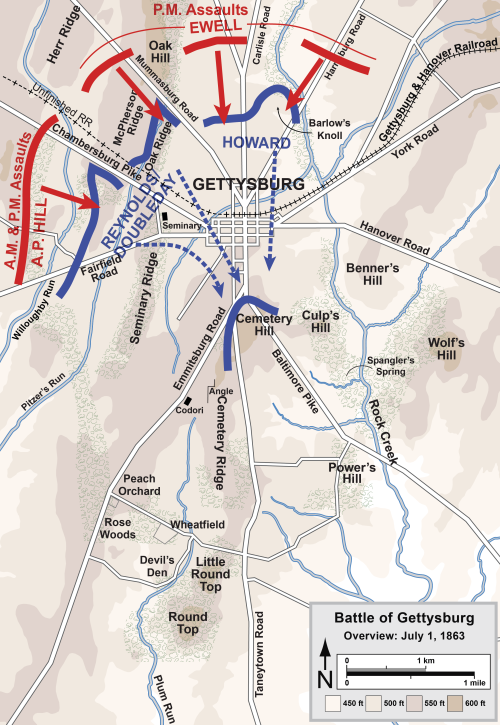
On the morning of July 1st, Hill ordered Harry Heth to advance his division to Gettysburg without the benefit of cavalry support or reconnaissance and backing them up with Pender’s division. As they advanced the leading brigades under Brigadier General James Archer and Joseph Davis met Federal forces. Heth became embroiled in a fight with Buford’s cavalry, which developed into a fight with Reynolds’s I Corps, a fight that resulted in Heth’s division being mauled and helping to bring a general engagement. That engagement drew in Ewell’s corps as well before Lee knew what was happening.

Lee had a number of chances to prevent the meeting engagement that developed on July 1st 1863. Lee noted in his after action report that “It had not been intended to deliver a general battle so far from our base unless attacked…” [36] but there are no records of him giving such instructions prior to the battle. There are no reports indicating that he urged caution on his commanders not to bring on a general engagement before July 1st, when the battle was already underway, nor are there records of any warning orders to his corps commanders upon learning of the presence of the Federal army north of the Potomac.

In the end of the day it was Lee’s “laxness with respect to reconnaissance and his lack of control of Hill’s movements caused him to stumble into battle.[37] The battle began without him knowing it; his subordinate commanders committed nearly half of his army into battle before he issued an order, Lee wrote “A battle had, therefore, become in a measure unavoidable….” [38] But such is not the case.
(Gburg day one)

Lee arrived early enough in the battle to make his influence known. He was told of Ewell’s movements by Major G. Campbell Brown of Ewell’s staff and instructed Brown in very strong terms to tell Ewell “that a general engagement was to be avoided until the arrival of the rest of the army.” [39] Ewell, did not get that message until after his forces were heavily committed noting in his report “that By the time this message reached me….It was too late to avoid an engagement without abandoning the position already taken up.” [40]

Lee was not happy that battle had been joined by Heth and Taylor observed that “on arriving at the scene of the battle, General Lee ascertained that the enemy’s infantry and artillery were present in considerable force” [41] and when Lee arrived on Herr Ridge, Heth asked permission to renew his attack when Rodes entered the fight. Lee’s initial response was negative “No, I am not prepared to bring on a general engagement today. Longstreet is not up.” [42]

After observing the battle for a time it became evident that Ewell’s corps was also heavily engaged and Lee began to change his mind. Heth reported that the Federal troops in front of him were withdrawing and Lee sensed an opportunity to strike a blow that might bring the climactic victory that he sought. Lee analyzed the situation and with Heth back at his division Heth wrote that “very soon an aide came to me with the orders to attack.” [43]

The order was given in the heat of the moment, and Lee always aggressive responded, but it was a bad decision. “It committed him to a major confrontation on this ground…without sufficient troops on hand and without knowledge of the whereabouts of the rest of the Federal army,” [44] and Lee knew this. He told Anderson at Cashtown not long before- meeting Heth: “I am in ignorance of what we have in front of us here. It may be the whole Federal army, or it may be only a detachment. If it is the whole Federal force we must fight a battle here.” But he was worried, telling Anderson “If we do not gain a victory, those defiles and gorges which we passed through this morning will shelter us from disaster.” [45]

Despite the success that his soldiers we now enjoying as they drove the I Corps and XI Corps back through the town Lee gave yet another vague order. This one to Ewell, who having already committed his corps to battle in the full knowledge that Lee did not desire a general engagement was confronted with another discretionary order, Lee said “General Ewell was…instructed to carry the hill occupied by the enemy, if he found it practicable, but to avoid a general engagement until the arrival of the other divisions of the army.” [46]

The Army of Northern Virginia came very close to sweeping Federal forces from the field on July 1st in spite of Lee’s lack of planning and clear commanders’ intent. But close was not enough. His forces which were committed in a piecemeal manner were unable to follow up their initial success. The situation faced by Ewell in Gettysburg was chaotic; his units were badly disorganized, and burdened by thousands of prisoners on the confided streets of the town. Rodes’ division had sustained frightful losses and he had no assurance of support from Hill. [47] Rodes’ after battle report supported Ewell’s decision. He wrote that before “the completion of his defeat before the town the enemy had begun to establish a line of battle on the heights back of the town, and by the time my line was in condition to renew the attack, he displayed quite a formidable line of infantry and artillery immediately in my front, extending smartly to my right, and as far as I could see to my left in front of Early.”[48]

Lee’s orders to Ewell, to take the high ground “if practicable” were correctly interpreted by Ewell despite his critics; he nature of the terrain, the number and condition of the troops that he had available for an attack, and the nature of the orders given by Lee late in the day was strong factors for Ewell to not attack. [49] Coddington noted that these problems “upset Ewell, for he was faced with the prospect of organizing a new attack with tired men even while he felt constrained by Lee’s injunction not to open a full-fledged battle. No wonder he was uncertain!” [50]The fact that Lee was not far away and did not issue a “peremptory order to Ewell” to attack also has to be noted. [51] If Lee had sensed that Ewell was not going to attack and really wanted him to he could have issued a direct order which Ewell, would have surely obeyed. “Lee realized that Ewell was not Jackson…and should have modified his method of command accordingly.” [52]

That evening Lee rode to Ewell’s headquarters and met with Ewell, Early and Rodes. “No reference was made to the possibility of an attack that evening on Cemetery Hill.” The question was put to them about what to do the next day. Lee asked “Can’t you with your corps attack on this flank tomorrow?” Jubal Early answered for Ewell saying “flatly that he did not believe an attack should be made from Gettysburg against Cemetery Hill the next day.” [53] Early added, “even if such an action were to succeed… it would be at a very great cost.” [54] Lee suggested to Ewell and his commanders that Second Corps around to the right along Seminary Ridge “where it might be better put to use, and twice he gave in to Ewell’s pleadings to remain where he was.” [55] This was yet another mistake that would haunt Lee during the rest of the battle, but the “notion of imposing his will on a subordinate was simply too alien to Lee’s nature for him to even to admit as a possibility.” [56] Fuller wrote “it was Lee’s inexhaustible tact that ruined his army.” [57]

Whether Lee intended to engage the Army of the Potomac at Gettysburg so early in the campaign is debated. His multiple and contradictory strategic aims left his commanders acting much on their own. Lee’s lack of clear commander’s intent to his subordinate commanders created confusion on the battlefield. They also paved the way to many controversies in the years following the war as Southerners sought to explain the failure of the Lost Cause, for which Lee could not be blamed.

Much of the controversy comes from Lee’s own correspondence which indicates that he might have not fully understood his own intentions. Some correspondence indicates that Lee desired to avoid a general engagement as long as possible while other accounts indicate that he wanted an early and decisive engagement. The controversy was stoked after the war by Lee’s supporters, particular his aides Taylor and Marshall and generals Early, Gordon and Trimble. Men like Longstreet and were castigated by Lee’s defenders for suggesting that Lee made mistakes on the battlefield.

The vagueness of Lee’s instructions to his commanders led to many mistakes and much confusion during the battle. Many of these men were occupying command positions under him for the first time and were unfamiliar with his command style. Where Stonewall Jackson might have understood Lee’s intent, even where Lee issued vague or contradictory orders, many others including Hill and Ewell did not. Lee did not change his command style to accommodate his new commanders.

That lack of flexibility and inability to clearly communicate Lee’s intent to his commanders and failure to exercise control over them proved fatal to his aims in the campaign. Stephen Sears’ scathing analysis of Lee’s command at Gettysburg perhaps says it the best. In the final analysis, it was Robert E. Lee’s inability to manage his generals that went to the heart of the failed campaign.” [58]

The vagueness of Lee’s intent was demonstrated throughout the campaign and was made worse by the fog of war. Day one ended with a significant tactical victory for Lee’s army but without a decisive result which would be compounded into a strategic defeat by Lee’s subsequent decisions on the 2nd and 3rd of July.

Notes:

[1] Taylor, Walter. General Lee: His campaigns in Virginia 1861-1865 With Personal Reminiscences University of Nebraska Press, Lincoln Nebraska and London, 1994 previously published 1906 p.45

[2] Ibid. Taylor General Lee: His campaigns in Virginia 1861-1865 With Personal Reminiscences p.25

[3] Lee, Robert Edward. Recollections and Letters of General Robert E Lee A Public Domain book, Amazon Kindle edition location 548

[4] Taylor, John M. Duty Faithfully Performed: Robert E Lee and His CriticsBrassey’s, Dulles VA 1999 p.35


[5] Fuller, J.F.C. Grant and Lee: A Study in Personality and Generalship, Indiana University Press, Bloomington IN 1957 p.112

[6] Korda, Michael. Clouds of Glory: The Life and Legend of Robert E. Lee Harper Collins Publishers, New York 2014 p.348

[7]Tucker, Glenn. High Tide at Gettysburg, The Bobbs Merrill Co. Indianapolis Indiana 1958 p.24

[8] Ibid. Fuller Grant and Lee: A Study in Personality and Generalship p.125

[9] Weigley, Russell F. The American Way of War: A History of United States Military History and Policy University of Indiana Press, Bloomington IN, 1973 p.116

[10] Ibid. Korda, Michael. Clouds of Glory: The Life and Legend of Robert E. Lee p.446

[11] Sears, Stephen W. Gettysburg. Houghton Mifflin Co. Boston and New York 2003 p. 139

[12] Taylor, Walter Four Years with General Lee Original published 1877. Heraklion Press Kindle Edition 2013 location 1199

[13] Freeman, Douglas Southall, Lee’s Lieutenant’s a Study in Command, One volume abridgement by Stephen W Sears, Scribner, New York 1998 pp.554-555

[14] Ibid. Freeman Lee’s Lieutenant’s a Study in Command, p.552

[15] Nolan, Alan T. R. E. Lee and July 1 at Gettysburg in the First Day at Gettysburg edited by Gallagher, Gary W. Kent State University Press, Kent Ohio 1992 p.16

[16] McClellan, Henry Brainerd The Life and Campaigns of Major General J.E.B. Stuart Commander of the Cavalry of the Army of Northern Virginia 1885. Digital edition copyright 2011 Strait Gate Publications, Charlotte NC location 6123 unfortunately this letter cannot be verified as no copy exists, McClellan presuming that it was destroyed sometime during the march.

[17] Dowdy, Clifford. Lee and His Men at Gettysburg: The Death of a Nation Skyhorse Publishing, New York 1986, originally published as Death of a Nation Knopf, New York 1958 p.60

[18] Lee, Robert E. Reports of Robert E Lee, C.S. Army, Commanding Army of Northern Virginia Campaign Report Dated January 20th 1864. Amazon Kindle Edition location 503

[19] Davis, Burke JEB Stuart: The Last Cavalier Random House, New York 1957 p. 325

[20] Coddington, Edwin B. The Gettysburg Campaign: A Study in Command, A Touchstone Book, Simon and Schuster New York, 1968 p.183

[21] Ibid. Coddington The Gettysburg Campaign: A Study in Command p.189

[22] Ibid. Sears Gettysburg p. 134

[23] Tredeau, Noah Andre. Gettysburg: A Testing of Courage, Harper Collins Publishers, New York 2002 p.124

[24] Ibid. Sears Gettysburg p. 134

[25] Ibid. Tredeau, Gettysburg: A Testing of Courage, p.124

[26] Ibid. Sears Gettysburg p. 134

[27] Ibid. Coddington The Gettysburg Campaign: A Study in Command pp.189-190

[28] Ibid. Dowdy Lee and His Men at Gettysburg: The Death of a Nation p.99

[29] Foote, Shelby, The Civil War, A Narrative. Volume Two Fredericksburg to Meridian Random House, New York 1963 p. 464

[30] Ibid. Foote The Civil War, A Narrative. Volume Two Fredericksburg to Meridian p.464

[31] Pfanz Harry W. Gettysburg: The First Day University of North Carolina Press, Chapel Hill and London 2001 p.148

[32] Ibid. Coddington The Gettysburg Campaign: A Study in Command p.192

[33] Ibid. Pfanz Gettysburg: The First Day p.149

[34] Ibid. Sears Gettysburg p. 160

[35] Ibid. Coddington The Gettysburg Campaign: A Study in Command p.264

[36] Ibid. Lee Reports of Robert E Lee, C.S. Army, Commanding Army of Northern Virginia Campaign Report Dated January 20th 1864 location 552

[37]Ibid. Nolan R. E. Lee and July 1 at Gettysburg p.24

[38] Ibid. Lee Reports of Robert E Lee, C.S. Army, Commanding Army of Northern Virginia Campaign Report Dated January 20th 1864 location 552

[39] Ibid. Pfanz Gettysburg: The First Day p.150

[40] Ibid. NolanR. E. Lee and July 1 at Gettysburg p.22

[41] Ibid. Taylor General Lee: His campaigns in Virginia 1861-1865 With Personal Reminiscences p.188

[42] Ibid. Foote The Civil War, A Narrative. Volume Two Fredericksburg to Meridian p.475

[43] Ibid. Sears Gettysburg p. 203

[44] Ibid. NolanR. E. Lee and July 1 at Gettysburg p.24

[45] Ibid. Foote The Civil War, A Narrative. Volume Two Fredericksburg to Meridian p.474

[46] Freeman, Douglas Southall, Lee’s Lieutenant’s a Study in Command, One volume abridgement by Stephen W Sears, Scribner, New York 1998 p.571

[47] Gallagher, Gary. Confederate Corps Leadership on the First Day at Gettysburg: A.P. Hill and Richard S. Ewell in a Difficult Debut in The First Day at Gettysburg edited by Gallagher, Gary W. Kent State University Press, Kent Ohio 1992 pp.54-55

[48] Ibid. Nolan p.26

[49] Ibid. NolanR. E. Lee and July 1 at Gettysburg in the First Day at Gettysburg p.28

[50] Ibid. Coddington The Gettysburg Campaign: A Study in Command p.319

[51] Ibid. NolanR. E. Lee and July 1 at Gettysburg in the First Day at Gettysburg p.28

[52] Ibid Gallagher Confederate Corps Leadership on the First Day at Gettysburg p.56

[53] Ibid. Freeman Lee’s Lieutenant’s a Study in Command p.572

[54] Ibid. Tredeau, Gettysburg: A Testing of Courage, p.261

[55] Sears, Stephen W. Gettysburg. Houghton Mifflin Co. Boston and New York p.504

[56] Ibid. Tredeau, Gettysburg: A Testing of Courage, p.262

[57] Ibid. Fuller Grant and Lee: A Study in Personality and Generalship p.119

[58]Sears, Stephen W. Gettysburg. Houghton Mifflin Co. Boston and New York p.504
3 Comments

Filed under civil war, History, leadership, Military

Gettysburg Day One: Inexperience and Hubris Meets Calculating Experience; Harry Heth Blunders into Battle against John Buford

burford june 30th

Despite the warnings of Johnston Pettigrew, Major General Harry Heth with the approval and blessing of his corps commander Lieutenant General A.P. Hill arose on the morning of July 1st 1863 and formed his division for its march to Gettysburg. But it was an inauspicious start to a very bad day for Heth and his division. Somehow orders had not gotten to his units to begin the advance at 5 a.m. and “there was haste to the early morning’s preparations that caught some off guard” even regimental commanders. [1]

During the night Of June 30th 1863 the actions of A.P. Hill show a commander who confused and uncertain. The confidence that he and Heth showed in rejecting Pettigrew and Young’s reports of Federal troops in Gettysburg left “most, if not all the commanding officers in Hill’s corps…unprepared for what happened.” [2] Lieutenant Lewis Young wrote “I doubt if any of the commanders of brigades, except General Pettigrew, believed that we were marching to battle, a weakness on their part which rendered them unprepared for what was about to happen.” [3]

Hill sent a message to Ewell of Second Corps telling that officer that “I intended to advance the next morning and discover what was in my front” [4] and sent word of Pettigrew’s discovery of Union cavalry to Lee’s headquarters, but his warning apparently gave Lee little cause for concern. Porter Alexander noted that on the night of June 30th that he visited Lee’s headquarters and found conversation to be “unusually careless & jolly. Certainly there was no premonition that the next morning was to open a great battle of the campaign.” [5] Hill also sent a courier to Anderson instructing him to bring up his division on Jul 1st and instructed Heth that “Pender’s division also would be ordered through Cashtown as a reserve to be available if Heth ran into serious trouble.” [6]

Since a reconnaissance is normally conducted by small elements, the fact that Hill committed his two divisions present to such a mission demonstrated his confusion of both the nature of what he might face and to the intentions of Robert E. Lee. One has to remember that Lee, like his corps commanders was operating blind, in part due to Stuart’s absence but also due to the poor employment of the cavalry that should have been available to them. Hill and Heth had no idea what they faced at Gettysburg and disregarded the warnings of his own people. Thus it is hard to believe that Hill did not expect the possibility of action. Likewise it is distinctly possible that Heth, despite his orders “may have had more on his mind than shoes and information when he made his advance towards Gettysburg.” [7]

Several critics have made this point, among them Major John Mosby the Confederate cavalry leader and guerrilla fighter who wrote: “Hill and Heth in their reports, to save themselves from censure, call the first day’s action a reconnaissance; this is all an afterthought….They wanted to conceal their responsibility for the defeat.” [8] A more contemporary writer, Jennings Wise noted that Hill’s orders “were specific not to bring on an action, but his thirst for battle was unquenchable, and…he rushed on, and…took the control of the situation out of the hands of his commander-in-chief.” [9] Heth in later years made an unsubstantiated claim that “A courier came from Gen. Lee, with a dispatch ordering me to get those shoes even if I encountered some resistance.” [10] That appears unlikely as Mosby noted that no one ordered Hill to advance and Lee “would never have sanctioned it.” [11] Neither Lee or any of his staff collaborate Heth’s claim and the judicious Porter Alexander who had been in Lee’s headquarters the night of June 30th wrote that “Hill’s movement to Gettysburg was made on his own accord, and with knowledge that he would find the enemy’s cavalry in possession.” [12]

The advance to contact was marred by Heth’s inexperience compounded by the illness of A.P. Hill who on the morning of July 1st had “awakened feeling very ill, too sick to mount his horse…although no diagnosis was made, he was probably suffering from overstrained nerves.” [13] Hill’s absence left Heth, an inexperienced division commander “without any sage counsel” [14] and Heth began to commit a series of costly errors. Heth understood from Hill that his mission was a job that normally would be assigned to cavalry: “to ascertain what force was at Gettysburg, and if he found infantry opposed to him, to report the fact immediately, without forcing an engagement.” [15]

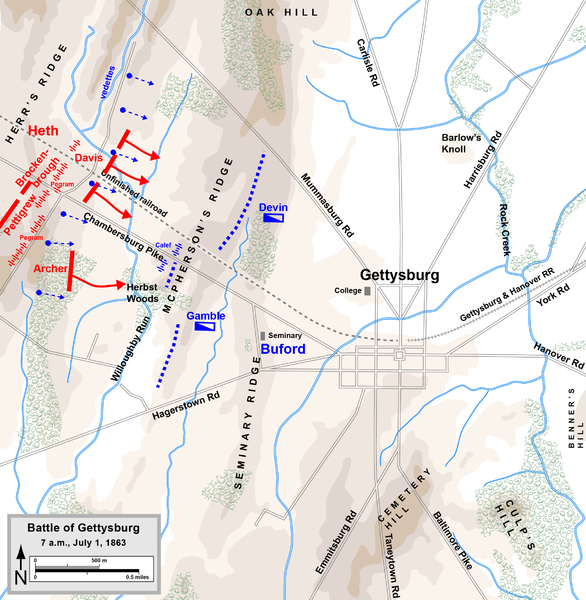
Heth advanced without the caution of a commander who had been told that enemy forces were likely opposing him. Even though he disbelieved the reports some amount of judicious caution should have been indicated. Instead, for reasons unknown Heth had his men advance as if they were conducting a routine movement. He led his advance with his assigned artillery battalion commanded by Major William Pegram. He followed with Archer’s veteran but depleted brigade and Davis’s inexperienced brigade. To compound Davis’s situation that commander led his movement with his new and untested regiments the 42nd Mississippi and 55th North Carolina leaving his veteran regiments the 2nd and 11th Mississippi in the rear guarding army stores. [16] It was a curious order of march for it left Johnston’s Pettigrew’s brigade behind both Archer and Davis’s brigades despite the fact that it was closer to Gettysburg than any other brigade and had recent eyes on contact with the enemy and knew the ground and what was ahead of them. Pettigrew’s brigade was followed by Colonel John Brockenbrough’s Virginia brigade. It is hard to know why Heth did this but one can speculate that it might have been because of Pettigrew’s insistence of the type of Federal forces in their front the previous day which caused Heth to do this.

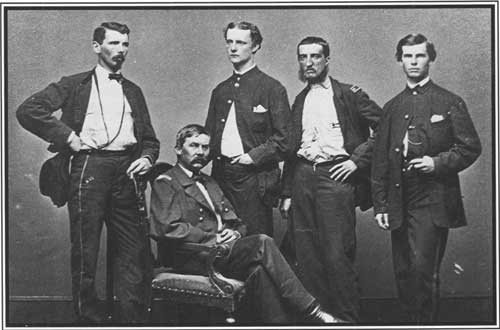
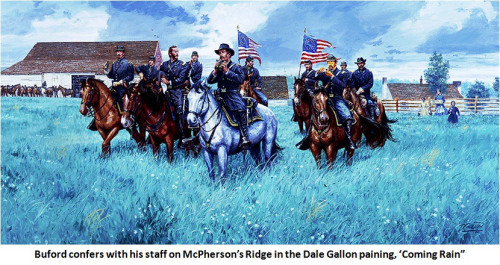
buford and staff

Buford and His Staff

As Heth’s troops advanced to Marsh Creek they encountered the cavalry videttes or pickets of the 8th Illinois Cavalry posted on the high ground just east of the creek. [17] The discovery of these forces was unanticipated by the Confederates leading the column. One of Pegram’s gunners recalled: “We moved forward leisurely smoking and chatting as we rode along, not dreaming of the proximity of the enemy.” [18] Most assumed that the movement “was simply one more part of the army’s concentration of forces” and Brockenbrough told the commander of the 55th Virginia that “we might meet some of Ewell’s command or Stuarts.” [19] Pettigrew had attempted to warn Archer prior to the march of the topography of the area and “a certain road which the Yankees might use to hit his flank, and the dangers of McPherson’s Ridge. Archer listened, believed not, marched on unprepared…” [20] Heth, who should have better anticipated the situation based on Pettigrew’s reports of the previous day demonstrated why one author called him “an intellectual lightweight.” [21] Heth told an officer from the Army of the Potomac after the war “I did not know any of your people were north of the Potomac.” [22]

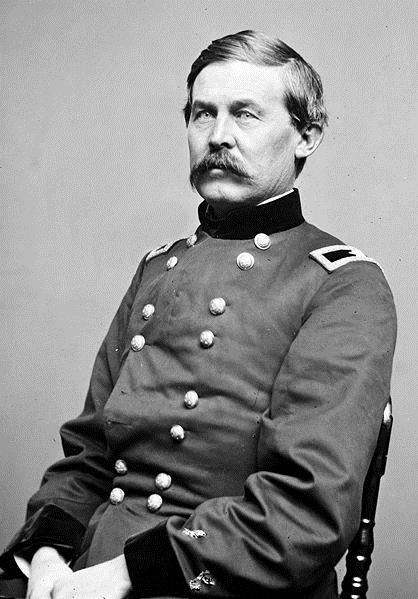
If Heth was inexperienced and knew little of the Federal forces arrayed before him and what forces were moving towards Gettysburg, his opponent, Brigadier General John Buford was his opposite in nearly every respect. Buford was born in Kentucky and came from a long line of family who had fought in both the Revolutionary War and War of 1812. He was an 1848 graduate of West Point who was commissioned in the Dragoons but too late to serve in Mexico. Instead he served on the Great Plains against the Sioux and on peacekeeping duty in the bitterly divided State if Kansas. Later he served in the Utah War in 1858. His family held Southern sympathies; his father was a Democrat who had opposed Abraham Lincoln.

buford

At the beginning of the war, the governor of Kentucky offered Buford a commission in that states’ militia. At the time Kentucky was still an “undeclared border slave state” and Buford loyal to his oath refused and wrote later “I sent him word that I was a Captain in the United States Army and I intend to remain one.” [23] However his southern ties kept him from field command until the politically well connected by ill-fated, Major General John Pope “could unreservedly vouch for his loyalty wrangled for him command of a brigade of cavalry.” [24] After Pope’s defeat at Second Bull Run in August 1862 Buford returned to staff duties until January 1863 when he was again given a brigade.

Buford was passed over by Hooker for command of the new cavalry corps in favor of Alfred Pleasanton who was eleven days his senior when Hooker reorganized the army before Chancellorsville. In later years Hooker agreed that Buford “would have been a better man for the position of chief” [25] for the Cavalry Corps, but in retrospect Buford’s passover for corps command was good fortune for the Army of the Potomac on June 30th and July 1st 1863. Despite being passed over, Buford a consummate professional, fought well at Brandy Station for which he was recommended for promotion and command of his division. [26]

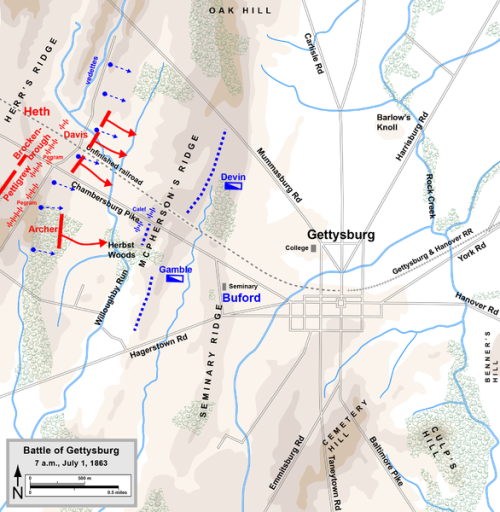
On the night of June 30th Buford prepared for battle. Unlike Hill and Heth he understood exactly what he was facing. He met with “reliable men” most likely from the Bureau of Military Intelligence operated by David McConaughy as to the composition of Lee’s forces. [27] Buford knew his business; he took the time to reconnoiter the ridges west of Gettysburg and posted videttes as far was as Marsh Creek. He deployed one brigade under Colonel Thomas Devin to the north and west of the town, Colonel William Gamble’s brigade was deployed to the west, its main line being on McPherson’s ridge. Buford planned “a defense in depth, fighting his men dismounted, using the series of ridgelines west of Gettysburg to hamper and delay the Rebel infantry he was certain would come “booming along” the Chambersburg Pike in the morning.” [28]

Noting that the ground was favorable to defense and giving battle Buford sent messages to Reynolds as to the situation. He warned Reynolds that “A.P. Hill’s corps is massed just back of Cashtown, about 9 miles from this place.” He also noted the location of Confederate pickets only four miles west of Gettysburg.” [29] Devin’s troops also identified elements of Ewell’s corps north of the town. Buford had accurately informed his superiors of what was before him, information that they needed for the day of battle.

gburg delaying action

According to his signals officer, Buford spent the night “anxious, more so than I ever saw him” [30] He discussed the situation with Devin who did not believe that the Confederates would move on Gettysburg in the morning. Devin thought if there were any threats that “he could handle anything that could come up in the next 24 hours.” [31] Buford rejected Devin’s argument and told him “No you won’t…. They will attack you in the morning and they will come booming – skirmishers three deep. You will have to fight like the devil to hold your own.” [32]

Reynolds, seeing the importance of the position elected to fight. He “ordered Buford to hold onto it to the last” believing that if Buford could “buy enough time, he might get his infantry into line “before the enemy should seize the point.” [33]

As Archer and Davis’s troops advanced in the early hours of July 1st their march was uneventful until they reached Marsh Creek. There they encountered the men of the 8th Illinois, one of whom, Lieutenant Marcellus Jones, took a carbine from one of his sergeants saying “Hold on George, give me the honor of opening this ball” and at about 7:30 a.m. Jones fired the first shot of the battle of Gettysburg. [34]

Heth had wanted to advance in column as long as possible “but the Yankee cavalry’s stiff resistance had ended that hope.” [35] Heth rode forward and ordered Archer and Davis’s troops to advance skirmishers with the support of Pegram’s artillery. This slowed the Confederate advance considerably. Heth wrote in his after action report that “it became evident that there were infantry, cavalry and artillery in and around the town.” [36] But instead of “feeling out the enemy” as directed by Hill, Heth “ordered Archer and Davis “to move forward and occupy the town.” [37] A chaplain in Brockenbrough’s brigade reported that one of Heth’s aide’s came up and reported “General Heth is ordered to move on Gettysburg, and fight or not as he wishes.” The chaplain heard one of the officers near him say “We must fight them; no division general will turn back with such orders.” [38]

The fight that Harry Heth and A.P. Hill had been directed not to precipitate was now on. Heth’s inexperience more than matched by the cunning and brilliant Buford, whose troopers now fought a masterful delaying action which enabled Reynolds to come up.
Notes

[1] Tredeau, Noah Andre. Gettysburg: A Testing of Courage, Harper Collins Publishers, New York 2002 p.153

[2] Coddinton, Edwin B. The Gettysburg Campaign, A Study in Command A Touchstone Book, Simon and Shuster New York 1968 p.264

[3] Pfanz Harry W. Gettysburg: The First Day University of North Carolina Press, Chapel Hill and London 2001 p.51

[4] Gallagher, Gary. Confederate Corps Leadership on the First Day at Gettysburg: A.P. Hill and Richard S. Ewell in a Difficult Debut in The First Day at Gettysburg edited by Gallagher, Gary W. Kent State University Press, Kent Ohio 1992 p.44

[5] Ibid. Coddington The Gettysburg Campaign, A Study in Command p.264

[6] Dowdy, Clifford. Lee and His Men at Gettysburg: The Death of a Nation Skyhorse Publishing, New York 1986, originally published as Death of a Nation Knopf, New York 1958 pp. 92

[7] Ibid. Coddington The Gettysburg Campaign, A Study in Command p.274

[8] Ibid. Gallagher Confederate Corps Leadership on the First Day at Gettysburg p.32

[9] Ibid. Gallagher Confederate Corps Leadership on the First Day at Gettysburg p.32

[10] Ibid. Tredeau Gettysburg: A Testing of Courage, p.153

[11] Ibid. Gallagher Confederate Corps Leadership on the First Day at Gettysburg p.32

[12] Alexander, Edward Porter Military Memoirs of a Confederate: A Critical Narrative 1907 republished 2013 by Pickle Partners Publishing, Amazon Kindle Edition location 7342 of 12968

[13] Dowdy.Lee and His Men at Gettysburg: The Death of a Nation pp.91-92

[14] Ibid. Tredeau Gettysburg: A Testing of Courage, p.153

[15] Guelzo, Allen C. Gettysburg: The Last Invasion Vintage Books a Division of Random House, New York 2013 p.131

[16] Ibid. Tredeau Gettysburg: A Testing of Courage, p.156

[17] Pfanz. Gettysburg: The First Day p.53

[18] Sears, Stephen W. Gettysburg. Houghton Mifflin Co. Boston and New York 2003 p. 162

[19] Ibid. Guelzo. Gettysburg: The Last Invasion p.134

[20] Ibid. Coddington The Gettysburg Campaign, A Study in Command p.264

[21] Ibid. Guelzo. Gettysburg: The Last Invasion p.134

[22] Ibid. Sears Gettysburg p. 162

[23] Ibid. Guelzo. Gettysburg: The Last Invasion p.121

[24] Ibid. Guelzo. Gettysburg: The Last Invasion p.121

[25] Ibid. Coddington The Gettysburg Campaign, A Study in Command p.44

[26] Ibid. Coddington The Gettysburg Campaign, A Study in Command p.64

[27] Ibid. Tredeau Gettysburg: A Testing of Courage, p.141

[28] Ibid. Sears Gettysburg p. 157

[29] Ibid. Guelzo. Gettysburg: The Last Invasion p.122

[30] Ibid. Sears Gettysburg p. 157

[31] Catton, Bruce The Army of the Potomac: Glory Road Doubleday and Company, Garden City New York, 1952 p.266

[32] Ibid. Guelzo. Gettysburg: The Last Invasion p.123

[33] Ibid. Guelzo. Gettysburg: The Last Invasion pp.122-123

[34] Pfanz. Gettysburg: The First Day p.53

[35] Ibid. Sears Gettysburg p. 163

[36] Luvaas, Jay and Nelson Harold W editors. The U.S. Army War College Guide to the Battle of Gettysburg South Mountain Press, Carlisle PA 1986 p.7

[37] Ibid. Sears Gettysburg p. 165

[38] Ibid. Tredeau Gettysburg: A Testing of Courage, p.163

Leave a comment

Filed under civil war, History, leadership, Military

“A Spirit of Unbelief”: A.P. Hill, Harry Heth and the Prelude to the Battle of Gettysburg

Hill.28135413_stdLieutenant General A.P. Hill

Note: One of the most important things to understand about the Battle of Gettysburg or for that matter any battle or campaign is leadership as well as organizational structure and climate of command. The study of A.P. Hill’s Third Corps is important to understanding how the battle unfolds and what happens at Gettysburg particularly on July 1st. In our understanding “Successful mission command demands that subordinate leaders at all echelons exercise disciplined initiative, acting aggressively and independently to accomplish the mission. Essential to mission command is the thorough knowledge and understanding of the commander’s intent at every level of command.”

While the leaders at Gettysburg on both sides would be unaware of our present definition they certainly would have been acquainted with the maxims of Napoleon, who many studied under Dennis Hart Mahan at the West Point. Napoleon noted: “What are the conditions that make for the superiority of an army? Its internal organization, military habits in officers and men, the confidence of each in themselves; that is to say, bravery, patience, and all that is contained in the idea of moral means.”

Likewise in a maxim that has direct application to the Confederate campaign in Pennsylvania Napoleon noted “To operate upon lines remote from each other and without communications between them, is a fault which ordinarily occasions a second. The detached column has orders only for the first day. Its operations for the second day depend on what has happened to the main body. Thus according to circumstances, the column wastes its time in waiting for orders or it acts at random….” [1]

I have spent more time in this chapter developing the issues of organization, leadership, climate of command and relationships between leaders because of their importance to the campaign. From these students should be able to draw lessons that would be applicable to leadership, organization and campaigning at the operational level of war.

As the Army of Northern Virginia began to concentrate near Cashtown after the reports that the Army of the Potomac was in Maryland it was Lieutenant General A.P. Hill’s Third Corps that was nearest to Gettysburg. Major General Harry Heth’s division led the corps and arrived on June 29th followed by Major General Dorsey Pender’s division on the 30th. Hill ordered his last division under the command of Major General Richard Anderson to remain behind and join the corps on July 1st. [2]

On the 30th Harry Heth sent Johnston Pettigrew’s Brigade to Gettysburg to “search the town for army supplies (shoes especially), and to return the same day.” [3] It was the first in a series of miscalculations that brought Lee’s army into a general engagement that he wished to avoid.

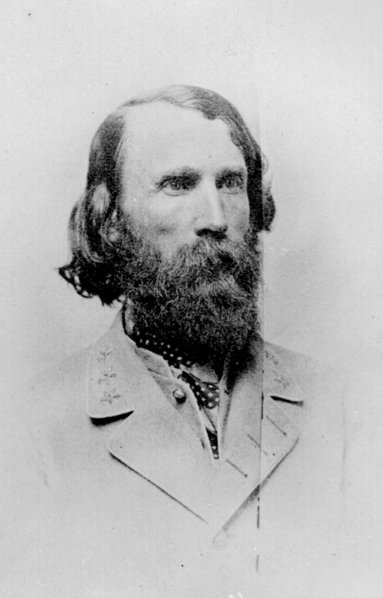
The Confederate Third Corps commanded by Lieutenant General Ambrose Powell (A.P.) Hill had been formed as part of the reorganization of the army following Stonewall Jackson’s death after the Battle of Chancellorsville. Hill had a stellar reputation as a division commander; his “Light Division” had distinguished itself on numerous occasions, especially at Antietam where its timely arrival after a hard forced march from Harper’s Ferry helped save Lee’s army late in the battle. At Chancellorsville Hill briefly succeeded Jackson until he too was wounded.

But that being said Hill was no stranger to controversy, beginning with a clash with James Longstreet during the Seven Days battles in which time Longstreet placed Hill under arrest and Hill challenged Longstreet to a duel. Lee quickly reassigned Hill to Jackson’s command as Jackson was operating in a semi-independent assignment. [4] Hill was in an intractable controversy with Stonewall Jackson for nearly a year until Jackson succumbed to his wounds. Jackson at one point during the invasion of Maryland prior to Antietam had Hill placed under arrest for the number of stragglers that he observed in Hill’s hard marching division as well as other errors that Jackson believed Hill had made. The dispute continued and the animosity deepened between the two men and in January 1863 Hill asked Lee for a trial by courts-martial on charges preferred against him by Jackson. Lee refused this and wrote to Hill: “Upon examining the charges in question, I am of the opinion that the interests of the service do not require that they be tried, and therefore, returned them to General Jackson with an indorsement to that effect….” [5] Just before Chancellorsville Jackson wrote to Lee “I respectfully request that Genl. Hill be relieved of duty in my Corps.” This time Lee simply ignored the request and though the two generals remained at loggerheads they also remained at their commands at Chancellorsville. [6]

Hill was recommended for promotion to Lieutenant General and command of the new Third Corps by Lee on May 24th and was promoted over the heads of Harvey Hill and Lafayette McLaws. The move displeased Longstreet who considered McLaws “better qualified for the job” and but who felt that the command should have gone to Harvey Hill whose “record was as good as that of Stonewall Jackson…but, not being a Virginian, he was not so well advertised.” [7]

Hill was slightly built and high strung. “Intense about everything” Hill was “one of the army’s intense disbelievers in slavery.” [8] Hill was an 1847 graduate of West Point and briefly served in Mexico but saw no combat. He spent some time in the Seminole wars and in garrison duty along the East Coast, spending 1855-1860 in the Coastal Survey and resigned his commission before Virginia’s secession. At the outbreak of the war he “received his commission as colonel, and soon trained one of Johnston’s best regiments in the Valley.” [9] He commanded a brigade under Longstreet on the Peninsula and was promoted to Major General and command of a division in May 1862. He was plagued by health problems which had even delayed his graduation from West Point, health issues that would arise on the first day at Gettysburg.

Hill’s Third Corps was emblematic of the “makeshift nature of the reorganization of the whole army.” [10] It was composed of three divisions; the most experienced being that of the recently promoted and hard fighting Major General Dorsey Pender. Pender’s division, was built around four excellent brigades from Hill’s old “Light Division” one of which Pender had commanded before his promotion. Hill strongly recommended Pender’s promotion which was accepted by Lee. Pender found the command to be a heavy burden. He was “an intelligent, reflective man, deeply religious and guided by a strong sense of duty….” [11]

Hill’s second experienced division was that of Major General Richard Anderson, transferred from Longstreet’s First Corps, something else which failed to endear Hill to Longstreet. [12] The unassuming Anderson had distinguished himself as a brigade and division commander in Longstreet’s corps, but in “an army of prima donnas, he was a self-effacing man, neither seeking praise for himself nor winning support by bestowing it on others.” [13] At Chancellorsville he fought admirably and Lee wrote that Anderson was “distinguished for the promptness, courage and skill with which he and his division executed every order.” [14] With four seasoned brigades under excellent commanders it was a good addition to the corps, although the transition from Longstreet’s stolid and cautious style of command to Hill’s impetuous style introduced “another incalculable of the reshuffled army.” [15]

heth

Major General Harry Heth

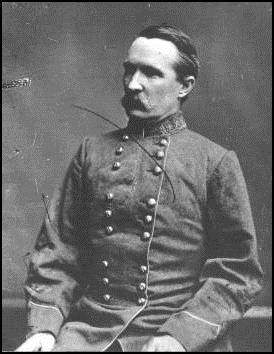
Major General Harry Heth’s division was the final infantry division assigned to the corps. This division was recently formed from two brigades of Hill’s old Light Division and “the two new brigades that Jefferson Davis had forced on an already disrupted army organization.” [16] The organization of this division as well as its leadership would be problematic in the days to come, especially on June 30th and July 1st 1863.

Heth like Pender was also newly promoted to his grade and the action at Gettysburg would be his first test in division command. Heth was a native Virginian, well connected politically who through his social charm had “many friends and bound new acquaintances to him” readily. [17] Heth was a West Point graduate who had an undistinguished academic career graduating last in the class of 1847. His career in the ante-bellum army was typical of many officers, he served “credibly in an 1855 fight with Sioux Indians” but his real claim to fame was in authoring the army’s marksmanship manual which was published in 1858. [18]

Heth’s career with the Confederate army serving in western Virginia was undistinguished but he was a protégé of Robert E. Lee who recommended him as a brigade commander to Jackson before Chancellorsville. Tradition states that of all his generals that Heth was the only one “whom Lee called by his first name.” [19] A.P. Hill when writing Lee about the choice of a successor for the Light Division noted that Heth was “a most excellent officer and gallant soldier” but in the coming campaign “my division under him, will not be half as effective as under Pender.” [20] Douglas Southall Freeman noted that Heth was “doomed to be one of those good soldiers…who consistently have bad luck.” [21]

Heth’s division was composed of two depleted brigades from the Light Division which had taken heavy casualties at Chancellorsville. The brigade commanded by James Archer from Alabama and Mississippi was “well led and had a fine combat reputation.” But the second brigade was more problematic. A Virginia brigade it had once been considered one of the best in the army had deteriorated in quality following the wounding of its first commander Brigadier General Charles Field. Heth took command of it at Chancellorsville and both he and the brigade performed well, but when Heth was promoted the lack of qualified officers left it under the command of its senior colonel, John Brockenbrough. [22] His third brigade came from Mississippi and North Carolina and was commanded by Brigadier General Joe Davis whose uncle was President Jefferson Davis. Davis had served on his uncle’s staff for months and had no combat experience. [23] One author noted that Davis’s promotion to Brigadier General “as unadulterated an instance of nepotism as the record of the Confederacy offers.” [24] His subordinate commanders were no better, one William Magruder was so bad that J.E.B. Stuart suggested that “he have his commission revoked” and only one of the nine field grade officers in his brigade had military training, and that from the Naval Academy. [25]

pettigrew

Brigadier General Johnston Pettigrew

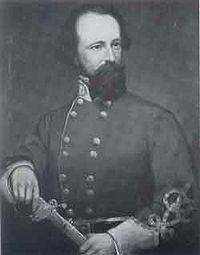
Heth’s largest brigade was new to the army. Commanded by the North Carolina academic Johnston Pettigrew it had no combat experience though Pettigrew was considered a strong leader, badly wounded at Seven Pines and thinking his wound mortal “he refused to permit his men to leave the ranks to carry him to the rear” [26] and was captured but later paroled and returned to the army later in the year.

Hill was under the impression that Meade’s army was still miles away, having just come from meeting Lee who assured him that “the enemy are still at Middleburg,” (Maryland) “and have not yet struck their tents.” [27] With that assurance Heth decided to use June 30th to send Pettigrew’s brigade on the foraging expedition to Gettysburg. An officer present noted that Heth instructed Pettigrew “to go to Gettysburg with three of his regiments present…and a number of wagons for the purpose of collecting commissary and quartermaster stores for the use of the army.” [28]

However Heth did instruct Pettigrew in no uncertain terms not to “precipitate a fight” should he encounter “organized troops” of the Army of the Potomac. [29] Heth was specific in his report that “It was told to Pettigrew that he might find in the town in possession of a home guard,…but if, contrary to expectations, he should find any organized troops capable of making resistance., or any part of the Army of the Potomac, he should not attack it.” [30]

That in mind one has to ask the question as to why Heth would employ “so many men on a long, tiring march, especially as without a cavalry escort he took the risk of sending them into a trap” when his “objects hardly justified” using such a large force. [31] Likewise it has to be asked why the next day in light of Lee’s standing orders not to provoke an engagement that Hill would send two divisions, two thirds of his corps on a reconnaissance mission. Some have said that Hill would have had to move to Gettysburg on July 1st anyway due to forage needs of the army, [32] but this is not indicated in any of Hill or Heth’s reports.

As his troops neared Gettysburg Pettigrew observed the Federal cavalry of Buford’s 1st Cavalry Division as they neared the town. He received another report “indicating that drumming could be heard in the distance – which might mean infantry nearby, since generally cavalry generally used only bugles.” [33] He then prudently and in accordance with his orders not to precipitate a fight “elected to withdraw rather than risk battle with a foe of unknown size and composition.” [34] His troops began their retrograde at 11 a.m. leaving Buford’s cavalry to occupy the town at ridges. On Confederate wrote “in coming in contact with the enemy, had quite a little brush, but being under orders not to bring a general engagement fell back, followed by the enemy.” [35]

Upon returning Pettigrew told Hill and Heth that “he was sure that the force occupying Gettysburg was a part of the Army of the Potomac” but Hill and Heth discounted Pettigrew’s report. [36] “Heth did not think highly of such wariness” and “Hill agreed with Heth” [37] Hill believed that nothing was in Gettysburg “except possibly a cavalry vidette.” [38] Hill was not persuaded by Pettigrew or Pettigrew’s aide Lieutenant Louis Young who had previously served under Hill and Pender who reported that the “troops that he saw were veterans rather than Home Guards.” [39] Hill reiterated that he did not believe “that any portion of the Army of the Potomac was up” but then according to Young Hill “expressed the hope that it was, as this was the place he wanted it to be.” [40] The West Point Graduates Hill and Heth may have manifested an often typical “distain for citizen soldiers…a professional questioning a talented amateur’s observations” [41] If so it was a distain that would cost the Confederacy dearly in the days to come.

Pettigrew was “aghast at Hill’s nonchalant attitude” [42] and Young was dismayed and later recalled that “a spirit of unbelief” seemed to cloud their thinking. [43] In later years he wrote “blindness in part seems to have come over our commanders, who slow to believe in the presence of an organized army of the enemy, thought that there must be a mistake in the report taken back by General Pettigrew.” [44]

Heth then asked Hill since neither believed Pettigrew’s report “whether Hill would have any objection to taking his division to Gettysburg again to get those shoes. Hill replied “none in the world.” [45] Douglas Southall Freeman wrote “On those four words fate hung” [46] and then, in “that incautious spirit, Hill launched Harry Heth’s division down the Chambersburg Pike and into battle at Gettysburg.” [47]

Notes

[1] Napoleon Bonaparte, Military Maxims of Napoleon in Roots of Strategy: The Five Greatest Military Classics of All Time edited by Phillips, Thomas R Stackpole Books Mechanicsburg PA 1985 p.410

[2] Coddinton, Edwin B. The Gettysburg Campaign, A Study in Command A Touchstone Book, Simon and Shuster New York 1968 p.194

[3] Ibid. Coddinton, The Gettysburg Campaign, A Study in Command p. 263

[4] Dowdy, Clifford. Lee and His Men at Gettysburg: The Death of a Nation Skyhorse Publishing, New York 1986, originally published as Death of a NationKnopf, New York 1958 p.81

[5] Freeman, Douglas Southall, Lee’s Lieutenant’s a Study in Command, One volume abridgement by Stephen W Sears, Scribner, New York 1998 p.460

[6] Sears, Stephen W. Chancellorsville A Mariner Book, Houghton and Mifflin Company, Boston and New York 1996 p.51

[7] Foote, Shelby, The Civil War, A Narrative. Volume Two Fredericksburg to Meridian Random House, New York 1963 p.453

[8] Ibid. Dowdy, Lee and His Men at Gettysburg: The Death of a Nation p.79

[9] Ibid. Freeman Lee’s Lieutenant’s a Study in Command p.109

[10] Ibid. Dowdy, Lee and His Men at Gettysburg: The Death of a Nation p.88

[11] Ibid. Dowdy, Lee and His Men at Gettysburg: The Death of a Nation p.85

[12] Ibid. Dowdy, Lee and His Men at Gettysburg: The Death of a Nation p.86

[13] Ibid. Dowdy, Lee and His Men at Gettysburg: The Death of a Nation p.86

[14] Ibid. Freeman Lee’s Lieutenant’s a Study in Command p.512

[15] Ibid. Dowdy, Lee and His Men at Gettysburg: The Death of a Nation p.86

[16] Ibid. Dowdy, Lee and His Men at Gettysburg: The Death of a Nation p.87

[17] Ibid. Freeman Lee’s Lieutenant’s a Study in Command p.527

[18] Krick, Robert K. Three Confederate Disasters on Oak Ridge: Failures of Brigade Leadership on the First Day of Gettysburg in The First Day at Gettysburg edited by Gallagher, Gary W. Kent State University Press, Kent Ohio 1992 p.96

[19] Ibid. Krick. Three Confederate Disasters on Oak Ridge p.96

[20] Ibid. Freeman Lee’s Lieutenant’s a Study in Command p.527

[21] Ibid. Freeman Lee’s Lieutenant’s a Study in Command p.46

[22] Ibid. Dowdy, Lee and His Men at Gettysburg: The Death of a Nation p.87

[23] Ibid. Freeman Lee’s Lieutenant’s a Study in Command p.533

[24] Ibid. Krick. Three Confederate Disasters on Oak Ridge p.99

[25] Ibid. Krick. Three Confederate Disasters on Oak Ridge p.101

[26] Ibid. Freeman Lee’s Lieutenant’s a Study in Command p.136

[27] Guelzo, Allen C. Gettysburg: The Last Invasion Vintage Books a Division of Random House, New York 2013 p.131

[28] Tredeau, Noah Andre. Gettysburg: A Testing of Courage, Harper Collins Publishers, New York 2002 p.128

[29] Sears, Stephen W. Gettysburg. Houghton Mifflin Co. Boston and New York 2003 p.136

[30] Ibid. Tredeau Gettysburg: A Testing of Courage, p.129

[31] Ibid. Coddinton,. The Gettysburg Campaign, A Study in Command p. 263

[32] Ibid. Guelzo. Gettysburg: The Last Invasion p.131 This argument does have merit based on the considerations Guelzo lists but neither Hill, Heth or Lee make any mention of that need in their post battle reports.

[33] Ibid. Tredeau Gettysburg: A Testing of Courage, p.130

[34] Gallagher, Gary. Confederate Corps Leadership on the First Day at Gettysburg: A.P. Hill and Richard S. Ewell in a Difficult Debut in The First Day at Gettysburg edited by Gallagher, Gary W. Kent State University Press, Kent Ohio 1992 p.42

[35] Ibid. Tredeau Gettysburg: A Testing of Courage, p.135

[36] Ibid. Coddinton, The Gettysburg Campaign, A Study in Command pp. 263-264

[37] Foote, Shelby, The Civil War, A Narrative. Volume Two Fredericksburg to Meridian Random House, New York 1963 p.465

[38] Pfanz Harry W. Gettysburg: The First Day University of North Carolina Press, Chapel Hill and London 2001 p.27

[39] Ibid. Gallagher, Gary. Confederate Corps Leadership on the First Day at Gettysburg p.42

[40] Ibid. Pfanz. Gettysburg: The First Day p.27

[41] Ibid. Gallagher, Gary. Confederate Corps Leadership on the First Day at Gettysburg p.42

[42] Ibid. Guelzo. Gettysburg: The Last Invasion p.131

[43] Ibid. Coddinton, The Gettysburg Campaign, A Study in Command p. 264

[44] Ibid Pfanz Gettysburg: The First Day p.27

[45] Ibid. Coddinton, The Gettysburg Campaign, A Study in Command p. 264

[46] Ibid. Freeman Lee’s Lieutenant’s a Study in Command p. 563

[47] Ibid. Krick. Three Confederate Disasters on Oak Ridge p.94

1 Comment

Filed under civil war, History, leadership, Military

Counting the Cost: Gettysburg in Flesh and Blood

CW-GettysburgDead

“It is well that war is so terrible. We should grow too fond of it.” Robert E Lee

Too often we look at distant battles and campaigns in terms of strategy, operations, tactics, leadership and the weaponry employed. Likewise we might become more analytical and look at the impact of the battle or campaign in the context of the war it was fought,  or in the manner in which the tactics or weapons used revolutionized warfare. Sometimes in our more reflective moments we might look at individual bravery or sacrifice, often missing in our analysis is the cost in flesh and blood.

The words of Guy Sager in his classic work The Forgotten Soldier about World War Two on the Eastern front is lost on many that study war:

“Too many people learn about war with no inconvenience to themselves. They read about Verdun or Stalingrad without comprehension, sitting in a comfortable armchair, with their feet beside the fire, preparing to go about their business the next day, as usual…One should read about war standing up, late at night, when one is tired, as I am writing about it now, at dawn, while my asthma attack wears off. And even now, in my sleepless exhaustion, how gentle and easy peace seems!”
battleofgettysburg-devils-den

In an age where so few have served in the military and even few have seen combat in some way shape or form many who study war are comfortable experts who learn about war with no inconvenience to themselves. When I hear men and women, the pundits, politicians and preachers, that Trinity of Evil who constantly urge on others to go to war for causes, places or conflicts that they have little understanding of from the comfort of their living rooms or television studios I grow weary.

As a historian who also is a military chaplain who has seen war I struggle with what Sager said. Thus when I read military history, study and write about particular battles or engagements, or conduct staff rides as I will this weekend at Gettysburg the human cost is always present in my mind. The fact that I still suffer the effects of PTSD including night terrors and chronic insomnia keeps what I do in good focus, and prevents me from being a comfortable expert. Thus to do a staff ride, to walk the battlefield, especially in somewhat uncomfortable weather is a good thing. It connects us more in at least a small way to the men that fought there.

To walk a battlefield where tens of thousands of men were killed and wounded is for me a visit to hallowed ground. I have felt that at Waterloo, Verdun, Arnhem, Normandy, the West Wall, the Shuri Line, Antietam, Chancellorsville and of course the battlefield which I have visited more than any in my life, Gettysburg. There are times when I walk these fields that I am overcome with emotion. This I think is a good thing, for as an American who has family ties to the Civil War, Gettysburg in particular is hallowed ground.

nursingnationdivided-jpg-20130518
Sisters of Charity on the Battlefield

The past few weeks I have been doing a lot of reading and writing on Gettysburg as part of my preparation for the staff ride. In my position as a Chaplain who also teaches Ethics and will be teaching more military history I cannot be a cheerleader. I try to be dispassionate in how I teach and while dealing with big issues that my students need to face as Joint Staff Officers. Some of these men and women will probably become Flag or General Officers. Thus I do feel a certain responsibility to teach not only the strategy and other important military aspects, but also the cost in human lives and ethical considerations. I take my work seriously. Like James Longstreet I have to ask “Why do men fight who were born to be brothers?”

As the sun set on the evening of July 3rd 1863 the battered Army of Northern Virginia and the battered but victorious Army of the Potomac tended their wounds, buried their dead and prepared for what might happen next.

Gettysburg-Casualties1

Following the disastrous attack aimed at the Union center, what is commonly called “Pickett’s Charge” Lee and his surviving commanders prepared for an expected Union counter attack. However, George Meade, the commander of the Army of the Potomac who had correctly anticipated Lee’s assault decided not to gamble on a counter attack, though it was tempting. He knew too well the tenacity and skill of the Confederate commanders and soldiers on the defense and did not want to risk a setback that might give Lee another chance.

Nurse-Anne-Bell-cares-for-wounded-soldiers-600x366

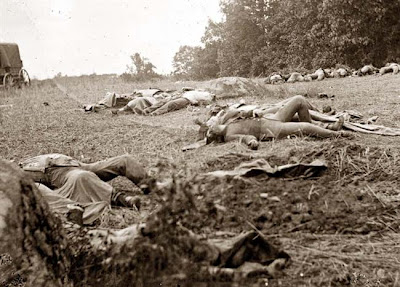
The dead and wounded littered the battlefield. Field hospitals, little more than butcher shops where arms and legs were amputated by overworked surgeons and attendants while those with abdominal wounds that could not be easily repaired were made as comfortable as possible. Triage was simple. If a casualty was thought to have a reasonable chance at survival he was treated, if not they were set aside in little groups and allowed to die as peacefully as possible. Chaplains made their way around, Protestant’s ensuring that their soldiers “knew Jesus” and Catholics administering the Last Rites.

Corporal Horatio Chapman of the 20th Connecticut Volunteers wrote about the the July 3rd:

But in front of our breastworks, where the confederates were massed in large numbers, the sight was truly awful and appalling. The shells from our batteries had told with fearful and terrible effect upon them and the dead in some places were piled upon each other, and the groans and moans of the wounded were truly saddening to hear. Some were just alive and gasping, but unconscious. Others were mortally wounded and were conscious of the fact that they could not live long; and there were others wounded, how bad they could not tell, whether mortal or otherwise, and so it was they would linger on some longer and some for a shorter time-without the sight or consolation of wife, mother, sister or friend. I saw a letter sticking out of the breast pocket of one of the confederate dead, a young man apparently about twenty-four. Curiosity prompted me to read it. It was from his young wife away down in the state of Louisiana. She was hoping and longing that this cruel war would end and he could come home, and she says, “Our little boy gets into my lap and says, `Now, Mama, I will give you a kiss for Papa.’ But oh how I wish you could come home and kiss me for yourself.” But this is only one in a thousand. But such is war and we are getting used to it and can look on scenes of war, carnage and suffering with but very little feeling and without a shudder.”

Colonel William Oates of the 15th Alabama whose brave troopers assaulted Little Round Top on July 2nd wrote:

“My dead and wounded were nearly as great in number as those still on duty. They literally covered the ground. The blood stood in puddles in some places on the rocks; the ground was soaked with the blood of as brave men as ever fell on the red field of battle.”

Another Confederate soldier describe the scene west of the town on July 4th:

“The sights and smells that assailed us were simply indescribable-corpses swollen to twice their size, asunder with the pressure of gases and vapors…The odors were nauseating, and so deadly that in a short time we all sickened and were lying with our mouths close to the ground, most of us vomiting profusely.”
Elon_John_Farnsworth

Elon Farnsworth

Among the killed and wounded were the great and the small. John Reynolds who died on day one, Winfield Scott Hancock, the valiant commander of the Union II Corps wounded during Pickett’s Charge, “Mad” Dan Sickles, who had nearly brought disaster on the Federal lines by advancing to the Peach Orchard on July 2nd had a leg amputated. The Army of the Potomac lost a large number of brigade and regimental commanders including Strong Vincent, the young and gallant brigade commander who helped save Little Round Top, and young Elon Farnsworth, who had been promoted from Captain to Brigadier General just days before his death on the Cavalry field to the east of the town.

The Confederates suffered grievous losses. Divisional commanders like Dorsey Pender and Johnston Pettigrew were mortally wounded, John Bell Hood was severely wounded, Isaac Trimble, wounded and captured while Harry Heth was wounded. Casualties were even higher for commanders and the brigade and regiment level. The toll of brigade and regimental commanders  that were killed or wounded was fearful. In Picket’s division alone all three brigade commanders, Kemper, Armistead and Garnett were killed or wounded while 26 of 40 Field Grade officers were casualties. 46% (78 of 171) of the regiments of the Army of Northern Virginia suffered casualties at the command level. The Confederate casualties, especially among the best leaders were irreplaceable and Lee’s Army never recovered from the loss of seasoned leaders who were already in short supply.
wesleyculp

Wesley Culp

For some like Private Wesley Culp of the 2nd Virginia it was a final trip home. Culp had grown up in Gettysburg and took a job prior to the war in Virginia. In 1861 he enlisted to serve among his friends and neighbors. He was killed on the morning of July 3rd on Culp’s Hill on property owned by his uncle where he grew up and had learned to hunt.

One witness, Frank Haskell looked in at a field hospital in the Union II Corps area and wrote:

“The Surgeons with coats off and sleeves rolled up…are about their work,… “and their faces and clothes are spattered with blood; and though they look weary and tired, their work goes systematically and steadily on- how much and how long they have worked, the piles of legs, arms, feet, hands, fingers…partially tell.” (Gettysburg by Stephen W Sears, Mariner Books, Houghton Mifflin Company Boston, New York 2004 p.466)

All told between 46,000 and 51,000 Americans were killed or wounded during the three days of Gettysburg. Busey and Martin’s Regimental Strengths and Losses at Gettysburg lists the following casualty figures, other accounts list higher numbers. One also has to remember that many of the missing were killed but their bodies were simply never found.

Killed          wounded         missing         total
Union                    3,155          14,531             5,369           23,055
Confederate         4,708          12,693             5,830            23,231
Total                     7,863           27,224            11,199          46,286

To provide a reference in 8 years of war in Iraq the United States suffered fewer casualties than during the three days of Gettysburg. It was the bloodiest single battle in American history.

At the end of the war, Joshua Chamberlain, the hero of Little Round Top who was well acquainted with the carnage of war asked the most difficult questions:

“…men made in the image of God, marred by the hand of man, and must we say in the name of God? And where is the reckoning for such things? And who is answerable? One might almost shrink from the sound of his own voice, which had launched into the palpitating air words of order–do we call it?–fraught with such ruin. Was it God’s command that we heard, or His forgiveness that we must forever implore?”

May we pray for peace that such an event never take place again.

Peace

Padre Steve+

1 Comment

Filed under civil war, History, leadership, Military

Experience versus Inexperience, Accident and Intent: Harry Heth and John Buford on July 1st at Gettysburg

bufordholdatallcosts

On June 30th 1863 Robert E. Lee’s Army of Northern Virginia was still spread out over wide parts of south central Pennsylvania and Maryland. He had issued orders to concentrate his forces near Cashtown but his orders to his subordinate commanders still lacked clarity. As such his corps commanders still acted in a nearly independent manner.

Lee was operating blind. Due to his own operational decisions he was without any significant cavalry forces to screen his army and conduct reconnaissance as it operated deep in enemy territory. He had only found out about the location and proximity to his forces of the Army of the Potomac from the report of Longstreet’s spy Harrison.

On June 30th Major General Harry Heth sent a brigade of his division to conduct a reconnaissance in the direction of Gettysburg. The brigade commander Brigadier General Johnston Pettigrew was instructed to avoid being drawn into battle. Pettigrew observed Federal cavalry of John Buford taking up positions west of the town and chose not to engage. He retired from the field and reported the presence of well drilled Federal cavalry to General Heth. As he was doing so A.P. Hill arrived and rejected Pettigrew’s report insisting that the Army of the Potomac was still over 20 miles away in Maryland. Neither Hill or Heth trusted Pettigrew’s report as Pettigrew’s was not a professional soldier.

The following morning Heth with Hill’s permission decided to send a force to Gettysburg to see what was there and to obtain a large number of shoes that he heard were in the town.

henryhethMajor General Henry (Harry) Heth

Heth was an 1847 graduate of West Point. He graduated at the bottom of his class. Heth was commissioned as an Infantry Officer in the United States Army. Heth did not serve in Mexico but on the frontier. He had commanded a company in battle against the Lakota Sioux in 1855 and wrote the first marksmanship manual for use in the U.S. Army.

Heth was a Virginian and a close friend of A.P. Hill. He spent the early part of the war as Lee’s Quartermaster where he became one of Lee’s favorite officers. This was the beginning of a close relationship where Lee looked after Heth’s career. Heth served as regimental commander in the actions in the Kanawha Valley of Western Virginia being assigned to Kirby Smith’s Department of Tennessee. There he commanded a division but took part no any major actions.

Lee brought him back to the Army of Northern Virginia in 1863 to command a brigade in Hill’s Division. He took commanded that brigade at Chancellorsville in which he made an ill advised unsupported attack against Union forces in which his brigade sustained heavy casualties. Despite this, during the reorganization of the army Heth was promoted to command of the Division when Hill assumed command of Third Corps when it was created following the death of Stonewall Jackson.

Lee had given his commanders orders not to provoke a major engagement until the Army was fully concentrated. However neither Heth nor Hill believed that the troops that Pettigrew observed were a threat, believing them to be nothing more than local militia.

Hill was sick and decided to conduct a reconnaissance despite his lack of cavalry. Hill decided to conduct an infantry reconnaissance, However instead of sending a small force he dispatched two of his divisions, those of Heth and Dorsey Pender and remained in his quarters. Heth, the most inexperienced division commander took the lead and advanced his division in a column not deployed for battle or reconnaissance.

Lee’s intent seemed to be clear at this point clear. He desired to have a tired and weary Union force under a new commander under political pressure attack him on ground of his choosing. He hoped to defeat the Union forces piecemeal as they came into the battle. By initiating the action Hill and Heth set in motion events that would lead to the climactic battle of the Civil War. Hill’s decision to use such a large force and Heth’s inexperience in leading such a mission put Lee in a position where he began to make more mistakes.

The Federal Cavalry that Heth’s troops encountered was the First Cavalry Division under the Command of Brigadier General John Buford. Buford’s division arrived in Gettysburg ahead of the Army of the Potomac on the 30th. Buford and his brigade commanders immediately recognized the importance of the ground when they saw Pettigrew’s troops. Buford order his troops to deploy on the ridges west of Gettysburg, Herr Ridge, McPherson Ridge and Seminary Ridge. It was the perfect place for a delaying action against superior forces.

john_bufordBrigadier General John Buford

Buford was also a graduate of West Point and served as a Cavalry officer in the Army before the war. He was from Kentucky and his father was a Democrat who had opposed Abraham Lincoln. Much of his family chose to fight for the Confederacy but Buford remained loyal to his oath and remained in the Army.

Prior to the war Buford had served against the Sioux and on peacekeeping duty in the bitterly divided State if Kansas. Later he served in the Utah War in 1858. He was a modern soldier who recognized that the tactics of the Army had to change due to improvements in weapons and technology.  He was promoted to Brigadier General in 1862 and served in numerous engagements as a Cavalry Brigade commander before being given command of the 1st Cavalry Division after Chancellorsville.

gettysburg_day1_0700

The Delaying Action, July 1st 1863 Map by Hal Jespersen, http://www.posix.com/CW

Buford was a keen student of war and a commander who was able to control his forces. When Heth’s division attacked he fought a masterful action. This allowed the Infantry Corps of the Army of the Potomac to arrive on the field of battle. Buford’s action to select the ground upon which the battle was fought was instrumental to the Union victory at Gettysburg. Even though Federal forces were pushed back on the first day they were able to maintain control of the high ground east of the city with interior lines of communication which they fortified.

After Heth engaged the Federal army Lee decided that he had to force the battle and continue the attack. Lee brushed aside the objections of General Longstreet and ignored the fact that he did not fully know the numbers and disposition of the troops arrayed against him.

Lee’s decision to engage the enemy was disastrous. Lee decided to attack after the ill conceived decision of Hill and Heth to get involved in a big fight and the correspondingly excellent command decisions of Buford to choose good ground and then to fight a skilled engagement.

While Lee and Hill’s decisions shaped the battle the tactical decisions of Heth and Buford in their conduct of the battle and their advice to their superiors had a dramatic effect on how the Battle of Gettysburg unfolded. Heth’s lack of experience in the east against the Army of the Potomac and limited battle experience as a senior commander certainly was a factor. Likewise, Buford’s experience played a major role. Buford had spent the war in action against Lee’s Army. He knew the capabilities of his enemies and knew what had to be done to give his side a chance to win.

Bufords-Cavalry

Like many battles success is often due to such factors. Had Heth been more experienced and been more prudent in conducting his mission Lee might not have made his fateful decision to commit his army at a Gettysburg. Had Buford not seen the importance of the ground that he selected and deployed himself accordingly the rest of the Army may not have gotten to Gettysburg before Lee had gained the critical ground east and south of the town.

On such decisions battles are decided and wars won. Heth was a good soldier, but his relative inexperience and inability to control his command was a decisive factor in the battle. On the other hand Buford’s experience and poise under pressure enabled the rest of the army to come up on that first day of battle. Had he not done so it is possible that despite the bad decisions made by Lee, Hill and Heth that the Army of northern Virginia might have seized the critical ground east of Gettysburg before the bulk of the Federal Army arrived.

Had that happened it would have been interesting to see how the rest of the campaign unfolded. But such is speculation and that is a subject for novelists, writers of historical fiction or alternate history. Instead we are left with the real decisions of people that to this day influence us. Experience versus inexperience, accident versus design and the decisions of men long dead are things that we must ponder as we look at this battle and seek to learn lessons that will benefit us today.

Peace

Padre Steve+

Leave a comment

Filed under civil war, History, leadership, Military

Lee Blunders into Battle: Day One at Gettysburg

Railroad_CutBetween Heth’s Divsion and I Corps at the Railroad Cut-Dale Gallon

The Army of Northern Virginia commanded by Robert E Lee was now deep in Union territory and nearly blind to the location of the Federal Army of the Potomac. On the 30th advanced units of Dick Ewell’s Second Corps had gone nearly as far as Harrisburg while most of the Army was on the road around Chambersburg. J.E.B. Stuart and his cavalry was far away encumbered by a large captured Federal wagon train around Hanover and not in position to report on Union troop movements.

As reports from the spy Harrison came to Longstreet he reported them to Lee. Lee was surprised but quickly began to concentrate the Army around Cashtown. As the rest of the army gathered General A.P. Hill sent Johnston Pettigrew’s Brigade of Harry Heth’s Division to Gettysburg on the 30th. Pettigrew observed the Federal cavalry of Buford’s 1st Cavalry Division as they took up positions on Seminary Ridge. Since it was late he declined to engage and reported the Federal concentration to Hill, believing it to be nothing more than militia and cavalry.

427_2Buford Defending McPherson’s Ridge Mort Kunstler

On the morning of July 1st Hill ordered Harry Heth’s to advance his division to Gettysburg without the benefit of cavalry support or reconnaissance. Hill believed that the troops reported by Pettigrew could be nothing more than local militia. As they advanced the leading brigades under Brigadier General James Archer and Joseph Davis met Federal forces. Heth first became embroiled in a fight with Buford’s cavalry, which forced him to deploy and held up his advance along McPherson’s and Herr’s Ridge. Lee’s “laxness with respect to reconnaissance and his lack of control of Hill’s movements caused him to stumble into battle.” For the master of so many battlefields it was an inauspicious beginning.

Heth had been surprised and then suffered heavy casualties when lead elements of the Federal 1st Corps under the command of Major General John Reynolds arrived. In the ensuing fight both Archer’s and Davis’ brigades were mauled with Archer being captured and Davis wounded. As the fight continued the Federal XI Corps under Oliver Howard arrived, extended the Right of the Federal line and emplaced troops on the hills to the east of the town. Unfortunately Howard’s dispositions were faulty and the choice of his First Division commander Barlow to advance to an exposed area of high ground proved to be nearly disastrous to the Federal position.

gettysburg_battle_map_of day1Gettysburg Day One (Map by Hal Jespersen, http://www.posix.com/Com)

Lee was surprised by the engagement and though he chastised Heth for getting involved but committed his army to the attack the Federals. Reynolds was killed early in the engagement but the fight was bitter, the Iron Brigade exacted a fearful toll on Archer and Davis’s brigades.

The attack by Heth was helped immensely when the lead elements of Ewell’s 2nd Corps in the form of Robert Rodes’ division arrived. Rodes’ division hit the right flank of the I Corps where it joined XI Corps and was joined by part of Jubal Early’s Division to his right. They overwhelmed the division of Francis Barlow who was wounded and captured, as well as other elements of XI Corps which was deployed on bad ground for defense.

The attack was well conceived but poorly executed, in part due to the failures of some of the subordinate brigade commanders. However, the attack threw the Federal line into confusion and the Federals shifted to meet the attack. Heth sought and got permission from Lee to renew his attack and the combination forced the Federal troops to withdraw through Gettysburg and up to Cemetery Ridge, where two brigade’s of Steinwehr’s division and the tough survivors of the Iron Brigade were already in place.

800px-First_day_at_gettysburgPender’s Division Goes into Action

In making the attack Lee acted against his own directions to his commanders. Though he only had a fraction of his army on the field and was unaware of the strength and location of the bulk of the Federal Army, Lee committed himself to a general engagement. In the process he placed his army at a disadvantage. Unless he could break the Federal line and take Cemetery Hill he would leave the Army of the Potomac with the high ground and with the ability to fight on interior lines, while his forces would be spread out over a long arcing line.

leeindexLee with A.P. Hill and Heth Bradley Schmehl

Ewell’s arrival was fortuitous because it temporarily tilted the balance to Lee, but the advantage was short lived, once again due to a vague order from Lee. This time it was an order to Ewell and like many things about Lee’s conduct of the battle this too is shrouded in controversy.

Lee’s report describes the order:

“General Ewell was, therefore, instructed to carry the hill occupied by the enemy, if he found it practicable, but to avoid a general engagement until the arrival of the other divisions of the army…”

But Lee had already committed himself to a general engagement in pursuing the attack during the afternoon. Although it appeared that Federal forces in turmoil as Reynold’s was dead and elements of XI Corps in retreat the situation was serious but the Confederates were not in a perfect or even completely advantageous position. Howard was able to rally his troops on Cemetery Hill taking advantage of his earlier deployment of Steinwehr’s division. Abner Doubleday who had succeeded Reynold’s brought his tropes back to reinforce the line as well as occupy Culp’s Hill to the right.

bogbayardwilkesonwebAbner Doubleday directs his troops on Day One

When Meade learned of Reynold’s death he dispatched Winfield Scott Hancock of II Corps to take command of all Federal Forces. Though he was junior to Howard, Hancock was able to work out a command arrangement with Howard and take command. Howard had to his credit Federal command position was strengthened.

Hancock doncemeteryhilljuly1_zps512a40faHancock Arrives on the Battlefield

Hancock was authorized by Meade to select where the Army would make its stand. Hancock told Howard “But I think this is the strongest position by nature upon which to fight a battle that I have ever saw…and if it meets your approbation I will select this as the battlefield.” Howard agreed and both men set off to rectify their lines.

Despite their success Ewell and his Corps were disorganized and not in a good position to take advantage of their earlier success. Likewise he was limited in the forces that he had available to continue the attack. Both his and A.P. Hill’s Corps only had two of their divisions in the field. Hill reported that his divisions “were exhausted by some six hours of hard fighting (and that) prudence led me to be content with what had been gained, and not push forward troops exhausted and necessarily disordered, probably to encounter fresh troops of the enemy.” Ewell reported that “all the troops with me were jaded by twelve hours’ marching and fighting.” Lee’s report of the battle indicated that the four divisions involved were “already weakened and exhausted by a long and bloody struggle.”

As such a night assault would have been exceptionally risky. Ewell would have only had the tired and disorganized survivors of four brigades at his disposal with no support from A.P. Hill on his right.

Early's_Charge_on_East_Cemetery_Hill

Ewell has often been criticized by the defenders of Lee and the legend of the Lost Cause for his failure to press the attack on Cemetery Ridge or Culp’s Hill. Critics cite that Federal forces were still disorganized and he could have easily attacked and driven the Federal Forces form the hills. Much is made of the protests of Major General Isaac Trimble as well as General John Gordon who were with Ewell. However as Edwin Coddington noted that these men concentrated their efforts on Ewell’s action to determine what went wrong at Gettysburg. In large part this was due to their inability to criticize Lee. Trimble’s account made its way into Michael Shaara’s classic novel of Gettysburg, the Killer Angels and were acted with conviction by Morgan Shepperd in the film adaptation of the book Gettysburg. Coddington correctly observed that “they forgot, however, the exact circumstances that kept the move from being “practicable” at the time.”

Rodes after battle report supported Ewell’s decision. He wrote before “the completion of his defeat before the town the enemy had begun to establish a line of battle on the heights back of the town, and by the time my line was in condition to renew the attack, he displayed quite a formidable line of infantry and artillery immediately in my front, extending smartly to my right, and as far as I could see to my left in front of Early.” Unfortunately for historians Rodes was killed in action at the Third Battle of Winchester in September 1864.

The Army of Northern Virginia came very close to sweeping Federal forces from the field on July 1st in spite of Lee’s lack of planning and clear commanders intent. But close was not enough. His forces which were committed in a piecemeal manner were unable to follow up their initial success. His orders to Ewell, to take the high ground “if practicable” were correctly interpreted by Ewell. Thus Federal corps under the command of Howard and Hancock were able to regroup, dig in and be reinforced by the rest of the Army on good ground of their choosing with interior lines.

Whether Lee intended to engage the Army of the Potomac at Gettysburg so early in the campaign is debated. His multiple and contradictory strategic aims left his commanders acting much on their own. His lack of clear commander’s intent to his subordinate commanders created confusion on the battlefield and paved the way to many controversies in the years following the war as Southerners sought to explain the failure of the Lost Cause, for which Lee could not be blamed.

Much of the controversy comes from Lee’s own correspondence which indicates that he might have not fully understood his own intentions. Some correspondence indicates that Lee desired to avoid a general engagement as long as possible while other accounts indicate that he wanted an early and decisive engagement. The controversy was stoked after the war by Lee’s supporters, particular his aides Taylor and Marshal and generals Gordon and Trimble, men like Longstreet and were castigated by Lee’s defenders for suggesting that Lee made mistakes on the battlefield.

Lee’s actual misunderstanding of his situation can be seen in the account of Isaac Trimble, traveling with Lee at the beginning of the invasion of Pennsylvania. He wrote:

“We have again outmaneuvered the enemy, who even now does not know where we are or what our designs are. Our whole army will be in Pennsylvania day after tomorrow, leaving the enemy far behind and obliged to follow by forced marches. I hope with these advantages to accomplish some single result and to end the war, if Providence favors us.”

The vagueness of Lee’s instructions to his commanders led to many mistakes and much confusion during the battle. Many of these men were occupying command positions under him for the first time and were unfamiliar with his command style. Where Stonewall Jackson might have understood Lee’s intent, even where Lee issued vague or contradictory orders, many others including Hill and Ewell did not. Lee did not change his command style to accommodate his new commanders.

That lack of flexibility and inability to clearly communicate Lee’s intent to his commanders and failure to exercise control over them proved fatal to his aims in the campaign. Stephen Sears scathing analysis of Lee’s command at Gettysburg perhaps says it the best. “In the final analysis, it was Robert E. Lee’s inability to manage his generals that went to the heart of the failed campaign.”

The vagueness of Lee’s intent was demonstrated throughout the campaign and was made worse by the fog of war. Day one ended with a significant tactical victory for Lee’s army but without a decisive result which would be compounded into a strategic defeat by Lee’s subsequent decisions on the 2nd and 3rd of July.

Peace,

Padre Steve+

2 Comments

Filed under civil war, History, leadership, Military