Tag Archives: joshua chamberlain

Where is the Reckoning? Reflections on War

IMG_0463

Friends of Padre Steve’s World,

I finished up my latest Gettysburg Staff Ride and as always I end up in a reflective mood. There was so much this time that caught my attention, both in the actual staff ride and my run up and down Cemetery Ridge on Friday evening. I guess the one thing that continues to strike me is a theological question that I began to wonder about after my return from Iraq.

The question is more theological, philosophical, and sociological in nature, and it goes to a place that most of us are unwilling or unable to go. I say this because so many Americans have no idea what war is really about. We tend to exalt the military, say that we “support the troops” but no one asks the hard questions of whether the wars that we are fighting, and the vast amounts of money we are spending are worth it. Frankly I think that the reason is that because for the vast majority of Americans that war is an abstract concept, and they are so disconnected from the military that they do not understand. As such the military is idolized and even mythologized by a public that is willing to send them to war, but unwilling to understand or question decisions of policy that begin and perpetuate war without end.

I see the sacrifice, the broken lives, bodies, minds and families of our military personnel who have deployed so many times. With the expansion of the war against the self-proclaimed Islamic State the wars will probably continue indefinitely. Do I think that the war against ISIS/ISIL is worth it? I have to admit I do, they are thugs who have commandeered a religion to justify their crusade against all who do not agree with them and who seek to obliterate all history and culture that they do not agree, and to paraphrase Vice President Biden, Hell is where they will reside.

At the same time I cannot support a war in which a tiny minority of citizens have skin in the game while those who send them to war do so with no cost to themselves. In fact it wearies me to think that those who so loudly call for war refuse to support those who fight with increased taxes, or even war bonds. I have no doubt that those who send people to war, and those who allow them to do so without question, have no interest in actually putting their lives, or the lives of their sons and daughters on the line.

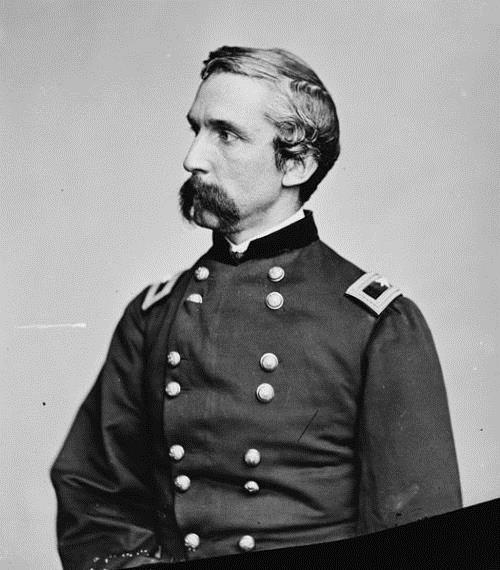
Joshua Chamberlain, the hero of Little Round Top asked the question that I think needs to be asked by all of us today:

“…men made in the image of God, marred by the hand of man, and must we say in the name of God? And where is the reckoning for such things? And who is answerable? One might almost shrink from the sound of his own voice, which had launched into the palpitating air words of order–do we call it? – fraught with such ruin. Was it God’s command that we heard, or His forgiveness that we must forever implore?”

My question for those who advocate war without end, who refuse to serve, and even refuse to sacrifice a wooden nickel to support those wars, is, whose forgiveness will you implore?

Peace

Padre Steve+

3 Comments

Filed under civil war, Gettysburg, History, national security, Political Commentary

The Power of the Vision: A Weekend in Gettysburg

chamberlain lrt

Friends of Padre Steve’s World

I have been in Gettysburg this weekend with my students from the Staff College and as always it has been a good trip so far. Yesterday we did the first two days of the battle ending at Culp’s Hill. We spent a good amount of time on Little Round Top, not just talking about the battle itself, but the impact of war on people, the souls of the people who fought it and their families. I always remind my students that the one constant in history, even military history, where so many people, particularly history “buffs” focus on tactics, weapons, and technology, is humanity.

Today we will finish and do the third day of battle, walking the route of Pickett’s Charge, going to General Meade’s headquarters before finishing at the Soldier’s Cemetery and discussing the Gettysburg Address and its importance to our history as Americans.

We drove up here yesterday making the best time we have ever made on one of these trips, no bad traffic in the Hampton Roads Bridge Tunnel, no bad traffic of major accidents to tie things up, and miraculously an easy trip around the DC Beltway. Thus we arrived early which allowed me to get a run in from Cemetery Hill, down, Cemetery Ridge, almost to Little Round Top before I turned around went back to the hotel. I was an awesome run. I used to run a lot and fell out of it with a number of physical, as well as emotional issues over the past 15 months. I fell out of shape and gained a lot of weight. I have started running again and my run Friday on the battlefield was the furthest I have ran in those 15 months. There is something inspiring about running here that I cannot explain. First there is the natural beauty of the area, especially during the fall and the beauty of the foliage, then there is the sense of running through an area where so many men made gave the last full measure of devotion, to save the Union.

When I come here I am always reminded of the words of Colonel Joshua Lawrence Chamberlain whose 20th Maine held back the Confederate tide on the extreme left of the Union position on Little Round Top. Those words always inspire me because they remind me of the deeds of men who came before me, men whose sacrifice and devotion helped bring about a new birth of freedom.

Chamberlain spoke these words at the dedication of the Maine monument in 1888, “In great deeds, something abides. On great fields, something stays. Forms change and pass; bodies disappear; but spirits linger, to consecrate ground for the vision-place of souls… generations that know us not and that we know not of, heart-drawn to see where and by whom great things were suffered and done for them, shall come to this deathless field, to ponder and dream; and lo! The shadow of a mighty presence shall wrap them in its bosom, and the power of the vision pass into their souls.”

Every time I come to Gettysburg I sense that mighty presence and the power of that vision embraces my soul.

Peace,

Padre Steve+

Leave a comment

Filed under civil war, Gettysburg, Military

Truth and Un-sanitized History

10570298_10152872503382059_5058681841617456899_n

Friends of Padre Steve’s World,

I have spent the last couple of days introducing to new readers to things that I have come to believe. Since I am a historian I will continue to do that today.

I have a passion for truth, especially in the realm of historical thought, in fact over the past few years this passion has deepened to a level of profoundness that I never dreamed. In fact for me this passion has become a duty, a duty to truth; an un-sanitized, warts and all examination of subjects attempting to strip away the veneer of myth in order to find truth. This is not easy, but it is what my life has become, knowing that in the long run I will not discover all truth, but hopefully point others to examine history, the sciences, philosophy and even theology to find truth. The process can be uncomfortable, especially when confronted by facts, documents, scientific and archeological data which shows what we used to think was truth, as either incomplete, romantic myth, or even complete lies, untruths and fabrication. Oscar Wilde once wrote,“The truth is rarely pure and never simple.”

Barbara Tuchman once wrote: “The reality of a question is inevitably more complicated than we would like to suppose.” That is the nature of truth. It does not matter if it is truth about history, biography, philosophy and religion, science, politics, economics or any part of life. To actively seek truth means that one must open up themselves to the possibility of doubting, as Rene Descartes wrote: “If you would be a real seeker after truth, it is necessary that at least once in your life you doubt, as far as possible, all things.” I admit that this is not comfortable, but it is necessary.

As a historian I have a tremendous passion for truth, and for unsanitized history and for me this means looking at what we know with a critical eye, to compare and examine sources to question what we or others knew before. Far too often what we believe about our own history is often more preserving myth more than by asking hard questions and applying reasoned critical study. To do this is dangerous, because to do so we have to admit that what we know today could be proven wrong at some time in the future when new facts, documents, archeological finds or other historical or scientific are discovered. To those content with half-truth, partial truth or even myth this is disconcerting, and those of us who attempt to unravel myth from fact and present things in a new way are called “revisionists” as if that is somehow a bad thing. The sad thing is we are having to revise in many cases, supposed history that was revised by people who needed to propagate myth, such as with those who promoted the myth of the Lost Cause, the romantic, noble Confederacy which for well over a half century was propagated as historical truth. This myth was sold to the American public in such in film, television and books, fiction and non-fiction alike, to the point that much of white America, even outside the South accepted the myth of the Lost Cause as truth. Films like Birth of a Nation, Gone with the Wind and even Disney’s Song of the South, helped ingrain the myth as truth, and even today when so much more is known, many people hold on to the myth and attack those who differ. 

A lot of my readers may wonder why I write so much about the American Civil War as well as the ante-bellum and Reconstruction eras of American history. For me they are very important for a couple of reasons; first they are eras, that for good and bad define us as a nation and people. Second, they still have relevance to what happens today, especially in the understanding of liberty, civil rights and race relations.

I have a passion for this. The American Civil War and the Battle of Gettysburg are intrinsic parts of who we are as Americans today. The events of that war and this battle continue to reverberate in many aspects of our political, social and national life. Thus for me teaching about this event and what happened on the “hallowed ground” of Gettysburg, as Abraham Lincoln called it, and even 150 years later it matters far more than most of us realize.

Civil War hero Joshua Chamberlain is an icon of the Civil War and American history. A professor of Rhetoric and Natural and Revealed Religions at Bowdoin College he volunteered to serve with the 20th Maine Infantry, his military career in the Civil War has been depicted in movies such as Gettysburg and Gods and Generals and written about in biographies and even historical fiction. Chamberlain was one of the heroes of Gettysburg, and his story has a myth like quality, but he too was a complex, contradictory and sometimes flawed character. However, Chamberlain attached a great importance to passing down the stories of people who did noble deeds and who lived exemplary lives. He wrote, “The power of noble deeds is to be preserved and passed on to the future.”

I sincerely believe what Chamberlain said and I am getting ready to lead another Staff Ride for students from our Staff College to Gettysburg next month.  I do beleive that the power of noble deeds needs to be preserved and passed on to the future.  Even the deeds of less than perfect, often contradictory and sometimes even scandalous  individuals. That is part of the task of the historian. I do this in what I teach and what I write, both in the academic setting as well as on this website.

We live in a time of great cynicism, some of which I can understand. We also live in a time where many people and our institutions operate in a “zero defect” culture, those who fail in any way are shunted aside, punished or even chastised or ostracized. However, when I look at the men who fought at Gettysburg, or for that matter almost any individual who has accomplished great things, none are perfect people and many have great flaws in character, or supported causes or ideologies that were evil. That being said, even less than perfect people can rise to do great deeds, deeds that need to be remembered, passed down and told to succeeding generations.

Many great leaders, or other men and women that we consider today to be great, influential or important were or are quite fallible. Even those who did great things often made gross mistakes, had great flaws in their character, and some lived scandalous lives. Such deeds may tarnish their legacy or take some of the luster away from their accomplishments. But I think that these flaws are often as important as their successes for they demonstrate the amazing capacity of imperfect people to accomplish great things, as well as the incredible complexity of who we are as people. No one is perfect. There are degrees of goodness and even evil in all of us. It is part of the human condition. That is the beauty of un-sanitized history, that is the beauty of stripping away myth to discover the humanity of people, and to recognize who they are, who we are, the good, the bad and even the ugly.

When I look at the perfection that imperfect people expect of others I am reminded of something that William Tecumseh Sherman said about his relationship with Ulysses Grant. These were flawed men, but they were in large part responsible for the Union victory in the Civil War. However, to be honest, neither man would never reach the level of command that they rose to in our current military culture, nor would they rise to the top in corporate America. They are too flawed. Sherman said it well, “Grant stood by me when I was crazy, and I stood by him when he was drunk, and now we stand by each other.” 

That is a part of my passion about Gettysburg and my appreciation and admiration of the brave men who fought in that battle. As I continue to write about that battle and about those men I hope that my readers will gain a new appreciation of their complex and contradictory natures, as well as think about what that means to us today, as individuals and as a society, for it is only when we strip away the myth and seek the truth. Marcus Aurelius wrote:

“If someone is able to show me that what I think or do is not right, I will happily change, for I seek the truth, by which no one was ever truly harmed. It is the person who continues in his self-deception and ignorance who is harmed.”

Those truths can be scientific, they can be historical or literary, and quite often the truth can also be quite personal.

As John F Kennedy said at Yale in 1962: “The great enemy of truth is very often not the lie–deliberate, contrived and dishonest–but the myth–persistent, persuasive and unrealistic. Too often we hold fast to the cliches of our forebears. We subject all facts to a prefabricated set of interpretations. We enjoy the comfort of opinion without the discomfort of thought.”

So until tomorrow, have a thoughtful night.

Peace

Padre Steve+


1 Comment

Filed under civil war, History, philosophy

A New Birth of Freedom

gburg address

Friends of Padre Steve’s World. Yesterday we celebrated the 239th anniversary of American independence and the revolutionary document we know as the Declaration of Independence. I wrote about that yesterday and discussed the context of it as well as the contradiction to it posed by the institution of slavery. I talked about Abraham Lincoln and how for him the Declaration was the real heart of the American nation. In Novwmber of 1863 after nearly three years of bloody Civil War and about 10 months following the Emancipation Proclamation, Lincoln was invited to say a few words at the dedication of the Soldeirs Cemetary at Gettysburg. 

In those few words Lincoln redefined forever the concept of Liberty found in the Declaration, he universalized it. Though of practice of it often falls short, it is the high bar for which we must strive. If we do not we will return to the days when freedom was only for the few, and sadly there are many on the political right who not only believe that Liberty is reserved for the few but labor incessantly to prevent people from the full excercuse of the rights of citizenship and wherever possible to roll them back. 

I hope that you enjoy this.

Peace

Padre Steve+

I am always humbled when I travel to Gettysburg as I about to do again early next month. It is hard to believe in that now peaceful pastoral setting that over 157,000 Americans, almost 82,000 Union and 75,000 Confederates met in a three-day battle. In those three days over 28,000 Confederates and 23,000 Union soldiers were killed, wounded, missing or captured. It was the greatest number of casualties inflicted in one battle on American soil in history.

The places that the battle was fought have become legendary, for they are “hallowed ground” as President Abraham Lincoln so eloquently put it. The places, McPherson’s and Herr’s Ridge, Seminary Ridge, the Railroad Cut, Barlow’s Knoll, Cemetery Hill, Culp’s Hill, The Wheat Field, Devil’s Den, the Peach Orchard, Little Round Top, Cemetery Ridge, the Apse of Trees, the Angle and the High Water Mark are in a sense holy, or hallowed ground. Those who struggled there, those who lived and those who gave the last full measure of devotion to their country consecrated them more than any of us could ever do. When I take my students there I always finish at the Soldier’s Cemetery where Abraham Lincoln delivered the Gettysburg Address.

I think about those men of both sides, fully convinced of the rightness of their cause who fought valiantly in the struggle. That being said when I go to Gettysburg my heart, my mind and my soul are with the men who remained loyal to the Union and those who answered the call of Abraham Lincoln to serve in a cause greater than their own interests, the great and the small alike. This is despite the fact that my family predominantly fought for the Confederacy.

Lincoln was a masterful orator who managed to rally the Union and bring hundreds of thousands of men to volunteer to serve before Gettysburg. These men volunteered for an ideal, an ideal for which Lincoln’s oratory was probably the most effective means at articulating in an ideal that men would volunteer to suffer hardship, fight and die to bring about. It was well put in the movie Gettysburg where Colonel Joshua Chamberlain, played by Jeff Daniels said:

“This is a different kind of army. If you look at history you’ll see men fight for pay, or women, or some other kind of loot. They fight for land, or because a king makes them, or just because they like killing. But we’re here for something new. This has not happened much, in the history of the world: We are an army out to set other men free. America should be free ground, all of it, from here to the Pacific Ocean. No man has to bow, no man born to royalty. Here we judge you by what you do, not by who your father was. Here you can be something. Here is the place to build a home. But it’s not the land. There’s always more land. It’s the idea that we all have value, you and me. What we’re fighting for, in the end… we’re fighting for each other…” [1]

On November 19th 1863 Lincoln delivered a “few words” at Gettysburg which were in all practical aspects a benediction at the dedication of the battlefield cemetery. Lincoln was the second speaker at the ceremony following former Pennsylvania Congressman Edward Everett who spoke for more than two hours, a typical speech from the period.

Everett was one of the leading orators of his day. Everett was “a scholar and Ivy-League diplomat who could hold mass audiences in thrall. His voice, diction, and gestures were successfully dramatic, and he always performed his carefully written text, no matter how long, from memory.” [2]

The 270 words of Lincoln’s address are perhaps the most important of any speech or document in American history save the Declaration of Independence and the Constitution of the United States, in those words “Lincoln, nevertheless managed to justify the ways of democracy more than anyone, then or now.” [3]

The speech was so powerful that Everett wrote Lincoln the next day:

“Permit me also to express my great admiration of the thoughts expressed by you, with such eloquent simplicity & appropriateness, at the consecration of the Cemetery. I should be glad, if I could flatter myself that I came as near to the central idea of the occasion, in two hours, as you did in two minutes.” [4]

The speech is short, but its eloquence is unmatched. Lincoln wrapped ideas, concepts and ideals that men have written volumes about into a speech so powerful that many have memorized it.

But few realize the context that it must be placed. Though the Union had defeated Lee’s Army at Gettysburg and Grant had taken Vicksburg to cut the Confederacy in half the North was growing war weary. During the fall of 1863 after a series of inconclusive battles in northern Virginia both Lee and Meade’s armies had sent significant numbers of troops to the west, to support operations in eastern Tennessee.

Lee sent Longstreet’s First Corps, which took part in the bloody battle of Chickamauga, which “is a Cherokee word meaning “river of death.” [5] where on September 19th and 20th the Federal Army of the Cumberland under General Rosecrans “were soundly whipped at …and driven back into the strategic point of Chattanooga.” [6] The number of casualties on both sides, over 16,000 Federal and 18,000 Confederate, a “combined total of 34,634 was exceeded only the three day slaughter at Gettysburg and by the week-long series of five battles known collectively as the Seven Days.” [7] Despite the number of casualties it was one of the biggest Confederate victories of the war. A clerk in Richmond wrote “The whole South will be filled again with patriotic fervor, and in the North there will be a corresponding depression.” [8] That changed rapidly when the Union reacted quickly and reversed the strategic situation. One action taken was to deploy Oliver Howard’s XI Corps and Henry Slocum’s XII Corps west, where “they would be commanded by Joe Hooker, who was conveniently at hand and unemployed.” [9]

In the east during the following weeks “Lee and Meade, like two wounded, spent gladiators, sparred listlessly along the Rapidan. It seemed to Northerners that the fruits of Gettysburg had been thrown away.” [10] Lee sensed an opportunity to go back on the offensive against Meade’s weakened army, but his offensive was stopped on October 14th when “the Union Second Corps shattered a reckless attack by A.P. Hill’s corps at Bristoe Station, five miles south of Manassas.[11]

There was a faction in the North, the Copperheads, who were willing even after Gettysburg and Vicksburg to end the war on terms favorable to the Confederacy, even allowing for Confederate independence and the continuation of slavery. They “clamored for negotiations with the Confederacy to restore the Union on the basis of status quo antebellum and, until the closing months of the war charged that as long as the antislavery party remained in power the restoration of the Union could not be achieved.” [12] They believed that the war was a failure and that military action could not be achieved by force of arms.

The leading Copperheads included Clement Vanlandingham of Ohio and George W. Woodward of Pennsylvania were typical, both opposed the use of force against Confederate secession; Woodward had written in 1860 that “Slavery was intended as a special blessing to the people of the United States,” that “Secession is not disloyalty” and “I cannot condemn the South for withdrawing….I wish Pennsylvania could go with them.” [13] The efforts of the Copperheads to gain governorships in Ohio and Pennsylvania met defeat in November 1863, as the Union victories at Gettysburg and Vicksburg “undercut their theme of the war’s failure.” [14] Their efforts would persist through the 1864 Presidential election, but instead of preaching the war’s failure they would concentrate on defeating emancipation. The Copperheads, “labeled all Republicans, including Lincoln, as radicals bent upon destroying the Union and undermining the Constitution.” [15]

However, the anti-abolitionist and racist views espoused by the northern Democrat Copperheads had begun to lose their potency in the North after July of 1863 with the onset of “the New York draft riot, which shocked many northerners into a backlash against the consequences of virulent racism” [16] and the sacrifice of the African American 54th Massachusetts Infantry when it assaulted Fort Wagner outside of Charleston South Carolina, which occurred “just after the Democratic rioters in New York had lynched black people and burned the Colored Orphan Asylum. Few Republican newspapers failed to point the moral: black men who fought for the Union deserved more respect than white men who fought against it.” [17]

It is also important to understand how Lincoln’s address at Gettysburg is reflective of the various intellectual and philosophical movements of the time. Even the location of the cemetery and the burial plots within it was significant. A Gettysburg lawyer, David Wills proposed to “Governor Andrew Curtain of Pennsylvania the establishment of a soldiers’ cemetery where the Union dead could be reburied with dignity and honor.” [18] The place was then outside the city, a plot of 17 acres purchased by Wills adjacent to the existing town cemetery on Cemetery Hill. That was significant culturally, for the Gettysburg Cemetery was part of a movement called the Rural Cemetery movement. The movement was part of the Greek revival in the United States and connected with the Transcendentalist movement.

The Rural Cemetery movement was launched at Cambridge’s Mount Auburn Cemetery, and Edward Everett was a key figure in it. Mount Auburn “took Athens’s Kerameikos as its model, since that ancient burial ground existed outside the city proper, near the groves of the Akademy, in what was still countryside.” [19] In his speech at Mount Auburn’s dedication, U.S. Supreme Court Justice Joseph Story noted:

“The Greeks exhausted the resources of their exquisite art in adorning the habitations of the dead. They discouraged internments within the limits of their cities; and consigned their relics to shady groves, in the neighborhood of murmuring streams and merry fountains, close by the favorite resorts of those who were engaged in the study of philosophy and nature, and called them, with the elegant expressiveness of their own beautiful language, cemeteries or “places of repose.” [20]

He further noted:

“Our cemeteries, rightly selected and properly arranged, may be made subservient to some of the highest purposes of religion and human duty. They may preach lessons to which none may refuse to listen and which all that live must hear. Truths may there be felt and taught, in the silence of our meditations, more persuasive and more enduring than ever flowed from human lips.” [21]

Everett in his Gettysburg oration linked what they were doing at the Soldiers’ Cemetery with the Greek tradition:

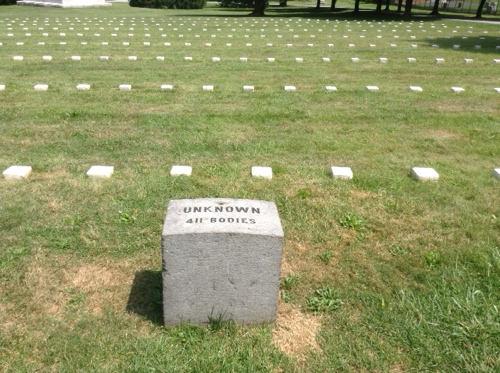
“It was appointed by law in Athens, that the obsequies of the citizens who fell in battle should be performed at the public expense, and in the most honorable manner. Their bones were carefully gathered up from the funeral pyre where their bodies were consumed, and brought home to the city. There, for three days before the interment, they lay in state, beneath tents of honor, to receive the votive offerings of friends and relatives,–flowers, weapons, precious ornaments, painted vases (wonders of art, which after two thousand years adorn the museums of modern Europe),–the last tributes of surviving affection. Ten coffins of funereal cypress received the honorable deposit, one for each of the tribes of the city, and an eleventh in memory of the unrecognized, but not therefore unhonored, dead, and of those whose remains could not be recovered….” [22]

The layout of the cemetery, and the manner in which the dead were buried was also significant when one considers the messages of both Everett and Lincoln that day. “The cemetery at Gettysburg was arranged so that every grave was of equal importance; William Saunders’s design, like Lincoln’s speech, affirmed that every dead soldier mattered equally regardless of rank or station.” [23] In this place “some 3,577 Union soldiers (half of them unknown) from eighteen states are buried.” [24]

The speeches of Everett and Lincoln are deeply connected with Romanticism, the Greek revival and the Transcendentalist movement in the United States. Both were children of the enlightenment, and Everett, a former President of Harvard was well versed in these subjects and Lincoln, though a politician who appealed to the tenets of the Enlightenment, the Declaration of Independence and the Constitution. Lincoln appealed to the “sacred principles of the laws of nature,” and hailed “the constitution and laws” as “hewn from the solid quarry of sober reason.” For Lincoln, the war was a test of the practical worth of liberalism.” [25]

Everett had been a mentor to some of the leading Transcendentalist thinkers of his era including Ralph Waldo Emerson who found that the experience of “Everett’s classroom gave him an entirely new direction in life.” Emerson wrote:

“Germany had created [literary] criticism in vain for us until 1820, when Edward Everett returned from his five years in Europe, and brought to Cambridge his rich results, which no one was so fitted by natural grace and splendor of his rhetoric to introduce and recommend…. The novelty of the learning lost northing in the skill and genius of its interpreter, and the rudest undergraduate found a new morning opening to him in the lecture room at Harvard.” [26]

Everett, who had previously dedicated battlefields at Bunker Hill, as well as Lexington and Concord, was at his best when dedicating battlefields and cemeteries. He spent weeks preparing his speech. Everett had studied the battle and knew it well from official reports and talks with those who fought it. Everett painted a vivid picture of the battle for his audience and connected the sacrifice of those who fought and died to preserve the Union form antiquity and from those who founded the nation. He noted why they had gathered:

“We have assembled, friends, fellow-citizens, at the invitation of the Executive of the great central State of Pennsylvania, seconded by the Governors of seventeen other loyal States of the Union, to pay the last tribute of respect to the brave men who, in the hard-fought battles of the first, second, and third days of July last, laid down their lives for the country on these hillsides and the plains before us, and whose remains have been gathered into the cemetery which we consecrate this day. As my eye ranges over the fields whose sods were so lately moistened by the blood of gallant and loyal men, I feel, as never before, how truly it was said of old that it is sweet and becoming to die for one’s country. I feel, as never before, how justly, from the dawn of history to the present time, men have paid the homage of their gratitude and admiration to the memory of those who nobly sacrifice their lives, that their fellow-men may live in safety and in honor. And if this tribute were ever due, to whom could it be more justly paid than to those whose last resting-place we this day commend to the blessing of Heaven and of men?” [27]

In his narrative Everett aspired to more than mere accuracy. Along “with Bancroft and other romantic historians of his time, he meant to create a tradition that would inspire as well as inform. Like the Attic orators- and dramatists- he knew the power of symbols to create a people’s political identity.” [28]

DSCN9741

Lincoln was sick when he delivered the address having what was mostly likely a mild form of Smallpox when he gave the address. Thus the tenor, simplicity and philosophical depth of the address are even more remarkable. It is a speech given in the manner of Winston Churchill’s “Blood sweat toil and tears” address to Parliament upon being appoint Prime Minister in 1940. Likewise it echoes the Transcendentalist understanding of the Declaration of Independence as a “test for all other things.”

Many in the United States and Europe did not agree and argued that no nation found on such principles could long survive. The more reactionary European subscribers of Romanticism ridiculed the “idea that a nation could be founded on a proposition….and they were not reluctant to point to the Civil War as proof that attempting to build a government around something as bloodless and logical as a proposition was futile.” [29]

But Lincoln disagreed. He believed that the “sacrifices of Gettysburg, Shiloh, Murfreesboro, Chancellorsville, and a hundred other places demonstrated otherwise, that men would die rather than to lose hold of that proposition. Reflecting on that dedication, the living should themselves experience a new birth of freedom, a determination- and he drove his point home with a deliberate evocation of the great Whig orator Daniel Webster- “that government of the people, by the people, for the people, shall not perish from the earth.” [30]

The Unitarian pastor and leading Transcendentalist Theodore Parker wrote:

“Our national ideal out-travels our experience, and all experience. We began our national career by setting all history at defiance- for that said, “A republic on a large scale cannot exist.” Our progress since that has shown that we were right in refusing to be limited by the past. The practical ideas of the nation are transcendent, not empirical. Human history could not justify the Declaration of Independence and its large statements of the new idea: the nation went beyond human history and appealed to human nature.” [31]

Likewise Lincoln’s address echoes the thought of George Bancroft who wrote of the Declaration:

“The bill of rights which it promulgates is of rights that are older than human institutions, and spring from the eternal justice…. The heart of Jefferson in writing the Declaration, and of Congress in adopting it, beat for all humanity; the assertion of right was made for the entire world of mankind and all coming generations, without any exceptions whatsoever.” [32]

Parker’s words also prefigured an idea that Lincoln used in his address, that being: The American Revolution, with American history since, is an attempt to prove by experience this transcendental proposition, to organize the transcendental idea of politics. The ideal demands for its organization a democracy- a government of all, for all, and by all…” [33]

Lincoln delivered these words on that November afternoon:

Four score and seven years ago our fathers brought forth on this continent, a new nation, conceived in Liberty, and dedicated to the proposition that all men are created equal.

Now we are engaged in a great civil war, testing whether that nation, or any nation so conceived and so dedicated, can long endure. We are met on a great battle-field of that war. We have come to dedicate a portion of that field, as a final resting place for those who here gave their lives that that nation might live. It is altogether fitting and proper that we should do this.

But, in a larger sense, we cannot dedicate — we can not consecrate — we can not hallow — this ground. The brave men, living and dead, who struggled here, have consecrated it, far above our poor power to add or detract. The world will little note, nor long remember what we say here, but it can never forget what they did here. It is for us the living, rather, to be dedicated here to the unfinished work which they who fought here have thus far so nobly advanced. It is rather for us to be here dedicated to the great task remaining before us — that from these honored dead we take increased devotion to that cause for which they gave the last full measure of devotion — that we here highly resolve that these dead shall not have died in vain — that this nation, under God, shall have a new birth of freedom — and that government of the people, by the people, for the people, shall not perish from the earth.[34]

In a time where many are wearied by the foibles and follies of our politicians, even wondering about our form of government can survive Lincoln’s words matter. Dr. Allen Guelzo, Professor of Civil War Studies at Gettysburg College wrote in the New York Times:

“The genius of the address thus lay not in its language or in its brevity (virtues though these were), but in the new birth it gave to those who had become discouraged and wearied by democracy’s follies, and in the reminder that democracy’s survival rested ultimately in the hands of citizens who saw something in democracy worth dying for. We could use that reminder again today.” [35]

Dr. Guelzo is quite correct. Many people in this country and around the world are having grave doubts about our democracy. I wonder myself, but I am an optimist. I do believe that we will recover because for the life of me I see no nation anywhere else with our resiliency and ability to overcome the stupidity of politicians, pundits and preachers.

The amazing thing was that in spite of everything the Union survived. Lincoln was a big part of that but it was the men who left lives of comfort and security like Joshua Chamberlain and so many others who brought about that victory. Throughout the war, even to the end Southern political leaders failed to understand that Union men would fight and die for an ideal, something greater than themselves, the preservation of the Union and the freedom of an enslaved race. For those men that volunteered to serve, the war was not about personal gain, loot or land, it was about something greater. It was about freedom, and when we realize this fact “then we can contemplate the real meaning of “that cause for which they gave the last full measure of devotion.” [36]

Gettysburg_Unknowns.JPG

Now I for one do not think that we are currently living up to the ideals enunciated by Lincoln that day at Gettysburg. I can understand the cynicism disillusionment of Americans as well as those around the world who have for over 200 years looked to us and our system as a “city set on a hill.” That being said, when I read these words and walk that hallowed ground I am again a believer. I believe that we can realize the ideal, even in our lifetime should we desire.

Notes

[1] Shaara, Michael. The Killer Angels, Ballantine Books, New York. 1974 p.28

[2] Wills, Garry. Lincoln at Gettysburg: The Words that Remade America Simon and Schuster Paperbacks, New York 1992 p.25

[3] Guelzo Allen C. Fateful Lightening: A New History of the Civil War Era and Reconstruction Oxford University Press, Oxford and New York 2012 p.407

[4] Everett, Edward Letter from Edward Everett to Abraham Lincoln, (Transcription) 20 November 1863 retrieved from http://www.in.gov/judiciary/citc/files/everett-to-lincoln.pdf July 18th 2014

[5] Ibid. Guelzo Fateful Lighteningp.352

[6] Hebert, Walter H. Fighting Joe Hooker University of Nebraska Press, Lincoln and London 1999. Originally published by Bobbs-Merrill, New York 1944

[7] Foote, Shelby, The Civil War, A Narrative. Volume Two Fredericksburg to Meridian Random House, New York 1963 p.758

[8] Ibid. Foote The Civil War, A Narrative. Volume Two p.757

[9] Ibid. Foote The Civil War, A Narrative. Volume Two p.764

[10] Sears, Stephen W. Gettysburg Mariner Books, Houghton Mifflin Company Boston, New York 2004 p.513

[11] McPherson, James M. Tried by War: Abraham Lincoln as Commander in Chief Penguin Books, New York and London 2008 p.200

[12] Harris, William C. With Charity for All: Lincoln and the Restoration of the Union The University Press of Kentucky, Lexington KY 1997 p.7

[13] McPherson, James. The Battle Cry of Freedom: The Civil War Era Oxford University Press, Oxford and New York 1988 p.685

[14] Ibid. McPherson The Battle Cry of Freedom p.685

[15] Ibid. Harris With Charity for All p.7

[16] Ibid. McPherson The Battle Cry of Freedom p.686

[17] Ibid. McPherson The Battle Cry of Freedom p.687

[18] McPherson, James M. This Hallowed Ground Crown Publishers, New York 2003 p.137

[19] Ibid. Wills. Lincoln at Gettysburg p.63

[20] Ibid. Wills. Lincoln at Gettysburg p.64

[21] Ibid. Wills. Lincoln at Gettysburg p.65

[22] Everett, Edward Gettysburg Address retrieved from http://voicesofdemocracy.umd.edu/everett-gettysburg-address-speech-text/ 21 August 2014

[23] Faust, Drew Gilpin, This Republic of Suffering: Death and the American Civil War Vintage Books, a division of Random House, New York 2008 p.100

[24] Ibid. McPherson This Hallowed Ground p.137

[25] Ibid. Guelzo. Fateful Lightening pp.406-407

[26] Ibid. Wills. Lincoln at Gettysburg p.45

[27] Ibid. Everett Gettysburg Address

[28] Ibid. Wills. Lincoln at Gettysburg p.51

[29] Ibid. Guelzo. Fateful Lightening p.409

[30] Ibid. Guelzo. Fateful Lightening p.408

[31] Ibid. Wills. Lincoln at Gettysburg p.110

[32] Ibid. Wills. Lincoln at Gettysburg p.105

[33] Ibid. Wills. Lincoln at Gettysburg p.105

[34] Lincoln, Abraham The Gettysburg Address the Bliss Copy retrieved from http://www.abrahamlincolnonline.org/lincoln/speeches/gettysburg.htm

[35] Guelzo, Allen C. Lincoln’s Sound Bite: Have Faith in Democracy New York Time Opinionator, November 17th 2013 retrieved from http://opinionator.blogs.nytimes.com/2013/11/17/lincolns-sound-bite-have-faith-in-democracy/?_php=true&_type=blogs&_r=0 July 18th 2014

[36] Ibid. McPherson This Hallowed Ground p.138

1 Comment

Filed under civil rights, civil war, Gettysburg, History, Political Commentary

Tragic Heroes of Little Round Top

Friends of Padre Steve’s World

As I mentioned I am going to be publishIng some of my revised sections of my Gettysburg text this week. I am focusing some of the men who fought at Little Round Top on July 2nd 1863, as well as their families.

I hope that you find this thought provoking when you consider the sacrifice made by these Union men who were either killed or wounded in order to both maintain the Union and to set others free, as well as the cost born by their families. 

Peace

Padre Steve+
chamberlain lrt

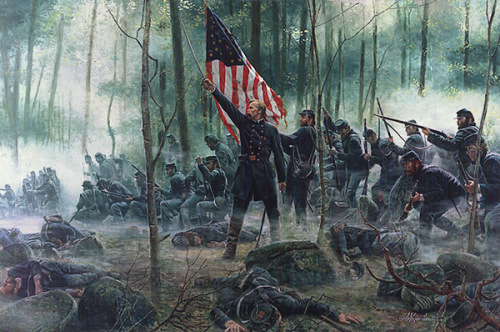
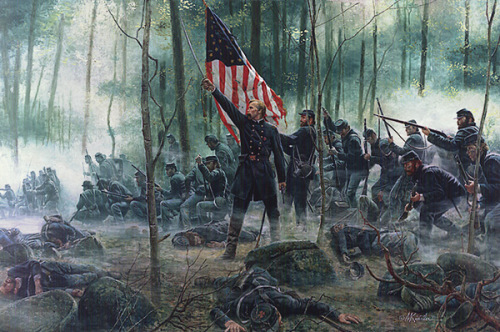
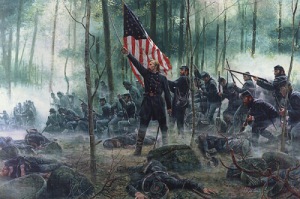
Iconic yet Incomplete: Chamberlain at Little Round Top (Mort Kunstler)

July 2nd 1863 was to be a pivotal day in the history of the United States, a day of valor, courage and carnage; a day where nearly 20,000 Americans were killed, wounded or missing fighting fellow Americans. It was a day where the fate of the Union and the Confederacy were in the balance. On the afternoon of that day, three volunteers rose to the challenge.

However, when we tell the story of Gettysburg or for that matter any other battle we often neglect the human costs endured by the soldiers as well as their families off the battlefield. In fact, what we know of the heroes of these battles is of their battlefield heroism as well other military or governmental service. The pictures we have of them are often the polished versions of their heroics, sometimes bordering on hagiography, criticism, if any is leveled at all, is confined to battlefield decisions or campaign plans. We mythologize them, we turn them into idols, icons and somehow, even as important and inspiring as the myths may be, we ignore their basic humanity. When we do this we often miss the more important things about their lives; those things that make them much more real, much more human, much more like us.

Sadly, the unvarnished accounts of then lives of heroes often only show up in biographies, and are seldom mentioned in the more popular accounts of battles. But the pain and suffering that these men and their families endured during and after war is sadly neglected, much to the detriment of those who idolize them.

Yes, there were many more heroes on Little Round Top that day; far too many to be covered in depth in any one work. However, these three Colonels, Strong Vincent, Joshua Lawrence Chamberlain and Patrick “Paddy” O’Rorke along with Brigadier General Gouverneur Warren were instrumental in securing the Union victory. They were all unlikely heroes. Of these men only O’Rorke was a professional soldier, albeit a very young one, but all took to soldiering and leading soldiers as if it were second nature. They were men who along with others “who stepped out of themselves for a moment and turned a corner at some inexpressibly right instant.” [1]

vincent

Colonel Strong Vincent

Colonel Strong Vincent was a 26 year old Harvard graduate and lawyer from Erie Pennsylvania. He was born in Waterford and attended school in Erie. Growing up, he worked in his father’s iron foundry, where the work helped make him a man of great physical strength. He studied at Trinity College in Hartford Connecticut and transferred to Harvard. There are various explanations for why he left Trinity, but the most interesting and probably the most credible is that during his sophomore year which was recorded by Trinity alumnus Charles F. Johnson who wrote that:

“He went calling on Miss Elizabeth Carter, a teacher at Miss Porter’s school in Farmington, ten miles west of Hartford. At some point a guard or watchman voiced a comment that impinged the lady’s virtue, and, as Johnson so aptly phrases it, Vincent “responded to the affront with the same gallantry and vigor that he was to display in the Civil War.” McCook’s account indicated that the man was repeatedly pummeled, which effectively rendered him unconscious.” [2]

Long after the war Dr. Edward Gallaudet, the president of Trinity responded to an enquiry of the circumstances leading to Vincent’s early departure from Trinity. Gallaudet responded to the request in a terse manner:

“Replying to yours of yesterday, I must say that I do not think it would be wise to make public the story I told of Strong Vincent’s escapade at Farmington & its consequences. Certainly not in the lifetime of Mrs. Vincent.” [3]

Evidently the incident resulted in Vincent leaving Trinity and the next year he entered Harvard. Vincent graduated from Harvard in 1859, ranking 51st in a class of 92. However, he was not an outstanding student and “earned admonishments on his record for missing chapel and smoking in Harvard Yard.” [4]

Returning home he studied law with a prominent lawyer and within two years had passed the bar, and he was well respected in the community. When war came and the call went out for volunteers, Vincent enlisted in a 30 Day regiment, the Wayne Guards as a private and then was appointed as a 1st Lieutenant and Adjutant of the regiment because of his academic and administrative acumen.

He married Elizabeth, the same woman whose virtue he had defended at Trinity that day. Vincent like many young northerners believed in the cause of the Union undivided, and he wrote his wife shortly after the regiment went to war on the Peninsula:

“Surely the right will prevail. If I live we will rejoice in our country’s success. If I fall, remember you have given your husband to the most righteous cause that ever widowed a woman.” [5]

When the Wayne Guards were disbanded at the end of their enlistment, Vincent helped to raise the 83rd Pennsylvania and was commissioned as a Lieutenant Colonel in it on September 14th 1861. The young officer learned his trade well and was considered a “strict disciplinarian and master of drill.” [6] That being said one enlisted man remarked that “no officer in the army was more thoughtful and considerate of the health and comfort of his men.” [7] Vincent assumed command of the regiment when the commander was killed during the Seven Days in June of 1862 where he learned lessons that he would help impart to his fellow officers as well as subordinates, including Chamberlain. At Fredericksburg any doubters about the young officer’s courage and leadership ability were converted where they observed his poise “with sword in hand” he “stood erect in full view of the enemy’s artillery, and though the shot fell fast on all sides, he never wavered or once changed his position.” [8]

By the time of the Battle of Gettysburg, the 26 year old Vincent was the youngest brigade commander in the army. He was noted for his intelligence, leadership, military acumen and maturity. One friend wrote “As a general thing his companions were older than himself….Among his associates were men of the highest rank. He could adapt himself to all, could talk with the politician on questions of history, with a general officer on military evolutions, or with a sporting man on the relative merits of horses,-and all respected his opinion.” [9]

His promotion was well earned, following a bout with a combination of Malaria and Typhoid, the “Chickahominy Fever” which almost killed him; Vincent took command of the regiment after its commander was killed at Gaines Mill. He commanded the regiment at Fredericksburg and was promoted to command the 3rd Brigade after the Battle of Chancellorsville following the resignation of its commander, Colonel T.W.B. Stockton on May 18th 1863.

Vincent was offered the chance to serve as the Judge Advocate General of the Army of the Potomac by Joseph Hooker in the spring of 1863 after spending three months on court-martial duty. But Vincent refused the offer in so that he might remain in the fight commanding troops. [10] He told his friends “I enlisted to fight.” [11]

Vincent, like Chamberlain who admired him greatly had “become a kind of model of the citizen soldier.” [12] As a result of his experience in battle and the tenacity of the Confederate army he became an advocate of the tactics that William Tecumseh Sherman would later employ during his march to the sea in 1864. He wrote his wife before Chancellorsville:

“We must fight them more vindictively, or we shall be foiled at every step.  We must desolate the country as we pass through it, and not leave a trace of a doubtful friend or foe behind us; make them believe that we are in earnest, terribly in earnest; that to break this band in twain is monstrous and impossible; that the life of every man, yea, of every weak woman or child in the entire South, is of no value whatever compared with the integrity of the Union.” [13]

Unlike most other brigade commanders, Vincent was still a Colonel, and he, like many others would in his place hoping for a General’s star. He remarked that his move to save Sickles’ command “will either bring me my stars, or finish my career as a soldier.” [14] On July first, Vincent, a native Pennsylvanian came to Hanover and learning that battle had been joined, ordered “the pipes and drums of the 83rd Pennsylvania to play his brigade through the town and ordered the regiments to uncover their flags again….” [15] As the brigade marched through the town, Vincent “reverently bared his head” and announced to his adjutant, “What death more glorious can any man desire than to die on the soil of old Pennsylvania fighting for that flag?” [16]

Vincent was known for his personal courage and a soldier of the 83rd Pennsylvania observed: “Vincent had a particular penchant for being in the lead….Whenever or wherever his brigade might be in a position to get ahead…, he was sure to be ahead.” [17] That courage and acumen to be in the right place at the right time was in evidence when he led his brigade into battle on that fateful July second.

On July 2nd Barnes’ division of V Corps, which Vincent’s brigade was a part was being deployed to the threat posed by the Confederate attack of McLaws’ division on the Peach Orchard and the Wheat Field to reinforce Sickles’ III Corps. While that division marched toward the Peach Orchard, Vincent’s 3rd Brigade was the trail unit. When Gouverneur Warren’s aide, Lieutenant Randall Mackenzie [18] came toward the unit in search of Barnes, he came across Vincent and his brigade near the George Weikert house on Cemetery Ridge awaiting further orders. [19]

Vincent intercepted him and demanded what his orders were. Upon being told that Sykes’ orders to Barnes were to “send one of his brigades to occupy that hill yonder,” [20] Vincent defied normal protocol assuming that Barnes had hit the bottle and was drunk [21] and told Mackenzie “I will take responsibility of taking my brigade there.” [22] Vincent immediately went into action and ordered Colonel James Rice, his friend and the commander of the 44th New York “to bring the brigade to the hill as quickly as possible,” and then turned on his horse and galloped off toward Little Round Top.” [23]

It was a fortunate thing for the Union that he did. His quick action to get his brigade, clear orders to his subordinate commanders and skilled analysis of the ground were a decisive factor in the Union forces holding Little Round Top. After ordering Colonel Rice to lead the brigade up to the hill, he and his aide went forward to scout positions accompanied by the brigade standards. Rice brought the brigade forward at the double quick “across the field to the road leading up the north shoulder of the hill” with Chamberlain’s 20th Maine in the lead. [24]

Vincent and his orderly made a reconnaissance of the south and east slope of the hill which adjoined a small valley and a rocky outcrop called Devil’s Den, which was occupied by the 124th New York and which was the end of Sickles’ line. Near the summit of the southern aspect of the hill, they came under Confederate artillery fire and told his orderly “They are firing at the flag, go behind the rocks with it.” [25]

Vincent dismounted, leaving his sword secured on his horse, carrying only his riding crop. He continued and “with the skill and precision of a professional had reconnoitered and decided how to best place his slim brigade of 1350 muskets.” [26] He chose a position along a spur of the hill, which now bears his name, running from the northwest to the southeast to place his regiments where they could intercept the Confederate troops of Hood’s division which he could see advancing toward the hill.

What Vincent saw when he arrived was a scene of disaster. Confederate troops had overwhelmed the 124th New York and were moving on Little Round Top, “Devil’s Den was a smoking crater,” and the ravine which separated Devil’s Den from Little Round Top “was a whirling maelstrom.” [27] Seeing the threat Vincent began to deploy his brigade but also sent at messenger back to Barnes telling him “Go tell General Barnes to send reinforcements at once, the enemy are coming against us with an overwhelming force” [28]

The 16th Michigan, the smallest regiment in his brigade with barely 150 soldiers in line [29] was placed on the right flank of the brigade. As it moved forward, its adjutant, Rufus W. Jacklin’s horse was hit by a cannon ball which decapitated that unfortunate animal and left it “a mass of quivering flesh.” [30] A fierce Confederate artillery barrage fell among the advancing Union troops and splintered trees, causing some concern among the soldiers. The 20th Maine’s Chaplain, Luther French, saw the “beheading of Jacklin’s horse and ran to Captain Atherton W. Clark, commanding the 20th’s Company E, babbling about what he had seen. Clark interrupted French abruptly and shouted: “For Christ sake Chaplain, if you have any business attend to it.” [31]

That section of the line was located on massive boulders that placed it high above the valley below, making it nearly impregnable to frontal attack. On the summit Vincent deployed the 83rd Pennsylvania and 44th New York to their left at the request of Rice who told him “In every battle that we have engaged the Eighty-third and Forty-fourth have fought side by side. I wish that it might be so today.” [32] The story is probably apocryphal but the regiments remained side by side with the 16th Michigan on the right and the 20th Maine on the left. The two regiments were deployed below the crest among the large number of boulders; the 83rd was about two-thirds of the way down the way down the slope where it joined the right of the 44th, whose line angled back up the slope to the southeast. A historian of the 83rd Pennsylvania noted that “Each rock”… “was a fortress behind which the soldier[s] instantly took shelter.” [33] The soldiers were determined to do their duty as they now were fighting on home ground.

Vincent deployed the 20th Maine on his extreme left of his line, and in fact the extreme end of the Union line. Vincent knew that if this flank was turned and Chamberlain overrun that it would imperil the entire Union position. Vincent came up to Chamberlain who remembered that Vincent said “in an awed, faraway voice: “I place you here….This is the left of the Union line. You understand. You are to hold this ground at all costs.” [34] Chamberlain acknowledged his understanding of the order and since the regiment lacked field grade officers, Chamberlain “assigned Captain Atherton Clark of company E to command the right wing, and acting Major Ellis Spear the left.” [35]
chamberlain

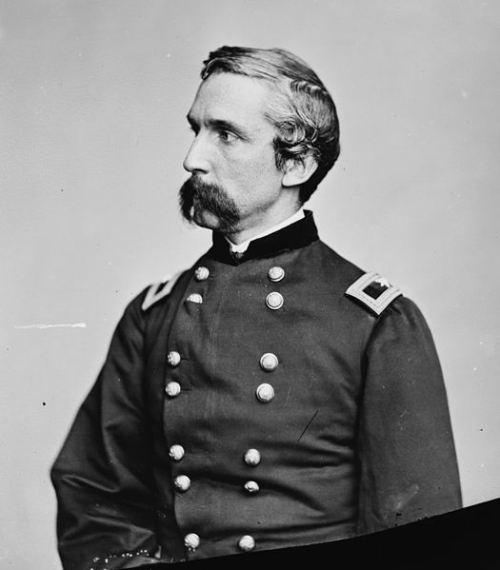
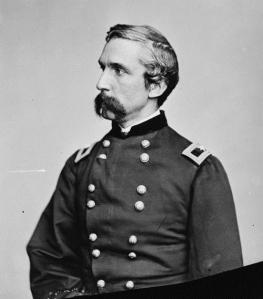
Colonel Joshua Chamberlain following his Promotion to Brigadier General

While Colonel Joshua Chamberlain’s story is much better known than his brigade commander, Strong Vincent, he was another of the citizen soldiers whose performance and leadership on Little Round Top saved the Union line that hot July evening. Chamberlain was a graduate of Bowdoin College and Bangor Theological Seminary. Fluent in nine languages other than English, he remained at Bowdoin as Professor of Rhetoric and was deeply unhappy at missing the war even as his students left and were commissioned as officers in newly raised regiments.

In June of 1862 Chamberlain wrote to Governor Israel Washburn requesting an appointment in a newly raised Maine Regiment without consulting either the college or his wife Fannie, who was “shocked, hurt, and alarmed by the decision he had made without consulting her…She remonstrated, she raised her voice, and quite possibly wept over the injustice he had done to both by this unilateral act that threatened to send their world careening in all directions.” [36]

As far as Bowdoin went, Chamberlain actually deceived the college by requesting a “scholarly sabbatical when in fact he had applied to the governor of Maine in the new 20th Maine Infantry in the late summer of 1862.” [37] When the faculty of Bowdoin found out of Chamberlain’s action many of them “were livid over what they considered his duplicity, and some shunned him during the brief period that he remained in Brunswick before reporting to training camp. [38]

The letter that Chamberlain wrote to Governor Israel Washburn details Chamberlain’s desire to serve and in some ways shows his considerable political skill in presenting his case to join the army:

“For seven years past I have been Professor in Bowdoin College. I have always been interested in military matters, and what I do not know in that line I know how to learn.

Having been lately elected to a new department here, I am expecting to have leave, at the approaching Commencement, to spend a year or more in Europe, in the service of the College. I am entirely unwilling, however, to accept this offer, if my Country needs my service or example here.

Your Excellency presides over the Educational as well as the military affairs of our State, and, I am well aware, appreciates the importance of sustaining our Institutions of Learning. You will therefore be able to decide where my influence is most needed.

But, I fear, this war, so costly of blood and treasure, will not cease until the men of the North are willing to leave good positions, and sacrifice the dearest personal interests, to rescue our Country from Desolation, and defend the National Existence against treachery at home and jeopardy abroad. This war must be ended, with a swift and strong hand; and every man ought to come forward and ask to be placed at his proper post.

Nearly a hundred of those who have been my pupils, are now officers in our army; but there are many more all over our State, who, I believe, would respond with enthusiasm, if summoned by me, and who would bring forward men enough to fill up a Regiment at once. I can not free myself from my obligations here until the first week in August, but I do not want to be the last in the field, if it can possibly be helped.” [39]

Chamberlain’s pre-war experiences gave no indication that he would emerge as a military hero. His father, a veteran of the War of 1812 had named him after Captain James Lawrence, the commanding officer of the frigate USS Chesapeake in the War of 1812 who uttered the famous words “Don’t give up the ship” as he lay mortally wounded when that ship was defeated by the HMS Shannon off Boston Harbor in 1813. However, Chamberlain’s mother added the name Joshua as his first name in the town’s books. While his father hoped that the young Chamberlain would pursue a military career, his mother earnestly desired that he would pursue a ministerial career. Chamberlain did become a licensed minister but had no desire to become a pastor, and was never ordained. This was reinforced by Fannie, who though the daughter of a minister was “too much a free thinker” and “did not share the devotion her father and Chamberlain held for organized religion.” [40]

Chamberlain debated attending West Point after graduation, a path that his classmate Oliver O. Howard took. Instead he attended Bangor Theological Seminary and following graduation took up his academic career at Bowdoin. It was during this time that he met, fell in love with, pursued, courted and finally married Frances Caroline Adams, who played the organ at the local Congregational Church that he attended. Known by most as “Fannie,” she was the adopted daughter of the eminent Congregationalist minister, Dr. George Adams who served as pastor. Fannie had a strong independent streak and was as an accomplished musician and artist.

The couple was an interesting match. Chamberlain was impressed by Fannie’s “artistic gifts. Fannie had talent not only in music but in poetry and, especially; art…” [41] but he ignored potential areas of conflict that would create difficulties throughout their marriage. However, Fannie was beset by numerous fears, as well as a desire not to be dominated by any man. Chamberlain pursued her with abandon but for a time she resisted, until her widowed father married a woman not much older than herself. She desired to pursue the study of music and went away to New York to do so, but in 1852 she decided that she was in love with him. “Yet she harbored doubts about her ability to return his feelings for her measure for measure.” [42]

Fannie suffered from depression and a constant worry about her eyesight which began failing her and an early age. It was a malady that eventually left her completely blind by then turn of the century. Compounding her struggles was that fact that her new husband struggled with his own doubts and depression, a depression that only seamed to lift during the war years.

“During most of his life, Chamberlain struggled with bouts of deep depression and melancholy. But not during the war years. It was as if the war and soldiering had made a new man out of him.” [43]

Chamberlain was offered command of the 20th Maine but asked Governor Washburn that he was appointed as a Lieutenant Colonel, which he was in August 1862. He fought with the regiment at Fredericksburg and was named commander of it when Colonel Adelbert Ames, his commander was transferred to preform staff duties prior to obtaining a brigade command in Oliver Howard’s XI Corps following the debacle at Chancellorsville.

Chamberlain at his heart, through his association with abolitionists and other prior to the war was a staunch Unionist. Before going into the army he wrote:

“We have this war upon is & we want to stop it. It has cost us already too much precious blood. It has carried stagnation, starvation & grief in to too many villages of our fair land – brought death to too many noble hearts that we could ill afford to lose. But the only way to stop this war, is first to show that we are strongest…I feel that we are fighting for our country – for our flag- not as so many Stars and Stripes, but as the emblem of a good & powerful nation – fighting to settle the question whether we are a nation or a basket of chips. Whether we shall leave our children the country we have inherited – or leave them without a country – without a name – without a citizenship among the great nations of the earth – take the chief city of the rebels. They will have no respect for us unless we whip them & and I say it in all earnestness….” [44]

Like Vincent, Chamberlain was also a quick student or military science and rapidly adapted to being a soldier, officer and commander of troops in combat. He spent as much time studying the art of war under the supervision of Colonel Ames including Henri Jomini’s Art of War which he wrote to Fannie “The Col. & I are going to read it. He to instruct me, as he is kindly doing everything now.” [45] He excelled at his studies under Ames, but since most of the manuals that he studied were based on Napoleonic tactics and had not incorporated the changes brought about by the rifled musket, Chamberlain like so many others would have to learn the lesson of war the hard way.

Chamberlain was with the regiment at Antietam, but it saw no action. He was in the thick of the fighting at Fredericksburg and Burnside’s subsequent “Mud March” which were both disastrous for the army.

He took command of the regiment in late April after Ames left on detached duty before assuming a brigade command. As the new commander of the regiment, Chamberlain and the 20th Maine missed the Battle of Chancellorsville as the regiment had been quarantined due to an epidemic of smallpox, which they had probably received from “poorly prepared serum with which the regiment was vaccinated” [46] in April.

From the regiment’s quarantined location Chamberlain and his men could hear the sound of battle. One of his soldiers wrote “We could hear the firing plain but there we lay in glorious idleness without being able to lift a finger or fire a gun.” [47] In frustration Chamberlain rode to Major General Joseph Hooker’s headquarters and asked Hooker’s Chief of Staff Dan Butterfield for the chance to enter the fight. Refused the chance Chamberlain told Butterfield “If we couldn’t do anything else we would give the rebels the smallpox!” [48] The regiment spent the battle guarding a telegraph line must to Chamberlain and his soldier’s disgust.

On the march up to Gettysburg, Chamberlain was ordered to take a number of veterans of the 2nd Maine who had signed three year, rather than two year enlistment contracts and were angry at remaining in the army when the regiment was mustered out. The men were angry and Chamberlain was given permission by Meade to fire on them “if they refused to do duty. The new colonel realized he had a crisis on his hands.” [49] The soldiers were bitter but Chamberlain treated them graciously and “almost all of them agreed to take up their muskets again the service of the 20th Maine.” [50] Chamberlain later remarked of how these men “we’re afterward among my best men, worthy of the proud fame of the 2nd, and the hard earned laurels of the 20th.” [51]

On receiving his orders from Vincent, Chamberlain deployed his small regiment halfway down the southern slope facing the small valley between Little Round Top and Big Round Top. By the time he arrived at Gettysburg he had become “a great infantry officer, and among his valuable qualities was [understanding] where an attack would come….” [52]

Since Chamberlain’s account is so important I will forgo a discussion of his tactics and instead quote the sections of his after action report that explains his actions. Chamberlain wrote:

“On reaching the field at about 4 p.m. July 2d, Col. Vincent commanding the Brigade, placing me on the left of the Brigade and consequently on the extreme left of our entire line of battle, instructed me that the enemy were expected shortly to make a desperate attempt to turn our left flank, and that the position assigned to me must be held at every hazard.

I established my line on the crest of a small spur of a rocky and wooded hill, and sent out at once a company of skirmishers on my left to guard against surprise on that unprotected flank.

These dispositions were scarcely made when the attack commenced, and the right of the Regt. found itself at once hotly engaged. Almost at the same moment, from a high rock which gave me a full view of the enemy, I perceived a heavy force in rear of their principal line, moving rapidly but stealthily toward our left, with the intention, as I judged, of gaining our rear unperceived. Without betraying our peril to any but one or two officers, I had the right wing move by the left flank, taking intervals of a pace or two, according to the shelter afforded by rocks or trees, extending so as to cover the whole front then engaged; and at the same time moved the left wing to the left and rear, making a large angle at the color, which was now brought to the front where our left had first rested.

This hazardous maneuvre [sic] was so admirably executed by my men that our fire was not materially slackened in front, and the enemy gained no advantage there, while the left wing in the meantime had formed a solid and steady line in a direction to meet the expected assault. We were not a moment too soon; for the enemy having gained their desired point of attack came to a front, and rushed forward with an impetuosity which showed their sanguine expectations.

Their astonishment however was evident, when emerging from their cover, they met instead of an unsuspecting flank, a firm and ready front. A strong fire opened at once from both sides, and with great effect, the enemy still advancing until they came within ten paces of our line, where our steady and telling volleys brought them to a stand. From that moment began a struggle fierce and bloody beyond any that I have witnessed, and which lasted in all its fury, a full hour. The two lines met, and broke and mingled in the shock. At times I saw around me more of the enemy than of my own men. The edge of conflict swayed to and fro -now one and now the other party holding the contested ground. Three times our line was forced back, but only to rally and repulse the enemy. As often as the enemy’s line was broken and routed, a new line was unmasked, which advanced with fresh vigor. Our “sixty rounds” were rapidly reduced; I sent several messengers to the rear for ammunition, and also for reinforcements. In the mean time we seized the opportunity of a momentary lull to gather ammunition and more serviceable arms, from the dead and dying on the field. With these we met the enemy’s last and fiercest assault. Their own rifles and their own bullets were turned against them. In the midst of this struggle, our ammunition utterly failed. The enemy were close upon us with a fresh line, pouring on us a terrible fire. Half the left wing already lay on the field. Although I had brought two companies from the right to its support, it was now scarcely more than a skirmish line. The heroic energy of my officers could avail no more. Our gallant line withered and shrunk before the fire it could not repel. It was too evident that we could maintain the defensive no longer. As a last desperate resort, I ordered a charge. The word “fix bayonets” flew from man to man. The click of the steel seemed to give new zeal to all. The men dashed forward with a shout. The two wings came into one line again, and extending to the left, and at the same time wheeling to the right, the whole Regiment described nearly a half circle, the left passing over the space of half a mile, while the right kept within the support of the 83d Penna. thus leaving no chance of escape to the enemy except to climb the steep side of the mountain or to pass by the whole front of the 83d Penna. The enemy’s first line scarcely tried to run-they stood amazed, threw down their loaded arms and surrendered in whole companies. Those in their rear had more time and gave us more trouble. My skirmishing company threw itself upon the enemy’s flank behind a stone wall, and their effective fire added to the enemy’s confusion. In this charge we captured three hundred and sixty eight prisoners, many of them officers, and took three hundred stand of arms. The prisoners were from four different regiments, and admitted that they had attacked with a Brigade.” [53]

Colonel William Oates of the 15th Alabama gave Chamberlain and his regiment the credit for stopping his attack. Oates wrote: “There have never been harder fighters than the Twentieth Maine and their gallant Colonel. His skill and persistency and the great bravery of his men saved Little Round Top and the Army of the Potomac from defeat.” [54]

As with any firsthand account, aspects of Chamberlain’s accounts are contested by others at the scene. But in another way Chamberlain’s accounts of battle have to be carefully examined, because they often reflect his romanticism, because he was not always a realist. Unlike Major Ellis Spear who played such an important role on the hill that day, a realist who “saw things plainly and remembered them clearly, in stark, unadorned hues. Joshua Chamberlain was a romanticist; even when describing the horrors of bloodbath his prose could be colorful, lyrical, even poetic.” [55]

Oates wrote that he ordered the retreat and that there were not as many prisoners taken. One of Chamberlain’s company commanders disputes the account of the order of the bayonet charge, however the fact is that Chamberlain, who was outnumbered nearly two to one by the 4th 15th and 47th Alabama regiments “offset this superiority with strength of position, iron determination and better tactics.” [56]Also a factor was the fatigue of the Confederates, these regiments and their parent unit, Law’s brigade of Hood’s division, which had conducted a grueling 28 mile march to get to the battlefield and were exhausted and dehydrated by the time that they arrived, something that their commander, Colonel Oates believed “contributed largely to our failure at Little Round Top.” [57]

Vincent was mortally wounded while leading the defense of the hill. As the men of Robertson’s Texas brigade rushed the hill and threatened to crack “the stout 16th Michigan defense…” [58] Vincent rushed to bolster the defenders. He was standing on a large boulder with a riding crop as the men of the 16th Michigan were beginning to waiver. Fully exposed to enemy fire he attempted to drive the retreating men back into the fight. Brandishing the riding which he cried out: “Don’t yield an inch now men or all is lost,” [59] and moments later was struck by a “minié ball which passed through his left groin and lodged in his left thigh. He fell to the ground and as he was being carried from the field, “This is the fourth or fifth time they have shot at me…and they have hit me at last.” [60]

o'rorke

Colonel Patrick “Paddy” O’Rorke

To Vincent’s right another hero emerged, Colonel Patrick “Paddy” O’Rorke; the young 27 year old Colonel of the 140th New York. O’Rorke was born in County Cavan, Ireland in 1836. His family immigrated to the United States, settling in Rochester, New York during the great wave of Irish immigration between 1838 and 1844. There the young O’Rorke worked hard to overcome the societal prejudices against Irish Catholics. After he completed his secondary education, he worked as a marble cutter before obtaining an appointment to West Point in 1857. He was the only foreign born member of his class at the academy from which he graduated first in his class in 1861. “Aggressive and bold, there was also something that implied gentility and tenderness…Beneath the mettle of a young professional soldier was a romantic heart that could croon a ballad before wielding the sword.” [61] O’Rorke married his childhood, schoolmate, fellow parishioner and childhood sweetheart, Clarissa Wadsworth Bishop, in the summer of 1862 and shortly thereafter accepted a commission as colonel of the 140th New York Infantry.

At Gettysburg, O’Rorke was with Weed’s brigade when Gouverneur Warren found him as he attempted to get any available troops to the summit of Little Round Top. When Warren found O’Rorke, who had been one of his students at West Point, he ordered him to follow him up the hill, saying “Paddy…give me a regiment.” [62] When O’Rorke said that Weed expected him to be following him, Warren took the responsibility telling O’Rorke “Bring them up on the double quick, and don’t stop for aligning. I’ll take responsibility.” [63] O’Rorke followed with his gallant regiment with the rest of the brigade under Weed following behind them.

The 140th New York’s entrance onto the summit of Little Round Top must have been dramatic. Dressed in new Zouave uniforms that they had been issued in early June “the men were “jaunty but tattered” in baggy blue trousers, red jackets, and fezzes.” [64] O’Rorke’s New Yorkers entered the battle to the right of the Vincent’s 16th Michigan, which was being swarmed by the 4th and 5th Texas and 4th Alabama, who thought that victory was at hand. O’Rorke did not even take time to form his men for battle but drew his sword and yelled :“Down this way boys!” [65] His troops responded magnificently slamming into the surprised Texans and Alabamians and “at once the Confederate assault began to dissolve” [66]

O’Rorke’s troops smashed into the surging Rebel ranks, stopping the Confederate assault in its tracks and taking over two-hundred prisoners. As O’Rorke “valiantly led his men into battle, surging down the hill toward the shelf of rock so recently vacated by the right wing of the 16th Michigan, he paused for a moment to cheer his men on and wave them forward. When he did, he was struck in the neck by an enemy bullet….O’Rorke, killed instantly slumped to the ground.” [67] But his regiment “had the initiative now. More and more men piled into a sloppy line, firing as fast as they could reload. Their dramatic appearance breathed renewed life into the other Union regiments on the hill, which now picked up their firing rates.” [68] The gallant young Irish colonel was dead, but he and his regiment had saved Vincent’s right flank. The regiment had suffered fearfully, “with 183 men killed or wounded, but they had managed to throw back the Texans. The adjutant of the 140th estimated that they came within sixty seconds of losing the top of the hill.” [69] O’Rorke’s soldiers were enraged by the death of their beloved colonel and picked out the Confederate who had killed him. One of the soldiers wrote “that was Johnny’s last shot, for a number of Companies A and G fired instantly.” It was said that this particular Johnny was hit, by actual count, seventeen times.” [70] Now led by company commanders the 140th stayed in the fight and solidified and extended the Federal line in conjunction with the rest of Weed’s brigade to their right.

The actions of Chamberlain’s, Vincent’s, and O’Rorke’s soldiers shattered Hood’s division. “Casualties among the Alabamians, Texans, and Georgians approached or exceeded 2,000. In the Texas Brigade commander Robertson had been wounded, three regimental commanders had fallen killed or wounded, and nearly all of the field officers lay on the ground.” [71]

The badly wounded Strong Vincent was taken to a field hospital at the Weikert farm where he lingered for five days before succumbing to his wounds. In the yard lay the body of Paddy O’Rorke whose regiment had saved his brigade’s right flank. Vincent knew that he was dying and he requested that a message be sent to Elizabeth for her to come to Gettysburg. It did not reach her in time. Though he suffered severe pain he bravely tried not to show it. Eventually he became so weak that he could no longer speak. “On July 7, a telegram from President Lincoln, commissioning Vincent a brigadier general, was read to him, but he could not acknowledge whether he understood that the president had promoted him for bravery in the line of duty.” [72] He died later that day and his body was transported home to Erie for burial. Ten weeks after his death his wife gave birth to a baby girl. The baby would not live a year and was buried next to him.

Colonel Rice, who led the 44th New York up the hill and took command of the brigade on Vincent’s death, memorialized his fallen commander in his general order to the brigade on July 12th:

“The colonel commanding hereby announces to the brigade the death of Brig. Gen. Strong Vincent. He died near Gettysburg, Pa., July 7, 1863, from the effects of a wound received on the 2d instant, and within sight of that field which his bravery had so greatly assisted to win. A day hallowed with all the glory of success is thus sombered by the sorrow of our loss. Wreaths of victory give way to chaplets of mourning, hearts exultant to feelings of grief. A soldier, a scholar, a friend, has fallen. For his country, struggling for its life, he willingly gave his own. Grateful for his services, the State which proudly claims him as her own will give him an honored grave and a costly monument, but he ever will remain buried in our hearts, and our love for his memory will outlast the stone which shall bear the inscription of his bravery, his virtues, and his patriotism.

While we deplore his death, and remember with sorrow our loss, let us emulate the example of his fidelity and patriotism, feeling that he lives but in vain who lives not for his God and his country. “[73]

Vincent’s wife Elizabeth never married again and was taken in by the Vincent family. Vincent’s younger brother became an Episcopal Priest and Bishop and later provided a home for her. She became a tireless worker in the church working with charitable work for young women and children. This led to an interest in sacred art and she wrote two books: Mary, the Mother of Jesus and The Madonna in Legend and in Art. She also translated Delitzch’s Behold the Man and A Day in Capernaum from the German. [74] Elizabeth Vincent passed away in April 1914 and was buried beside her husband and daughter.

After the battle, as the army looked to replace the casualties in the ranks of senior leadership and “when Colonel Rice, in charge of 3rd Brigade after Vincent fell, was promoted to brigadier general and given another command” the new division commander Major General Charles Griffin, “insisted on having Chamberlain, for the 3rd Brigade.” [75]

Chamberlain survived the war to great acclaim being wounded three times, once during the siege of Petersburg the wound was so severe that his survival was in doubt and General Ulysses S. Grant promoted him on the spot. It was the only promotion that Grant gave on the field of battle. Grant wrote:

“He had been several times recommended for a brigadier-generalcy for gallant and meritorious conduct. On this occasion, however, I promoted him on the spot, and forwarded a copy of my order to the War Department, asking that my act might be confirmed without any delay. This was done, and at last a gallant and meritorious officer received partial justice at the hands of his government, which he had served so faithfully and so well.” [76]

He recovered from the wound, and was promoted to Major General commanding a division and awarded the Medal of Honor. He received the surrender of John Gordon’s division of the Army of Northern Virginia at Appomattox on April 9th 1865. When he did he ordered his men to present arms in honor of their defeated foe as those haggard soldiers passed his division. It was an act that helped spur a spirit of reconciliation in many of his former Confederate opponents.

Chamberlain’s accolades were certainly earned but others on that hill have been all too often overlooked by most people. This list includes Gouverneur Warren who was humiliated by Phillip Sheridan at Five Forks, Strong Vincent who died on of wounds suffered on Little Round Top and Paddy O’Rorke, the commander of the 140th New York of Weed’s Brigade on Vincent’s right who was mortally wounded that day.

After the war like most citizen soldiers, Chamberlain returned to civilian life, and a marriage that was in crisis in which neither Joshua nor Fannie seemed able to communicate well enough to mend. The troubled couple “celebrated their tenth wedding anniversary on December 7, 1865. He gave her a double banded gold-and-diamond bracelet from Tiffany’s, an extravagant gift that only temporarily relieved the stresses at work just below the surface of their bland marriage. Wartime separation had perhaps damaged it more than Chamberlain knew.” [77]

When he came home Chamberlain was unsettled. Fannie quite obviously hoped that his return would reunite them and bring about “peaceful hours and the sweet communion of uninterrupted days with the husband that had miraculously survived the slaughter” [78] and who had returned home, but it was not to be. Army life had given him a sense of purpose and meaning that he struggled to find in the civilian world. He was haunted by a prediction made by one of his professors. A prediction that “he would return from war “shattered” & “good for nothing,” [79] Chamberlain began to search for something to give his life meaning. He began to write a history of V Corps and give speeches around the northeast, and “these engagements buoyed his spirit, helping him submerge his tribulations and uncertainties in a warm sea of shared experience. [80] In his travels he remained apart from Fannie, who remained with the children, seldom including her in those efforts. She expressed her heart in a letter in early 1866:

“I have no idea when you will go back to Philadelphia, why dont you let me know about things dear?….I think I will be going towards home soon, but I want to hear from you. What are you doing dear? are you writing for your book? and how was it with your lecture in Brunswick- was it the one at Gettysburg? I look at your picture when ever I am in my room, and I am lonely for you. After all, every thing that is beautiful must be enjoyed with one you love, or it is nothing to you. Dear, dear Lawrence write me one of the old letters…hoping to hear from you soon…I am as in the old times gone bye Your Fannie.” [81]

In those events he poured out his heart in ways that seemed impossible for him to do with Fannie. He accounted those wives, parents, sons and daughters at home who had lost those that they loved, not only to death:

“…the worn and wasted and wounded may recover a measure of their strength, or blessed by your cherishing care live neither useless nor unhappy….A lost limb is not like a brother, an empty sleeve is not like an empty home, a scarred breast is not like a broken heart. No, the world may smile again and repair its losses, but who shall give you back again a father? What husband can replace the chosen of your youth? Who shall restore a son? Where will you find a lover like the high hearted boy you shall see no more?” [82]

Chamberlain set his sights on politics, goal that he saw as important in championing the rights of soldiers and their well treatment by a society, but a life that again interrupted his marriage to Fannie and brought frequent separation. Instead of the one term that Fannie expected, Chamberlain ended up serving four consecutive one year terms as Governor of Maine, and was considered for other political offices. Fannie’s “protracted absence from the capital bespoke her attitude toward his political ambitions.” [83]absence from the capital. Eventually Chamberlain returned home and. “For twelve years following his last term as governor, he served as president of Bowdoin College, his alma mater. [84]

He became a champion of national reconciliation admired by friend and former foe alike, but he returned with bitterness towards some in the Union who he did not believe cared for his comrades or their families, especially those who had lost loved ones in the war. While saluting those who had served in the Christian and Sanitary Commissions during the war, praising veterans, soldiers and their families he noted that they were different than:

Those who can see no good in the soldier of the Union who took upon his breast the blow struck at the Nation’s and only look to our antagonists for examples of heroism- those over magnanimous Christians, who are so anxious to love their enemies that they are willing to hate their friends….I have no patience with the prejudice or the perversity that will not accord justice to the men who have fought and fallen on behalf of us all, but must go round by the way of Fort Pillow, Andersonville and Belle Isle to find a chivalry worthy of praise.” [85]

Chamberlain’s post-war life, save for the times that he was able to revisit the scenes of glory and be with his former comrades was marred by deep personal and professional struggles and much suffering. He struggled with the adjustment to civilian life, which for him was profoundly difficult. He “returned to Bowdoin and the college life which he had sworn he would not again endure. Three years of hard campaigning however, had made a career of college teaching seem less undesirable, while his physical condition made a permanent army career impossible.” [86] The adjustment was more than even he could anticipate, and the return to the sleepy college town and monotony of teaching left much to be desired.

fannychamberlain1

Joshua and Fannie Chamberlain (Dale Gallon)

These are not uncommon situations for combat veterans to experience, and Joshua Chamberlain, the hero of Little Round Top who was well acquainted with the carnage of war, suffered immensely. His wounds never fully healed and he was forced to wear what would be considered an early form of a catheter and bag. In 1868 he was awarded a pension of thirty dollars a month for his Petersburg wound which was described as “Bladder very painful and irritable; whole lower part of abdomen tender and sensitive; large urinal fistula at base of penis; suffers constant pain in both hips.” [87] Chamberlain struggled to climb out of “an emotional abyss” in the years after the war. Part was caused by his wounds which included wounds to his sexual organs, shattering his sexuality and caused his marriage to deteriorate.

He wrote to Fannie in 1867 about the “widening gulf between them, one created at least in part by his physical limitations: “There is not much left in me to love. I feel that all too well.” [88] Chamberlain’s inability to readjust to civilian life following the war, and Fanny’s inability to understand what he had gone through during it caused great troubles in their marriage. Chamberlain “felt like hell a lot of the time, morose in mood and racked with pain.” [89] His wounds would require more surgeries, and in “April 1883 he was forced to have extensive surgery on his war wounds, and through the rest of the decade and well into the next he was severely ill on several occasions and close to death once.” [90]

By 1868 the issues were so deep that Fannie threatened him with divorce and was accusing Joshua of domestic abuse, not in court, but among her friends and in town; a charge which he contested. It is unknown if the abuse actually occurred and given Chamberlain’s poor physical condition it is unlikely that he could have done what she claimed, it is actually much more likely, based on her correspondence as well as Fannie’s:

“chronic depression, her sense of being neglected of not abandoned, and her status as an unappreciated appendage to her husband’s celebrated public career caused her to retaliate in a manner calculated to get her husband’s attention while visiting on him some of the misery she had long endured.” [91]

The bitterness in their relationship at the time was shown in his offer to her of a divorce; a condition very similar to what many combat veterans and their families experience today. After he received news of the allegations that Fannie was spreading among their friends around town, Chamberlain wrote to her:

“If it is true (as Mr. Johnson seems to think there is a chance of its being) that you are preparing for an action against me, you need not give yourself all this trouble. I should think we had skill enough to adjust the terms of a separation without the wretchedness to all our family which these low people to whom it would seem that you confide your grievances & plans will certainly bring about.

You never take my advice, I am aware.

But if you do not stop this at once it will end in hell.” [92]

His words certainly seem harsh, especially in our time where divorce, be it contested or uncontested does not have the same social stigma it did then. Willard Wallace writes that the letter “reflects bewilderment, anger, even reproof, but not recrimination; and implicit throughout is an acute concern for Fanny, who did not seem to realize the implications of legal action. The lot of a divorcee in that era in a conservative part of the country was not likely to be a happy one.” [93]This could well be the case, but we do not know for sure his intent. We can say that it speaks to the mutual distress, anger and pain that both Joshua and Fannie were suffering at the time.

The marriage endured a separation which lasted until 1871 when his final term of office expired they reconciled, and the marriage did survive, for nearly forty more years. “Whatever differences may have once occasionally existed between Chamberlain and Fanny, the two had been very close for many years.” [94] The reconciliation could have been for any number of reasons, from simple political expedience, in that he had been rejected by his party to be appointed as Senator, and the realization that “that politics, unlike war, could never stir his soul.” [95] Perhaps he finally recognized just how badly he had hurt her over all the years of his neglect of her needs. But it is just as likely that deep in his heart he really did love her despite his chronic inability for so many years to demonstrate it in a way she could feel. Fannie died in 1905 and Chamberlain, who despite all of their conflicts loved her and grieved her, a grief “tinged with remorse and perhaps also with guilt.” [96] The anguished widower wrote after her death:

“You in my soul I see, faithful watcher, by my cot-side long days and nights together, through the delirium of mortal anguish – steadfast, calm, and sweet as eternal love. We pass now quickly from each other’s sight, but I know full well that where beyond these passing scenes you shall be, there will be heaven!”

Chamberlain made a final trip to Gettysburg in May of 1913. He felt well enough to give a tour to a delegation of federal judges. “One evening, an hour or so before sunset, he trudged, alone, up the overgrown slope of Little Round Top and sat down among the crags. Now in his Gothic imagination, the ghosts of the Little Round Top dead rose up around him….he lingered up the hillside, an old man lost in the sepia world of memory.” [97] He was alone.

Chamberlain died on a bitterly cold day, February 24th 1914 of complications from complications of the ghastly wound that he received at Petersburg in 1864. The Confederate minié ball that had struck him at the Rives’ Salient finally claimed his life just four months shy of 50 years since the Confederate marksman found his target.

Sadly, the story of the marriage of Joshua and Fannie Chamberlain is all too typical of many military marriages and relationships where a spouse returns home changed by their experience of war and struggles to readjust to civilian life. This is something that we need to remember when we encounter those changed by war and the struggles of soldiers as well as their families; for if we have learned nothing from our recent wars it is that the wounds of war extend far beyond the battlefield, often scarring veterans and their families for decades after the last shot of the war has been fired.

The Battle for Little Round Top which is so legendary in our collective history and myth was in the end something more than a decisive engagement in a decisive battle. It was something greater and larger than that, it is the terribly heart wrenching story of ordinary, yet heroic men like Vincent, Chamberlain and O’Rorke and their families who on that day were changed forever. As Chamberlain, ever the romantic, spoke about that day when dedicating the Maine Monument in 1888; about the men who fought that day and what they accomplished:

“In great deeds, something abides. On great fields, something stays. Forms change and pass; bodies disappear; but spirits linger, to consecrate ground for the vision-place of souls… generations that know us not and that we know not of, heart-drawn to see where and by whom great things were suffered and done for them, shall come to this deathless field, to ponder and dream; and lo! the shadow of a mighty presence shall wrap them in its bosom, and the power of the vision pass into their souls.” [98]

Notes

[1] Guelzo, Allen C. Gettysburg: The Last Invasion Vintage Books a Division of Random House, New York 2013 p.462

[2] Nevins, James H. And Styple What Death More Glorious: A Biography of General Strong Vincent Belle Grove Publishing Co, Kearny N.J. 1997 p.16

[3] Ibid. Nevins What Death More Glorious p.17

[4] Ibid. LaFantasie, Glenn W. Twilight at Little Round Top: p.105

[5] ________. Erie County Historical Society http://www.eriecountyhistory.org/wp-content/uploads/2008/10/strongvincent.pdf retrieved 9 June 2014

[6] Golay, Michael. To Gettysburg and Beyond: The Parallel Lives of Joshua Lawrence Chamberlain and Edward Porter Alexander Crown Publishers Inc. New York 1994 p.129

[7] Nevins, James H. and Styple, William B. What Death More Glorious: A Biography of General Strong Vincent Belle Grove Publishing Company, Kearney NJ 1997 p.29

[8] Ibid Guelzo, Gettysburg: The Last Invasion p.262

[9] Ibid. Nevins, What Death More Glorious p.54

[10] Leonardi, Ron Strong Vincent at Gettysburg in the Barringer-Erie Times News retrieved June 9th 2014 from http://history.goerie.com/2013/06/30/strong-vincent-at-gettysburg/

[11] Ibid. Nevins What Death More Glorious p.55

[12] Wallace, Willard. The Soul of the Lion: A Biography of Joshua L. Chamberlain Stan Clark Military Books, Gettysburg PA 1960 p.91

[13] Ibid. Nevins What Death More Glorious p.57

[14] Ibid. Guelzo, Gettysburg: The Last Invasion p.264

[15] Pfanz, Harry F. Gettysburg: The Second Day. University of North Carolina Press, Chapel Hill 1987 p.51

[16] Ibid. Guelzo Gettysburg: The Last Invasion Vintage p.159

[17] Trudeau, Noah Andre. Gettysburg: A Testing of Courage, Harper Collins Publishers, New York 2002 p.305

[18] Some such as Guelzo believe this may have been Captain William Jay of Sykes staff

[19] Ibid. Trudeau, Gettysburg: A Testing of Courage p.327

[20] Ibid. Guelzo Gettysburg: The Last Invasion Vintage p.262

[21] Ibid. Guelzo Gettysburg: The Last Invasion Vintage p.262

[22] Ibid. Trudeau, Gettysburg: A Testing of Courage p.327

[23] Ibid. LaFantasie Twilight at Little Round Top p.108

[24] Coddington, Edwin B. The Gettysburg Campaign: A Study in Command, A Touchstone Book, Simon and Schuster New York, 1968 p.389

[25] Ibid. LaFantasie Twilight at Little Round Top p.109

[26] Ibid. Coddington The Gettysburg Campaign p.390

[27] Ibid. Guelzo Gettysburg: The Last Invasion Vintage p.270

[28] Ibid. Nevins What Death More Glorious p.75

[29] Sears, Stephen W. Gettysburg. Houghton Mifflin Co. Boston and New York 2003 p.292

[30] Ibid. LaFantasie Twilight at Little Round Top p.109

[31] Ibid. LaFantasie Twilight at Little Round Top p.109

[32] Ibid. Pfanz, Gettysburg: The Second Day. p.213

[33] Ibid. LaFantasie Twilight at Little Round Top p.111

[34] Ibid. Golay, To Gettysburg and Beyond p.157

[35] Ibid. LaFantasie Twilight at Little Round Top p.111

[36] Ibid. Longacre Joshua Chamberlain p.52

[37] Ibid. LaFantasie Twilight at Little Round Top pp.44-45

[38] ibid. Longacre Joshua Chamberlain p.52

[39] Chamberlain, Joshua Lawrence Letter From Joshua L. Chamberlain to Governor [Israel] Washburn, Brunswick, July 14, 1862 retrieved from Bowdoin College, Joshua Lawrence Chamberlain Documents http://learn.bowdoin.edu/joshua-lawrence-chamberlain/documents/1862-07-14.html 8 November 2014

[40] Longacre, Edward Joshua Chamberlain: The Soldier and the Man Combined Publishing Conshohocken PA 1999 p.39

[41] Ibid. Longacre, Edward Joshua Chamberlain: The Soldier and the Man p.28

[42] Ibid. Longacre Joshua Chamberlain: The Soldier and the Man p.30

[43] Ibid. LaFantasie Twilight at Little Round Top p.45

[44] Smith, Diane Monroe Fanny and Joshua: The Enigmatic Lives of France’s Caroline Adams and Joshua Lawrence Chamberlain Thomas Publications, Gettysburg PA 1999 p.120

[45] Ibid. Longacre Joshua Chamberlain p.80

[46] Ibid. Wallace The Soul of the Lion p.66

[47] Ibid. Golay, To Gettysburg and Beyond p.132

[48] Ibid. Wallace The Soul of the Lion p.66

[49] Ibid. Longacre Joshua Chamberlain p.116

[50] Ibid. LaFantasie Twilight at Little Round Top p.45

[51] Ibid. Longacre Joshua Chamberlain p.117

[52] Ibid. Wallace The Soul of the Lion p.94

[53] Chamberlain, Joshua Lawrence. Official Narrative of Joshua Chamberlain of July 6th 1863, Maine Military Historical Society, Inc., Augusta, Maine, copyright 1989 U.S. Army Combat Studies Institute Reprint, retrieved from http://usacac.army.mil/cac2/cgsc/carl/download/csipubs/chamberlain.pdf June 15th 2014

[54] Oates, William C. and Haskell, Frank A. Gettysburg Bantam Books edition, New York 1992, originally published in 1905 p.98

[55] Ibid. Longacre Joshua Chamberlain p.94

[56] Ibid. Coddington The Gettysburg Campaign: A Study in Command p.393

[57] Ibid. Oates and Haskell Gettysburg p.87

[58] Ibid. Wallace The Soul of the Lion p.95

[59] Ibid. Guelzo Gettysburg: The Last Invasion Vintage p.272

[60] Ibid. Trudeau, Gettysburg: A Testing of Courage p.361

[61] LaFantasie, Glenn W. Twilight at Little Round Top: July 2, 1863 The Tide Turns at Gettysburg Vintage Books, a Division of Random House, New York 2005 pp.61-62

[62] Ibid. Jordan Happiness is Not My Companion: The Life of G.K. Warren p.93

[63] Ibid. Foote The Civil War, A Narrative. Volume Two Fredericksburg to Meridian p.504

[64] Ibid. Pfanz Gettysburg: The Second Day p.228

[65] Ibid. Pfanz Gettysburg: The Second Day p.228

[66] Ibid. LaFantasie Twilight at Little Round Top p.153

[67] Ibid. LaFantasie Twilight at Little Round Top p.154

[68] Ibid. Trudeau, Gettysburg: A Testing of Courage p.327

[69] Ibid. Jordan Happiness is Not My Companion: The Life of G.K. Warren p.93

[70] Ibid. Sears Gettysburg p.294

[71] Wert, Jeffry D. A Glorious Army: Robert E. Lee’s Triumph 1862-1863 Simon and Schuster, New York and London 2011 p.260

[72] Ibid. LaFantasie Twilight at Little Round Top p.207

[73] Ibid. Nevins What Death More Glorious p.86

[74] Ibid. Nevins What Death More Glorious pp.87-88

[75] Ibid. Wallace The Soul of the Lion p.115

[76] Ibid. Wallace The Soul of the Lion pp.134-135

[77] Ibid. Golay, To Gettysburg and Beyond p.282

[78] Ibid. Smith Fanny and Joshua p.182

[79] Ibid. Smith, Fanny and Joshua p.180

[80] Ibid. Longacre Joshua Chamberlain p.260

[81] Ibid. Smith, Fanny and Joshua pp.178-179

[82] Ibid. Smith, Fanny and Joshua p.181

[83] Ibid. Longacre Joshua Chamberlain p.

[84] Ibid. LaFantasie Twilight at Little Round Top p.245

[85] Ibid. Smith, Fanny and Joshua p.180 It is interesting to note that Chamberlain’s commentary is directed at Northerners who were even just a few years after the war were glorifying Confederate leader’s exploits. Chamberlain instead directs the attention of his audience, and those covering the speech to the atrocities committed at the Fort Pillow massacre of 1864 and to the hellish conditions at the Andersonville and Belle Isle prisoner of war camps run by the Confederacy.

[86] Ibid. Wallace The Soul of the Lion p.203

[87] Ibid. Golay, To Gettysburg and Beyond p.289

[88] Ibid. Longacre Joshua Chamberlain: The Soldier and the Man p.259

[89] Ibid. Golay, To Gettysburg and Beyond p.288

[90] Ibid. Longacre Joshua Chamberlain: The Soldier and the Man p.285

[91] Ibid. Longacre Joshua Chamberlain: The Soldier and the Man p.268

[92] Chamberlain, Joshua L. Letter Joshua L. Chamberlain to “Dear Fanny” [Fanny Chamberlain], Augusta, November 20, 1868 retrieved from Bowdoin College, Joshua Lawrence Chamberlain Documents http://learn.bowdoin.edu/joshua-lawrence-chamberlain/documents/1868-11-20.html 8 November 2014

[93] Ibid. Wallace The Soul of the Lion p.227

[94] Ibid. Wallace The Soul of the Lion p.297

[95] Ibid. Golay To Gettysburg and Beyond p.290

[96] Ibid. Longacre Joshua Chamberlain: The Soldier and the Man p.290

[97] Ibid. Golay To Gettysburg and Beyond PPP.342-343

[98] Chamberlain, Joshua Lawrence. Chamberlain’s Address at the dedication of the Maine Monuments at Gettysburg, October 3rd 1888 retrieved from http://www.joshualawrencechamberlain.com/maineatgettysburg.php 4 June 2014

1 Comment

Filed under civil war, History, leadership, marriage and relationships, Military

A Question for Tom Cotton and Other War Mongers

cotton

I have been at my denominational Chaplain and Pastoral Counselor conference and we were talking about the concept of Moral Injury.  Sadly the concept while real is so misunderstood. Many in the Christian psychotherapy and pastoral counseling world have reduced the concept to what the soldier did on a battlefield that causes him problems and which he must confess to God to be forgiven. But the bigger issue in moral injury is not that, it is the betrayal of trust by the nation of those that they send to war for the most spurious and often illegal and immoral reasons.

Most people who join the military are idealistic and have a trust of their government, their leaders, their military services and even their churches and God that is a major part of their life. Sadly, that trust is betrayed when the nation sends them into wars which are illegal, immoral and place them in situations where they do or see things that break that trust often forever. This happened to many of our Vietnam vets and is happening again to those of us who served in Iraq or Afghanistan.

Sadly, most Americans, about 99% have no skin in this game. The young men and women who go to war represent far less than one percent of the American population. Many ethnic minorities and come from either the middle class or the poor. Likewise, a growing percentage are men and women who grew up as military brats. I’m one of those, but I see a lot more now. In World War II even the political and economic elites sent their sons to war, but this is not the case today. In fact it is hard to name the children of any national political or corporate leaders who have served in Iraq or Afghanistan. The only one that comes to mind to me is Vice President Joe Biden’s son Beau, who served in Iraq.

But even as we still struggle to deal with the results of the Iraq blunder, there are those who foolishly desire to involve this nation in another war. A war which can have no good outcome and which when push comes to shove few will oppose, because other than the incredibly small minority that serve in the military, no one has any skin in the game.

Senator Tom Cotton, a former Army Lieutenant and Iraq veteran, with about as much sense as Doug Neidermeyer from Animal House is beating the drums of war with Iran saying that any military action against Iran would be short and easy. Senator Cotton-Neidermeyer say that it would require just a few days of bombing to complete the mission of crippling Iran’s nuclear program.

Of course he is not alone there is a rising chorus of war mongers who want yet to wage another preemptive war. This would be a war that baring a direct attack of Iran on the United States or an ally that we are bound by treaty to defend would be illegal under every international convention. It would be comparable to the actions of Nazi Germany in its wars of aggression that we sent Nazi leaders to the gallows at Nuremberg.

U.S. Supreme Court Associate Justice Robert Jackson who served as the American prosecutor and worked with our allies to set up the Nuremberg proceedings made this comment which always should be for most in the mind of any American leader when considering going to war: “If certain acts of violation of treaties are crimes, they are crimes whether the United States does them or whether Germany does them, and we are not prepared to lay down a rule of criminal conduct against others which we would not be willing to have invoked against us.” Justice Robert Jackson International Conference on Military Trials, London, 1945, Dept. of State Pub.No. 3080 (1949), p.330.

neidermeyer

If Senator Cotton-Neidermeyer gets his war, baring an Iranian attack on us or one of our allies it be illegal an tantamount to what we put the leaders of the Third Reich on trial for.  Likewise, it would be like the one waged against Iraq one waged under false pretenses which cost so many lives, bled the nation’s treasury dry and reduced our trust and standing in the world.  

We sowed the wind in Iraq, and with climatic struggle between the Islamic State and the Iraqi Shia, supported by Iranian Revolutionary Guards, are reaping the whirlwind. 

Senator Cotton seems not to get the fact that in any war the enemy gets a vote, and the Iranians, even if we manage to cripple their nuclear program will certainly exact a price in blood and treasure that Lieutenant Cotton-Neidermeyer does not seem to understand or appreciate. U.S. ships in the Persian Gulf will have to right off salvos of anti-ship missiles, swarm attacks by Iranian missile and torpedo boats as well as air attacks and submarines. No matter how well we do in defending against these attacks it is undoubtable that ships will be damaged or even sunk and many, maybe even hundreds or thousands of sailors killed, something not seen since World War Two. Likewise the U.S. installations in Bahrain and Qatar will be bombarded with hundreds of short and medium ranged missiles many which will get through our missile defense systems.

When the bodies of our dead military personnel come back, will Senator Cotton be there to meet them? I doubt it because for him, they are just the cost of war. Will he and his allies increase support for the bereaved families, or the wounded? I doubt it, because all of them are bent of cutting the benefits to the wounded, the broken and those shattered by war, because such expenditures get in the way of lining the pockets of their benefactors.

Yes, they will beat their chests and talk about “our heroes” and castigate as traitors those who opposed the war that they brought about in order to cover their guilt.

While we would eventually prevail in such an exchange it would be disastrous and further weaken our military as well as our standing in the world. But then there is the moral question, especially for those who like Senator Cotton and so many of the others who advocate an illegal, immoral preemptive war of aggression who claim to be Christians need to ask.

That question was asked by the iconic hero of the American Civil War Joshua Chamberlain on the front lines at Petersburg in the closing days of that war: “…men made in the image of God, marred by the hand of man, and must we say in the name of God? And where is the reckoning for such things? And who is answerable? One might almost shrink from the sound of his own voice, which had launched into the palpitating air words of order–do we call it?–fraught with such ruin. Was it God’s command that we heard, or His forgiveness that we must forever implore?” 

That my friends is what Senator Cotton and others of those who advocate yet another war of aggression need to answer.

Peace

Padre Steve+

5 Comments

Filed under afghanistan, ethics, faith, Foreign Policy, History, iraq, leadership, Military, national security, PTSD

A Terrible Good Friday: The Assassination of Abraham Lincoln

gburg address

Good Friday is somber day, and I think that there was none more somber than Good Friday 1865. Shortly after 10 P.M. at Ford’s theater a handsome and well known actor walked into the booth occupied by President Lincoln at Washington’s Ford’s Theater. The President was there with his wife Mary Todd Lincoln and another couple after a very full day of business to watch the play Our American Cousin a farcical look at the visit of an American visiting his English relatives when going to settle the family estate.

Lincoln was looking forward to the play. Though the war continued the surrender of Robert E. Lee’s Army of Northern Virginia to Ulysses S. Grant on April 9th for all intents and purposes had placed the final nail in the Confederacy’s malevolent coffin, and it was if a burden have been removed from Lincoln’s shoulders. His task now what the reintegration of the rebellious states back into the Union, a task that he believed needed to be accomplished without malice while still seeking justice. He made this clear in his Second Inaugural Address just over a month before:

“With malice toward none, with charity for all, with firmness in the right as God gives us to see the right, let us strive on to finish the work we are in, to bind up the nation’s wounds, to care for him who shall have borne the battle and for his widow and his orphan, to do all which may achieve and cherish a just and lasting peace among ourselves and with all nations.”

Just three days before Lincoln had given his last public speech at the White House. It was a practical speech dealing with the nuts and bolts reuniting the country including announcing his support for Negro Suffrage. He said:

“By these recent successes the re-inauguration of the national authority — reconstruction — which has had a large share of thought from the first, is pressed much more closely upon our attention. It is fraught with great difficulty. Unlike a case of a war between independent nations, there is no authorized organ for us to treat with. No one man has authority to give up the rebellion for any other man. We simply must begin with, and mould from, disorganized and discordant elements. Nor is it a small additional embarrassment that we, the loyal people, differ among ourselves as to the mode, manner, and means of reconstruction.”

In the speech Lincoln discussed the issues related to the new government of Louisiana and its dealings with African Americans, which did not go far enough for Lincoln, who was intent on extending the franchise to vote for all blacks, even if it took time to make it so. John Wilkes Booth was in attendance that day and as he listened he became ever angrier and he vowed to a fellow conspirator Lewis Powell, “That is the last speech he will make” and Booth was going to ensure this himself.

Lincoln had been troubled for some time by terrible insomnia and dreams, both bizarre and ghoulish. A few days before he had told Mary and others sharing dinner with them of a troubling dream which he described in detail, Mary and those at the table so accustomed to Lincoln’s customary wit and humor were stunned as Lincoln spoke. He closed the description with these words:

“Determined to find the cause of a state of things so mysterious and shocking, I kept on until I entered the East Room, which I entered. There I was met with a sickening surprise. Before me was a catafalque, on which rested a corpse wrapped in funeral vestments. Around it were stationed soldiers who were acting as guards; and a throng of people, some gazing mournfully at the corpse, whose face was covered, others weeping pitifully: ‘Who is dead in the White House?’ I demanded of one of the soldiers. ‘The President’ was the answer; ‘he was killed by an assassin!’ “Then came a loud burst of grief from the crowd…” [1]

Mary and the others were so upset, particularly with the large number of death threats Lincoln had received throughout the war. However, Lincoln told them all not to worry as “it was only a dream.”

On that Good Friday Lincoln was determined not to mourn, instead of attending Good Friday services or contemplating the war, or reconstruction, he simply wanted to laugh and chose to attend the play, wanting General Grant and his wife to attend. However Grant needed to travel to New Jersey and declined the offer.

Despite this Lincoln was in a cheerful mood, looking forward to the future and discussing all the things that he wanted to see and do after his term in office. Mary was startled by his cheerfulness and Lincoln told her “I have never felt better in my life.” [2] Lincoln and his party arrived late to the cheers of the cast and took their seats in the box about 8:30 to the strains of Hail to the Chief. As the play resumes Lincoln’s bodyguard slips away to get a drink and about twelve minutes after ten Booth slipped into the box where Lincoln sat watching the play. As the crowd roared its delight at a particularly funny scene a shot rings out and Lincoln’s arm jerks up and he slumps over. Booth then jumped to the stage from the box, injuring his leg and shouting “Sic semper tyrannis” or thus always to tyrants. It was the beginning of a series of attempted assassinations designed to decapitate the Federal government, Secretary of State Seward was badly wounded by Lewis Payne, a third assassin backed out at the last minute and failed to attack Vice President Johnson.

Though physicians sought to save the President the wound was mortal, the bullet having ender the back of his head, and dug deep into his brain, lodging behind his left eye. At 7:22 A.M. Abraham Lincoln was dead. It was a disaster for the nation as the new President, Andrew Johnson was a political enemy of Lincoln and not in line with Lincoln’s understanding of reconstruction and reconciliation. A poor Southerner from Tennessee, Johnson hated the Southern plantation aristocracy and would act as a punisher, while radical reconstructionist members of the cabinet and Congress would act in such a way that reconstruction would never achieve all that Lincoln believed that it could.

While radical Confederates rejoiced in Lincoln’s death others were more circumspect. Jefferson Davis who was fleeing and hoping to continue the war realized that the South would not fare as well under Johnson as Lincoln. In fact Johnson’s lack of understanding of the nuances of northern politics as well as his loathing of blacks, his “beliefs, prejudices, personality traits were a recipe for disaster at a time when an unprecedented national crisis put a premium on the capacity to think in new and creative ways.” [3]

The Army of the Potomac learned of Lincoln’s assassination on Easter Sunday. Joshua Chamberlain told a woman whose mansion was at the center of his division’s camp when she asked what disturbed him “It is bad news for the South.” When the woman asked if it was Lee or Davis Chamberlain told her that it was Lincoln and said “The South has lost its best friend, Madam.” [4]

Chamberlain ordered chaplain to conduct a field memorial for the fallen President. The division chaplain a Catholic Priest, Father Egan spoke and roused the men, and Egan ended his service “Better so, Better to die glorious, than live infamous. Better to be buried beneath a nation’s tears, than to walk the earth guilty of the nation’s blood.” [5]

During the war Lincoln had endeared himself to his soldiers and they responded with great emotion. One burst into tears and sobbed “He was our best friend. God bless him,” another wrote home “What a hold Old Abe had on the hearts of the soldiers of the army could only be told by the way they showed their mourning for him.” Admiral David Dixon Porter wrote “The United States has lost the greatest man she ever produced.” [6]

The bullet fired by John Wilkes Booth was a disaster for the country. Sadly, there are some today, in particular the White Supremacist group The League of the South are choosing to celebrate the assassination of the man that they so hate, and honor the assassin as a hero. However, I have to agree with Admiral Porter, there has never been a President before or after who was anything like this man, and I dedicate myself to the quest for equality of all people and for a reconciliation like the leaders of the League of the South and their forbearers will never embrace, for they hate this nation as much as they hate Lincoln. I also fear what such people would do to President Obama should they ever get the opportunity.

Peace

Padre Steve+

Notes

[1] Winik, Jay April 1865: The Month that Saved America Harper Collins, New York 2001 p.205

[2] Ibid. Winik April 1865 p.220

[3] Foner, Eric Forever Free: The Story of Emancipation and Reconstruction Vintage Books, New York 2005 p.109

[4] Wallace, Willard. The Soul of the Lion: A Biography of Joshua L. Chamberlain Stan Clark Military Books, Gettysburg PA 1960 p.193

[5] Ibid. Wallace The Soul of the Lion p.194.

[6] Flood, Charles Bracelen Grant and Sherman: The Friendship that Won the War Harper Perennial, New York 2005 pp.329-330

Leave a comment

Filed under civil war, History, leadership, Political Commentary

“We Are All Americans” Surrender at Appomattox

appomattox surrender

One hundred and fifty years ago on the 9th and 10th of April 1865, four men, Ulysses S Grant, Robert E. Lee, Joshua Lawrence Chamberlain and Ely Parker, taught succeeding generations the value of mutual respect and reconciliation. They would do so after a bitter and bloody war that had cost the lives of over 600,000 Americans which had left hundreds of thousands others maimed, shattered or without a place to live, and seen vast swaths of the country ravaged by war and its attendant plagues.

The men were all very different, Lee was a Southern aristocrat and career army officer, Grant, the officer of humble means who had struggled with alcoholism and failed in his civilian life before returning to the army when war began. Chamberlain, was the professor of rhetoric and natural and revealed religion, the hero of Little Round Top, who helped exemplify the importance of citizen soldiers in peace and war. Finally there was Parker, a full-blooded Seneca Indian; a professional engineer, a man who was barred from being an attorney because as a Native American he was never considered a citizen. Although he had been rejected from serving in the army for the same reason, his friend Grant had obtained him a commission and kept him on his staff.

On the morning of the 9th Confederate General Robert E. Lee replied to an entreaty of Lieutenant General Ulysses S. Grant requesting that he and his Army of Northern Virginia be allowed to surrender. Lee wrote to Grant:

HEADQUARTERS ARMY OF NORTHERN VIRGINIA, APRIL 9, 1865

Lieut. Gen. U.S. GRANT:

I received your note of this morning on the picket-line, whither I had come to meet you and ascertain definitely what terms were embraced in your proposal of yesterday with reference to the surrender of this army. I now ask an interview in accordance with the offer contained in your letter of yesterday for that purpose.

R.E. LEE, General.

The once mighty Army of Northern Virginia which had won so many victories was now a haggard but proud force of about 15,000 soldiers. For Lee to continue the war now would mean that they face hopeless odds against a vastly superior enemy. Grant recognized this and wrote Lee:

I am equally anxious for peace with yourself, and the whole North entertains the same feeling. The terms upon which peace can be had are well understood. By the South laying down their arms they will hasten that most desirable event, save thousands of human lives, and hundreds of millions of property not yet destroyed. Seriously hoping that all our difficulties may be set-tied without the loss of another life, I subscribe myself, &c.,

Since the high water mark at Gettysburg, Lee’s army had been on the defensive. His ill-fated offensive into Pennsylvania being one of the two climactic events that sealed the doom of the Confederacy. The other was Grant’s victory at Vicksburg which fell to him a day after Pickett’s Charge.

The bloody defensive struggle lasted through 1864 as Grant bled the Confederates dry during the Overland Campaign, leading to the long siege of Petersburg. Likewise the armies of William Tecumseh Sherman had cut a swath through the Deep South and were moving toward Virginia from the Carolinas.

With each battle following Gettysburg the Army of Northern Virginia became weaker and finally after the nine month long siege of Petersburg ended with a Union victory there was little else to do. On the morning of April 9th a final attempt to break through the Union lines by John Gordon’s division was turned back by vastly superior Union forces.

grant 1

Lieutenant General Ulysses S. Grant, United States Army

On April 7th Grant wrote a letter to Lee which began the process of ending the war in Virginia. He wrote:

General R. E. LEE:

The result of the last week must convince you of the hopelessness of further resistance on the part of the Army of Northern Virginia in this struggle. I feel that it is so, and regard it as my duty to shift from myself the responsibility of any further effusion of blood, by asking of you the surrender of that portion of the C. S. Army known as the Army of Northern Virginia.

U.S. GRANT, Lieutenant-General

Lee was hesitant to surrender knowing Grant’s reputation for insisting on unconditional surrender, terms that Lee could not accept. He replied to Grant:

HEADQUARTERS ARMY OF NORTHERN VIRGINIA, APRIL 7, 1865 Lieut. Gen. U.S. GRANT:

I have received your note of this date. Though not entertaining the opinion you express on the hopelessness of further resistance on the part of the Army of Northern Virginia, I reciprocate your desire to avoid useless effusion of blood, and therefore, before considering your proposition, ask the terms you will offer on condition of its surrender.

R.E. LEE, General.

The correspondence continued over the next day even as the Confederates hoped to fight their way out of the trap that they were in. But now Robert E. Lee, who had through his efforts extended the war for at least six months knew that he could no longer continue. Even so some of his younger subordinates wanted to continue the fight. When his artillery chief Porter Alexander recommended that the Army be released, “take to the woods and report to their state governors” Lee replied:

“We have simply now to face the fact that the Confederacy has failed. And as Christian men, Gen. Alexander, you & I have no right to think for one moment of our personal feelings or affairs. We must consider only the effect which our action will have upon the country at large.”

Lee continued:

“Already [the country] is demoralized by the four years of war. If I took your advice, the men would be without rations and under no control of their officers. They would be compelled to rob and steal in order to live…. We would bring on a state of affairs it would take the country years to recover from… You young fellows might go bushwhacking, but the only dignified course for me would be to go to General Grant and surrender myself and take the consequences of my acts.”

Alexander was so humbled at Lee’s reply he later wrote “I was so ashamed of having proposed such a foolish and wild cat scheme that I felt like begging him to forget he had ever heard it.” When Alexander saw the gracious terms of the surrender he was particularly impressed with how non-vindictive the terms were, especially in terms of parole and amnesty for the surrendered soldiers.

Abraham Lincoln had already set the tone for the surrender in his Second Inaugural Address given just over a month before the surrender of Lee’s army. Lincoln closed that speech with these words of reconciliation:

“With malice toward none, with charity for all, with firmness in the right as God gives us to see the right, let us strive on to finish the work we are in, to bind up the nation’s wounds, to care for him who shall have borne the battle and for his widow and his orphan, to do all which may achieve and cherish a just and lasting peace among ourselves and with all nations.”

Lee1

General Robert E. Lee, CSA

Lee met Grant at the house of Wilmer McLean, who had moved to Appomattox in 1861 after his home near Manassas had been used as a Confederate headquarters and was damaged by artillery fire. Lee was dressed in his finest uniform complete with sash, while Grant was dressed in a mud splattered uniform and overcoat only distinguished from his soldiers by the three stars on his should boards. Grant’s dress uniforms were far to the rear in the baggage trains and Grant was afraid that his slovenly appearance would insult Lee, but it did not. It was a friendly meeting, before getting down to business the two reminisced about the Mexican War.

Grant provided his vanquished foe very generous surrender terms:

“In accordance with the substance of my letter to you of the 8th inst., I propose to receive the surrender of the Army of N. Va. on the following terms, to wit: Rolls of all the officers and men to be made in duplicate. One copy to be given to an officer designated by me, the other to be retained by such officer or officers as you may designate. The officers to give their individual paroles not to take up arms against the Government of the United States until properly exchanged, and each company or regimental commander sign a like parole for the men of their commands. The arms, artillery and public property to be parked and stacked, and turned over to the officer appointed by me to receive them. This will not embrace the side-arms of the officers, nor their private horses or baggage. This done, each officer and man will be allowed to return to their homes, not to be disturbed by United States authority so long as they observe their paroles and the laws in force where they may reside.”

When Lee left the building Federal troops began cheering but Grant ordered them to stop. Grant felt a sense of melancholy and wrote “I felt…sad and depressed, at the downfall of a foe who had fought so long and valiantly, and had suffered so much for a cause, though that cause was, I believe, one of the worst for which a people has fought.” He later noted: “The Confederates were now our countrymen, and we did not want to exult over their downfall.”

In the hours before and after the signing of the surrender documents old friends and classmates, separated by four long years of war gathered on the porch or around the house. Grant and others were gracious to their now defeated friends and the bitterness of war began to melt away. Some Union officers offered money to help their Confederate friends get through the coming months. It was an emotional reunion, especially for the former West Point classmates gathered there:

“It had never been in their hearts to hate the classmates they were fighting. Their lives and affections for one another had been indelibly framed and inextricably intertwined in their academy days. No adversity, war, killing, or political estrangement could undo that. Now, meeting together when the guns were quiet, they yearned to know that they would never hear their thunder or be ordered to take up arms against one another again.”

Grant also sent 25,000 rations to the starving Confederate army waiting to surrender. The gesture meant much to the defeated Confederate soldiers who had had little to eat ever since the retreat began.

The surrender itself was accomplished with a recognition that soldiers who have given the full measure of devotion can know when confronting a defeated enemy. Major General Joshua Lawrence Chamberlain, the heroic victor of Little Round Top was directed by Grant to receive the final surrender of the defeated Confederate infantry on the morning of April 12th.

It was a rainy and gloomy morning as the beaten Confederates marched to the surrender grounds. As the initial units under the command of John Gordon passed him, Chamberlain was moved with emotion he ordered his soldiers to salute the defeated enemy for whose cause he had no sympathy, Chamberlain honored the defeated Rebel army by bringing his division to present arms.

chamberlian gordon appomattox

John Gordon, who was “riding with heavy spirit and downcast face,” looked up, surveyed the scene, wheeled about on his horse, and “with profound salutation returned the gesture by lowering his saber to the toe of his boot. The Georgian then ordered each following brigade to carry arms as they passed third brigade, “honor answering honor.”

joshua_chamberlain_-_brady-handy

Major General Joshua Lawrence Chamberlain, U.S. Army

Chamberlain was not just a soldier, but before the war had been Professor of Natural and Revealed Religions at Bowdoin College, and a student of theology before the war. He could not help to see the significance of the occasion. He understood that he would be criticized by some for offering the salute. However, Chamberlain, unlike some, understood the value of reconciliation. Chamberlain was a staunch abolitionist and Unionist who had nearly died on more than one occasion fighting the defeated Confederate Army, and he understood that no true peace could transpire unless the enemies became reconciled to one another.

He noted that his chief reason for doing so:

“The momentous meaning of this occasion impressed me deeply. I resolved to mark it by some token of recognition, which could be no other than a salute of arms. Well aware of the responsibility assumed, and of the criticisms that would follow, as the sequel proved, nothing of that kind could move me in the least. The act could be defended, if needful, by the suggestion that such a salute was not to the cause for which the flag of the Confederacy stood, but to its going down before the flag of the Union. My main reason, however, was one for which I sought no authority nor asked forgiveness. Before us in proud humiliation stood the embodiment of manhood: men whom neither toils and sufferings, nor the fact of death, nor disaster, nor hopelessness could bend from their resolve; standing before us now, thin, worn, and famished, but erect, and with eyes looking level into ours, waking memories that bound us together as no other bond;—was not such manhood to be welcomed back into a Union so tested and assured? Instructions had been given; and when the head of each division column comes opposite our group, our bugle sounds the signal and instantly our whole line from right to left, regiment by regiment in succession, gives the soldier’s salutation, from the “order arms” to the old “carry”—the marching salute. Gordon at the head of the column, riding with heavy spirit and downcast face, catches the sound of shifting arms, looks up, and, taking the meaning, wheels superbly, making with himself and his horse one uplifted figure, with profound salutation as he drops the point of his sword to the boot toe; then facing to his own command, gives word for his successive brigades to pass us with the same position of the manual,—honor answering honor. On our part not a sound of trumpet more, nor roll of drum; not a cheer, nor word nor whisper of vain-glorying, nor motion of man standing again at the order, but an awed stillness rather, and breath-holding, as if it were the passing of the dead!”

The next day Robert E Lee addressed his soldiers for the last time. Lee’s final order to his loyal troops was published the day after the surrender. It was a gracious letter of thanks to men that had served their beloved commander well in the course of the three years since he assumed command of them outside Richmond in 1862.

General Order
No. 9

After four years of arduous service marked by unsurpassed courage and fortitude, the Army of Northern Virginia has been compelled to yield to overwhelming numbers and resources.

I need not tell the survivors of so many hard fought battles, who have remained steadfast to the last, that I have consented to the result from no distrust of them.

But feeling that valour and devotion could accomplish nothing that could compensate for the loss that must have attended the continuance of the contest, I have determined to avoid the useless sacrifice of those whose past services have endeared them to their countrymen.

By the terms of the agreement, officers and men can return to their homes and remain until exchanged. You will take with you the satisfaction that proceeds from the consciousness of duty faithfully performed, and I earnestly pray that a merciful God will extend to you his blessing and protection.

With an unceasing admiration of your constancy and devotion to your Country, and a grateful remembrance of your kind and generous consideration for myself, I bid you an affectionate farewell. — R. E. Lee, General

The surrender was the beginning of the end. Other Confederate forces continued to resist for several weeks, but with the surrender of the Army of Northern Virginia led by the man that nearly all Southerners saw as the embodiment of their nation the war was effectively over.

Lee had fought hard and after the war was still under the charge of treason, but he understood the significance of defeat and the necessity of moving forward as one nation. In August 1865 Lee wrote to the trustees of Washington College of which he was now President:

“I think it is the duty of every citizen, in the present condition of the Country, to do all in his power to aid the restoration of peace and harmony… It is particularly incumbent upon those charged with the instruction of the young to set them an example of submission to authority.

It is a lesson that all of us in our terribly divided land need to learn regardless of or political affiliation or ideology. After he had signed the surrender document, Lee learned that Grant’s Aide-de-Camp Colonel Ely Parker, was a full-blooded Seneca Indian. He stared at Parker’s dark features and said: “It is good to have one real American here.”

eparker05-966-g

Brigadier General Ely Parker, United States Army

Parker, a man whose people had known the brutality of the white man, a man who was not considered a citizen and would never gain the right to vote, replied, “Sir, we are all Americans.” That afternoon Parker would receive a commission as a Brevet Brigadier General of Volunteers, making him the first Native American to hold that rank in the United States Army. He would later be made a Brigadier General in the Regular Army.

I don’t know what Lee thought of that. His reaction is not recorded and he never wrote about it after the war, but it might have been in some way led to Lee’s letter to the trustees of Washington College. I think with our land so divided, ands that is time again that we learn the lessons so evidenced in the actions and words of Ely Parker, Ulysses Grant, Robert E. Lee and Joshua Chamberlain, for we are all Americans.

Sadly, I think that there is a portion of the population who will not heed these words and will continue to agitate for policies and laws similar to those that led to the Civil War, and which those the could not reconcile defeat instituted again during the Post-Reconstruction and Jim Crow eras.

But I still maintain hope that in spite of everything, that we can overcome.

Peace

Padre Steve+


1 Comment

Filed under civil war, History, leadership, Military, Political Commentary

I Enlisted to Fight: Colonel Strong Vincent

vincent

Colonel String Vincent

Friends of Padre Steve’s World

I am continuing to periodically intersperse and publish short articles about various commanders at Gettysburg on the site. These all are drawn from my student text and may become a book in their own right.  The reason is I am going to do this is because I have found that readers are often more drawn to the lives of people than they are events. As I have noted before that people matter, even deeply flawed people, and we can learn from them.

Today’s article is about the youngest brigade commander in the Army of the Potomac, Colonel Strong Vincent a twenty-six year old Harvard graduate and citizen soldier. His story is fascinating as well as well as a reminder of the tragic losses brought about by war. His actions  and decisions on July 2nd 1863 were instrumental in the Union holding Little Round Top and turning back the Confederate Tide.

Peace

Padre Steve+

Colonel Strong Vincent was a 26 year old Harvard graduate and lawyer from Erie Pennsylvania. He was born in Waterford and attended school in Erie. Growing up, he worked in his father’s iron foundry, where the work helped make him a man of great physical strength. He studied at Trinity College in Hartford Connecticut and transferred to Harvard. There are various explanations for why he left Trinity, but the most interesting and probably the most credible is that during his sophomore year which was recorded by Trinity alumnus Charles F. Johnson who wrote that:

“He went calling on Miss Elizabeth Carter, a teacher at Miss Porter’s school in Farmington, ten miles west of Hartford. At some point a guard or watchman voiced a comment that impinged the lady’s virtue, and, as Johnson so aptly phrases it, Vincent “responded to the affront with the same gallantry and vigor that he was to display in the Civil War.” McCook’s account indicated that the man was repeatedly pummeled, which effectively rendered him unconscious.” [1]

Long after the war Dr. Edward Gallaudet, the president of Trinity responded to an enquiry of the circumstances leading to Vincent’s early departure from Trinity. Gallaudet responded to the request in a terse manner:

“Replying to yours of yesterday, I must say that I do not think it would be wise to make public the story I told of Strong Vincent’s escapade at Farmington & its consequences. Certainly not in the lifetime of Mrs. Vincent.” [2]

Evidently the incident resulted in Vincent leaving Trinity and the next year he entered Harvard. Vincent graduated from Harvard in 1859, ranking 51st in a class of 92. However, he was not an outstanding student and “earned admonishments on his record for missing chapel and smoking in Harvard Yard.” [3]

Returning home he studied law with a prominent lawyer and within two years had passed the bar, and he was well respected in the community. When war came and the call went out for volunteers, Vincent enlisted in a 30 Day regiment, the Wayne Guards as a private and then was appointed as a 1st Lieutenant and Adjutant of the regiment because of his academic and administrative acumen.

He married Elizabeth, the same woman whose virtue he had defended at Trinity that day. Vincent like many young northerners believed in the cause of the Union undivided, and he wrote his wife shortly after the regiment went to war on the Peninsula:

“Surely the right will prevail. If I live we will rejoice in our country’s success. If I fall, remember you have given your husband to the most righteous cause that ever widowed a woman.” [4]

When the Wayne Guards were disbanded at the end of their enlistment, Vincent helped to raise the 83rd Pennsylvania and was commissioned as a Lieutenant Colonel in it on September 14th 1861. The young officer learned his trade well and was considered a “strict disciplinarian and master of drill.” [5] That being said one enlisted man remarked that “no officer in the army was more thoughtful and considerate of the health and comfort of his men.” [6] Vincent assumed command of the regiment when the commander was killed during the Seven Days in June of 1862 where he learned lessons that he would help impart to his fellow officers as well as subordinates, including Chamberlain. At Fredericksburg any doubters about the young officer’s courage and leadership ability were converted where they observed his poise “with sword in hand” he “stood erect in full view of the enemy’s artillery, and though the shot fell fast on all sides, he never wavered or once changed his position.” [7]

By the time of the Battle of Gettysburg, the 26 year old Vincent was the youngest brigade commander in the army. He was noted for his intelligence, leadership, military acumen and maturity. One friend wrote “As a general thing his companions were older than himself….Among his associates were men of the highest rank. He could adapt himself to all, could talk with the politician on questions of history, with a general officer on military evolutions, or with a sporting man on the relative merits of horses,-and all respected his opinion.” [8]

His promotion was well earned, following a bout with a combination of Malaria and Typhoid, the “Chickahominy Fever” which almost killed him; Vincent took command of the regiment after its commander was killed at Gaines Mill. He commanded the regiment at Fredericksburg and was promoted to command the 3rd Brigade after the Battle of Chancellorsville following the resignation of its commander, Colonel T.W.B. Stockton on May 18th 1863.

Vincent was offered the chance to serve as the Judge Advocate General of the Army of the Potomac by Joseph Hooker in the spring of 1863 after spending three months on court-martial duty. But Vincent refused the offer in so that he might remain in the fight commanding troops. [9] He told his friends “I enlisted to fight.” [10]

Vincent, like Chamberlain who admired him greatly had “become a kind of model of the citizen soldier.” [11] As a result of his experience in battle and the tenacity of the Confederate army he became an advocate of the tactics that William Tecumseh Sherman would later employ during his march to the sea in 1864. He wrote his wife before Chancellorsville:

“We must fight them more vindictively, or we shall be foiled at every step.  We must desolate the country as we pass through it, and not leave a trace of a doubtful friend or foe behind us; make them believe that we are in earnest, terribly in earnest; that to break this band in twain is monstrous and impossible; that the life of every man, yea, of every weak woman or child in the entire South, is of no value whatever compared with the integrity of the Union.” [12]

Unlike most other brigade commanders, Vincent was still a Colonel, and he, like many others would in his place hoping for a General’s star. He remarked that his move to save Sickles’ command “will either bring me my stars, or finish my career as a soldier.” [13] On July first, Vincent, a native Pennsylvanian came to Hanover and learning that battle had been joined, ordered “the pipes and drums of the 83rd Pennsylvania to play his brigade through the town and ordered the regiments to uncover their flags again….” [14] As the brigade marched through the town, Vincent “reverently bared his head” and announced to his adjutant, “What death more glorious can any man desire than to die on the soil of old Pennsylvania fighting for that flag?” [15]

Vincent was known for his personal courage and a soldier of the 83rd Pennsylvania observed: “Vincent had a particular penchant for being in the lead….Whenever or wherever his brigade might be in a position to get ahead…, he was sure to be ahead.” [16] That courage and acumen to be in the right place at the right time was in evidence when he led his brigade into battle on that fateful July second.

On July 2nd Barnes’ division of V Corps, which Vincent’s brigade was a part was being deployed to the threat posed by the Confederate attack of McLaws’ division on the Peach Orchard and the Wheat Field to reinforce Sickles’ III Corps. While that division marched toward the Peach Orchard, Vincent’s 3rd Brigade was the trail unit. When Gouverneur Warren’s aide, Lieutenant Randall Mackenzie [17] came toward the unit in search of Barnes, he came across Vincent and his brigade near the George Weikert house on Cemetery Ridge awaiting further orders. [18]

Vincent intercepted him and demanded what his orders were. Upon being told that Sykes’ orders to Barnes were to “send one of his brigades to occupy that hill yonder,” [19] Vincent defied normal protocol assuming that Barnes had hit the bottle and was drunk [20] and told Mackenzie “I will take responsibility of taking my brigade there.” [21] Vincent immediately went into action and ordered Colonel James Rice, his friend and the commander of the 44th New York “to bring the brigade to the hill as quickly as possible,” and then turned on his horse and galloped off toward Little Round Top.” [22]

It was a fortunate thing for the Union that he did. His quick action to get his brigade, clear orders to his subordinate commanders and skilled analysis of the ground were a decisive factor in the Union forces holding Little Round Top. After ordering Colonel Rice to lead the brigade up to the hill, he and his aide went forward to scout positions accompanied by the brigade standards. Rice brought the brigade forward at the double quick “across the field to the road leading up the north shoulder of the hill” with Chamberlain’s 20th Maine in the lead. [23]

Vincent and his orderly made a reconnaissance of the south and east slope of the hill which adjoined a small valley and a rocky outcrop called Devil’s Den, which was occupied by the 124th New York and which was the end of Sickles’ line. Near the summit of the southern aspect of the hill, they came under Confederate artillery fire and told his orderly “They are firing at the flag, go behind the rocks with it.” [24]

Vincent dismounted, leaving his sword secured on his horse, carrying only his riding crop. He continued and “with the skill and precision of a professional had reconnoitered and decided how to best place his slim brigade of 1350 muskets.” [25] He chose a position along a spur of the hill, which now bears his name, running from the northwest to the southeast to place his regiments where they could intercept the Confederate troops of Hood’s division which he could see advancing toward the hill.

What Vincent saw when he arrived was a scene of disaster. Confederate troops had overwhelmed the 124th New York and were moving on Little Round Top, “Devil’s Den was a smoking crater,” and the ravine which separated Devil’s Den from Little Round Top “was a whirling maelstrom.” [26] Seeing the threat Vincent began to deploy his brigade but also sent at messenger back to Barnes telling him “Go tell General Barnes to send reinforcements at once, the enemy are coming against us with an overwhelming force” [27]

The 16th Michigan, the smallest regiment in his brigade with barely 150 soldiers in line [28] was placed on the right flank of the brigade. As it moved forward, its adjutant, Rufus W. Jacklin’s horse was hit by a cannon ball which decapitated that unfortunate animal and left it “a mass of quivering flesh.” [29] A fierce Confederate artillery barrage fell among the advancing Union troops and splintered trees, causing some concern among the soldiers. The 20th Maine’s Chaplain, Luther French, saw the “beheading of Jacklin’s horse and ran to Captain Atherton W. Clark, commanding the 20th’s Company E, babbling about what he had seen. Clark interrupted French abruptly and shouted: “For Christ sake Chaplain, if you have any business attend to it.” [30]

That section of the line was located on massive boulders that placed it high above the valley below, making it nearly impregnable to frontal attack. On the summit Vincent deployed the 83rd Pennsylvania and 44th New York to their left at the request of Rice who told him “In every battle that we have engaged the Eighty-third and Forty-fourth have fought side by side. I wish that it might be so today.” [31] The story is probably apocryphal but the regiments remained side by side with the 16th Michigan on the right and the 20th Maine on the left. The two regiments were deployed below the crest among the large number of boulders; the 83rd was about two-thirds of the way down the way down the slope where it joined the right of the 44th, whose line angled back up the slope to the southeast. A historian of the 83rd Pennsylvania noted that “Each rock”… “was a fortress behind which the soldier[s] instantly took shelter.” [32] The soldiers were determined to do their duty as they now were fighting on home ground.

Vincent deployed the 20th Maine on his extreme left of his line, and in fact the extreme end of the Union line. Vincent knew that if this flank was turned and Chamberlain overrun that it would imperil the entire Union position. Vincent came up to Chamberlain who remembered that Vincent said “in an awed, faraway voice: “I place you here….This is the left of the Union line. You understand. You are to hold this ground at all costs.” [33]

Vincent was wounded while leading the defense of the hill. As the men of Robertson’s Texas brigade rushed the hill and threatened to crack “the stout 16th Michigan defense…” [34] Vincent rushed to bolster the defenders. He was standing on a large boulder with a riding crop as the men of the 16th Michigan were beginning to waiver. Fully exposed to enemy fire he attempted to drive the retreating men back into the fight. Brandishing the riding which he cried out: “Don’t yield an inch now men or all is lost,” [35] and moments later was struck by a “minié ball which passed through his left groin and lodged in his left thigh. He fell to the ground and as he was being carried from the field, “This is the fourth or fifth time they have shot at me…and they have hit me at last.” [36]

Mortally wounded, Vincent was taken to a field hospital at the Weikert farm where he lingered for five days before succumbing to his wounds. In the yard lay the body of Paddy O’Rorke whose regiment had saved his brigade’s right flank. Vincent knew that he was dying and he requested that a message be sent to Elizabeth for her to come to Gettysburg. It did not reach her in time. Though he suffered severe pain he bravely tried not to show it. Eventually he became so weak that he could no longer speak. “On July 7, a telegram from President Lincoln, commissioning Vincent a brigadier general, was read to him, but he could not acknowledge whether he understood that the president had promoted him for bravery in the line of duty.” [37] He died later that day and his body was transported home to Erie for burial. Ten weeks after his death his wife gave birth to a baby girl. The baby would not live a year and was buried next to him.

Colonel Rice, who led the 44th New York up the hill and took command of the brigade on Vincent’s death, memorialized his fallen commander in his general order to the brigade on July 12th:

“The colonel commanding hereby announces to the brigade the death of Brig. Gen. Strong Vincent. He died near Gettysburg, Pa., July 7, 1863, from the effects of a wound received on the 2d instant, and within sight of that field which his bravery had so greatly assisted to win. A day hallowed with all the glory of success is thus sombered by the sorrow of our loss. Wreaths of victory give way to chaplets of mourning, hearts exultant to feelings of grief. A soldier, a scholar, a friend, has fallen. For his country, struggling for its life, he willingly gave his own. Grateful for his services, the State which proudly claims him as her own will give him an honored grave and a costly monument, but he ever will remain buried in our hearts, and our love for his memory will outlast the stone which shall bear the inscription of his bravery, his virtues, and his patriotism.

While we deplore his death, and remember with sorrow our loss, let us emulate the example of his fidelity and patriotism, feeling that he lives but in vain who lives not for his God and his country. “[38]

Vincent’s wife Elizabeth never married again and was taken in by the Vincent family. Vincent’s younger brother became an Episcopal Priest and Bishop and later provided a home for her. She became a tireless worker in the church working with charitable work for young women and children. This led to an interest in sacred art and she wrote two books: Mary, the Mother of Jesus and The Madonna in Legend and in Art. She also translated Delitzch’s Behold the Man and A Day in Capernaum from the German. [39] Elizabeth Vincent passed away in April 1914 and was buried beside her husband and daughter.

[1] Nevins, James H. And Styple What Death More Glorious: A Biography of General Strong Vincent Belle Grove Publishing Co, Kearny N.J. 1997 p.16

[2] Ibid. Nevins What Death More Glorious p.17

[3] Ibid. LaFantasie, Glenn W. Twilight at Little Round Top: p.105

[4] ________. Erie County Historical Society http://www.eriecountyhistory.org/wp-content/uploads/2008/10/strongvincent.pdf retrieved 9 June 2014

[5] Golay, Michael. To Gettysburg and Beyond: The Parallel Lives of Joshua Lawrence Chamberlain and Edward Porter Alexander Crown Publishers Inc. New York 1994 p.129

[6] Nevins, James H. and Styple, William B. What Death More Glorious: A Biography of General Strong Vincent Belle Grove Publishing Company, Kearney NJ 1997 p.29

[7] Ibid Guelzo, Gettysburg: The Last Invasion p.262

[8] Ibid.Nevins, What Death More Glorious p.54

[9] Leonardi, Ron Strong Vincent at Gettysburg in the Barringer-Erie Times News retrieved June 9th 2014 from http://history.goerie.com/2013/06/30/strong-vincent-at-gettysburg/

[10] Ibid. Nevins What Death More Glorious p.55

[11] Wallace, Willard. The Soul of the Lion: A Biography of Joshua L. Chamberlain Stan Clark Military Books, Gettysburg PA 1960 p.91

[12] Ibid. Nevins What Death More Glorious p.57

[13] Ibid. Guelzo, Gettysburg: The Last Invasion p.264

[14] Pfanz, Harry F. Gettysburg: The Second Day. University of North Carolina Press, Chapel Hill 1987 p.51

[15] Ibid. Guelzo Gettysburg: The Last Invasion Vintage p.159

[16] Trudeau, Noah Andre. Gettysburg: A Testing of Courage, Harper Collins Publishers, New York 2002 p.305

[17] Some such as Guelzo believe this may have been Captain William Jay of Sykes staff

[18] Ibid. Trudeau, Gettysburg: A Testing of Courage p.327

[19] Ibid. Guelzo Gettysburg: The Last Invasion Vintage p.262

[20] Ibid. Guelzo Gettysburg: The Last Invasion Vintage p.262

[21] Ibid. Trudeau, Gettysburg: A Testing of Courage p.327

[22] Ibid. LaFantasie Twilight at Little Round Top p.108

[23] Coddington, Edwin B. The Gettysburg Campaign: A Study in Command, A Touchstone Book, Simon and Schuster New York, 1968 p.389

[24] Ibid. LaFantasie Twilight at Little Round Top p.109

[25] Ibid. Coddington The Gettysburg Campaign p.390

[26] Ibid. Guelzo Gettysburg: The Last Invasion Vintage p.270

[27] Ibid. Nevins What Death More Glorious p.75

[28] Sears, Stephen W. Gettysburg. Houghton Mifflin Co. Boston and New York 2003 p.292

[29] Ibid. LaFantasie Twilight at Little Round Top p.109

[30] Ibid. LaFantasie Twilight at Little Round Top p.109

[31] Ibid. Pfanz, Gettysburg: The Second Day. p.213

[32] Ibid. LaFantasie Twilight at Little Round Top p.111

[33] Ibid. Golay, To Gettysburg and Beyond p.157

[34] Ibid. Wallace The Soul of the Lion p.95

[35] Ibid. Guelzo Gettysburg: The Last Invasion Vintage p.272

[36] Ibid. Trudeau, Gettysburg: A Testing of Courage p.361

[37] Ibid. LaFantasie Twilight at Little Round Top p.207

[38] Ibid. Nevins What Death More Glorious p.86

[39] Ibid. Nevins What Death More Glorious pp.87-88

Leave a comment

Filed under civil war, Gettysburg, History, leadership, Military

Gettysburg and the Human Cost of War

“Ashes of soldiers South or North, As I muse retrospective murmuring a chant in thought, The war resumes, again to my sense your shapes, And again the advance of the armies. Noiseless as mists and vapors, From their graves in the trenches ascending, From cemeteries all through Virginia and Tennessee, From every point of the compass out of the countless graves, In wafted clouds, in myriads large, or squads of twos or threes or single ones they come, And silently gather round me…”

From Walt Whitman- Ashes of Dead Soldiers

gburg dead2 

Friends of Padre Steve’s World

In a day or two I will be posting an article on the terrible nature of war. I am a career military officer who suffers from PTSD, TBI and other afflictions after serving in Iraq’s Al Anbar Province in 2007-2008.  I have seen firsthand the terrible effects of war. I am also a historian and I Assostant Professor at a major military staff college which helps educate senior military officers from this country and other countries. I my capacity there I teach ethics as well as lead a staff ride, or study of the Battle of Gettysburg. In my teaching I always attempt to deal with the human cost of war. Gettysburg was the most costly battle ever fought on the American continent. Around 50,000 men were killed or wounded there in three days of battle. William Tecumseh Sherman noted that “war is hell.” I agree, there is nothing romantic about it. The effects of war last generations and though we have been at war for the last thirteen and a half years, war itself is an abstract concept to most Americans. Fought by professionals and only experienced by most Americans on the news, movies or most the banal manner, video games, the cost in human terms is not fully appreciated, and nor can it be. Our politicians have insulated the public from war and in doing so have ensured that we are in a perpetual war which benefits no one. That is a big reason why I write so much about it, not to glorify or romanticize it, but to try in some war to help make it real  to my readers. This is a draft chapter from my Gettysburg text. 

Peace

Padre Steve+

Too often we look at distant battles and campaigns in terms of strategy, operations, tactics, leadership and the weaponry employed. Likewise we might become more analytical and look at the impact of the battle or campaign in the context of the war it was fought, or in the manner in which the tactics or weapons used revolutionized warfare. Sometimes in our more reflective moments we might look at individual bravery or sacrifice, often missing in our analysis is the cost in flesh and blood.

Admittedly the subject is somewhat macabre. But with the reality being that very few people in the United States, Canada or Western Europe have experienced the terrible brutality of war it is something that we should carefully consider any time the nation commits itself to war. By we, I mean all citizens, including the many soldiers, sailors and airmen who never see the personally see people they kill, or walk among the devastation caused by the highly advanced, precision weapons that they employ from a great distance, sometimes thousands of miles. In some parts of our military we have men and women who have the mission of targeting and killing enemies and then walking home to their families, but in the Civil War killing in combat “remained essentially intimate; soldiers were able to see each other’s faces and to know whom they had killed.” [1]

While the words of William Tecumseh Sherman that “War is Hell” are as true as when he spoke them; the tragic fact is that for most people war is an abstract concept, antiseptic and unreal; except for the occasional beheading of a hostage by Islamic militants or the videos shot by the perpetrators of crimes against humanity on the internet. Thus the cost of war and its attendant cost in lives, treasure and to the environment are not real to most people in the West.

We use words to describe the business of war which dehumanize the enemy, and we describe their deaths in words more palatable to us. Dave Grossman, the army infantry officer who has spent his post military life writing about the psychology of war and killing wrote:

“Even the language of men at war is the full denial of the enormity of what they have done. Most solders do not “kill,” instead the enemy was knocked over, wasted, greased, taken out, and mopped up. The enemy is hosed, zapped, probed, and fired on. The enemy’s humanity is denied, and he becomes a strange beast called a Jap, Reb, Yank, dink, slant, or slope. Even the weapons of war receive benign names- Puff the Magic Dragon, Walleye, TOW, Fat Boy, Thin Man- and the killing weapon of the individual soldier becomes a piece or a hog, and a bullet becomes a round.” [2]

We can now add the terms Haji and Raghead to Grossman’s list of dehumanizing terms for our opponents from our most recent wars in Iraq and Afghanistan.

The words of Guy Sager in his classic work The Forgotten Soldier about World War Two on the Eastern front is lost on many that study war:

“Too many people learn about war with no inconvenience to themselves. They read about Verdun or Stalingrad without comprehension, sitting in a comfortable armchair, with their feet beside the fire, preparing to go about their business the next day, as usual…One should read about war standing up, late at night, when one is tired, as I am writing about it now, at dawn, while my asthma attack wears off. And even now, in my sleepless exhaustion, how gentle and easy peace seems!” [3]

In an age where so few have served in the military and even few have seen combat in some way shape or form many who study war are comfortable experts who learn about war with no inconvenience to themselves. When I hear men and women, the pundits, politicians and preachers, that Trinity of Evil who constantly exhort governments and peoples to go to war for causes, places or conflicts that they have little understanding of from the comfort of their living rooms or television studios I grow weary. I fully comprehend the words of Otto Von Bismarck who said: “Anyone who has ever looked into the glazed eyes of a soldier dying on the battlefield will think hard before starting a war.” [4]

As a historian who also is a military chaplain who has seen war I struggle with what Sager said. Thus when I read military history, study and write about particular battles or engagements, or conduct staff rides as like the Gettysburg trip that we are embarking on, the human cost is always present in my mind. The fact that I still suffer the effects of PTSD including night terrors and chronic insomnia keeps what I do in good focus, and prevents me from being a comfortable expert.

Thus, it is my view, to conduct a staff ride, to walk the battlefield; especially in somewhat uncomfortable weather is a good thing. It connects us more in at least a small way to the men that fought there, died there, or brought home wounds that changed them forever.

To walk a battlefield where tens of thousands of men were killed and wounded is for me a visit to hallowed ground. I have felt that at Waterloo, Verdun, Arnhem, Normandy, the Bulge, the West Wall, the Shuri Line on Okinawa, Antietam, Chancellorsville, Stone’s River, and of course the battlefield which I have visited more than any in my life, Gettysburg. There are times when I walk these fields that I am overcome with emotion. This I think is a good thing, for as an American who has family ties to the Civil War, Gettysburg in particular is hallowed ground.

In doing this I try to be dispassionate in how I teach and while dealing with big issues that my students will face as Joint Staff Officers. Some of them will become Flag or General Officers, with the responsibility of advising our nation’s leaders as well planning and conducting the military operations on which the lives of thousands or maybe hundreds of thousands of people depend. Thus I do feel a certain responsibility to teach not only the strategy and other important military aspects of this campaign, but also the cost in human lives and ethical considerations. I take this work seriously because it forces us to remember what war is about and its nature, which Clausewitz wrote is “a paradoxical trinity-composed of primordial violence, hatred and enmity…” [5] which William Tecumseh Sherman so rightly understood without the euphemisms that we so frequently use to describe it: “War is cruelty, and you cannot refine it….”

As the sun set on the evening of July 3rd 1863 the battered Army of Northern Virginia and the battered but victorious Army of the Potomac tended their wounds, buried their dead and prepared for what might happen next. On that afternoon it was as if “the doors of Hell had shut” and the next day, the Glorious 4th of July “The heavens opened, and a thunderstorm of biblical proprotions drenched the battlefield, soaking dead, wounded and able-bodied men equally.” [6]

Following the disastrous attack aimed at the Union center, Lee and his surviving commanders prepared for an expected Union counter attack. However, George Meade, the commander of the Army of the Potomac who had correctly anticipated Lee’s assault decided not to gamble on a counter attack, though it was tempting. He knew too well the tenacity and skill of the Confederate commanders and soldiers on the defense and did not want to risk a setback that might give Lee another chance, thus “the two sides stared at each other, each waiting for the other to resume the fighting, neither did.” [7]

As the Confederate army retreated and Meade’s army pursued another army remained at Gettysburg, “an army of the wounded, some 20,350 in number, a third of them Confederate….” Just 106 surgeons were spared from the Army of the Potomac and “the comparatively few overburdened surgeons and attendants now on duty still labored every day to the point of exhaustion.” [8] These overworked men were aided by local volunteers as well as members of the U.S. Sanitary Commission, the Christian Commission and the Sisters of Charity. These men and women “brought organization to the hospitals, relief to the medical staffs and the local volunteers, and immense comfort to the wounded, whether blue or butternut.” [9]

The dead and wounded littered the battlefield and the sights and smells were ghastly:

“Wherever men gazed, they saw dead bodies. A New Yorker thought they “lay as thick as the stones that is on father’s farm.” A stench smothered the field, moving John Geary to tell his wife, “My very clothes smell of death.” A Regular Army veteran exclaimed, “I have seen many a big battle, most of the big ones of the war, and I never saw the like.” [10] A resident of Gettysburg walked up to Little Round top and wrote of what she observed from the peak of that rocky hill:

“surrounded by the wrecks of battle, we gazed upon the valley of death beneath. The view there spread out before us was terrible to contemplate! It was an awful spectacle! Dead soldiers, bloated horses, shattered cannon and caissons, thousands of small arms. In fact everything belonging to army equipments was there in one confused and indescribable mass.” [11]

At Joseph Sherfy’s farm, scene of some of the heaviest fighting on the second day, his barn “which had been used as a field hospital, was left a burnt ruin, with “crisped and blackened limbs, heads and other portions of bodies” clearly visible.” [12] When the rains came, the wounded suffered terribly. Many of the field aid stations were set up next to the creeks that crisscrossed the battlefield, and those streams quickly flooded as torrents of rain water caused them to overflow their banks. “A New Jersey soldier watched in horror as the flood waters washed over and carried away badly wounded men unable to move to safety….” [13]

Oliver Howard took his escort to do a reconnaissance of the town on July 4th, one of the cavalry troopers described the scene:

“The battle field was the Awfulest sight I ever saw…The woods in front of our men the trees were riddled with Cannon ball and bullets evry limb shot off 20 feet high. Some say the Rebel dead lay six deep in the grave yard where we lay. Nearly every grave stone was shattered by shots and everything was torn to pieces. I went through the town on the 4th of July with the General. The streets were covered with dead. Evry frame house were riddled with balls the brick ones dented thick where shot had hit.” [14]

Field hospitals were often little more than butcher shops where arms and legs were amputated by overworked surgeons and attendants while those with abdominal wounds that could not be easily repaired were made as comfortable as possible. Triage was simple. If a casualty was thought to have a reasonable chance at survival he was treated, if not they were set aside in little groups and allowed to die as peacefully as possible. Churches were requisition for use of the surgeons. A volunteer nurse noted: “Every pew was full; some sitting, some lying, some leaning on others. They cut off the legs and arms and threw them out the windows. Every morning the dead were laid on the platform in a sheet or blanket and carried away.” [15]

Chaplains were usually found with the doctors, caring for the physical as well as the spiritual needs of the wounded. Protestant chaplains might ensure that their soldiers “knew Jesus” and Catholics administered the Last Rites, often working together across denominational lines to care for their soldiers.

A Union chaplain described the ministry in the field hospitals and aid stations:

“Some of the surgeons were posted well up toward the front to give first aid. More of them were in the large field hospitals of division in more secure places at the rear. The chaplain might be at either place or at both by turns. Some made a point of watching for any wounded man who might be straggling back, who perhaps could be helped up into the saddle and ride back to the hospital. When the demand for help became urgent the chaplains were nurses. As the rows of wounded men grew longer, chaplains went from man to man to see what could be done to relieve their pain, perhaps to take a message or letter. All day into the night this work would continue. A drink of water, a loosened bandage on a swollen limb, a question answered, a surgeon summoned, a whispered word of comfort marked their course. Each night at sundown the men who died during the day were buried, with a short prayer, side by side in a common grave, each in his uniform with canvas wrapped around his face and a strip of paper giving his name and regiment in a bottle buttoned under his blouse.” [16]

The war would challenge the theology of the clergy who served as chaplains on both sides, as “individuals found themselves in a new and different moral universe, one in which unimaginable destruction had become a daily experience. Where could God belong in such a world? How could a benevolent deity countenance such cruelty and suffering? Doubt threatened to overpower faith….” [17] That sense of bewilderment is not lacking today among those of faith who return from war.

Some men, clergy and laity alike would attempt to find a theological meaning to the suffering. Many would do so in the theology of John Calvin which emphasized the Providence and foreknowledge of God. That theological frame of reference, of the results of battles and the death or wounding of men in war and the attendant suffering was found in the will, or providence of God was quite common among men of both sides who grew up during the Second Great Awakening, as it is today; and for some it was carried to fatalistic extremes. However, others like Colonel William Oates of the 15th Alabama, who considered himself a believing Christian, wrote that he believed God:

“endowed men with the power of acting for themselves and with responsibility for their acts. When we went to war it was a matter of business, of difference of opinion among men about their temporal affairs. God had nothing to do with it. He never diverted a bullet from one man, or caused it to hit another, nor directed who should fall or who should escape, nor how the battle should terminate. If I believed in such intervention of Providence I would be a fatalist….” [18]

The carnage around the battlefield was horrifying to most observers. Corporal Horatio Chapman of the 20th Connecticut Volunteers wrote about the sight on Cemetery Ridge on the night of July 3rd following the repulse of Pickett’s Charge:

But in front of our breastworks, where the confederates were massed in large numbers, the sight was truly awful and appalling. The shells from our batteries had told with fearful and terrible effect upon them and the dead in some places were piled upon each other, and the groans and moans of the wounded were truly saddening to hear. Some were just alive and gasping, but unconscious. Others were mortally wounded and were conscious of the fact that they could not live long; and there were others wounded, how bad they could not tell, whether mortal or otherwise, and so it was they would linger on some longer and some for a shorter time-without the sight or consolation of wife, mother, sister or friend. I saw a letter sticking out of the breast pocket of one of the confederate dead, a young man apparently about twenty-four. Curiosity prompted me to read it. It was from his young wife away down in the state of Louisiana. She was hoping and longing that this cruel war would end and he could come home, and she says, “Our little boy gets into my lap and says, `Now, Mama, I will give you a kiss for Papa.’ But oh how I wish you could come home and kiss me for yourself.” But this is only one in a thousand. But such is war and we are getting used to it and can look on scenes of war, carnage and suffering with but very little feeling and without a shudder.” [19]

Colonel William Oates of the 15th Alabama whose brave troopers assaulted Little Round Top on July 2nd wrote:

“My dead and wounded were nearly as great in number as those still on duty. They literally covered the ground. The blood stood in puddles in some places on the rocks; the ground was soaked with the blood of as brave men as ever fell on the red field of battle.” [20]

Another Confederate soldier described the scene west of the town on July 4th:

“The sights and smells that assailed us were simply indescribable-corpses swollen to twice their size, asunder with the pressure of gases and vapors…The odors were nauseating, and so deadly that in a short time we all sickened and were lying with our mouths close to the ground, most of us vomiting profusely.” [21]

The burial of the dead was too much for the soldier’s alone to accomplish. “Civilians joined the burial of the dead out of both sympathy and necessity. Fifty Confederates lay on George Rose’s fields; seventy-nine North Carolinians had fallen on a perfect line on John Forney’s farm.” [22]

Those tending the wounded recalled how many of the wounded selflessly asked medical personnel to tend others more badly wounded than themselves; a volunteer nurse wrote her sister: “More Christian fortitude was never witnessed than they exhibit, always say-‘Help my neighbor first, he is worse.’” [23] The Confederate wounded were the lowest priority for the badly overwhelmed Union surgeons and Lee had not done much to help, leaving just a few surgeons and attendants to care for the Confederates left on the battlefield. The Confederate wounded housed in the classrooms of Pennsylvania College were left in dire straits:

“All the rooms, halls and hallways were occupied with the poor deluded sons of the South,” and “the moans prayers, and shrieks of the wounded and dying were everywhere.” Between 500 and 700 wounded Confederates were jammed in with “five of our surgeons” and “no nurses, no medicines no kinds of food proper for men in our condition….” [24]

Across the battlefield the wounded were being treated in a variety of makeshift aid stations and field hospitals:

“Sergeant Major David E. Johnson of the Seventh Virginia was taken to the Myers house after the bombardment, suffering from a shrapnel wound to his left side and arm. “The shed in which I was placed,” he recalled, “was filled with the wounded and dying….I spoke to no one, and no one to me, never closed my eyes to sleep; the surgeons close by being engaged in removing the limbs of those nearby to be amputated….I heard nothing but the cries of the wounded and the groans of the dying, the agonies of General Kemper, who lay nearby, frequently being heard.” [25]

The suffering was not confined to the hospitals; John Imboden commanding the cavalry brigade protecting the Confederate wounded being transported home and supply trains described the horror of that movement:

“Scarcely one in a hundred had received adequate surgical aid, owning to the demands on the hard working surgeons from still far worse cases tat had to be left behind. Many of the wounded in the wagons had been without food for thirty-six hours. Their torn and bloody clothing, matted and hardened, was rasping the tender, inflamed, and still oozing wounds….From nearly every wagon as the teams trotted on, urged by whip and shout came such cries and shrieks as these:

“My God! Why can’t I die?” “My God! Will no one have mercy and kill me?” “Stop! Oh! For God’s sake stop for just one minute; take me out and leave me to die on the roadside.” “I am dying! I am dying! My poor wife, my dear children, what will become of you?” [26]

Eventually, by July 22nd with most of the wounded evacuated a proper general hospital was set up east of the town and the remaining wounded taken there. That hospital, named Camp Letterman grew into “a hundred –acre village of cots and tents, with its own morgue and cemetery, and served more than 3,000 wounded before it was finally closed in November.” [27]

As for the families of the dead, many never found out the details of their loved one’s deaths, which caused their losses to be “in some sense unreal and thus “unrealized,” as the bereaved described them, recognizing the inhibition of mourning that such uncertainty imposed.” [28] Much was because of how overwhelmed the field hospital staffs were, and how inadequate their records of treatment and the dispositions of bodies were sketchy at best. “Reports from field hospitals were riddled with errors and omissions, often lacked dates, and were frequently illegible, “written with the faintest lead pencil.” [29]

Among the killed and wounded were the great and the small. John Reynolds who died on day one, Winfield Scott Hancock, the valiant commander of the Union II Corps was severely wounded during Pickett’s Charge. Dan Sickles, the commander of Third Corps who had nearly brought disaster on the Federal lines by advancing to the Peach Orchard on July 2nd had his leg amputated after being grazed by a cannon ball at the Trostle Farm. Sickles, who survived the wound and the war, would visit the leg, which had carefully ordered his surgeons to preserve. The leg is now displayed at the National Museum of Health and Medicine in Washington D.C.

The Army of the Potomac lost a large number of brigade and regimental commanders including Strong Vincent, the young and gallant brigade commander who helped save Little Round Top; George Willard who brought redemption to his Harper’s Ferry brigade on Cemetery Ridge stopping Barksdale’s charge on July 2nd; Colonel Augustus Van Horne Ellis who before being killed at Devil’s Den told his staff “the men must see us today;” and the young Elon Farnsworth, who had been promoted from Captain to Brigadier General just days before his death in a senseless ordered by his division commander Judson “Kill Cavalry” Kilpatrick, against Hood and McLaws dug in divisions as the battle ended.

The Confederates suffered grievous losses. Divisional commanders like Dorsey Pender and Johnston Pettigrew were mortally wounded, John Bell Hood was severely wounded, Isaac Trimble, wounded and captured while Harry Heth was wounded. Casualties were even higher for commanders and the brigade and regiment level, the list included excellent commanders such as Paul Semmes and William Barksdale, while Wade Hampton, Stuart’s best brigade commander was seriously wounded and would be out of action for months. The toll of brigade and regimental commanders who were killed or wounded was fearful. “At the regimental level approximately 150 colonels, lieutenant colonels and majors had been killed, wounded or captured. Of that number nineteen colonels had been slain, the most in any single battle in which the army had been engaged. Captains now led regiments.” [30]

In Picket’s division alone all three brigade commanders, Kemper, Armistead and Garnett were killed or wounded while twenty-six of forty Field Grade officers were casualties. Forty-six percent (78 of 171) of the regiments of the Army of Northern Virginia suffered casualties at the command level. The Confederate casualties, especially among the best leaders were irreplaceable and Lee’s Army never recovered from the loss of seasoned leaders who were already in short supply.

For some like Private Wesley Culp of the 2nd Virginia it was a final trip home. Culp had grown up in Gettysburg and had taken a job in Virginia prior to the war. In 1861 he enlisted to serve among his friends and neighbors. He was killed on the morning of July 3rd on Culp’s Hill on the very property owned by his uncle where he grew up and had learned to hunt.

One witness, Frank Haskell looked in at a field hospital in the Union II Corps area and wrote:

“The Surgeons with coats off and sleeves rolled up…are about their work,… “and their faces and clothes are spattered with blood; and though they look weary and tired, their work goes systematically and steadily on- how much and how long they have worked, the piles of legs, arms, feet, hands, fingers…partially tell.” [31]

All told between 46,000 and 51,000 Americans were killed or wounded during the three days of Gettysburg. Busey and Martin’s Regimental Strengths and Losses at Gettysburg list the following casualty figures, other accounts list higher numbers, some as many as 53,000. One also has to remember that many of the missing soldiers were killed in action, but their bodies were simply never found.

                           Killed               wounded         missing         total

Union                    3,155                14,531             5,369           23,055

Confederate         4,708                12,693             5,830            23,231

Total                     7,863               27,224            11,199          46,286

To provide a reference point we need to remember that in 8 years of war in Iraq the United States suffered fewer casualties than during the three days of Gettysburg. It was the bloodiest single battle in American history, and it was a battle between brothers not against foreign enemies. To put it another perspective, even at the lowest estimates “the “army of Northern Virginia suffered something comparable to two sinkings of the Titanic, the 2001 attacks on the World Trade Center and the Pentagon, ten repetitions of the Great Blizzard of 1888, and two Pearl Harbors.” [32]Robert E Lee testified to Congress following the war “the war… was an unnecessary condition of affairs, and might have been avoided if forbearance and wisdom had been practiced on both sides.” [33]  Lee’s “Old Warhorse” James Longstreet asked “Why do men fight who were born to be brothers?” [34]

The carnage and death witnessed by survivors of Gettysburg and the other battles of the war changed Civil War soldiers as much as war has before or after. James Garfield, who served as a general in the Union army and went on to become President of the United States noted: “at the sight of these dead men whom other men killed, something went out of him, the habit of a lifetime, that never came back again: the sense of the sacredness of life and the impossibility of destroying it.” [35]

Others, like veterans of today had trouble adjusting to life after the war. “Civil War veterans had trouble finding employment and were accused of being drug addicts. Our word “hobo” supposedly comes from homeless Civil War veterans- called “hoe boys” – who roamed the lanes of rural America with hoes on their shoulders, looking for work.” [36] Following the war, during the turmoil of Reconstruction and the massive social change brought about by the industrialization of society and rise of “industrial feudalism” numerous veterans organizations were founded, for those that belonged to them they were “one of the principle refuges for old soldiers who had fought for a very different world than the one they found around them.” The Grand Army of the Republic was the most prominent of these organizations. “In more than 7,000 GAR posts across the United States, former soldiers could immerse themselves in a bath of sentimental memory; there, they established a ritualized camp geography, rekindled devotion to emancipation and preached the glories of manly independence.” [37]

At the end of the war, Joshua Chamberlain, the hero of Little Round Top who was well acquainted with the carnage of war suffered immensely. His wounds never healed fully, and he struggled to climb out of “an emotional abyss” in the years after the war. Part was caused by his wounds which included wounds to his sexual organs, shattering his sexuality and caused his marriage to deteriorate. He wrote his wife about the “widening gulf between them, one created at least in part by his physical limitations: “There is not much left in me to love. I feel that all too well.” [38]

Gouverneur Warren, who had helped save the Union at Little Round Top wrote to his wife while on Engineering duty after the war: He wrote in 1866 “Indeed the past year…was one of great despondency for me…I somehow don’t wonder that persons often remark how seldom I laugh, but it is really seldom that I do.” He wrote again in 1867 “I wish I did not dream that much. They make me sometimes dread to go to sleep. Scenes from the war, are so constantly recalled, with bitter feelings I wish to never experience again. Lies, vanity, treachery, and carnage.” [39]

The killing at Gettysburg and so many other battles “produced transformations that were not readily reversible; the living into the dead, most obviously, but the survivors into different men as well, men required to deny, to numb basic human feelings at costs they may have paid for decades after the war ended, as we know twentieth and twenty-first-century soldiers from Vietnam to Iraq continue to do; men who like James Garfield, were never quite the same again after seeing fields of slaughtered bodies destroyed by me just like themselves.” [40]

Joshua Chamberlain asked the most difficult questions when viewing the devastation around Petersburg in the final days of the war:

“…men made in the image of God, marred by the hand of man, and must we say in the name of God? And where is the reckoning for such things? And who is answerable? One might almost shrink from the sound of his own voice, which had launched into the palpitating air words of order–do we call it?–fraught with such ruin. Was it God’s command that we heard, or His forgiveness that we must forever implore?” [41]

Notes

Chamberlain’s questions should always be in our minds as we send young men and women to war.

[1] Faust, Drew Gilpin, This Republic of Suffering: Death and the American Civil War Vintage Books, a division of Random House, New York 2008 p.41

[2] Grossman, Dave On Killing: The Psychological Costs of Learning to Kill in War and Society. Back Bay Books, Little, Brown and Company New York 1995, 1996 p.92

[3] Sager, Guy The Forgotten Soldier originally published as Le Soldat Oublie Editions Robert Laffont 1967, Translation Harper and Row Inc 1971, Brasey’s Washington D.C 2000 p.223

[4] Bismarck, Otto von Speech, August 1867

[5] Clausewitz, Carl von. On War Indexed edition, edited and translated by Michael Howard and Peter Paret, Princeton University Press, Princeton NJ 1976 p.89

[6] Wittenberg, Eric J, Petruzzi, David and Nugent, Michael F. One Continuous Fight: The Retreat from Gettysburg and the Pursuit of Lee’s Army of Northern Virginia July 4-14 1863 Savas Beatie LLC New York NY and El Dorado Hills CA 2008,2001 p.27

[7] Ibid. Wittenberg One Continuous Fight p.28

[8] Sears, Stephen W Gettysburg Houghton Mifflin Co. Boston and New York 2003 p.508

[9] Ibid. Sears Gettysburg p.510

[10] Wert, Jeffry D. The Sword of Lincoln: The Army of the Potomac Simon and Schuster, New York and London 2005 p.303

[11] Schultz, Duane The Most Glorious Fourth: Vicksburg and Gettysburg July 4th 1863. W.W. Norton and Company New York and London, 2002 p.357

[12] Faust This Republic of Suffering p.81

[13] Ibid. Wittenberg One Continuous Fight p.30

[14] Ibid. Wittenberg One Continuous Fight pp.32-33

[15] Ibid. Sears Gettysburg. p.508

[16] Brinsfield, John W. et. al. Editor, Faith in the Fight: Civil War Chaplains Stackpole Books, Mechanicsburg PA 2003 pp.121-122

[17] Ibid. Faust. This Republic of Suffering p.267

[18] Oates, Willam C. and Haskell, Frank A. Gettysburg: The Confederate and Union Views of the Most Decisive Battle of the War in One Volume Bantam Books edition, New York 1992, originally published in 1905 p.138

[19] Chapman, Horatio Civil War Diary of a Forty-niner pp.22-24 Retrieved from http://www.dbappdev.com/vpp/ct20/hdc/HDC630703.htm 8 April 2014

[20] Oates, William C. Southern Historical Papers, April 6th, 1878 retrieved from http://www.brotherswar.com/Civil_War_Quotes_4h.htm 18 July 2014

[21] _________ What Happened to Gettysburg’s Confederate Dead? The Blog of Gettysburg National Military Park, retrieved from http://npsgnmp.wordpress.com/2012/07/26/what-happened-to-gettysburgs-confederate-dead/ 18 July 2014

[22] Ibid. Faust. This Republic of Suffering p.81

[23] Catton, Bruce The Army of the Potomac: Glory Road Doubleday and Company, Garden City New York, 1952 p.333

[24] Guelzo, Allen C. Gettysburg: The Last Invasion Vintage Books a Division of Random House, New York 2013 p.469

[25] Brown, Kent Masterson Retreat from Gettysburg: Lee, Logistics and the Gettysburg Campaign University of North Carolina Press, Chapel Hill and London, 2005 p.56

[26] Imboden, John D. The Confederate Retreat from Gettysburg in Battles and Leaders of the Civil War Volume III, The Tide Shifts. Edited by Robert Underwood Johnson and Clarence Clough Buel Castle, Secaucus NJ p.424

[27] Ibid. Guelzo Gettysburg: The Last Invasion pp.469-470

[28] Ibid. Faust. This Republic of Suffering p.267

[29] Ibid. Faust. This Republic of Suffering p.113

[30] Wert, Jeffry D. A Glorious Army: Robert E. Lee’s Triumph 1862-1863 Simon and Schuster, New York and London 2011 Ibid. Guelzo Gettysburg: The Last Invasion p.444

[31] Sears, Stephen W. Gettysburg Mariner Books, Houghton Mifflin Company Boston, New York 2004 p.466

[32]

[33] Flood, Charles Bracelen, Lee: The Last Years Houghton Books, New York 1981 p.124

[34] Longstreet, James in New York Times, July 24, 1885, retrieved from the Longstreet Society http://www.longstreetsociety.org/Longstreet_Quotes.html 18 July 2014

[35] Ibid. Faust. This Republic of Suffering p.55

[36] Shay, Jonathan Odysseus in America: Combat Trauma and the Trials of Homecoming Scribner, New York and London 2002 p.155

[37] Guelzo Allen C. Fateful Lightening: A New History of the Civil War Era and Reconstruction Oxford University Press, Oxford and New York 2012 p.523

[38] Longacre, Edward Joshua Chamberlain: The Soldier and the Man Combined Publishing Conshohocken PA 1999 p.259

[39] Jordan, David M. Happiness is Not My Companion: The Life of G.K. Warren Indiana University Press, Bloomington Indiana 2001 pp.248-249

[40] Ibid. Faust. This Republic of Suffering p.60

[41] Chamberlain, Joshua Lawrence, The Passing of the Armies: An Account of the Final Campaign of the Army of the Potomac, Based on the Personal Reminisces of the Fifth Corps G.P Putnam’s Son’s 1915, Bantam Books, New York 1993 Amazon Kindle Edition p.41

4 Comments

Filed under civil war, ethics, Gettysburg, History, Military, philosophy