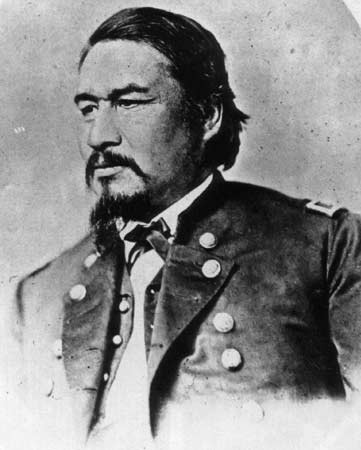
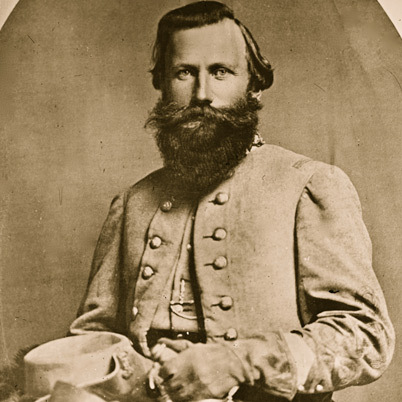
Tag Archives: robert e lee

God Bless My People, Black and White: The Complex Life of General Wade Hampton

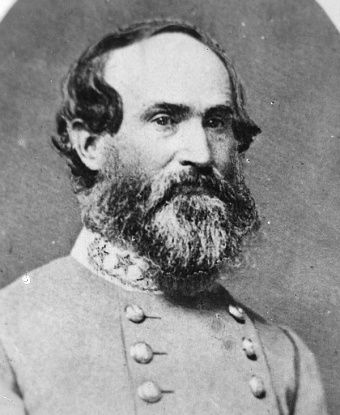
Hampton_inline

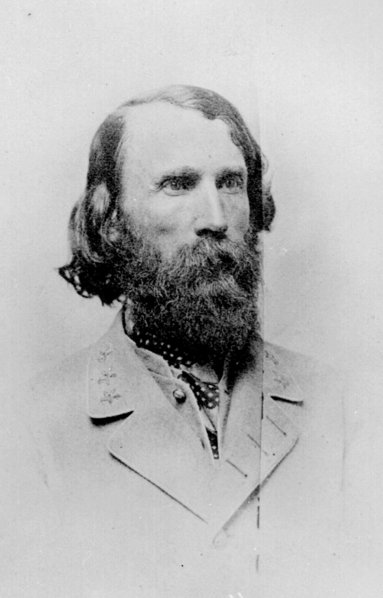
Lieutenant General Wade Hampton, C.S.A.

Friends of Padre Steve’s World 

I will be taking my students to Gettysburg this weekend and likewise I am continuing to periodically intersperse and publish short articles about various commanders at Gettysburg on the site. These all are drawn from my student text and may become a book in their own right.  The reason is I am going to do this is because I have found that readers are often more drawn to the lives of people than they are events. As I have noted before that people matter, even deeply flawed people, and we can learn from them.

Today’s article is about Lieutenant General Hade Hampton who commanded one of J.E.B. Stuart’s cavalry brigades at Gettysburg. Hampton is one of the most fascinating men I think of the entire Civil War period. Before the war he was one of the richest planters and largest owners of slaves in the South and after the war was a stalwart supporter of the rights of African Americans in South Carolina where he served as the first post-Reconstruction governor of that state. He was not a professional soldier but became one of the finest commanders of cavalry on either side during the war. Tomorrow I will be posting a completely revised, expanded and updated chapter of my text on the opening of the Battle of Gettysburg when Major General John Buford’s Cavalry conducted a heroic delaying action against the vastly superior numbers of Confederate Major General Heth’s division as it attempted to advance into Gettysburg on the morning of July 1st 1863. 

I do hope that you enjoy this.

Peace

Padre Steve+

Brigadier General Wade Hampton is one of the fascinating and complex characters in either army who served at Gettysburg. He defies a one dimensional treatment or stereotype. His complexities, contradictions and character make him one of the most interesting men that I have written about during my study of this battle.

Wade Hampton III was born in Charleston, South Carolina in 1828. He one of the richest, if not the richest man in the Confederacy when the war broke out. Hampton inherited his family’s expansive plantation and many slaves and studied law at the College of South Carolina.

As a slave owner, he expressed an aversion for the institution and ensured that his slaves were well cared for by the standards of his day, including medical care. He never condemned slavery or worked for the abolition of a system that had made him and his family quite prosperous. He served in the South Carolina legislature and Senate, where he took an “active and prominent role in the public debate on many issues. He was vocal not only on the perils of reopening the African slave trade but also on whether and how his state should seek redress of wrongs, real and imagined, by the federal government.” [1]

As a state senator, Hampton was pragmatic, and while he defended the South’s economic interests in slavery, Hampton cautioned against the rhetoric of secessionist fire-breathers. His argument was about “the preservation of the South’s political power and her social and economic institutions, now threatened by the short sighted policies of otherwise good and decent men.” [2] He did not wish to do anything that would lead to the destruction of the South, and he felt that the “only viable course was moderation, conciliation, compromise….” [3]

Hampton was a classic rich “Southern moderate He had opposed secession, and the fire eaters repulsed him.” [4] However, when Lincoln called for volunteers Hampton volunteered to serve in a war that he did not want, which would cost him dearly, and change him from a moderate to a vociferous opponent of most Reconstructionist policies.

Volunteering at the age of forty-three, Hampton had no prior military training. However, he had great organizational skill, leadership ability and a tremendous care and compassion for those who served under his command. Using his own money Hampton organized what would now be called a combined arms unit, the Hampton Legion, which comprised eight companies of infantry, four of cavalry and a battery of light artillery. He was careful in the appointment of the Legion’s officers choosing the best he could find.

Hampton rapidly rose to prominence as a respected officer and commander despite his lack of military training or experience. His soldiers fought well and took over command of an infantry brigade on the Peninsula, and was promoted to Brigadier General in May of 1862 and given command of a cavalry brigade serving under J.E.B. Stuart in July. Hampton “became Stuart’s finest subordinate.” [5] The contrast between the two men was remarkable. “Hampton and Stuart forged a professional relationship but not a friendship. They shared an adherence to duty and to the cause. But the contrasts between them in style and personality were undeniable.” [6] Stuart’s flamboyance, love of pageantry, and ambition clashed with Hampton’s simplicity and calm self-assurance. Serving as a brigade, and later division commander, Hampton had “little fondness or respect for Stuart. He regularly criticized Stuart for pampering the Virginia regiments and assigning his South Carolinians to the more arduous tasks.” [7]

During the war he was wounded several times, including at             Gettysburg where he took two saber cuts to the head. Eventually, he took command of the Cavalry Corps after Stuart was killed in action. This was something that Stuart in life would not have abided. When Stuart was scheming to get a promotion to Lieutenant General in another military department, he wrote that if he was to serve elsewhere he did not want Hampton to Command. In a curious post-script to a letter to Custis Lee Stuart wrote:

“Hampton is not the man for such a command, and I know he will not suit Gen’l Lee, nor the particular requirements of such a station. Hampton is a gallant officer, a nice Gentleman, and has done meritorious service, but there you must stop.” [8]

He fought in nearly every cavalry engagement under Stuart and led his own raids deep into Union territory. He fought well, but “hated the war.” In October 1862 he wrote home: “My heart has grown sick of the war, & I long for peace.” [9] Hampton’s Confederate service was unusual, especially for an officer of Lee’s Army of Northern Virginia which favored those who had prior service, especially West Point graduates. As such Hampton was “one of only three civilians to attain the rank of Lieutenant General in Confederate service.” [10] At Petersburg, his son Preston was mortally wounded and died in his arms even as his other son Wade IV was wounded while coming to Preston’s aid. Douglass Southall Freeman wrote of Hampton:

“Untrained in arms and abhorring war, the South Carolina planter had proved himself the peer of any professional soldier commanding within the same bounds and opportunities. He may not have possessed military genius, but he had the nearest approach to it.” [11]

The war that he opposed cost him the life of his brother, one of his sons and his livelihood. “His property destroyed, many of his slaves gone, and deep in debt from which he would never recover, Hampton faced the future with $1.75 in his pocket.” [12] The war changed the former moderate into a man who sought vindication in some ways, but reconciliation with the black population.

Hampton again entered politics and became the first post-Reconstruction Governor of South Carolina when President Rutherford Hayes withdrew the Federal troops which had supported the Reconstructionist governor. Initially he was “hailed as a redeemer by white constituents desperate to throw off the yoke of Reconstruction” [13] yet Hampton stood stalwartly against White Supremacy and White Supremacists. He acted on the belief that whites and African Americans could live, work and prosper together.

During his campaign and during his terms as Governor, Hampton “opposed the South’s imposition of so-called “black codes” which so restricted the freedom of former slaves as virtually to return them to civility.” [14] Unlike many in the post-reconstruction South, Hampton won the thanks of African Americans for condemning whites that would vote for him if they thought that he would “stand between him and the law, or grant him any privileges or immunities that shall not be granted to the colored man.” [15] Over his term, the former slave owner “extended more political benefits to African Americans than any other Democratic governor in the post-war South.” [16]

Hampton came to dominate South Carolina politics for fifteen years. After two terms as Governor, he served as a U.S. Senator until 1891 when a political enemy won the governorship and forced him from the Senate. When he died on April 11th 1902 his final words were “God bless my people, black and white.” [17]

Like so many leaders of so many tumultuous eras, Hampton was complex, contradictory and cannot be easily classified. He was certainly not perfect, but in war and in peace gave of himself to his state and community.

Notes

[1] Ibid. Longacre, Gentleman and Soldier pp.26-27

[2] Ibid. Longacre, Gentleman and Soldier p.28

[3] Ibid. Longacre, Gentleman and Soldier p.28

[4] Goldfield, David. America Aflame: How the Civil War Created a Nation Bloomsbury Press, New York 2011 p.399

[5] Ibid. Wert A Glorious Army p.64

[6] Ibid. Wert Cavalryman of the Lost Cause p.116

[7] Ibid. Glatthaar, General Lee’s Army p.352

[8] Ibid. Wert Cavalryman of the Lost Cause p.333

[9] Ibid. Goldfield, America Aflame p.399

[10] Ibid. Warner Generals in Gray p.123

[11] Ibid. Freeman Lee’s Lieutenants p.770

[12] Ibid. Goldfield, America Aflame p.399

[13] Ibid. Longacre, Gentleman and Soldier p.xv

[14] Ibid. Longacre, Gentleman and Soldier p.265

[15] Ibid. Longacre, Gentleman and Soldier p.265

[16] Ibid. Longacre, Gentleman and Soldier p.xv

[17] Ibid. Longacre, Gentleman and Soldier p.276


Leave a comment

Filed under civil rights, civil war, History, laws and legislation, leadership, Military

As Brave & Dashing as Any Officer: John Bell Hood and the Limitation of Ability

Friends of Padre Steve’s World

I am continuing to periodically intersperse and publish short articles about various commanders at Gettysburg on the site. These all are drawn from my student text and may become a book in their own right.  The reason is I am going to do this is because I have found that readers are often more drawn to the lives of people than they are events. As I have noted before that people matter, even deeply flawed people, and we can learn from them.

Today’s article is about Major General John Bell Hood who commanded a division in Longstreet’s First Corps at the Battle of Gettysburg. As a brigade and division commander he was as good as any in either army. However, after Gettysburg he was promoted, eventually to army command in Georgia and Tennessee in which position he failed miserably. His story is interesting because it shows that all of us probably have some limitations, that while we may excel in one arena or level, that we may very well not be suited for other things, especially high command or senior management. As Harry Callahan so wisely noted “A man’s got to know his limitations.” I do hope that you enjoy this.

Peace

Padre Steve+

HD_hoodJB1

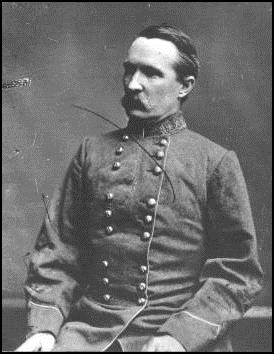
Lieutenant General John Bell Hood. C.S.A.

John Bell Hood was born in Owingsville Kentucky in 1831. He attended West Point where he was a classmate of the future Union Generals James McPherson and Phillip Sheridan, and graduated fortieth of the fifty-one in the class of 1853. Hood desired a commission in the newly formed cavalry but “his low class standing resulted him entering service as a second lieutenant in the 4th U.S. Infantry Regiment.” [1] However, Hood was persistent and continued to lobby for an appointment to the cavalry service, even directly corresponding with then Secretary of War Jefferson Davis. The young officer’s perseverance paid off and in 1855 he received orders to serve with the 2nd U.S. Cavalry.

Hood served as a cavalry officer under Lee’s command with the 2nd Cavalry in Texas. There he gained a stellar reputation as a leader and Indian fighter, though he only fought in one minor engagement. He was physically imposing and “stood six feet, two inches and had a powerful chest and a giant’s shoulders.” [2]

In 1860 “he received orders to report to West Point to serve as an instructor of cavalry.” [3] His secessionist sympathies were displayed when upon receipt of the orders and went5 directly to the War Department where he told the Adjutant General that “he did not want the position, since he “feared that was would soon be declared between the States, in which event I preferred to be in a position to act with complete freedom.” [4]

When his home state of Kentucky did not secede he attached himself to his adopted state of Texas. He resigned his commission and began the war as a lieutenant of cavalry in the Confederate army. In his resignation the officer was something of a realist concerning the coming war, noting, “seeing no hope of reconciliation or adjustment, but every indication of a fierce and bloody war.” [5] Lee assigned him to Magruder on the Peninsula where he quickly developed as a reputation as a fighter and was given the task of tasking independent cavalry companies into a regiment. He was soon was given the task of forming Texans then in Virginia into a fighting regiment, the 4th Texas, which was assigned to “join a Texas brigade under ex-Senator Louis T. Wigfall.” [6] After Manassas Hood was promoted to Brigadier General and given command of Wigfall’s brigade, the only Texas brigade in the east. He took temporary command of a division during the reorganization of the army that followed the Seven Days.

Over the course of the next year he had built a “combat record unequalled by any in the army at his level.” [7] And the “reputation gained as commander of the Texas Brigade and as a division commander made him both a valuable general officer and a celebrity who transcended his peers.” [8] After his performance at Antietam Lee worked the personnel system to get Hood promoted to Major General and assigned to command of an enlarged division which he would command at Gettysburg. Lee wrote of him “Hood is a good fighter, very industrious on the battle field, careless off, & I have had no opportunity of judging his action, when the whole responsibility rested on him. I have a high opinion of his gallantry, earnestness & zeal.” [9]

After Gettysburg Hood went on to succeed Joseph E. Johnston in Georgia as an army commander, but in this capacity he was out of his league. Johnston had fought a defensive campaign and was deemed by Jefferson Davis to be not aggressive enough in battling the combined armies of William Tecumseh Sherman.

However, Hood’s new responsibilities were beyond his capacity, at heart he “was an executive officer, not a strategist.” [10] Hood was overly aggressive and his offensive campaigns were all marked by failure. Hood saw his army shattered at the Battles of Franklin and Nashville. Afterward he asked to be relieved of command and “reverted to his permanent rank of Lieutenant General” in January 1865. [11]

He returned to Richmond to draft his reports on his campaigns and foreseeing the collapse and defeat of the army around Richmond “advocated that the three Confederate filed armies concentrate in central Tennessee and Kentucky.” [12] Though it was a reasonable suggestion from a strategic point of view, it was impossible for a number of reasons and rejected by Jefferson Davis. He requested another field command but instead was ordered to return to Texas. While on the way he learned of the surrenders of the various Confederate armies and “surrendered himself at Natchez, Mississippi.” [13]

After the war Hood married Anna Maria Henson and their marriage produced eleven children, who some jokingly referred to as “Hood’s brigade.” He remained in contact with James Longstreet and when Longstreet spoke to him about supporting Reconstruction and Negro suffrage Hood warned his former commander “that if he supported the congressional program that “the Southern press and people will vilify you and abuse you.” [14] While nothing is known about his own views on the subject Longstreet believed that the mirrored his own, though Hood would not publicly utter them.

He began working in the insurance business and writing his memoirs and campaign narratives, but in 1879 he business interests failed and in August of that year he, his wife and one of his children died in a Yellow Fever outbreak, he was just forty-eight years old.

As good of Brigade and division commander as he was under the direction of Longstreet, Hood was out of his league as an Army commander. John B. Gordon, as judicious of judge of command ability of any on the Confederate side noted:

“To say he was as brave and dashing as any officer of any age would be the merest commonplace tribute to such a man; but courage and dash are not the only or even the prime requisites of the commander of a great army.” [15]

Hood is highly regarded in Texas to this day. Units of the Texas Army National Guard including some that I served in during the 1980s and 1990s trace their lineage to the regiments of Hood’s Brigade. Likewise, Fort Hood, the largest post in the United States Army is named after him.

Notes

[1] Bohannon, Keith S. “A Bold Fighter” Promoted Beyond His Abilities: John Bell Hood in Leaders of the Lost Cause: New Perspectives on the Confederate High Command edited by Gallagher, Gary W. and Glatthaar, Joseph T. Stackpole Books, Mechanicsburg PA 2004 p.250

[2] Ibid. Freeman Lee’s Lieutenants p.121

[3] Ibid. Bohannon “A Bold Fighter” p.251

[4] Ibid. Bohannon “A Bold Fighter” p.251

[5] Ibid. Bohannon “A Bold Fighter” p.252

[6] Ibid. Freeman Lee’s Lieutenants p.121

[7] Ibid. Tagg The Generals of Gettysburg p.224

[8] Pfanz, Harry F. Gettysburg: The Second Day. University of North Carolina Press, Chapel Hill 1987 p.161

[9] Girardi, Robert I. The Civil War Generals: Comrades, Peers, Rivals in Their Own Words Zenith Press, MBI Publishing, Minneapolis MN 2013 p.219

[10] Ibid. Freeman Lee’s Lieutenants p.38

[11] Ibid. Warner Generals in Gray: Lives of Confederate Commanders p.143

[12] Ibid. Bohannon “A Bold Fighter” p.276

[13] Ibid. Warner Generals in Gray: Lives of Confederate Commanders p.143

[14] Ibid. Bohannon “A Bold Fighter” p.278

[15] Ibid. Girardi The Civil War Generals p.219

Leave a comment

Filed under civil war, Gettysburg, History, leadership, Military

Prelude to Gettysburg: A Spirit of Unbelief

Hill.28135413_std

Lieutenant General A.P. Hill


Friends of Padre Steve’s World 

Here is a revised chapter from my Gettysburg text. I will be taking another group of my students up in two weeks.

Have a great weekend.

Peace

Padre Steve+

When Robert E. Lee learned of the Army of the Potomac’s presence north of the Potomac River he ordered his widely dispersed army concentrate near Cashtown and Gettysburg. It was a complicated movement that involved at least five major operations: the shift of the bulk of Ewell’s Second Corps from its planned attack on Harrisburg, the redirection of Early’s division east from its position on the Susquehanna to the west, the movement of Hill’s Third Corps from the area around Cashtown to a position east of Gettysburg, Longstreet’s First Corps north to Chambersburg and Cashtown and the cavalry brigades of Beverly Robertson, Grumble Jones and John Imboden which were to join the army in Pennsylvania. The movement “would take at least two days – the 29th and the 30th of June – and perhaps more…the complete its concentration, especially since the rains had “made the roads very muddy,” forcing “the infantry” to march off the roads….” [1]

Lieutenant General A.P. Hill’s Third Corps that was nearest of Lee’s major units to Cashtown and Gettysburg. Major General Harry Heth’s division led the corps and arrived at Cashtown on June 29th. His division was followed by that of Major General Dorsey Pender which arrived on the 30th. Hill ordered his last division under the command of Major General Richard Anderson to remain behind at “Fayetteville until July 1, when he would join the rest at Cashtown.” [2]

Cashtown was important as a road junction and because it “was situated at one of the few gaps in the Pennsylvania Mountains” and because one of the roads emanating from it “snaked eight miles to another community called Gettysburg.” [3] However the order to concentrate the army at Cashtown presented its own problems. First was the matter of forage. There was not enough room for all the units ordered to Cashtown to have adequate areas to forage, as:

“each division would (by the standard required of nineteenth-century armies) require a circle twelve and a half miles around its encampments to forage (for water, firewood, and feed for men and horses); one single regiment could denuded an acre of woodland just for firewood every three days.” [4]

Likewise, because of the limited road network, Cashtown was becoming a choke point which as his units closed in slowed their movement and created massive traffic problems and confusion. Hill ordered Heth’s division to take the lead and advance to Cashtown on the 29th. The units of Hill’s corps had to endure heavy rains on the 29th which slowed their march and Heth halted at Cashtown knowing that the army would concentrate there while Pender’s division moved into the area his division had vacated.

Early in the morning of June 30th Harry Heth decided to undertake a foraging expedition to Gettysburg.to “search the town for army supplies (shoes especially), and to return the same day.” [5] It was the first in a series of miscalculations that brought Lee’s army into a general engagement that Lee wished to avoid and it is hard to comprehend in light of Lee’s orders not to precipitate a fight.

However, the expedition had taken a toll on the soldiers, especially in terms of shoes, clothes and equipment. The “long march over the hard macadam roads of the North had played havoc with the scraggly foot coverings of Lee’s men.” [6] After muster on the morning of June 30th Heth ordered Johnston Pettigrew’s “brigade to Gettysburg in search of supplies, especially badly needed shoes, which were badly needed by his the men of his division.” Heth, for a reason he never elaborated on decided that there must be shoes in Gettysburg. Perhaps he did not know that the town had been picked clean by John Gordon’s brigade of Jubal Early’s division just a few days before, but for whatever reason he believed this to be the case.

Hill’s Third Corps had been formed as part of the reorganization of the army following Stonewall Jackson’s death after the Battle of Chancellorsville. Hill had a stellar reputation as a division commander; his “Light Division” had distinguished itself on numerous occasions, especially at Antietam where its timely arrival after a hard forced march from Harper’s Ferry helped save Lee’s army late in the battle. At Chancellorsville Hill briefly succeeded Jackson until he too was wounded.

Hill was recommended for promotion to Lieutenant General and command of the new Third Corps by Lee on May 24th 1863. He was promoted over the heads of both Harvey Hill and Lafayette McLaws. The move displeased Longstreet who considered Lafayette McLaws “better qualified for the job.” Likewise there were others who felt that the command should have gone to Harvey Hill, now commanding the Department of North Carolina who’s “record was as good as that of Stonewall Jackson…but, not being a Virginian, he was not so well advertised.” [7]

Ambrose Powell Hill was slightly built and high strung. “Intense about everything” Hill was “one of the army’s intense disbelievers in slavery.” [8] Hill was an 1847 graduate of West Point and briefly served in Mexico but saw no combat. He spent some time in the Seminole wars but due to frequent bouts of ill-health he spent much of his career in garrison duty along the East Coast. Since he was prone to sickness he was assigned to the office of Coastal Survey, a Navy command from 1855 through 1861. Despite pleas from his superiors and his own opposition to secession and slavery, Hill resigned his commission just before Virginia’s secession.

At the outbreak of the war he “received his commission as colonel, and soon trained one of Johnston’s best regiments in the Valley.” [9] He commanded a brigade under Longstreet on the Peninsula and was promoted to Major General and command of the Light Division in May 1862, leading it with distinction, especially at Antietam where his march from Harper’s Ferry and timely arrival on the afternoon of September 17th saved the army of Northern Virginia from utter and complete destruction. He was plagued by health problems which had even delayed his graduation from West Point, health issues that would arise on the first day at Gettysburg.

Hill’s Third Corps was emblematic of the “makeshift nature of the reorganization of the whole army.” [10] It was composed of three divisions. His best and most experienced division was that of the recently promoted and hard fighting Major General Dorsey Pender. Pender’s division was built around four excellent brigades from Hill’s old “Light Division” one of which Pender had commanded before his promotion. Hill had strongly recommended Pender’s promotion during the reorganization, a proposal which was accepted by Lee. Pender, though a fierce fighter and excellent leader, found command of a division to be a heavy burden. He was “an intelligent, reflective man, deeply religious and guided by a strong sense of duty….” [11]

Hill’s second experienced division was that of Major General Richard Anderson. This division had been transferred from Longstreet’s First Corps during the reorganization. Longstreet resented losing the division to Hill, with who he had previously run afoul and this was yet another issue which failed to endear Hill to Longstreet. [12]

The unassuming Anderson had distinguished himself as a brigade and division commander in Longstreet’s corps, but in “an army of prima donnas, he was a self-effacing man, neither seeking praise for himself nor winning support by bestowing it on others.” [13] At Chancellorsville Anderson fought admirably and Lee wrote that Anderson was “distinguished for the promptness, courage and skill with which he and his division executed every order.” [14] With four seasoned brigades under excellent commanders it was a good addition to the corps, although the transition from Longstreet’s stolid and cautious style of command to Hill’s impetuous style introduced “another incalculable of the reshuffled army.” [15]

Major General Harry Heth’s division was the final infantry division assigned to the corps. The division was new and had was cobbled together from two brigades of Hill’s old Light Division and “the two new brigades that Jefferson Davis had forced on an already disrupted army organization.” [16] The organization of this division as well as its leadership would be problematic in the days to come, especially on June 30th and July 1st 1863. The hasty and makeshift organization under leaders who had not served together, many of who were new to command, as well as units which had not fought together spelled trouble.

Harry Heth, like Dorsey Pender was also newly promoted to his grade and the action at Gettysburg would be his first test in division command. Heth was a native Virginian. He came from a family that well connected both socially and politically. He had a social charm had “many friends and bound new acquaintances to him” readily. [17] Heth was a cousin of George Pickett. He was a West Point graduate and classmate of Hill. At West Point Heth had an undistinguished academic career and graduated last in the class of 1847. His career in the ante-bellum army was typical of many officers, he served “credibly in an 1855 fight with Sioux Indians” but his real claim to fame was in authoring the army’s marksmanship manual which was published in 1858. [18]

heth

Major General Harry Heth

Heth’s career with the Confederate army serving in western Virginia was undistinguished but he was a protégé of Robert E. Lee who recommended him as a brigade commander to Jackson before Chancellorsville. Tradition states that of all his generals that Heth was the only one “whom Lee called by his first name.” [19] A.P. Hill when writing Lee about the choice of a successor for the Light Division noted that Heth was “a most excellent officer and gallant soldier” but in the coming campaign “my division under him, will not be half as effective as under Pender.” [20] Douglas Southall Freeman noted that Heth was “doomed to be one of those good soldiers…who consistently have bad luck.” [21]

Heth’s division was composed of two depleted brigades from the Light Division which had taken heavy casualties at Chancellorsville. One brigade, commanded by the hard fighting former regular army officer Brigadier General James Archer. Archer was from Maryland and a graduate of Princeton University who had given up a law practice to join the army. Described as a “little gamecock” who “had no sense of fear” [22] Archer had saved the Confederate line at Fredericksburg leading a desperate counterattack at Prospect Hill. The brigade was composed of four veteran regiments, but was now down to barely 1200 soldiers in the ranks by the time it arrived at Cashtown. However, the brigade which was recruited from Alabama and Tennessee was “well led and had a fine combat reputation.”

But the second brigade was more problematic. This was the Virginia brigade under the command of “the plodding, uninspiring Colonel John Brockenbrough.” [23] Brockenbrough was an “1850 of the Virginia Military Institute and a farmer,” who had “entered the Confederate service as Colonel of the 40th (Virginia) in May 1861.” [24] The brigade had once been considered one of the best in the army had deteriorated in quality following the wounding of its first commander Brigadier General Charles Field. Heth took command of it at Chancellorsville where both he and the brigade performed well. The brigade had taken very heavy casualties and now was reduced to under 1000 effectives. When Heth was promoted the lack of qualified officers left it under the command of its senior colonel, John Brockenbrough.[25] Lee did not consider Brockenbrough “suited for promotion” but “could be counted on to keep together a command sadly reduced in numbers.” [26]

His third brigade came from Mississippi and North Carolina and was commanded by the “stuffy and ambitious” [27] Brigadier General Joe Davis whose uncle was President Jefferson Davis. Davis had served on his uncle’s staff for months and had no combat experience. [28] One author noted that Davis’s promotion to Brigadier General “as unadulterated an instance of nepotism as the record of the Confederacy offers.” [29] His subordinate commanders were no better, one William Magruder was so bad that J.E.B. Stuart suggested that “he have his commission revoked” and only one of the nine field grade officers in his brigade had military training, and that from the Naval Academy. [30] The brigade was also a makeshift operation with two veteran regiments including the 11th Mississippi which had “gone through blood and fire together on the Peninsula through Antietam.” [31] After Antietam, these units were then paired with two new regiments and a new politically connected commander and sent to the backwater of North Carolina where they saw no action. The veteran regiments “mistrusted not only their commander, but the reliability of its yet untested units.” [32]

pettigrew

Brigadier General Johnston Pettigrew

Heth’s largest brigade was new to the army. Commanded by the North Carolina academic Brigadier General Johnston Pettigrew it had no combat experience. Pettigrew himself was considered a strong leader. He had been badly wounded at Seven Pines and thinking his wound mortal “he refused to permit his men to leave the ranks to carry him to the rear.” [33] He was captured but later paroled and returned to the army to command a brigade later in the year.

Hill was under the impression that Meade’s army was still miles away, having just come from meeting Lee who assured him that “the enemy are still at Middleburg,” (Maryland) “and have not yet struck their tents.” [34] With that assurance Heth decided to use June 30th to send Pettigrew’s brigade on the foraging expedition to Gettysburg. An officer present noted that Heth instructed Pettigrew “to go to Gettysburg with three of his regiments present…and a number of wagons for the purpose of collecting commissary and quartermaster stores for the use of the army.” [35]

However Heth did instruct Pettigrew in no uncertain terms not to “precipitate a fight” should he encounter “organized troops” of the Army of the Potomac. [36] Heth was specific in his report that “It was told to Pettigrew that he might find in the town in possession of a home guard,…but if, contrary to expectations, he should find any organized troops capable of making resistance., or any part of the Army of the Potomac, he should not attack it.” [37]

That in mind one has to ask the question as to why Heth would employ “so many men on a long, tiring march, especially as without a cavalry escort he took the risk of sending them into a trap” when his “objects hardly justified” using such a large force. [38] Edwin Coddington is particularly critical of Heth in this regard.

Likewise it has to be asked why the next day in light of Lee’s standing orders not to provoke an engagement that Hill would send two divisions, two thirds of his corps on what was supposedly reconnaissance mission. Some have said that Hill would have had to move to Gettysburg on July 1st anyway due to forage needs of the army, [39] but this is not indicated in any of Hill or Heth’s reports.

As his troops neared Gettysburg Pettigrew observed the Federal cavalry of Buford’s 1st Cavalry Division as they neared the town. He received another report “indicating that drumming could be heard in the distance – which might mean infantry nearby, since generally cavalry generally used only bugles.” [40] He then prudently and in accordance with his orders not to precipitate a fight “elected to withdraw rather than risk battle with a foe of unknown size and composition.” [41] His troops began their retrograde at 11 a.m. leaving Buford’s cavalry to occupy the town at ridges. On Confederate wrote “in coming in contact with the enemy, had quite a little brush, but being under orders not to bring a general engagement fell back, followed by the enemy.” [42]

Upon returning Pettigrew told Hill and Heth that “he was sure that the force occupying Gettysburg was a part of the Army of the Potomac” but Hill and Heth discounted Pettigrew’s report. [43] “Heth did not think highly of such wariness” and “Hill agreed with Heth” [44] Hill believed that nothing was in Gettysburg “except possibly a cavalry vedette.” [45] Hill was not persuaded by Pettigrew or Pettigrew’s aide Lieutenant Louis Young who had previously served under Hill and Pender who reported that the “troops that he saw were veterans rather than Home Guards.” [46] Hill reiterated that he did not believe “that any portion of the Army of the Potomac was up” but then according to Young Hill “expressed the hope that it was, as this was the place he wanted it to be.[47]

Part of the issue was related to the fact that Pettigrew, though highly intelligent, and who had been an observer of wars in Europe was not a professional soldier. Likewise, since had was new to the Army of the Northern Virginia he was an unknown to both Hill and Heth. As such they dismissed his report. In their casual dismissal of Pettigrew’s report, the West Point Graduates Hill and Heth may have manifested an often typical “distain for citizen soldiers…a professional questioning a talented amateur’s observations” [48]

Pettigrew was “aghast at Hill’s nonchalant attitude” [49] and Young was dismayed and later recalled that “a spirit of unbelief” seemed to cloud the thinking of Hill and Heth. [50] In later years Young wrote that the “blindness in part seems to have come over our commanders, who slow to believe in the presence of an organized army of the enemy, thought that there must be a mistake in the report taken back by General Pettigrew.” [51]

Since neither man believed Pettigrew’s report, Heth then asked Hill “whether Hill would have any objection to taking his division to Gettysburg again to get those shoes.” Hill replied “none in the world.” [52] It was to be a fateful decision, a decision that brought about a series of events which in turn led to the greatest battle even fought on the American continent.

Douglas Southall Freeman wrote “On those four words fate hung” [53] and in “that incautious spirit, Hill launched Harry Heth’s division down the Chambersburg Pike and into battle at Gettysburg.” [54]

 Notes

[1] Guelzo, Allen C. Gettysburg: The Last Invasion Vintage Books a Division of Random House, New York 2013 p.128

[2] Coddington, Edwin B. The Gettysburg Campaign, A Study in Command A Touchstone Book, Simon and Shuster New York 1968 p.194

[3] Robertson, James I. Jr. General A.P. Hill: The Story of a Confederate Warrior Random House, New York 1987

[4] Ibid. Guelzo, Gettysburg: The Last Invasion p.128

[5] Ibid. Coddington, The Gettysburg Campaign, A Study in Command p. 263

[6] Ibid. Robertson A.P. Hill p.205

[7] Foote, Shelby, The Civil War, A Narrative. Volume Two Fredericksburg to Meridian Random House, New York 1963 p.453

[8] Ibid. Dowdy, Lee and His Men at Gettysburg: The Death of a Nation p.79

[9] Ibid. Freeman Lee’s Lieutenant’s a Study in Command p.109

[10] Ibid. Dowdy, Lee and His Men at Gettysburg: The Death of a Nation p.88

[11] Ibid. Dowdy, Lee and His Men at Gettysburg: The Death of a Nation p.85

[12] Ibid. Dowdy, Lee and His Men at Gettysburg: The Death of a Nation p.86

[13] Ibid. Dowdy, Lee and His Men at Gettysburg: The Death of a Nation p.86

[14] Ibid. Freeman Lee’s Lieutenant’s a Study in Command p.512

[15] Ibid. Dowdy, Lee and His Men at Gettysburg: The Death of a Nation p.86

[16] Ibid. Dowdy, Lee and His Men at Gettysburg: The Death of a Nation p.87

[17] Ibid. Freeman Lee’s Lieutenant’s a Study in Command p.527

[18] Krick, Robert K. Three Confederate Disasters on Oak Ridge: Failures of Brigade Leadership on the First Day of Gettysburg in The First Day at Gettysburg edited by Gallagher, Gary W. Kent State University Press, Kent Ohio 1992 p.96

[19] Ibid. Krick. Three Confederate Disasters on Oak Ridge p.96

[20] Ibid. Freeman Lee’s Lieutenant’s a Study in Command p.527

[21] Ibid. Freeman Lee’s Lieutenant’s a Study in Command p.46

[22] Ibid. Guelzo, Gettysburg: The Last Invasion p.134

[23] Sears, Stephen W. Gettysburg. Houghton Mifflin Co. Boston and New York 2003 p.55

[24] Pfanz Harry W. Gettysburg: The First Day University of North Carolina Press, Chapel Hill and London 2001 p.118

[25] Ibid. Dowdy, Lee and His Men at Gettysburg: The Death of a Nation p.87

[26] Ibid. Freeman Lee’s Lieutenant’s a Study in Command p.529

[27] Ibid. Guelzo, Gettysburg: The Last Invasion p.133

[28] Ibid. Freeman Lee’s Lieutenant’s a Study in Command p.533

[29] Ibid. Krick. Three Confederate Disasters on Oak Ridge p.99

[30] Ibid. Krick. Three Confederate Disasters on Oak Ridge p.101

[31] Ibid. Guelzo, Gettysburg: The Last Invasion p.134

[32] Ibid. Guelzo, Gettysburg: The Last Invasion p.134

[33] Ibid. Freeman Lee’s Lieutenant’s a Study in Command p.136

[34] Ibid. Guelzo, Gettysburg: The Last Invasion p.131

[35] Trudeau, Noah Andre. Gettysburg: A Testing of Courage, Harper Collins Publishers, New York 2002 p.128

[36] Ibid. Sears Gettysburg p.136

[37] Ibid. Trudeau Gettysburg: A Testing of Courage, p.129

[38] Ibid. Coddington, The Gettysburg Campaign, A Study in Command p. 263

[39] Ibid. Guelzo. Gettysburg: The Last Invasion p.131 This argument does have merit based on the considerations Guelzo lists but neither Hill, Heth or Lee make any mention of that need in their post battle reports.

[40] Ibid. Trudeau Gettysburg: A Testing of Courage, p.130

[41] Gallagher, Gary. Confederate Corps Leadership on the First Day at Gettysburg: A.P. Hill and Richard S. Ewell in a Difficult Debut in The First Day at Gettysburg edited by Gallagher, Gary W. Kent State University Press, Kent Ohio 1992 p.42

[42] Ibid. Trudeau Gettysburg: A Testing of Courage, p.135

[43] Ibid. Coddington, The Gettysburg Campaign, A Study in Command pp. 263-264

[44] Foote, Shelby, The Civil War, A Narrative. Volume Two Fredericksburg to Meridian Random House, New York 1963 p.465

[45] Ibid. Pfanz Gettysburg: The First Day p.27

[46] Ibid. Gallagher, Gary. Confederate Corps Leadership on the First Day at Gettysburg p.42

[47] Ibid. Pfanz. Gettysburg: The First Day p.27

[48] Ibid. Gallagher, Gary. Confederate Corps Leadership on the First Day at Gettysburg p.42

[49] Ibid. Guelzo. Gettysburg: The Last Invasion p.131

[50] Ibid. Coddington, The Gettysburg Campaign, A Study in Command p. 264

[51] Ibid Pfanz Gettysburg: The First Day p.27

[52] Ibid. Coddington, The Gettysburg Campaign, A Study in Command p. 264

[53] Ibid. Freeman Lee’s Lieutenant’s a Study in Command p. 563

[54] Ibid. Krick. Three Confederate Disasters on Oak Ridge p.94

Leave a comment

Filed under civil war, Gettysburg, History, leadership, Military

The Most Lovable of All Lee’s Generals: A.P. Hill

Hill.28135413_std

Lieutenant General Ambrose Powell Hill

Friends of Padre Steve’s World

I am continuing to periodically intersperse and publish short articles about various commanders at Gettysburg on the site. These all are drawn from my student text and will likely become a book in their own right when I finish the chapter on the Union commanders.  The reason is I am going to do this is because I have found that readers are often more drawn to the lives of people than they are events. As I have noted before that people matter, even deeply flawed people, and we can learn from them. Sometimes good and even honorable people serve malignant causes, while bad or even wicked people support good causes, usually for selfish reasons, but that is the constant quandary that human beings find themselves.

Today’s article is about Confederate Lieutenant General A.P. Hill. Hill is an interesting character to me, a man of a lot of contradictions both on and off the battlefield. He was gallant and reckless at the same time plagued with ill-health, some of which was certainly real, but at some times may have been stress induced. He made lasting friendships with men who he would later oppose in battle. He fought for a cause that he found repugnant for he hated slavery and the maltreatment of blacks, even condemning the actions of the people of his home town before the war in that regard. In an army filled with highly religious officers, even some who might be termed fanatical in terms of their beliefs, Hill was a skeptic who had little appreciation for those like Stonewall Jackson who he believed were fanatics.

So anyway, tomorrow I will be writing about the assassination of Abraham Lincoln, one of the darkest days in our history.

Peace

Padre Steve+

Ambrose Powell Hill was born about ten miles from Culpepper Court House Virginia in 1825. He was the youngest son of a “a highly esteemed, merchant, farmer, and politician….noted for his courage, famed for his hospitality and beloved for his character.” [1] The young Powell Hill was a good student and gifted horseman who loved the outdoors. His mother was introverted and a hypochondriac who seldom left the house and through her he acquired a love of reading.

As a child Hill attended Black Hills Seminary, a private school for well to do families and though he was a good student was not fond of the significant religious overtones of the school. In addition his mother, who had been raised Episcopalian became caught up in a Baptist revival which swept Northern Virginia in 1840. His mother embraced the austere faith of her new church. Soon “dancing, boisterous conduct, card-playing, and all forms of theatrics were banned in the Main Street home.” [2] From that time on the young Hill “spurned religion” and “always looked with disapproval on anyone who – like Stonewall Jackson, for instance- practiced religion with excessive intensity.” [3]

With his father’s approval and his mother approbation Hill sought admission to West Point and was accepted in 1842. Hill had little problem with the academics of the academy, but conduct was another matter. Hill entered the West Point with a good number of men who would become famous over the next two decades including George McClellan, Thomas Jackson, Cadmus Wilcox, Darius Couch and George Pickett. Hill would have been part of the illustrious class of 1846, but the young cadet had a certain proclivity for women and a certain amount of debauchery, causing him to lose a year of study after contracting “a case of gonorrhea, followed by complications, which were followed by lingering prostatitis.” [4] These afflictions caused many other ailments that would plague him the rest of his life. At West Point, Hill roomed with George McClellan, a refined cadet from Philadelphia, and became a longtime friend. His delayed graduation put him in the class of 1847 where along with his new roommate Julian McAllister and friends Harry Heth and Ambrose Burnside were the social leaders of the class due to their later “practical jokes and boisterous conduct.” [5]

Hill graduated fifteenth in his class and was assigned to the artillery. The young Second Lieutenant accompanied Brigadier General Joseph Lane’s brigade to Mexico where he saw limited action at the end of the war and mainly served on occupation duty. In Mexico and in the following years he was stricken with various fevers including typhoid and yellow fever, as well as recurrences of his prostatitis which so limited his ability to serve in the field with the artillery that he requested a transfer to a desk job. This he was granted by Secretary of War Jefferson Davis who detailed him “for special duty in the United States Coast Survey offices in Washington D.C.” [6]

The assignment to the Coast Survey offices was unusual, especially for Hill’s era of service, for they were a part of the Department of the Navy. Despite much political support, Hill could not get promoted to captain, most likely due to the fact that he was working for the Navy. Hill was generally unlucky at love being twice engaged and twice rejected, the latter time when his fiancée’s parents learned that he had had gonorrhea.

But Hill eventually found a bride as war drew near, Kitty Morgan McClung. She was a young and well off widow who was the sister of Confederate Brigadier General John Hunt Morgan. The two had a happy marriage and were nearly insuperable, Hill affectionately called her Dolly. They had four daughters, only two of who reached adulthood the last born three months after Hill’s death at Petersburg. During the war Dolly had a hard time remaining away from her husband. “She appeared to be impervious to danger and repeatedly ignored Hill’s admonitions to stay away from the front.” [7] Legend has it that she was nearly captured when attempting to spy on Union General Philip Sheridan.

When war came Hill’s friends at the Coastal Survey attempted to convince him to remain with the Union, as serving in their office he would have little chance of taking up arms against Virginia. The now happily settled and married Virginian was torn. He hated slavery and the depreciations visited on blacks; having in 1850 responded to the lynching of a young black man in his home town of Lynchburg: “Shame, shame upon you all, good citizens…Virginia must crawl unless you vindicate good order or discipline and hang every son of a bitch connected with this outrage.” [8] Likewise he was not in favor of secession, but he, like so many other Southern officers felt a stronger connection to family and his Virginia heritage than to the Union, and resigned his commission on February 26th 1861.

Hill was appointed as a Colonel of infantry in May 1861 to organize and command the 13th Virginia Infantry regiment. He commanded the regiment in the Valley and western Virginia as well as at First Manassas. By February 1862 he was a Brigadier General commanding Longstreet’s old Virginia brigade on the Peninsula where he distinguished himself against McClellan at Williamsburg. On May 26th 1862 he was promoted to Major General and given command of the very large so called “Light Division.” He emerged from the fighting on the Peninsula, the battles around Richmond and the Seven Days “with the reputation of being one of the best combat officers that Lee had.” [9] However, his success on the battlefield, like so many commanders, came at great cost. In those battles his division suffered nearly 5,500 casualties. “Six colonels and three majors were killed; two brigadiers (Anderson and Pender), eleven colonels and six lieutenant colonels wounded.” [10]

Hill had an earned reputation as a brilliant division commander with the Light Division. Despite his clashes with Longstreet, and especially with Jackson, who had Hill arrested twice and attempted to have him court-martialed, Lee recommended him to take command of Third Corps. Lee sang his praise of Hill and his abilities to Jefferson Davis noting that Hill was “the best soldier of his grade with me.” [11] However, Hill had never commanded more than one division in action, except for the confused hour after Jackson had been struck down. Hill, however, was devoted, prompt, and energetic, and deserved promotion.” [12]

Hill’s reputation as a superb division commander was well earned. At Antietam when Lee’s army was in danger of destruction, he “drove his men at a killing pace toward the sound of distant gunfire….” [13] Hill’s “Light Division’s remarkable march from Harper’s Ferry- seventeen miles in less than eight hours- rivaled the best marks by Jackson’s famous foot cavalry.” [14] Upon his arrival “instantly recognized the military situation, Kyd Douglas wrote, “and without waiting for the rest of the division and without a breathing spell he threw his columns into line and moved against the enemy, taking no note of their numbers.” [15] Hill’s march saved the Army of Northern Virginia from destruction as he dealt reverses to his old friends McClellan and Burnside. “Lee’s reference to him in his official Sharpsburg report, “And then A.P. Hill came up,” had become a byword in the army.” [16] There were other times, notably at Second Manassas and Fredericksburg where “he was sometimes careless on the battlefield,” and in both instances “his defensive postings were poor and nearly proved very costly.” [17]

Hill was a “nervous wiry man with a persistent chip of underappreciation [sic] on his shoulders and a bevy of chronic illnesses when under stress.” [18] He had an “impetuous streak and fiery temperament that matched his red beard, traits that at times had brought him trouble on the battlefield and off…” [19] Despite this, Hill exhibited a fondness and care for the welfare of his men that earned their respect and admiration. One officer called him “the most lovable of all Lee’s generals,” while “his manner so courteous as almost to lack decision.” [20]

Hill detested Jackson, who he referred to as “that old Presbyterian fool.” [21] His poor relations with Jackson’s confidants at Second Corps ensured that Ewell took Second Corps when Lee reorganized the army after Chancellorsville.

Lee appointed Hill to command Third Corps of which “half of the troops had been with him all along” [22] in the Light Division. Lee liked Hill’s aggressiveness and command instincts, which mirrored his own. Lee hoped that Hill’s aggressive instincts as a division commander would translate into success at the corps level. Longstreet was not in favor of Powell Hill’s appointment, most likely due to his altercation with him the previous year and lobbied for the promotion of D.H. Hill.

In his letter recommending the promotion of A.P. Hill and Ewell to serve as corps commanders, Lee wrote to Davis:

“I wish to take advantage of every circumstance to inspire and encourage…the officers and men to believe that their labors are appreciated, and that when vacancies occur that they will receive the advantages of promotion….I do not know where to get better men than those I have named.” [23]

But the decision to promote Ewell and Hill, both Virginians, stirred some dissent among those that believed that Lee was “favoring Virginians over officers from other states. The promotion of A.P. Hill, as previous noted was “made over the head of two Major Generals more senior than Hill- North Carolinian D.H. Hill and Georgian Lafayette McLaws.” [24] There is some validity to this perception, as Longstreet’s biographer Jeffry Wert noted:

“While the bulk of the troops hailed from outside the Old Dominion, two of the three corps commanders, six of the ten division commanders – including Jeb Stuart with the cavalry – and sixteen of forty-seven brigade commanders were natives of Virginia, along with the army commander and the chief of artillery.” [25]

As a Corps commander Hill enjoyed the confidence of many of his commanders, “the affection of his staff and the admiration of his men.” [26] He ceases to engage in conflict with other officers but “after advancement to corps command, Hill – the victim of what now seems to be a psychosomatic ailment – performed somewhat unevenly and was often incapacitated.” [27] For whatever reason, ill-health or the added responsibility Hill “is not the same man who impetuously led the fighting Light division.” [28]

His sickness did not mean that he was either shirking duty or a coward. During the final agony of the Army of Northern Virginia Hill, who was very sick, left his sick bed against the advice of his doctor to resume command of his decimated Third Corps at Petersburg. On April 1st he was shot through the heart by a Union infantryman of the 138th Pennsylvania as he attempted to ascertain the situation his broken corps faced as the Confederate lines collapsed.

His pregnant wife was told of his death and in the chaos of the fall of Richmond and the Confederate retreat it took several days before Hill’s body was buried. Dolly remarried in 1870, one of her daughters noted that “she was very averse to talking of anything connected with the war…” and nothing, not even a pardon from the Federal government “softened Dolly’s bitterness over the struggle that had taken her husband’s life.” [29] That bitterness also made her refuse “to support any of the “Lost Cause” sentiments that sprouted up during this time.” [30] She died in Lexington Kentucky in 1920.

Notes

[1] Robertson, James I. Jr. General A.P. Hill: The Story of a Confederate Warrior Random House, New York 1987 p.5

[2] Ibid. Robertson General A.P. Hill p.6

[3] Ibid. Robertson General A.P. Hill pp.6-7

[4] Waugh, John C. The Class of 1846: From West Point to Appomattox, Stonewall Jackson, George McClellan and their Brothers Ballantine Books, New York 1994 p.166

[5] Ibid. Robertson General A.P. Hill p.13

[6] Ibid. Robertson General A.P. Hill p.26

[7] Ibid. Wilson and Clair They Also Served p.91

[8] Ibid. Robertson General A.P. Hill p.22

[9] Ibid. Robertson General A.P. Hill p.95

[10] Ibid. Robertson General A.P. Hill p.95

[11] Ibid. Freeman Lee’s Lieutenants p.526

[12] Ibid. Freeman Lee p.304

[13] Ibid. Robertson, General A.P. Hillp.143

[14] Sears, Stephen W. Landscape Turned Red: The Battle of Antietam Houghton-Mifflin Company, Boston and New York 1983 p.285

[15] Ibid. Robertson General A.P. Hill p.144

[16] Ibid. Tagg The Generals of Gettysburg p.301

[17] Ibid. Sears Gettysburg p.45

[18] Ibid. Guelzo, Gettysburg: The Last Invasion p.22

[19] Ibid. Sears Landscape Turned Red p.285

[20] Ibid. Tagg The Generals of Gettysburg p.301

[21] Ibid. Guelzo, Gettysburg: The Last Invasion p.22

[22] Foote, Shelby, The Civil War, A Narrative. Volume Two Fredericksburg to Meridian Random House, New York 1963 p.434

[23] Ibid. Freeman Lee’s Lieutenants p.526

[24] Ibid. Taylor, John Duty Faithfully Performed p.290

[25] Ibid. Wert General James Longstreet p.249

[26] Ibid. Freeman Lee’s Lieutenants p.35

[27] Ibid. Warner Generals in Gray p.135

[28] Ibid. Freeman Lee’s Lieutenants p.35

[29] Ibid. Robertson General A.P. Hill p.321

[30] Ibid. Wilson and Clair They Also Served p.91

Leave a comment

Filed under civil war, faith, Gettysburg, History, leadership, Military

The Oddest, Most Eccentric Genius: Lt. General Richard Ewell

Richard-Ewell

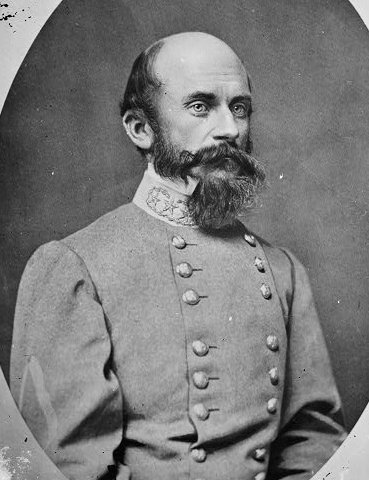
Lieutenant General Richard Ewell C.S.A.

Friends of Padre Steve’s World

I am continuing to periodically intersperse and publish short articles about various commanders at Gettysburg on the site. These all are drawn from my student text and may become a book in their own right.  The reason is I am going to do this is because I have found that readers are often more drawn to the lives of people than they are events. As I have noted before that people matter, even deeply flawed people, and we can learn from them.

Today’s article is about Lieutenant General Richard Ewell who commanded the Confederate Second Corps at Gettysburg. He is another complex character, whose actions at Gettysburg are surrounding in controversy. This article does not go into those but instead focuses on the man and his leadership qualities, character, particularly his struggle with faith and depression.

Peace

Padre Steve+


Dick Ewell was a modest man and “had maintained a reputation for solid competence.” [1] Freeman wrote:

“In part, the appointment of Dick Ewell was made because of sentimental association with the name Jackson, and in part because of admiration for his unique, picturesque, and wholly lovable personality. Of his ability to lead a corps nothing was known. Ewell had never handled more than a division and he had served with Lee directly for less than a month.” [2]

Richard Ewell was native of Virginia on February 8th 1817 in the District of Columbia. His father, Thomas Ewell, was a physician and scientific writer whose works created controversy with both the Catholic and Episcopal Churches. Though a gifted writer and editor, his finances declined even as the size of his family increased, plunging the family into poverty. The elder Ewell struggled with depression and alcoholism and died at the age of forty in in 1826 when Richard was nine years old. Ewell’s maternal grandfather was Benjamin Stoddert who served in the Revolutionary war and as the first Secretary of the Navy by John Adams. Stoddert helped create the Navy that rose to greatness. “In just three years he purchased land for six navy yards, acquired fifty ships, and recruited 6,000 sailors, including a corps of talented young officers that included David Porter, Isaac Hull, Oliver Perry, and Stephen Decatur.[3]

When his father died, the family remained in poverty on the family farm, albeit poverty with a distinguished heritage that his mother ensured that her children understood. She also instilled a strict religious faith in her son. With one brother at West Point and another having died of a liver infection, possibly caused by typhoid, Richard took over the management of the family farm. His mother, who sought more than a rudimentary education for him worked for several years to get him an appointment to West Point. Through her efforts he was finally admitted to the academy in 1836.

The young Ewell was an eccentric in many ways like his father, mother and grandfather:

“In him one could see the practical, precise mind of his grandfather Benjamin Stoddert and, negatively, the cynicism and sharp tongue of his mother, Elizabeth. The similarities to his deceased father were more pronounced. Richard possessed Thomas Ewell’s violent temper, high intellect, nervous energy, and love of alcohol.” [4]

In 1836 Ewell entered West Point, from which he graduated in 1840 along with his classmates, William Tecumseh Sherman and George Thomas. Some of his seniors in his cadet company included Joseph Hooker, John Sedgwick, P.T.G. Beauregard, Henry Halleck, Jubal Early and Henry Hunt, all of whom served as General officers in either the Union or Confederate armies during the Civil War. Some of the underclassmen who served under him included both James Longstreet and Ulysses S. Grant. By the end of his time at West Point Ewell had “developed into not only an impressive student but an impressive soldier.[5] He graduated thirteenth in a class of forty-two and chose to be commissioned in the Dragoons.

Upon graduation and his brevet promotion to Second Lieutenant the young officer reported to the First Dragoons and served on the western territories and plains of the rapidly expanding nation. Ewell was picky as far as relationships went and seeing the often sad examples of men who married on the frontier he elected to wait, which caused him not to marry until after the Civil War began.

On the frontier his Christian faith began to wane. He still believed in God, but he was a skeptic, did not own a Bible and found little solace in region, even as his mother converted to Catholicism and entered a novitiate with a Catholic religious order. His antipathy was deepened as he observed the behavior of Christian missionaries working among the various Indian tribes. Of the missionaries he observed “wife beating, fornication, theft and adultery.” He was taken by surprise when his younger brother William decided to become a missionary. Ewell wrote: “I have seen so much injury done the Indians here by them that I am rather skeptic[c]al of their utility. Some of the greatest scamps we have are missionaries.[6] Despite this he never completely lost faith. Stonewall Jackson had a marked influence on his return to faith. One night before a battle he heard Jackson praying inside his tent and later remarked that “he had never before heard a prayer so devout and beautiful; he then for the first time, felt the desire to be a Christian.[7]

When war came with Mexico Ewell, now a First Lieutenant went with his company. He fought at Vera Cruz, Cerro Gordo, Puebla and Churubusco. While he suffered no physical harm in combat, he developed malaria. He lost his older brother Tom, who while serving with the Mounted Rifles was mortally wounded at Cerro Gordo. Likewise his cousin Levi Gannt, was killed at Chapultepec. Following Mexico, he served in various duties became a noted Indian fighter on the western frontier. Those duties showed that “he had proved his mettle and established his credibility.” [8]

As secession drew near, Ewell was very sick again with fever and was returned to Virginia, some thought to die. However, that did not stop him from offering to fight a group of secessionists in Texas who were threatening to attack a Federal installation. He returned to health and on April 24th 1861 he resigned his commission in the U.S. Army, an act that he wrote “was like death to me.” [9] He was commissioned in the new Confederate Army as a Lieutenant Colonel of Cavalry shortly after his resignation.

Completely bald, and speaking with a lisp, Ewell’s oddities “endeared him to his officers and men,” [10] and by January 1862 he was a division commander and Major General serving under Jackson in the Valley campaign. John Gordon noted that Ewell “had in many respects the most unique personality I have ever known. He was composed of anomalies, the oddest, most eccentric genius in the Confederate Army….” [11] During that campaign he distinguished himself. During the campaign “Next to Jackson himself, Ewell stood out. Every act of Ewell’s in the campaign had been the standard of a competent, alert, and courageous lieutenant.” [12]

William C. Oates wrote of Ewell:

“Ewell was a first-class lieutenant, but he did not have enough confidence in himself to make him successful with an independent command…He hesitated…Therein was Ewell’s deficiency as a general. He had a splendid tactical eye, capable of grand military conceptions, and once resolved quick as lightening to act, yet never quite confident of his own judgment and sought the approval of others before he would execute.” [13]

Ewell had been an effective and dependable division commander under Jackson but had been wounded at Groveton where he was severely wounded and lost a leg, which meant the “absence for long months of the most generous, best disciplined, and in many soldierly qualities, the ablest of Jackson’s subordinates.” [14] Longstreet “regarded him as a superior officer in every respect to Hill.” [15]However, Ewell, though serving long with Jackson in the Shenandoah Valley had served “only briefly under Lee” [16] before being wounded at Groveton. The result was that neither Lee nor Ewell fully knew or understood each other. Lee knew Ewell’s excellent reputation among the soldiers of Second Corps and “may have heard rumors that on his deathbed Jackson expressed a preference for Ewell as his successor” [17] but he had little familiarity with Ewell.

In sending the recommendation on to Richmond Lee termed Ewell “an honest, brave soldier, who has always done his duty well.” [18] It was not a resounding recommendation, but then Lee barely knew Ewell. Lee wrote after the war that he recommended Ewell “with full knowledge of “his faults as a military leader- his quick alternations from elation to despondency[,] his want of decision &c.” [19]

Three days after his promotion Ewell married his widowed cousin, Lizinka Campbell, who he had long admired. Lizinka was the daughter of a Tennessee Congressman and had inherited he first husband’s estate. The couple had renewed their relationship during Ewell’s recovery from his wounds suffered at Grovetown. However, the marriage did not help Ewell. Lizinka was domineering and attempted to extend her “domination to the operations of 2nd Corps.” This “created animosity all around.” [20] One colonel noted that Lizinka’s conduct:

“very seriously injured old Ewell, and the very cleverness, which at other times would render her agreeable has only tended to make her more unpopular. She manages everything,” he complained, “from the General’s affairs down to the courier’s, who carries his dispatches. All say they are under the petticoat government.” [21]

Many questions hovered around the appointment of Ewell including how the loss of his leg, his recent marriage, newness to corps command, and unfamiliarity with Lee’s style of command would have on him.

The latter was even more problematic than any residual mental or physical effects of his wound and change in lifestyle. The fact was that Ewell was unfamiliar with Lee’s methods of command in large part because he “had served directly under Lee something less than a month, and then always subject to Jackson’s guidance. Lee never had an opportunity of the lack of self-confidence in Ewell.” [22] Had Lee known that the humble Ewell had reservations of his own about assuming command of a corps and going back to battle after the traumatic amputation of his leg he might have reconsidered his choice.

Ewell had written “I don’t feel up to a separate command” and he had “no desire to see the carnage and shocking sights of another field of battle.” [23] Ewell admitted to his new bride Lizinka that he was “provoked excessively with myself at times at my depression of spirits & dismal way of looking at everything, present & future….” [24] Lee did speak privately about his concerns to Ewell, but no record exists of the conversation, regardless Lee was not concerned enough to remove Ewell from command or to assign his corps to important tasks. However, Ewell was “never the same man in body or mind after the loss of his leg at Groveton.” [25] His decision making on the battlefield became clouded and he was often indecisive.

After Gettysburg Ewell continued to command Second Corps through the Battle of Spotsylvania Court House, “after which his health compelled his temporary retirement from active field duty.” [26] He was reassigned to be the commander of the Department of Richmond and was captured at Sayler’s Creek in April 1865. After the war Ewell was honest about his shortcomings as a corps commander, especially of his actions at Gettysburg. He told one officer “it took a dozen blunders to lose Gettysburg he committed a good many of them.” [27]

He retired to his wife’s dilapidated farm in Tennessee, which he rehabilitated through much hard work. He was active in his community and did not become immersed in the conflicts of various commanders. In January 1872 he and his family were stricken with fever, Lizinka died and he followed a few days later.

In his final days, the faith that he had so long avoided sustained him remarked to a former subordinate he said “I don’t know how it all is, but the mercy of God is greater than the mercy of men.” [28] He dictated that he wanted a simple funeral and no monument over his grave. “Above all, he insisted that nothing disrespectful to the United States Government be inscribed upon his tomb.” [29]

Unlike his former subordinate the bitter, hate filled and arrogant Jubal Early, the reserved and humble Dick Ewell reconciled with his country and owned his mistakes.

Peace

Padre Steve+

Notes

[1] Ibid. Taylor, John Duty Faithfully Performed p.130

[2] Ibid. Freeman Lee’s Lieutenants p.322

[3] Pfanz, Donald. Richard S. Ewell: A Soldier’s Life University of North Carolina Press, Chapel Hill and London 1998 p.9

[4] Ibid. Pfanz Richard S. Ewell p.11

[5] Ibid. Pfanz Richard S. Ewell p.24

[6] Ibid. Pfanz Richard S. Ewell p.33

[7] Ibid. Pfanz Richard S. Ewell p.266

[8] Ibid. Pfanz Richard S. Ewell p.99

[9] Ibid. Pfanz Richard S. Ewell p.121

[10] Ibid. Freeman Lee’s Lieutenants p.172

[11] Ibid. Girardi. The Civil War Generals p.209

[12] Ibid. Freeman Lee’s Lieutenants p.220

[13] Ibid. Girardi. The Civil War Generals p.209

[14] Ibid. Freeman Lee’s Lieutenants p.322

[15] Ibid. Wert A Glorious Army p.214

[16] Gallagher, Gary. Confederate Corps Leadership on the First Day at Gettysburg: A.P. Hill and Richard S. Ewell in a Difficult Debut in The First Day at Gettysburg edited by Gallagher, Gary W. Kent State University Press, Kent Ohio 1992 p.47

[17] Ibid. Gallagher Confederate Corps Leadership on the First Day at Gettysburg p.47

[18] Ibid. Gallagher Confederate Corps Leadership on the First Day at Gettysburg p.48

[19] Ibid. Gallagher Confederate Corps Leadership on the First Day at Gettysburg p..49

[20] Ibid. Wilson and Clair They Also Served p.25

[21] Ibid. Pfanz Richard S. Ewell p.356

[22] Freeman, Douglas Southall, Lee an abridgment by Richard Harwell, Touchstone Books, New York 1997 p.305

[23] Ibid. Guelzo, Gettysburg: The Last Invasion p.23

[24] Ibid. Pfanz Richard S. Ewell p.279

[25] Ibid. Freeman Lee’s Lieutenants p.720

[26] Ibid. Warner Generals in Gray p.85

[27] Ibid. Freeman Lee’s Lieutenants p.605

[28] Ibid. Pfanz Richard S. Ewell pp.495-496

[29] Ibid. Pfanz Richard S. Ewell p.496

[30] Ibid. Pfanz Richard S. Ewell p.268


Leave a comment

Filed under civil war, faith, History, leadership, Military

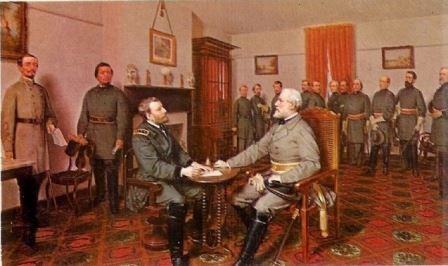
“We Are All Americans” Surrender at Appomattox

appomattox surrender

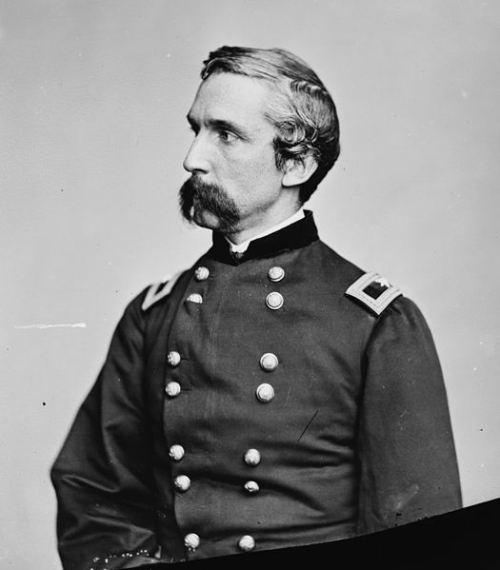
One hundred and fifty years ago on the 9th and 10th of April 1865, four men, Ulysses S Grant, Robert E. Lee, Joshua Lawrence Chamberlain and Ely Parker, taught succeeding generations the value of mutual respect and reconciliation. They would do so after a bitter and bloody war that had cost the lives of over 600,000 Americans which had left hundreds of thousands others maimed, shattered or without a place to live, and seen vast swaths of the country ravaged by war and its attendant plagues.

The men were all very different, Lee was a Southern aristocrat and career army officer, Grant, the officer of humble means who had struggled with alcoholism and failed in his civilian life before returning to the army when war began. Chamberlain, was the professor of rhetoric and natural and revealed religion, the hero of Little Round Top, who helped exemplify the importance of citizen soldiers in peace and war. Finally there was Parker, a full-blooded Seneca Indian; a professional engineer, a man who was barred from being an attorney because as a Native American he was never considered a citizen. Although he had been rejected from serving in the army for the same reason, his friend Grant had obtained him a commission and kept him on his staff.

On the morning of the 9th Confederate General Robert E. Lee replied to an entreaty of Lieutenant General Ulysses S. Grant requesting that he and his Army of Northern Virginia be allowed to surrender. Lee wrote to Grant:

HEADQUARTERS ARMY OF NORTHERN VIRGINIA, APRIL 9, 1865

Lieut. Gen. U.S. GRANT:

I received your note of this morning on the picket-line, whither I had come to meet you and ascertain definitely what terms were embraced in your proposal of yesterday with reference to the surrender of this army. I now ask an interview in accordance with the offer contained in your letter of yesterday for that purpose.

R.E. LEE, General.

The once mighty Army of Northern Virginia which had won so many victories was now a haggard but proud force of about 15,000 soldiers. For Lee to continue the war now would mean that they face hopeless odds against a vastly superior enemy. Grant recognized this and wrote Lee:

I am equally anxious for peace with yourself, and the whole North entertains the same feeling. The terms upon which peace can be had are well understood. By the South laying down their arms they will hasten that most desirable event, save thousands of human lives, and hundreds of millions of property not yet destroyed. Seriously hoping that all our difficulties may be set-tied without the loss of another life, I subscribe myself, &c.,

Since the high water mark at Gettysburg, Lee’s army had been on the defensive. His ill-fated offensive into Pennsylvania being one of the two climactic events that sealed the doom of the Confederacy. The other was Grant’s victory at Vicksburg which fell to him a day after Pickett’s Charge.

The bloody defensive struggle lasted through 1864 as Grant bled the Confederates dry during the Overland Campaign, leading to the long siege of Petersburg. Likewise the armies of William Tecumseh Sherman had cut a swath through the Deep South and were moving toward Virginia from the Carolinas.

With each battle following Gettysburg the Army of Northern Virginia became weaker and finally after the nine month long siege of Petersburg ended with a Union victory there was little else to do. On the morning of April 9th a final attempt to break through the Union lines by John Gordon’s division was turned back by vastly superior Union forces.

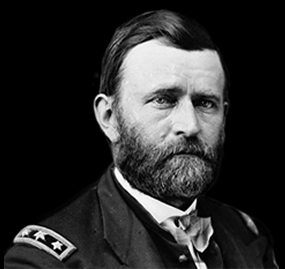
grant 1

Lieutenant General Ulysses S. Grant, United States Army

On April 7th Grant wrote a letter to Lee which began the process of ending the war in Virginia. He wrote:

General R. E. LEE:

The result of the last week must convince you of the hopelessness of further resistance on the part of the Army of Northern Virginia in this struggle. I feel that it is so, and regard it as my duty to shift from myself the responsibility of any further effusion of blood, by asking of you the surrender of that portion of the C. S. Army known as the Army of Northern Virginia.

U.S. GRANT, Lieutenant-General

Lee was hesitant to surrender knowing Grant’s reputation for insisting on unconditional surrender, terms that Lee could not accept. He replied to Grant:

HEADQUARTERS ARMY OF NORTHERN VIRGINIA, APRIL 7, 1865 Lieut. Gen. U.S. GRANT:

I have received your note of this date. Though not entertaining the opinion you express on the hopelessness of further resistance on the part of the Army of Northern Virginia, I reciprocate your desire to avoid useless effusion of blood, and therefore, before considering your proposition, ask the terms you will offer on condition of its surrender.

R.E. LEE, General.

The correspondence continued over the next day even as the Confederates hoped to fight their way out of the trap that they were in. But now Robert E. Lee, who had through his efforts extended the war for at least six months knew that he could no longer continue. Even so some of his younger subordinates wanted to continue the fight. When his artillery chief Porter Alexander recommended that the Army be released, “take to the woods and report to their state governors” Lee replied:

“We have simply now to face the fact that the Confederacy has failed. And as Christian men, Gen. Alexander, you & I have no right to think for one moment of our personal feelings or affairs. We must consider only the effect which our action will have upon the country at large.”

Lee continued:

“Already [the country] is demoralized by the four years of war. If I took your advice, the men would be without rations and under no control of their officers. They would be compelled to rob and steal in order to live…. We would bring on a state of affairs it would take the country years to recover from… You young fellows might go bushwhacking, but the only dignified course for me would be to go to General Grant and surrender myself and take the consequences of my acts.”

Alexander was so humbled at Lee’s reply he later wrote “I was so ashamed of having proposed such a foolish and wild cat scheme that I felt like begging him to forget he had ever heard it.” When Alexander saw the gracious terms of the surrender he was particularly impressed with how non-vindictive the terms were, especially in terms of parole and amnesty for the surrendered soldiers.

Abraham Lincoln had already set the tone for the surrender in his Second Inaugural Address given just over a month before the surrender of Lee’s army. Lincoln closed that speech with these words of reconciliation:

“With malice toward none, with charity for all, with firmness in the right as God gives us to see the right, let us strive on to finish the work we are in, to bind up the nation’s wounds, to care for him who shall have borne the battle and for his widow and his orphan, to do all which may achieve and cherish a just and lasting peace among ourselves and with all nations.”

Lee1

General Robert E. Lee, CSA

Lee met Grant at the house of Wilmer McLean, who had moved to Appomattox in 1861 after his home near Manassas had been used as a Confederate headquarters and was damaged by artillery fire. Lee was dressed in his finest uniform complete with sash, while Grant was dressed in a mud splattered uniform and overcoat only distinguished from his soldiers by the three stars on his should boards. Grant’s dress uniforms were far to the rear in the baggage trains and Grant was afraid that his slovenly appearance would insult Lee, but it did not. It was a friendly meeting, before getting down to business the two reminisced about the Mexican War.

Grant provided his vanquished foe very generous surrender terms:

“In accordance with the substance of my letter to you of the 8th inst., I propose to receive the surrender of the Army of N. Va. on the following terms, to wit: Rolls of all the officers and men to be made in duplicate. One copy to be given to an officer designated by me, the other to be retained by such officer or officers as you may designate. The officers to give their individual paroles not to take up arms against the Government of the United States until properly exchanged, and each company or regimental commander sign a like parole for the men of their commands. The arms, artillery and public property to be parked and stacked, and turned over to the officer appointed by me to receive them. This will not embrace the side-arms of the officers, nor their private horses or baggage. This done, each officer and man will be allowed to return to their homes, not to be disturbed by United States authority so long as they observe their paroles and the laws in force where they may reside.”

When Lee left the building Federal troops began cheering but Grant ordered them to stop. Grant felt a sense of melancholy and wrote “I felt…sad and depressed, at the downfall of a foe who had fought so long and valiantly, and had suffered so much for a cause, though that cause was, I believe, one of the worst for which a people has fought.” He later noted: “The Confederates were now our countrymen, and we did not want to exult over their downfall.”

In the hours before and after the signing of the surrender documents old friends and classmates, separated by four long years of war gathered on the porch or around the house. Grant and others were gracious to their now defeated friends and the bitterness of war began to melt away. Some Union officers offered money to help their Confederate friends get through the coming months. It was an emotional reunion, especially for the former West Point classmates gathered there:

“It had never been in their hearts to hate the classmates they were fighting. Their lives and affections for one another had been indelibly framed and inextricably intertwined in their academy days. No adversity, war, killing, or political estrangement could undo that. Now, meeting together when the guns were quiet, they yearned to know that they would never hear their thunder or be ordered to take up arms against one another again.”

Grant also sent 25,000 rations to the starving Confederate army waiting to surrender. The gesture meant much to the defeated Confederate soldiers who had had little to eat ever since the retreat began.

The surrender itself was accomplished with a recognition that soldiers who have given the full measure of devotion can know when confronting a defeated enemy. Major General Joshua Lawrence Chamberlain, the heroic victor of Little Round Top was directed by Grant to receive the final surrender of the defeated Confederate infantry on the morning of April 12th.

It was a rainy and gloomy morning as the beaten Confederates marched to the surrender grounds. As the initial units under the command of John Gordon passed him, Chamberlain was moved with emotion he ordered his soldiers to salute the defeated enemy for whose cause he had no sympathy, Chamberlain honored the defeated Rebel army by bringing his division to present arms.

chamberlian gordon appomattox

John Gordon, who was “riding with heavy spirit and downcast face,” looked up, surveyed the scene, wheeled about on his horse, and “with profound salutation returned the gesture by lowering his saber to the toe of his boot. The Georgian then ordered each following brigade to carry arms as they passed third brigade, “honor answering honor.”

joshua_chamberlain_-_brady-handy

Major General Joshua Lawrence Chamberlain, U.S. Army

Chamberlain was not just a soldier, but before the war had been Professor of Natural and Revealed Religions at Bowdoin College, and a student of theology before the war. He could not help to see the significance of the occasion. He understood that he would be criticized by some for offering the salute. However, Chamberlain, unlike some, understood the value of reconciliation. Chamberlain was a staunch abolitionist and Unionist who had nearly died on more than one occasion fighting the defeated Confederate Army, and he understood that no true peace could transpire unless the enemies became reconciled to one another.

He noted that his chief reason for doing so:

“The momentous meaning of this occasion impressed me deeply. I resolved to mark it by some token of recognition, which could be no other than a salute of arms. Well aware of the responsibility assumed, and of the criticisms that would follow, as the sequel proved, nothing of that kind could move me in the least. The act could be defended, if needful, by the suggestion that such a salute was not to the cause for which the flag of the Confederacy stood, but to its going down before the flag of the Union. My main reason, however, was one for which I sought no authority nor asked forgiveness. Before us in proud humiliation stood the embodiment of manhood: men whom neither toils and sufferings, nor the fact of death, nor disaster, nor hopelessness could bend from their resolve; standing before us now, thin, worn, and famished, but erect, and with eyes looking level into ours, waking memories that bound us together as no other bond;—was not such manhood to be welcomed back into a Union so tested and assured? Instructions had been given; and when the head of each division column comes opposite our group, our bugle sounds the signal and instantly our whole line from right to left, regiment by regiment in succession, gives the soldier’s salutation, from the “order arms” to the old “carry”—the marching salute. Gordon at the head of the column, riding with heavy spirit and downcast face, catches the sound of shifting arms, looks up, and, taking the meaning, wheels superbly, making with himself and his horse one uplifted figure, with profound salutation as he drops the point of his sword to the boot toe; then facing to his own command, gives word for his successive brigades to pass us with the same position of the manual,—honor answering honor. On our part not a sound of trumpet more, nor roll of drum; not a cheer, nor word nor whisper of vain-glorying, nor motion of man standing again at the order, but an awed stillness rather, and breath-holding, as if it were the passing of the dead!”

The next day Robert E Lee addressed his soldiers for the last time. Lee’s final order to his loyal troops was published the day after the surrender. It was a gracious letter of thanks to men that had served their beloved commander well in the course of the three years since he assumed command of them outside Richmond in 1862.

General Order
No. 9

After four years of arduous service marked by unsurpassed courage and fortitude, the Army of Northern Virginia has been compelled to yield to overwhelming numbers and resources.

I need not tell the survivors of so many hard fought battles, who have remained steadfast to the last, that I have consented to the result from no distrust of them.

But feeling that valour and devotion could accomplish nothing that could compensate for the loss that must have attended the continuance of the contest, I have determined to avoid the useless sacrifice of those whose past services have endeared them to their countrymen.

By the terms of the agreement, officers and men can return to their homes and remain until exchanged. You will take with you the satisfaction that proceeds from the consciousness of duty faithfully performed, and I earnestly pray that a merciful God will extend to you his blessing and protection.

With an unceasing admiration of your constancy and devotion to your Country, and a grateful remembrance of your kind and generous consideration for myself, I bid you an affectionate farewell. — R. E. Lee, General

The surrender was the beginning of the end. Other Confederate forces continued to resist for several weeks, but with the surrender of the Army of Northern Virginia led by the man that nearly all Southerners saw as the embodiment of their nation the war was effectively over.

Lee had fought hard and after the war was still under the charge of treason, but he understood the significance of defeat and the necessity of moving forward as one nation. In August 1865 Lee wrote to the trustees of Washington College of which he was now President:

“I think it is the duty of every citizen, in the present condition of the Country, to do all in his power to aid the restoration of peace and harmony… It is particularly incumbent upon those charged with the instruction of the young to set them an example of submission to authority.

It is a lesson that all of us in our terribly divided land need to learn regardless of or political affiliation or ideology. After he had signed the surrender document, Lee learned that Grant’s Aide-de-Camp Colonel Ely Parker, was a full-blooded Seneca Indian. He stared at Parker’s dark features and said: “It is good to have one real American here.”

eparker05-966-g

Brigadier General Ely Parker, United States Army

Parker, a man whose people had known the brutality of the white man, a man who was not considered a citizen and would never gain the right to vote, replied, “Sir, we are all Americans.” That afternoon Parker would receive a commission as a Brevet Brigadier General of Volunteers, making him the first Native American to hold that rank in the United States Army. He would later be made a Brigadier General in the Regular Army.

I don’t know what Lee thought of that. His reaction is not recorded and he never wrote about it after the war, but it might have been in some way led to Lee’s letter to the trustees of Washington College. I think with our land so divided, ands that is time again that we learn the lessons so evidenced in the actions and words of Ely Parker, Ulysses Grant, Robert E. Lee and Joshua Chamberlain, for we are all Americans.

Sadly, I think that there is a portion of the population who will not heed these words and will continue to agitate for policies and laws similar to those that led to the Civil War, and which those the could not reconcile defeat instituted again during the Post-Reconstruction and Jim Crow eras.

But I still maintain hope that in spite of everything, that we can overcome.

Peace

Padre Steve+


1 Comment

Filed under civil war, History, leadership, Military, Political Commentary

Jubal Early: The Unreconstructed Rebel

??????????????????????????????????????????????????????????????????????????????????????????????

Lieutenant General Jubal Early, the Propagandist of the Lost Cause

Friends of Padre Steve’s World

There are some people in history who have a major and sometimes malevolent impact on history who are little known to most people. One of these men is Confederate Lieutenant General Jubal A. Early. You may not have ever heard of him but his influence is still strong today in certain parts of the Republican Party, the Tea Party, the Christian Right and neo-Confederate organizations. Early is a complex, brilliant but malevolent character whose post Civil War activities, and writings influenced how generations of Americans embraced the myth of the Lost Cause as historic truth and why so  many people today support an ideology that is little more than a re-baptized Lost Cause in their fight against supposed liberals, progressives, gays, and minority groups. People who they believe threaten their place in society. 

This article is part of one of the chapters of my Gettysburg which I will continue to periodically publish here. Have a great night.

Peace

Padre Steve+ 

Jubal Early was an unusual character. He is described similarly by many to Dick Ewell in his gruffness and eccentrics. Unlike his corps commander, Ewell, who was modest and charitable, Early was “ambitious, critical, and outspoken to the point of insubordination. Under certain circumstances he could be devious and malevolent.” [1] James Longstreet’s aide Moxey Sorrel wrote of him: “Jubal Early….was one of the ablest soldiers in the army. Intellectually he was perhaps the peer of the best for strategic combinations, but he lacked the ability to handle troops effectively in the field….His irritable disposition and biting tongue made him anything but popular.” [2] Despite this, Early had proved himself as a brigade commander and acting division commander and Lee referred to him affectionately as “my bad old man.” [3]

Early was the son of a tobacco planter in Franklin County Virginia. He was born in 1816 who had served in the Virginia legislature and was a Colonel of militia. Growing up he had an aptitude for science and mathematics. He was accepted into West Point in 1833 at the age of seventeen. He was a good student, but had poor marks for conduct and graduated in the eighteenth of fifty cadets in the class of 1837. His fellow students included Joe Hooker, John Sedgwick, Braxton Bragg, and John Pemberton, later, the doomed defender of Vicksburg. Also in the class was Lewis Armistead, with whom the young Early had an altercation that led to Armistead breaking a plate over his head in the mess hall. For the offense Armistead was dismissed from the academy.

He was commissioned into the artillery on graduation in 1837. However, after experiencing life in the active duty army, including service in the in the Seminole War, Early left the army and became a highly successful lawyer and active Whig politician. He served in the Mexican war as a Major with Virginia volunteers. Unlike some of his classmates, and later contemporaries in the Civil War, Early, and his men did not see combat, instead, serving on occupation duty. In Mexico Zachary Taylor made Early the “military governor of Monterrey, a post that he relished and filled with distinction.” [4]

After his service in Mexico, Early returned to Virginia where he returned to his legal practice, serving as a prosecuting attorney. He also entered local politics where he served as a Whig in the Virginia legislature.

During his time in Mexico, Early contracted rheumatic fever, which left him with painful rheumatoid arthritis for the rest of his life. Due to it he “stooped badly and seemed so much older than his years that his soldiers promptly dubbed him “Old Jube” or Old Jubilee.” [5]

Jubal Early was “notoriously a bachelor and at heart a lonely man.” Unlike many Confederate officers he had “no powerful family connections, and by a somewhat bitter tongue and rasping wit” isolated himself from his peers.[6]

Likewise, in an army dominated by those with deep religious convictions, Early was avowedly irreligious and profane, though he did understand the importance of “the value of religion in keeping his soldiers’ spirits up” and as commander of the Army of the Valley, issued orders for a stricter keeping of the Sabbath. [7] Lee’s adjutant Walter Taylor wrote of him “I feared our friend Early wd not accomplish much because he is such a Godless man. He is a man who utterly sets at defiance all moral laws & such a one heaven cannot favor.” [8] That being said Porter Alexander praised Early and noted that his “greatest quality perhaps was the fearlessness with which he fought against all odds & discouragements.” [9]

Early was a Whig, and a stalwart Unionist who opposed Virginia’s secession, voting against it because he found it “exceedingly difficult to surrender the attachment of a lifetime to that Union which…I have been accustomed to look upon (in the language of Washington) as the palladium of the political safety and prosperity of the country.” [10] Nonetheless, like so many others he volunteered for service after Lincoln called for 75,000 volunteers to crush the rebellion.

Robert E. Lee “appreciated Early’s talents as a soldier and displayed personal fondness for his cantankerous and profane Lieutenant …who only Stonewall Jackson received more difficult assignments from Lee.” [11] Early was the most influential of Ewell’s division commanders, and his “record in battle prior to Gettysburg was unsurpassed.” [12]

After Gettysburg Early remained in command of his division and when Dick Ewell was relieved in 1864 assumed command of the Second Corps. With the corps he conducted operations in the Shenandoah Valley as well as a raid which briefly threatened Washington D.C. in 1864. Early became “a much maligned figure in the Confederacy after his army suffered utter defeat against Philip H. Sheridan’s forces in the Shenandoah Valley during the fall and winter of 1864-65.” [13] The clamor for his relief was so great that Lee relieved Early of command on March 30th 1865, “and sent him home to await orders.” [14] However Lee handled the matter with gentleness that made ensured Early’s undying devotion. Lee wrote:

“while my own confidence in your ability, zeal, and devotion to the cause in unimpaired…I nevertheless felt that I could not oppose what seems to be the current opinion, without injustice to your reputation and injury to the service.” [15]

After the war Early went into voluntary exile until 1869, unable to reconcile life in the United States following defeat. Travelling from Cuba to Mexico and on to Canada his bitterness grew, and for the embittered General it was about honor. For Early, who had fought so hard against secession, now took the opposing view. For him, “honor resided intact in the defeated cause of Southern independence. It was now distilled, for him, in the issue of states’ rights and white supremacy.” [16]

In his efforts Early sought to “elevate Lee above any other Civil War chieftains, and to promote the idea that the South had not been defeated, only compelled to surrender against overwhelming odds.” [17] Early’s hatred for anything to do with the North was demonstrated when he “refused even to donate funds to a monument to Robert E. Lee in Richmond when he learned that the pedestal would be carved from Maine granite.” [18]

Early’s hatred a blacks grew as he got older, and “became particularly virulent when they were involved in anything connected to the war on the Confederacy.” [19] While serving as Governor, James Kemper, who was so grievously wounded during Pickett’s Charge found Early’s views so dangerous that he begged Early not to attend the unveiling of a monument to Stonewall Jackson in 1875. He wrote to Early, “for the sake of public peace and harmony, I beg, beseech and implore you, for God’s sake stay at home.” [20]

Upon his return from his voluntary exile he was sought after by Lee to help in preparation of a memoir that would explain his decisions during the war. In addition to championing Lee and writing polemics against any former Confederate officer who dared to criticize his chief. As such those writing their own memoirs were usually careful to avoid anything that might provoke Early’s wrath, or submitted their work for his imprimatur before going to publication. He shameless attacked James Longstreet and William Mahone for their post war reconciliation with the hated Yankees, as well as Longstreet’s criticism of Lee.

Early was very intelligent and he knew that the controversy surrounding his defeat in the Valley did not enhance his own reputation, so instead “It was on Lee’s credibility that Early built his postwar career.” [21] Over the course of:

“the last twenty-five years of his life the bitter General sought to get his impressions of the war on record. He took an active role in publishing the Southern Historical Papers….and achieved as a leading arbiter of questions concerning relating to Confederate military history.” [22]

Early was immensely successful in this long term effort. The results of Early’s efforts was the successful propagation of the myth of the Lost Cause and its prominence throughout many of the books, journals and other publications published after the war, even Winston Churchill’s history of the Civil War is filled with Early like lost cause images and language in his works. Referring to Southern honor, that concept that Early held so dear Churchill, echoing Early wrote “The South knew they had lost the war, and would be conquered and flattened. It is one of the enduring glories of the American nation that this made no difference to the Confederate resistance.” [23] The idea that Churchill espoused, that Confederate “honor” was one of the enduring glories of  the American nation” is nothing more than myth which promotes everything wrong with the Confederacy.

In February 1894 Lee’s “old bad man” took a fall on the way out of the Lynchburg Post Office. He resisted treatment though he appeared to be in shock and was both mentally and physically unwell. He attempted to continue his business but got worse and he died in Lynchburg on March 2nd 1894.

Sadly, Early’s ideas live on in the minds of many Americans, who like him have not reconciled with the results of the war and who are susceptible to his message. Early set the example for them:

“Like an Old testament prophet, Jubal supported the message by his own extreme example – his “constancy” and intransigence, his unremitting hatred for Grant (even after Jefferson Davis had forgiven the Illinoisan), his refusal to be pardoned or reconstructed or to regard the North, at least in the abstract, as anything but an evil empire.” [24]

Jubal Early’s words and actions read almost as if they come out of current Republican and Christian Right talking points. Instead of Lincoln and the Black Republicans, the enemy is Obama and the Black, Gay and Liberal Democrats. I find it chilling to read about Early and his transformation for an anti-secession Whig to an unreconstructed Rebel whose nearly pathological hatred for the Union that he had once served reminds me of people I know.

Peace

Padre Steve+

Notes

[1] Ibid. Pfanz Richard S. Ewell p.268

[2] Ibid. Girardi. The Civil War Generals p.206

[3] Ibid. Wert A Glorious Army p.155

[4] Ibid. Osborne Jubal p.28

[5] Ibid. Freeman Lee’s Lieutenants p.83

[6] Ibid. Freeman Lee’s Lieutenants p.33

[7] Ibid. Osborne Jubal p.385

[8] Ibid. Girardi. The Civil War Generals p.207

[9] Alexander, Edward Porter. Fighting for the Confederacy: The Personal Recollections of General Edward Porter Alexander edited by Gary Gallagher University of North Carolina Press, Chapel Hill 1989 p.397

[10] Ibid. Osborne Jubal p.50

[11] Gallagher, Gary W. Jubal A. Early, the Lost Cause, and Civil War History: A Persistent Legacy; Frank L Klement Lecture, Alternate Views of the Sectional Conflict Marquette University Press Marquette WI 2003 p.11

[12] Ibid. Tagg The Generals of Gettysburg p.256

[13] Ibid. Gallagher Jubal A. Early, the Lost Cause, and Civil War History p.8

[14] Ibid. Freeman Lee’s Lieutenants p.769

[15] Ibid. Gallagher Jubal A. Early, the Lost Cause, and Civil War History p.11

[16] Ibid. Osborne Jubal p.416

[17] Ibid. Pryor Reading the Man p.469

[18] Guelzo Allen C. Fateful Lightening: A New History of the Civil War Era and Reconstruction Oxford University Press, Oxford and New York 2012 p.526

[19] Ibid. Osborne Jubal p.418

[20] Ibid. Osborne Jubal p.418

[21] Ibid. Osborne Jubal p.476

[22] Ibid. Gallagher Jubal A. Early, the Lost Cause, and Civil War History p.15

[23] Ibid. Gallagher Jubal A. Early, the Lost Cause, and Civil War History p.15

[24] Ibid. Osborne Jubal p.476

Leave a comment

Filed under civil rights, civil war, Gettysburg, History, Military, Political Commentary

The Knight-Errant of Virginia: J.E.B. Stuart

CWP015

Major General J.E.B. Stuart C.S.A.

Friends of Padre Steve’s World

I am continuing to periodically intersperse and publish short articles about various commanders at Gettysburg on the site. These all are drawn from my student text and may become a book in their own right.  The reason is I am going to do this is because I have found that readers are often more drawn to the lives of people than they are events. As I have noted before that people matter, even deeply flawed people, and we can learn from them.

Today’s article is about one of the most famous leaders of the Civil War, Confederate Cavalry commander James Ewell Brown “JEB” Stuart. He too is a complex character; exceptionally vain and self-seeking, capable of being a loyal friend or an implacable foe who confused fame with greatness because he did not have the depth of character to tell them apart. He led his troopers with great abandon to many victories but had little ability to reflect on his own actions which hurt the Confederate cause.

Peace

Padre Steve+

Major General James Ewell Brown Stuart was the son of a former congressman whose family went back five generations in Virginia. Like so many officers, his life is marked by contradictions. Eminently genial and fun-loving, he had a dark side of unbridled ambition and a willingness to use his rank, power and position to crush anyone who got in his way.

He graduated thirteenth in a class of forty-six at West Point in 1854. His classmates and friends included Dorsey Pender and Oliver O. Howard. A fellow cadet, as well as lifelong friend, who would serve under Stuart during the war, Fitzhugh Lee wrote of him:

“His distinguishing characteristics were a strict attention to his military duties, an erect, soldierly bearing, an immediate and almost thankful acceptance of a challenge from any cadet to fight, who might in any way feel himself aggrieved, and a clear, metallic, ringing voice.” [1]

At West Point Stuart was noted for his “lifelong religious devoutness. When he was at West Point he was known as a “Bible Class Man,” [2] and his faith would serve to define his life as much as his well-known vanity. As such, he was a close friend of Oliver O. Howard. The two were poles apart ideologically. Howard was already an abolitionist and opponent of state supremacy and states’ rights; Stuart on the other hand, was a proponent of all. When other Southern cadets “ostracized Howard, Stuart sided with the Maine Yankee. It was a courageous act in that closed society, rooted in his sense of justice and honor.” [3]

That sense of justice and honor carried with it a dark side. While he was genial and warm, he was intensely ambitious, and did not take criticism well. That would come out in his treatment of men like “Grumble” Jones and later Wade Hampton as well as other officers during his service to the Confederacy. One of his officers noted: “Stuart is an ambitious man – he wants those about him who are his friends. This is his first consideration – talent is next….A little flattery & a daring spirit will bring promotion.” [4]

Stuart was commissioned as a Second Lieutenant and assigned to the Mounted Rifles, which Stuart noted was “a corps which my taste, fondness for riding, and my desire to serve my country in some acceptable manner led me to select above all the rest.” [5] Stuart would serve with the Mounted Rifles for about a year before being selected to serve in one of the first Cavalry regiments formed, the First Cavalry at Jefferson Barracks Missouri.

In the pre-war years the young officer developed a solid reputation in the army where he served on the frontier and in “Bleeding Kansas.” In those years Stuart “was already a young officer of great promise, a natural horseman with a reputation for dash and bravery gained in countless clashes with Indians throughout the West, and for steady competence in the pro- and antislavery warfare of Kansas.” [6] However, Stuart was not a political person, while he certainly understood and kept himself apprised of developments he did not appreciate the magnitude of the events. Stuart was consumed with his advancing career and his personal life and “like most Americans, had neither the time nor inclination to understand the magnitude of the sectional conflict that produced civil war.” [7]

In 1859 Stuart was on leave, visiting Washington D.C. and staying with the Lees at Arlington. He was visiting the War Department when news came of John Brown’s raid at Harper’s Ferry. He was given a letter to take to Lee which ordered Lee to take command of troops to suppress the rebellion. Stuart accompanied Lee on the mission and was sent by Lee to present terms of surrender to the raiders, who at the time were still nameless to the Federal authorities. Stuart entered the building and was confronted by Brown whom he had previously met in Kansas. After some fruitless negotiation, Stuart realized that Brown was not about to surrender. At some point, Stuart broke away and motioned for the Marines to move in. “Three minutes after Stuart had given his signal, the affair was over.” [8]

In spite of having seen first-hand the effects of the violence in Kansas and at Harper’s Ferry, when secession came “Stuart was essentially unprepared.” [9] All he could do was to almost liturgically repeat “I go with Virginia” almost as an article of faith. As such, Stuart resigned his commission when Virginia seceded from the Union in April 1861, while his father-in-law, Colonel Philip St. George Cooke remained in Union service. Stuart could be unforgiving and such was the case now. Stuart hated his father-in-law’s decision, so much so that he re-named his son, who had been named for the elder Cooke, “James Ewell Brown Stuart,” which became “J.E.B. Stuart Jr. – Jimmy.” [10]

He commanded the 1st Virginia Cavalry in the Valley and at First Manassas and was promoted to Brigadier General in September 1861. The following month, he was given command of the army’s cavalry brigade and distinguished himself in the eyes of both General Joseph Johnston and Robert E. Lee. Johnston wrote to President Jefferson Davis praising the young brigadier “He is a rare man…wonderfully endowed by nature with the qualities necessary for an officer of light cavalry….If you add to this army a real brigade of cavalry, you can find no better brigadier-general to command it.” [11]

Lee came to share Johnston’s opinion and over the course of his service, Stuart had come to:

“demonstrate a real talent for the most mundane and most essential role cavalry played in this war – reconnaissance and intelligence gathering. No intelligence source surpassed his eye for seeing and evaluating a military landscape or an enemy’s strengths and dispositions.” [12]

This would be something that Lee came to rely and which he would dearly miss at Gettysburg.

Despite his excellence in this “most mundane” task, Stuart developed a flair and passion for the spectacular, which was first demonstrated during the Seven Days, where he took his cavalry on a circuit of McClellan’s army, which not only gathered a significant amount of intelligence, but also unnerved the Army of the Potomac. His raid was “flawlessly executed….” And Stuart “became a hero to his troopers and one of the idols of the public.” [13] Lee wrote that Stuart’s operation “was executed with great address and daring by accomplished officer.” [14] The raid did have its detractors, especially among the infantry and it also revealed something to Stuart that appealed to his own vanity, “that raiding would easily garner headlines in the Richmond papers.” [15]

Stuart Lee’s staff secretary, Colonel Robert Taylor noted that Stuart was “possessing of great powers of endurance, courageous to an exalted degree, of sanguine temperament, prompt to act, always ready for fight – he was the ideal cavalryman.” [16] Stuart also kept a lively headquarters. Taylor remarked “How genial he was! There was no room for “the blues” around his headquarters; the hesitating and desponding found no congenial atmosphere at his camp; good will, jollity, and even hilarity, reigned there.” [17]

Stuart always had his African-American banjo player with him and frequently sang around camp and on campaign. That was not always appreciated by some other officers. Wade Hampton, who in time became Stuart’s right-hand man was not impressed with the atmosphere at Stuart’s headquarters and “was not certain that he could flourish, or even survive, among such people….” [18] Lafayette McLaws wrote home complaining not only about Stuart but others:

“Stuart carries around with him a banjo player and special correspondent. This claptrap is noticed and lauded as a peculiarity of genius, when, in fact, it is nothing more but the act of a buffoon to get attention.” [19]

But Stuart was always aware of his own mortality and there was a serious side to him, often expressed in his faith, which impressed those around him. His West Point classmate and friend, Oliver O. Howard wrote:

“J.E.B. Stuart was cut out for a cavalry leader. In perfect health, but thirty-two years of age, full of vigor and enterprise, with the usual ideas imbibed in Virginia concerning State Supremacy, Christian thought and temperate by habit, no man could ride faster, endure more hardships, make a livelier charge, or be more hearty and cheerful while so engaged. A touch of vanity, which invited the smiles and applause of the fair maidens of Virginia, but added to the zest and ardor of Stuart’s parades and achievements.” [20]

At Chancellorsville Stuart assumed acting command of Jackson’s Second Corps which he led well during the battle, even impressing the infantry, who had long derided Stuart and his cavalry. Leading by example “seemed on fire.” Stuart sang as he led the Stonewall Brigade into action and “the troops joined him, singing while they loaded and fired.” One officer stated “Jeb impressed himself on the infantry.” [21]

Some believed that Stuart should have been appointed to command Second Corps after Jackson’s death, but evidently Lee valued Stuart’s role as a cavalry commander more and despite his accomplishments refused to proffer the command to Stuart. Colonel Rosser told Stuart, who was grieving the loss of his friend Jackson: “On his death bed Jackson said that you should succeed him, and command his corps.” Stuart responded “I would rather know that Jackson said that, than to have the appointment.” [22] One wonders what might have occurred during the Gettysburg campaign if Stuart had commanded Second Corps and left the cavalry to someone like the accomplished and level headed Wade Hampton.

Stuart, is another tragic figure, and that irony was that his tragedy was rooted in his success:

“He eventually became so absorbed in posturing and playing his role that he could not leave the stage or remove his mask….. He confused fame with greatness because he lacked the depth and experience to experience the difference. So consumed was he by his vision of what he ought to be that he never quite came to terms with his humanity – until he lay dying.” [23]

The knight errant of Virginia was mortally wounded less than a year after Gettysburg at the Battle of Yellow Tavern. He died twenty-seven hours after being wounded in the abdomen, suffering for most of it and unable to see his wife Flora one more time as she arrived hours after he died. Upon his death, Hampton was promoted to command what was left of the Cavalry Corps. He was mourned throughout the Confederacy. Even Grumble Jones, who had an acrimonious relationship with Stuart told his adjutant on hearing the news of Stuart’s death “You know I had little love for Stuart, and he had just as little for me; but that is the greatest loss that army has ever sustained except the death of Jackson.” [24]

Notes

[1] Davis, Burke J.E.B. Stuart: The Last Cavalier Random House, New York 1957 p.20

[2] Ibid. Tagg The Generals of Gettysburg p.356

[3] Wert, Jeffry D. Cavalryman of the Lost Cause: A Biography of J.E.B. Stuart Simon and Schuster, New York 2008 p.178

[4] Ibid. Wert Cavalryman of the Lost Cause p.116

[5] Ibid. Davis J.E.B. Stuart p.27

[6] Ibid. Korda Clouds of Glory p.xxv

[7] Thomas, Emory M. Bold Dragoon: The Life of J.E.B. Stuart University of Oklahoma Press, Norman OK 1986 and 1999 p.61

[8] Freeman, Douglas Southall, Lee an abridgment by Richard Harwell, Touchstone Books, New York 1997 p.101

[9] Ibid. Thomas Bold Dragoonp.61

[10] Ibid. Thomas Bold Dragoonp.95

[11] Ibid. Freeman Lee’s Lieutenants p.149

[12] Sears, Stephen W. To the Gates of Richmond: The Peninsula Campaign Houghton Mifflin Company, Boston and New York, 1992 p.167

[13] Ibid. Freeman Lee’s Lieutenants p.158

[14] Ibid. Wert A Glorious Army p.26

[15] Ibid. Guelzo, Gettysburg: The Last Invasion p.54

[16] Taylor, Walter. General Lee: His campaigns in Virginia 1861-1865 With Personal Reminiscences University of Nebraska Press, Lincoln Nebraska and London, 1994 previously published 1906 p.92

[17] Ibid. Taylor General Lee p.92

[18] Longacre, Edward G. Gentleman and Soldier: The Extraordinary Life of General Wade Hampton Rutledge Hill Press, Nashville TN 2003 p.83

[19] Ibid. Davis J.E.B. Stuart p.264

[20] Ibid. Girardi. The Civil War Generals p.255

[21] Ibid. Wert A Glorious Army p.198

[22] Ibid. Davis J.E.B. Stuart p.299

[23] Ibid. Thomas Bold Dragoon pp.299-300

[24] Ibid. Wert Cavalryman of the Lost Cause p.366

1 Comment

Filed under civil war, Gettysburg, History, leadership, Military

Gettysburg and the Human Cost of War

“Ashes of soldiers South or North, As I muse retrospective murmuring a chant in thought, The war resumes, again to my sense your shapes, And again the advance of the armies. Noiseless as mists and vapors, From their graves in the trenches ascending, From cemeteries all through Virginia and Tennessee, From every point of the compass out of the countless graves, In wafted clouds, in myriads large, or squads of twos or threes or single ones they come, And silently gather round me…”

From Walt Whitman- Ashes of Dead Soldiers
gburg dead2 

Friends of Padre Steve’s World

In a day or two I will be posting an article on the terrible nature of war. I am a career military officer who suffers from PTSD, TBI and other afflictions after serving in Iraq’s Al Anbar Province in 2007-2008.  I have seen firsthand the terrible effects of war. I am also a historian and I Assostant Professor at a major military staff college which helps educate senior military officers from this country and other countries. I my capacity there I teach ethics as well as lead a staff ride, or study of the Battle of Gettysburg. In my teaching I always attempt to deal with the human cost of war. Gettysburg was the most costly battle ever fought on the American continent. Around 50,000 men were killed or wounded there in three days of battle. William Tecumseh Sherman noted that “war is hell.” I agree, there is nothing romantic about it. The effects of war last generations and though we have been at war for the last thirteen and a half years, war itself is an abstract concept to most Americans. Fought by professionals and only experienced by most Americans on the news, movies or most the banal manner, video games, the cost in human terms is not fully appreciated, and nor can it be. Our politicians have insulated the public from war and in doing so have ensured that we are in a perpetual war which benefits no one. That is a big reason why I write so much about it, not to glorify or romanticize it, but to try in some war to help make it real  to my readers. This is a draft chapter from my Gettysburg text. 

Peace

Padre Steve+

Too often we look at distant battles and campaigns in terms of strategy, operations, tactics, leadership and the weaponry employed. Likewise we might become more analytical and look at the impact of the battle or campaign in the context of the war it was fought, or in the manner in which the tactics or weapons used revolutionized warfare. Sometimes in our more reflective moments we might look at individual bravery or sacrifice, often missing in our analysis is the cost in flesh and blood.

Admittedly the subject is somewhat macabre. But with the reality being that very few people in the United States, Canada or Western Europe have experienced the terrible brutality of war it is something that we should carefully consider any time the nation commits itself to war. By we, I mean all citizens, including the many soldiers, sailors and airmen who never see the personally see people they kill, or walk among the devastation caused by the highly advanced, precision weapons that they employ from a great distance, sometimes thousands of miles. In some parts of our military we have men and women who have the mission of targeting and killing enemies and then walking home to their families, but in the Civil War killing in combat “remained essentially intimate; soldiers were able to see each other’s faces and to know whom they had killed.” [1]

While the words of William Tecumseh Sherman that “War is Hell” are as true as when he spoke them; the tragic fact is that for most people war is an abstract concept, antiseptic and unreal; except for the occasional beheading of a hostage by Islamic militants or the videos shot by the perpetrators of crimes against humanity on the internet. Thus the cost of war and its attendant cost in lives, treasure and to the environment are not real to most people in the West.

We use words to describe the business of war which dehumanize the enemy, and we describe their deaths in words more palatable to us. Dave Grossman, the army infantry officer who has spent his post military life writing about the psychology of war and killing wrote:

“Even the language of men at war is the full denial of the enormity of what they have done. Most solders do not “kill,” instead the enemy was knocked over, wasted, greased, taken out, and mopped up. The enemy is hosed, zapped, probed, and fired on. The enemy’s humanity is denied, and he becomes a strange beast called a Jap, Reb, Yank, dink, slant, or slope. Even the weapons of war receive benign names- Puff the Magic Dragon, Walleye, TOW, Fat Boy, Thin Man- and the killing weapon of the individual soldier becomes a piece or a hog, and a bullet becomes a round.” [2]

We can now add the terms Haji and Raghead to Grossman’s list of dehumanizing terms for our opponents from our most recent wars in Iraq and Afghanistan.

The words of Guy Sager in his classic work The Forgotten Soldier about World War Two on the Eastern front is lost on many that study war:

“Too many people learn about war with no inconvenience to themselves. They read about Verdun or Stalingrad without comprehension, sitting in a comfortable armchair, with their feet beside the fire, preparing to go about their business the next day, as usual…One should read about war standing up, late at night, when one is tired, as I am writing about it now, at dawn, while my asthma attack wears off. And even now, in my sleepless exhaustion, how gentle and easy peace seems!” [3]

In an age where so few have served in the military and even few have seen combat in some way shape or form many who study war are comfortable experts who learn about war with no inconvenience to themselves. When I hear men and women, the pundits, politicians and preachers, that Trinity of Evil who constantly exhort governments and peoples to go to war for causes, places or conflicts that they have little understanding of from the comfort of their living rooms or television studios I grow weary. I fully comprehend the words of Otto Von Bismarck who said: “Anyone who has ever looked into the glazed eyes of a soldier dying on the battlefield will think hard before starting a war.” [4]

As a historian who also is a military chaplain who has seen war I struggle with what Sager said. Thus when I read military history, study and write about particular battles or engagements, or conduct staff rides as like the Gettysburg trip that we are embarking on, the human cost is always present in my mind. The fact that I still suffer the effects of PTSD including night terrors and chronic insomnia keeps what I do in good focus, and prevents me from being a comfortable expert.

Thus, it is my view, to conduct a staff ride, to walk the battlefield; especially in somewhat uncomfortable weather is a good thing. It connects us more in at least a small way to the men that fought there, died there, or brought home wounds that changed them forever.

To walk a battlefield where tens of thousands of men were killed and wounded is for me a visit to hallowed ground. I have felt that at Waterloo, Verdun, Arnhem, Normandy, the Bulge, the West Wall, the Shuri Line on Okinawa, Antietam, Chancellorsville, Stone’s River, and of course the battlefield which I have visited more than any in my life, Gettysburg. There are times when I walk these fields that I am overcome with emotion. This I think is a good thing, for as an American who has family ties to the Civil War, Gettysburg in particular is hallowed ground.

In doing this I try to be dispassionate in how I teach and while dealing with big issues that my students will face as Joint Staff Officers. Some of them will become Flag or General Officers, with the responsibility of advising our nation’s leaders as well planning and conducting the military operations on which the lives of thousands or maybe hundreds of thousands of people depend. Thus I do feel a certain responsibility to teach not only the strategy and other important military aspects of this campaign, but also the cost in human lives and ethical considerations. I take this work seriously because it forces us to remember what war is about and its nature, which Clausewitz wrote is “a paradoxical trinity-composed of primordial violence, hatred and enmity…” [5] which William Tecumseh Sherman so rightly understood without the euphemisms that we so frequently use to describe it: “War is cruelty, and you cannot refine it….”

As the sun set on the evening of July 3rd 1863 the battered Army of Northern Virginia and the battered but victorious Army of the Potomac tended their wounds, buried their dead and prepared for what might happen next. On that afternoon it was as if “the doors of Hell had shut” and the next day, the Glorious 4th of July “The heavens opened, and a thunderstorm of biblical proprotions drenched the battlefield, soaking dead, wounded and able-bodied men equally.” [6]

Following the disastrous attack aimed at the Union center, Lee and his surviving commanders prepared for an expected Union counter attack. However, George Meade, the commander of the Army of the Potomac who had correctly anticipated Lee’s assault decided not to gamble on a counter attack, though it was tempting. He knew too well the tenacity and skill of the Confederate commanders and soldiers on the defense and did not want to risk a setback that might give Lee another chance, thus “the two sides stared at each other, each waiting for the other to resume the fighting, neither did.” [7]

As the Confederate army retreated and Meade’s army pursued another army remained at Gettysburg, “an army of the wounded, some 20,350 in number, a third of them Confederate….” Just 106 surgeons were spared from the Army of the Potomac and “the comparatively few overburdened surgeons and attendants now on duty still labored every day to the point of exhaustion.” [8] These overworked men were aided by local volunteers as well as members of the U.S. Sanitary Commission, the Christian Commission and the Sisters of Charity. These men and women “brought organization to the hospitals, relief to the medical staffs and the local volunteers, and immense comfort to the wounded, whether blue or butternut.” [9]

The dead and wounded littered the battlefield and the sights and smells were ghastly:

“Wherever men gazed, they saw dead bodies. A New Yorker thought they “lay as thick as the stones that is on father’s farm.” A stench smothered the field, moving John Geary to tell his wife, “My very clothes smell of death.” A Regular Army veteran exclaimed, “I have seen many a big battle, most of the big ones of the war, and I never saw the like.” [10] A resident of Gettysburg walked up to Little Round top and wrote of what she observed from the peak of that rocky hill:

“surrounded by the wrecks of battle, we gazed upon the valley of death beneath. The view there spread out before us was terrible to contemplate! It was an awful spectacle! Dead soldiers, bloated horses, shattered cannon and caissons, thousands of small arms. In fact everything belonging to army equipments was there in one confused and indescribable mass.” [11]

At Joseph Sherfy’s farm, scene of some of the heaviest fighting on the second day, his barn “which had been used as a field hospital, was left a burnt ruin, with “crisped and blackened limbs, heads and other portions of bodies” clearly visible.” [12] When the rains came, the wounded suffered terribly. Many of the field aid stations were set up next to the creeks that crisscrossed the battlefield, and those streams quickly flooded as torrents of rain water caused them to overflow their banks. “A New Jersey soldier watched in horror as the flood waters washed over and carried away badly wounded men unable to move to safety….” [13]

Oliver Howard took his escort to do a reconnaissance of the town on July 4th, one of the cavalry troopers described the scene:

“The battle field was the Awfulest sight I ever saw…The woods in front of our men the trees were riddled with Cannon ball and bullets evry limb shot off 20 feet high. Some say the Rebel dead lay six deep in the grave yard where we lay. Nearly every grave stone was shattered by shots and everything was torn to pieces. I went through the town on the 4th of July with the General. The streets were covered with dead. Evry frame house were riddled with balls the brick ones dented thick where shot had hit.” [14]

Field hospitals were often little more than butcher shops where arms and legs were amputated by overworked surgeons and attendants while those with abdominal wounds that could not be easily repaired were made as comfortable as possible. Triage was simple. If a casualty was thought to have a reasonable chance at survival he was treated, if not they were set aside in little groups and allowed to die as peacefully as possible. Churches were requisition for use of the surgeons. A volunteer nurse noted: “Every pew was full; some sitting, some lying, some leaning on others. They cut off the legs and arms and threw them out the windows. Every morning the dead were laid on the platform in a sheet or blanket and carried away.” [15]

Chaplains were usually found with the doctors, caring for the physical as well as the spiritual needs of the wounded. Protestant chaplains might ensure that their soldiers “knew Jesus” and Catholics administered the Last Rites, often working together across denominational lines to care for their soldiers.

A Union chaplain described the ministry in the field hospitals and aid stations:

“Some of the surgeons were posted well up toward the front to give first aid. More of them were in the large field hospitals of division in more secure places at the rear. The chaplain might be at either place or at both by turns. Some made a point of watching for any wounded man who might be straggling back, who perhaps could be helped up into the saddle and ride back to the hospital. When the demand for help became urgent the chaplains were nurses. As the rows of wounded men grew longer, chaplains went from man to man to see what could be done to relieve their pain, perhaps to take a message or letter. All day into the night this work would continue. A drink of water, a loosened bandage on a swollen limb, a question answered, a surgeon summoned, a whispered word of comfort marked their course. Each night at sundown the men who died during the day were buried, with a short prayer, side by side in a common grave, each in his uniform with canvas wrapped around his face and a strip of paper giving his name and regiment in a bottle buttoned under his blouse.” [16]

The war would challenge the theology of the clergy who served as chaplains on both sides, as “individuals found themselves in a new and different moral universe, one in which unimaginable destruction had become a daily experience. Where could God belong in such a world? How could a benevolent deity countenance such cruelty and suffering? Doubt threatened to overpower faith….” [17] That sense of bewilderment is not lacking today among those of faith who return from war.

Some men, clergy and laity alike would attempt to find a theological meaning to the suffering. Many would do so in the theology of John Calvin which emphasized the Providence and foreknowledge of God. That theological frame of reference, of the results of battles and the death or wounding of men in war and the attendant suffering was found in the will, or providence of God was quite common among men of both sides who grew up during the Second Great Awakening, as it is today; and for some it was carried to fatalistic extremes. However, others like Colonel William Oates of the 15th Alabama, who considered himself a believing Christian, wrote that he believed God:

“endowed men with the power of acting for themselves and with responsibility for their acts. When we went to war it was a matter of business, of difference of opinion among men about their temporal affairs. God had nothing to do with it. He never diverted a bullet from one man, or caused it to hit another, nor directed who should fall or who should escape, nor how the battle should terminate. If I believed in such intervention of Providence I would be a fatalist….” [18]

The carnage around the battlefield was horrifying to most observers. Corporal Horatio Chapman of the 20th Connecticut Volunteers wrote about the sight on Cemetery Ridge on the night of July 3rd following the repulse of Pickett’s Charge:

But in front of our breastworks, where the confederates were massed in large numbers, the sight was truly awful and appalling. The shells from our batteries had told with fearful and terrible effect upon them and the dead in some places were piled upon each other, and the groans and moans of the wounded were truly saddening to hear. Some were just alive and gasping, but unconscious. Others were mortally wounded and were conscious of the fact that they could not live long; and there were others wounded, how bad they could not tell, whether mortal or otherwise, and so it was they would linger on some longer and some for a shorter time-without the sight or consolation of wife, mother, sister or friend. I saw a letter sticking out of the breast pocket of one of the confederate dead, a young man apparently about twenty-four. Curiosity prompted me to read it. It was from his young wife away down in the state of Louisiana. She was hoping and longing that this cruel war would end and he could come home, and she says, “Our little boy gets into my lap and says, `Now, Mama, I will give you a kiss for Papa.’ But oh how I wish you could come home and kiss me for yourself.” But this is only one in a thousand. But such is war and we are getting used to it and can look on scenes of war, carnage and suffering with but very little feeling and without a shudder.” [19]

Colonel William Oates of the 15th Alabama whose brave troopers assaulted Little Round Top on July 2nd wrote:

“My dead and wounded were nearly as great in number as those still on duty. They literally covered the ground. The blood stood in puddles in some places on the rocks; the ground was soaked with the blood of as brave men as ever fell on the red field of battle.” [20]

Another Confederate soldier described the scene west of the town on July 4th:

“The sights and smells that assailed us were simply indescribable-corpses swollen to twice their size, asunder with the pressure of gases and vapors…The odors were nauseating, and so deadly that in a short time we all sickened and were lying with our mouths close to the ground, most of us vomiting profusely.” [21]

The burial of the dead was too much for the soldier’s alone to accomplish. “Civilians joined the burial of the dead out of both sympathy and necessity. Fifty Confederates lay on George Rose’s fields; seventy-nine North Carolinians had fallen on a perfect line on John Forney’s farm.” [22]

Those tending the wounded recalled how many of the wounded selflessly asked medical personnel to tend others more badly wounded than themselves; a volunteer nurse wrote her sister: “More Christian fortitude was never witnessed than they exhibit, always say-‘Help my neighbor first, he is worse.’” [23] The Confederate wounded were the lowest priority for the badly overwhelmed Union surgeons and Lee had not done much to help, leaving just a few surgeons and attendants to care for the Confederates left on the battlefield. The Confederate wounded housed in the classrooms of Pennsylvania College were left in dire straits:

“All the rooms, halls and hallways were occupied with the poor deluded sons of the South,” and “the moans prayers, and shrieks of the wounded and dying were everywhere.” Between 500 and 700 wounded Confederates were jammed in with “five of our surgeons” and “no nurses, no medicines no kinds of food proper for men in our condition….” [24]

Across the battlefield the wounded were being treated in a variety of makeshift aid stations and field hospitals:

“Sergeant Major David E. Johnson of the Seventh Virginia was taken to the Myers house after the bombardment, suffering from a shrapnel wound to his left side and arm. “The shed in which I was placed,” he recalled, “was filled with the wounded and dying….I spoke to no one, and no one to me, never closed my eyes to sleep; the surgeons close by being engaged in removing the limbs of those nearby to be amputated….I heard nothing but the cries of the wounded and the groans of the dying, the agonies of General Kemper, who lay nearby, frequently being heard.” [25]

The suffering was not confined to the hospitals; John Imboden commanding the cavalry brigade protecting the Confederate wounded being transported home and supply trains described the horror of that movement:

“Scarcely one in a hundred had received adequate surgical aid, owning to the demands on the hard working surgeons from still far worse cases tat had to be left behind. Many of the wounded in the wagons had been without food for thirty-six hours. Their torn and bloody clothing, matted and hardened, was rasping the tender, inflamed, and still oozing wounds….From nearly every wagon as the teams trotted on, urged by whip and shout came such cries and shrieks as these:

“My God! Why can’t I die?” “My God! Will no one have mercy and kill me?” “Stop! Oh! For God’s sake stop for just one minute; take me out and leave me to die on the roadside.” “I am dying! I am dying! My poor wife, my dear children, what will become of you?” [26]

Eventually, by July 22nd with most of the wounded evacuated a proper general hospital was set up east of the town and the remaining wounded taken there. That hospital, named Camp Letterman grew into “a hundred –acre village of cots and tents, with its own morgue and cemetery, and served more than 3,000 wounded before it was finally closed in November.” [27]

As for the families of the dead, many never found out the details of their loved one’s deaths, which caused their losses to be “in some sense unreal and thus “unrealized,” as the bereaved described them, recognizing the inhibition of mourning that such uncertainty imposed.” [28] Much was because of how overwhelmed the field hospital staffs were, and how inadequate their records of treatment and the dispositions of bodies were sketchy at best. “Reports from field hospitals were riddled with errors and omissions, often lacked dates, and were frequently illegible, “written with the faintest lead pencil.” [29]

Among the killed and wounded were the great and the small. John Reynolds who died on day one, Winfield Scott Hancock, the valiant commander of the Union II Corps was severely wounded during Pickett’s Charge. Dan Sickles, the commander of Third Corps who had nearly brought disaster on the Federal lines by advancing to the Peach Orchard on July 2nd had his leg amputated after being grazed by a cannon ball at the Trostle Farm. Sickles, who survived the wound and the war, would visit the leg, which had carefully ordered his surgeons to preserve. The leg is now displayed at the National Museum of Health and Medicine in Washington D.C.

The Army of the Potomac lost a large number of brigade and regimental commanders including Strong Vincent, the young and gallant brigade commander who helped save Little Round Top; George Willard who brought redemption to his Harper’s Ferry brigade on Cemetery Ridge stopping Barksdale’s charge on July 2nd; Colonel Augustus Van Horne Ellis who before being killed at Devil’s Den told his staff “the men must see us today;” and the young Elon Farnsworth, who had been promoted from Captain to Brigadier General just days before his death in a senseless ordered by his division commander Judson “Kill Cavalry” Kilpatrick, against Hood and McLaws dug in divisions as the battle ended.

The Confederates suffered grievous losses. Divisional commanders like Dorsey Pender and Johnston Pettigrew were mortally wounded, John Bell Hood was severely wounded, Isaac Trimble, wounded and captured while Harry Heth was wounded. Casualties were even higher for commanders and the brigade and regiment level, the list included excellent commanders such as Paul Semmes and William Barksdale, while Wade Hampton, Stuart’s best brigade commander was seriously wounded and would be out of action for months. The toll of brigade and regimental commanders who were killed or wounded was fearful. “At the regimental level approximately 150 colonels, lieutenant colonels and majors had been killed, wounded or captured. Of that number nineteen colonels had been slain, the most in any single battle in which the army had been engaged. Captains now led regiments.” [30]

In Picket’s division alone all three brigade commanders, Kemper, Armistead and Garnett were killed or wounded while twenty-six of forty Field Grade officers were casualties. Forty-six percent (78 of 171) of the regiments of the Army of Northern Virginia suffered casualties at the command level. The Confederate casualties, especially among the best leaders were irreplaceable and Lee’s Army never recovered from the loss of seasoned leaders who were already in short supply.

For some like Private Wesley Culp of the 2nd Virginia it was a final trip home. Culp had grown up in Gettysburg and had taken a job in Virginia prior to the war. In 1861 he enlisted to serve among his friends and neighbors. He was killed on the morning of July 3rd on Culp’s Hill on the very property owned by his uncle where he grew up and had learned to hunt.

One witness, Frank Haskell looked in at a field hospital in the Union II Corps area and wrote:

“The Surgeons with coats off and sleeves rolled up…are about their work,… “and their faces and clothes are spattered with blood; and though they look weary and tired, their work goes systematically and steadily on- how much and how long they have worked, the piles of legs, arms, feet, hands, fingers…partially tell.” [31]

All told between 46,000 and 51,000 Americans were killed or wounded during the three days of Gettysburg. Busey and Martin’s Regimental Strengths and Losses at Gettysburg list the following casualty figures, other accounts list higher numbers, some as many as 53,000. One also has to remember that many of the missing soldiers were killed in action, but their bodies were simply never found.

                           Killed               wounded         missing         total

Union                    3,155                14,531             5,369           23,055

Confederate         4,708                12,693             5,830            23,231

Total                     7,863               27,224            11,199          46,286

To provide a reference point we need to remember that in 8 years of war in Iraq the United States suffered fewer casualties than during the three days of Gettysburg. It was the bloodiest single battle in American history, and it was a battle between brothers not against foreign enemies. To put it another perspective, even at the lowest estimates “the “army of Northern Virginia suffered something comparable to two sinkings of the Titanic, the 2001 attacks on the World Trade Center and the Pentagon, ten repetitions of the Great Blizzard of 1888, and two Pearl Harbors.” [32]Robert E Lee testified to Congress following the war “the war… was an unnecessary condition of affairs, and might have been avoided if forbearance and wisdom had been practiced on both sides.” [33]  Lee’s “Old Warhorse” James Longstreet asked “Why do men fight who were born to be brothers?” [34]

The carnage and death witnessed by survivors of Gettysburg and the other battles of the war changed Civil War soldiers as much as war has before or after. James Garfield, who served as a general in the Union army and went on to become President of the United States noted: “at the sight of these dead men whom other men killed, something went out of him, the habit of a lifetime, that never came back again: the sense of the sacredness of life and the impossibility of destroying it.” [35]

Others, like veterans of today had trouble adjusting to life after the war. “Civil War veterans had trouble finding employment and were accused of being drug addicts. Our word “hobo” supposedly comes from homeless Civil War veterans- called “hoe boys” – who roamed the lanes of rural America with hoes on their shoulders, looking for work.” [36] Following the war, during the turmoil of Reconstruction and the massive social change brought about by the industrialization of society and rise of “industrial feudalism” numerous veterans organizations were founded, for those that belonged to them they were “one of the principle refuges for old soldiers who had fought for a very different world than the one they found around them.” The Grand Army of the Republic was the most prominent of these organizations. “In more than 7,000 GAR posts across the United States, former soldiers could immerse themselves in a bath of sentimental memory; there, they established a ritualized camp geography, rekindled devotion to emancipation and preached the glories of manly independence.” [37]

At the end of the war, Joshua Chamberlain, the hero of Little Round Top who was well acquainted with the carnage of war suffered immensely. His wounds never healed fully, and he struggled to climb out of “an emotional abyss” in the years after the war. Part was caused by his wounds which included wounds to his sexual organs, shattering his sexuality and caused his marriage to deteriorate. He wrote his wife about the “widening gulf between them, one created at least in part by his physical limitations: “There is not much left in me to love. I feel that all too well.” [38]

Gouverneur Warren, who had helped save the Union at Little Round Top wrote to his wife while on Engineering duty after the war: He wrote in 1866 “Indeed the past year…was one of great despondency for me…I somehow don’t wonder that persons often remark how seldom I laugh, but it is really seldom that I do.” He wrote again in 1867 “I wish I did not dream that much. They make me sometimes dread to go to sleep. Scenes from the war, are so constantly recalled, with bitter feelings I wish to never experience again. Lies, vanity, treachery, and carnage.” [39]

The killing at Gettysburg and so many other battles “produced transformations that were not readily reversible; the living into the dead, most obviously, but the survivors into different men as well, men required to deny, to numb basic human feelings at costs they may have paid for decades after the war ended, as we know twentieth and twenty-first-century soldiers from Vietnam to Iraq continue to do; men who like James Garfield, were never quite the same again after seeing fields of slaughtered bodies destroyed by me just like themselves.” [40]

Joshua Chamberlain asked the most difficult questions when viewing the devastation around Petersburg in the final days of the war:

“…men made in the image of God, marred by the hand of man, and must we say in the name of God? And where is the reckoning for such things? And who is answerable? One might almost shrink from the sound of his own voice, which had launched into the palpitating air words of order–do we call it?–fraught with such ruin. Was it God’s command that we heard, or His forgiveness that we must forever implore?” [41]

Notes

Chamberlain’s questions should always be in our minds as we send young men and women to war.

[1] Faust, Drew Gilpin, This Republic of Suffering: Death and the American Civil War Vintage Books, a division of Random House, New York 2008 p.41

[2] Grossman, Dave On Killing: The Psychological Costs of Learning to Kill in War and Society. Back Bay Books, Little, Brown and Company New York 1995, 1996 p.92

[3] Sager, Guy The Forgotten Soldier originally published as Le Soldat Oublie Editions Robert Laffont 1967, Translation Harper and Row Inc 1971, Brasey’s Washington D.C 2000 p.223

[4] Bismarck, Otto von Speech, August 1867

[5] Clausewitz, Carl von. On War Indexed edition, edited and translated by Michael Howard and Peter Paret, Princeton University Press, Princeton NJ 1976 p.89

[6] Wittenberg, Eric J, Petruzzi, David and Nugent, Michael F. One Continuous Fight: The Retreat from Gettysburg and the Pursuit of Lee’s Army of Northern Virginia July 4-14 1863 Savas Beatie LLC New York NY and El Dorado Hills CA 2008,2001 p.27

[7] Ibid. Wittenberg One Continuous Fight p.28

[8] Sears, Stephen W Gettysburg Houghton Mifflin Co. Boston and New York 2003 p.508

[9] Ibid. Sears Gettysburg p.510

[10] Wert, Jeffry D. The Sword of Lincoln: The Army of the Potomac Simon and Schuster, New York and London 2005 p.303

[11] Schultz, Duane The Most Glorious Fourth: Vicksburg and Gettysburg July 4th 1863. W.W. Norton and Company New York and London, 2002 p.357

[12] Faust This Republic of Suffering p.81

[13] Ibid. Wittenberg One Continuous Fight p.30

[14] Ibid. Wittenberg One Continuous Fight pp.32-33

[15] Ibid. Sears Gettysburg. p.508

[16] Brinsfield, John W. et. al. Editor, Faith in the Fight: Civil War Chaplains Stackpole Books, Mechanicsburg PA 2003 pp.121-122

[17] Ibid. Faust. This Republic of Suffering p.267

[18] Oates, Willam C. and Haskell, Frank A. Gettysburg: The Confederate and Union Views of the Most Decisive Battle of the War in One Volume Bantam Books edition, New York 1992, originally published in 1905 p.138

[19] Chapman, Horatio Civil War Diary of a Forty-niner pp.22-24 Retrieved from http://www.dbappdev.com/vpp/ct20/hdc/HDC630703.htm 8 April 2014

[20] Oates, William C. Southern Historical Papers, April 6th, 1878 retrieved from http://www.brotherswar.com/Civil_War_Quotes_4h.htm 18 July 2014

[21] _________ What Happened to Gettysburg’s Confederate Dead? The Blog of Gettysburg National Military Park, retrieved from http://npsgnmp.wordpress.com/2012/07/26/what-happened-to-gettysburgs-confederate-dead/ 18 July 2014

[22] Ibid. Faust. This Republic of Suffering p.81

[23] Catton, Bruce The Army of the Potomac: Glory Road Doubleday and Company, Garden City New York, 1952 p.333

[24] Guelzo, Allen C. Gettysburg: The Last Invasion Vintage Books a Division of Random House, New York 2013 p.469

[25] Brown, Kent Masterson Retreat from Gettysburg: Lee, Logistics and the Gettysburg Campaign University of North Carolina Press, Chapel Hill and London, 2005 p.56

[26] Imboden, John D. The Confederate Retreat from Gettysburg in Battles and Leaders of the Civil War Volume III, The Tide Shifts. Edited by Robert Underwood Johnson and Clarence Clough Buel Castle, Secaucus NJ p.424

[27] Ibid. Guelzo Gettysburg: The Last Invasion pp.469-470

[28] Ibid. Faust. This Republic of Suffering p.267

[29] Ibid. Faust. This Republic of Suffering p.113

[30] Wert, Jeffry D. A Glorious Army: Robert E. Lee’s Triumph 1862-1863 Simon and Schuster, New York and London 2011 Ibid. Guelzo Gettysburg: The Last Invasion p.444

[31] Sears, Stephen W. Gettysburg Mariner Books, Houghton Mifflin Company Boston, New York 2004 p.466

[32]

[33] Flood, Charles Bracelen, Lee: The Last Years Houghton Books, New York 1981 p.124

[34] Longstreet, James in New York Times, July 24, 1885, retrieved from the Longstreet Society http://www.longstreetsociety.org/Longstreet_Quotes.html 18 July 2014

[35] Ibid. Faust. This Republic of Suffering p.55

[36] Shay, Jonathan Odysseus in America: Combat Trauma and the Trials of Homecoming Scribner, New York and London 2002 p.155

[37] Guelzo Allen C. Fateful Lightening: A New History of the Civil War Era and Reconstruction Oxford University Press, Oxford and New York 2012 p.523

[38] Longacre, Edward Joshua Chamberlain: The Soldier and the Man Combined Publishing Conshohocken PA 1999 p.259

[39] Jordan, David M. Happiness is Not My Companion: The Life of G.K. Warren Indiana University Press, Bloomington Indiana 2001 pp.248-249

[40] Ibid. Faust. This Republic of Suffering p.60

[41] Chamberlain, Joshua Lawrence, The Passing of the Armies: An Account of the Final Campaign of the Army of the Potomac, Based on the Personal Reminisces of the Fifth Corps G.P Putnam’s Son’s 1915, Bantam Books, New York 1993 Amazon Kindle Edition p.41

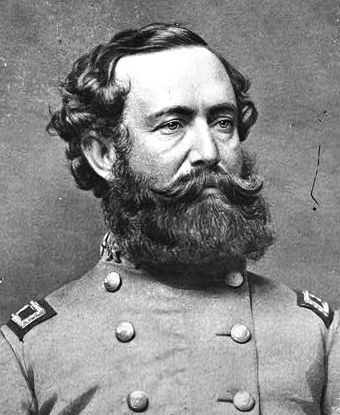
4 Comments

Filed under civil war, ethics, Gettysburg, History, Military, philosophy

The Romantic Rebel: George Pickett

Friends of Padre Steve’s World

I am continuing to periodically intersperse and publish short articles about various commanders at Gettysburg on the site. These all are drawn from my student text and may become a book in their own right.  The reason is I am going to do this is because I have found that readers are often more drawn to the lives of people than they are events. As I have noted before that people matter, even deeply flawed people, and we can learn from them.

Today’s article is about Major General George Edward Pickett who gained immortal fame at Gettysburg. He too is a complex, contradictory and controversial  figure in the Civil War, particularly in regard to the post war controversies regarding who was to blame for the Confederate defeat and his open criticism of Robert E. Lee’s decision to order the ill fated charge that made him famous.

Peace

Padre Steve+

Pickett

George Pickett was born to wealth and privilege in a Neo-feudal society [1] and came from an old and distinguished Virginia family with a long military heritage dating to the Revolution and the War of 1812. He attended the Richmond Academy until he was sixteen and had to withdraw due to the financial losses his parents had suffered during the panic of 1837.

This led to the young Pickett being sent to live with and study law under his mother’s older brother, Andrew Johnston in Quincy Illinois. Johnston was a lawyer, Whig politician and friend of Abraham Lincoln. The family’s continued financial distress led them to get George to consider the free education provided by West Point. His mother asked Johnston to assist and Johnston set about obtaining an appointment for his nephew. As befit an up-and-coming politician, his quest was short and successful. His Springfield acquaintances included a United States Congressman who happened to be a fellow Southerner and brother Whig, Kentucky native John T. Stuart. [2] There is a long running myth that connects Pickett’s appointment to West Point to Abraham Lincoln, but it is fiction, fabricated by Pickett’s widow Sallie long after her husband and Lincoln’s death. [3]

Pickett entered West Point in 1842 where he was described by a fellow cadet thought a jolly good fellow with fine natural gifts sadly neglected [4] through his tendency to demonstrate in word and deed that henhouse neither to authority nor submit to what’re considered the Academys narrow, arbitrary, unrealistic, harshly punitive, and inconsistently applied code of conduct [5] became a loyal patron of Benny Havens tavern where he was stealing away regularly now to life his glass in good fellowship…” [6]

Pickett’s academic performance, as well as his record of disciplinary infractions at West Point was exceptionally undistinguished. He racked up vast amounts of demerits for everything from being late to class, chapel and drill, uniform violations and pranks on the drill field where he mocked those who observed proper drill and ceremonies. Pickett graduated last in the class of 1846, something that his vast amount of demerits contributed.

His widow Sallie wrote after his death that he accumulated them so long as he could afford the black marks and punishments they entailed. He curbed his harmful behavior, however, when he found himself approaching the magic number of 200 demerits per year that constituted grounds for dismissal. [7] Pickett finally graduated only five behavioral demerits short of expulsion. [8] The graduating class included George McClellan, A.P. Hill, Thomas, later “Stonewall” Jackson as well as a number of other cadets, most of whom who went on to distinguished military and other careers. At West Point Pickett was considered to be the class clown by many of his classmates was the most popular and prominent young man in the class. [9] Among the many friends that he made was an upperclassman named Ulysses S. Grant and their friendship would span decades and would survive the fire of a war that placed them at swords point. [10]

Pickett was commissioned into the infantry and served alongside James Longstreet in the Mexican War where they fought valiantly in a number of battles, including Contreras, Churubusco, El Molino Del Rey. [11] Pickett distinguished himself at Chapultepec where he had been the first American to scale the ramparts of Chapultepec, where he planted the flag before the admiring gaze of his friend Longstreet. [12] During that assault Longstreet was wounded and Pickett had snatched the colors and planted them on the castle heights for all to see and cheer. [13] For his actions he received a brevet promotion to First Lieutenant.

Following the war Pickett married but was widowed less than two years later when his wife Sally Minge Pickett died during childbirth along with their infant son in 1852. The loss was devastating to the young officer. He went into a deep depression caused by grief and considered leaving the army. He was persuaded by friends, peers and understanding commanding officers to remain.

While on leave following Sally’s death, he was at Fort Monroe, laying under an umbrella at Point Comfort when a child approached him and took pity on him. The child was the nine year old La Salle “Sallie” Corbell and she broke through his emotional defenses by persistently, as only a child can do asking what the source of his grief was. Pickett told the child that his heart had been broken by a sorrow almost too great to bear. When the child asked how ones heart could break, he replied that God broke it when he took from him his loved ones and left him so lonely. [14] While Pickett may not have thought much of the meeting, he did give the little girl a ring and a golden heart bearing his wife’s name. He likely expected never to see her again but though she was a child she was a willful and determined one. She knew her own mind and heart, both told her that one day she would marry George Pickett. [15]

Pickett returned to Texas to serve with the 8th Infantry and was promoted to Captain and ordered to take command of the newly raised Company “D” 9th Infantry at Fort Monroe. Transferred to the Pacific Northwest he married. Widowed after that war he served in the Pacific Northwest where he took a Native American wife who bore him a son, however she did not survive childbirth and when she died in early 1858 Pickett was again widowed. In 1859 Captain Pickett faced down British troops from the Hudson Bay Company in an incident now known at the Pig War which at its heart was a dispute about whether the British or the Americans own San Juan Island. The dispute, which brought the two nations to the brink of war, was settled without bloodshed, save for the unfortunate pig, and Pickett became a minor celebrity in the United States and anathema to the British.

When Virginia seceded from the Union, Pickett like many other southern officers was conflicted in his feelings and loyalties and hoped to the last that he would have to take up arms against neither state nor country. [16] Pickett resigned his commission on June 25th 1861. He wrote to Sallie with who he now maintained a frequent correspondence about his decision and decidedly mixed feelings as he:

Always strenuously opposed disunion…” But While I love my neighbor, i.e., my country, I love my household, i.e., my state, more, and I could not be an infidel and lift my sword against my own kith and kin, even though I do believethat the measure of American greatness can be achieved only under one flag. [17]

Pickett returned to Virginia by a circuitous route where he was commissioned as a Captain in the new Confederate army on September 14th and two weeks later was promoted to Colonel and assigned to command forces along the Rappahannock. Though he had as yet seen no combat serving in the Confederate army, Pickett was promoted to brigadier General and assigned to command a Virginia brigade belonging to Longstreet’s division.

Pickett led his brigade well on the peninsula and at Williamsburg was instrumental in routing an advancing Federal force, and at Seven Pines had helped repel a dire threat to the Confederate position. At Gaines Mill Pickett was wounded in the shoulder during the assault put out of action and placed on convalescent leave to recover from his wounds. During his convalescence he fell in love with an old acquaintance; La Salle Corbell, who as a young girl had cheered him after the loss of his wife now a beautiful young woman nursed him back to health and started a chain reaction that would nearly engulf the Confederate officer. [18]

Pickett was promoted to Major General in October 1862 and was assigned command of the division formerly commanded by David R. Jones, which was assigned to Longstreet’s First Corps. The division was sent to peripheral areas and took no part in the battles of late 1862 or Chancellorsville serving instead in the Tidewater with Longstreet’s corps. The corps took part in a series of operations against Union forces in the Hampton Roads area and Pickett’s division bested a Federal force at Suffolk on April 24th 1863, though it was hardly a true test of his ability to command the division in combat. During this time Pickett spent much time visiting La Salle, much to the concern of some of his officers and Longstreet’s staff, and by the time the corps left the area the two were engaged to be married.

When the Division returned to the Army of Northern Virginia after Chancellorsville, it was among the forces considered by Jefferson Davis to be sent west for the relief of Vicksburg. Since that operation never materialized, the division was assigned to accompany First Corps with the army during the upcoming Pennsylvania campaign. However, much to the consternation of Lee, Longstreet and Pickett, two of its brigades were detached by the order of Jefferson Davis to protect Richmond from any Federal incursion.

During the advance into Pennsylvania the division, now composed of the brigades of James Kemper, Lewis Armistead and Richard Garnett was the trail division in Longstreet’s corps and often, in the absence of cavalry assigned to guard the corps and army trains. Due to its late release from these duties at Chambersburg, Pickett’s Division did not arrive at Gettysburg until late afternoon on July 2nd. Lee decided that they would not be needed that day and Longstreet placed that the division in bivouac at Marsh Creek for the night, sending word by messenger to tell Pickett I will have work for him tomorrow. [19]

Pickett spent the night with his soldiers and woke them about 3 a.m. After a quick breakfast Pickett moved the division to Seminary Ridge marshaling his troops in Spangler’s Woods where there was a modicum of protection from Federal fires and observation. However, despite these advantages it placed his division about 1000 yards from the extreme right of Pettigrew’s division with which he would have to coordinate his attack that fateful day.

Pickett scribbled a final note to Sallie as his troops prepared to attack. Oh, may God in his mercy help me as He never has helped me beforeremember always that I love you with all my heart and soul That now and forever I am yours. [20]

Pickett was never the same after the charge of July 3rd 1863. Pickett’s after action report which complained about the lack of support his division received was suppressed and destroyed by Lee who wrote Pickett You and your men have crowned yourselves in glory But we have an enemy to fight, and must carefully, at this critical moment, guard against dissections which the reflections in your report will create. [21]

Pickett married La Salle “Sallie” Corbell in September of 1863, and the marriage would last until his death in 1875. Sallie, impoverished by the death of “her soldier” took up writing as well as speaking tours in both the South and the North. Sallie was a stalwart defender of her husband, who she said had the keenest sense of justice, most sensitive consciousness of right, and the highest moral courage but also opposing hatred, sectionalism and strife. [22] Though much of her work was panned by historians and shunned by established magazines and periodicals; her writing were published by newer popular magazines. Her book The Heart of a Soldier, as Revealed in the Intimate Letters of General George Pickett, C.S.A. was for the most part fabrications authored by her, but she found a niche in newer popular magazines and journals, including Cosmopolitan for which she authored a ten part serial of the Pickett family story on the fiftieth anniversary of the battle. Sallie Pickett’s:

idealized portrait of her husband made him a Confederate hero. He never reached the status of Robert E. Lee or Stonewall Jackson, but his association with the famed but futile charge at Gettysburg helped. Virginia veterans and newspapers began romanticizing Picketts all-Virginia divisions role soon after the battle; it was almost by association that George too would share in this idolization…” [23]

Pickett retained command of his division after Gettysburg. The division was reconsituted and shipped off to North Carolina where he and it performed adequately but without marked distinction. Pickett had one moment of glory when reacting to a Federal Army under Benjamin Butler advancing on Petersburg he threw a scratch force together which preserved Petersburg and its vital rail line in early May 1864. This allowed General P.T.G. Beauregard to bring up more troops to hold the city.

The division performed adequately in the defensive battles around Richmond and Petersburg, though it suffered terribly from the lack of rations, medicines, clothing and equipmentaggravated by the rigors of life in the trenches. [24] Morale and desertion was a terrible problem in Pickett’s division and Lee was concerned enough to bring enough to bring the matter to Longstreet. Lee used terms like unsoldierly and unmilitary, lax in discipline, loose in military instruction [25] to describe the division. Though he was fully cognizant of the conditions of the trenches Lee identified the source of the problem as Pickett and his officers who were not sufficiently attentive to the men,not informed as to their condition and he told Longstreet: I desire you to correct the evils in Picketts divisionby every means in your power… I beg that you will insist upon these points. [26]

During the Richmond and Petersburg campaign, Pickett was often sick, and at several intervals he was unable to exercise command, and the poor state of his general health, aggravated by the unusually stressful conditions of the past year, age him beyond his years. [27]

The end came at the battle at Five Forks where Pickett’s division was deployed on the far right of the Confederate line, was overwhelmed by a massive assault by Sheridan’s cavalry and the Fifth Corps which destroyed it as a fighting formation. Pickett, for unknown reasons did not put much effort into the defense of Five Forks. He successfully repulsed an attack by Sheridan on March 31st but evidently did not expect an attack the following day. On the afternoon of April 1st Pickett was away from his division at a Shad bake with Fitzhugh Lee and Thomas Rosser when the attack came and destroyed his division as a fighting unit. No cowardice was involved; Pickett simply misjudged the situation by assuming that no attack was imminent, yet it left a bad taste in everyones mouth. [28] That being said Picketts lackadaisical effort in holding Five Forks is indefensible. So to is his incredible derelict behavior late on the morning of April 1st when he slipped away from his command to the shad bake not even informing the next senior officer, Rooney Lee that he was gone. [29]

Whether cowardice was involved or not, Pickett’s decision to be away from his division with a very aggressive Federal army at his front was ill-advised and demonstrated to Lee that Pickett was unfit for command. Two days later Pickett and two other generals, including Richard Anderson were relieved of their duties and dismissed by Lee. However Pickett remained with his division until the end and at Appomattox Lee was heard to remark in what some believed was a disparaging manner Is that man still with this army? [30]

George Pickett attempted to rebuild his life after the war and the task was not easy, for though he applied for amnesty, his case was complicated by an incident where he had ordered the execution of twenty-two former North Carolina militiamen who had defected to the Union and been re-captured by the Confederates. Pickett’s action was no different than many Confederate commanders who followed the Richmond government’s decision to take ruthless measures to suppress Unionist sentiments and secession of areas of the Confederacy where Union sympathies ran high. The area of Pickett’s operation was a haven for Tories who openly supported U.S. troops. What was worse, hundreds of local Unionists engaged in the most violent guerrilla activities, shooting and burning out their secessionist neighbors, waylaying Confederate supply trains, attacking outposts. [31] Some of these men had previously served in Confederate service which in the eyes of Pickett and many others made them traitors to the Confederate cause.

In a sense Pickett was engaged in what are now known as counter-insurgency operations. Like many commanders involved in such operations, he descended into the same type of barbaric actions of those he was fighting. “By early 1864 the war was turning into a grim, hate-filled struggle that knew few rules and niceties, and Pickett was changing to the pattern. [32] When Pickett captured the former militiamen he refused to treat them as prisoners of war and instead he court-martialed them and hanged them all. [33] He established a military court composed of Virginia, North Carolina and Georgia officers, hauled the deserters-in-arms before it, and approved the death sentences. [34] When the prisoners went to the gallows Pickett reportedly told each of them God damn you, I reckon you will ever hardly go back there again, you damned rascals; Ill have you shot, and all the other damned rascals who desert. [35]

Federal authorities thought about charging him with war crimes. Pickett fled to Canada in late 1865 before returning to Virginia. It took the intervention of Pickett’s faithful friend Ulysses S. Grant to have the charges dismissed and for Pickett to be granted amnesty by President Johnson in 1868. Grant admitted that the punishment was harsh, however, Grant’s judgment was steeped in the fact that many Northern commanders had resorted to similar actions in combating insurgents and deserters. Grant wrote in his friend’s defense:

But it was in time of war and when the enemy no doubt it necessary to retain, by some power, the services of every man within their reach. Gen. Pickett I know personally to be an honorable man but in this case his judgement [sic] prompted him to do what can not well be sustained though I do not see how good, either to the friends of the deceased or by fixing an example for the future, can be secured by his trial now. [36]

Even so, Pickett’s life was difficult. Health difficulties plagued him and employment was scarce, even for a man of Pickett’s stature in Virginia. He refused employment which would take him away from Sallie and his children and finally took a job as an insurance agent in Richmond. It was a job which he felt demeaning, requiring that he attempt to sell insurance policies to destitute and out of work Confederate veterans and their families. Sallie wrote that he could not come to terms with a profession that made its profits through what one colleague called gall, gall, old man, gall and grub. [37] Distinctly unhappy the dejected old soldier told her Id sooner face a canon,than to take out a policy with me. [38]

In 1870 he was convinced by John Singleton Mosby to visit Lee when the latter was visiting Richmond as Lee was making a final tour of battlefields and other sites. For Pickett the visit only reinforced his resentment that he felt for Lee, who he felt blamed him for the defeat at Five Forks and had ostracized him. The meeting occurred in Lees room at the Ballard Hotel was icy and lasted only two or three minutes. [39]

Mosby realized quickly that the meeting was not going well and Sensing the unpleasantness of the meeting, Mosby got up in a few moments and Pickett followed him. Once outside the room, Pickett broke out bitterly against that old man who, he said, had my division massacred at Gettysburg. [40] Mosby attempted to assuage his friend’s feelings but Pickett was not mollified by Mosbys rejoinder that it made you immortal. [41] Edwin Coddington wrote that it would have been better for his reputation if had been called to give his life or if the attack had been known for what it was, Longstreets Second Assault. [42]

George Pickett was a romantic as well as a true believer in the cause of the Confederacy. Pickett was vain, often self-serving and even irresponsible. He certainly as Porter Alexander noted was a better brigade commander than division commander, a position that he desired but at which never excelled. He was a poor administrator, and in the campaigns of 1864 and 1865 demonstrated exceptionally poor leadership.

His temperament, especially his seeming inability to function in a hierarchical structure, and the rebellious streak that he had as a cadet at West Point was never exercised: He resented authority and chafed at deferring to any man as his superiorPickett never understood his place in the hierarchy. He considered himself part of the cream of the Army of Northern Virginia, but without being willing to shoulder all the responsibilities and sacrifices that entailed. [43]

He died in the summer of 1875 while on a business trip to Norfolk with his wife at his side, but a single tragic charge had made his name immortal. [44] Bitter and discouraged at the end of his life he uttered his last words to Sallie’s uncle who had also served in the Army of Northern Virginia Well, Colonel, the enemy is too strong for me againmy ammunition is all out He closed his eyes, and settled back as if at peace for the first time in his life. Sallie never left his side; two hours after his death they gently pried her hands from his. [45]

[1] Ibid. Longacre Pickett p.4

[2] Ibid. Longacre Pickett p.6

[3] See Longacre Pickett pp.6-7. The myth was quite successful and it endures in some accounts of Pickett’s life and in a number of military histories including Larry Tagg’s The Generals of Gettysburg

[4] Waugh, John C. The Class of 1846 from West Point to Appomattox: Stonewall Jackson, George McClellan and their Brothers A Ballantine Book, New York 1994 pp.38-39

[5] Ibid. Longacre Pickett p.7

[6] Ibid. Waugh The Class of 1846 from West Point to Appomattox p.39

[7] Ibid. Longacre Pickett p.12

[8] Guelzo, Allen C. Gettysburg: The Last Invasion Vintage Books a Division of Random House, New York 2013 p.378

[9] Ibid. Guelzo Gettysburg: The Last Invasion p.378

[10] Ibid. Longacre Pickett p.20

[11] Ibid. Hess Picketts Charge p.37

[12] Ibid. Dowdy Lee and His Men at Gettysburg p.264

[13] Ibid. Waugh The Class of 1846 p.457

[14] Ibid. Longacre Pickett p.32

[15] Ibid. Longacre Pickett p.33

[16] Ibid. Longacre Pickett pp.50-51

[17] Ibid. Longacre Pickett p.51

[18] Ibid. Hess Pickett’s Charge p.38

[19] Ibid. Hess Pickett’s Charge p.47

[20] Ibid. Dowdy Lee and his Men at Gettysburg p.296

[21] Ibid. Hess Pickett’s Charge p.354

[22] Ibid. Reardon The Convergence of History and Myth in the Southern Past: Pickett’s Charge p.76

[23] Gordon, Lesley J. “Let the People See the Old Life as it Was” La Salle Corbell Pickett and the Myth of the Lost Cause in The Myth of the Lost Cause and Civil War History edited by Gallagher, Gary W. and Nolan, Alan T. Indiana University Press, Bloomington and Indianapolis 2000 p.170

[24] Ibid. Longacre Pickett p.160

[25] Selcer, Richard F. Lee vs. Pickett: Two Divided by War Thomas Publications, Gettysburg PA 1998 p.66

[26] Ibid. Selcer Lee vs. Pickett p.66

[27] Ibid. Longacre Pickett pp.160-161

[28] Ibid. Hess Pickett’s Charge p.375

[29] Ibid. Longacre Pickett pp.166-167

[30] Ibid. Hess Pickett’s Charge p.375

[31] Ibid. Longacre Pickett p.137

[32] Ibid. Longacre Pickett p.141

[33] Guelzo Allen C. Fateful Lightening: A New History of the Civil War Era and Reconstruction Oxford University Press, Oxford and New York 2012 p.368

[34] Ibid. Longacre Pickett p.140

[35] Ibid. Guelzo Fateful Lightening p.368

[36] Ibid. Longacre Pickett p.175

[37] Ibid. Longacre Pickett p.178

[38] Ibid. Longacre Pickett p.178

[39] Ibid. Hess Pickett’s Charge p.377

[40] Ibid. Freeman Lee p.569

[41] Ibid. Waugh The Class of 1846 p.529

[42] Ibid. Coddington The Gettysburg Campaign p.528

[43] Ibid. Selcer Lee vs. Pickett p.101

[44] Ibid. Waugh The Class of 1846 p.529

[45] Ibid. Longacre Pickett p.180

4 Comments

Filed under civil war, Gettysburg, History, leadership, Military