Tag Archives: russell weigley

Adjusting Strategy to Reality: The Pacific War- Why the Japanese Lost

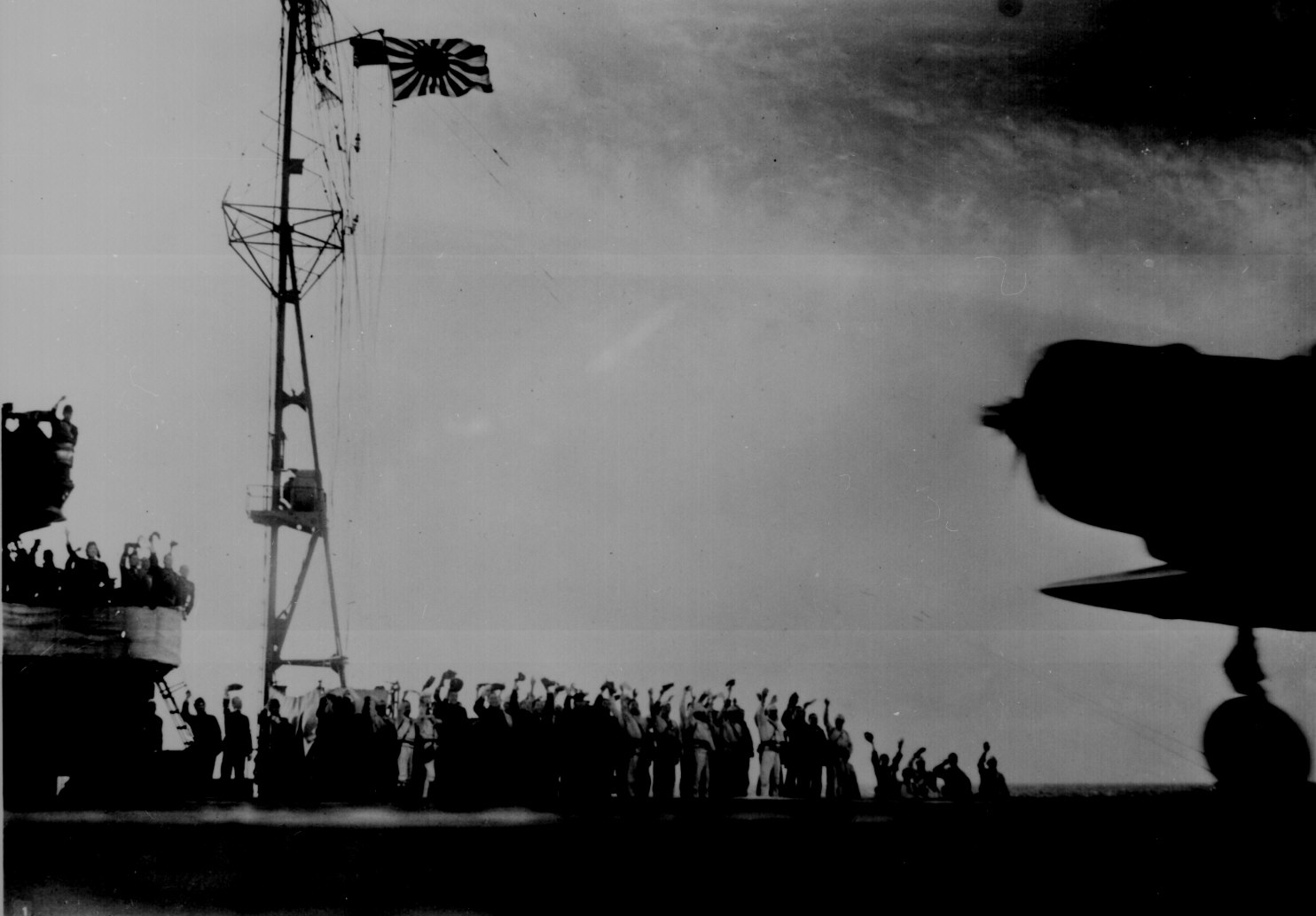
Lead aircraft ready to take off of IJN Carrier Akagi to attack Pearl Harbor beginning a 6 month chain of Japanese victories in the Pacific

The outcome of the Pacific war was directly related to the ability of the Americans to adjust strategy to the realities of the Pacific war, a unity of effort directed by the National Command Authority and superior industrial, technological and logistical capabilities. The Japanese after initial success did little to adapt and were hamstrung by inter-service rivalries and inadequate industrial capacity and limited natural resources.

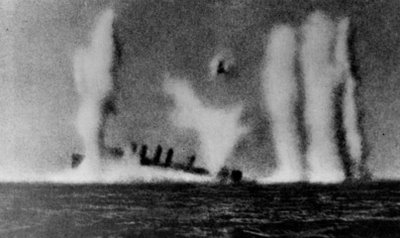
US Destroyer USS Pope being blasted out of the water by Japanese Cruisers at the Battle of Java Sea

The Japanese and the Americans each had war plans in place for the Pacific campaign.  The American plans, Plan Orange had been developed since the early part of the 20th Century after the Spanish-American War and Russo-Japanese War.  Predicated on holding the Philippines until relief could arrive Orange assumed that the US Pacific Fleet would sail across the Pacific and fight the Japanese Navy in a manner written about by Alfred Thayer Mahan; see Weigley in The American Way of War and Ronald Spector in “Eagle Against the Sun: The American War Against Japan.”

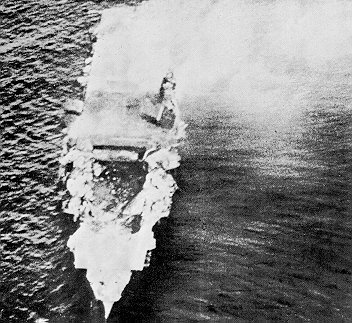
IJN Carrier Hiryu heavily damaged and abandoned at Midway. Hiryu, Akagi, Kaga and Soryu the creme of the Japanese carrier fleet were lost at Midway, the Japanese found it hard to replace them or their decimated air crews

The Japanese were conflicted.  The Navy desired a campaign that would destroy the American Navy and expand the Empire to the East and to Southeast Asia and the Indian Ocean. The Army was fixated on the China strategy having been embroiled on the Asian continent since the early 1930s. John Toland discusses this in good detail in his book “Rising Sun: The Decline and Fall of the Japanese Empire 1936-1945” In addition other Japanese Army leaders had designs on Siberia and fought a brief campaign against the Soviets which ended in a defeat.

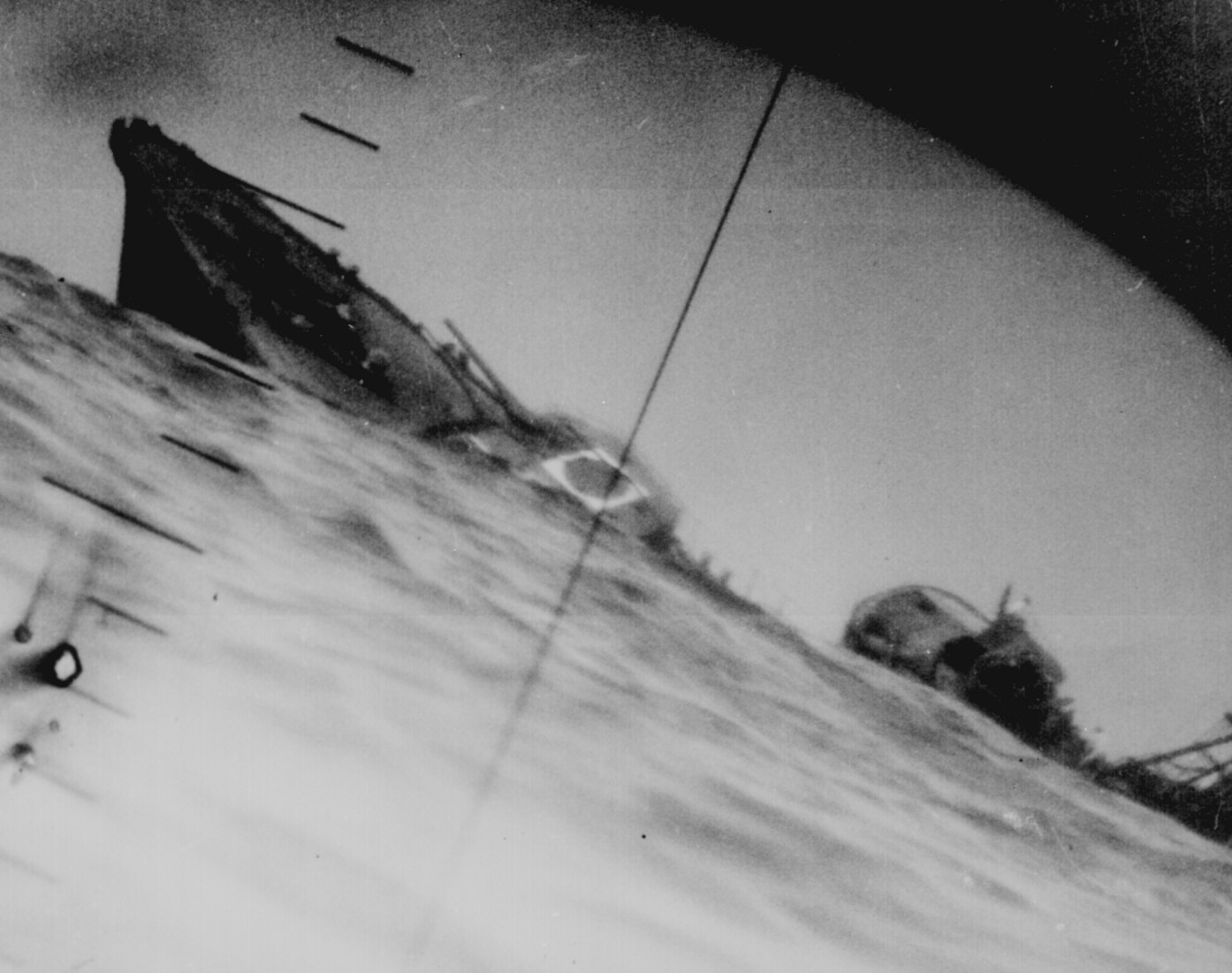
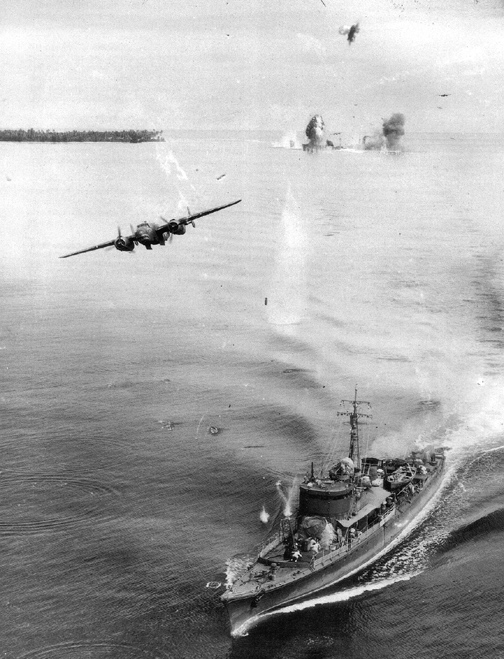
Japanese destroyer shown sinking after being torpedoed by a US submarine

When the Japanese attacked Pearl Harbor as well as the Philippines and Southeast Asia defeating American and Allied forces in detail, crippling the American Navy and dooming the Philippines the Americans were able to adjust strategy to first a defensive one supplemented by raids against the Japanese perimeter by carrier forces and the beginnings of a nascent submarine campaign against Japanese merchant shipping.  The Americans were able to parry the Japanese thrust at the Coral Sea and inflict a major defeat on the Japanese Carrier Forces at Midway prior to launching the first limited offensive by the Navy and the Marines at Guadalcanal.

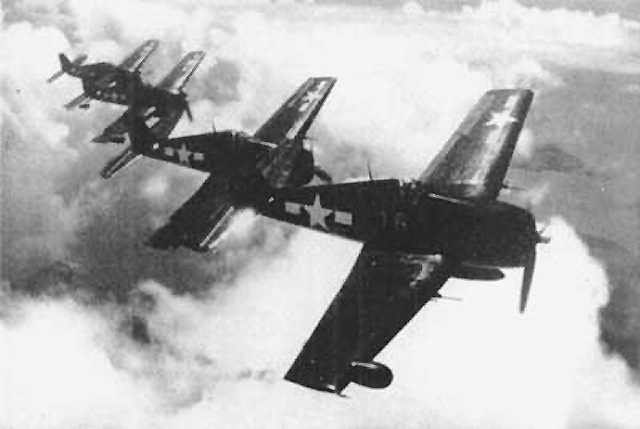
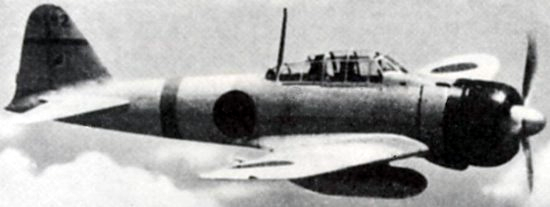
Aircraft like the F6F Hellcat drove Japanese aircraft such as the A6M2 Zero from the skies in the Pacific


The Japanese remained mired in their conflicting strategies with the Navy primarily fighting the Pacific campaign aided by limited Army and Army Air Forces on the islands Japan had occupied or fortified while the bulk of the Army was engaged in China, Southeast Asia or sitting on the Manchurian-Soviet border.

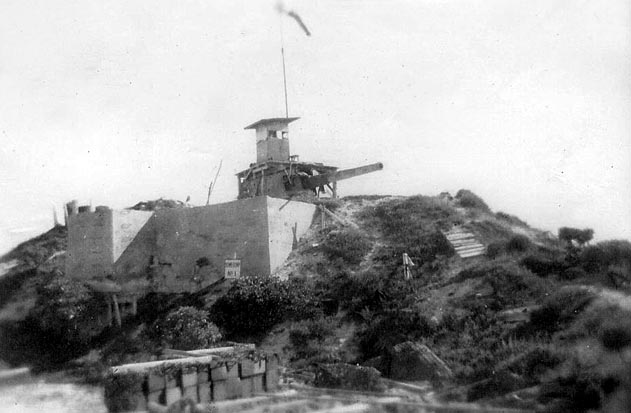
Heavily fortified Japanese islands were either bypassed or taken in bloody assaults, here a 8″ gun on Tarawa

Once the Americans shifted to the offensive a campaign of island hopping coordinated between the Southwest Pacific Area under General MacArthur and the Central Pacific Area under Admiral Nimitz focused on gaining control of islands which contained airbases and anchorages capable of sustaining the American advance while bypassing islands not necessary for this along with their Army garrisons. Both American advances in the South Pacific and Central Pacific focused on retaking the Philippines and cutting the Japanese lines of communication and supply with Southeast Asia. From late 1942 on the Japanese strategy was focused on individual areas of danger versus a overall coordinated defensive effort.

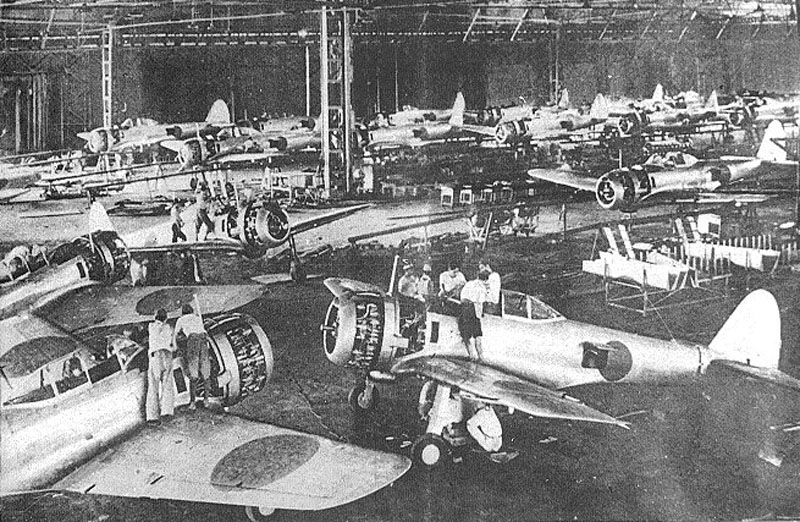
Japanese war industries were woefully ill equipped to match US war production. Here a factory producing Oscar fighter planes

The Japanese were hamstrung from the beginning of the war by limited natural resources, especially oil and oil refining capacities, limited industrial capacity, especially in the realm of the manufacture of steel and machining tools.  All of these were supplied in large part by their opponents and were cut off once the war began.

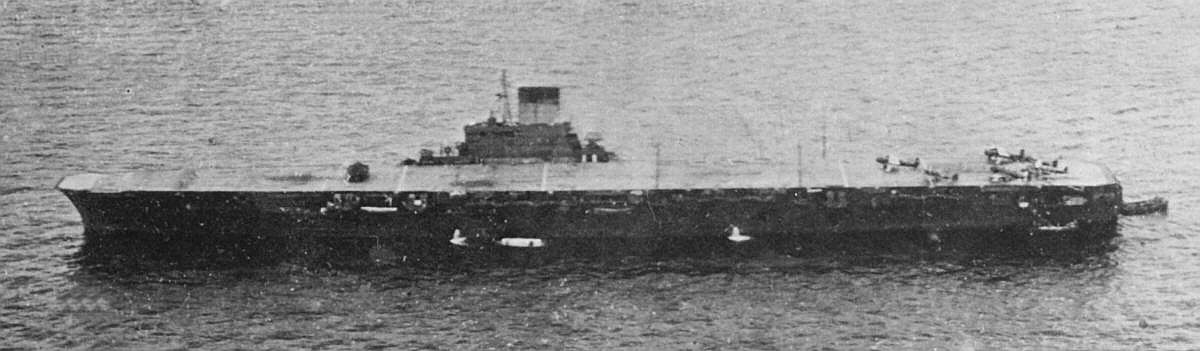
The Carrier Taiho was the equivalent of the Essex Class but the Japanese could only produce one unit

Michael Barnhart in his book Japan Prepares for Total War” has an excellent account of the limitations of Japanese economic, industrial and natural resource capacities, as well as the continual struggle by the Army and the Navy for priority in access to them and the inability of Japanese planners, both civilian and military to resolve this conflict. The Americans had a different situation; although American industrial capacity was enormous it had to be split between to Theaters of Operations and support the needs of American Allies, Britain, the Soviet Union, Canada and China.

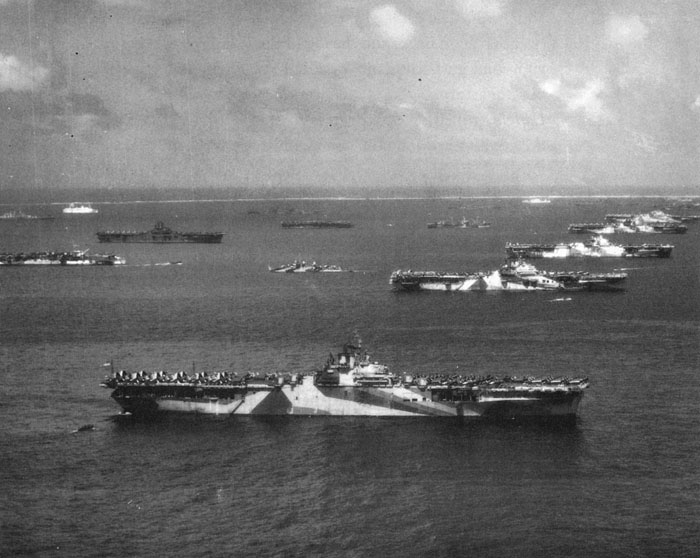
An Armada of US Essex Class Carriers in 1944 the Japanese could not keep pace with US Naval production

Despite this the Americans in a relatively short time were able to amass forces equal to or great than the Japanese who were unable to replace losses in ships, aircraft or the highly trained personnel needed to man them.  At the beginning of the war Japanese Air and Naval forces in the Pacific outmatched everything the Allies could offer, however once they began to experience significant losses at Midway and during the Guadalcanal Campaign their air and naval capabilities diminished to the point that they had to conserve ships and aircraft hoping to be able to gain local advantage in critical defensive areas.

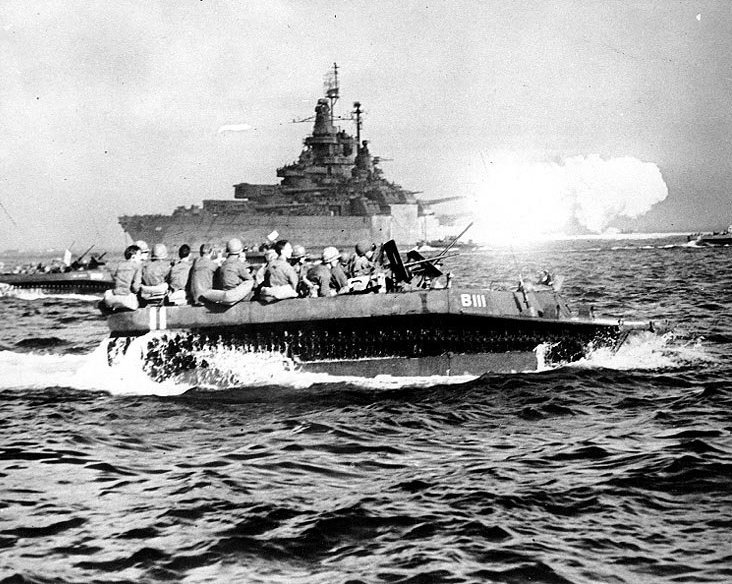
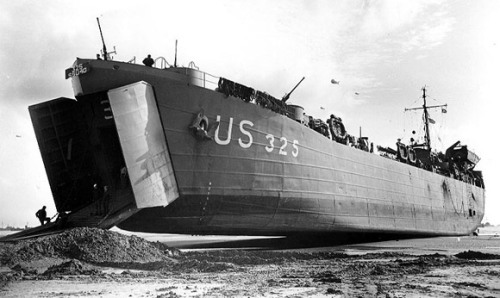
The US Amphibious warfare capacity was a key factor in the ability of the United States to take the war to Japan

New American ships and aircraft introduced during the war were superior to Japanese designs, many of which had reached their apex by 1942.  American advantages in radar, communications equipment added to American advantages throughout the war.  Japanese ground forces in the Pacific were dependant on the Navy and merchant marine for supply and reinforcements. As the American submarine campaign became better organized this became more difficult as the American submarines copying German Wolf pack tactics decimated the Japanese merchant Marine. I particularly like Samuel Elliott Morrison’s account of this in “The Two Ocean War” and “The History of US Navy Operations in World War II” which has a volume devoted to this subject.

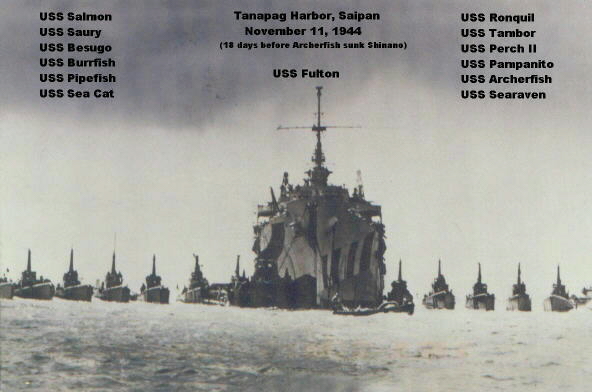
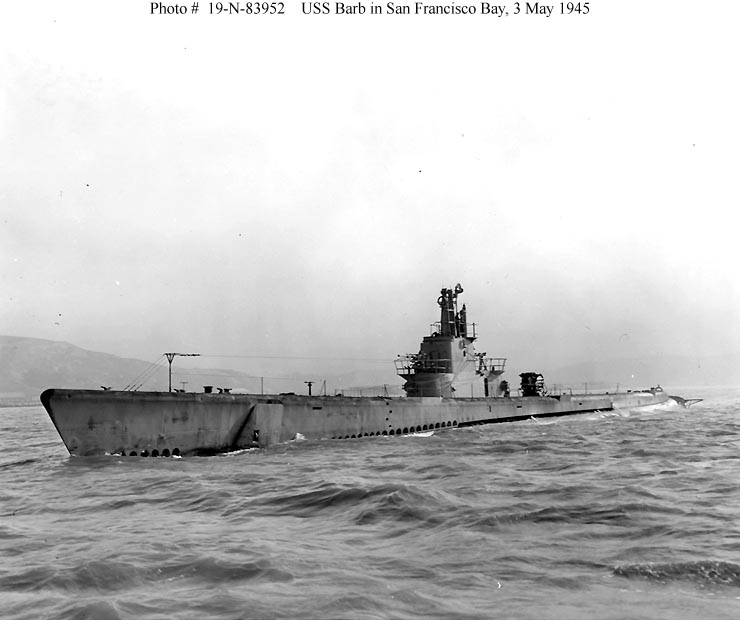
US Navy Submarines cut off Japan from its vital natural resources in Southeast Asia. A Sub Squadron above and USS Barb below

Japanese forces would always fight determined battles but they often expended great amounts of manpower in senseless Banzai charges rather than make the Americans force them out of well prepared positions.  Where the Japanese maintained excellent defense such as at Tarawa and Iwo Jima they made the Americans pay greatly for their gains.  American Marines were apart from the 82nd and 101st Airborne Divisions were the best infantry in the US Military and their skill at amphibious operations and integrated air-ground and naval warfare increased as the war went on.  The Americans were well equipped with modern weapons while the Japanese operated antiquated tanks and often substandard artillery.

Japanese leadership at the strategic and political level was inept throughout the war. They failed to coordinate any strategy with the Germans and failed to enunciate any sort of Grand Strategy.  On the operational and tactical levels the Japanese forces, especially the surface navy performed well, however as the American numeric and technologic advantage increased the Navy became less effective.  After the death of Admiral Yamamoto in 1943 Japanese Naval Leadership became far less effective. The Americans as mentioned before were able to devise a Grand Strategy which not only dealt with Japan but also Germany and coordinated the efforts of forces, war production, planning and logistics to advance their war aims.  At the operational and tactical level American forces, especially the Navy and Marines and later the Army Air Forces and Army became more skilled and than their Japanese counterparts with the possible exception of General Simon Bolívar Buckner at Okinawa. See Spector and Thomas Costello “The Pacific War.” In the air the Americans continued to increase their combat capabilities at the tactical and strategic level and used massed fire bombing raids to devastate the Japanese homeland.  The Japanese in contrast due to inexperienced pilots and fewer competitive aircraft were forced into suicide or Kamikaze missions as the war neared Japan.

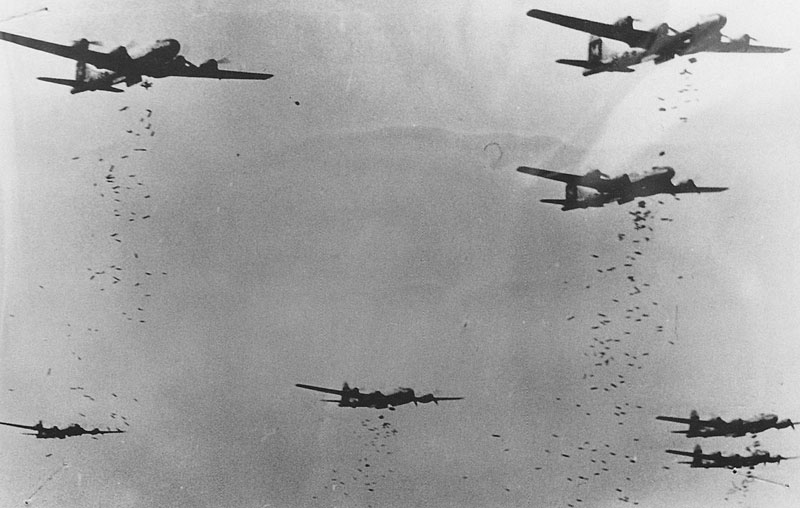
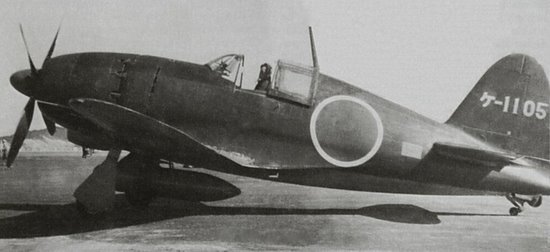
B-29 Super-fortresses leveled Japanese cities and even excellent fighters like the Mitsubishi J2M Raiden could not stop them


The outcome of the Pacific war was directly related to the ability of the Americans to adjust strategy to the realities of the Pacific war as well as the unity of effort which enabled the American superiority in industrial, technological and logistical capabilities to overwhelm the Japanese. The Japanese after initial success did little to adapt and were hamstrung by inter-service rivalries and inadequate industrial capacity and limited natural resources, fell behind in technology and were unable to replace losses among the ships, men and aircraft that they needed to fight an effective war.  Japanese leaders at many levels failed to adapt strategy, tactics or methods to match the reality of the war and the places that they did do so were done by local commanders and never instituted throughout the Japanese military.

2 Comments

Filed under History, Military, world war two in the pacific

The American Civil War and the Origins of Modern Warfare

Hagerman, Edward. The American Civil War and the Origins of Modern Warfare. Midland Book Editions, Indiana University Press. Bloomington IN. 1992

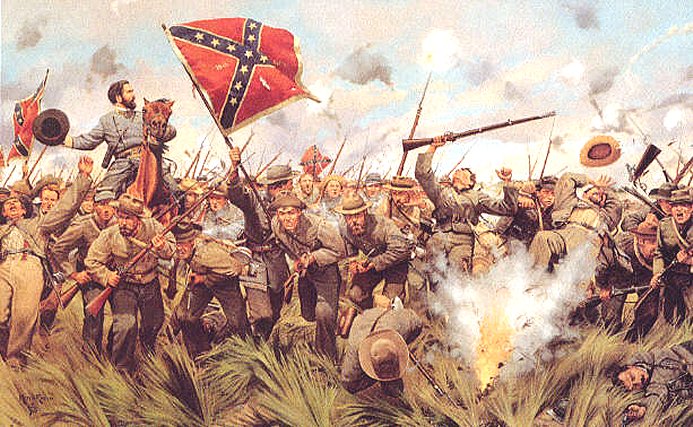
Pickett’s Charge Displayed the Futility of Napoleonic Tactics Against Modern Weaponry

Edward Hagerman postulates in The American Civil War and the Origins of Modern Warfare that the American Civil War is the first modern war. He examines developments in tactics, logistics and the concept of total war and looks specifically how tactical and strategic thought impacted the war.  Specifically Hagerman examines how Henri Jomini’s interpretation of Napoleonic warfare and the theories of Dennis Hart Mahan and Henry Halleck which were the prevalent military thought in America were challenged by advances in weaponry and the vastness of the American continent.  He surveys how the Union and Confederate armies learned the value and application of field fortifications and the limitations of artillery in the offense.  Even more importantly Hagerman argues how logistics influenced campaigning on the American continent as opposed to earlier European wars. Likewise he examines how the 20th Century concept of total war found its first application in the campaigns of General Sherman and how Robert E. Lee’s use of defensive maneuver and fortifications in positional warfare heralded a new era in warfare.

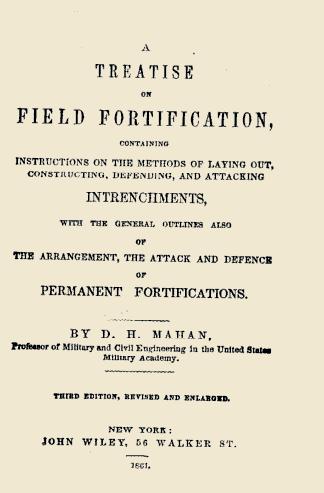
Dennis Hart Mahan’s Book: The First American Book on Military Theory

Hagerman examines how these factors influence and affected the Union and Confederate armies.  His initial focus is the tactical conundrum posed by the advances weaponry particularly the rifled musket to the Napoleonic tactics that both armies began the war. Napoleonic tactics were developed at a time when the maximum effective range of muskets was barely 100 meters and how despite the increase in range and accuracy that came with the rifled musket how tactical formations and tactics were slow to change.

Hagerman spends the first part of his book examining how the ante-bellum US Army leadership was influenced by the theories of Henri Jomini. He discusses the challenge to Jominian orthodoxy by Dennis Hart Mahan, who modified “the current orthodoxy by rejecting its central tenants-primarily offensive assault tactics.”[i] He examines the tension in American military thought between the conservative Jominian thinking which predominated much of the Army, noting that within the army “Mahan’s decrees failed to win universal applause.”[ii] However, Mahan influenced many future leaders of both the Union and Confederate armies in his “Napoleon Club” a military round table at West Point.[iii] Hagerman notes that Mahan’s greatest contributions were his development of the active defense and emphasis on victory through maneuver. Unlike Jomini, who thought maneuver as risky with the purpose of the “defeat of the enemy’s army,” Mahan emphasized “maneuver to occupy the enemy’s territory or strategic points.”[iv] In the book Hagerman wrestles with disjointed developments in infantry, artillery and cavalry tactics of the ante-bellum Army which and surmises that “Military thinking, and even more strategic organization, remained essentially within the Napoleonic tradition filtered through an eighteenth-century world view….” He asserts that “A broader vision was necessary to pose an alternative to the mechanistic program.”[v]

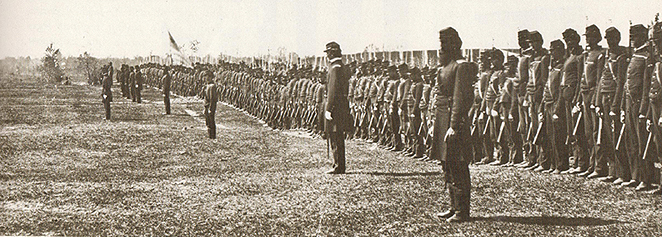
The 2nd Michigan Regiment: Most Civil War Units on both sides were State Regiments

Hagerman then discusses wartime developments in strategy, tactics and organization as they developed in both the Eastern and Western theaters.  He focuses on the themes of organization, logistics, communications, weaponry, field fortifications and maneuver. In each chapter he weaves these themes to show how they affected campaigns or were modified during the war based on experience.  He deals with leadership, but mostly in the context of how leaders responded to challenges posed in these arenas.  Of particular interest to him are the early efforts of successive commanders of the Army of the Potomac including McClellan, Burnside and Hooker to deal with these problems as well as the responses of Grant, Sherman and Rosecrans in the West to the same issues.

Hagerman’s discussion of army organization focuses on how each army developed sociologically as well as professionally prior to and during the war. He examines the ways that commanders educated at West Point initially dealt with large armies made up of militia units and volunteers and how these armies would be changed by the war.  He includes in the discussion i the institution of the draft in both the North and South.  His discussion of how McClellan successful fought the break-up of the Regular Army keeping it separate from the militia units organized by the States was important to development of the Army. He notes their importance and points out the problems of the militia units raised by the various states particularly in the early part of the war.

The Integration of Sea and Land Logistics Systems in the Civil War Revolutionized the Way that Modern War is Supplied

More significant to Hagerman’s narrative is his emphasis on logistics, and how each Army responded to the challenges of supplying their armies in the field.  Hagerman examines how the ante-bellum Army developed its logistic doctrine from the Napoleonic examples and how that doctrine had to be modified in light of the American reality of a less developed continent with far greater distances involved.

Hagerman’s discussion of logistics is quite detailed.  He examines topics such as the number of wagons per regiment and how army commanders, modified that number at various points during the war based on their situation. He discusses the development of the “flying column” as a response to the dependency on wagons and basic load of food and ammunition carried by each soldier in order to increase strategic maneuverability.  He details the forage requirements for people and animals in each theater of operations and how each army responded to requirement of living off the land for much of their forage requirements and their relative successes and failures in supplying their soldiers in this fashion.

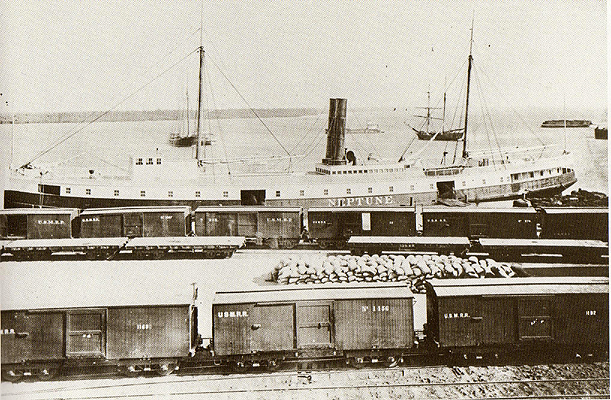
Railways Meant the Ability to Move Troops and Supplies Great Distances very Quickly

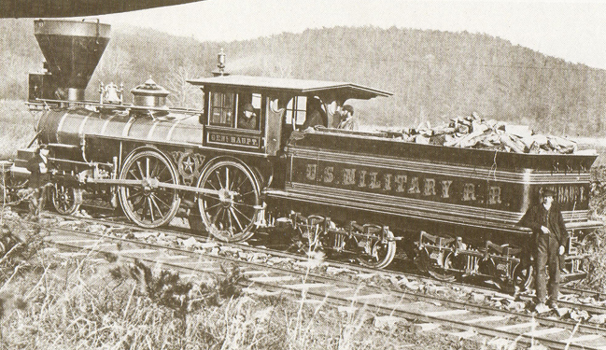
Hagenman discusses the use of railroads and the use of naval forces to both assist the ground forces and to move supplies and troops.  In each of these areas he provides a detailed examination of the effect of logistical considerations on each army.  He notes that of all the areas of development that the Army of the Potomac was successful at putting logistic theory into practice. By late 1863 the Army of the Potomac demonstrated “the close integration of operational planning and that of the general in chief and supply bureaus. In this one area, the development of a mature and modern staff was evident.”[vi]

Hagerman’s discussion of the development of communications in both armies focuses on the fact that the size of the armies and the distances involved on the battlefield made command and control difficult.  As such each army experimented with signals organizations that used tradition visual signals and couriers but began to rely on the telegraph for rapid communications.  He deals with the conflict in the North between the Signal Corps and the Military Telegraph Service.  He discusses the use of wire telegraph equipment and the new Beardslee wireless telegraphs by the Signal Corps and how the Army eventually favored the traditional wire bound networks operated by the Military Telegraph.  Though the Army rejected the Beardslee equipment some commanders requested it for their operations.[vii] As they became more dependent on such communications armies feared that their signals could be compromised through wire tapping and made efforts to encode transmissions.

Signal Corps Soldiers and Wire Communications

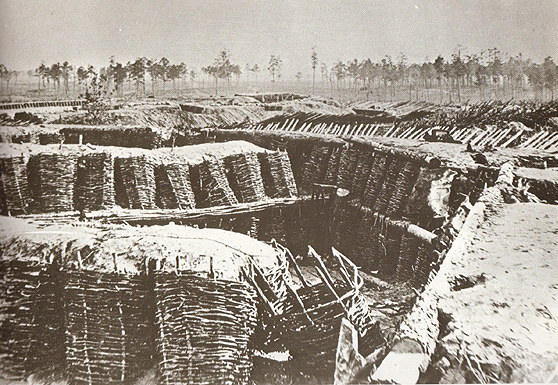
Hagerman’s discusses the evolution of the Union and Confederate armies use of field fortifications including their use in offensive campaigns.  He discusses their use by McClellan on the Peninsula in 1861 and Lee’s sporadic use of them[viii] until 1864 beginning in the Wilderness campaign and culminating in the defense and siege of Petersburg.  Hagerman’s thesis is that the developments in field works and firepower gave the advantage to the defense when armies made the frontal attacks which were at the heart of Jominian theory.  He notes how various commanders including Grant failed at Shiloh and Lee at Antietam failed to dig in, but how both the Union and Confederate armies learned to dig hasty field works as a matter of course.[ix]

Both sides also learned to use maneuver in combination with positional warfare to force the enemy to battle. Hagerman examines the campaigns in the West of Grant, Sherman and Rosecrans, particularly Stone’s River, the Vicksburg Campaign, and the campaign in middle Tennessee.[x] The last two chapters mention these issues in the context of the 1864-65 campaign around Richmond and Sherman’s campaigns in Georgia and the Carolinas.  Of particular note is how Sherman’s forces routinely entrenched on the offensive[xi] and how Confederate forces under Joseph Johnston employed entrenchments on the defensive. Hagerman notes how Confederate Cavalry “perhaps best displayed the growing intensity of trench warfare” noting General Joe Wheeler’s use of them at the close of the war.[xii]

Massive Siege Mortar outside Petersburg

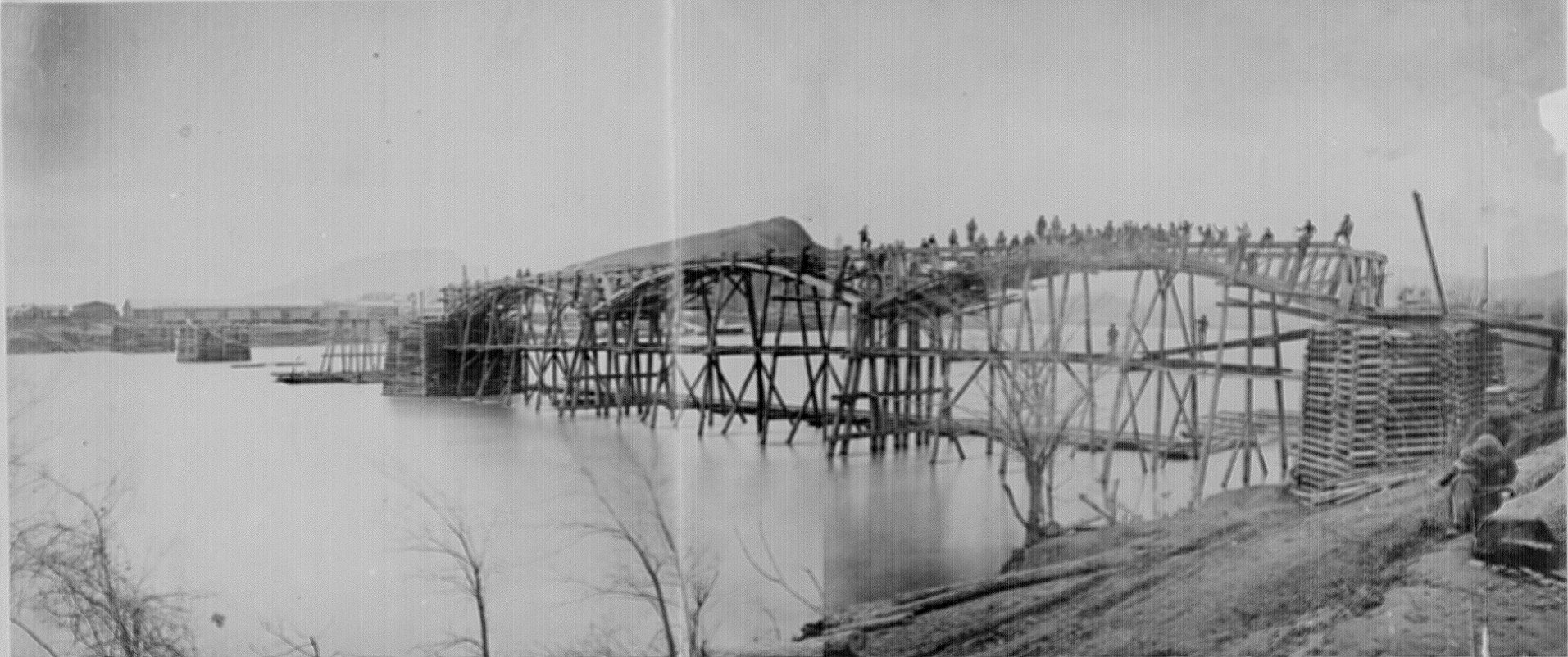
A sidebar to Hagerman’s discussion of fortification is his examination of the Corps of Engineers.  He discusses the development of Engineering or Pioneer units from nothing in 1861 to organized units by the middle of the war.  He examines the problems of the Engineering Corps in adjusting to the war. He notes its dispersion among the line and its civil duties as impediments to responding to the needs of war and both the hesitancy and resistance to creating engineering units by Congress, despite the pleas of McClellan and Lincoln.[xiii] He then looks at the institutional irony of the how newly organized engineer units had few West Point trained Corps of Engineers officers, but were primarily staffed and commanded by officers detailed from the line. The effect was a “decline in the antebellum definition of professionalism embodied in the Corps of Engineers.”[xiv]

Engineering Units were Built from Scratch and Accomplished Many Feats

Petersburg Fortifications a Harbinger of World War One

Hagerman’s last two chapters focus on the developments in the strategies of attrition and exhaustion in relation to positional and maneuver warfare.  He examines how this was by Grant in Virginia and Sherman in Georgia and the Carolinas.  He discusses the “ascendancy of positional warfare” which allowed Lee to hold out and force Grant into winter quarters at Petersburg.[xv] This demonstrated that “an army fighting on interior lines, even under nearly overwhelming conditions of deprivation and against vastly superior numbers, could sustain a prolonged existence by use of field fortification and defensive maneuver.”[xvi] Sherman’s campaign demonstrated how an army could exploit “diversion, dispersion, and surprise to successfully pursue a modern total-war strategy of exhaustion against the enemy’s resources, communications and will.”[xvii]

Sherman’s March to the Sea

Hagerman’s book is particularly strong in the discussion of tactical developments and logistics and how those were developed over the course of the war.  It is strong because it allows the serious student to trace the developments in each of the areas he examines to future wars fought by the US Army.  Russell Weigley picks up the effect of what Hagerman describes in his books The American Way of War discussing both Grant’s strategy of annihilation and its costs, and in Sherman’s campaign against Johnston and attack upon Southern resources.[xviii] His discussion of tactics reflects that of J.F.C. Fuller notes that “the tactics of this war were not discovered through reflection, but through trial and error.”[xix] The events described by Hagerman, especially the campaigns of Grant and Sherman influence modern strategy including that of the Marine Corps which discusses maneuver and attrition warfare continuum in MCDP 1 Warfighting.[xx] Hagerman’s work is best at helping tie the elements of war often ignored by other Civil War historians into a coherent whole that allows the reader to see the logical development of each of these elements in modern war.

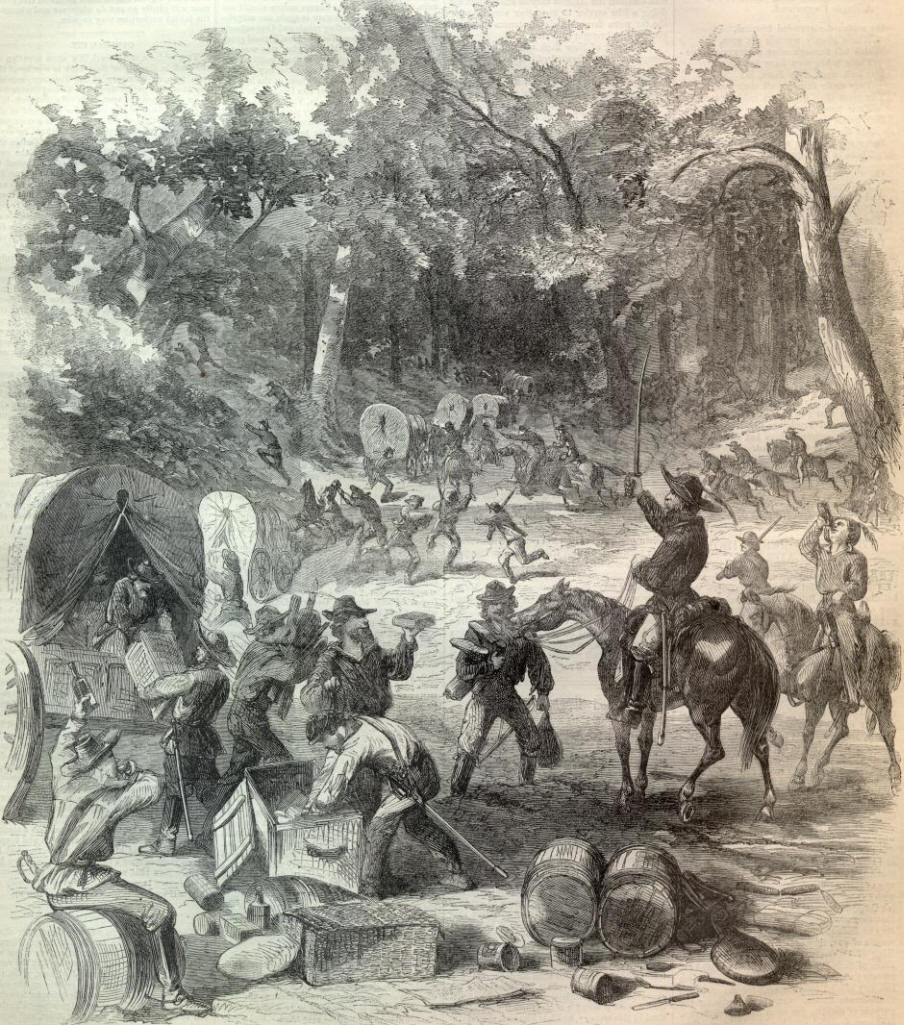
Irregular Formations Such as Mosby’s Raiders Would Create Problems Behind Union Lines

Hagerman’s value to the literature is that he fills a void among many Civil War writers who often focus simply on the battles and campaigns and not arcane but important subjects such as transportation, logistics, communications and fortifications.  Hagerman makes an astute observation on how change comes to military organizations at the end of his discussion of the Corps of Engineers and the Army following the war.  He notes “that change in war requires time for digestion before lessons are converted-if they are converted-into theory and doctrine.” [xxi] In the light of the Pershing’s strategy in the First World War One, which revisited some of the worst mistakes of the Civil War one wonders if those lessons were ever fully digested by the Army. Such an observation can be made about our present war.  We need to ask if the lessons of previous insurgencies in conquered areas have been digested, even going back to the lessons of the Union Army operating in the hostile lands of the conquered Confederacy.[xxii] Likewise how an Army adjusts to developments in weaponry, technology and tactics are fair game when one analyzes past campaigns in relation to current wars.  Thus when we look at Hagerman it is important to use his work to understand the timeless aspects of military history, theory, doctrinal development, logistics, communications and experiential learning in war that are with us even today.


[i] Hagerman, Edward. The American Civil War and the Origins of Modern Warfare. Midland Book Editions, Indiana University Press. Bloomington IN. 1992. p.9

[ii] Ibid. p.13.

[iii] Hagerman also notes the contributions of Henry Halleck and his Elements of Military Art and Science published in 1846 (p.14) and his influence on many American Officers.  Weigley in his essay in Peter Paret’s Makers of Modern Strategy would disagree with Hagerman who notes that in Halleck’s own words that his work was a “compendium of contemporary ideas, with no attempt at originality.” (p.14) Weigley taking exception gives credit to Halleck for “his efforts to deal in his own book with particularly American military issues.” Paret, Peter editor. Makers of Modern Strategy: For Machiavelli to the Nuclear Age Princeton University Press, Princeton NJ 1986 p.416.

[iv] Ibid.

[v] Ibid. p.27.

[vi] Ibid. p.79.

[vii] Ibid. p.87.

[viii] The most notable use of them between the Peninsula campaign and the Wilderness was at Fredericksburg by Longstreet’s Corps. Many wonder why Lee failed to entrench at Antietam.

[ix] Fuller, J.F.C. Grant and Lee: A Study in Personality and Generalship, Indiana University Press, Bloomington IN 1957.  Fuller comments “Thus over a year of bitter fighting was necessary to open the eyes of both sides to the fact that the trench was a by product of the rifle bullet, and like so many by-products, as valuable as the product itself.” (p.269) He calls it “astonishing that Lee, an engineering officer, made no use of entrenchments at the battle of Antietam.” (pp.269-270)

[x] Ibid. pp. 198-219.

[xi] Ibid. p.295.  Hagerman comments how Sherman’s troops outside Atlanta began to entrench both the front and rear of their positions.

[xii] Ibid. p.297-298.

[xiii] Ibid. p.238.

[xiv] Ibid.

[xv] Ibid. p.272

[xvi] Ibid. p.274.

[xvii] Ibid. p.293.  B.H. Liddell-Hart in comparing the campaigns of Grant and Sherman makes an important note that Sherman’s strategy is more “suited to the psychology of a democracy…” and “ he who pays the piper calls the tune, and that strategists might be better paid in kind if they attuned their strategy, so far as rightly possible, to the popular ear.” Liddell-Hart, B.H. Strategy Faber and Faber Ltd, London 1954 and 1967, Signet Edition, The New American Library, New York 1974 p.132

[xviii] Weigley, Russell F. The American Way of War: A History of United States Military History and Policy University of Indiana Press, Bloomington IN, 1973. pp.145-146.

[xix] Ibid. Fuller. P.269  A similar comment might be made of most wars including the current Iraq war.

[xx] ___________. MCDP-1 Warfighting. United States Marine Corps, Washington D.C. 1997. pp. 36-39

[xxi] Ibid. Hagerman. P.239

[xxii] Ibid. Fuller. Fuller’s comments on the situation of the Northern Soldier are eerily similar to our current conflict in Iraq : “Consequently, minor tactics were definitely against the Northern soldier, because his major tactics demanded the offensive; for without the offensive the South could not be brought to heel.  It was the problem which had faced the French in LaVendee and in the Peninsula of Spain, which faced Napoleon in Russia, and the British in South Africa during the Boer War of 1899-1902. Not only was the Northern soldier, through force of circumstances, compelled to fight in the enemy’s country, but he was compelled to devastate it as well as conquer it, in order to protect himself against the bands of irregular troops which were here, there and everywhere.” pp.247-248

Bibliography

Fuller, J.F.C. Grant and Lee: A Study in Personality and Generalship, Indiana University Press, Bloomington IN 1957

Hagerman, Edward. The American Civil War and the Origins of Modern Warfare. Midland Book Editions, Indiana University Press. Bloomington IN. 1992

Liddell-Hart, B.H. Strategy Faber and Faber Ltd, London 1954 and 1967, Signet Edition, The New American Library, New York 1974

Paret, Peter editor. Makers of Modern Strategy: For Machiavelli to the Nuclear Age Princeton University Press, Princeton NJ 1986

Weigley, Russell F. The American Way of War: A History of United States Military History and Policy University of Indiana Press, Bloomington IN, 1973

___________. MCDP-1 Warfighting. United States Marine Corps, Washington D.C. 1997

1 Comment

Filed under History, Military

The Danger of Believing Historical Myths: Hitler, the Stab in the Back and the United States

The are many times in history where leaders of nations and peoples embrace myths about their history even when historical, biographical and archeological evidence points to an entirely different record.  Myths are powerful in the way that they inspire and motivate people. They can provide a cultural continuity as a people celebrates the key events and people that shaped their past, even if they are not entirely true.  At the same time myths can be dangerous when they cause leaders and people to make bad choices and actually become destructive. Such was the case in Germany following the First World War.

After the war the belief that the German Army was not defeated but was betrayed by the German people, especially those of the political left.  Like all myths there was an element of truth in the “stab in the back” myth, there were revolts against the Monarchy of Kaiser Wilhelm II and even mutiny on elements of the German High Seas Fleet and Army units stationed in Germany. However the crisis had been brought about by General Ludendorff who until the last month of the war refused to tell the truth about the gravity of Germany’s position to those in the German government.  So when everything came crashing down in late October and early November 1918 the debacle came as a surprise to most Germans.  The myth arose because the truth had not been told by Ludendorff who was arguably the most powerful figure in Germany from 1916-1918.  In the looming crisis which included Ludendorff’s collapse and relief, General Wilhelm Groener presented the facts to the Kaiser and insisted on his abdication.  The Republic that was proclaimed on the 9th of November was saddled with the defeat and endured revolution, civil war and threats from the extreme left and right.  When it signed the Treaty of Versailles it accepted the sole responsibility of Germany for the war and its damages. Ordered to dismantle its military, cede territory that had not been lost in battle and pay massive reparations the legend of the “stab in the back” gained widespread acceptance in Germany.

Hitler and Many in Germany Doubted the War making Potential of the United States

Hitler always believed that the defeat of Germany in the First World War was due to the efforts of internal enemies of the German Reich on the home front and not due to battlefield losses or the entry of the United States.  This was a fundamental belief for him and was expressed in his writings, speeches and actions.  The internal enemies of Germany for Hitler included the Jews, as well as the Socialists and Communists who he believed were at the heart of the collapse on the home front.  Gerhard Weinberg believes that the effect of this misguided belief on Hitler’s actions has “generally been ignored” by historians. (Germany, Hitler and World War II p. 196)

Hitler believed that those people and groups that perpetrated the “stab in the back” were “beguiled by the by the promises of President Wilson” (World in the Balance p.92) in his 14 Points.  Thus for him Americans were in part responsible for undermining the German home front, something that he would not allow to happen again.  In fact Hitler characterization of Wilson’s effect on the German people in speaking about South Tyrol.  It is representative of his belief about not only the loss of that region but the war: “South Tyrol was lost by those who, from within Germany, caused attrition at the front, and by the contamination of German thinking with the sham declarations of Woodrow Wilson.” (Hitler’s Second Book p.221)

While others will note Hitler’s lack of respect for the potential power of the United States, no other author that I am familiar with links Hitler’s actions and the reaction of the German political, military and diplomatic elites to the entry of the United States into the war to the underlying belief in the “stab in the back.”   Likewise Hitler had little regard for the military abilities or potential of the United States. Albert Speer notes that Hitler believed “the Americans had not played a very prominent role in the war of 1914-1918,” and that “they would certainly not withstand a great trial by fire, for their fighting qualities were low.” (Inside the Third Reich: Memoirs by Albert Speer p.121)

Hitler not only dismissed the capabilities of the Americans but also emphasized the distance that they were from Germany and saw no reason to fear the United States when “he anticipated major victories on the Eastern Front.” (Germany Hitler and World War II p.92)   Hitler’s attitude was reflected by the majority of the military high command and high Nazi officials. Ribbentrop believed that the Americans would be unable to wage war if it broke out “as they would never get their armies across the Atlantic.” (History of the German General Staff, Walter Goerlitz, p.408).  General Walter Warlimont notes the “ecstasy of rejoicing” found at Hitler’s headquarters after Pearl Harbor and the fact that the he and Jodl at OKW caught by surprise by Hitler’s declaration of war. (Inside Hitler’s Headquarters 1939-1945 pp.207-209) Kenneth Macksey notes Warlimont’s comments about Hitler’s beliefs; that Hitler “tended to dismiss American fighting qualities and industrial capability,” and that he “regarded anyone who tried to show him such information [about growing American strength] as defeatist.” (Why the Germans Lose at War, Kenneth Macksey, p.153.)

Others like Field Marshal Erwin Rommel record the disregard of senior Nazis toward American capabilities in weaponry.  Quoting Goering who when Rommel discussed 40mm anti-aircraft guns on aircraft that were devastating his armored forces Goering replied “That’s impossible. The Americans only know how to make razor blades.” (The Rommel Papers edited by B.H. Liddell-Hart p.295) Rommel was one of the few German commanders who recognized the folly of Hitler’s  declaration of war on the United States noting that “By declaring war on America, we had brought the entire American industrial potential into the service of Allied war production. We in Africa knew all about the quality of its achievements.” (The Rommel Papers p.296)

When one also takes into account the general disrespect of the German military for the fighting qualities of American soldiers though often with good reason (see Russell Weigley’s books Eisenhower’s Lieutenants and The American Way of War) one sees how the myth impacted German thought.  This is evidenced by the disparaging comments of the pre-war German military attaché to the United States; General Boeticher, on the American military, national character and capability. (See World in the Balance pp. 61-62)

The overall negative view held by many Germans in regard to the military and industrial power and potential of the United States reinforced other parts of the myth. Such false beliefs served to bolster belief in the stab-in-the back theory as certainly the Americans could not have played any important role in the German defeat save Wilson’s alleged demoralization of the German population.  This was true not only of Hitler, but by most of his retinue and the military, diplomatic and industrial leadership of the Reich. Hitler’s ultimate belief, shaped by the stab-in-the back and reinforced by his racial views which held the United States to be an inferior mongrel people. This led him to disregard the impact that the United States could have in the war and ultimately influenced his decision to declare war on the United States, a decision that would be a key factor in the ultimate defeat of Germany.

Myth can have positive value, but myth which becomes toxic can and often does lead to tragic consequences. All societies have some degree of myth in relationship to their history including the United States.  The myths are not all the same, various subgroups within the society create their own myth surrounding historic events.  It is the duty of historians, philosophers and others in the society to ensure that myth does not override reality to the point that it moves policy both domestic and foreign in a manner that is ultimately detrimental to the nation.  The lesson of history demonstrated by myths surrounding the German defeat and role of the United States in that defeat shows just how myth can drive a nation to irrational, evil and ultimately tragic actions not only for that nation and its people, but for the world.

Peace,

Padre Steve+

7 Comments

Filed under History, Military, philosophy

The Paradox of Conflicting Doctrine: The US Campaign in France and Germany 1944-1945

The Paradox

The paradox of the American Army’s training in speed and mobility and the strategic tradition of U.S. Grant influenced the final campaign in Germany just as they had the campaign in France.  This is one of the Russell Weigley in Eisenhower’s Lieutenants asserts that the American strategic tradition of U.S. Grant emphasized direct confrontation and defeat of the enemy’s major forces.  He asserts the development of this tradition by officers assigned to the Leavenworth schools was influenced by the Civil War and World War One and the Army’s experience as a frontier constabulary force.  He develops this theory alongside his discussion of the formation of the highly mobile and less powerful forces that the Army would deploy in World War Two and how this paradoxical combination of doctrine and force determined by conflicting legacies “put the army at cross purposes with itself…as it began to prepare for European War.”[i]

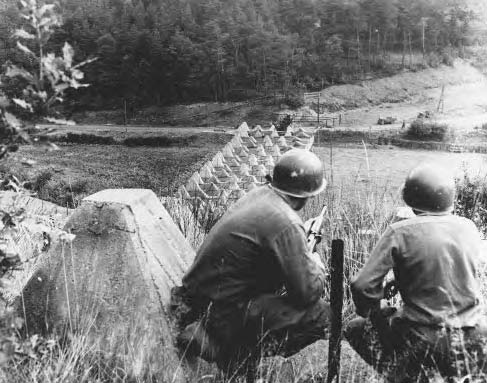
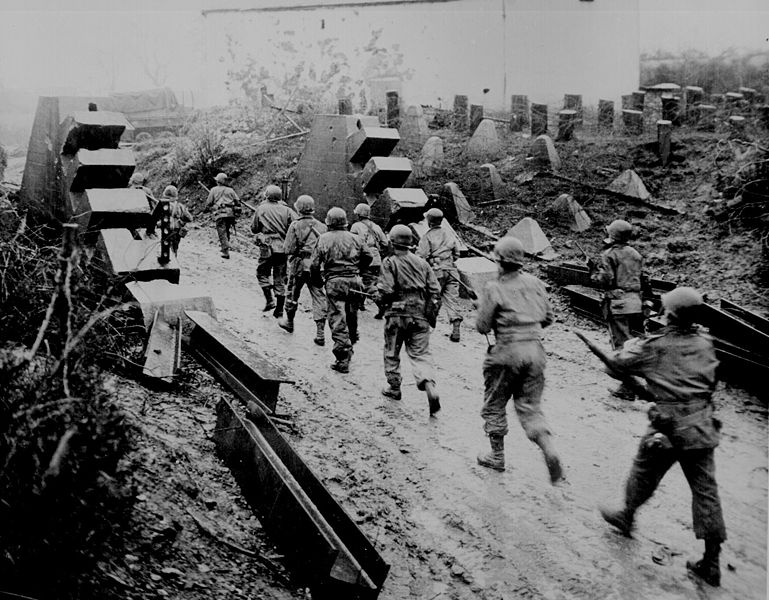
Crossing the Siegfried Line

The dogma of the Leavenworth School emphasized that “victory in large-scale war depends on a strategy of direct confrontation with the enemy’s main forces in order to destroy them.”[ii] This was not in itself different than the thought of contemporary European armies influenced by Clausewitz; but the Americans differed from the Europeans “in the extent to which they expected overwhelming power alone, without subtleties of maneuver, to achieve the objective.”[iii] The tradition developed from an emphasis on Ulysses S. Grant’s campaign in Virginia which understood that Grant had “defeated the armies of the Confederacy through head on assault by overwhelming strength to destroy them, so that in any future great war the United States would seek the destruction of the enemy armed forces by similar means.”[iv] It is perplexing that the Army failed to truly appreciate William Tecumseh Sherman’s use of strategic maneuver on the offense with the goal of destroying the enemy’s army. The fact that the Army failed to incorporate those lessons into its strategic thought, even as it built forces that were better suited to Sherman’s campaign is one of the contradictions of American military thought.[v]

Grant’s tradition was put into practice by Pershing in World War One to the extent that he could influence allied strategy, with mixed results.[vi] The reduction of the St Michel Salient and Meuse-Argonne offensive, though aided by German withdraws and achieved with high casualties, helped convince the Germans that the war was lost.[vii] “Only in late 1918 did the veteran American divisions show the same degree of tactical skill as their Allied and German counterparts, and the lessons came by bloody experience.”[viii] Pershing’s campaigns were bloody, but they came at a when maneuver had again become part of the war, and at the point where the Germans were beginning to collapse.  George Marshall warned about “generalizing about modern warfare from their 1918 experiences against a German army already stumbling into exhaustion.”[ix] Yet for “the American military, the First World War confirmed the doctrines of concentration and of fighting for complete victory, and out of the battlefields of Europe came the foundations of strategic faith….”[x] Weigley notes that: “In strategy, most American soldiers believed, the modern mass army left frontal assault as the only recourse.”[xi]

While Grant’s tradition remained a dominant feature of American strategic thought, the Army was becoming a mobile army whose divisions were to be “tough and lean.”[xii] General Leslie McNair reorganized the structure of the infantry division and later that of the armored divisions.  The heavy “square” infantry division of the First World War was reorganized with three infantry regiments and supporting elements and was characterized by its mobility than its sustained combat power.  McNair reorganized the armored divisions into lighter, though extremely flexible organizations built around the “Combat Command” and the tank was viewed as viewed as an instrument of exploitation, not a means to defeat enemy armor.  The result was an army formed “upon the principle of mobility and its lack of sustained combat power…did not serve it so well when it faced resolute and skillful enemies in strong defensive positions….”[xiii]

The new divisional structures were both mobile and flexible but in the context of the European campaign were wanting in sustained combat power.  Peter Mansoor comments that divisions “literally fought themselves out in constant operations.”[xiv] At the same time he takes issue with Weigley on the staying power of U.S. divisions commenting on the efficiency of the American individual replacement system.[xv] A U.S. Army study commented that in direct assaults against a emplaced enemy that “heavy casualties in such operations were more than the triangular division could sustain, with the result that the entire division was often rendered combat ineffective….”[xvi] McNair’s reorganization ignored General Chaffee’s 1941 admonition that armor must be organized into corps and employed in mass using not “hundreds but thousands of tanks…” calling the failure to train and organize “an adequate number of command echelons and corps troops to ensure proper employment and timely supply for these larger armored formations in active operation is indefensible.”[xvii]

To further complicate the American situation, the application of Grant’s tradition failed to take into account the principle of mass or concentration, which was vital to the success of a strategy of direct confrontation.  The theory demanded that the Americans have enough troops divisions to keep up pressure everywhere. Grant had such power at his disposal, Eisenhower did not.  The thought that “if the United States applied its superior power everywhere it must be able to rupture the defenses somewhere,”[xviii] was dominant.  But to be successful it required overwhelming superiority in numbers and firepower.  This strategy was in conflict with the Army that the Americans built to pursue the war, and in conflict with one of the more influential prewar American thesis on the subject, Infantry in Battle. This treatise stated:

“Generalship consists at being stronger at the decisive point-having three men there to attack one.  If we attempt to spread out so as to be strong everywhere, we shall end up being weak everywhere.  To have real main effort-and every attack and attack unit should have one- we must be prepared to risk extreme weakness elsewhere.”[xix]

It was an army designed for Sherman’s campaigns in Georgia and the Carolina’s, not Grant’s Virginia campaign. It was best suited to campaigns of strategic maneuver and concentration rather than frontal assaults along a broad front.  Its organization called for this and this fact was recognized before the war.[xx] Weigley notes that the “paradoxical commitment to a power drive strategy of head-on assault in an army shaped for mobility further contributed to the prolonging of the war by undermining the possible uses of mobility itself.”[xxi]

The theory of Grant, espoused by the Leavenworth school is fine there are sufficient forces to make it work. General McNair and Army planners initially planned for an Army of over 200 divisions.  Such an army would have been able to execute the strategy without the problems experienced by the Allies in 1944 and 1945.  Unfortunately the American Army was afflicted by the War Department’s decision in 1943 to limit the Army to 90 divisions.[xxii] The limitation on the number of divisions ensured that it would be “difficult or impossible once the battle of France was launched to rotate them out of line for rest or refitting.”[xxiii] This became a key consideration of allied planning by late 1944 because once the existing divisions were deployed to Europe or the Pacific there were no more to replace them.  Drastic measures were taken to increase the number of infantry troops by speeding up the movement of the last available divisions to Europe and by combing troops out of the COMMZ and from the Army Air Force.[xxiv] Training programs were put in place to train tank crews and junior officers.  Yet, these programs did not begin to put significant numbers of replacements into the line until March 1945.[xxv] Mansoor, a critic of Weigley, agrees with him on many points and notes that the “90 division gamble was a decision that cost the lives of numerous servicemen-primarily infantry replacements-in Europe in 1944 and 1945.”[xxvi] The decision to limit the number of divisions forced Eisenhower into a position where he frequently faced an equivalent number of German divisions to those that he could employ.  This would be the case in at the beginning of 1945 despite the steady erosion of the German forces arrayed before him.

Leadership, Strategy and Tactics and the Performance of the Army
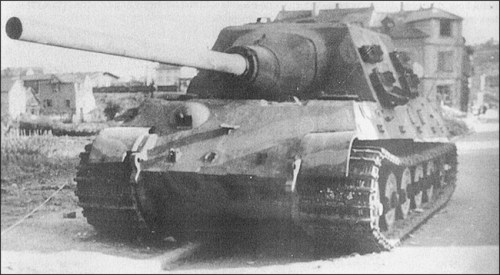
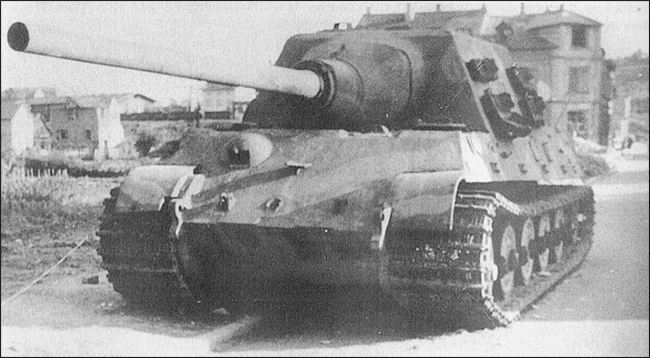
The Germans Employed the Jagdtiger in Small Numbers Against the American Onslaught

After the Bulge the Allies began their push to the Rhine.  Eisenhower “interpreted the Ardennes as confirming the necessity for his broad front strategy, particularly in closing up to the Rhine all the way to Switzerland.”[xxvii] Hastings notes that the Wehrmacht “retained psychological dominance on the battlefield,”[xxviii] and that “Allied commanders remained fearful about exposing their flanks in attack, even when the Germans no longer possessed the resources or mobility to intervene with conviction.”[xxix] In many places GIs and their British counterparts in Montgomery’s 21st Army Group failed to take the initiative and often the Allied commanders “expressed dismay about the lack of aggression shown by their troops.”[xxx] Gavin noted in his diary that: “With better troops, I see no reason why we could not run all over them…Our American army means well and tries hard, but….it is untrained and inefficient… certainly our infantry lacks courage and élan.”[xxxi] Despite this the Allied armies, in particular the Americans, made headway and in many places when well led performed admirably.

The Eifel

Following the reduction of the Bulge Eisenhower allowed Bradley to begin to break the West Wall in the Eifel. After the attack began Eisenhower stopped Bradley short of a breakthrough in order to shift weight of the offensive to Montgomery in the north ordering 12th Army Group to revert to the defensive.  Yet, Eisenhower allowed Bradley a “measure of freedom for limited attacks,”[xxxii] and Patton termed his “operations in the Eifel an “aggressive defense.””[xxxiii] The campaign was primary conducted against oddments of a number of Volksgrenadier divisions of 7th Army.

First Army was diverted on February 1st after making good progress in the Eifel to safeguard the right flank of 9th Army by capturing the Roer dams.  Hastings notes that a “more flexible and imaginative commander-or one unconstrained by the demands of inter-allied relations-would have allowed Hodges forces to keep going to the river and delayed Montgomery for the necessary few days.”[xxxiv] However Bradley felt that Eisenhower “had little choice but to accede to Montgomery’s demand.”[xxxv] Bradley allowed 3rd Army to continue “probing attacks,” and 3rd Army advanced across the Eifel breaking through the West Wall at Prüm and Bitburg.  For the first time the enemy showed “cracks in the admirable cohesion and discipline of the German army.”[xxxvi] Aggressive units of Patton’s 3rd Army were rewarded with dramatic advances. 4th Armored Division in “one bound covered 25 miles, taking 5,000 prisoners and killing several hundred Germans for the loss of 111 of its own men,”[xxxvii] and 10th Armored took Trier on 14 March.  Patton called the campaign “a long hard fought fight with many river crossings, much bad weather, and a great deal of luck.”[xxxviii] Despite this there were problems in some formations.  Hastings recounts how a platoon leader in a VII Corps unit told his commander during a crossing of the Sauer River that “These men have had it sir! They won’t budge for me or anybody else….”[xxxix]The G-3 of 6th Armored division noted that “some of our divisions are too sensitive to their flanks…the result of this is timidity…”[xl]

The Roer Dams, Grenade and Lumberjack

1st Army supported 9th Army by capturing the Roer river dams in preparation of Grenade.  The inexperienced 78th Division was able to secure the dams with help from the veteran 9th Division, though not before the Germans had destroyed the release valves to “flood the Roer valley for about two weeks.”[xli] This delayed the start of Grenade but the Americans finally captured a prize that had eluded them the previous fall.  The one truly notable aspect of this campaign was the continued erratic leadership of Hodges.  Gavin called it “impatient” and it nearly cost the Commanding General of 78th division his command.  Bradley’s aide, Major Hanson remarked that Hodges “was near exhaustion.”[xlii]

9th Army’s attack was conducted in concert with Operation Veritable of 2nd Canadian Army.  The plan was that the two armies would clear the area west of the Rhine destroying as much of the enemy as possible in preparation for the crossing of the river.  As such 9th Army remained under the operational control of Montgomery’s 21st Army Group.  9th Army crossed the Roer, hampered by the high waters and German resistance but captured Düren and München-Gladbach and closed up to the Rhine.  The “rapid build-up enabled Simpson to maintain intense pressure and on the last Day of February his armor broke away.”[xliii] 9th Army met up with the Canadians eliminated elements of the German Army that remained west of the river.  9th Army took over 30,000 prisoners and killed an estimated 6,000, but substantial numbers were evacuated by skillful German commanders.[xliv] The greatest disappointment was that Grenade failed to capture any bridges over the Rhine.   Montgomery turned down Simpson’s request to make a fast crossing of the Rhine at Urdingen, where there were few German troops.[xlv]

South of 9th Army the 1st and 3rd Armies launched Operation Lumberjack to attempt to envelope the German forces west of the Rhine in its sector in similar fashion to Grenade-Veritable. Facing weak German forces 1st Army made good progress capturing Cologne on March 5th.   3rd Army’s advance was exceptional.  Its plan to cut off the Germans on the west bank worked almost to perfection despite poor roads, snow and the opposition of the 2nd Panzer Division.[xlvi] General Gaffney’s 4th Armored division, drove 40 air miles, captured 5,000 prisoners killed another 700 Germans, capturing much equipment with the loss of only 29 men killed.[xlvii] Bradley called the division’s performance “the most insolent armored blitz of the Western war.”[xlviii] Patton’s armor covered “56 miles in three days to reach the Rhine near its confluence with the Moselle.”[xlix] For the first time “senior officers and headquarters fell into the American bag,”[l] including the command post of LXVI Corps and the commander of LIII Corps. In these operations the bold use of maneuver and concentration by Simpson, Hodges and especially Patton exploited the natural strengths of their formations to achieve their objectives.

Remagen
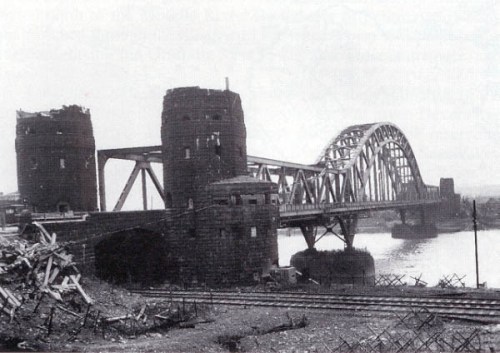
Remagen Bridge

1st Army’s swift advance and the chaos wreaked by Patton’s army led to the only instance in the campaign where the Allies captured a bridge over the Rhine intact.  The Ludendorff railway bridge at Remagen remained and on 7 March 9th Armored division detached a task force from CCB to take the bridge before it could be blown.   This force surprised the Germans and reached Remagen by 1300. General Hoge, hero of St. Vith, arrived quickly and ordered the capture the bridge as quickly as possible.[li] Hoge ignored orders to divert most of his troops to another crossing of the Ahr River and without orders “threw the rest of his armored infantry across the Rhine….”[lii] “In spite of the threat of the bridge being blown by the fleeing Germans, bold action by American infantry and engineers captured the bridge and established a bridgehead over the Rhine by 1630.  III Corps ordered 9th Armored division to “exploit the opportunity,”[liii] and “within 24 hours they had 8,000 men across.”[liv] Hodges exploited the opportunity and pushed the 9th, 78th and 99th divisions across the river where they continued to enlarge the bridgehead while fighting off fierce German counter-attacks.  By 24 March 1st Army had “three corps, six infantry divisions, and three armored divisions across the Rhine River.”[lv] The best German formations “arrived piecemeal and spent themselves in the same way, mustering only limited, scattered counterattacks instead of any major blow.”[lvi]

The Remagen crossing was not welcomed by all and restrictions were placed on 1st Army as it enlarged the bridgehead.  Carlo D’ Este saw Remagen as “typical of the lack of connection between SHAEF and its subordinate elements.”[lvii] “Pinky” Bull, the SHAEF G-3 was at Bradley’s headquarters when the Bradley was informed of the crossing.  Bull told Bradley that the Remagen crossing “just doesn’t fit in with the plan.”[lviii] Bradley recalled telling Bull: “What the hell do you want us to do,” I asked him, “pull back and blow it up?”[lix] During the next few days however “Bull’s unbending skepticism infected Eisenhower himself.”[lx] And by March 9th Bull informed Bradley that Eisenhower “did not want the Remagen bridgehead expanded beyond the ability of five divisions to defend it.”[lxi] The decision to favor Montgomery’s crossing of the Rhine by detaching divisions from 12th Army Group to support it caused consternation among Bradley and his commanders who feared that Montgomery would “use most of the divisions on the Western Front, British and American, for an attack on the Rhine plains…and the First and Third Armies be left out on a limb.”[lxii] Liddell-Hart noted that the order was “all the more resented because the U.S. Ninth Army…four days earlier, had been stopped by Montgomery from trying to cross the river immediately, as its commander, Simpson, desired and urged.”[lxiii]

Patton’s 3rd Army Crossed the Rhine on the Fly at Oppenheim

Remagen’s aftermath showed Eisenhower’s continued commitment to the broad front, to closing up to the Rhine along its entire length, and his inordinate fear of German counter-stokes.  He remained “fearful that, as long as some German forces survived on the Western side of the Rhine, the potential existed for another potential unpleasant surprise, a counter-attack across an exposed American flank.”[lxiv] The facts belied the situation and Model, commander of Army Group B “had not only given up on trying to eliminate the American bridgehead at Remagen but had covertly begun ordering large elements of Army Group B to evacuate the Rhine and cross the river.”[lxv] This decision resulted “in a lost opportunity to have established a larger bridgehead across the Rhine.”[lxvi] It was another example of Eisenhower’s failure to exploit opportunity when it presented itself and of a desire more to not lose the war than to win it. Despite this “Remagen bridge was one of the great sagas of the war and an example of inspired leadership.”[lxvii] Wilmont called it “a brilliant coup,”[lxviii] a thought echoed by Liddell-Hart.[lxix] The German response to rush numerous units to contain the bridgehead made the Allies task when they crossed the Rhine at other points “much easier than they had anticipated.”[lxx]

Patton’s Saar-Palatinate Campaign

Patton’s 3rd Army attacked the Saar-Palatinate in concert with the 7th Army with the intent of assailing the West Wall from the rear and trapping the remnant of the German Seventh Army and the German First Army.  7th Army assaulted the West Wall while Patton’s army began its assault on 13 March with the XII and XX Corps attacking into scattered German resistance.  With the infantry making the breakthrough both corps unleashed their armored divisions in an exploitation role.  Patton’s attack was so successful that he was allowed to adjust his assault to carry it into 7th Army’s zone to encircle the collapsing German Army.  In an unusual command and control move Devers of the 6th Army Group gave Patch and Patton “the authority to communicate directly with each other, bypassing their different army group headquarters.”[lxxi] Large scale surrenders began to take place for the first time, including that of 3 Volksgrenadier divisions and the remnants of 2nd Panzer division.[lxxii]

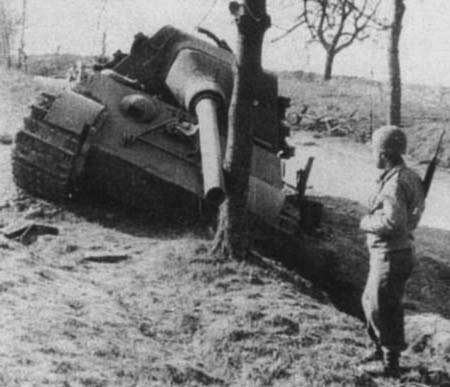
US Soldier Standing Watch over Disabled Jagdtiger

Patton was urged on by Bradley, who warned him about “the danger of losing his divisions to Montgomery if he did not secure a Rhine crossing.”[lxxiii] Patton got his engineers and bridging equipment up quickly and Bradley ordered him to “take the Rhine on the run.”[lxxiv] On March 19th alone the Third Army overran more than 950 square miles of territory.”[lxxv] Third Army “cleaned up the west bank of the Rhine all the way south to Worms and Speyer; Third and Seventh Armies claimed well over 100,000 German prisoners in the victory.”[lxxvi] On the 22nd Third Army launched the 5th Infantry division across the Rhine at Nierstein and Oppenheim, surprising the Germans and beating Montgomery across the Rhine. Patton called Bradley: “Brad, for God’s sake tell the world we’re across…I want the world to know that Third Army made it before Monty.”[lxxvii] Weigley notes in this campaign “the American army’s sharpening instinct for the jugular,” and that it was a model “of not only how to gain ground of not only how to gain ground but to destroy enemy forces.”[lxxviii]

Plunder

9th Army and Allied Airborne forces participated in 21st Army Group’s grand set-piece crossing of the Rhine on 23 March.  The attack had been prepared for weeks by Montgomery and more resembled an amphibious operation than a river crossing. The attack employed 25 divisions supported by 3,000 guns with maximum air support and naval amphibious units.   Opposing the Army group were “five weak and exhausted German divisions”[lxxix] of 1st Parachute Army.  The assault cost 9th Army thirty casualties.  Montgomery also employed the American 17th and 6th British Airborne divisions in Operation Varsity which was the largest single day airborne operation of the war. Over 21,000 paratroops were dropped or air-landed in gliders into the face of heavy flak. Numerous troop transport planes and gliders were lost.  The operation was of doubtful utility, ground forces were already well on their way to the objective the paratroops were landed on and the operation had a heavy cost, 17th Airborne took “some 1500 casualties, including 159 killed.” And 6th Airborne lost another 1400.[lxxx]

The Ruhr Pocket and the Decision to Stop on the Elbe
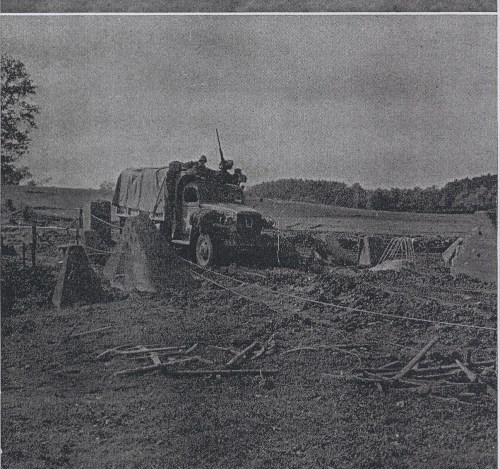

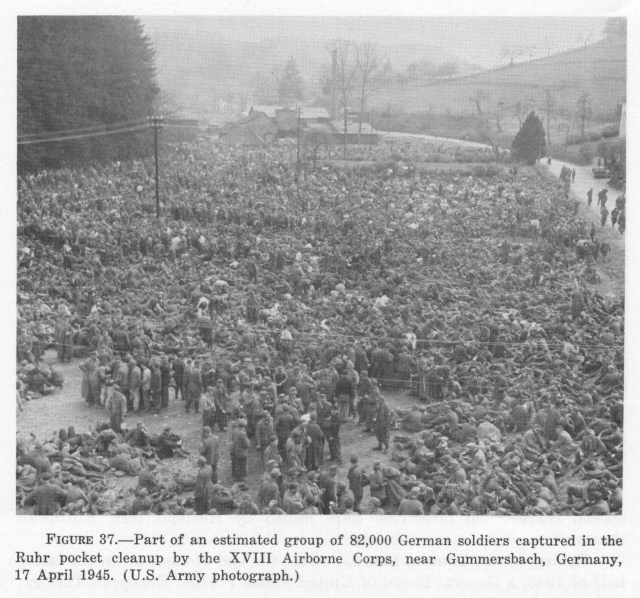
The last major operation in the West following the breakouts from the bridgeheads over the Rhine was the encirclement and reduction of the Ruhr pocket.  This operation involved the 9th Army and 1st Army. The 3rd Army continued its operations east and south toward Nurnberg.   Bradley, his blood stirred by the large numbers of prisoners taken in the Saar, Palatinate and Rhineland now became addicted by the completion of envelopments and he told his staff as “he shifted Hodges’ direction toward a meeting with Simpson encircling the Ruhr: “I’ve got bags on my mind.””[lxxxi] The Army Group completed the encirclement and reduced the pocket by April 18th. Two Army commanders, Von Zangen of 15th Army and Harpe of 5th Panzer Army as well as 25 other Generals and Admirals were caught in the American net.  Vaunted formations such as Panzer Lehr and 116th Panzer were among the 317,000 German prisoners taken by the Army Group. XVII Corps alone captured 160,000 prisoners.[lxxxii] Field Marshal Model, the commander of Army Group B took his own life on the 21st. The one setback during the battle was during the spirited advance of the 3rd Armored division to Paderborn a task force ran into a Kampfgrüppe of King Tigers manned by Waffen SS Panzer training students stopped them with heavy losses.[lxxxiii] To make matters worse the 3rd Armored Division Commanding General, Maurice Rose was killed when his jeep encountered Tigers and a jittery German Panzertroop shot him when he removed his pistol attempting to surrender.[lxxxiv]
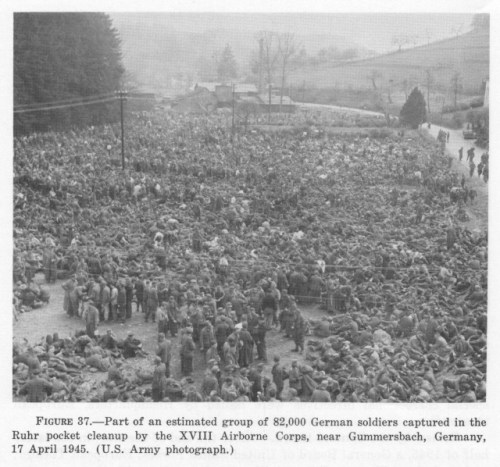
Despite the great number of prisoners taken and the elimination of the bulk of the Wehrmacht in the West the battle detracted from what had been hereto the overriding goal of the campaign, the capture of Berlin.[lxxxv] The reasons for this were twofold.  At the Army Group level Bradley was determined to engage as many of his troops as possible so they would not be sucked into any offensive commanded by Montgomery who continued to clamor for control of American troops to make the final drive for Berlin.   Eisenhower supported Bradley’s decision as he believed “that the Western Allies no longer had much chance of capturing “the main prize,” Berlin, anyway.”[lxxxvi] Weigley suggests that a better purpose for the troops that Bradley used to reduce the Ruhr pocket would have been to us them to aid 9th Army’s drive toward Berlin which was already closing on the Elbe.  With the reuniting of the 1st and 9th Armies Bradley was poised to begin his drive to Berlin with the largest field command in American history.[lxxxvii]

US Vehicles Driving Towards Kassel

The second reason was that Eisenhower had made a decision based on political and tactical considerations to shift the focus of the Allied effort from Berlin to Dresden and Leipzig yet not completely ruling out an advance toward Berlin.[lxxxviii] Attempts by 9th Army to drive toward Berlin were frustrated by unexpected German resistance to its bridgeheads over the Elbe. On the 15th of April Simpson flew to Bradley’s headquarters to propose an attack on Berlin.  Bradley called Eisenhower who on hearing Bradley’s estimate of 100,000 casualties to take the city elected not to continue the attack towards Berlin.[lxxxix] Eisenhower had now concluded “that the National Redoubt was now over more importance than Berlin,”[xc] and directed Patton and Devers to secure it.  Patton and Simpson were both incredulous at the decision and felt that it was “a terrible mistake.” Patton felt 9th Army could take Berlin in 48 hours.[xci] In a similar vein Patton’s move into Czechoslovakia was halted before Prague.

Overage German Recruits Captured by US Forces

Eisenhower’s decision was political and tactical and was supported by the U.S. Chiefs of Staff;[xcii] Berlin would be in the Soviet zone even if he took it.  Hastings sates the decision was “surely the correct one” noting that nothing could change the post-war settlement.[xciii] Murray and Millett agree.[xciv]Others such as J.F.C. Fuller felt that the political decisions had turned the fruits of victory “into the apples of Sodom, which turned to ashes as soon as they were plucked,”[xcv] leaving Eastern and Central Europe under the control of the Soviets.  D’ Este notes that no matter what was decided that Eisenhower’s “hands were already tied by the agreement of the Big Three agreement over the division of occupied Germany.”[xcvi] In the end there may have been a political advantage to taking Berlin before the Soviets, but as Hastings notes: “It is hard to see how this could have been prevented, given the Western Allies sluggish conduct of the war.”[xcvii] This was the fault of both the British and Americans and this was in fact as much a part of the final settlement in Europe as any decision made in the final weeks of the war.

In retrospect one can see the historical consequences of Eisenhower’s decision, but how much that decision was influenced by the way the American Army’s organization and conduct for war is seldom mentioned. Perhaps had Eisenhower had the 200 plus divisions envisioned by the Victory plan, or had he been bolder and abandoned the broad front strategy inherited from Grant, history might be different today.  There are always results.  One should not devise strategies for the conduct of war that do not match up with the forces that you plan to employ.  Organization, training and equipment must be designed for the type of war one intends to fight and are just as important as a grand strategy.   This was the lesson of the American involvement in the European campaign.  The American Army succeed in spite of the restraints that its leadership and saddled it with.  The final campaign in Germany showed that at least parts of it had learned the hard lessons of war and could conduct a highly successful campaign.

Handshake on the Elbe: US and  Red Army Troops Meeting


[i] Weigley, Russell  F. Eisenhower’s Lieutenants: The Campaign in France and Germany 1944-1945. Indiana University Press, Bloomington IN 1981. p.2.

[ii] Ibid.  p.728

[iii] Ibid. p.4.

[iv] Ibid.

[v] See Weigley’s article American Strategy, in Peter Paret’s Makers of Modern Strategy from Machiavelli to the Nuclear Age. Paret, Peter, editor.  Makers of Modern Strategy from Machiavelli to the Nuclear Age. Princeton University Press, Princeton, NJ 1986 pp.434-436.

[vi] See Keene, Jennifer D. Doughboys, the Great War, and the Remaking of America. The John’s Hopkins University Press. Baltimore,MD. 2001. pp.42-44.  Keene notes the results of the AEF’s training and Pershing’s organization and employment of the Army in WWI.  The similarities to the American experience in WWII are startling.  A comment of George Marshall after the war that: “Officers leading their men into battle, abandoned tactical maneuvering in favor of “steamroller operations” that forced men to keep going until exhaustion stopped them…” reminds one of the Huertgen Forrest.  Likewise a similar situation arose in regard to training.  Other comments are that the infantry was not well trained and that “many troops resisted advancing without artillery support….”

[vii] Herwig, Holger H. The First World War: Germany and Austria-Hungary 1914-1918. Arnold a Member of the Hodder Headline Group, London England 1998. p.424.

[viii] Millett, Allen R. and Maslowski, Peter. For the Common Defense: A Military History of the United States of America. The Free Press, New York 1984. p.349.

[ix] Ibid. Weigley. p.25

[x] Matloff, Maurice Allied Strategy in Europe in Makers of Modern Strategy from Machiavelli to the Nuclear Age. Paret, Peter, editor.  Makers of Modern Strategy from Machiavelli to the Nuclear Age. Princeton University Press, Princeton, NJ 1986 p.696.

[xi] Ibid. Weigley. p.5

[xii] Ibid. Weigley. p.23

[xiii] Ibid. p.728

[xiv] Mansoor, Peter R. The GI Offensive in Europe: The Triumph of American Infantry Divsions 1941-1945. University Press of Kansas, Lawrence KS. 1999 p.31.

[xv] Ibid. pp.253-254.  Mansoor is the only historian that I have ever seen defend this system.  Even Stephan Ambrose who generally leads the cheering section for the American Army in WWII condemned the system, which Mansoor admits in his account.

[xvi] Gabel, Christopher R. The Lorraine Campaign: An Overview September-December 1944. U.S. Army Command and Staff College, Ft. Leavenworth KS 1985.  pp.34-35.

[xvii] Chaffee, Adna R. Mechanization in the Army, Statement to Congress, April 1941. p.19.  Combined Arms Research Library, Digital Library http://cgsc.leavenworth.army.mil/carl/contentdm/home.htm

[xviii] Ibid. p.6.

[xix] _________Infantry in Battle 2nd Edition The Infantry Journal Incorporated, Washington DC 1939. p.68

[xx] See Chaffee and Infantry in Battle. Likewise this was echoed in S.L.A. Marshall’s book Armies on Wheels, William and Morrow Company, New York, NY 1941.

[xxi] Ibid. p.729.

[xxii] Ibid. p.14

[xxiii] Ibid.

[xxiv] Ibid. p.662-663. Initially, 21,000 troops were taken from the COMMZ and 10,000 were directed to be transferred from the AAF.  Additionally 2,253 black troops were formed into 37 platoons and distributed among the divisions of 12th and 6th Army Groups.

[xxv] Ibid. p.664.  The efforts were successful and by April there was a surplus of 50,000 infantry soldiers beyond reported shortages, despite the fact that no more American or British divisions were available for deployment to the continent.

[xxvi] Ibid. Mansoor,

[xxvii] Ibid. Weigley. p.578

[xxviii] Hastings, Max. Armageddon:  The Battle for Germany 1944-1945 Alfred A Knopf, New York NY 2004 p.340.

[xxix] Ibid.

[xxx] Ibid. Hastings. p.340

[xxxi] Ibid. p.341

[xxxii] Ibid. Weigley. p.583

[xxxiii] Bradley, Omar  N. A Soldier’s Story Henry Holt and Company, New York NY 1951. p.501

[xxxiv] Ibid. Hastings. p.348

[xxxv] Ibid. Bradley. p.497

[xxxvi] Ibid. p.589.

[xxxvii] Ibid. Hastings. p.348.

[xxxviii] Patton, George S. War as I Knew It Originally published by Houghton Mifflin Company NY 1947, Bantam Paperback Edition,  Bantam Books, New York, NY 1980 p.242

[xxxix] Ibid. Hastings. p.345

[xl] Ibid.

[xli] Ibid. Weigley. p.603

[xlii] Ibid. p.602

[xliii] Wilmont, Chester. The Struggle for Europe Harper and Brothers Publishers, New York, NY 1952 p.673

[xliv] Ibid. p.616

[xlv] Ibid. Hastings. p.365

[xlvi] Ibid. Weigley. p.621

[xlvii] Ibid.

[xlviii] Ibid. Bradley. p.509

[xlix] Ibid. Wilmont. p.674

[l] Ibid. Weigley. p.622.

[li] Ibid. 627

[lii] Ibid. Hastings. p.365

[liii] Ibid.

[liv] Murray, Williamson and Millett, Allan R. A War to Be Won: Fighting the Second World War The Belknap Press of Harvard University Press, Cambridge Massachusetts and London England, 2000 p.478

[lv] Ibid. Mansoor. P.244.

[lvi] Ibid. Weigley. p.632

[lvii] D’Este, Carlo. Eisenhower: A Soldier’s Life Owl Books, Henry Holt and Company, New York NY 2002. p.681

[lviii] Ibid. p.682

[lix] Ibid. Bradley. p.511

[lx] Ibid. Weigley. p.629.

[lxi] Ibid.

[lxii] Ibid. Wilmont. p.676

[lxiii] Liddell Hart, B.H. The History of the Second World War G.P. Putnam’s Sons, New York NY 1970. p.678.

[lxiv] Ibid. Hastings. p.366.

[lxv] Newton, Steven H. Hitler’s Commander: Field Marshal Walter Model, Hitler’s Favorite General. DeCapo Press, Cambridge MA 2005. p.351.

[lxvi] Ibid. D’Este. Eisenhower p.682

[lxvii] Ibid.  By this D’Este is obviously not referring to Bull and Eisenhower.

[lxviii] Ibid. Wilmont. p.677.

[lxix] Ibid. Liddell-Hart. p.677

[lxx] Warlimont, Walter. Inside Hitler’s Headquarters 1939-1945 translated by R.H. Barry. Presidio Press, San Francisco, CA 1964. p. 506.

[lxxi] Ibid. Weigly. p.635.

[lxxii] Ibid. p.638

[lxxiii] Ibid. Wilmont. p.678.

[lxxiv] Ibid.

[lxxv] D’Este, Carlo. Patton: A Genius for War. Harper Collins Publishers New York, 1995  p.711

[lxxvi] Ibid.  Murray and Millet. p.479.

[lxxvii] Ibid. D’Este Eisenhower p.683

[lxxviii] Ibid. Weigley. p.639

[lxxix] Ibid. Liddell-Hart. p.678.

[lxxx] Ibid. Hastings. p.369.

[lxxxi] Ibid. Weigley. p.673.

[lxxxii] Ibid. p.680

[lxxxiii] Ibid. Hastings. p.377.

[lxxxiv] Ibid. p.675.

[lxxxv] Ibid. Weigley. p.674.

[lxxxvi] Ibid. p.684.

[lxxxvii] Ibid.

[lxxxviii] Ibid. p.688.

[lxxxix] Ibid. pp.698-699.  Weigley believes that neither Eisenhower nor Bradley wanted to continue to Berlin; Bradley for the reason that Montgomery would steal the credit and Eisenhower because it was a “prestige objective” that would remain in the Soviet zone no matter who captured it.

[xc] Ibid. Wilmont. p.690.

[xci] Ibid. D’Este Patton. P.721

[xcii] Ryan, Cornelius. The Last Battle The Fawcett Popular Library, New York NY.1966.  p.240.

[xciii] Ibid. Hastings. p.425

[xciv] Ibid. Murray and Millett. P.480

[xcv] Fuller, J.F.C. The Conduct of War 1789-1961 DaCapo Press edition, San Francisco, CA 1992. p.296.

[xcvi] Ibid. D’Este. Eisenhower. P.694.

[xcvii] Ibid. Hastings. p.512.

Bibliography

Bradley, Omar  N. A Soldier’s Story Henry Holt and Company, New York NY 1951.

Chaffee, Adna R. Mechanization in the Army, Statement to Congress, April 1941.  Combined Arms Research Library, Digital Library http://cgsc.leavenworth.army.mil/carl/contentdm/home.htm

D’Este, Carlo. Eisenhower: A Soldier’s Life Owl Books, Henry Holt and Company, New York NY 2002.

D’Este,  Carlo. Patton: A Genius for War. Harper Collins Publishers New York, 1995

Fuller, J.F.C. The Conduct of War 1789-1961 DaCapo Press edition, San Francisco, CA 1992.

Gabel, Christopher R. The Lorraine Campaign: An Overview September-December 1944. U.S. Army Command and Staff College, Ft. Leavenworth KS 1985.

Hastings, Max. Armageddon:  The Battle for Germany 1944-1945 Alfred A Knopf, New York NY

Herwig, Holger H. The First World War: Germany and Austria-Hungary 1914-1918. Arnold a Member of the Hodder Headline Group, London England 1998

Keene, Jennifer D. Doughboys, the Great War, and the Remaking of America. The John’s Hopkins University Press. Baltimore, MD. 2001.

Liddell Hart, B.H. The History of the Second World War G.P. Putnam’s Sons, New York NY 1970

Mansoor, Peter R. The GI Offensive in Europe: The Triumph of American Infantry Divsions 1941-1945. University Press of Kansas, Lawrence KS. 1999

Millett, Allen R. and Maslowski, Peter. For the Common Defense: A Military History of the United States of America. The Free Press, New York 1984

Murray, Williamson and Millett, Allan R. A War to Be Won: Fighting the Second World War The Belknap Press of Harvard University Press, Cambridge Massachusetts and London England, 2000

Newton, Steven H. Hitler’s Commander: Field Marshal Walter Model, Hitler’s Favorite General. DeCapo Press, Cambridge MA 2005

Paret, Peter, editor.  Makers of Modern Strategy from Machiavelli to the Nuclear Age. Princeton University Press, Princeton, NJ 1986

Patton, George S. War as I Knew It Originally published by Houghton Mifflin Company NY 1947, Bantam Paperback Edition,  Bantam Books, New York, NY 1980

Ryan, Cornelius. The Last Battle The Fawcett Popular Library, New York NY.1966

Warlimont, Walter. Inside Hitler’s Headquarters 1939-1945 translated by R.H. Barry. Presidio Press, San Francisco, CA 1964

Weigley, Russell  F. Eisenhower’s Lieutenants: The Campaign in France and Germany 1944-1945. Indiana University Press, Bloomington IN 1981.

Wilmont, Chester. The Struggle for Europe Harper and Brothers Publishers, New York, NY 1952

_________Infantry in Battle 2nd Edition The Infantry Journal Incorporated, Washington DC 1939

2 Comments

Filed under History, Military, world war two in europe

Book Review: Identity and War, the Lessons of King Philip’s War

This is a book review of Jill Lepore’s bookThe Name of War: The Name of War: King Philip’s War and the Origins of American Identity” Vintage Books, a division of Random House, New York NY. 1999

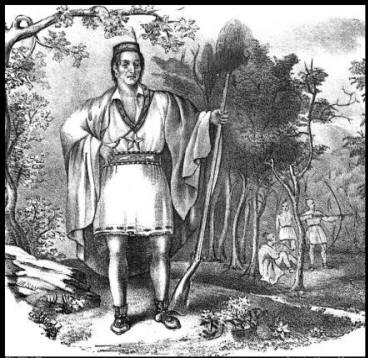
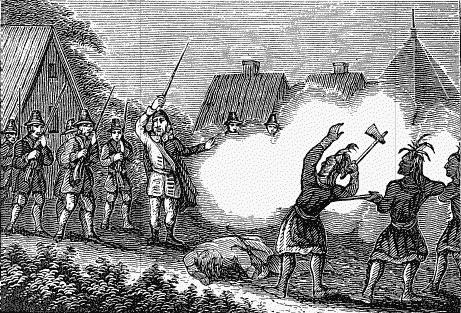
King Philip

The thesis of Jill Lepore’s book In the Name of War: King Philip’s War and the Origins of American Identity” is that King Philip’s War helped lay the foundation of American identity. Lepore postulates that the history of the war and the war itself cannot be separated especially in regard to the identity of the participants.  This is of particular interest in how the participants record the history of the war and how it influences their perception of themselves and their enemies.

War and how it is recorded in history can define a people. Examples of this can be seen throughout history. For instance the history and identity of Serbia cannot be separated from the battle of Kosovo in 1389 . There are countless other examples of how war shapes the identity of people and nations.  One of the defining moments in the early history of Colonial America was King Philip’s War which lasted from July 1675 through August 1676.

Lepore maintains that King Philip’s War defined the ways in which the colonists and Indians shaped their views of themselves and each other, not just at the time of the war but in succeeding generations.  She takes an approach unlike a lot of histories of war.  Instead of simply analyzing battles Lepore looks at how war cultivates language and the questions that war provokes.

The most pressing to Lepore is “how do people reconcile themselves to war’s worst cruelties.”[i] She notes her own view of war in her introduction: “War is a contagion, the universal perversion. War is politics by other means, at best barbarism, a mean contemptible thing.”[ii] She says that her interest in war was drawn on the media coverage of the Persian Gulf War and her question of “how war could be represented without pictures.”[iii] This of course demonstrates how she views the nature of war and how she interprets it.

Lepore examines the literature of “King Philip’s War” beginning with the death of the leader of Wampanoag Indian King Philip in June 1675.  She examines the war from both sides inasmuch as that only one side had access to the means to record that history. Through the writings of the colonists she examines the brutal nature of King Philip’s War which “in proportion to population… inflicted greater casualties than any other war in American history.”[iv]

This is not a campaign history.  Instead Lepore selects incidents and battles of the war and looks at them through the eyes of the people that recorded them.  Lepore notes that “the central claim of this book is that wounds and words-the injuries and their interpretation- cannot be separated, that acts of war generate acts of narration, and that both types of acts are often joined in a common purpose: defining the geographical, political, cultural, and sometimes racial and national boundaries between peoples.”[v]

Lepore’s account is a literary and philosophical study of the nature of war and not a military history. Her understanding of the totality of this war and its effect through the years is noted by others such as Russell Weigley.[vi] She asks a poignant question that should be noted by any practitioner of war or military theorist: “If war is, at least in part, a contest for meaning, can it ever be a fair fight when only one side has access to those perfect instruments of empire, pens, paper, and printing presses?”[vii]

Lepore studies the literature of the war published by the colonists.  In particular she discusses the competing histories published by Increase Mather and William Hubbard, both pastors in New England and the writings of other colonists, especially those of Nathanial Saltonstall and Mary Rowlandson.  For Lepore the importance of the writing of these people is connected to the identity of the peoples involved, both the English colonists and the Native Americans.[viii] Lepore’s premise is that the writings of the colonists “proved pivotal to their victory, a victory that drew new firmer boundaries between English and Indian people, between English and Indian land, and what it meant to be “English” and what it meant to be “Indian.””[ix] This is still a critical question. She notes how King Philip’s War influenced later events such as the American Revolution and the deportation of the Cherokee nation in the 1820s.

For Lepore the formation of the identity of both the colonists and the indigenous people is the key theme of this war, and for that matter most wars.

Lepore depicts this in her prologue and the account of the torture of a Narragansett Indian by Mohegans Indians while the English watch.  The question that she raises and that she will ask again is “If they are to think of themselves as different from “these Heathen” whom they condemn for their “barbarous Cruelty,” how then can they consent to such treatment of a Narragansett before their very eyes? “Their enemy is killed, yet they do not have to kill him. They are allowed to witness torture, yet they not need inflict it.”[x]

Yet for the colonists such behavior risked their identity as Christians and Englishmen which was what they believed that they fought for in the first place.  Lepore notes Mather’s 1674 sermon The Day of Trouble is Near which emphasized the theme of decay and confusion present at the time.[xi]

Lepore notes the effect of literacy on both the colonists and Indians. She begins with the murder of John Sassamon a bi-lingual Indian as the seminal event which set the stage for the war. She then examines Sassamon’s relationship to the English and Christianity and his relationship with King Philip.  In Lepore’s account Sassamon was a victim of both his faith and literacy.

Lepore provides a good study of early missionary attempts to “bring the Gospel” to the Indians by translating the Bible and devotional texts from English to Massachusett[xii] and how that missionary activity converted many Indians including Sassamon.  Lepore notes that: “in a sense literacy killed John Sassamon. And herein lies one of the fundamental paradoxes of the waging and writing of King Philip’s War:  The cultural tensions that caused the war – the Indians becoming Anglicized and English becoming Indianized- meant that literate Indians like John Sassamon who were those most likely to record their version of events of the war, were among its first casualties.” [xiii]

Lepore’s depiction of the cruelties of war in chapters three and four is a study in contrasts.  Again this comes back to a question of identity for the colonists.  They saw themselves as different from the “uncivilized Indians” even the Christian Indians.  This was because the colonists believed that Indians did not value English understanding of identity which was connected to property and its improvement, houses, land and farm field’s cattle and possessions.  When the Indians destroyed English property it was a blow at their very identity as Englishmen. The tension between these tow opposite points of view remains a fixture of American life.

Religion played a major role in the conflict.  Lepore notes that “the colonists’ sense of predestination…, their natural affinity with the land, and their cultural proclivity to conflate property with identity, all combined to produce this oneness of bodies and land.”[xiv] The English did not view the Indians as having the same values because they did not have the same understanding of land and property, and thus they saw them as savage.  For example she discusses how the colonists view of how “the Algonquians’’ perceived nomadism, their failure to “improve” the land, formed the basis for the English land claims….”[xv] In  other words the English Colonists believed that if the Indians were want to improve the land upon which they dwelt than they did not deserve to remain on it.

Lepore discusses the metaphor of “nakedness” in relation to the loss of property and identity.[xvi] She notes how the Indians seemed to have understood the importance of land and property to the English. She cites a note left by a Nipmuck Indian at Medfield “we hauve nothing but our lives to loose but thou hast many fair houses cattell & much good things.”[xvii] She notes that the note offered an analysis missed by all the English accounts of the war.[xviii]

Likewise Lepore notes how religion informed both the colonists and Indians who both looked for supernatural messages in the natural world.  The English colonists, primarily Puritan Calvinists believed that the devastation of the war on them at the beginning of the war was “God punishing them for their sins, not the least of them their failure to convert the Indians to Christianity.”[xix] The English settlers were influenced by their Calvinist theology and believed that the Indians both “served the devil” but were also “the instruments of God.”[xx] The Indians also had a spiritual element to their conduct of the war and the clash of these beliefs gave the war a religious dimension especially for the Colonists a dimension that would pervade American perceptions of many of the wars which followed.

Another theme of Lepore in how the war shaped identity is in the context of the bondage experienced by the English captives of the Indians during the war that of and of the Indians following the war.  She uses the stories of Mary Rowlandson and Christian Indian James Printer to illustrate her thesis.

Rowlandson’s story is the account of her capture, captivity and release by the Indians following the attack on Lancaster, Massachusetts in February 1676.  Lepore calls the importance of Rowlandson’s account The Sovereignty and Goodness of God and how it shaped the colonial and later American understanding of the war by “the nearly complete veil it has unwittingly placed over the experiences of bondage endured by Algonquian Indians during King Philip’s War.”[xxi] Lepore writes that for Rowlandson and Printer that the story was one of redemption and return to English society, Rowlandson through her book, Printer through bringing back scalps of other Indians as a demonstration of his loyalty to the Colonists.[xxii]

Another point raised by Lepore here is the enslavement and deportation of the Algonquians by the Colonists following the war.  A key to the thinking of the colonists is elaborated by Lepore: “In the end, the colonists’ evaluation of Indian sovereignty was merely an extension of their thinking about Indian possession: Indians were only sovereign enough to give their sovereignty away.”[xxiii]

This again comes back to Lepore’s thesis of identity.  She states that the “colonists moved toward (but never fully embraced) in their writing about King Philip’s War was the idea that Indians were not, in fact truly human, or else humans of such a vastly different race as to be considered essentially, and biologically inferior to Europeans.”[xxiv] She argues that King Philip’s war was a defining moment where “Algonquian political and cultural autonomy was lost and where the English moved one step closer to the worldview that would create, a century and a half later, the Indian removal policy of Andrew Jackson.”[xxv]

Lepore’s final section deals with memory and identity.  She illustrates this by noting how the Reverend Nathan Fiske in 1775 equated the British to the Indians of King Philip’s War; and the play Metamora written in 1829 about King Philip and the war.  Both Fiske and the latter play had an impact.

Fiske’s sermon helped light the fires of American independence movement, something that which Lepore notes for the Indians was “not a gain but a loss of liberty.”[xxvi] The play Metamora opened the day Andrew Jackson declared his policy of Indian removal. It was the most popular American play of its era. Lepore says that when you “peel back all the layers …what remains is a struggle for American and Indian identity. Through plays like Metamora, white Americans came to define themselves in relation to an imagined Indian past.”[xxvii]

Overall Lepore’s treatment of King Philip’s War is a good treatment of how wars affect people and their relationships with those whom they war against.  Using Lepore’s thesis of the war, the history of war and how they shape the identities of peoples and nations’ one could conceivably analyze other conflicts from this perspective.

Since this is the premise of why Lepore began her study of King Philip’s War it is worthy of further discussion.  Such studies could be undertaken in the Balkans, Kurdistan, Palestine, Iraq or Syria as well as other regions where the impact of war is thoroughly ingrained in the minds, hearts and imaginations of the parties involved.  From this perspective one wonders what future generations of Americans and Moslems will write of the current conflicts that the United States is engaged in.

Another aspect of Lepore’s examination study is religion in the perception and interpretation of war.  In this case it is the impact of the colonists Calvinism and its relationship to other English theologies of its day as well as other Calvinistic understanding of war of that era that matters.

This is very important.  The more recent English colonists prior to King Philip’s War had in many cases experienced the brutality of English Civil War and the protectorate of Oliver Cromwell in which they dominated the English political landscape.  Thus for many of these colonists a return of the Crown and Anglicanism would drive them to seeking independence for the colonies.

Many of the soldiers among them would certainly recall the brutality of the civil war and the invasion of Ireland. The soldier’s views of the Irish were similar to the views of the colonists of the Indians, something that Lepore only mentions in passing. As such the experience of the more recent colonists and the soldiers added a dimension of brutality that was not as prevalent before the hostilities.

Likewise Lepore mentions little of Roger Williams’ beliefs and his relations to the Puritans whom he fled to found Rhode Island in 1631 on the principle of religious freedom.  Her treatment of Williams does not include his respect for the Indians and view that “perhaps their religion was acceptable in the eyes of God as was Christianity.”[xxviii] Despite this her treatment of King Philip’s War is worthwhile reading because it brings up the question of identity which seems to drive war and those who write of it to the present day.

The question that Lepore forces us to ask is how past wars shape our conduct in and interpretation of ongoing wars.  The Colonists would see their conflict with the Indians as one of life and death, one of their very survival as a people and as such they were willing at times to commit atrocities against Indian threats, real and imagined.  More recently the American understanding of the war against Japan was conducted in a similar vein with many of the same overtones.  Likewise the framing of the current war by some as a war of survival against the threat of Islam raises similar issues.  Thus Lepore’s study is valuable in examining how some view the current war on terror as well as a means to look at other wars in our nation’s history through a different lens, not simply through the eyes of battles, military forces, strategy and tactics but through the participants identity and who the war is both shaped and recorded by both sides.  Even if one does not accept her conclusions or her admitted biases the book can allow us to reexamine our own views of our past and how they shape our present view of war, conflict and identity as a people.


[i] Lepore, Jill. The Name of War: The Name of War: King Philip’s War and the Origins of American Identity. Vintage Books, a division of Random House, New York NY. 1999 p.xxi

[ii] Ibid. p.x

[iii] Ibid. p.xxi

[iv] Ibid. p.xi.  Additionally, Allen R. Millet and Peter Maslowski in For the Common Defense: A Military History of the United States of America The Free Press, NYew York, NY 1984 note that “the colonists did not enjoy an “Age of Limited Warfare” like that which prevailed in Europe from the mid-seventeenth to the mid-eighteenth century.  To the colonists (and to the Indians) war was a matter of survival. Consequently, at the very time European nations strove to restrain war’s destructiveness, the colonists waged it with ruthless ferocity, purposefully striking at noncombatants and enemy property.” p.18

[v] Ibid. p.x

[vi] Weigley writes in “The American Way of War: A Study of United States Military Strategy and Policy,  Indiana University Press, Bloomington IN, 1973 that “In King Philip’s War of 1675-76, the Indians came fearfully close to obliterating the New England settlements. When the colonists rallied to save themselves, they saw to it that their victory was complete enough to extinguish the Indians as a military force throughout the southern and eastern parts of New England…” and that he “logic of a contest for survival was always implicit in the Indian wars, as it never was in the eighteenth-century wars …”p.19  Weigley notes how this would impact future American Wars beginning with the War against France and later the American Revolution in that “their success demanded the complete elimination of British power from all of North America, just as they had demanded and won the complete elimination of French power.” p.20

[vii] Ibid. p.xxi

[viii] Ibid. Lepore. p.x

[ix] Ibid. p.xiii

[x] Ibid. Lepore. p.4-5

[xi] Ibid. p.6.  Lepore notes a theme that will be later picked up by many in American history.  The idea that they were visible saints for all of Europe to see is a precursor to the idea of the United States as “A city set on a hill.”

[xii] See Leopre pp.33-39

[xiii] Ibid. p.25-26

[xiv] Ibid. p.82

[xv] Ibid. p.76

[xvi] Ibid. p.79

[xvii] Ibid. p.94

[xviii] Ibid. pp.95-96.  Lepore notes that the English interpreted Algonquian assaults and taunts as “expressions of mindless savagery rather than calculated assaults on the English way of life.” And the refusal of the English to “place Indian “cruelties” within the broader context of Algonquian culture, instead labeling them “barbarous” violations of English ideas of just conduct in war….”

[xix] Ibid. p.99

[xx] Ibid. p.102  Lepore does not dwell on this but this observation is entirely consistent with Calvinist theology which drew heavily on the Old Testament imagery of Israel and its relations with its neighbors.  The Old Testament prophets often spoke in terms of the enemies of Israel being used by God to punish Israel for its sin and  disobedience to God.

[xxi] Ibid. p.126

[xxii] Ibid. p.147-148

[xxiii] Ibid. p.165

[xxiv] Ibid. p.167

[xxv] Ibid.

[xxvi] Ibid. p.189 ff.  Lepore chronicles the losses of Freedom in the various states to the different tribes of New England.

[xxvii] Ibid.p.193

[xxviii] Gonzalez, Justo. The History of Christianity, Volume 2: The Reformation to the Present Day Harper and Row Publishers, San Francisco CA. 1985 p.225

4 Comments

Filed under History

The American Campaign in Normandy

Note: This is the first of a series of four articles dealing with the campaign in France and Germany in 1944-1945.  The second installment “Mortain to Market-Garden” was posted a couple of months back. The link to that article is here: https://padresteve.wordpress.com/2009/09/17/mortain-to-market-garden-a-study-in-how-armies-improvise-in-rapidly-changing-situations/

The others should be posted in the coming weeks.


Introduction

eienhower and 101stEisenhower and 101st Airborne

The American landings on Omaha Beach were critical to the success of the Allied invasion northwestern Europe in the overall Overlord plan.  Without success at Omaha there would have been a strong chance that the German 7th Army and Panzer Group West could have isolated the remaining beachheads, and even if unsuccessful at throwing the Allies into the sea could have produced a stalemate that would have bled the Allies white.  This quite possibly could have led to a political and military debacle for the western allies which would have certainly changed the course of World War II and maybe the course of history.[i] This is not to say the Germans would have won the war, but merely to state that a defeat on Omaha could have changed the outcomes of the war significantly.   Subsequent to the successful landing there were opportunities both for the Allies and the Germans to change the way that the campaign unfolded, thus the battles leading up to the breakout at Avranches are critical to its development and the subsequent campaign in France.

OVERLORD: The Preparations

The planning for the Normandy invasion began in earnest after the QUADRANT conference in Quebec in August 1943.  The timetable for the operation was established at the Tehran conference where Stalin sided with the Americans on the need for an invasion of France in the spring of 1944.[ii] Prior to this there had been some planning by both the British and Americans for the eventual invasion initially named ROUNDUP.  These preparations and plans included a large scale raid at Dieppe in 1942 which ended in disaster but which provided needed experience in what not to do in an amphibious assault on a heavily defended beach.        The failure at Dieppe also darkened the mood of the Allies, the British in particular to the success of such operations, bringing to mind the failed Gallipoli campaign of 1915 as well as the opposed landings at Salerno and the USMC experience at Tarawa.[iii] Despite this the Americans led by General Marshall pushed for an early invasion of northwest Europe. Churchill and the British due to their weakness in land power pushed for land operations in the Mediterranean, and even in Norway as an option to the assault in France. The conflicted mindset of the Allies left them in the position of planning almost exclusively for the success of the initial landings and build up to the near exclusion of planning for the subsequent campaign once they landed. This especially included what one writer described as “the maze of troubles awaiting behind the French shore.”[iv]

lst-325 at normandyLST-325 at Normandy, Specialized Landing Ships and Craft were in High Demand and Short Supply in June 1944
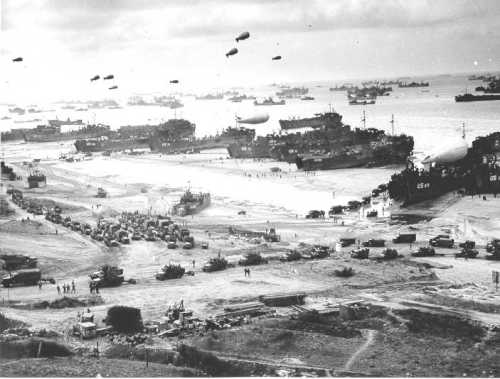
Despite conflicts between the Americans and British political and military leadership the planning for the Normandy landings detailed in NEPTUNE and OVERLORD moved ahead.  General Dwight Eisenhower was appointed as the commander of SHAEF with his major subordinates for Land, Air and Sea which caused consternation on both sides of the Atlantic.[v] [vi] The planned operation was expanded from the initial 3 division assault on a narrow front to a minimum 5 division assault on a broad front across Normandy[vii] supplemented by a strong airborne force.[viii] Overall the plan as it developed reflected a distinctly “American willingness to confront the enemy head-on in a collision which Britain’s leaders had sought for so long to defer.”[ix] It is ironic in a sense that the British avoidance of the head on attack was based on their known lack of manpower.  Britain had few infantry reserves to sustain the war effort and the Americans only late recognized their own deficiency in both quantity and quality of infantry forces on which their strategy depended.  That the western allies, so rich in material and natural resources would be so deficient in infantry manpower was a key constraint on the subsequent campaign in France and Germany.  The shortage of infantry forces would cause great consternation among the Allies as the campaign in France wore on. The Germans too faced manpower shortages due to the immense losses sustained on the Eastern front, those lost in Africa and those tied down in Italy, the Balkans and Norway as well as the drain caused by Luftwaffe Field Divisions and troops diverted into the Waffen-SS.   The German Army resorted to smaller divisions and the created many “static” divisions manned by elderly or invalid Germans to plug the gaps along the Atlantic wall. The Germans were also forced to recruit “Volksdeutsch” and foreign “volunteers” to fill out both Wehrmacht and Waffen-SS formations.

omaha_beach_low_tideOmaha Beach

Prior to the final decision to mount an invasion the Allied planners had contended with the location of the assault in northwestern France.  The Pas de Calais provided a direct route was rejected because it was where the Germans would expect the strike to occur and because it was where the German defenses were strongest.  The fiasco at Dieppe had provided ample proof of what could happen when making an assault into a heavily fortified port.  Likewise the mouth of the Seine near Le Harve was rejected because of the few beaches suitable for landing and because the forces would be split on both sides of the river.  Brittany was excluded due to its distance from the campaigns objectives in Germany.[x] This left Normandy which offered access to a sufficient number of ports and offered some protection from the weather. Normandy offered options to advance the campaign toward the “Breton ports or Le Harve as might be convenient.”[xi] Omaha beach, situated on the center right of the strike would be crucial to the success of the assault situated to the left of UTAH and the right of the British beaches.

Bild 101I-585-2184-33Outnumbered Paratroops of II Fallschirmjaeger Corps Delayed US Forces Considerably in Normandy
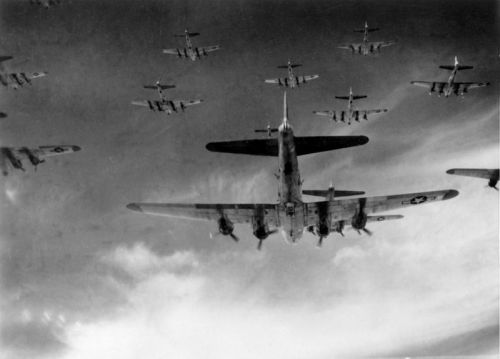
Once Normandy was selected as the location for the strike by the Allies, the planning sessions remained contentious.  This was especially true when the Allies debated the amount and type of amphibious lift that could be provided for the landings, particularly the larger types of landing ships and craft to support the Normandy invasion and the planned invasion of southern France, Operation ANVIL.  The increase in OVERLORD requirements for landing craft had an impact in the Mediterranean and resulted in ANVIL being postponed until later in the summer.

As part of their preparations the Allies launched a massive deception campaign, Operation FORTITUDE.  This operation utilized the fictitious First Army Group under the “command” of General George Patton. Patton was still smarting from his relief of command of 7th Army following slapping commanded an “Army Group” which incorporated the use of dummy camp sites, dummy tanks, aircraft and vehicles, falsified orders of battle and communications to deceive German intelligence.[xii] The success of this effort was heightened by the fact that all German intelligence agents in the U.K. had been neutralized or turned by the British secret service.  Additionally the Luftwaffe’s limited air reconnaissance could only confirm the pre-invasion build ups throughout England without determining the target of the invasion.[xiii] The German intelligence chief in the west, Colonel Baron von Roenne “was deceived by FORTITUDE’s fantasy invasion force for the Pas de Calais.”[xiv] Despite this Commander of the 7th Army recognized by 1943 that Normandy was a likely Allied target and efforts were made to shift 7th Army’s center of gravity from Brittany to Normandy.  The one potential German success in getting wind of when the Allied landings would occur was lost when German intelligence discovered two lines of Verlaine’s “Chason d’ Automme” in June 1944 which were to alert the French Resistance of the invasion.  The security section of 15th Army heard them transmitted on the afternoon of 5 June and notified General Jodl at OKW, but no action was taken to alert forces on the coast.[xv] Allied intelligence was aided by ULTRA intercepts of coded German wireless transmissions. However this was less of a factor than during the African and Italian campaigns as more German communications were sent via secure telephone and telegraph lines vice wireless.[xvi] Allied deception efforts were for the most part successful in identifying German forces deployed in Normandy. However they were uncertain about the location of the 352nd Infantry Division which had been deployed along OMAHA and taken units of the 709th Infantry Division under its command when it moved to the coast.[xvii]

b-17_group_in_formation8th Air Force Bombers Helped Hit German Oil Production Facilities and caused the Luftwaffe to spend its fighter squadrons over Germany than France
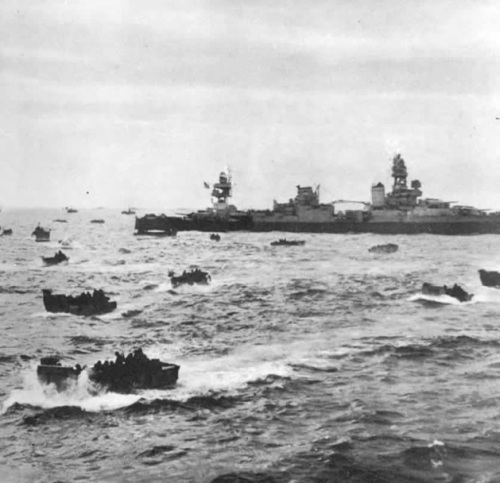
The Allied air campaign leading up to the invasion was based on attempting to isolate the invasion site from German reinforcements. Leigh-Mallory the Air Chief developed the “TRANSPORTATION PLAN” which focused efforts on destroying the French railroad infrastructure.[xviii] A more effective effort was led by General Brereton and his Ninth Air Force which was composed of medium bombers and fighters.  Brereton’s aircraft attacked bridges and rapidly achieved success in crippling German efforts to reinforce Normandy.[xix] Max Hastings gives more credit to the American bombing campaign in Germany to crippling the German defense in the west. General Spaatz and the 8th Air Force destroyed German production capacity in oil and petroleum as well as the degraded the German fighter force.  The American daylight raids so seriously degraded the German fighter force that it could not mount effective resistance to the invasion.[xx] Russell Weigley also notes that Albert Speer the Reich Armaments Minister said that “it was the oil raids of 1944 that decided the war.”[xxi]

omaha_beach_uss_augusta1944Landing craft passing USS Augusta

Planning and preparations for OMAHA were based around getting the 1st and 29th Infantry Divisions ashore and them securing a beachhead “twenty-five kilometers wide and eight or nine kilometers deep.”[xxii] American preparations were thorough and ambitious, but the American assault would go through the most heavily defended sector of German defenses in Normandy.  The landing beaches were wide and bordered by dunes which were nearly impassable to vehicles and “scrub covered bluffs thirty to fifty meters high…rough and impassable to vehicles even to tracked vehicles except at a few places.  The exits were unimproved roads running through four or five draws that cut the bluffs.”[xxiii] Dug in along those bluffs was the better part of the 352nd Division. The Americans compounded their selection of a difficult and heavily defended landing zone the Americans failed to take advantage of many of the “gadgets” that were offered by the British which in hindsight could have aided the Americans greatly.  The Americans made use of two battalions of DD (Dual Drive) tanks but turned down the offer of flail tanks, flamethrower tanks, and engineer tanks, the “funnies” developed by General Hobart and the British 79th Armored Division.[xxiv] Weigley believes that the American view of “tanks as instruments of mobility rather than of breakthrough power.” Likewise the Americans victories in the First World War were won by infantry with little tank support.[xxv] In this aspect the Americans were less receptive to utilizing all available technology to support their landings, something that when considering the fact that Americans were great lovers of gadgets and technology. The British use of the Armor, including the “Funnies” on the beaches to provide direct fire into German strong points lessened their infantry casualties on D-Day. Due to this lack of armor support on the beach American forces on OMAHA had little opportunity to exercise true combined arms operations during the initial landings.[xxvi]

dd-tankDual Drive or DD Tanks took heavy Losses at Omaha
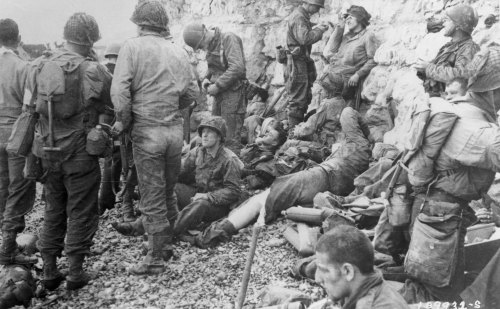
German preparations for an Allied landing in Normandy were less advanced than the Pas de Calais.  However they had made great strides since late 1943. Field Marshal Rommel greatly increased defensive preparations along the front, including the Normandy beaches.  One of Rommel’s initiatives was to deploy Panzer Divisions near the coast where they could rapidly respond to an invasion.  However Rommel did not get everything that he wanted.  The OKW only allotted him two Panzer Divisions to be deployed near the Normandy beaches.  Only one of these the 21st Panzer Division was deployed near Caen in the British sector.  One wonders the result had the 12th SS Panzer Division been deployed behind OMAHA. [xxvii]

OMAHA: The Landings

Like the rest of the Allied invasion forces the 1st and 29th U.S. Infantry Divisions set sail from their embarkation ports with the intent of landing on June 5th.  General Bradley, commanding the First Army until the American XII Army Group would be activated accompanied the invasion force.  The OMAHA landing was under the command of General Gerow and his V Corps while VII Corps led by the 4th Infantry Division landed at Utah supported by airdrops of the 82nd and 101st Airborne Divisions inland.  American command and control during the invasion was exercised from sea as in the Pacific, although General Officers were to go ashore with each of the American divisions.  A severe channel storm disrupted the plan to land on the 5th and Eisenhower delayed the invasion one day catching a break in the weather and electing to go on the 6th.[xxviii] This delay while uncomfortable for the embarked troops caused the Germans to believe that no invasion would take place until the next favorable tide and moon cycle later in the month.[xxix] The assumption that no invasion was possible ensured that a number of key senior German leaders, including Rommel were absent from the invasion front when the Allies landed.[xxx]

1st id normandy1st Infantry Divison Troops at the Omaha Beach Sea Wall
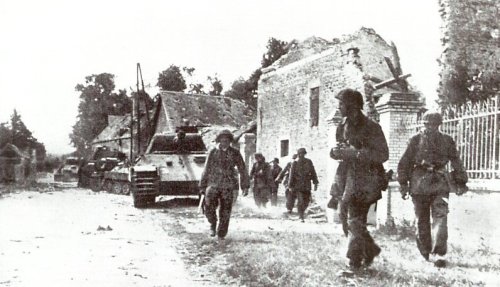
The landing beaches at OMAHA stretched about 6500 meters from Colleville-Sur-Mer to Vierville-Sur-Mere in the west.  The beaches are wide with bluffs overlooking them and a seawall between the beaches and the bluffs.  Additionally several small towns dot the beach. To the west of the town of Vierville, a prominent height overlooked the entire beachhead.  Named Pont du Hoc, it was believed to house a 150mm battery sighted where it could enfilade the OMAHA landing zones.  The Americans assigned to the 2nd Ranger Battalion to make a seaborne assault to land, scale the cliffs and take the battery.  Companies from this battalion made a heroic landing and scaled the cliffs to capture the strongpoint only to discover that the guns had not been emplaced.  The Rangers took heavy casualties and held their isolated beachhead against German counterattacks until relieved by the 29th Division on the morning of June 8th.[xxxi]

H-Hour for OMAHA was 0630.  Unfortunately the assault troops were transferred to their LCVP landing craft 16-20 kilometers from the beach.  The result was a long and dangerous ride in the small craft for the infantry.  Most of the infantry were completely soaked in sea spay and seasick before going ashore and they carried loads far above what they normally would carry into battle.[xxxii] The Armor support was one battalion of DD tanks, the 741st Armored Battalion, supporting the 16th Infantry Refiment of 1st Infantry Division. These were also launched too far out and nearly all of the tanks were swamped and lost before firing a shot in anger.[xxxiii] Other American support units needed to provide firepower on the beach were equally unfortunate. Weigley notes that at OMAHA “at least 10 of the LCVPs sank” as did “the craft carrying almost all of the 105mm howitzers that were to be the first artillery ashore after the tanks.”[xxxiv] The losses would cripple the assault on OMAHA and nearly cause its abandonment.

panzer111Panzers and Grenadiers in Normandy

As the soldiers of the American divisions on OMAHA came ashore they faced German defenders of the 352nd, 716th and a regiment of the 709th Infantry Division, the latter under the tactical command of the 352nd.   Without the bulk of their tanks artillery and lacking close air support the Americans struggled across the beaches and were cut down in large numbers before being pinned down behind the sea wall.[xxxv] With the Americans pinned down on the beach unable to advance, the time tables for the reinforcing waves became snarled amid the German beach obstacles which had not been cleared.  This was in large part due to 40% casualties among the Combat Engineers and the loss of all but five bulldozers.[xxxvi] Naval officers were frustrated in their attempts to provide naval gunfire support by the lack of identifiable targets on the beaches.  Yet German strongpoint’s were “knocked out by either by superbly directed vigorous gunfire from destroyers steaming as close as 800 yards offshore, or by determined action from Rangers or infantry.[xxxvii]

Soldiers ashore discovered that they were not facing the static 716th Division but the veteran 352nd Division as well.[xxxviii] Only the leadership and actions of Brigadier General Norman Cota the 29th Division’s Deputy Commander and Colonel Charles Canham of the 116th Infantry kept the situation from complete collapse.  They were able to rally their troops. Under their leadership small units from the 116th which had its linage back to the “Stonewall Brigade” as well as elements of the 16th and 18th Infantry Regiments began to move forward.  Surviving junior leaders began to lead survivors through the dunes and up the bluffs to attack German defenders of the roads leading up from the beach from the flank and rear.  A mid-day break in the weather allowed some close tactical air support giving the troops badly needed support.

With the situation desperate General Bradley considered the evacuation of OMAHA.  At sea events were as confused as Bradley and his staff attempted to make sense of what was going on.  Even later in the evening there was discussion of diverting all further reinforcements from OMAHA to the British beaches.[xxxix]At 1330 hours “Gerow signaled Bradley: “Troops formerly pinned down on beaches…advancing up heights behind beaches.”[xl] By the end of the day Bradley’s aid Major Hansen noted Bradley’s comments to Collins: “They are digging in on Omaha beach with their fingernails. I hope they can push in and get some stuff ashore.”  And Montgomery: “Someday I’ll tell Gen[eral] Eisenhower just how close it was for a few hours.”[xli]

me-at-normandy

The Author Teaching at Point du Hoc in 2004

The landings at OMAHA succeeded at a cost of over 2000 casualties.  Critical to the success of the landings were the German inability to reinforce their defending troops on the beach.  Likewise the weakness of the units available to mount the standard counterattack that was critical to German defensive plans on D-Day itself kept the Germans from driving the Americans back into the Channel. The 352nd Division fought superbly under the full weight of V Corps and the British XXX Corps on its right suffering heavy casualties as they contested every inch of ground.  The 716th Division composed of second rate troops melted under the onslaught.  Allied air supremacy played a key role as sorties by the 8th and 9th Air Forces helped keep German reinforcements from arriving and interdicted counter attacks inland.  Weigley credits the Allied air superiority with the success of the landings and with limiting casualties.[xlii] Von Rundstedt and other German commanders in France were limited by the delay and refusal of Hitler and OKW to release Panzer reserves when needed most early on June 6th.  By the close of D-Day allied forces had secured the five invasion beaches but not achieved their objectives of taking Caen and Bayuex.  Since the forces on the various beachheads had not linked up the beaches would have been extremely vulnerable had the Germans been able to mount a rapid counterattack by Panzers and strong infantry formations as they had at Salerno.

Major Battles to the Breakout at Avranches


Securing the Beachheads:

It took the V and VII Corps nearly a week to secure the beachheads. German forces including the stalwart 352nd Division resisted stubbornly and mounted sharp local counterattacks which kept the Americans off balance.  Elements of the 29th Division and the 90th Division began to push inland and to expand the beachhead toward UTAH. Opposed by the 352nd Division and elements of the 91st Airlanding Division and other non-divisional units the fighting revealed the inexperience of the American infantry formations and the uneven quality of their leadership.  As the Americans tackled the Germans in the labyrinth of the Bocage country the defensive skill of the Germans cost many American lives and delayed the joining of the beachheads. On the 13th the link up was solid enough to enabling the Americans to conduct the follow up operations needed to expand the beachhead, secure Cherbourg and clear the Cotentin.

tiger-tank normandyTiger Tank and Crew in Normandy

In some American divisions the hard fighting triggered a leadership crisis.  The lack of success of the 90th Division led General “Lightening Joe” Collins of VII Corps relieve the division commander and two regimental commanders of command, a portent of things to come with other American units.[xliii] As the V and VII corps pushed into the “Bocage” they were followed by a massive build up of troops and equipment delivered to the beaches and to the artificial “Mulberry” harbors.  Despite their numeric superiority, air supremacy and massive Naval gunfire support and facing the weakened 352nd, 91st and the 6th Parachute Regiment and other less than quality formations, survivors of the static divisions, the Americans made painfully slow progress as they moved off the beachhead and into the Bocage.[xliv]

The Capture of Cherbourg

Once the beachheads had been consolidated the Americans turned their attention toward Cherbourg. Cherbourg was the major naval port at the far northwest tip of the Cotentin.  D-Day planners counted on its swift capture and rehabilitation to serve as a supply port for the Allied forces. The 9th Division drove south to the coast near Barneville on the 18th of June cutting off the German forces covering the approaches to Cherbourg.[xlv] This put the Germans in a bind as the 7th Army “had to split its forces in the peninsula in order to hold the fortress a little longer and thus to gain time for the establishment of the southern front on the Cotentin peninsula.[xlvi] The German forces arrayed before Cherbourg waged a desperate defense centered around the 243rd Infantry Division and other assorted battle groups of LXXXIV Corps, whose commander General Marcks one of the best German Generals was killed in action on 12 June.[xlvii] The U.S. VII Corps under Collins with the 9th, 4th and 79th Divisions pushed up the peninsula capturing Cherbourg on June 29th.  Bradley pushed hard for the capture of the port as the Mulberries had been ravaged by a severe Channel storm the week prior. The port of Cherbourg was thoroughly demolished by German engineers and would not be fully operational for months. The loss of the Mulberries and delay in Cherbourg’s availability meant that few supplies were landed on the beaches would “hinder the escape from the constricting land of the hedgerows into which the Americans had come in search of a port.[xlviii]

The Battle of Caumont Gap

V Corps under Gerow made a cautious advance by phase lines toward Caumont, St Lo and Carentan.  The deliberate advance by the Corps toward a line weakly held by the Reconnaissance battalion of the 17th SS Panzer Grenadier Division was directed by Bradley who did not want to divert attention from the effort against Cherbourg.   After capturing Caumont V Corps halted and continued aggressive patrolling to deceive the Germans while digging in.[xlix] The possibility existed that a strong push against the weak German line could have led to an opportunity to envelope the German line west of Caen. This was a missed opportunity that in part led to the bloody and controversial campaign to capture Caen.[l]

British efforts around Caen

Montgomery had ambitious plans to break out of Normandy by capturing Caen on D-Day and driving toward Falaise and Argentan.  The British plans for this were frustrated by the rapid reinforcement of the sector by the Germans and the activities of 21st Panzer, Panzer Lehr, and the 12th SS Panzer Divisions.  A flanking maneuver at Villers-Bocage was frustrated by a few Tiger tanks led by the legendary Waffen SS Panzer commander Captain Michael Wittman whose tanks devastated a British Armored battalion.[li] A series of disastrous attacks toward Caen (EPSOM, CHARNWOOD and GOODWOOD) strongly supported by air strikes and Naval gunfire finally succeeded in taking that unfortunate city on July 18th but failed to take the heights beyond the town.[lii] Against crack well dug in German forces the British took heavy casualties in tanks and infantry seriously straining their ability to conduct high intensity combat operations in the future.[liii] The one benefit, which Montgomery would claim after the war as his original plan was that German forces were fixed before Caen and ground down so they could not be used against Bradley’s breakout in the west at St Lo.[liv]

Holding the line Michael_Wittmann_auf_Panzer_VI_(Tiger_I)Panzer Ace Captain Michael Wittmann on His Tiger Tank
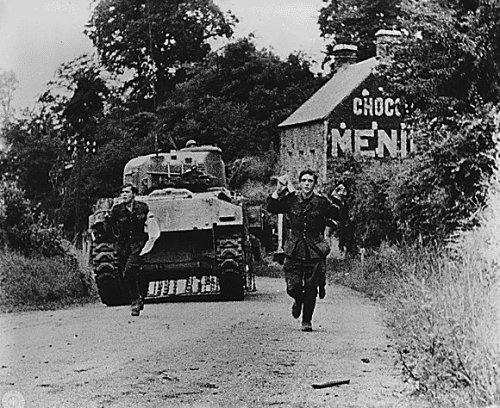
Clearing the Bocage: The Battle of the Cotentin Plain

Other German forces arrived, and reinforced the Caumont gap which no longer “yawned invitingly in front of V Corps.” [lv] Bradley wished to push forward rapidly to achieve a breakthrough in the American sector.[lvi] Facing the most difficult terrain in France amid the Bocage and swamps that limited avenues of approach to the American divisions committed to the offensive.  The Americans now faced their old foe the 352nd division as well various elements of II Parachute Corps, the 17th SS Panzer Grenadier and Panzer Lehr Divisions.  American tanks and infantry made slow progress and incurred high losses as they dueled the Germans at close range.  In the VIII Corps sector alone the attack “consumed twelve days and 10,000 casualties to cross eleven kilometers of the Bocage…the achievements of the VII and XIX Corps were no better than comparable.[lvii]

St. Lo

St. Lo was a key to Bradley’s breakout efforts.  His Army had to capture it and the roads leading out of it to launch Operation COBRA along the coast.  The task of capturing St. Lo was assigned to GEROW’S V Corps and Corlett’s XIX Corps.  They faced opposition from the tough paratroops of the German 3rd Parachute Division of II Parachute Corps.  The 2nd, 29th, 30th and 83rd Divisions fought a tough battle advancing eleven kilometers again with high numbers of casualties especially among the infantry to secure St. Lo on 18 July.[lviii] They finally had cleared the hedgerows.  St Lo epitomized the struggle that the American Army had to overcome in the Bocage.  Hard fighting but outnumbered German troops in excellent defensive country exacted a terrible price in American blood despite the Allied control of the skies.[lix]

st-loUS Tanks and German Prisoners at St Lo

Operation COBRA

With the Bocage behind him Bradley desired to push the Germans hard.  COBRA was his plan to break out of Normandy.  Bradley ably assisted by Collins they realized that the better terrain, road networks favored a breakout.  American preparations included a technical advance that allowed tanks to plow through hedgerows. This was the “Rhino” device fashioned by American troops which was installed on 3 of every 5 First Army Tanks for the operation.[lx] VII Corps was to lead the attack which was to begin on July 24th. American planning was more advanced than in past operations.  Collins and Bradley planned for exploitation operations once the breakthrough had been made. A massive air bombardment would precede the attack along with an artillery barrage by Collins corps artillery which was reinforced by additional battalions.   A mistake by the heavy bombers in the 24th resulted in the American troops being hit with heavy casualties and a postponement of the attack until the 25th.[lxi] The following day the attack commenced.  Another mistake by the bombers led to more American casualties[lxii] but VII Corps units pressed forward against the determined resistance of the survivors of Panzer Lehr and the remnants of units that had fought the Americans since the invasion began.  Although it was a “slow go” on the 25th Bradley and his commanders were already planning for and beginning to execute the breakout before the Germans could move up reinforcements.  The 26th of June brought renewed attacks accompanied by massive air strikes.  While not much progress was made on the 26th, the Americans discovered on the 27th that the German forces were retreating.  The capture of Marigny allowed VIII Corps to begin exploitation down the coastal highway to Coutances.  On the 27th General Patton was authorized to take immediate command of VIII Corps a precursor to the activation of his 3rd Army.  COBRA ripped a hole in the German line and inflicted such heavy casualties on the German 7th Army that it could do little to stop the American push.[lxiii] As the American forces pushed forward they reinforced their left flank absorbing the local German counterattacks which were hampered by the Allied close air support.

Avranches and Beyond

As the breakthrough was exploited the command of the forces leading it shifted to Patton and the newly activated 3rd Army. By the 28th VIII Corps led by the 4th and 6th Armored Divisions had reached Avranches and established bridgeheads over the See River with additional bridges being captured intact on the 30th.[lxiv] The capture of Avranches allowed the Americans to begin exploitation operations into Brittany and east toward the Seine. Weigley notes that for the first time in the campaign that in Patton the Americans finally had a commander who understood strategic maneuver and would use it to great effect.[lxv]

Conclusion

The American campaign in Normandy cost the U.S. Army a great deal. It revealed weaknesses in the infantry, the inferiority of the M4 Sherman tank to most German types, problems in tank-infantry cooperation and also deficiencies in leadership at senior, mid-grade and junior levels. Heavy casualties among infantry formations would lead to problems later in the campaign. Numerous officers were relieved including Division and Regimental commanders.  Nonetheless during the campaign the Americans grew in their ability to coordinate air and ground forces and adapt to the conditions imposed on them by their placement in the Cotentin.  The deficiencies would show up in later battles but the American Army learned its trade even impressing some German commanders on the ground in Normandy.[lxvi]


[i] See the alternative history of by Peter Tsouras Disaster at D-Day: The Germans Defeat the Allies, June 1944, Greenhill Books, London 1994. Tsouras describes the defeat of the Omaha landings and the effect on the course of the campaign leading to the overthrow of Hitler and a negotiated armistice in the west.  While this outcome could be rigorously debated other outcomes could have led to the fall of the Roosevelt and Churchill governments and their replacement by those not committed to unconditional surrender or a continuation of the war that brought about more German missile attacks on the U.K. and the introduction of other advanced German weapons that could have forced such a settlement. Another option could have led to the dropping of the Atomic Bomb on a German city vice Hiroshima.

[ii] Weigley, Russell F. Eisenhower’s Lieutenants: The Campaign of France and Germany, 1944-1945, Indiana University Press, Bloomington IN, 1981 p.33

[iii] Ibid pp. 34-35

[iv] Ibid p.35

[v] General Montgomery 21st Army group and Land Forces, Admiral Sir Bertram Ramsey as Allied Naval Expeditionary Force and Air Marshall Sir Trafford Leigh-Mallory as Commander in Chief Allied Expeditionary Air Force. Weigley p.43

[vi] Max Hastings in Overlord: D-Day and the Battle for Normandy Vintage Books, New York, 1984, comments that many in Britain wondered if Eisenhower with the lack of actual battle experience could be a effective commander and that Eisenhower was disappointed in the appointment of Leigh-Mallory and Ramsey, and had preferred Alexander over Montgomery, pp. 28-29.

[vii] Ibid. Weigley p.40.  Montgomery was the first to object to the 3 division narrow front invasion rightly recognizing that seizing Caen with its road junctions could provide a springboard for the campaign into open country.

[viii] Ibid. p.37

[ix] Hastings, Max. Overlord: D-Day and the Battle for Normandy Vintage Books, New York, 1984 p.29  Hastings finds the irony in the selection of the British officers to execute the plan that reflected the American way of thinking.

[x] The Germans agreed with this in their planning leaving Brittany very lightly defended.  See  Isby, David C. Ed. “The German Army at D-Day: Fighting the Invasion.” p.27 The report of General Blumentritt, Chief of Staff OB West noted that only 3 divisions were assigned to Brittany.

[xi] Ibid. Weigley, pp. 39-40

[xii] Ibid. p.73

[xiii] See Isby p. 69.  General Max Pemsel of 7th Army noted that “During  the spring of 1944, Seventh Army received only tow good photographs of British southern ports, which showed large concentrations of landing craft.”

[xiv] Ibid. Hastings p.63.  Hastings comments also about the success of using the turned Abwehr agents.

[xv] Warlimont, Walter. “Inside Hitler’s Headquarters: 1939-1945.” Translated from theGerman by R.H. Barry. Presidio Press, Novao CA, English Edition Copyright 1964 Wiedenfeld and Nicholson Ltd. Pp.422-423

[xvi] Ibid. Weigley pp. 53-54

[xvii] Ibid. p. 67

[xviii] Ibid. pp.57-64  Weigley spends a great deal of time on the wrangling between Eisenhower, Leigh Mallory and Spaatz on the nature of the plan, the allocation of forces both strategic and tactical assigned to carry it out and its success, or in the light of postwar analysis the lack of effect that it had on German operations.

[xix] Ibid. p.67-68.

[xx] Ibid. Hastings pp. 43-44 In large part due to the long range P-51 Mustang which accompanied the American bombing raids beginning in 1943.  Another comment is that the campaign drew the German fighters home to defend Germany proper and prevented their use in any appreciable numbers over the invasion beaches.

[xxi] Ibid. Weigley p.69

[xxii] Ibid. p.89

[xxiii] Ibid. pp. 88-89

[xxiv] Ibid. p.87

[xxv] Ibid. Weigley also talks about the rejection of General Corlett’s ideas to use Amtracks used by the Marines in the Pacific to land on less desirable, but less defended beaches to lessen casualties on the beaches and the need for additional support equipment even on smooth beaches.  One of Corlett’s criticisms was that too little ammunition was allotted to supporting the landings and not enough supporting equipment was provided. pp. 46-47

[xxvi] Hastings notes that with the strength and firepower of the German forces on OMAHA that many of these vehicles had they been employed would like have ended up destroyed further cluttering the beachhead. “Overlord” p.102

[xxvii] The battle over the deployment of the Panzer Divisions is covered by numerous historians.  The source of the conflict was between Rommel who desired to place the Panzer Divisions on the Coast under his command due to the fear that Allied air superiority would prevent the traditional Panzer counterthrust, General Gyer von Schweppenburg commander of Panzer Group West (Later the 5th Panzer Army) and Field Marshal Von Rundstedt who desired to deploy the divisions order the command of Rundstedt for a counter attack once the invasion had been launched, a strategy which was standard on the Eastern Front, and Hitler who held most of the Panzer reserve including the SS Panzer Divisions under his control at OKW.  Hitler would negotiate a compromise that gave Rommel the satisfaction of having three Panzer Divisions deployed behind coast areas in the Army Group B area of responsibility.  21st Panzer had those duties in Normandy.

[xxviii] Ibid. p.74-75

[xxix] Von Luck, Hans.  “Panzer Commander“ Dell Publishing, New York, 1989 pp. 169-170.  Von Luck a regiment commander in 21st Panzer noted that General Marcks of 84th Corps had predicted a 5 June invasion at a conference May 30th.

[xxx] Almost every D-Day historian talks about the weather factor and its effect on the German high command’s reaction to the invasion.  Rommel was visiting his wife for her birthday and planned to make a call on Hitler. Others including commanders of key divisions such as the 91st Airlanding Division were off to a war game in Rennes and the 21st Panzer Division to Paris.

[xxxi] Ibid. Weigley p. 96

[xxxii] See Cornelius Ryan, “The Longest Day” Popular Library Edition, New York 1959. pp. 189-193 for a vivid description of the challenges faced by soldiers going from ship to landing craft and their ride in to the beaches.

[xxxiii] Ibid. Weigley. p.78 Weigley talks about the order for the tanks to be carried ashore on their LCTs that did not get transmitted to the 741st.

[xxxiv] Ibid.

[xxxv] Ibid. Weigley  p. 87 The weather prevented the aerial bombardment from being effective. Because the bombers could not see their targets they dropped their bomb loads further inland, depriving the infantry of support that they were expecting.  Naval gunfire support had some effect but had to be lifted as the troops hit the beach leaving much of that support to come from Destroyers and specially equipped landing craft which mounted rockets and guns.

[xxxvi] Ibid. Hastings. pp. 90-91.

[xxxvii] Ibid. p.99

[xxxviii] Ibid. Weigley p.80

[xxxix] Ibid. p.101  Also see Weigley p.80

[xl] Ibid. p.99

[xli] Ibid. Weigley. p.95

[xlii] Ibid. p.94

[xliii] Ibid. p.99 Both Weigley and Hastings make note of the failure of both the Americans and British to train their troops to fight in the bocage once they had left the beaches.

[xliv] Ibid. Hastings. pp.152-153

[xlv] Ibid. Weigley p.101

[xlvi] Isby, David C., Ed. “Fighting in Normandy: The German Army from D-Day to Villers-Bocage.” Greenhill Books, London,  2001.  p.143

[xlvii] Ibid. Hastings p.173 Allied fighter bombers exacted a fearful toll among German commanders. The Commanders of the 243rd and 77th Divisions fighting in the Cotentin were also killed by air attacks on the 17th and 18th.   Further east facing the British the commander of the 12th SS Panzer Division, Fritz Witt on the 17th.

[xlviii] Ibid. Weigley. p.108

[xlix] Ibid. p.111-112.

[l] Ibid.

[li] The efforts of the 51st Highland Division and 7th Armored Division were turned aside by the Germans in the area and were dramatized by the destruction of  a British armored battalion by SS Captain Michael Wittman and his platoon of Tiger tanks.  See Hastings pp.131-135.

[lii] The British 8th Corps under General O’Connor lost 270 tanks and 1,500 men on 18 July attempting to crack the German gun line on the ridge beyond Caen. Weigley, pp.145-146.

[liii] Hastings comments about the critical British manpower shortage and the pressures on Montgomery to not take heavy casualties that could not be replaced. Overlord. pp.241-242.

[liv] Ibid. Weigley pp.116-120

[lv] Ibid. p.122

[lvi] Ibid. p121 Bradley told Eisenhower “when we hit the enemy this time we will hit him with such power that we can keep going and cause a major disaster.”

[lvii] Ibid. 134

[lviii] Ibid. Weigley. pp. 138-143.  Weigley notes of 40,000 U.S. casualties in Normandy up to the capture of St. Lo that 90% were concentrated among the infantry.

[lix] Weigley quotes the 329th Regiment, 83rd Division historian “We won the battle of Normandy, [but] considering the high price in American lives we lost. P.143. This is actually a provocative statement that reflects America’s aversion to massive casualties in any war.

[lx] Ibid. p.149

[lxi] Ibid. p. 152

[lxii] Ibid. pp. 152-153.  Among the casualties were the command group of the 9th Division’s 3rd Battalion 47th Infantry and General Leslie McNair who had come to observe the assault.

[lxiii] Ibid. pp.161-169. Weigley notes the advances in U.S. tactical air support, the employment of massive numbers of U.S. divisions against the depleted German LXXXIV Corps, and the advantage that the “Rhino” device gave to American tanks by giving them the ability to maneuver off the roads for the first time.

[lxiv] Ibid. pp.172-173.

[lxv] Ibid. p.172

[lxvi] Ibid. Isby, David C. “Fighting in Normandy,” p.184, an officer of the 352nd Division referred to the American soldier “was to prove himself a in this terrain an agile and superior fighter.”

Bibliography

Carell, Paul. “Invasion: They’re Coming!” Translated from the German by E. Osers, Bantam, New York 1964.

Hastings, Max. Overlord: D-Day and the Battle for Normandy Vintage Books, New York, 1984

Isby, David C. Ed. “The German Army at D-Day: Fighting the Invasion.” Greenhill Books, London 2004

Isby, David C., Ed. “Fighting in Normandy: The German Army from D-Day to Villers-Bocage.” Greenhill Books, London, 2001.

Ryan, Cornelius, “The Longest Day” Popular Library Edition, New York 1959

Tsouras, Peter. “Disaster at D-Day: The Germans Defeat the Allies, June 1944,” Greenhill Books, London 1994.

Von Luck, Hans.  “Panzer Commander“ Dell Publishing, New York, 1989

Warlimont, Walter. “Inside Hitler’s Headquarters: 1939-1945.” Translated from theGerman by R.H. Barry. Presidio Press, Novao CA, English Edition Copyright 1964 Wiedenfeld and Nicholson Ltd. Warlimont, Walter. “Inside Hitler’s Headquarters: 1939-1945.” Translated from theGerman by R.H. Barry. Presidio Press, Novao CA, English Edition Copyright 1964 Wiedenfeld and Nicholson Ltd.

Weigley, Russell F. Eisenhower’s Lieutenants: The Campaign of France and Germany, 1944-1945, Indiana University Press, Bloomington IN, 1981

5 Comments

Filed under Loose thoughts and musings

Ein Volk Steht Auf: The German Volksturm, Ideology and late war Nazi Strategy

volksturm formationVolksturm Members

One of the more important but little understood parts of the German mobilization to defend the Reich, was the creation of the Volksturm. The Volksturm’s role in Nazi strategy and ideology is often misunderstood more than likely because on the Western Front the Volksturm was not much of a factor.  Of the major chroniclers of the war in Europe only Max Hastings in “Armageddon: The Battle for Germany, 1944-1945” [1] and John Erickson in “The Road to Berlin” [2] devote any attention to the subject.  Others, including B.H. Liddell-Hart’s History of the Second World War,” Chester Wilmont’s “The Struggle for Europe” and Russell Weigley’s “Eisenhower’s Lieutenants” devote no space whatsoever to the Volksturm. This is understandable. The Volksturm was far less effective than Nazi leaders would have hoped in fact militarily it was a failure because of the Nazi Party management of it.  Even German historian Walter Goerlitz’s “History of the German General Staff” devotes only one small passage to the Volksturm.[3] Other German Generals such as Generals Warlimont and Guderian and Field Marshal Kesselring mention the Volksturm but only Guderian goes into any detail about it.[4] Kesselring mentions its “propaganda value” and calls the Volksturm a “fiasco” [5] while limiting his other comments to specific uses of it.  In light of such limited analysis by leading historians David Yelton’s treatment in “Ein Volk Steht Auf”: The German Volksturm and Nazi Strategy, 1944-45 published in The Journal of Military History is highly important.

volksturm trainingVolksturm receiving training on Panzerfaust Anti-Tank Rocket
Yelton’s study is more than an analysis of military value and use of the Volksturm. The Volksturm was more than a military organization.  As a military organization it had many grave deficiencies as do all militias in a State where most able bodied men are already in the regular military components.  However, as an arm of the Nazi Party leadership’s defensive strategy to resist the allies, it played a key role.  It was a political militia designed for total war effort to defend the Germany against the advancing Allied armies in conjunction with the “miracle weapons” which were just beginning to be deployed.  Kesselring notes the propaganda value of the Volksturm, but to understand its place in Nazi strategic thinking, one has to look at the entirety of Nazi political, ideological and military thinking at this point in the war, something that Yelton does well.

Yelton makes an important point regarding Gerhard Weinberg’s assertion that most historians have neglected Germany’s late war strategy and that “Nazi Germany is viewed as having no real, coherent strategy” after 1943.[6] Yelton; like Weinberg shows how Nazi leaders believed in a reversal in the course of the war and how they “began implementing a broad and coherent strategy to this end.”[7] He discusses the influence of Nazi ideological preconceptions which impacted strategy[8] and notes the two primary purposes of the Volksturm were to stalemate the war by making the Allies fight for “every foot of German territory and maximize Allied casualties beyond which their morale…could tolerate”  and more importantly from the Nazi viewpoint to “fanaticize the civilian population ….”[9] From this point Yelton goes into a discussion of the beginnings of the Volksturm. He looks first to the mind of General Guderian[10] who advocated forming a militia to be activated when the Soviets threatened German soil. Guderian saw this in military terms. It was to be under Army Wehrkreis or Military District control on the Eastern Front and not civilian control.  It was the subsequent political machinations of Bormann, Himmler and others which expanded it to the entire nation, and placed it in the hands of Nazi Party Gauleiters who often were antagonistic to the Army.[11]

An important point is that the shift in control from the Wehrmacht Wehrkreis to Bormann’s Nazi Party control was related to the basic Nazi understanding of war, the understanding that the war was a “struggle for existence.”[12] Likewise it was a tenant of Nazi faith in racial ideology was since the the “Master Race” was being defeated by lesser races it had to be the result of “treason or sabotage in the officer corps.”[13] Thus many of the Reich’s political leaders believed that “the key to victory lay in generating a fanatical will to resist among all Germans both civilians and military.”[14] Of course this created more problems in terms of logistics and command and control for military commanders wherever the Volksturm was directed by the more paranoid of the Gauleiters.

The goal of the Volksturm was to maximize Allied casualties in the hope that one of the Allied nations would decide that the war was senseless and drop out.  The Nazis believed that this would take place while the new weapons, jet aircraft and new U-Boats wrested control of the air and sea from the Allies and the V weapons, rockets and missiles brought destruction to Britain.  A second goal was to strengthen the political will of the German population.   This goal included the political aspects of how the Party extended its influence over the military.  The Party gained control of the political indoctrination of recruits, the appointment of National Socialist Leadership Officers and increased roles for Gauleiters in preparing defenses at home and in the military chain of command.[15] Yelton’s study provides a detailed analysis of the psychological conditioning of the Volksturm instituted by Bormann including the use of propaganda and that all Volksturm training should “include some form of National Socialist “schooling.”[16] Bormann ensured that the Volksturm was made up of all components of the “racially superior” Nazi Volksgeimenschaft carefully excluding Jews, other “racially inferior” groups, as well as clergymen who might undermine the people with Christian ideas or were politically divisive or unreliable.[17] Yelton concludes by examining how the Nazi leadership attempted to raise the military value of the Volksturm by appointing Nazis who had military experience as officers. They believed that “the racial superiority of the German Volk would ultimately carry the day against their “inferior Jewish-Bolshevik-Slavic” enemies.[18]

volkssturm posterVolksturm Propaganda Poster

Yelton’s essay is important to the historian of the late war period to understand how Nazi ideology influenced the German war effort. Yelton does a commendable job in analyzing the Volksturm and its role in Nazi strategy in late 1944-45. He makes very good use of original sources as well as historic works and documents, including diaries and operations orders of Hitler, Himmler and others, correspondence between Bormann and Gauleiters.  His use of published and unpublished works dealing with the Volksturm and Nazi ideology, particularly letters and diaries serve as an important source of information about how the closely the Nazis linked ideology to the Volksturm..  Yelton’s conclusions that the Volksturm was a key component of what senior Nazis believed to be a coherent strategy to win the war are convincing.  Gerhard Weinberg also posits this view, and it gains credence when one studies other aspects of German racial war theories.

Yelton’s study shows that a more holistic approach to a military history needs to include political, ideological and other factors that lead to the formation of military strategy. In isolation the creation of the Volksturm makes little sense from a purely military point of view and most of the senior officers believed the Volksturm was a waste of manpower and weaponry.   However, if the Volksturm is viewed as part of Nazi political and racial theory it made perfect sense to Nazi leaders.

Thus, political ideologies are something to consider when one believes an opponent’s strategy is senseless or militarily suspect. Simply looking at the military side of the equation often leads to wrong answers about the nature of the conflict.  This has been the case more often than not in many ongoing conflicts today where religious and political ideology is at the center of the opponent’s resistance. It is understanding idea of the people’s war where the population is mobilized to fight the war even if militarily weak and is often related to defending one’s homeland such as the Taliban in Afghanistan or the Vietnamese who successfully opposed French, Japanese, American and Chinese efforts to subdue them.  Thus understanding helps the reader understand how a badly flawed organization can make perfect sense to the leaders employing it.   This is something that we in the Western World of the early 21st Century are not very good at doing and are currently failing at doing in Afghanistan.  The political or the political-religious ideology that drives people to fight for existence matters as much as the military understanding of the enemy’s strengths and weaknesses.  In World War Two Germany had lost most of the capacity to resist effective under the assault of the Allies and the people had become war weary.  Thus the Volksturm were doomed to fail.  However, had Germany been better organized to meet the Allied threat asymmetrically and not been so militarily defeated conventional sense, the effort of the Volksturm might have brought better results.


[1] Hastings, Max. Armageddon: The Battle for Germany 1944-1945. Alfred A. Knopf, New York, NY. 2004. Hastings’ discussion does not go into detail on the formation or organization of the Volksturm itself. He focuses more incidental aspects of training and employment as well as people’s feelings toward. He does make the connection between increasing Nazi fanaticism and the Volksturm. p.160

[2] Erickson, John. The Road to Berlin” Cassell Military Paperbacks, London, 1983.   Erickson’s best contribution is noting how Martin Bormann and the Party Gauleiters controlled the Volksturm and the turf war that Heinrich Himmler waged to ensure that his Waffen-SS formations would not be deprived of manpower by his erstwhile party comrades. p.399

[3] Goerlitz, Walter. History of the German General Staff,” translated by Brian Battershaw, Westview Press, Boulder and London, 1985. Originally published as Die Deutsche Generalstab Verlag der Frankfurter Hefte, Frankfur am Main, 1953. It is interesting to note that Goerlitz attributes the formation of the Volksturm to Himmler, p.483 something repudiated by General Heinz Guderian and Yelton in this reviewed essay.  At the same time it is understandable to see how Goerlitz reaches his conclusion in light of the fact that Himmler had some control as commander of the Replacement Army.

[4] Guderian, Heinz Panzer Leader translated by Constantine Fitzgibbon, Ballantine Books, New York, New York, 1957.  p. 288

[5] Kesselring, Albrecht. The Memoirs of Field-Marshal Kesselring. Greenhill Military Paperbacks, London, 1997. Originally published as Soldat bis zum letzen Tag Anthenum, Bonn, 1953 and translated by William Kimber, London 1953. p.73.  Kesselring’s comments here come in comparison to the British formation of a Home Guard in 1940. In general Kesselring found these types of units to be worthless and personnel, especially older soldiers brought back on duty with regular units.

[6] Yelton, David K. Ein Volk Steht Auf: The German Volksturm and Nazi Strategy 1944-1945 in The Journal of Military History, October 2000, 64, 4. Research Library p.1061.  Although he fits Weinberg’s thesis that the Germans believed that they could still win the war and developed a strategy to do so Weinberg does not mention the Volksturm in his book although it would be easy to extrapolate from his thesis Yelton’s assertion of the Volksturm being a part of that strategy.

[7] Ibid. p.1062.

[8] Ibid. This is important as the understanding of Nazi ideology in many decisions is downplayed by many purely “military” historians.”  However, Michael Geyer in his essay German Strategy, 1914-1945 in Makers of Modern Strategy from Machiavelli to the Nuclear Age, Peter Paret editor, Princeton University Press, 1986 p.582 talks about the rise of political-ideological strategy in Nazi Germany where Hitler “rejected the traditional analysis of military strengths of the opposing sides….” This could be part of the reason of why many military historians fail to distinguish a discernable strategy on the part of the Germans which the Volksturm was a key element. At the same time this ties in with other over arching aspects of the Nazi war effort going to early actions against the Poles and Russians.

[9] Ibid. Yelton. Pp.1063-1064.

[10] Ibid. Yelton. p.1068. The idea was actually that of Guderian’s Chief of Staff’s predecessor General Huesinger in 1943.

[11] Ibid. Yelton pp. 1065-1066. An interesting note to this discussion is Guderian’s comments that “the Party was less interested in the military qualifications than in the political fanaticism of the men that it appointed to fill the responsible posts.” Guderian, Heinz Panzer Leader translated by Constantine Fitzgibbon, Ballantine Books, New York, New York, 1957.  p. 288  Guderian’s comments are particularly relevant because he recognized that the political and ideological components of the organization outweighed the military.

[12] Ibid. Yelton p.1067  General Walter Warlimont notes that General Keitel countersigned the order forming the Volksturm with Bormann and that the order “charged the Party with the formation and leadership of this “last levy.” Warlimont, Walter. Inside Hitler’s Headquarters 1939-45 translated by R.H. Barry. Presidio Press, Novato CA. 1964. Originally published in Germany under the title Im Hauptquarier der Deutschen Wehrmacht 1939-1945 Bernard und Graefe Verlag. p.479  It is interesting to note that as such this was a political and ideological decision versus a purely military one.

[13] Ibid. Yelton p. 1068

[14] Ibid. Yelton p. 1069

[15] Ibid. Yelton. pp. 1071-1072. Guderian noted how the Gauleiters on the Eastern Front would go directly to Bormann when conflict arose with the Wehrmacht. Panzer Leader p. 289

[16] Ibid. Yelton. p. 1075

[17] Ibid. Yelton pp. 1077-1079

[18] Ibid. Yelton. p.1082

Leave a comment

Filed under History, Military, world war two in europe