Tag Archives: US Grant

Gettysburg, Vicksburg and the Campaign of 1863: The Relationship between Strategy and Operational Art

american14_5

Today we look at the Gettysburg Campaign in terms of how we understand the connection between strategy and operational art. In doing so we have to place it in the context that Lees campaign has in relationship to the Confederate command relationships and where it fits in the continuum of unified action as we understand it today.

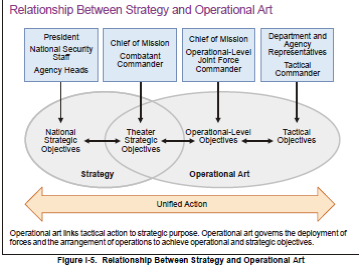
To do so we have to make the connection between national strategic objectives, theater objectives, operational objective and tactical objectives. We have to explore command and control structures, staff organization and the understand the effect of the Diplomatic, Informational, Economic and Military elements of national power that impact a nations ability to wage war.

fig 1-5 jp-03

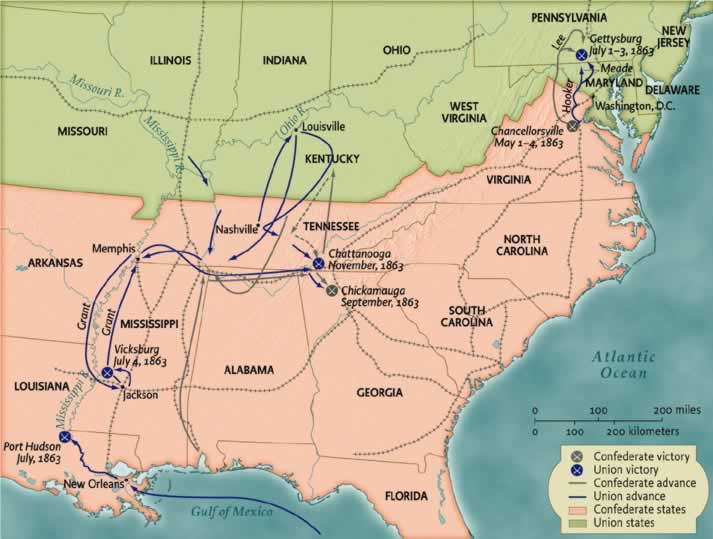
The summer campaign of 1863 in the Civil War gives us the opportunity to do this as we explore the Gettysburg campaign in relation to Vicksburg and the overall strategic situation that both sides faced.

The Confederacy had a twofold problem in its organization for war and how it conducted the war. First it had no organization at the strategic level to direct the war and it never developed a grand strategy from which its national strategic objectives could be translated for action at the theater, operational and tactical levels of warfare.

The overarching national strategic objective of the Confederacy was to attain independence. To such ends the governors of the 11 Confederate States raised units to fight any Federal armies which dared to force them back into the Union. The various states controlled the use of their units. Some kept their best units at home, while others dispatched units to Confederate armies such as Lees Army of Northern Virginia. After that there was not much thought given to how to fight the war.

Other than the stated desire for independence and their common hatred of the Yankee,there was little in the way of unity within the Confederate States. Each state viewed itself as an independent nation only loosely bound to the other states. There was much distrust of any attempt to organize a true central government with any actual authority or power in Richmond. Jefferson Davis may have been President but his country was hamstrung by its own internal divisions.

The Confederacy lacked a clear defined command structure to coordinate war efforts. This included its military operations, diplomatic efforts and economy. Jefferson Davis, an able man to be sure was a man given to suspicion and had major personality conflicts with all of his senior commanders save Robert E. Lee. These conflicts did impact operations, just as did the refusal of various states to support operations or campaigns apart from ones that impacted their state directly.

While Jefferson Davis and his Secretary of War theoretically exercised direction of the war no formal mechanism existed to coordinate the needs of the various military departments or armies. In effect each army operated independently often competing with each other for the troops, supplies and materials needed to fight, as well as having to contend with recalcitrant state governments, each loathe to sacrifice anything that might compromise their own independence. Attempts by the authorities in Richmond to centralize some measure of authority were met with resistance by the states. Thus statesrights were not only the cause of the war, but also the cause of the Confederate downfall.[i]

In a country as vast as the Confederacy that lacked the industry, transportation infrastructure, population and economic power of the North this was a hindrance that could not be overcome by the soldierly abilities of its armies alone.

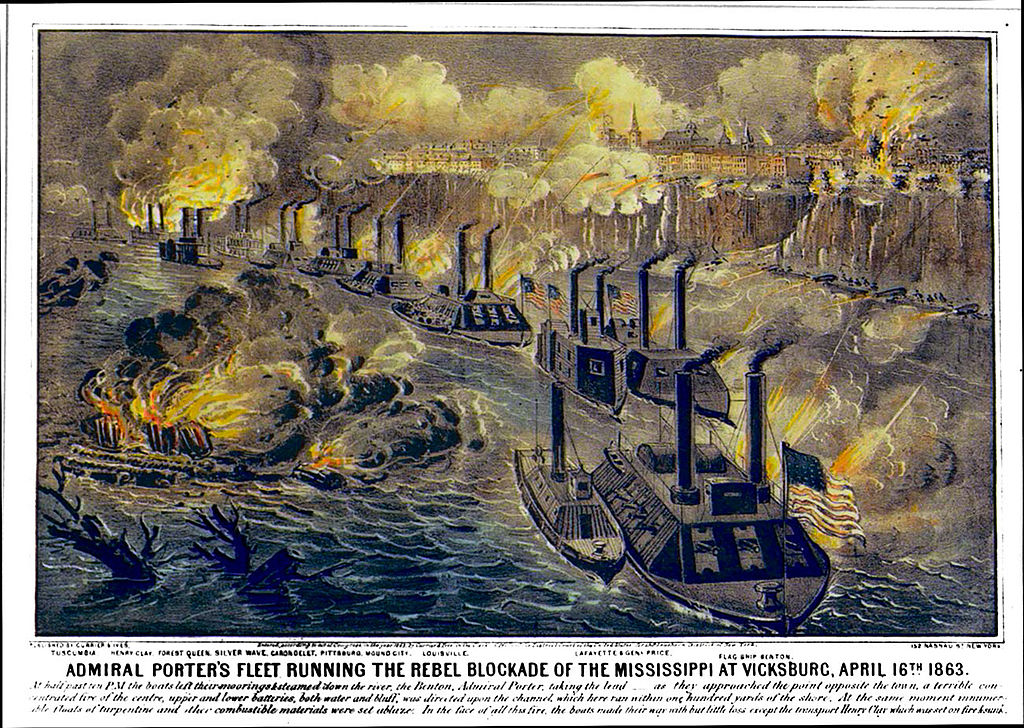
VicksburgBlockade

This had a direct effect on the campaign of 1863. In the west, Confederate commanders were very much left to fend for themselves and to add to their misery failed even to coordinate their activities to meet the threat of Grant and his naval commander, Admiral David Dixon Porter. In the East, Lee having established a close relationship with Jefferson Davis as his military advisor during the first year of the war exercised a disproportionate influence on the overall strategy of the Confederacy.

Lee in theory was simply one of a number of army or department commanders, yet he was responsible for a decision that impacted the entire war effort. The Confederate cabinet could reject Lees proposal as readily as that of any other department commander, Bragg, or Pemberton or Beauregard, for example, each of whom was zealous to protect the interests of the region for which he was responsible…” But this was Lee, the first soldier of the Confederacy- the first soldier of the world…”[i] Lees plan was approved by the cabinet by a vote of five to one. The lone dissenter was Postmaster General John H. Reagan who believed a fatal mistake had been made…”[ii]

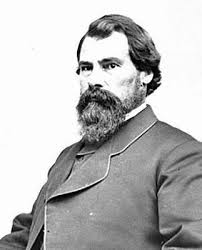
reagan

The Lone Dissenter, Postmaster General John H Reagan

Lees decision to launch an invasion of the north in hopes of a quick victory to secure independence had numerous adverse effects on the broader needs of the Confederacy at a time when the Confederacy had little room for a misstep. Lee was a remarkable commander at the operational level but his military thinking process was very much Napoleonic. To succeed Lees design required a climactic Napoleonic battle,[iii] to defeat Union armies and this was something that his new opponent Meade would not allow.

The lack of any sense of unity in the Confederate hierarchy was disastrous. The lack of agreement on a grand strategy and the inability of the Confederate States Government and the various state governments to cooperate at any level culminated in the summer of 1863 with the loss of Vicksburg and the failure of Lees invasion of Pennsylvania.

Confederate army units and their commanders generally excelled on the tactical level, and their soldiers endured hardship well. They displayed amazing individual initiative on the battlefield and they won many victories against superior forces, especially in the early part of the war. But neither the Confederate government nor the various army commanders were able to translate battlefield success to operational, theater specific or national strategic objectives.

This can be contrasted with the Union, which though it was slow to understand the nature of the war did have people who, through trial and error developed a cohesive strategy that led to success at the operational level and the tactical level. George McClellan, whatever his faults as a field commander possessed a strategic design for winning the war,[iv] the necessity of unity of command and successfully built an effective army.

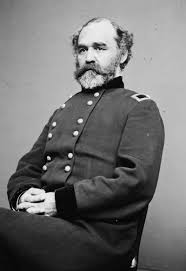
meigs

General Montgomery Meigs, the Logistician

The Union understood the changing nature of modern war and in stark contrast to the inefficient and graft ridden Confederate agencies developed an efficient and well managed War Department where the importance of logistics interbureau cooperation became a paramount concern. The Quartermasters Department under the direction of Quartermaster General Montgomery Meigs was particularly efficient in supplying the needs of a military fighting on exterior lines in multiple theaters of operation.

This had a profound effect on operations. When the Union forces by necessity had to operate in enemy territory they were well supplied whereas whenever Confederate Forces conducted operations in the North or even in friendly Border States they were forced to subsist off the land. This meant that Confederate operations in the north were no more than raids, even the large invasions launched by Lee. They had no staying power to keep and hold any ground that they took in enemy territory. This can be contrasted with the Union which when it sent its forces south meant them to stay. Lee could not fathom this and because he believed that no Federal Army could stand a summer in the Deep South and that Grant would be forced to withdraw. The use of railroads to supply its far flung forces operating in the south as well as its use of maritime transportation along the coast and on inland waterways ensured that its armies could always be supplied.

Henry Halleck was the first true American military theorist who published Elements of Military Art and Science in 1846. While his is often given short shrift because he was not an effective field commander, and had an acerbic personality which rubbed people the wrong way was one of the most important individuals in organizing the eventual Union victory. This included matters of strategy, picking effective subordinate commanders and understanding the logistical foundations of strategy.

Weigley wrote of Halleck:

He sponsored and encouraged the operations of Brigadier General Ulysses. S. Grant and Flag Officer Andrew H. Foote that captured Forts Henry and Donaldson in February 1862 and  thereby opened up the Tennessee and Cumberland Rivers for Union penetration deep into the state of Tennessee and toward the strategically important Memphis and Charleston Railroad. Hallecks insights into the logistical foundations of strategy proved consistently accurate. Throughout the war, he maintained a shrewd eye for logistically viable lines of operation for the Union forces, and he increasingly recognized that one of the most effective weapons of offensive strategy, in an age when battle meant exposure to rifled firepower, was not to aim directly at the enemy armies but at their logistical base.[i]

Halleck was also instrumental in helping to oust Hooker, raise Meade to command the Army of the Potomac. When Lincoln brought Grant east to become General in Chief Halleck took on the new position of Chief of Staff. This was a task that he fulfilled admirably, allowing Grant to remain in the field and ensuring clear communication between Lincoln and Grant as well as relieving Grant of the burden of personally corresponding with his department commanders.[ii]

By establishing what we now understand as the beginning of a modern command and staff organizational structure the Union was far more able to link its national, theater and operational level objectives with its tactical objectives, even when some of its commanders were not as good as Confederates and blundered into defeats.

In the end during the summer of 1863 it was the Union which was better able to link the ends, ways and means of the strategic direction of the war. This is something that Davis and Lee were unable to do as they struggled with political division, a lack of cooperation from the states, and the lack of any true grand strategy.

Lee’s strategy of the offensive was wrong and compounded the problems faced by the Confederacy. The losses that his army suffered were irreplaceable, not just in terms of overall numbers of soldiers but in terms of his mid-level leaders, his battalion, regiment and brigade commanders who suffered grievous losses and were even more critical to the leadership of his army.

Lee recognized the terrible effects of his officer casualties in a letter to General John Bell Hood on May 21st: There never were such men in an Army before. But there is the difficulty- proper commanders- where can they be obtained?[iii] His actions at Gettysburg only added to his crisis in keeping his army supplied with competent commanders, as so many were left dead, wounded or captured during the campaign.

Even had Lee won the battle of Gettysburg his casualties in Union territory would have been prohibitive. He would have spent most of his ammunition, incurred serious losses in personnel and horses, and been burdened by not having to care for his wounded and still been deep in Union territory away from his nearest logistics hub. Had Lee won at Gettysburg his ammunition would have been nearly exhausted in victory, while Federal logistics would have improved as the Army of the Potomac fell back toward the eastern cities.[iv] This would have forced him to withdraw from Pennsylvania even had he been victorious.

It is true that a victory on northern soil might have emboldened the peace party in the North, but even then that could not have an effect on the desired effect on the Lincoln Administration until the election of 1864, still 16 months away. Likewise, in July 1863 such a victory would probably not have triggered foreign recognition or assistance on the part of France or England. Skilful northern diplomacy prevented an internal conflict from becoming an international war.[v] Jefferson Davis held on to his fantasy until August 1863, when even he was forced to deal with reality was a vain hope indeed and ended his diplomatic efforts to bring England into the war.

England would not intervene for many reasons and the Confederate government did not fully appreciate the situation of the countries that they hoped would intervene on their behalf:

its dependence on northern foodstuffs, access to new cotton supplies, turmoil in Europe, fear of what might happen to Canada and to British commerce in a war with the Union, and an unwillingness to side with slavery. The British government also wanted to establish precedents by respecting the blockade, a weapon that it often used.[vi]

Confederate politicians were hindered by a very narrow, parochial view of the world, had little understanding of modern industry, economics and the type of diplomacy employed by Europeans both to strengthen their nations, but also to maintain a balance of power.

As we look at the Gettysburg and Vicksburg campaigns in the summer of 1863 these are important things to consider. The relationship between national strategic objectives, theater objectives, operational objectives and tactical success cannot be minimized. Success on the battlefield alone is almost always insufficient to win a war unless those wins serve a higher operational and strategic purpose, and the costs of battles and campaigns have to be weighed in relation to the strategic benefits that derive from them.

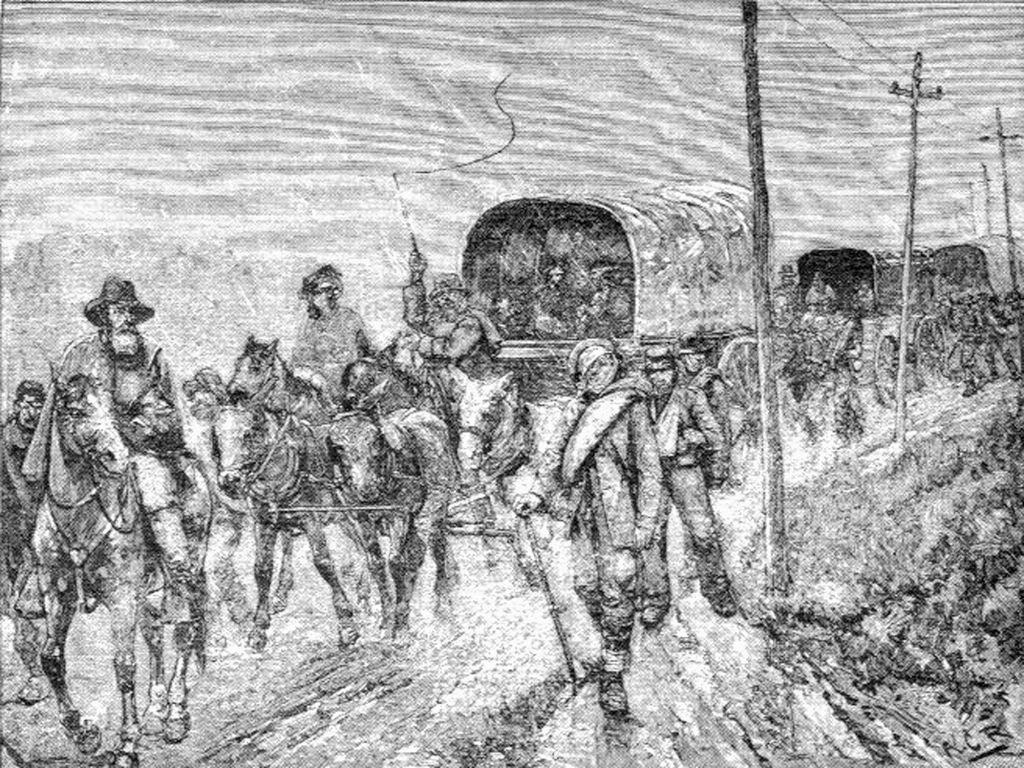
gettysburg retreat

Retreat from Gettysburg

In the end the total failure of the two campaigns destroyed any real hope of Confederate military victory. At Vicksburg the Confederacy lost all of Pembertons army, 33,000 men and Lee suffered over 28,000 casualties from an army which had begun the campaign with about 80,000 troops.

This essay is certainly not an exhaustive look at the subject, but if we do not consider them we cannot really understand the bigger picture of the situation that the two sides faced and how they dealt with them. While the weapons and tactics employed by the sides are obsolete the thought processes and strategic considerations are timeless.

While I will be writing more about the specifics of the battle in the coming days including leadership issues, tactical considerations and even the relationships and friendships between commanders on both sides that transcended the war.

Notes


[i] Ibid. p.429-430

[ii] Millet, Allan R. and Maslowski, Peter, For the Common Defense: A Military History of the United States The Free Press a Division of Macmillan Inc. New York, 1984 p. 221

[iii] Sears, Stephen W Gettsyburg Houghton Mifflin Company Boston and New York, 2004 p.51

[iv] Ibid. Weigley, Russell. The American Way of War p.116

[v] Ibid. Millet and Maslowski p.220

[vi] Ibid.


[i] Foote, Shelby, The Civil War, A Narrative. Volume Two Fredericksburg to Meridian Random House, New York 1963 pp.432-433

[ii] Ibid. p.433

[iii] Weigley, Russell. The American Way of War Indiana University Press, Bloomington Indiana 1974, p.115

[iv] Weigley, Russell F. American Strategy from Its Beginnings through the First World War. In Makers of Modern Strategy, from Machiavelli to the Nuclear Age edited by Paret, Peter, Princeton University Press, Princeton New Jersey 1986. P.429


[i] Fuller, J.F.C Grant and Lee: A Study in Personality and Generalship Indiana University Press, Bloomington Indiana, 1957 p.35

Leave a comment

Filed under civil war, History, leadership, Military

The First Modern War: The American Civil War, its Lessons and Challenges for Today’s Military Planners

Note: This article is one that I am preparing for my Gettysburg Staff Ride in early March. It is more academic and theoretical in its emphasis being directed at those who will be involved in the planning of joint operations at the operational level of war. 

keith-rocco-hell-for-glory-picketts-charge

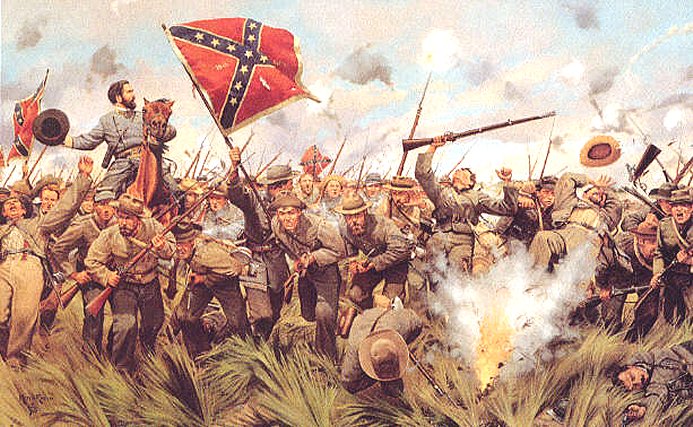
Pickett’s Charge Showcased the Futility of Napoleonic Tactics Against Modern Weaponry

The American Civil War was the first modern war. It was a watershed time which introduced changes in tactics, logistics, communications and the concept of total war to the world. Though it did not change the essential nature of war, which Clausewitz says is “is an act of violence to compel our opponent to fulfil our will.”  What the war did was add new dimensions to war, increased its lethality and for the first time since the 30 Years’ War saw opponents take war to civilian populations as part of a military campaign.

The Civil War was a precursor to the wars that followed. However, like all wars many of its lessons were forgotten by military professionals in the United States as well as in Europe. Thus 50 years later during World War One, British, French, German, Austrian and Russian wasted vast amounts of manpower and destroyed the flower of a generation because they did not heed the lessons of the Civil War.

The lessons of the war are still relevant today. Despite vast advances in weaponry, technology and the distances with which force can be applied by opponents, war remains an act of violence to compel an enemy to fulfill our will. War according to Clausewitz is a “chameleon” which changes its nature to some degree in each particular case, but it is always characterized by the violence of its elements, the province of chance and its subordination to the political objective.

The study of the Civil War can be helpful to the joint planner and commander because it so wonderfully shows the interplay of Clausewitz’s Trinity during an era of great technological change. It is my intent to introduce the reader to the manner in which the military theory and doctrine that dominated American military thought before was applied and changed as a result of the experience gained during the war.

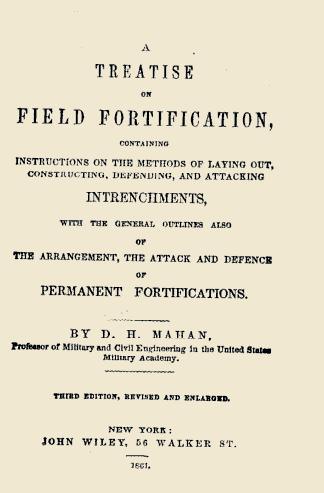
dmahan-treastise

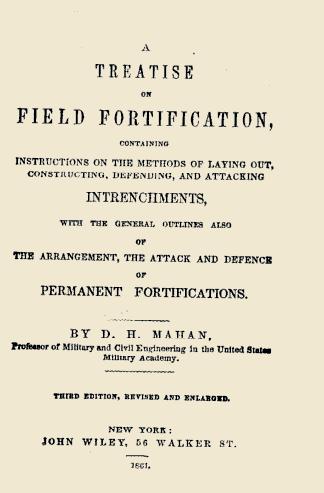
Dennis Hart Mahan’s Book: The First American Book on Military Theory

The professional American army officers on both sides were educated at West Point, VMI or the Citadel. In these institutions they were taught Henri Jomini’s interpretation of Napoleonic warfare and the theories of Dennis Hart Mahan and Henry Halleck.

The war exposed the serious weaknesses in all of these theories which were challenged by advances in weaponry and the vastness of the American continent.  During the war both Union and Confederate armies learned to value field fortifications and the limitations of the artillery of the day during offensive operations.

Logistics influenced campaigning on the American continent much more than previous European wars.  An example can be found in Lee’s Gettysburg Campaign where he had to travel far from his railheads and bases of supply, meaning that he had to live off the land in enemy territory. The concept of total war found its first application in the campaigns of General William Tecumseh Sherman and Robert E. Lee’s use of defensive maneuver and fortifications in positional warfare heralded a new era in warfare.

These factors influenced and affected the Union and Confederate armies as they campaigned. Likewise, the advances weaponry particularly the rifled musket, posed a conundrum for officers educated in the Napoleonic tactics that both armies began the war. Those tactics were developed at a time when the maximum effective range of muskets was barely 100 meters. Yet by 1860 the rifled muskets had an effective range of about 400 meters, and the advent of the repeating rifle increased the firepower available to individual soldiers.  Yet despite the increase in range and accuracy that came with the rifled musket tactics were slow to change.

Ante-bellum US Army leadership was most influenced by the theories of Henri Jomini, Clausewitz had yet to make his appearance in America. Dennis Hart Mahan, a professor at West Point challenged Jominian orthodoxy and modified the current orthodoxy by rejecting its central tenants-primarily offensive assault tactics.”[i] Thus there was a tension in American military thought between the followers of Jomini and Mahan. Conservative Jominian thinking predominated much of the Army, and within the army “Mahan’s decrees failed to win universal applause.”[ii]

However, Mahan did influence many future leaders of both the Union and Confederate armies who participated in his “Napoleon Club,” a military round table at West Point. [iii] Mahan’s greatest contributions were his development of the active defense and emphasis on victory through maneuver. Mahan’s thought contrasted with that of Jomini who thought maneuver was risky and believed that purpose of war was the “defeat of the enemy’s army.” As we look the Gettysburg campaign it is important to note how much Lee was affected by the thought of Jomini as he attempted to defeat the Army of the Potomac, while ignoring the advice of Longstreet to use maneuver and active defense too his advantage.

Mahan emphasized the use of “maneuver to occupy the enemy’s territory or strategic points.” [iv] Edward Hagerman wrestles with the disjointed developments in infantry, artillery and cavalry tactics of the ante-bellum Army in his book The American Civil War and the Origins of Modern Warfare.  Hagerman surmised that “Military thinking, and even more strategic organization, remained essentially within the Napoleonic tradition filtered through an eighteenth-century world view….” He asserted that “A broader vision was necessary to pose an alternative to the mechanistic program.”[v]

The leaders who organized the vast armies that fought during the war were influenced more than military factors. Social, political, economic, scientific and even religious factors influenced their conduct of the war. Commanders educated at West Point who had previously commanded small units were faced with the task of organizing, training and employing large armies made up primarily of militia units and volunteers. Most had little experience commanding such units and their experience with militia and volunteer formations during the Mexican War did not increase their appreciation for them or their leaders.

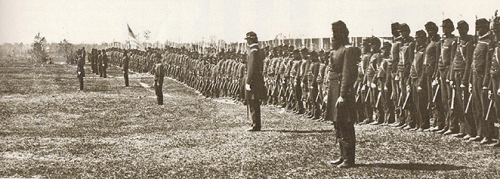
civil-war-2nd-michigan

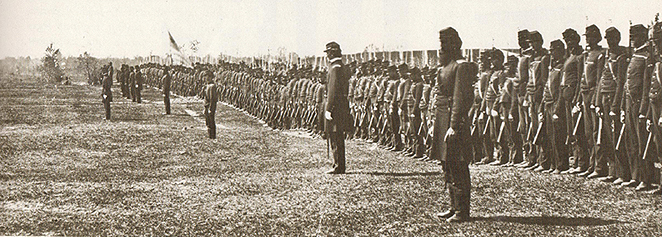
The 2nd Michigan Regiment: Most Civil War Units on both sides were State Regiments

Both armies were changed by the war. Initially both sides sought to fight the war with volunteers. The South began a draft first followed by the Union in 1863. At the beginning of the war General George McClellan successful fought the break-up of the Regular Army. He helped keep it separate from the militia units organized by the States. This preserved a professional core in a time where the new volunteer units were learning their craft. The Confederacy did not have a Regular Army and all of its units were raised by the States and officered by a collection of professionals from the Ante-bellum Army, militia officers, political appointees or anyone with enough money to raise a unit. The draft laws created much consternation in both the Union and Confederate States and the efforts to enforce the draft were filled with controversy and sometimes violence as was evidenced during the New York Draft Riots of 1863 where Union Soldiers, recently victorious at Gettysburg were employed to end the rioting and violence.


civil-war-city-point-dock

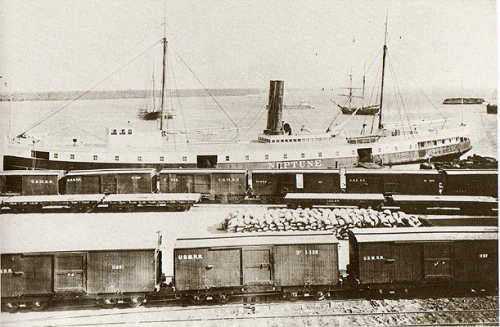
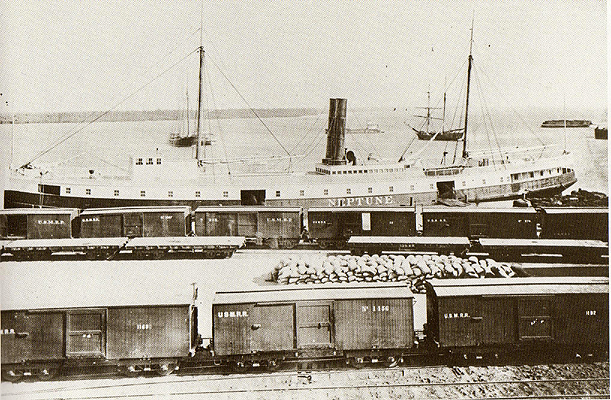
The Integration of Sea and Land Logistics Systems in the Civil War Revolutionized the Way that Modern War is Supplied

The Ante-bellum Army developed its logistic doctrine from Napoleonic examples. That doctrine had to be modified in light of the American reality of a less developed continent with far greater distances involved in the movement of troops. During the war, both armies learned to adapt their logistical support services to the reality of war.

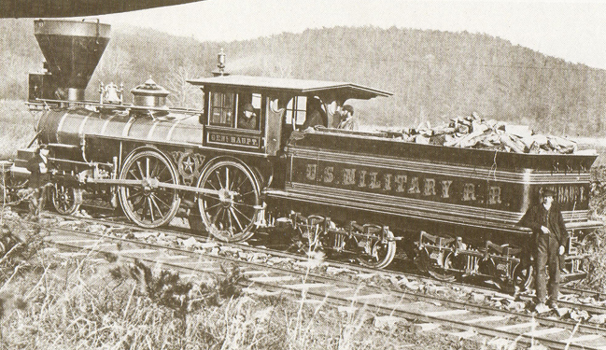
civil-war-locomotive

Railways Meant the Ability to Move Troops and Supplies Great Distances very Quickly

Where possible each side used railroads and maritime forces to move troops and supplies. The Confederacy, lacking in both was at a severe disadvantage. The Union however enjoyed a great advantage in modern rail networks, as well as ocean and river based maritime power. By late 1863 the Army of the Potomac, as well as forces in the West demonstrated “the close integration of operational planning and that of the general in chief and supply bureaus. In this one area, the development of a mature and modern staff was evident.”[vi]

In both armies commanders and their logisticians experimented with the number of wagons per regiment and how army commanders, modified that number at various points during the war based on their situation. Both armies experimented with the use of the “flying column” as a response to the dependency on wagons. The basic load of food and ammunition carried by each soldier in order to increase strategic maneuverability was adjusted to meet the operational need. Both armies often had to live off the land. The success and failure of forage operations and the requirements for people and animals in each theater of operations had a large impact on each army.

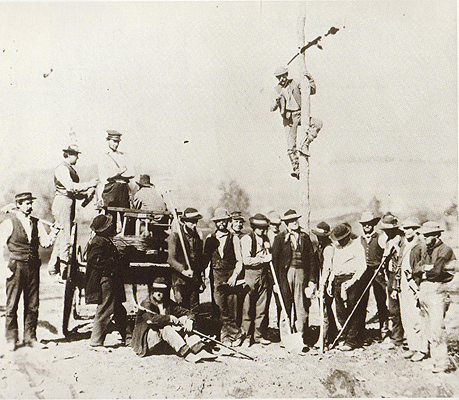
The size of the armies and the distances involved on the battlefield made command and control difficult.  As such communications became more important and each army experimented with new signals organizations that used both old and new communication technologies. At the beginning of the war both sides made extensive use of visual signals and couriers, but rapidly began to rely on the telegraph for rapid communications.

civil-war-us-signal-corps

Signal Corps Soldiers and Wire Communications

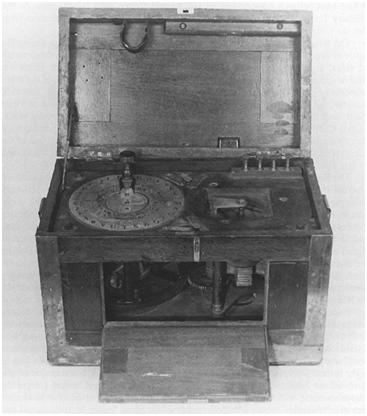
The organizational tension was particularly evident in the rivalry between the U.S. Army Signal Corps and the Military Telegraph Service.  The Signal Corps focused on wireless communications. It preferred the Beardslee wireless telegraphs which had the limitations of such early wireless technology. The Army command favored the traditional wire bound networks operated by the Military Telegraph due to better reliability and security. Though the Army rejected the Beardslee equipment some commanders requested it for their operations. [vii] As each Army became more dependent on the telegraph, each feared that their signals could be compromised through wiretapping and made efforts to encode their transmissions.

03-Beardslee-telegraph-US-Army-photo

The Beardslee Wireless Telegraph 

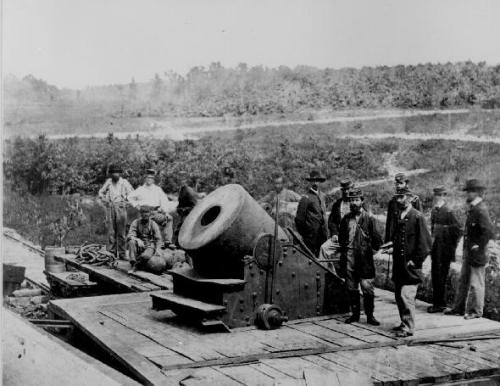
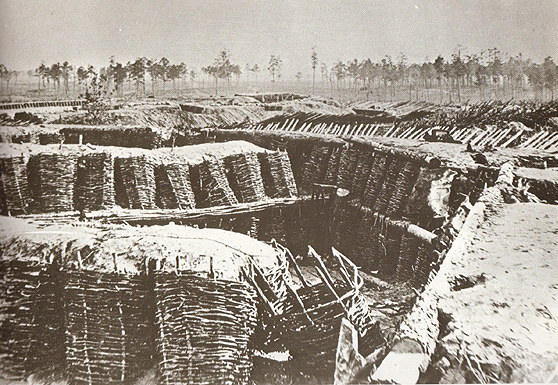
The evolution of how Union and Confederate armies used field fortifications is an interesting topic. McClellan made extensive use of them on the Peninsula in 1861 and Lee made sporadic use of them [viii] until 1864.  Lee made much more use of field fortifications during the Wilderness campaign, the battles around Richmond culminating in the defense of Petersburg.  The developments in field works and firepower gave the advantage to the defense. This was especially the case when opposing armies made the frontal attacks which were at the heart of Jominian offensive tactics.  Early in the war commanders including Grant at Shiloh and Lee at Antietam failed to dig in, but over time both the Union and Confederate armies learned to dig hasty field works as a matter of course.[ix]

dictator

Massive Siege Mortar outside Petersburg

Both sides also learned to use maneuver in combination with positional warfare to force the enemy to battle. Hagerman examines the campaigns in the West of Grant, Sherman and Rosencrans, particularly Stone’s River, the Vicksburg Campaign, and the campaign in middle Tennessee.[x] The last two chapters of Hagerman’s book detail these issues in the context of the 1864-65 campaign around Richmond and Sherman’s campaigns in Georgia and the Carolinas. Of particular note is how Sherman’s forces routinely entrenched on the offensive [xi] and how Confederate forces under Joseph Johnston employed entrenchments on the defensive.

civil-war-earthworks-petersburg Petersburg Fortifications a Harbinger of World War One

Surprisingly, it was Confederate Cavalry commander Joe Wheeler toward the end of the war made use of entrenchments, something not seen before by an arm traditionally known fro maneuver. Hagerman noted that Confederate Cavalry “perhaps best displayed the growing intensity of trench warfare” [xii] by the latter part of the war.

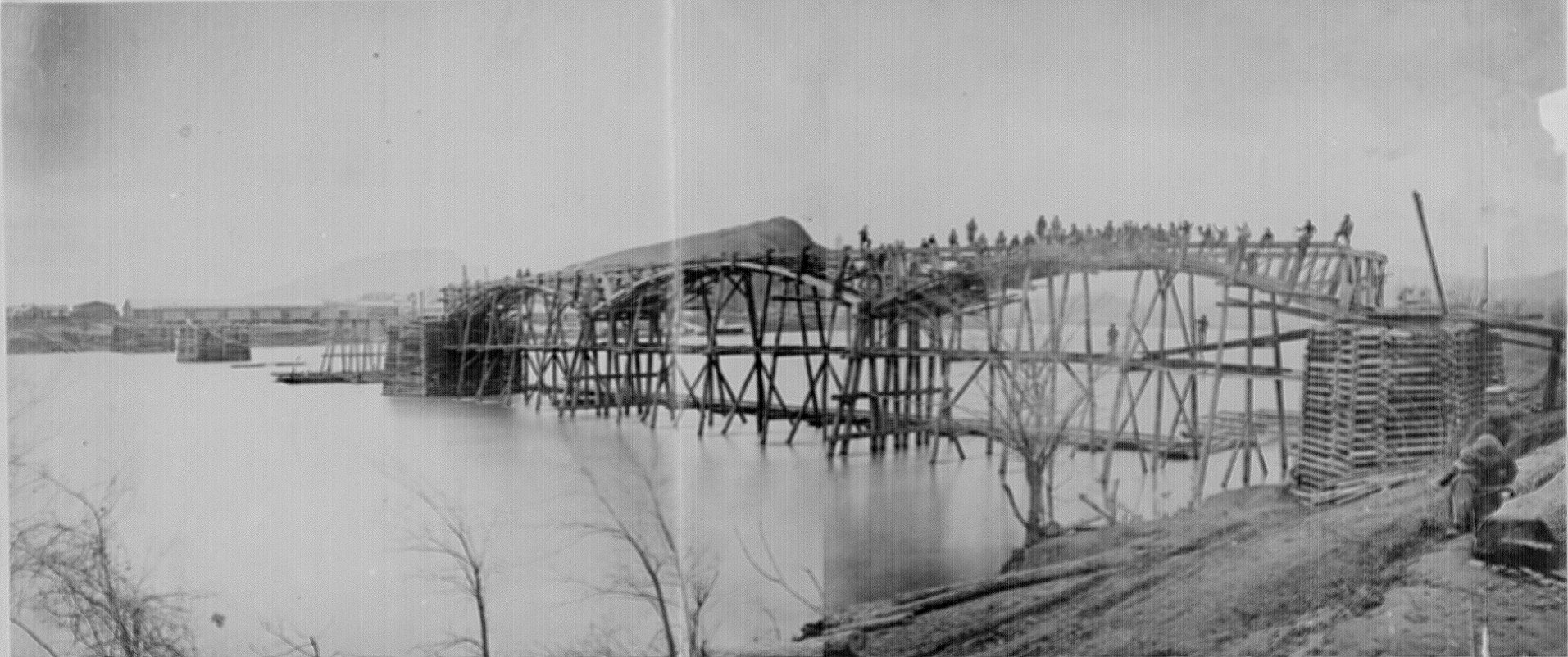
The Corps of Engineers in both armies adapted to the war. Prior to the war the Corps of Engineers was primarily responsible for building coastal fortifications and outposts in the west.  Both sides had to develop Engineer or Pioneer units from scratch in 1861.By the middle of the war organized units of Pioneers and Engineers were enhancing both offensive and defensive operations.

engineers-bridging-tenessee-river

Engineering Units were Built from Scratch and Accomplished Many Feats

The Corps of Engineers initially had a difficult time adapting to war. The dispersion of the Corps among the line and its civil duties were impediments to responding to the needs of war.  There was a hesitancy and resistance to creating engineering units by Congress, despite the pleas of McClellan and Lincoln for specialized engineering units.[xiii] When they were established it was ironic how the newly organized engineer units had few very few West Point trained Corps of Engineers officers. Most Union Engineer Units were primarily staffed and commanded by officers detailed from the line or who had come from civilian life. The effect was a “decline in the antebellum definition of professionalism embodied in the Corps of Engineers” [xiv] which prior to the war were considered the elite branch of the Army.

Strategy and operational level adapted to the new reality of war. Attrition and exhaustion became as important in relation to both positional and maneuver warfare. In 1864 in the East the “ascendancy of positional warfare” allowed Lee to hold out and force Grant into winter quarters at Petersburg.[xv] This demonstrated that “an army fighting on interior lines, even under nearly overwhelming conditions of deprivation and against vastly superior numbers, could sustain a prolonged existence by use of field fortification and defensive maneuver.”[xvi]

shermans-march-through-georgia

Sherman’s March to the Sea

Despite the increasing power of positional warfare in relation to fortifications in the East and around Atlanta, maneuver was not ignored. Sherman’s campaign in Georgia and the Carolinas demonstrated how an army could exploit “diversion, dispersion, and surprise to successfully pursue a modern total-war strategy of exhaustion against the enemy’s resources, communications and will.”[xvii] Sherman used maneuver to force his opponents out of their prepared positions and did not hesitate to target the key infrastructure and infrastructure needed by the Confederate armies. The same was true in Virginia where in 1864 General Phillip Sheridan laid waste to the Shenandoah Valley, the breadbasket of the Army of Northern Virginia.

The developments in tactics, maneuver, defense and logistics and how those were developed over the course of the war brought about a form of warfare that remained dominant of decades. In studying the campaigns, developments and tensions between the theories of Jomini and Mahan in the Civil War a student can begin to recognize them in future wars fought by the US Army including World War Two.

Russell Weigley picks up this theme in his book The American Way of War. Weigley  discusses Grant’s strategy of annihilation and its costs as well as Sherman’s campaign against Johnston and his attack upon Southern resources.[xviii] Weigley’s discussion of tactics used by both sides in the Civil War reflects the thought of British theoretician of J.F.C. Fuller. Fuller noted that “the tactics of this war were not discovered through reflection, but through trial and error.”[xix]

It is important for planners and commanders at the operational level to see the importance the developments of the Civil War on how we campaign today. While the technology is now antiquated, the ideas are not. The campaigns of Grant and Sherman in particular influence modern strategy.  This is reflected the Marine Corps which discusses the maneuver and attrition warfare continuum in MCDP 1 Warfighting.[xx] It is important for students of operational art to be able recognize the these developments and principles in what we do today, to see the logical development of each of these elements in modern war and to find new ways to apply them within the scope of the technologies we now use that those that will be available in the coming years.

traindes

The Destruction of Hood’s Ordnance Train Outside Atlanta

The important things that we learn from studying the various campaigns of the Civil War are timeless. If we only focus on the military aspects of the great battles we miss the really important lessons. The battles and leadership lessons that we learn from them are important. However it is the often arcane but important subjects such as transportation, logistics, communications and fortifications, as well as the diplomatic, economic and informational aspects of the war that are more important.

In his book Hagerman makes an astute observation on how change comes to military organizations. At the end of his discussion of the Corps of Engineers and the Army following the war, he notes “that change in war requires time for digestion before lessons are converted-if they are converted-into theory and doctrine.” [xxi] Such is true in every war.

When the United States entered ground combat operations in the First World War, General John Pershing’s strategy revisited some of the worst mistakes of the Civil War, as well as the bloody lessons learned by the Europeans during the first three years of that war. In light of this one wonders if the lessons were ever fully digested by the Army.

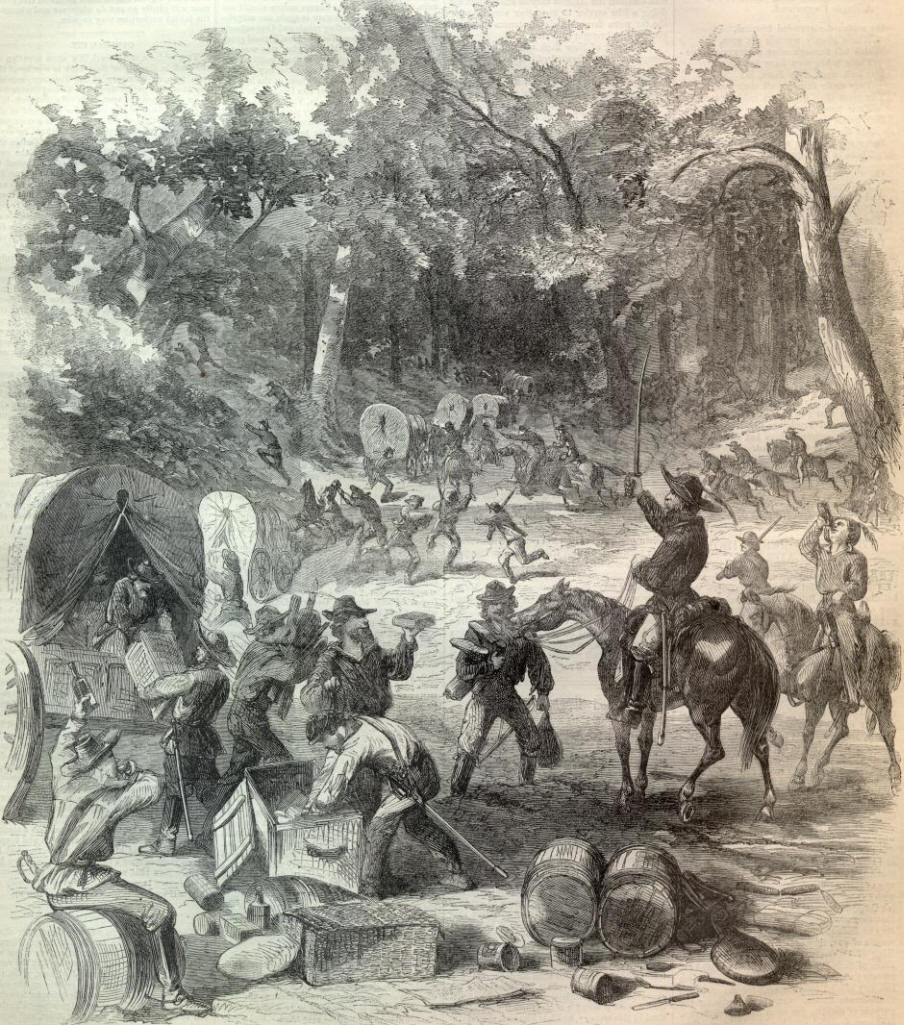
john-mosby-raid

Irregular Formations Such as Mosby’s Raiders Would Create Problems Behind Union Lines, much Like Insurgents in Iraq and Afghanistan 

Such an observation can be made about our present wars. We need to ask if the lessons of previous insurgencies have been digested, even going back to the lessons of the Union Army operating in the hostile lands of the conquered Confederacy.[xxii] Likewise it is fair game for us to examine how our military adjusts to developments in weaponry, technology and tactics today in relation to past examples. Such studies must include regular and irregular warfare. Thus when we look at the Civil War, it is important to use those lessons to better understand the timeless aspects of military history, theory, doctrinal development, logistics, communications and experiential learning in war.

If we do not believe that we can learn from history we will in the words of historian George Santayana “be doomed to repeat it.”

Peace

Padre Steve+

Notes: 

[i] Hagerman, Edward. The American Civil War and the Origins of Modern Warfare. Midland Book Editions, Indiana University Press. Bloomington IN. 1992. p.9

[ii] Ibid. p.13.

[iii] Hagerman also notes the contributions of Henry Halleck and his Elements of Military Art and Science published in 1846 (p.14) and his influence on many American Officers.  Weigley in his essay in Peter Paret’s Makers of Modern Strategy would disagree with Hagerman who notes that in Halleck’s own words that his work was a “compendium of contemporary ideas, with no attempt at originality.” (p.14) Weigley taking exception gives credit to Halleck for “his efforts to deal in his own book with particularly American military issues.” Paret, Peter editor. Makers of Modern Strategy: For Machiavelli to the Nuclear Age Princeton University Press, Princeton NJ 1986 p.416.

[iv] Ibid.

[v] Ibid. p.27.

[vi] Ibid. p.79.

[vii] Ibid. p.87.

[viii] The most notable use of them between the Peninsula campaign and the Wilderness was at Fredericksburg by Longstreet’s Corps. Many wonder why Lee failed to entrench at Antietam.

[ix] Fuller, J.F.C. Grant and Lee: A Study in Personality and Generalship, Indiana University Press, Bloomington IN 1957.  Fuller comments “Thus over a year of bitter fighting was necessary to open the eyes of both sides to the fact that the trench was a by product of the rifle bullet, and like so many by-products, as valuable as the product itself.” (p.269) He calls it “astonishing that Lee, an engineering officer, made no use of entrenchments at the battle of Antietam.” (pp.269-270)

[x] Ibid. pp. 198-219.

[xi] Ibid. p.295.  Hagerman comments how Sherman’s troops outside Atlanta began to entrench both the front and rear of their positions.

[xii] Ibid. p.297-298.

[xiii] Ibid. p.238.

[xiv] Ibid.

[xv] Ibid. p.272

[xvi] Ibid. p.274.

[xvii] Ibid. p.293.  B.H. Liddell-Hart in comparing the campaigns of Grant and Sherman makes an important note that Sherman’s strategy is more “suited to the psychology of a democracy…” and “ he who pays the piper calls the tune, and that strategists might be better paid in kind if they attuned their strategy, so far as rightly possible, to the popular ear.” Liddell-Hart, B.H. Strategy Faber and Faber Ltd, London 1954 and 1967, Signet Edition, The New American Library, New York 1974 p.132

[xviii] Weigley, Russell F. The American Way of War: A History of United States Military History and Policy University of Indiana Press, Bloomington IN, 1973. pp.145-146.

[xix] Ibid. Fuller. P.269  A similar comment might be made of most wars including the current Iraq war.

[xx] ___________. MCDP-1 Warfighting. United States Marine Corps, Washington D.C. 1997. pp. 36-39

[xxi] Ibid. Hagerman. P.239

[xxii] Ibid. Fuller. Fuller’s comments on the situation of the Northern Soldier are eerily similar to our current conflict in Iraq : “Consequently, minor tactics were definitely against the Northern soldier, because his major tactics demanded the offensive; for without the offensive the South could not be brought to heel.  It was the problem which had faced the French in LaVendee and in the Peninsula of Spain, which faced Napoleon in Russia, and the British in South Africa during the Boer War of 1899-1902. Not only was the Northern soldier, through force of circumstances, compelled to fight in the enemy’s country, but he was compelled to devastate it as well as conquer it, in order to protect himself against the bands of irregular troops which were here, there and everywhere.” pp.247-248

Bibliography

Fuller, J.F.C. Grant and Lee: A Study in Personality and Generalship, Indiana University Press, Bloomington IN 1957

Hagerman, Edward. The American Civil War and the Origins of Modern Warfare. Midland Book Editions, Indiana University Press. Bloomington IN. 1992

Liddell-Hart, B.H. Strategy Faber and Faber Ltd, London 1954 and 1967, Signet Edition, The New American Library, New York 1974

Paret, Peter editor. Makers of Modern Strategy: From Machiavelli to the Nuclear Age Princeton University Press, Princeton NJ 1986

Weigley, Russell F. The American Way of War: A History of United States Military History and Policy University of Indiana Press, Bloomington IN, 1973

___________. MCDP-1 Warfighting. United States Marine Corps, Washington D.C. 1997

Leave a comment

Filed under civil war, History, Military

Confederate Army Strong? I Think Not

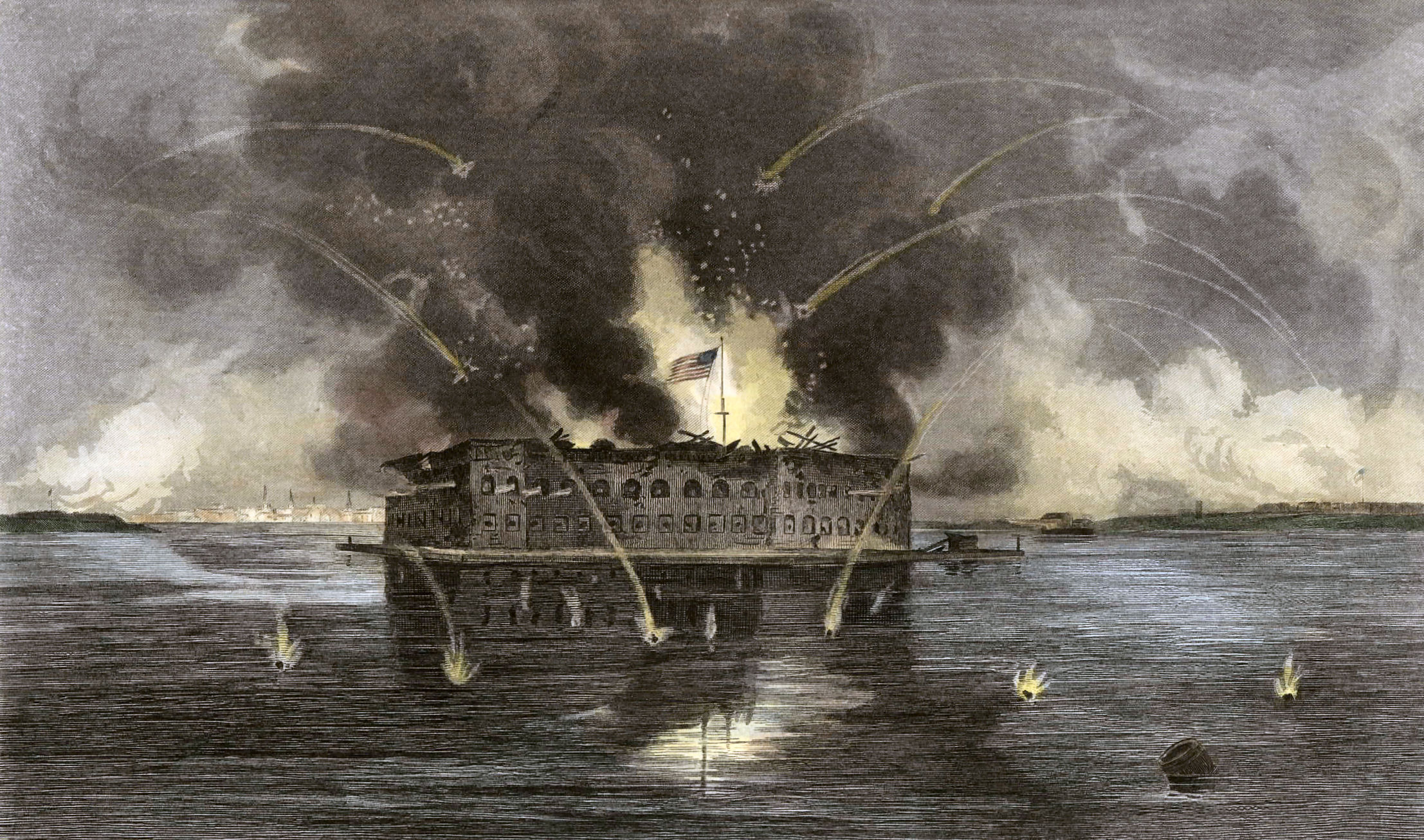
fort-sumter-bombardmentAttack on Ft Sumpter 

“THE CAUSE of the great War of the Rebellion against the United Status will have to be attributed to slavery. For some years before the war began it was a trite saying among some politicians that “A state half slave and half free cannot exist.” All must become slave or all free, or the state will go down. I took no part myself in any such view of the case at the time, but since the war is over, reviewing the whole question, I have come to the conclusion that the saying is quite true.” ― Ulysses S. Grant, Personal Memoirs, Vol. 2

I have served my country, not just Red or Blue States or members of either major political party, or minor political party for 32 years. I have served and as a Chaplain have guarded the religious and free speech rights of Christians, Jews, Moslems, Buddhists, Hindus, Wiccans, Atheists and Agnostics as a Chaplain for 21 of those years.

My family on my mother’s side came to the British Colonies in North America in  the 1680s or 1690s from England and France. My father’s family came in the 1740s from Scotland. During the War for Independence much of my family fought for the colonies or was neutral and some were Tories. One of my direct relatives lived in Philadelphia and worked as a supply officer for the Colonial Army throughout the war. He is buried not far from Benjamin Franklin and other heroes of the Revolution in the Christ Church Cemetery in Philadelphia, something that get’s me free admittance to the historic site anytime that I am in the city.

Those that were Tories ended up in  what is not Canada after the war. I even had distant relatives who were British Redcoats, one a Lieutenant Colonel Thomas Dundas, later Major General Sir Thomas Dundas commanded one of Lord Cornwallis’ brigades at Yorktown and was one of two British Officers who arranged the surrender at Yorktown.

Thus said my family has a long pedigree in this country and when the war of the Souther Slaveholder Rebellion broke out in 1861 I had family on both sides of the conflict. Most served in the Confederacy, though the part of Virginia they lived in seceded from the Commonwealth because Virginia seceded from the Union.

All this being said I can claim my heritage as a Son of the American Revolution or a Son of the Confederacy.

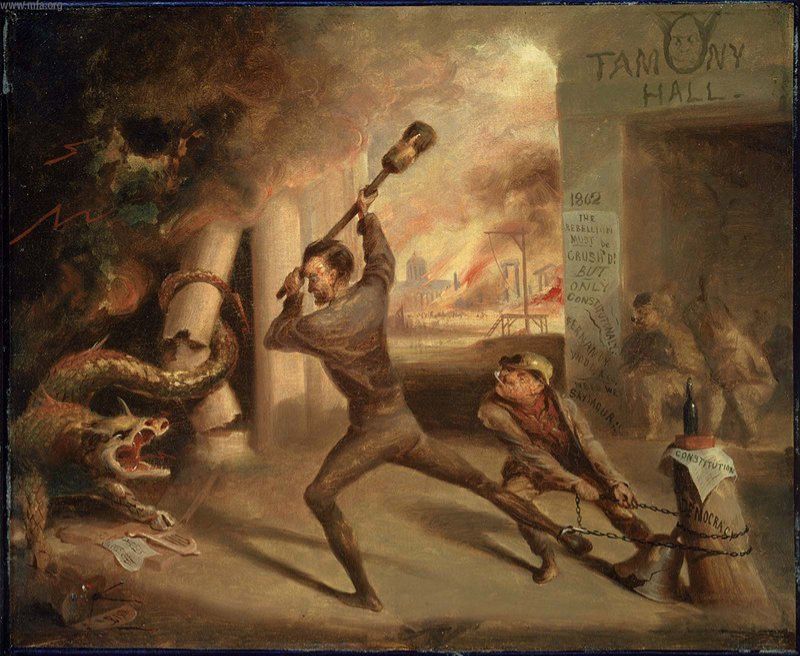
lincoln_rebellion_dragon

Today I saw something that made my blood boil. As I said I have served this country for 32 years in both the Army and the Navy. Part of my service has included time in both the Virginia and Texas Army National Guard. In my time in Virginia or Texas the units that I served traced their linage to either the 1st or 5 Texas Regiments of Hood’s Brigade or the 2nd or 17th Virginia Regiments which fought under Jackson or Pickett during that war.

fort-pillow

As I was saying I saw something today that made my blood boil. I saw a bumper sticker on a pickup truck at the local Home Depot that looked a bit like the US Army “Army Strong” complete with the star featured on the Army bumper sticker. However this one was different. It said “Confederate Army Strong.” To be fair I have seen this sticker on a number of vehicles in Virginia over the past few years but this one got me. The man also has numerous other Confederate or neo-Confederate stickers as well as partisan political comments and conspiracy theory comments about 9-11 being an “inside job” as well as a sticker for the conspiracy theory nutcase Alex Jones’ “Info Wars” website.

IJ2ZD00Z

What I find offensive about the “Confederate Army Strong” sticker is that it is a slap in the face to all who died to preserve the Union. Likewise it is the symbol of a political movement designed to promote, defend and expand an economic system built on slavery using the language of “States Rights.” That being said those states and their political leaders who claimed “States Rights” only cared about their own rights and in the decade leading up to the War of the Slaveholders Rebellion, now known as the Civil War used Federal statutes against non-slave States whenever they needed to and fought for tougher Federal laws to keep their “freedom” to maintain slavery.

351px-Andersonvillesurvivor

Freed Union Prisoner at Andersonville

The fact is that the Confederate Army was responsible for the more deaths and other casualties than all other enemies of the United States before or after the War of the Slaveholders Rebellion. The real fact is that those “noble Confederates” like Robert E. Lee and Stonewall Jackson and others that by the way included men from my family who owned slaves were rebels who when they did not like the result of an elected seceded from the Union and declared war on their fellow citizens in order to maintain their racist economic and political power. They were not about due process or the will of the people, but their will.

These were the same men who condoned the atrocities committed at places like Andersonville and Belle Isle and when they invaded non-slave states had no qualms about taking any black men, women and children from their homes and sending them to the South, even if the were Free Men and not escaped slaves.

However it is now impolitic to say this. But that is the case and whenever I see such displays of hatred against the country, constitution and citizens who I have sworn an oath to support and defend “against all enemies foreign and domestic” for 32 years I get angry.

I saw the man get into his vehicle and almost confronted him, but in the current climate had I done so I would have been the person condemned in the hate filled right wing media and blogosphere which wants nothing more than to have anyone connected to the Federal Government look like they are being intolerant. Such is the victim culture of many on the political right.

So I held back, took a picture of his stickers and went on my way. I have been far too busy trying to catch up on things left unattended by the past 7 years of service to this nation which has cost me much of my mind, my health and finances being away from home, deployed to Iraq or serving as a geographic bachelor, the latter alone which has cost me over $50,000 that I will never get back. Likewise I figured out that the last 17 years of my military career I have been away from home for 10 years. Since I returned from Iraq I have had to deal with the “Mad Cow” of PTSD.

Thus when I see some old fat codger running around spouting hate who probably has not served a day in uniform, or if he did served an enlistment and then got out I get pissed off. To tell the truth I think that I have good reason. There are times that I think that maybe William Tecumseh Sherman was too gentle on the South and that maybe the Radical Reconstructionists like Thaddeus Stevens were right about the South and what needed to be done to eradicate slavery and restore the Union.

Now that is not me, I am more of a Lincoln “with malice toward none and with charity toward all” kind of person. As a soldier I can be gracious toward a defeated enemy.  But when I see that thrown back in my face by the neo-Confederates of my day I wonder if maybe I and men like Sherman, Grant, Hancock and Chamberlain were wrong. Maybe the rebels should have been tried, executed, exiled or imprisoned for their crimes against the Constitution and their fellow citizens.

That being said Grant noticed how the landed elites of the South not only enslaved the blacks but used poor whites who had nothing to gain from their economics or slavery. The sad thing is the descendants of those who enslaved blacks and used poor whites as their political and later military fodder are at it again. Grant noted:

“The great bulk of the legal voters of the South were men who owned no slaves; their homes were generally in the hills and poor country; their facilities for educating their children, even up to the point of reading and writing, were very limited; their interest in the contest was very meagre–what there was, if they had been capable of seeing it, was with the North; they too needed emancipation. Under the old regime they were looked down upon by those who controlled all the affairs in the interest of slave-owners, as poor white trash who were allowed the ballot so long as they cast it according to direction.”

It really is a sad state of affairs and I grieve for the United States. To think I swear on my life an honor to ensure that all citizens have their right to freedom of speech including the man with his message of hate. However I don’t think that he or others like him would  do the same for me.

Peace

Padre Steve+


4 Comments

Filed under civil war, History, national security, Political Commentary

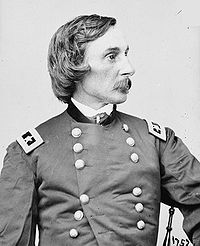
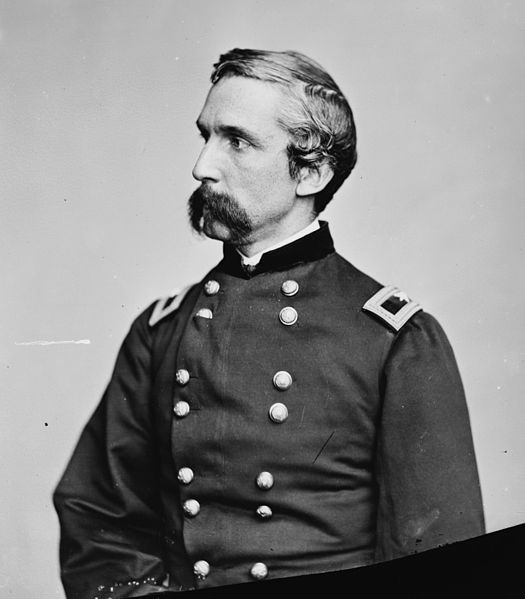
Gettysburg Day Two: The Engineer and the Professors on the Hill, Major General Gouverneur Warren and Colonels Strong Vincent and Joshua Chamberlain

The Confederate Onslaught

“In great deeds, something abides. On great fields, something stays. Forms change and pass; bodies disappear; but spirits linger, to consecrate ground for the vision-place of souls… generations that know us not and that we know not of, heart-drawn to see where and by whom great things were suffered and done for them, shall come to this deathless field, to ponder and dream; and lo! the shadow of a mighty presence shall wrap them in its bosom, and the power of the vision pass into their souls.” ― Joshua Lawrence Chamberlain

The Federal Army at Gettysburg had a wide variety of officers. Many senior officers were graduates of West Point but in the expansion of the Army and the call of up militia from the various states other officers were appointed. Many had no prior military service and at times that lack of experience was tragic. However some of the time those volunteers were the men who by their service helped save the Union.

On July 2nd 1863 the situation at Gettysburg was precarious. Robert E Lee had ordered an attack to seize a hill at the far end of the Federal line, Little Round Top and turn the Union flank. General Meade had ordered III Corps under Major General Dan Sickles to extend it’s line to defend the southern section of his line on Cemetery Ridge. Unfortunately Sickles moved his Corps several hundred yards west forming a vulnerable salient at the Peach Orchard leaving the southern flank undefended.

Major General Gouverneur Warren

When Meade saw the developing situation he sent his Chief Engineer, Major General Gouverneur Warren to take charge of the situation. When Warren arrived he found the hill undefended and he dispatched staff officers to get assistance from any units in the area. Major General George Sykes of V Corps responded sending a messenger to the commander of his 1st Division. The messenger encountered the commander of the division’s 3rd Brigade Colonel Strong Vincent who immediately took the initiative and ordered his four regiments up Little Round Top without waiting for permission.

Warren at Little Round Top

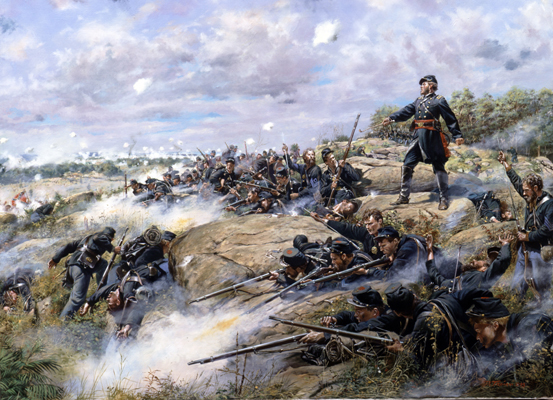
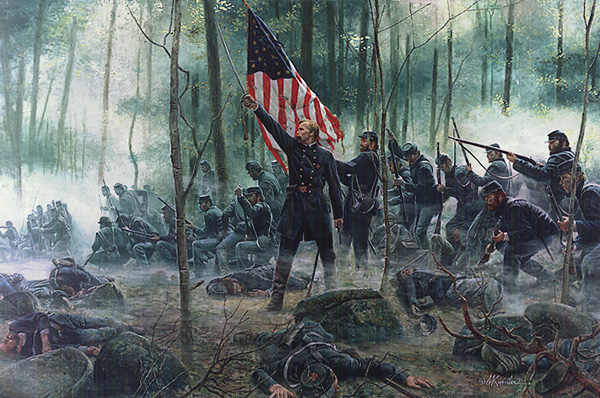
Vincent placed and his regiments arrived in a nick of time. He deployed his regiments, along the spur running to the south if the top of the hill. The 16th Michigan on the right with the 44th New York, 83rd Pennsylvania at his center and the 20th Maine under the Command of Colonel Joshua Chamberlain on the extreme left of the line. His order to Chamberlain was ordered to “hold at all costs.” Chamberlain led his regiment skillfully and when nearly out of ammunition led a charge down the slope of Little Round Top which ended the Confederate chances of gaining the hill and turning the flank of Meade’s Army.

Warren was a West Point graduate and had been a topographical engineer for most of his pre-war career and saw combat against the Sioux at the Battle of Ash Grove in 1855. When the war began Warren was a mathematics instructor at West Point. He helped raise a militia regiment in New York and was appointed to Lieutenant Colonel. As a regimental commander and later brigade commander he saw much combat and was wounded at the Battle of Gaines Mill during the Seven Days.  When the Army was reorganized in February 1863 he was named Chief Engineer of the Army of the Potomac by Major General Joseph Hooker. When Major General Meade relieved Hooker on June 28th he retained Warren.

The 26 year old Colonel Strong Vincent

Colonel Strong Vincent was a 26 year old Harvard graduate and lawyer from Erie Pennsylvania. He was appointed as a 1st Lieutenant and Adjutant of the Erie Regiment and married his wife Elizabeth the same day.  He wrote her before his death “If I fall, remember you have given your husband to the most righteous cause that ever widowed a woman.”  He was commissioned as a Lieutenant Colonel in the 83rd Pennsylvania September 14th 1861and assumed command of the regiment when the commander was killed during the Seven Days in June of 1862. He commanded the regiment at Fredericksburg in December 1862 and was promoted to command the 3rd Brigade when its commander was killed at Chancellorsville in May 1863.

Major General Joshua Chamberlain

Colonel Joshua Chamberlain was a graduate of Bowdoin College and Bangor Theological Seminary, fluent in 9 languages other than English. He was Professor of Rhetoric at Bowdoin before seeking an appointment in a Maine Regiment without consulting either the college or his family. He was offered command of the 20th Maine but asked to be appointed as a Lieutenant Colonel which he was in August 1862. He fought at Fredericksburg and was named commander of the regiment when Colonel Ames, his commander was promoted following Chancellorsville.

“Don’t Give and Inch!”

The battle of Little Round Top is one of the most famous of all Civil War battles and Chamberlain along with Vincent are immortalized in the film Gettysburg which is based on Michael Shaara’s Pulitzer Prize winning novel The Killer Angels. Vincent was mortally wounded while leading the defense of the hill standing on a large boulder with a riding crop ordering the men of the 16th Michigan who were beginning to waiver “don’t give an inch.” Two months later his wife gave birth to a baby girl. The baby would not live a year and was buried next to him

Warren would become a distinguished Corps commander until he ran afoul of the fiery General Phillip Sheridan in 1865. Sheridan relieved Warren of command of V Corps following the Battle of Five Forks where Sheridan believed that Warren’s Corps had moved too slowly in the attack. The relief was brutal and ruined his career.  Warren resigned his commission as a Major General after the war and returned to his permanent rank as a Major of Engineers. He served another 17 years doing engineering  duty being promoted to Lieutenant Colonel in 1879. He sought a Court of Inquiry to exonerate himself but this was refused until President Grant left office. The Court eventually exonerated him but he died before the results were published. Embittered he directed that he be buried in civilian clothes and without military honors.

Chamberlain was awarded the Medal of Honor for his valor at Little Round Top in 1893. He was gravely wounded during the siege of Petersburg in June of 1864 while commanding a brigade and promoted to Brigadier General. He returned to duty later in the year as commander of the 1st Brigade, 1st Division V Corps and was again wounded at Petersburg in a skirmish at Quaker Road and was promoted to Brevet Major General by Abraham Lincoln. Chamberlain received the surrender of Lee’s decimated Army if Northern Virginia. He would go on to serve as a four term Governor of Maine and remained active with the Grand Army of the Republic veteran’s organization, remained active as an educator and President of Bowdoin College and founded the Maine Institute for the Blind which is now known as the Iris Foundation. He died of his wartime wounds on February 24th 1914.

These three men acted with great courage and alacrity on the afternoon of July 2nd 1863. Warren for his immediate action to call for assistance when he discovered that the hill was undefended and the line exposed, Vincent for his swift taking of responsibility and getting his brigade up the hill before the Confederates could gain the summit and Chamberlain for his dogged refusal to yield against repeated assaults. Only one of the three, Warren was a professional soldier but as a topographic engineer he was an outsider and not fully appreciated by Grant or Sheridan who destroyed his career. The youthful Vincent died of his wounds days after the battle. He was recommended for promotion to Brigadier General by Meade but the promotion was never confirmed by the Senate and Chamberlain is still one of the revered commanders of the Civil War.

It is easy for those enamored with military history to forget the stories behind the men that fought the battles of war. It is easy to isolate and analyze a commander’s actions in battle and ignore the rest of their lives.  I think that this does a great disservice to the men themselves. I say this because everyone who serves in the military has their reasons, some more noble than others and likewise everyone who dons the uniform in time of war gives up something of themselves and sometimes even heroes are destroyed by the institutions that they serve.

Chamberlain wrote: “It is something great and greatening to cherish an ideal; to act in the light of truth that is far-away and far above; to set aside the near advantage, the momentary pleasure; the snatching of seeming good to self; and to act for remoter ends, for higher good, and for interests other than our own.”

Peace

Padre Steve+

1 Comment

Filed under civil war, History, leadership, Military

The American Civil War and the Origins of Modern Warfare

Hagerman, Edward. The American Civil War and the Origins of Modern Warfare. Midland Book Editions, Indiana University Press. Bloomington IN. 1992

Pickett’s Charge Displayed the Futility of Napoleonic Tactics Against Modern Weaponry

Edward Hagerman postulates in The American Civil War and the Origins of Modern Warfare that the American Civil War is the first modern war. He examines developments in tactics, logistics and the concept of total war and looks specifically how tactical and strategic thought impacted the war.  Specifically Hagerman examines how Henri Jomini’s interpretation of Napoleonic warfare and the theories of Dennis Hart Mahan and Henry Halleck which were the prevalent military thought in America were challenged by advances in weaponry and the vastness of the American continent.  He surveys how the Union and Confederate armies learned the value and application of field fortifications and the limitations of artillery in the offense.  Even more importantly Hagerman argues how logistics influenced campaigning on the American continent as opposed to earlier European wars. Likewise he examines how the 20th Century concept of total war found its first application in the campaigns of General Sherman and how Robert E. Lee’s use of defensive maneuver and fortifications in positional warfare heralded a new era in warfare.

Dennis Hart Mahan’s Book: The First American Book on Military Theory

Hagerman examines how these factors influence and affected the Union and Confederate armies.  His initial focus is the tactical conundrum posed by the advances weaponry particularly the rifled musket to the Napoleonic tactics that both armies began the war. Napoleonic tactics were developed at a time when the maximum effective range of muskets was barely 100 meters and how despite the increase in range and accuracy that came with the rifled musket how tactical formations and tactics were slow to change.

Hagerman spends the first part of his book examining how the ante-bellum US Army leadership was influenced by the theories of Henri Jomini. He discusses the challenge to Jominian orthodoxy by Dennis Hart Mahan, who modified “the current orthodoxy by rejecting its central tenants-primarily offensive assault tactics.”[i] He examines the tension in American military thought between the conservative Jominian thinking which predominated much of the Army, noting that within the army “Mahan’s decrees failed to win universal applause.”[ii] However, Mahan influenced many future leaders of both the Union and Confederate armies in his “Napoleon Club” a military round table at West Point.[iii] Hagerman notes that Mahan’s greatest contributions were his development of the active defense and emphasis on victory through maneuver. Unlike Jomini, who thought maneuver as risky with the purpose of the “defeat of the enemy’s army,” Mahan emphasized “maneuver to occupy the enemy’s territory or strategic points.”[iv] In the book Hagerman wrestles with disjointed developments in infantry, artillery and cavalry tactics of the ante-bellum Army which and surmises that “Military thinking, and even more strategic organization, remained essentially within the Napoleonic tradition filtered through an eighteenth-century world view….” He asserts that “A broader vision was necessary to pose an alternative to the mechanistic program.”[v]

The 2nd Michigan Regiment: Most Civil War Units on both sides were State Regiments

Hagerman then discusses wartime developments in strategy, tactics and organization as they developed in both the Eastern and Western theaters.  He focuses on the themes of organization, logistics, communications, weaponry, field fortifications and maneuver. In each chapter he weaves these themes to show how they affected campaigns or were modified during the war based on experience.  He deals with leadership, but mostly in the context of how leaders responded to challenges posed in these arenas.  Of particular interest to him are the early efforts of successive commanders of the Army of the Potomac including McClellan, Burnside and Hooker to deal with these problems as well as the responses of Grant, Sherman and Rosecrans in the West to the same issues.

Hagerman’s discussion of army organization focuses on how each army developed sociologically as well as professionally prior to and during the war. He examines the ways that commanders educated at West Point initially dealt with large armies made up of militia units and volunteers and how these armies would be changed by the war.  He includes in the discussion i the institution of the draft in both the North and South.  His discussion of how McClellan successful fought the break-up of the Regular Army keeping it separate from the militia units organized by the States was important to development of the Army. He notes their importance and points out the problems of the militia units raised by the various states particularly in the early part of the war.

The Integration of Sea and Land Logistics Systems in the Civil War Revolutionized the Way that Modern War is Supplied

More significant to Hagerman’s narrative is his emphasis on logistics, and how each Army responded to the challenges of supplying their armies in the field.  Hagerman examines how the ante-bellum Army developed its logistic doctrine from the Napoleonic examples and how that doctrine had to be modified in light of the American reality of a less developed continent with far greater distances involved.

Hagerman’s discussion of logistics is quite detailed.  He examines topics such as the number of wagons per regiment and how army commanders, modified that number at various points during the war based on their situation. He discusses the development of the “flying column” as a response to the dependency on wagons and basic load of food and ammunition carried by each soldier in order to increase strategic maneuverability.  He details the forage requirements for people and animals in each theater of operations and how each army responded to requirement of living off the land for much of their forage requirements and their relative successes and failures in supplying their soldiers in this fashion.

Railways Meant the Ability to Move Troops and Supplies Great Distances very Quickly

Hagenman discusses the use of railroads and the use of naval forces to both assist the ground forces and to move supplies and troops.  In each of these areas he provides a detailed examination of the effect of logistical considerations on each army.  He notes that of all the areas of development that the Army of the Potomac was successful at putting logistic theory into practice. By late 1863 the Army of the Potomac demonstrated “the close integration of operational planning and that of the general in chief and supply bureaus. In this one area, the development of a mature and modern staff was evident.”[vi]

Hagerman’s discussion of the development of communications in both armies focuses on the fact that the size of the armies and the distances involved on the battlefield made command and control difficult.  As such each army experimented with signals organizations that used tradition visual signals and couriers but began to rely on the telegraph for rapid communications.  He deals with the conflict in the North between the Signal Corps and the Military Telegraph Service.  He discusses the use of wire telegraph equipment and the new Beardslee wireless telegraphs by the Signal Corps and how the Army eventually favored the traditional wire bound networks operated by the Military Telegraph.  Though the Army rejected the Beardslee equipment some commanders requested it for their operations.[vii] As they became more dependent on such communications armies feared that their signals could be compromised through wire tapping and made efforts to encode transmissions.

Signal Corps Soldiers and Wire Communications

Hagerman’s discusses the evolution of the Union and Confederate armies use of field fortifications including their use in offensive campaigns.  He discusses their use by McClellan on the Peninsula in 1861 and Lee’s sporadic use of them[viii] until 1864 beginning in the Wilderness campaign and culminating in the defense and siege of Petersburg.  Hagerman’s thesis is that the developments in field works and firepower gave the advantage to the defense when armies made the frontal attacks which were at the heart of Jominian theory.  He notes how various commanders including Grant failed at Shiloh and Lee at Antietam failed to dig in, but how both the Union and Confederate armies learned to dig hasty field works as a matter of course.[ix]

Both sides also learned to use maneuver in combination with positional warfare to force the enemy to battle. Hagerman examines the campaigns in the West of Grant, Sherman and Rosecrans, particularly Stone’s River, the Vicksburg Campaign, and the campaign in middle Tennessee.[x] The last two chapters mention these issues in the context of the 1864-65 campaign around Richmond and Sherman’s campaigns in Georgia and the Carolinas.  Of particular note is how Sherman’s forces routinely entrenched on the offensive[xi] and how Confederate forces under Joseph Johnston employed entrenchments on the defensive. Hagerman notes how Confederate Cavalry “perhaps best displayed the growing intensity of trench warfare” noting General Joe Wheeler’s use of them at the close of the war.[xii]

Massive Siege Mortar outside Petersburg

A sidebar to Hagerman’s discussion of fortification is his examination of the Corps of Engineers.  He discusses the development of Engineering or Pioneer units from nothing in 1861 to organized units by the middle of the war.  He examines the problems of the Engineering Corps in adjusting to the war. He notes its dispersion among the line and its civil duties as impediments to responding to the needs of war and both the hesitancy and resistance to creating engineering units by Congress, despite the pleas of McClellan and Lincoln.[xiii] He then looks at the institutional irony of the how newly organized engineer units had few West Point trained Corps of Engineers officers, but were primarily staffed and commanded by officers detailed from the line. The effect was a “decline in the antebellum definition of professionalism embodied in the Corps of Engineers.”[xiv]

Engineering Units were Built from Scratch and Accomplished Many Feats

Petersburg Fortifications a Harbinger of World War One

Hagerman’s last two chapters focus on the developments in the strategies of attrition and exhaustion in relation to positional and maneuver warfare.  He examines how this was by Grant in Virginia and Sherman in Georgia and the Carolinas.  He discusses the “ascendancy of positional warfare” which allowed Lee to hold out and force Grant into winter quarters at Petersburg.[xv] This demonstrated that “an army fighting on interior lines, even under nearly overwhelming conditions of deprivation and against vastly superior numbers, could sustain a prolonged existence by use of field fortification and defensive maneuver.”[xvi] Sherman’s campaign demonstrated how an army could exploit “diversion, dispersion, and surprise to successfully pursue a modern total-war strategy of exhaustion against the enemy’s resources, communications and will.”[xvii]

Sherman’s March to the Sea

Hagerman’s book is particularly strong in the discussion of tactical developments and logistics and how those were developed over the course of the war.  It is strong because it allows the serious student to trace the developments in each of the areas he examines to future wars fought by the US Army.  Russell Weigley picks up the effect of what Hagerman describes in his books The American Way of War discussing both Grant’s strategy of annihilation and its costs, and in Sherman’s campaign against Johnston and attack upon Southern resources.[xviii] His discussion of tactics reflects that of J.F.C. Fuller notes that “the tactics of this war were not discovered through reflection, but through trial and error.”[xix] The events described by Hagerman, especially the campaigns of Grant and Sherman influence modern strategy including that of the Marine Corps which discusses maneuver and attrition warfare continuum in MCDP 1 Warfighting.[xx] Hagerman’s work is best at helping tie the elements of war often ignored by other Civil War historians into a coherent whole that allows the reader to see the logical development of each of these elements in modern war.

Irregular Formations Such as Mosby’s Raiders Would Create Problems Behind Union Lines

Hagerman’s value to the literature is that he fills a void among many Civil War writers who often focus simply on the battles and campaigns and not arcane but important subjects such as transportation, logistics, communications and fortifications.  Hagerman makes an astute observation on how change comes to military organizations at the end of his discussion of the Corps of Engineers and the Army following the war.  He notes “that change in war requires time for digestion before lessons are converted-if they are converted-into theory and doctrine.” [xxi] In the light of the Pershing’s strategy in the First World War One, which revisited some of the worst mistakes of the Civil War one wonders if those lessons were ever fully digested by the Army. Such an observation can be made about our present war.  We need to ask if the lessons of previous insurgencies in conquered areas have been digested, even going back to the lessons of the Union Army operating in the hostile lands of the conquered Confederacy.[xxii] Likewise how an Army adjusts to developments in weaponry, technology and tactics are fair game when one analyzes past campaigns in relation to current wars.  Thus when we look at Hagerman it is important to use his work to understand the timeless aspects of military history, theory, doctrinal development, logistics, communications and experiential learning in war that are with us even today.


[i] Hagerman, Edward. The American Civil War and the Origins of Modern Warfare. Midland Book Editions, Indiana University Press. Bloomington IN. 1992. p.9

[ii] Ibid. p.13.

[iii] Hagerman also notes the contributions of Henry Halleck and his Elements of Military Art and Science published in 1846 (p.14) and his influence on many American Officers.  Weigley in his essay in Peter Paret’s Makers of Modern Strategy would disagree with Hagerman who notes that in Halleck’s own words that his work was a “compendium of contemporary ideas, with no attempt at originality.” (p.14) Weigley taking exception gives credit to Halleck for “his efforts to deal in his own book with particularly American military issues.” Paret, Peter editor. Makers of Modern Strategy: For Machiavelli to the Nuclear Age Princeton University Press, Princeton NJ 1986 p.416.

[iv] Ibid.

[v] Ibid. p.27.

[vi] Ibid. p.79.

[vii] Ibid. p.87.

[viii] The most notable use of them between the Peninsula campaign and the Wilderness was at Fredericksburg by Longstreet’s Corps. Many wonder why Lee failed to entrench at Antietam.

[ix] Fuller, J.F.C. Grant and Lee: A Study in Personality and Generalship, Indiana University Press, Bloomington IN 1957.  Fuller comments “Thus over a year of bitter fighting was necessary to open the eyes of both sides to the fact that the trench was a by product of the rifle bullet, and like so many by-products, as valuable as the product itself.” (p.269) He calls it “astonishing that Lee, an engineering officer, made no use of entrenchments at the battle of Antietam.” (pp.269-270)

[x] Ibid. pp. 198-219.

[xi] Ibid. p.295.  Hagerman comments how Sherman’s troops outside Atlanta began to entrench both the front and rear of their positions.

[xii] Ibid. p.297-298.

[xiii] Ibid. p.238.

[xiv] Ibid.

[xv] Ibid. p.272

[xvi] Ibid. p.274.

[xvii] Ibid. p.293.  B.H. Liddell-Hart in comparing the campaigns of Grant and Sherman makes an important note that Sherman’s strategy is more “suited to the psychology of a democracy…” and “ he who pays the piper calls the tune, and that strategists might be better paid in kind if they attuned their strategy, so far as rightly possible, to the popular ear.” Liddell-Hart, B.H. Strategy Faber and Faber Ltd, London 1954 and 1967, Signet Edition, The New American Library, New York 1974 p.132

[xviii] Weigley, Russell F. The American Way of War: A History of United States Military History and Policy University of Indiana Press, Bloomington IN, 1973. pp.145-146.

[xix] Ibid. Fuller. P.269  A similar comment might be made of most wars including the current Iraq war.

[xx] ___________. MCDP-1 Warfighting. United States Marine Corps, Washington D.C. 1997. pp. 36-39

[xxi] Ibid. Hagerman. P.239

[xxii] Ibid. Fuller. Fuller’s comments on the situation of the Northern Soldier are eerily similar to our current conflict in Iraq : “Consequently, minor tactics were definitely against the Northern soldier, because his major tactics demanded the offensive; for without the offensive the South could not be brought to heel.  It was the problem which had faced the French in LaVendee and in the Peninsula of Spain, which faced Napoleon in Russia, and the British in South Africa during the Boer War of 1899-1902. Not only was the Northern soldier, through force of circumstances, compelled to fight in the enemy’s country, but he was compelled to devastate it as well as conquer it, in order to protect himself against the bands of irregular troops which were here, there and everywhere.” pp.247-248

Bibliography

Fuller, J.F.C. Grant and Lee: A Study in Personality and Generalship, Indiana University Press, Bloomington IN 1957

Hagerman, Edward. The American Civil War and the Origins of Modern Warfare. Midland Book Editions, Indiana University Press. Bloomington IN. 1992

Liddell-Hart, B.H. Strategy Faber and Faber Ltd, London 1954 and 1967, Signet Edition, The New American Library, New York 1974

Paret, Peter editor. Makers of Modern Strategy: For Machiavelli to the Nuclear Age Princeton University Press, Princeton NJ 1986

Weigley, Russell F. The American Way of War: A History of United States Military History and Policy University of Indiana Press, Bloomington IN, 1973

___________. MCDP-1 Warfighting. United States Marine Corps, Washington D.C. 1997

1 Comment

Filed under History, Military

The Paradox of Conflicting Doctrine: The US Campaign in France and Germany 1944-1945

The Paradox

The paradox of the American Army’s training in speed and mobility and the strategic tradition of U.S. Grant influenced the final campaign in Germany just as they had the campaign in France.  This is one of the Russell Weigley in Eisenhower’s Lieutenants asserts that the American strategic tradition of U.S. Grant emphasized direct confrontation and defeat of the enemy’s major forces.  He asserts the development of this tradition by officers assigned to the Leavenworth schools was influenced by the Civil War and World War One and the Army’s experience as a frontier constabulary force.  He develops this theory alongside his discussion of the formation of the highly mobile and less powerful forces that the Army would deploy in World War Two and how this paradoxical combination of doctrine and force determined by conflicting legacies “put the army at cross purposes with itself…as it began to prepare for European War.”[i]

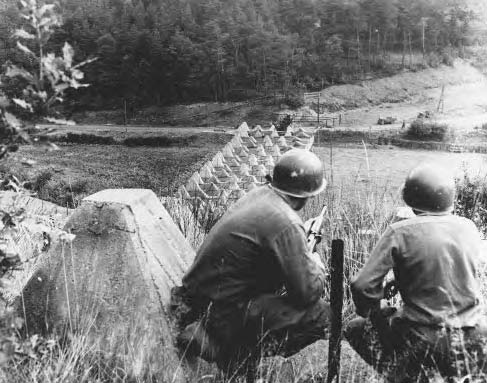
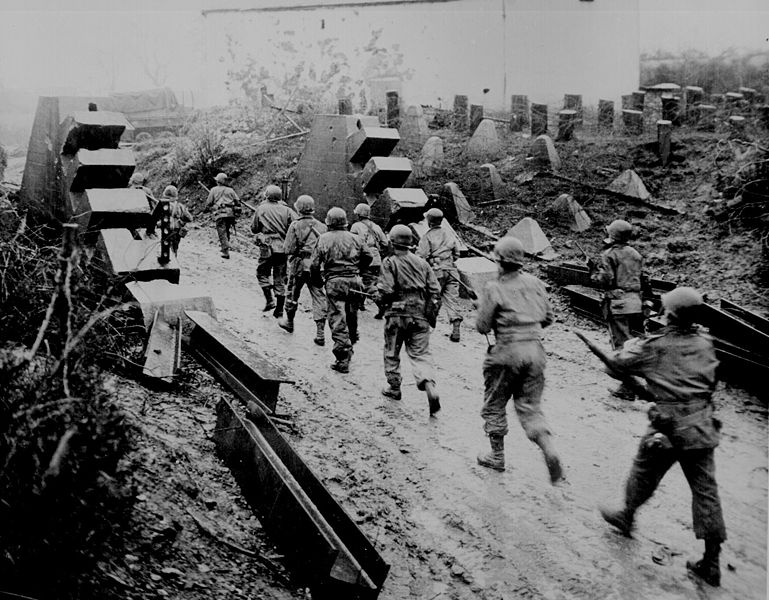
Crossing the Siegfried Line

The dogma of the Leavenworth School emphasized that “victory in large-scale war depends on a strategy of direct confrontation with the enemy’s main forces in order to destroy them.”[ii] This was not in itself different than the thought of contemporary European armies influenced by Clausewitz; but the Americans differed from the Europeans “in the extent to which they expected overwhelming power alone, without subtleties of maneuver, to achieve the objective.”[iii] The tradition developed from an emphasis on Ulysses S. Grant’s campaign in Virginia which understood that Grant had “defeated the armies of the Confederacy through head on assault by overwhelming strength to destroy them, so that in any future great war the United States would seek the destruction of the enemy armed forces by similar means.”[iv] It is perplexing that the Army failed to truly appreciate William Tecumseh Sherman’s use of strategic maneuver on the offense with the goal of destroying the enemy’s army. The fact that the Army failed to incorporate those lessons into its strategic thought, even as it built forces that were better suited to Sherman’s campaign is one of the contradictions of American military thought.[v]

Grant’s tradition was put into practice by Pershing in World War One to the extent that he could influence allied strategy, with mixed results.[vi] The reduction of the St Michel Salient and Meuse-Argonne offensive, though aided by German withdraws and achieved with high casualties, helped convince the Germans that the war was lost.[vii] “Only in late 1918 did the veteran American divisions show the same degree of tactical skill as their Allied and German counterparts, and the lessons came by bloody experience.”[viii] Pershing’s campaigns were bloody, but they came at a when maneuver had again become part of the war, and at the point where the Germans were beginning to collapse.  George Marshall warned about “generalizing about modern warfare from their 1918 experiences against a German army already stumbling into exhaustion.”[ix] Yet for “the American military, the First World War confirmed the doctrines of concentration and of fighting for complete victory, and out of the battlefields of Europe came the foundations of strategic faith….”[x] Weigley notes that: “In strategy, most American soldiers believed, the modern mass army left frontal assault as the only recourse.”[xi]

While Grant’s tradition remained a dominant feature of American strategic thought, the Army was becoming a mobile army whose divisions were to be “tough and lean.”[xii] General Leslie McNair reorganized the structure of the infantry division and later that of the armored divisions.  The heavy “square” infantry division of the First World War was reorganized with three infantry regiments and supporting elements and was characterized by its mobility than its sustained combat power.  McNair reorganized the armored divisions into lighter, though extremely flexible organizations built around the “Combat Command” and the tank was viewed as viewed as an instrument of exploitation, not a means to defeat enemy armor.  The result was an army formed “upon the principle of mobility and its lack of sustained combat power…did not serve it so well when it faced resolute and skillful enemies in strong defensive positions….”[xiii]

The new divisional structures were both mobile and flexible but in the context of the European campaign were wanting in sustained combat power.  Peter Mansoor comments that divisions “literally fought themselves out in constant operations.”[xiv] At the same time he takes issue with Weigley on the staying power of U.S. divisions commenting on the efficiency of the American individual replacement system.[xv] A U.S. Army study commented that in direct assaults against a emplaced enemy that “heavy casualties in such operations were more than the triangular division could sustain, with the result that the entire division was often rendered combat ineffective….”[xvi] McNair’s reorganization ignored General Chaffee’s 1941 admonition that armor must be organized into corps and employed in mass using not “hundreds but thousands of tanks…” calling the failure to train and organize “an adequate number of command echelons and corps troops to ensure proper employment and timely supply for these larger armored formations in active operation is indefensible.”[xvii]

To further complicate the American situation, the application of Grant’s tradition failed to take into account the principle of mass or concentration, which was vital to the success of a strategy of direct confrontation.  The theory demanded that the Americans have enough troops divisions to keep up pressure everywhere. Grant had such power at his disposal, Eisenhower did not.  The thought that “if the United States applied its superior power everywhere it must be able to rupture the defenses somewhere,”[xviii] was dominant.  But to be successful it required overwhelming superiority in numbers and firepower.  This strategy was in conflict with the Army that the Americans built to pursue the war, and in conflict with one of the more influential prewar American thesis on the subject, Infantry in Battle. This treatise stated:

“Generalship consists at being stronger at the decisive point-having three men there to attack one.  If we attempt to spread out so as to be strong everywhere, we shall end up being weak everywhere.  To have real main effort-and every attack and attack unit should have one- we must be prepared to risk extreme weakness elsewhere.”[xix]

It was an army designed for Sherman’s campaigns in Georgia and the Carolina’s, not Grant’s Virginia campaign. It was best suited to campaigns of strategic maneuver and concentration rather than frontal assaults along a broad front.  Its organization called for this and this fact was recognized before the war.[xx] Weigley notes that the “paradoxical commitment to a power drive strategy of head-on assault in an army shaped for mobility further contributed to the prolonging of the war by undermining the possible uses of mobility itself.”[xxi]

The theory of Grant, espoused by the Leavenworth school is fine there are sufficient forces to make it work. General McNair and Army planners initially planned for an Army of over 200 divisions.  Such an army would have been able to execute the strategy without the problems experienced by the Allies in 1944 and 1945.  Unfortunately the American Army was afflicted by the War Department’s decision in 1943 to limit the Army to 90 divisions.[xxii] The limitation on the number of divisions ensured that it would be “difficult or impossible once the battle of France was launched to rotate them out of line for rest or refitting.”[xxiii] This became a key consideration of allied planning by late 1944 because once the existing divisions were deployed to Europe or the Pacific there were no more to replace them.  Drastic measures were taken to increase the number of infantry troops by speeding up the movement of the last available divisions to Europe and by combing troops out of the COMMZ and from the Army Air Force.[xxiv] Training programs were put in place to train tank crews and junior officers.  Yet, these programs did not begin to put significant numbers of replacements into the line until March 1945.[xxv] Mansoor, a critic of Weigley, agrees with him on many points and notes that the “90 division gamble was a decision that cost the lives of numerous servicemen-primarily infantry replacements-in Europe in 1944 and 1945.”[xxvi] The decision to limit the number of divisions forced Eisenhower into a position where he frequently faced an equivalent number of German divisions to those that he could employ.  This would be the case in at the beginning of 1945 despite the steady erosion of the German forces arrayed before him.

Leadership, Strategy and Tactics and the Performance of the Army
The Germans Employed the Jagdtiger in Small Numbers Against the American Onslaught

After the Bulge the Allies began their push to the Rhine.  Eisenhower “interpreted the Ardennes as confirming the necessity for his broad front strategy, particularly in closing up to the Rhine all the way to Switzerland.”[xxvii] Hastings notes that the Wehrmacht “retained psychological dominance on the battlefield,”[xxviii] and that “Allied commanders remained fearful about exposing their flanks in attack, even when the Germans no longer possessed the resources or mobility to intervene with conviction.”[xxix] In many places GIs and their British counterparts in Montgomery’s 21st Army Group failed to take the initiative and often the Allied commanders “expressed dismay about the lack of aggression shown by their troops.”[xxx] Gavin noted in his diary that: “With better troops, I see no reason why we could not run all over them…Our American army means well and tries hard, but….it is untrained and inefficient… certainly our infantry lacks courage and élan.”[xxxi] Despite this the Allied armies, in particular the Americans, made headway and in many places when well led performed admirably.

The Eifel

Following the reduction of the Bulge Eisenhower allowed Bradley to begin to break the West Wall in the Eifel. After the attack began Eisenhower stopped Bradley short of a breakthrough in order to shift weight of the offensive to Montgomery in the north ordering 12th Army Group to revert to the defensive.  Yet, Eisenhower allowed Bradley a “measure of freedom for limited attacks,”[xxxii] and Patton termed his “operations in the Eifel an “aggressive defense.””[xxxiii] The campaign was primary conducted against oddments of a number of Volksgrenadier divisions of 7th Army.

First Army was diverted on February 1st after making good progress in the Eifel to safeguard the right flank of 9th Army by capturing the Roer dams.  Hastings notes that a “more flexible and imaginative commander-or one unconstrained by the demands of inter-allied relations-would have allowed Hodges forces to keep going to the river and delayed Montgomery for the necessary few days.”[xxxiv] However Bradley felt that Eisenhower “had little choice but to accede to Montgomery’s demand.”[xxxv] Bradley allowed 3rd Army to continue “probing attacks,” and 3rd Army advanced across the Eifel breaking through the West Wall at Prüm and Bitburg.  For the first time the enemy showed “cracks in the admirable cohesion and discipline of the German army.”[xxxvi] Aggressive units of Patton’s 3rd Army were rewarded with dramatic advances. 4th Armored Division in “one bound covered 25 miles, taking 5,000 prisoners and killing several hundred Germans for the loss of 111 of its own men,”[xxxvii] and 10th Armored took Trier on 14 March.  Patton called the campaign “a long hard fought fight with many river crossings, much bad weather, and a great deal of luck.”[xxxviii] Despite this there were problems in some formations.  Hastings recounts how a platoon leader in a VII Corps unit told his commander during a crossing of the Sauer River that “These men have had it sir! They won’t budge for me or anybody else….”[xxxix]The G-3 of 6th Armored division noted that “some of our divisions are too sensitive to their flanks…the result of this is timidity…”[xl]

The Roer Dams, Grenade and Lumberjack

1st Army supported 9th Army by capturing the Roer river dams in preparation of Grenade.  The inexperienced 78th Division was able to secure the dams with help from the veteran 9th Division, though not before the Germans had destroyed the release valves to “flood the Roer valley for about two weeks.”[xli] This delayed the start of Grenade but the Americans finally captured a prize that had eluded them the previous fall.  The one truly notable aspect of this campaign was the continued erratic leadership of Hodges.  Gavin called it “impatient” and it nearly cost the Commanding General of 78th division his command.  Bradley’s aide, Major Hanson remarked that Hodges “was near exhaustion.”[xlii]

9th Army’s attack was conducted in concert with Operation Veritable of 2nd Canadian Army.  The plan was that the two armies would clear the area west of the Rhine destroying as much of the enemy as possible in preparation for the crossing of the river.  As such 9th Army remained under the operational control of Montgomery’s 21st Army Group.  9th Army crossed the Roer, hampered by the high waters and German resistance but captured Düren and München-Gladbach and closed up to the Rhine.  The “rapid build-up enabled Simpson to maintain intense pressure and on the last Day of February his armor broke away.”[xliii] 9th Army met up with the Canadians eliminated elements of the German Army that remained west of the river.  9th Army took over 30,000 prisoners and killed an estimated 6,000, but substantial numbers were evacuated by skillful German commanders.[xliv] The greatest disappointment was that Grenade failed to capture any bridges over the Rhine.   Montgomery turned down Simpson’s request to make a fast crossing of the Rhine at Urdingen, where there were few German troops.[xlv]

South of 9th Army the 1st and 3rd Armies launched Operation Lumberjack to attempt to envelope the German forces west of the Rhine in its sector in similar fashion to Grenade-Veritable. Facing weak German forces 1st Army made good progress capturing Cologne on March 5th.   3rd Army’s advance was exceptional.  Its plan to cut off the Germans on the west bank worked almost to perfection despite poor roads, snow and the opposition of the 2nd Panzer Division.[xlvi] General Gaffney’s 4th Armored division, drove 40 air miles, captured 5,000 prisoners killed another 700 Germans, capturing much equipment with the loss of only 29 men killed.[xlvii] Bradley called the division’s performance “the most insolent armored blitz of the Western war.”[xlviii] Patton’s armor covered “56 miles in three days to reach the Rhine near its confluence with the Moselle.”[xlix] For the first time “senior officers and headquarters fell into the American bag,”[l] including the command post of LXVI Corps and the commander of LIII Corps. In these operations the bold use of maneuver and concentration by Simpson, Hodges and especially Patton exploited the natural strengths of their formations to achieve their objectives.

Remagen
Remagen Bridge

1st Army’s swift advance and the chaos wreaked by Patton’s army led to the only instance in the campaign where the Allies captured a bridge over the Rhine intact.  The Ludendorff railway bridge at Remagen remained and on 7 March 9th Armored division detached a task force from CCB to take the bridge before it could be blown.   This force surprised the Germans and reached Remagen by 1300. General Hoge, hero of St. Vith, arrived quickly and ordered the capture the bridge as quickly as possible.[li] Hoge ignored orders to divert most of his troops to another crossing of the Ahr River and without orders “threw the rest of his armored infantry across the Rhine….”[lii] “In spite of the threat of the bridge being blown by the fleeing Germans, bold action by American infantry and engineers captured the bridge and established a bridgehead over the Rhine by 1630.  III Corps ordered 9th Armored division to “exploit the opportunity,”[liii] and “within 24 hours they had 8,000 men across.”[liv] Hodges exploited the opportunity and pushed the 9th, 78th and 99th divisions across the river where they continued to enlarge the bridgehead while fighting off fierce German counter-attacks.  By 24 March 1st Army had “three corps, six infantry divisions, and three armored divisions across the Rhine River.”[lv] The best German formations “arrived piecemeal and spent themselves in the same way, mustering only limited, scattered counterattacks instead of any major blow.”[lvi]

The Remagen crossing was not welcomed by all and restrictions were placed on 1st Army as it enlarged the bridgehead.  Carlo D’ Este saw Remagen as “typical of the lack of connection between SHAEF and its subordinate elements.”[lvii] “Pinky” Bull, the SHAEF G-3 was at Bradley’s headquarters when the Bradley was informed of the crossing.  Bull told Bradley that the Remagen crossing “just doesn’t fit in with the plan.”[lviii] Bradley recalled telling Bull: “What the hell do you want us to do,” I asked him, “pull back and blow it up?”[lix] During the next few days however “Bull’s unbending skepticism infected Eisenhower himself.”[lx] And by March 9th Bull informed Bradley that Eisenhower “did not want the Remagen bridgehead expanded beyond the ability of five divisions to defend it.”[lxi] The decision to favor Montgomery’s crossing of the Rhine by detaching divisions from 12th Army Group to support it caused consternation among Bradley and his commanders who feared that Montgomery would “use most of the divisions on the Western Front, British and American, for an attack on the Rhine plains…and the First and Third Armies be left out on a limb.”[lxii] Liddell-Hart noted that the order was “all the more resented because the U.S. Ninth Army…four days earlier, had been stopped by Montgomery from trying to cross the river immediately, as its commander, Simpson, desired and urged.”[lxiii]

Patton’s 3rd Army Crossed the Rhine on the Fly at Oppenheim

Remagen’s aftermath showed Eisenhower’s continued commitment to the broad front, to closing up to the Rhine along its entire length, and his inordinate fear of German counter-stokes.  He remained “fearful that, as long as some German forces survived on the Western side of the Rhine, the potential existed for another potential unpleasant surprise, a counter-attack across an exposed American flank.”[lxiv] The facts belied the situation and Model, commander of Army Group B “had not only given up on trying to eliminate the American bridgehead at Remagen but had covertly begun ordering large elements of Army Group B to evacuate the Rhine and cross the river.”[lxv] This decision resulted “in a lost opportunity to have established a larger bridgehead across the Rhine.”[lxvi] It was another example of Eisenhower’s failure to exploit opportunity when it presented itself and of a desire more to not lose the war than to win it. Despite this “Remagen bridge was one of the great sagas of the war and an example of inspired leadership.”[lxvii] Wilmont called it “a brilliant coup,”[lxviii] a thought echoed by Liddell-Hart.[lxix] The German response to rush numerous units to contain the bridgehead made the Allies task when they crossed the Rhine at other points “much easier than they had anticipated.”[lxx]

Patton’s Saar-Palatinate Campaign

Patton’s 3rd Army attacked the Saar-Palatinate in concert with the 7th Army with the intent of assailing the West Wall from the rear and trapping the remnant of the German Seventh Army and the German First Army.  7th Army assaulted the West Wall while Patton’s army began its assault on 13 March with the XII and XX Corps attacking into scattered German resistance.  With the infantry making the breakthrough both corps unleashed their armored divisions in an exploitation role.  Patton’s attack was so successful that he was allowed to adjust his assault to carry it into 7th Army’s zone to encircle the collapsing German Army.  In an unusual command and control move Devers of the 6th Army Group gave Patch and Patton “the authority to communicate directly with each other, bypassing their different army group headquarters.”[lxxi] Large scale surrenders began to take place for the first time, including that of 3 Volksgrenadier divisions and the remnants of 2nd Panzer division.[lxxii]

US Soldier Standing Watch over Disabled Jagdtiger

Patton was urged on by Bradley, who warned him about “the danger of losing his divisions to Montgomery if he did not secure a Rhine crossing.”[lxxiii] Patton got his engineers and bridging equipment up quickly and Bradley ordered him to “take the Rhine on the run.”[lxxiv] On March 19th alone the Third Army overran more than 950 square miles of territory.”[lxxv] Third Army “cleaned up the west bank of the Rhine all the way south to Worms and Speyer; Third and Seventh Armies claimed well over 100,000 German prisoners in the victory.”[lxxvi] On the 22nd Third Army launched the 5th Infantry division across the Rhine at Nierstein and Oppenheim, surprising the Germans and beating Montgomery across the Rhine. Patton called Bradley: “Brad, for God’s sake tell the world we’re across…I want the world to know that Third Army made it before Monty.”[lxxvii] Weigley notes in this campaign “the American army’s sharpening instinct for the jugular,” and that it was a model “of not only how to gain ground of not only how to gain ground but to destroy enemy forces.”[lxxviii]

Plunder

9th Army and Allied Airborne forces participated in 21st Army Group’s grand set-piece crossing of the Rhine on 23 March.  The attack had been prepared for weeks by Montgomery and more resembled an amphibious operation than a river crossing. The attack employed 25 divisions supported by 3,000 guns with maximum air support and naval amphibious units.   Opposing the Army group were “five weak and exhausted German divisions”[lxxix] of 1st Parachute Army.  The assault cost 9th Army thirty casualties.  Montgomery also employed the American 17th and 6th British Airborne divisions in Operation Varsity which was the largest single day airborne operation of the war. Over 21,000 paratroops were dropped or air-landed in gliders into the face of heavy flak. Numerous troop transport planes and gliders were lost.  The operation was of doubtful utility, ground forces were already well on their way to the objective the paratroops were landed on and the operation had a heavy cost, 17th Airborne took “some 1500 casualties, including 159 killed.” And 6th Airborne lost another 1400.[lxxx]

The Ruhr Pocket and the Decision to Stop on the Elbe
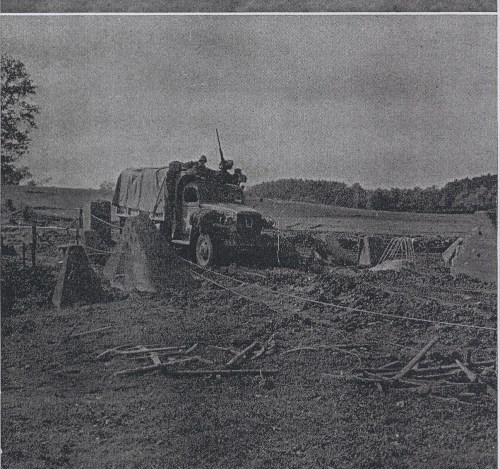

The last major operation in the West following the breakouts from the bridgeheads over the Rhine was the encirclement and reduction of the Ruhr pocket.  This operation involved the 9th Army and 1st Army. The 3rd Army continued its operations east and south toward Nurnberg.   Bradley, his blood stirred by the large numbers of prisoners taken in the Saar, Palatinate and Rhineland now became addicted by the completion of envelopments and he told his staff as “he shifted Hodges’ direction toward a meeting with Simpson encircling the Ruhr: “I’ve got bags on my mind.””[lxxxi] The Army Group completed the encirclement and reduced the pocket by April 18th. Two Army commanders, Von Zangen of 15th Army and Harpe of 5th Panzer Army as well as 25 other Generals and Admirals were caught in the American net.  Vaunted formations such as Panzer Lehr and 116th Panzer were among the 317,000 German prisoners taken by the Army Group. XVII Corps alone captured 160,000 prisoners.[lxxxii] Field Marshal Model, the commander of Army Group B took his own life on the 21st. The one setback during the battle was during the spirited advance of the 3rd Armored division to Paderborn a task force ran into a Kampfgrüppe of King Tigers manned by Waffen SS Panzer training students stopped them with heavy losses.[lxxxiii] To make matters worse the 3rd Armored Division Commanding General, Maurice Rose was killed when his jeep encountered Tigers and a jittery German Panzertroop shot him when he removed his pistol attempting to surrender.[lxxxiv]
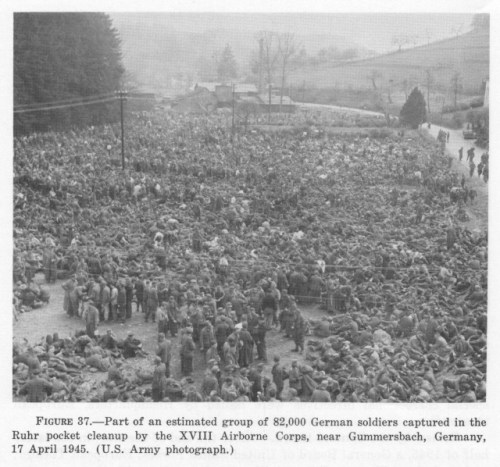
Despite the great number of prisoners taken and the elimination of the bulk of the Wehrmacht in the West the battle detracted from what had been hereto the overriding goal of the campaign, the capture of Berlin.[lxxxv] The reasons for this were twofold.  At the Army Group level Bradley was determined to engage as many of his troops as possible so they would not be sucked into any offensive commanded by Montgomery who continued to clamor for control of American troops to make the final drive for Berlin.   Eisenhower supported Bradley’s decision as he believed “that the Western Allies no longer had much chance of capturing “the main prize,” Berlin, anyway.”[lxxxvi] Weigley suggests that a better purpose for the troops that Bradley used to reduce the Ruhr pocket would have been to us them to aid 9th Army’s drive toward Berlin which was already closing on the Elbe.  With the reuniting of the 1st and 9th Armies Bradley was poised to begin his drive to Berlin with the largest field command in American history.[lxxxvii]

US Vehicles Driving Towards Kassel

The second reason was that Eisenhower had made a decision based on political and tactical considerations to shift the focus of the Allied effort from Berlin to Dresden and Leipzig yet not completely ruling out an advance toward Berlin.[lxxxviii] Attempts by 9th Army to drive toward Berlin were frustrated by unexpected German resistance to its bridgeheads over the Elbe. On the 15th of April Simpson flew to Bradley’s headquarters to propose an attack on Berlin.  Bradley called Eisenhower who on hearing Bradley’s estimate of 100,000 casualties to take the city elected not to continue the attack towards Berlin.[lxxxix] Eisenhower had now concluded “that the National Redoubt was now over more importance than Berlin,”[xc] and directed Patton and Devers to secure it.  Patton and Simpson were both incredulous at the decision and felt that it was “a terrible mistake.” Patton felt 9th Army could take Berlin in 48 hours.[xci] In a similar vein Patton’s move into Czechoslovakia was halted before Prague.

Overage German Recruits Captured by US Forces

Eisenhower’s decision was political and tactical and was supported by the U.S. Chiefs of Staff;[xcii] Berlin would be in the Soviet zone even if he took it.  Hastings sates the decision was “surely the correct one” noting that nothing could change the post-war settlement.[xciii] Murray and Millett agree.[xciv]Others such as J.F.C. Fuller felt that the political decisions had turned the fruits of victory “into the apples of Sodom, which turned to ashes as soon as they were plucked,”[xcv] leaving Eastern and Central Europe under the control of the Soviets.  D’ Este notes that no matter what was decided that Eisenhower’s “hands were already tied by the agreement of the Big Three agreement over the division of occupied Germany.”[xcvi] In the end there may have been a political advantage to taking Berlin before the Soviets, but as Hastings notes: “It is hard to see how this could have been prevented, given the Western Allies sluggish conduct of the war.”[xcvii] This was the fault of both the British and Americans and this was in fact as much a part of the final settlement in Europe as any decision made in the final weeks of the war.

In retrospect one can see the historical consequences of Eisenhower’s decision, but how much that decision was influenced by the way the American Army’s organization and conduct for war is seldom mentioned. Perhaps had Eisenhower had the 200 plus divisions envisioned by the Victory plan, or had he been bolder and abandoned the broad front strategy inherited from Grant, history might be different today.  There are always results.  One should not devise strategies for the conduct of war that do not match up with the forces that you plan to employ.  Organization, training and equipment must be designed for the type of war one intends to fight and are just as important as a grand strategy.   This was the lesson of the American involvement in the European campaign.  The American Army succeed in spite of the restraints that its leadership and saddled it with.  The final campaign in Germany showed that at least parts of it had learned the hard lessons of war and could conduct a highly successful campaign.

Handshake on the Elbe: US and  Red Army Troops Meeting


[i] Weigley, Russell  F. Eisenhower’s Lieutenants: The Campaign in France and Germany 1944-1945. Indiana University Press, Bloomington IN 1981. p.2.

[ii] Ibid.  p.728

[iii] Ibid. p.4.

[iv] Ibid.

[v] See Weigley’s article American Strategy, in Peter Paret’s Makers of Modern Strategy from Machiavelli to the Nuclear Age. Paret, Peter, editor.  Makers of Modern Strategy from Machiavelli to the Nuclear Age. Princeton University Press, Princeton, NJ 1986 pp.434-436.

[vi] See Keene, Jennifer D. Doughboys, the Great War, and the Remaking of America. The John’s Hopkins University Press. Baltimore,MD. 2001. pp.42-44.  Keene notes the results of the AEF’s training and Pershing’s organization and employment of the Army in WWI.  The similarities to the American experience in WWII are startling.  A comment of George Marshall after the war that: “Officers leading their men into battle, abandoned tactical maneuvering in favor of “steamroller operations” that forced men to keep going until exhaustion stopped them…” reminds one of the Huertgen Forrest.  Likewise a similar situation arose in regard to training.  Other comments are that the infantry was not well trained and that “many troops resisted advancing without artillery support….”

[vii] Herwig, Holger H. The First World War: Germany and Austria-Hungary 1914-1918. Arnold a Member of the Hodder Headline Group, London England 1998. p.424.

[viii] Millett, Allen R. and Maslowski, Peter. For the Common Defense: A Military History of the United States of America. The Free Press, New York 1984. p.349.

[ix] Ibid. Weigley. p.25

[x] Matloff, Maurice Allied Strategy in Europe in Makers of Modern Strategy from Machiavelli to the Nuclear Age. Paret, Peter, editor.  Makers of Modern Strategy from Machiavelli to the Nuclear Age. Princeton University Press, Princeton, NJ 1986 p.696.

[xi] Ibid. Weigley. p.5

[xii] Ibid. Weigley. p.23

[xiii] Ibid. p.728

[xiv] Mansoor, Peter R. The GI Offensive in Europe: The Triumph of American Infantry Divsions 1941-1945. University Press of Kansas, Lawrence KS. 1999 p.31.

[xv] Ibid. pp.253-254.  Mansoor is the only historian that I have ever seen defend this system.  Even Stephan Ambrose who generally leads the cheering section for the American Army in WWII condemned the system, which Mansoor admits in his account.

[xvi] Gabel, Christopher R. The Lorraine Campaign: An Overview September-December 1944. U.S. Army Command and Staff College, Ft. Leavenworth KS 1985.  pp.34-35.

[xvii] Chaffee, Adna R. Mechanization in the Army, Statement to Congress, April 1941. p.19.  Combined Arms Research Library, Digital Library http://cgsc.leavenworth.army.mil/carl/contentdm/home.htm

[xviii] Ibid. p.6.

[xix] _________Infantry in Battle 2nd Edition The Infantry Journal Incorporated, Washington DC 1939. p.68

[xx] See Chaffee and Infantry in Battle. Likewise this was echoed in S.L.A. Marshall’s book Armies on Wheels, William and Morrow Company, New York, NY 1941.

[xxi] Ibid. p.729.

[xxii] Ibid. p.14

[xxiii] Ibid.

[xxiv] Ibid. p.662-663. Initially, 21,000 troops were taken from the COMMZ and 10,000 were directed to be transferred from the AAF.  Additionally 2,253 black troops were formed into 37 platoons and distributed among the divisions of 12th and 6th Army Groups.

[xxv] Ibid. p.664.  The efforts were successful and by April there was a surplus of 50,000 infantry soldiers beyond reported shortages, despite the fact that no more American or British divisions were available for deployment to the continent.

[xxvi] Ibid. Mansoor,

[xxvii] Ibid. Weigley. p.578

[xxviii] Hastings, Max. Armageddon:  The Battle for Germany 1944-1945 Alfred A Knopf, New York NY 2004 p.340.

[xxix] Ibid.

[xxx] Ibid. Hastings. p.340

[xxxi] Ibid. p.341

[xxxii] Ibid. Weigley. p.583

[xxxiii] Bradley, Omar  N. A Soldier’s Story Henry Holt and Company, New York NY 1951. p.501

[xxxiv] Ibid. Hastings. p.348

[xxxv] Ibid. Bradley. p.497

[xxxvi] Ibid. p.589.

[xxxvii] Ibid. Hastings. p.348.

[xxxviii] Patton, George S. War as I Knew It Originally published by Houghton Mifflin Company NY 1947, Bantam Paperback Edition,  Bantam Books, New York, NY 1980 p.242

[xxxix] Ibid. Hastings. p.345

[xl] Ibid.

[xli] Ibid. Weigley. p.603

[xlii] Ibid. p.602

[xliii] Wilmont, Chester. The Struggle for Europe Harper and Brothers Publishers, New York, NY 1952 p.673

[xliv] Ibid. p.616

[xlv] Ibid. Hastings. p.365

[xlvi] Ibid. Weigley. p.621

[xlvii] Ibid.

[xlviii] Ibid. Bradley. p.509

[xlix] Ibid. Wilmont. p.674

[l] Ibid. Weigley. p.622.

[li] Ibid. 627

[lii] Ibid. Hastings. p.365

[liii] Ibid.

[liv] Murray, Williamson and Millett, Allan R. A War to Be Won: Fighting the Second World War The Belknap Press of Harvard University Press, Cambridge Massachusetts and London England, 2000 p.478

[lv] Ibid. Mansoor. P.244.

[lvi] Ibid. Weigley. p.632

[lvii] D’Este, Carlo. Eisenhower: A Soldier’s Life Owl Books, Henry Holt and Company, New York NY 2002. p.681

[lviii] Ibid. p.682

[lix] Ibid. Bradley. p.511

[lx] Ibid. Weigley. p.629.

[lxi] Ibid.

[lxii] Ibid. Wilmont. p.676

[lxiii] Liddell Hart, B.H. The History of the Second World War G.P. Putnam’s Sons, New York NY 1970. p.678.

[lxiv] Ibid. Hastings. p.366.

[lxv] Newton, Steven H. Hitler’s Commander: Field Marshal Walter Model, Hitler’s Favorite General. DeCapo Press, Cambridge MA 2005. p.351.

[lxvi] Ibid. D’Este. Eisenhower p.682

[lxvii] Ibid.  By this D’Este is obviously not referring to Bull and Eisenhower.

[lxviii] Ibid. Wilmont. p.677.

[lxix] Ibid. Liddell-Hart. p.677

[lxx] Warlimont, Walter. Inside Hitler’s Headquarters 1939-1945 translated by R.H. Barry. Presidio Press, San Francisco, CA 1964. p. 506.

[lxxi] Ibid. Weigly. p.635.

[lxxii] Ibid. p.638

[lxxiii] Ibid. Wilmont. p.678.

[lxxiv] Ibid.

[lxxv] D’Este, Carlo. Patton: A Genius for War. Harper Collins Publishers New York, 1995  p.711

[lxxvi] Ibid.  Murray and Millet. p.479.

[lxxvii] Ibid. D’Este Eisenhower p.683

[lxxviii] Ibid. Weigley. p.639

[lxxix] Ibid. Liddell-Hart. p.678.

[lxxx] Ibid. Hastings. p.369.

[lxxxi] Ibid. Weigley. p.673.

[lxxxii] Ibid. p.680

[lxxxiii] Ibid. Hastings. p.377.

[lxxxiv] Ibid. p.675.

[lxxxv] Ibid. Weigley. p.674.

[lxxxvi] Ibid. p.684.

[lxxxvii] Ibid.

[lxxxviii] Ibid. p.688.

[lxxxix] Ibid. pp.698-699.  Weigley believes that neither Eisenhower nor Bradley wanted to continue to Berlin; Bradley for the reason that Montgomery would steal the credit and Eisenhower because it was a “prestige objective” that would remain in the Soviet zone no matter who captured it.

[xc] Ibid. Wilmont. p.690.

[xci] Ibid. D’Este Patton. P.721

[xcii] Ryan, Cornelius. The Last Battle The Fawcett Popular Library, New York NY.1966.  p.240.

[xciii] Ibid. Hastings. p.425

[xciv] Ibid. Murray and Millett. P.480

[xcv] Fuller, J.F.C. The Conduct of War 1789-1961 DaCapo Press edition, San Francisco, CA 1992. p.296.

[xcvi] Ibid. D’Este. Eisenhower. P.694.

[xcvii] Ibid. Hastings. p.512.

Bibliography

Bradley, Omar  N. A Soldier’s Story Henry Holt and Company, New York NY 1951.

Chaffee, Adna R. Mechanization in the Army, Statement to Congress, April 1941.  Combined Arms Research Library, Digital Library http://cgsc.leavenworth.army.mil/carl/contentdm/home.htm

D’Este, Carlo. Eisenhower: A Soldier’s Life Owl Books, Henry Holt and Company, New York NY 2002.

D’Este,  Carlo. Patton: A Genius for War. Harper Collins Publishers New York, 1995

Fuller, J.F.C. The Conduct of War 1789-1961 DaCapo Press edition, San Francisco, CA 1992.

Gabel, Christopher R. The Lorraine Campaign: An Overview September-December 1944. U.S. Army Command and Staff College, Ft. Leavenworth KS 1985.

Hastings, Max. Armageddon:  The Battle for Germany 1944-1945 Alfred A Knopf, New York NY

Herwig, Holger H. The First World War: Germany and Austria-Hungary 1914-1918. Arnold a Member of the Hodder Headline Group, London England 1998

Keene, Jennifer D. Doughboys, the Great War, and the Remaking of America. The John’s Hopkins University Press. Baltimore, MD. 2001.

Liddell Hart, B.H. The History of the Second World War G.P. Putnam’s Sons, New York NY 1970

Mansoor, Peter R. The GI Offensive in Europe: The Triumph of American Infantry Divsions 1941-1945. University Press of Kansas, Lawrence KS. 1999

Millett, Allen R. and Maslowski, Peter. For the Common Defense: A Military History of the United States of America. The Free Press, New York 1984

Murray, Williamson and Millett, Allan R. A War to Be Won: Fighting the Second World War The Belknap Press of Harvard University Press, Cambridge Massachusetts and London England, 2000

Newton, Steven H. Hitler’s Commander: Field Marshal Walter Model, Hitler’s Favorite General. DeCapo Press, Cambridge MA 2005

Paret, Peter, editor.  Makers of Modern Strategy from Machiavelli to the Nuclear Age. Princeton University Press, Princeton, NJ 1986

Patton, George S. War as I Knew It Originally published by Houghton Mifflin Company NY 1947, Bantam Paperback Edition,  Bantam Books, New York, NY 1980

Ryan, Cornelius. The Last Battle The Fawcett Popular Library, New York NY.1966

Warlimont, Walter. Inside Hitler’s Headquarters 1939-1945 translated by R.H. Barry. Presidio Press, San Francisco, CA 1964

Weigley, Russell  F. Eisenhower’s Lieutenants: The Campaign in France and Germany 1944-1945. Indiana University Press, Bloomington IN 1981.

Wilmont, Chester. The Struggle for Europe Harper and Brothers Publishers, New York, NY 1952

_________Infantry in Battle 2nd Edition The Infantry Journal Incorporated, Washington DC 1939

2 Comments

Filed under History, Military, world war two in europe

Beer and Donuts

Tonight after a hard week for Judy and a reasonably sporty week on the ICU for me, Judy and I went out to dinner at Gordon Biersch.  Patently we are preparing for our Dos De Mayo party and while I have been at work Judy has been working her ass off to cook and clean all week in preparation for this celebration.

Now our  Dos De Mayo is actually a celebration of the fact that we know that the Mexicans will kick the ass of the French on Cinco De Mayo at the battle of Puebla in 1862. The Mexicans were outnumbered 2-1 and whipped up on the French, allowing the Americans who were involved in a brother on brother bloodletting known as the Civil War continue. This enabled Americans to kill each other  to kill each other in peace without the help of any European powers for the next 2 1/2 years. This preserved American sovereignty and kept the evil European Union out of the United States for the next 150 years.  This Independence lasted until a descendant of Robert E. Lee, President Barak Obama, surrendered American sovereignty to Europe in late 2009 and early 2010.  Of course this is mostly BS but it does makes for a great tall tale from someone who has just a bit of Irish blood in him due to the grace of the Deity Herself.

An interesting but little known fact is that Cinqo de Mayo is only locally celebrated in Mexico in the state of Puebla.  The celebration actually began in California where until that time state workers had no state holidays.

The Mexican victory was decidedly helpful to the Union armies who despite a poor opening managed to come back under US Grant and William T. Sherman to decidedly defeat the Confederate armies in the final innings of this brutal game.  Abner Doubleday, who by some accounts invented the game of baseball gets credit for helping to stem the Confederate tide on day one at the Battle of Gettysburg.

Grant got the win and celebrated by donating the liquor for all in the clubhouse after General Robert E. Lee surrendered at Appomattox in April 1865.  This helped bring about the tradition of popping Champagne bottles when a baseball team wins a championship series or the World’s series. Though the South led through the middle of the game, the Union took charge and won the war in in regulation without having to go into extra innings.  This latter comment may be interpreted differently if one assumes that the war was not ended for another 100 years with people like Nathaniel Bedford Forrest and his fellow Klansmen taking over for Lee in extra innings.   Patently though they attempted to keep the game alive, it was over at Appomattox, Forest, the Klan and their supporters simply hung on like Dodgers’ fans after the 1951 Championship Game between the Evil Brooklyn Dodgers and the New York Giants in 1951.

This being said the idea of beer and donuts going together is not all that strange, after all there are many deserts which combine alcohol and sugar.  It is just the fact that something is right about a hot and fresh Krispy Kreme and a good pilsner or lager.  Tonight’s brew is a Harp’s Lager from Ireland.  Somehow I think that the Irish had to be the originators of the beer and donut combination.  I think the Brits would think the combination insulting, the French uncultured, the Italians unromantic and the Germans simply illegal.  Only the Irish could come up with this succulent combination.

So all that aside we have discovered a wonderful desert combination.  Hot and Fresh Krispy Creme Donuts and a good beer.  Life doesn’t get much better than this.  It is a yin and yang kind of thing.  You get the sugar rush from the donuts but the beer counteracts the rush.  There is patently a chemistry that only the Deity Herself understands in this.  Well tomorrow is Dos De Mayo and I will have to be up early to help Judy get ready.

As far as the Tides, they beat the Scranton-Wilkes Barre Yankees on the road, 14-7 ending a 3 game losing streak.  Tides sluggers Nolan Reimold and Oscar Salazar each hit home runs while starting pitcher Chris Tillman got the win.  Reimold has already taken 8 out of the park this year.  He is really the first serious home run hitter that the Tides have had since we have lived in the area. The Tides will come back home for a 4 game series against the Columbus Clippers on Monday. I think I will get three of these games in before the Tides and I come back into town about the middle of the month.

Peace and blessings,

Steve+

1 Comment

Filed under Baseball, beer, Loose thoughts and musings, Religion