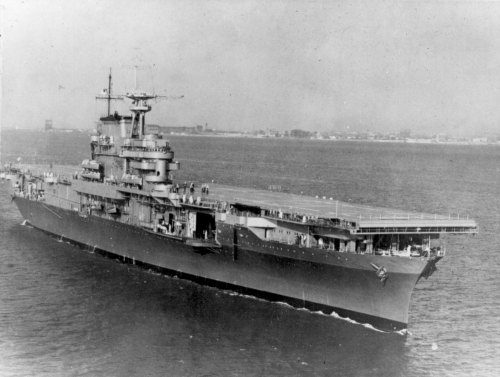
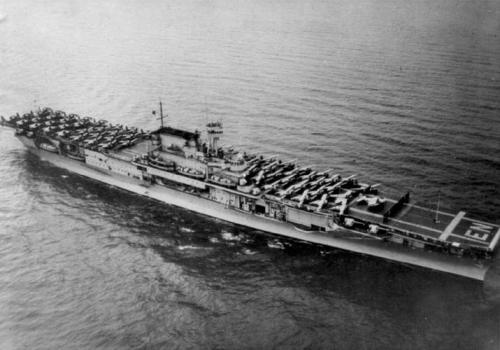
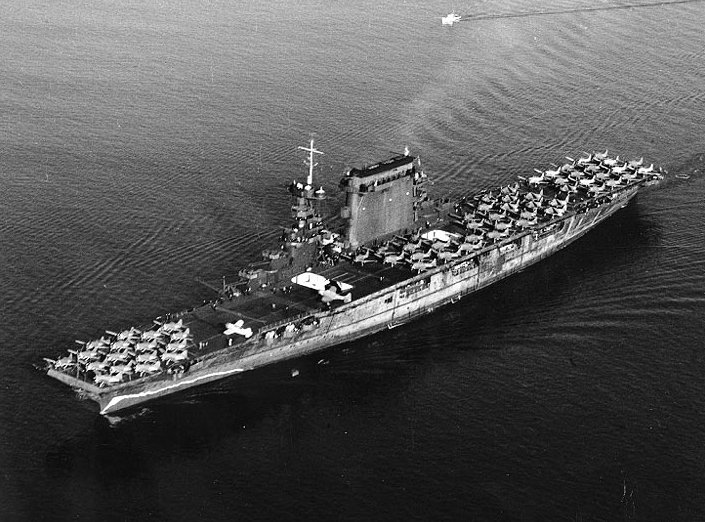
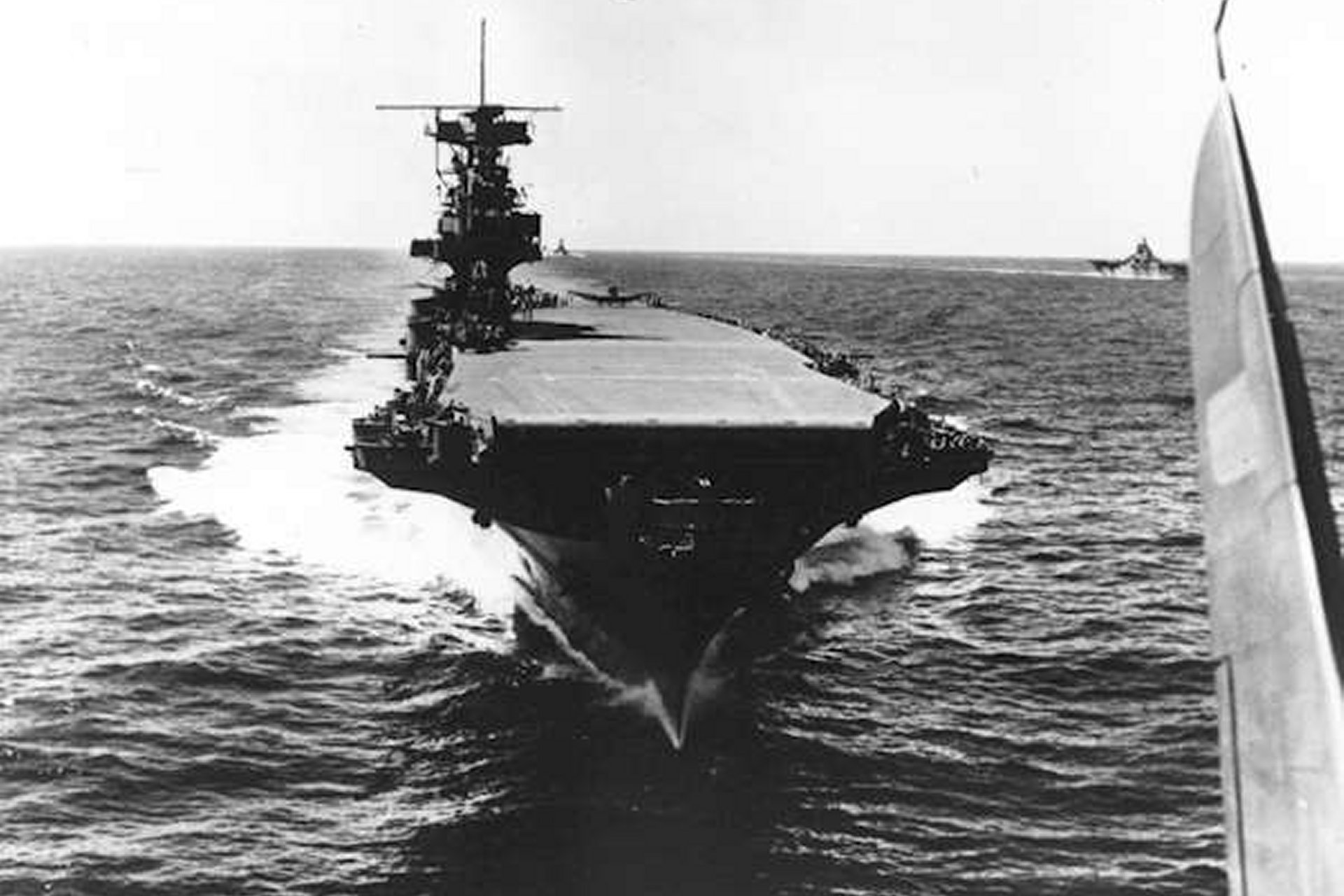
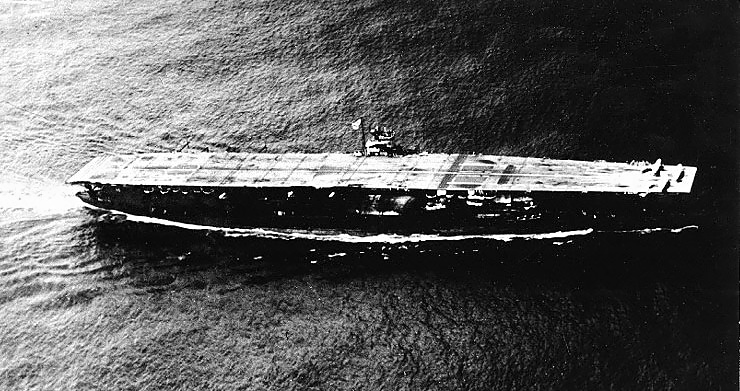
Tag Archives: uss saratoga

The Valiant Sacrifice of the Torpedo Bombers: VT3, VT-6 and VT-8 at Midway

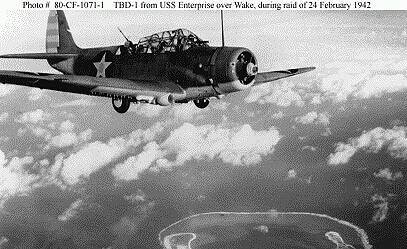
tbd-devastator1


Half a league half a league,
Half a league onward,
All in the valley of Death
Rode the six hundred:
‘Forward, the Light Brigade!
Charge for the guns’ he said:
Into the valley of Death
Rode the six hundred.

Alfred, Lord Tennyson: The Charge of the Light Brigade

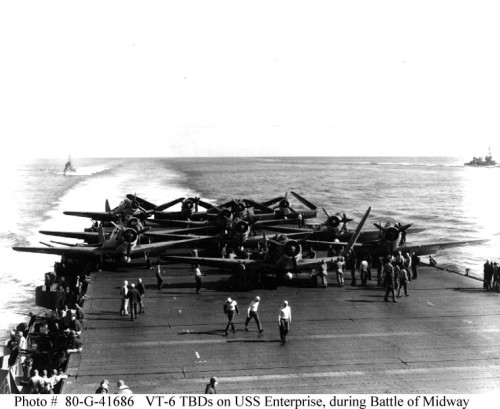
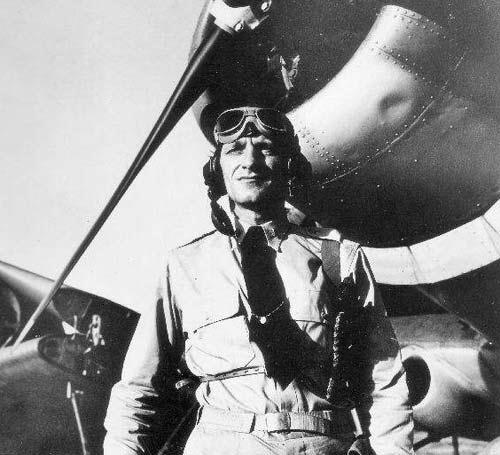
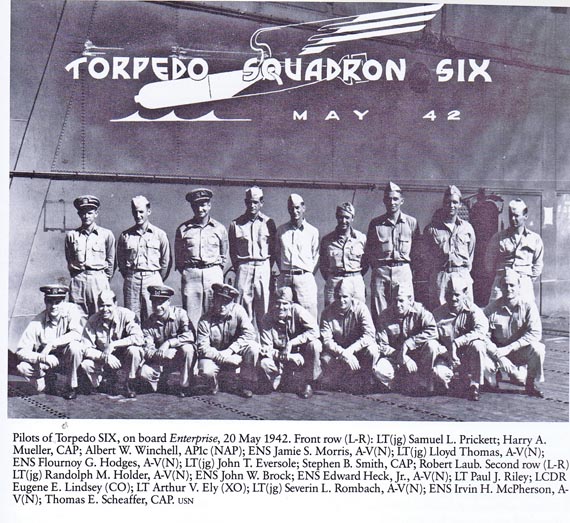
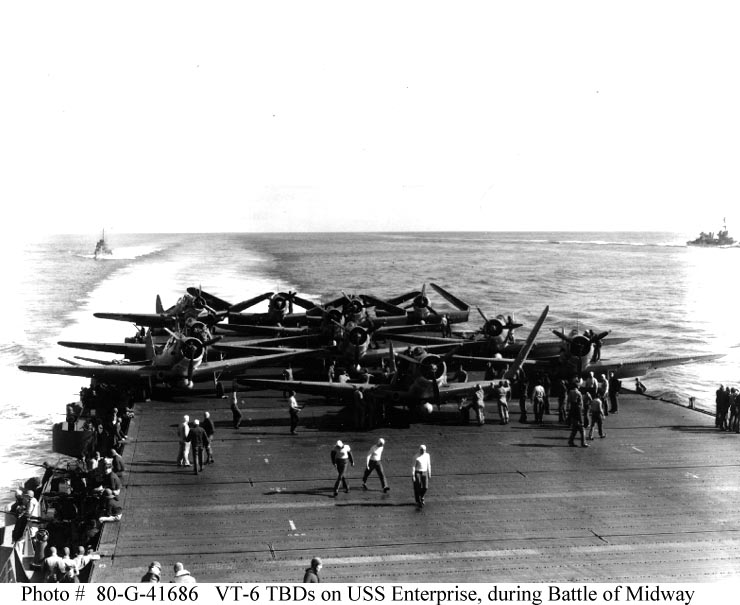
They were not six hundred and they were not mounted on horses but the Naval Aviators of Torpedo Squadrons 3, 6 and 8 and their aerial steeds 42 Douglas TBD Devastators and 6 TBF Avengers wrote a chapter of courage and sacrifice seldom equaled in the history of Naval Aviation. Commanded by veteran Naval Aviators, LCDR Lance “Lem” Massey, LCDR Eugene Lindsey and LCDR John Waldron the squadrons embarked aboard the carriers flew the obsolete TBD Devastators and the young pilots of the Midway based Torpedo 8 detachment under the command of LT Langdon Fieberling flew in the new TBF Avengers.


eneterprise-vt-6-midway1

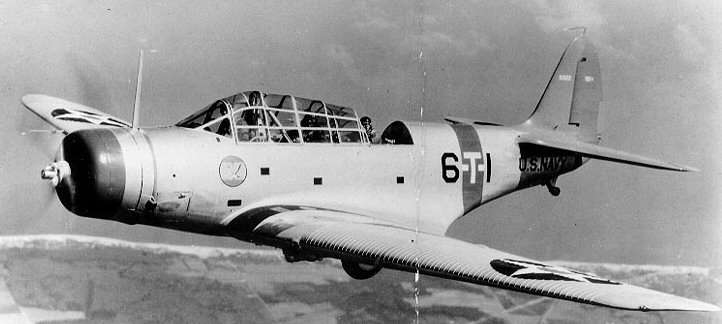
The TBD which first flew in 1935 entered service in 1937 and was possibly the most modern naval aircraft in the world when it entered service.  It was a revolutionary aircraft. It was the first monoplane widely used on carriers and was first all-metal naval aircraft.  It was the first naval aircraft with a totally enclosed cockpit, the first with hydraulic powered folding wings.  The TBD had crew of three and had a maximum speed of 206 miles an hour and carried a torpedo or up to 1500 pounds of bombs (3 x 500) or a 1000 pound bomb.

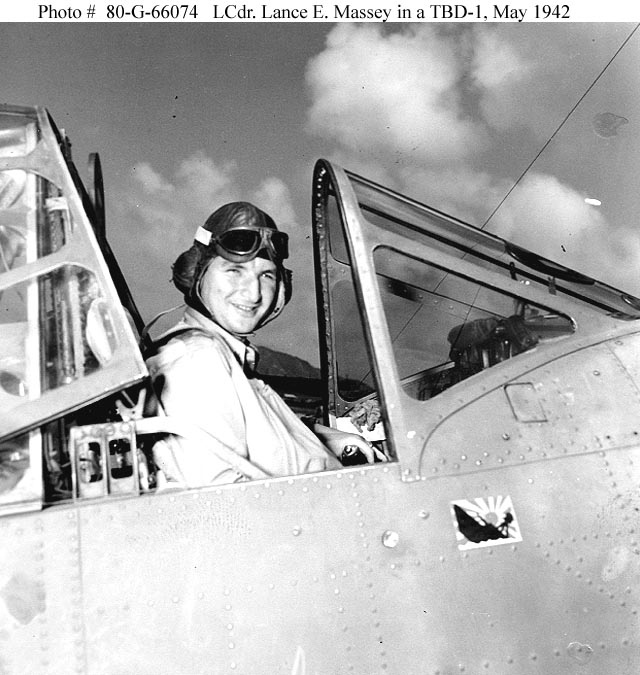
g66074


LCDR Lem Massey C.O. of Torpedo 3

129 TBDs were built and served in all pre-war torpedo bombing squadrons based aboard the Lexington, Saratoga, Ranger, Yorktown, Enterprise and Hornet with a limited number embarked aboard Wasp.  The Devastator saw extensive service prior to the war which pushed many airframes to the end of their useful service life and by 1940 only about 100 were operational by the beginning of the war, and now were for all purposes obsolete antiques.


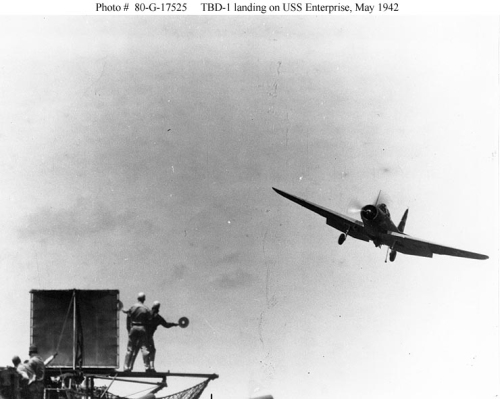
They were still in service in 1942 as their replacement the TBF Avenger was not available for service in large enough numbers to replace them before Midway.  The TBDs performed adequately against minor opposition at Coral Sea and in strikes against the Marshalls but the squadrons embarked on Yorktown (VT3), Enterprise (VT-6) and Hornet (VT-8) were annihilated at Midway with only 6 of 41 aircraft surviving their uncoordinated attacks against the Japanese Carrier Strike Force.  They were too slow, had poor maneuverability, insufficient armor and defensive armament.

enterprise-tbd-landing1


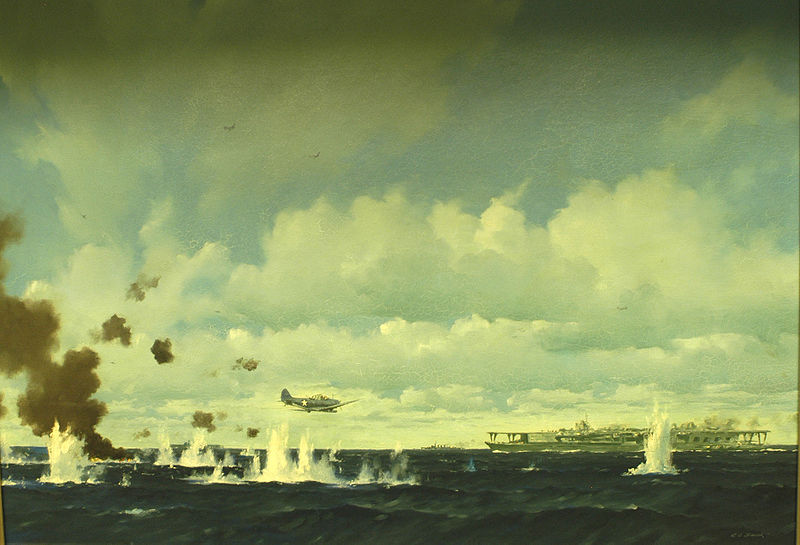
The Torpedo squadrons attacked independently of each other between 0920 and 1030 on June 4th 1942.  Lacking coordination and with inadequate escort, the lumbering aircraft were easy prey for the modern Japanese A6M Zeroes.

The Japanese Combat Air Patrol ripped into the slow, cumbersome and under armed TBD Devastators as they came in low to launch their torpedoes.  Torpedo Eight from Hornet under the command of LCDR John C Waldron pressed the attack hard but all 15 of the Devastators were shot down.  Only Ensign George Gay’s aircraft was able to launch its torpedo before being shot down and Gay would be the sole survivor of the squadron to be picked up later by a PBY Catalina patrol plane.

Page500_163_6

LCDR John Waldron C.O

Torpedo Six from the Enterprise under the command of LCDR Eugene Lindsey suffered heavy casualties losing 10 of 14 aircraft with Lindsey being one of the casualties.  The last group of Devastators to attack was Torpedo Three from the Yorktown under the command of LCDR Lem Massey losing 11 of 13 aircraft with Massey a casualty last being seen standing on the wing of his burning aircraft as it went down.

VT-6

These aircraft were also decimated and Massey killed but they had drawn the Japanese Combat Air Patrol down to the deck leaving the task force exposed to the Dive Bombers of the Enterprise and Yorktown.  The six aircraft of the Torpedo Eight detachment from Midway under the command of LT Fieberling lost 5 of their 6 aircraft while pressing their attacks.  Only Ensign Bert Earnest and his aircraft survived the battle landing in a badly damaged state on Midway.  Four U.S. Army B-26 Marauder Medium Bombers were pressed into service as torpedo bombers of which 2 were lost.  No torpedo bomber scored a hit on the Japanese Task force even those torpedoes launched at close range failed to score and it is believe that this was in large part due to the poor performance of the Mark 13 aircraft torpedoes.

yorktown-devastators1


Despite the enormous losses of the torpedo squadrons their sacrifice was not in vain. Their attacks served to confuse the Japanese command and delay the rearmament of aircraft following the Japanese strikes on Midway. They also took the Japanese Combat Air Patrol down to sea level and opened the way for American Dive Bombers to strike the Japanese with impunity fatally damaging the Akagi, Kaga and Soryu in the space of 5 minutes.

After Midway the remaining TBDs were withdrawn from active service and no example survives today. The TBF became the most effective torpedo bomber of the war.

800px-tbd_attacking_at_midway_painting-1

As we remember the brave men that fought at Midway it is imperative that we remember the brave aircrews of the torpedo squadrons that like the Light Brigade rode into the Valley of the Shadow of Death against the First Carrier Strike Force and Midway.

Peace

Padre Steve+


13 Comments

Filed under History, world war two in the pacific

The Thin Gray Line: The USS Yorktown, USS Enterprise and USS Hornet, the Carriers that Held the Japanese at Bay in 1942

yorktown-drydock1USS Yorktown CV-5

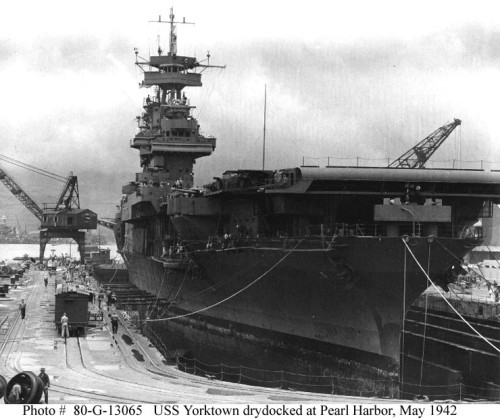
Seldom in the annals of war is recorded that three ships changed the course of a war and altered history.  Winston Churchill once said about Fighter Command of the Royal Air Force during the Battle of Britain: “Never in the field of human conflict was so much owed by so many to so few” however I would place the epic war waged by the three carriers of the Yorktown class against the Combined Fleet and First Carrier Strike Group, the Kido Butai of the Imperial Japanese Navy between December 1941 and November 1942 alongside the epic fight of the Royal Air Force against Hitler’s Luftwaffe.

The Carriers of the Yorktown Class hold a spot in United States Naval History nearly unequaled by any other class of ships, especially a class that numbered only three ships.  Designed and built in the mid 1930s they were the final class of pre-war carriers commissioned by the navy.  The ships were built incorporating the lessons learned with Langley, Lexington, Saratoga and Ranger and had features that would become standard in the design of US Aircraft Carriers. As such they were the template for future classes of ships beginning with the Essex Class until the advent of the super carriers of the Forrestal Class.

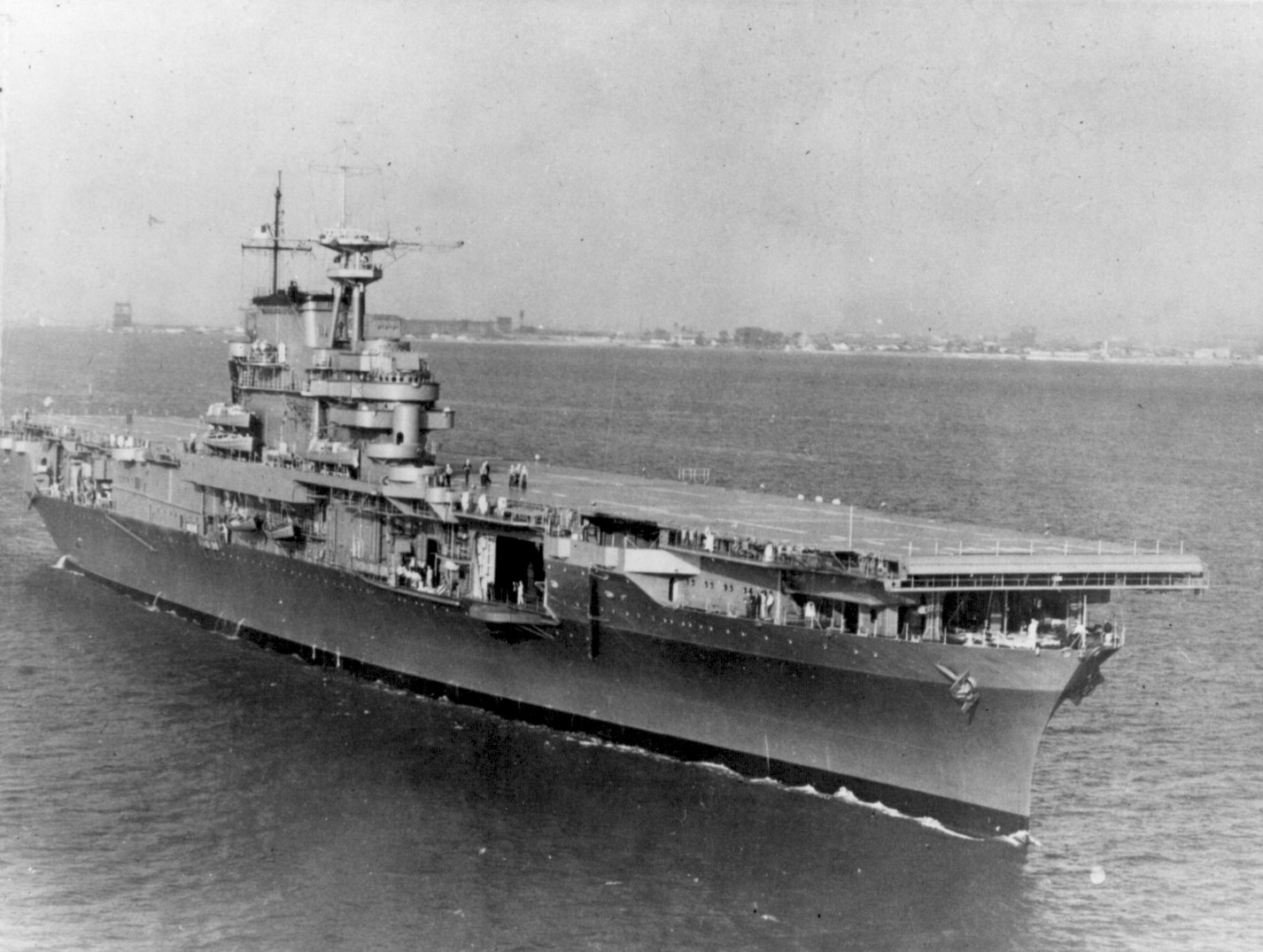
hornet-as-completed1USS Hornet CV-8

The ships heritage was evident in their names. Yorktown, the lead ship of the class named after the victory of Washington and Rochambeau over Cornwallis at Yorktown, Enterprise named after the sloop of war commanded by Stephen Decatur in the war against the Barbary Pirates, and Hornet after another famous Brig of War commanded by James Lawrence which defeated the British ship Peacock in the War of 1812.

They displaced 19.800 tons with a 25,000 full load displacement. Capable of 32.5 knots they were the Navy’s first truly successful class of carriers built from the keel up.  The ships could embark over aircraft and could steam long distances without refueling.  Protection was good for their era and the ships proved to be extraordinarily tough when tested in actual combat. In speed and air group capacity the only carriers of their era to equal them were the Japanese Hiryu and Soryu and the larger Shokaku and Zuikaku. British carriers of the period were about the same size but were slower and carried a smaller and far less capable air group though their protection which included armored flight decks was superior to both the American and Japanese ships.

enterprise-pre-war-with-ac-on-deck1USS Enterprise CV-6

Next week we will remember the epic battle of Midway, where these three gallant ships inflicted a devastating defeat on the Japanese First Carrier Strike Group. I believe that it is appropriate to go into that week remembering those ships and the brave sailors and aviators who made their triumph at Midway possible. the The links below are to articles about these three gallant ships.

They Held the Line: The USS Yorktown CV-5, USS Enterprise CV-6 and USS Hornet CV-8, Part One

They Held the Line: The USS Yorktown CV-5, USS Enterprise CV-6 and USS Hornet CV-8, Part Two the Hornet

They Held the Line: The USS Yorktown CV-5, USS Enterprise CV-6 and USS Hornet CV-8, Part Two the Hornet

Peace,

Padre Steve+

2 Comments

Filed under History, Military, Navy Ships, world war two in the pacific

The Never Built Battlecruisers of 1921: The G3, Amagi and Lexington Classes

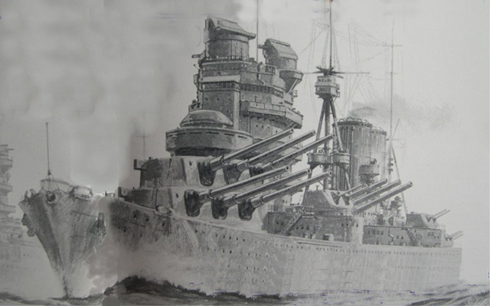
artist

Artists Depiction of G3 Battlecruiser 

As the First World War ended a new Naval Race was heating up. The United States had announced its intention during the war to build a navy second to none while Imperial Japan was making plans for a fleet that would give it superiority in the Western Pacific. The British, though still be far the largest naval power in the world were burdened by the massive costs of war and empire, but also seeking to maintain their naval dominance.

The ships known as battle cruisers were first built by the British Royal Navy as a compliment to the all big gun Dreadnought battleships. The Battle Cruiser concept was a ship of roughly the same size and firepower as a Battleship but sacrificing protection for greater speed, endurance and range.  and Japan joined in the Battle Cruiser race before and during the war. The United States had concentrated on Battleships.

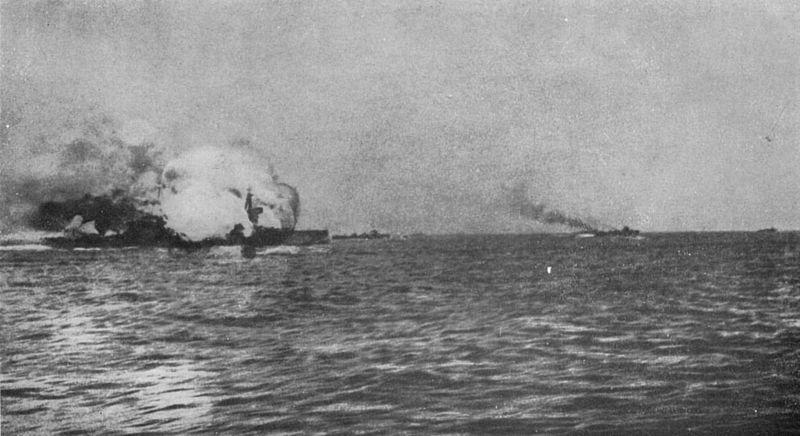
800px-InvincibleBlowingUpJutland1916

HMS Invincible Blowing Up at Jutland 

During the war the weaknesses of the type were exposed during the Battle of Jutland where three British Battle Cruisers, the HMS Invincible, HMS Indefatigable and HMS Queen Mary blew up with the loss of most of their crews of the  3311 officers and sailors on the ships only 26 survived. The HMS Lion was almost lost in a similar manner but for the heroic actions of her crew. The British ships had glaring deficiencies in armor protection and the arrangement of their ammunition magazines and hoists which certainly contributed to their loss. Their German counterparts on the other hand proved much tougher and though all sustained heavy damage while engaging British Battleships and Battle Cruisers, only one the Lützow was lost. She absorbed over 30 hits from large caliber shells and only lost 128 crew members.

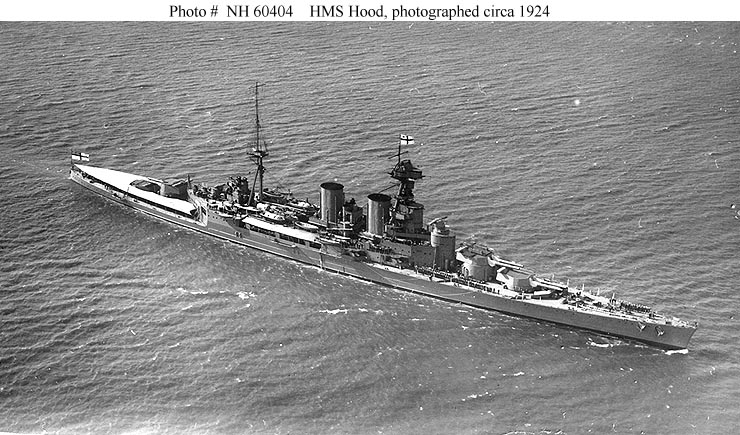
h60404

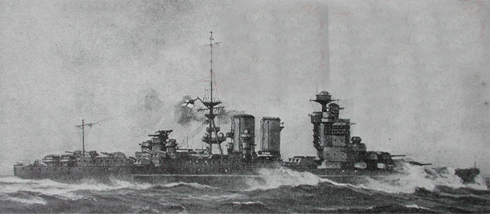
As the war progressed other Battle Cruisers were built, the British launched the HMS Repulse and HMS Renown and completed the HMS Hood shortly after the war was over. The Japanese built the four ship Kongo class from a British design. As the powers embarked on the next Naval Race planners and naval architects designed ships of massive firepower, better protection and higher range and speed. All would have been better classed as Fast Battleships.

The British designed and began construction on the G3 class in 1921, the Japanese the Amagi Class, and the United States the Lexington Class. However the construction and completion of these ships as Battle Cruisers was prevented by the Washington Naval Treaty.

invincible 490

The treaty was ratified in 1922 limited the United States and Great Britain to a maximum of 525,000 tons in their battle ship fleets and 125,000 tons in aircraft carriers.  The Japanese agreed to a limit of 315,000 tons and the French and Italians 175,000 tons each. Tonnage for battleships was limited to a maximum of 35,000 tons with a limitation on guns size to 16 inches.  Since the bulk of the ships planned or being built by the US and Japan exceeded those limits they would be effected more than the British whose post war shipbuilding program had not begun in earnest, in fact the G3 Class had just been approved for construction.

The G3 class would have comprised four ships and been similar to the N3 Class Battleships. They were very well balanced ships and would have mounted nine 16” guns in three turrets on a displacement of 49,200 tons and deep load of 54,774 tons. They had an all or nothing protection plan meaning that the armored belt was concentrated in vital areas around the armored citadel, conning tower, turrets and magazines and engineering spaces. Their armor belt would have ranged from 12-14 inches, deck armor from 3-8 inches, conning tower 8 inches, barbettes 11-14 inches, turrets 13-17 inches and bulkheads 10-12 inches. Their propulsion system of 20 small tube boilers powering 4 geared steam turbines connected to 4 propeller shafts would have produced 160,000 shp with a designed speed of 32 knots.

The four ships, none of which were named were ordered between October and November of 1921. Their construction was suspended on November 18th 1921 and they and the N3 Battleships were cancelled in February 1922 due to the limitations of the Washington Naval Treaty. Many concepts of their design were incorporated in the Nelson Class Battleships.

rys-amagi

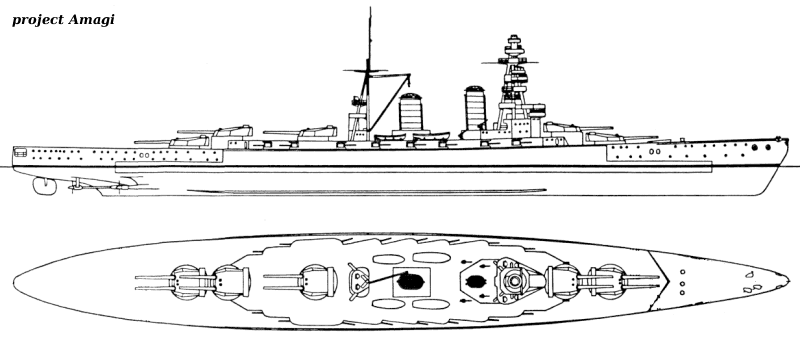
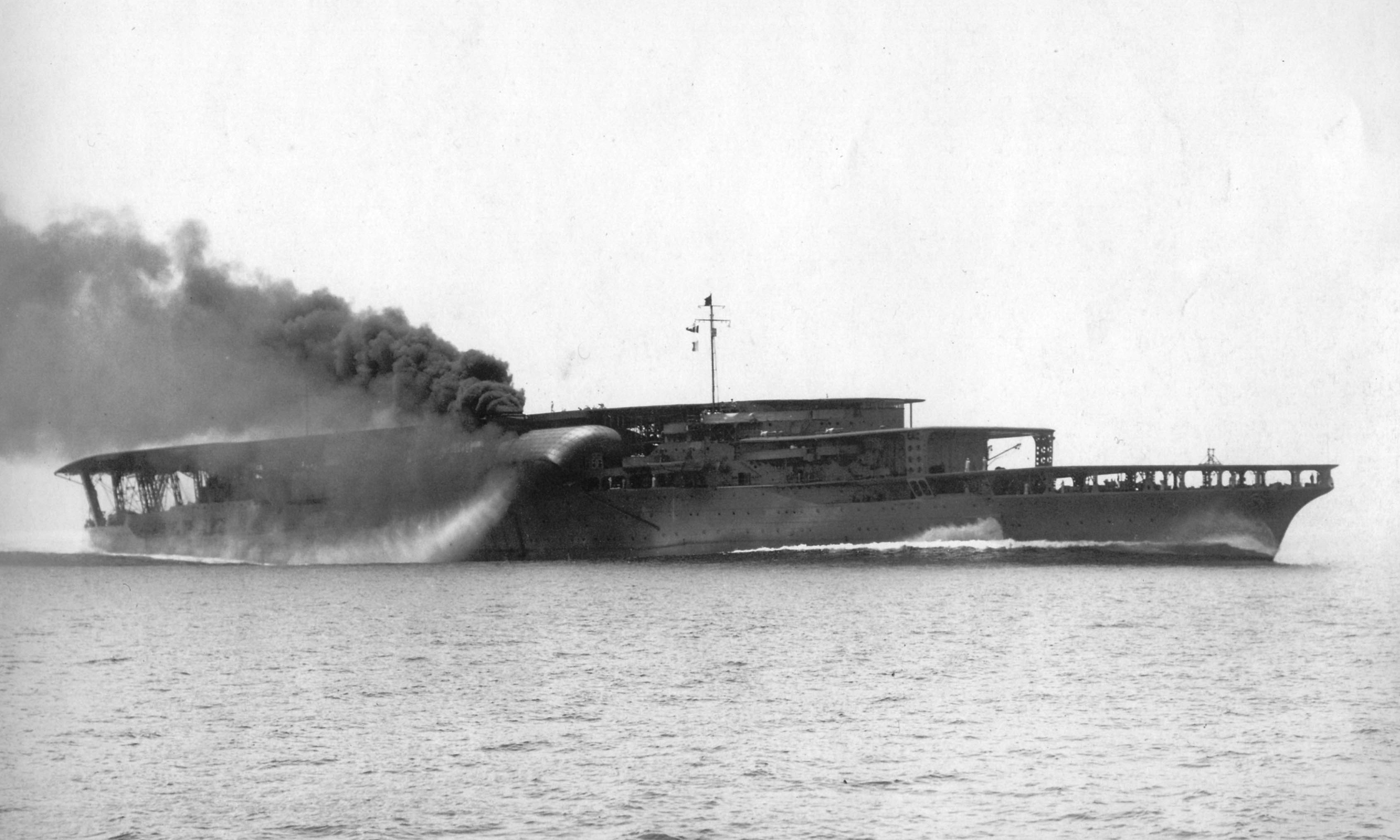
Amagi Class as Designed, Akagi as Completed (below) 

JapaneseAircraftCarrierAkagi3Deck_cropped

The four planned Japanese Amagi Class ships would have mounted ten 16” guns on a displacement of 47,000 tons at full load. Their propulsion system 19 Kampon boilers powering four Gihon turbines would have given them a maximum speed of 30 knots, They would have had less protection than the G3 ships being more of a traditional Battle Cruiser design. As a result of the Washington Naval Treaty the Japanese elected to convert two of the ships, the Amagi and Akagi to aircraft carriers. Amagi was destroyed on the ways during the great Tokyo earthquake and Akagi was completed as a carrier. The other two vessels were scrapped on the ways.

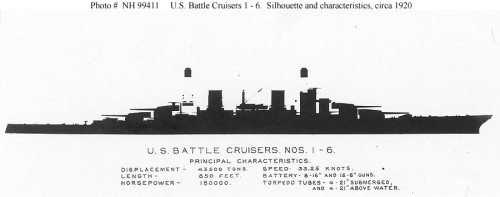
lexington-class-battle-cruisern11978

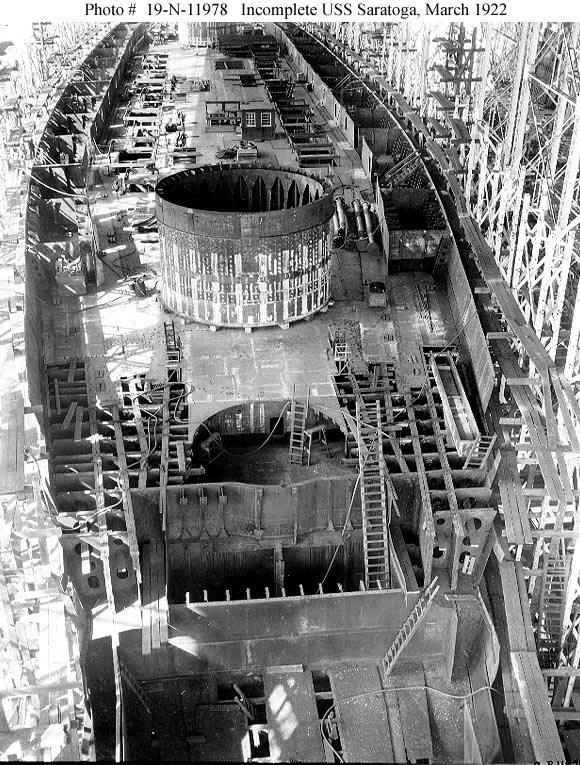
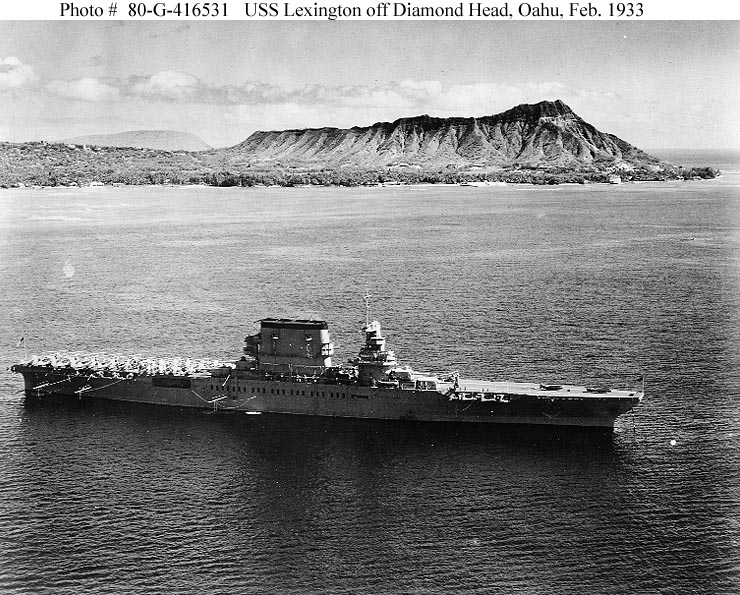
The United States Navy planned the six ship Lexington Class. These ships would have mounted eight 16” guns on a ship displacing 43,254 tons at full load. They would have had a maximum speed of 33 knots being powered by 16 boilers which drove 4 GE electric turbines producing 180,000 shp. It was a massive engineering plant and the class did not have as heavy armor protection as either the G3 or Amagi classes but were superior in speed as well as endurance. Upon ratification of the Washington Naval Treaty four of the six ships were cancelled and the remaining two, the Lexington and Saratoga competed as aircraft carriers.  Had any of the ships been completed as Battle Cruisers it is likely due to their speed that they would have operated primarily with the the carriers that the US Navy built during the 1930s.

g416531

One can only speculate what the navies of World War II would have looked like had the Washington and the subsequent London Naval Treaties not been ratified. One can also only imagine how the war at sea would have been different had the ships completed as carriers been completed as Battle Cruisers.

However that was not to be, of the planned 14 ships of these three classes only three were completed, all as aircraft carriers. Thus they are an interesting footnote in the annals of naval ship design and not much more.

Until tomorrow,

Peace

Padre Steve+

4 Comments

Filed under History, Military, Navy Ships, US Navy

Pearl Harbor, the Missing Carriers: USS Enterprise, USS Lexington and USS Saratoga

h50931

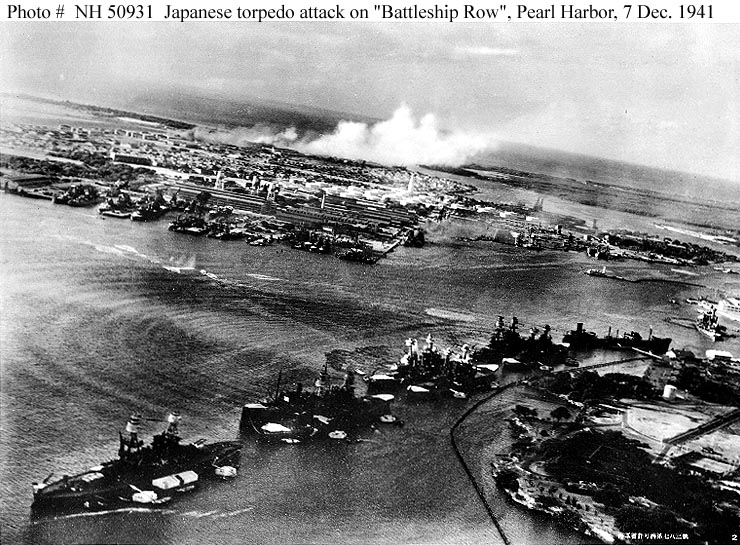
On the morning of December 7th 1941 8 of the 9 Battleships assigned to the US Pacific Fleet were in Pearl Harbor. Seven, the USS California, USS Maryland, USS Oklahoma, USS Tennessee, USS West Virginia, USS Arizona and USS Nevada were moored on Battleship Row. The USS Pennsylvania was in the massive dry dock which she shared with the destroyers USS Cassin and USS Downes. The USS Colorado, a sister ship of Maryland and West Virginia was at the Puget Sound Naval Yard being overhauled.

pearlharbor_wide-6febcbc3473e02a65f9b7b9e151905b7300c328f-s6-c30

USS West Virginia sinking at left and USS Tennessee burning at Pearl Harbor

At the time both the United States Navy and the Japanese Imperial Navy still viewed the Battleships as the heart of the fleet and the essence of naval power. Aircraft Carriers were still viewed as an adjunct and support to the traditional battle line.

Japanese-carriersJapanese Aircraft preparing to launch at Pearl Harbor

Thus as the Japanese Carrier Strike Group, the Kido Butai under the command of Vice Admiral Chūichi Nagumo approached Pearl Harbor and intelligence reports came in indicating that the carriers were not present the Japanese were not overly concerned. The lack of concern was in a sense ironic because the force they assigned to destroy the Battleships of the Pacific Fleet was the carrier strike group, not their battle line.

Kido-Butai-in-the-North-Pacific

The Kido Butai enroute to Pearl Harbor

Comprised of six carriers, the Akagi, Kaga, Hiryu, Soryu, Shokaku and Zuikaku the force embarked over 300 first line aircraft. The aviators of the air groups aboard the carriers had been training for months to attack Pearl Harbor. Their aircraft had been specially outfitted with Type 91 Model 2 aerial torpedoes designed to run in the shallow waters of Pearl Harbor and Type 99 Model 5 armor piecing bombs modified from battleship shells. These weapons would be employed with a devastating effect on the morning of December 7th 1941.

The three carriers assigned to the Pacific Fleet, the USS Saratoga, USS Lexington and USS Enterprise had been dispatched on missions that took them away from Pearl Harbor that fateful Sunday.

USS_Lexington

USS Lexington

The Lexington and Task Force 12 had departed Pearl Harbor on December 5th to ferry 18 SB2U Vindicator Dive Bombers of VSMB-231 to Midway Island. Saratoga was entering San Diego to embark her air group and Enterprise which had left Pearl Harbor on November 28th to deliver VMF-211 to Wake Island was due to return to Pearl Harbor on the 7th of December. As such none of these ships were in Pearl Harbor at the time of the attack. Their absence helped save the United States and Allied cause in the Pacific.

USS_Saratoga_CV-3_underway_1942

USS Saratoga

The United States had other carriers but all were assigned to the Atlantic Fleet due to the belief that Nazi Germany was a greater threat than Japan. The USS Yorktown was at Norfolk in between deployments in support of the Neutrality Patrol. USS Ranger was returning to Norfolk from a patrol, USS Wasp was at Grassy Bay Bermuda and the newly commissioned USS Hornet was training out of Norfolk. The USS Long Island, the first Escort carrier was undergoing operational tests and training out of Norfolk.

cv-6-01USS Enterprise at Midway

Had any of the three carriers assigned to the Pacific Fleet been in Pearl Harbor on the morning of the Japanese attack the results would have been even more disastrous for the United States. Instead the carriers began operations against the Japanese almost immediately. Carriers based on the East Coast including Hornet, Yorktown and Wasp were transferred to the Pacific. In the perilous months following the Pearl Harbor attack the US carriers took the fight to the Japanese conducting raids against Japanese held islands. In April 1942 the Enterprise and Hornet, the latter with 16 B-25 Mitchell bombers under the command of Colonel Jimmy Doolittle struck Tokyo.

gallery_30225_28868_12824874244ae0d6734af3b

USS Hornet launching the Doolittle Raiders

The result was that Admiral Isoruku Yamamoto decided to attack Midway Island to force the US fleet and its carriers into a decisive battle. Although the Japanese had lost a good number of aircrew from Shokaku and Zuikaku at the Battle of Coral Sea, while sinking the Lexington Yamamoto remained committed to the decisive battle. That battle was decisive, but not in the way Yamamoto had planned. Akagi, Kaga, Hiryu and Soryu were sunk by aircraft operating from Enterprise, Yorktown and Hornet. Yorktown was lost in the battle bat it was a decisive defeat for the Japanese.

Attack_of_the_Akagi

Sinking the Akagi at Midway

In the succeeding months in the vicious battles around the Solomon Islands the remaining US carriers proved decisive. Although Wasp and Hornet were sunk in those battles and both Saratoga and Enterprise often heavily damaged they held the line. The carriers that the Japanese missed proved decisive in turning the tide and winning the war.

22_bb48

Raised from the mud of Pearl Harbor the USS West Virginia in Tokyo Bay

Though Yamamoto did not realize it the attack on Pearl Harbor signaled the end of the supremacy of the Battleship and the ascendency of the Aircraft Carrier. By 1943 Battleships were regulated to escorting the fast carrier task forces or conducting shore bombardments. The ultimate irony was that the last battleship engagement in history was won by the survivors of the attack on Pearl Harbor. Raised from the mud the West Virginia, Tennessee, California, Maryland and Pennsylvania joined by the USS Mississippi rained destruction on two Japanese task forces attempting to penetrate Leyte Gulf and destroy the US invasion force transports at the Battle of Surigao Strait.

The ironies and intricacies of war. They are amazing.

Peace

Padre Steve+

24 Comments

Filed under History, Military, Navy Ships, US Navy, world war two in the pacific

“All Glory is Fleeting” Prelude to Midway June 3rd 1942: The False Belief in the Surety of Victory

Japanese_aircraft_carrier_Akagi_01

The Flagship IJN Akagi

On the night of June 3rd 1942 the Japanese First Carrier Strike Force under the command of Vice Admiral Chuichi Nagumo sailed east toward the tiny Midway Atoll. Midway was the target of an operation designed by Admiral Isoroku Yamamoto to draw out the remnants of the United States Pacific Fleet, destroy them and set the conditions for Japanese victory and the subsequent dominance of the Pacific by the Empire of Japan. Nagumo had seen many of the risks involved in the plan and considered it an “impossible and pointless operation” before the Doolittle Raid on Tokyo, but even Nagumo fell in line as Yamamoto relentlessly lobbied for the operation, in spite of political opposition and opposition from the Imperial Army.

Chuichi_Nagumo

Vice Admiral Chuichi Nagumo

As the First Carrier strike force closed within 300 miles of Midway on the night of June 3rd 1942 Nagumo and his staff prepared for the battle that they and many others believed would be the decisive battle. Aircraft received their final preparations, bombs were loaded and as night faded into early morning air crew arose, ate their breakfast and went to their aircraft.

The ships had been observing radio silence since they departed their bases and anchorages in Japan the previous week. Honed to a fine edge the crews of the ships and the veteran aircrews anticipated victory.

The crews of the ships of the task force and the air groups embarked on the great aircraft carriers Akagi, Kaga, Soryu and Hiryu as well as their escorts were confident. They had since the war began known nothing but victory. They had devastated the Pacific Fleet at Pearl Harbor and roamed far and wide raiding allied targets and sinking allied shipping across the Pacific and deep into the Indian Ocean. Commander Magotaro Koga of the destroyer Nowaki wrote in his diary “Our hearts burn with the conviction of sure victory.”

However, Nagumo and his sailors had no idea that most of what they knew about their American opponents was wrong, just as Yamamoto had no idea that American code breakers had broken the Japanese Naval codes and determined that the Japanese were going to attack Midway.

893594c746

Admiral Isoroku Yamamoto 

Though confident that the Americans could field no more than two operational carriers, the Yorktown, which they believed had been sunk at Coral Sea was operational and joined by the air group from the damaged Saratoga had joined Enterprise and Hornet northeast of Midway.  An operation designed to get aerial surveillance of US Fleet dispositions at Pearl Harbor had been cancelled because the atoll at French Frigate Shoals that the Japanese flying boats would operate from was occupied by a small US force. Likewise the line of Japanese submarines arrived on station a day late, after the US carrier task forces had passed by. Those aboard the First Carrier Strike Force, including Nagumo or his senior commanders and staff had no idea that the Americans not only knew of their approach but were already deployed in anticipation of their strike.

Within a day all of the Japanese carriers would be sunk or sinking. Thousands of Japanese sailors would be dead and the vaunted air groups which had wreaked havoc on the Allies would be decimated, every aircraft lost and the majority of pilots and aircrew dead. It would be a most unexpected and devastating defeat stolen out of the hands of what appeared to be certain victory.

In the next couple of days I will write some articles on Midway and republish older articles on this site. The fact of the matter is that like Yamamoto and the Japanese that many military leaders, including those of the United States make assumptions about campaigns and battles that turn out to be wrong. Wars are often expected to be short, decisive and glorious but many times end up long, indecisive and agonizing. History has shown that to be the case for the United States in every fight it has been engaged since the Second World War, even when we win every pitched battle.

I think that there is a lesson to be learned from the Japanese who sailed into the night on June 3rd 1942 and saw the sunrise of June 4th. There is no battle, campaign or war that goes according to plan. Thousands of Japanese sailors and airmen went to bed on the night of the 3rd expecting that the following night, or within the next few days they would be celebrating a decisive victory. Thousands of them would be dead by the night of the 4th of June and the ambitions of the Empire of Japan to defeat the United States Navy and end the war would be dealt a decisive defeat from which they would never recover.

IJN_Akagi_World_War_II_Aircraft_Carrier_hit_by_Douglas_SBD_Dauntless_Dive_Bomber_at_Midway-1

The Japanese had known nothing but victory and on the night of June 3rd 1942 they expected nothing more than victory. However the wisdom of the Romans was proved right yet again. Quoted in the movie Patton the legendary US General said:

“For over a thousand years Roman conquerors returning from the wars enjoyed the honor of triumph, a tumultuous parade. In the procession came trumpeteers, musicians and strange animals from conquered territories, together with carts laden with treasure and captured armaments. The conquerors rode in a triumphal chariot, the dazed prisoners walking in chains before him. Sometimes his children robed in white stood with him in the chariot or rode the trace horses. A slave stood behind the conqueror holding a golden crown and whispering in his ear a warning: that all glory is fleeting.”

Peace

Padre Steve+

2 Comments

Filed under Military, Navy Ships, world war two in the pacific

Into the Valley of the Shadow of Death: The Death of the Torpedo Bombers at Midway

Half a league half a league,
Half a league onward,
All in the valley of Death
Rode the six hundred:
‘Forward, the Light Brigade!
Charge for the guns’ he said:
Into the valley of Death
Rode the six hundred.

Alfred, Lord Tennyson: The Charge of the Light Brigade

They were not six hundred and they were not mounted on horses but the Naval Aviators of Torpedo Squadrons 3, 6 and 8 and their aerial steeds 42 Douglas TBD Devastators and 6 TBF Avengers wrote a chapter of courage and sacrifice seldom equaled in the history of Naval Aviation. Commanded by veteran Naval Aviators, LCDR Lance “Lem” Massey, LCDR Eugene Lindsey and LCDR John Waldron the squadrons embarked aboard the carriers flew the obsolete TBD Devastators and the young pilots of the Midway based Torpedo 8 detachment under the command of LT Langdon Fieberling flew in the new TBF Avengers.

The TBD which first flew in 1935 entered service in 1937 and was possibly the most modern naval aircraft in the world when it entered service.  It was a revolutionary aircraft. It was the first monoplane widely used on carriers and was first all-metal naval aircraft.  It was the first naval aircraft with a totally enclosed cockpit, the first with hydraulic powered folding wings.  The TBD had crew of three and had a maximum speed of 206 miles an hour and carried a torpedo or up to 1500 pounds of bombs (3 x 500) or a 1000 pound bomb.  129 were built and served in all pre-war torpedo bombing squadrons based aboard the Lexington, Saratoga, Ranger, Yorktown, Enterprise and Hornet with a limited number embarked aboard Wasp.  The Devastator saw extensive service prior to the war which pushed many airframes to the end of their useful service life and by 1940 only about 100 were operational by the beginning of the war.  They were still in service in 1942 as their replacement the TBF Avenger was not available for service in large enough numbers to replace them before Midway.  The TBDs performed adequately against minor opposition at Coral Sea and in strikes against the Marshalls but the squadrons embarked on Yorktown (VT3), Enterprise (VT-6) and Hornet (VT-8) were annihilated at Midway with only 6 of 41 aircraft surviving their uncoordinated attacks against the Japanese Carrier Strike Force.  They were too slow, had poor maneuverability, insufficient armor and defensive armament.

The Torpedo squadrons attacked independently of each other between 0920 and 1030 on June 4th 1942. Only

The Japanese Combat Air Patrol ripped into the slow, cumbersome and under armed TBD Devastators as they came in low to launch their torpedoes.  Torpedo Eight from Hornet under the command of LCDR John C Waldron pressed the attack hard but all 15 of the Devastators were shot down.  Only Ensign George Gay’s aircraft was able to launch its torpedo before being shot down and Gay would be the sole survivor of the squadron to be picked up later by a PBY Catalina patrol plane.

Torpedo Six from the Enterprise under the command of LCDR Eugene Lindsey suffered heavy casualties losing 10 of 14 aircraft with Lindsey being one of the casualties.  The last group of Devastators to attack was Torpedo Three from the Yorktown under the command of LCDR Lem Massey losing 11 of 13 aircraft with Massey a casualty last being seen standing on the wing of his burning aircraft as it went down.  These aircraft were also decimated and Massey killed but they had drawn the Japanese Combat Air Patrol down to the deck leaving the task force exposed to the Dive Bombers of the Enterprise and Yorktown.  The six aircraft of the Torpedo Eight detachment from Midway under the command of LT Fieberling lost 5 of their 6 aircraft while pressing their attacks.  Only Ensign Bert Earnest and his aircraft survived the battle landing in a badly damaged state on Midway.  Four U.S. Army B-26 Marauder Medium Bombers were pressed into service as torpedo bombers of which 2 were lost.  No torpedo bomber scored a hit on the Japanese Task force even those torpedoes launched at close range failed to score and it is believe that this was in large part due to the poor performance of the Mark 13 aircraft torpedoes.

Despite the enormous losses of the torpedo squadrons their sacrifice was not in vain. Their attacks served to confuse the Japanese command and delay the rearmament of aircraft following the Japanese strikes on Midway. They also took the Japanese Combat Air Patrol down to sea level and opened the way for American Dive Bombers to strike the Japanese with impunity fatally damaging the Akagi, Kaga and Soryu in the space of 5 minutes.

After Midway the remaining TBDs were withdrawn from active service and no example survives today. The TBF became the most effective torpedo bomber of the war.

As we remember the brave men that fought at Midway it is imperative that we remember the brave aircrews of the torpedo squadrons that like the Light Brigade rode into the Valley of the Shadow of Death against the First Carrier Strike Force and Midway.

Peace

Padre Steve+

10 Comments

Filed under aircraft, History, Military, world war two in the pacific

Four of a Kind: The Illustrious Class Aircraft Carriers

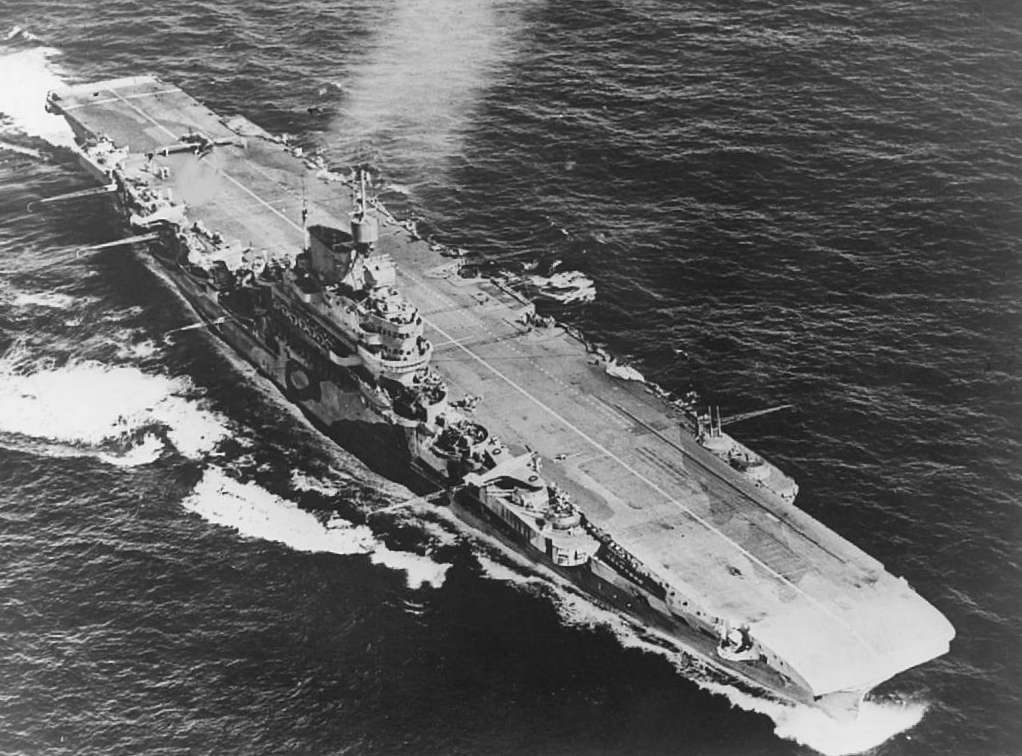
HMS Illustrious in 1944

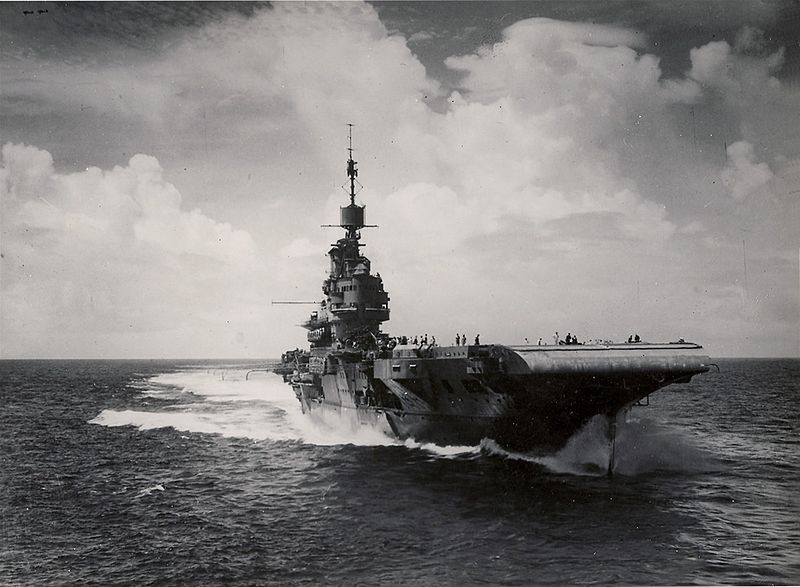
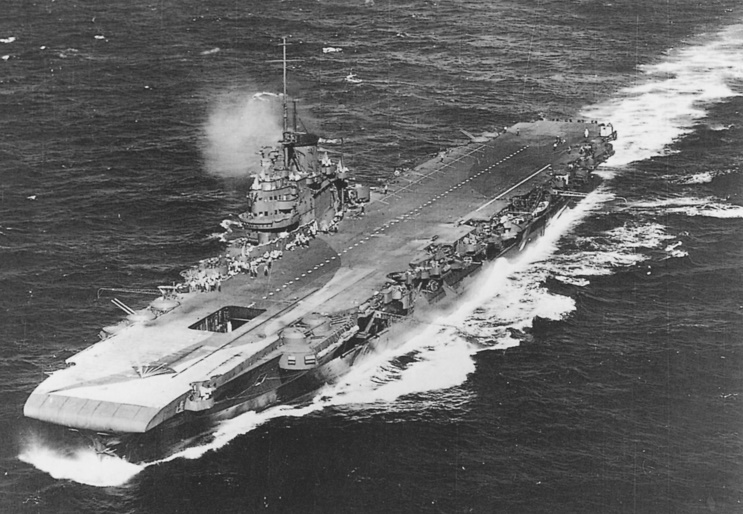
In the mid-1930s the Royal Navy recognized the need to develop and built new Fleet Carriers. The Illustrious Class of four ships was ordered as part of the 1936 Naval Program.  The four ships of the class HMS Illustrious, HMS Formidable, HMS Victorious and HMS Indomitable were some of the most important ships to see service in the Royal Navy in the Second World War and would see action in the Atlantic, Arctic, Mediterranean, Indian Ocean and Pacific.  They were tough ships and all sustained serious damage at least once in their careers that might have sunk other ships.  Different in concept than the Royal Navy’s only modern carrier the Ark Royal they displaced more than the U.S. Navy Yorktown Class and just somewhat less than the following Essex Class ships although they were over 100 feet shorter in length as compared to the American ships.

The class was built with an armored flight deck which covered the hangar deck with both as an integral part of the ship’s structure and defense.  The American ships hanger and flight deck were part of the superstructure with the armored deck being that of the hangar deck itself.  This provided advantages in protection against bombs and later Kamikazes but there was a trade off in both aircraft capacity and the ability for the ships to handle the larger aircraft that came into service following the Second World War.  As designed the ships carried just 36 aircraft as compared with the 80-100 aircraft of the American ships and the 72 that the Ark Royal was rated at.  Later in the war the Royal Navy adopted the American practice of an air park on the flight deck which increased their capacity to up to 70 aircraft. The last ship of the class, the Indomitable was built to a modified deign with an expanded two deck hangar with increased aircraft capacity similar to that of the Ark Royal.  An additional drawback to the design was that any bomb which penetrated the armored flight deck exploded inside the hangar causing deformation to the actual ship’s structure.

British defensive doctrine for these carriers was focused on the passive protection provided by the armored flight deck and by a far heavier anti-aircraft battery than the Yorktown Class and comparable to the Essex Class. This was a different doctrine than that of the Americans and the Imperial Japanese Navy which embarked large air groups believing that the aircraft were integral to the defense of the ship.

The ships displaced 28,919 tons full load and were capable of steaming at 30.5 knots with an operational range of 11,000 nautical miles at 14 knots, far more than any previous Royal Navy carrier but far less than the Essex class which could steam 20,000 nautical miles at 15 knots. The Essex Class ships were had a greater displacement as well as a higher top speed of 33 knots.  The Illustrious class was best suited for operations in the Atlantic and Mediterranean and less suited to the vast expanse of the Pacific where they would spend the last year of the war.

Illustrious under attack by German Bombers

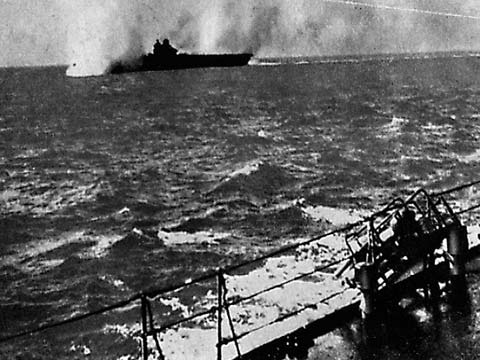
HMS Illustrious: Illustrious was laid down in April 1937, launched in April 1939 and commissioned in May 1940. Upon commissioning she and her air group deployed to the Mediterranean where in the dark days following the fall of France they escorted vital convoys, supported the Royal Army in the war in North Africa and conducted strikes against Italian shore installations and fleet units.  Illustrious launched the first major raid against an enemy shore base by carrier aircraft on 11 November 1940. Her aircraft from number 813, 815, 819 and 823 Squadrons made a night attack on the Naval Base at Taranto sinking the battleship Conte di Cavour and heavily damaging the battleships Andrea Doria and the new battleship Littorio and moderate damage to the Caio Dulio This strike helped cripple Italian naval power and helped give the Japanese inspiration for the Pearl Harbor attack.    On 10 January she suffered severe damage from 6 bomb hits while escorting a convoy near Malta. She was attacked again at Malta causing more damage and she was withdrawn from action and sent to Norfolk Naval Shipyard for repairs. The damage was severe enough to keep her out of the war until May of 1942.  One of her shafts was so badly damaged that it had to be cut away and could not be replaced which reduced her speed to 23 knots. On her return to action she covered the landings against the Vichy French island of Madagascar and the Sicily landings. In 1944 she was in action with the Far East Fleet conducting raids against Japanese held islands in Indonesia and in 1945 was in action as part of the British Pacific Fleet where she saw action at Okinawa where she was hit by two Kamikazes and Formosa where a near miss close aboard by a Kamikaze caused severe damage below her waterline.  She sailed home where she underwent repair until 1946 when she was returned to duty as a training carrier in which capacity she served until she was decommissioned and scrapped in 1954.

Grumman Marlett (F4F Wildcat) on flight deck of HMS Formidable

HMS Formidable: Formidable was laid down in June 1937, launched in August 1939 and commissioned in November 1940.  She actually “launched herself” a half hour before her Christening ceremony which gave her the nickname “The ship that launched herself.”  Formidable saw action in the Mediterranean in 1941 and was heavily damaged by two 1000 kg bombs while escorting a Malta Convoy. This put her out of action for 6 months as she was repaired at Norfolk Naval Shipyard.  On her return she saw service first in the Indian Ocean and then in the invasions of North Africa, Sicily and the Italian Campaign. She also saw service in the Arctic sinking U-331 and in raids against the German Battleship Tirpitz.  She was in action in 1945 against the Japanese with the British Pacific Fleet where she relieved Illustrious after that ship was withdrawn from action. On 4 May 1945 while supporting operations off Okinawa she suffered massive damage from a Kamikaze, temporary repairs kept her in action until hit by another Kamikaze on 9 May. She was withdrawn from action and a fleet review determined that she was not economically repairable in the austere post war years. She was placed in reserve in 1947 and sold for scrap in 1953 with the scrapping taking place in 1956.

HMS Indomitable

HMS Indomitable: Indomitable was built to a modified design which allowed her to operate far more aircraft than her sisters. She was laid down in November 1937, launched in March 1940 and commissioned in October 1941. She was slated to accompany the HMS Prince of Wales and HMS Repulse to the Far East and the defense of Singapore but ran aground on a coral reef during her shakedown cruise in the Jamaica which prevented that deployment.  After repairs she operated with the Far East Fleet in the Indian Ocean and took part in the invasion of Madagascar in November 1942.  In July of 1942 she took part in the Malta resupply mission Operation Pedestal where she was heavily damaged by two 500 kg bombs which penetrated her flight deck. She was withdrawn to the United States for repairs which lasted until February 1943 when she returned to the Mediterranean.  She took a torpedo hit from a German Ju-88 bomber on 15 June 1943 during the build up to the invasion of Sicily and again returned to the United States for repairs which were completed in February 1944. She then took part in operations with the Far East Fleet in the Indian Ocean before joining the British Pacific Fleet in 1945. She received minor damage from a Kamikaze hit on 4 May 1945 while operating near Okinawa. She finished the war in good shape compared to Illustrious and Formidable but was damaged by an internal fire and explosion in 1947 the damage from which was never repaired. She remained in service until she was placed in unmaintained reserve in 1953 and scrapped in 1955.

HMS Victorious

HMS Victorious: The Victorious was probably the most celebrated aircraft carrier in the history of the Royal Navy. Her World War Two service was remarkable by any standard and she was the only ship of her class to be modernized to carry jet aircraft following the war being refitted in much the same way as the American Essex Class ships were in the 1950s with an angled flight deck.  She was laid down in May 1937, launched in September 1939 and commissioned on 14 May 1941. Within 10 days of her commissioning she was taking part in the Hunt for the Bismarck and her Swordfish torpedo bombers scored one torpedo hit on that ship.  She saw much action in the North Atlantic and Arctic escorting convoys and deterring forays of German raiders into the Atlantic. She served in the Mediterranean during some Malta operations including Operation Pedestal and the Operation Torch landings in North Africa.  Due to the shortage of U.S. Carriers from heavy combat in the South Pacific in 1942 Victorious was “loaned” to the U.S. Navy deployed to operate with the U.S. Pacific Fleet following refits to operate U.S. built aircraft. She operated in the South Pacific from March to September of 1943 with the USS Saratoga in operations against the Japanese to include the New Georgia landings. She returned home and took part in raids against the Tirpitz which put that ship out of action for several months. She deployed to the Far East in 1944 and support operations in the Indian Ocean before being transferred to the British Pacific Fleet.

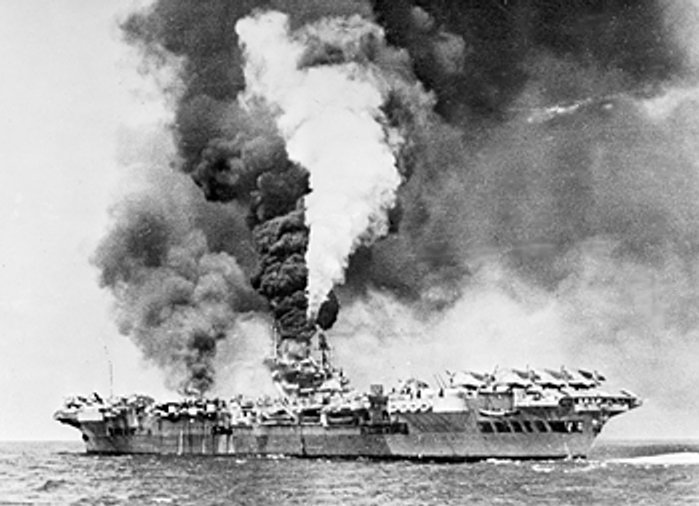
Victorious on Fire off Okinawa

She was involved in extensive Pacific operations including Okinawa and the raids on mainland Japan. She was stuck on a number of occasions by Kamikazes but remained in action.  After the war she was modernized and remained in service until 1969 when the Royal Navy decided that it was going to end its fixed wing operations and decommission its remaining attack aircraft carriers. She was broken up at Faslane beginning in 1969.

The modernized HMS Victorious

The Illustrious Class ships were great ships which performed admirable work in the Second World War. They and their brave crews continued the proud tradition of the Royal Navy. It is my hope that at least the new Queen Elizabeth Class carriers will be renamed for a ship of this class, preferably Victorious.

Peace

Padre Steve+


9 Comments

Filed under History, Military, Navy Ships, world war two in europe, world war two in the pacific

Wings of Gold: U. S. Navy Carrier Aircraft 1935-1941

Curtiss BF2C Goshawks (US Navy Photo)

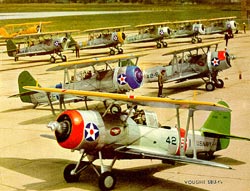
As the United States Navy built up its Carrier Force in the mid to late 1930s it continued to develop aircraft specifically designed to operate from aircraft carriers.  It continued its development of fighter, dive bomber and torpedo bomber aircraft.  In 1935 the Navy was operating the Grumman FF-1 biplane fighter which it had began using in 1933 and the Curtiss F11C and BF2C Goshawk. The Curtiss aircraft were built in fighter and bomber variants and while initial aircraft had an open cockpit and fixed landing gear later aircraft had an enclosed cockpit and retractable landing gear. They had top speed of 157 miles an hour and due to limited success and were retired from service by 1939.  The Goshawk was operated against the Japanese by Nationalist China and also served in a number of air forces including Thailand where they were used against the French and Japanese.

Grumman FF-1 (US Navy Photo)

The Grumman FF-1 was a two-seater that had a enclosed cockpit with retractable landing gear and a top speed of 201 miles an hour.  The FF-1 was faster than any naval aircraft of its era, a follow-on variant designated the SF-1 followed and 120 aircraft were built. Most of the operational aircraft served aboard the USS Lexington CV-2 in a fighter and scouting role. The FF-1 and SF-1 were withdrawn from first line service and placed with the reserve as well as being used in aviation training commands. The aircraft was manufactured under license by the Canadian Car and Foundry Company and served in the Canadian Air Force until 1942 as the Goblin and 40 of the Canadian aircraft were used by the Spanish Republican forces in the Spanish Civil War.

Grumman F2F-1 (US Navy Photo)

The FF-1/SF-1 was followed by the Grumman F2F a single-seat model with improved speed and maneuverability over is predecessors.  54 F2F’s were ordered in 1934 with the production models being delivered between April and August 1935.  The aircraft were armed with 2 .30 machine guns mounted above the cowl and had a top speed of 231 miles an hour and maximum range of 985 miles.  The aircraft would remain in service until they were replaced in 1939 with the Grumman F3F. However they remained in service as utility and training aircraft until retired from service toward the end of 1940.

Grumman F3F (US Navy Photo)

The Grumman F3F followed the F2F with 157 production models. It was more aerodynamic and had a more powerful engine that the F2F which enabled it to achieve a top speed of 264 miles an hour.  It was operated by seven Navy and Marine Corps Squadrons and entered service in 1936 and would serve aboard carriers until replaced in late 1941. It continued with 117 aircraft being stationed at naval air stations and used for training until 1943.

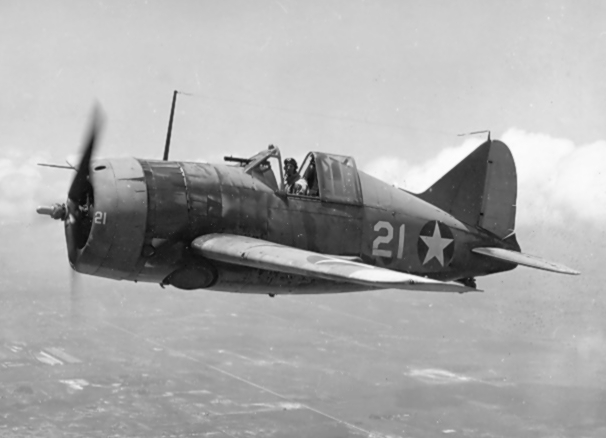
F2A Brewster Buffalo (U.S. Navy Photo)

The first monoplane fighter developed and placed in service by the Navy was the F2A Brewster Buffalo. The Buffalo served with Navy and Marine Corps squadrons and was purchased by Great Britain for service in the Royal Australian and Royal New Zealand Air Forces which received 202 Buffalos. They would also serve with the Royal Navy. The Royal Netherlands Air Force received 144 most of which served in the East Indies. The final nation to receive the Buffalo was Finland which received 44 aircraft.  Buffalo was underpowered and the addition of armor and added fuel capacity further diminished the speed and performance of the aircraft.  The Navy placed its Buffalo’s in advanced training squadrons in early 1942 and one of the two Marine Corps squadrons (VMF-221) operated it at the Battle of Midway where they endured fearful losses at the hands of Japanese Zero fighters.

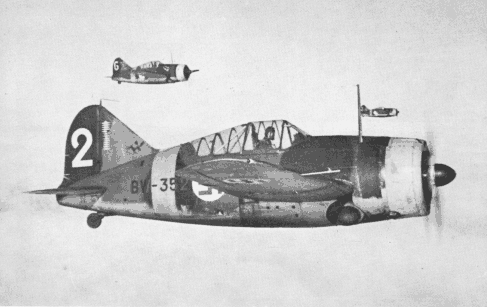
Brewster Buffalo 239s of the Finnish Air Force

Despite the lack of success in U. S. service the Buffalo performed in a heroic manner for the Finns destroying over 500 Soviet and German aircraft and producing 36 Buffalo Aces.  The highest scorer was Captain Hans W. Wind with 39 of 75 victories flying a Buffalo.  British Commonwealth and Dutch aircraft did not fare as well as the Finns as the tropical climate degraded the aircraft considerably.

Martin T4M over Lexington or Saratoga (US Navy Photo)

The Navy also developed aircraft for bombing missions as well as that could launch aerial torpedoes. The first aircraft built were dual purpose in that they could be used in level bombing and torpedo missions. In 1935 the primary aircraft of this type was the Martin T4M which had entered service in 1928 and replaced the Douglas DT and Martin T4M aircraft.  The T4M was a biplane with a crew of three that had a maximum speed of 114 miles an hour (I have driven much fast than this on the German Autobahn but I digress) and it could carry a torpedo or bombs.  155 were purchased by the Navy and the Marine Corps between 1928 and 1931.  They were operated from the Lexington and Saratoga until 1938 as no replacement aircraft offered enough improvements for the Navy to purchase and were instrumental in the development and demonstration of the capabilities of naval air power.  They were finally replaced by the Douglas TBD Devastator.

TBD Devastator (US Navy Photo)

The TBD which first flew in 1935 entered service in 1937 and at the time was possibly the most modern naval aircraft in the world and was a revolutionary aircraft. It was the first monoplane widely used on carriers and was first all-metal naval aircraft.  It was the first naval aircraft with a totally enclosed cockpit, the first with hydraulic powered folding wings.  The TBD had crew of three and had a maximum speed of 206 miles an hour and carried a torpedo or up to 1500 pounds of bombs (3 x 500) or a 1000 pound bomb.  129 were built and served in all pre-war torpedo bombing squadrons based aboard the Lexington, Saratoga, Ranger, Yorktown, Enterprise and Hornet with a limited number embarked aboard Wasp.  The Devastator saw extensive service prior to the war which pushed many airframes to the end of their useful service life and by 1940 only about 100 were operational.  They were still in service in 1942 as their replacement the TBF Avenger was not ready for service.  They performed adequately against minor opposition at Coral Sea and in strikes against the Marshalls but the squadrons embarked on Yorktown (VT3), Enterprise (VT-6) and Hornet (VT-8) were annihilated at Midway with only 6 of 41 surviving their uncoordinated attacks against the Japanese Carrier Strike Force.  They were too slow, had poor maneuverability, insufficient armor and defensive armament.  Only a few were able to launch their torpedoes as the Japanese Combat Air Patrol tore through them. Their sacrifice was not in vain as the Dive Bombers arrived facing no opposition and sank three of the four Japanese carriers getting the fourth later in the day. After Midway the remaining aircraft were withdrawn from active service in the Pacific. The Ranger’s VT-4 operated them until September 1942and Wasp’s VT-7 operated them in the Atlantic until she was transferred to the Pacific in July 1942.   By 1944 all remaining aircraft had been scrapped.

Vought SBU Corsair

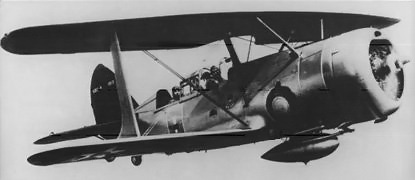
In the mid 1930s the Navy began to develop Scout and Dive Bombers for use in carrier scouting (VS) and bombing (VT) squadrons.  The first of these aircraft types were biplanes.  The Grumman SF-1 was used in a scouting and bombing role and was joined by the Vought SBU Corsair in 1935 and by 1937 both were being replaced by the Curtiss SBC Helldiver, a biplane with a 234 mile an hour maximum speed, retractable landing gear, enclosed cockpit which could carry a 1000 bomb.

Curtis SBC Helldiver

However the era of the biplane was drawing to a close and the Helldiver would be relegated to training squadrons based in Florida.  Although they had a brief service career they were instrumental in develop dive bombing tactics at which the U.S. Navy excelled and which were copied by the German Luftwaffe with the Junkers JU-87 Stuka and the Japanese with the Aichi 99 Val naval dive bomber.  50 aircraft were transferred to the French and served aboard the carrier Bearn but due to the French surrender in June of 1940 saw no action and spent the war rotting in Martinique.

Vought SB2U Vindicator

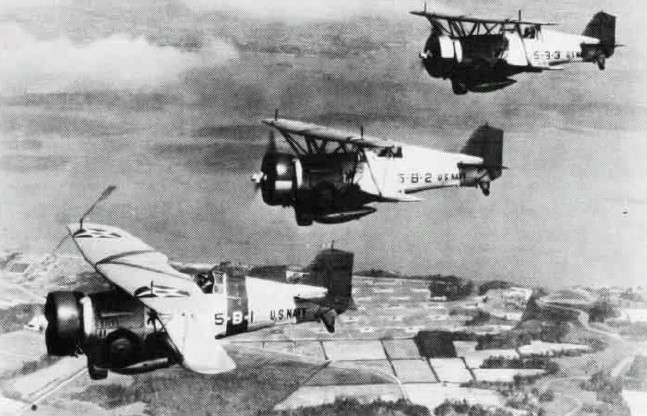
The Helldiver’s were joined by the first monoplane dive bomber in U.S. service the Vought SBU2 Vindicator in 1937. The Vindicator was used by the Navy and the Marine Corps serving aboard the Lexington, Saratoga, Ranger and Wasp. They would remain in service until September 1942. The Marine aircraft equipped two squadrons VMSB 131 and VMSB-241, VMSB 241 suffered heavy casualties at Midway as the aircraft were underpowered and were limited to glide bombing missions.  After they were taken out of the operational squadrons the Vindicator served as a training aircraft until retired in 1945.   A French Naval Air Squadron was equipped with the Vindicator but they served ashore against the German invasion.  Most were lost to enemy action.  The Douglas SBD Dauntless was introduced in 1940 and 1941 but I will cover that aircraft in the World War II aircraft article that will follow this in a week or two.

These aircraft helped pave the way to aircraft that would be the mainstays of the Navy in the Second World War, aircraft with names such as Dauntless, Helldiver, Avenger, Hellcat and Corsair.  Naval aviation earned its “wings of gold” in these early years wings that continue to shine in the 21st Century.

Peace

Padre Steve+

9 Comments

Filed under aircraft, Military, US Navy, world war two in the pacific

100 Years of Navy Aviation: Part One the Aircraft Carriers

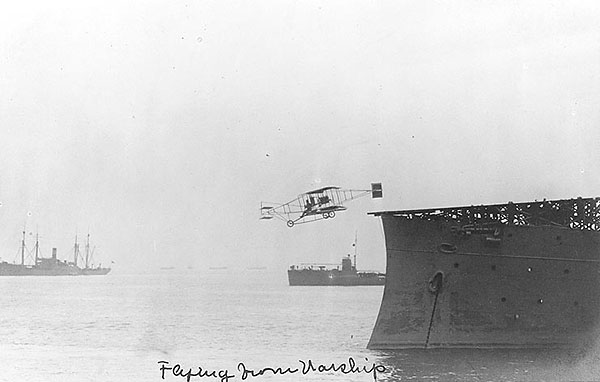
Eugene Ely makes the first takeoff from USS Birmingham on November 14th 1910

On a blustery November 14th in the year 1910 a young civilian pilot hailing from Williamsburg Iowa became the first man to fly an aircraft off the deck of a ship.  At the age of 24 and having taught himself to fly barely 7 months before Eugene Ely readied himself and his Curtis biplane aboard the Cruiser USS Birmingham anchored just south of Fort Monroe in Hampton Roads.  Ely was there because he was discovered by Navy Captain Washington Irving Chambers who had been tasked with exploring how aircraft might become part of Naval Operations. Chambers had no budget or authority for his seemingly thankless task but hearing that a German steamship might launch and aircraft from a ship hustled to find a way to stake a claim for the U.S. Navy to be the first in flight. Weather was bad that day as is so typical for Hampton Roads in November and between rain squalls Ely decided to launch even though Birmingham did not have steam up to get underway to assist the launch.  Ely gunned the engine and his biplane rumbled down the 57 foot ramp and as he left the deck the aircraft nosed down and actually make contact with the water splintering the propeller and forcing him to cut the flight short and land on Willoughby Spit about 2 ½ miles away not far from the southern entrance to the modern Hampton Roads Bridge Tunnel is.  Chambers would talk Ely into making the first landing on a Navy ship the Armored Cruiser USS Pennsylvania in San Francisco Bay on January 18th 1911.  Ely died in a crash at the Georgia State Fairgrounds on October 11th 1911.
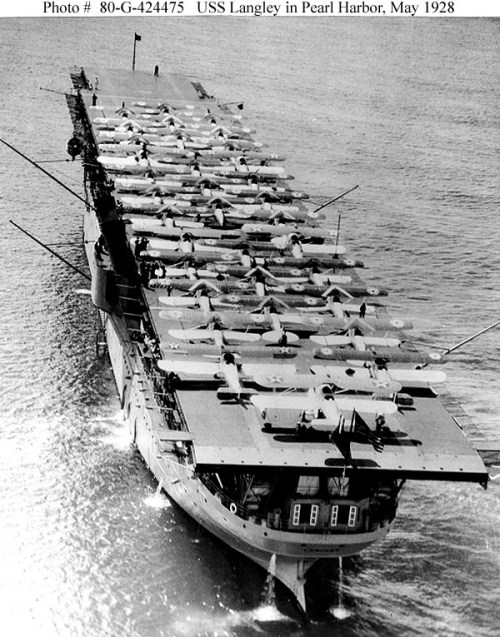
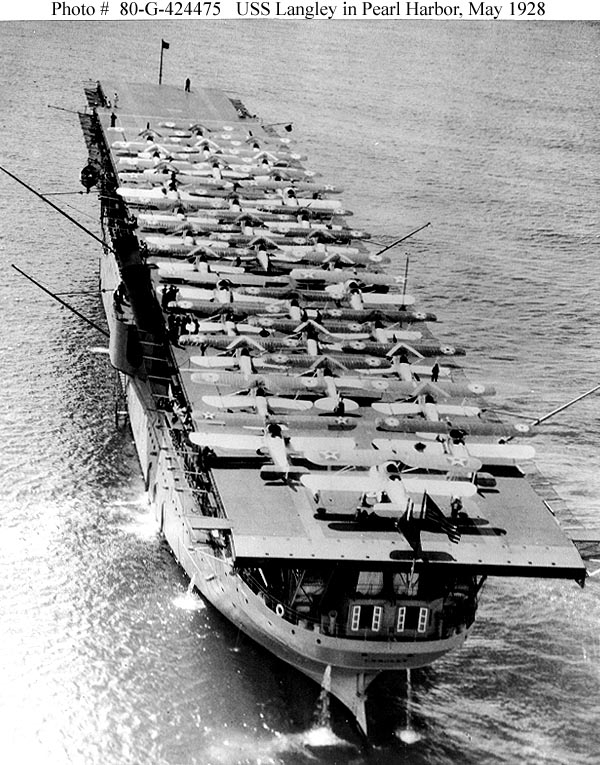
USS Langley CV-1

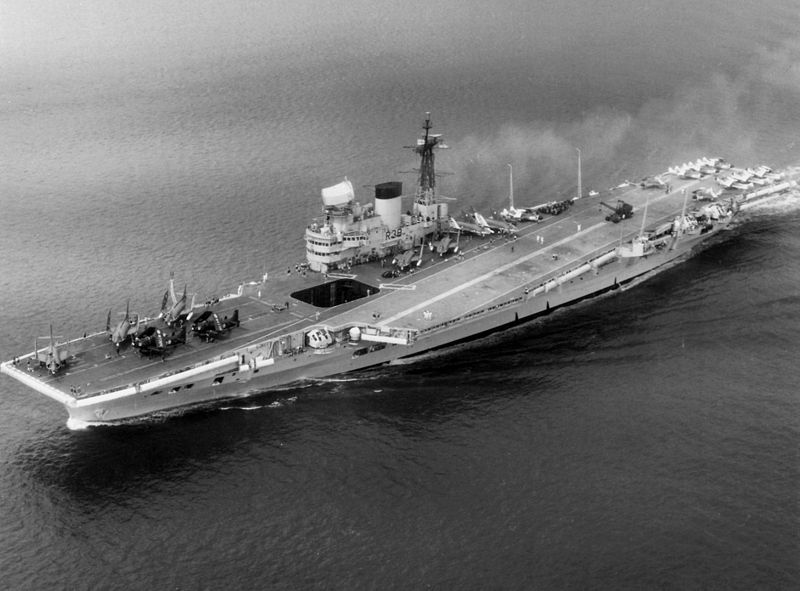
The Naval was slow to build upon the early achievements and the British and France would commission Aircraft Carriers well before the USS Langley CV-1 a converted Collier was commissioned.  After Langley the Navy commissioned the converted Battlecruisers USS Lexington CV-2 and USS Saratoga CV-3 in the mid 1920s.

USS Lexington CV-2 October 1941

The three ships formed the nucleus of the Navy’s embrace of aviation and the pilots that they trained and the experience gained would be the foundation of the Navy’s success in the Second World War.  They would be joined by the USS Ranger CV-4 the first U. S. Navy Carrier designed as such from the keel up in 1934.
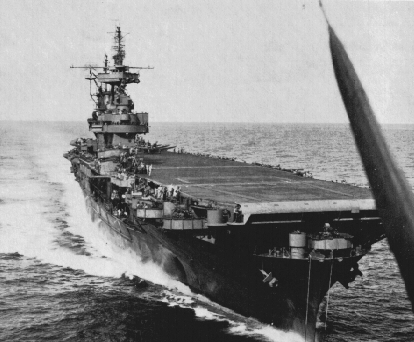
USS Enterprise CV-6

In 1937 the Navy commissioned the first of its true Fleet Carriers the USS Yorktown CV-5 which was followed by the USS Enterprise CV-6 in 1938, the USS Wasp CV-7 an improved version of Ranger in was commissioned in 1940 and the USS Hornet CV-8 in 1941.   These ships would bear the brunt of US Navy operations in the first year of the war following the disaster at Pearl Harbor. Of these ships only the Enterprise and Saratoga would survive the first year of the war in the Pacific.  Langley now a Seaplane Carrier was sunk during the Battle of the Java Sea in February 1942. Lexington would go down at Coral Sea in May 1942.  Hornet would launch the Doolittle Raid against Japan on April 18th 1942.  Yorktown, Enterprise and Hornet would take on and defeat the Japanese Carrier Strike force and sink the Akagi, Kaga, Soryu and Hiryu at Midway to avenge Pearl Harbor. Yorktown was sunk in the battle but Midway stopped the Japanese advance in the Pacific.

The U. S. went on the offensive in August invading Guadalcanal in the Solomons Islands. The Guadalcanal campaign and the numerous sea battles in the adjacent waterways would claim many American and Japanese ships. Wasp was sunk by a Japanese submarine on September 15th 1942 and Hornet was sunk at the Battle of Santa Cruz on 27 October 27th 1942.  Saratoga spent much of 1942 in the yards having been torpedoed twice leaving the often battered Enterprise as the sole U. S. Navy Carrier facing the Japanese until Saratoga was repaired and the first of the Essex Class Fleet Carriers and Independence Class Light Fleet Carriers entered service and arrived in the Pacific.
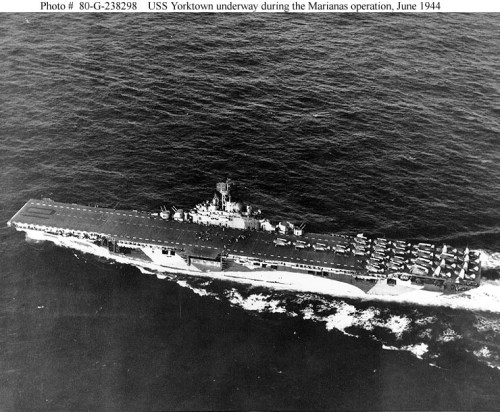
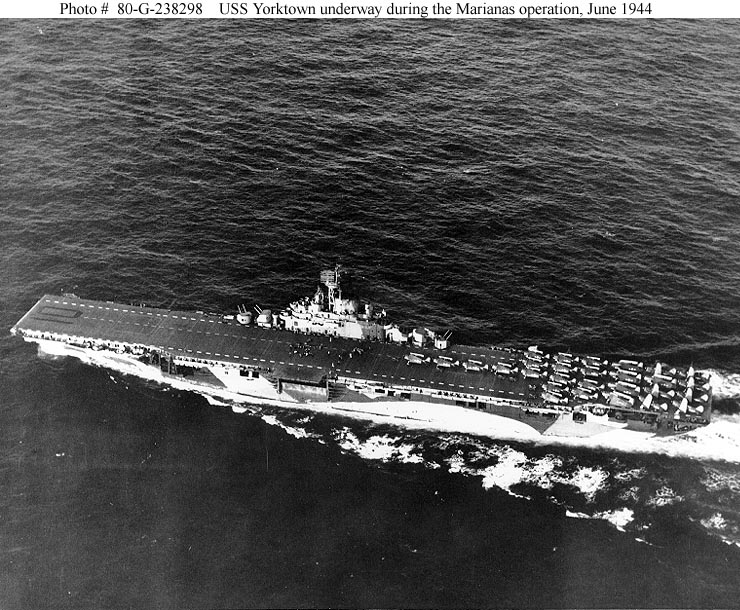
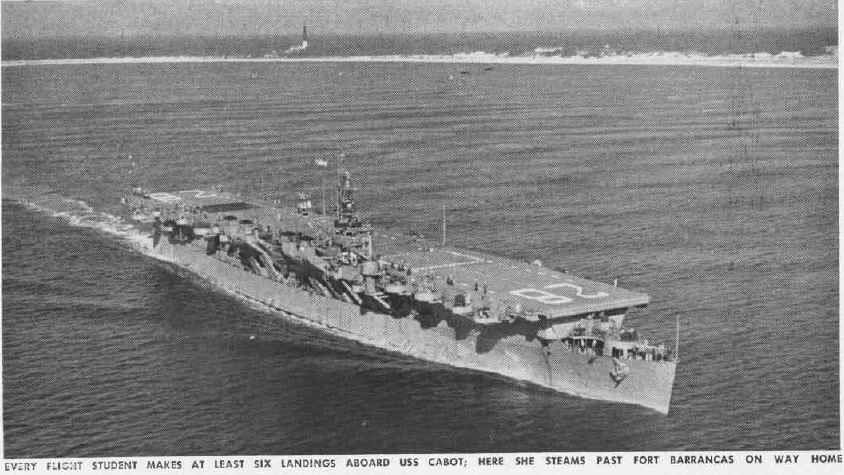
USS Yorktown CV-10 1944 a good example of the wartime Essex class ships  below USS Cabot CVL-28 an Independence Class Light Fleet Carrier
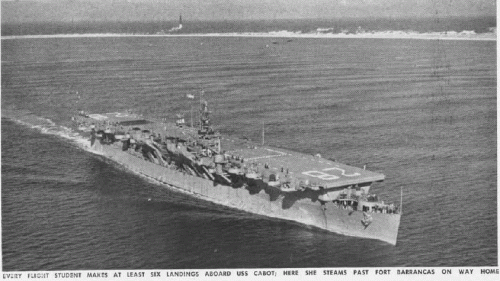

The Essex Class ships became the nucleus of the Fast Carrier Task Forces in the Pacific and with their smaller consorts of the Independence Class would dominate operations at sea from 1943 on.  The Essex class would eventually number 24 ships with several more canceled before completion becoming the most numerous of any class of Fleet Carriers produced by the U. S. Navy.  The Essex class would figure prominently in all offensive operations including the Battle of the Philippine Sea, Battle of Leyte Gulf, the campaigns at Iwo Jima and Okinawa and raids on the Japanese home islands.  In the process they and their air groups would be instrumental in sinking hundreds of Japanese ships including the Battleships Yamato and Musashi and destroying thousands of aircraft.  A number were heavily damaged by Kamikazes but none were lost with the epic story of the USS Franklin CV-13 and her survival after being hit by two bombs from a Japanese plane that slipped through the Combat Air Patrol. The resultant explosions and fires amongst her fueled and armed aircraft nearly sank her but for the heroic efforts of her crew including Chaplain Joseph O’Callahan who won the Medal of Honor caring for the wounded and dying and directing damage control teams. The ship lost 724 men killed and 265 wounded in the attack but survived though without power and dead in the water 50 miles off the Japanese coast.
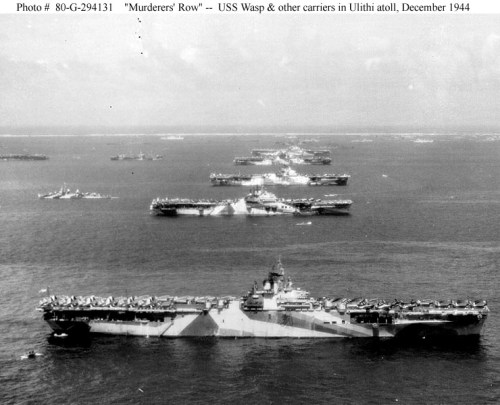
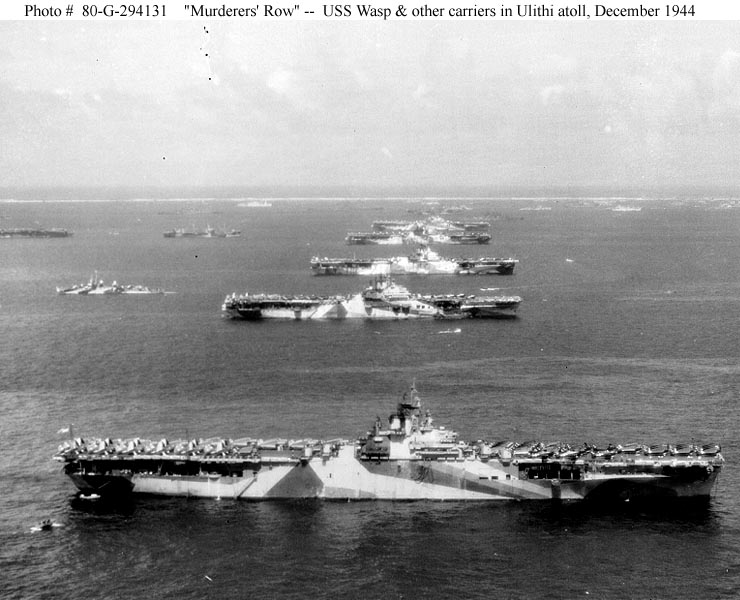
Murderers’ Row

The Essex class were iconic and the ships etched their names in naval history. The Essex, Yorktown, Hornet, Wasp, Hancock, Ticonderoga, Franklin, Bunker Hill, Intrepid, Lexington and the other ships of the class had legendary careers. These ships became known as “Murderers’ Row” for their expertise in killing off Japanese ships and aircraft.  Fittingly four of the ships, the Hornet, Yorktown, Lexington and Intrepid have found a second life as museum ships and Oriskany was sunk as an artificial reef off the coast of Florida where she is a favorite of recreational divers.
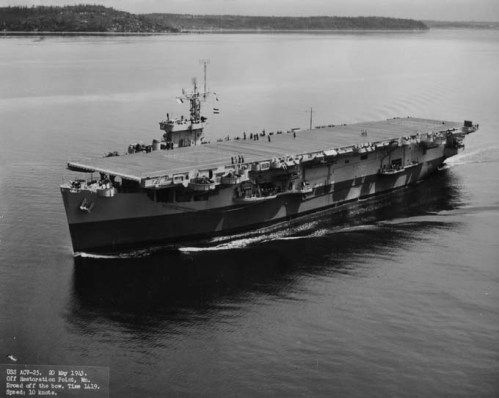
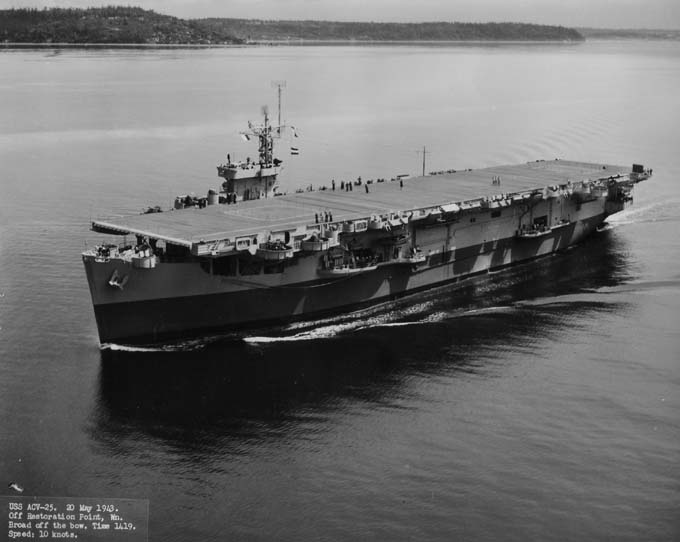
USS Croatan CVE-25 a Bogue Class Escort Carrier

During the war the Navy also built 118 Escort Carriers converted from merchant ships for use as convoy escorts, anti-submarine warfare and close air support for amphibious operations. 38 of these ships saw service in the British Royal Navy during the war.
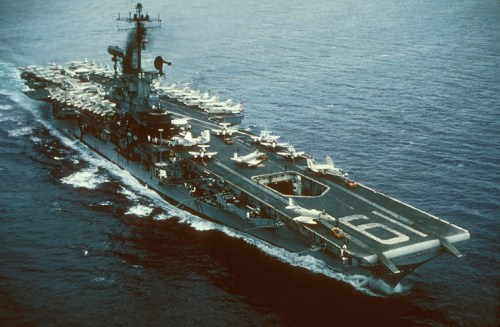
USS Hancock CVA-19 in 1969 showing the extent of the modernizations that brought the Essex Class into the jet age

In the post World War II drawdown many carriers were decommissioned and the oldest, the Saratoga and Ranger disposed of.  The three ship Midway class entered service after the war and incorporated design improvements learned from combat operations in the war. As the Navy entered the jet era it was found that the existing carriers would need significant modernization to handle the new aircraft. Among the improvements made to the Midway and Essex class ships was the angled flight deck, steam catapults, hurricane bows and improved landing systems.  These improvements allowed these World War II era ships to remain front line carriers into Vietnam and in the case of the USS Midway and USS Coral Sea into the 1990s.

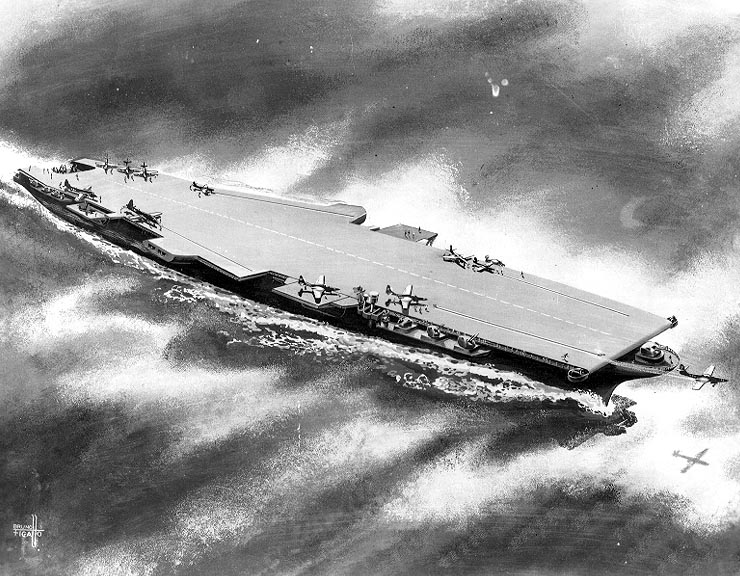
Artists’ conception of USS United States CVA-58 a victim of Truman Era Air Force politics

The Navy began its first super-carrier the USS United States in 1949 but the ship and class was cancelled by Secretary of Defense Louis A. Johnson, not a fan of the Navy or Marine Corps due to opposition by the Army and the newly founded Air Force.  The ship would have carried 12-18 nuclear capable bombers as well as 45-50 jet fighters and attack aircraft and been 1090 feet long and displaced 65,000 tons.  It would not be until after the Korean War that the Navy would begin construction of its first super-carriers.

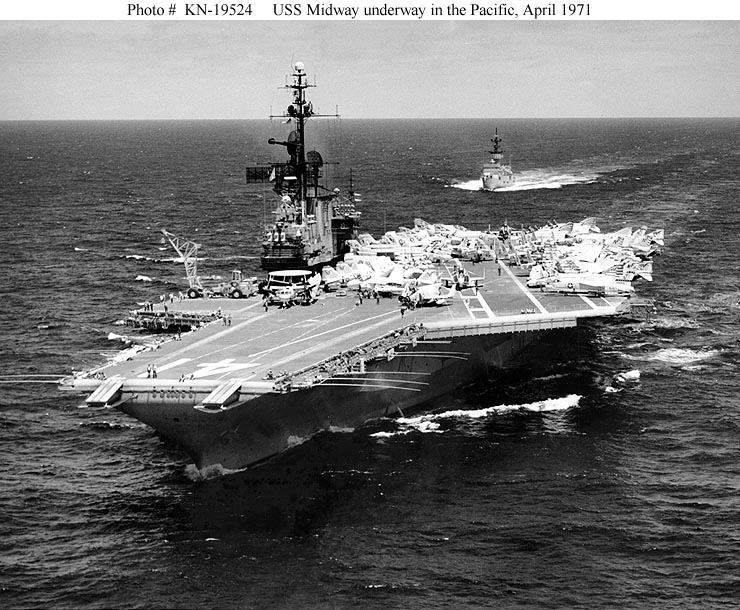
USS Midway CVA-41 in 1971

During the Korean War most of the Essex class ships were called back into service with 15 modified to conduct jet operations while others were converted to serve as ASW Carriers and Helicopter Carriers (LPH) to support Marine amphibious forces. Likewise the Midway’s were modernized as the Navy began to construct the four-ship Forrestal Class which were 1036 feet long and displaced 56,000 tons and designed to carry 100 aircraft. The four ships, Forrestal CVA-59, Saratoga CVA-60, Ranger CVA-61, and Independence CVA-62 would all serve into the early 1990s before being decommissioned. In the past few months Forrestal and Saratoga have begun the journey to be scrapped, sold for a penny each to scrapyards in Brownsville, Texas.
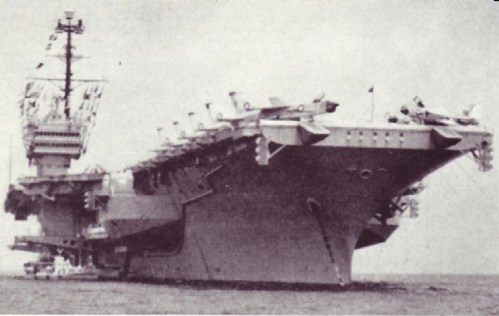
USS Ranger CVA-61

They were all heavily involved in the Vietnam War on Yankee and Dixie Station and both the Atlantic and Pacific during the Cold War. All four have been stricken from the Navy List and are awaiting disposal.  Forrestal was programmed as an artificial reef but she, like Saratoga which had been on donation hold was approved for scrapping. Ranger is still on donation hold and the USS Ranger Foundation is attempting to raise the money to save her. Independence which had been programmed as an artificial reef project was approved for scrapping in 2008.In the past few months Forrestal and Saratoga began the journey to be scrapped in 2014, sold for a penny each to scrapyards in Brownsville, Texas.

USS John F Kennedy CV-67 a modified Kitty Hawk class ship

These ships were followed by the Kitty Hawk class consisting of Kitty Hawk CVA-63, Constellation CVA-64, America CVA-66 and John F. Kennedy CVA-67 which were improved versions of the Forrestal Class with a 60,100 ton displacement and 1047 foot length with the ability to carry 100 aircraft. Kitty Hawk had the distinction of being the last fossil fuel carrier in active U. S. Navy service being decommissioned and placed in reserve in 2009. Her sister the Constellation CV was decommissioned in December 2003 and in 2008 was programmed to be scrapped in the next five years.  America was decommissioned in 1996 after not being given a Service Life Extension Program (SLEP) refit in the 1990s due to budget cuts.  America was involved in much of the Cold War, Gulf War and Vietnam including responding to the Israeli attack on the USS Liberty in 1967, the Intervention in Lebanon in 1983 and the conflict with Libya in the Gulf of Sidra in 1985.  She was sunk as a test bed to see how modern carriers would be affected by battle damage and to incorporate those lessons into future carrier design in May of 2005.  John F. Kennedy was originally planned to be a nuclear ship equipped with 4 A3W reactors.  This plan was shelved and she was completed as a fossil fuel ship. “Big John” served in Vietnam as well as throughout the Cold War and Gulf War and also engaged the Libyans in 1985.  She was placed in the Reserve Force in the 1990s to save money and also served as a training carrier.  Like America she did not receive the necessary maintenance and by 2002 she needed emergency repairs in order to deploy in support of Operation Enduring Freedom. Kennedy made three deployments in support of the War on Terror and decommissioned in 2007.  She was placed in donation hold and currently two groups are making progress to acquire her as a Museum ship. Like the Forrestal’s the Constellation’s served in Vietnam, the Cold War, Operation Desert Shield and Desert Storm and three continued their service into Operation Iraqi Freedom. Constellation began her journey to the scrapyard in August 2014.
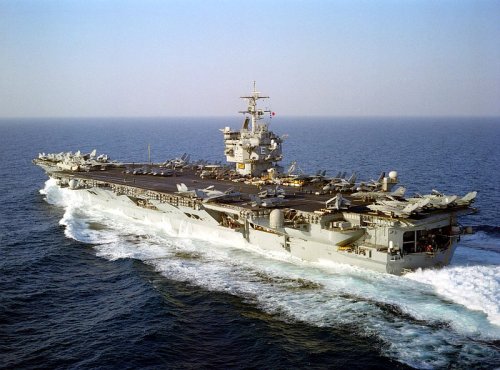
USS Enterprise CVN-65

As the Navy continued to develop the capabilities of the aircraft carrier it commissioned the nuclear powered USS Enterprise CVAN-65.  The added capability of nuclear power enabled her to operate without dependence on fossil fuel which in addition to her range and speed allowed her to carry more aviation fuel and munitions than the fossil fuel ships.  Unique among the Nuclear Carriers she produces 280,000 SHP and is powered by 8 Westinghouse (A2W) Reactors driving geared turbines, 4 screws with a classified top speed in excess of 35 Knots and is the quickest carrier going from all stop to full speed. At 1101 feet long and 75,700 ton (93,000 Full Load) displacement she was larger than any other carrier. She served in Vietnam, the Cold War, the Gulf War and Operation Enduring and Operation Iraqi Freedom. She was and was decommissioned in 2013.

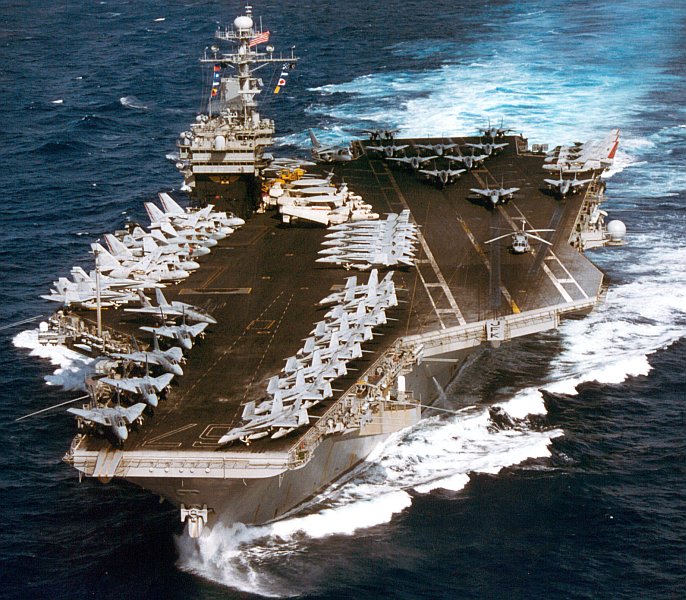
USS Theodore Roosevelt CVN-71 of the Nimitz class

The Nimitz Class of nuclear powered carriers is the most numerous class of capital ship in the U.S. Navy since the Essex Class.  Slightly smaller than Enterprise with a 1088 overall length and 91,000 full load displacement the Nimitz CVN-68 and her sister ships are the mainstay of the U. S. Navy carrier force.  These ships have been the symbols of American naval power for three decades and will continue to be for the foreseeable future.  Each of the ships has embodied successive improvements gained from the previous ships and the latest ships of the class the USS Ronald Reagan CVN-76 and USS George H. W. Bush CVN-77 incorporate technologies that were not known when Nimitz was on the drawing board. Thus whenever a ship is taken in for their Refueling and Complex Overhaul (RCOH) it is upgraded to the capabilities of the newest ship.  The class consists of the Nimitz, the USS Dwight D. Eisenhower CVN-69, USS Carl Vinson CVN-70, USS Theodore Roosevelt CVN-71, USS George Washington CVN-72, USS Abraham Lincoln CVN-73, USS John C. Stennis CVN-74, USS Harry Truman CVN-75 as well as the previously mentioned Reagan and Bush. They can carry 90% more fuel and 50% more ordnance than the Forrestal class. Carrying 90 or more aircraft they pack a mobile offensive punch that is not matched by any other surface ship.  The have served in every major military and many humanitarian missions since Nimitz was commissioned in 1974.
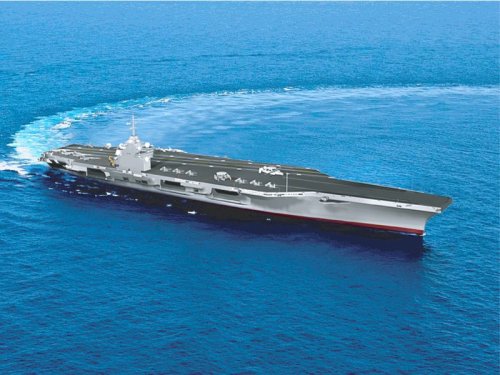
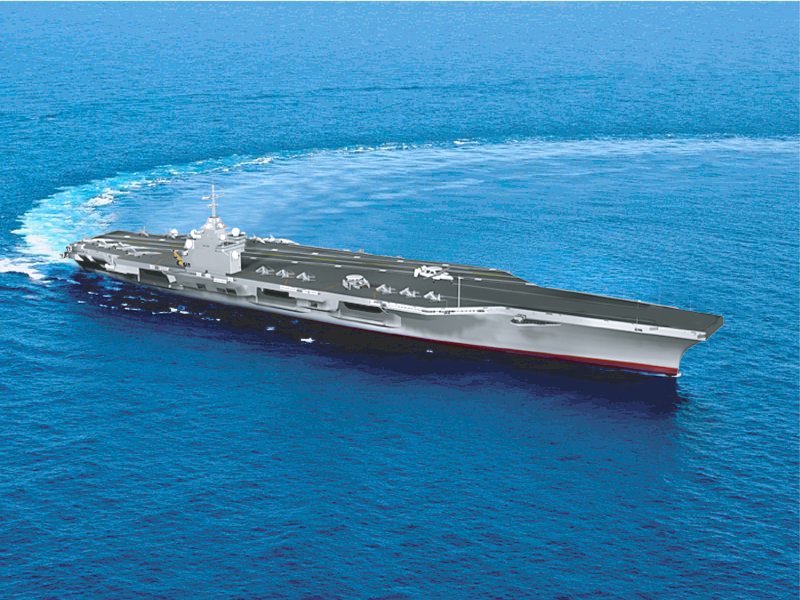
Artist conception of USS Gerald R Ford CVN-78

The Nimitz class will be joined by the USS Gerald R. Ford CVN-78.  The Ford is the first ship of an entirely new class. While approximately the same size as the Nimitz class at 1092 feet long and approximately 100,000 tons full load displacement the Ford class of which three are currently authorized and one under construction will feature many improvements over their predecessors. Among improvements are an advanced arresting gear, automation, which reduces crew requirements by several hundred from the Nimitz class carrier, the updated RIM-162 Evolved Sea Sparrow missile system, the AN/SPY-3 dual-band radar (DBR), as developed for Zumwalt class destroyers an Electromagnetic Aircraft Launch System (EMALS) in place of traditional steam catapults for launching aircraft, a new nuclear reactor design (the A1B reactor) for greater power generation, advanced stealth features to help reduce radar profile and the ability to operate the new F-35C Lightning II. If the class is built as programmed on a one ship every five year rate with the Ford commissioning in 2015 then 6 ships of the class will be in commission by 2040. The next two ships have been named, the John F Kennedy and Enterprise. 

Of course as with any military technology the future never is certain. In 1918 no one would have thought that the all-big gun Dreadnought Battleships would be eclipsed by the Aircraft Carrier in less than 25 years. While the Carriers have ruled the waves since Midway there are threats to them both military and financial.  Countries such as China while building their own carriers have are developing weapons such as guided ballistic missiles designed to destroy carriers.  As of now there is no defense against such a weapon if a carrier is within range. While China has not yet deployed the weapon it could be a game changer in the Western Pacific. Likewise there is the ever present threat posed by new and advanced submarines even those deployed by 2nd and 3rd world nations.  Finally there is the financial cost which could derail the procurement of more carriers in an era of austerity. The cost of the Ford is currently estimated to be $9 Billion Dollars which if stretched end to end would probably reach Vulcan where the Vulcans would come up with an answer to our current problems.

At the same time the carriers have defied those who predicted their demise since the Truman administration.  Currently no sea based platform has the multitude of capabilities of a carrier and its associated air wing and battle group and thus they should remain the Queens of the Sea for some time to come and the United States Navy which has led the world in their development and operation should continue to lead the way.

The next installment which will appear later this week will discuss the aircraft employed by the United States Navy not only those from carriers, but seaplanes, rotor-wing aircraft and lighter than air ships.

Peace

Padre Steve+

6 Comments

Filed under History, Military, Navy Ships

They Held the Line: The USS Yorktown CV-5, USS Enterprise CV-6 and USS Hornet CV-8, Part Two the Hornet

USS Hornet CV-8 Building at Newport News VA

This is part two of a three part series about the USS Yorktown Class Aircraft Carriers. Part one serves as an introduction as well as the story of the lead ship of the Class, the USS Yorktown CV-5.  Part One about the Yorktown is located here: https://padresteve.wordpress.com/2009/12/27/they-held-the-line-the-uss-yorktown-cv-5-uss-enterprise-cv-6-and-uss-hornet-cv-8-part-one/

Hornet as Completed off Hampton Roads shortly after Her Commissioning

The USS Hornet CV-8 was the third ship of the Yorktown Class and is sometimes referred to as her own one ship Hornet Class.  Laid down on 25 September1939 under the Naval Expansion act of May 17th 1938, Hornet was part of the pre-war naval build up authorized by President and Congress.  The previous Yorktown design was used to speed construction.  Hornet was slightly modified from her sisters Yorktown and Enterprise being 15 feet longer, 5 feet wider in the beam and displacing about 1000 tons more than her near sisters.  Her anti-aircraft armament was also slightly improved.  As with her near sisters Hornet had good protection except that her underwater protection was weak.  However, as would be born out in combat Hornet like her sisters would prove to be extraordinarily tough.

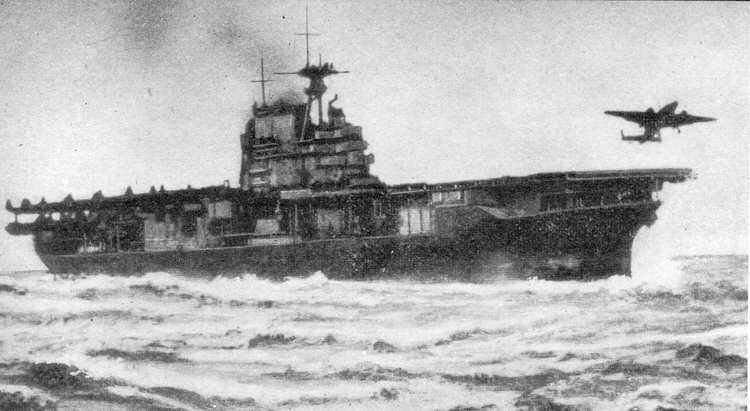
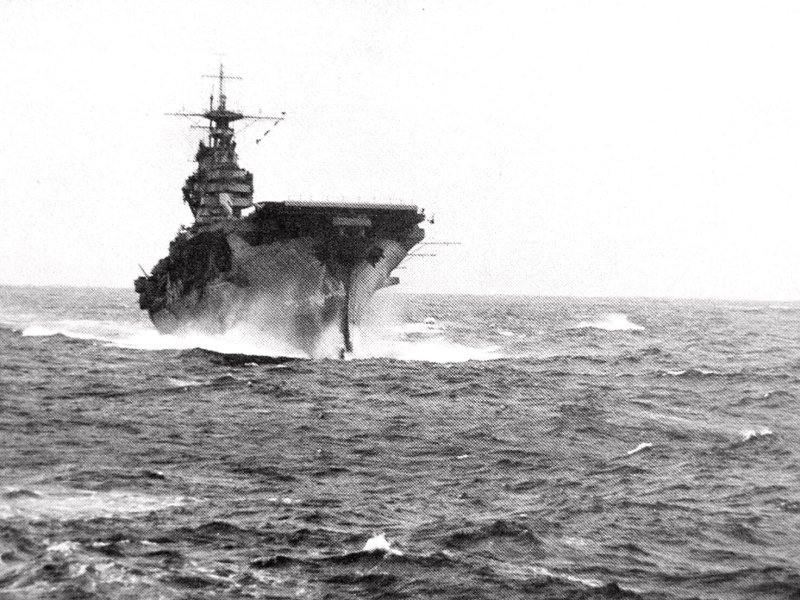
Hornet in Rough Seas Preparing to Launch the Doolittle Raid

Hornet was launched on 14 December 1940 and commissioned 25 October 1941 with Naval Aviation pioneer Captain Marc A Mitscher Commanding. Hornet conducted her initial training and air group qualifications while operating out of Norfolk.  On February 2nd two Army Air Corps B-25 Medium Bombers were loaded aboard.  As Hornet put to sea the bombers were launched to the astonishment of the crew. Hornet departed Norfolk for the Pacific where she embarked 16 B-25s under the command of Colonel Jimmy Doolittle.  Hornet’s own air group was stowed in the hanger bay.  On April 2nd Hornet departed from San Francisco for a rendezvous with Admiral Halsey’s Task Force 16 and her sister ship Enterprise.  As the ship departed Mitscher informed the crew of their mission.  Hornet would launch Colonel Doolittle’s aircraft against the heart of the Imperial Japanese Empire, Tokyo.

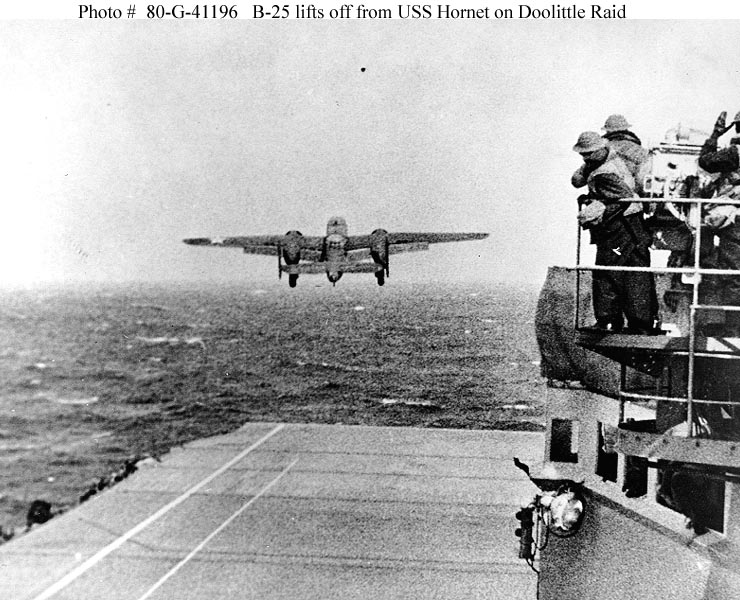
Hornet Launching B-25

The plan was for the task force to sail to 400 miles from Japan and launch the bombers. Enterprise was to provide air cover for the task force while Hornet’s air group was inaccessible while the bombers remained aboard.  On the morning of 18 April the task force was spotted by a Japanese patrol boat.  The craft was quickly dispatched by the heavy cruiser USS Nashville but not before the craft had reported the presence of the task force.  Though the task force was still 600 some miles from Japan Halsey ordered that Doolittle’s aircraft be launched against Tokyo.  The attack while militarily insignificant came as a major surprise to the Japanese who anticipating a raid by naval aircraft believed that any attack could not take place until the following day.  Even more significantly the attack stunned the Japanese military establishment, especially the Navy. The attack would provoke Admiral Yamamoto to attack Midway in order to draw out the American carriers and destroy them.

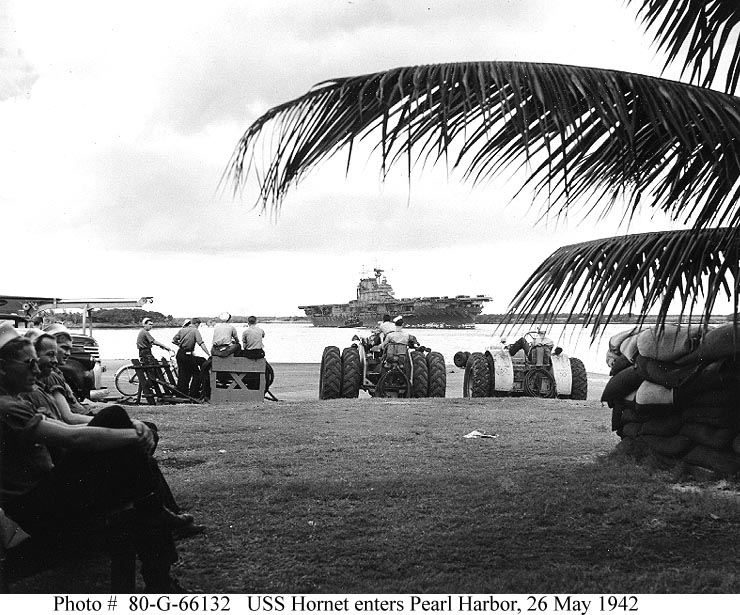
Hornet Arrives at Pearl Harbor Before Midway

Hornet along with Task Force 16 sailed back to Pearl Harbor arriving a week later and the mission would remain secret for over a year.  The task force steamed to assist the Yorktown and Lexington at the Battle of Coral Sea but that battle was over before they could arrive.  The task force returned to Pearl Harbor on the 26th of May and sail on the 28th for Midway.  Hornet’s air group was plagued with bad luck.  Torpedo Squadron 8, or Torpedo 8 commanded by LCDR John Waldron found and attacked the Japanese task force losing all aircraft and all pilots save one.  6 new TBF Avengers from her air group operating from Midway met with heavy losses in their attack against the Japanese.  Only one pilot from Torpedo 8 with Waldron’s group survived, Ensign George Gay.  Hornet’s dive bombers followed bad reports of the location of the Japanese carriers and took no part in the action.  Many would have to ditch in the ocean as they ran out of fuel.  Hornet’s air group would help sink the Japanese Heavy Cruiser Mikuma and heavily damaged Mogami on the 6th.  The Battle of Midway was one of the major turning points of the war.  The Japanese had lost six carriers which had attacked Pearl Harbor along with their aircraft and many of their highly trained pilots and flight crews. Coupled with their losses at Coral Sea the Japanese suffered losses that they could ill afford and could not easily replace.

Following Midway Hornet had new radar installed and trained out of Pearl Harbor until order to the Southwest Pacific to take part in the struggle for Guadalcanal.  By the time she arrived she was the only operational American carrier in the Pacific. Enterprise had suffered bomb damage at the Battle of Easter Solomons on August 24th; Saratoga was damaged by a submarine torpedo on August 31st and the Wasp was sunk by a submarine on September 15th.  In the space of 3 weeks the United States Navy had lost 3/4ths of its operational carriers in the waters off of Guadalcanal. Hornet now faced the Japanese alone, providing much of the badly needed air support for the Marines fighting ashore.

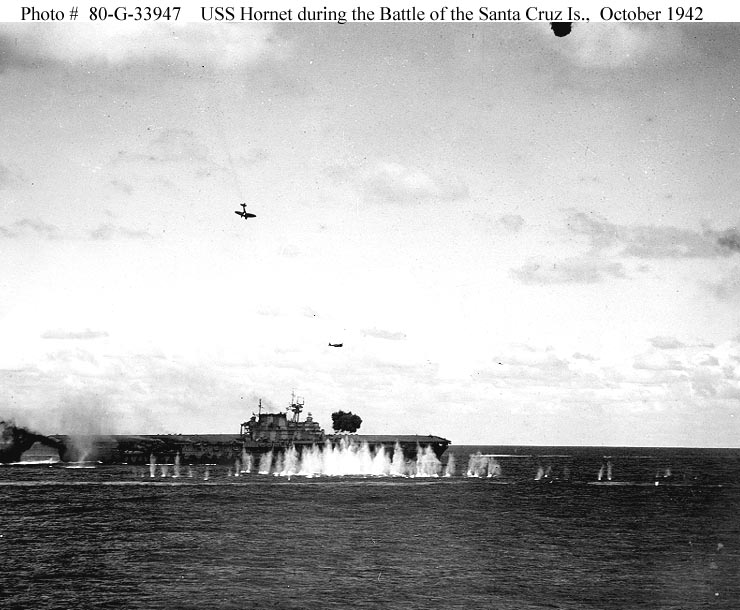
Hornet Under Attack: Note “Val” Dive Bomber about to crash ship

The Enterprise rejoined Hornet following hasty repairs off the New Hebrides Islands on October 24th.  On the 26th they joined battle with a Japanese task force of 4 carriers centered on the veterans Shokaku and Zuikaku. The Hornet’s aircraft attacked and seriously damaged Shokaku even as Japanese torpedo planes and dive bombers launched a well coordinated attack against Hornet. Hornet was hit by three bombs, two torpedoes and had two Vals dive into her with their bombs.  On fire and without power her damage control parties fought to regain control of the ship and extinguish the fires that blazed aboard her.

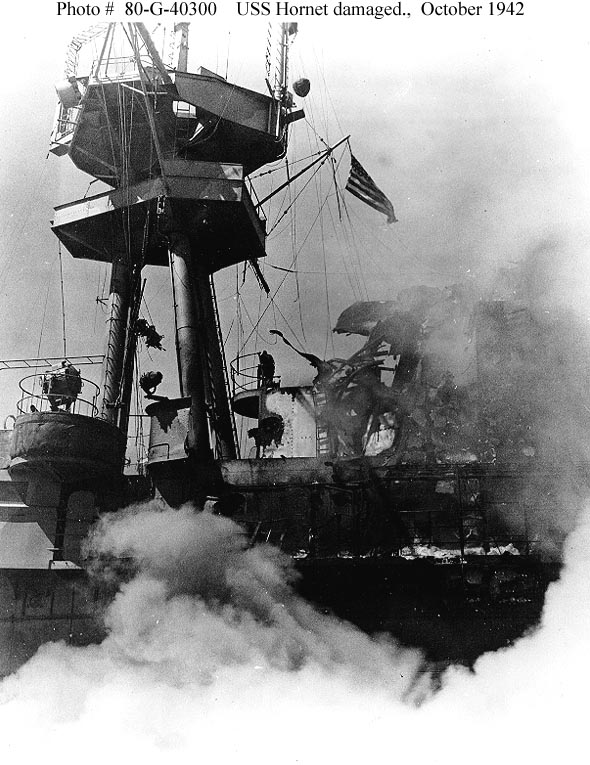
Hornet’s Damaged Island and Main Mast

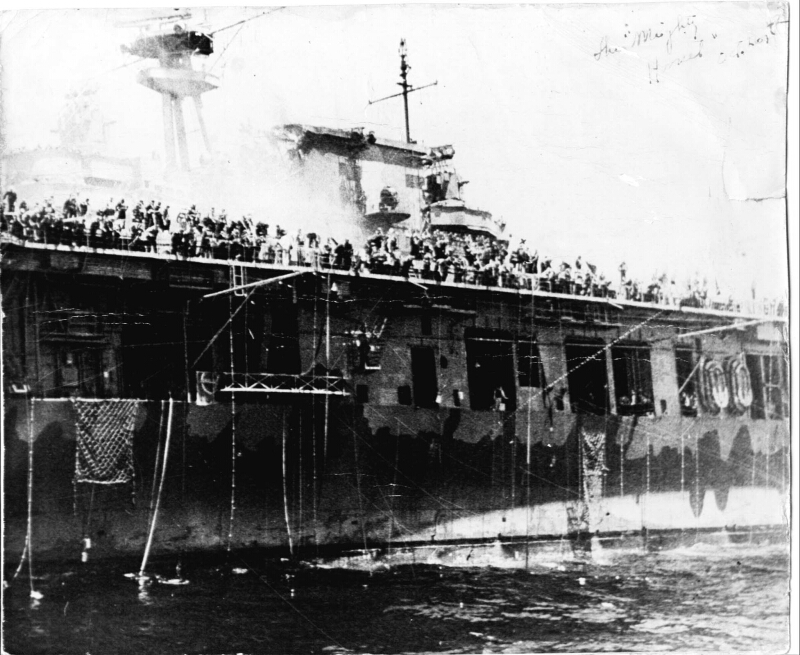
Assisted by the heavy cruiser Northampton which took her in tow her crew brought the fires under control and were close to restoring power when another Japanese strike group found her and put another torpedo into her.  With this hit Hornet’s list increase and she was abandoned even as she was hit by another bomb.  With Japanese ships in the area it was decided to scuttle the ship. Escorting destroyers hit her with 9 torpedoes and over 400 rounds of 5” shells.  As Hornet blazed in the night her escorts withdrew and Japanese forces after attempting to take her under tow put four of their 24” “Long Lance” torpedoes into the doomed ship at long last sinking her.

Hornet Being Abandoned by Her Crew

In her last fight Hornet’s aircraft along with those of Enterprise mauled the air groups of Shokaku and Zuikaku again inflicting irreplaceable losses among their experienced air crews.  In the battle Hornet was hit by 4 bombs, two aircraft, 16 torpedoes and over 400 rounds of 5” shells, more hits than were sustained by any other US carrier in a single action during the war.  She was stuck from the Navy list on 13 January 1943 and her gallant Torpedo 8 was awarded the Navy Presidential Unit Citation “for extraordinary heroism and distinguished service beyond the call of duty” in the Battle of Midway.  Her name was given to the Essex Class carrier CV-12. The new Hornet served throughout the war and served well into the Cold War.  She now rests as a Museum ship at Alameda California.

The USS Hornet Association website is here:  http://www.usshornetassn.com/

The Museum site is here: http://www.uss-hornet.org/

If you liked this article you might want to also read the following articles on this site:

The Battleships of Pearl Harbor

The Transitional Carriers: USS Ranger CV-4 and USS Wasp CV-7

The First Aircraft Carriers Part One: The First American Flattops- Langley, Lexington and Saratoga

The Treaty Cruisers: A Warship Review

5 Comments

Filed under History, Military, Navy Ships, world war two in the pacific