Monthly Archives: May 2015

The Presence of Molly


wherewegoingdad

“Dogs are our link to paradise. They don’t know evil or jealousy or discontent. To sit with a dog on a hillside on a glorious afternoon is to be back in Eden, where doing nothing was not boring–it was peace.”  Milan Kundera

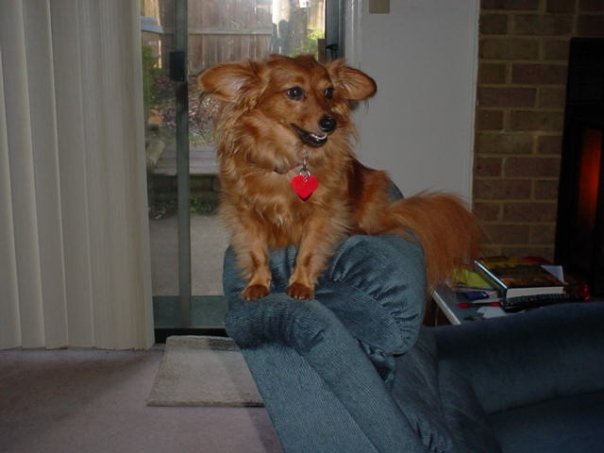
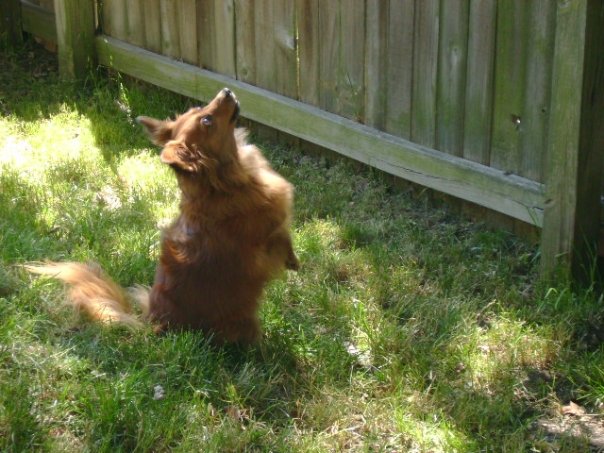
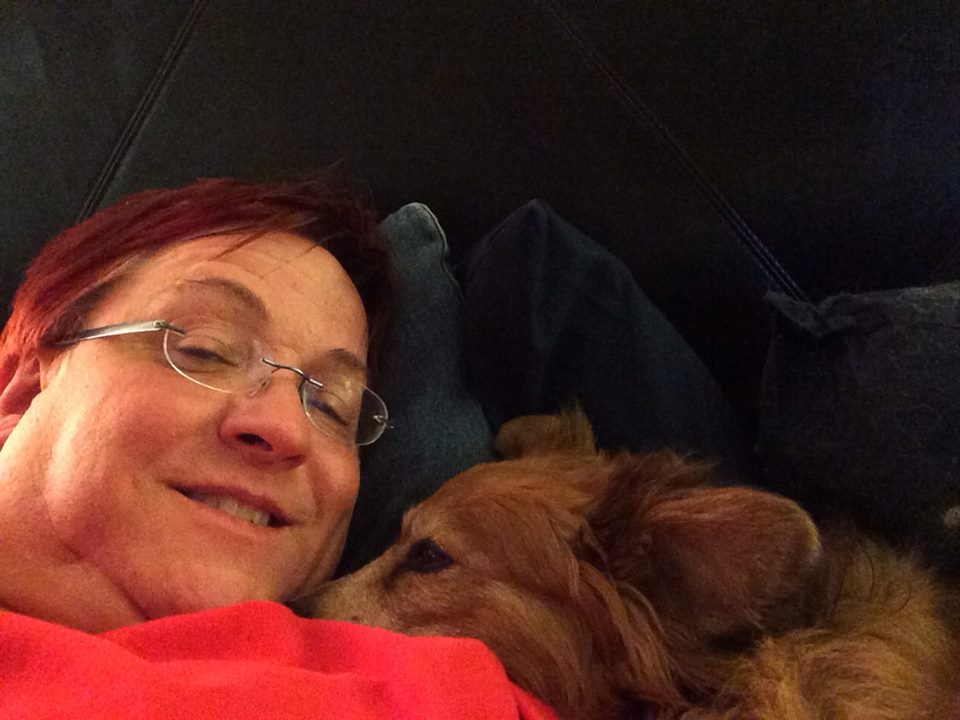
Molly Fur is still with me. Though we had to have her put down Monday I have felt her presence, especially as I drive too and from work. You see Molly was my constant companion and that wonderful furry baby spent innumerable hours traveling with me in North Carolina and on what seemed were our endless treks between Emerald Isle and Virginia Beach.

Molly loved riding with me and it did not matter how long or short the the trip was she had developed her own rituals for the rides. She would take a drink from her water dish before leaving the house, ensure that she had peed before hopping into the car and then take her place either in the front seat next to me of the back seat, centered so she could look over my shoulder. She was a comforting presence on those long trips and she savored every moment of them, especially when we would stop at a drive through for lunch and she would get her “Molly Burger.” When we got to our destination she was always happy, if coming home to Virginia she would joyfully run to Judy at the front door, and if heading back to Emerald Isle demand that I walk her to the beach, all the while hunting for deer.

I have never seen a dog savor life as much as Molly and thus I am not surprised that I still feel her presence in the car. Yesterday was funny because I thought I saw her shadow in the seat next to me and I reached over to pet her. She wasn’t there, but I could feel her spirit. That may sound weird to some of you, even religious people who believe in an afterlife, but somehow exclude everything but we contemptible human beings from it. I think that one of my favorite passages in the Bible is the one in Romans chapter eight which talks about the creation awaits its redemption, even groans for its redemption, and having heard Molly groan I know that this means dogs and other furry friends too. Personally I don’t give a flying fuck if any supposedly Christian leader condemns me as a heretic, for believing this.  But as Mark Twain said: “The dog is a gentleman; I hope to go to his heaven not man’s.”  Since I am already stoking the fires of Hell that according to some await me let me echo the words of Will Rogers who said “If there are no dogs in Heaven, then when I die I want to go where they went,”   even as I totally agree with the late curmudgeon Andy Rooney  who said “The average dog is a nicer person than the average person.”   I can feel the flames heating up, can’t you?

So, since I have already been condemned as a heretic to Hell even by some Christian “friends”  who have had the nerve to do so on social media, this matters not.  For I know that Molly is with me any time I get in my car. She is now like a guardian angel and I can feel her presence and frankly I would rather have her spiritual presence and the presence of my Papillon Pack of Minnie Scule and Izzy Bella around me than most people. A friend of mine noted that I have to start training up Izzy in “the way of the dog” not to replace Molly, but to be my next guardian angel. Thankfully, the little girl is already working on that.

So until tomorrow, thank you for all of your thoughts, prayers and love.

I wish you all the greatest love and joy possible. 

Peace

Padre Steve+

6 Comments

Filed under christian life, dogs, faith

Memories of Molly & Thanks to Friends


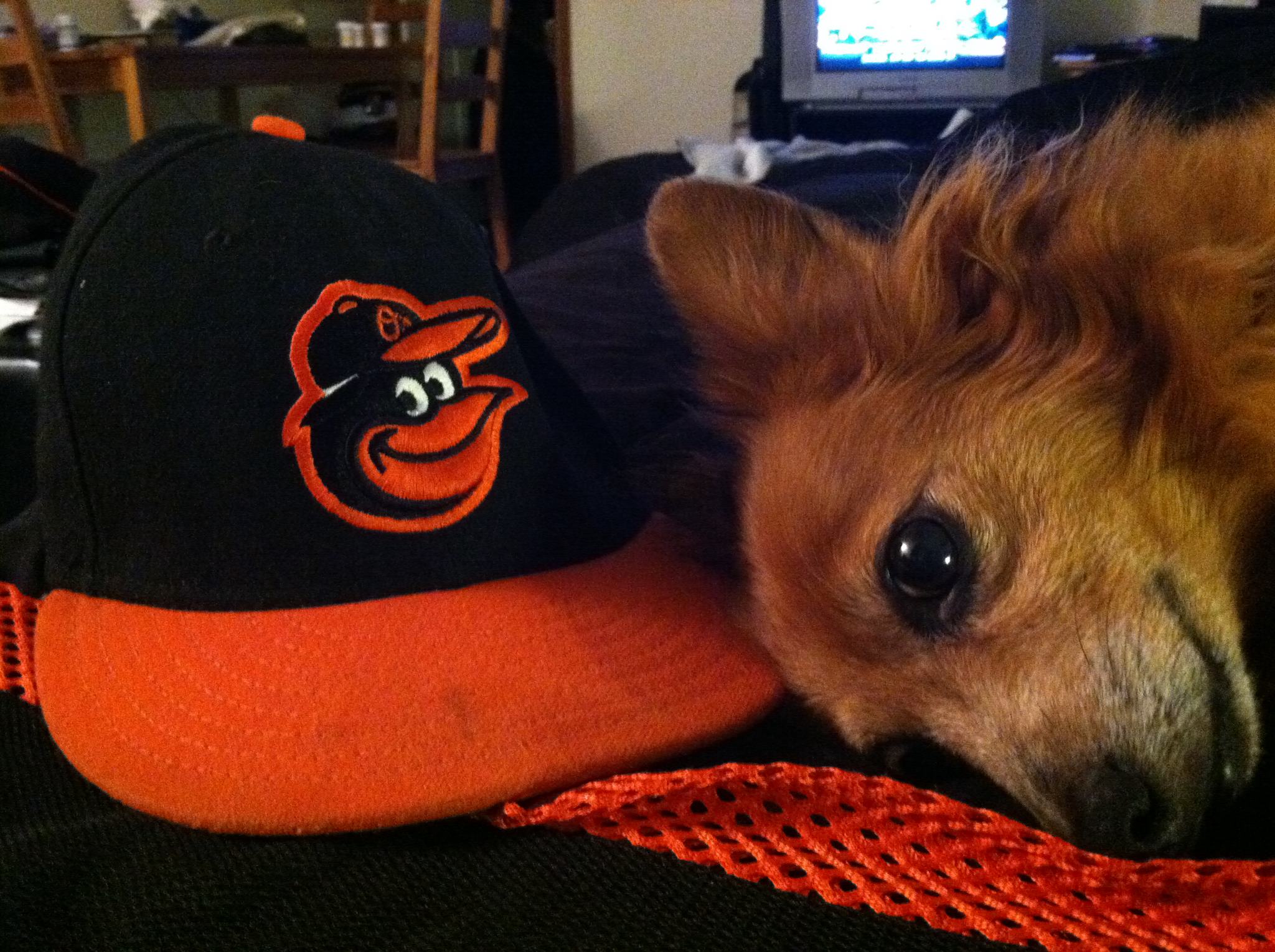
molly and orioles hat

Dean Koontz wrote:

“No matter how close we are to another person, few human relationships are as free from strife, disagreement, and frustration as is the relationship you have with a good dog. Few human beings give of themselves to another as a dog gives of itself. I also suspect that we cherish dogs because their unblemished souls make us wish – consciously or unconsciously – that we were as innocent as they are, and make us yearn for a place where innocence is universal and where the meanness, the betrayals, and the cruelties of this world are unknown.”  

As most of you know from what I posted yesterday we had to have Molly Fur, the wonderful dog who saved my life after Iraq put down at the age of fourteen. I knew her loss would hit me hard, however I have always tried to conduct myself in such situations as would Mr. Spock on Star Trek, or Commander Data in Star Trek the Next Generation before he got the emotion chip implanted. That being said I knew that I would cry, however, little did I expect that every time I turned around that I be crying.

Honestly I feel a lot like Robert De Niro playing the mobster Paul Viti in the movie Analyze This, where he tells his shrink played by Billy Crystal: “The other day, I was watching a commercial with a kid playing with a couple of puppies, I cried for forty five minutes! You slap a pair of tits on me, I’m a woman!” But I digress…

Molly meant more to me than almost anything in life. I am convinced that had she not come to live with me when I was stationed in Camp Lejeune away from Judy, that I would have succumbed to despair and found a way to die without making it look like suicide. I probably would have driven off the bridge to Emerald Isle or driven into the trees lining one of the state highways on the way to or from work.

However, having Molly there kept me from this because I wondered what the effect would have been on Molly. Stanley Coren wrote:“The greatest fear dogs know is the fear that you will not come back when you go out the door without them.”  I couldn’t do that to her, she loved me too much and would not have understood.

Having Molly with me in North Carolina gave me someone to come home to, and her cheerfulness and devotion kept me going through some of the darkest times of my life. Just having her waiting for me when I came home made all the difference and today for the first time I came home from work and Molly was not there to great me. It really hit me again, that she was gone .

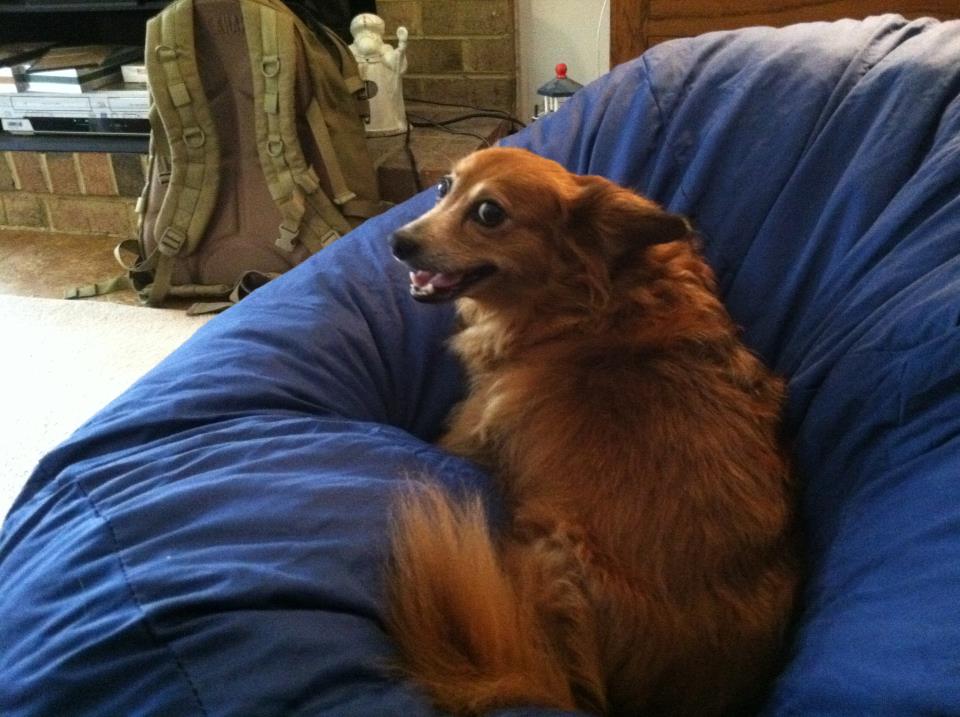
mollybag

Molly was so irresistibly funny, sweet and beautiful and she lived her whole life that way, caring for Judy as much as she cared for me. Molly would sit with me on a huge bean bag chair and watch baseball, sometimes she would be looking at the television so intently I thought she had to be watching the games at least as much as she was comforting me, especially during the 2012 season when the San Francisco Giants won their second World Series title. She hardly left my side during those games.

mollgrin

Thankfully, Molly never developed the taste for beer that our now Senior Dog on Deck, Minnie has, otherwise I would have probably had to pour her out of the beanbag to chase the deer around the house.

Over the past couple of days Judy and I have been showed such care and love by family and friends, in person as well as on Facebook. Likewise I have received so many kind words and thoughts from people who follow me here or on Twitter.

I know that sometimes social media can be poisonous and filled with vitriol. However, that being said such is not always the case. There are a lot of wonderful people out there on Twitter, Facebook and in the blogosphere.  The kindness shown by people people that I have never met in person who follow me on this site and Twitter has been amazing.

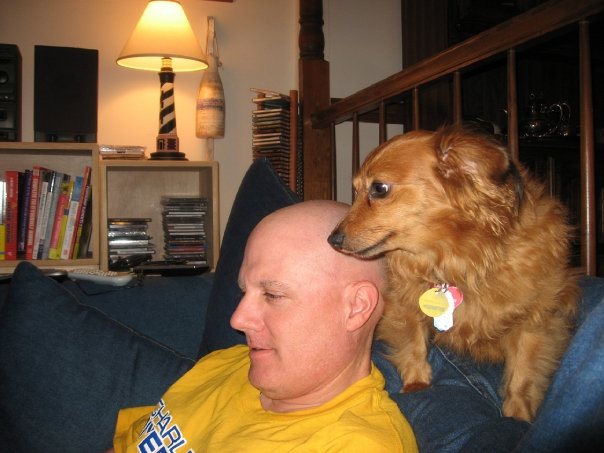
editormolly

I think Molly will always be with Me

Your kindness  reduces me to tears, just like Paul Viti, and just like is happening to me right now as I wipe the tears from my eyes. But those tears are not tears of sadness. They are tears of appreciation and thanksgiving, to Molly who saved my life, and for all who have taken just a few moments of time to offer a word of kindness. Those words have enabled me to remember all those times that Molly made my life better, helped keep me alive, and in the process probably made me a better person in spite of myself.

Thank you all so much.

Blessings, Love and Peace

Padre Steve+

4 Comments

Filed under Baseball, beer, dogs, movies

The Saddest Day: Rest In Peace Molly Fur

mollbeach6

Friends of Padre Steve’s World

It has been a tough day at Padre Steve’s home as we had to put our oldest dog, Molly Fur down. It has been a day where we have shed a lot of tears.

Dean Koontz Wrote:

“Dogs, lives are short, too short, but you know that going in. You know the pain is coming, you’re going to lose a dog, and there’s going to be great anguish, so you live fully in the moment with her, never fail to share her joy or delight in her innocence, because you can’t support the illusion that a dog can be your lifelong companion. There’s such beauty in the hard honesty of that, in accepting and giving love while always aware that it comes with an unbearable price. Maybe loving dogs is a way we do penance for all the other illusions we allow ourselves and the mistakes we make because of those illusions.”

Molly was fourteen years old, a half Dachshund and half Papillon mix who was a rescue. Molly was the most amazing dog that we have ever had the honor of loving. Some people talk of being dog-owners, but we are dog-parents as we have never had any children of our own. Our dogs have been our children and we have been blessed to have all of them. Frieda, who was literally the “Dog from Hell” held us hostage for sixteen years was smart, beautiful, devious, and conniving. She fought us to be the Alpha of the family to the end of her life.  To her we were just the incompetent help.

Greta, our second baby, was sweet and lovable. But Greta was basically a “cookie-cutter” Wiener Dog. She was serious, and dour, and one hell of a tough dog. She was strongly territorial and woe betide any big dog who infringed on that territory. She took a mouthful of fur out of a Chow once, but I digress, this is about Molly…

Molly the Wonder Fur… I have a feeling that this article will eventually become the outline of a book, because Molly was amazing. I posted a short note about her loss with a picture of her running down the beach in North Carolina on my Facebook page after we put her down. Both Judy and I have been crying a lot today, even though it was time and Molly was suffering. Since posting that note I have been comforted by the comments of many friends, especially those who knew and loved her, of course reading those made me cry more, but I think that is okay. Anyway, let me tell the story of Molly Fur here. Gilda Radner said: “I think dogs are the most amazing creatures; they give unconditional love. For me, they are the role model for being alive.” 

We had lost our first dog, a Wire Hair Dachshund named Frieda while I was deployed to Okinawa, Mainland Japan and Korea in April 2001. In October 2001 my wife Judy was at the veterinarian with our other Dachshund, a smooth-hair red named Greta, or Greta-Poo for a routine visit when she met a lady holding what Judy presumed to be a long-hair Dachshund puppy.  The lady explained that she had found the puppy along North Carolina Highway 24 in Carteret County covered in tar. The lady had cleaned her up and had brought her to the vet to get checked out and to get her immunizations. 

molltaingoat

Since we had a great deal of experience with Dachshunds Judy told the lady that they could be quirky and that if she needed any help to let her know. Three days later we received a call from the lady explaining that she could not hand the puppy as it was too much for her older dog and asked if we wanted her. Of course I said yes. We got to the lady’s home and were confronted with a dog that certainly was not a full-blooded Wiener Dog. The puppy had legs and her ears were mounted wrong, but she had a long Dachshund body and brilliant red fur. She looked like a little red fox. I fell in love at first sight and we took her home, thus began the saga of Molly the Fur.

Now Greta our Dachshund was not thrilled to have a puppy. Greta was mommy’s baby and was not going to let anyone come in the way. She was not happy and ensured that Molly knew that, however, Molly was undeterred and one day when Greta tried to bully Molly, the Moll kicked her ass. After that the too maintained a state of detente, not really liking each other but working together to raid the cupboards, steal food and to raid the kitchen garbage can. When Greta had to put down in June of 2003, Molly became an only dog-child.

Molly was always smart, in obedience school she was not the most obedient but she charmed people and she was the class clown. As she got older she became scary smart, but unlike Frieda who used her brains for nefarious purposes, Molly was simply inventive, resourceful and undeterred in finding solutions to any obstacle that she faced. Likewise, Molly’s cheerfulness and sweet demeanor was something that endeared her to everyone who ever got to know her.

mollbirds1

Looking for Birds and Squirrels 

Molly was also became daddy’s girl and despite the fact that I was often deployed or frequently on the road that never changed. Molly was daddy’s girl from day one until the end.

We almost lost Molly when she was seven, when she developed a strange spinal infection. It was a difficult battle and she was in a lot of pain but she overcame it and had completely recovered in about a month’s time.

However, that infection and Molly’s recovery showed us that she was even smarter than we had imagined. As I mentioned the infection was painful for her.  She was basically put in enforced bed rest in a large laundry basket, which we were the enforcers. Molly handled that well and let us know that if she was hurting that she did not want to be picked up.

One funny thing that she did was to start screaming like a two year old child whenever Judy approached her basket. It was amazing. If she didn’t want to be picked up she didn’t bark, she screamed a blood curdling scream. When she recovered she went back to normal, but continued to amaze us with the new and inventive ways that she dealt with obstacles.

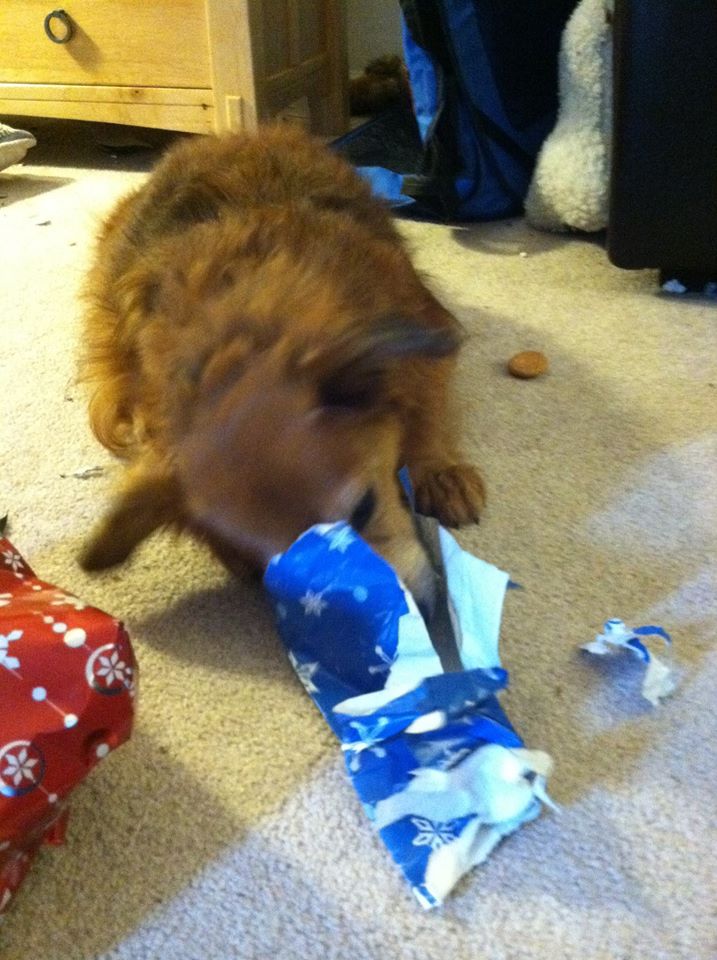
Molly loved Christmas. Her first Christmas we wrapped her up a toy and gave it to her. She immediately unwrapped it and began to play. thereafter every Christmas we did this and every Christmas she opened her presents with the joy of a child.

mollypresents

She also came to love the snow, she was never much a fan of rain, but she loved the snow. It was funny during  our “Februwinter.” Molly was not in the greatest shape but handled the amazingly severe winter weather with aplomb, she with Minnie and Izzy who we had just got, had fun in the snow.

mollsnow

Molly in her first snow, December 1983

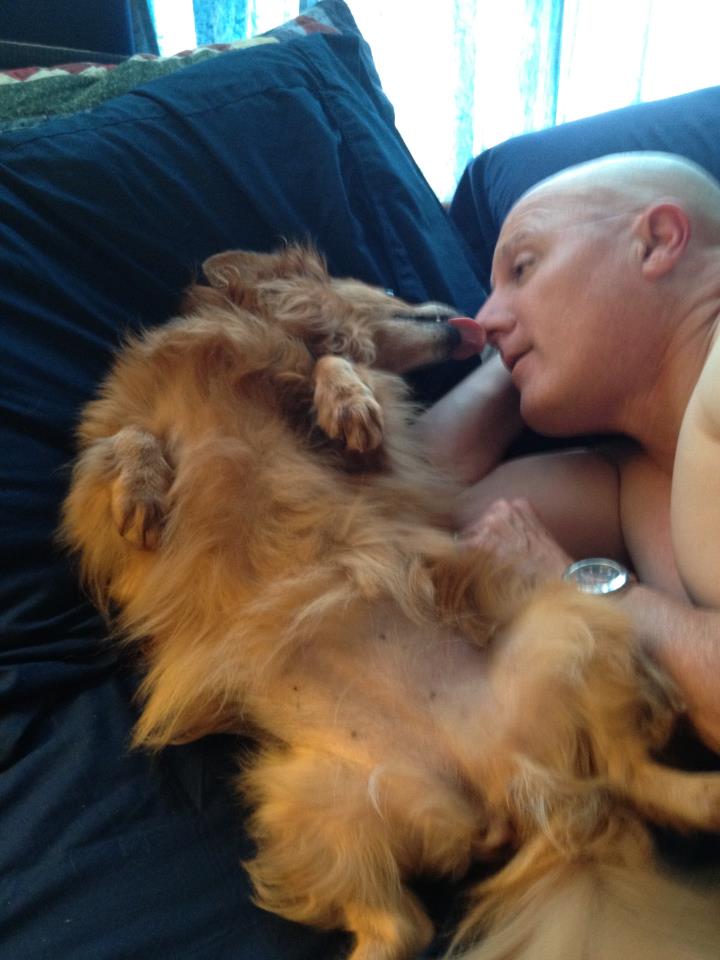
Molly always had a sense for when we were hurting or sick. If we were not doing well she became “Nurse Molly.” Judy gave her that name because of her devotion to trying to make us feel better whenever we were sick or down. Since I am basically a Chaplain version of Doctor House, Nurse Molly was a tremendous comfort.

mollgrin

When I returned from Iraq I was a mess. PTSD, anxiety, depression, chronic pain, night terrors and chronic sleep problems plagued me, and often still do. However Molly looked after me and I give her credit for helping save my life during those incredibly dark times when I often saw no hope and wanted to die. Over the years it was Molly’s amazing resiliency and devotion that helped keep me alive.

puppylove

mollyandmommy

When I was assigned to Camp LeJeune a second time in 2010 Molly decided, after a visit where Judy was recovering from Achilles Tendon surgery that she wanted to stay with daddy. How could she not?

deerhunt

Molly Tracking a Deer in my back yard in Emerald Isle

I lived in an apartment under a beach house in Emerald Isle. Outside my door there were deer, squirrels, birds, and did I say deer? I lived about three-tenths of a mile from the beach and every day she and I would take a walk, she would chase deer and then were would hit the beach. In Virginia we have a small back yard and though there are squirrels and birds it could not compete with Emerald Isle.

One of the things that happened in Emerald Isle was on July 4th of 2011. Judy and Molly had come down for a short visit and Judy wanted to see the fireworks which were being launched from the Emerald Island Pier. The three of us went down to the beach and it was packed with people. I don’t do crowds well, I still get panicky in crowds. I also don’t do explosions well. It wasn’t the main show that got me it was the fact that everyone and their brother’s cousin’ father-in-laws next door neighbor’s roommate were there and were shooting off industrial grade fireworks right on top of me. I was melting down and flashing back to Iraq, Molly sensed that I was not doing well and moved close to me. Then to defend me she looked up and started barking at the fireworks. She was unfazed by the explosions and was determined to protect me. I love her to this day for helping to save my life.

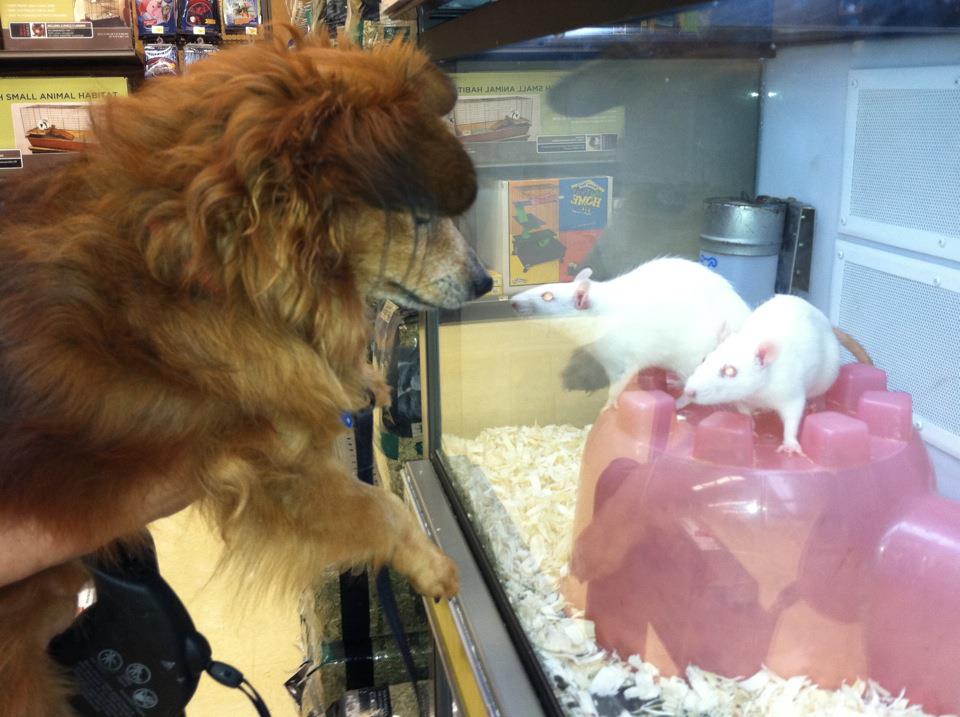
mollrats

Visit to the Pet Store: Can I Have one Daddy? 

When Molly came to North Carolina she really came into her own. She almost bagged a few deer, including one which was sleeping just off my porch.Thankfully I was able to stop Molly’s attack with a big tug on the retractable leash with Molly just inches from taking a bite out of the left flank of the unsuspecting deer. I would have hated to explain to the local Department of Fish and Game officials how a 15 pound dog had taken a bite out of a deer.

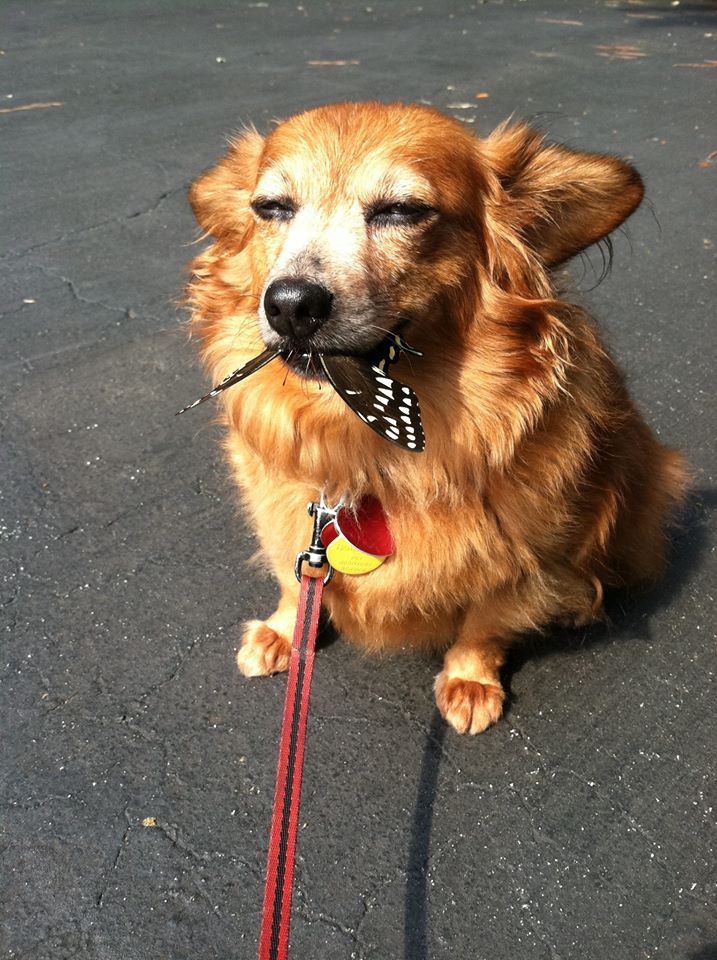
Molly went everywhere with me and loved the rides in the car. She also loved the visits to the pet store which we call the “cookie store” and the walks on the beach. Just before I returned to Virginia in 2013 Molly went blind, just before this she had caught a butterfly in mid-air. She held onto it for five minutes before releasing it unharmed, except for the PTSD that the poor insect must have had.

mollyfly

As I have already mentioned Molly, loved to do things with me, and one thing she really enjoyed were the long rides between Virginia Beach and Emerald Isle. On those rides we would stop to get something to eat, usually going through various drive thru restaurants where I would get her what I called a “Molly Burger” a plain hamburger that she would scarf down. Of course she tended to get a Molly Burger any time we went out when I lived in North Carolina.

mollchoices

So Much to Choose From…

wherewegoingdad

Turn left at the drive through

mollbreezyrider

Keep the Window Down…

editormolly

Daddy and his Girl, Molly always was interested in the computer

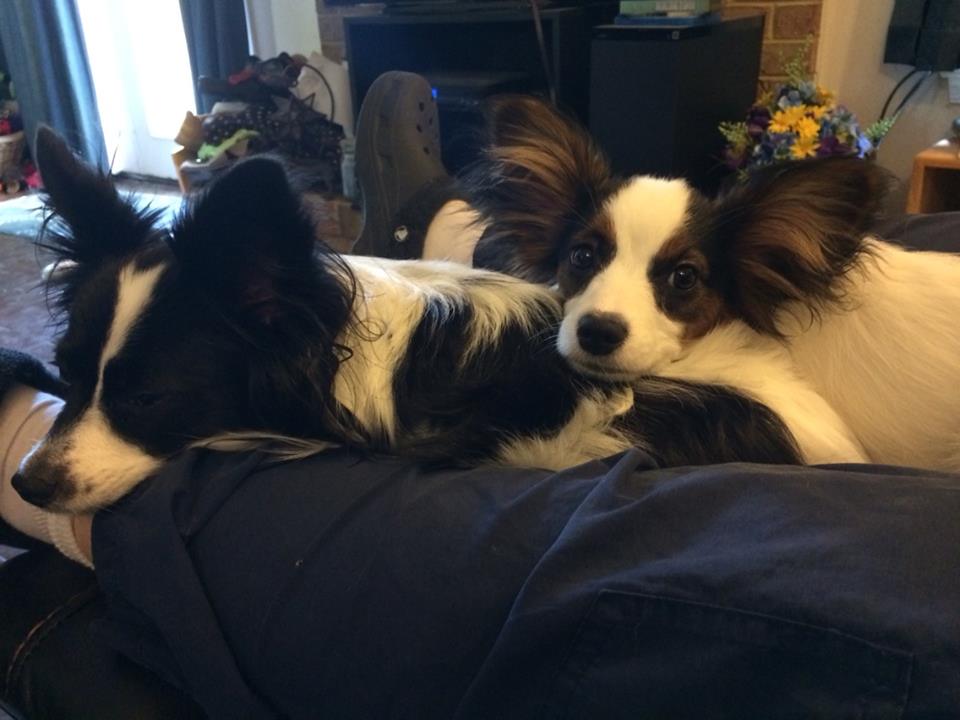
Molly was also responsible for us having Papillons. We came to love Molly’s cheery, happy and funny Papillon side. Now Molly did have a Dachshund side of her personality as well, but she operated as either one or the other, so we never knew if we were going to get the “happy Pappy” of the serious Dachshund. But Molly’s Papillon side caused me to get Judy a Papillon just about a month after Molly a abandoned Judy to move to North Carolina with me. This Papillon is Minnie, or her full name “Minnie Scule.” In February we got Minnie a pappy-puppy named Izzy, or “Izzy Bella.” They are a joy. They are not Molly and they, even though both are full blooded Papillons have wildly different personalities. They are now best buddies and partners in crime.

pappypups

Minnie and Izzy 

Molly also shares some of the responsibility of bringing Frieda back into our lives. The vet that I took Molly to in North Carolina was the same one that Frieda and Greta went to, as well as the first that Molly went to. In 2012 Molly had to have a painful but benign tumor removed from her shoulder. When she came back from the surgery I felt a strange presence in the apartment and began to see Frieda sized shadow figures. Judy noticed them too in her visits and when Molly and I returned for good Frieda came with us. Both of us occasionally feel her presence and see her shadow.

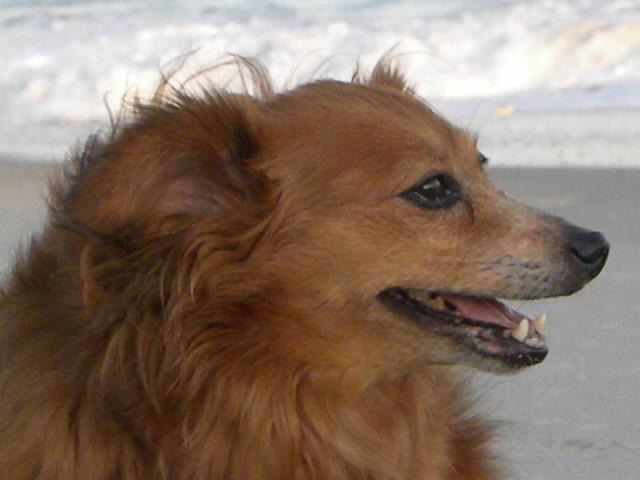
mollbeachbreeze

The Wind on the Beach

“The dog is the most faithful of animals and would be much esteemed were it not so common. Our Lord God has made His greatest gifts the commonest.” Martin Luther

Anyway, as I mentioned Molly went blind just before returning from North Carolina. The blindness was very quick to develop, and according to the veterinary eye-speciallist was congenital. However, that did not stop Molly, she adapted and overcame. To prevent injury to her eyes we got her a clear visor which covered her head and eyes but still allowed her to function almost normally. She would use it like a blind person uses their cane to figure out where she was, and if needed as a weapon to get our attention. If we had to move furniture around, she figured out what was moved and proudly let us know what she knew. 

beautifulmoll

Molly at Age Seven, Not long after surviving a serious Spinal Infection

About a year ago she was diagnosed with the beginning stage of renal failure. She continued to do relatively well until a few months ago when she began to shed a lot of weight. Even so until a couple of weeks ago she still got around fine and gave us little cause for concern. She took a serious turn for the worse last week. On Thursday she stopped eating as she was occasionally throwing up and had developed a bloody diarrhea but Saturday. Judy and I knew that she was in pain and suffering and while I was at Gettysburg we decided that today would have to be the day. I got home from Gettysburg last night and we loved on Molly. Since she would eat nothing else we got her some hot and fresh Krispy Kreme glazed donuts, which she ate joyfully.

molltalk

Molly Giving Orders

This morning we made arrangements to take her in. Minnie and Izzy both gave Molly gentle kisses and nuzzled her before we left. I am sure that they knew that Molly wasn’t coming back. The look of concern on Minnie’s face was heart-warming. Judy drove as I cradled Molly in my arms. With the exception of her time in North Carolina this vet, Dr Robin Knoppf of Abbey Animal Hospital has been her vet. Many of his staff have known Molly for years and a number were with us, one a tech named Sean were with us shedding tears for the Amazing Molly Fur.

mollbeach4

Happy Trails Molly…Until We Meet Again

mollbeach5

Just before eleven A.M. Dr Knoppf gave Molly the injection which helped Molly into the next phase of her journey. Judy and I were holding her and Dr. Knoppf had a hand on her as he listened to her final heartbeats. Molly died surrounded by people who loved her.

It was sad, but it was also reassuring for as we looked at her we could see that she was not longer in pain and was at finally at peace. Some believe that what we see in this live is final, but I am not so sure.

I fully expect that we will see Molly again. That being said I have been crying more that I have for any reason since I can remember. Judy has been too, and thankfully the Pappies, Minnie and Izzy have been wonderful.

Thank you for allowing me to share this, and remember to love your furry babies.

Peace

Padre Steve+

6 Comments

Filed under dachshunds, dogs, papillons

The Most Scientific and Resourceful of All: General Edward Porter Alexander

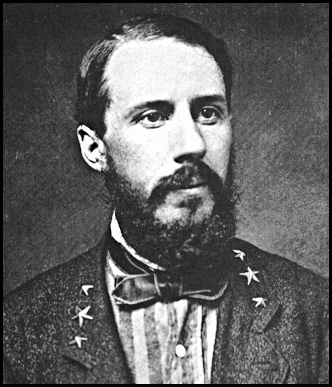
alexander

Friends of Padre Steve’s World

I am getting ready to conclude my latest Gettysburg Staff Ride with my students from the Staff College. It has been a fantastic experience again. Right now I am getting ready to turn in for the night after having dinner and drinks with my students. In the morning we will be walking the ground of Pickett’s Charge before heading to General Meade’s headquarters and the Soldier’s Cemetary where President Abraham Lincoln delivered the Gettysburg Address.

As part of what I have been doing on the site I have been periodically interspersing and publishing short articles about various commanders at Gettysburg. I did one on The Union cavalry commander, John Buford yesterday. 

These articles are all are drawn from my student text and will likely become a book in their own right when I finish the chapter on the Union commanders.  The reason is I am going to do this is because I have found that readers are often more drawn to the lives of people than they are events. As I have noted before that people matter, even deeply flawed people, and we can learn from them. Sometimes good and even honorable people serve malignant causes, while bad or even wicked people support good causes, usually for selfish reasons, but that is the constant quandary that human beings find themselves.

Today’s article is about Confederate General Edward Porter Alexander. Alexander directed the Confederate artillery during Pickett’s Charge and because he was not a terribly high ranking officer is comparatively little known.

However, Alexander is another interesting character. He was one of the most gifted and brilliant artillery commanders of the war and after the war went on to serve the country with distinction after following his re-integration back into the ranks of American citizens.

Alexander wrote a narrative of the war that is considered by historians to be one of the best and most objective accounts written by any Confederate. However, he was very much a military man and never fully grasped the political and ideological nature of the war, not the profound social effects of the Union victory. I hope you enjoy. Until tomorrow. 

Peace

Padre Steve+ 

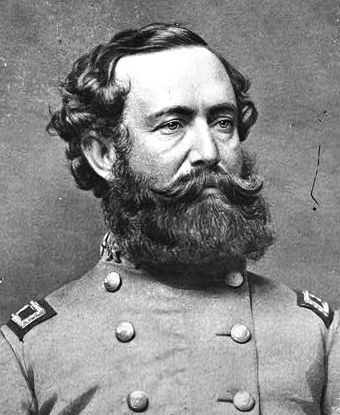
Though he was only a Colonel commanding an artillery battalion in Longstreet’s First Corps at Gettysburg, Edward Porter Alexander needs to be mentioned in this text because during the battle he assumed tactical command of the largest concentration of Confederate artillery during the entire war. Likewise his contributions to the writing history of the war are incredibly important and provide some of the most balanced views of the war written by any participant on the Confederate side.

Alexander was born in Washington Georgia in 1835. He attended West Point and graduated third in his class in 1857. One of his classmates was Marcus Reno who was second in command of the ill-fated fight of Custer’s 7th Cavalry at Little Big Horn.

Alexander was commissioned in the Corps of Engineers and served as an instructor at West Point. He realized after the John Brown raid that if war came he would fight for the Confederacy. He was married to Bettie Mason in April 1860 and was thereafter assigned to duty at Fort Steilacoom, Washington. He wrestled with his the decision to leave the army, his father was one of the Georgia legislators who voted for secession and like many Southern officers he decided to resign. He wrote about Lincoln, “If he is elected I believe that in the interests of humanity, civilization, and self-preservation call on the South to secede, I’ll go my arm, leg, or death on it.” [1]

His commander Major James McPherson who later had a prominent part in Sherman’s campaigns attempted to talk Alexander into remaining in the army on the west coast, but Alexander refused. McPherson graciously allowed Alexander and his bride to return to the East in a leave status. Bettie too was “upset by this decision and seriously questioned whether other alternatives were possible.” [2] But Alexander saw no other option. McPherson graciously allowed Alexander and his bride to return to the East in a leave status. When he got back to the South he resigned his commission after the election of Lincoln and on July 2nd 1861 Captain Alexander reported for duty at Manassas as an artillery officer. The professional artillerymen believed that Alexander “was the most scientific and resourceful of all.” [3]

Promotion came at regular intervals for Alexander. Initially he served as Beauregard’s Signals officer, and was appointed as the Chief of Ordnance for the Army of Northern Virginia, with the rank of Lieutenant Colonel. He was made an artillery battalion commander after Antietam, and at Fredericksburg his battalion was in the thick of the fighting along Marye’s Heights. With each new battle Lee and Longstreet “had come to rely increasingly on Alexander’s eager intelligence, regularly assigning him duties more properly those of Col. James Walton, Longstreet’s nominal chief of artillery, or even Brig. Gen, William N. Pendleton, the artillery chief of the Army of Northern Virginia.” [4] So trusted was he that he “had nearly a free hand in organizing the Fredericksburg defenses” [5] and his work was instrumental in turning back the Army of the Potomac in its bloody repulse.

During the winter of 1862-63 Alexander worked with Pendleton and Colonel Stapleton Crutchfield to reorganize the artillery in February 1863. He and his battalion were in the thick of the fighting at Chancellorsville where he also assumed command of Second Corps artillery when Crutchfield was wounded. [6] He was promoted to Colonel prior to Gettysburg and then Brigadier General of Artillery in February 1864. He was in the action in the Wilderness campaign and at Petersburg where he was badly wounded.

After recovering he rejoined the army and was present at the surrender at Appomattox where in the hours before the surrender he advocated beginning a guerrilla campaign in order to continue the war. This Lee was unwilling to do and Lee reminded Alexander and the other officers present that such was not an honorable course of action. Lee told Alexander:

“We have simply now to face the fact that the Confederacy has failed. And as Christian men, Gen. Alexander, you & I have no right to think for one moment of our personal feelings or affairs. We must consider only the effect which our action will have upon the country at large.” [7]

After Lee’s monologue Alexander later wrote “I was so ashamed of having proposed such a foolish and wild cat scheme that I felt like begging him to forget he had ever heard it.” [8] When Alexander saw the gracious terms of the surrender he was particularly impressed with how non-vindictive the terms were, especially in terms of parole and amnesty for the surrendered soldiers.

Sadly, Alexander really did not have any political vision or understanding of the meaning of the war. When asked about his “Confederate allegiance, Alexander had a straightforward explanation. “We didn’t go into our cause,” he said; “we were born into it.” [9] This is something that men like Virginian George Thomas who remained loyal to the Union would have certainly contested. Thomas’s loyalty resulted in him being rejected and disowned by his family during and after the war.

Alexander adjusted to peace and went into railroads, becoming highly successful railroad president as well as one of the more circumspect of the Confederate officers who wrote histories of the Civil War. His book Military Memoirs of a Confederate published in 1907 infuriated many associated with the myth of the lost cause for he dared to criticize the generalship of both Lee and Jackson. However, the book gained the praise of many reviewers for Alexander’s objectivity. The Nation wrote of it “No preceding book by a Southern officer surpasses this in good temper wise discrimination and graphic portrayal.” But the review also noted that Alexander “all but ignored social issues and barely touched on the merits and questions in dispute.” [10] A reviewer in the American Historical Review wrote: “He criticizes alike Confederate friend and Federal foe, the justice for which, in some cases, may be disputed, but the good temper showed must be conceded.” [11]

Alexander became a close friend of President Grover Cleveland and the President, recognizing Alexander’s talent sent him to “be the U.S. boundary arbitrator between Nicaragua and Costa Rica; a job that needed to be done prior to going ahead with plans for building the Panama Canal.” [12] As in nearly everything he did he was successful, but the cost was great. Bettie was experiencing severe health problems and died a month after he returned in 1899. He remarried in 1901 but his health continued to decline. He suffered a series of strokes, and he died in 1910 in Savannah.

Notes

[1] Golay, Michael To Gettysburg and Beyond: The Parallel Lives of Joshua Lawrence Chamberlain and Edward Porter Alexander Crown Publishers, New York 1994 p.74

[2] Ibid. Wilson and Clair They Also Served p.116

[3] Ibid. Freeman Lee p.44

[4] Ibid. Golay To Gettysburg and Beyond p.109

[5] Ibid. Golay To Gettysburg and Beyond p.109

[6] Ibid. Freeman Lee p.486

[7] Alexander, Edward Porter. Fighting for the Confederacy: The Personal Recollections of General Edward Porter Alexander edited by Gary Gallagher University of North Carolina Press, Chapel Hill 1989 p.532

[8] Ibid. Golay To Gettysburg and Beyond p.262

[9] Ibid. Golay To Gettysburg and Beyond p.vii

[10] Ibid. Golay To Gettysburg and Beyond p.329

[11] Ibid. Golay To Gettysburg and Beyond p.329

[12] Ibid. Wilson and Clair They Also Served p.117

Leave a comment

Filed under civil war, Gettysburg, History, leadership, Military

The Best Cavalry General We Had: John Buford


Friends of Padre Steve’s World

I am at Gettysburg this weekend leading my students on our spring “staff ride.” Since the morning begins with the delaying action fought by General John Buford’s Union cavalry I have included one of my short biographic articles about the leaders who fought at Gettysburg, this one about an amazing patriot and military leader who when push came to shove remained loyal to the Union, and whose military abilities as a modern leader were unmatched in his day. 

I hope you enjoy this little piece about a most amazing man. 

Peace

Padre Steve+

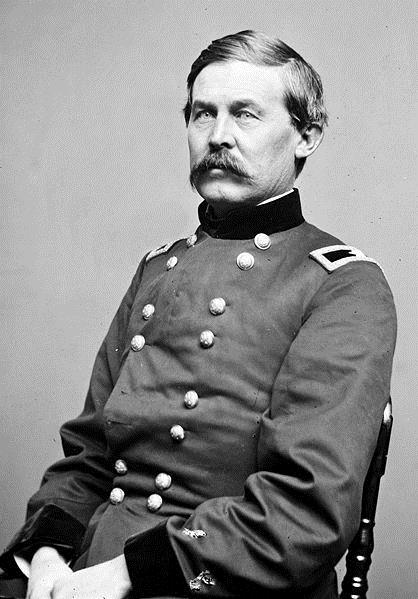
buford

“He was decidedly the best cavalry general we had, and was acknowledged as such in the army, though being no friend to newspaper reporters…In many respects he resembled Reynolds, being rough in the exterior, never looking after his own comfort, untiring on the march and in the supervision of all the militia in his command, quiet and unassuming in his manners.” Colonel Charles Wainwright on Buford (Diary of Battle, p.309)

John Buford was born in Kentucky and came from a family with a long military history of military service, including family members who had fought in the Revolutionary War and War of 1812. In fact according to some the family military pedigree reaches back to England’s War of the Roses.

Buford’s family was well off with a spacious plantation near Versailles on which labored forty-five slaves, and his father also established a stage line which carried “passengers and freight between Frankfort and Lexington.” His father divested himself of his property, selling his home, business and slaves and moved to Stephenson Illinois in 1838. [1] The young Buford developed an interest in military life which was enlivened by his half-brother Napoleon Bonaparte Buford who graduated from West Point in 1827, and his brother would be influential in helping John into West Point, which he entered in 1844.

Buford graduated with the class of 1848 which included the distinguished Union artilleryman John Tidball, and the future Confederate brigadier generals “Grumble Jones and “Maryland” Steuart. Among his best friends was Ambrose Burnside of the class of 1847. He did well academically but his conduct marks kept him from graduating in the top quarter of his class.

Upon graduation he was commissioned as a Brevet Second Lieutenant of Dragoons, however too late to serve in Mexico. Instead he was initially assigned to the First United States Dragoons but less than six months after joining was transferred to the Second Dragoons when he was promoted to full Second Lieutenant.

Instead of going to Mexico Buford “spent most of the 1850s tracking and fighting Indians on the Plains.” [2] During this period, the young dragoon served on the Great Plains against the Sioux, where he distinguished himself at the Battle of Ash Creek and on peacekeeping duty in the bitterly divided State of Kansas and in the Utah War of 1858.

His assignments alternated between field and staff assignments and he gained a great deal of tactical and administrative expertise that would serve him well. This was especially true in the realm of the tactics that he would employ so well at Gettysburg and on other battlefields against Confederate infantry and cavalry during the Civil War. Buford took note of the prevailing tactics of the day which still stressed a rigid adherence to outdated Napoleonic tactics which stressed mounted charges and “little cooperation with units of other arms or in the taking and holding of disputed ground.” [3] While he appreciated the shock value of mounted charges against disorganized troops he had no prejudice against “fighting dismounted when the circumstances of the case called for or seemed to justify it.” [4] Buford’s pre-war experience turned him into a modern soldier who appreciated and employed the rapid advances in weaponry, including the repeating rifle with tremendous effect.

Despite moving to Illinois Buford’s family still held Southern sympathies; his father was a Democrat who had opposed Abraham Lincoln. Buford himself was a political moderate and though he had some sympathy for slave owners:

“he despised lawlessness in any form – especially that directed against federal institutions, which he saw as the bulwark of democracy…..He especially abhorred the outspoken belief of some pro-slavery men that the federal government was their sworn enemy.” [5]

After the election of Abraham Lincoln, the officers of Buford’s regiment split on slavery. His regimental commander, Colonel Philip St. George Cooke, a Virginian and the father-in-law of J.E.B. Stewart announced that he would remain loyal to the Union, others like Beverly Robertson who would command a brigade of cavalry during the Gettysburg campaign resigned their commissions.

For many officers, both those who remained loyal to the Union and those who joined the Confederate cause the decision was often difficult, and many anguished over their decisions as they weighed their allegiance to the Union against their loyalty to home and family. Buford was not one of them.

Since Buford’s family had longstanding ties to Kentucky, the pro-secession governor of Kentucky, Beriah Magoffin offered Buford a commission in that states’ militia. At the time Kentucky was still an “undeclared border slave state” and Buford loyal to his oath refused the governor’s offer. He wrote a brief letter to Magoffin and told his comrades that “I sent him word that I was a Captain in the United States Army and I intend to remain one.” [6] Around the same time the new provisional government of the Confederacy “offered Buford a general officer’s commission, which reached him by mail at Fort Crittenden.” [7] According to Buford’s biographer Edward Longacre “a well-known anecdote has him wadding up the letter while angrily announcing that whatever future had in store he would “live and die under the flag of the Union.” [8]

However Buford’s family’s southern ties, and lack of political support from the few remaining loyal Kentucky legislators initially kept him from field command. Instead he received a promotion to Colonel and an assignment to the Inspector General’s Office, although it was not the field assignment that he desired it was of critical importance to the army in those early days of the war as the Union gathered its strength for the war. Buford was assigned to mustering in, and training the new regiments being organized for war. Traveling about the country he evaluated each unit in regard to “unit dress, deportment and discipline, the quality and quantity of weapons, ammunition, equipment, quarters, animals and transportation; the general health of the unit and medical facilities available to it; and the training progress of officers and men.” [9] Buford was a hard and devastatingly honest trainer and evaluator of the new regiments. He was especially so in dealing with commanding officers as well as field and company officers. Additionally he was a stickler regarding supply officers, those he found to be incompetent or less than honest were cashiered.

Buford performed these duties well but desired command. Eventually he got the chance when the politically well-connected but ill-fated Major General John Pope who “could unreservedly vouch for his loyalty wrangled for him command of a brigade of cavalry.” [10] After Pope’s disastrous defeat at Second Bull Run in August 1862 Buford was wounded in the desperate fighting at Second Manassas and returned to staff duties until January 1863 when he was again given a brigade. However, unlike many of the officers who served under Pope, Buford’s reputation as a leader of cavalry and field commander was increased during that campaign.

Buford was given the titular title of “Chief of Cavalry of the Army of the Potomac” by George McClellan, a title which sounded impressive but involved no command during the Antietam campaign. Following that frustrating task he continued in the same position under his old West Point friend Ambrose Burnside during the Fredericksburg campaign. Buford lost confidence in his old friend and was likely “shocked by his friend’s deadly ineptitude, his dogged insistence on turning defeat into nightmare.” [11]

When Burnside was relieved and Fighting Joe Hooker appointed to command the army, Buford’s star began to rise. While he was passed over by Hooker for command of the newly organized First Cavalry division in favor of Alfred Pleasanton who was eleven days his senior, he received command of the elite Reserve Brigade composed of mostly Regular Army cavalry regiments. When Major General George Stoneman was relieved of command following the Chancellorsville campaign, Pleasanton was again promoted over Buford.

In later years Hooker recognized that Buford “would have been a better man for the position of chief” [12] but in retrospect Buford’s pass over was good fortune for the Army of the Potomac on June 30th and July 1st 1863. Despite being passed over for the Cavalry Corps command, Buford, a consummate professional never faltered or became bitter. Despite the Pleasanton’s interference and “lax intelligence-gathering” [13]   During the Gettysburg campaign he led his brigade well at Brandy Station as it battled J.E.B. Stuart’s troopers, after which he was recommended for promotion and given command of the First Cavalry division of the Cavalry Corps. [14]

Following Brandy Station Buford led his troopers aggressively as they battled Stuart’s troopers along the Blue Ridge at the battles of Aldie, Philmont, Middleburg and Upperville. It was at Upperville while fighting a hard action Confederate Brigadier general “Grumble Jones’s brigade that Buford’s troopers provided Hooker with the first visual evidence that Lee’s infantry was moving north into Maryland and Pennsylvania.

burford reynolds monuments

When Hooker was relieved on the night of June 27th and 28th George Meade gave Buford the chance at semi-independent command without Pleasanton looking over his shoulder. Meade appreciated Pleasanton’s administrative and organizational expertise and took him out of direct field command. Meade had his Cavalry Corps commander “pitch his tent next to his own on almost every leg of the trip to Pennsylvania and rarely let him out of sight or earshot.” [15]

One of Meade’s staff officers, Theodore Lyman gave this description of Buford:

“He is one of the best of the officers…and is a singular looking party. Figurez-vous a compactly built man of middle height, with a tawny mustache and a little, triangular gray eye, whose expression is determined, not to say sinister. His ancient corduroys are tucked into a pair of ordinary cowhide boots, his blue blouse is ornamented with holes; from which one pocket thereof peeps a huge pipe, while the other is fat with a tobacco pouch. Notwithstanding this get-up he is a very soldierly looking man. Hype is of a good natured disposition, but is not to be trifled with.” [16]

When he was ordered to screen the army as it moved into Pennsylvania, Buford was confident about his troopers and their ability and he and his men performed their duties admirably. On June 29th Buford’s men skirmished with two of Harry Heth’s regiments near the town of Fairfield, which Buford promptly reported to Meade and John Reynolds after ascertaining their size and composition.

The Battle of Gettysburg would be the zenith of Buford’s career. His masterful delaying action against Harry Heth’s division on July 1st 1863 enabled John Reynold’s wing of the army to arrive in time to keep the Confederates from taking the town and all of the high ground which would have doomed any union assault against them. Following Gettysburg Buford continued to command his cavalry leading his division in a number of engagements. In early November the worn out cavalryman who had been in so many actions over the past year came down with Typhoid. In hopes that he would recover he was told that he would be appointed to command all the cavalry in the West, however his health continued to decline. He was officially promoted to Major General of Volunteers by President Lincoln, over the objection of Secretary of War Stanton who disliked deathbed promotions. “Upon learning of the honor. Buford is supposed to have whispered, “I wish I could have lived now.” [17] He died later that evening, the last words warning his officers “patrol the roads and halt fugitives at the front.” [18]

John Pope wrote of Buford:

“Buford’s coolness, his fine judgment, and his splendid courage were well known of all men who had to do with him… His quiet dignity, covering a fiery spirit and a military sagacity as far reaching as it was accurate made him…one of the best and most trusted officers in the service.” [19]

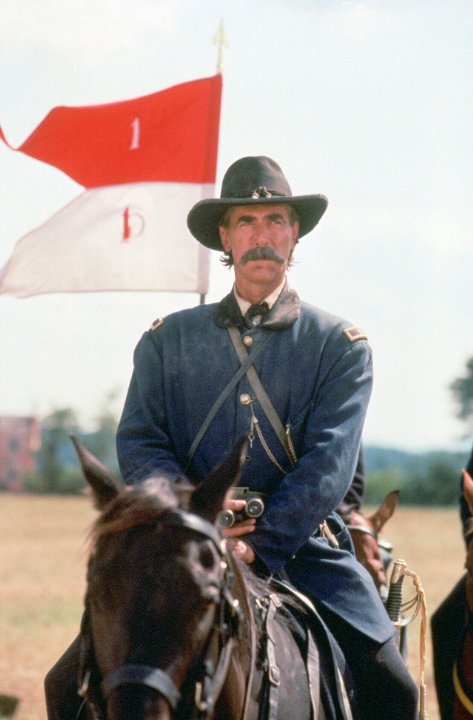
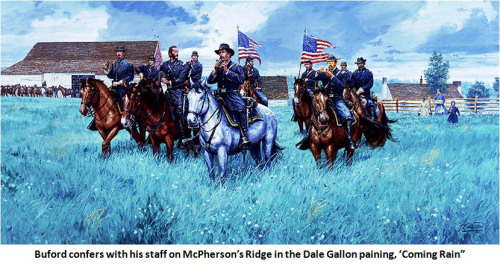
Sam Elliot as Buford

Buford was buried at West Point and he is immortalized in the monument dedicated to him on McPherson’s Ridge at Gettysburg where he with binoculars in hand looks defiantly west in the direction of the advancing Confederates. The monument is surrounded by the gun tubes of four Union 3” Rifles, three of which were part of Lieutenant John Calef’s Battery which he directed on the fateful morning of July 1st 1863. He was portrayed masterfully portrayed by Sam Elliott in the movie Gettysburg.

Notes

[1] Longacre, Edward G. John Buford: A Military Biography Da Capo Press, Perseus Book Group, Cambridge MA p.17

[2] Ibid. Guelzo. Gettysburg: The Last Invasion p.121

[3] Ibid. Longacre John Buford p.36

[4] Ibid. Longacre John Buford p.36

[5] Ibid. Longacre John Buford p.54

[6] Ibid. Guelzo. Gettysburg: The Last Invasion p.121

[7] Ibid. Longacre John Buford p.70

[8] Ibid. Longacre John Buford p.70

[9] Ibid. Longacre John Buford p.78

[10] Ibid. Guelzo. Gettysburg: The Last Invasion p.121

[11] Ibid. Longacre John Buford p.122

[12] Ibid. Coddington The Gettysburg Campaign, A Study in Command p.44

[13] Ibid. Longacre John Buford p.173

[14] Ibid. Coddington The Gettysburg Campaign, A Study in Command p.64

[15] Longacre, Edward G. The Cavalry at Gettysburg: A Tactical Study of Mounted Operations during the Civil War’s Pivotal Campaign, 9 June-14 July 1863 University of Nebraska Press, Lincoln and London 1986 p.168

[16] Girardi, Robert I. The Civil War Generals: Comrades, Peers, Rivals in Their Own Words Zenith Press, MBI Publishing, Minneapolis MN 2013 p.38

[17] Ibid. Longacre John Buford p.245

[18] Ibid. Longacre John Buford p.246

[19] Ibid. Girardi The Civil War General p.38


1 Comment

Filed under civil war, Gettysburg, History, leadership, Military

V.E. Day at 70: Remember Sacrifice 

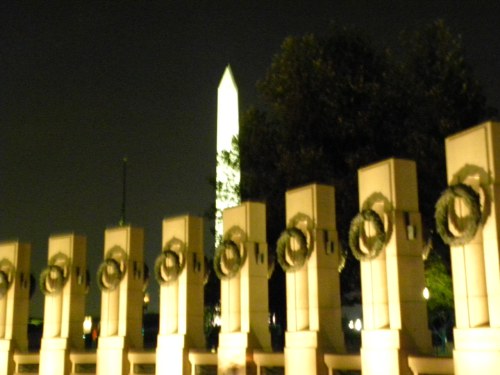
dscn0044

Seventy years ago World War Two in Europe officially ended. It is hard to believe that it has been that long. The men and women who fought in the war, known as the Greatest Generation now had endured the collapse of one world order after the First World War, the Great Depression and finally fought the Second World War which on May 8th 1945 was ending in Europe even as it raged on in Asia and the Pacific.

For most Americans the 1920s and 1930s were decades of isolationism, where idealists believed that the United States could stay out of the wars and rumors of wars. In 1939 Hitler’s legions stormed across Europe after bamboozling the British, French and even the Soviet Union about their intentions. Even so in 1939 many Americans believed that we could remain neutral in any conflict, but by mid-1941, with France and most of Europe under Nazi rule, with Hitler’s armies advancing on Moscow and Great Britian standing alone the writing on the wall was growing increasing legible. As such the reluctant nation began to mobilize large numbers of soldiers and to build up its Navy and Air Force, and on December 7th 1941 Japan attacked Pearl Harbor and other U.S. Installations thoughout the Western Pacific and a day later Nazi Germany declared war on the United States. The latter was really a huge mistake by Hitler who had he been thinking should have done everything in his power to keep the United States out of Europe. It would be a fatal mistake.

The United States and Britian determined that Germany was a greater threat than Japan decided that the defeat of Germany took precedence and devoted their efforts to that. Even so U.S. Forces in the Pacific, primarily built around the Navy took the offensive against Japan in August 1942 at Guadalcanal. But in Europe the U.S. And Britian invaded North Africa to drive the Germans and their Italian allies out, moved in to Sicily and Itslly, knocking the Itslians out of the war in 1943. At sea allied naval forces won the Battle of the Atlantic against Hitler’s U-Boats which had sunk thousands of ships totaling millions of tons of cargo and lost lives. American war materials and supplies provided massive assistance to the British and to the Soviet Union, the latter whose Red Army had broken the back of the vaunted Wehrmacht on the Eastern Front and who by 1944 were on the offensive. In the air the United States Army Air Corps and the British Royal Air Force  waged a non-stop air campaign to defeat Hitler’s Luftwaffe and bomb German industrial targets and population centers. 

Then on June 6th 1944 came D-Day, the Allied invasion of Europe, Hitler meddled in the affairs of his commanders ordering a no-retreat policy in Normandy. After a brutal campaign the Allies broke out of Normandy liberating France, much of Belgium and about half of the Netherlands by the end of September. The Germans launched a last ditch offensive against the Americans in December 1994, that battle, nicknamed the Battle of the Bulge hastened the end of the war. By the early Spring of 1945 the American, British, French and Soviet forces, aided by military forces of liberated nations were closing in on the heart of Germany. With the American Army on the Elbe River and the Soviets battling street by street in Berlin and just blocks away, Hitler committed suicide in his Fuhrer Bunker on April 30th 1945. Within days his successor, Admiral Karl Donitz was seeking an end to the war. Forced to surrender unconditionally Donitz ordered German forces to surrender on May 8th 1945. 

General Dwight Eisenhower issued his announcement of the endo of the war: 

eisenhower ve day message


ny times ve day


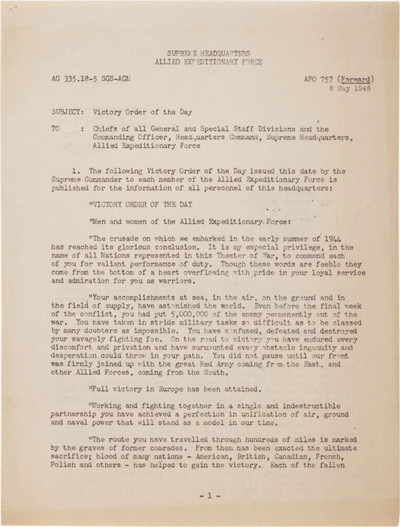
Men and women of the Allied Expeditionary Force:

The crusade on which we embarked in the early summer of 1944 has reached its glorious conclusion . . .

“Your accomplishments at sea, in the air, on the ground and in the field of supply, have astonished the world. Even before the final week of the conflict, you had put 5,000,000 of the enemy permanently out of the war. You have taken in stride military tasks so difficult as to be classed by many doubters as impossible. You have confused, defeated and destroyed your savagely fighting foe. On the road to victory you have endured every discomfort and privation and have surmounted every obstacle ingenuity and desperation could throw in your path. You did not pause until our front was firmly joined up with the great Red Army coming from the East, and other Allied Forces, coming from the South.

Full victory in Europe has been attained. 

Eisenhower’s announcement of the end of the war is shown in the link below. 

https://www.youtube.com/watch?v=wR99iTgKedc

Now the men and women of the Greatest Generation are passing away, most of those that I personally knew have died. The young ones who are still with us are in their late 80s and early 90s, most if not all will be gone in the next 10-15 years. 

So as you think about today, remember those men and women. Remember the evil that they fought to defeat and hope that if Americans, and by the way I don’t just mean the professional military which has been fighting our wars for the past 14 years, but all Americans have to make such sacrifices again, that we will be up to it. Sadly, I don’t know if we would be. 

That may sound harsh but that generation sacrificed to win the war. Their political leaders did not cut taxes and then telli people to go shopping while the less than one percent that constituted the military went and fought the wars. No they gave up things, and millions served in the military or in war related industries. When I came home from Iraq I was stunned at just how distant the country was from the war. Unlike World War II only a few Americans even have skin in the game that we call war. That is so different than World War II. But that my friends is just my opinion. 

So please don’t forget that true greatness requires both sacrifice and magnanimity. 

Peace

Padre Steve+ 

2 Comments

Filed under History, world war two in europe

Gettysburg: The Opening Engagement

Friends of Padre Steve’s World

The latest major chapter revision to my Gettysburg text, this one about the opening of the battle and two men, Confederate Major General Harry Heth and Union Major General John Buford whose actions that morning set in motion the greatest battle ever fought on the American Continent.

Peace

Padre Steve+
burford june 30th

The principles found in Chairman of the Joint Chief of Staff’s “Desired Leader Attributes” are something that we can learn about from both practical experience and history. The study of commanders and leaders throughout the Gettysburg campaign provide historical examples of commanders and other leaders that the best and the worst examples of some of those concepts. One of these is the ability to “anticipate and adapt to surprise and uncertainty.” The meeting engagement on the morning of July 1st 1863 between Harry Heth’s division of A.P. Hill’s corps and John Buford’s First Cavalry Division shows a very clear example of a commander, Heth, not anticipating or adapting to surprise and uncertainty. Heth was surprised by the presence of experienced Federal cavalry on his front and the uncertainty of not knowing what lay just beyond McPherson and Seminary Ridge.

Despite the warnings of Brigadier General Johnston Pettigrew, Major General Harry Heth and his corps commander Lieutenant General A.P. Hill decided that they would advance into Gettysburg. Hill and Heth dismissed Pettigrew’s warnings out of hand. Pettigrew should have been listened to, he was “was one of those natural leaders of a privileged background who, without military ambitions, had been advanced on the application of native intelligence and contagious courage.” [1] To help state his case Pettigrew brought Captain Louis G. Young of his staff, who had served under Hill and was a professional soldier “with the hope that his testimony as to Union numbers might be more convincing.” [2] Young “insisted that the troops he saw were veterans rather than Home Guards,” [3] but Hill refused to believe telling Young and Pettigrew “I still cannot believe that any portion of the Army of the Potomac is up,” he declared. Then he added: “I hope that it is, for this is the place I want it to be.” [4] Hill told Heth and Pettigrew that “I am just from General Lee, and the information he has from his scouts corroborates what I have received from mine – that is, the enemy is still at Middleburg and have not yet struck their tents.” [5]

How Hill could make such a statement neither knowing the ground nor the location and strength of the Federal troops to his front is stunning. How Hill’s “scouts” could miss the massive force heading their way is beyond belief and indicates that Hill wanted to believe what he wanted to believe and disregarded any evidence to the contrary, especially that which came from a subordinate that he did not know who was not a professional soldier. Hill’s attitude also demonstrates the profound lack of respect given to the Army of the Potomac by Hill and many other Confederate commanders.

Hill sent a message to Lee, as well as Ewell of Second Corps telling them that “I intended to advance the next morning and discover what was in my front.” [6] He also sent word of the discovery of cavalry to Lee’s headquarters, but his warning apparently gave Lee little cause for concern as Lee believed that “Meade’s army was still some distance to the south.” [7] Likewise, Hill sent a courier to Richard Anderson instructing him to bring up his division on July 1st and instructed Heth that “Pender’s division also would be ordered through Cashtown as a reserve to be available if Heth ran into serious trouble.” [8]

During the night the actions of A.P. Hill show a commander who confused and uncertain. The confidence that he and Heth showed in rejecting Pettigrew and Young’s reports of Federal troops in Gettysburg had left “most, if not all the commanding officers in Hill’s corps…unprepared for what happened.” [9] Lieutenant Lewis Young wrote “I doubt if any of the commanders of brigades, except General Pettigrew, believed that we were marching to battle, a weakness on their part which rendered them unprepared for what was about to happen.” [10]

A major part of Hill’s uncertainly can be laid on his and his subordinate commander’s lack of experience at their current level of command. “Pettigrew new to the army, Heth to division command, and Hill to corps command.” [11] One could not ask for such an untested chain-of-command as the army advanced blindly forward not knowing what lay before it. James Longstreet said “The army…moved forward, as a man might walk over strange ground with his eyes shut.” [12]

Lieutenant Colonel Porter Alexander noted that on the night of June 30th that he visited Lee’s headquarters and found conversation to be “unusually careless & jolly. Certainly there was no premonition that the next morning was to open a great battle of the campaign.” [13] The attitude that all exhibited according to Alexander was “when all our corps were together what could successfully attack us? So naturally we were all in good spirits.” [14] The Confederates believed that they were invincible. Walter Taylor of Lee’s staff admitted “An overweening confidence possessed us all.” [15] Clifford Dowdey wrote:

“Considering their unprecedented assignment to act, in the absence of cavalry, as reconnaissance troops in a country they had never seen, the men were unrealistically relaxed – from the privates of the 1st South Carolina, the oldest unit in point of organization, to the corps commander.” [16]

The British observer, Lieutenant Colonel Arthur Fremantle wrote in his diary: “The universal feeling in the army was one of profound contempt for an enemy whom they had beaten so consistently, and under so many disadvantages.” [17] That contempt would cost Lee’s army dearly in the coming battle.

Harry Heth arose on the morning of July 1st 1863 and formed his division for its march to Gettysburg. He had been ordered by Hill to “be ready to march at 5:00 A.M; and by an unusual directive from the corps commander, each man who wanted an issue of whisky at that early hour was to receive one.” [18] Heth should have spent the night making detailed plans for his advance but since neither he, nor any other senior officer in Hill’s corps “anticipated real action in the immediate area, Harry Heth kept uppermost in his mind the quartermaster aspects of the invasion,” [19] thus his overriding concern to get the shoes that supposedly were there in abundance, rather than “all the little details involved in an operation as tricky as a reconnaissance in force.” [20] The lack of attention to detail became evident the first thing that morning and that brought about an inauspicious start to a very bad day for Heth and his division. His troops were up early with the sunrise but somehow orders had not gotten to them to begin the advance at 5 a.m. and as a result “there was haste to the early morning’s preparations that caught some off guard” even regimental commanders. [21]

Several critics have made this point, among them Major John Mosby, the Confederate cavalry leader and guerrilla fighter who wrote: “Hill and Heth in their reports, to save themselves from censure, call the first day’s action a reconnaissance; this is all an afterthought….They wanted to conceal their responsibility for the defeat.” [22] A more contemporary writer, Jennings Wise, noted that Hill’s orders “were specific not to bring on an action, but his thirst for battle was unquenchable, and…he rushed on, and…took the control of the situation out of the hands of his commander-in-chief.” [23]

Years later Heth made an unsubstantiated claim that “A courier came from Gen. Lee, with a dispatch ordering me to get those shoes even if I encountered some resistance.” [24] That appears unlikely as Mosby noted that no one ordered Hill to advance and Lee “would never have sanctioned it.” [25] The ever judicious Porter Alexander who had been in Lee’s headquarters the night of June 30th wrote that: “Hill’s movement to Gettysburg was made on his own accord, and with knowledge that he would find the enemy’s cavalry in possession.” [26]

The advance to contact was marred by Heth’s inexperience compounded by the illness of A.P. Hill which caused Hill to be absent at the critical point where contact was made with the Federal forces. Hill “awakened feeling very ill, too sick to mount his horse…although no diagnosis was made, he was probably suffering from overstrained nerves.” [27] While it is possible that Hill’s “malady could have been upset stomach, diarrhea, simple exhaustion or a flair up of the old prostate problem” [28] his history of illness at critical times throughout the war lends credence to the possibility that whatever he was suffering could have been brought about by his emotional state. The result was that Hill’s “disability made it impossible for him to assume personal responsibility on July 1, 1863.” [29]

Hill gave Heth the responsibility to lead the advance, not based on experience or command ability, but because his division was closest to Gettysburg. However, during the night Hill decided to augment Heth’s division by ordering Dorsey Pender’s division to support Heth, and thus committed two thirds of his corps to what was supposedly a reconnaissance mission to find shoes. Since a reconnaissance is normally conducted by small elements of one’s force, the fact that Hill committed his two divisions present to such a mission demonstrated his “own confusion and uncertainty” [30] regarding the nature of what he might face and to his own understanding of the mission that he was assigning Heth. Whatever Hill’s intentions “he ordered Pender to support Heth while he awaited Anderson in Cashtown.” [31]

Disregarding the only solid intelligence he had, Hill put the majority of his corps into a “reconnaissance” which he would not be able to lead, instead turning over command to Heth. Hill gave Heth strict instructions not to bring on an engagement. The admonition was clear: “Do not bring on an engagement.” [32]

Likewise it is distinctly possible that Heth, despite orders to the contrary “may have had more on his mind than shoes and information when he made his advance towards Gettysburg.” [33] This is the allegation of Confederate cavalryman John Singleton Mosby who: “charged Hill with planning a “foray” and calling it a “reconnaissance.” Both Hill and Heth, Mosby asserted “evidently expected to bag a few thousand Yankees, return to Cashtown, and present them to General Lee that evening. But…”they bit off more than they could chew.” [34] Mosby’s claim does lend some explanation as to why Hill committed such a large force to his “reconnaissance” however, since Hill was killed in the closing days of the war and because Mosby was a partisan of J.E.B. Stuart. Mosby’s claim, even if true cannot be verified. But the fact remains that Hill’s force “was too large for a reconnaissance mission…and too large of force to back away from any Yankee challenge.” [35]The result was that Hill’s large force “if opposed, might well commit Lee’s army to battle on a field that Lee had not seen and before his army was assembled.” [36]

Hill’s absence left Heth, an inexperienced division commander “without any sage counsel” [37] and Heth began to commit a series of costly errors. Hill’s instructions to Heth to aggressively execute the mission but at the same time to avoid a major action put his subordinate in a hard place that even more experienced commanders might have struggled to find the appropriate balance. However, Heth was not at the level of experience or battlefield savvy.

Heth stated after the war that he understood from Hill that his mission was a job that normally would be assigned to cavalry and the restraints that he was employ: “to ascertain what force was at Gettysburg, and if he found infantry opposed to him, to report the fact immediately, without forcing an engagement.” [38] However, when the action began Heth did not heed those instructions.

Heth advanced without the caution of a commander who had been told that enemy forces were likely opposing him. Even though Heth disbelieved the reports made by Pettigrew the previous day, some amount of judicious caution on his part should have been indicated. Instead, for reasons unknown Heth had his men advance as if it was a routine movement. “Rather than placing his strongest brigades in the lead, Heth simply determined order of march based on where the troops had bivouacked along the road the previous night.” [39]

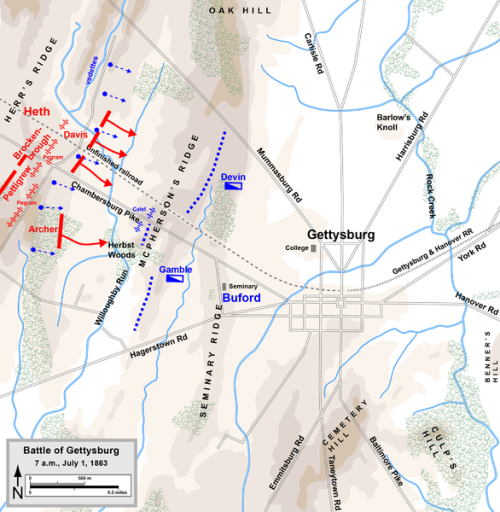
Heth “pushed out his four brigades in routine deployment for contact. In taking elementary precautions, Heth gave no indication of sensing an impending clash of any consequence.” [40] He placed Archer’s veteran but depleted brigade and Davis’s newly organized and inexperienced brigade in the lead of the advance. They were accompanied by the division’s artillery battalion commanded by Major William Pegram. Behind the lead units came the brigades of Pettigrew and Brockenbrough.

It was a curious order of march, for it left Johnston’s Pettigrew’s brigade behind both Archer and Davis’s brigades despite the fact that it was closer to Gettysburg than any other brigade. Likewise it was the only unit in the division that had recent eyes on contact with the enemy and knew the ground and what was ahead of them. It is hard to understand why Heth did this but one can speculate that it might have been because of Pettigrew’s insistence of the type of Federal forces in their front the previous day which caused Heth to do this.

The attitude of the soldiers was good, but most of the soldiers and their leaders “assumed that this morning’s movement was simply one more part in the army’s overall concentration of forces” [41] and the troops many expected to meet were those of Ewell or Stuart, Colonel John Brockenbrough told the commander of the 55th Virginia that “we might meet some of Ewell’s command or Stuart’s. [42] No one, with the possible exception of Johnston Pettigrew seemed to believe that experienced Federal troops lay before them, and Pettigrew had been ignored. This “spirit of unbelief” seemed to cloud the thinking of most, if not all of the commanding officers in Hill’s corps and left them unprepared for what happened.” [43]

Heth’s infantry brigades were deployed alongside the road and were led by several lines of skirmishers while the artillery battalion rumbled down the road between the infantry brigades, few expected any battle. Gunners from Pegram’s four-gun Fredericksburg battery leading his battalion’s advance recalled “We moved forward leisurely smoking and chatting as we rode along, not dreaming of the proximity of the enemy.” [44] Heth should have better anticipated the situation based on Pettigrew’s reports of the previous day and should have prepared his troops to expect combat. He demonstrated why one author called him “an intellectual lightweight.” [45] After the war when Heth told an officer from the Army of the Potomac “I did not know any of your people were north of the Potomac.” [46]

While Archer was highly experienced and had the advantage of commanding experienced veteran troops during this advance he was not well. Though he led his troops into combat “on that morning he was suffering from some debilitating ailment.” [47] The other commander leading the Confederate advance was the inexperienced Joseph Davis. Davis’s inexperience caused him to put the new and untested 42nd Mississippi and 55th North Carolina in the van of his advance and left his veteran regiments the 2nd and 11th Mississippi in the rear guarding army stores. [48] It was an unfortunate choice, the 11th Mississippi was seasoned and had “fought with distinction” [49] as part of the Army of Northern Virginia over the previous year.

The advance of the brigades of Archer and Davis was uneventful until they reached Marsh Creek they encountered the cavalry vedettes or pickets of the 8th Illinois Cavalry of John Buford’s First Cavalry Division posted on the high ground just east of the creek. [50] Despite the fact that Pettigrew had repeatedly warned Heth and Hill about the presence of Union cavalry, the discovery of these forces was unanticipated by the Confederates leading the column. Early in the morning Pettigrew attempted to warn Archer of the topography of the area and the presence of Union troops. Lieutenant Young recorded that Pettigrew “told General Archer of a ridge some distance west of Gettysburg on which he would probably find the enemy, as this position was favorable for defense.” [51] Pettigrew also warned Archer of “a certain road which the Yankees might use to hit his flank, and the dangers of McPherson’s Ridge. Archer listened, believed not, marched on unprepared…” [52]

Enter John Buford

If Heth was inexperienced and knew little of the Federal forces arrayed before him and what forces were moving towards Gettysburg, his opponent Brigadier General John Buford was his opposite in nearly every respect. Buford was born in Kentucky and like Heth, came from a family with a long military history of military service, including family members who had fought in the Revolutionary War and War of 1812. His family was well off with a spacious plantation near Versailles on which labored forty-five slaves, and his father also established a stage line which carried “passengers and freight between Frankfort and Lexington.” His father divested himself of his property, selling his home, business and presumably his slaves and moved to Stephenson Illinois in 1838. [53] The young Buford developed an interest in military life which was enlivened by his half-brother Napoleon Bonaparte Buford who graduated from West Point in 1827, and his brother would be influential in helping John into West Point, which he entered in 1844.

Buford graduated with the class of 1848 which included the distinguished Union artilleryman John Tidball, and the future Confederate brigadier generals William “Grumble” Jones, with whose troops he would do battle during the Gettysburg campaign and George “Maryland” Steuart. Among Buford’s best friends was Ambrose Burnside of the class of 1847. He did well academically but his conduct marks kept him from graduating in the top quarter of his class.

Upon graduation he was commissioned as a Brevet Second Lieutenant of Dragoons, however this came too late to serve in Mexico. Instead he was initially assigned to the First United States Dragoons but less than six months after joining was transferred to the Second Dragoons when he was promoted to full Second Lieutenant.

Instead of going to Mexico Buford “spent most of the 1850s tracking and fighting Indians on the Plains.” [54] During this period, the young dragoon served on the Great Plains against the Sioux, where he distinguished himself at the Battle of Ash Creek and on peacekeeping duty in the bitterly divided State of Kansas and in the Utah War of 1858.

His assignments alternated between field and staff assignments and he gained a great deal of tactical and administrative expertise that would serve him well. This was especially true in the realm of the tactics that he would employ so well at Gettysburg and on other battlefields against Confederate infantry and cavalry during the Civil War. Buford took note of the prevailing tactics of the day which still stressed a rigid adherence to outdated Napoleonic tactics which stressed mounted charges and “little cooperation with units of other arms or in the taking and holding of disputed ground.” [55] While he appreciated the shock value of mounted charges against disorganized troops he had no prejudice against “fighting dismounted when the circumstances of the case called for or seemed to justify it.” [56] Buford’s pre-war experience turned him into a modern soldier who appreciated and employed the rapid advances in weaponry, including the breech loading carbine and repeating rifle with tremendous effect.

Despite moving to Illinois Buford’s family still held Southern sympathies; his father was a Democrat who had opposed Abraham Lincoln. Buford himself was a political moderate and though he had some sympathy for slave owners:

“he despised lawlessness in any form – especially that directed against federal institutions, which he saw as the bulwark of democracy…..He especially abhorred the outspoken belief of some pro-slavery men that the federal government was their sworn enemy.” [57]

After the election of Abraham Lincoln, the officers of Buford’s regiment split on slavery. His regimental commander, Colonel Philip St. George Cooke, a Virginian and the father-in-law of J.E.B. Stuart announced that he would remain loyal to the Union, others like Beverly Robertson who would command a brigade of cavalry during the Gettysburg campaign resigned their commissions.

For many officers, both those who remained loyal to the Union and those who joined the Confederate cause the decision was often difficult, and many anguished over their decisions as they weighed their allegiance to the Union against their loyalty to home and family. Buford was not one of them.

Since Buford’s family had longstanding ties to Kentucky, the pro-secession governor of Kentucky, Beriah Magoffin offered Buford a commission in that states’ militia. At the time Kentucky was still an “undeclared border slave state” and Buford loyal to his oath refused the governor’s offer. He wrote a brief letter to Magoffin and told his comrades that “I sent him word that I was a Captain in the United States Army and I intend to remain one.” [58] Around the same time the new provisional government of the Confederacy “offered Buford a general officer’s commission, which reached him by mail at Fort Crittenden.” [59] According to Buford’s biographer Edward Longacre “a well-known anecdote has him wadding up the letter while angrily announcing that whatever future had in store he would “live and die under the flag of the Union.” [60]

However Buford’s family’s southern ties, and lack of political support from the few remaining loyal Kentucky legislators initially kept him from field command. Instead he received a promotion to Colonel and an assignment to the Inspector General’s Office, although it was not the field assignment that he desired it was of critical importance to the army in those early days of the war as the Union gathered its strength for the war. Buford was assigned to mustering in, and training the new regiments being organized for war. Traveling about the country he evaluated each unit in regard to “unit dress, deportment and discipline, the quality and quantity of weapons, ammunition, equipment, quarters, animals and transportation; the general health of the unit and medical facilities available to it; and the training progress of officers and men.” [61] Buford was a hard and devastatingly honest trainer and evaluator of the new regiments. He was especially so in dealing with commanding officers as well as field and company officers. Additionally he was a stickler regarding supply officers, those he found to be incompetent or less than honest were cashiered.

Buford performed these duties well but desired command. Eventually he got the chance when the politically well-connected but ill-fated Major General John Pope who “could unreservedly vouch for his loyalty wrangled for him command of a brigade of cavalry.” [62] After Pope’s disastrous defeat at Second Bull Run in August 1862 Buford was wounded in the desperate fighting at Second Manassas and returned to staff duties until January 1863 when he was again given a brigade. However, unlike many of the officers who served under Pope, Buford’s reputation as a leader of cavalry and field commander was increased during that campaign.

Buford was given the titular title of “Chief of Cavalry of the Army of the Potomac” by George McClellan, a title which sounded impressive but involved no command during the Antietam campaign. Following that frustrating task he continued in the same position under his old West Point friend Ambrose Burnside during the Fredericksburg campaign. Buford lost confidence in his old friend and was likely “shocked by his friend’s deadly ineptitude, his dogged insistence on turning defeat into nightmare.” [63]

When Burnside was relieved and Fighting Joe Hooker appointed to command the army, Buford’s star began to rise. While he was passed over by Hooker for command of the newly organized First Cavalry division in favor of Alfred Pleasanton who was eleven days his senior, he received command of the elite Reserve Brigade composed of mostly Regular Army cavalry regiments. When Major General George Stoneman was relieved of command following the Chancellorsville campaign, Pleasanton was again promoted over Buford.

In later years Hooker recognized that Buford “would have been a better man for the position of chief” [64] but in retrospect Buford’s pass over was good fortune for the Army of the Potomac on June 30th and July 1st 1863. Despite being passed over for the Cavalry Corps command, Buford, a consummate professional never faltered or became bitter. Despite the Pleasanton’s interference and “lax intelligence-gathering” [65]   During the Gettysburg campaign he led his brigade well at Brandy Station as it battled J.E.B. Stuart’s troopers, after which he was recommended for promotion and given command of the First Cavalry division of the Cavalry Corps. [66]

Following Brandy Station Buford led his troopers aggressively as they battled Stuart’s troopers along the Blue Ridge at the battles of Aldie, Philmont, Middleburg and Upperville. It was at Upperville while fighting a hard action Confederate Brigadier general “Grumble” Jones’s brigade that Buford’s troopers provided Hooker with the first visual evidence that Lee’s infantry was moving north into Maryland and Pennsylvania.

When Hooker was relieved on the night of June 27th and 28th George Meade gave Buford the chance at semi-independent command without Pleasanton looking over his shoulder. Meade appreciated Pleasanton’s administrative and organizational expertise and took him out of direct field command. Meade had his Cavalry Corps commander “pitch his tent next to his own on almost every leg of the trip to Pennsylvania and rarely let him out of sight or earshot.” [67]

The result was that when ordered to screen the army as it moved into Pennsylvania Buford was confident of his troopers and their ability and he and his men performed their duties admirably. On June 29th Buford’s men skirmished with two of Harry Heth’s regiments near the town of Fairfield, which Buford promptly reported to Meade and John Reynolds after ascertaining their size and composition. The following morning Buford and his troopers arrived in Gettysburg and were greeted by the townspeople who “thronged the streets, waving, shouting, and singing patriotic songs as Buford’s advance pushed through.” [68] Marching through the town they took up positions on the ridges west of the town. As they moved west the advance elements of Buford’s brigade discovered the presence of Johnston Pettigrew’s North Carolina brigade which promptly withdrew when it discovered that it was facing regular Federal cavalry.

Despite the welcome of the townsfolk, Buford’s troopers were tired from the weeks of incessant marching and combat. Their horses needed fodder, which was barely adequate, and most needed to be reshod, but because Early’s division had “seized nearly every shoe and nail”…”he had neither materials nor facilities for reshoeing them.” [69] Despite their fatigue Buford’s men had one distinctive advantage over the Confederates that they would face, this was in their weaponry. With few exceptions the Union cavalry at Gettysburg went into battle with “the finest equipment and arms obtainable. The troopers in almost every regiment carried breech-loading carbines (usually Sharp’s singe shot) hitched to their belts; they also carried revolvers (usually Colt army) and cavalry sabers.” [70] Though outnumbered their weapons gave them an edge in maintaining a heavy fire against the Confederate infantry which was armed with a variety of muzzle-loaded rifled muskets.

Based on all the intelligence available to him, that of George Sharpe’s Bureau of Military Information and that of his own scouts Buford “gathered that the whole of Hill’s Corps was “massed back of Cashtown” to the west, but there was also clear indication that Ewell’s Corps was “coming over the mountains from Carlisle,” to the north.” [71] Buford sent that news to Reynolds and to Meade by way of Pleasanton by mounted courier the evening of June 30th. The report caused Reynolds to realize the importance of Gettysburg and he immediately sent orders for Buford “to hold onto it to the last.” If Buford could buy enough time, he might get his infantry into line “before the enemy could seize the point.” [72]

Since Buford suspected that Ewell’s troops might also arrive he posted forces a few miles to the north of Gettysburg to provide warning and to delay them if needed, however since Buford determined that “Hill represented the more immediate threat, Buford resolved to concentrate most of his strength west of the town along MacPherson’s Ridge.” [73]
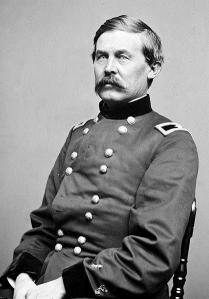
 buford

Brigadier General John Buford U.S.A.

On the night of June 30th Buford prepared for battle. Unlike Hill and Heth he understood exactly what he was facing. He met with “reliable men” most likely from the Bureau of Military Intelligence operated by David McConaughy as to the composition of Lee’s forces. [74] Buford knew his business; he took the time to reconnoiter the ridges west of Gettysburg and posted videttes as far was as Marsh Creek. He deployed one brigade under Colonel Thomas Devin to the north and west of the town, Colonel William Gamble’s brigade was deployed to the west, its main line being on McPherson’s Ridge.

As he deployed his forces Buford formulated his plan. Riding with his brigade commanders and staff “Buford, puffing away on his pipe, peering through field glass, studied the road network and lay of the land. He calculated distance to physical landmarks and tried to determine how long it would take those Confederates massing behind South Mountain to come within carbine range.” [75] Buford’s composure and confidence inspired his troopers as well as local civilians who observed him as he surveyed the ground on which the greatest battle ever waged on American soil would be fought.

Considering that he had fewer than three-thousand troopers available at Gettysburg because the Reserve Brigade was still further south guarding the army’s trains, and that he was facing a foe many times larger, it was a bold plan. Buford seems to have convinced himself that “he could pull off something never achieved in this war: a defense in depth by dismounted cavalry against a force of foot soldiers with full artillery support.” [76] As such the crafty Buford planned “a defense in depth, fighting his men dismounted, using the series of ridgelines west of Gettysburg to hamper and delay the Rebel infantry he was certain would come “booming along” the Chambersburg Pike in the morning.” [77]

Noting that the ground was favorable to defense and giving battle Buford sent messages to Reynolds as to the situation. He warned Reynolds that “A.P. Hill’s corps is massed just back of Cashtown, about 9 miles from this place.” He also noted the location of Confederate pickets “only four miles west of Gettysburg.” [78] Devin’s troops also identified elements of Ewell’s corps north of the town. Buford had accurately informed his superiors of what was before him, information that they needed for the day of battle.

Buford set up his headquarters at the Eagle Hotel in Gettysburg where he spent the night and according to his signals officer was “anxious, more so than I ever saw him” [79] Buford discussed the tactical situation with Colonel Devin, commanding the brigade on Herr’s and McPherson’s Ridge. Devin did not yet believe that the Confederates would move on Gettysburg in the morning. Devin thought if there were any threats that “he could handle anything that could come up in the next 24 hours.” [80] Buford rejected Devin’s argument and told him bluntly “No you won’t…. They will attack you in the morning and they will come booming – skirmishers three deep. You will have to fight like the devil to hold your own.” [81]

In preparation for the Confederate advance Buford deployed about seven hundred of his men in videttes, or pickets several miles in advance of the main force of his division. These videttes stretched from the Blackhorse Tavern south and west of Gettysburg, across the Mummasburg and Carlisle Roads, ending east of town on the York Pike. The center of this line was along the Chambersburg or Cashtown Pike along Marsh Creek about five miles west of Gettysburg. These videttes were critical in ascertaining the direction and composition of any advancing Confederate forces.

Reynolds immediately saw the importance of the position elected to fight. He “ordered Buford to hold onto it to the last” believing that if Buford could “buy enough time, he might get his infantry into line “before the enemy should seize the point.” [82] Buford knew that against the odds he would face that he would only be able to hold for a few hours at best and since by “refusing to flee from Lee’s path, by committing himself to fight in an advanced position however favorable, he risked not only his division’s annihilation but the disarranging of Meade’s plans” [83] to fight a defensive battle along the Pipe Creek line. Buford and Reynold’s bold decisions on that last night of June 1863 committed the Army of the Potomac to battle Lee’s hearty veterans at Gettysburg.
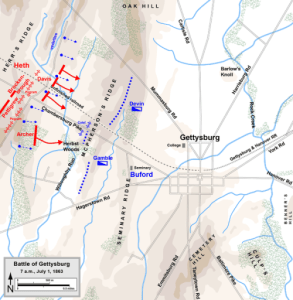
gburg delaying action

Buford’s Delaying Action July 1st

For Buford’s troopers the night and morning of June 30th and July 1st 1863 was spent in grim anticipation that they would meet a good portion of Lee’s army in battle. “It was a jumpy night, and the lowering clouds “poured down a drenching rain” [84] even as Buford’s advanced videttes observed the camp fires of the advanced Confederate outposts left by Pettigrew on the 30th   of June.

As the over-confident and lackadaisical Confederates advanced in the pre-dawn early morning mist they had a hard time determining what lay ahead of them and they “halted as they got to the swampy land fringing Marsh Creek, beyond which the ground angled up into a single swell to a ridge line.” [85] Pegram’s artillerists surveyed the ground to their front and noted mounted troops, but the limited visibility made it impossible to identify them, some even thought that they might belong to Longstreet’s corps, however Pegram knowing Longstreet’s corps was well the west, stopped his advance and unlimbered is guns. This caused the commander of Archer’s lead brigade, Colonel Birkett D. Fry of the 13th Alabama to ask Pegram what was going on and why he had stopped his advance. Upon seeing the artillery readying for action Fry “rode back to the color bearer and ordered him to uncase the colors.” [86] This was the first indication that the enemy was near and Fry quickly ordered his regiment to establish a skirmish line.

With the sun coming up the Union troops saw the now uncased colors of the Confederate battle flags to their front. Lieutenant Marcellus Jones of the 8th Illinois, commanding one of the detachments along Marsh Creek, expecting such rode to one of his advanced posts. He took a carbine from one of his sergeants and said “Hold on George, give me the honor of opening this ball” and at about 7:30 a.m. Jones fired the first shot of the battle of Gettysburg. [87]

Heth had wanted to advance in column as long as possible “but the Yankee cavalry’s stiff resistance had ended that hope.” [88] Heth rode forward and ordered Archer and Davis’s troops to advance skirmishers with the support of Pegram’s artillery. This slowed the Confederate advance considerable and Heth wrote in his after action report that “it became evident that there were infantry, cavalry and artillery in and around the town.” [89] At this point, Heth should have stopped and sought guidance on what to do next, however, instead of “feeling out the enemy” as directed by Hill, Heth “ordered Archer and Davis “to move forward and occupy the town.” [90] A chaplain in Brockenbrough’s brigade reported that one of Heth’s aide’s came up and reported “General Heth is ordered to move on Gettysburg, and fight or not as he wishes.” The chaplain heard one of the officers near him say “We must fight them; no division general will turn back with such orders.” [91]

Heth obviously expected small detachments of cavalry to give way at the sight of massed infantry, but Buford and his men had other plans. Instead of withdrawing the small cavalry detachments dismounted and used trees, bushes and fence lines for cover and poured forth a rapid fire with their Sharps carbines. This forced Heth’s skirmishers to advance slowly and deliberately, and forced the main body of his advanced brigades to deploy into battle formation supported by Pegram’s artillery.

About 8:00 A.M. Colonel Gamble who commanded the Buford’s First Brigade to which the videttes belonged “received a report that a strong enemy force was driving in his pickets.” [92] Gamble promptly reported this to Buford who in turn directed Gamble to deploy his “1,600 troopers to form a battle line on Herr’s Ridge a mile west of the seminary” [93] from which Buford was now directing his division. Likewise Buford ordered Devin’s Second Brigade to take up positions north of the Pike. He likewise order Lieutenant John Calef who commanded Battery “A” Second United States Horse Artillery to deploy his six three inch rifles along the ridge. However, instead of deploying them in an orthodox manner Buford ordered Calef to “spread his pieces wide apart to deceive the enemy into thinking his battery was actually two artillery units.” [94]

Everything that Buford did served to further confuse Heth, who now because of the heavy volume of fire his troops were receiving and his inability to see the horses of the dismounted cavalry believed that he was facing Federal infantry and artillery for Buford’s troopers “surely acted like infantry.” [95] Captain Amasa Dana of Company E. of the 8th Illinois “ordered his men to “throw up their carbine sights and [we] gave the enemy the benefit of long range practice [;] the firing was rapids from our carbines, and at the distance induced the enemy to the belief of four times our number actually present….” [96]

Instead of driving the cavalry out by force of numbers the Confederates had to advance deliberately to drive out the Union troopers, forcing Archer’s men to “undertake the time-consuming task of fixing the enemy in place, and then working parties around its flanks or any other chinks they could find.” [97] As they did this the veteran Union troopers withdrew and formed again, each time forcing the Confederates to slow their advance on Gettysburg.

Buford’s defense in depth was unlike anything that the Confederates had experienced at the hands of the Army of the Potomac. At each position Gable’s troopers continued to hold and his “carbineers continued to blast away as fast as they could reload, Calef’s shells thundering over their heads to burst in the fields beyond.” [98] That defense gave Buford an extra two hours and at 9:00 he directed his brigades to fall back to the next line of defense that of McPherson’s Ridge, where Buford’s troopers established another line.

Seeing the enemy before him Harry Heth committed yet another error. He was not going to let the Federal force stop him from reaching Gettysburg. On Herr’s Ridge he made a fateful decision. He spend over half an hour, from 9:00 until just past 9:30 deploying Archer’s Brigade in line of battle “and extending its left flank with the next brigade in line, that of Brigadier General Joseph R. Davis.” [99] Once that was accomplished Heth ordered Archer and Davis’s brigades forward toward Buford’s troops. It was a deadly mistake for Heth had no idea that the advance elements of John Reynold’s First Corps were rapidly moving to support Buford and that his troops were about to experience a fight like which they had never seen or expected. Despite this the Confederates pushed on and were threatening to force Buford’s troops from McPherson’s Ridge and “victory seemed to be at hand, but as the 13th Alabama climbed from the Willoughby Run ravine into a field south of McPherson Wood’s its men saw a Union line of battle a hundred yards to the front.” [100] John Reynold’s First Corps led by the famous Iron Brigade of Abner Doubleday’s First Division had arrived on the field.

The fight that Harry Heth and A.P. Hill had been directed not to precipitate was now on. Heth’s inexperience was more than matched by the cunning and brilliant Buford, whose troopers had fought a masterful delaying action, one which prefigured the later use of cavalry and eventually armored cavalry and motorized reconnaissance in later wars. Buford’s masterful defense along Marsh Creek, and Herr’s and McPherson’s Ridge enabled Reynolds’s infantry to come up before the Confederates could seize the key high ground to the west of Gettysburg.

Notes

[1] Dowdy, Clifford. Lee and His Men at Gettysburg: The Death of a Nation Skyhorse Publishing, New York 1986, originally published as Death of a Nation Knopf, New York 1958 p.78

[2] Robertson, James I. Jr. General A.P. Hill: The Story of a Confederate Warrior Random House, New York 1987 p.206

[3] Gallagher, Gary. Confederate Corps Leadership on the First Day at Gettysburg: A.P. Hill and Richard S. Ewell in a Difficult Debut in The First Day at Gettysburg edited by Gallagher, Gary W. Kent State University Press, Kent Ohio 1992 p.44

[4] Ibid Robertson General A.P. Hill p.206

[5] Sears, Stephen W. Gettysburg. Houghton Mifflin Co. Boston and New York 2003 p. 137

[6] Ibid. Gallagher Confederate Corps Leadership on the First Day at Gettysburg p.44

[7] Ibid Robertson General A.P. Hill p.206

[8] Ibid. Dowdy. Lee and His Men at Gettysburg p.92

[9] Coddington, Edwin B. The Gettysburg Campaign, A Study in Command A Touchstone Book, Simon and Shuster New York 1968 p.264

[10] Pfanz Harry W. Gettysburg: The First Day University of North Carolina Press, Chapel Hill and London 2001 p.51

[11] Ibid. Dowdy. Lee and His Men at Gettysburg p.79

[12] Pryor, Elizabeth Brown. Reading the Man: A Portrait of Robert E. Lee Through His Private Letters Penguin Books, New York and London 2007 p.352

[13] Ibid. Coddington The Gettysburg Campaign, A Study in Command p.264

[14] Alexander, Edward Porter. Fighting for the Confederacy: The Personal Recollections of General Edward Porter Alexander edited by Gary Gallagher University of North Carolina Press, Chapel Hill 1989 p.230

[15] Wert, Jeffry D. A Glorious Army: Robert E. Lee’s Triumph 1862-1863 Simon and Schuster, New York and London 2011 p.234

[16] Ibid. Dowdy. Lee and His Men at Gettysburg p.90

[17] Ibid. Wert A Glorious Army p.234

[18] Ibid Robertson General A.P. Hill pp.206-207

[19] Ibid. Dowdy. Lee and His Men at Gettysburg p.91

[20] Trudeau, Noah Andre. Gettysburg: A Testing of Courage, Harper Collins Publishers, New York 2002 p.147

[21] Ibid. Trudeau Gettysburg: A Testing of Courage p.153

[22] Ibid. Gallagher Confederate Corps Leadership on the First Day at Gettysburg p.32

[23] Ibid. Gallagher Confederate Corps Leadership on the First Day at Gettysburg p.32

[24] Ibid. Trudeau Gettysburg: A Testing of Courage, p.153

[25] Ibid. Gallagher Confederate Corps Leadership on the First Day at Gettysburg p.32

[26] Alexander, Edward Porter Military Memoirs of a Confederate: A Critical Narrative 1907 republished 2013 by Pickle Partners Publishing, Amazon Kindle Edition location 7342 of 12968

[27] Dowdy. Lee and His Men at Gettysburg: The Death of a Nation pp.91-92

[28] Ibid Robertson General A.P. Hill p.206

[29] Ibid. Dowdy. Lee and His Men at Gettysburg p.92

[30] Ibid. Trudeau Gettysburg: A Testing of Courage, p.153

[31] Ibid. Gallagher Confederate Corps Leadership on the First Day at Gettysburg p.44

[32] Ibid. Trudeau Gettysburg: A Testing of Courage, p.153

[33] Ibid. Coddington The Gettysburg Campaign, A Study in Command p.274

[34] Ibid. Coddington The Gettysburg Campaign, A Study in Command p.274

[35] Ibid. Sears Gettysburg p. 161

[36] Ibid. Pfanz Gettysburg: The First Day p.52

[37] Ibid. Trudeau Gettysburg: A Testing of Courage, p.153

[38] Guelzo, Allen C. Gettysburg: The Last Invasion Vintage Books a Division of Random House, New York 2013 p.131

[39] Ibid Robertson General A.P. Hill p.207

[40] Ibid. Dowdy. Lee and His Men at Gettysburg p.93

[41] Ibid. Guelzo. Gettysburg: The Last Invasion p.135

[42] Ibid. Guelzo. Gettysburg: The Last Invasion p.134

[43] Ibid. Coddington The Gettysburg Campaign, A Study in Command p.264

[44] Ibid. Sears Gettysburg p. 162

[45] Ibid. Guelzo. Gettysburg: The Last Invasion p.134

[46] Ibid. Sears Gettysburg p. 162

[47] Ibid. Dowdy. Lee and His Men at Gettysburg p.93

[48] Ibid. Trudeau Gettysburg: A Testing of Courage, p.156

[49] Ibid. Dowdy. Lee and His Men at Gettysburg p.93

[50] Pfanz. Gettysburg: The First Day p.53

[51] Ibid. Trudeau Gettysburg: A Testing of Courage, p.158

[52] Ibid. Coddington The Gettysburg Campaign, A Study in Command p.264

[53] Longacre, Edward G. John Buford: A Military Biography Da Capo Press, Perseus Book Group, Cambridge MA p.17

[54] Ibid. Guelzo. Gettysburg: The Last Invasion p.121

[55] Ibid. Longacre John Buford p.36

[56] Ibid. Longacre John Buford p.36

[57] Ibid. Longacre John Buford p.54

[58] Ibid. Guelzo. Gettysburg: The Last Invasion p.121

[59] Ibid. Longacre John Buford p.70

[60] Ibid. Longacre John Buford p.70

[61] Ibid. Longacre John Buford p.78

[62] Ibid. Guelzo. Gettysburg: The Last Invasion p.121

[63] Ibid. Longacre John Buford p.122

[64] Ibid. Coddington The Gettysburg Campaign, A Study in Command p.44

[65] Ibid. Longacre John Buford p.173

[66] Ibid. Coddington The Gettysburg Campaign, A Study in Command p.64

[67] Longacre, Edward G. The Cavalry at Gettysburg: A Tactical Study of Mounted Operations during the Civil War’s Pivotal Campaign, 9 June-14 July 1863 University of Nebraska Press, Lincoln and London 1986 p.168

[68] Ibid. Longacre John Buford p.181

[69] Ibid. Guelzo. Gettysburg: The Last Invasion p.133

[70] Ibid. Coddington The Gettysburg Campaign, A Study in Command p.258

[71] Ibid. Trudeau Gettysburg: A Testing of Courage, p.142

[72] Ibid. Guelzo. Gettysburg: The Last Invasion pp.122-123

[73] Ibid. Trudeau Gettysburg: A Testing of Courage, pp.142-143

[74] Ibid. Trudeau Gettysburg: A Testing of Courage, p.141

[75] Ibid. Longacre John Buford p.184

[76] Ibid. Longacre The Cavalry at Gettysburg p.185

[77] Ibid. Sears Gettysburg p. 157

[78] Ibid. Guelzo. Gettysburg: The Last Invasion p.122

[79] Ibid. Sears Gettysburg p. 157

[80] Catton, Bruce The Army of the Potomac: Glory Road Doubleday and Company, Garden City New York, 1952 p.266

[81] Ibid. Guelzo. Gettysburg: The Last Invasion p.123

[82] Ibid. Guelzo. Gettysburg: The Last Invasion pp.122-123

[83] Ibid. Longacre The Cavalry at Gettysburg p.185

[84] Ibid. Guelzo. Gettysburg: The Last Invasion p.132

[85] Ibid. Trudeau Gettysburg: A Testing of Courage, p.158

[86] Ibid. Trudeau Gettysburg: A Testing of Courage, pp.158-159

[87] Pfanz. Gettysburg: The First Day p.53

[88] Ibid. Sears Gettysburg p. 163

[89] Luvaas, Jay and Nelson Harold W editors. The U.S. Army War College Guide to the Battle of Gettysburg South Mountain Press, Carlisle PA 1986 p.7

[90] Ibid. Sears Gettysburg p. 165

[91] Ibid. Trudeau Gettysburg: A Testing of Courage, p.163

[92] Ibid. Coddington The Gettysburg Campaign, A Study in Command p.266

[93] Ibid. Coddington The Gettysburg Campaign, A Study in Command p.266

[94] Ibid. Longacre John Buford p.191

[95] Ibid. Sears Gettysburg p. 164

[96] Ibid. Trudeau Gettysburg: A Testing of Courage, p.162

[97] Ibid. Trudeau Gettysburg: A Testing of Courage, p.162

[98] Ibid. Longacre The Cavalry at Gettysburg p.187

[99] Ibid. Longacre John Buford p.191

[100] Ibid. Pfanz. Gettysburg: The First Day p.68

2 Comments

Filed under civil war, Gettysburg, History, leadership, Military

God Bless My People, Black and White: The Complex Life of General Wade Hampton

Hampton_inline

Lieutenant General Wade Hampton, C.S.A.

Friends of Padre Steve’s World 

I will be taking my students to Gettysburg this weekend and likewise I am continuing to periodically intersperse and publish short articles about various commanders at Gettysburg on the site. These all are drawn from my student text and may become a book in their own right.  The reason is I am going to do this is because I have found that readers are often more drawn to the lives of people than they are events. As I have noted before that people matter, even deeply flawed people, and we can learn from them.

Today’s article is about Lieutenant General Hade Hampton who commanded one of J.E.B. Stuart’s cavalry brigades at Gettysburg. Hampton is one of the most fascinating men I think of the entire Civil War period. Before the war he was one of the richest planters and largest owners of slaves in the South and after the war was a stalwart supporter of the rights of African Americans in South Carolina where he served as the first post-Reconstruction governor of that state. He was not a professional soldier but became one of the finest commanders of cavalry on either side during the war. Tomorrow I will be posting a completely revised, expanded and updated chapter of my text on the opening of the Battle of Gettysburg when Major General John Buford’s Cavalry conducted a heroic delaying action against the vastly superior numbers of Confederate Major General Heth’s division as it attempted to advance into Gettysburg on the morning of July 1st 1863. 

I do hope that you enjoy this.

Peace

Padre Steve+

Brigadier General Wade Hampton is one of the fascinating and complex characters in either army who served at Gettysburg. He defies a one dimensional treatment or stereotype. His complexities, contradictions and character make him one of the most interesting men that I have written about during my study of this battle.

Wade Hampton III was born in Charleston, South Carolina in 1828. He one of the richest, if not the richest man in the Confederacy when the war broke out. Hampton inherited his family’s expansive plantation and many slaves and studied law at the College of South Carolina.

As a slave owner, he expressed an aversion for the institution and ensured that his slaves were well cared for by the standards of his day, including medical care. He never condemned slavery or worked for the abolition of a system that had made him and his family quite prosperous. He served in the South Carolina legislature and Senate, where he took an “active and prominent role in the public debate on many issues. He was vocal not only on the perils of reopening the African slave trade but also on whether and how his state should seek redress of wrongs, real and imagined, by the federal government.” [1]

As a state senator, Hampton was pragmatic, and while he defended the South’s economic interests in slavery, Hampton cautioned against the rhetoric of secessionist fire-breathers. His argument was about “the preservation of the South’s political power and her social and economic institutions, now threatened by the short sighted policies of otherwise good and decent men.” [2] He did not wish to do anything that would lead to the destruction of the South, and he felt that the “only viable course was moderation, conciliation, compromise….” [3]

Hampton was a classic rich “Southern moderate He had opposed secession, and the fire eaters repulsed him.” [4] However, when Lincoln called for volunteers Hampton volunteered to serve in a war that he did not want, which would cost him dearly, and change him from a moderate to a vociferous opponent of most Reconstructionist policies.

Volunteering at the age of forty-three, Hampton had no prior military training. However, he had great organizational skill, leadership ability and a tremendous care and compassion for those who served under his command. Using his own money Hampton organized what would now be called a combined arms unit, the Hampton Legion, which comprised eight companies of infantry, four of cavalry and a battery of light artillery. He was careful in the appointment of the Legion’s officers choosing the best he could find.

Hampton rapidly rose to prominence as a respected officer and commander despite his lack of military training or experience. His soldiers fought well and took over command of an infantry brigade on the Peninsula, and was promoted to Brigadier General in May of 1862 and given command of a cavalry brigade serving under J.E.B. Stuart in July. Hampton “became Stuart’s finest subordinate.” [5] The contrast between the two men was remarkable. “Hampton and Stuart forged a professional relationship but not a friendship. They shared an adherence to duty and to the cause. But the contrasts between them in style and personality were undeniable.” [6] Stuart’s flamboyance, love of pageantry, and ambition clashed with Hampton’s simplicity and calm self-assurance. Serving as a brigade, and later division commander, Hampton had “little fondness or respect for Stuart. He regularly criticized Stuart for pampering the Virginia regiments and assigning his South Carolinians to the more arduous tasks.” [7]

During the war he was wounded several times, including at             Gettysburg where he took two saber cuts to the head. Eventually, he took command of the Cavalry Corps after Stuart was killed in action. This was something that Stuart in life would not have abided. When Stuart was scheming to get a promotion to Lieutenant General in another military department, he wrote that if he was to serve elsewhere he did not want Hampton to Command. In a curious post-script to a letter to Custis Lee Stuart wrote:

“Hampton is not the man for such a command, and I know he will not suit Gen’l Lee, nor the particular requirements of such a station. Hampton is a gallant officer, a nice Gentleman, and has done meritorious service, but there you must stop.” [8]

He fought in nearly every cavalry engagement under Stuart and led his own raids deep into Union territory. He fought well, but “hated the war.” In October 1862 he wrote home: “My heart has grown sick of the war, & I long for peace.” [9] Hampton’s Confederate service was unusual, especially for an officer of Lee’s Army of Northern Virginia which favored those who had prior service, especially West Point graduates. As such Hampton was “one of only three civilians to attain the rank of Lieutenant General in Confederate service.” [10] At Petersburg, his son Preston was mortally wounded and died in his arms even as his other son Wade IV was wounded while coming to Preston’s aid. Douglass Southall Freeman wrote of Hampton:

“Untrained in arms and abhorring war, the South Carolina planter had proved himself the peer of any professional soldier commanding within the same bounds and opportunities. He may not have possessed military genius, but he had the nearest approach to it.” [11]

The war that he opposed cost him the life of his brother, one of his sons and his livelihood. “His property destroyed, many of his slaves gone, and deep in debt from which he would never recover, Hampton faced the future with $1.75 in his pocket.” [12] The war changed the former moderate into a man who sought vindication in some ways, but reconciliation with the black population.

Hampton again entered politics and became the first post-Reconstruction Governor of South Carolina when President Rutherford Hayes withdrew the Federal troops which had supported the Reconstructionist governor. Initially he was “hailed as a redeemer by white constituents desperate to throw off the yoke of Reconstruction” [13] yet Hampton stood stalwartly against White Supremacy and White Supremacists. He acted on the belief that whites and African Americans could live, work and prosper together.

During his campaign and during his terms as Governor, Hampton “opposed the South’s imposition of so-called “black codes” which so restricted the freedom of former slaves as virtually to return them to civility.” [14] Unlike many in the post-reconstruction South, Hampton won the thanks of African Americans for condemning whites that would vote for him if they thought that he would “stand between him and the law, or grant him any privileges or immunities that shall not be granted to the colored man.” [15] Over his term, the former slave owner “extended more political benefits to African Americans than any other Democratic governor in the post-war South.” [16]

Hampton came to dominate South Carolina politics for fifteen years. After two terms as Governor, he served as a U.S. Senator until 1891 when a political enemy won the governorship and forced him from the Senate. When he died on April 11th 1902 his final words were “God bless my people, black and white.” [17]

Like so many leaders of so many tumultuous eras, Hampton was complex, contradictory and cannot be easily classified. He was certainly not perfect, but in war and in peace gave of himself to his state and community.

Notes

[1] Ibid. Longacre, Gentleman and Soldier pp.26-27

[2] Ibid. Longacre, Gentleman and Soldier p.28

[3] Ibid. Longacre, Gentleman and Soldier p.28

[4] Goldfield, David. America Aflame: How the Civil War Created a Nation Bloomsbury Press, New York 2011 p.399

[5] Ibid. Wert A Glorious Army p.64

[6] Ibid. Wert Cavalryman of the Lost Cause p.116

[7] Ibid. Glatthaar, General Lee’s Army p.352

[8] Ibid. Wert Cavalryman of the Lost Cause p.333

[9] Ibid. Goldfield, America Aflame p.399

[10] Ibid. Warner Generals in Gray p.123

[11] Ibid. Freeman Lee’s Lieutenants p.770

[12] Ibid. Goldfield, America Aflame p.399

[13] Ibid. Longacre, Gentleman and Soldier p.xv

[14] Ibid. Longacre, Gentleman and Soldier p.265

[15] Ibid. Longacre, Gentleman and Soldier p.265

[16] Ibid. Longacre, Gentleman and Soldier p.xv

[17] Ibid. Longacre, Gentleman and Soldier p.276


Leave a comment

Filed under civil rights, civil war, History, laws and legislation, leadership, Military

Power Hungry Religionists Will Inherit the Wind

Friends of Padre Steve’e World

I light of the attack in Garland by Islamic extremists possibly connected with the Islamic State which has claimed credit for the attack, I am re-posting an article that I wrote the day after the attack and slaughter of the staff of Charlie Hebdo. The fact is I believe that religion around the world is becoming more and more toxic as fanatics of every sect determine that they alone speak for God and serve as the instruments of God’s wrath against all who do not believe like them.

Have a great night, and for those who read, commented and messaged me about my post from late last night and early this morning, thank you. Your encouragement was much needed. I was about to spend some time with my therapist and also gather some support on the military side of the house in dealing with the frustration that I have encountered over the past number of years.

Peace

Padre Steve+

padresteve's avatarThe Inglorius Padre Steve's World

sdfp-inherit-the-wind

“An idea is a greater monument than a cathedral. And the advance of man’s knowledge is a greater miracle than all the sticks turned to snakes or the parting of the waters.” Henry Drummond (Spencer Tracy) in Inherit the Wind

Evil is evil is evil, especially when it is done in the name of God, no-matter what one’s name is for God is. Since the attacks of 9-11-2001 most of the attention for terrorist attacks and murder in the name of God have been focused on radical militant Moslems, a I dare say with good reason. Whether it was the 9-11 attack, the 3-11-2004 attacks in Madrid which killed 191 people and wounded another 1800, 7-7-2005  attacks on in London which killed 52 people and wounded over 700 more, the 26-11-2008 attacks in Mumbai, India which killed 164 people and wounded another 308, and the most recent attacks in Paris…

View original post 1,671 more words

Leave a comment

Filed under Loose thoughts and musings

Bitter Feelings I wish Never to Experience Again: Tuesday Musings

IMG_0535

Friends of Padre Steve’s World

It is funny how a single event, or a number of seemingly unrelated events can change all the plans for a week of writing. Tonight I am struggling with my own feelings as I try to make sense out of my own experiences as well as the events of the day. I am still awake and writing because of how upset I am about a number of things that really  on the surface shouldn’t be so upsetting but wound me deeply. 

This weekend I will be leading a group of my students to Gettysburg and I have been working on my Gettysburg text as well as revisions to that text. My plan is to place a number of the short biographic articles on a number of leaders in that battle who I find particularly interesting and not just for what they did in the battle. I find complex and contradictory people fascinating. Likewise I will be posting an article about the classic action of the first day of the battle between the Union cavalry under Brigadier General John Buford, a fascinating man in his own right and Confederate general Harry Heth who led the Confederate army into the a battle that would help turn the tide of the war.

Of course I am cognizant of the the fact that events can change my plans as far as what I intend to write and tend to plan accordingly. But sometimes such events actually give me a chance to reflect and actually cause me to think about the significance of those events. Since I do a lot of that the attack in Garland that I wrote about yesterday has triggered some more of those thoughts.

When I wrote yesterday’s article I began thinking about some of the things that I wrote in the wake of the Charlie Hebdo massacre in Paris as well as other terrorist attacks, those of Moslems as well as those who attack and hate Moslems. Some critics might think I am being “politically correct” but truth is truth and terrorism no matter what the ideology or religion of those who kill innocents is evil. So I think I will probably re-package one or more of those articles because of the attack in Garland because when I went back and re-read the series I saw that so much of what I wrote then was still pertinent today, and because of the seriousness of what is going on probably need more attention.

I will also be writing something about the Battle of Dien Bien Phu which sealed the fate of French colonialism in Indochina. That battle was concluded sixty-one years ago this week. Having been a participant in the Iraq war, a war which like Indochina was a disaster for the colonial power and a war in which the soldiers who sacrificed so much were so rapidly forgotten by the nation even as they were thrown into other hopeless wars.

I have been reading a book on the experiences of the Union soldiers when they returned home from the Civil War and that book has stirred up a lot of my emotions concerning my return from Iraq and what I have experienced over the past six years.

Sadly I have a hard time containing my bitterness about my sacrifices and the insults I have endured even from the incredibly irrational and insensitive military bureaucracy and even my own Chaplain Corps. Some of that I was reminded of today in dealing with a bureaucracy that ensures that you are caught in a permanent state of “catch-twenty-two” when simply trying to get the appropriate credit for what you have done. I ran into that today in regard to an administrative catch-twenty-two regarding my Joint Qualification credit and I am so angry that I can scarcely contain myself. Sadly, that is just one more reason that I will be glad to retire in 2017. 

The past week I have had terrible nightmares, some dealing with those issues and I can fully understand the words of Union General Gouverneur Warren who wrote his wife after the war:

“I wish I did not dream so much. They make me sometimes to dread to go to sleep. Scenes from the war, are so constantly recalled, with bitter feelings I wish never to experience again. Lies, vanity, treachery, and carnage.”

I fully understand how Warren felt, because he was not only a victim of the war but of Army bureaucracy. In Warren I have found someone that I can completely understand and relate to in what he had to deal with during and after the war.

People ask me sometimes why I will remove my name from consideration for promotion to Captain in the Navy Chaplain Corps and retire instead of remaining on active duty and possibly make Captain. This my friends something that many men and women would consider the pinnacle of accomplishment, and which a number of senior chaplains tell me I would be very competitive. In fact even two years ago I would have almost sold my soul to be promoted to that rank. But I know that don’t need to sacrifice any more of my life for a promotion that I no longer want. 

Maybe I’m a bit bitter, not terribly, but enough to make me realize that I don’t want to deal with the bullshit that I would have to deal with at a higher rank as I now realize that I am rank enough in my own right. Frankly, somehow I need to let go of the bitterness and disappointment that I have, but I realize that I may never fully let it go. Not because I do not want to, but because whenever I turn around there is yet another reminder which twists the knife in my belly that the bureaucrats in the service do not give a damn about me, or for that matter anyone else. 

But I am now rambling and I should stop writing for the night before I get myself in trouble by being too honest by naming names. 

Until the next time, pray for me a sinner.

Peace

Padre Steve+


3 Comments

Filed under History, iraq, leadership, Military