Monthly Archives: April 2018

“These acts… are overt acts of war.” The Attack on Fort Sumter

fort-sumter-higher-res

Friends of Padre Steve’s World,

Here is this is the first of a two-part installment of my Civil War text. The story follows the implosion of the Democratic Party, the election of Abraham Lincoln, and the secession crisis. It describes who the attack came about and the reactions of people in all parts of the country, as well as the Army to those fateful shots. I hope that you enjoy.

Peace

Padre Steve+

The remaining forts under Federal control in the South were a thorn in the side and a constant reminder to Jefferson Davis of the power of the federal government. As such he attempted to negotiate to obtain the forts, and when that offer was rejected out of hand by both Buchanan and Lincoln he began military preparations to seize them if negotiations failed. His task was complicated in Charleston where the Federal commander, Major Robert Anderson unexpectedly withdrew his entire garrison from the mainland to Fort Sumter in Charleston harbor. The move was prompted by President Buchanan’s dithering on the status of the fort and garrison. Anderson was a Southerner who had decided to remain loyal to the Union, his second in command was Captain Abner Doubleday, a strongly committed abolitionist.

Under the cover of darkness the Union officers withdrew their men from old and weak Fort Moultrie in Charleston to Fort Sumter gaining him instant adulation in the North and condemnation in the South. Buchanan wanted to abandon the fort but “when it appeared that Northern public opinion was solidly behind Anderson, Buchanan changed his mind and attempted to persuade the South Carolinians to accept Anderson’s occupation of Fort Sumter as a legitimate exercise of federal authority.” [1] Jefferson Davis, who had not yet resigned from the Senate awaiting Mississippi’s declaration of secession complained that he “pleaded with Buchanan to give up Sumter and avert impending calamity. Once again the old imbecile refused, after his fashion, which is to say that he muttered to himself, nodded and tilted his head as if in agreement, begged leave to say a prayer, and then did nothing at all. Plainly the reins of state were in feeble hands. Had this lame-duck President withdrawn the troops from Sumter, he might have turned away the threatening of civil war.” [2]But Davis was blind to the political realities in the North that secession and seizure of other Federal installations had brought about. A prominent Northern Democrat wrote that “Anderson’s course of action is universally approved and that if he is recalled or if Sumter is surrendered… Northern sentiment will be unanimous in favor of hanging Buchanan….I am not joking – Never have I known the entire people more unanimous on any question. We are ruined if Anderson is disgraced or Sumter given up.” [3] Congressman Dan Sickles who had been such a friend of the South for so many years, even backing peaceful secession, spoke out against the Southern seizure of federal installations, said that the secessionists had committed “a fatal error” and said “it will never do, sir, for them to protest against coercion, and, at the same moment seize all the arms and arsenals and forts and navy yards, and ships that may, through our forbearance, fall within their power. This is not peaceful secession. These acts, whensoever or whomsoever done, are overt acts of war.” [4]

major anderson

Buchanan made a belated attempt to reinforce and resupply the fort and on January 9th 1861, an unarmed civilian ship, the Star of the West entered Charleston harbor. But the operation was bungled, secrecy was broken and the South Carolinians knew the ship was coming, even as Anderson did not get the message about the relief expedition and permission to fire if the Star of the West was fired upon. As a result when Confederate gunners opened fire on the steamer, Anderson, who had instructions to defend himself and not for an instance such as this, did nothing to intervene. “If he opened fire, the United States and South Carolina would be at war…. Major Anderson hesitated, plainly uncertain, an immense weight of responsibility resting on him….” [5] As a result the Star of the West retreated, leaving the garrison unreinforced. But the secessionists “had overplayed their hand. The South Carolina gunners who fired on the Star of the West had, in effect, invited the Federal government to start the war then and there if it wanted a war….” [6] The firing on the Star of the West further inflamed Northerners. Dan Sickles thundered in the House chambers “the authorities of South Carolina, through their military forces, opened fire upon that defenseless ship, and compelled her to retire and abandon the peaceful and legitimate mission in which she was engaged. Now, sir, that was an act of war, unqualified war.” [7]

The debate continued as Buchanan eased out of office and the new Confederate government of Jefferson Davis took ownership of the situation in Charleston. Buchanan did not want to do anything overt to tip the balance in undecided slave states toward secession and Davis did not want South Carolina to act alone and risk a premature attack on the fort. But as both sides waited the balance of power in Charleston shifted, “as local troops day by day strengthened the ring of batteries confronting Sumter’s garrison.” [8] In incoming Lincoln administration debated what to do with some of the incoming cabinet members counseling withdraw and others resistance to Confederate demands. Lincoln gave serious thought to abandoning the fort but could not bring himself to authorize the action. He understood that if he ordered evacuation, “the credibility of his presidency and the Republican administration would be in pieces before either had scarcely begun.” [9]

Instead the new President sought more information and sent three men “down to Charleston to observe the situation and report on what they saw. The first two, both southern-born, were Illinois law associates, both reported reconciliation impossible…. The third, a high-ranking naval observer who secured and interview with Anderson at the fort, returned to declare a relief expedition was feasible.” [10] He also continued to meet with his cabinet members to decide on the appropriate policy to meet the challenge to federal authority in Charleston. “He met with Francis Blair, who, like his son, Monty, believed passionately that the surrender of Sumter “was virtually a surrender of the Union unless under irresistible force – that compounding with treason was treason to the Govt.” [11] On March 29th Lincoln again met with his cabinet and having weighed all of the options, decided to resupply the fort. His decision was to “not send guns or bullets to Sumter, only food and medicine. He would resupply, but not rearm, it. And he would announce the plan in advance so the South could not regard the effort as an act of hostility by an enemy.” [12] If the attempt succeeded “federal authority in South Carolina had been preserved, and Charleston could do little short of war to change it; if it failed, the failure would be due to Charleston’s decision to open fire, and the onus of beginning a civil war would lie on their hands.” [13]

Even as the Confederate moved even more troops and guns into position around the Sumter, more and more people of influence were growing impatient with the delays in gaining Fort Sumter and feared that if something was not done that in some places there might be a call to return to the Union. Jefferson Davis was under great pressure to act, a newspaper in Mobile Alabama editorialized that “If something is not done pretty soon…the whole country will be so disgusted with the sham of independence that the first chance the people get at a popular election the y will turn the whole movement topsy-turvy.” [14] Likewise, “Southern ardor was chafing at the bit anyway, and failure to meet the challenge threatened to undermine the government and weaken Southern resolve.” [15]
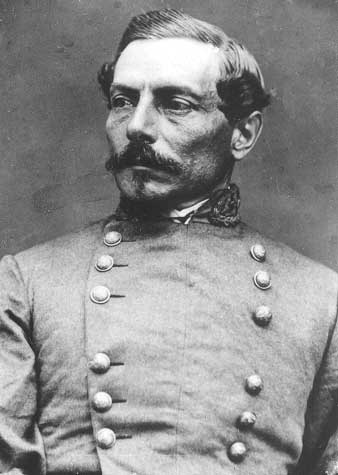
P.G.T._Beauregard

General P.T.G. Beauregard C.S.A.

Knowing from Southern sympathizers still in Washington that a relief expedition was coming, General P.T.G. Beauregard “had already cut off Major Anderson’s purchases in the Charleston market the day before Governor Pickens received Lincoln’s message about the intention to provision Sumter.” [16] Pickens forwarded the message to Davis in Montgomery and Davis was forced to either back down on their threats or fire the first shot of the war, and even worse from a messaging standpoint, “that first shot would be for the immediate purpose of keeping food from hungry men.” [17]

Davis was extremely angry when he went into conference with his cabinet on April 9th upon getting the news of the relief expedition. The debate in the cabinet “ran long and heated. Davis favored proceeding with the bombardment. Charleston’s batteries were ready, and the South Carolinians were more than anxious,” [18] and the majority of the cabinet, with the exception of Robert Toombs concurred. He wrote:

“I summoned the Cabinet and told them that negotiation was now at an end, and that it was time to bombard the fort. Yes, I said, we would now be firing the first shot, but that was not our fault. It was Lincoln who intended war. He and that lying Seward had drawn the sword, and we were responding to them. We were defending our honor.

Toombs, my Secretary of State disagreed. “Sir,” he said to me, “firing at the fort is suicide. It’s unnecessary, it puts us in the wrong, it’s fatal.”

“Sir,” I said, “you are wrong.”

On April tenth, I ordered General Beauregard to demand the evacuation of Fort Sumter, and if refused, to reduce it with his guns.” [19]

Beauregard delivered the ultimatum to Anderson, who rejected it noting that “his sense of honor and obligations to his government prevented him his complying; but in conversation with Beauregard’s aides he remarked that in any event, the garrison would be starved out in a few days.” [20] But the fear of the Confederates that the relief force might actually arrive and succeed in its mission prompted them to open fire on the fort at 4:30 a.m. on the morning of the 12th. The relief force was scattered by a gale and could not resupply Anderson. The bombardment lasted thirty-three hours, and while Anderson’s troops resisted but could not man all of their guns and were short on ammunition and powder. With the fort heavily damaged by over 4,000 hits and interior of the fort on fire, a fire that was threatening the powder magazines, Anderson gave the order to surrender. Beauregard allowed the assembled U.S. Navy ships to evacuate the garrison and as a parting gesture the Confederate General allowed Anderson’s troops to fire a last salute to Old Glory. They hauled down the smoke stained and torn Star Spangled Banner and marched to the ship taking them off the island with their drums beating the tune “Yankee Doodle.” Lincoln realized the importance of what had happened all too well. He noted, “They attacked Sumter. It fell and thus did more service than it otherwise would.” [21]

Notes

[1] Ibid. Guelzo Fateful Lightening p.136

[2] Ibid. Oates The Approaching Fury p.367

[3] Ibid. McPherson The Battle Cry of Freedom pp.265-266

[4] Ibid. Keneally American Scoundrel p.211

[5] Ibid. Catton The Coming Fury pp.180-181

[6] Ibid. Catton The Coming Fury p.184

[7] Ibid. Keneally American Scoundrel pp.211-212

[8] Ibid. Potter The Impending Crisis p.544

[9] Ibid. Guelzo Fateful Lightening p.137

[10] Ibid. Foote The Civil War, A Narrative. Volume One p.46

[11] Ibid. Goodwin Team of Rivals p. 335

[12] Holzer, Harold Lincoln: How Abraham Lincoln Ended Slavery in America Newmarket Press for itbooks an imprint of Harper Collins, New York 2012 p.80

[13] Ibid. Guelzo Fateful Lightening p.137

[14] Ibid. McPherson The Battle Cry of Freedom p.272

[15] Ibid. Catton Two Roads to Sumter p.278

[16] Weigley, Russell F. A Great Civil War: A Military and Political History 1861-1865 Indiana University Press, Bloomington and Indianapolis 2000 pp.20-21

[17] Ibid. Foote The Civil War, A Narrative. Volume One p.47

[18] Ibid. Davis Jefferson Davis p.323

[19] Ibid. Oates The Approaching Fury pp.416-417

[20] Ibid. Weigley A Great Civil War p.21

[21] Ibid. Goldfield America Aflame p.202

1 Comment

Filed under civil war, History, Military, Political Commentary

Never Again? Holocaust Days of Remembrance 2018

img_4761

Friends of Padre Steve’s World,

April 8th to 15th are the Holocaust Days of Remembrance in the United States. I am glad we do this but sadly I don’t think that the vast majority of Americans really care about the Holocaust or its eternal precedent because frankly we live in an age where history, unless it is being bastardized to fit the propaganda message of political ideologues matters not a wit.

Historian Timothy Snyder refers to the current trend of history being cherry picked and perverted in support of ideology as the  politics of eternity. Over the past two decades this concept has replaced the politics of inevitability  which defined the immediate ear after the Cold War. Inevitability presumed that no-matter what happened that the future would unfold in a manner that ultimately benefited everyone.

That understanding lasted until the disastrous American war against Iraq, the collapse of the banking system, and the politics of inequity that by 2010 made most Americans feel that they were being shortchanged. The social contract that had buttressed society has given way much in the way that it had in Europe following the First World War. Many, regardless of where they lay on the political spectrum feel victimized and angry. Their victimhood and anger require scapegoats who in turn become victims and many times the scapegoats are those who were traditionally exploited and persecuted based on race or religion, or new immigrants who have taken the place of the previously persecuted peoples that now embrace the very ideologies used to persecute their ancestors.

Snyder noted that the politics of “eternity places one nation at the centre of a cyclical story of victimhood. Time is no longer a line into the future, but a circle that endlessly returns the same threats from the past. Within inevitability, no one is responsible because we all know that the details will sort themselves out for the better; within eternity, no one is responsible because we all know that the enemy is coming no matter what we do. Eternity politicians spread the conviction that government cannot aid society as a whole, but can only guard against threats. Progress gives way to doom.”

To those that practice the politics of eternity, no matter what nation they hail from the precedent of the Holocaust looms large.

Snyder correctly observed that “The world is now changing, reviving fears that were familiar in Hitler’s time, and to which Hitler responded. The history of the Holocaust is not over. Its precedent is eternal, and its lessons have not yet been learned.”

That is something that we must never forget lest the would be architects of annihilation of our day; the politicians, preachers, propagandists, and profiteers, who demonize the Jews, Muslims, dark skinned immigrants, LTBTQ people and other inconvenient elements and prepare people to do evil or ignore it: the ordinary men who just obey orders. Primo Levi wrote:Primo Levi wrote, “Monsters exist, but they are too few in number to be truly dangerous. More dangerous are the common men, the functionaries ready to believe and to act without asking questions.” 

Levi was right, the common men, those that don’t think but simply follow orders or turn their heads and ignore the evil who are the most dangerous.

But of all of the people victimized by the politics of eternity it has to be the Jewish people  who have suffered the greatest from often disparate enemies. Anti-Semitism knows few boundaries and is not just one prejudice among many, even though the purveyors of it often persecute and massacre others. Christopher Hitchens noted about the Nazi crimes in Eastern Europe which were often aided by local militias: “We should not at all allow ourselves to forget the millions of non-Jewish citizens of Belarus, Russia, Ukraine, and other Slav territories who were also massacred. But for me the salient fact remains that anti-Semitism was the regnant, essential, organizing principle of all the other National Socialist race theories. It is thus not to be thought of as just one prejudice among many.” 

That is one major reason why I fear the surge in the politics of eternity in the United States, Europe, and other nations. I fear that the Jews will again be a sacrificial victim especially because a part of the American electorate which allegedly supports Israel, Evangelical Christians only do so because their theology requires the sacrifice of the Jews and Israel at the hand of the Anti-Christ during Christ’s Second Coming.  Sadly, these are the same people who unabashedly support a President that mocks their faith and Christ in word and deed, and whose often disparaging tone toward American Jews is well known. As such I cannot help but think that it could indeed happen here. If this is what it means to make America Great again then we are deep trouble. Snyder wrote: “When exactly was the “again” in the president’s slogan “Make America great again”? Hint: It is the same “again” that we find in “Never again.”

Milton Mayer wrote in his book They Thought They Were Free about a German colleague during the 1950s that had lived through the Hitler years as an academic. The man tried to explain how changes were so gradual that people like him who should have known better did not take action, if they did at all until it was too late. The man asked Mayer:

“How is this to be avoided, among ordinary men, even highly educated ordinary men? Frankly, I do not know. I do not see, even now. Many, many times since it all happened I have pondered that pair of great maxims, Principiis obsta and Finem respice—‘Resist the beginnings’ and ‘Consider the end.’ But one must foresee the end in order to resist, or even see, the beginnings. One must foresee the end clearly and certainly and how is this to be done, by ordinary men or even by extraordinary men? Things might have. And everyone counts on that might.”

With what is happening on the border of Israel in Syria I am very much afraid that there will be a backlash against American Jews, as well as American Muslims from both the political left and right. The precedent of the Holocaust is indeed eternal and it is incumbent on us to ensure that it does not happen again. That being said if it does and some of us have the courage to resist and even risk martyrdom it will not be the martyrdom of the innocent. Sadly, most of us regardless of our ideological or political point of view have contributed to the situation that we see today. Dietrich Bonhoeffer spoke these words as the Nazi Party became the largest and most powerful in Germany before Hitler was appointed Chancellor by Hindenburg:

“the blood of martyrs might once again be demanded, but this blood, if we really have the courage and loyalty to shed it, will not be innocent, shining like that of the first witnesses for the faith. On our blood lies heavy guilt, the guilt of the unprofitable servant who is cast into outer darkness” 

I am one of those unprofitable servants because for some thirty years I supported the party and policies that brought about Trump and turned a blind eye toward the consequences until I saw the terrible results of the polices that I supported when I went to Iraq in 2007 and 2008.

Until tomorrow,

Peace

Padre Steve+

Leave a comment

Filed under ethics, faith, History, holocaust, middle east, nazi germany, News and current events, Political Commentary

“We Are All Americans” Ely Parker’s Words at Appomattox

chamberlian gordon appomattox

Joshua Chamberlain Receives the Surrender of John Gordon at Appomattox

Friends of Padre Steve’s World,


One hundred and fifty three years ago on the 9th and 10th of April 1865, four men, Ulysses S Grant, Robert E. Lee, Joshua Lawrence Chamberlain and Ely Parker, taught succeeding generations of Americans the value of mutual respect and reconciliation. The four men, each very different, would do so after a bitter and bloody war that had cost the lives of over 600,000 Americans which had left hundreds of thousands others maimed, shattered or without a place to live, and seen vast swaths of the country ravaged by war and its attendant plagues.

The differences in the men, their upbringing, and their views about life seemed to be insurmountable. The Confederate commander, General Robert E. Lee was the epitome of a Southern aristocrat and career army officer. Lieutenant General Ulysses S. Grant, like Lee was a West Point graduate and veteran of the War with Mexico, but there the similarities ended. Grant was an officer of humble means who had struggled with alcoholism and failed in his civilian life after he left the army, before returning to it as a volunteer when war began. Major General Joshua Lawrence Chamberlain had been a professor of rhetoric and natural and revealed religion from Bowdoin College until 1862 when he volunteered to serve. He was a hero of Little Round Top at the Battle of Gettysburg, who helped exemplify the importance of citizen soldiers in peace and war. Finally there was Colonel Ely Parker, a full-blooded Seneca Indian; a professional engineer by trade, a man who was barred from being an attorney because as a Native American he was never considered a citizen. Although he had been rejected from serving in the army for the same reason, his friend Grant had obtained him a commission and kept him on his staff.

grant 1

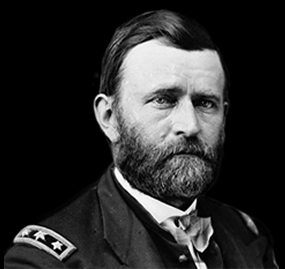
Ulysses S. Grant

A few days bef0ore the Confederate line around the fortress of Petersburg was shattered at the battle of Five Forks, and to save the last vestiges of his army Lee attempted to withdraw to the west. Within a few days the once magnificent Army of Northern Virginia was trapped near the town of Appomattox. On the morning of April 9th 1865 Lee replied to an entreaty of Lieutenant General Ulysses S. Grant requesting that he and his Army of Northern Virginia be allowed to surrender. Lee wrote to Grant:

HEADQUARTERS ARMY OF NORTHERN VIRGINIA, APRIL 9, 1865

Lieut. Gen. U.S. GRANT:

I received your note of this morning on the picket-line, whither I had come to meet you and ascertain definitely what terms were embraced in your proposal of yesterday with reference to the surrender of this army. I now ask an interview in accordance with the offer contained in your letter of yesterday for that purpose.

R.E. LEE, General.

The once mighty Army of Northern Virginia, which had won so many victories, and which at its peak numbered nearly 80,000 men, was now a haggard and emaciated, but still proud force of about 15,000 soldiers. For Lee to continue the war now would mean that they would have to face hopeless odds against a vastly superior enemy. Grant recognized this and wrote Lee:

I am equally anxious for peace with yourself, and the whole North entertains the same feeling. The terms upon which peace can be had are well understood. By the South laying down their arms they will hasten that most desirable event, save thousands of human lives, and hundreds of millions of property not yet destroyed. Seriously hoping that all our difficulties may be set-tied without the loss of another life, I subscribe myself, &c.,

Since the high water mark at Gettysburg, Lee’s army had been on the defensive. Lee’s ill-fated offensive into Pennsylvania was one of the two climactic events that sealed the doom of the Confederacy. The other was Grant’s victory at Vicksburg which fell to him a day after Pickett’s Charge, and which cut the Confederacy in half.

ileerob001p1

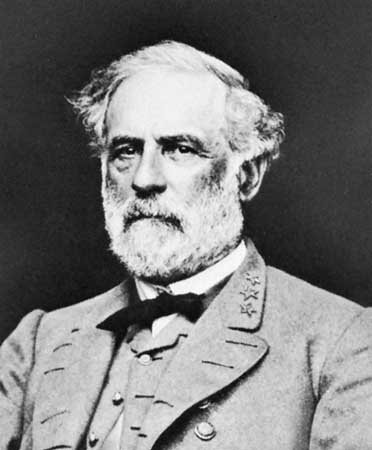
Robert E. Lee

The bloody defensive struggle lasted through 1864 as Grant bled the Confederates dry during the Overland Campaign, leading to the long siege of Petersburg. Likewise the armies of William Tecumseh Sherman had cut a swath through the Deep South and were moving toward Virginia from the Carolinas.

With each battle following Gettysburg the Army of Northern Virginia became weaker and finally after the nine month long siege of Petersburg ended with a Union victory there was little else to do. On the morning of April 9th a final attempt to break through the Union lines by John Gordon’s division was turned back by vastly superior Union forces.

On April 7th Grant wrote a letter to Lee, which began the process of ending the war in Virginia. He wrote:

General R. E. LEE:

The result of the last week must convince you of the hopelessness of further resistance on the part of the Army of Northern Virginia in this struggle. I feel that it is so, and regard it as my duty to shift from myself the responsibility of any further effusion of blood, by asking of you the surrender of that portion of the C. S. Army known as the Army of Northern Virginia.

U.S. GRANT, Lieutenant-General

Lee was hesitant to surrender knowing Grant’s reputation for insisting on unconditional surrender, terms that Lee could not accept. He replied to Grant:

HEADQUARTERS ARMY OF NORTHERN VIRGINIA, APRIL 7, 1865 Lieut. Gen. U.S. GRANT:

I have received your note of this date. Though not entertaining the opinion you express on the hopelessness of further resistance on the part of the Army of Northern Virginia, I reciprocate your desire to avoid useless effusion of blood, and therefore, before considering your proposition, ask the terms you will offer on condition of its surrender.

R.E. LEE, General.

The correspondence continued over the next day even as the Confederates hoped to fight their way out of the trap that they were in. But now Robert E. Lee, who had through his efforts extended the war for at least six months, knew that he could no longer continue. Even so some of his younger subordinates wanted to continue the fight. When his artillery chief Porter Alexander recommended that the Army be released, “take to the woods and report to their state governors” Lee replied:

“We have simply now to face the fact that the Confederacy has failed. And as Christian men, Gen. Alexander, you & I have no right to think for one moment of our personal feelings or affairs. We must consider only the effect which our action will have upon the country at large.”

Lee continued:

“Already [the country] is demoralized by the four years of war. If I took your advice, the men would be without rations and under no control of their officers. They would be compelled to rob and steal in order to live…. We would bring on a state of affairs it would take the country years to recover from… You young fellows might go bushwhacking, but the only dignified course for me would be to go to General Grant and surrender myself and take the consequences of my acts.”

Alexander was so humbled at Lee’s reply he later wrote “I was so ashamed of having proposed such a foolish and wild cat scheme that I felt like begging him to forget he had ever heard it.” When Alexander saw the gracious terms of the surrender he was particularly impressed with how non-vindictive the terms were, especially in terms of parole and amnesty for the surrendered soldiers.

Abraham Lincoln had already set the tone for the surrender in his Second Inaugural Address given just over a month before the surrender of Lee’s army. Lincoln closed that speech with these words of reconciliation:

“With malice toward none, with charity for all, with firmness in the right as God gives us to see the right, let us strive on to finish the work we are in, to bind up the nation’s wounds, to care for him who shall have borne the battle and for his widow and his orphan, to do all which may achieve and cherish a just and lasting peace among ourselves and with all nations.”

appomattox surrender

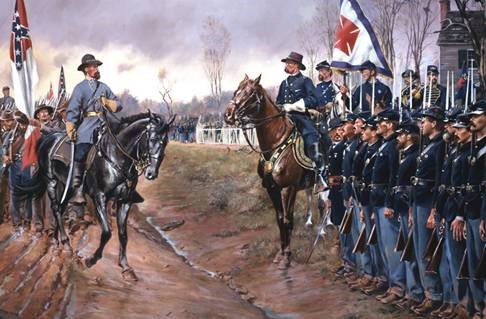
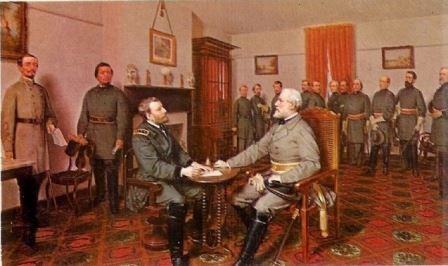
Lee met Grant at the house of Wilmer McLean, who had moved to Appomattox in 1861 after his home near Manassas had been used as a Confederate headquarters and was damaged by artillery fire. Lee was dressed in his finest uniform complete with sash, while Grant was dressed in a mud splattered uniform and overcoat only distinguished from his soldiers by the three stars on his should boards. Grant’s dress uniforms were far to the rear in the baggage trains and Grant was afraid that his slovenly appearance would insult Lee, but it did not. It was a friendly meeting, before getting down to business the two reminisced about the Mexican War.

Grant provided his vanquished foe very generous surrender terms:

“In accordance with the substance of my letter to you of the 8th inst., I propose to receive the surrender of the Army of N. Va. on the following terms, to wit: Rolls of all the officers and men to be made in duplicate. One copy to be given to an officer designated by me, the other to be retained by such officer or officers as you may designate. The officers to give their individual paroles not to take up arms against the Government of the United States until properly exchanged, and each company or regimental commander sign a like parole for the men of their commands. The arms, artillery and public property to be parked and stacked, and turned over to the officer appointed by me to receive them. This will not embrace the side-arms of the officers, nor their private horses or baggage. This done, each officer and man will be allowed to return to their homes, not to be disturbed by United States authority so long as they observe their paroles and the laws in force where they may reside.”

When Lee left the building Federal troops began cheering but Grant ordered them to stop. Grant felt a sense of melancholy and wrote “I felt…sad and depressed, at the downfall of a foe who had fought so long and valiantly, and had suffered so much for a cause, though that cause was, I believe, one of the worst for which a people has fought.” He later noted: “The Confederates were now our countrymen, and we did not want to exult over their downfall.”

In the hours before and after the signing of the surrender documents old friends and classmates, separated by four long years of war gathered on the porch or around the house. Grant and others were gracious to their now defeated friends and the bitterness of war began to melt away. Some Union officers offered money to help their Confederate friends get through the coming months. It was an emotional reunion, especially for the former West Point classmates gathered there:

“It had never been in their hearts to hate the classmates they were fighting. Their lives and affections for one another had been indelibly framed and inextricably intertwined in their academy days. No adversity, war, killing, or political estrangement could undo that. Now, meeting together when the guns were quiet, they yearned to know that they would never hear their thunder or be ordered to take up arms against one another again.”

Grant also sent 25,000 rations to the starving Confederate army waiting to surrender. The gesture meant much to the defeated Confederate soldiers who had had little to eat ever since the retreat began.

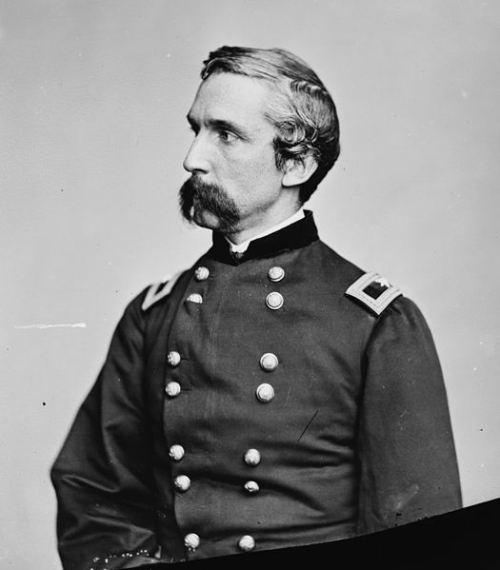
The surrender itself was accomplished with a recognition that soldiers who have given the full measure of devotion can know when confronting a defeated enemy. Major General Joshua Lawrence Chamberlain, the heroic victor of Little Round Top was directed by Grant to receive the final surrender of the defeated Confederate infantry on the morning of April 12th.

It was a rainy and gloomy morning as the beaten Confederates marched to the surrender grounds. As the initial units under the command of John Gordon passed him, Chamberlain was moved with emotion he ordered his soldiers to salute the defeated enemy for whose cause he had no sympathy, Chamberlain honored the defeated Rebel army by bringing his division to present arms.

John Gordon, who was “riding with heavy spirit and downcast face,” looked up, surveyed the scene, wheeled about on his horse, and “with profound salutation returned the gesture by lowering his saber to the toe of his boot. The Georgian then ordered each following brigade to carry arms as they passed third brigade, “honor answering honor.”

joshua_chamberlain_-_brady-handy

Joshua Lawrence Chamberlain

Chamberlain was not just a soldier, but before the war had been Professor of Natural and Revealed Religions at Bowdoin College, and a student of theology before the war. He could not help to see the significance of the occasion. He understood that some people would criticize him for saluting the surrendered enemy. However, Chamberlain, unlike others, understood the value of reconciliation. Chamberlain was a staunch abolitionist and Unionist who had nearly died on more than one occasion fighting the defeated Confederate Army, and he understood that no true peace could transpire unless the enemies became reconciled to one another.

He noted that his chief reason for doing so:

“The momentous meaning of this occasion impressed me deeply. I resolved to mark it by some token of recognition, which could be no other than a salute of arms. Well aware of the responsibility assumed, and of the criticisms that would follow, as the sequel proved, nothing of that kind could move me in the least. The act could be defended, if needful, by the suggestion that such a salute was not to the cause for which the flag of the Confederacy stood, but to its going down before the flag of the Union. My main reason, however, was one for which I sought no authority nor asked forgiveness. Before us in proud humiliation stood the embodiment of manhood: men whom neither toils and sufferings, nor the fact of death, nor disaster, nor hopelessness could bend from their resolve; standing before us now, thin, worn, and famished, but erect, and with eyes looking level into ours, waking memories that bound us together as no other bond;—was not such manhood to be welcomed back into a Union so tested and assured? Instructions had been given; and when the head of each division column comes opposite our group, our bugle sounds the signal and instantly our whole line from right to left, regiment by regiment in succession, gives the soldier’s salutation, from the “order arms” to the old “carry”—the marching salute. Gordon at the head of the column, riding with heavy spirit and downcast face, catches the sound of shifting arms, looks up, and, taking the meaning, wheels superbly, making with himself and his horse one uplifted figure, with profound salutation as he drops the point of his sword to the boot toe; then facing to his own command, gives word for his successive brigades to pass us with the same position of the manual,—honor answering honor. On our part not a sound of trumpet more, nor roll of drum; not a cheer, nor word nor whisper of vain-glorying, nor motion of man standing again at the order, but an awed stillness rather, and breath-holding, as if it were the passing of the dead!”

The next day Robert E Lee addressed his soldiers for the last time. Lee’s final order to his loyal troops was published the day after the surrender. It was a gracious letter of thanks to men that had served their beloved commander well in the course of the three years since he assumed command of them outside Richmond in 1862.

General Order
No. 9


After four years of arduous service marked by unsurpassed courage and fortitude, the Army of Northern Virginia has been compelled to yield to overwhelming numbers and resources.

I need not tell the survivors of so many hard fought battles, who have remained steadfast to the last, that I have consented to the result from no distrust of them.

But feeling that valour and devotion could accomplish nothing that could compensate for the loss that must have attended the continuance of the contest, I have determined to avoid the useless sacrifice of those whose past services have endeared them to their countrymen.

By the terms of the agreement, officers and men can return to their homes and remain until exchanged. You will take with you the satisfaction that proceeds from the consciousness of duty faithfully performed, and I earnestly pray that a merciful God will extend to you his blessing and protection.

With an unceasing admiration of your constancy and devotion to your Country, and a grateful remembrance of your kind and generous consideration for myself, I bid you an affectionate farewell. — R. E. Lee, General

The surrender was the beginning of the end. Other Confederate forces continued to resist for several weeks, but with the surrender of the Army of Northern Virginia led by the man that nearly all Southerners saw as the embodiment of their nation the war was effectively over.

Lee had fought hard and after the war was still under the charge of treason, but he understood the significance of defeat and the necessity of moving forward as one nation. In August 1865 Lee wrote to the trustees of Washington College of which he was now President:

“I think it is the duty of every citizen, in the present condition of the Country, to do all in his power to aid the restoration of peace and harmony… It is particularly incumbent upon those charged with the instruction of the young to set them an example of submission to authority.

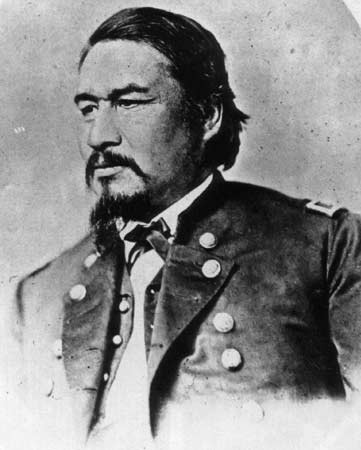
eparker05-966-g

Brigadier General Ely Parker

It is a lesson that all of us in our terribly divided land need to learn regardless of or political affiliation or ideology. After he had signed the surrender document, Lee learned that Grant’s Aide-de-Camp Colonel Ely Parker, was a full-blooded Seneca Indian. He stared at Parker’s dark features and said: “It is good to have one real American here.”

Parker, a man whose people had known the brutality of the white man, a man who was not considered a citizen and would never gain the right to vote, replied, “Sir, we are all Americans.” That afternoon Parker would receive a commission as a Brevet Brigadier General of Volunteers, making him the first Native American to hold that rank in the United States Army. He would later be made a Brigadier General in the Regular Army.

I don’t know what Lee thought of that. His reaction is not recorded and he never wrote about it after the war, but it might have been in some way led to Lee’s letter to the trustees of Washington College. I think with our land so divided, ands that is time again that we learn the lessons so evidenced in the actions and words of Ely Parker, Ulysses Grant, Robert E. Lee and Joshua Chamberlain, for we are all Americans.

Sadly, I think that there is a portion of the American population who will not heed these words and will continue to agitate for policies and laws similar to those that led to the Civil War, and which those the could not reconcile defeat instituted again during the Post-Reconstruction and Jim Crow eras. For me such behavior and attitudes are incompressible, but they are all too real, and all too present in our divided nation.

But I still maintain hope that in spite of everything that divides us, in spite of the intolerance and hatred of some, that we can overcome. I think that the magnanimity of Grant in victory, the humility of Lee in defeat, the graciousness of Chamberlain in honoring the defeated foe, and the stark bluntness of Parker, the Native American, in reminding Lee, that “we are all Americans,” is something that is worth remembering, and yes, even emulating.

Peace

Padre Steve+

Leave a comment

Filed under civil rights, civil war, History, Military, Political Commentary

Dietrich Bonhoeffer and the Martyrs of Flossenburg: A Lesson for Christians in the Age of Trump

D.Bonhoeffer im Gefaengnis Berlin-Tegel

Friends of Padre Steve’s World,

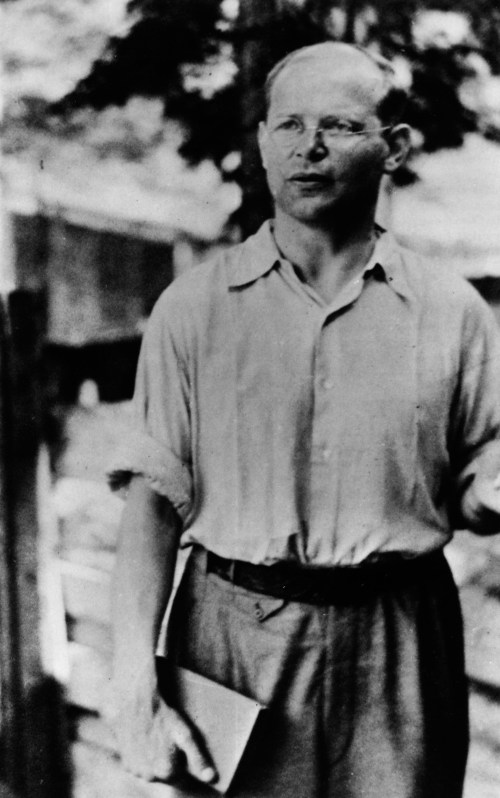
Seventy-three years ago at the Flossenburg Concentration Camp near the German-Czech border a pastor, an Admiral, and a General were martyred on the specific order of Adolf Hitler. The pastor was the eminent Dietrich Bonhoeffer, the Admiral, Wilhelm Canaris the former head of the German military intelligence service; the Abwehr, the General, Hans Oster, Canaris’s deputy. All three were Christians and all three opponents of Hitler’s regime. Condemned with them were Karl Sack a senior military jurist, retired General Friedrich Von Rabenau who was also a theologian, and several others connected with the Abwehr and the resistance.

I think that in an age where politically conservative Christians have trampled their own faith to support of a leader who makes a mockery of the Christian faith as he blasphemes the very name of Christ and the teachings of Jesus in his words and deeds. While I am not comparing the President to Hitler I am comparing the corrupt and evil Christian leaders and organizations which support him to the German Christians who eagerly supported Hitler and his diabolical regime. Thus the men who lost their lives in the fight against Hitler on April 9th 1945 and their courage need to be remembered and emulated should the Trump administration continue down its path to trample the Constitution and crush civil and human rights, and quite possibly engage in aggressive preemptive wars that would be illegal under the precedents of the Nuremberg Trials; all in the name of Making America Great Again.

But it is Bonhoeffer that I will focus on tonight. As early as 1932 Bonhoeffer realized the menace and evil of Hitler’s growing Nazi Party and movement. In a sermon the recently ordained Bonhoeffer, then only 26 years old noted that danger and the complicity of all Germans in it, especially Christians.  He warned that resistance to it could well involve martyrdom. But he believed that the the evil of the tyrant gave no one the luxury of claiming innocence:

“the blood of martyrs might once again be demanded, but this blood, if we really have the courage and loyalty to shed it, will not be innocent, shining like that of the first witnesses for the faith. On our blood lies heavy guilt, the guilt of the unprofitable servant who is cast into outer darkness” 

On February 1st 1933, two days after Hitler’s accession to power Bonhoeffer was beginning a previously scheduled speech on what was known as the concept known as the Fuhrerprinzep. The speech was not a direct attack on Hitler but a warning of the limits of power. He had barely begun the speech when for unexplained circumstances he was cut off. While there was no proof that this was deliberately done it would not have been unlike the Nazis to engage in such subterfuge. The speech was printed in a non-Nazi conservative newspaper and he was invited to give the speech in early March at the University of Berlin’s college of political science. At the end of the speech, which included no remarks on current events Bonhoeffer criticized the Fuhrerprinzep which he believed could easily become an idolatrous cult. However, Hitler had ridden into power upon upon that concept as people sought a strong leader to bring Germany out of political, social, and economic turmoil.

“The fearful danger of the present time is that above the cry for authority, be it of a Leader or of an office, we forget that man stands alone before the ultimate authority and that anyone who lays violent hands on man here is infringing eternal laws and taking upon himself superhuman authority which will eventually crush him. The eternal law that the individual stands alone before God takes fearful vengeance where it is attacked and distorted. Thus the Leader points to the office, but Leader and office together point to the final authority itself, before which Reich or state are penultimate authorities. Leaders or offices which set themselves up as gods mock God and the individual who stands alone before him, and must perish.”

german-christians-march

At that early stage Hitler whose office was conditional on the support of President Paul Von Hindenburg and headed a cabinet in which his Nazis were a minority partner realized that he had to say the right things to maintain it, he could not appear too radical. One group that he courted were politically conservative German Christians. In a speech delivered the same day as Bonhoeffer’s curtailed speech, Hitler claimed that the Christian faith would serve as “the basis of our collective morality.” It was a lie but it assuaged the fears of Christians in non-Nazi conservative and moderate parties, many who became a part of the Nazi German Christian movement which decidedly in the service of Hitler espousing Nazi racial doctrines and attacks upon the Jews.

As Hitler and the Nazis stepped up their persecution of their political opponents and the Jews based on the emergency provisions of the Reichstag Fire Decree Bonhoeffer both worked and spoke his opposition to the tyranny that was beginning to envelop Germany. In April 1933 while speaking of the responsibility of Christians and the church to stand against injustice he wrote in his essay The Church and the Jewish Question: 

“The church has an unconditional obligation to the victims of any ordering society, even if they do not belong to the Christian community.” and also“We are not to simply bandage the wounds of victims beneath the wheels of injustice, we are to drive a spoke into the wheel itself.”

He became a key member of what became known as the Confessing Church and the Pastors Emergency League where he helped draft the Barmen Declaration. He ran an underground seminary to train theology students. He had the chance to remain in the United States in June of 1939 but refused the pleas of his American friends to do so. He explained his position to the American theologian Reinhold Niebuhr:

“I have come to the conclusion that I made a mistake in coming to America. I must live through this difficult period in our national history with the people of Germany. I will have no right to participate in the reconstruction of Christian life in Germany after the war if I do not share the trials of this time with my people… Christians in Germany will have to face the terrible alternative of either willing the defeat of their nation in order that Christian civilization may survive or willing the victory of their nation and thereby destroying civilization. I know which of these alternatives I must choose but I cannot make that choice from security.”

On his return to Germany he was forbidden to speak in public, prohibited from publishing and required to report his movements to the police. However he did have friends. His brother in law, the lawyer Hans Dohnányi who was a member of the opposition, recruited Bonhoeffer for the Abwehr the German military service in order to prevent him from being conscripted into the Wehrmacht based on the proposition that his contacts with British and American could prove useful to to German intelligence. While Bonhoeffer remained suspect to Nazi officials the appointment brought him into the orbit of Admiral Wilhelm Canaris, General Hans Oster, and other leaders of the military opposition to Hitler.

From these men he began to comprehend the fulness of the Nazi evil and learned of early plots against Hitler’s life. Bonhoeffer, a pacifist realized that he must become an active part of the resistance and wrote: “the ultimate question for a responsible man to ask is not how he is to extricate himself heroically from the affair, but how the coming generation shall continue to live.” By participating in the conspiracy Bonhoeffer can be accused of hypocrisy, and he knew it. He explained his position in a letter to his sister:

“If I sit next to a madman as he drives a car into a group of innocent bystanders, I can’t, as a Christian, simply wait for the catastrophe, then comfort the wounded and bury the dead. I must try to wrestle the steering wheel out of the hands of the driver.”

During his tenure with the Abwehr he served as a courier to make contact with Allied leaders in Switzerland in order to gain support for opposition efforts, attempts that the Allies ignored, even as he wrote his book Ethics. Bonhoeffer worked with Dohnányi and others in the Abwehr to smuggle fourteen Jews out of German to Switzerland along with large sums of currency. However, the Sicherheitsdienst, the intelligence branch of Heinrich Himmler’s SS  became aware of their activities and both were arrested in April 1943, not so much for that but in order to discredit the rival Abwehr. While the Abwehr was able to cover for most of their activities they were charged with breaking the Nazi laws regarding the Jews.

He was imprisoned in Berlin’s Tegel Prison while awaiting trial but during that time he produced many theological writings which were smuggled out of the prison to his student Eberhard Bethage by his fiancé and sympathetic guards. These uncensored works would become the book Letters and Papers from Prison. He expressed no bitterness in his arrest but reflected on what he and others in the resistance had learned, lessons that privileged Christians in the United States who worship the ungodly political, economic, and military power reveled in by President Trump would be wise to heed:

“We in the resistance have learned to see the great events of world history from below, from the perspective of the excluded, the ill treated, the powerless, the oppressed and despised… so that personal suffering has become a more useful key for understanding the world than personal happiness.”

Documents that exposed Bonhoeffer’s connection to the anti-Hitler plot that resulted in the July 20th 1944 assassination attempt on Hitler by Lieutenant Colonel Claus von Stauffenberg were discovered by the Gestapo in September 1944 and he was moved to the SS Prison at the Reichssicherheitshauptamt, the Reich Security Main Office. When that facility was bombed in February 1945 he was moved to Buchenwald and finally to Flossenburg where he would die.

Two of his writings which he produced while in prison have had a profound impact on my faith.

“During the last year or so I’ve come to know and understand more and more the profound this-worldliness of Christianity.  The Christian is not ahomo religiosus, but simply a man, as Jesus was a man…I’m still discovering right up to this moment, that it is only by living completely in this world that one learns to have faith. One must completely abandon any attempt to make something of oneself, whether it be a saint, or a converted sinner, or a churchman (a so-called priestly type!) a righteous man or an unrighteous one, a sick man or a healthy one.  By this-worldliness I mean living unreservedly in life’s duties, problems, successes and failures, experiences and perplexities.  In so doing we throw ourselves completely into the arms of God, taking seriously, not our own sufferings, but those of God in the world—watching with Christ in Gethsemane. That, I think, is faith; that is metanoia; and that is how one becomes a man and a Christian.”

“I discovered later, and I’m still discovering right up to this moment, that is it only by living completely in this world that one learns to have faith. By this-worldliness I mean living unreservedly in life’s duties, problems, successes and failures. In so doing we throw ourselves completely into the arms of God, taking seriously, not our own sufferings, but those of God in the world. That, I think, is faith.”

Bonhoeffer’s fate was sealed when on April 4th 1945 Canaris’s secret diaries were found. When Hitler read them he became enraged and demanded that the Abwehr traitors be destroyed. Bonhoeffer and his companions were taken to Flossenburg, but at a stop Bonhoeffer became separated from them and was held with other prisoners in the small town of Schoenberg. While there on Sunday 8 April 1945, Bonhoeffer was asked to conduct a service on the second Sunday of Easter. He had just finished conducting the service at a schoolhouse when plainclothes Gestapo agents arrived to arrest him. British prisoner Payne Best noted that Bonhoeffer:

“spoke to us in a manner which reached the hearts of all, finding just the right words to express the spirit of our imprisonment and the thoughts and resolutions which it had brought.”

As Bonhoeffer was taken he said to another prisoner, “This is the end – but for me, the beginning of life.” He was driven to Flossenburg where he along with the other Abwehr conspirators was condemned at a drumhead trial by SS Judge Sturmbannfuhrer (Major) Otto Thorbeck without witnesses or records of proceedings or defense and hanged the next day, two weeks before American soldiers liberated the camp.

The only account of his death was written by the SS doctor of the camp.

“On the morning of that day between five and six o’clock the prisoners, among them Admiral Canaris, General Oster, General Thomas and Reichgerichtsrat Sack were taken from their cells, and the verdicts of the court martial read out to them. Through the half-open door in one room of the huts I saw Pastor Bonhoeffer, before taking off his prison garb, kneeling on the floor praying fervently to his God. I was most deeply moved by the way this lovable man prayed, so devout and so certain that God heard his prayer. At the place of execution, he again said a short prayer and then climbed the steps to the gallows, brave and composed. His death ensued after a few seconds. In the almost fifty years that I worked as a doctor, I have hardly ever seen a man die so entirely submissive to the will of God.”

So until tomorrow,

Peace

Padre Steve+

Leave a comment

Filed under christian life, ethics, faith, History, holocaust, nazi germany, News and current events, philosophy, Political Commentary, Religion, world war two in europe

Requiem for Yamato…

Friends of Padre Steve’s World,

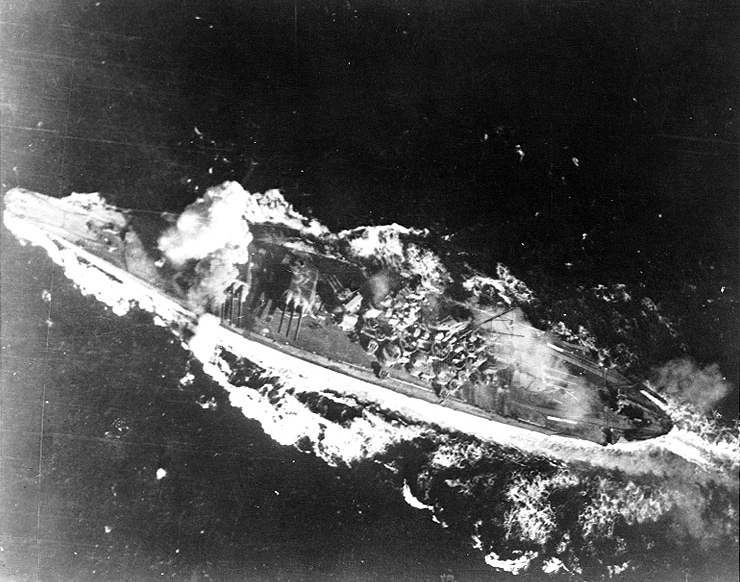
Those who have read my site since the beginning know that I have written much in terms of Naval History. One of the things that I am drawn to are the great ships that were sacrificed with the crews in futile attempts of salvage victory from defeat, or which were sacrificed in order to save others. Regardless of the circumstance I have a soft spot in my heart for sailors of any nation who pay with their lives when their ships are sunk. This is the story of the IJN Yamato, who along with her sister ship, the Musashi were the largest battleship ever constructed.

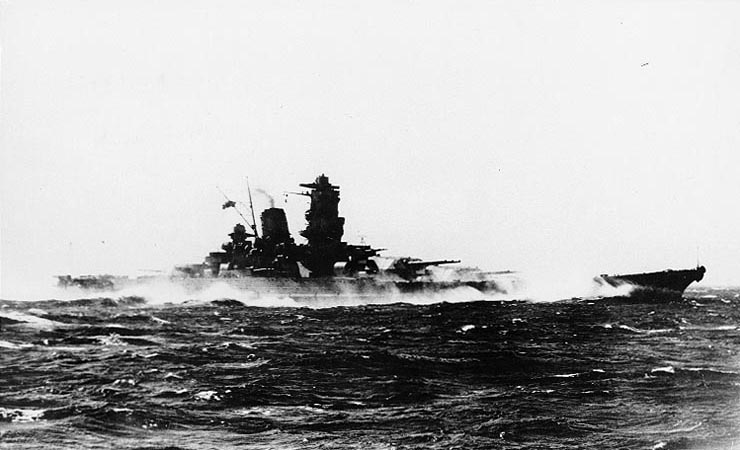
As dawn broke on April 7th 1945 the great Super-Battleship Yamato, the pride of the Japanese Imperial Navy and nine escorts steamed toward Okinawa on a suicide mission. It was literally the end of empire and the end of a navy. What had begun on December 7th 1941 was now winding down as the Imperial Navy launched its last offensive operation against the United States Navy.

The Imperial Navy was already at the end of its tether. Following the disasters at the Battle of the Philippine Sea which decimated the carrier air arm of the Imperial Navy; the subsequent losses in the defense of Formosa which used up the majority of any remaining carrier aircraft and crews; and the Battle of Leyte Gulf which decimated the surface forces of the navy what remained was a pitiful remnant of a once dominant fleet.

The great battleship Yamato and her sister ship Musashi were the largest warships ever built until the advent of the USS Enterprise CVN-65. Displacing over 72,000 tons 863 feet long and 127 feet in beam these ships mounted the heaviest artillery battery ever placed on a warship. Their nine 18.1” guns mounted in three triple turrets each weighing over 2500 tons weighed as much or more than the largest destroyers of the time. They could fire their massive shells 26 miles and even had the capability of firing a special anti-aircraft shell known as the Sanshiki or beehive round.

Musashi was sunk during the Battle of the Sibuyan Sea at Leyte Gulf on October 24th 1944 after being hit by 19 aerial torpedoes and 17 bombs. Yamato engaged the American Escort Carriers and destroyers of Taffy-3 at the Battle off Samar the following day but was prevented by the audacity of the inferior American destroyers and timidity of the Japanese commander Vice Admiral Takeo Kurita from achieving any notable success.

The remains of the Imperial Navy were hampered by a lack of fuel, air power and training time. When the United States attacked Iwo Jima in February 1945, barely 700 miles from the home islands of Japan not a single Japanese surface ship sortied to challenge the American Navy.

However when the American attacked Okinawa on April 1st the Navy launched Operation Ten-Go. In spite of overwhelming American superiority in both naval air and surface forces the tiny task force was to fight its way to Okinawa, beach their ships and once the ships were destroyed the crews were to join Japanese Army forces on the island.

The doomed sortie was in part due to the insistence of the Imperial Army which derided the Imperial Navy for its failures at Philippine Sea and Leyte Gulf and pressure from Emperor Hirohito who asked “But what about the Navy? What are they doing to assist in defending Okinawa? Have we no more ships?” In response the Naval High command devised what amounted to a suicide mission for Yamato and her escorts. The plan was opposed by many in the Navy and leaders of the task force who saw it as a futile mission. Only the insistence of Admiral Kusaka who told the reticent commanders that the Emperor expected the Navy to make its best effort to defend Okinawa persuaded the Captains of the doomed force to accept the mission.

At about 1600 on April 6th the ships of the task force weighed anchor and departed their anchorage at Tokuyama hoping to take advantage of approaching darkness to mask their departure. They were detected and shadowed by American submarines which provided real time information on the course and speed of the Japanese ships to the American leadership.

The next morning the task force was spotted by patrol planes and its position relayed to the American fleet commander, Admiral Raymond Spruance, the victor of Midway. Spruance ordered the six fast battleships, accompanied by two battlecruisers, seven cruisers and 21 destroyers engaged in shore bombardment to intercept the Japanese force. However, Admiral Marc Mitscher of Task Force 58, the fast carriers launched a massive air strike of over 400 aircraft against the Japanese.

At 1232 the first wave of American aircraft began their attacks on the doomed Japanese force. As the succeeding waves of American aircraft attacked Yamato was hit by 15 bombs and at least 8 torpedoes, almost all of which struck her port side created an imminent risk of capsizing. The damage control teams’ counter flooded the starboard engine and boiler rooms which kept the ship from turning turtle, but which also further reduced her speed.

By 1405 the great ship was dead in the water and just minutes before her commander had ordered the crew to abandon ship. At 1420 she capsized and began to sink and at 1423 she blew apart in a massive explosion that was reportedly heard and seen 120 miles away and created a mushroom cloud that reached 20,000 feet.

Captain Tameichi Hara of the light cruiser Yahagi which had already sank described the demise of the great ship in his book Japanese Destroyer Captain:

“We looked and saw Yamato, still moving. What a beautiful sight. Suddenly smoke belched from her waterline. We both groaned as white smoke billowed out until it covered the great battleship, giving her the appearance of a snow-capped Mount Fuji. Next came black smoke mingled with the white, forming to a huge cloud which climbed to 2000 meters. As it drifted away we looked to the surface of the sea again and there was nothing. Yamato had vanished. Tremendous detonations at 1423 of that seventh day of April signaled the end of this “unsinkable” symbol of the Imperial Navy.”

Only 280 men of the estimated 3000 crew members were rescued by the surviving escorts. Of her escorts, the Yahagi and four destroyers were also sunk. The Americans lost a total of ten aircraft and 12 men. Never again would the surface forces of the Imperial Navy threaten U.S. forces or take any meaningful part in the war.

The sacrifice of Yamato and her escorts was a futile was of lives and though many in Japan revere their sacrifice as noble it served no purpose. The loss of Yamato, named after the ancient Yamato province in a sense was symbolic of the demise of the Japanese Empire.

I cannot help but think of gallantry of the doomed crews of these ships, sacrificed for the “honor” of leaders that did not really value their sacrifice.

It is a commentary that is timeless.

Peace

Padre Steve+

3 Comments

Filed under History, Military, Navy Ships, US Navy, World War II at Sea, world war two in the pacific

Look for the Liberal Label: My Journey to the Left

Friends of Padre Steve’s World,

A couple of days ago I received a comment on my Political Commentary tab from an old baseball player who played with the Detroit Tigers in the 1960s. He made some comments that I took to heart as he noted some of the apparent contradictions in my actions, words, and beliefs over the years. He said that I was about as “liberal” as Ricard Nixon. Sadly what he commented on had not been updated since 2009 so I was still in the initial stages of my transformation from being a lifelong Republican to a progressive (liberal) realist in Wonderland.

I am definitely a liberal or progressive now, though I think that I am pretty moderate all things considered, and no I don’t think that my views are particularly Nixonian, though when it comes to foreign policy dealing with the Soviet Union and china he was pretty sharp, his record in Vietnam was quite the opposite.

However my views are probably more like Franklin Roosevelt, Harry Truman, Dwight Eisenhower, or John F. Kennedy. Of course saying that means that I will certainly contradict myself at times and that is part of life. That being said that while I was a Republican for 32 years of my life (1976-2008) I have been on an ever more progressive trajectory since 2008 and somewhere along the path from conservatism, to moderation, to progressivism I got labeled.

I got labeled with the “L” Word. no, not the Lesbian one, the other less socially acceptable one, the Liberal label…and to tell the truth though I consider myself a moderate in terms of my progressiveness I actually fall on the Liberal side of most parts of the political and religious spectrum; both in domestic and foreign policy.

It actually surprised me when I figured out that I had become a liberal. To tell the truth I don’t know how it happened. I cheered the demise of Jimmy Carter, Walter Mondale, Mike Dukakis and even Al Gore. I listened to Rush Limbaugh and Sean Hannity as much as I could. During his first term and early in his second I was defending “W” against what I thought were unfair assaults from the left.

But a funny thing happened between 2004 and now. It was a place called Iraq, where I began to question the unquestionable questions of conservative orthodoxy in a number of forums. I became a moderate and a passionate one at that, although truthfully I am probably better described as one of those nasty liberals.

I think being a moderate or a liberal, for those who really are moderates or liberals, is really a tricky thing. Back when I was in seminary during the pre-Fundamentalist takeover of Southwestern Baptist Seminary I remember hearing a big name Fundamentalist preacher say that “middle of the road moderates were only good to be run over.”  One of my professors who would be a casualty of the takeover of the seminary said that for many in the Southern Baptist Convention of the time that “Liberal means anyone to the left of me.”

Now I do have to confess, unlike a lot of people when they get older and become more conservative I have become more “liberal” in the way I do life. I am more accepting of people different than me. The late great manager of the Baltimore Orioles, Earl Weaver noted: “It’s what you learn after you know it all that counts.” That is a fact.

Because of that I am more willing to accept things that back in the days when I knew everything that I would attack without exception. When I worked up the guts to openly state that I questioned political conservative orthodoxy almost eight years ago I got thrown out of the church that I was first ordained as a priest.  That was less about matters of actual Christian doctrine than political orthodoxy masked in religious language. But despite that experience I still believed that I was somewhere in the middle of the political spectrum but I was obviously wrong. In fact today what I considered based on my more traditional Roosevelt, Truman, Eisenhower, Kennedy beliefs was no longer moderate but radically liberal and progressive, especially on social and economic issues.

So let me without equivocation in this age of Trump state:

I think that racism is still alive and well and that Jim Crow lives, thus the job of the Civil Rights movement is not done. Martin Luther King Jr.’s “dream” has not been fulfilled and it is in danger.

I think that gays and lesbians should have the same right to marriage and civil rights that heterosexuals have and that those constitutional rights should not be abridged based on the religious beliefs of their opponents.

I think that the bankers and the Wall Street people who practically destroyed the economy back in late 2008 should be in jail and I think that neither Congress, the Obama administration, and especially the Trump administration have done or will do enough to prevent the next economic implosion.

I think that multinational corporations that enjoy the benefits of all this country offers and that the taxpayers provide should pay their fair share of taxes instead of being allowed to make their money here and shelter it offshore. Sadly, because of the Trump tax reforms they will be able to do more of this.

I think that the environment matters and that we should do all that we can to protect it. Unfortunately the Trump administration, the GOP dominated congress, and their Evangelical Christian sycophants are doing their damnedest to promote the destruction of the environment.

I believe that the poor, minorities, the elderly and others with no power need the help and protection of the government from predatory businesses, banks and others that would seek to impoverish them even more.

I think that there is a place for strong organized labor to protect the rights of people who either produce the goods or provide the services that make others rich and this nation prosperous.

I think that the leaders of the Bush administration who took us to war in Iraq are war criminals and would have hung at Nuremberg if Justice Robert Jackson had had them in the dock. Likewise I think that the opposition of the GOP and the Trump administration to the International Criminal Court (ICC), other international organizations, and to our partners and allies around the world and cooperation with dictatorships and authoritarian regimes beginning with Putin’s Russia is damnable.


I think that Fox News lies when it calls itself “fair and balanced” and that much of what it airs is nothing more than political propaganda designed to help its political allies and keep people riled up against that black man in the White House.

I think that the crass social Darwinism of the followers of Ayn Rand is evil, needs to be called what it is  and condemned by those who call themselves Christians.

Likewise, speaking of Christians I think that many American Christians have sold their faith to political hacks that call themselves pastors or religious leaders while pocketing the money of their followers laughing all the way to the bank. This is especially true of their relationship to President Trump.

Finally as a Christian I don’t think that the United States was founded as a Christian nation, and in that I am backed by the Founders and their Christian allies like Virginia Baptist leader John Leland. I think that we as a society have a responsibility to care for the least, the lost and the lonely.

So while I am moderate in the way that I do life, I am certainly a liberal, a progressive, and a realist.  I am okay with people that disagree with me because it is a free country but that being said I won’t be bullied.

So where did I go left?

Peace

Padre Steve+

2 Comments

Filed under civil rights, culture, faith, Foreign Policy, History, LGBT issues, News and current events, Political Commentary

Heresies and Drumheads: Evangelicals and Trump through the Lens of Star Trek

galaxy_universe-normal

Friends of Padre Steve’s World,

The German theologian, pastor and martyr Dietrich Bonhoeffer wrote:

“Man no longer lives in the beginning–he has lost the beginning. Now he finds he is in the middle, knowing neither the end nor the beginning, and yet knowing that he is in the middle, coming from the beginning and going towards the end. He sees that his life is determined by these two facets, of which he knows only that he does not know them”  

There is an episode of Star Trek Voyager called Distant Origin where a scientist of a race in the Delta Quadrant believes that genetic evidence indicated that their race originated on Earth. His thesis is challenged the doctrine of his species and he was accused of “heresy against Doctrine” for positing something different than his people believed. He ends up being persecuted and punished for his beliefs.

Now I want to be diplomatic about this. I am not someone who simply is contrary to established doctrines, be they theological, scientific or even military theories. That being said I think it is only right to question our presuppositions, as Anselm of Canterbury did through faith seeking understanding.

That understanding as a Christian is based on the totality of the message of the Christian faith. Hans Kung said it well:

“Christians are confident that there is a living God and that in the future of this God will also maintain their believing community in life and in truth. Their confidence is based on the promise given with Jesus of Nazareth: he himself is the promise in which God’s fidelity to his people can be read.” 

What we have to admit is that our belief is rooted in our faith, faith which is given to us through the witness of very imperfect people influenced by their own culture, history and traditions. Even scripture does not make the claim to be inerrant, and the Bible cannot be understood like the Koran or other texts which make the claim to be the infallible compendium of faith delivered by an angel or dictated by God himself. It is a Divine-human collaboration so symbolic of the relationship that God has with his people, often confusing and contradictory yet inspiring.

themiddle

There is a certain sense of relationship between God and humanity within scripture and that relationship creates certain tensions between God and those people. The interesting thing is that Scripture is a collection of texts which record often in terrible honesty the lack of perfection of both the writers and their subjects. They likewise record the sometimes unpredictable and seemingly contradictory behavior of God toward humanity in the Old Testament. They bear witness to the weaknesses, limitations and lack of understanding of the people of God of the message of God but even in that those limitations and weaknesses that God is still faithful to humanity in the life death and resurrection of Jesus of Nazareth.

The real fact of the matter is that fixed doctrines are much more comfortable than difficult questions than honestly examining the contradictions that exist within Scripture, history and tradition. The fact is this makes many people uncomfortable and thus the retreat into the fortress of fixed and immutable doctrine found in the various incarnations of Fundamentalism.

The fact is the world is not a safe place, and our best knowledge is always being challenged by new discoveries many of which make people nervous and uncomfortable, especially people who need the safety of certitude. So in reaction the true believers become even more strident and sometimes, in the case of some forms of Islam and Hinduism violent.

Picard

Christianity cannot get away unscathed by such criticism. At various points in our history we have had individuals, churches and Church controlled governments persecute and kill those that have challenged their particular orthodoxy. Since Christian fundamentalists are human they like others have the capacity for violence if they feel threatened, or the cause is “holy” enough. Our history is full of sordid tales of the ignorance of some Christians masquerading as absolute truth and crushing any opposition. It is as Eric Hoffer wrote:

“A doctrine insulates the devout not only against the realities around them but also against their own selves. The fanatical believer is not conscious of his envy, malice, pettiness and dishonesty. There is a wall of words between his consciousness and his real self.”

This is the magnetic attraction of fundamentalism in all of its forms, not just Christian fundamentalism.  Yet for me there is a comfort in knowing that no matter how hard and fast we want to be certain of our doctrines, that God has the last say in the matter in the beginning and the end. We live in the uncomfortable middle but I have hope in the faith that God was in the beginning. Besides as Bonhoeffer well noted “A God who let us prove his existence would be an idol” 

But there some Christians who now faced with the eloquence of men like Neil DeGrasse Tyson and Bill Nye who make legitimate challenges respond in the most uncouth and ignorant manners. The sad thing is that their response reveals more about them and their uncertainty than it does the faith that they boldly proclaim.

Our doctrines, the way we interpret Scripture and the way we understand God are limited by our humanity and the fact that no matter how clever we think we are that our doctrines are expressions of faith. This is because we were not in the beginning as was God and we will not be at the end, at least in this state. We live in the uncomfortable middle, faith is not science, nor is it proof, that is why it is called faith, even in our scriptures.

We are to always seek clarity and understanding but know that it is possible that such understanding and the seeking of truth, be it spiritual, historical, scientific or ethical could well upset our doctrines, but not God himself. As Henri Nouwen wrote: “Theological formation is the gradual and often painful discovery of God’s incomprehensibility. You can be competent in many things, but you cannot be competent in God.” Is that not the point of the various interactions of Jesus with the religious leaders of his day? Men who knew that they knew the truth and even punished people who had been healed by Jesus such as the man born blind in the 9th Chapter of John’s Gospel.

vasily-surikov-christ-healing-the-man-born-blind

“You are that man’s disciple; we are disciples of Moses! We know that God spoke to Moses, but we do not know where this one is from.” The man answered and said to them, “This is what is so amazing, that you do not know where he is from, yet he opened my eyes. We know that God does not listen to sinners, but if one is devout and does his will, he listens to him. It is unheard of that anyone ever opened the eyes of a person born blind. If this man were not from God, he would not be able to do anything.” They answered and said to him, “You were born totally in sin, and are you trying to teach us?” Then they threw him out.”

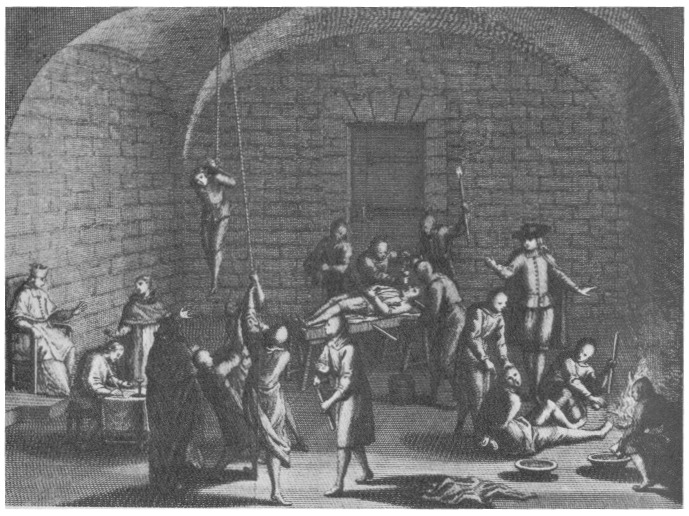
The interchange between the religious leaders and the man is not an indictment on Judaism, but rather on religious certitude in any time or place. The fact is that the Pharisees are no different than those who ran the Inquisition, or those who conducted Witch Trials or those who attempt to crush anyone who questions their immutable doctrine no matter what their religion.

They were and many of their theological and ecclesiastical descendants still are true believers. That has been demonstrated over and over again in regards to biblically and theologically challenged yet politically fanatical American Evangelical Christians who have willingly surrendered any pretense of following Christ to paying obeisance to President Trump; a would be dictator who plays to their perpetual sense of victimhood in order to cement his power over them and to use them as his willing foot soldiers.

What Trump has done has turned the Gospel on its head, the Christian faith has become a political bludgeon to support laws and policies that are in diametric opposition to the message of Jesus. Sadly, a large majority of Evangelicals and their leaders have become Trump’s willing accomplices.

In the episode of Star Trek the Next Generation called The Drumhead Captain Picard counsels Lieutenant Worf after their encounter with a retired admiral who turned an investigation involving a Klingon exchange scientist into a witch hunt aboard the Enterprise. That episode is well worth watching especially because it anticipates what is going on in the United States today, where a President, his party, and a reactionary fear filled cabal of religious followers has declared war on all who oppose them.

At the end of the episode Lieutenant  Worf comes to Captain Picard’s office. He is apologetic about having believed and cooperated with the Admiral. The dialogue is striking and should be heeded, especially by Evangelical Christians and others who have with open eyes sacrificed their faith even as they tear up the Constitution thinking that they are defending it.

WORF: Am I bothering you, Captain?
PICARD: No. Please, Mister Worf. Come in.
WORF: It is over. Admiral Henry has called an end to any more hearings on this matter.
PICARD: That’s good.
WORF: Admiral Satie has left the Enterprise.
PICARD: We think we’ve come so far. The torture of heretics, the burning of witches, it’s all ancient history. Then, before you can blink an eye, it suddenly threatens to start all over again.
WORF: I believed her. I helped her. I did not see what she was.
PICARD: Mister Worf, villains who wear twirl their moustaches are easy to spot. Those who clothe themselves in good deeds are well camouflaged.
WORF: I think after yesterday, people will not be as ready to trust her.
PICARD: Maybe. But she, or someone like her, will always be with us, waiting for the right climate in which to flourish, spreading fear in the name of righteousness. Vigilance, Mister Worf, that is the price we have to continually pay.

And that is true and despite the certitude of the true believers that we do live in the uncomfortable middle.

Peace

Padre Steve+

1 Comment

Filed under ethics, faith, News and current events, philosophy, Political Commentary, Religion, star trek

“We’ve Got Some Difficult Days Ahead…” The Assassination of Dr. Martin Luther King Jr. at 50 Years

20130404-203529.jpg

Friends of Padre Steve’s World,

Fifty years ago today a bullet killed Dr. Martin Luther King Jr. while he was in Memphis supporting Sanitation Workers who were being subjected to unsafe working conditions without the same rights, protections, pay, or benefits of white Sanitation workers. As always there were threats on King’s life and he knew that he was a target. The night before his assassination Dr. King spoke at Mason Temple the international headquarters of the Church of God in Christ, the largest historically Black denomination in the United States.

That speech is now known as the “I have been to the mountaintop” speech. Dr. King had flown into Memphis earlier in the day, on a flight delayed by a bomb threat. King like many Civil Rights leaders of his day lived under the constant threat of physical violence, intimidation and assassination. After the heady days of the great march in Washington and the I Have a Dream speech and the award of the Nobel Prize his positions on social and economic justice and his opposition to the Vietnam War had made him a pariah of sorts, even in the Black community. He had place himself in the gunsights of his opponents as he pressed on in spite of the opposition.

Life was precious to him, but he like many others understood that it could be cut short at any moment for simply speaking the truth about racial discrimination, prejudice and violence. King himself had been accosted at different times and spent time in jail for “breaking” laws that enforced and enabled institutions and individuals to discriminate against Blacks with no consequences whatsoever. He was called a radical, a Communist and anti-American by those that opposed any changes to the status quo. He knew that his life was always in danger.

In that speech Dr. King seemed to understand the threat but he was determined to go on and to do God’s will. Dr. King understood that the Christian faith required more than intellectual assent to a doctrine. He understood the words of the German martyr Dietrich Bonhoeffer: We are not to simply bandage the wounds of victims beneath the wheels of injustice, we are to drive a spoke into the wheel itself.”

At Mason Temple Dr King proclaimed:

“And then I got to Memphis. And some began to say the threats…or talk about the threats that were out… What would happen to me from some of our sick white brothers? Well I don’t know what will happen now. We’ve got some difficult days ahead. but it doesn’t matter with me now. Because I been to the mountaintop. And I don’t mind. Like anybody, I would like to live a long life. Longevity has its place. But I’m not concerned about that now. I just want to do God’s will. And He’s allowed me to go up to the mountain. And I’ve looked over.and I have seen the promised land. I may not get there with you. But I want you to know tonight, that we, as a people, will get to the promised land! And so I am happy, tonight. I’m not worried about anything. I am not fearing any man. Mine eyes have seen the glory of the coming of The Lord.”

It was April 4th 1968. The United States was divided by the Vietnam War and numerous social crises. President Lyndon Johnson had just done the unthinkable, he had announced that he was withdrawing from his reelection bid. In many places despite the integration of the Armed Forces, Baseball, the repeal of many Jim Crow laws and the passage of the 1964 Voter’s Rights Act African Americans still felt the sting of individual and institutional racial prejudice. In Vietnam the effects of the Tet Offensive still lingered even as American cities burned.

His speech at Mason Temple was almost prophetic in its message. The words of the thirty-nine year old Baptist Preacher from Atlanta echoed through the sanctuary of the church to the applause of those present even as a heavy spring thunderstorm rocked the city.

The following evening, King with a number of other Civil Rights leaders including Ralph Abernathy and Andrew Young were at the Lorraine Motel, where King often stayed. King was standing on the balcony outside of his room, Room 306 when at 6:01 PM he was cut down and mortally wounded by a single shot fired from a Remington 760 rifle. The bullet struck him in the right cheek, traveled down his spine and severed his jugular vein and several major arteries before it came to rest in his shoulder. He still had a heartbeat when the ambulance arrived and on his arrival at St Joseph’s Hospital. Efforts to revive him by opening his chest and attempting cardiac massage were unsuccessful and at 7:05 PM Dr King was pronounced dead.

20130404-221100.jpg

20130404-221225.jpg

Witnesses reported a man named James Earl Ray fleeing the area after the shooting. The Remington rifle and a pair of binoculars with Ray’s fingerprints were found at the scene. Ray was apprehended at London’s Heathrow Airport two months later. Ray was tried and convicted of Dr King’s murder. He was sentenced to 99 years in prison and died in 1998. During the trial Ray recanted his confession, implicated an unknown man named “Raul” who he had supposedly met in Montreal as being involved and said that “he personally did not kill” Dr King hinting at a conspiracy. Ray plead guilty to avoid the death penalty.

Other theories were postulated about the murder and Lloyd Jowers who owned a restaurant across from the Lorraine Motel claimed in a 1993 interview that the US Government and the Mafia were complicit in the killing, that Ray was a scapegoat and that Memphis Police Lieutenant Earl Clark was the shooter.

Jowers’ story is disputed but it was believed by King’s widow Coretta Scott King.  She filed a wrongful death lawsuit in which a jury found that Jowers and others including government agencies were guilty of the plot to kill Dr King on December 8th 1998. Though Jowers’ story was contradicted by much of his own testimony during the trial the results have caused a divide in who experts believe killed Dr King. As for the King family they reconciled with Ray before his death.

20130404-221809.jpg

Regardless of who killed Dr King the result was a shock to much of the nation and in many places riots broke out despite the pleadings of most Civil Rights leaders to continue in Dr King’s path of non-violence.

20130404-230118.jpg

Senator Robert F Kennedy, then running for the Democratic Party nomination for President learned of Dr King’s shooting just before flying to Indianapolis for a campaign rally. On his arrival he learned of Dr King’s death. Warned by police that he could be in danger he made an impromptu speech from the back of a flat bed truck. The speech was short, under 5 minutes but its message is applicable even today.

“Ladies and Gentlemen,

I’m only going to talk to you just for a minute or so this evening, because I have some — some very sad news for all of you — Could you lower those signs, please? — I have some very sad news for all of you, and, I think, sad news for all of our fellow citizens, and people who love peace all over the world; and that is that Martin Luther King was shot and was killed tonight in Memphis, Tennessee.

Martin Luther King dedicated his life to love and to justice between fellow human beings. He died in the cause of that effort. In this difficult day, in this difficult time for the United States, it’s perhaps well to ask what kind of a nation we are and what direction we want to move in. For those of you who are black — considering the evidence evidently is that there were white people who were responsible — you can be filled with bitterness, and with hatred, and a desire for revenge.

We can move in that direction as a country, in greater polarization — black people amongst blacks, and white amongst whites, filled with hatred toward one another. Or we can make an effort, as Martin Luther King did, to understand, and to comprehend, and replace that violence, that stain of bloodshed that has spread across our land, with an effort to understand, compassion, and love.

For those of you who are black and are tempted to fill with — be filled with hatred and mistrust of the injustice of such an act, against all white people, I would only say that I can also feel in my own heart the same kind of feeling. I had a member of my family killed, but he was killed by a white man.

But we have to make an effort in the United States. We have to make an effort to understand, to get beyond, or go beyond these rather difficult times.

My favorite poem, my — my favorite poet was Aeschylus. And he once wrote:

Even in our sleep, pain which cannot forget falls drop by drop upon the heart, until, in our own despair, against our will, comes wisdom through the awful grace of God.

What we need in the United States is not division; what we need in the United States is not hatred; what we need in the United States is not violence and lawlessness, but is love, and wisdom, and compassion toward one another, and a feeling of justice toward those who still suffer within our country, whether they be white or whether they be black.

So I ask you tonight to return home, to say a prayer for the family of Martin Luther King — yeah, it’s true — but more importantly to say a prayer for our own country, which all of us love — a prayer for understanding and that compassion of which I spoke.

We can do well in this country. We will have difficult times. We’ve had difficult times in the past, but we — and we will have difficult times in the future. It is not the end of violence; it is not the end of lawlessness; and it’s not the end of disorder.

But the vast majority of white people and the vast majority of black people in this country want to live together, want to improve the quality of our life, and want justice for all human beings that abide in our land.

And let’s dedicate ourselves to what the Greeks wrote so many years ago: to tame the savageness of man and make gentle the life of this world. Let us dedicate ourselves to that, and say a prayer for our country and for our people.

Thank you very much.”

Two months later Kennedy was shot and mortally wounded by Sirhan Sirhan after winning the California Primary.

The loss of Dr King and later Senator Kennedy was profound. So tonight take the time to remember and pray that we all will be able to go to the mountain and see the promised land where in a more perfect Union we will heal the wounds that so divide our country.

20130405-004046.jpg

Today the rights that Dr. King and so many others fought for dating back to the days of Frederick Douglass are being rolled back at the local, state and Federal level. The administration of President Trump and Republican led statehouses have been working overtime to silence dissent, discredit opposition, and through unjust laws and policies upend the civil rights not only of Blacks, but other people of color, immigrants, women, LGBTQ people, and Muslims.

Dr. King noted the night before he was slain that “we’ve got some difficult days ahead” but as he told his staff in January 1968 “Hope is the final refusal to give up.”

Peace

Padre Stave+

Leave a comment

Filed under christian life, civil rights, ethics, faith, History, leadership, ministry, News and current events, Political Commentary, Religion

I had a Comrade: Farewell LTC John Penree

Friends of Padre Steve’s World,

Today marks a solemn occasion at our base. We will be saying our farewell at a memorial service for our Army Deputy Commander, Lieutenant Colonel John Penree. He passed away late last Monday night. He was beloved by many and had served our country in the New York Army National Guard and the United States Army for 42 years.

He will receive full military honors in the ceremony which is a collaboration between the Army and the Navy. His wife Patty and his six children will be in attendance along with a number of high ranking officers and other dignitaries. I only knew and worked with him for a year but came to love him and consider him a friend. We had worked together the Saturday before he died at a ceremony marking opening day for the Little League the meets on our base. Not long before that we had enjoyed a day working and playing with the German contingent from NATO and their families. He was a good man and a good comrade in arms. In the words of the old German military funeral march Ich hatt’ ein Kameraden “Ich hatt’ ein Kameraden, Einen bessern findest du nit…” I had a comrade, you will find none better.

Today I will include that thought in my meditation at the service and will,close the service with the words of Lieutenant Colonel John McRea, a Canadian Soldier, physician, and poet in the First World War. His poem, In Flanders Fields is a classic and it speaks to soldiers as few poems can:

In Flanders fields the poppies blow

    Between the crosses, row on row,

  That mark our place; and in the sky

  The larks, still bravely singing, fly

Scarce heard amid the guns below.

We are the Dead.   Short days ago

We lived, felt dawn, saw sunset glow,

  Loved and were loved, and now we lie

      In Flanders fields.

Take up our quarrel with the foe:

To you from failing hands we throw

  The torch; be yours to hold it high.

  If ye break faith with us who die

We shall not sleep, though poppies grow

      In Flanders fields.

I will leave you with that and ask you to pray for John, his family, and those that he leaves behind.

Until tomorrow,

Peace

Padre Steve+

1 Comment

Filed under faith, Military, ministry, shipmates and veterans

Reflections on Holy Week 2018

Friends of Padre Steve’s World,

Those who follow this blog and people who know me know how much I have struggled with faith since returning from Iraq ten years ago, especially during Holy Week. Truthfully it has been one of the most difficult times of the Church year for me, but over the past year I have rediscovered faith, yes I still doubt but I believe a lot more than I have for quite a long time.

Holy Week is over but the Easter Season has just begun. Likewise it will be about another week before I get some real time off after pretty much working every day for the past two weeks. That being said though tired and a bit emotionally worn down from it especially with the sudden death of our Army Deputy Base Commander on Monday night which led to a very full day on Tuesday which also was my 58th birthday, a funeral on Wednesday for one of our long time Catholic parishioners who like my father was a retired Chief Petty Officer who died of complications from Alzheimer’s Disease, our Ecumenical Good Friday service, various medical appointments, and Chaplain duty supervisor tasks culminating in our oceanfront Easter Sunrise Service at the First Landing monument at Fort Story and ministry afterwards.

Tomorrow will be full getting ready for the memorial service for our Deputy Commander which takes place Tuesday. Wednesday is filled with meetings, Thursday I begin working with children of our German NATO contingent to get them ready for their confirmation in May. I’ll conclude the week with medical appointments for my Sleep Apnea and checking to see how my C-Pap machine is doing.

But all of that being said I emerged from Holy Week doing a lot better than I thought. For the first time in years sensing a certain amount of joy in my faith, a reaffirmation of my priestly vocation; and this despite all injustices I see and threats of war, especially in the threat that I feel that the President poses to the country and the world. Despite the sadness of my Deputy Commander and friend’s death I was comforted by the Orthodox Prayers that I had the opportunity to pray over his body in one last time with him. Part of those prayers from the Trisagion service was a reminder of the promise of Easter in between the reading of the Passion Gospels on Palm Sunday and Good Friday:

“O God of spirits and of all flesh, You trampled upon death and abolished the power of the devil, giving life to Your world. Give rest to the soul of Your departed servant in a place of light, in a place of green pasture, in a place of refreshment, from where pain, sorrow, and sighing have fled away…”

As I studied for my Good Friday and Easter Sunrise services I was drawn back to the writings of the German Lutheran theologian Jurgen Moltmann and the Swiss Reformed theologian Karl Barth.

One of thing Moltmann wrote really struck me in regard to Good Friday. I finished that sermon quoting and then discussing it for a few minutes:

“When God becomes man in Jesus of Nazareth, he not only enters into the finitude of man, but in his death on the cross also enters into the situation of man’s godforsakenness. In Jesus he does not die the natural death of a finite being, but the violent death of the criminal on the cross, the death of complete abandonment by God. The suffering in the passion of Jesus is abandonment, rejection by God, his Father. God does not become a religion, so that man participates in him by corresponding religious thoughts and feelings. God does not become a law, so that man participates in him through obedience to a law. God does not become an ideal, so that man achieves community with him through constant striving. He humbles himself and takes upon himself the eternal death of the godless and the godforsaken, so that all the godless and the godforsaken can experience communion with him.”

Two quotes, one from Moltmann and the other by Barth really stayed with me for the Sunrise service. Moltmann wrote: “In the cross of Christ God is taking man dead-seriously so that he may open up for him the happy freedom of Easter. God takes upon himself the pain of negation and the God forsakenness of judgement to reconcile himself with his enemies and to give the godless fellowship with himself,” as did these words of Barth:

“What happened on that day (of Easter) became, was and remained the centre around which everything else moves. For everything lasts its time, but the love of God – which was at work and was expressed in the resurrection of Jesus Christ from the dead – lasts forever. Because this event took place, there is no reason to despair, and even when we read the newspaper with all its confusing and frightening news, there is every reason to hope.”

For the first time in years I could truly exclaim the Easter Alleluia, that Christ is Risen.

So until tomorrow,

Peace

Padre Steve+

2 Comments

Filed under christian life, faith, Pastoral Care, Religion