Monthly Archives: September 2018

The Development of Cavalry in the American Civil War

gallonbuyingtime

Friends of Padre Steve’s World,

Today, since I am tired and it looks like I am not get a chance to write anything new before we begin our trip to Germany I am going to  I am post a revised part of one of my Civil War texts.  This one deals with the organization, use, and development of cavalry during the war in the United States Army and the Army of the Confederate States Army.  

Peace

Padre Steve+

Cavalry in the United States in the ante-bellum period and during the war differed from the massive cavalry arms of European armies. In Europe the major armies had two types of cavalry units, light cavalry which was used for scouting, reconnaissance and screening, and heavy cavalry which was designed to be employed at the decisive moment of the battle in order to break enemy infantry formations through the shock of the massed charge. Napoleon always had a number of reserve cavalry corps to fulfill this mission.

The United States had little in the way of a cavalry tradition. Cavalry was considered by many American political leaders to be too aristocratic for America and as a result this arm of service suffered. In its early years the U.S. Army did not have any sizable mounted formations to call upon.

There were a number of other reasons for the cultural and institutional resistance to a strong were trained and armed cavalry service in the United States Army.

First, the nation as a whole distrusted large standing armies and viewed them as a source of potential tyranny and traditional cavalry was the most aristocratic part of European armies. The struggle between Federalists who desired a standing army and a militia that could be organized under central control and Republicans who wanted nothing of the sort was a constant source of friction in the new republic. Anti-Federalists saw standing armies as despotic, as one anti-federalist publication noted “In despotic governments, as well as in all the monarchies of Europe, standing armies are kept to execute the commands of the prince or magistrate…. By establishing an armed force to execute the laws at the point of the bayonet – a government of all others is the most to be dreaded.” [1]

As such, much of the nation’s military spending was focused on the Navy, which was deemed as less of a domestic threat, and even then the limited budgets meant that many times significant numbers of ships were laid up in ordinary. The Regular Army struggled to maintain its existence from 1787 until the War of 1812 in the face of Republican opposition led by Thomas Jefferson. After the War of 1812 the nation soon lost interest in paying for a standing army and in 1821 against the wishes of Secretary of War John C. Calhoun slashed “the Army’s strength by eliminating regiments and reducing the number of officers.” [2] With appropriations cut to the bone there was no effort to create a cavalry arm for the service as cavalry formations were much more expensive to equip and maintain than infantry.

Even though the Regular Army survived, it was tiny in. Its strength ranged from 3,000 to 6,000 men, the bulk were infantry who for the most part formed a frontier constabulary or manned coastal fortifications. However, in 1796 two companies of Dragoons were authorized, but even so the mounted arm remained a poor stepchild. Likewise, “Doctrinal resistance to battle cavalry was also very strong. The ‘American’ tradition had no place for such an animal….” [3]

Finally as the nation expanded westward the army formed the First Dragoon Regiment in 1833. In 1836 the Second Dragoons were organized. The Dragoons were basically mounted infantry formations and these units were scattered about the expanding western frontiers of the nation were employed “guarding the routes of expansion as far west as the Rocky Mountains and as far south as the Red River.” The army also formed Mounted Infantry units, which like the Dragoons were hybrid formations. Though many thought that such units promised “a double return on the government’s investment, but which did not manage to provide either an efficient force of infantry or an efficient battle force of cavalry.” [4]

The First Dragoons would serve with “distinction in numerous engagements in what was to become California and New Mexico.”[5] The regiment fought well in the War with Mexico but suffered heavy casualties in the process. When the war ended it was again dispersed on the frontier when it was used to protect settlers and fight Native American tribes that resisted the advance of the flood of white settlers.

One of the reasons for the heavy losses sustained by the First Dragoons in Mexico was because “West Point cavalry doctrine was based upon a Napoleonic mania for the massed saber charge.” [6] However, one problem with this was that the United States Army never had sufficient numbers of cavalry, not to mention a death of heavy cavalry needed to make such attacks successful, but in Mexico the limited number of cavalry troops available made such tactics untenable. The tactic had often worked well for Napoleon and massed cavalry charges were used to sweep the field of broken enemy infantry formation. However, the suicidal charge of Marshal Ney’s vaunted Cuirassiers against the Duke of Wellington’s highly disciplined infantry squares at Waterloo had shown that such tactics were destined for extinction unless they were part of an all arms assault. Marshal Ney failed because he used his cavalry in unsupported attacks against the allied infantry squares rather advancing artillery to support the attack or bringing infantry up to force the defenders out of their squares.

It was not until the 1850s that the army organized its first two Cavalry regiments for duty on the frontier. The new cavalry regiments were the equivalent of European light cavalry and during the war primarily served in that role, conducting reconnaissance, raids, and screening the army. Even so the tactical doctrine taught at West Point focused continued to “support the continuing predominance of the offense over the defense, of shock over firepower” [7] which was at odds with the cavalry’s actual capabilities.

Cavalry regiments were usually composed of four to six squadrons, each squadron having two companies. Cavalry regiments could range in size from 660 to nearly 1,200 troopers. Both the Union and the Confederacy grouped their cavalry into brigades and later divisions, but the Confederates were first to establish cavalry brigades and divisions. By 1863 both the Confederate Army of Northern Virginia and the Union Army of the Potomac each formed cavalry corps. Cavalry tactics “complemented conventional infantry assault tactics, emphasizing shock and the role of the saber”; unfortunately both the infantry and the cavalry developed their doctrine independently. U.S. Army Cavalry doctrine was prescribed in Philip St. George Cooke’s Cavalry Tactics which was published in 1861 while a corresponding Confederate manual, Joseph Wheeler’s A Revised System of Cavalry Tactics appeared in 1863.

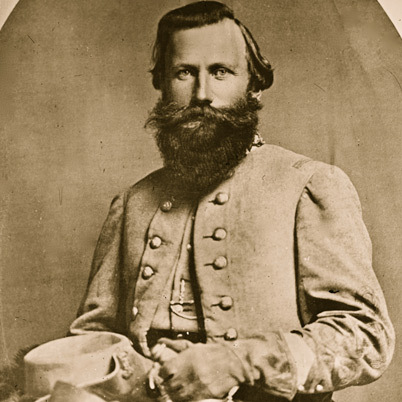
Before the war American cavalry units tended to operate in small numbers with regiments seldom sending into action more than a few companies at once. At the beginning of the war the Federal government decided to form just five mounted regiments, including two of Dragoons and one of Mounted Infantry. It soon decided to add a sixth but the units were hindered by the fact that many of their officers had gone to the Confederacy, and some of those remaining “would jump to volunteer units to secure higher rank, pay, and prestige.”[8] The result was defeat after defeat at the hands of J.E.B. Stuart’s Confederate cavalry.

Eventually large scale programs to train and equip large numbers of volunteers and the Regulars combined with wartime reorganizations and solid leadership would make the Federal cavalry a force that was able to hold its own and then to sweep Confederate cavalry from the field. But it took time to train cavalry, and early Union commanders like McClellan refused to take that time and a “whole year was lost as a result, during which the cavalry was allowed to indoctrinate itself in the notion that it could never make use of European standards.” [9] While McClellan may have done well in organizing and training the infantry and artillery of the Army of the Potomac, he did little in the way of providing the mounted arm with leaders, training or missions that would increase their effectiveness. Unlike Stuart who combined his troopers with effective horse artillery, McClellan “failed to appreciate the advantage of coordinating the tactical strengths of cavalry with those of infantry and artillery.” [10]
CWP015

J.E.B. Stuart

While the South did struggle at times with its cavalry arm but did have an advantage in that the vast majority of their cavalry troopers owned their mounts and were experienced horsemen, something that could not be said of the many city dwellers who volunteered for duty in the Union cavalry. But the initial Southern superiority in cavalry was also due to the fact that “the principal of massing regiments into brigades and divisions was pursued earlier than by the Federal.” [11] In contrast McClellan “followed the evil course of reducing mounted regiments to their smallest components for operational use.” Likewise, he “wasted cavalry’s potential and depressed its morale by employing it as couriers, bodyguards for his subordinates, pickets for his encampments, and wagon train escorts, instead of as combat troops.” [12] The result as one would expect was that for the first two years of the war “J.E.B. Stuart and his horsemen were able, literally, to run rings around their opponents.” [13]

One Union writer compared the development of the Confederate and Union cavalry arms during the war:

“The habits of the Southern people facilitated the formation of cavalry corps which were comparatively efficient even without instruction; and accordingly we see Stuart, John Morgan, and Forrest riding around with impunity around the Union armies, and destroying or harassing their communications. Late in the war that agency was reversed. The South was exhausted of horses, while the Northern cavalry increased in numbers and efficiency, and acquired the audacity which had characterized the Southern.” [14]
buford

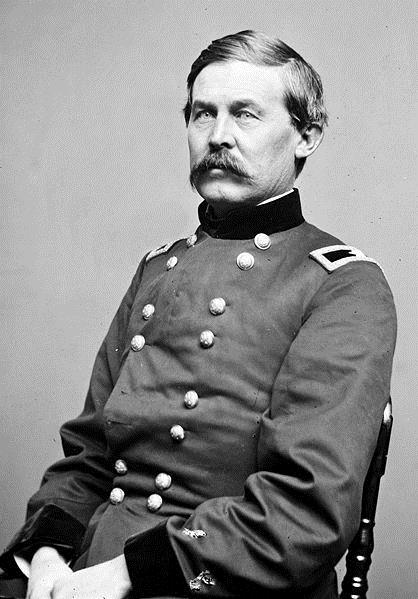
John Buford

As such much of the initial improvement in the Union cavalry arm were due to solid commanders like Brigadier General John Buford to teach new recruits as well as discouraged veterans to become effective cavalrymen.

Cavalry remained a fairly small in comparison to the infantry and artillery branches of service. Even during the wartime expansion the amount of cavalry available was miniscule compared to European armies. On the average only about 8% of the Army of the Potomac was composed of cavalry, compared to Napoleon’s 20 to 25%. [15] Part of this was due to the perceived cost of the cavalry arm which many believed was too expensive to maintain on a large scale: “estimates held that every twelve companies mounted and outfitted at public expense would rob the Treasury of over $300,000 a year merely to cover upkeep on animals, remounts, weapons, and equipment….” [16]

The cost of equipping cavalry was high enough that in the South that troopers had to procure their own mounts. Edwin Coddington noted that the Confederate policy “was a wonderful arrangement for keeping the strength of the cavalry below par, much more than enemy bullets, for it encouraged absenteeism.” [17] The Confederate government paid the own for the use of the horse, and a cash reimbursement if it was lost in combat, but if it was lost in any other manner the soldier had to get another horse if he wanted to remain in the service. Since the Confederates never set up a “centralized replacement service” troopers who lost their mount “had to go home to procure a new horse. If he were a Virginian he needed from thirty to sixty days to accomplish his purpose, and a much longer time should he have to come deeper south.” [18]

Despite the doctrinal predilection to the offense and using the cavalry as a shock unit, the U.S. Army formed no heavy cavalry formations on the order of the famous French Cuirassiers, named after their armored breastplates and metal helmets which were the primary type of cavalry used in Europe for such tactics. As such, during the Civil War both Union and Confederate cavalry formations were primarily assigned to reconnaissance and screening missions normally conducted by light cavalry units in Europe. These larger formations began to be used en masse for the purpose of raiding by both sides “but in the hands of J.E.B Stuart and his friends it became little more than a license to roam off into the enemy’s rear areas looking for plunder and glory.”[19] The cavalry Corps of the Army of the Potomac was used in a similar manner to raid enemy rear areas with often dreadful results which contributed nothing to the overall goal of defeating Lee’s army. A prime example was when Joseph Hooker detached his newly formed Cavalry Corps under George Stoneman to raid Richmond leaving the flank of the army uncovered at Chancellorsville.

Quite often the soldiers assigned to the infantry and artillery had little use for the cavalry who they saw as pampered and contributing little to the war. Many infantrymen held the “cavalry in open contempt. “These cavalry are a positive nuisance,” an officer in the 123rd Illinois wrote. “They won’t fight, and whenever they are around they are always in the way of those who will fight.” [20] Disdainful Confederate infantrymen “greeted their cavaliers with “Here’s your mule!” and “their Federal counterparts would exclaim: “There’d going to be a fight, boy; the cavalry’s running back!” and “Whoever saw a dead cavalryman.”[21]

The lethality of the rifled musket also made the classic Napoleonic cavalry charge against enemy infantry a costly and dangerous enterprise if the enemy infantry still had the means to make organized resistance, and if the cavalry assault was not supported by infantry and cavalry.. An example of this was the ill-fated cavalry attack ordered by Brigadier General Judson Kilpatrick against the men of Lafayette McLaws’s well prepared division on the Confederate right after the failure of Pickett’s Change at Gettysburg.

Cavalry tactics began to change during the war. Both sides used their cavalry for raids, sometimes very large ones, and operations against enemy partisans in their rear areas. In each case the cavalry was typically deployed by itself and even when it accompanied the armies into battle cavalry units were typically employed on the periphery of the battle. As such as Griffith wrote, “Civil War doctrine of raiding… was not only a deliberate turn away from the hope of victory on the battlefield, but it actually removed the means by which victory might have been won at the very moment when those means were at last starting to be properly efficient.” [22] The lack of heavy cavalry of the European model sometimes kept commanders from completing victories, one can only imagine what would have happened had George Meade had a division of heavy cavalry at hand to sweep the Confederates from the battlefield after Pickett’s Charge.
sheridanphiliphbio

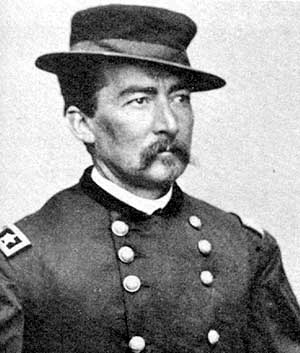
Philip Sheridan

Tactics only began to change when General Philip Sheridan took command of Grant’s cavalry. Sheridan kept the cavalry close to the main body of the arm. Sheridan had replaced Major General Alfred Pleasanton as commander of the Cavalry Corps of the Army of the Potomac in early 1864. It is quite possible had he not died in December 1863 that the post would have gone to John Buford, but Sheridan had a vision for the cavalry that foreshadowed modern operational art. Sheridan wanted to organize the Cavalry Corps by concentrating it “into a powerful striking arm. He desired to do this, first, to deal with the Confederate cavalry, on the theory that “with a mass of ten thousand mounted men… I could make it so lively for the enemy’s cavalry that… the flanks and rear of the Army of the Potomac would require little or no defense.” [23] Sheridan was making no idle boast as by now his troops “were not only more numerous, but they had better leaders, tactics, and equipment than before,” [24] especially when it came to the Spencer repeating rifle which was now standard issue for the cavalrymen, and which gave them a tremendous advantage in firepower over Stuart’s now ill-equipped troops.

Sheridan first did this at the beginning of the Wilderness campaign when he took his 10,000 strong corps around the Confederate flank. Sheridan had been quarreling with Meade about the latter’s insistence that Sheridan’s horsemen were clogging the roads that his infantry needed to advance upon. In the heated discussion Sheridan came very close to being insubordinate with Meade. Meade reportedly told Sheridan that “Stuart “will do about how he pleases anyhow” to which Sheridan supposedly replied “Damn Stuart, I can trash hell out of him any day.” [25] Furious, Meade went and reported the matter to Grant. Grant listened and replied “Did Sheridan say that?… He usually knows what he is talking about. Let him go ahead and do it.” [26] At Grant’s request Meade provided Sheridan with new orders to concentrate his cavalry, march south and engage Stuart’s cavalry. Unlike previous raids which sought to avoid battle with Stuart’s troops in order to hit prescribed objectives, above all Sheridan wanted to engage and defeat the legendary Confederate cavalier. He “defined the raid as “a challenge to Stuart for a cavalry duel behind Lee’s lines in his own country.” And the more there were of the gray riders when the showdown was at hand, the better he would like it, since that would mean there were more to be smashed up.” [27]

Sheridan’s column totaled nearly 13,000 men and was nearly 13 miles long as he proceeded at a slow pace around Lee’s army and south towards Richmond. In addition to his horsemen he brought all of his horse artillery batteries. He was well around Lee’s flank before he was discovered and during the march his troops burned a depot and over one hundred railroad cars containing “close to a million rations of meat and better than a half million of bread, along with Lee’s entire reserve of medical stores.” [28]

On May 11th Stuart managed to intercept Sheridan’s column at a place called Yellow Tavern, just south of Ashland and the Ana River, but his corps was outnumbered by at least three to one. Three well trained, experienced, equipped, and superbly led Federal cavalry divisions confronted Stuart. With no hopes of fighting an offensive action, Stuart’s troops fought dismounted and were routed by the superior Bluecoats who continued on to cut the railroad between Lee’s army and Richmond. During the battle Stuart, who had cheated death on a number of occasions was mortally wounded. The Confederate cavalry of the Army of Northern Virginia would never recover, and to Southerners Stuart’s death was a profound psychological blow, only slightly worse than that of Stonewall Jackson a year before. Robert E. Lee, to who Stuart was like a son took the loss harder than he had taken Jackson’s. “I can scarcely think of him without weeping,” he told one of Stuart’s officers.” [29]

As the armies in the East and West dueled throughout 1864, Sheridan and other Federal cavalry officers transformed the Union cavalry into a striking force which could be the spearhead of the army and use new tactics to overcome the problem of combining fire with rapid maneuver which had never been satisfactory applied by the infantry. There were four components in the new tactical mix: “fast operational mobility on horseback out of contact with the enemy; a willingness to take cover and fight on foot when the enemy was close; new repeating carbines to give enhanced firepower; and a mounted reserve to make the sabre charge when the moment was ripe.” [30] Sheridan would apply these tactics in his later campaigns against Jubal Early in the Shenandoah Valley and during the Appomattox campaign and his cavalry, working with infantry and artillery smashed the beleaguered Confederate armies which tried to oppose them. The reorganized cavalry was not the answer to all of the battlefield problems faced by Civil War commanders but it gave Union commanders an impressive weapon in which the speed and firepower of the cavalry could be readily combined with artillery and infantry to achieve decisive results. On the Confederate side, General Joseph Wheeler who commanded the cavalry in the west, Wheeler usually fought dismounted in “skirmish order using field fortification, whether skirmishing independently or in the line…. In the last major action of the war, he dramatically displayed how cavalry had become tactically integrated with infantry. At Bentonville, while fighting his cavalry dismounted, first on the right, then moving around to the left flank, Wheeler constructed a line of breastworks 1,200 yards long.” [31]

European cavalry officers found little to admire in American use of cavalry. Few paid attention to the importance of fighting dismounted and working as part of a combined arms team. In August 1914 their cavalry formations paid severe price for ignoring the realities of modern war, realities which the Americans, both Union and Confederate learned during the Civil War.

Notes

[1] ____________ Anti-Federalists Fear a Large Military “Brutus I.” “To the Citizens of the State of New York” 1787 in Major Problems in American Military History edited by John Whiteclay Chambers II and G. Kurt Piehler, Houghton-Mifflin and Company, Boston and New York 1999 p. 103

[2] Ibid. Millet and Maslowski For the Common Defense: A Military History of the United States p.122

[3] Ibid. Griffith, Battle Tactics of the Civil War p.181

[4] Ibid. Griffith, Battle Tactics of the Civil War p.181

[5] Longacre, Edward G. John Buford: A Military Biography Da Capo Press, Perseus Book Group, Cambridge MA p.33

[6] Thomas, Emory M. Bold Dragoon: The Life of J.E.B. Stuart University of Oklahoma Press, Norman OK 1986 and 1999 p.30

[7] Ibid. Hagerman The American Civil War and the Origins of Modern Warfare p.21

[8] Longacre, Edward G. The Cavalry at Gettysburg: A Tactical Study of Mounted Operations, during the Civil War’s Pivotal Campaign, 9 June- 14 July 1863. University of Nebraska Press, Lincoln and London 1986 p.44

[9] Ibid. Griffith, Battle Tactics of the Civil War p.182

[10] Ibid. Longacre The Cavalry at Gettysburg: A Tactical Study of Mounted Operations, during the Civil War’s Pivotal Campaign, 9 June- 14 July 1863 p.45

[11] Ibid. Griffith, Battle Tactics of the Civil War p.181

[12] Ibid. Longacre The Cavalry at Gettysburg: A Tactical Study of Mounted Operations, during the Civil War’s Pivotal Campaign, 9 June- 14 July 1863 p.45

[13] Ibid. Griffith, Battle Tactics of the Civil War p.183

[14] Buell, Don Carlos. East Tennessee and the Campaign of Perryville in Battles and Leaders of the Civil War Volume III, The Tide Shifts. Edited by Robert Underwood Johnson and Clarence Clough Buel Castle, Secaucus NJ p.51

[15] Ibid. Griffith, Battle Tactics of the Civil War p.181

[16] Ibid. Longacre The Cavalry at Gettysburg: A Tactical Study of Mounted Operations, during the Civil War’s Pivotal Campaign, 9 June- 14 July 1863 p.43

[17] Coddington, Edwin B. The Gettysburg Campaign: A Study in Command, A Touchstone Book, Simon and Schuster New York, 1968 p.17

[18] Ibid. Coddington The Gettysburg Campaign: A Study in Command p.17

[19] Ibid. Griffith, Battle Tactics of the Civil War p.183

[20] Ibid. Robertson Soldiers Blue and Gray p.20

[21] Ibid. Longacre The Cavalry at Gettysburg: A Tactical Study of Mounted Operations, during the Civil War’s Pivotal Campaign, 9 June- 14 July 1863 p.45

[22] Ibid. Griffith, Battle Tactics of the Civil War pp.183-184

[23] Ibid. Weigley A Great Civil War: A Military and Political History 1861-1865 p.369

[24] Ibid. Whelan Bloody Spring: Forty Days that Sealed the Confederacy’s Fate p.181

[25] Ibid. Thomas Bold Dragoon: The Life of J.E.B. Stuart p.288

[26] Catton, Bruce Grant Takes Command Little, Brown, and Company, New York, Toronto, London 1968 and 1969 p.216

[27]Ibid. Foote The Civil War, A Narrative. Volume Three Red River to Appomattox p.564 p.224

[28] Ibid. Foote The Civil War, A Narrative. Volume Three Red River to Appomattox p.564 p.225

[29] Ibid. Korda, Clouds of Glory p.626

[30] Ibid. Griffith, Battle Tactics of the Civil War p.184

[31] Ibid. Hagerman The American Civil War and the Origins of Modern Warfare p.298
Leave a comment

Filed under civil war, Gettysburg, History, Military, us army

Pardon Me, But… Reflections on the Evangelical Dead Enders of Trump World

Friends of Padre Steve’s World,

Pardon me tonight, but as I watch the descent into collective madness of the Trump regime and its acolytes as the walls close in around it I wonder what acts of desperation they will resort in the coming weeks until the mid-term elections and afterward should the Democrats regain control of the House, Senate, or both.

Truthfully, am afraid of what Trump, his Vichy Republican supporters and the cult-like base might do if they lose. In normal times and with normal players in our system with its checks and balances I wouldn’t be concerned, but with this crew I am concerned and I wouldn’t be surprised at anything that they might do to retain power.

I have lost count of the number of egregious policies and behaviors of the administration and its most fervent supports. It is like watching a cult leader and his disciples. Republican strategists and “Never Trumper” Rick Wilson noted of the Evangelicals that make up a significant part of his base:

Evangelicals are the dead-enders of the Trump world, a phenomenon explained by both demographics and geographic distribution; the southern and Midwestern states where they live are Trump country, writ large. He is their Golden Calf, and the leaders of the Evangelical movement repeat daily, “This is your god, who brought you up from Egypt.”

While I know many evangelicals who are truly in their personal lives the salt of the earth, but as for their high powered leaders who have over the course of more than three decades led them to surrender their lives and sell their souls for 30 small disc shaped pieces of metal composed of 97.5% zinc and 2.5% copper, if that much.

Believe me I know what I am talking about. I spent much of my young adult life and ministry in that world. In the early 1990s I worked at the headquarters of a major Evangelist who in 2016 became a political prostitute for candidate Trump, but I woke up after seeing the lies and the human cost of that devotion during my time in Iraq, long before Donald Trump burst on the Republican political scene.

Even before Trump came on the scene I experienced what it was like to have “Christian friends” turn their backs on me because I was no longer politically conservative enough for them. Yet after Trump, the cesspool that is political evangelicalism is far more toxic than it ever was. It’s leaders seem to have flushed anything redemptive in the Gospel down their gilded toilets, and some seem to be competing for the position of Reichsbishof in the new order. For them it is all about the raw acquisition of worldly power, the curse that has infected the Church since Constantine.

Dietrich Bonhoeffer wrote:

Christianity stands or falls with its revolutionary protest against violence, arbitrariness and pride of power and with its plea for the weak. Christians are doing too little to make these points clear rather than too much. Christendom adjusts itself far too easily to the worship of power. Christians should give more offense, shock the world far more, than they are doing now. Christian should take a stronger stand in favor of the weak rather than considering first the possible right of the strong.

This is something that far too many American Christian leaders and their followers have forgotten. Instead they have become vengeful instruments of the most ungodly and unprincipled man ever to serve as the American President, and maybe any man that has ever aspired to be President, and that my friends takes a lot of effort.

Rick Wilson, who knows the current generation of Christian leaders well due to his position in Republican administrations and as a political consultant to many GOP candidates wrote of them:

Changing hearts and minds in a society that has passed them by on many issues is boring and hard work. They’d rather compromise with a candidate who will nominate their preferred judges than uphold their values. Instead of working to change society through moral suasion, exemplars of faith, or even just better communications, they’d rather trust the federal government in the hands of Donald Trump to deliver their desired social end states. Call me crazy, but I thought that was the other team’s modus operandi.

Anyway, like I said in the beginning of this article, pardon me tonight, but…

Until tomorrow,

Peace,

Padre Steve+

Leave a comment

Filed under ethics, faith, Political Commentary

Preparing for Another Trip to Germany

Friends of Padre Steve’s World,

Later this week we will be flying to Germany for what has seemingly become an annual pilgrimage. While there we will be seeing friends as well as enjoying the Oktoberfest in Munich, seeing historical places, and exploring towns where Judy’s ancestors came from in the Rheinland-Pfalz, Baden-Württemberg, and the Alsace in France.

While in Munich I plan to again visit Dachau and the Sophie Scholl museum at Munich University and hopefully a number of other sites. I have a ticket for a soccer match between Bayern-München and Augsburg at Allianz area.

Outside of Munich it looks like we will visit the Flossenbürg and Buchenwald Concentration Camps Southwest of Berlin. We will stay in Wittenberg where Martin Luther began the Protestant Reformation, and the Wartburg Castle in Eisenach where Luther was hidden after his defense and excommunication before the Imperial Diet at Worms. In his ten months of hiding he translated the New Testament from Greek into German.

We will visit friends in Berlin. It will be our first visit to the city since November of 1986, before the fall of the Berlin Wall. It will be interesting to see the redone Reichstag, walk under the Brandenburger Tor, as well as see the the Berlin Monument to the Holocaust, the Kaiser Wilhelm Memorial Church, the Bendlerstrasse Museum to the German anti-Nazi resistance, the Berlin Holocaust Memorial, and the Wannsee House.

From Berlin we will stay with friends near Karlsruhe one the Rhein River near the French Border for a few days before returning to Munich for our flight home.

I’ll be writing and posting about those things and more in the coming weeks, but for now I will wish you a good night.

Until tomorrow,

Peace,

Padre Steve+

Leave a comment

Filed under History, Loose thoughts and musings, Travel

The Birmingham Church Bombing and the Never Ending Scourge of Race Hatred in the United States

SixteenthStBaptistBomb05

Friends of Padre Steve’s World

On September 16th 1963 a young Southern White lawyer in Birmingham Alabama spoke these words after a black church was bombed and the police attacked peaceful protesters:

“from anger and despair, from frustration and empathy. And from years of hopes, hopes that were shattered and crumbled with the steps of that Negro Baptist Church.”

Most Americans will not recognize the names and I would dare say that many do not even know about what happened in Birmingham Alabama 52 years ago today. At 10:22 in the morning on September 15th 1963 a bomb exploded during the worship service at the 16th Street Baptist Church. It was one of the most brazen attacks against a church in the modern era, and men who claimed to be “Christians” committed it.

MCNAIR ROBERTSON COLLINS WESLEY

Four young girls, three 14 year olds and one 13 year old were killed. Addie Mae Collins, Denise McNair, Carole Robertson and Cynthia Wesley lost their lives that day. Twenty-two other church members were wounded in an attack, which was carried out by members of the KKK and tacitly approved of by many political leaders including Alabama Governor George Wallace. Why were they killed and why were the others wounded? For the crime of being black and the crime of their church serving as a focal point of the Civil Rights movement.

Likewise, most people, including many blacks do not know that before that beginning in 1955 there had been 19 other bombings of black churches and the homes of black leaders in Birmingham before this one. But even before that outbreak of violence, Birmingham had become known as “Bombingham”because over 50 bombing attacks against blacks, black churches and black institutions in the years after the First World War.

The church had served as a focal point of the Freedom Summer where Civil Rights activists and students from around the country had met, trained and organized to register blacks to vote. This made it a prominent target for violence.

1179981

Early in the morning of September 15th four members of the United Klans of America Frank Bobby Cherry, Thomas Blanton, Herman Cash and Robert Chambliss placed a box of 10 sticks of dynamite under the church steps near the basement. A time delay detonator was set o ensure that the church was filled when the bomb went off. The blast occurred as children were entering the to listen to a sermon, ironically entitled “The Love that Forgives.”

The attack was a heinous crime and an act of cold-blooded premeditated murder that maybe a number of years before might not have made the news in much of the country. But this was 1963 and over the preceding months of the Freedom Summer opened the eyes of people across the nation to what was happening in the South. The brutal attacks on many blacks, civil rights workers and student volunteers during that time raised the profile of the Civil Rights Movement and shown the ugly hatred towards blacks held by many Southerners hidden underneath the veneer of polite Southern hospitality.

315

Blacks protested and were met with a massive police response coordinated by Governor Wallace that brought about more violence, and more dead blacks. A day later a young white lawyer, Charles Morgan Jr.; a true Southerner by right and heritage spoke to the White Businessman’s club of Birmingham. His words were forceful and to the point. Instead of simply asking why, the young man began his speech with this poignant remark:

“Four little girls were killed in Birmingham yesterday. A mad, remorseful worried community asks, “Who did it? Who threw that bomb? Was it a Negro or a white?” The answer should be, “We all did it.” Every last one of us is condemned for that crime and the bombing before it and a decade ago. We all did it.”

He continued, A short time later, white policemen kill a Negro and wound another. A few hours later, two young men on a motorbike shoot and kill a Negro child. Fires break out, and, in Montgomery, white youths assault Negroes. And all across Alabama, an angry, guilty people cry out their mocking shouts of indignity and say they wonder, “Why?” “Who?” Everyone then “deplores” the “dastardly” act. But you know the “who” of “Who did it” is really rather simple.”

Not only was the attack heinous, but, the response of many in law enforcement at the local level and even at the office of FBI Director J. Edgar Hoover was criminal. Hoover refused to investigate, and although a witness identified Chambliss, he was not charged with the bombing; instead he was charged for having a case of dynamite without a permit. He was fined $100 and given a six-month jail sentence.

765026275

Thought FBI agents had investigated the crime and discovered evidence against all four men, Hoover ordered the evidence not be provided to local or Federal prosecutors. So for eight years the crime was covered up.

However in 1971 Bill Baxley was elected Attorney General of Alabama. Baxley re-opened the case and requested the FBI files, which had been suppressed by Hoover, who had died in 1972. In 1977 Chambliss was indicted and convicted of first degree murder, he died in prison. Blanton was tried in 2001, convicted of four counts of murder and sentenced to life in prison. Cash died in 1994 with ever having been charged with a crime and Cherry was convicted in 2002, sentenced to life in prison and died in 2004.

The attack and the deaths of the four girls served as a catalyst in the Civil Rights Movement. In 1964 President Lyndon Johnson signed the Civil Rights Act. However it did not end the fight for equality, and others would die in its aftermath, including Dr. Martin Luther King Jr. who died at the hands of an assassin’s bullet less than 4 years later.

Since the passage of the Civil Rights Act of 1964 and the Voters Rights Act of 1965 many blacks have been elected to local, state and federal offices or served in some of the highest ranks of the military, judiciary, and at the Cabinet level. Two, Colin Powell and Condoleezza Rice have served as Secretary of State, two, Eric Holder and Loretta Lynch, as Attorney General of the United States; one, Clarence Thomas, as a Justice of the Supreme Court; and one, Barak Obama elected as President of the United States. Black sports stars, actors and singers are celebrated as heroes among much of society.

But despite these advances, racism is still quite prevalent and getting worse as its proponents, unleashed and unhindered with a supportive President in the White House. One of my former co-workers from Georgia, a white Southern Baptist minister and retired military chaplain noted that many whites may not be explicitly racists in interpersonal relationships with blacks, but have an attitude that blacks still need “to stay in their place.” He noted that he thinks that quite a few believe that many whites believe that this is a large part of the reason that President Obama is opposed and even hated by so many whites. It is not just politics or ideology. While politics may play a role the root of the hatred is racism because I cannot for the life of me imagining any white Democrat, including Hilary Clinton getting this kind of treatment.

But the sad truth is there still is an undercurrent of unrepentant racism in the country and not just the South. In fact many places in the South have seen greater advances in racial relations than other parts of the country. That is not to say that there are those who would attempt to disenfranchise blacks, some of the voting laws recently passed are designed to ensure that significant parts of the black population, specifically the elderly and students living away from home have greater difficulty voting. It is actually a more insidious method than past Jim Crow laws because the drafters of these laws hope to keep just enough black and other poor or minority voters from voting to ensure that they maintain power. Some of those who drafted or supported these state laws designed to disenfranchise voters have openly admitted that fact.

Not only is racial prejudice experienced by blacks, it is experienced by many Americans of Hispanic origins, some of Asian descent but also by those of Middle Eastern, Iranian, Pakistani or Indian descent. And yes, people of all races, including racial, ethnic and religious minorities can be as racist and violent as the men who bombed the 16th Street Baptist Church 52 years ago. Racism is an ugly part of our human condition and no matter whom it is targeted against, and who does the targeting, it is wrong and needs to be fought.

The Southern Poverty Law Center http://www.splcenter.org lists 784 active hate groups of all types operating across the country, including neo-Nazis, Klansmen, white nationalists, neo-Confederates, racist skinheads, black separatists, border vigilantes and others. (See the Hate Map herehttps://www.splcenter.org/hate-map) The number is down from recent because a number of more the virulent White Supremacist and militia groups have gone underground, shut down websites and social media pages.

Too many people have died in this struggle to stop now. If today you read this before or after going to church, remember those four little girls who died at the hands of four murdering, racist Klansmen. Likewise remember that there are others out there full of hate who would not hesitate to do the same again and others who would actively support those efforts. Sometimes even in the name of God.

As for me I will fight it no matter whom it is against.

Charles Morgan Jr. closed the speech which brought about death threats against him and his family and forced him to leave Birmingham with these words.

“And who is really guilty? Each of us. Each citizen who has not consciously attempted to bring about peaceful compliance with the decisions of the Supreme Court of the United States, every citizen who has ever said “they ought to kill that nigger,” every citizen who votes for the candidate with the bloody flag, every citizen and every school board member and schoolteacher and principal and businessman and judge and lawyer who has corrupted the minds of our youth; every person in this community who has in any way contributed during the past several years to the popularity of hatred, is at least as guilty, or more so, than the demented fool who threw that bomb.”

10morgan01-190

Charles Morgan Jr.

Charles Morgan died in 2009, but after he left Birmingham he went on to lead a remarkable life, especially in his commitment to Civil Rights and Justice. The New York Times obituary noted:

“Among his many cases as a civil rights lawyer, Mr. Morgan sued to desegregate his alma mater, the University of Alabama; forced a new election in Greene County, Ala., that led to the election of six black candidates for local offices in 1969; and successfully challenged racially segregated juries and prisons. After the civil rights movement began to subside, Mr. Morgan, as a leader of the American Civil Liberties Union, fought three celebrated court cases involving protests against the Vietnam War.

He represented Muhammad Ali in his successful court fight to avoid being drafted. He represented the civil rights activist Julian Bond in the early stages of an ultimately successful lawsuit after Mr. Bond had been denied a seat in the Georgia legislature because of his antiwar views. And he defended an officer when he was court-martialed for refusing to help instruct Green Berets headed for Vietnam.”

We cannot ever let ourselves forget that it was supposedly Christian men who bombed a church and killed those four little girls, and that as long as all of us fail to live up to our responsibilities such things will happen again. If we do not, we are as guilty as those who throw the bombs, shoot the bullets, and those preachers, pundits and politicians who deny the fact that these things are still commonplace. This is especially true in the Trump era.

Yes, my friends, we will be at least as guilty as the brazen killers who continue to try to kill the dreams of those who are not like them. As for me, I hope that I will be as committed to stand for the rights of the oppressed and for justice as did Charles Morgan.

Peace

Padre Steve+

Leave a comment

Filed under civil rights, ethics, History, Political Commentary, terrorism

We Dodged Florence, but Millions of Others Didn’t: Thoughts and Prayers are Nice, but More is Required

Friends of Padre Steve’s World,

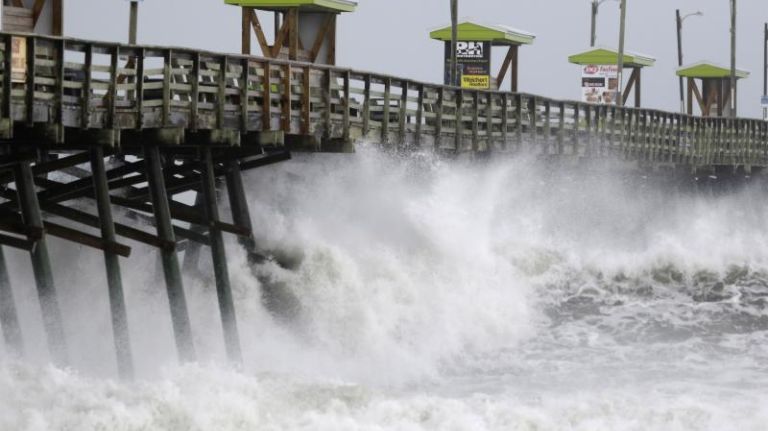
I spent the better part of the past week at work and at home getting ready for the possible impact of Hurricane Florence. I had two of my personnel and their families who lived in mandatory evacuation zones and did evacuate. Until late Wednesday when Florence took her turn to the southwest we had made reservations in a local hotel since our neighborhood typically floods. The last storm that we had, Hurricane Matthew dropped 15 inches of rain on us in a period of about 10 hours, barely a week and a half after another system had dropped 16 inches of rain on us in a three day period. During those events I fought to keep water out of our home and we lost one of our cars to flood damage and the other had a couple thousand dollars of damage. We could not leave our neighborhood for almost three days because of the depth of the water on the streets in our subdivision.

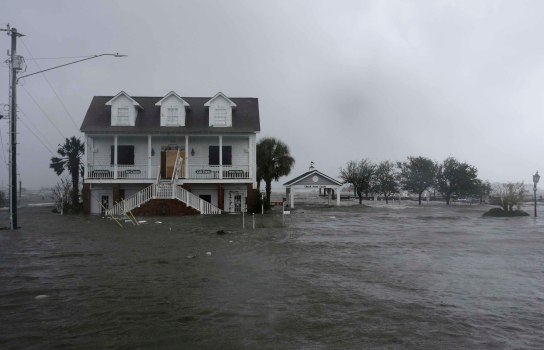
High winds and water surround a house as Hurricane Florence hits Swansboro N.C., Friday, Sept. 14, 2018. (AP Photo/Tom Copeland)

This time we got lucky. Florence, after making a jog to the northwest turned back west and then southwest. For us she was pretty much a nothing-burger, but we live in a place that is incredibly vulnerable should a major storm hit. A category three of four storm would devastate the area. Hampton Roads is in an area of Virginia known as the Tidewater and Tidewater is a polite word for swamp. In fact that applies to most of the East Coast from us down to Florida.

But, since Hampton Roads one of the nation’s major seaports and transportation hubs, as well as the home of the largest naval base in the world the effects would be more than local. Though since I am local it would really suck. So the fact that Florence missed us was not a bad thing for us, but  it was a really bad thing for millions of people in the Carolinas, including many of our friends. I know a number of former shipmates who will quite probably lose their homes. Likewise  There are others who have evacuated and don’t know what they will return to when the go back.

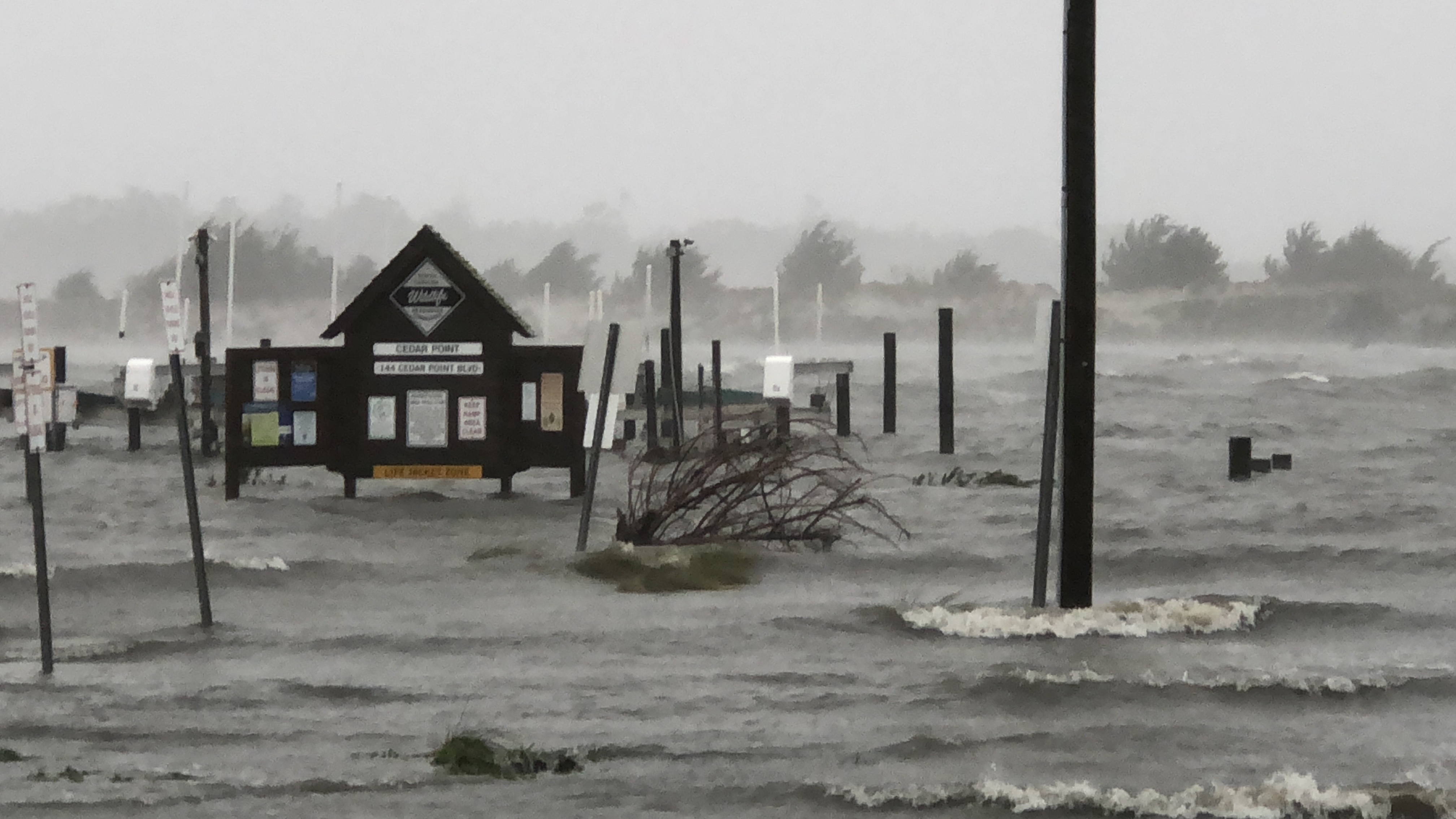
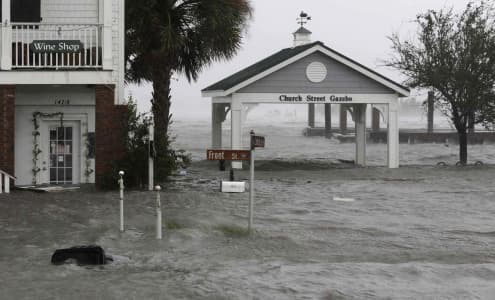
I saw pictures and videos from places near Camp LeJeune where I once lived and realize that the destruction, especially where the the storm surge was massive. I saw an estimate that 750,000 homes could be impacted by the storm surge alone, this doesn’t could the added damage from the flooding rains and the runoff from streams and rivers that empty out into the wetlands and coastal areas that have already be inundated. Likewise the region will be polluted by runoff from hog farms and coal ash.

I have been through hurricanes down there and Florence looks worse than any that I went through, although Floyd in 1999 create massive flooding that isolated many towns in Eastern North Carolina. I do hope that my friends and all others impacted by her are safe and have not incurred too much damage.

After Florence passes we will see the extent of the damage and begin to count the cost in lives lost and disrupted. There will be chances for those of us who are not impacted to try to do something to help. Thoughts and prayers are fine but practical acts of assistance and mercy are much better at times like this.

Until tomorrow,

Peace,

Padre Steve+

2 Comments

Filed under News and current events, weather

Battling Emboldened Holocaust Deniers a Day at a Time

Babi Yar

Friends of Padre Steve’s World,

I have a policy about Holocaust denial on my site. If someone denies the Holocaust or tries to minimize it I delete their post. That might sound somewhat restrictive, but I will not give them the space on my site to posit their race hatred and justification of genocide in any way shape or form. It used to be that I would spar with them, but I realized that by doing so I gave them a sense of acceptability, and when some proceeded to make physical threats against me for opposing their ideas I realized that I couldn’t go down that road anymore.

That being said, every so often I get comments from Holocaust deniers, as well as Japanese deniers of the Rape of Nanking and other Japanese atrocities in Asia during the 1930s and World War II. The Japanese Nanking deniers are almost always Right Wing revisionists and hyper-nationalists who subscribe to the racial theory that the Chinese and other non-Japanese are less than human. But I’ve never had an American take issue with Nanking while almost all of my holocaust deniers are Americans who not only deny the Holocaust, but who subscribe to the most base and repulsive theories of anti-Semitism, and White Supremacy.

Today I had yet another Holocaust denier pop up and comment on my article  The Justification of Genocide: Race Hatred and the Quest for Living Space and said “you fear open debate.”  His blog address was listed on the post so I went to it and found plenty of racist, pro-Nazi, and Holocaust denial posts and links, as well as President Trump’s racist polices on immigration.

But the reality is that such people fear open debate because when they engage in it they are exposed for the frauds that they are. Some like the English defender of all things Hitler and Holocaust denier, David Irving had the nerve to sue American Jewish historian Deborah Lipstadt for libel in a British court where she would have to prove her innocence as opposed to an American court where he would have had to prove that she had libeled him. Even in that setting Irving lost. If you want to see a great film, watch the movie adaptation of the trial Denial.”

A while back I had another who ripped into me on the Nazi massacre of Ukrainian Jews at Babi Yar, in which over 33,771 Jews were marched out of Kiev and shot on the 29th and 30th of September 1941. There were 29 survivors who managed to escape the death pits by feigning and climbing out after dark. Massacres of more than 100,000 other people, mostly non-Jews continued until November. The number of Jews killed was documented by the Commander of the Sonderkommando 4a of Einsatzgruppe C which conducted the massacre. The Einsatzgruppe men were assisted by troops from two Police Battalions and Waffen SS troops with support from the Wehrmacht.  Both the records of the Einsatzgruppe and the testimony of SS men who took part is damning enough, yet my denier critic had the nerve to say “There was no such massacre – it is just another example of war time atrocity propaganda.”

I since he decided to leave his email address and website I decided to do a little investigation and found that he is full of these zingers and an avid supporter of President Trump. He plays fast and loose with the number of Jews killed in the Holocaust and claims that “It is currently illegal in many European nations to question the official or generally accepted account of the holocaust of European Jewry during the Second World War.” Of course that is not true, in fact in most of Europe the archives are open, the documents assessable, and the evidence undeniable. The problem is that the evidence is so great that any to deny it or attempt to revise it deserves both public ridicule and academic scorn. There are laws against Holocaust denial in many European countries precisely because it was such a horrific chapter in human history that it cannot be minimized or defended.

James Morcan in his book Debunking Holocaust Denial Theories wrote something very true that I am all too aware of:

“Unfortunately, the historicity of the Holocaust has been undermined and chipped away at by the exact same sinister forces that created the genocide in the first place: racists, religious bigots and the most paranoid type of conspiracy theorists who, together, are uniting – often unwittingly – to form a new wave of anti-Semitism that will not willingly accept the obvious facts of the past. This chipping away (at the truth) began slowly and insidiously – much like the Holocaust itself – but sadly, and worryingly, it is gathering pace.” 

It is interesting to read through the man’s blog and see that his issue is not about anti-Semitism, as he is exceptionally anti-Semitic, nor is it about the killing of the Jews, just the number of Jews killed. It seems that if  he, like the other deniers can somehow lessen the number of Jews killed, that it becomes more acceptable, and over time forgettable. I will not open this site up to Holocaust deniers. One of those deniers is Charles Johnson who was invited to the State of the Union Address by Congressman Matt Gaetz. In an interview Johnson responded to the question “what are your thoughts on the Holocaust, WW2, and the JQ in general?” (JQ is short for the Jewish Question) His response was telling.

“I do not and never have believed the six million figure. I think the Red Cross numbers of 250,000 dead in the camps from typhus are more realistic. I think the Allied bombing of Germany was a war [sic] crime. I agree…about Auschwitz and the gas chambers not being real.”

He denies being a Holocaust deniers and touts his support for Israel, but his words are all too indicative of what he really believes, yet he is accepted by leading members of the Republican Party. Such associations do nothing but serve to legitimatize them and make their arguments more acceptable, after all, if a President and leading Congressmen espouse a position and associate with its proponents, it must have merit. Of course it doesn’t but when there is a dearth of historical knowledge and general indifference it does not take much for such men to motivate others to violence. As Lipstadt noted about David Irving, and I would extend to people like Johnson: “People like David Irving do not throw firebombs. They throw the words that can cause others to throw those firebombs.” 

The sad thing for us as a nation is that quite a few Holocaust deniers, have the ear of the President, people in his administration, and Republican Congressmen. This makes this topic all too relevant. As Marc Bloch wrote “we can truly understand the past only if we read it in light of the present.”

Until tomorrow,

Peace

Padre Steve+

Leave a comment

Filed under History, holocaust, nazi germany, News and current events, Political Commentary

Civilization is Tissue Thin: The Uncomfortable Necessity of Understanding Evil

Friends of Padre Steve’s World,

Fyodor Dostoyevsky wrote, “Nothing is easier than to denounce the evildoer; nothing is more difficult than to understand him.”

I think one of our problems is that we want to believe that evil is simply done be evil people. That is why when we see a Hitler, Stalin, Pol Pot, or the monsters of the so-called Islamic State, we are often strangely comforted. This is often  because we can point to a single person with a wicked ideology and say “they are evil,” all the while forgetting that they are, or were, like us, also human. Aleksandr Solzhenitsyn reminds us of the folly of that type of thinking:

“If only it were all so simple! If only there were evil people somewhere insidiously committing evil deeds, and it were necessary only to separate them from the rest of us and destroy them. But the line dividing good and evil cuts through the heart of every human being. And who is willing to destroy a piece of his own heart?”

A few years ago I took a break from my Gettysburg studies and writing and dusted off an old academic paper dealing with the one of the more uncomfortable aspects of the Nazi Holocaust against the Jews. I did that because I felt that I needed to reexamine the nature of evil in the modern world. Since that time I have gone back, done more study, more writing, and made more visits to locations of Nazi evil. I will be doing more of that in the next few weeks as we go back to Germany for an eighteen day visit.

When I ponder the evil committed by supposedly civilized men and women of Germany, I realize that they are little different than others who share the culture of the West. These people were the products of a culture of learning, and of science. They were part of a culture formed by the Christian tradition, the Renaissance, the Reformation, and the Enlightenment, the age of Reason. As I pondered this I came to remember something said by the late Iris Chang, “civilization is tissue thin.”

Omaha_courthouse_lynching

Lynching in the American South

That series of articles about the Einsatzgruppen dealt with the ordinary men, and the bureaucratic systems that implemented an ideology so twisted and evil that it is unimaginable to most people. In fact even in the Nazi system the majority of the genocide was not committed in the death camps, but up close and personal by men standing over pits with pistols, rifles, and machine guns.

While most people in the United States know a little about the Holocaust, most do not fully comprehend how devilish and insidious the crimes of the Nazis were. More frightening is the fact that in a 2015 survey 46% of people worldwide have never heard of the Holocaust, and of the 54% who are aware of it some 32% think it is a myth or has been greatly exaggerated. The numbers will only get worse as we become farther removed from these events and the survivors, witnesses, and perpetrators die off. The same is true for other genocidal acts.

We typically know about the extermination camps like Auschwitz, but the lesser known dark side of the Holocaust, perhaps the scariest part, is the story of the men of the Einsatzgruppen. The Einsatzgruppen and affiliated units, including those of the Wehrmacht, the Waffen SS, the mobilized battalions of the Order Police, and locally recruited units, rounded up massive numbers of people and killed them up close and personal. In all these units murdered over two million people, about 1.3 million of whom were Jews.

My study of the Holocaust began in college as an undergraduate. My primary professor at California State University at Northridge, Dr. Helmut Haeussler had been an interpreter and interrogator at the Nuremberg trials. I was able to take a number of lecture classes from him a large amount of research and independent study courses in a year of graduate work while finishing my Army ROTC program at UCLA. It was an immersion in the history, sociology, and the psychology of evil, during which I was able to meet and talk with Jewish survivors of the Holocaust.

mass killing einsatzgruppen

Einsatzgruppen and Ordungspolizei in Russia

Since then I have continued to read and study. I lived in Germany for over four years, and made many other visits, during which I went to a number of Concentration Camp sites. I visited the rebuilt synagogue in Worms which had been destroyed during the infamous Kristallnacht, and other museums and Holocaust memorial sites in Germany. I visited the Zeppelin field, the site of Hitler’s massive Nazi Party rallies in Nuremburg, as well as the graveyards which contain the victims of other Nazi crimes, including the Nacht und Nebel or night and fog actions, where people simply disappeared and were murdered by the Gestapo.

For me, those visits were sobering, maybe even more so because I understood exactly what happened in those sites. These are uncomfortable places to visit, and I can understand why many people would not want to visit them, or even study them.

The darkness that they remind us of  is a part of our human condition. Traces of the evil on display in those places is present in every human being. Frankly, most people cannot bear looking into that abyss, for fear that they might be swallowed by it.

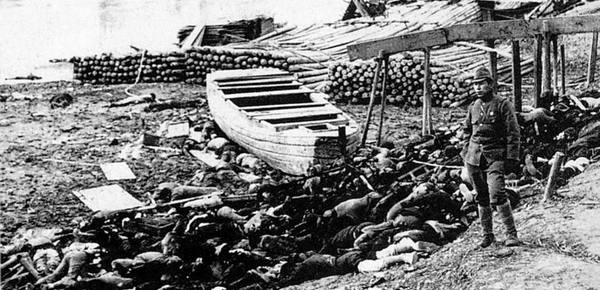
nankino-masakra-1

Nankingnanking_massacre_1

I can understand that and I have to admit that it is hard to do so. I am a historian as well as a clinician with much experience dealing with death and trauma. With my training I do a pretty good job of keeping my emotional distance to maintain objectivity when confronted with evil. However, it is hard for me not to have some emotional reaction when visiting these places, or reading about the events and people, and in writing about them.

Likewise, I am very troubled by the growing lack or awareness or denial of the Holocaust. It is very hard for me not to have a virulent reaction when I see books and websites dedicated to Holocaust denial, or that minimize other well documented genocides, and crimes against humanity.

tzd8ftsn-1390907543

Soviet Mass Killings in Ukraine

My sensitivity to human suffering and the terrible indifference of people in this country to it was greatly increased by my experience of war, and my post-war struggles with PTSD, depression, anxiety, which at points left me very close to committing suicide. A non-chaplain friend, a now retired Navy Command Master Chief Petty Officer that I served with at my last duty station recently remarked that I am a tremendously empathic person, and that I have a large capacity to feel the pain and suffering of others. This capacity for empathy and the ability to feel the suffering of others is part of who I am. It is a good thing, but it makes my work studying and writing about the Holocaust, other genocides, crimes against humanity, and subjects like American slavery, racism, and Jim Crow a sometimes difficult and often very emotionally consuming task. This sometimes leaves me even more sleepless and anxious than normal; especially when I see the indifference of so many people to the suffering of others today.

CambodiaExhibitMassgrave-x1

The Killing Fields

It is that indifference which motivates me to write; because if these events are not recalled and retold, they, like any part of history will be ignored and then forgotten. The statistics bear this out. There are people today, who say that we should stop talking about these events, that they are old news, and they cannot happen again; but history tells us different, and not just the Holocaust, but indeed every genocide. Then there are those who shamelessly use the Holocaust imagery to spread fear among their followers even as they openly demonize minority groups and religions as the Nazis did to the Jews.

I have to agree with Elie Wiesel who said, “Indifference to me, is the epitome of all evil.”

The late Iris Chang, who wrote The Rape of Nanking: The Forgotten Holocaust of World War II wrote something that is pertinent to almost every modern episode of genocide, or other crime against humanity. It is the ability of leaders, be they political, military, or religious to convince people to rationalize actions that they normally would find repulsive.

“After reading several file cabinets’ worth of documents on Japanese war crimes as well as accounts of ancient atrocities from the pantheon of world history, I would have to conclude that Japan’s behavior during World War II was less a product of dangerous people than of a dangerous government, in a vulnerable culture, in dangerous times, able to sell dangerous rationalizations to those whose human instincts told them otherwise.”

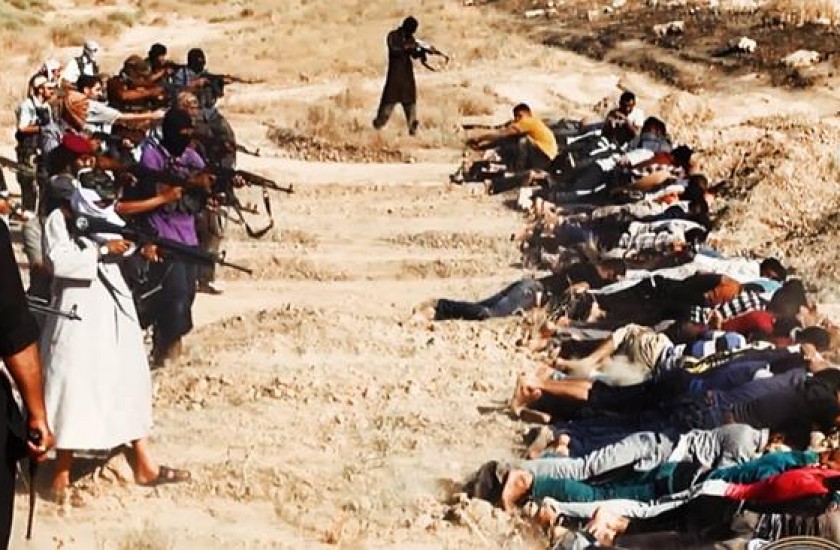
isis3-840x550

The Islamic State

There are many other such events that we could note; the American decimation and genocide committed against native American tribes that spanned close to two centuries, the 1915 Turkish genocide of Armenians, the Rwandan genocide of 1994, the Serbian atrocities in Bosnia and Kosovo, the Chinese Communist “Great Leap Forward,” the actions of the Islamic State in Iraq and Syria, and the more recent but seldom discussed action of the Myanmar government and military against its Rohingya Muslim minority.

                        Rwandan Genocide 

What we call civilization, to use the words of Iris Chang, is tissue thin. That is why we must never forget these terrible events of history, and that part of human nature, and in a sense part of every one of us, that makes them so easy to repeat. That is why we must periodically take the time to remember and reflect on the Holocaust, other genocides and crimes against humanity.

It is even more important now with the rise of fascist, nationalist, and racist regimes around the world. Even in the United States these demons of the past, racism, nationalism, and fascism have come out into the open as those who believe in them have become emboldened by the words of President Trump and members of his administration.

In fact in trying to clean up his inaction after the violence committed by neo-Nazis and KKK sympathizers in Charlottesville the President first equated the Nazis and Klansmen with the people that they attacked and under pressure made a speech condemning the Nazis and Klansmen. According to Bob Woodward, when a Fox News correspondent said that was an admission that he was almost an admission that he was wrong.” The President exploded at Rob Porter, the aide who convinced him to make the speech: “That was the biggest fucking mistake I’ve made,” the President told Porter. “You never make those concessions. You never apologize. I didn’t do anything wrong in the first place. Why look weak?” A few days later the President returned to the subject and again made the argument of moral equivalence.

Coupled with so many of the President’s words and policies directed against Blacks, Mexicans and Central Americans, Arabs, Africans, and others; as well as his attacks on the First Amendment and his praise and defense of cold blooded dictators around the world one has to take it more seriously.

This is not an issue that simply lurks in the past, it is a very real part of the present. Historian Timothy Snyder wrote:

“The European history of the twentieth century shows us that societies can break, democracies can fall, ethics can collapse, and ordinary men can find themselves standing over death pits with guns in their hands. It would serve us well today to understand why.”


Yes, these are terribly uncomfortable subjects, but we cannot allow this generation to allow them to be forgotten, lest they be repeated. That is why that I must continue to write about them and do my best to make sure that they are not forgotten as we cannot afford to let them happen again.

Peace

Padre Steve+

1 Comment

Filed under crime, culture, ethics, History, holocaust, nazi germany, News and current events, Political Commentary

“I imagined leave would be different from this” September 11th 2001 at Seventeen Years

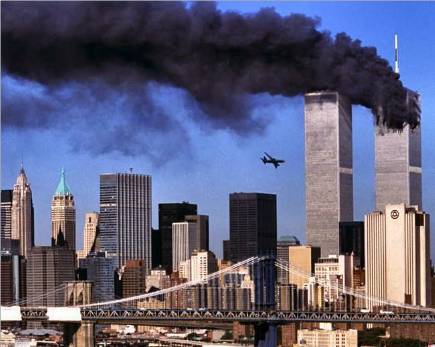
flight_175_photo

Friends of Padre Steve’s World,

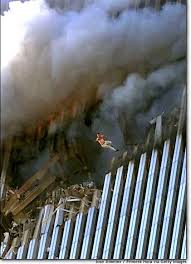
September 11th is a day that always makes me more introspective. It brings back so many memories, some that I wish I could forget; but I cannot get the images of that day out of my mind. The burning towers, the people jumping to their deaths to escape the flames, and the scenes of devastation. I knew one of the victims in the attack on the Pentagon, an Army Lieutenant Colonel, Karen Wagner who commanded a Medical training company at Fort Sam Houston where I was serving as the Brigade Adjutant in 1987 and 1988. She was a very nice person, very gracious and decent, admired by everyone who knew her; I was shocked to see her name on the casualty list after the attack.

The emotions that I feel on the anniversary of these terrorist attacks which claimed the lives of so many innocent people, and which devastated so many families, still haunts me, and my subsequent service, especially in Iraq has changed me. Years after he returned from his time in the Middle East, T.E. Lawrence; the immortal Lawrence of Arabia wrote to a friend, “You wonder what I am doing? Well, so do I, in truth. Days seem to dawn, suns to shine, evenings to follow, and then I sleep. What I have done, what I am doing, what I am going to do, puzzle and bewilder me. Have you ever been a leaf and fallen from your tree in autumn and been really puzzled about it? That’s the feeling.” I often feel that way.

Seventeen years ago I was getting ready to go to the French Creek Gym at Camp Le Jeune North Carolina where I was serving as the Chaplain of Headquarters Battalion 2nd Marine Division. I had returned from a deployment to Okinawa, Mainland Japan and Korea just two months before and was preparing to transfer to the USS Hue City, a guided missile cruiser stationed in Mayport, Florida.

At the time of the attack I had already been in the military for over 20 years and I had actually taken a reduction in rank to transfer from the Army, where I was a Major in the reserves, to the Navy to serve on active duty. In those previous 20 years I had served overseas during the Cold War along the Fulda Gap. I had been mobilized to support the Bosnia mission in 1996, and I had just missed being mobilized for Operation Desert Storm as my unit was awaiting its mobilization orders when the war ended. I had done other missions as well as the deployment to the Far East that returned from in July 2001; but nothing prepared me for that day. Like other career military officers I expected that we would be at war again and thought it might be back in the Middle East, and probably a result of some fool’s miscalculations; but like the American officers who were serving at the time of the Pearl Harbor attack, I never expected what happened that morning.

Tuesday, September 11th 2001 had started like so many days in my career. Routine office work, a couple of counseling cases and what I thought would be a good PT session. I was about to close out my computer browser when I saw a little headline on Yahoo News that a plane had crashed into the World Trade Center. I paid little attention and figured that a private plane, something like a Cessna piloted by an incompetent had inadvertently flown into the building.

9-11 jumpers

That delusion lasted about two minutes. I got in my car and the radio, tuned to an AM talk station had a host calling the play by play. He started screaming “oh my God another airliner flew into the other tower.” Seeking to see what was happening I went to the gym where there were many televisions. I got there and saw the towers burning, with stunned Marines and Sailors watching silently, some in tears. I went back out, drove to my office and got into uniform. After checking in with my colonel a made a quick trip to my house for my sea bags and some extra underwear, and personal hygiene items. When I got back the headquarters we went into a meeting, and the base went on lock down mode. The gates were closed and additional checkpoints, and roadblocks established on base. Marines in full battle-rattle patrolled the perimeter and along the waterfront. I did not leave the base until the night of the 15th when things began to settle down and we all went into contingency planning mode for any military response to the attacks.

My wife, who as waiting for a doctor’s appointment with a friend saw the attacks on live television and knew when the first plane struck she told her friend that it was terrorism. Her friend responded “that damned Saddam Hussein.” Like so many of us who initially thought this, my wife’s friend was wrong.

LutjensHonors

Those were tumultuous days, so much fear; so much paranoia; and so much bad information as to who committed the attacks and what was going to happen next.

hue city boarding party


A few months later I deployed aboard Hue City to the Middle East where we supported the air operations in Afghanistan, anti-terrorist operations off the Horn of Africa and in Operation Southern Watch and the U.N. Oil Embargo against Iraq. I then did three years with Marine Security Forces, traveling around the world to support Marine Fleet Anti-Terrorism Security Team companies. For three years I was on the road one to three weeks a month traveling to the Middle East, Europe, the Pacific and many parts of the United States. Then I was promoted and transferred to Explosive Ordnance Disposal Group Two, from which I was deployed with my assistant to Iraq, where we served as members of the Iraq Assistance Group in all Al Anbar Province supporting small teams of Marine Corps, Army and Joint Force adviser teams to the Iraqi Army, Border troops, Port of Entry police, police and highway patrol.

with-mtt-3-7-ronin


When I returned from Iraq I was a changed man and while I am proud of my service I am haunted by my experiences. One cannot go to war, see its devastation, see the wounded and dead, as well as the innocents traumatized by it. One cannot get shot at, or be in enclosed rooms, meeting with people that might be friends, or might be enemies, and while everyone else is armed, you are not.

War changed me, and my homecoming was more difficult than I could have imagined. I never felt so cut off from my country, my society, my church, or even other chaplains. My experience is not uncommon among those who have served in Iraq or Afghanistan, or for that matter those who have served in almost any modern war. Erich Maria Remarque in his classic All Quite on the Western Front wrote:

“I imagined leave would be different from this. Indeed, it was different a year ago. It is I of course that have changed in the interval. There lies a gulf between that time and today. At that time I still knew nothing about the war, we had been only in quiet sectors. But now I see that I have been crushed without knowing it. I find I do not belong here any more, it is a foreign world.”

That being said I would not trade my experience for anything. The experience of PTSD and other war related afflictions has been a blessing as well as a curse. They have changed my world view and made me much more emphatic to the suffering and afflictions of others, as well when they are abused, mistreated, terrorized and discriminated against. These experiences along with my training as a historian, theologian, and hospital chaplain clinician before and after my tour have given me a lot bigger perspective than I had before.

But I have to live with all of the memories. Guy Sajer wrote in his book The Forgotten Soldier“Only happy people have nightmares, from overeating. For those who live a nightmare reality, sleep is a black hole, lost in time, like death.” General Gouverneur Warren, a hero of many Civil War battles including Gettysburg wrote to his wife after the war “I wish I did not dream so much. They make me sometimes to dread to go to sleep. Scenes from the war, are so constantly recalled, with bitter feelings I wish never to experience again. Lies, vanity, treachery, and carnage.”

As hard as this has been these are good things, and as I go on I wonder what will happen next. I do not think that the wars and conflicts which have followed in the wake of the 9-11 attacks will be over for years, maybe even decades. I pray for peace, but too many people, some even in this country seem to live for the bloodlust of war. One can only hope and as my Iraqi friends say, Inshallah, (إن شاء الله) God willing…

I wonder too, if the words of T.E. Lawrence reflecting on his service in the Arab Revolt are not as applicable to me and others who came back from Iraq, “We had been hopelessly labouring to plough waste lands; to make nationality grow in a place full of the certainty of God… Among the tribes our creed could be only like the desert grass – a beautiful swift seeming of spring; which, after a day’s heat, fell dusty.” I have lost too many friends in these wars, including men who could not readjust to home, many like me. I have seen the men and women, broken in body, mind and spirit and I wonder if any of it was worth it, and if in some of our response, especially the invasion of Iraq has not made a bad situation even worse, and turned the war into a generational conflict.

As for me, I am now an old guy by military standards. I recently celebrated 37 years of service and will, God willing, retire next year. Sadly, I know all too well that those who I have worked with, and those who are yet to enlist will be continuing to fight a war which seems to be without end long after I retire.

Yesterday and today there were and will be many ceremonies and services to remember the victims of the attacks. I think that is fitting. As I mentioned last night I did not take place in this year’s commemoration of the event at my base because I had been asked by name to do a funeral for a retired Navy Chief at a local veterans cemetery followed by more planning and preparing for the arrival of Hurricane Florence.

So please, have a good day and whatever you do do not forget those whose lives were forever changed by those dastardly attacks and all that has transpired in the years since. Honestly I did not think that we would still be at war today. It is hard for me to believe that we still are at war and that there is no end in sight.

As Erich Maria Remarque wrote “I imagined that it would be different…”

At the same time I do hope that things will get better and that some semblance of peace will return to the world.

Inshallah, (إن شاء الله) God willing…

Peace

Padre Steve+

2 Comments

Filed under afghanistan, ethics, History, iraq, iraq,afghanistan, leadership, Military, Political Commentary, terrorism

They are Not Just Names: September 11th 2001 at Seventeen Years

Friends of Padre Steve’s World,

In Star Trek Deep Space Nine there is a scene where the deputy commander of the Space Station, Major Kira Nerys gives a casualty report to Captain Benjamin Sisko. It resonates with me every time that I see it and especially on the anniversary of September 11th.

KIRA: Sir, the latest casualty reports have just been posted.
SISKO: How many this time?
KIRA: Including the troops lost at AR five five eight, seventeen hundred and thirty.
SISKO: Seventeen hundred thirty.
KIRA: That’s a lot of names.
SISKO: They’re not just names. It’s important we remember that. We have to remember.

Today marks the seventeenth year since the attacks of September 11th 2001 and we do have to remember those who lost their lives that day, all those Americans and our coalition partners who died, and all the innocents lost, even to those of American military action. None of them are just names, they are real men and women, as well as children cut down by terrorism and unending war.

When we were attacked on September 11th 2001 I had already passed twenty years of service, though about half of them were service in the reserves and National Guard. Now I am over 37 years of service and by this time next year I should be on the retired list unless something very unexpected happens.

My base will be marking it with the dedication of a nature trail that now has plaques commemorating over 80 eighty men and women from our base who have died in action, on deployment, or training to go to combat since that occasion. While this ceremony is taking place I will be driving out to a Veteran’s Cemetery an hour or so away to perform the internment of a retired Navy Chief Petty Officer whose family requested me by name.

Thus I will be turning over the big high profile ceremony to my deputy chaplain. It will give him a chance to be on the big stage and get recognized for his own talents and abilities while I do something less visible but very meaningful to that Navy Chief’s family and to me as the son of a Navy Chief. In addition to conducting the service I will have the honor of presenting the colors of the nation to his daughter.

For me it is a chance to pay back the goodness shown to my dad and family when he passed away in 2010. The base ceremony and the internment were pretty close together time wise. My Commanding Officer and I talked about it decided and decided that since I am now in pretty much constant pain with knee and hip injuries since I fell down my stairs last month that I shouldn’t be doing back to back ceremonies with a long drive in between.

But anyway. Since September 11th 2001 I have lost count of the number of friends and comrades who died during the attack and the subsequent wars. This includes those that died by their own hand during or after their service due to the effects of combat trauma, PTSD, or Traumatic Brain Injury,  or the never ending pain of physical wounds and injuries. I often see their faces when I think about the past 17 years, their names are forever etched in my memory, but they are not just names and we cannot forget them. I cannot and I will not.

It seems like every week or so we lose another soldier, sailor, marine, or airman in Afghanistan, Iraq, or Africa. I loom at their names, where they are from, and the number of deployments that they have made. Some entered service well after me but because of their specialities and assignments made far more deployments that I can imagine. One soldier who was killed in action serving in Iraq had made 13 deployments, 9 of which were combat deployments in a 16 year career, and for the most part they are forgotten by all but their family, friends, and comrades, most barely get a mention elsewhere.

Sadly at this point in my career I believe that for many Americans, especially the faux patriots of the Fox News set, the political preachers of the Christian Right, and the President himself, that the troops are merely a prop to place in the background to promote their political causes and slam other Americans for not being patriotic enough.

Today I will continue to serve and I will mourn in my own way the friends, comrades, and shipmates that I have lost over these past 17 years. For me they are not just numbers or names, they are real people and no amount of flag waving will bring them back. No amount of corporate sponsored “patriotism” will make up for the lost lives, and the destruction of these wars. We can remember and honor the lost, and those who still suffer, including the wounded in body, mind, and spirit, and of the widows and children of the men and women who never came home or were never the same. I came home, but I am not the same.

They are not just names.

So as you go about your activities today take time to remember the victims of war, terrorism, and as I do the men and women who I knew who never came home, couldn’t make the transition back from war, or who still suffer in mind, body or spirit.

Never forget, they are not just names.

Until tomorrow,

Peace

Padre Steve+


Leave a comment

Filed under History, middle east, Military, ministry, News and current events, philosophy, Political Commentary, star trek, terrorism, Tour in Iraq

Recommended Readings from My Reading Rainbow

Friends of Padre Steve’s World,

I think that it important to read, and read, and did I say read?

Barbara Tuchman wrote:

“Books are the carriers of civilization. Without books, history is silent, literature dumb, science crippled, thought and speculation at a standstill. Without books, the development of civilization would have been impossible. They are engines of change (as the poet said), windows on the world and lighthouses erected in the sea of time. They are companions, teachers, magicians, bankers of the treasures of the mind. Books are humanity in print.”

Since I write about a lot of topics and because I am a historian as well as a stand up theologian, I read a lot and I frequently quote from other people in anything that I write. Sometimes I find that those who have gone before me have said things I want to say much better than I could on my own. Thus I am not afraid or ashamed to give attribution to them, after all, it is only fair.

But today I want to share some of the books that I think are important for anyone seeking to understand our world. In a sense, this is a part of my Reading Rainbow.

Most of my picks deal with history, military, diplomacy, civil rights, politics, as well as baseball, and there are some novels on the list, most of which fall into the categories listed above.

Despite the fact that I am a priest I don’t have many books on theology, religion, or faith on my list, but then the fact is that I don’t see a lot, including many of the so called classics that hold up over time.

In the same manner I do not list any contemporary political biographies or autobiographies, nor books on current events. The fact is that none of them has yet stood the test of history.

So today here are just some of the books that I recommend from my reading rainbow.

They are listed in alphabetical order by author:

Our Declaration: A Reading of the Declaration of Independence in Defense of Equality by Danielle Allen

The Origins of Totalitarianism by Hannah Arendt

Meditations by Marcus Aurelius

The New American Militarism: How Americans are Seduced by War by Andrew J. Bacevich

The Epistle to the Romans by Karl Barth

SPQR: A History of Ancient Rome by Mary Beard

Ordinary Men by Christopher Browning

The Cost of Discipleship by Dietrich Bonhoeffer

The Scandal of Christianity by Emil Brunner

War is a Racket by Smedley Butler

The Nanking Massacre by Iris Chang

On War by Carl Von Clausewitz

Shake Hands With the Devil: The Failure of Humanity in Rwanda by Roméo Dallaire

Waiting for First Light: My Ongoing Battle with PTSD by Roméo Dallaire

The War Against the Jews 1933-1945 by Lucy Dawidowicz

The Autobiography of Frederick Douglass by Frederick Douglass

Street Without Joy by Bernard Fall

This Republic of Suffering by Drew Gilpin Faust

Hitler by Joachim Fest

Forever Free: the Story of Emancipation and Reconstruction by Eric Foner

Nuremberg Diary by Gustave Gilbert

Team of Rivals by Doris Kearns Goodwin

Personal Memoirs of U.S. Grant by Ulysses S. Grant

A Wicked War: Polk, Clay, Lincoln, and the 1846 U.S. Invasion of Mexico by Amy S. Greenberg

On Killing: The Psychological Cost of Learning to Kill in War and Society by Dave Grossman

Fateful Lightening: A New History of the Civil War and Reconstruction by Allen Guelzo

The Best and the Brightest by David Halberstam

The Summer of ’49 by David Halberstam

October 1964 by David Halberstam

Catastrophe 1914: Europe Goes to War by Max Hastings

Das Reich: The March of the 2nd SS Panzer Division Through France, June 1944 by Max Hastings

Catch 22 by Joseph Heller

For Whom the Bell Tolls by Ernest Hemingway

Perpetrators Victims Bystanders: The Jewish Catastrophe 1933-1945 by Raul Hilberg

King Leopold’s Ghost: A Story of Greed, Terror, and Heroism in Colonial Africa by Adam Hochschild

The True Believer by Eric Hoffer

Anti-Intellectualism in American Life by Richard Hofstadter

The Paranoid Style in American Politics by Richard Hofstadter

A Savage War of Peace by Alistair Horne

Hubris: The Tragedy of War in the Twentieth Century by Alistair Horne

The Age of American Unreason by Susan Jacoby

The Boys of Summer by Roger Kahn

American Scoundrel: The Life of the Notorious American Civil,War General, Daniel Sickles by Thomas Keneally

Letter from a Birmingham Jail by Martin Luther King Jr.

The Iowa Baseball Confederacy by W.P. Kinsella

Shoeless Joe by W.P. Kinsella

Hero: A Life of Lawrence of Arabia by Michael Korda

On Being a Christian by Hans Kung

The Catholic Church a Short History by Hans Kung

Why I am Still a Christian by Hans Kung

The Centurions by Jean Larteguy

Seven Pillars of Wisdom by T.E. Lawrence

To Kill an Mockingbird by Harper Lee

In the Name of War: King Philip’s War and the Origins of American Identity by Jill Lepore

Perpetrators: The World of the Holocaust Killers by Guenter Lewy

Why Don’t We Learn from History? By B.H. Liddell-Hart

The Nazi Doctors by Robert Jay Lifton

Denial: Holocaust History on Trial by Deborah Lipstadt

Denying the Holocaust: The Growing Assault on Truth and Memory by Deborah Lipstadt

The Past that Would Not Die by Walter Lord

A Night to Remember by Walter Lord

Incredible Victory by Walter Lord

The Confederate and Neo-Confederate Reader: The “Great Truth” about the “Lost Cause” by James Loewen and Edward Sebesta

Concerning Christian Liberty by Martin Luther

Drift: The Unmooring of American Military Power by Rachel Maddow

They Thought they Were Free by Milton Mayer

The Mystery of the Cross by Alister McGrath

Battle Cry of Freedom by James McPherson

Abraham Lincoln and the Second American Revolution by James McPherson

The War that Forged a Nation: Why the Civil War Still Matters by James McPherson

War of Annihilation: Combat and Genocide on the Eastern Front 1941 by Geoffrey Megargee

Once an Eagle by Anton Meyer

The Crucified God by Juergen Moltmann

Theology of Hope by Juergen Moltmann

The Spirit of Life: A Universal Affirmation by Juergen Moltmann

We Were Soldiers Once… and Young by Hal Moore

A Soldier Once… and Always by Hal Moore

The Wounded Healer by Henri Nouwen

1984 by George Orwell

Nuremberg: Infamy on Trial by Joseph Perisco

The Hot Zone by Richard Preston

All Quiet on the Western Front by Erich Maria Remarque

A Bridge Too Far by Cornelius Ryan

The Forgotten Soldier by Guy Sajer

Lincoln’s Lieutenants: The High Command of the Army of the Potomac by Stephen Sears

Gettysburg by Stephen Sears

A Bright and Shining Lie: John Paul Vann and America in Vietnam by Neil Sheehan

Conduct Unbecoming: Gays and Lesbians in the U.S. Military by Randy Shilts

And the Band Played On: Politics, People, and the AIDS Epidemic by Randy Shilts

Berlin Diary by William L. Shirer

The Collapse of the Third Republic: An Inquiry into the Fall of France in 1940 by William L. Shirer

The Rise and Fall of the Third Reich by William Shirer

On Tyranny by Timothy Snyder

Black Earth: the Holocaust as History and Warning by Timothy Snyder

The Guns of August by Barbara Tuchman

The Wehrmacht: History, Myth, Reality by Wolfram Wette

The American Way of War: A History of United States Military Strategy and Policy by Russell Weigley

Eisenhower’s Lieutenants: The Campaigns of France and Germany, 1944-45 by Russell Weigley

Men at Work: The Craft of Baseball by George Will

Lincoln at Gettysburg by Gary Wills

Hitler’s American Model: The United States and the Making of Nazi Race Law by James Q. Whitman

What Have We Done: The Moral Injury of Our Longest Wars by David Wood

The Caine Mutiny by Herman Wouk

Sorry, no descriptions or intros included, but trust me. They are all worth the read. Anyway, those are just some of my favorites on from my Reading Rainbow. Yes, there are plenty more, but that’s all for now.

Have a great day and as always,

Peace,

Padre Steve+

1 Comment

Filed under books, History