Yearly Archives: 2018

No Sympathy for Sarah

Friends of Padre Steve’s World,

Over the past number of years I have had my life threatened by Nazis, White Supremacists, and supposedly Christian zealots. Likewise I had to the real threat to my freedom and career by a Trump supporter in my chapel who tried to have me tried by Court Martial because he disagreed with the administration’s policies on imprisoning children and separating the for their families and recalling from scripture, Christian tradition, and history the duty of Christians to confront evil policies. I was exonerated but I still have legal fees to pay.

Over the past week or so I have had a number of friends and acquaintances when learning of what I went through tell me how sorry they felt for White House Press Secretary Sarah Huckabee Sanders. I had to be blunt and tell them that I feel no sympathy for her. It surprised them.

I told them both that I had no sympathy for someone who works for and lies for the man who supports and encourages the people the very people who have threatened me in such dire ways. I have no sympathy for a person who uses her position to first and foremost blatantly lie on a daily basis.

If that wasn’t enough I have no sympathy for a person serving as the White House Press Secretary speaking against the rights to free speech, the freedom, of the press, and freedom of association guaranteed by the First Amendment.

Likewise, I have no sympathy for a person for a person who uses the position of White House Press Secretary to deride, mock, and impugn the integrity of journalists and to give aid and comfort to those who threaten the lives of those journalists.

Finally, I have no sympathy for any government official who when confronted about the actions of their boss which encourage violence against all opponents and give aid and comfort to those who have and will again commit violence by whining about how she has been disrespected.

I have no sympathy for this spawn of Mike Huckabee. She has enjoyed a life of privilege and power as the daughter of a powerful preacher who became a powerful politician and pundit.

She, like her father and her boss is a sociopath and narcissist. As such she has no capacity for empathy or receiving any kind of criticism. I do not believe that she is a good person for a good person with a good heart could not do what she is doing. To me she is no better that Joseph Goebbels. I believe that if she was ever given the kind of political and governmental power that Goebbels was given by Hitler that she would joyfully exercise it.

Thus, I have no sympathy for Sarah, even less than I have for her boss. She made the decision to serve him and has willingly carried out his desires with the energy of a Nazi propagandist.

Maybe if she grows a conscience and realizes the evil that she has steadfastly defended and encouraged and decides to speak the truth from the James Brady Press Room I might change my mind. But until she decides to honor her Christian faith and obey the Constitution I have no sympathy for Sarah, and neither should you. She has made her bed and one day she will have to answer for her actions.

So until tomorrow,

Peace,

Padre Steve+

8 Comments

Filed under christian life, ethics, faith, History, nazi germany, News and current events, Political Commentary

The High Cost of Two Battleships: Churchill, Turkey and a Decision that Still Effects us Today

churchill1914

Friends of Padre Steve’s World,

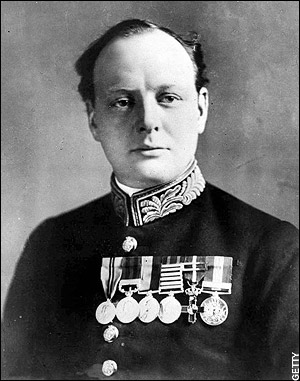
One of the more interesting and overlooked factors in the days leading up to the First World War, which had significant ramifications in the Middle East involved Winston Churchill. Churchill was serving as First Lord of the Admiralty and made a decision which ensured the Ottoman Empire would be pushed into an alliance with Germany.

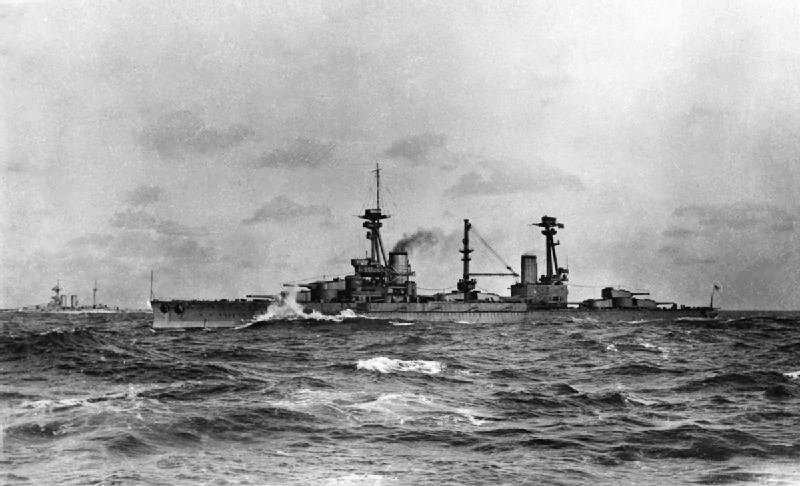
For many years Britain had been the chief supplier of ships for the Ottoman Navy. In fact in the years leading up to World War One the Ottomans had purchased over 40 ships from Great Britain and on August 2nd 1914 was expecting to take delivery of two, extremely modern Dreadnoughts, the Sultan Osman I and the Reshadieh. The Sultan Osman was armed with fourteen 12” guns, the Reshadieh with ten 13” guns, making them the equal or superior to most battleships afloat. The Turkish Government had paid over 4 billion Pounds for the ships and made the final payment on August 2nd shortly before the Turkish Captain and 500 crew members were to come aboard for a ceremony formally handing over the ship to the Turkish Navy.

HMS_Agincourt_1915

HMS Agincourt 

Much of the money the Turks used to pay for the ships came from the donations of ordinary Turkish citizens. Money came from taverns, from cafes, schools, Mosques and markets. Those that donated were awarded a commemorative medal, the ships were the pride of Turkey and the empire. The nation awaited the delivery of the ships which would ensure the superiority of the Turkish Navy against its traditional foe, Russia.

HMS_Erin

HMS Erin

As War approached Churchill began to prepare, keeping many of his plans and actions even from the government. Less than an hour before the ceremony Churchill ordered the ships seized and and the Royal Navy kept the Turkish Captain and crew locked aboard a nearby transport. The Turkish Captain later wrote:

“… We paid the last installment (700.000 Turkish liras). The manufacturer and we agreed on that the ships would be hand over on 2 August 1914. Nevertheless, after we made our payment and half an hour before the ceremony, the British declared that they have requisitioned the ships… Although we have protested, nobody paid attention.”

Churchill had gained two modern Dreadnoughts for the Royal Navy, and the British shipyards kept the money, the Turks were never compensated for the loss. The ships were renamed HMS Agincourt and HMS Erin. Both served throughout the war and at the Battle of Jutland, and bother were scrapped in the early 1920s due to the restrictions of the Washington Naval Treaty.

SMS_Goeben-ptbow3

SMS Goeben

But in the process whereby the British gained the ships, ensured that Turkey would ally itself with Germany. The positive effects were mitigated by the Germans providing the very modern dreadnought type  Molkte ClassBattlecruiser Goeben and Light Cruiser Breslau to the Turks, giving them the edge over the Russians. Breslau was mined and sunk in 1918 but Goeben served in the Turkish Navy as the Yavuz Sultan Selim until she was decommissioned in 1954, and scrapped in 1973.

Likewise, Churchill’s decision meant that when Turkey entered the war that the strategically important Bosporus strait which was Russia’s only year round access to foreign shipping was closed, keeping Britain and France from being able to supply their Russian ally. The ill-fated Gallipoli campaign, launched by Churchill was the attempt to break the Turkish stranglehold, and the costly failure of that operation helped ensure the defeat of Russia and the overthrow of the Czar..

In the long term it had affects that we are still feeling the today. The entry or Turkey into the war and the subsequent collapse of the Ottoman Empire was the catalyst for the arbitrary borders drawn by the allies across the Middle East. We still suffer the result today.

Had Turkey remained neutral throughout the war, or even sided with the allies the course of history might be far different. We don’t know, but the Ottoman Empire might have endured or it might have peacefully morphed into something different.

Churchill’s decision turned out to be one of the more important, and less known events before the war broke out, and certainly we still feel the ramifications today. Actions have consequences, and sometimes what seems expedient to give a tactical edge, sometimes has far reaching strategic consequences. Consequences that sometimes linger for generations. In particular, the Trump administration needs to wake up to how their present policies will effect the world for the next century or more.

Peace

Padre Steve+

2 Comments

Filed under Foreign Policy, History, Military, national security, Navy Ships, News and current events, Political Commentary, world war one

The Night the Lamps Went Out in Europe: August 3rd 1914

Sir Edward Grey Addresses the House of Commons

Friends of Padre Steve’s World,

One hundred and four years ago the political and military leaders of Europe embarked on a catastrophic war, the results of which are still with us over a century later.

The mobilization of millions of soldiers across Europe was moving rapidly as the sun set on the night of August 2nd 1914 when the German Ambassador to Belgium Klaus Bulow-Selaske delivered an ultimatum to the Belgian government. The ultimatum gave the Belgians 12 hours to decide if they would allow the German armies free passage through the country. The Belgians, treasuring their independence and led by a truly heroic leader, the young and humble King Albert, refused the German ultimatum and vowed to fight.

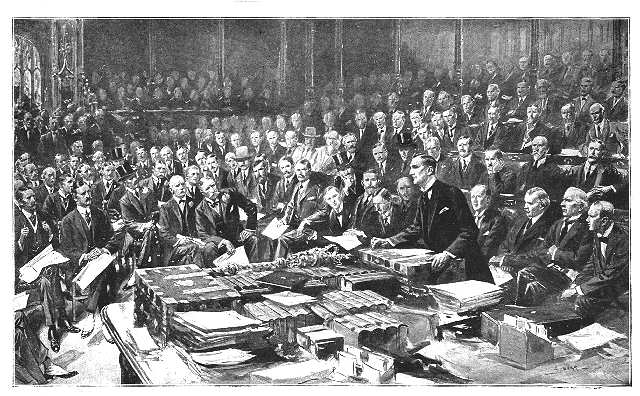
The next morning the British House of Commons met and for the first time since 1893 every member was present, with many spectators also in attendance. It was a dramatic event, as for the first time in 100 years Britain’s participation in a war on the European Continent was being debated. Britain was divided between those who wanted to intervene and non-interventionists. In a high pressure situation where the armies of the Austro-Hungarian Empire, Russia, France, Germany, and little Belgium were mobilizing for war the was on His Majesty’s Government to make a decision.

The British Foreign Minister, Sir Edward Grey urged giving support to France. He told the assembled Members of Parliament about, British military understandings with France, and the German ultimatum to Belgium. Grey asked them whether Britain “would quietly stand by and witness the perpetration of the dirtiest crime that ever stained the pages of history, and thus become participators in the sin.” He added that “we are going to suffer, I am afraid in this war, whether we are in it or stand aside.” If Britain dis stand aside, forfeiting her “Belgian Treaty obligations” the she would “sacrifice our respect and good name and reputation before the world.” Grey had not convinced everyone, but he had carried the day. However, the Germans did not believe that Britain would go to war over Belgium.

At seven that evening the German Ambassador to France Baron Schoen delivered a declaration of war against France, his counterpart in Berlin, the French Ambassador was given his passports.

As Grey pondered the content of an ultimatum to be sent to Berlin he returned to his office in Whitehall. “Watching with his failing eyes, the lamps being lit in St. James Park, Grey was heard to remark that “the lamps are going out all over Europe; we shall not see them again in our lifetime.”

The next morning the German army began its assault on the Belgian fortress city of Liege. That afternoon Poincare and Foreign Minister Viviani addressed the combined houses of the French Parliament, asking for war credits, discussing German violations of French territory and “implored the deputies, and the French people “to help us in bearing the burden of our heavy responsibility, the comfort of a clear conscience and the conviction that we have done our duty.”

The members of all parties, from the nationalists, the Catholic right and the Socialists overwhelming committed themselves to a sacred union. Poincare recalled later “Never has there been a spectacle as magnificent as that which they have just participated….In the memory of man, there has never been anything more beautiful in France.”

Bethmann-Hollweg Addresses the Reichstag

In Berlin Prime Minister Bethmann-Hollweg accused the French of violating German borders and of the Russian mobilization. He asked the Reichstag deputies “Were we to wait in further patience until the nations on either side of us chose the moment for their attack?” He was interrupted with cries of “No! No!”

Bethmann went on and admitted that Germany had violated Belgian territory and that it was a “breach of international law” ironically what he had just accused the French of doing, but Bethmann promised that “this wrong- I speak openly-the wrong we thereby commit we will try to make good as soon as our military aims have been attained.” Grand Admiral Tirpitz considered the admission of wrongdoing “the greatest blunder ever spoken by a German statesman.”

Bethmann called the nation to stand behind the military and as in France “Reichstag party leaders rose as one to vote war credits.”

A similar ultimatum was delivered to Russia by the German Ambassador and a similar scene repeated as Russia declared war.

That evening the British Ambassador to Germany Sir Edward Goschen paid a visit to Foreign Minister Jagow with a British ultimatum for the Germans to withdraw from Belgium within twelve hours, or face war. Bethmann, who had helped lead his nation into war believing that the British would remain neutral was stunned. Likewise, none had counted on the Russians to fight. The Germans had given Austria-Hungary a “blank check” and that nation’s leaders cashed it with grave consequences for the world. Austria’s actions led to Czar Nicholas making the fateful decision to mobilize on July 29th, which set Europe on course for war.

There was no turning back, in four hours the two greatest military powers in the world, Great Britain and Germany would be at war.

All all of the leaders in their speeches had left out information that would be embarrassing to their claims in their addresses, duplicity was the order of the day. The lights were going out across Europe. And the leaders of all of the nations, with the exception of Belgium shared some degree of responsibility.

The questions for us today are similar: Will all of our leaders allow the lights to go out again, not just in Europe but the Middle East and Asia? and will world leaders allow some foolish action somewhere to bring about more war?

Admittedly the situation is not identical, but there are troubling similarities. It is something to think long and hard about.

Peace

Padre Steve+

Leave a comment

Filed under Foreign Policy, History, Military, national security, Political Commentary, world war one

When Conservatives Make Deals With Devils: Lessons from 1929 and 2016

Alfred Hugenberg (third from Right) reviews Nazi SA men in 1931

Friends of Padre Steve’s World,

Just a short thought for the day. I have been reading Joachim Fest’s biography of Adolf Hitler. Like so many books that I read it is a massive volume but despite that and the fact that it has been translated from the original German it reads very well. This is not always the case with books translated from German.

I came across a passage dealing with Hitler and the Nazi Party’s surprising election victories that propelled it to prominence among the parties of the German Right in 1929. It was a landslide in which the other major parties of the German Right and center were decimated in the Reichstag. Alfred Hugenberg, a highly successful businessman and publisher had become leader of the Deutschnationale Volkspartei (German Nationalist Peoples Party) DVNP decided to enter into an alliance with Hitler. Fest wrote:

In evaluating this episode we must not overlook the power-hungry blindness of the German nationalist conservatives. By parasitically seizing on the force and vitality of the Nazi movement, by uniting with the secretly despised but also admired upstart Hitler, they were trying to forestall German nationalist conservatism’s departure from the stage of history, when that departure had been long since decided.

The German conservatives had experienced a collapse much like the ossified leaders of Republican Party during the primaries of 2016 as Donald Trump and his followers swept on to claim the GOP nomination. Despite their comments about the untrustworthiness of Trump throughout the primaries they fell in line to support him, not because they thought he could become President but because they thought they could harness the power of the wave that thrust him to prominence. But they were as wrong as Hugenberg and the German conservatives in 1929. Trump ended up taking their party from them. Fest wrote of Hugenberg and the German conservatives:

Fascinated by the demogogic wildness of the Nazis, Hugenberg and the rest of the conservatives in the coalition stared at the tremendous wave they had set in motion. They encouraged it, repeatedly lent impetus to it, and in their smug faith in their natural leadership thought they were riding it when they had long since been swamped by it.

The German left would also underestimate Hitler like the American left did with Trump in the days leading up to the 2016 general election where despite losing the popular vote by a large margin Trump won the election based on narrow victories in key swing states. But that is a matter to be explored at another time.

The Republican leadership, especially Party Chairman Reince Priebus thought that they could control Trump and harness the energy of his followers but they have been proven wrong.

What will follow is still to be determined, but without the cynical cooperation and feckless non-resistance to Trump the GOP leadership under Priebus lost the party. The GOP is now the party of Trump, just as the German conservative movement was swallowed up by the Nazis after Hitler took power and every other conservative party voted itself out of existence even before Hitler outlawed other parties.

Hugenberg would be a party of Hitler’s first cabinet, just as Priebus would become Trump’s first Chief of Staff, and both soon found that they had been outmaneuvered and made fools of by the men and movements they thought that they could control. Others found themselves similarly outmaneuvered including Franz Von Papen, Oskar Von Hindenburg, and General Kurt Von Schleicher, the last would pay with his life for his mistake during the Night of the Long Knives.

Of course there are many more comparisons to be made, but for tonight it is enough to note that leaders of failing parties seldom remember that if you make a deal with a devil, that devil will almost always win. Both Hugenberg and Priebus demonstrate that fact.

Until tomorrow,

Peace,

Padre Steve+

5 Comments

Filed under History, leadership, nazi germany, News and current events, Political Commentary

Dealing With “Christian” Political Extremists: My Recent Experience

img_0535

Friends of Padre Steve’s World,

Last night I wrote about Attorney General Jeff Sessions and his newly formed Religious Tyranny Task Force. The goal of that task force is to make sure that white conservative Christians can impose their beliefs on other and suffer no recriminations from discriminating against Gays and others that they do not want to serve or care for, even if their religious rights trump the civil rights of others. It is perhaps one of the most incestuous and dangerous displays of marriage of the Church and the police power of the state in the history of the United States.

Likewise, last month I wrote an article about having been accused by a chapel congregation member of conduct unbecoming an officer and contempt towards the President of the United States. I wrote the article after I was cleared of the charges during the preliminary inquiry. But it left me with many questions about the people of my congregation; questions that I have been wrestling for the better part of the month.

Since I am the senior supervisory chaplain on my base and come from a tiny denomination of the Old Catholic tradition that is stuck in the middle between Roman Catholicism and Protestantism I am an odd fit. My denomination is orthodox in its theology of God and Christ but very much a part of the the understandings of the Protestant Social Gospel of the early 1900s, the social teachings that came out of the Roman Catholic Church during Vatican II, and the Civil Rights Movement. I am also informed by being a trained historian.  This includes having a strong understanding of influence of the early Baptists in the United States on religious liberty as it came to be written into the Bill of Rights. The Baptists of that period were highly persecuted, in Europe and in the North American colonies by state churches. As a result they were much more progressive and tolerant of the rights of all religious minorities and even non-believers.

These men included Roger Williams who founded the colony of Rhode Island as a colony with no state religion and Virginia Baptist John Leland who was the inspiration for James Madison drafting the Bill of Rights.

I do my best to support the congregation and my junior chaplains regardless of their theological beliefs or political viewpoints. As such I try to allow my junior chaplains the chance to do good by pastoring the congregation while I support by them substituting every four to six weeks so they can get a full weekend off once in a while. In fact my policy is that I will not police their sermon content or how they do ministry so long as they care about the people, are not abusive, do not violate the rights of others, or commit crimes. So if a congregation member were to complain to me about their sermon I would tell that congregant to talk to them and if they could not work it out to contact that chaplains church or religious organization. I cannot police the beliefs

Since the accusations were leveled and I was told that I was exonerated I have been thinking of how next to approach the congregation, and today I got a copy of the investigation. I was heartened by some of the statements given by members of the congregation, while others troubled me. In the investigation was a copy of the letter the complainant sent to my commander. The difference between his letter and even the even the most prejudiced other congregant was amazing for even those somewhat critical of the sermon admitted their prejudices and gave me some benefit of doubt. In fact his letter was over the top and in opposition to what everyone of the others said that the investigating officer decided not to get a statement from him. But I could never believe that someone could make up such venomous lies in an attempt to destroy my name, reputation and career in such a despicable manner.

My review of the investigation and the statements has made me even more concerned about going before the congregation again. Knowing the attitudes of many it feels like by doing so I will be exposing myself to other charges from people who are little different than the Gestapo, Stasi, and KGB informants who routinely denounced priests and pastors. Sadly, with the Justice Department now behind them such people will have free reign to denounce people simply based on their often quite shallow and narrow theological understandings which are far more informed by their right wing politics than by Scripture, Tradition, or Reason.

So in the next few weeks I have a decision to make on how I will deal with this. I have a few ideas and I discuss them with my Protestant pastors who are much more conservative than me are incredibly supportive. I also am thinking and praying about what to do. Whatever I do I will script my remarks and have at least one of my other chaplains in attendance. I may even record it because I don’t want to give any of these Trump cultists to make up anything that cannot be refuted.

The sad thing is that I even have to be concerned about this. I never in a million years could have imagined being denounced by retired military officer for my sermon content. That gives me pause and frankly makes me very concerned. The experience has embittered me.  Don’t get me wrong. There are a few people in the congregation who have stood behind me and encouraged me, but most have either turned their backs on me or remained bystanders.

So I ask for your prayers, thoughts, encouragement, or wisdom in what I should do next. I am struggling with anger while trying to love and forgive the people who hurt me that God still loves and who Christ died to save.

However, there is one thing that I do know. It is something that both Dr. Martin Luther King Jr. and Dietrich Bonhoeffer understood. Dr. King said: “Our lives begin to end the day we become silent about things that matter.”  While Bonhoeffer wrote: “Silence in the face of evil is itself evil: God will not hold us guiltless. Not to speak is to speak. Not to act is to act.” 

So I know I cannot remain silent because what is happening in the church in the United States not to mention the country is a manifestation of evil.

Until tomorrow,

Peace,

Padre Steve+


21 Comments

Filed under christian life, civil rights, culture, ethics, faith, History, leadership, LGBT issues, Military, ministry, nazi germany, Political Commentary, Religion, US Navy

Acting in the Name of God: Sessions Commissions Religious Tyranny Task Force

img_0294

Friends of Padre Steve’s World,

Almost a quarter of a century ago the late Senator Barry Goldwater observed something that is now coming to full fruition. He remarked to John Dean:

“Mark my word, if and when these preachers get control of the [Republican] party, and they’re sure trying to do so, it’s going to be a terrible damn problem. Frankly, these people frighten me. Politics and governing demand compromise. But these Christians believe they are acting in the name of God, so they can’t and won’t compromise. I know, I’ve tried to deal with them.” November, 1994, in John Dean, Conservatives Without Conscience.

They were always up front about who they are and what they believe and they galvanized Christians to follow Republicans for one purpose and one purpose only: to seize control of the government. Gary North was one of the intellectual leaders of the movement. Quiet and less known than the more prominent pastors and televangelists, North has been a long time adviser to Ron and Rand Paul and numerous other GOP leaders. North wrote:

“The long-term goal of Christians in politics should be to gain exclusive control over the franchise. Those who refuse to submit publicly to the eternal sanctions of God by submitting to His Church’s public marks of the covenant–baptism and holy communion–must be denied citizenship, just as they were in ancient Israel.”

Well they did and have made common cause with a President that under any other circumstances they would never have anything to do with and with his unwavering support are about to launch the biggest campaign of government sponsored religious discrimination and persecution ever seen in this country. It began early in the administration picked up a measure of legal empowerment by a with the issuance of an Executive Order by the President in May.

Today, Attorney General Jeff Sessions announced the formation of a Religious Liberty Task Force at the Department of Justice. The goal is to protect the ability of conservative Christians ability to discriminate on people based on “sincere and strongly held religious beliefs.” The sole object of this task force is to support religious zealots with the full police power of the government. This will be wielded mostly at LGBTQ people as the administration and the Justice Department have signaled their intention to roll back civil and legal protections for LGBTQ people having determined that that there is “no basis for these protections.” Be assured it will not stop there. The grossly satanic intertwining of Church and State is exactly what our founders warned against and exactly why the the great Virginia Baptist John Leland fought for the wall of separation between Church and State. Leland proclaimed:

“The notion of a Christian commonwealth should be exploded forever. … Government should protect every man in thinking and speaking freely, and see that one does not abuse another. The liberty I contend for is more than toleration. The very idea of toleration is despicable; it supposes that some have a pre-eminence above the rest to grant indulgence, whereas all should be equally free, Jews, Turks, Pagans and Christians.”

Thankfully his friends Thomas Jefferson and James Madison agreed. Today many of the theological descendants of Leland are in the forefront of the ideas that he believed protected all Americans, not just Baptists.

Likewise, George Truett, the great Southern Baptist Pastor who served as President of Southwestern Baptist Theological Seminary wrote in his book Baptists and Religious Liberty in 1920 about the decidedly negative effect of when the Church became the State religion:

“Constantine, the Emperor, saw something in the religion of Christ’s people which awakened his interest, and now we see him uniting religion to the state and marching up the marble steps of the Emperor’s palace, with the church robed in purple. Thus and there was begun the most baneful misalliance that ever fettered and cursed a suffering world…. When … Constantine crowned the union of church and state, the church was stamped with the spirit of the Caesars…. The long blighting record of the medieval ages is simply the working out of that idea.”

Under Trump todays “Christians” have thrown in  their lot with a modern Constantine, a man with no conscience, no empathy, and even less faith than the Roman Emperor.

There will be dark days ahead for all of us and we will have no one to blame but the so called conservative Christians who like Esau have throw out their faith for bowl of rancid porridge. They will given the chance tear down the wall between the separation of church and state and drive a dagger into the heart of the First Amendment.

God help us because these “Christians” will not. I know, because one in my own congregation tried to get me charged and court-martialed because he disagreed with my sermon. These people are not going to stop until they crush anyone that gets in their way. They must be fought from the pulpit, the polling place, and the public square.

Peace

Padre Steve+

9 Comments

Filed under christian life, civil rights, culture, ethics, faith, History, leadership, LGBT issues, News and current events, Political Commentary, Religion

The Men of the Negro Leagues: Carl Long Day 2011

Friends of Padre Steve’s World,

For tonight a reposting of an old article dealing with my friends from the Negro Leagues. These men were heroes, they played ball in the face of prejudice and discrimination and were a part of the Civil Rights movement. They were peers of Jackie Robison, Willie Mays, Satchel Paige, and Larry Doby.

This article is from 2011, my friend, Negro League Hall of Famer Carl Long passed away in 2015. I do miss him.

Until tomorrow,

Peace,

Padre Steve+

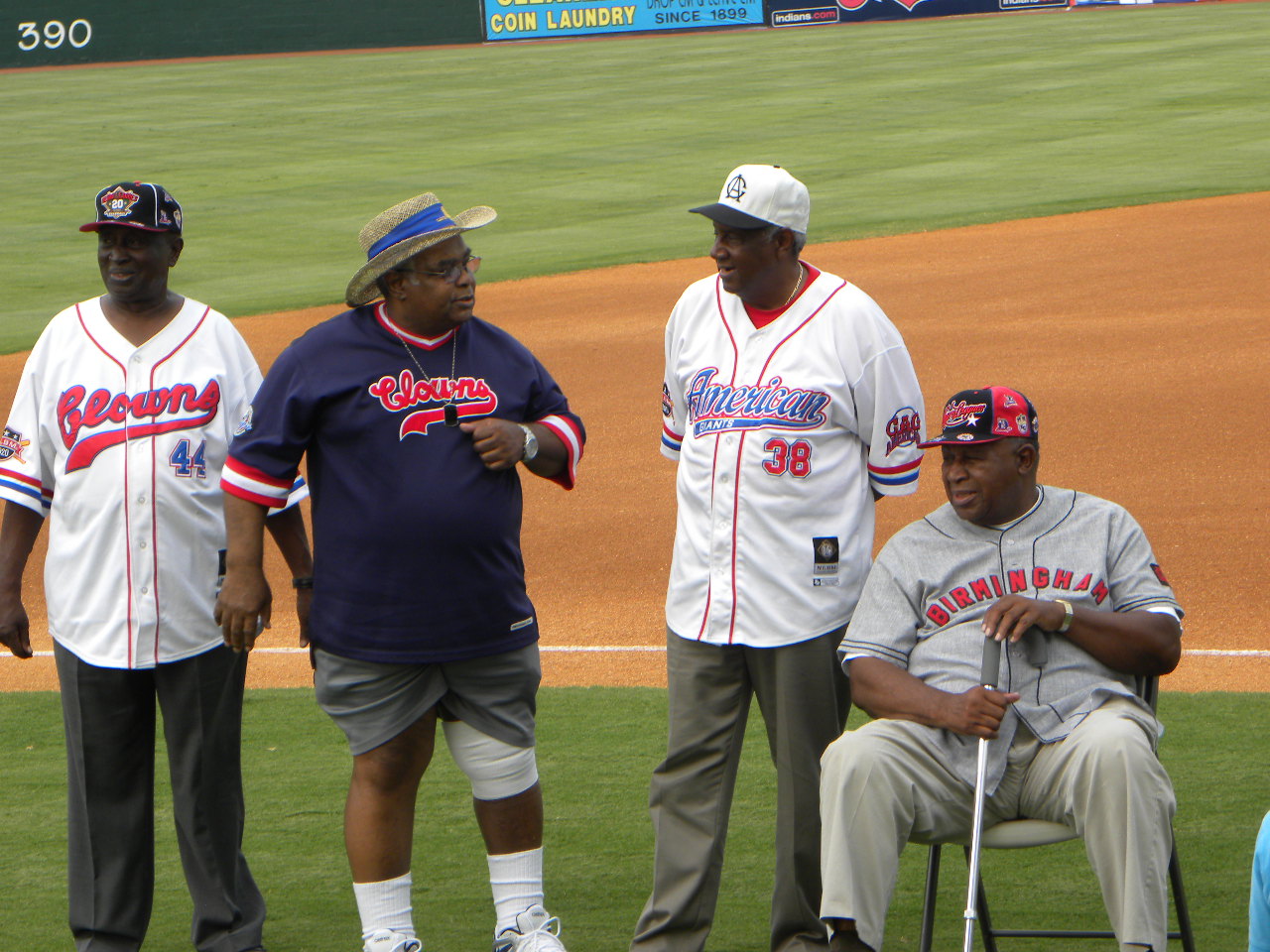
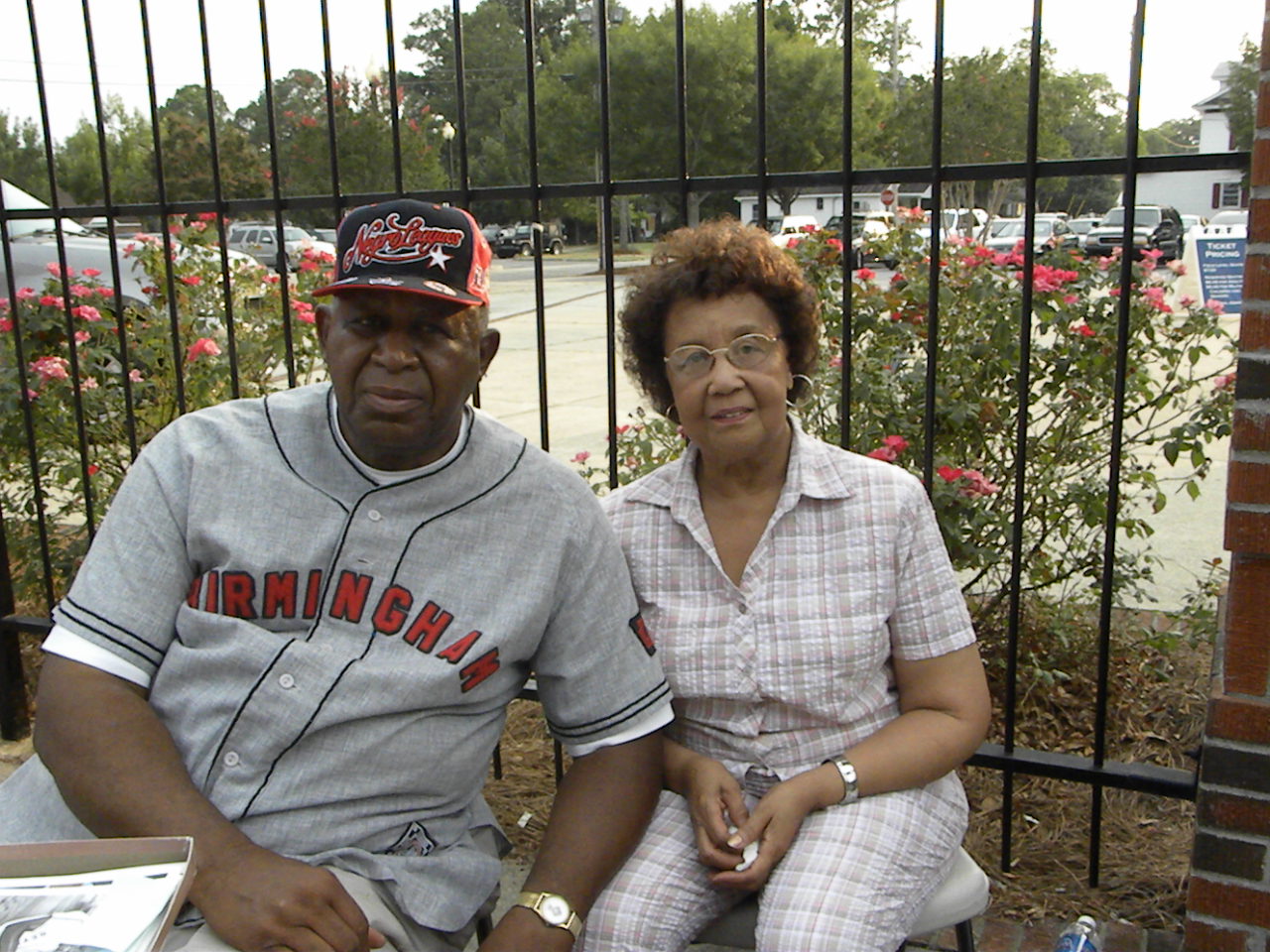
Carl Long Night: L-R  James “Spot”King, Hubert “Big Daddy”Wooten, Dennis “Bose”Biddle and Carl Long  at Historical Grainger Stadium

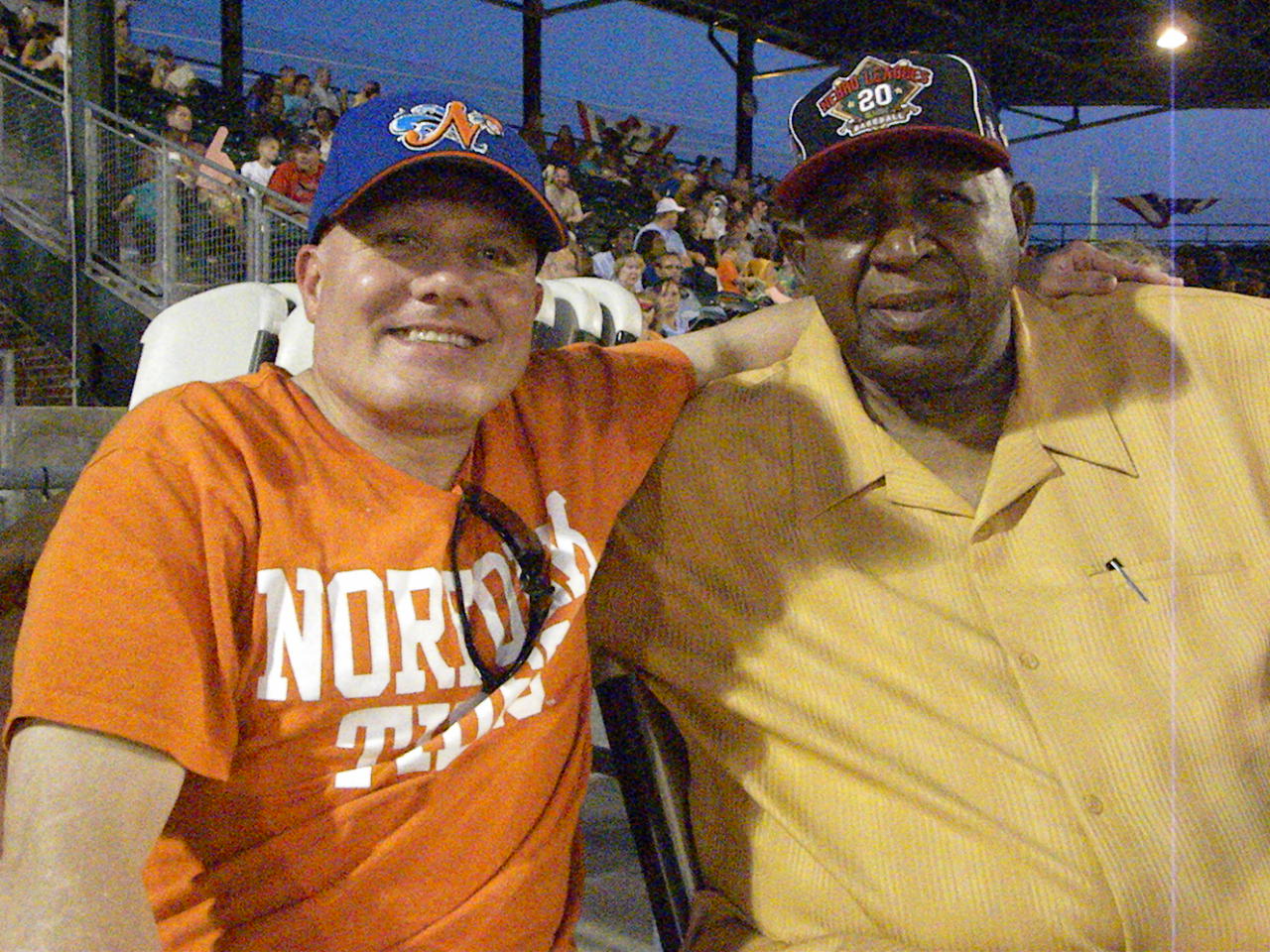
Friday I had the privilege of being invited to spend a portion of the day a number of former Negro League players, Minor League players and a couple of former Major Leaguers including one veteran of the 2004 Boston Red Sox World Series Championship team, Trot Nixon.  In addition to the ballplayers I met Carl’s lovely wife Ella as well city officials from the City of Kinston and regular folks, baseball fans and parents with their children.

Carl and Ella

It was a day to honor one of the few remaining veterans of the Negro Leagues.  Carl Long played with the Birmingham Black Barons alongside Willie Mays and Country and Western singer Charlie Pride. He played against Hank Aaron and spent time in the minors with Willie McCovey and Roberto Clemente.  He was the first black to play in the Carolina League and still holds the record for the most RBIs in a season inKinstonwhich has also seen such sluggers as Jim Thome, Alex White and Manny Ramirez play at Historic Grainger Stadium.  Carl did not have a long baseball career, he injured his shoulder and his wife of over 50 years Ella, a local Kinston girl stole his heart.  In Kinston he became the first black commercial bus driver in the state, the first black Deputy Sheriff in North Carolina, and first black Detective on the Kinston Police Department. Carl was presented with a certificate from the Mayor of Kinston during the

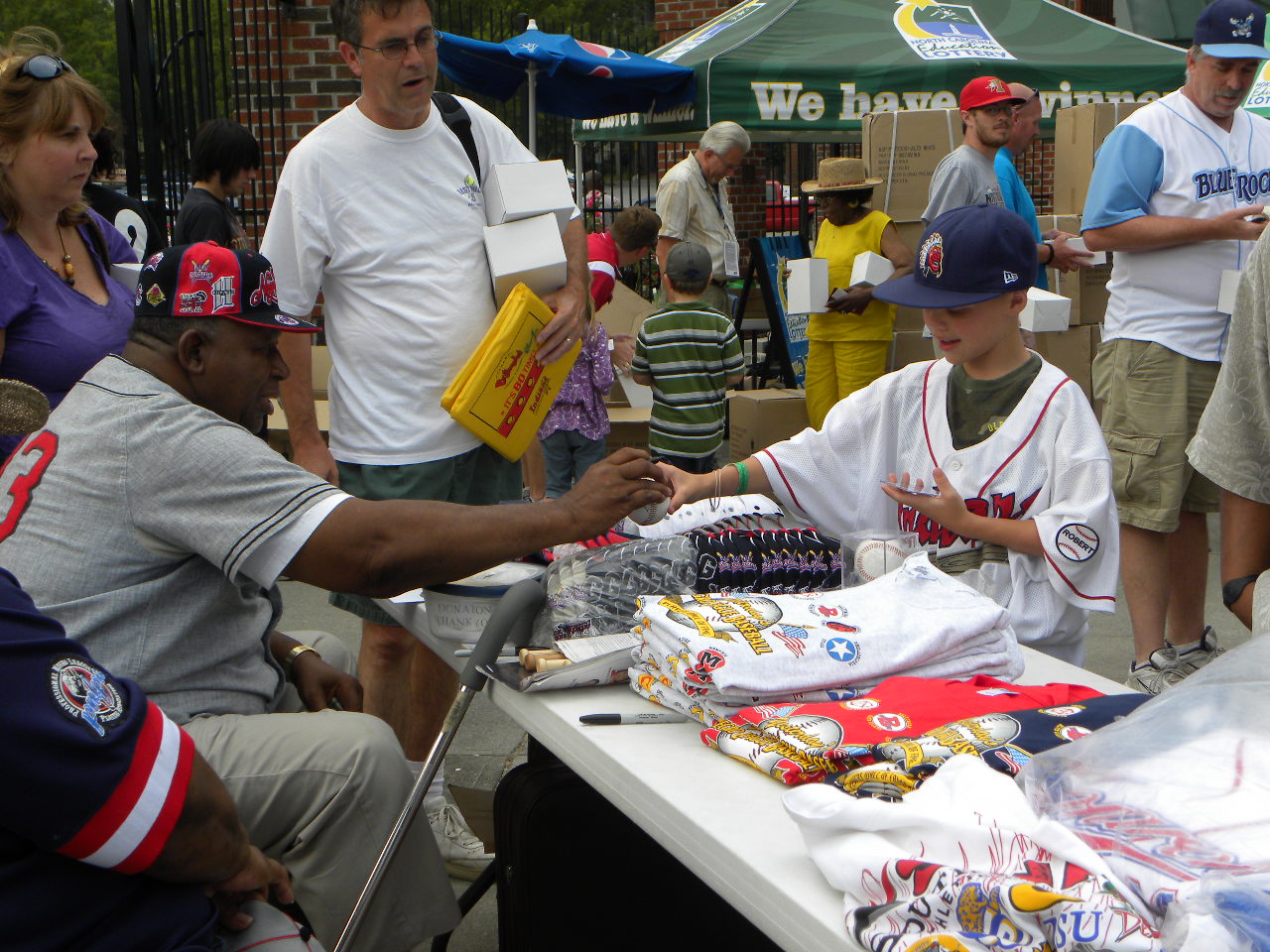
That evening the Kinston Indians hosted Carl Long Appreciation night.  Carl as well as Dennis, James “Spot” King and Hubert “Big Daddy” Wooten and a number of local Negro League era players took the field near along the third base line as their names were announced.  A local television station filmed the event and Carl made sure the members of the “Field of Dreams” Little League team each got a copy of his signed baseball card. It was a night of emotion, appreciation and history.

Carl broke barriers wherever he went and credits his father with ensuring that he got his education, a mantra that he repeats to every young person that he meets.  I met Carl earlier in the season and knew that I was in the presence of a pioneer and a great American.  When I am in Kinston there is nothing that I enjoy more that listening to Carl’s stories of life in the Negro Leagues and breaking the baseball’s color barrier in the Deep South.

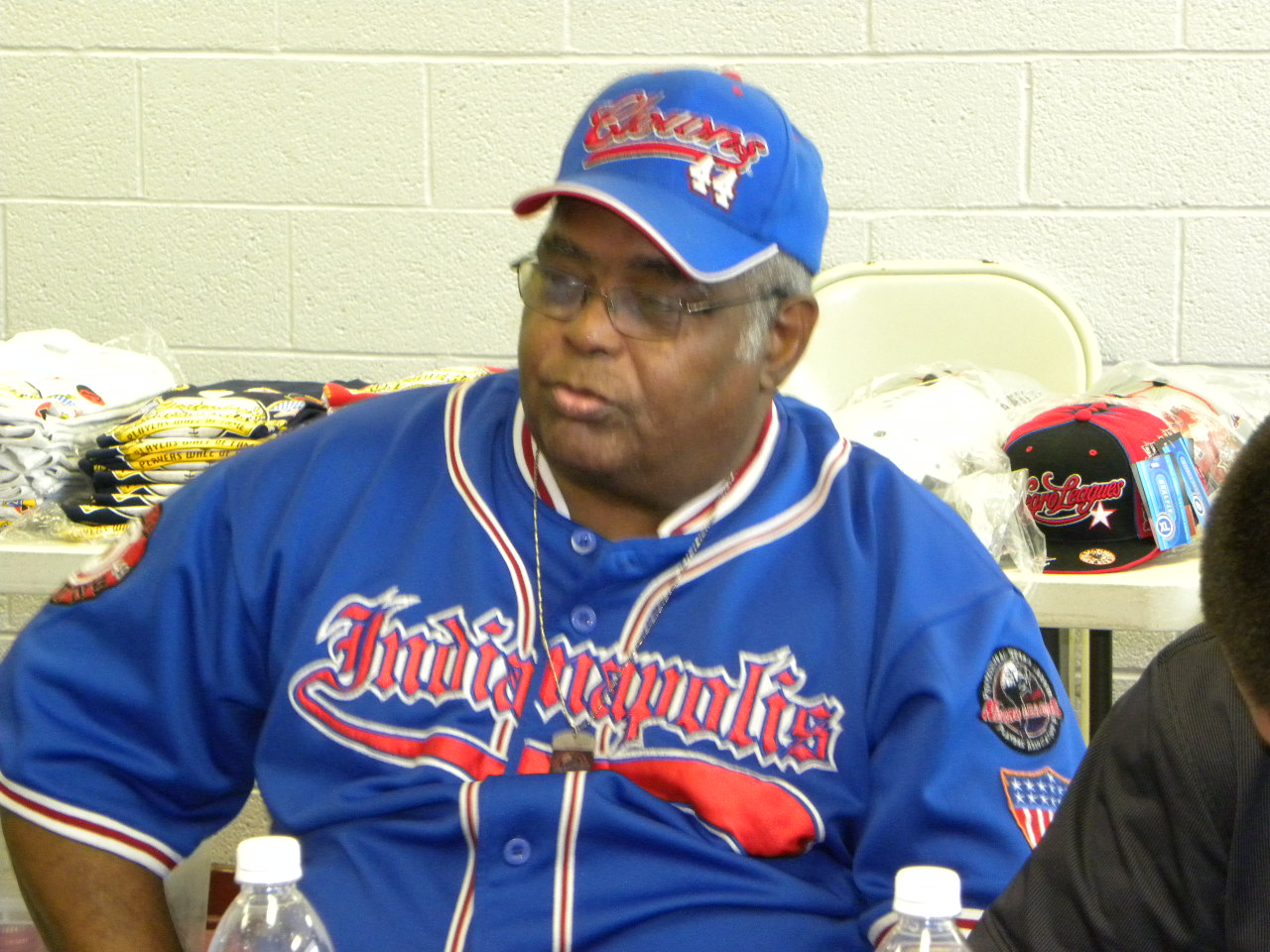
Hubert “Big Daddy”Wooten” 

It is hard to imagine now just how deep the poisonous river of racism ran in 1940’s, 50’s and 60’s America.  Then it was a fact that segregation was not only acceptable but widely practiced in much of this country.  Institutionalized racism was normal and violence against blacks and whites that befriended them was commonplace.  We like to think that we have overcome racism in this country but unfortunately there is a segment of the population that still practices and promotes this evil.  Even this week there was a Ku Klux Klan attack on the home of a black pastor in the South.  His offense….supporting a white candidate for county sheriff.  While we have overcome much there is still much work to be done.  I think this is why I believe it is so important to remember the men and women of the Negro Leagues.

One of the men at today’s events was Dennis “Bose” Biddle who played for the Chicago American Giants in 1953 and 1954.  He was in the process of having his contract purchased by the Chicago Cubs when he suffered a devastating injury to his leg and ankle going hard into Second Base.  When he couldn’t play in the Majors he went to college and became a Social Worker.  Dennis said to me “you know that “take out” sign at restaurants? We started it” referring to how black players would have to get their food at the back of a restaurant or eat in the kitchen out of sight of white customers.

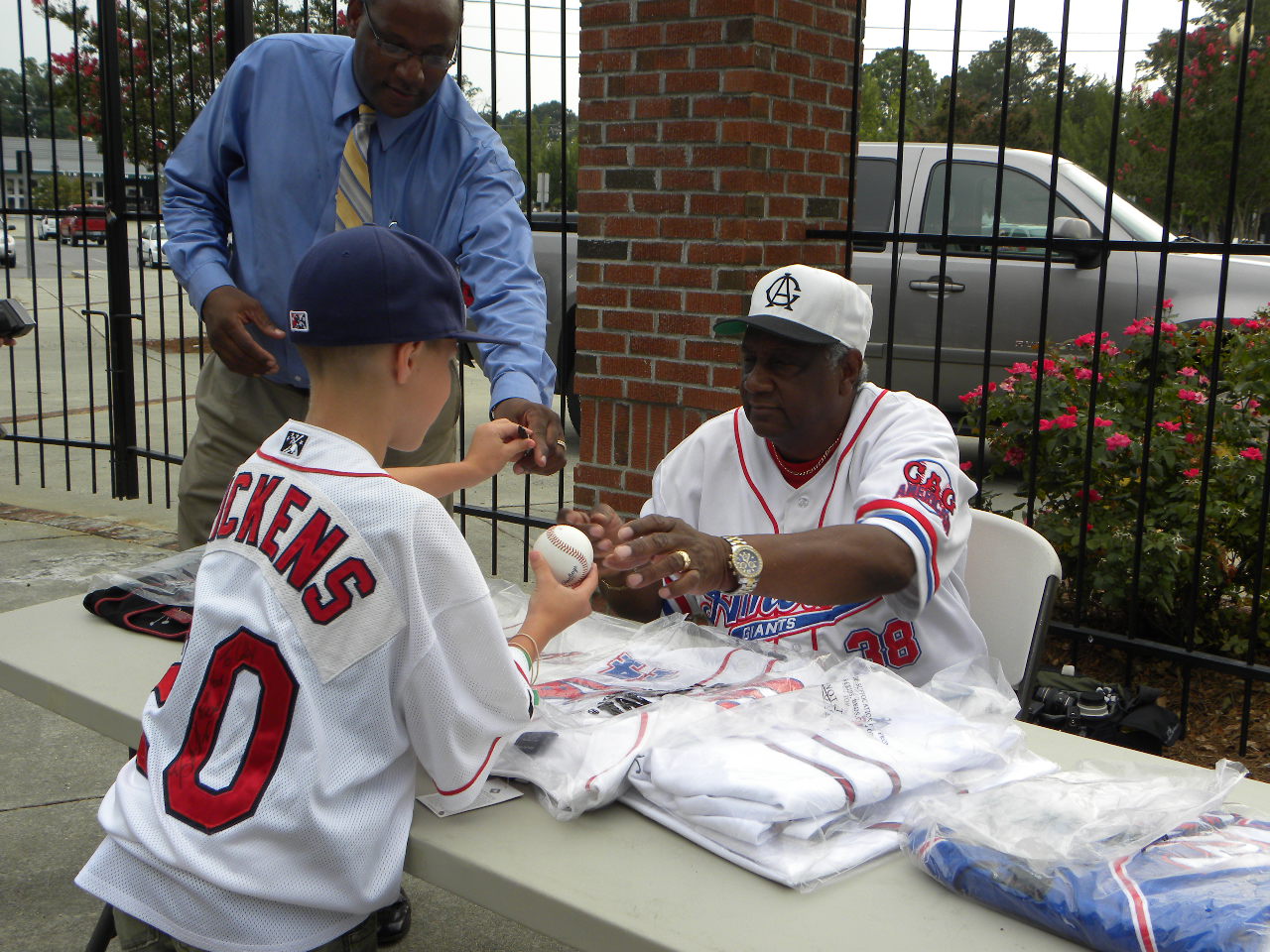
Dennis “Bose”Biddle autographing a baseball 

The truth of the matter is that the players of the Negro Leagues were torch bearers in our society.  The men and women of the Negro Leagues barnstormed and played against white teams when baseball was still segregated.  When Branch Rickey signed Jackie Robinson it was a seismic event with great social connotations.  A barrier had been broken and I dare say that without the men of the Negro Leagues that the work of other Civil Rights leaders including Dr. Martin Luther King Jr. would have had a less fertile audience in White America and probably a even less friendly reception than they had as they worked to fulfill the vision of a better America where men and women of every race, color and creed could aspire to great things.

Carl Long giving a baseball and good advice to a young fan

Men like Carl Long are responsible for this.  Some made their impact at a national level while others like Carl and Dennis on a local and regional level.  Like the men and women of the “Greatest Generation” this fellowship grows smaller with each passing year. Hubert “Daddy” Wooten was one of the last Negro League players; he played for and later managed the Indianapolis Clowns in the years where they barnstormed.  During that time he managed the legendary Satchel Paige. “Big Daddy” Wooten  is the youngest of the he surviving Negro League players a mere 65 years old.  Most are in their mid-70s or in their 80s.  It is important that their friends and neighbors write down their stories so they are not forgotten.

Baseball in particular the Negro League Hall of Fame and Museum has done a credible job of trying to preserve the contributions of these men to baseball and the American experience. Yet many more stories are still to be told.  I hope that as I continue to visit with Carl, Sam Allen in Norfolk and other players that I will be able to help them tell more of those stories.

Peace

Padre Steve+

1 Comment

Filed under Baseball, civil rights, History, Loose thoughts and musings

Remembering My Friendship with Carl Long, Negro League Hall of Famer and Civil Rights Pioneer

Friends of Padre Steve’s World,

Today was a day of recovery from a long week with little sleep, lots of work, contractors in the house doing renovations, and a lot of stress. Last night it took me forever to get to sleep even though I went to bed early I could not get to sleep until about four AM. I big part of the problem was that I had my sleep meds lapse as there was a problem between my military provider, the military pharmacy, and the civilian pharmacy that my meds get transferred to. I put on my CPAP and with the lights off I laid in bed for almost four hours before I finally went to sleep. I slept until two PM. I did go out and pick up some melatonin and Advil PM to try to help me sleep tonight. We did get a bit more work done in the house today but not nearly what I hoped to get accomplished.

This evening I had a twitter exchange with a few people including the President of the Negro Leagues Hall of Fame in Kansas City. One of the people encouraged me to write down my memories of the Negro League players that became my friends. The best was the late Carl Long who is in the Negro League Hall of Fame. So tonight I am reposting an article about the beginning of my friendship with him. I will post another tomorrow night.

So until then,

Peace

Padre Steve+

Me with Carl Long

On Friday, after a long and stressful week at work I decided to head to Kinston to see a ball game.  It was a rough week, my staff and I dealt with the death of an 11 year old girl that came through our ER on Monday morning.  I found that a Marine that I had served with while serving with 3rd Battalion 8th Marines in 2000-2001.  Staff Sergeant Ergin Osman was killed around Memorial Day with 7 of his fellow soldiers in Afghanistan. His death hit me hard.  I remembered the great Marine and wonderful young man that I knew back then.  That night I went out and sat in the light of the half moon and cried. Some other things went on and I finished work Friday caring for a family that lost their unborn baby and knowing that I was going to have to come in during the early morning hours Saturday for another still-birth.  I needed something and for me that “something” is baseball.

So when I was done with work I loaded up my trusty 2001 Honda CR-V and drove from LeJeune to Kinston. The trip across rural Eastern North Carolina was relaxing, there was little traffic and despite a passing thunder shower was uneventful, not even a driver doing well less than the speed limit in a no-passing zone to annoy the spit out of me. Eastern North Carolina has its own charm, small towns and settlements dot the farm fields and forests of the area. It is not uncommon to drive by a former plantation or to pass gas stations and country stores that seem to have stopped in time.

Kinston is one of those towns that have seen better times, the outsourcing of the garment industry to Central America and Asia has hit the town hard.  While a budding aviation industry promises better times many of the poorer and less educated people in the city have little opportunity.  While there are some very nice areas in town the central part of the city, especially downtown shows the real effect of what economic damage has been done to our country by the actions of industries to relocate overseas and actions by successive administrations and congresses to help them abandon Americans in order to increase profits.

However Kinston has had a team in the Carolina League for years and Minor League Baseball has been in the city continuously since 1937, with a four year break between 1958 and 1962 when the Kinston Eagles became part of the Coastal Plains League.  Grainger Stadium was built in 1946. The team became part of the Carolina League in 1956. Over the years the Kinston team has had various affiliations with Major League teams as well as various names.  The Team was called the Eagles until 1982 when they became the Blue Jays until 1986 when they again became the Eagles. Then in 1986 they became the affiliate of the Cleveland Indians, a relationship that they maintain until this day. Before the 2011 season it was announced that the team had been sold and was being moved to Zebulon North Carolina to replace the Carolina Mudcats which are moving to Pensacola Florida. The team owner is seeking to bring another team to Kinston in time for the 2012 season.  It will be a sad day if a team cannot be found to bring to Kinston which has one of the nicest parks in Class “A” ball.

I got to the game and was able to relax talking with new friends and moving around the ballpark to take pictures. When I moved back to the first base line I saw a man that I had watched a game with earlier in the year in his season ticket box. John is a retired Navy Supply Corps Officer and really nice to spend time with. This particular evening he was sitting beside a heavy set older African American man wearing a Negro League cap.  I came up and John invited me to sit with them and I got to meet the man, Carl Long.

Carl had played ball in the Negro Leagues with the Birmingham Barons and played with Willie Mays and for legendary manager Buck O’Neal and he was the first black player in the Carolina League playing with the Kinston Eagles when they were with the Pittsburgh Pirate organization.  In 1956 he led the team in home runs with 18, hit .299 and had 111 RBIs a season record that still stands in Kinston.

It was really nice just to be able to listen and to spend time with one of those great men of the Negro Leagues and pioneers of baseball integration. He played with Mays, McCovey, Clemente and against Aaron and even country and western singer Charlie Pride.  He played on a number of minor league teams until the end of 1957.  He was 22 years old and had a lot of good years left in him but he had married the woman of his dreams and he elected to settle in Kinston with her.  They are still married and went on to become the first black deputy Sheriff and first black Detective on the Kinston Police Department and even the first black commercial bus driver.

Carl is part of the Living Legends of surviving Negro League players and makes many appearances, the most recent at Rickwood Field in Birmingham the oldest ballpark in the country and home of the Barons.  He will be honored on July 22ndin Kinston with other Negro League players, including Sam Allen who I know from Norfolk.

I plan on visiting more with Carl as I enjoyed the man immensely. When he found my interesting in baseball history and the Negro Leagues he gave me an autographed baseball card.

I drove home through the night feeling much better even knowing that I would be called in to deal with sad situations at the hospital, but once again I was blessed to have the opportunity to spend time with Carl and John and to meet some other really nice people.

Thank God for baseball and the Church of Baseball, Grainger Stadium Parish.

Peace

Padre Steve+


2 Comments

Filed under Baseball, civil rights, History, Loose thoughts and musings

The Road Built With Hate and Paved by the Indifference of Trump’s Christian Followers

1_PdtRL0EWQD_TJZdqE8BzQg

Friends of Padre Steve’s World,

We are still in the midst of our repairs and renovations of our home. There is still so much to do and as with anything like this it seems that it is taking years. Because I am rather tired I have re-written an article that I think is especially important today in regard to the path that is being trod by President Trump’s passionate followers, the bulk of which are supposedly conservative Evangelical Christians.

Thew fact is that Trump’s followers were prepared for his advent by years of highly politicized propaganda nationalistic covered with a very thin veneer of Christian jibber-jabber, most of which is at odds with 2000 years of the teachings of the Church going back to Jesus. But this propaganda has brought about a wave of hatred that consumes many toward those that they identify as enemies, and indifference to the victims of the policies that their political and clerical leaders espouse.

Historian Ian Kershaw wrote: “The road to Auschwitz was built by hate, but paved with indifference.” I find that comment all too real today when I look at the President, his propagandists, and those who follow him without question even when they know that he is lying to them.

The longer that I live the more that I understand how this happens. Today, as there were in 1930s and 1940s Nazi Germany, there are all too many hate-filled ideologues who desire to destroy or subjugate entire races and ethnic groups, or members of different religions or political ideologies. In the United States they have free reign to do speak and write freely about their goals and for many years we have regarded most of them as fringe characters who had no chance of ever enacting anything that they proposed.

Barry Goldwater, the true conservative scion of the GOP was frightened by the Christians who now form the core of the Trump personality cult. Goldwater said:

“Mark my word, if and when these preachers get control of the [Republican] party, and they’re sure trying to do so, it’s going to be a terrible damn problem. Frankly, these people frighten me. Politics and governing demand compromise. But these Christians believe they are acting in the name of God, so they can’t and won’t compromise. I know, I’ve tried to deal with them.” 

Many of these were and continue to be the most vocal supporters of President Trump, and see in him a man who will help them accomplish their desires as no President has done before. One of them, Steve Bannon serves as his chief policy adviser and strategist, and there are no shortage of civil rights opponents and proponents of a police state in his cabinet, including his Attorney General. The the most recent about the latter, the top law enforcement official in the country joined a chorus of Republican youth chanting “lock her up” meaning former First Lady, Senator, and Secretary of State Hillary Clinton.

e5b0006d86d35ad18a117e40a2e528af

Despite the myriad of actions taken by the Trump administration, its abuses of power, its probable connections to a hostile power, its attempts to shut down law enforcement probes of the Russia connections, its unabashed attempts to silence the press and all other opponents, and its nearly uncountable number of lies and distortions that it makes on a daily basis is that the vast majority of Congressional Republicans nor his supposedly Christian followers seem to care.

Don’t get me wrong, there is plenty of opposition, but among his followers and the great number of people in the middle who prefer not to get involved there is little real opposition; moral, religious, ethical, or political to anything that he says or does, mostly because they do not understand how it effects them or their liberties, nor how toxic it is to the nation. It seems to me that they are not only apathetic to the abuses of power, but have no empathy towards the people that they are directed against.

But as I said at the opening of this article, the were prepared by decades of political propaganda covered with a veneer of Christian jibber-jabber. I know this because for a bit over two decades I was exposed to it and and believed it. Years ago I knew and went to church with Randall Terry, the former head Operation Rescue. He once said: “Let a wave of intolerance wash over you. I want you to let a wave of hatred wash over you. Yes, hate is good…” I have walked in the shoes of Trump’s “Christian” personality cult, and at one time I was as whipped into a frenzy of hate by those preachers, and their colleagues in right wing talk radio. That was before I went to and returned from Iraq. Thus I fully understand them and now I reject them and their intolerant creeds.

img_0476

For the Trump supporters this is not a problem. He represents a chance for them to recover their greatness, just as Hitler did for many of his followers in the 1930s, including those who joined the Party late. One of the greatest film monologues that illustrated this phenomenon is that of Burt Lancaster in his portrayal of a Nazi judge who is on trial in the movie Judgment at Nuremberg. His comments remind me so much of what I see among many Trump supporters today:

“There was a fever over the land. A fever of disgrace, of indignity, of hunger. We had a democracy, yes, but it was torn by elements within. Above all, there was fear. Fear of today, fear of tomorrow, fear of our neighbors, and fear of ourselves. Only when you understand that – can you understand what Hitler meant to us. Because he said to us: ‘Lift your heads! Be proud to be German! There are devils among us. Communists, Liberals, Jews, Gypsies! Once these devils will be destroyed, your misery will be destroyed.’ It was the old, old story of the sacrificial lamb. What about those of us who knew better? We who knew the words were lies and worse than lies? Why did we sit silent? Why did we take part? Because we loved our country! What difference does it make if a few political extremists lose their rights? What difference does it make if a few racial minorities lose their rights? It is only a passing phase. It is only a stage we are going through. It will be discarded sooner or later. Hitler himself will be discarded… sooner or later. The country is in danger. We will march out of the shadows. We will go forward. Forward is the great password. And history tells how well we succeeded, your honor. We succeeded beyond our wildest dreams. The very elements of hate and power about Hitler that mesmerized Germany, mesmerized the world! We found ourselves with sudden powerful allies. Things that had been denied to us as a democracy were open to us now. The world said ‘go ahead, take it, take it! Take Sudetenland, take the Rhineland – remilitarize it – take all of Austria, take it! And then one day we looked around and found that we were in an even more terrible danger. The ritual began in this courtoom swept over the land like a raging, roaring disease. What was going to be a passing phase had become the way of life. Your honor, I was content to sit silent during this trial. I was content to tend my roses. I was even content to let counsel try to save my name, until I realized that in order to save it, he would have to raise the specter again. You have seen him do it – he has done it here in this courtroom. He has suggested that the Third Reich worked for the benefit of people. He has suggested that we sterilized men for the welfare of the country. He has suggested that perhaps the old Jew did sleep with the sixteen year old girl, after all. Once more it is being done for love of country. It is not easy to tell the truth; but if there is to be any salvation for Germany, we who know our guilt must admit it… whatever the pain and humiliation.”

img_0178

While we have not reached the point that the Third Reich did between 1933 and 1938, it will not take much for us to get there. We misjudge ourselves if we belief that such things cannot happen here.

Timothy Snyder wrote:

“The European history of the twentieth century shows us that societies can break, democracies can fall, ethics can collapse, and ordinary men can find themselves standing over death pits with guns in their hands. It would serve us well today to understand why.”

Reinhold Niebuhr, the great American theologian noted: “Ultimately evil is done not so much by evil people, but by good people who do not know themselves and who do not probe deeply.”

We should heed their warnings before we cross that precipice and head into the abyss.

Until tomorrow,

Peace

Padre Steve+

4 Comments

Filed under christian life, civil rights, culture, faith, film, History, leadership, nazi germany, News and current events, Political Commentary

War Without Mercy: Race and Power in the Pacific War

Friends of Padre Steve’s World,

It has been another long day of work in the house and dealing with contractors but we are making progress. We stopped work about 8;15 this evening. Tomorrow the contractor crew arrives between seven and seven-thirty in the morning. As they work we too will be working to set conditions so I can start, painting, and then ripping out old laminate and re-flooring our guest room and hallway.

Specifically that mean sorting through all of the stuff that we moved into the guest room. I have to find what was damaged during the flooding from our air conditioning condenser pan, things that we will be keeping and taking to the attic or storage space, and things that we will either throw out or give to Goodwill.

So anyway, I am re-posting an older article, a review and reflection on John Dower’s classic book War without Mercy: Race and Power in the Pacific War. 

Until tomorrow,

Peace,

Padre Steve+

1NoRoosevelt

The study of war cannot simply be confined to the study of battles, weapons and leaders. While all of these are important one must as Clausewitz understood examine the human element of policy, ideology and the motivations of nations as they wage war. Clausewitz understood that war could not be reduced to formulas and templates but involved what he called the “remarkable trinity” which he described in on war as (1) primordial violence, hatred, and enmity; (2) the play of chance and probability; and (3) war’s element of subordination to rational policy. Clausewitz connects this with the people being connected to the primordial forces of war, the military with the non-rational elements of friction, chance and probability and the government.
Anti-Japan2

The Clausewitzian understanding of war is rooted in the Enlightenment and classic German Liberalism, born out of his experience in the Napoleonic Wars, which forever changed the face of warfare.  From the defeat of Prussia and its liberation from Napoleonic rule under Scharnhorst and Gneisenau Clausewitz developed the understanding that war was more than simply tactics and weapons.  Thus when we examine war today we deprive ourselves of properly understanding the dynamic of war if we fail to appreciate the human factor which is frequently not rational.  Such is especially the case when one fights an enemy who wages war on religious, racial or ideological grounds as is the case in the current war against Al Qaida and other extremist Moslem groups. Such groups would like to turn this war into such a conflict as do certain figures in the American political milieu who repeatedly label all of Islam as the enemy.  In such a climate it is imperative to look at history to show us the results of such primal passions.

14129979717_6f281b6876_b

It is in such conflict as we are engaged in today it is good to look at previous wars from the human experiential component and not simply military operations.  If one wants to look at how inflamed passion driven by racial prejudice and hatred took war to a level of barbarity and totality that defy our comprehension we only need to look back to the Pacific war between Japan and the United States.  In another post I dealt with the how racial ideology influenced Nazi Germany’s conduct of the war against Poland and the Soviet Union.  https://padresteve.wordpress.com/2009/09/14/the-ideological-war-how-hitlers-racial-theories-influenced-german-operations-in-poland-and-russia/

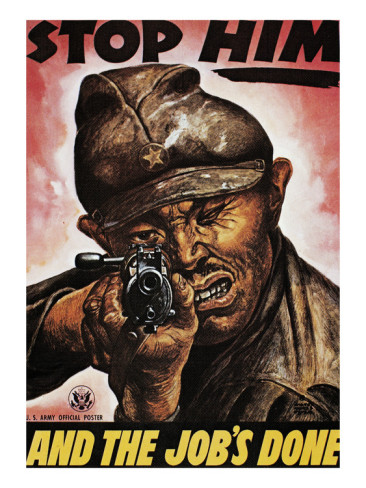
To do this I will look at John Dower’s “War Without Mercy.” In this book Dower examines World War Two in the Pacific from the cultural and ideological viewpoints of the opposing sides.  He looks at the war as a race war, which he says “remains one of the great neglected subjects of World War Two.”[i] Dower examines race hated and its influence on both the Japanese and the Allies, particularly in the way that each side viewed one another and conducted the war.  He examines the nature of racial prejudice and hate in each society, including its religious, psychological, ideological, scientific and mythological components.  He also examines the use of media and propaganda, and how racial attitudes not only influenced national and individual attitudes, but also the military and intelligence operations of both sides.  This book is not about military campaigns, thus it is much more like “In the Name of War” by Jill Lepore [ii] than any history of the Pacific war.
5767884_orig

Dower uses sources such as songs, movies, cartoons and various writings of the times to demonstrate the totality of the war.  Dower admits many of these are difficult to handle and “not respectable sources in some academic sources.”[iii]Despite this he puts together a work that is sometimes chilling, especially when one looks at the current war that our country is engaged in. He also endeavors to explain how after a war where “extraordinarily fierce and Manichean”[iv] race hate predominated, it could “have dissipated so easily”[v] after the war was over.

Dower divides his work into three major sections.  The first which examines how the aspect of race effected the fighting of the war, the second, the war through Western eyes and the third the war through Japanese eyes.  The first section begins with how racial attitudes in Western and Japanese societies helped fuel the war and compares similar attitudes and concepts in Western and Japanese thought, including how “prejudice and racial stereotypes frequently distorted both Japanese and Allied evaluations of the enemy’s intentions and capabilities.”[vi] He looks at the language of the conflict; at how war words and race words came together “in a manner which did not reflect the savagery of the war, but truly contributed to it….”[vii] the result being “an obsession with extermination on both sides.”[viii] He comes back to this theme throughout the book comparing the two sides and occasionally contrasting these attitudes with corresponding attitudes of the Allies to their German and Italian foes in Europe.[ix]

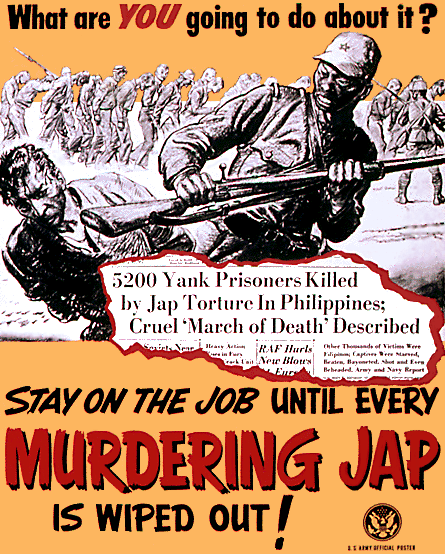
In the first chapter Dower examines the role played by the propaganda used by both sides.  In particular he expalins how the “Know Your Enemy: Japan”movies commissioned by the War Department and directed by Frank Capra, and the Japanese works “Read this and the War is Won” and “The Way of the Subject” helped shape the view of each side. Propaganda developed the idea of the war in terms of good versus evil and the mortal threat posed to their respective cultures by the enemy.

From this he looks at the visceral emotions that the war engendered and how those emotions spilled over into the conduct of the war especially in regard to its ferocity and the war crimes that were spawned by the unbridled hatred of both sides.  He notes the targeted terror bombings of civilians by both sides and how those actions were portrayed as “barbaric” by the other side when they were the victim.[x] He notes the viciousness of the war and how for the Americans the war brought forth “emotions forgotten since our most savage Indian wars.”[xi]He contrasts this with European war in particular how the Japanese and their actions were portrayed in Western media, and how similar actions by the Germans, such as the Holocaust, were ignored by Western media until the war was over.[xii] He traces some of this to the understanding of the psychological effects of the defeats and humiliations of the Allies at the hands of the Japanese, and the corresponding brutality toward Allied prisoners by the Japanese as compared to that of the Germans.[xiii] He uses this section to also examine the prevailing attitudes of the Japanese toward the Allies as being weak and “psychologically incapable of recovery” from blows such as the Pearl Harbor attack, and the Allied view of the Japanese as “treacherous.”[xiv]

Dower’s second major section describes the attitudes and actions of the Americans and British toward their Japanese enemy.  He looks at the view that the Japanese were less than human and often portrayed as apes or other primates such as monkeys.  To do this he examines cartoons and illustrations in popular magazines and military publications, and includes those cartoons in the book.   The sheer vulgarity of these cartoons is easily contrasted with those promoted and published by Nazis such as Julius Streicher in Der Stürmer, something often overlooked or ignored in other histories.[xv] The early Western views of Japan as sub-human continued throughout the war, while at the same time, especially after the rapid series of Allied defeats and Japanese victories they were viewed as almost “super-human.”  Paradoxically some allied leaders turned the Japanese from “the one time “little man” into a Goliath.”[xvi] They were now “tough, disciplined and well equipped.”[xvii] Ambassador Joseph Grew, reported on his return from Japan, that the Japanese were; “”sturdy,” “Spartan,” “clever and dangerous,” and that “his will to conquer was “utterly ruthless, utterly cruel and utterly blind to the values that make up our civilization….””[xviii] The juxtaposition of such conflicting attitudes is curious, although understandable, especially in light of other Western wars against Asians or Arabs.[xix]

Dower then examines how some Americans and British explained the Japanese “National Character,” their approach to war, and actions during the war from Freudian psychiatry as well as Anthropology and other social and behavioral sciences.   Beginning with the widespread Allied understanding that the Japanese were “dressed-up primitives-or “savages” in modern garb…”[xx] he notes that these interpretations of the Japanese national character stemmed from “child-rearing practices and early childhood experiences,”[xxi] including toilet training and Freudian interpretations that saw an arrested psychic development at the “infantile (anal or genital) stage of development.”[xxii]Dower deduces that it was not hard to see how “Japanese overseas aggression became explicable in terms of penis envy or a castration complex….”[xxiii] The views were widespread and emphasized  that the “Japanese were collectively unstable.”[xxiv] Dower notes that the “very notion of “national character”-was the application to whole nations and cultures of an analytical language that had been developed through personal case studies…”[xxv] which he is rightly critical in suggesting that this premise “was itself questionable.”[xxvi] In addition to this was the understanding of Margaret Mead and others of the Japanese as “adolescents” and “bullies,”[xxvii] and notes that from “the diagnosis of the Japanese as problem children and juvenile delinquents, it was but a small step to see them as emotionally maladjusted adolescents and, finally as a deranged race in general.”[xxviii] Dower cites numerous other “experts” of the time and their interpretations of the Japanese national character, but the overwhelming message is that the application of these theories, regardless of their validity had a major impact on the Allied war against Japan.

He follows this chapter with one with much importance in explaining the similarities in how Americans and Westerners in general viewed the Japanese in relationship to other races that they had dealt with including Blacks, Chinese, Filipinos, and American Indians.  Common themes include the views of each as primitives, children and madmen and the view of the Japanese as part of the “Yellow Peril.”  Of particular note is his analysis of the work of Homer Lea’s 1909 book The Valor of Ignorance and the vision of Japanese supermen which enjoyed a revival after Pearl Harbor.[xxix] Dower examines depictions of Asians in general in the Fu Manchu and Charlie Chan series of films and other racial aspects hearkening back to the “specter of Genghis Khan and the prospect that the white races “may be liquidated.”[xxx] He notes how Japanese propagandists attempted to use Allied prejudice to influence the Chinese and other Asians against the Allies[xxxi] and American blacks against whites,[xxxii] while attempting to maintain their own racial superiority which is the subject of the next section.

The chapters dealing with the Japanese view of themselves and their opponents tie together neatly.  These deal with the Japanese view of themselves as the leading race in Asia and the world.  Dower talks about symbols and the understanding of racial purity that motivated the Japanese from the 1800s to the rejection of Japan’s request for a declaration of “racial equity” at the League of Nations.[xxxiii] He notes the “propagation of an elaborate mythohistory in Japan and the time spent “wrestling with the question of what it really meant to be “Japanese” and how the “Yamato race” was unique among races….”[xxxiv] He notes the relationship of Shinto with whiteness and purity and connotations of how the Japanese indulged in “Caucasianization” of themselves vis-à-vis other Asians during World War Two,”[xxxv] and their emphasis on a Japanese racial worldview.[xxxvi] He also tackles the way in which the Japanese wrestled with evolution and its relationship to other racial theories contrasting books such as A History of Changing Theories about the Japanese Race and Evolution of Life with Cardinal Principles of the National Polity published by the Thought Bureau of the Ministry of Education in1937.  These declared that the Japanese were “intrinsically different from the so-called citizens of Occidental countries.”[xxxvii] He also deals with the Kyoto school and the Taiwa concept.[xxxviii] In Chapter Nine Dower looks at how the Japanese viewed themselves and outsiders, in particular the characterization of Westerners as nanbanjin or  barbarians and how this eventually train of thought carried through the war led to the “Anglo-American foe emerged full blown as the demonic other.”[xxxix]Dowers final chapter deals with how quickly the race hatred dissipated and genuine goodwill that developed between the Japanese and Americans after the war.[xl]

This book holds a unique place in the literature of the Pacific war.  It is not a comfortable book, it is challenging. No other deals with these matters in any systemic way.  If there is a weakness in Dower is that he does not, like Lepore in “In the Name of War” deal with the attitudes of soldiers and those who actually fought the war.  His examples are good and go a long way in explaining the savagery with which the war was conducted, but could have been enhanced with reflections and accounts of those who fought the war and survived as well as the writings of those who did not, and the way those attitudes were reflected in different services, times and theaters during the war, including adjustments that commanders made during the war.[xli] His description of how Japanese “reluctance to surrender had meshed horrifically with Allied disinterest …in contemplating anything short of Japan’s “thoroughgoing defeat.”[xlii]

The lessons of the book are also contemporary in light of the cultural and religious differences between the West and its Moslem opponents in the current war. Possibly even more so than the war between the United States and Japan which was fought by nation states that still were signatories to international conventions, not nation states against terrorists unbound by any Western code or law or indigenous forces engaged in revolutionary war against the west such as the Taliban.[xliii] The temptation is for both sides to demonize one’s opponent while exalting one’s own way of life through official propaganda and popular media, with a result of increased viciousness and inhumanity in pursuit of ultimate victory.   In today’s world with the exponential rise in the radicalization of whole people groups and the availability of weapons of mass destruction, it is possibility that the war could develop into one that is a racial as well as religious and ideological war that would make the War in the Pacific look like a schoolyard brawl.

Bibliography

Alexander, Joseph H. Utmost Savagery: The Three Days of Tarawa. Ivy Books, Published by Ballantine Books, New York, NY 1995

Dower, John W. War without Mercy: Race and Power in the Pacific War.”Pantheon Books, A Division  of Random House, New York, NY 1986.

Leckie, Robert. Okinawa. Penguin Books USA, New York NY, 1996

Lepore, Jill  The Name of War Vintage Books a Division of Random House, New York, NY 1998

Tregaskis, Richard Guadalcanal Diary Random House, New York NY 1943, Modern Library Edition, 2000.


[i] Dower, John W. War without Mercy: Race and Power in the Pacific War.”Pantheon Books, A Division  of Random House, New York, NY 1986. p.4

[ii] Lepore, Jill  The Name of War Vintage Books a Division of Random House, New York, NY 1998.  Lepore’s book deals with King Phillip’s War and how that war shaped the future of American war and how it shaped the views of Indians and the English Colonists and their later American descendants both in the language used to describe it, the histories written of it and the viciousness of the war.

[iii] Ibid. p.x

[iv] Ibid. p.ix

[v] Ibid. p.x

[vi] Ibid. p.11

[vii] Ibid.

[viii] Ibid.   Also see Alexander, Joseph H. Utmost Savagery: The Three Days of Tarawa. Ivy Books, Published by Ballantine Books, New York, NY 1995 Alexander notes an incident that shows a practical application of the Japanese views and the ruthlessness inflicted on their enemies, in this case prisoners in response to an American bombing raid. In 1942 the commander of the Japanese Garrison of Makin Island ordered 22 prisoners beheaded after one cheered following a bombing raid. (p.32)

[ix] An interesting point which Dower does not mention but is interesting for this study is how the Germans referred to the British and Americans as “Die gegener” (opponents) and the Soviets as “Die Feinde” (the enemy), the implication being that one die gegener was a common foe, much like an opposing team in a sport, and the other a mortal enemy, the implication of Feinde being evil, or demonic.

[x] In particular he makes note of the Japanese actions during the “Rape of Nanking,” and the 1945 sack of Manila, as well as the fire bombing of Japanese cities by the US Army Air Corps in 1945.

[xi] Ibid. Dower. p.33

[xii] Ibid. p.35

[xiii] Ibid.  This is important in the fact that the Allies tended not to make much of German brutality to the Jews, Russians and other Eastern Europeans.

[xiv] Ibid. p.36.

[xv] Dower does not make this implicit comparison, but having seen both and studied the Nazi propaganda directed toward the Jews, Russians and other Slavic peoples considered to be Untermenschen (sub-humans) by the Nazis the similarities are striking.

[xvi] Ibid. pp.112-113.

[xvii] Ibid. p.113

[xviii] Ibid.

[xix] In the 2006 Israeli invasion of Lebanon, Israeli soldiers who previously showed no respect to any Arab fighter described their Hezbollah opponents as “soldiers and warriors.”  Similar attitudes were voiced by American soldiers in Vietnam when they fought NVA regulars.

[xx] Ibid. p.123

[xxi] Ibid.

[xxii] Ibid.

[xxiii] Ibid.

[xxiv] Ibid. p.124

[xxv] Ibid.

[xxvi] Ibid.

[xxvii] Ibid. p.129

[xxviii] Ibid. p.143

[xxix] Ibid. P.157.  Lea is interesting because he predicts a decline in the stature of the British Empire and softness of both the Americans and British as peoples.  Also see John Costello in The Pacific War 1941-1945 Quill Books, New York, NY 1982 pp.31-32 notes Lea’s concerns and how they drove the American Pacific strategy until the outbreak of World War Two.

[xxx] Ibid. p.161

[xxxi] Ibid. p.169

[xxxii] Ibid. pp.174-180.  This is an interesting section.  One of the most interesting topics being the reaction of the NAACP’s Walter White’s book A Rising Wind published which “suggested a sense of kinship with other colored-and also oppressed-peoples of the world….he senses that the struggle of the Negro in the United States is part and parcel of the struggle against imperialism and exploitation in India, China, Burma….” (p.177-178)

[xxxiii] Ibid. p.204

[xxxiv] Ibid. p.205

[xxxv] Ibid. p.209  This is interesting when one compares the Japanese emphasis on “Pan-Asianism” and the inherent contradiction between the two.

[xxxvi] Ibid. p.211  Dower notes that the article Establishing a Japanese Racial Worldview in the monthly Bungei Shunju “clarified the Japanese character, whose basic traits were brightness, strength and uprightness.  These qualities made the Japanese “the most superior race in the world.”

[xxxvii] Ibid. p.221

[xxxviii] Ibid. p.227 This was the theory of Zen Buddhism’s Suzuki Daisetsu (D.T. Suzuki) in his teaching of the struggle for the Great Harmony “Taiwa” which attempted to identify “an intuitive sense of harmony and oneness that he declared to be characteristic of Oriental thought.”

[xxxix] Ibid. p.247.  Descriptions of the Allies as Barbarians, Gangsters and Demons permeated Japanese propaganda.

[xl] Ibid. Dower makes a number of observations relating to how the Japanese were able to use their own self concept to adapt to their defeat.  He also notes that the Japanese were able to transfer their self concept to a peaceful orientation.

[xli] See Leckie, Robert. Okinawa. Penguin Books USA, New York NY, 1996 p.35.  Leckie quotes General Ushijima “You cannot regard the enemy as on par with you,” he told his men. “You must realize that material power usually overcomes spiritual power in the present war. The enemy is clearly our superior in machines. Do not depend on your spirits overcoming this enemy. Devise combat method [sic] based on mathematical precision-then think about displaying your spiritual power.”  Leckie comments: “Ushijima’s order was perhaps the most honest issued by a Japanese commander during the war. It was Bushido revised, turned upside down and inside out-but the revision had been made too late.”

[xlii] Ibid. Dower. p.37

[xliii] See Tregaskis, Richard Guadalcanal Diary Random House, New York NY 1943, Modern Library Edition, 2000. p.95.  Tregaskis notes when commenting on Japanese POWs on Guadalcanal “We stared at them and they stared back at us. There was no doubt what we or they would have liked to do at that moment-if we had not remembered our code of civilization or if they had not been unarmed.”




Leave a comment

Filed under History, Military, Political Commentary, world war two in the pacific