Yearly Archives: 2018

Admiral Ronny Jackson: As Qualified to Head the V.A. as Tom Cruise is to Command the Top Gun School

Dr. Ronny Jackson Briefing

Note: this Post was written before Admiral Jackson withdrew his name from nomination.

Friends of Padre Steve’s World,

President Trump foolishly nominated the White House Physician, Rear Admiral (Lower Half) Ronny Jackson to head the Veterans Administration. That nomination is in the process of coming apart as allegations by over 20 current and former military personnel which detail of Admiral Jackson’s abusive leadership, drunken rampages, and careless dispensing of controlled substances including opioids has come to light. If any of those allegations are true he should not only be removed from consideration for the Veterans Administration position but he should be forced out of the service.

But even if none of those allegations are true Admiral Jackson in completely unqualified to be the Secretary of Veterans Affairs.

From a career standpoint Admiral Jackson is an oddity in military medicine. Most officers who rise to the rank of General or Admiral in the Medical Corps, Medical Service Corps, or Nurse Corps earn their rank in a variety of demanding assignments of increasing responsibility after they are promoted to the grade of Major or Lieutenant Commander in their respective services. Most combine clinical, administrative, and command assignments, serve on combat deployments, and spend extra time to do advanced fellowships in their medical field, or obtain degrees in Medical Administration, Business, or subjects like Ethics. Quite a few take the time to earn higher military education at schools like the Naval War College, Army Command and Staff and War College, the Air War College, or Marine command and Staff College.

Their assignments usually encompass commands of clinics, field hospitals, hospitals, major medical centers, and medical regions which cover half of the United States. The men and women who go through this process have to understand the extremely complicated world of the military and civilian medical systems, insurance programs, veterans medical benefits, and Medicare. These are men and women who are exceptional, honed in combat and erudite enough to understand the complexities of the Veterans Administration. Having served two full tours in Naval Medicine as a Chaplain I know a lot of them and could name five Flag Officers from the Medical Corps and the Medical Service Corps, active duty and retired off the top of my head who would be excellent candidates for the position, as well as a number of exceptional Navy Captains. All of them are far more qualified than Admiral Jackson.

Admiral Jackson has never been in charge of anything more than a medical clinic, the White House is his second clinic assignment despite its rather high profile patient base. From all accounts he is an excellent Emergency Medicine physician, he is a qualified Navy Diver, and he has served in a combat setting caring for the wounded during some of the bloodiest times in Iraq’s Al Anbar Province. That being said he has served in the insular and politicized world of the White House for 12 years, during which time he was promoted to Captain and later Rear Admiral. The White House clinic is the largest that he has ever commanded, a mere 70 people. When I was a 25 year old Army Medical Service Corps First Lieutenant I commanded a Medical Company overseas of 110 soldiers, most of them medics.  When I was a 27 year old Captain I served as a personnel officer for the largest Medical training organization in the U.S. Military. Neither qualify me to command a hospital or oversee an agency as vast as the V.A.

I’m sorry, but by any means that is not a career path that should lead to an appointment that would oversee the largest medical system in the nation.

That my friends is reality even if there were no allegations of abusive conduct or careless distribution of controlled medications; allegations detailed by the Inspector General in 2012 which resulted in a recommendation for his relief and reassignment which did not happen. However, Admiral Jackson is white, male, and Hollywood good looking, and exactly the kind of man that the President hyperventilates about, especially when they engage in hyperbole and lies to describe his physical condition. Admiral Jackson is as qualified to head the Veteran’s Administration as Tom Cruise is to Command the Top Gun School.

Admiral Jackson is not qualified for the head of the Veterans Administration or any higher post in Navy Medicine. His nomination should be immediately withdrawn instead of being allowed to become yet another disgusting political spectacle designed to polarize the nation.

If the GOP Congress had any balls, which they don’t but can be purchased at the National’s Shop, they would tell the President right now to drop this nomination like his trousers at a Playboy Club party.

The President set himself and Admiral Jackson up for this and if he has any sense of honor he would end it now and go back to the drawing board to pick a truly qualified person. Like I said I can name five off the top of my head, he can ask me for recommendations if he wants, and if he picked any of them they would make him and the nation proud.

This isn’t about politics. It is about qualifications and character. Admiral Jackson certainly lacks the qualifications, and very likely the character needed to serve in such a responsible position involving the care of millions of veterans. I’m a combat veteran, and all veterans deserve better.

Peace

Padre Steve+

1 Comment

Filed under ethics, Military, News and current events, Political Commentary, US Navy

Nothing Alters the Psychology of Dictatorship

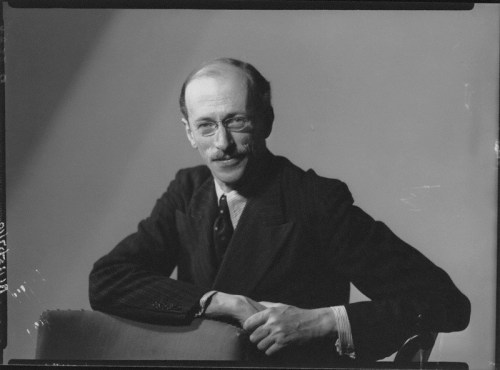
NPG x25404; Sir Basil Henry Liddell Hart by Howard Coster

B. H. Liddell-Hart

Friends of Padre Steve’s World,

A couple of weeks ago I re-read the short but poignant little but by the British military historian B.H. Liddell-Hart entitled Why Don’t We Learn from History. The book was written in not long before his death in 1970 and it is good quite good. It deals with a number of issues, including the conflict between history and propaganda; or when faith, especially religious faith as treated as historic or scientific fact; and when propaganda or faith is preached as if it were history, if it were truth. In doing this he also contrasted democracy and lure of totalitarianism.

Liddell-Hart was a realist, especially about democracy and totalitarianism. He served on the Western Front in the First World War and was wounded in a German gas attack. Between the wars he was one of the theorists of armored warfare and the use of tanks in a combined arms force, and he was also quite observant of the trends toward totalitarianism in the late 1920s and 1930s.

Hart, like many others admitted the inefficiencies of democracy, however, he realized that it was far less dangerous than the “stupidity” of totalitarianism. In fact it was important for him to note just how this inefficient system was for freedom. He wrote:

“What is of value in “England” and “America” and worth defending is its tradition of freedom, the guarantee of its vitality. Our civilization, like the Greek, has, for all its blundering way, taught the value of freedom, of criticism of authority, and of harmonising this with order. Anyone who urges a different system, for efficiency’s sake, is betraying the vital tradition.”

There is much to ponder in his book and I will be posting some more of my thoughts on it, but when I looked at it again I was struck by just how much Liddell-Hart in his description of a despot described President Donald Trump through the his campaign and after his election and inauguration.

“We learn from history that self-made despotic rulers follow a standard pattern. In gaining power: They exploit, consciously or unconsciously, a state of popular dissatisfaction with the existing regime or of hostility between different sections of the people. They attack the existing regime violently and combine their appeal to discontent with unlimited promises (which, if successful, they fulfil only to a limited extent). They claim that they want absolute power for only a short time (but “find” subsequently that the time to relinquish it never comes). They excite popular sympathy by presenting the picture of a conspiracy against them and use this as a lever to gain a firmer hold at some crucial stage.” 

Once authoritarian, despotic, or dictatorial leaders gain power through the democratic process they seldom deviate from how they behave when seeking power. Liddell-Hart wrote:

“We learn from history that time does little to alter the psychology of dictatorship. The effect of power on the mind of the man who possesses it, especially when he has gained it by successful aggression, tends to be remarkably similar in every age and in every country.”

So please, take a breathe for a second and think about this in terms of President Trump and his actions during his first two weeks in office. Liddell-Hart noted that once a despot achieves power that their reign is marked by the following types of events:

“On gaining power:  They soon begin to rid themselves of their chief helpers, “discovering” that those who brought about the new order have suddenly become traitors to it. 

They suppress criticism on one pretext or another and punish anyone who mentions facts which, however true, are unfavourable to their policy. They enlist religion on their side, if possible, or, if its leaders are not compliant, foster a new kind of religion subservient to their ends. 

They spend public money lavishly on material works of a striking kind, in compensation for the freedom of spirit and thought of which they have robbed the public. 

They manipulate the currency to make the economic position of the state appear better than it is in reality. 

They ultimately make war on some other state as a means of diverting attention from internal conditions and allowing discontent to explode outward. 

They use the rallying cry of patriotism as a means of riveting the chains of their personal authority more firmly on the people. 

They expand the superstructure of the state while undermining its foundations by breeding sycophants at the expense of self-respecting collaborators, by appealing to the popular taste for the grandiose and sensational instead of true values, and by fostering a romantic instead of a realistic view, thus ensuring the ultimate collapse, under their successors if not themselves, of what they have created. 

This political confidence trick, itself a familiar string of tricks, has been repeated all down the ages. Yet it rarely fails to take in a fresh generation.”

Now pause for a moment. This is happening all over the world. It began again in Vladimir Putin’s Russia around 2010 and under a veneer of democratic “voting” Putin has become for all intents and purposes the dictator of Russia for as long as he desires. In Turkey Recip Erdogan has done the same thing, and it has also started in Hungary, Poland, and the Czech Republic. In China President Xi managed to abrogate the Chinese Communist Constitution to become ruler for life.

In the United States Donald Trump has been in office for about 15 months. Look at how he is behaving. Read his words, examine his actions, and not just during his presidency but throughout his business career and his campaign for the presidency. Then look at how his followers take it all in.

Then, take the time to let Liddell-Hart’s words sink in.

This is something to think about.

Peace

Padre Steve+

4 Comments

Filed under History, News and current events, Political Commentary

The Lingering Presence of Manifest Destiny in Trump’s America First Message

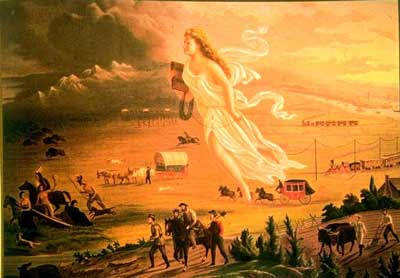
Manife4

Manifest Destiny

Friends of Padre Steve’s World,

This is a part of my yet to be published book, Mine Eyes Have Seen the Glory: Race, Religion, and Ideology in the Civil War Era.  I have posted it before, but as I watch what is going on in the world and President Trump’s militantly isolationist America First foreign policy which often uses the words and images of Manifest Destiny and American Exceptionalism I thought it might be good to post it again.

That past was mythologized in American history and popularized often on film and in print. Since the President admits that does little reading and engages in less critical thought it is obvious that most of what he knows of American history comes from the mythologized past.  This includes the concept of Manifest Destiny and American Exceptionalism. These concepts are the result of a racially and religiously based glorification of imperialistic conquest that resulted in the extermination or enslavement of millions of people in North America, as well as in the Philippines, Mexico, Central America and the Caribbean.

When you have a President of such limited historical knowledge who represents a party controlled by hyper-political religionists who are convinced that God is with them it portends trouble. As true Conservative icon Barry Goldwater once noted:

“Mark my word, if and when these preachers get control of the [Republican] party, and they’re sure trying to do so, it’s going to be a terrible damn problem. Frankly, these people frighten me. Politics and governing demand compromise. But these Christians believe they are acting in the name of God, so they can’t and won’t compromise. I know, I’ve tried to deal with them.” (November, 1994, in John Dean, Conservatives Without Conscience.)

While the President himself shows little evidence of actually believing in any God but himself he certainly does relish the accolades of these political creatures who call themselves Christian preachers. Goldwater in his later years exhibited a certain insight into the dangers of the movement that has taken over the GOP.

Until tomorrow,

Peace,

Padre Steve+

Manifest Destiny and American Exceptionalism

The foreign policy of the United States nearly always reflects to one degree or another a quasi-religious belief in the continued importance of the United States in spreading democracy around the world.

The United States was an anomaly among western nations in the early 1800s. During that time the percentage of people in Europe who were active churchgoers was shrinking and the number of skeptics rising as the industrial revolution, and advances in science, and the philosophies and theology of classic Liberalism permeated the elites of the continent. But in the United States, the situation was different. The Second Great Awakening helped shape and define the purpose of the nation, and by the “mid-nineteenth century, from North to South, was arguably Christendom’s most churchgoing nation, bristling with exceptionalist faith and millennial conviction.” [1] This was especially true of American Protestantism were “church attendance rose by a factor of ten over the period 1800 to 1860, comfortably outstripping population growth. Twice as many Protestants went to church at the end of this period as the beginning.” [2]

This exceptionalist faith kindled a belief in the nation’s Manifest Destiny in large part was an outgrowth of the Second Great Awakening which was particularly influential among the vast numbers of people moving into the new western territories. As people moved west, Evangelical religion came with them, often in the form of vast revival and camp meetings which would last weeks and which would be attended by tens of thousands. The first of these was at Cane Ridge Kentucky in 1801, organized by a Presbyterian others, including Baptists and Methodists joined in the preaching, and soon the revivals became a fixture of frontier life and particularly aided the growth of the Methodist and Baptists who were willing to “present the message as simply as possible, and to use preachers with little or no education,” [3] and which soon became the largest denominations in the United States. These meetings appealed to common people and emphasized emotion rather than reason. Even so the revivals “not only became the defining mark of American religion but also played a central role in the nation’s developing identity, independence, and democratic principles.” [4]

The West came to be viewed as a place where America might be reborn and “where Americans could start over again and the nation fulfill its destiny as a democratic, Protestant beacon to inspire peoples and nations. By conquering a continent with their people and ideals, Americans would conquer the world.” [5] The westward expansion satiated the need for territorial conquest and the missionary zeal to transform the country and the world in the image of Evangelical Christianity.

The man who coined the term “Manifest Destiny,” New York journalist John O’Sullivan a noted that “Manifest Destiny had ordained America to “establish on the earth the moral dignity and salvation of man,” to disseminate its principles, both religious and secular abroad,” [6] and New York Journalist Horace Greely issued the advice, “Go West, young man” which they did go, by the millions between 1800 and 1860.

But the movement also had a dark side. Americans poured westward first into the heartland of the Deep South and the Old Northwest, then across the Mississippi, fanning westward along the great rivers that formed the tributaries of the new territories. As they did so, the “population of the region west of the Appalachians grew nearly three times as fast as the original thirteen states” and “during that era a new state entered the Union on the average of three years.” [7]

The combination of nationalism fueled by Evangelical religion was combined with the idea from revolutionary times that America was a “model republic” that could redeem the people of the world from tyranny,” [8] as well an ascendant rational nationalism based on the superiority of the White Race. This, along with the belief that Catholicism was a threat to liberty was used as reason to conquer Mexico as well as to drive Native Americans from their ancestral homes. “By 1850 the white man’s diseases and wars had reduced the Indian population north of the Rio Grande to half of the estimated million who had lived there two centuries earlier. In the United States all but a few thousand Indians had been pushed west of the Mississippi.” [9] The radical racism used pseudo-scientific writings to “find biological evidence of white supremacy, “radical nationalism” cast Mexicans as an unassimilable “mixed “race “with considerable Indian and some black blood.” The War with Mexico “would not redeem them, but would hasten the day when they, like American Indians, would fade away.” [10]

Manifest Destiny and American Foreign Policy

Just as the deeply Evangelical Christian religious emphasis of Manifest Destiny helped shape American domestic policy during the movement west, it provided similar motivation and justification for America’s entry onto the world stage as a colonial power and world economic power. It undergirded United States foreign policy as the nation went from being a continental power to being an international power; claiming as Hawaii, and various former Spanish possessions in 1890s, and which would be seen again in the moralizing of Woodrow Wilson in the years leading up to America’s entry into World War One.

The belief in Manifest Destiny can still be seen in the pronouncements of American politicians, pundits, and preachers who believe that that this message is to be spread around the world. Manifest Destiny is an essential element of the idea of American Exceptionalism which often has been the justification for much recent American foreign policy, including the Freedom Agenda of former President George W. Bush. Bush referenced this during his 2003 State of the Union Address, “that freedom is the right of every person and the future of every nation. The liberty we prize is not America’s gift to the world, it is God’s gift to humanity.” [11] Bush frequently used language in his speeches in which biblical allusions were prominent in justifying the morality of his policy, and by doing this “Bush made himself a bridge between politics and religion for a large portion of his electorate, cementing their fidelity.” [12]

Throughout the Bush presidency the idea that God was directing him even meant that his faith undergirded the policy of the United States and led to a mismatch of policy ends and the means to accomplish them. Former Israeli Ambassador to the U.S. and historian Michael Oren wrote:

“Not inadvertently did Bush describe the struggle against Islamic terror as a “crusade to rid the world of evildoers.” Along with this religious zeal, however, the president espoused the secular fervor of the neoconservatives…who preached the Middle East’s redemption through democracy. The merging of the sacred and the civic missions in Bush’s mind placed him firmly in the Wilsonian tradition. But the same faith that deflected Wilson from entering hostilities in the Middle East spurred Bush in favor of war.” [13]

Policy makers and military leaders must realize that if they want to understand how culture and religious ideology drive others to conquer, subjugate and terrorize in the name of God, they first have to understand how our ancestors did the same thing. It is only when they do that that they can understand that this behavior and use of ideology for such ends is much more universal and easier to understand.

One can see the influence of Manifest Destiny abroad in a number of contexts. Many American Christians became missionaries to foreign lands, establishing churches, colleges, schools, and hospitals in their zeal to spread the Gospel. As missionaries spread across the globe, American policy makers ensured their protection through the presence of the United States Navy, and missionaries frequently called upon the United States Government for help and the naval strength of the United States during the period provided added fuel to their zeal. In 1842, Dabney Carr, the new American ambassador to the Ottoman Empire“declared his intention to protect the missionaries “to the full extent of [his] power,” if necessary “by calling on the whole of the American squadron in the Mediterranean to Beyrout.” [14] Such episodes would be repeated in the Middle East, Asia, the Pacific, and Central America over and over again until the 1920s.

The White Man’s Burden, Imperialism, Business, and Faith: Manifest Destiny and the Annexation of the Philippines

If one wants to see how the use of this compulsion to conquer in the name of God in American by a national leader one needs to go no farther than to examine the process whereby President McKinley, himself a veteran of the Civil War, decided to annex the Philippine in 1898 following the defeat of the Spanish. That war against the Filipinos that the United States had helped liberate from Spanish rule saw some of the most bloodthirsty tactics ever employed by the U.S. Army to fight the Filipino insurgents. The Filipino’s who had aided the United States in the war against Spain were now being subjugated by the American military for merely seeking an independence that they believed was their right. While the insurgency was suppressed in a violent manner and American rule was established, some Americans came to see the suppression of the Filipino’s as a stain on our national honor which of which Mark Twain wrote: “There must be two Americas: one that sets the captive free, and one that takes a once-captive’s new freedom away from him, and picks a quarrel with him with nothing to found it on; then kills him to get his land. . .” [15]

William McKinley was a cautious man, and after the United States had defeated the Spanish naval squadron at Manila Bay and wrestled with what to do with the Philippines. McKinley was a doubtless sincere believer, and according to his words, he sought counsel from God about whether he should make the decision to annex the Philippines or not. For him this was not a mere exercise, but a manifestation of his deep rooted faith which was based on Manifest Destiny. Troubled, he sought guidance, and he told a group of ministers who were vesting the White House:

“Before you go I would like to say a word about the Philippine business…. The truth is I didn’t want the Philippines, and when they came to us as a gift from the gods, I did not know what to do with them…. I sought counsel from all sides – Democrat as well as Republican – but got little help…. I walked the floor of the White House night after night until midnight; and I am not ashamed to tell you, gentlemen, that I went down on my knees and prayed Almighty God for guidance more than one night. And late one night it came to me this way – I don’t know how it was but it came….” [16]

He then went on to discuss what he supposedly heard from God, but reflected more of a calculated decision to annex the archipelago. He discussed what he believed would be an occupation of just a few islands and Manila, ruled out returning them to Spain as that would be “dishonorable,” ruled out turning them over to France or Germany because “that would be bad for business,”or allowing Filipino self-rule, as “they were unfit for self-government.”[17] The last was a reflection of the deep-rooted opinion of many Americans that the dark skinned Filipinos were “niggers.”

Barbara Tuchman described McKinley’s comments to the ministers:

“He went down on his knees, according to his own account, and “prayed to Almighty God for light and guidance.” He was accordingly guided to conclude “that there was nothing left to do for us but to take them all, and to educate the Filipinos. And uplift and civilize and Christianize them, by God’s grace to do the very best we could by them, as our fellowmen for whom Christ died.” [18]

But the result, regardless of whether McKinley heard the voice of God, or took the advice of advisers with imperialist, business, or religious views, he made the choice to annex the Philippines, believing it to be the only rational course of action, and something that he could not avoid. In a sense McKinley, of who Barbara Tuchman wrote “was a man made to be managed,” and who was considered spineless by Speaker of the House Thomas Reed who said “McKinley has no more backbone than a chocolate éclair.” [19] It appears that McKinley was more convinced by the arguments of those who desired to annex the Philippines for military reasons, a business community which saw the islands as a gateway to the markets of Asia, and by Protestant clergy, who saw “a possible enlargement of missionary opportunities.”[20] He rejected a proposal by Carl Schurz who urged McKinley to “turn over the Philippines as a mandate to a small power, such as Belgium or Holland, so the United States could remain “the great neutral power in the world.” [21]The combination of men who desired the United States to become an imperialist and naval power, business, and religion turned out to be more than McKinley could resist, as “the taste of empire was on the lips of politicians and business interests throughout the country. Racism, paternalism, and the talk of money mingled with the talk of destiny.” [22] Though there was much resistance to the annexation in congress and in the electorate, much of which was led by William Jennings Bryant, but which crumbled when Bryant with his eyes on the Presidency embraced imperialism.

The sense of righteousness and destiny was encouraged by magazine publisher S.S. McClure, who published a poem by Rudyard Kipling addressed to Americans debating the issue entitled The White Man’s Burden:

Take up the White Man’s burden–
Send forth the best ye breed–
Go bind your sons to exile
To serve your captives’ need;
To wait in heavy harness,
On fluttered folk and wild–
Your new-caught, sullen peoples,
Half-devil and half-child…

Take up the White Man’s burden–
The savage wars of peace–
Fill full the mouth of Famine
And bid the sickness cease…

Take up the White Man’s burden–
Ye dare not stoop to less–
Nor call too loud on Freedom
To 
cloke your weariness;
By all ye cry or whisper,
By all ye leave or do,
The silent, sullen peoples
Shall weigh your gods and you…
 [23]

McKinley’s decision and the passage of the peace treaty with Spain to acquire the Philippines sparked an insurrection led by Filipino revolutionary Emilio Aguinaldo who had been leading resistance to Spanish rule on the island of Luzon for several years prior to the American defeat of Spanish naval forces at the Battle of Manila Bay, and the subsequent occupation of Manila. The following war lasted nearly three years and was marked by numerous atrocities committed by American forces against often defenseless civilians and it would help to change the nature of the country. After American troops captured Manila, Walter Hines Page, the editor of the Atlantic Monthly believed that Americans would face greater challenges and difficulties in the coming years than they had known in previous years. He wrote:

“A change in our national policy may change our very character… and we are now playing with the great forces that may shape the future of the world – almost before we know it…. Before we knew the meaning of foreign possessions in a world ever growing more jealous, we have found ourselves the captors of islands in both great oceans; and from our home staying policy of yesterday we are brought face to face with world-wide forces in Asia as well as Europe, which seem to be working, by the opening of the Orient, for one of the greatest challenges in human history…. And to nobody has the change come more unexpectedly than ourselves. Has it come without our knowing the meaning of it?” [24]

Within the span of a few months, America had gone from a nation of shopkeepers to an imperial power, and most people did not realize the consequences of that shift. Manifest destiny and American Exceptionalism had triumphed and with it a new day dawned, where subsequent generations of leaders would invoke America’s mission to spread freedom and democracy around the world, as President George W. Bush said, “that freedom is the right of every person and the future of every nation. The liberty we prize is not America’s gift to the world, it is God’s gift to humanity.”

Notes

[1] Ibid. Phillips American Theocracy: The Peril and Politics of Radical Religion, Oil and Borrowed Money in the 21st Century p.143

[2] McGrath, Alister Christianity’s Dangerous Idea: The Protestant Revolution A History from the Sixteenth Century to the Twenty-First Harper Collins Publishers, New York 2007 p.164

[3] Gonzalez, Justo L. The History of Christianity Volume 2: The Reformation to the Present Day Harper and Row Publishers San Francisco 1985 p.246

[4] Ibid. McGrath Christianity’s Dangerous Idea: The Protestant Revolution A History from the Sixteenth Century to the Twenty-First p.164

[5] Goldfield, David America Aflame: How the Civil War Created a Nation Bloomsbury Press, New York, London New Delhi and Sidney 2011 p.5

[6] Ibid. Oren Power, Faith and Fantasy: America and the Middle East 1776 to the Present p130

[7] McPherson, James. The Battle Cry of Freedom: The Civil War Era Oxford University Press, Oxford and New York 1988 p.42

[8] Varon, Elizabeth R. Disunion! The Coming of the American Civil War 1789-1858 University of North Carolina Press, Chapel Hill NC 2008 p.183

[9] Ibid. McPherson The Battle Cry of Freedom: The Civil War Era p,45

[10] Ibid. Varon. Disunion! The Coming of the American Civil War 1789-1858p.183

[11] Bush, George W. State of the Union Address Washington D.C. January 28th2003 retrieved from Presidential Rhetoric.com http://www.presidentialrhetoric.com/speeches/01.28.03.html 10 June 2015

[12] Ibid. Phillips American Theocracy: The Peril and Politics of Radical Religion, Oil and Borrowed Money in the 21st Century p.252

[13] Oren, Michael Power, Faith and Fantasy: America and the Middle East 1776 to the Present W.W. Norton and Company, New York and London 2007 p.584

[14] Ibid. Oren Power, Faith and Fantasy: America and the Middle East 1776 to the Present p130

[15] Twain, Mark To the Person Sitting in Darkness February 1901 Retrieved from The World of 1898: The Spanish American War The Library of Congress http://www.loc.gov/rr/hispanic/1898/twain.html 12 December 2014

[16] Zinn, Howard A People’s History of the United States Harper Perennial, New York 1999 pp.312-313

[17] Ibid. Zinn A People’s History of the United States p.313

[18] Ibid. Tuchman Practicing History p.289

[19] Tuchman, Barbara The Proud Tower: A Portrait of the World Before the War, 1890-1914 Random House Trade Paperbacks Edition, New York 2008 originally published 1966 by McMillan Company. Amazon Kindle edition location 2807 of 10746

[20] Hofstadter, Richard The Paranoid Style in American Politics Vintage Books a Division of Random House, New York 1952 and 2008 p167

[21] Ibid. Tuchman The Proud Tower: A Portrait of the World Before the War, 1890-1914 location 3098 of 10746

[22] Ibid. Zinn A People’s History of the United States p.313

[23] Kipling, Rudyard “The White Man’s Burden: The United States and the Philippine Islands” 1899 retrieved from https://public.wsu.edu/~brians/world_civ/worldcivreader/world_civ_reader_2/kipling.html 6 August 2016

[24] Ibid. Hofstadter The Paranoid Style in American Politics pp.183-184

1 Comment

Filed under Foreign Policy, History, leadership, News and current events, Political Commentary, Religion

The Past is a Foreign Country: they do Things Differently There”

Friends of Padre Steve’s World,

British novelist L.P. Hartley wrote, “The past is a foreign country: they do things differently there…”

That is true. When we look at or study history it is often hard for us in our time to comprehend how others committed or allowed acts that we find reprehensibly criminal and evil. Since my primary areas of expertise include the American Civil War, including the ante-bellum period and Reconstruction, as Germany from about 1848 through 1945, including Weimar and the Nazi era, I find that I am confronted with these questions almost daily.

One of the hard things for any of us, even historians who want to present a relatively objective view of events, is to try to avoid the assumption that the people who made those decisions operated under our world-view; to assume that they should have known what we know now. But that is not the case.

The historian Richard Evans wrote in his book The Coming of the Third Reich:

“People make their own history, as Karl Marx once memorably observed, but not under conditions of their own choosing. These conditions included not only the historical context in which they lived, but also the way in which they thought, the assumptions they acted upon, and the principles and beliefs that informed their behavior.”

Yet the fact is that these contexts don’t make their history correct. Quite a few people, especially those who subordinate history to ideology and thus pretend to have a key to understanding history. Hannah Arendt noted:

“Caution in handling generally accepted opinions that claim to explain whole trends of history is especially important for the historian of modern times, because the last century has produced an abundance of ideologies that pretend to be keys to history but are actually nothing but desperate efforts to escape responsibility.” 

Such is also our contemporary problem, and future historians and lay-people alike will ask the same questions about us, just as we ask them about those who went before us.

Dr. Timothy Snyder discusses how mythologized history leads to dangerous understandings of politics, which posit theories of inevitability or eternity. According to Snyder inevitability assumes “a sense that the future is just more of the present, that the laws of progress are known, that there are no alternatives, and therefore nothing really to be done.” Such was the view of many Americans and Western Europeans when Communism fell.

Snyder wrote:

“Whereas inevitability promises a better future for everyone, eternity places one nation at the centre of a cyclical story of victimhood. Time is no longer a line into the future, but a circle that endlessly returns the same threats from the past. Within inevitability, no one is responsible because we all know that the details will sort themselves out for the better; within eternity, no one is responsible because we all know that the enemy is coming no matter what we do. Eternity politicians spread the conviction that government cannot aid society as a whole, but can only guard against threats. Progress gives way to doom.”

That is what makes the past so different, and it is why that when I read, study, and write that I try to understand the world-view of those that I study. I try to discover what made them who they were; to see the good and the bad, and attempt to be as fair as possible without falling into the trap of writing history as either inevitable or eternal. I try to emulate Barbara Tuchman who noted:

“What his imagination is to the poet, facts are to the historian. His exercise of judgment comes in their selection, his art in their arrangement.”

Even so I exercise a fair amount of caution when researching and writing about the past, because it truly is a different country.

Until tomorrow,

Peace

Padre Steve+

1 Comment

Filed under History, philosophy, Political Commentary

If You Don’t Have Time to Read You don’t Have the Time or Tools to Lead

img_3914

Friends of Padre Steve’s World,

During the first week of March I took about a week off of regular writing and commended a new campaign of reading. This was not because I don’t read, I am always reading, but sometimes I don’t read enough, so that week I began to catch up on some reading. Since then I have read, and read, even as I began to write again, not that I ever really stopped. I fully subscribe to the words of American satirist Will Rogers who noted: “There are three kinds of men. The one that learns by reading. The few who learn by observation. The rest of them have to pee on the electric fence for themselves.”

Honestly I prefer to learn by reading or observing, and reading has been part of my life since I was a child and I cannot imagine trying to write a single sentence without reading, as Stephen King noted: “If you don’t have time to read, you don’t have the time (or the tools) to write. Simple as that.” I would extend King’s observation to say that if you don’t have time to read you don’t have time or the tools to lead. Sadly the American President and many of his most devoted followers never challenge themselves by reading.

So tonight I wanted to take a few minutes and catch you up on the newest additions to my reading rainbow. I finished reading German historian Paul Carrel’s Unternehmen Barbarossa im Bild (Operation Barbarossa in Pictures) in which the text is in German and Max Boot’s The Road Not Taken: Edward Lansdale an the American Tragedy in Vietnam. 

I took on Carrel’s book because I had read many of his histories of the German Army in the Second World War in English and I wanted to use this large German volume to improve my German vocabulary. It’s an excellent volume first published in 1976 but unless you have a moderate familiarity of German it I don’t recommend it despite the vast number of photos that I have not seen elsewhere and his honest commentary and reflections on the moral, social, and political disaster that was Operation Barbarossa.

I also finished Max Boot’s outstanding volume of the life of General Edward Lansdale. This is really a good account of U.S. involvement in the Philippines and Vietnam from 1945 until 1975. Lansdale was deeply involved in one of the few successful counter-insurgencies of the 20th Century, that against the Communist supported Huks in the Philippines  by Lansdale who worked closely with political reformers and sought to understand and win over insurgents without engaging in massive military sweeps. However successful he was he was distrusted by much of the CIA and military establishment and his efforts in Vietnam were undercut by them. Boot treats Lansdale’s story well without attempting to hide his many flaws. Lansdale has been referred to as an American T. E. Lawrence and Boot gives an excellent account of his life in the context of the CIA, American actions in Indochina, and American politics in the from the mid 1950s until the early 1970s. The book is well worth the read.

On the Vietnam front I read the late Michael Herr’s Dispatches, his classic account of his time serving as a war correspondent in Vietnam at Hue, Khe San, and other battles over the course of 18 months. Having been to war I highly recommend it.

On the more contemporary American political situation I read conservative and former Bush Administration advisor, David Frum’s book on the Trump Era, Trumpocracy: The Corruption of the American Republic. It is well worth the read for anyone but I highly recommend that conservatives read it. I don’t always agree with some of Frum’s political positions, but his take on the corrosive effects of Donald Trump on the United States and how Republicans have aided and abetted him.

Continuing down that road I read Michael Isikoff and David Corn’s masterpiece of investigative journalism Russian Roulette: The Inside Story of Putin’s War on America and the Election of Donald Trump. Trump loyalists will hate this book because their work continues to be verified by every new discovery about the Russians and their role in the 2016 elections. It gives the reader a superb understanding of the key players  in this drama and help the reader to put in context the daily revelations of the investigation being conducted by Special Prosecutor Robert Muller and the actions of the President’s words, actions, and policies toward Russia and Putin as well as when he melts down on Twitter. In time it might be ranked with All the President’s Men. 

As a matter of contextualizing the present I read the late historian Tony Judt’s Ill Fares the Land which was written following the collapse of 2008. Judt discusses how we have not learned the lessons of the Twentieth Century and the problems related to the failures of both the right and left to learn those lessons. It is well worth the read but it is not a book designed or written to comfort partisans on any side of the political spectrum.

Going back to look at history I took the time to read Walter Lord’s sequel to his classic book on the sinking of the Titanic, A Night to Remember by reading his book The Night Lives On: The Untold Stories and Secrets of the “Unsinkable” Ship – Titanic. The second volume was published some three decades after Lord’s first volume which I think is the best account of the event ever written.  To follow it up I ordered and watched the film A Night To Remember which was also well worth watching. While not as technically accurate nor filled with “A list” stars the film captures the the tragedy of the ship in a way I don’t think that James Cameron’s masterpiece Titanic really gets.

I re-read Lord’s book on the integration of Ol’e Miss The Past that Would Not Die which though it recounts events of 1962 seems amazingly relevant in the present day.  The account of the admission of Air Force veteran James Howard Meredith in the face of the political opposition of Mississippi’s Governor and Legislature, armed White Supremacists against Attorney General Robert F. Kennedy Jr. and civil rights activists. The event was a crisis that brought to the present the memories and ideology of secession and revolt against the Federal Government and Constitution in the name of preserving a history of white supremacism. Likewise I also re-read British historian and military theorist B. H. Liddell Hart’s little book Why Don’t We Learn from History? 

I took up Jason Stanley’s excellent How Propaganda Works. This is an excellent book for academics but I do not recommend it for the casual reader because it presupposes a knowledge of political philosophy and history that most people don’t have. It was a long and tiring read for me and I liked it. It provides a lot of insights into the mechanics of propaganda. For me it gave me a different level of understanding of the propaganda being used by the Russians agains the United States and the machinations of the American President to discredit opponents through both official government pronouncements and the official unofficial White House propaganda network, Fox News.

I am currently reading a number of books. I am about a quarter of the way through John Dower’s The Bloody American Century, about a third of the way through Timothy Snyder’s The Road to Unfreedom: Russia, Europe, America, and have just started Tony Judt’s Thinking the Twentieth Century and Ron Chernow’s biography of Ulysses S. Grant.

So anyway. Have a great night and see you tomorrow,

Peace

Padre Steve+

Leave a comment

Filed under books, History, leadership, life

“The Coexistence of Normality and Bottomless Cruelty” Timothy McVeigh and the Terrorist Next Door

murrah bombing

Friends of Padre Steve’s World,

Just a short note to close out the work week. Amid all the political drama surrounding President Trump, James Comey, and the release of the Comey memos this week, one thing that was overlooked by most people was the anniversary of the bombing of the Murrah Federal Building by Timothy McVeigh and Terry Nichols in 1995.

I don’t think that I could ever forget the day. I was working as a hospital ER department chaplain where I worked a 3:00-11:00 shift and usually didn’t get to bed until one or two in the morning. I was also a Chaplain in the Army National Guard. Not long after I got up I turned on the news and was drinking my coffee when the news about the bombing flashed across the screen. I was stunned, especially when I found out that the bombers were Americans, and both former soldiers. I could not imagine American soldiers turning their hatred agains the government into an act of terrorism.

They killed 168 people, including babies and young children in the day care center were killed, hundreds of others wounded. McVeigh and Nichols were part of the anti-government so-called “militia” movement that still exists in parts of this country, of which the Bundy family, which occupied a Federal Wildlife Sanctuary in 2016 in order to bring about a revolt against the government is part.

Sadly, there are such people who would do the same today if given the chance. As this attack shows, most of them are not Islamic terrorists, but some are plain old Americans, people you might see in the grocery store or at the gas station. Some belong to the White Supremacist and Neo-Nazi Alt-Right, others to heavily armed self-appointed “militia” groups, and still others simply deluded followers of conspiracy theorists like Alex Jones. Members of all of these groups or movements have committed violent acts or have been stopped from doing so by the work of the FBI and other law enforcement agencies.

What is scary is that almost all of them repeat the same words, thoughts and ideology that McVeigh wrote about before and after the attack. In the end McVeigh rationalized his violence and defended his actions, never showing any hint of remorse for his victims, they were simply collateral damage, and the children he killed, a distraction from his message. Those that interviewed him said that he seemed completely normal and it was hard for them to reconcile his normalcy with what he did and his attitude toward his victims.

Reading his words and what others observed about him reminded me of what the Israeli court psychologist who interviewed Adolf Eichmann noted about Eichmann. Hannah Arendt recounted it:

“The Israeli court psychiatrist who examined Eichmann found him a “completely normal man, more normal, at any rate, than I am after examining him,” the implication being that the coexistence of normality and bottomless cruelty explodes our ordinary conceptions and present the true enigma of the trial.” 

I find it sad to see others like McVeigh doing their damnedest to impugn the character, honor and work of the men and women of the FBI. Unfortunately they have found a friend in President Trump who impugns the honor, decency, and loyalty of the FBI, members of the Justice Department, and Federal Judges; not to mention his political enemies and the free press.

So let’s never forget the events of that terrible morning and remember that to paraphrase Arendt using McVeigh instead of Eichmann:

The trouble with McVeigh was precisely that so many were like him, and that the many were neither perverted or sadistic, that they were, and still are, terribly and terrifyingly normal. 

Until tomorrow.

Peace

Padre Steve+

1 Comment

Filed under crime, History, News and current events, Political Commentary, terrorism

“If Only…” Thinking about the Tapestry of Life

img_3416

Friends of Padre Steve’s World

It is interesting to think about life, what has transpired, and what might have been if only…

Like anyone I wonder about all of the “what ifs” and “might have been” parts of my life. Of course there are many, going back to things that I could not control, such as the choices that my parents made regarding their lives, career, family, and home. Then there are my own choices, choices that I made, some for better, and some maybe for worse. Then there were the choices of men and women in my life and career that impacted my life and the decisions that I made, again for better or worse.

Some of my dreams, and nightmares too, involve those decisions, particularly the ones that I could not control; but then there were those decisions, particularly regarding my military career choices, that come back to haunt my dreams. Those can be troubling; the things that I volunteered to do and the costs of those to Judy as a result of those decisions. Many of those decisions, particularly my decisions to volunteer for certain deployments and operations have come at a great cost to both of us, the struggle with the effects of PTSD even ten years after my return from Iraq is still very real.

But then I am reminded that none of us have a crystal ball that allows us to see what the result of our decisions will be; none of us are God, or some other omniscient being. We make our decisions based on what we know, and what we think might be the outcome of our decisions.

I love the television series Star Trek the Next Generation. One of my favorite episodes is called Tapestry. In the episode Captain Picard is killed. He is then met by the being known as Q, played by John De Lancie for a do-over, a second chance to reverse a choice that he made as a young officer.

On Q’s promise that his choice will not alter history Picard takes the chance and he ends up regretting it. In his second chance to avoid the incident that allowed him to be killed he alienates himself from his friends, and turns him in to a different person, unwilling to take chances and doomed to insignificance. When he returns to his new present he finds himself alive but a different person. Instead of a starship captain is a nondescript lieutenant junior grade doing a job that he hates as an assistant astrophysics officer.

tapestry2

Distraught Picard complains to Q:

Picard: You having a good laugh now, Q? Does it amuse you to think of me living out the rest of my life as a dreary man in a tedious job?

Q: I gave you something most mortals never experience: a second chance at life. And now all you can do is complain?

Picard: I can’t live out my days as that person. That man is bereft of passion… and imagination! That is not who I am!

Q: Au contraire. He’s the person you wanted to be: one who was less arrogant and undisciplined in his youth, one who was less like me… The Jean-Luc Picard you wanted to be, the one who did not fight the Nausicaan, had quite a different career from the one you remember. That Picard never had a brush with death, never came face to face with his own mortality, never realized how fragile life is or how important each moment must be. So his life never came into focus. He drifted through much of his career, with no plan or agenda, going from one assignment to the next, never seizing the opportunities that presented themselves. He never led the away team on Milika III to save the Ambassador; or take charge of the Stargazer’s bridge when its captain was killed. And no one ever offered him a command. He learned to play it safe – and he never, ever, got noticed by anyone.

It is a fascinating exchange and one that when I wonder about the choices that I have made that I think about; because when all is said and done, my life, like all of ours is a tapestry. On reflection Picard tells Counselor Troi, “There are many parts of my youth that I’m not proud of. There were… loose threads – untidy parts of me that I would like to remove. But when I… pulled on one of those threads – it’d unravel the tapestry of my life.”

I think that I can agree with that. All the things in my life, the good things and the bad, as well as the paths not taken have all been a part of the tapestry of my life. I would not be who I am without them; and that I cannot comprehend. I would rather be the flawed me that is me, than the perfect me that never existed. Thus, all of those threads of my tapestry are in a sense, precious and even holy.

I’ll keep all of them.

Peace

Padre Steve+

Leave a comment

Filed under faith, life, Loose thoughts and musings, philosophy, PTSD, star trek

Integrity, Truthfulness, Purity, and Singleness of Purpose: Winfield Scott Hancock and what the United States Needs Today

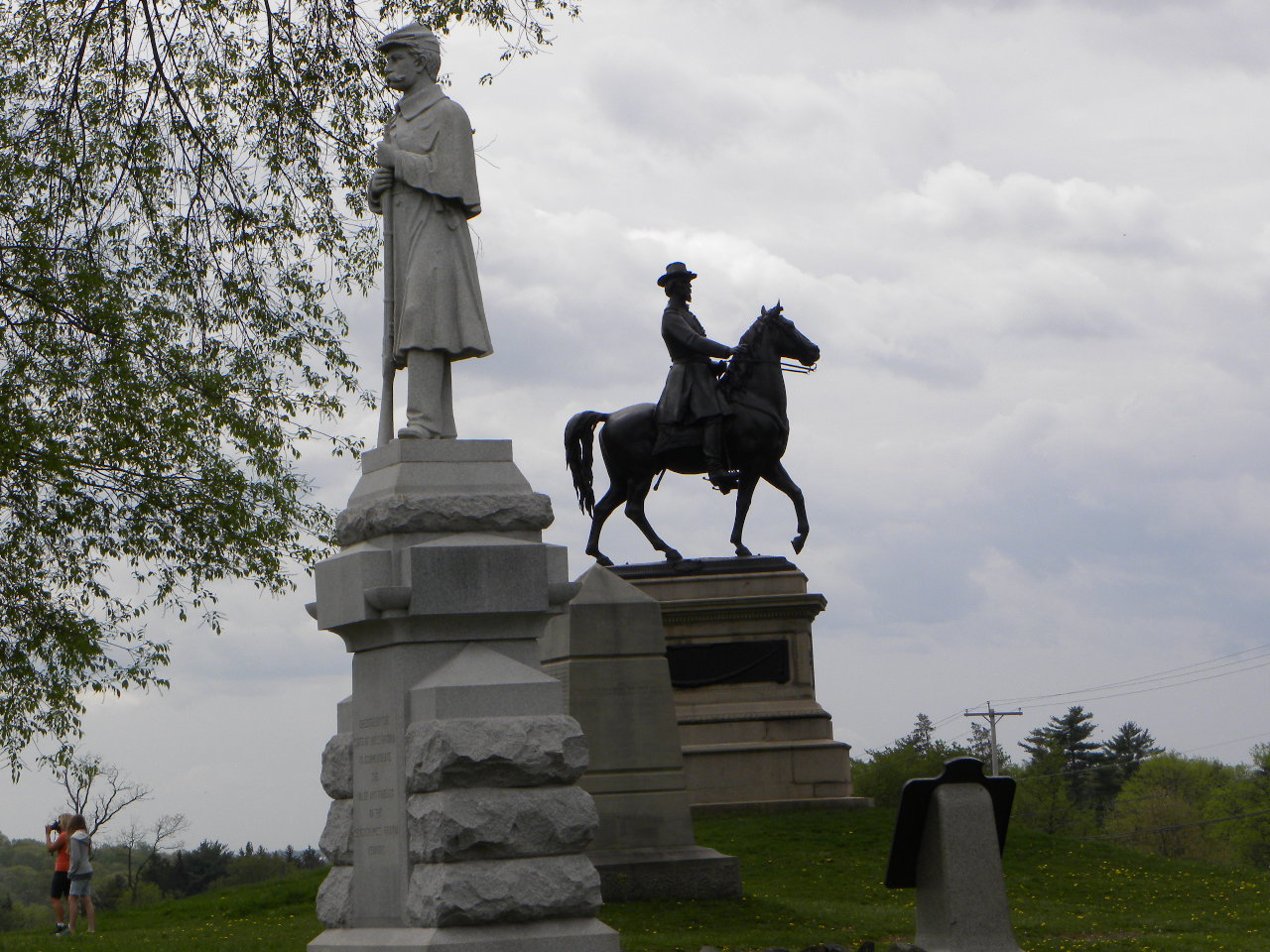
hancock


Friends of Padre Steve’s World,

I visit Gettysburg a lot and I also write about it a lot. When I make those visits I am always humbled and learn something new. I only wish that most Americans and our leaders of both political parties as well as most media types and pundits could grasp what I experience on each visit to the “hallowed ground” of Gettysburg.

Quite honestly I do not think that the vast majority Americans regardless of their party affiliation or ideology  understand, appreciate or value in the slightest the sacrifices of the men who fought and in many cases died to preserve the Union at Gettysburg. Even among those who do I think that the object of their appreciation are the military aspects of the battle often taken in isolation, not the profound strategic dimensions of what this battle as well as the fall of Vicksburg in the west at the same time had on the war.

Nor do I think that they appreciate the massive political, ideological and social effects bought about by those Union victories in ending the war and how those effects redound to us today. This is especially true of the pundits, politicians and preachers, the “Trinity of Evil” as I call them whose shrill voices urge on divisions between our people; including some that call out for violence to maintain their groups social, economic or religious advantages over others. Quite a few even lament the fall of the South and the institution including the washed up rock and roll musician of the political right Ted Nugent who wrote in the Washington Times in July 2012: “I’m beginning to wonder if it would have been best had the South won the Civil War.” More recently when President Trump talked of the moral equivalence of the opposing sides at Charlottesville I was reminded of just how hateful and morally bankrupt such feelings are, I am sure that General Hancock would be appalled that an American President would make that kind of stand.

All of that concerns me as an American and a historian; because I realize how dangerous such historical ignorance and visceral propaganda is in the life of any nation. Thus when I go to Gettysburg, or for that matter any other battlefield of our American Civil War the sacrifices of those men and what they fought to maintain are again imprinted on my heart.

Abraham Lincoln eloquently noted about those soldiers who fought to turn back the Confederate tide at Gettysburg in his Gettysburg Address:

“But, in a larger sense, we can not dedicate — we can not consecrate — we can not hallow — this ground. The brave men, living and dead, who struggled here, have consecrated it, far above our poor power to add or detract. The world will little note, nor long remember what we say here, but it can never forget what they did here. It is for us the living, rather, to be dedicated here to the unfinished work which they who fought here have thus far so nobly advanced. It is rather for us to be here dedicated to the great task remaining before us — that from these honored dead we take increased devotion to that cause for which they gave the last full measure of devotion — that we here highly resolve that these dead shall not have died in vain — that this nation, under God, shall have a new birth of freedom — and that government of the people, by the people, for the people, shall not perish from the earth.”

While I am an idealist I am also a pragmatist. I respect the right of others, even those that disagree with things that I very much believe in and support. Like it or not the keystone of our governmental system is one of compromise. That being said having relatives that fought on both sides of the American Civil War that I am not a sectionalist. Nor am I a person that attempts to use the political system to ensure that others have to follow my religious beliefs or to enrich certain groups. The democracy that is part of our republic’s system of government is not a perfect system by any means. In fact as the great English Prime Minister Winston Churchill noted “democracy was the worst form of government except for all the others.”

Thus I appreciate military men who maintain their oath to the nation in times of great conflict not abandoning it to support causes that they know are wrong because the people of their state, or interest group seek to divide that Union. Winfield Scott Hancock was one of those kind of men, as was George Meade, and John Buford, all of whom played key roles in defeating the Confederates at Gettysburg.

Hancock, who earned the title “Hancock the Superb” was the commander of the Union Second Corps at Gettysburg. Upon the death of John Reynolds early on the first day of battle Hancock was appointed by George Meade as commander of the Federal Left Wing, in effect becoming Meade’s deputy commander for the rest of the battle. He was seriously wounded as Pickett’s Charge came to its bloody end at “the Angle” even as his dear friend Confederate General Lewis Armistead lay mortally wounded a few hundred yards away.

Hancock is an interesting character. He was from Pennsylvania but was a Democrat. He was not a Republican like Lincoln. Hancock was not a political ideologue but was since he was a Democrat he was suspect by leaders in the party establishments of both parties; Republicans for being a Democrat, and Democrats for serving under Lincoln. As such he never was given independent command of an Army but remained the beloved commander of the Union Second Corps.

As the nation split and friends went their separate ways Hancock gave some advice to his best friend, Lewis Armistead and their commander, Brigadier General Albert Sidney Johnston who were preparing to leave the Union in early 1861. In response to the states rights arguments of his friends he made himself clear. He fully believed in the principal of states rights, but he could not compromise his faithfulness to the Union. He told his friends as they departed company on their way to their destinies during the Civil War:

“I shall not fight upon the principle of state-rights, but for the Union, whole and undivided.” 

During the war Hancock served with distinction. At Gettysburg he was influential in determining the choice of the Union defense, in helping to repel the Rebel attacks on July 2nd 1863 and the final repulse of Pickett’s Charge where he was severely wounded and his friend Armistead died. After he recovered from his wounds he continued to lead Second Corps until the end of the war. Ulysses Grant wrote of him:

“Hancock stands the most conspicuous figure of all the general officers who did not exercise a separate command. He commanded a corps longer than any other one, and his name was never mentioned as having committed in battle a blunder for which he was responsible. He was a man of very conspicuous personal appearance…. His genial disposition made him friends, and his personal courage and his presence with his command in the thickest of the fight won for him the confidence of troops serving under him. No matter how hard the fight, the 2d corps always felt that their commander was looking after them.”

After the war Hancock supervised the execution of those convicted of the assassination of Abraham Lincoln. Following that duty he served in various postings in the occupied South and attempted to mitigate some of the actions of those bent on vengeance against African Americans as well as others who tried to exploit the defeated Confederates for political or economic gain. His balanced attempt at justice was not appreciated by many people in the North or the South.

In 1880 Hancock ran for President and lost a narrow election to James A. Garfield. After his unsuccessful campaign he returned to the Army and died at the age of 61 in 1886 at his headquarters from complications from diabetes.

In death was praised by political supporters and opponents alike. Former President Rutherford B. Hayes wrote:

“if when we make up our estimate of a public man, conspicuous both as a soldier and in civil life, we are to think first and chiefly of his manhood, his integrity, his purity, his singleness of purpose, and his unselfish devotion to duty, we can truthfully say of Hancock that he was through and through pure gold.” 

Another political opponent Republican General Francis A. Walker lamented not supporting Hancock in 1880 after the great corruption that engulfed the country during “Gilded Age” of the “Robber Barons” the 1880s. Walker wrote in 1893:

“Although I did not vote for General Hancock, I am strongly disposed to believe that one of the best things the nation has lost in recent years has been the example and the influence of that chivalric, stately, and splendid gentleman in the White House. Perhaps much which both parties now recognize as having been unfortunate and mischievous during the past thirteen years would have been avoided had General Hancock been elected.”

DSCN9741

I have stood by the monument to this fine man on East Cemetery Hill at Gettysburg many times. Each time I am struck by the bravery, courage and integrity of that remarkable man. Regardless of party affiliation I wish that we had more leaders like him today.

Peace

Padre Steve+

1 Comment

Filed under civil war, Gettysburg, History, Military, Political Commentary

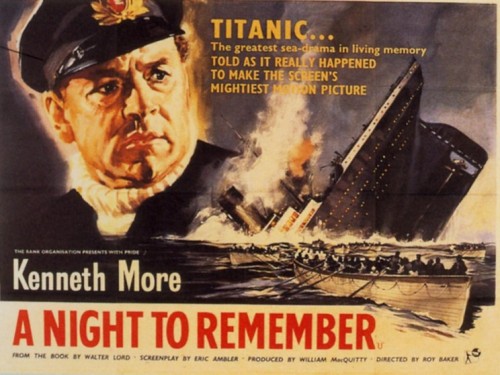
A Night to Remember

A Night to Remember

Friends of Padre Steve’s World,A couple of days ago I wrote about the sinking of the Titanic. The story transcends time in many ways, but in particular I think because it was the beginning of the end of an era. Over the past couple of weeks I have re-read Walter Lord’s classic narrative of the Titanic disaster, A Night to Remember and his later work The Night Lives On.

Tonight I watched the film version of A Night to Remember for the first time since I was a child when saw it on televisionI think now, looking back over time that A Night to Remember which was filmed in 1958 is the best film involving the subject despite not having the spectacular special effects of James Cameron’s masterpiece Titanic, and its lack of major film stars was the better picture from a human and emotional point of view.

I remember reading Walter Lord’s book A Night to Remember in 7th grade at Stockton Junior High School. When I read the book I didn’t realize that it was of genre known as narrative history, That method of history is an especially effective method of communicating these kinds of tumultuous events. Lord would prove a master of the genre, writing captivating books about Pearl Harbor (Day of Infamy) , Dunkirk, the Battle of Midway (Incredible Victory), and the desegregation of Ol’e Miss, (A Time to Stand). 

The method focuses on weaving the stories of participants in the event into a story that catches the imagination of the reader. I like the method and hopefully my yet to be published books about the struggle for civil rights, the American Civil War and the Battle of Gettysburg it will be shown again. Walter Lord was a master of it and his works which are incredibly accurate from a historical point of view also convey the human dram of history as few other authors have done.

The senior surviving officer of Titanic, Second Officer Herbert Lightoller who was portrayed by Kenneth More was later as a civilian master of a private boat took part in the evacuation of Dunkirk, and was portrayed in the 2017 film of that name by English actor Mark Rylance.

One of the most striking thinks about the story of Titanic is the inequity between the classes of passengers. Third Class passengers, or those booked in “Steerage” paid 12 Pounds for the trip but had little in the way of amenities and when the ship sank, many of whom were forcibly kept from going to the boat deck and escaping death. That being said there were truly noble people among the First Class passengers who would forfeit their lives that others could live. Honestly I could not see many people today, regardless of being rich or poor who would willingly go down with the ship like Isidor and Ida Strauss, Benjamin Guggenheim, and John Jacob Astor as well as many others who either remained at their posts or station in life; the good, the bad, and yes the ugly.

But then there were men like the director of the White Star Line, Bruce Ismay who snuck into a boat to escape death only to live in shame the rest of his life. Ismay succeeded in reducing the amount of life boats to the bare minimum required for a steamer less and a quarter her size and despite not being a mariner himself used his leverage as the director of the line to ignore those regulations.

I wonder how many men today, like Ismay, who like others of his day skirted safety regulations and advances in technology to increase their own profits. But then in an age where an American President presides over an administration that is rolling back safety, health, and environmental regulations for the sake of profit.

But that is another question for another day.

So anyway, until tomorrow,

Peace

Padre Steve+


1 Comment

Filed under film, History, movies

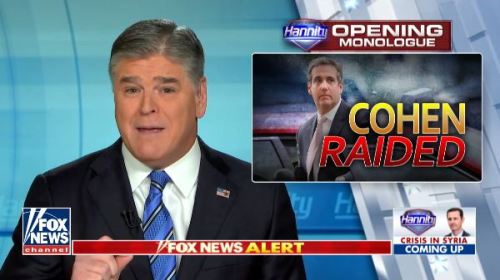
The Political, Media, and Legal Ménage à Trois of Trump, Hannity, and Cohen Exposed

hannity-cohen

Friends of Padre Steve’s World,

The irony and intrigue of the incestuous relationship of President with members of the Fox News team, especially the college dropout and blowhard extraordinaire Sean Hannity. Trump promotes Hannity and his show, Hannity protects him with a daily propaganda barrage and both have the same lawyer. This is a political, legal, and propaganda ménage à trois for the ages.

The story really exploded last week when Special Counsel Robert Muller and the Southern district of New York Department of Justice team raided the offices of Trump personal lawyer and consigliere Michael Cohen. The President went to battle stations on Twitter claiming that action, cleared by a Federal Judge was illegal and violated attorney-client privilege.  Hannity used his show to go on the warpath against Muller only to be exposed today in court as the previously unnamed client of Cohen. Even the flagrant O.J. Simpson and Trump defender Alan Dershowitz when on Hannity’s show Monday night to school Hannity on how smart it would have been if Hannity had revealed his relationship with with the consigliere before defending him by attacking Muller.  To which Hannity responded: “It ain’t the way I wanted it! I can handle things! I’m smart! Not like everybody says… like dumb… I’m smart and I want respect!”

Hannity’s defense of his actions was ludicrous. Cohen named him in court and he denied it. If Hannity is telling the truth that meant that Cohen perjured himself in Federal Court, and Cohen, despite his hubris is not so stupid as to commit perjury to defend Sean Hannity; his Godfather maybe but not Fredo. Somehow i imagine that somewhere in the night, the President while devouring a bucket of fried chicken is thinking of both Cohen and Hannity: “Fredo, you’re nothing to me now.”

trump hannity cohen

Right now this is simply a ménage à trois but Lordy, Lordy, Lordy, it could become a full blown Right Wing Studio 54 orgy once Cohen’s files, tapes, and other sundry secrets are revealed. My God it will be fun to see who else was at the orgy.

Until tomorrow,

Peace

Padre Steve+


2 Comments

Filed under film, News and current events, Political Commentary