Monthly Archives: July 2019

The Battle Of Kursk: Nazi Military Operations Cannot be Separated from Hitler’s Genocidal Policies

Friends of Padre Steve’s World,

I am reposting an older article today which was a paper that I wrote for a class as part of my second Masters Degree program.  Tomorrow, July 12th is the anniversary of the one of the largest tank battles in history, The Battle of Prokhorovka, the climax of the Battle Of Kursk, in which nearly 1000 German and Soviet tanks engaged in an often close quarters battle where both suffered staggering casualties, but the Soviets prevented a German breakthrough, and with it a potential German victory. 

The Battle of Kursk was the climactic battle on the Eastern Front from which the Germans never recovered. It was a battle that should not have been fought, at least at the time that it was fought. It was high risk operation with minimal payoff should it succeed. It did not and combined with the Allied landings in Sicily and other setbacks suffered by German forces in 1943 was the battle that doomed Germany to defeat. It was the last time that the German military had a chance to score a major victory against the Soviets and their defeat ensured the defeat of the Third Reich. 

The decision of Hitler and the High Command to launch this offensive is also connected for the need of the Nazis to complete the Final Solution Of the “Jewish Problem,” which was in the process of execution millions of Jews, with an emphasis on the systematic destruction of European Jewry, with the desire to eliminate the Russian Jews who as of yet remained under the protection of the Red Army. The German military campaign in the east can never be disconnected from the genocidal policies of the Nazis, and many of the German troops and commanders involved in Zitadelle were accomplices to Genocide or actively supported it. 

So when you read this article, do not just look at the military dimensions. Remember, that it, like every Nazi military operation was a necessary part of Hitler’s genocidal program. 

Until tomorrow, 

Peace

Padre Steve+


The German Situation and Dilemma in April 1943

Battle_of_Kursk_(map)

The Germans faced a dilemma in April 1943.  Manstein’s brilliant counter-stroke had turned what could have been disaster into an opportunity to salvage prospects for the Eastern Front. The German action had “repaired its front, shattered the hopes of the Allies, and nipped the Russian spearhead.”[i]Unfortunately for the Germans the spring thaw meant that Manstein could not continue immediately and eliminate the Kursk bulge which had been formed by Rokossovky’s offensive and Manstein’s own counter-stroke.  With the Germans stalled by the weather Stavka cancelled “other significant planned offensives to dispatch reinforcements to the Kursk region.”[ii] Despite the weather Manstein pushed Kluge for an immediate attack on both sides of the bulge but was rebuffed by Kluge who “insisted that his troops needed to rest and refit.”[iii] This rebuff combined with the onset of the Russian mud meant that in “March 1943 the war on the ground came to an end….The front was immobilized.”[iv]

manstein with tanks                 Field Marshal Erich von Manstein with Tiger I Tanks

Manstein’s offensive had “enabled the Germans to consolidate a firm position in the East, and build up strength afresh- not to its former level, but sufficient to provide a good prospect of holding the Russians at bay.”[v] As a result German armies in the south “held again nearly the same positions from which the Blau offensive had begun the previous spring.”[vi] Now the Kursk bulge some 250 Kilometers wide and 160 Kilometers deep[vii] protruded menacingly into the German lines and drew the attention of both sides, to the Germans it appeared to be designed for an encirclement battle.[viii] Thus it appeared that the Kursk bulge was the obvious place for the Germans to resume the offensive and maintain the initiative on the Eastern Front.

But was the Kursk necessary?  Was Operation ZITADELLE as obvious as it seemed to be to Hitler, Zeitzler and others?  The battle is the subject of many books and articles which often focus on tactical and operational details of the German offensive, particularly the battle on the southern side of the bulge and the clash of armor at Prokhorovka.  This essay will focus less on the battle and more on the strategic situation faced by the Germans in the spring of 1943. Key to this are the arguments for and against the operation, the operations timing and the option that the Germans had to conduct a mobile defense.   It is the strategic situation that must be looked at to determine whether Operation ZITADELLE was necessary at all. Manstein believed that had the offensive been launched early enough that it might have succeeded provided it “we launched it early enough we could hope to catch them in a state of unpreparedness.”[ix]Williamson Murray and Allan Millett agree with Manstein’s assessment but note that an early offensive was “riskier…but greater the prospect for a major success.”[x] Guderian on the other hand saw that nothing good could come of ZITADELLE and opposed it from the beginning.[xi] Glantz and House in their detailed study argue that “there is absolutely no basis for assuming that Citadel would have succeeded had it been launched in spring 1943.”[xii]

battle_kursk t 34            The Soviets Reinforced and Fortified the Kursk Salient

The Germans faced a number of major problems in early 1943.  First, among them was manpower.  The armed forces had been mauled on the Eastern Front, “after continuous operations from June 1942 to March 1943, most German units were worn out.”[xiii] Many infantry divisions “were reduced to two thirds of their original strength, with declining mobility and anti-tank defenses.”[xiv] Had the Germans only faced the Russians this might have been overcome, however they not only faced a rejuvenated Red Army, but challenges brought about by multi-theater operations and their weak, ineffective and reluctant allies.  The Allied air offensive which though it “did not decisively effect German arms production it nevertheless prevented a great deal of work from being carried on and had profound moral effects which communicated themselves to all the fronts.”[xv] Likewise the U-Boat campaign had been effectively defeated by May 1943 allowing for increasing numbers of American troops and supplies to reach Europe, including significant Lend-Lease aide for the Soviet Union.  Manpower became a major issue for the the German Army and industry.  Both the military and industryhad difficulty in getting the required number of personnel to meet their personnel needs, in January 1943 the German High Command “demanded 800,000 men-but even the most ruthless call-up was able to produce only 400,000” who were lost to the civilian war economy.[xvi] Even the “belated industrial mobilization of Germany, fueled by slave labor and directed by the organizational genius of men like Speer and Guderian, could do little beyond patching together existing units.”[xvii]

Bild 101I-139-1112-17General Heinz Guderian, Inspector of Panzer Troops was one of Few Senior German Officers to Oppose ZITADELLE from the Beginning

There were other challenges. The German and Italian armies in North Africa had surrendered, and about 330,000 Axis soldiers entered captivity.[xviii] Added to the heavy losses on the Eastern Front, the disasters in North Africa and Stalingrad had “effectively destroyed the Axis military alliance, such as it was.”[xix] Italy, Hungary and Romania all began to pull their forces out of the Eastern front after having them shattered by the Soviet Winter offensive.[xx]Italy, shaken by its losses in North Africa and the Russian front was wavering in its support for Germany; Mussolini’s government itself was on the verge of falling.  Likewise the Hungarian government sought contact with the Allies;[xxi]as did the Romanians.[xxii] Finland too was looking for a way out and limiting its participation in German offensive operations.[xxiii] As her allies looked for a way out, the British and Americans were about to open a new front in Southern Europe, while another had effectively been opened by partisans in Yugoslavia and Greece.[xxiv] The crisis in the south was great enough that OKW under General Jodl began to look at ways of shoring up those fronts in case Italy withdrew from the war including the use of units that would have to be withdrawn from the Eastern Front.[xxv] The Balkans drained German reserves such that the number of German divisions deployed there increased from 5 to 15 between July 1942 and July 1943.[xxvi] Additionally many units had to be created by the Replacement Army to build up the Western Front knowing that an Allied strike there would eventually take place, further depriving the Eastern Front of badly needed infantry replacements and divisions.

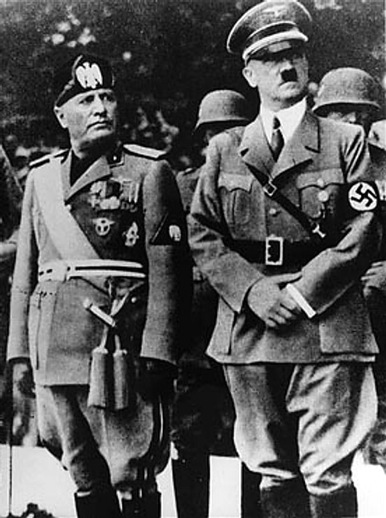
Benito_Mussolini_and_Adolf_HitlerHitler Felt Regaining the Initiative in the East was Critical to Keeping his Allies in the War

The German Options and Decision

The question for the Germans now was whether they “had any strategic options that would allow them to avoid defeat.”[xxvii] It is from this perspective that the necessity of Kursk must be examined. Most in the German High Command now realized that strategy in the east could no longer be “based on the illusion of conquering the vast Soviet Union.”[xxviii] As such the discussion turned to what direction the new strategy should take.  Political considerations came into play: Since the German allies were looking for ways to exit the war it was felt that “it was politically impossible for Germany to surrender the initiative on the Eastern Front.”[xxix] Realistically there were two options available: Wait and counterattack or launch a limited attack on the Kursk salient. The general impression among many German commanders in the East was that they had ended the last campaign “with a relative advantage over the Reds, an advantage that should be exploited as soon as the rasputitsa ended in April or early May.”[xxx] But the only strategy that looked feasible balancing the political and military goal of maintaining the initiative was what Manstein originally had in mind after Kharkov, to continue on, pinch out the Kursk bulge with the cooperation of Kluge’s Army Group Center.  As noted the opportunity to do so was lost with Kluge’s refusal and the onset of the spring thaw.  Yet this idea captured Zeitzler at OKH and Kluge at Army Group Center, though by April and May Manstein was more inclined toward “the ‘backhand’ stroke, which involved giving up the whole Donetz basin and staging a major Panzer offensive southeast from Kharkov.”[xxxi] However, this was too bold for Hitler who was “unwilling to give up the Donetz Basin with its industrial and mineral resources.”[xxxii]

battle_kursk_tiger advancing     The New Tiger Tanks Were to Play a Critical Role in the Attack

Manstein felt that the “moment of opportunity had passed, but his counterpart at Army Group Center…Kluge, was enthusiastic about the proposal.”[xxxiii]Zeitzler believed that an “attack at Kursk would be less risky”[xxxiv] than Manstein’s “backhand” and pushed the plan to Hitler.  There were advantages to this strategy if it could be carried out successfully. The Germans would encircle and destroy Russian forces in the salient and “shorten their own defensive lines after such an encirclement.”[xxxv] Yet the plan was opposed by others. Jodl at OKW argued against ZITADELLE “because he believed that it was dangerous to empty the strategic reserve when so many new crises threatened to develop in the Mediterranean.”[xxxvi] Zeitzler countered that because of German weakness in the east that they could not “wait to be hit.”[xxxvii] Guderian did not believe that either Army Group could be ready to mount the offensive that Zeitzler envisioned and “declared that the attack was pointless…if we attacked according to the plan of the Chief of the General Staff, we were certain to suffer heavy tank casualties, which we would not be in position to replace in 1943.”[xxxviii]Guderian asked Hitler at a separate conference “why he wanted to attack at all in the East in 1943.” When Keitel expressed that the reasons were political, Guderian asked Hitler “How many people do you think even know where Kursk is? It’s a matter of profound indifference to the world whether we hold Kursk or not…”[xxxix] Guderian and Speer both pointed out technical problems in producing the Tigers and Panthers but were overruled.[xl] Hitler himself reportedly had misgivings about the attack at one point reportedly stating that “the thought of the Zitadelle operation ‘made [his] stomach turn over’”[xli] In spite of Jodl and Guderian’s warnings, his own misgivings and those of Manstein and Model in April and May, Hitler “allowed himself to be tempted once more into taking the offensive. The Kursk salient…lured him into mounting his great pincer operation known as Citadel.”[xlii] Glantz and House maintain that he could “see no alternative politically and agreed to the plan.”[xliii]

The Facts on the Ground

Kursk_T34_and_Fieldgun-px800Soviet Forces Expected the Attack and Were well Prepared to Meet it

Once the decision to attack was made the question that remained was the timing of the attack. Manstein had preferred an early attack in May, but the operation was postponed to mid-June and then to July due to the request of Model who believed that his forces were too weak and needed reinforcements.[xliv] The attack was to be one of several “limited offensives designed to consolidate the German defenses while inflicting sufficient damage on the Red Army to delay any Soviet offensive.”[xlv] But the delays insisted on by Model and agreed to by Hitler were a fatal error.  The Germans failed to “factor into their decision was the unpalatable reality that Soviet strength in the Kursk salient was growing much faster than the Wehrmacht could muster forces to attack it.”[xlvi] Not only were the Soviet forces growing they knew about the German plans and could deploy their forces to counter them and for their own offensive.[xlvii] Stalin’s generals were able to convince him not to launch an attack and instead wait on the Germans so they could attack as the Germans exhausted their strength.[xlviii] They knew of it since April and reinforced the flanks of the salient with guns and armor at a faster pace than the Germans opposite them.[xlix] At Kursk “improved intelligence collection and analysis permitted the Red Army to predict almost exactly the strategic focal point of a major German offensive.”[l] Into the bulge “Vatutin and Rokossovsky crammed seven armies.”[li] The Russians deployed in depth in heavy fortified zones and minefields along the very sectors of the bulge that the Germans intended to attack, successfully masking their preparations from the Germans. It was “a measure of Soviet self-confidence that the senior commanders were looking beyond the German attack, beyond its failure, to the first major Soviet summer offensive.”[lii] Had the Germans succeeded in pinching off the salient “they would have faced several additional defensive belts constructed to the east of the salient.”[liii]

Typically when one launches an offensive it is desirable to have numeric advantage over the defender, 3:1 is normally assumed to be sufficient. At Kursk the Germans were outnumbered by the Russians 2.3:1 in men and 1.6:1 in tanks[liv] yet somehow the offensive had now morphed from a spoiling attack into a strategic offensive, albeit with more limited objectives attacking one of the strongest points in the Russian line.  General Raus, commanding a corps in Army Detachment Kempf noted: “Considering Russian dispositions, defenses and terrain, German strength could be considered only minimally sufficient for the assigned mission.”[lv] The Chief of Staff of XLVIII Panzer Corps called Kursk “the strongest fortress in the world.”[lvi]

Danger Signs: Requests for Cancellation

keitel-jodl-hitlerGeneral Alfred Jodl at OKW Protested the Offensive Verbally and in Writing

As more delays occurred Manstein “came out in the open and protested that the operation was no longer feasible and must be abandoned, but it was too late.  The united stand of orthodox General Staff opinion, Keitel, Zeitzler, Kluge, had persuaded the Führer, whose mind, once made up, was never altered.”[lvii]Manstein felt that the idea had been to “attack the enemy before the enemy had replenished his forces and got over the reverses of the winter.”[lviii] He felt there was great danger to the Mius line and to the northern Orel bulge with each delay; and the felt the threat of an attack by the Allies in Western Europe.[lix] On 18 June Jodl and the OKW Operations Staff “recommended to Hitler that he abandon Operation Citadel in order to free strategic reserves for defense in both East and West.”[lx] Warlimont writes that Jodl “raised empathic objection to the premature commitment of the central reserves to the East; he pointed out both verbally and in writing that a local success was all that could be hoped from Operation Citadel and that it could have no strategic significance for the overall situation.”[lxi] Hitler again refused the request.  “The doubts of certain Chiefs of Staff of the attacking armies were disregarded, and in the case of Colonel von Schleinitz, answered with dismissal.”[lxii]

The Battle

battle_kursk tigersTigers Advancing

The attacking forces for ZITADELLE involved units of Army Group Center and Army Group South.  Spearheading the assault for Army Group Center was Model’s 9th Army.  2nd Army from the same Army Group took a defensive role in the center of the bulge while Army Group South’s 4th Panzer Army under Hoth and Army Detachment Kempf composed the Southern attack force.  Von Mellenthin noted that to muster the necessary divisions for the attacking armies “neighboring fronts were to be thinned out beyond the limits of prudence” and from a strategic point of view likened Citadel “to be a veritable ‘death ride.’”[lxiii]Manstein worried about stripping the Mius-Donetz salient which “had to hand over all their available forces.”[lxiv] The Germans sent 17 panzer divisions against Kursk including the elite 2nd Panzer, Grossdeutschland, Leibstandarte, Das Reich and Totenkopf. Hoth’s army was the “strongest force ever put under a single commander in the German Army.”[lxv] While the Germans assembled the Russians waited, and beginning on 1 July the “Red Army defenders were on constant alert, waiting in their bunkers for the first sign of attack.”[lxvi]

battle_kursk_0020                                          Panzers on the Advance

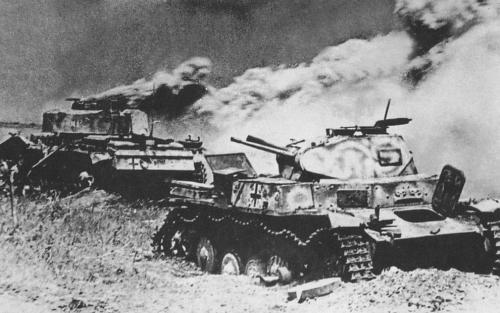
ZITADELLE began on 4 July with a reconnaissance in force, the main blow scheduled for 0300 5 July. The Russians learned of the timing from a prisoner and quickly launched an artillery counter-preparation an hour prior to the German attack, disrupting it while air strikes were ordered against Luftwaffe airfields.[lxvii] Model’s 9th Army on the northern flank attacked the Russian “13th and 70th Armies on a frontage of 50 kilometers”[lxviii] with the focus being a 16 kilometer front where he concentrated 6 infantry divisions, a panzer division and all his Tiger and Ferdinand units.[lxix] He intended to break the Soviet defensive system “by constantly feeding in new units to grind down the defenses.”[lxx] The attack stalled by the 9July making minimal progress of “8 to 12 kilometers into the massive Soviet defenses.”[lxxi] A good deal of his problem was due to limited infantry strength which was  “far below established strength….moreover, the Ninth Army’s infantry- even the veterans- lacked experience in conducting set-piece attacks against prepared positions.”[lxxii]The Russians defined the battleground and forced Model into a battle determined by superior firepower on a constricted battlefield, “a game that the Wehrmacht could not win.”[lxxiii] This nullified any advantage the Germans might have had in mobility for their panzer divisions.  In savage battles to take the high ground at Ponyri station and Ol’khovatka Model’s assaults faltered.  9thArmy sacrificed about 50,000 men and 400 tanks to the god of war.”[lxxiv]Model continued to attack until 12 July when the Russians launched their offensive against the Orel bulge forcing him to redeploy to counter the Russian advance.  The battle in the north became “a savage defensive battle in which considerable parts of the offensive wing of Ninth Army were involved.”[lxxv]Model’s defeat made Hoth’s task “much more challenging.”[lxxvi]

battle_kursk_t-34s and infantry                                          Soviet T-34’s and Infantry

The Fourth Panzer Army and Army Detachment Kempf made better progress, nearly breaking through the Russian defenses after hard fighting. They penetrated “into the third Soviet defensive belt, a depth of 35 kilometers, but were stopped by Katukov’s 1st Tank Army.”[lxxvii] The critical point was reached on 11 and 12 July at Prokhorovka station when 5th Tank Army collided with 4thPanzer Army. “Over 1200 tanks from both sides were engaged in this struggle.”[lxxviii] It was the largest tank engagement of the war, over 700 tanks were destroyed and “German losses were too great to allow a decisive breakthrough.”[lxxix] Both sides took heavy casualties but the Germans could not replace theirs while the Russians still had formidable uncommitted reserves.  On 13 July the battle in the south drifted into a stalemate as XLVIII Panzer Corps and Hausser’s II SS Panzer Corps failed to break the Soviet line[lxxx] as the Russians “kept on throwing in fresh troops, and their reserves seemed inexhaustible.”[lxxxi] Manstein desired to continue the offensive as he believed that for his Army Group “the battle was now at its culminating point, that to break it off at this moment would be tantamount to throwing victory away.”[lxxxii] Although Manstein and Hoth felt that they could continue on and break the Russian line, they were now not in a position to do so. Model’s forces were in no shape to assist in the north and Manstein and Kluge were called to the Wolfsschanze by Hitler who, now preoccupied with the Allied invasion of Sicily necessitating withdraws of strong panzer forces from the east to face the threat in the west.[lxxxiii] Hitler rejected Manstein’s counsel to continue and ordered him to withdraw II SS Panzer Corps,[lxxxiv] effectively ending the ZITADELLE as the Russians launched their offensive on 17 July.

battle_kursk_destroyed panzers                                               Destroyed Panzers

Analysis of the Decision: Zitadelle Was Not Obvious, Necessary nor Well Executed

To Hitler and the supporters of ZITADELLE the operation seemed obvious.  In the two previous years the Germans had dealt punishing blows against the Red Army and the belief of Zeitzler and others was that the Wehrmacht was still qualitatively superior to the Soviets and that even a limited offensive would succeed in its objectives.  But the conditions on the ground had changed and the Germans failed to take the change into account.  The German Army did not have the resources for an offensive of the scope of Barbarossa or Blau. However this lack of resources did not lessen the optimism of some for ZITADELLE; particularly Zeitzler and Kluge. From their perspective the offensive to pinch out the Kursk salient seemed likely to succeed.  Yet as Clark notes the offensive was defined by a “lack of imagination and adaptability….Where the old Blitzkrieg formula….was fed into the computer, with little regard for the changed conditions….” [lxxxv] Von Mellenthin comments that by attacking Kursk, the “German Army threw away all their advantages in mobile tactics, and met the Russians on ground of their own choosing.”[lxxxvi] Glantz and House attribute this to the fact that the Germans “clung to outmoded assumptions about their own superiority over their opponents” due to their previous success. They point out that the Red Army had systematically reviewed its performance after every failure,” so that “Soviet doctrine, organization, and expectations were closer to battlefield reality than were those of the senior German leadership.”[lxxxvii] The German intelligence services failed them[lxxxviii] as they failed to detect the large strategic sized force that the Soviets had concentrated in the spring of 1943.  This was a force that Glantz and House believe would have caused ZITADELLE to fail even had it occurred in May, particularly in regard to the comparatively weak German forces fielded by Manstein.[lxxxix]

An offensive with what appeared to be reasonable objectives that were believed to be within the capabilities of the Wehrmacht failed.  Hitler according to Carell “gambled away not only victory but all hope of a draw.”[xc] Manstein categorized the offensive as a “fiasco.”[xci] Guderian called it “a decisive defeat” that made it “problematical” whether the armored formations could be “rehabilitated in time to defend the Eastern Front.”[xcii] Warlimont who served at OKW commented: “Operation Citadel was more than a battle lost; it handed the Russians the initiative and we never recovered it again right up to the end of the war.”[xciii]Guderian’s biographer Kenneth Macksey wrote that “the failure at Kursk was due to the employment of a faulty plan which lacked the element of strategic as well as tactical surprise.”[xciv] Raus lists several factors for this.  However, his argument is summarized: “once we learned in May and June that this was the area in which the Russians were prepared to offer their stiffest resistance, we should have modified our plans.  Either we should have refrained from attacking at all, or the operation should have been carried out to strike the enemy not at his strongest, but at his weakest point.”[xcv]

Hitler felt that a decisive victory was needed for political and propaganda reasons, yet even a significant victory was unlikely to keep Italy in the war, even if it swayed the lesser allies to stay the course.  ZITADELLE was conducted too late to save the Italians, success in May might have given German supporters in Italy some leverage but the invasion of Sicily and the failure at Kursk emboldened Mussolini’s opponents. The Fascist Grand Council “voted to have Mussolini removed as prime minister” and King Vittorio Emmanuaele “dismissed Mussolini” who was then placed under arrest.[xcvi] Finland refused to take offensive action that might have cut the Murmansk railway[xcvii] and engaged the Americans in a round of “abortive negotiation”[xcviii] while the Hungarians and Romanians provided little assistance to the Germans, partially due to the German reluctance to assist in modernizing and rebuilding their armies.[xcix]

Of the German Generals involved it was only Guderian as Inspector of Armored Troops and Jodl at OKW who consistently opposed ZITADELLE, citing realistic assessments of strengths, risks and dangers in other theaters.  Manstein opposed it when he felt the opportunity had passed, though it was unlikely to succeed had it been launched in May as he desired.  Guderian and Jodl’s arguments proved correct in every respect. ZITADELLE engaged German the preponderance of German forces in a battle that had at best chances of local success. The offensive itself weakened and endangered the German position on all fronts.  In the end, despite the belief and decision of Hitler, Zeitzler Kluge and others in the High Command, Operation ZITADELLE was neither obvious nor necessary and played out with the disastrous results expected by those who opposed it.

                                                        Notes


[i] Clark, Allan. Barbarossa:  The Russian-German Conflict 1941-45. Perennial, an Imprint of Harper Collins Books, New York, NY 2002. Originally published by William Morrow, New York, NY 1965. p. 306

[ii] Glantz, David M and House, Jonathan. The Battle of Kursk.  University Press of Kansas, Lawrence, KS. 1999. p.14

[iii] Ibid. Glantz and House, Jonathan. The Battle of Kursk.  p.14

[iv] Carell, Paul. Scorched Earth: The Russian German War 1943-1944. Translated by Ewald Osers, Ballantine Books, New York, NY 1971, published in arrangement with Little-Brown and Company. p. 335

[v] Liddell-Hart, B.H. The German Generals Talk. Quill Publishing, New York, NY. 1979. Copyright 1948 by B.H. Liddell-Hart. p.212

[vi] Wray, Timothy A. Standing Fast: German Defensive Doctrine on the Russian Front in World War II, Prewar to March 1943. U.S. Army Command and General Staff College, Fort Leavenworth, KS. 1986. p.163

[vii] Glantz, David M. and House, Jonathan. When Titans Clashed: How the Red Army Stopped Hitler. University Press of Kansas, Lawrence, KS. 1995. p.157

[viii] Ibid. Glantz and House. When Titans Clashed. p.157

[ix] Manstein, Erich von. Lost Victories. Translated by Anthony G. Powell, Zenith Press, an imprint of MBI Publishing Company, St Paul, MN. 2004. First Published as Verlorene Siege Athenaum-Verlag, Bonn, GE 1955, English edition Methuen & Company Ltd. 1958  p.447

[x] Murray, Williamson and Millett, Allan R. A War to Be Won: Fighting the Second World War.  The Belknap Press of Harvard University, Cambridge, MA. 2000. p.295

[xi] Macksey, Kenneth. Guderian: Creator of the Blitzkrieg. Stein and Day Publishing, New York, NY 1975 p.206

[xii] Ibid. Glantz and House. The Battle of Kursk. p.261

[xiii] Ibid. Glantz and House. The Battle of Kursk. p.14

[xiv] Ibid. Glantz and House. Clash of Titans. p.174

[xv] Goerlitz, Walter. History of the German General Staff 1657-1945.Translated by Brian Battershaw. Westview Press. Boulder CO and London. 1985 Originally published as Der Deutsche Generalstab, Verlag der Fankfurter Hefte, Frankfurt am Main.  First U.S. publication in 1953 by Preager Publishers. p.441

[xvi] Ibid. Carell. p.336

[xvii] Ibid. Glantz and House. Clash of Titans. p.174

[xviii] Warlimont, Walter. Inside Hitler’s Headquarters 1939-45. Translated by R.H. Berry, Presido Press, Novato CA, 1964. p.312

[xix] DiNardo, Richard L. Germany and the Axis Powers: From Coalition to Collapse. University Press of Kansas, Lawrence, KS. 2005. p.174

[xx] Ibid. DiNardo. p.174. By the summer all Italians units had been withdrawn, all but two Hungarian divisions which were used in anti-partisan operations and nine Romanian divisions.

[xxi] Ibid. Goerlitz. p.441

[xxii] Ibid. Glantz and House. Kursk. p.21

[xxiii] Ibid. DiNardo. p.180

[xxiv] Ibid. Goerlitz. p.441

[xxv] Ibid. Warlimont. pp.317-318

[xxvi] Dunn, Walter S. Jr. Heroes or Traitors: The German Replacement Arm, the July Plot, and Adolf Hitler. Praeger Publishers, Westport CT and London, 2003. p.53

[xxvii] Ibid. Murray and Millett. p.294

[xxviii] Ibid. Carell. p.339

[xxix] Ibid. Glantz and House. Kursk. p.21

[xxx] Ibid. Glantz and House. Kursk. p.21

[xxxi] Ibid. Clark. p.322

[xxxii] Liddell-Hart, B.H. Strategy. A Signet Book, the New American Library, New York, NY. 1974, Originally Published by Faber and Faber Ltd., London. 1954 & 1967. p.280

[xxxiii] Ibid. Glantz and House. When Titans Clashed. p.157

[xxxiv] Ibid. Clark. p.322

[xxxv] Ibid. Glantz and House. p.157

[xxxvi] Ibid. Clark. p.323

[xxxvii] Ibid. Clark. p.323

[xxxviii] Guderian, Heinz. Panzer Leader. (abridged) Translated from the German by Constantine Fitzgibbon, Ballantine Books, New York 1957. pp.245-246

[xxxix] Ibid. Clark. p.325.

[xl] Ibid. Glantz and House. When Titans Clashed. p.157.

[xli] Ibid. Clark. p.325

[xlii] Ibid. Carell. p.341

[xliii] Ibid. Glantz and House. When Titans Clashed. p.158

[xliv]Newton, Steven H. Hitler’s Commander: Field Marshal Walter Model, Hitler’s Favorite General. DeCapo Press, Cambridge MA 2005. pp.218-219

[xlv] Ibid. Glantz and House. When Titans Clashed. p.21

[xlvi] Ibid. Newton. p.219

[xlvii] Ibid. Murray and Millett. p.295

[xlviii] Ibid. Glantz and House. When Titans Clashed. p.158

[xlix] Ibid. Clark. p.326

[l] Ibid. Glantz and House. Kursk. p.63

[li] Overy, Richard. Russia’s War: A History of the Soviet War Effort: 1941-1945. Penguin Books, New York NY and London, 1997. pp.200-201

[lii] Ibid. Glantz and House. When Titans Clashed. p.159

[liii] Ibid. Glantz and House. Kurskp.64

[liv] Ibid. Glantz and House. Kursk. p.65 This reference contains a listing of each sector and the force ratios of men, tanks and guns in each sector.

[lv] Raus, Erhard. Panzer Operation: The Eastern Front Memoir of General Raus, 1941-1945. Compiled and Translated by Steven H Newton. Da Capo Press a member of the Perseus Book Group, Cambridge, MA 2003. p.197

[lvi] Weingartner, James. J. Leibstandarte SS Adolf Hitler: A Military History, 1933-45. Battery Press, Nashville, TN.(no publication date listed)  p.81

[lvii] Ibid. Clark. p.327

[lviii] Ibid. Manstein. p.447

[lix] Ibid. Manstein. pp.447-448

[lx] Ibid. Glantz and House. Kursk. p.55

[lxi] Ibid. Warlimont. p.334

[lxii] Ibid. Goerlitz. p.445

[lxiii] Von Mellenthin, F.W. Panzer Battles: A Study of the Employment of Armor in the Second World War. Translated by H. Betzler, Ballantine Books, New York, NY, 1971. Originally Published University of Oklahoma Press, 1956. p.262

[lxiv] Ibid. Manstein. p.448

[lxv] Ibid. Clark. p.328

[lxvi] Ibid. Glantz and House. Kursk. p.78

[lxvii] Ibid. Glantz and House. Kursk. pp.81-84

[lxviii] Ibid. Glantz and House. When Titans Clashed. p.166

[lxix] Ibid. Erickson. P.99

[lxx] Erickson, John. The Road to Berlin. Cassel Military Paperbacks, London, 2003. First Published by Weidenfeld and Nicholson, 1983. p.99

[lxxi] Ibid. Glantz and House. When Titans Clashed. p.166

[lxxii] Ibid. Newton. p.222

[lxxiii] Ibid. Newton. 234

[lxxiv] Ibid. Glantz and House. Kursk. p.121

[lxxv] Ibid. Carell. p.342

[lxxvi] Ibid. Glantz and House. Kursk. p.121

[lxxvii] Ibid. Glantz and House. When Titans Clashed. p.166

[lxxviii] Ibid. Glantz and House. When Titans Clashed. p.166

[lxxix] Ibid. Overy. p.209

[lxxx] Ibid. Glantz and House. Kursk. pp.215-217

[lxxxi] Ibid. Von Mellenthin. p.274

[lxxxii] Ibid. Manstein. p.449

[lxxxiii] Ibid. Glantz and House. Kursk. pp.217-218.

[lxxxiv] Ibid. Glantz and House. When Titans Clashed. p.167

[lxxxv] Ibid. Clark. pp.329-330

[lxxxvi] Ibid. Von Mellenthin. p.264

[lxxxvii] Ibid. Glantz and House. Kursk. p.269

[lxxxviii] Macksey, Kenneth. Why the Germans Lose at War. Greenhill Books 1996, Barnes and Noble, New York,  2006. p.227

[lxxxix] Ibid. Glantz and House. Kursk. p. 261

[xc] Ibid. Carell. p.342

[xci] Ibid. Manstein. p.449

[xcii] Ibid. Guderian. p.251

[xciii] Ibid. Warlimont. p.334

[xciv] Ibid. Macksey. Guderian p.206

[xcv] Ibid. Raus. p.211

[xcvi] Ibid. DiNardo. p.178

[xcvii] Ibid. DiNardo. p.181

[xcviii] Ibid. Erickson. p.91

[xcix] Ibid. DiNardo. pp.182-188

Bibliography

Carell, Paul. Scorched Earth: The Russian German War 1943-1944. Translated by Ewald Osers, Ballantine Books, New York, NY 1971, published in arrangement with Little-Brown and Company

Clark, Allan. Barbarossa:  The Russian-German Conflict 1941-45. Perennial, an Imprint of Harper Collins Books, New York, NY 2002. Originally published by William Morrow, New York, NY 1965

DiNardo, Richard L. Germany and the Axis Powers: From Coalition to Collapse.University Press of Kansas, Lawrence, KS. 2005

Dunn, Walter S. Jr. Heroes or Traitors: The German Replacement Arm, the July Plot, and Adolf Hitler. Praeger Publishers, Westport CT and London, 2003

Erickson, John. The Road to Berlin. Cassel Military Paperbacks, London, 2003. First Published by Weidenfeld and Nicholson, 1983

Glantz, David M and House, Jonathan. The Battle of Kursk.  University Press of Kansas, Lawrence, KS. 1999.

Glantz, David M. and House, Jonathan. When Titans Clashed: How the Red Army Stopped Hitler. University Press of Kansas, Lawrence, KS. 1995

Goerlitz, Walter. History of the German General Staff 1657-1945. Translated by Brian Battershaw. Westview Press. Boulder CO and London. 1985 Originally published as Der Deutsche Generalstab, Verlag der Fankfurter Hefte, Frankfurt am Main.  First U.S. publication in 1953 by Preager Publishers

Guderian, Heinz. Panzer Leader. (abridged) Translated from the German by Constantine Fitzgibbon, Ballantine Books, New York 1957

Liddell-Hart, B.H. Strategy. A Signet Book, the New American Library, New York, NY. 1974, Originally Published by Faber and Faber Ltd., London. 1954 & 1967

Liddell-Hart, B.H. The German Generals Talk. Quill Publishing, New York, NY. 1979. Copyright 1948 by B.H. Liddell-Hart.

Macksey, Kenneth. Guderian: Creator of the Blitzkrieg. Stein and Day Publishing, New York, NY 1975

Macksey, Kenneth. Why the Germans Lose at War. Greenhill Books 1996, Barnes and Noble, New York, 2006

Manstein, Erich von. Lost Victories. Translated by Anthony G. Powell, Zenith Press, an imprint of MBI Publishing Company, St Paul, MN. 2004. First Published as Verlorene Siege Athenaum-Verlag, Bonn, GE 1955, English edition Methuen & Company Ltd. 1958

Murray, Williamson and Millett, Allan R. A War to Be Won: Fighting the Second World War.  The Belknap Press of Harvard University, Cambridge, MA. 2000

Newton, Steven H. Hitler’s Commander: Field Marshal Walter Model, Hitler’s Favorite General. DeCapo Press, Cambridge MA 2005

Overy, Richard. Russia’s War: A History of the Soviet War Effort: 1941-1945.Penguin Books, New York NY and London, 1997

Raus, Erhard. Panzer Operation: The Eastern Front Memoir of General Raus, 1941-1945. Compiled and Translated by Steven H Newton. Da Capo Press a member of the Perseus Book Group, Cambridge, MA 2003

Von Mellenthin, F.W. Panzer Battles: A Study of the Employment of Armor in the Second World War. Translated by H. Betzler, Ballantine Books, New York, NY, 1971. Originally Published University of Oklahoma Press, 1956.

Warlimont, Walter. Inside Hitler’s Headquarters 1939-45. Translated by R.H. Berry, Presido Press, Novato CA, 1964

Weingartner, James. J. Leibstandarte SS Adolf Hitler: A Military History, 1933-45. Battery Press, Nashville, TN.(no publication date listed)

Wray, Timothy A. Standing Fast: German Defensive Doctrine on the Russian Front in World War II, Prewar to March 1943. U.S. Army Command and General Staff College, Fort Leavenworth, KS. 1986

Leave a comment

Filed under Foreign Policy, History, holocaust, leadership, Military, national security, nazi germany, Political Commentary, war crimes, world war two in europe

To Kill a Mockingbird at 59: Sometimes the Bible in the Hand Of One Man is Worse than a Whiskey Bottle in the Hand Of Another

mock

Friends of Padre Steve’s World,

Tomorrow marks the 59th the anniversary of the release of Harper Lee’s classic novel To Kill a Mockingbird. I have read the book, and seen the film many times. Sadly, it is all too relevant in our time. Race hatred and a belief in the absolutes of aberrant forms of Christianity which bless White Racism are rampant in the United States and Europe, many of these groups are overtly Fascist and Authoritarian.

That alone is to make the novel and the film worth reading and watching, especially if you haven’t read the book or seen the film.

Sadly, such people would “kill the Mockingbird” to ensure that they keep their privileged position in society. The Mockingbirds are those that they have condemned to social inferiority and discrimination and eternal punishment, especially gays and the LGBT community, but others as well.

This is especially the case of the preachers, pundits and politicians that crowd the airwaves and internet with their pronouncements against Gays, immigrants, Arabs, poor blacks, political liberals, progressive Christians, and for that matter anyone who simply wants the same rights enjoyed by these Christians.

In the book there is a line spoken by Miss Maudie Atkinson, a neighbor of Atticus Finch and his children. She says to Atticus’s daughter Scout:

“Sometimes the Bible in the hand of one man is worse than a whisky bottle in the hand of another… There are just some kind of men who – who’re so busy worrying about the next world they’ve never learned to live in this one, and you can look down the street and see the results.”

As I survey the world of Christian conservatives I become surer of this every day. I’ve often wrote about my own fears in regard to dealing with such people as well as the troubling trends that I see. Last week I wrote five articles on the trends that I see in the church, trends toward greed, political power, social isolation and the active campaign of some to deny basic civil rights to people that they hate on purely religious grounds.

The language of some like Matt Staver of Liberty Counsel, Tony Perkins of the American Family Association and a host of others describe actions of governments and courts to ensure equal treatment of all people under the law as threats to Christians, affronts to them and of course to God. Their words are chilling. Matt Staver commented a few years back that if the Supreme Court upheld marriage equity for gays that it would be like the Dred Scott decision. Of course that is one of the most Orwellian statements I have ever heard, for the Dred Scott decision rolled back the few rights that blacks had anywhere in the country and crushed the rights of people in non-slave states.

Again, as a reminder to readers, especially those new to the site, I spent a large amount of my adult Christian life in that conservative Evangelical cocoon. I worked for a prominent television evangelist for several years, a man who has become an extreme spokesman for the religious political right. I know what goes on in such ministries, I know what goes on in such churches. I know the intolerance and the cold hearted political nature of the beast. I know and have gone to church with Randall Terry, the former head Operation Rescue who once said: “Let a wave of intolerance wash over you. I want you to let a wave of hatred wash over you. Yes, hate is good…” I have walked in those shoes, I have been whipped up by those preachers. I fully understand them, and because I do I am in a unique position to critique their words and actions, especially as the supposedly moral majority snuggle up with one of the most amoral men ever to become President, solely to protect and crease their political power. They have surrendered their claim to being a party of morality, and embraced evil for the sake of their power. Without empathy, they judge and condemn others not like them. They are incapable of understanding anything that conflicts with their visions of White Power, racial superiority, and an interpretation of Christianity which needs state support in order to survive.

As Atticus Finch told his children:

“You never really understand a person until you consider things from his point of view… Until you climb inside of his skin and walk around in it.”

They cannot, thus I total reject the message of such people now, not out of ignorance, but because I have walked in their shoes. At times I supported their causes, not to any extreme, but all too often my crime was simply said nothing when I knew that what they preached, taught and lived was not at all Christian, but from the pits of Hell.

As far as them being entitled to hold whatever opinion they want, even if I disagree, yes that is their right. But as Atticus said:

“People are certainly entitled to think that I’m wrong, and they are entitled to full respect for their opinions. But before I can live with other folks I’ve got to live with myself. The only thing that doesn’t abide by majority rule is a person’s conscience.”

My conscience will not allow me to be silent when I see men like Staver, Perkins, Franklin Graham, Robert Jeffress, Pat Robertson, and so many others preach hatred towards those who are different than them. Their reach and power has only increased with their support of President Trump.

In the movie and the book the Mockingbirds were Tom Robinson, the black man falsely accused of rape and assault and Boo Radley, a shy recluse feared by his neighbors, a man who stories were made up about; stories that turned a simple man into a monster in the eyes of people who did not know him. Today they are others who fit the Mockingbird role, people who just want to get along and live in peace, but who endure discrimination and damnation from those who call themselves Conservative Christians.

Jem Finch, the son of Atticus asks his sister a question in the book and the film:

“If there’s just one kind of folks, why can’t they get along with each other? If they’re all alike, why do they go out of their way to despise each other?”

I ask the same question on a daily basis.

So until tomorrow I wish you a good night.

Peace

Padre Steve+

4 Comments

Filed under books, christian life, civil rights, ethics, faith, film, History, LGBT issues, movies, News and current events, Political Commentary

“Fanaticism and Ignorance is Forever Busy” The Scopes Monkey Trial at 94Years, and Inherit the Wind

donald-trump-prays-with-religious-leaders

Friends of Padre Steve’s World,

“As long as the prerequisite for that shining paradise is ignorance, bigotry and hate, I say the hell with it.” Henry Drummond (Spencer Tracy) Inherit the Wind

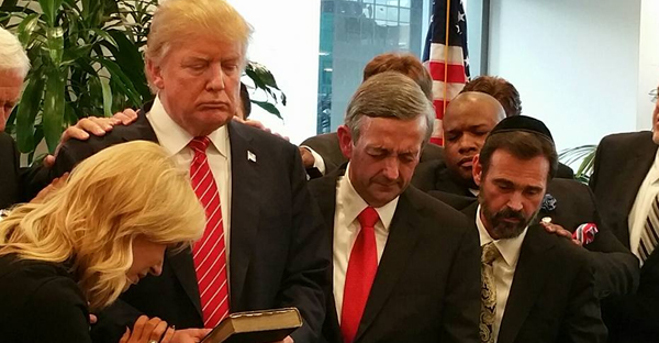
Tomorrow is the 84th Anniversary of the beginning of what became known as the Scopes Monkey Trial which was dramatized in the 1960 film Inherit the Wind. I really do believe that it is well worth watching, especially when a charlatan like Donald Trump, a man with no Christian virtues whatsoever stokes up the hopes of conservative Christians by catering to his base of Conservative Christians who hang on his every word, like a cult, believing that he, through the police power of the state will Christianity great again.

Of course the Christianity that Trump and his followers refers to is not that of Jesus, but that of Constantine and every other strongman who has used the Christians and the church to achieve earthly power and to crush any opposition. Noted televangelists have come to Trump’s side, many like John Hagee saying that Christians that God will punish Christians, that vote against Trump. That is why this film is still so pertinent.

It is fascinating that a play and film set about an incident that actually occurred in the 1920s remains so timeless. It is hard to believe that 90 years after the trial and over 50 years after the movie that our society would still be debating the issue in the movie and that legislatures and school boards are still attempting to pass religious doctrine off as science.

inherit-the-wind

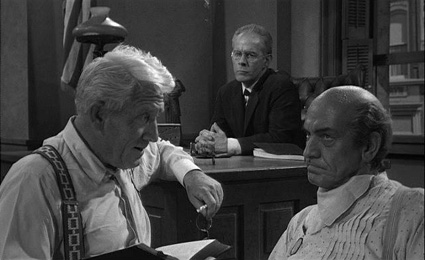
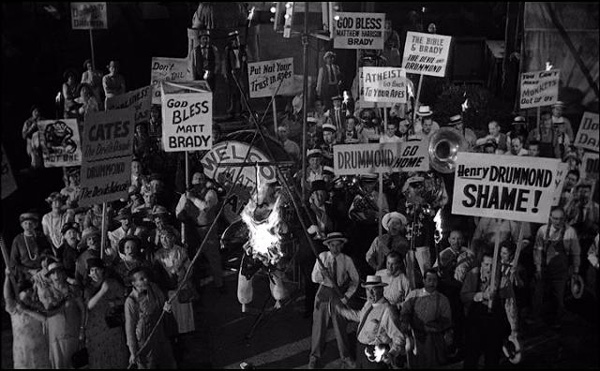
It is a film about what is commonly called the “Scopes Monkey Trial” which was litigated in July of 1925 and featured an epic battle between populist three time Presidential Candidate and former Secretary of State William Jennings Bryan and famed defense attorney Clarence Darrow. The film is not completely historically accurate. It was adapted from a play by the same name. It came out following the hysteria of the McCarthy Era, when people were condemned and blacklisted for their freedom of speech, association; frequently on the basis of false testimony against them. However, the film captures the blind hatred of religious bigots the willingly ignorant who object to any belief or theory that threatens their superior position in society.

The trial was brought about after the passage of the Butler Act in Tennessee. It was an act that made it a criminal offense to teach evolution in any publicly funded school. The act stipulated:

“That it shall be unlawful for any teacher in any of the Universities, Normals and all other public schools of the State which are supported in whole or in part by the public school funds of the State, to teach any theory that denies the story of the Divine Creation of man as taught in the Bible, and to teach instead that man has descended from a lower order of animals.”

The author of the act was Tennessee State Representative John W. Butler, a farmer and the head of the World Christian Fundamentals Association an interdenominational organization dedicated to a “New Protestantism” based on the Pre-Millennial interpretation of Bible prophecy.

itw2

Butler was heavily influenced by William Jennings Bryant who with his followers had gotten legislation banning evolution in 15 states. H.L. Mencken commented that over the years of his public life that Bryant, who had been a progressive advocate had “transformed himself” into some “sort of Fundamentalist Pope.”

Butler was opposed to the teaching of evolution and the act passed the house by a vote of 75-1. No public hearings had been held on it and no debate proffered.

Butler’s legislation did face some opposition in the State Senate. However it passed there on a vote of 24-6 after the famous Fundamentalist evangelist Billy Sunday preached as series of revival meetings to incite public opinion in favor of the bill. Sunday’s message was clear, he preached that “Education today is chained to the Devil’s throne” and praised Butler and the House for their “action against that God forsaken gang of evolutionary cutthroats.” The bill was signed into law by Governor Austin Peay, but Peay expected little to come of it.

The American Civil Liberties Union put the law to the test using high school biology teacher John Scopes who was charged with breaking the law. The trial ended up becoming less about the guilt or innocence of Scopes or even the constitutionality of the law, but rather as the field where the conflict between religious and social issues and faith versus intellectualism was fought. Butler, the man who legislated the law on religious grounds covered it as a correspondent.

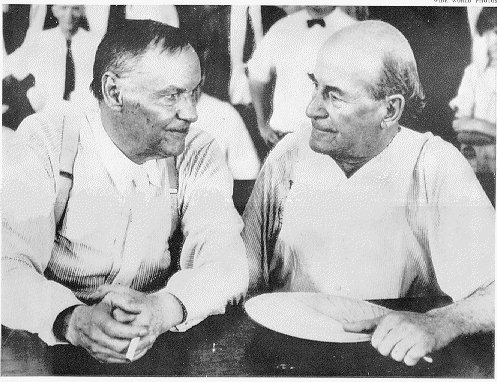
daytonscene

Mencken wrote of the trial:

“The Scopes trial, from the start, has been carried on in a manner exactly fitted to the anti- evolution law and the simian imbecility under it. There hasn’t been the slightest pretense to decorum. The rustic judge, a candidate for re-election, has postured the yokels like a clown in a ten-cent side show, and almost every word he has uttered has been an undisguised appeal to their prejudices and superstitions. The chief prosecuting attorney, beginning like a competent lawyer and a man of self-respect, ended like a convert at a Billy Sunday revival. It fell to him, finally, to make a clear and astounding statement of theory of justice prevailing under fundamentalism. What he said, in brief, was that a man accused of infidelity had no rights whatever under Tennessee law…”

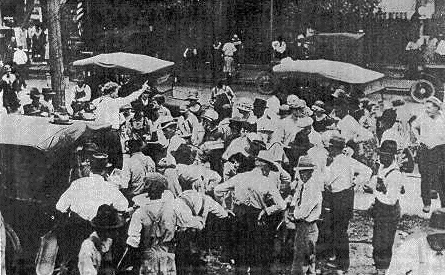
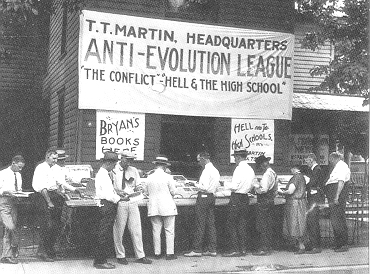
It was an epic event covered by news outlets across the nation and the atmosphere in the town outside the courthouse was circus like, something that the movie depicts very well. The defense was not allowed to produce Scientists as witnesses, even to the chagrin of Butler who despite his opposition to evolutionary theory felt that it was not fair. When all was said and done Scopes had been convicted and a fine of $100 assessed, which was overturned on appeal. Bryan died a week after the trial and of the 15 states with similar legislation to Butler passed them into law.

SCO_EVOL

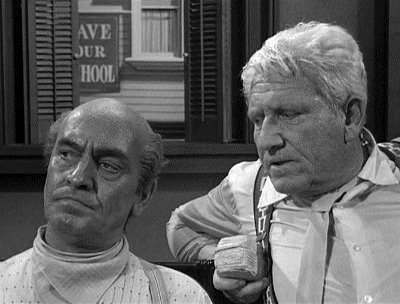
The film is based on the play of the same name written in 1950 by Jerome Lawrence and Robert E. Lee. It was written during the height of the McCarthy Era and opened in 1955. The first film version starring Spencer Tracy as Henry Drummond (Clarence Darrow), Frederic March as Matthew Harrison Brady (William Jennings Bryan), Gene Kelly as E.K. Hornbeck (H.L. Mencken) while Dick York played Bertram Cates (John Scopes). Lawrence and Lee invented some fictional characters including Reverend Brown played by Claude Akins.

The film directed by Stanley Kramer captures the raw emotions of the trial, the participants and the spectators who came from near and far. The depiction of the angry mob of Christians is terrifying to watch. In the film they sing:

“We’ll hang Bertram Cates to a sour apple tree, we’ll hang Bertram Cates to a sour apple tree, we’ll hang Bertram Cates to a sour apple tree. Our God is marching on! Glory Glory Hallelujah! Glory Glory Hallelujah! Glory Gory Hallelujah! His truth is marching on. We’ll hang Henry Drummond to a sour apple tree, we’ll hang Henry Drummond to a sour apple tree, we’ll hang Henry Drummond to a sour apple tree, our God is marching on.”

inheritwind

March’s depiction of Matthew Harrison Brady is riveting. The Brady of the film does not do justice to other parts of Bryan’s life. Bryan, outside his fight against evolution was ahead of his time in many ways. Earlier in his career he had pressed for Universal Suffrage, fought against war and labored against the social Darwinism of the banks, business and the Robber Barons. However the loss of three Presidential elections left him bitter and it is believed that he saw the trial as an opportunity to regain the limelight and perhaps build a base to again run for President. This speech by Brady is a fair characterization of Bryan’s beliefs:

“I have been to their cities and I have seen the altars upon which they sacrifice the futures of their children to the gods of science. And what are their rewards? Confusion and self-destruction. New ways to kill each other in wars. I tell you gentlemen the way of science is the way of darkness.”

The problem with the Bryant of the Scopes Trial was that he was a caricature of his former self, he played to the crowds. The trial played to the worst parts of his character and that shows in the movie depiction. Some Christians find this an unfair portrayal and even call it a lie, however even though March’s portrayal is fictional it does fit the spirit of the trial which is captured in the writings of many of the contemporary commentators of the trial. Mencken wrote of the real Bryan: It is a tragedy, indeed, to begin life as a hero and to end it as a buffoon.


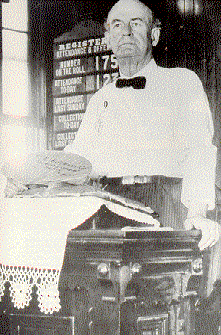
wjb_pulpit

Another of those commentators, Marcet Haldeman-Julius wrote of the real Bryan:

“As he sat there in the court room, day after day, silent, fanning, fanning, his face set I was appalled by the hardness, the malice in it. No one who has watched the fanatical light in those hard, glittering black eyes of Bryan’s can doubt but that he believes both in a heaven and in a hell. At the same time the cruel lines of his thin, tight-pressed mouth proclaim, it seems to me, that he would stop at nothing to attain his own ends. It is anything but a weak face–Bryan’s. But it is a face from which one could expect neither understanding nor pity. My own opinion is that he is sincere enough in his religion. Also that in it is included the doctrine Paul so frankly taught–that a lie told for the glory of God is justified…”

scope2

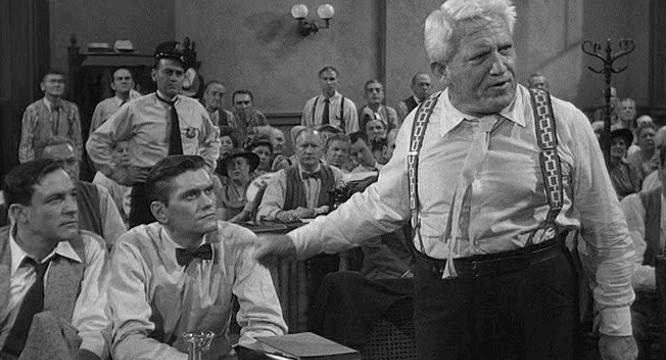
But I think that the real drama and tension in the film comes from Spencer Tracy in his portrayal of Drummond. This speech is taken almost verbatim from the trial:

“Can’t you understand? That if you take a law like evolution and you make it a crime to teach it in the public schools, tomorrow you can make it a crime to teach it in the private schools? And tomorrow you may make it a crime to read about it. And soon you may ban books and newspapers. And then you may turn Catholic against Protestant, and Protestant against Protestant, and try to foist your own religion upon the mind of man. If you can do one, you can do the other. Because fanaticism and ignorance is forever busy, and needs feeding. And soon, your Honor, with banners flying and with drums beating we’ll be marching backward, BACKWARD, through the glorious ages of that Sixteenth Century when bigots burned the man who dared bring enlightenment and intelligence to the human mind!”

0237318_11378_MC_Tx360

I think that this speech is the real crux of the tension that we face even now. Legislators in a number of States have enacted laws of much the same kind of spirit as Butler and defended them with the same kind of fire as Bryan. Civil libertarians, especially secular ones bring up the same issues as Darrow did. I am a Christian and a Priest and my thinking about this is much like that espoused by Drummond in the movie.

So the film may be a fictional depiction of the Scopes Trial, but it is a film that I think that people would do well to watch. I don’t expect everyone to agree with me or the issues that I agree with brought up by the character of Henry Drummond. However, I think that everyone should watch the film and come to their own conclusions as well as to ask themselves how their particular ethic, whether secular or religious informs them in how they deal with this issue and so many others that divide us today.

Bryant’s death, coming a few days after the trial was nowhere as near as dramatic as the death scene in the movie, sometimes fiction makes the story a bit more entertaining.

But the film also gives a warning to cynics like Mencken. After Brady’s death and the trials end there is a fascinating dialogue between Drummond (Darrow) and Hornbeck (Mencken). It is worth watching:

Henry Drummond : My God, don’t you understand the meaning of what happened here today?

E. K. Hornbeck : What happened here has no meaning…

Henry Drummond : YOU have no meaning! You’re like a ghost pointing an empty sleeve and smirking at everything people feel or want or struggle for! I pity you.

E. K. Hornbeck : You pity me?

Henry Drummond : Isn’t there anything? What touches you, what warms you? Every man has a dream. What do you dream about? What… what do you need? You don’t need anything, do you? People, love, an idea, just to cling to? You poor slob! You’re all alone. When you go to your grave, there won’t be anybody to pull the grass up over your head. Nobody to mourn you. Nobody to give a damn. You’re all alone.

E. K. Hornbeck : You’re wrong, Henry. You’ll be there. You’re the type. Who else would defend my right to be lonely?

I just know when I watch it, that it could have been in the news this week, only with a different cast of characters. My concern is that there is a very loud minority that wants to inflict its particular religious view on everyone and use the public treasure to do it. The attitude of many of these people is much like the characters from the actual Scopes Trial including their view that pushes both demonizes those they oppose and their desire to regulate the secular opposition to the sidelines.

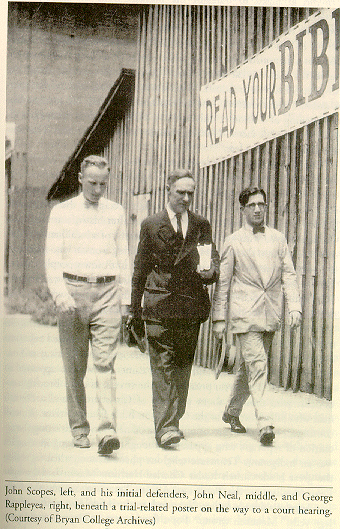
SCOPES1

I know that the same accusation is made by religious people of secularists, however I have seen the results of religious wars in Iraq and the Balkans, and from history. Those conflicts and the brutality of religious people in them give me great pause when I see religious and political leaders here suggest curtailing the civil liberties and even using the law against those that they oppose. As Drummond asked in the movie: “Must men go to jail because they find themselves at odds with a self-appointed prophet?”

That is why this film and that trial are still so important, for the very practice of liberty and protection of the First Amendment.

Peace

Padre Steve+

Leave a comment

Filed under civil rights, enteratinment, faith, film, History, laws and legislation, movies, News and current events, Political Commentary

Myths and Legends: Abner Doubleday, Baseball, and Gettysburg

Friends of Padre Steve’s World,

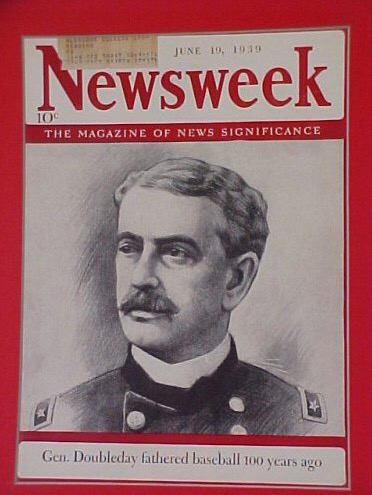
Tonight, two of my favorite topics in one. The Battle Of Gettysburg and baseball. The tie between them is the myth of Abner Doubleday and the creation of baseball, combined with the best action he ever commanded on the first day of the Battle Of Gettysburg. Sadly, he gets more credit for something he didn’t create, than his actions that certainly helped win the Battle Of Gettysburg. Strange thing how life happens like that. Millions of people know the myth, but few the truth. I find it fascinating.

Have a great night, And enjoy the All Star Game tomorrow. 

Peace

Padre Steve+

             The Abner Doubleday Monument on Seminary Ridge                                

                                     Doubleday Takes Command

As the initial Confederate attacks were driven back by the actions of Reynolds, Doubleday and their subordinate commanders, Harry Heth’s battered brigades fell back and regrouped to prepare for another assault. As Heth reorganized his division he was bolstered by the arrival Major General Dorsey Pender’s Division powerful division.

With John Reynolds dead and Oliver Howard moving his Eleventh Corps into position on Cemetery Hill and to the north of Gettysburg, Major General Abner Doubleday had assumed command of First Corps on McPherson and Seminary Ridge and successfully parried Heth’s initial attacks, in the process shattering the brigades of James Archer and Joseph Davis.

           Major General Abner Doubleday, United States Army

Doubleday was an experienced soldier but did not enjoy a stellar reputation in the Army of the Potomac, despite the fact that he was the senior division commander in First Corps. Doubleday came from a prominent New York family; his grandfather had fought in the American Revolution and had fought at Bunker Hill. His father served four years in Congress. By the time he was admitted to West Point Doubleday had worked for two years as a civil engineer. Doubleday graduated 24th in a class of 52 in the West Point Class of 1842 along with future Gettysburg commanders “Longstreet, McLaws, Richard Anderson and John Newton.” [1] After his graduation he served a rather uneventful career as an artillery officer, including service in Mexico and on the frontier. Shortly before the war he was transferred to South Carolina where he was second in command at Fort Sumter when the Confederates opened fire on the fort and began the Civil War.

Doubleday was definitely an unusual character by the standards of the ante-bellum army officer corps. The “mustachioed, barrel-chested Doubleday considered himself a thoroughly modern man, unencumbered by the cheap affections of honor and chivalry with which so many officers bedecked themselves.” [2] He had few real friends in the army. He was a rather vocal abolitionist “which endeared him to few of the army’s socially conservative generals” [3] and he allowed his political opinions to infringe on his relationships with other officers. In the days before the war at Fort Sumter “he relished being hissed in the streets as a “Black Republican” when his official duties took him over the water to downtown Charleston.” [4]

Doubleday fired the first shot on the Union side at Fort Sumter, and with the expansion of the army to meet the rebellion he “expected that his anti-slavery credentials would guarantee a rise to the top of Lincoln’s army.” [5] However, he was to be disappointed. While promotion came to him it was not to the top of the army. Doubleday had the “reputation of being a cautious, deliberate plodder,” [6] and the artillery commander of First Corps, the somewhat curmudgeonly but honest, Colonel Charles Wainwright noted “Doubleday knows enough, but he is entirely impractical, and so slow at getting an idea through his head.” [7] Likewise, the new army commander George Meade had formed an unfavorable opinion of Doubleday’s leadership ability, when both served as division commanders in First Corps. Meade considered Doubleday “slow and pedantic.” [8]

Doubleday was somewhat portly and his physical appearance did little to inspire his soldiers or officers, and some of his troops nicknamed him “Old Forty-Eight Hours” for his deliberate, even slothful style.” [9] His promotion in the wartime army was rather typical for a career officer. He was “promoted to Brigadier General in February 1862 and commanded a brigade at Second Bull Run and a division at South Mountain and in later battles.” [10] As a brigade commander his best work was at Brawner’s Farm on the eve of Second Manassas, where Doubleday on his own initiative threw “two of his regiments into line to bolster Brig. Gen. John Gibbon’s brigade against a larger Confederate force…together the fought a superior force to a standstill.” [11] He was promoted to Major General in November 1862 and received command of the First Division Third Division of First Corps. At Antietam Doubleday led the division “into the carnage of the Cornfield and West Woods, and one colonel described him as a “gallant officer…remarkable cool and at the very front of battle.” [12] He led the division again at Fredericksburg, but the division saw little action. After the reorganization of the army following Fredericksburg he was given command of Third Division of First Corps at Chancellorsville, but again saw no action.

At Gettysburg Doubleday went into battle “stiff and pompous, still wearing his laurels as an “old Sumter hero” [13] and complaining about the choice of Henry Slocum to command Twelfth Corps, even though he was senior to Slocum. That being said, Doubleday’s actions in the wake of Reynolds’s death demonstrated that he was capable of quick thinking and leadership from the front and in the next few hours Doubleday “had his best command hours of the war.” [14]

                                                    A Brief Lull

After the initial repulse of the Heth’s division, Doubleday continued to organize his defenses. He could see Heth’s division reforming its lines on Herr’s Ridge and Pender’s division as it arrived and deployed to Heth’s left. Doubleday had no directions from Reynolds as to that General’s defensive plan but be believed was that the ridges could be a redoubt and his instinct was “to hold on to the position until ordered to leave it,” an officer of the 149thPennsylvania heard Doubleday say that “all he could do was fight until he got sufficient information to form his own plan.” [15]Doubleday wrote in his after action report, “to fall back without orders from the commanding general might have inflicted lasting disgrace upon the corps, and as general Reynolds, who was high in the confidence of General Meade, had formed his lines to resist the entrance of the enemy into Gettysburg, I naturally supposed that it was the intention to defend the place.” [16] Wadsworth’s division, bloodied but unbeaten remained in place in McPherson’s woods and across the Cashtown Road where Cutler’s brigade had fought the Confederates to a standstill at the Railroad Cut. During the lull these brigades had their ammunition replenished by his recently arrived ammunition trains.

To counter the Confederate move to his right he deployed his own small Third Division under the acting command of Brigadier General Thomas Rowley. He placed Rowley’s brigade to the left of the Iron Brigade to extend the line to the south and the brigade of Colonel Roy Stone to occupy the area around the McPherson House and Barn which had been left open when Cutler’s brigade advanced to the railroad cut.

When the Second Division under the command of Brigadier General John Cleveland Robinson arrived Doubleday placed it in reserve around the Lutheran Seminary where they and some of John Buford’s dismounted troopers began to set up a hasty “barricade of fence rails and fieldstone on the seminary’s west side.” [17] Doubleday and Wadsworth deployed every artillery piece of that the Corps had available to support their infantry, sometimes over the objections of the Corps artillery commander Colonel Charles Wainwright. Wainwright “had no confidence in Doubleday, and felt that he would be a weak reed to lean upon,” [18] and on his own initiative deployed most of his batteries on Seminary Ridge where he believed that they could affect the battle but not be torn to pieces by Confederate artillery or shredded by close range musket fire. Despite the “pleas from infantry officers along the rise, Wainwright would send guns forward only under peremptory orders to do so.” [19] Wainwright was hesitant to risk his guns in exposed positions along McPherson’s Ridge and deployed most of his available artillery near the seminary in good defensive positions and stationed his limbers not far off so in the event of a retreat that he might have the opportunity to save his guns.

About Two o’clock Major General Oliver Howard, commander of the Eleventh Corps who was now the senior officer on the field made his way to seminary ridge where he met with Doubleday. Howard had already been working to support First Corps by ordering Schurz, who was now in acting command of Eleventh Corps to move north of the town to connect with Doubleday’s flank and securing Cemetery Hill as a natural redoubt and fallback position. While little is known what was said between the two commanders it is certain that Howard notified Doubleday of the locations of his corps headquarters and that of his divisions. Howard asked Doubleday “to continue his work of protecting the left of the Union position, while he would take care of the right…..Before leaving, Howard, repeated the instructions he had given Wadsworth, to hold the position as long as he could and then retire.” [20] Doubleday asked Howard for reinforcements, but there were none available, the best that either man could hope was that Henry Slocum’s Twelfth Corps, now about five miles distant could arrive soon. “If Slocum could make Gettysburg in the next hour and a half, Howard could post the 12thCorps on the right flank of his own corps and firm up the defensive arc that now stretched north and west of Gettysburg.” [21] However, despite the repeated requests of Howard, Slocum never came and did not advance toward Gettysburg until about three-thirty in the afternoon. Howard’s aid Captain Daniel Hall who delivered the messages and briefed Slocum on the situation at Gettysburg later stated that Slocum’s “conduct on that occasion was anything but honorable, soldierly, or patriotic.” [22]

With his troops under heavy artillery fire and Heth and Pender’s divisions advancing, a new threat emerged from the north. Messengers from Gamble’s cavalry scouts of Buford’s division to the north of town reported the arrival of Ewell’s Second Corps. To meet the threat Doubleday was obliged to send Robinson’s division north to occupy the extension of Seminary Ridge known as Oak Ridge. His lead brigade was under the command of Brigadier General Henry Baxter, and it advanced to the end of the ridge near the Mummasburg Road where it was joined by Brigadier General Gabriel Paul’s brigade.

Unlike the relatively small brigades of Third Division whose command structures were disrupted by Reynold’s death and Doubleday’s acting command of the corps, these brigades were comparatively large and powerful units and very well led. Their commander, Robinson “an old regular whose flowing beard lent him the look of a biblical prophet, had seen considerable fighting but was yet to be tested as a division commander.” [23]During this battle he more than met the test of an effective division commander. As the advance regiments of the division moved into position on Oak Ridge and the Mummasburg road they were greeted by a few of Gamble’s cavalrymen who told them “You stand alone between the Rebel army and your homes. Fight like hell!” [24] Upon their arrival Robinson refused the line in order to connect to the advance elements of Eleventh Corps which were arriving to the north of Gettysburg.

                                             Enter Second Corps

On June 30th Rodes’ division marched about twenty miles and bivouacked at Heidlersburg where he met with his corps commander Ewell, fellow division commander Jubal Early and Isaac Trimble who was accompanying Second Corps where they puzzled over Lee’s orders as to the movement of Second Corps the following day, which indicated that Ewell should march to Gettysburg or Cashtown “as circumstances may dictate.” [25] Neither Rodes nor Early gave favorable opinions of the order and Ewell asked the rhetorical question “Why can’t a commanding General have someone on his staff who can write an intelligible order?” [26]

Ewell assumed that Cashtown was the desired junction of the army ordered his to march from on the morning of July 1st 1863 toward Cashtown to join with Hill’s corps. His choice of routes was good as it gave him the opportunity to turn south towards Gettysburg “as circumstances” dictated in compliance with Lee’s rather vague order of the day before.[27]

Rodes’s division was at Middletown (modern Biglerville) when Ewell received A.P. Hill’s message that he was moving on Gettysburg between eight and nine in the morning. Ewell immediately directed Rodes onto the “Middletown-Gettysburg road and instructed Early to march directly toward Gettysburg on the Heidlersburg road.” [28] As he did so he sent a note to Lee informing him of the situation and about noon he received Lee’s response that Lee “did not want a general engagement brought on till the rest of the army came up.” [29] But by the time Ewell received that instruction events were beginning to spiral out of control on his front just as they had on Harry Heth not long before.

Although Ewell was closer to Rodes than Hill was to Heth at the beginning of the battle, Rodes like Heth was also operating somewhat independently as Ewell “preferred to ride near the tail of his column in his buggy.” [30] Like Heth when confronted with the opportunity for battle, he ignored the instruction “to avoid a general engagement, if practicable.” [31] The operation was Rodes’ first as a Major General and he like his fellow division commanders, Jubal Early and Allegheny Johnston, the young and aggressive Rodes was operating independently “as Ewell preferred” until the corps was reunited in the evening. [32] During the early part of the march to Gettysburg he had performed well but July 1st 1863 “would never be remembered as a great day for Robert Rodes.” [33] As he moved his division south he, like Ewell was unaware that a battle was developing to their front and both were surprised when they heard the sound of artillery about four miles north of the town. Rodes later wrote that “to my surprise, the presence of the enemy there in force was announced by the sound of a sharp cannonade, and instant preparations for battle were made.” [34]

Rodes deployed his infantry brigades and “posted Lt.Col. Thomas H. Carter’s battalion of artillery along the nose of the ridge, where it opened with “fine effect” on the Union line stretched across McPherson’s Ridge.” [35] As Rodes set about deploying his troops for his assault on Oak Ridge, Ewell could see Robinson’s division moving up to Oak Ridge and the Mummasburg road facing his troops. He also observed the advance of the two divisions of Eleventh Corps which Carl Schurz was moving into position north of the town. Seeing the developments to his front and right Ewell considered Lee’s order obsolete and noted that “it was already too late to avoid an engagement without abandoning the position already taken up…and I determined to push the attack vigorously.” [36] Likewise he sent an aide to contact Jubal Early and enjoin that General to move to battle.

Robert Rodes was new to commanding a division. The big, blond and charismatic Rodes was one of the most popular leaders in the Army of Northern Virginia. Rodes had a great ability to inspire his subordinates. This was in large part due to his handsome physical appearance which made him look “as if he had stepped from the pages of Beowulf” [37] but also due to his “bluff personality featuring “blunt speech” and a tincture of “blarney.” [38]

Rodes graduated at the age of 19 from the Virginia Military Institute and remained at the school as an assistant professor for three years. He left VMI when Thomas “Stonewall” Jackson received the full professorship he desired and became a successful civil engineer working with railroads in Alabama. He had just been appointed a full professor at VMI as the war was declared. [39]

His career had been remarkable. Rodes was “tough, disciplined and courageous; he was one of those unusual soldiers who quickly grew into each new assignment.” [40] In just two years he had “risen from captaining a company of “Warrior Guards” in Alabama in 1861 to earning the equivalent of a battlefield promotion to major general for the fight he made at Chancellorsville.” [41] As a brigadier he had shown remarkable leadership on the battlefield and off, taking care of the needs of his soldiers and worked to have “at least one company per regiment to drill on a field gun and to keep up that training from time to time, so that his men could service a cannon in a crisis.” [42]

With the coming of war Rodes abandoned his academic endeavors returned to his recent home of Alabama where he was appointed Colonel of the 5th Alabama regiment of infantry. Early in the war Rodes distinguished himself as the commander of that regiment and later as brigade commander of Ewell’s former brigade, a promotion that Ewell recommended. His brigade was one of the spearheads of Jackson’s attack on Eleventh Corps at Chancellorsville, where he “was a brilliant presence on the field, exhorting his men with mustache flying. Jackson personally congratulated him on his gallant performance.” [43] He took acting command of Major General D. H. Hill’s former division during that battle and handled that unit well. Following Chancellorsville, Rodes was recommended for promotion to Major General and permanent command the division by Stonewall Jackson. The act was one of Jackson’s last acts before his untimely death from pneumonia while recovering from his wounds sustained at Chancellorsville. With his appointment Rodes became the first non-West Point graduate to command a division in the Robert E. Lee’s Army of Northern Virginia.

Rodes’s division was the largest in the army with five brigades and approximately 8,000 soldiers present at Gettysburg, almost as many as the First Corps of the Army of the Potomac. His brigade commanders were a mixed bag, ranging from the excellent to the incompetent. Among the former he had George Doles, Stephen Ramseur and Junius Daniel. However, Rodes was saddled with two commanders of dubious quality, Brigadier General Alfred Iverson, who was hated by his men and Colonel Edward O’Neal, a leading secessionist politician “who had absolutely no military experience before the war” [44] and who had been ineffective as an acting brigade commander when he took over for Rodes at Chancellorsville. However, Lee was forced to leave O’Neal at the head of his brigade for lack of other senior leaders over Rodes’ objections. It would be a mistake that would come to haunt him.

However, Rodes was fortunate to have Brigadier Generals Stephen Ramseur and George Doles in command of two of his brigades. Both had led their units well at Chancellorsville under Rodes direction, and would fight well in Gettysburg and subsequent actions. [45] Brigadier General Junius Daniel, though an experienced West Point graduate with a solid record was new to the Army of Northern Virginia, unfamiliar with his commander, while and his brigade was untested in combat.

Brigadier General George Doles commanded a brigade. Doles was not a professional soldier but a former Georgia militia where he commanded a company, “the Baldwin Blues,” one of the oldest and best-trained military units in the state.” [46] As a Colonel he “had shown fiber and vigor” [47] as commander of the 4th Georgia regiment which he commanded at South Mountain and Antietam. Doles was promoted to Brigadier General after Antietam, and commanded the brigade at Chancellorsville. At Chancellorsville his brigade was part of Jackson’s attack against the Federal XI Corps and in the thick the action throughout the battle. Doles was noted for his leadership and valor. By Gettysburg he had a reputation for “being among the Southern army’s most daring, hard fighting brigadiers.” [48]

Stephen Ramseur was the youngest General in the Army of Northern Virginia, he had graduated from West Point in 1861, immediately resigned to join the Confederate cause and within seven months he would be a Brigadier General. He was elected captain of the Ellis Light Artillery of Raleigh North Carolina, and became colonel of the 49th Alabama in 1862. He led the regiment “with distinction during the Seven Days.” [49] While leading his troops at Malvern Hill he was severely wounded. Ramseur was noted for “being a fighter and for his skill in handling troops in battle.” [50]

The young Colonel was promoted to Brigadier General in November 1862 following the Battle of Antietam. He led a North Carolina brigade with great daring at Chancellorsville where he was wounded in the shin by a shell fragment. Along with his division commander Robert Rodes, the still injured Ramseur was “one of the brightest lights in Lee’s army as it approached the field at Gettysburg.” [51]

Junius Daniel was an 1851 graduate of West Point who served seven years before resigning to run his family plantation in 1858. When war came he Daniel volunteered for service and was appointed commander of the 14th North Carolina. He had much brigade command time but little combat experience, as his brigade had been posted in North Carolina and the Virginia Tidewater, thus, not sharing in the Army of Northern Virginia’s year of glory and slaughter. “Daniel’s brigade joined Rodes division in Virginia as a result of the army’s reorganization after Chancellorsville and in time for it to take part in the invasion of Pennsylvania.” [52] Despite his lack of combat experience Junius Daniel was well respected and “had the essential qualities of a true soldier and successful officer, brave, vigilant, honest…gifted as an organizer and disciplinarian, skilled in handling troops.” [53] At Gettysburg he “proved himself a valiant soldier and capable leader….” [54]

This left Rodes with two brigades under questionable leadership, and both would cause him immense grief on the morning of July 1st 1863.

One North Carolina brigade was commanded by Brigadier General Alfred Iverson. Iverson who was considered a “reliable secession enthusiast” was appointed to command the North Carolina troops whose political steadiness and loyalty was questioned by Richmond. [55] Because of this Iverson became “embroiled in bitter turmoil with his North Carolinians.” [56] Iverson had served in the Mexican War and in the army of the 1850s. However, he owed his appointments in both the U.S. Army and that of the Confederacy to political patronage, his father being a prominent U.S. Senator.

Though Iverson was from Georgia he helped raise the 20th North Carolina regiment of infantry and became its first Colonel. However he was constantly at war with his officers and his regiment never bonded with him. As a regimental commander he did see a fair amount of action but his leadership was always a question mark. After he took command of the brigade Iverson “sent an aide to the camp of his former regiment to arrest all twenty-six of its officers.” [57] Those officers responded in kind and “retained a powerful bevy of counsel including…Colonel William Bynum who would later become a member of the Supreme Court.” [58] Iverson then refused promotions to any officer who had opposed him. One of the aggrieved officers of the 20th North Carolina “wrote an outraged letter home insisting that resistance to Iverson was every reasonable man’s duty and asserting that he would oppose him again “with great pleasure” if the occasion offered.” [59] In his previous action at Chancellorsville Iverson “had not distinguished himself.” [60] After Chancellorsville he had “been stigmatized for his conspicuous absence at the height of the fighting.” [61]

Rodes’s old brigade was in the worst hands all. Due to the lack of qualified officers it was commanded at Gettysburg by its senior regimental commander Colonel Edward A. O’Neal. O’Neal was another political animal, who unlike Iverson had no prior military training and nothing he had done before the war “had prepared him for command at any level.” [62] As an Alabama lawyer O’Neal was however well connected politically which gained him rapid rank and seniority over other officers, this eventually led to his command of the 26th Alabama which was a part of Rodes brigade. Rodes had reservations about O’Neal’s ability to command the brigade and recommended two other officers, John Gordon and John T. Morgan who instead were assigned to command other brigades. [63] The Confederate War Department in Richmond forwarded a commission to Lee for O’Neal to be promoted to Brigadier General before Gettysburg, but Lee, who had serious reservations about O’Neal’s capabilities blocked the promotion. [64]

                           The Confederate Disaster at Oak Ridge

The arrival of Rodes’s division as on the field in the van of the Confederate Second Corps was decisive in turning the tide of the battle toward the Confederates that afternoon. When Rodes arrived with Ewell, the Federal First Corps was facing west against Heth and Pender’s divisions and its line only extended about a quarter mile north of the Railroad Cut.

The Union First Corps and Buford’s cavalry division had fought Heth’s poorly coordinated and led attacks to a standstill, but when Rodes arrived he found “a golden opportunity spread before him.” [65] From his position at Oak Ridge he saw the opportunity to take the Federal troops opposing Hill in the flank though his position did not “provide him as comprehensive view as he thought.” [66] His desire was to advance south along Oak Ridge using it to screen his movements in order to execute an attack on the Federal right flank. But before he could do this “the First Corps Generals had made preparations to oppose him.” [67] Robinson’s two brigades under Baxter and Paul deployed and “hurried in line stone and wood fences approximately at right angles to Rodes proper line of advance.” [68]Rodes could see the deployment but the fences obscured the exact positions of Robinson’s troops from him. Seeing the advance of the First Corps units as well as the emergence of Schurz’s troops from Eleventh Corps advancing out of the town the aggressive Confederate commander decided to launch an immediate attack.

Carter’s artillery, which had deployed in the open and was had “opened an enfilading fire all along the line to the Fairfield road” [69] now drew the fire of Captain Hubert Dilger’s Battery I First Ohio Artillery from Howard’s XI Corps which had just arrived near Oak Ridge. Dilger commanded one of the best artillery units in the army. He was a German immigrant and professional artilleryman who had served in the Grand Duke of Baden’s Horse Artillery. He came to the United States at beginning of the war at the invitation of a distant uncle, to “practice the war-making he had only previously rehearsed.” [70] Dilger was “blunt and a bit arrogant…loved by his men but not by his superiors.” At Chancellorsville he and his battery had helped save the Federal right “when it used a leapfrogging technique to keep the victorious Confederate infantry at bay.” [71] At Gettysburg Dilger again displayed his talent.

Upon its arrival Dilger’s battery opened “a storm of counter-battery fire”[72] on Carter’s battalion as well as the infantry brigade of O’Neal which was near it. The effect of Dilger’s fire on Carter’s artillery disrupted its operation and was successful in blowing up several caissons and guns causing significant numbers of casualties among the men. [73] Seeing the carnage to one battery that he had not placed, Carter “accosted Rodes and asked, “General, what fool put that battery up yonder?” Only to realize after an “awkward pause and a queer expression on the face of all Rodes’ staffers that Rodes himself had placed it there.” [74] In response, the chastised division commander replied “You had better take it away, Carter.” [75]Throughout the rest of the engagement Dilger’s battery would make itself known, shattering Confederate infantry assaults and damaging Southern artillery batteries.

The young division commander was overconfident as he ordered the attack. Thinking he had an adequate grasp of the situation he did not order a reconnaissance before launching the attack, nor did the commanders of the brigades spearheading the attack put out skirmishers, the normal precaution when advancing in the face of the enemy. [76] Rodes deployed his troops over the rough ground of the ridge as quickly as he could and dashed off a note to Jubal Early stating “I can burst through the enemy in an hour.” [77] He was to be badly mistaken, and “like Heth in the south, he paid in disproportionate blood for the ready aggressiveness which in the past had been the hallmark of the army’s greatest victories, but now seemed mere rashness and the hallmark of defeat.” [78]

Rodes deployed George Doles’ excellent brigade to guard his left against the advancing Eleventh Corps units until Early’s division could arrive, something he expected momentarily. Doles and his brigade conducted this task admirably until the arrival of Jubal Early’s division, which enabled it to join the attack on Eleventh Corps divisions north of the town. Initially the movement of the brigade opened a potentially dangerous gap between Doles brigade and O’Neal’s brigade to its right, but this could not be exploited by the Federals. To hold this gap between Doles and O’Neal Rodes pulled one regiment, the 5th Alabama from O’Neal.

To make his main attack Rodes initially deployed his division on a one brigade front as they arrived on the battlefield in line-of-march. As the leading elements of the division neared the Federal positions Rodes, made what appeared to be a simple change of plan to “attack on a two brigade front, sending in O’Neal’s and Iverson’s men simultaneously, then following up with Daniel’s brigade in echelon on the right.” [79] Ramseur’s brigade was held in close reserve. In theory it was a sound plan, but everything is more complicated when bullets start flying. The execution of this change in plan was “bungled right at the start.” [80] None of “the three brigade commanders was sure what the signal for the advance would be”[81] and since Rodes had made no reconnaissance, and none of the brigades put out skirmishers the direction of the attack was faulty, units were mingled and a gap developed between O’Neal and Iverson. [82] The attack “though vigorous, was a disaster” [83] and the plan floundered due to the stout resistance of Robinson’s troops and the “nicely matched incompetence of O’Neal and Iverson” [84] neither of who advanced with their assaulting troops.

O’Neal’s brigade became disoriented and “went in with only three regiments and at an angle different from that indicated by Rodes. Instead of leading his troops in the attack O’Neal remained in the rear with the Fifth Alabama, a reserve regiment,” [85] the regiment Rodes had left behind to guard the gap between O’Neal and Doles’s brigades. The last regiment, the Third Alabama had been aligned on the flank of Doles’s brigade and since Rodes had moved it “evidently concluded…that it was no longer his to direct.” [86] When Rodes discovered this he had to send a staff officer to ensure that the regiment was properly attached to Daniel’s brigade. That regiment was thus left out of the initial advance. The attack stalled almost immediately when O’Neal’s three attacking regiments were fired upon by Union troops of Robinson’s division who had been hidden by a wall which had obscured them from Rodes’s view.

Striking O’Neal’s advancing troops at the oblique, Robinson’s battle hardened Union troops slaughtered the unsuspecting Confederates. Though they were outnumbered the Union men were solid veterans from Baxter’s brigade who were aided by Dilger’s artillery which delivered “effective canister fire at O’Neal’s brigade.” [87] The combined fire of Baxter’s troops as well as Dilger’s artillery “killed or wounded about half of the advancing men with a series of point blank volleys pumped directly into their flank.” [88] O’Neal’s decision to remain back with his reserve regiment rather than “going forward to direct the advancing regiments” [89] caused further problems because there was no officer on the spot to direct the action of the three regiments.

Rodes noted in his after action report that O’Neal’s three attacking regiments “moved with alacrity (but not in accordance with my orders as to direction)” and that when he ordered the 5th Alabama up to support “I found Colonel O’Neal, instead of personally superintending the movements of his brigade, had chosen to remain with his reserve regiment. The result was that the whole brigade was repulsed quickly and with loss….” [90] As O’Neal’s troops fell back in confusion they exposed Iverson’s brigades flank to the Federal fire.

As Rodes’s continued bad luck would have it, Iverson, like O’Neal on his right did not advance simultaneously with O’Neal or on the same axis, but instead waited to see O’Neal’s advance. [91] When it advanced, the brigade “about 1,450 strong, kept on under artillery fire through the open field “as evenly as if on parade.” Then its alignment became faulty, and without Iverson on hand to correct it, the brigade with strange fatality began to bear left toward the stone wall…” [92] As a result the brigade drifted right it’s exposed left was subject to attack from Baxter’s and Paul’s brigades of Robinson’s division still hidden behind the stone wall.

When the Confederates got within fifty yards of Baxter’s troops they were overwhelmed by a fierce resistance from the concealed Federal troops. The commander of the 83rd New York, the Swiss born lieutenant Colonel Joseph A. Moesch, shouted: “Up men, and fire.” Moesch rode behind his line cheering his men on, but they needed no urging. In the words of one of one, “The men are no longer human, they are demons; a curse from the living here, a moan from the dying there. ‘Give them —- shouts one.’ See them run’ roars another.” [93] The well concealed veterans of Baxter regiments slaughtered them as they had O’Neal’s men just minutes before. “One regiment went down in such a neat row that when its survivors waves shirt tails, or any piece of cloth remotely white, Iverson thought that the whole regiment of live men were surrendering.” [94] As the Confederate attack collapsed some “of the regiments in Robinson’s division changed front again, charged, and captured nearly all the men who were left unhurt in three of Iverson’s regiments.” [95] Official Confederate reports list only 308 missing but that number differs from the Union reports, Robinson reporting 1000 prisoners and three flags and Baxter’s brigade nearly 400. [96] As Robinson’s troops smashed the brigades of O’Neal and Iverson, they were joined by the remnants of Cutler’s brigade which changed its face from west to north to deliver more devastating fire into the Confederates.

Iverson was badly shaken by the slaughter and “went to pieces and became unfit for further command,” [97] after being just close enough to the action to observe it. He panicked and notified Rodes that one of his regiments had surrendered in masse though Iverson later retracted that in claim in his official report where he noted “when I found afterward that 500 of my men were left lying dead and wounded on a line as straight as a dress parade, I exonerated …the survivors.” [98] His brigade had lost over two-thirds of its strength in those few minutes, one regiment the 23rd North Carolina lost 89 percent of those it took into battle, and at the end of the day would “count but 34 men in its ranks.” [99] Iverson’s conduct during the battle was highly criticized by fellow officers after it. Accused of cowardice, drunkenness and hiding during the action he was relieved of his command upon the army’s return to Virginia “for misconduct at Gettysburg” [100] and sent back to Georgia. Some complained after the war that Iverson was helped by politicians once he returned to Richmond and instead of facing trial “got off scot free & and had brigade of reserves given to him in Georgia.”[101]

With the center of his attacking forces crushed the brigades of Junius Daniels and Stephen Ramseur entered the fray to the right of Iverson’s smashed brigade. These capable officers achieved a link up with the battered brigades of Harry Heth at the Railroad cut after Daniel’s brigade had fought a fierce battle with Culter’s and Stone’s brigades in the area [102] and allowed the Confederates of A.P. Hill and Dick Ewell’s Corps to form a unified front from which they were able to resume their attack in even greater numbers against the battered remnants of First Corps.

To the east Doles’s brigade advanced with Jubal Early’s division smashed the outnumbered and badly spread out divisions of Oliver Howard’s Eleventh Corps. The timely arrival of that division coupled with the skillful work of Daniel and Ramseur saved Rodes from even more misfortune on that first day of battle, but Rodes’ plan “to burst through the enemy” with his division had evaporated. [103] By the end of the day his division had lost nearly 3000 of the 8000 that it had begun the afternoon.

The battle at Oak Ridge was a series of tactical debacles within a day of what appeared to be a “Confederate strategic bonanza.” [104] Despite the mistakes Rodes never lost his own self-control. He recovered from each mistake and continued to lead his division. He “kept his men on the ridge driving forward until with Hill, and on the flats left joined Early’s right to form a continuous line into Gettysburg.” [105] It was a hard lesson for the young Major General, but one that he learned from. Rodes continued to serve with distinction as a division commander would be killed in action while leading a counterattack by his division against Philip Sheridan’s army at the Third Battle of Winchester on September 19th 1864.

Abner Doubleday’s Best Performance and Disgraceful Treatment

On the other hand Abner Doubleday proved himself as a capable commander who was able to provide effective leadership during a crisis situation. Although he is one of the most underappreciated Union commanders at Gettysburg he “ably rose to the occasion, as did divisional commanders James Wadsworth and John Robinson.” [106] Though his abilities were suspect, especially by George Meade and Colonel Wainwright, the Corps artillery commander Doubleday managed to hold off superior Confederate forces, and even inflicted a significant defeat on the divisions of Harry Heth and Robert Rodes. During the fighting against ever increasing numbers of Confederates, First Corps inflicted massive casualties on their opponents. “Seven of the ten Southern brigades incurred casualties from 35 to 50 percent, and the total for all brigades came to an estimated 6,300 officers and men, or about 40 percent of their strength.” [107] Doubleday’s troops held on long enough to support the left flank of Eleventh Corps as it was being assaulted by Early’s division.

When Winfield Scott Hancock arrived on Meade’s behest to take command at Gettysburg Oliver Howard informed him that First Corps “had given way at first contact” [108] implicitly blaming Doubleday for the collapse of the Federal line. Hancock delivered the report in a note to Meade which said “Howard says that Doubleday’s command gave way” [109] This false report fixed in Meade’s mind that his doubts about Doubleday’s ability were correct. To Doubleday’s amazement Meade then cancelled his order appointing Doubleday to command First Corps and ordered John Newton, a division commander, far junior to Doubleday in Sedgwick’s Sixth Corps to replace Doubleday. A badly disappointed Doubleday resumed command of his division. In large part Meade’s appointment of Newton over Doubleday was also political. Doubleday’s fellow abolitionist division commander in First Corps, James Wadsworth said that “Meade’s “animosity” toward Doubleday rested in a “past political difference.” [110] Doubleday, the abolitionist Republican was not acceptable to Meade, the conservative Unionist Democrat and ally of Gorge McClellan. The fact that Newton “was not regarded as daring or brilliant” [111] and was regarded by many as a “pet” of Meade, did not matter. Meade’s volcanic temper and temptation to allow politics to cloud his military judgement meant that “Newton was the only other major general he could trust politically.” [112] When Doubleday formally protested to Meade he was dismissed from Army of the Potomac.

He left the Army of the Potomac and never held a field command during the war, however, he was brevetted in the Regular Army to both brigadier and major general. Doubleday served in administrative capacities in Washington D.C. until the end of the war and testified against Meade during the politically charged hearings of the Committee on the conduct of the War. Doubleday remained bitter toward Meade and he “was never reconciled to Meade’s relieving him as acting commander of First Corps in Favor of Maj. Gene. John Newton, who was his junior in rank and the reproach that it implied.” [113] After the war Doubled reverted to his rank as a Colonel in the Regular Army and was made Colonel of the 35th U.S. Infantry in San Francisco. From 1871 until his retirement in 1873 Doubleday commanded the African American “Buffalo Soldier” 24th Infantry Regiment in Texas. He died in New York on January 25th 1893, and was buried in Arlington National Cemetery. Among the members of the honor guard at his funeral in New York was a man named Abraham Mills who would play a major role in Doubleday’s future fame.

doubleday newsweek

A Myth and Legend Greater than Gettysburg: Abner Doubleday and Baseball

Interestingly enough Doubleday, who was unappreciated as a general became linked forever to the game known as America’s national pastime and to Cooperstown New York, the home of Baseball’s Hall of Fame. As such he is probably better known to most Americans, particularly baseball fans than any Union general who fought at Gettysburg.

Like the Civil War, Baseball too is filled with myths which connect it to our culture, and one “is the myth that Abner Doubleday invented the sport one fine day in 1839 at the farmer Phinney’s pasture at Cooperstown.” [114] It was early American baseball star Albert G. Spaulding who linked the creation of baseball to the Civil War and in particular to Abner Doubleday by way of an apocryphal story of one of Doubleday’s childhood friends, years after Doubleday’s death. In 1907, Spaulding worked with Abraham G. Mills the fourth President of the National League, the same man who had served in Doubleday’s funeral honor guard to conclude that “that the first scheme for playing it, according to the best evidence obtained to date, was devised at Cooperstown New York, in 1839.” [115] But this is simply myth and the underappreciated hero of the first day of battle at Gettysburg is much better known for something that he did not do.

The ironies of history and myth are fascinating. Interestingly Mills paid homage to Doubleday noting, “in the years to come, in the view of hundreds of thousands of people who are devoted to baseball, Abner Doubleday’s fame will rest evenly, if not quite so much that he was its inventor…as upon his brilliant and distinguished career as an officer in the Federal Army.” [116]

                                                            Notes

[1] Pfanz Harry W. Gettysburg: The First Day University of North Carolina Press, Chapel Hill and London 2001 p.121

[2] Goodheart, Adam 1861: The Civil War Awakening Vintage Books a division of Random House, New York 2011 p.5

[3] Wert, Jeffry D. The Sword of Lincoln: The Army of the Potomac Simon and Schuster, New York and London 2005 p.276

[4] Ibid. Goodheart 1861 p.5

[5] Guelzo, Allen C. Gettysburg: The Last Invasion Vintage Books, a Division of Random House, New York 2013 p.30

[6] Sears, Stephen W. Gettysburg. Houghton Mifflin Co. Boston and New York 2003 p.181

[7] Wainwright, Charles S. A Diary of Battle: The Personal Journal of Colonel Charles S. Wainwright 1861-1865 edited by Allan Nevins, Da Capo Press, New York 1998 p.172

[8] Cleaves, Freeman Meade of Gettysburg University of Oklahoma Press, Norman and London 1960 p.143

[9] Tagg, Larry The Generals of Gettysburg: The Leaders of America’s Greatest Battle Da Capo Press Cambridge MA 1998 Amazon Kindle Edition p.25

[10] Ibid. Pfanz Harry Gettysburg: The First Day p.122

[11] Ibid. Tagg The Generals of Gettysburg p.26

[12] Ibid. Tagg The Generals of Gettysburg p.26

[13] Catton, Bruce The Army of the Potomac: Glory Road Doubleday and Company, Garden City New York, 1952 p.273

[14] Ibid. Sears Gettysburg p.181

[15] Ibid. Guelzo Gettysburg: The Last Invasion p.161

[16] Trudeau, Noah Andre. Gettysburg: A Testing of Courage, Harper Collins Publishers, New York 2002 p.206

[17] Ibid. Guelzo Gettysburg: The Last Invasion p.162

[18] Ibid. Wainwright A Diary of Battle p.233

[19] Ibid. Trudeau Gettysburg: A Testing of Courage p.200

[20] Coddington, Edwin B. The Gettysburg Campaign: A Study in Command, A Touchstone Book, Simon and Schuster New York, 1968 p.282

REPORT THIS AD

[21] Ibid. Guelzo Gettysburg: The Last Invasion p.162

[22] Melton, Brian C. Sherman’s Forgotten General: Henry W. SlocumUniversity of Missouri Press, Columbia and London 2007 p.121

[23] Ibid. Sears Gettysburg p.34

[24] Ibid. Trudeau Gettysburg: A Testing of Courage p.206

[25] Ibid Pfanz Gettysburg: The First Day p.148

[26] Ibid Pfanz Gettysburg: The First Day p.149

[27] Ibid. Sears Gettysburg p.160

[28] Ibid. Coddington The Gettysburg Campaign: A Study in Command p.281

[29] Gallagher, Gary. Confederate Corps Leadership on the First Day at Gettysburg: A.P. Hill and Richard S. Ewell in a Difficult Debut in The First Day at Gettysburg edited by Gallagher, Gary W. Kent State University Press, Kent Ohio 1992 p.49

[30] Foote, Shelby, The Civil War, A Narrative. Volume Two Fredericksburg to Meridian Random House, New York 1963 p.472

[31] Ibid Freeman, Lee’s Lieutenant’s a Study in Command p.564

[32] Ibid. Foote The Civil War, A Narrative. Volume Twop.472

[33] Ibid. Dowdy Lee and His Men at Gettysburg: The Death of a Nation p.138

[34] Luvaas, Jay and Nelson Harold W editors. The U.S. Army War College Guide to the Battle of Gettysburg South Mountain Press, Carlisle PA 1986 p.35

[35] Pfanz, Donald. Richard S. Ewell: A Soldier’s Life University of North Carolina Press, Chapel Hill and London 1998 p.305 Pfanz credits Ewell for this but nearly every other source lists Rodes as having placed Carter’s artillery battalion on Oak Hill.

[36] Ibid. Pfanz, Donald Richard S. Ewell p.305

[37] Freeman, Douglas Southall, Lee’s Lieutenant’s a Study in Command, One volume abridgement by Stephen W Sears, Scribner, New York 1998 p.39

[38] Krick, Robert K. Three Confederate Disasters on Oak Ridge: Failures of Brigade Leadership on the First Day of Gettysburg in The First Day at Gettysburg edited by Gallagher, Gary W. Kent State University Press, Kent Ohio 1992 p.115

REPORT THIS AD

[39] Dowdy, CliffordLee and His Men at Gettysburg: The Death of a Nation Skyhorse Publishing, New York 1986, originally published as Death of a Nation Knopf, New York 1958 p.123

[40] Glatthaar, Joseph T. General Lee’s Army from Victory to Collapse The Free Press, Simon and Schuster, New York and London 2008 p.243

[41] Ibid. Sears, Gettysburg p.53

[42] Ibid. Glatthaar General Lee’s Army from Victory to Collapse p.244

[43] Gwynne, Samuel C. Rebel Yell: The Violence, Passion, and Redemption of Stonewall Jackson Scribner, a Division of Simon and Schuster New York 2014 p.537

[44] Ibid. Tagg The Generals of Gettysburg p.299

[45] Ibid. Krick Three Confederate Disasters on Oak Ridge p.117

[46] Ibid. Tagg The Generals of Gettysburg p.287

[47] Ibid. Freeman Lee’s Lieutenants p.386

[48] Ibid. Tagg The Generals of Gettysburg p.288

[49] Ibid. Warner Generals in Gray p.251

[50] Pfanz Harry W. Gettysburg: The First Day University of North Carolina Press, Chapel Hill and London 2001

[51] Ibid. Tagg The Generals of Gettysburg p.290

[52] Ibid. Pfanz Gettysburg: The First Day p.179

[53] Ibid. Tagg The Generals of Gettysburg p.292

[54] Ibid. Coddington The Gettysburg Campaign p.21

[55] Ibid. Guelzo Gettysburg: The Last Invasion p.25

[56] Ibid. Sears Gettysburg p.53

[57] Ibid. Krick Three Confederate Disasters on Oak Ridge p.129

[58] Ibid. Krick Three Confederate Disasters on Oak Ridge p.131

[59] Ibid. Krick Three Confederate Disasters on Oak Ridge p.130-131

[60] Ibid Freeman, Lee’s Lieutenant’s a Study in Command p.564

[61] Ibid. Trudeau, Gettysburg: A Testing of Courage p.145

REPORT THIS AD

[62] Ibid. Krick Three Confederate Disasters on Oak Ridge p.120

[63] Ibid. Krick Three Confederate Disasters on Oak Ridge p.123

[64] Ibid. Pfanz Harry Gettysburg: The First Day p.162 Also see Krick pp.123-124 Following Gettysburg Lee continued to block O’Neal’s promotion and that officer went to extraordinary lengths to obtain a General’s commission using every political ally he had in Alabama and in Richmond. Finally Lee settled the matter before the Wilderness campaign writing that he made “more particular inquiries into his capacity to command the brigade and I cannot recommend him to the command.” Krick pp.123-124

[65] Ibid. Foote, Shelby, The Civil War, A Narrative. Volume Two p.472

[66] Ibid. Guelzo Gettysburg: The Last Invasion p.170

[67] Ibid. Coddington The Gettysburg Campaign p.286

[68] Ibid. Krick Three Confederate Disasters on Oak Ridge p.119

[69] Ibid. Coddington The Gettysburg Campaign p.286

[70] Ibid Trudeau, Gettysburg: A Testing of Courage p.208

[71] Gottfried, Bradley The Artillery of Gettysburg Cumberland House Publishing, Nashville TN 2008 pp.59-60 Dilger was awarded the Medal of Honor for his actions at Chancellorsville in 1893, part of the citation stating that Dilger: “fought his guns until the enemy were upon him, then with one gun hauled in the road by hand he formed the rear guard and kept the enemy at bay by the rapidity of his fire and was the last man in the retreat.”

[72] Ibid. Krick Three Confederate Disasters on Oak Ridge p.118

[73] Ibid Trudeau, Gettysburg: A Testing of Courage p.210

[74] Ibid. Guelzo Gettysburg: The Last Invasion p.170

[75] Ibid. Gottfried The Artillery of Gettysburg p.61

[76] Ibid. Guelzo Gettysburg: The Last Invasion p.170

[77] Ibid. Guelzo Gettysburg: The Last Invasion p.170

[78] Ibid. Foote, Shelby, The Civil War, A Narrative. Volume Two p.473

[79] Ibid. Sears Gettysburg p.197

[80] Ibid. Sears Gettysburg p.197

[81] Ibid. Guelzo Gettysburg: The Last Invasion p.170

REPORT THIS AD

[82] Ibid Freeman, Lee’s Lieutenant’s a Study in Command p.565

[83] Ibid. Pfanz, Donald Richard S. Ewell p.305

[84] Ibid. Krick Three Confederate Disasters on Oak Ridge p.120

[85] Ibid. Pfanz, Donald Richard S. Ewell p.305

[86] Ibid. Krick Three Confederate Disasters on Oak Ridge p.124

[87] Ibid. Sears Gettysburg p.198

[88] Ibid. Foote, Shelby, The Civil War, A Narrative. Volume Two p.473

[89] Ibid Freeman, Lee’s Lieutenant’s a Study in Command p.565

[90] Ibid Luvaas The U.S. Army War College Guide to the Battle of Gettysburgp.36

[91] Ibid. Krick Three Confederate Disasters on Oak Ridge p.132

[92] Ibid. Coddington The Gettysburg Campaign p.289

[93] Ibid. Pfanz Gettysburg: The First Day p.172

[94] Ibid. Dowdy, Lee and His Men at Gettysburg: The Death of a Nation p.134

[95] Ibid. Coddington The Gettysburg Campaign p.290

[96] Ibid Pfanz Gettysburg: The First Day p.175

[97] Ibid. Coddington The Gettysburg Campaign: A Study in Command p.290

[98] Ibid Luvaas The U.S. Army War College Guide to the Battle of Gettysburgp.37

[99] Ibid. Sears Gettysburg p.201

[100] Ibid. Guelzo Gettysburg: The Last Invasion p.173

[101] Ibid. Krick Three Confederate Disasters on Oak Ridge p.136

[102] Ibid. Coddington, The Gettysburg Campaign: A Study in Command, p.292

[103] Ibid. Guelzo Gettysburg: The Last Invasion p.173

[104] Ibid. Krick Three Confederate Disasters on Oak Ridge p.138

[105] Ibid. Dowdy Lee and His Men at Gettysburg: The Death of a Nation p.138

[106] Ibid. Sears Gettysburg p.245

[107] Ibid. Coddington, The Gettysburg Campaign: A Study in Command, p.307

[108] Ibid. Wert The Sword of Lincoln p.294

[109] Ibid. Guelzo Gettysburg: The Last Invasion p.224

[110] Ibid. Wert The Sword of Lincoln p.294

[111] Ibid. Cleaves Meade of Gettysburg p.143

[112] Ibid. Guelzo Gettysburg: The Last Invasion p.224

[113] Ibid. Pfanz Gettysburg: The First Day p.355

[114] Will, George F Men at Work: The Craft of Baseball Harper Collins Publishers, New York 1990 p.294

[115] Kirsch, George B. Baseball in Blue and Gray: The National Pastime in the Civil War Princeton University Press, Princeton and Oxford, 2003 p.xiii

[116] Ibid.. Kirsch Baseball in Blue and Gray p.xii

Leave a comment

Filed under Baseball, civil war, Gettysburg, History, Military, us army

Reflecting on the Best Of American Sports Teams

Friends of Padre Steve’s World,

The United States Women’s National Team, was simply the best and I continue to be in love with them.

They were derided before the tournament, mostly by male commentators. Their one of a kind outspoken veteran star player and co-Captain was viciously attacked in public statements by the President Of the United States, and they were criticized by others for their dominance and love of the game and love of team. I have never seen any winning team in any sport so derided for their unity, their dominance, and their ability to win against some of the best teams in the world, including Sweden, France, and England. In the final they defeated the Netherlands team which had played brilliantly the entire tournament, never trailing in a game until Megan Rapinoe scored on a penalty kick in the 61st minute of the championship game.

Their victory today was more than a victory for their team it was a victory for the proposition in the Declaration Of Independence that all people are created equal. In addition to winning they forced the hand of FIFA to increase the financial aspects of the game to women, doubling and then quadrupling the amount of money dedicated to the women’s tournament.

Beyond that, these women, and the members of the team over the past quarter of a century have blazed a trail of excellence that is hard to match. Forget about the men’s Olympic Basketball “Dream Teams”, made up of the best players in the NBA, no one cared when they ran up scores, dominated, and celebrated their wins. Forget the United States men’s Baseball team who cannot win or come close to winning an international tournament because the MLB owners won’t let their best players compete, or the U.S. Men’s Soccer team which has never gotten past the semifinals in the World Cup despite more funding and higher salaries than those of the USNWT.

The U.S. Women speak for more than sports. They speak for the equality of the Declaration, and the rights of women (and men) everywhere who are discriminated against because of gender, race, or religion. By the way when I speak of gender I don’t just talk male and female, but also of my LGBTQ friends, brothers and sisters.

This was a special team. They had a lot of detractors, including former teammates, but they showed their metal and won, in a convincing manner. They scored the most goals ever by a women’s treat in World Cup history and only allowed three goals against them in seven games. They defeated three of the highest rated teams in the world just to get to the final. They dealt with age and injuries, and still showed a joy for the game, love of team, and yes, patriotism, even the kind of which is unpopular and makes authoritarians uncomfortable and angry.

In that, Megan Rapinoe, the object of so much of President Trump’s disdain, won both the tournament’s Golden Boot for the most goals and assists, as well as the Golden Ball as best player of the tournament. As a patriot who believes and hopes for the best that our country has to offer, I hope that she and the team refuse any invitation to Trump’s White House. They fought for too much to surrender those victories to a man who would use them for a photo op and then continue to speak badly of them.

Congratulations to the American Women who won the Women’s World Cup and so much more, this year, as well as in 1995, 1999, and 2015. They all deserve our respect, appreciation, and admiration; but especially this team, for they are the face of ALL United States Soccer. They are the people who have inspired American women and men to compete at the highest levels of soccer worldwide.

So until tomorrow,

Peace,

Padre Steve+

Leave a comment

Filed under civil rights, leadership, LGBT issues, Loose thoughts and musings, News and current events, soccer, sports and life

The Bloodiest Battle on American Soil: The Human Cost at Gettysburg

gburg dead2

Friends of Padre Steve’s World

This week I have been posting about Gettysburg, Independence Day, and a commentary on the toxic nationalism of President Trump’s hijacking of Independence Day. We have been visiting with friends and I have been catching up on my reading. I completed Ian Kershaw’s “To Hell and Back: Europe 1914-1949; I’m about halfway through Geoff Megargee’s “Inside Hitler’s High Command”; and I am about two thirds of the way through with Danielle Allen’s “Our Declaration: A Reading Of the Declaration of Independence In Defense of Equality.” They are all worth the read in an age where much of our citizenry lacks a basic understanding of the principles of the Declaration and worships at the altar of brute military and economic force, thinking that somehow those are the guarantors of freedom and liberty. They are not. Kershaw’s book shows the cost of toxic nationalism and ideologies that destroyed Europe in two World Wars, Megargee’s shows the cost of militarism and militaries  that become compliant with authoritarian leaders. 

So tonight I repost a final article from my Gettysburg text. It deals with the human cost of that battle. 

I am a career military officer who suffers from PTSD, TBI and other afflictions after serving in Iraq’s Al Anbar Province in 2007-2008.  I have seen firsthand the terrible effects of war. I am also a historian and I  have served as Assistant Professor at a major military staff college which helps educate senior military officers from this country and other countries. In that capacity I taught ethics as well as led the Gettysburg Staff ride, or study of the Battle of Gettysburg. When teaching I always attempted to deal with the human cost of war.

Gettysburg was the most costly battle ever fought on the American continent. Around 50,000 men were killed or wounded there in three days of battle. William Tecumseh Sherman noted that “war is hell.” I agree, there is nothing romantic about it. The effects of war last generations and though we have been at war for the last seventeen and a half years, war itself is an abstract concept to most Americans. It is fought by professionals and only experienced by most Americans on the news, movies or most the banal manner, video games; thus the cost in human terms is not fully appreciated, and nor can it be, we are far too insulated from it. Over the past forty plus years our politicians have insulated the public from war, and in doing so they have ensured that we remain in perpetual war which benefits no one. That is a big reason why I write so much about it, not to glorify or romanticize it, but to try in some war to help make it real  to my readers. This is a another draft chapter from my Gettysburg text. 

Peace

Padre Steve+

Walt Whitman Wrote:

“Ashes of soldiers South or North, As I muse retrospective murmuring a chant in thought, The war resumes, again to my sense your shapes, And again the advance of the armies. Noiseless as mists and vapors, From their graves in the trenches ascending, From cemeteries all through Virginia and Tennessee, From every point of the compass out of the countless graves, In wafted clouds, in myriads large, or squads of twos or threes or single ones they come, And silently gather round me…”

Too often we look at distant battles and campaigns in terms of strategy, operations, tactics, leadership and the weaponry employed. Likewise we might become more analytical and look at the impact of the battle or campaign in the context of the war it was fought, or in the manner in which the tactics or weapons used revolutionized warfare. Sometimes in our more reflective moments we might look at individual bravery or sacrifice, often missing in our analysis is the cost in flesh and blood.

Admittedly the subject is somewhat macabre. But with the reality being that very few people in the United States, Canada or Western Europe have experienced the terrible brutality of war it is something that we should carefully consider any time the nation commits itself to war. By we, I mean all citizens, including the many soldiers, sailors and airmen who never see the personally see people they kill, or walk among the devastation caused by the highly advanced, precision weapons that they employ from a great distance, sometimes thousands of miles. In some parts of our military we have men and women who have the mission of targeting and killing enemies and then walking home to their families, but in the Civil War killing in combat “remained essentially intimate; soldiers were able to see each other’s faces and to know whom they had killed.” [1]

While the words of William Tecumseh Sherman that “War is Hell” are as true as when he spoke them; the tragic fact is that for most people war is an abstract concept, antiseptic and unreal; except for the occasional beheading of a hostage by Islamic militants or the videos shot by the perpetrators of crimes against humanity on the internet. Thus the cost of war and its attendant cost in lives, treasure and to the environment are not real to most people in the West.

We use words to describe the business of war which dehumanize the enemy, and we describe their deaths in words more palatable to us. Dave Grossman, the army infantry officer who has spent his post military life writing about the psychology of war and killing wrote:

“Even the language of men at war is the full denial of the enormity of what they have done. Most solders do not “kill,” instead the enemy was knocked over, wasted, greased, taken out, and mopped up. The enemy is hosed, zapped, probed, and fired on. The enemy’s humanity is denied, and he becomes a strange beast called a Jap, Reb, Yank, dink, slant, or slope. Even the weapons of war receive benign names- Puff the Magic Dragon, Walleye, TOW, Fat Boy, Thin Man- and the killing weapon of the individual soldier becomes a piece or a hog, and a bullet becomes a round.” [2]

We can now add the terms Haji and Raghead to Grossman’s list of dehumanizing terms for our opponents from our most recent wars in Iraq and Afghanistan.

The words of Guy Sager in his classic work The Forgotten Soldier about World War Two on the Eastern front is lost on many that study war:

“Too many people learn about war with no inconvenience to themselves. They read about Verdun or Stalingrad without comprehension, sitting in a comfortable armchair, with their feet beside the fire, preparing to go about their business the next day, as usual…One should read about war standing up, late at night, when one is tired, as I am writing about it now, at dawn, while my asthma attack wears off. And even now, in my sleepless exhaustion, how gentle and easy peace seems!” [3]

In an age where so few have served in the military and even few have seen combat in some way shape or form many who study war are comfortable experts who learn about war with no inconvenience to themselves. When I hear men and women, the pundits, politicians and preachers, that Trinity of Evil who constantly exhort governments and peoples to go to war for causes, places or conflicts that they have little understanding of from the comfort of their living rooms or television studios I grow weary. I fully comprehend the words of Otto Von Bismarck who said: “Anyone who has ever looked into the glazed eyes of a soldier dying on the battlefield will think hard before starting a war.” [4]

As a historian who also is a military chaplain who has seen war I struggle with what Sager said. Thus when I read military history, study and write about particular battles or engagements, or conduct staff rides as like the Gettysburg trip that we are embarking on, the human cost is always present in my mind. The fact that I still suffer the effects of PTSD including night terrors and chronic insomnia keeps what I do in good focus, and prevents me from being a comfortable expert.

Thus, it is my view, to conduct a staff ride, to walk the battlefield; especially in somewhat uncomfortable weather is a good thing. It connects us more in at least a small way to the men that fought there, died there, or brought home wounds that changed them forever.

To walk a battlefield where tens of thousands of men were killed and wounded is for me a visit to hallowed ground. I have felt that at Waterloo, Verdun, Arnhem, Normandy, the Bulge, the West Wall, the Shuri Line on Okinawa, Antietam, Chancellorsville, Stone’s River, and of course the battlefield which I have visited more than any in my life, Gettysburg. There are times when I walk these fields that I am overcome with emotion. This I think is a good thing, for as an American who has family ties to the Civil War, Gettysburg in particular is hallowed ground.

In doing this I try to be dispassionate in how I teach and while dealing with big issues that my students will face as Joint Staff Officers. Some of them will become Flag or General Officers, with the responsibility of advising our nation’s leaders as well planning and conducting the military operations on which the lives of thousands or maybe hundreds of thousands of people depend. Thus I do feel a certain responsibility to teach not only the strategy and other important military aspects of this campaign, but also the cost in human lives and ethical considerations. I take this work seriously because it forces us to remember what war is about and its nature, which Clausewitz wrote is “a paradoxical trinity-composed of primordial violence, hatred and enmity…” [5]which William Tecumseh Sherman so rightly understood without the euphemisms that we so frequently use to describe it: “War is cruelty, and you cannot refine it….”

As the sun set on the evening of July 3rd 1863 the battered Army of Northern Virginia and the battered but victorious Army of the Potomac tended their wounds, buried their dead and prepared for what might happen next. On that afternoon it was as if “the doors of Hell had shut” and the next day, the Glorious 4th of July “The heavens opened, and a thunderstorm of biblical proprotions drenched the battlefield, soaking dead, wounded and able-bodied men equally.” [6]

Following the disastrous attack aimed at the Union center, Lee and his surviving commanders prepared for an expected Union counter attack. However, George Meade, the commander of the Army of the Potomac who had correctly anticipated Lee’s assault decided not to gamble on a counter attack, though it was tempting. He knew too well the tenacity and skill of the Confederate commanders and soldiers on the defense and did not want to risk a setback that might give Lee another chance, thus “the two sides stared at each other, each waiting for the other to resume the fighting, neither did.” [7]

As the Confederate army retreated and Meade’s army pursued another army remained at Gettysburg, “an army of the wounded, some 20,350 in number, a third of them Confederate….” Just 106 surgeons were spared from the Army of the Potomac and “the comparatively few overburdened surgeons and attendants now on duty still labored every day to the point of exhaustion.” [8] These overworked men were aided by local volunteers as well as members of the U.S. Sanitary Commission, the Christian Commission and the Sisters of Charity. These men and women “brought organization to the hospitals, relief to the medical staffs and the local volunteers, and immense comfort to the wounded, whether blue or butternut.” [9]

The dead and wounded littered the battlefield and the sights and smells were ghastly:

“Wherever men gazed, they saw dead bodies. A New Yorker thought they “lay as thick as the stones that is on father’s farm.” A stench smothered the field, moving John Geary to tell his wife, “My very clothes smell of death.” A Regular Army veteran exclaimed, “I have seen many a big battle, most of the big ones of the war, and I never saw the like.” [10] A resident of Gettysburg walked up to Little Round top and wrote of what she observed from the peak of that rocky hill:

“surrounded by the wrecks of battle, we gazed upon the valley of death beneath. The view there spread out before us was terrible to contemplate! It was an awful spectacle! Dead soldiers, bloated horses, shattered cannon and caissons, thousands of small arms. In fact everything belonging to army equipments was there in one confused and indescribable mass.” [11]

At Joseph Sherfy’s farm, scene of some of the heaviest fighting on the second day, his barn “which had been used as a field hospital, was left a burnt ruin, with “crisped and blackened limbs, heads and other portions of bodies” clearly visible.” [12] When the rains came, the wounded suffered terribly. Many of the field aid stations were set up next to the creeks that crisscrossed the battlefield, and those streams quickly flooded as torrents of rain water caused them to overflow their banks. “A New Jersey soldier watched in horror as the flood waters washed over and carried away badly wounded men unable to move to safety….” [13]

Oliver Howard took his escort to do a reconnaissance of the town on July 4th, one of the cavalry troopers described the scene:

“The battle field was the Awfulest sight I ever saw…The woods in front of our men the trees were riddled with Cannon ball and bullets evry limb shot off 20 feet high. Some say the Rebel dead lay six deep in the grave yard where we lay. Nearly every grave stone was shattered by shots and everything was torn to pieces. I went through the town on the 4th of July with the General. The streets were covered with dead. Evry frame house were riddled with balls the brick ones dented thick where shot had hit.” [14]

Field hospitals were often little more than butcher shops where arms and legs were amputated by overworked surgeons and attendants while those with abdominal wounds that could not be easily repaired were made as comfortable as possible. Triage was simple. If a casualty was thought to have a reasonable chance at survival he was treated, if not they were set aside in little groups and allowed to die as peacefully as possible. Churches were requisition for use of the surgeons. A volunteer nurse noted: “Every pew was full; some sitting, some lying, some leaning on others. They cut off the legs and arms and threw them out the windows. Every morning the dead were laid on the platform in a sheet or blanket and carried away.” [15]

Chaplains were usually found with the doctors, caring for the physical as well as the spiritual needs of the wounded. Protestant chaplains might ensure that their soldiers “knew Jesus” and Catholics administered the Last Rites, often working together across denominational lines to care for their soldiers.

A Union chaplain described the ministry in the field hospitals and aid stations:

“Some of the surgeons were posted well up toward the front to give first aid. More of them were in the large field hospitals of division in more secure places at the rear. The chaplain might be at either place or at both by turns. Some made a point of watching for any wounded man who might be straggling back, who perhaps could be helped up into the saddle and ride back to the hospital. When the demand for help became urgent the chaplains were nurses. As the rows of wounded men grew longer, chaplains went from man to man to see what could be done to relieve their pain, perhaps to take a message or letter. All day into the night this work would continue. A drink of water, a loosened bandage on a swollen limb, a question answered, a surgeon summoned, a whispered word of comfort marked their course. Each night at sundown the men who died during the day were buried, with a short prayer, side by side in a common grave, each in his uniform with canvas wrapped around his face and a strip of paper giving his name and regiment in a bottle buttoned under his blouse.” [16]

The war would challenge the theology of the clergy who served as chaplains on both sides, as “individuals found themselves in a new and different moral universe, one in which unimaginable destruction had become a daily experience. Where could God belong in such a world? How could a benevolent deity countenance such cruelty and suffering? Doubt threatened to overpower faith….” [17] That sense of bewilderment is not lacking today among those of faith who return from war.

Some men, clergy and laity alike would attempt to find a theological meaning to the suffering. Many would do so in the theology of John Calvin which emphasized the Providence and foreknowledge of God. That theological frame of reference, of the results of battles and the death or wounding of men in war and the attendant suffering was found in the will, or providence of God was quite common among men of both sides who grew up during the Second Great Awakening, as it is today; and for some it was carried to fatalistic extremes. However, others like Colonel William Oates of the 15th Alabama, who considered himself a believing Christian, wrote that he believed God:

“endowed men with the power of acting for themselves and with responsibility for their acts. When we went to war it was a matter of business, of difference of opinion among men about their temporal affairs. God had nothing to do with it. He never diverted a bullet from one man, or caused it to hit another, nor directed who should fall or who should escape, nor how the battle should terminate. If I believed in such intervention of Providence I would be a fatalist….”[18]

The carnage around the battlefield was horrifying to most observers. Corporal Horatio Chapman of the 20th Connecticut Volunteers wrote about the sight on Cemetery Ridge on the night of July 3rd following the repulse of Pickett’s Charge:

But in front of our breastworks, where the confederates were massed in large numbers, the sight was truly awful and appalling. The shells from our batteries had told with fearful and terrible effect upon them and the dead in some places were piled upon each other, and the groans and moans of the wounded were truly saddening to hear. Some were just alive and gasping, but unconscious. Others were mortally wounded and were conscious of the fact that they could not live long; and there were others wounded, how bad they could not tell, whether mortal or otherwise, and so it was they would linger on some longer and some for a shorter time-without the sight or consolation of wife, mother, sister or friend. I saw a letter sticking out of the breast pocket of one of the confederate dead, a young man apparently about twenty-four. Curiosity prompted me to read it. It was from his young wife away down in the state of Louisiana. She was hoping and longing that this cruel war would end and he could come home, and she says, “Our little boy gets into my lap and says, `Now, Mama, I will give you a kiss for Papa.’ But oh how I wish you could come home and kiss me for yourself.” But this is only one in a thousand. But such is war and we are getting used to it and can look on scenes of war, carnage and suffering with but very little feeling and without a shudder.” [19]

Colonel William Oates of the 15th Alabama whose brave troopers assaulted Little Round Top on July 2nd wrote:

“My dead and wounded were nearly as great in number as those still on duty. They literally covered the ground. The blood stood in puddles in some places on the rocks; the ground was soaked with the blood of as brave men as ever fell on the red field of battle.” [20]

Another Confederate soldier described the scene west of the town on July 4th:

“The sights and smells that assailed us were simply indescribable-corpses swollen to twice their size, asunder with the pressure of gases and vapors…The odors were nauseating, and so deadly that in a short time we all sickened and were lying with our mouths close to the ground, most of us vomiting profusely.” [21]

The burial of the dead was too much for the soldier’s alone to accomplish. “Civilians joined the burial of the dead out of both sympathy and necessity. Fifty Confederates lay on George Rose’s fields; seventy-nine North Carolinians had fallen on a perfect line on John Forney’s farm.” [22]

Those tending the wounded recalled how many of the wounded selflessly asked medical personnel to tend others more badly wounded than themselves; a volunteer nurse wrote her sister: “More Christian fortitude was never witnessed than they exhibit, always say-‘Help my neighbor first, he is worse.’” [23] The Confederate wounded were the lowest priority for the badly overwhelmed Union surgeons and Lee had not done much to help, leaving just a few surgeons and attendants to care for the Confederates left on the battlefield. The Confederate wounded housed in the classrooms of Pennsylvania College were left in dire straits:

“All the rooms, halls and hallways were occupied with the poor deluded sons of the South,” and “the moans prayers, and shrieks of the wounded and dying were everywhere.” Between 500 and 700 wounded Confederates were jammed in with “five of our surgeons” and “no nurses, no medicines no kinds of food proper for men in our condition….” [24]

Across the battlefield the wounded were being treated in a variety of makeshift aid stations and field hospitals:

“Sergeant Major David E. Johnson of the Seventh Virginia was taken to the Myers house after the bombardment, suffering from a shrapnel wound to his left side and arm. “The shed in which I was placed,” he recalled, “was filled with the wounded and dying….I spoke to no one, and no one to me, never closed my eyes to sleep; the surgeons close by being engaged in removing the limbs of those nearby to be amputated….I heard nothing but the cries of the wounded and the groans of the dying, the agonies of General Kemper, who lay nearby, frequently being heard.” [25]

The suffering was not confined to the hospitals; John Imboden commanding the cavalry brigade protecting the Confederate wounded being transported home and supply trains described the horror of that movement:

“Scarcely one in a hundred had received adequate surgical aid, owning to the demands on the hard working surgeons from still far worse cases tat had to be left behind. Many of the wounded in the wagons had been without food for thirty-six hours. Their torn and bloody clothing, matted and hardened, was rasping the tender, inflamed, and still oozing wounds….From nearly every wagon as the teams trotted on, urged by whip and shout came such cries and shrieks as these:

“My God! Why can’t I die?” “My God! Will no one have mercy and kill me?” “Stop! Oh! For God’s sake stop for just one minute; take me out and leave me to die on the roadside.” “I am dying! I am dying! My poor wife, my dear children, what will become of you?” [26]

Eventually, by July 22nd with most of the wounded evacuated a proper general hospital was set up east of the town and the remaining wounded taken there. That hospital, named Camp Letterman grew into “a hundred –acre village of cots and tents, with its own morgue and cemetery, and served more than 3,000 wounded before it was finally closed in November.” [27]

As for the families of the dead, many never found out the details of their loved one’s deaths, which caused their losses to be “in some sense unreal and thus “unrealized,” as the bereaved described them, recognizing the inhibition of mourning that such uncertainty imposed.” [28] Much was because of how overwhelmed the field hospital staffs were, and how inadequate their records of treatment and the dispositions of bodies were sketchy at best. “Reports from field hospitals were riddled with errors and omissions, often lacked dates, and were frequently illegible, “written with the faintest lead pencil.” [29]

Among the killed and wounded were the great and the small. John Reynolds who died on day one, Winfield Scott Hancock, the valiant commander of the Union II Corps was severely wounded during Pickett’s Charge. Dan Sickles, the commander of Third Corps who had nearly brought disaster on the Federal lines by advancing to the Peach Orchard on July 2nd had his leg amputated after being grazed by a cannon ball at the Trostle Farm. Sickles, who survived the wound and the war, would visit the leg, which had carefully ordered his surgeons to preserve. The leg is now displayed at the National Museum of Health and Medicine in Washington D.C.

The Army of the Potomac lost a large number of brigade and regimental commanders including Strong Vincent, the young and gallant brigade commander who helped save Little Round Top; George Willard who brought redemption to his Harper’s Ferry brigade on Cemetery Ridge stopping Barksdale’s charge on July 2nd; Colonel Augustus Van Horne Ellis who before being killed at Devil’s Den told his staff “the men must see us today;” and the young Elon Farnsworth, who had been promoted from Captain to Brigadier General just days before his death in a senseless ordered by his division commander Judson “Kill Cavalry” Kilpatrick, against Hood and McLaws dug in divisions as the battle ended.

The Confederates suffered grievous losses. Divisional commanders like Dorsey Pender and Johnston Pettigrew were mortally wounded, John Bell Hood was severely wounded, Isaac Trimble, wounded and captured while Harry Heth was wounded. Casualties were even higher for commanders and the brigade and regiment level, the list included excellent commanders such as Paul Semmes and William Barksdale, while Wade Hampton, Stuart’s best brigade commander was seriously wounded and would be out of action for months. The toll of brigade and regimental commanders who were killed or wounded was fearful. “At the regimental level approximately 150 colonels, lieutenant colonels and majors had been killed, wounded or captured. Of that number nineteen colonels had been slain, the most in any single battle in which the army had been engaged. Captains now led regiments.”[30]

In Picket’s division alone all three brigade commanders, Kemper, Armistead and Garnett were killed or wounded while twenty-six of forty Field Grade officers were casualties. Forty-six percent (78 of 171) of the regiments of the Army of Northern Virginia suffered casualties at the command level. The Confederate casualties, especially among the best leaders were irreplaceable and Lee’s Army never recovered from the loss of seasoned leaders who were already in short supply.

For some like Private Wesley Culp of the 2nd Virginia it was a final trip home. Culp had grown up in Gettysburg and had taken a job in Virginia prior to the war. In 1861 he enlisted to serve among his friends and neighbors. He was killed on the morning of July 3rd on Culp’s Hill on the very property owned by his uncle where he grew up and had learned to hunt.

One witness, Frank Haskell looked in at a field hospital in the Union II Corps area and wrote:

“The Surgeons with coats off and sleeves rolled up…are about their work,… “and their faces and clothes are spattered with blood; and though they look weary and tired, their work goes systematically and steadily on- how much and how long they have worked, the piles of legs, arms, feet, hands, fingers…partially tell.” [31]

All told between 46,000 and 51,000 Americans were killed or wounded during the three days of Gettysburg. Busey and Martin’s Regimental Strengths and Losses at Gettysburg list the following casualty figures, other accounts list higher numbers, some as many as 53,000. One also has to remember that many of the missing soldiers were killed in action, but their bodies were simply never found.

                           Killed               wounded         missing         total

Union                    3,155                14,531             5,369           23,055

Confederate         4,708                12,693             5,830            23,231

Total                     7,863               27,224            11,199          46,286

To provide a reference point we need to remember that in 8 years of war in Iraq the United States suffered fewer casualties than during the three days of Gettysburg. It was the bloodiest single battle in American history, and it was a battle between brothers not against foreign enemies. To put it another perspective, even at the lowest estimates “the “army of Northern Virginia suffered something comparable to two sinkings of the Titanic, the 2001 attacks on the World Trade Center and the Pentagon, ten repetitions of the Great Blizzard of 1888, and two Pearl Harbors.” [32]Robert E Lee testified to Congress following the war “the war… was an unnecessary condition of affairs, and might have been avoided if forbearance and wisdom had been practiced on both sides.” [33]  Lee’s “Old Warhorse” James Longstreet asked “Why do men fight who were born to be brothers?” [34]

The carnage and death witnessed by survivors of Gettysburg and the other battles of the war changed Civil War soldiers as much as war has before or after. James Garfield, who served as a general in the Union army and went on to become President of the United States noted: “at the sight of these dead men whom other men killed, something went out of him, the habit of a lifetime, that never came back again: the sense of the sacredness of life and the impossibility of destroying it.” [35]

Others, like veterans of today had trouble adjusting to life after the war. “Civil War veterans had trouble finding employment and were accused of being drug addicts. Our word “hobo” supposedly comes from homeless Civil War veterans- called “hoe boys” – who roamed the lanes of rural America with hoes on their shoulders, looking for work.” [36] Following the war, during the turmoil of Reconstruction and the massive social change brought about by the industrialization of society and rise of “industrial feudalism” numerous veterans organizations were founded, for those that belonged to them they were “one of the principle refuges for old soldiers who had fought for a very different world than the one they found around them.” The Grand Army of the Republic was the most prominent of these organizations. “In more than 7,000 GAR posts across the United States, former soldiers could immerse themselves in a bath of sentimental memory; there, they established a ritualized camp geography, rekindled devotion to emancipation and preached the glories of manly independence.” [37]

At the end of the war, Joshua Chamberlain, the hero of Little Round Top who was well acquainted with the carnage of war suffered immensely. His wounds never healed fully, and he struggled to climb out of “an emotional abyss” in the years after the war. Part was caused by his wounds which included wounds to his sexual organs, shattering his sexuality and caused his marriage to deteriorate. He wrote his wife about the “widening gulf between them, one created at least in part by his physical limitations: “There is not much left in me to love. I feel that all too well.” [38]

Gouverneur Warren, who had helped save the Union at Little Round Top wrote to his wife while on Engineering duty after the war: He wrote in 1866 “Indeed the past year…was one of great despondency for me…I somehow don’t wonder that persons often remark how seldom I laugh, but it is really seldom that I do.” He wrote again in 1867 “I wish I did not dream that much. They make me sometimes dread to go to sleep. Scenes from the war, are so constantly recalled, with bitter feelings I wish to never experience again. Lies, vanity, treachery, and carnage.” [39]

The killing at Gettysburg and so many other battles “produced transformations that were not readily reversible; the living into the dead, most obviously, but the survivors into different men as well, men required to deny, to numb basic human feelings at costs they may have paid for decades after the war ended, as we know twentieth and twenty-first-century soldiers from Vietnam to Iraq continue to do; men who like James Garfield, were never quite the same again after seeing fields of slaughtered bodies destroyed by me just like themselves.” [40]

Joshua Chamberlain asked the most difficult questions when viewing the devastation around Petersburg in the final days of the war:

“…men made in the image of God, marred by the hand of man, and must we say in the name of God? And where is the reckoning for such things? And who is answerable? One might almost shrink from the sound of his own voice, which had launched into the palpitating air words of order–do we call it?–fraught with such ruin. Was it God’s command that we heard, or His forgiveness that we must forever implore?” [41]

Notes

Chamberlain’s questions should always be in our minds as we send young men and women to war. 

Notes

[1] Faust, Drew Gilpin, This Republic of Suffering: Death and the American Civil War Vintage Books, a division of Random House, New York 2008 p.41

[2] Grossman, Dave On Killing: The Psychological Costs of Learning to Kill in War and Society. Back Bay Books, Little, Brown and Company New York 1995, 1996 p.92

[3] Sager, Guy The Forgotten Soldier originally published as Le Soldat Oublie Editions Robert Laffont 1967, Translation Harper and Row Inc 1971, Brasey’s Washington D.C 2000 p.223

[4] Bismarck, Otto von Speech, August 1867

[5] Clausewitz, Carl von. On War Indexed edition, edited and translated by Michael Howard and Peter Paret, Princeton University Press, Princeton NJ 1976 p.89

[6] Wittenberg, Eric J, Petruzzi, David and Nugent, Michael F. One Continuous Fight: The Retreat from Gettysburg and the Pursuit of Lee’s Army of Northern Virginia July 4-14 1863 Savas Beatie LLC New York NY and El Dorado Hills CA 2008,2001 p.27

[7] Ibid. Wittenberg One Continuous Fight p.28

[8] Sears, Stephen W Gettysburg Houghton Mifflin Co. Boston and New York 2003 p.508

[9] Ibid. Sears Gettysburg p.510

[10] Wert, Jeffry D. The Sword of Lincoln: The Army of the Potomac Simon and Schuster, New York and London 2005 p.303

[11] Schultz, Duane The Most Glorious Fourth: Vicksburg and Gettysburg July 4th 1863. W.W. Norton and Company New York and London, 2002 p.357

[12] Faust This Republic of Suffering p.81

[13] Ibid. Wittenberg One Continuous Fight p.30

[14] Ibid. Wittenberg One Continuous Fight pp.32-33

[15] Ibid. Sears Gettysburg. p.508

[16] Brinsfield, John W. et. al. Editor, Faith in the Fight: Civil War Chaplains Stackpole Books, Mechanicsburg PA 2003 pp.121-122

[17] Ibid. Faust. This Republic of Suffering p.267

[18] Oates, Willam C. and Haskell, Frank AGettysburg: The Confederate and Union Views of the Most Decisive Battle of the War in One Volume Bantam Books edition, New York 1992, originally published in 1905 p.138

[19] Chapman, Horatio Civil War Diary of a Forty-niner pp.22-24 Retrieved from http://www.dbappdev.com/vpp/ct20/hdc/HDC630703.htm 8 April 2014

[20] Oates, William C. Southern Historical Papers, April 6th, 1878 retrieved from http://www.brotherswar.com/Civil_War_Quotes_4h.htm 18 July 2014

[21] _________ What Happened to Gettysburg’s Confederate Dead? The Blog of Gettysburg National Military Park, retrieved from http://npsgnmp.wordpress.com/2012/07/26/what-happened-to-gettysburgs-confederate-dead/ 18 July 2014

[22] Ibid. Faust. This Republic of Suffering p.81

[23] Catton, Bruce The Army of the Potomac: Glory Road Doubleday and Company, Garden City New York, 1952 p.333

[24] Guelzo, Allen C. Gettysburg: The Last Invasion Vintage Books a Division of Random House, New York 2013 p.469

[25] Brown, Kent Masterson Retreat from Gettysburg: Lee, Logistics and the Gettysburg Campaign University of North Carolina Press, Chapel Hill and London, 2005 p.56

[26] Imboden, John D. The Confederate Retreat from Gettysburg in Battles and Leaders of the Civil War Volume III, The Tide Shifts. Edited by Robert Underwood Johnson and Clarence Clough Buel Castle, Secaucus NJ p.424

[27] Ibid. Guelzo Gettysburg: The Last Invasion pp.469-470

[28] Ibid. Faust. This Republic of Suffering p.267

[29] Ibid. Faust. This Republic of Suffering p.113

[30] Wert, Jeffry D. A Glorious Army: Robert E. Lee’s Triumph 1862-1863 Simon and Schuster, New York and London 2011 Ibid. Guelzo Gettysburg: The Last Invasion p.444

[31] Sears, Stephen W. Gettysburg Mariner Books, Houghton Mifflin Company Boston, New York 2004 p.466

[32]

[33] Flood, Charles Bracelen, Lee: The Last Years Houghton Books, New York 1981 p.124

[34] Longstreet, James in New York Times, July 24, 1885, retrieved from the Longstreet Society http://www.longstreetsociety.org/Longstreet_Quotes.html18 July 2014

[35] Ibid. Faust. This Republic of Suffering p.55

[36] Shay, Jonathan Odysseus in America: Combat Trauma and the Trials of Homecoming Scribner, New York and London 2002 p.155

[37] Guelzo Allen C. Fateful Lightening: A New History of the Civil War Era and Reconstruction Oxford University Press, Oxford and New York 2012 p.523

[38] Longacre, Edward Joshua Chamberlain: The Soldier and the ManCombined Publishing Conshohocken PA 1999 p.259

[39] Jordan, David M. Happiness is Not My Companion: The Life of G.K. Warren Indiana University Press, Bloomington Indiana 2001 pp.248-249

[40] Ibid. Faust. This Republic of Suffering p.60

[41] Chamberlain, Joshua Lawrence, The Passing of the Armies: An Account of the Final Campaign of the Army of the Potomac, Based on the Personal Reminisces of the Fifth Corps G.P Putnam’s Son’s 1915, Bantam Books, New York 1993 Amazon Kindle Edition p.41

Leave a comment

Filed under civil war, ethics, Gettysburg, History, leadership, Military, News and current events, Political Commentary, us army

“A Day of Jubilee, A Day of Rejoicing for the Faithful” July 4th 1863

gburg retreat

Friends of Padre Steve’s World,

Today I will continue on with a section of my Gettysburg text that coincides with Independence Day. The victory at Gettysburg combined with the capture of the Confederate stronghold at Vicksburg the same day was a decisive defeat for the Rebels. Grants capture of the Vicksburg Garrison on Meade’s defeat of Lee at Gettysburg took nearly 60,000 Confederate troops out of the war. While Lee’s Army fought on, Grant’s victory cut the Confederacy in two and opened the door to the campaign of Sherman in Tennessee, Georgia, and the Carolinas the following year. It became known as “The Most Glorious Fourth.” From that time on the Confederacy was doomed. 

It is a day still fully worth celebrating, unless you are an unreconstructed Secessionist, Confederate Nationalist, or White Supremacist. In which case you don’t have my sympathy. 

Until tomorrow,

Peace,

Padre Steve+ 

A Union soldier, Elbert Corbin, Union Soldier at Gettysburg 1st Regiment, Light Artillery, N. Y. S. Volunteers (Pettit’s Battery) wrote of the aftermath of the Battle of Gettysburg:

“Dead men and plenty here – and I saw plenty of them in all shapes on the field – Help to wound & Kill men then Patch them up I could show more suffering here in one second than you will see in a Life…” 

Long after the Battle Joshua Lawrence Chamberlain, who commanded the 20th Maine in its defense of Little Round Top said:

“In great deeds something abides. On great fields something stays. Forms change and pass; bodies disappear, but spirits linger, to consecrate ground for the vision-place of souls.” [2]

The ground may have been consecrated by the blood of the men who fell there, and like Chamberlain whenever I visit the hallowed ground of Gettysburg I have a sense that the spirits of those men still linger.

“The day after the battle began muggy and cloudy, and there was a tremendous rainstorm” [3] as the Army of Northern Virginia and Army of the Potomac licked their wounds on the bloodstained Gettysburg battlefield on July 4th 1863. Both armies had suffered severely in the fighting and around 50,000 soldiers from both sides lay dead, dying or wounded on the battlefield. It was a somber day, the sweltering heat sunshine which had bathed the battlefield as Longstreet’s’ Corps attacked Cemetery Ridge was now broken by heavy rain and wind. The commanders of both armies, General Robert E Lee and Major General George Mead attempted to discern the others intent while making their own plans.

Early in the morning, or rather very late the night of July 3rd, General Robert E. Lee called Brigadier General John Imboden, to his headquarters to discuss the withdraw of the Army of Northern Virginia from the place of its defeat. Lee had spent the evening of July 3rd with Longstreet they “rode together along the lines on Seminary Ridge and conferred with other generals.” [4]

When Lee arrived to meet Imboden the brigadier felt the need to say something and said to Lee: “General, this has been a hard day on you.” [5] Lee waited some time before replying mournfully, “Yes, it has been a sad, sad day for us” [6]and then praised the conduct of Pickett’s men saying “I never saw troops behave more magnificently than Pickett’s division of Virginians did today in that grand charge upon the enemy.” He continued and lamented what he believed to be the lack of support from the rest of the army, then paused and “exclaimed in a voice that echoed loudly and grimly through the night, “Too bad! Too bad! Oh, too bad!” [7] It was a strange thing to say, and showed his inability to comprehend the strength and tenacity of his opponent on that final day of battle, and just how his own decisions, including the fact that “he had denied Hill’s permission to throw his whole corps into the assault,” [8] contributed to his defeat.

Lee realized, that unless “he could somehow entice Meade into counterattacking along his Seminary Ridge line, he must get the army back to Virginia with all speed. There was only enough ammunition for one battle, if that…and lee had to consider that Meade might aggressively seek to cut the routes south to the Potomac.” [9] Thus he wasted little time in preparing the army for its return. Lee “chose his routes, decided on the order of march, and then, despite the lateness of the hour and his bone-deep weariness after three days of failure and frustration, went in person to make certain that his plans were understood by the responsible commanders.” [10] He felt, if not in his words, but in his actions, that he had been failed by his subordinates. He was now aware that the method of command he had employed so successfully with Stonewall Jackson had failed, and in “the task of saving his army, he trusted no one with any discretion at all.” [11] Unlike “the vague and discretionary orders he had issued throughout the week leading up to battle and even during the past three days of fighting…his instructions were now written and precise….” [12] Meade explained “that he had not wanted to follow “the bad example [Lee] had set me, in ruining himself attacking a strong position.” [13] In not attacking Meade was probably correct, despite the criticism he received from contemporaries and later commentators. Lee’s army, though defeated was not broken and held good ground on July 4th, likewise the lack of supplies, exhaustion of his troops and foul weather would likely have doomed any attack. Instead he told a cavalry officer “We have done well enough…” [14]

About 1:00 P.M. on the 4th Imboden’s troopers escorting the ambulance trains carrying the wounded began to withdraw. As they did “a steady, pounding rain increased Imboden’s problems manifold, yet by 4 o’clock that afternoon he had the journey under way. He estimated this “vast procession of misery” stretched for seventeen miles. It bore between 8,000 and 8,500 wounded men, many in constant, almost unendurable agony as they jolted over the rough and rutted roads.” [15] Although beaten, the Lee’s army “retained confidence in itself and its commander” [16] and they retreated in good order.

Across the carnage strewn battlefield on Cemetery Ridge George Meade took inventory and “unsure about the nature and extent of Lee’s movements from information he had already received, he realized he had a busy day ahead.” [17] The army, tired from three weeks of hard marching and three days of brutal combat was exhausted; Meade’s was down to about “51,000 men armed and equipped for duty.” About 15,000 were loose from the ranks, and though they would return “for the moment they were lost.” [18] The at times torrential rain “was a damper on enthusiasms,” and the Federal burial parties, exhausted from the battle and engaged in somber work, “dug long trenches and, after separating Rebel from Yankee, without ceremony piled the bodies several layers deep and threw dirt over them.” [19]

Meade ordered his trains to bring the supplies from Westminster Maryland on the morning of the 4th as Federal patrols pushed into the town to see what Lee’s army was doing, but apart from isolated skirmishing and sniper actions the day was quiet. During the afternoon, “David Birney summoned the band of the 114th Pennsylvania “to play in honor of the National Anniversary” and up on the “line of battle.” They played the usual “national airs, finishing with the Star Spangled Banner.” [20] As they did a Confederate artillery shell passed over them, and with that last shot the battle of Gettysburg was over. Meade, signaling the beginning of an overly cautious pursuit, wired Halleck: “I shall require some time to get up supplies, ammunition, etc. [and to] rest the army, worn out by hard marches and three days hard fighting.” [21]

Surgeons and their assistants manned open air hospitals while parties of stretcher bearers evacuated wounded men for treatment and other soldiers began to identify and bury the dead.  A Confederate soldier described the scene west of the town on July 4th:

“The sights and smells that assailed us were simply indescribable-corpses swollen to twice their size, asunder with the pressure of gases and vapors…The odors were nauseating, and so deadly that in a short time we all sickened and were lying with our mouths close to the ground, most of us vomiting profusely.” [22]

00844v-lc_confederate-graves-on-rose-farm_detail

Confederate Dead 

Halfway across the continent Confederate Lieutenant General John C. Pemberton surrendered his emaciated forces at Vicksburg to Major General Ulysses S Grant which cut the Confederacy in half. It was a fitting day of remembrance as it was the 87th anniversary of the signing of the Declaration of Independence, and the significance was not lost on any of the commanders. Grant, the victor of Vicksburg had eliminated a Confederate army of over 43,000 troops, and William Tecumseh Sherman wired his friend a most appropriate message: “This is a day of jubilee, a day of rejoicing for the faithful.”[23]

Lieutenant Elisha Hunt Rhodes of the 2nd Rhode Island wrote:

“Was ever the Nation’s Birthday celebrated in such a way before. This morning the 2nd R.I. was sent out to the front and found that during the night General Lee and his Rebel Army had fallen back. It was impossible to march across the field without stepping upon dead or wounded men, while horses and broken artillery lay on every side.” [24]

As Lee withdrew Meade slowly pursued and lost his chance of trapping the Confederate Army before it could escape across the rain swollen Potomac River.  Lee completed his withdraw under pressure on the 14th and his rear-guard under the command of Major General Harry Heth fought an action against Union forces at the in which the accomplished academic and author Brigadier General James Pettigrew was mortally wounded.

Meade’s lackluster pursuit was criticized by many including President Lincoln who believed that had Meade been more aggressive that the war could have ended there. Had Lee’s army been destroyed in little over a week after the surrender of Vicksburg it could have well brought about the downfall of the Confederacy in the summer of 1863.  Even so the skill of Meade in defeating Lee at Gettysburg was one of the greatest achievements by a Union commander during the war in the East.  In earlier times Lee had held sway over his Federal opponents. McClellan, Porter, Pope, Burnside and Hooker had all failed against Lee and his army.

Many of the dead at Gettysburg were the flower of the nation. Intelligent, thoughtful and passionate they were cut down in their prime. The human cost some of over 50,000 men killed or wounded is astonishing. In those three days more Americans were killed or wounded than in the entire Iraq campaign.

The war would go on for almost two more years adding many thousands more dead and wounded. However the Union victory at Gettysburg was decisive. Never again did Lee go on the offensive and when Grant came east at the end of 1863 to command Union armies in the East against Lee the Federal armies fought with renewed ferocity and once engaged Grant never let Lee’s forces out of their grip.

Notes

[1] Corbin, Elbert. Union soldier in Pettit’s Battery account of caring for wounded at the Battle of Gettysburg retrieved from https://www.gilderlehrman.org/sites/default/files/inline-pdfs/t-03685.pdf 18 July 2014

[2] Primono, John W. The Appomattox Generals: The Parallel Lives of Joshua L Chamberlain, USA, and John B. Gordon, CSA, Commanders at the Surrender Ceremony of April 12th 1865 McFarland and Company Publishers, Jefferson NC 2013 p.187

[3] Catton, Bruce The Army of the Potomac: Glory Road Doubleday and Company, Garden City New York, 1952 p.322

[4] Wert, Jeffry DGeneral James Longstreet The Confederacy’s Most Controversial Soldier, A Touchstone Book, Simon and Schuster, New York and London 1993 p.293

[5] Trudeau, Noah Andre. Gettysburg: A Testing of Courage, Harper Collins Publishers, New York 2002 p.530

[6] Freeman, Douglas Southall, Lee an abridgment by Richard Harwell, Touchstone Books, New York 1997 p.341

[7] Ibid. Freeman Lee p.341

[8] Foote, Shelby, The Civil War, A Narrative. Volume Two Fredericksburg to Meridian Random House, New York 1963 p. 581

[9] Sears, Stephen W. Gettysburg. Houghton Mifflin Co. Boston and New York 2003 p.470

[10] Ibid. Foote, The Civil War, A Narrative. Volume Two pp.579-580

[11] Dowdy, CliffordLee and His Men at Gettysburg: The Death of a Nation Skyhorse Publishing, New York 1986, originally published as Death of a Nation Knopf, New York 1958

[12] Ibid. Foote, The Civil War, A Narrative. Volume Two p.580

[13] McPherson, James. The Battle Cry of Freedom: The Civil War Era Oxford University Press, Oxford and New York 1988 p.663

[14] Ibid. McPherson The Battle Cry of Freedom p.663

[15] Ibid, Sears Gettysburg pp.471-472

[16] Coddington, Edwin B. The Gettysburg Campaign: A Study in Command, A Touchstone Book, Simon and Schuster New York, 1968 p.536

[17] Ibid. Coddington, The Gettysburg Campaign p.535

[18] Ibid. Catton The Army of the Potomac: Glory Road p.323

[19] Ibid, Sears Gettysburg p.474

[20] Guelzo, Allen C. Gettysburg: The Last Invasion Vintage Books a Division of Random House, New York 2013 pp.433-434

[21] Schultz, Duane The Most Glorious Fourth: Vicksburg and Gettysburg July 4th 1863. W.W. Norton and Company New York and London, 2002 pp.355-356

[22] _________ What Happened to Gettysburg’s Confederate Dead? The Blog of Gettysburg National Military Park, retrieved from http://npsgnmp.wordpress.com/2012/07/26/what-happened-to-gettysburgs-confederate-dead/ 18 July 2014

[23] Ibid. Schultz, Duane The Most Glorious Fourth p.364

[24] Rhodes, Robert Hunt ed. All for the Union: The Civil War Diaries and Letters of Elisha Hunt Rhodes, Vintage Civil War Library, Vintage Books a Division of Random House, New York 1985 p.109

Leave a comment

Filed under civil war, Gettysburg, History, leadership, Military, Political Commentary, us army

A Most Relevant and Uncomfortable Message: Frederick Douglass’s Independence Day Oration Of 1852

Friends of Padre Steve’s World,

Yesterday President Trump delivered a speech at the Lincoln Memorial in his “Salute to America.” For Trump the speech was as non-partisan. Although he talked about the “spirit of America” and detailed many military, scientific, and economic accomplishments, appealed to American Exceptionalism, and threw in a couple of comments about Martin Luther King Jr., Civil rights, and Women’s Suffrage, it was pretty much a salute to American military and economic might.  There was not a mention of the ideals of the Declaration of Independence, nor the preamble of the Constitution, the Gettysburg Address, or the Four Freedoms. 

The United States, as our founders, and men like Abraham Lincoln, Frederick Douglass, Martin Luther King Jr., and so many others, often persecuted and denied the rights of other Americans  understood, is a nation founded on ideals, which we frequently fall short of, even today. 

I have lived my life in the shadow of the military, my dad was career Navy, and I have spent almost 38 years in the Army and Navy. I remember when it wasn’t popular to be in the military. I remember being accosted by someone in my first year at UCLA who got in my face and shouted “ROTC Nazis off campus!” back in 1981. I love tanks, but I don’t think that they belong on the National Mall. The military overtones of the President’s remarks and his failure to address the foundational principles and ideals of the country, while violating them with nearly every tweet, statement and policy he proclaims that bother me. I don’t want to see the military to become the showcase of an authoritarian as it was in the Soviet Union, the Third Reich, and as it is in Communist China, North Korea, Venezuela, and a host of other despotic regimes. 

These are the words of Frederick Douglass spoken on July 5th 1852 to a gathering of abolitionists in Rochester New York. He spoke them over 10 years before Abraham Lincoln issued the Emancipation Proclamation. The words are haunting even today because they point to the yet unfulfilled promise of the Declaration:

“We hold these truths to be self-evident, that all men are created equal, that they are endowed by their Creator with certain unalienable Rights, that among these are Life, Liberty and the pursuit of Happiness…”

If you read it you see the praise that he uses to describe the founders and their ideals, that they themselves did not meet, but then he draws attention to the current state of affairs that existed in 1852 shortly after the passage of the Compromise of 1850 and the draconian Fugitive Slave Act of 1850, which condemned escaped slaves and Free blacks in the North, in Free States to being arrested and taken back into slavery solely based on the words of a Slave owner. 

In our day this address is just as relevant as it was on the day that Frederick Douglass gave it. 

Peace,

Padre Steve+

Frederick Douglass 4th of July Oration: Source: Frederick Douglass: Selected Speeches and Writings, ed. Philip S. Foner (Chicago: Lawrence Hill, 1999), 188-206.

Mr. President, Friends and Fellow Citizens:

He who could address this audience without a quailing sensation, has stronger nerves than I have. I do not remember ever to have appeared as a speaker before any assembly more shrinkingly, nor with greater distrust of my ability, than I do this day. A feeling has crept over me, quite unfavorable to the exercise of my limited powers of speech. The task before me is one which requires much previous thought and study for its proper performance. I know that apologies of this sort are generally considered flat and unmeaning. I trust, however, that mine will not be so considered. Should I seem at ease, my appearance would much misrepresent me. The little experience I have had in addressing public meetings, in country schoolhouses, avails me nothing on the present occasion.

The papers and placards say, that I am to deliver a 4th [of] July oration. This certainly sounds large, and out of the common way, for it is true that I have often had the privilege to speak in this beautiful Hall, and to address many who now honor me with their presence. But neither their familiar faces, nor the perfect gage I think I have of Corinthian Hall, seems to free me from embarrassment.

The fact is, ladies and gentlemen, the distance between this platform and the slave plantation, from which I escaped, is considerable — and the difficulties to be overcome in getting from the latter to the former, are by no means slight. That I am here to-day is, to me, a matter of astonishment as well as of gratitude. You will not, therefore, be surprised, if in what I have to say I evince no elaborate preparation, nor grace my speech with any high sounding exordium. With little experience and with less learning, I have been able to throw my thoughts hastily and imperfectly together; and trusting to your patient and generous indulgence, I will proceed to lay them before you.

This, for the purpose of this celebration, is the 4th of July. It is the birthday of your National Independence, and of your political freedom. This, to you, is what the Passover was to the emancipated people of God. It carries your minds back to the day, and to the act of your great deliverance; and to the signs, and to the wonders, associated with that act, and that day. This celebration also marks the beginning of another year of your national life; and reminds you that the Republic of America is now 76 years old. I am glad, fellow-citizens, that your nation is so young. Seventy-six years, though a good old age for a man, is but a mere speck in the life of a nation. Three score years and ten is the allotted time for individual men; but nations number their years by thousands. According to this fact, you are, even now, only in the beginning of your national career, still lingering in the period of childhood. I repeat, I am glad this is so. There is hope in the thought, and hope is much needed, under the dark clouds which lower above the horizon. The eye of the reformer is met with angry flashes, portending disastrous times; but his heart may well beat lighter at the thought that America is young, and that she is still in the impressible stage of her existence. May he not hope that high lessons of wisdom, of justice and of truth, will yet give direction to her destiny? Were the nation older, the patriot’s heart might be sadder, and the reformer’s brow heavier. Its future might be shrouded in gloom, and the hope of its prophets go out in sorrow. There is consolation in the thought that America is young. Great streams are not easily turned from channels, worn deep in the course of ages. They may sometimes rise in quiet and stately majesty, and inundate the land, refreshing and fertilizing the earth with their mysterious properties. They may also rise in wrath and fury, and bear away, on their angry waves, the accumulated wealth of years of toil and hardship. They, however, gradually flow back to the same old channel, and flow on as serenely as ever. But, while the river may not be turned aside, it may dry up, and leave nothing behind but the withered branch, and the unsightly rock, to howl in the abyss-sweeping wind, the sad tale of departed glory. As with rivers so with nations.

Fellow-citizens, I shall not presume to dwell at length on the associations that cluster about this day. The simple story of it is that, 76 years ago, the people of this country were British subjects. The style and title of your “sovereign people” (in which you now glory) was not then born. You were under the British Crown. Your fathers esteemed the English Government as the home government; and England as the fatherland. This home government, you know, although a considerable distance from your home, did, in the exercise of its parental prerogatives, impose upon its colonial children, such restraints, burdens and limitations, as, in its mature judgment, it deemed wise, right and proper.

But, your fathers, who had not adopted the fashionable idea of this day, of the infallibility of government, and the absolute character of its acts, presumed to differ from the home government in respect to the wisdom and the justice of some of those burdens and restraints. They went so far in their excitement as to pronounce the measures of government unjust, unreasonable, and oppressive, and altogether such as ought not to be quietly submitted to. I scarcely need say, fellow-citizens, that my opinion of those measures fully accords with that of your fathers. Such a declaration of agreement on my part would not be worth much to anybody. It would, certainly, prove nothing, as to what part I might have taken, had I lived during the great controversy of 1776. To say now that America was right, and England wrong, is exceedingly easy. Everybody can say it; the dastard, not less than the noble brave, can flippantly discant on the tyranny of England towards the American Colonies. It is fashionable to do so; but there was a time when to pronounce against England, and in favor of the cause of the colonies, tried men’s souls. They who did so were accounted in their day, plotters of mischief, agitators and rebels, dangerous men. To side with the right, against the wrong, with the weak against the strong, and with the oppressed against the oppressor! here lies the merit, and the one which, of all others, seems unfashionable in our day. The cause of liberty may be stabbed by the men who glory in the deeds of your fathers. But, to proceed.

Feeling themselves harshly and unjustly treated by the home government, your fathers, like men of honesty, and men of spirit, earnestly sought redress. They petitioned and remonstrated; they did so in a decorous, respectful, and loyal manner. Their conduct was wholly unexceptionable. This, however, did not answer the purpose. They saw themselves treated with sovereign indifference, coldness and scorn. Yet they persevered. They were not the men to look back.

As the sheet anchor takes a firmer hold, when the ship is tossed by the storm, so did the cause of your fathers grow stronger, as it breasted the chilling blasts of kingly displeasure. The greatest and best of British statesmen admitted its justice, and the loftiest eloquence of the British Senate came to its support. But, with that blindness which seems to be the unvarying characteristic of tyrants, since Pharaoh and his hosts were drowned in the Red Sea, the British Government persisted in the exactions complained of.

The madness of this course, we believe, is admitted now, even by England; but we fear the lesson is wholly lost on our present ruler.

Oppression makes a wise man mad. Your fathers were wise men, and if they did not go mad, they became restive under this treatment. They felt themselves the victims of grievous wrongs, wholly incurable in their colonial capacity. With brave men there is always a remedy for oppression. Just here, the idea of a total separation of the colonies from the crown was born! It was a startling idea, much more so, than we, at this distance of time, regard it. The timid and the prudent (as has been intimated) of that day, were, of course, shocked and alarmed by it.

Such people lived then, had lived before, and will, probably, ever have a place on this planet; and their course, in respect to any great change, (no matter how great the good to be attained, or the wrong to be redressed by it), may be calculated with as much precision as can be the course of the stars. They hate all changes, but silver, gold and copper change! Of this sort of change they are always strongly in favor.

These people were called Tories in the days of your fathers; and the appellation, probably, conveyed the same idea that is meant by a more modern, though a somewhat less euphonious term, which we often find in our papers, applied to some of our old politicians.

Their opposition to the then dangerous thought was earnest and powerful; but, amid all their terror and affrighted vociferations against it, the alarming and revolutionary idea moved on, and the country with it.

On the 2d of July, 1776, the old Continental Congress, to the dismay of the lovers of ease, and the worshipers of property, clothed that dreadful idea with all the authority of national sanction. They did so in the form of a resolution; and as we seldom hit upon resolutions, drawn up in our day whose transparency is at all equal to this, it may refresh your minds and help my story if I read it. “Resolved, That these united colonies are, and of right, ought to be free and Independent States; that they are absolved from all allegiance to the British Crown; and that all political connection between them and the State of Great Britain is, and ought to be, dissolved.”

Citizens, your fathers made good that resolution. They succeeded; and to-day you reap the fruits of their success. The freedom gained is yours; and you, therefore, may properly celebrate this anniversary. The 4th of July is the first great fact in your nation’s history — the very ring-bolt in the chain of your yet undeveloped destiny.

Pride and patriotism, not less than gratitude, prompt you to celebrate and to hold it in perpetual remembrance. I have said that the Declaration of Independence is the ring-bolt to the chain of your nation’s destiny; so, indeed, I regard it. The principles contained in that instrument are saving principles. Stand by those principles, be true to them on all occasions, in all places, against all foes, and at whatever cost.

From the round top of your ship of state, dark and threatening clouds may be seen. Heavy billows, like mountains in the distance, disclose to the leeward huge forms of flinty rocks! That bolt drawn, that chain broken, and all is lost. Cling to this day — cling to it, and to its principles, with the grasp of a storm-tossed mariner to a spar at midnight.

The coming into being of a nation, in any circumstances, is an interesting event. But, besides general considerations, there were peculiar circumstances which make the advent of this republic an event of special attractiveness.

The whole scene, as I look back to it, was simple, dignified and sublime.

The population of the country, at the time, stood at the insignificant number of three millions. The country was poor in the munitions of war. The population was weak and scattered, and the country a wilderness unsubdued. There were then no means of concert and combination, such as exist now. Neither steam nor lightning had then been reduced to order and discipline. From the Potomac to the Delaware was a journey of many days. Under these, and innumerable other disadvantages, your fathers declared for liberty and independence and triumphed.

Fellow Citizens, I am not wanting in respect for the fathers of this republic. The signers of the Declaration of Independence were brave men. They were great men too — great enough to give fame to a great age. It does not often happen to a nation to raise, at one time, such a number of truly great men. The point from which I am compelled to view them is not, certainly, the most favorable; and yet I cannot contemplate their great deeds with less than admiration. They were statesmen, patriots and heroes, and for the good they did, and the principles they contended for, I will unite with you to honor their memory.

They loved their country better than their own private interests; and, though this is not the highest form of human excellence, all will concede that it is a rare virtue, and that when it is exhibited, it ought to command respect. He who will, intelligently, lay down his life for his country, is a man whom it is not in human nature to despise. Your fathers staked their lives, their fortunes, and their sacred honor, on the cause of their country. In their admiration of liberty, they lost sight of all other interests.

They were peace men; but they preferred revolution to peaceful submission to bondage. They were quiet men; but they did not shrink from agitating against oppression. They showed forbearance; but that they knew its limits. They believed in order; but not in the order of tyranny. With them, nothing was “settled” that was not right. With them, justice, liberty and humanity were “final;” not slavery and oppression. You may well cherish the memory of such men. They were great in their day and generation. Their solid manhood stands out the more as we contrast it with these degenerate times.

How circumspect, exact and proportionate were all their movements! How unlike the politicians of an hour! Their statesmanship looked beyond the passing moment, and stretched away in strength into the distant future. They seized upon eternal principles, and set a glorious example in their defense. Mark them!

Fully appreciating the hardship to be encountered, firmly believing in the right of their cause, honorably inviting the scrutiny of an on-looking world, reverently appealing to heaven to attest their sincerity, soundly comprehending the solemn responsibility they were about to assume, wisely measuring the terrible odds against them, your fathers, the fathers of this republic, did, most deliberately, under the inspiration of a glorious patriotism, and with a sublime faith in the great principles of justice and freedom, lay deep the corner-stone of the national superstructure, which has risen and still rises in grandeur around you.

Of this fundamental work, this day is the anniversary. Our eyes are met with demonstrations of joyous enthusiasm. Banners and pennants wave exultingly on the breeze. The din of business, too, is hushed. Even Mammon seems to have quitted his grasp on this day. The ear-piercing fife and the stirring drum unite their accents with the ascending peal of a thousand church bells. Prayers are made, hymns are sung, and sermons are preached in honor of this day; while the quick martial tramp of a great and multitudinous nation, echoed back by all the hills, valleys and mountains of a vast continent, bespeak the occasion one of thrilling and universal interest — a nation’s jubilee.

Friends and citizens, I need not enter further into the causes which led to this anniversary. Many of you understand them better than I do. You could instruct me in regard to them. That is a branch of knowledge in which you feel, perhaps, a much deeper interest than your speaker. The causes which led to the separation of the colonies from the British crown have never lacked for a tongue. They have all been taught in your common schools, narrated at your firesides, unfolded from your pulpits, and thundered from your legislative halls, and are as familiar to you as household words. They form the staple of your national poetry and eloquence.

I remember, also, that, as a people, Americans are remarkably familiar with all facts which make in their own favor. This is esteemed by some as a national trait — perhaps a national weakness. It is a fact, that whatever makes for the wealth or for the reputation of Americans, and can be had cheap! will be found by Americans. I shall not be charged with slandering Americans, if I say I think the American side of any question may be safely left in American hands.

I leave, therefore, the great deeds of your fathers to other gentlemen whose claim to have been regularly descended will be less likely to be disputed than mine!

My business, if I have any here to-day, is with the present. The accepted time with God and his cause is the ever-living now.

Trust no future, however pleasant,
Let the dead past bury its dead;
Act, act in the living present,
Heart within, and God overhead.

We have to do with the past only as we can make it useful to the present and to the future. To all inspiring motives, to noble deeds which can be gained from the past, we are welcome. But now is the time, the important time. Your fathers have lived, died, and have done their work, and have done much of it well. You live and must die, and you must do your work. You have no right to enjoy a child’s share in the labor of your fathers, unless your children are to be blest by your labors. You have no right to wear out and waste the hard-earned fame of your fathers to cover your indolence. Sydney Smith tells us that men seldom eulogize the wisdom and virtues of their fathers, but to excuse some folly or wickedness of their own. This truth is not a doubtful one. There are illustrations of it near and remote, ancient and modern. It was fashionable, hundreds of years ago, for the children of Jacob to boast, we have “Abraham to our father,” when they had long lost Abraham’s faith and spirit. That people contented themselves under the shadow of Abraham’s great name, while they repudiated the deeds which made his name great. Need I remind you that a similar thing is being done all over this country to-day? Need I tell you that the Jews are not the only people who built the tombs of the prophets, and garnished the sepulchres of the righteous? Washington could not die till he had broken the chains of his slaves. Yet his monument is built up by the price of human blood, and the traders in the bodies and souls of men shout — “We have Washington to our father.” — Alas! that it should be so; yet so it is.

The evil that men do, lives after them, The good is oft-interred with their bones.

Fellow-citizens, pardon me, allow me to ask, why am I called upon to speak here to-day? What have I, or those I represent, to do with your national independence? Are the great principles of political freedom and of natural justice, embodied in that Declaration of Independence, extended to us? and am I, therefore, called upon to bring our humble offering to the national altar, and to confess the benefits and express devout gratitude for the blessings resulting from your independence to us?

Would to God, both for your sakes and ours, that an affirmative answer could be truthfully returned to these questions! Then would my task be light, and my burden easy and delightful. For who is there so cold, that a nation’s sympathy could not warm him? Who so obdurate and dead to the claims of gratitude, that would not thankfully acknowledge such priceless benefits? Who so stolid and selfish, that would not give his voice to swell the hallelujahs of a nation’s jubilee, when the chains of servitude had been torn from his limbs? I am not that man. In a case like that, the dumb might eloquently speak, and the “lame man leap as an hart.”

But, such is not the state of the case. I say it with a sad sense of the disparity between us. I am not included within the pale of this glorious anniversary! Your high independence only reveals the immeasurable distance between us. The blessings in which you, this day, rejoice, are not enjoyed in common. — The rich inheritance of justice, liberty, prosperity and independence, bequeathed by your fathers, is shared by you, not by me. The sunlight that brought life and healing to you, has brought stripes and death to me. This Fourth [of] July is yours, not mineYou may rejoice, I must mourn. To drag a man in fetters into the grand illuminated temple of liberty, and call upon him to join you in joyous anthems, were inhuman mockery and sacrilegious irony. Do you mean, citizens, to mock me, by asking me to speak to-day? If so, there is a parallel to your conduct. And let me warn you that it is dangerous to copy the example of a nation whose crimes, lowering up to heaven, were thrown down by the breath of the Almighty, burying that nation in irrecoverable ruin! I can to-day take up the plaintive lament of a peeled and woe-smitten people!

“By the rivers of Babylon, there we sat down. Yea! we wept when we remembered Zion. We hanged our harps upon the willows in the midst thereof. For there, they that carried us away captive, required of us a song; and they who wasted us required of us mirth, saying, Sing us one of the songs of Zion. How can we sing the Lord’s song in a strange land? If I forget thee, O Jerusalem, let my right hand forget her cunning. If I do not remember thee, let my tongue cleave to the roof of my mouth.”

Fellow-citizens; above your national, tumultuous joy, I hear the mournful wail of millions! whose chains, heavy and grievous yesterday, are, to-day, rendered more intolerable by the jubilee shouts that reach them. If I do forget, if I do not faithfully remember those bleeding children of sorrow this day, “may my right hand forget her cunning, and may my tongue cleave to the roof of my mouth!” To forget them, to pass lightly over their wrongs, and to chime in with the popular theme, would be treason most scandalous and shocking, and would make me a reproach before God and the world. My subject, then fellow-citizens, is AMERICAN SLAVERY. I shall see, this day, and its popular characteristics, from the slave’s point of view. Standing, there, identified with the American bondman, making his wrongs mine, I do not hesitate to declare, with all my soul, that the character and conduct of this nation never looked blacker to me than on this 4th of July! Whether we turn to the declarations of the past, or to the professions of the present, the conduct of the nation seems equally hideous and revolting. America is false to the past, false to the present, and solemnly binds herself to be false to the future. Standing with God and the crushed and bleeding slave on this occasion, I will, in the name of humanity which is outraged, in the name of liberty which is fettered, in the name of the constitution and the Bible, which are disregarded and trampled upon, dare to call in question and to denounce, with all the emphasis I can command, everything that serves to perpetuate slavery — the great sin and shame of America! “I will not equivocate; I will not excuse;” I will use the severest language I can command; and yet not one word shall escape me that any man, whose judgment is not blinded by prejudice, or who is not at heart a slaveholder, shall not confess to be right and just.

But I fancy I hear some one of my audience say, it is just in this circumstance that you and your brother abolitionists fail to make a favorable impression on the public mind. Would you argue more, and denounce less, would you persuade more, and rebuke less, your cause would be much more likely to succeed. But, I submit, where all is plain there is nothing to be argued. What point in the anti-slavery creed would you have me argue? On what branch of the subject do the people of this country need light? Must I undertake to prove that the slave is a man? That point is conceded already. Nobody doubts it. The slaveholders themselves acknowledge it in the enactment of laws for their government. They acknowledge it when they punish disobedience on the part of the slave. There are seventy-two crimes in the State of Virginia, which, if committed by a black man, (no matter how ignorant he be), subject him to the punishment of death; while only two of the same crimes will subject a white man to the like punishment. What is this but the acknowledgement that the slave is a moral, intellectual and responsible being? The manhood of the slave is conceded. It is admitted in the fact that Southern statute books are covered with enactments forbidding, under severe fines and penalties, the teaching of the slave to read or to write. When you can point to any such laws, in reference to the beasts of the field, then I may consent to argue the manhood of the slave. When the dogs in your streets, when the fowls of the air, when the cattle on your hills, when the fish of the sea, and the reptiles that crawl, shall be unable to distinguish the slave from a brute, then will I argue with you that the slave is a man!

For the present, it is enough to affirm the equal manhood of the Negro race. Is it not astonishing that, while we are ploughing, planting and reaping, using all kinds of mechanical tools, erecting houses, constructing bridges, building ships, working in metals of brass, iron, copper, silver and gold; that, while we are reading, writing and cyphering, acting as clerks, merchants and secretaries, having among us lawyers, doctors, ministers, poets, authors, editors, orators and teachers; that, while we are engaged in all manner of enterprises common to other men, digging gold in California, capturing the whale in the Pacific, feeding sheep and cattle on the hill-side, living, moving, acting, thinking, planning, living in families as husbands, wives and children, and, above all, confessing and worshipping the Christian’s God, and looking hopefully for life and immortality beyond the grave, we are called upon to prove that we are men!

Would you have me argue that man is entitled to liberty? that he is the rightful owner of his own body? You have already declared it. Must I argue the wrongfulness of slavery? Is that a question for Republicans? Is it to be settled by the rules of logic and argumentation, as a matter beset with great difficulty, involving a doubtful application of the principle of justice, hard to be understood? How should I look to-day, in the presence of Americans, dividing, and subdividing a discourse, to show that men have a natural right to freedom? speaking of it relatively, and positively, negatively, and affirmatively. To do so, would be to make myself ridiculous, and to offer an insult to your understanding. — There is not a man beneath the canopy of heaven, that does not know that slavery is wrong for him.

What, am I to argue that it is wrong to make men brutes, to rob them of their liberty, to work them without wages, to keep them ignorant of their relations to their fellow men, to beat them with sticks, to flay their flesh with the lash, to load their limbs with irons, to hunt them with dogs, to sell them at auction, to sunder their families, to knock out their teeth, to burn their flesh, to starve them into obedience and submission to their masters? Must I argue that a system thus marked with blood, and stained with pollution, is wrong? No! I will not. I have better employments for my time and strength than such arguments would imply.

What, then, remains to be argued? Is it that slavery is not divine; that God did not establish it; that our doctors of divinity are mistaken? There is blasphemy in the thought. That which is inhuman, cannot be divine! Who can reason on such a proposition? They that can, may; I cannot. The time for such argument is passed.

At a time like this, scorching irony, not convincing argument, is needed. O! had I the ability, and could I reach the nation’s ear, I would, to-day, pour out a fiery stream of biting ridicule, blasting reproach, withering sarcasm, and stern rebuke. For it is not light that is needed, but fire; it is not the gentle shower, but thunder. We need the storm, the whirlwind, and the earthquake. The feeling of the nation must be quickened; the conscience of the nation must be roused; the propriety of the nation must be startled; the hypocrisy of the nation must be exposed; and its crimes against God and man must be proclaimed and denounced.

What, to the American slave, is your 4th of July? I answer: a day that reveals to him, more than all other days in the year, the gross injustice and cruelty to which he is the constant victim. To him, your celebration is a sham; your boasted liberty, an unholy license; your national greatness, swelling vanity; your sounds of rejoicing are empty and heartless; your denunciations of tyrants, brass fronted impudence; your shouts of liberty and equality, hollow mockery; your prayers and hymns, your sermons and thanksgivings, with all your religious parade, and solemnity, are, to him, mere bombast, fraud, deception, impiety, and hypocrisy — a thin veil to cover up crimes which would disgrace a nation of savages. There is not a nation on the earth guilty of practices, more shocking and bloody, than are the people of these United States, at this very hour.

Go where you may, search where you will, roam through all the monarchies and despotisms of the old world, travel through South America, search out every abuse, and when you have found the last, lay your facts by the side of the everyday practices of this nation, and you will say with me, that, for revolting barbarity and shameless hypocrisy, America reigns without a rival.

Take the American slave-trade, which, we are told by the papers, is especially prosperous just now. Ex-Senator Benton tells us that the price of men was never higher than now. He mentions the fact to show that slavery is in no danger. This trade is one of the peculiarities of American institutions. It is carried on in all the large towns and cities in one-half of this confederacy; and millions are pocketed every year, by dealers in this horrid traffic. In several states, this trade is a chief source of wealth. It is called (in contradistinction to the foreign slave-trade) “the internal slave trade.” It is, probably, called so, too, in order to divert from it the horror with which the foreign slave-trade is contemplated. That trade has long since been denounced by this government, as piracy. It has been denounced with burning words, from the high places of the nation, as an execrable traffic. To arrest it, to put an end to it, this nation keeps a squadron, at immense cost, on the coast of Africa. Everywhere, in this country, it is safe to speak of this foreign slave-trade, as a most inhuman traffic, opposed alike to the laws of God and of man. The duty to extirpate and destroy it, is admitted even by our DOCTORS OF DIVINITY. In order to put an end to it, some of these last have consented that their colored brethren (nominally free) should leave this country, and establish themselves on the western coast of Africa! It is, however, a notable fact that, while so much execration is poured out by Americans upon those engaged in the foreign slave-trade, the men engaged in the slave-trade between the states pass without condemnation, and their business is deemed honorable.

Behold the practical operation of this internal slave-trade, the American slave-trade, sustained by American politics and America religion. Here you will see men and women reared like swine for the market. You know what is a swine-drover? I will show you a man-drover. They inhabit all our Southern States. They perambulate the country, and crowd the highways of the nation, with droves of human stock. You will see one of these human flesh-jobbers, armed with pistol, whip and bowie-knife, driving a company of a hundred men, women, and children, from the Potomac to the slave market at New Orleans. These wretched people are to be sold singly, or in lots, to suit purchasers. They are food for the cotton-field, and the deadly sugar-mill. Mark the sad procession, as it moves wearily along, and the inhuman wretch who drives them. Hear his savage yells and his blood-chilling oaths, as he hurries on his affrighted captives! There, see the old man, with locks thinned and gray. Cast one glance, if you please, upon that young mother, whose shoulders are bare to the scorching sun, her briny tears falling on the brow of the babe in her arms. See, too, that girl of thirteen, weeping, yes! weeping, as she thinks of the mother from whom she has been torn! The drove moves tardily. Heat and sorrow have nearly consumed their strength; suddenly you hear a quick snap, like the discharge of a rifle; the fetters clank, and the chain rattles simultaneously; your ears are saluted with a scream, that seems to have torn its way to the center of your soul! The crack you heard, was the sound of the slave-whip; the scream you heard, was from the woman you saw with the babe. Her speed had faltered under the weight of her child and her chains! that gash on her shoulder tells her to move on. Follow the drove to New Orleans. Attend the auction; see men examined like horses; see the forms of women rudely and brutally exposed to the shocking gaze of American slave-buyers. See this drove sold and separated forever; and never forget the deep, sad sobs that arose from that scattered multitude. Tell me citizens, WHERE, under the sun, you can witness a spectacle more fiendish and shocking. Yet this is but a glance at the American slave-trade, as it exists, at this moment, in the ruling part of the United States.

I was born amid such sights and scenes. To me the American slave-trade is a terrible reality. When a child, my soul was often pierced with a sense of its horrors. I lived on Philpot Street, Fell’s Point, Baltimore, and have watched from the wharves, the slave ships in the Basin, anchored from the shore, with their cargoes of human flesh, waiting for favorable winds to waft them down the Chesapeake. There was, at that time, a grand slave mart kept at the head of Pratt Street, by Austin Woldfolk. His agents were sent into every town and county in Maryland, announcing their arrival, through the papers, and on flaming “hand-bills,” headed CASH FOR NEGROES. These men were generally well dressed men, and very captivating in their manners. Ever ready to drink, to treat, and to gamble. The fate of many a slave has depended upon the turn of a single card; and many a child has been snatched from the arms of its mother by bargains arranged in a state of brutal drunkenness.

The flesh-mongers gather up their victims by dozens, and drive them, chained, to the general depot at Baltimore. When a sufficient number have been collected here, a ship is chartered, for the purpose of conveying the forlorn crew to Mobile, or to New Orleans. From the slave prison to the ship, they are usually driven in the darkness of night; for since the antislavery agitation, a certain caution is observed.

In the deep still darkness of midnight, I have been often aroused by the dead heavy footsteps, and the piteous cries of the chained gangs that passed our door. The anguish of my boyish heart was intense; and I was often consoled, when speaking to my mistress in the morning, to hear her say that the custom was very wicked; that she hated to hear the rattle of the chains, and the heart-rending cries. I was glad to find one who sympathized with me in my horror.

Fellow-citizens, this murderous traffic is, to-day, in active operation in this boasted republic. In the solitude of my spirit, I see clouds of dust raised on the highways of the South; I see the bleeding footsteps; I hear the doleful wail of fettered humanity, on the way to the slave-markets, where the victims are to be sold like horsessheep, and swine, knocked off to the highest bidder. There I see the tenderest ties ruthlessly broken, to gratify the lust, caprice and rapacity of the buyers and sellers of men. My soul sickens at the sight.

Is this the land your Fathers loved,
The freedom which they toiled to win?
Is this the earth whereon they moved?
Are these the graves they slumber in?

But a still more inhuman, disgraceful, and scandalous state of things remains to be presented. By an act of the American Congress, not yet two years old, slavery has been nationalized in its most horrible and revolting form. By that act, Mason and Dixon’s line has been obliterated; New York has become as Virginia; and the power to hold, hunt, and sell men, women, and children as slaves remains no longer a mere state institution, but is now an institution of the whole United States. The power is co-extensive with the Star-Spangled Banner and American Christianity. Where these go, may also go the merciless slave-hunter. Where these are, man is not sacred. He is a bird for the sportsman’s gun. By that most foul and fiendish of all human decrees, the liberty and person of every man are put in peril. Your broad republican domain is hunting ground for men. Not for thieves and robbers, enemies of society, merely, but for men guilty of no crime. Your lawmakers have commanded all good citizens to engage in this hellish sport. Your President, your Secretary of State, our lordsnobles, and ecclesiastics, enforce, as a duty you owe to your free and glorious country, and to your God, that you do this accursed thing. Not fewer than forty Americans have, within the past two years, been hunted down and, without a moment’s warning, hurried away in chains, and consigned to slavery and excruciating torture. Some of these have had wives and children, dependent on them for bread; but of this, no account was made. The right of the hunter to his prey stands superior to the right of marriage, and to all rights in this republic, the rights of God included! For black men there are neither law, justice, humanity, not religion. The Fugitive Slave Law makes mercy to them a crime; and bribes the judge who tries them. An American judge gets ten dollars for every victim he consigns to slavery, and five, when he fails to do so. The oath of any two villains is sufficient, under this hell-black enactment, to send the most pious and exemplary black man into the remorseless jaws of slavery! His own testimony is nothing. He can bring no witnesses for himself. The minister of American justice is bound by the law to hear but one side; and that side, is the side of the oppressor. Let this damning fact be perpetually told. Let it be thundered around the world, that, in tyrant-killing, king-hating, people-loving, democratic, Christian America, the seats of justice are filled with judges, who hold their offices under an open and palpable bribe, and are bound, in deciding in the case of a man’s liberty, hear only his accusers!

In glaring violation of justice, in shameless disregard of the forms of administering law, in cunning arrangement to entrap the defenseless, and in diabolical intent, this Fugitive Slave Law stands alone in the annals of tyrannical legislation. I doubt if there be another nation on the globe, having the brass and the baseness to put such a law on the statute-book. If any man in this assembly thinks differently from me in this matter, and feels able to disprove my statements, I will gladly confront him at any suitable time and place he may select.

I take this law to be one of the grossest infringements of Christian Liberty, and, if the churches and ministers of our country were not stupidly blind, or most wickedly indifferent, they, too, would so regard it.

At the very moment that they are thanking God for the enjoyment of civil and religious liberty, and for the right to worship God according to the dictates of their own consciences, they are utterly silent in respect to a law which robs religion of its chief significance, and makes it utterly worthless to a world lying in wickedness. Did this law concern the “mint, anise, and cumin” — abridge the right to sing psalms, to partake of the sacrament, or to engage in any of the ceremonies of religion, it would be smitten by the thunder of a thousand pulpits. A general shout would go up from the church, demanding repeal, repeal, instant repeal! — And it would go hard with that politician who presumed to solicit the votes of the people without inscribing this motto on his banner. Further, if this demand were not complied with, another Scotland would be added to the history of religious liberty, and the stern old Covenanters would be thrown into the shade. A John Knox would be seen at every church door, and heard from every pulpit, and Fillmore would have no more quarter than was shown by Knox, to the beautiful, but treacherous queen Mary of Scotland. The fact that the church of our country, (with fractional exceptions), does not esteem “the Fugitive Slave Law” as a declaration of war against religious liberty, implies that that church regards religion simply as a form of worship, an empty ceremony, and not a vital principle, requiring active benevolence, justice, love and good will towards man. It esteems sacrifice above mercy; psalm-singing above right doing; solemn meetings above practical righteousness. A worship that can be conducted by persons who refuse to give shelter to the houseless, to give bread to the hungry, clothing to the naked, and who enjoin obedience to a law forbidding these acts of mercy, is a curse, not a blessing to mankind. The Bible addresses all such persons as “scribes, Pharisees, hypocrites, who pay tithe of mintanise, and cumin, and have omitted the weightier matters of the law, judgment, mercy and faith.”

But the church of this country is not only indifferent to the wrongs of the slave, it actually takes sides with the oppressors. It has made itself the bulwark of American slavery, and the shield of American slave-hunters. Many of its most eloquent Divines. who stand as the very lights of the church, have shamelessly given the sanction of religion and the Bible to the whole slave system. They have taught that man may, properly, be a slave; that the relation of master and slave is ordained of God; that to send back an escaped bondman to his master is clearly the duty of all the followers of the Lord Jesus Christ; and this horrible blasphemy is palmed off upon the world for Christianity.

For my part, I would say, welcome infidelity! welcome atheism! welcome anything! in preference to the gospel, as preached by those Divines! They convert the very name of religion into an engine of tyranny, and barbarous cruelty, and serve to confirm more infidels, in this age, than all the infidel writings of Thomas Paine, Voltaire, and Bolingbroke, put together, have done! These ministers make religion a cold and flinty-hearted thing, having neither principles of right action, nor bowels of compassion. They strip the love of God of its beauty, and leave the throng of religion a huge, horrible, repulsive form. It is a religion for oppressors, tyrants, man-stealers, and thugs. It is not that “pure and undefiled religion” which is from above, and which is “first pure, then peaceable, easy to be entreated, full of mercy and good fruits, without partiality, and without hypocrisy.” But a religion which favors the rich against the poor; which exalts the proud above the humble; which divides mankind into two classes, tyrants and slaves; which says to the man in chains, stay there; and to the oppressor, oppress on; it is a religion which may be professed and enjoyed by all the robbers and enslavers of mankind; it makes God a respecter of persons, denies his fatherhood of the race, and tramples in the dust the great truth of the brotherhood of man. All this we affirm to be true of the popular church, and the popular worship of our land and nation — a religion, a church, and a worship which, on the authority of inspired wisdom, we pronounce to be an abomination in the sight of God. In the language of Isaiah, the American church might be well addressed, “Bring no more vain ablations; incense is an abomination unto me: the new moons and Sabbaths, the calling of assemblies, I cannot away with; it is iniquity even the solemn meeting. Your new moons and your appointed feasts my soul hateth. They are a trouble to me; I am weary to bear them; and when ye spread forth your hands I will hide mine eyes from you. Yea! when ye make many prayers, I will not hear. YOUR HANDS ARE FULL OF BLOOD; cease to do evil, learn to do well; seek judgment; relieve the oppressed; judge for the fatherless; plead for the widow.”

The American church is guilty, when viewed in connection with what it is doing to uphold slavery; but it is superlatively guilty when viewed in connection with its ability to abolish slavery. The sin of which it is guilty is one of omission as well as of commission. Albert Barnes but uttered what the common sense of every man at all observant of the actual state of the case will receive as truth, when he declared that “There is no power out of the church that could sustain slavery an hour, if it were not sustained in it.”

Let the religious press, the pulpit, the Sunday school, the conference meeting, the great ecclesiastical, missionary, Bible and tract associations of the land array their immense powers against slavery and slave-holding; and the whole system of crime and blood would be scattered to the winds; and that they do not do this involves them in the most awful responsibility of which the mind can conceive.

In prosecuting the anti-slavery enterprise, we have been asked to spare the church, to spare the ministry; but how, we ask, could such a thing be done? We are met on the threshold of our efforts for the redemption of the slave, by the church and ministry of the country, in battle arrayed against us; and we are compelled to fight or flee. From what quarter, I beg to know, has proceeded a fire so deadly upon our ranks, during the last two years, as from the Northern pulpit? As the champions of oppressors, the chosen men of American theology have appeared — men, honored for their so-called piety, and their real learning. The Lords of Buffalo, the Springs of New York, the Lathrops of Auburn, the Coxes and Spencers of Brooklyn, the Gannets and Sharps of Boston, the Deweys of Washington, and other great religious lights of the land have, in utter denial of the authority of Him by whom they professed to be called to the ministry, deliberately taught us, against the example or the Hebrews and against the remonstrance of the Apostles, they teach that we ought to obey man’s law before the law of God.

My spirit wearies of such blasphemy; and how such men can be supported, as the “standing types and representatives of Jesus Christ,” is a mystery which I leave others to penetrate. In speaking of the American church, however, let it be distinctly understood that I mean the great mass of the religious organizations of our land. There are exceptions, and I thank God that there are. Noble men may be found, scattered all over these Northern States, of whom Henry Ward Beecher of Brooklyn, Samuel J. May of Syracuse, and my esteemed friend (Rev. R. R. Raymond) on the platform, are shining examples; and let me say further, that upon these men lies the duty to inspire our ranks with high religious faith and zeal, and to cheer us on in the great mission of the slave’s redemption from his chains.

One is struck with the difference between the attitude of the American church towards the anti-slavery movement, and that occupied by the churches in England towards a similar movement in that country. There, the church, true to its mission of ameliorating, elevating, and improving the condition of mankind, came forward promptly, bound up the wounds of the West Indian slave, and restored him to his liberty. There, the question of emancipation was a high religious question. It was demanded, in the name of humanity, and according to the law of the living God. The Sharps, the Clarksons, the Wilberforces, the Buxtons, and Burchells and the Knibbs, were alike famous for their piety, and for their philanthropy. The anti-slavery movement there was not an anti-church movement, for the reason that the church took its full share in prosecuting that movement: and the anti-slavery movement in this country will cease to be an anti-church movement, when the church of this country shall assume a favorable, instead of a hostile position towards that movement. Americans! your republican politics, not less than your republican religion, are flagrantly inconsistent. You boast of your love of liberty, your superior civilization, and your pure Christianity, while the whole political power of the nation (as embodied in the two great political parties), is solemnly pledged to support and perpetuate the enslavement of three millions of your countrymen. You hurl your anathemas at the crowned headed tyrants of Russia and Austria, and pride yourselves on your Democratic institutions, while you yourselves consent to be the mere tools and body-guards of the tyrants of Virginia and Carolina. You invite to your shores fugitives of oppression from abroad, honor them with banquets, greet them with ovations, cheer them, toast them, salute them, protect them, and pour out your money to them like water; but the fugitives from your own land you advertise, hunt, arrest, shoot and kill. You glory in your refinement and your universal education yet you maintain a system as barbarous and dreadful as ever stained the character of a nation — a system begun in avarice, supported in pride, and perpetuated in cruelty. You shed tears over fallen Hungary, and make the sad story of her wrongs the theme of your poets, statesmen and orators, till your gallant sons are ready to fly to arms to vindicate her cause against her oppressors; but, in regard to the ten thousand wrongs of the American slave, you would enforce the strictest silence, and would hail him as an enemy of the nation who dares to make those wrongs the subject of public discourse! You are all on fire at the mention of liberty for France or for Ireland; but are as cold as an iceberg at the thought of liberty for the enslaved of America. You discourse eloquently on the dignity of labor; yet, you sustain a system which, in its very essence, casts a stigma upon labor. You can bare your bosom to the storm of British artillery to throw off a threepenny tax on tea; and yet wring the last hard-earned farthing from the grasp of the black laborers of your country. You profess to believe “that, of one blood, God made all nations of men to dwell on the face of all the earth,” and hath commanded all men, everywhere to love one another; yet you notoriously hate, (and glory in your hatred), all men whose skins are not colored like your own. You declare, before the world, and are understood by the world to declare, that you “hold these truths to be self evident, that all men are created equal; and are endowed by their Creator with certain inalienable rights; and that, among these are, life, liberty, and the pursuit of happiness;” and yet, you hold securely, in a bondage which, according to your own Thomas Jefferson, “is worse than ages of that which your fathers rose in rebellion to oppose,” a seventh part of the inhabitants of your country.

Fellow-citizens! I will not enlarge further on your national inconsistencies. The existence of slavery in this country brands your republicanism as a sham, your humanity as a base pretence, and your Christianity as a lie. It destroys your moral power abroad; it corrupts your politicians at home. It saps the foundation of religion; it makes your name a hissing, and a bye-word to a mocking earth. It is the antagonistic force in your government, the only thing that seriously disturbs and endangers your Union. It fetters your progress; it is the enemy of improvement, the deadly foe of education; it fosters pride; it breeds insolence; it promotes vice; it shelters crime; it is a curse to the earth that supports it; and yet, you cling to it, as if it were the sheet anchor of all your hopes. Oh! be warned! be warned! a horrible reptile is coiled up in your nation’s bosom; the venomous creature is nursing at the tender breast of your youthful republic; for the love of God, tear away, and fling from you the hideous monster, and let the weight of twenty millions crush and destroy it forever!

But it is answered in reply to all this, that precisely what I have now denounced is, in fact, guaranteed and sanctioned by the Constitution of the United States; that the right to hold and to hunt slaves is a part of that Constitution framed by the illustrious Fathers of this Republic.

Then, I dare to affirm, notwithstanding all I have said before, your fathers stooped, basely stooped

To palter with us in a double sense:
And keep the word of promise to the ear,
But break it to the heart.

And instead of being the honest men I have before declared them to be, they were the veriest imposters that ever practiced on mankind. This is the inevitable conclusion, and from it there is no escape. But I differ from those who charge this baseness on the framers of the Constitution of the United States. It is a slander upon their memory, at least, so I believe. There is not time now to argue the constitutional question at length — nor have I the ability to discuss it as it ought to be discussed. The subject has been handled with masterly power by Lysander Spooner, Esq., by William Goodell, by Samuel E. Sewall, Esq., and last, though not least, by Gerritt Smith, Esq. These gentlemen have, as I think, fully and clearly vindicated the Constitution from any design to support slavery for an hour.

Fellow-citizens! there is no matter in respect to which, the people of the North have allowed themselves to be so ruinously imposed upon, as that of the pro-slavery character of the Constitution. In that instrument I hold there is neither warrant, license, nor sanction of the hateful thing; but, interpreted as it ought to be interpreted, the Constitution is a GLORIOUS LIBERTY DOCUMENT. Read its preamble, consider its purposes. Is slavery among them? Is it at the gateway? or is it in the temple? It is neither. While I do not intend to argue this question on the present occasion, let me ask, if it be not somewhat singular that, if the Constitution were intended to be, by its framers and adopters, a slave-holding instrument, why neither slavery, slaveholding, nor slave can anywhere be found in it. What would be thought of an instrument, drawn up, legally drawn up, for the purpose of entitling the city of Rochester to a track of land, in which no mention of land was made? Now, there are certain rules of interpretation, for the proper understanding of all legal instruments. These rules are well established. They are plain, common-sense rules, such as you and I, and all of us, can understand and apply, without having passed years in the study of law. I scout the idea that the question of the constitutionality or unconstitutionality of slavery is not a question for the people. I hold that every American citizen has a right to form an opinion of the constitution, and to propagate that opinion, and to use all honorable means to make his opinion the prevailing one. Without this right, the liberty of an American citizen would be as insecure as that of a Frenchman. Ex-Vice-President Dallas tells us that the Constitution is an object to which no American mind can be too attentive, and no American heart too devoted. He further says, the Constitution, in its words, is plain and intelligible, and is meant for the home-bred, unsophisticated understandings of our fellow-citizens. Senator Berrien tell us that the Constitution is the fundamental law, that which controls all others. The charter of our liberties, which every citizen has a personal interest in understanding thoroughly. The testimony of Senator Breese, Lewis Cass, and many others that might be named, who are everywhere esteemed as sound lawyers, so regard the constitution. I take it, therefore, that it is not presumption in a private citizen to form an opinion of that instrument.

Now, take the Constitution according to its plain reading, and I defy the presentation of a single pro-slavery clause in it. On the other hand it will be found to contain principles and purposes, entirely hostile to the existence of slavery.

I have detained my audience entirely too long already. At some future period I will gladly avail myself of an opportunity to give this subject a full and fair discussion.

Allow me to say, in conclusion, notwithstanding the dark picture I have this day presented of the state of the nation, I do not despair of this country. There are forces in operation, which must inevitably work the downfall of slavery. “The arm of the Lord is not shortened,” and the doom of slavery is certain. I, therefore, leave off where I began, with hope. While drawing encouragement from the Declaration of Independence, the great principles it contains, and the genius of American Institutions, my spirit is also cheered by the obvious tendencies of the age. Nations do not now stand in the same relation to each other that they did ages ago. No nation can now shut itself up from the surrounding world, and trot round in the same old path of its fathers without interference. The time was when such could be done. Long established customs of hurtful character could formerly fence themselves in, and do their evil work with social impunity. Knowledge was then confined and enjoyed by the privileged few, and the multitude walked on in mental darkness. But a change has now come over the affairs of mankind. Walled cities and empires have become unfashionable. The arm of commerce has borne away the gates of the strong city. Intelligence is penetrating the darkest corners of the globe. It makes its pathway over and under the sea, as well as on the earth. Wind, steam, and lightning are its chartered agents. Oceans no longer divide, but link nations together. From Boston to London is now a holiday excursion. Space is comparatively annihilated. Thoughts expressed on one side of the Atlantic, are distinctly heard on the other. The far off and almost fabulous Pacific rolls in grandeur at our feet. The Celestial Empire, the mystery of ages, is being solved. The fiat of the Almighty, “Let there be Light,” has not yet spent its force. No abuse, no outrage whether in taste, sport or avarice, can now hide itself from the all-pervading light. The iron shoe, and crippled foot of China must be seen, in contrast with nature. Africa must rise and put on her yet unwoven garment. “Ethiopia shall stretch out her hand unto God.” In the fervent aspirations of William Lloyd Garrison, I say, and let every heart join in saying it:

God speed the year of jubilee
The wide world o’er
When from their galling chains set free,
Th’ oppress’d shall vilely bend the knee,

And wear the yoke of tyranny
Like brutes no more.
That year will come, and freedom’s reign,
To man his plundered fights again
Restore.

God speed the day when human blood
Shall cease to flow!
In every clime be understood,
The claims of human brotherhood,
And each return for evil, good,
Not blow for blow;
That day will come all feuds to end.
And change into a faithful friend
Each foe.

God speed the hour, the glorious hour,
When none on earth
Shall exercise a lordly power,
Nor in a tyrant’s presence cower;
But all to manhood’s stature tower,
By equal birth!
That hour will come, to each, to all,
And from his prison-house, the thrall
Go forth.

Until that year, day, hour, arrive,
With head, and heart, and hand I’ll strive,
To break the rod, and rend the gyve,
The spoiler of his prey deprive —
So witness Heaven!
And never from my chosen post,
Whate’er the peril or the cost,
Be driven.

2 Comments

Filed under civil rights, History, laws and legislation, leadership, News and current events, Political Commentary

“It Used to Be We Stood For Ideals” Independence Day 2019, the Trump Show


Friends of Padre Steve’s World,

Abraham Lincoln spoke these words in Springfield, Illinois on June 26th 1857, nearly 162 years ago:

“They [the signers of the Declaration of Independence] did not mean to assert the obvious untruth that all were then actually enjoying that equality, nor yet that they were about to confer it immediately upon them. In fact, they had no power to confer such a boon. They meant simply to declare the right; so that the enforcement of it might follow as fast as circumstances should permit.”

They are part of a continuum in the development of his philosophy of liberty and how he understood the words of the Declaration of Independence, and how he believed that the authors 0f that document understood the words that set the United States apart from all other nations. The words “We hold these truths to be self evident, that all men are created equal” were revolutionary for their time and the Jefferson understood them in that manner.

Though at the time they words of the Declaration only applied to white men, the words and writings of many of the founders were uncomfortable with the actual condition of black slaves as well as Native Americans. The had enough integrity to understand that what they wrote was a proposition that had universal implications which were not yet realized and would take time to happen. Those who mocked the document, the proposition, the founders, and the new nation understood that as well. It was a watershed moment for all of Europe was still under the control of Kings and despots. Thomas Jefferson understood how these words threatened despotic rule around the world and in 1821 he wrote to John Adams:

“The flames kindled on the 4th of July 1776, have spread over too much of the globe to be extinguished by the feeble engines of despotism; on the contrary, they will consume these engines and all who work them.”

But this was something that the people of the United States would have to wrestle with for decades before the most glaring aspect of inequality, that of slavery was overthrown. Frederick Douglass understood the importance of the Declaration even as white Americans on both sides of the Mason-Dixon line crafted compromises that left blacks in slavery and gave unfettered access for slave owners to go to Free States to recover their human property. In 1852 he wrote:

“I have said that the Declaration of Independence is the ring-bolt to the chain of your nation’s destiny; so, indeed, I regard it. The principles contained in that instrument are saving principles. Stand by those principles, be true to them on all occasions, in all places, against all foes, and at whatever cost.”

It is that ring bolt and it must be understood in its universal application and people in the United States and in countries which have embraces some portions of the concept and fight for it, otherwise it could be lost. Harry Truman noted this danger in 1952 when he said:

“We find it hard to believe that liberty could ever be lost in this country. But it can be lost, and it will be, if the time ever comes when these documents are regarded not as the supreme expression of our profound belief, but merely as curiosities in glass cases.”

Today the rights, protections, civil liberties, and opportunity to advance themselves of Americans are being rolled back in a manner that a few decades ago most of us would have found unimaginable. They are under threat many ways, too many to mention today and they must be continually fought for or we will lose them.

On this Independence Day we are witnessing an American President commandeering the holiday for his own aggrandizement and making it a display of military power versus the understanding that our independence was founded on the proposition on a proposition, an ideal yet to be fulfilled that “We Hold these truths to be self evident, that all men are created equal, that they are endowed by their Creator with certain unalienable Rights, that among these are Life, Liberty and the pursuit of Happiness.”

The symbolism of what the President is doing, shrouding the Lincoln Memorial so the statue of Lincoln is not visible from the Capital Mall, spending millions of dollars on military displays and flyovers, and making it a celebration of him is what men who are bent on establishing authoritarian rule have done for millennia. The best seats are reserved for his family, friends, diners, and V.I.P.s something that mocks the words of the ideals of the Declaration of Independence.

General Martin Dempsey, the former Chair Of the Joint Chiefs of Staff noted:  “It used to be we stood for ideals,… Our national pride wasn’t based on the power of our military or how dominant we are over others.” Retired Marine General Anthony Zinni said: Put troops out there so we can thank them – leave the tanks for Red Square.” 

The President is turning the celebration of our Independence on its head. But that is not surprising because for him this is not about patriotism but his own power and the use of nationalistic images of American power as an expensive substitute for the ideals that he does not believe in. Instead of being a display of patriotism this is going to turn in to a display of toxic nationalism.

Historian Timothy Snyder warned us when he wrote:

The president is a nationalist, which is not at all the same thing as a patriot. A nationalist encourages us to be our worst, and then tells us that we are the best. A nationalist, “although endlessly brooding on power, victory, defeat, revenge,” wrote Orwell, tends to be “uninterested in what happens in the real world.” Nationalism is relativist, since the only truth is the resentment we feel when we contemplate others. As the novelist Danilo Kiš put it, nationalism “has no universal values, aesthetic or ethical.” A patriot, by contrast, wants the nation to live up to its ideals, which means asking us to be our best selves. A patriot must be concerned with the real world, which is the only place where his country can be loved and sustained. A patriot has universal values, standards by which he judges his nation, always wishing it well—and wishing that it would do better.”

But the issue is greater than the President. Many Americans have either forgotten or are willfully ignorant of what it is to be a patriot. Many Americans are becoming less knowledgeable about our own history while embracing authoritarian concepts completely antithetical to the ideals of the Declaration, and the understanding embodied in the preamble to the Constitution:

We the People of the United States, in Order to form a more perfect Union, establish Justice, insure domestic Tranquility, provide for the common defense, promote the general Welfare, and secure the Blessings of Liberty to ourselves and our Posterity, do ordain and establish this Constitution for the United States of America.

George Will rightly understands that the situation at the present time is tenuous.

The equilibrium of James Madison’s constitutional architecture is currently in disarray, with congressional anemia enabling presidential imperiousness, the architecture was designed to “secure” — the crucial verb in the Declaration’s second paragraph — the natural rights the Declaration affirms.”

Judge Learned Hand, probably the most brilliant American jurist never to sit on the Supreme Court wrote something very pertinent to our day:

“Liberty lies in the hearts of men and women; when it dies there, no constitution, no law, no court can even do much to help it. The spirit of Liberty is the spirit which is not too sure that it is right; the spirit of Liberty is the spirit which seeks to understand the minds of other men and women; the spirit of Liberty is that which weighs their interests alongside its own without bias.”

I am afraid that the spirit of liberty is dying in America, it certainly has in the Republican Party and I am not too sure if the Democratic Party is that far behind.

As Independence Day passes I will continue to write about this subject even as I write about other subjects including civil rights, the Holocaust, Gettysburg, and other historical and political subjects.

Peace

Padre Steve+

Leave a comment

Filed under civil rights, History, leadership, Military, News and current events, Political Commentary

“I Have No Division Now” George Pickett and the Great Charge at Gettysburg

ipickeo001p1

Friends of Padre Steve’s World,

I have been bombarding my readers with articles from my text and hopefully one day books about the Battle of Gettysburg the past few days.  Tomorrow I will focus on Independence Day. 

Have a great day.

Peace

Padre Steve+

The great German theoretician of war Carl von Clausewitz had an exceptionally keen understanding of the human element in war and its importance in setting policy, deciding on operations, and especially in what men face on the battlefield. Clausewitz wrote, Danger is part of the friction of war. Without an accurate conception of danger we cannot understand war. That is why I have dealt with it here.” [1] This is an important understanding because it brings the human element to the fore, thus, when commanders send their troops into battle to execute the plans of their staff, they cannot forget, as Clausewitz so succinctly that War is the province of danger and, In the dreadful presence of suffering and danger, emotion can easily overwhelm intellectual conviction, and in the psychological fog it is so hard to form clear and complete insights that changes in view become more understandable and excusable.No degree of calm can provide enough protection: new impressions are too powerful, too vivid, and always assault the emotions as well as the intellect.” [2] The memories of the men who fight in such conditions are vivid and seldom forgotten.

However, in the more modern wars of today, many soldiers of developed nations with modern high-tech militaries are not exposed to the same type of danger. Thus it is important to examine the issue in light of history and understand that no-matter how much technology advances that the human element remains the same. Understanding the element of danger is important, for leaders, as General Martin Dempsey noted, Understanding equips decision makers at all levels with the insight and foresight to make effective decisions, to manage the associated risks, and to consider second and subsequent order effects. [3] The fact is that many current and recent wars fought by the United States and its NATO and coalition allies have shielded many military professionals from this aspect of war. But the realm of danger it is still present and should not be ignored. As noted in the 2006 edition of the Armed Forces Officer:

The same technology that yields unparalleled success on the battlefield can also detach the warrior from the traditional ethos of the profession by insulating him or her from many of the human realities of war. [4]

However, The nature of the warrior leader is driven by the requirements of combat [5] and courage, both courage in the face of the danger, and the courage to accept responsibility [6] are of paramount importance. That is why the study of history is never a waste, and in fact should be given more importance in general education, but even more so in the education of those who are to lead men and women in combat.

Both Pickett’s Charge and the life of George Pickett provide excellent case studies in courage and responsibility. We live in a time where the numbers of soldiers that actually experience combat or served in true combat conditions where the element of danger is present is shrinking. As such the Battle of Gettysburg and the climactic event of Pickett’s Charge on July 3rd is a good place to reimagine the element of danger from the point of view of the soldiers, but also the commanders involved in the action.

Gettysburg is also a place that we can look to find the end of dreams, the shattering of legacies, the emergence of myth as history, and the terrible effects ill-conceived of plans gone awry.

Major General George Pickett’s men’s opinions varied as they anticipate the approaching battle. Some in Richard Garnett’s brigade were in splendid spirits and confident of sweeping everything before them;never was there anything like the same enthusiasm entering battle. [7]Others were not so confident. In Armistead’s brigade, Lieutenant James F. Crocker of the 9th Virginia ,who had been wounded at Malvern Hill surveyed the ridge before them and told a number of officers that the attack was going to be another Malvern Hill, another costly day to Virginia and Virginians, [8] while a Colonel in Pickett’s division noted that when the men were told of the attack that they went being unusually merry and hilarious that they on a sudden had become as still and thoughtful as Quakers at a love feast. [9] Their commander, George Pickett received the plan of attack from James Longstreet who later noted that Pickett seemed to appreciate the severity of the contest he was about to enterbut was quite hopeful of success. [10]

A member of Pickett’s staff noted years later that It is said, that the condemned, in going to execution, the moments fly.To the good soldier, about to go into action, I am sure the moments linger. Let us not dare say, that with him, either individually, or collectively, is that mythical love of fighting, poetical but fabulous; but rather, that it is the nervous anxiety to solve the great issue as speedily as possible, without stopping to count the cost. [11]

Porter Alexander’s artillery began its bombardment at 1:07 p.m. As it did, the Union artillery commenced a deliberate counter-fire, in which the Confederate infantry behind Seminary Ridge began to take a beating. Unlike the Confederate barrage which had mainly sailed over the Union troops on Cemetery Ridge causing few causalities, a large proportion” of the Union long shots landed squarely in the ranks of the gray soldiers drawn up to await the order to advance. [12] Estimates vary, but the waiting Confederates lost 300 to 500 men killed and wounded during the Union counter-barrage. The most affected was Kemper’s brigade of Pickett’s division which lost about 250 men or fifteen percent of its strength. [13] Other units lost significant numbers, with those inflicted on Pettigrew’s brigades further depleting their already sparse numbers.

The Union counter fire had an effect on many of the Confederates including Pickett. As the artillery duel continued Porter Alexander found Pickett in a very positive and excited frame of mind. [14] There are conflicting opinions of Pickett’s state of mind; supporters tending to believe the best about him and his conduct on the battlefield, while detractors, both his contemporaries and current historians allege that he was afraid and quite possibly minimizing his exposure to enemy fire due to his obsession with his young fiancée La Salle “Sallie” Corbell. Edwin Longacre wrote: While not himself under fire, Pickett appears not to have taken the barrage too calmly. Aware that Longstreet had asked Alexander recommend the most opportune time for our attack based on the enemys response to his cannonade, Pickett at least twice sent couriers to as the colonel if they should go in. [15]

Like in any historical account, the truth probably lies in the middle of the extreme viewpoints and while we think that we know much about the greatest charge in the history of the United States, we are hindered by the lack of written accounts by most of the senior Confederate officers who took part in Pickett’s Charge. This complicates the task of attempting to separate the true from the false and the truth from a judgment or verdict rendered by a less than impartial judge. Lee, Hill and Longstreet treated the charge as just one episode in long campaign reports, and modern readers, like some of the participants, can wonder how much of any of the three generals really saw once the firing started. [16]

Since no reports of the Confederate division commanders are available, Pickett’s was suppressed because of how critical it was toward other commanders. Pettigrew and Pender were dead, Trimble was wounded and in a Federal prison and Harry Heth, Pickett’s cousin limited his report to the action of July 1st 1863. Likewise, only two of the nine brigade commanders filed reports and none of them were from Pickett’s division, so it is hard to get a complete and accurate view from official sources. Longstreet discussed Pickett’s report and said that it was not so strong against the attack as mine before the attack was made but his was made in writing and of official record. [17] Pickett was reportedly furious at being forced to destroy his report and refused to submit an edited report. So what we are left with on the Confederate side are the reports of two corps commanders and an army commander who were far away from the scene of the action, after action reports of regiments, many of which had lost their commander’s and most of their senior officers, and the recollections from men with axes to grind and or reputations to defend; some Longstreet, some Pickett, some Pettigrew.

                                                        Picketts Charge

The assault force was composed of Pickett’s fresh division from First Corps, Harry Heth’s battered division now under Johnston Pettigrew which had already taken close to 40% casualties and two brigades of Pender’s division now commanded by Isaac Trimble. Of these two brigades, only Lane’s was fresh while Scales brigade, now under command of Colonel William Lowrence had suffered greatly on July 1st; its “casualty rate was 63% and it had lost its commander and no fewer than fifty-five field and company grade officers. [18] And now, these battered units began to take casualties from well directed Federal fire. George Stewart wrote: In most armies, such a battered unit would have been sent to the rear for reorganization, but here it was being selected for a climactic attack! [19]

The Confederate losses mounted at an alarming rate. The psychological impact of artillery casualties was great, for the big guns not only killed but mangled bodies, tore them apart, or disintegrated them. [20] A survivor wrote his wife days later: If the crash of worlds and all things combustible had been coming in collision with each other, it could not have surpassed it seemingly. To me it was like the Magazine of Vengeance” blown up. [21] A soldier of Kemper’s brigade recalled that The atmosphere was rent and broken by the rust and crash of projectilesThe sun, but a few minutes before so brilliant, was now darkened. Through this smoky darkness came the missiles of deaththe scene beggars descriptionMany a fellow thought his time had comeGreat big, stout hearted men prayed, loudly too. [22] Colonel Joseph Mayo of the 3rd Virginia regiment was heavily hit. One of its survivors wrote: when the line rose up to chargeit appeared that as many were left dead and wounded as got up. [23]

On the opposite ridge, Union forces were experiencing the same kind of intense artillery fire. But these effects were minimized due to the prevalent overshooting of the Confederate artillery as well as the poor quality of ammunition. This resulted in few infantry casualties with the worst damage being taken by a few batteries of artillery at “the Angle.” Soldiers behind the lines took the worst beating, but the routing of these non-combatants was of no military significance, [24] This did create some problems for the Federals as Meade was forced to abandon their headquarters and the Artillery Reserve was forced to relocate a little over a half mile to the rear.” [25] The effects of this on operations were minimal as Brigadier General Robert Tyler commanding the Artillery Reserve posted couriers at the abandoned position, should Hunt want to get in touch with him. [26]

Despite the fusillade Meade maintained his humor and as some members of his staff tried to find cover on the far side of the little farmhouse quipped:

Gentlemen, are you trying to find a safe place?…You remind me of the man who drove the oxen team which took ammunition for the heavy guns to the field at Palo Alto. Finding himself in range, he tipped up his cart and hid behind it. Just then General Taylor came along and shouted You damned fool, dont you know you are no safer there than anywhere else?” The driver responded, I dont suppose I am general, but it kind of feels so. [27]

A bombardment of this magnitude had never been seen on the American continent, but despite its apparent awesome power, the Confederate artillery barrage had little actual effect on the charge. The Prussian observer traveling with Lee’s headquarters dismissed the barrage as aPulververschwindung,”…a waste of powder. [28] The Federal infantry remained in place behind the stone wall on Cemetery Ridge ready to meet the assault. Henry Hunt replaced his damaged artillery batteries on Cemetery Ridge. But even more importantly Lieutenant Colonel Freeman McGilvery’s massive battery was lying undetected where it could deliver devastating enfilade fire as the Confederate infantry neared their objective. Likewise, Rittenhouse’s batteries on Little Round Top and Osborne’s on Cemetery Hill were unaffected by the Confederate bombardment were poised to wreak destruction on the men of the three Confederate divisions.

Unlike the Federal Army which had a large pool of artillery battalions in the Artillery Reserve with which to replace batteries that had taken casualties or were running low on ammunition, Porter Alexander had no fresh artillery batteries and suffered a want of ammunition. The manifestation of the effect of this was not long in coming: soon the drivers of the caissons found that the heavy fire had exhausted their supply of shot and shell, and they had to go even farther to get it from the reserve train. As a result some of the guns remained mute and their gunners stood helpless during the cannonade and charge, for Alexander had no batteries in reserve to replace them. [29]

There were two reasons for this. First was that Lee had reorganized the artillery before Chancellorsville. He eliminated the artillery reserve and assigned all artillery battalions and batteries directly to the three infantry corps. This meant that Alexander could only draw upon the battalions assigned to First Corps and had no operational control over the batteries of Ewell’s Second Corps or Hill’s Third Corps.

The second was due to the meddling of Brigadier General William Pendleton, Lee’s senior artilleryman who as a staff officer had no command authority over any of the guns in the army. Pendleton relocated the artillery trains of First Corps further to the rear without informing Alexander or Longstreet. Likewise, Pendleton also ordered the eight guns of the Richardson’s artillery away without notifying anyone. These were guns that Alexander was counting on to provide direct support to the attack by advancing them to provide close support to the infantry.

At about 2:20 p.m. Alexander, knowing that he was running short of ammunition sent a note to Picket and Pettigrew advising them:

General: If you are to advance at all, you must come at once or we will not be able to support you as we ought. But the enemys fire has not slackened and there are still 18 guns firing from the cemetery.” [30]

About twenty minutes later Alexander saw some of the Federal guns along Cemetery Ridge begin to limber up and depart. He also noticed a considerable drop off in Federal fire. He interpreted this to mean that his guns had broken the Federal resistance, and at 2:40 Alexander sent word to Pickett For Gods sake come quick or my ammunition will not let me support you. [31]

However, what Alexander did not realize was that what was happening on Cemetery Ridge had little to do with his bombardment but instead was directed by Henry Hunt. Hunt ordered batteries low on ammunition or that had sustained damage to withdraw and was replacing them with fresh batteries that Alexander could not see, Although he assumed that such might be the case, he noted that the withdraw of batteries was new, for the Federals had never done anything of that sort before, & I did not believe that they were doing it now. [32] He had also decided to conserve ammunition by ordering an immediate cessation and preparation for the assault to follow.[33]

Alexander’s message reached Pickett and Pickett immediately rode off to confer with Longstreet. Pickett gave the message to Longstreet who read it and said nothing. Pickett said, “General, shall I advance!” Longstreet, knowing it had to be, but unwilling to give the word, turned his face away. Pickett saluted and said I am going to move forward, sir” galloped off to his division and immediately put it in motion. [34] Sadly, Pickett had no inkling that his corps commander was immovably opposed to the charge [35] and Pickett, caught up in the moment with the excitement of leading his Division into battle did not notice his friend’s mood.

A few minutes later Longstreet rode to find Alexander. Meeting him at 2:45 Alexander informed him of the shortage of ammunition. The news was surprising to Longstreet as neither he nor Lee had checked on the supply of ammunition during the morning. [36] The news took him aback enough that he seemed momentarily stunned [37] by it. Longstreet told Alexander: Stop Pickett immediately and replenish your ammunition. [38] But Alexander now had to give Longstreet even worse news telling him I explained that it would take too long, and the enemy would recover from the effect of our fire was then having, and too that we had, moreover, very little to replenish it with. [39] Longstreet continued to ride with Alexander and again eyed the Federal positions on Cemetery Ridge with his binoculars. As he looked at the Federal position he slowly spoke and said I dont want to make this attack,” pausing between sentences as if thinking aloud. I believe it will fail- I do not know how it can succeed- I would not make it even now, but Gen. Lee has ordered it and expects it. [40] Alexander, who as a battalion commander now in charge of First Corps artillery was very uncomfortable, he later wrote:

I had the feeling that he was on the verge of stopping the charge, & that with even slight encouragement he would do it. But that very feeling kept me from saying a word, or either assent I would not willingly take any responsibility in so grave a matter & I had almost a morbid fear of causing any loss of time. So I stood by, & looked on, in silence almost embarrassing. [41]

While Longstreet was still speaking Pickett’s division swept out of the woods to begin the assault. Alexander wrote that the battle was lost if we stopped. Ammunition was too low to try anything else, for we had been fighting for three days. There was a chance, and it was not my part to interfere.” [42]

Despite this Pickett and many of his soldiers were confident of success, and: “no officer reflected the mens confidence better than George Pickett. There was no fatalism in him. Believing that his hour of destiny had come and expecting to take fortune at its flood, he rode down the slope like a knight in a tournament. [43] Pickett was an unforgettable man at first sight [44] Pickett wore a dark mustache drooping and curled at the ends, a thin goatee, and hair worn long and curled in ringlets. His hair was brown, and in the morning sunlight it reflected auburn hints. George Pickett stood slender and graceful at the middle height, and carried himself with an air. Dandified in dress, he was the most romantic looking of all Confederates, the physical image of that gallantry implicit in the Souths self concept. [45]

                         The Romantic Rebel: George Pickett

George Pickett was born to wealth and privilege in a Neo-feudal society [46] and came from an old and distinguished Virginia family with a long military heritage dating to the Revolution and the War of 1812. He attended the Richmond Academy until he was sixteen and had to withdraw due to the financial losses his parents had suffered during the panic of 1837.

This led to the young Pickett being sent to live with and study law under his mother’s older brother, the future President, Andrew Johnston in Quincy Illinois. The family’s continued financial distress led them to get George to consider the free education provided by West Point. His mother asked Johnston to assist and Johnston set about obtaining an appointment for his nephew. As befit an up-and-coming politician, his quest was short and successful. His Springfield acquaintances included a United States Congressman who happened to be a fellow Southerner and brother Whig, Kentucky native John T. Stuart. [47] There is a long running myth that connects Pickett’s appointment to West Point to Abraham Lincoln, but it is fiction, fabricated by Pickett’s widow Sallie long after her husband and Lincoln’s death. [48]

Pickett entered West Point in 1842 where he was described by a fellow cadet thought a jolly good fellow with fine natural gifts sadly neglected[49] through his tendency to demonstrate in word and deed that henhouse neither to authority nor submit to what’re considered the Academys narrow, arbitrary, unrealistic, harshly punitive, and inconsistently applied code of conduct [50] became a loyal patron of Benny Havens tavern where he was stealing away regularly now to life his glass in good fellowship…” [51]

Pickett’s academic performance, as well as his record of disciplinary infractions at West Point was exceptionally undistinguished. He racked up vast amounts of demerits for everything from being late to class, chapel and drill, uniform violations and pranks on the drill field where he mocked those who observed proper drill and ceremonies. Pickett graduated last in the class of 1846, something that his vast amount of demerits contributed.

His widow Sallie wrote after his death that he accumulated them so long as he could afford the black marks and punishments they entailed. He curbed his harmful behavior, however, when he found himself approaching the magic number of 200 demerits per year that constituted grounds for dismissal. [52] Pickett finally graduated only five behavioral demerits short of expulsion. [53] The graduating class included George McClellan, A.P. Hill, Thomas, later “Stonewall” Jackson as well as a number of other cadets, most of whom who went on to distinguished military and other careers. At West Point Pickett was considered to be the class clown by many of his classmates was the most popular and prominent young man in the class. [54] Among the many friends that he made was an upperclassman named Ulysses S. Grant and their friendship would span decades and would survive the fire of a war that placed them at swords point. [55]

Pickett was commissioned into the infantry and served alongside James Longstreet in the Mexican War where they fought valiantly in a number of battles, including Contreras, Churubusco, El Molino Del Rey. [56]Pickett distinguished himself at Chapultepec where he had been the first American to scale the ramparts of Chapultepec, where he planted the flag before the admiring gaze of his friend Longstreet. [57]During that assault Longstreet was wounded and Pickett had snatched the colors and planted them on the castle heights for all to see and cheer. [58] For his actions he received a brevet promotion to First Lieutenant.

Following the war Pickett married but was widowed less than two years later when his wife Sally Minge Pickett died during childbirth along with their infant son in 1852. The loss was devastating to the young officer. He went into a deep depression caused by grief and considered leaving the army. He was persuaded by friends, peers and understanding commanding officers to remain.

While on leave following Sally’s death, he was at Fort Monroe, laying under an umbrella at Point Comfort when a child approached him and took pity on him. The child was the nine year old La Salle “Sallie” Corbell and she broke through his emotional defenses by persistently, as only a child can do asking what the source of his grief was. Pickett told the child that his heart had been broken by a sorrow almost too great to bear. When the child asked how ones heart could break, he replied that God broke it when he took from him his loved ones and left him so lonely. [59] While Pickett may not have thought much of the meeting, he did give the little girl a ring and a golden heart bearing his wife’s name. He likely expected never to see her again but though she was a child she was a willful and determined one. She knew her own mind and heart, both told her that one day she would marry George Pickett. [60]

Pickett returned to Texas to serve with the 8th Infantry and was promoted to Captain and ordered to take command of the newly raised Company “D” 9thInfantry at Fort Monroe. Transferred to the Pacific Northwest he married. Widowed after that war he served in the Pacific Northwest where he took a Native American wife who bore him a son, however she did not survive childbirth and when she died in early 1858 Pickett was again widowed. In 1859 Captain Pickett faced down British troops from the Hudson Bay Company in an incident now known at the Pig War which at its heart was a dispute about whether the British or the Americans own San Juan Island. The dispute, which brought the two nations to the brink of war, was settled without bloodshed, save for the unfortunate pig, and Pickett became a minor celebrity in the United States and anathema to the British.

When Virginia seceded from the Union, Pickett like many other southern officers was conflicted in his feelings and loyalties and hoped to the last that he would have to take up arms against neither state nor country. [61]Pickett resigned his commission on June 25th 1861. He wrote to Sallie with who he now maintained a frequent correspondence about his decision and decidedly mixed feelings as he:

Always strenuously opposed disunion…” But While I love my neighbor, i.e., my country, I love my household, i.e., my state, more, and I could not be an infidel and lift my sword against my own kith and kin, even though I do believethat the measure of American greatness can be achieved only under one flag. [62]

Pickett returned to Virginia by a circuitous route where he was commissioned as a Captain in the new Confederate army on September 14th and two weeks later was promoted to Colonel and assigned to command forces along the Rappahannock. Though he had as yet seen no combat serving in the Confederate army, Pickett was promoted to brigadier General and assigned to command a Virginia brigade belonging to Longstreet’s division.

Pickett led his brigade well on the peninsula and at Williamsburg was instrumental in routing an advancing Federal force, and at Seven Pines had helped repel a dire threat to the Confederate position. At Gaines Mill Pickett was wounded in the shoulder during the assault put out of action and placed on convalescent leave to recover from his wounds. During his convalescence he fell in love with an old acquaintance; La Salle Corbell, who as a young girl had cheered him after the loss of his wife now a beautiful young woman nursed him back to health and started a chain reaction that would nearly engulf the Confederate officer. [63]

Pickett was promoted to Major General in October 1862 and was assigned command of the division formerly commanded by David R. Jones, which was assigned to Longstreet’s First Corps. The division was sent to peripheral areas and took no part in the battles of late 1862 or Chancellorsville serving instead in the Tidewater with Longstreet’s corps. The corps took part in a series of operations against Union forces in the Hampton Roads area and Pickett’s division bested a Federal force at Suffolk on April 24th 1863, though it was hardly a true test of his ability to command the division in combat. During this time Pickett spent much time visiting La Salle, much to the concern of some of his officers and Longstreet’s staff, and by the time the corps left the area the two were engaged to be married.

When the Division returned to the Army of Northern Virginia after Chancellorsville, it was among the forces considered by Jefferson Davis to be sent west for the relief of Vicksburg. Since that operation never materialized, the division was assigned to accompany First Corps with the army during the upcoming Pennsylvania campaign. However, much to the consternation of Lee, Longstreet and Pickett, two of its brigades were detached by the order of Jefferson Davis to protect Richmond from any Federal incursion.

During the advance into Pennsylvania the division, now composed of the brigades of James Kemper, Lewis Armistead and Richard Garnett was the trail division in Longstreet’s corps and often, in the absence of cavalry assigned to guard the corps and army trains. Due to its late release from these duties at Chambersburg, Pickett’s Division did not arrive at Gettysburg until late afternoon on July 2nd. Lee decided that they would not be needed that day and Longstreet placed that the division in bivouac at Marsh Creek for the night, sending word by messenger to tell Pickett I will have work for him tomorrow. [64]

keith-rocco-hell-for-glory-picketts-charge

                                            The Price of Immortality

Pickett spent the night with his soldiers and woke them about 3 a.m. After a quick breakfast Pickett moved the division to Seminary Ridge marshaling his troops in Spangler’s Woods where there was a modicum of protection from Federal fires and observation. However, despite these advantages it placed his division about 1000 yards from the extreme right of Pettigrew’s division with which he would have to coordinate his attack that fateful day.

Pickett scribbled a final note to Sallie as his troops prepared to attack. Oh, may God in his mercy help me as He never has helped me beforeremember always that I love you with all my heart and soul That now and forever I am yours. [65]

When Pickett’s division as well as those of Pettigrew and Trimble swept out of the wood to begin the attack, the last chance for anyone to stop it ended. Robert E. Lee’s final die was cast and nearly thirteen-thousand men began to advance into what Longstreet called “a cul de sac of death.”

As Pickett’s brigades moved out, Pickett galloped up, as debonair as if he had been riding through the streets of the Richmond under the eye of his affianced [66] and every soldier within hearing was stirred by Picketts appeal [67] as he shouted Remember Old Virginia! or to Garnett’s men Up, men, and to your posts! Dont forget today that you are from Old Virginia! [68] But when Garnett asked if there were any final instructions Pickett was told I advise you to make the best kind of time in crossing the valley; its a hell of an ugly looking place over yonder. [69]

Armistead called out to his soldiers, Men, remember who you are fighting for! Your homes, your firesides, and your sweethearts! Follow Me! [70]Armistead’s example had a major impact on his brigade. His men were inspired, as one later wrote They saw his determination, and they were resolved to follow their heroic leader until the enemys bullets stopped them. [71] About 500 yards to Pickett’s left Pettigrew exhorted his men for the honor of the good old North State, forward.” [72]

Pickett’s division showed the full length of its long gray ranks and shining bayonets, as grand as a sight as ever a man looked on.” [73]The sight was impressive on both sides of the line, a Confederate Captain recalling the glittering forest of bayonets” the two half mile wide formations bearing down in superb alignment. [74] The sight of the amassed Confederates moving forward even impressed the Federals. Colonel Philippe Regis de Trobriand, a veteran of many battles in Europe and the United States recalled it was a splendid sight, [75] and another recalled that the Confederate line gave their line an appearance of being irresistible.[76]

But the Federals were confident. Having withstood the Confederates for two days and having survived the artillery bombardment the Union men on Cemetery Ridge eagerly awaited the advancing Confederates. Directly facing the Confederate advance in the center of the Union line was the division of Pickett’s West Point Classmate and North Carolina native who remained with the Union, John Gibbon. The cry went out Here they come! Here they come! Here comes the infantry! [77] To the left of Gibbon Alexander Hays called to his men Now boys look outnow you will see some fun! [78]

The Confederates faced difficulties as they advanced, and not just from the Union artillery which now was already taking a terrible toll on the advancing Confederates. Stuck by the massed enfilade fire coming from Cemetery Hill and Little Round Top, they continued their steady grim advance. Carl Schurz from his vantage point on Cemetery Hill recalled:

Through our field-glasses we could distinctly see the gaps torn in their ranks, the grass dotted with dark spots- their dead and wounded.But the brave rebels promptly filled the gaps from behind or by closing up on their colors, and unasked and unhesitatingly they continued with their onward march.” [79]
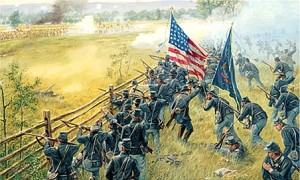
8th_Ohio_At_Gettysburg

                                                     The 8th Ohio 

Pettigrew’s division was met by fire which enveloped them obliquely from Osborne’s thirty-nine guns emplaced on Cemetery Hill. On their left flank a small Federal regiment, the 8th Ohio lay in wait unnoticed by the advancing Confederates. Seeing an opportunity the regiment’s commander Lieutenant Colonel Franklin Sawyer deployed his 160 men in a single line, took aim at Brockenbrough’s Virginia brigade some two hundred yards ahead of the Emmitsburg Road, and opened a devastating fire. Above the boiling clouds the Union men could see a ghastly debris of guns, knapsacks, blanket rolls, severed human heads, and arms and legs and parts of bodies tossed into the air by the impact of the shot. [80] So sudden and unexpected was this that the Confederates panicked and fled in confusion… to the rear where they created more chaos in Trimble’s advancing lines as one observed they Came tearing through our ranks, which caused many men to break. [81] The effect on Confederate morale was very important, for the Army of Northern Virginia was not used to seeing a brigade, even a small one, go streaming off to the rear, with all its flags.Even Picketts men sensed that something disastrous had happened on the left. [82]

In one fell swoop Pettigrew was minus four regiments. Brockenbrough was singularly ineffective in leading his men, he was a nonentity who did not know how to control his recalcitrant rank and file; nor did he have the presence to impress his subordinate officers and encourage them to do his bidding. [83] The disaster that had overtaken Brockenbrough’s brigade now threatened another important component of Lee’s plan- protecting the left flank of the assaulting force. As Brockenbrough’s brigade collapsed, the vital protection of the left flank collapsed with it.

Pettigrew’s division continued its advance after Brockenbrough’s brigade collapsed, but the Confederate left was already beginning to crumble. Sawyer changed front, putting his men behind a fence, and the regiment began firing into the Confederate flank. [84] Now Davis’s brigade was taking the full brunt of the storm of artillery shells from Osborne’s guns. This brigade had suffered terribly at the railroad cut on July 1st. The brigade, especially in terms of field and company grade officers was virtually leaderless, and the inexperienced Joe Davis was helpless to control them. [85]To escape the devastating fire Davis ordered his brigade to advance at the double quick which brought them across the Emmitsburg Road ahead of the rest of the division, where they were confronted by enfilade canister fire from Woodruff’s battery to its left, as well as several regiments of Federal infantry and from the 12th New Jersey directly in their front. A New Jersey soldier recalled We opened on them and they fell like grain before the reaper, which nearly annihilated them. [86] Davis noted that the enemy’s fire commanded our front and left with fatal effect. [87] Davis saw that further continuing was hopeless and ordered his decimated brigade to retire to the position originally held.” [88]

Pettigrew’s remain two brigades continued grimly on to the Emmitsburg Road, now completely devoid of support on their left flank. Under converging fire from Hay’s Federal troops the remaining troops of Pettigrew’s command were slaughtered. Hay’s recalled As soon as the enemy got within range we poured into them and the cannon opened with grape and canister [, and] we mowed them down in heaps.” [89] The combination of shot, shell, canister and massed musket fire simply erased the North Carolinians ranks. [90] Pettigrew was wounded, Colonel Charles Marshall was killed fifty yards from the stone wall and only remnants of companies and regiments remained unscathed. Soon the assault of Pettigrew’s division was broken:

Suddenly Pettigrews men passed the limit of human endurance and the lines broke apart and the hillside covered with men running for cover, and the Federal gunners burned the ground with shell and canister. On the field, among the dead and wounded, prostrate men could be seen holding up handkerchiefs in sign of surrender. [91]

Trimble’s two brigades fared no better. Scales brigade, now under the command of Colonel W. Lee Lowrence never crossed the Emmitsburg Road but instead took position along it to fire at the enemy on the hill. The soldiers from North Carolina who two days before had marched without flinching into the maw of Wainwrights cannon on Seminary Ridge could not repeat the performance.” [92] Trimble was severely wounded in the leg and sent a message to Lane to take command of the division. The order written in the third person added a compliment to his troops: He also directs me to say that if the troops he had the honor to command today for the first time couldnt take that position, all hell cant take it. [93] Lane attempted to rally the troops for one last charge when one of his regimental commanders exploded telling him My God, General, do you intend rushing your men into such a place unsupported, when the troops on the right are falling back?” [94] Lane looked at the broken remains of Pettigrew’s division retiring from the field and ordered a retreat. Seeing the broken remnants of the command retreating, an aide asked Trimble if the troops should be rallied. Trimble nearly faint from loss of blood replied: No Charley the best these brave fellows can do is to get out of this,” so let them get out of this, its all over. [95] The great charge was now over on the Confederate left.

The concentrated Federal fire was just as effective and deadly on the Confederate right. Kemper’s brigade, on the right of Pickett’s advance was mauled by the artillery of Rittenhouse on Little Round Top, which tracked their victims with cruel precision of marksmen in a monstrous shooting gallery” and the overs landed their shots on Garnetts ranks with fearful effect.” [96]

As the Confederates advanced Pickett was forced to attempt to shift his division to the left to cover the gap between his and Pettigrew’s division. The move involved a forty-five degree oblique and the fences, which had been discounted by Lee as an obstacle which along the Emmitsburg Road virtually stopped all forward movement as men climbed over them or crowed through the few openings. [97] Pickett’s division’s oblique movements to join with Pettigrew’s had presented the flank of his division to McGilvery’s massed battery. The movement itself had been masterful, the execution of it under heavy fire impressive; however it meant the slaughter of his men who were without support on their right flank.

Pickett himself was doing his best to direct the movements of his Division. Placing himself just behind his Division he “kept his staff busy carrying messages to various generals and performing other duties on the field. At different times he sent his aides back to Confederate lines to inform Longstreet of his need for reinforcements, or to direct Wilcox when to advance his troops, or to ask Major James Dearing for artillery support.” [98] While some of Pickett’s detractors attempt to accuse him of cowardice, including inventing fables about him drinking behind the lines, the facts do not substantiate the accusations. Likewise, Pickett’s position about one hundred yards behind his advancing troops was optimal for command and control purposes.

Though he did not have operational control of Pettigrew’s division, “when he saw it beginning to falter, he ordered Captains E.R. Baird and W. Stuart Symington to help rally them. Then Pickett himself galloped to the left in an effort to steady the men.” [99]

As Pickett’s division advanced into the Plum Run Valley they were met by the artillery of Freeman McGilvery, who wrote that the execution of the fire must have been terrible, as it was over a level plain, and the effect was plain to be seen. In a few minutes, instead of a well-ordered line of battle, there were broken and confused masses, and fugitives fleeing in every direction. [100]

Kemper’s brigade which had the furthest to go and the most complicated maneuvering to do under the massed artillery fire suffered more damage. The swale created by Plum Run was a “natural bowling alley for the projectiles fired by Rittenhouse and McGilvery” [101] was now flanked by Federal infantry as it passed the Condori farm. The Federal troops were those of the Vermont brigade commanded by Brigadier General George Stannard. These troops were nine month volunteers recruited in the fall of 1862 and due to muster our in a few days. They were new to combat, but one of the largest brigades in the army and 13th Vermont had performed with veteran like precision the day before [102] leading Hancock to use them to assault the Confederate right. The Vermonters were positioned to pour fire into the Confederate flank, adding to the carnage created by the artillery, and the 13thand 16th Vermont pivoted ninety degrees to the right and fired a succession of volleys at pistol range on the right of Picketts flank.[103]

Kemper had not expected this, assuming that the Brigades of Wilcox and Perry would be providing support on the flank. As he asked a wounded officer of Garnett’s brigade if his wound was serious, the officer replied that he soon expected to be a prisoner and asked Kemper Dont you see those flanking columns the enemy are throwing on our right to sweep the field?[104] Kemper was stunned but ordered his troops to rush the federal guns, however they were torn to pieces first by the artillery and then by the successive musketry of three and a half brigades of Yankee infantry. [105] Kemper was fearfully wounded in the groin and no longer capable of command. His brigade was decimated and parts of two regiments had to refuse their line to protect the flank, and those that continued to advance had hardly any strength left with which to succeed, meaning that the Confederate left and right were for all intents and purposes out of the fight.

This left Armistead and Garnett’s grimly advancing brigades to carry on the fight as they crossed the Emmitsburg Road and approached the stone wall. The brigades where now bunched together and at the point of attack and for a few minutes outnumbered the Federal defenders at the stone wall and the Angle, as one regiment of Webb’s Philadelphia Brigade, the 71st Pennsylvania had bolted to the rear.

This left the decimated remains of Lieutenant Alonzo Cushing’s battery of artillery alone to face the advancing Confederates. Cushing who had already received multiple wounds in his shoulder and groin was desperately wounded. A number of his guns had been disabled and his battery had taken significant numbers of casualties during the Confederate bombardment. Cushing was another of the young West Point graduates who directed batteries at key points during the battle who was not only a skilled artilleryman, but a gifted leader and a warrior who won the respect of his men. One corporal said that Cushing was the best fighting man I ever saw while another recollected He was so cool and calm as I ever saw him, talking to the boys between shots with the glass constantly to his eyes, watching the effect of our shots. [106]

He received permission from the commander of the Philadelphia Brigade, Alexander Webb, among whose regiments his battery was sited to advance his guns to the wall. Though wounded Cushing remained with his gunners and when a subordinate suggested that he go to the rear he replied I will stay right here and fight it out or die in the attempt. [107]

92681186b29b70439321935b2ab79a62

When Webb came to his battery and told Cushing that he believed that the Confederate infantry was about to assault their position Cushing replied I had better run my guns right up to the stone fence and bring all my canister alongside each piece. [108] From the stone fence the young officer directed the fire of his remaining guns. His gunners rammed in more loads of double canister when the Confederates were less than seventy yards away. [109] When the Garnett and Armistead’s survivors were just a hundred yards away from the wall, Cushing ordered triple canister. He was hit a third time, this time in his mouth killing him instantly.” [110] The surviving gunners, now commanded by a sergeant fought hand to hand against the Confederates as they were overrun.

The survivors of Garnett’s brigade, led by their courageous but injured commander, who rode fully exposed to Federal fire on his horse, crossed the Emmitsburg Road and pushed forward, overwhelming the few Federals remaining at the wall. They reached the outer area of the Angle “which had been abandoned by the 71st Pennsylvania” and some of his men stood on the stones yelling triumphantly at their foes.” [111]

Dick Garnett, was still leading his troops mounted upon his horse, miraculously un-hit until he was almost to the wall. There, Garnett, “muffled in his dark overcoat, cheered his troops, waving a black hat with a silver cord” [112] and still seeking redemption from the scurrilous accusations of Stonewall Jackson was shot down, in a blast of musket fire and canister. His now rider less and frightened horse, now alone, ran off the battlefield, a symbol of the disaster which had befallen Pickett’s division.
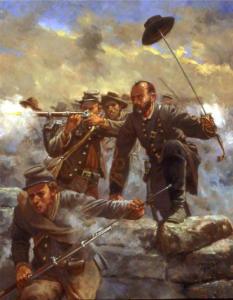
armistead

Armistead and his decimated brigade continued their grim advance into the fiery cauldron of death, their commander, sword raised with his hat still on it, climbed over the wall shouting to his men Come on boys! Give them the cold steel”…and holding his saber high, still with the black hat balanced on its tip for a guidon, he stepped over the wall yelling as he did so: Follow me! [113] It would be a moment that those that survived would remember for the rest of their lives.

Now, Armistead and his remaining soldiers, maybe about one hundred in total of the approximately 1570 who had advanced out of the woods on Seminary Ridge just twenty minutes before when the order was given to advance. [114] The survivors waded into the wreckage of Cushing’s battery and some began to attempt to turn the guns on the Federals. For a few moments there was a sense of supreme exultation as the rebels swarmed over the fence, forced back two Federal companies, and swallowed up a third. Armistead was the first to reach Cushings two guns, placing a hand on one of them and yelling, The day is ours men, come turn this artillery upon them. [115]

High_Water_Mark_from_Gettysburg

However, the triumph of Armistead and his band was short lived; the 72ndPennsylvania was rushed into the gap by the brigade commander Brigadier General Alexander Webb. The climax of the battle was now at hand and the next few minutes would tell the story, and what that story would be would all depend on whether these blue-coated soldiers really meant it. Right here there were more Confederates than Federals, and every man was firing in a wild, feverish haste, with smoke settling down thicker and thicker. [116] The 69th Pennsylvania, an Irish regiment under Colonel Dennis O’Kane stood fast and their fire slaughtered many Confederates. Other Federal regiments poured into the fight, famous veteran regiments like the 19th and 20th Massachusetts, the 7th Michigan and the valiant remnants of the 1st Minnesota who had helped stop the final Confederate assault on July 2nd at such fearful cost. Major Rice of the 19th Massachusetts wrote:

The grove was fairly jammed with Picketts men. In all positions, lying and kneeling. Back from the edge were many standing and firing over those in front.Every foot of ground was occupied by men engaged in mortal combat, who were in every possible position which can be taken while under arms, or lying wounded or dead.[117]

As his troops battled the Federals hand to hand, using muskets as clubs, and the bayonet Armistead, standing by one of Cushing’s cannon was he was hit by several bullets and collapsed, mortally wounded. Armistead had been the driving force behind the last effort, there was no one else on hand to take the initiative. Almost as quickly as it had come crashing in, the Rebel tide inside the outer angle ebbed back to the wall. [118]

For a time the Confederate survivors engaged Webb’s men in a battle at the wall itself in a stubborn contest with men battling in some places within rifle-length of each other and other places hopelessly mingled. [119] A Federal regimental commander wrote The opposing lines were standing as if rooted, dealing death into each other.” [120] The Federals launched a local counterattack and many Confederates elected to surrender rather than face the prospect of retiring across the battlefield that was still swept by Federal fire.

Webb had performed brilliantly in repulsing the final Confederate charge andgained for himself an undying reputation. Faced with defeat, he accepted the challenge and held his men together through great personal exertion and a willingness to risk his life.” [121] For his efforts he was belatedly awarded the Medal of Honor.

Webb, like John Buford on July 1st, Strong Vincent, Freeman McGilvery and George Sears Greene on July 2nd, was instrumental in the Union victory. Hancock said of Webb:

In every battle and on every important field there is one spot to which every army [officer] would wish to be assigned- the spot upon which centers the fortunes of the field. There was but one such spot at Gettysburg and it fell to the lot of Genl Webb to have it and to hold it and for holding it he must receive the credit due him. [122]

The surviving Confederates of Pickett’s division who had not surrendered at the Angle retreated without order [123] and as they drew nearer to the safety of their own lines the survivors of Picketts division soon turned into a sullen mob intent on getting as far as possible from the bloody battlefield. [124] Some commanders attempted to restore order but their efforts were in vain as Pickett’s defeated and shell shocked men realized the enormity of their defeat and the terrible cost.

As the survivors of Pickett, Pettigrew and Trimble’s shattered divisions retreated from the killing field Robert E. Lee did not yet understand that his great assault had been defeated. However, the sullen James Longstreet, who was in a position to observe the horror, did. Longstreet was approached by Lieutenant Colonel Arthur Fremantle, a British observer from the Coldstream Guards. Fremantle did not realize that the attack had been repulsed, having just seen one of Longstreet’s regiments advancing through the woods in good order” and unwisely bubbled I would not have missed this for anything.” [125] Longstreet replied with a sarcastic laugh The devil you wouldnt” barked Longstreet. I would have liked to have missed this very much; weve attacked and been repulsed. Look there. [126]

Fremantle looked out and for the first time I then had a view of the open space between the two positions, and saw it covered with Confederates slowly and sulkily returning towards us in small broken parties, under a heavy fire of artillery. [127] Henry Owen of the 18th Virginia wrote that the retreating men without distinction of rank, officers and privates side by side, pushed, poured and rushed in a continuous stream, throwing away guns, blankets, and haversacks as they hurried on in confusion to the rear. [128]

It was a vision of utter defeat. Pickett, who had seen his division destroyed and had been unable to get it additional support was distraught. An aide noted that Pickett was greatly affected and to some extent unnerved [129] by the defeat. He found Longstreet and poured out his heart in terrible agonyGeneral, I am ruined; my division is gone- it is destroyed.[130] Lee had come up by now and attempted to comfort Pickett grasping his hand and telling him: General, your men have done all that they could do, the fault is entirely my own and instructed him that he should place his division in the rear of this hill, and be ready to repel the advance of the enemy should they follow up their advantage.” [131]The anguished Pickett replied, General Lee, I have no division now. Armistead is down, Garnett is down and Kemper is mortally wounded. [132] Lee missed the point of Picketts anguish completely and attempted to console Pickett again and told the distraught General, General Pickettyou and your men have covered themselves in glory. [133]

Pickett, the romantic true believer in the cause refused to be consoled and told Lee not all the glory in the world, General Lee, can atone for the widows and orphans this day has made. [134] Pickett’s bitterness toward Lee over the loss of his division would redound through the remainder of his life. While Longstreet and Lee maintained their composure, Pickett felt an overpowering sense of helplessness as he observed the high tide from Emmitsburg Road and the subsequent retreat of his shattered division. It was too much for the mercurial romantic to absorb.[135] But Pickett was not alone. Cadmus Wilcox told Lee as he returned from the assault that he came into Pennsylvania with one of the finest brigades in the Army of Northern Virginia and now all my people are gone. [136]

When others attempted to stop the flight of his men, Pickett countermanded them and ordered his survivors to return to the site where they had bivouacked the previous night. A soldier from the 18th Virginia who saw the retreat noted that at Willoughby Run:

The fugitives, without distinction of rank, officers and privates side by side pushed, poured and rushed in a continuous stream, throwing away guns, blankets, and haversacks as they hurried in confusion toward the rear. Before long there was another attempt to restore order, but again Pickett intervened. Don’t stop any of my men! he cried. Tell them to come to the camp we occupied last night. As he said this he was weeping bitterly, and then he rode on alone toward the rear. [137]

When the survivors finally assembled the next morning, they numbered less than 1000 out of the approximately 5000 troops Pickett led into the attack. “Four out of every five of Picketts men had been either killed, wounded, or captured. Two of his three brigadiers were gone, probably dead, the third perhaps mortally wounded. Every one of his regimental commanders had been killed, wounded or captured.[138]

During the retreat Pickett and his remaining soldiers would be assigned to the task of being the Provost Guard for the army, escorting Federal prisoners back during the long retreat back to Virginia. For them, it was a humiliating experience.

Pickett was never the same after the charge of July 3rd 1863. Pickett’s after action report which complained about the lack of support his division received was suppressed and destroyed by Lee who wrote Pickett You and your men have crowned yourselves in glory But we have an enemy to fight, and must carefully, at this critical moment, guard against dissections which the reflections in your report will create. [139]

Pickett married La Salle “Sallie” Corbell in September of 1863, and the marriage would last until his death in 1875. Sallie, impoverished by the death of “her soldier” took up writing as well as speaking tours in both the South and the North. Sallie was a stalwart defender of her husband, who she said had the keenest sense of justice, most sensitive consciousness of right, and the highest moral courage but also opposing hatred, sectionalism and strife. [140] Though much of her work was panned by historians and shunned by established magazines and periodicals; her writing were published by newer popular magazines. Her book The Heart of a Soldier, as Revealed in the Intimate Letters of General George Pickett, C.S.A. was for the most part fabrications authored by her, but she found a niche in newer popular magazines and journals, including Cosmopolitan for which she authored a ten part serial of the Pickett family story on the fiftieth anniversary of the battle. Sallie Pickett’s:

idealized portrait of her husband made him a Confederate hero. He never reached the status of Robert E. Lee or Stonewall Jackson, but his association with the famed but futile charge at Gettysburg helped. Virginia veterans and newspapers began romanticizing Picketts all-Virginia divisions role soon after the battle; it was almost by association that George too would share in this idolization…” [141]

Pickett retained command of his division which was reconstituted after Gettysburg and shipped off to North Carolina where he and it performed adequately but without marked distinction. Pickett had one moment of glory when reacting to a Federal Army under Benjamin Butler advancing on Petersburg he threw a scratch force together which preserved Petersburg and its vital rail line in early May 1864. This allowed General P.T.G. Beauregard to bring up more troops to hold the city.

The division performed adequately in the defensive battles around Richmond and Petersburg, though it suffered terribly from the lack of rations, medicines, clothing and equipmentaggravated by the rigors of life in the trenches. [142] Morale and desertion was a terrible problem in Pickett’s division and Lee was concerned enough to bring enough to bring the matter to Longstreet. Lee used terms like unsoldierly and unmilitary, lax in discipline, loose in military instruction [143] to describe the division. Though he was fully cognizant of the conditions of the trenches Lee identified the source of the problem as Pickett and his officers who were not sufficiently attentive to the men,not informed as to their condition and he told Longstreet: I desire you to correct the evils in Picketts divisionby every means in your power… I beg that you will insist upon these points. [144]

During the Richmond and Petersburg campaign, Pickett was often sick, and at several intervals he was unable to exercise command, and the poor state of his general health, aggravated by the unusually stressful conditions of the past year, age him beyond his years. [145]

The end came at the battle at Five Forks where Pickett’s division was deployed on the far right of the Confederate line, was overwhelmed by a massive assault by Sheridan’s cavalry and the Fifth Corps which destroyed it as a fighting formation. Pickett, for unknown reasons did not put much effort into the defense of Five Forks. He successfully repulsed an attack by Sheridan on March 31st but evidently did not expect an attack the following day. On the afternoon of April 1stPickett was away from his division at a Shad bake with Fitzhugh Lee and Thomas Rosser when the attack came and destroyed his division as a fighting unit. No cowardice was involved; Pickett simply misjudged the situation by assuming that no attack was imminent, yet it left a bad taste in everyones mouth. [146] That being said Picketts lackadaisical effort in holding Five Forks is indefensible. So to is his incredible derelict behavior late on the morning of April 1st when he slipped away from his command to the shad bake not even informing the next senior officer, Rooney Lee that he was gone. [147]

Whether cowardice was involved or not, Pickett’s decision to be away from his division with a very aggressive Federal army at his front was ill-advised and demonstrated to Lee that Pickett was unfit for command. Two days later Pickett and two other generals, including Richard Anderson were relieved of their duties and dismissed by Lee. However Pickett remained with his division until the end and at Appomattox Lee was heard to remark in what some believed was a disparaging manner Is that man still with this army? [148]

George Pickett attempted to rebuild his life after the war and the task was not easy, for though he applied for amnesty, his case was complicated by an incident where he had ordered the execution of twenty-two former North Carolina militiamen who had defected to the Union and been re-captured by the Confederates. Pickett’s action was no different than many Confederate commanders who followed the Richmond government’s decision to take ruthless measures to suppress Unionist sentiments and secession of areas of the Confederacy where Union sympathies ran high. The area of Pickett’s operation was a haven for Tories who openly supported U.S. troops. What was worse, hundreds of local Unionists engaged in the most violent guerrilla activities, shooting and burning out their secessionist neighbors, waylaying Confederate supply trains, attacking outposts. [149]

In a sense Pickett was now engaged in counter-insurgency operations, and like many commanders involved in such operations descend into the same type of barbaric actions of those they are fighting. By early 186 the war was turning into a grim, hate-filled struggle that knew few rules and niceties, and Pickett was changing to the pattern. [150] When Pickett captured the former militiamen he refused to treat them as prisoners of war and instead he court-martialed them and hanged them all. [151] He established a military court composed of Virginia, North Carolina and Georgia officers, hauled the deserters-in-arms before it, and approved the death sentences. [152] When the prisoners went to the gallows Pickett reportedly told each of them God damn you, I reckon you will ever hardly go back there again, you damned rascals; Ill have you shot, and all the other damned rascals who desert. [153]

Federal authorities thought about charging him with war crimes which resulted in Pickett fleeing to Canada. It took the intervention of Pickett’s faithful friend Ulysses S. Grant to have the charges dismissed and for Pickett to be granted amnesty by President Johnson in 1868. Grant admitted that the punishment was harsh, however, Grant’s judgment was steeped in the fact that many Northern commanders had resorted to similar actions in combating insurgents and deserters. Grant wrote in his friend’s defense:

But it was in time of war and when the enemy no doubt it necessary to retain, by some power, the services of every man within their reach. Gen. Pickett I know personally to be an honorable man but in this case his judgement [sic] prompted him to do what can not well be sustained though I do not see how good, either to the friends of the deceased or by fixing an example for the future, can be secured by his trial now. [154]

Even so, Pickett’s life was difficult. Health difficulties plagued him and employment was scarce, even for a man of Pickett’s stature in Virginia. He refused employment which would take him away from Sallie and his children and finally took a job as an insurance agent in Richmond. It was a job which he felt demeaning, requiring that he attempt to sell insurance policies to destitute and out of work Confederate veterans and their families. Sallie wrote that he could not come to terms with a profession that made its profits through what one colleague called gall, gall, old man, gall and grub. [155] Distinctly unhappy the dejected old soldier told her Id sooner face a canon,than to take out a policy with me. [156]

In 1870 he was convinced by John Singleton Mosby to visit Lee when the latter was visiting Richmond as Lee was making a final tour of battlefields and other sites. For Pickett the visit only reinforced his resentment that he felt for Lee, who he felt blamed him for the defeat at Five Forks and had ostracized him. The meeting occurred in Lees room at the Ballard Hotel was icy and lasted only two or three minutes. [157]

Mosby realized quickly that the meeting was not going well and Sensing the unpleasantness of the meeting, Mosby got up in a few moments and Pickett followed him. Once outside the room, Pickett broke out bitterly against that old man who, he said, had my division massacred at Gettysburg. [158] Mosby attempted to assuage his friend’s feelings but Pickett was not mollified by Mosbys rejoinder that it made you immortal. [159]

general-george-pickett-and-lasalle-corbell-picketss-circa-1865-img542

                                               George and Sallie

George Pickett was a romantic as well as a true believer in the cause of the Confederacy. Pickett was vain, often self-serving and even irresponsible. He certainly as Porter Alexander noted was a better brigade commander than division commander, a position that he desired but at which never excelled. He was a poor administrator, and in the campaigns of 1864 and 1865 demonstrated exceptionally poor leadership.

His temperament, especially his seeming inability to function in a hierarchical structure, and the rebellious streak that he had as a cadet at West Point was never exercised: He resented authority and chafed at deferring to any man as his superiorPickett never understood his place in the hierarchy. He considered himself part of the cream of the Army of Northern Virginia, but without being willing to shoulder all the responsibilities and sacrifices that entailed. [160]

All that being said, in the matter of Pickett’s conduct during the charge that bears his name; the charges of cowardice or incompetence that some leveled at him are certainly not true. The fact that Pickett retained command after the battle indicates that Lee did not believe that he had acted with cowardice, or that Lee questioned the manner in which Pickett led the assault. Lee had many concerns about Pickett and reservations about his leadership but those stand apart from Pickett’s conduct on July 3rd 1863.

In the matter of Pickett not going far enough forward, it is unlikely that such any such action on Pickett’s part to charge further into the maelstrom would have done little more than add yet another name to the list of Confederate general officers killed or wounded at Gettysburg. The question of how Pickett survived without a scratch, when his three brigadiers and all of his field officers but one went down. This could be done by the brief explanation that his escape was miraculous. [161] Edwin Coddington wrote that it would have been better for his reputation if had been called to give his life or if the attack had been known for what it was, Longstreets Second Assault. [162]

Bitter and discouraged at the end of his life he uttered his last words to Sallie’s uncle who had also served in the Army of Northern Virginia Well, Colonel, the enemy is too strong for me againmy ammunition is all out He closed his eyes, and settled back as if at peace for the first time in his life. Sallie never left his side; two hours after his death they gently pried her hands from his. [163]

Pickett’s charge was over, except for the blame, the stories and the legends, especially in the South. The failure of this disastrous tactical assault that bears Pickett’s name placed the final nail in Lee’s operational plan to take the war to the North and defeat the Federal army on its own territory. Lees plan was almost Burnside-like in its simplicity, and it produced a Fredericksburg with the roles reversed. [164] James McPherson made the very succinct observation that Picketts charge represented the Confederate war effort in microcosm: matchless valor, apparent initial success, and ultimate disaster. [165]

That tactical and operational failure had strategic implications for the Confederacy; it ensured the loss of Vicksburg and forced Lee to assume the defensive in the east. Lee and his men would go on to further laurels. But they never again possessed the power and reputation that they carried into Pennsylvania those palmy midsummer days of 1863.[166] The repulse ended the campaign that Lee had hoped would secure the independence of the Confederacy. The Battle of Gettysburg was and it was much more than a military defeat, but a political one as well, for with it went the slightest hope remaining of foreign intervention. As J.F.C. Fuller wrote It began as a political move and it had ended in a political fiasco.” [167]

                                                           Notes

[1] Clausewitz, Carl von. On War Indexed edition, edited and translated by Michael Howard and Peter Paret, Princeton University Press, Princeton NJ 1976 p.114

[2] Ibid. Clausewitz On War p.108

[3] Dempsey, Martin Mission Command White Paper 3 April 2012 p.5 retrieved ( July 2014 from http://www.dtic.mil/doctrine/concepts/white_papers/cjcs_wp_missioncommand.pdf

[4] ___________. The Armed forces Officer U.S. Department of Defense Publication, Washington DC. January 2006 p.18

[5] Ibid. The Armed Forces Officer p.18

[6] Ibid. Clausewitz On War p.101

[7] Stewart, George R. Pickett’s Charge: A Micro-History of the Final Attack at Gettysburg, July 3rd 1863 Houghton Mifflin Company Boston 1959 p.94

[8] Hess, Earl JPickett’s Charge: The Last Attack at Gettysburg University of North Carolina Press, Chapel Hill and London 2001 p. 55

[9] Ibid. Stewart Pickett’s Charge: A Micro-History p.94

[10] Wert, Jeffery D. Gettysburg Day Three A Touchstone Book, New York 2001 p.110

[11] Foote, Shelby, The Civil War, A Narrative. Volume Two Fredericksburg to Meridian Random House, New York 1963 p.548

[12] Ibid. Foote The Civil War, A Narrative. Volume Two p.548

[13] Gottfried, Bradley The Artillery of Gettysburg Cumberland House Publishing, Nashville TN 2008 p.206

[14] Ibid. Gottfried The Artillery of Gettysburg p.193

[15] Longacre, Edward G. Pickett: Leader of the Charge White Mane Publishing Company, Shippensburg PA 1995 p.121

[16] Reardon, Carol The Convergence of History and Myth in the Southern Past: Pickett’s Charge in The Third Day at Gettysburg and Beyond edited by Gallagher, Gary W. University of North Carolina Press, Chapel Hill and London 1994 p.83

[17] Ibid. Wert Gettysburg Day Three p.297

[18] Sears, Stephen W. Gettysburg. Houghton Mifflin Co. Boston and New York 2003 p.387

[19] Ibid. Stewart Picketts Charge: A Micro-History p.39

[20] Ibid. Hess Picketts Charge p.153

[21] Ibid. Wert Gettysburg Day Three p.181

[22] Dowdy, CliffordLee and His Men at Gettysburg: The Death of a Nation Skyhorse Publishing, New York 1986, originally published as Death of a Nation Knopf, New York 1958 p.294

[23] Ibid. Wert Gettysburg Day Three p.179

[24] Ibid. Stewart Picketts Charge p.132

[25] Coddington, Edwin B. The Gettysburg Campaign: A Study in Command, A Touchstone Book, Simon and Schuster New York, 1968 p.496

[26] Ibid. Coddington The Gettysburg Campaign p.496

[27] Huntington, Tom Searching for George Gordon Meade: The Forgotten Victor of Gettysburg Stackpole Books, Mechanicsburg PA 2013 p.171

[28] Ibid. Hess Picketts Charge p.163

[29] Ibid. Coddington The Gettysburg Campaign p.499

[30] Trudeau, Noah Andre. Gettysburg: A Testing of Courage, Harper Collins Publishers, New York 2002 p.459

[31] Ibid. Coddington The Gettysburg Campaign p.500

[32] Alexander, Edward Porter Fighting for the Confederacy: The Personal Recollections of General Edward Porter Alexander edited by Gallagher, Gary The University of North Carolina Press, Chapel Hill and London 1989 p.258

[33] Hunt, Henry The Third Day at Gettysburg in Battles and Leaders of the Civil War edited by Bradford, Neil Meridian Press, New York 1989 p.374

[34] Alexander, Edwin Porter. The Great Charge and the Artillery Fighting at Gettysburg, in Battles and Leaders of the Civil War edited by Bradford, Neil Meridian Press, New York 1989 p.364

[35] Ibid. Dowdy Lee and His Men at Gettysburg p.297

[36] Wert, Jeffry D. General James Longstreet: The Confederacy’s Most Controversial Soldier A Touchstone Book, Simon and Schuster, New York and London 1993 p.291

[37] Ibid. Coddington The Gettysburg Campaign p.501

[38] Ibid. Alexander The Great Charge and the Artillery Fighting at Gettysburg p.365

[39] Ibid. Alexander The Great Charge and the Artillery Fighting at Gettysburg p.365

[40] Ibid. Trudeau. Gettysburg: A Testing of Courage pp.474-475

[41] Ibid. Alexander The Great Charge and the Artillery Fighting at Gettysburg p.365

[42] Ibid. Alexander Fighting for the Confederacy p.261

[43] Ibid. Dowdy Lee and His Men at Gettysburg p.313

[44] Ibid. Wert Gettysburg Day Three p.109

[45] Ibid. Dowdy, Lee and His Men at Gettysburg p.264

[46] Ibid. Longacre Pickett p.4

[47] Ibid. Longacre Pickett p.6

[48] See Longacre Pickett pp.6-7. The myth was quite successful and it endures in some accounts of Pickett’s life and in a number of military histories including Larry Tagg’s The Generals of Gettysburg

[49] Waugh, John C. The Class of 1846 from West Point to Appomattox: Stonewall Jackson, George McClellan and their Brothers A Ballantine Book, New York 1994 pp.38-39

[50] Ibid. Longacre Pickett p.7

[51] Ibid. Waugh The Class of 1846 from West Point to Appomattox p.39

[52] Ibid. Longacre Pickett p.12

[53] Guelzo, Allen C. Gettysburg: The Last Invasion Vintage Books a Division of Random House, New York 2013 p.378

[54] Ibid. Guelzo Gettysburg: The Last Invasion p.378

[55] Ibid. Longacre Pickett p.20

[56] Ibid. Hess Picketts Charge p.37

[57] Ibid. Dowdy Lee and His Men at Gettysburg p.264

[58] Ibid. Waugh The Class of 1846 p.457

[59] Ibid. Longacre Pickett p.32

[60] Ibid. Longacre Pickett p.33

[61] Ibid. Longacre Pickett pp.50-51

[62] Ibid. Longacre Pickett p.51

[63] Ibid. Hess Pickett’s Charge p.38

[64] Ibid. Hess Pickett’s Charge p.47

[65] Ibid. Dowdy Lee and his Men at Gettysburg p.296

[66] Freeman, Douglas Southall, Lee an abridgment by Richard Harwell, Touchstone Books, New York 1997 p.338

[67] Freeman, Douglas Southall Lee’s Lieutenants: A Study in Command abridged in one volume by Stephen Sears, Scribner Books, Simon and Schuster, New York 1998 p.594

[68] Ibid. Guelzo, Gettysburg: The Last Invasion p.408

[69] Ibid. Hess Picketts Charge p.166

[70] Ibid. Hess Picketts Charge p.167

[71] Ibid. Hess Picketts Charge p.167

[72] Ibid. Trudeau. Gettysburg: A Testing of Courage p.483

[73] Ibid. Alexander The Great Charge and the Artillery Fighting at Gettysburg p.365

[74] Ibid. Foote The Civil War, A Narrative. Volume Two p.553

[75] Ibid. Guelzo Gettysburg: The Last Invasion p.407

[76] Ibid. Hess Picketts Charge p.193

[77] Ibid. Hess Picketts Charge p.193

[78] Ibid. Guelzo Gettysburg: The Last Invasion p.411

[79] Ibid. Sears Gettysburg p.422

[80] Catton, Bruce The Army of the Potomac: Glory Road Doubleday and Company, Garden City New York, 1952 p.318

[81] Ibid. Sears Gettysburg p.423

[82] Ibid. Stewart Pickett’s Charge: A Micro-History of the Final Attack at Gettysburg pp.193-194

[83] Ibid. Hess Pickett’s Charge p.187

[84] Ibid. Stewart Pickett’s Charge: A Micro-History of the Final Attack at Gettysburg p.193

[85] Ibid. Dowdy Lee and His Men at Gettysburg p.311

[86] Ibid. Trudeau. Gettysburg: A Testing of Courage p.494

[87] Ibid. Sears Gettysburg p.425

[88] Ibid. Trudeau. Gettysburg: A Testing of Courage p.494

[89] Ibid. Trudeau. Gettysburg: A Testing of Courage p.502

[90] Ibid. Wert Gettysburg Day Three p.216

[91] Ibid. Catton The Army of the Potomac: Glory Road p.318

[92] Ibid. Trudeau. Gettysburg: A Testing of Courage p.504

[93] Ibid. Stewart Pickett’s Charge: A Micro-History of the Final Attack at Gettysburg pp.238-239

[94] Ibid. Trudeau. Gettysburg: A Testing of Courage p.504

[95] Ibid. Guelzo Gettysburg: The Last Invasion p.425

[96] Ibid. Foote The Civil War, A Narrative. Volume Two p.555

[97] Ibid. Coddington The Gettysburg Campaign p.503

[98] Ibid. Coddington The Gettysburg Campaign p.505

[99] Ibid. Coddington The Gettysburg Campaign p.505

[100] Ibid. Gottfried The Artillery of Gettysburg p.217

[101] Ibid. Hess Pickett’s Charge p.220

[102] Ibid. Coddington The Gettysburg Campaign p.515

[103] Ibid. Coddington The Gettysburg Campaign p.515

[104] Ibid. Trudeau. Gettysburg: A Testing of Courage p.502

[105] Ibid. Sears Gettysburg p.448

[106] Ibid. Gottfried The Artillery of Gettysburg p.200

[107] Ibid. Gottfried The Artillery of Gettysburg p.221

[108] Ibid. Gottfried The Artillery of Gettysburg p.208

[109] Ibid. Wert Gettysburg Day Three p.211

[110] Ibid. Gottfried The Artillery of Gettysburg p.221

[111] Ibid. Trudeau. Gettysburg: A Testing of Courage p.505

[112] Ibid. Dowdy Lee and His Men at Gettysburg p.317

[113] Ibid. Foote The Civil War, A Narrative. Volume Two p.562

[114] Ibid. Stewart Pickett’s Charge: A Micro-History of the Final Attack at Gettysburg p.172

[115] Ibid. Hess Pickett’s Charge p.262

[116] Ibid. Catton The Army of the Potomac: Glory Road p.319

[117] Ibid. Stewart Pickett’s Charge: A Micro-History of the Final Attack at Gettysburg pp.235-236

[118] Ibid. Trudeau Gettysburg p.508

[119] Ibid. Stewart Pickett’s Charge: A Micro-History of the Final Attack at Gettysburg p.236

[120] Ibid. Sears Gettysburg p.451

[121] Ibid. Coddington The Gettysburg Campaign p.528

[122] Ibid. Coddington The Gettysburg Campaign p.528

[123] Ibid. Stewart Pickett’s Charge: A Micro-History of the Final Attack at Gettysburg p.248

[124] Ibid. Hess Pickett’s Charge p.309

[125] Fremantle, Arthur Three Months in the Southern States, April- June 1863 William Blackwood and Sons, Edinburgh and London 1863 Amazon Kindle edition p.285

[126] Ibid. Wert General James Longstreet The Confederacy’s Most Controversial Soldier p.292

[127] Ibid. Fremantle Three Months in the Southern States p.287

[128] Ibid. Sears Gettysburg p.456

[129] Ibid. Hess Pickett’s Charge p.326

[130] Ibid. Guelzo Gettysburg: The Last Invasion p.428

[131] Ibid. Guelzo Gettysburg: The Last Invasion p.428

[132] Ibid. Hess Pickett’s Charge p.326

[133] Ibid Guelzo Gettysburg: The Last Invasion p.428

[134] ibid. Guelzo Gettysburg: The Last Invasion pp.428-429

[135] Ibid. Hess Pickett’s Charge p.325

[136] Ibid. Guelzo Gettysburg: The Last Invasion p.429

[137] Ibid. Sears Gettysburg p.456

[138] Ibid. Waugh The Class of 1846 p.489

[139] Ibid. Hess Pickett’s Charge p.354

[140] Ibid. Reardon The Convergence of History and Myth in the Southern Past: Pickett’s Charge p.76

[141] Gordon, Lesley J. “Let the People See the Old Life as it Was” La Salle Corbell Pickett and the Myth of the Lost Cause in The Myth of the Lost Cause and Civil War History edited by Gallagher, Gary W. and Nolan, Alan T. Indiana University Press, Bloomington and Indianapolis 2000 p.170

[142] Ibid. Longacre Pickett p.160

[143] Selcer, Richard F. Lee vs. Pickett: Two Divided by War Thomas Publications, Gettysburg PA 1998 p.66

[144] Ibid. Selcer Lee vs. Pickett p.66

[145] Ibid. Longacre Pickett pp.160-161

[146] Ibid. Hess Pickett’s Charge p.375

[147] Ibid. Longacre Pickett pp.166-167

[148] Ibid. Hess Pickett’s Charge p.375

[149] Ibid. Longacre Pickett p.137

[150] Ibid. Longacre Pickett p.141

[151] Guelzo Allen C. Fateful Lightening: A New History of the Civil War Era and Reconstruction Oxford University Press, Oxford and New York 2012 p.368

[152] Ibid. Longacre Pickett p.140

[153] Ibid. Guelzo Fateful Lightening p.368

[154] Ibid. Longacre Pickett p.175

[155] Ibid. Longacre Pickett p.178

[156] Ibid. Longacre Pickett p.178

[157] Ibid. Hess Pickett’s Charge p.377

[158] Ibid. Freeman Lee p.569

[159] Ibid. Waugh The Class of 1846 p.529

[160] Ibid. Selcer Lee vs. Pickett p.101

[161] Ibid. Stewart Pickett’s Charge: A Micro-History p.287

[162] Ibid. Coddington The Gettysburg Campaign p.528

[163] Ibid. Longacre Pickett p.180

[164] Millet, Allan R. and Maslowski, Peter, For the Common Defense: A Military History of the United States The Free Press a Division of Macmillan Inc. New York, 1984 p.206

[165] McPherson, James The Battle Cry of Freedom: The Civil War Era Oxford University Press, Oxford and New York 1988 p.662

[166] Ibid. McPherson The Battle Cry of Freedom p.665

[167] Fuller, J.F.C. Grant and Lee: A Study in Personality and Generalship, Indiana University Press, Bloomington IN 1957 pp.200-201

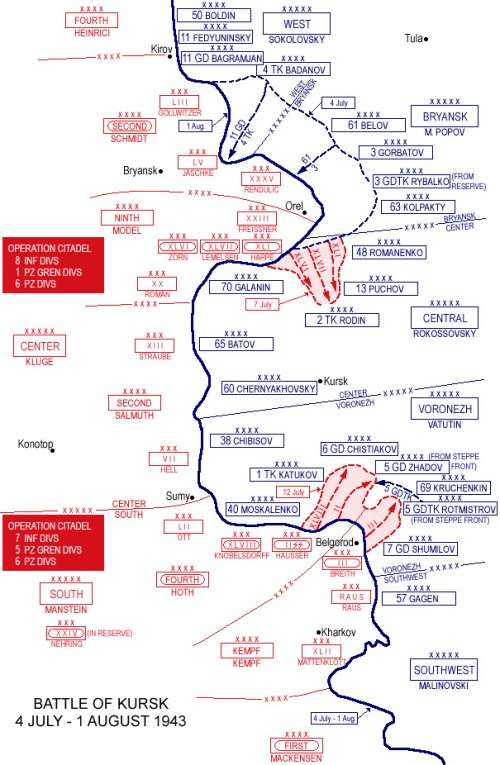
Leave a comment

Filed under artillery, civil war, Gettysburg, History, leadership, Military, us army