Author Archives: padresteve

padresteve's avatar

About padresteve

I'm a Navy Chaplain and Old Catholic Priest

“Unprecedented, unmerciful and unrelenting harshness…”: Terror and Ideology in the German Campaigns In Poland and Russia


The following is an article that I first published on this site in 2009 “The Ideological War: How Hitler’s Racial Theories Influenced German Operations in Poland and Russia.” Since I am getting ready to write a number of articles on the subject of politicized military and police forces, the Concentration Camps and the Einsatzgrüppen I wanted to give my readers an overview of the subject. The focus is the ideology that framed and justified to the perpetrators the mass murders of Jews, Poles, Russians and others during the German invasions of Poland and the Soviet Union. I will be writing about policy as well as key personalities involved in the planning and execution of these crimes over the coming months since I have renewed my studies of the crimes and their prosecution at Nuremberg over the past year. In a sense this article is simply an introduction to more specific articles that I will write.  

Peace, Padre Steve+

Introduction: Ideology and Genocide 

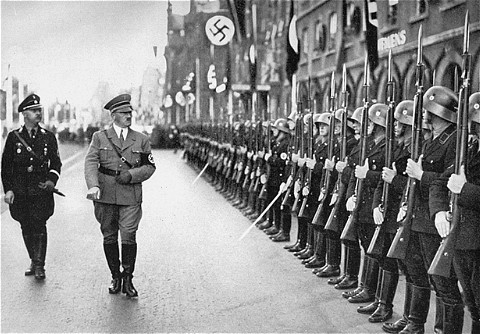
Architects of Annihilation: Heinrich Himmler with Adolf Hitler 

The German war against the Soviet Union was the first truly race-based ideological war in history with the campaign against Poland its precursor.  Adolf Hitler’s racial theories and beliefs played a dominant role in Germany’s conduct of the war in the East in both the military campaign and occupation.  This has become clearer in recent years as historians have had the opportunity to examine Hitler’s writings, those of senior Nazi officials and military officers and documents which had been unavailable until the end of the Cold War.  Understanding the Nazi ideological basis and the underlying cultural prejudice against the Jews and eastern Europeans in general is foundational to understanding Hitler’s conduct of the war and why the destruction of the Jews figured so highly in his calculations.  One must also understand the military and police cultures and doctrines that enabled them to cooperate so closely in the conduct of the war.

The German war in the east would differ from any previous war.  Its underlying basis was ideological. Economic and geopolitical considerations were given importance in relationship to the understanding of the German “Master Race.”  Race and Lebensraum was the goal of the State that “concentrates all of its strength on marking out a way of life for our people through the allocation of Lebensraum for the next one hundred years…the goal corresponds equally to the highest national and ethnic requirements.[1] Hitler believed that Germany was “entitled to more land…because it was the “mother of life” not just some “little nigger nation or another.”” [2] The Germans planned to “clear” the vast majority of the Slavic population and the “settlement of millions of hectares of eastern Lebensraum with German colonists” complimented by a short term exploitation of the land to “secure the food balance of the German Grossraum.”[3] Joachim Fest notes that Hitler called it a “crime” to wage war only for the acquisition of raw materials. Only the issue of living space permitted resort to arms.”[4]

Previous wars emphasized conquest of territory and natural resources be they for empire or self sufficiency. The Thirty Years War had a heavy religious component but was more about increasing the power of emerging nation states led by men not necessarily loyal to their religious brethren.[5] The American and Russian Civil wars had some ideological basis and helped usher in the brutality of total war. Both had major effect in these nations’ development and both were bitterly contested with the winners imposing to various degrees political changes on their vanquished brothers they were civil wars.[6] While Adam Tooze sees the Holocaust as the first step of the “last great land grab in the long and bloody history of European colonialism…”[7] this argument does not take away from the basic premise that the war was at its heart ideological.
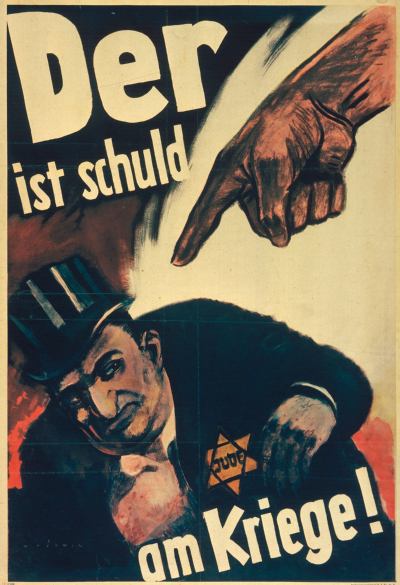
The root of this war was in the mind of Adolf Hitler himself. His years in Vienna were foundational as he absorbed the ideas of Pan-German, anti-Semitic groups and newspapers like the Deutsches Volksblatt. [8] In Vienna he made the connection between the Jews and Marxism.[9] Joachim Fest notes that in Vienna Hitler became obsessed by the fear of the Slavs and Jews, hated the House of Hapsburg, the Social Democratic Party, and “envisioned the end of Germanism.”[10] His racial views were amplified after the war in turbulent Weimar Germany where he became a member of the NDSAP, rising rapidly within it, eventually taking over party leadership, reorganizing it so that it “became the instrument of Hitler’s policies.”[11] Following the unsuccessful Beer Hall Putsch of 1923 Hitler wrote Mein Kampf while imprisoned in the Landsberg prison in which he enunciated his views about the Jews, Slavs and Lebensraum. Hitler believed that Imperial Germany had been “hopelessly negligent” in regard to the Jews[12] and that the Jews in conjunction with the Catholic Center Party and Socialists worked together for “maximum damage to Germany.”[13] Likewise he saw the Jews as heading the “main ideological scourges of the nineteenth and twentieth century’s.”[14] It was the ideology of Hitler’s “obsessive anti-Semitism”[15] that drove Nazi Germany’s policy in regard to the Jews and against Jewish-Bolshevism.

By the 1920s Hitler had “combined his hatred of the Jews and of the supposedly Jewish dominated Soviet state with existing calls to conquer additional Lebensraum, or living space, in the east.”[16] Hitler wrote: “The fight against Jewish world Bolshevism requires a clear attitude toward Soviet Russia. You cannot drive out the Devil with Beelzebub.”[17] Richard Evans notes that Mein Kampf clearly enunciated that “Hitler considered racial conflict…the essence of history, and the Jews to be the sworn enemy of the German race ….” And that the “Jews were now linked indissolubly in Hitler’s mind with “Bolshevism” and “Marxism.” [18] When Hitler became the dictator of Germany “his ideology and strategy became the ends and means of German foreign policy.”[19] His aims were clear, Hitler remarked to Czech Foreign Minister Chvalkovsky on 21 January 1939: “We are going to destroy the Jews.”[20] It was clear that Hitler understood his own role in this effort noting to General Heinrici that “he was the first man since Charlemagne to hold unlimited power in his own hand. He did not hold this power in vain, he said, but would know how to use it in the struggle for Germany…”[21]

This study will focus on the German policy of ideological-racial war in Poland and Russia. The German war against the Soviet Union and to a certain extent Poland was waged with an unforgiving ferocity against Hitler’s enemy, the Jewish-Bolshevik state and the Slavic Untermenschen. It was characterized by the rise of “political-ideological strategy”[22] in which “Barbarossa showed the fusion of technocracy and ideology in the context of competitive military planning.”[23]
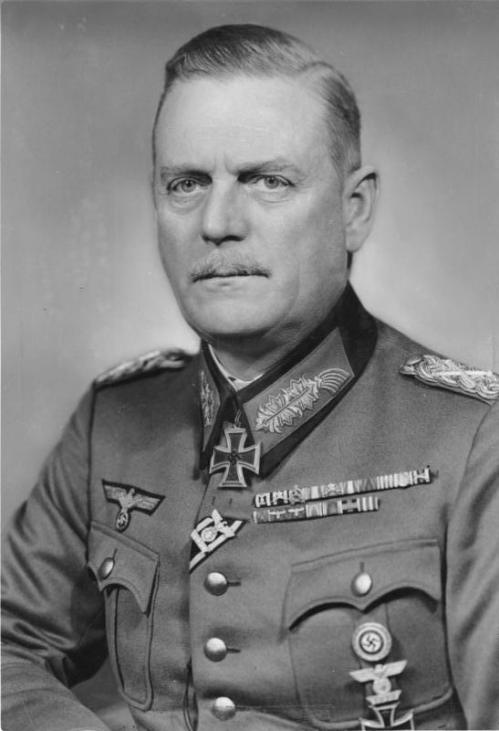
Field Marshal Wilhelm Keitel “war was a fight for survival….dispense with outdated and traditional ideas about chivalry and the generally accepted rules of warfare…” Bundesarchiv Bild

Hitler’s “ideological and grandiose objectives, expressed in racial and semi-mystical terms, made the war absolute.”[24] Field Marshal Keitel noted a speech in March 1941 where Hitler talked about the inevitability of conflict between “diametrically opposed ideologies” and that the “war was a fight for survival and that they dispense with their outdated and traditional ideas about chivalry and the generally accepted rules of warfare.”[25] General Halder, Chief of the OKH in his War Dairy for that meeting noted “Annihilating verdict on Bolshevism…the leaders must demand of themselves the sacrifice of understanding their scruples.”[26] Based on Lebensraum and race, the German approach to war would combine “racism and political ideology” for the purpose of the “conquest of new living space in the east and its ruthless Germanization.”[27] Hitler explained that the “struggle for the hegemony of the world will be decided in favor of Europe by the possession of the Russian space.”[28] Conquered territories would be “Reich protectorates…and that these areas were to be deprived of anything in the nature of a Slav intelligentsia.”[29] This goal was manifest in the “Criminal Order” issued by OKW which stated that the war was “more than mere armed conflict; it is a collision between two different ideologies…The Bolshevist-Jewish intelligentsia must be eliminated….”[30] Other displaced inhabitants of the conquered eastern lands would be killed or allowed to starve.[31] Part of this was due to economic considerations in the Reich, which gave Germans priority in distribution of food, even that from the conquered lands. Starvation was a population control measure that supplemented other forms of annihilation.[32] As Fest notes in Russia Hitler was “seeking nothing but “final solutions.””[33] Despite numerous post-war justifications by various Wehrmacht generals, the “Wehrmacht and army fell into line with Hitler because there was “a substantial measure of agreement of “ideological questions.””[34]

Ideology was key to Hitler’s worldview and fundamental to understanding his actions in the war.[35] However twisted Hitler’s ideological formulations were his ideas found acceptance beyond the Nazi faithful to the Army and Police, who would execute the campaigns in Poland and Russia in conjunction with the Einsatzgrüppen and Nazi party organizations.  In these organizations he found allies with pre-existing cultural, political and doctrinal understandings which allowed them to be willing participants in Hitler’s grand scheme of eastern conquest.

Doctrinal and Ideological Foundations

While Hitler’s racial ideology was more extreme than many in the German military and police, these organizations had cultural beliefs and prejudices as well as doctrinal and ideological foundations which helped them become willing accomplices to Hitler.  These factors were often, consciously or unconsciously, excluded from early histories of World War II. The Allies relied on German officers to write these histories at the beginning of the Cold War, developing the “dual myth of German military brilliance and moral correctness.”[36] B.H. Liddell-Hart makes the astounding statement that “one of the surprising features of the Second World War was that German Army in the field on the whole observed the rules of war than it did in 1914-1918-at any rate in fighting its western opponents….”[37] While he might be excused by lack of knowledge of German army atrocities, not just the SS who he blamed the atrocities, it helps present a myth as truth.[38] The myths were helped by the trials of Manstein and Kesselring where “historical truth had to be sacrificed…to the demands of the Cold War.”[39] Kenneth Macksey confronts the myth that only the “Waffen SS committed barbaric and criminal acts” noting: “Not even the Knights of the Teutonic Order and their followers in the Middle Ages sank to the depths of the anti-Bolshevik Wehrmacht of 1941.”[40]
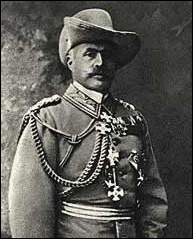
Pre-Nazi Exterminator: General Lothar Von Trotha led the Genocide against the Herero in Namibia

Germany had a long running history of anti-Semitism before Hitler.  German anti-Semitism often exhibited a “paranoid fear of the power of the Jews,”[41] and included a “fashionable or acceptable anti-Semitism”[42] which became more pronounced as the conditions of the Jews became better and Jews who had fled to Eastern Europe returned to Germany.[43] Sometimes this was tied to religious attitudes, but more often focused on the belief that the Jews “controlled certain aspects of life” and presented in “pseudo-scientific garb” along with the “myth of a secret Jewish plot for world domination which was simultaneously part of the internationalism of Freemasonry.”[44] Admiral Wilhelm Canaris provides an example as he “had grown up in the atmosphere of “moderate” anti-Semitism prevailing in the Ruhr middle class and in the Navy believed in the existence of a “Jewish problem”” and would “suggest during 1935-1936 that German Jews should be identified by a Star of David as special category citizens….”[45] Wehrmacht soldiers were “subject to daily doses of propaganda since the 1930s” and that with the “start of the Russian campaign propaganda concerning Jews became more and more aggressive.”[46] Some objected to Nazi actions against Jews. Von Manstein protested the “Aryan paragraph” in the Reichswehr on general principal.”[47] Yet some who planned and executed the most heinous crimes like Adolf Eichmann had “no fanatical anti-Semitism or indoctrination of any kind.”[48]

The military “looked to the regime to reshape society in every respect: political, ideological, economic and military…Propaganda would hammer home absolute nature of the struggle…”[49] Ideological training began in the Hitler Youth and Reichsarbeitsdienst and produced a soldier in which “Anti-Semitism, anti-communism, Lebensraum – these central tenants of Nazism were all inextricably linked with the Landser’s conception of duty, with his place and role in the vast machinery of war.”[50] Following the dismissal of General Fritsch in 1938, General Brauchitsch promised that “he would make every effort to bring the Army closer to the State and the State’s ideology.”[51] Alfred Novotny, a Austrian soldier in the Gross Deutschland division noted how training depicted the Russians as Untermenschen and how they were “subjected to official rantings about how the supposedly insidious, endless influence of the Jews in practically every aspect of the enemy’s endeavors…Jews were portrayed as rats, which were overrunning the world….”[52] This added to the already “harsh military discipline” which had a long tradition in Germany conditioning soldiers to violence and brutalization of their enemy. Similar programs existed in the Order Police which would play a large part in the eastern campaign, the “image of “treasonous” leftists and Jews helped shape the personal and political beliefs of many policemen throughout the interwar period.”[53] Even ordinary police training before the war in German speaking Europe was brutalizing.”[54] These troops were recipients of an ideological formation which “aimed at shaping the worldview of the police leading to the internalization of belief along National Socialist lines.”[55] Waffen SS soldiers, especially those of the Totenkopf division were subjected to even more systematic political indoctrination on the enemies of National Socialism, the Jews, freemasonry, Bolshevism and the churches.[56]

Along with cultural anti-Semitism and the Nazification of German thought in the 1930s, there were aspects of military doctrine which helped prepare the way for the eastern campaign. The most important were the Army’s anti-partisan and rear area security doctrine.  The history of security anti-partisan operations dated back to the Prussian Army’s Ettapen, which began in 1813 with the Landwehr’s role in security against looters and others.[57] These units supported and supplied offensive operations from the rear to the combat zone with a secondary mission of countering partisans and preventing disruptions in the rear area. The Ettapen would be reformed and regulated in 1872 following the Franco-Prussian War.[58] The German experience fighting guerrillas and partisans, the francs-tireurs in the Franco-Prussian War, “scarred the Army’s institutional mentality.”[59] Von Moltke was “shattered,” writing his brother that “war was now taking on an ever more hate-inspired character.”[60] He was “appalled by improvised armies, irregular elements, and appeals to popular passion, which he described as a “return to barbarism.”[61] He wrote: “Their gruesome work had to be answered by bloody coercion. Because of this our conduct of the war finally achieved a harshness that we deplored, but which we could not avoid.”[62] The brutal German response to the franc-tireurs found legal justification in Franz Lieber’s principles for classification of belligerents and non-belligerents, which determined that guerrillas were outlaws or bandits.[63] In response, the Germans systematically reorganized the Ettapen to include railroad and security troops, special military courts, military police, intelligence and non-military police, including the Landespolizei and the Grenzschutzpolizei.[64]

The doctrinal response to partisans, or as they would become known in German writings as “bandits,” was that bandits should be encircled and destroyed. This was employed in the Southwest Africa German colonies.  The Germans, influenced by the experience in France, “displayed a ferocity surpassing even that of the racially brutalized campaigns of its imperialist peers.”[65] The campaign against the Herero tribes which resisted the occupation of Namibia from 1904-1912 utilized encirclement operations, racial cleansing and what would become known as Bandenkämpfung operations.[66] This was further developed in the First World War, especially in the east where General Fritz Gempp described the security problem as a “ruthless struggle” in which German pacification policy “was in reality the application of terror to galvanize the population into accepting German rule.”[67] Anti-partisan doctrine was codified in the Truppenführung of 1933 which stated that “area defense against partisan warfare is the mission of all units” and that the preferred method of combating partisan bands was that they be surrounded and destroyed.[68] General Erhard Rauss later described active and passive measures used to deal with partisans, focusing on the tactic of encirclement to destroy the enemy.[69]

Anti-partisan doctrine focused on the destruction of the partisans, was coupled a total war philosophy and provided fit well with Hitler’s radical ideology.  The “propensity for brutality in anti-guerrilla warfare was complimented by officers’ growing preoccupation, both during and after World War I, with the mastery and application of violence.”[70] Michael Geyer notes: “ideological mobilization for the creation of a new national and international order increasingly defined the parameters of technocratic planning.”[71] The acceptance of long used brutal tactics to destroy the enemy combined with Hitler’s radical racial animus against the Jews could only be expected to create a maelstrom in which all international legal and moral standards would be breached.

Beginnings in Poland

Einsatzgrüppen in Poland

The Polish campaign was a precursor to the Russian campaign and was not totally race driven. It contained elements of Germany’s perception of the injustice of Versailles which gave Poland the Danzig corridor and Germany’s desire to reconnect East Prussia to the Reich, as well as the perceived necessity to remove a potential enemy from its rear as it faced France, yet it was a campaign steeped in Nazi racial ideology.  Poland resisted German efforts to ally itself with Germany in 1939, thus Hitler determined it “would be crushed first.”[72] Meeting with military leaders on 23 May 1939 Hitler “made it plain that the real issue was not Danzig, but securing of Germany’s Lebensraum….”[73] On 22 August he enjoined the generals to “Close your hearts to pity! Act brutally! Eighty million people must obtain what is their right.”[74]

General Johannes Blaskowitz 

Even so, most military leaders failed to appreciate what Hitler was calling on them to do; Manstein would note that “what Hitler had to say about an eventual war with Poland, could not, in my opinion, be interpreted as a policy of annihilation.”[75] Others such as Canaris was “utterly horrified” as he read his notes to his closest colleagues “His voice trembled as he read, Canaris was acutely aware that he had witnessed something monstrous.”[76] General Johannes Blaskowitz, commander of 8th Army who would be the military commander in Poland did not leave any notes about the meeting, but his biographer notes that he “may have naively attached a military meaning to these terms since he was busy with military matters and soon to begin operations.”[77] This was the interpretation of Manstein as well.[78] Keitel noted that the speech was “delivered in the finest sense of psychological timing and application,” molding “his words and phrases to suit his audience.”[79] In light of the mixed interpretations by military leaders, it is possible that many misinterpreted Hitler’s intent and did not fully appreciated his ideology as they went into Poland, carefully secluding themselves in the narrow confines of their military world. While such an explanation is plausible for some, it is also true that many others in light of subsequent actions were in full agreement with Hitler. One author notes that “no man who participated in the Führer Conferences….and there were present the highest ranking officers of the three services, could thereafter plead ignorance of the fact that Hitler had laid bare his every depth of infamy before them, and they had raised no voice in protest either then or later.”[80] In July, General Wagner, the Quartermaster General issued orders that “authorized German soldiers to take and execute hostages in the event of attacks by snipers or irregulars.”[81]

Regardless of the meaning ascribed to Hitler’s speech, Hitler had already laid plans to destroy the Jews in Poland and decimate the Polish intelligentsia and leadership.   Hitler gave Himmler the task of forming “Einsatzgrüppen to follow the German troops as they advanced into Poland and liquidate Poland’s upper class wherever it was to be found.”[82] While senior party leaders remained at Hitler’s side following the conference, Himmler worked to coordinate his troops, including the reinforced Totenkopf battalions and Einsatzgrüppen with the Army.[83]

SS Obergruppenfuhrer Reinhard Heydrich: Hitler’s Hangman

Himmler began planning in early May and the Army decided to “use SS and police units to augment their own forces for security tasks.”[84] Himmler established “five Einsatzgrüppen to accompany each of the numbered German armies at the start of the campaign.”[85] Placed under the aegis of Reinhard Heydrich the groups were broken down into smaller units of 100-150 men and allotted to army corps.  All senior posts were occupied by officers of the SS Intelligence Service the SD or Sicherhietsdienst.[86] Two additional groups were formed shortly after the invasion.[87] Additionally 3 regiments of the SS Totenkopfverbande, under the direction of SS General Theodore Eicke were deployed in the rear areas of the advancing armies.[88] The purpose of these units was shielded from the Army in the planning stages,[89] although Heydrich worked with the Army to develop lists of up to 30,000 people to be arrested.[90] To eliminate the Polish elites without disturbing the Army, Himmler and Heydrich gave the Army “only the bare minimum of information.”[91] The deception was initially successful.  Blaskowitz’s 8th Army defined the mission of the Einsatzgrüppen in a traditional manner, noting their mission as “the suppression of all anti-Reich and anti-German elements in the rear of the “fighting troops, in particular, counter espionage arrests of politically unreliable persons, confiscation of weapons, safeguarding of important counter-espionage materials etc…”[92] General Wagner issued orders in July 1939 that “authorized German soldiers to take and execute hostages in the event of attacks by snipers or irregulars.” Despite the deception, there was no way to disguise the murder of Polish intelligentsia and Jews, and had the Army had the political acumen it could have considerably restricted the terror campaign.[93] .

The campaign demonstrated Hitler’s intent. Heydrich talked about the “murdering the Polish ruling class” of the aristocracy, Catholic clergy, communists and Jews on 7 September.[94] The Army moved east with the Einsatzgruppen and Totenkopf Verbande, conducting arrests and executions in its wake.  The Army worried about Polish soldiers left behind in rear areas, and a paranoia developed as some generals believed that a “brutal guerilla campaign has broken out everywhere and we are ruthlessly stamping it out.”[95] Yet some actions against the Polish elites and the Jews drew Army reactions. The unit commanded by SS General Woyrsch “behaved with such unparalleled bestiality that it was throw out of the operational area” by General List of 14th Army.[96] Totenkopfverbande Brandenburg came to Army attention when its commander remarked that the “SSVT would not obey Army orders,” and the conclusion of the Army General was that “the SSVT commander was following orders from some non-military authority to terrorize the local Jews.”[97]

These atrocities as well as those of other Waffen-SS units were hard to hide and brought reactions out of army commanders who sought to punish the offenders. Blaskowitz and others attempted to put a halt to SS actions against Poles and Jews,[98] but most officers turned a blind eye to the atrocities or outright condoned them.  It is believed that General Walter Model and others “not only knew what was occurring in Poland but actually took part in what Halder himself described in October as “this devilish plan.””[99] It appears that many who objected were not motivated so much by humanitarian, moral or legal considerations, but rather by the effect on good order and discipline.[100] Likewise it is clear that many officers, even if they did not participate in the actions probably approved of them.  Many biographies and histories of this period written by authors influenced by surviving German officers make no or little mention of the Army’s part in these actions.
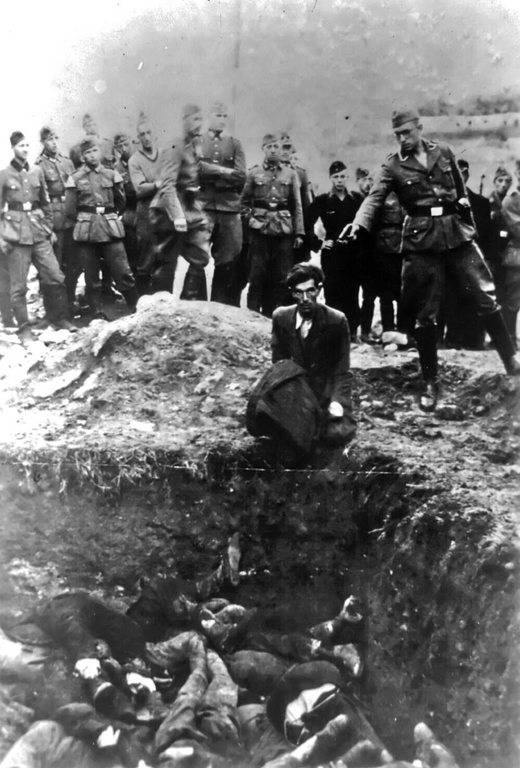
Einsatzgruppe Members killing Polish Jews

Himmler and Heydrich were sensitive to the perception of the Army and resented the fact that the Army believed them to be responsible for actions that they were carrying out under the direction and order of Hitler and that their troops were “undisciplined gangs of murderers.”[101] After the establishment of the Government General led by Hans Frank there was conflict between the Army under Blaskowitz, the SS, Police and the Nazi administration. Blaskowitz made an “elaborate report on the atrocities of the SS,”[102] expressing concern about his “extreme alarm about illegal executions, his worries about maintaining troop discipline under those circumstances, the failure of discussions with the SD and Gestapo and their assertions that they were only following SS Orders.”[103] While it is unclear if the memorandum made it to Hitler, it is clear that Hitler did know about the protest and Blaskowitz fell into disfavor and was reassigned after a period of continued conflict with the Nazi administration. Hitler’s reaction according to his adjutant was that the Army’s leaders used “Salvation Army” methods, and their ideas “childish.”[104] Likewise General Georg von Külcher was relieved of command for protesting SS and police atrocities.[105] SS Officers convicted by Army courts-martial were given amnesty by Hitler on “4 October 1939 who two weeks later removed SS units from the jurisdiction of military courts.”[106] While the army remained, it was not longer in charge and would assist the SS and Police in combat and further atrocities. One German officer, later a conspirator in the July 20th plot, remarked in November 1939 about the killings that he “was ashamed to be German! The minority are dragging our good through the mud by murdering, looting and torching houses will bring disaster on the whole German people if we do not stop it soon…”[107]

The Army was relieved of responsibility for policing Poland which fell on the Ordungspolizei battalions and Gendarmerie.  These units would wreak their own devastation on Poland in the coming months and years.[108] Poland would also be the first Nazi driven shift in population to exploit the newly won Lebensraum as Poles were driven into the newly formed Government General and ethnic Germans moved into previously Polish occupied territories. By 1941 over 1,200,000 Poles and 300,000 Jews had been expelled and 497,000 ethnic Germans brought into provinces lost in 1919.[109] Prior to the war about 3.3 million Jews lived in Poland. After the war 50-70,000 were found to have survived in Poland, the Polish Army and camps in Germany. A further 180,000 were repatriated from the Soviet Union.[110]

Russia
The Nazi war against Russia was the penultimate test of Hitler’s ideology. Planning began after 21 July, when Hitler made “his intentions plain” and “von Brauchitsch set his planners to work.”[111] Detailed preparations began in the winter of 1940-41 following the Luftwaffe’s failure against Britain and postponement of Operation Sea Lion.  Hitler intended to “crush Soviet Russia in a quick campaign which was to begin no later than March 15, 1941, and before the end of the war with England.”[112] Keitel noted the final decision came in “early December 1940” and from then he had “no doubt whatsoever that only some unforeseen circumstance could possibly alter his decision to attack.”[113] The plan focused on the destruction of “the Red Army rather than on any specific terrain or political objective,”[114] although these objectives would arise in later planning and in the campaign.  Hitler stated: “What matters is that Bolshevism must be exterminated. In case of necessity, we shall renew our advance whenever a new center of resistance is formed. Moscow as the center of doctrine must disappear from the earth’s center….”[115]
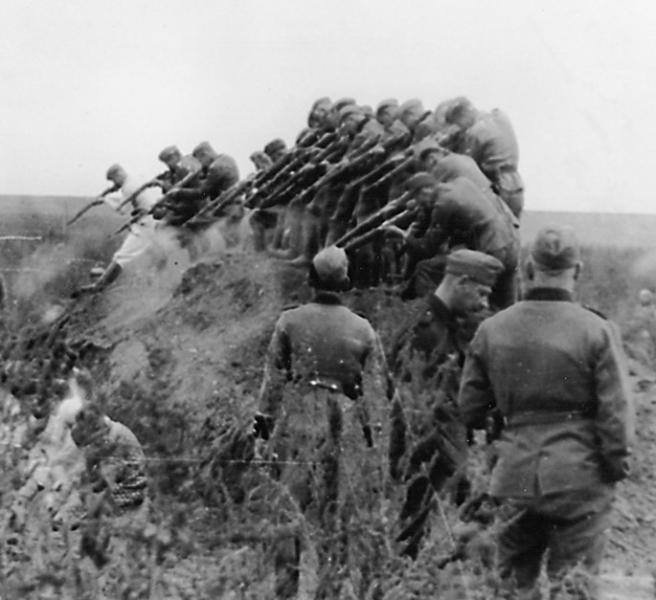
Besides preparations aimed at the destruction of the Red Army and overthrow of the Soviet State, the “war against the Soviet Union was more openly ideological from the start.”[116] Hitler set the stage on March 3rd 1941: “the forthcoming campaign is more than a mere armed conflict; it is a collision between two different ideologies…this war will not be ended merely by the defeat of the enemy armed forces” and that “the Jewish-Bolshevist intelligentsia must be eliminated….”[117] Hitler noted that “this is a task so difficult that it cannot be entrusted to the Army.”[118] Reichskommissars would be appointed in the conquered areas, but since normal civilian powers would be insufficient to eliminate the Bolshevists, that it “might be necessary “to establish organs of the Reichsführer SS alongside the army’s Secret Field Police, even in the operational areas….”[119] The “primary task was to liquidate “all Bolshevist leaders or commissars” if possible while still in the operations zones,”[120] yet the orders did not contain “a syllable that in practice every Jew would be handed over to the extermination machine.”[121] This was followed on 13 March by an agreement between the Army represented by General Wagner and the SS, which stated in part that “the Reichsführer SS has been given by the Führer special tasks within the operations zone of the Army…to settle the conflict between two opposing political systems.”[122] Likewise the agreement dictated that Himmler would “act independently and on his own responsibility” while ensuring that “military operations are not affected by measures necessary to carry out his task.”[123] A further instruction of 26 March issued by Wagner gave the Army’s agreement to the use of the Einsatzgrüppen in the operations zone, specifying coordination between them and army authorities in the operational zone and communications zones to the rear.  Cooperation was based on the “principals for co-operation between the State Secret Police and the Field Security organization of the Wehrmacht agreed with the Security branch of the War Ministry on 1 January 1937.”[124]
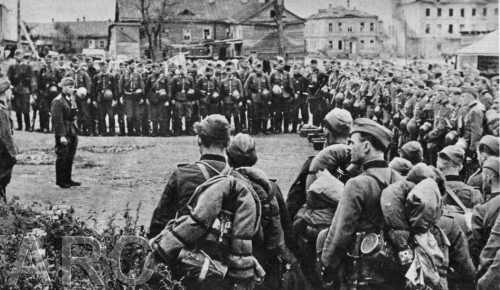
Police Battalion in the Soviet Union

The most significant act for the Army in this was the Commissar Order, sometimes known as the “Criminal Order” which was used war as evidence at Nuremberg as against Keitel and the High Command of the Wehrmacht.  The order specified the killing of Soviet Political Commissars attached to the Red Army and as “they were not prisoners of war” and another order specified that “in the event that a German soldier committed against civilians or prisoners, disciplinary action was optional….”[125] The order noted regarding political commissars that “in this struggle consideration and respect for international law with regard to these elements is wrong.” [126] The “Guidelines for the Conduct of Troops in Russia” issued on May 19, 1941 called for “ruthless and vigorous measures against Bolshevist inciters, saboteurs [and] Jews.”[127]
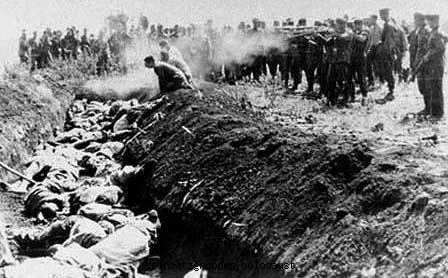
Shortly before the order was issued, Hitler previewed it to the generals saying that the war in Russia “cannot be conducted in a knightly fashion” and that it would have to be waged with “unprecedented, unmerciful and unrelenting harshness…”[128] and that they would have to “dispense with all of their outdated and traditional ideas about chivalry and the generally accepted rules of warfare: the Bolsheviks had long since dispensed with them.”[129] He explained that his orders were beyond their comprehension stating “I cannot and will not change my orders and I insist that that they be carried out with unquestioning and unconditional obedience.”[130]
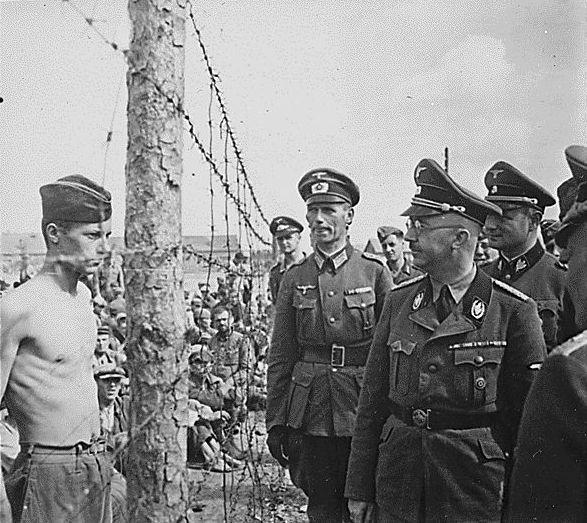
Himmler visiting POW Camp holding Red Army Prisoners, most would die in German Captivity

Hitler’s speech was protested by some according to Von Brauchitsch,[131] who refused to protest to Hitler but issued an order “threatening dire penalties for excesses against civilians and prisoners of war” which he maintained at Nurnberg “was sufficient to nullify the Commissar Order.”[132] Yet Von Brauchitsch would tell commanders to “proceed with the necessary hardness.”[133] Warlimont noted that Von Bock, who would “later emerge as an opponent of the Commissar Order…makes no special comment on the meeting or the restricted conference that followed.” [134] Keitel said that he “stubbornly contested” the clause “relating to the authority of the SS-Reichsführer… in the rearward operational areas.”[135] Keitel blamed the Army High Command, but the order came out with his signature on behalf of Hitler, which was key evidence against him at Nuremberg. He stated that “there was never any possibility of justifying them in retrospect by circumstances obtaining in the Russian campaign.”[136] Some commanders refused to publish the orders and “insisted that the Wehrmacht never implemented such policies…” blaming them instead on the SS. One writer states “such protests were undoubtedly sincere, but in practice German soldiers were far from innocent. The senior professional officers were often out of touch with their subordinates.”[137] The orders were a “license to kill, although not a great departure from German military traditions….”[138] The effect was terrifying, for in a sense the Einsatzgruppen, “could commit ever crime known to God and man, so long as they were a mile or two away from the firing line.”[139] Security Divisions were “instructed to give material and logistical support to…units of the Einsatzgruppen.”[140] Even worse, army units in rear areas “could be called on to assist Himmler’s SS police leaders.”[141]
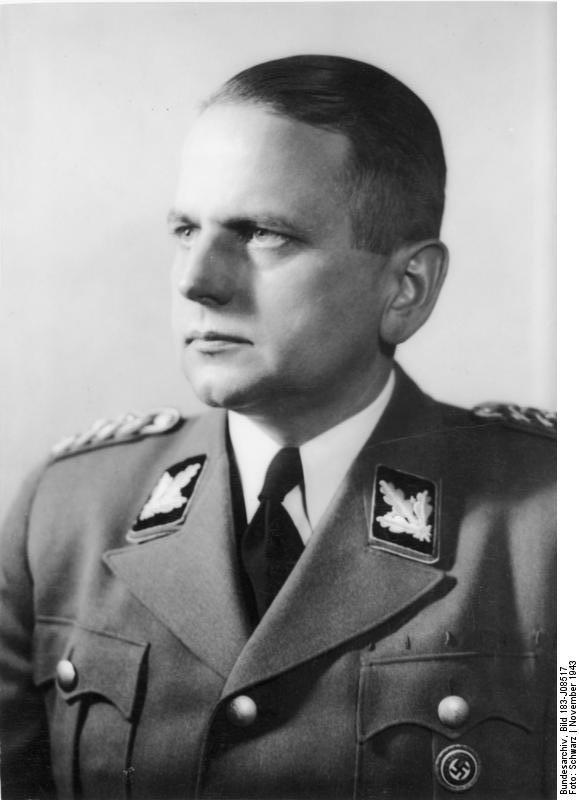
SS Brigadefuhrer Otto Ohlendorf Commander of Einstazgruppe D

The SS formed four Einsatzgruppen composed of SD, Waffen-SS and Police troops designated A-D with “A” being assigned to Army Group North, B to Army Group Center, C to Army Group South and “D” to 11th Army.  They were not standardized in manpower or equipment, the largest unit being A in the North at 990 personnel[142] and D with only 550.[143] These units had SS, SD or Police commanders. Additionally nine Ordnungspolizei battalions were initially assigned to the invasion forces.[144] The police contingent would grow over time so that by 1943, these units would be grouped under regiments and number about 180,000 men assisted by 301,000 auxiliaries.[145] These units would act in concert with 9 Army Security Divisions which handled rear area security.[146] Himmler initially did not reveal their intent and planned use to Einsatzgruppen commanders, only speaking of a “heavy task…to “secure and pacify” the Russian area using Sicherheitspolizei and SD methods.”[147] Understanding the effect of these operations, Himmler would state that “in many cases it is considerably easier to lead a company in battle than to command a company responsible to…carry out executions, to deport people…to be always consistent, always uncompromising-that is in many cases far, far harder.”[148]

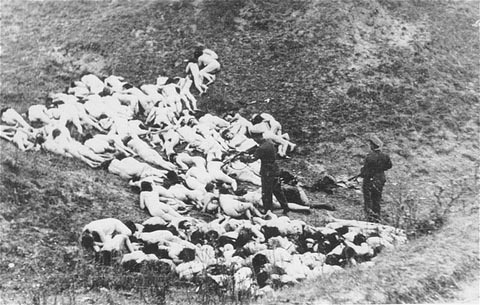
Nazi actions are well documented; the Einsatzgruppen, Police, Army and locally recruited Schutzmannschaft battalions[149] ruthlessly exterminated Jews and others in the operational area. No sooner had an Einsatzgruppe unit entered a city, a “deadly stranglehold” would grip the “Jewish inhabitants claiming thousands and thousands of victims day by day and hour by hour.”[150] Non-Jewish Russians were encouraged to conduct programs which Heydrich noted “had to be encouraged.”[151] Einsatzgruppen D report 153 noted: “During period covered by this report 3,176 Jews, 85 Partisans, 12 looters, 122 Communist functionaries shot. Total 79,276.”[152] By the spring of 1942 Einsatzgruppe A had claimed “more than 270,000 victims, the overwhelming majority of whom were Jewish.”[153] The total killed for all groups then was 518,388 people, mostly Jews.[154] Germany’s Romanian ally acted against Jews in Odessa as well; “on 23 October 1941 19,000 Jews were shot near the harbor… probably 200,000 Jews perished either at Romanian hands or after being turned over by the Romanians to the Germans.”[155]

Operations against Jews were often called anti-partisan operations.  Himmler referred to Einsatzgruppen as “anti-Partisan formations[156] while Wehrmacht Security divisions “murdered countless Soviet civilians and burned Russian settlements to the ground under the pretext of subduing partisan resistance.”[157] The attitude in 1941-1942 was that “’all Jews are partisans and all partisans are Jews.” From 1943, all armed resistance was “banditry” and all Jews irrespective of circumstances were treated as “bandits.””[158] The commander of the 221st Security Division endeavored to persuade his “subordinate units that the Jews were carriers of Bolshevik contamination and, therefore, the ultimate source of any sabotage or difficulty the division faced.”[159] The extermination of the Jews and partisan war were closely intertwined with the Reich’s economic policies designed to exploit the natural resources of the Russia. This included the “hunger plan” which German authorities seemed to imagine that “millionfold starvation could be induced by requisitioning off all available grain and “shutting off” the cities.”[160] Hitler told Halder that in 1941 that he “intended to level Moscow and Leningrad, to make them uninhabitable, so there would be no need to feed their populations during the winter.”[161] Economic officials held life and death power over villages. Those that met agricultural quotas were “likely to be spared annihilation and evacuation…the culmination of this process, during 1943, would be the widespread creation of “dead zones.””[162] All told the German killed nearly 1.5 million Russian Jews.[163] By 1942, 2 million Soviet POW’s were killed.  600,000 shot outright, 140,000 by the Einsatzkommandos.[164] All told 3.3 million Soviet POWs died in German captivity through starvation, disease and exposure,[165] are included in a total of over 10 million Red Army Combat deaths.[166] Bracher notes: “The reality and irreality of the National Socialism were given their most terrible expression in the extermination of the Jews.”[167]
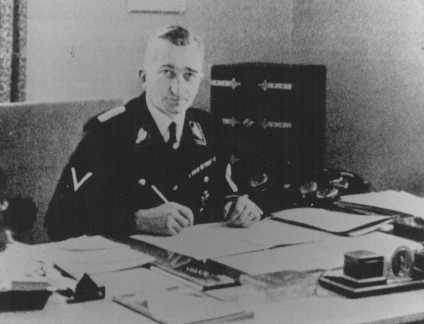
SS Gruppenfuhrer Arthur Nebe: “I have looked after so many criminals and now I have become one myself.”

Himmler and others continued to use euphemistic language to describe their efforts talking in terms of “Jewish resettlement.”[168] Terms such as special actions, special treatment, execution activity, cleansing and resettlement were used in place of the word murder.[169] At the same time these operations led to problems in the ranks, one SS trooper observed: “deterioration in morale among his own men who had to be issued increasing rations of vodka to carry out their killing orders.”[170] Even commanders were affected, Nebe would say “I have looked after so many criminals and now I have become one myself.”[171] A fellow conspirator would describe him as a “shadow of his former self, nerves on edge and depressed.”[172] Erich Bach-Zelewski, who led the SS anti-partisan efforts would suffer a nervous breakdown which included “hallucinations connected to the shootings of Jews” which hospitalized him in 1942.[173] Himmler would state in October 1943 that “to have gone through” the elimination of the Jews had “and remained decent, that has made us tough. This is an unwritten, never to be written, glorious page in our history.”[174]

Conclusion

The German war against Poland and Russia was heavily dependent on the racist ideology of Adolf Hitler.  He was the true spirit behind the atrocities committed by his nation as one noted in Russia: “Here too the Führer is the moving spirit of a radical solution in both word and deed.”[175] He saw the partisan war as “the chance to stamp out everything that stands against us.”[176] Belief in Germany’s right to Lebensraum the superiority of the German Volk and necessity to settle the Jewish problem provided a fertile ground for Hitler’s plans.  German military doctrines, especially those of anti-partisan and total warfare abetted Hitler’s goals.
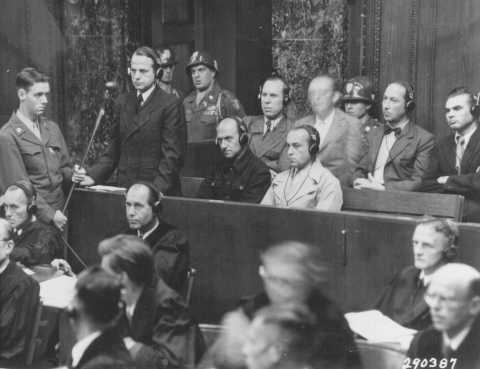
Einsatzgruppen Trial at Nuremberg 

It is quite clear that many in the Wehrmacht were in agreement with Hitler’s ideology of racial-war. Prepared by cultural prejudice and long traditions of thought, the “Prussian and in later German military must be regarded as a significant part of the ideological background of the Second World War.”[177] General Reichenau’s orders to his troops are revealing: “The most important goal of the campaign against Jewish-Bolshevism is the complete destruction of its grip on power and the elimination of the Asian influence from our European cultural sphere.”[178] Von Rundstedt appeared to agree with Reichenau to “use the partisan threat as excuse for persecuting Jews, so long as the dirty work was largely left to SS Einsatzgruppen.”[179] The Army command…on the whole acquiesced in the extermination of the Jews, or at least closed its eyes to what was happening.”[180] Even if the Generals had been more forceful in their opposition, they would have been opposed by the highly Nazified youth that made up the bulk of their Army, especially junior officers. SS leaders fanatically executed Hitler’s policies aided by the civil administration. Genocide was to bring the Reich “long term economic gains and trading advantages” and was seen as a way of “financing the war debt without burdening the German taxpayer.”[181] Some individuals attempted to resist the most brutal aspects of the Nazi campaign against the Jews. Some like Wilhelm Kube, Reichskommissar for White Russia and a virulent anti-Semite was shocked at the murders of the Jews calling them “unworthy of the German cause and damaging to the German reputation” and would later attempt to spare Jews by employing them in war industries, would be “defeated by Himmler’s zealots.”[182] Army officers who objected like Blaskowitz and Külcher were relieved, or like Von Leeb, told by Hitler to “in so many words told to mind his own business.” Leeb stated: “the only thing to do is to hold oneself at a distance.”[183] Rommel knew of crimes through Blaskowitz but blamed the crimes “on Hitler’s subordinates, not Hitler himself.”[184]

Hitler’s ideology permeated German military campaigns and administration of the areas conquered by his armies. No branch of the German military, police or civil administration in occupied Poland or Russia was exempt guiltless in the crimes committed by the Nazi regime. It is a chilling warning of the consequences awaiting any nation that allows it to become caught up in hate-filled political, racial or even religious ideologies which dehumanizes opponents and of the tragedy that awaits them and the world. In Germany the internal and external checks that govern the moral behavior of the nation and individuals failed. Caught up in the Nazi system, the Germans, especially the police and military abandoned the norms of international law, morality and decency, banally committing crimes which still reverberate today and which are seen in the ethnic cleansing actions in the former Yugoslavia and other nations.

Bibliography

Aly, Gotz and Heim, Susanne. Architects of Annihilation: Auschwitz and the Logic of Destruction Phoenix Paperbacks, London, 2003, originally published as Vordenker der Vernichtung, Hoffman und Campe, Germany 1991, English translation by Allan Blunden.  First published in Great Britain Weidenfeld & Nicholson, London, 2002

Arendt, Hannah, Eichmann in Jerusalem: A Report on the Banality of Evil. Revised and Enlarged Edition. Penguin Books, Harmondsworth, England and New York, NY 1965. Originally published by Viking Press, New York, NY 1963

Blood, Philip. Hitler’s Bandit Hunters: The SS and the Occupation of Europe. Potomoac Books Inc. Washington, DC 2008

Bracher, Karl Dietrich. The German Dictatorship: The Origins, Structure, and Effects of National Socialism. Translated by Jean Steinberg, Holt Rinehart and Winston, New York, NY 1979. Originally Published under the title Die Deutsche Diktatur: Entstehung, Struktur,Folgen des Nationalsocialismus. Verlag Kiepenheuer & Witsch. Koln and Berlin, 1969

Browning, Christopher R. Ordinary Men: Reserve Police Battalion 101 and the Final Solution in Poland. Harper Perennial Books, New York, New York 1993 reissued 1996.

Burleigh, Michael and Wippermann, Wolfgang. The Racial State: Germany 1933-1945 Cambridge University Press, New York NY and Cambridge UK 1991

Condell, Bruce and Zabecki, David T. Editors. On the German Art of War: Truppenführung , Lynn Rienner Publishers, Boulder CO and London 2001

Craig, Gordon A. The Politics of the Prussian Army 1640-1945. Oxford University Press, London and New York, 1955

Davidowicz, Lucy S. The War Against the Jews 1933-1945 Bantam Books, New York, NY 1986.

Di Nardo, Richard L. Germany and the Axis Powers: From Coalition to Collapse. University Press of Kansas, Lawrence, KS. 2005

Erickson, John. The Road to Berlin. Cassel Military Paperbacks, London, 2003. First Published by Weidenfeld and Nicholson, 1983

Evans, Richard J. The Coming of the Third Reich Penguin Books, New York 2004.  First published by Allen Lane 2003

Evans, Richard J. The Third Reich in Power 1933-1939. Penguin Press, New York, NY 2005

Ferguson, Niall. The War of the Worlds: Twentieth Century Conflict and the Descent of the West. The Penguin Press, New York, 2006

Fest, Joachim, Hitler. Translated by Richard and Clara Winston. Harcourt Brace Jovanovich Publishers, San Diego, New York, London, 1974.  German Edition by Verlag Ullstein 1973

Fraser, David. Knight’s Cross: A Life of Field Marshal Erwin Rommel Harper Perennial, New York 1995, first published by Harper Collins in Britain, 1993

Friedlander, Saul Nazi Germany and the Jews 1939-1945: The Years of Extermination. Harper Perennial, New York, NY 2007

Fritz, Stephen G. Frontsoldaten: The German Soldier in World War II.  The University Press of Kentucky, Lexington, KY 1995

Geyer, Michael. German Strategy 1914-1945 in Makers of Modern Strategy from Machiavelli to the Nuclear Age. Peter Paret, editor. Princeton University Press, Princeton NJ. 198

Giziowski, Richard. The Enigma of General Blaskowitz. Hippocrene Books, New York 1997

Glantz, David M. and House, Jonathan. When Titans Clashed: How the Red Army Stopped Hitler. University Press of Kansas, Lawrence, KS. 1995

Goerlitz, Walter. History of the German General Staff. Translated by Brian Battershaw, Westview Press, Boulder and London, 1985. Originally published as Die Deutsche Generalstab Verlag der Frankfurter Hefte, Frankfurt am Main, 1953

Goerlitz, Walter. The Memiors of Field Marshal Wilhelm Keitel: Chief of the German High Command 1938-1945.  Translated by David Irving. Cooper Square Press 2000,  First English Edition 1966 William Kimber and Company Ltd.  German edition published by Musterschmnidt-Verlad, Gottigen 1961 .

Hitler, Adolf Mein Kampf translated by Ralph Manheim. Mariner Books, Houghton Mifflin Company, New York, NY 1999. Houghton Mifflin Company 1943, copyright renewed 1971. Originally published in Germany by Verlag Frz. Eher Nachf. GmbH 1925

Höhne, Heinze. Canaris: Hitler’s Master Spy. Traslated by J. Maxwell Brownjohn. Cooper Square Press,

New York 1999. Originally published by C. Bertelsmann Verlag Gmbh, Munich 1976, first English edition by Doubleday and Company 1979

Höhne, Heinze. The Order of the Death’s Head: The Story of Hitler’s SS. Translated by Richard Barry. Penguin Books, New York and London, 2000. First English edition published by Martin Secker and Warburg Ltd. London 1969. Originally published as Der Orden unter dem Totenkopf, Verlag Der Spiegel, Hamburg 1966.

Hughes, Daniel J. editor. Moltke on the Art of War: Selected Writings, translated by Harry Bell and Daniel J Hughes. Presidio Press, Novato CA 1993

Liddell-Hart, B.H. The German Generals Talk. Quill Publishing, New York, NY. 1979. Copyright 1948 by B.H. Liddell-Hart

Macksey, Kenneth. Why the Germans Lose at War: The Myth of German Military Superiority. Barnes and Noble Books, New York 2006, originally published by Greenhill Books, 1996

Manstein, Erich von. Forward by B.H. Liddle Hart, Introduction by Martin Blumenson. Lost victories: The War Memoirs of Hitler’s Most Brilliant General. Zenith Press, St Paul MN 2004. First Published 1955 as Verlorene Siege, English Translation 1958 by Methuen Company

Shirer, William L. The Rise and Fall of the Third Reich. A Touchstone Book published by Simon and Schuster, 1981, Copyright 1959 and 1960

Megargee, Geoffrey P. War of Annihilation: Combat and Genocide on the Eastern Front 1941.Bowman and Littlefield Publishers Inc. Lanham, Boulder, New York. 2007

Messinger, Charles, The Last Prussian: A Biography of Field Marshal Gerd Von Rundstedt 1875-1953 Brassey’s (UK) London England 1991

Newton, Steven H. Hitler’s Commander: Field Marshal Walter Model-Hitler’s Favorite General DaCapo Press a division of Perseus Books Group, Cambridge MA 2005

Novatny, Alfred. The Good Soldier. The Aberjona Press, Bedford, PA 2003

Padfield, Peter. Himmler. MJF Books, New York. 1990

Reitlinger, Gerald.  The SS: Alibi of a Nation. The Viking Press, New York, 1957. Republished by Da Capo Press, New York, NY.

Rhodes, Richard. Masters of Death: The SS Einsatzgruppen and the Invention of the Holocaust. Vintage Books a division of Random House, New York, NY 2002

Shepherd, Ben. War in the Wild East: The German Army and Soviet Partisans. Harvard University Press, Cambridge, MA 2004

Sofsky, Wolfgang. The Order of Terror: The Concentration Camp. Translated by William Templer. Princeton University Press. Princeton, NJ 1997. Originally published as Die Ordnung des Terros: Das Konzentrationslager. S. Fischer Verlag, GmbH, Frankfurt am Main, 1993

Speer, Albert. Inside the Third Reich. Collier Books, a Division of MacMillan Publishers, Inc. New York, NY 1970.

Strachan, Hew. European Armies and the Conduct of War. George, Allen and Unwin, London, UK 1983

Stein, George H. The Waffen SS 1939-1945: Hitler’s Elite Guard at War. Cornell University Press, Ithaca and London, 1966

Stern, Fritz. Gold and Iron: Bismarck, Bleichroder and Building of the German Empire. Vintage Books a division of Random House, New York 1979 First published by Alfred a Knopf 1977

Sydnor, Charles W. Soldiers of Destruction: The SS Death’s Head Division, 1933-1945. Princeton University Press, Princeton, NY 1977 Taylor, Fred, Editor and Translator. The Goebbels Diaries 1939-1941, Penguin Books Ltd, Harmondsworth UK and New York NY 1984.

Tooze, Adam. The Wages of Destruction Penguin Books, New York, NY, 2008. First Published by Allen Lane Books, Penguin Group, London UK, 2006

Trevor-Roper, H.R. Hitler’s Table Talk 1941-1944 with an introduction by Gerhard L Weinberg,  Translated by Norman Cameron and R.H. Stevens, Enigma Books, New York, NY 2000. Originally published in Great Britain by Weidenfeld & Nicholoson, London 1953.

Warlimont, Walter. Inside Hitler’s Headquarters 1939-45. Translated by R.H. Berry, Presido Press, Novato CA, 1964.

Weinberg, Gerhard L. Germany Hitler and World War II . Cambridge University Press, New York, NY 1995

Weinberg, Gerhard L. Ed. Hitler’s Second Book: The Unpublished Sequel to Mein Kampf by Adolph Hitler. Translated by Krista Smith, Enigma Books,  New York, NY 2006. Originally published as Hitlers zweites Buch, Gerhard Weinberg editor, 1961.

Weinberg, Gerhard L. Visions of Victory: The Hopes of Eight World War II Leasers. Cambridge University Press, New York, NY 2005

Westermann, Edward B. Hitler’s Police Battalions: Enforcing Racial War in the East. University Press of Kansas, Lawrence, KS. 2005

Wette, Wolfram. The Wehrmacht: History, Myth, Reality. Translated by Deborah Lucas Schneider. Harvard University Press, Cambridge, MA 2006. Originally published as Die Wehrmacht: Feindbilder, Vernichtungskreig, Legenden. S. Fischer Verlag, GmbH, Frankfurt am Main, 2002

Wheeler-Bennett, John. The Nemesis of Power: The German Army in Politics 1918-1945. St. Martin’s Press Inc. New York, NY 1954

Notes

[1] Weinberg, Gerhard L. Ed. Hitler’s Second Book: The Unpublished Sequel to Mein Kampf by Adolph Hitler. Translated by Krista Smith, Enigma Books, New York, NY 2006. Originally published as Hitlers zweites Buch, Gerhard Weinberg editor, 1961 p. 159

[2] Davidowicz, Lucy S. The War Against the Jews 1933-1945 Bantam Books, New York, NY 1986. p.91

[3] Tooze, Adam. The Wages of Destruction Penguin Books, New York, NY, 2008. First Published by Allen Lane Books, Penguin Group, London UK, 2006. p.463

[4] Fest, Joachim, Hitler. Translated by Richard and Clara Winston. Harcourt Brace Jovanovich Publishers, San Diego, New York, London, 1974.  German Edition by Verlag Ullstein 1973 pp. 607-608

[5] Note the actions of Cardinal Richelieu in France who worked to expand French power at the expense of other Catholic nations and the Vatican itself.

[6] In the United States the Reconstruction policies produced great resentment in the south with decidedly negative results for the newly freed slaves which lasted another 100 years, while in the Soviet Union great numbers of “opponents of Socialism” were killed, imprisoned or driven out of the county.

[7] Ibid. Tooze. The Wages of Destruction p.462

[8] Ibid. Davidowicz, The War Against the Jews pp.8-9

[9] Ibid. Davidowicz. The War Against the Jews p.12

[10] Ibid. Fest  Hitler. p.47

[11] Bracher, Karl Dietrich. The German Dictatorship: The Origins, Structure, and Effects of  National Socialism. Translated by Jean Steinberg, Holt Rinehart and Winston, New York, NY 1979. Originally Published under the title Die Deutsche Diktatur: Entstehung, Struktur,Folgen des Nationalsocialismus. Verlag Kiepenheuer & Witsch. Koln and Berlin, 1969 p.93

[12] Weinberg, Gerhard L. Germany Hitler and World War II . Cambridge University Press, New York, NY 1995 p.61

[13] Ibid. Weinberg, Hitler’s Second Book p.60

[14] Friedlander, Saul Nazi Germany and the Jews 1939-1945: The Years of Extermination. Harper Perennial, New York, NY 2007 p.xviii

[15] Ibid. Friedlander, The Years of Extermination p.xvii  Friedlander called this anti-Semitism “Redemptive anti-Semitism” in which “Hitler perceived his mission as a kind of crusade to redeem the world by eliminating the Jews.

[16] Megargee, Geoffrey P. War of Annihilation: Combat and Genocide on the Eastern Front 1941.Bowman and Littlefield Publishers Inc. Lanham, Boulder, New York. 2007 p.4

[17] Hitler, Adolf Mein Kampf translated by Ralph Manheim. Mariner Books, Houghton Mifflin Company, New York, NY 1999. Houghton Mifflin Company 1943, copyright renewed 1971. Originally published in Germany by Verlag Frz. Eher Nachf. GmbH 1925. p.662.

[18] Evans, Richard J. The Coming of the Third Reich Penguin Books, New York 2004.  First published by Allen Lane 2003 p.197

[19] Ibid. Davidowicz The War Against the Jews pp. 88-89

[20] Rhodes, Richard. Masters of Death: The SS Einsatzgruppen and the Invention of the Holocaust. Vintage Books a division of Random House, New York, NY 2002 p.37

[21] Speer, Albert. Inside the Third Reich. Collier Books, a Division of MacMillan Publishers, Inc. New York, NY 1970 p.166

[22] Geyer, Michael. German Strategy 1914-1945 in Makers of Modern Strategy from Machiavelli to the Nuclear Age. Peter Paret, editor. Princeton University Press, Princeton NJ. 1986. p.582

[23] Ibid. Geyer. German Strategy p.587

[24] Strachan, Hew. European Armies and the Conduct of War. George, Allen and Unwin, London, UK 1983 p.174

[25] Goerlitz, Walter. The Memoirs of Field Marshal Wilhelm Keitel: Chief of the German High Command 1938-1945.  Translated by David Irving. Cooper Square Press 2000,  First English Edition 1966 William Kimber and Company Ltd.  German edition published by Musterschmnidt-Verlad, Gottigen 1961 p. 135

[26] Ibid. Fest, Hitler.  p. 649

[27] Ibid. Megargee, War of Annihilation p.7

[28] Trevor-Roper, H.R. Hitler’s Table Talk 1941-1944 with an introduction by Gerhard L Weinberg,  Translated by Norman Cameron and R.H. Stevens, Enigma Books, New York, NY 2000. Originally published in Great Britain by Weidenfeld & Nicholoson, London 1953 p. 27 Goebbels notes a similar theme in his recollection of Hitler’s reasons for destroying Russia a power .  See Taylor, Fred, Editor and Translator. The Goebbels Diaries 1939-1941, Penguin Books Ltd, Harmondsworth UK and New York NY 1984 pp. 413-415.

[29] Goerlitz, Walter. History of the German General Staff.” Translated by Brian Battershaw, Westview Press, Boulder and London, 1985. Originally published as Die Deutsche Generalstab Verlag der Frankfurter Hefte, Frankfur am Main, 1953 p.390

[30] Warlimont, Walter. Inside Hitler’s Headquarters 1939-45. Translated by R.H. Berry, Presido Press, Novato CA, 1964 p. 150

[31] Weinberg, Gerhard L. Visions of Victory: The Hopes of Eight World War II Leasers. Cambridge University Press, New York, NY 2005. p. 24

[32] Aly, Gotz and Heim, Susanne. Architects of Annihilation :Auschwitz and the Logic of Destruction Phoenix Paperbacks, London, 2003, Originally published as  Vordenker der Vernichtung, Hoffman und Campe, Germany 1991, English translation by Allan Blunden.  First published in Great Britain Weidenfeld & Nicholson, London, 2002 pp. 245-246

[33] Ibid. Fest. Hitler p.649

[34] Wette, Wolfram. The Wehrmacht: History, Myth, Reality. Translated by Deborah Lucas Schneider. Harvard University Press, Cambridge, MA 2006. Originally published as Die Wehrmacht: Feindbilder, Vernichtungskreig, Legenden. S. Fischer Verlag, GmbH, Frankfurt am Main, 2002 p.93

[35] This understanding is different than many historians who as Friedlander notes advocate something like this: “The persecution and extermination of the Jews of Europe was but a secondary consequence of major German policies pursued toward entirely different goals.” Friedlander p.xvi

[36] Ibid. Megargee. War of Annihilation p.xii

[37] Liddell-Hart, B.H. The German Generals Talk. Quill Publishing, New York, NY. 1979. Copyright 1948 by B.H. Liddell-Hart p.22

[38] It has to be noted that Liddle-Hart published this work in 1948 and was limited in the materials available, his primary sources being German officers who he viewed with sympathy because he saw them as exponents of his theory of the indirect approach.

[39] Ibid. Wette. The Wehrmacht p.224

[40] Macksey, Kenneth. Why the Germans Lose at War: The Myth of German Military Superiority. Barnes and Noble Books, New York 2006, originally published by Greenhill Books, 1996. p.139

[41] Stern, Fritz. Gold and Iron: Bismarck, Bleichroder and Building of the German Empire. Vintage Books a division of Random House, New York 1979 First published by Alfred a Knopf 1977.  p.495

[42] Ibid. Stern. Gold and Iron p.494

[43] Ibid. Bracher. The German Dictatorship p.34

[44] Ibid. Bracher The German Dictatorship pp.34-35

[45] Höhne, Heinze. Canaris: Hitler’s Master Spy. Translated by J. Maxwell, Brownjohn. Cooper Square Press,

New York 1999. Originally published by C. Bertelsmann Verlag Gmbh, Munich 1976, first English edition by Doubleday and Company 1979 p. 216.  Canaris would later protest the Kristalnacht to Keitel (p.334) and become convinced of the crime of the Nazis against the Jews.

[46] Ibid. Witte. The Wehrmacht p.98

[47] Ibid Witte The Wehrmacht, p.73

[48] Arendt, Hannah, Eichmann in Jerusalem: A Report on the Banality of Evil. Revised and Enlarged Edition. Penguin Books, Harmondsworth, England and New York, NY 1965. Originally published by Viking Press, New York, NY 1963 p.26

[49] Ibid. Megargee. War of Annihilation p.6

[50] Fritz, Stephen G. Frontsoldaten: The German Soldier in World War II.  The University Press of Kentucky, Lexington, KY 1995 p.195

[51] Craig, Gordon A. The Politics of the Prussian Army 1640-1945. Oxford University Press, London and New York, 1955 p.495

[52] Novatny, Alfred. The Good Soldier. The Aberjona Press, Bedford, PA 2003 p.40

[53] Westermann, Edward B. Hitler’s Police Battalions: Enforcing Racial War in the East. University Press of Kansas, Lawrence, KS. 2005 p.64  Westermann also notes the preponderance of SA men who entered the Order Police in the 1930s, a factor which helped further the politicization of that organization.

[54] Ibid. Rhodes Masters of Death p.23

[55] Ibid. Westermann Hitler’s Police Battalions p.103

[56] Sydnor, Charles W. Soldiers of Destruction: The SS Death’s Head Division, 1933-1945. Princeton University Press, Princeton, NY 1977 p. 28

[57] Shepherd, Ben. War in the Wild East: The German Army and Soviet Partisans. Harvard University Press, Cambridge, MA 2004 p.41

[58] Blood, Philip. Hitler’s Bandit Hunters: The SS and the Occupation of Europe. Potomac Books Inc. Washington, DC 2008 p.11

[59] Ibid. Shepherd. War in the Wild East p.42

[60] Ibid. Goerlitz. History of the German General Staff p.93

[61] Rothenburg, Gunther. Moltke, Schieffen, and the Doctrine of Strategic Envelopment in Makers of Modern Strategy from Machiavelli to the Nuclear Age. Peter Paret, editor. Princeton University Press, Princeton NJ. 1986 p.305

[62] Hughes, Daniel J. editor. Moltke on the Art of War: Selected Writings, translated by Harry Bell and Daniel J Hughes. Presidio Press, Novato CA 1993. p.32

[63] Ibid. Blood Hitler’s Bandit Hunters p.6   Lieber was a Prussian emigrant to the US who taught law at Columbia University.

[64] Ibid. Blood Hitler’s Bandit Hunters pp.12-13

[65] Ibid. Shepherd Wild War in the East p.42

[66] Ibid. Blood. Hitler’s Bandit Hunters pp.16-19

[67] Ibid. Blood. Hitler’s Bandit Hunters p.22

[68] Condell, Bruce and Zabecki, David T. Editors. On the German Art of War: Truppenführung , Lynn Rienner Publishers, Boulder CO and London 2001. p.172

[69] Tsouras, Peter G. Editor, Fighting in Hell: The German Ordeal on the Eastern Front The Ballantine Publishing Group, New York, 1998. First published 1995 by Greenhill Books. Pp. 142-146.  It is interesting to note that Rauss does not describe any actual anti-partisan operation.

[70] Ibid. Shepherd. War in the Wild East p.45

[71] Ibid. Geyer. German Strategy p.584

[72] Ibid. Weinberg. Visions of Victory p.8

[73] Ibid. Goerlitz, History of the German General Staff p.346

[74] Höhne, Heinze. The Order of the Death’s Head: The Story of Hitler’s SS. Translated by Richard Barry. Penguin Books, New York and London, 2000. First English edition published by Martin Secker and Warburg Ltd. London 1969. Originally published as Der Orden unter dem Totenkopf, Verlag Der Spiegel, Hamburg 1966 p.259

[75] Manstein, Erich von. Forward by B.H. Liddle Hart, Introduction by Martin Blumenson. Lost victories: The War Memoirs of Hitler’s Most Brilliant General. Zenith Press, St Paul MN 2004. First Published 1955 as Verlorene Siege, English Translation 1958 by Methuen Company p.29

[76] Ibid. Hohne. Canaris p.347

[77] Giziowski, Richard. The Enigma of General Blaskowitz. Hppocrene Books, New York 1997 p.119

[78] Ibid. Manstein. Lost Victories p.29

[79] Ibid. Goerlitz. The Memoirs of Field Marshal Keitel p.87

[80] Wheeler-Bennett, John. The Nemesis of Power: The German Army in Politics 1918-1945. St. Martin’s Press Inc. New York, NY 1954 p.448

[81] Ibid. Megargee. War of Annihilation p.13

[82] Ibid. Höhne The Order of the Death’s Head p.297

[83] Padfield, Peter. Himmler. MJF Books, New York 1990 p.264

[84] Ibid. Megargee. War of Annihilation p.13

[85] Ibid. Westermann. Hitler’s Police Battalions p.127

[86] Ibid.  Höhne The Order of the Death’s Head p.297

[87] Ibid. Westermann. Hitler’s Police Battalions p.127

[88] Ibid. Sydnor Soldiers of Destruction p.37 These would become the nucleus of the Totenkopf Division

[89] Ibid. Giziowski Blaskowitz p.120

[90] Ibid. Witte. The Wehrmacht p.100

[91] Ibid. Höhne The Order of the Death’s Head pp. 297-298

[92] Ibid. Giziowski Blaskowitz p.120

[93] Ibid. Höhne The Order of the Death’s Head p.298

[94] Ibid. Witte. The Wehrmacht p.100

[95] Newton, Steven H. Hitler’s Commander: Field Marshal Walter Model-Hitler’s Favorite General Da Capo Press a division of Perseus Books Group, Cambridge MA 2005. p.74

[96] Ibid. Giziowski. The Enigma of General Blaskowitz pp.165-166

[97] Ibid. Sydnor, Soldiers of Destruction pp. 42-43 Note SSVT is the common abbreviation for the SS Totenkopf Verbande

[98] Ibid. Goerlitz. History of the German General Staff p.359

[99] Ibid. Newton. Hitler’s Commander p.78

[100] Ibid. Witte The Wehrmacht p.102

[101] Ibid. Höhne The Order of the Death’s Head p.298

[102] Ibid. Goerlitz. History of the German General Staff .p.359

[103] Ibid. Giziowski. The Enigma of General Blaskowitz p.173

[104] Ibid. Giziowski. The Enigma of General Blaskowitz p.173

[105] Ibid. Witte The Wehrmacht p.102

[106] Burleigh, Michael and Wippermann, Wolfgang. The Racial State: Germany 1933-1945 Cambridge University Press, New York NY and Cambridge UK 1991. p.100

[107] Ibid. Witte The Wehrmacht p.102

[108] For a good account of one of the Police Battalions see Ordinary Men: Reserve Police Battalion 101mand the Final Solution in Poland by Christopher Browning Harper Perennial Publishers, San Francisco CA 1992

[109] Reitlinger, Gerald.  The SS: Alibi of a Nation. The Viking Press, New York, 1957. Republished by Da Capo Press, New York, NY p.131

[110] Ibid. Davidowicz The War Against the Jews pp.395-397

[111] Ibid. Megargee. War of Annihilation p.24

[112] Ibid. Wheeler-Bennett The Nemesis of Power p.511

[113] Ibid. Goerlitz. The Memoirs of Field Marshal Wilhelm Keitel. P.132

[114] Glantz, David M. and House, Jonathan. When Titans Clashed: How the Red Army Stopped Hitler. University Press of Kansas, Lawrence, KS. 1995 p.31

[115] Trevor-Roper, H.R. Hitler’s Table Talk 1941-1944 with an introduction by Gerhard L Weinberg,  Translated by Norman Cameron and R.H. Stevens, Enigma Books, New York, NY 2000. Originally published in Great Britain by Weidenfeld & Nicholoson, London 1953 p.6

[116] Ibid. Megargee. War of Annihilation p.10 More openly ideological as compared to Poland.

[117] Ibid. Warlimont. Inside Hitler’s Headquarters p.150

[118] Ibid. Warlimont. Inside Hitler’s Headquarters p.151

[119] Ibid. Reitlinger, The SS p.175

[120] Ibid. Höhne The Order of the Death’s Head p. 354

[121] Ibid. Höhne The Order of the Death’s Head p. 354  Again another deception.

[122] Ibid. Warlimont. Inside Hitler’s Headquarters p.153

[123] Ibid. Warlimont. Inside Hitler’s Headquarters p.153

[124] Ibid. Warlimont. Inside Hitler’s Headquarters pp. 158-159

[125] Ibid. Glantz and House. When Titans Clashed p.56

[126] Ibid. Davidowicz. The War Against the Jews p.123

[127] Ferguson, Niall. The War of the Worlds: Twentieth Century Conflict and the Descent of the West. The Penguin Press, New York, 2006 p.442

[128] Ibid. Wheeler-Bennett. Nemesis of Power p.513

[129] Ibid. Goerlitz. The Memoirs of Field Marshal Keitel p.135

[130] Ibid. Wheeler-Bennett. Nemesis of Power p.513

[131] Ibid. Wheeler-Bennett Nemesis of Power p.513 and footnote. He cites the three Army Group commanders, Leeb, Rundstedt and Bock. However Von Rundstedt’s biographer notes that “no evidence exists as to what Von Rundstedt’s to this was at the time.” Messenger, Charles, The Last Prussian: A Biography of Field Marshal Gerd Von Rundstedt 1875-1953 Brassey’s (UK) London England 1991. p.134

[132] Ibid. Reitlinger, The SS p.176

[133] Ibid. Megargee. War of Annihilation p.33

[134] Ibid. Warlimont. Inside Hitler’s Headquarters p.162

[135] Ibid. Goerlitz. The Memoirs of Field Marshal Keitel p.136

[136] Ibid. Goerlitz. The Memoirs of Field Marshal Keitel pp.136-137

[137] Ibid. Glantz and House. When Titans Clashed p.56

[138] Ibid. Blood. Hitler’s Bandit Hunters p.52

[139] Ibid. Reitlinger The SS p. 177

[140] Ibid. Shepherd. War in the Wild East p.54

[141] Ibid. Reitlinger The SS p. 177

[142] Ibid. Rhodes Masters of Death pp.12-13

[143] Ibid. Westermann. Hitler’s Police Battalions p.167

[144] Ibid. Westermann. Hitler’s Police Battalions p.164

[145] Ibid. Blood Hitler’s Bandit Hunters p.141

[146] Ibid. Shepherd Wild War in the East p.48. Shepherd notes the deficiencies of these units in terms of organization, manpower and equipment which he calls “far short of the yardstick of military excellence with which the Wehrmacht is so widely associated.

[147] Ibid.  Höhne The Order of the Death’s Head p. 356 Only one of the Einsatzgruppen commanding officers was a volunteer, Arthur Nebe who was involved in the conspiracy to kill Hitler. It is believed by many that Nebe volunteered to earn the clasp to the Iron Cross to curry favor with Heydrich and that initially “Nebe certainly did not know that “employment in the east” was synonymous with the greatest mass murder in history.

[148] Ibid. Bracher. The German Dictatorship p.422

[149] Ibid. Blood Hitler’s Bandit Hunters p.55

[150] Ibid. Höhne The Order of the Death’s Head p. 360

[151] Ibid.  Friedlander The Years of Extermination p.207

[152] Ibid. Höhne The Order of the Death’s Head p. 360

[153] Ibid. Tooze The Wages of Destruction p.481

[154] Ibid. Ferguson. The War of the World p.446

[155] Di Nardo, Richard L. Germany and the Axis Powers: From Coalition to Collapse. University Press of Kansas, Lawrence, KS. 2005 p.133 The Hungarians would also engage in ant-Jewish operations. Only the Italian army would not conduct operations against the Jews.

[156] Ibid. Höhne The Order of the Death’s Head p. 369

[157] Ibid. Wette The Wehrmacht p.127

[158] Ibid. Blood. Hitler’s Bandit Hunters p.117

[159] Ibid. Shepherd. War in the Wild East pp.90-91

[160] Ibid. Tooze The Wages of Destruction p.481

[161] Ibid. Magargee. War of Annihilation p.64

[162] Ibid. Shepherd. War in the Wild East pp.127-128

[163] Ibid. Davidowicz The War Against the Jews from the table on page 403. This included 228,000 from the Baltic republics (90%) 245,000 from White Russia (65%) 900,000 from the Ukraine (60%) and 107,000 from Russia proper (11%)

[164] Ibid. Rhodes. Masters of Death p.241

[165] Ibid. Glantz and House When Titans Clashed p.57

[166] Ibid. Glantz and House. When Titans Clashed table on p.292

[167] Ibid. Bracher. The German Dictatorship p.431

[168] Ibid. Bracher. The German Dictatorship p.430

[169] Ibid. Höhne The Order of the Death’s Head p. 367

[170] Ibid. Rhodes. Masters of Death p.225

[171] Ibid. Rhodes Masters of Death p.225

[172] Ibid. Höhne The Order of the Death’s Head p. 363

[173] Ibid. Höhne The Order of the Death’s Head p. 363

[174] Ibid. Bracher. The German Dictatorship p.423

[175] Ibid. Bracher. The German Dictatorship p.430

[176] Ibid. Megargee War of Annihilation p.65

[177] Ibid. Wette. The Wehrmacht p.293

[178] Ibid. Wette. The Wehrmacht p.97

[179] Messenger, Charles. The Last Prussian A Biography of Field Marshal Gerd Von Rundstedt 1875-1953 Brassey’s London, 1991 p148

[180] Ibid. Bracher The German Dictatorship pp.430-431

[181] Ibid. Aly and Heim Architects of Annihilation p.242

[182] Ibid. Padfield Himmler pp.341-342

[183] Ibid. Megargee War of Annihilation p.97

[184] Fraser, David. Knight’s Cross: A Life of Field Marshal Erwin Rommel Harper Perennial, New York 1995, first published by Harper Collins in Britain, 1993. p.536

3 Comments

Filed under History, Military, nazi germany, Political Commentary, world war two in europe

A Midsummer Night Dream: Memories of MLB All Star Games Past and Present

“I think the National League has better biorhythms in July.” – Earl Weaver (1979 All Star Game) 

Before the days of inter-league play and free-agency and the multitude of national and regional television outlets for baseball the All Star Game was the one time outside of the World Series that fans of in a National League town or American League town could watch players from the opposing league play their “boys.”

MVP Melky Cabrera homers in the 4th inning. (Getty Images)

http://mlb.mlb.com/video/play.jsp?content_id=22979315&topic_id=34326704

My dad was typical of his generation. He was a National League fan. He grew up with the Cincinnati Reds and when he moved west with the Navy he became a San Francisco Giants fan. When the All-Star Game rolled around at was if time itself would stop as we gathered around the TV as a family to watch it.

Me with Angel’s Manager Lefty Phillips in 1970 at Anaheim Stadium

I think that is in large part why I have such a veneration for this annual event. As I mentioned back then there was no inter-league play and with free agency very limited players spent their careers in the same organization or with teams of the league that they played.

As far as what league I am for it is hard to say. My dad took me to so many California Angels games at Anaheim Stadium when we were stationed in Long Beach in 1970 and 1971 that I became much more familiar with the players of the American League than the National League. That American League attachment grew stronger when we moved to Stockton California where the local minor league team, the Single A Stockton Ports of the California League were then affiliated with the Baltimore Orioles and because of going to Oakland Athletic’s games when the team was in its first era of World Series dominance. He also took me to an occasional Dodger’s game when stationed in Long Beach and sometimes to Candlestick Park to see the Giants but most of the exposure that I had to baseball in my early years was with the American League.

My favorite teams, with the exception of the Orioles tend to be West Coast teams, the Giants and the A’s. My dad was not a fan of the American League, especially of Earl Weaver’s Orioles but between the Ports and seeing the Orioles constantly in the playoffs or World Series in the late 1960s and early 1970s I became a closet Orioles fan. I remember the greats of that team, Brooks Robinson and Frank Robinson, Boog Powell, Paul Blair and Pitcher’s like Jim Palmer, Mike Cuellar, Pat Dobson and Dave McNally the team was amazing to watch. I became fascinated with the “Oriole way” which to use Cal Ripken Sr.’s phrase “perfect practice makes perfect” really is a model for success in any field.

Despite this I also love the National League primarily because it does not use the designated hitter and there is more emphasis on pitching and because the San Francisco Giants are a National League team.

Both Leagues have had eras where they dominated the game. Between 1963 and 1982 the National League won 19 of 20 games and the American League won 12 of 13 between 1997 and 2009, the only game that they did not win was the 2002 debacle where Commissioner Bud Selig ended a tie game in the 11th when the teams ran out of substitute players, the only previous tie was in 1961 when rain stopped a tie game in the 9th inning at Fenway Park.

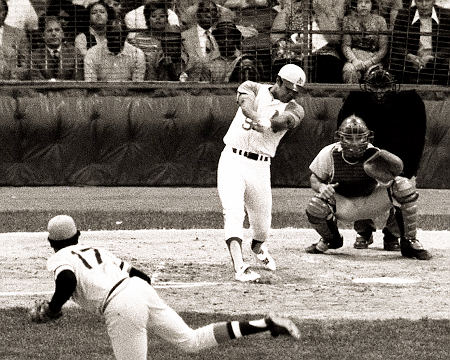
There are some All-Star Game moments that stand out to me more than most. The was Pete Rose plowing over Ray Fosse in the 1970 All-Star Game.

Pete Rose collides with Ray Fosse in the 1970 All Star Game

http://mlb.mlb.com/video/play.jsp?content_id=5766041

I remember reverently casting my ballot at Anaheim Stadium that year, which was the first time that fans voted in for All-Stars since 1957 when after a ballot box stuffing scandal by Cincinnati Red’s fans caused then Major League Baseball Commissioner Ford Frick to end the practice. I still remember taking that paper ballot and putting it in that box and those votes probably were more important than any political ballot that I have cast, at least I felt like my vote mattered.  Of course now the vote early vote often philosophy which has exploded on the internet takes away some of the reverence that I have for the All Star voting process, but at least no-one checks your ID to vote.

In 1971 I remember the massive home run hit by Reggie Jackson off Dock Ellis at Tiger Stadium, the longest home run in the history of the game, a home run that had it not hit a electrical transformer on the roof was calculated as a 532 foot home run.

Reggie Jackson’s massive home run in the 1972 All Star Game

http://mlb.mlb.com/video/play.jsp?content_id=15759689&topic_id=20156278

I remember the 1973 All-Star Game which was the last for Willie Mays, it was his 24th trip to the game, a record that still stands.

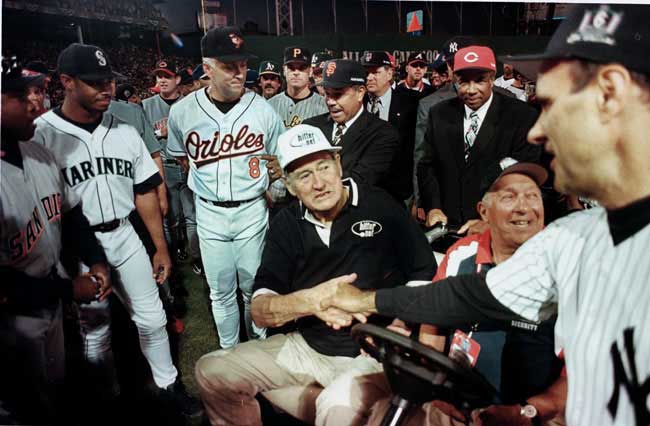
The 1999 All-Star Game at Fenway Park was one that brought tears to my eyes. It was magical as Major League Baseball announced its “All Century Team” including the great Ted Williams.  It was an exceptionally emotional experience for me as I watched many of the living legends who I had seen play as a child walk out onto the field.

Ted Williams at the 1999 All Star Game where the All Century Team was Inducted

http://mlb.mlb.com/video/play.jsp?content_id=5570299

But I think one of the most memorable for me was watching Cal Ripken Jr. in his final All-Star Game when Alex Rodriguez insisted that Ripken start the game at Shortstop where he had played most of his career and when Ripken went yard in his final All-Star Game plate appearance.

Alex Rodriguez pushes Cal Ripken Jr. to Short in the 2001 All Star Game

http://www.youtube.com/watch?v=unF087sArpg

Tonight’s game was played in Kansas City, a town with a remarkable Baseball history especially with the Negro League Kansas City Monarch’s. The Negro Leagues were founded in Kansas City in 1920 and it is the home of the Negro League Hall of Fame. The Athletics played there between their time in Philadelphia and Oakland, and the Royals began as an expansion team in 1969 and opened Kaufman Stadium in 1973. I saw the Royals play for the first time in Anaheim against the Angels.  The Stadium was unique in its era because it was the last non dual-purpose stadium built until Oriole Park and Camden Yards opened in 1991. As such it was and is a beautiful yard and with the renovation completed in 2007 is still among the most beautiful parks in the Major Leagues and there is a seat designated in honor of the late Monarch’s player and manager Buck O’Neil and the home of such greats as Satchel Page.

Buck O’Neil

Tonight  like most All-Star Games I was torn my feelings. Unlike my dad I am not an exclusivist regarding the American or National League. I have favorite teams and players in both leagues. Tonight my Giants have a number of starters on the field including the Starting Pitcher Matt Cain, Catcher Buster Posey, 3rd Baseman Pablo “The Panda” Sandoval and Outfielder Melky Cabrera.  The Giants contingent aided by the ballot stuffing San Francisco Fans dominated the game.

On the other hand the American League had three Orioles on it for the first time in a long time, Closer Jim Johnson, Catcher Matt Wieters and Outfielder Adam Jones. There are future Hall of Famers on the field including Atlanta Braves 3rd Baseman Chipper Jones who is played in his final All-Star Game and got a soft single in the top of the 6th inning.

Chipper Jones 

http://mlb.mlb.com/video/play.jsp?content_id=22978231&source=MLB

Justin Verlander was hit hard giving up 5 earned runs in the top of the 1st and Pablo Sandoval had a bases clearing triple. Joe Nathan of the Rangers pitched the 2nd inning and David Price of the Rays pitched the third while Matt Cain pitched 2 shut out innings and was relieved by Gio Gonzalez of the Cardinals. I hope that the game produces a great moment that will be replayed forever.

Managing the game for the National League is Tony LaRussa the now retired former Manager of the 2011 World Series Champion St. Louis Cardinals. The American League Manager is Ron Washington of the Texas Rangers.

Pablo Sandoval hits a bases clearing Triple off Justin Verlander in the 1st Inning (Photo Getty Images)

http://mlb.mlb.com/video/play.jsp?content_id=22978523&topic_id=34326704

Well the National League won 8-0 led by a home run by Melky Cabrera in the top of the 4th inning. Five of the 8 National League runs were produced by members of the San Francisco Giants.  Cabrera was the Most Valuable Player and Matt Cain got the win.  It was a long night for the American League  especially with the pitchers due to pitch including National’s Stephen Strasburg, Met’s Knuckleballer R.A. Dickey, Dodger’s ace Clayton Kershaw, and three closers, Jonathan Papelbon of the Phillies, Ardolis Chapman of the Reds and Craig Kimbrel of the Braves.  As Earl Weaver said “The only thing that matters is what happens on the little hump out in the middle of the field.”

Peace

Padre Steve+

1 Comment

Filed under Baseball, Batlimore Orioles, sports and life

Sweet 16: Celebrating 16 Years Since My Ordination as a Priest

“Practically speaking, your religion is the story you tell about your life.” Andrew Greeley

It was a quiet celebration of Eucharist with Judy this afternoon at my dinner table. I was wearing a stole that Judy made which has been with me around the world and which I wore throughout my time in Iraq. The chalice was a very simple one that I got in Germany when I was stationed there in 1996-1997. The other elements that I used, the paten and crucifix were those that I used in Iraq, as was the lectionary that the readings came from, which has a cover that Judy made for my travels.

Our dog Molly was at my feet and our Papillon puppy Minnie decided that she needed to stay in Judy’s arms for the duration of the liturgy. This is nothing new, our dogs have pretty much been there any time that we have had a home Eucharist. Frieda, our Wire Hair Dachshund I’m sure was a lapsed Bavarian Catholic who if she attended was passed out. Greta our red smooth hair Dachshund would always be with us, but usually would be asleep next to Judy. Molly just likes to be with daddy and this was Minnie’s first Mass. Minnie made us laugh when she tried to get into the chalice as I gave it to Judy, but thankfully she did not succeed.

My service as a priest has been exclusively as a military Chaplain, first in the Army and since 1999 in the Navy. I have not yet had to opportunity to serve in a civilian parish though I have on occasion assisted fellow priests at their parishes. My current assignment is a hospital and most of my duties are related to patient care or staff support. Thus when I am home in Virginia I attend St. James Episcopal Church in Portsmouth where I first started attending while serving at the Naval Medical Center in the midst of my crisis of faith. I love that little parish which has its roots in the former slaves and freedmen of the city.  Down here at the Island Hermitage I have not found that place where I feel at home so on weekends that I am here I typically will do the daily office and Eucharist at home.

So my parish is wherever I serve as a chaplain but in a sense my readers are an extended part of my parish. Father Andrew Greeley wrote:

“I wouldn’t say the world is my parish, but my readers are my parish. And especially the readers that write to me. They’re my parish. And it’s a responsibility that I enjoy.”

I get notes from people on this site quite often who have experienced the pain of spiritual abuse, trauma from various sources and who have experienced a crisis in faith or lost their faith. I hear from others that have been ostracized by their churches for various reasons. They write in response to articles that I have written about my own crisis of faith following my time in Iraq and struggle with the demons of PTSD. It was a time where I felt abandoned by God and the church. I found that churches can be painful places as often as they become places of healing. Having been asked to leave the denomination that ordained me in September 2010 as I began to recover faith after spending nearly two years struggling I understand that pain. But I agree with Jurgen Moltmann who said of his experiences in World War II and its aftermath “Christ’s own ‘God-forsaken-ness’ on the cross showed me where God is present where God had been present in those nights of deaths in the fire storms in Hamburg and where God would be present in my future whatever may come.”

Today was nice. We spent time together and after the scripture readings and before the Eucharist we simply talked about the journey and how different things are now than when I was ordained. The world has changed and so have we. War does that.

I have been thinking a lot this week about this and how blessed I am to be a priest and chaplain. I am blessed by people who taught me, mentored me and cared for me throughout my journey. I am blessed to still be able to serve God’s people and my church even as I serve those that serve this country in the military.  I try to remember as Andrew Greeley wrote in one of his Bishop Blackie Ryan mysteries that:

“Every sacramental encounter is an evangelical occasion. A smile warm and happy is sufficient. If people return to the pews with a smile, it’s been a good day for them. If the priest smiles after the exchanges of grace, it may be the only good experience of the week.”  (The Archbishop in Andalusia p.77)

This week I was humbled when one of my old shipmates from my time on the USS Hue City posted a comment on my Facebook page about the impact that I had made in his life about 10 years ago.  The week was supposed to be a bit relaxing but I spent a good amount of it dealing with the tragic suicide of one of our Corpsmen who worked at one of our hospital clinics.  I will continue to be working with that situation this week and would appreciate your prayers.

We also had our tankless water heating system go out and have been shuttling in to the base to take showers at the hospital locker room. Hopefully the maintenance man has the new component tomorrow. As it is I will be going in to work very early to PT and shower before my first meeting and what promises to be a very busy day as we prepare a memorial service and care for our shipmates.

Judy came to North Carolina this week and leaves tomorrow. Molly as usual will remain with me and Minnie after a wonderful week of growing up is going back to Virginia with Judy.  It has been, excepting the oppressive heat, humidity and lack of hot water for showers been an enjoyable time together. We were able to have dinner last night with our friends from Kinston, Jerry, Toni and Cara in New Bern.

Since tomorrow will be a very early start I will close.

Anyway, grace and peace,

Padre Steve+

1 Comment

Filed under christian life, faith, Pastoral Care, Religion

The Miscalculations of July

The Assassination of Archduke Franz Ferdinand 

“War is the unfolding of miscalculations.” Barbara Tuchman

Sometimes I miss the Cold War and the ever constant threat of Nuclear annihilation.  Not that I looked forward to getting nuked and having the world blown out from under us, but back in those days it was pretty much for sure that the United States and Soviets would keep their missiles in their silos no matter how much they jibber-jabbered. Things did get awfully sporting during the Cuban Missile Crisis and during the 1973 Yom Kippur War but cooler heads prevailed. Yes there were incidents but we survived. We fought proxy wars and helped despots that we liked while the Soviets did the same. There was an air of predicability as both sides restrained their client states. Those were the days, we only really had to worry about two sides keeping things under control. Yes, those were the days… not really but compared to now I wonder.

Now, it seems that the shit is really starting to hit the fan all over the world, especially in the Middle East, Southwestern and Central Asia and even Europe. As day does into day it is hard to keep track of all the boiling cauldrons of hatred and misery and the vast numbers of political, religious, military, economic and ideological “leaders” that pour gasoline on the fires that stoke them. While I cannot definitively predict exactly where the disaster of war will begin or what the reasons that men will justify it; I do know that whenever, wherever and for whatever reasons it will be because of a failure of political, religious, military and economic leaders to prevent it. Abba Eban said “History teaches us that men and nations behave wisely once they have exhausted all other alternatives.”

*Iran continues to threaten to close the Straits of Hormuz and unleash missiles on neighboring countries and Israel. 

*Israel is making plans for pre-emptive wars in Iran and Lebanon.

*The EU Oil Embargo on Iran has gone into effect.

*In Lebanon Hezbollah, the proxy army of Iran has made major strides in its ability to strike Israel and border skirmishes are now occurring between Israeli forces, Hezbollah fighters and even the Lebanese Army. 

*Syria’s Assad dictatorship is killing vast numbers of its own people and violence from its civil war is spreading to Lebanon. 

*Turkey has reinforced its borders with Syria after one of its aircraft was shot down by Syrian forces. 

*The United States sends additional naval and air forces to the Persian Gulf while maintaining a strong ground force in Kuwait. 

*Iraq, still beset by sectarian violence and undermined by Iranian agents is unable to maintain its traditional role as a balance to the Persians. 

*In Egypt a government led by the Muslim Brotherhood has taken power and threatens to end the peace with Israel even as they contend with the still powerful Egyptian military, and more secularist Egyptians for control of the country. 

*The United States and NATO are bogged down in a war in Afghanistan that cannot be won and works with a government that cannot be trusted and a military whose members are killing more NATO troops than actual “enemy” forces.

*Pakistan teeters on the brink and supports Taliban and Al Qaida forces even as the United States wages a clandestine war against those forces ensconced in their Pakistan bases. 

*The United States fights a drone war in Yemen as that country’s military fights Al Qaida Yemen forces, forces that are now more capable of harming the United States and its interests than those based in either Afghanistan or Pakistan. 

*Violence in the Horn of Africa spread by the Al Shabaab terrorist network threatens to spill over into neighboring countries. 

*In Nigeria Moslem extremists burn Christian churches and threaten that country’s oil production and economy. 

*European nations stand on the brink of disorder and anarchy should nations begin to default on their debts and abandon the Euro. 

*Simmering long term disputes in the Balkans continue to cause worry about more war and instability.

*Fascist political parties and movements are gaining momentum throughout Europe, especially in Eastern Europe.

*Leaders of all of nations make bellicose statements meant to stoke the passions of their most zealous political supporters often invoking apocalyptic visions of the future.

*Other leaders attempt to maintain a precarious balance in order to ride out the wave of change, hatred and discontent sweeping the Middle East and Europe.

*Religious and political leaders do their best to demonize anyone that does not agree with them or their version of “the truth.” 

*The war profiteers sell arms in abundance to every side to maximize their profits by legal and illegal sales and transfers.

I could keep going but the point is that eventually someone is going to miscalculate in one or more of these conflicts or situations and events will take on a life of their own. Leaders will commit themselves to wars that they think that they will be able to manage and like 1914 things will go horribly wrong. The hatreds of peoples, many which go back hundreds of years will spill out against their neighbors.  Martin Luther said “War is the greatest plague that can affect humanity; it destroys religion, it destroys states, it destroys families. Any scourge is preferable to it.”  Unfortunately it seems that we are heading down a path that will bring great suffering and misfortune all because of all types of leaders who are willing to take a chance on war rather than to do the hard work of peace. Confederate General Robert E Lee wrote about the American Civil War “The war…was an unnecessary condition of affairs, and might have been avoided if forbearance and wisdom had been practiced on both sides.” 

I wonder if any of the leaders now waging war or preparing for war will say the same when the coming wars are over, or if they will find words to justify the suffering that they have inflicted on millions of people. I imagine that it will be the latter.

Peace

Padre Steve+

1 Comment

Filed under History, middle east, national security, Political Commentary

Protecting the Ideal: Reflections on Gettysburg, Freedom and Why It Matters

I have spent this week writing about the Battle of Gettysburg which happens to fall in the days before the celebration of our Declaration of Independence. This week on the 149th Anniversary of Pickett’s Charge at the Battle of Gettysburg washed up rocker and now political activist Ted Nugent wrote in the Washington Times “I’m beginning to wonder if it would have been best had the South won the Civil War.”  I find his remark appalling and disgraceful but I have come to expect such comments from him and and others who voice similar sentiments.

When I hear such sentiments and they are many now days I think of men like Joshua Chamberlain. Chamberlain was a college professor who served in the Union Army and won fame and the Medal of Honor for the defense of Little Round Top at Gettysburg. There is a quote from the film Gods and Generals which I think about when I hear anyone suggesting that it would have been better for the Confederacy to have won the war:

“Now, somewhere out there is the Confederate army. They claim they are fighting for their independence, for their freedom. Now, I can not question their integrity. I believe they are wrong but I can not question it. But I do question a system that defends its own freedom while it denies it to an entire race of men. I will admit it, Tom. War is a scourge, but so is slavery. It is the systematic coercion of one group of men over another. It has been around since the book of Genesis. It exists in every corner of the world, but that is no excuse for us to tolerate it here when we find it right in front of our very eyes in our own country. As God as my witness, there is no one I hold in my heart dearer than you. But if your life, or mine,is part of the price to end this curse and free the Negro, then let God’s work be done.”

There is a spot near the Copse of Trees along Cemetery Ridge which is referred to as the “High Water Mark of the Confederacy.” It is the spot close to where Confederate Brigadier General Lewis Armistead fell mortally wounded as the decimated remains of his command were overwhelmed by Union forces shortly after they breached the Union line. It is a place immortalized in history, literature and film. It is the place that marked the beginning of the end for the great evil of slavery in America.

My ancestors lived in Cabell County which in 1861 was part of Virginia. They were slave holders along the Mud River, a tributary of the Ohio River just to the north of what is now Huntington West Virginia. When war came to the country the family patriarch James Dundas and my great, great grandfather joined the 8th Virginia Cavalry Regiment in which he served the bulk of the war as a Lieutenant.  When it ended he refused to sign the loyalty oath to the Union and had his lands, which are now some of the most valuable in that part of West Virginia confiscated and sold by the Federal Government.  He was a believer in the “Lost Cause” that romantic and confused idea about the rightness of the South in its war against what they called “Northern aggression.”

Because he served I am eligible for membership in the Sons of the Confederacy. However it is something that I cannot do.  There are some that do this as a means to honor their relatives that served in the war and I do not make light of their devotion to their family, but there are some that take that devotion to places that I cannot go.  As much as I admire the valor and personal integrity of many military men who served the Confederacy I cannot for a moment think that their “cause” was just.

It has been said that the North won the war but that the South won the history.  I think this is true. Many people now days like to reduce the reasons for the war to the South protecting its rights.  Sometimes the argument is “states rights” or “economic freedom” and those that make these arguments romanticize the valor shown by Confederate soldiers on the battlefield but conveniently ignore or obscure the evil of the Southern economic system.

The “rights” and the “economic freedom” espoused by those that led the secession and that are lamented by those like Nugent were based upon the enslavement and exploitation of the Black man to maintain an archaic economy based on agriculture, particularly the export of King Cotton.  Arguments which try to place the blame on the North, especially arguments that attempt to turn the Northern States into economic predators’ intent on suppressing the economic rights of Southerners only serve to show the bankruptcy of the idea itself. The fact that the “economic and political freedom” of Southerners was founded on the enslavement of a whole race of people matters not because the “cause” is greater.

The fact is that the longer the South relied solely on its agriculture which was supported by the institution of slavery it deprived itself of the means of economic progress, the same progress that propelled the North to prosperity. The south lagged in all industrial areas as well as transportation infrastructure. The majority of non-slave owning whites lived at the poverty line and only enjoyed some elevated social status because the slaves ranked beneath them on the sociological and economic hierarchy.  The South depended on cheap imports from England, which then was still considered an enemy of the country. When tariffs to protect newly establish American industries were enacted in 1828 South Carolina attempted to nullify the Federal law even raising troops and threatened a revolt in 1832.

The Southern economic system was immoral and antiquated. It enslaved blacks and it impoverished most rural Southerners, with the exception of those that owned the land and the slaves. It was a hateful, backward and loathsome system which even the southern churches attempted to justify from Scripture.  Southern Baptists, Methodists and Presbyterians would all break away from their parent denominations regarding slavery.

This does not mean that I think that the average Confederate soldier or officers were dishonorable men. Many officers who had served in the United States Army hated the breakup of the Union but served the South because it was the land that they were from. It was the home of their families and part of who they were.  To judge them as wanting 150 years later when we have almost no connection to family or home in a post industrial world is to impose the standards of a world that they did not know upon them. For those that gave up everything to serve one can feel a measure of sympathy.  So many died and so much of the South was destroyed in the defense of that “cause” one has to wonder just why the political and religious leaders of the South were willing to maintain such an inadequate and evil economic system one that hurt poor Southern whites nearly as much as it did blacks.

The war devastated the South and the radicals that ran “Reconstruction” ensured that Southerners suffered terrible degradation and that Southern blacks would have even more obstacles raised against them by the now very angry and revengeful whites.  It would take another 80-100 years to end segregation and secure voting rights for blacks. Thus I have no desire to become part of an organization that even gives the appearance of supporting the “cause” even if doing so would allow me to “honor” an ancestor who raised his hand against the country that I serve.

I was raised on the West Coast but have lived in the South much of my adult life due to military assignments. I have served in National Guard units that trace their lineage to Confederate regiments in Texas and Virginia. Despite my Confederate connections both familial and by service I can find little of the romance and idealism that some find in the Confederacy and the “Lost Cause.” I see the Civil War for what it was, a tragedy of the highest order brought about by the need of some to enslave others to maintain their economic system.

Today there are many that use the flags of the Confederacy outside of their historic context. They are often used as a symbol of either racial hatred or of defiance to the Federal Government by white Supremacist or anti-government organizations.  Many that use them openly advocate for the overthrow of the Federal Government.  The calls for such “revolt” can be found all over the country even in the halls of Congress much as they were in the 1830s, 40s and 50s. Some of this is based in libertarian economic philosophy which labels the government as the enemy of business, some based social policies which are against their religious beliefs and some sadly to say based in an almost xenophobic racial hatred.  The scary thing as that the divisions in the country are probably as great as or greater than they were in the 1850s as the country lurched inexorably to Civil War with neither side willing to do anything that might lessen their political or economic power even if it means the ruin of the country.

As seems to be the case around this time of year I have seen the symbols of the Confederacy, particularly the Battle Flag displayed in manners that can only be seen as symbols of defiance.  Wednesday was July 4th and it seems to me that the flag that should be most prominently displayed is the Stars and Stripes not the Confederate Battle flag or even the Gadsen Flag which has become the symbol of the modern Tea Party movement.  Somehow I find the flag flown in rebellion to the country that I serve displayed in such an arrogant manner.

For people like the Federal Government which is the enemy. Now I know that our system of government has its flaws. Likewise I cannot agree more about the corruption of many in political office, regardless of their political allegiance.  While it is true that the Federal Government has taken upon itself many powers some never envisioned by those that crafted the Constitution, it has done so because leaders of both political parties have consented to it and even worked to strengthen the Federal Government with the consent of the American people that elect them again and again.

Despite this much of this has been accomplished by the Federal Government has been for the good for the country and people no matter what the critics say. Many of the things that we enjoy today are the result of the work of the Federal Government and not business as much as those that deify big corporations want to believe. There are the National Parks, laws against child labor and for safe workplaces brought about by Teddy Roosevelt, the infrastructure built in the 1930s and 1940s by the Franklin Roosevelt administration. The Roosevelt administration also brought about Social Security and banking regulations to protect Americans from corporations and banks that violated the public trust. The Eisenhower administration began the Interstate Highway system which is the backbone of our transportation system.  Likewise the Space Program and yes even the military have led the way in technological, scientific and medical innovation including that thing that we all take for granted today the Internet.

Today quite a few people are calling for revolt or secession if they do not get what they want be it socially, politically or economically. For years politicians on both sides have fought to minimize such talk and enact compromises with the usual discontent that comes with compromise.  Unfortunately many of those compromises have had the effect of widening the political divide much as the various compromises on the road to the Civil War.  Jefferson said of the Missouri Compromise of 1824: “but this momentous question, like a fire bell in the night, awakened and filled me with terror. I considered it at once as the knell of the Union. It is hushed indeed for the moment, but this is a reprieve only, not a final sentence. A geographical line, coinciding with a marked principle, moral and political, once conceived and held up to the angry passions of men, will never be obliterated; and every new irritation will mark it deeper and deeper.”

We have allowed the issues of our time to become a fire of unbridled angry passion where those with almost no historical understanding and whose history is often based on myth stake claims and promote ideas that will destroy this Union if they continue. Unfortunately we have not yet reached the high water mark of this movement yet and I fear like Jefferson that the hatred and division will only grow worse as both radical on the right and left prepare for conflict.

This week we celebrated the 236th anniversary of our Declaration of Independence.  It is a remarkable occasion. It is the anniversary that free people as well as those oppressed around the world look to as a beacon of liberty. It has been paid for time and time again, especially during that cruel Civil War which killed more American soldiers than any other war that we have fought.

A few months after Gettysburg Abraham Lincoln a man much reviled by those that have romanticized the Cause and who is demonized by many “conservative” politicians and pundits today as a “tyrant” made these brief remarks at the site of the battle:

Four score and seven years ago our fathers brought forth on this continent, a new nation, conceived in Liberty, and dedicated to the proposition that all men are created equal.

“Now we are engaged in a great civil war, testing whether that nation, or any nation so conceived and so dedicated, can long endure. We are met on a great battlefield of that war. We have come to dedicate a portion of that field, as a final resting place for those who here gave their lives that that nation might live. It is altogether fitting and proper that we should do this. But, in a larger sense, we cannot dedicate—we cannot consecrate—we cannot hallow—this ground. The brave men, living and dead, who struggled here, have consecrated it, far above our poor power to add or detract. The world will little note, nor long remember what we say here, but it can never forget what they did here. It is for us the living, rather, to be dedicated here to the unfinished work which they who fought here have thus far so nobly advanced. It is rather for us to be here dedicated to the great task remaining before us—that from these honored dead we take increased devotion to that cause for which they gave the last full measure of devotion—that we here highly resolve that these dead shall not have died in vain—that this nation, under God, shall have a new birth of freedom— and that government of the people, by the people, for the people, shall not perish from the earth.”

Today with so many radicals on both the political right and political left doing all that they can to plunge us into yet another civil war we should remember Lincoln’s word and rededicate ourselves to this Union, this remarkable Union.  Tony Blair the former Prime Minster of Great Britain remarked last year:

“It may be strange for a former British Prime Minister to offer thoughts on America when the country will be celebrating its independence from Britain. But the circumstances of independence are part of what makes America the great and proud nation it is today. And what gives nobility to the American character.

That nobility isn’t about being nicer, better or more successful than anyone else. It is a feeling about the country. It is a devotion to the American ideal that at a certain point transcends class, race, religion or upbringing. That ideal is about values, freedom, the rule of law, democracy. It is also about the way you achieve: on merit, by your own efforts and hard work.

But it is most of all that in striving for and protecting that ideal, you as an individual take second place to the interests of the nation as a whole. This is what makes the country determined to overcome its challenges. It is what makes its soldiers give their lives in sacrifice. It is what brings every variety of American, from the lowest to the highest, to their feet when “The Star-Spangled Banner” is played.

Of course the ideal is not always met – that is obvious. But it is always striven for.

The next years will test the American character. The world is changing. New powers are emerging. But America should have confidence. This changing world does not diminish the need for that American ideal. It only reaffirms it.”

I think that the Prime Minister got it right and Ted Nugent is an ignorant fool but he has the right to be one.

Peace

Padre Steve+

Leave a comment

Filed under civil war, History, Political Commentary

Four Score and Seven: July 4th at Gettysburg

“Dead men and plenty here – and I saw plenty [3] of them in all shapes on the field – Help to wound & Kill men then Patch them up I could show more suffering here in one second than you will see in a Life…” Elbert Corbin, Union Soldier at Gettysburg 1st Regiment, Light Artillery, N. Y. S. Volunteers (Pettit’s Battery)

“In great deeds something abides. On great fields something stays. Forms change and pass; bodies disappear, but spirits linger, to consecrate ground for the vision-place of souls.” Colonel Joshua Lawrence Chamberlain

The Army of Northern Virginia and Army of the Potomac remained on the bloodstained Gettysburg battlefield on July 4th 1863. Both armies had suffered severely in the fighting around 50,000 soldiers from both sides lay dead, dying or wounded on the battlefield. Surgeons and their assistants manned open air hospitals while parties of stretcher bearers evacuated wounded men for treatment and other soldiers began to identify and bury the dead.  Halfway across the continent Confederate Lieutenant General John C Pemberton surrendered his emaciated forces at Vicksburg to Major General Ullysses S Grant which cut the Confederacy in half. It was a fitting day of remembrance as it was the 87th anniversary of the signing of the Declaration of Independence, and the significance was not lost on any of the commanders.

It was a somber day, the sweltering heat sunshine which had bathed the battlefield as Longstreets’ Corps Corps attacked Cemetery Ridge was broken by heavy rain and wind. The commanders of both armies, General Robert E Lee and Major General George Mead attempted to discern the others intent while making their own plans. It was Lee’s hope that Meade would attack and possibly give him the opportunity to inflict a defeat on the Union forces.  Meade, still new to command and cautious did not renew the engagement and Lee began to withdraw the battered Army of Northern Virginia from the field.

As Lee withdrew Meade slowly pursued and lost a chance at trapping the Confederate Army before it could escape across the rain swollen Potomac River.  Lee completed his withdraw under pressure on the 14th and his rear-guard under the command of Major General Harry Heth fought an action against Union forces at the in which the accomplished academic and author Brigadier General James Pettigrew was mortally wounded.

Meade’s lackluster pursuit was criticized by many including President Lincoln who believed that had Meade been more aggressive that the war could have ended there. Had Lee’s army been destroyed in little over a week after the surrender of Vicksburg it could have well brought about the downfall of the Confederacy in the summer of 1863.  Even so the skill of Meade in defeating Lee at Gettysburg was one of the greatest achievements by a Union commander during the war in the East.  In earlier times Lee had held sway over his Federal opponents. McClellan, Porter, Pope, Burnside and Hooker had all failed against Lee and his army.

Many of the dead at Gettysburg were the flower of the nation. Intelligent, thoughtful and passionate they were cut down in their prime. The human cost some of over 50,000 men killed or wounded is astonishing. In those three days more Americans were killed or wounded than in the entire Iraq campaign.

The war would go on for almost two more years adding many thousands more dead and wounded. However the Union victory at Gettysburg was decisive. Never again did Lee go on the offensive and when Grant came East at the end of 1863 to command Union armies in the East against Lee the Federal armies fought with renewed ferocity and once engaged Grant never let Lee’s forces out of their grip.

In November 1863 Lincoln travelled to Gettysburg to dedicate a cemetery and commemorate the dead. He penned a short speech which still echoes in the hearts of Americans as one of the greatest tributes ever spoken. His Gettysburg Address is a speech that still calls Americans to the cause of freedom and the to remember the great cost of liberty with renewed passion.

“Fourscore and seven years ago our fathers brought forth on this continent a new nation, conceived in liberty and dedicated to the proposition that all men are created equal. Now we are engaged in a great civil war, testing whether that nation or any nation so conceived and so dedicated can long endure. We are met on a great battlefield of that war. We have come to dedicate a portion of that field as a final resting-place for those who here gave their lives that that nation might live. It is altogether fitting and proper that we should do this. But in a larger sense, we cannot dedicate, we cannot consecrate, we cannot hallow this ground. The brave men, living and dead who struggled here have consecrated it far above our poor power to add or detract. The world will little note nor long remember what we say here, but it can never forget what they did here. It is for us the living rather to be dedicated here to the unfinished work which they who fought here have thus far so nobly advanced. It is rather for us to be here dedicated to the great task remaining before us–that from these honored dead we take increased devotion to that cause for which they gave the last full measure of devotion–that we here highly resolve that these dead shall not have died in vain, that this nation under God shall have a new birth of freedom, and that government of the people, by the people, for the people shall not perish from the earth.”

Peace

Padre Steve+

1 Comment

Filed under civil war, History

Gettysburg Day Three: The Tragedy of Friends at War; Lewis Armistead and Winfield Scott Hancock

“Armistead at Gettysburg” by Keith Rocco

The bonds of friendship forged by soldiers are some of deepest and long lasting that are formed anywhere.  Those bonds are formed by military professionals in the small rather closed society that is the regular United States military over years of deployments, isolated duty, combat and a culture that is often quite different than that of civilian society.

When the people of a nation goes to war against each other the military is often the last to split and when it does men that were friends and comrades turn their weapons against each other and seldom with pleasure. Mass levies of civilian volunteers motivated by ideological, sectional or religious hatred tend to take up such causes with great aplomb. But those that serve together, even those that may believe in their cause are often torn between oaths that they swore to defend their country and their family and home. When their decisions are made they often part with great sadness knowing that they could one day meet each other on a battlefield.

The American Civil War has many such tales. One of the most remembered due to it being a key story line in Michael Shaara’s Pulitzer Prize winning novel The Killer Angels is that of Union General Winfield Scott Hancock and Confederate General Lewis Armistead. This friendship was immortalized in the movie Gettysburg which is based on Shaara’s novel.

Major General Winfield Scott Hancock USA

Hancock was from Pennsylvania was a career soldier and Infantry officer, a graduate of West Point Class of 1844. He served in Mexico and held numerous positions and in 1861 he was stationed in California as a Quartermaster under the command of Colonel (Brevet Brigadier General) Albert Sidney Johnston. One of his fellow officers, who he and his wife Almira became fast friends with was Captain Lewis Armistead, a twice widowed Virginian who also served as a commander of the New San Diego Garrison under Johnston’s command. Armistead was a nephew of the officer who defended Fort McHenry from the British in the War of 1812, a battle which occasioned Francis Scott Key to pen the Star Spangled Banner.  Armistead had academic difficulties at West Point and also had an altercation with Jubal Early in which he broke a plate over Early’s head.  His father helped him obtain a commission as an Infantry officer and his career was similar to many other officers of his day, Mexico, the Great Plains, Kansas, Utah and California.

As the war clouds built and various southern states seceded from the Union numerous officers were torn between their oath, their friendships with their fellow officers and their deep loyalty to their home state and families even if they personally opposed secession. In the end it was a decided minority of of Southern born officers that remained loyal to the Union, the most prominent of these men were General Winfield Scott and Major General George Thomas, the Rock of Chickamauga. Thomas’s action cost him his relationship with his immediate family who deemed him to be a traitor. Both men were pilloried and demonized in the most base ways by many in the South, during and after the war. Some Southerners who served the Union were executed when captured, George Pickett, who called for Thomas’ death ordered 22 North Carolinians captured fighting for the Union in Kinston North Carolina and he was not alone.

Brigadier General Lewis Armistead CSA

Armistead and other officers asked Hancock, who was a Democrat advice on what he would do if war came. Hancock’s reply was simple. I shall not fight upon the principle of state-rights, but for the Union, whole and undivided” 

The Hancock’s hosted a going away party for their friends departing from the service to join the Confederacy. Almira Hancock wrote that “Hearts were filled with sadness over the surrendering of life-long ties.”with the Johnston’s wife Eliza singing the popular Irish song Kathleen Mavourneen:

“Mavourneen, mavourneen, my sad tears are falling, To think that from Erin and thee I must part!

It may be for years, and it may be forever, Then why art thou silent, thou voice of my heart?…”

Armistead was tearful and said “Hancock, good-by; you can never know what this has cost me, and I hope God will strike me dead if I am ever induced to leave my native soil, should worse come to worse.”

At Gettysburg Armistead spoke his fears to his comrades, including Brigadier General Dick Garnett, another of his comrades from the California days as they met the night before the fateful charge of July 3rd. The next afternoon Armistead and Garnett led their brigades of Pickett’s Division against Hancock’s II Corps which was defending Cemetery Ridge.

During the engagement Garnett was killed just before reaching the Union lines and Hancock gravely wounded. Armistead, leading his brigade breached the Union line with his black hat atop his sword was wounded in the right arm and shoulder and fell near one of the Union artillery pieces, a point now known as “The High Water Mark” of the Confederacy.  As Armistead lay wounded he was approached by Major Bingham of Hancock’s staff who was responding to Armistead’s making a Masonic sign of distress. When Bingham told Armistead of Hancock’s injury Armistead was grieved and told Bingham to “Tell General Hancock for me that I have done him and you all an injury which I shall regret the longest day I live.” He gave Bignham a wrapped Bible and Prayer book to give to Almira Hancock, inscribed were the words “Trust in God and fear nothing.” 

“Minnesota Forward” Hancock directing the Defense by Dale Gallon

Armistead would die from infections caused by his wounds which were initially not thought to be life threatening. Hancock would go on to continued fame and be one of the most admired and respected leaders of the Army during and after the war. He was gracious as a victor and spoke out against reprisals committed against Southerners after the war. He was the Democratic nominee for President losing a close election to James Garfield, losing the popular vote by under 40,000 votes.  It was an era of great political corruption and Hancock was one of the few major public figures Even his political opponents respected him for his integrity and honesty. Former President Rutherford B Hayes said “[i]f, when we make up our estimate of a public man, conspicuous both as a soldier and in civil life, we are to think first and chiefly of his manhood, his integrity, his purity, his singleness of purpose, and his unselfish devotion to duty, we can truthfully say of Hancock that he was through and through pure gold.” 

A few years after his death Republican General Francis A Walker, lamenting the great corruption of the time said:

“Although I did not vote for General Hancock, I am strongly disposed to believe that one of the best things the nation has lost in recent years has been the example and the influence of that chivalric, stately, and splendid gentleman in the White House. Perhaps much which both parties now recognize as having been unfortunate and mischievous during the past thirteen years would have been avoided had General Hancock been elected.”

The story of Hancock and Armistead is one that reminds us of how hardened ideologues can divide a nation to the point of civil war. It is a story that should give pause to any political or spiritual leader that incites people to war against their neighbor and use their ideology to enslave or brutalize their political opponents.

The blood of the approximately 50,000 soldiers that were killed or wounded during the three days of the Battle of Gettysburg is ample reminder of the human suffering brought about by unrestrained ideologues.

Peace

Padre Steve+

8 Comments

Filed under civil war, History

Gettysburg Day Two: The Engineer and the Professors on the Hill, Major General Gouverneur Warren and Colonels Strong Vincent and Joshua Chamberlain

The Confederate Onslaught

“In great deeds, something abides. On great fields, something stays. Forms change and pass; bodies disappear; but spirits linger, to consecrate ground for the vision-place of souls… generations that know us not and that we know not of, heart-drawn to see where and by whom great things were suffered and done for them, shall come to this deathless field, to ponder and dream; and lo! the shadow of a mighty presence shall wrap them in its bosom, and the power of the vision pass into their souls.” ― Joshua Lawrence Chamberlain

The Federal Army at Gettysburg had a wide variety of officers. Many senior officers were graduates of West Point but in the expansion of the Army and the call of up militia from the various states other officers were appointed. Many had no prior military service and at times that lack of experience was tragic. However some of the time those volunteers were the men who by their service helped save the Union.

On July 2nd 1863 the situation at Gettysburg was precarious. Robert E Lee had ordered an attack to seize a hill at the far end of the Federal line, Little Round Top and turn the Union flank. General Meade had ordered III Corps under Major General Dan Sickles to extend it’s line to defend the southern section of his line on Cemetery Ridge. Unfortunately Sickles moved his Corps several hundred yards west forming a vulnerable salient at the Peach Orchard leaving the southern flank undefended.

Major General Gouverneur Warren

When Meade saw the developing situation he sent his Chief Engineer, Major General Gouverneur Warren to take charge of the situation. When Warren arrived he found the hill undefended and he dispatched staff officers to get assistance from any units in the area. Major General George Sykes of V Corps responded sending a messenger to the commander of his 1st Division. The messenger encountered the commander of the division’s 3rd Brigade Colonel Strong Vincent who immediately took the initiative and ordered his four regiments up Little Round Top without waiting for permission.

Warren at Little Round Top

Vincent placed and his regiments arrived in a nick of time. He deployed his regiments, along the spur running to the south if the top of the hill. The 16th Michigan on the right with the 44th New York, 83rd Pennsylvania at his center and the 20th Maine under the Command of Colonel Joshua Chamberlain on the extreme left of the line. His order to Chamberlain was ordered to “hold at all costs.” Chamberlain led his regiment skillfully and when nearly out of ammunition led a charge down the slope of Little Round Top which ended the Confederate chances of gaining the hill and turning the flank of Meade’s Army.

Warren was a West Point graduate and had been a topographical engineer for most of his pre-war career and saw combat against the Sioux at the Battle of Ash Grove in 1855. When the war began Warren was a mathematics instructor at West Point. He helped raise a militia regiment in New York and was appointed to Lieutenant Colonel. As a regimental commander and later brigade commander he saw much combat and was wounded at the Battle of Gaines Mill during the Seven Days.  When the Army was reorganized in February 1863 he was named Chief Engineer of the Army of the Potomac by Major General Joseph Hooker. When Major General Meade relieved Hooker on June 28th he retained Warren.

The 26 year old Colonel Strong Vincent

Colonel Strong Vincent was a 26 year old Harvard graduate and lawyer from Erie Pennsylvania. He was appointed as a 1st Lieutenant and Adjutant of the Erie Regiment and married his wife Elizabeth the same day.  He wrote her before his death “If I fall, remember you have given your husband to the most righteous cause that ever widowed a woman.”  He was commissioned as a Lieutenant Colonel in the 83rd Pennsylvania September 14th 1861and assumed command of the regiment when the commander was killed during the Seven Days in June of 1862. He commanded the regiment at Fredericksburg in December 1862 and was promoted to command the 3rd Brigade when its commander was killed at Chancellorsville in May 1863.

Major General Joshua Chamberlain

Colonel Joshua Chamberlain was a graduate of Bowdoin College and Bangor Theological Seminary, fluent in 9 languages other than English. He was Professor of Rhetoric at Bowdoin before seeking an appointment in a Maine Regiment without consulting either the college or his family. He was offered command of the 20th Maine but asked to be appointed as a Lieutenant Colonel which he was in August 1862. He fought at Fredericksburg and was named commander of the regiment when Colonel Ames, his commander was promoted following Chancellorsville.

“Don’t Give and Inch!”

The battle of Little Round Top is one of the most famous of all Civil War battles and Chamberlain along with Vincent are immortalized in the film Gettysburg which is based on Michael Shaara’s Pulitzer Prize winning novel The Killer Angels. Vincent was mortally wounded while leading the defense of the hill standing on a large boulder with a riding crop ordering the men of the 16th Michigan who were beginning to waiver “don’t give an inch.” Two months later his wife gave birth to a baby girl. The baby would not live a year and was buried next to him

Warren would become a distinguished Corps commander until he ran afoul of the fiery General Phillip Sheridan in 1865. Sheridan relieved Warren of command of V Corps following the Battle of Five Forks where Sheridan believed that Warren’s Corps had moved too slowly in the attack. The relief was brutal and ruined his career.  Warren resigned his commission as a Major General after the war and returned to his permanent rank as a Major of Engineers. He served another 17 years doing engineering  duty being promoted to Lieutenant Colonel in 1879. He sought a Court of Inquiry to exonerate himself but this was refused until President Grant left office. The Court eventually exonerated him but he died before the results were published. Embittered he directed that he be buried in civilian clothes and without military honors.

Chamberlain was awarded the Medal of Honor for his valor at Little Round Top in 1893. He was gravely wounded during the siege of Petersburg in June of 1864 while commanding a brigade and promoted to Brigadier General. He returned to duty later in the year as commander of the 1st Brigade, 1st Division V Corps and was again wounded at Petersburg in a skirmish at Quaker Road and was promoted to Brevet Major General by Abraham Lincoln. Chamberlain received the surrender of Lee’s decimated Army if Northern Virginia. He would go on to serve as a four term Governor of Maine and remained active with the Grand Army of the Republic veteran’s organization, remained active as an educator and President of Bowdoin College and founded the Maine Institute for the Blind which is now known as the Iris Foundation. He died of his wartime wounds on February 24th 1914.

These three men acted with great courage and alacrity on the afternoon of July 2nd 1863. Warren for his immediate action to call for assistance when he discovered that the hill was undefended and the line exposed, Vincent for his swift taking of responsibility and getting his brigade up the hill before the Confederates could gain the summit and Chamberlain for his dogged refusal to yield against repeated assaults. Only one of the three, Warren was a professional soldier but as a topographic engineer he was an outsider and not fully appreciated by Grant or Sheridan who destroyed his career. The youthful Vincent died of his wounds days after the battle. He was recommended for promotion to Brigadier General by Meade but the promotion was never confirmed by the Senate and Chamberlain is still one of the revered commanders of the Civil War.

It is easy for those enamored with military history to forget the stories behind the men that fought the battles of war. It is easy to isolate and analyze a commander’s actions in battle and ignore the rest of their lives.  I think that this does a great disservice to the men themselves. I say this because everyone who serves in the military has their reasons, some more noble than others and likewise everyone who dons the uniform in time of war gives up something of themselves and sometimes even heroes are destroyed by the institutions that they serve.

Chamberlain wrote: “It is something great and greatening to cherish an ideal; to act in the light of truth that is far-away and far above; to set aside the near advantage, the momentary pleasure; the snatching of seeming good to self; and to act for remoter ends, for higher good, and for interests other than our own.”

Peace

Padre Steve+

1 Comment

Filed under civil war, History, leadership, Military

Gettysburg Day One Accident and Intent: How the Actions of Harry Heth and John Buford Helped Decide the Battle

On June 30th 1863 the Confederate Army of Northern Virginia under the Command of General Robert E Lee was deep in enemy territory. His mission was to draw the Federal Army of the Potomac now under the command of Major General George Gordon Meade into battle and destroy it.  His Army composed of three Corps, the First Corps under Lieutenant General James Longstreet, the Second under Lieutenant General Richard Ewell and the Third Corps under the command of Lieutenant General A.P. Hill.  Lieutenant General J.E.B. Stuart commanded his cavalry but was operating independently of Lee conducting a movement around the Army of the Potomac and unable to provide Lee information on the deployment or movement of the Union forces.

Lee’s army was spread out. Early’s Second Corps was spread out near the Susquehanna River near Harrisburg while his other two corps were concentrated in the area around Cashtown about 8 miles west of Gettysburg. On the 30th a brigade of Major General Harry Heth’s division of Hill’s Corps made a reconnaissance in the direction of Gettysburg. The brigade commander Brigadier General James Pettigrew observed Federal cavalry entering the town and chose not to engage reporting the matter to General Heth.

Major General Henry (Harry) Heth

Heth was a graduate of West Point who had served as an Infantry Officer in the United States Army until he resigned to enter the Confederate Army. He had commanded a company in battle against the Lakota Sioux in 1855 and wrote the first marksmanship manual for use in the U.S. Army. Unlike many of his fellow officers he had not taken part in the Mexican-American War.

Heth spent the early part of the war as Lee’s Quartermaster where he became one of Lee’s favorite officers and began a relationship where Lee looked after his career.  He then served as regimental commander in the actions in the Kanawha Valley of Western Virginia being assigned to Kirby Smith’s Department of Tennessee where he commanded a division but took part no no major actions. Lee brought him back to the Army of Northern Virginia in 1863 to command a brigade in Hill’s Division. He took commanded that brigade at Chancellorsville in which he made an ill advised unsupported attack against Union forces with heavy casualties. He was promted to command of the Division when Hill assumed command of Third Corps when it was created following the death of Lieutenant General Thomas “Stonewall” Jackson.

Lee had given his commanders orders not to provoke a major engagement until the Army was fully concentrated to meet Meade’s troops which had crossed the Potomac and was moving north. However neither Heth nor Hill believed that the troops that Pettigrew observed were a threat, believing them to be nothing more than local militia. Heth ordered half of his division to make a reconnaissance in force on the morning of July 1st. It was not what Lee wanted and Heth’s conduct of it and the resultant action led to the largest battle of the Civil War, the costliest battle.

Lee’s intent was clear. He desired to have a tired and weary Union force under a new commander under political pressure attack him on ground of his choosing. He hoped to defeat the Union forces piecemeal as they came into the battle. By initiating the action Heth caused Lee to have to improvise an attack contrary to his initial plan.  It was an accidental encounter which was compounded by Heth’s action to commit his entire division into battle in spite of his orders.

Brigadier General John Buford

The Federal Cavalry was the First Cavalry Division under the Command of Brigadier General John Buford. Buford’s division arrived in Gettysburg ahead of the Army of the Potomac on the 30th. Buford and his brigade commanders immediately recognized the importance of the ground when they saw Pettigrew’s troops. Buford order his troops to deploy on the ridges west of Gettysburg, Herr Ridge, McPherson Ridge and Seminary Ridge. It was the perfect place for a delaying action against superior forces.

Buford was also a graduate of West Point and served as a Cavalry officer in the Army before the war. He was from Kentucky and though his father was a Democrat who had opposed Abraham Lincoln and had family that chose to fight for the Confederacy he remained loyal to his oath and remained in the Army. He served against the Sioux and on peacekeeping duty in the bitterly divided State if Kansas before serving in the Utah War in 1858. He was a modern soldier who recognized that the tactics of the Army had to change due to improvements in weapons and technology.  He was promoted to Brigadier General in 1862 and served in numerous engagements as a Cavalry Brigade commander before being given command of the 1st Cavalry Division after Chancellorsville.

The Delaying Action, July 1st 1863 Map by Hal Jespersen, http://www.posix.com/CW

Buford was a keen student of war and a commander who was able to control his forces. When Heth engaged his division he fought a masterful action which allowed the Infantry Corps of the Army of the Potomac to arrive on the field of battle. His action to select the ground upon which the battle was fought led to the Union victory because even though Federal forces were pushed back on the first day they were able to maintain control of the high ground east of the city with interior lines of communication which they fortified.

Lee decided that he had to force the battle and continue the attack despite the objections of General Longstreet and the fact that he did not fully know the numbers and disposition of the troops arrayed against him. It would be a fateful decision born of a ill conceived action of Heth and correspondingly excellent command decisions of Buford. I am sure that part of the reason for this was Heth’s lack of experience in the East against the Army of the Potomac and limited battle experience as a senior commander. Buford had spent the war in action against Lee’s Army. He knew the capabilities of his enemies and what had to be done to give his side a chance to win.

Like many battles success is often due to such factors.  Had Heth held up and had Lee followed Longstreet’s advice the battle and war might have turned out quite differently. Had Buford not seen the importance of the ground that he selected and deployed himself accordingly the rest of the Army may not have gotten to Gettysburg before Lee had gained the critical ground east and south of the town.

On such decisions battles are decided and wars won.  Heth’s relative inexperience and inability to control his command was a decisive factor in the battle while Buford’s experience and poise under pressure probably saved the Army of the Potomac from a decisive defeat.

Peace

Padre Steve+

3 Comments

Filed under civil war, History, leadership, Military

War is a Racket: Remembering Major General Smedley Butler USMC and Why He Matters

What is the cost of war? what is the bill? Major General Smedley Butler wrote: “This bill renders a horrible accounting. Newly placed gravestones. Mangled bodies. Shattered minds. Broken hearts and homes. Economic instability. Depression and all of its attendant miseries. Back -breaking taxation for generations and generations. For a great many years as a soldier I had a suspicion that war was a racket; not only until I retired to civilian life did I fully realize it….”

With all the domestic political news and the apocalyptic talk and actions surrounding John Roberts the Supreme Court and Obamacare it is hard to believe that we are at war for over 10 years and are at war or now preparing for war all over the Middle East. Iran, Syria, Afghanistan, Yemen, Somalia, the Persian Gulf, Libya, Egypt, Pakistan, you name the place there is a real a present danger of US forces becoming involved in even more war.

Maybe it is just me but it doesn’t seem that anybody in Washington has a damned bit of sense. I saw the “tweet” of a Michigan Republican party leader asking if “armed revolt was now justified” because of the Supreme Court ruling on Obamacare. That makes my blood boil, we are at war and this idiot wants to have a real live civil war and he is not alone. The process is to win elections if you want to change laws not to threaten civil war or revolution when the cause that you are against and take to the Supreme Court gets upheld for whatever reason. Anyone with a half a grain of sense knows that if you take something to the Supreme Court that you need to ask yourself the “Dirty Harry” question: “Do you feel lucky? Well do you punk?” When you go to the Supreme Court you put your case in front of nine Justices and not the electorate. That goes for Liberals as well as Conservatives.

The simple act of working together in the legislative process has been sabotaged by both parties over the years.  This finally hit the culminating point when GOP pushed through the self inflicted wound of the Budget Control Act of 2012. It is this act which now threatens the military which is at war with “sequestration.”  This threatens deep cuts in the military beyond those already anticipated and planned for by DOD. The Republicans are now trying to change it and the Administration is refusing to budge on the issue. Again this didn’t need to happen but brinksmanship is the order of the day.

There are no statesmen left in Washington DC only shills of the Right and Left and their masters from Wall Street to K Street. The only people profiting from this are the war profiteers who even if the budget gets cut and they fail to deliver usable weapon systems on time or in budget will still get paid. The losers will be the military personnel who must fight the wars who will get tossed onto the street by those that claim that personnel costs are the problem. Of course those that make this point are almost always the same lobbyists that shill for the defense industries and the banks. But enough about them.

Right now over 100,000 American military personnel and tens of thousands of other Department of Defense, Federal law enforcement, intelligence, diplomatic, humanitarian workers as well as contractors are fighting a war in Afghanistan. Tens of thousands more (mostly contractors)  are helping to shore up the Iraqi government or are fighting wars by other names in Pakistan, Yemen, the Horn of Africa or are deployed to counter Iran or standing by to assist Turkey if it comes into conflict with Syria. Of course this does not take into account the instability in Egypt, Libya, Eastern and Central Africa that threatens even more war or the potential of turmoil in Europe should the Euro Crisis bring about more financial disaster or even revolution in countries that are our allies. By the way let’s not forget about the nutcase leaders of North Korea who could provoke war on that side of the world in a heartbeat.

But never mind this, let’s fight each other instead threaten insurrection when we don’t get our way. But wait, I digress…

Did you know that while Americans stand in harms way almost every real or potential enemy has been armed, subsidized or assisted by American corporations and paid for by American tax dollars.  We have armed much of the world with weapons that have already in Iraq and Afghanistan killed thousands of American military personnel. But those were small time weapons compared to what we have provided to Egypt, Pakistan, Saudi Arabia and yes even Israel. F-15, F-16 and F-18 fighter planes, Tomahawk cruise missiles and Harpoon Anti-Ship Missiles, M-1 Tanks, M113 Fighting vehicles, Patriot Air Defense systems, you name the weapons system the war profiteers will sell it and US taxpayers will pay for it. These are weapons that very easily could be used with great effect to attack American interests should leaders in any of those countries decide to use them against us. I only include Israel because in 1967 its forces viciously attacked the USS Liberty which was operating in the Eastern Mediterranean Sea as Israel launched its pre-emptive war against Egypt. Although all of these countries are “allies” we must remember that alliances are only as good as the interests and values that unite nations.

Our defense industries with the support of the government sell advanced weapons to nations that often are less than trustworthy allies, allies of convenience that have little love for the United States but welcome the weapons and training that we provide.  They often use them to suppress the aspirations of their own people and plant the cultivate the seeds of radicalism and revolution.  It is hard not to cringe when pro-democracy protestors are killed by totalitarian regimes whose police and military are armed to the teeth with American made weapons. When those totalitarian regimes fall as did that of the Shah of Iran in 1979 those weapons fall into the hands of people radicalized against us by our support of their former oppressors.

Certainly nobody seriously believes that the angry masses in the countries that we have armed to the teeth with the latest in American weaponry would not use that weaponry against us should they desire.  But wait…. our politicians, arms dealers, bankers and their political, religious and financial backers certainly wouldn’t put Americans in harms way? Perish the thought, but not so quickly. They have done so before and will do it again.

Smedley Butler is one of under two dozen American military personnel to win the Congressional Medal of Honor twice. He saw the dangers of Fascism as well as the danger of unlimited corporate and business power to profit by war. Butler was not only a  valiant Marine he was also a commander that in war and peace cared about those who served. He saw how American finance and banking interests helped drag us into the Fist World War, the promises broken by the government and the lives destroyed by war.

In his book War is a Racket Butler wrote eloquently about how the heads of corporations and their political supporters in both parties were the only benefactors of war. He wrote of the plight of the soldiers that served and returned wounded and often changed by war and he did not mince words in what he saw. He became an anti-war activist. He was a supporter of the Bonus Army, the veterans that “occupied” Washington DC during the last year of the Hoover Administration to get the bonuses promised for their service and were violently evicted by troops under the command of General Douglas MacArthur. If he was alive today I have no doubt that he would be an active supporter of the current “Occupy” movement and opponent of politicians, political activists, lobbyists and even preachers that advocate even more war.

Butler’s War is a Racket as well as other published works are a worthwhile read and should make the most rabid fan of war think twice. Butler’s patriotism and devotion to the United States and the Constitution is unquestioned. His warnings are strong, he was a prophet in regard to the dangers of the Military-Industrial Complex well before President Eisenhower coined the term as he left office. He detailed how corporations made obscene profits often by selling the US Military vast amounts of materials that it could not possibly use and which taxpayers bought while business leaders and bankers made their fortunes that they never had realized when the nation was at peace. He reminds us of the dangers that our founders recognized about entwining ourselves in other people’s wars. While his answers on how to end war are now utopian dreams because of advances in technology and the wars which now rage without end in sight they are nonetheless not a bad place to start a debate.

Butler writes movingly about the price paid by veterans years after the war, men broken in body, mind and spirit from their war service.

“But the soldier pays the biggest part of this bill.

If you don’t believe this, visit the American cemeteries on the battlefields abroad. Or visit  any of the veterans’ hospitals in the United States….I have visited eighteen government hospitals for veterans. In them are about 50,000 destroyed men- men who were the pick of the nation eighteen years ago. The very able chief surgeon at the government hospital in Milwaukee, where there are 3,800 of the living dead, told me that mortality among veterans is three times as great as among those who stayed home.” 

One would think that things would be better now but our veterans’ health care system is a train wreck and there is an epidemic of suicide among active duty troops and veterans. In 2005 after years of hand wringing the Bush administration grudgingly increased the number of Soldiers and Marines even while cutting Navy personnel and ships to the  minimum that they could despite ever increasing operational tempos. The Navy was reduced by over 50,000 sailors during the Bush years and now when the Navy is needed more it has been reduced to the point that 8-10 month deployments with short turn arounds will be normal.

Now the Obama administration is cutting back partly due to the withdraw from Iraq but mostly because of the economic crisis. However the bulk of these cuts are falling on the military personnel and not the war profiteers. The Army will be cut by nearly 80,000 in the coming years the Marines by 20,000 and that may increase if the budget takes the sequestration hit without any reduction in operational tempo. These Soldiers and Marines will enter a bleak job market where many employers give little value to military experience or training, which has resulted in a vastly higher unemployment rate for Iraq and Afghanistan veterans than the general population.

It wasn’t much different in Butler’s day. He writes:

“Boys with a normal viewpoint were taken out of the fields and offices and factories and classrooms and put into the ranks. They were remolded; they were made over; they were made to “about face”; to regard murder as the order of the day. They were put shoulder to shoulder and through mass psychology, they were entirely changed. We used them for a couple of years and trained them to think of nothing but killing and being killed.

The suddenly, we discharged them and told them to make another “about face”! This time they had to do their own readjusting, sans mass psychology, sans officers’ aid and advice, sans nation-wide propaganda. We didn’t need them anymore. So we scattered them about without any “three minute” or “Liberty Loan” speeches or parades.”

Butler recounted another visit to a different veterans’ hospital:

“In the government hospital at Marion, Indiana 1,800 of these boys are in pens! Five hundred of them in a barracks with steel bars and wires all around the outside of the buildings and on the porches. These have already been mentally destroyed. These boys don’t even look like human beings. Oh, the looks on their faces! Physically they are in good shape but mentally they are gone.” 

There are thousands and thousands of these cases and more and more are coming in all the time…

That’s a part of the bill. So much for the dead-they have paid their part of the war profits. So much for the mentally and physically wounded- they are paying now with thier share of the war profits. But others paid with the heartbreaks when they tore themselves away for their firesides and their families to don the uniform of Uncle Sam- on which a profit had been made….”

I could go on but I think that Butler says it quite well and with the passion of a Marine who was wounded on more than one occasion and won the Medal of Honor twice.

The only people that want war are those that profit from it and don’t have to pay the price paid by those that have to fight them and pay for them. When I see pictures of Mitt Romney protesting in support of the Vietnam war while getting deferment after deferment to avoid service it makes my head spin. My head spins even more when I hear him talking brazenly about committing US troops to even more war. For me the pictures of Romney’s pro-war protests as a college student avoiding war on educational and religious service deferments as millions of other Americans went to war are up there with the pictures of “Hanoi” Jane Fonda giving aid and comfort to those that were killing our troops.

Butler’s detractors and they are legion on the political right attempt to paint him as an isolationist or appeaser of Hitler. However they misunderstand him and his work. They don’t understand as Butler understood that there would not have been a Nazi Germany without Versailles and that was not possible without the American intervention on the side of Britain and France in 1917. That involvement was driven by the bankers and industrialists who had supplied raw materials, weapons and technical patents to the British and French, and had done so before with the Germans who believed that they would lose their investments if the Germans won the war. That would have happened in late 1917 or early 1918 had not the Americans declared war and entered the war on the side of the British and French.

Most of Butler’s current critics have never served a day in uniform much less a day in a combat zone. They make their livings and profits by the sacrifice of others and other than a few of his quotes have never read anything about him.

If you sense indignation in my voice it is real. I have lived the nightmare of PTSD for over 4 years. I see and work with the young men and women that have bravely endured the hardship of combat deployments and come home physically, mentally and spiritually wounded. To our credit we are trying to do better but for the war profiteers that will be too much. If military spending is cut you can bet that they will not take the hit that military personnel, their families and our veterans will take. They and their political benefactors will not allow it.

I am a military man through and through. I have spent nearly my whole life associated with the military as a dependent of a Navy Chief who served in Vietnam and a career of over 30 years divided between the Army and Navy. Some of my friends dads did not return from Vietnam, other friends and those who I have served with have paid with their lives in Iraq or Afghanistan while others suffer the continuing wounds of war.

This is personal for me and it is also motivated by my faith as a Christian. Butler chided the pro-war clergy propagandists of the Great War. He wrote:

“So vicious was this war propaganda that even God was brought into it. With few exceptions our clergymen joined in the clamor to kill, kill, kill. To kill Germans. God is on our side…it is his will that the Germans be killed.”

Such preaching is not much different from the right wing pro-war preachers who advocate killing Moslems simply because they are Moslems and that go out of their way to preach the value of “pre-emptive war” despite such wars being against the Christian understanding of the  “Just War” or international law against such war that we as Americans helped develop after World War Two at Nuremberg and to which we hold the leaders of what we call “rogue nations.”

I only wish that our leaders; political leaders of both parties, religious leaders, and even business leaders would see the folly of this course and their responsibility for the results.

Someone has to say it.

Peace

Padre Steve+

Note: All quotations from “War is a Racket” by Smedley Butler copyright 1935 and 2003 by the Butler family. Amazon Kindle edition. 

6 Comments

Filed under faith, History, iraq,afghanistan, Military, national security, News and current events, Political Commentary, PTSD, shipmates and veterans