Category Archives: civil war

A Reminder Of How Violently Freedom Can Die: the Colfax Massacre

Friends of Padre Steve’s World,

Judy was released from the hospital today having exceeded all expectations in recovery, mobility, and flexibility. Compared to her first knee replacement surgery in November it is a night and day difference. That is a good thing because I am so “crippled up” as my paternal grandmother “Granny” would say. Trying to get up to one of my hanging lights in the living room I took a shortcut and didn’t use a ladder. Instead, I tried to balance on the arm of a couch and a rather lightweight end table. My right ankle, which I sprained last week when my right knee went out, gave out, I fell and crashed smashing the table and ending up on the floor, with either a bruised or broken rib to show for it. So it is really a good thing that she is doing so much better. So tonight a rerun from a couple of years ago.

One hundred and forty-six years ago today one of the worst acts of terrorism against Americans by Americans was conducted by members of the White Leagues, a violent white supremacist group in Louisiana. This is from one of my Civil war texts and it is something not to forget in an age where violence against racial and religious minorities is again raising its head, and not just in the United States.

Have a good day,

Peace

Padre Steve+

The violence against Southern blacks escalated in the wake of the passage of the Fourteenth and Fifteenth Amendments and with the increasing number of blacks being elected to office in some Southern states during the elections of 1872. In Louisiana a Federal court ruled in favor of Republican Reconstruction candidates following a Democrat campaign to interfere with the vote, which included attacks on polling sites and the theft of ballot boxes. As a result the Louisiana Democrats “established a shadow government and organized paramilitary unit known as the White League to intimidate and attack black and white Republicans.” [1]

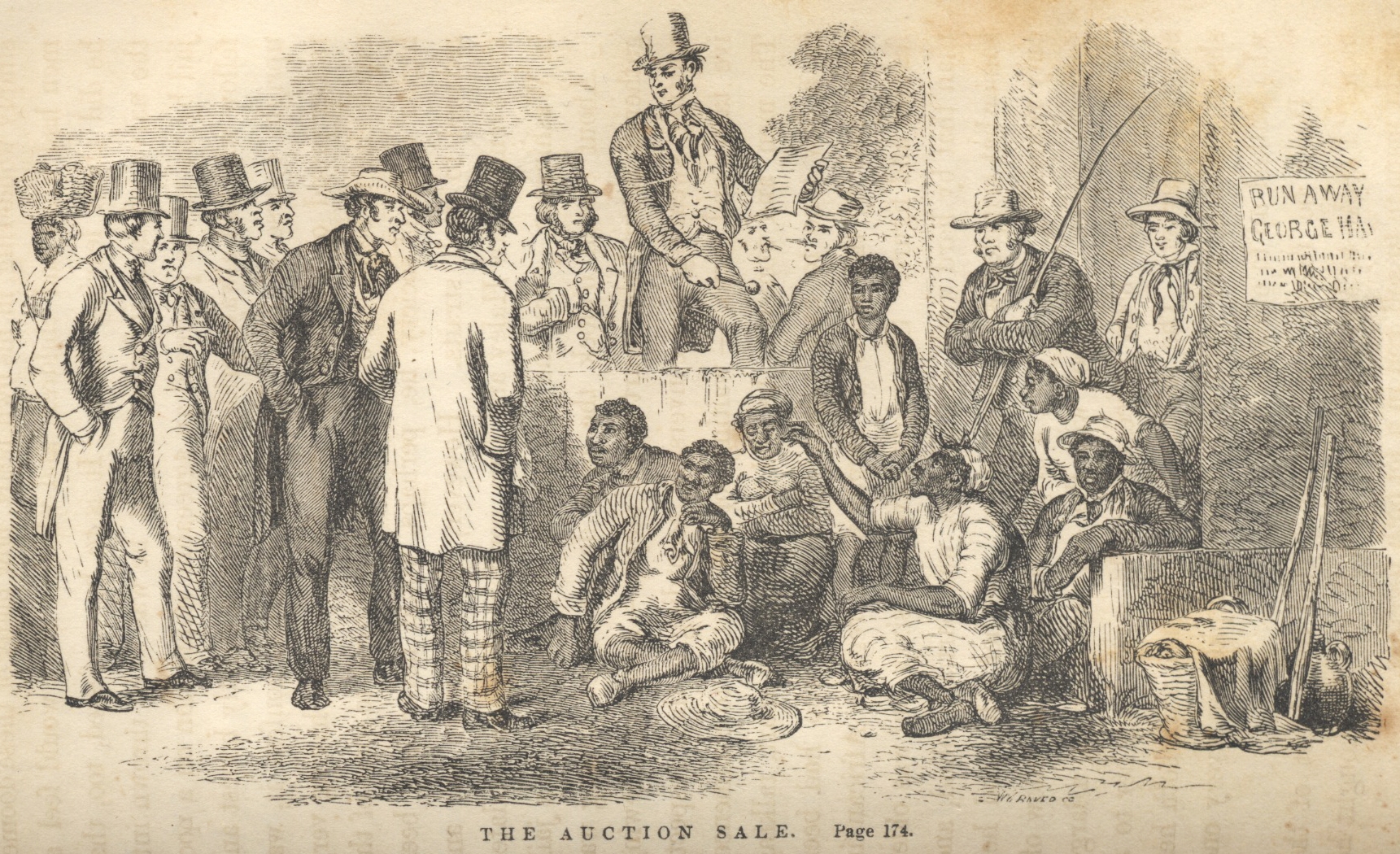
The White League in Louisiana was particularly brutal in its use of violence. The worst massacre committed by the White League occurred Easter Sunday 1873 when it massacred blacks in Colfax, Louisiana. Colfax was an isolated nondescript hamlet about three hundred fifty miles northwest of New Orleans. It sat on the grounds of a former plantation whose owner, William Calhoun, who worked with the former slaves who were now freedmen. The town itself was composed of only a few hundred white and black votes”[2] was located in the newly established Grant Parish. The “parish totaled about 4,500, of whom about 2,400 were Negroes living on the lowlands along the east bank of the Red.” [3]Between 1869 and 1873 the town and the parish were the scene of numerous violent incidents and following the 1872 elections, the whites of the parish were out for blood.

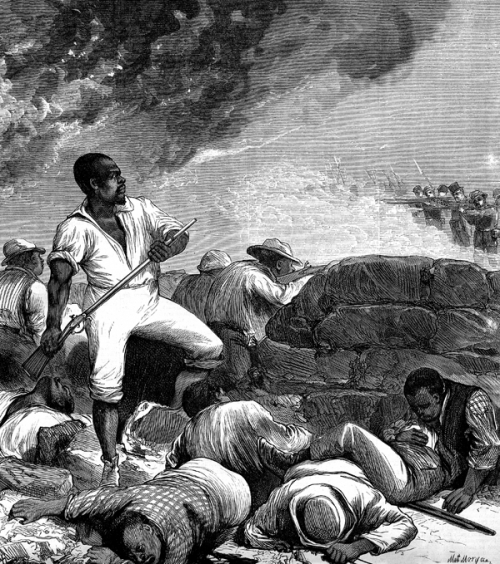
White leaders in Grant Parish “retaliated by unleashing a reign of terror in rural districts, forcing blacks to flee to Colfax for protection.” [4] The blacks of parish fled to the courthouse seeking protection from a violent white mob following the brutal murder of a black farmer and his family on the outskirts of town. The people of Colfax, protected by just a few armed black militiamen and citizens deputized by the sheriff took shelter in the courthouse knowing an attack by the White Supremacists was coming.  As the White League force assembled one of its leaders told his men what the day was about. He said, “Boys, this is a struggle for white supremacy….There are one hundred-sixty-five of us to go into Colfax this morning. God only knows who will come out. Those who do will probably be prosecuted for treason, and the punishment for treason is death.” [5] The attack by over 150 heavily armed men of the White League, most of whom were former Confederate soldiers, killed at least seventy-one and possibly as many as three-hundred blacks. Most of the victims were killed as they tried to surrender. The people, protected by just a few armed men were butchered or burned alive by the armed terrorist marauders. It was “the bloodiest peacetime massacre in nineteenth-century America.” [6]

The instigators of the attack claimed that they acted in self-defense. They claimed that “armed Negroes, stirred up by white Radical Republicans, seized the courthouse, throwing out the rightful officeholders: the white judge and sheriff” and they claimed that the blacks had openly proclaimed “their intention to kill all the white men, they boasted they would use white women to breed a new race.” [7] The claims were completely fabricated, after sending veteran former army officers who were serving in the Secret Service to investigate, the U.S. Attorney for Louisiana, J.R. Beckwith sent an urgent telegram to the Attorney General:

“The Democrats (White) of Grant Parish attempted to oust the incumbent parish officers by force and failed, the sheriff protecting the officers with a colored posse. Several days afterward recruits from other parishes, to the number of 300, came to the assistance of the assailants, when they demanded the surrender of the colored people. This was refused. An attack was made and the Negroes were driven into the courthouse. The courthouse was fired and the Negroes slaughtered as they left the burning building, after resistance ceased. Sixty-five Negroes terribly mutilated were found dead near the ruins of the courthouse. Thirty, known to have been taken prisoners, are said to have been shot after the surrender, and thrown into the river. Two of the assailants were wounded. The slaughter is greater than the riot of 1866 in this city. Will send report by mail.” [8]

Federal authorities arrested nine white men in the wake of the massacre and after two trials in which white majority juries were afraid to go against public opinion, three were “convicted of violating the Enforcement Act of 1871.” [9] None were convicted of murder despite the overwhelming evidence against them and even the lesser convictions enraged the White Supremacists in Louisiana who had employed the best lawyers possible and provided them and the defendants with unlimited financial backing. Assisted by the ruling of Supreme Court Associate Justice Joseph Bradley, who had a long history of neglecting Southern racism, white Democrats appealed the convictions to the Supreme Court.

The attack, and the court cases which followed, notably the judgment of the Supreme Court in United States v. Cruickshank which dealt with the appeal of the men responsible for the Colfax Massacre led to a “narrowing of Federal law enforcement authority” and were “milestones on the road to a “solid” Democratic South.” [10] The decision of the court in United States v. Cruikshank was particularly perverse in its interpretation of constitutional rights and protections. The court ruled in favor of the terrorists and declared that “the right of the black victims at Colfax to assemble hand not been guaranteed because they were neither petitioning Congress nor protesting a federal law. Assembling for any other cause was not protected.” [11] The Cruikshank decision amounted to a Supreme Court endorsement of violence against blacks, and made it “impossible for the federal government to prosecute crimes against blacks unless they were perpetrated by a state and unless it could prove a racial motive unequivocally.” [12] Northern politicians and newspapers, reeling under the effects of the stock market crash of 1873, which had denounced the massacre just a year before now ran from the story and from support of African Americans. A Republican office holder wrote, “The truth is, our people are tired out with this worn cry of ‘Southern outrages…. Hard times and heavy taxes make them wish the ‘nigger,’ the ‘everlasting nigger,’ were in hell or Africa.” [13] Racism and race hatred was not exclusively the parlance of the South.

In the wake of Justice Bradley’s reversal of the Colfax convictions whites in Grant Parish engaged in brutal reprisals against blacks, leading to many murders and lynching’s, crimes which law enforcement, even that favorable to the rights of African Americans were afraid to prosecute for fear of their own lives. Louisiana’s Republican Governor, William Pitt Kellogg wrote Attorney General Williams blaming the violence on Bradley’s ruling, which he wrote, “was regarded as establishing the principle that hereafter no white man could be punished for killing a negro, and as virtually wiping the Ku Klux laws of the statute books.” He added that with the Army leaving the state that his government and other Reconstruction governments would fall, “if Louisiana goes,” Kellogg wrote, “Mississippi will inevitably follow and, that end attained, all the results of the war so far as the colored people are concerned will be neutralized, all the reconstruction acts of Congress will be of no more value than so much waste paper and the colored people, though free in name, will be practically remitted back to servitude.” [14] Governor Kellogg could not have been more correct.

In the years that followed many of the men involved in the massacre and other murders before and after were hailed as heroes, some, including the leader of the attackers, Christopher Columbus Nash were again appointed to office in Colfax and Grant Parish and blacks were reminded every day of just what they had lost. On April 13th 1921 the men who committed the massacre were honored with a memorial in the Colfax cemetery honoring them as “Heroes… who fell in the Colfax Riot fighting for White Supremacy.”

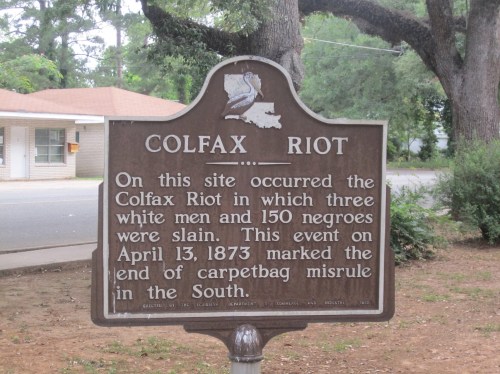
In 1951 the State of Louisiana Department of Commerce and Industry dedicated a marker outside the Courthouse which read: “On the site occurred the Colfax Riot in which three White men and 150 Negroes were slain, this event on April 13, 1873 marked the end of Carpetbag misrule in the South.”[15] That marker still stands, there is no marker commemorating the victims.

Other massacres followed across the South, aimed at both blacks and their white Republican allies. In Louisiana the White League had some 14,000 men under arms, in many cases drilling as military units led by former Confederate officers. A White League detachment southwest of Shreveport “forced six white Republicans to resign their office on pain of death – and then brutally murdered them after they had resigned.” This became known as the Coushatta Massacre and it was a watershed because for the first time the White League targeted whites as well as African Americans. The violence, now protected by the courts ensured that neither would last long in the post-Reconstruction South and that the freedom of African Americans in those states would amount to a cruel illusion.

In 1875, President Ulysses S. Grant including comments about the Colfax massacre and the subsequent court decisions in his message to Congress. Grant was angry and wrote: “Fierce denunciations ring through the country about office-holding and election matters in Louisiana…while every one of the Colfax miscreants goes unwhipped of justice, and no way can be found in this boasted land of civilization and Christianity to punish the perpetrators of this bloody and monstrous crime.” [17] President Grant, the man who so wanted to help African Americans attain the full measure of freedom, was unable to do more as the Congress and Courts took sides with the Southern insurgents.

Notes

[1] Ibid. Foner Forever Free p.151

[2] Ibid. Langguth After Lincoln p.312

[3] Ibid. Lane The Day Freedom Died p.42

[4] Ibid. Goldfield America Aflame p.493

[5] Ibid. Lane The Day Freedom Died p.91

[6] Ibid. Goldfield America Aflame p.493

[7] Ibid. Lane The Day Freedom Died p.11

[8] Ibid. Lane The Day Freedom Died p.22

[9] Ibid. Goldfield America Aflame p.494

[10] Ibid. Lane The Day Freedom Died p.251

[11] Ibid. Langguth After Lincoln p.314

[12] Ibid. Goldfield American Aflame p.494

[13] Ibid. Lane The Day Freedom Died p.213

[14] Ibid. Lane The Day Freedom Died p.217

[15] Ibid. Lane The Day Freedom Died pp.261-262

[16] Ibid. McPherson The War that Forged a Nation p. 185

[17] Ibid. Lane The Day Freedom Died p.228

Leave a comment

Filed under civil rights, civil war, crime, History, Loose thoughts and musings, Political Commentary

Surrender at Appomattox, the Birth and Death Of a Better America, Remembering the Words Of Ely Parker

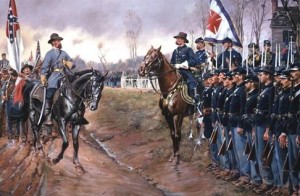
chamberlian gordon appomattox

Joshua Chamberlain Receives the Surrender of John Gordon at Appomattox

Friends of Padre Steve’s World,

 One hundred and fifty four years ago on the 9th and 10th of April 1865, four men, Ulysses S Grant, Robert E. Lee, Joshua Lawrence Chamberlain and Ely Parker, taught succeeding generations of Americans the value of mutual respect and reconciliation. The four men, each very different, would do so after a bitter and bloody war that had cost the lives of over 600,000 Americans which had left hundreds of thousands others maimed, shattered or without a place to live, and seen vast swaths of the country ravaged by war and its attendant plagues.

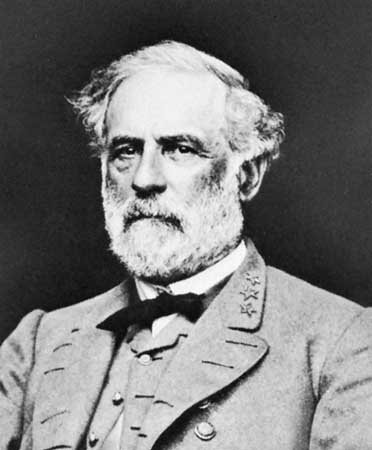
The differences in the men, their upbringing, and their views about life seemed to be insurmountable. The Confederate commander, General Robert E. Lee was the epitome of a Southern aristocrat and career army officer. Lieutenant General Ulysses S. Grant, like Lee was a West Point graduate and veteran of the War with Mexico, but there the similarities ended. Grant was an officer of humble means who had struggled with alcoholism and failed in his civilian life after he left the army, before returning to it as a volunteer when war began. Major General Joshua Lawrence Chamberlain had been a professor of rhetoric and natural and revealed religion from Bowdoin College until 1862 when he volunteered to serve. He was a hero of Little Round Top at the Battle of Gettysburg, who helped exemplify the importance of citizen soldiers in peace and war. Finally there was Colonel Ely Parker, a full-blooded Seneca Indian; a professional engineer by trade, a man who was barred from being an attorney because as a Native American he was never considered a citizen. Although he had been rejected from serving in the army for the same reason, his friend Grant had obtained him a commission and kept him on his staff.
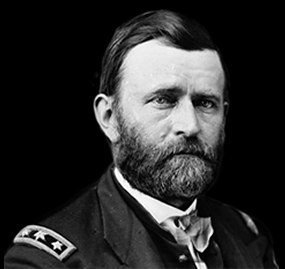
grant 1

General Ulysses S. Grant

A few days bef0ore the Confederate line around the fortress of Petersburg was shattered at the battle of Five Forks, and to save the last vestiges of his army Lee attempted to withdraw to the west. Within a few days the once magnificent Army of Northern Virginia was trapped near the town of Appomattox. On the morning of April 9th 1865 Lee replied to an entreaty of Lieutenant General Ulysses S. Grant requesting that he and his Army of Northern Virginia be allowed to surrender. Lee wrote to Grant:

HEADQUARTERS ARMY OF NORTHERN VIRGINIA, APRIL 9, 1865

Lieut. Gen. U.S. GRANT:

I received your note of this morning on the picket-line, whither I had come to meet you and ascertain definitely what terms were embraced in your proposal of yesterday with reference to the surrender of this army. I now ask an interview in accordance with the offer contained in your letter of yesterday for that purpose.

R.E. LEE, General.

The once mighty Army of Northern Virginia, which had won so many victories, and which at its peak numbered nearly 80,000 men, was now a haggard and emaciated, but still proud force of about 15,000 soldiers. For Lee to continue the war now would mean that they would have to face hopeless odds against a vastly superior enemy. Grant recognized this and wrote Lee:

I am equally anxious for peace with yourself, and the whole North entertains the same feeling. The terms upon which peace can be had are well understood. By the South laying down their arms they will hasten that most desirable event, save thousands of human lives, and hundreds of millions of property not yet destroyed. Seriously hoping that all our difficulties may be set-tied without the loss of another life, I subscribe myself, &c.,

Since the high water mark at Gettysburg, Lee’s army had been on the defensive. Lee’s ill-fated offensive into Pennsylvania was one of the two climactic events that sealed the doom of the Confederacy. The other was Grant’s victory at Vicksburg which fell to him a day after Pickett’s Charge, and which cut the Confederacy in half.
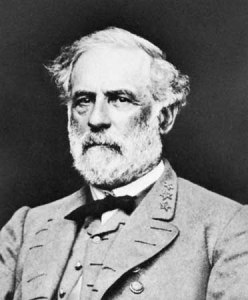
ileerob001p1

General Robert E. Lee

The bloody defensive struggle lasted through 1864 as Grant bled the Confederates dry during the Overland Campaign, leading to the long siege of Petersburg. Likewise the armies of William Tecumseh Sherman had cut a swath through the Deep South and were moving toward Virginia from the Carolinas.

With each battle following Gettysburg the Army of Northern Virginia became weaker and finally after the nine month long siege of Petersburg ended with a Union victory there was little else to do. On the morning of April 9th a final attempt to break through the Union lines by John Gordon’s division was turned back by vastly superior Union forces.

On April 7th Grant wrote a letter to Lee, which began the process of ending the war in Virginia. He wrote:

General R. E. LEE:

The result of the last week must convince you of the hopelessness of further resistance on the part of the Army of Northern Virginia in this struggle. I feel that it is so, and regard it as my duty to shift from myself the responsibility of any further effusion of blood, by asking of you the surrender of that portion of the C. S. Army known as the Army of Northern Virginia.

U.S. GRANT, Lieutenant-General

Lee was hesitant to surrender knowing Grant’s reputation for insisting on unconditional surrender, terms that Lee could not accept. He replied to Grant:

HEADQUARTERS ARMY OF NORTHERN VIRGINIA, APRIL 7, 1865 Lieut. Gen. U.S. GRANT:

I have received your note of this date. Though not entertaining the opinion you express on the hopelessness of further resistance on the part of the Army of Northern Virginia, I reciprocate your desire to avoid useless effusion of blood, and therefore, before considering your proposition, ask the terms you will offer on condition of its surrender.

R.E. LEE, General.

The correspondence continued over the next day even as the Confederates hoped to fight their way out of the trap that they were in. But now Robert E. Lee, who had through his efforts extended the war for at least six months, knew that he could no longer continue. Even so some of his younger subordinates wanted to continue the fight. When his artillery chief Porter Alexander recommended that the Army be released, “take to the woods and report to their state governors” Lee replied:

“We have simply now to face the fact that the Confederacy has failed. And as Christian men, Gen. Alexander, you & I have no right to think for one moment of our personal feelings or affairs. We must consider only the effect which our action will have upon the country at large.”

Lee continued:

“Already [the country] is demoralized by the four years of war. If I took your advice, the men would be without rations and under no control of their officers. They would be compelled to rob and steal in order to live…. We would bring on a state of affairs it would take the country years to recover from… You young fellows might go bushwhacking, but the only dignified course for me would be to go to General Grant and surrender myself and take the consequences of my acts.”

Alexander was so humbled at Lee’s reply he later wrote “I was so ashamed of having proposed such a foolish and wild cat scheme that I felt like begging him to forget he had ever heard it.” When Alexander saw the gracious terms of the surrender he was particularly impressed with how non-vindictive the terms were, especially in terms of parole and amnesty for the surrendered soldiers.

Abraham Lincoln had already set the tone for the surrender in his Second Inaugural Address given just over a month before the surrender of Lee’s army. Lincoln closed that speech with these words of reconciliation.

“With malice toward none, with charity for all, with firmness in the right as God gives us to see the right, let us strive on to finish the work we are in, to bind up the nation’s wounds, to care for him who shall have borne the battle and for his widow and his orphan, to do all which may achieve and cherish a just and lasting peace among ourselves and with all nations.”
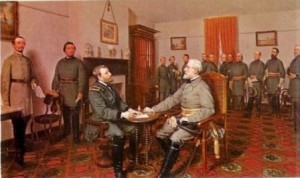
appomattox surrender

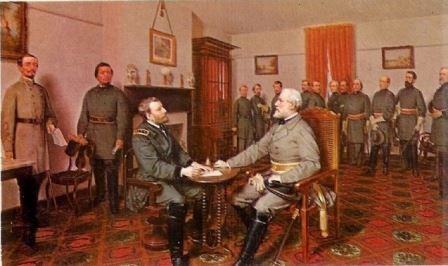
Lee met Grant at the house of Wilmer McLean, who had moved to Appomattox in 1861 after his home near Manassas had been used as a Confederate headquarters and was damaged by artillery fire. Lee was dressed in his finest uniform complete with sash, while Grant was dressed in a mud splattered uniform and overcoat only distinguished from his soldiers by the three stars on his should boards. Grant’s dress uniforms were far to the rear in the baggage trains and Grant was afraid that his slovenly appearance would insult Lee, but it did not. It was a friendly meeting, before getting down to business the two reminisced about the Mexican War.

Grant provided his vanquished foe very generous surrender terms:

“In accordance with the substance of my letter to you of the 8th inst., I propose to receive the surrender of the Army of N. Va. on the following terms, to wit: Rolls of all the officers and men to be made in duplicate. One copy to be given to an officer designated by me, the other to be retained by such officer or officers as you may designate. The officers to give their individual paroles not to take up arms against the Government of the United States until properly exchanged, and each company or regimental commander sign a like parole for the men of their commands. The arms, artillery and public property to be parked and stacked, and turned over to the officer appointed by me to receive them. This will not embrace the side-arms of the officers, nor their private horses or baggage. This done, each officer and man will be allowed to return to their homes, not to be disturbed by United States authority so long as they observe their paroles and the laws in force where they may reside.”

When Lee left the building Federal troops began cheering but Grant ordered them to stop. Grant felt a sense of melancholy and wrote “I felt…sad and depressed, at the downfall of a foe who had fought so long and valiantly, and had suffered so much for a cause, though that cause was, I believe, one of the worst for which a people has fought.” He later noted: “The Confederates were now our countrymen, and we did not want to exult over their downfall.”

In the hours before and after the signing of the surrender documents old friends and classmates, separated by four long years of war gathered on the porch or around the house. Grant and others were gracious to their now defeated friends and the bitterness of war began to melt away. Some Union officers offered money to help their Confederate friends get through the coming months. It was an emotional reunion, especially for the former West Point classmates gathered there.

“It had never been in their hearts to hate the classmates they were fighting. Their lives and affections for one another had been indelibly framed and inextricably intertwined in their academy days. No adversity, war, killing, or political estrangement could undo that. Now, meeting together when the guns were quiet, they yearned to know that they would never hear their thunder or be ordered to take up arms against one another again.”

Grant also sent 25,000 rations to the starving Confederate army waiting to surrender. The gesture meant much to the defeated Confederate soldiers who had had little to eat ever since the retreat began.

The surrender itself was accomplished with a recognition that soldiers who have given the full measure of devotion can know when confronting a defeated enemy. Major General Joshua Lawrence Chamberlain, the heroic victor of Little Round Top was directed by Grant to receive the final surrender of the defeated Confederate infantry on the morning of April 12th.

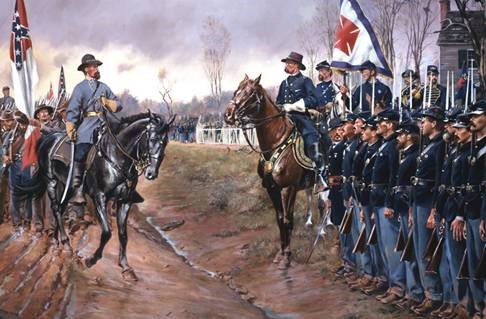
It was a rainy and gloomy morning as the beaten Confederates marched to the surrender grounds. As the initial units under the command of John Gordon passed him, Chamberlain was moved with emotion he ordered his soldiers to salute the defeated enemy for whose cause he had no sympathy, Chamberlain honored the defeated Rebel army by bringing his division to present arms.

John Gordon, who was “riding with heavy spirit and downcast face,” looked up, surveyed the scene, wheeled about on his horse, and “with profound salutation returned the gesture by lowering his saber to the toe of his boot. The Georgian then ordered each following brigade to carry arms as they passed third brigade, “honor answering honor.”
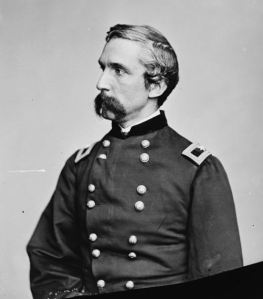
joshua_chamberlain_-_brady-handy

Joshua Lawrence Chamberlain

Chamberlain was not just a soldier, but before the war had been Professor of Natural and Revealed Religions at Bowdoin College, and a student of theology before the war. He could not help to see the significance of the occasion. He understood that some people would criticize him for saluting the surrendered enemy. However, Chamberlain, unlike others, understood the value of reconciliation. Chamberlain was a staunch abolitionist and Unionist who had nearly died on more than one occasion fighting the defeated Confederate Army, and he understood that no true peace could transpire unless the enemies became reconciled to one another.

He noted that his chief reason for doing so:

“The momentous meaning of this occasion impressed me deeply. I resolved to mark it by some token of recognition, which could be no other than a salute of arms. Well aware of the responsibility assumed, and of the criticisms that would follow, as the sequel proved, nothing of that kind could move me in the least. The act could be defended, if needful, by the suggestion that such a salute was not to the cause for which the flag of the Confederacy stood, but to its going down before the flag of the Union. My main reason, however, was one for which I sought no authority nor asked forgiveness. Before us in proud humiliation stood the embodiment of manhood: men whom neither toils and sufferings, nor the fact of death, nor disaster, nor hopelessness could bend from their resolve; standing before us now, thin, worn, and famished, but erect, and with eyes looking level into ours, waking memories that bound us together as no other bond;—was not such manhood to be welcomed back into a Union so tested and assured? Instructions had been given; and when the head of each division column comes opposite our group, our bugle sounds the signal and instantly our whole line from right to left, regiment by regiment in succession, gives the soldier’s salutation, from the “order arms” to the old “carry”—the marching salute. Gordon at the head of the column, riding with heavy spirit and downcast face, catches the sound of shifting arms, looks up, and, taking the meaning, wheels superbly, making with himself and his horse one uplifted figure, with profound salutation as he drops the point of his sword to the boot toe; then facing to his own command, gives word for his successive brigades to pass us with the same position of the manual,—honor answering honor. On our part not a sound of trumpet more, nor roll of drum; not a cheer, nor word nor whisper of vain-glorying, nor motion of man standing again at the order, but an awed stillness rather, and breath-holding, as if it were the passing of the dead!”

The next day Robert E Lee addressed his soldiers for the last time. Lee’s final order to his loyal troops was published the day after the surrender. It was a gracious letter of thanks to men that had served their beloved commander well in the course of the three years since he assumed command of them outside Richmond in 1862.

General Order
No. 9

After four years of arduous service marked by unsurpassed courage and fortitude, the Army of Northern Virginia has been compelled to yield to overwhelming numbers and resources.

I need not tell the survivors of so many hard fought battles, who have remained steadfast to the last, that I have consented to the result from no distrust of them.

But feeling that valour and devotion could accomplish nothing that could compensate for the loss that must have attended the continuance of the contest, I have determined to avoid the useless sacrifice of those whose past services have endeared them to their countrymen.

By the terms of the agreement, officers and men can return to their homes and remain until exchanged. You will take with you the satisfaction that proceeds from the consciousness of duty faithfully performed, and I earnestly pray that a merciful God will extend to you his blessing and protection.

With an unceasing admiration of your constancy and devotion to your Country, and a grateful remembrance of your kind and generous consideration for myself, I bid you an affectionate farewell. — R. E. Lee, General

The surrender was the beginning of the end. Other Confederate forces continued to resist for several weeks, but with the surrender of the Army of Northern Virginia led by the man that nearly all Southerners saw as the embodiment of their nation the war was effectively over.

Lee had fought hard and after the war was still under the charge of treason, but he understood the significance of defeat and the necessity of moving forward as one nation. In August 1865 Lee wrote to the trustees of Washington College of which he was now President:

“I think it is the duty of every citizen, in the present condition of the Country, to do all in his power to aid the restoration of peace and harmony… It is particularly incumbent upon those charged with the instruction of the young to set them an example of submission to authority.

eparker05-966-g

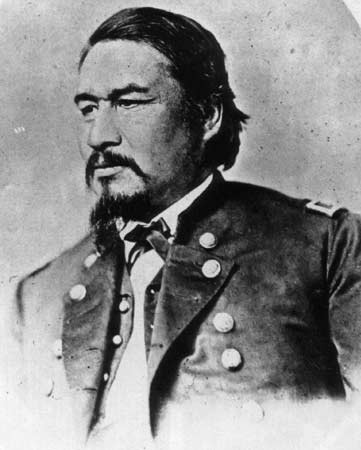
Brigadier General Ely Parker

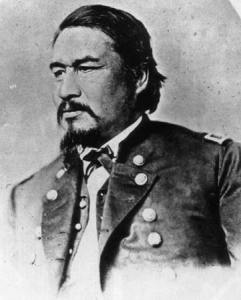
It is a lesson that all of us in our terribly divided land need to learn regardless of or political affiliation or ideology. After he had signed the surrender document, Lee learned that Grant’s Aide-de-Camp Colonel Ely Parker, was a full-blooded Seneca Indian. He stared at Parker’s dark features and said: “It is good to have one real American here.”

Parker, a man whose people had known the brutality of the white man, a man who was not considered a citizen and would never gain the right to vote, replied, “Sir, we are all Americans.” That afternoon Parker would receive a commission as a Brevet Brigadier General of Volunteers, making him the first Native American to hold that rank in the United States Army. He would later be made a Brigadier General in the Regular Army.

I don’t know what Lee thought of that. His reaction is not recorded and he never wrote about it after the war, but it might have been in some way led to Lee’s letter to the trustees of Washington College. I think with our land so divided, ands that is time again that we learn the lessons so evidenced in the actions and words of Ely Parker, Ulysses Grant, Robert E. Lee and Joshua Chamberlain, for we are all Americans.

Sadly, I think that there is a portion of the American population who will not heed these words and will continue to agitate for policies and laws similar to those that led to the Civil War, and which those the could not reconcile defeat instituted again during the Post-Reconstruction and Jim Crow eras. For me such behavior and attitudes are incompressible, but they are all too real, and all too present in our divided nation.

But I still maintain hope that in spite of everything that divides us, in spite of the intolerance and hatred of some, that we can overcome. I think that the magnanimity of Grant in victory, the humility of Lee in defeat, the graciousness of Chamberlain in honoring the defeated foe, and the stark bluntness of Parker, the Native American, in reminding Lee, that “we are all Americans,” is something that is worth remembering, and yes, even emulating.

That is where we need to be in the age of President Trump. Robert E. Lee, could admit defeat, and though still at heart a racist, could still advocate for the end of a rebellion that he supported and reconciliation with a government which he had committed high treason against. Ulysses S. Grant and Joshua Chamberlain embodied the men of the Union who had fought for the Union, Emancipation, and against the Rebellion hat Lee supported to the end.

But even more so we need to remember the words of the only man whose DNA and genealogy did not make him a European transplant, the man who Lee refereed to as the only true American at Appomattox, General Ely Parker, the Native American who fought for a nation that not acknowledge him as a citizen until long after he was dead.

In the perverted, unrequited racist age of President Donald Trump we have to stop the bullshit, and take to heart the words of Ely Parker. “We are all Americans.” If we don’t get that there is no hope for our country. No amount of military or economic might can save us if we cannot understand Parker’s words, or the words of the Declaration: “We hold these truths to be self evident, that all men are created equal…” Really, it does not matter if our relatives were second sons of European Gentry, religious dissidents, refugees of repressive regimes, African Slaves, Asians seeking a new life in a new country, or Mexican citizens who turned on their own country to become citizens of a new Republic, men like Mariano Vallejo, the Mexican governor of El Norte and one of the First U.S. Senators from California.

Let us never forget Ely Parker’ words at Appomattox, “We are all Americans.”

Sadly, there are not just more than a few Americans, and many with no familial or other connection to the Confederacy and the South than deeply held racism who would rather see another bloody civil war because they hate the equality of Blacks, Women, immigrants, and LGBTQ Americans more than they love the Declaration of Independence and the Constitution of the United States.

That is why Parker’s words to Lee still matter so much and why we must never give up the fight for equality for all Americans. Likewise, whether one likes it or not, Robert E. Lee broke his sacred oath to the Constitution as a commissioned officer refused to free the slaves entrusted to his care by his Father in Law in 1859, who refused to support his Confederate President’s plan to emancipate and free African American slaves who were willing to fight for the Confederacy until February 1865.

Lee the Myth is still greater than Lee the man in much of this country. Lee the man is responsible for the deaths for more Americans than the leaders of Imperial Germany, Imperial Japan, Nazi Germany, or any other foreign power. He even cast aside such loyalists as George Pickett, whose division he destroyed in a suicidal attack at Gettysburg on July 3rd 1863, and then continued to damn Pickett for mistakes which were his own until the end of the war.

Both sides of my family fought for the Confederacy as officers and members of the 8th Virginia Cavalry. Most reconciled, but others didn’t, including the patriarch of my paternal side of the family. His decision ended up costing the family millions of dollars in the following years. The maternal side was smart enough to reconcile after the war and to later engage in the profoundly libertarian practice of bootlegging until the end of prohibition. I don’t know if any members of either side of my family were Kan supporters, but if they were I wouldn’t doubt it. They lost what they had during the war by fighting on the wrong sided and refusing to reconcile with the United States, and they deserved it. Even Robert E. Lee refused to completely admit his crime of treason. He used the language of reconciliation without fully embracing it.

That my friends is the crime of those who today speak of freedom and reconciliation, but refused to apply it to themselves or their families. I guess that makes me different, and I’m okay I’m okay with that. I have to admit, that the person that I was in my early 20s, or the person that I am now could not have embraced secession or slavery. There is no moral reason that any Christian person could have fully embraced secession and civilly war to defend slavery, but people on both sides of my family did even as their neighbors embraced the Union.

So for me April 9th is very personal. I have served my country for nearly 38 years. I cannot abide men and women who treat the men and women that I have served with in the defense of this county as less than human or fully entitled to the rights that are mine, more to my birth and race than today than any of my inherent talents or abilities. That includes my ancestors who fought for the Confederacy on both sides of my family. Ancestors or not, they were traitors to everything that I believe in and hold dear.

As for me, principles and equality trump all forms of racism, racist ideology, and injustice, even when the President himself advocates for them. I am a Union man, despite my Southern ancestry, and I will support the rights of people my ancestors would never support, Blacks, Hispanics, Women, LTBTQ, and other racial, religious, or gender minorities. But then, I am a Unionist. I am a supporter of Equal rights for African Americans, I am a women’s rights advocate, including their reproductive rights, and I am a supporter of LGBTQ people and their rights, most of which are opposed by the Evangelical Christians who I grew up with. I also will not hesitate to criticize the elected President of the United States when he pisses on the preface of the Declaration of Independence, the United States Constitution, attacks the bedrock principles of the Bill of Rights

How can I be silent?

Dietrich Bonhoeffer notes:

“The messengers of Jesus will be hated to the end of time. They will be blamed for all the division which rend cities and homes. Jesus and his disciples will be condemned on all sides for undermining family life, and for leading the nation astray; they will be called crazy fanatics and disturbers of the peace. The disciples will be sorely tempted to desert their Lord. But the end is also near, and they must hold on and persevere until it comes. Only he will be blessed who remains loyal to Jesus and his word until the end.”

Trump certainly hates those who hold fast to the worlds of Jesus. So I will stand fast on this anniversary of Appomattox and echoes the words of Eli Parker to President Trump himself: “Sir, we are all Americans.” He may not understand it, but I certainly do.

Until tomorrow,

Peace

Padre Steve+

6 Comments

Filed under civil rights, civil war, History, leadership, LGBT issues, Loose thoughts and musings, Military, Political Commentary

“Together, There is no Other Way” Lyndon Johnson at Gettysburg and a Challenge to Democrats Today

Friends of Padre Steve’s World,

I am about to finish Historian John Meacham’s inspiring history United States politics and the leadership of different Presidents, The Soul of America: The Battle for Our Better Angels. I have to say that in light of Meacham’s remarks at the Funeral of the late President George H.W. Bush, Meacham’s book has inspired me and encouraged me in the dark era of President Trump and his supporting cast of Angels of Darkness, men and women who, to paraphrase historian Timothy Snyder tell us we are the best while encouraging us to be our worst.

While reading Meacham’s book over the weekend I read about the Civil Rights crusade of President Lyndon Baines Johnson, who had he not gone into Vietnam would probably be considered one of the greatest President’s who ever lived. Johnson would have been considered by many to be an unlikely champion of Civil Rights, though he supported Franklin Roosevelt’s New Deal would not have been considered a pioneering Civil Rights advocate.

Those who read this blog know my attachment to Gettysburg, the Battle Of Gettysburg, and President Abraham Lincoln and his Gettysburg Address. Until I read Meacham’s book I had never known that as Vice President, Lyndon Johnson also spoke at Gettysburg. His words came on Memorial Day 1963, and in part they were an answer to Dr Martin Luther King Jr.’s “Letter from a Birmingham Jail.” It was an incredible and courageous speech. Johnson was a Southerner, a Democrat, and many Southern Democrats were fighting President Kennedy on Civil Rights issues. Kennedy was much too understanding and polite to hold their ball to the fire, but Johnson for all of his other flaws wasn’t and he used his Gettysburg speech to remind the nation of the unfinished legacy of Gettysburg and the still unfulfilled “new birth of freedom” that Lincoln so eloquently spoke in his few remarks at the dedication of the Gettysburg National Military Cemetery.

Johnson spoke these words:

On this hallowed ground, heroic deeds were performed and eloquent words were spoken a century ago. We, the living, have not forgotten–and the world will never forget–the deeds or the words of Gettysburg. We honor them now as we join on this Memorial Day of 1963 in a prayer for permanent peace of the world and fulfillment of our hopes for universal freedom and justice.

We are called to honor our own words of reverent prayer with resolution in the deeds we must perform to preserve peace and the hope of freedom. We keep a vigil of peace around the world. Until the world knows no aggressors, until the arms of tyranny have been laid down, until freedom has risen up in every land, we shall maintain our vigil to make sure our sons who died on foreign fields shall not have died in vain.

As we maintain the vigil of peace, we must remember that justice is a vigil, too–a vigil we must keep in our own streets and schools and among the lives of all our people–so that those who died here on their native soil shall not have died in vain.

One hundred years ago, the slave was freed. One hundred years later, the Negro remains in bondage to the color of his skin. The Negro today asks justice. We do not answer him–we do not answer those who lie beneath this soil–when we reply to the Negro by asking, “Patience.”

It is empty to plead that the solution to the dilemmas of the present rests on the hands of the clock. The solution is in our hands. Unless we are willing to yield up our destiny of greatness among the civilizations of history, Americans — white and Negro together–must be about the business of resolving the challenge which confronts us now.

Our nation found its soul in honor on these fields of Gettysburg one hundred years ago. We must not lose that soul in dishonor now on the fields of hate. To ask for patience from the Negro is to ask him to give more of what he has already given enough. But to fail to ask of him–and of all Americans–perseverance within the processes of a free and responsible society would be to fail to ask what the national interest requires of all its citizens.

The law cannot save those who deny it but neither can the law serve any who do not use it. The history of injustice and inequality is a history of disuse of the law. Law has not failed–and is not failing. We as a nation have failed ourselves by not trusting the law and by not using the law to gain sooner the ends of justice which law alone serves.

If the white over-estimates what he has done for the Negro without the law, the Negro may under-estimate what he is doing and can do for himself with the law. If it is empty to ask Negro or white for patience, it is not empty–it is merely honest–to ask perseverance. Men may build barricades–and others may hurl themselves against those barricades–but what would happen at the barricades would yield no answers. The answers will only be wrought by our perseverance together. It is deceit to promise more as it would be cowardice to demand less.

In this hour, it is not our respective races which are at stake–it is our nation. Let those who care for their country come forward, North and South, white and Negro, to lead the way through this moment of challenge and decision. The Negro says, “Now.” Others say, “Never.” The voice of responsible Americans — the voice of those who died here and the great man who spoke here–their voices say, “Together.” There is no other way.

Until justice is blind to color, until education is unaware of race, until opportunity is unconcerned with the color of men’s skins, emancipation will be a proclamation but not a fact. To the extent that the proclamation of emancipation is not fulfilled in fact, to that extent we shall have fallen short of assuring freedom to the free.

If Johnson was alive today in the age of Trump, and in the fighting form that enabled him to go against fellow Southerners to get the Civil Rights Act Of 1964 and the since emasculated Voting Rights Act Of 1965 passed by overwhelming bi-partisan majorities, and to pass other bills that benefited all Americans, he would not be silent. He would be adding his voice to those of Blacks, Latinos, Arab Americans, Asians, Women, LGBTQ people, and non-Christian Religious minorities whose constitutional rights are under threat by a President whose despises those rights, and a Party which was reborn when the segregationists Democrats Of Johnson’s time became Republicans in 1964 under the white supremacist campaign of Barry Goldwater and the 1968 Southern Strategy Of Richard Nixon. In those years the Democratic Party became the true successors of Lincoln, Grant and the early Republican Party Vision of freedom, while the Republicans under the direction of men like Goldwater, Nixon, Pat Buchanan, Roger Ailes, and a host of others including former Democrats and Dixiecrats like Strong Thurman became the Party of the Lost Cause, the Noble Confederacy, and Jim Crow. Under President Trump the pathetic rump of that once great party, predominantly made of Conservative Christians and a growing violent White Supremacist movement attempt to claim to be the Party of Lincoln and Theodore Roosevelt, but are the Party of Jefferson Davis and the later Dixiecrats.

If he were alive today Lyndon Johnson would be using his legislative expertise to push forward responsible but unpopular policies.

I can only ask, who among today’s Democrats will do that? I honestly don’t know, but I believe that such a man or woman much come forth to challenge Trump and his Cult for the Presidency in 2020. To quote Johnson:

“In this hour, it is not our respective races which are at stake–it is our nation. Let those who care for their country come forward, North and South, white and Negro, to lead the way through this moment of challenge and decision.

The Negro says, “Now.” Others say, “Never.” The voice of responsible Americans–the voice of those who died here and the great man who spoke here–their voices say, “Together.” There is no other way.”

Until tomorrow,

Peace,

Padre Steve+

Leave a comment

Filed under civil rights, civil war, Gettysburg, History, laws and legislation, leadership, LGBT issues, News and current events, Political Commentary, White nationalism

Alexander Stephen’s Cornerstone Speech and the Continuing Curse Of White Supremacy

Friends of Padre Steve’s World,

On March 21st 1861 in the midst of the Secession crisis, the newly elected Vice President Of the Confederacy, The former Georgia Senator, Alexander Stephens made a speech in Savannah Georgia demonstrating just how much the new Confederacy was different that the Republic founded in 1776 and who those founders struggled with the morality of slavery.

For people who like to comfort themselves in the myth of the Noble South, The Lost Cause, or the illusion that the war was brought about by Northern infringements on the States Rights Of the Slave States, the Speech is damning. The American version of White Nationalism and the superiority of the White Race over African slaves, and in more recent times Eastern Europeans, Jews, Chinese, Japanese, Hispanics (especially Mexicans), and Arabs can be refuted by Stephens’ words. He spoke:

“But not to be tedious in enumerating the numerous changes for the better, allow me to allude to one other — though last, not least. The new constitution has put at rest, forever, all the agitating questions relating to our peculiar institution — African slavery as it exists amongst us — the proper status of the negro in our form of civilization. This was the immediate cause of the late rupture and present revolution. Jefferson in his forecast, had anticipated this, as the “rock upon which the old Union would split.” He was right. What was conjecture with him, is now a realized fact. But whether he fully comprehended the great truth upon which that rock stood and stands, may be doubted. The prevailing ideas entertained by him and most of the leading statesmen at the time of the formation of the old constitution, were that the enslavement of the African was in violation of the laws of nature; that it was wrong in principle, socially, morally, and politically. It was an evil they knew not well how to deal with, but the general opinion of the men of that day was that, somehow or other in the order of Providence, the institution would be evanescent and pass away. This idea, though not incorporated in the constitution, was the prevailing idea at that time. The constitution, it is true, secured every essential guarantee to the institution while it should last, and hence no argument can be justly urged against the constitutional guarantees thus secured, because of the common sentiment of the day. Those ideas, however, were fundamentally wrong. They rested upon the assumption of the equality of races. This was an error. It was a sandy foundation, and the government built upon it fell when the “storm came and the wind blew.”

Our new government is founded upon exactly the opposite idea; its foundations are laid, its corner- stone rests upon the great truth, that the negro is not equal to the white man; that slavery — subordination to the superior race — is his natural and normal condition. [Applause.] This, our new government, is the first, in the history of the world, based upon this great physical, philosophical, and moral truth. This truth has been slow in the process of its development, like all other truths in the various departments of science. It has been so even amongst us. Many who hear me, perhaps, can recollect well, that this truth was not generally admitted, even within their day. The errors of the past generation still clung to many as late as twenty years ago. Those at the North, who still cling to these errors, with a zeal above knowledge, we justly denominate fanatics. All fanaticism springs from an aberration of the mind-from a defect in reasoning. It is a species of insanity. One of the most striking characteristics of insanity, in many instances, is forming correct conclusions from fancied or erroneous premises; so with the anti-slavery fanatics; their conclusions are right if their premises were. They assume that the negro is equal, and hence conclude that he is entitled to equal privileges and rights with the white man. If their premises were correct, their conclusions would be logical and just-but their premise being wrong, their whole argument fails. I recollect once of having heard a gentleman from one of the northern States, of great power and ability, announce in the House of Representatives, with imposing effect, that we of the South would be compelled, ultimately, to yield upon this subject of slavery, that it was as impossible to war successfully against a principle in politics, as it was in physics or mechanics. That the principle would ultimately prevail. That we, in maintaining slavery as it exists with us, were warring against a principle, a principle founded in nature, the principle of the equality of men. The reply I made to him was, that upon his own grounds, we should, ultimately, succeed, and that he and his associates, in this crusade against our institutions, would ultimately fail. The truth announced, that it was as impossible to war successfully against a principle in politics as it was in physics and mechanics, I admitted; but told him that it was he, and those acting with him, who were warring against a principle. They were attempting to make things equal which the Creator had made unequal.

In the conflict thus far, success has been on our side, complete throughout the length and breadth of the Confederate States. It is upon this, as I have stated, our social fabric is firmly planted; and I cannot permit myself to doubt the ultimate success of a full recognition of this principle throughout the civilized and enlightened world.

As I have stated, the truth of this principle may be slow in development, as all truths are and ever have been, in the various branches of science. It was so with the principles announced by Galileo-it was so with Adam Smith and his principles of political economy. It was so with Harvey, and his theory of the circulation of the blood. It is stated that not a single one of the medical profession, living at the time of the announcement of the truths made by him, admitted them. Now, they are universally acknowledged. May we not, therefore, look with confidence to the ultimate universal acknowledgment of the truths upon which our system rests? It is the first government ever instituted upon the principles in strict conformity to nature, and the ordination of Providence, in furnishing the materials of human society. Many governments have been founded upon the principle of the subordination and serfdom of certain classes of the same race; such were and are in violation of the laws of nature. Our system commits no such violation of nature’s laws. With us, all of the white race, however high or low, rich or poor, are equal in the eye of the law. Not so with the negro. Subordination is his place. He, by nature, or by the curse against Canaan, is fitted for that condition which he occupies in our system. The architect, in the construction of buildings, lays the foundation with the proper material-the granite; then comes the brick or the marble. The substratum of our society is made of the material fitted by nature for it, and by experience we know that it is best, not only for the superior, but for the inferior race, that it should be so. It is, indeed, in conformity with the ordinance of the Creator. It is not for us to inquire into the wisdom of his ordinances, or to question them. For his own purposes, he has made one race to differ from another, as he has made “one star to differ from another star in glory.”

Stephens honesty infuriated Confederate President Jefferson Davis who while he agreed with Stephens was infuriated by the international response to the speech. On learning of the speech and its contents Davis, who had counseled his cabinet members to downplay slavery as an issue wrote:

“That speech infuriated me, Oh, what Stephens had said was true, perfectly true, but could anything hurt us more abroad than such impolitic remarks? It was the beginning of a fatal falling out between me and that rebellious and vindictive dwarf, who was hell-bent on forming his own policies and disputing mine with niggardly deviousness.”

Unfortunately, what is called America’s Original Sin remains with us. We have a President who historian John Meacham points this out repeatedly in his book The Soul Of America.

So, before anyone wants to defend Southern Secession based on anything other than the maintenance and expansion of slavery and White Supremacy at the expense of Free States as evidenced in the Compromise Of 1850 and the Fugitive Slave Law Of 1850, compounded by the Dred Scott Decision, and the attempted takeover of Kansas and the battle over the Lecompton Constitution which would have made it a slave state over the majority of its population, try to defend the words of the President and Vice President of the Confederacy.

I bet you can’t.

Until tomorrow,

Peace

Padre Steve+
Leave a comment

Filed under civil rights, civil war, History, Political Commentary

Erin Go Bragh, and Go Bayern München

Friends of Padre Steve’s World,

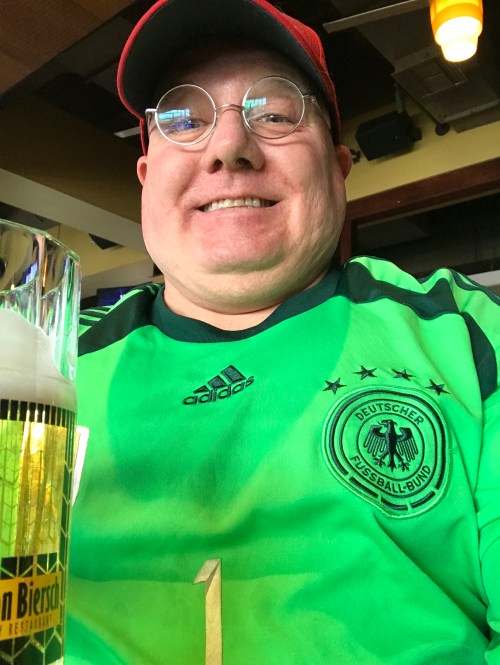
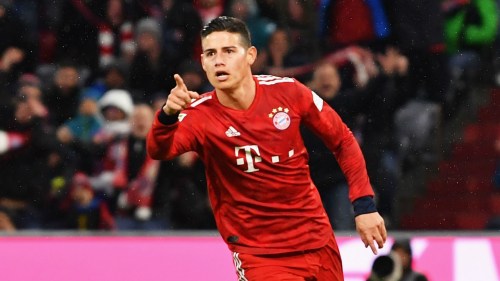
It’s Saint Patrick’s Day and as anyone with 45% Irish DNA should be doing I am donning the green. Of course it happens to be my 2014 German National Team, Manuel Neuer World Cup goalkeeper jersey. Of course I am sporting a red Bayern baseball cap, can’t help that since I watched Bayern München play and absolutely smash Mainz 6-0 while waiting for some friends to come by. during the match James Rodriguez score a hat trick for the first time this season, vastly increasing his value to the team in the last part of the season and maybe for a long time to come.

The win keeps Bayern ahead of Dortmund and increased the goal differential to seven goals. Since both teams are now out of the UEFA Champions League Bayern is going to take this to their 7th straight Bundesliga Championship. Two and a half months ago Dortmund led Bayern by 9 points on the table and what looked like an insurmountable goal differential. Now Bayern is resurgent and the talented but young Dortmund team is struggling. My prediction is that Bayern will win the Bundesliga and Dortmund finish second or third which will put them both in the UEFA Champions League in 2020.

But enough football for today. I may be 45% Irish by DNA and less than 5% German, I am a conflicted mix of Irish, Scottish, and German, with a large amount of English, Welsh, and non German Western Europeans, mostly French Huguenot, I am a man who is quite complex and often quite conflicted.

Conflicts aside, I love German Beer and Irish Whisky. I like European football more than American, and prefer Baseball to Cricket. But that doesn’t matter because my family, regardless of their ancestry or even incestry has been in this country for between 280 and 320 years which means that that I am a very conflicted American. I have many near and distant cousins who are African American, all of which are related to me through white ancestors, and their descendants who just happened to be slave owners, including men on both sides of my family who all fought for the Confederacy and their slave ownership rather than follow the majority in their part of Virginia and side with the Union. They all fought under the flag of the 8th Virginia Cavalry Regiment.

All that being said, I am an American with a highly conflicted genetic stew who happens to be defiant Unionist and abolitionist. I a fully for freedom and the understanding of the Declaration of Independence, and Abraham Lincoln that “all men are created equal,” and that we are engaged in a a conflict that will bring about “a new birth of freedom.”

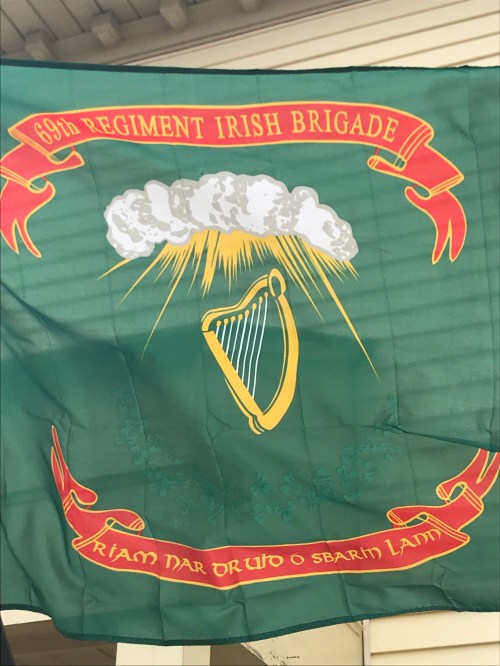
Today outside my home hang the 35 Star Circle Union flag of June 1863 and that of the 69th New York Volunteer Infantry, also known as the 1st Regiment Of the Irish Brigade. I will never display the flag of the 8th Virginia or any other secessionist Regiment at my home in the Virginia Tidewater.

So, in the spirit of my Irish ancestors, even the most distant who fought under the flag of the Union and the regiments of the Irish Brigade I raise my pint glass and say Erin go Bragh!

Until tomorrow,

Peace,

Padre Steve+

2 Comments

Filed under civil war, History, Military, Political Commentary

The Struggle for Women’s Rights: Nurses, Spies, and Soldiers in the Civil War

Clayton-Francis-L

Friends of Padre Steve’s World,

It’s been a couple of days since International Women’s Day and I am really surprised of how many men Insee attacking and denigrating women military members and combat veterans. I actually wonder how many of these Twitter Trolls have actually served in the military or combat, and how many simply live their lives through myth and video games, but obviously they have never served in combat with the women who serve not only in the United States military, but so many others.

Nor domthey study history, even going back to Biblical Times; Deborah the Judge and Military leader or Judith, the Spy and assassin. Likewise the forget Joan Of Arc, Molly Pitcher, and what this article deals with, the women who served in the American Civil War. In fact, some of these women were what we would now call Transgender. 

There will be more articles in this series. So until tomorrow, 

Peace

Padre Steve+
women-civil-war-sarah-edmonds-frank-thompson-631

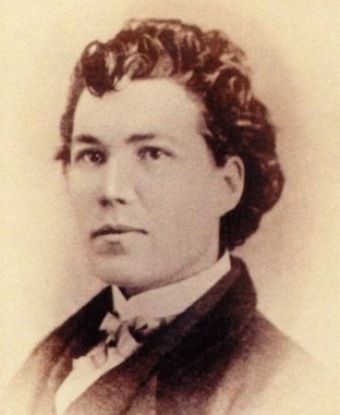
Of course when war broke out the logical end of this train of thought led to the question of whether women should women be allowed to serve in the military. Legally and socially it was not possible for women to serve in the military in 1861, but this did not stop women from doing so. Even so, “women were not expected to defend their country, and when they did nevertheless and were found out, they learned that they were not necessarily a welcome addition to the military. Women who returned home after the Civil War as veterans reaped few of the societal rewards for having rendered such service.” [1] Quite a few women on both sides of the conflict chaffed about not being allowed to fight for their countries, their families and their causes, and despite official prohibitions that kept women from serving in any capacity but nursing, a good number of women found their way to go to war. While men in the North and South “were expected to enlist, any woman actively participating in the Civil War was an oddity if not a renegade.” [2] In some cases this involved hundreds of women taking male identities in order to fulfill their desires to serve their countries.

The motives of these women varied. In some cases women wanted gain the economic privileges of full citizenship, and for others the glory reserved to only to men. In our modern parlance those that took male identities would be considered transvestites or possibly transgender, but for them “transvestitism was a private rebellion against public conventions. By taking a male social identity, they secured for themselves male power and independence, as well as full status as citizens of their nation. In essence the Civil War was an opportunity for hundreds of women to escape the confines of their sex.” [3]

During the war hundreds of women went to war, dreaming of being a second Joan of Arc, taking on the identity of men, however, their idealistic vision of wanting to serve the cause of their country, was not viewed favorably by many, men and women alike, as “they were usually viewed by contemporaries as mentally unbalanced or immoral.” [4] Their morality was question, their motivation was questioned, and their character was questioned, all because they broke long held social, and religious barriers in order to fight for what they believed.

These brave and socially progressive women enlisted under male names and pretended to be men. Unless they were discovered to be women, or unless they confessed to their wartime service either during or after the war, most of their records were lost. In 1861 Private Franklin Thompson “enlisted in Company F of the 2ndMichigan Infantry…unknown to comrades, Thompson actually was Sarah Emma Edmonds.” [5] Edmonds served in the illustrious Iron Brigade until the disaster at Fredericksburg. Well known for her courage as Franklin Thompson, Edmonds participated in some of the bloodiest combats of the war. At Antietam she was caring for the wounded when she came upon a soldier who had been wounded in the neck. That soldier informed Edmonds that she was dying and after a surgeon came by and confirmed what the soldier said the dying soldier told Edmonds:

“I am not what I seem, but I am female. I enlisted from the purest motives, and I have remained undiscovered and unsuspected. I have neither father, mother nor sister. My only brother was killed today. I closed his eyes about an hour before I was wounded….I am Christian, and have maintained the Christian character ever since I entered the army. I have performed the duties of a soldier faithfully, and am willing to die for the cause of truth and freedom….I wish you to bury me with your own hands, that none may know after my death that I am other than my appearance indicates.” [6]

That unknown woman was not alone, at least nine women, eight Union and one Confederate, fought at Antietam and of those five were casualties. Five women, two Federal and three Confederate took part at Gettysburg. All three Confederate women at Gettysburg were either killed or wounded, or captured, including two women who took part in Pickett’s Charge. [7]

Edmonds_inline

Sarah Edmonds

Sarah Edmonds published a book Nurse and Spy in the Union Army while recovering from malaria in 1863. The book, which was published the following year, sold 175,000 copies, the proceeds that she donated to care for sick and wounded Union veterans. After the war, Edmonds attended Oberlin College, married, had three of her own children and adopted two more. She “became a member of the Grand Army of the Potomac, the organization for Union veterans of the Civil War. She applied for, and received, a military pension, and upon her death in 1898 was buried with full military honors.” [8] She was the only women admitted to the Grand Army of the Republic.

Another of the women to serve was Frances Louisa Clayton. Fighting for the Union as a member of the Minnesota State Militia Cavalry and 2nd Minnesota Battery, serving under the command of Ulysses S. Grant she was wounded at Fort Donelson. Like many other women soldiers, Clayton mastered the art of behaving as a man. She “became “a capital swordsman,” but also commanded attention with her “masculine stride in walking” and “her erect and soldierly carriage.” [9]

Albert-Cashier

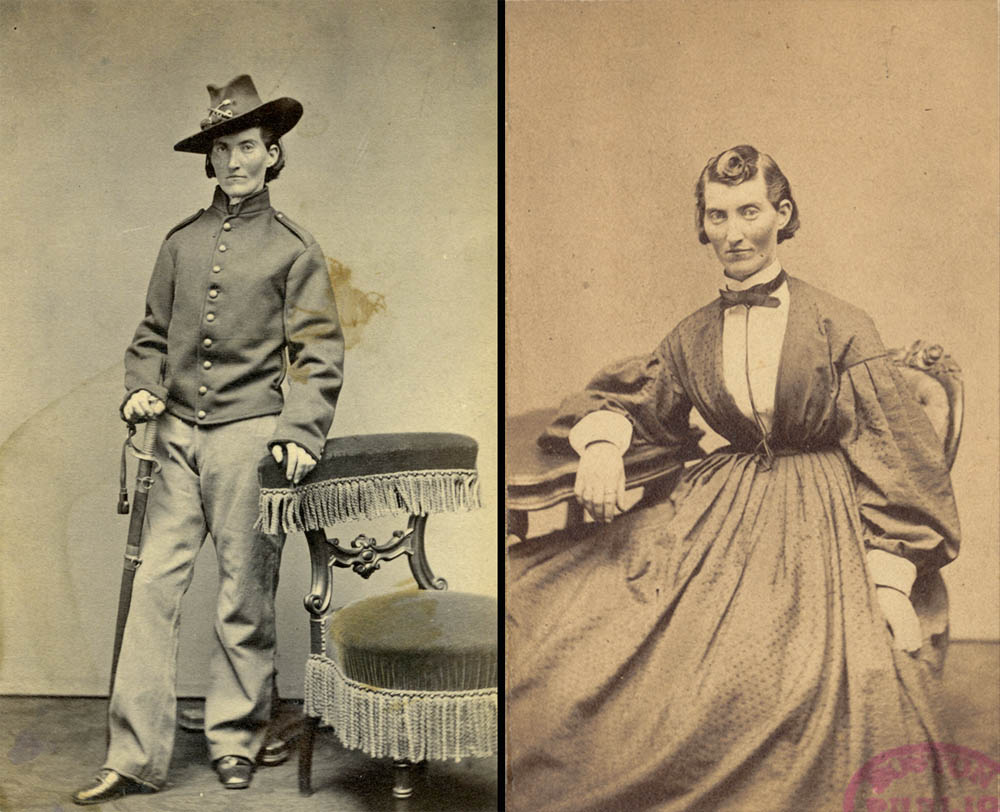
However, most women were more discreet during and after the war regarding their true sexuality. Private Albert Cashier hid his sexuality identity for his entire term of service. He enlisted in August 1862 as a member of the 95th Illinois. Cashier was born in Ireland as a woman, Jennie Hodgers. He fought in forty battles and was discharged with the regiment in August 1865. At Vicksburg he was briefly captured by the Confederates while conducting a reconnaissance “but managed to escape by seizing a gun from one of her guards, knocking him down, and outrunning others. Comrades recalled Private Cashier climbing to the top of their fieldworks to taut the enemy into showing themselves.” [10]

After the war “Albert” returned home and lived as a “farmer and handyman and served as a caretaker in his church. He never married.” In 1890 he applied for and received a military pension and in 1911 the now elderly “man” was struck by a car and suffered a broken leg. The doctor treating him discovered that Albert was not a man, but a woman. But the doctor kept his confidentiality and without revealing “Albert’s” secret had the Union veteran admitted to the local Soldier’s and Sailors’ Home at Quincy, Illinois.” [11] A few years later the elderly “man” began to exhibit erratic behavior and was “committed to a public mental hospital and the word was out.” [12] With her story now sensational front page news and “old comrades in arms came to her defense.” [13] Her comrades had never known that “Albert” was a man during or after the war, while the news was a surprise to them they came to her defense. To combat some of the sensationalism in the media Albert’s fellow soldiers testified “to Albert’s bravery in combat and public good works in later life. Albert/Jennie died at Watertown State Hospital in 1915 at age seventy-one. The local post of the Grand Army of the Republic arranged for her burial. Her headstone reads: “Albert D.J. Cashier, Company G, 95th Illinois Infantry.” [14]

There are similar accounts of women who served as soldiers in the Confederate army including Mrs. Amy Clarke who enlisted with her husband and continued to serve until after his death at the Battle of Shiloh. Her gender remained secret until she was wounded and captured by Union forces. As “soon as she had recovered they gave her a dress and sent her back into Confederate lines; but a short time later she was seen in Mississippi making plans to re-enlist.” [15]

Wartime records are sketchy but as a minimum it is believed that “between 250 and 400 women disguised as men found their way into either the Federal or Confederate armies.”  [16] A more recent estimate is that in the Confederate army alone there were some 250 women who served as soldiers during the war. [17] Casualties were high for the women that are known to have served as soldiers, they had a “combined casualty rate of 44 percent” including the fact that fully “eleven percent of women soldiers died in the military.” [18] Some of those women are now well known but many others are lost to history. Most women tried to keep their sexual identities secret, even to the point of their death on the battlefield. Most of the women who served in the armies returned home to resume relatively normal lives after the war.

Other women would serve as spies for both sides, often rendering valuable assistance to their countries. The women who served as spies often took their lives into their hands; however, they often provided vital information to the Union or Confederate officers that they served. Pauline Cushman “parlayed her acting talents into a series of elaborate ruses that allowed her to pry information out of admiring and complaisant Confederate officers; Belle Boyd used an equal measure of talent in as a northern Virginia coquette to elide the same kind of information out of Federal officers.[19]

0065747

Elizabeth Van Lew

Even those women who were successful often suffered for their service during and after the war as they learned “that few people completely trusted or respected a spy, not even a “friend.” [20] Many, especially Southern women who spied for the Union were ostracized and persecuted in their communities after the war, and found little support from Northern politicians. Rebecca Wright, a young Quaker schoolteacher in Winchester, Virginia provided information that “enabled him to defeat General Early’s forces” in the Valley of 1864. She lost her job, and her former friends and neighbors boycotted her family’s businesses. Rejected for a pension, Sheridan helped Wright obtain “an appointment in a government office, remaining there for the rest of her days.” [21] Elizabeth Van Lew was a lifelong resident of Richmond and daughter of a wealthy businessman.  She helped Union prisoners escape from Richmond’s notorious Libby prison and when Grant besieged Petersburg, Miss Van Lew “supplied him with a steady stream of information” [22]

To be continued….

Notes

[1] Ibid. Blanton and Cook They Fought Like Demons p.209

[2] Silvey, Anita I’ll Pass for Your Comrade Clarion Books, New York 2008 p.9

[3] Ibid. Blanton and Cook They Fought Like Demons p.5

[4] Ibid. Massey Women in the Civil War p.79

[5] Ibid. Lowry The Stories the Soldiers Wouldn’t Tell  p.119

[6] Ibid. Silvey I’ll Pass for Your Comrade p.68

[7] Ibid. Blanton and Cook They Fought Like Demons pp. 15-16

[8] Ibid. Silvey I’ll Pass for Your Comrade p.90

[9] Ibid. Blanton and Cook They Fought Like Demons p.58

[10] Ibid. Blanton and Cook They Fought Like Demons pp. 16-17

[11] Ibid. Lowry The Stories the Soldiers Wouldn’t Tell p.121

[12] Ibid. Lowry The Stories the Soldiers Wouldn’t Tell p.121

[13] Ibid. Silvey I’ll Pass for Your Comrade p.90

[14] Ibid. Lowry The Stories the Soldiers Wouldn’t Tell p.121

[15] Ibid. Massey Women in the Civil War p.81

[16] Ibid. Guelzo Fateful Lightning p.394

[17] Ibid. McCurry Confederate Reckoning  p.87

[18] Ibid. Blanton and Cook They Fought Like Demons pp.206-207

[19] ibid. Guelzo Fateful Lightning p.395

[20] Ibid. Massey Women in the Civil War p.87

[21] Ibid. Massey Women in the Civil War pp. 103-104

[22] Ibid. Massey Women in the Civil War p.102

Leave a comment

Filed under civil rights, civil war, History, Military, national security, News and current events, Political Commentary

The Monitor and the Virginia at 157 Years: The Clash of Ironclads at Hampton Roads

800px-the_monitor_and_merrimac1

Friends of Padre Steve’s World

Today marks the 157th  anniversary of an event which changed naval warfare forever. It was a watershed event which ended the reign of the great wooden ships which plied the oceans of the world under massive fields of canvas sails. 

It took place just a few miles from my office, if it happened today I would certainly be able to watch it from beach any of the beaches were I work at Joint Base Little Creek – Fort Story.  

On that day, two very strange looking ships joined in battle. This is the story of the Battle of Hanpton Roads and the USS Monitor and CSS Virginia. 

Peace

Padre Steve+ 

On the morning of March 8th 1862 the CSS Virginia steamed slowly from her base at Portsmouth Virginia into Hampton Roads at the mouth of the Chesapeake Bay. Awaiting her was a US Navy squadron of wooden warships including the steam Frigate USS Minnesota, the Sloop of War USS Cumberland and Frigate USS Congress and a number of smaller vessels. The Virginia was an armored ram built from the salvaged remains of the large steam frigate USS Merrimack which had been burned at Gosport (Now Norfolk) Naval Shipyard. Her plans had been leaked to the US Navy which was also in the process of constructing a number of ironclad ships of different types. The first of these ships to be ready was the USS Monitor, a small ship mounting a single heavily armored turret mounting two powerful 11” Dalghren smoothbore guns was still steaming to Hampton Roads when Virginia came out for battle.

CSSVirginia1862.2.ws

During the ensuing fight of March 8th Virginia rammed and sank Cumberland which though fatally wounded disabled two of Virginia’s 9” in guns. She destroyed Congress by gunfire which burned and blew up and appeared to be in position to destroy Minnesota the following day as that ship had run hard aground. The losses aboard Cumberland and Congress were severe and included the Captain of the Congress and Chaplain John L. Lenhart of Cumberland, the first US Navy Chaplain to die in battle. During the battle Virginia had several men wounded including her Captain Franklin Buchanan.

Cumberland_rammed_by_Merrimac

Due to the coming of darkness and a falling tide the acting commander of Virginia, Lieutenant Catsby Ap Roger Jones her executive officer took her in for the night. During the night Monitor, under the command of Lieutenant John Worden arrived and took up station to defend Minnesota.

603px-Battle_of_Hampton_Roads_Map

The next morning Virginia again ventured out and was intercepted by the Monitor. The ships fought for over three hours, with Monitor using her superior speed and maneuverability to great effect. During the battle Monitor suffered a hit on her small pilothouse near her bow blinding her Captain. Monitor’s executive officer, Lieutenant Dana Greene, the son of Union Brigadier General George Sears Greene, the hero of Culp’s Hill at Gettysburg took command. Neither side suffered much damage but the smokestack of Virginia was pierced in several places affecting her already poor engine performance.  Jones broke off the action and returned to Gosport for repairs and Monitor remained on station.

Secretary of the Navy Gideon Welles wrote after the battle:

“the performance, power, and capabilities of the Monitor, must effect a radical change in naval warfare.”

USSMonitor1862.3.ws

It did. The battle showed the world the vulnerability of wooden warships against the new ironclads. Monitor in particular revolutionized naval warfare and warship construction. Her defining mark was the use of the armored gun turret which over the succeeding decades became the standard manner for large ships guns to be mounted. Turrets like the warships they were mounted upon grew in size and power reaching their apex during the Second World War.

arizon-main-battery2

Both Virginia and Monitor reached less than glorious ends. Virginia had to be destroyed by her crew to prevent her capture just over two months after the battle on May 11th 1862. Monitor survived until January 31st 1862 when she sank during a heavy storm off Cape Hatteras North Carolina with the loss of 16 of her 62 man crew. The remains of two of those men, recovered during the salvage of Monitor’s engines, turret, guns and anchor were interred at Arlington National Cemetery on March 8th 2012. The relics from Monitor and some from Virginia are displayed at the Mariners Museum in Newport News (http://www.marinersmuseum.org )while one of Virginia’s anchors resides on the lawn of the Museum of the Confederacy in Richmond.

Those early ironclads and the brave men who served aboard them revolutionized naval warfare and their work should never be forgotten.

Peace

Padre Steve+

Leave a comment

Filed under civil war, History, Military, Navy Ships, US Navy

International Women’s Day 2019 and the Beginning Of the Women’s Rights Movement

youngecs

Elizabeth Cady Stanton

Friends of Padre Steve’s World,

Today is International Women’s Day and I have reached into my archives to publish the first part of a chapter of one of my Civil War books that deals with the beginnings of the Women’s Rights movement in the war and in the preceding decades. 

At this point in history one would like to say that women have achieved equality and are treated with the same respect that we would accord men in similar positions. But the fact is that we haven’t reached that point in the United States, and there is a significant minority with tremendous power, especially in state legislatures and courts, as well as in the Republican Party at the national level which are working hard to roll back the rights women have gained. Hell, we can’t even pass the Equal Rights Act, decades after its introduction, primary because religious conservatives allied with the Republican Party have bottled it up. 

Something eventually has to happen to pass this constitutional amendment as well as to ensure that women who have been sexually assaulted, raped, or discriminated against simply because of their gender receive equal and fair treatment under the law. We haven’t reached that point yet. So over the next couple of weeks I will intersperse the other parts of this story among my other writings. 

Until tomorrow,

Continue reading

Leave a comment

Filed under civil rights, civil war, ethics, faith, History, laws and legislation, leadership, News and current events, Political Commentary

Mahan, Halleck, and the Beginning of American Military Thought

Friends of Padre Steve’s World

Something a bit different. Again this is a part of one of the chapters of my Gettysburg and Civil War text, but this time dealing with two men who were the first American military theorists, Dennis Hart Mahan, the father of Alfred Thayer Mahan the great naval strategist and Henry Wager Hillock. Both men contributed to American military thought for over a century until they and their French-Swiss mentor Henri Jomini’s theories were overtaken by those of the Prussian Carl von Clausewitz. 

They both are interesting characters and both had an influence on American history today ion large part due to their influence on the education of most of the generals who conducted the Civil War, and in the case of Halleck in advising Abraham Lincoln during the war. 

I hope that you enjoy

Peace

Padre Steve+

West_Point

Background 

As we continue to examine the Civil War as the first modern war we have to see it as a time of great transition and change for military and political leaders. As such we have to look at the education, culture and experience of the men who fought the war, as well as the various advances in technology and how that technology changed tactics, which in turn influenced the operational and strategic choices that defined the characteristics of the Civil War and wars to come.

The leaders who organized the vast armies that fought during the war were influenced more than military factors. Social, political, economic, scientific and even religious factors influenced their conduct of the war. The officers that commanded the armies on both sides grew up during the Jacksonian opposition to professional militaries, and for that matter even somewhat trained militias. The Jacksonian period impacted how officers were appointed and advanced. Samuel Huntington wrote:

“West Point was the principal target of Jacksonian hostility, the criticism centering not on the curriculum and methods of the Academy but rather upon the manner of how cadets were appointed and the extent to which Academy graduates preempted junior officer positions in the Army. In Jacksonian eyes, not only was specialized skill unnecessary for a military officer, but every man had the right to pursue the vocation of his choice….Jackson himself had an undisguised antipathy for the Academy which symbolized such a different conception of officership from that which he himself embodied. During his administration disciple faltered at West Point, and eventually Sylvanus Thayer, the superintendent and molder of the West Point educational methods, resigned in disgust at the intrusion of the spoils system.” [1]

This is particularly important because of how many officers who served in the Civil War were products of the Jacksonian system and what followed over the next two decades. Under the Jackson administration many more officers were appointed directly from civilian sources than from West Point, often based on political connections. “In 1836 when four additional regiments of dragoons were formed, thirty officers were appointed from civilian life and four from West Point graduates.” [2]

While this in itself was a problem, it was made worse by a promotion system based on seniority, not merit. There was no retirement system so officers who did not return to the civilian world hung on to their careers until they quite literally died with their boots on. The turnover in the highest ranks was quite low, “as late as 1860, 20 of the 32 men at or above the rank of full colonel held commissions in the war of 1812.” [3] This held up the advancement of outstanding junior officers who merited promotion and created a system where “able officers spent decades in the lower ranks, and all officers who had normal or supernormal longevity were assured of reaching higher the higher ranks.” [4]

Robert E. Lee was typical of many officers who stayed in the Army. Despite his success Lee was constantly haunted by his lack of advancement. While he was still serving in Mexico having gained great laurels, including a brevet promotion to Lieutenant Colonel, the “intrigues, pettiness and politics…provoked Lee to question his career.” He wrote, “I wish I was out of the Army myself.” [5]

In 1860 on the brink of the war, Lee was “a fifty-three year-old man and felt he had little to show for it, and small hope for promotion.” [6] Lee’s discouragement was not unwarranted, for despite his exemplary service, there was little hope for promotion and to add to it, Lee knew that “of the Army’s thirty-seven generals from 1802 to 1861, not one was a West Pointer.” [7]

The careers of other exemplary officers including Winfield Scott Hancock, James Longstreet, and John Reynolds languished with long waits between promotions between the Mexican War and the Civil War. The long waits for promotion and the duty in often-desolate duty stations on the western frontier, coupled with family separations caused many officers to leave the Army. A good number of these men would volunteer for service in 1861 a go on to become prominent leaders in both the Union and Confederate armies. Among these officers were such notables as Thomas “Stonewall” Jackson, Ulysses S. Grant, William Tecumseh Sherman, Henry Halleck, George McClellan and Jubal Early.

The military education of these officers at West Point was based very technical and focused on engineering, civil, and topographic, disciplines that had a direct contribution to the expanding American nation. What little in the way of formal higher level military education West Point cadets received was focused the Napoleonic tactics and methods espoused by Henri Jomini as Clausewitz’s works had yet to make their way to America. Dennis Hart Mahan taught most military theory and tactics courses being taught at the academy in the formative years of so many of the men who would lead the armies that fought the American Civil War.

Many Americans looked on the French, who had been the allies of the United States in the American Revolution, favorably during the ante-bellum period. This was especially true of the fledgling United States Army, which had just fought a second war with Great Britain between 1812 and 1815, and “outstanding Academy graduates in the first half of the nineteenth century, such as Halleck and Mahan, were sent to France and Prussia to continue their education. Jomini was considered as the final word on the larger aspects of military operations, and American infantry, cavalry, and artillery tactics imitated those of the French Army.” [8]

Dennis_Hart_Mahan

Respected but Never Loved: Dennis Hart Mahan

Mahan, who graduated at the top of the West Point class of 1824 was recognized as having a brilliant mind very early in his career, as a third classman that “he was appointed an acting assistant professor of mathematics.” [9] Following his graduation the brilliant young officer was sent by the army to France, where he spent four years as a student and observer at the “School of Engineering and Artillery at Metz” [10] before returning to the academy where “he was appointed professor of military and civil engineering and of the science of war.” [11] It was a position that the young professor excelled as subjected “the cadets…to his unparalleled knowledge and acid disposition.” [12]

Mahan spent nearly fifty years of his life at West Point, including nearly forty years as a faculty member he could not imagine living life without it. Thus he became “morbid when the Academy’s Board of Visitors recommended his mandatory retirement from the West Point Faculty” and on September 16th 1871 the elderly Mahan “committed suicide by leaping into the paddlewheel of a Hudson River steamer.” [13]

While he was in France Mahan studied the prevailing orthodoxy of Henri Jomini who along with Clausewitz was the foremost interpreter of Napoleon and Napoleon’s former Chief of Staff Marshal Ney. When we look at Mahan’s body of work in his years at West Point, Jomini’s influence cannot be underestimated. Some have noted, and correctly so, that “Napoleon was the god of war and Jomini was his prophet” [14] and in America the prophet found a new voice in that of Dennis Hart Mahan.

Thus, if one wants to understand the underlying issues of military strategy and tactics employed by the leaders of the Civil War armies, the professional soldiers, as well as those who learned their trade on the battlefield of America, one has to understand Jomini and his American interpreter Mahan.

Unlike the Prussian Clausewitz, whose writings were still unknown in America, Jomini saw the conduct of war apart from its human element and controlled by certain scientific principles. The focus in principles versus the human element is one of the great weaknesses of traditional Jominian thought.

The basic elements of Jominian orthodoxy were that: “Strategy is the key to warfare; That all strategy is controlled by invariable scientific principles; and That these principles prescribe offensive action to mass forces against weaker enemy forces at some defensive point if strategy is to lead to victory.” [15] Like Clausewitz, Jomini interpreted “the Napoleonic era as the beginning of a new method of all out wars between nations, he recognized that future wars would be total wars in every sense of the word.” [16] In his thesis Jomini laid out a number of principles of war including elements that we know well today: operations on interior and exterior lines, bases of operations, and lines of operation. Jomini understood the importance of logistics in war, envisioned the future of amphibious operations and his thought would be taken to a new level by Alfred Thayer Mahan, the son of Dennis Hart Mahan in his book The Influence of Sea Power on History.

To be fair, Jomini foresaw the horrific nature of the coming wars, but he could not embrace them, nor the concepts that his Prussian counterpart Carl von Clausewitz regarding the base human elements that made up war. “Born in 1779, Jomini missed the fervor of the Revolutionary generation and the romantic world view that inspired its greatest theorist, Jacques Antoine Guibert. He came to intellectual maturity during a period of codification and quest for stability in all spheres of life, including the waging of war.” [17] Jomini expressed his revulsion for the revolutionary aspects of war, and his desire to return to the limited wars of the eighteenth century:

“I acknowledge that my prejudices are in favor of the good old times when the French and English guards courteously invited each other to fire first as at Fontenoy, preferring them to the frightful epoch when priests, women. And children throughout Spain plotted the murder of individual soldiers.” [18]

Jomini’s influence was great throughout Europe and was brought back to the United States by Mahan who principally “transmitted French interpretations of Napoleonic war” [19] especially the interpretation given to it by Henri Jomini. However, when Mahan returned from France he was somewhat dissatisfied with some of what he learned. This is because he understood that much of what he learned was impractical in the United States where a tiny professional army and the vast expenses of territory were nothing like European conditions in which Napoleon waged war and Jomini developed his doctrine of war.

It was Mahan’s belief that the prevailing military doctrine as espoused by Jomini:

“was acceptable for a professional army on the European model, organized and fighting under European conditions. But for the United States, which in case of war would have to depend upon a civilian army held together by a small professional nucleus, the French tactical system was unrealistic.” [20]

Mahan set about rectifying this immediately upon his return to West Point, and though he was now steeped in French thought, he was acutely sensitive to the American conditions that in his lectures and later writings had to find a home. As a result he modified Jominian orthodoxy by rejecting one of its central tenants-primary reliance on offensive assault tactics.” [21] Mahan wrote, “If the offensive is attempted against a strongly positioned enemy… it should be an offensive not of direct assault but of the indirect approach, of maneuver and deception. Victories should not be purchased by the sacrifice of one’s own army….To do the greatest damage to our enemy with the least exposure of ourselves,” said Mahan, “is a military axiom lost sight of only by ignorance to the true ends of victory.” [22]

However, Mahan had to contend with the aura of Napoleon, which affected the beliefs of many of his students and those who later served with him at West Point, including Robert E. Lee. “So strong was the attraction of Napoleon to nineteenth-century soldiers that American military experience, including the generalship of Washington, was almost ignored in military studies here.” [23] It was something that many American soldiers, Union and Confederate would pay with their lives as commanders steeped in Napoleon and Jomini threw them into attacks against well positioned and dug in opponents well supported by artillery. Lee’s assault on Cemetery Ridge on July 3rd1863 showed how little he had learned from Mahan regarding the futility of such attacks, and instead trusted in his own interpretation of Napoleon’s dictums of the offense.

Thus there was a tension in American military thought between the followers of Jomini and Mahan. The conservative Jominian interpretation of Napoleonic warfare predominated much of the officer corps of the Army, and within the army “Mahan’s decrees failed to win universal applause.” [24] However, much of this may have been due in part to the large number of officers accessed directly from civilian life into the army during the Jacksonian period. Despite this, it was Dennis Hart Mahan who more than any other man “taught the professional soldiers who became the generals of the Civil War most of what they knew through the systematic study of war.” [25]

When Mahan returned from France and took up his professorship he became what Samuel Huntington the “American Military Enlightenment” and he “expounded the gospel of professionalism to successive generations of cadets for forty years.” [26]Some historians have described Mahan by the “star professor” of the Military Academy during the ante-bellum era. [27] Mahan’s influence on the future leaders of the Union and Confederate armies went beyond the formal classroom setting. Mahan established the “Napoleon Club,” a military round table at West Point.[28] In addition to his writing and teaching, Mahan was one of the preeminent influences on the development of the army and army leadership during the ante-bellum period.

However, Mahan and those who followed him such as Henry Halleck, Emory Upton and John Bigelow who were the intellectual leaders of the army had to contend with an army culture which evidenced “a distain for overt intellectual activities by its officers for much of the nineteenth and twentieth centuries….Hard fighting, hard riding, and hard drinking elicited far more appreciation from an officer’s peers that the perusal of books.” [29]

Mahan dominated the academy in many ways. For the most part Mahan ran the academic board, an institution that ran the academy, and “no one was more influential than Mahan in the transition of officership from a craft into a profession.”[30] Mahan was a unique presence at West Point who all students had to face in their final year before they could graduate and become a commissioned officer. “His Engineering and Science of War course was the seedbed of strategy and tactics for scores of cadets who later became Civil War Generals.” [31] That being said most of what Mahan taught was the science of engineering related to war and he “went heavy on the military engineering and light on strategy” [32] relying primarily on Jomini’s work with his modifications for the latter.

The prickly professor was “respected by his students but never loved.” One student described him as “the most particular, crabbed, exacting man that I ever saw. He is a slim little skeleton of a man and is always nervous and cross.” [33] As a teacher Mahan was exceptional, but he was exceptionally demanding of his students. Those cadets who had survived the first three years at the academy were confronted by this “irritable, erudite, captious soldier-professional who had never seen combat” yet who was “America’s leading military mind.” [34]

Mahan was “aloof and relentlessly demanding, he detested sloppy thinking, sloppy posture, and a sloppy attitude toward duty…Mahan would demand that they not only learn engineering and tactics, but that every manner and habit that characterizes an officer gentlemanly deportment, strict integrity, devotion to duty, chivalric honor, and genuine loyalty be pounded into them. His aim was to “rear soldiers worthy of the Republic.” [35] Continue reading

1 Comment

Filed under civil war, History, leadership, Military, us army

“Deo Vindice” The Confederates who Believed God Was on their Side

Friends of Padre Steve’s World,

Another in my series dealing with aspects of Black history in the United States which is in every bit a part of American history as any other historical narrative about our nation. One thing that constantly amazes me is the way that some people, in fact many people, including the School Board of the State of Texas go out of their way to minimize the real and tragically crime against humanity that American slavery represented. Like many of the proponents of the whitewashing of slavery out of school textbooks, many of the most vehement supporters of the institution of slavery and its supposed Divine mandate were Christian churches, preachers, and writers. They were in the forefront of the secession movement and at the beginning of the Civil War bragged about how “God was on their side.” One again this is not an easy read if you take your Christian faith seriously, and it has direct application in how american Christians treat other despised races, ethnic groups, religions, and lifestyles today.

Honestly, people who wish to whitewash slavery, Jim Crow, and the crimes of the American past out of our history are no better than the apologists for the Nazi State who wore belt buckles with the words Gott Mitt Uns, God With Us adorned on them.

So have a great day,

Peace

Padre Steve+
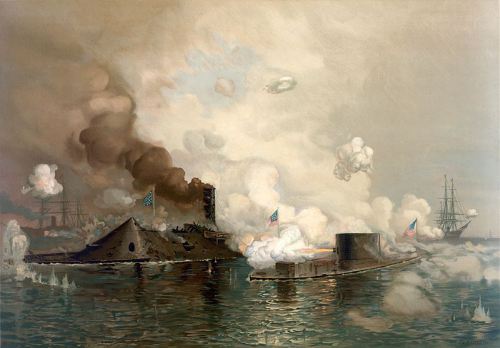
OTCauction


“Lo! Suddenly, to the amazement of the world a mighty kingdom arose…. [of strictly providential Divine origin….The One like the Son of Man has appeared in the ride of the Confederate States.” Reverend William Seat 1862 [1]

Perhaps more than anything, the denominational splits helped prepare the Southern people as well as clergy for secession and war. They set precedent by which Southerners left established national organizations. When secession came, “the majority of young Protestant preachers were already primed by their respective church traditions to regard the possibilities of political separation from the United States without undue anxiety.” [2]

One of the most powerful ideological tools since the days of the ancients has been the linkage of religion to the state. While religion has always been a driving force in American life since the days of the Puritans in the Massachusetts Bay Colony, especially in the belief about the destiny of the nation as God’s “Chosen People,” it was in the South where the old Puritan beliefs took firm root in culture, society, politics and the ideology which justified slavery and became indelibly linked to Southern nationalism. “Confederate independence, explained a Methodist tract quoting Puritan John Winthrop, was intended to enable the South, “like a city set on a hill’ [to] fulfill her God given mission to exalt in civilization and Christianity the nations of the earth.” [3]

Religion and the churches “supplied the overarching framework for southern nationalism. As Confederates cast themselves as God’s chosen people.” [4]  the defense of slavery was a major part of their mission. Southern clergymen had to find a balance between the two most important parts of their political and religious identity, evangelicalism and republicanism. Since these concepts could mean different things to different people Southern clergy and politicians had to find a way to combine the two. Depending on the interpreter “republicanism and evangelicalism could be reactionary or progressive in implication, elitist or democratic.” [5] This can be seen in how Northern and Southern evangelicals supported abolition or the institution of slavery.

A group of 154 clergymen calling themselves “The Clergy of the South” “warned the world’s Christians that the North was perpetuating a plot of “interference with the plans of Divine Providence.” [6] A Tennessee pastor bluntly stated in 1861 that “In all contests between nations God espouses the cause of the Righteous and makes it his own….The institution of slavery according to the Bible is right. Therefore in the contest between the North and the South, He will espouse the cause of the South and make it his own.” [7]

The effect of such discourse on leaders as well as individuals was to unify the struggle as something that linked the nation to God, and God’s purposes to the nation identifying both as being the instruments of God’s Will and Divine Providence. As such, for Southern preachers to be successful agents of the state, the “key to their success as the foundation of a hegemonic ideology lay in making” [8] evangelicalism and republicanism to seem to be both elitist and democratic at the same time.  This resulted in a need to convince the “Southern people to acknowledge God’s authority was bound up with a legitimization of both clerical and civil rulers. Christian humility became identified with social and political deference as the clergy urged submission to both God and Jefferson Davis.” [9]

“Sacred and secular history, like religion and politics, had become all but indistinguishable… The analogy between the Confederacy and the chosen Hebrew nation was invoked so often as to be transformed into a figure of everyday speech. Like the United States before it, the Confederacy became a redeemer nation, the new Israel.”[10]

jackson-prayer

This theology also motivated men like the convinced hard line Calvinist-Presbyterian, General Stonewall Jackson on the battlefield. Jackson’s brutal, Old Testament understanding of the war caused him to murmur: “No quarter to the violators of our homes and firesides,” and when someone deplored the necessity of destroying so many brave men, he exclaimed: “No, shoot them all, I do not wish them to be brave.” [11] He told Richard Ewell after that General order his men not to fire on a Union officer galloping on a white horse during the Valley campaign, “Never do such a thing again, General Ewell. This is no ordinary war. The brave Federal officers are the very kind that must be killed. Shoot the brave officers and the cowards will run away with their men with them.” [12]

For Southerner’s, both lay and clergy alike “Slavery became in secular and religious discourse, the central component of the mission God had designed for the South….The Confederates were fighting a just war not only because they were, in the traditional framework of just war theory, defending themselves against invasion, they were struggling to carry out God’s designs for a heathen race.”[13]

From “the beginning of the war southern churches of all sorts with few exceptions promoted the cause militant”[14] and supported war efforts.  The early military victories of Robert E. Lee’s Army of Northern Virginia and the victories of Stonewall Jackson in the Shenandoah Valley   were celebrated as “providential validations of the cause that could not fail…” Texas Methodist minister William Seat wrote: “Never surely since the Wars of God’s ancient people has there been such a remarkable and uniform success against tremendous odds. The explanation is found in the fact that the Lord goes forth to fight against the coercion by foes of his particular people. Thus it has been and thus it will be to the end of the War.”  [15]

lee-jackson-in-prayer

This brought about a intertwining of church and state authority, a veritable understanding of theocracy as “The need for the southern people to acknowledge God’s authority was bound up with a legitimation of the authority of clerical and civil rulers. Christian humility became identified with social and political deference to both God and Jefferson Davis.” [16]

Jefferson Davis and other leaders helped bolster this belief:

“In his repeated calls for God’s aid and in his declaration of national days of fasting, humiliation, and prayer on nine occasions throughout the war, Jefferson Davis similarly acknowledged the need for a larger scope of legitimization. Nationhood had to be tied to higher ends. The South, it seemed, could not just be politically independent; it wanted to believe it was divinely chosen.”[17]

Davis’s actions likewise bolstered his support and the support for the war among the clergy. A clergyman urged his congregation that the people of the South needed to relearn “the virtue of reverence – and the lesson of respecting, obeying, and honoring authority, for authority’s sake.” [18]

leonidas-polk

Bishop Leonidas Polk

Confederate clergymen not only were spokesmen and supporters of slavery, secession and independence, but many also shed their clerical robes and put on Confederate Gray as soldiers, officers and even generals fighting for the Confederacy. Bishop Leonidas Polk, the Episcopal Bishop of Louisiana, who had been a classmate of Jefferson Davis at West Point was commissioned as a Major General and appointed to command the troops in the Mississippi Valley. Polk did not resign his ecclesiastical office, and “Northerners expressed horror at such sacrilege, but Southerners were delighted with this transfer from the Army of the Lord.”[19] Lee’s chief of Artillery Brigadier General Nelson Pendleton was also an academy graduate and an Episcopal Priest.

Southern churches were supremely active in the war effort. Churches contributed to the Confederate cause through donations of “everything from pew cushions to brass bells, Southern churches gave direct material aid to the cause. Among all the institutions in Southern life, perhaps the church most faithfully served the Confederate Army and nation.” [20]Likewise, many Southern ministers were not content to remain on the sidelines in the war and “not only proclaimed the glory of their role in creating the war but also but also went off to battle with the military in an attempt to add to their glory.” [21]

Sadly, the denominational rifts persisted until well into the twentieth century. The Presbyterians and Methodists both eventually reunited but the Baptists did not, and eventually “regional isolation, war bitterness, and differing emphasis in theology created chasms by the end of the century which leaders of an earlier generation could not have contemplated.” [22]  The Southern Baptist Convention is now the largest Protestant denomination in the United States and many of its preachers are active in often-divisive conservative social and political causes. The denomination that it split from, the American Baptist Convention, though much smaller remains a diverse collection of conservative and progressive local churches. Some of these are still in the forefront of the modern civil rights movement, including voting rights, women’s rights and LGBT issues, all of which find some degree of opposition in the Southern Baptist Convention.

But the religious dimensions were far bigger than denominational disagreements about slavery; religion became one of the bedrocks of Confederate nationalism. The Great Seal of the Confederacy had as its motto the Latin words Deo Vindice, which can be translated “With God as our Champion” or “Under God [Our] Vindicator.” The issue was bigger than independence itself; it was intensely theological. Secession “became an act of purification, a separation from the pollutions of decaying northern society, that “monstrous mass of moral disease,” as the Mobile Evening News so vividly described it.” [23]

The arguments found their way into the textbooks used in schools throughout the Confederacy. “The First Reader, For Southern Schools assured its young pupils that “God wills that some men should be slaves, and some masters.” For older children, Mrs. Miranda Moore’s best-selling Geographic Reader included a detailed proslavery history of the United States that explained how northerners had gone “mad” on the subject of abolitionism.” [24] The seeds of future ideological battles were being planted in the hearts of white southern children by radically religious ideologues, just as they are today in the Madrassas of the Middle East.

While the various theological and ideological debates played out and fueled the fires of passion that brought about the war, they also provided great motivation to their advocates.  This was true especially to Confederates during the war, that their cause was righteous. While this fueled the passion of the true believers, other very real world decisions and events in terms of politics, law and lawlessness, further inflamed passions.

Notes

[1] Ibid. Daly When Slavery was called Freedom p.147

[2] Brinsfield, John W. et. al. Editor, Faith in the Fight: Civil War Chaplains Stackpole Books, Mechanicsburg PA 2003 p.67

[3] Ibid. Faust The Creation of Confederate Nationalism p.27

[4] Ibid. Gallagher The Confederate War pp.66-67

[5] Ibid. Faust The Creation of Confederate Nationalism p.32

[6] Ibid. Daly When Slavery Was Called Freedom  p.145

[7] Ibid. Daly When Slavery Was Called Freedom p.138

[8] Ibid. Faust The Creation of Confederate Nationalism p.32

[9] Ibid. Faust The Creation of Confederate Nationalism p.33

[10] Ibid. Faust The Creation of Confederate Nationalism p.29

[11] Fuller, J.F.C. Grant and Lee: A Study in Personality and Generalship, Indiana University Press, Bloomington IN 1957 p.129

[12] Davis, Burke They Called Him Stonewall: A Life of T.J. Jackson CSA Random House, New York 1954 and 2000 p.192

[13] Ibid. Faust, The Creation of Confederate Nationalism p.60

[14] Ibid. Thomas The Confederate Nation 1861-1865 pp.245-246

[15] Ibid. Daly When Slavery Was Called Freedom pp.145 and 147

[16] Ibid. Faust The Creation of Confederate Nationalism p.26

[17] Ibid. Faust The Creation of Confederate Nationalism p.33

[18] Ibid. Faust The Creation of Confederate Nationalism p.32

[19] Foote, Shelby, The Civil War, A Narrative. Volume One: Fort Sumter to Perryville Random House, New York 1963 1958 p.87

[20] Ibid. Thomas The Confederate Nation p.246

[21] Ibid. Daly When Slavery Was Called Freedom p.142

[22] Ibid. McBeth The Baptist Heritage pp.392-393

[23] Ibid. Faust The Creation of Confederate Nationalism p.30

[24] Ibid. Faust The Creation of Confederate Nationalism p.62

Leave a comment

Filed under civil rights, civil war, faith, History, laws and legislation