Category Archives: civil war

Gettysburg Day Two: The Complex Character of Gouverneur Warren and Little Round Top

gkwarren

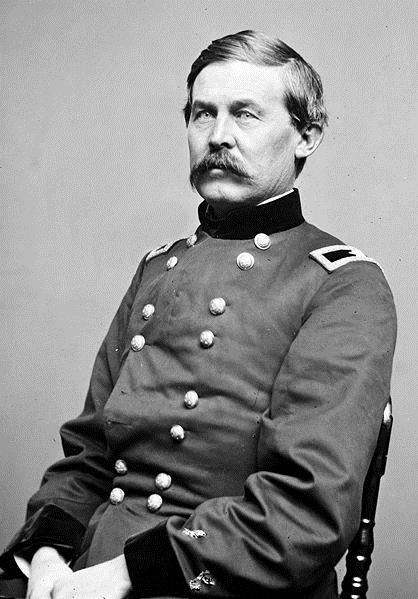
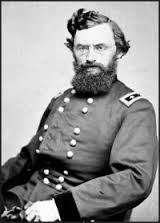
Brigadier General Gouverneur Warren

Throughout this study we have been looking at how leaders at various levels in conduct of campaigns as well as battles make decisions. Likewise we examine the lives and character of those leaders as it applies to their actions at critical points of a battle. In this chapter we will examine three officers whose lives, character and actions at Gettysburg, specifically at Little Round Top exemplify two of the Chairman of the Joint Chiefs of Staff Desired Leader Attributes, “to anticipate and adapt to surprise and uncertainty” and the principle of Mission Command, to “operate on intent through trust, empowerment and understanding.” It is from those perspectives that we will look at this part of the battle, but we would be amiss if we did not address the nearly mythical status to which this action has risen.

The actions of three men at the Battle of Little Round Top; Brigadier General Gouverneur Warren, the Chief Engineer of the Army of the Potomac, Colonel Strong Vincent, commanding Third Brigade, First Division, V Corps and Colonel Joshua Lawrence Chamberlain, commanding the 20th Maine Infantry Regiment of Vincent’s brigade are very important to the outcome of the battle, but also for what they teach us about leadership and the profession of arms. This chapter focuses on Warren, in particular with his work with the Commander of the Army of the Potomac, George Meade and his actions to secure Little Round Top on July 2nd 1863, the next will deal with Chamberlain and Vincent.

The battle at Little Round Top is an iconic part of American History and in particular for the Army, a key element of how leadership has been studied. It has achieved nearly mythical status due to the actions of Colonel Joshua Chamberlain which have been told many times in history, fiction and in film, particularly Michael Shaara’s classic historical novel The Killer Angels and its film adaptation Gettysburg. While these accounts are certainly inspiring and allow us to experience the emotion and near spiritual quality of what Chamberlain writes, there is much more to learn.

That near spiritual quality and mythic status that we accord Gettysburg is important, for in large part it is why we come to the battlefield, and why we study. Chamberlain said it well many years after Gettysburg at the dedication of the Maine Monuments:

“In great deeds, something abides. On great fields, something stays. Forms change and pass; bodies disappear; but spirits linger, to consecrate ground for the vision-place of souls… generations that know us not and that we know not of, heart-drawn to see where and by whom great things were suffered and done for them, shall come to this deathless field, to ponder and dream; and lo! the shadow of a mighty presence shall wrap them in its bosom, and the power of the vision pass into their souls.” [1]

So as we endeavor to look at the actions of these leaders on that fateful day it is important to recognize that we cannot totally separate those actions that helped decide the battle from the mythos that surrounds the story. [2] Likewise, it important to acknowledge that we cannot separate their character and the totality of military leaders lives from their actions on a particular battlefield. Unlike Chamberlain Warren does not engender myth, and that is why he is often overlooked by many casual students and observers of the Battle of Gettysburg.

For the purposes of this study it is important to note that Warren was not a commander during this action, he was, like most senior officers today, a staff officer. Many times students of military history and theory are inclined to dismiss the contributions of staff officers because they do not have the overall responsibility of a battle, or the glamour of the limelight of the commanders that they serve under. However, for military professionals, especially those serving on senior staffs who prepare campaign plans, contingency plans and crisis plans the study of officers like Warren is essential.

The Federal Army at Gettysburg, like its Confederate opponent had a wide variety of officers serving in its ranks. Many of its senior officers were graduates of West Point. Many had served together in Mexico and in the various campaigns against Native American tribes. Those who stayed in the Army during the long “peace” between the Mexican War and the outbreak of the Civil War endured the monotony, boredom and often miserable conditions of isolated army posts, long family separations, as well as low pay, slow promotion and often low social status.[3] In light of such conditions, many resigned their commissions to undertake various professional, business or academic pursuits; in fact Samuel Huntington noted that in the years before the Civil War that “West Point produced more railroad presidents than generals.” [4] However, on the outbreak of the war returned to service whether in the service of the Union, or the Confederate States.

When the war began the Army underwent a massive expansion, which it met through and the call of up militia and raising new units from the various states. In the expansion many officers were appointed who had no prior military service, or if they did it was performed years or even decades before the war. Some of these men were simply patriots who rallied to the flag, others due to a sense of righteousness about their cause, while others were political opportunists or appointees. In the north this was a particular problem as “professional officers were pushed aside and passed over in the Union, the higher commissions going, in the first stages of the war at least to officers called back into service or directly appointed from civilian life, many of them “political” appointees.” [5]

At times the lack of experience, training and sometimes the poor character of these men was tragic. However, many of these men performed as well or better than some of their regular army counterparts at various levels of command. At the same time a good number of Regular Army officers were allowed to assist states in the formation and training of these new units, one of whom was Gouverneur Warren. Gettysburg would provide opportunity for the best and worst of all of these types of officers to succeed or fail. In this chapter we will look at one of the regular officers and two of the volunteer whose lives intersected on July 2nd 1863.

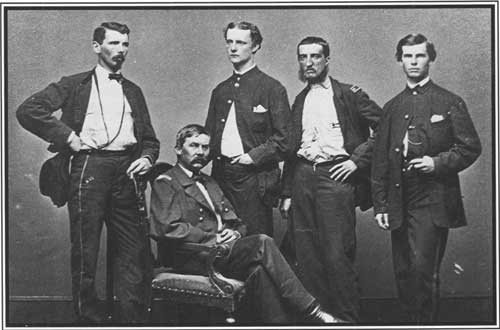
Brigadier General Gouverneur Warren was typical of the many professional officers of the old army. An 1850 graduate of West Point, Warren was a bright student who had absorbed the teachings of his professor, Dennis Hart Mahan as the core of his own military thought, both in his senior year in college and through reinforcement as a faculty member. [6] Warren was commissioned as a Brevet Second Lieutenant and because of his high standing in his class was assigned to Corps of Topographical Engineers. He spent his first seven years in a number of assignments which took him throughout much of the country.

Warren’s work involved exploring and mapping for various enterprises including the project to help tame the Mississippi River, and the exploration of the Great Plains and Black Hills where he developed a sympathy for the various Sioux tribes he encountered noting on completion of his mission in 1858, writing that He had never heard a Sioux chief express an opinion in regard to what was due them in which I do not concur and that many of them view the extinction of their race as an inevitable result of the operation of present causes, and do so with all the feelings of despair with which we should contemplate the extinction of our nationality. [7] Following his years in the west he returned as faculty to West Point where he as an Assistant Professor, shared mathematics instructional duties with Oliver O. Howard and resumed his relationship with his former professor Mahan. [8]

On the outbreak of war Warren was granted leave from his duties at West Point to serve as Lieutenant Colonel of Volunteers in the 5th New York Infantry Regiment, also known as Duryee’s Zouaves. Where Duryee was appointed as a Brigadier General, Warren became its Colonel, serving with it during the Peninsula campaign where he was eventually given command of a provisional brigade and promoted to Brigadier General, serving as a Brigade Commander in at Second Manassas, Antietam and Fredericksburg.

At Chancellorsville he was pulled from his brigade duties by Hooker who employed him with good effect to assist his engineering staff, first with mapping and then building the fortifications that stopped the ferocious Confederate storm on the second day of battle. [9] In less than 48 hours Warren’s troops threw up five miles of the most formidable entrenchments yet constructed under battlefield conditions. [10] Edward Alexander, Longstreet’s artillery officer noted that when the Confederates came upon the fortifications after Hooker’s withdraw that “they were amazed at the strength and completeness of the enemys fortifications. [11] Following the battle Warren was appointed as Chief Engineer of the Army of the Potomac on May 12th 1863 by Hooker. When Hooker was relieved of command and was replaced by Meade on June 28th 1863, he was kept in that position by his fellow engineer Meade rather than being promoted to a division or being assigned as Meade’s Chief of Staff. As this turned out it was a wise choice.

Warren along with Major General Winfield Scott Hancock arrived at Cemetery Hill on the night of July 1st. As Meade organized his defenses he not only depended on his advice about the ground, but “consulted him constantly at headquarters or sent him off on matters of highest importance.” [12] Meade respected Warren and had offered Warren the chance to serve as his Chief of Staff, a position that Warren, like Seth Williams, the Adjutant General declined that offer indicating that he had too much work in their departments to take on the burdens of a new job. [13] Lee appreciated Warren’s calm, absorbed, and earnest manner, his professional skill and sound judgment.[14] These qualities would serve both men and the army well on July 2nd.

When Sickles moved III Corps forward during the afternoon without permission moved his Corps forming a vulnerable salient at the Peach Orchard leaving the southern flank in the air, Meade was aghast. Warren who from his reconnaissance of the previous day and the morning knew the position better than anyone recognized that something was badly awry on Sickles Third Corps front matters there were not all straight. [15] He had sent an officer to discover to investigate Sickles’ front and that officer reported that the section of Cemetery Ridge assigned to III Corps was not occupied. [16]

Meade and Warren discussed the situation and realized that III Corps “could hardly be said to be in position” [17] and knowing VI Corps was now close at hand order V Corps, at the time his only reserve into the position vacated by Sickles. They went forward and seeing the empty spaces Warren told Meade “here is where our line should be” to which Meade replied: “It’s too late now.” [18] Warren, whose familiarity with the whole of the battlefield gave him concern about Sickles’ corps dispositions suggest that Meade send him to the Federal left, “to examine the condition of affairs.” [19]

Meade concurred with his Engineer and in dispatching him he also gave Warren the authority to take charge as needed saying “I wish you would ride over there and if anything serious is going on, attend to it.” [20] Again Meade’s choice of Warren for the task demonstrated the trust that is essential in command. The two officers worked together seamlessly and as Coddington described their relationship that day: “Meade chose him to act as his alter ego in crucial moments of the battle, and Warren rendered services for which Meade and the country were to be eternally grateful.” [21] Warren would not see Meade again “until the attack had spent its force.” [22]
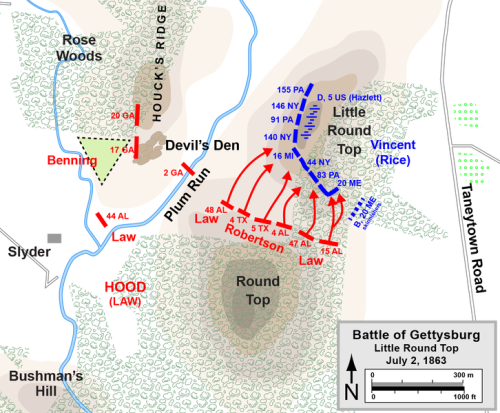
little round top map

Hunt noted that “The duty could not have been in better hands.” [23] When Warren arrived on Little Round Top he found it unoccupied save for a few signal corps soldiers. Warren immediately recognized the tactical value of Little Round Top and noted that it was “the key of the whole position.” [24] Warren saw that the Confederates were massing not more than a mile away and that there were no troops on the hill to stop them. He believed that an area “of woods on the near side of the Emmitsburg Road as “an excellent place for the enemy to form out of sight” [25] which was exactly what Major General John Bell Hood’s division was doing, as Henry Hunt noted “The enemy at the time lay concealed, awaiting signal for the assault…” [26] To test his suspicions Warren sent a messenger to Captain James Smith’s 4th New York artillery battery on Devil’s Den to fire a single shot into the woods. Warren described the situation:

“As the shot went whistling through the air the sound of it reached the enemy’s troops and caused every one to look in the direction of it. This motion revealed to me the glistening gun-barrels and bayonets of the enemy’s line of battle, already formed and far outflanking the position of any of our troops; so that the line of his advance from the right to Little Round Top was unopposed. I have been particular in telling this, as the discovery was intensely thrilling to my feelings, and almost appalling.” [27]

warren lrt

Upon confirming his fears Warren resorted to ruse and action. He order the “signalmen to keep up their wigwag activity, simply as a pretense of alertness, whether they had any real signals to transmit or not…” [28] He also sent messengers to Meade, Sickles and Sykes, the commander of V Corps asking Meade to “Send at least a division to me” [29] instructing the messenger, Lieutenant Randall Mackenzie to tell Meade “that we would at once have to occupy that place very strongly.” [30] Sickles refused on account of how badly stretched his lines were, however George Sykes of V Corps responded sending Captain William Jay to find Barnes commander of his 1st Division. The messenger could not find Barnes, but instead came across the commander of the division’s 3rd Brigade Colonel Strong Vincent. Vincent knew that Barnes was self-medicating his “pre-battle anxieties out of a black commissary quart bottle” and was already “hollow from skull to boots” and demanded “What are your orders? Give me your orders.” [31] Upon learning that Sykes wanted a brigade to proceed to Little Round Top Vincent responded immediately to take the initiative and ordered his four regiments up Little Round Top without waiting for permission. Vincent told Sykes messenger “I will take the responsibility myself of taking my brigade there.” [32]

Meade’s choice of Warren was demonstrated in how Warren continued to act with alacrity and decisiveness throughout the afternoon. “As the Union line began to crumble on Little Round Top, Warren, vested with the authority of Meade’s chief representative, emerged as the right man at the right place at the right time.” [33] Warren did not stop with sending messengers, but seeing the danger building he noted that the northwest face of the hill was still unoccupied and open to attack. Warren forgot “all about a general’s dignity” he “sprinted down the east slope of the hill like a rabbit.” [34] There he found Brigadier General Stephen Weed’s brigade which he had previously commanded. Since he did not see Weed, but he found Colonel Patrick O’Rorke of the 140th New York and ordered him to follow him up the hill, saying “Paddy…give me a regiment.” [35] When O’Rorke said that Weed expected him to be following him Warren took the responsibility telling O’Rorke “Bring them up on the double quick, and don’t stop for aligning. I’ll take responsibility.” [36] O’Rorke followed with his gallant regiment with the rest of the brigade under Weed following. Warren’s actions were fortuitous as the 140th New York and Lieutenant Charles Hazlett’s battery of the 5th Artillery arrived at the crest just in time to repulse the advancing Confederates. In the fight the brigade would take fearful casualties and by the end of the battle, Weed, O’Rorke and Hazlett would all be dead, but with Vincent’s brigade they held on and saved the Union line.[37]

Warren continued to urge on the Federal troops despite being wounded, in the words of a reporter who observed him in “a most gallant and heroic manner, riding with utmost confidence over fields swept by the enemy’s fire, seemingly everywhere present, directing, aiding, and cheering the troops.” [38] Once he was assured that Little Round Top was secure he proceeded to rejoin Meade “near the center of the battlefield where another crisis was at hand.” [39]

Warren distinguished as a Corps commander until he ran afoul of the fiery General Phillip Sheridan in 1865. Sheridan relieved Warren of command of V Corps following the Battle of Five Forks where Sheridan believed that Warren’s Corps had moved too slowly in the attack. The relief was brutal and ruined his career. Warren was a professional soldier and took the relief hard. Unfortunately as a topographic engineer he was an outsider to many in the army and not fully appreciated by Grant or Sheridan who in their haste at Five Forks destroyed his career.

After the war Warren resigned his commission as a Major General of Volunteers and returned to his permanent rank as a Major of Engineers. He served another 17 years doing engineeringduty and was promoted to Lieutenant Colonel in 1879, but his past always haunted him, even his sleep. He wrote his wife while supervising a major bridge construction project over the Mississippi River in 1867: “I wish I did not dream so much. They make me sometimes to dread to go to sleep. Scenes from the war, are so constantly recalled, with bitter feelings I wish never to experience again. Lies, vanity, treachery, and carnage.” [40]

He sought a Court of Inquiry to exonerate himself but this was refused until President Grant left office. The Court eventually exonerated him but he died three months before the results were published. Embittered he directed that he be buried in civilian clothes and without military honors. His funeral was attended by his friends Winfield Scott Hancock and Samuel Crawford, his oldest army friend and mentor Andrew Humphreys was called away before the service due to the sudden illness of his son. [41] The Washington Post noted that Warren “had gone “where neither the malevolence nor the justice of this world can reach him. He had enough of the former; and denial of the latter not only embittered his closing months of his life, but undoubtedly hastened his end.” [42]

Warren’s actions on that hot and muggy July 2nd exemplified the leadership qualities that we as an institution strive for, and from a leadership perspective demonstrate how the Chairman’s Desired Leader Attributes and the principles of Mission Command: “the ability to operate on intent through trust, empowerment and understanding” should work in a relationship between seniors and subordinates. But his life also serves to remind us of the ethics of our profession. Loomis Langdon, who served as the official recorder for the board of inquiry wrote of Warren:

“I had never met General Warren till he came before his Court of Inquiry…I learned to value his good opinion – and while I admired him for his great patience, his wonderful energy, habit of concentration, his vast learning and untiring application, I loved him for his tenderness, gentleness and charity, even to those whom he believed had combined to do him a cruel wrong; and I admired him for his nobleness of character and his courage and unselfish patriotism.” [43]

It is easy for military professionals to become totally focused in our profession, especially the details of planning and process to forget the humanity of those that we serve alongside. Warren is one of those complex figures who are not easy to categorize. His biographer Jordan wrote that:

“Warren was a man with fine intellect, widely read, and of keen sensibilities. He was also an excellent engineer, mapmaker, and scientist. He was a soldier who cared much for the safety and welfare of the men under him, and he was sickened by the appalling carnage of the war in which he took such a prominent part. He was arrogant and proud, and he hesitated hardly at all in putting down those of his colleagues he regarded as inferiors. His mind’s eye took in much beyond what was his immediate concern, but this gift worked against him in the hierarchical realm of military life. Warren was prone to long sieges of depression, and he himself agreed that others found him morose and unsmiling…” [44]
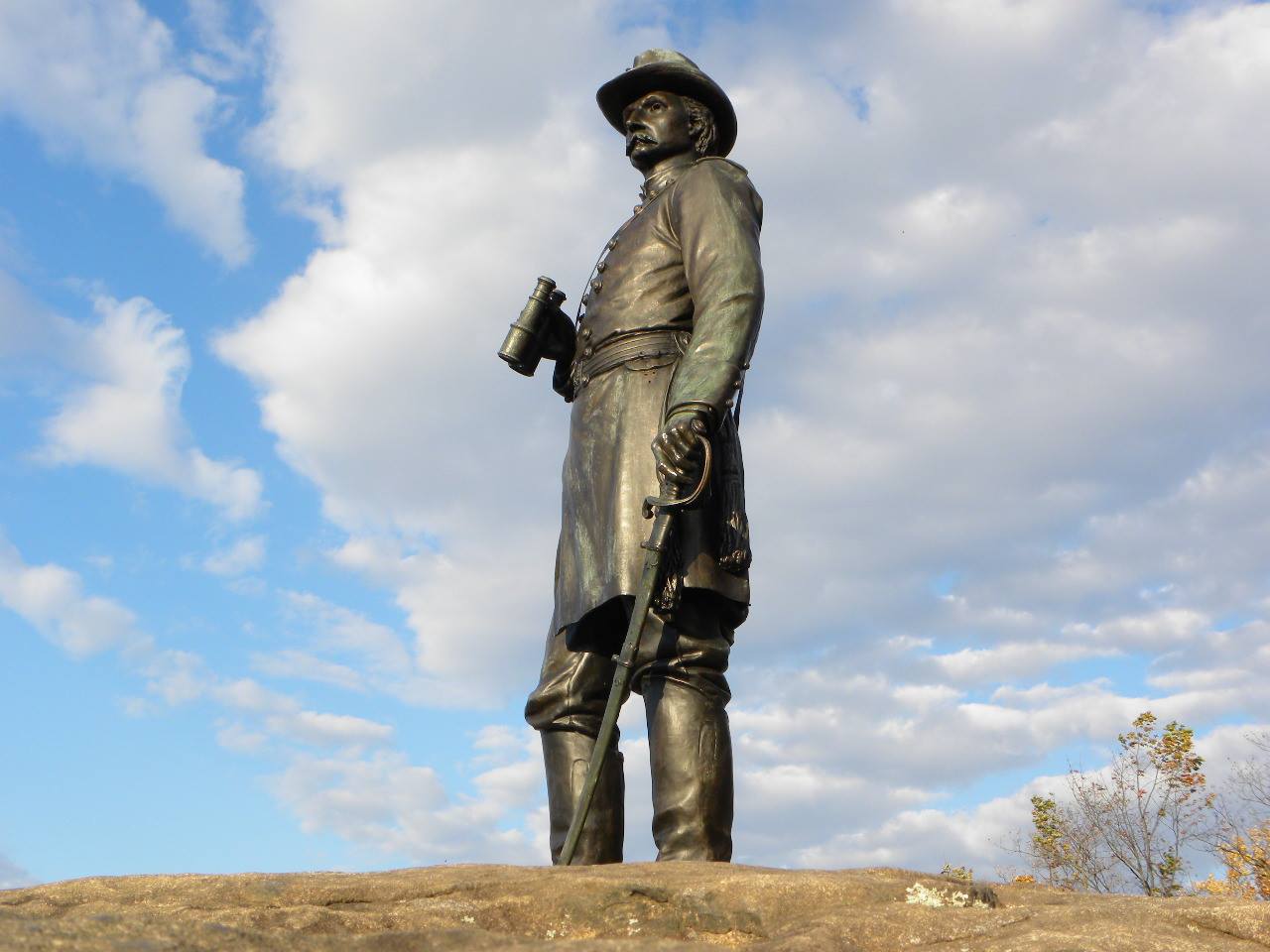
Warren

In reading military history is far too easy to isolate and analyze a commander’s actions in battle and ignore the rest of their lives. I think that this does a great disservice to the men themselves. In time of war gives up something of themselves and sometimes even heroes like Gouverneur Warren are destroyed by the actions of institutions that they serve.

Notes

[1] Chamberlain, Joshua Lawrence. Chamberlain’s Address at the dedication of the Maine Monuments at Gettysburg, October 3rd 1888 retrieved from http://www.joshualawrencechamberlain.com/maineatgettysburg.php 4 June 2014

[2] Note: My use of the terms myth, mythology or mythos should not be considered negative, and the use of the terms does not mean that there is not some degree of fact or truth in them. The definitions of the term mythos are important to understanding my use of the term here, first it denotes a traditional or recurrent narrative theme or plot structure of a story, and secondly a set of beliefs or assumptions about something. (See the Oxford American Dictionary.)

[3] Taylor, John M. Duty Faithfully Performed: Robert E Lee and His CriticsBrassey’s, Dulles VA 1999 pp.37-38.

[4] Huntington, Samuel P. The Soldier and the State: The Theory and Politics of Civil-Military Relations The Belknap Press of Harvard University Press, Cambridge MA and London 1957 p.199

[5] Ibid. Huntington. The Soldier and the State: The Theory and Politics of Civil-Military Relations p.213

[6] Jordan, David M. Happiness is Not My Companion: The Life of G.K. Warren Indiana University Press, Bloomington Indiana 2001 p.6

[7] Ibid. Jordan Happiness is Not My Companion: The Life of G.K. Warren p.30

[8] Ibid. Jordan Happiness is Not My Companion: The Life of G.K. Warren p.33

[9] Sears, Stephen W. ChancellorsvilleHoughton Mifflin Co. Boston and New York 1996 p.372

[10] Hagerman, Edward. The American Civil War and the Origins of Modern Warfare. Midland Book Editions, Indiana University Press. Bloomington IN. 1992 p.91

[11] Alexander, Edward Porter Military Memoirs of a Confederate: A Critical Narrative 1907 republished 2013 by Pickle Partners Publishing, Amazon Kindle Edition location 7007

[12] Coddington, Edwin B. The Gettysburg Campaign: A Study in Command, A Touchstone Book, Simon and Schuster New York, 1968 p.332

[13] Sears, Stephen W. Gettysburg. Houghton Mifflin Co. Boston and New York 2003 pp.129-130

[14] Ibid. Coddington, The Gettysburg Campaign: A Study in Command, p.332

[15] Ibid. Sears Gettysburg p.262

[16] Tredeau, Noah Andre. Gettysburg: A Testing of Courage, Harper Collins Publishers, New York 2002 p.319

[17] Ibid. Tredeau. Gettysburg: A Testing of Courage, p.319

[18] Ibid. Tredeau. Gettysburg: A Testing of Courage, p.320

[19] Ibid. Jordan Happiness is Not My Companion: The Life of G.K. Warren p.90

[20] Ibid. Tredeau. Gettysburg: A Testing of Courage, p.320

[21] Ibid. Coddington, The Gettysburg Campaign: A Study in Command, p.388

[22] Guelzo, Allen C. Gettysburg: The Last Invasion Vintage Books a Division of Random House, New York 2013 p.260

[23] Hunt, Henry. The Second Day at Gettysburg in Battles and Leaders of the Civil War Volume III, The Tide Shifts. Edited by Robert Underwood Johnson and Clarence Clough Buel Castle, Secaucus NJ p. 307

[24] Ibid. Jordan Happiness is Not My Companion: The Life of G.K. Warren p.92

[25] Ibid. Jordan Happiness is Not My Companion: The Life of G.K. Warren p.92

[26] Ibid. Hunt The Second Day at Gettysburg in Battles and Leaders of the Civil War Volume III, The Tide Shifts. p. 307

[27] Pfanz, Harry F. Gettysburg: The Second Day. University of North Carolina Press, Chapel Hill 1987 p.206

[28] Foote, Shelby, The Civil War, A Narrative. Volume Two Fredericksburg to Meridian Random House, New York 1963 p.503

[29] Ibid. Jordan Happiness is Not My Companion: The Life of G.K. Warren p.92

[30] Ibid. Guelzo Gettysburg: The Last Invasion Vintage p.261

[31] Ibid. Guelzo Gettysburg: The Last Invasion Vintage p.262

[32] Longacre, Edward Joshua Chamberlain: The Soldier and the Man Combined Publishing Conshohocken PA 1999 p.127

[33] Ibid. Coddington, The Gettysburg Campaign: A Study in Command, p.395

[34] Swanberg, W.A. Sickles the IncredibleStan Clark Military Books, Gettysburg PA 1957 p.214

[35] Ibid. Jordan Happiness is Not My Companion: The Life of G.K. Warren p.93

[36] Ibid. Foote The Civil War, A Narrative. Volume Two Fredericksburg to Meridian p.504

[37] Ibid. Jordan Happiness is Not My Companion: The Life of G.K. Warren pp. 93-94

[38] Ibid. Coddington, The Gettysburg Campaign: A Study in Command, p.388

[39] Ibid. Coddington, The Gettysburg Campaign: A Study in Command, p.396

[40] Ibid. Jordan Happiness is Not My Companion: The Life of G.K. Warren p.249

[41] Ibid. Jordan Happiness is Not My Companion: The Life of G.K. Warren p.309

[42] Ibid. Jordan Happiness is Not My Companion: The Life of G.K. Warren p.308

[43] Ibid. Jordan Happiness is Not My Companion: The Life of G.K. Warren p.309

[44] Ibid. Jordan Happiness is Not My Companion: The Life of G.K. Warren preface pp.x-xi

3 Comments

Filed under civil war, History, leadership, Military

Gettysburg Day One: Lee’s Vague Discretionary Orders and Lack of Control

Lee1

Discretionary orders are important to the success of commanders who desire that their subordinates have the necessary freedom to exploit opportunities within the broader operational context. They are a key element of what we now define as Mission Command and thus expressed clearly in the Chairman of the Joint Chiefs of Staff Desired Leader Attributes the ability to operate on intent through trust, empowerment and understanding. In this chapter we will look at how Lee conducted war and how his decision process and communications, particularly the use of discretionary orders influenced the outcome of the battle and how important the issuance of clear orders is to a successful campaign.

To be effective such orders need to be clear and concise and they must be employed in a manner that are within the capabilities of one’s subordinate commanders to both understand them and carry them out. Thus a commander must always be ready to adjust his method when his command goes through a major turnover of personnel. After the loss of Jackson at Chancellorsville and the subsequent reorganization of the Army of Northern Virginia, Lee continued to operate as if nothing had changed, despite his own recognition that the army suffered from a want of qualified senior officers.

Robert E. Lee habitually issued discretionary orders with varying degrees of effectiveness. With Jackson, a man of ruthless battlefield instincts Lee was able to do this, even when Lee’s intent was less than clear, but even with Jackson such orders occasionally went awry as was the case during the Seven Days. Lee’s aide Walter Taylor noted that Jackson “took the suggestion of General Lee into immediate consideration, and proceeded to carry it into effect.” [1] This was not to be the case with those that followed Jackson, something that Lee failed to adjust to that would doom his army at Gettysburg.

Part of this is attributable to Lee’s distaste for administrative routine. Taylor noted how Lee’s “correspondence…was constantly a source of worry to him. He did not enjoy writing; indeed he wrote with labor, and nothing seemed to tax his amiability as the necessity for writing a lengthy official communication.” [2] But more importantly in the matter of communicating orders and following up, much of the issue came down to Lee’s near fatalistic understanding of faith and life in regard to the providence of God. For Lee victory and defeat came down to God’s will, as he wrote his wife after his ill-fated 1861 campaign in western Virginia “But the Ruler of the Universe willed otherwise and sent a storm to discontent a well laid plan and to destroy my hopes.” [3] But for Lee, the concept of “duty” became a secular manifestation of his religion.” [4]

J. F. C. Fuller attributes much of the manner in how Lee conducted battle to this sense of duty as well as belief in providence. Fuller notes that it “controlled the whole of his generalship.” [5] Lee explained his concept of command to the Prussian observer, Captain Justus Scheibert:

“You must know our circumstances, and see in battle that my leading would do more harm than good. It would be a bad thing if I could not then rely on my brigade and divisional commanders. I plan and work with all my might to bring my troops to the right place at the right time; with that I have done my duty. As soon as I order the troops forward into battle, I lay the fate of my army in the hands of God.” [6]

That firm belief in providence and the hand of God was evident in Lee’s comments to Major General Isaac Trimble as the army advanced into Pennsylvania. “We have again outmaneuvered the enemy, who even now does not know where we are or what our designs are. Our whole army will be in Pennsylvania day after tomorrow, leaving the enemy far behind and obliged to follow by forced marches. I hope with these advantages to accomplish some single result and to end the war, if Providence favors us.” [7]

Fuller is one of the harshest critics of Lee bluntly notes that “this lack of appreciation that administration is the foundation for strategy; this lack of interest in routine, and his abhorrence to exert his authority…” [8] were key factors in many of his army’s problems, from command and control, discipline and the material and logistics aspects of war. Likewise his absolute reliance on his subordinates to carry out his orders, and unwillingness to interfere once the battle was joined was a major factor in his failure at Gettysburg, where Russell Weigley noted in a rather kind and subdued way that “Lee…was sometimes served less than well by his corps, division and brigade commanders.” [9]

Throughout the Gettysburg campaign Lee issued vague orders that his subordinates either failed to understand or willingly interpret in a manner that Lee did not intend. Lee’s biographer Michael Korda notes that “the phrase if practicable…led to many unfortunate consequences, since it provided subordinate commanders a kind of escape clause, allowing them to argue after the event that what they had been order to do was not, in their view “practicable.” [10]

From the time that Robert E Lee learned that the Army of the Potomac had crossed the Potomac into Maryland on June 28th, he attempted to adjust his campaign plan and concentrate his army in preparation for battle. At that point his army was scattered and he did not want to provoke an engagement until he could concentrate his forces. Stuart’s cavalry, the absence of which was a matter of great consternation to Lee was chief among his concerns. Lee had hoped that Hooker would pursue him north, but finding the information out from Longsteet’s spy Harrison disturbed Lee greatly. [11]

Lee expected to know about Hooker’s movements from Stuart. However, Stuart was nowhere to be found; operating nearly fifty miles away separated from Lee’s main body much of the Army of the Potomac. Lee’s aide Walter Taylor wrote: “No tidings had been received from or of our cavalry under General Stuart since crossing the river; and General Lee was consequently without accurate of the movements or position of the main Federal Army.” [12] However, while Stuart certainly can be blamed for taking his best cavalry off on a ride around the Federal army, he acted in accordance with how he interpreted Lee’s orders, as Douglas Southall Freeman wrote: “What was possible was permissible. That, as Stuart saw it, was the substance of his orders.” [13]

This was especially true after Stuart had been surprised at Brandy Station by the Federal cavalry and pilloried in the Confederate press, the Richmond Sentinel saying Stuart had been “outgeneraled” and the Richmond Whig predicting that “We shall not be surprised if the gallant Stuart does not, before many days, make the enemy repent sorely the temerity that led them to undertake this bold and insulting feat….” [14] Lee’s orders provided just enough ambiguity and wiggle room for the wounded Stuart to do precisely what he did.

Lee’s orders gave Stuart the options of moving back to screen the army or passing around the Federal army, leaving the decision to Stuart’s discretion. “You will, however, be able to judge whether you can pass around their army without hindrance, doing them all the damage you can…” [15] Major Henry McClellan, Stuart’s aide recorded that he also received a “lengthy communication from General Lee…” which “discussed at considerable length the plan of passing around the enemy’s rear….” [16] Stuart in his official report wrote: “The commanding General wrote me, authorizing this move if I deemed it practical.” [17]

That being said Lee was clear enough that he expected Stuart to “lose no time in placing his command on the right of our column as soon as he should perceive the enemy moving northward.” [18] Though Stuart had detected Hancock’s II Corps moving north near Manassas he elected to make his movement around the Federal Army. Stuart’s biographer Burke Davis noted that Stuart “sought no advice on the all-important detour of June twenty-sixth, which changed his direct. He did not so much consult his brigadiers as he swung his column southward to pass around the enemy.” [19] Though Lee at a number of points during lead up to Gettysburg signaled his frustration with Stuart’s absence and its effect on his abilities, he failed to draw the appropriate conclusions that a prudent commander, operating deep in enemy territory would assume from the lack of contact. Lee should have assumed that Stuart was because of his move “become temporarily incommunicado” but instead, “inferred from Stuart’s silence that Hooker had not crossed the Potomac.” [20]

Lee’s vague order was the first in a series of command and control issues that plagued him during the campaign and combined with Stuart’s vanity and need to redeem his reputation, Lee’s ill use of the cavalry he did have under his control were all contributing factors leading to the disastrous encounter at Gettysburg, but there was more to come.

Now that Lee knew that the Army of the Potomac had crossed into Maryland and was now under the command of George Meade he began to take action to reassemble his widely scattered army in the vicinity of Chambersburg and Cashtown. A.P. Hill’s Third Corps was already near Cashtown, and Longstreet’s First Corps was on its way up. The most important issue Lee had was to get Ewell’s Second Corps, then near Carlisle preparing to attack Harrisburg, back in contact with the rest of the Army.

Lee sent two sets of orders to Ewell on the night of the 28th, after getting Harrison’s intelligence, but they did not reach Ewell until the morning of the 29th. The first orders were for Ewell to move to Chambersburg, and the second, to concentrate at Heidlersburg where he could either continue to Cashtown or turn south to Gettysburg. [21] The intent was good, Lee appears to have desired to minimize congestion on the turnpike in order to more rapidly assemble his army, however the orders caused much discontent at the Second Corps headquarters and “made Old Bald Head most unhappy.” [22] Many of his soldiers with Harrisburg in plain sight were likewise upset the “disappointment and chagrin were extreme” [23] while a soldier in “Maryland Steuart’s brigade recalled the “ill-concealed dissatisfaction” of the men, who “found the movement to be as they supposed “one of retreat.” [24] A staff officer noted that Ewell was “quite testy and hard to please” at the news and “became disappointed, and had everyone flying around.” [25]

Despite his displeasure Ewell did move promptly to comply with Lee’s orders “Lee had not communicated any particular sense of crisis to the case, and the Second Corps’ march proceeded at the usual pace.” [26] Likewise the fact that there were two orders caused several problems that would manifest themselves on July 1st all of which would affect the outcome of the battle.

The first regarded the movement of Second Corps. On receipt of the first order to proceed to Chambersburg Ewell promptly started Allegany Johnson’s division as well as the Second Corps Wagon Train and two battalions of its Corps Artillery Reserve down the turnpike. [27] When they arrived near Cashtown on the first they would become entangled with Anderson’s division of Hill’s Third Corps, slowing that unit’s attempt to move to battle. This massive traffic jam also delayed two of Longstreet’s divisions which were moving to link up with Hill’s Corps. [28]

Ewell was able to direct Rodes and Early’s divisions toward Heildlersburg, but the vagueness of Lee’s changing the objective of the march “to Cashtown or Gettysburg and leaving it up to the commander to choose between the two” [29]caused Ewell problems. Had Johnson’s division and the rest of the corps been available early on the afternoon of July 1st at Heildlersburg with Rodes and Early’s divisions it might have completely changed the outcome of the battle. Ewell had been very successful under Jackson, whose orders “were precise and positive” where Lee had not only revered the course of Ewell’s advance on Harrisburg back to Chambersburg, but then modified with the order to proceed to either Cashtown or Gettysburg. [30]

Lee’s order again contained a discretionary clause, to advance to Cashtown or Gettysburg “as circumstances dictate.” [31] Ewell was upset not knowing what “circumstances” Lee had in mind.” [32] On the night of the 30th he discussed the order with Rodes and Early as well as Major General Isaac Trimble, and complained of the order’s “indefinite phraseology” and made the comment “Why can’t a commanding General have someone on his staff who can write an intelligible order.” [33] Ewell’s acerbic comment could easily be applied to many of Lee’s orders issued during the next few days, but in spite of it Ewell did handle his “first discretionary order very well indeed” [34] as he issued his movement orders for July 1st in a manner that would allow his divisions to move on either location should the situation dictate.

As Ewell attempted to comply with Lee’s orders on the 29th and 30th to rejoin the army his other two corps were resting. Third Corps under A.P. Hill was at and around Cashtown west of Gettysburg. On the 30th Hill allowed Harry Heth to advance Johnston Pettigrew’s brigade to Gettysburg. When Pettigrew discovered Buford’s cavalry division there he withdrew and reported to incident to Hill and Heth who refused to believe it. Hill did pass on that news to Lee and alerted Lee that “that he intended to march there in the morning” but the “announcement seemed not to have disturbed the commanding general, since he expected to move his headquarters only as far as Cashtown the next day.[35] This lack of reaction was to have enormous consequences for Lee.

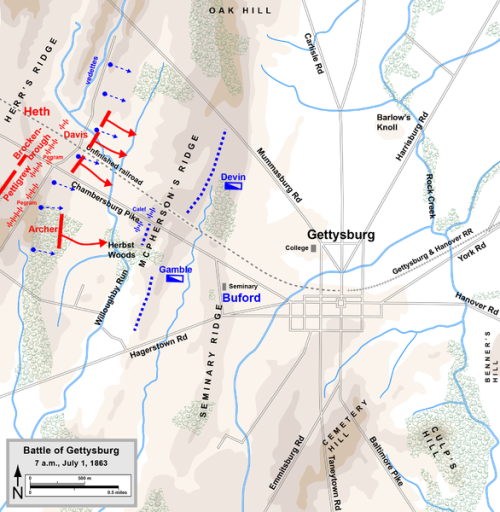
On the morning of July 1st, Hill ordered Harry Heth to advance his division to Gettysburg without the benefit of cavalry support or reconnaissance and backing them up with Pender’s division. As they advanced the leading brigades under Brigadier General James Archer and Joseph Davis met Federal forces. Heth became embroiled in a fight with Buford’s cavalry, which developed into a fight with Reynolds’s I Corps, a fight that resulted in Heth’s division being mauled and helping to bring a general engagement. That engagement drew in Ewell’s corps as well before Lee knew what was happening.

Lee had a number of chances to prevent the meeting engagement that developed on July 1st 1863. Lee noted in his after action report that “It had not been intended to deliver a general battle so far from our base unless attacked…” [36] but there are no records of him giving such instructions prior to the battle. There are no reports indicating that he urged caution on his commanders not to bring on a general engagement before July 1st, when the battle was already underway, nor are there records of any warning orders to his corps commanders upon learning of the presence of the Federal army north of the Potomac.

In the end of the day it was Lee’s “laxness with respect to reconnaissance and his lack of control of Hill’s movements caused him to stumble into battle.[37] The battle began without him knowing it; his subordinate commanders committed nearly half of his army into battle before he issued an order, Lee wrote “A battle had, therefore, become in a measure unavoidable….” [38] But such is not the case.

(Gburg day one)

Lee arrived early enough in the battle to make his influence known. He was told of Ewell’s movements by Major G. Campbell Brown of Ewell’s staff and instructed Brown in very strong terms to tell Ewell “that a general engagement was to be avoided until the arrival of the rest of the army.” [39] Ewell, did not get that message until after his forces were heavily committed noting in his report “that By the time this message reached me….It was too late to avoid an engagement without abandoning the position already taken up.” [40]

Lee was not happy that battle had been joined by Heth and Taylor observed that “on arriving at the scene of the battle, General Lee ascertained that the enemy’s infantry and artillery were present in considerable force” [41] and when Lee arrived on Herr Ridge, Heth asked permission to renew his attack when Rodes entered the fight. Lee’s initial response was negative “No, I am not prepared to bring on a general engagement today. Longstreet is not up.” [42]

After observing the battle for a time it became evident that Ewell’s corps was also heavily engaged and Lee began to change his mind. Heth reported that the Federal troops in front of him were withdrawing and Lee sensed an opportunity to strike a blow that might bring the climactic victory that he sought. Lee analyzed the situation and with Heth back at his division Heth wrote that “very soon an aide came to me with the orders to attack.” [43]

The order was given in the heat of the moment, and Lee always aggressive responded, but it was a bad decision. “It committed him to a major confrontation on this ground…without sufficient troops on hand and without knowledge of the whereabouts of the rest of the Federal army,” [44] and Lee knew this. He told Anderson at Cashtown not long before- meeting Heth: “I am in ignorance of what we have in front of us here. It may be the whole Federal army, or it may be only a detachment. If it is the whole Federal force we must fight a battle here.” But he was worried, telling Anderson “If we do not gain a victory, those defiles and gorges which we passed through this morning will shelter us from disaster.” [45]

Despite the success that his soldiers we now enjoying as they drove the I Corps and XI Corps back through the town Lee gave yet another vague order. This one to Ewell, who having already committed his corps to battle in the full knowledge that Lee did not desire a general engagement was confronted with another discretionary order, Lee said “General Ewell was…instructed to carry the hill occupied by the enemy, if he found it practicable, but to avoid a general engagement until the arrival of the other divisions of the army.” [46]

The Army of Northern Virginia came very close to sweeping Federal forces from the field on July 1st in spite of Lee’s lack of planning and clear commanders’ intent. But close was not enough. His forces which were committed in a piecemeal manner were unable to follow up their initial success. The situation faced by Ewell in Gettysburg was chaotic; his units were badly disorganized, and burdened by thousands of prisoners on the confided streets of the town. Rodes’ division had sustained frightful losses and he had no assurance of support from Hill. [47] Rodes’ after battle report supported Ewell’s decision. He wrote that before “the completion of his defeat before the town the enemy had begun to establish a line of battle on the heights back of the town, and by the time my line was in condition to renew the attack, he displayed quite a formidable line of infantry and artillery immediately in my front, extending smartly to my right, and as far as I could see to my left in front of Early.”[48]

Lee’s orders to Ewell, to take the high ground “if practicable” were correctly interpreted by Ewell despite his critics; he nature of the terrain, the number and condition of the troops that he had available for an attack, and the nature of the orders given by Lee late in the day was strong factors for Ewell to not attack. [49] Coddington noted that these problems “upset Ewell, for he was faced with the prospect of organizing a new attack with tired men even while he felt constrained by Lee’s injunction not to open a full-fledged battle. No wonder he was uncertain!” [50]The fact that Lee was not far away and did not issue a “peremptory order to Ewell” to attack also has to be noted. [51] If Lee had sensed that Ewell was not going to attack and really wanted him to he could have issued a direct order which Ewell, would have surely obeyed. “Lee realized that Ewell was not Jackson…and should have modified his method of command accordingly.” [52]

That evening Lee rode to Ewell’s headquarters and met with Ewell, Early and Rodes. “No reference was made to the possibility of an attack that evening on Cemetery Hill.” The question was put to them about what to do the next day. Lee asked “Can’t you with your corps attack on this flank tomorrow?” Jubal Early answered for Ewell saying “flatly that he did not believe an attack should be made from Gettysburg against Cemetery Hill the next day.” [53] Early added, “even if such an action were to succeed… it would be at a very great cost.” [54] Lee suggested to Ewell and his commanders that Second Corps around to the right along Seminary Ridge “where it might be better put to use, and twice he gave in to Ewell’s pleadings to remain where he was.” [55] This was yet another mistake that would haunt Lee during the rest of the battle, but the “notion of imposing his will on a subordinate was simply too alien to Lee’s nature for him to even to admit as a possibility.” [56] Fuller wrote “it was Lee’s inexhaustible tact that ruined his army.” [57]

Whether Lee intended to engage the Army of the Potomac at Gettysburg so early in the campaign is debated. His multiple and contradictory strategic aims left his commanders acting much on their own. Lee’s lack of clear commander’s intent to his subordinate commanders created confusion on the battlefield. They also paved the way to many controversies in the years following the war as Southerners sought to explain the failure of the Lost Cause, for which Lee could not be blamed.

Much of the controversy comes from Lee’s own correspondence which indicates that he might have not fully understood his own intentions. Some correspondence indicates that Lee desired to avoid a general engagement as long as possible while other accounts indicate that he wanted an early and decisive engagement. The controversy was stoked after the war by Lee’s supporters, particular his aides Taylor and Marshall and generals Early, Gordon and Trimble. Men like Longstreet and were castigated by Lee’s defenders for suggesting that Lee made mistakes on the battlefield.

The vagueness of Lee’s instructions to his commanders led to many mistakes and much confusion during the battle. Many of these men were occupying command positions under him for the first time and were unfamiliar with his command style. Where Stonewall Jackson might have understood Lee’s intent, even where Lee issued vague or contradictory orders, many others including Hill and Ewell did not. Lee did not change his command style to accommodate his new commanders.

That lack of flexibility and inability to clearly communicate Lee’s intent to his commanders and failure to exercise control over them proved fatal to his aims in the campaign. Stephen Sears’ scathing analysis of Lee’s command at Gettysburg perhaps says it the best. In the final analysis, it was Robert E. Lee’s inability to manage his generals that went to the heart of the failed campaign.” [58]

The vagueness of Lee’s intent was demonstrated throughout the campaign and was made worse by the fog of war. Day one ended with a significant tactical victory for Lee’s army but without a decisive result which would be compounded into a strategic defeat by Lee’s subsequent decisions on the 2nd and 3rd of July.

Notes:

[1] Taylor, Walter. General Lee: His campaigns in Virginia 1861-1865 With Personal Reminiscences University of Nebraska Press, Lincoln Nebraska and London, 1994 previously published 1906 p.45

[2] Ibid. Taylor General Lee: His campaigns in Virginia 1861-1865 With Personal Reminiscences p.25

[3] Lee, Robert Edward. Recollections and Letters of General Robert E Lee A Public Domain book, Amazon Kindle edition location 548

[4] Taylor, John M. Duty Faithfully Performed: Robert E Lee and His CriticsBrassey’s, Dulles VA 1999 p.35


[5] Fuller, J.F.C. Grant and Lee: A Study in Personality and Generalship, Indiana University Press, Bloomington IN 1957 p.112

[6] Korda, Michael. Clouds of Glory: The Life and Legend of Robert E. Lee Harper Collins Publishers, New York 2014 p.348

[7]Tucker, Glenn. High Tide at Gettysburg, The Bobbs Merrill Co. Indianapolis Indiana 1958 p.24

[8] Ibid. Fuller Grant and Lee: A Study in Personality and Generalship p.125

[9] Weigley, Russell F. The American Way of War: A History of United States Military History and Policy University of Indiana Press, Bloomington IN, 1973 p.116

[10] Ibid. Korda, Michael. Clouds of Glory: The Life and Legend of Robert E. Lee p.446

[11] Sears, Stephen W. Gettysburg. Houghton Mifflin Co. Boston and New York 2003 p. 139

[12] Taylor, Walter Four Years with General Lee Original published 1877. Heraklion Press Kindle Edition 2013 location 1199

[13] Freeman, Douglas Southall, Lee’s Lieutenant’s a Study in Command, One volume abridgement by Stephen W Sears, Scribner, New York 1998 pp.554-555

[14] Ibid. Freeman Lee’s Lieutenant’s a Study in Command, p.552

[15] Nolan, Alan T. R. E. Lee and July 1 at Gettysburg in the First Day at Gettysburg edited by Gallagher, Gary W. Kent State University Press, Kent Ohio 1992 p.16

[16] McClellan, Henry Brainerd The Life and Campaigns of Major General J.E.B. Stuart Commander of the Cavalry of the Army of Northern Virginia 1885. Digital edition copyright 2011 Strait Gate Publications, Charlotte NC location 6123 unfortunately this letter cannot be verified as no copy exists, McClellan presuming that it was destroyed sometime during the march.

[17] Dowdy, Clifford. Lee and His Men at Gettysburg: The Death of a Nation Skyhorse Publishing, New York 1986, originally published as Death of a Nation Knopf, New York 1958 p.60

[18] Lee, Robert E. Reports of Robert E Lee, C.S. Army, Commanding Army of Northern Virginia Campaign Report Dated January 20th 1864. Amazon Kindle Edition location 503

[19] Davis, Burke JEB Stuart: The Last Cavalier Random House, New York 1957 p. 325

[20] Coddington, Edwin B. The Gettysburg Campaign: A Study in Command, A Touchstone Book, Simon and Schuster New York, 1968 p.183

[21] Ibid. Coddington The Gettysburg Campaign: A Study in Command p.189

[22] Ibid. Sears Gettysburg p. 134

[23] Tredeau, Noah Andre. Gettysburg: A Testing of Courage, Harper Collins Publishers, New York 2002 p.124

[24] Ibid. Sears Gettysburg p. 134

[25] Ibid. Tredeau, Gettysburg: A Testing of Courage, p.124

[26] Ibid. Sears Gettysburg p. 134

[27] Ibid. Coddington The Gettysburg Campaign: A Study in Command pp.189-190

[28] Ibid. Dowdy Lee and His Men at Gettysburg: The Death of a Nation p.99

[29] Foote, Shelby, The Civil War, A Narrative. Volume Two Fredericksburg to Meridian Random House, New York 1963 p. 464

[30] Ibid. Foote The Civil War, A Narrative. Volume Two Fredericksburg to Meridian p.464

[31] Pfanz Harry W. Gettysburg: The First Day University of North Carolina Press, Chapel Hill and London 2001 p.148

[32] Ibid. Coddington The Gettysburg Campaign: A Study in Command p.192

[33] Ibid. Pfanz Gettysburg: The First Day p.149

[34] Ibid. Sears Gettysburg p. 160

[35] Ibid. Coddington The Gettysburg Campaign: A Study in Command p.264

[36] Ibid. Lee Reports of Robert E Lee, C.S. Army, Commanding Army of Northern Virginia Campaign Report Dated January 20th 1864 location 552

[37]Ibid. Nolan R. E. Lee and July 1 at Gettysburg p.24

[38] Ibid. Lee Reports of Robert E Lee, C.S. Army, Commanding Army of Northern Virginia Campaign Report Dated January 20th 1864 location 552

[39] Ibid. Pfanz Gettysburg: The First Day p.150

[40] Ibid. NolanR. E. Lee and July 1 at Gettysburg p.22

[41] Ibid. Taylor General Lee: His campaigns in Virginia 1861-1865 With Personal Reminiscences p.188

[42] Ibid. Foote The Civil War, A Narrative. Volume Two Fredericksburg to Meridian p.475

[43] Ibid. Sears Gettysburg p. 203

[44] Ibid. NolanR. E. Lee and July 1 at Gettysburg p.24

[45] Ibid. Foote The Civil War, A Narrative. Volume Two Fredericksburg to Meridian p.474

[46] Freeman, Douglas Southall, Lee’s Lieutenant’s a Study in Command, One volume abridgement by Stephen W Sears, Scribner, New York 1998 p.571

[47] Gallagher, Gary. Confederate Corps Leadership on the First Day at Gettysburg: A.P. Hill and Richard S. Ewell in a Difficult Debut in The First Day at Gettysburg edited by Gallagher, Gary W. Kent State University Press, Kent Ohio 1992 pp.54-55

[48] Ibid. Nolan p.26

[49] Ibid. NolanR. E. Lee and July 1 at Gettysburg in the First Day at Gettysburg p.28

[50] Ibid. Coddington The Gettysburg Campaign: A Study in Command p.319

[51] Ibid. NolanR. E. Lee and July 1 at Gettysburg in the First Day at Gettysburg p.28

[52] Ibid Gallagher Confederate Corps Leadership on the First Day at Gettysburg p.56

[53] Ibid. Freeman Lee’s Lieutenant’s a Study in Command p.572

[54] Ibid. Tredeau, Gettysburg: A Testing of Courage, p.261

[55] Sears, Stephen W. Gettysburg. Houghton Mifflin Co. Boston and New York p.504

[56] Ibid. Tredeau, Gettysburg: A Testing of Courage, p.262

[57] Ibid. Fuller Grant and Lee: A Study in Personality and Generalship p.119

[58]Sears, Stephen W. Gettysburg. Houghton Mifflin Co. Boston and New York p.504

3 Comments

Filed under civil war, History, leadership, Military

Gettysburg Day One: John Reynolds’ Finest Hour

z_maritato_ironbrigadeforward1

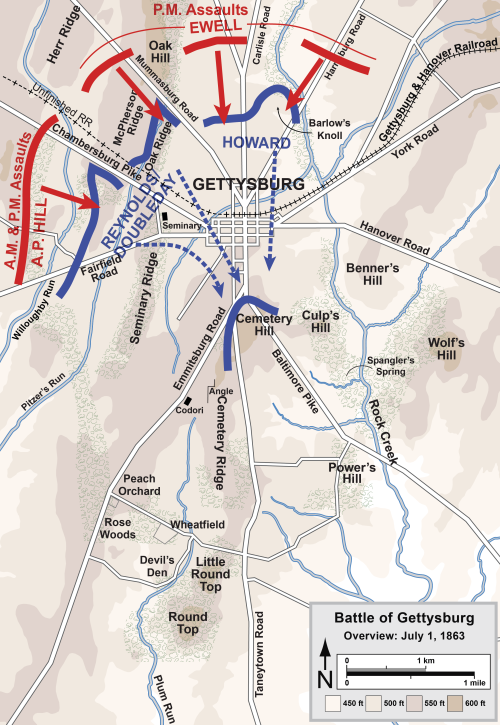
While A.P. Hill and Harry Heth ignored warnings and launched their troops towards Gettysburg, Buford believing an engagement was in the offing sought out good ground to give battle and hold back the enemy until the army could arrive. This he found on the ridges west of Gettysburg. The choice of ground is always important and in this battle was paramount to the success of the Army of the Potomac. Buford alerted Major General John Reynolds and the cavalry corps commander Alfred Pleasanton to the location of the approaching Confederates on the night of June 30th. However, Buford’s warning, and that of the intelligence bureau came too late for Reynolds or Meade to take action on them that evening, nor give Meade “to dictate the choice of giving or accepting battle.” [1]

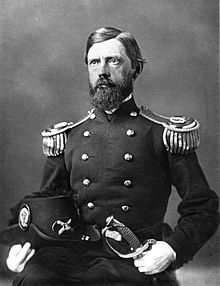
The Army of the Potomac had the good fortune of having Reynolds in this key position on the morning of July 1st 1863. John Reynolds was one of the finest commanders on either side during the Civil War. He graduated from West Point in 1841 and served in the artillery. He fought during the war with Mexico serving in Braxton Bragg’s battery winning fame and two brevet promotions for bravery, [2] to Captain at Monterrey and Major at Buena Vista. Following the war he remained in the army. He served in field and coastal batteries and like John Buford had “participated in the Utah Expedition.” [3] In 1860 he was appointed as Commandant of the Corps of Cadets at West Point and served there until June of 1861 when he was appointed as Lieutenant Colonel of the 14th U.S. Infantry regiment. [4]

220px-GenJFRenyolds

However, he was soon promoted to Brigadier General and he commanded a brigade of Pennsylvania volunteers during the Peninsula Campaign. He was captured on June 28th as McClellan began his withdraw from the gates of Richmond but was released in a prisoner exchange on August 15th 1862. [5] He returned to command a division at Second Bull Run where his division held firm as much of the army retreated, but missed the battle of Antietam as he was called to “the fruitless and frustrating task of trying to organize Pennsylvania’s militia” [6] by Governor Curtain. He commanded I Corps at Fredericksburg and again at Chancellorsville and was reportedly offered command of the Army of the Potomac by Lincoln, something that he recounted to his artillery chief Colonel Wainwright that he “refused it because he would have been under the same constraints as Burnside and Hooker.” [7]

The Army of the Potomac’s senior leadership had been the source of much political consternation during 1862 and 1863 for Abraham Lincoln. It was split among Lincoln’s supporters and detractors, Radical Republican abolitionists and moderate Democrats some of its leaders including McClellan, Hooker and Sickles had their own aspirations for the presidency. However, Reynolds was of a different character than some of his fellow commanders. He was a moderate Pennsylvania Democrat and no supporter of Lincoln, once comparing him to a “baboon.” But he “was also a serious unbending professional, who unlike McClellan, actually lived by the principle of “obedience to the powers that be.” [8] “Universally respected” in the army “for his high character and sterling generalship” [9] it was noted that unlike others Reynolds had a policy of holding back “stoutly aloof from all personal or partisan quarrels, and keeping guardedly free from any of the heart-burnings and jealousies that did so much to cripple the usefulness and endanger the reputation of many gallant officers.” [10]

On the night of June 30th Reynolds was awash in reports, some of them conflicting and without Meade’s course of action for the next day “concluded that Lee’s army was close by and in force.” [11] He spent the night at his headquarters “studying the military situation with Howard and keeping in touch with army headquarters.” [12] Howard noted Reynolds anxiety and “Howard received the impression that Reynolds was depressed.” [13] After Howard’s departure Reynolds took the opportunity to get a few hours of fitful sleet before arising again at 4 a.m. on July 1st.

When morning came, Reynolds was awakened by his aide Major William Riddle with Meade’s order to “advance the First and Eleventh Corps to Gettysburg.” [14] Reynolds studied the order and though he expected no battle that morning, expecting “only moving up to be in supporting distance to Buford” [15] took the reasonable precautions that Confederate commanders had not done.

Though Reynolds was not expecting a fight he organized his march in a manner that ensured if one did happen that he was fully prepared. They were precautionary measures that any prudent commander knowing that strong enemy forces were nearby would take. Reynolds certainly took to heart the words of Napoleon who said “A General should say to himself many times a day: If the hostile army were to make its appearance in front, on my right, or on my left, what should I do?” [16] It was a question that A.P. Hill and Harry Heth seemed not to consider on that warm and muggy July morning, where Heth was committing Lee’s army to battle on his own authority, Reynolds was about to do the same, but unlike Heth, he “had at least been delegated the authority for making such a decision.” [17]

Reynolds “wanted all the fighting troops to be up front, so he instructed Howard not to intermingle his supply wagons with his infantry. Similar instructions had been given to Abner Doubleday; to ensure that the First Corps wagons would wait until the Eleventh Corps foot soldiers had passed.” [18] Likewise, instead operating in the normal fashion of rotating units on the march, Reynolds opted to save time. Since the First Division under the command of James Wadsworth was further advanced than other I Corps divisions, Reynolds instructed it to move first. In doing so he countermanded the order of the acting corps commander Doubleday telling Wadsworth that Doubleday’s order “was a mistake and that I should move on directly.” [19] He went forward with Wadsworth’s division and ordered Doubleday to “assemble the artillery and the remainder of the corps, and join him as soon as possible.” [20] He ordered Howard’s XI Corps to follow and Sickles’ III Corps to come up through Emmitsburg. [21] Reynolds’ intention according to Doubleday was “to fight the enemy as soon as I could meet him.” [22]

Reynolds rode forward with some of his staff into the town as the infantry of I Corps and XI Corps moved advanced. In the town they were met by “a fleeing, badly frightened civilian, who gasped out the news that the cavalry was in a fight.” [23] When he came to the Lutheran Seminary he came across Buford. It was a defining moment of the Civil War, a moment that shaped the battle to come. It has been recounted many times and immortalized on screen in the movie Gettysburg, a time “when the entire battle would come down to a matter of minutes getting one place to another.” [24]

450px-Gettysburg_Day1_1000

When Buford saw Reynolds infantry advancing he remarked “now we can hold this place.” [25] Reynolds greeted Buford, who was in the cupola of the seminary calling out “What’s the matter John?” to which Buford replied “The devil’s to pay” before coming down to discuss the matter with Reynolds. [26] Buford explained the situation noting that “I have come upon some regiments of infantry…they are in the woods…and I am unable to dislodge them.” [27]

Reynolds needed no other convincing. He asked Buford if he could hold and quickly sent off a number of messages. One officer wrote: “The Genl ordered Genl Buford to hold the enemy in check as long as possible, to keep them from getting into town and at the same time sent orders to Genl Sickles…& Genl Howard to come as fast as possible.” [28] He also sent a message to Meade stating: “The enemy are advancing in strong force. I [Reynolds] fear they will get to the heights beyond the own before I can. I will fight them inch by inch, and if driven into the town, I will barricade the streets and hold them back as long as possible.” [29] He directed Major Weld to take it to Meade with all haste “with the greatest speed I could, no matter if I killed my horse.” [30]

After dictating his instructions Reynolds then did what no senior Confederate commander did, he rode back and took personal charge of the movements of his troops to hurry them forward. Unlike Heth, he had taken note of the ground and recognized from Buford’s reports that “the Confederates were marching only on that single road and thus would not be able to push their forces to the front any faster than Reynolds could reach the battlefield with his First Corps divisions.” [31]

Reynolds, recognizing that time was of the essence if his forces were to hold the ground west of the town selected a shortcut around the town for I Corps. Those forces were directed across the fields near the Condori farm toward the back side of Seminary Ridge, with Reynolds’ staff helping to remove fences to speed the advance. [32] It was not an easy advance as the troops had to move across the farm fields at an oblique and have to “double-quick for a mile and a quarter in the thick humidity just to reach the seminary.” [33]

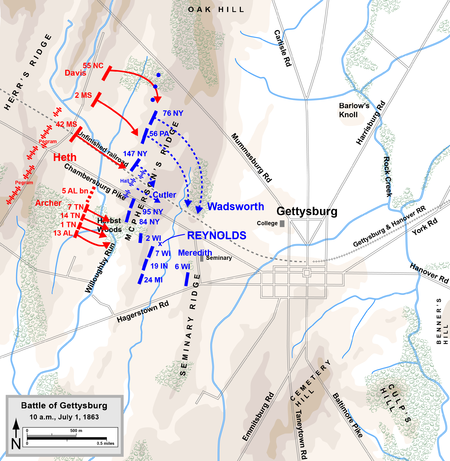
As troops arrived Reynolds directed them into position. He directed the artillery of Captain James Hall’s 2nd Maine Battery to McPherson’s Ridge instructing Hall “I desire you to damage their artillery to the greatest possible extent, and to keep their fire from our infantry until they are deployed….” [34] The leading infantry of I Corps was James Wadsworth’s understrength division containing just two brigades, its losses from Chancellorsville not being made good and as the result of the loss of regiments discharged because their enlistments had expired.

However these units were “good ones,” composed of hardened combat veterans. Brigadier General Zylander Cutler led his brigade of New Yorkers and Pennsylvanians up first followed by the six foot seven inch tall Quaker, Brigadier General Solomon Meredith’s “Iron Brigade” of westerners following in their distinctive black hats. Reynolds directed Cutler’s brigade north of the Cashtown Pike and “called the Iron Brigade into action on the south side” [35] Reynolds directed Wadsworth to take change on the north side of the road while he looked after the left. [36] It is also believed by some writers that he directed Oliver Howard to prepare Cemetery Hill as a fallback position [37] however; there is more evidence that points to Howard selecting the site himself. [38]

Cutler’s brigade moved north and engaged Davis’ men near the railroad cut, with Davis’ troops initially having the upper hand, inflicting massive casualties Cutler’s regiments. But in a fierce engagement Cutler’s men pushed the unsupported Confederates back into the Railroad Cut where they slaughtered many of those unfortunate soldiers, taking over 200 prisoners and a battle flag. [39]

The Iron Brigade, brought forward by Doubleday hit Archer’s brigade in the front at Herbst Woods on McPherson’s Ridge. As the unit went into action Doubleday “urged the men…to hold it all hazards.” He recalled that the troops, “full of enthusiasm and the memory of their past achievements they said to me proudly, “If we can’t hold it, where will you find men who can?” The effect was dramatic as the Iron Brigade overwhelmed that unit, whose soldiers now realized they were facing “the first team.” Members of the Iron Brigade recalling the voices of Confederate soldiers exclaiming “Here are those damned black-hat fellers again…’Taint no militia-that’s the Army of the Potomac.” [40] As they attempted to withdraw they piled up at a fence near Willoughby Run and were hit in the flank by “a Michigan regiment that had worked its way around through the woods to the south.” [41]

Coddington writes “It was a bad moment for the Army of Northern Virginia, and Archer gained the unenviable distinction of being the first of its general officers to be captured after Lee took command.” [42] As the 2nd Wisconsin advanced into the woods Reynolds urged them forward: “Forward men, for God’s sake and drive those fellows out of those woods….” [43] As he looked around toward the seminary to see the progress of reinforcements Reynolds was struck in the back of the neck by a bullet and fell dead with Doubleday taking command of the First Corps to the west of the town.

death_of_reynolds_gettysburg

Reynolds was dead, but the series of command decisions reached by Reynolds under the pressure of a meeting engagement “where neither side held an immediate advantage” [44] were critical to the army. Though shaken by his loss the Union troops fought on at McPherson and Seminary Ridge until the assault of Ewell on their left and the arrival of Pender’s fresh division forced them from their positions.

The contrast between Reynolds and his opponents was marked. Hill was ten miles away from the action, Heth too far to the rear of his troops to direct their advance when they ran into trouble. However, Reynolds “hurried to the front, where he was able to inspirit the defense and throw troops into the decisive zone.” [45] At every point John Reynolds showed himself superior to his opponents as he directed the battle and reacted to circumstances. He paid with his life but his sacrifice was not in vain. Harry Hunt noted: “…by his promptitude and gallantry he had determined the decisive field of the war, and he opened brilliantly a battle which required three days of hard fighting to close with a victory.” [46]

 Notes

[1] Sears, Stephen W. Gettysburg. Houghton Mifflin Co. Boston and New York 2003 p. 159

[2] Pfanz Harry W. Gettysburg: The First Day University of North Carolina Press, Chapel Hill and London 2001pp.47-48

[3] Ibid. Pfanz Gettysburg: The First Day p.48

[4] Ibid. Pfanz Gettysburg: The First Day p.48

[5] Foote, Shelby, The Civil War, A Narrative. Volume One Fort Sumter to Perryville Random House, New York 1958 p.493

[6] Ibid. Pfanz Gettysburg: The First Day p.48

[7] Ibid. Sears, Gettysburg. p. 40-42


[8] Guelzo, Allen C. Gettysburg: The Last Invasion Vintage Books a Division of Random House, New York 2013 pp.29-30

[9] Ibid. Sears, Gettysburg. p. 34

[10] Ibid. Guelzo, Gettysburg: The Last Invasion p.30

[11] Ibid. Pfanz Gettysburg: The First Day p.48

[12] Coddington, Edwin B. The Gettysburg Campaign: A Study in Command, A Touchstone Book, Simon and Schuster New York, 1968 p.261

[13] Ibid. Pfanz Gettysburg: The First Day p.48

[14] Ibid. Coddington The Gettysburg Campaign: A Study in Command, p.261

[15] Ibid. Sears, Gettysburg. p. 158

[16] Napoleon Bonaparte, Military Maxims of Napoleon in Roots of Strategy: The Five Greatest Military Classics of All Time edited by Phillips, Thomas R Stackpole Books Mechanicsburg PA 1985 p.410

[17] Ibid. Sears, Gettysburg. p. 165

[18] Tredeau, Noah Andre. Gettysburg: A Testing of Courage, Harper Collins Publishers, New York 2002 p.159

[19] Ibid. Tredeau, Gettysburg: A Testing of Courage p.156

[20] Ibid. Guelzo, Gettysburg: The Last Invasion p.142

[21] Ibid. Sears, Gettysburg. p. 158

[22] Ibid. Tredeau, Gettysburg: A Testing of Courage p.156

[23] Ibid. Sears, Gettysburg. p. 165

[24] Ibid. Guelzo, Gettysburg: The Last Invasion p.142

[25] Ibid. Guelzo, Gettysburg: The Last Invasion p.142

[26] Ibid. Sears, Gettysburg. p. 172

[27] Ibid. Guelzo, Gettysburg: The Last Invasion p.143

[28] Ibid. Tredeau, Gettysburg: A Testing of Courage p.172-173

[29] Schultz, Duane The Most Glorious Fourth: Vicksburg and Gettysburg July 4th 1863. W.W. Norton and Company New York and London, 2002 p.202

[30] Ibid. Tredeau, Gettysburg: A Testing of Courage p.173

[31] Ibid. Sears, Gettysburg. p. 166

[32] Ibid. Pfanz Gettysburg: The First Day p.75

[33] Ibid. Guelzo, Gettysburg: The Last Invasion p.145

[34] Gottfried, Bradley The Artillery of Gettysburg Cumberland House Publishing, Nashville TN 2008 pp.28-29

[35] Catton, Bruce The Army of the Potomac: Glory Road Doubleday and Company, Garden City New York, 1952 p.271

[36] Ibid. Pfanz Gettysburg: The First Day pp.75-76

[37] Ibid. Pfanz Gettysburg: The First Day p.76

[38] Green, A. Wilson. From Chancellorsville to Gettysburg: O. O. Howard and Eleventh Corps Leadership in The First Day at Gettysburg edited by Gallagher, Gary W. Kent State University Press, Kent Ohio 1992 p. 70

[39] Ibid. Guelzo, Gettysburg: The Last Invasion p.153

[40] Ibid. Catton The Army of the Potomac: Glory Road p.273

[41] Foote, Shelby, The Civil War, A Narrative. Volume Two Fredericksburg to Meridian Random House, New York 1963 pp.470-471

[42] Ibid. Coddington The Gettysburg Campaign: A Study in Command, p.271

[43] Ibid. Coddington The Gettysburg Campaign: A Study in Command, p.271

[44] Ibid. Sears, Gettysburg. p. 168

[45] Krick, Robert K. Three Confederate Disasters on Oak Ridge: Failures of Brigade Leadership on the First Day of Gettysburg in The First Day at Gettysburg edited by Gallagher, Gary W. Kent State University Press, Kent Ohio 1992 p.113

[46] Hunt, Henry. The First Day at Gettysburg in Battles and Leaders of the Civil War Volume III, The Tide Shifts. Edited by Robert Underwood Johnson and Clarence Clough Buel Castle, Secaucus NJ

1 Comment

Filed under civil war, History, leadership, Military

Memorial Day 2014: Remembering the Memorial Day Order of 1868

memorial-day-traditions_1399868491

Oliver Wendell Holmes ended his Decoration Day 1884 speech:

But grief is not the end of all…Our dead brothers still live for us, and bid us think of life, not death, — of life to which in their youth they lent the passion and glory of the spring. As I listen, the great chorus of life and joy begins again, and amid the awful orchestra of seen and unseen powers and destinies of good and evil our trumpets sound once more a note of daring, hope, and will.

Frederick Douglass noted the same year in his Decoration Day Speech:

“Dark and sad will be the hour to this nation when it forgets to pay grateful homage to its greatest benefactors. The offering we bring to-day is due alike to the patriot soldiers dead and their noble comrades who still live; for, whether living or dead, whether in time or eternity, the loyal soldiers who imperiled all for country and freedom are one and inseparable.” From Frederick Douglass’ Memorial Day Speech 1884

The words of both men are something that we should not forget as we remember and honor all who have given the “last full measure of devotion to duty.”

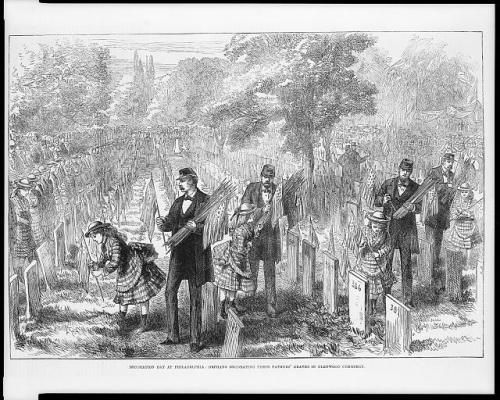
It was after the great bloodletting known as the American Civil War that Memorial Day, originally known as Decoration Day was established. The first observance was made by the recently freed slaves of Charleston South Carolina who honored the memory of the Union Soldiers who had died at the Washington Racecourse Prison Camp on May 1st 1865.  Other celebrations began around the country in May and June of 1866. By 1868 the Commander of the Grand Army of the Republic Union Veterans association General John Logan issued an order directing that the 30th of May 1868 be designated to the memory of the Union Soldiers, Sailors and Marines who had given their lives in the defense of the Union.

decoration-day1

Since its establishment the holiday has grown to encompass the honored dead of all American wars.  However its roots were in the Civil War, a war that claimed the lives of between 600,000 and 700,000 American military personnel on both sides of the conflict. It is hard to imagine that on one, September 17th 1862 that over 23,000 Union and Confederate Soldiers were killed, wounded or missing. At Gettysburg more men were killed and wounded than in the entirety of the Iraq and Afghanistan wars. Two percent of the population was killed in the war. To put that in perspective that casualty rate would involve the deaths of more than 6 million soldiers, well over twice as many men and women as currently serve on active duty and in the reserve components. Abraham Lincoln noted in his Gettysburg Address the importance of not forgetting those men:

“It is rather for us to be here dedicated to the great task remaining before us — that from these honored dead we take increased devotion to that cause for which they gave the last full measure of devotion — that we here highly resolve that these dead shall not have died in vain — that this nation, under God, shall have a new birth of freedom — and that government of the people, by the people, for the people, shall not perish from the earth.”


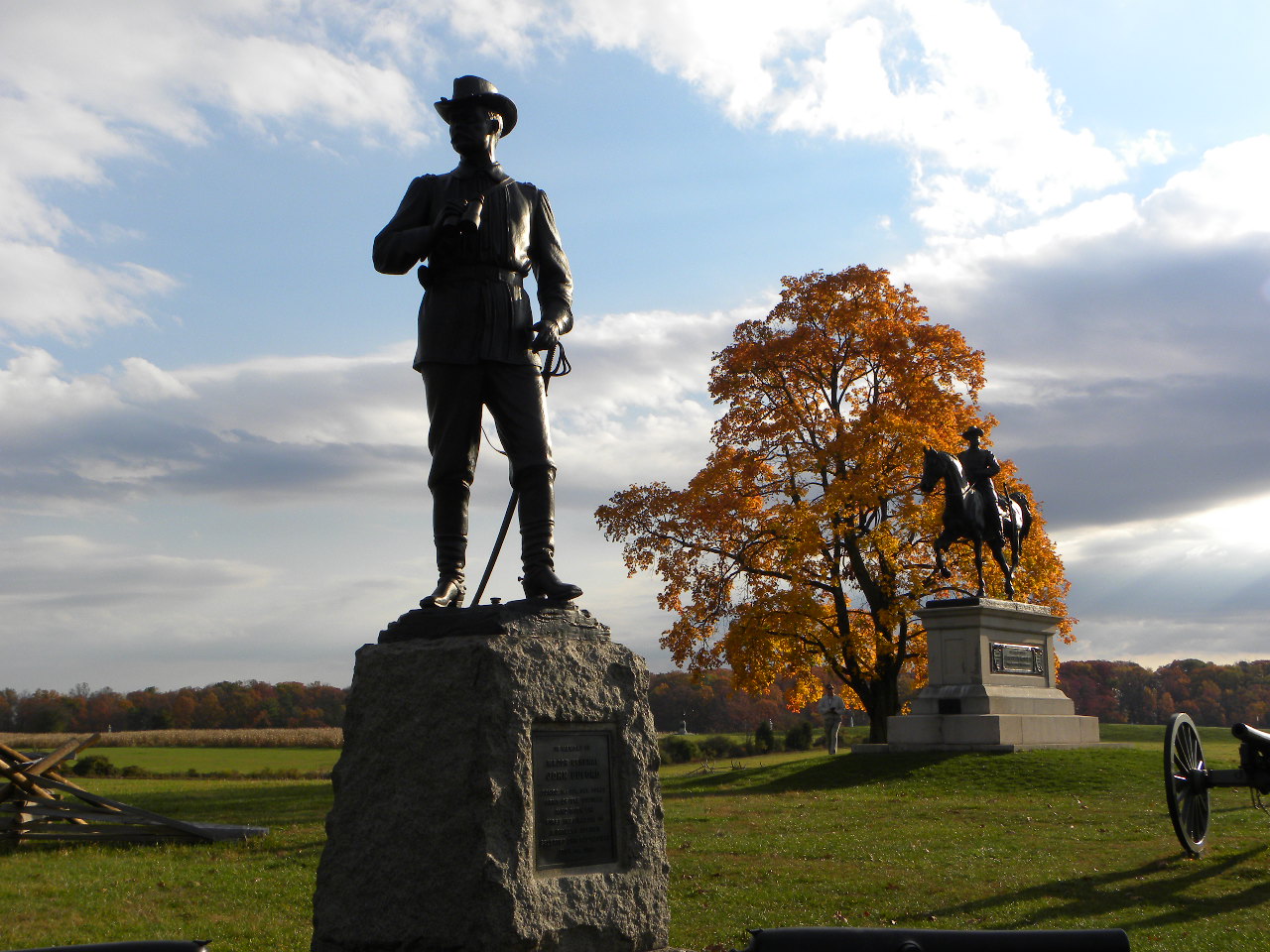
DSCN8774

General Logan’s order is remarkable in its frankness and the understanding of the war in the immediate context of its conclusion.  In 1868 the day would be observed at 183 cemeteries in 27 States and the following year over 300 cemeteries. Michigan was the first state to make the day a holiday and by 1890 all states in the North had made it so. In the South there were similar observances but the meaning attributed to the events and the sacrifices of the Soldiers of both sides was interpreted differently. In the North it was about preserving the Union and in the South the interpretation of the Lost Cause.  Yet in both regions and all states, the surviving Soldiers, family members and communities honored their dead.

This Memorial Day we will honor all that have fallen but in our mind are the few that fight our current wars, wars that unlike that terrible Civil War, the majority of the population does not experience.

The order of the Grand Army of the Republic establishing Memorial Day is posted below.

Peace

Padre Steve+

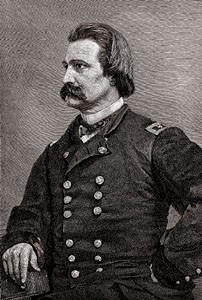
logan_engraving

HEADQUARTERS GRAND ARMY OF THE REPUBLIC, General Orders No.11, WASHINGTON, D.C., May 5, 1868

I. The 30th day of May, 1868, is designated for the purpose of strewing with flowers or otherwise decorating the graves of comrades who died in defense of their country during the late rebellion, and whose bodies now lie in almost every city, village, and hamlet church-yard in the land. In this observance no form of ceremony is prescribed, but posts and comrades will in their own way arrange such fitting services and testimonials of respect as circumstances may permit.

We are organized, comrades, as our regulations tell us, for the purpose among other things, “of preserving and strengthening those kind and fraternal feelings which have bound together the soldiers, sailors, and marines who united to suppress the late rebellion.” What can aid more to assure this result than cherishing tenderly the memory of our heroic dead, who made their breasts a barricade between our country and its foes? Their soldier lives were the reveille of freedom to a race in chains, and their deaths the tattoo of rebellious tyranny in arms. We should guard their graves with sacred vigilance. All that the consecrated wealth and taste of the nation can add to their adornment and security is but a fitting tribute to the memory of her slain defenders. Let no wanton foot tread rudely on such hallowed grounds. Let pleasant paths invite the coming and going of reverent visitors and fond mourners. Let no vandalism of avarice or neglect, no ravages of time testify to the present or to the coming generations that we have forgotten as a people the cost of a free and undivided republic.

If our eyes grow dull, other hands slack, and other hearts cold in the solemn trust, ours shall keep it well as long as the light and warmth of life remain to us.

Let us, then, at the time appointed gather around their sacred remains and garland the passionless mounds above them with the choicest flowers of spring-time; let us raise above them the dear old flag they saved from dishonor; let us in this solemn presence renew our pledges to aid and assist those whom they have left among us a sacred charge upon a nation’s gratitude, the soldier’s and sailor’s widow and orphan.

II. It is the purpose of the Commander-in-Chief to inaugurate this observance with the hope that it will be kept up from year to year, while a survivor of the war remains to honor the memory of his departed comrades. He earnestly desires the public press to lend its friendly aid in bringing to the notice of comrades in all parts of the country in time for simultaneous compliance therewith.

III. Department commanders will use efforts to make this order effective.

By order of

JOHN A. LOGAN,
Commander-in-Chief

N.P. CHIPMAN,
Adjutant General

Official:
WM. T. COLLINS, A.A.G.

Leave a comment

Filed under civil war, History, Military, shipmates and veterans

Gettysburg Day One: Inexperience and Hubris Meets Calculating Experience; Harry Heth Blunders into Battle against John Buford

burford june 30th

Despite the warnings of Johnston Pettigrew, Major General Harry Heth with the approval and blessing of his corps commander Lieutenant General A.P. Hill arose on the morning of July 1st 1863 and formed his division for its march to Gettysburg. But it was an inauspicious start to a very bad day for Heth and his division. Somehow orders had not gotten to his units to begin the advance at 5 a.m. and “there was haste to the early morning’s preparations that caught some off guard” even regimental commanders. [1]

During the night Of June 30th 1863 the actions of A.P. Hill show a commander who confused and uncertain. The confidence that he and Heth showed in rejecting Pettigrew and Young’s reports of Federal troops in Gettysburg left “most, if not all the commanding officers in Hill’s corps…unprepared for what happened.” [2] Lieutenant Lewis Young wrote “I doubt if any of the commanders of brigades, except General Pettigrew, believed that we were marching to battle, a weakness on their part which rendered them unprepared for what was about to happen.” [3]

Hill sent a message to Ewell of Second Corps telling that officer that “I intended to advance the next morning and discover what was in my front” [4] and sent word of Pettigrew’s discovery of Union cavalry to Lee’s headquarters, but his warning apparently gave Lee little cause for concern. Porter Alexander noted that on the night of June 30th that he visited Lee’s headquarters and found conversation to be “unusually careless & jolly. Certainly there was no premonition that the next morning was to open a great battle of the campaign.” [5] Hill also sent a courier to Anderson instructing him to bring up his division on Jul 1st and instructed Heth that “Pender’s division also would be ordered through Cashtown as a reserve to be available if Heth ran into serious trouble.” [6]

Since a reconnaissance is normally conducted by small elements, the fact that Hill committed his two divisions present to such a mission demonstrated his confusion of both the nature of what he might face and to the intentions of Robert E. Lee. One has to remember that Lee, like his corps commanders was operating blind, in part due to Stuart’s absence but also due to the poor employment of the cavalry that should have been available to them. Hill and Heth had no idea what they faced at Gettysburg and disregarded the warnings of his own people. Thus it is hard to believe that Hill did not expect the possibility of action. Likewise it is distinctly possible that Heth, despite his orders “may have had more on his mind than shoes and information when he made his advance towards Gettysburg.” [7]

Several critics have made this point, among them Major John Mosby the Confederate cavalry leader and guerrilla fighter who wrote: “Hill and Heth in their reports, to save themselves from censure, call the first day’s action a reconnaissance; this is all an afterthought….They wanted to conceal their responsibility for the defeat.” [8] A more contemporary writer, Jennings Wise noted that Hill’s orders “were specific not to bring on an action, but his thirst for battle was unquenchable, and…he rushed on, and…took the control of the situation out of the hands of his commander-in-chief.” [9] Heth in later years made an unsubstantiated claim that “A courier came from Gen. Lee, with a dispatch ordering me to get those shoes even if I encountered some resistance.” [10] That appears unlikely as Mosby noted that no one ordered Hill to advance and Lee “would never have sanctioned it.” [11] Neither Lee or any of his staff collaborate Heth’s claim and the judicious Porter Alexander who had been in Lee’s headquarters the night of June 30th wrote that “Hill’s movement to Gettysburg was made on his own accord, and with knowledge that he would find the enemy’s cavalry in possession.” [12]

The advance to contact was marred by Heth’s inexperience compounded by the illness of A.P. Hill who on the morning of July 1st had “awakened feeling very ill, too sick to mount his horse…although no diagnosis was made, he was probably suffering from overstrained nerves.” [13] Hill’s absence left Heth, an inexperienced division commander “without any sage counsel” [14] and Heth began to commit a series of costly errors. Heth understood from Hill that his mission was a job that normally would be assigned to cavalry: “to ascertain what force was at Gettysburg, and if he found infantry opposed to him, to report the fact immediately, without forcing an engagement.” [15]

Heth advanced without the caution of a commander who had been told that enemy forces were likely opposing him. Even though he disbelieved the reports some amount of judicious caution should have been indicated. Instead, for reasons unknown Heth had his men advance as if they were conducting a routine movement. He led his advance with his assigned artillery battalion commanded by Major William Pegram. He followed with Archer’s veteran but depleted brigade and Davis’s inexperienced brigade. To compound Davis’s situation that commander led his movement with his new and untested regiments the 42nd Mississippi and 55th North Carolina leaving his veteran regiments the 2nd and 11th Mississippi in the rear guarding army stores. [16] It was a curious order of march for it left Johnston’s Pettigrew’s brigade behind both Archer and Davis’s brigades despite the fact that it was closer to Gettysburg than any other brigade and had recent eyes on contact with the enemy and knew the ground and what was ahead of them. Pettigrew’s brigade was followed by Colonel John Brockenbrough’s Virginia brigade. It is hard to know why Heth did this but one can speculate that it might have been because of Pettigrew’s insistence of the type of Federal forces in their front the previous day which caused Heth to do this.

buford and staff

Buford and His Staff

As Heth’s troops advanced to Marsh Creek they encountered the cavalry videttes or pickets of the 8th Illinois Cavalry posted on the high ground just east of the creek. [17] The discovery of these forces was unanticipated by the Confederates leading the column. One of Pegram’s gunners recalled: “We moved forward leisurely smoking and chatting as we rode along, not dreaming of the proximity of the enemy.” [18] Most assumed that the movement “was simply one more part of the army’s concentration of forces” and Brockenbrough told the commander of the 55th Virginia that “we might meet some of Ewell’s command or Stuarts.” [19] Pettigrew had attempted to warn Archer prior to the march of the topography of the area and “a certain road which the Yankees might use to hit his flank, and the dangers of McPherson’s Ridge. Archer listened, believed not, marched on unprepared…” [20] Heth, who should have better anticipated the situation based on Pettigrew’s reports of the previous day demonstrated why one author called him “an intellectual lightweight.” [21] Heth told an officer from the Army of the Potomac after the war “I did not know any of your people were north of the Potomac.” [22]

If Heth was inexperienced and knew little of the Federal forces arrayed before him and what forces were moving towards Gettysburg, his opponent, Brigadier General John Buford was his opposite in nearly every respect. Buford was born in Kentucky and came from a long line of family who had fought in both the Revolutionary War and War of 1812. He was an 1848 graduate of West Point who was commissioned in the Dragoons but too late to serve in Mexico. Instead he served on the Great Plains against the Sioux and on peacekeeping duty in the bitterly divided State if Kansas. Later he served in the Utah War in 1858. His family held Southern sympathies; his father was a Democrat who had opposed Abraham Lincoln.

buford

At the beginning of the war, the governor of Kentucky offered Buford a commission in that states’ militia. At the time Kentucky was still an “undeclared border slave state” and Buford loyal to his oath refused and wrote later “I sent him word that I was a Captain in the United States Army and I intend to remain one.” [23] However his southern ties kept him from field command until the politically well connected by ill-fated, Major General John Pope “could unreservedly vouch for his loyalty wrangled for him command of a brigade of cavalry.” [24] After Pope’s defeat at Second Bull Run in August 1862 Buford returned to staff duties until January 1863 when he was again given a brigade.

Buford was passed over by Hooker for command of the new cavalry corps in favor of Alfred Pleasanton who was eleven days his senior when Hooker reorganized the army before Chancellorsville. In later years Hooker agreed that Buford “would have been a better man for the position of chief” [25] for the Cavalry Corps, but in retrospect Buford’s passover for corps command was good fortune for the Army of the Potomac on June 30th and July 1st 1863. Despite being passed over, Buford a consummate professional, fought well at Brandy Station for which he was recommended for promotion and command of his division. [26]

On the night of June 30th Buford prepared for battle. Unlike Hill and Heth he understood exactly what he was facing. He met with “reliable men” most likely from the Bureau of Military Intelligence operated by David McConaughy as to the composition of Lee’s forces. [27] Buford knew his business; he took the time to reconnoiter the ridges west of Gettysburg and posted videttes as far was as Marsh Creek. He deployed one brigade under Colonel Thomas Devin to the north and west of the town, Colonel William Gamble’s brigade was deployed to the west, its main line being on McPherson’s ridge. Buford planned “a defense in depth, fighting his men dismounted, using the series of ridgelines west of Gettysburg to hamper and delay the Rebel infantry he was certain would come “booming along” the Chambersburg Pike in the morning.” [28]

Noting that the ground was favorable to defense and giving battle Buford sent messages to Reynolds as to the situation. He warned Reynolds that “A.P. Hill’s corps is massed just back of Cashtown, about 9 miles from this place.” He also noted the location of Confederate pickets only four miles west of Gettysburg.” [29] Devin’s troops also identified elements of Ewell’s corps north of the town. Buford had accurately informed his superiors of what was before him, information that they needed for the day of battle.

gburg delaying action

According to his signals officer, Buford spent the night “anxious, more so than I ever saw him” [30] He discussed the situation with Devin who did not believe that the Confederates would move on Gettysburg in the morning. Devin thought if there were any threats that “he could handle anything that could come up in the next 24 hours.” [31] Buford rejected Devin’s argument and told him “No you won’t…. They will attack you in the morning and they will come booming – skirmishers three deep. You will have to fight like the devil to hold your own.” [32]

Reynolds, seeing the importance of the position elected to fight. He “ordered Buford to hold onto it to the last” believing that if Buford could “buy enough time, he might get his infantry into line “before the enemy should seize the point.” [33]

As Archer and Davis’s troops advanced in the early hours of July 1st their march was uneventful until they reached Marsh Creek. There they encountered the men of the 8th Illinois, one of whom, Lieutenant Marcellus Jones, took a carbine from one of his sergeants saying “Hold on George, give me the honor of opening this ball” and at about 7:30 a.m. Jones fired the first shot of the battle of Gettysburg. [34]

Heth had wanted to advance in column as long as possible “but the Yankee cavalry’s stiff resistance had ended that hope.” [35] Heth rode forward and ordered Archer and Davis’s troops to advance skirmishers with the support of Pegram’s artillery. This slowed the Confederate advance considerably. Heth wrote in his after action report that “it became evident that there were infantry, cavalry and artillery in and around the town.” [36] But instead of “feeling out the enemy” as directed by Hill, Heth “ordered Archer and Davis “to move forward and occupy the town.” [37] A chaplain in Brockenbrough’s brigade reported that one of Heth’s aide’s came up and reported “General Heth is ordered to move on Gettysburg, and fight or not as he wishes.” The chaplain heard one of the officers near him say “We must fight them; no division general will turn back with such orders.” [38]

The fight that Harry Heth and A.P. Hill had been directed not to precipitate was now on. Heth’s inexperience more than matched by the cunning and brilliant Buford, whose troopers now fought a masterful delaying action which enabled Reynolds to come up.
Notes

[1] Tredeau, Noah Andre. Gettysburg: A Testing of Courage, Harper Collins Publishers, New York 2002 p.153

[2] Coddinton, Edwin B. The Gettysburg Campaign, A Study in Command A Touchstone Book, Simon and Shuster New York 1968 p.264

[3] Pfanz Harry W. Gettysburg: The First Day University of North Carolina Press, Chapel Hill and London 2001 p.51

[4] Gallagher, Gary. Confederate Corps Leadership on the First Day at Gettysburg: A.P. Hill and Richard S. Ewell in a Difficult Debut in The First Day at Gettysburg edited by Gallagher, Gary W. Kent State University Press, Kent Ohio 1992 p.44

[5] Ibid. Coddington The Gettysburg Campaign, A Study in Command p.264

[6] Dowdy, Clifford. Lee and His Men at Gettysburg: The Death of a Nation Skyhorse Publishing, New York 1986, originally published as Death of a Nation Knopf, New York 1958 pp. 92

[7] Ibid. Coddington The Gettysburg Campaign, A Study in Command p.274

[8] Ibid. Gallagher Confederate Corps Leadership on the First Day at Gettysburg p.32

[9] Ibid. Gallagher Confederate Corps Leadership on the First Day at Gettysburg p.32

[10] Ibid. Tredeau Gettysburg: A Testing of Courage, p.153

[11] Ibid. Gallagher Confederate Corps Leadership on the First Day at Gettysburg p.32

[12] Alexander, Edward Porter Military Memoirs of a Confederate: A Critical Narrative 1907 republished 2013 by Pickle Partners Publishing, Amazon Kindle Edition location 7342 of 12968

[13] Dowdy.Lee and His Men at Gettysburg: The Death of a Nation pp.91-92

[14] Ibid. Tredeau Gettysburg: A Testing of Courage, p.153

[15] Guelzo, Allen C. Gettysburg: The Last Invasion Vintage Books a Division of Random House, New York 2013 p.131

[16] Ibid. Tredeau Gettysburg: A Testing of Courage, p.156

[17] Pfanz. Gettysburg: The First Day p.53

[18] Sears, Stephen W. Gettysburg. Houghton Mifflin Co. Boston and New York 2003 p. 162

[19] Ibid. Guelzo. Gettysburg: The Last Invasion p.134

[20] Ibid. Coddington The Gettysburg Campaign, A Study in Command p.264

[21] Ibid. Guelzo. Gettysburg: The Last Invasion p.134

[22] Ibid. Sears Gettysburg p. 162

[23] Ibid. Guelzo. Gettysburg: The Last Invasion p.121

[24] Ibid. Guelzo. Gettysburg: The Last Invasion p.121

[25] Ibid. Coddington The Gettysburg Campaign, A Study in Command p.44

[26] Ibid. Coddington The Gettysburg Campaign, A Study in Command p.64

[27] Ibid. Tredeau Gettysburg: A Testing of Courage, p.141

[28] Ibid. Sears Gettysburg p. 157

[29] Ibid. Guelzo. Gettysburg: The Last Invasion p.122

[30] Ibid. Sears Gettysburg p. 157

[31] Catton, Bruce The Army of the Potomac: Glory Road Doubleday and Company, Garden City New York, 1952 p.266

[32] Ibid. Guelzo. Gettysburg: The Last Invasion p.123

[33] Ibid. Guelzo. Gettysburg: The Last Invasion pp.122-123

[34] Pfanz. Gettysburg: The First Day p.53

[35] Ibid. Sears Gettysburg p. 163

[36] Luvaas, Jay and Nelson Harold W editors. The U.S. Army War College Guide to the Battle of Gettysburg South Mountain Press, Carlisle PA 1986 p.7

[37] Ibid. Sears Gettysburg p. 165

[38] Ibid. Tredeau Gettysburg: A Testing of Courage, p.163

Leave a comment

Filed under civil war, History, leadership, Military

“The Offering We Bring…” Remembering the First Memorial Day

racecourse_t600

“Dark and sad will be the hour to this nation when it forgets to pay grateful homage to its greatest benefactors. The offering we bring to-day is due alike to the patriot soldiers dead and their noble comrades who still live; for, whether living or dead, whether in time or eternity, the loyal soldiers who imperiled all for country and freedom are one and inseparable.” From Frederick Douglass’ Memorial Day Speech 1884

Memorial Day, at one time known as Decoration Day is one of our most sacred civil holidays that we celebrate in the United States, or at least it should be. It was a holiday born out of the shedding of the blood of about 600,000 American soldiers, from the North and the South in the Civil War, a singular event that still echoes in our history and in some sense defines who we are. The sad thing is that many; if not most Americans it is simply another holiday, a chance maybe to get a three day weekend at the end of the school year and beginning of summer vacation. This is so because we and our government dominated by business interests and our own wallets for decades knowingly made the decision to sacrifice of the teaching of history and heritage at the altar of “education” that “produces jobs.”

But the first observance of what we now know as Memorial Day is fascinating and it needs to be remembered. Frederick Douglass was absolutely right when he spoke the words that I began this article, and we need to remember the humble beginnings of this day which was first marked by recently freed slaves in Charleston South Carolina on May 1st 1865, barely two weeks after Abraham Lincoln was assassinated and three weeks after the surrender of Robert E. Lee and the Army of Northern Virginia at Appomattox Court House. Their commemoration was for the most part forgotten as Charleston sought to remove the vestiges of any Union sacrifice within the city limits in the 1880s.

The acrid smell of smoke of the last battles of the American Civil War was still lingering over many towns and cities in the South on May 1st 1865.  Charleston South Carolina, the hotbed of secession was particularly hard hit during the war. In 1861 Cadets of the Citadel and South Carolina militia forces began the war with the bombardment of Fort Sumter. Union Forces laid siege to the city in late 1863, a siege which ended with the city’s surrender to Union forces on 18 February 1865. The day of the surrender was somewhat ironic. Charleston, the city most associated with the opening of the conflict surrendered to Union forces on the fourth anniversary of the inauguration of Jefferson Davis as President of the Confederacy. By the time of its surrender much of the city had been destroyed by Union siege artillery and naval forces.

Charleston had also been the home of three of the Prisoner of War Camps. One was located in the Charleston City Jail and the other at Castle Pinckney which had been one of the ante-bellum U.S. Army installations in the city. A third camp was erected on the site of the Washington Race Course and Jockey Club in 1864. This was an open air camp and Yale Historian David Blight wrote that “Union soldiers were kept in horrible conditions in the interior of the track; at least 257 died of exposure and disease and were hastily buried in a mass grave behind the grandstand.”

By the end of the war most of the white population of the city had left and most of those remaining were recently freed slaves. After their liberation and the city’s occupation by Federal forces, which included the famous 54th Massachusetts as well as the 20th, 35th and 104th US Colored Troops Regiments, about 28 these recently liberated Black men went to work and properly reinterred these 257 Union dead on the raceway building a high fence around it. They inscribed “Martyrs of the Race Course” on an arch above the cemetery entrance.

unionsoldierscemetary

On May 1st over 10,000 Black Charlestonians gathered at the site to honor the fallen. Psalms, Scriptures and prayers were said, hymns were sung and many brought flowers. A parade of 2800 children covered the burial ground with flowers.  They were followed by members of the Patriotic Association of Colored Men and the Mutual Aid Society. This society’s members provided relief supplies to Freedmen and provided aid to bury those Blacks who were too poor to afford burial. More citizens followed many laying flower bouquets on the graves. Children then led the singing of The Star Spangled Banner, America and Rally around the Flag. The Brigade composed of the 54th Massachusetts and the 35th and 104th Colored Regiments marched in honor of their fallen comrades. Following the formalities many remained behind for a picnic.

Other communities established their own Memorial Day observances in the years following the war, but the event in Charleston was the first. The first “Official” commemoration was on 30 May 1868 when Union General John Logan who headed the veteran’s organization called The Grand Army of the Republic appealed to communities to honor the dead by holding ceremonies and decorating the graves of the fallen.

In the South three different days served a similar purpose.  In Virginia people commemorated the day on June 3rd, the birthday of Confederate President Jefferson Davis, the Carolinas marked the day on 10 May, the birthday of General Thomas “Stonewall” Jackson. In much of the Deep South the event was conducted April 26th, the anniversary of the surrender of General Joseph Johnson’s Army to General William Tecumseh Sherman.  For many in the South, still attempting to come to grips with their defeat the day would become about “The Lost Cause” or “the defense of Liberty” or “States Rights” and the war was often referred to as the “War of Northern Aggression.”

The “Martyrs of the Racecourse” cemetery is no longer there. The site is now a park honoring the fascinatingly complex Confederate General and post-Reconstruction Governor of South Carolina Wade Hampton. An oval track remains in the park and is used to run or walk by the local population and cadets from the Citadel. Thankfully, at long last in 2010, one hundred and forty-five years after the dedication of that cemetery a marker was placed in that park commemorating the cemetery and the event that we now recognize as the first Memorial Day.

The Union dead who had been so beautifully honored by the Black population were moved to the National Cemetery at Beaufort South Carolina by the 1880s. Some state that the reason for this was that the cemetery had fallen into neglect, and this may be the case, but the event and their memory conveniently erased from memory of Charlestonians. I do not think that this would have happened had the people who had the bodies moved simply restored and maintained the cemetery. Had not historian David Blight found the documentation we probably still would not know of this touching act by former slaves who honored those that fought the battles, and gave their lives to win their freedom. Blight wrote in 2011 in the 1870s Charleston “had no place for the former slaves’ march on their masters’ racecourse.”

The African American population of Charleston understood the bonds of slavery and oppression. They understood the tyranny of prejudice in which they only counted as 3/5ths of a person. They understood and saw the suffering of those that were taken prisoner while attempting to liberate them from the tyranny of slavery. They stand as an example for us today.

But their suffering was not over. Within little more than a decade Blacks in the South would be subject to Jim Crow and again treated by many whites as something less than human.  The struggle of they and their descendants against the tyranny of racial prejudice, discrimination and violence over the next 100 years would finally bear fruit in the Civil Rights movement, some of whose leaders, like the Reverend Doctor Martin Luther King Jr. would also become martyrs. Unfortunately that struggle is not over.

Frederick Douglass spoke to Union Veterans on Memorial Day 1878.  His words, particularly in light of the war and the struggles of African Americans since and the understanding of what those who were enslaved understood liberation to be are most significant to our time. It was not merely a war based on sectionalism or even “States rights,” it was a war of ideas, a war of diametrically opposed ideologies. He said:

“But the sectional character of this war was merely accidental and its least significant feature.  It was a war of ideas, a battle of principles and ideas which united one section and divided the other; a war between the old and new, slavery and freedom, barbarism and civilization; between a government based upon the broadest and grandest declaration of human rights the world ever heard or read, and another pretended government, based upon an open, bold and shocking denial of all rights, except the right of the strongest.” 

Douglass’s words were powerful then and they resonate today as many of the same ideas that were the cause of the Civil War and were continued during Jim Crow are still alive. Unfortunately there are those in our society who labor daily to establish the “rights” of the strongest over the weak, the poor, the powerless and minorities of all kinds. Of course such actions, often wrapped in the flag, patriotism and buttressed with cherry picked quotes (many of which are fake, changed or taken out of context) from some of our founders are designed to re-establish the oligarchy of the power of the few, much like the men who owned the lives of the slaves and poor whites in the ante-bellum American South. Such actions do nothing but demean and trample the sacrifice of those who fought for freedom and the only remedy is to fight them with the full knowledge of truth.

I do hope that in the coming days as we prepare to celebrate Memorial Day that we do so in a fitting manner. Let us honor those Americans who died that others might be free. Let us look back at what freedom actually means and not forget the sacrifices of those that gave, and still give their lives in the “last full measure of devotion to duty” that others might live.

Peace

Padre Steve+

5 Comments

Filed under civil rights, civil war, History, News and current events, Political Commentary

“A Spirit of Unbelief”: A.P. Hill, Harry Heth and the Prelude to the Battle of Gettysburg

Hill.28135413_stdLieutenant General A.P. Hill

Note: One of the most important things to understand about the Battle of Gettysburg or for that matter any battle or campaign is leadership as well as organizational structure and climate of command. The study of A.P. Hill’s Third Corps is important to understanding how the battle unfolds and what happens at Gettysburg particularly on July 1st. In our understanding “Successful mission command demands that subordinate leaders at all echelons exercise disciplined initiative, acting aggressively and independently to accomplish the mission. Essential to mission command is the thorough knowledge and understanding of the commander’s intent at every level of command.”

While the leaders at Gettysburg on both sides would be unaware of our present definition they certainly would have been acquainted with the maxims of Napoleon, who many studied under Dennis Hart Mahan at the West Point. Napoleon noted: “What are the conditions that make for the superiority of an army? Its internal organization, military habits in officers and men, the confidence of each in themselves; that is to say, bravery, patience, and all that is contained in the idea of moral means.”

Likewise in a maxim that has direct application to the Confederate campaign in Pennsylvania Napoleon noted “To operate upon lines remote from each other and without communications between them, is a fault which ordinarily occasions a second. The detached column has orders only for the first day. Its operations for the second day depend on what has happened to the main body. Thus according to circumstances, the column wastes its time in waiting for orders or it acts at random….” [1]

I have spent more time in this chapter developing the issues of organization, leadership, climate of command and relationships between leaders because of their importance to the campaign. From these students should be able to draw lessons that would be applicable to leadership, organization and campaigning at the operational level of war.

As the Army of Northern Virginia began to concentrate near Cashtown after the reports that the Army of the Potomac was in Maryland it was Lieutenant General A.P. Hill’s Third Corps that was nearest to Gettysburg. Major General Harry Heth’s division led the corps and arrived on June 29th followed by Major General Dorsey Pender’s division on the 30th. Hill ordered his last division under the command of Major General Richard Anderson to remain behind and join the corps on July 1st. [2]

On the 30th Harry Heth sent Johnston Pettigrew’s Brigade to Gettysburg to “search the town for army supplies (shoes especially), and to return the same day.” [3] It was the first in a series of miscalculations that brought Lee’s army into a general engagement that he wished to avoid.

The Confederate Third Corps commanded by Lieutenant General Ambrose Powell (A.P.) Hill had been formed as part of the reorganization of the army following Stonewall Jackson’s death after the Battle of Chancellorsville. Hill had a stellar reputation as a division commander; his “Light Division” had distinguished itself on numerous occasions, especially at Antietam where its timely arrival after a hard forced march from Harper’s Ferry helped save Lee’s army late in the battle. At Chancellorsville Hill briefly succeeded Jackson until he too was wounded.

But that being said Hill was no stranger to controversy, beginning with a clash with James Longstreet during the Seven Days battles in which time Longstreet placed Hill under arrest and Hill challenged Longstreet to a duel. Lee quickly reassigned Hill to Jackson’s command as Jackson was operating in a semi-independent assignment. [4] Hill was in an intractable controversy with Stonewall Jackson for nearly a year until Jackson succumbed to his wounds. Jackson at one point during the invasion of Maryland prior to Antietam had Hill placed under arrest for the number of stragglers that he observed in Hill’s hard marching division as well as other errors that Jackson believed Hill had made. The dispute continued and the animosity deepened between the two men and in January 1863 Hill asked Lee for a trial by courts-martial on charges preferred against him by Jackson. Lee refused this and wrote to Hill: “Upon examining the charges in question, I am of the opinion that the interests of the service do not require that they be tried, and therefore, returned them to General Jackson with an indorsement to that effect….” [5] Just before Chancellorsville Jackson wrote to Lee “I respectfully request that Genl. Hill be relieved of duty in my Corps.” This time Lee simply ignored the request and though the two generals remained at loggerheads they also remained at their commands at Chancellorsville. [6]

Hill was recommended for promotion to Lieutenant General and command of the new Third Corps by Lee on May 24th and was promoted over the heads of Harvey Hill and Lafayette McLaws. The move displeased Longstreet who considered McLaws “better qualified for the job” and but who felt that the command should have gone to Harvey Hill whose “record was as good as that of Stonewall Jackson…but, not being a Virginian, he was not so well advertised.” [7]

Hill was slightly built and high strung. “Intense about everything” Hill was “one of the army’s intense disbelievers in slavery.” [8] Hill was an 1847 graduate of West Point and briefly served in Mexico but saw no combat. He spent some time in the Seminole wars and in garrison duty along the East Coast, spending 1855-1860 in the Coastal Survey and resigned his commission before Virginia’s secession. At the outbreak of the war he “received his commission as colonel, and soon trained one of Johnston’s best regiments in the Valley.” [9] He commanded a brigade under Longstreet on the Peninsula and was promoted to Major General and command of a division in May 1862. He was plagued by health problems which had even delayed his graduation from West Point, health issues that would arise on the first day at Gettysburg.

Hill’s Third Corps was emblematic of the “makeshift nature of the reorganization of the whole army.” [10] It was composed of three divisions; the most experienced being that of the recently promoted and hard fighting Major General Dorsey Pender. Pender’s division, was built around four excellent brigades from Hill’s old “Light Division” one of which Pender had commanded before his promotion. Hill strongly recommended Pender’s promotion which was accepted by Lee. Pender found the command to be a heavy burden. He was “an intelligent, reflective man, deeply religious and guided by a strong sense of duty….” [11]

Hill’s second experienced division was that of Major General Richard Anderson, transferred from Longstreet’s First Corps, something else which failed to endear Hill to Longstreet. [12] The unassuming Anderson had distinguished himself as a brigade and division commander in Longstreet’s corps, but in “an army of prima donnas, he was a self-effacing man, neither seeking praise for himself nor winning support by bestowing it on others.” [13] At Chancellorsville he fought admirably and Lee wrote that Anderson was “distinguished for the promptness, courage and skill with which he and his division executed every order.” [14] With four seasoned brigades under excellent commanders it was a good addition to the corps, although the transition from Longstreet’s stolid and cautious style of command to Hill’s impetuous style introduced “another incalculable of the reshuffled army.” [15]

heth

Major General Harry Heth

Major General Harry Heth’s division was the final infantry division assigned to the corps. This division was recently formed from two brigades of Hill’s old Light Division and “the two new brigades that Jefferson Davis had forced on an already disrupted army organization.” [16] The organization of this division as well as its leadership would be problematic in the days to come, especially on June 30th and July 1st 1863.

Heth like Pender was also newly promoted to his grade and the action at Gettysburg would be his first test in division command. Heth was a native Virginian, well connected politically who through his social charm had “many friends and bound new acquaintances to him” readily. [17] Heth was a West Point graduate who had an undistinguished academic career graduating last in the class of 1847. His career in the ante-bellum army was typical of many officers, he served “credibly in an 1855 fight with Sioux Indians” but his real claim to fame was in authoring the army’s marksmanship manual which was published in 1858. [18]

Heth’s career with the Confederate army serving in western Virginia was undistinguished but he was a protégé of Robert E. Lee who recommended him as a brigade commander to Jackson before Chancellorsville. Tradition states that of all his generals that Heth was the only one “whom Lee called by his first name.” [19] A.P. Hill when writing Lee about the choice of a successor for the Light Division noted that Heth was “a most excellent officer and gallant soldier” but in the coming campaign “my division under him, will not be half as effective as under Pender.” [20] Douglas Southall Freeman noted that Heth was “doomed to be one of those good soldiers…who consistently have bad luck.” [21]

Heth’s division was composed of two depleted brigades from the Light Division which had taken heavy casualties at Chancellorsville. The brigade commanded by James Archer from Alabama and Mississippi was “well led and had a fine combat reputation.” But the second brigade was more problematic. A Virginia brigade it had once been considered one of the best in the army had deteriorated in quality following the wounding of its first commander Brigadier General Charles Field. Heth took command of it at Chancellorsville and both he and the brigade performed well, but when Heth was promoted the lack of qualified officers left it under the command of its senior colonel, John Brockenbrough. [22] His third brigade came from Mississippi and North Carolina and was commanded by Brigadier General Joe Davis whose uncle was President Jefferson Davis. Davis had served on his uncle’s staff for months and had no combat experience. [23] One author noted that Davis’s promotion to Brigadier General “as unadulterated an instance of nepotism as the record of the Confederacy offers.” [24] His subordinate commanders were no better, one William Magruder was so bad that J.E.B. Stuart suggested that “he have his commission revoked” and only one of the nine field grade officers in his brigade had military training, and that from the Naval Academy. [25]

pettigrew

Brigadier General Johnston Pettigrew

Heth’s largest brigade was new to the army. Commanded by the North Carolina academic Johnston Pettigrew it had no combat experience though Pettigrew was considered a strong leader, badly wounded at Seven Pines and thinking his wound mortal “he refused to permit his men to leave the ranks to carry him to the rear” [26] and was captured but later paroled and returned to the army later in the year.

Hill was under the impression that Meade’s army was still miles away, having just come from meeting Lee who assured him that “the enemy are still at Middleburg,” (Maryland) “and have not yet struck their tents.” [27] With that assurance Heth decided to use June 30th to send Pettigrew’s brigade on the foraging expedition to Gettysburg. An officer present noted that Heth instructed Pettigrew “to go to Gettysburg with three of his regiments present…and a number of wagons for the purpose of collecting commissary and quartermaster stores for the use of the army.” [28]

However Heth did instruct Pettigrew in no uncertain terms not to “precipitate a fight” should he encounter “organized troops” of the Army of the Potomac. [29] Heth was specific in his report that “It was told to Pettigrew that he might find in the town in possession of a home guard,…but if, contrary to expectations, he should find any organized troops capable of making resistance., or any part of the Army of the Potomac, he should not attack it.” [30]

That in mind one has to ask the question as to why Heth would employ “so many men on a long, tiring march, especially as without a cavalry escort he took the risk of sending them into a trap” when his “objects hardly justified” using such a large force. [31] Likewise it has to be asked why the next day in light of Lee’s standing orders not to provoke an engagement that Hill would send two divisions, two thirds of his corps on a reconnaissance mission. Some have said that Hill would have had to move to Gettysburg on July 1st anyway due to forage needs of the army, [32] but this is not indicated in any of Hill or Heth’s reports.

As his troops neared Gettysburg Pettigrew observed the Federal cavalry of Buford’s 1st Cavalry Division as they neared the town. He received another report “indicating that drumming could be heard in the distance – which might mean infantry nearby, since generally cavalry generally used only bugles.” [33] He then prudently and in accordance with his orders not to precipitate a fight “elected to withdraw rather than risk battle with a foe of unknown size and composition.” [34] His troops began their retrograde at 11 a.m. leaving Buford’s cavalry to occupy the town at ridges. On Confederate wrote “in coming in contact with the enemy, had quite a little brush, but being under orders not to bring a general engagement fell back, followed by the enemy.” [35]

Upon returning Pettigrew told Hill and Heth that “he was sure that the force occupying Gettysburg was a part of the Army of the Potomac” but Hill and Heth discounted Pettigrew’s report. [36] “Heth did not think highly of such wariness” and “Hill agreed with Heth” [37] Hill believed that nothing was in Gettysburg “except possibly a cavalry vidette.” [38] Hill was not persuaded by Pettigrew or Pettigrew’s aide Lieutenant Louis Young who had previously served under Hill and Pender who reported that the “troops that he saw were veterans rather than Home Guards.” [39] Hill reiterated that he did not believe “that any portion of the Army of the Potomac was up” but then according to Young Hill “expressed the hope that it was, as this was the place he wanted it to be.” [40] The West Point Graduates Hill and Heth may have manifested an often typical “distain for citizen soldiers…a professional questioning a talented amateur’s observations” [41] If so it was a distain that would cost the Confederacy dearly in the days to come.

Pettigrew was “aghast at Hill’s nonchalant attitude” [42] and Young was dismayed and later recalled that “a spirit of unbelief” seemed to cloud their thinking. [43] In later years he wrote “blindness in part seems to have come over our commanders, who slow to believe in the presence of an organized army of the enemy, thought that there must be a mistake in the report taken back by General Pettigrew.” [44]

Heth then asked Hill since neither believed Pettigrew’s report “whether Hill would have any objection to taking his division to Gettysburg again to get those shoes. Hill replied “none in the world.” [45] Douglas Southall Freeman wrote “On those four words fate hung” [46] and then, in “that incautious spirit, Hill launched Harry Heth’s division down the Chambersburg Pike and into battle at Gettysburg.” [47]

Notes

[1] Napoleon Bonaparte, Military Maxims of Napoleon in Roots of Strategy: The Five Greatest Military Classics of All Time edited by Phillips, Thomas R Stackpole Books Mechanicsburg PA 1985 p.410

[2] Coddinton, Edwin B. The Gettysburg Campaign, A Study in Command A Touchstone Book, Simon and Shuster New York 1968 p.194

[3] Ibid. Coddinton, The Gettysburg Campaign, A Study in Command p. 263

[4] Dowdy, Clifford. Lee and His Men at Gettysburg: The Death of a Nation Skyhorse Publishing, New York 1986, originally published as Death of a NationKnopf, New York 1958 p.81

[5] Freeman, Douglas Southall, Lee’s Lieutenant’s a Study in Command, One volume abridgement by Stephen W Sears, Scribner, New York 1998 p.460

[6] Sears, Stephen W. Chancellorsville A Mariner Book, Houghton and Mifflin Company, Boston and New York 1996 p.51

[7] Foote, Shelby, The Civil War, A Narrative. Volume Two Fredericksburg to Meridian Random House, New York 1963 p.453

[8] Ibid. Dowdy, Lee and His Men at Gettysburg: The Death of a Nation p.79

[9] Ibid. Freeman Lee’s Lieutenant’s a Study in Command p.109

[10] Ibid. Dowdy, Lee and His Men at Gettysburg: The Death of a Nation p.88

[11] Ibid. Dowdy, Lee and His Men at Gettysburg: The Death of a Nation p.85

[12] Ibid. Dowdy, Lee and His Men at Gettysburg: The Death of a Nation p.86

[13] Ibid. Dowdy, Lee and His Men at Gettysburg: The Death of a Nation p.86

[14] Ibid. Freeman Lee’s Lieutenant’s a Study in Command p.512

[15] Ibid. Dowdy, Lee and His Men at Gettysburg: The Death of a Nation p.86

[16] Ibid. Dowdy, Lee and His Men at Gettysburg: The Death of a Nation p.87

[17] Ibid. Freeman Lee’s Lieutenant’s a Study in Command p.527

[18] Krick, Robert K. Three Confederate Disasters on Oak Ridge: Failures of Brigade Leadership on the First Day of Gettysburg in The First Day at Gettysburg edited by Gallagher, Gary W. Kent State University Press, Kent Ohio 1992 p.96

[19] Ibid. Krick. Three Confederate Disasters on Oak Ridge p.96

[20] Ibid. Freeman Lee’s Lieutenant’s a Study in Command p.527

[21] Ibid. Freeman Lee’s Lieutenant’s a Study in Command p.46

[22] Ibid. Dowdy, Lee and His Men at Gettysburg: The Death of a Nation p.87

[23] Ibid. Freeman Lee’s Lieutenant’s a Study in Command p.533

[24] Ibid. Krick. Three Confederate Disasters on Oak Ridge p.99

[25] Ibid. Krick. Three Confederate Disasters on Oak Ridge p.101

[26] Ibid. Freeman Lee’s Lieutenant’s a Study in Command p.136

[27] Guelzo, Allen C. Gettysburg: The Last Invasion Vintage Books a Division of Random House, New York 2013 p.131

[28] Tredeau, Noah Andre. Gettysburg: A Testing of Courage, Harper Collins Publishers, New York 2002 p.128

[29] Sears, Stephen W. Gettysburg. Houghton Mifflin Co. Boston and New York 2003 p.136

[30] Ibid. Tredeau Gettysburg: A Testing of Courage, p.129

[31] Ibid. Coddinton,. The Gettysburg Campaign, A Study in Command p. 263

[32] Ibid. Guelzo. Gettysburg: The Last Invasion p.131 This argument does have merit based on the considerations Guelzo lists but neither Hill, Heth or Lee make any mention of that need in their post battle reports.

[33] Ibid. Tredeau Gettysburg: A Testing of Courage, p.130

[34] Gallagher, Gary. Confederate Corps Leadership on the First Day at Gettysburg: A.P. Hill and Richard S. Ewell in a Difficult Debut in The First Day at Gettysburg edited by Gallagher, Gary W. Kent State University Press, Kent Ohio 1992 p.42

[35] Ibid. Tredeau Gettysburg: A Testing of Courage, p.135

[36] Ibid. Coddinton, The Gettysburg Campaign, A Study in Command pp. 263-264

[37] Foote, Shelby, The Civil War, A Narrative. Volume Two Fredericksburg to Meridian Random House, New York 1963 p.465

[38] Pfanz Harry W. Gettysburg: The First Day University of North Carolina Press, Chapel Hill and London 2001 p.27

[39] Ibid. Gallagher, Gary. Confederate Corps Leadership on the First Day at Gettysburg p.42

[40] Ibid. Pfanz. Gettysburg: The First Day p.27

[41] Ibid. Gallagher, Gary. Confederate Corps Leadership on the First Day at Gettysburg p.42

[42] Ibid. Guelzo. Gettysburg: The Last Invasion p.131

[43] Ibid. Coddinton, The Gettysburg Campaign, A Study in Command p. 264

[44] Ibid Pfanz Gettysburg: The First Day p.27

[45] Ibid. Coddinton, The Gettysburg Campaign, A Study in Command p. 264

[46] Ibid. Freeman Lee’s Lieutenant’s a Study in Command p. 563

[47] Ibid. Krick. Three Confederate Disasters on Oak Ridge p.94

1 Comment

Filed under civil war, History, leadership, Military

Gettysburg Day One: A Breakdown in Leadership, Disaster at Oak Ridge

rodes

Major General Robert Rodes

Major General Robert Rodes was new to commanding a division. The big, blond and charismatic Rodes was one of the most popular leaders in the Army of Northern Virginia. Rodes had a great ability to inspire his subordinates, in part due to his physical appearance which was “as if he had stepped from the pages of Beowulf[1] but also due to his “bluff personality featuring “blunt speech” and a tincture of “blarney.” [2]

Rodes graduated at the age of 19 from the Virginia Military Institute and remained at the school as an assistant professor for three years. He left VMI when Thomas “Stonewall” Jackson received the full professorship he desired and became a successful civil engineer working with railroads in Alabama. He had just been appointed a full professor at VMI as the war was declared. [3]

With the coming of war Rodes abandoned his academic endeavors and was appointed Colonel of the 5th Alabama regiment of infantry. Early in the war Rodes distinguished himself as the commander of that regiment and later as a brigade commander. He took acting command of Major General D. H. Hill’s former division at Chancellorsville and handled that unit well. Following Chancellorsville Rodes was recommend for promotion to Major General and permanent command the division by Stonewall Jackson, in one of his last acts before his untimely death from pneumonia as that remarkable commander recovered from wounds sustained at Chancellorsville. With his appointment Rodes was the first non-West Point graduate to command a division in the Army of Northern Virginia.

Rodes’ division was the largest in the Army of Northern Virginia. Composed of five brigades and numbering around 8000 men it was a powerful force. All of its brigades save one had seen action before, but that large brigade of 2200 men was well trained and commanded by West Point graduate Junius Daniel [4] and was expected to perform well despite its inexperience.

battle-of-gettysburg-oak-ridge-july-1

The despite Gettysburg campaign was to be Rodes first command as a Major General and his brigade commanders were an uneven lot. Following the heavy losses in senior officers at Chancellorsville experienced and competent officers were becoming harder to come by. As a result some brigades were commanded by officers either not experienced or competent in their new commands.

Rodes was fortunate to have Brigadier Generals Stephen Ramsuer and George Doles in command of two of his brigades. Both had led their units well at Chancellorsville under Rodes direction, and would fight well in Gettysburg and subsequent actions. [5] Brigadier General Junius Daniel, though experienced was new to the Army of Northern Virginia and his brigade untested.

iverson

Brigadier General Alfred Iverson

This left two brigades under questionable leadership. One brigade from North Carolina was commanded by Brigadier General Alfred Iverson. Iverson who was considered a “reliable secession enthusiast” was appointed to command the North Carolina troops whose political steadiness and loyalty was questioned by Richmond. [6] Because of this Iverson became “embroiled in bitter turmoil with his North Carolinians.” [7] Iverson both in the Mexican War, the 1850s and in his service to the Confederacy owed his position to political appointments and patronage. Though he was from Georgia he helped raise the 20th North Carolina regiment of infantry and became its first Colonel. However he was constantly at war with his officers and his regiment never bonded with him. As a regimental commander he did see a fair amount of action but his leadership was always a question mark. After he took command of the brigade Iverson “sent an aide to the camp of his former regiment to arrest all twenty-six of its officers.” [8] Those officers responded in kind and “retained a powerful bevy of counsel including…Colonel William Bynum who would later become a member of the Supreme Court.” [9] Iverson then refused promotions to any officer who had opposed him. One of the aggrieved officers of the 20th North Carolina “wrote an outraged letter home insisting that resistance to Iverson was every reasonable man’s duty and asserting that he would oppose him again “with great pleasure” if the occasion offered.” [10] In his previous action at Chancellorsville Iverson “had not distinguished himself.” [11] After Chancellorsville he had “been stigmatized for his conspicuous absence at the height of the fighting.” [12]

o'neal

Colonel Edward A. O’Neal

The last brigade to mention is the brigade which Rodes had commanded prior to taking command of the division at Chancellorsville. Due to the lack of qualified officers it was commanded by its senior regimental commander Colonel Edward A. O’Neal. O’Neal was another political animal, who unlike Iverson had no prior military training and nothing he had done before the war “had prepared him for command at any level.” [13] As an Alabama lawyer O’Neal was however well connected politically which gained him rapid rank and seniority over other officers, this eventually led to his command of the 26th Alabama which was a part of Rodes brigade. Rodes had reservations about O’Neal’s ability to command the brigade and recommended two other officers, John Gordon and John T. Morgan who instead were assigned to other brigades and both of whom became General Officers, [14] Gordon finish the war as a Lieutenant General and commander of Second Corps. Richmond forwarded a commission to Lee for O’Neal to be promoted to Brigadier General but Lee, obviously with reservations about O’Neal’s capabilities blocked the promotion. [15]

On June 30th Rodes’ division marched about twenty miles and bivouacked at Heidlersburg where he met with his corps commander Ewell, fellow division commander Jubal Early and Isaac Trimble who was accompanying Second Corps where they puzzled over Lee’s orders as to the movement of Second Corps the following day, which indicated that Ewell should march to Gettysburg or Cashtown “as circumstances may dictate.” [16] Neither Rodes nor Early gave favorable opinions of the order and Ewell asked the rhetorical question “Why can’t a commanding General have someone on his staff who can write an intelligible order?” [17]

Ewell who assumed that Cashtown was the desired junction of the army ordered his to march from on the morning of July 1st 1863 toward Cashtown to join with Hill’s corps. His choice of routes was good as it gave him the opportunity to turn south towards Gettysburg “as circumstances” dictated.[18] Rodes division was at Middletown (modern Bilgerville) when Ewell was informed that Hill’s troops were in action against Federal cavalry outside of Gettysburg. Ewell then ordered his divisions south to support Hill’s corps in its attack even though he was not clear on what the strength or composition of the Federal forces. [19]

Like Heth to his west Rodes was also operating somewhat independently and like Heth when confronted with the opportunity for battle ignored the instruction “to avoid a general engagement, if practicable.” [20] The operation was Rodes’ first as a Major General and he like the other commanders in Second Corps was operating independently “as Ewell preferred.” [21] About four miles north of the town Rodes wrote that “to my surprise, the presence of the enemy there in force was announced by the sound of a sharp cannonade, and instant preparations for battle were made.” [22]

The arrival of Rodes’ division as well as Early’s division was decisive in turning the tide of the battle toward the Confederates that afternoon. The Union I Corps and Buford’s cavalry division had fought Heth’s poorly coordinated and led attacks to a standstill, but when Rodes arrived he found “a golden opportunity spread before him.” [23] From his position at Oak Ridge he saw the opportunity to take the Federal troops opposing Hill in the flank though his position did not “provide him as comprehensive view as he thought. [24] He also saw the divisions of Howard’s XI Corps advancing out of Gettysburg and moving north.

Rodes brought up Carter’s artillery battalion and ordered it to fire on the Union positions. This and the reports from Devin’s brigade of Buford’s cavalry division deployed north of the town alerted the commanders of I Corps who turned to meet the new threat from their north.

dilger

Captain Hubert Dilger

Carter’s artillery, deployed in the open immediately drew the fire of Captain Hubert Dilger’s Battery I First Ohio Artillery from Howard’s XI Corps. Dilger commanded one of the best artillery units in the army, a German immigrant and artilleryman serving in the Grand Duke of Baden’s Horse Artillery at the beginning of the war arrived in the United States at the invitation of a distant uncle, to “practice the war-making he had only previously rehearsed.” [25] Dilger was “blunt and a bit arrogant…loved by his men but not by his superiors.” At Chancellorsville he and his battery had helped save the Federal right “when it used a leapfrogging technique to keep the victorious Confederate infantry at bay.” [26] The effect of Dilger’s fire was blasted carter’s artillery blowing up several caissons and guns causing casualties among the men. [27]

dilgersbatteryDilger’s Battery goes into action

Thinking he had an adequate grasp of the situation Rodes did not order a reconnaissance before launching his attack, nor did the brigades assigned to it put out skirmishers, a normal precaution when advancing to the attack. [28] Rodes deployed his troops over the rough ground of the ridge as quickly as he could and dashed off a note to Jubal Early stating “I con burst through the enemy in an hour.” [29] He was to be badly mistaken.

Rodes deployed Doles’ excellent brigade to guard his left against the advancing XI Corps units a task which it conducted admirably until the arrival of Jubal Early’s division and after which it too joined the attack on XI Corps. Initially this opened a gap between Doles and the rest of the division but this could not be exploited by the Federals.

His division initially deployed on a one brigade front. As they neared the Federal positions Rodes developed a relatively simple plan to “attack on a two brigade front, sending in O’Neal’s and Iverson’s men simultaneously, then following up with Daniel’s brigade in echelon on the right.” [30] It was a sound plan, but in execution it was “bungled right at the start.” [31] Direction was faulty, units were mingled and a gap developed between O’Neal and Iverson. [32]

O’Neal’s brigade had stalled almost immediately when fired upon by Union troops who had been hidden by a wall which had obscured them from Rodes’ view. Striking the O’Neal’s advancing troops at the oblique the Union troops wreaked havoc on the unsuspecting Confederates. These men were solid veterans from Baxter’s brigade of Robinson’s division as well as Dilger’s artillery which delivered effective canister fire at O’Neal’s brigade” [33] which “killed or wounded about half of the advancing men with a series of point blank volleys pumped directly into their flank.” [34] To further complicate matters O’Neal had chosen to remain back with his reserve regiment rather than “going forward to direct the advancing regiments.” [35] Rodes noted in his after action report that O’Neal’s three attacking regiments “moved with alacrity (but not in accordance with my orders as to direction)” and when he ordered the 5th Alabama up to support “I found Colonel O’Neal, instead of personally superintending the movements of his brigade, had chosen to remain with his reserve regiment. The result was that the whole brigade was repulsed quickly and with loss….” [36]

As Rodes bad luck would have it Iverson on O’Neal’s right did not advance simultaneously or on the same axis, but in waited to see O’Neal’s advance. Like O’Neal, Iverson did not advance with or direct his advancing troops. [37] As a result the brigade drifted right and its exposed left was subject to attack from Baxter’s, Paul’s and Hook’s brigades of Robinson’s division. Like O’Neal’s brigade it too blundered into the path of well concealed veterans who like they did with O’Neal’s Alabamians and slaughtered them. The Federals advanced into the broken ranks of the North Carolina regiments they captured many. Official Confederate reports list only 308 missing but that number differs from the Union reports, Robinson reporting 1000 prisoners and three flags and Baxter’s nearly 400 alone. [38]

88thPAchargeThe 88th Pennsylvania Charges Iverson’s Brigade

Iverson was badly shaken by the slaughter and “went to pieces and became unfit for further command,” [39] being just close enough to observe it. He panicked and notified Rodes that one of his regiments had surrendered in masse though he later retracted that in his official report where he noted “when I found afterward that 500 of my men were left lying dead and wounded on a line as straight as a dress parade, I exonerated …the survivors.” [40] His brigade had lost over two-thirds of its strength in those few minutes, one regiment the 23rd North Carolina lost 89 percent of those it took into battle, and at the end of the day would “count but 34 men in its ranks.” [41] Iverson’s conduct during the battle was highly criticized by fellow officers after it. Accused of cowardice, drunkenness and hiding during the action he was relieved of his command upon the army’s return to Virginia “for misconduct at Gettysburg” [42] and sent back to Georgia. Some complained after the war that Iverson was helped by politicians once he returned to Richmond and instead of facing trial “got off scot free & and had brigade of reserves given to him in Georgia.” [43]

With the center of his attacking forces crushed the brigades of Junius Daniels and Stephen Ramseur entered the fray to the right of Iverson’s smashed brigade. These capable officers achieved a link up with the battered brigades of Harry Heth at the Railroad cut after Daniel’s brigade had fought a fierce battle with Culter’s and Stone’s brigades in the area [44] and allowed the Confederates a unified front with which they pressed east. To the east Doles’ brigade advanced with Jubal Early’s division smashed the outnumbered and badly spread out divisions of Oliver Howard’s XI Corps. The timely arrival of that division coupled with the skillful work of Daniel and Ramseur saved Rodes from even more misfortune on that first day of battle, but Rodes’ plan “to burst through the enemy” with his division had evaporated. [45] Rodes’ division lost 3000 of its 8000 men present killed, wounded or captured in those few short hours on July 1st 1863.

The battle at Oak Ridge was a series of tactical debacles within a day of what appeared to be a “Confederate strategic bonanza.” [46] Despite the mistakes Rodes never lost his own self-control. He recovered from each mistake and continued to lead his division. He “kept his men on the ridge driving forward until with Hill, and on the flats left joined Early’s right to form a continuous line into Gettysburg.” [47] It was a hard lesson for the young Major General, but one that he learned from. He would be killed at killed at the Third Battle of Winchester on September 19th 1864.
Notes:

[1] Freeman, Douglas Southall, Lee’s Lieutenant’s a Study in Command, One volume abridgement by Stephen W Sears, Scribner, New York 1998 p.39

[2] Krick, Robert K. Three Confederate Disasters on Oak Ridge: Failures of Brigade Leadership on the First Day of Gettysburg in The First Day at Gettysburg edited by Gallagher, Gary W. Kent State University Press, Kent Ohio 1992 p.115

[3] Dowdy, Clifford. Lee and His Men at Gettysburg: The Death of a Nation Skyhorse Publishing, New York 1986, originally published as Death of a Nation Knopf, New York 1958 p.123

[4] Sears, Stephen W. Gettysburg. Houghton Mifflin Co. Boston and New York 2003 p.53

[5] Ibid. Krick Three Confederate Disasters on Oak Ridge p.117

[6] Guelzo, Allen C. Gettysburg: The Last Invasion Vintage Books, a Division of Random House, New York 2013 p.25

[7] Ibid. Sears Gettysburg p.53

[8] Ibid. Krick Three Confederate Disasters on Oak Ridge p.129

[9] Ibid. Krick Three Confederate Disasters on Oak Ridge p.131

[10] Ibid. Krick Three Confederate Disasters on Oak Ridge p.130-131

[11] Ibid Freeman, Lee’s Lieutenant’s a Study in Command p.564

[12] Tredeau, Noah Andre. Gettysburg: A Testing of Courage, Harper Collins Publishers, New York 2002 p.145

[13] Ibid. Krick Three Confederate Disasters on Oak Ridge p.120

[14] Ibid. Krick Three Confederate Disasters on Oak Ridge p.123

[15] Pfanz Harry W. Gettysburg: The First Day University of North Carolina Press, Chapel Hill and London 2001 p.162Also see Krick pp.123-124 Following Gettysburg Lee continued to block O’Neal’s promotion and that officer went to extraordinary lengths to obtain a General’s commission using every political ally he had in Alabama and in Richmond. Finally Lee settled the matter before the Wilderness campaign writing that he made “more particular inquiries into his capacity to command the brigade and I cannot recommend him to the command.” Krick pp.123-124

[16] Ibid Pfanz Gettysburg: The First Day p.148

[17] Ibid Pfanz Gettysburg: The First Day p.149

[18] Ibid. Sears Gettysburg p.160

[19] Ibid Tredeau, Gettysburg: A Testing of Courage p.169-170

[20] Ibid Freeman, Lee’s Lieutenant’s a Study in Command p.564

[21] Foote, Shelby, The Civil War, A Narrative. Volume Two Fredericksburg to Meridian Random House, New York 1963 p.472

[22] Luvaas, Jay and Nelson Harold W editors. The U.S. Army War College Guide to the Battle of Gettysburg South Mountain Press, Carlisle PA 1986 p.35

[23] Ibid. Foote, Shelby, The Civil War, A Narrative. Volume Two p.472

[24] Ibid. Guelzo Gettysburg: The Last Invasion p.170

[25] Ibid Tredeau, Gettysburg: A Testing of Courage p.208

[26] Gottfried, Bradley The Artillery of Gettysburg Cumberland House Publishing, Nashville TN 2008 pp.59-60 Dilger was awarded the Medal of Honor for his actions at Chancellorsville in 1893, part of the citation stating that Dilger: “fought his guns until the enemy were upon him, then with one gun hauled in the road by hand he formed the rear guard and kept the enemy at bay by the rapidity of his fire and was the last man in the retreat.”

[27] Ibid Tredeau, Gettysburg: A Testing of Courage p.210

[28] Ibid. Guelzo Gettysburg: The Last Invasion p.170

[29] Ibid. Guelzo Gettysburg: The Last Invasion p.170

[30] Ibid. Sears Gettysburg p.197

[31] Ibid. Sears Gettysburg p.197

[32] Ibid Freeman, Lee’s Lieutenant’s a Study in Command p.565

[33] Ibid. Sears Gettysburg p.198

[34] Ibid. Foote, Shelby, The Civil War, A Narrative. Volume Two p.473

[35] Ibid Freeman, Lee’s Lieutenant’s a Study in Command p.565

[36] Ibid Luvaas The U.S. Army War College Guide to the Battle of Gettysburg p.36

[37] Ibid. Krick Three Confederate Disasters on Oak Ridge p.132

[38] Ibid Pfanz Gettysburg: The First Day p.175

[39] Coddington, Edwin B. The Gettysburg Campaign: A Study in Command, A Touchstone Book, Simon and Schuster New York, 1968 p.290

[40] Ibid Luvaas The U.S. Army War College Guide to the Battle of Gettysburg p.37

[41] Ibid. Sears Gettysburg p.201

[42] Ibid. Guelzo Gettysburg: The Last Invasion p.173

[43] Ibid. Krick Three Confederate Disasters on Oak Ridge p.136

[44] Ibid. Coddington, The Gettysburg Campaign: A Study in Command, p.292

[45] Ibid. Guelzo Gettysburg: The Last Invasion p.173

[46] Ibid. Krick Three Confederate Disasters on Oak Ridge p.138

[47] Ibid. Dowdy Lee and His Men at Gettysburg: The Death of a Nation p.138

2 Comments

Filed under civil war, History, Military

Gettysburg Day One: “A Portrait of Hell” The Collapse of Barlow and Schimmelpfennig’s Divisions at Blocher’s Knoll

XI_Coprs_July_1_Gettysburg_Barlows_advance_thumb

Note to readers: This is another of my articles on the battle of Gettysburg.  

Oliver Howard’s XI Corps had a bad reputation in the Army of the Potomac through no fault of its commander. Composed mainly of German immigrants the corps was on the extreme right of the Union line at Chancellorsville with its flank exposed. It was hit unexpectedly by Jackson’s Corps and routed, its soldiers fleeing as Howard and other commanders tried to rally them. The action earned the corps the derisive nickname “the flying Dutchmen.”

As the battle along McPherson’s and Seminary Ridge continued between Hill’s Third Corps and the Union I Corps and Buford’s Cavalry Howard’s Corps deployed to cover I Corps flank. Howard sent two divisions forward under the command of Major General Carl Schurz. The divisions Schurz’s Second division temporarily under the command of Brigadier General Alexander Schimmelpfennig, one of the brigade commanders and the First Division under the command of Brigadier General Francis Barlow were small divisions of just two brigades apiece. Schurz estimated that the two divisions numbered “hardly over 6,000 effective men when going into battle….[1]

schurz

Carl Schurz

Schurz intended to bring these two divisions into line each with one brigade forward and one in reserve. Schimmelpfennig’s brigade was placed at a right angle to the flank of Robinson’s division and it was his intention that Barlow’s division “extend Schimmelpfennig’s front facing north” keeping Ames’ brigade as a reserve in the right rear “in order to use it against a possible flanking movement by the enemy.” [2]

However Barlow did not comply. Barlow was a 29 year old Harvard law graduate and Boston Brahmin was well connected politically with the more radical abolitionists of the Republican Party and had an intense dislike of Democrats. He came from a family well entrenched in Boston society and though he became a competent soldier and was promoted to Brigadier General after Antietam and was convinced to command a division in XI Corps by Howard after Chancellorsville. He soon regretted his decision. Barlow was to use modern terminology somewhat of an elitist and snob. He “disliked the beery and impenetrable Germans in his division as much as he disliked Democrats.” He admitted that he had “always been down on the ‘Dutch’ & I do not abate my contempt now.” [3]

barlow

Francis Barlow

Barlow was the only non-German division commander in XI Corps and he had little regard for Schurz. Instead of following Schurz’s direction he advanced Colonel Leopold Von Gilsa’s small brigade with two sections of artillery to a small knob of high ground known as Blocher’s Knoll. Instead of maintaining Ames’ brigade in reserve and to the right to guard against a flanking attack he deployed it facing slightly northeast on the right of Von Gilsa’s brigade. It was to be a costly error. Schurz noted:

“But I now noticed that Barlow, be it that he had misunderstood my order, or that he was carried away by the ardor of the conflict, had advanced his whole line and lost connection with my third division on the left, and…he had instead of refusing, had pushed forward his right brigade, so that it formed a projecting angle with the rest of the line.” [4]

There are still debates as to why Barlow advanced but one of the most likely explanations is that he saw the unprotected left of Brigadier General George Doles’s brigade of Georgians from Rodes divsion and wanted to strike them in the flank. [5] However this left his own flank exposed to the attack of Brigadier General John Gordon’s brigade of Early’s division.

gordon

John Gordon

Gordon’s troops hit the exposed right flank of Von Gilsa’s brigade and that force rapidly cracked under the fierceness of the Confederate assault. Jones’ artillery battalion “enfiladed its whole line and took it in reverse” [6] supporting Gordon as well as Hays and Avery’s brigades as they advanced. One Confederate recalled “it was a fearful slaughter, the golden wheat fields, a few minutes before in beauty, now gone, and the ground covered with the dead and wounded in blue.” [7]

As Von Gilsa’s brigade collapsed Gordon “focused on the exposed right flank of Ames’s brigade” and Doles fell upon its left and “Ames’s outnumbered troops also collapsed” [8] even as he advanced his brigade to support Von Gilsa’s now fleeing troops. Ames took command of the shattered remnants of the two brigades when Barlow, attempting to rally his troops fell badly wounded. Barlow would be assisted by Gordon who had one of Early’s staff “carried to the shade” of a nearby farmhouse. [9] Barlow recovered and “he and Gordon established a friendship that lasted for the remainder of their lives.” [10]

barlow and gordon

Schurz attempted to recover the situation by extending Schimmelpfennig’s division to the right, and advanced his reserve brigade under Polish born Colonel Wladimir Krzyzanowski to support Barlow counterattacking against Doles’s brigade. However they too were rolled up in the Confederate assault, both of Krzyzanowski’s flanks received enfilading fire and the brigade fell back across the Carlisle Road toward an orchard on the north side of Gettysburg.” [11] During the retreat the 157th New York sacrificed itself leaving over 75 percent of its men on the battlefield. Krzyzanowski described the scene as “a portrait of hell.” [12]

Harry Hays brigade of Louisianans joined the assault on the collapsing Federal right while on the left Schimmelpfennig’s line collapsed and the Prussian joined his troops in retreat. Inside the town he was unhorsed and in order to avoid capture “took refuge in a woodshed, where he remained in hiding the next three days.” [13]

Howard, looking for relief from Major General Slocum’s XII Corps sent the First Brigade of Brigadier General Adolph Von Steinwehr’s division from Cemetery Hill to support the fleeing men of Barlow and Schimmelpfennig’s divsions. The small brigade of about 800 soldiers under the command of Colonel Charles Coster advanced through the town to a brickyard on the outskirts of the town. They were hit hard by Hays and Avery’s brigades of Early’s division; Avery’s which took them in the right flank. Both flanks turned by the advancing Confederates [14] Coster’s brigade too broke under the pressure leaving many prisoners to the Confederates. The commander of the 134th New York exclaimed “I never imagined such a rain of bullets.” [15] Coster survived but resigned from the army a few months later never having filed and official report. [16]

Barlow was acrimonious toward his troops who he had so carelessly exposed to the Confederate onslaught. He wrote “We ought to have held the place easily, for I had my entire force at the very point where the attack was made….But the enemies [sic] skirmishers had hardly attacked us before my men began to run. No fight at all was made.” [17] However this statement is not backed by others on the Union of Confederate side. Henry Hunt wrote that it was “an obstinate and bloody contest” [18] while Gordon wrote:

“The enemy made a most obstinate resistance until the colors of the two lines were separated by a space of less than 50 paces, when his line was broken and driven back, leaving the flank which this line had protected exposed to the fire from my brigade. An effort was made by the enemy to change his front and check our advance, but the effort failed and this line too, was driven back in the greatest confusion with immense loss in killed, wounded and prisoners.” [19]

A private of the 61st Georgia Infantry of Gordon’s brigade wrote the XI Corps troops “stood firm until we got near them. Then they began to retreat in good order. They were harder to drive than we had known them before….Their officers were cheering their men and behaving like heroes and commanders of ‘the first water’” [20]

xi corps

Their right now uncovered by the retreat of the XI Corps the battered I Corps survivors fell back through the town onto Cemetery Ridge.  There they and the remnants Barlow and Schimmelpfennig’s divisions were rallied by Howard and the recently arrived Major General Winfield Scott Hancock around Colonel Orland Smith’s fresh and dug in brigade and a substantial amount of artillery.

[1] Coddington, Edwin B. The Gettysburg Campaign: A Study in Command, A Touchstone Book, Simon and Schuster New York, 1968 p.288

[2] Guelzo, Allen C. Gettysburg: The Last Invasion Vintage Books a Division of Random House, New York 2013 p.181

[3] Ibid. Guelzo. P.181

[4] Green, A. Wilson. From Chancellorsville to Gettysburg: O. O. Howard and Eleventh Corps Leadership in The First Day at Gettysburg edited by Gallagher, Gary W. Kent State University Press, Kent Ohio 1992 p.77

[5] Ibid. Greene p.78

[6] Hunt, Henry The First Day at Gettysburg in Battles and Leaders of the Civil War edited by Bradford, Neil Meridian Press, New York 1989 p.363

[7] Ibid. Greene p.79

[8] Ibid. Greene p.79

[9] Ibid. Guelzo p.188

[10] Dowdy, Clifford. Lee and His Men at Gettysburg: The Death of a Nation Skyhorse Publishing, New York 1986, originally published as Death of a Nation Knopf, New York 1958 p.141

[11] Ibid. Greene p.80

[12] Ibid. Guelzo p.186

[13] Foote, Shelby, The Civil War, A Narrative. Volume Two Fredericksburg to Meridian Random House, New York 1963 p.477

[14] Tredeau, Noah Andre. Gettysburg: A Testing of Courage, Harper Collins Publishers, New York 2002 p.241

[15] Ibid. Trudeau p.241

[16] Ibid. Guelzo p.190

[17] Ibid Greene p.79

[18] Ibid. Hunt The First Day at Gettysburg p.365

[19] Report of Brigadier General J. B. Gordon, CSA, commanding brigade, Early’s Divsision, in Luvaas, Jay and Nelson Harold W editors. The U.S. Army War College Guide to the Battle of Gettysburg South Mountain Press, Carlisle PA 1986 p.45


[20] Ibid. Greene p.79

Leave a comment

Filed under civil war, History, Military

“Integrity, Purity Unselfish Devotion to Duty” Reflections on Winfield Scott Hancock after another Gettysburg Staff Ride

hancock

“I shall not fight upon the principle of state-rights, but for the Union, whole and undivided.” Winfield Scott Hancock

I am back home after leading another trip to Gettysburg with a new group of students.

I always come away from Gettysburg with a new appreciation of the sacrifice that was made there by so many Americans. I am always humbled and learn something new. I only wish that most Americans and our leaders of both political parties as well as most media types and pundits could grasp what I experience on each visit to this “hallowed ground.”

Quite honestly I do not think that the vast majority Americans understand, appreciate or value in the slightest the sacrifices of the men who fought and in many cases died to preserve the Union at Gettysburg. Even among those who do I think that the object of their appreciation are the military aspects of the battle often taken in isolation, not the profound strategic dimensions of what this battle as well as the fall of Vicksburg in the west at the same time had on the war.

Nor do they appreciate the massive political, ideological and social effects bought about by those Union victories in ending the war and how those effects redound to us today. This is especially true of the pundits, politicians and preachers, the “Trinity of Evil” as I call them whose shrill voices urge on divisions between our people; including some that call out for violence to maintain their groups social, economic or religious advantages over others. Quite a few even lament the fall of the South and the institution including the washed up rock and roll musician of the political right Ted Nugent who wrote in the Washington Times in July 2012: “I’m beginning to wonder if it would have been best had the South won the Civil War.” 

All of that concerns me as an American and a historian; because I realize how dangerous such historical ignorance and visceral propaganda is in the life of any nation. Thus when I go to Gettysburg, or for that matter any other battlefield of our American Civil War the sacrifices of those men and what they fought to maintain is again imprinted on my heart.

Abraham Lincoln eloquently noted about those soldiers who fought to turn back the Confederate tide at Gettysburg in his Gettysburg Address:

“But, in a larger sense, we can not dedicate — we can not consecrate — we can not hallow — this ground. The brave men, living and dead, who struggled here, have consecrated it, far above our poor power to add or detract. The world will little note, nor long remember what we say here, but it can never forget what they did here. It is for us the living, rather, to be dedicated here to the unfinished work which they who fought here have thus far so nobly advanced. It is rather for us to be here dedicated to the great task remaining before us — that from these honored dead we take increased devotion to that cause for which they gave the last full measure of devotion — that we here highly resolve that these dead shall not have died in vain — that this nation, under God, shall have a new birth of freedom — and that government of the people, by the people, for the people, shall not perish from the earth.”

While I am an idealist I am also a pragmatist. I respect the right of others, even those that disagree with things that I very much believe in and support. Like it or not the keystone of our governmental system is one of compromise. That being said having relatives that fought on both sides of the American Civil War that I am not a sectionalist. Nor am I a person that attempts to use the political system to ensure that others have to follow my religious beliefs or to enrich certain groups. The democracy that is part of our republic’s system of government is not a perfect system by any means. In fact as the great English Prime Minister Winston Churchill noted “democracy was the worst form of government except for all the others.”

Thus I appreciate military men who maintain their oath to the nation in times of great conflict not abandoning it to support causes that they know are wrong because the people of their state, or interest group seek to divide that Union. Winfield Scott Hancock was one of those kind of men, as was George Meade, and John Buford, all of whom played key roles in defeating the Confederates at Gettysburg.

Hancock, who earned the title “Hancock the Superb” was the commander of the Union II Corps at Gettysburg. Upon the death of John Reynolds early on the first day of battle Hancock was appointed by Meade as commander of the Federal Left Wing, in effect becoming Meade’s deputy commander for the rest of the battle. He was seriously wounded as Pickett’s Charge came to its bloody end at “the Angle” and his dear friend Confederate General Lewis Armistead lay mortally wounded a few hundred yards away.

Hancock is an interesting character. He was from Pennsylvania but was a Democrat. He was not a Republican like Lincoln. Hancock was not a political ideologue but was since he was a Democrat he was suspect by some in the party establishments of both parties and never was given independent command.

Hancock gave his advice to Armistead and others who were preparing to leave the Union in early 1861 including Armistead and his commanding officer Brigadier General Albert Sidney Johnston. He made himself clear:

“I shall not fight upon the principle of state-rights, but for the Union, whole and undivided.” 

During the war he served with distinction and Ulysses Grant wrote of him:

“Hancock stands the most conspicuous figure of all the general officers who did not exercise a separate command. He commanded a corps longer than any other one, and his name was never mentioned as having committed in battle a blunder for which he was responsible. He was a man of very conspicuous personal appearance…. His genial disposition made him friends, and his personal courage and his presence with his command in the thickest of the fight won for him the confidence of troops serving under him. No matter how hard the fight, the 2d corps always felt that their commander was looking after them.”

After the war he supervised the execution of those convicted of the assassination of Abraham Lincoln and in various postings in the occupied South attempted to mitigate some of the actions of those bent on vengeance and others who tried to exploit the defeated people of the south for political or economic gain.

Hancock ran for President and lost a narrow election in 1880 to James A. Garfield. After that he returned to the Army and died at the age of 61at his headquarters of complications from diabetes.

He was praised by political opponents. Former President Rutherford B. Hayes wrote:

“if when we make up our estimate of a public man, conspicuous both as a soldier and in civil life, we are to think first and chiefly of his manhood, his integrity, his purity, his singleness of purpose, and his unselfish devotion to duty, we can truthfully say of Hancock that he was through and through pure gold.” 

Another political opponent Republican General Francis A. Walker lamented not supporting Hancock in 1880 after the great corruption that engulfed the country during “Gilded Age” of the “Robber Barons” the 1880s. Walker wrote:

“Although I did not vote for General Hancock, I am strongly disposed to believe that one of the best things the nation has lost in recent years has been the example and the influence of that chivalric, stately, and splendid gentleman in the White House. Perhaps much which both parties now recognize as having been unfortunate and mischievous during the past thirteen years would have been avoided had General Hancock been elected.”

DSCN9741

As I stood at the statue that marks Hancock on Cemetery Hill this weekend I again was struck by the bravery, courage and integrity of that remarkable man.

Peace

Padre Steve+

1 Comment

Filed under civil war, History, Political Commentary