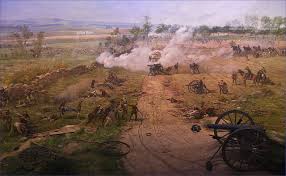
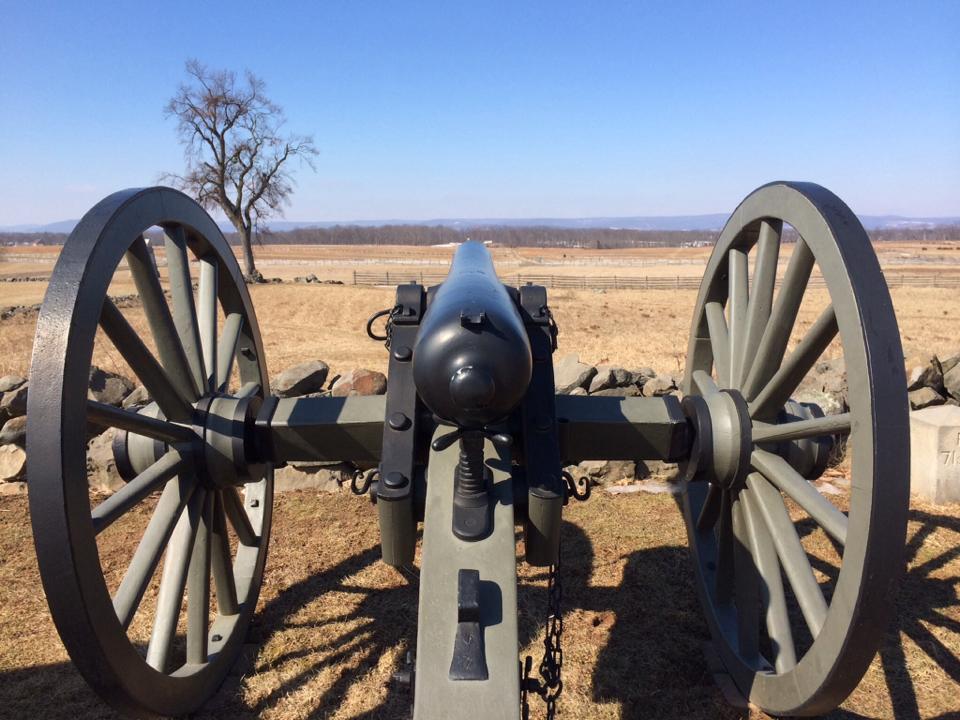
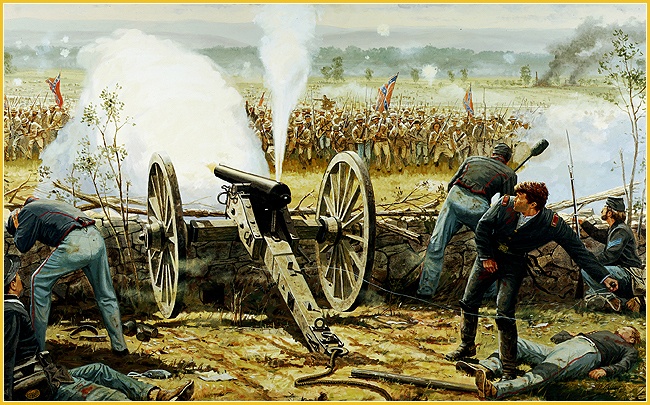
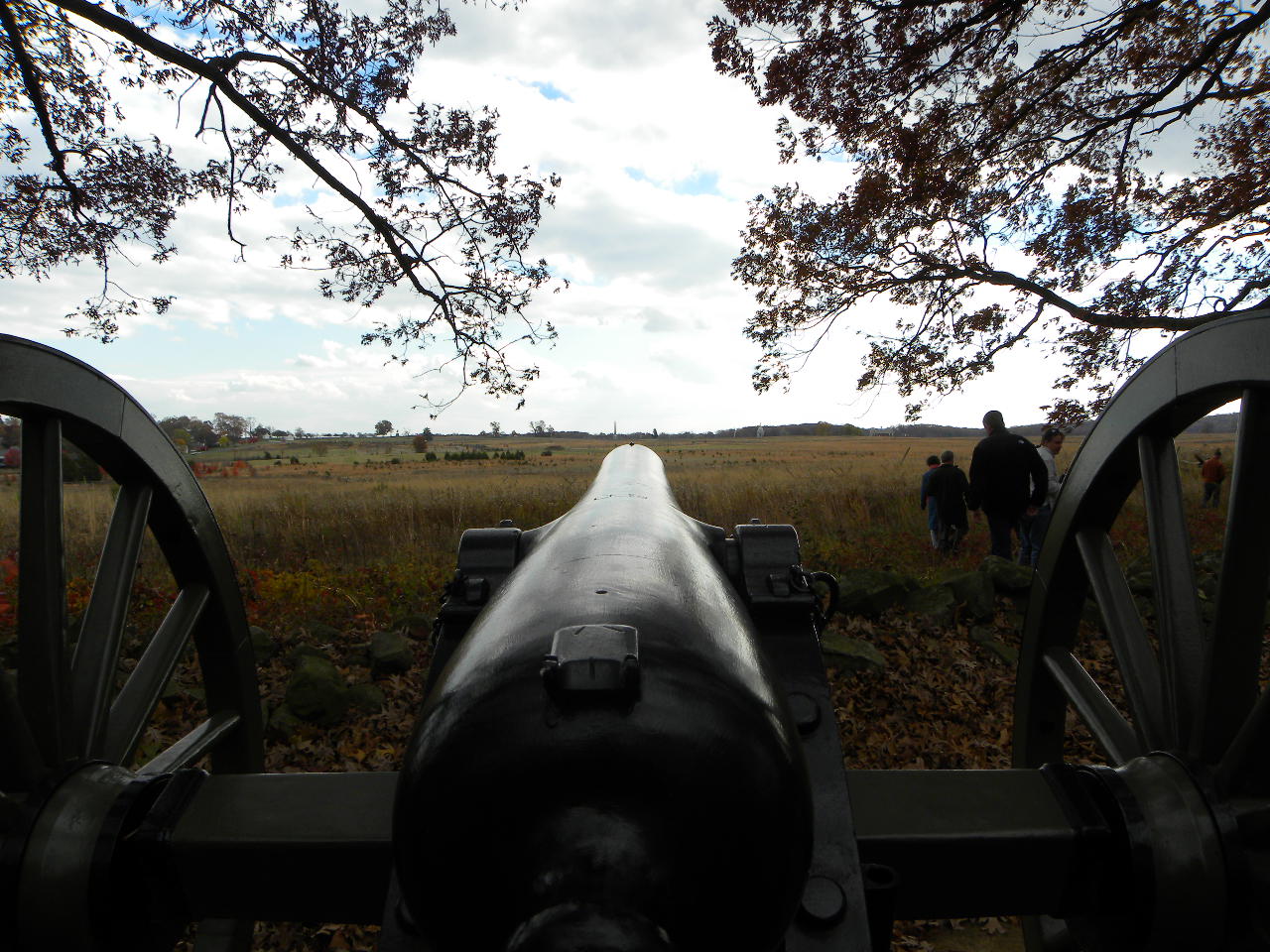
Category Archives: History

The YUCK Factor: Religious Freedom & Kim Davis

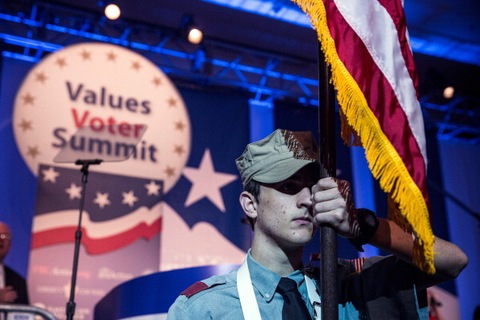
valuesvoterssummit

Friends of Padre Steve’s World,

I am getting so tired of people who decide that their religious freedom trumps everyone else’s freedoms as well as the law. The example of the Recalcitrant County Clerk of Rowan County Kentucky, Mrs. Kim Davis provides us a shining example of this from the Christian side of the house; and I can only say YUCK! So today I am taking a certain amount of delight that she is now in jail, the German word for my feeling of joy is schadenfreude. It’s a great word that we don’t use often enough.

I cannot speak authoritatively about non-Christians who decide that they can disobey law based on their religious freedom, and frankly I haven’t heard about too many of those cases;. However, as a Christian, a historian, a theologian, and a military officer charged with upholding the law; I can comment on Christians who decide to disobey the law in the name of their faith.

Freedom of religion is the most abused freedom that we have in this country. For the most part it is we can blame politically powerful conservative Christians abusing it. For them their religious freedom is a constitutional absolute which allows them to pick and choose what laws they do not want to obey; of course should a Moslem public official attempt this these same people will scream about Moslems trying to impose Sharia law on non-Moslems.

The fact that there are thousands of Christian denominations and split offs makes this messy. It is messy because while most of these Christians claim to believe in Jesus and the Bible, most cannot agree on any doctrine; except that they hate Gays. Other than that there is there is almost no consensus of belief. American Christianity is a pick-and-choose smorgasbord of beliefs, in which the individual’s right to choose what they want to believe about God is now spilling out of the church, and over into society at large. They chose what laws they will obey, and the religious beliefs that they want the government to enforce against others based on their “sincerely held religious views.” 

To that I say YUCK! As Attorney Alan Shore played by James Spader said in Boston Legal “Enough with this freedom of religion crap. Yuck. Yuck, yuck.”

But this is the latest “in-thing” for Christian bullies to do. In fact, the failing Presidential Candidate and seminary drop-out Mike Huckabee, got in on the act today. He commended Mrs. Davis today, saying that he called her and “let her know how proud I am of her for not abandoning her religious convictions and standing strong for religious liberty…” Likewise Senators Rand Paul and Marco Rubio are conniving to find a way to legislate ways for Christians to do this, while forgetting the legal precedent that would allow others to do the same in the name of their religion, and they will cry foul when a Moslem uses that precedent.

The fact is that this pompous attempt to make Evangelical Christianity a State Religion, is positively abusive toward all other citizens.  To be fair the attempts by Mrs. Davis and her political and legal supports needs to be called out by Christians, if we want to be taken seriously. If we don’t we as will denigrate our witness in the community and if the time ever comes, will forfeit our rights if someone wants to use the legal precedent that we set against us.

Dr. Mark Silk, Professor of Religion in Public Life at Trinity College and director of the college’s Leonard E. Greenberg Center for the Study of Religion in Public Life, calls this “Spiritual Libertarianism” and it is dangerous both to society, as well as the church. Or should I say churches, since given the chance and the backing of the government, a big church with the majority of adherents in an area will always oppress smaller churches, non-Christian religions and unbelievers. Since I have written a lot about this facet of religious liberty I will not go into that in depth here. Just put “religious liberty” or “freedom of religion” in the little search box on this site, and you will see my long list of articles on the subject, most dealing with our religious history.

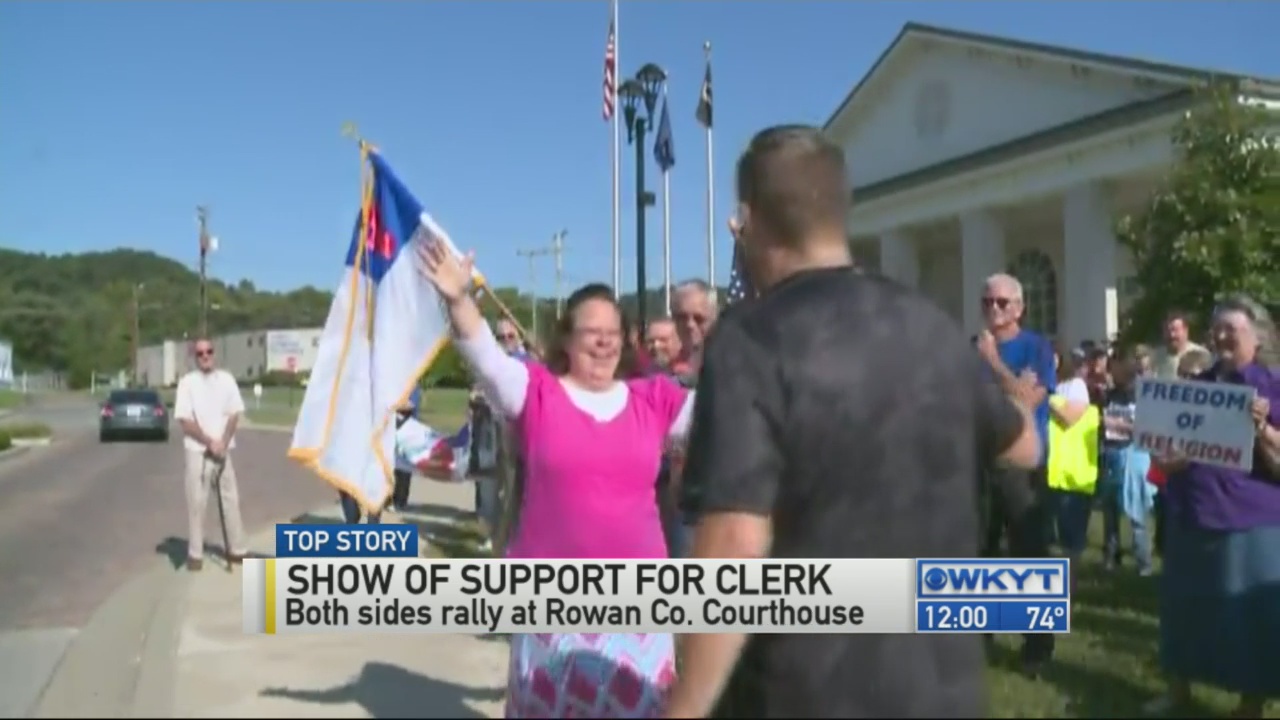
kim davis flag

But I digress… These people, including the Recalcitrant County Clerk of Rowan County, Kentucky, Mrs. Kim Davis, all claim to be obey the Bible, but they totally ignore other parts of the Bible. Jesus said to “Give to Caesar what is Caesar’s and to God what is God’s” and the Apostle Paul commanded Christians in his letter to the Romans, “Let everyone be subject to the governing authorities, for there is no authority except that which God has established. The authorities that exist have been established by God. Consequently, whoever rebels against the authority is rebelling against what God has instituted, and those who do so will bring judgment on themselves.”

So, this absolute right that Davis and so many others a championing is overplayed and dangerous. To quote attorney Alan Shore:

“Ugh, please. It’s a dumb freedom….And I don’t know about you, but I’m getting a little tired of this freedom of religion thing. When did religion get such a good name, anyway? Be it the Crusades, the Reformation genocides, the “troubles” in Northern Ireland, the Middle East, mass slaughters supposedly in the name of Allah, and then, of course, the obligatory reciprocal retribution. Hundreds of millions of people have died in religious conflicts. Hitler did his business in the name of his Creator. 9/11 was an act of religious extremism. It’s our greatest threat today—a Holy Jihad. If we’re not ready to strip religion of its sacred cow status, how ‘bout we at least scale back a little on the constitutional dogma exalting it as all get-out?” (Boston Legal “Whose God is it Anyway” Season 3 episode 5)

I am beginning to believe, like Alan Shore that religious freedom is a dumb freedom. This is not because I do not value it, but because it is so abused by people who want to establish a theocracy. This is something that our founders and even influential religious leaders of their day, did their best to avoid.

The fact is that these true believers, like Mrs. Davis, who desire to have their religious beliefs exalted over law and the rights of others are dangerous. Eric Hoffer wrote, that true believers, especially the religious type were likely to see themselves as “as one of the chosen, the salt of the earth, the light of the world, a prince disguised in meekness, who is destined to inherit the earth and the kingdom of heaven too. He who is not of his faith is evil; he who will not listen will perish.”

People are looking for something different than this and they are fleeing the church in droves. Dietrich Bonhoeffer, who was killed by the Nazis in 1945 wrote something about German Christians of his time that more American Christians should take to heart:

“Many people are looking for an ear that will listen. They do not find it among Christians, because these Christians are talking where they should be listening. But he who can no longer listen to his brother will soon be no longer listening to God, either; he will be doing nothing but prattle in the presence of God, too. This is the beginning of the death of the spiritual life, and in the end there will be nothing left but spiritual chatter and clerical condescension arrayed in pious words… never really speaking to others.”

Christians no longer have a good name in this country because we act like we are better than everyone else. What Mrs. Davis and her supporters are doing is to make that even worse. A pox on them.

Davis told Fox News before the ruling, “This is a heaven or hell issue for me and for every other Christian that believes…This is a fight worth fighting.” In other words, she is a Christian that believes and Christians who do not agree with her are not.

If you wonder why people are fleeing Christianity look no farther than Mrs. Davis’s and her supporters. Their perverted and insidiously malignant “Christianity” is the cause of this. As I said yesterday by the standards of Christian orthodoxy she is not even a Christian based on her beliefs about the Godhead. In Calvin’s Geneva and almost all countries with state churches in Europe, as well as the Massachusetts Bay Colony, she would have been burned at the stake for her beliefs; beliefs that she now presumes to hold as the standard for all other people. Basically, she has just had the nerve to say, in so many words, that the rest of us are going to hell. Of course in Jesus Name, Amen.

As to the ruling of Federal District Judge David Bunning which sent Mrs. Davis to jail until she complies with the law: it also requires her deputies to carry out their duties and authorizing county judges to issue marriage licenses. Five of the six deputies have agreed to follow the law. 

Now the Kentucky legislature which has tried to avoid the issue, and to kick the can down the road until next year might actually have to get off their asses and do something to amend their laws regarding marriage as well as what officials can issue a marriage certificate. That is if they want Mrs. Davis to keep her job and get out of jail before the next legislative session in 2016.

Davis and her followers, including the crass politicians trying to carve out exemptions for people like her to disobey the law have poisoned the water for anyone wanting to actually be a positive influence on society as Christians, and I include conservative “pro-life” Christians, as well as progressive Christians who advocate a more inclusive faith and relationship to society.

But, as more people flee the church and the Christian faith, the leaders of this movement to impose Christian beliefs on others through the power of the state, will have no one else to blame. They are the cause of this. The Barna group did a scientific survey of the attitudes of 18-29 year-olds on what phrases best described Christians. The top answers were “Anti-homosexual, judgmental, hypocritical and too involved in politics.” This view was held by 91% of non-Christians and a staggering 80% of young churchgoers. Another Barna survey mentioned Hypocritical, anti-homosexual, insincere, sheltered and too political. Another Barna survey of Evangelical Christians of the same demographic found that they believed that, “Christians demonize everything outside of the church” while 20% said that “God seems missing from my experience of church” while 22% said that “church is like a country club, only for insiders” and 36% said that they were unable “to ask my most pressing life questions in church.” 

As for now I am glad that she is in jail. The sad thing for her though is that the people who helped get her to jail at Liberty Counsel, will jettison her as soon as they can no longer make money off of her cause; and that will not be very long from now. They will move along and find some other dupe to do their bidding. By dupe, I do not mean a devout Christian, but rather one stupid enough to trust the judgement of politically motivated lawyers like Liberty Counsel who get them tossed in jail, and pocket vast amounts of money for their next legal crusade.

But then there seems to be an unending supply of dupes who think they are doing God’s will, and sadly, not just in this country. The Middle East is full of them.

God help us all.

Peace

Padre Steve+

7 Comments

Filed under christian life, faith, History, laws and legislation, LGBT issues, News and current events, Political Commentary, Religion

Heaven, Hell, Homosexuals & Kim Davis: The Pandora’s Box of Political Religion

kim davis flag

Kim Davis Greeting Supporters (above) Her Pastor Below

kim davis pastor

Friends of Padre Steve’s World

Kim Davis, the recalcitrant County Clerk of Rowan County, Kentucky has now decided that the reason that she cannot issue marriage licenses to Gays is that it is a heaven or hell decision, in other words, if she complies with the court order she will quite possibly go to hell. Actually as a theologian and historian I find this fascinating, and regardless of what happens next in this sorry saga, we must remember the words of Captain Jean Luc Picard “But she, or someone like her, will always be with us. Waiting for the right climate in which to flourish, spreading fear in the name of righteousness….”

Davis, who was elected to the office last November, following her mother who held the office for the 37 years prior, makes $80,000 a year to serve as the Country Clerk and one of her big duties is issuing marriage licenses to citizens of the county. The only problem is that Marriage Equality is the law and gays are entitled to the full rights of all citizens based on a Supreme Court ruling which said that based on the 14th Amendment that Gays, like all other American Citizens were legally entitled to the same rights as all other citizens. Likewise it appealed to the Civil Rights Act of 1965. By refusing the recalcitrant County Clerk of Rowan County Kentucky is in violation of the law. However, because she is an elected official she cannot be fired. She can only be impeached by a state legislature whose members need the votes of her supporters in the state. 

Mrs. Davis is an Apostolic Pentecostal Christian. Her Church, Morehead First Apostolic Church belongs to the United Pentecostal Church International. This denomination is one of the early Pentecostal denominations in the United States, founded in 1905 during the Pentecostal Awakening. It split from another Pentecostal denomination, the Assemblies of God over the issue of the Godhead. The United Pentecostals reject the traditional understanding of Trinitarian Christianity. Their theology is Monotheistic and they interpret the references to Father, Son and Holy as modes in which God reveals himself. In other words, God was the Father, and then the Son, and then the Holy Spirit.

According to mainstream Christianity since the Council of Nicaea in 325 A.D. the theology of the United Pentecostals was considered heretical, by all Eastern and Western branches of Christianity. This means, and I hate to be a theological hard ass here, but technically, they are not Christian, because they worship a different God. Now personally, I am not such a hard ass and believe that God forgives a lot of bad theology, even my own; but the United Pentecostals don’t, and here is where it gets really interesting.

The United Pentecostal Church believes that in order for a person to be “saved” that they must first repent of their sins. No problem there, I think repentance is a good thing. Next one must be baptized, and here is where it gets tricky. If you are not baptized “In Jesus’ Name” your baptism doesn’t count. Sorry all you folks that were baptized “in the Name of the Father, Son and Holy Spirit” you may have repented but you are not saved and yes you are heading for that eternal vacation on the Lake of Fire, so don’t forget your asbestos water skis.

But that’s not all my friends; to Kim Davis and the United Pentecostals you must also be baptized in the Holy Spirit with the evidence of Speaking in Tongues. If not, by their doctrine you are going to hell, and don’t forget to go to bathroom first because it is “damnation without relief” and if you do not go it will be a very uncomfortable eternity. But wait there’s still more…. Even if you a member of these churches, like Kim Davis is and you make it through those first three gates, you can still go to hell; you have to Persevere to the End, that means that she must wear those frumpy clothes, no makeup or jewelry, and avoid doing sinful things and that is kind of tricky because there are so many ways to screw up. No wonder she is afraid of going to hell for doing the duties required by the law.

I find it fascinating that Mrs. Davis and her supporters are so hell bent on making sure that homosexuals cannot get married, or enjoy the same rights as other citizens and condemn homosexuals all to hell based on their interpretation of the Bible. Interestingly enough many of her big supporters are Trinitarian Evangelicals and other Conservative Christians, who by doctrine Kim Davis and the United Pentecostal Church does not consider Christians.

This is the fascinating part. Her biggest defenders and her lawyers are all Trinitarian Christians who Kim Davis and her church believe are going to hell, at least which is what their doctrine says, and these wonderful Trinitarian Christians are so full of animosity to homosexuals that they will defend a person who believes that they too are going to hell with those horrible homosexuals. Imagine, if Kim Davis and her church are right, Mat Staver, lawyer from Liberty Counsel will be sunning himself on the banks of the Lake of Fire with the homosexual that he so loathes, and I hope he takes some tanning oil. The irony is rich, but I digress….

You see this is the problem when you decide to let theologically and historically ignorant religious fanatics run government. But that is the morass that conservative Christians in the United States have created for themselves. Ever since the 1970s when Jerry Falwell began the charge the situation has got increasingly stickier with every passing year. Odd alliances are made by groups who all believe that they have to only way to salvation and that all others are going to hell. The problem is that this alliance cannot hold. Should the Religious Right ever get control they will start persecuting each other in the areas that they are strongest, because it is an alliance of convenience and in their hearts they despise each other almost as much as they do the gays. It will Balkanize and fracture our society beyond belief; but then who cares so long as our religion wins.

Robert Heinlien observed, “Almost any sect, cult, or religion will legislate its creed into law if it acquires the political power to do so.” That is what Davis and her backers want, if they cannot stop the law they want legal authority to disobey it while getting paid to administer it as government officials.

Is it no wonder that James Madison, Thomas Jefferson and others of our founding fathers were so adamant about separating church and state? Madison said why this is so necessary, “The purpose of separation of church and state is to keep forever from these shores the ceaseless strife that has soaked the soil of Europe in blood for centuries.” And why Conservative Atheist Christopher Hitchens remarked “How dismal it is to see present day Americans yearning for the very orthodoxy that their country was founded to escape.”

Mrs. Davis can hold whatever religious views that she desires, and she can chose to worship the God of her choice and take her chances on landing in hell or heaven. However, her duties as an officer of the government require her to carry out the law. If she cannot carry out the law her choice is to resign. She has no right to be paid by the government and then substitute her religious beliefs for law she is to carry out, and thereby sabotage the law, which is meant for all citizens. Since she is unlikely to resign, cannot be fired, and most likely will not be impeached, there is no remedy for the citizens of Rowan County, none of who are able to get a marriage license. It reminds me of the days when White officials in the South defied Congress and the Courts to defend Jim Crow Laws in the 1959s and 1960s. 

Let’s turn this around for a second and put Mrs. Davis standing at the counter trying to get a marriage license following one of her three divorces. Imagine how Mrs. Davis would have felt if some hard-assed Trinitarian Catholic Christian denied her application for a marriage license due to her three divorces, and his belief that divorce was a mortal sin and that to issue a marriage license violated his religious beliefs.

That my friends is the path that Mrs. Davis and her supporters are taking us down. It is the path where a personal belief trumps the law, and one’s duty as an officer of the government to carry out that law.

Mrs. Davis needs to resign, or face the consequences. She will be considered a martyr for a cause by people who she, if she actually believes the teachings of her church, are going to go to hell alongside of the homosexuals that they are defending her from. I love that irony, and since Davis and many of her supporters would probably beleive that I am going to be damned for my support of the civil rights of Gays then I will have to agree with Captain Jean Luc Picard who once said “If we’re going to be damned, let’s be damned for what we really are.”

Make it so…

Peace

Padre Steve+

19 Comments

Filed under christian life, civil rights, ethics, faith, History, LGBT issues, News and current events, Political Commentary, Religion

Murderers, Evil & the Absence of Empathy

einsatzgruppen executions

Friends of Padre Steve’s World,

Like so many people this week I was stunned, shocked and sickened by the execution style murders of Roanoke Virginia reporters Allison Parker and Adam Ward by former reporter Vester Flanagan. Then later in the week the same type of murder of Houston Deputy Sheriff Darren Goforth by a man named Shannon Miles. The first was particularly upsetting as a local news station had a story on it early in the day with a video, which I thought was their coverage, but instead it was the live video which had been broadcast at the moment of the shooting. Then I saw the pictures published by the New York Daily News taken by Flanagan as he shot Allison Parker. Those pictures which showed Flanagan’s view down his gun sight as he aimed, fired and aimed again were chilling. They are so troubling that I will not post them here.

I think it was so because I have been on the other side of the gun barrel. Back in 1979, when I was first starting to date Judy we were out with her parents and help up at gunpoint. I had a .38 caliber revolver to my head, the criminals took our wallets, the women’s purses and as they left the one on the other side of the car ripped Judy’s glasses off of her face and ground them into the pavement. I thought about trying to get the gun from the man on my side of the car but realized that if I failed fired that Judy or her parents might have been killed. If I had my own gun, which I did not I would have probably not been able to get a shot off without getting them killed. Likewise, on a number of occasions in Iraq, serving as an unarmed chaplain, I was under enemy small arms or rocket fire. Thus when I think about what happened to the victims there is a certain amount of kinship I feel.

They reminded me of a picture that I saw of a member of a Nazi Einsatzgruppe individually killing women who had survived a mass execution in Russia during the German invasion. In one picture a woman, appears to be trying to rise up to crawl away from the piles of bodies, and a tall SS man walking up a few feet away with a sub-machinegun aimed at her.

I wondered how people of any sort could be so cold as to look someone in the eye and commit such brutal crimes. It was horrifying. I was up that night thinking about so many others that have happened in this country in just past few years. Dylann Storm Roof going to a Bible Study at the Emmanuel A.M.E. Church and then murdering the people there because they were African-American and he was a White Supremacist. There was Frazier Glenn Cross, a former KKK leader and militant white supremacist that killed three people near a Jewish Community center in Overland Park Kansas on the Eve of Passover, 2014. He claimed, “I had no criminal intent, I had a patriotic intent to stop genocide against my people,” and “I hate Jews…. They are the ones who destroy us.”

Then there was Neo-Nazi Wade Page who walked into a Sikh Temple in Oak Creek Wisconsin and killed six people in cold blood. There was James Holmes who went into a crowded theater in Aurora Colorado and killed twelve and wounded fifty-eight more in a mass killing spree. Holmes was convicted and sentenced to life in prison. Of course there was the Boston Marathon Bombing, and other killings committed by the Tsarnaev brothers, and twenty-year-old Adam Lanza who murdered twenty children and six adults at Sandy Hook Elementary School in Newtown Connecticut. Then there is George Zimmerman, a man in a league of his own, who killed an unarmed black teenager  and got away with it, much like so many murderers of so many others, not just in this country, but others as well.

Of course this is nothing new, we can look back that the 9-11 hijackers who killed almost 3000 people; Timothy McVeigh and Terry Nichols who killed 168 and wounded hundreds more when they bombed the Murrah Federal Building; as well as the terrorists of ISIL who routinely look into the eyes of their victims and then kill them.

The list can go on and on, and the murderers span the spectrum of American. Native born and immigrants, whites, blacks, Latin Americans, Asians, well educated men such as Holmes, children of privilege, Christians, Moslems, Jews, various other religions as well as atheists and agnostics. Some seemed to be motivated by some kind of intense hatred, religion, ideology, race; others apparently with some kind of mental imbalance or sense that they, or their race were the victims of the people that they killed.

Whether people murder others in cold blood, be it in large numbers or by looking them in the eye and pulling the trigger, no matter what their motivation for doing so, there is a common factor. It is not the weapons, though I do think the easy availability of so many lethal weapons is a factor, and that we need to tighten the requirements and even limit the types of weapons and amount of ammunition one can legally have, there were over 11,000 gun related homicides in the United States in 2014, I have left out suicides, which were close to 20,000 and justified defense using a gun which are so few that they don’t hit the chart. That number for one year dwarfs the number of all Americans killed in Iraq and Afghanistan, but I digress…. I am not against people owning guns, I will probably get myself a carbine for marksmanship practice someday, preferably a bolt action World War II Mauser if I can find one in good shape, but again I digress…. The easy access to guns too, is just a part of the equation.

It is not religion, ideology, or political differences, while that certainly plays a part, they are just contributing factors; the same is true of mental illness.

But there is something else, something that an American Army psychologist assigned to the major war criminals noted at the Nuremburg trials: “In my work with the defendants (at the Nuremberg Trails 1945-1949) I was searching for the nature of evil and I now think I have come close to defining it. A lack of empathy. It’s the one characteristic that connects all the defendants, a genuine incapacity to feel with their fellow men. Evil, I think, is the absence of empathy.” 

If you look at the video evidence provided by the killers, their writings, their Internet postings, or the testimony that any of them who survived long enough to go to trial; there is one thing that comes through loud and clear. None of them, not a one have any empathy for their fellow human beings, and as such when they look the people that they are about to kill in the eye do not feel anything.

It does not matter if they are men who perpetrated genocide or killed, or enslaved hundreds of thousands or even millions of people in the name of their religion, ideology, or political-economic systems; or if they are mass murderers or terrorists not connected with a state; who kill in the name of God, race, or ideology; or simply those who hate others and kill to avenge a real or perceived wrong against them. or even those who can look their victim in the eye and then murder them, they all lack the ability to feel for their victims.

The lack empathy, the totality of narcissism, the inability to see others as valued human beings; that it the definition of evil; and there is so much of it in our world. When I saw those pictures that the New York Daily News posted I was reminded of that; and I have had a hard time sleeping since.

I realize all too well that Gustave Gilbert was right; evil is the absence of empathy. The fact is that almost anything else is solvable, but the absence of empathy is the one characteristic that cannot be solved by humanity, and it may be the instrument of our demise as a species.

I say that because there are men and women who would not hesitate to unleash the hell of nuclear, biological, or chemical weapons of mass destruction on their enemies and the world. Despite their differences of their belief systems, religion or ideology, these people all display a certain absence of empathy; and that my friends makes them dangerous. Those who can look a single person, or a number of people in the eye and kill them are no different than those who have the ability, or desire the ability to kill millions; for none of them truly believe that their victims are worthy of life. Life unworthy of life, that is how the Nazis referred to their victims, and how those without empathy see their victims.

I’m hoping that his will not be the case and I’m hoping that I will be able to sleep,

Peace,

Padre Steve+

2 Comments

Filed under crime, History, Political Commentary, terrorism

Faith, Power & Politics: The Death of Good Religion

184062576_1_blog_main_horizontal

Friends of Padre Steve’s World,

Today I just want to share a few subversive thoughts on American Christianity and established religion. I am not talking about organized religion, because we Americans have little in the way of organization to our religion except when it comes to wanting to be in charge of the country, as many on the Christian Right advocate today.

Mark Twain wrote in his classic novel, A Connecticut Yankee in King Arthur’s Court:

“Concentration of power in a political machine is bad; and an Established Church is only a political machine; it was invented for that; it is nursed, cradled, preserved for that; it is an enemy to human liberty, and does no good which it could not better do in a split-up and scattered condition.”

On a more individual level, Atticus Finch, the hero of the book and film To Kill a Mockingbird said, “Sometimes the Bible in the hand of one man is worse than a whisky bottle in the hand of (another)… There are just some kind of men who – who’re so busy worrying about the next world they’ve never learned to live in this one, and you can look down the street and see the results.” In fact I’ll bet most of us know someone just like Atticus described; I know that I do, plenty of them.

I, and probably you, like to believe that religion is a benign or positive influence in the world. As much as I want to believe the positive aspects I have to admit based on the historical and sociological evidence that this is not so, especially during unsettled times of great change. We live in such an era and when it comes to identity, God is the ultimate trump card.

It seems to me that most fanatical individuals and groups on earth, of course not all are tied to religions, whether it is the Islamic State and Al Qaeda, Boko Haram, Hezbollah, Orthodox Jews, radical Hindus and Buddhists, as well as militant Christians. Who can forget that the Holocaust, the African Slave Trade, and even the Rwandan Genocide were predominantly the work of Christians, but I digress… Of course all of these groups have different goals, but their thought and philosophy are quite similar.

Robert Heinlein wrote: “Almost any sect, cult, or religion will legislate its creed into law if it acquires the political power to do so.” Heinlein, author of the classic Starship Troopers was absolutely correct. Just look at any place in any time where any religion, sect or cult has gained control of a government. They are not loving, they are not forgiving and they use the police power of the state to persecute any individual or group that is judged to be in error, or even worse has the gall to question their authority.

Since the Christian groups tend to thrive in the West, they only speak in terms of violence, most, with the exception of Russian Orthodox Christians, do not have a government to translate those words into action, which it does against Evangelical Protestants, Roman Catholics, Moslems, Jews, and every religious group’s favorite enemies, Gays and women.

Many American Christians, especially conservative Catholics and some Evangelical and Charismatic Protestants seem for a long for the day when they can assume control of a theocratic government, and a day where they can sit at the side of the rich and oppress the poor, the alien and the outcast. The amount of public support given to Vlad Putin by conservative Christian leaders in this country is amazing, and some publically state that they would want someone like Vlad the topless male magazine model for a leader.

But this is nothing new. Many American Christians have practiced that type of Christianity for close to two hundred years. In fact American Christianity is little changed since the day Frederick Douglass wrote, “The Christianity of America is a Christianity, of whose votaries it may be as truly said, as it was of the ancient scribes and Pharisees, ‘They bind heavy burdens, and grievous to be borne, and lay them on men’s shoulders, but they themselves will not move them with one of their fingers… “The man who wields the blood-clotted cowskin during the week fills the pulpit on Sunday, and claims to be a minister of the meek and lowly Jesus. The man who robs me of my earnings at the end of each week meets me as a class- leader on Sunday morning, to show me the way of life, and the path of salvation. He who sells my sister, for purposes of prostitution, stands forth as the pious advocate of purity. He who proclaims it a religious duty to read the Bible denies me the right of learning to read the name of the God who made me. He who is the religious advocate of marriage robs whole millions of its sacred influence, and leaves them to the ravages of wholesale pollution. The warm defender of the sacredness of the family relation is the same that scatters whole families,— sundering husbands and wives, parents and children, sisters and brothers,—leaving the hut vacant, and the hearth desolate. We see the thief preaching against theft, and the adulterer against adultery. We have men sold to build churches, women sold to support the gospel, and babes sold to purchase Bibles for the poor heathen! all for the glory of God and the good of souls! … The dealer gives his blood-stained gold to support the pulpit, and the pulpit, in return, covers his infernal business with the garb of Christianity. Here we have religion and robbery the allies of each other—devils dressed in angels’ robes, and hell presenting the semblance of paradise.””

The remarks of Douglass are as pertinent today as he first penned them in relationship to American white acceptance and support of slavery, and while much of his writing was directed against slaveholders and others who profited off of that system, he directed much of his writing against Northern Christians who offered support to that system.

Many American Christians are no different than other religious people, Christian, Moslem, Jewish, Hindu, and in some cases Buddhists as well as countless other religions history. Religions which have more often sworn alliance to governments, rulers, military and economic power to increase their power than to embody the essence of their founders’ teachings. Most of the time this is due to the need of people for an identity that is bigger and more powerful than what they believe they are on their own and sadly this often results in a sometimes unconscious but more often very conscious belief that they are part of an elect that in this life and the next should rule over unbelievers and others.

This is very important to understand, and Samuel Huntington wrote about it in his book The Clash of Civilizations:

“People do not live by reason alone. They cannot calculate and act rationally in pursuit of their self-interest until they define their self. Interest politics presupposes identity. In times of rapid social change established identities dissolve, the self must be redefined, and new identities created. For people facing the need to determine Who am I? Where do I belong? Religion provides compelling answers….In this process people rediscover or create new historical identities. Whatever universalist goals they may have, religions give people identity by positing a basic distinction between believers and non-believers, between a superior in-group and a different and inferior out-group.”

Huntington was right, you see the true believers, those who follow their religion without question and believe that it is superior to all others also believe that their religion entitles them to be atop the food chain, others who don’t believe like them be damned, if not in this life, the next. That is the certitude of the true believer, especially the religious one. Secular or atheistic fanatics could care less about the next life, for this life is all that they have. But the religious “true believers” are not only interested in destroying someone in this life, but ensuring that in the next that they suffer for eternity, unless they believe in the annihilation of the soul after death, which really spoils the whole Dante’s Inferno perspective of the damned in the afterlife.

The great American philosopher Eric Hoffer wrote:

“The impression somehow prevails that the true believer, particularly the religious individual, is a humble person. The truth is the surrendering and humbling of the self bred pride and arrogance. The true believer is apt to see himself as one of the chosen, the salt of the earth, the light of the world, a prince disguised in meekness, who is destined to inherit the earth and the kingdom of heaven too. He who is not of his faith is evil; he who will not listen will perish.”

That is why they, the religious true believers of any faith are capable of such great evil, and why such people can murder innocents in the most brutal manner simply because they do not believe correctly.

Please do not get me wrong. I am a Christian, a priest, a historian and a theologian, but I also know just how insidious those who hold their religion over those of others can be. While I hold faith dear, I know that it can be abused for the claim of some to have God as their final authority is a sort of trump card with which they are able to justify the most obscene and evil acts against others.

One of my heroes of religious liberty is John Leland, a Baptist whose passionate defense of religious freedom prevented Virginia from re-establishing a state church after the American Revolution and whose influence was key in the decision of Madison and Jefferson to amend the Constitution with the Bill of Rights, particularly the First Amendment. In fact, late in life, well after his success in working with Madison and Jefferson Leland wrote:

“The liberty I contend for is more than toleration. The very idea of toleration is despicable; it supposes that some have a pre-eminence above the rest to grant indulgence; whereas all should be equally free, Jews, Turks [Muslims], Pagans and Christians. Test oaths and established creeds should be avoided as the worst of evils.”

Like Leland, I contend for more than tolerance and I contend for acceptance. But that acceptance ends when any person or group is willing to use their religion to enslave, murder, or otherwise dominate other people in the name of their God, not just in this life, but in the next. This is especially true of those who use the police power of the state to enforce their beliefs and hatred on others.  I will do whatever I can to expose them for what they are, regardless of the “faith” they supposedly represent.

I guess that is why I am even more frightened of religious true believers than non-religious true believers. While the non-religious true believer may sacrifice everything for the sake of power and control in this life, and may in fact commit the most heinous crimes against humanity, their hatred is bounded in space and time to this earth. The religious true believer is not content with that; his enemies must be damned and punished not only in this life, but for eternity, without hope of salvation.

That is why I believe that such people are so dangerous; for their hatred is unbounded by time, or space, it lasts for eternity; which I think is a very, very, long time.

With that I wish you a good day.

Peace

Padre Steve+

1 Comment

Filed under christian life, faith, History, Political Commentary, Religion

A Magnificent Display: The Artillery at Pickett’s Charge

Friends of Padre Steve’s World

I am continuing to edit, update and revise my Gettysburg text and today I am putting out an article dealing with the artillery at Pickett’s Charge. The artillery engagement was the largest ever conducted on the American continent. I am in the process of combining two chapters into one to make the text flow better. While not a final effort, I will be adding to this as I work my way through the text, I wanted to present it now as I will be published a section on what soldiers went through while waiting to go into action yesterday and will be putting out the section on Pickett’s Charge tomorrow.

Like all of my writings I do my best to convey the human element and the suffering involved in battle as in our day too few people, even military personnel see it first hand, and I will be doing more to revise this chapter in the coming weeks and months.

I hope that you enjoy.

Peace

Padre Steve+

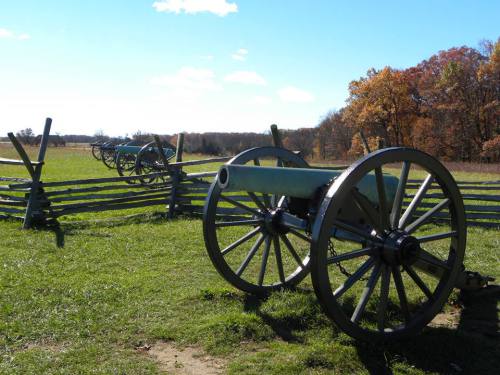
24 pound field howitzers

Confederate Guns on Seminary Ridge

Indescribably Grand… a Mere Waste of Ammunition: The Confederate Artillery at Pickett’s Charge

Many times battles are won or lost due to organizational failures as much as they are by tactical decisions. One of the issues that plagued Robert E Lee at Gettysburg was the effects of the army reorganization prior to and after Chancellorsville. While much attention is given to the reorganization of the Second Corps following the death of Stonewall Jackson and its division between A.P. Hill and Richard Ewell, less attention is given to the reorganization of the artillery.

Following Chancellorsville Lee abolished his artillery reserve and split all artillery between the three corps of his army. Each corps now had its own artillery reserve while divisions maintained control of their own organic batteries. Each corps had its own artillery reserve commander. The reorganization had been delegated by Pendleton to Porter Alexander and Jackson’s Corps Artillery Chief Colonel Stapleton Crutchfield. [1] The initial reorganization approved by Lee on April 16th 1863 retained a 36 gun general reserve was retained, but after Chancellorsville the battalions assigned to it were distributed to the corps. [2] While the reorganization did give the corps commanders more firepower it took away the ability of the army commander to have a ready reserve of firepower that could be used at when he needed.

At Gettysburg the artillery of the Army of Northern Virginia was assigned to each of the three army corps. First Corps under James Longstreet was assigned 5 battalions with 21 total batteries of 84 guns. Longstreet’s artillery chief was Colonel James B Walton, though during the battle Longstreet would come to rely on Lieutenant Colonel Edward Porter Alexander as his de facto artillery chief. Richard Ewell’s Second Corps also had five battalions of artillery, again with 21 assigned batteries totaling 84 guns. The chief of Second Corps artillery was Colonel J. Thomson Brown. Lastly A. P. Hill’s Third Corps had five battalions composed of 20 batteries with 80 guns under direction of Colonel Lindsey Walker. [3]

It was an idea the Union army had experimented with but Henry Hunt had the wisdom to retain the reserve. [4] The actions of the union artillery reserve on the second day were in large measure responsible for breaking the back of Confederate assaults on both flanks of July 2nd. The fact Meade and his artillery Chief Henry Hunt had this reserve available and not split up among the various army corps gave them a flexibility in employing massed firepower at critical points throughout the battle.

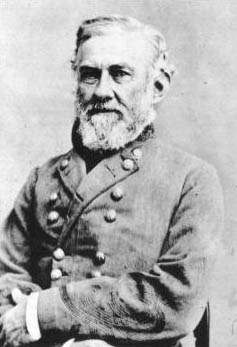
WNPendelton

Brigadier General William Pendleton

The head of the Army of Northern Virginia’s artillery Brigadier General William Pendleton, given the inflated title of “General in Chief Artillery” had his actual role “deflated to purely advisory.” [5] However as Lee’s adviser he was still the senior artilleryman in the army and Lee issued orders regarding the employment of the artillery through him. Pendleton was an 1830 graduate of West Point but had left the army to enter the Episcopal Priesthood. A “well meaning bumbler” [6] he owed his appointment to his “friendship with both Lee and Davis.” [7] He had no combat experience prior to the war, had missed the war with Mexico, shared in the responsibility for the disaster at Malvern Hill and he “lacked any instinct for the battlefield.” [8]

At Gettysburg Pendleton was especially ineffectual and his role on July 3rd was to sow confusion in Confederate artillery units as he “sought to supervise the whole artillery operation.” [9] Though his administrative skills should have made him effective in the advisory role he contributed to the failure of the attack.

Since the Confederates were more than 200 miles from their nearest artillery depot the amount of ammunition for the operation was always an issue. This became critical after the first two days of battle because Pendleton did not keep track of his ammunition expenditure and failed to let Lee know of ammunition shortages, information that might have made Lee reconsider the ill-fated attack of July 3rd.

During the day of July 3rd without a real job of his own to do Pendleton moved batteries on his own authority without coordination with the commanders to which they belonged. Even more importantly he placed the artillery ammunition supply trains too far to the rear to resupply the guns. This was discovered by Alexander during the great artillery barrage when his ammunition ran low and he had to tell Longstreet and Pickett at a critical point that he could not maintain his fire much longer. Pendleton should have ensured that the ammunition was located where it needed to be instead “lurked about the artillery corps commanders and gave them the impression that he was exercising the supervisory control implied by his title.” [10] As a result “some of the guns remained mute and their gunners stood helpless during the cannonade and charge.” [11]

fig66

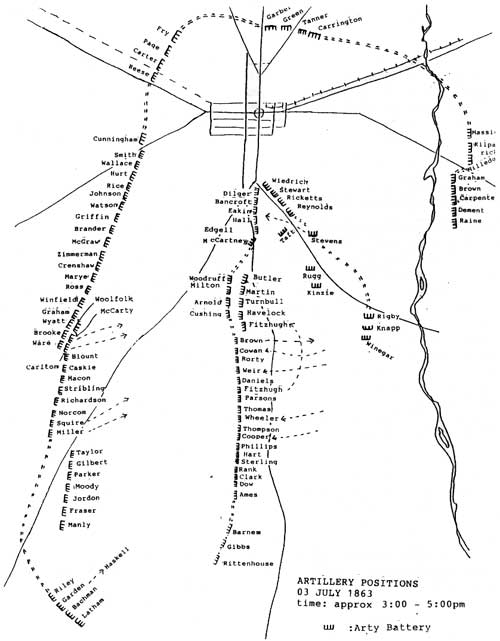
With Longstreet’s First Corps given the assignment of breaking the center of the Federal line priority of fires was given to him. Lee had high expectations of the artillery. Alexander recorded that Lee’s intent was “First, to give the enemy the most effective cannonade possible. It was not meant simply to make a noise, but to try to cripple him-to tear him limbless, as it were, if possible….” [12] Lee wanted the artillery from all of his corps to concentrate on the Federal position. In theory the exterior lines that his army occupied which were such a disadvantage to him in the attack should have allowed Ewell’s and some of Hill’s batteries to enfilade the Federal position, in a sense creating a cross fire.

This should have been the job of Pendleton as the General in Chief of Artillery, but as noted he was not effective in coordinating anything. It was the biggest artillery operation ever attempted by the Army of Northern Virginia and it required a great deal of coordination, “assigning or approving the best firing positions, specifying targets, ordering and coordinating the fire of a dozen artillery battalions of three army corps” [13] and a host of other important details, which Pendleton, though he claimed to have given “earnest attention” to all of these matters fell short. Alexander noted “our line was so extended that all of it was not well studied, and the officers of the different corps had no opportunity to examine each other’s ground for chances to cooperate.” [14]

Parrott-Answer-LRESM

Instead the real responsibility for the artillery battle fell upon the shoulders of three corps artillery commanders, each unaware of what the other was doing. “Alexander did not know what Lindsey Walker was doing with Hill’s artillery and Walker was apparently not even sure of what he was doing himself.” [15] While Porter Alexander attempted to provide what Lee and Longstreet required Ewell’s artillery took almost no part in the battle and Hill’s artillery under Walker was largely ineffectual in large part because it had spent much of its ammunition supporting a meaningless skirmish prior to Pickett’s attack. Likewise, Second Corps artillery badly needed supervision as Crutchfield was now wounded and out of action. [16]

As a result “two thirds of Lee’s guns were idle or improperly employed.” Instead of shattering Meade’s lines as Lee intended “the guns achieved little beyond adding to the terrifying noise, and overshooting, scaring the men in Meade’s noncombatant services…” [17] In all at least 58 guns assigned to support the attack never fired a shot.

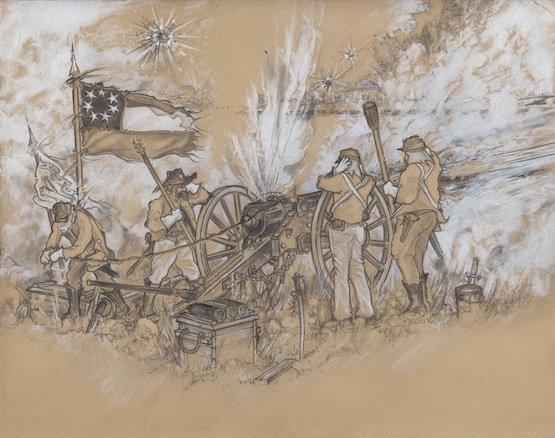
When the bombardment began at 1:07 P.M. Henry Hunt described the sight as “indescribably grand.” but he noted that “most of the enemy’s projectiles passed overhead, the effect being to sweep all the open ground in our rear, which was of little benefit to the Confederates – a mere waste of ammunition.” [18] Their target, a thin infantry and gun line was hard to hit and complicating matters was the smoke which obscured their view and “the inferior quality of their fuzes.” [19]

Command, control, logistics and organization helped make the largest artillery attack on American soil fall far short of what Robert E. Lee expected. As Lee stood by Alexander watching the battered remnants of Pickett’s division return from the assault Alexander noted that “at this moment he must have foreseen Appomattox.” [20]

“The Artillery…Must Concur as a Unit” Henry Hunt and the Union Artillery at Pickett’s Charge

henryhunt

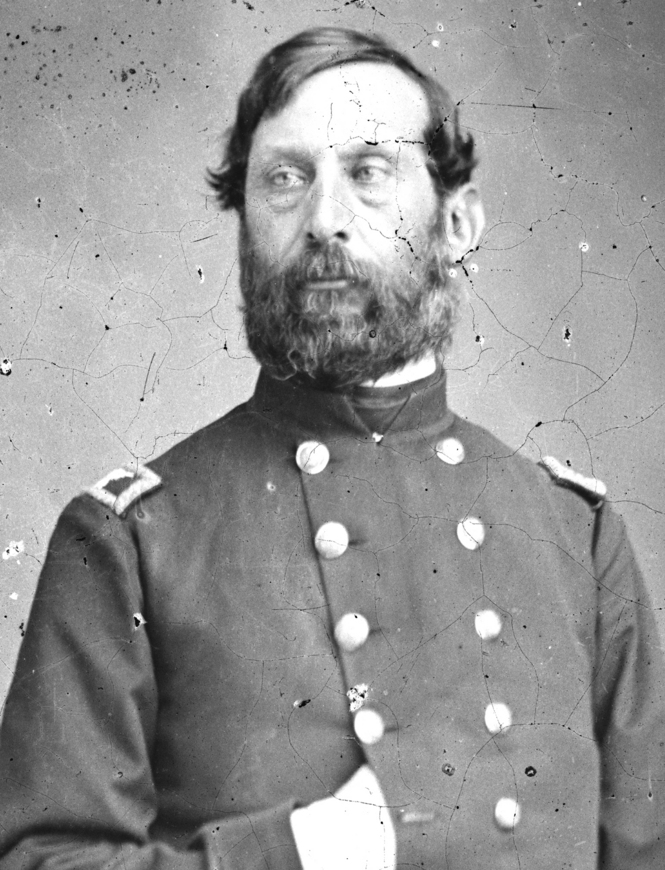
Major General Henry Hunt

Major General Henry Hunt the Chief of Union artillery was the admitted expert of all the artillerymen present at Gettysburg. Prior to the war he had taught artillery theory and tactics at West Point and written the Army’s artillery doctrine. However, he was no mere theoretician. He was an excellent battlefield leader who had a keen eye to assess the tactical situation and effectively employ his batteries. Hunt also understood the change in warfare brought about by small arms, particularly the rifled musket and that artillery had become a support weapon instead of an assault weapon, something that Lee had not yet fully appreciated as we have seen from his use of artillery.

fig59

The employment of fires is an important part of military art and to be effective it must be understood and used in concert with maneuver. As George Patton wrote in “War as I Knew ItBattles are won by fire and by movement. The purpose of the movement is to get the fire in a more advantageous place to play on the enemy. In contrast to Lee and his employment of artillery at Gettysburg which was ineffective in large part because he declined to use maneuver to his advantage, Meade, Hancock, Hunt and the various Union Corps commanders used their artillery to maximum effect taking advantage of their interior lines.

After Hooker’s disastrous experiment at Chancellorsville to decentralize the command and organization of the artillery Hunt was give a free hand to reorganize the artillery of the Army of the Potomac. The changes were sweeping. Batteries were removed from divisions and consolidated into brigades for each corps. Additionally Hunt created an Artillery Reserve of five Brigades totaling 21 batteries which could be employed to support the army at any given point and provided both him and the army commander a flexible and powerful source of firepower. Hunt put his best veteran artillerymen in charge of these brigades, and their deployment was in the hands of Hunt and the corps commanders. [21] At Gettysburg the changes would be of decisive importance.

cemeteryridgearty

Hunt had been very active on July 2nd in working with Meade, Hancock and vital in ensuring that Sickles beleaguered command received batteries from the artillery reserve. He was not present at the council of war held that night but was informed of the decision to remain upon his return from his last inspection of his lines and supervision of artillery at Culp’s Hill. In his inspection of the Federal artillery positions he took charge and moved units as needed and coordinated his work with the brigade commanders of each corps ensuring that they understood their part in the next day’s action.

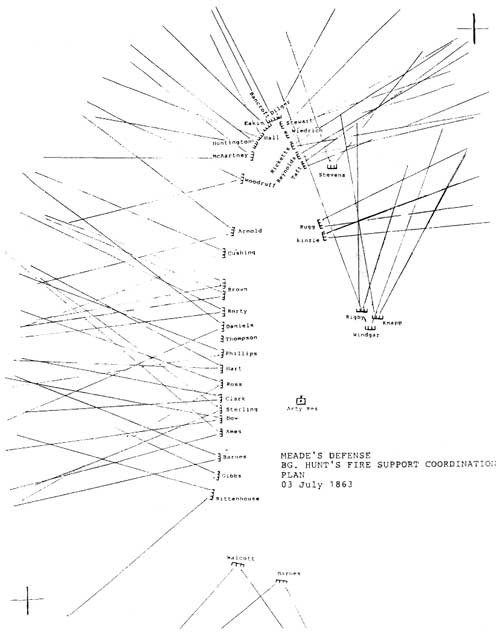
Unlike his Confederate counterpart William Pendleton, Hunt went into battle on July 3rd with very definite ideas of how he was going to employ his artillery and developed a detailed plan of fire support. Hunt’s artillery regulations dictated that in the attackthe artillery is employed to silence the batteries that protect the [enemy] position. In the defense it is better to direct its fire on the advancing troops. [22]

cemeteryridge

One of his most critical decisions was in relation to the Artillery Reserve to address Meade’s concerns about an attack on the Union center. About 11 A.M. Hunt went to Cemetery Hill where he was able to gain a good view of Confederate preparations. He wrote that Here a magnificent display greeted my eyes. Our whole front for two miles was covered by batteries in line or going into position. Never before had such a sight been witnessed on this continent, and rarely if ever abroad…” [23]Hunt placed twenty batteries of his artillery reserve along Cemetery Ridge and laid out a deadly latticework of crossfire lanes designed to scourge the fields in front of every living thing. [24] Hunt was aided in his efforts by the commander of the Artillery Reserve Brigadier General Robert O. Tyler who was able to increase the number of guns available through repairs and reconditioning. [25]

92681186b29b70439321935b2ab79a62

As Hunt examined the situation before him he had to discern what the Confederate intentions were. He thought there was the possibility that Lee might use them to cover a move of infantry to support Ewell but he dismissed that as he did the possibility of Lee withdrawing his army. Despite the fact that he could not see the deployment of the Confederate infantry massing for the assault Hunt was convinced that the attack would hit the center. In light of his understanding of the how artillery should be employed in the defense he grasped the essence of the situation-that the duty of the artillery was not to combat the opposing ones, but to reserve themselves to smash the infantry assault. [26]

As such his guns, both of the artillery reserve as well as II Corps deployed on Cemetery Ridge was confronted with an artilleryman’s dream. He was posted on the high groundwith clear fields of fire. He had 119 guns of high quality massed in battery, with plentiful reserves and sufficient ammunition. He was positioned to catch an infantry attack in a deadly crossfire. His brigade commanders were chosen by him and trained by him. [27] This total included the guns on Cemetery Hill as well as Cemetery Ridge.

Notes

[1] Golay, Michael To Gettysburg and Beyond: The Parallel lives of Joshua Lawrence Chamberlain and Edward Porter Alexander Crown Publishers Inc. New York 1994 p.155

[2] Coco, Gregory A. A Concise Guide to the Artillery at Gettysburg Colcraft Industries Ortanna PA 1998 p.43

[3] Ibid.

[4] Dowdey, Clifford Lee and His Men at Gettysburg: The Death of a Nation, Skyhorse Publishing New York 1958 p.284

[5] Sears Stephen W Gettysburg Houghton Mifflin Company Boston and New York 2004 p.377

[6] Ibid Dowdey, p.284

[7] Ibid. Sears p.377

[8] Ibid.

[9] Ibid. Dowdey p.285

[10] Ibid. p.286

[11] Coddington, Edwin The Gettysburg Campaign, a Study in Command A Touchstone Book, Simon and Schuster New York 1968 p.499

[12] Trudeau, Noah Andre Gettysburg A Testing of Courage Harper Collins New York 2002 pp.444-445

[13] Ibid. Sears p.379

[14] Alexander, Edward Porter The Great Charge and the Artillery Fighting at Gettysburg in Battles and Leaders of the Civil War edited by Bradford, Neil Meridian Press New York 1989 p.395

[15] Ibid. Dowdey p.286

[16] Ibid.

[17] Ibid

[18] Hunt, Henry The Third Day at Gettysburg in Battles and Leaders of the Civil War edited by Bradford, Neil Meridian Press, New York 1989 p.386

[19] Ibid. Sears p.381

[20] Ibid. Alexander p.397

[21] Sears, Stephen W. Gettysburg. Houghton Mifflin Co. Boston and New York 2003 p.32

[22] Foote, Shelby, The Civil War, A Narrative. Volume Two Fredericksburg to Meridian Random House, New York 1963 p.545

[23] Hunt, Henry The Third Day at Gettysburg in Battles and Leaders of the Civil War edited by Bradford, Neil Meridian Press, New York 1989 p.385

[24] Trudeau, Noah Andre. Gettysburg: A Testing of Courage, Harper Collins Publishers, New York 2002 p.486

[25] Ibid. Sears p.375

[26] Stewart, George R. Pickett’s Charge: A Micro-History of the Final Attack at Gettysburg, July 3rd 1863 Houghton Mifflin Company Boston 1959 p.131

[27] Ibid. Sears p.376

Leave a comment

Filed under civil war, Gettysburg, History, leadership, Military

Almost Unbearable: Waiting for Pickett’s Charge

gettysburgpickettscharge

Friends of Padre Steve’s World,

A couple of weeks ago I led a group of my students from the Staff College to Gettysburg. One thing that an observant person will do when they go to such a location is to imagine what was going through the minds of the people who were there. At Gettysburg this is very possible because the battlefield is in such good shape, thus when you stand in the wood line on Seminary Ridge looking out at the federal positions as did the Confederates on July 3rd 1863, or on Cemetery Ridge looking to the west as the Union troops did you can get a sense of what these men were face. The Confederates were to advance across an open field in the face of concentrated artillery, much of which they could not even see before they came into range. I think that when we look at events like this that there is always a current application simply because people are people and no-matter how much technology changes, it is the actions of people that are important, be it in a military setting or not. To go to a place such as Gettysburg and to take in the sites while reading and imagining what those men were thinking, both those in command as well as those being ordered to their deaths.

Anyway, this a a part of my Gettysburg text and I do hope that it helps you understand the plight of those invested with command as well as those whose only real option based on their society and culture is to obey their orders.

Peace

Padre Steve+

Pickett

Major General George Pickett C.S.A.

While James Longstreet was depressed and doubted whether any assault could break the Federal line, as were many other Confederate commanders who had seen the great cost in lives of attacking the entrenched Federal army on July 2nd, Robert E. Lee held on to the hope that one more assault would carry the day. It had to Lee had staked everything on a decisive battle, “the importance with which his whole strategy had invested in this battle and the stubbornness which had driven him on at Gainess Mill, Malvern Hill, and Antietam, impelled Lee to still try another major attack on July 3.” [1]

However, Robert E. Lee was encouraged by the partial success of his forces on July 2nd and he was now confident “that with the proper coordination and support of artillery, it was still possible to assault and break through Meades front.” [2] Convinced that his men could conquer the Federal position, and encouraged by the small successes of the second day, “the general plan of attack was unchanged.” [3]

Lee’s tactical problem remained the same as it had on July 2nd, when the power of the rifled musket and massed artillery of the Federal defenders had cut his assaulting troops to ribbons. True his troops inflicted heavy casualties on the Federal army, especially on Sickles’ badly exposed III Corps in the Wheat Field and the Peach Orchard, but the Federal position was unbroken. His problem was how to break the enemy’s line and then exploit the breakthrough in order to gain not only a victory, but destroy the Army of the Potomac as a fighting force in the process. Some of his troops had pierced the Federal line on July 2nd but unsupported with Federal reinforcements flowing in were forced to withdraw. Thus Lee’s real problem was not breaking through the Federal line, but “how to stay there and exploit the advantage once the enemys line was pierced.” [4] Lee’s solution was a grand frontal attack on the center of the Federal position, something that he had absolute faith that his troops could accomplish.

As we have already discussed, the new battlefield of the Civil War was one where the killing power of entrenched troops on the defense had grown exponentially as compared to the Napoleonic era or even the Mexican War, of which Lee and so many commanders were veterans. Troops on the offense assaulting an entrenched enemy had few advantages. As Russell Weigley noted that by the time an attacking force was able to breach a prepared defensive position, “almost invariably, by that time the attacker had lost so heavily, and his reserves were so distant, that he could not hold on against a counterattack by the defending armys nearby reserves.” [5] Like Lee’s costly assaults at Gaines’s Mill, Malvern Hill and those at Gettysburg on July 2nd, the assault of July 3rd by the divisions of Pickett, Pettigrew and Trimble were facing a similar bloody repulse; only Lee refused to accept it.

Colonel Porter Alexander, commanding Longstreet’s corps artillery noted that “even if the attack was “entirely successful, it can be only be at a very bloody cost” [6] while Brigadier General A.R. Wright, whose brigade had actually reached Cemetery Ridge on the afternoon of July 2nd told Alexander “The trouble is not going in there…the problem is to stay there after you get there.” [7]

With a fresh army, or perhaps a number of fresh divisions, Lee’s plan might have had a chance to success. But Lee had already lost heavily on July 1st and July 2nd and in the process shattered the divisions of Heth, Pender, Rodes, Johnson, Hood and McLaws and suffered serious casualties to the divisions of Early and Anderson. As far as infantry he had very little left, only Pickett’s shorthanded division which was missing two of its five brigades, with which to mount a frontal assault. An assault, that even if it was successful in driving Meade from his position on Cemetery Ridge would further decimate his army, deplete its ammunition, encumber it with wounded and render it incapable of further offensive operations.

DSCN8783

But Robert E. Lee was not deterred, as over the past year of action, involving many large battles “Lee had developed extremely high expectations of his enlisted men.” [8] He had seen them overcome adversity as well as defeat far larger forces. Unlike his doubting Lieutenant Longstreet, Lee was never in awe “of the formidable character of the Union position…and he felt sure his incomparable infantry if properly handled could take any height.” [9]But this time the terrain with all of its advantages to the defense, the superiority of the Federal artillery, the excellent position that Meade’s army occupied and his own lack of fresh troops and scarcity of artillery ammunition, combined with poor staff work and bad organization ensured that this assault would be more than his superb troops could handle.

Porter Alexander, like most in the Army, held Lee in such esteem that regardless of the situation that he implicitly trusted Lee’s judgment. As the preparations were made in the morning initially “believed that it would come out right, because General Lee had planned it.” [10] But as he weighed the matter more fully Alexander began to have his doubts and told Longstreet “if there is any alternative to this attack, it should be carefully considered before opening our fire, for it will take all the artillery ammunition we have left to test this one thoroughly, and if the result is unfavorable, we will have none left for another effort.” [11]

While Lee was certainly determined to reengage the Federals and defeat them, his lack of clarity and vagueness in his orders combined with the reluctance of a subordinate to carry them out hindered his plan. Lee again had not published a written plan of attack and relied on verbal instructions, which were vague, and more importantly he and Longstreet “had not reached a clear understanding on the nature, extent, and direction of his offensive operations.” [12] The misunderstandings and disagreement between the two men had not gotten better over the course of the battle, and somehow, in “the strange, undeclared conflict of wills that had begun thirty-six hours before, neither general was thinking clearly. As Longstreet would now do anything to avoid assuming responsibility for a full-scale attack, Lee would do anything to get him to move out.” [13]

Pickett’s division had arrived at Marsh Creek was of Gettysburg after a long and tiring forced march from Chambersburg on July 2nd at about 4 p.m.. Lee informed Pickett that his division would not be needed that day and ordered him to rest his troops. Thereafter, for whatever reason, they remained in that position until about 4 in the morning on July 3rd. Neither Lee nor Longstreet ordered them up earlier, which would have allowed them to be in position for an earlier assault on the Federal center, an attack that might have been coordinated with Ewell’s attack on Culp’s Hill which went off about 4 a.m.

Some of the blame for this can be laid at the feet of Longstreet, who still determined to find a way to turn the Federal left flank had his staff planning throughout the night for a way to execute that attack, but Lee was remiss in not clearly communicating his intent to his subordinate, to include what he expected him to do as well as when and where he expected him to do it. These questions were not cleared up until after sunrise on July 3rd, when Lee reiterated his plans to Longstreet and A.P. Hill.

Lee decided to attack the Federal center, where Cemetery Ridge was less commanding than Cemetery Hill, or the Round Tops which had been so costly to attack on the first two days of battle. All of Pickett’s division arrived behind Seminary Ridge between 7 a.m. and 9 a.m. on the morning of July 3rd. There it joined the other units assigned to the attack by Lee. Those units, apart from Pickett all came from A.P. Hill’s Third Corps, Longstreet having convinced Lee that the badly cut up divisions of Hood and McLaws should remain in place on the south end of the battlefield to protect the flank. Longstreet was of the opinion, and gained Lee’s concurrence that if those units joined the assault that the flank would be exposed to the well dug in and reinforced Federal units on and around the Round Tops, as Longstreet explained, “To have rushed forward with my two divisions, then carrying bloody noses from their terrible conflict the day before, would have been madness.” [14]

The decision to leave these two divisions in place resulted in a change of plan as to where the Confederate assault would be directed. Lee initially planned for Longstreet’s corps to continue its push in the south, from the positions they had taken near Little Round Top, Devil’s Den, the Peach Orchard and the Wheat Field. In that attack Hood’s division now lead by Evander Law, would be on the extreme right, McLaws division in the center attacking from the Wheat Field and Peach Orchard and Pickett on the left, supported by some of A.P. Hill’s Third Corps. Their target would be the south center of Cemetery Ridge, where Wright’s brigade had made it the day before.

However, with the change of plan Pickett’s division was now on the left of the attack, while Heth’s division, now commanded by Johnston Pettigrew would be in the center supported by Lane’s and Scales’ brigades of Dorsey Pender’s division, now commanded by Isaac Trimble, who had taken command only that morning. The selection of Heth’s division to join the attack now “provided a focal point for the attack, since it was roughly opposite the Federal center; then, too, there was a concealed position to the right of Heths line that offered room enough for Picketts men.” [15] This necessitated a change to the intended target of the attack, which Lee now identified as the “small clump of trees” visible in the center of the Federal position.

Lee discounted the terrain as a factor, thinking that the fences that crisscrossed the open field between the two opponents were of little concern. The open ground lent itself to the “massive attack on the scale that Lee visualized” but would “expose his men to a raking fire from enemy muskets and artillery.” [16] Lee hoped to reduce this danger with an overwhelming artillery barrage as we have already discussed.

DSCN8855

While Longstreet had opposed the attack opposed the attack and finally consented to Lee’s wishes, and other Confederate commanders such as Armistead and Garnett realized the near hopelessness of the attack but maintained their silence, William Mahone, whose brigade was part of Anderson’s division and not assigned to the attack was mortified. Mahone begged Anderson to observe the battlefield and told him his honest opinion of the coming attack: “That no troops ever formed a line of battle that could cross the plain of fire to which the attacking force would be subjected, and…that I could not believe that General Lee would insist on such an assault after he had seen the ground.” [17] But Lee was determined and Anderson refused to confront Lee, saying “in substance, that we had nothing to do but to obey the orders.” [18]

Mahone was right both about the ground and the fires from the Federal army that the attacking Confederates would encounter. While the fences along the Emmitsburg road in Pickett’s area were not much of a factor, they were on Pettigrew’s front. The Plum Run Valley which cut across the battlefield was a wide swale which “was truly a valley of death; Union artillery placed on Little Round Top could easily fire up its shallow groove as if it were a bowling alley, and Federal infantry could easily counterattack into it.” [19] In front of Pettigrew the ground formed “a natural glacis. In short, it naturally sloped at a steeper angle, forcing the attacker to literally walk up directly into the muzzles of the defending infantrymen.” [20] Whether Lee recognized it or not the ground itself offered major obstacles that the attacking Confederates would have to negotiate under heavy artillery and musket fire.

DSCN8851

From a command, control and coordination aspect there was little to be commended in Lee’s plan. The artillery support, nominally to be conducted by all the Confederate artillery from all three corps was not well coordinated and lacked an overall commander, this ensured that the “corps artillery commanders acted independently, without a firm understanding of the crucial importance of their roles.” [21] Porter Alexander, who had the heaviest responsibility during the attack, and on whose recommendation the attack would proceed, only had operational control of the batteries of First Corps and a few from Third Corps, the rest of the artillery battalions remained under their respective corps artillery commanders.

Additionally, to further complicate the artillery plan, the senior artilleryman present, Brigadier General William Pendleton, despite his lack of command authority muddled the artillery preparations by batteries committed to Alexander and the infantry assault without telling him. He also moved the artillery trains from their location near the batteries, far to the rear where the ammunition needed to sustain an attack was out of reach when needed. Lacking central control the batteries of Third Corps did not conserve their limited ammunition and became involved in a long battle over the Bliss farmhouse between the lines which limited their ability to take part in the attack. Likewise the guns of Second Corps, some of which could have had good enfilade fire on Cemetery Hill took little part in the action.

Of the three infantry divisions allotted to the attack, only one, Pickett’s actually belonged to Longstreet, the corps commander leading the attack, while the two divisions from Third Corps were badly cut up from the battle on July 1st and commanded by new commanders, neither who had commanded a division, and one of who, Trimble had never worked with or even met his subordinate commanders until that morning. The two brigades assigned to Trimble from Pender’s division were units that had been heavily engaged on July 1st, while two other brigades, those of Mahone and Posey from Anderson’s division, had “yet to see serious action” and were “just as fresh as Picketts division, yet they were overlooked and not even assigned a supporting role.” [22]

Despite his objections to it and the challenges posed by the attack, James Longstreet earnestly worked to make it succeed. Longstreet, Pickett and Pettigrew attempted to smooth out communications to “avoid mistakes and secure proper coordination between various units.” [23] However, despite his good intentions, Longstreet made a number of mistakes which could be best described as “lapses of thought.” He failed to “explain the details of the attack to all levels of command in all units…he failed to communicate effectively with anyone outside of First Corps, even though Third Corps troops would make up more than half of the attackers.” He left the artillery plan to Alexander and failed to develop a detailed plan that would determine if the artillery bombardment had weakened the Federals enough “to justify sending in the infantry.” He also did not appreciate the weakened condition of the attached Third Corps units and more importantly seemed to give little thought to the placement of Pickett’s troops in relationship to Pettigrew. This left a 400 yard gap between the Pickett and Pettigrew’s divisions, a gap that would cause problems during the attack, as it necessitated “a significant and difficult left oblique movement by the Virginians across the valley, under artillery fire.” [24]

Despite Longstreet’s lapses he was not solely responsible for the outcome of the attack. The fact was that Lee reviewed the plans, and troop dispositions late in the morning. Lee had ridden up and down the line inspecting it and receiving the accolades of his devoted soldiers, but somehow despite his keen eye and battlefield prowess, he too “did not detect the hidden flaws in the deployment of his troops and the layout of its batteries.” [25] Likewise Lee seemed to continue the passive role that he had maintained throughout the battle. Alexander spelled this out in a private letter noting that “The arrangement of all the troops… must have been apparent to Gen Lee when he was going about the lines between 11 & 12, & his not interfering with it stamps of his approval.” [26]

About noon the approximately 13,000 troops in the three attacking divisions continued to make their individual preparations for the attack. As they did this “a great stillness came down over the field and over the two armies on their ridges…the Confederates maintaining their mile wide formation along the wooded slope and in the swale, the heat was oppressive.” [27] Pickett wrote his young fiancée “the suffering and waiting are almost unbearable.” [28]

Notes

[1] Weigley, Russell F. The American Way of War: A History of United States Military Strategy and Policy Indiana University Press, Bloomington and Indianapolis 1973 p.117

[2] Fuller, J.F.C. Grant and Lee: A Study in Command Indiana University Press, Bloomington and Indianapolis 1957 pp. 198-199

[3] Guelzo, Allen C. Gettysburg: The Last Invasion Vintage Books, a Division of Random House, New York 2013 p.375

[4] Ibid. Weigley The American Way of War p.117

[5] Ibid. Weigley The American Way of War p.117

[6] Korda, Michael. Clouds of Glory: The Life and Legend of Robert E Lee Harper Collins Books, New York 2014 p.591

[7] Coddington, Edwin B. The Gettysburg Campaign: A Study in Command A Touchstone Book, New York, 1968 p.459

[8] Hess, Earl J. Picketts Charge: The Last Attack at Gettysburg University of North Carolina Press, Chapel Hill and London 2001 p.13

[9] Coddington The Gettysburg Campaign: A Study in Command p.457

[10] Golay, Michael To Gettysburg and Beyond: The Parallel Lives of Joshua Lawrence Chamberlain and Edward Porter Alexander Crown Publishers, New York 1994 p.167

[11] Freeman, Douglas Southall. Lees Lieutenants: A Study in Command One Volume Abridgment by Stephen Sears, Scribner New York 1998 p.592

[12] Ibid. Coddington Gettysburg: A Study in Command p.454

[13] Dowdy, Clifford Lee and His Men at Gettysburg: The Death of a Nation originally published as Death of a Nation Skyhorse Publishing New York 1958 p.258

[14] Trudeau, Noah Andre Gettysburg a Testing of Courage Harper Collins Publishers, New York 2002 p.441

[15] Ibid. Trudeau Gettysburg: A Testing of Courage p.441

[16] Ibid. Coddington The Gettysburg Campaign p.459

[17] Ibid. Trudeau Gettysburg: A Testing of Courage p.458

[18] Ibid. Trudeau Gettysburg: A Testing of Courage p.458

[19] Ibid. Hess Picketts Charge p.79

[20] Ibid. Hess Picketts Charge p.81

[21] Wert, Jeffery D. Gettysburg Day Three A Touchstone Book, New York 2001 p.126

[22] Ibid. Coddington The Gettysburg Campaign p.462

[23] Ibid. Coddington The Gettysburg Campaign p.491

[24] Ibid. Hess Picketts Charge p.32

[25] Ibid. Coddington The Gettysburg Campaign p.492

[26] Ibid. Wert. Gettysburg Day Three p.128

[27] Foote, Shelby The Civil War a Narrative: Fredericksburg to Meridian Vintage Books a Division of Random House, New York 1963 p.539

[28] Ibid. Dowdy Lee and His Men at Gettysburg p.281

Leave a comment

Filed under civil war, Gettysburg, History, Military

Worldwide Uncertainty & the Importance of Now

1625727_10152283192447059_782802676_n

Friends of Padre Steve’s World

“Some people see things as they are and ask why? Others see things as they never were and claim mad cow.” Alan Shore

I am not an economist, I am a historian and I while I do understand some things about economic theory and history, and I am certainly no expert on markets. Like many I do get concerned when I see the stock markets around the world crashing, not so much for the rich people who are losing inflated stock value, for the rich almost without exception seem to do well in times of such turmoil, in fact they often do better because governments value their business expertise and depend on them to get countries out of the mess. But I worry more for the possible effects that this could have on small business owners, the middle class and the poor. I do get concerned for the middle class who have money invested in the markets through their 401k’s and retirement programs, as well as the poor who could lose their jobs if the companies that they work for tank.

150824123207-market-1000-pt-graphic-hedline-780x439

There are so many variables; interest rates, oil prices, housing prices, and employment rates just to name a few. There are also the factors of what is happening in China and other big yet developing markets which can have ripple effects, or even tsunami-like affects across the globe depending how bad things get. There are so many other things going on in the world economy dealing with Greece the EU and the Euro, Russian rumblings in Eastern Europe and the Ukraine, the rise of ISIL and the potential threats to oil producing countries in the Middle East, things going on with vast refugee migrations as well as economic, political, and potential viral epidemics in African countries which frankly most Americans and Europeans could care less about until they reach our shores. 

All of these things are so troubling on so many levels, and why shouldn’t they be. Not only are we looking at potential economic chaos, but there is climate change and its effects on endangered wildlife like the Virgin Island Screech Owl and the Fresno Kangaroo. Who knows what could be next?

So in light of this worldwide uncertainty I can recommend a number of things. Look at your investments, take a look at history because it always has lessons, or follow the immortal advice of John “Bluto” Blutarsky: “My advice to you is to start drinking heavily.”

crane and shore

But that being said, no matter how bad things are and how much worse they could get it is far more important to live in the moment with those that you love and care about in the now, not the future that we have so little influence over. As Danny Crane (William Shatner) told Alan Shore (James Spader) in Boston Legal:

“Let me tell you something. When you got polar ice caps melting and breaking off into big chunks and you got Osama still hiding in a cave, planning his next attack, when you got other rogue nations with nuclear arsenals, and not to mention some wack-job, home-grown that can cancel you at any second and when you got…mad cow, now gets high priority. And when you’re still on the balcony on a clear night, sipping scotch with your best friend, now is everything.”

Yes my friends, in the midst of all the craziness that we cannot control, now is everything so keep calm. 

Peace

Padre Steve+

1 Comment

Filed under economics and financial policy, History, Just for fun, philosophy, purely humorous

The Rebirth of American Nativism: Trump and the Know Nothings

american-patriot

Friends of Padre Steve’s World,

In the past few months we have witnessed a big debate in the Republican Party regarding immigration. This is not a new phenomenon, over the past few decades the debate has come and gone, but it has returned with a vengeance as Donald Trump, the billionaire developer and current GOP frontrunner has made immigration, or rather a virulent anti-immigration platform the centerpiece of his campaign. This has other Republican candidates scrambling to find a position close enough to Trump’s without completely throwing away the vote of immigrants who they will need to win in many states; if they are to have any hope of winning back the presidency in 2016.

But Trump’s position has resonated with parts of the Republican base, and by appealing to their anger and frustration he has built a solid core of support whether he becomes the GOP nominee or runs as a third-party candidate. If one takes the time to read Trump’s speeches and the reactions to them by his supporters it becomes apparent that Trump has tapped into that vast reservoir of nativism that has always been a part of the American body-politic.

knownothing-convent-main

As I said, such attitudes and movements are nothing new. Anti-immigrant movements in the United States go back to our earliest days, ever since the first Irish Catholics showed up in the northeast in the late 1790s and early 1800s. Met with scorn and treated as criminals the Irish Catholics had to work hard to gain any kind of acceptance in Protestant America. But immigrants continued to come, seeking the freedom promised in the Declaration of Independence.

know-nothing_flag

Many White American Protestants viewed Irish, German and other European immigrants to the Unites States in the 1830s, 1840s, and 1850s as interlopers who were attempting to take over the country. The immigrants were regarded as poor, uneducated, uncouth, and immoral, and in the case of Catholic immigrants as representatives and foot soldiers of a hostile government, the Vatican, headed by the Pope and the bishops. Those who opposed immigration formed a movement that was aimed at forbidding immigrants from being granted full rights, especially the rights of citizenship and voting. The fear was pervasive. Many Northern Whites were afraid that immigrants would take their jobs, since like slaves in the South, the new immigrants were a source of cheap labor.

Northern Protestant church leaders and ministers were some of the most vocal anti-immigrant voices and their words were echoed by politicians and in the press. The movement grew and used government action, the courts and violence to oppress the Irish and Germans who were the most frequent targets of their hate. The movement eventually became known as the “Know Nothing” movement.

Know Nothing leaders were not content to simply discuss their agenda in the forum of ideas and political discourse, they often used mob-violence and intimidation to keep Catholics away from the ballot box. Mobs of nativist Know Nothings sometimes numbering in the hundreds or even the thousands attacked immigrants in what they called “Paddy hunts,” Paddy being a slur for the Irish. To combat immigrants who might want to exercise their right to vote, the Know Nothings deployed gangs like the New York’s Bowery Boys and Baltimore’s Plug Uglies. They also deployed their own paramilitary organization to intimidate immigrants on Election Day. This group, known as the Wide Awakes was especially prone to use violence and physical intimidation in pursuit of their goals. The Nativist paramilitaries also provided security for anti-immigrant preachers from angry immigrants who might try to disrupt their “prayer” meetings.

Know Nothing’s and other Nativist organizations, organized mass meetings throughout the country which were attended by thousands of men. The meetings were often led by prominent Protestant ministers who were rich in their use of preaching and prayer to rile up their audiences. The meetings often ended with physical attacks and other violence against German or Irish immigrants and sometimes with the burning of the local Catholic Church. They also provided security for preachers from angry immigrants who might try to disrupt nativist prayer meetings.

The violence was widespread and reached its peak in the mid-1850s.

Bloody Monday.jpg.opt836x314o0,0s836x314

Black Monday in Louisville 

003.jpg.opt562x853o0,0s562x853

Monday, August 6, 1855 was Election Day in Louisville, Kentucky. To prevent German and Irish Catholics from voting, Know Nothing mobs took to the street and launched a violent attack on immigrants as well as their churches and businesses. Known now as “Black Monday” the Nativists burned Armbruster’s Brewery, they rolled cannons to the doors of the St. Martin of Tours Church, the Cathedral of the Assumption and Saint Patrick’s Church, which they then were searched for arms. The private dwellings and the businesses of immigrants were looted. A neighborhood known as “Quinn’s Row” was burned with the inhabitants barricaded inside. At least 22 persons were killed in the violence and many more were injured. In Baltimore the 1856, 1857, and 1858 elections were all marred by violence perpetrated by Nativist mobs. In Maine, Know Nothing followers tarred and feathered a Catholic priest and burned down a Catholic church.

natives

The Know Nothings did not merely seek to disenfranchise immigrants through violence alone, they were more sophisticated than that. They knew that to be successful they had to change the law. Then, as now, a new immigrant had to live in the United States for five years before becoming eligible to become a naturalized of the United States. The Know nothings felt that this was too short of time and their party platform in the 1856 election had this as one of the party planks:

A change in the laws of naturalization, making a continued residence of twenty-one years, of all not heretofore provided for, an indispensable requisite for citizenship hereafter, and excluding all paupers, and persons convicted of crime, from landing upon our shores; but no interference with the vested rights of foreigners.

The rational of the Know Nothings for the 21 year wait was that if a baby born in the United States had to wait until it was 21 years old he could vote, that immigrants were being permitted to “jump the line” and vote sooner than native-born Americans. But really what the Know Nothings wanted to was to destroy the ability of immigrant communities to use the ballot box. In many localities and some states Know Nothing majorities took power. The Massachusetts legislature, which was dominated by Know Nothings, passed a law barring immigrants from voting for two additional years after they became United States citizens.

know-nothing-letter

The 1856 platform Know Nothing Party was synopsized by a Know Nothing supporter:

(1) Repeal of all Naturalization Laws.

(2) None but Americans for office.

(3) A pure American Common School system.

(4) War to the hilt, on political Romanism.

(5) Opposition to the formation of Military Companies, composed of Foreigners.

(6) The advocacy of a sound, healthy and safe Nationality.

(7) Hostility to all Papal influences, when brought to bear against the Republic.

(8) American Constitutions & American sentiments.

(9) More stringent & effective Emigration Laws.

(10) The amplest protection to Protestant Interests.

(11) The doctrines of the revered Washington.

(12) The sending back of all foreign paupers.

(13) Formation of societies to protect American interests.

(14) Eternal enmity to all those who attempt to carry out the principles of a foreign Church or State.

(15) Our Country, our whole Country, and nothing but our Country.

(16) Finally,-American Laws, and American Legislation, and Death to all foreign influences, whether in high places or low

In addition to their violent acts, the use of the courts and political intimidation the Know Nothings waged a culture war against immigrants. Latin mottoes on courthouses were replaced by English translations. Actions were taken to remove immigrants who had become naturalized citizens from public offices and civil service jobs as well as to use the government to persecute Catholic churches. In Philadelphia, all naturalized citizens on the police force were fired, including non-Catholics who has supported Catholic politicians, and in Boston, a special board was set up to investigate the sex lives of nuns and other supposed crimes of the Catholic church.

In the political upheaval of the 1850s Nativists tried to find homes in the different political parties. Some Know Nothings who were abolitionists became part of the new Republican Party, and Abraham Lincoln condemned them in harsh terms. He wrote his friend Joshua Speed about the hypocrisy that they displayed by supposedly being against the oppression of blacks while willing to oppress immigrants:

“I am not a Know-Nothing. That is certain. How could I be? How can any one who abhors the oppression of negroes, be in favor or degrading classes of white people? Our progress in degeneracy appears to me to be pretty rapid. As a nation, we began by declaring that “all men are created equal.” We now practically read it “all men are created equal, except negroes” When the Know-Nothings get control, it will read “all men are created equal, except negroes, and foreigners, and Catholics.” When it comes to this I should prefer emigrating to some country where they make no pretence of loving liberty — to Russia, for instance, where despotism can be taken pure, and without the base alloy of hypocracy [sic].”

1880_Anti-Chinese_Riot_in_Denver_anagoria

As an organized movement, the Know Nothings died out by the early 1860s, migrating to different parties and causes. In the North many became part of the pro-slavery Copperhead movement, which opposed Lincoln on emancipation and the Thirteenth Amendment. In the post-war South the anti-Catholic parts of the Nativist movement found a home in the Ku Klux Klan and other white terrorist organizations which also used racist and nativist propaganda to perpetuate violence, and disenfranchise emancipated blacks in the decades following the end of the Civil War and the end of Reconstruction. The Nativist and anti-immigrant sentiments have periodically found a home in different parts of the country and the electorate. Violence was used against Chinese, Japanese and Filipino immigrants on the West Coast, against Mexicans in the Southwest, Italians, Slavs, Eastern Europeans and Jews in the Northeast.

9587864_orig

Sadly it seems that it is being turned against others today. I find it strange that there are a host of people, mostly on the political right that are doing their best in their local communities, state legislatures and even Congress to roll back civil liberties for various groups of people. There is a certain amount of xenophobia in regard to immigrants of all types, especially those with darker skin white Americans, but some of the worst is reserved for Arabs and other Middle-Easterners, even Arab Christians who are presumed as all Middle Easterners are to be Moslem terrorists, even those who have been here decades and hold respectable places in their communities.

But immigrants are not alone, there seems to be in some states a systematized attempt to disenfranchise the one group of people that has almost always born the brunt of legal and illegal discrimination, African Americans.

Likewise there have been numerous attempts to roll back the rights of women, especially working women; the use of the legislature by religious conservatives to place limits on the reproductive rights of women, holding them to the standard of a religion that they do not practice. Despite the Supreme Court’s ruling for Marriage Equality in Obergfell v. Hodges there still are numerous attempts to curb any civil rights, including the right to marriage or civil unions of the LGBT community.

As I said, this is nothing new, that hatred and intolerance of some toward anyone who is different than them, who they deem to be a threat is easily exploited by politicians, pundits and preachers, none of whom care for anything but their prosperity, ideology, religion, or cause. While I would not call them a new incarnation of the Know Nothings, I have to notice the similarities in their message and the way that they push their agenda. As for those among them who claim the mantle of Christ and call themselves Christians I am troubled, because I know that when religion is entwined with political movements that are based in repressing or oppressing others that it does not end well. As Brian Cox who played Herman Goering in the television miniseries Nuremberg told the American Army psychologist Captain Gustave Gilbert played by Matt Craven “The segregation laws in your country and the anti-Semitic laws in mine, are they not just a difference of degree?

That difference of degree does matter, and there have been and still could be times when the frustration and anger of people, especially religious people can be whipped into a frenzy of violence and government sanctioned oppression by unscrupulous politicians, preachers and pundits. History is replete with examples of how it can happen. When I think of this I am reminded of the close of Spencer Tracy’s remarks in the movie Judgment at Nuremberg:

But this trial has shown that under a national crisis, ordinary – even able and extraordinary – men can delude themselves into the commission of crimes so vast and heinous that they beggar the imagination. No one who has sat through the trial can ever forget them: men sterilized because of political belief; a mockery made of friendship and faith; the murder of children. How easily it can happen. There are those in our own country too who today speak of the “protection of country” – of ‘survival’. A decision must be made in the life of every nation at the very moment when the grasp of the enemy is at its throat. Then, it seems that the only way to survive is to use the means of the enemy, to rest survival upon what is expedient – to look the other way. Well, the answer to that is ‘survival as what’? A country isn’t a rock. It’s not an extension of one’s self. It’s what it stands for. It’s what it stands for when standing for something is the most difficult! Before the people of the world, let it now be noted that here, in our decision, this is what we stand for: justice, truth, and the value of a single human being.”

Peace

Padre Steve+

9 Comments

Filed under civil rights, History, LGBT issues, News and current events, Political Commentary

Logistics, Transportation & Communication in the Civil War

Friends of Padre Steve’s World

Today something a bit wonkish, another section of my Civil War and Gettysburg Staff Ride text. Nothing controversial, but an interesting look at how all of these mundane and often forgotten components of war advanced during the Civil War and how both sides adapted to these developments.

Peace

Padre Steve+
meigs

General Montgomery Meigs: Logistician Extraordinaire

With the advances in weaponry, technology turned the adoption of field fortifications and the tactical defense; even during offensive operations changed the way that the armies conducted the war; other advances were occurring. These took place in logistics, transportation, signals and communications.

In a country as vast as the United States logistics was a major concern of both armies. The ante-bellum Army developed its logistic doctrine from Napoleonic examples. That doctrine had to be modified in light of the American reality of a less developed continent with far greater distances involved in the movement of troops. “While the North’s logistical mobilization expanded, the South’s peaked in early 1863 and then declined. Fundamental interlocking problems beset logistics. The Confederacy had few preexisting industries to expand and lacked sufficient raw materials upon which to build an industrial base.” [1]

The Confederacy “did not have the material resources to fight a mass industrial war” [2] and the actions of its leaders from Jefferson Davis down did not help their cause. “The South needed a careful weighing of assets and liabilities, the setting of strict priorities, and centralized direction in order to use its resources efficiently. But Confederate leaders allowed events to control planning, resulting in uncoordinated, tardy, and incompetent centralization of the logistical effort.” [3]

The issue was not limited to industry but also agriculture, which in a region as rich as the Confederacy should not have been a problem. However, it was a major issue that became ever more serious throughout the war, not only for the Confederate armies in the field but also for the population as a whole. While the South managed to maintain effective armies until the end of 1864, it “failed to preserve the population’s well-being.” [4] This would prove to be a major problem.

By the spring of 1863 five major cities experienced bread riots, the most serious being in Richmond. Here, women, many of whose husbands were in the army “could no longer defer starvation. Living without men meant living without livelihood for many women. On the morning of April 2, 1863, a group of working class women met at a Baptist church in Richmond. Unable to feed their families they resolved to march to the governor’s mansion to seek redress.” [5] The governor was unable to satisfy their demands and the women, armed with guns and knives proceeded to wreak havoc, and over the “next several hours, all semblance of order disappeared in Richmond’s commercial district as the enraged women broke down doors and windows, seized bread and meat, and then went on to loot jewelry, clothing, hats, “and whatever they wanted.” [6]

Army troops and militia arrived on the scene and it appeared that Confederate soldiers might soon open fire on upon Confederate women. Jefferson Davis, who heard about the situation went to the commercial district and personally gave an ultimatum to the rioters ordering them to disperse or have the troops and militia open fire. [7] He turned “glanced at the soldiers behind him and turned to the women. “We do not desire to injure anyone, but this lawlessness must stop. I will give you five minutes to disburse, otherwise you will be fired upon.” [8] Soon the crowd disbursed and order was restored, but the damage was done. Other bread riots occurred in Southern cities until the fall of 1863. Many Southerners blamed merchants in general and the press labeled most businesses as speculators and extortionists. However as a result of the great privations at home and the need for a scapegoat, the specter of anti-Semitism rose in the Confederacy. Many, including some influential newspapers and government officials “focused on the Jews as the worst “extortioners” [9] blaming them for many if not most of the Confederacy’s economic woes.

civil-war-city-point-dock

Even as their families went without food many soldiers in the armies of the Confederacy likewise faced hunger and privation. In the fall of 1863 some soldiers of the Army of Tennessee were ordered into line to be reviewed by Jefferson Davis. One soldier, Private Sam Watkins wrote: “When he passed by us with his great retinue of staff officers …cheers greeted them, with the words “Send us something to eat, Massa Jeff! Give us something to eat, Massa Jeff! I’m hungry! I’m hungry!” [10]

During the war, both armies learned to adapt their logistical support services to the reality of war. However, the South, for a number of reasons had difficultly this. Poor infrastructure and the lack of standardized rail systems were significant factors. But even more importantly inability of the government in Richmond, various states governments as well as the private sector to work together helped doom the Confederacy. The South did not lack for food. It was a rich agricultural region, but its ability to provide sustenance for its people and its armies was hindered due to its woeful infrastructure and various self-inflicted political and economic reasons. Several major issues affected the South’s ability to feed its people and its armies.

Among these were “the deficiencies of the Confederate rail system” which deteriorated throughout the war and was made worse by the lack of cooperation of Confederate railroad owners. The South “did not have a railroad network that tied its scant industrial base together or readily permitted long distance movements.” [11] This would hamper Confederate attempts to move and supply its armies as well as sustain its economy throughout the war. The Confederacy never nationalized its railroads, and “no centralized planning or organization developed, and field commanders, supply agencies, and civilian shippers competed for use of Southern rolling stock.” [12]
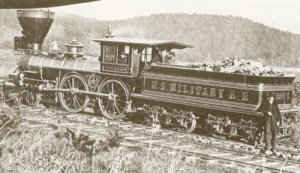
civil-war-locomotive

Southern policy towards the use of its railroads was muddled at best and the demands of the war and by 1863, “the excessive wear of wartime rail movement was chewing up southern rail lines[13] which resulted in the “South barely keeping a few lines operating by cannibalizing less important lines and could not replace its rolling stock.” [14] The combination of the lack of a strong industrial base to produce the iron to make replacement rails and the similar lack of producing facilities to manufacture locomotives and rolling stock, combined with the “unsure policies of the Confederate government and military” [15] ran the already feeble Southern railway system into the ground.

The Confederacy also faced a basic unwillingness of many producers of food, textiles and other necessities to cooperate with the Confederate government, which often could not even find ways for its own agencies to cooperate with each other. “The government gave no overall direction to the supply bureaus, which often bid against each other for materials and labor.” [16] This was a pervasive problem, and not helped by the efforts of some parts of the Confederate government to nationalize various parts of their economy in direct competition with the private sector. This contrasted starkly with the Union whose “quartermaster and commissary heads contracted out their needs for weapons, horses and clothes by bid on the open market, rather than by appropriating existing industries for government use.” [17]

The Confederate policies meant that many citizens and businesses found ways to not submit to government edicts. There was a basic “unwillingness of farmers to sell goods and produce at government rates” [18] and the greed of hoarders and war profiteers who through “hoarding, black marketing and simple withdraw from the market[19] crippled Southern war efforts and by “1862 much of the Confederate economy had become unmanageable.” [20] When Davis attempted to use the religious faith of the people to bolster more and “called for a day of fasting and prayer in March 1863, one man wrote that the president asked for “fasting in the midst of famine.” [21]

Where possible each side used railroads and maritime forces to move troops and supplies. The Confederacy, as has been noted was lacking in both, and was at a severe disadvantage. The Union however enjoyed a great advantage in modern rail networks, as well as ocean and river based maritime power. By late 1863 the Army of the Potomac, as well as forces in the West demonstrated “the close integration of operational planning and that of the general in chief and supply bureaus. In this one area, the development of a mature and modern staff was evident.” [22]

Once the armies were away from railheads or the ports from where they drew supplies both armies, like their Napoleonic cousins relied on wagons to transport essential food, supplies and ammunition when on campaign. In both armies commanders and their logisticians experimented with the number of wagons per regiment and how army commanders, modified that number at various points during the war based on their situation.

At the beginning of the war the Napoleonic standards by which both armies based the number of wagons, 12 wagons per 1000 men to support the troops on campaign were found to be insufficient as it “placed too much emphasis on foraging for American conditions” [23] and throughout the war standards for what the armies needed would be debated and commanders in different theaters of the war often set their own standards based on their needs and the availability of wagons and livestock to draw them.

As the war went on the Federal army experimented with the use of the “flying column” as a response to the dependency on wagons in order to increase their mobility. The flying column was an idea drawn from the French by Major General Montgomery Meigs, the Union Quartermaster General. The idea was simple; in order to reduce dependency on wagons the army itself would be reorganized at the lowest level, the infantry squad.

“The soldier in a flying column carried eight days’ compressed rations, including desiccated vegetables on his back. He carried a blanket but no overcoat. The men were divided into squads of eight, one of whom was to carry a covered cooking kettle, another a large mess tin, another an axe, another a pick, and one a shovel. One man in each company carried the hospital knapsack. Each man carried his share of a shelter tent. The cavalry were pickets and grain for their horses.” [24]

After Gettysburg and the unsuccessful pursuit of Lee’s army, Halleck and Rufus Ingalls, the Army of the Potomac’s chief quartermaster made provision and set standards “to convert the army into a flying column that would be self-sufficient for eight- and twelve- day periods away from the base of supply.” [25] In contrast, the Confederacy lacked the wagons and livestock to support the field operations of the army on campaign. Wagons, especially those suited for military operations were in short supply and any time the opportunity presented, confederate commanders ensured the capture of Union wagons. This turned out to be a major problem during the Gettysburg campaign, when Stuart during his ride around the Army of the Potomac “succumbed to temptation of capturing a beautifully equipped and heavily laden Union supply train near Rockville, Maryland, at the cost of exhausting his cavalry and wasting precious time.” [26] In most cases Stuart’s action would have been commendable, and he certainly felt that such should have been the case here as well, but the cost to his operations and Lee’s need for his cavalry were such that it was a mistake of disastrous consequences.

The basic load of food and ammunition carried by each soldier in order to increase strategic maneuverability was adjusted to meet the operational need. Both armies, but more often the Confederate army frequently had to live off the land. The success and failure of forage operations and the requirements for people and animals in each theater of operations had a large impact on each army. By early 1863 the Army of Northern Virginia was “greatly deficient in all areas of supply….there were extreme shortages of footwear, clothing, draft animals, and wagons.” [27] When the Army of Northern Virginia advanced into Pennsylvania they found it to be “a land of plenty” while “quartermaster and commissary details, acting under official instructions, filled wagons and supplies with foodstuffs.” [28]

While the Federal army never lacked in provisions or supplies, the Confederate armies were almost always in short supply. Even adequate food supplies needed to maintain an adequate caloric intake on the march were almost impossible to achieve. Food supplies were so limited that they were barely adequate, especially when the army was encamped. In fact, one of the reasons that Lee based his invasion of Pennsylvania was to alleviate his desperate supply situation. One regimental commander in Pickett’s division recalled that Lee told him “the movement was a necessity; that our provisions and supplies of every kind were nearly exhausted in Virginia, and we had to go into Pennsylvania for supplies.” [29]

As Federal forces moved into the South they encountered a new problem, the areas that the conquered and their essential supply bases, railheads and railroads had to protected from Confederate partisans, irregulars, raiders and other insurgents. Railroads were especially important to the Federal logistics chain as they provided “new strategic and operational abilities” to civil war armies, but they were an “extremely delicate sources of dependence when they ran through hostile territory.” [30] As such they had to be protected, as did the sprawling supply bases on which the Federal armies in the South depended. This resulted in an ever increasing logistics tail in proportion to the fighting forces spearheading the Federal advance. The three Union armies commanded by William Tecumseh Sherman that carried “the brunt of the Union effort against Joe Johnston and Atlanta, for example, showed 352,265 men on their muster rolls, but took only about 100,000 directly into the campaign.” [31] The rest were engaged in protecting the vital logistics tail.

Communications and Signals

The size of the armies and the distances involved on the battlefield made command and control difficult.  As such, communications became more important and each army experimented with new signals organizations that used both old and new communication technologies. At the beginning of the war both sides made extensive use of visual signals and couriers, but rapidly began to rely on the telegraph for rapid communications.

03-Beardslee-telegraph-US-Army-photo

The organizational tension was particularly evident in the rivalry between the U.S. Army Signal Corps and the Military Telegraph Service.  The Signal Corps focused on wireless communications. It preferred the Beardslee wireless telegraphs, however, they were plagued by the limitations of such early wireless technology. The Union Army command favored the traditional wire bound networks operated by the Military Telegraph due to better reliability and security and eventually the Military Telegraph Service and its Morse trained operators were given “jurisdiction for all field telegraph” services at the urging of President Lincoln in November 1863. [32] Though the Army rejected the Beardslee equipment some commanders requested it for their operations.[33] As each Army became more dependent on the telegraph, each feared that their signals could be compromised through wiretapping and made efforts to encode their transmissions.

While the various forms of telegraphic communication were important in keeping higher headquarters in contact with armies in the field, battlefield communication could be difficult. Commanders on both sides relied on messengers to relay orders to subordinate commanders as well as pass information to senior commanders. On the battlefield this took time, and since the messengers were subject to the same dangers as ordinary soldiers messages might not reach the intended commanders. It took approximately an hour for a message to travel from an army commander to a corps commander, 30 minutes from a corps commander to a division commander, 20 from division to brigade, 15 from brigade to regiment and 5 minutes from regiment to company. [34]

Written orders generally provided better clarity if detailed enough but if they were passed orally, as was Lee’s preferred method they could easily be miscommunicated by messengers, or misunderstood or even ignored by commanders. This was a major source of Lee’s consternation during the Gettysburg campaign. A major problem for Lee during the campaign was that his orders, be they written or oral were frequently vague and discretionary, something that we will discuss in detail later, but Lieutenant General Richard Ewell spoke for many Confederate subordinate commanders on the evening of June 30th when he asked his division commanders in frustration “Why can’t a commanding General have someone on his staff who can write an intelligent order?” [35]

The Union Signal Corps also pioneered the use and development with a “modern system of semaphores with a telegraphic alphabet…” as well as “a cipher disk…that allowed the Union Signal Corps to change the code hourly if need be.” [36] The one disadvantage to this form of visual communication was that it could be limited due to weather conditions or the smoke of battle. While semaphore was used with a good deal of success by the Union, and Meade would make good use of it at Gettysburg, it was not used by the Confederate army.
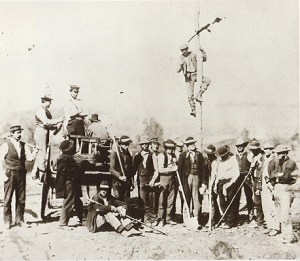
civil-war-us-signal-corps

Likewise Meade “set a precedent in command procedures” during the Gettysburg campaign, where “for perhaps the first time in military history the commanding general of a large army was kept in communication during active operations with his corps and division commanders.” Likewise Meade “set a precedent in command procedures when he brought signal officers to the conference table for consultation on the plan of battle” [37] and for the first time Signal Corps officers were assigned directly to each corps, when Meade ordered that two Signal Corps officers be “detached for service with each corps.” [38]

The troops of the Union Signal Corps were also a vital link in the transmission of military intelligence gathered by Colonel George Sharpe’s Bureau of Military Information, whose network of scouts during the Gettysburg campaign were “supported by Signal Corps detachments which could establish chains of flag stations from Harpers Ferry to “South Mountain, Monterrey, Greencastle…up to Parnell’s Knob, in the Cumberland Valley.” [39] This link helped provide Meade with much better intelligence regarding the movement of Lee’s army throughout the campaign.

Regardless of the means of transmitting orders, the fact was that at Gettysburg the element of friction entered the communication process. Wireless communications suffered from encryption problems, semaphore could not always be read due to the reduced visibility caused by the smoke covered battlefield. Commanders who took the time to issue written orders found that those could be delayed or lost due to battlefield conditions that impacted a messenger’s ability to deliver them, or misunderstood by their recipients. Likewise, verbal orders sent by messenger were frequently garbled and misunderstood, or depending on the situation, understood in the manner that best fit the situation of the recipient.

The developments in tactics, maneuver, defense and logistics and how those were developed over the course of the war brought about a form of warfare that remained dominant of decades. In studying the campaigns, developments and tensions between the competing theories of Jomini and Mahan in the Civil War, a student can begin to recognize them in future wars fought by the US Army including World War Two.

Russell Weigley picks up this theme in his books The American Way of War and Eisenhower’s Lieutenants. Weigley discusses Lee’s use of Napoleonic strategy and Grant’s corresponding strategy of annihilation as well as Sherman’s campaign against Johnston, as well as Sheridan’s devastation of the Shenandoah Valley to impose its aims on the Confederacy. [40] These lessons influenced American strategic doctrine well into the next century, and were employed by leaders in the First and Second World Wars, as well as much less effectively in Korea and Vietnam. Weigley concluded: “Because it worked so well, achieving total submission, American soldiers thereafter tended to generalize the United States strategy of the Civil War into the appropriate strategy for all major, full scale wars.” [41]

Notes

[1] Ibid. Millet and Maslowski For the Common Defense p.216

[2] Ibid. Thomas, The Confederate Nation p.135

[3] Ibid. Millet and Maslowski For the Common Defense pp.216-217

[4] Ibid. Millet and Maslowski For the Common Defense p.218

[5] Ibid. Goldfield America Aflame pp.296-297

[6] Ibid. Guelzo Fateful Lightening p.326

[7] Ibid. McPherson. The Battle Cry of Freedom p.617-618

[8] Ibid. Goldfield America Aflame p.297

[9] Ibid. McPherson. The Battle Cry of Freedom p.441

[10] Ibid. Robertson Soldiers Blue and Gray p.72

[11] Ibid. Millet and Maslowski For the Common Defense p.156

[12] Ibid. Thomas, The Confederate Nation p.211

[13] Ibid. Guelzo Fateful Lightening p.319

[14] Ibid. Millet and Maslowski For the Common Defense p.216

[15] Ibid. Guelzo Fateful Lightening p.323

[16] Ibid. Millet and Maslowski For the Common Defense p.217

[17] Ibid. Guelzo Fateful Lightening p.322

[18] Ibid. Guelzo Fateful Lightening p.320

[19] Ibid. Guelzo Fateful Lightening p.322

[20] Ibid. McPherson. The Battle Cry of Freedom p.442

[21] Ibid. Millet and Maslowski For the Common Defense p.219

[22] Ibid. Hagerman The American Civil War and the Origins of Modern Warfare p.79

[23] Ibid. Hagerman The American Civil War and the Origins of Modern Warfare p.44

[24] Ibid. Hagerman The American Civil War and the Origins of Modern Warfare p.71

[25] Ibid. Hagerman The American Civil War and the Origins of Modern Warfare p.76

[26] Coddington, Edwin B. The Gettysburg Campaign: A Study in Command, A Touchstone Book, Simon and Schuster New York, 1968 p.198

[27] Ibid. Hagerman The American Civil War and the Origins of Modern Warfare p.126

[28] Wert, Jeffry D. A Glorious Army: Robert E. Lee’s Triumph 1862-1863 Simon and Schuster, New York and London 2011 p.229

[29] Ibid. West A Glorious Army p.230

[30] Ibid. Weigley A Great Civil War p.322

[31] Ibid. Weigley A Great Civil War p.322

[32] Ibid. Hagerman The American Civil War and the Origins of Modern Warfare p.87

[33] Ibid. Hagerman The American Civil War and the Origins of Modern Warfare p.87

[34] Cole, Phillip M. Command and Communication Friction in the Gettysburg Campaign Colecraft Industries, Ortanna PA 2006 p.80

[35] Trudeau, Noah Andre. Gettysburg: A Testing of Courage, Harper Collins Publishers, New York 2002 p.140

[36] Ibid. Hagerman The American Civil War and the Origins of Modern Warfare pp.43-44

[37] Ibid. Hagerman The American Civil War and the Origins of Modern Warfare p.87

[38] Ibid. Guelzo Gettysburg: The Last Invasion p.123

[39] Ibid. Guelzo Gettysburg: The Last Invasion p.42

[40] Ibid. Weigley The American Way of War pp.145-146

[41] Weigley, Russell F. Eisenhower’s Lieutenants: The Campaign in France and Germany 1944-1945. Indiana University Press, Bloomington IN 1981 p.3

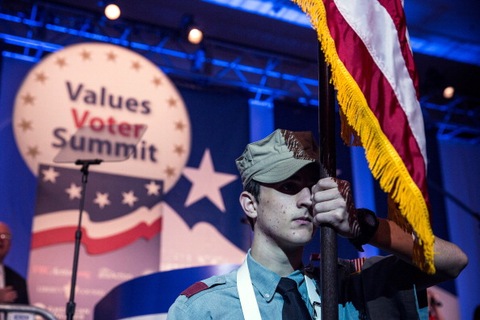
2 Comments

Filed under civil war, Gettysburg, History, Military

History, Critical Thinking & Truth

  
Friends of Padre Steve’s World

Just a short note today as I continue to read, reflect and do some research and writing on my Civil War and Gettysburg Staff Ride text.

Yesterday I was adding books that I have read over the past few months to my “read” list on my Facebook page, and there were a lot more than I remembered as I worked my way through my stack. If you add things to your Facebook page, movies, books, music or television shows, Facebook will provide lists of suggested titles that you can browse. This of course includes books, and not surprisingly to me, most of the books that were suggested were various forms of fiction or children’s books. There were a few literature classics among the suggestions and a host of Bible books. What I noticed was there were few books on history, philosophy, political science, world affairs or even theology listed. William Hughes

I was troubled by this; not because I am against people reading fiction or children’s book by any means, but typically those books, with the exception of some of the children’s books are for entertainment, not learning. As entertainment they are fine, but since almost everything else in our culture is geared toward entertainment I wonder where people are being challenged to think critically, and not simply be sponges for the sound bites offered by the politicians, preachers and pundits who dominate so much of our airwaves and the internet.

Barbara Tuchman wrote, “Books are the carriers of civilization. Without books, history is silent, literature dumb, science crippled, thought and speculation at a standstill. Without books, the development of civilization would have been impossible. They are engines of change (as the poet said), windows on the world and lighthouses erected in the sea of time. They are companions, teachers, magicians, bankers of the treasures of the mind. Books are humanity in print.”

Sadly, many people in this country and around the world are sadly deficient in knowing any history at all, and much of what they do know is based on myth. This is dangerous, historian George Santayana wrote, “Those who cannot remember the past are condemned to repeat it.” But I think that Howard Zinn said it the best:

“History can come in handy. If you were born yesterday, with no knowledge of the past, you might easily accept whatever the government tells you. But knowing a bit of history–while it would not absolutely prove the government was lying in a given instance–might make you skeptical, lead you to ask questions, make it more likely that you would find out the truth.”

Have a great night,

Peace

Padre Steve+

2 Comments

Filed under History, philosophy