Category Archives: laws and legislation

“Deo Vindice” The Confederates who Believed God Was on their Side

Friends of Padre Steve’s World,

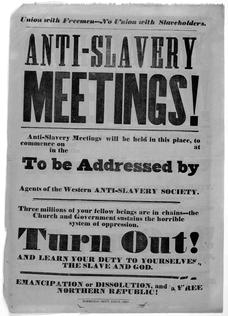
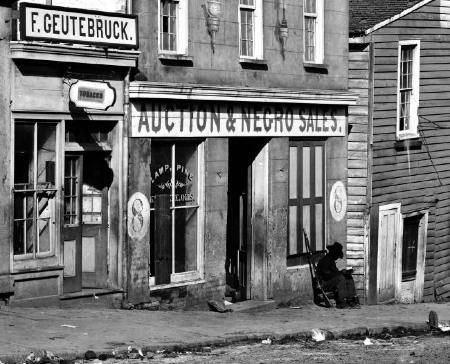
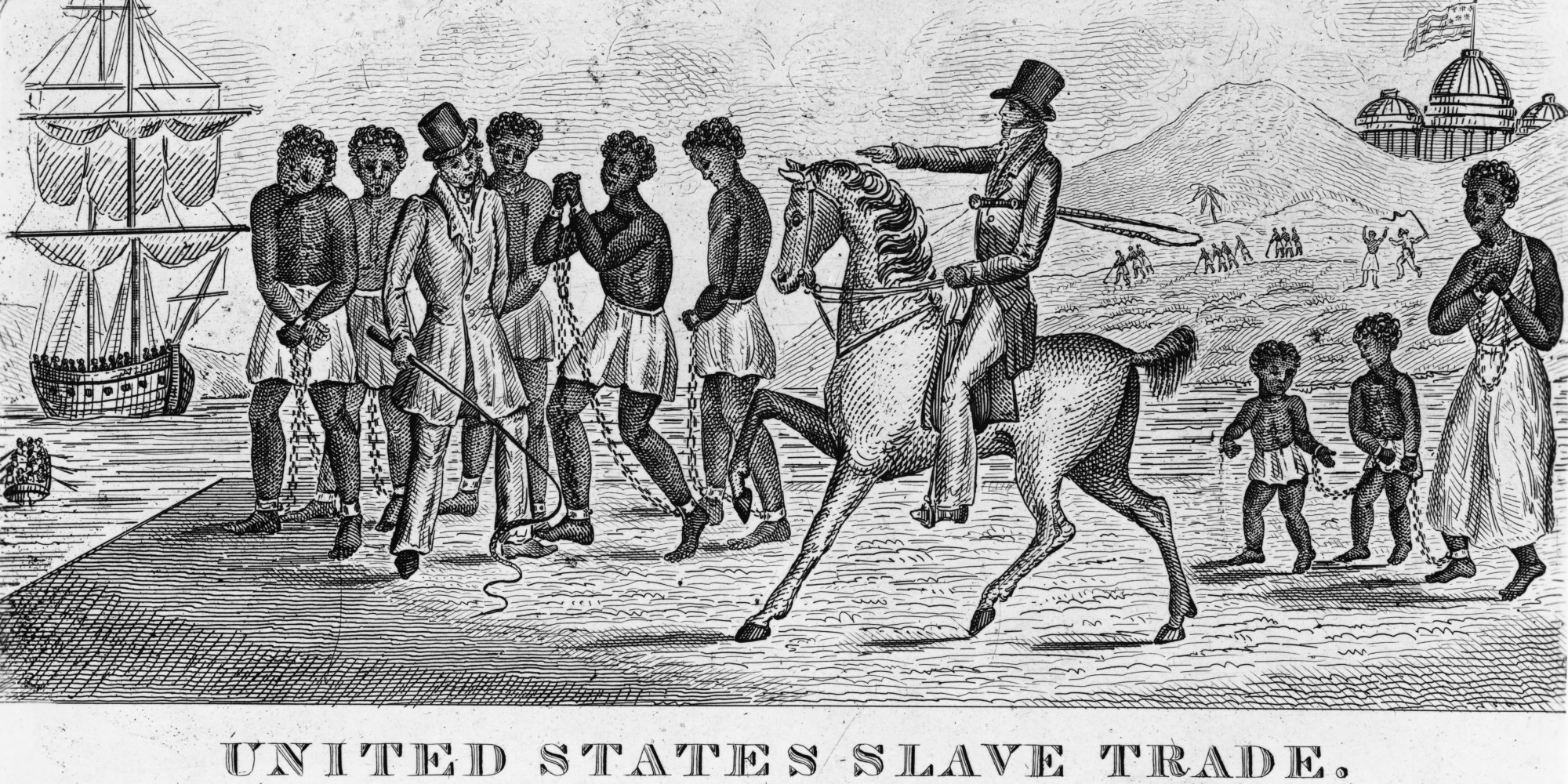
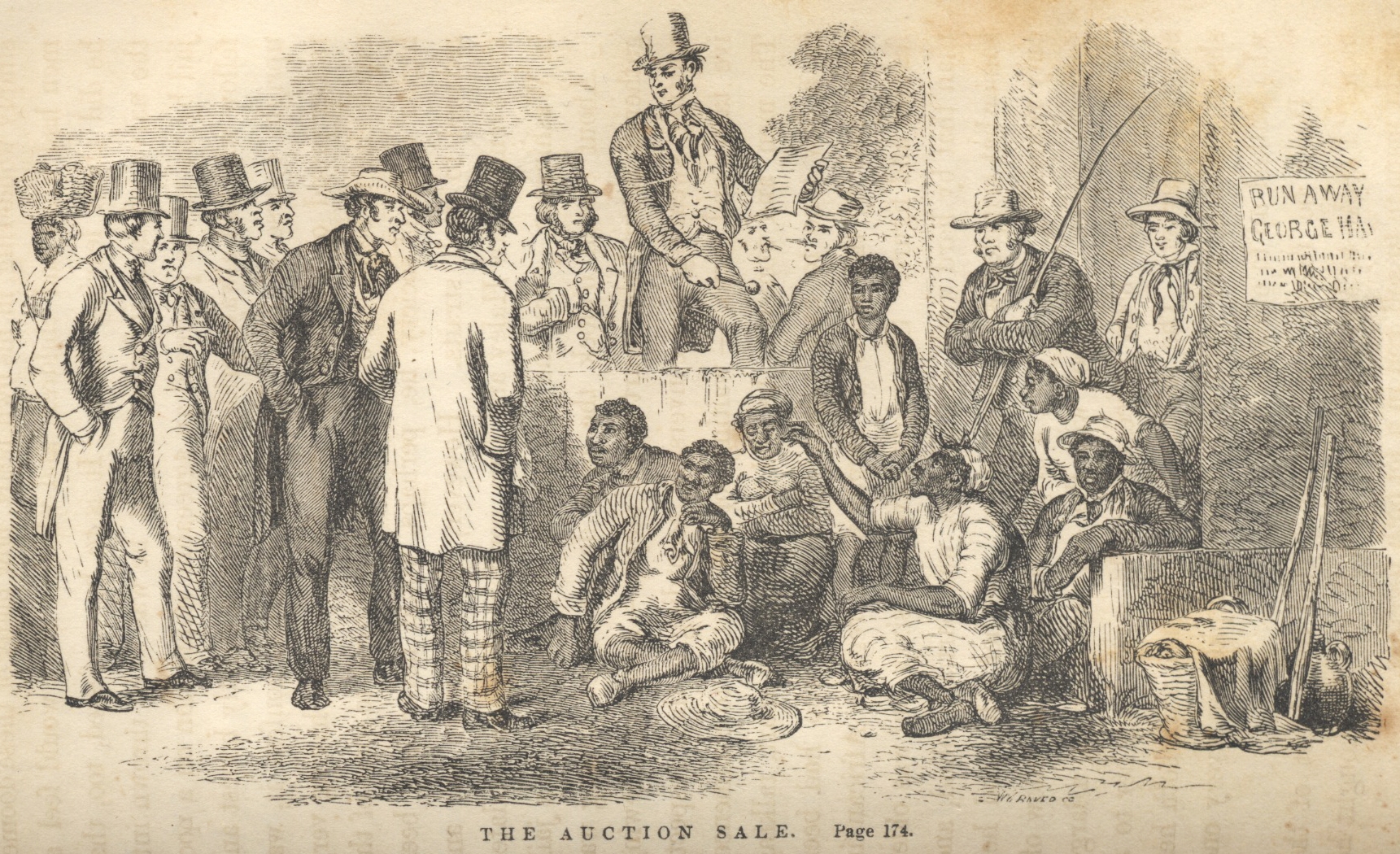
Another in my series dealing with aspects of Black history in the United States which is in every bit a part of American history as any other historical narrative about our nation. One thing that constantly amazes me is the way that some people, in fact many people, including the School Board of the State of Texas go out of their way to minimize the real and tragically crime against humanity that American slavery represented. Like many of the proponents of the whitewashing of slavery out of school textbooks, many of the most vehement supporters of the institution of slavery and its supposed Divine mandate were Christian churches, preachers, and writers. They were in the forefront of the secession movement and at the beginning of the Civil War bragged about how “God was on their side.” One again this is not an easy read if you take your Christian faith seriously, and it has direct application in how american Christians treat other despised races, ethnic groups, religions, and lifestyles today.

Honestly, people who wish to whitewash slavery, Jim Crow, and the crimes of the American past out of our history are no better than the apologists for the Nazi State who wore belt buckles with the words Gott Mitt Uns, God With Us adorned on them.

So have a great day,

Peace

Padre Steve+
OTCauction


“Lo! Suddenly, to the amazement of the world a mighty kingdom arose…. [of strictly providential Divine origin….The One like the Son of Man has appeared in the ride of the Confederate States.” Reverend William Seat 1862 [1]

Perhaps more than anything, the denominational splits helped prepare the Southern people as well as clergy for secession and war. They set precedent by which Southerners left established national organizations. When secession came, “the majority of young Protestant preachers were already primed by their respective church traditions to regard the possibilities of political separation from the United States without undue anxiety.” [2]

One of the most powerful ideological tools since the days of the ancients has been the linkage of religion to the state. While religion has always been a driving force in American life since the days of the Puritans in the Massachusetts Bay Colony, especially in the belief about the destiny of the nation as God’s “Chosen People,” it was in the South where the old Puritan beliefs took firm root in culture, society, politics and the ideology which justified slavery and became indelibly linked to Southern nationalism. “Confederate independence, explained a Methodist tract quoting Puritan John Winthrop, was intended to enable the South, “like a city set on a hill’ [to] fulfill her God given mission to exalt in civilization and Christianity the nations of the earth.” [3]

Religion and the churches “supplied the overarching framework for southern nationalism. As Confederates cast themselves as God’s chosen people.” [4]  the defense of slavery was a major part of their mission. Southern clergymen had to find a balance between the two most important parts of their political and religious identity, evangelicalism and republicanism. Since these concepts could mean different things to different people Southern clergy and politicians had to find a way to combine the two. Depending on the interpreter “republicanism and evangelicalism could be reactionary or progressive in implication, elitist or democratic.” [5] This can be seen in how Northern and Southern evangelicals supported abolition or the institution of slavery.

A group of 154 clergymen calling themselves “The Clergy of the South” “warned the world’s Christians that the North was perpetuating a plot of “interference with the plans of Divine Providence.” [6] A Tennessee pastor bluntly stated in 1861 that “In all contests between nations God espouses the cause of the Righteous and makes it his own….The institution of slavery according to the Bible is right. Therefore in the contest between the North and the South, He will espouse the cause of the South and make it his own.” [7]

The effect of such discourse on leaders as well as individuals was to unify the struggle as something that linked the nation to God, and God’s purposes to the nation identifying both as being the instruments of God’s Will and Divine Providence. As such, for Southern preachers to be successful agents of the state, the “key to their success as the foundation of a hegemonic ideology lay in making” [8] evangelicalism and republicanism to seem to be both elitist and democratic at the same time.  This resulted in a need to convince the “Southern people to acknowledge God’s authority was bound up with a legitimization of both clerical and civil rulers. Christian humility became identified with social and political deference as the clergy urged submission to both God and Jefferson Davis.” [9]

“Sacred and secular history, like religion and politics, had become all but indistinguishable… The analogy between the Confederacy and the chosen Hebrew nation was invoked so often as to be transformed into a figure of everyday speech. Like the United States before it, the Confederacy became a redeemer nation, the new Israel.”[10]
jackson-prayer

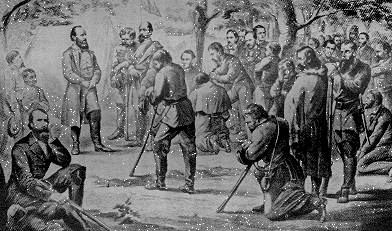
This theology also motivated men like the convinced hard line Calvinist-Presbyterian, General Stonewall Jackson on the battlefield. Jackson’s brutal, Old Testament understanding of the war caused him to murmur: “No quarter to the violators of our homes and firesides,” and when someone deplored the necessity of destroying so many brave men, he exclaimed: “No, shoot them all, I do not wish them to be brave.” [11] He told Richard Ewell after that General order his men not to fire on a Union officer galloping on a white horse during the Valley campaign, “Never do such a thing again, General Ewell. This is no ordinary war. The brave Federal officers are the very kind that must be killed. Shoot the brave officers and the cowards will run away with their men with them.” [12]

For Southerner’s, both lay and clergy alike “Slavery became in secular and religious discourse, the central component of the mission God had designed for the South….The Confederates were fighting a just war not only because they were, in the traditional framework of just war theory, defending themselves against invasion, they were struggling to carry out God’s designs for a heathen race.”[13]

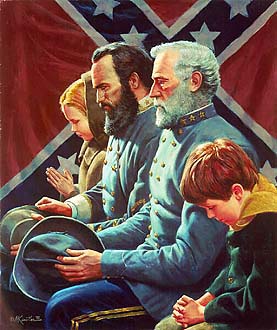
From “the beginning of the war southern churches of all sorts with few exceptions promoted the cause militant”[14] and supported war efforts.  The early military victories of Robert E. Lee’s Army of Northern Virginia and the victories of Stonewall Jackson in the Shenandoah Valley   were celebrated as “providential validations of the cause that could not fail…” Texas Methodist minister William Seat wrote: “Never surely since the Wars of God’s ancient people has there been such a remarkable and uniform success against tremendous odds. The explanation is found in the fact that the Lord goes forth to fight against the coercion by foes of his particular people. Thus it has been and thus it will be to the end of the War.”  [15]
lee-jackson-in-prayer

This brought about a intertwining of church and state authority, a veritable understanding of theocracy as “The need for the southern people to acknowledge God’s authority was bound up with a legitimation of the authority of clerical and civil rulers. Christian humility became identified with social and political deference to both God and Jefferson Davis.” [16]

Jefferson Davis and other leaders helped bolster this belief:

“In his repeated calls for God’s aid and in his declaration of national days of fasting, humiliation, and prayer on nine occasions throughout the war, Jefferson Davis similarly acknowledged the need for a larger scope of legitimization. Nationhood had to be tied to higher ends. The South, it seemed, could not just be politically independent; it wanted to believe it was divinely chosen.”[17]

Davis’s actions likewise bolstered his support and the support for the war among the clergy. A clergyman urged his congregation that the people of the South needed to relearn “the virtue of reverence – and the lesson of respecting, obeying, and honoring authority, for authority’s sake.” [18]

leonidas-polk

Bishop Leonidas Polk

Confederate clergymen not only were spokesmen and supporters of slavery, secession and independence, but many also shed their clerical robes and put on Confederate Gray as soldiers, officers and even generals fighting for the Confederacy. Bishop Leonidas Polk, the Episcopal Bishop of Louisiana, who had been a classmate of Jefferson Davis at West Point was commissioned as a Major General and appointed to command the troops in the Mississippi Valley. Polk did not resign his ecclesiastical office, and “Northerners expressed horror at such sacrilege, but Southerners were delighted with this transfer from the Army of the Lord.”[19] Lee’s chief of Artillery Brigadier General Nelson Pendleton was also an academy graduate and an Episcopal Priest.

Southern churches were supremely active in the war effort. Churches contributed to the Confederate cause through donations of “everything from pew cushions to brass bells, Southern churches gave direct material aid to the cause. Among all the institutions in Southern life, perhaps the church most faithfully served the Confederate Army and nation.” [20]Likewise, many Southern ministers were not content to remain on the sidelines in the war and “not only proclaimed the glory of their role in creating the war but also but also went off to battle with the military in an attempt to add to their glory.” [21]

Sadly, the denominational rifts persisted until well into the twentieth century. The Presbyterians and Methodists both eventually reunited but the Baptists did not, and eventually “regional isolation, war bitterness, and differing emphasis in theology created chasms by the end of the century which leaders of an earlier generation could not have contemplated.” [22]  The Southern Baptist Convention is now the largest Protestant denomination in the United States and many of its preachers are active in often-divisive conservative social and political causes. The denomination that it split from, the American Baptist Convention, though much smaller remains a diverse collection of conservative and progressive local churches. Some of these are still in the forefront of the modern civil rights movement, including voting rights, women’s rights and LGBT issues, all of which find some degree of opposition in the Southern Baptist Convention.

But the religious dimensions were far bigger than denominational disagreements about slavery; religion became one of the bedrocks of Confederate nationalism. The Great Seal of the Confederacy had as its motto the Latin words Deo Vindice, which can be translated “With God as our Champion” or “Under God [Our] Vindicator.” The issue was bigger than independence itself; it was intensely theological. Secession “became an act of purification, a separation from the pollutions of decaying northern society, that “monstrous mass of moral disease,” as the Mobile Evening News so vividly described it.” [23]

The arguments found their way into the textbooks used in schools throughout the Confederacy. “The First Reader, For Southern Schools assured its young pupils that “God wills that some men should be slaves, and some masters.” For older children, Mrs. Miranda Moore’s best-selling Geographic Reader included a detailed proslavery history of the United States that explained how northerners had gone “mad” on the subject of abolitionism.” [24] The seeds of future ideological battles were being planted in the hearts of white southern children by radically religious ideologues, just as they are today in the Madrassas of the Middle East.

While the various theological and ideological debates played out and fueled the fires of passion that brought about the war, they also provided great motivation to their advocates.  This was true especially to Confederates during the war, that their cause was righteous. While this fueled the passion of the true believers, other very real world decisions and events in terms of politics, law and lawlessness, further inflamed passions.

Notes

[1] Ibid. Daly When Slavery was called Freedom p.147

[2] Brinsfield, John W. et. al. Editor, Faith in the Fight: Civil War Chaplains Stackpole Books, Mechanicsburg PA 2003 p.67

[3] Ibid. Faust The Creation of Confederate Nationalism p.27

[4] Ibid. Gallagher The Confederate War pp.66-67

[5] Ibid. Faust The Creation of Confederate Nationalism p.32

[6] Ibid. Daly When Slavery Was Called Freedom  p.145

[7] Ibid. Daly When Slavery Was Called Freedom p.138

[8] Ibid. Faust The Creation of Confederate Nationalism p.32

[9] Ibid. Faust The Creation of Confederate Nationalism p.33

[10] Ibid. Faust The Creation of Confederate Nationalism p.29

[11] Fuller, J.F.C. Grant and Lee: A Study in Personality and Generalship, Indiana University Press, Bloomington IN 1957 p.129

[12] Davis, Burke They Called Him Stonewall: A Life of T.J. Jackson CSA Random House, New York 1954 and 2000 p.192

[13] Ibid. Faust, The Creation of Confederate Nationalism p.60

[14] Ibid. Thomas The Confederate Nation 1861-1865 pp.245-246

[15] Ibid. Daly When Slavery Was Called Freedom pp.145 and 147

[16] Ibid. Faust The Creation of Confederate Nationalism p.26

[17] Ibid. Faust The Creation of Confederate Nationalism p.33

[18] Ibid. Faust The Creation of Confederate Nationalism p.32

[19] Foote, Shelby, The Civil War, A Narrative. Volume One: Fort Sumter to Perryville Random House, New York 1963 1958 p.87

[20] Ibid. Thomas The Confederate Nation p.246

[21] Ibid. Daly When Slavery Was Called Freedom p.142

[22] Ibid. McBeth The Baptist Heritage pp.392-393

[23] Ibid. Faust The Creation of Confederate Nationalism p.30

[24] Ibid. Faust The Creation of Confederate Nationalism p.62

Leave a comment

Filed under civil rights, civil war, faith, History, laws and legislation

The Contempt For Facts: Trump, the GOP, and the Cohen Hearings

Friends of Padre Steve’s World,

A Short thought to begin the weekend that kind of follows my posts of the last several days. Hannah Arendt wrote in her book The Origins of Totalitarianism this poignant fact and warning:

“Before mass leaders seize the power to fit reality to their lies, their propaganda is marked by its extreme contempt for facts as such, for in their opinion fact depends entirely on the power of man who can fabricate it.” 

In my life which now spans almost 59 years I have never seen an American political leader attempt to present a full-blown counter-factual narrative to support their desire for power; but that was before the presidential campaign and presidency of Donald Trump. This not only comes from watching the campaigns of various presidential candidates and the actions of those men who have gained the Presidency, but from my study of history. Yes, I have seen Presidents lie with varying degrees of success. I have seen politicians twist facts and numbers for specific ends, but I have never seen one do so on such a scale and magnitude as our current President; nor have I seen any President so boldly attack and attempt to discredit the institutions established as checks and balances in the Constitution.

Likewise, I have never seen members of Congress stoop to such lows as I did this week. Will there ever be a Stephan A.Douglas with the courage to confront at the risk of his political career again? Sadly, I don’t see such a man or woman in today’s Republican Party.

This week we had the opportunity to watch Republican Congressmen do all they could to protect their master without actually defending him. Instead they attack the messenger, the President’s former lawyer and fixer, Michael Cohen. Instead of wrestling with facts, or troubling themselves with truth, these men by their actions surrendered all sense of honor and decency to attack a man who has already admitted to his wrongdoings on behalf of the President, rather than actually attempting to defend the President, because in their heart of hearts they know that they cannot. Instead of admitting the truth, they still spew forth the President’s propaganda, as they drink the dregs of the mirth of Trump, and it will kill them.

Hannah Arendt’s words describe in terribly precise detail the kind of propaganda campaign that has been waged by the President and his advisers since the beginning of his Presidency, which is reinforced by his spokespeople on a daily basis. Arendt wrote: “The outstanding negative quality of the totalitarian elite is that it never stops to think about the world as it really is and never compares the lies with reality.” Arendt’s statement is very descriptive of this administration and the President’s Congressional sycophants. I am going to leave things here for now, but it takes honesty to to face that truth.

So until tomorrow,

Peace

Padre Steve+

3 Comments

Filed under ethics, History, laws and legislation, Political Commentary

The Reichstag Fire Decree and Trump’s Potential Actions

partridge if you can't be a dictator

Friends of Padre Steve’s World,

Yesterday I wrote about the Reichstag Fire and the resultant Order of the President of the Reich for the Protection of People and State or as it is more often known as the Reichstag Fire DecreeI wrote about how perilously close that I really believe that we are to a Reichstag Fire moment in our country today.

That has not changed. In fact the President declared a National Emergency over an imaginary crisis at the U.S. – Mexican border, an act that he said that he did not have to proclaim as he made the declaration.

On February 27th 1933 Adolf Hitler and his Nazi Party which was still a minority party in a coalition government of partners that wouldn’t have minded his failure, became recipients of of a political gift that allowed them to seize power under the very provisions of the Republic and Constitution that they despised. A Dutch Communist The very next day Hitler with the backing of President Paul von Hindenburg issued a decree under Article 48 of the Weimar Constitution which though directed at the German Communist Party, which was banned along with its publications, applied to every political party in Germany.

Barely three weeks later the Reichstag, now emptied of Communists deputies gave its approval to the Enabling Act which gave the central government. Their abdication Of their Constitutional role allowed Hitler to enact laws without the approval of the Reichstag, effectively ending any sort of parliamentary democracy and eviscerating the constitution. 

These acts gave the central government in Berlin to usurp State governments in States where non-Nazi parties held democratic majorities and to outlaw political opposition. The only party to oppose the Nazi moves toward dictatorship were the Social Democrats who voted against both laws. Their party was banned shortly after the Enabling Act was passed. Their leader in the Reichstag, Otto Weis proclaimed the last free words uttered in the Reichstag:

“No Enabling Law can give you the power to destroy ideas which are eternal and indestructible … You can take our lives and our freedom, but you cannot take our honour. We are defenseless but not honourless.” 

The other political parties in Germany, including the conservative parties and center parties who had allied themselves with Hitler voted to dissolve themselves by the end of July 1933. None of the conservative opposition wanted to face the wrath of Hitler or his newly established extrajudicial Concentration Camps which were not run by the Ministry of Justice, but the Nazi Party.

In Germany it was the burning of the Reichstag but in any crisis the same could happen here. I think this is very possible with President Trump and a compliant Republican Party which has surrendered any sense of responsibility, including the defense of things that it fought against for years in order to maintain power by supporting a man that just two years ago most mocked and opposed; so much like the non-Nazi German conservatives and Hitler. That was demonstrated today as Michael Cohen, the President’s former lawyer and “fixer” testified before Congress. His testimony was compelling, credible, and backed up by documentary evidence, including documents signed by the President signed after he took office. All the Republicans could do was attack the messenger, they never challenged a single fact.

Now let’s think about today and lets let our minds wander into possibilities that are much more likely than they would have been a few years ago. So let’s take a journey to a future where most of us would not want to go. I mean really, I don’t want these things to happen, if not for any other reasons than things than effect me.  I want to attend my 40th high school reunion on September 1st and a trip to Germany to the Oktoberfest and to visit our German friends later that month.  So some things are about me, I mean if were going to lose all of our freedoms I want to get a few bucket list items in, but I digress, let’s go back to the unimaginable.

Rather than standing up for truth, the Republicans, like the non-Nazi German Conservatives in 1933 are more concerned with holding power to fulfill their agenda than with the character of the man they are backing. Today Cohen warned them when they attacked him:

As Mr. Cohen told Republican lawmakers, “I did the same thing that you’re doing now. For 10 years. I protected Mr. Trump for 10 years.”

He then issued this warning to them: “The more people that follow Mr. Trump — as I did blindly — are going to suffer the same consequences that I’m suffering.” Mr. Cohen later explained the ethos of Trumpworld: “Everybody’s job at the Trump Organization is to protect Mr. Trump. Every day most of us knew we were coming and we were going to lie for him about something. That became the norm.”

This has now become the norm of the Republican Party, which if I need to remind you I served and believed from the time that I volunteered for Gerald Ford’s campaign before I could vote in 1976 until I left the party following my return from Iraq in 2008. I stopped defending the indefensible eleven years ago.

I would say close your eyes but then you wouldn’t be able to read unless you have some sort of software that turns my written words into spoken words, or unless you want me to start a podcast. If you want the latter make it worth it by doing something to get me a few extra bucks for more beer before everything goes to hell.

Let us imagine that following increased tensions in Venezuela that a real or alleged terrorist group claiming to support the Venezuelan dictator Maduro attacks the NY Subway and the Washington Metro subway systems with Sarin and phosgene nerve gas. Another alleged Venezuelan terrorist shoots down an American Airlines Airbus 330 with a SAM 7 as it attempted to land In Philadelphia. In the attacks, thousands of people die. In another attack a heavily armed terrorist group attacks the Mall of American with assault rifles, RPGs, and grenades. Between Miami and the Bahamas an explosion rocks a Disney Cruise Ship, killing many passengers and crew and leaving it disabled and requiring Coast Guard and U.S. Navy assistance to save the ship and bring her back to port.

While Federal, State and local law enforcement investigate at the points of attack, the FBI, CIA and NSA attempted to ascertain if and what foreign power or terrorist groups were behind the attacks. Venezuela was at the top of the list, but Iran, Hezbollah, North Korea, and even Russia were suspects, but it took time to find the culprits.

In the mean time the country went into a panic. Retribution was the watchword. Thousands of people were killed and injured in the attacks. Following them the subways, airports and maritime ports shut down. The economy went into shock. Prices soared and Wall Street crashed, dumping some 30% of its value in three days. Prices for imported goods skyrocketed, and all commercial air traffic was grounded leaving millions of people stranded. It didn’t matter that the President’s Fixer Michael Cohen had implicated the President in high crimes and misdemeanors, just a week before, emotion, hatred and the desire for revenge ruled the day. Trump understood that better than most.

In response the President invoked measures from National Security Presidential Directive NSPD 51/Homeland Security Presidential Directive HSPD-20 of 4 May 2007, while Congress by a wide margin grants him the authority to pursue the attackers both at home and abroad. Neither the President’s opponents in the GOP or most Democrats object, after all it was about national security and the nation had been attacked; people had died, and the economy was in a major crisis.

The President, whose poll numbers were cratering and was coming closer to being implicated in by the Muller investigation uses these new powers to shut down opposition to him, including the Muller investigation in the name of national security, the siren song of all tyrants.

Democrats in Congress finally realized that they have been outmaneuvered in the crisis but it was now too late. Their protests about the illegalities and questions needing to be answered go nowhere and they are labeled enemies of the state, as are responsible journalists who seek to uncover the truth. Those protesting the violations of the Constitution are jailed indefinitely without being charged in Federal and State facilities as well as for profit prisons.

But the Venezuelan connection to the terrorist attacks was disproven and even though the CIA and FBI put Russia at the center of the attacks, aided by North Korean agents the reports were initially disregarded by the administration.

As the investigation lead to the North Koreans, the President, who had spent two years trying to say that the North Koreans were not a threat and holding summits to North Korean dictator Kim Jun Un, rapidly turned on his heal and ordered attacks on North Korea, leading to a nuclear exchange and major land war on the Korean Peninsula.

While North Korea was obliterated, South Korea and Japan also took massive hits, as did the American bases on Okinawa, Guam, and Pearl Harbor, all of which are hit by North Korean nuclear missiles. Trump then declared Martial law is and ordered 2020 elections postponed indefinitely with the promise that once the crisis is over that they will be restored. Despite the disasters the President’s approval rating shot up from under 40% to nearly 65%. A Supreme Court Justice who went along with the emergency degrees would later say:

“There was a fever over the land. A fever of disgrace, of indignity, of hunger. We had a democracy, yes, but it was torn by elements within, and successfully attacked by enemies abroad. Above all, there was fear. Fear of today, fear of tomorrow, fear of our neighbors, and fear of ourselves. Only when you understand that – can you understand what Trump meant to us. Because he said to us: ‘Lift your heads! Make America Great Again! Be proud to be American! There are devils among us. Liberals, Jews, Muslims, Immigrants, Gays! Once these devils will be destroyed, your misery will be destroyed.” (*adapted from the speech of Ernst Janning in Judgment at Nuremberg) 

Thankfully none of this has not happened, but if Americans fail to appreciate the danger that lays ahead then all bets are off. Those who cooperate in moves to damage and undermine the American experiment in democracy and a constitutional republic with its safeguards and checks and balances will be show by their inaction and lack of resistance the truth of historian Dr. Timothy Snyder’s words: “The sad truth is that most evil is done by people who never make up their minds to be good or evil.”

However, during the Cohen hearings today most Congressional Republicans in showed that if push came to shove that they would toss aside the Constitution in order to defend a man they have sold their souls to.

Those that might doubt my concerns need only to look at the life and actions of President Trump, the cunning of Russia, North Korea, and the hyper-partisan nature and gullibility of much of the American electorate, and the response of the United States government and populace during past crises and threats to our national existence.

That cannot be allowed to happen. If it does, it will harm every American, no-matter what their political beliefs or affiliation is.

Until tomorrow,

Peace

Padre Steve+

Leave a comment

Filed under ethics, History, laws and legislation, leadership, national security, nazi germany, News and current events

Non-Emergency National Emergencies: The Reichstag Fire and Trump’s Decree

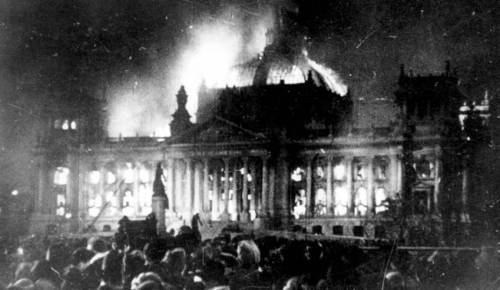
riechstag fire
Friends of Padre Steve’s World,

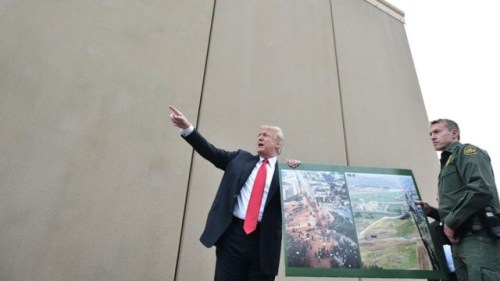
There are times that is terrifying to be a historian who has specialized in the study of tyrannical regimes especially on the anniversaries of significant events that changed the course of nations. A couple of weeks ago President Donald Trump made good on his threat to declare a National Emergency because Congress would not approve funding for his wall along the Border with Mexico. The Declaration, which I expected would happen came after a government shutdown that lasted over a month followed by almost three weeks of Congressional negotiations to re-open the government. When the House and Senate passed a compromise bill that did not give Trump what he wanted he declared a State Of Emergency while at the same time commenting that he “didn’t have to do it.” 

Of course he didn’t have to do it. He did it in a juvenile fit of rage, even more than Hitler did after the Reichstag Fire. 

The Reichstag Fire,  the 86th anniversary of which is tomorrow, February 27th is a precedent setting state of emergency that brought with it very dire results.

The fire was set by Marinus (Rinus) van der Lubbea Dutch Communist who was acting alone. There was no proof that he had any German support, nor that any German political party was involved. However, Hitler, backed by the aging and doddering President Paul Von Hindenburg was given power to suspend constitutional rights indefinitely by acting under Article 48 of the Weimar Constitution through the Order of the President of the Reich for the Protection of People and State. I will discuss that tomorrow.

Ever since my undergraduate study working under Dr. Helmut Haeussler  at California State University Northridge I have studied the transition of German society from democracy to dictatorship. While my studies then and ever since focused on the rise of National Socialism in Germany, the fact is that what happened in Germany was not unique, it is a part of the human condition and the people of any country can find themselves under the foot of a dictatorship if the conditions are right. I believe that conditions in the United States have never been more ripe for the establishment of an authoritarian regime, possibly even a dictatorship, than they are today.

When I read through the text of President Trump’s speech at CPAC and the response of the NRA to the massacre in Parkland Florida shuddered last February, I shuddered. They were the words that an autocrat would use, and the vehemence of the CPAC crowd, which just a few years ago prided itself as being the intellectual bastion of conservatism. Speakers and panel members who dared to question the movement were heckled, jeered, and threatened. Mona Charen, a long time conservative who had worked for both William Buckley and Ronald Reagan, had to be escorted out by security officers concerned for her safety.

I realize that despite chaos that is engulfing the House of Trump; despite more and more of his advisors being indicted by the Muller investigation of the Trump campaign and family connections to Russia, the more I become more concerned that the unthinkable will happen and something will occur that will allow the President to seize power under the pretext of national security; most likely a war, or a major terrorist attack, using existing National Security Executive Orders dealing with the continuity of government functions as a result of catastrophic emergency. 

But the President chose to declare an emergency for which no evidence exists. Even today, the Commanding General Of U.S. Northcom reported that there was no military threat at the border in direct contravention to the words of the President and his actions, sending thousands of troops to the border with Mexico.

There are a lot of  laws in existence for a President to declare a state of emergency, the latest of which is National Security and Homeland Security Presidential Directive (National Security Presidential Directive NSPD 51/Homeland Security Presidential Directive HSPD-20) of 4 May 2007 which defines a catastrophic emergency as “any incident, regardless of location, that results in extraordinary levels of mass casualties, damage, or disruption severely affecting the U.S. population, infrastructure, environment, economy, or government functions.”

But this doesn’t fit the bill. Nor does the National Emergency Act of 1976 do the trick, though the Administration seems to be banking on it with the courts.

Trump has now made his declaration. But I am sure if his attempt is rebuffed by Congress or the Courts, his regime will act to suspend civil rights and liberties and maybe even suspend Congress and the courts in the name of security and under existing provisions. Sadly, I think that in such a case that very few people would resist such a takeover. Of course the 35% or so of people that would support him as he said, even if he shot someone on 5th Avenue would be at the forefront probably even using extrajudicial means to apprehend, persecute, or kill anyone suspected of disloyalty. But I also believe that many other people would follow all because they are afraid and desire security more than freedom.

Now the psychological preparation for such an event is not all Trump’s doing; for the last three decades many of those that now support him, especially the leaders of the Religious Right, Fox News, and radio and internet demagogues have prepared the ground for his rise.

Dr. Timothy Snyder, the historian from Yale has warned us in his book On Tyranny. He noted:

“Be calm when the unthinkable arrives. Modern tyranny is terror management. When the terrorist attack comes, remember that authoritarians exploit such events in order to consolidate power. The sudden disaster that requires the end of checks and balances, the dissolution of political parties, the suspension of freedom of expression, the right to a fair trial, and so on, is the oldest trick in the Hitlerian book. DO NOT FALL FOR IT.”

Human beings are the one constant in history, and human nature is very consistent when it comes to how we respond when under attack. One only has to think of the fear that followed the 9-11 attacks and the willingness of people to give the government vast new powers. Those included The Patriot Act and an authorization for the use of military force against Al Qaida which has not been updated or supplemented since 2001, and which has been used for operations around the world which are completely unconnected to the initial authorization.

I believe that the chances of such an event occurring have gone up exponentially.  Part of this is because the President and the Executive branch have not filled many critical ambassadorships, as well as thousands of key billets in the State Department, the Department of Defense, the Department of Justice, and the Department of Homeland Security. Even more concerning is the fact that the President is relying on non-Senate confirmed “Acting” cabinet members to serve in order to circumvent the Constitution.

This is a very dangerous time and every day I wake up wondering if this will be the day that our Republic as we knew it dies. I do not know if this will be the result of a war a major terror attack, or even an unexpected financial crisis, but as things spiral out of control I cannot shake the feeling that we are going to have our Reichstag Fire moment, and that we will not rise to the challenge. Instead I think that most Americans will give up freedom in the name of security simply because that is human nature and has been demonstrated throughout history on every continent. The President’s Declaration Of National Emergency qualifies as such an event.

James Madison noted:

“The means of defence against foreign danger have been always the instruments of tyranny at home. Among the Romans it was a standing maxim to excite a war, whenever a revolt was apprehended. Throughout all Europe, the armies kept up under the pretext of defending, have enslaved the people.”

Now is a time that we must all be awake and aware of what is going on in our country and the world. The storm clouds are building and we most be cognizant of the times or be engulfed and overwhelmed when the unthinkable arrives. That may not be pleasant to contemplate, but it is necessary.

I would like to believe that I will be proven wrong and honestly I want to be proven wrong because I do not want our nation to have to endure war, terrorism, or the rule of a tyrannical despot backed by fanatical and heavily armed followers, many of who are already discussing a new civil war and the extermination of their opponents by violent means. Sadly, some of these men and women are serving in the military and in various Federal, State, and local law enforcement agencies. If I am right, they will be the nucleus of quasi-government death squads, no different than in any dictatorship, and any resistor, regardless of Party, politics, ideology, religion, or even military service will be a potential target.

God I hope that I am wrong.

So, until tomorrow I wish you a good day, the conclusion of the article will appear tomorrow.

Peace,

Padre Steve+

1 Comment

Filed under civil rights, ethics, History, holocaust, laws and legislation, Military, national security, nazi germany, Political Commentary

Money, Power, and Authoritarian Leaders: 1933 and Today

Friends of Padre Steve’s World,

Lord Acton noted:

“Power tends to corrupt and absolute power corrupts absolutely. Great men are almost always bad men, even when they exercise influence and not authority; still more when you superadd the tendency of the certainty of corruption by authority.”

Less than a month after his appointment as Chancellor by President Hindenburg and before the Reichstag Fire, Adolf Hitler met with German industrialists at Hermann Goering’s Estate on February 20th 1933. The purpose of the meeting was to secure financial support for the Nazi Party in the upcoming Reichstag election, an election that would be the last in Hitler’s Germany.

The invitees were a “who’s who” of German industrialists and by the end of the day they had pledged over Two Million Reichsmarks to the Nazi cause.

It wasn’t hard for Hitler to win them over. They feared a Communist counter revolution against the Nazis and were still unsure of the economic plans of the Nazis. Hitler played to their fears as William Shier recorded in his book The Rise and Fall of the Third Reich:

Hitler began a long speech with a sop to the industrialists. “Private enterprise,” he said, “cannot be maintained in the age of democracy; it is conceivable only if the people have a sound idea of authority and personality… All the worldly goods we possess we owe to the struggle of the chosen… We must not forget that all the benefits of culture must be introduced more or less with an iron fist.” He promised the businessmen that he would “eliminate” the Marxists and restore the Wehrmacht (the latter was of special interest to such industries as Krupp, United Steel and I. G. Farben, which stood to gain the most from rearmament). “Now we stand before the last election,” Hitler concluded, and he promised his listeners that “regardless of the outcome, there will be no retreat.” If he did not win, he would stay in power “by other means… with other weapons.” Goering, talking more to the immediate point, stressed the necessity of “financial sacrifices” which “surely would be much easier for industry to bear if it realized that the election of March fifth will surely be the last one for the next ten years, probably even for the next hundred years.”

Money and power, the sacrifice of hard earned freedoms, the selling out of political openness, workers, and Jews were irrelevant in the end. What mattered was profit and the protection of it and their status by an authoritarian state in perpetuity. As such the German industrialists, championed by Hjalmar Schacht sold their souls and their nation to Hitler. They included the head of Krupp Industries, Gustav Krupp, the head of Opel, Fritz von Opel, and leaders of Siemens, IG Farben, Allianz, and numerous others. Hitler’s desire was to raise enough money to ensure a two-thirds majority in the Reichstag in order to pass his Enabling Act which would enable Hitler to rule by decree, in order to establish a dictatorship, by parliamentary means.

Between the meeting and the election the Reichstag had burned and the Reichstag Fire Decree been enacted. In the elections that followed the Nazis still not achieve a majority in the Reichstag, much less a two-thirds majority. Even so, with the surrender and acquiescence of every remaining party but the Socialists, the Nazis passed the Enabling Act. The leaders of the German economic and banking establishment, Nazi or not were pleased. In the coming months all opposition parties were liquidated or outlawed, independent labor unions as well, ironically the day after Hitler declared May 1st as a National Holiday to honor German Workers. But Hitler’s economic supporters included corporate and banking leaders from other countries, including Henry Ford of the United States.

The curious thing is that in many countries, including the United States, leaders of great corporations, the banking industry, builders, manufacturers are little different than their predecessors in Nazi Germany and so many other democracies that succumbed to dictatorship. Money needs power, and those that desire power need money.

Let’s take that as a warning for every politician who seeks the money of corporate lobbyists, and corporate leaders who seek political power, regardless of what ideology or party they represent, especially the religious, “patriotic,” or nationalist ones.

This is a lesson we all need to learn today. In 2016, some 6.5 Billion dollars was spent on Presidential and Congressional elections by all parties. I have not seen the estimates, but I would bet that over 10 billion dollars will be spent in the 2020 general elections. Regardless of the outcome, that cannot be a good thing.

Think about it, let it sink in.

Peace

Padre Steve+

2 Comments

Filed under economics and financial policy, ethics, History, laws and legislation, leadership, nazi germany, News and current events, Political Commentary

the Four Freedoms, a Universal Message Which Needs to Be Heard Again

Friends of Padre Steve’s World,

On January 6th 1941 President Franklin Delano Roosevelt delivered his State of the Union Message to Congress and the nation. I spent the time to both both read it and listen to it the other day. It is a profoundly moving speech, not without controversy of course, but one which we need to hear again. It is a speech that like the Declaration of Independence, Lincoln’s  Gettysburg Address, and Dr. Martin Luther King Jr.’s I have a Dream speech calls us to higher ideals, ideals that we often come up short in living up to, but ideals worth living for and to endeavor to attain in our lifetime.

When Roosevelt spoke the nation was in the midst of crisis. The United States was still recovering from the Great Depression. War threatened as Hitler’s Nazi German legions had overrun all of Western Europe and much much of North Africa. German U-Boats and surface ships were prowling the North Atlantic. Britain stood alone between Germany’s complete domination of Europe. Even the Soviet Union, a mortal enemy of Fascism had concluded a concordat with Hitler to divide Eastern Europe. Though no one yet knew it, Hitler was already planning to break his accord with Stalin and invade the Soviet Union.

In it Roosevelt made a comment that we should remember in light of the knowledge that Russia interfered in our election, and has been working tirelessly to split us from our allies and directly working against our efforts to fight ISIS, and the efforts of our soldiers in Afghanistan. He noted:

“I suppose that every realist knows that the democratic way of life is at this moment being directly assailed in every part of the world — assailed either by arms or by secret spreading of poisonous propaganda by those who seek to destroy unity and promote discord in nations that are still at peace.”

Roosevelt’s speech, which largely focused on the threat of Nazi Germany, also supported Britain and the exiled governments of nations conquered by Hitler.  As he outlined preparations to defend the United States, Roosevelt also called on Congress to pass Lend Lease to help those fighting the dictators, as well as increased opportunity at home. In response to the emerging threats and the unwillingness of some, including a strong pro-Germany lobby headed by prominent senators, American aviation hero Charles Lindberg, and and big business, Roosevelt challenged Americans to face up to them. He noted:

“As a nation we may take pride in the fact that we are soft-hearted; but we cannot afford to be soft-headed.  We must always be wary of those who with sounding brass and a tinkling cymbal preach the “ism” of appeasement.  We must especially beware of that small group of selfish men who would clip the wings of the American eagle in order to feather their own nests.”

On the domestic front Roosevelt reiterated the message of the New Deal, for even with war looming he did not want to see Americans lost in the exchange and he linked freedom abroad to the same at home. He noted:

“As men do not live by bread alone, they do not fight by armaments alone. Those who man our defenses and those behind them who build our defenses must have the stamina and the courage which come from unshakable belief in the manner of life which they are defending. The mighty action that we are calling for cannot be based on a disregard of all the things worth fighting for.”

He continued:

“Certainly this is no time for any of us to stop thinking about the social and economic problems which are the root cause of the social revolution which is today a supreme factor in the world. For there is nothing mysterious about the foundations of a healthy and strong democracy.

The basic things expected by our people of their political and economic systems are simple. They are:

Equality of opportunity for youth and for others.

Jobs for those who can work.

Security for those who need it.

The ending of special privilege for the few.

The preservation of civil liberties for all.

The enjoyment — The enjoyment of the fruits of scientific progress in a wider and constantly rising standard of living.

These are the simple, the basic things that must never be lost sight of in the turmoil and unbelievable complexity of our modern world. The inner and abiding strength of our economic and political systems is dependent upon the degree to which they fulfill these expectations.”

But the real heart of the message, applicable to all people everywhere Roosevelt enunciated a number of principles that are a beacon to all people. Firmly grounded in words of the Declaration of Independence and the Gettysburg Address they are called the Four Freedoms. Those freedoms are an ideal, in fact they certainly were not practiced well then by Americans, nor now, but they are worth working to: Roosevelt said:

“In the future days, which we seek to make secure, we look forward to a world founded upon four essential human freedoms.

The first is freedom of speech and expression—everywhere in the world.

The second is freedom of every person to worship God in his own way—everywhere in the world.

The third is freedom from want—which, translated into world terms, means economic understandings which will secure to every nation a healthy peacetime life for its inhabitants—everywhere in the world.

The fourth is freedom from fear—which, translated into world terms, means a world-wide reduction of armaments to such a point and in such a thorough fashion that no nation will be in a position to commit an act of physical aggression against any neighbor—anywhere in the world.

That is no vision of a distant millennium. It is a definite basis for a kind of world attainable in our own time and generation. That kind of world is the very antithesis of the so-called new order of tyranny which the dictators seek to create with the crash of a bomb.”

The speech was important, and now as it did then it calls Americans to higher purposes, to higher ideals, and it recognizes that we have never fully measured up to our own words. At the time it was spoken, Jim Crow was still the law of the land, Mexican Americans were often treated as poorly as blacks, Native Americans had few rights; and barely a year later Japanese Americans would be taken from the homes, lose their business and be sent to detention camps for the duration of the war after Pearl Harbor, simply because they were of Japanese descent. But those abiding principles are things that we should never lose sight of, and always strive to realize.

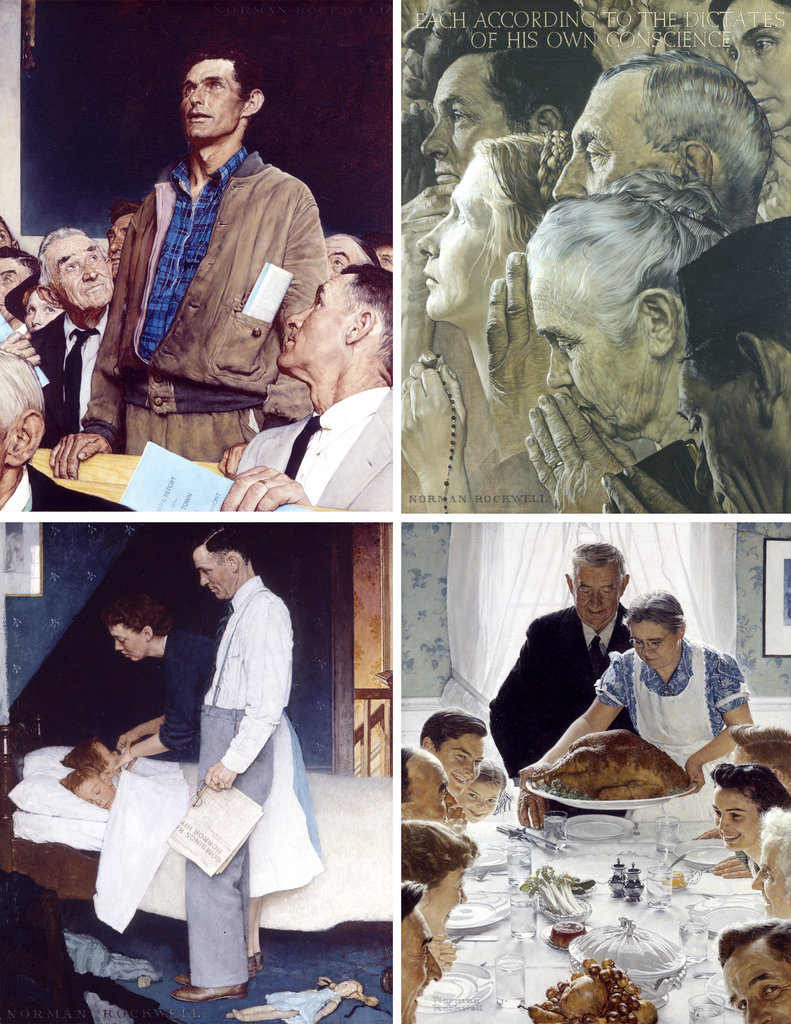
The great American artist Norman Rockwell did a series of portraits, the first of which was published 76 years ago today.

Today the four freedoms that Roosevelt enunciated are under threat around the world and in the United States too. We live in an age of uncertainty, turbulence, division, inequity, as well as deeply ingrained cynicism. Unscrupulous authoritarian politicians are using that uncertainty and fear to roll back the very liberties that democratic institutions are founded on.

As a result, as a man who promised during his campaign to roll back the rights of many people it is important not to forget this speech. The same is true as state and local politicians set out to not only roll back the rights of some, but to enable religious people to discriminate against other citizens.

It is also important because the government of Russia led efforts to attack the country by influencing the election, and for years has been committing aggression against American allies and working against American and allied efforts around the world. Yet the the incoming administration is not only welcoming it, but attacking and trying to discredit the American intelligence officials who say that it happened, and condemning senators and congressmen of its own party who want to further investigate those attacks by Russia and impose sanctions.  

So I think that it is important to reflect on these events, and then turn to speeches like Roosevelt’s in order for us to strive for a higher purpose, not to lose hope, and give in to fear that would enable our freedoms and the freedoms of any citizen to be curtailed.

The fact is that every bit of this speech is something that President Donald Trump stands against. He stands for the rights of the wealthiest and despises all others; he pretends to be for the rights of Conservative Christians despite mocking their faith and denigrating the faith or lack of faith of all other Americans who haven’t prostrated their religion to him; the freedom of free expression that he attacks every day; and finally fear, which he attempts to instill with every speech, or Tweet that he makes.

The contrast cannot be any greater.

Honestly, if any man or woman seeking the nomination of the Democratic Party would fully embrace the truths of this speech, in thought, word, and deed, they would walk into the White House in a landslide, popular vote and even in the electoral college.

If you can please that the time to listen to it or read it at the following link: http://www.americanrhetoric.com/speeches/fdrthefourfreedoms.htm

Peace,

Padre Steve+

2 Comments

Filed under civil rights, ethics, faith, History, laws and legislation, News and current events, Political Commentary

The Crossing Of an American Rubicon: The Trumped Up National Emergency

Friends of Padre Steve’s World,

It has finally happened. President Trump finally declared his National Emergency because Congress did not give in to him, and because when he had solid House and Senate majorities he couldn’t garner a deal that would pass because of his own intransigence and stupidity ensured the inability to make a deal.

So here we are with a National Emergency that is based on his lies, and his inability to compromise the slightest to get a deal. After failing time and time again he shut down the Government for over a month, endangering the economy and national security in the process, even as the Mueller investigation indicted more of his close associates who appear to have quite extensive dealings with Russian agents, collaborators, and government officials. So in my view he is getting desperate, and more dangerous bit the minute.

I honestly expected that the President would use the cover of a major terrorist attack or war as cover to make his power grab. Right now al, he has done is offer a befuddled series of lies and excuses wrapped in a worthless, and plainly unconstitutional piece of paper as has ever been signed by an American President. Winston Churchill said of Russian intentions:  “It is a riddle wrapped in a mystery inside an enigma; but perhaps there is a key. That key is Russian national interest.” For Trump one can say that his intentions are clear, selfish, and washed with an enema. The key is Trump’s personal interest.” The irony is that his interests are all backed by the Russians.

It is sickening to watch as the Acting Secretary Of Defense is attempting to find the money and manpower needed for Trump’s Wall from military construction, MILCON accounts which includes everything from training facilities to tarmacs, runways to railheads, shipyards to firing ranges, drydocks to aircraft hangers, and everything that make the bases which support the troops in the field operating. Military family housing, medical facilities, schools operated by DOD which service military kids, and base security designed to protect bases from of all things, actual terrorists. Then he’s going after the DOD part of our nation’s drug interdiction programs, which is ludicrous in light of his rational that the Trump Wall is to keep out illegal drugs.

I will not compare Trump to Hitler because that would be an insult to the genocidal criminal dictator that Hitler was, not because Hitler was a good human being or worthy of any praise, but because he was a far better politician than Trump could ever hope to be. Hitler took advance of his opponents missteps, be they the political opponents, those in his own party, and European governments. But unlike Hitler, Trump delivers unforced error after error and claims to be a brilliant leader even while he is being rolled by men like Kim Jun Un, Vlad Putin, and so many others.

His only salvation is that some 35% of the American electorate, including the vast bulk of Republican legislators, are what he calls the most loyal followers, who in his words would vote for him even if he shot someone in the middle of 5th Avenue. I guarantee that if he called on them to kill that thousands would heed the call to kill his opponents, just like his Stormtroopers would before his accession to power; and how his SS, acting in concert with the Army and Police would decapitate the leadership of the SA Stormtroopers, including some of his earliest friends and allies during the Night of the Long Knives. Like Hitler, Trump’s only loyalty is to himself, all others are fungible, even his family if need be.

Now is a dangerous time. Declarations of National Emergency give the President great powers above what Article II of the Constitution normally permit. Unlike any other point in our history we now have a President is prepared to use those powers for his political survival and personal gain, sadly his GOP majority in the Senate has all but surrendered their Article I powers to the imperial President.

I do not know what will happen next. The State Of California has already sued to block the effort, the Democrats in the House Of Representatives are planning legislative and possible legal moves against it. Likewise, Trump’s move has divided Republicans. So obviously this will not be enough to cement his power, it is a ploy to distract as the Mueller Eagle circles its prey.

An animal that acts purely on instinct is most dangerous when cornered. It has become apparent that Trump does not act or live within the confines of reason or legality. His business and personal life has always shown that he is a predator speaking his own engorgment, even at the expense of wives, business partners, contractors, customers, or employees. It is the world that he lives in. It is the world that he imbibed from his father Fred Trump.

So my friends, do not let your guard down. We are in completely untested waters for Americans. What will happen tomorrow we don’t know, and we would be fools to prognosticate about. Thus we have to look at history and how other human beings have behaved in similar situations.

Milton Mayer wrote in his book They Thought They Were Free about a German colleague during the 1950s that had lived through the Hitler years as an academic. The man tried to explain how changes were so gradual that people like him who should have known better did not take action, if they did at all until it was too late. The man asked Mayer:

“How is this to be avoided, among ordinary men, even highly educated ordinary men? Frankly, I do not know. I do not see, even now. Many, many times since it all happened I have pondered that pair of great maxims, Principiis obsta and Finem respice—‘Resist the beginnings’ and ‘Consider the end.’ But one must foresee the end in order to resist, or even see, the beginnings. One must foresee the end clearly and certainly and how is this to be done, by ordinary men or even by extraordinary men? Things might have. And everyone counts on that might.”

To forsee the end of the Trump gambit is not hard. We have the benefit of seeing tyrants of history, including Hitler, with today’s authoritarian leaders. Trump has already deployed Federal troops to the U.S. Mexican Border in what most people, including many Republicans viewed as a political stunt. In the aftermath of his declaration he again went to Twitter and attacked the media as enemy of the people” and demanded retribution against his opponents. How long will it be until one of his militarized and propaganda filled believers goes on the attack. One did last week in El Paso, but thankful they were not armed. What is to keep Right Wing Trump supporters who have concealed carry permits to walk into any place and kill someone they believe to be an enemy of the people? 

The fact is there is that there is nothing that will keep this from happening. This makes me glad that I served in Iraq and on Naval boarding teams in the Persian Gulf completely unarmed, and also in a certain way for the PTSD that I suffer, because one of the afflictions if it can be called that is being very hyper vigilant. I won’t be caught by surprise if I can help it, and even unarmed I know enough how to disrupt and confuse an attacker to at least equalize a situation. After having credible threats to my life in 2009 and 2010 from a neo-Nazi long before I became outspoken in my beliefs I always remain alert, sadly, even on base, because I do take notice of the rather violent political messages on the bumper stickers and window decals of many fellow sailors, marines, and soldiers, active and retired.

I don’t want to be considered a pessimist, but I do forsee the end, unless a sea change that I don’t think will happen occurs. I fully expect something else to happen that allows Trump to expand his powers, an event that even many opponents would find hard to oppose. A Reichstag Fire moment, maybe, but possibly worse.

So with all those happy thoughts in mind, have a good night.

Until tomorrow,

Peace,

Padre Steve+


3 Comments

Filed under civil rights, History, laws and legislation, leadership, Military, national security, nazi germany, News and current events, Political Commentary

Trump’s National Emergency and Blazing Saddles

Friends Of Padre Steve’s World,

Today President Trump declared a National Emergency, though in his own words “he didn’t need to do it, he just wanted to do it faster.”

A couple of days ago I wrote about the great and trailblazing Mel Brooks film, Blazing Saddles. 

It was a film way ahead of its time and two of its characters, Attorney General Headly Lamarr, played by Harvey Kormann, and Governor William  Lepetomaine, played by Brooks himself are a startling premonition of the current President, in their lust for power and incompetence, wrapped in ignorance and racism.

Of course the President’s decision impacts military readiness, infrastructure, and the service men and women who work and live on the bases that will now be deprived of billions of dollars of badly needed infrastructure repairs and improvements just to remain operational. But that doesn’t seem to matter to the President, nor does the Constitutional separation of powers that gives to Congress, and Congress alone the power of the purse. But I digress…

The fact is that the President is doing his damnedest to undermine the rule of law by finding some kind of precedent for something that amounts to an unprecedented federal land grab on the basis of an unprovable national emergency.

Now all the President needs is men to carry it out. Of course, there will be no want of volunteers.

So anyway, as this cracked up Operation gets underway, just remember, Trump won’t be the first nor the last to try find a way around the law and the Constitution to fulfill his agenda, but none will be as funny and to the point as Headly Lamarr and William Lepetomaine. Compared to them, Trump is a pathetically clueless, humorless, and soulless rank amature who believes that he is both witty and smart.

All that being said I cannot beleive that he won’t get away with it. The GOP Senate majority has shown no courage when Trump walks on their Party beliefs and Constitutional responsibilities, and the Courts at this point, God only knows. I hope to be wrong but I don’t expect them to exercise any judicial independence in support of the Constitution and the powers granted to them within it.

Until tomorrow,

Peace,

Padre Steve+

13 Comments

Filed under civil rights, film, History, laws and legislation, leadership, movies, News and current events

America’s Original Sin and its Continuing Legacy: Part Two, “Liberty for the few – slavery in every form, for the mass”

Friends of Padre Steve’s World,

I am going to be posting a number of articles from my various texts dealing with the American Civil War era dealing with topics that some would want to forget, but are very important if we want to fully appreciate the struggle of African-Americans for equality. This is the second of those posts.

Of course this original sin is the distinctly American version of slavery that arose in the American South, was protected in the Constitution, and supported by not only the Slave holders, and their Southern political protectors, but the businessmen, bankers, and equally complicit political allies in the North.

I honestly wish that we had really advanced beyond where we are now. But we are not. We’re still dealing with what has been called our nation’s original sin. over course slavery was abolished, and African Americans given citizenship and voting rights, but those rights would become a mockery in the Post-Reconstruction Jim Crow South, and in the Sundown Towns of the North and West. Even today, after the gains of the Civil Rights Movement we still deal with the continued effects of it. Our President and his closest advisers are White Nationalists, and White Supremacy is thriving under his tacit blessing. But that’s not enough, men like the Democratic Party Governor of Virginia posed in black face or in a KKK hood in his medical school yearbook. I could go on with a laundry list of other issues related to this but that would turn this introduction into another book, which is ironic because the content of this article was an introductory chapter of a Civil War Text about the Battle of Gettysburg that became part of a book of its own.

American Slavery and Racism is the subject of this and the following articles. More articles will follow in the next couple of weeks.

Have a great day,

Peace,

Padre Steve+

OTCauction

Abolition versus Slave Power

The conflicting ideologies of the Abolitionists who believed that African Americans were created by God and had the same rights as whites, as well as the arguments of Southern political leaders that blacks were inferior and slavery was a positive good, were buttressed by profoundly religious arguments which were related directly to a divergence in values. These diverging values crept into every aspect of life and as such it was this “conflict of values, rather than a conflict of interests or a conflict of cultures, lay at the root of the sectional schism.” [1]   The support of the church in Europe and the Americas was key to the religious and moral belief in the rightness of slavery.

Slavery was the key issue that permeated all aspects of the Civil War to include the cultural, the economic and the ideological. David M. Potter summed up this understanding of the connection between the ideological, cultural and economic aspects of the conflict and just how the issue of slavery connected all three realms in the American Civil War:

“These three explanations – cultural, economic and ideological – have long been the standard formulas for explaining the sectional conflict. Each has been defended as though it were necessarily incompatible with the other two. But culture, economic interest, and values may all reflect the same fundamental forces at work in a society, in which case each will appear as an aspect of the other. Diversity of culture may produce both diversity of interests and diversity of values. Further, the differences between a slaveholding and a nonslaveholding society would be reflected in all three aspects. Slavery represented an inescapable ethical question which precipitated a sharp conflict of values.” [2]

Sadly this is something that those who study the war from a purely military perspective tend to miss, or even willingly gloss over in order make the war more palatable to their own prejudice tend to “blur the reality that slavery was at the heart of the matter, ignore the baser realities of the brutal fighting, romanticize our own home-grown terrorist organization, the Ku Klux Klan, and distort the consequences of the Civil War that still intrude on our national life.” [3] For many people it is far easier not to deal with the harsh reality that slavery and racism was at the heart of the issue and escape to the bloodless romanticism which even ignores the human cost of the war, approximately 750,000 military dead alone. If we extrapolate the percentage of the population that that 750,000 represents and compared it to today’s census that number would be the equivalent of 7.5 million Americans dead. This is a fact that many Civil War buffs tend to ignore.

The political ends of the Civil War grew out of the growing cultural, economic, ideological and religious differences between the North and South that had been widening since the 1830s. However, slavery was the one issue which helped produce this conflict in values and it was “basic to the cultural divergence of the North and South, because it was inextricably fused into the key elements of southern life – the staple crop of the plantation system, the social and political ascendency of the planter class, the authoritarian system of social control.” [4] 

Without slavery and the Southern commitment to an economy based on slave labor, the southern economy would have most likely undergone a similar transformation as what happened in the North; thus the economic divergence between North and South would “been less clear cut, and would have not met in such head-on collision.” [5] But slavery was much more than an economic policy for Southerners; it was a key component of their religious, racial and philosophic worldview. A world without slavery was unimaginable and incomprehensible to them: politics, economics, religion, philosophy, and even the interpretation the Constitution itself depended on one’s view of slavery and white supremacy.

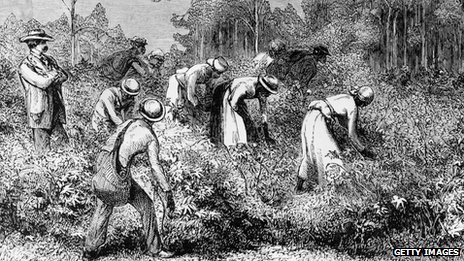
_65344344_cottonpickers1875_getty

The issue of slavery divided the ante-bellum United States on even what the words freedom and liberty meant. The dispute can be seen in the writings of many before the war, with each side emphasizing their particular understanding of these concepts. In the South, freedom was reserved for those who occupied the positions of economic power; slavery was key to that from not only an economic point of view but as a social philosophy. The concept of human equality, which was so much a part of the Declaration of Independence was downplayed to accommodate slavery and white supremacy.

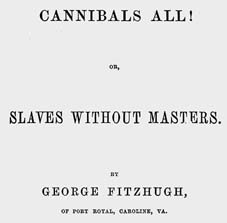
George Fitzhugh, a planter and slave owner in eastern Virginia commented that that concept “is practically impossible, and directly conflicts with all government, all separate property, and all social existence.” [6] Fitzhugh was very critical of the founder’s philosophy of natural liberty and human equality which he found repugnant and error ridden. He wrote:

“We must combat the doctrines of natural liberty and human equality, and the social contract as taught by Locke and the American sages of 1776. Under the spell of Locke and the Enlightenment, Jefferson and other misguided patriots ruined the splendid political edifice they erected by espousing dangerous abstractions – the crazy notions of liberty and equality that they wrote into the Declaration of Independence and the Virginia Bill of Rights. No wonder the abolitionists loved to quote the Declaration of Independence! Its precepts are wholly at war with slavery and equally at war with all government, all subordination, all order. It is full if mendacity and error. Consider its verbose, newborn, false and unmeaning preamble…. There is, finally, no such thing as inalienable rights. Life and liberty are not inalienable…. Jefferson in sum, was the architect of ruin, the inaugurator of anarchy. As his Declaration of Independence Stands, it deserves the appropriate epithets which Major Lee somewhere applies to the thought of Mr. Jefferson, it is “exuberantly false, and absurdly fallacious.”   ” [7]

The political philosophy such as Fitzhugh’s, which was quite common in the South, and was buttressed by a profound religious belief that it was the South’s God ordained mission to maintain and expand slavery. One Methodist preacher in his justification of slavery wrote, “God as he is infinitely wise, just and holy never could authorize the practice of moral evil. But God has authorized the practice of slavery, not only by bare permission of his providence, but by the express permission of his word.” [8] Buttressed by such scriptural arguments Southerners increasingly felt that they were the only people following God. The Northern abolitionists as well as those who advocated for the concept of human equality and free labor were heretics to be damned. As such the “South’s ideological isolation within an increasingly antislavery world was not a stigma or a source of guilt but a badge of righteousness and a foundation for national identity and pride.” [9]

Speaking of the necessity for slavery, as well as limitations on the equality of human beings no matter what their race or sex; Fitzhugh penned words that explained that human relationships were not to be seen in terms of individual liberty, “but in relations of strict domination and subordination. Successful societies were those whose members acknowledged their places within that hierarchy.” [10]

Fitzhugh was quite caustic when he discussed the real implications of his philosophy:

“We conclude that about nineteen out of twenty individuals have “a natural and inalienable right” to be taken care of and protected, to have guardians, trustees, husbands or masters; in other words they have a natural and inalienable right to be slaves. The one in twenty are clearly born or educated in some way fitted for command and liberty.” [11]

Fitzhugh’s chilling conclusion was summarized in the words “Liberty for the few – slavery in every form, for the mass.” [12]

But many Southerners, including many poor whites, especially the Yeoman farmers who were the backbone of the Southern populace did not see or understand the limitations that were placed on their own liberty by the slavery system and instead saw slavery as the guarantee of their economic freedom.

John C. Calhoun said to the Senate in 1848 that “With us, the two great divisions of society are not the rich and poor, but white and black; and all of the former, the poor as well as the rich, belong to the upper class, and are respected and treated as equals.” [13] Calhoun’s racial distinction is important if we are to understand why poor whites would fight and die for a social and economic idea that did not benefit them or their families, then as well as now.

But it was Abraham Lincoln, who cut to the heart of the matter when he noted the difference between his understanding of liberty and that of Calhoun and others in the South who defended slavery and the privileges of the Southern oligarchs:

“We all declare for liberty” but “in using the same word we do not all mean the same thing. With some the word liberty may mean for each man to do as he pleases with himself and the product of his labor; while with others the same word may mean for some men to do as they please with other men and the product of other men’s labor.” [14]

The growing economic disparity between the Slave and Free states became more about the expansion of slavery in federal territories as disunion and war approached; for a number of often competing reasons. These differences, amplified by the issue of slavery led to the substitution of stereotypes of each other and had the “effect of changing men’s attitudes toward the disagreements which are always certain to arise in politics: ordinary, resolvable disputes were converted into questions of principle, involving rigid, unnegotiable dogma.” [15] The Charleston Mercury noted in 1858 “on the subject of slavery…the North and the South…are not only two peoples, but they are rival, hostile peoples.” [16]

This was driven both by the South’s insistence on both maintaining slavery where it was already legal, and expanding it into new territories, even where it was forbidden by Federal laws enacted by Congress. This set it against the vocal abolitionist movement. But Southern exponents of expanding slavery were fighting an even more powerful enemy than the abolitionists, who despite their vocal protests were not yet in a position to influence policy. They were now fighting Northern industrialists who were not as idealistic as the abolitionists who were much more concerned with “economic policy designed to secure Northern domination of Western lands than the initial step in a broad plan to end slavery.” [17]

This competition between the regions not only affected politics, it affected religion and culture. In the South it produced a growing culture of victimhood, which was manifest in the words of Robert Toombs who authored Georgia’s declaration of causes for secession:

“For twenty years past, the Abolitionists and their allies in the Northern states, have been engaged in constant efforts to subvert our institutions, and to excite insurrection and servile war among us…” whose “avowed purpose is to subject our society, subject us, not only to the loss of our property but the destruction of ourselves, our wives and our children, and the dissolution of our homes, our altars, and our firesides.” [18]

As the social, economic, cultural and religious differences between the two regions grew wider and the people of the South became ever more closed off from the North. “More than other Americans, Southerners developed a sectional identity outside the national mainstream. The Southern life style tended to contradict the national norm in ways that life styles of other sections did not.” [19]

The complex relationship of Southern society where “Southern bodies social, economic, intellectual, and political were decidedly commingled” came to embrace the need for slavery and its importance to Southern society. This occurred despite the fact that the system did not benefit poor whites in the South and actually harmed them economically.

Southern society had become dependent on a race based social hierarchy in which dissent was neither welcome or tolerated. This

system of subordination reached out still further to require a certain kind of society, one in which certain questions were not publically discussed. It must give blacks no hope of cultivating dissention among the whites. It must commit non slaveholders to the unquestioning support of racial subordination…. In short, the South became increasingly a closed society, distrustful of isms from outside and unsympathetic to dissenters. Such were the pervasive consequences of giving top priority to the maintenance of a system of racial subordination.” [21]

A number of slave revolts, and planned slave revolts which were caught before they could erupt serve to heighten the fear and paranoia of Southerners living in the “Black belts” where slaves outnumbered whites by great margins. “In thickly enslaved areas, fancied dangers united white classes and sexes. Whites in black belts shared horror images about freed blacks as rioters, rapists, arsonists, and cannibals. The whites characteristically thought that using slavery to control alleged barbarians meant saving civilization.”[22]

Even before the abolitionist movement took any recognizable form in the North, “with an intensity that escalated through the Civil War, planters declared war on all open criticism of the peculiar institution.” [23] As Northern abolitionists like William Lloyd Garrison and his newspaper The Liberator grew in its distribution and began to appear in the South various elected officials throughout the South “suppressed antislavery books, newspapers, lectures, and sermons and strove generally to deny critics of bondage access to any public forum. [24] Despite this resistance, abolitionists continued to use the U.S. Mail service to send their literature south provoking even more drastic action from Southern legislators.

garrison by jocelyn 1833

William Lloyd Garrison 

But Garrison and the more radical abolitionists did not have a great following even in the North, most Northerners who even leaned toward abolition were supporters of a very gradual emancipation and not supportive of the immediate emancipation demanded by Garrison and his allies. In fact in the North, Garrison and his followers were not popular, they were “a small and often despised group.” [25] This was born out by facts that Garrison understood all too well, which made him even more uncompromising in his message even as support for it dropped. Even in the North Garrison was considered an unlikeable extremist.

In 1840, support for Garrison extremism peaked at around 2 percent of the northern voting population. The other 98 percent of northern citizens considered immediate abolition to be too extreme to be American, too problack to be tolerable, too keen on seizing property to be capitalistic, and too antisouthern to be safe for the Union.” [26] 

Garrison despised his northern opponents and wrote that he found among them “contempt more bitter, opposition more active, detraction more relentless, prejudice more stubborn, and apathy more frozen, than among slave owners themselves.” [27] Opponents broke up his meetings and on one occasion paraded Garrison “through the streets of Boston with a rope around his neck.” [28]

But Southerners, particularly those in the Black Belts where slaves constituted a majority of the population were further outraged by Garrison and his follower’s incendiary words and what they considered to be “almost pornographic diatribes,” which they felt had assaulted their “self-respect and sense of honor.” [29] In response to the proliferation of abolitionist literature in the South which was being sent through the mail, Senator John C. Calhoun proposed that Congress pass a law to prosecute “any postmaster who would “knowingly receive or put into the mail any pamphlet, newspaper, handbill, or any printed, written, or pictorial representation touching the subject of slavery.” [30] The law was a direct assault on the First Amendment, but in the South anything and anyone that took a stand against slavery had no Constitutional rights.

Calhoun was not alone as other members of Congress as well as state legislatures worked to restrict the import of what they considered subversive and dangerous literature. The condescending attitude of the radical abolitionists provoked an “emotional wildfire” [31] in the South, which united slave owners and poor whites in the Black Belt regions and served to increase their fear and loathing of Yankees who they believed wanted to destroy them and their way of life. Had they really understood just how united much of the North was with them they may not have pushed as hard to force Northern allies to accept laws that eventually offended the sensibilities of even non-abolitionists Northerners.

attention-southern-men

But Southern fears of real and imagined slave revolts, and hatred of radicals like Garrison brought about a host of new problem. Southerners now attempted to crush First Amendment protections of free speech in the north and to blot out any mention of slavery in the House of Representatives.

Beginning in 1836 the House of Representatives, led by Southern members of Congress passed a “gag rule” for its members. The “Gag Rule” “banned all petitions, memorials, resolutions, propositions, or papers related in any way or to any extent whatever to the subject of slavery.” [32]Former President John Quincy Adams continually challenged the gag-rule beginning in 1842, as did a number of others. The pressure was such that in 1844 the House finally voted to rescind it.

anti-slavery-meetings

However, Southern politicians were unhappy with the recension of the Gag Rule and “began to spout demands that the federal government and the Northern states issue assurances that the abolitionists would never be allowed to tamper with what John Calhoun had described as the South’s “peculiar domestic institution.” [33] As tensions grew between the regions; the issue of slavery more than any other issue, “transformed political action from a process of accommodation to a mode of combat.” [34]

Around the same time as the gag rule was played out in Congress the Supreme Court had ruled that the Federal government alone “had jurisdiction where escaped slaves were concerned”which resulted in several states enacting “personal liberty laws”to “forbid their own elected officials from those pursuing fugitives.” Southern politicians at the federal and state levels reacted strongly to these moves, which they believed to be an assault on their institutions and their rights to their human property. Virginia legislators said these laws were a “disgusting and revolting exhibition of faithless and unconstitutional legislation.” [35]

The issue of slavery shaped political debate and “structured and polarized many random, unoriented points of conflict on which sectional interest diverged.” [36] As the divide grew, leaders and people in both the North and the South began to react to the most distorted images of each other imaginable- “the North to an image of a southern world of lascivious and sadistic slave drivers; the South to the image of a northern world of cunning Yankee traders and radical abolitionists plotting slave insurrections.” [37]

To be continued…

Notes

[1] Potter, David M. The Impending Crisis: America before the Civil War 1848-1861 completed and edited by Don E. Fehrenbacher Harper Collins Publishers, New York 1976 p.41

[2] Ibid. Potter The Impending Crisis p.41

[3] Burns, Ken A Conflict’s Acoustic Shadows in The New York Times Disunion: Modern Historians Revisit and Reconsider the Civil War from Lincoln’s Election to the Emancipation Proclamation Black Dog and Leventhal Publishing, New York 2013 p.102

[4] Ibid. Potter The Impending Crisis p.42

[5] Ibid. Potter The Impending Crisis p.42

[6] Ibid. Levine Half Slave and Half Free: The Roots of the Civil War Revised Edition p.140

[7] Fitzhugh, George. New Haven Lecture 1855, in The Approaching Fury: Voices From the Storm, 1820-1861 Stephen B. Oates, Editor, University of Nebraska Press, Lincoln and London 1997 p.135

[8] Ibid. Daly When Slavery Was Called Freedom: Evangelicalism, Proslavery, and the Causes of the Civil War pp.63-64

[9] Ibid. Faust, Drew The Creation of Confederate Nationalism: Ideology and Identity in the Civil War South p.61

[10] Ibid. Levin Half Slave and Half Free p.140

[11] Ibid. Levin Half Slave and Half Free p.140

[12] Ibid. Levin Half Slave and Half Free p.141

[13] McPherson, James M. Drawn With the Sword: Reflections on the American Civil War Oxford University Press, Oxford and New York 1996 p.50

[14] Ibid. Levin Half Slave and Half Free p.122

[15] Ibid. Potter The Impending Crisis p.43

[16] Ibid. McPherson Drawn With the Sword p.16

[17] Egnal, Marc Clash of Extremes: The Economic Origins of the Civil War Hill and Wang a division of Farrar, Straus and Giroux New York 2009 p.6

[18] Dew, Charles B. Apostles of Disunion: Southern Secession Commissioners and the Causes of the Civil War University Press of Virginia, Charlottesville and London 2001 p.12

[19] Thomas, Emory The Confederate Nation 1861-1865 Harper Perennial, New York and London 1979 p.5

[20] Ibid. Thomas The Confederate Nation p.5

[21] Ibid. Potter The Impending Crisis pp.457-458

[22] Freehling, William W. The South vs. The South: How Anti-Confederate Southerners Shaped the Course of the Civil War Oxford University Press, Oxford and New York 2001 p.20

[23] Ibid. Levine Half Slave and Half Free p.166

[24] Ibid. Levine Half Slave and Half Free p.166

[25] Ibid. Goldfield America Aflame: How the Civil War Created a Nation p.27

[26] Ibid. Freehling The South vs. The South p. 34

[27] Ibid. Varon Disunion! The Coming of the American Civil War 1789-1858 pp.70-71

[28] Ibid. Goldfield America Aflame p.27

[29] Ibid. Freehling The South vs. The South p.22

[30] Ibid. Guelzo Fateful Lightning pp.50-51

[31] Ibid. Freehling The South vs. The South p.22

[32] Ibid. Levine Half Slave and Half Free pp.169-170

[33] Ibid. Guelzo Fateful Lightning pp.51-52

[34] Ibid. Potter The Impending Crisis p.43

[35] Ibid. Levine Half Slave and Half Free pp.169-170

[36] Ibid. Potter The Impending Crisis p.43

[37] Ibid. Potter The Impending Crisis p.43

Leave a comment

Filed under civil rights, civil war, ethics, History, laws and legislation, leadership, News and current events, Political Commentary, Religion

America’s Original Sin and Its Continuing Legacy: Part One

Friends of Padre Steve’s World,

I am going to be posting a number of articles from my various texts dealing with the American Civil War era dealing with topics that some would want to forget, but are very important if we want to fully appreciate the struggle of African-Americans for equality.

Of course this original sin is the distinctly American version of slavery that arose in the American South, was protected in the Constitution, and supported by not only the Slave holders, and their Southern political protectors, but the businessmen, bankers, and equally complicit political allies in the North.

I honestly wish that we had really advanced beyond where we are now. But we are not. We’re still dealing with what has been called our nation’s original sin. over course slavery was abolished, and African Americans given citizenship and voting rights, but those rights would become a mockery in the Post-Reconstruction Jim Crow South, and in the Sundown Towns of the North and West. Even today, after the gains of the Civil Rights Movement we still deal with the continued effects of it. Our President and his closest advisers are White Nationalists, and White Supremacy is thriving under his tacit blessing. But that’s not enough, men like the Democratic Party Governor of Virginia posed in black face or in a KKK hood in his medical school yearbook. I could go on with a laundry list of other issues related to this but that would turn this introduction into another book, which is ironic because the content of this article was an introductory chapter of a Civil War Text about the Battle of Gettysburg that became part of a book of its own.

American Slavery and Racism is the subject of this and the following articles. More articles will follow in the next couple of weeks.

Have a great day,

Peace

Padre Steve+

slavescars

The Slave Economy and the Divide between North and South

“Thy bond-men and thy bond-maids which thou shalt have, shall be of the heathen that are round about you: of them you shall buy bond-men and bond-maids. Moreover, of the children of the strangers that do sojourn among you, of them he shall buy, and of their families that are with you, which they begat in your land. And they shall be your possession. And you shall take them as an inheritance for your children after you, they shall be your bond-men forever.” Leviticus 25:44-46

thewanderer_lastslaveship

Early Slavery in the Americas and the African Slave Trade

If we are to really understand the Civil War we have to understand the ideological clash between Abolitionists in the North, and Southern proponents of slavery. Slavery began very early in the history of the American colonies and though the British and the Dutch were the largest traders of slaves in those early days, the first American slave ship made its first voyage to bring Africans to the new world. Historian Howard Zinn noted:

By 1800, 10 to 15 million blacks had been transported to the Americas, representing perhaps one-third of those originally seized in Africa. It is roughly estimated that Africa lost 50 million human beings to death and slavery in those centuries we call the beginnings of modern Western civilization, at the hands of slave traders and plantation owners in Western Europe and America, the countries deemed the most advanced in the world.” [1]

Slavery in the Americas grew out of the economic need of planters to for laborers on the vast plantations of the new world as “the number of arriving whites, whether free or indentured servants (under four to seven year contract) was not enough to meet the demand of the plantations.” [2] Thus, land owners needed more workers, and unwilling to employ free men who would need to be paid, thus decreasing profit, they resorted to the use of slaves brought from Africa who were then bought.

But the use of slaves in the new American colonies was significantly different than previous forms of slavery in Africa, where slavery was one of a number of forms of labor. In Africa, slaves “worked within the households of their owners and had well-defined rights, such as possessing property and marrying free persons. It was not uncommon for slaves in Africa to acquire their freedom.” [3] In fact the plantation form of slavery practiced in the Americas differed radically from traditional forms of African slavery and was characterized by “the frenzy for limitless profit that comes from capitalistic agriculture; the reduction of the slave to less than human status by the use of race hatred, with that relentless clarity based on color, where white was master, black was slave.” [4]

American slavery took on a new form, that of the plantation. The plantation system allowed owners to amass “large concentrations of laborers under the control of a single owner produced goods – sugar, tobacco, rice, and cotton – for the free market.” [5] Beginning with the Spanish and the Portuguese in the early 1500s, the African slave trade became a major part of the world economy, and “slave labor played an indispensable part in its rapid growth.” [6] 

Not only was this in the world economy, but to the economy of the English colonies in North America and the new American nation it was indispensable. The paradox was rich, especially in a new nation founded upon, and supposed dedicated to liberty and equality. The “Atlantic slave trade, which flourished from 1500 into the nineteenth century was a regularized business in which European merchants, African traders, and American planters engaged in a highly complex and profitable bargaining in human lives.” [7]

It was economic gain that prompted the growth in American slavery, and for which slaves were essential for profit. As such, the “first mass consumer goods in international trade were produced by slaves – sugar, rice, coffee, and tobacco. The profits from slavery stimulated the rise of British ports such as Liverpool and Bristol, and the growth of banking, shipbuilding, and insurance, and helped to finance the early industrial revolution. The centrality of slavery to the British empire encouraged an ever-closer identification of freedom with whites and slavery with blacks.” [8]

full_1361408284slave.market

The Constitution, Slavery and Disunion 

When the United State won its independence the founders of the new nation had to deal with the already existing institution of slavery. It also had to deal with the threat to the Union that the institution and the real possibility of disunion, something that almost all of them feared more than anything. Slavery was an institution that even some powerful politicians who owned slaves were uncomfortable; Patrick Henry noted in 1773 that “to do so was “repugnant to humanity” and “inconsistent with the Bible,” while George Washington wrote in 1786 “There is not a man living…who wishes more sincerely than I do, to see a plan for the gradual abolition of it.” [9]

Slavery was an issue that divided the newly independent states as they gathered for the Constitutional Convention in 1787 and Washington confided to a friend before the convention that “he could “foresee no greater evil than disunion,” and now the “mere discussion of slavery” was poisoning the atmosphere.” [10] James Madison was one of the first to recognize this and noted that “the states differed “primarily from the effects of their having or not having slaves.” [11]

Thus the issue came to a head around how the population of the states would be represented in the new government and how to balance the power between the federal government and the various state governments. To do this the founders divided Congress into two houses, the House of Representatives who were directly elected by the voters of each state with the population of the state determining the number of representative each would have; and in the Senate, whose members were elected by the state legislatures, each state would have two members regardless of the size of its population. The division of the legislature in the Constitution “enabled the individual states to retain a large measure of their jealously guarded autonomy.” [12] Eligible voters in each state elected the President by electing “electors” for the Electoral College, and each state was given an amount of electors equal to its representation in the Senate and the House of Representatives. In a real sense, the Electoral College was designed to support the political power of the Slave States.

The heart of the matter came to the issue of what people would be counted in each state. The Northern states wanted to base the number on each state’s white population. The Southern states wanted to “swell their power by counting both white citizens and black non-citizens.” [13] Doing so would give Southern States more power in the House of Representatives which, when coupled with the equality each state had in the Senate, gave the less populous Southern disproportionate power in the national government. A representative from New Jersey, Gouverneur Morris believed that if slaves “were human enough to boost the representation of the Southern States…they should be treated as persons and not property in the South.” [14]There was debate on this issue and to bridge the sectional divide the Convention passed what is now known as the three-fifths compromise.

This measure had profound results. It stipulated that the size of a state’s congressional delegation and its Electoral College electors; and the state’s tax burden would be determined by their population. The population was determined by counting free-persons as a full person, and then adding the words “three-fifths of all other persons.” Of course the “other persons” were slaves, but the language was carefully crafted to avoid the use of the terms slave or slavery to make the document acceptable to Northern delegations. The compromise was the first of many made by the Northern states to appease the South and maintain national unity. The South got less than it wanted, as its delegates wanted slaves to count as a whole person for population sake without considering them as such.

When all was said and done in 1790 “southern states, possessing around 40% of the nations’ white population, controlled around 47% of the House and Electoral College.” [15] Gouverneur Morris understood that the compromise would exaggerate Southern power and predicted that “the three-fifths clause’s real legacy would be to give slaveholders majority control over electoral politics.” [16] However, Morris’s warning was unheeded for decades by many in the North, though through electoral experience Northern leaders began to realize what the compromise had wrought but could not change the process without amending the Constitution.

Morris was correct. During the election of 1802 in the Electoral College the “three-fifths clause gave the Southerners 14 extra electors, the Republicans’ Thomas Jefferson defeated the Federalists’ John Adams, 73-65. Jefferson swept South’s extra electors 12-2. If no three-fifths clause had existed and House apportionment been based strictly on white numbers, Adams would have likely squeaked by, 63-61.” [17] The compromise had major impacts on the Electoral College. In the first 36 years of the Republic, only one President came from the North, John Adams. The rest, Washington, Jefferson, Madison and Monroe were all Virginian’s, and all were slaveholders.

Apart from John Quincy Adams who served from 1825-1829 every other President until Abraham Lincoln was either a Southern slaveholder, or a Northern supporter of the South’s position on the preservation and or expansion of slavery. In fact the South dominated all branches of the Federal government from 1789-1861, often with the cooperation of Northern political and business interests.

James McPherson wrote:

“A Southern slaveholder had been president of the United States two-thirds of the years between 1789 and 1861, and two-thirds of the Speakers of the House and president pro tem of the Senate had also been Southerners. Twenty of the thirty-five Supreme Court justices during that period had been from slave states, which always had a majority on the court before 1861.” [18] 

Those who believed in the South’s moral, religious, and cultural supremacy over the North often used the Southern domination of American politics as proof of that superiority, despite the fact that the system was rigged to support their status as a minority which depended on the institution of slavery.

Two other compromises were made by the delegates to the convention. The first dealt with ending the African slave trade. This was contentious and in response to the threat of ending the trade the delegates from South Carolina, John Rutledge and Charles Cotesworth Pinckney insisted that “South Carolina could not join the proposed Union if the slave trade was prohibited.” [19] The compromise allowed the African slave trade to remain legal until 1808 unless Congress voted to allow it to continue. However, this was the first of many threats by Southern leaders and states to threaten disunion over the issue of slavery. A final compromise required states to “extradite and deliver any fugitive from service to his or her master and state of origin.” [20] The wording of the law was purposely vague and could include indentured servants, but the real target was escaped slaves.

The early compromises set the stage for future compromises, in large part because Federalist politicians preferred compromise over disunion, and their fear was that “failure to compromise would bring disunion” [21] and with it disaster. Thus the convention approved the compromises and the states, even Northern states which had abolished or were on the way to abolishing slavery ratified it.

<img src="https://padresteve.com/wp-content/uploads/2014/12/o-slavery-facebook.jpg?w=300&h=150" class="aligncenter size-medium wp-image-15916" width="300" height="150" data-attachment-id="15916" data-permalink="https://padresteve.com/2014/12/11/mine-eyes-have-seen-the-glory-religion-ideology-the-civil-war-part-1/o-slavery-facebook/" data-orig-file="https://padresteve.com/wp-content/uploads/2014/12/o-slavery-facebook.jpg" data-orig-size="2000,1000" data-comments-opened="1" data-image-meta="{"aperture":"0","credit":"Getty Images\/Photo Researchers RM","camera":"","caption":"United States Slave Trade","created_timestamp":"0","copyright":"","focal_length":"0","iso":"0","shutter_speed":"0","title":"128619271","orientation":"0"}" data-image-title="o-SLAVERY-facebook" data-image-description="

United States Slave Trade

” data-medium-file=”https://padresteve.com/wp-content/uploads/2014/12/o-slavery-facebook.jpg?w=300&h=150″ data-large-file=”https://padresteve.com/wp-content/uploads/2014/12/o-slavery-facebook.jpg?w=500″ alt=”o-SLAVERY-facebook” srcset=”https://padresteve.com/wp-content/uploads/2014/12/o-slavery-facebook.jpg?w=300&h=150 300w, https://padresteve.com/wp-content/uploads/2014/12/o-slavery-facebook.jpg?w=600&h=300 600w, https://padresteve.com/wp-content/uploads/2014/12/o-slavery-facebook.jpg?w=150&h=75 150w” sizes=”(max-width: 300px) 100vw, 300px” style=”height: auto; max-width: 100%; border: 0px; margin-bottom: 2px”>

Slavery in the Early Years of the United States

Slavery expanded in the American colonies and continued to do so after American independence despite the fact that a number of prominent slaveholders including George Washington voluntarily emancipated their slaves in the 1780s and 1790s. In large part this was due to fact that the United States “purposely built a weak central state, dispersing power to govern from the center to the constituent (some would have said still sovereign) parts.” [22] 

That being said the in the new Constitution the founders ensured that the central government was far stronger than the attempt made in the initial Confederation of States in matters of tariffs, taxes and laws to protect bondholders, slaveowners, and land speculators. In this government the land owners of the Southern states, as well as the merchants of the North held the bulk of the economic, political and social power. Significantly, “most of the makers of the Constitution had some direct interest in establishing a strong federal government: the manufacturers needed protective tariffs; the moneylenders wanted to stop the use of paper money to pay off debts; the land speculators wanted protection as they invaded Indian lands; slaveowners needed federal security against slave revolts and runaways; bondholders wanted a government able to raise money by nationwide taxation, to pay off those bonds.” [23] The Constitution ensured that the Federal Government was strong enough to protect those interests, but not strong enough to encroach on the powers granted to the states, especially the powers of slave states.

The conflict between supporters of slavery and those who opposed it on either humanitarian, religious or political-ideological grounds would become more of a source of even conflict following slavery’s boost by Eli Whitney’s invention of the Cotton Gin.

The machine made the production of cotton and its export an even more profitable enterprise requiring more slaves to meet the expanding demand and it was not something that those who believed that slavery would expire of its own accord expected. Thomas Jefferson wrote in 1805 that in regard to slavery that “interest is really going over to the side of morality. The value of the slave is every day lessening; his burden on his master dayly increasing. Interest is therefore preparing for the disposition to be just.” [24] Of course Jefferson, who owned over 200 slaves and had built much of his political base among Virginia planters was wrong, and despite the misgivings that he expresses in some of his letters and papers, including the first draft of the Declaration of Independence, he never took the lead or a public stand on the abolition of slavery.

The difference made by the cotton gin was starling, it enabled greater production and increased the need for slaves, and with the end of the legal African slave trade in 1808 the price of slaves already in the United States went up considerably, making the interstate trafficking of slaves much more profitable. In 1790 “a thousand tons of cotton were being produced every year in the South. By 1860, it was a million tons. In the same period, 500,000 slaves grew to 4 million.” [25] This enriched Northerners as well, “Northern ships carried cotton to New York and Europe, northern bankers and merchants financed the cotton crop, northern companies insured it, and northern factories turned cotton into textiles. The “free states” had abolished slavery, but they remained intimately linked to the peculiar institution.” [26] Thus the institution of slavery’s tentacles reached out to much of America and with the threat of slave rebellions in the South which could upset the economic status quo the nation “developed a network of controls in the southern states, backed by laws, courts, armed forces, and race prejudice of the nation’s political leaders.” [27]

But during the early nineteenth century slavery was on the decline in the rest of the Americas as the Spanish, Portuguese and French lost most of their American possessions. Likewise, Britain emancipated its slaves and the slaves in its colonies in the 1830s. Russia emancipated its serfs, and most countries, even the United States banned the African slave trade.

These events would lead to increasing calls for the abolition of slavery in the United States. In the Free States Of the North abolitionist societies, newspapers and stepped up efforts to help slaves escape their bonds. With the advent of these small, but vocal abolitionist organizations, there was a movement, particularly in Southern religious circles to justify and defend the peculiar institution.

To be continued…

Notes

[1] Ibid. Zinn A People’s History of the United States p.29

[2] Ibid. Zinn A People’s History of the United States p.32

[3] Foner, Eric Forever Free: The Story of Emancipation and Reconstruction Vintage Books a Division of Random House, New York 2005 p.6

[4] Ibid. Zinn A People’s History of the United States p.28

[5] Ibid. Foner Forever Free p.6

[6] Foner, Eric A Short History of Reconstruction Harper and Row, New York 1990 p.1

[7] Ibid. Foner Forever Free pp.6-7

[8] Ibid. Foner Forever Free p.7

[9] Ibid. Levine Half Slave and Half Free: The Roots of the Civil War Revised Edition p.5

[10] Ibid. Varon Disunion! The Coming of the American Civil War 1789-1858 p.24

[11] Ibid. Varon Disunion! The Coming of the American Civil War 1789-1858 p.22

[12] Ibid. Guelzo Fateful Lightning p.7

[13] Freehling, William W. The Road to Disunion Volume One: Secessionists at Bay Oxford University Press, Oxford and New York 1990 p.146

[14] Ibid. Varon Disunion! The Coming of the American Civil War 1789-1858 p.23

[15] Ibid. Freehling The Road to Disunion Volume One: Secessionists at Bay p.147

[16] Ibid. Varon Disunion! The Coming of the American Civil War 1789-1858 p.23

[17] Ibid. Freehling The Road to Disunion Volume One: Secessionists at Bay p.147

[18] McPherson, James The War that Forged a Nation: Why the Civil War Still Matters Oxford University Press, Oxford and New York 2015 p.7

[19] Ibid. Varon Disunion! The Coming of the American Civil War 1789-1858 p.23

[20] Ibid. Varon Disunion! The Coming of the American Civil War 1789-1858 p.24

[21] Ibid. Varon Disunion! The Coming of the American Civil War 1789-1858 p.24

[22] McCurry, Stephanie Confederate Reckoning: Power and Politics in the Civil War South Harvard University Press, Cambridge and London 2010 p.220

[23] Ibid. Zinn A People’s History of the United States pp.90-91

[24] Ibid. Levine Half Slave and Half Free: The Roots of the Civil War Revised Edition p.8

[25] Ibid. Zinn A People’s History of the United States p.171

[26] Ibid. Foner Forever Free p.13

[27] Ibid. Zinn A People’s History of the United States p.171

2 Comments

Filed under civil war, History, labor, laws and legislation, News and current events, Political Commentary