Category Archives: leadership

Remembering the Four Freedom’s Speech

Friends of Padre Steve’s World,

On January 6th 1941 President Franklin Delano Roosevelt delivered his State of the Union Message to Congress and the nation. I spent the time to both both read it and listen to it the other day. It is a profoundly moving speech, not without controversy of course, but one which we need to hear again. It is a speech that like the Declaration of Independence, Lincoln’s  Gettysburg Address, and Dr. Martin Luther King Jr.’s I have a Dream speech calls us to higher ideals, ideals that we often come up short in living up to, but ideals worth living for and to endeavor to attain in our lifetime.


When Roosevelt spoke the nation was in the midst of crisis. The United States was still recovering from the Great Depression. War threatened as Hitler’s Nazi German legions had overrun all of Western Europe and much much of North Africa. German U-Boats and surface ships were prowling the North Atlantic. Britain stood alone between Germany’s complete domination of Europe. Even the Soviet Union, a mortal enemy of Fascism had concluded a concordat with Hitler to divide Eastern Europe. Though no one yet knew it, Hitler was already planning to break his accord with Stalin and invade the Soviet Union.

In it Roosevelt made a comment that we should remember in light of the knowledge that Russia interfered in our election, and has been working tirelessly to split us from our allies and directly working against our efforts to fight ISIS, and the efforts of our soldiers in Afghanistan. He noted:

“I suppose that every realist knows that the democratic way of life is at this moment being directly assailed in every part of the world — assailed either by arms or by secret spreading of poisonous propaganda by those who seek to destroy unity and promote discord in nations that are still at peace.”

Roosevelt’s speech, which largely focused on the threat of Nazi Germany, also supported Britain and the exiled governments of nations conquered by Hitler.  As he outlined preparations to defend the United States, Roosevelt also called on Congress to pass Lend Lease to help those fighting the dictators, as well as increased opportunity at home. In response to the emerging threats and the unwillingness of some, including a strong pro-Germany lobby headed by prominent senators, American aviation hero Charles Lindberg, and and big business, Roosevelt challenged Americans to face up to them. He noted:

“As a nation we may take pride in the fact that we are soft-hearted; but we cannot afford to be soft-headed.  We must always be wary of those who with sounding brass and a tinkling cymbal preach the “ism” of appeasement.  We must especially beware of that small group of selfish men who would clip the wings of the American eagle in order to feather their own nests.”

On the domestic front Roosevelt reiterated the message of the New Deal, for even with war looming he did not want to see Americans lost in the exchange and he linked freedom abroad to the same at home. He noted:

“As men do not live by bread alone, they do not fight by armaments alone. Those who man our defenses and those behind them who build our defenses must have the stamina and the courage which come from unshakable belief in the manner of life which they are defending. The mighty action that we are calling for cannot be based on a disregard of all the things worth fighting for.”

He continued:

“Certainly this is no time for any of us to stop thinking about the social and economic problems which are the root cause of the social revolution which is today a supreme factor in the world. For there is nothing mysterious about the foundations of a healthy and strong democracy.

The basic things expected by our people of their political and economic systems are simple. They are:

Equality of opportunity for youth and for others.

Jobs for those who can work.

Security for those who need it.

The ending of special privilege for the few.

The preservation of civil liberties for all.

The enjoyment — The enjoyment of the fruits of scientific progress in a wider and constantly rising standard of living.

These are the simple, the basic things that must never be lost sight of in the turmoil and unbelievable complexity of our modern world. The inner and abiding strength of our economic and political systems is dependent upon the degree to which they fulfill these expectations.”

But the real heart of the message, applicable to all people everywhere Roosevelt enunciated a number of principles that are a beacon to all people. Firmly grounded in words of the Declaration of Independence and the Gettysburg Address they are called the Four Freedoms. Those freedoms are an ideal, in fact they certainly were not practiced well then by Americans, nor now, but they are worth working to: Roosevelt said:

“In the future days, which we seek to make secure, we look forward to a world founded upon four essential human freedoms.

The first is freedom of speech and expression—everywhere in the world.

The second is freedom of every person to worship God in his own way—everywhere in the world.

The third is freedom from want—which, translated into world terms, means economic understandings which will secure to every nation a healthy peacetime life for its inhabitants—everywhere in the world.

The fourth is freedom from fear—which, translated into world terms, means a world-wide reduction of armaments to such a point and in such a thorough fashion that no nation will be in a position to commit an act of physical aggression against any neighbor—anywhere in the world.

That is no vision of a distant millennium. It is a definite basis for a kind of world attainable in our own time and generation. That kind of world is the very antithesis of the so-called new order of tyranny which the dictators seek to create with the crash of a bomb.”

The speech was important, and now as it did then it calls Americans to higher purposes, to higher ideals, and it recognizes that we have never fully measured up to our own words. At the time it was spoken, Jim Crow was still the law of the land, Mexican Americans were often treated as poorly as blacks, Native Americans had few rights; and barely a year later Japanese Americans would be taken from the homes, lose their business and be sent to detention camps for the duration of the war after Pearl Harbor, simply because they were of Japanese descent. But those abiding principles are things that we should never lose sight of, and always strive to realize.

Today the four freedoms that Roosevelt enunciated are under threat around the world and in the United States too. We live in an age of uncertainty, turbulence, division, inequity, as well as deeply ingrained cynicism. Unscrupulous authoritarian politicians are using that uncertainty and fear to roll back the very liberties that democratic institutions are founded on.

As a result, as a man who promised during his campaign to roll back the rights of many people it is important not to forget this speech. The same is true as state and local politicians set out to not only roll back the rights of some, but to enable religious people to discriminate against other citizens.

It is also important because the government of Russia led efforts to attack the country by influencing the election, and for years has been committing aggression against American allies and working against American and allied efforts around the world. Yet the the incoming administration is not only welcoming it, but attacking and trying to discredit the American intelligence officials who say that it happened, and condemning senators and congressmen of its own party who want to further investigate those attacks by Russia and impose sanctions.  

So I think that it is important to reflect on these events, and then turn to speeches like Roosevelt’s in order for us to strive for a higher purpose, not to lose hope, and give in to fear that would enable our freedoms and the freedoms of any citizen to be curtailed.

If you can please that the time to listen to it or read it at the following link: http://www.americanrhetoric.com/speeches/fdrthefourfreedoms.htm

Peace,

Padre Steve+

Leave a comment

Filed under civil rights, Foreign Policy, History, leadership, national security, News and current events, Political Commentary

The Problem with Having Scruples when Rulers Don’t: A Warning from General Johannes Steinhoff 

Friends of Padre Steve’s World

I have written a lot about the dehumanization of people and genocide, and some of the things that create a climate where such events take place, and how political and religious leaders stir the primal passions of otherwise good, decent and law abiding citizens. I wrote yesterday how I am afraid of what is going on in our country, especially in regard to the violence being sanctioned and even promoted by President Elect Donald Trump.

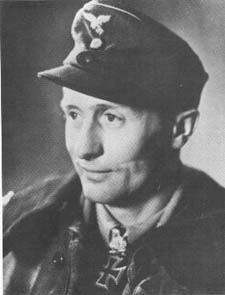
Last spring I read a book by World War II German Luftwaffe ace Johannes Steinhoff. Steinhoff was unlike many of the German officers who wrote memoirs following the war, memoirs that historian Williamson Murray wrote “fell generally into two categories; generals writing in the genre of “if the fuhrer had only listened to me!” and fighter pilots or tank busters writing about their heroics against the productive flood from America or the primitively masses of the Soviet Union.” His book, The Final Hours: The Luftwaffe Plot Against Goering should be essential reading for any currently serving officer.

steinhoff6

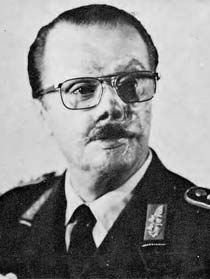
General Johannes Steinhof (above) as a Bundeswehr and NATO officer, showing his burns and before his crash (below)

steinhoff WW II

In his books, Steinhoff does something that you do not see authors do in most military or political memoirs, he actually does serious self reflection on his role in supporting an evil regime. In his introduction to his book The Final Hours the legendary fighter ace who was horribly disfigured when his Me-262 jet fighter crashed and burned two weeks prior to the end of the war wrote:

“In recalling these events, which had been long buried in my memory, it has not been my intention to make excuses. Our unconditional self-sacrifice in the service of the Third Reich is too well documented for that….

So it is because of what is happening today—with freedom threatened in virtually every respect by its own abuse—that I offer this contribution, in the form of an episode in which I was myself involved, to the history of the soldier in the twentieth century. Soldiers have always, in every century of their existence, been victims of the ruthless misuse of power; indeed, given the opportunity, they have joined in the power game themselves. But it fell to our own century to accomplish, with the aid of a whole technology of mass extermination, the most atrocious massacres in the history of mankind. This fact alone makes pacifism a philosophy worthy of respect, and I have a great deal of sympathy with those who profess it. 

The figure of the soldier in all his manifestations is thus symptomatic of the century now nearing its close, and it is to the history of that figure that I wish to contribute by describing what happened to me. I have tried to show what it is possible to do to men, how insidiously they can be manipulated by education, how they can be hoisted onto a pedestal as “heroes,” how they can be so corrupted as even to enjoy the experience—and how they can be dropped and denounced as mutineers when they discover that they have scruples. The complete lack of scruples that such treatment implies is peculiar to rulers who believe that the problems of their own and other peoples can be solved by imposing, through the use of military force, peace on their, the rulers’, terms—in our case a pax germanica, but the second Latin word is readily interchangeable.” from “The Final Hours: The Luftwaffe Plot Against Goring (Aviation Classics)” by Johannes Steinhoff

Since I am a historian and and a career military officer with service in the Iraq War, a war that was illegal and unjust by all measure I can understand Steinhof’s words. Because much of my undergraduate and graduate work focused on German history, particularly that of Imperial Germany after the unification, the Weimar Republic, and the Nazi Reich, I draw a lot of lessons from the period. I also understand how people in this country can fall for the same kind of vitriolic propaganda that the Germans of that era did. I can understand because for years I fell for the lies and propaganda being put out by the politicians, pundits and preachers of the American political right.

10665323_10154041610267059_5277331492232210946_n

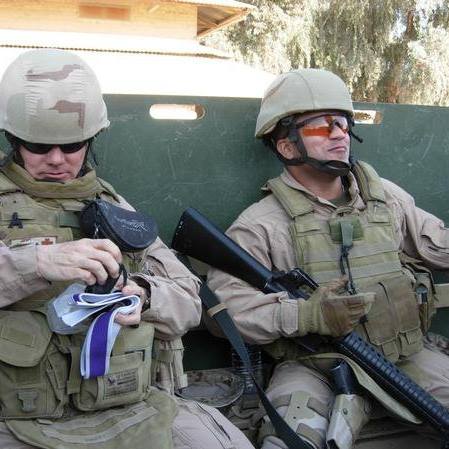
A picture of me (on left) in Iraq 2007 with my assistant and bodyguard RP1 Nelson Lebron

One of those lessons is that in times of crisis, that people, no matter what their race, culture, religious belief system, educational, or economic background are still human. Humanity is the one constant in all of history, our prejudices are often ingrained in us during childhood and reinforced by the words of politicians, pundits, and preachers. In times of stress, crisis, and societal change or upheaval even good people, moral people, people of great intellectual, scientific abilities can fall prey to demagogues who preach hate and blame others, usually racial, ethnic, or religious minorities, as well as civil libertarians who champion the rights of those minorities for the problems of the nation.

Shrewd politicians, preachers, and pundits do this well. They demonize the target group or population and then let the hatred of their disaffected followers flow. The leaders need that disaffected and angry base in order to rise to power; such was how Hitler, Stalin, and so many other despots gained power. They took advantage of a climate of fear, and found others to blame. For Hitler it was the Jews, Slavs, Socialists and Communists; while for Stalin it was various groups like the Ukrainians, or the Poles who were the devil to be feared and destroyed. Timothy Snyder in his book Bloodlands: Europe Between Hitler and Stalin wrote:

“Dead human beings provided retrospective arguments for the rectitude of policy. Hitler and Stalin thus shared a certain politics of tyranny: they brought about catastrophes, blamed the enemy of their choice, and then used the death of millions to make the case that their policies were necessary or desirable. Each of them had a transformative utopia, a group to be blamed when its realization proved impossible, and then a policy of mass murder that could be proclaimed as a kind of ersatz victory.”

But that being said, there are a lot of people who from childhood believe the lies about others without question. In good times such people continue on with life as normal, but in crisis those hatreds and prejudices come to the fore. Rudolf Höss, the notorious sociopath who commanded Auschwitz told American Army psychologist Gustave Gilbert about his reaction when ordered to turn the camp into an extermination center. He said that the order “fitted in with all that had been preached to me for years,” and “at the same time I didn’t think of it as propaganda, but as something one just had to believe.” 

Eugene Davidson in his book on the Nuremberg Trials wrote:

“Every society has in it at all times negative, criminal, sadistic, asocial forces. What holds them in check more than law and police is the consensus of the society – a general belief that despite everything wrong and stupid and muddleheaded in politics, the state is a going concern that will somehow make its way into the future.” (Davidson, The Trial of the Germans p.581)

But when things do not go well, when people do not feel that things will be okay, that the future will be better, and that they have a purpose they look for answers. However, they tend to find their answers in the rantings of demagogues, race baiters, conspiracy theorists, and others who they would tend to dismiss out of hand in good times. In Germany it was the loss of the First World War, the humiliation of Versailles and the economic chaos and social change of the Weimar period which allowed Hitler to gain an audience, then a following, then political power. The demagogues played to what was already in the hearts and minds of the disaffected masses, without that fertile soil, the rantings of Hitler and his propagandists would have never succeeded. Albert Speer wrote:

“As I see it today, Hitler and Goebbels were in fact molded by the mob itself, guided by its yearnings and its daydreams. Of course, Goebbels and Hitler knew how to penetrate through to the instincts of their audiences; but in the deeper sense they derived their whole existence from these audiences. Certainly the masses roared to the beat set by Hitler’s and Goebbels’ baton; yet they were not the true conductors. The mob determined the theme. To compensate for misery, insecurity, unemployment, and hopelessness, this anonymous assemblage wallowed for hours at a time in obsessions, savagery and license. The personal unhappiness caused by the breakdown of the economy was replaced by a frenzy that demanded victims. By lashing out at their opponents and vilifying the Jews, they gave expression and direction to fierce primal passions.”

In a sense a similar thing has happened in the United States which has experienced a series of wars beginning with Vietnam, the shock of the 9-11-2001 attacks, the economic crash of 2007 and 2008 which devastated the savings, home ownership, and investments of many Americans while at the same time benefiting the banking and brokerage houses whose government assisted policies brought about the crash. Of course there are other issues, many religious conservatives hate the progress made by the Women’s and Gay Rights movements, and their leaders play to their fears in apocalyptic terms. I could go on, but I am sure that my readers can identify other issues which demagogues and others use to spread fear and hate to further their goals. The fact is that without the the fertile soil that lays in the hearts of their most fervent followers they would never have a following.

In Weimar Germany hate mongers like Julius Streicher and propagandist Josef Goebbels stuck a chord with disenchanted people who felt that they had lost their country. They were fearful, angry, and desired a leader who would “make Germany great again.” Hitler and his Nazi media sycophants played to that fear, and took advantage of their anger at the existing order. Davidson wrote such people “exist everywhere and in a sick society they can flourish.” 

For decades the way has been prepared for true extremists to take advantage of the fears and doubts of people as modern American versions of Streicher and Goebbels have been at work for years. Rush Limbaugh was a modern pioneer of this in the United States, and he has been joined by so many who are even more extreme in their rantings that it is hard to name them all. Likewise, whole media corporations, websites, and political networks spread such fear every minute of the day, claiming that they, and they alone are real Americans. They actively support politicians who condemn, and sometimes even threaten people who oppose them, and all the while claim that “make America great again.”

When I was younger I devoured that propaganda, despite all of my learning I followed the rantings of men who I realize today are propagandists who promote the basest of lies, and hatred, often in the name of God. I was changed when I was at war, and when I returned home from Iraq in 2008 I realized through hard experience that I had been lied to, and that as a result that thousands of my brothers and sisters were dead, and tens of thousands shattered in body, mind, and spirit. Likewise I saw the massive destruction levied on Iraq and realized how terrible war really is. That was my epiphany, that is what it took to see how much I had been lied to, and it called me to question everything else that I had so willingly believed, things which had been fed to me by years of indoctrination in church, through the media, and by politicians who I believed were truly Christian. I can understand now how Martin Niemoller felt after the Nazi seizure of power when he said, “I hated the growing atheistic movement, which was fostered and promoted by the Social Democrats and the Communists. Their hostility toward the Church made me pin my hopes on Hitler for a while. I am paying for that mistake now; and not me alone, but thousands of other persons like me.”

There was a time that I hated people who espouse the views that I hold today, the views that I write about so often here on this site. I can remember how angry I would get as I listened to the propaganda being put out by Limbaugh, Hannity, the Fox News Channel and all of the others that I listened to every time that I had the chance. But when I changed after Iraq, I felt the sting of that hatred in very real ways. I remember the day I was called by my bishop in my former church, who told me that I had to leave because my views on women, gays, and Moslems were to use his words were now “too liberal.” After that, many men who I considered to be the best of friends turned their backs on me, some in the most bitter and vindictive of ways.

But I realize now that what they did was because I had in a sense left the cult, and had to be ostracized. I can understand that now, because when I was under the spell I too turned my back on people who had fallen out of favor, or people who had rejected the tenants of the church or the political movement, and those are things that I can never undo. But at the time it made sense, it fitted in with all I had been taught for decades, as Albert Speer wrote of Hitler, “One seldom recognizes the devil when he is putting his hand on your shoulder.”

What happened to Steinhoff’s generation is threatening to happen again, in our country, an authoritarian movement is threatening to destroy our democracy and republic. In it soldiers are esteemed, until they realize what is going on and speak out, but by then it is usually too late. I am understanding that fact more and more every day, and having had people troll this blog and call me a traitor and worse, I understand just a bit of what happened to Steinhoff and his fellow officers when they protested to the highest levels what was happening to Germany in early 1945.

We will soon know how military professionals react to being labeled as traitors. President Elect Trump and his followers have been demonizing the personnel of the nation’s intelligence, law enforcement, and diplomatic communities since before the election. The President Elect lambasts critics of any station on his Twitter feed which results in them receiving death threats from his followers. I expect that when presumptive Secretary of Defense James Mattis speaks his mind and tells the truth that we will find out. Personally I expect that when he does that Trump and his most strident supporters will label him as a traitor for doing so. Like a religious cult they have no capacity to tolerate dissent, loyalty to the man will supersede loyalty to the country or the Constitution. When that happens it will be interesting to see the throngs of people in the military and outside of it who make the choice to throw one of the most courageous, selfless, and intellectual soldiers ever produced by our nation under the bus.

Their’s will be a conscious decision. My opinion is that the Constitution and the country will always come first. I want to give the President Elect the benefit of the doubt and do honestly pray that he will do the right thing for the country, but I am concerned because of his past and current behavior that his only loyalty is to himself. General Ludwig Beck, who resigned rather than obey Hitler’s order to invade Czechoslovakia in 1938 and died in the anti-Hitler coup attempt in 1944 said:

“It is a lack of character and insight, when a soldier in high command sees his duty and mission only in the context of his military orders without realizing that the highest responsibility is to the people of his country.” 

I have no doubt that General Mattis understands that and will courageously speak his mind, even if he is condemned for doing so. Sadly I have many doubts about other leaders: be they military, political, business, or religious. There are many people who will sell their souls for their personal advancement, the advancement of their agenda, or an increase in their bottom line. It is after all human nature. 

But the question is: will we see true men and women of courage who will stand when it appears there is no chance of success? As Atticus Finch said in To Kill a Mockingbird: “Real courage is when you know you’re licked before you begin, but you begin anyway and see it through no matter what.” 

That will be what is demanded in the coming months and years. 

Peace

Padre Steve+

1 Comment

Filed under ethics, History, holocaust, leadership, Military, News and current events, Political Commentary

“The Only Thing that Doesn’t Abide by Majority Rule is a Person’s Conscience” Standing Up to the Empowered Christian Right

mock

Friends of Padre Steve’s World

One of my favorite films is To Kill a Mockingbird. I am a convinced that many people that call themselves “conservative Christians,” are so busy protecting their place and power in society that they despise anyone not like them. For decades before and now after the election of Donald Trump the same collection of conservative Christian Supremacists have played fast and loose with the truth, scammed billions of dollars from desperate followers, and drove almost every moderate there ever was out of the Republican Party with their ideology of Christian Dominionism.

I have written about this before. In light of my experience with them I imagine that some of these folks will, now that they have help a man that they belief will fully support their agenda, “kill the Mockingbird” in order to ensure that they keep their privileged position in society. Traditionally the Mockingbirds are those people that they have condemned to social inferiority and discrimination and eternal punishment simply because they are different. To today’s theocrats, the most frequent targets of their wrath are gays and the LGBT community, as well as Muslims, other non-white immigrants, women, and the disabled. The fact that just because someone else gets equal rights doesn’t mean that they lose any rights equality before the law, except to persecute them, seems to be beyond their capability to understand.

This is especially the case of the preachers, pundits and politicians that crowd the airwaves and internet with their pronouncements against Gays, immigrants, Arabs, poor blacks, political liberals, progressive Christians, and for that matter anyone who simply wants the same rights enjoyed by these Christians. This makes me fear them more far more than I fear Donald Trump. They represent a majority of the Republican House caucus and there quite a few in the Senate including, Attorney General nominee Senator Jefferson Beauregard Sessions, whose racist sentiments were so reprehensible that kept him from appointment as a Federal Judge during the Reagan administration.

In the book there is a line spoken by Miss Maudie Atkinson, a neighbor of Atticus Finch and his children. She says to Atticus’s daughter Scout:

“Sometimes the Bible in the hand of one man is worse than a whiskey bottle in the hand of another… There are just some kind of men who – who’re so busy worrying about the next world they’ve never learned to live in this one, and you can look down the street and see the results.”

As I survey the world of Christian conservatives I become surer of this every day. I’ve often wrote about my own fears in regard to dealing with such people as well as the troubling trends that I see. Over the years I have written articles on the trends that I see in the church, trends toward greed, political power, social isolation and the active campaign of some to deny basic civil rights to people that they hate on purely religious grounds.

The language of some like Matt Staver of Liberty Counsel, Tony Perkins of the American Family Association and a host of others describe actions of governments and courts to ensure equal treatment of all people under the law as threats to Christians, affronts to them and of course to God. Their words are chilling. Before the Obergfell v. Hodges decision, Matt Staver that if the Supreme Court upheld marriage equity for gays that it would be like the Dred Scott decision. Of course that is one of the most Orwellian statements I have heard in a while, for the Dred Scott decision rolled back the few rights that blacks had anywhere in the country and crushed the rights of non-slave states. These men are now pushing to ensure that President-Elect Trump does there will, and some have pledged to turn against him if he doesn’t fully support their every demand. I hope that they become so onerous that Trump turns on them like he has on so many other past supporters. They would deserve it and this is a distinct possibility. If we look at history, every authoritarian leader of the past century has turned on supporters who think that they are more entitled than other followers, often with a vengeance.

Again, as a reminder to readers, especially those new to the site, I spent a large amount of my adult Christian life in that conservative Evangelical cocoon. I worked for a prominent television evangelist for several years, a man who has become an extreme spokesman for the religious political right. I know what goes on in such ministries, I know what goes on in such churches. I know the intolerance and the cold hearted political nature of the beast. I know and have gone to church with Randall Terry, the former head Operation Rescue who once said: “Let a wave of intolerance wash over you. I want you to let a wave of hatred wash over you. Yes, hate is good…” I have walked in those shoes, and at one time I was as whipped into a frenzy of hate by those preachers, and their colleagues in right wing talk radio. Thus I fully understand them.

As Atticus Finch told his children:

“You never really understand a person until you consider things from his point of view… Until you climb inside of his skin and walk around in it.”

Thus I total reject the message of such people now, not out of ignorance, but because I have walked in their shoes. At times I supported their causes, not to any extreme, but all too often my crime was simply said nothing when I knew that what they preached, taught and lived was not at all Christian, but from the pits of Hell.

As far as them being entitled to hold whatever opinion they want, even if I disagree, yes that is their right. But as Atticus said:

“People are certainly entitled to think that I’m wrong, and they are entitled to full respect for their opinions. But before I can live with other folks I’ve got to live with myself. The only thing that doesn’t abide by majority rule is a person’s conscience.”

My conscience will not allow me to be silent when I see men like Staver, Perkins, Franklin Graham and so many others preach hatred towards those who are different than them. In 2010 that caused me to be thrown out of a church I had served faithfully from over 14 years as a priest and chaplain. These people are viscous and need to be opposed at all costs.

In the movie and the book the Mockingbirds were Tom Robinson, the black man falsely accused of rape and assault and Boo Radley, a shy recluse feared by his neighbors, a man who stories were made up about; stories that turned a simple man into a monster in the eyes of people who did not know him. Today they are others who fit the Mockingbird role, people who just want to get along and live in peace, but who endure discrimination and damnation from those who call themselves Christians.

Jem Finch, the son of Atticus asks his sister a question in the book and the film:

“If there’s just one kind of folks, why can’t they get along with each other? If they’re all alike, why do they go out of their way to despise each other?”

I ask the same question on a daily basis and I wonder how it can happen again and again.

Peace

Padre Steve+

1 Comment

Filed under civil rights, ethics, faith, film, History, laws and legislation, leadership, LGBT issues, movies, News and current events, Political Commentary

Time to Stand Against Hatred

westboroprotest

Friends of Padre Steve’s World,

Over the past five years or so I have found myself becoming an activist. I am a straight ally of the LGBTQ community and I am becoming even more of one now with the surge of violence and threats directed at LGBTQ people and others in the wake of Donald Trump’s election. In quite a few of these incidents the perpetrators cite Trump’s victory for their actions. A young man I know was had his life threatened in his workplace recently and due to the circumstances I helped link him up with people who could help. My friend who is leading this effort told me that incidents like this are happening all over the country and that many of the people being harassed, assaulted, or having their homes, cars, or other property vandalized, are younger people who don’t fully understand their legal rights. This is not just happening to LGBTQ people, but other minorities and women. The hatred of the perpetrators is immense and is not going away anytime soon and it is not limited to fringe groups of professional anti-Gay protesters like Westboro Baptist Church (pictured above). 

Last year I took the time to re-read the late Randy Shilts’ book about the beginning of the AIDS crisis, And the Band Played On: Politics, People, and the AIDS Epidemic. As I did so I was struck by a single sentence “Prejudice makes prisoners of both the hated and the hater.”

In the book, Shilts, a journalist and author, discussed the impact of hatred on people. The part of the book I was reading was about the release from prison of Dan White, the San Francisco city councilman who murdered the legendary Gay rights activist and politician Harvey Milk and San Francisco Mayor George Moscone on January 7th 1984.

Shilts reflected on how reciprocal hatred between White, his militant-anti-Gay supporters, and the Gay community harmed the whole community, and the response to the AIDS epidemic. The Gay community was angry, and rightly so, about how White who had killed Milk and Moscone in cold blood based was acquitted of the First Degree Murder charge on the ludicrous defense diminished capacity based on White’s being consumption of Hostess Twinkies. That anger was compounded by how many Gays felt about the AIDS epidemic, which at the time the cause was still unknown, and which most government agencies were ignoring.  When White was released, angry Gays protested, some even calling for White’s death. White was out of prison but he was a prisoner of his actions, he killed himself a number of months later.

Shilts wrote, “Prejudice makes prisoners of both the hated and the hater.” In regard to White, Shilts echoed the words of Thornton Wilder who wrote, “There is no need for me to curse you -the murderer survives the victim only to learn that it was himself that he longed to be rid of. Hatred is self-hatred.”

At the time neither the Gay community, nor their opponents, especially conservative Christians could get around the hate. Many people, including men like Gary Bauer, a current leader of the Christian Right who was then an adviser to Ronald Reagan, believed that believed AIDS was God’s judgment upon Gays and fought against public health measures and research. A number of President Elect Trump’s cabinet nominees are stridently anti-Gay and have supported policies of overt discrimination against the LGBTQ people, and one, Secretary of Education nominee Betsy DeVos, a very conservative Evangelical Christian, off contact with her brother in the 1990s when he came out as Gay and revealed that he had AIDS. 

Sadly, despite all the advances in civil rights that the Gay community has fought for and earned, there are still those who hate them just for being different.

When I read Shilts’s words I was struck with just how timeless they were. While Shilts was discussing the experience of the Gay community in 1984, the lesson can be applied in almost every instance where there is anger about real or perceived injustice; as well as in times like today when societies are deeply divided along political, ideological, racial, or religious lines.

As the numbers of hate crimes directed at LGBTQ people mount, we are beginning to realize that his words are truly timeless. It is time for people, including straight people and Christians to speak up for the civil and human rights of people in the LGBTQ community. If we don’t we will be as guilty as those did not speak up so many other times in history when minorities were persecuted and even killed because they were different or viewed as less than human. It is time to stand. 

Peace

Padre Steve+

1 Comment

Filed under civil rights, leadership, LGBT issues, Political Commentary, Religion

Dan Sickles Part Five: War and Redemption

Friends of Padre Steve’s World,

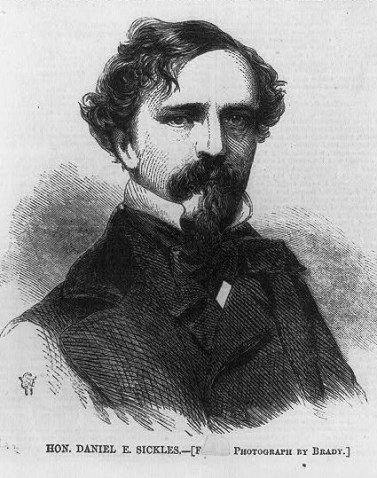
I am taking a break over this Thanksgiving weekend and am re-posting some articles from my Gettysburg text dealing with a man that I consider one of the most fascinating , salacious, scandalous, heroic, and incredible figures ever to grace and disgrace American history, Congressman, and Civil War General Daniel E. Sickles.

I hope that you enjoy,

Peace

Padre Steve+
sickles as brigadier


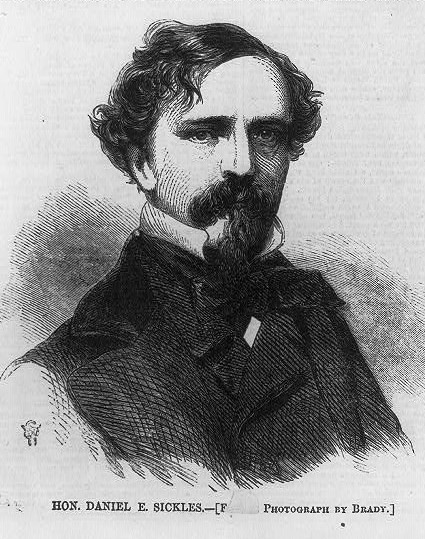
Dan Sickles completed his term in Congress making few speeches and maintaining a relatively low profile, frequently entering and leaving through side entrances. But as tensions rose and secession fever built, Sickles, the longstanding supporter of Southern states rights, who had declined to run for reelection “briefly transformed himself from outcast to firebrand” [1]when secessionist troops opened fire on the transport Star of the West when that ship attempted to deliver supplies to Fort Sumter. Surprising his Southern colleagues he declared the attack on the ship as “naked, unmitigated war,” and declared:

It will never do, sir, for them [the South] to protest against coercion and, at the same moment, seize all the arms and arsenals and forts and navy-yards and ships… when sovereign states by their own deliberate acts, make war, they must not cry peace… When the flag of the Union is insulted, when the fortified place provided for the common defense are assaulted and seized, when the South abandons its Northern friends for English and French alliances, then the loyal and patriotic population of that imperial city [New York] are unanimous for the Union.” [2]

He declared the assault to an act of war, and predicted that “the men of New York would go in untold thousands anywhere to protect the flag of its country and to maintain its legitimate authority.” [3] Sickles’ speech was electrifying and heartened back to his early career and what might have been, and during the remaining days of his term he continued to speak out in the House against the actions of the South and sponsored legislation to bills to suspend postal service with the South and recover the funds in the United States Mint buildings which had been seized by seceding states. He thundered in the presence of Southern friends still serving in the House, “Surely the chivalrous men of the South would scorn to receive the benefit of our postal laws,… “They cannot intend to remain, like Mahomid’s coffin, between heaven and earth, neither in nor out of the Union, getting all the benefits, and subjecting us to all its burdens.” [4]

Shortly thereafter Dan Sickles left Washington to what many thought would be political and possibly personal oblivion, but they underestimated Sickles. Ambition and the desire for redemption still burned in his heart, and shortly after President Lincoln called for 75,000 volunteers to put down the rebellion, Sickles volunteered to help raise and lead the men of the Empire State into battle to restore the Union. As the future commander of a one of the regiments, the French born journalist, Regis De Trobriand, noted “during the lead-up to Sumter, Dan had been among the conciliatory and moderate, “but when the sword was drawn, he was one of the first to throw away the scabbard.” [5]

sickles-brigade

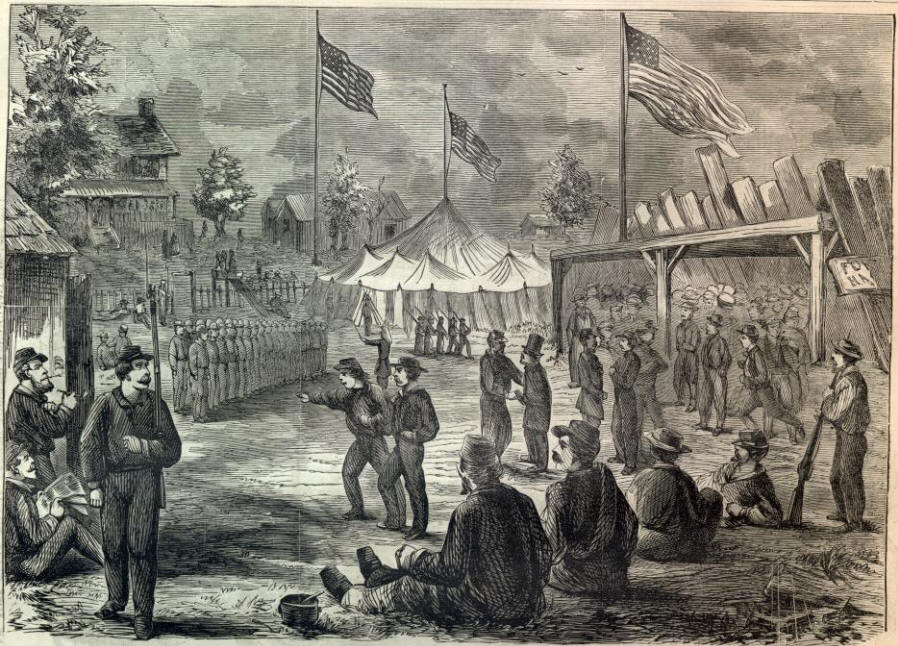
Taking up the challenge to raise a regiment sickles went to work, and “almost overnight, using flag-waving oratory, organizational skills, and promissory notes, he had his regiment, the 70th New York volunteers well in hand.” [6] Soon his authority was expanded to recruit a brigade, which rapidly filled with volunteers, soon over 3,000 men were under his command, and the new brigade, consisting of the 70th, 71st, 72nd, 73rd and 74thNew York Volunteers which Sickles promptly christened the Excelsior Brigade, taking on the Empire State’s motto. However many of the brigade’s volunteers were scorned because of Sickles’ reputation, the brigade’s historian wrote, “no name was too bad for you; one would call you this and another would call you that, and even a person’s own relatives would censure him for joining such a Brigade as that of Daniel E. Sickles.”[7]

Even so, Sickles rapidly captured the hearts of his men. Volunteers were found throughout New York, as well as New Jersey, Ohio, and Pennsylvania, and the men represented the spectrum of White America; men of traditional Anglo-Saxon origin mingled with Irish, Germans, and Dutch. But he was so successful in recruiting that organizers of other regiments, especially in rural New York counties demanded that the Republican governor, Edward Morgan, order Sickles to disband most of the brigade. Believing the action politically motivated, Sickles refused and went directly to Lincoln to get the brigade Federal recognition. At first Lincoln balked at the request, he needed troops but was yet unwilling to get in the way of what he saw as the individual state control of their militias. The result was an impasse as Federal and New York officials argued about the brigade and the status of Sickles himself.

Sickles organizational and leadership skills were tested by the situation, and he went to extraordinary lengths to meet the needs of his soldiers for housing, food and sanitation, “and financed its camp for some time out of his own purse…. At one point he rented a circus tent from P.T. Barnum to house several hundred of his recruits. At another, with several companies or more quartered in a bare hall on lower Broadway, he contracted a cheap bath-house to give fourteen hundred men a shave and shower at ten cents apiece.” [8] To meet the need for cooked meals Sickles’ old friend Captain Wiley “commandeered cooks for the brigade from Delmonico’s, working in inadequate kitchens in side streets, they tried to turn out enough food for the men.” [9] Eventually the brigade was given a campsite on “Staten Island, near Fort Wadsworth, where he and his men could wait until the issue of mustering-in was settled.” [10]

Finally in July of 1861 the Excelsiors were officially mustered in to service as New York Volunteer troops and Sickles commissioned as a Colonel, functioning as the commander of the 70th New York and the de-facto commander of the brigade. Lincoln nominated Sickles for a commission as a Brigadier General of Volunteers but due to pressure from New York officials, still steaming at Sickles for going to Lincoln, and the Senate delated confirmation for months, forcing Lincoln to re-nominate him a second time after which they confirmed him in May 1862, in some measure due to the influence of Sickles former defense attorney, Edwin Stanton who had succeeded Simon Cameron as Secretary of War.

Sickles and his brigade first saw combat at Fair Oaks during the Seven Day’s battle. Sickles acquitted himself well during the fighting, he seemed to be a natural leader of men, who cheered him as he led them into battle. The actions of the Excelsiors and their newly minted Brigadier were praised by the Army commander, George McClellan in a letter to Stanton, “The dashing charge of the Second and Fourth Regiments,…”the cool and steady advance of the Third, occurred under my immediate observation and could not have been surpassed.” [11] A news correspondent attached to the army wrote:

“Gen. Sickles had several narrow escapes; he was always to be found in the thickest of the fight. Had those gifted Senators who refused to confirm his nomination, but witnessed the enthusiasm of his troops when serving under him, and his military qualifications for office, they would do penance until re-elected.” [12]

The success at Fair Oaks was not followed up by McClellan, despite the urging of many officers, including Sickles and Richmond, which many believed could have been taken, remained in Confederate hands. Sickles performance during the Peninsular Campaign won Dan the respect and affection of his soldiers, as well as the respect of his division commander Fighting Joe Hooker. Unlike many other leaders who in their first taste of combat on the Peninsula saw the terrible carnage of battle, the immense numbers of casualties, and the suffering of the troops, Sickles maintained his composure, as others collapsed, “neither the casualties nor the state of the earth daunted Sickles.” [13] Hundreds of his Excelsiors, including his own aid-de-camp were killed or wounded during the campaign, and “the Excelsior Brigade, through steadily reduced by deaths, wounds and illness, had been forged into a body of hard-bitten, battle-wise soldiers educated in the necessities of war and in the tricks of self-preservation.” [14] A member of the brigade wrote, “It is no fable about the men of this Brigade thinking a great deal of the General.” [15]

Following the army’s withdraw from the Peninsula and its return to encampments near Washington D.C. Sickles went back to New York to raise new troops to replace those killed or wounded during the campaign. He also took time to organize efforts to care of the children of the brigade’s soldiers, living and dead who were being taken care of at the Union Home School. Due to this he missed the battles of Second Bull Run and Antietam. His recruiting efforts were successful, even former political enemies were impressed by his service, and his ability to raise and organize troops. His reputation had been so completely rehabilitated by his war service that some of his “old backers in Tammany wanted him to run again for Congress,” [16] but he was opposed by others, like his old friend Sam Butterworth, who had become a “Copperhead,” an anti-war, faction that wanted to end the war and let the South go on its way; “to them, Dan had become a Lincoln man, a crypto-Republican.” [17] the relief of many of his troops he declined the offer to run again. As one of his Chaplains, Joseph Twitchell noted Sickles, “is getting fixed in his new place most successfully and will probably serve himself, as well as the country, better here than in a war of words.” [18]

Sickles-Excelsior-Brigade-Headquarters-City-Hall-Park.-Yorktown

During his recruiting efforts Sickles, now a military, as well as political realist, made many speeches, in which he recognized that conscription was inevitable. Having seen the brutal cost of war and the suffering of his men, Sickles complained of the lack of effort being provided in New York to the war effort. In a speech at the Produce Exchange, he praised the leadership and nerve of President Lincoln, and said, “A man may pass through New York, and unless he is told of it, he would not know that this country is a war…. In God’s name, let the state of New York have it to say hereafter that she furnished her quota for the army without conscription – without resorting to a draft!” [19]

When he returned to the army in November of 1862 his old division commander, Hooker had been promoted to corps command following the relief of George McClellan, and as the senior brigadier was promoted to command of the division. His, division, the Second Division of Third Corps was used in a support role at Fredericksburg and saw little action in that fight and only suffered about 100 casualties. His old friend and defense counsel Thomas Meagher, now commanding the Irish Brigade saw his brigade shattered in the carnage of at Fredericksburg. After Ambrose Burnside who had commanded the army during that fiasco was relieved of command Hooker was appointed by Lincoln as commander of the Army of the Potomac.

One of Hooker’s organizational changes was to establish a Cavalry Corps which was to be commanded by Major General George Stoneman, the commander of Third Corps. This left “Sickles as the corps’ ranking officer.” [20] Sickles was promoted to command the Third Corps by Hooker, who chose Sickles over another volunteer officer, David Birney. Had a professional officer rather than Birney been his competition, “Sickles would have remained division commander.” [21] Sickles was given the corps “on a provisional basis, for his appointment as a major general had not yet been confirmed by the Senate and corps command was definitely a two-star job.” [22]Once again it was political enemies in the Senate, this time Republicans who did not trust the Democrat, who delayed Sickles’ promotion to Major General, but he was finally confirmed on March 9th 1863, with his promotion backdated to November 29th of 1862. “Professionals in the army attributed his rise to his “skill as a political maneuverer.” Few men, however, questioned his personal bravery.” [23]

To be continued…

Notes

[1] Ibid. Hessler Sickles at Gettysburg p.21

[2] Ibid. Hessler Sickles at Gettysburg p.111

[3] Ibid. Keneally American Scoundrel p. 212

[4] Ibid. Keneally American Scoundrel p.214

[5] Ibid. Keneally American Scoundrel p.219

[6] Ibid. Sears Controversies and Commanders p.201

[7] Ibid. Hessler Sickles at Gettysburg p.23

[8] Ibid. Catton Glory Road p. 153

[9] Ibid. Keneally American Scoundrel p.222

[10] Ibid. Keneally American Scoundrel p.222

[11] Ibid. Hessler Sickles at Gettysburg pp.30-31

[12] Ibid. Swanberg Sickles the Incredible p.149

[13] Ibid. Keneally American Scoundrel p.245

[14] Ibid. Swanberg Sickles the Incredible p.153

[15] Ibid. Wert The Sword of Lincoln p.222

[16] Ibid. Hessler Sickles at Gettysburg p.32

[17] Ibid. Keneally American Scoundrel p.245

[18] Ibid. Hessler Sickles at Gettysburg p.32

[19] Ibid. Keneally American Scoundrel p.252

[20] Ibid. Wert The Sword of Lincoln p.223

[21] Ibid. Sears Controversies and Commanders p.206

[22] Ibid. Swanberg Sickles the Incredible p.168

[23] Ibid. Wert The Sword of Lincoln p.223

Leave a comment

Filed under civil war, History, leadership, Military

Dan Sickles the Incredible Scoundrel and Patriot Part One

Friends of Padre Steve’s World,

I am taking a break over this Thanksgiving weekend and am re-posting some articles from my Gettysburg text dealing with a man that I consider one of the most fascinating , salacious, scandalous, heroic, and incredible figures ever to grace and disgrace American history, Congressman, and Civil War General Daniel E. Sickles.

I hope that you enjoy,

Peace

Padre Steve+

6517740_orig


George Meade had made his dispositions on July 2nd 1863 with care, but there was one notable problem, the commander of III Corps, Major General Dan Sickles did not like the position assigned to his corps on the south end of Cemetery Ridge. But before discussing that it is worth chasing the rabbit so to speak and spend some time on the life of a man referred to by one by one biographer as an American Scoundrel and another as Sickles the Incredible. The interesting thing is that lie most complex characters in history that Dan Sickles was both and, “he might have had more faults than virtues, but everything about him was perfectly genuine.” [1] That is one of the reason that he is so fascinating.

Sickles was certainly a scoundrel and at the same time incredible, charming yet terribly vain and often insincere. “He was quick-witted, willful, brash, and ambitious, with pliable moral principles.” [2] But he was also incredibly brilliant, far sighted, patriotic, and civic minded. He was a political general, “flamboyant, impulsive, and brave, some would wonder about his discipline and military judgement.” [3] His notoriety and unpopularity among the West Point trained professional officers in the Army of the Potomac, as well as his tactical decision to move his corps on the afternoon of July 2nd 1863, and his subsequent political machinations ensured that he would be the only corps commander of that army not commemorated with a monument at Gettysburg.

Dan Sickles was one of the most colorful, controversial, and perhaps the most scandalous officer ever to command a corps in the history of the United States Army. While he lacked professional training he had done a fair amount of study of the military arts in his spare time, and he “made up for his lack of military training by acting on the battlefield with reckless courage, and was much admired for it by his men.” [4]

After having served as a brigade and division commander Sickles was promoted to corps command. “Sickles owed his elevation to corps command to the patronage of his friend Joseph Hooker…. And while man of the West Point officer….regarded Sickles military acumen with the greatest skepticism, many in the volunteer ranks were of a different mind. “Sickles is a great favorite in this corps,” asserted Private John Haley of the 17th Maine. “The men worship him. He is every inch a soldier and looking like a game cock. No one questions his bravery or patriotism.” [5] General Alpheus Williams who commanded a division in the Union Twelfth Corps despised Sickles, and after Chancellorsville Williams wrote “A Sickles’ would beat Napoleon in winning glory not earned,,, He is a hero without a heroic deed! Literally made by scribblers.” [6] Likewise, Sickles, the political general was no favorite of George Gordon Meade.

On July 2nd 1863 Sickles would be responsible for an act that threw George Meade’s defensive plan into chaos, and according to most historians and analysts nearly lost the battle, however, there are some who defend his actions and give him credit for upsetting Lee’s plan of attack. However, the truth lays somewhat in the middle as both observations are correct. Sickles’ decision created a massive controversy in the months following the battle as public hearings in Congress, where Sickles, a former congressman from New York had many friends, as well as enemies, sought a political advantage from a near military disaster.

Sickles was a mercurial, vain and scandal plagued man who “wore notoriety like a cloak” and “whether he was drinking, fighting, wenching or plotting, he was always operating with the throttle wide open.” [7]Sickles was born in New York to George and Susan Marsh Sickles in late 1819, though a number of sources, including Sickles himself cite dates ranging from 1819 through 1825. “There is little reliable information about Sickles’ early days,” [8] and he did not talk much about them, especially after the war, when Gettysburg and the Civil War became his main subjects of conversation. His father, a sixth generation American whose family were early Dutch settlers in Manhattan became wealthy through real estate speculation, “and he passed on to his son a pride in being a congenital Knickerbocker,” charming, witty, and clever, in whom “hardheadedness and impulsiveness were combined.” [9]

The young Sickles was an impetuous child and his father’s wealth ensured that Dan Sickles had “the finest of tutors…. And an unceasing bankroll of funding for lascivious escapades.” [10] To get their son special tutoring to prepare him for college, his parents “arranged for him to live in the scholarly house of the Da Pont family…. It was a household like few others in that hardheaded, mercantile city, at a time when New York had little of the Italian character it would later take on.” [11]The home was a place of learning, culture, and unusual relationships. The head of the house was Lorenzo L. Da Pont, a Professor at Columbia, as well as a practicing attorney. Also living in the home was Da Pont’s father, the ninety-year-old Professor Lorenzo Da Pont, who “had been the librettist for three of Mozart’s operas” [12] and “held the chair of Italian and Columbia University” [13] Additionally, the elder Da Pont’s “adopted daughter Maria and her husband, Antonio Bagioli, a successful composer and music teacher” [14] lived under the same roof.

Maria was only about twenty-years-old when Sickles moved in. By this time she and Bagioli already had a child of their own, a three year old daughter named Teresa, which Sickles would eventually marry. While the elder Da Pont claimed Maria as an adopted daughter, it was “widely believed that she was his “natural child” … from an American liaison conducted when he was near the age of seventy.” [15] This spawned rumors, even at the time of Gettysburg that the young Sickles “and his future mother-in-law had a sexual affair.” [16]

Whether the liaison with Maria Bagioli occurred is a matter of innuendo and conjecture, but it would not be out of character for Sickles, who, to put it mildly, had a wild proclivity for the opposite sex. As a young man he frequented brothels, and as his social and political status increased, he moved from the brothels frequented by the middle class to those which catered to the more socially well to do. One of his affairs was with the a prostitute named Fanny White, a woman who was smart, pretty, and upwardly mobile who ran her own bordello. His affair with Fanny was well publicized, but did not prevent him from being elected to the state legislature in 1847. She and Sickles would continue their relationship for years with her asking nothing more than expensive gifts, and there are inklings that Fanny help to fund Sickles’ early political campaigns. There is also speculation that in 1854 following his marriage, that Fanny spent time with him in London while he was working with James Buchanan and that that he “may have brought Fanny to one of the Queens’s receptions and introducing the prostitute to Her Majesty.” [17] But Fanny eventually moved on to a man older and richer than Sickles. Eventually she retired from her business and married another New York lawyer but died of complications of tuberculosis and possibly syphilis in 1860. Her property at the time of her death was conservatively “estimated at $50,000 to $100,000”[18] a considerable fortune for a woman of her day and age.

While he lived with the Da Pont family, Sickles gained an appreciation for foreign languages, as well as theater and opera. The elder Professor Da Pont was a major part of his academic life and quite possibly in the development of Sickles liberal education and his rather libertine morality. Lorenzo had been a Catholic Priest and theologian in Italy, but like his young American admirer had quite the attraction for women, and was a connoisseur of erotic literature and poetry. His activities resulted in him being expelled from his teaching position in the seminary, after which he became fast friends with a man whose name is synonymous with smooth talking, suave, amorous men, Giacomo Casanova, and in Europe “his affairs with women had been almost as notorious as those of his good friend.” [19] Certainly the elder Lorenzo’s tales “of Casanova, the fabled prince of Priapus, did nothing to quell Dan’s adolescent sexual appetite.” [20]

Noted Civil War and Gettysburg historian Allen Guelzo describes the Sickles in even less flattering terms, “Sickles was from the beginning, a spoiled brat, and he matured from there into a suave, charming, pathological liar, not unlike certain characters in Mozart operas.”[21]

Following the deaths of both the elder and younger Professor Da Pont, Sickles was stricken with grief. At the funeral of the younger Professor Da Pont Sickles “raved and tore up and down the graveyard shrieking,” [22] forcing other mourners to take him away by force. Soon after, Sickles left New York University and began to work in the law office of the very formidable New York lawyer and former U.S. Attorney General, Benjamin F. Butler.

While he was studying for the bar under Butler, he was joined by his father who would also become an attorney. It was under the influence of his father, who was now a wealthy Wall Street investor, and the Democrats of Tammany Hall that the incredibly talented Sickles was groomed for political leadership. Tammany was a rough and tumble world of hardnosed politics, backroom deals, corruption and graft.

He passed the bar in 1843 and soon was making a name for himself in the legal world, and in politics, despite his well-known questionable ethics and morality. His political career began in 1844 when “he wrote a campaign paper for James Polk and became involved in the Tammany Hall political machine.” [23] The ever ambitious Sickles “clambered up the city’s Democratic party ladder, on the way collecting allies and enemies with utter disregard for the consequences, attending the typically unruly Tammany meetings armed with bowie knife and pistol.” [24]

Like many of his fellow New York Democrats he was a proponent of “Manifest Destiny, and the right of the United States to acquire and hold Texas, New Mexico, California, perhaps the isthmus of Central American, and certainly Cuba.” [25] He was also a political ally of many states rights Southern Democrats and “largely opposed anti-slavery legislation.” [26] This was in large part due to the commercial interests of New York, which between banking and commercial shipping interests profited from the South’s slave economy.

He was elected to the New York State legislature in 1847 and his political star continued to rise even as his personal reputation sank among many of his peers. An attorney who knew him described Sickles as “one of the bigger bubbles in the scum of the profession, swollen, and windy, and puffed out with fetid gas.” [27] Sickles rivals any American politician, before or since in his ability to rise even as the slime ran down his body, the term “Teflon” applied to politicians like Presidents Ronald Reagan and Bill Clinton comes to mind when one studies Sickles’ career. New York lawyer and diarist George Templeton Strong wrote, “One might as well try to spoil a rotten egg as to damage Dan’s career.” [28]

But there was no denying that Sickles was a brilliant lawyer, politician, and debater. One observed that Sickles was “a lawyer by intuition – careful in reaching his conclusions, but quick and bold in pushing them.” [29]New York Governor “William Marcy grudgingly said that as a debater Sickles excelled any man of his years, and the astute Henry Raymond declared that as a parliamentary leader he was unsurpassed.” [30] Soon Sickles was a delegate to the 1848 Democratic Convention where he helped nominate Franklin Pierce for his unsuccessful run at the democratic nomination. The convention enabled Sickles to enter the world of national politics making friends with many influential politicians and financiers, including Pierce, the Van Burens, and James Buchanan. On his return to New York he received an appointed as a Major in the New York Militia.

Even as Sickles rose in the tumultuous world of American law and politics, and chased Fanny White he became enamored with the now teenage daughter of Antonio and Maria Bagioli, Miss Teresa Bagioli who though only fifteen was beautiful, wise beyond her years, fluent in French and Italian, devoted to the arts, and entirely besotted by Dan Sickles. Both the parents of Sickles and Teresa opposed the relationship, but both were madly in love, and Teresa was as headstrong as Dan regarding the relationship. Though such a relationship would be considered completely scandalous today, such marriages were not uncommon then, though they were certainly less common in the upper society of New York. Sickles “was enchanted by her” and “courted her with the sensibility of being a friend of her parents and he must have suspected that he loved her with a fated and exclusive love.” [31] When she was just sixteen Teresa quit school and married the thirty-three year-old assemblyman in a civil ceremony officiated by New York Mayor Ambrose Kingsland on September 27th1852. Six months later, the two were married in the Catholic Church by Archbishop John Hughes, in a “gala and largely attended affair.” [32] Just three months after the church wedding their daughter, Laura, was born. Though there can be no doubt that Sickles loved Teresa, and she him, it did not stop him from other extramarital affairs, nor did it take much away from his political machinations at Tammany Hall.

Following the 1852 Democratic convention where he again supported Franklin Pierce, Sickles hard fighting and influence at in the Wigwam of was rewarded with political plum prize of being appointed “corporation counsel of New York City, a post that paid a flattering salary with extra emoluments and also left room for profitable legal work on the side.” [33] His political and social acumen were again demonstrated as he convinced the state legislature, through personal force of will, to enable the New York City Corporation “to go ahead with creating a great central park,”[34] a park that we now know today as Central Park. He also helped push forward a proposal to create New York’s first mass transportation system, that of horse drawn omnibuses.

Later in the year Sickles was appointed as secretary of the American legation to the Court of St. James n London, headed by former Secretary of State James Buchanan. The position paid a pittance of what Sickles was earning in New York, but he realized that the serving overseas in such a position could not but help him on the national political stage. Though Buchanan and Pierce wanted Sickles, the new Secretary of State, the former New York Governor William Marcy refused to sign Sickles’ commission for the post. Eventually, Pierce prevailed and Sickles got the job.

As their baby, Laura, was still very young and sea travel still quite hazardous, Teresa remained at home, and joined her husband in London the following year. However, when she arrived in London, the teenage wife of Dan Sickles charmed Americans and Britons alike. Aided by her multilingual gifts, which “were rare among American diplomats’ wives,” [35] she became a great success and the unmarried Buchanan appointed her as hostess for the legation. She rapidly became a celebrity due to her stunning beauty and charm, and like he had Fanny, Sickles had Teresa introduced to the Queen. Her celebrity status evoked different responses from those that observed her. “One contemporary described Teresa as an Italian beauty, warm, openhearted, and unselfish. Another described her as being “… without shame or brain and [having] a lust for men.” [36] That “lust for men” coupled with the neglect of her husband may well have been the catalyst for the scandal which overwhelmed them in Dan’s congressional career.

It was during his service in London with Buchanan that Sickles became embroiled in one of the most embarrassing diplomatic incidents in American history. The proponents of Manifest Destiny and American expansion had long desired to take Cuba from Spain through diplomacy, or if needed force. Following a failed attempt by American “Filibusters” to seize the island in 1852 which ended in the execution of fifty Americans, including the son of U.S. Attorney General John Crittenden by Spanish authorities, and in 1854 President Franklin Pierce authorized Buchanan to attempt to negotiate the acquisition of Cuba.

Pierce authorized Buchanan to meet with James Mason, the United States Ambassador to France and Pierre Soule, the United States Ambassador to Spain secretly in order to draft “a statement on the future of Cuba and the proposed role of the United States.” [37] Soule dominated the meeting and the statement, which was in large part drafted by Dan Sickles, was highly inflammatory. Despite this the statement was released to the press in defiance of the order to maintain the strictest secrecy and it resulted in a diplomatic disaster for the Pierce Administration.

The document was prepared by Soule and Sickles and endorsed by Buchanan and Mason was known as the Ostend Manifesto, and it “was one of the most truly American, and at the same time most undiplomatic, documents every devised.” [38] The manifesto prepared by Soule and Sickles proclaimed that “Cuba is as necessary to the North American Republic as any of its present members, and that it belongs naturally to the great family of states of which the Union is the Providential Nursery.” [39] The authors of the manifesto also threatened Spain should the Spanish fail to accede to American demands. The authors declared that if the United States “decided its sovereignty depended on acquiring Cuba, and if Spain would not pass on sovereignty in the island to the United States by peaceful means, including sale, then, “by every law, human and Divine, we shall be justified in wresting it from Spain.” [40]

The Ostend Manifesto “sent shivers through the chancelleries of Europe, provoked hurried conversations between the heads of the French and British admiralties.” [41] European diplomats and leaders reacted harshly to the statement and Secretary of State William Marcy who had previously supported the ideas in the document immediately distance himself and official American policy from it and the authors. Marcy then “forced Soule’s resignation by repudiating the whole thing, but the damage was done.” For months the Pierce administration was on the defensive, and was condemned “as the advocate of a policy of “shame and dishonor,” the supporter of a “buccaneering document,” a “highwayman’s plea.” American diplomacy, said the London Times, was given to “the habitual pursuit of dishonorable object by clandestine means.”[42] The incident ended official and unofficial attempts by Americans to obtain Cuba by legal or extralegal means until the Spanish American War in 1898.

To be continued…

Notes

[1] Catton, Bruce The Army of the Potomac: Glory Road Doubleday and Company, Garden City New York, 1952 p.151

[2] Wert, Jeffry D. The Sword of Lincoln: The Army of the Potomac Simon and Schuster, New York and London 2005 p.222

[3] Ibid. Coddington The Gettysburg Campaign a Study in Command p.45

[4] Sears, Stephen W. Chancellorsville Houghton Mifflin Co. Boston and New York 1996 p.65

[5] Ibid. Trudeau Gettysburg a Testing of Courage p.110

[6] Ibid. Sears Gettysburg p.35

[7] Ibid. Catton The Army of the Potomac: Glory Road pp.150-151

[8] Hessler, James A. Sickles at Gettysburg Savas Beatie New York and El Dorado Hills CA, 2009, 2010 p.1

[9] Keneally, Thomas American Scoundrel: The Life of the Notorious Civil War General Dan Sickles Anchor Books, a Division of Random House, New York 2003 p.7

[10] Ibid. Guelzo, Gettysburg The Last Invasion p.243

[11] Ibid. Keneally American Scoundrel p.3

[12] Ibid. Hessler Sickles at Gettysburg p.2

[13] Ibid. Keneally American Scoundrel p.3

[14] Ibid. Hessler Sickles at Gettysburg p.3

[15] Ibid. Keneally American Scoundrel p.4

[16] Ibid. Hessler Sickles at Gettysburg p.3

[17] Ibid. Hessler Sickles at Gettysburg p.6

[18] Ibid. Keneally American Scoundrel p.215

[19] Swanberg, W.A. Sickles the Incredible copyright by the author 1958 and 1984 Stan Clark Military Books, Gettysburg PA 1991 p.79

[20] Ibid. Swanberg Sickles the Incredible p.80

[21] Ibid. Guelzo, Gettysburg The Last Invasion p.243

[22] Ibid. Swanberg Sickles the Incredible p.81

[23] Ibid. Hessler Sickles at Gettysburg p.4

[24] Sears, Stephen W. Controversies and Commanders Mariner Books, Houghton-Mifflin Company, Boston and New York 1999 p.198

[25] Ibid. Keneally American Scoundrel p.12

[26] Ibid. Swanberg Sickles the Incredible p.82

[27] Ibid. Wert The Sword of Lincoln p.222

[28] Ibid. Hessler Sickles at Gettysburg p.4

[29] Ibid. Swanberg Sickles the Incredible p.84

[30] Ibid. Swanberg Sickles the Incredible p.84

[31] Ibid. Keneally American Scoundrel p.21

[32] Wilson Robert and Clair, Carl They Also Served: Wives of Civil War Generals Xlibris Corporation 2006 p.98

[33] Ibid. Swanberg Sickles the Incredible p.88

[34] Ibid. Keneally American Scoundrel p.21

[35] Ibid. Keneally American Scoundrel p.39

[36] Ibid. Wilson and Clair They Also Served p.98

[37] Ibid. Keneally American Scoundrel p.44

[38] Pinchon, Edgcumb Dan Sickles: Hero of Gettysburg and “Yankee King of Spain” Doubleday, Doran and Company Inc. Garden City NY 1945 p.48

[39] Ibid. Potter The Impending Crisis p.190

[40] Ibid. Keneally American Scoundrel p.45

[41] Ibid. Pinchon Dan Sickles p.48

[42] Potter, David M. The Impending Crisis: America before the Civil War 1848-1861 completed and edited by Don E. Fehrenbacher Harper Collins Publishers, New York 1976 p.193

Leave a comment

Filed under civil war, ethics, History, leadership

John F. Kennedy and Civility

Friends of Padre Steve’s World,

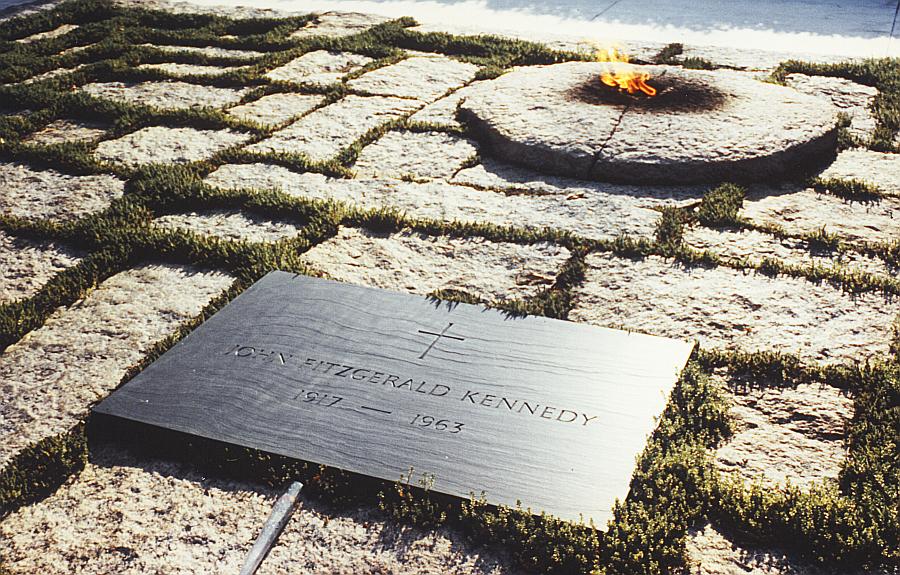
Fifty-three years ago President John F. Kennedy was assassinated by Lee Harvey Oswald in Dallas Texas. Despite his many flaws he was an inspiring American hero. Today I am taking the time to remember something that he said that is so lacking in our political discourse today.

Peace

Padre Steve+

John F. Kennedy said:“So let us begin a new remembering on both sides that civility is not a sign of weakness, and sincerity is always subject to proof. Let us never negotiate out of fear. But let us never fear to negotiate.”

Some fifty-six years ago a young, handsome Irish Catholic from Massachusetts took the oath of office of the President of the United States. President John F. Kennedy had won an exceptionally close Presidential Race against Republican Voce President Richard M. Nixon, a race that some believe was decided by votes of the dead in places like Chicago and West Virginia. Despite the contested nature of the election Nixon was gracious and conceded the race to avoid deeper division.

Fifty years ago today that young President was gunned down in Dealey Plaza in Dallas Texas by Lee Harvey Oswald. It was an event that shattered our nation which helped in many ways to foment the deep and abiding cynicism that is the hallmark of our recent political landscape.

The Kennedy administration had a wonderful vision but was not always successful. In fact there were time its policies and actions were in the case of the Bay of Pigs Invasion were mired in controversy. Decisions made by Kennedy to send more advisors to Vietnam would be followed by the Johnson Administration sending combat troops. Kennedy played a high stakes game of chess with Nikita Khrushchev during the Cuban Missile Crisis where the world came perilously close to nuclear war.

That being said he also inspired and energized Americans and our Allies to greatness. Kennedy’s speech at the Berlin Wall where he identified himself with the city saying “Ich bin Ein Berliner” inspired many in Germany who realized that in Kennedy they had a friend who would not abandon them.

Kennedy challenged us as Americans to put a man on the moon by 1970. He  supported NASA as they began to develop the Apollo program which did achieve that lofty goal when Apollo 11 landed on the Moon on July 11th 1969.

Kennedy was a visionary. He supported the establishment the Army Special Forces, or the Green Berets.  He helped to found and promote the Peace Corps.  His economic policies were fiscally conservative but did not ignore the poor. He pushed for equal rights for African Americans against a much divided nation.

jfkptfloat

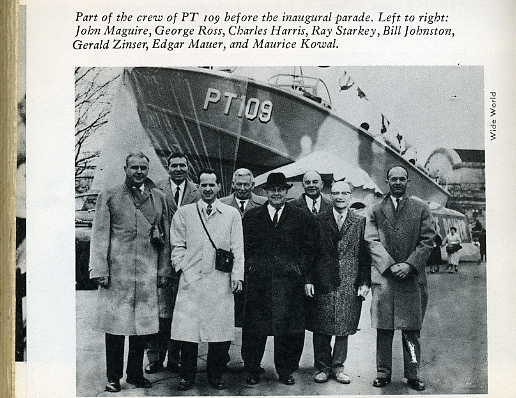
As I said, Kennedy was a flawed man. A deeply flawed man. I have written about that before. He was not known for his sexual morality and the stories of him with various mistresses including Marilyn Monroe abound. At the same time he was a hero. He volunteered to serve on PT Boats in the Second World War when his political connections would have ensured him a billet in a non-combat area and his physical condition would have exempted him from any military service.

Kennedy died 50 years ago today. He was the victim of an assassin’s bullet in Dealey Plaza in Dallas Texas with his wife Jackie at his side. His death stunned the nation and in a sense ended our innocence.  Since that time American politics has been on a slow but steady descent into darkness which both parties have aided and abetted to the point that they view each other as mortal enemies and along with it have devastated our body politic.

JOHN F KENNEDY FUNERAL

In our divided state it seems that the nation has become nothing more than a collection of special interest groups. Each group is driven by their own wants and needs above that of others goaded into a frenzy by politicians who cater to those needs whether they be tax breaks, entitlements or “pork barrel” projects which only benefit the political benefactors of the politicians. I know that American politics has always had such elements but I don’t think that my parents or those other young people who heard and responded to this speech ever imagined that we would come to this.

While Kennedy still has critics and was a flawed man I find him still to be a great and compelling President. He is one of my favorite Presidents in large part because he understood that “civility is not a sign of weakness.” In our current poisonous political environment this is something that all of us need to take to heart, especially people of faith who so often seem to be the least civil and most hateful in our society.

Kennedy was one of those rare leaders who called us to better as individuals and as a nation. Today we remember his life and the tragedy of his death.

But today I think about his inaugural address. It is a speech that in my opinion calls us as Americans to higher and better ideals. It is a speech that if we actually listen to it can still help point us away from the abyss which we are staring into. I have posted the text of the speech as well as a link to the video of it here.

In the hope that we can learn at home and abroad from John F Kennedy.

Vice President Johnson, Mr. Speaker, Mr. Chief Justice, President Eisenhower, Vice President Nixon, President Truman, Reverend Clergy, fellow citizens:

We observe today not a victory of party but a celebration of freedom, symbolizing an end as well as a beginning, signifying renewal as well as change. For I have sworn before you and Almighty God the same solemn oath our forbears prescribed nearly a century and three-quarters ago.

The world is very different now. For man holds in his mortal hands the power to abolish all forms of human poverty and all forms of human life. And yet the same revolutionary beliefs for which our forebears fought are still at issue around the globe – the belief that the rights of man come not from the generosity of the state but from the hand of God.

We dare not forget today that we are the heirs of that first revolution. Let the word go forth from this time and place, to friend and foe alike, that the torch has been passed to a new generation of Americans, born in this century, tempered by war, disciplined by a hard and bitter peace, proud of our ancient heritage, and unwilling to witness or permit the slow undoing of those human rights to which this nation has always been committed, and to which we are committed today at home and around the world.

Let every nation know, whether it wishes us well or ill, that we shall pay any price, bear any burden, meet any hardship, support any friend, oppose any foe to assure the survival and the success of liberty.

This much we pledge – and more.

To those old allies whose cultural and spiritual origins we share, we pledge the loyalty of faithful friends. United there is little we cannot do in a host of cooperative ventures. Divided there is little we can do; for we dare not meet a powerful challenge at odds and split asunder.

To those new states whom we welcome to the ranks of the free, we pledge our word that one form of colonial control shall not have passed away merely to be replaced by a far more iron tyranny. We shall not always expect to find them supporting our view. But we shall always hope to find them strongly supporting their own freedom; and to remember that, in the past, those who foolishly sought power by riding the back of the tiger ended up inside.

To those people in the huts and villages of half the globe struggling to break the bonds of mass misery, we pledge our best efforts to help them help themselves, for whatever period is required – not because the communists may be doing it, not because we seek their votes, but because it is right. If a free society cannot help the many who are poor, it cannot save the few who are rich.

To our sister republics south of our border, we offer a special pledge: to convert our good words into good deeds in a new alliance for progress; to assist free men and free governments in casting off the chains of poverty. But this peaceful revolution of hope cannot become the prey of hostile powers. Let all our neighbors know that we shall join with them to oppose aggression or subversion anywhere in the Americas. And let every other power know that this Hemisphere intends to remain the master of its own house.

To that world assembly of sovereign states, the United Nations, our last best hope in an age where the instruments of war have far outpaced the instruments of peace, we renew our pledge of support, to prevent it from becoming merely a forum for invective, to strengthen its shield of the new and the weak, and to enlarge the area in which its writ may run.

Finally, to those nations who would make themselves our adversary, we offer not a pledge but a request: that both sides begin anew the quest for peace, before the dark powers of destruction unleashed by science engulf all humanity in planned or accidental self-destruction.

We dare not tempt them with weakness. For only when our arms are sufficient beyond doubt can we be certain beyond doubt that they will never be employed.

But neither can two great and powerful groups of nations take comfort from our present course – both sides overburdened by the cost of modern weapons, both rightly alarmed by the steady spread of the deadly atom, yet both racing to alter that uncertain balance of terror that stays the hand of mankind’s final war.

So let us begin a new remembering on both sides that civility is not a sign of weakness, and sincerity is always subject to proof. Let us never negotiate out of fear. But let us never fear to negotiate.

Let both sides explore what problems unite us instead of belaboring those problems which divide us.

Let both sides, for the first time, formulate serious and precise proposals for the inspection and control of arms – and bring the absolute power to destroy other nations under the absolute control of all nations.

Let both sides seek to invoke the wonders of science instead of its terrors. Together let us explore the stars, conquer the deserts, eradicate disease, tap the ocean depths and encourage the arts and commerce.

Let both sides unite to heed in all corners of the Earth the command of Isaiah to “undo the heavy burdens . . . (and) let the oppressed go free.”

And if a beachhead of cooperation may push back the jungle of suspicion, let both sides join in creating a new endeavor, not a new balance of power, but a new world of law, where the strong are just and the weak secure and the peace preserved.

All this will not be finished in the first one hundred days. Nor will it be finished in the first one thousand days, nor in the life of this Administration, nor even perhaps in our lifetime on this planet. But let us begin.

In your hands, my fellow citizens, more than mine, will rest the final success or failure of our course. Since this country was founded, each generation of Americans has been summoned to give testimony to its national loyalty. The graves of young Americans who answered the call to service surround the globe.

Now the trumpet summons us again; not as a call to bear arms, though arms we need; not as a call to battle, though embattled we are; but a call to bear the burden of a long twilight struggle, year in and year out, “rejoicing in hope, patient in tribulation” – a struggle against the common enemies of man: tyranny, poverty, disease and war itself.

Can we forge against these enemies a grand and global alliance, North and South, East and West, that can assure a more fruitful life for all mankind? Will you join in that historic effort?

In the long history of the world, only a few generations have been granted the role of defending freedom in its hour of maximum danger. I do not shrink from this responsibility; I welcome it. I do not believe that any of us would exchange places with any other people or any other generation. The energy, the faith, the devotion which we bring to this endeavor will light our country and all who serve it – and the glow from that fire can truly light the world.

And so, my fellow Americans: ask not what your country can do for you – ask what you can do for your country.

My fellow citizens of the world: ask not what America will do for you, but what together we can do for the freedom of man.

Finally, whether you are citizens of America or citizens of the world, ask of us here the same high standards of strength and sacrifice which we ask of you. With a good conscience our only sure reward, with history the final judge of our deeds, let us go forth to lead the land we love, asking His blessing and His help, but knowing that here on Earth God’s work must truly be our own.

Kennedy03290905

I do hope that we can after a half a century finally learn something from John F Kennedy.

Leave a comment

Filed under History, leadership, Political Commentary

Waiting for First Light: A Reflection on PTSD

img_0230-3

Friends of Padre Steve’s World,

I just finished reading General Romeo Dallaire’s latest book, Waiting for First Light: My Ongoing Struggle with PTSD. Dallaire had been the commander of the UN Peacekeepers in Rwanda, men and women who were prevented from stopping genocide, and people who have been forever haunted by what they witnessed.

General Dallaire recounts a story of horror that never ended for him, and he details how difficult and traumatic coming home that neither appreciate nor understood what he had been through, including people in the military. I found so much in his story that was analogous to my own and in light of that I am going to begin writing my PTSD memoir.

It will be hard because I will have to write about things that are deeply traumatic and upsetting, especially how I was received and continue to be received by most of my fellow chaplains. Because I came and publicly discussed my issues with PTSD, the shattering of my faith in so many things, my wilderness experience of being an agnostic for two years, and the change in my faith since then, I experienced the rejection of my former church and many of my peers.

To many of my peers and Chaplain Corps superiors I am simply a broken Chaplain; and broken chaplains or for that matter broken ministers have no place and very few people who they can talk with. I remember my old Commodore at EOD Group Two, Captain Tom Sitsch ask me bluntly “Where does a chaplain go for help?” My answer to him was “not to other chaplains.” Sadly, he too was going through his own personal PTSD hell and with his life falling apart he committed suicide in January 2014.

General Dallaire recounts a similar experience, as like Chaplains, Generals and other senior leaders have no place to go, they like us are not supposed to break. General Dallaire wrote: “I received little support from my colleagues and peers; I received only a few messages from my sixty or so fellow generals – a couple of phone calls, and an e-mail from one old friend. The others appeared to be in two camps: those who were too busy to get in touch, and those who didn’t know what to say.” But I would also add, that there are those that do not want to know and others who actually turn their backs on men and women whose injury lies inside their brain, as well as some chaplains and ministers who seem to take a certain perverse joy in inflicting pain.

So pray for me if you do that, if not send some positive thoughts my direction.

Until tomorrow,

Peace

Padre Steve+

2 Comments

Filed under faith, leadership, Military, ministry, PTSD

The Venomous Vulgarian: the Lasting Toxic Legacy of Donald Trump

Friends of Padre Steve’s World,

As I watched and listened to Donald Trump before and after the third and thankfully final debate of the 2016 Presidential election, I was struck with just how viscous, vulgar, and venomous this man is. I cannot remember anyone in American politics at the national level, Republican or Democrat, or for that matter even Whig, who ever managed to immerse himself so deeply into the amoral, unethical, and undemocratic sewer that Trump has bathed himself, the Republican Party and this nation. 

Trump’s toxicity is unparalleled in American politics. Everything and everyone who has ever had anything to do with him is poisoned by his touch. Wives, business partners, contractors, employees, political advisors, and supporters have all been stained by the Mustard Gas that Trump emits on a minute to minute basis. Maybe the most stained are the Evangelical Christian church leaders who have not only endorsed and defended Trump, but  who positively described his character as Christian and said nothing about Trump’s words and actions, which if an opponent had uttered, or had been accused, they would have excoriated with a particularly “Christian” self-righteousness.  Their actions have stained the witness of the church for at least the next generation and it is no wonder that young people are fleeing the church. I specifically use the imagery of Mustard Gas, not just because of its toxicity, but because of its persistence. The battlefields of World War One France and Belgium are still contaminated by it, and the toxic residue still injures people today. 

That my friends is the poisonous and corrosive effect of Donald Trump on this country.  He is a toxic and persistent threat to everyone, even his most devout followers. Race baiting, misogynistic, narcissistic, vulgar, and ignorant, Trump spews his vile venom of conspiracy theories wrapped in fiction, and coated in lies, and buttressed with near pornograpic misogyny in every direction. He has given his supporters in the heavily armed Alt-Right, the neo-Nazis, Klansmen, and White Supremacists the boldness to come out of hiding because he has normalized their hate, something that no Western statesman or politician has done since before the verdicts at Nuremberg. 

I have long felt that Trump reminded me of Nazi leaders, but frankly most of them, while every bit as toxic as Trump were both more intelligent and were better able to cover the darkness of their amoral souls with a modicum of respectability, with the exception of one; the publisher of the infamous newspaper Der Sturmer, and Gauleiter of Nuremberg, Julius Streicher. 

Robert Jackson, the Associate Justice of the Supreme Court who served as the Chief American Prosecutor at Nuremberg referred to Streicher in his summation: 

“Streicher, the venomous vulgarian, manufactured and distributed obscene racial libels which incited the populace to accept and assist the progressively savage operations of “race purification.” 

Is that not exactly what Trump has done during his seventeen month campaign to stir up race hatred against Mexicans and Arabs, not to mention Asians and Blacks? Of course it is, which is exactly why the leaders of the Alt-Right claim him as their candidate, the man who in their perverted minds has made them respectable again and ready to assume their place in Trump’s new order. Anti-Semitism and racism runs rampant in the words of his closest collaborators such as the Breitbart News chief Steve Bannon, as well as Alt-Right Neo-Nazi and KKK leaders like David Duke, Richard Spencer, Jared Taylor, and Peter Brimalow. 

My friends, what you see in Trump is what you get. Unlike Hitler and Goering, but much like Streicher, Trump has no capability of maintaining any sort of respectability. He has been stoking the fires of violence by claiming that the election is rigged and pumping up his followers for violence if he loses. 

Donald Trump is dangerous and will remain an enemy of the American experiment long after he is defeated on November 8th. 

Until tomorrow,

Peace

Padre Steve+ 

3 Comments

Filed under ethics, History, holocaust, leadership, News and current events, Political Commentary

The Cautionary Tale of the Desert Fox: The Murder of Field Marshal Erwin Rommel

rommel

Friends of Padre Steve’s World,

It was 72 years ago in Ulm Germany that a car pulled up to the residence of Field Marshal Erwin Rommel. In the car was the driver and two Generals dispatched by Hitler.  Rommel was recuperating following being severely wounded in an air attack in Normandy on July 17th 1944.

Rommel had been awarded the Pour le Merite, Imperial Germany’s highest award for valor in the First World War. He was never an official member of the Nazi Party, but like many Germans he believed Hitler’s promises and propaganda. As Hitler rose to power he like many others was carried away by early Nazi successes, the bloodless conquests of the Rhineland, Austria, Czechoslovakia, and the spectacle of the Olympics.

Like most other officers he would serve the regime as it spread its dark pall over Europe, and unlike so many others when he suffered a crisis in conscience about the Nazi leadership and their policies he refused to obey orders that he knew were illegal and immoral and then risked his life by joining the conspiracy to kill Hitler.

After years of stalled promotion, Hitler’s expansion of the military allowed Rommel to be promoted, and when Germany went to war he was commander of the unit which guarded Hitler’s headquarters train when he went into Poland. Rommel received command of the 7th Panzer Division after Poland and as a division commander in France he led his troops on some of the most epic advances of the French campaign.

He was then given command of the troops sent to bail out Mussolini’s failed African adventure. His small force and always ill-supplied force, which became known as the Afrika Korps scored impressive victories against British forces. In Africa, Rommel gained fame and earned rapid promotion. Though Africa was a sideshow in the Nazi war effort, Rommel became a poster-child for Joseph Goebbels’ propaganda machine. His fame also earned the resentment of many fellow officers who because he was not an officer of the General Staff regarded him with jealous envy and distain. Even so, Rommel was a soldier’s soldier. He believed in sharing in the suffering of his troops. He once said:Be an example to your men in your duty and in private life. Never spare yourself, and let the troops see that you don’t in your endurance of fatigue and privation. Always be tactful and well-mannered, and teach your subordinates to be the same. Avoid excessive sharpness or harshness of voice, which usually indicates the man who has shortcomings of his own to hide.”

bundesarchiv_bild_146-1991-031-25a_nordafrika_vor_tobruk_rommel

That was until he discovered the reality of Hitler’s promises as the troops of the Afrika Corps found themselves subjected to constant privation from lack of supply, air support and reinforcements. As commander of the Afrika Corps and later the Panzer Armee Arfika he and his troops achieved amazing success against an enemy that was always better supplied and equipped and which had air and sea superiority. Battling the British as well as the political machinations of Mussolini and Germany’s Italian Allies as well as opponents in the German government such as Hermann Goering, Rommel saw his troops crushed under the press of the British as well as the Americans who landed in French North Africa. Eventually, sick and worn out, Rommel was sent back to Germany to recuperate.

rommel-with-soldier

Rommel had a sense of honor and humanity that many other German generals lacked. He refused to allow anti-Jewish measures in areas occupied by German troops in North Africa, ensuring that the approximately 425,000 Jews living in Libya, Tunisia, Algeria, and Morocco were spared the fate of the Holocaust. He refused to execute Jewish POWs, and refused to follow the notorious “commando order.” In June of 1994 he protested the massacre of the people of the village of Oradour-sur-Glane by units of the 2nd SS Panzer Division directly to Hitler and asked for the authority to punish those responsible, but was refused.

His honest assessments of the chances of the Germans winning the war which he spoke candidly to Hitler and the High Command made him persona non grata in Berlin and Berchtesgaden. In the time before he was posted to France in late 1943 he became a part of the plot to end the war and overthrow Hitler. Rommel’s Chief of Staff at OB West, General Hans Speidel, was a key man in the conspiracy and Rommel had contacts with a number of key conspirators. He believed that the war was lost unless his forces could repel the coming Allied invasion on the beaches and worked feverishly to bolster the beach fortifications. He recommended that the Panzer Divisions be deployed near the coast where they could immediately counterattack Allied invasion forces while they were still vulnerable. But his advice was not taken. He was given command of the Army Group but was not given control of most of the Panzer Divisions, which Hitler kept under his direct control.

When the invasion came Rommel was away from Normandy visiting his wife. On learning of the invasion he sped back to Normandy. When he arrived he fought a desperate battle against the Allied forces. His outnumbered forces were under constant assault from the land, sea and air received paltry reinforcements compared to the Allies. Even so, German troops inflicted many local defeats and exacted a heavy price in allied blood in Normandy but were ground to dust. Even so, many American and British infantry regiments suffered 100% casualties but remained in action because of a continuous stream of replacements. Rommel urged Hitler and the High Command to withdraw German forces from Normandy before the allies broke through his front. By doing so he found that he was now considered a defeatist.

Rommel was severely wounded in an air attack on his vehicle by a just days before the attempt on Hitler’s life. Hitler survived the attempted assassination and exacted a terrible revenge on anyone connected with the plot. Show trials and public hangings of officers who had served valiantly at the front were common. Thousands were killed and thousands more imprisoned.

Eventually, other conspirator’s testimony exposed that Rommel was part of the plot. He was recommended by the “Court of Military Honor” to be expelled from the military and tried by the “People’s Court” of Judge Roland Freisler. During the purge that followed the attempt on Hitler’s life, many noted German military commanders were hauled before this court and humiliated by Freisler before they were sent to their deaths. Freisler, a fanatic Nazi judge has been part of the infamous Wansee Conference which planned the details of the Final Solution was killed when his courtroom was bombed in February 1945.

Because of his fame and popularity in Germany Hitler was decided to offer Rommel a choice of being tried by the People’s Court or committing suicide and ensuring his family’s safety. Hitler dispatched two generals from Berlin to personally deliver the message.

492px-Erwin_rommel_death

Rommel suspected that he would be identified and killed and told that to his friends and family in the days leading up to the arrival of Generals Wilhelm Burgorf and Ernst Maisel from OKW with the ultimatum. They met with Rommel for a short time before giving him the opportunity to say goodbye to his family. Rommel told them of his choice and left his home for the last time. 15 minutes later the Generals called his wife to say that he had died of a heart attack. Rommel was given a state funeral and the German people were lied to about his cause of his death.

Winston Churchill wrote of Rommel:

“He also deserves our respect because, although a loyal German soldier, he came to hate Hitler and all his works, and took part in the conspiracy to rescue Germany by displacing the maniac and tyrant. For this, he paid the forfeit of his life. In the sombre wars of modern democracy, chivalry finds no place … Still, I do not regret or retract the tribute I paid to Rommel, unfashionable though it was judged.”

Rommel was just 52 years old when he died. I find in the story of Rommel some commonality in my own life. Before Rommel went to Africa he believed that Germany would win the war, during his command there he discovered that what he believed was lies and that Hitler had little regard for him or his troops. Before I went to Iraq in 2007 I believed much of the political propaganda promoted by the Bush administration and right wing news media and pundits about that war.

The example of Erwin Rommel is a cautionary tale of what can happen when a brilliant and honorable man comes under the spell of a demagogue. Rommel believed Hitler and blindly followed him until he ran into the hard face of reality in Africa at which point he had the moral courage to do the right thing, but many didn’t. Sadly there are otherwise honorable men and women in the current United States military who are blindly supporting a delusional madman for President, a man who promises to order soldiers to commit war crimes, who threatens to jail political opponents, who condemns whole races of people and religions, a man who has no respect for the courts, the law, or the Constitution.  Personally as a historian I cannot understand that. Thankfully I am glad that I am not one of them for I know if Donald Trump ever became President that I would become a target.

Peace,

Padre Steve+

Leave a comment

Filed under ethics, History, leadership, Military, world war two in europe