Category Archives: leadership

Bungled from the Start: Confederate Disaster at Oak Ridge

Friends of Padre Steve’s World

Since I taking a group of my students from the Staff College to Gettysburg this weekend another excerpt from a chapter of my Gettysburg text. This deals with the badly bungled Confederate attack on Oak Ridge on the afternoon of July 1st 1863. I hope that you enjoy.

Peace

Padre Steve+

88thPAcharge

The 88th Pennsylvania Charging Rodes’ Division

The arrival of Rodes’s division as on the field in the van of the Confederate Second Corps was decisive in turning the tide of the battle toward the Confederates that afternoon. When Rodes arrived with Ewell, the Federal First Corps was facing west against Heth and Pender’s divisions and its line only extended about a quarter mile north of the Railroad Cut.

The Union First Corps and Buford’s cavalry division had fought Heth’s poorly coordinated and led attacks to a standstill, but when Rodes arrived he found “a golden opportunity spread before him.” [1] From his position at Oak Ridge he saw the opportunity to take the Federal troops opposing Hill in the flank though his position did not “provide him as comprehensive view as he thought.” [2] His desire was to advance south along Oak Ridge using it to screen his movements in order to execute an attack on the Federal right flank. But before he could do this “the First Corps Generals had made preparations to oppose him.” [3] Robinson’s two brigades under Baxter and Paul deployed and “hurried in line stone and wood fences approximately at right angles to Rodes proper line of advance.” [4] Rodes could see the deployment but the fences obscured the exact positions of Robinson’s troops from him. Seeing the advance of the First Corps units as well as the emergence of Schurz’s troops from Eleventh Corps advancing out of the town the aggressive Confederate commander decided to launch an immediate attack.

dilger

Captain Hubert Dilger

Carter’s artillery, which had deployed in the open and was had “opened an enfilading fire all along the line to the Fairfield road” [5] now drew the fire of Captain Hubert Dilger’s Battery I First Ohio Artillery from Howard’s XI Corps which had just arrived near Oak Ridge. Dilger commanded one of the best artillery units in the army. He was a German immigrant and professional artilleryman who had served in the Grand Duke of Baden’s Horse Artillery. He came to the United States at beginning of the war at the invitation of a distant uncle, to “practice the war-making he had only previously rehearsed.” [6] Dilger was “blunt and a bit arrogant…loved by his men but not by his superiors.” At Chancellorsville he and his battery had helped save the Federal right “when it used a leapfrogging technique to keep the victorious Confederate infantry at bay.” [7] At Gettysburg Dilger again displayed his talent.

Upon its arrival Dilger’s battery opened “a storm of counter-battery fire” [8] on Carter’s battalion as well as the infantry brigade of O’Neal which was near it. The effect of Dilger’s fire on Carter’s artillery disrupted its operation and was successful in blowing up several caissons and guns causing significant numbers of casualties among the men. [9] Seeing the carnage to one battery that he had not placed, Carter “accosted Rodes and asked, “General, what fool put that battery up yonder?” Only to realize after an “awkward pause and a queer expression on the face of all Rodes’ staffers that Rodes himself had placed it there.” [10] In response, the chastised division commander replied “You had better take it away, Carter.” [11] Throughout the rest of the engagement Dilger’s battery would make itself known, shattering Confederate infantry assaults and damaging Southern artillery batteries.


battle-of-gettysburg-oak-ridge-july-1

Rodes’ Division attacks Oak Ridge July 1st

The young division commander was overconfident as he ordered the attack. Thinking he had an adequate grasp of the situation he did not order a reconnaissance before launching the attack, nor did the commanders of the brigades spearheading the attack put out skirmishers, the normal precaution when advancing in the face of the enemy. [12] Rodes deployed his troops over the rough ground of the ridge as quickly as he could and dashed off a note to Jubal Early stating “I can burst through the enemy in an hour.” [13] He was to be badly mistaken, and “like Heth in the south, he paid in disproportionate blood for the ready aggressiveness which in the past had been the hallmark of the army’s greatest victories, but now seemed mere rashness and the hallmark of defeat.” [14]

Rodes deployed George Doles’ excellent brigade to guard his left against the advancing Eleventh Corps units until Early’s division could arrive, something he expected momentarily. Doles and his brigade conducted this task admirably until the arrival of Jubal Early’s division, which enabled it to join the attack on Eleventh Corps divisions north of the town. Initially the movement of the brigade opened a potentially dangerous gap between Doles brigade and O’Neal’s brigade to its right, but this could not be exploited by the Federals. To hold this gap between Doles and O’Neal Rodes pulled one regiment, the 5th Alabama from O’Neal.

To make his main attack Rodes initially deployed his division on a one brigade front as they arrived on the battlefield in line-of-march. As the leading elements of the division neared the Federal positions Rodes, made what appeared to be a simple change of plan to “attack on a two brigade front, sending in O’Neal’s and Iverson’s men simultaneously, then following up with Daniel’s brigade in echelon on the right.” [15] Ramseur’s brigade was held in close reserve. In theory it was a sound plan, but everything is more complicated when bullets start flying. The execution of this change in plan was “bungled right at the start.” [16] None of “the three brigade commanders was sure what the signal for the advance would be” [17] and since Rodes had made no reconnaissance, and none of the brigades put out skirmishers the direction of the attack was faulty, units were mingled and a gap developed between O’Neal and Iverson. [18] The attack “though vigorous, was a disaster” [19] and the plan floundered due to the stout resistance of Robinson’s troops and the “nicely matched incompetence of O’Neal and Iverson” [20] neither of who advanced with their assaulting troops.

O’Neal’s brigade became disoriented and “went in with only three regiments and at an angle different from that indicated by Rodes. Instead of leading his troops in the attack O’Neal remained in the rear with the Fifth Alabama, a reserve regiment,” [21] the regiment Rodes had left behind to guard the gap between O’Neal and Doles’s brigades. The last regiment, the Third Alabama had been aligned on the flank of Doles’s brigade and since Rodes had moved it “evidently concluded…that it was no longer his to direct.” [22] When Rodes discovered this he had to send a staff officer to ensure that the regiment was properly attached to Daniel’s brigade. That regiment was thus left out of the initial advance. The attack stalled almost immediately when O’Neal’s three attacking regiments were fired upon by Union troops of Robinson’s division who had been hidden by a wall which had obscured them from Rodes’s view.

Striking O’Neal’s advancing troops at the oblique, Robinson’s battle hardened Union troops slaughtered the unsuspecting Confederates. Though they were outnumbered the Union men were solid veterans from Henry Baxter’s brigade who were aided by Dilger’s artillery which delivered “effective canister fire at O’Neal’s brigade.” [23] The combined fire of Baxter’s troops as well as Dilger’s artillery “killed or wounded about half of the advancing men with a series of point blank volleys pumped directly into their flank.” [24] O’Neal’s decision to remain back with his reserve regiment rather than “going forward to direct the advancing regiments” [25] caused further problems because there was no officer on the spot to direct the action of the three regiments.

Rodes noted in his after action report that O’Neal’s three attacking regiments “moved with alacrity (but not in accordance with my orders as to direction)” and that when he ordered the 5th Alabama up to support “I found Colonel O’Neal, instead of personally superintending the movements of his brigade, had chosen to remain with his reserve regiment. The result was that the whole brigade was repulsed quickly and with loss….” [26] As O’Neal’s troops fell back in confusion they exposed Iverson’s brigades flank to the Federal fire.

As Rodes’s continued bad luck would have it, Iverson, like O’Neal on his right did not advance simultaneously with O’Neal or on the same axis, but instead waited to see O’Neal’s advance. [27] When it advanced, the brigade “about 1,450 strong, kept on under artillery fire through the open field “as evenly as if on parade.” Then its alignment became faulty, and without Iverson on hand to correct it, the brigade with strange fatality began to bear left toward the stone wall…” [28] As a result the brigade drifted right it’s exposed left was subject to attack from Baxter’s and Gabriel Paul’s brigades of Robinson’s division still hidden behind the stone wall.

When the Confederates got to about fifty yards of Baxter’s troops the commander of the 83rd New York, the Swiss born lieutenant Colonel Joseph A. Moesch shouted: “Up men, and fire.” Moesch rode behind his line cheering his men on, but they needed no urging. In the words of one of one, “The men are no longer human, they are demons; a curse from the living here, a moan from the dying there. ‘Give them —- shouts one.’ See them run’ roars another.” [29] The well concealed veterans of Baxter regiments slaughtered them as they had O’Neal’s men just minutes before. “One regiment went down in such a neat row that when its survivors waves shirt tails, or any piece of cloth remotely white, Iverson thought that the whole regiment of live men were surrendering.” [30] As the Confederate attack collapsed some “of the regiments in Robinson’s division changed front again, charged, and captured nearly all the men who were left unhurt in three of Iverson’s regiments.” [31] Official Confederate reports list only 308 missing but that number differs from the Union reports, Robinson reporting 1000 prisoners and three flags and Baxter’s brigade nearly 400. [32] As Robinson’s troops smashed the brigades of O’Neal and Iverson, they were joined by the remnants of Cutler’s brigade which changed its face from west to north to deliver more devastating fire into the Confederates.

iverson

Brigadier General Alfred Iverson CSA

Iverson was badly shaken by the slaughter and “went to pieces and became unfit for further command,” [33] after being just close enough to the action to observe it. He panicked and notified Rodes that one of his regiments had surrendered in masse though Iverson later retracted that in claim in his official report where he noted “when I found afterward that 500 of my men were left lying dead and wounded on a line as straight as a dress parade, I exonerated …the survivors.” [34] His brigade had lost over two-thirds of its strength in those few minutes, one regiment the 23rd North Carolina lost 89 percent of those it took into battle, and at the end of the day would “count but 34 men in its ranks.” [35] Iverson’s conduct during the battle was highly criticized by fellow officers after it. Accused of cowardice, drunkenness and hiding during the action he was relieved of his command upon the army’s return to Virginia “for misconduct at Gettysburg” [36] and sent back to Georgia. Some complained after the war that Iverson was helped by politicians once he returned to Richmond and instead of facing trial “got off scot free & and had brigade of reserves given to him in Georgia.” [37]

With the center of his attacking forces crushed the brigades of Junius Daniels and Stephen Ramseur entered the fray to the right of Iverson’s smashed brigade. These capable officers achieved a link up with the battered brigades of Harry Heth at the Railroad cut after Daniel’s brigade had fought a fierce battle with Culter’s and Stone’s brigades in the area [38] and allowed the Confederates of A.P. Hill and Dick Ewell’s Corps to form a unified front from which they were able to resume their attack in even greater numbers against the battered remnants of First Corps.

To the east Doles’s brigade advanced with Jubal Early’s division smashed the outnumbered and badly spread out divisions of Oliver Howard’s Eleventh Corps. The timely arrival of that division coupled with the skillful work of Daniel and Ramseur saved Rodes from even more misfortune on that first day of battle, but Rodes’ plan “to burst through the enemy” with his division had evaporated. [39] By the end of the day his division had lost nearly 3000 of the 8000 that it had begun the afternoon.

The battle at Oak Ridge was a series of tactical debacles within a day of what appeared to be a “Confederate strategic bonanza.” [40] Despite the mistakes Rodes never lost his own self-control. He recovered from each mistake and continued to lead his division. He “kept his men on the ridge driving forward until with Hill, and on the flats left joined Early’s right to form a continuous line into Gettysburg.” [41] It was a hard lesson for the young Major General, but one that he learned from. Rodes continued to serve with distinction as a division commander would be killed in action while leading a counterattack by his division against Philip Sheridan’s army at the Third Battle of Winchester on September 19th 1864.

Notes

[1] Ibid. Foote, Shelby, The Civil War, A Narrative. Volume Two p.472

[2] Ibid. Guelzo Gettysburg: The Last Invasion p.170

[3] Ibid. Coddington The Gettysburg Campaign p.286

[4] Ibid. Krick Three Confederate Disasters on Oak Ridge p.119

[5] Ibid. Coddington The Gettysburg Campaign p.286

[6] Ibid Trudeau, Gettysburg: A Testing of Courage p.208

[7] Gottfried, Bradley The Artillery of Gettysburg Cumberland House Publishing, Nashville TN 2008 pp.59-60 Dilger was awarded the Medal of Honor for his actions at Chancellorsville in 1893, part of the citation stating that Dilger: “fought his guns until the enemy were upon him, then with one gun hauled in the road by hand he formed the rear guard and kept the enemy at bay by the rapidity of his fire and was the last man in the retreat.”

[8] Ibid. Krick Three Confederate Disasters on Oak Ridge p.118

[9] Ibid Trudeau, Gettysburg: A Testing of Courage p.210

[10] Ibid. Guelzo Gettysburg: The Last Invasion p.170

[11] Ibid. Gottfried The Artillery of Gettysburg p.61

[12] Ibid. Guelzo Gettysburg: The Last Invasion p.170

[13] Ibid. Guelzo Gettysburg: The Last Invasion p.170

[14] Ibid. Foote, Shelby, The Civil War, A Narrative. Volume Two p.473

[15] Ibid. Sears Gettysburg p.197

[16] Ibid. Sears Gettysburg p.197

[17] Ibid. Guelzo Gettysburg: The Last Invasion p.170

[18] Ibid Freeman, Lee’s Lieutenant’s a Study in Command p.565

[19] Ibid. Pfanz, Donald Richard S. Ewell p.305

[20] Ibid. Krick Three Confederate Disasters on Oak Ridge p.120

[21] Ibid. Pfanz, Donald Richard S. Ewell p.305

[22] Ibid. Krick Three Confederate Disasters on Oak Ridge p.124

[23] Ibid. Sears Gettysburg p.198

[24] Ibid. Foote, Shelby, The Civil War, A Narrative. Volume Two p.473

[25] Ibid Freeman, Lee’s Lieutenant’s a Study in Command p.565

[26] Ibid Luvaas The U.S. Army War College Guide to the Battle of Gettysburg p.36

[27] Ibid. Krick Three Confederate Disasters on Oak Ridge p.132

[28] Ibid. Coddington The Gettysburg Campaign p.289

[29] Ibid. Pfanz Gettysburg: The First Day p.172

[30] Ibid. Dowdy, Lee and His Men at Gettysburg: The Death of a Nation p.134

[31] Ibid. Coddington The Gettysburg Campaign p.290

[32] Ibid Pfanz Gettysburg: The First Day p.175

[33] Ibid. Coddington The Gettysburg Campaign: A Study in Command p.290

[34] Ibid Luvaas The U.S. Army War College Guide to the Battle of Gettysburg p.37

[35] Ibid. Sears Gettysburg p.201

[36] Ibid. Guelzo Gettysburg: The Last Invasion p.173

[37] Ibid. Krick Three Confederate Disasters on Oak Ridge p.136

[38] Ibid. Coddington, The Gettysburg Campaign: A Study in Command, p.292

[39] Ibid. Guelzo Gettysburg: The Last Invasion p.173

[40] Ibid. Krick Three Confederate Disasters on Oak Ridge p.138

[41] Ibid. Dowdy Lee and His Men at Gettysburg: The Death of a Nation p.138

Leave a comment

Filed under civil war, Gettysburg, History, leadership, Military

From the Pages of Beowulf: Robert Rodes & His Division

Friends of Padre Steve’s World

Since I am taking at group of students from the Staff College to Gettysburg this weekend I am continuing to post excepts from a chapter of my Gettysburg text.  This section deals with the entrance of the leading division of the Confederate Second Corps onto the battlefield. The focus is primarily on the Division’s commander, Major General Robert Rodes and his subordinate commanders. It deals with the disparity of leadership that led to a Confederate disaster. I hope you enjoy.

Peace

Padre Steve+

On June 30th Rodes’ division marched about twenty miles and bivouacked at Heidlersburg where he met with his corps commander Ewell, fellow division commander Jubal Early and Isaac Trimble who was accompanying Second Corps where they puzzled over Lee’s orders as to the movement of Second Corps the following day, which indicated that Ewell should march to Gettysburg or Cashtown “as circumstances may dictate.” [1] Neither Rodes nor Early gave favorable opinions of the order and Ewell asked the rhetorical question “Why can’t a commanding General have someone on his staff who can write an intelligible order?” [2]

Ewell assumed that Cashtown was the desired junction of the army ordered his to march from on the morning of July 1st 1863 toward Cashtown to join with Hill’s corps. His choice of routes was good as it gave him the opportunity to turn south towards Gettysburg “as circumstances” dictated in compliance with Lee’s rather vague order of the day before.[3]

Rodes’s division was at Middletown (modern Biglerville) when Ewell received A.P. Hill’s message that he was moving on Gettysburg between eight and nine in the morning. Ewell immediately directed Rodes onto the “Middletown-Gettysburg road and instructed Early to march directly toward Gettysburg on the Heidlersburg road.” [4] As he did so he sent a note to Lee informing him of the situation and about noon he received Lee’s response that Lee “did not want a general engagement brought on till the rest of the army came up.” [5] But by the time Ewell received that instruction events were beginning to spiral out of control on his front just as they had on Harry Heth front just a few hours before.

robert-rodes

Major General Robert Rodes, C.S.A.

Enter Second Corps

Although Ewell was closer to Rodes than Hill was to Heth at the beginning of the battle, Rodes like Heth was also operating somewhat independently as Ewell “preferred to ride near the tail of his column in his buggy.” [6] Like Heth when confronted with the opportunity for battle, he ignored the instruction “to avoid a general engagement, if practicable.” [7] The operation was Rodes’ first as a Major General and he like his fellow division commanders, Jubal Early and Allegheny Johnston, the young and aggressive Rodes was operating independently “as Ewell preferred” until the corps was reunited in the evening. [8] During the early part of the march to Gettysburg he had performed well but July 1st 1863 “would never be remembered as a great day for Robert Rodes.” [9] As he moved his division south he, like Ewell was unaware that a battle was developing to their front and both were surprised when they heard the sound of artillery about four miles north of the town. Rodes later wrote that “to my surprise, the presence of the enemy there in force was announced by the sound of a sharp cannonade, and instant preparations for battle were made.” [10]

Rodes deployed his infantry brigades and “posted Lt.Col. Thomas H. Carter’s battalion of artillery along the nose of the ridge, where it opened with “fine effect” on the Union line stretched across McPherson’s Ridge.” [11] As Rodes set about deploying his troops for his assault on Oak Ridge, Ewell could see Robinson’s division moving up to Oak Ridge and the Mummasburg road facing his troops. He also observed the advance of the two divisions of Eleventh Corps which Carl Schurz was moving into position north of the town. Seeing the developments to his front and right Ewell considered Lee’s order obsolete and noted that “it was already too late to avoid an engagement without abandoning the position already taken up…and I determined to push the attack vigorously.” [12] Likewise he sent an aide to contact Jubal Early and enjoin that General to move to battle.

Rodes’s Division and His Commanders

Robert Rodes was new to commanding a division. The big, blond and charismatic Rodes was one of the most popular leaders in the Army of Northern Virginia. Rodes had a great ability to inspire his subordinates. This was in large part due to his handsome physical appearance which made him look “as if he had stepped from the pages of Beowulf” [13] but also due to his “bluff personality featuring “blunt speech” and a tincture of “blarney.” [14]

Rodes graduated at the age of 19 from the Virginia Military Institute and remained at the school as an assistant professor for three years. He left VMI when Thomas “Stonewall” Jackson received the full professorship he desired and became a successful civil engineer working with railroads in Alabama. He had just been appointed a full professor at VMI as the war was declared. [15]

His career had been remarkable. Rodes was “tough, disciplined and courageous; he was one of those unusual soldiers who quickly grew into each new assignment.” [16] In just two years he had “risen from captaining a company of “Warrior Guards” in Alabama in 1861 to earning the equivalent of a battlefield promotion to major general for the fight he made at Chancellorsville.” [17] As a brigadier he had shown remarkable leadership on the battlefield and off, taking care of the needs of his soldiers and worked to have “at least one company per regiment to drill on a field gun and to keep up that training from time to time, so that his men could service a cannon in a crisis.” [18]

With the coming of war Rodes abandoned his academic endeavors returned to his recent home of Alabama where he was appointed Colonel of the 5th Alabama regiment of infantry. Early in the war Rodes distinguished himself as the commander of that regiment and later as brigade commander of Ewell’s former brigade, a promotion that Ewell recommended. His brigade was one of the spearheads of Jackson’s attack on Eleventh Corps at Chancellorsville, where he “was a brilliant presence on the field, exhorting his men with mustache flying. Jackson personally congratulated him on his gallant performance.” [19] He took acting command of Major General D. H. Hill’s former division during that battle and handled that unit well. Following Chancellorsville, Rodes was recommended for promotion to Major General and permanent command the division by Stonewall Jackson. The act was one of Jackson’s last acts before his untimely death from pneumonia while recovering from his wounds sustained at Chancellorsville. With his appointment Rodes became the first non-West Point graduate to command a division in the Robert E. Lee’s Army of Northern Virginia.

Rodes’s division was the largest in the army with five brigades and approximately 8,000 soldiers present at Gettysburg, almost as many as the First Corps of the Army of the Potomac. His brigade commanders were a mixed bag, ranging from the excellent to the incompetent. Among the former he had George Doles, Stephen Ramseur and Junius Daniel. However, Rodes was saddled with two commanders of dubious quality, Brigadier General Alfred Iverson, who was hated by his men and Colonel Edward O’Neal, a leading secessionist politician “who had absolutely no military experience before the war” [20] and who had been ineffective as an acting brigade commander when he took over for Rodes at Chancellorsville. However, Lee was forced to leave O’Neal at the head of his brigade for lack of other senior leaders over Rodes’ objections. It would be a mistake that would come to haunt him.

However, Rodes was fortunate to have Brigadier Generals Stephen Ramseur and George Doles in command of two of his brigades. Both had led their units well at Chancellorsville under Rodes direction, and would fight well in Gettysburg and subsequent actions. [21] Brigadier General Junius Daniel, though an experienced West Point graduate with a solid record was new to the Army of Northern Virginia, unfamiliar with his commander, while and his brigade was untested in combat.

Brigadier General George Doles commanded a brigade. Doles was not a professional soldier but a former Georgia militia where he commanded a company, “the Baldwin Blues,” one of the oldest and best-trained military units in the state.” [22] As a Colonel he “had shown fiber and vigor” [23] as commander of the 4th Georgia regiment which he commanded at South Mountain and Antietam. Doles was promoted to Brigadier General after Antietam, and commanded the brigade at Chancellorsville. At Chancellorsville his brigade was part of Jackson’s attack against the Federal XI Corps and in the thick the action throughout the battle. Doles was noted for his leadership and valor. By Gettysburg he had a reputation for “being among the Southern army’s most daring, hard fighting brigadiers.” [24]

Stephen Ramseur was the youngest General in the Army of Northern Virginia, he had graduated from West Point in 1861, immediately resigned to join the Confederate cause and within seven months he would be a Brigadier General. He was elected captain of the Ellis Light Artillery of Raleigh North Carolina, and became colonel of the 49th Alabama in 1862. He led the regiment “with distinction during the Seven Days.” [25] While leading his troops at Malvern Hill he was severely wounded. Ramseur was noted for “being a fighter and for his skill in handling troops in battle.” [26]

The young Colonel was promoted to Brigadier General in November 1862 following the Battle of Antietam. He led a North Carolina brigade with great daring at Chancellorsville where he was wounded in the shin by a shell fragment. Along with his division commander Robert Rodes, the still injured Ramseur was “one of the brightest lights in Lee’s army as it approached the field at Gettysburg.” [27]

Junius Daniel was an 1851 graduate of West Point who served seven years before resigning to run his family plantation in 1858. When war came he Daniel volunteered for service and was appointed commander of the 14th North Carolina. He had much brigade command time but little combat experience, as his brigade had been posted in North Carolina and the Virginia Tidewater, thus, not sharing in the Army of Northern Virginia’s year of glory and slaughter. “Daniel’s brigade joined Rodes division in Virginia as a result of the army’s reorganization after Chancellorsville and in time for it to take part in the invasion of Pennsylvania.” [28] Despite his lack of combat experience Junius Daniel was well respected and “had the essential qualities of a true soldier and successful officer, brave, vigilant, honest…gifted as an organizer and disciplinarian, skilled in handling troops.” [29] At Gettysburg he “proved himself a valiant soldier and capable leader….” [30]

This left Rodes with two brigades under questionable leadership, and both would cause him immense grief on the morning of July 1st 1863.

One North Carolina brigade was commanded by Brigadier General Alfred Iverson. Iverson who was considered a “reliable secession enthusiast” was appointed to command the North Carolina troops whose political steadiness and loyalty was questioned by Richmond. [31] Because of this Iverson became “embroiled in bitter turmoil with his North Carolinians.” [32] Iverson had served in the Mexican War and in the army of the 1850s. However, he owed his appointments in both the U.S. Army and that of the Confederacy to political patronage, his father being a prominent U.S. Senator.

Though Iverson was from Georgia he helped raise the 20th North Carolina regiment of infantry and became its first Colonel. However he was constantly at war with his officers and his regiment never bonded with him. As a regimental commander he did see a fair amount of action but his leadership was always a question mark. After he took command of the brigade Iverson “sent an aide to the camp of his former regiment to arrest all twenty-six of its officers.” [33] Those officers responded in kind and “retained a powerful bevy of counsel including…Colonel William Bynum who would later become a member of the Supreme Court.” [34] Iverson then refused promotions to any officer who had opposed him. One of the aggrieved officers of the 20th North Carolina “wrote an outraged letter home insisting that resistance to Iverson was every reasonable man’s duty and asserting that he would oppose him again “with great pleasure” if the occasion offered.” [35] In his previous action at Chancellorsville Iverson “had not distinguished himself.” [36] After Chancellorsville he had “been stigmatized for his conspicuous absence at the height of the fighting.” [37]

Rodes’s old brigade was in the worst hands all. Due to the lack of qualified officers it was commanded at Gettysburg by its senior regimental commander Colonel Edward A. O’Neal. O’Neal was another political animal, who unlike Iverson had no prior military training and nothing he had done before the war “had prepared him for command at any level.” [38] As an Alabama lawyer O’Neal was however well connected politically which gained him rapid rank and seniority over other officers, this eventually led to his command of the 26th Alabama which was a part of Rodes brigade. Rodes had reservations about O’Neal’s ability to command the brigade and recommended two other officers, John Gordon and John T. Morgan who instead were assigned to command other brigades. [39] The Confederate War Department in Richmond forwarded a commission to Lee for O’Neal to be promoted to Brigadier General before Gettysburg, but Lee, who had serious reservations about O’Neal’s capabilities blocked the promotion. [40]

Notes

[1] Ibid Pfanz Gettysburg: The First Day p.148

[2] Ibid Pfanz Gettysburg: The First Day p.149

[3] Ibid. Sears Gettysburg p.160

[4] Ibid. Coddington The Gettysburg Campaign: A Study in Command p.281

[5] Gallagher, Gary. Confederate Corps Leadership on the First Day at Gettysburg: A.P. Hill and Richard S. Ewell in a Difficult Debut in The First Day at Gettysburg edited by Gallagher, Gary W. Kent State University Press, Kent Ohio 1992 p.49

[6] Foote, Shelby, The Civil War, A Narrative. Volume Two Fredericksburg to Meridian Random House, New York 1963 p.472

[7] Ibid Freeman, Lee’s Lieutenant’s a Study in Command p.564

[8] Ibid. Foote The Civil War, A Narrative. Volume Twop.472

[9] Ibid. Dowdy Lee and His Men at Gettysburg: The Death of a Nation p.138

[10] Luvaas, Jay and Nelson Harold W editors. The U.S. Army War College Guide to the Battle of Gettysburg South Mountain Press, Carlisle PA 1986 p.35

[11] Pfanz, Donald. Richard S. Ewell: A Soldier’s Life University of North Carolina Press, Chapel Hill and London 1998 p.305 Pfanz credits Ewell for this but nearly every other source lists Rodes as having placed Carter’s artillery battalion on Oak Hill.

[12] Ibid. Pfanz, Donald Richard S. Ewell p.305

[13] Freeman, Douglas Southall, Lee’s Lieutenant’s a Study in Command, One volume abridgement by Stephen W Sears, Scribner, New York 1998 p.39

[14] Krick, Robert K. Three Confederate Disasters on Oak Ridge: Failures of Brigade Leadership on the First Day of Gettysburg in The First Day at Gettysburg edited by Gallagher, Gary W. Kent State University Press, Kent Ohio 1992 p.115

[15] Dowdy, Clifford. Lee and His Men at Gettysburg: The Death of a Nation Skyhorse Publishing, New York 1986, originally published as Death of a Nation Knopf, New York 1958 p.123

[16] Glatthaar, Joseph T. General Lee’s Army from Victory to Collapse The Free Press, Simon and Schuster, New York and London 2008 p.243

[17] Ibid. Sears, Gettysburg p.53

[18] Ibid. Glatthaar General Lee’s Army from Victory to Collapse p.244

[19] Gwynne, Samuel C. Rebel Yell: The Violence, Passion, and Redemption of Stonewall Jackson Scribner, a Division of Simon and Schuster New York 2014 p.537

[20] Ibid. Tagg The Generals of Gettysburg p.299

[21] Ibid. Krick Three Confederate Disasters on Oak Ridge p.117

[22] Ibid. Tagg The Generals of Gettysburg p.287

[23] Ibid. Freeman Lee’s Lieutenants p.386

[24] Ibid. Tagg The Generals of Gettysburg p.288

[25] Ibid. Warner Generals in Gray p.251

[26] Pfanz Harry W. Gettysburg: The First Day University of North Carolina Press, Chapel Hill and London 2001

[27] Ibid. Tagg The Generals of Gettysburg p.290

[28] Ibid. Pfanz Gettysburg: The First Day p.179

[29] Ibid. Tagg The Generals of Gettysburg p.292

[30] Ibid. Coddington The Gettysburg Campaign p.21

[31] Ibid. Guelzo Gettysburg: The Last Invasion p.25

[32] Ibid. Sears Gettysburg p.53

[33] Ibid. Krick Three Confederate Disasters on Oak Ridge p.129

[34] Ibid. Krick Three Confederate Disasters on Oak Ridge p.131

[35] Ibid. Krick Three Confederate Disasters on Oak Ridge p.130-131

[36] Ibid Freeman, Lee’s Lieutenant’s a Study in Command p.564

[37] Ibid. Trudeau, Gettysburg: A Testing of Courage p.145

[38] Ibid. Krick Three Confederate Disasters on Oak Ridge p.120

[39] Ibid. Krick Three Confederate Disasters on Oak Ridge p.123

[40] Ibid. Pfanz Harry Gettysburg: The First Day p.162 Also see Krick pp.123-124 Following Gettysburg Lee continued to block O’Neal’s promotion and that officer went to extraordinary lengths to obtain a General’s commission using every political ally he had in Alabama and in Richmond. Finally Lee settled the matter before the Wilderness campaign writing that he made “more particular inquiries into his capacity to command the brigade and I cannot recommend him to the command.” Krick pp.123-124

Leave a comment

Filed under civil war, Gettysburg, History, leadership, Military

Abner Doubleday’s Finest Day: July 1st at Gettysburg

Friends of Padre Steve’s World

I am getting ready to take another group of students from the Staff College up to Gettysburg this weekend, so for the next few days I will be putting out excepts of a chapter that I have been working on dealing with the fight conducted by Abner Doubleday and First Corps following the death of John Reynolds.

I hope you enjoy,

Peace

Padre Steve+

fw-baseball-doubleday

Major General Abner Doubleday

As the initial Confederate attacks were driven back by the actions of Reynolds, Doubleday and their subordinate commanders, Harry Heth’s battered brigades fell back and regrouped to prepare for another assault. As Heth reorganized his division he was bolstered by the arrival Major General Dorsey Pender’s Division powerful division.

With John Reynolds dead and Oliver Howard moving his Eleventh Corps into position on Cemetery Hill and to the north of Gettysburg, Major General Abner Doubleday had assumed command of First Corps on McPherson and Seminary Ridge and successfully parried Heth’s initial attacks, in the process shattering the brigades of James Archer and Joseph Davis.

Doubleday was an experienced soldier but did not enjoy a stellar reputation in the Army of the Potomac, despite the fact that he was the senior division commander in First Corps. Doubleday came from a prominent New York family; his grandfather had fought in the American Revolution and had fought at Bunker Hill. His father served four years in Congress. By the time he was admitted to West Point Doubleday had worked for two years as a civil engineer. Doubleday graduated 24th in a class of 52 in the West Point Class of 1842 along with future Gettysburg commanders “Longstreet, McLaws, Richard Anderson and John Newton.” [1] After his graduation he served a rather uneventful career as an artillery officer, including service in Mexico and on the frontier. Shortly before the war he was transferred to South Carolina where he was second in command at Fort Sumter when the Confederates opened fire on the fort and began the Civil War.

Doubleday was definitely an unusual character by the standards of the ante-bellum army officer corps. The “mustachioed, barrel-chested Doubleday considered himself a thoroughly modern man, unencumbered by the cheap affections of honor and chivalry with which so many officers bedecked themselves.” [2] He had few real friends in the army. He was a rather vocal abolitionist “which endeared him to few of the army’s socially conservative generals” [3] and he allowed his political opinions to infringe on his relationships with other officers. In the days before the war at Fort Sumter “he relished being hissed in the streets as a “Black Republican” when his official duties took him over the water to downtown Charleston.” [4]

Doubleday fired the first shot on the Union side at Fort Sumter, and with the expansion of the army to meet the rebellion he “expected that his anti-slavery credentials would guarantee a rise to the top of Lincoln’s army.” [5] However, he was to be disappointed. While promotion came to him it was not to the top of the army. Doubleday had the “reputation of being a cautious, deliberate plodder,” [6] and the artillery commander of First Corps, the somewhat curmudgeonly but honest, Colonel Charles Wainwright noted “Doubleday knows enough, but he is entirely impractical, and so slow at getting an idea through his head.” [7] Likewise, the new army commander George Meade had formed an unfavorable opinion of Doubleday’s leadership ability, when both served as division commanders in First Corps. Meade considered Doubleday “slow and pedantic.” [8]

Doubleday was somewhat portly and his physical appearance did little to inspire his soldiers or officers, and some of his troops nicknamed him “Old Forty-Eight Hours” for his deliberate, even slothful style.” [9] His promotion in the wartime army was rather typical for a career officer. He was “promoted to Brigadier General in February 1862 and commanded a brigade at Second Bull Run and a division at South Mountain and in later battles.” [10] As a brigade commander his best work was at Brawner’s Farm on the eve of Second Manassas, where Doubleday on his own initiative threw “two of his regiments into line to bolster Brig. Gen. John Gibbon’s brigade against a larger Confederate force…together the fought a superior force to a standstill.” [11] He was promoted to Major General in November 1862 and received command of the First Division Third Division of First Corps. At Antietam Doubleday led the division “into the carnage of the Cornfield and West Woods, and one colonel described him as a “gallant officer…remarkable cool and at the very front of battle.” [12] He led the division again at Fredericksburg, but the division saw little action. After the reorganization of the army following Fredericksburg he was given command of Third Division of First Corps at Chancellorsville, but again saw no action.

At Gettysburg Doubleday went into battle “stiff and pompous, still wearing his laurels as an “old Sumter hero” [13] and complaining about the Henry Slocum to command Twelfth Corps, even though he was senior to Slocum. That being said, Doubleday’s actions in the wake of Reynolds’s death demonstrated that he was capable of quick thinking and leadership from the front and in the next few hours Doubleday “had his best command hours of the war.” [14]

A Brief Lull

After the initial repulse of the Heth’s division, Doubleday continued to organize his defenses. He could see Heth’s division reforming its lines on Herr’s Ridge and Pender’s division as it arrived and deployed to Heth’s left. Doubleday had no directions from Reynolds as to that General’s defensive plan but be believed was that the ridges could be a redoubt and his instinct was “to hold on to the position until ordered to leave it,” an officer of the 149th Pennsylvania heard Doubleday say that “all he could do was fight until he got sufficient information to form his own plan.” [15] Doubleday wrote in his after action report, “to fall back without orders from the commanding general might have inflicted lasting disgrace upon the corps, and as general Reynolds, who was high in the confidence of General Meade, had formed his lines to resist the entrance of the enemy into Gettysburg, I naturally supposed that it was the intention to defend the place.” [16] Wadsworth’s division, bloodied but unbeaten remained in place in McPherson’s woods and across the Cashtown Road where Cutler’s brigade had fought the Confederates to a standstill at the Railroad Cut. During the lull these brigades had their ammunition replenished by his recently arrived ammunition trains.

To counter the Confederate move to his right he deployed his own small Third Division under the acting command of Brigadier General Thomas Rowley. He placed Rowley’s brigade to the left of the Iron Brigade to extend the line to the south and the brigade of Colonel Roy Stone to occupy the area around the McPherson House and Barn which had been left open when Cutler’s brigade advanced to the railroad cut.

When the Second Division under the command of Brigadier General John Cleveland Robinson arrived Doubleday placed it in reserve around the Lutheran Seminary where they and some of John Buford’s dismounted troopers began to set up a hasty “barricade of fence rails and fieldstone on the seminary’s west side.” [17] Doubleday and Wadsworth deployed every artillery piece of that the Corps had available to support their infantry, sometimes over the objections of the Corps artillery commander Colonel Charles Wainwright. Wainwright “had no confidence in Doubleday, and felt that he would be a weak reed to lean upon,[18] and on his own initiative deployed most of his batteries on Seminary Ridge where he believed that they could affect the battle but not be torn to pieces by Confederate artillery or shredded by close range musket fire. Despite the “pleas from infantry officers along the rise, Wainwright would send guns forward only under peremptory orders to do so.” [19] Wainwright was hesitant to risk his guns in exposed positions along McPherson’s Ridge and deployed most of his available artillery near the seminary in good defensive positions and stationed his limbers not far off so in the event of a retreat that he might have the opportunity to save his guns.

About Two o’clock Major General Oliver Howard, commander of the Eleventh Corps who was now the senior officer on the field made his way to seminary ridge where he met with Doubleday. Howard had already been working to support First Corps by ordering Schurz, who was now in acting command of Eleventh Corps to move north of the town to connect with Doubleday’s flank and securing Cemetery Hill as a natural redoubt and fallback position. While little is known what was said between the two commanders it is certain that Howard notified Doubleday of the locations of his corps headquarters and that of his divisions. Howard asked Doubleday “to continue his work of protecting the left of the Union position, while he would take care of the right…..Before leaving, Howard, repeated the instructions he had given Wadsworth, to hold the position as long as he could and then retire.” [20] Doubleday asked Howard for reinforcements, but there were none available, the best that either man could hope was that Henry Slocum’s Twelfth Corps, now about five miles distant could arrive soon. “If Slocum could make Gettysburg in the next hour and a half, Howard could post the 12th Corps on the right flank of his own corps and firm up the defensive arc that now stretched north and west of Gettysburg.” [21] However, despite the repeated requests of Howard, Slocum never came and did not advance toward Gettysburg until about three-thirty in the afternoon. Howard’s aid Captain Daniel Hall who delivered the messages and briefed Slocum on the situation at Gettysburg later stated that Slocum’s “conduct on that occasion was anything but honorable, soldierly, or patriotic.” [22]

With his troops under heavy artillery fire and Heth and Pender’s divisions advancing, a new threat emerged from the north. Messengers from Gamble’s cavalry scouts of Buford’s division to the north of town reported the arrival of Ewell’s Second Corps. To meet the threat Doubleday was obliged to send Robinson’s division north to occupy the extension of Seminary Ridge known as Oak Ridge. His lead brigade under the command of Brigadier General Henry Baxter advanced to the end of the ridge near the Mummasburg Road and were joined by Brigadier General Gabriel Paul’s brigade.

Unlike the relatively small brigades of Third Division whose command structures were disrupted by Reynold’s death and Doubleday’s acting command of the corps, these brigades were comparatively large and powerful units and very well led. Their commander, Robinson “an old regular whose flowing beard lent him the look of a biblical prophet, had seen considerable fighting but was yet to be tested as a division commander.” [23] During this battle he more than met the test of an effective division commander. As the advance regiments of the division moved into position on Oak Ridge and the Mummasburg road they were greeted by a few of Gamble’s cavalrymen who told them “You stand alone between the Rebel army and your homes. Fight like hell!” [24] Upon their arrival Robinson refused the line in order to connect to the advance elements of Eleventh Corps which were arriving to the north of Gettysburg.

Notes

[1] Pfanz Harry W. Gettysburg: The First Day University of North Carolina Press, Chapel Hill and London 2001 p.121

[2] Goodheart, Adam 1861: The Civil War Awakening Vintage Books a division of Random House, New York 2011 p.5

[3] Wert, Jeffry D. The Sword of Lincoln: The Army of the Potomac Simon and Schuster, New York and London 2005 p.276

[4] Ibid. Goodheart 1861 p.5

[5] Guelzo, Allen C. Gettysburg: The Last Invasion Vintage Books, a Division of Random House, New York 2013 p.30

[6] Sears, Stephen W. Gettysburg. Houghton Mifflin Co. Boston and New York 2003 p.181

[7] Wainwright, Charles S. A Diary of Battle: The Personal Journal of Colonel Charles S. Wainwright 1861-1865 edited by Allan Nevins, Da Capo Press, New York 1998 p.172

[8] Cleaves, Freeman Meade of Gettysburg University of Oklahoma Press, Norman and London 1960 p.143

[9] Tagg, Larry The Generals of Gettysburg: The Leaders of America’s Greatest Battle Da Capo Press Cambridge MA 1998 Amazon Kindle Edition p.25

[10] Ibid. Pfanz Harry Gettysburg: The First Day p.122

[11] Ibid. Tagg The Generals of Gettysburg p.26

[12] Ibid. Tagg The Generals of Gettysburg p.26

[13] Catton, Bruce The Army of the Potomac: Glory Road Doubleday and Company, Garden City New York, 1952 p.273

[14] Ibid. Sears Gettysburg p.181

[15] Ibid. Guelzo Gettysburg: The Last Invasion p.161

[16] Trudeau, Noah Andre. Gettysburg: A Testing of Courage, Harper Collins Publishers, New York 2002 p.206

[17] Ibid. Guelzo Gettysburg: The Last Invasion p.162

[18] Ibid. Wainwright A Diary of Battle p.233

[19] Ibid. Trudeau Gettysburg: A Testing of Courage p.200

[20] Coddington, Edwin B. The Gettysburg Campaign: A Study in Command, A Touchstone Book, Simon and Schuster New York, 1968 p.282

[21] Ibid. Guelzo Gettysburg: The Last Invasion p.162

[22] Melton, Brian C. Sherman’s Forgotten General: Henry W. Slocum University of Missouri Press, Columbia and London 2007 p.121

[23] Ibid. Sears Gettysburg p.34

[24] Ibid. Trudeau Gettysburg: A Testing of Courage p.206

Leave a comment

Filed under civil war, Gettysburg, History, leadership, Military

The Unspeakable Taboo: Evil, Genocide & Human Nature

Friends of Padre Steve’s World,

This is the final section of the article that I have been posting over the last six days.

The material in this article that I have spread over the past six days is often troubling. At least it is to me because while I earnestly want to believe that humanity is essentially good, I cannot get around the fact that people in every clime and place throughout history often choose to either participate in, or to ignore evil committed against when it is in their own self-interest.  I can see into the darkness and I can understand it.

Joyce Carol Oates wrote, “And this is the forbidden truth, the unspeakable taboo – that evil is not always repellent but frequently attractive; that it has the power to make of us not simply victims, as nature and accident do, but active accomplices.” That is one of the things that makes the Holocaust, but even more so, the actions of those murdered millions of people up close and personal as members of the Einsatzgruppen, the Police battalions, the Romanian Army, or the locally recruited Eastern European militias.

While this of itself is troubling, the fact that many high ranking military and civilian officials in Germany, and some of their allied countries knew about it, and even if they disapproved did nothing to try to stop it. But even more damning is the fact that many other nations, including the United States knew what was happening and before the war would not accept Jewish immigrants who were being forced to leave Germany and Austria, and then during the war did little or nothing to attempt to stop the mass killings in the extermination camps. The fact is that people are people and most of the actors in this ghastly drama were much like us. That is what makes the period so troubling.

Peace

Padre Steve+

einsatzgruppen trial

Otto Ohlendorf at the Einsatzgruppen Trial

The German war against Poland and the Soviet Union was heavily dependent on the racist ideology of Adolf Hitler. He was the true spirit behind the atrocities committed by his nation as one Nazi leader noted in Russia, “Here too the Führer is the moving spirit of a radical solution in both word and deed.” 187Hitler saw the war in the East as “the chance to stamp out everything that stands against us.” 188Belief in Germany’s right to Lebensraum, was predicated on increasing the standard of living for Germans even if it meant destroying others to do it. The need for food security was one of Hitler’s biggest concerns, and he believed that need would be provided by the conquest of the Soviet Union and the exploitation of the breadbasket of the Ukraine. Hitler’s quest for unlimited natural resources to sustain his Thousand Year Reich and his belief in the racial superiority of the German Volk were combined with his belief in the necessity to settle the Jewish problem. These ideological and economic beliefs provided a fertile ground for Hitler’s followers.

But it was German military doctrine, especially its anti-partisan doctrine and plans for total warfare which allowed Hitler to realize so many of his goals. Without the Army’s support and compliance Hitler could never have succeeded. The post-war and early Cold War myth that the German military had no knowledge of and were not involved in the Holocaust committed against the Jews and others has been shattered as more and more records, correspondence, and testimony emerge.

It is now quite clear that many officers in the Wehrmacht were in agreement with Hitler’s ideology of racial war, including men who have been idolized by military historians and history buffs who marvel at their planning skills and operational precision, but ignore the uncomfortable truth that many either participated in or meekly acquiesced to Hitler’s agenda.

7010_1017630386

Alfred Jodl

These men, like so many in Germany were products of their culture. They were immersed in cultural prejudices against Jews and Slavs. When we examine the long traditions of racist ideology, coupled with military doctrine, the “Prussian and in later German military must be regarded as a significant part of the ideological background of the Second World War.189 General Walther Von Reichenau’s orders to his troops at the beginning of Operation Barbarossa are revealing in this regard, “The most important goal of the campaign against Jewish-Bolshevism is the complete destruction of its grip on power and the elimination of the Asian influence from our European cultural sphere.” 190 Reichenau’s superior, Field Marshal Gerd Von Rundstedt appeared to agree with von Reichenau’s orders, but wanted to keep the hands of the Army clean of the actual dirty work of the mass killings. Rundstedt had no problem with the “use the partisan threat as excuse for persecuting Jews, so long as the dirty work was largely left to SS Einsatzgruppen.” 191

On the whole the Army command…on the whole acquiesced in the extermination of the Jews, or at least closed its eyes to what was happening.” 192 This is absolutely true, but that being said, and as guilty as many of the Generals were, there are factors involved that if are honest might have influenced us to make the same choices as them if we stood in their shoes. This is not an excuse, it is reality and it is borne out by history. The sad truth is that most people act in accordance with their self-interest, especially their economic well-being and social status. We accommodate evil when it serves our needs, especially if we do not actually have to do the dirty work. Their actions show the truth of Primo Levi’s comment “Monsters exist, but they are too few in number to be truly dangerous. More dangerous are the common men, the functionaries ready to believe and to act without asking questions.”

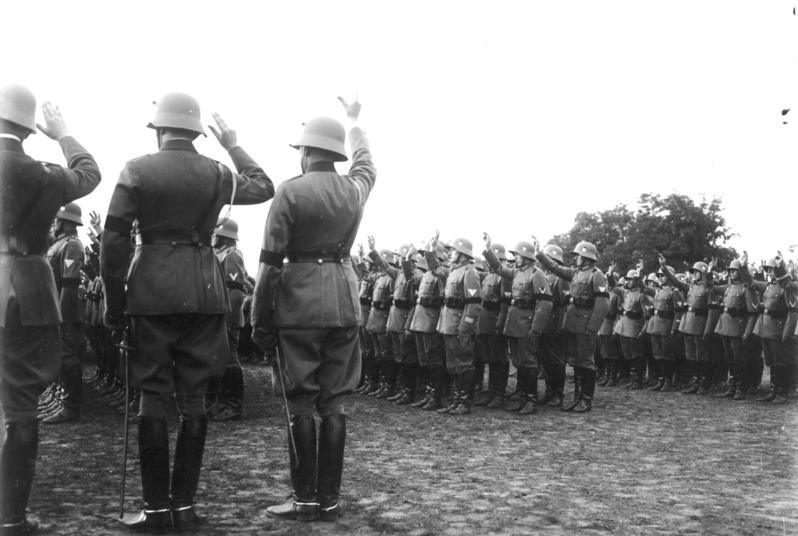
Die feierliche Vereidigung der Reichswehr auf den neuen Reichspräsidenten Adolf Hitler auf dem Kasernenhof der Wachtruppe in Berlin 1934 Offiziere und Mannschaften leisten den feierlichen Eid durcherheben der rechten Hand. Die Reichswehr trägt Trauerflor für den verstorbenen Reichspräsidenten.

Officers and men of the Reichswehr take the Oath to Hitler in 1934 following the death of President Hindenburg

Had the Generals had been more forceful in their opposition, they would have most likely been opposed by the highly Nazified youth that made up the bulk of their Army, especially many of the junior officers, NCOs and enlisted men. Likewise there was the matter of their oath and this is something that many Americans do not understand. During the Kaiser Reich German officers swore an oath to the Kaiser, during Weimar that was changed to the Constitution, when Hitler took power and assumed both the Presidency and Chancellorship following the death of President von Hindenburg, the officer corps swore a new oath, that to Hitler as President and Chancellor. While many saw the danger, almost all officers took the oath, in a sense it was a throwback to the old way of doing things in the Kaiser Reich, and most officers hated the Republic. To them the oath embodied their honor, to break it was to dishonor themselves and their family. When war came it became more than that, to break the oath was considered treason. General Alfred Jodl told American Army psychologist Gustave Gilbert at Nuremberg that “In war the moral pressure of obedience and the stigma of high treason are pretty hard to get around.” 193

Jodl’s superior Keitel stated his helplessness before Hitler saying to Gilbert “What could I do? There were only 3 possibilities: (a) refusal to follow orders, which naturally meant death; (b) resign my post, or (c) commit suicide. I was on the point of resigning my post 3 times, but Hitler made it clear that he considered my resignation in time of war the same as desertion. What could I do?” 194 This was obviously an after the fact excuse by Keitel who had been present in Hitler’s headquarters since the beginning and had witnessed the explosive General Heinz Guderian explode in rage against Hitler in 1945. Following that violent outburst in which Guderian and Hitler engaged in a lengthy heated argument in which those present thought would come to blows and the enraged dictator and general shouted at each other and were held back from contact by others in the conference room. Instead of arrest or imprisonment Hitler ordered Guderian to take extended sick leave and never accosted him afterwards.

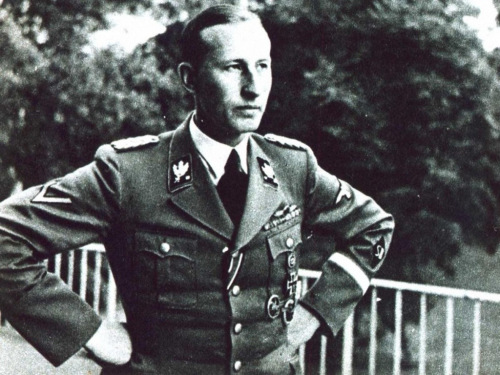
heydrich

Reinhard Heydrich

Himmler, Heydrich, Eichmann and other SS leaders fanatically executed Hitler’s policies and were aided by the civil administration, including the leaders of the Reichsbank, and the proponents of long term economic plans. Genocide was to bring the Reich “long term economic gains and trading advantages” and was seen as a way of “financing the war debt without burdening the German taxpayer.” 195

The willing participation of Army commanders is hard to get around. Otto Ohlendorf, commander of Einsatzgruppe D testified at the Einsatzgruppe Trial that Einsatzgruppen reported all of their tasks to the army commanders, and that together, they and the army agreed on the time, place, and possible support of the troops for any particular “liquidation action[s].” 196

Some individuals did attempt to resist the most brutal aspects of the Nazi campaign against the Jews, but few had the fortitude to make more than half-hearted attempts. Wilhelm Kube, the Reichskommissar for White Russia, himself a fanatical Nazi and a virulent anti-Semite was shocked at the mass murders of the Jews taking place in his region. He called them “unworthy of the German cause and damaging to the German reputation.” During his administration Kube would later attempt to spare Jews by employing skilled Jews in war industries, however, Kube’s efforts were “defeated by Himmler’s zealots.” 197

Army officers who objected to the killing of Jews, like Blaskowitz and Külcher in Poland were relieved of command or were reassigned. Others like Field Marshal Ritter von Leeb took their protests to Hitler. Such protests were readily dismissed and those who made them usually took no further action. Leeb was told by Hitler to “in so many words told to mind his own business.” Leeb later stated, “the only thing to do is to hold oneself at a distance.” 198 Field Marshall Erwin Rommel, who had burned the notorious Commando Order in front of his staff in North Africa could not bring himself to believe that Hitler was to blame. While commanding Army Group B in France Rommel heard of the crimes being committed against the Jews and others through information provided by Blaskowitz, and members of his own staff who had served in Russia. But Rommel, who became part of the plot of overthrow Hitler, was then still in the thrall of the Fuhrer and blamed the crimes “on Hitler’s subordinates, not Hitler himself.” 199

Of the men mentioned in this article who survived the war, only four, Wilhelm Keitel, Alfred Jodl, Otto Ohlendorf and Adolf Eichmann paid for their crimes with their lives Keitel and Jodl were found guilty in the major War Crimes Trials at Nuremberg. Ohlendorf at the Einsatzgruppen trial, while Eichmann was caught by the Israelis, tried, convicted and put to death in 1962. Blaskowitz committed suicide while being tried with thirteen other generals during the final Nuremberg trial, that of the generals. Of those eleven were convicted and none served out their full sentence.

keitel-jodl-hitler

Hitler with Jodl

Hitler’s ideology permeated German military campaigns and administration of the areas conquered by his armies. No branch of the German military, police or civil administration in occupied Poland or Russia was exempt guiltless in the crimes committed by the Nazi regime. It is a chilling warning of the consequences awaiting any nation that allows it to become caught up in hate-filled political, racial or even religious ideologies which dehumanizes opponents and of the tragedy that awaits them and the world. In Germany the internal and external checks that govern the moral behavior of the nation and individuals failed. Caught up in the Nazi system, the Germans, especially the police and military abandoned the norms of international law, morality and decency, banally committing crimes which still reverberate today and which were seen in the ethnic cleansing actions in the former Yugoslavia, and now throughout much of the Middle East.

In light of the fact that there is a growing food shortage in the world which will only get worse due to a factors including the global rise in population, the shrinking of the amount land which can be farmed due to climate change.  There are many other factors as well which could such a situation could bring about another Holocaust.  In such a case leaders will decide that the lands and resources of less developed people are theirs for the taking in order to maintain the standards of living of their people, and that the indigenous people who they will victimize are less than human and thus have no rights. The terminology used by them will be very neutral and full of euphemisms which will allow many people to maintain the illusion that any evil carried out is for the good. Politicians, pundits and preachers will talk of problems, and of solutions, and in trying to find a resolution yearn for a conclusive solution, a final solution.

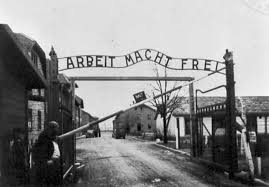
arbiet macht frei

I return to the quote from the movie Judgment at Nuremberg which I included in the first section of this article because it is worth repeating and all too true:

“Janning, to be sure, is a tragic figure. We believe he loathed the evil he did. But compassion for the present torture of his soul must not beget forgetfulness of the torture and the death of millions by the Government of which he was a part. Janning’s record and his fate illuminate the most shattering truth that has emerged from this trial: If he and all of the other defendants had been degraded perverts, if all of the leaders of the Third Reich had been sadistic monsters and maniacs, then these events would have no more moral significance than an earthquake, or any other natural catastrophe. But this trial has shown that under a national crisis, ordinary – even able and extraordinary – men can delude themselves into the commission of crimes so vast and heinous that they beggar the imagination….”

That quote might be applied to many of the people who participated in this genocide. Sadly, the fact is that in truth we are not really all that much different than the victims, the perpetrators and the bystanders who lived and died in the Holocaust, and similarly every other act of genocide.

History serves as a guide and a warning. We must always be alert and we must always when the truly difficult times come, in the midst of crisis, not to take the easy path and denude ourselves into the commission of such crimes.

Notes

187 Ibid. Bracher. The German Dictatorship p.430

188 Ibid. Megargee War of Annihilation p.65

189 Ibid. Wette. The Wehrmacht p.293

190 Ibid. Wette. The Wehrmacht p.97

191 Messenger, Charles. The Last Prussian A Biography of Field Marshal Gerd Von Rundstedt 1875-1953 Brassey’s London, 1991 p148

192 Ibid. Bracher The German Dictatorship pp.430-431

193 Gilbert, Gustave Nuremberg Diary DaCapo Press 1995 copyright G.M. Gilbert 1947 p.290

194 Ibid. Gilbert p.26

195 Ibid. Aly and Heim Architects of Annihilation p.242

196 Ibid. Hebert p.92

197 Ibid. Padfield Himmler pp.341-342

198 Ibid. Megargee War of Annihilation p.97

199 Fraser, David. Knight’s Cross: A Life of Field Marshal Erwin Rommel Harper Perennial, New York 1995, first published by Harper Collins in Britain, 1993. p.536

Bibliography for the series

Aly, Gotz and Heim, Susanne. Architects of Annihilation: Auschwitz and the Logic of Destruction Phoenix Paperbacks, London, 2003, originally published as Vordenker der Vernichtung, Hoffman und Campe, Germany 1991, English translation by Allan Blunden. First published in Great Britain Weidenfeld & Nicholson, London, 2002

Arendt, Hannah, Eichmann in Jerusalem: A Report on the Banality of Evil. Revised and Enlarged Edition. Penguin Books, Harmondsworth, England and New York, NY 1965. Originally published by Viking Press, New York, NY 1963

Blood, Philip. Hitler’s Bandit Hunters: The SS and the Occupation of Europe. Potomoac Books Inc. Washington, DC 2008

Bracher, Karl Dietrich. The German Dictatorship: The Origins, Structure, and Effects of National Socialism. Translated by Jean Steinberg, Holt Rinehart and Winston, New York, NY 1979. Originally Published under the title Die Deutsche Diktatur: Entstehung, Struktur,Folgen des Nationalsocialismus. Verlag Kiepenheuer & Witsch. Koln and Berlin, 1969

Browning, Christopher R. Ordinary Men: Reserve Police Battalion 101 and the Final Solution in Poland. Harper Perennial Books, New York, New York 1993 reissued 1996.

Burleigh, Michael and Wippermann, Wolfgang. The Racial State: Germany 1933-1945 Cambridge University Press, New York NY and Cambridge UK 1991

Condell, Bruce and Zabecki, David T. Editors. On the German Art of War: Truppenführung , Lynn Rienner Publishers, Boulder CO and London 2001

Craig, Gordon A. The Politics of the Prussian Army 1640-1945. Oxford University Press, London and New York, 1955

Davidowicz, Lucy S. The War Against the Jews 1933-1945 Bantam Books, New York, NY 1986.

Di Nardo, Richard L. Germany and the Axis Powers: From Coalition to Collapse. University Press of Kansas, Lawrence, KS. 2005

Erickson, John. The Road to Berlin. Cassel Military Paperbacks, London, 2003. First Published by Weidenfeld and Nicholson, 1983

Evans, Richard J. The Coming of the Third Reich Penguin Books, New York 2004. First published by Allen Lane 2003

Evans, Richard J. The Third Reich in Power 1933-1939. Penguin Press, New York, NY 2005

Ferguson, Niall. The War of the Worlds: Twentieth Century Conflict and the Descent of the West.

The Penguin Press, New York, 2006

Fest, Joachim, Hitler. Translated by Richard and Clara Winston. Harcourt Brace Jovanovich Publishers, San Diego, New York, London, 1974. German Edition by Verlag Ullstein 1973

Fraser, David. Knight’s Cross: A Life of Field Marshal Erwin Rommel Harper Perennial, New York 1995, first published by Harper Collins in Britain, 1993

Friedlander, Saul Nazi Germany and the Jews 1939-1945: The Years of Extermination. Harper Perennial, New York, NY 2007

Fritz, Stephen G. Frontsoldaten: The German Soldier in World War II. The University Press of Kentucky, Lexington, KY 1995

Geyer, Michael. German Strategy 1914-1945 in Makers of Modern Strategy from Machiavelli to the Nuclear Age. Peter Paret, editor. Princeton University Press, Princeton NJ. 198

Gilbert, Gustave Nuremberg Diary DaCapo Press 1995 copyright G.M. Gilbert 1947

Giziowski, Richard. The Enigma of General Blaskowitz. Hppocrene Books, New York 1997

Glantz, David M. and House, Jonathan. When Titans Clashed: How the Red Army Stopped Hitler. University Press of Kansas, Lawrence, KS. 1995

Goerlitz, Walter. History of the German General Staff.” Translated by Brian Battershaw, Westview Press, Boulder and London, 1985. Originally published as Die Deutsche Generalstab Verlag der Frankfurter Hefte, Frankfurt am Main, 1953

Goerlitz, Walter. The Memiors of Field Marshal Wilhelm Keitel: Chief of the German High Command 1938-1945. Translated by David Irving. Cooper Square Press 2000, First English Edition 1966 William Kimber and Company Ltd. German edition published by Musterschmnidt- Verlad, Gottigen 1961.

Hebert, Valerie Genevieve, Hitler’s Generals on Trial: The Last War Crimes Tribunal at Nuremberg University of Kansas Press, Lawrence Kansas 2010

Hitler, Adolf Mein Kampf translated by Ralph Manheim. Mariner Books, Houghton Mifflin Company, New York, NY 1999. Houghton Mifflin Company 1943, copyright renewed 1971. Originally published in Germany by Verlag Frz. Eher Nachf. GmbH 1925

Höhne, Heinze. Canaris: Hitler’s Master Spy. Traslated by J. Maxwell Brownjohn. Cooper Square Press, New York 1999. Originally published by C. Bertelsmann Verlag Gmbh, Munich 1976, first English edition by Doubleday and Company 1979

Höhne, Heinze. The Order of the Death’s Head: The Story of Hitler’s SS. Translated by Richard Barry. Penguin Books, New York and London, 2000. First English edition published by Martin Secker and Warburg Ltd. London 1969. Originally published as Der Orden unter dem Totenkopf, Verlag Der Spiegel, Hamburg 1966.

Hughes, Daniel J. editor. Moltke on the Art of War: Selected Writings, translated by Harry Bell and Daniel J Hughes. Presidio Press, Novato CA 1993

Liddell-Hart, B.H. The German Generals Talk. Quill Publishing, New York, NY. 1979. Copyright 1948 by B.H. Liddell-Hart

Lieber, Franz Instructions for the Government of Armies of the United States in the Field, prepared by Francis Lieber, LL.D., Originally Issued as General Orders No. 100, Adjutant General’s Office, 1863, Washington 1898: Government Printing Office. Retrieved from http://avalon.law.yale.edu/19th_century/lieber.asp 6 May 2014

Lindqvist, Sven Exterminate All the Brutes: One Man’s Oddessy into the Heart of Darkness and the Origins of European Genocide Translated from the Swedish by Joan Tate, The New Press , New York and London 1992

Macksey, Kenneth. Why the Germans Lose at War: The Myth of German Military Superiority. Barnes and Noble Books, New York 2006, originally published by Greenhill Books, 1996

Manstein, Erich von. Forward by B.H. Liddle Hart, Introduction by Martin Blumenson. Lost victories: The War Memoirs of Hitler’s Most Brilliant General. Zenith Press, St Paul MN 2004. First Published 1955 as Verlorene Siege, English Translation 1958 by Methuen Company

Shirer, William L. The Rise and Fall of the Third Reich. A Touchstone Book published by Simon and Schuster, 1981, Copyright 1959 and 1960

Megargee, Geoffrey P. War of Annihilation: Combat and Genocide on the Eastern Front 1941.Bowman and Littlefield Publishers Inc. Lanham, Boulder, New York. 2007

Messinger, Charles, The Last Prussian: A Biography of Field Marshal Gerd Von Rundstedt 1875-1953 Brassey’s (UK) London England 1991

Newton, Steven H. Hitler’s Commander: Field Marshal Walter Model-Hitler’s Favorite General

DaCapo Press a division of Perseus Books Group, Cambridge MA 2005 Novatny, Alfred. The Good Soldier. The Aberjona Press, Bedford, PA 2003 Padfield, Peter. Himmler. MJF Books, New York. 1990

Reitlinger, Gerald. The SS: Alibi of a Nation. The Viking Press, New York, 1957. Republished by Da Capo Press, New York, NY.

Rhodes, Richard. Masters of Death: The SS Einsatzgruppen and the Invention of the Holocaust.

Vintage Books a division of Random House, New York, NY 2002

Shepherd, Ben. War in the Wild East: The German Army and Soviet Partisans. Harvard University Press, Cambridge, MA 2004

Sofsky, Wolfgang. The Order of Terror: The Concentration Camp. Translated by William Templer. Princeton University Press. Princeton, NJ 1997. Originally published as Die Ordnung des Terrors: Das Konzentrationslager. S. Fischer Verlag, GmbH, Frankfurt am Main, 1993

Speer, Albert. Inside the Third Reich. Collier Books, a Division of MacMillan Publishers, Inc. New York, NY 1970.

Strachan, Hew. European Armies and the Conduct of War. George, Allen and Unwin, London, UK 1983

Stein, George H. The Waffen SS 1939-1945: Hitler’s Elite Guard at War. Cornell University Press, Ithaca and London, 1966

Stern, Fritz. Gold and Iron: Bismarck, Bleichroder and Building of the German Empire. Vintage Books a division of Random House, New York 1979 First published by Alfred a Knopf 1977

Sydnor, Charles W. Soldiers of Destruction: The SS Death’s Head Division, 1933-1945. Princeton University Press, Princeton, NY 1977

Taylor, Fred, Editor and Translator. The Goebbels Diaries 1939-1941, Penguin Books Ltd, Harmondsworth UK and New York NY 1984.

Tooze, Adam. The Wages of Destruction Penguin Books, New York, NY, 2008. First Published by Allen Lane Books, Penguin Group, London UK, 2006

Trevor-Roper, H.R. Hitler’s Table Talk 1941-1944 with an introduction by Gerhard L Weinberg, Translated by Norman Cameron and R.H. Stevens, Enigma Books, New York, NY 2000. Originally published in Great Britain by Weidenfeld & Nicholoson, London 1953.

Warlimont, Walter. Inside Hitler’s Headquarters 1939-45. Translated by R.H. Berry, Presido Press, Novato CA, 1964.

Weinberg, Gerhard L. Germany Hitler and World War II . Cambridge University Press, New York, NY 1995

Weinberg, Gerhard L. Ed. Hitler’s Second Book: The Unpublished Sequel to Mein Kampf by Adolph Hitler. Translated by Krista Smith, Enigma Books, New York, NY 2006. Originally published as Hitlers zweites Buch, Gerhard Weinberg editor, 1961.

Weinberg, Gerhard L. Visions of Victory: The Hopes of Eight World War II Leasers. Cambridge University Press, New York, NY 2005

Westermann, Edward B. Hitler’s Police Battalions: Enforcing Racial War in the East.

University Press of Kansas, Lawrence, KS. 2005

Wette, Wolfram. The Wehrmacht: History, Myth, Reality. Translated by Deborah Lucas Schneider. Harvard University Press, Cambridge, MA 2006. Originally published as Die Wehrmacht: Feindbilder, Vernichtungskreig, Legenden. S. Fischer Verlag, GmbH, Frankfurt am Main, 2002

Wheeler-Bennett, John. The Nemesis of Power: The German Army in Politics 1918-1945. St. Martin’s Press Inc. New York, NY 1954


1 Comment

Filed under crime, History, laws and legislation, leadership, Military, Political Commentary, world war two in europe

When Political Parties Implode: The Battle over the Lecompton Constitution and its Relevance Today

Friends of Padre Steve’s World

I have been watching the implosion of the Republican Party with some concern, not because I am a Republican or support that party, but because I am a historian and understand that the effects of these kinds of crack ups are not just bad for the party concerned, but often for the country, because they reveal deeper social and political issues. As I watch this I am reminded of the crisis and battle regarding the Lecompton Constitution in 1858. Since the article deals with this in some detail I will cut to the bottom line. In 1858 the Democratic Party held majorities in both houses of Congress and the Presidency. It had been aided by the collapse of the Whig Party and the new republican Party was still in its infancy. But extremists Democrats sought to push through a measure to bring Kansas into the Union as a Slave State, though the measure was rife with fraud. It split the Democratic Party and for a time destroyed it as a national party and helped bring about the Civil War. The battle over the Lecompton constitution is an epic event in our history. 

The issues today are not the same by any means, but the rhetoric and the intransigence of the most zealous ideologues is destroying the Republican Party in much the same way other ideologues destroyed the Democratic Party in 1858.  I admit that I could be wrong, but everything that I see happening is pointing to the implosion and possible breakup of the Republican Party. This may be good for Democrats in the short term, but seldom is it good for the country. But whatever your political views are, I do hope that you read this article and think about the implications of it, and of what is happening in our country today.

Peace

Padre Steve+

Stephen-Douglas-in-1858

Senator Stephen Douglas in 1858

Kansas was politically divided between two competing legislatures, each which claimed to be the voice of the people. The population of Kansas was heavily anti-slavery and many citizens felt disenfranchised by the official legislature, which was “a pro-slavery body elected by fraud in 1855.” [1] This body met in the city of Lecompton. In 1857 the Lecompton legislature sensed the opportunity to have Kansas admitted to the Union as a Slave State. It elected slavery supporters as members of a constitutional convention to draft a constitution which would be submitted to Congress for admission to the Union as a Slave State.

Free State partisans feared that that if they participated in the election that they would be “gerrymandered, and simply counted out by stuffed ballots,” and sat out the election. As a result it was “a quiet election, with many proslavery candidates unopposed and only 2,200 out of 9,000 registered voters going to the polls, a large majority of extreme proslavery men won election as delegates to the constitutional convention in September.” [2] But the result of the election was untenable, for “Two thousand voters in a territory with 24,000 eligible for the franchise had elected a body of delegates whom no one seriously regarded as representative of the majority opinion in Kansas.” [3]

The Lecompton legislature passed the proslavery constitution, but it was vetoed by the outgoing governor, John W. Geary. Geary accused “the pro-slavery legislature of attempting to stampede a rush to statehood on pro-slavery terms,” but his veto was overridden. The constitution had several provisions that most of the population found unacceptable. It protected owners of “the 200 slaves in Kansas, banned free blacks from the state, and prohibited any amendments to the constitution for seven years.” [4] The newly appointed governor of the territory, Robert J. Walker opposed the measure and denounced it “as a vile fraud, a bare counterfeit.” [5] Walker demanded a new, fair, referendum, which the newly elected president James Buchanan, also backed. In response many Southerners in Congress “threatened to secede unless the administration fired Walker and backed down on the referendum issue.” [6] The threat of secession by Southerners in support of the radical minority in Lecompton led to chaos in the Democratic Party which controlled the House, the Senate and held the Presidency.

james-buchanan

President James Buchanan

James Buchanan, who had rode into office on the votes of the South was now pressured by Southern legislators to change his position on the Lecompton Constitution. Buchannan’s cabinet, which was heavily Southern, and pro-slavery expansion also used its influence to pressure the president. In response to the pressure, Buchanan reversed his previous stance in regard to Kansas and endorsed the bill. This provoked a new outcry, this time from members of the Democratic Party. Many Northern Democrats were outraged by the reversal and the threats of secession. Most of the Northern Democrats were willing to accept and even defend slavery where it existed, but they were opposed to the expansion of slavery. They felt betrayed by their president’s actions and rose in opposition to the bill that would admit Kansas as a Slave State.

The formidable Stephen A. Douglas, the Little Giant who had so skillfully crafted the Compromise of 1850 using the principle of popular sovereignty, led these Democrats in their fight against Buchanan’s acceptance and endorsement of Lecompton. Douglas’s previous actions to support the rights of Slave States had made him a hero in much of the South and his stature in both the North and the South made him the front runner to win the Democratic nomination for the presidency in 1860.

But Douglas, who had worked so hard to build compromises that would hold the Union together could not countenance the actions and tactics of the Southern members of his party. Douglas was a political realist and not an ideologue. He was very sympathetic to slave holders and no supporter of emancipation, in fact Douglas was a racist, and was convinced “of the inferiority of the Negro, and he had a habit of stating it with brutal bluntness, “I do not believe that the Negro is any kin of mine at all…. I believe that this government of ours was founded, and wisely founded upon white basis. It was made by white men, for the benefit of white men and their posterity, to be executed and managed by white men.” [7] But despite his own beliefs Douglas understood the danger that the pro-slavery extremists supporting Lecompton were to the party, and he knew that if the bill was passed that it would destroy the unity of the Democratic Party and possibly the Union itself.

Douglas was outraged and when he saw the news that in the Washington Union that Buchanan had decided to support Lecompton he wrote:

“This left no doubt were the old bastard stood. “Can you believe his Goddamned arrogance?” I told a friend. “I run the Committee on Territories. He should have consulted me before approving the Lecompton fraud. He’ll pay for that. By God, sir, I made Mr. James Buchanan, and by God, sir, I’ll unmake him.” [8]

As such, the Little Giant threw caution to the wind and stormed to the White House “to confront Buchanan on the “trickery and juggling of the Lecompton constitution.” He warned the president of that his actions in support of the Lecompton party would “destroy the Democratic party in the North,” and we warned that “if Buchanan insisted on going through with it, Douglas swore to oppose him in Congress.” [9]

It was an epic confrontation. Douglas recalled, “The Lecompton constitution, I told Buchanan bluntly, was a blatant fraud on the people of Kansas and the process of democracy, I warned him not to recommend acceptance of it. With his head titled forward in that bizarre habit of his, he said that he intended to endorse the constitution and send it to Congress. “If you do,” I thundered, “I’ll denounce it the moment that it is read.” His face turned red with anger. “I’ll make Lecompton a party test,” he said. “I expect every democratic Senator to support it.” I will not, sir![10] Buchanan then cut Douglas off.

Angry and offended by Douglas Buchanan issued his own threat to Douglas saying, “I desire you to remember that no Democrat ever yet differed from an administration of his own choice without being crushed….Beware of the fate of Tallmadge and Rives,” two senators who had gone into political oblivion after crossing Andrew Jackson.” Douglas was undeterred and fought back, Douglas riposted: “Mr. President, I wish to remind you that General Jackson is dead, sir.” [11] It was an unprecedented action by a sitting Senator, to confront a President of one’s own party and threaten to oppose him in Congress was not done.

Following the confrontation with Buchanan Douglas was even more determined to defeat the Lecompton party. In righteous anger Douglas “took his political life into his own hands and assailed the Lecompton Constitution on the floor of the Senate as a mockery of the popular sovereignty principle.” [12] Buchanan’s allies in Congress fought back, and the two sides sometimes came into physical confrontation with each other in the chambers of Congress. When Buchanan’s supporters pushed for Lecompton’s approval and the admission of Kansas as a Slave State, Douglas fired back, warning “You do,” I said, “and it will lead directly to civil war!” I warned the anti-Lecompton Democrats of the North that the President intended to put the knife to the throat of every man who dared to think for himself on this question and carry out principles in good faith. “God forbid,” I said “that I ever surrender my right to differ from a President of the United States for my own choice. I am not a tool of any President!” [13]

Under Douglas the Northern Democrats joined with Republicans for the first time to defeat the admission of Kansas as a Slave State. Douglas recalled the battle:

“After the Christmas recess, the Administration unleashed its heavy horsemen: Davis, Slidell, Hunter, Toombs, and Hammond, all southerners. They damned me as a traitor and demanded that I be stripped of my chairmanship of the Committee on Territories and read out of the Democratic party. Let the fucking bastards threaten, proscribe, and do their worst, I told my followers; it would not cause any honest man to falter. If my course divided the Democratic party, it would not be my fault. We were engaged in a great struggle for principle, I said, and we would defy the Administration to the bitter end.” [14]

Southern members of Congress fought back and as the battle continued their acrimony towards Douglas grew and their rhetoric against the Little Giant became more heated. He was “at the head of the Black column…stained with the dishonor of treachery without parallel…patent double dealing…detestable heresies…filth of his defiant recreancy…a Dead Cock in the Pit…away with him to the tomb which he is digging for his political corpse.” [15]

But Douglas was undeterred by the threats to his career, he saw that he was in the right, and though he was in agreement with the philosophy of his opponents regarding slavery as an institution he realized that appeasing the South was not an option in regard to Lecompton. He wrote:

“My forces in the House fought a brilliant delaying action while I worked to win over wavering Democrats. When we introduced a substitute bill, Buchanan called a dozen congressmen to the White House and exhorted them not to forsake the administration. He was cursing and in tears. He had reason to be: on April first, a coalition of ninety-two Republicans, twenty-two anti-Lecompton Democrats, and six Know-Nothings sent Lecompton down to defeat by passing the substitute bill. This bill provided for a popular vote on the Lecompton constitution and for a new convention if the people rejected that document, as they surely would.” [16]

The substitute bill was passed by the Senate as well and sent back to Kansas for a popular vote. When the Lecompton Constitution was resubmitted to the people of Kansas, “to the hideous embarrassment of Buchanan, the voters of Kansas turned on August 30th and rejected Lecompton by a vote of 11,812 to 1,926.” [17] Douglas wroteThe agony is over,” cried one of my aides, “and thank God that the right has triumphed. Poor old Buck! Poor old Buck had just had his face rubbed in shit. By our “indomitable courage, “ as another aide put it, we’d whipped this “powerful and proscriptive” Administration and forced the Black Republicans to support a substitute measure which fully embodied the great principles of the Kansas-Nebraska Act.” [18]

Pro-slavery Southerners were outraged and Buchanan used every measure that he could to crush the anti-Lecompton Democrats, but he had lost “one of the most vicious struggles in the history of Congress, Southern Democrats had seriously damaged the patience of their Northern counterparts, and Buchannan loyalists in the North were unseated wholesale by upstart Republicans in the 1858 congressional elections.” [19] Buchanan’s Presidency was discredited, his party divided, its majority in congress lost, and the South moving closer to secession. Southerners considered Douglas a traitor and accused him of betraying them. “A South Carolinian lamented that “this defection of Douglas has done more than all else to shake my confidence in Northern men on the slavery issue, for I have long regarded him as one of our safest and most reliable friends.” [20]

The fight over Lecompton was a watershed. It served to illuminate how “minuscule minorities’ initial concerns ballooned into unmanageable majoritarian crises. The tiny fraction of Missouri slaveholders who lived near the Kansas border, comprising a tinier fraction of the South and a still tinier fraction of the Union, had demanded their chance to protect the southern hinterlands.” [21] The crisis that they provoked drew in the majority of Southern Democrats who came to their aid in Congress and provoked Northerners to condemn the Southern minority, which they believed was disenfranchising the majority in order to expand slavery to new territories.

The issue of Lecompton galvanized the political parties of the North and split the Democratic Party into Northern and Southern factions, dooming it as a national party for the foreseeable future. It was also the first time that a coalition Northern Democrats sided with anti-slavery forces. Through the efforts of “Republicans and anti-Lecompton Douglas Democrats, Congress had barely turned back a gigantic Slave Power Conspiracy to bend white men’s majoritarianism to slavemaster’s dictatorial needs, first in Kansas, then in Congress.” [22]

The political impact of the Lecompton crisis on the Democratic Party was an unmitigated disaster. The party suffered a major election defeat in the 1858 mid-term elections and lost its majorities, and in a sense fulfilling Lincoln’s words “became increasingly a house divided against itself.” [23] Douglas’s courageous opposition to Lecompton would be chief among the 1860 split in the Democratic Party, Southern Democrats turned with a vengeance on the man who had been their favorite in the 1856 democratic primary. This doomed his candidacy for President and ensured the election of Abraham Lincoln and the Republicans, a man that he had defeated for Senate in that critical summer of 1858.

Notes

[1] Ibid. Guelzo Fateful Lightening p.81

[2] Ibid. Potter The Impending Crisis p.300

[3] Ibid. Potter The Impending Crisis p.314

[4] Ibid. Guelzo Fateful Lightening p.115

[5] Ibid. McPherson The Battle Cry of Freedom p.165

[6] Ibid. McPherson The Battle Cry of Freedom p.164

[7] Ibid. Potter The Impending Crisis p.340

[8] Ibid, Oates The Approaching Fury p.208

[9] Ibid. McPherson The Battle Cry of Freedom p.166

[10] Ibid, Oates The Approaching Fury p.208

[11] Ibid. McPherson The Battle Cry of Freedom p.166

[12] Ibid. Guelzo Fateful Lightening p.115

[13] Ibid, Oates The Approaching Fury p.210

[14] Ibid, Oates The Approaching Fury pp.212-213

[15] Ibid. McPherson The Battle Cry of Freedom p.168

[16] Ibid, Oates The Approaching Fury pp.215-216

[17] Ibid. Guelzo Fateful Lightening p.116

[18] Ibid, Oates The Approaching Fury p.216

[19] Ibid. Guelzo Fateful Lightening p.116

[20] Ibid. McPherson The Battle Cry of Freedom p.167

[21] Ibid. Freehling, The Road to Disunion Volume II: Secessionists Triumphant 1854-1861 p.140

[22] Ibid. Freehling, The Road to Disunion Volume II: Secessionists Triumphant 1854-1861 p.142

[23] Fehrenbacher, Don E. Kansas, Republicanism, and the Crisis of the Union in The Civil War and Reconstruction Documents and Essays Third Edition edited by Michael Perman and Amy Murrell Taylor Wadsworth Cengage Learning Boston MA 2011 p.94

7 Comments

Filed under civil rights, civil war, History, laws and legislation, leadership, Political Commentary

Separate Ideology & Religion from Sworn Duty: The Legacy of Dr. C. Everett Koop

c-everett-koop-1db591308d7eb474

“At the beginning of the AIDS epidemic many Americans had little sympathy for people with AIDS…. The feeling was that somehow people from certain groups ‘deserved’ their illness. Let us put those feelings behind us. We are fighting a disease, not a people.” C. Everett Koop, Surgeon General 1986

Friends of Padre Steve’s World,

I have mentioned that I have been reflecting on many things over the past few weeks and months. Of course if you follow my writings you know what I think about public officials who refuse to do their duty to follow the law and protect the rights of other citizens, even of those that they happen to disapprove. This came to a head recently with the case of the anti-marriage equity county clerk, Kim Davis. I am not going to revisit her case as I have been worn out by it and have no need to waste any more time on her.

That being said I can point out the case of a public official, a conservative, pro-life, Evangelical Christian who served as Surgeon General under President Reagan, Dr. C. Everett Koop. In an era of extreme intolerance and hatred for those infected with HIV, Dr. Koop became one of the leading proponents of compassionate and responsible care for victims of HIV/AIDS, most of whom were homosexual men. He met opposition within the administration, where despite his impressive credentials he was marginalized and was vilified by conservative Christians.

Dr. James Dobson and Dr. D. James Kennedy, early leaders of the political religious right were particularly vindictive. These unscrupulous leaders helped spread much disinformation about HIV from the a book published by a charlatan named Gene Antonio who wrote what was then a popular book called “The AIDS Cover Up,” They claimed that AIDS could be spread by kissing, mosquito bites or even by touching surfaces that had been touched by those infected. These men were bolstered by their allies in the Reagan White House, Secretary of education Bill Bennett and his assistant Gary Bauer who were the official administration spokesmen regarding AIDS.

They marginalized the Surgeon General; Dr. C. Everett Koop who noted in the early days of the epidemic was “completely cut off from AIDS” by Bennett and others in the Reagan Administration. They were so wrong that Koop, who was by no means a liberal took them to task on their hateful, dishonest and un-Christian proclamations. Koop told a journalist:

“the Christian activity in reference to AIDS of both D. James Kennedy and Jim Dobson is reprehensible. The first time that Kennedy ever made a statement about AIDS, I saw it on television. It was so terrible, so homophobic, so pure Antonio that I wrote him a letter.”

Koop said of Dobson, who he had worked with earlier on HIV/AIDS: “I don’t know what happened to him. He changed his mind, and last August in his paper he attacked me for two pages as leading people down the garden path. But again his arguments were full of holes. I just cannot believe the poor scholarship of so many Christians.”

Despite the opposition and attacks on his character by leaders of the Christian Right, Dr. Koop was undeterred and had no problem taking on these men and women. Some of these supposedly Christian leaders still are with us and spout the same hatred for homosexuals that they did in the 1980s. Dr. Koop realized that many of his fellow Christians really didn’t care about people, and believed that HIV was God’s judgment against people that they already despised and had in their theology condemned to Hell. He also realized that many of these leaders would resort to poor scholarship and even inflammatory statements to influence public opinion.

For doing so Dr. Koop was condemned by fanatical extremists like Phyllis Schlafly who said that Koop’s recommendations in his report about preventing AIDS looked “like it was edited by the Gay Task Force” and Schlafly, ever the loving, honest and ethical Christian that she is accused Koop of advocating that third-graders learn the rules of “safe sodomy.”

Koop replied in a very courageous manner to Schlafly, who in my view is one of the most loathsome people to ever unite religion and politics: “I’m not surgeon general to make Phyllis Schlafly happy. I’m surgeon general to save lives.”

Dr. Koop understood the oath that he took as a physician and the oath that he took when he became Surgeon General; sadly Mrs. Davis and many in the Christian Right will never understand that. In 1988 Dr. Koop said something that most people in positions of any public responsibility, be they public health officials, medical professionals, politicians or even the most partisan political preachers should abide: “I separate ideology, religion and other things from my sworn duty as a health officer in this country.”

Dr. Koop’s words should be heeded by any Christian in public office, but sadly, those who do will be treated with the same scorn and hatred as Dobson, Kennedy, Bauer, and Schlafly heaped on him.

I can understand Dr. Koop’s plight. I have been set upon by some of the disciples of Bauer, Dobson, Schlafly, Kennedy and others for simply defending people’s rights under the Constitution and obeying the oath of office that I took in 1981 and have continued to affirm since. Sadly, the truth is that many so-called Christians will attempt to destroy the lives, reputation and careers of other Christians who do not tow their ideological line, and sadly this has become much worse than it was in the 1980s.

I will write more about this but for now I will wish you a good day.

Peace

Padre Steve+

1 Comment

Filed under christian life, civil rights, ethics, faith, healthcare, History, laws and legislation, leadership, LGBT issues, News and current events, Political Commentary

Tragedy in Kunduz: Mistake, Accident or War Crime?

kunduz-hospital-bombing

Friends of Padre Steve’s World

I have been troubled by the disaster at the Doctor’s Without Borders in Kunduz Afghanistan, a disaster that appears to be linked to the actions of U.S. and or NATO, Coalition, and Afghan forces as well as the Taliban who had taken control of that city a few days before the attack.

There are so many things about this incident that trouble me, but truthfully I, like almost everyone, know very little about it, other than the fact that too many innocent people died as a result of what appears to be a prolonged air strike against what should have been a known hospital. Now, truthfully, none of us knows enough about the incident to declare it a justified act, a tragic mistake, or a war crime, and there are people who without full knowledge of the facts are arguing for each of these positions. However, that has not stopped the speculation about the circumstances concerning the incident. Today the American command released a statement saying that Afghan forces requested the air strikes.

The fact is that the circumstances are unclear, and in the fog of war we may never know the truth about what happened. I do not pretend to think that the Taliban are entirely without blame, nor is the incredibly corrupt Afghan government and military; and most importantly are American, NATO and other non-Afghan coalition forces.

I do caution anyone who attempts to place the blame for what happened on any one group in this conflict, and I think that it was irresponsible for people in the United Nations to declare that this could be a war crime without knowing all the facts.

That being said I believe, as a career military officer, that we as Americans need to hold ourselves, and our military to a higher standard than our enemies and even our coalition partners. Sadly, we have not always done this and sometimes we have not only committed war crimes, but also we often hold ourselves above international sanction and law when our forces are suspected of committing war crimes. Even more importantly we ignore the words of a man who acting as an agent of the United States, and the United Nations set the standard for prosecuting war criminals. I am talking about Supreme Court Associate Justice Robert Jackson, who organized the trials of the major Nazi War Criminals at Nuremburg.

When the trials were being organized Justice Jackson set down a rule of conduct for his American, and allied colleagues from Britain, the Soviet Union and France. Sadly, we Americans have failed to heed his words on many occasions. Jackson noted:

“If certain acts of violation of treaties are crimes, they are crimes whether the United States does them or whether Germany does them, and we are not prepared to lay down a rule of criminal conduct against others which we would not be willing to have invoked against us.” Justice Robert Jackson International Conference on Military Trials, London, 1945, Dept. of State Pub.No. 3080 (1949), p.330.

Now personally I hope that this is a tragic accident brought about by a confused tactical situation that was worsened by the fog of war. Truthful that does not lessen the pain and tragedy of what happened in Kunduz, but it is far better than the alternative; that American forces ignored warnings and intelligence that this was a hospital and kept attacking even after being told that it was a hospital. If the latter is the case the charge that this could be a war crime cannot be ignored.

As a veteran of Iraq and a career officer who knows the terrible horrors of war first hand, as well as being a historian and theologian I am especially sensitive to the nuances of such events and know that many times that what happens is difficult to fully understand or comprehend. I can only hope that Secretary of Defense Carter and President Obama will ensure that an investigation, coordinated with the U.N. and our coalition partners fully explores what happened, and if American forces acted improperly, or even in a criminal manner take the moral high ground and assume responsibility.

We cannot ignore the precedent that we ourselves set when we tried the surviving leaders of the Nazi regime at Nuremburg. War crimes are war crimes no matter what people commit them, and we must hold ourselves to this higher standard. But then we must also realize as Hannah Arendt noted “The sad truth is that most evil is done by people who never make up their minds to be good or evil.”

Likewise there are people, like a younger me, who agree with Commodore Stephen Decatur who declare “my country right or wrong” and then ignore any possible evils committed by the United States. I love and serve my country, but if we are complicit in war crimes then what have we become? Are we willing to throw away our ideals, our ethics, our humanity to ensure our survival?

Personally, even if the worst outcome is true, I cannot imagine that those involved meant to commit a war crime, but that being said there is a rationalization that even good people make during war, that their actions, or the actions of their nation are excused by necessity. I am reminded of the words of Spencer Tracy in the movie Judgment at Nuremburg when he said:

There are those in our own country too who today speak of the “protection of country” – of ‘survival’. A decision must be made in the life of every nation at the very moment when the grasp of the enemy is at its throat. Then, it seems that the only way to survive is to use the means of the enemy, to rest survival upon what is expedient – to look the other way. Well, the answer to that is ‘survival as what’? A country isn’t a rock. It’s not an extension of one’s self. It’s what it stands for. It’s what it stands for when standing for something is the most difficult! Before the people of the world, let it now be noted that here, in our decision, this is what we stand for: justice, truth, and the value of a single human being.”

At Kunduz over twenty medical personnel at the Doctors Without Borders died, another three dozen were wounded when American, or other coalition aircraft responded to the call of Afghan ground forces for air support against the Taliban. Regardless of if the Taliban were taking advantage of the hospital to engage the Afghan troops, the location of the hospital was known to coalition forces, it had been there and in operation for four years.

Please do not get me wrong, I want my country to always be in the right. For over 30 years I have sworn an oath to defend the Constitution of the United States and followed what I believe is a call to uphold the best that our country has to offer. I do not support the Taliban or any other group that would seek to impose a theocracy on their people, but at the same time how can I countenance the support of a discredited, unethical and corrupt regime that has squandered the lives and trust of its own people while at the same time taking advantage of American and NATO forces, our military and intelligence support as well our massive economic support without which they could not remain in power?

When I see what the U.S. backed governments in Afghanistan, not to mention Iraq have done to their people with our support I feel much like T.E. Lawrence who wrote of the British administration in 1920 Iraq:

“The people of England have been led in Mesopotamia into a trap from which it will be hard to escape with dignity and honour. They have been tricked into it by a steady withholding of information. The Bagdad communiqués are belated, insincere, incomplete. Things have been far worse than we have been told, our administration more bloody and inefficient than the public knows. It is a disgrace to our imperial record, and may soon be too inflamed for any ordinary cure. We are to-day not far from a disaster.”

Like about everyone I do not pretend to know everything that happened in this incident. But that being said; of we as Americans cannot uphold and subject ourselves to the same standards that we have imposed on others, then what does that say about us? I wonder what our response will be and I am troubled, because I think that we will not hold ourselves to the standards that we ourselves claim to uphold. I say this because we have not done so since Nuremberg.

If we fail in this task, the task to embody the truth of what is in our Declaration of Independence and Constitution, to embody the spirit of the city set upon a hill that inspired so many before we were ever a military power to come here, to believe that the principles that we stood for were better than their own countries;  it will not matter how many Taliban we kill for we will have lost thawed and in the process our collective soul. As Lawrence wrote in 1920 “We are to-day not far from a disaster.”

Praying for Peace and Justice,

Padre Steve+

Leave a comment

Filed under ethics, History, leadership, Military

England Expects: Nelson at Trafalgar

497px-HoratioNelson1

Admiral Horatio Nelson

“Duty is the great business of a sea officer; all private considerations must give way to it, however painful it may be.” Horatio Nelson

Friends of Padre Steve’s World,

I have always been fascinated by the life of Admiral Horatio Nelson and the Battle of Trafalgar. In fact I still have a biography of Nelson written for young people and published by American Heritage Publishers that I bought when I was in 5th Grade.

Those who follow my writings know that I am fascinated by people who are often courageous, brilliant, and masters of their field of expertise, yet flawed. I think that is one reason that I like history, because if we really study it, we find that even the greatest men and women who have ever lived and inhabited the pages of books, are often little different than us. Horatio Nelson is one of those individuals.

Since I read little biography of Nelson a lot of water has passed under my keel. But even today, about 45 years later I still am fascinated about the very heroic and flawed man who commanded the British Fleet at Trafalgar and was mortally wounded at the moment of his greatest victory.

Peace

Padre Steve+

HMS_Victory

HMS Victory

In 1805 Britain was facing the threat of invasion by Napoleon’s French Empire which was allied with Spain. All Napoleon had to do was have he combined French and Spanish naval might to defeat the Royal Navy and a least for a time control the English channel to allow the French invasion force to land.

It was a daunting challenge to the British but the force the Royal Navy send to hunt down the combined fleet of France and Spain was commanded by the diminutive one eyed, one armed victor of the Battle of the Nile and Battle of Copenhagen Admiral Horatio Nelson.

When the French Fleet under the command of Charles Villeneuve escaped into the Atlantic aided by storms which forced Nelson’s Fleet off station in early 1805. Nelson assumed it was heading to Egypt and sailed into the Mediterranean in pursuit. He found out that he was wrong and that Villeneuve had sailed to the Caribbean he went after him. Barely missing contact with the combined French and Spanish Fleet Nelson followed it to Cadiz where the Combined Fleet took refuge.

Villeneuve’s task was difficult. Though he outnumbered the British force his crews were inexperienced and  because the ships had been blockaded for many years not trained to the standard of French forces in earlier times. Likewise many French naval leaders had not survived the bloodletting of the Revolution or been killed in action at the Battle of the Nile. In order to execute Napoleon’s strategy he would have to take his Combined Fleet out of Cadiz, rendezvous with another French Squadron from Brest, defeat the Royal Navy and gain control over the channel.

800px-The_Battle_of_Trafalgar_by_William_Clarkson_Stanfield

However Napoleon changed the plan and on September 16th 1805 ordered the Fleet to break out of Cadiz and sail to Naples, however Villeneuve had misgivings and deliberating with his Captains and Spanish Allies remained in Cadiz. That changed on October 18th when Villeneuve gave the order to sail despite light winds. His decision was based less on strategy or tactics but the fact that he had discovered that he was to be relieved of command and that his relief was on the way to Cadiz.

Nelson was a controversial and often contradictory man. He was the son of an Anglican Priest, a man of faith who struggled in marriage and had an affair with Lady Emma Hamilton which bore him a daughter and eclipsed his marriage. He was a man of valor who lost an arm and eye in battle and led his sailors to victory time and time again. He was loved by the men who served under him but the target of the jealousy of officers who disapproved of him.

mp_full.3

When Villeneuve attempted to break out on October 18th Nelson was alerted by the screen of frigates conducting the close blockade of Cadiz. Nelson began to pursue and when Villeneuve discovered this he attempted to return to Cadiz. On the morning of the 21st the fleets drew closer, Nelson with 27 Ships of the line mounting 2148 guns against the Combined Fleet of 33 Ships of the Line mounting 2568 guns. It was a battle that many a British Tar believed held the fate of the nation.

Nelson was less than orthodox in is conduct of battle. Instead of laying alongside the French line he opted to split his force into two columns and break the French and Spanish line with the intent of the total destruction of the enemy force in close combat where the individual superiority of his ships and sailors . It was a risky strategy of the approach meant that the Combined Fleet would if properly handled could possibly use its superior firepower against a few British ships at a time.

As his Fleet approached the Combined Fleet Nelson penned a prayer:

“May the great God, whom I worship, grant to my country and for the benefit of Europe in general, a great and glorious victory: and may no misconduct, in any one, tarnish it: and may humanity after victory be the predominant feature in the British fleet.

For myself individually, I commit my life to Him who made me and may His blessing light upon my endeavours for serving my country faithfully.

To Him I resign myself and the just cause which is entrusted to me to defend.

Amen. Amen. Amen.” 

At 1145 Nelson had his signalmen hoist the signal that would go down in history. ENGLAND EXPECTS THAT EVERY MAN WILL DO HIS DUTY. The signal as composed by Nelson said that ENGLAND CONFIDES THAT EVERY MAN WILL DO HIS DUTY. However that signal was more complicated and the Signal’s Officer LT Pasco informed Nelson that “Expects” was in the signals vocabulary where “confides” would have to be spelt requiring extra lifts. Nelson concurred.

In the slow run up to the Combined Fleet the British took a beating, but when the British broke the French line and opened fire the battle took a different turn. Following Nelson’s orders his captains and his second in command Admiral Cuthbert Collingwood took the fight to the enemy.

Nelson’s flagship, the HMS Victory delivered he opening broadsides into the stern of Villeneuve’s flagship the Bucentaure with devastating results. After passing Bucentaure the Victory was engaged in close combat by the 74-gun Redoutable and the ships became locked together. Redoutable was commanded by one of the finest Captain’s in French Fleet, Captain Lucas who had trained his crew well including in close combat. His marksmen took a deadly toll of Victory’s crew exposed on the upper decks and one of his marksmen mortally wounded Nelson as the British Admiral walked his flagship’s quarterdeck.

800px-Fall_of_Nelson

Nelson is Mortally Wounded

Nelson was carried to the sick bay of Victory where as he lay dying he continued to receive updates on the battle. Knowing a storm was coming he gave orders for his ships to anchor. Upon being informed of the number of French and Spanish ships taken he whispered “Thank God I have done my duty” and Nelson’s Chaplain noted Nelson’s last words as “God and my country.

By the end of the battle the British had captured or sunk 22 of the 33 French and Spanish Ships of the Line including Villeneuve’s flagship Bucentaure and the largest warship of time the 130 gun Spanish behemoth Santisima Trinidad. On the night of the battle and the days following the British Fleet and the survivors of the Combined Fleet were battered by a massive storm causing much more suffering, misery and loss of life as badly damaged ships succumbed and sank or ran aground on the shores of Cape Trafalgar.

The battle broke the naval strength of the French and Spanish and removed the threat of invasion from Britain. Napoleon hid the defeat from his people and calling it a victory, but throughout England it was celebrated even as Nelson was mourned.

The Battle of Trafalgar epitomized the courage of Nelson and the Royal Navy. As an officer of the United States Navy I tip my hat and drink a toast to Admiral Nelson.

Peace

Padre Steve+

Leave a comment

Filed under History, leadership, Military, Navy Ships

For Us or Against Us: The Politics of the Christian Right & the Shutdown

181295102-7322

Friends of Padre Steve’s World,

Once again the United States stands on the verge of another potentially dangerous, and costly government shutdown led by the fanatical religious leaders of a political party. While it appears that a short –term stopgap bill will pass both houses, it will leave the country hanging for the next couple of months with another showdown in December.

Senator Mitch McConnell who the day President Obama took office in 2009 colluded with other GOP leaders to set a policies  to ensure Obama failed as president blamed Democrats for not passing various spending bills offered to by the GOP.  But he failed to note that the authors of the GOP bills, mainly from the Christian Right planted poisoned pills in each of them that ensured Democrat opposition. Truthfully those bills were not offered in good faith and gave Democrats no reason to vote for them. 

When I see this behavior I am reminded of the words of Supreme Court Justice Robert Jackson, who prosecuted the major Nazi War Criminals at Nuremberg; “[I]n our country are evangelists and zealots of many different political, economic and religious persuasions whose fanatical conviction is that all thought is divinely classified into two kinds — that which is their own and that which is false and dangerous.”

The leaders of this unabashedly shameless movement have no problem lying to, or deceiving their followers in order to accomplish their political goals. Sadly, almost all of them come from the supposedly Christian Right, and are determined to destroy the country in order to save it. They use the same kind of tactics used by extremists in other countries throughout history to destroy the political center and turn the government itself into an enemy, until they can take it over and use it for their purposes. Sadly, much of this is coming from a relatively small, but incredibly vocal and politically influential coalition of politically charged conservative Christians. The leaders of this movement have openly stated that their desire is to impose a Christian theocracy on the country, a theocracy where non-Christians, or non-believers of any kind would not have rights as citizens. The have taken up the mantle of the Emperor Constantine, who united the Roman Empire with the Church. George Truett, a great Southern Baptist champion of religious liberty noted:

“Constantine, the Emperor, saw something in the religion of Christ’s people which awakened his interest, and now we see him uniting religion to the state and marching up the marble steps of the Emperor’s palace, with the church robed in purple. Thus and there was begun the most baneful misalliance that ever fettered and cursed a suffering world…. When … Constantine crowned the union of church and state, the church was stamped with the spirit of the Caesars…. The long blighting record of the medieval ages is simply the working out of that idea.”

The late Senator Mark Hatfield, a strong evangelical Christian wrote “As a Christian, there is no other part of the New Right ideology that concerns me more than its self-serving misuse of religious faith. What is at stake here is the very integrity of biblical truth. The New Right, in many cases, is doing nothing less than placing a heretical claim on Christian faith that distorts, confuses, and destroys the opportunity for a biblical understanding of Jesus Christ and of his gospel for millions of people.” 

Since I have written about these supposedly Christian leaders numerous times and quoted them at length I am not going to go back into that; however, I will note the warning of colonial Baptist leader Roger Williams, who founded the Rhode Island Colony after fleeing the Massachusetts Bay Colony over the religious oppression of the Massachusetts Bay Colony, which included killing heretics, conducting witch hunts and trials, and exterminating local Native Americans, especially those who had become Christians.

Williams wanted nothing of this and fled, swimming the Narraganset to reach Rhode Island. He wrote, “An enforced uniformity of religion throughout a nation or civil state, confounds the civil and religious, denies the principles of Christianity and civility, and that Jesus Christ has come in the flesh.”

Another early colonial New England Baptist leader, Isaac Backus wrote, “God has appointed two kinds of government in the world, which are distinct in their nature, and ought never to be confounded together; one of which is called civil, the other ecclesiastical government.”

Both of these men, and those who followed them in the tradition of religious liberty realized the importance of the absolute separation of church and state. Well, the Christian Right now has control of the Republican Party. In their zeal to destroy their political and religious enemies they will also destroy that party. Likewise they will cause great harm to the church and the Christian faith in this country. From Williams and Backus, to John Leland, James Madison and Thomas Jefferson, to George Truett, Robert Jackson, Mark Hatfield and Barry Goldwater; true champions of religious liberty have recognized the danger of what is happening today and fought against it.

But will American Christians be willing to stand against this before liberty is lost, and the Christian faith in this country, destroyed by the fanatics who are leading the charge to shut down the government once again? Sadly, I doubt it. We may yet avoid the shutdown, but until Christians police themselves and the political leaders that they have elected, this will continue until freedom is lost, the country damaged, and the church discredited and destroyed.

The leaders of this movement undermined and destroyed Speaker of the House John Boehner, a conservative pro-life Catholic because he was not extreme enough for them. They are currently working to destroy other conservative Christian leaders in the Republican Party, including Senator McConnell and other conservative Christians who do not completely submit to them. These supposedly Christian leaders who are bringing this about are not conservatives, they are revolutionaries who believe that they are on a mission from God which trumps all else. Barry Goldwater was right about them when he said, the late Senator Barry Goldwater said in 1994, “Mark my word, if and when these preachers get control of the [Republican] party, and they’re sure trying to do so, it’s going to be a terrible damn problem. Frankly, these people frighten me. Politics and governing demand compromise. But these Christians believe they are acting in the name of God, so they can’t and won’t compromise. I know, I’ve tried to deal with them.”

But the leaders of this movement don’t care. In their apocalyptic worldview, it does not matter because they speak for God.  If they cannot win it all then they will leave scorched earth behind. The shutdown of 2013 and their actions this year show us that they would if need be, destroy the country in order to save it. That my friends is a scary thought.

Peace

Padre Steve+

5 Comments

Filed under History, laws and legislation, leadership, Political Commentary, Religion

I Imagined that it Would be Different than This: Thoughts on Coming Home from War

Friends of Padre Steve’s World

Judy and I are now on our last full day in Germany and the Oktoberfest in Munich. Tomorrow evening we should be back in the good old USA. Since I am posting in advance as I do not plan on writing anything in Germany unless something really important happens, I am re-posting a modified version of an article that I first posted over a year ago.

For me it began in February 2008 when on the way back from Iraq the military charter aircraft bringing us home stopped in Ramstein Germany. After a few hour layover we re-boarded the aircraft but we were no longer alone, the rest of the aircraft had been filled with the families of soldiers and airmen stationed in Germany. Just days before most of us had been in Iraq or Afghanistan. The cries of children and the intrusion of these people, not bad people by any means on our return flight was shocking, it was like returning to a world that I no longer knew.

I think that coming home from war, especially for those damaged in some way, in mind, body or spirit is harder than being at war.

In that thought I am not alone. Erich Maria Remarque in his classic novel All Quiet on the Western Front wrote:

“I imagined leave would be different from this. Indeed, it was different a year ago. It is I of course that have changed in the interval. There lies a gulf between that time and today. At that time I still knew nothing about the war, we had been only in quiet sectors. But now I see that I have been crushed without knowing it. I find I do not belong here any more, it is a foreign world.”

Likewise, Guy Sajer a French-German from the Alsace and veteran of the Grossdeutschland Division on the Eastern Front in World War II noted at the end of his book The Forgotten Soldier: 

“In the train, rolling through the sunny French countryside, my head knocked against the wooden back of the seat. Other people, who seemed to belong to a different world, were laughing. I couldn’t laugh and couldn’t forget.”

I have been reminded of this several times in the past week. It began walking through a crowded Navy commissary on Saturday, in the few minutes in the store my anxiety level went up significantly. On Tuesday I learned of the death of Captain Tom Sitsch my last Commodore at EOD Group Two, who died by his own hand. His life had come apart. After a number of deployments to Iraq as the Commander EOD Mobile Unit 3 and of Task Force Troy he was afflicted with PTSD. Between June of 2008 and the end of 2009 he went from commanding an EOD Group to being forced to retire.  Today I had a long talk with a fairly young friend agonizing over continued medical treatments for terminal conditions he contracted in two tours in Iraq where he was awarded the Bronze Star twice.

I have a terrible insomnia, nightmares and night terrors due to PTSD. My memories of Iraq are still strong, and this week these conditions have been much worse. Sager wrote:

“Only happy people have nightmares, from overeating. For those who live a nightmare reality, sleep is a black hole, lost in time, like death.”

Nearly 20 years after returning from war, a survivor of the 1st Battalion 308th Infantry, the “Lost Battalion” of World War One, summed up the experience of so many men who come back from war:

“We just do not have the control we should have. I went through without a visible wound, but have spent many months in hospitals and dollars for medical treatment as a result of those terrible experiences.”

butler-medals1

Two time Medal of Honor winner Major General Smedley Butler toured Veterans hospitals following his retirement from the Marine Corps. He observed the soldiers who had been locked away. In his book War is a Racket:

“But the soldier pays the biggest part of this bill. If you don’t believe this, visit the American cemeteries on the battlefields abroad. Or visit  any of the veterans’ hospitals in the United States….I have visited eighteen government hospitals for veterans. In them are about 50,000 destroyed men- men who were the pick of the nation eighteen years ago. The very able chief surgeon at the government hospital in Milwaukee, where there are 3,800 of the living dead, told me that mortality among veterans is three times as great as among those who stayed home.”

Similarly Remarque wrote in All Quiet on the Western Front:

“A man cannot realize that above such shattered bodies there are still human faces in which life goes its daily round. And this is only one hospital, a single station; there are hundreds of thousands in Germany, hundreds of thousands in France, hundreds of thousands in Russia. How senseless is everything that can ever be written, done, or thought, when such things are possible. It must be all lies and of no account when the culture of a thousand years could not prevent this stream of blood being poured out, these torture chambers in their hundreds of thousands. A hospital alone shows what war is.”

Lt.ColonelCharlesWhiteWhittlesey

Lieutenant Colonel Charles Whittlesey

Sometimes even those who have been awarded our Nation’s highest award for valor succumb to the demons of war that they cannot shake, and never completely adjust to life at “home” which is no longer home. For them it is a different, a foreign world to use the words of Sager and Remarque. Lieutenant Colonel Charles Whittlesey won the Medal Medal of Honor as Commander of 1st Battalion 308th Infantry, the “Lost Battalion” in France. After the war he was different. He gave up his civilian law practice and served as head of the Red Cross in New York. In that role, and as the Colonel for his reserve unit, he spent his time visiting the wounded who were still suffering in hospitals. He also made the effort to attend the funerals of veterans who had died. The continued reminders of the war that he could not come home from left him a different man. He committed suicide on November 21st 1921not long after serving as a pallbearer for the Unknown Soldier when that man was interred at Arlington National Cemetery.

In his eulogy, Judge Charles L. Hibbard noted:

“He is sitting on the piazza of a cottage by the sea on a glorious late September day but a few weeks ago. . . He is looking straight out to sea, with naught but sea between him and that land where lie so many of his boys. The beating surf is but an echo, the warm, bright sunshine, the blue sky, the dancing waves, all combine to charm. But a single look at his face and one knows he is unconscious of this glory of Nature. Somewhere far down in the depths of his being or in imagination far off across the waters he lives again the days that are past. That unconscious look has all the marks of deep sorrow, brooding tragedy, unbearable memories. Weeks pass. The mainspring of life is wound tighter and tighter and then comes the burial of the Unknown Soldier. This draws the last measure of reserve and with it the realization that life had little now to offer. This quiet, reserved personality drew away as it were from its habitation of flesh, thought out the future, measured the coming years and came to a mature decision. You say, ‘He had so much to live for – family, friends, and all that makes life sweet.’ No, my friends, life’s span for him was measured those days in that distant forest. He had plumbed the depth of tragic suffering; he had heard the world’s applause; he had seen and touched the great realities of life; and what remained was of little consequence. He craved rest, peace and sweet forgetfulness. He thought it out quietly, serenely, confidently, minutely. He came to a decision not lightly or unadvisedly, and in the end did what he thought was best, and in the comfort of that thought we too must rest. ‘Wounded in action,’ aye, sorely wounded in heart and soul and now most truly ‘missing in action.’”

Psychologist and professor Dr. Ari Solomon analyzed the case of Colonel Whittlesey and noted:

“If I could interview Whittlesey as a psychologist today, I’d especially have in mind … the sharp discrepancy between the public role he was playing and his hidden agony, his constant re-exposure to reminders of the battle, his possible lack of intimate relations, and his felt need to hide his pain even from family and dearest friends.”

I wish I had the answer. I have some ideas that date back to antiquity in the ways that tribes, clans and city states brought their warriors home. The warriors were recognized, there were public rituals, sometimes religious but other times not. But the difference is that the warriors were welcomed home by a community and re-integrated into it. They were allowed to share their stories, many of which were preserved through oral traditions so long that they eventually were written down, even in a mythologized state.

But we do not do that. Our society is disconnected, distant and often cold. Likewise it is polarized in ways that it has not been since the years before our terrible Civil War. Our warriors return from war, often alone, coming home to families, friends and communities that they no longer know. They are misunderstood because the population at large does not share their experience. The picture painted of them in the media, even when it is sympathetic is often a caricature; distance and the frenetic pace of our society break the camaraderie with the friends that they served alongside. Remarque wrote, “We were all at once terribly alone; and alone we must see it through.”

If we wonder about the suicide epidemic among veterans we have to ask hard questions. Questions like why do so many combat veterans have substance abuse problems and why is it that approximately one in ten prisoners serving time are veterans? It cannot be simply that they are all bad eggs. Many were and are smart, talented, compassionate and brave, tested and tried in ways that our civilian society has no understanding for or clue about. In fact to get in the military most had to be a cut above their peers. We have to ask if we are bringing our veterans home from war in a way that works. Maybe even more importantly we have to ask ourselves if as a culture if we have forgotten how to care about each other. How do we care for the men and women who bear the burden of war, even while the vast majority of the population basks in the freedom and security provided by the soldier without the ability to empathize because they have never shared that experience.

For every Tom Sitsch, Charles Whittlesey or people like my friend, there are countless others suffering in silence as a result of war. We really have to ask hard questions and then decide to do something as individuals, communities and government to do something about it. If we don’t a generation will suffer in silence.

Peace

Padre Steve+


Leave a comment

Filed under History, leadership, Military, PTSD