Category Archives: leadership

“If the Enemy is There Tomorrow, We Must Attack Him” Lee’s Decision to Continue his Attack and Failure to Appreciate Changing Technology


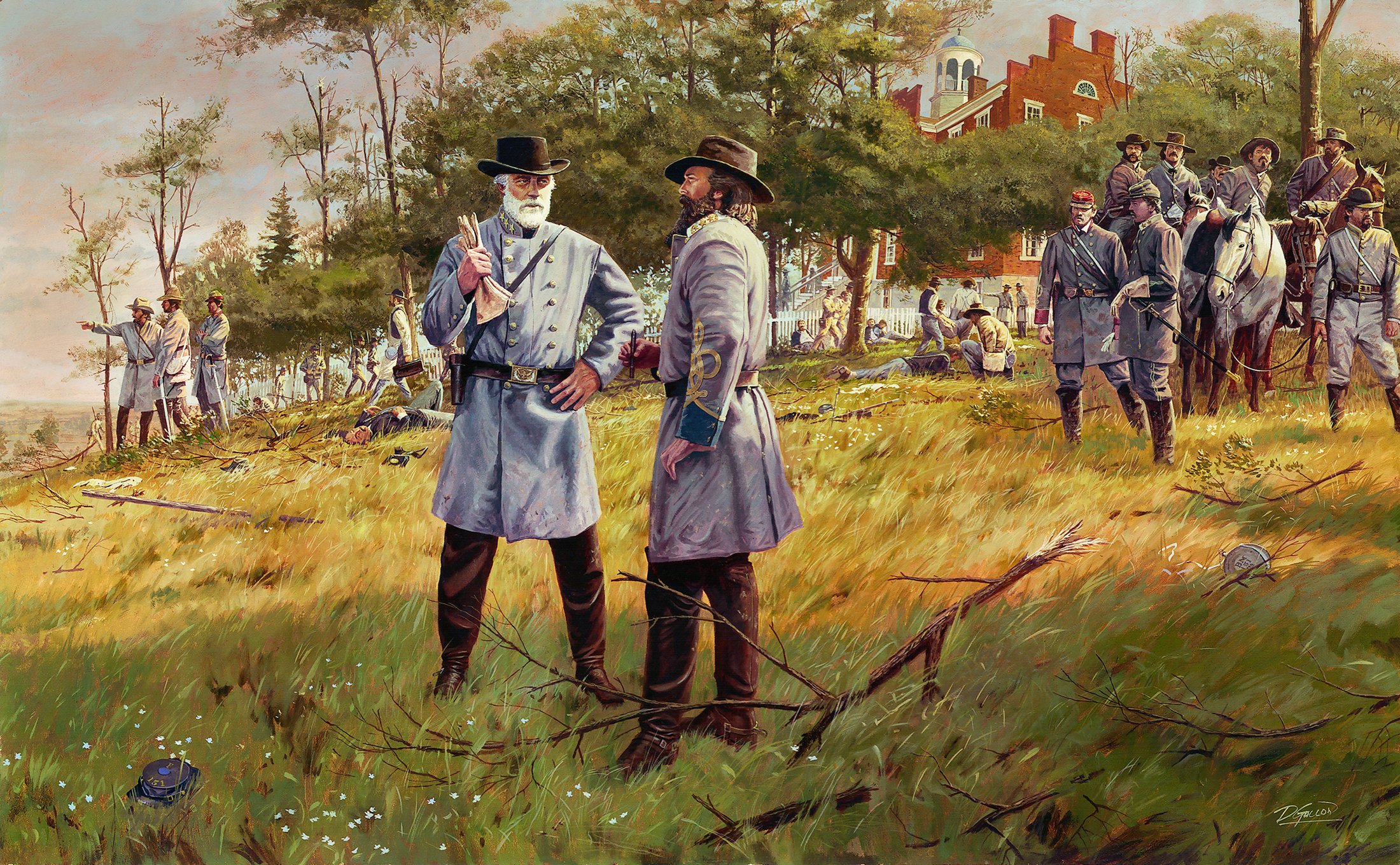
lee-and-longstreet-10709161246_9f5baf6452_o

One of the key issues that military leaders must face is how new and changing technology changes the shape of the battlefield and impacts operations at the tactical as well as the operational level. While some technological advances merely adjust how military organizations fight, others force military organizations to completely change the way they conduct war. Examples are found throughout history, but truly became more far reaching during the Civil War with their echoes redounding to the present day.

Those changes can include firepower, protection, mobility, communication and even the frontiers of war to what goes on underwater, in the air, in space and cyber-space. None of these advances are necessarily limited to how military professionals conduct war at any given time. In fact technological changes are often unwelcome by military professionals who have invested their professional lives and careers defending doctrinal traditions. Likewise those victimized by opponents who use new technology to their advantage sometimes accuse their opponents as being unfair, as if fairness counts in war.

The development of the rifled musket just prior to the Civil War and its widespread usage on the battlefield brought about change that most leaders were slow to appreciate, including Robert E. Lee. The fact was that the rifled musket changed war even when military tactics were still rooted in Napoleonic tactics, which were built around the weaponry commonly employed in 1800, the smoothbore flintlock musket, with an effect range of barely 100 yards and smoothbore artillery. The artillery, even when firing grapeshot and canister was superior in range, lethality and as a result dominated the offense. [1] Thus Napoleonic tactics emphasized the artillery as an assault weapon, placed in advance of the infantry, breaking up enemy formations and allowing the infantry to close with the enemy and finish him with the bayonet charge.

The advent of the rifled musket, use of percussion caps and the Minie’ ball bullet by necessity changed how war had to be fought. Rifles firing the Minie’ ball “had an effective range of at least 500 yards” [2] and the new weapons outranged both grapeshot and canister, putting artillerymen exposed to the long range rifle fire in more danger on the battlefield. Not only did they do this but they allowed the infantryman to increase his rate of fire.

Prior to this the limitations of the smoothbore flintlock musket necessitated that the infantry form in dense formations where their firepower could be concentrated. Dennis Hart Mahan was one of the first to recognize how this would change warfare and in 1847 advocated that close line and columns be “replaced by the regular infantry advancing in the loose order of skirmishers” and “take advantage of available cover and close by rushing within about 200 yards.” [3] Even so both armies, as well as their European counterparts were restrained by their continued adherence to “a body of tactical doctrine with long roots back to the 1790s,” the debate between the virtues of line and column formations. [4] The effectiveness of the new weapons was seen by American observers to the Crimean War and despite this both the Union and Confederate armies insisted on employing the old tactics in massed infantry attacks.

This was in part because many of the senior leaders had last experienced combat in the Mexican War, where both sides still used smoothbore muskets and in which frontal attacks and bayonet charges were used effectively. However, as Bruce Catton so well noted:

“the generals had been brought up wrong. The tradition they had learned was that of close order fighting in the open country, where men with bayonets bravely charged a line of men firing smoothbore muskets. That used to work well enough, because the range at which defenders could kill their assailants was very short….But the rifle came in and changed all of that. The range which charging men began to be killed was at least five times as great as it used to be, which meant about five times as many of the assailants were likely to be hit…A few men, like young Colonel Upton, sensed that new tactics were called for, but most could not quite get the idea.” [5]

Lee was one of them.

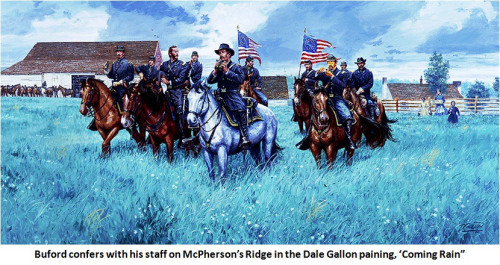
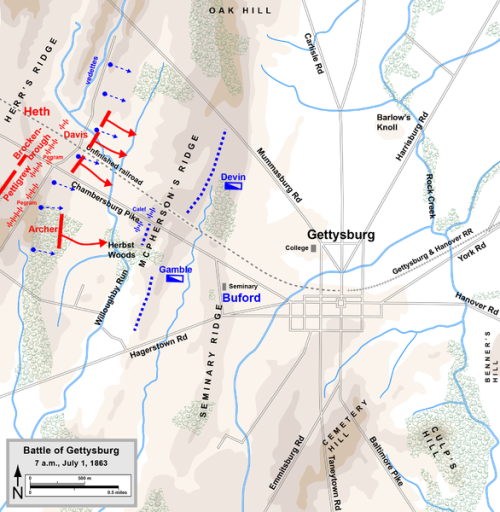
This new technology changed the battlefield, although many leaders were slow to appreciate who. “The artillery now had to fall back behind the infantry and became a support instead of an assault weapon.” [6] The new firepower available to the infantry “reduced artillery to the defense and forced cavalry to fight dismounted beside the infantry,” [7] something that had been show in its best form in John Buford’s defense of McPherson Ridge on the morning of July first. “The devastating increase in firepower doomed the open frontal assault and ushered in the entrenched battlefield.” [8]

Despite the plentiful evidence which showed that the defense now had the advantage, including his own experience at Malvern Hill and at Fredericksburg, Lee as well as his “right arm” Thomas “Stonewall” Jackson were firm believers in the offense. In their vision of battle, the the close assault of infantry and the bayonet retained its Napoleonic prominence, in 1861 Jackson enunciated his tactical philosophy: “my opinion is that there should not be much firing at all. My idea is that the best mode of fighting is to reserve your fire until the enemy get- or until you get them- to close quarters. The deliver one deadly, deliberate fire- and charge [with the bayonet].” [9] In fact the more time that Lee worked with Jackson the more he became an adherent of the offense, requiring “large scale battles and large casualties” [10] in order to bring about a climactic victory that would secure Southern independence.

At Gettysburg, Lee was “counting on the fighting spirit- the élan, as it is called in the French army- of his officers and men to win the day.” [11] The war in Mexico had not prepared Lee for the advent of the rifle and its effect on the battlefield and despite the tactical preference for the bayonet, the use of that weapon proved rare in combat. Heroes Von Borcke, a Prussian who served under the command of Stuart wrote the “accounts of bayonet fights are current after every general engagement, and are frequently embodied in subsequent ‘histories,’ so called; but as my experience goes, bayonet-fights rarely occur, and exist only in the imagination.” [12] Russell Weigley noted that “bayonet and saber wounds combined accounted for only 922 of some 250,000 wounded treated in Union hospitals during the war.” [13] But as late as 1862 Jackson just before Second Manassas “urged the Light Division under attack to hold their fire and use their bayonets” while “Lee’s penchant for frontal attacks when flanking and enveloping maneuvers failed to secure the results he hoped for…suggests slowness on the part of this otherwise astute and even brilliant commander to appreciate the power of the new weaponry.” [14] However, that being said, in defense of Lee, Jackson and so many commanders of the Civil War, despite the predictions of Mahan 15 years prior, “had no precedent to guide them, for all intents and purposes this was a new weapon.” [15] However, that was before the war began and bitter experience and massive casualties had demonstrated the power of the new weapons, especially when used by troops in strong defensive positions.

At about 5 p.m. on July 1st Lieutenant General James Longstreet reached the battlefield ahead of his corps, the closest division being still six miles away from the battle. He joined Lee on Seminary Ridge and commenced to survey the battlefield for a period of about ten minutes. While the scene before him gave the appearance of Confederate victory, Longstreet thought otherwise and believed that the Federal troop’s position on Cemetery Hill and Ridge “was a strong one.” [16] However, Lee despite his initial hesitancy to engage the Federal army was now certain that he could follow up the success of the day, and if the Union forces which he had driven back to the hill were still there the next morning “he had plenty of fresh troops to move in behind them and finish them off.” [17] Lee believed, even without any true idea of where the rest of the Federal Army was that he would be able to defeat it in detail as each Union corps arrived on the field. But Lee had misjudged Meade’s response and the movement of the Army of the Potomac to Gettysburg, and instead of a part of that army, almost all of it would be in place on ground of Meade and his commanders choosing.

The actions of Lee and his “Old Warhorse” on Seminary Ridge are part of much of the myth of Gettysburg, and the cause of endless debate between Lee’s supporters and Longstreet’s detractors. After Longstreet surveyed the ground he was pleased. The battlefield appeared to be set up for what he believed was a repetition of the Confederate victory at Fredericksburg, as he was under the assumption that Lee had promised to fight a defensive battle when contact was made. [18]

However, Longstreet was not aware of Lee’s though process on the march up. Lee had discussed the matter with Isaac Trimble on June 27th, before he discovered that Hooker had been relieved and was across the Potomac. Trimble recalled Lee’s words:

“Our army is in good spirits, not overly fatigued, and can be concentrated on any point in twenty-four hours or less….They will come up, probably through Frederick; broken down with hunger and hard marching, strung out on a long line and march demoralized, when they come into Pennsylvania. I shall throw an overwhelming force on their advance, crush it, follow up the success, drive on corps back and another, and by successive repulses and surprises before they can concentrate; create a panic and virtually destroy the army.” [19]

Trimble’s account of Lee’s state of mind is consistent with how Lee had conducted his operations over the previous year, Lee’s watchword in nearly every encounter with Union forces was “we must destroy this army” and the “aim of his maneuvers was always the battle of annihilation.” [20]

The only record of the conversation between the two men is that of Longstreet, written in his memoirs after years of being blamed by Lee’s supporters for the loss at Gettysburg. Without that knowledge and still under the impression, or “delusion” as Clifford Dowdey wrote, [21] that Lee had accepted his idea of fighting defensive battles in Pennsylvania. He “said that “he didn’t like the look of things, and he urged quite vehemently that the Confederates avoid any attack on the union position at Gettysburg.” [22] Longstreet commented: to Lee: “We could not call the enemy to position better suited to our plans. All we do is have do is to file around his left and secure good ground between him and his capital.” [23] Thus Longstreet was stunned by Lee’s impatience with the suggestion noting that Lee said “If he is there tomorrow I will attack him.” [24] Longstreet and Lee debated the matter for a while and Longstreet replied to Lee’s comment: “If he is there, it will be because he is anxious that we would attack him- a good reason, in my judgment, for not doing so.” [25]

That conversation has ignited a debate that continues today, but both Lee and Longstreet had sound arguments to support their positions, but both were hamstrung by the absolute lack of intelligence as to where the rest of the Federal army was and Meade’s intentions. Longstreet’s strategic and tactical concepts regarding employing the tactical defensive in the offense “grew out of an appreciation of the advantages Civil War military technology gave to the side having strong defensive positions.” [26] But the course of action that he suggested to Lee was vague and impractical, he did not specify at any time whether he meant a strategic sweeping move to the south or a shorter tactical move around the Round Tops, and “Lee rightly dismissed it at the time. Without Stuart’s cavalry he could not agree to a movement into the unknown.” [27]

Those that believe that if only Longstreet’s advice to move around the enemy was followed that the Confederates would have won a victory are mistaken. One of the key errors that many military history buffs make is that they assume that if one strategy failed and another had been suggested that the neglected course of action would have brought about victory. This is the case with those who assume that if only had lee followed Longstreet’s advice he would have won the battle. That neglects the understanding that the enemy too has a say in one’s plan. Several other factors have to be considered in this. First Meade had already prepared at strong position at Pipe Creek on the Maryland Pennsylvania border, this position was actually a stronger defensive position than Gettysburg. Likewise it neglects to account for the fact that any such maneuver would have exposed Lee’s army’s flank as it was strung out on the march in front of a now concentrated Federal army, and it ignores the logistics of the move deep in enemy territory without knowledge of the enemy’s positions. Additionally and possibly more important neither Lee nor Longstreet “had no idea where this “magic” good ground could be found, and no way to look for it until Stuart arrived with the cavalry.” [28]

But while rejecting Longstreet’s advice to move around the enemy what other choices did Robert E. Lee have on the evening of July 1st 1863? Lee obviously and with good reason rejected maneuver as a possibility, but there were other options, as Porter Alexander and others have noted. Freeman and others have discussed the concern that Lee had with forage, and his fear that if he remained in place that with supplies low that “the Federals could easily block the mountain passes and limit the area in which the Southern army could forage.” [29] But this need did “not require his renewal of the battle on July 1 any more than days following….” [30] Alexander noted that it was possible “for the Confederates to have abandoned Seminary Ridge on the night of July 1 or on July 2: “The onus of the attack was on Meade….we could have fallen back on Cashtown & held the mountain passes… & popular sentiment would have forced Meade to take the aggressive.” [31]

It seems that Lee’s decision to attack on July 2nd was mistaken, despite his appraisal that “A battle had, became in a measure unavoidable, and that the success already gained gave hope of a favorable issue.” [32] But Lee’s assertion is very much a matter of his framing life and actions in the context a nearly fatalistic understanding of Divine Providence and God’s will, it was not in accordance with the facts on the ground. Lee remarked “as soon as I order my army into battle, I leave my army in the hands of God…” [33] Porter Alexander later wrote “Not fully appreciating the strength of the enemy’s position, and mislead by the hope that a large fraction of the Federal Army was out of reach, Lee had determined to strike….” [34]

Lee elected to attack again, and even when he had the knowledge that most of the Federal army had come up he continued with his attack, committing his troops to fight an enemy who had strong defensive positions, high ground and interior lines from which they could shift troops and artillery to endangered sectors. Lee had taken heavy casualties on July 1st, three of the four divisions committed had been severely blooded and two division commanders wounded and he still did not have his entire army in position. As night settled on July 1st the only decision Lee had not made was where to make his attack.

Lee’s decision to attack, even when knowing the full Federal army was on the field was an exercise of both bad strategy, hubris and the refusal to acknowledge how the battlefield had changed with the advent of the rifled musket. It showed that even a great commander and a man associated with military genius was not infallible, despite the myth of the Lost Cause and its icon, General Robert E. Lee.

Peace

Padre Steve+

Notes

[1] Fuller, J.F.C. The Conduct of War 1789-1961 Da Capo Press, New York 1992. Originally published by Rutgers University Press, New Brunswick N.J p.104

[2] Ibid. Fuller The Conduct of War 1789-1961 p.104

[3] Hagerman, Edward. The American Civil War and the Origins of Modern Warfare. Midland Book Editions, Indiana University Press. Bloomington IN. 1992 p.10

[4] Guelzo, Allen C. Gettysburg: The Last Invasion Vintage Books a Division of Random House, New York 2013 p.38

[5] Catton, Bruce. A Stillness at Appomattox Doubleday and Company Garden City, New York 1953 pp.154-155

[6] Ibid. Fuller The Conduct of War 1789-1961 p.104

[7] Ibid. Hagerman The American Civil War and the Origins of Modern Warfare. p.xii

[8] Ibid. Hagerman The American Civil War and the Origins of Modern Warfare. p.xi

[9] Weigley, Russell F. American Strategy from its Beginnings to the First World War in Makers of Modern Strategy from Machiavelli to the Nuclear Age edited by a Peter Paret, Princeton University Press, Princeton New Jersey, 1986 p.428

[10] Weigley, Russell F. American Strategyp.426

[11] Korda, Michael Clouds of Glory: The Life and Legend of Robert E. Lee Harper Collins Books, New York 2014 p.593

[12] Fuller, J.F.C. Grant and Lee: A Study in Personality and Generalship Indiana University Press, Bloomington Indiana 1957 p.48

[13] Ibid. Weigley American Strategy p.428

[14] Ibid. Weigley American Strategy p.428

[15] Ibid. Fuller Grant and Lee p.48

[16] Ibid. Korda Clouds of Glory p.559

[17] Ibid. Guelzo Gettysburg: The Last Invasion p.215

[18] Freeman, Douglas Southall, Lee’s Lieutenant’s a Study in Command, One volume abridgement by Stephen W Sears, Scribner, New York 1998 pp.574-575

[19] Thomas, Emory Robert E. Lee W.W. Norton and Company, New York and London 1995 pp.293-294

[20] Ibid. Weigley American Strategy p.427

[21] Dowdy, Clifford. Lee and His Men at Gettysburg: The Death of a Nation Skyhorse Publishing, New York 1986, originally published as Death of a Nation Knopf, New York 1958 p.169

[22] Coddington, Edwin B. The Gettysburg Campaign: A Study in Command, A Touchstone Book, Simon and Schuster New York, 1968 p.360

[23] Longstreet, James From Manassas to Appomattox, Memoirs of the Civil War in Americaoriginally published 1896, Amazon Kindle Edition loc. 5059

[24] Ibid. Longstreet From Manassas to Appomattox loc. 5059

[25] Sears, Stephen W. Gettysburg. Houghton Mifflin Co. Boston and New York 2003 p.234

[26] Ibid. Coddington The Gettysburg Campaign: A Study in Command p.360

[27] Wert, Jeffry D. General James Longstreet The Confederacy’s Most Controversial Soldier, A Touchstone Book, Simon and Schuster, New York and London 1993 p.258


[28] Ibid. Korda Clouds of Glory p.561

[29] Ibid. Freeman Lee’s Lieutenants p.575

[30] Nolan, Alan T. R. E. Lee and July 1 at Gettysburg in the First Day at Gettysburg edited by Gallagher, Gary W. Kent State University Press, Kent Ohio 1992 p.24

[31] Ibid. Nolan R. E. Lee and July 1 at Gettysburg p.24

[32] Ibid. Freeman Lee’s Lieutenants p.575

[33] Ibid. Fuller Grant and Lee p.112

[34] Alexander, Edward Porter Military Memoirs of a Confederate: A Critical Narrative 1907 republished 2013 by Pickle Partners Publishing, Amazon Kindle Edition loc. 7517


1 Comment

Filed under civil war, leadership, Military

The Failure to Link Grand-Strategy and Operational Objectives: Robert E. Lee and the Decision to Invade Pennsylvania 1863

jefferson_davis_and_his_cabinet

A cohesive national strategy involves true debate and consideration of all available courses of action. In 1863 the Confederacy was confronted with the choice of how it would deal with the multiple threats to it posed by Union forces in both the West at Vicksburg, as well as in Tennessee as well as the East, where the Army of the Potomac was in striking distance of Richmond. However in May of 1863 the leaders of the Confederacy allowed themselves to choose the worst possible course of action for their circumstances simply because it was proposed by Robert E. Lee.

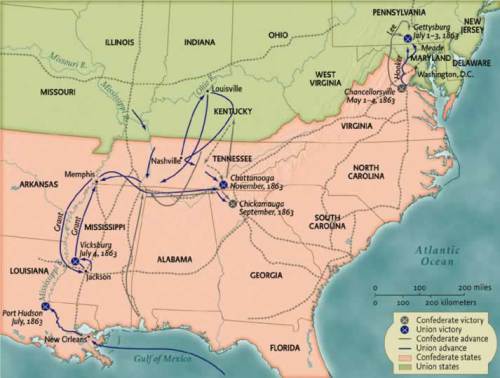
The strategic situation was bad but few Confederate politicians realized just how bad things were, or cared in the euphoria after the Lee and Jackson’s victory at Chancellorsville. In the west the strategic river city of Vicksburg Mississippi was threatened by the Army of Union General Ulysses S Grant, and Naval forces under the command of Admiral David Farragut and Admiral David Dixon Porter.

If Vicksburg fell the Union would control the entire Mississippi and cut the Confederacy in two. Union forces also maintained a strong presence in the areas of the Virginia Tidewater and the coastal areas of the Carolinas; while in Tennessee a Union Army under Rosecrans, was stalemated, but still threatening Chattanooga, the gateway to the Deep South. The blockade of the United States Navy continually reinforced since its establishment in 1861, had crippled the already tenuous economy of the Confederacy. The once mocked “anaconda strategy” devised by General Winfield Scott was beginning to pay dividends. [1] Of the nine major Confederate ports linked by rail to the inland cities the Union, all except three; Mobile, Wilmington and Charleston were in Union hands by April 1862. [2]

However, the Confederate response to the danger was “divided councils and paralysis” [3] in their upper leadership. Some Confederate leaders realized the mortal danger presented by Grant in the West including officials in the War Department, one of whom wrote “The crisis there is of the greatest moment. The loss of Vicksburg and the Mississippi river…would wound us very deeply in a political as well as a military point of view.” [4]

american14_51

Confederate Secretary of War James Seddon and President Jefferson Davis recognized the danger in the winter of 1862-1863. During the winter Davis and Seddon suggested to Lee that he detach significant units, including Pickett’s division to relieve the pressure in the west and blunt Grant’s advance. Lee would have nothing of it; he argued that the war would be won in the East. He told Seddon that “The adoption of your proposition is hazardous, and it becomes a question between Virginia and the Mississippi.” [5] From a strategic point of view it is hard to believe that Lee could not see this, however, much of Lee’s reasoning can be explained by what he saw as his first duty, the defense of Virginia. Lee’s biographer Michael Korda points out that Lee’s strategic argument was very much influenced by his love of Virginia, which remained his first love, despite his deep commitment to the Confederacy. Korda noted that Lee: “could never overcome a certain myopia about his native state. He remained a Virginian first and foremost…..” [6] It was Lee’s view that if Virginia was lost, so was the Confederacy, and was concerned that whatever units left behind should he dispatch troops from his Army west, would be unable to defend Richmond.

Despite this Seddon did remain in favor of shifting troops west and relieving Vicksburg. He was backed in this by Joseph Johnston, Braxton Bragg, P.T.G. Beauregard and James Longstreet. In Mid-May of 1863 Beauregard proposed a strategy to concentrate all available forces in in Tennessee and going to the strategic defensive on all other fronts. Beauregard, probably the best Southern strategist “saw clearly that the decisive point lay in the West and not the East.” [7] Beauregard’s plan was to mass Confederate forces was crush Rosecrans, relieve Vicksburg and then move east to assist Lee in destroying the Army of the Potomac in his words to complete “the terrible lesson the enemy has just had at Chancellorsville.” [8] His plan was never acknowledged and in a letter to Johnston, where he re-sent the plan he noted “I hope everything will turn out well, although I do not exactly see how.” [9]

James Longstreet had proposed a similar measure to Seddon in February 1863 and then again on May 6th in Richmond. Longstreet believed that “the Confederacy’s greatest opportunity lay “in the skillful use of our interior lines.” [10] He suggested to Seddon that two of his divisions link up with Johnston and Bragg and defeat Rosecrans and upon doing that move toward Cincinnati. Longstreet argued that since Grant would have the only Union troops that could stop such a threat that it would relieve “Pemberton at Vicksburg.” [11] Seddon favored Longstreet’s proposal but Jefferson Davis having sought Lee’s counsel rejected the plan, Longstreet in a comment critical of Davis’s rejection of the proposal wrote: “But foreign intervention was the ruling idea with the President, and he preferred that as the easiest solution of all problems.” [12] Following that meeting Longstreet pitched the idea to Lee who according to Longstreet “recognized the suggestion as of good combination, and giving strong assurance of success, but he was averse to having a part of his army so far beyond his reach.” [13]

In early May 1863 Lee, commanding the Army of Northern Virginia realized that the Confederacy was in desperate straits. Despite numerous victories against heavy odds, Lee knew that time was running out. Though he had beaten the Army of the Potomac under General Joseph Hooker at Chancellorsville, he had not destroyed it and Hooker’s Army, along with a smaller force commanded by General Dix in Hampton Roads still threatened Richmond. He had rejected the western option presented by Seddon, Beauregard and Longstreet. Lee questioned “whether additional troops there would redress the balance in favor of the Confederacy, and he wondered how he would be able to cope with the powerful Army of the Potomac.” [14] In Lee’s defense neither of these suggestions was unsound, but his alternative, an offensive into Pennsylvania just as unsound and undertaken for “confused” reasons. Confederate leaders realized that “something had to be done to save Vicksburg; something had to be done to prevent Hooker from recrossing the Rappahannock; something had to be done to win European recognition, or compel the North to consider terms of peace…[15] However added to these reasons, and perhaps the most overarching for Lee was “to free the State of Virginia, for a time at least, from the presence of the enemy” and “to transfer the theater of war to Northern soil….” [16]

On May 14th Lee travelled by train to Richmond to meet with President Jefferson Davis and War Secretary James Seddon. At the meeting Lee argued for an offensive campaign in the east, to take the war to Pennsylvania. Lee had three major goals for the offensive, two which were directly related to the immediate military situation and one which went to the broader strategic situation.

Lee had long believed that an offensive into the North was necessary, even before Chancellorsville. As I have already noted, Lee did not believe that reinforcing the Confederate Armies in the West would provide any real relief for Vicksburg. He believed, quite falsely, that the harsh climate alone would force Grant to break off his siege of Vicksburg. [17] Instead, Lee believed that his army, flush with victory needed to be reinforced and allowed to advance into Pennsylvania. He proposed withdrawing Beauregard’s 16,000 soldiers from the Carolinas to the north in order “increase the known anxiety of Washington authorities” [18] and sought the return of four veteran brigades which had been loaned to D.H. Hill in North Carolina. In this he was unsuccessful receiving two relatively untested brigades from Hill, those of Johnston Pettigrew and Joseph Davis. The issue of the lack of reinforcements was a “commentary on the severe manpower strains rending the Confederacy…and Davis wrote Lee on May 31st, “and sorely regret that I cannot give you the means which would make it quite safe to attempt all that we desire.” [19]

Lee’s Chief of Staff Colonel Charles Marshall crafted a series of courses of action for Lee designed to present the invasion option as the only feasible alternative for the Confederacy. Lee’s presentation was an “either or” proposal. He gave short shrift to any possibility of reinforcing Vicksburg and explained “to my mind, it resolved itself into a choice of one of two things: either to retire to Richmond and stand a siege, which must ultimately end in surrender, or to invade Pennsylvania.” [20] As any military planner knows the presentation of courses of action designed to lead listeners to the course of action that a commander prefers by ignoring the risks of such action, downplaying other courses of action is disingenuous. In effect Lee was asking Davis and his cabinet to “choose between certain defeat and possibly victory” [21] while blatantly ignoring other courses of action or playing down very real threats.

Lee embraced the offensive as his grand strategy and rejected the defensive in his presentation to the Confederate cabinet, and they were “awed” by Lee’s strategic vision. Swept up in Lee’s presentation the cabinet approved the invasion despite the fact that “most of the arguments he made to win its approval were more opportunistic than real.” [22] However, Postmaster General John Reagan objected and stated his dissent arguing that Vicksburg had to be the top priority. But Lee was persuasive telling the cabinet “There were never such men in any army before….They will go anywhere and do anything if properly led….” So great was the prestige of Lee, “whose fame…now filled the world,” that he carried the day.” [23]Although both Seddon and Davis had reservations about the plan they agreed to it, unfortunately for all of them they never really settled the important goals of the campaign including how extensive the invasion would be, how many troops would he need and where he would get them. [24] The confusion about these issues was fully demonstrated by Davis in his letter of May 31st where he “had never fairly comprehended” Lee’s “views and purposes” until he received a letter and dispatch from the general that day.” [25] That lack of understanding is surprising since Lee had made several personal visits to Davis and the cabinet during May and demonstrates again the severe lack of understanding of the strategic problems by Confederate leaders.

Lee believed that his offensive would relieve Grant’s pressure on Pemberton’s Army at Vicksburg. How it would do so is not clear since the Union had other armies and troops throughout the east to parry any thrust made had the Army of the Potomac endured a decisive defeat that not only drove it from the battlefield but destroyed it as a fighting force. Postmaster General Reagan believed that the only way to stop Grant was “destroy him” and “move against him with all possible reinforcements.” [26]

Likewise Lee believed that if he was successful in battle and defeated the Army of the Potomac in Pennsylvania that it could give the peace party in the North to bring pressure on the Lincoln Administration to end the war. This too was a misguided belief and Lee would come to understand that as his forces entered Maryland and Pennsylvania where there was no popular support for his invading army. In the meeting with the cabinet Postmaster-General Reagan, agreeing with General Beauregard warned that “the probability that the threatened danger to Washington would arouse again the whole of the Yankee nation to renewed efforts for the protection of their capital.” [27] Likewise, Stephens the fire breathing Vice President “wanted to negotiate for peace, and he foresaw rightly that Lee’s offensive would strengthen and not weaken the war party in the North….Stephens was strongly of the opinion that Lee should have remained on the defensive and detached a strong force to assist Johnston against Grant at Vicksburg.” [28]

Lee believed that if he could spend a summer campaign season in the North, living off of Union foodstuffs and shipping booty back to the Confederacy that it would give farmers in Northern Virginia a season to harvest crops unimpeded by major military operations. While the offensive did give a few months relief to these farmers it did not deliver them. Likewise Lee’s argument that he could not feed his army flies in the face of later actions where for the next two years the Army of Northern Virginia continued to subsist. Alan Nolan notes that if a raid for forage was a goal of the operation then “a raid by small, mobile forces rather than the entire army would have had considerably more promise and less risk.” [29] D. H. Hill in North Carolina wrote his wife: “Genl. Lee is venturing upon a very hazardous movement…and one that must be fruitless, if not disastrous.” [30]

Though Lee won permission to invade Pennsylvania, he did not get all that he desired. Davis refused Lee reinforcements from the coastal Carolinas, and insisted on units being left to cover Richmond in case General Dix advanced on Richmond from Hampton Roads. Much of this was due to political pressure as well as the personal animus of General D. H. Hill who commanded Confederate forces in the Carolinas towards Lee. The units included two of Pickett’s brigades which would be sorely missed on July third.

Likewise Lee’s decision revealed an unresolved issue in Confederate Grand Strategy, the conflict between the strategy of the offensive and that of the defensive. Many in the Confederacy realized that the only hope for success was to fight a defensive campaign that made Union victory so expensive that eventually Lincoln’s government would fall or be forced to negotiate.

Lee was convinced that ultimate victory could only be achieved by decisively defeating and destroying Federal military might in the East. His letters are full of references to crush, defeat or destroy Union forces opposing him. His strategy of the offensive was demonstrated on numerous occasions in 1862 and early 1863, however in the long term, the strategy of the offensive was unfeasible and counterproductive to Southern strategy. Lee’s offensive operations always cost his Army dearly in the one commodity that the South could not replace, nor keep pace with its Northern adversary, his men. His realism about that subject was shown after he began his offensive when he wrote Davis about how time was not on the side of the Confederacy. He wrote: “We should not therefore conceal from ourselves that our resources in men are constantly diminishing, and the disproportion in this respect…is steadily augmenting.” [31] Despite this, as well as knowing that in every offensive engagement, even in victory he was losing more men percentage wise than his opponent Lee persisted in the belief of the offensive.

When Lee fought defensive actions on ground of his choosing, like a Fredericksburg he was not only successful but husbanded his strength. However, when he went on the offensive in almost every case he lost between 15 and 22 percent of his strength, a far higher percentage in every case than his Union opponents. In these battles the percentage of soldiers that he lost was always more than his Federal counterparts, even when his army inflicted greater aggregate casualties on his opponents. Those victories may have won Lee “a towering reputation” but these victories “proved fleeting when measured against their dangerous diminution of southern white manpower.” [32] Lee recognized this in his correspondence but he did not alter his strategy of the offensive until after his defeat at Gettysburg.

The course of action was decided upon, but one has to ask if Lee’s decision was wise decision at a strategic point level, not simply the operational or tactical level where many Civil War students are comfortable. General Longstreet’s artillery commander, Colonel Porter Alexander described the appropriate strategy of the South well, he wrote:

“When the South entered upon war with a power so immensely her superior in men & money, & all the wealth of modern resources in machinery and the transportation appliances by land & sea, she could entertain but one single hope of final success. That was, that the desperation of her resistance would finally exact from her adversary such a price in blood & treasure as to exhaust the enthusiasm of its population for the objects of the war. We could not hope to conquer her. Our one chance was to wear her out.” [33]

What Alexander describes is the same type of strategy successfully employed by Washington and his more able officers during the American Revolution, Wellington’s campaign on the Iberian Peninsula against Napoleon’s armies, and that of General Giap against the French and Americans in Vietnam. It was not a strategy that completely avoided offensive actions, but saved them for the right moment when victory could be obtained.

It is my belief that Lee erred in invading the North for the simple fact that the risks far outweighed the possible benefits. It was a long shot and Lee was a gambler, audacious possibly to a fault. His decision to go north also exhibited a certain amount of hubris as he did not believe that his army could be beaten, even when it was outnumbered. Lee had to know from experience that even in victory “the Gettysburg campaign was bound to result in heavy Confederate casualties…limit his army’s capacity to maneuver…and to increase the risk of his being driven into a siege in the Richmond defenses.” [34] The fact that the campaign did exactly that demonstrates both the unsoundness of the campaign and is ironic, for Lee had repeatedly said in the lead up to the offensive in his meetings with Davis, Seddon and the cabinet that “a siege would be fatal to his army” [35] and “which must ultimately end in surrender.” [36]

Grand-strategy and national policy objectives must be the ultimate guide for operational decisions. “The art of employing military forces is obtaining the objects of war, to support the national policy of the government that raises the military forces.” [37] Using such criteria, despite his many victories Lee has to be judged as a failure as a military commander. Lee knew from his previous experience that his army would suffer heavy casualties. He understood that a victory over the Army of the Potomac deep in Northern territory could cost him dearly. He knew the effect that a costly victory would have on his operations, but he still took the risk. That decision was short sighted and diametrically opposed to the strategy that the South needed to pursue in order to gain its independence. Of course some will disagree, but I am comfortable in my assertion that it was a mistake that greatly affected the Confederacy’s only real means of securing its independence, the breaking of the will of the Union by making victory so costly that it would not be worth the cost.


[1] Fuller, J.F.C. The Conduct of War 1789-1961 Da Capo Press, New York 1992. Originally published by Rutgers University Press, New Brunswick N.J p.101 Fuller has a good discussion of the Anaconda strategy which I discussed in the chapter: Gettysburg, Vicksburg and the Campaign of 1863: The Relationship between Strategy, Operational Art and the DIME

[2] Ibid. Fuller The Conduct of War 1789-1961 p.101

[3] McPherson, James. The Battle Cry of Freedom: The Civil War Era Oxford University Press, Oxford and New York 1988 p.629

[4] Coddington, Edwin B. The Gettysburg Campaign: A Study in Command, A Touchstone Book, Simon and Schuster New York, 1968 p.5

[5] Guelzo, Allen C. Gettysburg: The Last Invasion Vintage Books a Division of Random House, New York 2013 p.34

[6] Korda, Michael. Clouds of Glory: The Life and Legend of Robert E. Lee Harper Collins Publishers, New York 2014 p.525

[7] Fuller, J.F.C Grant and Lee: A Study in Personality and Generalship Indiana University Press, Bloomington Indiana, 1957 p.193

[8] Foote, Shelby, The Civil War, A Narrative. Volume Two Fredericksburg to Meridian Random House, New York 1963 p.429

[9] Ibid. Foote The Civil War, A Narrative. Volume Two Fredericksburg to Meridian p.429

[10] Ibid. Korda Clouds of Glory: The Life and Legend of Robert E. Lee p.525

[11] Wert, Jeffry D. General James Longstreet The Confederacy’s Most Controversial Soldier, A Touchstone Book, Simon and Schuster, New York and London 1993 p.241

[12] Longstreet, James From Manassas to Appomattox, Memoirs of the Civil War in America originally published 1896, Amazon Kindle Edition location 4656

[13] Ibid. Longstreet, James From Manassas to Appomattox, Memoirs of the Civil War in America location 4705

[14] Ibid. Coddington The Gettysburg Campaign: A Study in Command, p.5

[15] Ibid. Fuller Grant and Lee: A Study in Personality and p.194

[16] Taylor, Walter. General Lee: His campaigns in Virginia 1861-1865 With Personal Reminiscences University of Nebraska Press, Lincoln Nebraska and London, 1994 previously published 1906 p.180.

[17] Ibid. Foote The Civil War, A Narrative. Volume Two Fredericksburg to Meridian p.430

[18] Ibid. Korda Clouds of Glory: The Life and Legend of Robert E. Lee p.528

[19] Sears, Stephen W. Gettysburg. Houghton Mifflin Co. Boston and New York 2003 p.51

[20] Ibid. Foote The Civil War, A Narrative. Volume Two Fredericksburg to Meridian p.431

[21] Ibid. Foote The Civil War, A Narrative. Volume Two Fredericksburg to Meridian p.431

[22] Tredeau, Noah Andre. Gettysburg: A Testing of Courage, Harper Collins Publishers, New York 2002 p.6

[23] Ibid. McPherson The Battle Cry of Freedom p.647

[24] Ibid. Coddington The Gettysburg Campaign: A Study in Command, p.7

[25] Ibid. Coddington The Gettysburg Campaign: A Study in Command, p.7

[26] Ibid. Foote The Civil War, A Narrative. Volume Two Fredericksburg to Meridian p.432

[27] Ibid. Foote The Civil War, A Narrative. Volume Two Fredericksburg to Meridian p.432

[28] Ibid. Fuller Grant and Lee: A Study in Personality and p.194

[29] Nolan, Alan T. R. E. Lee and July 1 at Gettysburg in the First Day at Gettysburg edited by Gallagher, Gary W. Kent State University Press, Kent Ohio 1992 p.2

[30] Ibid. Sears. Gettysburg p.51

[31] Taylor, John M. Duty Faithfully Performed: Robert E Lee and His CriticsBrassey’s, Dulles VA 1999 p.134

[32] Gallagher, Gary W. The Confederate War: How Popular Will, Nationalism and Military Strategy Could not Stave Off Defeat Harvard University Press, Cambridge MA and London 1999 p.120

[33] Alexander, Edward Porter. Fighting for the Confederacy: The Personal Recollections of General Edward Porter Alexander, ed. Gary W. Gallagher, University of North Carolina Press, Chapel Hill NC, 1989 p.415

[34] Ibid. NolanR. E. Lee and July 1 at Gettysburg in the First Day at Gettysburg p.11

[35] Ibid. NolanR. E. Lee and July 1 at Gettysburg in the First Day at Gettysburg p.11

[36] Ibid. Foote The Civil War, A Narrative. Volume Two Fredericksburg to Meridian p.431

[37] Ibid. NolanR. E. Lee and July 1 at Gettysburg in the First Day at Gettysburg p.4

2 Comments

Filed under civil war, History, leadership, Military

Gettysburg: The Connection between Policy, Strategy, and Operational Art

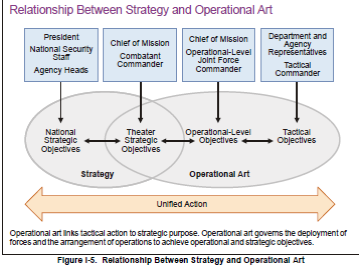
fig-1-5-jp-03a

Friends of Padre Steve’s World

As I have been working to revise my materials form my next Gettysburg Staff Ride I did some revisions to my text that I use with my students. The footnotes did not show up so Monday I will repost the text of this article with them. The article is important even for non-military types who care about the country and are involved in politics or policy, because it shows the linkage between the advantages that a nation with a strong strong and effective central government has over one which adopts what we would call today a Libertarian form of government. In fact I would call the effort of the Confederacy in the Civil War “The Failed Libertarian War.” But that is possibly a subject for an article or maybe even a book, but I digress…

So anyway here is the latest,

Peace

Padre Steve+

Today we look at the Gettysburg Campaign in terms of how we understand the connection between strategy and operational art. In doing so we have to place it in the context that Lee’s campaign has in relationship to the Confederate command relationships and where it fits in the continuum of unified action as we understand it today.

To do so we have to make the connection between national strategic objectives, theater objectives, operational objective and tactical objectives. We have to explore command and control structures, staff organization and the understand the effect of the Diplomatic, Informational, Economic and Military elements of national power that impact a nation’s ability to wage war.

The summer campaign of 1863 in the Civil War gives us the opportunity to do this as we explore the Gettysburg campaign in relation to Vicksburg and the overall strategic situation that both sides faced. This includes the elements that we now associate with the DIME.

While Confederate army units and their commanders generally excelled on the tactical level, and their soldiers endured hardship well, this would not be enough to secure victory. They displayed amazing individual initiative on the battlefield and they won many victories against superior forces, especially in the early part of the war. Even during the final year of the war, Lee’s forces fought skillfully and helped prolong the war. But neither the Confederate government nor the various army commanders were able to translate battlefield success to operational, theater specific or national strategic objectives.

The Confederacy had a twofold problem in its organization for war and how it conducted the war. First it had no organization at the strategic level to direct the war, and it never developed one to coordinate its military, military, diplomatic or economic policies. While Southern strategists understood that they needed to “wear down the ability of the North to wage war” they were consistently hobbled by its own internal political divisions which served to undermine efforts to coordinate the effort to defend the Confederacy. These divisions focused on the opposition of the states’ rights proponents to the central government in Richmond.

The overarching national strategic objective of the Confederacy was to attain independence. The Confederates could not hope to conquer the Union and because of that their “strategic problem was to resist conquest” and to do so they would have to “tire the Federals out, and force them to abandon the war.” Jefferson Davis seems to have understood this early in the war, but political considerations and the temperament of most Southerners and their political leaders frustrated his attempts. Generals like Lee and Joseph E. Johnston “were of the opinion that the more remote frontiers should be abandoned, and that the scattered forces of the Confederacy be concentrated, political reasons overruled their judgment.”

Southern politicians, especially the governors and congressmen demanded that troops “defend every portion of the Confederacy from penetration by “Lincoln’s abolition hordes.” Likewise, most Southerners believed that they “could whip any number of Yankees” and as early as 1861 the Confederate press was advocating an offensive strategy as the Richmond Examiner declared “The idea of waiting for blows rather than inflicting them, is altogether unsuited to the genius of our people….The aggressive policy is the truly defensive one. A column pushed forward into Ohio or Pennsylvania is worth more to us, as a defensive measure, than a whole tier of seacoast batteries from Norfolk to the Rio Grande.”

This combination of wanting to defend everything, which defied Frederick the Great’s classic dictum that “he who defends everything defends nothing” and the persistent employment of the offensive even when it “drained the Confederacy’s manpower and weakened its long term prospects for independence” were key strategic factors in its defeat.

The South did get an earlier start to in mobilizing for war then the Union. Even before the “Confederate Congress authorized an army of 100,000 volunteers for twelve months” on March 6th 1861 the governors of the eleven Confederate States raised units to fight any Federal armies which dared to force them back into the Union. This involved dusting off the old militias which had been allowed to decay in the period between the Mexican War and 1860. Most of these units in the South as well as the North were volunteer companies in which the discipline, equipment and training varied to a significant degree. Most had little in the way of real military training and “many of them spent more time drinking than drilling.” The early Confederate mobilization outstripped the availability of arms and equipment forcing many volunteers to be sent home.

Other than the stated desire for independence and their common hatred of the “Yankee,” there was little in the way of unity within the Confederate States, “the incurable jealousy of the States, especially those not immediately affected by the war, established a dry rot within the Confederacy.” Within the Confederacy, each state viewed itself as an independent nation only loosely bound to the other states and some legislatures enacted laws which actively opposed the central government in Richmond.

The various Confederate states controlled the use of their units and often resisted any effort at centralization of effort. Some kept their best units at home, while others dispatched units to Confederate armies such as Lee’s Army of Northern Virginia. Initially most states limited enlistment periods to one year despite the opposition of Robert E. Lee who helped Jefferson Davis pass the Conscription Act of 1862, a measure that was “heavily watered down by those politicians whose first concern was states’ rights and by those who felt that it would undermine patriotism.” That measure, even in its watered down form was distinctly unpopular, especially with the following declaration of martial law in parts of the Confederacy.

Both measures were brought by realists who understood that for the Confederacy to survive the war effort had to become a total war, with “the whole population and the whole production…put on a war footing.” Such measures provoke more attacks and opposition by their opponents who advocated states’ rights even if it worked against the overall interests of the Confederacy. By the time of Gettysburg if not sooner, “Confederate society began to unravel. The yeomanry and poor white people resented conscription, the tax-in-kind impressment, and other governmental measures than the wealthy. Planters sought to safeguard their property and status to the detriment of national goals.”

This included how state governments responded to the military needs of the Confederacy. Some governors hoarded weapons seized from Federal armories, “retaining these weapons to arm regiments that they kept at home… defend state boarders and guard against potential slave uprisings.” When in response to threats within the Confederacy Jefferson Davis suspended the writ of habeas corpus it resulted in a firestorm of opposition from the states. “Mississippi and Georgia passed flaming resolutions against the act; Louisiana presently did so, too, and North Carolina soon had a law on its books nullifying the action of the central government.” Alexander Stephens, the Confederate Vice President noted that there was “no such thing as a citizen of the United States, but the citizen of a State, and that “the object of quitting the Union, was not to destroy, but to save the principles of the Constitution.”

Likewise as economic conditions worsened and inflation soared in late 1861 the Confederate Congress “in its allotments to the War Department refused to face up to the costs of running the war…it forced the department to scramble in an atmosphere of uncertainty for allotments on a short-run basis.” There was much distrust of any attempt to organize a true central government with any actual authority or power in Richmond. Jefferson Davis may have been President but his country was hamstrung by its own internal divisions, including the often vocal opposition of Stephens for whom states’ rights remained a paramount issue. Stephens, in a statement that defied the understanding that military victory had to be achieved for independence to be won said during the habeas corpus debate “Away with the idea of getting independence first, and looking to liberty afterward.” This, like so many other aspects of the Confederate war effort showed the radical disconnection between legislators, policy makers and the Army and defied any understanding of the importance of government and the unity of effort in pursuing war aims. .

The Confederacy lacked a clear defined command structure to coordinate its war efforts. At the beginning of the war this was true of the Union as well, however, by the Union was much more adept at responding to the needs of the war, this included its military operations, diplomatic efforts and economy. Out of necessity it established a War Department as well as a Department of the Navy in February 1861 and Jefferson Davis, the new President who had served in Mexico and as Secretary of War prior to secession “helped speed southern mobilization in 1861.” However helpful this was initially Davis, who micromanaged Confederate war efforts “eventually led to conflict with some army officers.”

american14_5a

Jefferson Davis was an able man to be sure, but he “totally misunderstood the nature of the war.” Davis was a man given to suspicion and had major personality conflicts with all of his senior commanders save Robert E. Lee. These included Joseph Johnston who he loathed and P.T.G. Beauregard, both of whom he quarreled with on matters of strategy. These conflicts did impact operations, just as did the refusal of various states to support operations or campaigns apart from ones that impacted their state directly.

While Jefferson Davis and his Secretary of War theoretically exercised direction of the war no formal mechanism existed to coordinate the needs of the various military departments or armies. In 1863 Davis, Lee and the Secretary of War, James Seddon were acting as an “informal board which had a say in all major questions of Confederate strategy. Seddon, who had definite ideas of his own about military affairs, was usually but not always a party to Davis’ discussions with Lee…but Davis usually dominated them…. In contrast to the Northern command organization, the South had no general in chief. If anyone fulfilled his functions, it was the President.” It was not until February of 1865 that Lee was named as General in Chief of all armies, and by then the war had been lost.

While Jefferson Davis and his Secretary of War theoretically exercised direction of the war no formal mechanism existed to coordinate the needs of the various military departments or armies. In 1863 Davis, Lee and the Secretary of War, James Seddon were acting as an “informal board which had a say in all major questions of Confederate strategy. Seddon, who had definite ideas of his own about military affairs, was usually but not always a party to Davis’ discussions with Lee…but Davis usually dominated them…. In contrast to the Northern command organization, the South had no general in chief. If anyone fulfilled his functions, it was the President.” It was not until February of 1865 that Lee was named as General in Chief of all armies, and by then the war had been lost.

In effect each Confederate army and military department operated independently, often competing with each other for the troops, supplies and materials needed to fight. They also had to contend with recalcitrant state governments, each loathe to sacrifice anything that might compromise their own independence. Attempts by the authorities in Richmond to centralize some measure of authority were met with resistance by the states. Thus states’ rights were “not only the cause of the war, but also the cause of the Confederate downfall.”

In a country as vast as the Confederacy that lacked the industry, transportation infrastructure, population and economic power of the North this was a hindrance that could not be overcome by the soldierly abilities of its armies alone. An example of the Confederate problem was that “neither the army nor the government exercised any control of the railroads.” The Confederate Subsistence Department, which in theory was responsible for ensuring the supply of food, stores and the logistical needs necessary to maintain armies in the field could not plan with confidence. “Tied to the railroads, unable to build up a reserve; frequently uncertain whether or not their troops were going to be fed from one day to the next, field commanders understandably experienced a general loss of confidence in the Subsistence Department….” Even though the subsistence and even the survival of the army was dependent on the use of railroads, the railroad owners “responded by an assertion of their individual rights. They failed to cooperate….and Government shipments were accorded low priority. In May of 1863 the Confederate Congress finally granted the government broad authority over the railroads, but “Davis hesitated to wield the power. “ It would not be until early 1865 that the Confederacy would “finally take control of the railroads.”

All of these factors had a direct effect on the campaign of 1863. In the west, Confederate commanders were very much left to fend for themselves and to add to their misery failed even to coordinate their activities to meet the threat of Grant and his naval commander, Admiral David Dixon Porter. In the East, Lee having established a close relationship with Jefferson Davis as his military advisor during the first year of the war exercised a disproportionate influence on the overall strategy of the Confederacy because of his relationship with Davis. However, Lee was hesitant to use his influence to supply his army, even when it was suffering. Even though he willingly shared in the plight of his solders, Lee refused “to exert his authority to obtain supplies….” As the army prepared to invade Pennsylvania, “the paltry rationing imposed by Richmond was made worse by a tenuous supply line….”

Lee in theory was simply one of a number of army or department commanders, yet he was responsible for the decision to invade the Union in June of 1863. This decision impacted the entire war effort. The Confederate cabinet “could reject Lee’s proposal as readily as that of any other department commander, Bragg, or Pemberton or Beauregard, for example, each of whom was zealous to protect the interests of the region for which he was responsible…” But this was Lee, “the first soldier of the Confederacy- the first soldier of the world…” Lee’s plan was approved by the cabinet by a vote of five to one. The lone dissenter was Postmaster General John H. Reagan who “believed a fatal mistake had been made…”

Lee in theory was simply one of a number of army or department commanders, yet he was responsible for the decision to invade the Union in June of 1863. This decision impacted the entire war effort. The Confederate cabinet “could reject Lee’s proposal as readily as that of any other department commander, Bragg, or Pemberton or Beauregard, for example, each of whom was zealous to protect the interests of the region for which he was responsible…” But this was Lee, “the first soldier of the Confederacy- the first soldier of the world…” Lee’s plan was approved by the cabinet by a vote of five to one. The lone dissenter was Postmaster General John H. Reagan who “believed a fatal mistake had been made…”

Seddon desired to turn the tide at Vicksburg and proposed sending Longstreet’s Corps to reinforce Johnston to relieve the embattled city and maintain the front on the Mississippi. However, Lee believed that any attempt “to turn the Tide at Vicksburg…put Lee’s army in Virginia at unacceptable risk.”

The lack of any sense of unity in the Confederate hierarchy and lack of a grand strategy was disastrous. The lack of agreement on a grand strategy and the inability of the Confederate States Government and the various state governments to cooperate at any level culminated in the summer of 1863 with the loss of Vicksburg and the failure of Lee’s invasion of Pennsylvania. The Confederate failure in this demonstrates the absolute need for unity of effort and even more a whole of government and whole of nation approach to war.

This can be contrasted with the Union, which though it was slow to understand the nature of the war did have people who, through trial and error developed a cohesive strategy that led to success at the operational level and the tactical level. The genus in Union strategy came from Lieutenant General Winfield Scott who “appreciated the relationship between economic factors and attack.” Scott’s strategic plan was to establish a blockade and form two major armies, “one to move down the Mississippi and cut off the western half of the Confederacy from its eastern half, while the other threatened Richmond and pinned down the main Confederate forces in Virginia.” It was a plan for total war called Anaconda which was mocked in both the Northern and Southern press and it would become the blueprint of Federal success at the war progressed. Scott was the first to recognize that the war would not be short and his plan was the first to “recognize the North’s tremendous advantage in numbers and material, and it was the first to emphasize the importance of the Mississippi Valley in an over-all view of the war.”

Abraham Lincoln had little in the way of military acumen and frequently, until Grant took control of the armies interfered with his senior commanders, often with good reason. However, Lincoln was committed to winning the war and willing to take whatever steps necessary to do so. Fuller describes him as “none other than a dictator” by bypassing Congress and on his own authority declaring a blockade of Southern ports, calling for 75,000 volunteers and suspending habeas corpus.

Likewise Lincoln as well as Congress understood the value and necessity of the railroads and in January 1862 “Congress authorized to take possession of any railroads and place them under military control when the public safety warranted it.” Lincoln formed the Department of Military Railroads the following month and appointed Daniel C McCallum as its director. In May President Lincoln formally took possession of all railroads, but “saw to it that cooperative lines received government aid.”

George McClellan, who Lincoln appointed as commander of the Army of the Potomac in 1862, whatever his many faults as a field commander “possessed a strategic design for winning the war,” understood the necessity of unity of command and successfully built an effective army. Now his design was different than that of Scott, for he desired to “crush the rebels in one campaign” by an overland march to Richmond. While this was unrealistic because of McClellan’s constant overestimation of his enemy and inability to risk a fight when on the Peninsula and at the gates of Richmond, the Union might have at least had a chance should he have defeated the major Confederate forces deployed to defend that city. While that would have been unlikely to win the war in a single stroke it would have been a significant reversal for the Confederacy in 1862.

Logistics was one of the deciding factors of e war, both the Confederate weakness and Union ability to adapt society and government needs to wartime conditions. As a general principle Union leaders, government and business alike understood the changing nature of modern war. This stood in stark contrast to the inefficient and graft ridden Confederate agencies where even those who wanted more effective means to wage war were hindered by politicians, land owners and businessmen who insisted on their rights over the needs of the nation. The Union developed an efficient and well managed War Department where the importance of logistics inter-bureau cooperation became a paramount concern.

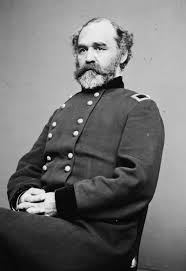
Union industry “geared up up for war production on a scale that would make the Union army the best fed, most lavishly supplied army that have ever existed.” The Quartermaster’s Department under the direction of Quartermaster General Montgomery Meigs was particularly efficient in supplying the needs of a military fighting on exterior lines in multiple theaters of operation. Unlike the Confederate Subsistence Bureau the Federal Quartermaster Bureau supplied almost everything the army could need: “uniforms, overcoats shoes, knapsacks, haversacks, canteens, mess gear, blankets, tents, camp equipage, barracks, horses, mules, forage, harnesses, horseshoes, and portable blacksmith shops, supply wagons, ships when the army could be supplied by water, coal and wood to fuel them, and supply depots for storage and distribution.” The ill-equipped Confederates could only look on with awe, in fact during his absence from Lee J.E.B. Stuart was ecstatic over the capture of “one hundred and twenty five of the best United States model wagons and splendid teams….” likewise one of the reasons that A.P. Hill allowed Harry Heth to send his division the Gettysburg was to find shoes that the Confederate Subsistence Department could not provide for them. Thus one of the reasons for the Battle of Gettysburg is directly linked to the failed logistics system of the Confederacy.

Early in the war the Union logistics effort was beset by some of the same problems that plagued the Confederacy throughout the war. Graft and corruption ran rife until 1862 when “Congress established investigative committees to uncover fraud and passed laws regulating the letting of contracts.” Meigs overhauled the bureau. At the beginning of the war it had only one department, for clothing. He modernized this and added eight new departments, which dealt with “specialized logistical functions such as forage and fuel, barracks and hospitals and wagon transportation.” During the war Meigs managed nearly half the direct costs of the Union war effort,” over 1.5 billion dollars in spending. He has been called by James McPherson as “the unsung hero of northern victory.”

meigs1

The Unsung Union Hero: General Montgomery Meigs 

This had a profound effect on operations. When the Union forces by necessity had to operate in enemy territory they were well supplied whereas whenever Confederate Forces conducted operations in the North or even in supposedly friendly Border States they were forced to subsist off the land. This meant that Confederate operations in the north were no more than what we would call raids, even the large invasions launched by Lee in 1862 and 1863, both which ended in defeat and near disaster.

Because of their poor logistic capabilities Confederate forces had no staying power to keep and hold any ground that they took in enemy territory. This can be contrasted with the Union which when it sent its forces south meant them to stay.

Lee could not fathom this and because he believed that no Federal Army could stand a summer in the Deep South and that Grant would be forced to withdraw. The use of railroads to supply its far flung forces operating in the south as well as its use of maritime transportation along the coast and on inland waterways ensured that Northern armies could always be supplied or if threatened could be withdrawn by ship.

Some senior Union officers also understood the importance of logistics. Henry Halleck was the first true American military theorist. He published the first American work on strategy, Elements of Military Art and Science in 1846. While his is often given short shrift because he was not an effective field commander and had an acerbic personality which rubbed people the wrong way, Halleck was one of the most important individuals in organizing the eventual Union victory. This included matters of strategy, picking effective subordinate commanders and understanding the logistical foundations of strategy.

Weigley wrote of Halleck:

“He sponsored and encouraged the operations of Brigadier General Ulysses. S. Grant and Flag Officer Andrew H. Foote that captured Forts Henry and Donaldson in February 1862 and thereby opened up the Tennessee and Cumberland Rivers for Union penetration deep into the state of Tennessee and toward the strategically important Memphis and Charleston Railroad. Halleck’s insights into the logistical foundations of strategy proved consistently accurate. Throughout the war, he maintained a shrewd eye for logistically viable lines of operation for the Union forces, and he increasingly recognized that one of the most effective weapons of offensive strategy, in an age when battle meant exposure to rifled firepower, was not to aim directly at the enemy armies but at their logistical base.”

Halleck was also instrumental in helping to oust Hooker just before Gettysburg and raise Meade to command the Army of the Potomac. When Lincoln brought Grant east to become General in Chief Halleck took on the new position of Chief of Staff. This was a task that he fulfilled admirably, allowing Grant to remain in the field and ensuring clear communication between Lincoln and Grant as well as relieving “Grant of the burden of personally corresponding with his department commanders.”

By establishing what we now understand as the beginning of a modern command and staff organizational structure the Union was far more able to link its national, theater and operational level objectives with its tactical objectives, even when some of its commanders were not as good as Confederates and blundered into defeats. Above the army, at the administration level Stanton, the Federal Secretary of war organized a War Board and “composed of department heads and chaired by Major General Ethan Allen Hitchcock…as an embryonic American-style general staff.”

In the end during the summer of 1863 it was the Union which was better able to link the ends, ways and means of the strategic direction of the war. This is something that Davis and Lee were unable to do as they struggled with political division, a lack of cooperation from the states, and the lack of any true grand strategy.

Lee’s strategy of the offensive was wrong and compounded the problems faced by the Confederacy. The losses that his army suffered were irreplaceable, not just in terms of overall numbers of soldiers but in terms of his mid-level leaders, his battalion, regiment and brigade commanders who suffered grievous losses and were even more critical to the leadership of his army.

Lee recognized the terrible effects of his officer casualties in a letter to General John Bell Hood on May 21st: “There never were such men in an Army before. But there is the difficulty- proper commanders- where can they be obtained?” His actions at Gettysburg only added to his crisis in keeping his army supplied with competent commanders, as so many were left dead, wounded or captured during the campaign.

Even had Lee won the battle of Gettysburg his casualties in Union territory would have been prohibitive. He would have spent most of his ammunition, incurred serious losses in personnel and horses, and been burdened by not having to care for his wounded and still been deep in Union territory away from his nearest logistics hub. Had Lee won at Gettysburg “his ammunition would have been nearly exhausted in victory, while Federal logistics would have improved as the Army of the Potomac fell back toward the eastern cities.” This would have forced him to withdraw from Pennsylvania even had he been victorious.

It is true that a victory on northern soil might have emboldened the peace party in the North, but even then that could not have an effect on the desired effect on the Lincoln Administration until the election of 1864, still 16 months away. Likewise, in July 1863 such a victory would probably not have triggered foreign recognition or assistance on the part of France or England. “Skilful northern diplomacy prevented an internal conflict from becoming an international war.” Jefferson Davis held on to his fantasy until August 1863, when even he was forced to deal with reality was a vain hope indeed and ended his diplomatic efforts to bring England into the war.

England would not intervene for many reasons and the Confederate government did not fully appreciate the situation of the countries that they hoped would intervene on their behalf:

“its dependence on northern foodstuffs, access to new cotton supplies, turmoil in Europe, fear of what might happen to Canada and to British commerce in a war with the Union, and an unwillingness to side with slavery. The British government also wanted to establish precedents by respecting the blockade, a weapon that it often used.”

Confederate politicians were hindered by a very narrow, parochial view of the world, had little understanding of modern industry, economics and the type of diplomacy employed by Europeans both to strengthen their nations, but also to maintain a balance of power.

As we look at the Gettysburg and Vicksburg campaigns in the summer of 1863 these are important things to consider. The relationship between national strategic objectives, theater objectives, operational objectives and tactical success cannot be minimized. Success on the battlefield alone is almost always insufficient to win a war unless those wins serve a higher operational and strategic purpose, and the costs of battles and campaigns have to be weighed in relation to the strategic benefits that derive from them.

In the end the total failure of the two campaigns destroyed any real hope of Confederate military victory. At Vicksburg the Confederacy lost all of Pemberton’s army, 33,000 men and Lee suffered over 28,000 casualties from an army which had begun the campaign with about 80,000 troops. The losses were irreplaceable.

This essay is certainly not an exhaustive look at the subject, but if we do not consider these factors we cannot really understand the bigger picture of the situation that the two sides faced and how they dealt with them. While the weapons and tactics employed by the sides are obsolete the thought processes and strategic considerations are timeless.

Leave a comment

Filed under civil war, History, leadership, Military, national security

The Importance of Citizen Soldiers: Strong Vincent and Joshua Chamberlain at Little Round Top and American Military Sociology

dont give an inch

“As soldier and citizen, today’s armed forces officer is a champion of both the nation’s defense and the principles upon which the nation was founded. Taking an oath to support and defend the Constitution means swearing to uphold the core values that define the essence of American citizenship; the armed forces officer is first and foremost a citizen who has embraced the ideals of the nation—only then can he or she defend those principles with true conviction.” [1]

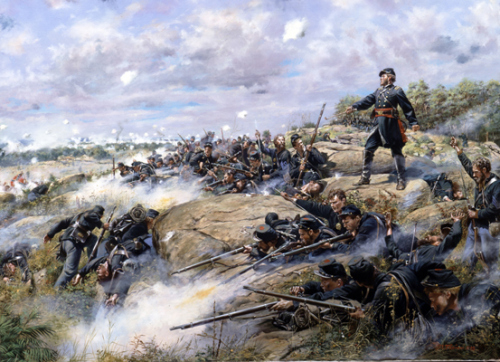
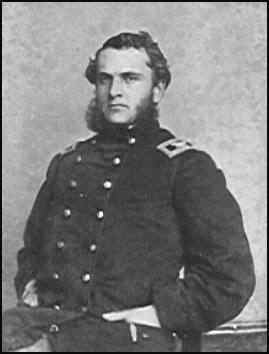
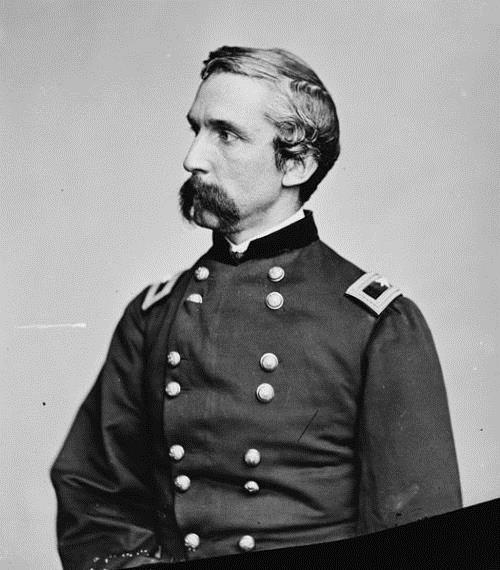
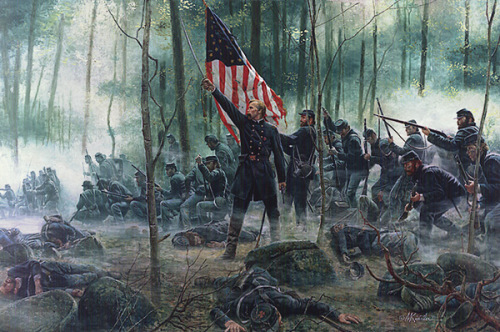
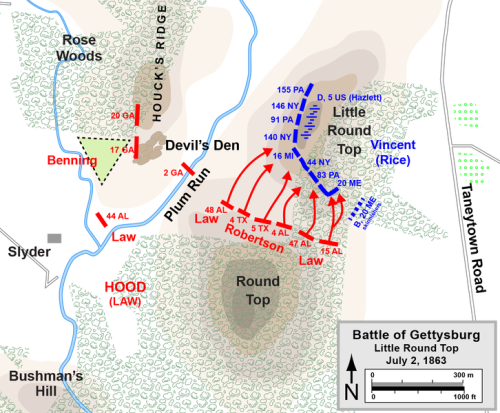
While the professional Gouverneur Warren through himself into the battle to save Little Round Top, as did many others the story of the battle dictates that we must discuss the actions of two “citizen soldiers” without whom the battle may have been lost, Colonel Strong Vincent and Colonel Joshua Chamberlain. Both are depicted and immortalized in the film Gettysburg which is based on Michael Shaara’s Pulitzer Prize winning novel The Killer Angels. As such their actions are known more than many others that are covered in this account of the Battle of Gettysburg.

Within the U.S. Army the example of Chamberlain at the Battle of Little Round Top has occupied a prominent place in Army leadership manuals including FM 22-100 and its successor FM 6-22, however, that being said even those that learn about Chamberlain from this seldom delve deeper into his character, development as a leader and significance, at Little Round Top, Appomattox and after the war, likewise the examples of both Warren and Vincent which are key to Chamberlain and his regiment even being on the hill are ignored in that publication.

It is important to discuss Vincent and Chamberlain for more than their direct contributions to the battle. Those are widely known and in a sense have become part of the myth that is our understanding of Gettysburg. While discussing those actions it is also necessary to put them into context with the character of both men, the cause that they fought. Likewise it is important to address in this age of the professional all volunteer force the importance of Citizen Soldiers in any kind of democracy or representative republic, a sociological question that military professionals as well as our elected officials and citizenry would do well to revisit.

This is particularly important now as various elected leaders, think tanks, defense contractors and lobbyists are all questioning the economic “liabilities” of the All-Volunteer force as well as the disconnect between the broader military and society at large. This means that there will be efforts to determine how the military will be manned, trained and employed, and if military leaders are ignorant of our history, the vital connection between the military and the citizenry and the contributions of Citizen Soldiers then we will be caught flat footed and unprepared in the coming debates. If that happens those decisions could be made by “bean counters” with little appreciation for what military professionalism and readiness entails, as well as think tanks and lobbyists for the defense industry who have their own motivations for what they do, often more related to their profits, power and influence than national security.

The armies that fought the Civil War for the most part were composed of volunteers who of a myriad of reasons went off to fight that war. Gouverneur Warren is a character whose life and career before and after the Civil War was much more like currently serving regular officers and to some extent the much more professional and hardened by war officer corps of the Reserve Components of each of our Armed Services, in particular the much active and deployed Army National Guard and Army Reserve. The reserve components still do reflect much of the Citizen Soldier tradition but that being said between deployments, other activations and required schooling, those assets are much more on par with their active counterparts than they ever have been in our history.

“American defense policy has traditionally been built upon pluralistic military institutions, most notably a mix force of professionals and citizen soldiers.” [2] Warren represented what until the beginning of the Cold War was the smaller pillar of that pluralistic institution that of the long term professional while Vincent and Chamberlain represented the volunteer citizen soldier who enlisted to meet the crisis.

Until World War II and the advent of the Cold War these dual pillars existed side by side. Following the Second World War along with the small-wars that went along as part of it the world changed, and the wars that occurred, such as Korea and Vietnam “occurred on a scale too small to elicit a sustained, full-fledged national commitment, yet too large for a prewar-style regular army to handle.” [3] Because of this “military requirements thus became a fundamental ingredient of foreign policy, and military men and institutions acquired authority and influence far surpassing that ever previously possessed by military professionals on the American scene.” [4] General Tony Zinni noted that the foreign policy results of this transformation have resulted in the United States becoming “an empire” [5] something that no American living in 1863 could have ever contemplated.

This was part of a revolution in military affairs far more important than the application of technology which brought it about, the Atomic Bomb; it was a revolution in national strategy which fundamentally changed American thinking regarding the use of the military instrument in relationship to diplomacy, and the relationship of the military to society at large. Russell Weigley noted: “To shift the American definition of strategy from the use of combats for the object of wars to the use of military force for the deterrence of war, albeit while still serving the national interests in an active manner, amounted to a revolution in the history of American military policy….” [6]

The policy worked reasonably well until Vietnam and the inequities of the system showed its liabilities and brought about a change from politicians. Lieutenant General Hal Moore wrote of the Vietnam era: “The class of 1965 came out of the old America, a nation that disappeared forever in the smoke that billowed off the jungle battlegrounds where we fought and bled. The country that sent us off to war was not there to welcome us home. It no longer existed.” [7]

The debacle of Vietnam and the societal tidal wave that followed brought about the end of the selective service system, by which the large army needed to fight wars was connected to the society at large and the creation of the All-Volunteer force by President Nixon in 1974. The ethos that every citizen was a soldier was destroyed by Vietnam and even men like General William Westmoreland who warned that “absent “the continuous movement of citizens in and out of the service,…the army could “become a danger to our society-a danger that our forefathers so carefully tried to preclude.” [8]

This cultural shift is something that none of the professional officers of the small ante-bellum army like Warren would have ever imagined much less men like Vincent or Chamberlain who were true citizen-soldiers. Thus for currently serving officers it is important to recognize this key change as it applies to American military strategy as well as the place the military occupies in our society. This makes it important to our study as we examine the actions of Vincent and Chamberlain outside of myth and legend and see the implications that they can have not only on the battlefield but in our relationship to the American citizenry and society. It is to put in in classic terms a return to understanding the relationship between the military and the people so powerfully enunciate in Clausewitz’s Trinity.

While Warren represents the Strong Vincent and Joshua Chamberlain represented that important part of our military tradition that really, except in the case of young men and women that volunteer to serve and leave the military after their obligated service really no longer exists. We no longer have a system that allows, nor do we actively encourage men like Vincent and Chamberlain to leave lucrative civilian employment or academia to serve alongside the professionals in positions of responsibility leading regiments or brigades or serving as senior staff officers unless they are already part of the military in our reserve components.

vincent

Colonel Strong Vincent was a 26 year old Harvard graduate and lawyer from Erie Pennsylvania. Vincent enlisted and then was appointed as a 1st Lieutenant and Adjutant of the Erie Regiment because of his academic and administrative acumen. He married his wife Elizabeth the same day. Vincent like many young northerners believed in the cause of the Union undivided, and he wrote his wife shortly after after the regiment went to war on the Peninsula:

“Surely the right will prevail. If I live we will rejoice in our country’s success. If I fall, remember you have given your husband to the most righteous cause that ever widowed a woman.”[9]

Vincent was commissioned as a Lieutenant Colonel in the 83rd Pennsylvania September 14th 1861. The young officer learned his trade well and was considered a “strict disciplinarian and master of drill.” [10] That being said one enlisted man remarked that “no officer in the army was more thoughtful and considerate of  the health and comfort of his men.” He assumed command of the regiment when the commander was killed during the Seven Days in June of 1862 where he learned lessons that he would help impart to his fellow officers as well as subordinates, including Chamberlain. Following a bout with a combination of Malaria and Typhoid that almost killed him, he took command of the regiment. He commanded the regiment at Fredericksburg and was promoted to command the 3rd Brigade when its commander was killed at Chancellorsville in May 1863. Vincent was offered the chance to serve as the Judge Advocate General of the Army of the Potomac in the spring of 1863 after spending three months on court-martial duty. But refused the offer in order to remain in the fight commanding troops. [11]

Unlike most other brigade commanders, Vincent was still a Colonel, and he, like many others would in his place hoped that going into action to save Sickles’ command “will either bring me my stars, or finish my career as a soldier.” [12] On July first, Vincent, a native Pennsylvanian came to Hanover and learning that battle had been joined, ordered “the pipes and drums of the 83rd Pennsylvania to play his brigade through the town and ordered the regiments to uncover their flags again….” [13] As the brigade marched through the town Vincent “reverently bared his head” and announced to his adjutant, “What death more glorious can any man desire than to die on the soil of old Pennsylvania fighting for that flag?” [14]

Vincent was known for his personal courage and a soldier of the 83rd Pennsylvania observed “Vincent had a particular penchant for being in the lead….Whenever or wherever his brigade might be in a position to get ahead…, he was sure to be ahead.” [15] That courage and acumen to be in the right place at the right time was in evidence when he led his brigade into battle on July second.

On July 2nd Barnes’ division of V Corps, which Vincent’s brigade was a part was being deployed to the threat posed by the Confederate attack of McLaws’ division on the Peach Orchard and the Wheat Field to reinforce Sickles’ III Corps. While that division marched toward the Peach Orchard, Vincent’s 3rd Brigade was the trail unit. When Gouverneur Warren’s aide, Lieutenant Randall Mackenzie [16] came toward the unit in search of Barnes he came across Vincent and his brigade near the George Weikert house on Cemetery Ridge awaiting further orders. [17] Vincent intercepted him and demanded what his orders were. Upon being told that Sykes’ orders to Barnes were to “send one of his brigades to occupy that hill yonder,” [18] Vincent, defied normal protocol assuming that Barnes was drunk [19] told Mackenzie “I will take responsibility of taking my brigade there.” [20]

It was a fortunate thing for the Union that he did. His quick action to get his brigade, clear orders to his subordinate commanders and skilled analysis of the ground were a decisive factor in the Union forces holding Little Round Top. He ordered Colonel James C. Rice of the 44th New York to lead the brigade up to the hill while he and his aide went forward to scout positions as the brigade moved forward at the double quick “across the field to the road leading up the north shoulder of the hill” with Chamberlain’s 20th Maine in the lead. [21] Looking at the ground which had the valley and Devil’s Den, occupied by the end of Sickles’ line, he chose a position along a spur of the hill running from the northwest to the southeast to place his regiments where they could intercept the Confederate troops of Hood’s division which he could see advancing toward the hill.

The 16th Michigan, his smallest regiment was placed on the right of the brigade. That section of the line was located on massive boulders that placed it high above the valley below, making it nearly impregnable to frontal attack. He deployed the 83rd Pennsylvania and 44th New York, known as Butterfield’s Twins to their left at the request of Rice who told him “In every battle that we have engaged the Eighty-third and Forty-fourth have fought side by side. I wish that it might be so today.” [22] Those units were deployed below the crest among the large number of boulders; the 83rd was about two-thirds of the way down the way down the slope where it joined the right of the 44th, whose line angled back up the slope to the southeast.

Vincent deployed the 20th Maine on his extreme left of his line, and in fact the extreme end of the Union line. Vincent knew that if this flank was turned and Chamberlain overrun that it would imperil the entire Union position. Vincent came up to Chamberlain who remembered that Vincent said “in an awed, faraway voice. “I place you here….This is the left of the Union line. You understand. You are to hold this ground at all costs.” [23]

chamberlain

Colonel Joshua Chamberlain was another one of the citizen soldiers whose performance and leadership on Little Round Top saved the Union line that hot July evening. A graduate of Bowdoin College and Bangor Theological Seminary, Chamberlain was fluent in nine languages other than English. He was Professor of Rhetoric at Bowdoin before seeking an appointment in a Maine Regiment without consulting either the college or his family. He was offered command of the 20th Maine but asked to be appointed as a Lieutenant Colonel which he was in August 1862. He fought at Fredericksburg and was named commander of the regiment when Colonel Adelbert Ames, his commander was promoted following Chancellorsville.

Like Vincent, Chamberlain was also a quick student and rapidly adapted to being a soldier, officer and commander of troops in combat. On receiving his orders Chamberlain deployed his small regiment halfway down the southern slope facing the small valley between Little and Big Round Top. As a result of his experience in battle and the tenacity of the Confederate army he became an advocate of the tactics that William Tecumseh Sherman would later employ during his march to the sea in 1864. He wrote his wife before Chancellorsville:

“We must fight them more vindictively, or we shall be foiled at every step.  We must desolate the country as we pass through it, and not leave a trace of a doubtful friend or foe behind us; make them believe that we are in earnest, terribly in earnest; that to break this band in twain is monstrous and impossible; that the life of every man, yea, of every weak woman or child in the entire South, is of no value whatever compared with the integrity of the Union.”

Since Chamberlain’s account is so important I will forgo a discussion of his tactics and instead quote the sections of his after action report that explains his actions. Chamberlain wrote:

“On reaching the field at about 4 p.m. July 2d, Col. Vincent commanding the Brigade, placing me on the left of the Brigade and consequently on the extreme left of our entire line of battle, instructed me that the enemy were expected shortly to make a desperate attempt to turn our left flank, and that the position assigned to me must be held at every hazard.

I established my line on the crest of a small spur of a rocky and wooded hill, and sent out at once a company of skirmishers on my left to guard against surprise on that unprotected flank.

These dispositions were scarcely made when the attack commenced, and the right of the Regt. found itself at once hotly engaged. Almost at the same moment, from a high rock which gave me a full view of the enemy, I perceived a heavy force in rear of their principal line, moving rapidly but stealthily toward our left, with the intention, as I judged, of gaining our rear unperceived. Without betraying our peril to any but one or two officers, I had the right wing move by the left flank, taking intervals of a pace or two, according to the shelter afforded by rocks or trees, extending so as to cover the whole front then engaged; and at the same time moved the left wing to the left and rear, making a large angle at the color, which was now brought to the front where our left had first rested.

This hazardous maneuvre was so admirably executed by my men that our fire was not materially slackened in front, and the enemy gained no advantage there, while the left wing in the meantime had formed a solid and steady line in a direction to meet the expected assault. We were not a moment too soon; for the enemy having gained their desired point of attack came to a front, and rushed forward with an impetuosity which showed their sanguine expectations.

Their astonishment however was evident, when emerging from their cover, they met instead of an unsuspecting flank, a firm and ready front. A strong fire opened at once from both sides, and with great effect, the enemy still advancing until they came within ten paces of our line, where our steady and telling volleys brought them to a stand. From that moment began a struggle fierce and bloody beyond any that I have witnessed, and which lasted in all its fury, a full hour. The two lines met, and broke and mingled in the shock. At times I saw around me more of the enemy than of my own men. The edge of conflict swayed to and fro -now one and now the other party holding the contested ground. Three times our line was forced back, but only to rally and repulse the enemy. As often as the enemy’s line was broken and routed, a new line was unmasked, which advanced with fresh vigor. Our “sixty rounds” were rapidly reduced; I sent several messengers to the rear for ammunition, and also for reinforcements. In the mean time we seized the opportunity of a momentary lull to gather ammunition and more serviceable arms, from the dead and dying on the field. With these we met the enemy’s last and fiercest assault. Their own rifles and their own bullets were turned against them. In the midst of this struggle, our ammunition utterly failed. The enemy were close upon us with a fresh line, pouring on us a terrible fire. Half the left wing already lay on the field. Although I had brought two companies from the right to its support, it was now scarcely more than a skirmish line. The heroic energy of my officers could avail no more. Our gallant line withered and shrunk before the fire it could not repel. It was too evident that we could maintain the defensive no longer. As a last desperate resort, I ordered a charge. The word “fix bayonets” flew from man to man. The click of the steel seemed to give new zeal to all. The men dashed forward with a shout. The two wings came into one line again, and extending to the left, and at the same time wheeling to the right, the whole Regiment described nearly a half circle, the left passing over the space of half a mile, while the right kept within the support of the 83d Penna. thus leaving no chance of escape to the enemy except to climb the steep side of the mountain or to pass by the whole front of the 83d Penna. The enemy’s first line scarcely tried to run-they stood amazed, threw down their loaded arms and surrendered in whole companies. Those in their rear had more time and gave us more trouble. My skirmishing company threw itself upon the enemy’s flank behind a stone wall, and their effective fire added to the enemy’s confusion. In this charge we captured three hundred and sixty eight prisoners, many of them officers, and took three hundred stand of arms. The prisoners were from four different regiments, and admitted that they had attacked with a Brigade.” [24]

Colonel William Oates of the 15th Alabama would give Chamberlain and his regiment the credit for stopping his attack. Oates wrote: “There have never been harder fighters than the Twentieth Maine and their gallant Colonel. His skill and persistency and the great bravery of his men saved Little Round Top and the Army of the Potomac from defeat.” [25]

chamberlain lrt

As with any firsthand account, aspects of Chamberlain’s accounts are contested by others at the scene. Oates notes that he ordered the retreat and that there were not as many prisoners taken, one of Chamberlain’s company commanders disputes the account of the order of the bayonet charge however the fact is that Chamberlain who was outnumbered nearly two to one by the 15th and 47th Alabama regiments “offset this superiority with strength of position, iron determination and better tactics.” [26] Also a factor was the fatigue of the Confederates, these regiments and their parent unit, Law’s brigade of Hood’s division had conducted a grueling 28 mile march to get to the battlefield and were exhausted by the time that they arrived.

Vincent was mortally wounded while leading the defense of the hill. While he was standing on a large boulder with a riding crop ordering the men of the 16th Michigan who were beginning to waiver he cried out “Don’t yield an inch now men or all is lost,[27]he was struck by a bullet which hit him in the groin. As he was being carried from the field to the hospital where he died on July 7th, “This is the fourth or fifth time they have shot at me…and they have hit me at last.” [28]

As Vincent lay dying he was visited by many comrades, visited by Sykes and Barnes he told them “I presume… I have dune my last fighting.” Meade recommended Vincent for posthumous promotion to Brigadier General, but the request was lost.

Two months after his death his wife gave birth to a baby girl. The baby would not live a year and was buried next to him. One wonders what heights of leadership the young colonel might have achieved had he not died at Gettysburg. He was a man who understood the nature of total war, an excellent leader and skilled tactician.

Chamberlain survived the war to great acclaim being wounded three times and receiving the surrender of the Army of Northern Virginia at Appomattox on April 9th 1865.

The examples of these two citizen soldiers demonstrate the importance of this legacy, which is still to some extent carried on by the reserve components of the United States military service. That being said, in the coming years military professionals will have to engage lawmakers and the bureaucracy of the Pentagon as the shape of the future military, especially the land components is debated and decided upon by politicians. Thus, it is of the utmost importance of revisiting the tradition of the citizen soldier and how it can be renewed in the coming years.

Chamberlain’s words about the men that he served alongside like his commanding officer, Strong Vincent are a fitting way to close.

“It is something great and greatening to cherish an ideal; to act in the light of truth that is far-away and far above; to set aside the near advantage, the momentary pleasure; the snatching of seeming good to self; and to act for remoter ends, for higher good, and for interests other than our own.” [29]

Notes

[1] _______. The Armed forces Officer U.S. Department of Defense Publication, Washington DC. January 2006 p.2

[2] Millet, Allan R. and Maslowski, Peter, For the Common Defense: A Military History of the United States The Free Press a Division of Macmillan Inc. New York, 1984 p.xii

[3] Bacevich, Andrew J. Breach of Trust: How Americans Failed their Soldiers and Their Country Metropolitan Books, Henry Holt and Company, New York 2013 Kindle Edition Amazon Edition p.50

[4] Huntington, Samuel P. The Soldier and the State: The Theory and Politics of Civil-Military Relations, The Belknap Press of Harvard University Press, Cambridge MA and London 1957 p.345

[5] Zinni, Tony. The Battle for Peace: A Frontline Vision of America’s Power and Purpose Palgrave McMillian, New York 2006 p.4

[6] Weigley, Russell F. The American Way of War: A History of United States Military History and Policy University of Indiana Press, Bloomington IN, 1973 pp.367-368

[7] Moore, Harold G. and Galloway Joseph L We Were Soldiers Once…And Young Harper Perennial Books, 1992 pp. xix-xx

[8] Ibid. Bacevich Breach of Trust p.58

[9] ________. Erie County Historical Society http://www.eriecountyhistory.org/wp-content/uploads/2008/10/strongvincent.pdfretrieved 9 June 2014

[10] Golay, Michael. To Gettysburg and Beyond: The Parallel Lives of Joshua Lawrence Chamberlain and Edward Porter Alexander Crown Publishers Inc. New York 1994 p.129

[11] Leonardi, Ron Strong Vincent at Gettysburg Barringer-Erie Times News retrieved June 9th 2014 from http://history.goerie.com/2013/06/30/strong-vincent-at-gettysburg/

[12] Guelzo, Allen C. Gettysburg: The Last Invasion Vintage Books a Division of Random House, New York 2013 p.264

[13] Pfanz, Harry F. Gettysburg: The Second Day. University of North Carolina Press, Chapel Hill 1987 p.51

[14] Ibid. Guelzo Gettysburg: The Last Invasion Vintage p.159

[15] Tredeau, Noah Andre. Gettysburg: A Testing of Courage, Harper Collins Publishers, New York 2002 p.305

[16] Some such as Guelzo believe this may have been Captain William Jay of Sykes staff.

[17] Ibid. Tredeau, Gettysburg: A Testing of Courage p.327

[18] Ibid. Guelzo Gettysburg: The Last Invasion Vintage p.262

[19] Ibid. Guelzo Gettysburg: The Last Invasion Vintage p.262

[20] Ibid. Tredeau, Gettysburg: A Testing of Courage p.327

[21] Coddington, Edwin B. The Gettysburg Campaign: A Study in Command, A Touchstone Book, Simon and Schuster New York, 1968 p.389

[22] Ibid. Pfanz, Gettysburg: The Second Day. p.213

[23] Ibid. Golay To Gettysburg and Beyond p.157

[24] Chamberlain, Joshua Lawrence. Official Narrative of Joshua Chamberlain of July 6th 1863, Maine Military Historical Society, Inc., Augusta, Maine, copyright 1989 U.S. Army Combat Studies Institute Reprint, retrieved from http://usacac.army.mil/cac2/cgsc/carl/download/csipubs/chamberlain.pdf June 15th 2014

[25] Oates, Willam C. and Haskell, Frank A. Gettysburg Bantam Books edition, New York 1992, originally published in 1905 p.98

[26] Ibid.Coddington The Gettysburg Campaign: A Study in Command p.393

[27] Ibid. Guelzo Gettysburg: The Last Invasion Vintage p.272

[28] Ibid. Tredeau, Gettysburg: A Testing of Courage p.361

[29] Chamberlain, Joshua Lawrence. Chamberlain’s Address at the dedication of the Maine Monuments at Gettysburg, October 3rd 1888 retrieved from http://www.joshualawrencechamberlain.com/maineatgettysburg.php 4 June 2014

Leave a comment

Filed under civil war, History, leadership, Military, national security

Gettysburg Day Two: The Complex Character of Gouverneur Warren and Little Round Top

gkwarren

Brigadier General Gouverneur Warren

Throughout this study we have been looking at how leaders at various levels in conduct of campaigns as well as battles make decisions. Likewise we examine the lives and character of those leaders as it applies to their actions at critical points of a battle. In this chapter we will examine three officers whose lives, character and actions at Gettysburg, specifically at Little Round Top exemplify two of the Chairman of the Joint Chiefs of Staff Desired Leader Attributes, “to anticipate and adapt to surprise and uncertainty” and the principle of Mission Command, to “operate on intent through trust, empowerment and understanding.” It is from those perspectives that we will look at this part of the battle, but we would be amiss if we did not address the nearly mythical status to which this action has risen.

The actions of three men at the Battle of Little Round Top; Brigadier General Gouverneur Warren, the Chief Engineer of the Army of the Potomac, Colonel Strong Vincent, commanding Third Brigade, First Division, V Corps and Colonel Joshua Lawrence Chamberlain, commanding the 20th Maine Infantry Regiment of Vincent’s brigade are very important to the outcome of the battle, but also for what they teach us about leadership and the profession of arms. This chapter focuses on Warren, in particular with his work with the Commander of the Army of the Potomac, George Meade and his actions to secure Little Round Top on July 2nd 1863, the next will deal with Chamberlain and Vincent.

The battle at Little Round Top is an iconic part of American History and in particular for the Army, a key element of how leadership has been studied. It has achieved nearly mythical status due to the actions of Colonel Joshua Chamberlain which have been told many times in history, fiction and in film, particularly Michael Shaara’s classic historical novel The Killer Angels and its film adaptation Gettysburg. While these accounts are certainly inspiring and allow us to experience the emotion and near spiritual quality of what Chamberlain writes, there is much more to learn.

That near spiritual quality and mythic status that we accord Gettysburg is important, for in large part it is why we come to the battlefield, and why we study. Chamberlain said it well many years after Gettysburg at the dedication of the Maine Monuments:

“In great deeds, something abides. On great fields, something stays. Forms change and pass; bodies disappear; but spirits linger, to consecrate ground for the vision-place of souls… generations that know us not and that we know not of, heart-drawn to see where and by whom great things were suffered and done for them, shall come to this deathless field, to ponder and dream; and lo! the shadow of a mighty presence shall wrap them in its bosom, and the power of the vision pass into their souls.” [1]

So as we endeavor to look at the actions of these leaders on that fateful day it is important to recognize that we cannot totally separate those actions that helped decide the battle from the mythos that surrounds the story. [2] Likewise, it important to acknowledge that we cannot separate their character and the totality of military leaders lives from their actions on a particular battlefield. Unlike Chamberlain Warren does not engender myth, and that is why he is often overlooked by many casual students and observers of the Battle of Gettysburg.

For the purposes of this study it is important to note that Warren was not a commander during this action, he was, like most senior officers today, a staff officer. Many times students of military history and theory are inclined to dismiss the contributions of staff officers because they do not have the overall responsibility of a battle, or the glamour of the limelight of the commanders that they serve under. However, for military professionals, especially those serving on senior staffs who prepare campaign plans, contingency plans and crisis plans the study of officers like Warren is essential.

The Federal Army at Gettysburg, like its Confederate opponent had a wide variety of officers serving in its ranks. Many of its senior officers were graduates of West Point. Many had served together in Mexico and in the various campaigns against Native American tribes. Those who stayed in the Army during the long “peace” between the Mexican War and the outbreak of the Civil War endured the monotony, boredom and often miserable conditions of isolated army posts, long family separations, as well as low pay, slow promotion and often low social status.[3] In light of such conditions, many resigned their commissions to undertake various professional, business or academic pursuits; in fact Samuel Huntington noted that in the years before the Civil War that “West Point produced more railroad presidents than generals.” [4] However, on the outbreak of the war returned to service whether in the service of the Union, or the Confederate States.

When the war began the Army underwent a massive expansion, which it met through and the call of up militia and raising new units from the various states. In the expansion many officers were appointed who had no prior military service, or if they did it was performed years or even decades before the war. Some of these men were simply patriots who rallied to the flag, others due to a sense of righteousness about their cause, while others were political opportunists or appointees. In the north this was a particular problem as “professional officers were pushed aside and passed over in the Union, the higher commissions going, in the first stages of the war at least to officers called back into service or directly appointed from civilian life, many of them “political” appointees.” [5]

At times the lack of experience, training and sometimes the poor character of these men was tragic. However, many of these men performed as well or better than some of their regular army counterparts at various levels of command. At the same time a good number of Regular Army officers were allowed to assist states in the formation and training of these new units, one of whom was Gouverneur Warren. Gettysburg would provide opportunity for the best and worst of all of these types of officers to succeed or fail. In this chapter we will look at one of the regular officers and two of the volunteer whose lives intersected on July 2nd 1863.

Brigadier General Gouverneur Warren was typical of the many professional officers of the old army. An 1850 graduate of West Point, Warren was a bright student who had absorbed the teachings of his professor, Dennis Hart Mahan as the core of his own military thought, both in his senior year in college and through reinforcement as a faculty member. [6] Warren was commissioned as a Brevet Second Lieutenant and because of his high standing in his class was assigned to Corps of Topographical Engineers. He spent his first seven years in a number of assignments which took him throughout much of the country.

Warren’s work involved exploring and mapping for various enterprises including the project to help tame the Mississippi River, and the exploration of the Great Plains and Black Hills where he developed a sympathy for the various Sioux tribes he encountered noting on completion of his mission in 1858, writing that He had never heard a Sioux chief express an opinion in regard to what was due them in which I do not concur and that many of them view the extinction of their race as an inevitable result of the operation of present causes, and do so with all the feelings of despair with which we should contemplate the extinction of our nationality. [7] Following his years in the west he returned as faculty to West Point where he as an Assistant Professor, shared mathematics instructional duties with Oliver O. Howard and resumed his relationship with his former professor Mahan. [8]

On the outbreak of war Warren was granted leave from his duties at West Point to serve as Lieutenant Colonel of Volunteers in the 5th New York Infantry Regiment, also known as Duryee’s Zouaves. Where Duryee was appointed as a Brigadier General, Warren became its Colonel, serving with it during the Peninsula campaign where he was eventually given command of a provisional brigade and promoted to Brigadier General, serving as a Brigade Commander in at Second Manassas, Antietam and Fredericksburg.

At Chancellorsville he was pulled from his brigade duties by Hooker who employed him with good effect to assist his engineering staff, first with mapping and then building the fortifications that stopped the ferocious Confederate storm on the second day of battle. [9] In less than 48 hours Warren’s troops threw up five miles of the most formidable entrenchments yet constructed under battlefield conditions. [10] Edward Alexander, Longstreet’s artillery officer noted that when the Confederates came upon the fortifications after Hooker’s withdraw that “they were amazed at the strength and completeness of the enemys fortifications. [11] Following the battle Warren was appointed as Chief Engineer of the Army of the Potomac on May 12th 1863 by Hooker. When Hooker was relieved of command and was replaced by Meade on June 28th 1863, he was kept in that position by his fellow engineer Meade rather than being promoted to a division or being assigned as Meade’s Chief of Staff. As this turned out it was a wise choice.

Warren along with Major General Winfield Scott Hancock arrived at Cemetery Hill on the night of July 1st. As Meade organized his defenses he not only depended on his advice about the ground, but “consulted him constantly at headquarters or sent him off on matters of highest importance.” [12] Meade respected Warren and had offered Warren the chance to serve as his Chief of Staff, a position that Warren, like Seth Williams, the Adjutant General declined that offer indicating that he had too much work in their departments to take on the burdens of a new job. [13] Lee appreciated Warren’s calm, absorbed, and earnest manner, his professional skill and sound judgment.[14] These qualities would serve both men and the army well on July 2nd.

When Sickles moved III Corps forward during the afternoon without permission moved his Corps forming a vulnerable salient at the Peach Orchard leaving the southern flank in the air, Meade was aghast. Warren who from his reconnaissance of the previous day and the morning knew the position better than anyone recognized that something was badly awry on Sickles Third Corps front matters there were not all straight. [15] He had sent an officer to discover to investigate Sickles’ front and that officer reported that the section of Cemetery Ridge assigned to III Corps was not occupied. [16]

Meade and Warren discussed the situation and realized that III Corps “could hardly be said to be in position” [17] and knowing VI Corps was now close at hand order V Corps, at the time his only reserve into the position vacated by Sickles. They went forward and seeing the empty spaces Warren told Meade “here is where our line should be” to which Meade replied: “It’s too late now.” [18] Warren, whose familiarity with the whole of the battlefield gave him concern about Sickles’ corps dispositions suggest that Meade send him to the Federal left, “to examine the condition of affairs.” [19]

Meade concurred with his Engineer and in dispatching him he also gave Warren the authority to take charge as needed saying “I wish you would ride over there and if anything serious is going on, attend to it.” [20] Again Meade’s choice of Warren for the task demonstrated the trust that is essential in command. The two officers worked together seamlessly and as Coddington described their relationship that day: “Meade chose him to act as his alter ego in crucial moments of the battle, and Warren rendered services for which Meade and the country were to be eternally grateful.” [21] Warren would not see Meade again “until the attack had spent its force.” [22]

little round top map

Hunt noted that “The duty could not have been in better hands.” [23] When Warren arrived on Little Round Top he found it unoccupied save for a few signal corps soldiers. Warren immediately recognized the tactical value of Little Round Top and noted that it was “the key of the whole position.” [24] Warren saw that the Confederates were massing not more than a mile away and that there were no troops on the hill to stop them. He believed that an area “of woods on the near side of the Emmitsburg Road as “an excellent place for the enemy to form out of sight” [25] which was exactly what Major General John Bell Hood’s division was doing, as Henry Hunt noted “The enemy at the time lay concealed, awaiting signal for the assault…” [26] To test his suspicions Warren sent a messenger to Captain James Smith’s 4th New York artillery battery on Devil’s Den to fire a single shot into the woods. Warren described the situation:

“As the shot went whistling through the air the sound of it reached the enemy’s troops and caused every one to look in the direction of it. This motion revealed to me the glistening gun-barrels and bayonets of the enemy’s line of battle, already formed and far outflanking the position of any of our troops; so that the line of his advance from the right to Little Round Top was unopposed. I have been particular in telling this, as the discovery was intensely thrilling to my feelings, and almost appalling.” [27]

warren lrt

Upon confirming his fears Warren resorted to ruse and action. He order the “signalmen to keep up their wigwag activity, simply as a pretense of alertness, whether they had any real signals to transmit or not…” [28] He also sent messengers to Meade, Sickles and Sykes, the commander of V Corps asking Meade to “Send at least a division to me” [29] instructing the messenger, Lieutenant Randall Mackenzie to tell Meade “that we would at once have to occupy that place very strongly.” [30] Sickles refused on account of how badly stretched his lines were, however George Sykes of V Corps responded sending Captain William Jay to find Barnes commander of his 1st Division. The messenger could not find Barnes, but instead came across the commander of the division’s 3rd Brigade Colonel Strong Vincent. Vincent knew that Barnes was self-medicating his “pre-battle anxieties out of a black commissary quart bottle” and was already “hollow from skull to boots” and demanded “What are your orders? Give me your orders.” [31] Upon learning that Sykes wanted a brigade to proceed to Little Round Top Vincent responded immediately to take the initiative and ordered his four regiments up Little Round Top without waiting for permission. Vincent told Sykes messenger “I will take the responsibility myself of taking my brigade there.” [32]

Meade’s choice of Warren was demonstrated in how Warren continued to act with alacrity and decisiveness throughout the afternoon. “As the Union line began to crumble on Little Round Top, Warren, vested with the authority of Meade’s chief representative, emerged as the right man at the right place at the right time.” [33] Warren did not stop with sending messengers, but seeing the danger building he noted that the northwest face of the hill was still unoccupied and open to attack. Warren forgot “all about a general’s dignity” he “sprinted down the east slope of the hill like a rabbit.” [34] There he found Brigadier General Stephen Weed’s brigade which he had previously commanded. Since he did not see Weed, but he found Colonel Patrick O’Rorke of the 140th New York and ordered him to follow him up the hill, saying “Paddy…give me a regiment.” [35] When O’Rorke said that Weed expected him to be following him Warren took the responsibility telling O’Rorke “Bring them up on the double quick, and don’t stop for aligning. I’ll take responsibility.” [36] O’Rorke followed with his gallant regiment with the rest of the brigade under Weed following. Warren’s actions were fortuitous as the 140th New York and Lieutenant Charles Hazlett’s battery of the 5th Artillery arrived at the crest just in time to repulse the advancing Confederates. In the fight the brigade would take fearful casualties and by the end of the battle, Weed, O’Rorke and Hazlett would all be dead, but with Vincent’s brigade they held on and saved the Union line.[37]

Warren continued to urge on the Federal troops despite being wounded, in the words of a reporter who observed him in “a most gallant and heroic manner, riding with utmost confidence over fields swept by the enemy’s fire, seemingly everywhere present, directing, aiding, and cheering the troops.” [38] Once he was assured that Little Round Top was secure he proceeded to rejoin Meade “near the center of the battlefield where another crisis was at hand.” [39]

Warren distinguished as a Corps commander until he ran afoul of the fiery General Phillip Sheridan in 1865. Sheridan relieved Warren of command of V Corps following the Battle of Five Forks where Sheridan believed that Warren’s Corps had moved too slowly in the attack. The relief was brutal and ruined his career. Warren was a professional soldier and took the relief hard. Unfortunately as a topographic engineer he was an outsider to many in the army and not fully appreciated by Grant or Sheridan who in their haste at Five Forks destroyed his career.

After the war Warren resigned his commission as a Major General of Volunteers and returned to his permanent rank as a Major of Engineers. He served another 17 years doing engineeringduty and was promoted to Lieutenant Colonel in 1879, but his past always haunted him, even his sleep. He wrote his wife while supervising a major bridge construction project over the Mississippi River in 1867: “I wish I did not dream so much. They make me sometimes to dread to go to sleep. Scenes from the war, are so constantly recalled, with bitter feelings I wish never to experience again. Lies, vanity, treachery, and carnage.” [40]

He sought a Court of Inquiry to exonerate himself but this was refused until President Grant left office. The Court eventually exonerated him but he died three months before the results were published. Embittered he directed that he be buried in civilian clothes and without military honors. His funeral was attended by his friends Winfield Scott Hancock and Samuel Crawford, his oldest army friend and mentor Andrew Humphreys was called away before the service due to the sudden illness of his son. [41] The Washington Post noted that Warren “had gone “where neither the malevolence nor the justice of this world can reach him. He had enough of the former; and denial of the latter not only embittered his closing months of his life, but undoubtedly hastened his end.” [42]

Warren’s actions on that hot and muggy July 2nd exemplified the leadership qualities that we as an institution strive for, and from a leadership perspective demonstrate how the Chairman’s Desired Leader Attributes and the principles of Mission Command: “the ability to operate on intent through trust, empowerment and understanding” should work in a relationship between seniors and subordinates. But his life also serves to remind us of the ethics of our profession. Loomis Langdon, who served as the official recorder for the board of inquiry wrote of Warren:

“I had never met General Warren till he came before his Court of Inquiry…I learned to value his good opinion – and while I admired him for his great patience, his wonderful energy, habit of concentration, his vast learning and untiring application, I loved him for his tenderness, gentleness and charity, even to those whom he believed had combined to do him a cruel wrong; and I admired him for his nobleness of character and his courage and unselfish patriotism.” [43]

It is easy for military professionals to become totally focused in our profession, especially the details of planning and process to forget the humanity of those that we serve alongside. Warren is one of those complex figures who are not easy to categorize. His biographer Jordan wrote that:

“Warren was a man with fine intellect, widely read, and of keen sensibilities. He was also an excellent engineer, mapmaker, and scientist. He was a soldier who cared much for the safety and welfare of the men under him, and he was sickened by the appalling carnage of the war in which he took such a prominent part. He was arrogant and proud, and he hesitated hardly at all in putting down those of his colleagues he regarded as inferiors. His mind’s eye took in much beyond what was his immediate concern, but this gift worked against him in the hierarchical realm of military life. Warren was prone to long sieges of depression, and he himself agreed that others found him morose and unsmiling…” [44]

Warren

In reading military history is far too easy to isolate and analyze a commander’s actions in battle and ignore the rest of their lives. I think that this does a great disservice to the men themselves. In time of war gives up something of themselves and sometimes even heroes like Gouverneur Warren are destroyed by the actions of institutions that they serve.

Notes

[1] Chamberlain, Joshua Lawrence. Chamberlain’s Address at the dedication of the Maine Monuments at Gettysburg, October 3rd 1888 retrieved from http://www.joshualawrencechamberlain.com/maineatgettysburg.php 4 June 2014

[2] Note: My use of the terms myth, mythology or mythos should not be considered negative, and the use of the terms does not mean that there is not some degree of fact or truth in them. The definitions of the term mythos are important to understanding my use of the term here, first it denotes a traditional or recurrent narrative theme or plot structure of a story, and secondly a set of beliefs or assumptions about something. (See the Oxford American Dictionary.)

[3] Taylor, John M. Duty Faithfully Performed: Robert E Lee and His CriticsBrassey’s, Dulles VA 1999 pp.37-38.

[4] Huntington, Samuel P. The Soldier and the State: The Theory and Politics of Civil-Military Relations The Belknap Press of Harvard University Press, Cambridge MA and London 1957 p.199

[5] Ibid. Huntington. The Soldier and the State: The Theory and Politics of Civil-Military Relations p.213

[6] Jordan, David M. Happiness is Not My Companion: The Life of G.K. Warren Indiana University Press, Bloomington Indiana 2001 p.6

[7] Ibid. Jordan Happiness is Not My Companion: The Life of G.K. Warren p.30

[8] Ibid. Jordan Happiness is Not My Companion: The Life of G.K. Warren p.33

[9] Sears, Stephen W. ChancellorsvilleHoughton Mifflin Co. Boston and New York 1996 p.372

[10] Hagerman, Edward. The American Civil War and the Origins of Modern Warfare. Midland Book Editions, Indiana University Press. Bloomington IN. 1992 p.91

[11] Alexander, Edward Porter Military Memoirs of a Confederate: A Critical Narrative 1907 republished 2013 by Pickle Partners Publishing, Amazon Kindle Edition location 7007

[12] Coddington, Edwin B. The Gettysburg Campaign: A Study in Command, A Touchstone Book, Simon and Schuster New York, 1968 p.332

[13] Sears, Stephen W. Gettysburg. Houghton Mifflin Co. Boston and New York 2003 pp.129-130

[14] Ibid. Coddington, The Gettysburg Campaign: A Study in Command, p.332

[15] Ibid. Sears Gettysburg p.262

[16] Tredeau, Noah Andre. Gettysburg: A Testing of Courage, Harper Collins Publishers, New York 2002 p.319

[17] Ibid. Tredeau. Gettysburg: A Testing of Courage, p.319

[18] Ibid. Tredeau. Gettysburg: A Testing of Courage, p.320

[19] Ibid. Jordan Happiness is Not My Companion: The Life of G.K. Warren p.90

[20] Ibid. Tredeau. Gettysburg: A Testing of Courage, p.320

[21] Ibid. Coddington, The Gettysburg Campaign: A Study in Command, p.388

[22] Guelzo, Allen C. Gettysburg: The Last Invasion Vintage Books a Division of Random House, New York 2013 p.260

[23] Hunt, Henry. The Second Day at Gettysburg in Battles and Leaders of the Civil War Volume III, The Tide Shifts. Edited by Robert Underwood Johnson and Clarence Clough Buel Castle, Secaucus NJ p. 307

[24] Ibid. Jordan Happiness is Not My Companion: The Life of G.K. Warren p.92

[25] Ibid. Jordan Happiness is Not My Companion: The Life of G.K. Warren p.92

[26] Ibid. Hunt The Second Day at Gettysburg in Battles and Leaders of the Civil War Volume III, The Tide Shifts. p. 307

[27] Pfanz, Harry F. Gettysburg: The Second Day. University of North Carolina Press, Chapel Hill 1987 p.206

[28] Foote, Shelby, The Civil War, A Narrative. Volume Two Fredericksburg to Meridian Random House, New York 1963 p.503

[29] Ibid. Jordan Happiness is Not My Companion: The Life of G.K. Warren p.92

[30] Ibid. Guelzo Gettysburg: The Last Invasion Vintage p.261

[31] Ibid. Guelzo Gettysburg: The Last Invasion Vintage p.262

[32] Longacre, Edward Joshua Chamberlain: The Soldier and the Man Combined Publishing Conshohocken PA 1999 p.127

[33] Ibid. Coddington, The Gettysburg Campaign: A Study in Command, p.395

[34] Swanberg, W.A. Sickles the IncredibleStan Clark Military Books, Gettysburg PA 1957 p.214

[35] Ibid. Jordan Happiness is Not My Companion: The Life of G.K. Warren p.93

[36] Ibid. Foote The Civil War, A Narrative. Volume Two Fredericksburg to Meridian p.504

[37] Ibid. Jordan Happiness is Not My Companion: The Life of G.K. Warren pp. 93-94

[38] Ibid. Coddington, The Gettysburg Campaign: A Study in Command, p.388

[39] Ibid. Coddington, The Gettysburg Campaign: A Study in Command, p.396

[40] Ibid. Jordan Happiness is Not My Companion: The Life of G.K. Warren p.249

[41] Ibid. Jordan Happiness is Not My Companion: The Life of G.K. Warren p.309

[42] Ibid. Jordan Happiness is Not My Companion: The Life of G.K. Warren p.308

[43] Ibid. Jordan Happiness is Not My Companion: The Life of G.K. Warren p.309

[44] Ibid. Jordan Happiness is Not My Companion: The Life of G.K. Warren preface pp.x-xi

3 Comments

Filed under civil war, History, leadership, Military

Gettysburg Day One: Lee’s Vague Discretionary Orders and Lack of Control

Lee1

Discretionary orders are important to the success of commanders who desire that their subordinates have the necessary freedom to exploit opportunities within the broader operational context. They are a key element of what we now define as Mission Command and thus expressed clearly in the Chairman of the Joint Chiefs of Staff Desired Leader Attributes the ability to operate on intent through trust, empowerment and understanding. In this chapter we will look at how Lee conducted war and how his decision process and communications, particularly the use of discretionary orders influenced the outcome of the battle and how important the issuance of clear orders is to a successful campaign.

To be effective such orders need to be clear and concise and they must be employed in a manner that are within the capabilities of one’s subordinate commanders to both understand them and carry them out. Thus a commander must always be ready to adjust his method when his command goes through a major turnover of personnel. After the loss of Jackson at Chancellorsville and the subsequent reorganization of the Army of Northern Virginia, Lee continued to operate as if nothing had changed, despite his own recognition that the army suffered from a want of qualified senior officers.

Robert E. Lee habitually issued discretionary orders with varying degrees of effectiveness. With Jackson, a man of ruthless battlefield instincts Lee was able to do this, even when Lee’s intent was less than clear, but even with Jackson such orders occasionally went awry as was the case during the Seven Days. Lee’s aide Walter Taylor noted that Jackson “took the suggestion of General Lee into immediate consideration, and proceeded to carry it into effect.” [1] This was not to be the case with those that followed Jackson, something that Lee failed to adjust to that would doom his army at Gettysburg.

Part of this is attributable to Lee’s distaste for administrative routine. Taylor noted how Lee’s “correspondence…was constantly a source of worry to him. He did not enjoy writing; indeed he wrote with labor, and nothing seemed to tax his amiability as the necessity for writing a lengthy official communication.” [2] But more importantly in the matter of communicating orders and following up, much of the issue came down to Lee’s near fatalistic understanding of faith and life in regard to the providence of God. For Lee victory and defeat came down to God’s will, as he wrote his wife after his ill-fated 1861 campaign in western Virginia “But the Ruler of the Universe willed otherwise and sent a storm to discontent a well laid plan and to destroy my hopes.” [3] But for Lee, the concept of “duty” became a secular manifestation of his religion.” [4]

J. F. C. Fuller attributes much of the manner in how Lee conducted battle to this sense of duty as well as belief in providence. Fuller notes that it “controlled the whole of his generalship.” [5] Lee explained his concept of command to the Prussian observer, Captain Justus Scheibert:

“You must know our circumstances, and see in battle that my leading would do more harm than good. It would be a bad thing if I could not then rely on my brigade and divisional commanders. I plan and work with all my might to bring my troops to the right place at the right time; with that I have done my duty. As soon as I order the troops forward into battle, I lay the fate of my army in the hands of God.” [6]

That firm belief in providence and the hand of God was evident in Lee’s comments to Major General Isaac Trimble as the army advanced into Pennsylvania. “We have again outmaneuvered the enemy, who even now does not know where we are or what our designs are. Our whole army will be in Pennsylvania day after tomorrow, leaving the enemy far behind and obliged to follow by forced marches. I hope with these advantages to accomplish some single result and to end the war, if Providence favors us.” [7]

Fuller is one of the harshest critics of Lee bluntly notes that “this lack of appreciation that administration is the foundation for strategy; this lack of interest in routine, and his abhorrence to exert his authority…” [8] were key factors in many of his army’s problems, from command and control, discipline and the material and logistics aspects of war. Likewise his absolute reliance on his subordinates to carry out his orders, and unwillingness to interfere once the battle was joined was a major factor in his failure at Gettysburg, where Russell Weigley noted in a rather kind and subdued way that “Lee…was sometimes served less than well by his corps, division and brigade commanders.” [9]

Throughout the Gettysburg campaign Lee issued vague orders that his subordinates either failed to understand or willingly interpret in a manner that Lee did not intend. Lee’s biographer Michael Korda notes that “the phrase if practicable…led to many unfortunate consequences, since it provided subordinate commanders a kind of escape clause, allowing them to argue after the event that what they had been order to do was not, in their view “practicable.” [10]

From the time that Robert E Lee learned that the Army of the Potomac had crossed the Potomac into Maryland on June 28th, he attempted to adjust his campaign plan and concentrate his army in preparation for battle. At that point his army was scattered and he did not want to provoke an engagement until he could concentrate his forces. Stuart’s cavalry, the absence of which was a matter of great consternation to Lee was chief among his concerns. Lee had hoped that Hooker would pursue him north, but finding the information out from Longsteet’s spy Harrison disturbed Lee greatly. [11]

Lee expected to know about Hooker’s movements from Stuart. However, Stuart was nowhere to be found; operating nearly fifty miles away separated from Lee’s main body much of the Army of the Potomac. Lee’s aide Walter Taylor wrote: “No tidings had been received from or of our cavalry under General Stuart since crossing the river; and General Lee was consequently without accurate of the movements or position of the main Federal Army.” [12] However, while Stuart certainly can be blamed for taking his best cavalry off on a ride around the Federal army, he acted in accordance with how he interpreted Lee’s orders, as Douglas Southall Freeman wrote: “What was possible was permissible. That, as Stuart saw it, was the substance of his orders.” [13]

This was especially true after Stuart had been surprised at Brandy Station by the Federal cavalry and pilloried in the Confederate press, the Richmond Sentinel saying Stuart had been “outgeneraled” and the Richmond Whig predicting that “We shall not be surprised if the gallant Stuart does not, before many days, make the enemy repent sorely the temerity that led them to undertake this bold and insulting feat….” [14] Lee’s orders provided just enough ambiguity and wiggle room for the wounded Stuart to do precisely what he did.

Lee’s orders gave Stuart the options of moving back to screen the army or passing around the Federal army, leaving the decision to Stuart’s discretion. “You will, however, be able to judge whether you can pass around their army without hindrance, doing them all the damage you can…” [15] Major Henry McClellan, Stuart’s aide recorded that he also received a “lengthy communication from General Lee…” which “discussed at considerable length the plan of passing around the enemy’s rear….” [16] Stuart in his official report wrote: “The commanding General wrote me, authorizing this move if I deemed it practical.” [17]

That being said Lee was clear enough that he expected Stuart to “lose no time in placing his command on the right of our column as soon as he should perceive the enemy moving northward.” [18] Though Stuart had detected Hancock’s II Corps moving north near Manassas he elected to make his movement around the Federal Army. Stuart’s biographer Burke Davis noted that Stuart “sought no advice on the all-important detour of June twenty-sixth, which changed his direct. He did not so much consult his brigadiers as he swung his column southward to pass around the enemy.” [19] Though Lee at a number of points during lead up to Gettysburg signaled his frustration with Stuart’s absence and its effect on his abilities, he failed to draw the appropriate conclusions that a prudent commander, operating deep in enemy territory would assume from the lack of contact. Lee should have assumed that Stuart was because of his move “become temporarily incommunicado” but instead, “inferred from Stuart’s silence that Hooker had not crossed the Potomac.” [20]

Lee’s vague order was the first in a series of command and control issues that plagued him during the campaign and combined with Stuart’s vanity and need to redeem his reputation, Lee’s ill use of the cavalry he did have under his control were all contributing factors leading to the disastrous encounter at Gettysburg, but there was more to come.

Now that Lee knew that the Army of the Potomac had crossed into Maryland and was now under the command of George Meade he began to take action to reassemble his widely scattered army in the vicinity of Chambersburg and Cashtown. A.P. Hill’s Third Corps was already near Cashtown, and Longstreet’s First Corps was on its way up. The most important issue Lee had was to get Ewell’s Second Corps, then near Carlisle preparing to attack Harrisburg, back in contact with the rest of the Army.

Lee sent two sets of orders to Ewell on the night of the 28th, after getting Harrison’s intelligence, but they did not reach Ewell until the morning of the 29th. The first orders were for Ewell to move to Chambersburg, and the second, to concentrate at Heidlersburg where he could either continue to Cashtown or turn south to Gettysburg. [21] The intent was good, Lee appears to have desired to minimize congestion on the turnpike in order to more rapidly assemble his army, however the orders caused much discontent at the Second Corps headquarters and “made Old Bald Head most unhappy.” [22] Many of his soldiers with Harrisburg in plain sight were likewise upset the “disappointment and chagrin were extreme” [23] while a soldier in “Maryland Steuart’s brigade recalled the “ill-concealed dissatisfaction” of the men, who “found the movement to be as they supposed “one of retreat.” [24] A staff officer noted that Ewell was “quite testy and hard to please” at the news and “became disappointed, and had everyone flying around.” [25]

Despite his displeasure Ewell did move promptly to comply with Lee’s orders “Lee had not communicated any particular sense of crisis to the case, and the Second Corps’ march proceeded at the usual pace.” [26] Likewise the fact that there were two orders caused several problems that would manifest themselves on July 1st all of which would affect the outcome of the battle.

The first regarded the movement of Second Corps. On receipt of the first order to proceed to Chambersburg Ewell promptly started Allegany Johnson’s division as well as the Second Corps Wagon Train and two battalions of its Corps Artillery Reserve down the turnpike. [27] When they arrived near Cashtown on the first they would become entangled with Anderson’s division of Hill’s Third Corps, slowing that unit’s attempt to move to battle. This massive traffic jam also delayed two of Longstreet’s divisions which were moving to link up with Hill’s Corps. [28]

Ewell was able to direct Rodes and Early’s divisions toward Heildlersburg, but the vagueness of Lee’s changing the objective of the march “to Cashtown or Gettysburg and leaving it up to the commander to choose between the two” [29]caused Ewell problems. Had Johnson’s division and the rest of the corps been available early on the afternoon of July 1st at Heildlersburg with Rodes and Early’s divisions it might have completely changed the outcome of the battle. Ewell had been very successful under Jackson, whose orders “were precise and positive” where Lee had not only revered the course of Ewell’s advance on Harrisburg back to Chambersburg, but then modified with the order to proceed to either Cashtown or Gettysburg. [30]

Lee’s order again contained a discretionary clause, to advance to Cashtown or Gettysburg “as circumstances dictate.” [31] Ewell was upset not knowing what “circumstances” Lee had in mind.” [32] On the night of the 30th he discussed the order with Rodes and Early as well as Major General Isaac Trimble, and complained of the order’s “indefinite phraseology” and made the comment “Why can’t a commanding General have someone on his staff who can write an intelligible order.” [33] Ewell’s acerbic comment could easily be applied to many of Lee’s orders issued during the next few days, but in spite of it Ewell did handle his “first discretionary order very well indeed” [34] as he issued his movement orders for July 1st in a manner that would allow his divisions to move on either location should the situation dictate.

As Ewell attempted to comply with Lee’s orders on the 29th and 30th to rejoin the army his other two corps were resting. Third Corps under A.P. Hill was at and around Cashtown west of Gettysburg. On the 30th Hill allowed Harry Heth to advance Johnston Pettigrew’s brigade to Gettysburg. When Pettigrew discovered Buford’s cavalry division there he withdrew and reported to incident to Hill and Heth who refused to believe it. Hill did pass on that news to Lee and alerted Lee that “that he intended to march there in the morning” but the “announcement seemed not to have disturbed the commanding general, since he expected to move his headquarters only as far as Cashtown the next day.[35] This lack of reaction was to have enormous consequences for Lee.

On the morning of July 1st, Hill ordered Harry Heth to advance his division to Gettysburg without the benefit of cavalry support or reconnaissance and backing them up with Pender’s division. As they advanced the leading brigades under Brigadier General James Archer and Joseph Davis met Federal forces. Heth became embroiled in a fight with Buford’s cavalry, which developed into a fight with Reynolds’s I Corps, a fight that resulted in Heth’s division being mauled and helping to bring a general engagement. That engagement drew in Ewell’s corps as well before Lee knew what was happening.

Lee had a number of chances to prevent the meeting engagement that developed on July 1st 1863. Lee noted in his after action report that “It had not been intended to deliver a general battle so far from our base unless attacked…” [36] but there are no records of him giving such instructions prior to the battle. There are no reports indicating that he urged caution on his commanders not to bring on a general engagement before July 1st, when the battle was already underway, nor are there records of any warning orders to his corps commanders upon learning of the presence of the Federal army north of the Potomac.

In the end of the day it was Lee’s “laxness with respect to reconnaissance and his lack of control of Hill’s movements caused him to stumble into battle.[37] The battle began without him knowing it; his subordinate commanders committed nearly half of his army into battle before he issued an order, Lee wrote “A battle had, therefore, become in a measure unavoidable….” [38] But such is not the case.

(Gburg day one)

Lee arrived early enough in the battle to make his influence known. He was told of Ewell’s movements by Major G. Campbell Brown of Ewell’s staff and instructed Brown in very strong terms to tell Ewell “that a general engagement was to be avoided until the arrival of the rest of the army.” [39] Ewell, did not get that message until after his forces were heavily committed noting in his report “that By the time this message reached me….It was too late to avoid an engagement without abandoning the position already taken up.” [40]

Lee was not happy that battle had been joined by Heth and Taylor observed that “on arriving at the scene of the battle, General Lee ascertained that the enemy’s infantry and artillery were present in considerable force” [41] and when Lee arrived on Herr Ridge, Heth asked permission to renew his attack when Rodes entered the fight. Lee’s initial response was negative “No, I am not prepared to bring on a general engagement today. Longstreet is not up.” [42]

After observing the battle for a time it became evident that Ewell’s corps was also heavily engaged and Lee began to change his mind. Heth reported that the Federal troops in front of him were withdrawing and Lee sensed an opportunity to strike a blow that might bring the climactic victory that he sought. Lee analyzed the situation and with Heth back at his division Heth wrote that “very soon an aide came to me with the orders to attack.” [43]

The order was given in the heat of the moment, and Lee always aggressive responded, but it was a bad decision. “It committed him to a major confrontation on this ground…without sufficient troops on hand and without knowledge of the whereabouts of the rest of the Federal army,” [44] and Lee knew this. He told Anderson at Cashtown not long before- meeting Heth: “I am in ignorance of what we have in front of us here. It may be the whole Federal army, or it may be only a detachment. If it is the whole Federal force we must fight a battle here.” But he was worried, telling Anderson “If we do not gain a victory, those defiles and gorges which we passed through this morning will shelter us from disaster.” [45]

Despite the success that his soldiers we now enjoying as they drove the I Corps and XI Corps back through the town Lee gave yet another vague order. This one to Ewell, who having already committed his corps to battle in the full knowledge that Lee did not desire a general engagement was confronted with another discretionary order, Lee said “General Ewell was…instructed to carry the hill occupied by the enemy, if he found it practicable, but to avoid a general engagement until the arrival of the other divisions of the army.” [46]

The Army of Northern Virginia came very close to sweeping Federal forces from the field on July 1st in spite of Lee’s lack of planning and clear commanders’ intent. But close was not enough. His forces which were committed in a piecemeal manner were unable to follow up their initial success. The situation faced by Ewell in Gettysburg was chaotic; his units were badly disorganized, and burdened by thousands of prisoners on the confided streets of the town. Rodes’ division had sustained frightful losses and he had no assurance of support from Hill. [47] Rodes’ after battle report supported Ewell’s decision. He wrote that before “the completion of his defeat before the town the enemy had begun to establish a line of battle on the heights back of the town, and by the time my line was in condition to renew the attack, he displayed quite a formidable line of infantry and artillery immediately in my front, extending smartly to my right, and as far as I could see to my left in front of Early.”[48]

Lee’s orders to Ewell, to take the high ground “if practicable” were correctly interpreted by Ewell despite his critics; he nature of the terrain, the number and condition of the troops that he had available for an attack, and the nature of the orders given by Lee late in the day was strong factors for Ewell to not attack. [49] Coddington noted that these problems “upset Ewell, for he was faced with the prospect of organizing a new attack with tired men even while he felt constrained by Lee’s injunction not to open a full-fledged battle. No wonder he was uncertain!” [50]The fact that Lee was not far away and did not issue a “peremptory order to Ewell” to attack also has to be noted. [51] If Lee had sensed that Ewell was not going to attack and really wanted him to he could have issued a direct order which Ewell, would have surely obeyed. “Lee realized that Ewell was not Jackson…and should have modified his method of command accordingly.” [52]

That evening Lee rode to Ewell’s headquarters and met with Ewell, Early and Rodes. “No reference was made to the possibility of an attack that evening on Cemetery Hill.” The question was put to them about what to do the next day. Lee asked “Can’t you with your corps attack on this flank tomorrow?” Jubal Early answered for Ewell saying “flatly that he did not believe an attack should be made from Gettysburg against Cemetery Hill the next day.” [53] Early added, “even if such an action were to succeed… it would be at a very great cost.” [54] Lee suggested to Ewell and his commanders that Second Corps around to the right along Seminary Ridge “where it might be better put to use, and twice he gave in to Ewell’s pleadings to remain where he was.” [55] This was yet another mistake that would haunt Lee during the rest of the battle, but the “notion of imposing his will on a subordinate was simply too alien to Lee’s nature for him to even to admit as a possibility.” [56] Fuller wrote “it was Lee’s inexhaustible tact that ruined his army.” [57]

Whether Lee intended to engage the Army of the Potomac at Gettysburg so early in the campaign is debated. His multiple and contradictory strategic aims left his commanders acting much on their own. Lee’s lack of clear commander’s intent to his subordinate commanders created confusion on the battlefield. They also paved the way to many controversies in the years following the war as Southerners sought to explain the failure of the Lost Cause, for which Lee could not be blamed.

Much of the controversy comes from Lee’s own correspondence which indicates that he might have not fully understood his own intentions. Some correspondence indicates that Lee desired to avoid a general engagement as long as possible while other accounts indicate that he wanted an early and decisive engagement. The controversy was stoked after the war by Lee’s supporters, particular his aides Taylor and Marshall and generals Early, Gordon and Trimble. Men like Longstreet and were castigated by Lee’s defenders for suggesting that Lee made mistakes on the battlefield.

The vagueness of Lee’s instructions to his commanders led to many mistakes and much confusion during the battle. Many of these men were occupying command positions under him for the first time and were unfamiliar with his command style. Where Stonewall Jackson might have understood Lee’s intent, even where Lee issued vague or contradictory orders, many others including Hill and Ewell did not. Lee did not change his command style to accommodate his new commanders.

That lack of flexibility and inability to clearly communicate Lee’s intent to his commanders and failure to exercise control over them proved fatal to his aims in the campaign. Stephen Sears’ scathing analysis of Lee’s command at Gettysburg perhaps says it the best. In the final analysis, it was Robert E. Lee’s inability to manage his generals that went to the heart of the failed campaign.” [58]

The vagueness of Lee’s intent was demonstrated throughout the campaign and was made worse by the fog of war. Day one ended with a significant tactical victory for Lee’s army but without a decisive result which would be compounded into a strategic defeat by Lee’s subsequent decisions on the 2nd and 3rd of July.

Notes:

[1] Taylor, Walter. General Lee: His campaigns in Virginia 1861-1865 With Personal Reminiscences University of Nebraska Press, Lincoln Nebraska and London, 1994 previously published 1906 p.45

[2] Ibid. Taylor General Lee: His campaigns in Virginia 1861-1865 With Personal Reminiscences p.25

[3] Lee, Robert Edward. Recollections and Letters of General Robert E Lee A Public Domain book, Amazon Kindle edition location 548

[4] Taylor, John M. Duty Faithfully Performed: Robert E Lee and His CriticsBrassey’s, Dulles VA 1999 p.35


[5] Fuller, J.F.C. Grant and Lee: A Study in Personality and Generalship, Indiana University Press, Bloomington IN 1957 p.112

[6] Korda, Michael. Clouds of Glory: The Life and Legend of Robert E. Lee Harper Collins Publishers, New York 2014 p.348

[7]Tucker, Glenn. High Tide at Gettysburg, The Bobbs Merrill Co. Indianapolis Indiana 1958 p.24

[8] Ibid. Fuller Grant and Lee: A Study in Personality and Generalship p.125

[9] Weigley, Russell F. The American Way of War: A History of United States Military History and Policy University of Indiana Press, Bloomington IN, 1973 p.116

[10] Ibid. Korda, Michael. Clouds of Glory: The Life and Legend of Robert E. Lee p.446

[11] Sears, Stephen W. Gettysburg. Houghton Mifflin Co. Boston and New York 2003 p. 139

[12] Taylor, Walter Four Years with General Lee Original published 1877. Heraklion Press Kindle Edition 2013 location 1199

[13] Freeman, Douglas Southall, Lee’s Lieutenant’s a Study in Command, One volume abridgement by Stephen W Sears, Scribner, New York 1998 pp.554-555

[14] Ibid. Freeman Lee’s Lieutenant’s a Study in Command, p.552

[15] Nolan, Alan T. R. E. Lee and July 1 at Gettysburg in the First Day at Gettysburg edited by Gallagher, Gary W. Kent State University Press, Kent Ohio 1992 p.16

[16] McClellan, Henry Brainerd The Life and Campaigns of Major General J.E.B. Stuart Commander of the Cavalry of the Army of Northern Virginia 1885. Digital edition copyright 2011 Strait Gate Publications, Charlotte NC location 6123 unfortunately this letter cannot be verified as no copy exists, McClellan presuming that it was destroyed sometime during the march.

[17] Dowdy, Clifford. Lee and His Men at Gettysburg: The Death of a Nation Skyhorse Publishing, New York 1986, originally published as Death of a Nation Knopf, New York 1958 p.60

[18] Lee, Robert E. Reports of Robert E Lee, C.S. Army, Commanding Army of Northern Virginia Campaign Report Dated January 20th 1864. Amazon Kindle Edition location 503

[19] Davis, Burke JEB Stuart: The Last Cavalier Random House, New York 1957 p. 325

[20] Coddington, Edwin B. The Gettysburg Campaign: A Study in Command, A Touchstone Book, Simon and Schuster New York, 1968 p.183

[21] Ibid. Coddington The Gettysburg Campaign: A Study in Command p.189

[22] Ibid. Sears Gettysburg p. 134

[23] Tredeau, Noah Andre. Gettysburg: A Testing of Courage, Harper Collins Publishers, New York 2002 p.124

[24] Ibid. Sears Gettysburg p. 134

[25] Ibid. Tredeau, Gettysburg: A Testing of Courage, p.124

[26] Ibid. Sears Gettysburg p. 134

[27] Ibid. Coddington The Gettysburg Campaign: A Study in Command pp.189-190

[28] Ibid. Dowdy Lee and His Men at Gettysburg: The Death of a Nation p.99

[29] Foote, Shelby, The Civil War, A Narrative. Volume Two Fredericksburg to Meridian Random House, New York 1963 p. 464

[30] Ibid. Foote The Civil War, A Narrative. Volume Two Fredericksburg to Meridian p.464

[31] Pfanz Harry W. Gettysburg: The First Day University of North Carolina Press, Chapel Hill and London 2001 p.148

[32] Ibid. Coddington The Gettysburg Campaign: A Study in Command p.192

[33] Ibid. Pfanz Gettysburg: The First Day p.149

[34] Ibid. Sears Gettysburg p. 160

[35] Ibid. Coddington The Gettysburg Campaign: A Study in Command p.264

[36] Ibid. Lee Reports of Robert E Lee, C.S. Army, Commanding Army of Northern Virginia Campaign Report Dated January 20th 1864 location 552

[37]Ibid. Nolan R. E. Lee and July 1 at Gettysburg p.24

[38] Ibid. Lee Reports of Robert E Lee, C.S. Army, Commanding Army of Northern Virginia Campaign Report Dated January 20th 1864 location 552

[39] Ibid. Pfanz Gettysburg: The First Day p.150

[40] Ibid. NolanR. E. Lee and July 1 at Gettysburg p.22

[41] Ibid. Taylor General Lee: His campaigns in Virginia 1861-1865 With Personal Reminiscences p.188

[42] Ibid. Foote The Civil War, A Narrative. Volume Two Fredericksburg to Meridian p.475

[43] Ibid. Sears Gettysburg p. 203

[44] Ibid. NolanR. E. Lee and July 1 at Gettysburg p.24

[45] Ibid. Foote The Civil War, A Narrative. Volume Two Fredericksburg to Meridian p.474

[46] Freeman, Douglas Southall, Lee’s Lieutenant’s a Study in Command, One volume abridgement by Stephen W Sears, Scribner, New York 1998 p.571

[47] Gallagher, Gary. Confederate Corps Leadership on the First Day at Gettysburg: A.P. Hill and Richard S. Ewell in a Difficult Debut in The First Day at Gettysburg edited by Gallagher, Gary W. Kent State University Press, Kent Ohio 1992 pp.54-55

[48] Ibid. Nolan p.26

[49] Ibid. NolanR. E. Lee and July 1 at Gettysburg in the First Day at Gettysburg p.28

[50] Ibid. Coddington The Gettysburg Campaign: A Study in Command p.319

[51] Ibid. NolanR. E. Lee and July 1 at Gettysburg in the First Day at Gettysburg p.28

[52] Ibid Gallagher Confederate Corps Leadership on the First Day at Gettysburg p.56

[53] Ibid. Freeman Lee’s Lieutenant’s a Study in Command p.572

[54] Ibid. Tredeau, Gettysburg: A Testing of Courage, p.261

[55] Sears, Stephen W. Gettysburg. Houghton Mifflin Co. Boston and New York p.504

[56] Ibid. Tredeau, Gettysburg: A Testing of Courage, p.262

[57] Ibid. Fuller Grant and Lee: A Study in Personality and Generalship p.119

[58]Sears, Stephen W. Gettysburg. Houghton Mifflin Co. Boston and New York p.504

3 Comments

Filed under civil war, History, leadership, Military

Gettysburg Day One: John Reynolds’ Finest Hour

z_maritato_ironbrigadeforward1

While A.P. Hill and Harry Heth ignored warnings and launched their troops towards Gettysburg, Buford believing an engagement was in the offing sought out good ground to give battle and hold back the enemy until the army could arrive. This he found on the ridges west of Gettysburg. The choice of ground is always important and in this battle was paramount to the success of the Army of the Potomac. Buford alerted Major General John Reynolds and the cavalry corps commander Alfred Pleasanton to the location of the approaching Confederates on the night of June 30th. However, Buford’s warning, and that of the intelligence bureau came too late for Reynolds or Meade to take action on them that evening, nor give Meade “to dictate the choice of giving or accepting battle.” [1]

The Army of the Potomac had the good fortune of having Reynolds in this key position on the morning of July 1st 1863. John Reynolds was one of the finest commanders on either side during the Civil War. He graduated from West Point in 1841 and served in the artillery. He fought during the war with Mexico serving in Braxton Bragg’s battery winning fame and two brevet promotions for bravery, [2] to Captain at Monterrey and Major at Buena Vista. Following the war he remained in the army. He served in field and coastal batteries and like John Buford had “participated in the Utah Expedition.” [3] In 1860 he was appointed as Commandant of the Corps of Cadets at West Point and served there until June of 1861 when he was appointed as Lieutenant Colonel of the 14th U.S. Infantry regiment. [4]

220px-GenJFRenyolds

However, he was soon promoted to Brigadier General and he commanded a brigade of Pennsylvania volunteers during the Peninsula Campaign. He was captured on June 28th as McClellan began his withdraw from the gates of Richmond but was released in a prisoner exchange on August 15th 1862. [5] He returned to command a division at Second Bull Run where his division held firm as much of the army retreated, but missed the battle of Antietam as he was called to “the fruitless and frustrating task of trying to organize Pennsylvania’s militia” [6] by Governor Curtain. He commanded I Corps at Fredericksburg and again at Chancellorsville and was reportedly offered command of the Army of the Potomac by Lincoln, something that he recounted to his artillery chief Colonel Wainwright that he “refused it because he would have been under the same constraints as Burnside and Hooker.” [7]

The Army of the Potomac’s senior leadership had been the source of much political consternation during 1862 and 1863 for Abraham Lincoln. It was split among Lincoln’s supporters and detractors, Radical Republican abolitionists and moderate Democrats some of its leaders including McClellan, Hooker and Sickles had their own aspirations for the presidency. However, Reynolds was of a different character than some of his fellow commanders. He was a moderate Pennsylvania Democrat and no supporter of Lincoln, once comparing him to a “baboon.” But he “was also a serious unbending professional, who unlike McClellan, actually lived by the principle of “obedience to the powers that be.” [8] “Universally respected” in the army “for his high character and sterling generalship” [9] it was noted that unlike others Reynolds had a policy of holding back “stoutly aloof from all personal or partisan quarrels, and keeping guardedly free from any of the heart-burnings and jealousies that did so much to cripple the usefulness and endanger the reputation of many gallant officers.” [10]

On the night of June 30th Reynolds was awash in reports, some of them conflicting and without Meade’s course of action for the next day “concluded that Lee’s army was close by and in force.” [11] He spent the night at his headquarters “studying the military situation with Howard and keeping in touch with army headquarters.” [12] Howard noted Reynolds anxiety and “Howard received the impression that Reynolds was depressed.” [13] After Howard’s departure Reynolds took the opportunity to get a few hours of fitful sleet before arising again at 4 a.m. on July 1st.

When morning came, Reynolds was awakened by his aide Major William Riddle with Meade’s order to “advance the First and Eleventh Corps to Gettysburg.” [14] Reynolds studied the order and though he expected no battle that morning, expecting “only moving up to be in supporting distance to Buford” [15] took the reasonable precautions that Confederate commanders had not done.

Though Reynolds was not expecting a fight he organized his march in a manner that ensured if one did happen that he was fully prepared. They were precautionary measures that any prudent commander knowing that strong enemy forces were nearby would take. Reynolds certainly took to heart the words of Napoleon who said “A General should say to himself many times a day: If the hostile army were to make its appearance in front, on my right, or on my left, what should I do?” [16] It was a question that A.P. Hill and Harry Heth seemed not to consider on that warm and muggy July morning, where Heth was committing Lee’s army to battle on his own authority, Reynolds was about to do the same, but unlike Heth, he “had at least been delegated the authority for making such a decision.” [17]

Reynolds “wanted all the fighting troops to be up front, so he instructed Howard not to intermingle his supply wagons with his infantry. Similar instructions had been given to Abner Doubleday; to ensure that the First Corps wagons would wait until the Eleventh Corps foot soldiers had passed.” [18] Likewise, instead operating in the normal fashion of rotating units on the march, Reynolds opted to save time. Since the First Division under the command of James Wadsworth was further advanced than other I Corps divisions, Reynolds instructed it to move first. In doing so he countermanded the order of the acting corps commander Doubleday telling Wadsworth that Doubleday’s order “was a mistake and that I should move on directly.” [19] He went forward with Wadsworth’s division and ordered Doubleday to “assemble the artillery and the remainder of the corps, and join him as soon as possible.” [20] He ordered Howard’s XI Corps to follow and Sickles’ III Corps to come up through Emmitsburg. [21] Reynolds’ intention according to Doubleday was “to fight the enemy as soon as I could meet him.” [22]

Reynolds rode forward with some of his staff into the town as the infantry of I Corps and XI Corps moved advanced. In the town they were met by “a fleeing, badly frightened civilian, who gasped out the news that the cavalry was in a fight.” [23] When he came to the Lutheran Seminary he came across Buford. It was a defining moment of the Civil War, a moment that shaped the battle to come. It has been recounted many times and immortalized on screen in the movie Gettysburg, a time “when the entire battle would come down to a matter of minutes getting one place to another.” [24]

450px-Gettysburg_Day1_1000

When Buford saw Reynolds infantry advancing he remarked “now we can hold this place.” [25] Reynolds greeted Buford, who was in the cupola of the seminary calling out “What’s the matter John?” to which Buford replied “The devil’s to pay” before coming down to discuss the matter with Reynolds. [26] Buford explained the situation noting that “I have come upon some regiments of infantry…they are in the woods…and I am unable to dislodge them.” [27]

Reynolds needed no other convincing. He asked Buford if he could hold and quickly sent off a number of messages. One officer wrote: “The Genl ordered Genl Buford to hold the enemy in check as long as possible, to keep them from getting into town and at the same time sent orders to Genl Sickles…& Genl Howard to come as fast as possible.” [28] He also sent a message to Meade stating: “The enemy are advancing in strong force. I [Reynolds] fear they will get to the heights beyond the own before I can. I will fight them inch by inch, and if driven into the town, I will barricade the streets and hold them back as long as possible.” [29] He directed Major Weld to take it to Meade with all haste “with the greatest speed I could, no matter if I killed my horse.” [30]

After dictating his instructions Reynolds then did what no senior Confederate commander did, he rode back and took personal charge of the movements of his troops to hurry them forward. Unlike Heth, he had taken note of the ground and recognized from Buford’s reports that “the Confederates were marching only on that single road and thus would not be able to push their forces to the front any faster than Reynolds could reach the battlefield with his First Corps divisions.” [31]

Reynolds, recognizing that time was of the essence if his forces were to hold the ground west of the town selected a shortcut around the town for I Corps. Those forces were directed across the fields near the Condori farm toward the back side of Seminary Ridge, with Reynolds’ staff helping to remove fences to speed the advance. [32] It was not an easy advance as the troops had to move across the farm fields at an oblique and have to “double-quick for a mile and a quarter in the thick humidity just to reach the seminary.” [33]

As troops arrived Reynolds directed them into position. He directed the artillery of Captain James Hall’s 2nd Maine Battery to McPherson’s Ridge instructing Hall “I desire you to damage their artillery to the greatest possible extent, and to keep their fire from our infantry until they are deployed….” [34] The leading infantry of I Corps was James Wadsworth’s understrength division containing just two brigades, its losses from Chancellorsville not being made good and as the result of the loss of regiments discharged because their enlistments had expired.

However these units were “good ones,” composed of hardened combat veterans. Brigadier General Zylander Cutler led his brigade of New Yorkers and Pennsylvanians up first followed by the six foot seven inch tall Quaker, Brigadier General Solomon Meredith’s “Iron Brigade” of westerners following in their distinctive black hats. Reynolds directed Cutler’s brigade north of the Cashtown Pike and “called the Iron Brigade into action on the south side” [35] Reynolds directed Wadsworth to take change on the north side of the road while he looked after the left. [36] It is also believed by some writers that he directed Oliver Howard to prepare Cemetery Hill as a fallback position [37] however; there is more evidence that points to Howard selecting the site himself. [38]

Cutler’s brigade moved north and engaged Davis’ men near the railroad cut, with Davis’ troops initially having the upper hand, inflicting massive casualties Cutler’s regiments. But in a fierce engagement Cutler’s men pushed the unsupported Confederates back into the Railroad Cut where they slaughtered many of those unfortunate soldiers, taking over 200 prisoners and a battle flag. [39]

The Iron Brigade, brought forward by Doubleday hit Archer’s brigade in the front at Herbst Woods on McPherson’s Ridge. As the unit went into action Doubleday “urged the men…to hold it all hazards.” He recalled that the troops, “full of enthusiasm and the memory of their past achievements they said to me proudly, “If we can’t hold it, where will you find men who can?” The effect was dramatic as the Iron Brigade overwhelmed that unit, whose soldiers now realized they were facing “the first team.” Members of the Iron Brigade recalling the voices of Confederate soldiers exclaiming “Here are those damned black-hat fellers again…’Taint no militia-that’s the Army of the Potomac.” [40] As they attempted to withdraw they piled up at a fence near Willoughby Run and were hit in the flank by “a Michigan regiment that had worked its way around through the woods to the south.” [41]

Coddington writes “It was a bad moment for the Army of Northern Virginia, and Archer gained the unenviable distinction of being the first of its general officers to be captured after Lee took command.” [42] As the 2nd Wisconsin advanced into the woods Reynolds urged them forward: “Forward men, for God’s sake and drive those fellows out of those woods….” [43] As he looked around toward the seminary to see the progress of reinforcements Reynolds was struck in the back of the neck by a bullet and fell dead with Doubleday taking command of the First Corps to the west of the town.

death_of_reynolds_gettysburg

Reynolds was dead, but the series of command decisions reached by Reynolds under the pressure of a meeting engagement “where neither side held an immediate advantage” [44] were critical to the army. Though shaken by his loss the Union troops fought on at McPherson and Seminary Ridge until the assault of Ewell on their left and the arrival of Pender’s fresh division forced them from their positions.

The contrast between Reynolds and his opponents was marked. Hill was ten miles away from the action, Heth too far to the rear of his troops to direct their advance when they ran into trouble. However, Reynolds “hurried to the front, where he was able to inspirit the defense and throw troops into the decisive zone.” [45] At every point John Reynolds showed himself superior to his opponents as he directed the battle and reacted to circumstances. He paid with his life but his sacrifice was not in vain. Harry Hunt noted: “…by his promptitude and gallantry he had determined the decisive field of the war, and he opened brilliantly a battle which required three days of hard fighting to close with a victory.” [46]

 Notes

[1] Sears, Stephen W. Gettysburg. Houghton Mifflin Co. Boston and New York 2003 p. 159

[2] Pfanz Harry W. Gettysburg: The First Day University of North Carolina Press, Chapel Hill and London 2001pp.47-48

[3] Ibid. Pfanz Gettysburg: The First Day p.48

[4] Ibid. Pfanz Gettysburg: The First Day p.48

[5] Foote, Shelby, The Civil War, A Narrative. Volume One Fort Sumter to Perryville Random House, New York 1958 p.493

[6] Ibid. Pfanz Gettysburg: The First Day p.48

[7] Ibid. Sears, Gettysburg. p. 40-42


[8] Guelzo, Allen C. Gettysburg: The Last Invasion Vintage Books a Division of Random House, New York 2013 pp.29-30

[9] Ibid. Sears, Gettysburg. p. 34

[10] Ibid. Guelzo, Gettysburg: The Last Invasion p.30

[11] Ibid. Pfanz Gettysburg: The First Day p.48

[12] Coddington, Edwin B. The Gettysburg Campaign: A Study in Command, A Touchstone Book, Simon and Schuster New York, 1968 p.261

[13] Ibid. Pfanz Gettysburg: The First Day p.48

[14] Ibid. Coddington The Gettysburg Campaign: A Study in Command, p.261

[15] Ibid. Sears, Gettysburg. p. 158

[16] Napoleon Bonaparte, Military Maxims of Napoleon in Roots of Strategy: The Five Greatest Military Classics of All Time edited by Phillips, Thomas R Stackpole Books Mechanicsburg PA 1985 p.410

[17] Ibid. Sears, Gettysburg. p. 165

[18] Tredeau, Noah Andre. Gettysburg: A Testing of Courage, Harper Collins Publishers, New York 2002 p.159

[19] Ibid. Tredeau, Gettysburg: A Testing of Courage p.156

[20] Ibid. Guelzo, Gettysburg: The Last Invasion p.142

[21] Ibid. Sears, Gettysburg. p. 158

[22] Ibid. Tredeau, Gettysburg: A Testing of Courage p.156

[23] Ibid. Sears, Gettysburg. p. 165

[24] Ibid. Guelzo, Gettysburg: The Last Invasion p.142

[25] Ibid. Guelzo, Gettysburg: The Last Invasion p.142

[26] Ibid. Sears, Gettysburg. p. 172

[27] Ibid. Guelzo, Gettysburg: The Last Invasion p.143

[28] Ibid. Tredeau, Gettysburg: A Testing of Courage p.172-173

[29] Schultz, Duane The Most Glorious Fourth: Vicksburg and Gettysburg July 4th 1863. W.W. Norton and Company New York and London, 2002 p.202

[30] Ibid. Tredeau, Gettysburg: A Testing of Courage p.173

[31] Ibid. Sears, Gettysburg. p. 166

[32] Ibid. Pfanz Gettysburg: The First Day p.75

[33] Ibid. Guelzo, Gettysburg: The Last Invasion p.145

[34] Gottfried, Bradley The Artillery of Gettysburg Cumberland House Publishing, Nashville TN 2008 pp.28-29

[35] Catton, Bruce The Army of the Potomac: Glory Road Doubleday and Company, Garden City New York, 1952 p.271

[36] Ibid. Pfanz Gettysburg: The First Day pp.75-76

[37] Ibid. Pfanz Gettysburg: The First Day p.76

[38] Green, A. Wilson. From Chancellorsville to Gettysburg: O. O. Howard and Eleventh Corps Leadership in The First Day at Gettysburg edited by Gallagher, Gary W. Kent State University Press, Kent Ohio 1992 p. 70

[39] Ibid. Guelzo, Gettysburg: The Last Invasion p.153

[40] Ibid. Catton The Army of the Potomac: Glory Road p.273

[41] Foote, Shelby, The Civil War, A Narrative. Volume Two Fredericksburg to Meridian Random House, New York 1963 pp.470-471

[42] Ibid. Coddington The Gettysburg Campaign: A Study in Command, p.271

[43] Ibid. Coddington The Gettysburg Campaign: A Study in Command, p.271

[44] Ibid. Sears, Gettysburg. p. 168

[45] Krick, Robert K. Three Confederate Disasters on Oak Ridge: Failures of Brigade Leadership on the First Day of Gettysburg in The First Day at Gettysburg edited by Gallagher, Gary W. Kent State University Press, Kent Ohio 1992 p.113

[46] Hunt, Henry. The First Day at Gettysburg in Battles and Leaders of the Civil War Volume III, The Tide Shifts. Edited by Robert Underwood Johnson and Clarence Clough Buel Castle, Secaucus NJ

1 Comment

Filed under civil war, History, leadership, Military

Gettysburg Day One: Inexperience and Hubris Meets Calculating Experience; Harry Heth Blunders into Battle against John Buford

burford june 30th

Despite the warnings of Johnston Pettigrew, Major General Harry Heth with the approval and blessing of his corps commander Lieutenant General A.P. Hill arose on the morning of July 1st 1863 and formed his division for its march to Gettysburg. But it was an inauspicious start to a very bad day for Heth and his division. Somehow orders had not gotten to his units to begin the advance at 5 a.m. and “there was haste to the early morning’s preparations that caught some off guard” even regimental commanders. [1]

During the night Of June 30th 1863 the actions of A.P. Hill show a commander who confused and uncertain. The confidence that he and Heth showed in rejecting Pettigrew and Young’s reports of Federal troops in Gettysburg left “most, if not all the commanding officers in Hill’s corps…unprepared for what happened.” [2] Lieutenant Lewis Young wrote “I doubt if any of the commanders of brigades, except General Pettigrew, believed that we were marching to battle, a weakness on their part which rendered them unprepared for what was about to happen.” [3]

Hill sent a message to Ewell of Second Corps telling that officer that “I intended to advance the next morning and discover what was in my front” [4] and sent word of Pettigrew’s discovery of Union cavalry to Lee’s headquarters, but his warning apparently gave Lee little cause for concern. Porter Alexander noted that on the night of June 30th that he visited Lee’s headquarters and found conversation to be “unusually careless & jolly. Certainly there was no premonition that the next morning was to open a great battle of the campaign.” [5] Hill also sent a courier to Anderson instructing him to bring up his division on Jul 1st and instructed Heth that “Pender’s division also would be ordered through Cashtown as a reserve to be available if Heth ran into serious trouble.” [6]

Since a reconnaissance is normally conducted by small elements, the fact that Hill committed his two divisions present to such a mission demonstrated his confusion of both the nature of what he might face and to the intentions of Robert E. Lee. One has to remember that Lee, like his corps commanders was operating blind, in part due to Stuart’s absence but also due to the poor employment of the cavalry that should have been available to them. Hill and Heth had no idea what they faced at Gettysburg and disregarded the warnings of his own people. Thus it is hard to believe that Hill did not expect the possibility of action. Likewise it is distinctly possible that Heth, despite his orders “may have had more on his mind than shoes and information when he made his advance towards Gettysburg.” [7]

Several critics have made this point, among them Major John Mosby the Confederate cavalry leader and guerrilla fighter who wrote: “Hill and Heth in their reports, to save themselves from censure, call the first day’s action a reconnaissance; this is all an afterthought….They wanted to conceal their responsibility for the defeat.” [8] A more contemporary writer, Jennings Wise noted that Hill’s orders “were specific not to bring on an action, but his thirst for battle was unquenchable, and…he rushed on, and…took the control of the situation out of the hands of his commander-in-chief.” [9] Heth in later years made an unsubstantiated claim that “A courier came from Gen. Lee, with a dispatch ordering me to get those shoes even if I encountered some resistance.” [10] That appears unlikely as Mosby noted that no one ordered Hill to advance and Lee “would never have sanctioned it.” [11] Neither Lee or any of his staff collaborate Heth’s claim and the judicious Porter Alexander who had been in Lee’s headquarters the night of June 30th wrote that “Hill’s movement to Gettysburg was made on his own accord, and with knowledge that he would find the enemy’s cavalry in possession.” [12]

The advance to contact was marred by Heth’s inexperience compounded by the illness of A.P. Hill who on the morning of July 1st had “awakened feeling very ill, too sick to mount his horse…although no diagnosis was made, he was probably suffering from overstrained nerves.” [13] Hill’s absence left Heth, an inexperienced division commander “without any sage counsel” [14] and Heth began to commit a series of costly errors. Heth understood from Hill that his mission was a job that normally would be assigned to cavalry: “to ascertain what force was at Gettysburg, and if he found infantry opposed to him, to report the fact immediately, without forcing an engagement.” [15]

Heth advanced without the caution of a commander who had been told that enemy forces were likely opposing him. Even though he disbelieved the reports some amount of judicious caution should have been indicated. Instead, for reasons unknown Heth had his men advance as if they were conducting a routine movement. He led his advance with his assigned artillery battalion commanded by Major William Pegram. He followed with Archer’s veteran but depleted brigade and Davis’s inexperienced brigade. To compound Davis’s situation that commander led his movement with his new and untested regiments the 42nd Mississippi and 55th North Carolina leaving his veteran regiments the 2nd and 11th Mississippi in the rear guarding army stores. [16] It was a curious order of march for it left Johnston’s Pettigrew’s brigade behind both Archer and Davis’s brigades despite the fact that it was closer to Gettysburg than any other brigade and had recent eyes on contact with the enemy and knew the ground and what was ahead of them. Pettigrew’s brigade was followed by Colonel John Brockenbrough’s Virginia brigade. It is hard to know why Heth did this but one can speculate that it might have been because of Pettigrew’s insistence of the type of Federal forces in their front the previous day which caused Heth to do this.

buford and staff

Buford and His Staff

As Heth’s troops advanced to Marsh Creek they encountered the cavalry videttes or pickets of the 8th Illinois Cavalry posted on the high ground just east of the creek. [17] The discovery of these forces was unanticipated by the Confederates leading the column. One of Pegram’s gunners recalled: “We moved forward leisurely smoking and chatting as we rode along, not dreaming of the proximity of the enemy.” [18] Most assumed that the movement “was simply one more part of the army’s concentration of forces” and Brockenbrough told the commander of the 55th Virginia that “we might meet some of Ewell’s command or Stuarts.” [19] Pettigrew had attempted to warn Archer prior to the march of the topography of the area and “a certain road which the Yankees might use to hit his flank, and the dangers of McPherson’s Ridge. Archer listened, believed not, marched on unprepared…” [20] Heth, who should have better anticipated the situation based on Pettigrew’s reports of the previous day demonstrated why one author called him “an intellectual lightweight.” [21] Heth told an officer from the Army of the Potomac after the war “I did not know any of your people were north of the Potomac.” [22]

If Heth was inexperienced and knew little of the Federal forces arrayed before him and what forces were moving towards Gettysburg, his opponent, Brigadier General John Buford was his opposite in nearly every respect. Buford was born in Kentucky and came from a long line of family who had fought in both the Revolutionary War and War of 1812. He was an 1848 graduate of West Point who was commissioned in the Dragoons but too late to serve in Mexico. Instead he served on the Great Plains against the Sioux and on peacekeeping duty in the bitterly divided State if Kansas. Later he served in the Utah War in 1858. His family held Southern sympathies; his father was a Democrat who had opposed Abraham Lincoln.

buford

At the beginning of the war, the governor of Kentucky offered Buford a commission in that states’ militia. At the time Kentucky was still an “undeclared border slave state” and Buford loyal to his oath refused and wrote later “I sent him word that I was a Captain in the United States Army and I intend to remain one.” [23] However his southern ties kept him from field command until the politically well connected by ill-fated, Major General John Pope “could unreservedly vouch for his loyalty wrangled for him command of a brigade of cavalry.” [24] After Pope’s defeat at Second Bull Run in August 1862 Buford returned to staff duties until January 1863 when he was again given a brigade.

Buford was passed over by Hooker for command of the new cavalry corps in favor of Alfred Pleasanton who was eleven days his senior when Hooker reorganized the army before Chancellorsville. In later years Hooker agreed that Buford “would have been a better man for the position of chief” [25] for the Cavalry Corps, but in retrospect Buford’s passover for corps command was good fortune for the Army of the Potomac on June 30th and July 1st 1863. Despite being passed over, Buford a consummate professional, fought well at Brandy Station for which he was recommended for promotion and command of his division. [26]

On the night of June 30th Buford prepared for battle. Unlike Hill and Heth he understood exactly what he was facing. He met with “reliable men” most likely from the Bureau of Military Intelligence operated by David McConaughy as to the composition of Lee’s forces. [27] Buford knew his business; he took the time to reconnoiter the ridges west of Gettysburg and posted videttes as far was as Marsh Creek. He deployed one brigade under Colonel Thomas Devin to the north and west of the town, Colonel William Gamble’s brigade was deployed to the west, its main line being on McPherson’s ridge. Buford planned “a defense in depth, fighting his men dismounted, using the series of ridgelines west of Gettysburg to hamper and delay the Rebel infantry he was certain would come “booming along” the Chambersburg Pike in the morning.” [28]

Noting that the ground was favorable to defense and giving battle Buford sent messages to Reynolds as to the situation. He warned Reynolds that “A.P. Hill’s corps is massed just back of Cashtown, about 9 miles from this place.” He also noted the location of Confederate pickets only four miles west of Gettysburg.” [29] Devin’s troops also identified elements of Ewell’s corps north of the town. Buford had accurately informed his superiors of what was before him, information that they needed for the day of battle.

gburg delaying action

According to his signals officer, Buford spent the night “anxious, more so than I ever saw him” [30] He discussed the situation with Devin who did not believe that the Confederates would move on Gettysburg in the morning. Devin thought if there were any threats that “he could handle anything that could come up in the next 24 hours.” [31] Buford rejected Devin’s argument and told him “No you won’t…. They will attack you in the morning and they will come booming – skirmishers three deep. You will have to fight like the devil to hold your own.” [32]

Reynolds, seeing the importance of the position elected to fight. He “ordered Buford to hold onto it to the last” believing that if Buford could “buy enough time, he might get his infantry into line “before the enemy should seize the point.” [33]

As Archer and Davis’s troops advanced in the early hours of July 1st their march was uneventful until they reached Marsh Creek. There they encountered the men of the 8th Illinois, one of whom, Lieutenant Marcellus Jones, took a carbine from one of his sergeants saying “Hold on George, give me the honor of opening this ball” and at about 7:30 a.m. Jones fired the first shot of the battle of Gettysburg. [34]

Heth had wanted to advance in column as long as possible “but the Yankee cavalry’s stiff resistance had ended that hope.” [35] Heth rode forward and ordered Archer and Davis’s troops to advance skirmishers with the support of Pegram’s artillery. This slowed the Confederate advance considerably. Heth wrote in his after action report that “it became evident that there were infantry, cavalry and artillery in and around the town.” [36] But instead of “feeling out the enemy” as directed by Hill, Heth “ordered Archer and Davis “to move forward and occupy the town.” [37] A chaplain in Brockenbrough’s brigade reported that one of Heth’s aide’s came up and reported “General Heth is ordered to move on Gettysburg, and fight or not as he wishes.” The chaplain heard one of the officers near him say “We must fight them; no division general will turn back with such orders.” [38]

The fight that Harry Heth and A.P. Hill had been directed not to precipitate was now on. Heth’s inexperience more than matched by the cunning and brilliant Buford, whose troopers now fought a masterful delaying action which enabled Reynolds to come up.
Notes

[1] Tredeau, Noah Andre. Gettysburg: A Testing of Courage, Harper Collins Publishers, New York 2002 p.153

[2] Coddinton, Edwin B. The Gettysburg Campaign, A Study in Command A Touchstone Book, Simon and Shuster New York 1968 p.264

[3] Pfanz Harry W. Gettysburg: The First Day University of North Carolina Press, Chapel Hill and London 2001 p.51

[4] Gallagher, Gary. Confederate Corps Leadership on the First Day at Gettysburg: A.P. Hill and Richard S. Ewell in a Difficult Debut in The First Day at Gettysburg edited by Gallagher, Gary W. Kent State University Press, Kent Ohio 1992 p.44

[5] Ibid. Coddington The Gettysburg Campaign, A Study in Command p.264

[6] Dowdy, Clifford. Lee and His Men at Gettysburg: The Death of a Nation Skyhorse Publishing, New York 1986, originally published as Death of a Nation Knopf, New York 1958 pp. 92

[7] Ibid. Coddington The Gettysburg Campaign, A Study in Command p.274

[8] Ibid. Gallagher Confederate Corps Leadership on the First Day at Gettysburg p.32

[9] Ibid. Gallagher Confederate Corps Leadership on the First Day at Gettysburg p.32

[10] Ibid. Tredeau Gettysburg: A Testing of Courage, p.153

[11] Ibid. Gallagher Confederate Corps Leadership on the First Day at Gettysburg p.32

[12] Alexander, Edward Porter Military Memoirs of a Confederate: A Critical Narrative 1907 republished 2013 by Pickle Partners Publishing, Amazon Kindle Edition location 7342 of 12968

[13] Dowdy.Lee and His Men at Gettysburg: The Death of a Nation pp.91-92

[14] Ibid. Tredeau Gettysburg: A Testing of Courage, p.153

[15] Guelzo, Allen C. Gettysburg: The Last Invasion Vintage Books a Division of Random House, New York 2013 p.131

[16] Ibid. Tredeau Gettysburg: A Testing of Courage, p.156

[17] Pfanz. Gettysburg: The First Day p.53

[18] Sears, Stephen W. Gettysburg. Houghton Mifflin Co. Boston and New York 2003 p. 162

[19] Ibid. Guelzo. Gettysburg: The Last Invasion p.134

[20] Ibid. Coddington The Gettysburg Campaign, A Study in Command p.264

[21] Ibid. Guelzo. Gettysburg: The Last Invasion p.134

[22] Ibid. Sears Gettysburg p. 162

[23] Ibid. Guelzo. Gettysburg: The Last Invasion p.121

[24] Ibid. Guelzo. Gettysburg: The Last Invasion p.121

[25] Ibid. Coddington The Gettysburg Campaign, A Study in Command p.44

[26] Ibid. Coddington The Gettysburg Campaign, A Study in Command p.64

[27] Ibid. Tredeau Gettysburg: A Testing of Courage, p.141

[28] Ibid. Sears Gettysburg p. 157

[29] Ibid. Guelzo. Gettysburg: The Last Invasion p.122

[30] Ibid. Sears Gettysburg p. 157

[31] Catton, Bruce The Army of the Potomac: Glory Road Doubleday and Company, Garden City New York, 1952 p.266

[32] Ibid. Guelzo. Gettysburg: The Last Invasion p.123

[33] Ibid. Guelzo. Gettysburg: The Last Invasion pp.122-123

[34] Pfanz. Gettysburg: The First Day p.53

[35] Ibid. Sears Gettysburg p. 163

[36] Luvaas, Jay and Nelson Harold W editors. The U.S. Army War College Guide to the Battle of Gettysburg South Mountain Press, Carlisle PA 1986 p.7

[37] Ibid. Sears Gettysburg p. 165

[38] Ibid. Tredeau Gettysburg: A Testing of Courage, p.163

Leave a comment

Filed under civil war, History, leadership, Military

“A Spirit of Unbelief”: A.P. Hill, Harry Heth and the Prelude to the Battle of Gettysburg

Hill.28135413_stdLieutenant General A.P. Hill

Note: One of the most important things to understand about the Battle of Gettysburg or for that matter any battle or campaign is leadership as well as organizational structure and climate of command. The study of A.P. Hill’s Third Corps is important to understanding how the battle unfolds and what happens at Gettysburg particularly on July 1st. In our understanding “Successful mission command demands that subordinate leaders at all echelons exercise disciplined initiative, acting aggressively and independently to accomplish the mission. Essential to mission command is the thorough knowledge and understanding of the commander’s intent at every level of command.”

While the leaders at Gettysburg on both sides would be unaware of our present definition they certainly would have been acquainted with the maxims of Napoleon, who many studied under Dennis Hart Mahan at the West Point. Napoleon noted: “What are the conditions that make for the superiority of an army? Its internal organization, military habits in officers and men, the confidence of each in themselves; that is to say, bravery, patience, and all that is contained in the idea of moral means.”

Likewise in a maxim that has direct application to the Confederate campaign in Pennsylvania Napoleon noted “To operate upon lines remote from each other and without communications between them, is a fault which ordinarily occasions a second. The detached column has orders only for the first day. Its operations for the second day depend on what has happened to the main body. Thus according to circumstances, the column wastes its time in waiting for orders or it acts at random….” [1]

I have spent more time in this chapter developing the issues of organization, leadership, climate of command and relationships between leaders because of their importance to the campaign. From these students should be able to draw lessons that would be applicable to leadership, organization and campaigning at the operational level of war.

As the Army of Northern Virginia began to concentrate near Cashtown after the reports that the Army of the Potomac was in Maryland it was Lieutenant General A.P. Hill’s Third Corps that was nearest to Gettysburg. Major General Harry Heth’s division led the corps and arrived on June 29th followed by Major General Dorsey Pender’s division on the 30th. Hill ordered his last division under the command of Major General Richard Anderson to remain behind and join the corps on July 1st. [2]

On the 30th Harry Heth sent Johnston Pettigrew’s Brigade to Gettysburg to “search the town for army supplies (shoes especially), and to return the same day.” [3] It was the first in a series of miscalculations that brought Lee’s army into a general engagement that he wished to avoid.

The Confederate Third Corps commanded by Lieutenant General Ambrose Powell (A.P.) Hill had been formed as part of the reorganization of the army following Stonewall Jackson’s death after the Battle of Chancellorsville. Hill had a stellar reputation as a division commander; his “Light Division” had distinguished itself on numerous occasions, especially at Antietam where its timely arrival after a hard forced march from Harper’s Ferry helped save Lee’s army late in the battle. At Chancellorsville Hill briefly succeeded Jackson until he too was wounded.

But that being said Hill was no stranger to controversy, beginning with a clash with James Longstreet during the Seven Days battles in which time Longstreet placed Hill under arrest and Hill challenged Longstreet to a duel. Lee quickly reassigned Hill to Jackson’s command as Jackson was operating in a semi-independent assignment. [4] Hill was in an intractable controversy with Stonewall Jackson for nearly a year until Jackson succumbed to his wounds. Jackson at one point during the invasion of Maryland prior to Antietam had Hill placed under arrest for the number of stragglers that he observed in Hill’s hard marching division as well as other errors that Jackson believed Hill had made. The dispute continued and the animosity deepened between the two men and in January 1863 Hill asked Lee for a trial by courts-martial on charges preferred against him by Jackson. Lee refused this and wrote to Hill: “Upon examining the charges in question, I am of the opinion that the interests of the service do not require that they be tried, and therefore, returned them to General Jackson with an indorsement to that effect….” [5] Just before Chancellorsville Jackson wrote to Lee “I respectfully request that Genl. Hill be relieved of duty in my Corps.” This time Lee simply ignored the request and though the two generals remained at loggerheads they also remained at their commands at Chancellorsville. [6]

Hill was recommended for promotion to Lieutenant General and command of the new Third Corps by Lee on May 24th and was promoted over the heads of Harvey Hill and Lafayette McLaws. The move displeased Longstreet who considered McLaws “better qualified for the job” and but who felt that the command should have gone to Harvey Hill whose “record was as good as that of Stonewall Jackson…but, not being a Virginian, he was not so well advertised.” [7]

Hill was slightly built and high strung. “Intense about everything” Hill was “one of the army’s intense disbelievers in slavery.” [8] Hill was an 1847 graduate of West Point and briefly served in Mexico but saw no combat. He spent some time in the Seminole wars and in garrison duty along the East Coast, spending 1855-1860 in the Coastal Survey and resigned his commission before Virginia’s secession. At the outbreak of the war he “received his commission as colonel, and soon trained one of Johnston’s best regiments in the Valley.” [9] He commanded a brigade under Longstreet on the Peninsula and was promoted to Major General and command of a division in May 1862. He was plagued by health problems which had even delayed his graduation from West Point, health issues that would arise on the first day at Gettysburg.

Hill’s Third Corps was emblematic of the “makeshift nature of the reorganization of the whole army.” [10] It was composed of three divisions; the most experienced being that of the recently promoted and hard fighting Major General Dorsey Pender. Pender’s division, was built around four excellent brigades from Hill’s old “Light Division” one of which Pender had commanded before his promotion. Hill strongly recommended Pender’s promotion which was accepted by Lee. Pender found the command to be a heavy burden. He was “an intelligent, reflective man, deeply religious and guided by a strong sense of duty….” [11]

Hill’s second experienced division was that of Major General Richard Anderson, transferred from Longstreet’s First Corps, something else which failed to endear Hill to Longstreet. [12] The unassuming Anderson had distinguished himself as a brigade and division commander in Longstreet’s corps, but in “an army of prima donnas, he was a self-effacing man, neither seeking praise for himself nor winning support by bestowing it on others.” [13] At Chancellorsville he fought admirably and Lee wrote that Anderson was “distinguished for the promptness, courage and skill with which he and his division executed every order.” [14] With four seasoned brigades under excellent commanders it was a good addition to the corps, although the transition from Longstreet’s stolid and cautious style of command to Hill’s impetuous style introduced “another incalculable of the reshuffled army.” [15]

heth

Major General Harry Heth

Major General Harry Heth’s division was the final infantry division assigned to the corps. This division was recently formed from two brigades of Hill’s old Light Division and “the two new brigades that Jefferson Davis had forced on an already disrupted army organization.” [16] The organization of this division as well as its leadership would be problematic in the days to come, especially on June 30th and July 1st 1863.

Heth like Pender was also newly promoted to his grade and the action at Gettysburg would be his first test in division command. Heth was a native Virginian, well connected politically who through his social charm had “many friends and bound new acquaintances to him” readily. [17] Heth was a West Point graduate who had an undistinguished academic career graduating last in the class of 1847. His career in the ante-bellum army was typical of many officers, he served “credibly in an 1855 fight with Sioux Indians” but his real claim to fame was in authoring the army’s marksmanship manual which was published in 1858. [18]

Heth’s career with the Confederate army serving in western Virginia was undistinguished but he was a protégé of Robert E. Lee who recommended him as a brigade commander to Jackson before Chancellorsville. Tradition states that of all his generals that Heth was the only one “whom Lee called by his first name.” [19] A.P. Hill when writing Lee about the choice of a successor for the Light Division noted that Heth was “a most excellent officer and gallant soldier” but in the coming campaign “my division under him, will not be half as effective as under Pender.” [20] Douglas Southall Freeman noted that Heth was “doomed to be one of those good soldiers…who consistently have bad luck.” [21]

Heth’s division was composed of two depleted brigades from the Light Division which had taken heavy casualties at Chancellorsville. The brigade commanded by James Archer from Alabama and Mississippi was “well led and had a fine combat reputation.” But the second brigade was more problematic. A Virginia brigade it had once been considered one of the best in the army had deteriorated in quality following the wounding of its first commander Brigadier General Charles Field. Heth took command of it at Chancellorsville and both he and the brigade performed well, but when Heth was promoted the lack of qualified officers left it under the command of its senior colonel, John Brockenbrough. [22] His third brigade came from Mississippi and North Carolina and was commanded by Brigadier General Joe Davis whose uncle was President Jefferson Davis. Davis had served on his uncle’s staff for months and had no combat experience. [23] One author noted that Davis’s promotion to Brigadier General “as unadulterated an instance of nepotism as the record of the Confederacy offers.” [24] His subordinate commanders were no better, one William Magruder was so bad that J.E.B. Stuart suggested that “he have his commission revoked” and only one of the nine field grade officers in his brigade had military training, and that from the Naval Academy. [25]

pettigrew

Brigadier General Johnston Pettigrew

Heth’s largest brigade was new to the army. Commanded by the North Carolina academic Johnston Pettigrew it had no combat experience though Pettigrew was considered a strong leader, badly wounded at Seven Pines and thinking his wound mortal “he refused to permit his men to leave the ranks to carry him to the rear” [26] and was captured but later paroled and returned to the army later in the year.

Hill was under the impression that Meade’s army was still miles away, having just come from meeting Lee who assured him that “the enemy are still at Middleburg,” (Maryland) “and have not yet struck their tents.” [27] With that assurance Heth decided to use June 30th to send Pettigrew’s brigade on the foraging expedition to Gettysburg. An officer present noted that Heth instructed Pettigrew “to go to Gettysburg with three of his regiments present…and a number of wagons for the purpose of collecting commissary and quartermaster stores for the use of the army.” [28]

However Heth did instruct Pettigrew in no uncertain terms not to “precipitate a fight” should he encounter “organized troops” of the Army of the Potomac. [29] Heth was specific in his report that “It was told to Pettigrew that he might find in the town in possession of a home guard,…but if, contrary to expectations, he should find any organized troops capable of making resistance., or any part of the Army of the Potomac, he should not attack it.” [30]

That in mind one has to ask the question as to why Heth would employ “so many men on a long, tiring march, especially as without a cavalry escort he took the risk of sending them into a trap” when his “objects hardly justified” using such a large force. [31] Likewise it has to be asked why the next day in light of Lee’s standing orders not to provoke an engagement that Hill would send two divisions, two thirds of his corps on a reconnaissance mission. Some have said that Hill would have had to move to Gettysburg on July 1st anyway due to forage needs of the army, [32] but this is not indicated in any of Hill or Heth’s reports.

As his troops neared Gettysburg Pettigrew observed the Federal cavalry of Buford’s 1st Cavalry Division as they neared the town. He received another report “indicating that drumming could be heard in the distance – which might mean infantry nearby, since generally cavalry generally used only bugles.” [33] He then prudently and in accordance with his orders not to precipitate a fight “elected to withdraw rather than risk battle with a foe of unknown size and composition.” [34] His troops began their retrograde at 11 a.m. leaving Buford’s cavalry to occupy the town at ridges. On Confederate wrote “in coming in contact with the enemy, had quite a little brush, but being under orders not to bring a general engagement fell back, followed by the enemy.” [35]

Upon returning Pettigrew told Hill and Heth that “he was sure that the force occupying Gettysburg was a part of the Army of the Potomac” but Hill and Heth discounted Pettigrew’s report. [36] “Heth did not think highly of such wariness” and “Hill agreed with Heth” [37] Hill believed that nothing was in Gettysburg “except possibly a cavalry vidette.” [38] Hill was not persuaded by Pettigrew or Pettigrew’s aide Lieutenant Louis Young who had previously served under Hill and Pender who reported that the “troops that he saw were veterans rather than Home Guards.” [39] Hill reiterated that he did not believe “that any portion of the Army of the Potomac was up” but then according to Young Hill “expressed the hope that it was, as this was the place he wanted it to be.” [40] The West Point Graduates Hill and Heth may have manifested an often typical “distain for citizen soldiers…a professional questioning a talented amateur’s observations” [41] If so it was a distain that would cost the Confederacy dearly in the days to come.

Pettigrew was “aghast at Hill’s nonchalant attitude” [42] and Young was dismayed and later recalled that “a spirit of unbelief” seemed to cloud their thinking. [43] In later years he wrote “blindness in part seems to have come over our commanders, who slow to believe in the presence of an organized army of the enemy, thought that there must be a mistake in the report taken back by General Pettigrew.” [44]

Heth then asked Hill since neither believed Pettigrew’s report “whether Hill would have any objection to taking his division to Gettysburg again to get those shoes. Hill replied “none in the world.” [45] Douglas Southall Freeman wrote “On those four words fate hung” [46] and then, in “that incautious spirit, Hill launched Harry Heth’s division down the Chambersburg Pike and into battle at Gettysburg.” [47]

Notes

[1] Napoleon Bonaparte, Military Maxims of Napoleon in Roots of Strategy: The Five Greatest Military Classics of All Time edited by Phillips, Thomas R Stackpole Books Mechanicsburg PA 1985 p.410

[2] Coddinton, Edwin B. The Gettysburg Campaign, A Study in Command A Touchstone Book, Simon and Shuster New York 1968 p.194

[3] Ibid. Coddinton, The Gettysburg Campaign, A Study in Command p. 263

[4] Dowdy, Clifford. Lee and His Men at Gettysburg: The Death of a Nation Skyhorse Publishing, New York 1986, originally published as Death of a NationKnopf, New York 1958 p.81

[5] Freeman, Douglas Southall, Lee’s Lieutenant’s a Study in Command, One volume abridgement by Stephen W Sears, Scribner, New York 1998 p.460

[6] Sears, Stephen W. Chancellorsville A Mariner Book, Houghton and Mifflin Company, Boston and New York 1996 p.51

[7] Foote, Shelby, The Civil War, A Narrative. Volume Two Fredericksburg to Meridian Random House, New York 1963 p.453

[8] Ibid. Dowdy, Lee and His Men at Gettysburg: The Death of a Nation p.79

[9] Ibid. Freeman Lee’s Lieutenant’s a Study in Command p.109

[10] Ibid. Dowdy, Lee and His Men at Gettysburg: The Death of a Nation p.88

[11] Ibid. Dowdy, Lee and His Men at Gettysburg: The Death of a Nation p.85

[12] Ibid. Dowdy, Lee and His Men at Gettysburg: The Death of a Nation p.86

[13] Ibid. Dowdy, Lee and His Men at Gettysburg: The Death of a Nation p.86

[14] Ibid. Freeman Lee’s Lieutenant’s a Study in Command p.512

[15] Ibid. Dowdy, Lee and His Men at Gettysburg: The Death of a Nation p.86

[16] Ibid. Dowdy, Lee and His Men at Gettysburg: The Death of a Nation p.87

[17] Ibid. Freeman Lee’s Lieutenant’s a Study in Command p.527

[18] Krick, Robert K. Three Confederate Disasters on Oak Ridge: Failures of Brigade Leadership on the First Day of Gettysburg in The First Day at Gettysburg edited by Gallagher, Gary W. Kent State University Press, Kent Ohio 1992 p.96

[19] Ibid. Krick. Three Confederate Disasters on Oak Ridge p.96

[20] Ibid. Freeman Lee’s Lieutenant’s a Study in Command p.527

[21] Ibid. Freeman Lee’s Lieutenant’s a Study in Command p.46

[22] Ibid. Dowdy, Lee and His Men at Gettysburg: The Death of a Nation p.87

[23] Ibid. Freeman Lee’s Lieutenant’s a Study in Command p.533

[24] Ibid. Krick. Three Confederate Disasters on Oak Ridge p.99

[25] Ibid. Krick. Three Confederate Disasters on Oak Ridge p.101

[26] Ibid. Freeman Lee’s Lieutenant’s a Study in Command p.136

[27] Guelzo, Allen C. Gettysburg: The Last Invasion Vintage Books a Division of Random House, New York 2013 p.131

[28] Tredeau, Noah Andre. Gettysburg: A Testing of Courage, Harper Collins Publishers, New York 2002 p.128

[29] Sears, Stephen W. Gettysburg. Houghton Mifflin Co. Boston and New York 2003 p.136

[30] Ibid. Tredeau Gettysburg: A Testing of Courage, p.129

[31] Ibid. Coddinton,. The Gettysburg Campaign, A Study in Command p. 263

[32] Ibid. Guelzo. Gettysburg: The Last Invasion p.131 This argument does have merit based on the considerations Guelzo lists but neither Hill, Heth or Lee make any mention of that need in their post battle reports.

[33] Ibid. Tredeau Gettysburg: A Testing of Courage, p.130

[34] Gallagher, Gary. Confederate Corps Leadership on the First Day at Gettysburg: A.P. Hill and Richard S. Ewell in a Difficult Debut in The First Day at Gettysburg edited by Gallagher, Gary W. Kent State University Press, Kent Ohio 1992 p.42

[35] Ibid. Tredeau Gettysburg: A Testing of Courage, p.135

[36] Ibid. Coddinton, The Gettysburg Campaign, A Study in Command pp. 263-264

[37] Foote, Shelby, The Civil War, A Narrative. Volume Two Fredericksburg to Meridian Random House, New York 1963 p.465

[38] Pfanz Harry W. Gettysburg: The First Day University of North Carolina Press, Chapel Hill and London 2001 p.27

[39] Ibid. Gallagher, Gary. Confederate Corps Leadership on the First Day at Gettysburg p.42

[40] Ibid. Pfanz. Gettysburg: The First Day p.27

[41] Ibid. Gallagher, Gary. Confederate Corps Leadership on the First Day at Gettysburg p.42

[42] Ibid. Guelzo. Gettysburg: The Last Invasion p.131

[43] Ibid. Coddinton, The Gettysburg Campaign, A Study in Command p. 264

[44] Ibid Pfanz Gettysburg: The First Day p.27

[45] Ibid. Coddinton, The Gettysburg Campaign, A Study in Command p. 264

[46] Ibid. Freeman Lee’s Lieutenant’s a Study in Command p. 563

[47] Ibid. Krick. Three Confederate Disasters on Oak Ridge p.94

1 Comment

Filed under civil war, History, leadership, Military

Counting the Cost: Reflections on Armed Forces Day 2014

Event-Armed-Forces-Day-poster-2014

“What is the cost of war? what is the bill?…“This bill renders a horrible accounting. Newly placed gravestones. Mangled bodies. Shattered minds. Broken hearts and homes. Economic instability. Depression and all of its attendant miseries. Back -breaking taxation for generations and generations. For a great many years as a soldier I had a suspicion that war was a racket; not only until I retired to civilian life did I fully realize it….” Major General Smedley Butler USMC

Today is Armed Forces Day and unfortunately most of the country will not notice unless they are attending a Baseball game where it is being observed or some special event on a base, national cemetery, monument or VFW hall.

There are also a fair number of local celebrations to honor members of the Armed Forces across the country but for the most part they are small and not well publicized. As a career officer and son of a Vietnam veteran Navy Chief I appreciate those events and the people that put them together. Being a veteran of Operation Iraqi Freedom and Operation Enduring Freedom, especially those that have taken the time to honor Iraq and Afghanistan veterans.

At any given time less than 1% of Americans are serving in all components of the military. For over 10 years we have been at war in Afghanistan and Iraq as well as other locations that we don’t like to talk about too much. However this has not been the effort of a nation at war, it is the war of a tiny percentage of the population.

As a nation we are disconnected from the military and the wars that the military fights. The fact is that most Americans do not have a personal or vested interest in these wars, they have been insulated by political leaders of both parties from them. There is no draft, and no taxes were raised to fund the wars and the military is now worn out.

We have been at war for nearly 14 years and truthfully there is no end in sight. In that time every single Soldier, Sailor, Marine and Airman volunteered for duty or reenlisted during this time period. Motives may have varied from individual to individual, but unlike the World Wars, Korea and Vietnam every single one volunteered to serve in time of war. I think that this makes the current generation of veterans quite unique, we are no longer a military composed of citizen soldiers we are now, even our reserve components a Warrior caste, set apart from the society that we serve.

There is a tragic disconnection between the military and civilian society in the United States. This is the result of deliberate public policy since the end of the Vietnam War supported by both political parties. For almost 40 years we have relied on an all volunteer force. It is that relatively small and socially isolated military which is sent to fight wars while the bulk of the population is uninvolved and corporations, lobbyists and think tanks get rich.

Andrew Bacevich wrote in his new book Breach of Trust: How Americans failed their Soldiers and their Country:

“Rather than offering an antidote to problems, the military system centered on the all-volunteer force bred and exacerbated them. It underwrote recklessness in the formulation of policy and thereby resulted in needless, costly, and ill-managed wars. At home, the perpetuation of this system violated simple standards of fairness and undermined authentic democratic practice. The way a nation wages war—the role allotted to the people in defending the country and the purposes for which it fights—testifies to the actual character of its political system. Designed to serve as an instrument of global interventionism (or imperial policing), America’s professional army has proven to be astonishingly durable, if also astonishingly expensive. Yet when dispatched to Iraq and Afghanistan, it has proven incapable of winning. With victory beyond reach, the ostensible imperatives of U.S. security have consigned the nation’s warrior elite to something akin to perpetual war.”

Bacevich, a retired Army Colonel and Vietnam veteran who lost a son in Iraq is dead on, as is Rachel Maddow who wrote in her outstanding book Drift: The Unmooring of American Military Power:

“The reason the founders chafed at the idea of an American standing army and vested the power of war making in the cumbersome legislature was not to disadvantage us against future enemies, but to disincline us toward war as a general matter… With citizen-soldiers, with the certainty of a vigorous political debate over the use of a military subject to politicians’ control, the idea was for us to feel it- uncomfortably- every second we were at war. But after a generation or two of shedding the deliberate political encumbrances to war that they left us… war making has become almost an autonomous function of the American state. It never stops.” 

The lobbyists, pundits, politicians and preachers that promote war don’t care about the troops. This is because no matter who is in office or who controls congress these people and corporations will promote policies that keep them employed and their businesses enriched. Marine Major General and Medal of Honor winner Smedley Butler was quite right when he said:

“War is a racket. It always has been. It is possibly the oldest, easily the most, surely the most vicious. It is the only one international in scope. It is the only one in which the profits are reckoned in dollars and the losses in lives. A racket is best described, I believe, as something that is not what it seems to the majority of the people. Only a small ‘inside’ group knows what it is about. It is conducted for the benefit of the very few, at the expense of the very many. Out of war a few people make huge fortunes.”

I think that the reason that our current wars have gone on so long is the that misguided policies have brought about a chronic disconnection in our society between those that serve in the military. But how can there not be when in the weeks after 9-11 people like President Bush and others either directly or in a manner of speaking told people to “go shopping” * as we went to war in Afghanistan? When I returned from Iraq I returned to a nation that was not at war whose leaders used the war to buttress their respective political bases.

The results are terrible. Suicide rates are continuing to rise among veterans who have returned to find that neither the VA nor the civilian mental health care sector is prepared to care for them.

I think that Armed Forces Day should be better celebrated and I am grateful to the people that do things every day to thank and support military personnel. These wonderful people that do this come from across the political spectrum. Some are veterans and others non-veterans. But they care for and appreciate the men and women that serve in and fight the wars that no-one else can be bothered to fight.

481801_10151367001287059_1003164983_n-2

Of course the politicians, pundits, preachers and the defense contractors, banks and lobbyists will find a way to profit. They will do so no matter how many more troops are killed, wounded or injured and how badly it affects military personnel or their families and will push to abandon those who fought as they do after every war. After all, to quote Smedley Butler, “war is a racket.”

Peace

Padre Steve+

President Bush’s actually words were “Now, the American people have got to go about their business. We cannot let the terrorists achieve the objective of frightening our nation to the point where we don’t — where we don’t conduct business, where people don’t shop…” http://georgewbush-whitehouse.archives.gov/news/releases/2001/10/20011011-7.html

2 Comments

Filed under History, iraq,afghanistan, leadership, Military, national security, Political Commentary