Category Archives: Political Commentary

Civilization Is Tissue Thin: Holocaust & Genocide as Warning

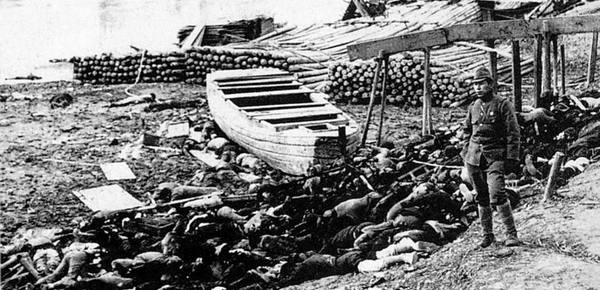
nanking_massacre_1

The Rape of Nanking

Friends of Padre Steve’s World,

Fyodor Dostoyevsky wrote, “Nothing is easier than to denounce the evildoer; nothing is more difficult than to understand him.”

I think one of our problems is that we want to believe that evil is simply done be evil people. That is why when we see a Hitler, Stalin, Pol Pot, or the monsters of the so-called Islamic State, we are often strangely comforted. This is often  because we can point to a single person with a wicked ideology and say “they are evil,” all the while forgetting that they are, or were, like us, also human. Aleksandr Solzhenitsyn reminds us of the folly of that type of thinking, “If only it were all so simple! If only there were evil people somewhere insidiously committing evil deeds, and it were necessary only to separate them from the rest of us and destroy them. But the line dividing good and evil cuts through the heart of every human being. And who is willing to destroy a piece of his own heart?”

Last week I took a break from my Gettysburg text and dusted off an old academic paper dealing with the one of the more uncomfortable aspects of the Nazi Holocaust against the Jews. I did that because I felt that I needed to reexamine the nature of evil in the modern world. 

When I ponder the evil committed by supposedly civilized men and women of Germany, I realize that they are little different than others who share the culture of the West. These people were the products of a culture of learning, and of science. They were part of a culture formed by the Christian tradition, the Renaissance, the Reformation, and the Enlightenment, the age of Reason. As I pondered this I came to remember something said by the late Iris Chang, “civilization is tissue thin.”

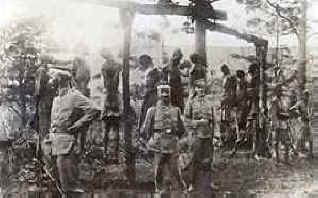
Omaha_courthouse_lynching

Lynching in the American South

That series of articles about the Eunsatzgruppen dealt with the ordinary men, and the bureaucratic systems that implemented an ideology so twisted and evil that it is unimaginable to most people. While most people in the United States know a little about the Holocaust, most do not fully comprehend how devilish and insidious the crimes of the Nazis were. More frightening is the fact that 46% of people worldwide have never heard of the Holocaust, and of the 54% who are aware some 32% think it is a myth or has been greatly exaggerated. The numbers wills only get worse as younger people are far more likely to believe that the Holocaust is a myth or or exaggerated. 

We typically know about the extermination camps like Auschwitz, but the lesser known dark side of the Holocaust, perhaps the scariest part, is the story of the men of the Einsatzgruppen. The Einsatzgruppen and affiliated units, including those of the Wehrmacht, the Waffen SS, the mobilized battalions of the Order Police, and locally recruited units, rounded up massive numbers of people and killed them up close and personal. In all these units murdered over two million people, about 1.3 million of whom were Jews.

My study of the Holocaust began in college as an undergraduate. My primary professor at California State University at Northridge, Dr. Helmut Haeussler had been an interpreter and interrogator at the Nuremberg trials. I was able to take a number of lecture classes from him a large amount of research and independent study courses in a year of graduate work while finishing my Army ROTC program at UCLA. It was an immersion in the history, sociology, and the psychology of evil, during which I was able to meet and talk with Jewish survivors of the Holocaust.

mass killing einsatzgruppen

Einsatzgruppen

Since then I have continued to read and study. I lived in Germany for over four years, and made many other visits, during which I went to a number of Concentration Camp sites. I visited the rebuilt synagogue in Worms which had been destroyed during the infamous Kristallnacht, and other museums and Holocaust memorial sites in Germany. I visited the Zeppelin field, the site of Hitler’s massive Nazi Party rallies in Nuremburg, as well as the graveyards which contain the victims of other Nazi crimes, including the Nacht und Nebel or night and fog actions, where people simply disappeared and were murdered by the Gestapo. 

For me, those visits were sobering, maybe even more so because I understood exactly what happened in those sites. These are uncomfortable places to visit, and I can understand why many people would not want to visit them, or even study them. 

The darkness that they remind us of  is a part of our human condition. Traces of the evil on display in those places is present in every human being. Frankly, most people cannot bear looking into that abyss, for fear that they might be swallowed by it.

nankino-masakra-1

Nanking

I can understand that and I have to admit that it is hard to do so. I am a historian as well as a clinician with much experience dealing with death and trauma. With my training I do a pretty good job of keeping my emotional distance to maintain objectivity when confronted with evil. However, it is hard for me not to have some emotional reaction when visiting these places, or reading about the events and people, and in writing about them. 

Likewise, I am very troubled by the growing lack or awareness or denial of the Holocaust. It is very hard for me not to have a virulent reaction when I see books and websites dedicated to Holocaust denial, or that minimize other well documented genocides, and crimes against humanity.

tzd8ftsn-1390907543

Soviet Genocide in Ukraine

My sensitivity to human suffering and the terrible indifference of people in this country to it was greatly increased by my experience of war, and my post-war struggles with PTSD, depression, anxiety, which at points left me very close to committing suicide. A non-chaplain friend, a now retired Navy Command Master Chief Petty Officer that I served with at my last duty station recently remarked that I am a tremendously empathic person, and that I have a large capacity to feel the pain and suffering of others. This capacity for empathy and the ability to feel the suffering of others is part of who I am. It is a good thing, but it makes my work studying and writing about the Holocaust, other genocides, crimes against humanity, and subjects like American slavery, racism, and Jim Crow a sometimes difficult and often very emotionally consuming task. This sometimes leaves me even more sleepless and anxious than normal; especially when I see the indifference of so many people to the suffering of others today.

CambodiaExhibitMassgrave-x1

The Killing Fields

It is that indifference which motivates me to write; because if these events are not recalled and retold, they, like any part of history will be ignored and then forgotten. The statistics bear this out. There are people today, who say that we should stop talking about these events, that they are old news, and they cannot happen again; but history tells us different, and not just the Holocaust, but indeed every genocide. Then there are those who shamelessly use the Holocaust imagery to spread fear among their followers even as they openly demonize minority groups and religions as the Nazis did to the Jews.

I have to agree with Elie Wiesel who said, “Indifference to me, is the epitome of all evil.”

The late Iris Chang, who wrote The Rape of Nanking: The Forgotten Holocaust of World War II wrote something that is pertinent to almost every modern episode of genocide, or other crime against humanity. It is the ability of leaders, be they political, military, or religious to convince people to rationalize actions that they normally would find repulsive.

“After reading several file cabinets’ worth of documents on Japanese war crimes as well as accounts of ancient atrocities from the pantheon of world history, I would have to conclude that Japan’s behavior during World War II was less a product of dangerous people than of a dangerous government, in a vulnerable culture, in dangerous times, able to sell dangerous rationalizations to those whose human instincts told them otherwise.”

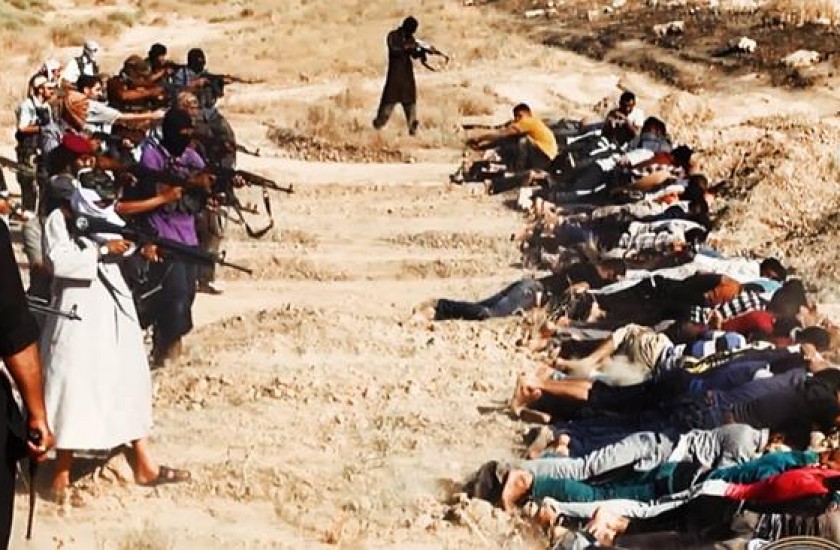
isis3-840x550

The Islamic State

What we call civilization, to use the words of Iris Chang, is tissue thin. That is why we must never forget these terrible events of history, and that part of human nature, and in a sense part of every one of us, that makes them so easy to repeat. That is why we must periodically take the time to remember and reflect on the Holocaust, other genocides and crimes against humanity.

Yes, these are terribly uncomfortable subjects, but we cannot allow this generation to allow them to be forgotten, lest they be repeated. That is why that I must continue to write about them.

Peace

Padre Steve+

5 Comments

Filed under crime, History, Political Commentary

The Unspeakable Taboo: Evil, Genocide & Human Nature

Friends of Padre Steve’s World,

This is the final section of the article that I have been posting over the last six days.

The material in this article that I have spread over the past six days is often troubling. At least it is to me because while I earnestly want to believe that humanity is essentially good, I cannot get around the fact that people in every clime and place throughout history often choose to either participate in, or to ignore evil committed against when it is in their own self-interest.  I can see into the darkness and I can understand it.

Joyce Carol Oates wrote, “And this is the forbidden truth, the unspeakable taboo – that evil is not always repellent but frequently attractive; that it has the power to make of us not simply victims, as nature and accident do, but active accomplices.” That is one of the things that makes the Holocaust, but even more so, the actions of those murdered millions of people up close and personal as members of the Einsatzgruppen, the Police battalions, the Romanian Army, or the locally recruited Eastern European militias.

While this of itself is troubling, the fact that many high ranking military and civilian officials in Germany, and some of their allied countries knew about it, and even if they disapproved did nothing to try to stop it. But even more damning is the fact that many other nations, including the United States knew what was happening and before the war would not accept Jewish immigrants who were being forced to leave Germany and Austria, and then during the war did little or nothing to attempt to stop the mass killings in the extermination camps. The fact is that people are people and most of the actors in this ghastly drama were much like us. That is what makes the period so troubling.

Peace

Padre Steve+
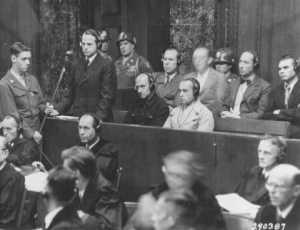
einsatzgruppen trial

Otto Ohlendorf at the Einsatzgruppen Trial

The German war against Poland and the Soviet Union was heavily dependent on the racist ideology of Adolf Hitler. He was the true spirit behind the atrocities committed by his nation as one Nazi leader noted in Russia, “Here too the Führer is the moving spirit of a radical solution in both word and deed.” 187Hitler saw the war in the East as “the chance to stamp out everything that stands against us.” 188Belief in Germany’s right to Lebensraum, was predicated on increasing the standard of living for Germans even if it meant destroying others to do it. The need for food security was one of Hitler’s biggest concerns, and he believed that need would be provided by the conquest of the Soviet Union and the exploitation of the breadbasket of the Ukraine. Hitler’s quest for unlimited natural resources to sustain his Thousand Year Reich and his belief in the racial superiority of the German Volk were combined with his belief in the necessity to settle the Jewish problem. These ideological and economic beliefs provided a fertile ground for Hitler’s followers.

But it was German military doctrine, especially its anti-partisan doctrine and plans for total warfare which allowed Hitler to realize so many of his goals. Without the Army’s support and compliance Hitler could never have succeeded. The post-war and early Cold War myth that the German military had no knowledge of and were not involved in the Holocaust committed against the Jews and others has been shattered as more and more records, correspondence, and testimony emerge.

It is now quite clear that many officers in the Wehrmacht were in agreement with Hitler’s ideology of racial war, including men who have been idolized by military historians and history buffs who marvel at their planning skills and operational precision, but ignore the uncomfortable truth that many either participated in or meekly acquiesced to Hitler’s agenda.
7010_1017630386

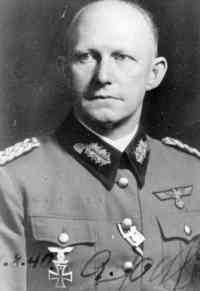
Alfred Jodl

These men, like so many in Germany were products of their culture. They were immersed in cultural prejudices against Jews and Slavs. When we examine the long traditions of racist ideology, coupled with military doctrine, the “Prussian and in later German military must be regarded as a significant part of the ideological background of the Second World War.189 General Walther Von Reichenau’s orders to his troops at the beginning of Operation Barbarossa are revealing in this regard, “The most important goal of the campaign against Jewish-Bolshevism is the complete destruction of its grip on power and the elimination of the Asian influence from our European cultural sphere.” 190 Reichenau’s superior, Field Marshal Gerd Von Rundstedt appeared to agree with von Reichenau’s orders, but wanted to keep the hands of the Army clean of the actual dirty work of the mass killings. Rundstedt had no problem with the “use the partisan threat as excuse for persecuting Jews, so long as the dirty work was largely left to SS Einsatzgruppen.” 191

On the whole the Army command…on the whole acquiesced in the extermination of the Jews, or at least closed its eyes to what was happening.” 192 This is absolutely true, but that being said, and as guilty as many of the Generals were, there are factors involved that if are honest might have influenced us to make the same choices as them if we stood in their shoes. This is not an excuse, it is reality and it is borne out by history. The sad truth is that most people act in accordance with their self-interest, especially their economic well-being and social status. We accommodate evil when it serves our needs, especially if we do not actually have to do the dirty work. Their actions show the truth of Primo Levi’s comment “Monsters exist, but they are too few in number to be truly dangerous. More dangerous are the common men, the functionaries ready to believe and to act without asking questions.”
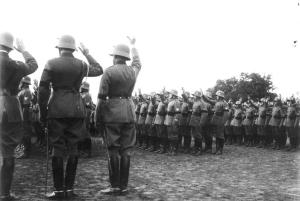
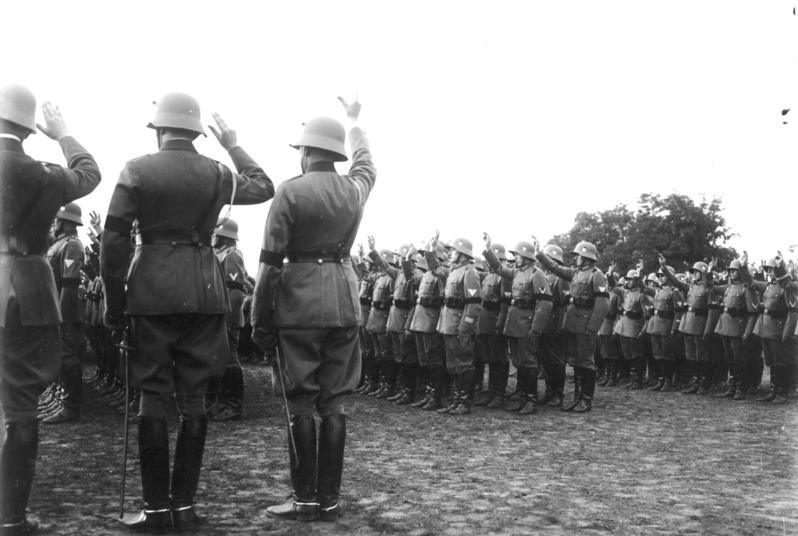
Die feierliche Vereidigung der Reichswehr auf den neuen Reichspräsidenten Adolf Hitler auf dem Kasernenhof der Wachtruppe in Berlin 1934 Offiziere und Mannschaften leisten den feierlichen Eid durcherheben der rechten Hand. Die Reichswehr trägt Trauerflor für den verstorbenen Reichspräsidenten.

Officers and men of the Reichswehr take the Oath to Hitler in 1934 following the death of President Hindenburg

Had the Generals had been more forceful in their opposition, they would have most likely been opposed by the highly Nazified youth that made up the bulk of their Army, especially many of the junior officers, NCOs and enlisted men. Likewise there was the matter of their oath and this is something that many Americans do not understand. During the Kaiser Reich German officers swore an oath to the Kaiser, during Weimar that was changed to the Constitution, when Hitler took power and assumed both the Presidency and Chancellorship following the death of President von Hindenburg, the officer corps swore a new oath, that to Hitler as President and Chancellor. While many saw the danger, almost all officers took the oath, in a sense it was a throwback to the old way of doing things in the Kaiser Reich, and most officers hated the Republic. To them the oath embodied their honor, to break it was to dishonor themselves and their family. When war came it became more than that, to break the oath was considered treason. General Alfred Jodl told American Army psychologist Gustave Gilbert at Nuremberg that “In war the moral pressure of obedience and the stigma of high treason are pretty hard to get around.” 193

Jodl’s superior Keitel stated his helplessness before Hitler saying to Gilbert “What could I do? There were only 3 possibilities: (a) refusal to follow orders, which naturally meant death; (b) resign my post, or (c) commit suicide. I was on the point of resigning my post 3 times, but Hitler made it clear that he considered my resignation in time of war the same as desertion. What could I do?” 194 This was obviously an after the fact excuse by Keitel who had been present in Hitler’s headquarters since the beginning and had witnessed the explosive General Heinz Guderian explode in rage against Hitler in 1945. Following that violent outburst in which Guderian and Hitler engaged in a lengthy heated argument in which those present thought would come to blows and the enraged dictator and general shouted at each other and were held back from contact by others in the conference room. Instead of arrest or imprisonment Hitler ordered Guderian to take extended sick leave and never accosted him afterwards.

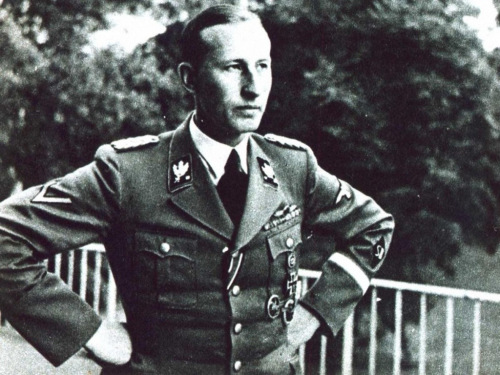
heydrich

Reinhard Heydrich

Himmler, Heydrich, Eichmann and other SS leaders fanatically executed Hitler’s policies and were aided by the civil administration, including the leaders of the Reichsbank, and the proponents of long term economic plans. Genocide was to bring the Reich “long term economic gains and trading advantages” and was seen as a way of “financing the war debt without burdening the German taxpayer.” 195

The willing participation of Army commanders is hard to get around. Otto Ohlendorf, commander of Einsatzgruppe D testified at the Einsatzgruppe Trial that Einsatzgruppen reported all of their tasks to the army commanders, and that together, they and the army agreed on the time, place, and possible support of the troops for any particular “liquidation action[s].” 196

Some individuals did attempt to resist the most brutal aspects of the Nazi campaign against the Jews, but few had the fortitude to make more than half-hearted attempts. Wilhelm Kube, the Reichskommissar for White Russia, himself a fanatical Nazi and a virulent anti-Semite was shocked at the mass murders of the Jews taking place in his region. He called them “unworthy of the German cause and damaging to the German reputation.” During his administration Kube would later attempt to spare Jews by employing skilled Jews in war industries, however, Kube’s efforts were “defeated by Himmler’s zealots.” 197

Army officers who objected to the killing of Jews, like Blaskowitz and Külcher in Poland were relieved of command or were reassigned. Others like Field Marshal Ritter von Leeb took their protests to Hitler. Such protests were readily dismissed and those who made them usually took no further action. Leeb was told by Hitler to “in so many words told to mind his own business.” Leeb later stated, “the only thing to do is to hold oneself at a distance.” 198 Field Marshall Erwin Rommel, who had burned the notorious Commando Order in front of his staff in North Africa could not bring himself to believe that Hitler was to blame. While commanding Army Group B in France Rommel heard of the crimes being committed against the Jews and others through information provided by Blaskowitz, and members of his own staff who had served in Russia. But Rommel, who became part of the plot of overthrow Hitler, was then still in the thrall of the Fuhrer and blamed the crimes “on Hitler’s subordinates, not Hitler himself.” 199

Of the men mentioned in this article who survived the war, only four, Wilhelm Keitel, Alfred Jodl, Otto Ohlendorf and Adolf Eichmann paid for their crimes with their lives Keitel and Jodl were found guilty in the major War Crimes Trials at Nuremberg. Ohlendorf at the Einsatzgruppen trial, while Eichmann was caught by the Israelis, tried, convicted and put to death in 1962. Blaskowitz committed suicide while being tried with thirteen other generals during the final Nuremberg trial, that of the generals. Of those eleven were convicted and none served out their full sentence.

keitel-jodl-hitler

Hitler with Jodl

Hitler’s ideology permeated German military campaigns and administration of the areas conquered by his armies. No branch of the German military, police or civil administration in occupied Poland or Russia was exempt guiltless in the crimes committed by the Nazi regime. It is a chilling warning of the consequences awaiting any nation that allows it to become caught up in hate-filled political, racial or even religious ideologies which dehumanizes opponents and of the tragedy that awaits them and the world. In Germany the internal and external checks that govern the moral behavior of the nation and individuals failed. Caught up in the Nazi system, the Germans, especially the police and military abandoned the norms of international law, morality and decency, banally committing crimes which still reverberate today and which were seen in the ethnic cleansing actions in the former Yugoslavia, and now throughout much of the Middle East.

In light of the fact that there is a growing food shortage in the world which will only get worse due to a factors including the global rise in population, the shrinking of the amount land which can be farmed due to climate change.  There are many other factors as well which could such a situation could bring about another Holocaust.  In such a case leaders will decide that the lands and resources of less developed people are theirs for the taking in order to maintain the standards of living of their people, and that the indigenous people who they will victimize are less than human and thus have no rights. The terminology used by them will be very neutral and full of euphemisms which will allow many people to maintain the illusion that any evil carried out is for the good. Politicians, pundits and preachers will talk of problems, and of solutions, and in trying to find a resolution yearn for a conclusive solution, a final solution.

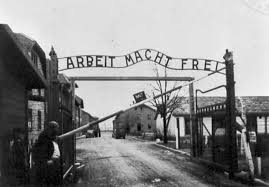
arbiet macht frei

I return to the quote from the movie Judgment at Nuremberg which I included in the first section of this article because it is worth repeating and all too true:

“Janning, to be sure, is a tragic figure. We believe he loathed the evil he did. But compassion for the present torture of his soul must not beget forgetfulness of the torture and the death of millions by the Government of which he was a part. Janning’s record and his fate illuminate the most shattering truth that has emerged from this trial: If he and all of the other defendants had been degraded perverts, if all of the leaders of the Third Reich had been sadistic monsters and maniacs, then these events would have no more moral significance than an earthquake, or any other natural catastrophe. But this trial has shown that under a national crisis, ordinary – even able and extraordinary – men can delude themselves into the commission of crimes so vast and heinous that they beggar the imagination….”

That quote might be applied to many of the people who participated in this genocide. Sadly, the fact is that in truth we are not really all that much different than the victims, the perpetrators and the bystanders who lived and died in the Holocaust, and similarly every other act of genocide.

History serves as a guide and a warning. We must always be alert and we must always when the truly difficult times come, in the midst of crisis, not to take the easy path and denude ourselves into the commission of such crimes.

Notes

187 Ibid. Bracher. The German Dictatorship p.430

188 Ibid. Megargee War of Annihilation p.65

189 Ibid. Wette. The Wehrmacht p.293

190 Ibid. Wette. The Wehrmacht p.97

191 Messenger, Charles. The Last Prussian A Biography of Field Marshal Gerd Von Rundstedt 1875-1953 Brassey’s London, 1991 p148

192 Ibid. Bracher The German Dictatorship pp.430-431

193 Gilbert, Gustave Nuremberg Diary DaCapo Press 1995 copyright G.M. Gilbert 1947 p.290

194 Ibid. Gilbert p.26

195 Ibid. Aly and Heim Architects of Annihilation p.242

196 Ibid. Hebert p.92

197 Ibid. Padfield Himmler pp.341-342

198 Ibid. Megargee War of Annihilation p.97

199 Fraser, David. Knight’s Cross: A Life of Field Marshal Erwin Rommel Harper Perennial, New York 1995, first published by Harper Collins in Britain, 1993. p.536

Bibliography for the series

Aly, Gotz and Heim, Susanne. Architects of Annihilation: Auschwitz and the Logic of Destruction Phoenix Paperbacks, London, 2003, originally published as Vordenker der Vernichtung, Hoffman und Campe, Germany 1991, English translation by Allan Blunden. First published in Great Britain Weidenfeld & Nicholson, London, 2002

Arendt, Hannah, Eichmann in Jerusalem: A Report on the Banality of Evil. Revised and Enlarged Edition. Penguin Books, Harmondsworth, England and New York, NY 1965. Originally published by Viking Press, New York, NY 1963

Blood, Philip. Hitler’s Bandit Hunters: The SS and the Occupation of Europe. Potomoac Books Inc. Washington, DC 2008

Bracher, Karl Dietrich. The German Dictatorship: The Origins, Structure, and Effects of National Socialism. Translated by Jean Steinberg, Holt Rinehart and Winston, New York, NY 1979. Originally Published under the title Die Deutsche Diktatur: Entstehung, Struktur,Folgen des Nationalsocialismus. Verlag Kiepenheuer & Witsch. Koln and Berlin, 1969

Browning, Christopher R. Ordinary Men: Reserve Police Battalion 101 and the Final Solution in Poland. Harper Perennial Books, New York, New York 1993 reissued 1996.

Burleigh, Michael and Wippermann, Wolfgang. The Racial State: Germany 1933-1945 Cambridge University Press, New York NY and Cambridge UK 1991

Condell, Bruce and Zabecki, David T. Editors. On the German Art of War: Truppenführung , Lynn Rienner Publishers, Boulder CO and London 2001

Craig, Gordon A. The Politics of the Prussian Army 1640-1945. Oxford University Press, London and New York, 1955

Davidowicz, Lucy S. The War Against the Jews 1933-1945 Bantam Books, New York, NY 1986.

Di Nardo, Richard L. Germany and the Axis Powers: From Coalition to Collapse. University Press of Kansas, Lawrence, KS. 2005

Erickson, John. The Road to Berlin. Cassel Military Paperbacks, London, 2003. First Published by Weidenfeld and Nicholson, 1983

Evans, Richard J. The Coming of the Third Reich Penguin Books, New York 2004. First published by Allen Lane 2003

Evans, Richard J. The Third Reich in Power 1933-1939. Penguin Press, New York, NY 2005

Ferguson, Niall. The War of the Worlds: Twentieth Century Conflict and the Descent of the West.

The Penguin Press, New York, 2006

Fest, Joachim, Hitler. Translated by Richard and Clara Winston. Harcourt Brace Jovanovich Publishers, San Diego, New York, London, 1974. German Edition by Verlag Ullstein 1973

Fraser, David. Knight’s Cross: A Life of Field Marshal Erwin Rommel Harper Perennial, New York 1995, first published by Harper Collins in Britain, 1993

Friedlander, Saul Nazi Germany and the Jews 1939-1945: The Years of Extermination. Harper Perennial, New York, NY 2007

Fritz, Stephen G. Frontsoldaten: The German Soldier in World War II. The University Press of Kentucky, Lexington, KY 1995

Geyer, Michael. German Strategy 1914-1945 in Makers of Modern Strategy from Machiavelli to the Nuclear Age. Peter Paret, editor. Princeton University Press, Princeton NJ. 198

Gilbert, Gustave Nuremberg Diary DaCapo Press 1995 copyright G.M. Gilbert 1947

Giziowski, Richard. The Enigma of General Blaskowitz. Hppocrene Books, New York 1997

Glantz, David M. and House, Jonathan. When Titans Clashed: How the Red Army Stopped Hitler. University Press of Kansas, Lawrence, KS. 1995

Goerlitz, Walter. History of the German General Staff.” Translated by Brian Battershaw, Westview Press, Boulder and London, 1985. Originally published as Die Deutsche Generalstab Verlag der Frankfurter Hefte, Frankfurt am Main, 1953

Goerlitz, Walter. The Memiors of Field Marshal Wilhelm Keitel: Chief of the German High Command 1938-1945. Translated by David Irving. Cooper Square Press 2000, First English Edition 1966 William Kimber and Company Ltd. German edition published by Musterschmnidt- Verlad, Gottigen 1961.

Hebert, Valerie Genevieve, Hitler’s Generals on Trial: The Last War Crimes Tribunal at Nuremberg University of Kansas Press, Lawrence Kansas 2010

Hitler, Adolf Mein Kampf translated by Ralph Manheim. Mariner Books, Houghton Mifflin Company, New York, NY 1999. Houghton Mifflin Company 1943, copyright renewed 1971. Originally published in Germany by Verlag Frz. Eher Nachf. GmbH 1925

Höhne, Heinze. Canaris: Hitler’s Master Spy. Traslated by J. Maxwell Brownjohn. Cooper Square Press, New York 1999. Originally published by C. Bertelsmann Verlag Gmbh, Munich 1976, first English edition by Doubleday and Company 1979

Höhne, Heinze. The Order of the Death’s Head: The Story of Hitler’s SS. Translated by Richard Barry. Penguin Books, New York and London, 2000. First English edition published by Martin Secker and Warburg Ltd. London 1969. Originally published as Der Orden unter dem Totenkopf, Verlag Der Spiegel, Hamburg 1966.

Hughes, Daniel J. editor. Moltke on the Art of War: Selected Writings, translated by Harry Bell and Daniel J Hughes. Presidio Press, Novato CA 1993

Liddell-Hart, B.H. The German Generals Talk. Quill Publishing, New York, NY. 1979. Copyright 1948 by B.H. Liddell-Hart

Lieber, Franz Instructions for the Government of Armies of the United States in the Field, prepared by Francis Lieber, LL.D., Originally Issued as General Orders No. 100, Adjutant General’s Office, 1863, Washington 1898: Government Printing Office. Retrieved from http://avalon.law.yale.edu/19th_century/lieber.asp 6 May 2014

Lindqvist, Sven Exterminate All the Brutes: One Man’s Oddessy into the Heart of Darkness and the Origins of European Genocide Translated from the Swedish by Joan Tate, The New Press , New York and London 1992

Macksey, Kenneth. Why the Germans Lose at War: The Myth of German Military Superiority. Barnes and Noble Books, New York 2006, originally published by Greenhill Books, 1996

Manstein, Erich von. Forward by B.H. Liddle Hart, Introduction by Martin Blumenson. Lost victories: The War Memoirs of Hitler’s Most Brilliant General. Zenith Press, St Paul MN 2004. First Published 1955 as Verlorene Siege, English Translation 1958 by Methuen Company

Shirer, William L. The Rise and Fall of the Third Reich. A Touchstone Book published by Simon and Schuster, 1981, Copyright 1959 and 1960

Megargee, Geoffrey P. War of Annihilation: Combat and Genocide on the Eastern Front 1941.Bowman and Littlefield Publishers Inc. Lanham, Boulder, New York. 2007

Messinger, Charles, The Last Prussian: A Biography of Field Marshal Gerd Von Rundstedt 1875-1953 Brassey’s (UK) London England 1991

Newton, Steven H. Hitler’s Commander: Field Marshal Walter Model-Hitler’s Favorite General

DaCapo Press a division of Perseus Books Group, Cambridge MA 2005 Novatny, Alfred. The Good Soldier. The Aberjona Press, Bedford, PA 2003 Padfield, Peter. Himmler. MJF Books, New York. 1990

Reitlinger, Gerald. The SS: Alibi of a Nation. The Viking Press, New York, 1957. Republished by Da Capo Press, New York, NY.

Rhodes, Richard. Masters of Death: The SS Einsatzgruppen and the Invention of the Holocaust.

Vintage Books a division of Random House, New York, NY 2002

Shepherd, Ben. War in the Wild East: The German Army and Soviet Partisans. Harvard University Press, Cambridge, MA 2004

Sofsky, Wolfgang. The Order of Terror: The Concentration Camp. Translated by William Templer. Princeton University Press. Princeton, NJ 1997. Originally published as Die Ordnung des Terrors: Das Konzentrationslager. S. Fischer Verlag, GmbH, Frankfurt am Main, 1993

Speer, Albert. Inside the Third Reich. Collier Books, a Division of MacMillan Publishers, Inc. New York, NY 1970.

Strachan, Hew. European Armies and the Conduct of War. George, Allen and Unwin, London, UK 1983

Stein, George H. The Waffen SS 1939-1945: Hitler’s Elite Guard at War. Cornell University Press, Ithaca and London, 1966

Stern, Fritz. Gold and Iron: Bismarck, Bleichroder and Building of the German Empire. Vintage Books a division of Random House, New York 1979 First published by Alfred a Knopf 1977

Sydnor, Charles W. Soldiers of Destruction: The SS Death’s Head Division, 1933-1945. Princeton University Press, Princeton, NY 1977

Taylor, Fred, Editor and Translator. The Goebbels Diaries 1939-1941, Penguin Books Ltd, Harmondsworth UK and New York NY 1984.

Tooze, Adam. The Wages of Destruction Penguin Books, New York, NY, 2008. First Published by Allen Lane Books, Penguin Group, London UK, 2006

Trevor-Roper, H.R. Hitler’s Table Talk 1941-1944 with an introduction by Gerhard L Weinberg, Translated by Norman Cameron and R.H. Stevens, Enigma Books, New York, NY 2000. Originally published in Great Britain by Weidenfeld & Nicholoson, London 1953.

Warlimont, Walter. Inside Hitler’s Headquarters 1939-45. Translated by R.H. Berry, Presido Press, Novato CA, 1964.

Weinberg, Gerhard L. Germany Hitler and World War II . Cambridge University Press, New York, NY 1995

Weinberg, Gerhard L. Ed. Hitler’s Second Book: The Unpublished Sequel to Mein Kampf by Adolph Hitler. Translated by Krista Smith, Enigma Books, New York, NY 2006. Originally published as Hitlers zweites Buch, Gerhard Weinberg editor, 1961.

Weinberg, Gerhard L. Visions of Victory: The Hopes of Eight World War II Leasers. Cambridge University Press, New York, NY 2005

Westermann, Edward B. Hitler’s Police Battalions: Enforcing Racial War in the East.

University Press of Kansas, Lawrence, KS. 2005

Wette, Wolfram. The Wehrmacht: History, Myth, Reality. Translated by Deborah Lucas Schneider. Harvard University Press, Cambridge, MA 2006. Originally published as Die Wehrmacht: Feindbilder, Vernichtungskreig, Legenden. S. Fischer Verlag, GmbH, Frankfurt am Main, 2002

Wheeler-Bennett, John. The Nemesis of Power: The German Army in Politics 1918-1945. St. Martin’s Press Inc. New York, NY 1954


1 Comment

Filed under crime, History, laws and legislation, leadership, Military, Political Commentary, world war two in europe

Military & Legal Foundations of Genocide

Friends of Padre Steve’s World

The next installment of my article on war crimes, genocide and the role of ordinary people in them. This focuses on the legal, ideological, and military doctrine foundations of the German race war in Poland and Russia. Without these foundations it would have been difficult, maybe even impossible for the Germans to implement genocide on such a vast scale.

Peace

Padre Steve+

???????????????

Wilhelm Keitel: “war was a fight for survival….dispense with outdated and traditional ideas about chivalry and the generally accepted rules of warfare…” Bundesarchiv Bild

This study will focus on the German policy of ideological-racial war in Poland and Russia. The German war against the Soviet Union and to a certain extent Poland was waged with an unforgiving ferocity against Hitler’s enemy, the Jewish-Bolshevik state and the Slavic Untermenschen.

The campaigns in Poland and the Soviet Union were characterized by the rise of a “political- ideological strategy.” 25 Operation “Barbarossa showed the fusion of technocracy and ideology in the context of competitive military planning.” 26 Hitler’s “ideological and grandiose objectives, expressed in racial and semi-mystical terms, made the war absolute.” 27

Field Marshal Keitel noted a speech in March 1941 where Hitler talked about the inevitability of conflict between “diametrically opposed ideologies” and that the “war was a fight for survival and that they dispense with their outdated and traditional ideas about chivalry and the generally accepted rules of warfare.” 28 General Halder, Chief of the OKH in his War Dairy for that meeting noted “Annihilating verdict on Bolshevism…the leaders must demand of themselves the sacrifice of understanding their scruples.” 29

Based on Lebensraum and race, the German approach to war would combine “racism and political ideology” for the purpose of the “conquest of new living space in the east and its ruthless Germanization.” 30 Hitler explained that the “struggle for the hegemony of the world will be decided in favor of Europe by the possession of the Russian space.” 31 Conquered territories would be “Reich protectorates…and that these areas were to be deprived of anything in the nature of a Slav intelligentsia.” 32

This goal was manifest in the “Criminal Order” issued by OKW which stated that the war was “more than mere armed conflict; it is a collision between two different ideologies…The Bolshevist-Jewish intelligentsia must be eliminated….” 33 Other displaced inhabitants of the conquered eastern lands would be killed or allowed to starve. 34 Part of this was due to economic considerations in the Reich, which gave Germans priority in distribution of food, even that from the conquered lands. Starvation was a population control measure that supplemented other forms of annihilation. 35 As Fest notes in Russia Hitler was “seeking nothing but “final solutions.”” 36Despite numerous post-war justifications by various Wehrmacht generals, the “Wehrmacht and army fell into line with Hitler because there was “a substantial measure of agreement of “ideological questions.”” 37

Hitler’s racial ideology was central to his worldview and fundamental to understanding his actions in the war. 38 However twisted Hitler’s ideological formulations were his ideas found acceptance beyond the Nazi faithful to the Army and Police, who would execute the campaigns in Poland and Russia in conjunction with the Einsatzgrüppen and Nazi party organizations. In these organizations he found allies with pre-existing cultural, political and doctrinal understandings which allowed them to be willing participants in Hitler’s grand scheme of eastern conquest.

ss recruiting poster

Military Doctrine and Ideology

While Hitler’s racial ideology was more extreme than many in the German military and police, these organizations had cultural beliefs and prejudices as well as doctrinal and ideological foundations which helped them become willing accomplices to Hitler. These factors were often, consciously or unconsciously, excluded from early histories of World War II. The Allies relied on German officers to write these histories at the beginning of the Cold War, developing the “dual myth of German military brilliance and moral correctness.” 39 British historian and military theorist B.H. Liddell-Hart makes the astounding statement that “one of the surprising features of the Second World War was that German Army in the field on the whole observed the rules of war than it did in 1914-1918-at any rate in fighting its western opponents….” 40

While Liddell-Hart might be excused by lack of knowledge of some German army atrocities he could not have been ignorant. It was not just the SS who he blamed the atrocities but many of the men who he interviewed. In doing this Liddell-Hart and others presented a myth as truth. 41 The myths were helped by the trials of Manstein and Kesselring where “historical truth had to be sacrificed…to the demands of the Cold War.” 42 British military historian Kenneth Macksey confronted the myth that only the “Waffen SS committed barbaric and criminal acts” noting: “Not even the Knights of the Teutonic Order and their followers in the Middle Ages sank to the depths of the anti-Bolshevik Wehrmacht of 1941.” 43

Germany had a long running history of anti-Semitism before Hitler. German anti-Semitism often exhibited a “paranoid fear of the power of the Jews,” 44 and included a “fashionable or acceptable anti-Semitism” 45 which became more pronounced as the conditions of the Jews became better and Jews who had fled to Eastern Europe returned to Germany. 46 Sometimes this was tied to religious attitudes, but more often focused on the belief that the Jews “controlled certain aspects of life” and presented in “pseudo-scientific garb” the “myth of a secret Jewish plot for world domination which was simultaneously part of the internationalism of Freemasonry.” 47

Admiral Wilhelm Canaris provides an example as he “had grown up in the atmosphere of “moderate” anti-Semitism prevailing in the Ruhr middle class and in the Navy believed in the existence of a “Jewish problem”” and would “suggest during 1935-1936 that German Jews should be identified by a Star of David as special category citizens….” 48 Wehrmacht soldiers were “subject to daily doses of propaganda since the 1930s” and that with the “start of the Russian campaign propaganda concerning Jews became more and more aggressive.” 49 Some officers objected to Nazi actions against Jews. Von Manstein protested the “Aryan paragraph” in the Reichswehr on general principal.” 50 Yet some of the men who planned and executed the most heinous crimes like, Adolf Eichmann had “no fanatical anti-Semitism or indoctrination of any kind.” 51

The military “looked to the regime to reshape society in every respect: political, ideological, economic and military…Propaganda would hammer home absolute nature of the struggle…” 52 Ideological training began in the Hitler Youth and Reichsarbeitsdienst and produced a soldier in which “Anti-Semitism, anti-communism, Lebensraum – these central tenants of Nazism were all inextricably linked with the Landser’s conception of duty, with his place and role in the vast machinery of war.” 53

Following the dismissal of General Fritsch in 1938, General Brauchitsch promised Hitler that “he would make every effort to bring the Army closer to the State and the State’s ideology.” 54

Alfred Novotny, a Austrian soldier in the Gross Deutschland division noted how training depicted the Russians as Untermenschen and how they were “subjected to official rantings about how the supposedly insidious, endless influence of the Jews in practically every aspect of the enemy’s endeavors…Jews were portrayed as rats, which were overrunning the world….” 55

anti-jewish poster

This ideological component added to the already “harsh military discipline” which had a long tradition in Germany conditioning soldiers to violence and brutalization of their enemy. Similar programs existed in the Order Police which would play a large part in the eastern campaign, the “image of “treasonous” leftists and Jews helped shape the personal and political beliefs of many policemen throughout the interwar period.” 56 Even ordinary police training before the war in German speaking Europe “was brutalizing.” 57 These troops were recipients of an ideological formation which “aimed at shaping the worldview of the police leading to the internalization of belief along National Socialist lines.” 58 Waffen SS soldiers, especially those of the Totenkopf division were subjected to even more systematic political indoctrination on the enemies of National Socialism, the Jews, freemasonry, Bolshevism and the churches. 59

Along with cultural anti-Semitism and the Nazification of German thought in the 1930s, there were aspects of military doctrine which helped prepare the way for the eastern campaign. The most important were the Army’s anti-partisan and rear area security doctrine. The history of security anti-partisan operations dated back to the Prussian Army’s Ettapen, which began in 1813 with the Landwehr’s role in security against looters and others. 60 These units supported and supplied offensive operations from the rear to the combat zone with a secondary mission of countering partisans and preventing disruptions in the rear area. The Ettapen would be reformed and regulated in 1872 following the Franco-Prussian War. 61

The German experience fighting guerrillas and partisans, the francs-tireurs in the Franco- Prussian War, “scarred the Army’s institutional mentality.” 62 Field Marshal Von Moltke the elder was “shattered,” and wrote his brother that “war was now taking on an ever more hate-inspired character.” 63 He was “appalled by improvised armies, irregular elements, and appeals to popular passion, which he described as a “return to barbarism.” 64 He wrote:  “Their gruesome work had to be answered by bloody coercion. Because of this our conduct of the war finally achieved a harshness that we deplored, but which we could not avoid.” 65

The brutal German response to the franc-tireurs found its legal justification in Franz Lieber’s principles for classification of belligerents and non-belligerents, which determined that guerrillas were outlaws or bandits. 66 Leiber’s principles were written for the Federal Army of the United States during the U.S. Civil War. Propagated as General Order 100 and signed by Abraham Lincoln the sections dealing with irregular forces and partisans dealt with this in section IV of that code:

Article 82 stated: “Men, or squads of men, who commit hostilities, whether by fighting, or inroads for destruction or plunder, or by raids of any kind, without commission, without being part and portion of the organized hostile army, and without sharing continuously in the war, but who do so with intermitting returns to their homes and avocations, or with the occasional assumption of the semblance of peaceful pursuits, divesting themselves of the character or appearance of soldiers – such men, or squads of men, are not public enemies, and, therefore, if captured, are not entitled to the privileges of prisoners of war, but shall be treated summarily as highway robbers or pirates.”

Article 84 stated: “Armed prowlers, by whatever names they may be called, or persons of the enemy’s territory, who steal within the lines of the hostile army for the purpose of robbing, killing, or of destroying bridges, roads or canals, or of robbing or destroying the mail, or of cutting the telegraph wires, are not entitled to the privileges of the prisoner of war.”

Article 85 stated: “War-rebels are persons within an occupied territory who rise in arms against the occupying or conquering army, or against the authorities established by the same. If captured, they may suffer death, whether they rise singly, in small or large bands, and whether called upon to do so by their own, but expelled, government or not. They are not prisoners of war; nor are they if discovered and secured before their conspiracy has matured to an actual rising or armed violence.” 67

The German Army adapted that code and incorporated it in its doctrine for dealing with partisans. In response to their experience in France during the Franco-Prussian War the Germans systematically reorganized the Ettapen to include railroad and security troops, special military courts, military police, intelligence and non-military police, including the Landespolizei and the Grenzschutzpolizei. 68

The doctrinal response to partisans, or as they would become known in German writings as “bandits,” was that bandits should be encircled and destroyed. This was employed in the Southwest Africa German colonies. The Germans, influenced by the experience in France, “displayed a ferocity surpassing even that of the racially brutalized campaigns of its imperialist peers.” 69

von trotha

Lothar Von Trotha

The campaign against the Herero tribes which resisted the occupation of Namibia from 1904- 1912 utilized encirclement operations, racial cleansing and what would become known as Bandenkämpfung operations. 70 In 1904 the Herero were banished from their lands which were handed over to German settlers. When the Herero resisted Von Trotha ordered that they be exterminated. “Every Herero found within German borders with or without weapons, was to be shot. But most of them died without violence. The Germans simply drove them out into the desert and sealed off the border.” 71

20030228_Herero

Of about 80,000 Herero some 60,000 died in the desert, a few thousand survived to be “sentenced to hard labor in German concentration camps.” 72 Despite praise from some in the General Staff the brutality shocked many Germans and General Alfred Von Schielffen who had to defend himself from the “accusations that he had harmed the good name of the army” ensured that “Trotha never served in the field again.” 73 Despite this the application of such Bandenkämpfung operations found their way into German military doctrine.

This was further developed in the First World War, especially in the east where General Fritz Gempp described the security problem as a “ruthless struggle” in which German pacification policy “was in reality the application of terror to galvanize the population into accepting German rule.” 74Anti-partisan doctrine was codified in the Truppenführung of 1933 which stated that “area defense against partisan warfare is the mission of all units” and that the preferred method of combating partisan bands was that they be surrounded and destroyed. 75 General Erhard Rauss later described active and passive measures used to deal with partisans, focusing on the tactic of encirclement to destroy the enemy. 76

The accounts of the German General Staff praised Von Trotha’s operation. “The month long sealing of desert areas, carried out with iron severity, completed the work of annihilation…the sentence had been carried out” and “the Hereros had ceased to exist as an independent people.” 77

Anti-partisan doctrine focused on the destruction of the partisans, was coupled a total war philosophy and provided fit well with Hitler’s radical ideology. The “propensity for brutality in anti-guerrilla warfare was complimented by officers’ growing preoccupation, both during and after World War I, with the mastery and application of violence.” 78 Michael Geyer notes: “ideological mobilization for the creation of a new national and international order increasingly defined the parameters of technocratic planning.” 79 The acceptance of long used brutal tactics to destroy the enemy combined with Hitler’s radical racial animus against the Jews could only be expected to create a maelstrom in which all international legal and moral standards would be breached.

To be continued…

Notes

25 Geyer, Michael. German Strategy 1914-1945 in Makers of Modern Strategy from Machiavelli to the Nuclear Age.

Peter Paret, editor. Princeton University Press, Princeton NJ. 1986. p.582

26 Ibid. Geyer. German Strategy p.587

27 Strachan, Hew. European Armies and the Conduct of War. George, Allen and Unwin, London, UK 1983 p.174

28 Goerlitz, Walter. The Memoirs of Field Marshal Wilhelm Keitel: Chief of the German High Command 1938- 1945. Translated by David Irving. Cooper Square Press 2000, First English Edition 1966 William Kimber and Company Ltd. German edition published by Musterschmnidt-Verlad, Gottigen 1961 p. 135

29 Ibid. Fest, Hitler. p. 649

30 Ibid. Megargee, War of Annihilation p.7

31 Trevor-Roper, H.R. Hitler’s Table Talk 1941-1944 with an introduction by Gerhard L Weinberg, Translated by Norman Cameron and R.H. Stevens, Enigma Books, New York, NY 2000. Originally published in Great Britain by

Weidenfeld & Nicholoson, London 1953 p. 27 Goebbels notes a similar theme in his recollection of Hitler’s reasons for destroying Russia a power . See Taylor, Fred, Editor and Translator. The Goebbels Diaries 1939-1941, Penguin Books Ltd, Harmondsworth UK and New York NY 1984 pp. 413-415.

32 Goerlitz, Walter. History of the German General Staff.” Translated by Brian Battershaw, Westview Press, Boulder

and London, 1985. Originally published as Die Deutsche Generalstab Verlag der Frankfurter Hefte, Frankfur am Main, 1953 p.390

33 Warlimont, Walter. Inside Hitler’s Headquarters 1939-45. Translated by R.H. Berry, Presido Press, Novato CA,

1964 p. 150

34 Weinberg, Gerhard L. Visions of Victory: The Hopes of Eight World War II Leasers. Cambridge University Press, New York, NY 2005. p. 24

35 Aly, Gotz and Heim, Susanne. Architects of Annihilation :Auschwitz and the Logic of Destruction Phoenix

Paperbacks, London, 2003, Originally published as Vordenker der Vernichtung, Hoffman und Campe, Germany 1991, English translation by Allan Blunden. First published in Great Britain Weidenfeld & Nicholson, London, 2002 pp. 245-246

36 Ibid. Fest. Hitler p.649

37 Wette, Wolfram. The Wehrmacht: History, Myth, Reality. Translated by Deborah Lucas Schneider. Harvard University Press, Cambridge, MA 2006. Originally published as Die Wehrmacht: Feindbilder, Vernichtungskreig, Legenden. S. Fischer Verlag, GmbH, Frankfurt am Main, 2002 p.93

38 This understanding is different than many historians who as Friedlander notes advocate something like this: “The persecution and extermination of the Jews of Europe was but a secondary consequence of major German policies pursued toward entirely different goals.” See Friedlander p.xvi

39 Ibid. Megargee. War of Annihilation p.xii

40 Liddell-Hart, B.H. The German Generals Talk. Quill Publishing, New York, NY. 1979. Copyright 1948 by B.H. Liddell-Hart p.22

41 It has to be noted that Liddell-Hart published this work in 1948 and was limited in the materials available, his

primary sources being German officers who he viewed with sympathy because he saw them as exponents of his theory of the indirect approach. The time was also around the beginning of the Cold War and the Berlin Blockade when many American and British leaders were trying to end the war crimes trials and bring the West Germans into the new anti-Communist alliance.

42 Ibid. Wette. The Wehrmacht p.224

43 Macksey, Kenneth. Why the Germans Lose at War: The Myth of German Military Superiority. Barnes and Noble Books, New York 2006, originally published by Greenhill Books, 1996. p.139

44 Stern, Fritz. Gold and Iron: Bismarck, Bleichroder and Building of the German Empire. Vintage Books a division of Random House, New York 1979 First published by Alfred a Knopf 1977. p.495

45 Ibid. Stern. Gold and Iron p.494

46 Ibid. Bracher. The German Dictatorship p.34

47 Ibid. Bracher The German Dictatorship pp.34-35

48 Höhne, Heinze. Canaris: Hitler’s Master Spy. Translated by J. Maxwell, Brownjohn. Cooper Square Press,New York 1999. Originally published by C. Bertelsmann Verlag Gmbh, Munich 1976, first English edition by Doubledayand Company 1979 p. 216. Canaris would later protest the Kristalnacht to Keitel (p.334) and become convinced of the crime of the Nazis against the Jews.

49 Ibid. Witte. The Wehrmacht p.98

50 Ibid Witte The Wehrmacht, p.73

51 Arendt, Hannah, Eichmann in Jerusalem: A Report on the Banality of Evil. Revised and Enlarged Edition. Penguin Books, Harmondsworth, England and New York, NY 1965. Originally published by Viking Press, New York, NY 1963 p.26

52 Ibid. Megargee. War of Annihilation p.6

53 Fritz, Stephen G. Frontsoldaten: The German Soldier in World War II. The University Press of Kentucky, Lexington, KY 1995 p.195

54 Craig, Gordon A. The Politics of the Prussian Army 1640-1945. Oxford University Press, London and New York, 1955 p.495

55 Novatny, Alfred. The Good Soldier. The Aberjona Press, Bedford, PA 2003 p.40

56 Westermann, Edward B. Hitler’s Police Battalions: Enforcing Racial War in the East. University Press of Kansas, Lawrence, KS. 2005 p.64 Westermann also notes the preponderance of SA men who entered the Order Police in the 1930s, a factor which helped further the politicization of that organization.

57 Ibid. Rhodes Masters of Death p.23

58 Ibid. Westermann Hitler’s Police Battalions p.103

59 Sydnor, Charles W. Soldiers of Destruction: The SS Death’s Head Division, 1933-1945. Princeton University Press, Princeton, NY 1977 p. 28

60 Shepherd, Ben. War in the Wild East: The German Army and Soviet Partisans. Harvard University Press, Cambridge, MA 2004 p.41

61 Blood, Philip. Hitler’s Bandit Hunters: The SS and the Occupation of Europe. Potomac Books Inc. Washington, DC 2008 p.11

62 Ibid. Shepherd. War in the Wild East p.42

63 Ibid. Goerlitz. History of the German General Staff p.93

64 Rothenburg, Gunther. Moltke, Schieffen, and the Doctrine of Strategic Envelopment in Makers of ModernStrategy from Machiavelli to the Nuclear Age. Peter Paret, editor. Princeton University Press, Princeton NJ. 1986 p.305

65 Hughes, Daniel J. editor. Moltke on the Art of War: Selected Writings, translated by Harry Bell and Daniel J Hughes. Presidio Press, Novato CA 1993. p.32

66 Ibid. Blood Hitler’s Bandit Hunters p.6 Lieber was a Prussian emigrant to the US who taught law at Columbia University.

67 Instructions for the Government of Armies of the United States in the Field, prepared by Francis Lieber, LL.D., Originally Issued as General Orders No. 100, Adjutant General’s Office, 1863, Washington 1898: Government Printing Office. Retrieved from http://avalon.law.yale.edu/19th_century/lieber.asp 6 May 2014

68 Ibid. Blood Hitler’s Bandit Hunters pp.12-13

69 Ibid. Shepherd Wild War in the East p.42

70 Ibid. Blood. Hitler’s Bandit Hunters pp.16-19 71 Ibid. Lindqvist Exterminate the Brutes p.149 72 Ibid. Lindqvist Exterminate the Brutes p.149 73 Ibid. Blood. Hitler’s Bandit Hunters p.19

74 Ibid. Blood. Hitler’s Bandit Hunters p.22

75 Condell, Bruce and Zabecki, David T. Editors. On the German Art of War: Truppenführung, Lynn Rienner Publishers, Boulder CO and London 2001. p.172

76 Tsouras, Peter G. Editor, Fighting in Hell: The German Ordeal on the Eastern Front The Ballantine Publishing

Group, New York, 1998. First published 1995 by Greenhill Books pp. 142-146. It is interesting to note that Rauss does not describe any actual anti-partisan operation

77 Ibid. Lindqvist. P.149

78 Ibid. Shepherd. War in the Wild East p.45

79 Ibid. Geyer. German Strategy p.584


2 Comments

Filed under History, laws and legislation, Military, Political Commentary, world war two in europe

Vast and Heinous Crimes: Ordinary Men & War Crimes

babi yar

Friends of Padre Steve’s World,

As part of my academic work at the Staff College I teach military ethics as related to the Just War Theory. In the class on jus post bellum or justice after war I deal with the implication of participating in war crimes. It is a serious subject and in the class I attempt to make my students, all relatively senior officers from the United States and allied nations as uncomfortable as possible. I use a number of examples from the major war crimes trials at Nuremberg as well as the Generals Trial. I had an exceptionally good class over the past several weeks and that caused me to go back and do some revisions to a number articles that I have written in the past. I have published a version of this before but I have made some additions and expect that like my work on Gettysburg that this work too will be an ongoing project.

As I went through previous notes and research I felt a tenseness and revulsion for the actions of those that ordered, committed or condoned these crimes, men who were like me professional officers. I realize how easily it is for normal, rational, and even basically decent people to succumb to either participating in or turning a blind eye to crimes against others, even on a massive scale, in fact the bigger they are they seem easier to dismiss, because the victims cease be human, and simply a statistic. Sadly, Josef Stalin probably got human nature right when he said “The death of one man is a tragedy. The death of millions is a statistic.” That comment causes great revulsion in my soul, but I have to admit it seems to be the way that many people deal with such great crimes.

September 29th 2015 was the 74th anniversary of the Babi Yar massacre. It was committed by members of the SS Einsatzgruppen C near Kiev shortly after the German Army captured that city. 33,771 Jews were exterminated by the members of Sonderkommando 4b of Einsatzgruppen C as well as Police battalions. About 10,000 others, mainly Communist Officials and Gypsies were rounded up and killed in the same operation. The victims were stripped of all of their belongings taken to a ravine and shot. It was the second largest killing action by the various Einsatzgruppen in the war. It was committed by men who either believed that the people that they were killing were sub-human, or did not have the courage to stand up and say no.

These issues are still with us. Hannah Arendt made the comment that “The sad truth is that most evil is done by people who never make up their minds to be good or evil.”

These are uncomfortable subjects. We like to say that the Nazis were different than us or others. To some extent this is true, but the real truth is that most of the Christian Western European countries, and I include the United States have also committed gross crimes against humanity against peoples that we believed were less than human and not afforded human rights or protections. In the movie Judgement at Nuremberg Spencer Tracy makes a comment that should send chills through any of us. He spoke concerning one of the judges on trial, “Janning, to be sure, is a tragic figure. We believe he loathed the evil he did. But compassion for the present torture of his soul must not beget forgetfulness of the torture and the death of millions by the Government of which he was a part. Janning’s record and his fate illuminate the most shattering truth that has emerged from this trial: If he and all of the other defendants had been degraded perverts, if all of the leaders of the Third Reich had been sadistic monsters and maniacs, then these events would have no more moral significance than an earthquake, or any other natural catastrophe. But this trial has shown that under a national crisis, ordinary – even able and extraordinary – men can delude themselves into the commission of crimes so vast and heinous that they beggar the imagination….”

Babi Yar is just one example of how civilized people can get can commit great atrocities in the name of ideology and race, and it does not stand alone. The tragic fact is that it really doesn’t take much to condition people to go commit such crimes; just teach people from childhood that people of certain races or religions are less than human. Then subjugate them to incessant propaganda and then turn them loose using the pretext that they are killing terrorists or insurgents. In the coming days I am posting in small sections an article that I wrote that deals with the ideological as well as military reasons that brought about Babi Yar and so many other atrocities committed by the Nazis during the campaigns in Poland and the Soviet Union.

What happened at Babi Yar is just one example of how civilized people can get can commit great atrocities in the name of ideology and race, and it does not stand alone. The tragic fact is that it really doesn’t take much to condition people to go commit such crimes; just teach people from childhood that people of certain races or religions are less than human. Then subjugate them to incessant propaganda and then turn them loose using the pretext that they are killing terrorists or insurgents.

The article deals with the ideological as well as military reasons that brought about Babi Yar and so many other atrocities committed by the Nazis during the campaigns in Poland and the Soviet Union.

To be continued….

Peace

Padre Steve+

6 Comments

Filed under crime, film, History, Political Commentary, world war two in europe

When Political Parties Implode: The Battle over the Lecompton Constitution and its Relevance Today

Friends of Padre Steve’s World

I have been watching the implosion of the Republican Party with some concern, not because I am a Republican or support that party, but because I am a historian and understand that the effects of these kinds of crack ups are not just bad for the party concerned, but often for the country, because they reveal deeper social and political issues. As I watch this I am reminded of the crisis and battle regarding the Lecompton Constitution in 1858. Since the article deals with this in some detail I will cut to the bottom line. In 1858 the Democratic Party held majorities in both houses of Congress and the Presidency. It had been aided by the collapse of the Whig Party and the new republican Party was still in its infancy. But extremists Democrats sought to push through a measure to bring Kansas into the Union as a Slave State, though the measure was rife with fraud. It split the Democratic Party and for a time destroyed it as a national party and helped bring about the Civil War. The battle over the Lecompton constitution is an epic event in our history. 

The issues today are not the same by any means, but the rhetoric and the intransigence of the most zealous ideologues is destroying the Republican Party in much the same way other ideologues destroyed the Democratic Party in 1858.  I admit that I could be wrong, but everything that I see happening is pointing to the implosion and possible breakup of the Republican Party. This may be good for Democrats in the short term, but seldom is it good for the country. But whatever your political views are, I do hope that you read this article and think about the implications of it, and of what is happening in our country today.

Peace

Padre Steve+

Stephen-Douglas-in-1858

Senator Stephen Douglas in 1858

Kansas was politically divided between two competing legislatures, each which claimed to be the voice of the people. The population of Kansas was heavily anti-slavery and many citizens felt disenfranchised by the official legislature, which was “a pro-slavery body elected by fraud in 1855.” [1] This body met in the city of Lecompton. In 1857 the Lecompton legislature sensed the opportunity to have Kansas admitted to the Union as a Slave State. It elected slavery supporters as members of a constitutional convention to draft a constitution which would be submitted to Congress for admission to the Union as a Slave State.

Free State partisans feared that that if they participated in the election that they would be “gerrymandered, and simply counted out by stuffed ballots,” and sat out the election. As a result it was “a quiet election, with many proslavery candidates unopposed and only 2,200 out of 9,000 registered voters going to the polls, a large majority of extreme proslavery men won election as delegates to the constitutional convention in September.” [2] But the result of the election was untenable, for “Two thousand voters in a territory with 24,000 eligible for the franchise had elected a body of delegates whom no one seriously regarded as representative of the majority opinion in Kansas.” [3]

The Lecompton legislature passed the proslavery constitution, but it was vetoed by the outgoing governor, John W. Geary. Geary accused “the pro-slavery legislature of attempting to stampede a rush to statehood on pro-slavery terms,” but his veto was overridden. The constitution had several provisions that most of the population found unacceptable. It protected owners of “the 200 slaves in Kansas, banned free blacks from the state, and prohibited any amendments to the constitution for seven years.” [4] The newly appointed governor of the territory, Robert J. Walker opposed the measure and denounced it “as a vile fraud, a bare counterfeit.” [5] Walker demanded a new, fair, referendum, which the newly elected president James Buchanan, also backed. In response many Southerners in Congress “threatened to secede unless the administration fired Walker and backed down on the referendum issue.” [6] The threat of secession by Southerners in support of the radical minority in Lecompton led to chaos in the Democratic Party which controlled the House, the Senate and held the Presidency.

james-buchanan

President James Buchanan

James Buchanan, who had rode into office on the votes of the South was now pressured by Southern legislators to change his position on the Lecompton Constitution. Buchannan’s cabinet, which was heavily Southern, and pro-slavery expansion also used its influence to pressure the president. In response to the pressure, Buchanan reversed his previous stance in regard to Kansas and endorsed the bill. This provoked a new outcry, this time from members of the Democratic Party. Many Northern Democrats were outraged by the reversal and the threats of secession. Most of the Northern Democrats were willing to accept and even defend slavery where it existed, but they were opposed to the expansion of slavery. They felt betrayed by their president’s actions and rose in opposition to the bill that would admit Kansas as a Slave State.

The formidable Stephen A. Douglas, the Little Giant who had so skillfully crafted the Compromise of 1850 using the principle of popular sovereignty, led these Democrats in their fight against Buchanan’s acceptance and endorsement of Lecompton. Douglas’s previous actions to support the rights of Slave States had made him a hero in much of the South and his stature in both the North and the South made him the front runner to win the Democratic nomination for the presidency in 1860.

But Douglas, who had worked so hard to build compromises that would hold the Union together could not countenance the actions and tactics of the Southern members of his party. Douglas was a political realist and not an ideologue. He was very sympathetic to slave holders and no supporter of emancipation, in fact Douglas was a racist, and was convinced “of the inferiority of the Negro, and he had a habit of stating it with brutal bluntness, “I do not believe that the Negro is any kin of mine at all…. I believe that this government of ours was founded, and wisely founded upon white basis. It was made by white men, for the benefit of white men and their posterity, to be executed and managed by white men.” [7] But despite his own beliefs Douglas understood the danger that the pro-slavery extremists supporting Lecompton were to the party, and he knew that if the bill was passed that it would destroy the unity of the Democratic Party and possibly the Union itself.

Douglas was outraged and when he saw the news that in the Washington Union that Buchanan had decided to support Lecompton he wrote:

“This left no doubt were the old bastard stood. “Can you believe his Goddamned arrogance?” I told a friend. “I run the Committee on Territories. He should have consulted me before approving the Lecompton fraud. He’ll pay for that. By God, sir, I made Mr. James Buchanan, and by God, sir, I’ll unmake him.” [8]

As such, the Little Giant threw caution to the wind and stormed to the White House “to confront Buchanan on the “trickery and juggling of the Lecompton constitution.” He warned the president of that his actions in support of the Lecompton party would “destroy the Democratic party in the North,” and we warned that “if Buchanan insisted on going through with it, Douglas swore to oppose him in Congress.” [9]

It was an epic confrontation. Douglas recalled, “The Lecompton constitution, I told Buchanan bluntly, was a blatant fraud on the people of Kansas and the process of democracy, I warned him not to recommend acceptance of it. With his head titled forward in that bizarre habit of his, he said that he intended to endorse the constitution and send it to Congress. “If you do,” I thundered, “I’ll denounce it the moment that it is read.” His face turned red with anger. “I’ll make Lecompton a party test,” he said. “I expect every democratic Senator to support it.” I will not, sir![10] Buchanan then cut Douglas off.

Angry and offended by Douglas Buchanan issued his own threat to Douglas saying, “I desire you to remember that no Democrat ever yet differed from an administration of his own choice without being crushed….Beware of the fate of Tallmadge and Rives,” two senators who had gone into political oblivion after crossing Andrew Jackson.” Douglas was undeterred and fought back, Douglas riposted: “Mr. President, I wish to remind you that General Jackson is dead, sir.” [11] It was an unprecedented action by a sitting Senator, to confront a President of one’s own party and threaten to oppose him in Congress was not done.

Following the confrontation with Buchanan Douglas was even more determined to defeat the Lecompton party. In righteous anger Douglas “took his political life into his own hands and assailed the Lecompton Constitution on the floor of the Senate as a mockery of the popular sovereignty principle.” [12] Buchanan’s allies in Congress fought back, and the two sides sometimes came into physical confrontation with each other in the chambers of Congress. When Buchanan’s supporters pushed for Lecompton’s approval and the admission of Kansas as a Slave State, Douglas fired back, warning “You do,” I said, “and it will lead directly to civil war!” I warned the anti-Lecompton Democrats of the North that the President intended to put the knife to the throat of every man who dared to think for himself on this question and carry out principles in good faith. “God forbid,” I said “that I ever surrender my right to differ from a President of the United States for my own choice. I am not a tool of any President!” [13]

Under Douglas the Northern Democrats joined with Republicans for the first time to defeat the admission of Kansas as a Slave State. Douglas recalled the battle:

“After the Christmas recess, the Administration unleashed its heavy horsemen: Davis, Slidell, Hunter, Toombs, and Hammond, all southerners. They damned me as a traitor and demanded that I be stripped of my chairmanship of the Committee on Territories and read out of the Democratic party. Let the fucking bastards threaten, proscribe, and do their worst, I told my followers; it would not cause any honest man to falter. If my course divided the Democratic party, it would not be my fault. We were engaged in a great struggle for principle, I said, and we would defy the Administration to the bitter end.” [14]

Southern members of Congress fought back and as the battle continued their acrimony towards Douglas grew and their rhetoric against the Little Giant became more heated. He was “at the head of the Black column…stained with the dishonor of treachery without parallel…patent double dealing…detestable heresies…filth of his defiant recreancy…a Dead Cock in the Pit…away with him to the tomb which he is digging for his political corpse.” [15]

But Douglas was undeterred by the threats to his career, he saw that he was in the right, and though he was in agreement with the philosophy of his opponents regarding slavery as an institution he realized that appeasing the South was not an option in regard to Lecompton. He wrote:

“My forces in the House fought a brilliant delaying action while I worked to win over wavering Democrats. When we introduced a substitute bill, Buchanan called a dozen congressmen to the White House and exhorted them not to forsake the administration. He was cursing and in tears. He had reason to be: on April first, a coalition of ninety-two Republicans, twenty-two anti-Lecompton Democrats, and six Know-Nothings sent Lecompton down to defeat by passing the substitute bill. This bill provided for a popular vote on the Lecompton constitution and for a new convention if the people rejected that document, as they surely would.” [16]

The substitute bill was passed by the Senate as well and sent back to Kansas for a popular vote. When the Lecompton Constitution was resubmitted to the people of Kansas, “to the hideous embarrassment of Buchanan, the voters of Kansas turned on August 30th and rejected Lecompton by a vote of 11,812 to 1,926.” [17] Douglas wroteThe agony is over,” cried one of my aides, “and thank God that the right has triumphed. Poor old Buck! Poor old Buck had just had his face rubbed in shit. By our “indomitable courage, “ as another aide put it, we’d whipped this “powerful and proscriptive” Administration and forced the Black Republicans to support a substitute measure which fully embodied the great principles of the Kansas-Nebraska Act.” [18]

Pro-slavery Southerners were outraged and Buchanan used every measure that he could to crush the anti-Lecompton Democrats, but he had lost “one of the most vicious struggles in the history of Congress, Southern Democrats had seriously damaged the patience of their Northern counterparts, and Buchannan loyalists in the North were unseated wholesale by upstart Republicans in the 1858 congressional elections.” [19] Buchanan’s Presidency was discredited, his party divided, its majority in congress lost, and the South moving closer to secession. Southerners considered Douglas a traitor and accused him of betraying them. “A South Carolinian lamented that “this defection of Douglas has done more than all else to shake my confidence in Northern men on the slavery issue, for I have long regarded him as one of our safest and most reliable friends.” [20]

The fight over Lecompton was a watershed. It served to illuminate how “minuscule minorities’ initial concerns ballooned into unmanageable majoritarian crises. The tiny fraction of Missouri slaveholders who lived near the Kansas border, comprising a tinier fraction of the South and a still tinier fraction of the Union, had demanded their chance to protect the southern hinterlands.” [21] The crisis that they provoked drew in the majority of Southern Democrats who came to their aid in Congress and provoked Northerners to condemn the Southern minority, which they believed was disenfranchising the majority in order to expand slavery to new territories.

The issue of Lecompton galvanized the political parties of the North and split the Democratic Party into Northern and Southern factions, dooming it as a national party for the foreseeable future. It was also the first time that a coalition Northern Democrats sided with anti-slavery forces. Through the efforts of “Republicans and anti-Lecompton Douglas Democrats, Congress had barely turned back a gigantic Slave Power Conspiracy to bend white men’s majoritarianism to slavemaster’s dictatorial needs, first in Kansas, then in Congress.” [22]

The political impact of the Lecompton crisis on the Democratic Party was an unmitigated disaster. The party suffered a major election defeat in the 1858 mid-term elections and lost its majorities, and in a sense fulfilling Lincoln’s words “became increasingly a house divided against itself.” [23] Douglas’s courageous opposition to Lecompton would be chief among the 1860 split in the Democratic Party, Southern Democrats turned with a vengeance on the man who had been their favorite in the 1856 democratic primary. This doomed his candidacy for President and ensured the election of Abraham Lincoln and the Republicans, a man that he had defeated for Senate in that critical summer of 1858.

Notes

[1] Ibid. Guelzo Fateful Lightening p.81

[2] Ibid. Potter The Impending Crisis p.300

[3] Ibid. Potter The Impending Crisis p.314

[4] Ibid. Guelzo Fateful Lightening p.115

[5] Ibid. McPherson The Battle Cry of Freedom p.165

[6] Ibid. McPherson The Battle Cry of Freedom p.164

[7] Ibid. Potter The Impending Crisis p.340

[8] Ibid, Oates The Approaching Fury p.208

[9] Ibid. McPherson The Battle Cry of Freedom p.166

[10] Ibid, Oates The Approaching Fury p.208

[11] Ibid. McPherson The Battle Cry of Freedom p.166

[12] Ibid. Guelzo Fateful Lightening p.115

[13] Ibid, Oates The Approaching Fury p.210

[14] Ibid, Oates The Approaching Fury pp.212-213

[15] Ibid. McPherson The Battle Cry of Freedom p.168

[16] Ibid, Oates The Approaching Fury pp.215-216

[17] Ibid. Guelzo Fateful Lightening p.116

[18] Ibid, Oates The Approaching Fury p.216

[19] Ibid. Guelzo Fateful Lightening p.116

[20] Ibid. McPherson The Battle Cry of Freedom p.167

[21] Ibid. Freehling, The Road to Disunion Volume II: Secessionists Triumphant 1854-1861 p.140

[22] Ibid. Freehling, The Road to Disunion Volume II: Secessionists Triumphant 1854-1861 p.142

[23] Fehrenbacher, Don E. Kansas, Republicanism, and the Crisis of the Union in The Civil War and Reconstruction Documents and Essays Third Edition edited by Michael Perman and Amy Murrell Taylor Wadsworth Cengage Learning Boston MA 2011 p.94

7 Comments

Filed under civil rights, civil war, History, laws and legislation, leadership, Political Commentary

Separate Ideology & Religion from Sworn Duty: The Legacy of Dr. C. Everett Koop

c-everett-koop-1db591308d7eb474

“At the beginning of the AIDS epidemic many Americans had little sympathy for people with AIDS…. The feeling was that somehow people from certain groups ‘deserved’ their illness. Let us put those feelings behind us. We are fighting a disease, not a people.” C. Everett Koop, Surgeon General 1986

Friends of Padre Steve’s World,

I have mentioned that I have been reflecting on many things over the past few weeks and months. Of course if you follow my writings you know what I think about public officials who refuse to do their duty to follow the law and protect the rights of other citizens, even of those that they happen to disapprove. This came to a head recently with the case of the anti-marriage equity county clerk, Kim Davis. I am not going to revisit her case as I have been worn out by it and have no need to waste any more time on her.

That being said I can point out the case of a public official, a conservative, pro-life, Evangelical Christian who served as Surgeon General under President Reagan, Dr. C. Everett Koop. In an era of extreme intolerance and hatred for those infected with HIV, Dr. Koop became one of the leading proponents of compassionate and responsible care for victims of HIV/AIDS, most of whom were homosexual men. He met opposition within the administration, where despite his impressive credentials he was marginalized and was vilified by conservative Christians.

Dr. James Dobson and Dr. D. James Kennedy, early leaders of the political religious right were particularly vindictive. These unscrupulous leaders helped spread much disinformation about HIV from the a book published by a charlatan named Gene Antonio who wrote what was then a popular book called “The AIDS Cover Up,” They claimed that AIDS could be spread by kissing, mosquito bites or even by touching surfaces that had been touched by those infected. These men were bolstered by their allies in the Reagan White House, Secretary of education Bill Bennett and his assistant Gary Bauer who were the official administration spokesmen regarding AIDS.

They marginalized the Surgeon General; Dr. C. Everett Koop who noted in the early days of the epidemic was “completely cut off from AIDS” by Bennett and others in the Reagan Administration. They were so wrong that Koop, who was by no means a liberal took them to task on their hateful, dishonest and un-Christian proclamations. Koop told a journalist:

“the Christian activity in reference to AIDS of both D. James Kennedy and Jim Dobson is reprehensible. The first time that Kennedy ever made a statement about AIDS, I saw it on television. It was so terrible, so homophobic, so pure Antonio that I wrote him a letter.”

Koop said of Dobson, who he had worked with earlier on HIV/AIDS: “I don’t know what happened to him. He changed his mind, and last August in his paper he attacked me for two pages as leading people down the garden path. But again his arguments were full of holes. I just cannot believe the poor scholarship of so many Christians.”

Despite the opposition and attacks on his character by leaders of the Christian Right, Dr. Koop was undeterred and had no problem taking on these men and women. Some of these supposedly Christian leaders still are with us and spout the same hatred for homosexuals that they did in the 1980s. Dr. Koop realized that many of his fellow Christians really didn’t care about people, and believed that HIV was God’s judgment against people that they already despised and had in their theology condemned to Hell. He also realized that many of these leaders would resort to poor scholarship and even inflammatory statements to influence public opinion.

For doing so Dr. Koop was condemned by fanatical extremists like Phyllis Schlafly who said that Koop’s recommendations in his report about preventing AIDS looked “like it was edited by the Gay Task Force” and Schlafly, ever the loving, honest and ethical Christian that she is accused Koop of advocating that third-graders learn the rules of “safe sodomy.”

Koop replied in a very courageous manner to Schlafly, who in my view is one of the most loathsome people to ever unite religion and politics: “I’m not surgeon general to make Phyllis Schlafly happy. I’m surgeon general to save lives.”

Dr. Koop understood the oath that he took as a physician and the oath that he took when he became Surgeon General; sadly Mrs. Davis and many in the Christian Right will never understand that. In 1988 Dr. Koop said something that most people in positions of any public responsibility, be they public health officials, medical professionals, politicians or even the most partisan political preachers should abide: “I separate ideology, religion and other things from my sworn duty as a health officer in this country.”

Dr. Koop’s words should be heeded by any Christian in public office, but sadly, those who do will be treated with the same scorn and hatred as Dobson, Kennedy, Bauer, and Schlafly heaped on him.

I can understand Dr. Koop’s plight. I have been set upon by some of the disciples of Bauer, Dobson, Schlafly, Kennedy and others for simply defending people’s rights under the Constitution and obeying the oath of office that I took in 1981 and have continued to affirm since. Sadly, the truth is that many so-called Christians will attempt to destroy the lives, reputation and careers of other Christians who do not tow their ideological line, and sadly this has become much worse than it was in the 1980s.

I will write more about this but for now I will wish you a good day.

Peace

Padre Steve+

1 Comment

Filed under christian life, civil rights, ethics, faith, healthcare, History, laws and legislation, leadership, LGBT issues, News and current events, Political Commentary

How Many More? The Umpqua Community College Massacre

ct-oregon-college-shooting-photos-20151001

Friends of Padre Steve’s World,

Tonight just a short thought about the latest mass shooting in the United States, this one at Umpqua Community College, in Roseburg, Oregon.

I won’t say much, except that I have a hard time imagining that a society such as ours would continue to tolerate events like this on such a regular basis. Maybe I feel this way because I have been held up at gunpoint in my hometown in 1979. Maybe it is because I have been to war and been shot at by enemy forces. Maybe it is because I remember when the elementary school that I attended when I was a child, Grover Cleveland Elementary School in Stockton California became the scene of a massacre in 1989, some 17 years after I had gone there. Maybe it is because I know too many people who have be affected by gun violence.

Whatever the reason I find it troubling. For the first time in a long time I turned on the television news, and listened to President Obama speak about this. I had to agree with everything that he said; the fact is that such massacres have become routine to us, almost as routine as is the violence of the so-called Islamic State in Iraq and Syria, or the “Troubles” of Northern Ireland. The fact is that after every one of these events; Stockton, Columbine, Virginia Tech, Newtown, Tucson, Aurora, the Washington Naval Yard, San Ysidro, Fort Hood, Charleston and so many others; many of which never hit anything but local media really do not move us to do anything. We have accepted them as part of life, and despite our protestations, our “prayers” and our outward sympathy for the victims we seem unwilling to do anything about them.

Guns are certainly a part of the problem; but there is something far deeper that we should be concerned about in all of this, it is who we are as a people. These events are not new, they have been occurring for well over a century in our country; lynching, bombing, gangland shootings, some committed by individuals, some by criminal organizations. But in addition to the true murderous sociopaths, many more seriously disturbed and even mentally ill individuals, who should have no access to weapons, commit many of these shootings.

chris-harper-mercer-ucc-shooter-lead1

As yet we do not know much about the shooter, his motivations or his victims. We do know that his name is Chris Harper Mercer, a twenty-six year old student at the college. According to a dating profile said that he was a “conservative Republican” who “doesn’t like organized religion.” But most of us only care about those details to either titillate our need for information, or to back whatever our political position is regarding laws about gun ownership. The fact is that we don’t know why Mercer did this; evidently during the attack he was asking people to state their religion as he shot them. We will find out more as the investigation unfolds, but again to most of us the details won’t matter as our minds are made up, and we accept this as a way of life.

Some say we should take drastic measures to control guns; others that we should have more training and screening of potential guy buyers; others say ban certain types of weapons; still others say to eliminate all restrictions on gun ownership; while others say to increase the mental health screenings to keep mentally ill or potentially disturbed people from purchasing guns. Sadly, those who most loudly proclaim eliminating restrictions on any kind of gun ownership, even for the most lethal weapons are the same people who support politicians who constantly vote down funding for mental health care and restrictions on law enforcement in dealing with guns.

The fact is that no matter which side is argued people continue to die in gun violence everyday, and not just mass shootings like the one we saw today. I think the President is right, Americans and our legislators at local, state and federal levels need to find solutions that protect constitutional liberties for responsible gun owners with the safety of the public. Honestly, I don’t know how that happens; far too many lobbyists, special interest groups with conflicting interests, and the gun industry are involved.

But I have to say, with unfettered honesty, I really don’t think that we care, we have become used to the routine of this; we are no longer shocked, we are no longer offended, and we lack the political will, the compassion, or the courage to do anything substantive about the problem. But most of all I think that we, as a people have lost any sense of empathy for those who are killed and those who are affected by such senseless violence. In the words of the Nuremberg War Crimes Trials Psychologist, Gustave Gilbert, is the absence of empathy.

President Obama was right; we have accepted these killings as a routine part of life. We say “how terrible, someone should do something” and then turn our backs until the next time. We should politicize the issue and through our political process try to find ways to deal with this with the appropriate checks and balances; because it affects every one of us. Every year over 10,000 people in this country die of gun violence committed by others. That number does not include the 20,000- 30,000 people who use guns to kill themselves every year.

How many more people need to die for us to recover any sense of empathy? How many more people need to die?

Peace

Padre Steve+

1 Comment

Filed under crime, mental health, Political Commentary

For Us or Against Us: The Politics of the Christian Right & the Shutdown

181295102-7322

Friends of Padre Steve’s World,

Once again the United States stands on the verge of another potentially dangerous, and costly government shutdown led by the fanatical religious leaders of a political party. While it appears that a short –term stopgap bill will pass both houses, it will leave the country hanging for the next couple of months with another showdown in December.

Senator Mitch McConnell who the day President Obama took office in 2009 colluded with other GOP leaders to set a policies  to ensure Obama failed as president blamed Democrats for not passing various spending bills offered to by the GOP.  But he failed to note that the authors of the GOP bills, mainly from the Christian Right planted poisoned pills in each of them that ensured Democrat opposition. Truthfully those bills were not offered in good faith and gave Democrats no reason to vote for them. 

When I see this behavior I am reminded of the words of Supreme Court Justice Robert Jackson, who prosecuted the major Nazi War Criminals at Nuremberg; “[I]n our country are evangelists and zealots of many different political, economic and religious persuasions whose fanatical conviction is that all thought is divinely classified into two kinds — that which is their own and that which is false and dangerous.”

The leaders of this unabashedly shameless movement have no problem lying to, or deceiving their followers in order to accomplish their political goals. Sadly, almost all of them come from the supposedly Christian Right, and are determined to destroy the country in order to save it. They use the same kind of tactics used by extremists in other countries throughout history to destroy the political center and turn the government itself into an enemy, until they can take it over and use it for their purposes. Sadly, much of this is coming from a relatively small, but incredibly vocal and politically influential coalition of politically charged conservative Christians. The leaders of this movement have openly stated that their desire is to impose a Christian theocracy on the country, a theocracy where non-Christians, or non-believers of any kind would not have rights as citizens. The have taken up the mantle of the Emperor Constantine, who united the Roman Empire with the Church. George Truett, a great Southern Baptist champion of religious liberty noted:

“Constantine, the Emperor, saw something in the religion of Christ’s people which awakened his interest, and now we see him uniting religion to the state and marching up the marble steps of the Emperor’s palace, with the church robed in purple. Thus and there was begun the most baneful misalliance that ever fettered and cursed a suffering world…. When … Constantine crowned the union of church and state, the church was stamped with the spirit of the Caesars…. The long blighting record of the medieval ages is simply the working out of that idea.”

The late Senator Mark Hatfield, a strong evangelical Christian wrote “As a Christian, there is no other part of the New Right ideology that concerns me more than its self-serving misuse of religious faith. What is at stake here is the very integrity of biblical truth. The New Right, in many cases, is doing nothing less than placing a heretical claim on Christian faith that distorts, confuses, and destroys the opportunity for a biblical understanding of Jesus Christ and of his gospel for millions of people.” 

Since I have written about these supposedly Christian leaders numerous times and quoted them at length I am not going to go back into that; however, I will note the warning of colonial Baptist leader Roger Williams, who founded the Rhode Island Colony after fleeing the Massachusetts Bay Colony over the religious oppression of the Massachusetts Bay Colony, which included killing heretics, conducting witch hunts and trials, and exterminating local Native Americans, especially those who had become Christians.

Williams wanted nothing of this and fled, swimming the Narraganset to reach Rhode Island. He wrote, “An enforced uniformity of religion throughout a nation or civil state, confounds the civil and religious, denies the principles of Christianity and civility, and that Jesus Christ has come in the flesh.”

Another early colonial New England Baptist leader, Isaac Backus wrote, “God has appointed two kinds of government in the world, which are distinct in their nature, and ought never to be confounded together; one of which is called civil, the other ecclesiastical government.”

Both of these men, and those who followed them in the tradition of religious liberty realized the importance of the absolute separation of church and state. Well, the Christian Right now has control of the Republican Party. In their zeal to destroy their political and religious enemies they will also destroy that party. Likewise they will cause great harm to the church and the Christian faith in this country. From Williams and Backus, to John Leland, James Madison and Thomas Jefferson, to George Truett, Robert Jackson, Mark Hatfield and Barry Goldwater; true champions of religious liberty have recognized the danger of what is happening today and fought against it.

But will American Christians be willing to stand against this before liberty is lost, and the Christian faith in this country, destroyed by the fanatics who are leading the charge to shut down the government once again? Sadly, I doubt it. We may yet avoid the shutdown, but until Christians police themselves and the political leaders that they have elected, this will continue until freedom is lost, the country damaged, and the church discredited and destroyed.

The leaders of this movement undermined and destroyed Speaker of the House John Boehner, a conservative pro-life Catholic because he was not extreme enough for them. They are currently working to destroy other conservative Christian leaders in the Republican Party, including Senator McConnell and other conservative Christians who do not completely submit to them. These supposedly Christian leaders who are bringing this about are not conservatives, they are revolutionaries who believe that they are on a mission from God which trumps all else. Barry Goldwater was right about them when he said, the late Senator Barry Goldwater said in 1994, “Mark my word, if and when these preachers get control of the [Republican] party, and they’re sure trying to do so, it’s going to be a terrible damn problem. Frankly, these people frighten me. Politics and governing demand compromise. But these Christians believe they are acting in the name of God, so they can’t and won’t compromise. I know, I’ve tried to deal with them.”

But the leaders of this movement don’t care. In their apocalyptic worldview, it does not matter because they speak for God.  If they cannot win it all then they will leave scorched earth behind. The shutdown of 2013 and their actions this year show us that they would if need be, destroy the country in order to save it. That my friends is a scary thought.

Peace

Padre Steve+

5 Comments

Filed under History, laws and legislation, leadership, Political Commentary, Religion

Who but Tyrants? The Danger of State Religion

dyer-hanging-1

Friends of Padre Steve’s World

James Madison wrote something about certain Christians of his day that could have been written today. The topic, one of Madison’s favorite topics actually, was the subject of the relationship between church and state. Madison wrote:

“[T]here remains [in some parts of the country] a strong bias towards the old error, that without some sort of alliance or coalition between Govt. & Religion neither can be duly supported. Such indeed is the tendency to such a coalition, and such its corrupting influence on both parties, that the danger cannot be too carefully guarded against.”

I have lost count of the number of preachers, pundits, and politicians, who have been making public statements and doing their best to pass legislation to make Christianity the official state religion of the United States. To a person all represent the politically militant wing of the conservative, or maybe better named Right Wing Christianity. I wrote about this some yesterday and have written numerous pieces on the subject so I am not going to say much more here; except to say that the historical ignorance of those that want to impose Christianity as the law of the land is mind-numbing in large part because of how fiercely the concept was resisted by those who founded the United States.

The great Virginia Baptist leader John Leland, a friend of both Jefferson and Madison was scathing in his condemnation of those who wanted to impose a Christian state religion and place it in the Constitution:

“How undeniable the fact, that civil government is not founded on Christianity …. How improper, how unjust, how anti-Christian it must be, for one man or one party of men to get that kind of religion interwoven into the civil constitution, which they believe is best, under the pretence that their consciences are wounded if others do not believe like themselves. The plea of conscience, in such cases, is the art of ill design, or the effect of imposition, which none but tyrants or bigoted enthusiasts will make …. Government is the formation of an association of individuals, by mutual agreement, for mutual defence and advantage; to be governed by specific rules. And, when rightly formed, it embraces Pagans, Jews, Mahometans and Christians, within its fostering arms–prescribes no creed of faith for either of them–proscribes none of them for being heretics, promotes the man of talents and integrity, without inquiring after his religion–impartially protects all of them–punishes the man who works ill to his neighbor, let his faith and motives be what they may. Who, but tyrants, knaves and devils, can object to such government …. It is the glory of the United States, that, after Christian tyranny had raged with savage fury for fifteen hundred years, its progress should be arrested in this land of liberty.”

The fact is, in every place and clime where a religion, be it a Christian Church, or any non-Christian religion holds the franchise of power with the state that no person is safe. Robert Ingersoll stated it very well, “The liberty of man is not safe in the hands of any church. Wherever the Bible and sword are in partnership, man is a slave. All laws for the purpose of making man worship God, are born of the same spirit that kindled the fires of the auto da fe, and lovingly built the dungeons of the Inquisition….”

Today, a very vocal minority that has seized control of a major political party wish to reverse the very liberty promoted by our founders and men like Leland who fought for it by legislating at every turn laws which give special privilege to Christians, often under the name “Religious Freedom Restoration Acts,” which exempt people from obeying laws applicable to all citizens, merely based on their “sincere religious beliefs.” Some of these laws even permit discrimination against others based on an individual’s sincere religious beliefs. One of that party’s leading candidates for the Presidential nomination, Ben Carson, said that a Moslem should not be able to be President, defying the Constitution itself. I do not have to wonder what Jefferson, Madison, Leland or so many other pioneers of real religious liberty would say to Mr. Carson or others like him. Their replies to the people of their day more than suffice to reply to such ignorant buffoons.

Leland was right. This country was miraculous because to again quote Leland; It is the glory of the United States, that, after Christian tyranny had raged with savage fury for fifteen hundred years, its progress should be arrested in this land of liberty.” And as he so succinctly put it, who but tyrants, knaves, and devils, could resist a government which “embraces Pagans, Jews, Mahometans and Christians, within its fostering arms–prescribes no creed of faith for either of them–proscribes none of them for being heretics, promotes the man of talents and integrity, without inquiring after his religion–impartially protects all of them–punishes the man who works ill to his neighbor, let his faith and motives be what they may.”

For me it gets old to continue to have to write about this, but then someone has to, otherwise the truth about religious freedom will be trampled under the jack-boots of Christian tyrants who have the fact is we deceived sincere Christians into following a creed that will enslave them. History matters, and have not advanced so far that we cannot return to the barbarism of our ancestors. If the political manifestation of the Christian Right was ever to establish themselves and their Dominionist theology as the law of the land, we would all be in trouble.

Peace

Padre Steve+

Leave a comment

Filed under christian life, civil rights, ethics, faith, History, philosophy, Political Commentary, Religion

Religion & State: The Less Mixed the Better

baptistpersecutionvirginia01

Virginia Anglicans Persecution Baptists in the 1780s

Friends of Padre Steve’s World,

Robert Heinlein wrote that, “Almost any sect, cult, or religion will legislate its creed into law if it acquires the political power to do so.” His words are quite relevant and in a way consistent with the desires of the founders of the United States.

Since I am still getting readjusted to life back in the states after my very nice trip in Germany where I was mostly off the grid I will just share a few thoughts. They are not really original to me, but they are born of reflection on the palpable political anger of the politicians, pundits and preachers of the political-religious movement that I refer to as the “Christian Right.”

In order to be clearly understood it is important for my readers to understand that I am not lumping all “conservative Christians” into the political Christian right. In fact some conservative Christian traditions and their followers are diametrically opposed to the political theology of the Christian Right, which has as its heart the theology of Christian Dominionism, something I have written about many times. This is a modernized understanding of political Calvinism, which has sometimes known as “Seven-Mountain” theology, as such I make a profound distinction between such groups and the political movement which calls itself the Christian Right and assumes that as such it speaks for all conservative Christians.

Gary North, a prominent ideologue of the movement who has advised many of the current Christian Right leaders of the Republican Party, and whose ideas are widely promulgated by the politicians, pundits and preachers of the Christian Right was quite clear in what this movement desires. “The long-term goal of Christians in politics should be to gain exclusive control over the franchise. Those who refuse to submit publicly to the eternal sanctions of God by submitting to His Church’s public marks of the covenant–baptism and holy communion–must be denied citizenship, just as they were in ancient Israel.” Thus, every time you hear the words “religious freedom” or “religious liberty” being uttered by them, please understand that they are talking about their religious liberty only, and that that liberty has at its heart the desire to establish their political-religious dogma as law of the land. Thomas Paine, the author of the amazing little book “Common Sense” which was so much a part of the thought of our founders noted, “Persecution is not an original feature in any religion; but it is always the strongly marked feature of all religions established by law.”

Robert Ingersoll, one of this first prominent skeptics in this country and acknowledged atheists wrote something quite profound in understanding the nature of what our founders intended and why there were protections both for and from religion in the Constitution:

“They knew that to put God in the constitution was to put man out. They knew that the recognition of a Deity would be seized upon by fanatics and zealots as a pretext for destroying the liberty of thought. They knew the terrible history of the church too well to place in her keeping or in the keeping of her God the sacred rights of man. They intended that all should have the right to worship or not to worship that our laws should make no distinction on account of creed. They intended to found and frame a government for man and for man alone. They wished to preserve the individuality of all to prevent the few from governing the many and the many from persecuting and destroying the few.”

Ingersoll correctly reflected the thoughts of Jefferson, Madison, Adams and even George Washington as well as early Virginia Baptist John Leland, and other pioneers of religious liberty like Roger Williams, the founder of the colony of Rhode Island.

According to every scientifically based survey of Christians and non-Christian attitudes toward the church and its religious involvement show that ever-increasing numbers of Christians are fleeing the church. Likewise, increasing numbers of non-Christians want nothing to do with it, even if they are favorably disposed to Jesus and his teachings.

In light of this fact, maybe it is time for Christians to get off their high-horse expecting that they should hold the rights to the political franchise and remember the words of James Madison who said, “Every new & successful example therefore of a perfect separation between ecclesiastical and civil matters, is of importance. And I have no doubt that every new example, will succeed, as every past one has done, in shewing that religion & Govt. will both exist in greater purity, the less they are mixed together.”

Have a great night,

Peace

Padre Steve+

1 Comment

Filed under christian life, civil rights, ethics, faith, History, Political Commentary, Religion