Category Archives: Political Commentary

“The Offering We Bring…” Remembering the First Memorial Day

racecourse_t600

“Dark and sad will be the hour to this nation when it forgets to pay grateful homage to its greatest benefactors. The offering we bring to-day is due alike to the patriot soldiers dead and their noble comrades who still live; for, whether living or dead, whether in time or eternity, the loyal soldiers who imperiled all for country and freedom are one and inseparable.” From Frederick Douglass’ Memorial Day Speech 1884

Memorial Day, at one time known as Decoration Day is one of our most sacred civil holidays that we celebrate in the United States, or at least it should be. It was a holiday born out of the shedding of the blood of about 600,000 American soldiers, from the North and the South in the Civil War, a singular event that still echoes in our history and in some sense defines who we are. The sad thing is that many; if not most Americans it is simply another holiday, a chance maybe to get a three day weekend at the end of the school year and beginning of summer vacation. This is so because we and our government dominated by business interests and our own wallets for decades knowingly made the decision to sacrifice of the teaching of history and heritage at the altar of “education” that “produces jobs.”

But the first observance of what we now know as Memorial Day is fascinating and it needs to be remembered. Frederick Douglass was absolutely right when he spoke the words that I began this article, and we need to remember the humble beginnings of this day which was first marked by recently freed slaves in Charleston South Carolina on May 1st 1865, barely two weeks after Abraham Lincoln was assassinated and three weeks after the surrender of Robert E. Lee and the Army of Northern Virginia at Appomattox Court House. Their commemoration was for the most part forgotten as Charleston sought to remove the vestiges of any Union sacrifice within the city limits in the 1880s.

The acrid smell of smoke of the last battles of the American Civil War was still lingering over many towns and cities in the South on May 1st 1865.  Charleston South Carolina, the hotbed of secession was particularly hard hit during the war. In 1861 Cadets of the Citadel and South Carolina militia forces began the war with the bombardment of Fort Sumter. Union Forces laid siege to the city in late 1863, a siege which ended with the city’s surrender to Union forces on 18 February 1865. The day of the surrender was somewhat ironic. Charleston, the city most associated with the opening of the conflict surrendered to Union forces on the fourth anniversary of the inauguration of Jefferson Davis as President of the Confederacy. By the time of its surrender much of the city had been destroyed by Union siege artillery and naval forces.

Charleston had also been the home of three of the Prisoner of War Camps. One was located in the Charleston City Jail and the other at Castle Pinckney which had been one of the ante-bellum U.S. Army installations in the city. A third camp was erected on the site of the Washington Race Course and Jockey Club in 1864. This was an open air camp and Yale Historian David Blight wrote that “Union soldiers were kept in horrible conditions in the interior of the track; at least 257 died of exposure and disease and were hastily buried in a mass grave behind the grandstand.”

By the end of the war most of the white population of the city had left and most of those remaining were recently freed slaves. After their liberation and the city’s occupation by Federal forces, which included the famous 54th Massachusetts as well as the 20th, 35th and 104th US Colored Troops Regiments, about 28 these recently liberated Black men went to work and properly reinterred these 257 Union dead on the raceway building a high fence around it. They inscribed “Martyrs of the Race Course” on an arch above the cemetery entrance.

unionsoldierscemetary

On May 1st over 10,000 Black Charlestonians gathered at the site to honor the fallen. Psalms, Scriptures and prayers were said, hymns were sung and many brought flowers. A parade of 2800 children covered the burial ground with flowers.  They were followed by members of the Patriotic Association of Colored Men and the Mutual Aid Society. This society’s members provided relief supplies to Freedmen and provided aid to bury those Blacks who were too poor to afford burial. More citizens followed many laying flower bouquets on the graves. Children then led the singing of The Star Spangled Banner, America and Rally around the Flag. The Brigade composed of the 54th Massachusetts and the 35th and 104th Colored Regiments marched in honor of their fallen comrades. Following the formalities many remained behind for a picnic.

Other communities established their own Memorial Day observances in the years following the war, but the event in Charleston was the first. The first “Official” commemoration was on 30 May 1868 when Union General John Logan who headed the veteran’s organization called The Grand Army of the Republic appealed to communities to honor the dead by holding ceremonies and decorating the graves of the fallen.

In the South three different days served a similar purpose.  In Virginia people commemorated the day on June 3rd, the birthday of Confederate President Jefferson Davis, the Carolinas marked the day on 10 May, the birthday of General Thomas “Stonewall” Jackson. In much of the Deep South the event was conducted April 26th, the anniversary of the surrender of General Joseph Johnson’s Army to General William Tecumseh Sherman.  For many in the South, still attempting to come to grips with their defeat the day would become about “The Lost Cause” or “the defense of Liberty” or “States Rights” and the war was often referred to as the “War of Northern Aggression.”

The “Martyrs of the Racecourse” cemetery is no longer there. The site is now a park honoring the fascinatingly complex Confederate General and post-Reconstruction Governor of South Carolina Wade Hampton. An oval track remains in the park and is used to run or walk by the local population and cadets from the Citadel. Thankfully, at long last in 2010, one hundred and forty-five years after the dedication of that cemetery a marker was placed in that park commemorating the cemetery and the event that we now recognize as the first Memorial Day.

The Union dead who had been so beautifully honored by the Black population were moved to the National Cemetery at Beaufort South Carolina by the 1880s. Some state that the reason for this was that the cemetery had fallen into neglect, and this may be the case, but the event and their memory conveniently erased from memory of Charlestonians. I do not think that this would have happened had the people who had the bodies moved simply restored and maintained the cemetery. Had not historian David Blight found the documentation we probably still would not know of this touching act by former slaves who honored those that fought the battles, and gave their lives to win their freedom. Blight wrote in 2011 in the 1870s Charleston “had no place for the former slaves’ march on their masters’ racecourse.”

The African American population of Charleston understood the bonds of slavery and oppression. They understood the tyranny of prejudice in which they only counted as 3/5ths of a person. They understood and saw the suffering of those that were taken prisoner while attempting to liberate them from the tyranny of slavery. They stand as an example for us today.

But their suffering was not over. Within little more than a decade Blacks in the South would be subject to Jim Crow and again treated by many whites as something less than human.  The struggle of they and their descendants against the tyranny of racial prejudice, discrimination and violence over the next 100 years would finally bear fruit in the Civil Rights movement, some of whose leaders, like the Reverend Doctor Martin Luther King Jr. would also become martyrs. Unfortunately that struggle is not over.

Frederick Douglass spoke to Union Veterans on Memorial Day 1878.  His words, particularly in light of the war and the struggles of African Americans since and the understanding of what those who were enslaved understood liberation to be are most significant to our time. It was not merely a war based on sectionalism or even “States rights,” it was a war of ideas, a war of diametrically opposed ideologies. He said:

“But the sectional character of this war was merely accidental and its least significant feature.  It was a war of ideas, a battle of principles and ideas which united one section and divided the other; a war between the old and new, slavery and freedom, barbarism and civilization; between a government based upon the broadest and grandest declaration of human rights the world ever heard or read, and another pretended government, based upon an open, bold and shocking denial of all rights, except the right of the strongest.” 

Douglass’s words were powerful then and they resonate today as many of the same ideas that were the cause of the Civil War and were continued during Jim Crow are still alive. Unfortunately there are those in our society who labor daily to establish the “rights” of the strongest over the weak, the poor, the powerless and minorities of all kinds. Of course such actions, often wrapped in the flag, patriotism and buttressed with cherry picked quotes (many of which are fake, changed or taken out of context) from some of our founders are designed to re-establish the oligarchy of the power of the few, much like the men who owned the lives of the slaves and poor whites in the ante-bellum American South. Such actions do nothing but demean and trample the sacrifice of those who fought for freedom and the only remedy is to fight them with the full knowledge of truth.

I do hope that in the coming days as we prepare to celebrate Memorial Day that we do so in a fitting manner. Let us honor those Americans who died that others might be free. Let us look back at what freedom actually means and not forget the sacrifices of those that gave, and still give their lives in the “last full measure of devotion to duty” that others might live.

Peace

Padre Steve+
5 Comments

Filed under civil rights, civil war, History, News and current events, Political Commentary

Who Profits by War?

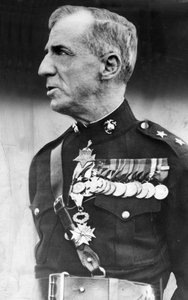
butler-medals1

In an age where Defense contractors overcharge and under produce, where lobbyists for them ensure that congressional leaders and other elected officials and appointees cater to the needs of these corporations it is important to know who profits from war. It is certainly not the military personnel, nor is it the taxpayer.

The sad fact is that the people that profit from unending war are those who really couldn’t care less about the economy, except as it benefits them nor care about the taxpayers or those that they send into battle in wars that do little or nothing to enhance the security this nation, or for that matter the security of those we are supposedly fight for.

Major General Smedley Butler who was awarded the Congressional Medal of Honor twice, and earned the ire of the Hoover Administration for criticizing Mussolini wrote a book called War is a Racket. I recommend everyone read it because it is timeless. Dwight Eisenhower kind of echoed it when he talked about the military-industrial complex.

Here is the second chapter of that hard hitting book. By the way take the time to Google the names of these corporations in this chapter and see how many are still profiting from war.

Peace

Padre Steve+

Who Makes The Profits?

The World War, rather our brief participation in it, has cost the United States some $52,000,000,000. Figure it out. That means $400 to every American man, woman, and child. And we haven’t paid the debt yet. We are paying it, our children will pay it, and our children’s children probably still will be paying the cost of that war.

The normal profits of a business concern in the United States are six, eight, ten, and sometimes twelve percent. But war-time profits — ah! that is another matter — twenty, sixty, one hundred, three hundred, and even eighteen hundred per cent — the sky is the limit. All that traffic will bear. Uncle Sam has the money. Let’s get it.

Of course, it isn’t put that crudely in war time. It is dressed into speeches about patriotism, love of country, and “we must all put our shoulders to the wheel,” but the profits jump and leap and skyrocket — and are safely pocketed. Let’s just take a few examples.

Take our friends the du Ponts, the powder people — didn’t one of them testify before a Senate committee recently that their powder won the war? Or saved the world for democracy? Or something? How did they do in the war? They were a patriotic corporation. Well, the average earnings of the du Ponts for the period 1910 to 1914 were $6,000,000 a year. It wasn’t much, but the du Ponts managed to get along on it. Now let’s look at their average yearly profit during the war years, 1914 to 1918. Fifty-eight million dollars a year profit we find! Nearly ten times that of normal times, and the profits of normal times were pretty good. An increase in profits of more than 950 per cent.

Take one of our little steel companies that patriotically shunted aside the making of rails and girders and bridges to manufacture war materials. Well, their 1910-1914 yearly earnings averaged $6,000,000. Then came the war. And, like loyal citizens, Bethlehem Steel promptly turned to munitions making. Did their profits jump — or did they let Uncle Sam in for a bargain? Well, their 1914-1918 average was $49,000,000 a year!

Or, let’s take United States Steel. The normal earnings during the five-year period prior to the war were $105,000,000 a year. Not bad. Then along came the war and up went the profits. The average yearly profit for the period 1914-1918 was $240,000,000. Not bad.

There you have some of the steel and powder earnings. Let’s look at something else. A little copper, perhaps. That always does well in war times.

Anaconda Copper for instance. Average yearly earnings during the pre-war years 1910-1914 of $10,000,000. During the war years 1914-1918 profits leaped to $34,000,000 per year. (One should read their history of strip mining massive pollution, ARCO bought them in the 1970s but was stuck with massive environmental problems, such that the company is only on the books to show the losses)

Or Utah Copper. Average of $5,000,000 per year during the 1910-1914 period. Jumped to an average of $21,000,000 yearly profits for the war period.

Let’s group these five, with three smaller companies. The total yearly average profits of the pre-war period 1910-1914 were $137,480,000. Then along came the war. The average yearly profits for this group skyrocketed to $408,300,000. A little increase in profits of approximately 200 per cent.

Does war pay? It paid them. But they aren’t the only ones. There are still others. Let’s take leather. For the three-year period before the war the total profits of Central Leather Company were $3,500,000. That was approximately $1,167,000 a year. Well, in 1916 Central Leather returned a profit of $15,000,000, a small increase of 1,100 per cent. That’s all.

The General Chemical Company (now part of Honeywell) averaged a profit for the three years before the war of a little over $800,000 a year. Came the war, and the profits jumped to $12,000,000. a leap of 1,400 per cent.

International Nickel Company — and you can’t have a war without nickel — showed an increase in profits from a mere average of $4,000,000 a year to $73,000,000 yearly. Not bad? An increase of more than 1,700 per cent.

American Sugar Refining Company (largest Sugar refining company in the world, name brand Domino Sugar) averaged $2,000,000 a year for the three years before the war. In 1916 a profit of $6,000,000 was recorded.

Listen to Senate Document No. 259. The Sixty-Fifth Congress, reporting on corporate earnings and government revenues. Considering the profits of 122 meat packers, 153 cotton manufacturers, 299 garment makers, 49 steel plants, and 340 coal producers during the war. Profits under 25 per cent were exceptional. For instance the coal companies made between 100 per cent and 7,856 per cent on their capital stock during the war. The Chicago packers doubled and tripled their earnings.

And let us not forget the bankers who financed the great war. If anyone had the cream of the profits it was the bankers. Being partnerships rather than incorporated organizations, they do not have to report to stockholders. And their profits were as secret as they were immense. How the bankers made their millions and their billions I do not know, because those little secrets never become public — even before a Senate investigatory body.

But here’s how some of the other patriotic industrialists and speculators chiseled their way into war profits.

Take the shoe people. They like war. It brings business with abnormal profits. They made huge profits on sales abroad to our allies. Perhaps, like the munitions manufacturers and armament makers, they also sold to the enemy. For a dollar is a dollar whether it comes from Germany or from France. But they did well by Uncle Sam too. For instance, they sold Uncle Sam 35,000,000 pairs of hobnailed service shoes. There were 4,000,000 soldiers. Eight pairs, and more, to a soldier. My regiment during the war had only one pair to a soldier. Some of these shoes probably are still in existence. They were good shoes. But when the war was over Uncle Sam has a matter of 25,000,000 pairs left over. Bought — and paid for. Profits recorded and pocketed.

There was still lots of leather left. So the leather people sold your Uncle Sam hundreds of thousands of McClellan saddles for the cavalry. But there wasn’t any American cavalry overseas! Somebody had to get rid of this leather, however. Somebody had to make a profit in it — so we had a lot of McClellan saddles. And we probably have those yet.

Also somebody had a lot of mosquito netting. They sold your Uncle Sam 20,000,000 mosquito nets for the use of the soldiers overseas. I suppose the boys were expected to put it over them as they tried to sleep in muddy trenches — one hand scratching cooties on their backs and the other making passes at scurrying rats. Well, not one of these mosquito nets ever got to France!

Anyhow, these thoughtful manufacturers wanted to make sure that no soldier would be without his mosquito net, so 40,000,000 additional yards of mosquito netting were sold to Uncle Sam.

There were pretty good profits in mosquito netting in those days, even if there were no mosquitoes in France. I suppose, if the war had lasted just a little longer, the enterprising mosquito netting manufacturers would have sold your Uncle Sam a couple of consignments of mosquitoes to plant in France so that more mosquito netting would be in order.

Airplane and engine manufacturers felt they, too, should get their just profits out of this war. Why not? Everybody else was getting theirs. So $1,000,000,000 — count them if you live long enough — was spent by Uncle Sam in building airplane engines that never left the ground! Not one plane, or motor, out of the billion dollars worth ordered, ever got into a battle in France. Just the same the manufacturers made their little profit of 30, 100, or perhaps 300 per cent.

Undershirts for soldiers cost 14¢ [cents] to make and uncle Sam paid 30¢ to 40¢ each for them — a nice little profit for the undershirt manufacturer. And the stocking manufacturer and the uniform manufacturers and the cap manufacturers and the steel helmet manufacturers — all got theirs.

Why, when the war was over some 4,000,000 sets of equipment — knapsacks and the things that go to fill them — crammed warehouses on this side. Now they are being scrapped because the regulations have changed the contents. But the manufacturers collected their wartime profits on them — and they will do it all over again the next time.

There were lots of brilliant ideas for profit making during the war.

One very versatile patriot sold Uncle Sam twelve dozen 48-inch wrenches. Oh, they were very nice wrenches. The only trouble was that there was only one nut ever made that was large enough for these wrenches. That is the one that holds the turbines at Niagara Falls. Well, after Uncle Sam had bought them and the manufacturer had pocketed the profit, the wrenches were put on freight cars and shunted all around the United States in an effort to find a use for them. When the Armistice was signed it was indeed a sad blow to the wrench manufacturer. He was just about to make some nuts to fit the wrenches. Then he planned to sell these, too, to your Uncle Sam.

Still another had the brilliant idea that colonels shouldn’t ride in automobiles, nor should they even ride on horseback. One has probably seen a picture of Andy Jackson riding in a buckboard. Well, some 6,000 buckboards were sold to Uncle Sam for the use of colonels! Not one of them was used. But the buckboard manufacturer got his war profit.

The shipbuilders felt they should come in on some of it, too. They built a lot of ships that made a lot of profit. More than $3,000,000,000 worth. Some of the ships were all right. But $635,000,000 worth of them were made of wood and wouldn’t float! The seams opened up — and they sank. We paid for them, though. And somebody pocketed the profits.

It has been estimated by statisticians and economists and researchers that the war cost your Uncle Sam $52,000,000,000. Of this sum, $39,000,000,000 was expended in the actual war itself. This expenditure yielded $16,000,000,000 in profits. That is how the 21,000 billionaires and millionaires got that way. This $16,000,000,000 profits is not to be sneezed at. It is quite a tidy sum. And it went to a very few.

The Senate (Nye) committee probe of the munitions industry and its wartime profits, despite its sensational disclosures, hardly has scratched the surface.

Even so, it has had some effect. The State Department has been studying “for some time” methods of keeping out of war. The War Department suddenly decides it has a wonderful plan to spring. The Administration names a committee — with the War and Navy Departments ably represented under the chairmanship of a Wall Street speculator — to limit profits in war time. To what extent isn’t suggested. Hmmm. Possibly the profits of 300 and 600 and 1,600 per cent of those who turned blood into gold in the World War would be limited to some smaller figure.

Apparently, however, the plan does not call for any limitation of losses — that is, the losses of those who fight the war. As far as I have been able to ascertain there is nothing in the scheme to limit a soldier to the loss of but one eye, or one arm, or to limit his wounds to one or two or three. Or to limit the loss of life.

There is nothing in this scheme, apparently, that says not more than 12 per cent of a regiment shall be wounded in battle, or that not more than 7 per cent in a division shall be killed.

Of course, the committee cannot be bothered with such trifling matters.

3 Comments

Filed under History, Military, Political Commentary

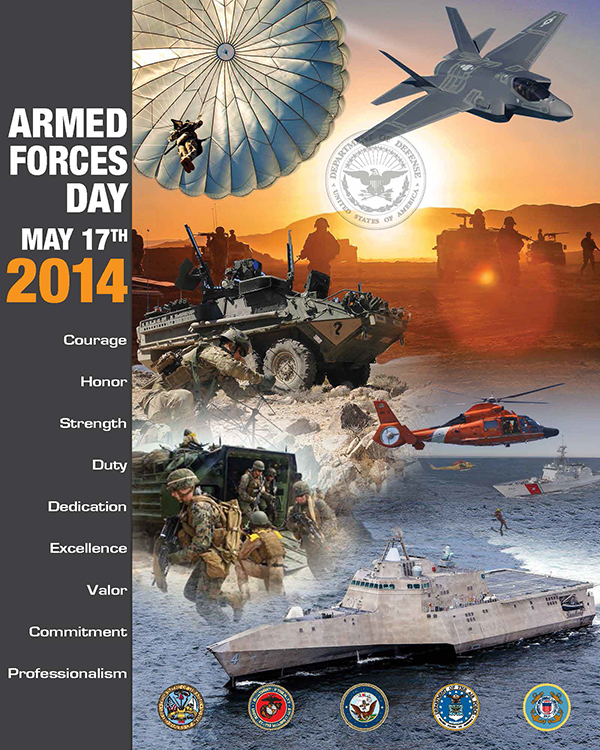
Counting the Cost: Reflections on Armed Forces Day 2014

Event-Armed-Forces-Day-poster-2014

“What is the cost of war? what is the bill?…“This bill renders a horrible accounting. Newly placed gravestones. Mangled bodies. Shattered minds. Broken hearts and homes. Economic instability. Depression and all of its attendant miseries. Back -breaking taxation for generations and generations. For a great many years as a soldier I had a suspicion that war was a racket; not only until I retired to civilian life did I fully realize it….” Major General Smedley Butler USMC

Today is Armed Forces Day and unfortunately most of the country will not notice unless they are attending a Baseball game where it is being observed or some special event on a base, national cemetery, monument or VFW hall.

There are also a fair number of local celebrations to honor members of the Armed Forces across the country but for the most part they are small and not well publicized. As a career officer and son of a Vietnam veteran Navy Chief I appreciate those events and the people that put them together. Being a veteran of Operation Iraqi Freedom and Operation Enduring Freedom, especially those that have taken the time to honor Iraq and Afghanistan veterans.

At any given time less than 1% of Americans are serving in all components of the military. For over 10 years we have been at war in Afghanistan and Iraq as well as other locations that we don’t like to talk about too much. However this has not been the effort of a nation at war, it is the war of a tiny percentage of the population.

As a nation we are disconnected from the military and the wars that the military fights. The fact is that most Americans do not have a personal or vested interest in these wars, they have been insulated by political leaders of both parties from them. There is no draft, and no taxes were raised to fund the wars and the military is now worn out.

We have been at war for nearly 14 years and truthfully there is no end in sight. In that time every single Soldier, Sailor, Marine and Airman volunteered for duty or reenlisted during this time period. Motives may have varied from individual to individual, but unlike the World Wars, Korea and Vietnam every single one volunteered to serve in time of war. I think that this makes the current generation of veterans quite unique, we are no longer a military composed of citizen soldiers we are now, even our reserve components a Warrior caste, set apart from the society that we serve.

There is a tragic disconnection between the military and civilian society in the United States. This is the result of deliberate public policy since the end of the Vietnam War supported by both political parties. For almost 40 years we have relied on an all volunteer force. It is that relatively small and socially isolated military which is sent to fight wars while the bulk of the population is uninvolved and corporations, lobbyists and think tanks get rich.

Andrew Bacevich wrote in his new book Breach of Trust: How Americans failed their Soldiers and their Country:

“Rather than offering an antidote to problems, the military system centered on the all-volunteer force bred and exacerbated them. It underwrote recklessness in the formulation of policy and thereby resulted in needless, costly, and ill-managed wars. At home, the perpetuation of this system violated simple standards of fairness and undermined authentic democratic practice. The way a nation wages war—the role allotted to the people in defending the country and the purposes for which it fights—testifies to the actual character of its political system. Designed to serve as an instrument of global interventionism (or imperial policing), America’s professional army has proven to be astonishingly durable, if also astonishingly expensive. Yet when dispatched to Iraq and Afghanistan, it has proven incapable of winning. With victory beyond reach, the ostensible imperatives of U.S. security have consigned the nation’s warrior elite to something akin to perpetual war.”

Bacevich, a retired Army Colonel and Vietnam veteran who lost a son in Iraq is dead on, as is Rachel Maddow who wrote in her outstanding book Drift: The Unmooring of American Military Power:

“The reason the founders chafed at the idea of an American standing army and vested the power of war making in the cumbersome legislature was not to disadvantage us against future enemies, but to disincline us toward war as a general matter… With citizen-soldiers, with the certainty of a vigorous political debate over the use of a military subject to politicians’ control, the idea was for us to feel it- uncomfortably- every second we were at war. But after a generation or two of shedding the deliberate political encumbrances to war that they left us… war making has become almost an autonomous function of the American state. It never stops.” 

The lobbyists, pundits, politicians and preachers that promote war don’t care about the troops. This is because no matter who is in office or who controls congress these people and corporations will promote policies that keep them employed and their businesses enriched. Marine Major General and Medal of Honor winner Smedley Butler was quite right when he said:

“War is a racket. It always has been. It is possibly the oldest, easily the most, surely the most vicious. It is the only one international in scope. It is the only one in which the profits are reckoned in dollars and the losses in lives. A racket is best described, I believe, as something that is not what it seems to the majority of the people. Only a small ‘inside’ group knows what it is about. It is conducted for the benefit of the very few, at the expense of the very many. Out of war a few people make huge fortunes.”

I think that the reason that our current wars have gone on so long is the that misguided policies have brought about a chronic disconnection in our society between those that serve in the military. But how can there not be when in the weeks after 9-11 people like President Bush and others either directly or in a manner of speaking told people to “go shopping” * as we went to war in Afghanistan? When I returned from Iraq I returned to a nation that was not at war whose leaders used the war to buttress their respective political bases.

The results are terrible. Suicide rates are continuing to rise among veterans who have returned to find that neither the VA nor the civilian mental health care sector is prepared to care for them.

I think that Armed Forces Day should be better celebrated and I am grateful to the people that do things every day to thank and support military personnel. These wonderful people that do this come from across the political spectrum. Some are veterans and others non-veterans. But they care for and appreciate the men and women that serve in and fight the wars that no-one else can be bothered to fight.

481801_10151367001287059_1003164983_n-2

Of course the politicians, pundits, preachers and the defense contractors, banks and lobbyists will find a way to profit. They will do so no matter how many more troops are killed, wounded or injured and how badly it affects military personnel or their families and will push to abandon those who fought as they do after every war. After all, to quote Smedley Butler, “war is a racket.”

Peace

Padre Steve+

President Bush’s actually words were “Now, the American people have got to go about their business. We cannot let the terrorists achieve the objective of frightening our nation to the point where we don’t — where we don’t conduct business, where people don’t shop…” http://georgewbush-whitehouse.archives.gov/news/releases/2001/10/20011011-7.html

2 Comments

Filed under History, iraq,afghanistan, leadership, Military, national security, Political Commentary

Frightened by Christians

10151918_10152444030142059_7871957421917905974_n

“I like your Christ, I do not like your Christians. Your Christians are so unlike your Christ.” Mahatma Gandhi

I expect that this article might make some people uncomfortable but it is something that I need to write.

I am a Christian. I am a Priest and I am a Navy Chaplain. But for the most part I am afraid of Christians. There are many reasons for this. Some are more general in the way I see Christians treat others; their own wounded as well as non-believers, the political machinations of pastors and “Christian” special interest groups masquerading as ministries.

But most of why I am afraid is because what I have experienced at the hand of many Christians, some of whom I had counted as friends many of whom are pastors, priests or chaplains. To experience rejection or being shamed by people that you thought were friends is very hard, especially when that at one time you trusted them implicitly to care for you. However to be rejected by those that you trusted “in the name of God, ” or rather because you violated supposedly “correct” doctrinal beliefs about God is frightening.

It seems to me that with many Christians and churches that the “unconditional” love of God that they proclaim not really unconditional. It is totally conditional on believing what they believe or behaving in the way they think that you should.

For those that do not know me or my story I am a career military officer with over 30 years of service between the Army and Navy. I have been a chaplain since 1992 and served in the National Guard, Army Reserve, Active Duty Army and the Navy. I am a trained hospital chaplain; I have a great academic background. I went to Iraq in 2007 and came home with a terrible case of severe chronic PTSD. I still suffer from some anxiety, depression and plenty of insomnia. I find mental health care hard to get in my new assignment and I realize how woefully unprepared that our medical system, military, VA and civilian is to care for that vast numbers of veterans like me.

After Iraq I suffered a collapse of my faith and for close to two years was a practical agnostic. Only my deep sense of call and vocation kept me going and there were times that I wondered if I would be better off dead.

When faith returned through what I call my Christmas miracle it was different. I totally relate to author Anne Rice who said:

“My faith in Christ is central to my life. My conversion from a pessimistic atheist lost in a world I didn’t understand, to an optimistic believer in a universe created and sustained by a loving God is crucial to me. But following Christ does not mean following His followers. Christ is infinitely more important than Christianity and always will be, no matter what Christianity is, has been, or might become.”

I have always questioned a lot but after my crisis of faith I began to see through the bullshit. I began to not only question things my former church taught, but openly stated my convictions about how we treat others as Christians, the equality of people in general and tolerance for those different than us including gays and Moslems who for some Christians are rather low on the scale of those that God might love.

After Iraq I was sickened by the crass politicization of conservative American Christianity and many of its leaders. Men and women who advocate war without end, be it real wars against “enemies” of American, or promote a culture war even against other Christians that they do not like or agree with. Of course this is all done in “Jesus name.”

Likewise I question the opulence and materialism of the church. I question the nearly cult like focus and near worship accorded to the Pastor-CEOs of the megachurches and the television preachers and teachers. I wonder in amazement about how many of these leaders live like royalty and have devoted followers who despite repeated scandals treat them as the voice of God.

Along with the that I question the preference of many American Christian leaders for the rich and their disdain for the poor, the alien and the outcasts among us. I don’t know where where they get it.

All of that got me thrown out of a church that I had served 14 years a priest and chaplain back in 2010. I thought I had a lot of friends in that church. I still have some that keep in contact with me but after my dismissal most abandoned me. That hurts worse than anything.

In fact when I came home from Iraq in crisis and falling apart the first person who asked about how I was doing with God was not clergy. It was my first shrink. I was asked by a commanding officer after Iraq “where does a chaplain go for help?” I told him “not to other chaplains.”  The sad thing is that man who did care about me suffered untreated terrible PTSD and Traumatic Brain Injury and committed suicide earlier this year.

I have had a few experiences this week that have opened that wound again and reminded me of why I am afraid of many that call themselves Christians. I had a friend comment on some coarse language I used in a rant on a social media site, the friend noted a certain word that I used was used to silence others.

I replied that he was wrong, that the ultimate way to silence others was to invoke God and shame them. That is the ultimate trump card because no one is bigger than God.

The good thing is that when he realized why I had said the word and realized what he said had further wounded me and understood a bit of what I was going through he was quite gracious, sympathetic and apologetic. He is still a friend and he means a lot to me. Thankfully there was not another broken relationship.

But my friend’s initial comment made me realize how many of us as Christians, even well meaning people, focus on outward behaviors, words or actions of others without understanding what they are going through. Like Dietrich Bonhoeffer said:

“Many people are looking for an ear that will listen. They do not find it among Christians, because these Christians are talking where they should be listening.”

I am thankful that I have a number of friends including a good number of Christians from various backgrounds who have stood by me even if they disagree with my theology, politics or favorite baseball team.

That being said with the exception of such
people who have been with me through thick and thin I am almost terrified of being around Christians. Church in most cases is a frightening place for me, and the sad fact is that if I were not already a Christian there is little in American Christianity that would ever cause me to be interested in Jesus.  I can totally understand why churches are hemorrhaging members, especially young people and why the fastest growing religious preference in our society is “none” for I too am in some sense an outcast.

As Pedro Cerrano (Dennis Haysbert) said in the movie Major League: “I Like Jesus very much, but he no help with curveball.”

Pray for me a sinner,

Peace

Padre Steve+

13 Comments

Filed under christian life, faith, Military, ministry, Pastoral Care, Political Commentary, PTSD

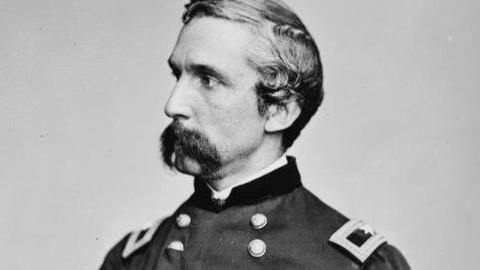
“Integrity, Purity Unselfish Devotion to Duty” Reflections on Winfield Scott Hancock after another Gettysburg Staff Ride

hancock

“I shall not fight upon the principle of state-rights, but for the Union, whole and undivided.” Winfield Scott Hancock

I am back home after leading another trip to Gettysburg with a new group of students.

I always come away from Gettysburg with a new appreciation of the sacrifice that was made there by so many Americans. I am always humbled and learn something new. I only wish that most Americans and our leaders of both political parties as well as most media types and pundits could grasp what I experience on each visit to this “hallowed ground.”

Quite honestly I do not think that the vast majority Americans understand, appreciate or value in the slightest the sacrifices of the men who fought and in many cases died to preserve the Union at Gettysburg. Even among those who do I think that the object of their appreciation are the military aspects of the battle often taken in isolation, not the profound strategic dimensions of what this battle as well as the fall of Vicksburg in the west at the same time had on the war.

Nor do they appreciate the massive political, ideological and social effects bought about by those Union victories in ending the war and how those effects redound to us today. This is especially true of the pundits, politicians and preachers, the “Trinity of Evil” as I call them whose shrill voices urge on divisions between our people; including some that call out for violence to maintain their groups social, economic or religious advantages over others. Quite a few even lament the fall of the South and the institution including the washed up rock and roll musician of the political right Ted Nugent who wrote in the Washington Times in July 2012: “I’m beginning to wonder if it would have been best had the South won the Civil War.” 

All of that concerns me as an American and a historian; because I realize how dangerous such historical ignorance and visceral propaganda is in the life of any nation. Thus when I go to Gettysburg, or for that matter any other battlefield of our American Civil War the sacrifices of those men and what they fought to maintain is again imprinted on my heart.

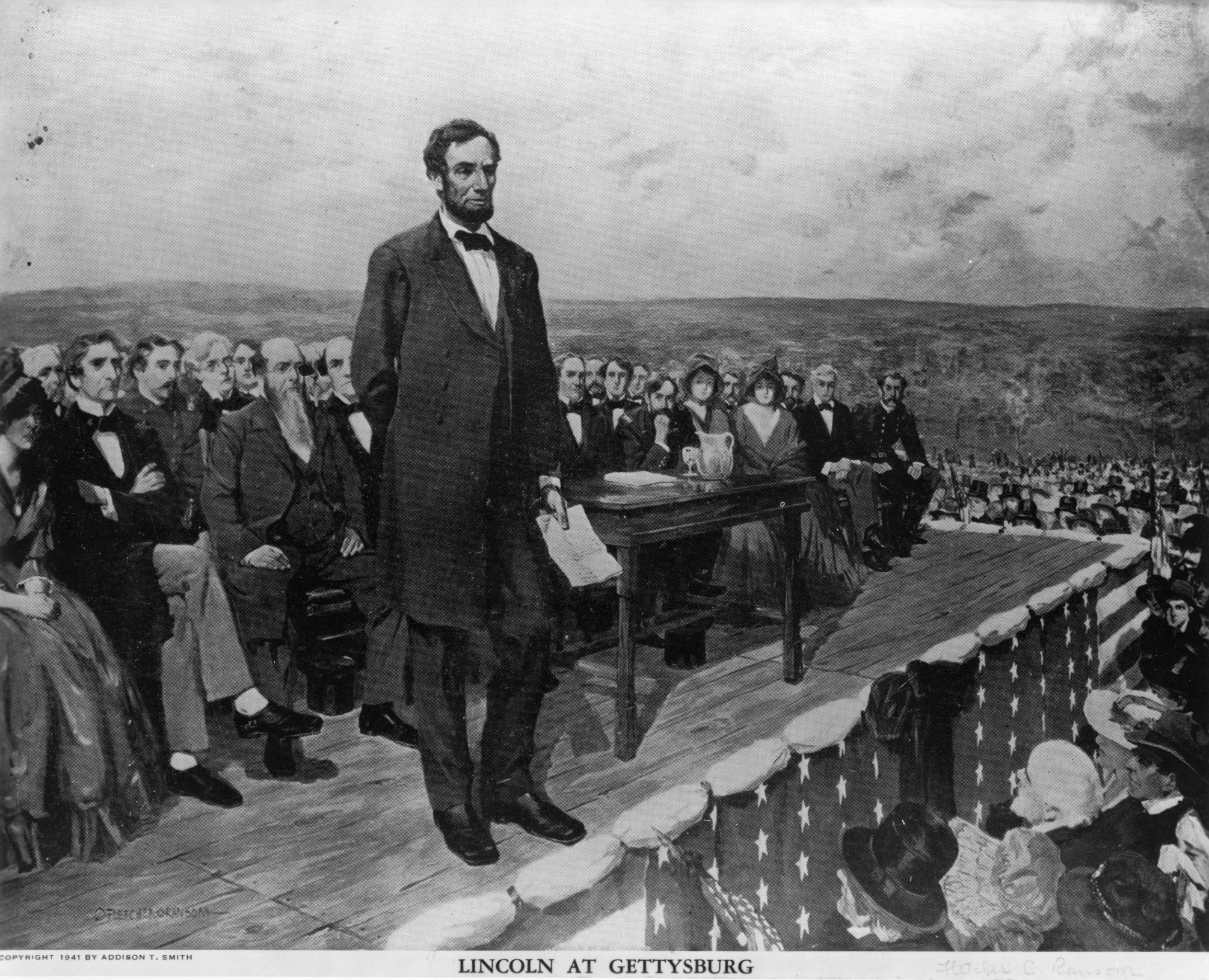
Abraham Lincoln eloquently noted about those soldiers who fought to turn back the Confederate tide at Gettysburg in his Gettysburg Address:

“But, in a larger sense, we can not dedicate — we can not consecrate — we can not hallow — this ground. The brave men, living and dead, who struggled here, have consecrated it, far above our poor power to add or detract. The world will little note, nor long remember what we say here, but it can never forget what they did here. It is for us the living, rather, to be dedicated here to the unfinished work which they who fought here have thus far so nobly advanced. It is rather for us to be here dedicated to the great task remaining before us — that from these honored dead we take increased devotion to that cause for which they gave the last full measure of devotion — that we here highly resolve that these dead shall not have died in vain — that this nation, under God, shall have a new birth of freedom — and that government of the people, by the people, for the people, shall not perish from the earth.”

While I am an idealist I am also a pragmatist. I respect the right of others, even those that disagree with things that I very much believe in and support. Like it or not the keystone of our governmental system is one of compromise. That being said having relatives that fought on both sides of the American Civil War that I am not a sectionalist. Nor am I a person that attempts to use the political system to ensure that others have to follow my religious beliefs or to enrich certain groups. The democracy that is part of our republic’s system of government is not a perfect system by any means. In fact as the great English Prime Minister Winston Churchill noted “democracy was the worst form of government except for all the others.”

Thus I appreciate military men who maintain their oath to the nation in times of great conflict not abandoning it to support causes that they know are wrong because the people of their state, or interest group seek to divide that Union. Winfield Scott Hancock was one of those kind of men, as was George Meade, and John Buford, all of whom played key roles in defeating the Confederates at Gettysburg.

Hancock, who earned the title “Hancock the Superb” was the commander of the Union II Corps at Gettysburg. Upon the death of John Reynolds early on the first day of battle Hancock was appointed by Meade as commander of the Federal Left Wing, in effect becoming Meade’s deputy commander for the rest of the battle. He was seriously wounded as Pickett’s Charge came to its bloody end at “the Angle” and his dear friend Confederate General Lewis Armistead lay mortally wounded a few hundred yards away.

Hancock is an interesting character. He was from Pennsylvania but was a Democrat. He was not a Republican like Lincoln. Hancock was not a political ideologue but was since he was a Democrat he was suspect by some in the party establishments of both parties and never was given independent command.

Hancock gave his advice to Armistead and others who were preparing to leave the Union in early 1861 including Armistead and his commanding officer Brigadier General Albert Sidney Johnston. He made himself clear:

“I shall not fight upon the principle of state-rights, but for the Union, whole and undivided.” 

During the war he served with distinction and Ulysses Grant wrote of him:

“Hancock stands the most conspicuous figure of all the general officers who did not exercise a separate command. He commanded a corps longer than any other one, and his name was never mentioned as having committed in battle a blunder for which he was responsible. He was a man of very conspicuous personal appearance…. His genial disposition made him friends, and his personal courage and his presence with his command in the thickest of the fight won for him the confidence of troops serving under him. No matter how hard the fight, the 2d corps always felt that their commander was looking after them.”

After the war he supervised the execution of those convicted of the assassination of Abraham Lincoln and in various postings in the occupied South attempted to mitigate some of the actions of those bent on vengeance and others who tried to exploit the defeated people of the south for political or economic gain.

Hancock ran for President and lost a narrow election in 1880 to James A. Garfield. After that he returned to the Army and died at the age of 61at his headquarters of complications from diabetes.

He was praised by political opponents. Former President Rutherford B. Hayes wrote:

“if when we make up our estimate of a public man, conspicuous both as a soldier and in civil life, we are to think first and chiefly of his manhood, his integrity, his purity, his singleness of purpose, and his unselfish devotion to duty, we can truthfully say of Hancock that he was through and through pure gold.” 

Another political opponent Republican General Francis A. Walker lamented not supporting Hancock in 1880 after the great corruption that engulfed the country during “Gilded Age” of the “Robber Barons” the 1880s. Walker wrote:

“Although I did not vote for General Hancock, I am strongly disposed to believe that one of the best things the nation has lost in recent years has been the example and the influence of that chivalric, stately, and splendid gentleman in the White House. Perhaps much which both parties now recognize as having been unfortunate and mischievous during the past thirteen years would have been avoided had General Hancock been elected.”

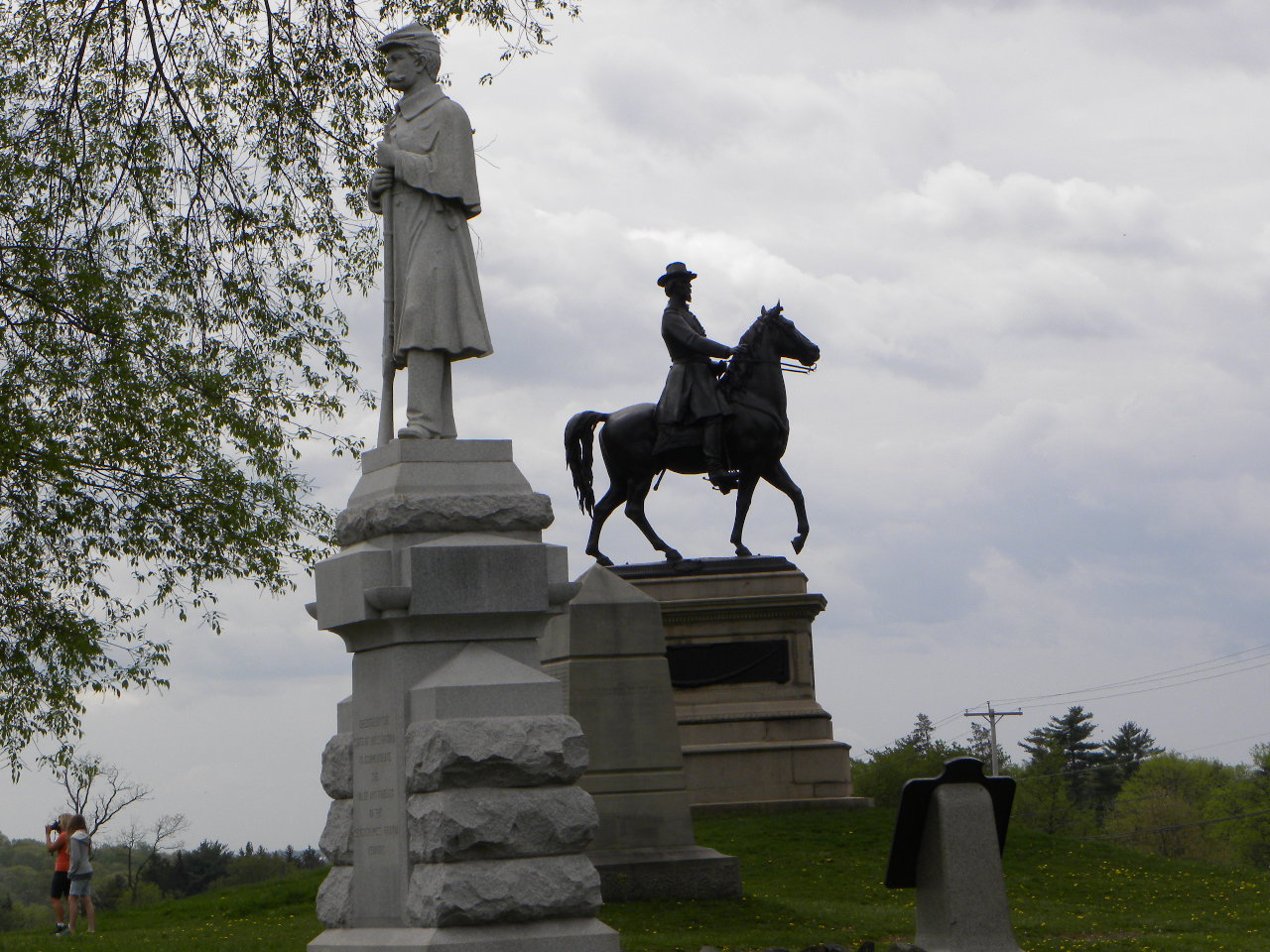
DSCN9741

As I stood at the statue that marks Hancock on Cemetery Hill this weekend I again was struck by the bravery, courage and integrity of that remarkable man.

Peace

Padre Steve+

1 Comment

Filed under civil war, History, Political Commentary

War Crimes are Us: I Want No Part of Sarah Palin’s Torture Loving Christianity

-nrarallypalin

Well, Sarah Palin is at it again and I do have to say something. The former Alaska Governor, losing V.P. Candidate and failed reality television celebrity who can’t even hold a down a steady job with Fox News committed an act so brazenly anti-Christian and anti-American that as a Christian I have to condemn it. I wrote about this subject before in my article Baptism and Water Boarding: When Professed Christians Defile Their Own Faith to Make Cheap Political Points which I wrote almost a year ago in response to people making the same comment.

Palin said at the National Rifle Association convention Sunday April 27th that “waterboarding is how we baptize terrorists” and the crowd, many certainly God fearing Christians went wild. You see Palin and many like her believe with all their hearts that waterboarding and other techniques of “enhanced interrogation” should not only be used, but be national policy when it comes to dealing with enemies of the state. Their view is not that torture is inherently evil but might be justified in a supreme emergency to save lives, but that it should be institutionalized as a matter of judicial and military policy and publicized. Torture is considered by all civilized nations to be a war crime and crime against humanity. We set the standard for that in what we did at Nuremberg.

Justice Robert Jackson, the chief prosecutor of the Nuremberg Trials wrote:

“If certain acts of violation of treaties are crimes, they are crimes whether the United States does them or whether Germany does them, and we are not prepared to lay down a rule of criminal conduct against others which we would not be willing to have invoked against us.”

First I object to Palin’s use of the “baptism” to bless torture, to bless actions that our country sentenced the soldiers of Germany and Japan to death for doing after World War II. Yes, at Nuremberg, Tokyo and Manila American justices sentenced leaders both civilian and military to death for institutionalized policies of torture. People like Palin who advocate the routine use of torture as an act of national policy put our military, intelligence and diplomatic personnel as well as other citizens at greater risk should they be held captive by a state or non-state actor.

Some are speculating that she is doing this to slam John McCain, the only serving member of the Senate or Congress to have been a Prisoner of War and subjected to waterboarding as a means of torture. If so it shows that she has no grace or ability to be thankful, for without John McCain she would not be on the national political stage and the vast majority of us would have been blessed never to know who she is.

Of course for people like Palin and her cheering media supporters who have no skin in this game it doesn’t matter. They don’t serve in the military, nor intelligence or diplomatic corps, nor do they don’t volunteer in humanitarian relieve operations. In fact to them those who lose their lives because of such stupid statements, actions and policies are simply part of the cost of war.

Baptism is a sacrament of the Christian church, or in some cases considered an “ordinance.” There is a difference. Christians who view baptism as a sacrament see it as something that is the entrance into new life, it is a vehicle of God’s grace where the Holy Spirit acts in a special way to cleanse the person being baptized from sin, incorporate them into the family of faith and a chance for the Christian community to join with the Baptized in recommitting ourselves to the faith and pledging to help the new Christian in theirs. In churches where it is an ordinance; or something we do because it was commanded by Jesus it is still important. It is an outward demonstration and witness of faith that has already been received. Christians have been persecuted and even gone to their death as martyrs for what they believed about baptism in all of its forms. Thus what Sarah Palin did is not only cheap and tawdry political speech by a narcissistic self-aggrandizing diva of extremely limited intellect and zero spiritual acumen, but sacrilege that every Christian who values their faith and baptism should condemn in the strongest terms.

The sad thing is that many Christians will not condemn her nor call her into account simply because they have bought into the evil of systematized torture as an instrument of public policy. Likewise many want Palin to run again for either the Presidency or for the Senate because she embodies what they believe.

But here is the real rub. Once you make torture a part of your public policy where does it stop? Every society that has practiced it has used it not only on their military foes, but on their own people.

What Palin supports and endorses is nothing more than the evil perpetuated by every totalitarian regime that has ever existed.

For those that support her, be warned; like the non-Nazi German conservatives who initially supported Hitler but later had second thoughts you too could considered a terrorist using the methods that Palin advocates against others today. You get what you vote for…

As Martin Niemoller said after the fall of the Third Reich:

First they came for the communists, and I did not speak out—because I was not a communist;
Then they came for the socialists, and I did not speak out—because I was not a socialist;
Then they came for the trade unionists, and I did not speak out—because I was not a trade unionist;
Then they came for the Jews, and I did not speak out—because I was not a Jew;
Then they came for me—and there was no one left to speak out for me.

Peace

Padre Steve+
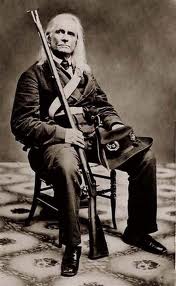
4 Comments

Filed under christian life, faith, History, laws and legislation, national security, News and current events, Political Commentary

Schadenfreude: Who Doesn’t Love the Exposure of Unrepentant Racists?

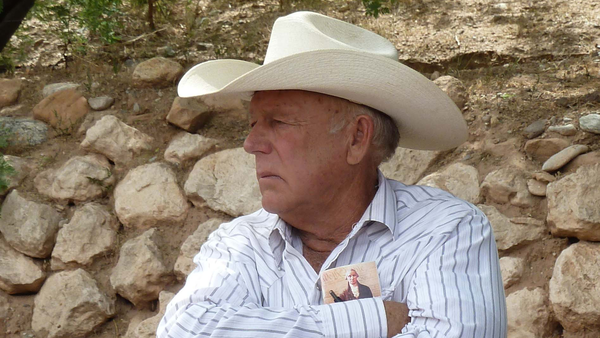
la-ed-rancher-cliven-bundy-grazing-federal-lan-001

Note to readers: It has been a while since I waded into the morass that is American politics of 2014 but I need to get my two cents in for what it is worth. My long time readers know my background, my newer readers may not. If you are a new reader take a look on my civil rights section to see what I believe about racist attitudes and actions. 

I am amazed. Freeloading rancher and welfare prince Cliven Bundy flat out demonstrated that he is an unrepentant racist who would have just loved the Ante-Bellum days before the Civil War when “good blacks” were happy as clams to be slaves. Now Bundy who managed to call together every form of anti-government, anti-Federal Government and just plain wacko racist militia type to his side in his fight to avoid paying over a million dollars in back taxes shows his real hand.

Not that he hadn’t before. Heck, even Glenn Beck was a voice of sanity compared to Sean Hannity in the build up to this fiasco, but Bundy’s own words showed that he is for all practical purposes an unrepentant racist, secessionist freeloader who only cares about himself. The 68 year old “rancher” who for use of lands that he does not own and is making money on made incredibly stupid comments that not only showed his racism, but also his historical ignorance.

Bundy’s comments were so full of irony. Bundy has been making money by grazing his cattle for free on land that he does not own and not paid taxes and fees initially approved by the Reagan administration. So in one of his daily “news conferences” he went on the attack to condemn poor blacks on various forms of Federal assistance. It was the Pot calling the Kettle “Black,” or maybe better calling the Kettle “Negro.”

It was a wondrous thing to behold as all sorts of right wing politicians, pundits and preachers had to back track from their support of Bundy. Frankly I loved it. To me Bundy is no hero, no patriot or anything of the sort. He is a wealthy man who has lied his way to fame in order to embarrass that “Negro” in the White House.

Lies lies and lies….Bundy claimed that his family has been grazing his cattle on the land since before the Federal Government owned it, actually since the late 1800s. Funny thing is that according to court and real estate records Bundy’s family didn’t even purchase the land where there ranch is until 1948. Those nasty legal documents always get in the way of lies… but I digress…

You see Bundy is no hero, he is no patriot. In fact he is little different from Edmund Ruffin, the secessionist leader who fired the first shot at Fort Sumter back in 1861 or Alexander Stephens the Vice President of the Confederate States of America who said in his “Cornerstone Speech” of 1861:

“Our new government is founded upon exactly the opposite idea; its foundations are laid, its corner- stone rests upon the great truth, that the negro is not equal to the white man; that slavery — subordination to the superior race — is his natural and normal condition….”

Based on what Bundy has said I have no doubt that he would wholeheartedly agree with Stephens. The people supporting Bundy include “true believers” like the heavily armed militiamen protecting him who long for bloodshed in order to create martyrs for their cause and their media allies. The militia types are quite interesting because many are either blatantly racist or affiliated in some way with White Separatist, Neo Nazi or Neo Confederate groups all itching for a bloody battle with the Federal Government that it is scary to comprehend.

Likewise there are others who have been deceived by the constant fear mongering of men like Sean Hannity into thinking the Federal Government they have a say in electing is their enemy who fell for Bundy’s outrageous lies hook line and sinker. Thus when men like Bundy reveal in excruciating and painful detail just who they really are I like it.

Donald-Sterling

Then there is the owner of the Los Angeles Clippers Basketball team who makes big money off of the efforts of some really outstanding African-American basketball players. The owner, Donald Sterling told his girlfriend that he doesn’t want her hanging out with blacks or having her picture taken with them, including men like Magic Johnson. I don’t have to mention but will that Sterling had to pay a lot of money to settle previous discrimination complaints and lawsuits, all of which had substantial racial overtones.

I like it because there is a cottage industry of right wing myth makers who like to say that there is no such thing as racism, that it it is a thing of the past or even that it is a product of liberals, liberalism or even the Civil Rights movement. When guys like Bundy or Sterling betray their lies it gives me a certain sense of schadenfreude. When I see college dropout Sean Hannity have to run for cover and condemn men like Bundy that he has helped to build up it really makes me happy.

The fact is that many Americans love the myth that racism no longer exists and that what is left is simply a fabrication of the “liberal media.” If that was true why would there need to be such concerted efforts to roll back civil rights and voting rights to disenfranchise African Americans, Hispanics and poor whites? Why would there be such a concerted media campaign to demonize minorities, women, the poor and yes even Moslems and gays?

If there wasn’t a big streak of racism, sexism, and other prejudice and discrimination still why would the pundits, politicians and preachers be working to hard to disprove it? Why would a political-media and even religious cottage industry be working overtime with lobbyists who support the most wealth people in the country in their quest to disenfranchise the bulk of Americans, even those who are their unwitting foot soldiers?

The fact is and I hate to admit it, but many attitudes haven’t changed that much since the days of Edmund Ruffin and Alexander Stephens, they have just become more suave and savvy. But every once in a while idiots like Bundy and Sterling show up and remind us that this is still all too real and that my friends as distasteful as it is, is a good thing. We like our racism and other prejudices hidden and unspoken so they don’t embarrass us.

kgrhqfqefgdotlsbqojfqwe0w60_57

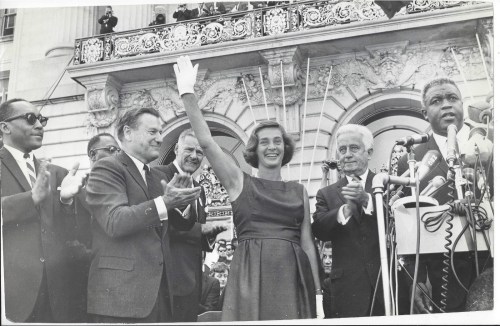
Baseball hero Jackie Robinson was a Republican. But in 1964 he found that the party of Lincoln was no more. After the 1964 Republican Convention where he supported Nelson Rockefeller he wrote:

“I wasn’t altogether caught of guard by the victory of the reactionary forces in the Republican party, but I was appalled by the tactics they used to stifle their liberal opposition.  I was a special delegate to the convention through an arrangement made by the Rockefeller office. That convention was one of the most unforgettable and frightening experiences of my life. The hatred I saw was unique to me because it was hatred directed against a white man.  It embodied a revulsion for all he stood for, including his enlightened attitude toward black people.

A new breed of Republicans had taken over the GOP.  As I watched this steamroller operation in San Francisco, I had a better understanding of how it must have felt to be a Jew in Hitler’s Germany….”

Robinson was right even though most people didn’t realize it at the time. The Republican Party of today is not the party of Lincoln, it is the party of Jefferson Davis and Alexander Stephens. As distasteful as the Bundy affair has been and will unfortunately continue to be, it does allow us as individuals and a society to look in the mirror and reevaluate who we are as Americans.

Personally I would rather stand with Jackie Robinson than men like Bundy, Sterling or Hannity.

Anyway, that’s all for tonight. Another Gettysburg article tomorrow unless I get derailed.

Peace

Padre Steve+
1 Comment

Filed under civil rights, History, News and current events, Political Commentary

Surrender at Appomattox: Ulysses S. Grant, Robert E. Lee and Joshua Lawrence Chamberlain teach us about Reconciliation

The Authentic History Center

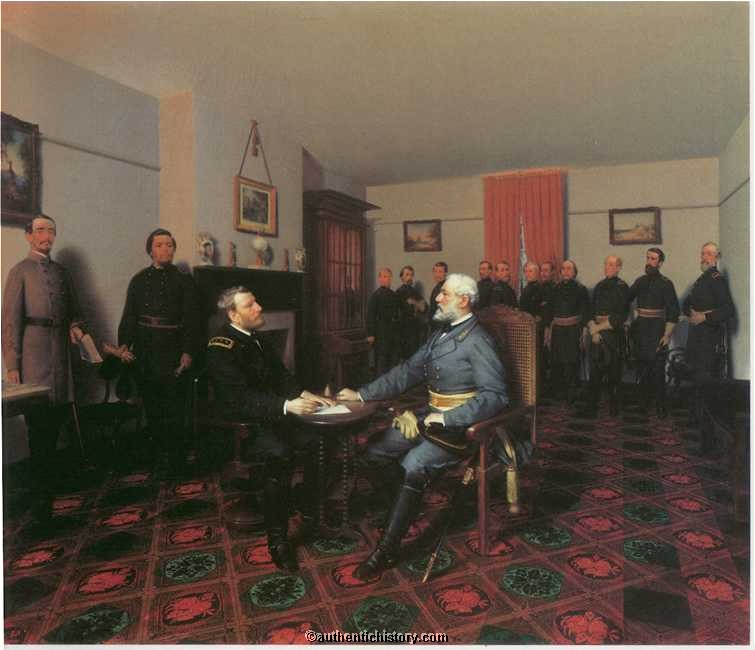
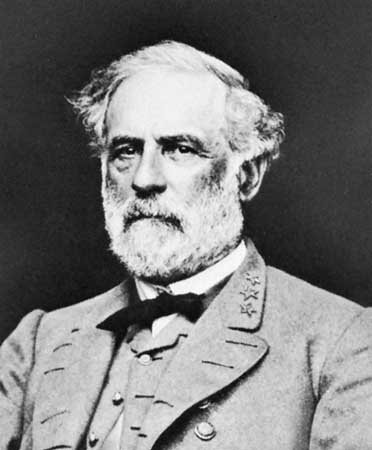
It was the day after General Robert E Lee had requested to Lieutenant General Ulysses S. Grant that his Army of Northern Virginia be allowed to surrender. The once mighty army now a haggard but proud force of about 11,000 soldiers faced hopeless odds against a vastly superior enemy. Since Gettysburg Lee’s army had been on the defensive, Lee’s ill fated offensive into Pennsylvania being one of the two climactic blows that sealed the doom of the Confederacy, the other Grant’s victory at Vicksburg which fell a day after Pickett’s Charge.

On the 9th and 10th of April three men, Ulysses S Grant, Robert E Lee and Joshua Lawrence Chamberlain taught succeeding generations the value of mutual respect and reconciliation after a bitter and bloody war.

ileerob001p1

With each battle following Gettysburg the Army of Northern Virginia became weaker and finally after the nine month long siege of Petersburg ended with a Union victory there was little else to do. When his artillery chief Porter Alexander recommended that the Army be released, “take to the woods and report to their state governors” Lee replied:

“Already [the country] is demoralized by the four years of war. If I took your advice, the men would be without rations and under no control of their officers. They would be compelled to rob and steal in order to live…. We would bring on a state of affairs it would take the country years to recover from… You young fellows might go bushwhacking, but the only dignified course for me would be to go to General Grant and surrender myself and take the consequences of my acts.”

Abraham Lincoln had already set the tone for the surrender in his Second Inaugural Address given just over a month before the surrender of Lee’s army. Lincoln closed that speech with these words of reconciliation:

“With malice toward none, with charity for all, with firmness in the right as God gives us to see the right, let us strive on to finish the work we are in, to bind up the nation’s wounds, to care for him who shall have borne the battle and for his widow and his orphan, to do all which may achieve and cherish a just and lasting peace among ourselves and with all nations.”

poor--ulysses-s-grant-president-1040cs021412

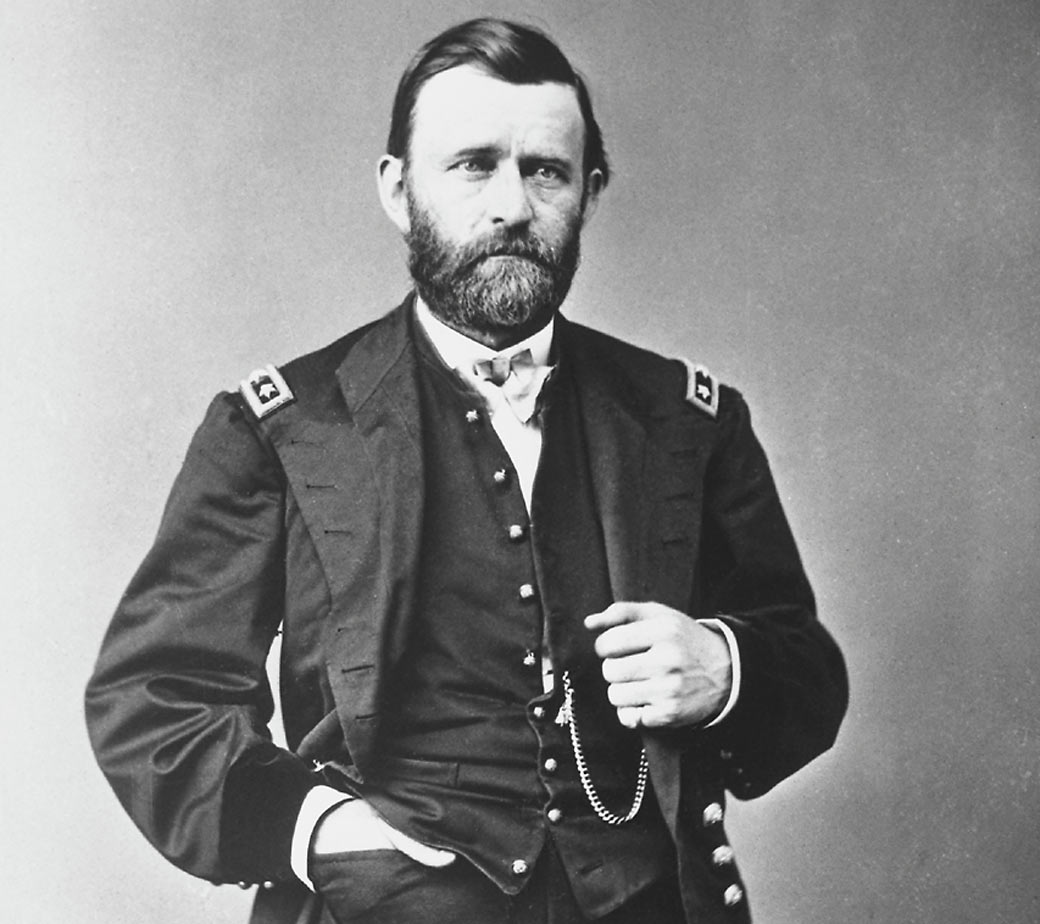
Grant provided his vanquished foe generous surrender terms. Grant met with Lee and offered the following terms of surrender:

“In accordance with the substance of my letter to you of the 8th inst., I propose to receive the surrender of the Army of N. Va. on the following terms, to wit: Rolls of all the officers and men to be made in duplicate. One copy to be given to an officer designated by me, the other to be retained by such officer or officers as you may designate. The officers to give their individual paroles not to take up arms against the Government of the United States until properly exchanged, and each company or regimental commander sign a like parole for the men of their commands. The arms, artillery and public property to be parked and stacked, and turned over to the officer appointed by me to receive them. This will not embrace the side-arms of the officers, nor their private horses or baggage. This done, each officer and man will be allowed to return to their homes, not to be disturbed by United States authority so long as they observe their paroles and the laws in force where they may reside.”

When Lee left the building Federal troops began cheering but Grant ordered them to stop. He later noted: “The Confederates were now our countrymen, and we did not want to exult over their downfall.”

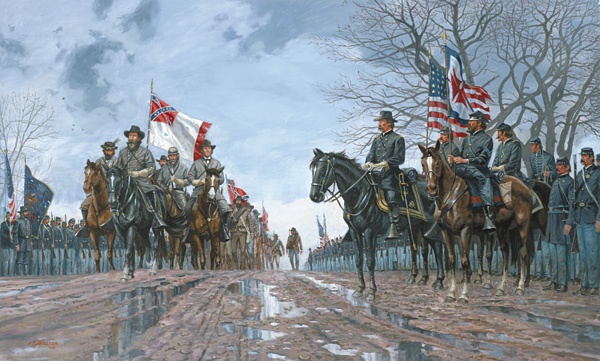
The surrender itself was accomplished with a recognition that soldiers who have given the full measure of devotion can know when confronting a defeated enemy. Major General Joshua Lawrence Chamberlain, the heroic victor of Little Round Top was directed by Grant to receive the surrender of the defeated Confederates. As they passed, moved with emotion he ordered his soldiers to salute the defeated enemy for whose cause he had no sympathy.

PH2010062902996

Chamberlain was not just a soldier, but before the war had been Professor of Natural and Revealed Religions at Bowdoin College, and a student of theology before the war. He could not help to see the significance of the occasion. He understood that he would be criticized by some for offering the salute, however unlike some, the staunch abolitionist and Unionist who had nearly died on more than one occasion fighting the defeated Confederate Army understood that no true peace could transpire unless the enemies became reconciled to one another.

He noted that his chief reason for doing so:

“The momentous meaning of this occasion impressed me deeply. I resolved to mark it by some token of recognition, which could be no other than a salute of arms. Well aware of the responsibility assumed, and of the criticisms that would follow, as the sequel proved, nothing of that kind could move me in the least. The act could be defended, if needful, by the suggestion that such a salute was not to the cause for which the flag of the Confederacy stood, but to its going down before the flag of the Union. My main reason, however, was one for which I sought no authority nor asked forgiveness. Before us in proud humiliation stood the embodiment of manhood: men whom neither toils and sufferings, nor the fact of death, nor disaster, nor hopelessness could bend from their resolve; standing before us now, thin, worn, and famished, but erect, and with eyes looking level into ours, waking memories that bound us together as no other bond;—was not such manhood to be welcomed back into a Union so tested and assured? Instructions had been given; and when the head of each division column comes opposite our group, our bugle sounds the signal and instantly our whole line from right to left, regiment by regiment in succession, gives the soldier’s salutation, from the “order arms” to the old “carry”—the marching salute. Gordon at the head of the column, riding with heavy spirit and downcast face, catches the sound of shifting arms, looks up, and, taking the meaning, wheels superbly, making with himself and his horse one uplifted figure, with profound salutation as he drops the point of his sword to the boot toe; then facing to his own command, gives word for his successive brigades to pass us with the same position of the manual,—honor answering honor. On our part not a sound of trumpet more, nor roll of drum; not a cheer, nor word nor whisper of vain-glorying, nor motion of man standing again at the order, but an awed stillness rather, and breath-holding, as if it were the passing of the dead!”

The next day Robert E Lee address his soldiers for the last time. Lee’s final order to his loyal troops was published the day after the surrender. It was a gracious letter of thanks to men that had served their beloved commander well in the course of the three years since he assumed command of them outside Richmond in 1862.

General Order
No. 9


After four years of arduous service marked by unsurpassed courage and fortitude, the Army of Northern Virginia has been compelled to yield to overwhelming numbers and resources.

need not tell the survivors of so many hard fought battles, who have remained steadfast to the last, that I have consented to the result from no distrust of them.
But feeling that valour and devotion could accomplish nothing that could compensate for the loss that must have attended the continuance of the contest, I have determined to avoid the useless sacrifice of those whose past services have endeared them to their countrymen.

By the terms of the agreement, officers and men can return to their homes and remain until exchanged. You will take with you the satisfaction that proceeds from the consciousness of duty faithfully performed, and I earnestly pray that a merciful God will extend to you his blessing and protection.

With an unceasing admiration of your constancy and devotion to your Country, and a grateful remembrance of your kind and generous conideration for myself, I bid you an affectionate farewell. — R. E. Lee, General

Warriors_Tribute_at_Appomattox

The surrender was the beginning of the end. Other Confederate forces continued to resist for several weeks, but with the surrender of the Army of Northern Virginia led by the man that nearly all Southerners saw as the embodiment of their nation the war was effectively over.

Lee had fought hard and after the war was still under the charge of treason, but he understood the significance of defeat and the necessity of moving forward as one nation. In August 1865 Lee wrote to the trustees of Washington College of which he was now President:

“I think it is the duty of every citizen, in the present condition of the Country, to do all in his power to aid the restoration of peace and harmony… It is particularly incumbent upon those charged with the instruction of the young to set them an example of submission to authority.

It is a lesson that all of us in our terribly divided land need to learn regardless of or political affiliation or ideology. Lee learned that Grant’s Aide-de-Camp was a Seneca and said after the surrender “It is good to have one real American here.” The officer replied, “Sir, we are all Americans.”

It is time again that we learn that lesson.

Peace

Padre Steve+

Leave a comment

Filed under civil war, History, Military, philosophy, Political Commentary

The Freedom of Living on the Margins of American Christianity

1622612_10152232336042059_727365308_nMe and my Littlest Buddy, Minnie Scule

I have been living on the margins of American Christianity for a bit over six years now. The watershed moment was when I returned from Iraq in February 2008 my faith shattered and my soul wounded suffering from severe PTSD. I was not in good shape then and two years later after faith returned, albeit in a different form I realized that I no longer fit in the mainstream of conservative American Christianity.

When I began to express some of those changes, which mainly had to do in the manner of how I viewed others I got in trouble. At the time I was part of a pretty conservative Episcopal-Catholic denomination with very strong Evangelical and Charismatic leanings. I wrote that I thought that homosexuals could be Christians and not automatically damned to hell. I wrote that not all Moslems were bad. I expressed a great deal of empathy for non-believers, particularly Atheists and Agnostics having recently come out of a period where for all intents I was an Agnostic praying that God really did exist and care. I also asserted that I saw no reason why women could not or should not be ordained to the Priesthood and the Episcopacy and I expressed other views that while not connected with anything to do in the Christian faith was not politically correct in conservative circles.

During that time period I found that I was getting slammed and “unfriended” on Facebook by people I had previously considered friends whenever I had the nerve to disagree with them, or innocently post something that they disagreed with on my Facebook page. I think that was the hardest part for me, I was shocked that people who I had thought were friends, who knew what I was going through were so devoted to their ideology that they condemned me and threw me away. I found that I agreed with Mahatma Gandhi who observed: “I like your Christ; I do not like your Christians. Your Christians are so unlike your Christ.” Of course I say that with a fair amount of humility because most of the time I am not a very good Christian, if that means actually trying to emulate Jesus.

Of course that is not uncommon in the annals of Christianity. Ulrich Zwingli, the Reformer of Zurich was so upset when his students and closest associates became Anabaptist that he had them drowned in the Rhine River. In fact any time Church leaders have had significant powers over people through the levers of the State they have quite often used that power to crush anyone that did not believe like them or questioned their authority.

In a sense for two millennia various groups of Christians have been creating God in their own image and inflicting their beliefs on others. Anne Lamott has a pithy little thought that I love: “You can safely assume you’ve created God in your own image when it turns out that God hates all the same people you do.”

In September of 2010 I was asked to leave that church, even though my actual theological orthodoxy, as to what I believed about God and Christ was unchanged. Thankfully another church, the Apostolic Catholic Orthodox Church, a denomination of the Old Catholic tradition took me in. It is a tiny denomination, much like the Old Catholic Church of the Netherlands, but very affirming and I fit well in it.

As far as my old church, it was going through a difficult time and the Bishop who threw me out was a big part of the problem. He was removed a few months later when it was revealed that he was plotting to take all of the military chaplains out of the denomination to another without consulting the other bishops. One friend who is still in that church speculated that I was asked to leave by the bishop because he thought I might reveal his plans, even though he had not told me directly about them.

What was odd about that church was that in 2004 I was censured by the then second ranking archbishop in that church, forbidden from publishing and even having or having any personal contact with his clergy where I was living because I was “too Catholic.” The irony was that this bishop was a big cause of the trouble that the church went through including the massive splits that occurred in 2005-2010. He left that church, became the editor of a conservative Catholic website and now is a Priest in the Anglican Ordinate and effectively a Roman Catholic Priest.  I love irony.

Thankfully I still have many friends in my old church, and thankfully there are good people there doing their best to live the Gospel. I can’t say that I would fit in there anymore, but I have no residual animosity to the current leadership of that denomination and pray that they continue to recover from the tumult and division that marked their struggle from 2005-2011. I admit that it was a painful time and for a while I was quite bitter about how I had been treated, but it has been easier to live by forgiving. C. S. Lewis noted: “To be a Christian means to forgive the inexcusable because God has forgiven the inexcusable in you.” Since I have been forgiven for so much how can I not at least try to live in a forgiving manner?

Last night I wrote about my frustrations with American Christianity in particular the conservative Christian subculture. Looking at what I wrote I can see that I definitely exist on the margins of that world. But that is not a bad thing, there is a certain amount of freedom as well as intellectual honesty and integrity that I have now that I could not have being for all intents closeted in my former denomination.

Living on the margins allows me to echo Galileo who wrote: “I do not feel obliged to believe that the same God who has endowed us with sense, reason, and intellect has intended us to forgo their use.” It allows me to be at the intersection of faith and unbelief and allows me entry into both worlds, both of which I believe to be sacred and both need to be heard, as well as protected.

Thus when I champion religious liberty, it is not the liberty to use religion to bludgeon others or to use the police power of the State to enforce their religious views on others. Unfortunately that is what I see going on in this country as conservative American Christians especially Evangelicals, Charismatics and conservative Roman Catholics wage a Kulturkampf against modernism and secularism. It as if many of the leaders of that movement desire to set up a Christian theocracy. Gary North, a longtime adviser to Ron Paul and many in the Tea Party movement wrote:

“We must use the doctrine of religious liberty to gain independence for Christian schools until we train up a generation of people who know that there is no religious neutrality, no neutral law, no neutral education, and no neutral civil government. Then they will get busy in constructing a Bible-based social, political and religious order which finally denies the religious liberty of the enemies of God.”

Personally, and with no invective intended I have to imagine that if a Moslem leader in this country said somethings similar that the Religious Right would be screaming bloody murder and that Bill O’Reilly and Fox News would be leading the charge.

Thus we see a reprise of the Scopes Monkey Trial in efforts to diminish the teaching of real science in schools and replace it with various religious theories of origins such as Young Earth Creationism. It doesn’t seem to matter what the issue is: equality for women, minorities, gays, teaching science, caring for the poor, the sick and the weak, acknowledging the value of other cultural traditions and religions it seems that many politically charged conservative Christians have no tolerance for anyone outside their often quite narrow belief system. North wrote:

“The long-term goal of Christians in politics should be to gain exclusive control over the franchise. Those who refuse to submit publicly to the eternal sanctions of God by submitting to His Church’s public marks of the covenant–baptism and holy communion–must be denied citizenship, just as they were in ancient Israel.”

I’m sorry but again this sounds not too dissimilar to the Taliban in Afghanistan and Pakistan, without the sheep and the comfortable clothes, or the Moslem Brotherhood types, Hezbollah or the Iranian Imams. The religion of North might be different from the Taliban but the goals are eerily similar, and only a fool would not see that. But then we Christians are quite good at ignoring the hate being preached by those that claim to be defending us from those “evil” Moslems.

This is no empty threat, throughout the country Christian Conservatives and their political front men are ramming through laws that have but one intent, the establishment of a Christian theocracy and the persecution of those who do not agree. Allegedly all of these laws are designed to “protect religious liberty” but in fact are nothing more than a legislative attempt to disenfranchise non-believers or others that the majority does not approve. Unfortunately the people pushing these laws do not understand that once the become law they can be used against them if another group comes into power. They set precedent and under such precedent even Sharia Law could could be enacted in Moslem dominated areas of the country, such as Dearborn Michigan, or polygamy in separatist Mormon communities in Utah and Idaho.

I am sorry but that is antithetical to the thoughts of our founders and the real defenders of religious liberty in the early days of our republic. John Leland, head of the Virginia Baptists and a key player in the drafting of the First Amendment and religious liberty protections in Virginia wrote:

“The notion of a Christian commonwealth should be exploded forever…Government should protect every man in thinking and speaking freely, and see that one does not abuse another. The liberty I contend for is more than toleration. The very idea of toleration is despicable; it supposes that some have a pre-eminence above the rest to grant indulgence, whereas all should be equally free, Jews, Turks, Pagans and Christians.”

Leland understood what he was talking about, because in Virginia Baptists and others were being persecuted by Anglicans who before the Revolution had been the State Church of Virginia and wanted to be again in the new republic. James Madison wrote of the danger:  “Who does not see that the same authority which can establish Christianity, in exclusion of all other religions, may establish with the same ease any particular sect of Christians, in exclusion of all other sects?”

I will defend the right of religious conservative to believe what they want, including the right to teach it in their churches, church schools and homes and to express those views in the public square as part of real dialogue. I may not agree with them, but if I want my views to be protected I should grant others what I would want. What I cannot support is the attempt of some politically active Christian conservatives to force those views on others through the power of the State, the public schools or any other place where the citizens of our very diverse and pluralistic society have to co-exist.

I love the movie Inherit the Wind. I especially love the scene where Spencer Tracy playing the fictionalized version of Clarence Darrow gives a logical yet passionate defense of religious, civil and intellectual liberty.

“Can’t you understand? That if you take a law like evolution and you make it a crime to teach it in the public schools, tomorrow you can make it a crime to teach it in the private schools? And tomorrow you may make it a crime to read about it. And soon you may ban books and newspapers. And then you may turn Catholic against Protestant, and Protestant against Protestant, and try to foist your own religion upon the mind of man. If you can do one, you can do the other. Because fanaticism and ignorance is forever busy, and needs feeding. And soon, your Honor, with banners flying and with drums beating we’ll be marching backward, BACKWARD, through the glorious ages of that Sixteenth Century when bigots burned the man who dared bring enlightenment and intelligence to the human mind!”

Since I don’t want to go back to the 16th Century I will be content to live in the freedom that I have on the margins of contemporary American Christianity. Personally I would rather be there than in the 16th century.

bloom-county-liberal-label-1

Back in 2010 when I was getting kicked out of my old church and suffering the rejection of friends it wasn’t something that I enjoyed. However, I am grateful to be where I am now and to have the freedom that I enjoy. I certainly didn’t plan it this way, but I am definitely okay with the way things have turned out.

Peace

Padre Steve+
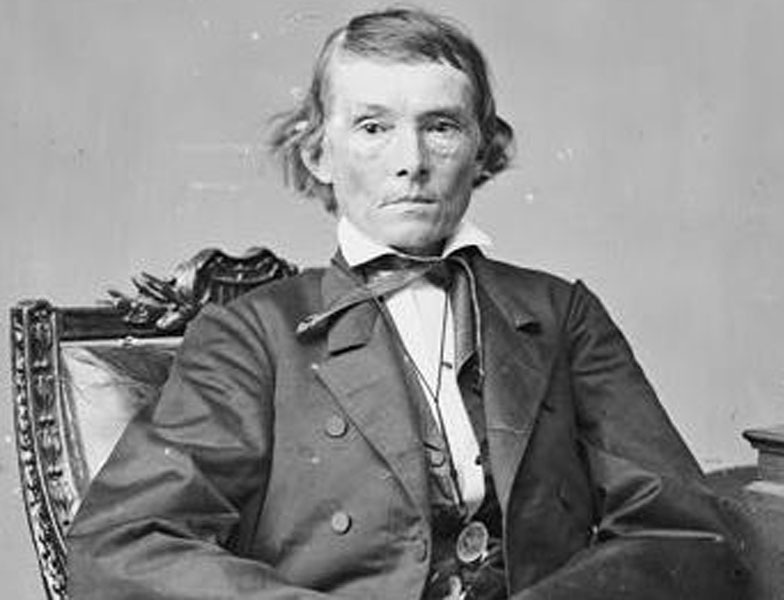
6 Comments

Filed under christian life, civil rights, faith, laws and legislation, Political Commentary, Religion

The American Ideological War: The American Civil War…The Continuation of Politics by Other Means

Gettysburg Address

Note to my friends at Padre Steve’s World. I am again preparing materials for my next teaching trip to Gettysburg. While some will deal with purely military and leadership aspects, the political and social context of the war has to be examined. The false assertions that the war was not about slavery have to be met head on since there has been a cottage industry which has denied that slavery was the matter of “States Rights” that the Confederacy went to war not only to preserve but to expand.

One can never separate war and the means by which it is fought from its political ends. War according to Clausewitz is an extension or continuation of politics. The American Civil War was not only the first modern war based on the advancement of technology and the changing nature of war, but also in terms of it being the first modern war caused by the clash of radically different ideologies, ideologies which championed two very different views of civilization. British theorist and military historian J.F.C. Fuller wrote of it:

“At length on 12th April, the tension could no longer bear the strain. Contrary to instructions, in the morning twilight, and when none could see clearly what the historic day portended, the Confederates in Charleston bombarded Fort Sumter, and the thunder of their guns announced that the argument of a generation should be decided by the ordeal of war. A war, not between two antagonistic political parties, but a struggle to the death between two societies, each championing a different civilization…”1

That is why it impossible to simply examine the military campaigns and battles of the Civil War in isolation from the politics, polices and even the philosophy and theology which brought it about.

The world was changed when Edmund Ruffin a 67 year old farm paper editor, plantation owner and ardent old line secessionist from Virginia pulled the lanyard which fired the first shot at Fort Sumter. Ruffin was a radical ideologue. He was a type of man who understood reality far better than some of the more moderate oligarchs that populated the Southern political and social elite. While in the years leading up to the war these men attempted to secure the continued existence and spread of slavery within the Union. Ruffin was not such a man. He and other radical secessionists believed that there could be no compromise with the north. He believed that in order to maintain the institution of slavery the slave holding states that those states had to be independent from the North.

ruffinEdmund Ruffin

Ruffin’s views were not unique to him, the formed the basis of how most slave owners and supporters felt about slavery’s economic benefits, Ruffin wrote:

“Still, even this worst and least profitable kind of slavery (the subjection of equals and men of the same race with their masters) served as the foundation and the essential first cause of all the civilization and refinement, and improvement of arts and learning, that distinguished the oldest nations. Except where the special Providence and care of God may have interposed to guard a particular family and its descendants, there was nothing but the existence of slavery to prevent any race or society in a state of nature from sinking into the rudest barbarism. And no people could ever have been raised from that low condition without the aid and operation of slavery, either by some individuals of the community being enslaved, by conquest and subjugation, in some form, to a foreign and more enlightened people.”2

The South of the time was an agrarian society which depended on the free labor provided by slaves. The Northern states had abolished slavery in the years since the United States had gained independence and over the intervening years the North had embraced the Industrial Revolution leading to advances which gave it a marked economic advantage over the South. The population of the North also expanded at a clip that far outpaced the South as European immigrants swelled the population.

The divided was not helped by the various compromises worked out between northern and souther legislators. After the Missouri Compromise Thomas Jefferson wrote:

“but this momentous question, like a fire bell in the night, awakened and filled me with terror. I considered it at once as the knell of the Union. It is hushed indeed for the moment, but this is a reprieve only, not a final sentence. A geographical line, coinciding with a marked principle, moral and political, once conceived and held up to the angry passions of men, will never be obliterated; and every new irritation will mark it deeper and deeper.”3

The trigger for the increase in tensions was the war with Mexico in which the United States annexed nearly half of Mexico. The new territories were viewed by those who advocated the expansion of slavery as fresh and fertile ground for its spread. Ulysses S Grant noted the effects of the war with Mexico in his memoirs:

“In taking military possession of Texas after annexation, the army of occupation, under General [Zachary] Taylor, was directed to occupy the disputed territory.  The army did not stop at the Nueces and offer to negotiate for a settlement of the boundary question, but went beyond, apparently in order to force Mexico to initiate war….To us it was an empire and of incalculable value; but it might have been obtained by other means.  The Southern rebellion was largely the outgrowth of the Mexican war.”4

uncletoms

In the North a strident abolitionist movement took root. This movement aimed to not only stop the spread of slavery but to abolish it. Given a boost by the huge popularity of Harriett Beecher Stowe’s 1852 novel Uncle Tom’s Cabinthe abolitionist movement gained steam and power. The leaders fought against acts like the Fugitive Slave Act and the Dred Scott decision and with the formation of the Republican Party found a formidable political voice.

As the 1850s wore on the divisions over slavery became deeper and voices of moderation retreated. The trigger for the for the worsening of the division was the political battle regarding the expansion of slavery, even the status of free blacks in the north who were previously slaves, over whom their owners asserted their ownership. In 1856 the Supreme Court, dominated by southern Democrats ruled in favor of southern views in the Dred Scott decision one pillar of which gave slavery the right to expand by denying to Congress the power to prohibit slavery in Federal territories.

This ignited a firestorm in the north where Republicans now led by Abraham Lincoln decried the decision and southerners basked in their judicial victory. Northerners quite rightly feared that an activist court would rule to deny their states the right to forbid slavery. As early as 1854 Lincoln posed the idea that the Declaration of Independence was “the standard maxim of free society …constantly spreading and deepening its influence,” ultimately applicable “to peoples of all colors everywhere.”5

But after the Dred Scott decision Lincoln warned that the Declaration was being cheapened and diluted “to aid in making the bondage of the Negro universal and eternal….All the powers of the earth seem rapidly combining against him. Mammon is after him; ambition follows, and philosophy follows, and the theology of the day is fast joining the cry. They have him in his prison house;…One after another they have closed the heavy doors upon him…and they stand musing as to what invention, in all the dominions of mind and matter, can be produced the impossibility of his escape more complete than it is.” 6

jeffdavisJefferson Davis

In response to the decision the advocates of the expansion of slavery not only insisted on its westward expansion in Federal territories but to Panama, Nicaragua and Cuba as well. In 1857 Jefferson Davis further provoked northern ire when he insisted that “African Slavery as it exists in the United States is a moral, a social, and a political blessing.”7 Taking advantage of the judicial ruling Davis and his supporters in Congress began to bring about legislation not just to ensure that Congress could not “exclude slavery” but to protect it in all places and all times. They sought a statute that would explicitly guarantee “that slave owners and their property would be unmolested in all Federal territories.” This was commonly known in the south as the doctrine of positive protection, designed to “prevent a free-soil majority in a territory from taking hostile action against a slave holding minority in their midst.”8

Previously a man of moderation Lincoln laid out his views in the starkest terms in his House Divided speech given on June 16th 1858. Lincoln understood, possibly with more clarity than others of his time that the divide over slavery was deep and that the country could not continue to exists while two separate systems contended with one another. He was to the point and laid our in clear terms what few had ever said before and which even some in his own Republican Party did not want to say because they felt it was too divisive:

“If we could first know where we are and whither we are tending, we could better judge what to do and how to do it. We are now far into the fifth year since a policy was initiated with the avowed object and confident promise of putting an end to slavery agitation. Under the operation of that policy, that agitation has not only not ceased but has constantly augmented. In my opinion, it will not cease until a crisis shall have been reached and passed. “A house divided against itself cannot stand.” I believe this government cannot endure, permanently, half slave and half free. I do not expect the Union to be dissolved; I do not expect the house to fall; but I do expect it will cease to be divided. It will become all one thing, or all the other. Either the opponents of slavery will arrest the further spread of it and place it where the public mind shall rest in the belief that it is in the course of ultimate extinction, or its advocates will push it forward till it shall become alike lawful in all the states, old as well as new, North as well as South.”9

The crisis continued to fester and when Lincoln was elected to the Presidency in November 1860 with no southern states voting Republican the long festering volcano erupted. It did not take long before southern states began to secede from the Union. South Carolina was first, followed by Mississippi, Florida, Alabama, Georgia, Louisiana and Texas. Many of the declarations of causes for secession made it clear that slavery was the root cause. The declaration of South Carolina is typical of these and is instructive of the basic root cause of the war:

“all the States north of that line have united in the election of a man to the high office of President of the United States, whose opinions and purposes are hostile to slavery. He is to be entrusted with the administration of the common Government, because he has declared that that “Government cannot endure permanently half slave, half free,” and that the public mind must rest in the belief that slavery is in the course of ultimate extinction.”10

Throughout the war slavery loomed large. In his First Inaugural Address Lincoln noted: “One section of our country believes slavery is right and ought to be extended, while the other believes it is wrong and ought not to be extended. This is the only substantial dispute.”11 Of course he was right, and his southern opponents agreed.

Alexander-StephensAlexander Stephens

Alexander Stephens the Vice President of the Confederacy noted in his Cornerstone Speech of March 21st 1861 that: “Our new government is founded upon exactly the opposite idea; its foundations are laid, its corner- stone rests upon the great truth, that the negro is not equal to the white man; that slavery — subordination to the superior race — is his natural and normal condition. [Applause.] This, our new government, is the first, in the history of the world, based upon this great physical, philosophical, and moral truth.”12

After the bloody battle of Antietam Lincoln published the emancipation proclamation in which he proclaimed the emancipation of slaves located in the rebel states. Likewise in his Second Inaugural Address he discussed slavery as being the cause of the war:

“One-eighth of the whole population were colored slaves, not distributed generally over the Union, but localized in the southern part of it. These slaves constituted a peculiar and powerful interest. All knew that this interest was somehow the cause of the war. To strengthen, perpetuate, and extend this interest was the object for which the insurgents would rend the Union even by war, while the Government claimed no right to do more than to restrict the territorial enlargement of it. Neither party expected for the war the magnitude or the duration which it has already attained. Neither anticipated that the cause of the conflict might cease with or even before the conflict itself should cease. Each looked for an easier triumph, and a result less fundamental and astounding. Both read the same Bible and pray to the same God, and each invokes His aid against the other. It may seem strange that any men should dare to ask a just God’s assistance in wringing their bread from the sweat of other men’s faces, but let us judge not, that we be not judged. The prayers of both could not be answered. That of neither has been answered fully. The Almighty has His own purposes. “Woe unto the world because of offenses; for it must needs be that offenses come, but woe to that man by whom the offense cometh.” If we shall suppose that American slavery is one of those offenses which, in the providence of God, must needs come, but which, having continued through His appointed time, He now wills to remove, and that He gives to both North and South this terrible war as the woe due to those by whom the offense came, shall we discern therein any departure from those divine attributes which the believers in a living God always ascribe to Him? Fondly do we hope, fervently do we pray, that this mighty scourge of war may speedily pass away. Yet, if God wills that it continue until all the wealth piled by the bondsman’s two hundred and fifty years of unrequited toil shall be sunk, and until every drop of blood drawn with the lash shall be paid by another drawn with the sword, as was said three thousand years ago, so still it must be said “the judgments of the Lord are true and righteous altogether.”13

CW-GettysburgDeadDied for an Ideal Confederate Dead at Gettysburg

When Edmund Ruffin pulled the lanyard of the cannon that fired the first shot at Fort Sumter it marked the end of an era and despite Ruffin, Stephens and Davis’ plans gave birth to what Lincoln would describe as “a new birth of freedom.”
When the war ended with the Confederacy defeated and the south in ruins Ruffin still could not abide the result. In a careful crafted suicide note he sent to his son the bitter and hate filled old man wrote on June 14th 1865: “… And now with my latest writing and utterance, and with what will be near my last breath, I here repeat and would willingly proclaim my unmitigated hatred to Yankee rule — to all political, social and business connections with Yankees, and the perfidious, malignant and vile Yankee race.”

Ruffin outlived Lincoln who was killed by the assassin John Wilkes Boothe on April 14th 1864. However the difference between the two men was marked. In his Second Inaugural Address Lincoln spoke in a different manner. He concluded that address with these thoughts:

“With malice toward none, with charity for all, with firmness in the right as God gives us to see the right, let us strive on to finish the work we are in, to bind up the nation’s wounds, to care for him who shall have borne the battle and for his widow and his orphan, to do all which may achieve and cherish a just and lasting peace among ourselves and with all nations.”14

With that I wish you peace,

Padre Steve+

1 Fuller, J.F.C. The Conduct of War 1789-1961 Da Capo Press, New York 1992. Originally published by Rutgers University Press, New Brunswick N.J. 1961 p.98

2 Ruffin, Edmund The Political Economy of Slavery in McKitrick, Eric L.. ed. Slavery Defended: The Views of the Old South. Englewood Cliffs, NJ: Prentice Hall/Spectrum Books, 1963.Retrieved from http://www.pbs.org/wgbh/americanexperience/features/primary-resources/lincolns-political-economy/ 24 March 2014 

3 Jefferson, Thomas Letter to John Holmes dated April 22nd 1824 retrieved from www.loc.gov/exhibits/jefferson/159.html

4 U.S. Grant, Personal Memoirs of U.S. Grant New York 1885 pp.23-245

5 Catton, William and Bruce, Two Roads to Sumter: Abraham Lincoln, Jefferson Davis and the March to Civil War McGraw Hill Book Company New York 1963, Phoenix Press edition London p.139

6 Ibid.

7 Ibid. p.142

8 Ibid.

9 Lincoln, Abraham A House Divided given at the Illinois Republican Convention, June 16th 1858, retrieved from www.pbs.org/wgbh/ala/part4/4h2934.html

10 Declaration of the Immediate Causes Which Induce and Justify the Secession of South Carolina from the Federal Union. Retrieved from The Avalon Project, Yale School of Law http://avalon.law.yale.edu/19th_century/csa_scarsec.asp

11 Lincoln, Abraham First Inaugural Address March 4th 1861 retrieved from www.bartleby.com/124/pres31.html

12 Cleveland, Henry Alexander H. Stevens, in Public and Private: With Letters and Speeches, before, during and since the War, Philadelphia 1886 pp.717-729 retrieved from http://civilwarcauses.org/corner.htm

13 Lincoln, Abraham Second Inaugural Address March 4th 1865 retrieved from www.bartleby.com/124/pres32.html

14 Ibid.

Leave a comment

Filed under civil war, History, Military, Political Commentary