Category Archives: Political Commentary

Intellectual, Political, and Theological Integrity in the Time of the Iowa Caucuses, the State of the Union, and Ideological Conformity

Friends of Padre Steve’s World,

Just a quick note for today as it will be an eventful week; the Iowa Caucuses on Monday, the State of the Union Address on Tuesday, and the acquittal without an actual trial with witnesses or new evidence on Wednesday, or Thursday at the lastest.

Since the first will be disputed because of irregularities, hacking, and political manipulation in the caucuses which will sow discord in the Democratic Party; the second, the State of the Union which will be President Trump’s preludes to his acquittal by the Senate; and the last a charade which will destroy the checks and balances intended by our Founders, and solidify an authoritarian government, led by the Executive Branch regardless of who is President or which party they represent. The guardrails that secured our republic and its Constitution have been damaged beyond repair. Humanity, the one constant in recorded history will see to that.

So what I am going to to do, at least until I retire from the military is post articles that the discerning reader will understand are due to prudence over propaganda, and enlightening people by sometimes indirect means that to bludgeon my way through issues. This is because while I am a liberal, progressive, or whatever label you want to put on me I am a historian and a realist.

I will be bold when I need to be, but it may be through the lives and words of others, people who living or dead I support and admire. Sometimes it will be my own words, but sadly, my words and wisdom often pale to those who have often paid with their lives for their opposition to the status quo. Truthfully, being a former conservative who now is a bit further to the left than the center left., but certainly not an extremist in any way. My pragmatism and study of history prevents that, as does my Oath of Office to the Constitution which rises beyond political party or religious denomination’s beliefs.

That might confuse true believers and ideologues regardless of their place on the political and ideological chasm. Thus my posts will reflect my position on the political and theological left, without    compromise, but while doing my best to maintain intellectual, theological, political, and historical integrity. So you can expect more articles from history, with appropriate political or theological commentary thrown in as needed. Likewise, though I am a Democrat I will try to refrain from intra-Party fratricide because of the broader issues at hand. The political fight among Democrats must not become a Democratic version of the Trump Cult where one candidate is not to be criticized or their lives, records, and actions submitted to scrutiny. I refuse to exchange one version of tyranny for another.

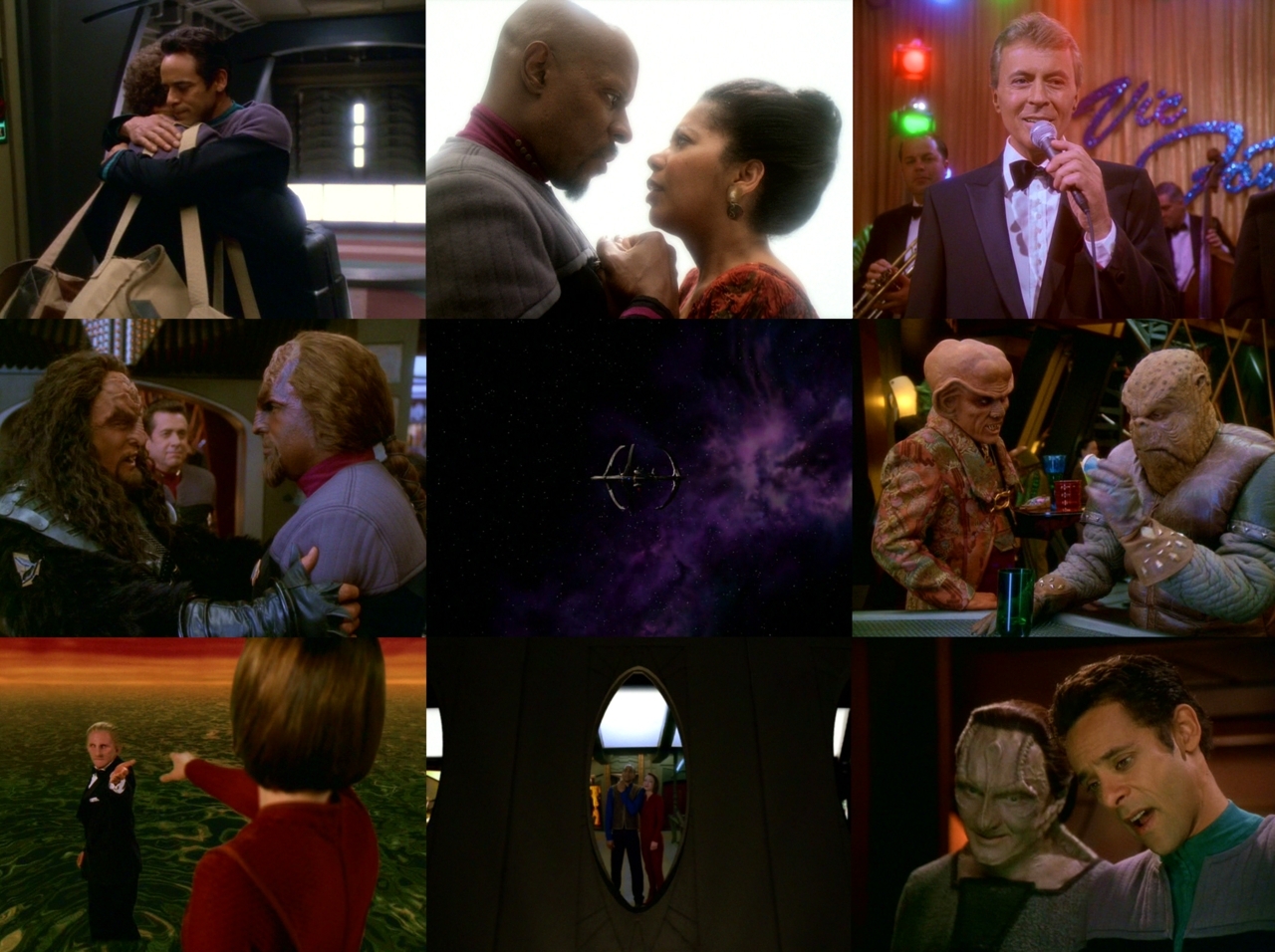
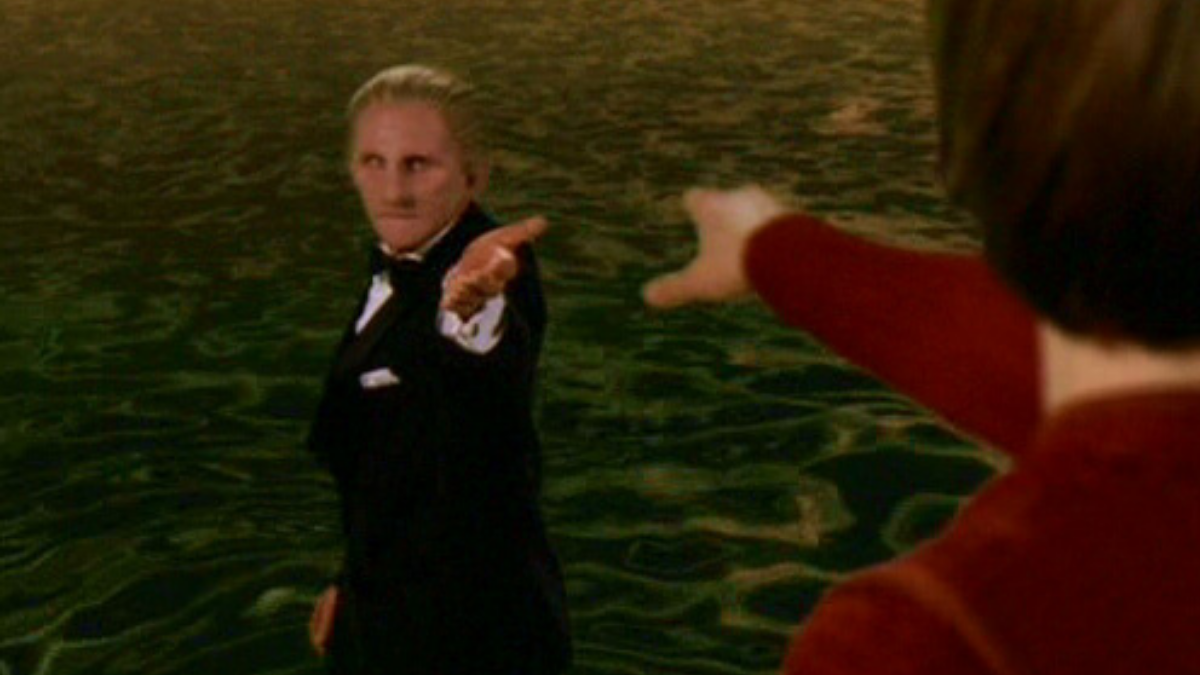
I will now quote from one of my favorite episodes of Star Trek the Next Generation called The Drumhead uttered by Jean Luc Picard:

“We think we’ve come so far. Torture of heretics, burning of witches it’s all ancient history. Then – before you can blink an eye – suddenly it threatens to start all over again.”

So until tomorrow,

Peace,

Padre Steve+


Leave a comment

Filed under civil rights, ethics, faith, Foreign Policy, History, laws and legislation, leadership, LGBT issues, nazi germany, News and current events, Political Commentary, Religion, spirituality

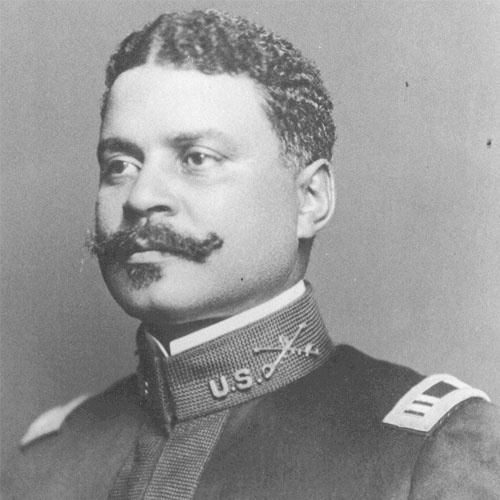
Military Civil Rights Pioneers, Buffalo Soldier & the Red Tail: Benjamin O. Davis Senior and Junior

Benjamin_o_davis

Brigadier General Benjamin O Davis in France 1944

Friends of Padre Steve’s World,

In his I Have a Dream speech Dr. Martin Luther King Jr. gave all of us a vision of what can and in spite of what I see going on today will be the future of the people of this country:

“I have a dream that my four little children will one day live in a nation where they will not be judged by the color of their skin, but by the content of their character.”

American History would not be the same without the life, work and prophetic ministry of Dr. Martin Luther King Jr. Dr. King was born in a time when most of the country was segregated when “separate by equal” was simply façade to cover the lie that in no way did African Americans have equal rights or privileges in the United States.

Dr King was born less than 60 years after the secession of the Southern states from the Union and the beginning of the American Civil War. Though that blood conflict had freed the slaves it had not freed African Americans from prejudice, violence and discrimination.  When Dr. King began his ministry and was thrust upon the national stage as the strongest voice for equal rights and protections for blacks the discrimination and violence directed towards blacks was a very real and present reality in much of the United States.

However there were cracks beginning to appear in the great wall of segregation in the years preceding Dr. King’s ascent to leadership as the moral voice of the country in the matter of racial equality. In baseball Jackie Robinson became the first African American player in Major League Baseball opening a door for others who would become legends of the game as well as help white America begin its slow acceptance of blacks in sports and the workplace.

Likewise the contributions of a father and son Brigadier General Benjamin O. Davis Sr. and General Benjamin O. Davis Jr. were advancing the cause of blacks in the military which eventually led to the desegregation of the military in 1948.  The impact of these two men cannot be underestimated for they were trailblazers who by their lives, professionalism and character blazed a trail for African Americans in the military as well as society.

Benjamin O. Davis Sr. was a student at Howard University when the USS Maine exploded and sank in Havana Harbor.  He volunteered for service and was commissioned as a temporary 1st Lieutenant in the 8th United States Volunteer Infantry. He was mustered out of service in 1899 but enlisted as a private in the 9th United States Cavalry one of the original Buffalo Soldiers regiments.  He enlisted as the unit clerk of I troop of 3rd Squadron and was promoted to be the squadron Sergeant Major.

Davis was commissioned while the unit was deployed to the Philippines and assigned to the 10th Cavalry.  He was assigned in various positions throughout his career including command, staff and instruction duties including as Professor of Military Science and Tactics in various ROTC programs.  He reached the rank of rank of temporary Lieutenant Colonel and Squadron Commander of 3rd and later 1st Squadron 9th Cavalry from 1917-1920 in the Philippines before reverting to the rank of Captain on his return as part of the post World War I reduction in force.

Davis continued to serve during the inter-war years and assumed command of the 369th Infantry Regiment New York National Guard in 1938. He was promoted to Brigadier General on 25 October 1940 becoming the first African American elevated to that rank in the United States Army and was assigned as Commander 4th Brigade 2nd Cavalry Division. He later served in various staff positions at the War Department and in France and was instrumental in the integration of the U.S. Military. He retired after 50 years service in 1948 in a public ceremony with President Harry S. Truman presiding. He was a member of the American Battle Monuments Commission from 1953-1961 and died in 1970.

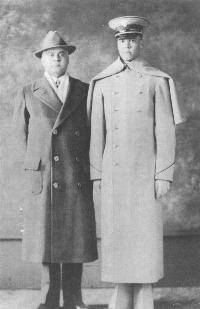
davis-3

Colonel Davis with his son Cadet Benjamin O Davis Jr.

His son Benjamin O. Davis Jr. was appointed to West Point in 1932.  He graduated and was commissioned in 1936 graduating 35 out of 278, the fourth African American graduate of West Point. During his time at the Academy most of his classmates shunned him and he never had a roommate.  Despite this he maintained a dogged determination to succeed.  The Academy yearbook made this comment about him:

“The courage, tenacity, and intelligence with which he conquered a problem incomparably more difficult than plebe year won for him the sincere admiration of his classmates, and his single-minded determination to continue in his chosen career cannot fail to inspire respect wherever fortune may lead him.”

He was denied entrance to the Army Air Corps because of his race and assigned to the Infantry first to the all lack 24th Infantry Regiment at Ft Benning where he was not allowed in the Officers Club due to his race. Upon his commissioning the Regular Army had just 2 African American Line Officers, 2nd Lieutenant Davis and his father Colonel Davis.

After completion of Infantry School he was assigned as an instructor of Military Science and Tactics and the Tuskegee Institute.  In 1941 the Roosevelt Administration moved to create a black flying unit and Captain Davis was assigned to the first black class at the Tuskegee Army Air Field and in March 1942 one his wings as one of the first 5 African Americans to complete flight training.

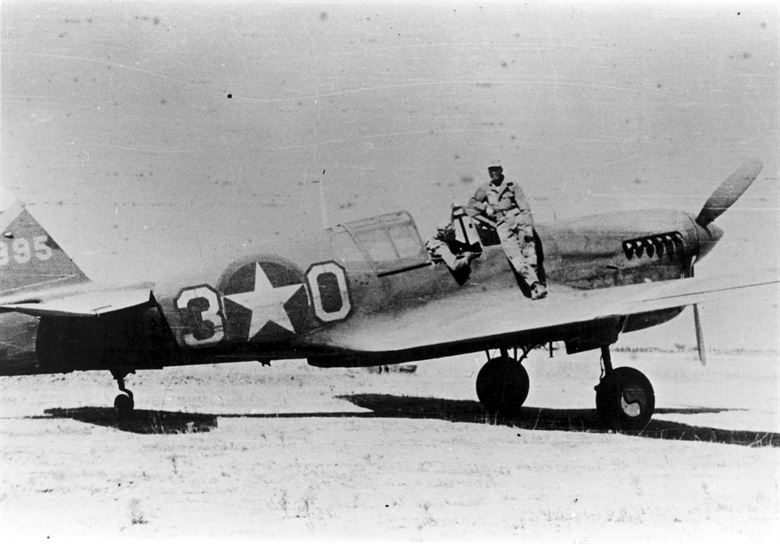
In July 1942 the younger Davis was assigned as Commanding Officer of the 99th Pursuit Squadron which served in North Africa and Sicily flying Curtiss P-40 Warhawks. He was recalled to the United States in September 1943 to command the 332ndFighter Group. However some senior officers attempted to prevent other black squadrons from serving in combat alleging that the 99th had performed poorly in combat. Davis defended his squadron and General George Marshall ordered an inquiry which showed that the 99th was comparable to white squadrons in combat and during a 2 day period over the Anzio beachhead the pilots of the 99thshot down 12 German aircraft.

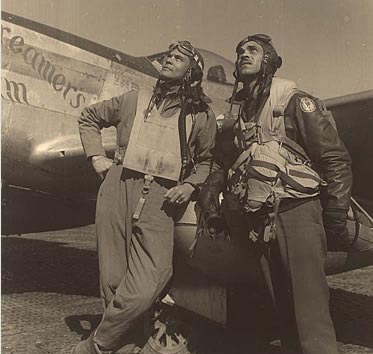
davis Library of congress photo public domain

Colonel Benjamin O Davis Jr (left) with one of his Tuskegee Airmen

Davis took the 332nd to Italy where they transitioned to P-47 Thunderbolts and in July 1944 to the P-51 Mustang which were marked with a signature red tail. During the war, the units commanded by Davis flew more than 15,000 sorties, shot down 111 enemy planes, and destroyed or damaged 273 on the ground at a cost of 66 of their own planes.

Tuskegee_01

Their record against the Luftwaffe was outstanding and their protection of the bombers that they escorted was superb with very few bombers lost while escorted by them men that the Luftwaffe nicknamed the Schwarze Vogelmenschen and the Allies the Red-Tailed Angels or simply the Redtails. Davis led his Tuskegee Airmen to glory in the war and their performance in combat helped break the color barrier in the U.S. Military which was ended in 1948 when President Truman signed an executive order to end the segregation of the military. Colonel Davis helped draft the Air Force plan and the Air Force was the first of the services to fully desegregate.

ltgen Benjamindavis

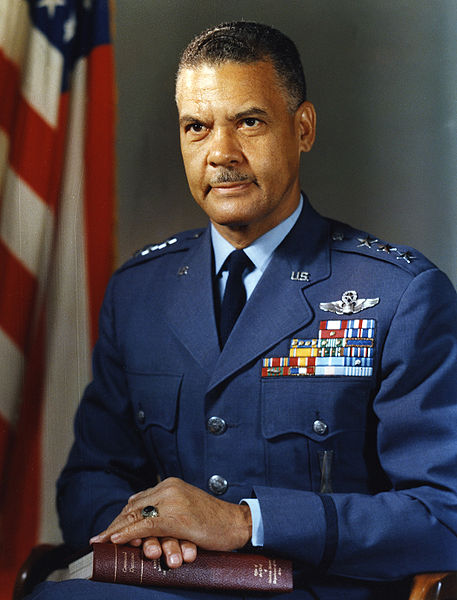
Lieutenant General Benjamin O Davis Jr

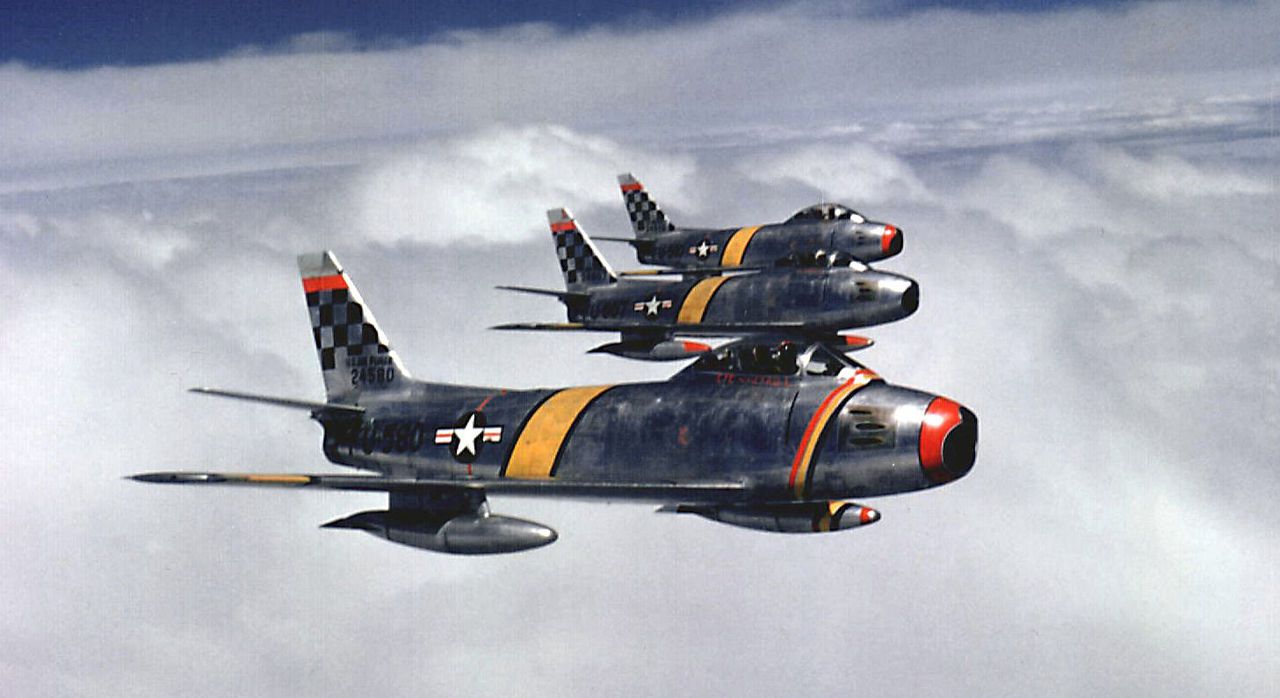
Colonel Davis transitioned to jets and led the 51st Fighter Interceptor Wing against Chinese Communist MIGs in the Korean War.

Davis Leading a Flight of F-86 Super Sabers in Korea 

He was promoted to Brigadier General in 1954 and served in numerous command and staff positions. He retired in 1970 with the rank of Lieutenant General and was advanced to General while retired by President Clinton in 1998.  He died in 2002 at the age of 89.

The legacy of Benjamin O. Davis Senior and Benjamin O. Davis Junior is a testament to their character, courage and devotion to the United States of America. They helped pioneer the way for officers such as General Colin Powell and helped change this country for the better.  During times when discrimination was legal they overcame obstacles that would have challenged lesser men.  Benjamin O. Davis Junior remarked:

“My own opinion was that blacks could best overcome racist attitudes through achievements, even though those achievements had to take place within the hateful environment of segregation.”

Such men epitomize the selfless service of so many other African Americans who served the country faithfully and “by the content of their character” triumphed over the evil of racism and helped make the United States a more perfect union. That may seem threatened today with the open display of White Supremacy movements which are now openly being supported by many Republican politicians, at all levels of government. However, it was worse before and in the words of the old spiritual, “we shall overcome.” In days like ours it may seem not to be the case, but we must persevere.

Peace

Padre Steve+

Leave a comment

Filed under civil rights, History, Korean Conflicts, laws and legislation, Military, News and current events, Political Commentary, racism, us army, US Army Air Corps, world war two in europe

Fighting For Emancipation and Equality: The Black Soldiers of the Civil War

Friends of Padre Steve’s World,

February is Black History Month, it’s something that no American of any race, color, or creed should forget. African Americans, the decendants of slaves and slaves themselves fought for freedom that was only at best was in the promissory note of the Emancipation Proclamation.

Those men, and women in the case of Harriett Tubman and Sojourner Truth, paved the way for freedom for African Americans and all others who benefited from what they fought for: women, Native Americans, Mexican Americans, and other Hispanics, Asian Americans, and LGBTQ Americans. That promise being made then, must be kept today, to the descendents of  this men, as well as all who benefited through their sacrifice: even the Southern Whites who at the time did not know then, or all too often today, that they too needed emancipation.

This article is a section of one of my yet unpublished Civil War books in which I spend much time dealing with the importance of emancipation and the role of Black soldiers during the American Civil War. I think it is important to remember as we get ready to close out Black History Month just how important these men are to American history and for the civil rights of all Americans.

Emancipation and the U.S. Military

HD_4USCinfantryDetail.preview

Men of the 4th Regiment of U.S. Colored Troops

The war brought about another change to warfare in America. This was a societal and political change that has shaped American military history, culture and life ever since. The Emancipation Proclamation gave African Americans, both Freedmen and recently freed slaves the opportunity to serve in the Union Army. The change of policy instituted by Lincoln was revolutionary as well as controversial and it had strategic implications for the war effort. There were many doubters in the north whose attitudes towards African Americans were not much different than Southerners, especially among the Copperheads.

Prior to the Emancipation some Union commanders in occupied Confederate territory “had unofficially recruited black soldiers in Kansas and in occupied portions of South Carolina and Louisiana in 1862. But the administration had not sanctioned these activities.” [1] The issue for Lincoln in 1861 and 1862 was the necessity of keeping the Border-Slave Sates of Kentucky, Missouri and Maryland, which had not seceded from the Union. Lincoln repudiated the orders of General John Fremont, in Missouri, and his friend General David Hunter, who commanded the Department of the South regarding emancipation, not because he was in complete disagreement, but because he felt that the officers had overstepped their authority.

Lincoln understood that this might hurt him with the abolitionist wing of the Republican Party. While Lincoln was certainly sympathetic to their cause, he insisted that such decisions were not within the prevue of local commanders, but that any such proclamations had to come from him, as Commander-in-Chief. He told Treasure Secretary Salmon Chase, who supported the measures of Hunter and Fremont, “No commanding general shall do such a thing, upon my responsibility, without consulting me.” [2] Lincoln’s decision to reverse and repudiate the decisions of local commanders infuriated some in his cabinet and in the Congress. But Lincoln remained firm in that conviction due to the need to ensure the cooperation of the Border States the continued loyalty of which were absolutely vital to winning the war, without which no meaningful emancipation would be possible.

However, Lincoln did support the efforts of General Benjamin Butler. Butler commanded the Federal forces at Fort Monroe in Hampton Roads. Butler had been a former pro-slavery Democrat who learned that the Confederates were using slaves to construct fortifications and to support their army on the Peninsula. In May 1862 twenty-three slaves escaped to his lines and their owner, a Confederate Colonel, “demanded the return of his property under the Fugitive Slave Law! With as deadpan expression as possible (given his cocked eye), Butler informed him that since Virginia claimed to have left the Union, the Fugitive Slave Law no longer applied.” [3]Butler then declared that since the escaped slaves had worked for the Confederate Army that they were “contraband of war – enemy property subject to seizure.” [4] It was a solid argument, since Southerners themselves referred to African American slaves as property was subject to seizure. Lincoln and Secretary of War Cameron approved of Butler’s action and “eventually, the Congress passed a confiscation law ending the rights of masters over fugitive slaves used to support Confederate troops.” [5]

Salmon Chase and other strong abolitionists opposed Lincoln vehemently for this, but it would not be long until Lincoln made the decision for full emancipation. This was first accomplished by the Emancipation Proclamation, a military order that only applied to the states that had seceded. However, Lincoln would follow this by pushing for a constitutional amendment to end slavery.   The latter occurred when Congress passed the Thirteenth Amendment was passed in January 1865. This amendment abolished slavery in the United States.

Lincoln had already decided upon emancipation in the spring of 1862, however, following the defeat of McClellan on the Peninsula he decided to postpone announcing it, Secretary of State Seward recommended against it until “until you can give it to the country supported by military success.” Otherwise the world might view it as an incitement for slave insurrections, “as the last measure of an exhausted government, a cry for help…our last shriek, on the retreat.” [6] The wisdom of Seward’s advice was profound, and Lincoln put off the announcement until after the Battle of Antietam.

McClellan, true to form opposed any such policy. When Lincoln visited him after his withdraw from the Peninsula, the defeated but still arrogant General handed Lincoln a memorandum on what McClellan viewed as the “proper conduct of the war.” McClellan advised Lincoln that the war “should not be a war looking to the subjugation of any State in any event…but against armed forces and political organizations. Neither confiscation of property, political executions of persons, the territorial organization of States, or the forcible abolition of slavery should be contemplated for a moment.” [7]

Lincoln was not seeking advice from his recalcitrant commander and put the letter in his pocket and simply told McClellan, “All right.” Interestingly enough just a few months earlier Lincoln would have agreed with McClellan’s views on the conduct of the war. However, with the passage of time and the realization that the Confederacy was fully committed to its independence as well as the continuance and even the expansion of slavery had come to the view that fighting a limited war with limited aims was foolish. He told another Unionist Democrat a few days after McClellan offered his advice that the war could not be fought:

“with elder-stalk squirts, charged with rose water….This government cannot much longer play a game in which it stakes all, and its enemies stake nothing. Those enemies must understand that they cannot experiment for ten years trying to destroy this government, and if they fail still come back into the Union unhurt.”[8]

From Slavery to Soldiering

2nd-colored-light-artillery

Gun Crew of 2nd Colored Light Artillery 

But as the war continued on, consuming vast numbers of lives the attitude of Lincoln and his administration began to change. After a year and a half of war, Lincoln and the closest members of his cabinet were beginning to understand that the “North could not win the war without mobilizing all of its resources and striking against Southern resources used to sustain the Confederate war effort.” [9] Slave labor was essential to the Confederate war effort, not only did slaves still work the plantations, they were impressed into service in war industries as well as in the Confederate Army.

Lieutenant Colonel Arthur Freemantle, a British observer who was with Lee’s army at Gettysburg noted, “in the rear of each regiment were from twenty to thirty negro slaves.” [10] The fact is that the slaves who accompanied the army remained slaves, they were not the mythical thousands of black soldiers who rallied to the Confederate cause, nor were they employees. “Tens of thousands of slaves accompanied their owners to army camps as servants or were impressed into service to construct fortifications and do other work for the Confederate army.” [11] This fact attested to by Colonel William Allan, one of Stonewall Jackson’s staff members who wrote “there were no employees in the Confederate army.” [12] slaves served in a number of capacities to free up white soldiers for combat duties, “from driving wagons to unloading trains and other conveyances. In hospitals they could perform work as nurses and laborers to ease the burdens of patients.” [13] An English-born artilleryman in Lee’s army wrote in 1863 that “in our whole army there must be at least thirty thousand colored servants….” [14] When Lee marched to Gettysburg he did so with somewhere between ten and thirty-thousand slaves in support roles and during the advance into Virginia Confederate troops rounded up and re-enslaved as many blacks as they could, including Freedmen.
istanto001p1

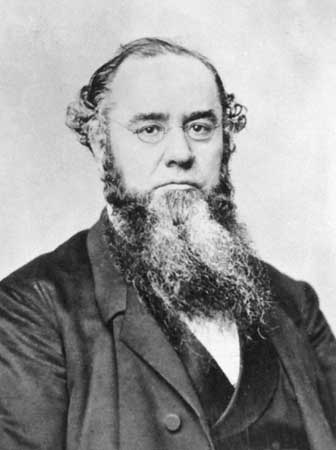
                                                      Secretary of War Edwin Stanton

Lincoln’s Secretary of War, Edwin Stanton; who was a passionate believer in the justice of emancipation, was one of the first to grasp the importance of slave labor to the Confederate armies and how emancipation was of decided military necessity. Stanton, “Instantly grasped the military value of the proclamation. Having spent more time than any of his colleagues contemplating the logistical problems facing the army, he understood the tremendous advantage to be gained if the massive workforce of slaves could be transferred from the Confederacy to the Union.” [15]

Lincoln emphasized the “military necessity” of emancipation and “justified the step as a “fit and necessary war measure for suppressing the rebellion.” [16] The process of emancipation now became not only a moral crusade, but now became a key part of national strategy, not just in a military means, but politically, economically and diplomatically as Lincoln “also calculated that making slavery a target of the war would counteract the rising clamor in Britain for recognition of the Confederacy.”  [17]

Lincoln wrote to his future Vice President, Andrew Johnson, then the military governor of occupied Tennessee that “The colored population is the great available and yet unavailed of, force for restoration of the Union.”[18] The idea of simply mollifying the border states was dropped and policy changed that of “depriving the Confederacy of slave labor. Mobilizing that manpower for the Union – as soldiers as well as laborers – was a natural corollary.” [19] Reflecting President Lincoln’s and Stanton’s argument for the military necessity of emancipation, General Henry Halleck wrote to Ulysses Grant:

“the character of the war has very much changed within the past year. There is now no possibility of reconciliation with the rebels… We must conquer the rebels or be conquered by them….Every slave withdrawn from the enemy is the equivalent of a white man put hors de combat.” [20]

54thmassposter

Ulysses Grant concurred with Lincoln’s decision. Grant wrote to in a letter to Lincoln after the assault on Battery Wagner by the 54th Massachusetts, “by arming the negro we have added a powerful ally. They will make good soldiers and taking them from the enemy weakens him in the same proportion as it strengthens us.” [21] William Tecumseh Sherman was supportive but also noted some facts that some radical abolitionists did not understand. He noted in his correspondence that, “The first step in the liberation of the Negro from bondage will be to get him and his family to a place of safety… then to afford him the means of providing for his family,… then gradually use a proportion – greater and greater each year – as sailors and soldiers.” [22] Lincoln wrote after the Emancipation Proclamation that “the emancipation policy, and the use of colored troops, constitute the heaviest blow yet dealt to the rebellion.” [23] The change was a watershed in both American history as well as for the future of the U.S. Military services.

In conjunction with the Emancipation Proclamation Secretary of War Stanton “authorized General Rufus Saxton to “arm, uniform, equip, and receive into the service of the United States such number of volunteers of African descent as you may deem expedient, not exceeding 5,000, and [you] may detail officers to instruct them in military drill, discipline, and duty, and to command them.”  [24] The initial regiments of African Americans were formed by Union commanders in liberated areas of Louisiana and South Carolina, and most were composed of newly freed slaves. Others like the 54th and 55th Massachusetts Volunteer Infantry regiments were raised from free black men in the north. Stanton’s authorization was followed by the Enrollment Act passed by Congress in March of 1863 which established the draft also allowed blacks to serve. By March Stanton was working with state governors to establish more black regiments. The units became known as United States Colored Troops, or U.S.C.T. and were commanded by white officers and organized into the infantry, cavalry and, artillery regiments organized on the model of white regiments. The U.S.C.T. “grew to include seven regiments of cavalry, more than a dozen of artillery, and well over one hundred of infantry.” [25]

Some Union soldiers and officers initially opposed enlisting blacks at all, and some “charged that making soldiers of blacks would be a threat to white supremacy, and hundreds of Billy Yanks wrote home that they would no serve alongside blacks.” [26]  But most common soldiers accepted emancipation, especially those who had served in the South and seen the misery that many slaves endured, one Illinois soldier, stationed who served in the Western Theater of war wrote, “the necessity of emancipation is forced upon us by the inevitable events of the war… and the only road out of this war is by blows aimed at the heart of the Rebellion…. If slavery should be left undisturbed the war would be protracted until the loss of life and national bankruptcy would make peace desirable on any terms.” [27]

Another soldier’s letters home show his conversion from being against emancipation to being fully for it. Corporal Chauncey B. Welton from Ohio wrote to his father after the Emancipation proclamation:

“Father I want you to write and tell me what you think of Lincoln’s proclamation of setting all the negroes free. I can tell you we don’t think much of it hear in the army for we did not enlist to fight for the negro and I can tell you that we never shall or many of us any how[.] no never.”

Following over two years of combat in which he served with Sherman’s army he became a vocal critic of the anti-abolitionist Copperheads in the North, especially former Ohio Governor Clement Vallandigham, as well as a strong proponent of abolition and opponent of slavery. By February 1865 his tone had changed “dear parents let us trust in Him that never forsakes the faithful, and never cease to pray… that soon we may look upon an undivided Country and that Country free free free yes free from that blighting curs[e] Slavery the cause of four years of Bloody warfare.” [28]

Even so racial prejudice in the Union ranks never went away and sometimes was accompanied by violence. It remained a part and parcel of life in and outside of the army, even though many Union soldiers would come to praise the soldierly accomplishments and bravery of African American Soldiers. An officer who had refused a commission to serve with a U.S.C.T. regiment watched as black troops attacked the defenses of Richmond in September 1864:

“The darkies rushed across the open space fronting the work, under a fire which caused them loss, into the abattis… down into the ditch with ladders, up and over the parapet with flying flags, and down among, and on top of, the astonished enemy, who left in utmost haste…. Then and there I decided that ‘the black man could fight’ for his freedom, and that I had made a mistake in not commanding them.” [29] Likewise, “Once the Lincoln administration broke the color barrier of the army, blacks stepped forward in large numbers. Service in the army offered to blacks the opportunity to strike a decisive blow for freedom….” [30]

HD_NgroWarFL640116p264cz.preview

                                                    The Defense of Milliken’s Bend 

Emancipation allowed for the formation of regiments of United States Colored Troops (USCT), which were mustered directly into Federal service. In sheer numbers the U.S.C.T. formations soon dwarfed the few state raised Black Regiments.  However, it was the inspiration provided by those first state raised regiments, the heroic accounts of those units reported in Northern newspapers, as well as the unprovoked violence directed against Blacks in the 1863 New York draft riots that helped to provoke “many northerners into a backlash against the consequences of violent racism.” [31]

Despite the hurdles and prejudices that blacks faced even in the North, many African Americans urged others to enlist, self-help mattered more than self-preservation. Henry Gooding, an black sergeant from Massachusetts wrote the editor of the New Bedford Mercury urging fellow blacks to enlist despite the dangers, “As one of the race, I beseech you not to trust a fancied security, laying in your minds, that our condition will be bettered because slavery must die…[If we] allow that slavery will die without the aid of our race to kill it – language cannot depict the indignity, the scorn, and perhaps the violence that will be heaped upon us.” [32]

The valor of the state regiments, as well as the USCT units that managed to get into action was remarkable, especially in regard to the amount of discrimination levied at them by some northerners, including white Northern soldiers, and the very real threat of death that they faced if captured by Confederates. In response to the Emancipation Proclamation and to the formation of African American regiments the Confederate Congress passed measures that would make Union officers who commanded African American troops as war criminals and return any black soldier captured by Confederate forces return to slavery, if those blacks captured in battle were not summarily tortured by their captors or executed as happened at Fort Wagner, Petersburg, and at Fort Pillow.

In late 1862 Major General Nathaniel Banks was in desperate need of soldiers and received permission to form a number of regiments of free blacks. Known as the First, Second and Third Regiments of the Louisiana Native Guards they were primarily composed of former slaves who had escaped to Union lines, as well as some mulattos who were the children of prominent white citizens of the city. During an inspection, the white Colonel of the Guards told another officer:

“Sir, the best blood of Louisiana is in that regiment! Do you see that tall, slim fellow, third file from the right of the second company? One of the ex-governors of the state is his father. That orderly sergeant in the next company is the son of a man who has been six years in the United States Senate. Just beyond him is the grandson of Judge ______ …; and through all the ranks you will find the same state of facts…. Their fathers are disloyal; [but] these black Ishmaels will more than compensate for their treason by fighting in the field.” [33]

In May of 1863 Banks dared to send the First and Third Regiments of “Louisiana Native Home Guard regiments on a series of attacks on Confederate positions at Port Hudson, Louisiana” [34] where they received their baptism of fire. They suffered heavy losses and “of the 1080 men in the ranks, 271 were hit, or one out of every four.” [35] A white Wisconsin soldier commented that the black soldiers “fought like devils,”while a soldier of the 156th New York wrote, “They charged and re-charged and they didn’t know what retreat meant. They lost in their two regiments some four hundred men as near as I can learn. This settles the question about niggers not fighting well. They on the contrary make splendid soldiers and are as good fighting men as we have.” [36] Banks too was caught up in the moment and said of these troops in his after action report: “They answered every expectation…In many respects their conduct was heroic…The severe test to which they were subjected, and the determined manner in which they encountered the enemy, leave upon my mind no doubt of their ultimate success.” [37]

The_Storming_of_Ft_Wagner-lithograph_by_Kurz_and_Allison_1890a

                                                54th Massachusetts at Fort Wagner 

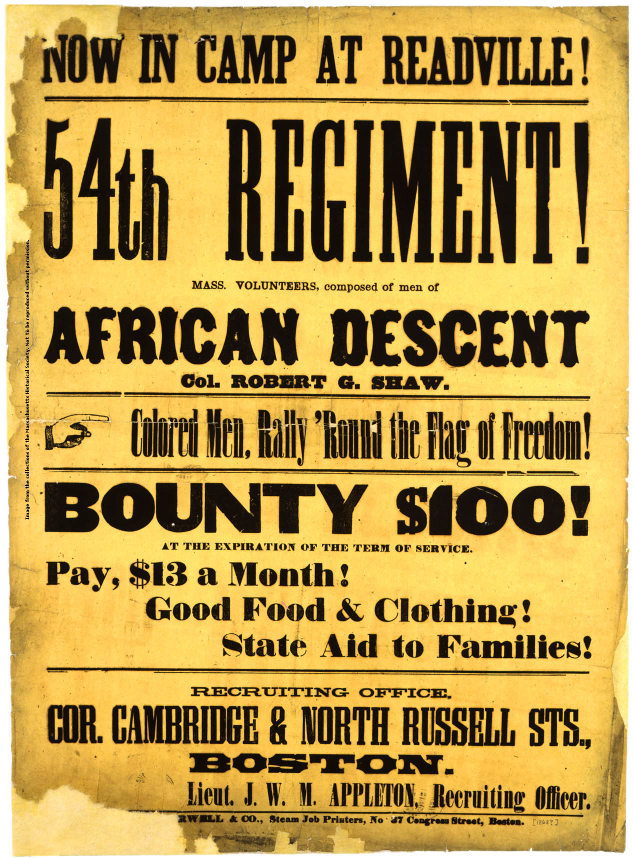
But the most famous African American volunteer regiment was the 54thMassachusetts, commanded by Colonel Robert Gould Shaw, the “North’s showcase black regiment.” [38] Raised in Boston and officered by many men who were the sons of Boston’s blue blood abolitionist elite, the regiment was authorized in March 1863. Since there was still opposition to the formation of units made up of African Americans, Massachusetts Governor John Andrew authorized the formation of the 54th under the command of white officers, a practice that with few exceptions, became standard in the U.S. military until President Truman desegregated the armed forces in 1948. Governor Andrew was determined to ensure that the officers of the 54th were men of “firm antislavery principles…superior to a vulgar contempt for color.”[39]

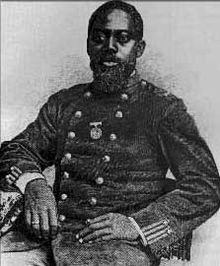
The 54th Massachusetts first saw action in early June 1863 and at Shaw’s urging were sent into battle against the Confederate positions at Fort Wagner on July 18th 1863. Leading the attack the 54th lost nearly half its men, “including Colonel Shaw with a bullet through his heart. Black soldiers gained Wagner’s parapet and held it for an hour before falling back.” [40]Though they tried to hold on they were pushed back after a stubborn fight to secure a breach in the fort’s defenses. “Sergeant William H Carney staggered back from the fort with wounds in his chest and right arm, but with the regiment’s Stars and Stripes securely in his grasp. “The old flag never touched the ground, boys,” Carney gasped as he collapsed at the first field hospital he could find.” [41] Shaw was buried with his men by the Confederates and when Union commanders asked for the return of his body were told “We have buried him with his niggers,” Shaw’s father quelled a northern effort to recover his son’s body with these words: We hold that a soldier’s most appropriate burial-place is on the field where he has fallen.” [42] As with so many frontal attacks on prepared positions throughout the war, valor alone could not overcome a well dug in enemy. “Negro troops proved that they could stop bullets and shell fragments as good as white men, but that was about all.” [43]

Despite the setback, the regiment went on to further actions where it continued to distinguish itself. The Northern press, particularly abolitionist newspapers brought about a change in the way that many Americans in the North, civilians as well as soldiers, saw blacks. The Atlantic Monthly noted, “Through the cannon smoke of that dark night, the manhood of the colored race shines before many eyes that would not see.”  [44]

55th-mass-at-charleston

                                  55th Massachusetts being welcomed in Charleston SC 

In the African American 55th Massachusetts, which was recruited after the 54th, twenty-one year old Sergeant Isaiah Welch wrote a letter which was published in the Philadelphia Christian Recorder from Folly Island South Carolina:

“I will mention a little about the 55th Massachusetts Regiment. They seem to be in good health at the present and are desirous of making a bold dash upon the enemy. I pray God the time will soon come when we, as soldiers of God, and of our race and country, may face the enemy with boldness. For my part I feel willing to suffer all privations incidental to a Christian and a soldier…. In conclusion, let me say, if I fall in the battle anticipated, remember, I fall in defense of my race and country. Some of my friends thought it very wrong of me in setting aside the work of the Lord to take up arms against the enemy…. I am fully able to answer all questions pertaining to rebels. If taking lives will restore the country to what it once was, then God help me to slay them on every hand.” [45]

Like the 54th Massachusetts, the 55th would see much action. After one particularly sharp engagement in July 1864, in which numerous soldiers had demonstrated exceptional valor under fire the regiment’s commander, Colonel Alfred S. Hartwell “recommended that three of the black sergeants of the 55th be promoted to the rank of 2nd Lieutenant.” But Hartwell’s request was turned down, and a member of the regiment complained, “But the U.S. government has refused so far to must them because God did not make them White…. No other objection is, or can be offered.”[46]


Frederick Douglass
Frederick Douglass, who had two sons serving in the 54th Massachusetts, understood the importance of African Americans taking up arms against those that had enslaved them in order to win their freedom:

“Once let a black man get upon his person the brass letters U.S… let him get an eagle on his button, and a musket on his shoulder and bullets in his pockets, and there is no power on earth which can deny he has won the right to citizenship in the United States.” [47]

Douglass urged African American men to enlist to secure their freedom, even while noting the inequities still prevalent in society and in the military, in which they did not receive the same pay as whites, nor could they become officers. Appealing to duty and reality Douglass noted in a speech in Philadelphia urging black men to volunteer. In it he carefully defined the real differences between the purposes of the Confederacy which was to “nothing more than to make the slavery of the African race universal and perpetual on this continent,” which was “based upon the idea that colored men are an inferior race, who may be enslaved and plundered forever.” [48]
220px-WilliamCarney

                        Sergeant William Carney 54th Massachusetts, Medal of Honor

But the premier leader of the African Americans of his day, who had himself suffered as a slave, did not stop with that. Douglass understood that winning the war was more important that to what had been the attitude of the Federal government before the war and before emancipation, “Now, what is the attitude of the Washington government towards the colored race? What reasons have we to desire its triumph in the present contest? Mind, I do not ask what was its attitude towards us before the war…. I do not ask you about the dead past. I bring you to the living present.” He noted the advances that had been made in just a few months and appealed to his listeners. “Do not flatter yourselves, my friends, that you are more important to the Government than the Government to you. You stand but as the plank to the ship. This rebellion can be put down without your help. Slavery can be abolished by white men: but liberty so won for the black man, while it may leave him an object of pity, can never make him an object of respect…. Young men of Philadelphia, you are without excuse. The hour has arrived, and your place is in the Union army. Remember that the musket – the United States musket with its bayonet of steel – is better than all the mere parchment guarantees of liberty. In your hands that musket means liberty…” [49]

Other African American units less famous than the illustrious 54thMassachusetts distinguished themselves in action against Confederate forces. Two regiments of newly recruited blacks were encamped at Milliken’s Bend Louisiana when a Confederate brigade attempting to relieve the Vicksburg garrison attacked them. The troops were untrained and ill-armed but held on against a determined enemy:

“Untrained and armed with old muskets, most of the black troops nevertheless fought desperately. With the aid of two gunboats they finally drove off the enemy. For raw troops, wrote Grant, the freedmen “behaved well.” Assistant Secretary of War Dana, still with Grant’s army, spoke with more enthusiasm. “The bravery of the blacks,” he declared, “completely revolutionized the sentiment in the army with regard to the employment of negro troops. I heard prominent officers who had formerly in private had sneered at the idea of negroes fighting express after that as heartily in favor of it.”[50]

The actions of the black units at Milliken’s bend attracted the attention and commendation of Ulysses Grant, who wrote in his cover letter to the after action report, “In this battle most of the troops engaged were Africans, who had little experience in the use of fire-arms. Their conduct is said, however, to have been most gallant, and I doubt not but with good officers that they will make good troops.” [51] They also garnered the attention of the press. Harper’s published an illustrated account of the battle with a “double-page woodcut of the action place a black color bearer in the foreground, flanked by comrades fighting hand-to-hand with Confederates. A brief article called it a “the sharp fight at Milliken’s bend where a small body of black troops with a few whites were attacked by a large force of rebels.” [52] In the South the result was chilling and shocked whites, one woman wrote “It is hard to believe that Southern soldiers – and Texans at that – have been whipped by a mongrel crew of white and black Yankees…. There must be some mistake.” While another woman in Louisiana confided in her diary, “It is terrible to think of such a battle as this, white men and freemen fighting with their slaves, and to be killed by such a hand, the very soul revolts from it, O, may this be the last.” [53]

flporthudsonedml

                                          Louisiana Native Guards at Port Hudson 

By the end of the war over 179,000 African American Soldiers, commanded by 7,000 white officers served in the Union armies. For a number of reasons most of these units were confined to rear area duties or working with logistics and transportation operations. The policies to regulate USCT regiments to supporting tasks in non-combat roles “frustrated many African American soldiers who wanted a chance to prove themselves in battle.” [54] Many of the soldiers and their white officers argued to be let into the fight as they felt that “only by proving themselves in combat could blacks overcome stereotypes of inferiority and prove their “manhood.” [55]Even so in many places in the army the USCT and state regiments made up of blacks were scorned:

“A young officer who left his place in a white regiment to become colonel of a colored regiment was frankly told by a staff officer that “we don’t want any nigger soldiers in the Army of the Potomac,” and his general took him aside to say: “I’m sorry to have you leave my command, and am still more sorry that you are going to serve with Negroes. I think that it is a disgrace to the army to make soldiers of them.” The general added that he felt this way because he was sure that colored soldiers just would not fight.”  [56]

The general of course, was wrong, for “Nothing eradicated the prejudices of white soldiers as effectively as black soldiers performing well under fire. And nothing inspired black soldiers to fight as desperately as the fear that capture meant certain death.” [57]  In the engagements where USCT units were allowed to fight, they did so with varying success most of which was often attributable to the direction of their senior officers and the training that they had received. As with any other unit, well led and well trained regiments performed better than those whose leaders had failed their soldiers. When given the chance they almost always fought well, even when badly commanded. This was true as well when they were thrown into hopeless situations.

One such instance was when Ferrero’s Division, comprised of colored troops were thrown into the Battle of the Crater at Petersburg when “that battle lost beyond all recall.” [58] The troops advanced in good order singing as they went, while their commander, General Ferrero took cover in a dugout and started drinking; but the Confederate defenders had been reinforced and “Unsupported, subjected to a galling fire from batteries on the flanks, and from infantry fire in front and partly on the flank,” a witness write, “they broke up in disorder and fell back into the crater.” [59] Pressed into the carnage of the crater where white troops from the three divisions already savaged by the fighting had taken cover, the “black troops fought with desperation, uncertain of their fate if captured.”[60] In the battle Ferrero’s division lost 1,327 of the approximately 4,000 men who made the attack. [61]

Major General Benjamin Butler railed to his wife in a letter against those who questioned the courage of African American soldiers seeing the gallantry of black troops assaulting the defenses of Petersburg in September 1864: The man who says that the negro will not fight is a coward….His soul is blacker than then dead faces of these dead negroes, upturned to heaven in solemn protest against him and his prejudices.” [62]

In another engagement, the 1864 Battle of Saltville in western Virginia the troops of the 5th USCT Cavalry who had been insulted, taunted, and derided by their fellow white Union soldiers went into action against Confederate troops defending the salt works in that town. The regiment’s commander, Colonel Wade, order his troops to attack. Colonel James Brisbin detailed the attack:

“the Negroes rushed upon the works with a yell and after a desperate struggle carried the line killing and wounding a large number of the enemy and capturing some prisoners…. Out of the four hundred men engaged, one hundred and fourteen men and four officers fell killed or wounded. Of this fight I can only say that men could not have behaved more bravely. I have seen white troops in twenty-seven battles and I never saw any fight better…. On the return of the forces those who had scoffed at the Colored Troops on the march out were silent.” [63]

The response of the Confederate government to Emancipation and African Americans serving as soldiers was immediate and uncompromisingly harsh. “When in the autumn of 1862 General Beauregard referred the question of a captured black soldier to Davis’s latest Secretary of War, James A. Seddon, the later replied “…my decision is that the negro is to be executed as an example.” [64] Davis approved of the summary executions of black prisoners carried out in South Carolina in November 1862, and a month later “on Christmas Eve, Davis issued a general order requiring all former slaves and their officers captured in arms to be delivered up to state officials for trial.” [65] Davis warned that “the army would consider black soldiers as “slaves captured in arms,” and therefore subject to execution.” [66] While the Confederacy never formally carried out the edict, there were numerous occasions where Confederate commanders and soldiers massacred captured African American soldiers.

The Lincoln administration responded to the Confederate threats by sending a note to Davis that threatened reprisals against Confederate troops if black soldiers suffered harm. It “was largely the threat of Union reprisals that thereafter gave African-American soldiers a modicum of humane treatment.” [67] Even so, they and their white officers were often in much more danger than the officers and soldiers of all-white regiments if captured by Confederate forces.

When captured by Confederates, black soldiers and their white officers received no quarter from many Confederate opponents. General Edmund Kirby Smith who held overall command of Confederate forces west of the Mississippi instructed General Richard Taylor to simply execute black soldiers and their white officers: “I hope…that your subordinates who may have been in command of capturing parties may have recognized the propriety of giving no quarter to armed negroes and their officers. In this way we may be relieved from a disagreeable dilemma.” [68] This was not only a local policy, but echoed at the highest levels of the Confederate government. In 1862 the Confederate government issued an order that threatened white officers commanding blacks: “any commissioned officer employed in the drilling, organizing or instructing slaves with their view to armed service in this war…as outlaws” would be “held in close confinement for execution as a felon.” [69] After the assault of the 54th Massachusetts at Fort Wagner a Georgia soldier “reported with satisfaction that the prisoners were “literally shot down while on their knees begging for quarter and mercy.” [70]

                                                                       Fort Pillow Massacre 

On April 12th 1864 at Fort Pillow, troops under the command of General Nathan Bedford Forrest massacred the bulk of over 231 Union most of them black as they tried to surrender. While it is fairly clear that Forrest did not order the massacre and even may have attempted to stop it, it was clear that he had lost control of his troops, and “the best evidence indicates that the “massacre”…was a genuine massacre.” [71] Forrest’s soldiers fought with the fury of men possessed by hatred of an enemy that they considered ‘a lesser race’ and slaughtered the Union troops as they either tried to surrender or flee; but while Forrest did not order the massacre, he certainly was not displeased with the result. His subordinate, General James Chalmers told an officer from the gunboat Silver Cloud that he and Forrest had neither ordered the massacre and had tried to stop their soldiers but that “the men of General Forrest’s command had such a hatred toward the armed negro that they could not be restrained from killing the negroes,” and he added, “it was nothing better than we could expect so long as we persisted in arming the negro.” [72] It was a portent of what some of the same men would do to defenseless blacks and whites sympathetic to them as members of the Ku Klux Klan, the White Liners, White League, and Red Shirts, during and after Reconstruction in places like Colfax Louisiana.

Ulysses Grant was infuriated and threatened reprisals against any Confederates conducting such activities, he a later wrote:

“These troops fought bravely, but were overpowered I will leave Forrest in his dispatches to tell what he did with them.

“The river was dyed,” he says, “with the blood of the slaughtered for up to 200 years. The approximate loss was upward of five hundred killed; but few of the officers escaped. My loss was about twenty killed. It is hoped that these facts will demonstrate to the Northern people that negro soldiers cannot cope with Southerners.” Subsequently Forrest made a report in which he left out the part that shocks humanity to read.”  [73]

The bulk of the fanatical hatred of Forrest’s troops was directed at the black soldiers of the 6th U.S. Colored Heavy Artillery, which composed over a third of the garrison. “Of the 262 Negro members of the garrison, only 58 – just over 20 percent – were marched away as prisoners; while of the 295 whites, 168 – just under sixty percent were taken.”  [74] A white survivor of the 13th West Tennessee Cavalry, a Union unit at the fort wrote:

We all threw down our arms and gave tokens of surrender, asking for quarter…but no quarter was given….I saw 4 white men and at least 25 negroes shot while begging for mercy….These were all soldiers. There were also 2 negro women and 3 little children standing within 25 steps of me, when a rebel stepped up to them and said, “Yes, God damn you, you thought you were free, did you?” and shot them all. They all fell but one child, when he knocked it in the head with the breech of his gun.” [75]

A Confederate Sergeant who was at Fort Pillow wrote home a week after the massacre: “the poor deluded negroes would run up to our men, fall upon their knees and with uplifted hands scream for mercy, but were ordered to their feet and shot down.” [76] The captain of the Union gunboat Silver Cloud was allowed by the Confederate to bring his ship to the Fort to evacuate wounded, and to bury the dead was appalled at the sight, he wrote:

“All the buildings around the fort and the tents and huts in the fort had been burned by the rebels, and among the embers of the charred remains of numbers of our soldiers who had suffered terrible death in the flames could be seen. All the wounded who had strength enough to speak agreed that after the fort was taken an indiscriminate slaughter of our troops was carried on by the enemy…. Around on every side horrible testimony to the truth of this statement could be seen, Bodies with gaping wounds,… some with skulls beaten through, others with hideous wounds as if their bowels had been ripped open with bowie-knives, plainly told that little quarter was shown…. Strewn from the fort to the river bank, in the ravines and the hollows, behind logs and under the brush where they had crept for protection from the assassins who pursued them, we found bodies bayoneted, beaten, and shot to death, showing how cold-blooded and persistent was the slaughter…. Of course, when a work is carried by assault there will always be more or less bloodshed, even when all resistance has ceased; but here there were unmistakable evidences of a massacre carried on long after any resistance could have been offered, with a cold-blooded barbarity and perseverance which nothing can palliate.” [77]

The rabidly pro-slavery members of the Confederate press lent their propaganda to cheer the massacre of the captured blacks. John R. Eakin of the Washington (Arkansas) Washington Telegraph, who later became a justice on the Arkansas Supreme Court after Reconstruction, wrote,

“The Slave Soldiers. – Amongst there are stupendous wrongs against humanity, shocking to the moral sense of the world, like Herod’s massacre of the Innocents, or the eve of St. Bartholomew, the crime of Lincoln in seducing our slaves into the ranks of his army will occupy a prominent position….

How should we treat our slaves arrayed under the banners of the invader, and marching to desolate our homes and firesides….

Meanwhile, the problem has been met our soldiers in the heat of battle, where there has been no time for discussion. They have cut the Gordian knot with the sword. They did right….

It follows that we cannot treat negroes in arms as prisoners of war without a destruction of the social system for which we contend. We must be firm, uncompromising and unfaltering. We must claim the full control of all negroes who may fall into our hands, to punish with death, or any other penalty, or remand them to their owners. If the enemy retaliate, we must do likewise; and if the black flag follows, the blood be upon their heads.” [78]

However, when African American Troops were victorious, and even after they had seen their brothers murdered by Confederate troops, that they often treated their Confederate with great kindness. Colonel Brisbin wrote that following Battle of Saltville that “Such of the Colored Soldiers who fell into the hands of the Enemy during the battle were murdered. The Negroes did not retaliate but treated the Rebel wounded with great kindness, carrying them water in their canteens and doing all they could to alleviate the sufferings of those whom the fortunes of war had placed in their hands.” [79]

African American soldiers proved themselves during the war and their efforts paved the way for Lincoln and others to begin considering the full equality of blacks as citizens. If they could fight and die for the country, how could they be denied the right to votes, be elected to office, serve on juries or go to public schools? Under political pressure to end the war during the stalemate before Petersburg and Atlanta in the summer of 1864, Lincoln reacted angrily to Copperheads as well as wavering Republicans on the issue of emancipation:

“But no human power can subdue this rebellion without using the Emancipation lever as I have done.” More than 100,000 black soldiers were fighting for the Union and their efforts were crucial to northern victory. They would not continue fighting if they thought the North intended to betray them….If they stake their lives for us they must be prompted by the strongest motive…the promise of freedom. And the promise being made, must be kept…There have been men who proposed to me to return to slavery the black warriors. “I should be damned in time & in eternity for so doing. The world shall know that I will keep my faith to friends & enemies, come what will.”  [80]

The importance of African Americans cannot be minimized, without them the war could have dragged on much longer or even ended in stalemate, which would have been a Confederate victory. Lincoln wrote about the importance of the African American contribution to the war effort in 1864:

“Any different policy in regard to the colored man, deprives us of his help, and this is more than we can bear. We can not spare the hundred and forty or hundred and fifty thousand now serving us as soldiers, seamen, and laborers. This is not a question of sentiment or taste, but one of physical force which may be measured and estimated as horse-power and Steam-power are measured and estimated. Keep it and you save the Union. Throw it away, and the Union goes with it.” [81]

Despite this, even in the North during and after the war, blacks, including former soldiers faced discrimination, sometimes that of the white men that they served alongside, but more often from those who did not support the war effort. Lincoln wisely took note of this fact, and wrote that after the war:

“there will there will be some black men who can remember that, with silent tongue, the clenched teeth, the steady eye, the well poised bayonet, they have helped  mankind on to this great consummation; while, I fear, there will be some white ones, unable to forget that, with malignant heart, and deceitful speech, they have strove to hinder it.” [82]

swails

Lt Stephen Swails, First African American Officer of 54th Massachusetts 

Those rights would be fought for another century and what began in 1863 with the brave service and sacrifice of these African American soldiers began a process of increased civil rights that is still going on today. It would not be until after the war that some blacks were commissioned as officers in the Army. When Governor John Andrew, the man who had raised the 54th Massachusetts attempted to “issue a state commission to Sergeant Stephen Swails of the 54th…the Bureau of Colored Troops obstinately refused to issue Swails a discharge from his sergeant’s rank, and Swails promotion was held up until after the end of the war. “How can we hope for success to our arms or God’s blessing,” raged the white colonel of the 54th, Edward Hallowell, “while we as a people are so blind to justice?” [83]

The families of the free blacks who volunteered also suffered, especially those who still had families enslaved in Confederate occupied areas or Union States which still allowed slavery. One women in Missouri wrote her husband begging him to come home “I have had nothing but trouble since you left….They abuse me because you went & say they will not take care of our children & do nothing but quarrel with me all the time and beat me scandalously the day before yesterday.”  [84]

However, the Emancipation Proclamation transformed the war, and even jaded White Union soldiers who had been against emancipation and who were deeply prejudiced against blacks began to change their outlook as the armies marched into the South and saw the horrors of slavery, Russell Weigley wrote that Union soldiers: “confronting the scarred bodies and crippled souls of African Americans as they marched into the South experienced a strong motivation to become anti-slavery men…Men do not need to play a role long, furthermore, until the role grows to seem natural and customary to them. That of liberators was sufficiently fulfilling to their pride that soldiers found themselves growing more accustomed to it all the more readily.” [85]

A sergeant of the 19th Michigan who had already lost a stepson in the war wrote to his wife from Georgia before being killed in action during the Atlanta campaign; “the more I learn of the cursed institution of Slavery, the more I feel willing to endure, for its final destruction…. After this war is over, this whole country will undergo a change for the better…. Abolishing slavery will dignify labor; that fact will revolutionize everything…. Let Christians use all their influence to have justice done to the black man.” [86]

But even more importantly for the cause of liberty, the sight of regiments of free African Americans, marching “through the slave states wearing the uniform of the U.S. Army and carrying rifles on their shoulders was perhaps the most revolutionary event of a war turned into revolution.” [87]
battle_of_nashville_kurz__allison

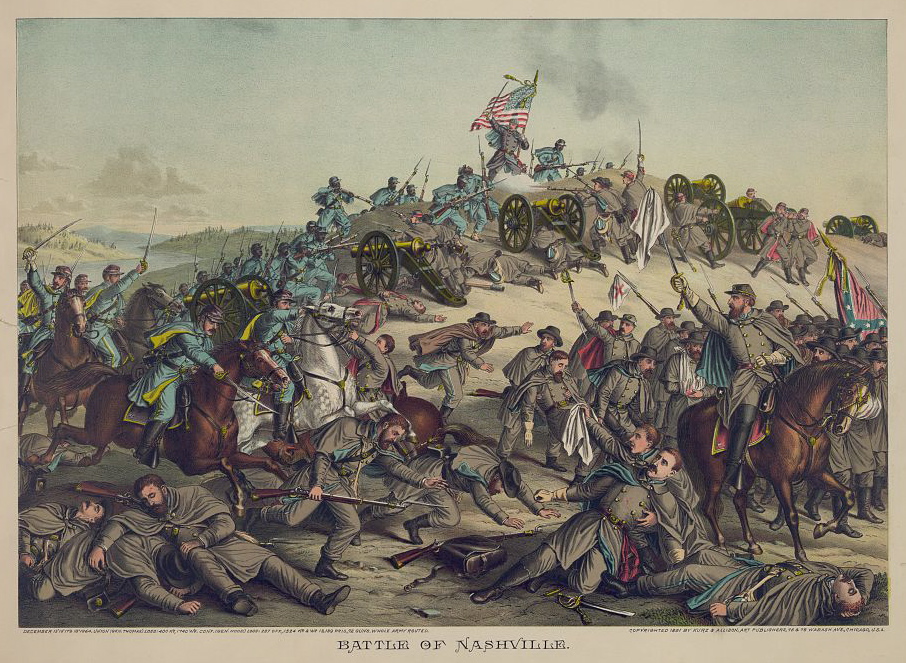
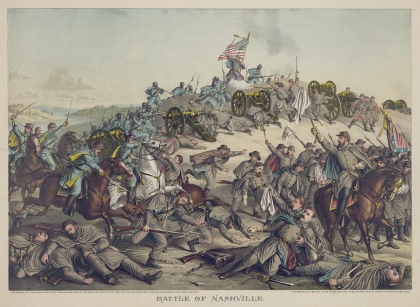
At peak one in eight Union troops were African American, and Black troops made an immense contribution to the Union victory. “Black troops fought on 41 major battlefields and in 449 minor engagements. Sixteen soldiers and seven sailors received Medals of Honor for valor. 37,000 blacks in army uniform gave their lives and untold sailors did, too.” [88] To fully appreciate the measure as to the importance and significance of the numbers of African American troops serving in the Union ranks has to compare that number with the number of active Confederate troops serving toward the end of the war. The approximately 180,000 African Americans serving in Union ranks at the end of the war outnumbered the “aggregate present” in Confederate ranks on January 1st 1865 by over 20,000 men. Of these troops “134,111 were recruited in states that had stars in the Confederate battle flag, and the latter figure in turn was several thousand greater than the total of 135,994 gray-clad soldiers “present for duty” that same day.” [89]

Of the African American soldiers who faced the Confederates in combat, “deep pride was their compensation. Two black patients in an army hospital began a conversation. One of them looked at the stump of an arm he had once had and remarked: “Oh I should like to have it, but I don’t begrudge it.” His ward mate, minus a leg, replied: “Well, ‘twas [lost] in a glorious cause, and if I’d lost my life I should have been satisfied. I knew what I was fighting for.” [90]

22nd-usct-flags                                                Flags of the 22nd U.S. Colored Troops 

After the war many of the African American soldiers became leaders in the African American community and no less than 130 of these former soldiers held elected office including in the U.S. Congress and various state legislatures. The liberating aspect of “the black military experience radiated from black soldiers and their families into the larger black community, so it spread into white society as well.” [91]  Many abolitionists who had served as officers, and officers who were assigned to the USCT or volunteered to serve with state raised African American regiments became leaders continued to be voices for expanding civil rights in the years following the war.

Following war’s end, the demobilized African American troops became the target of racial discrimination and violence, but even so, “black veterans continued to play a central role in black communities, North and South. The skills and experience black men gained during the war not only propelled many of them into positions of leaders and sustained the prominence of others, but it also shaped the expectations and aspirations of all black people. The achievements and pride engendered by military service helped to make a new world of freedom.” [92]

Sadly, much of the nation has forgotten the efforts of the Free Black Soldiers and Sailors who fought for freedom, but even so their legacy remains in the “contribution of black soldiers to Union victory remained a point of pride in black communities. “They say,” an Alabama planter reported in 1867, “the Yankees never could have whipped the South without the aid of the Negroes.” Well into the twentieth century, black families throughout the United States would recall with pride that their fathers and grandfathers had fought for freedom.” [93]

Notes 

[1] Ibid. McPherson Tried by War: Abraham Lincoln as Commander in Chief

[2] Ibid. Goodwin Team of Rivals p.435

[3] Ibid. McPherson Tried by War p.58

[4] Ibid. McPherson Tried by War p.58

[5] Ibid. Goodwin Team of Rivals p.369

[6] Ibid. McPherson Tried by War p.109

[7] Ibid. Foote, The Civil War, A Narrative Volume Two p.531

[8] Ibid. McPherson. The Battle Cry of Freedom p.503

[9] Ibid. McPherson Drawn With the Sword: Reflections on the American Civil War p.101

[10] Ibid. Guelzo Gettysburg: The Last Invasion p.160

[11] Foner, Eric Forever Free: The Story of Emancipation and Reconstruction Vintage Books a Division of Random House, New York 2005 p.45

[12] Ibid. Guelzo Gettysburg: The Last Invasion p.160

[13] Ibid. Glatthaar General Lee’s Army from Victory to Collapse p.313

[14] Ibid. Guelzo Gettysburg: The Last Invasion p.160

[15] Ibid. Goodwin Team of Rivals p.465

[16] Egnal, Marc Clash of Extremes: The Economic Origins of the Civil War Hill and Wang a division of Farrar, Straus and Giroux New York 2009 p.318

[17] Ibid. Foner Forever Free p.48

[18] Ibid. McPherson Tried by War p.159

[19] Ibid. McPherson Drawn With the Sword p.159

[20] Ibid. McPherson Abraham Lincoln and the Second American Revolution p.35

[21] Ibid. Guelzo Fateful Lightning p.381

[22] Ibid. Dobak Freedom by the Sword: The U.S. Colored Troops, 1862-1867 p.10

[23] Ibid. McPherson Abraham Lincoln and the Second American Revolution p.35

[24] Ibid. Robertson Soldiers Blue and Gray p.31

[25] Ibid. Dobak Freedom by the Sword: The U.S. Colored Troops, 1862-1867 p.11

[26] Ibid. Robertson Soldiers Blue and Gray p.31

[27] Ibid. Gallagher, Gary W. The Union War Harvard University Press, Cambridge MA and London 2011 p.103

[28] Welton, Chauncey B. A Union Soldier’s Changing Views on Emancipationin The Civil War and Reconstruction: A Documentary Collection edited by William Gienapp, W.W. Norton Company, New York and London 2001 pp.242 and 245

[29] Ibid. Robertson Soldiers Blue and Gray p.34

[30] Glatthaar, Joseph T. Black Glory: The African American Role in Union Victory in Why the Confederacy Lost edited by Gabor S. Boritt Oxford University Press, Oxford and New York 1992

[31] Ibid. McPherson. The Battle Cry of Freedom p.686

[32] Ibid. Goldfield America Aflame p.282

[33] Jones, Terry L. The Free Men of Color Go to War in The new York Times Disunion: 106 Articles from the New York Times Opinionator edited by Ted Widmer with Clay Risen and George Kalogerakis, Black Dog and Leventhal Publishers, New York 2013 p.403

[34] Ibid. Guelzo Fateful Lightening p.379

[35] Ibid. Foote The Civil War, A Narrative Volume Two p.398

[36] Ibid. Trudeau Like Men of War p.44

[37] Ibid. Guelzo Fateful Lightening p.379

[38] Ibid. McPherson. The Battle Cry of Freedom p.686

[39] Ibid. McPherson Drawn With the Sword p.101

[40] Ibid. McPherson. The Battle Cry of Freedom p.686

[41] Ibid. Guelzo Fateful Lightening pp. 380-381

[42] Ibid. McPherson. The Battle Cry of Freedom pp.686-687

[43] Ibid. Foote, The Civil War, A Narrative Volume Two p.697

[44] Ibid. McPherson. The Battle Cry of Freedom p.686

[45] Welch, Isaiah H. Letter in the Christian Recorder 24 October 1863 in The Civil War and Reconstruction: A Documentary Collection edited by William E. Gienapp, W.W. Norton and Company, New York and London 2001 pp.225-226

[46] Trudeau, Noah Andre, Like Men of War: Black Troops in the Civil War 1862-1865 Little, Brown and Company, Boston, New York and London, 1998 p.262

[47] Ibid. Guelzo Fateful Lightening p. 381

[48] Douglass, Frederick Philadelphia Speech of July 6th 1863 recorded in the Liberator in The Civil War and Reconstruction: A Documentary Collection edited by William E. Gienapp, W.W. Norton and Company, New York and London 2001 pp.220-221

[49] Ibid. Douglass Philadelphia Speech of July 6th 1863 p.221

[50] Ibid. McPherson. The Battle Cry of Freedom p.634

[51] Ibid. Trudeau Like Men of War: Black Troops in the Civil War 1862-1865p.58

[52] Ibid. Gallagher The Union War p.97

[53] Ibid. Trudeau Like Men of War: Black Troops in the Civil War 1862-1865 p.59

[54] Ibid. Gallagher The Union War p.92

[55] Ibid. McPherson Drawn With the Sword p.89 p.

[56] Catton, Bruce. A Stillness at Appomattox Doubleday and Company Garden City, New York 1953 p.227

[57] Berlin, Ira, Riedy, Joseph P. and Rowland, Leslie S. editors, Freedom’s Soldiers: The Black Military Experience in the Civil War  Cambridge University Press, Cambridge and New York 1998 pp.133-134

[58] Ibid. Catton A Stillness at Appomattox p.249

[59] Foote, Shelby, The Civil War, A Narrative. Volume Three Red River to Appomattox Random House, New York 1974 p.537

[60] Ibid.Wert The Sword of Lincoln: The Army of the Potomac pp.384-385

[61] Ibid. Foote The Civil War, A Narrative Volume Three p.537

[62] Ibid. Robertson Soldiers Blue and Gray p.34

[63] Ibid. Berlin et al, Freedom’s Soldiers: The Black Military Experience in the Civil War  p.135

[64] Ibid. Weigley A Great Civil War p.189

[65] Ibid. McPherson Battle Cry of Freedom p.566

[66] Ibid. Goldfield America Aflame p. 280

[67] Ibid. Weigley A Great Civil War p.188

[68] Ibid. Guelzo Fateful Lightening p. 377

[69] Ibid. Guelzo Fateful Lightening p. 377

[70] Ibid. Goldfield America Aflame p.281

[71] Ibid. Weigley A Great Civil War p.189

[72] Ibid. Dobak Freedom by the Sword: The U.S. Colored Troops, 1862-1867 p.208

[73] Grant, Ulysses S. Preparing for the Campaigns of ’64 in Battles and Leaders of the Civil War Volume IV, Retreat With Honor Edited by Robert Underwood Johnson and Clarence Clough Buel Castle, Secaucus NJ pp.107-108

[74] Ibid. Foote The Civil War, A Narrative Volume Three p.111

[75] Ibid. Guelzo Fateful Lightning p. 378

[76] Ibid. Foote The Civil War, A Narrative Volume Three p.112

[77] Ibid. Dobak Freedom by the Sword: The U.S. Colored Troops, 1862-1867 p.208

[78] Eakin, John R. The Slave Soldiers, June 8, 1864  in Loewen, James W. and Sebesta, Edward H. editors, The Confederate and Neo-Confederate Reader: The “Great Truth” about “The Lost Cause” University of Mississippi Press, Jackson 2010 pp.210 and 212

[79] Ibid. Berlin et al, Freedom’s Soldiers: The Black Military Experience in the Civil War  p.47

[80] Ibid. McPherson Abraham Lincoln and the Second American Revolution p.89

[81] Ibid. Glatthaar Black Glory: The African American Role in Union Victoryp.138

[82] Ibid. McPherson The War that Forged a Nation p. 113

[83] Ibid. Guelzo Fateful Lightning p. 376

[84] Ibid. Goldfield America Aflame p.282

[85] Ibid. Weigley A Great Civil War p.192

[86] Ibid. McPherson For Cause and Comrades p.130

[87] Ibid. Weigley A Great Civil War p.191

[88] Gallagher, Gary, Engle, Stephen, Krick, Robert K. and Glatthaar editors The American Civil War: The Mighty Scourge of War Osprey Publishing, Oxford UK 2003 p.296

[89] Ibid. Foote The Civil War, A Narrative. Volume Three Red River to Appomattox p.756

[90] Ibid. Robertson Soldiers Blue and Gray p.36

[91] Ibid. Berlin et al, Freedom’s Soldiers: The Black Military Experience in the Civil War  p.47

[92] Ibid. Berlin et al. Freedom’s Soldiers: The Black Military Experience in the Civil War pp.49-50

[93] Ibid. Foner Forever Free p.55

2 Comments

Filed under civil rights, civil war, History, Military, Political Commentary, racism, us army

“The Day of Reckoning Has Come” Stalingrad and the White Rose: The Sixth Pamphlet

Friends of Padre Steve’s World,

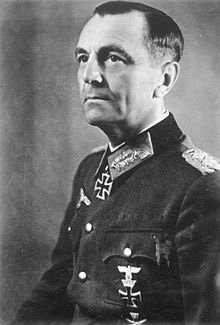
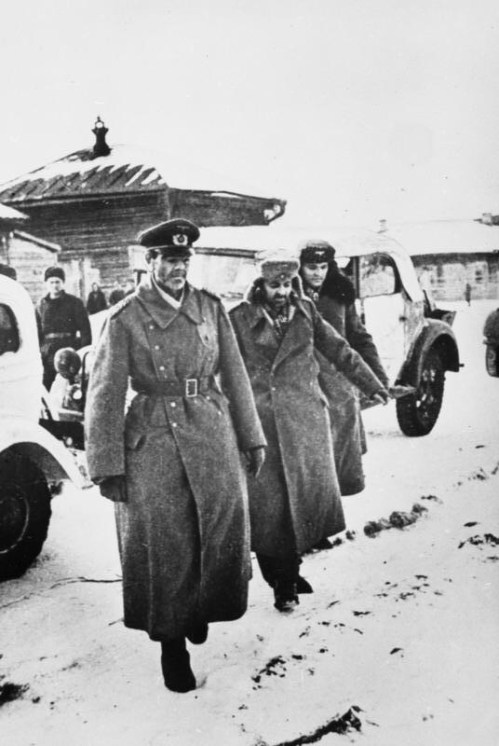
Shortly after the disaster at Stalingrad, the White Rose Resistance issued what would be their last pamphlet. In disturbing it, Sophie Scholl and her brother Hans would be arrested after being spotted by by a Gestapo informer af the University of Munich. They and their co-conspirators would be tried by the extra judicial Volksgericht headed by the notorious Nazi Judge Roland Freisler.

The pamphlet read:

Fellow Fighters in the Resistance!
*
Shaken and broken, our people behold the loss of the men of Stalingrad. Three hundred and thirty thousand German men have been senselessly and irresponsibly driven to death and destruction by the inspired strategy of our World War I Private First Class. Fuhrer, we thank you!
*
The German people are in ferment. Will we continue to entrust the fate of our armies to a dilettante? Do we want to sacrifice the rest of German youth to the base ambitions of a Party clique? No, never! The day of reckoning has come – the reckoning of German youth with the most abominable tyrant our people have ever been forced to endure. In the name of German youth we demand restitution by Adolf Hitler’s state of our personal freedom, the most precious treasure we have, out of which he has swindled us in the most miserable way.
*
We grew up in a state in which all free expression of opinion is unscrupulously suppressed. The Hitler Youth, the SA, the SS have tried to drug us, to revolutionize us, to regiment us in the most promising young years of our lives. “Philosophical training” is the name given to the despicable method by which our budding intellectual development is muffled in a fog of empty phrases. A system of selection of leaders at once unimaginably devilish and narrow-minded trains up its future party bigwigs in the “Castles of the Knightly Order” to become Godless, impudent, and conscienceless exploiters and executioners – blind, stupid hangers-on of the Fuhrer. We “Intellectual Workers” are the ones who should put obstacles in the path of this caste of overlords.

Soldiers at the front are regimented like schoolboys by student leaders and trainees for the post of Gauleiter, and the lewd jokes of the Gauleiters insult the honor of the women students. German women students at the university in Munich have given a dignified reply to the besmirching of their honor, and German students have defended the women in the universities and have stood firm….  That is a beginning of the struggle for our free self-determination – without which intellectual and spiritual values cannot be created. We thank the brave comrades, both men and women, who have set us brilliant examples. 
*
For us there is but one slogan: fight against the party! Get out of the party organization, which are used to keep our mouths sealed and hold us in political bondage! Get out of the lecture rooms of the SS corporals and sergeants and the party bootlickers! We want genuine learning and real freedom of opinion. No threat can terrorize us, not even the shutting down of the institutions of higher learning. This is the struggle of each and every one of us for our future, our freedom, and our honor under a regime conscious of its moral responsibility. 
*
Freedom and honor! For ten long years Hitler and his coadjutor have manhandled, squeezed, twisted, and debased these two splendid German words to the point of nausea, as only dilettantes can, casting the highest values of a nation before swine. They have sufficiently demonstrated in the ten years of destruction of all material and intellectual freedom, of all moral substance among the German people, what they understand by freedom and honor. The frightful bloodbath has opened the eyes of even the stupidest German – it is a slaughter which they arranged in the name of “freedom and honor of the German nation” throughout Europe, and which they daily start anew.

The name of Germany is dishonored for all time if German youth does not finally rise, take revenge, and atone, smash its tormentors, and set up a new Europe of the spirit. Students! The German people look to us. As in 1813 the people expected us to shake off the Napoleonic yoke, so in 1943 they look to us to break the National Socialist terror through the power of the spirit. Beresina and Stalingrad are burning in the East. The dead of Stalingrad implore us to take action.  “Up, up, my people, let smoke and flame be our sign!”
*
Our people stand ready to rebel against the Nationals Socialist enslavement of Europe in a fervent new breakthrough of freedom and honor.”

The necessity for the citizens of evil regimes not to turn a blind eye to their acts matters. Sometimes “My Country, Right or Wrong” is not an appropriate response to the actions of the government. However, I am not sure if anyone ever learns from history, especially when their country is the guilty party. The great British Military Historian and Theorist B. H. Liddell-Hart wrote:

“What is of value in “England” and “America” and worth defending is its tradition of freedom, the guarantee of its vitality. Our civilization, like the Greek, has, for all its blundering way, taught the value of freedom, of criticism of authority, and of harmonising this with order. Anyone who urges a different system, for efficiency’s sake, is betraying the vital tradition.”

Sophie Scholl and the White Rose were exceptions to the general attitude that a government cannot be criticized in times of crisis, national emergency, or war. They had been resisting long before Stalingrad, and this pamphlet coming on the heels of the calls of Nazi leaders to redouble war efforts is remarkable. They had no power but the pen, and though they were caught and many executed, their message was heard.

Until tomorrow,

Peace,

Padre Steve+

Leave a comment

Filed under civil rights, ethics, faith, germany, History, leadership, nazi germany, Political Commentary, world war two in europe

The Legacy and Warning of Field Marschal Von Paulus at Stalingrad: Even Honorable People Can Believe a Lie and Lead Men to Death

Friends of Padre Steve’s World,

Seventy-seven years ago today the commander of the encircled German Sixth Army at Stalingrad, Field Marshal Friedrich Paulus left his command bunker and surrendered the the Red Army. In the ruins of Stalingrad lay most of the freezing, malnourished, soldiers of his once elite Army. Around 90,000 survivors of his army surrendered in the coming days to the Red Army. Of the Germans taken prisoners, only about 5,000 returned home. The Most were to die of their wounds, or of diseases, maltreatment, and starvation in Soviet Camps between 1943 and 1955 when the bulk of the survivors were released.
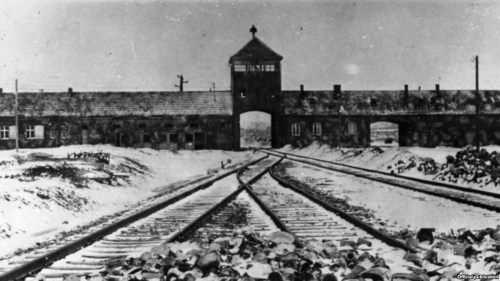
Friedrich Paulus was one of them, and his story is interesting, not simply because he was the Commander of the Sixth Army, but because he wasn’t the kind of man one would have expected to command an army of 13 divisions with a strength of nearly 285,000 men spearheading the great German Offensive of 1942.

Paulus was born in 1890, and joined the Imperial Army in 1910. During the First World War he served on the Western Front, finishing the war as a Captain. After the was the collapse of the Army and order during the German civil war he served as Adjutant of a government sponsored Freikorps Brigade. Following the Treaty of Versailles, Paulus was retained as one of the 4,000 officers in the new Reichsheer. He served as a staff officer and company commander, and briefly commanded a battalion. He would also serve on the staff which developed the new Panzer Forces for the Wehrmacht. Paulus was an apolitical professional soldier, he was not a Nazi but he, like many other military men considered Hitler:

“an excellent leader for the German people, a man who had contributed greatly to the development of the state. After watching him evolve the strategies that conquered Poland, France, and most of Europe, Paulus was awed by Hitler’s grasp of the technical aspects of warfare. He considered him a genius.”

Paulus was promoted to Colonel in 1938 and served as Chief of Staff to Heinz Guderian’s XVI Motorized Corps. But Guderian had reservations about Paulus’s lack of command experience, decisiveness, and toughness. Following his assignment with the motorized Corps, Paulus was promoted to the rank of Generalmajor (the equivalent of a U.S. Brigadier General) to serve as Chief of Staff to the 10th Army under the command of General Walter Reichenau during the invasion of Poland. He continued in that position when 10th Army was redesigned 6th Army for the Invasion Of France and the Low Countries.

After the Battle of France he was promoted to Generalleutnant and assigned as deputy Chief Staff, Operations, of the Oberkommando Des Heeres, the German General Staff. In this capacity he served as one of the principle planners of Operation Barbarossa.

His wife, Elena, a descendant of one of Romania’s Royal Houses was opposed to Hitler and the war. She told her husband that “he was far too good for the likes of men such as Keitel and the other “lackeys” who surrounded Hitler.” She protested the injustice of the war against Poland, but he, in the thrall of Hitler’s genius and simply followed orders. When he brought home maps and documents related to Barbarossa she again protested to him. When he ignored her she said:

“What will become of us all? Who will survive to the end?”

Since he believed in Hitler’s invincibility, Paulus ignored her concerns, and told her that the war would be over in six weeks. Elena’s words would prove prophetic.

But Elena’s concerns were well justified. In December 1941 the German Offensive ground to a halt at the gates of Moscow and a devastating Red Army counterattack created a crisis in the Wehrmacht which was completely unprepared for the Russian Winter. Only heroic resistance and improvisation by German units, and the still imperfect application of operational warfare by the Red Army, saved the German front. While battles from Leningrad to Crimea continued throughout the winter, the lines stabilized, and both sides began their plans for the coming year.

During the winter debacle Hitler sacked many commanders, which left many command vacancies. Reichenau, a committed National Socialist and fanatical fighter took over command of Army Group South from Field Marshal Gerd Von Rundstedt, who had been fired by Hitler. Reichenau, who had been Paulus’s patron had Paulus promoted to General der Panzertruppen and named as commander of 6th Army.

The two men were nothing alike and Paulus had never commanded more than a battalion, and that not in peacetime. However, six days later the athletic Reichenau suffered a heart attack, which was was followed by a head injury during a medical evacuation flight back to Germany. Reichenau, the fanatical Nazi died, and Paulus, revoked the infamous Commissar Order, as well as Reichenau’s most notorious orders, the Severity Order in the Sixth Army area of operations. That order stated:

“The most important objective of this campaign against the Jewish-Bolshevik system is the complete destruction of its sources of power and the extermination of the Asiatic influence in European civilization.… In this eastern theatre, the soldier is not only a man fighting in accordance with the rules of the art of war, but also the ruthless standard bearer of a national conception.… For this reason the soldier must learn fully to appreciate the necessity for the severe but just retribution that must be meted out to the subhuman species of Jewry.…”

Paulus demonstrated moral courage unusual for senior German officers, but he also forbade cooperation with the Einsatzgruppen death squads, which Reichenau had gone out of his way to support. This was unusual for any commander on the Eastern Front, especially a man like Paulus who believed in Hitler’s invincibility. Paulus did well in his first combat with the Red Army, when it attempted to disrupt the coming German offensive at Kharkov as Sixth Army encircled and captured over 200,000 Soviet troops.

The Sixth Army had a key role in the German summer offensive, Operation Blau. Paulus commanded it well but became involved in the battle for Stalingrad. The battle dragged on in the face of fanatical and skilled Soviet resistance. However, Hitler would not let Paulus break off the Battle, and promoted him to Colonel Genera in order to bolster his confidence. Likewise, in an interesting, but vital footnote to the campaign, which was unknown to Hitler and his commanders, Stalin knew of Operation Blau.

Stalin had learned to preserve his forces after the catastrophes of 1941 withdrew his forces and observing the German movements decided to turn Stalingrad into a fortress. He conducted a strategic withdraw to preserve his forces, allowing the majority of the German Army Group South to advance deep into the Caucasus in order to capture the oilfields of the region.

However, this movement divided the German armies, leaving the flanks of the Sixth Army protected by pathetically equipped Italian, Romanian, and Hungarian armies. None of these units could not match the manpower, mobility, or firepower of the Red Army, and none were prepared for the onslaught that was to be directed against them.

Stalin allowed the German Army Group South to continue to advance, and forced the Sixth Army to battle street by street, building by building, factory by factory to capture Stalingrad. Had the Germans followed their operational doctrine Stalingrad would have been bypassed and surrounded, but they didn’t, Hitler would not allow it. Because of this, Paulus allowed the Soviets to maintain their defense by not cutting the Red Army defenders in the city off from the Volga, even by not taking action to link up with the Fourth Panzer Army which under its commander Hermann Hoth had broken through the Soviet front south of the Stalingrad when the opportunity presented itself.

Even so, the Sixth Army had conquered most of the city when in lateNovember the Red Army launched Operation Uranus, which was designed to destroy the weakly held flanks and surround the Sixth Army by a deep envelopment operation, which had previously been the forte of the German Blitzkrieg. The operation totally surprised the Germans and in four days time the Sixth Army went from the spearhead of the German assault to an army cut off and surrounded by a Soviet Army Group. The Italian, Hungarian, and Romanian armies on its flanks were shattered.

Plans were made to relieve the Sixth Army but they depended on the Sixth Army attacking out to meet the relief forces of the Fourth Panzer Army. Hitler refused permission and Paulus obeyed, believing Hitler’s promise that Goering’s Luftwaffe would be able to keep his troops supplied. On New Year’s Day Hitler promoted Paulus to Colonel General. Paulus was now convinced that his Army was doomed but he grasped the broader strategic situation; as long as he could keep the Red Army invested in Stalingrad, it would keep them from encircling the much bigger portion of Army Group South, now under direction of Erich von Manstein from being cut off. According to one officer Paulus remarked:

“What would become of the war if our army in the Caucasus were also surrounded? That danger is real. But as long as we keep on fighting, the Red Army has to remain here. They need these forces for a big offensive against Army Group ‘A’ in the Caucasus and along the still-unstable front from Voronesh to the Black Sea. We must hold them here to the last so that the eastern front can be stabilized. Only if that happens is there a chance of the war going well for Germany.”

But the handwriting was on the wall. German Forces to the south were having to extricate themselves from an even bigger encirclement. The superb generalship of Field Marshal Erich Von Manstein prevented a complete disaster and inflicted a compelling defeat on the Red Army, but the Sixth Army was doomed. On January January 7th Paulus was offered generous surrender terms by General Konstantin Rokossovsky. Paulus asked permission to surrender which was denied by Hitler.

Again on January 22nd Paulus requested his Fuhrer:

… For submittal to the Führer and to commander in chief, Army Group Don.… The Russians are advancing on a six-kilometer frontage both sides of Voporonovo toward the east, [toward Stalingrad] in part with flying colors. There is no possibility to close the gap … All provisions are used up. Over twelve thousand unattended [wounded] men in the pocket. What orders am I to issue to the troops, who have no ammunition left? … Immediate decision is required, since symptoms of disintegration are noted in some places. However, the troops still have faith in their commanders.” Paulus

On January 25th the Red Army overran the last airfield in the Stalingrad pocket, now there was no escape.

To a Luftwaffe Officer who was sent by Berlin to encourage Paulus about new airlifts, Paulus said:

“Why on earth did the Luftwaffe ever promise to keep us supplied? Who is the man responsible for declaring that it was possible? Had someone told me it was not possible, I should not have held it against the Luftwaffe. I could have broken out. When I was strong enough to do so. Now it is too late.…”

Paulus radioed Hitler for permission to surrender, empathetically stating the conditions in the pocket. No food, no medicine, no ammunition, no fuel; only to be denied again.

On January 30th, the 10th anniversary of Hitler’s seizure of power the Troops in Stalingrad were treated to a radio broadcast from Berlin, not Hitler, but Goering. The words of the Reichsmarschal fell hollow on the ears of the doomed men:

“… What herculean labors our Führer has performed … out of this pulp, this human pulp … to forge a nation as hard as steel. The enemy is tough, but the German soldier has grown tougher.… We have taken away the Russians’ coal and iron, and without that they can no longer make armaments on a large scale.… Rising above all these gigantic battles like a mighty monument is Stalingrad.… One day this will be recognized as the greatest battle in our history, a battle of heroes.… We have a mighty epic of an incomparable struggle, the struggle of the Nibelungs. They, too, stood to the last.… My soldiers, thousands of years have passed, and thousands of years ago in a tiny pass in Greece stood a tremendously brave and bold man with three hundred soldiers, Leonidas with his three hundred Spartans.… Then the last man fell … and now only the inscription stands: ‘Wanderer, if you should come to Sparta, go tell the Spartans you found us lying here as the law bade us.’… Someday men will read: ‘If you come to Germany, go tell the Germans you saw us lying in Stalingrad, as the law bade us.…’”

The soldiers knew that they had been abandoned by Berlin. Yet, Paulus, ever loyal radioed:

January 30th:

On the tenth anniversary of your assumption of power, the Sixth Army hails its “Führer.” The swastika flag is still flying above Stalingrad. May our battle be an example to the present and coming generations, that they must never capitulate even in a hopeless situation, for then Germany will come out victorious.

Hail my Führer Paulus, Generaloberst

But it was a lie. Less than 24 hours later on January 31st with Red Army tanks and troops outside his command bunker, Paulus surrendered, just hours after Hitler promoted him to Field Marshal. The promotion was supposed to encourage Paulus to commit suicide as no German Field Marshal had ever surrendered his army.

Colonel Adam, an aide to Paulus recorded how Paulus received his promotion:

January 31, 1943 – 7.00 a.m. It was still dark but day was dawning almost imperceptibly. Paulus was asleep. It was some time before I could break out of the maze of thoughts and strange dreams that depressed me so greatly. But I don’t think I remained in this state for very long. I was going to get up quietly when someone knocked at the door. Paulus awoke and sat up. It was the HQ commander. He handed the colonel general a piece of paper and said: ‘Congratulations. The rank of field marshal has been conferred upon you. The dispatch came early this morning – it was the last one.’

‘One can’t help feeling it’s an invitation to suicide. However I’m not going to do them such a favour.’ said Paulus after reading the dispatch. Schmidt continued: ‘At the same time I have to inform you that the Russians are at the door.’ with these words he opened the door and a Soviet general and his interpreter entered the room. The general announced that we were his prisoners. I placed my revolver on the table.”

Paulus surrendered, and contrary to Hitler’s wishes did not commit suicide. In the next few days the other isolated pockets of German resistance surrendered as well. Roughly 95,000 Germans, Italians, and Romanians surrendered at Stalingrad. Fewer than 6,000 would return home after nearly a decade of imprisonment and forced labor.

In Hitler’s headquarters the scene was terrifying. Hitler ranted about the treason and cowardice of Paulus, and his lackeys in the military agreed. Paulus should have shot himself and the garrison formed a hedgehog and resisted to the last bullet.

Though he surrendered Paulus did not give support to the Soviets or the German resistance until he learned of the execution of his Friend Field Marshal Erich von Witzleben and others for their participation in the attempt to kill Hitler. When he learned of their deaths he joined the he joined the Communist-inspired Bund Deutsche Offiziere, an “anti-Fascist” group that broadcast appeals to the citizens of the Third Reich against the Hitler regime.

After the war he testified at the Nuremberg Trials admitting German conduct of the war in the east was criminal but refusing to label men like Wilhelm Keitel, and Afred Jodl as war criminals. He took up a position as the civilian chief for military history for the new East German Government. He died on February 1st 1957, of ALS, having never seen his wife since he left to take command of Sixth Army in January 1942, she died in 1949. His son Alexander was killed at Anzio in 1944. His other son, Ernst, survived the war and committed suicide in 1970.

Paulus’s fate is an object lesson for military personnel, civil servants, or police officials who themselves are apolitical, and that honorable can people become seduced and believe in cults of personality. In the end, many sacrifice their lives, reputations, and even their families.

Without mentioning any names, the Americans who worship at the cult of Trump should pay heed. like Paulus, their loyalty will be betrayed, and even as their leader abandons them.

Until tomorrow,

Peace,

Padre Steve+

10 Comments

Filed under ethics, faith, germany, History, holocaust, Military, nazi germany, News and current events, Political Commentary, world war two in europe

What You Leave Behind: Thoughts on Leaving Iraq 12 Years Ago and Star Trek Deep Space Nine


Friends of Padre Steve’s World,

Tonight, Judy and I finished a several month marathon of Star Trek Deep Space Nine. The final episode was titled What You Leave Behind. It so happens that today is the twelfth anniversary of my last full day in Iraq. To me those memories are bittersweet. As Charles Dickens wrote: “It was the best of times, and the worst of times.”

I left a significant part of my soul in Iraq, and truthful, only part of me came back. I don’t know what part, I am still trying to figure that out, maybe I’ll figure it out someday and maybe I won’t, but does it really matter? Honestly, after twelve years does it really matter? For me everything changed after Iraq, just like in an imaginary science fiction show everything changed for every character. I am not going to try to describe the entire two part episode, but the great folks at Memory Alpha have done that very well. If you like any Star Trek series you need to visit that sight.  https://memory-alpha.fandom.com/wiki/What_You_Leave_Behind_(episode)

The episode is set at the end of great and costly war, political, and social change. In a sense DS9 is the perfect series for someone like me. It is my favorite Star Trek series, because it demonstrates the complicated nature and gray areas of life, faith, politics, relationships, alliances, power, and even love.

For the past week I have been having troubling nightmares and terrors, some of which almost seem like visions of the future. Some are directly related to my time in Iraq, evidently in one of them Judy had to deflect an attack from me. I have a neurological condition that when I am in REM sleep, my body still acts out my dreams and nightmares. I have had three incidents where I hurt myself bad enough to go to the ER, or medical clinic, including a broken nose.

But these have been different from past ones. They are a combination of Iraq experienced transposed into the future, a future where I watch our military mobilizing and going to war, and the. evacuating bases, destroying computers, and burning or shredding documents, and I am there in the middle of it. In these nightmares I see cities burning, people dying by the millions, and the United States, like the Federation in DS9 is not entirely innocent, just like Vietnam and Iraq. Of course the Federation was fighting a superior power, the Dominion and tried to conduct genocide against the Founders of the Dominion; although the Dominion Founders had no problem with genocide either, including their allies in the Alpha Quadrant. But I digress, I am struggling, and vulnerable; and despite my attempts to be strong, and fight rather than resort to flight, I am pissing people off. I seem to be coming across as overly sensitive and defensive, ready to fight and unwilling to compromise when I see people who have helped me attacked by friends on the right and the left. It seems that there are very few safe spaces left, so given the choice of whether to run away, go underground, or fight, I usually choose the latter.

Near the end of the episode, Dr. Bashir, and the former Cardassian Intelligence Agent and exile Garak, stand victorious in the ruins of Cardassia Prime, Garak and Bashir have the following conversation:

Bashir: “Eight hundred million dead.”
Garak: “And casualty reports still coming in. Well, aren’t you going to congratulate me, Doctor? My exile is now officially over. I’ve returned home. Or rather, to what’s left of it.”
Bashir: “Listen, I know that this must seem bleak.”
Garak: “Some may say that we’ve gotten just what we deserved. After all, we’re not entirely innocent, are we? And I’m not just speaking of the Bajoran occupation. No, our whole history is one of arrogant aggression. We’ve collaborated with the Dominion, betrayed the entire Alpha Quadrant. Oh, no, no. There’s no doubt about it. We’re guilty as charged.”
Bashir: “You and I both know that the Cardassians are a strong people. They’ll survive. Cardassia will survive.”
Garak: “Please, Doctor. Spare me your insufferable Federation optimism. Of course it will survive, but as not the Cardassia I knew. We had a rich and ancient culture. Our literature, music, art were second to none. And now, so much of it is lost. So many of our best people, our most gifted minds.”
Bashir: “I’m sorry, Garak. I didn’t mean…”
Garak: “Oh, it’s quite all right, Doctor. You’ve been such a good friend. I’m going to miss our lunches together.”
Bashir: “”I’m sure we’ll see each other again.”
Garak: “I’d like to think so, but one can never say. We live in uncertain times.”

I have to say that I now really understand that conversation, especially when the President of the United States openly consorts with the enemies of the United States, defames long time allies, and treats his senior military and foreign policy advisors as traitors, and incompetents.

But that is enough for the night. I have learned not to trust ideologues of the far right or the far left who promote scorched earth policies with anyone who offends them without trying to understand their opposites. I try to understand, but then I see people who I thought were safe condemn me. By being me and attempting to retain a sense of honor All of my life, I might end up achieving a place in Sto’Vo’Kor, the Klingon afterlife for the honored dead.

But as the Ferengi bartender Quark noted: “It’s like I said: the more things change, the more they stay the same.” But the fact is that the world that we think we know is not linear.

Until tomorrow,

Peace,

Padre Steve+

3 Comments

Filed under ethics, faith, film, iraq, iraq,afghanistan, national security, Political Commentary, Religion, televsion, Tour in Iraq

The Antidote to Theocracy and Authoritarian Dictatorship Done in the Name of Any God: The Virginia Statute of Religious Rights

Friends of Padre Steve’s World,

Two hundred and thirty four years ago, in the year 1786, the the legislature of the Commonwealth Of Virginia ratified a law written by Thomas Jefferson. It was the precursor to the Establishment and the Free Exercise Clauses Of the First Amendment to the Constitution of the United States.

It is the antithesis of, and the antidote to all theocratic movements, to include contemporary Christian Nationalism and it’s close cousin Christian Dominionism, or as it is sometimes called Seven Mountains Theology.

Jefferson, James Madison, and their Virginia Baptist ally, John Leland understood the threat to a republic such as ours posed by religious theocrats of any type, to include Christians.

The Virginia statute was necessitated by militant Anglicans who desired to re-establish themselves as the state religion in Virginia and had gone about using physical violence against various dissenters, especially Virginia’s Baptist minority. It is fascinating, in a frightening and grotesque sense of the word to see Virginia Baptists like Jerry Falwell Jr., and other Evangelical leaders of the Free Church tradition, including Pat Robertson, Franklin Gresham, Paula White, John Hagee, Robert Jeffress, Rick Wiles, and a host of other contemporary theocrats interpreting Religious Freedom in a manner similar to the Anglicans of Virginia in the 1780s, or in the manner of all Christians who follow the path of Constantine.

Not all of these religious leaders are Baptists, but many are independents, charismatics, Pentecostals, and other conservative Evangelicals of many denominations have thrown their lot in the hat of theocracy and authoritarian rule.

Such was the warning of the great Southern Baptist Pastor and seminary president George Truett, who wrote:

“Constantine, the Emperor, saw something in the religion of Christ’s people which awakened his interest, and now we see him uniting religion to the state and marching up the marble steps of the Emperor’s palace, with the church robed in purple. Thus and there was begun the most baneful misalliance that ever fettered and cursed a suffering world…. When … Constantine crowned the union of church and state, the church was stamped with the spirit of the Caesars…. The long blighting record of the medieval ages is simply the working out of that idea.”

The Virginia Statute stood in complete opposition to theocratic minded Americans then, and now. The statute which I post below in its entirety is must reading for anyone who thinks that they understand what the founders of the United States believed about religious liberty:

An Act for establishing religious Freedom

Whereas, Almighty God hath created the mind free;

That all attempts to influence it by temporal punishments or burthens, or by civil incapacitations tend only to beget habits of hypocrisy and meanness, and therefore are a departure from the plan of the holy author of our religion, who being Lord, both of body and mind yet chose not to propagate it by coercions on either, as was in his Almighty power to do,

That the impious presumption of legislators and rulers, civil as well as ecclesiastical, who, being themselves but fallible and uninspired men have assumed dominion over the faith of others, setting up their own opinions and modes of thinking as the only true and infallible, and as such endeavouring to impose them on others, hath established and maintained false religions over the greatest part of the world and through all time;

That to compel a man to furnish contributions of money for the propagation of opinions, which he disbelieves is sinful and tyrannical;

That even the forcing him to support this or that teacher of his own religious persuasion is depriving him of the comfortable liberty of giving his contributions to the particular pastor, whose morals he would make his pattern, and whose powers he feels most persuasive to righteousness, and is withdrawing from the Ministry those temporary rewards, which, proceeding from an approbation of their personal conduct are an additional incitement to earnest and unremitting labours for the instruction of mankind;

That our civil rights have no dependence on our religious opinions any more than our opinions in physics or geometry,

That therefore the proscribing any citizen as unworthy the public confidence, by laying upon him an incapacity of being called to offices of trust and emolument, unless he profess or renounce this or that religious opinion, is depriving him injuriously of those privileges and advantages, to which, in common with his fellow citizens, he has a natural right,

That it tends only to corrupt the principles of that very Religion it is meant to encourage, by bribing with a monopoly of worldly honours and emoluments those who will externally profess and conform to it;

That though indeed, these are criminal who do not withstand such temptation, yet neither are those innocent who lay the bait in their way;

That to suffer the civil magistrate to intrude his powers into the field of opinion and to restrain the profession or propagation of principles on supposition of their ill tendency is a dangerous fallacy which at once destroys all religious liberty because he being of course judge of that tendency will make his opinions the rule of judgment and approve or condemn the sentiments of others only as they shall square with or differ from his own;

That it is time enough for the rightful purposes of civil government, for its officers to interfere when principles break out into overt acts against peace and good order;

And finally, that Truth is great, and will prevail if left to herself, that she is the proper and sufficient antagonist to error, and has nothing to fear from the conflict, unless by human interposition disarmed of her natural weapons free argument and debate, errors ceasing to be dangerous when it is permitted freely to contradict them:

Be it enacted by General Assembly that no man shall be compelled to frequent or support any religious worship, place, or ministry whatsoever, nor shall be enforced, restrained, molested, or burthened in his body or goods, nor shall otherwise suffer on account of his religious opinions or belief, but that all men shall be free to profess, and by argument to maintain, their opinions in matters of Religion, and that the same shall in no wise diminish, enlarge or affect their civil capacities. And though we well know that this Assembly elected by the people for the ordinary purposes of Legislation only, have no power to restrain the acts of succeeding Assemblies constituted with powers equal to our own, and that therefore to declare this act irrevocable would be of no effect in law; yet we are free to declare, and do declare that the rights hereby asserted, are of the natural rights of mankind, and that if any act shall be hereafter passed to repeal the present or to narrow its operation, such act will be an infringement of natural right.

Please, take some time to let those words sink in, especially if you think that religious liberty is only for people of your favorite religion, or the one that you belong to. The fact is, that those who established religious liberty in the United States, many of them like John Leland, professing Christians, did not think that religious liberty was for the powerful, or those who wanted to dominate others on the basis of religion wedded to government and political power.

Leland wrote:

“The notion of a Christian commonwealth should be exploded forever. … Government should protect every man in thinking and speaking freely, and see that one does not abuse another. The liberty I contend for is more than toleration. The very idea of toleration is despicable; it supposes that some have a pre-eminence above the rest to grant indulgence, whereas all should be equally free, Jews, Turks, Pagans and Christians.”

With that I bid you a good night, or maybe a troubling one. It all depends on ones perspective. I don’t say that lightly; but really, considering my vivid dreams, nightmares, and night terrors brought on by PTSD and a neurological condition that ensures that those dreams, nightmares, and terrors are acted out when I am in REM sleep, maybe it is a necessary step to healing.

If you value freedom those words may be hopeful; but if you don’t, they are a threat, a threat of unlimited government and religious power. The fact is, that all of us, regardless of our religious beliefs, or lack thereof must take them to heart when we proclaim our loyalty to the Constitution, and our belief in the First Amendment to it, if we don’t we actively proclaim our opposition to the ideals of our Founders, but I digress. The simple fact and problem is that authoritarians and theocrats hate the First Amendment, and have to twist it to ensure that only their rights are protected and enhanced. However, the Virginia Statute ,and the First Amendment at meant by the Founders, threatens their desires of theocracy and unbridled state power, and so long as we believe it and fight for it, undermines their power. My friends, if you know history, that is not a bad thing. As John Emerich Edward Dalberg-Acton wrote: “Power tends to corrupt, and absolute power corrupts absolutely. Great men are almost always bad men…”,

Think about it, the police power of the state married to religion. For God’s sakes, we are not Iran, Saudi Arabia, the Taliban, the perverted Shinto of Imperial Japan, the Tsarist and Putin’s Russia, or any other state that relies on the unwavering loyalty of its religious majority, or powerful minority, to maintain power. In time they all come crashing down, as will Trump’s Cult.

Until tomorrow,

Peace,

Padre Steve+

Leave a comment

Filed under afghanistan, civil rights, culture, ethics, faith, History, laws and legislation, News and current events, Political Commentary, racism, Religion

International Holocaust Remembrance Day 2020, the Liberation of Auschwitz at 75 Years: To Forget is to Kill Twice

Friends of Padre Steve’s World,

Seventy-five years ago today the Red Army’s 100th Division liberated the Auschwitz Concentration Camp. There were somewhere between 7000 and 9000 prisoners left in the camp. The crematoria had been destroyed as well as most of the gas chambers. The SS had evacuated by forced march to railhead miles away from the camp, in order to take them to other Concentration Camps deeper in Germany; Buchenwald, Bergen-Belsen, Ravensbruck, and others.

Auschwitz was liberated, the Nazis continued to exterminate Jews at other camps and conducted forced marches in freezing winter weather to keep them from being liberated, marches which were both deadly and inhuman. Actions that even Heinrich Himmler had forbidden. Many of these actions were the work of Adolf Eichmann.

Even Rudolf Höss the former Commandant of Auschwitz, who admitted to killing over one and a half-million Jews, was appalled by the senseless brutality of what he saw. Höss, the meticulous killer of millions, was shocked by the columns of emaciated and Jews, with no winter clothing or in many cases not even shoes that Eichmann marched from Budapest and other cities and camps to Austria and Czechoslovakia in late 1944 and 1945 to keep the Russians from liberating them, even against the orders of Himmler.

There have been many episodes of genocide in human history, but none were more pointedly directed at a single group of people based on race hatred than the Holocaust of the Jews. While it is true that the Nazis exterminates millions of people than the nearly six million Jews they dispatched during the Holocaust. This is important, as the late Christopher Hitchens noted:

“We should not at all allow ourselves to forget the millions of non-Jewish citizens of Belarus, Russia, Ukraine, and other Slav territories who were also massacred. But for me the salient fact remains that anti-Semitism was the regnant, essential, organizing principle of all the other National Socialist race theories. It is thus not to be thought of as just one prejudice among many.” 

Hitchens was right, without the primary Nazi hatred and determination to obliterate the Jews from the face of the earth, their other atrocities would never occurred. Today, that rabid anti-semitism is again raising its evil head in Eastern and Western Europe, the Middle East, and even in the United States.

It is impossible for an objective person to deny this fact. Hate crimes against Jews are blossoming around the world like toxic mushrooms. The new perpetrators are the descendants of the former perpetrators, Protestant, Catholic, and Orthodox Christians, Muslims, and secularists who embrace the same social Darwinism that motivated many of the Nazis.

Or course the non-Muslim opponents of the Jews today also despise dark skinned minorities, non-Christians, not to mention atheists and secularists; thus what Hitchens says is still as accurate as it was when he wrote those words.

So here we are, Holocaust Remembrance Day, 2020. The question is, will we allow it to happen again? The late Iris Chang, who documented the Rape Of Nanking noted: “to forget a holocaust is to kill twice.” Sadly, I believe that without a sea change in public opinion and knowledge about the Holocaust, genocide, and anti-semitism we will see it happen again.

But will we allow it to happen again? I would hope not, but I have to say that human nature and the course of events is leading me to believe that it will happen again, maybe even in our lifetime.

That may be difficult to accept, but it is reality. What is the alternative to telling the truth? Except to perpetuate a lie, except to take the side of the perpetrators, and those who would do the same today. That includes many of President Trump’s most loyal supporters, Evangelical Christians who while outwardly allying with Israel, only do so in that their interpretation of Biblical prophecy might be fulfilled. That interpretation is that Christians will be raptured from the earth, and during a seven year Great Tribulation the Anti-Christ will conquer his foes and that in the end over two-thirds of all Jews will be killed, while the survivors convert to follow Christ.

Honestly, I cannot deem such politicized and racist theology to be Christian, or respectful and considerate of the elder brother of the Christian faith, Judaism, without which Christianity wouldn’t exist. Let me repeat that. Without Judaism Christianity would not exist, and the treatment of the Jews by the Christian Church has been shameful for the majority of its existence. I say that as a Christian.

In the 1930s and 1940s the Nazis created the euphemism the Jewish Question in order to remove the aspect of humanity from their policy. It wasn’t about human beings, it was about people that they considered sub-human minority that they were able to demonize to expedite their elimination. Hitchens wrote:

“Die Judenfrage,’ it used to be called, even by Jews. ‘The Jewish Question.’ I find I quite like this interrogative formulation, since the question—as Gertrude Stein once famously if terminally put it—may be more absorbing than the answer. Of course one is flirting with calamity in phrasing things this way, as I learned in school when the Irish question was discussed by some masters as the Irish ‘problem.’ Again, the word ‘solution’ can be as neutral as the words ‘question’ or ‘problem,’ but once one has defined a people or a nation as such, the search for a resolution can become a yearning for the conclusive. Endlösung: the final solution.”

Thus, once one labels the Jews, or for that matter any other despised minority a question, or a problem, we place ourselves on the path to Trump administration and his followers have done that since 2015 regarding Mexicans and other Hispanics, Arabs, Haitians, Sub-Saharan Africans, and too many others.

That is why I cannot be silent. I have to proclaim the words of Ellie Wiesel:

“I swore never to be silent whenever and wherever human beings endure suffering and humiliation. We must take sides. Neutrality helps the oppressor, never the victim. Silence encourages the tormentor, never the tormented.”

Silence it not an option, and to again quote Wiesel: “For the dead and the living, we must bear witness.”

We must bear witness, for if we do not it will happen again. Humanity is the one constant in history, and there are no exceptions once one begins down the path to labeling the fate of races, nations, and peoples a question or a problem which they can resolve with a solution, the more comprehensive, total, or final, the better. There are certainly plenty of people, including Trump’s closest advisors who would make draconian laws in order to enable the government to commit genocide.

Yehuda Bauer wrote:

“The horror of the Holocaust is not that it deviated from human norms; the horror is that it didn’t. What happened may happen again, to others not necessarily Jews, perpetrated by others, not necessarily Germans. We are all possible victims, possible perpetrators, possible bystanders.”

In the wake of an number of situations that I have seen and have watched in morbid fascination be debated on my Facebook, and Twitter timelines, as well a potential Holocaust Denier who commented on my blog yesterday, I realize that with the prevailing attitudes being stoked by men like President Trump, his media supporters, and sadly, far too many Conservative Christians, that it will quite probably happen again.

I will fight it, butI have no doubt of the power, passion, and petulance of people consumed by race hatred under the guise of patriotism.

Until tomorrow,

Peace,

Padre Steve+

Leave a comment

Filed under ethics, faith, History, holocaust, laws and legislation, leadership, nazi germany, News and current events, Political Commentary, world war two in europe

Survival as What? Truth, Justice, and the Value of a Single Human Life in the Age of Trump

Friends of Padre Steve’s World,

Yesterday I wrote about the rise in Anti-Semitism as reflected in an email sent to me by a Jewish friend and champion of religious liberty. With that rise rise in Anti-Semitism the film Judgment at Nuremberg, came to my mind today. So I am following that up that post with an, albeit, short post regarding one of the most riveting monologues in film from that film, which is a factionalized account of the Nuremberg Judge’s Trial.

 Since yesterday marked the beginning Holocaust Remembrances, which cumulated on the 27th with the actual Holocaust Remembrance Day, and the liberation of Auschwitz, it is appropriate to take the time to never forget. For while we may not want to admit it, as human beings we are all capable of the same inhumanity. Yesterday, one of the President’s aids was quoted as saying “I can’t wait until the revenge (for impeachment) begins” If that doesn’t make make you tremble, in combination with a threat from the President to GOP Senators who vote for witnesses and the introduction of documents and other evidence; one has to take it seriously. As a historian I cannot ignore the Night of the Long Knives when Hitler, Himmler, and Goering joined forces with the Army to exact vengeance on some of Hitler’s longest, and closest supporters in the Nazi Party, German conservative parties, and even Army generals.

The segment of the film, in which Spencer Tracy plays the role of Chief Judge Dan Heywood gives his verdict is one of the most telling sequences in cinema regarding what it is to be an American. I always showed it in the first session of my military ethics class at the Staff College and since the majority of my students had never seen the film, and it usually left them in silence. So I am just going to leave it with you to watch, read, and contemplate. Who are we, and what do we stand for?

This is especially true when the President, politicians of the majority party in the legislature, pundits, and politically minded preachers make no bones that they have every intent of persecuting those who are of certain races, religions, or political beliefs that they abhor, often using the most scurrilous charges, and outright lies in order to demonize them, dehumanize them, and  open the door for normal, decent, and even brilliant people to justify government sponsored cruelty and injustice that defies the ideals of the Declaration of Independence, the Gettysburg Address, and the Constitution itself, even in the midst of an impeachment trial.

Please, watch the video and read the text. Ponder it in your heart, because it speaks to something that is not a historical aberration, not just a dramatic film, but something that affects the human condition and is present right here and right now in our own country.

“The trial conducted before this Tribunal began over eight months ago. The record of evidence is more than ten thousand pages long, and final arguments of counsel have been concluded.

Simple murders and atrocities do not constitute the gravamen of the charges in this indictment. Rather, the charge is that of conscious participation in a nationwide, government organized system of cruelty and injustice in violation of every moral and legal principle known to all civilized nations. The Tribunal has carefully studied the record and found therein abundant evidence to support beyond a reasonable doubt the charges against these defendants.

Herr Rolfe, in his very skillful defense, has asserted that there are others who must share the ultimate responsibility for what happened here in Germany. There is truth in this. The real complaining party at the bar in this courtroom is civilization. But the Tribunal does say that the men in the dock are responsible for their actions, men who sat in black robes in judgment on other men, men who took part in the enactment of laws and decrees, the purpose of which was the extermination of humans beings, men who in executive positions actively participated in the enforcement of these laws — illegal even under German law. The principle of criminal law in every civilized society has this in common: Any person who sways another to commit murder, any person who furnishes the lethal weapon for the purpose of the crime, any person who is an accessory to the crime — is guilty.

Herr Rolfe further asserts that the defendant, Janning, was an extraordinary jurist and acted in what he thought was the best interest of this country. There is truth in this also. Janning, to be sure, is a tragic figure. We believe he loathed the evil he did. But compassion for the present torture of his soul must not beget forgetfulness of the torture and the death of millions by the Government of which he was a part. Janning’s record and his fate illuminate the most shattering truth that has emerged from this trial: If he and all of the other defendants had been degraded perverts, if all of the leaders of the Third Reich had been sadistic monsters and maniacs, then these events would have no more moral significance than an earthquake, or any other natural catastrophe. But this trial has shown that under a national crisis, ordinary — even able and extraordinary — men can delude themselves into the commission of crimes so vast and heinous that they beggar the imagination. No one who has sat at through trial can ever forget them: men sterilized because of political belief; a mockery made of friendship and faith; the murder of children. How easily it can happen.

There are those in our own country too who today speak of the “protection of country” — of “survival.” A decision must be made in the life of every nation at the very moment when the grasp of the enemy is at its throat. Then, it seems that the only way to survive is to use the means of the enemy, to rest survival upon what is expedient — to look the other way.

Well, the answer to that is “survival as what?” A country isn’t a rock. It’s not an extension of one’s self. It’s what it stands for. It’s what it stands for when standing for something is the most difficult!

Before the people of the world, let it now be noted that here, in our decision, this is what we stand for: justice, truth, and the value of a single human being.”

Think about it, Justice, truth, and the value of a single human being.” 

This is something for every American; Republican, Democrat, Independent, Green, Libertarian, True Believer, or Atheist to think about. No one is safe when the President; be it Trump, or any future President of any party, as well as his or her officials threaten anyone they believe to be opponents regardless of political party, religion, or place in society.

I am concerned, but Judy and I got to see Three Dog Night in concert yesterday evening. I will have to write about that later.

Peace,

Padre Steve+

Leave a comment

Filed under civil rights, crime, culture, ethics, faith, film, History, holocaust, laws and legislation, nazi germany, News and current events, Political Commentary

It Will Happen Again: The Holocaust and Trump’s “Christian” Supporters


Friends of Padre Steve’s World,

Robert Heinlein wrote:

“Almost any sect, cult, or religion will legislate its creed into law if it acquires the political power to do so.”

Today I received a forwarded email from a well known Jewish friend who represents the religious rights of many, mostly Christians in the military. It was one of the most despicable Anti-Semitic, racist, and Nazi-like screeds that I have read in a long time. He gets hundreds like it daily. It used the language of Joseph Goebbels and other Nazis referring to his “Jewish looks,” other blatantly racist and religious comments that might appear in Julius Streicher’s Der Stürmer, nearly pornographic. Whoever wrote the email also included some very disturbing theocratic Christian views and referred to my friend as a Christ Killer and member of the Tribe, both terms used widely among the Nazis.

The historian Yehuda Bauer wrote:

“The horror of the Holocaust is not that it deviated from human norms; the horror is that it didn’t. What happened may happen again, to others not necessarily Jews, perpetrated by others, not necessarily Germans. We are all possible victims, possible perpetrators, possible bystanders.”

The sad thing is that many of the most active Anti-Semites are Christians, or people who label themselves as Christians, who often echo the words and Tweets of President Trump and many of his conservative Christian supporters. Such people people beat their chest and loudly proclaim their support for the State of Israel, but such support is only to usher in Armageddon, the annihilation of two thirds of living Jews, and the conversion of the survivors to Christianity. It is a theology of genocide. It is a theology that has allowed Christians since the time of Constantine to use the police power of the state and its military organizations to exterminate Jews, or any sect that opposes them to commit great acts of systematic murder in the name of Jesus.

It is no wonder to me that a man like my friend who actually stands for the principles of the Declaration of Independence, the Bill of Rights, and the actual beliefs of the Founders who did not create a “Christian nation,”  is targeted by such people.  The great Virginia Baptist, John Leland, who was in large part responsible for the Bill of Rights, and the religious liberty clause of the First Amendment wrote:

“Is conformity of sentiments in matters of religion essential to the happiness of civil government? Not at all. Government has no more to do with the religious opinions of men than it has with the principles of mathematics. Let every man speak freely without fear–maintain the principles that he believes–worship according to his own faith, either one God, three Gods, no God, or twenty Gods; and let government protect him in so doing, i.e., see that he meets with no personal abuse or loss of property for his religious opinions. Instead of discouraging him with proscriptions, fines, confiscation or death, let him be encouraged, as a free man, to bring forth his arguments and maintain his points with all boldness; then if his doctrine is false it will be confuted, and if it is true (though ever so novel) let others credit it. When every man has this liberty what can he wish for more? A liberal man asks for nothing more of government.”

My friend is constantly threatened by supposed Christians, who are no doubt more nationalist and members of the Trump Cult than they are Christians, as were the German Christians, the official Christianity of Naziism.

But the Nazis weren’t the only ones to have such visions of religious superiority aided by the police power of the state.

Gary North, one of the most eloquent expositors of the Christian Dominionist movement and a long time adviser to Ron and Rand Paul and other conservative Christian politicians wrote:

“The long-term goal of Christians in politics should be to gain exclusive control over the franchise. Those who refuse to submit publicly to the eternal sanctions of God by submitting to His Church’s public marks of the covenant–baptism and holy communion–must be denied citizenship, just as they were in ancient Israel.

That is not a criticism of the President, he is an opportunist who understands the insatiable needs of his supporters better than they do. The President really doesn’t believe a word of Christian doctrine, or exhibit one iota of Christian morality or ethics, as a businessman he just realizes an easy mark, a gullible customer, willing to believe whatever he says because he tickles their ears with what they want to hear. He is being what he is, while they are denying their faith and God, while at the same time aiding and abetting the persecution of American Jews.

It is late, I am tired, but believe me, the Anti-Semitism of the Holocaust was not an abnormality, but an ever present reality, even and maybe especially in the United States and Europe because we so easily forget and believe the lies of Holocaust deniers. Oh, I forget to mention, as Yehuda Bauer did. so well, that these people not only despise Jews, they are equal opportunity haters, willing to exterminate anyone who does not agree with them, including Christians. Please don’t blame the President for a more than a millennium of Anti-Semitism and alleged hatred and persecution of supposed heretics by Christians who wield the sword of the state in one hand and their particular versions of the Bible in the other. He’s just shrewd enough of a con-man to scam religious con-men.  If the stakes weren’t freedom and life itself I would think it amusing. But hopefully they will turn on each other before they can destroy the ever expanding idea of liberty that our flawed founders believed in.

So, until tomorrow, I wish you the best,

Peace,

Padre Steve+

6 Comments

Filed under christian life, civil rights, ethics, faith, History, holocaust, laws and legislation, nazi germany, News and current events, Political Commentary, spirituality, White nationalism