Tag Archives: abraham lincoln

Obedience to the Powers that Be: John Reynolds

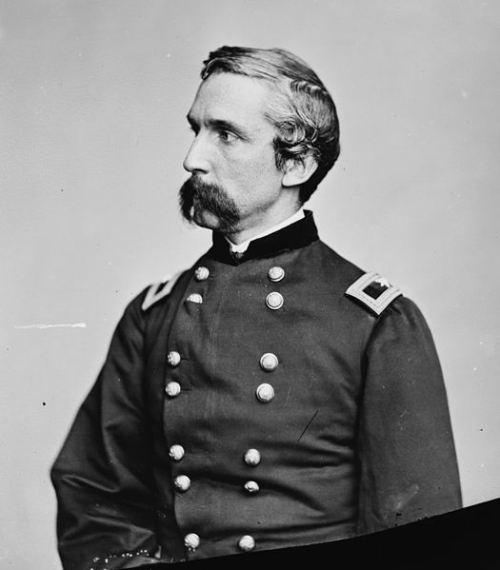
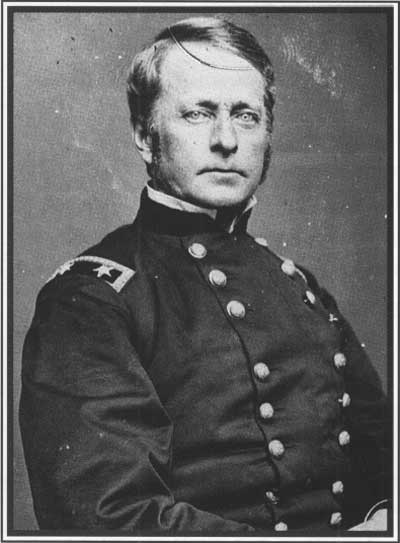
220px-GenJFRenyolds

Friends of Padre Steve’s World

I am continuing to periodically intersperse and publish short articles about various commanders at Gettysburg on the site. These all are drawn from my student text and may become a book in their own right.  The reason is I am going to do this is because I have found that readers are often more drawn to the lives of people than they are events. As I have noted before that people matter, even deeply flawed people, and we can learn from them.

This article deals with Major General John Fulton Reynolds who in large part is responsible for bringing about the Battle of Gettysburg and whose actions on that field in the opening hours of the engagement helped decide the course of the Civil War. This segment does not include the details of that battle, those are reserved for the rest of this chapter which I am currently revising for the student text.

I have come to admire Reynold’s more and more and I hope that in this brief treatment of his life and career leading to Gettysburg that you will be inspired by his single dovotion to the Union and the humanity compassion that he treated the victims of war.

Peace

Padre Steve+

There is much written about the supposed superiority of Robert E. Lee and the generals of the Army of Northern Virginia over those of the Army of the Potomac. Their eventual defeat is often blamed on the Union’s superior manpower and attrition with scant recognition of times where the Union commanders, particularly at Gettysburg out-generaled them. Not only did Harry Heth have the misfortune of battling John Buford and John Reynolds, but division, brigade and regimental leaders who performed their duties magnificently. Despite being greatly outnumbered by the Confederates these men and their soldiers turned back the initial Confederate assaults and shattering Confederate infantry formations.

Likewise if chance plays a role in war, the Army of the Potomac had good fortune smiling upon it that fateful morning of July 1st 1863. Part of that good fortune was having Major General John Fulton Reynolds, one of the finest commanders on either side during the Civil War directing its operations. During the engagement Reynolds, his subordinates and his successor in command Abner Doubleday dealt with the unforeseen elements of this engagement far better than any Confederate General on the battlefield that morning. Reynolds exemplified the indispensable qualities described by Clausewitz regarding commanders who must deal with the role of chance and the unforeseen elements that so often cloud the battlefield:

“first, an intellect that, even in the darkest hour, retains the glimmerings of the inner light which leads to truth; and second, the courage to follow this faint inner light wherever it may lead.” [1]

John Reynolds was a native Pennsylvanian, born in Lancaster to descendants of Irish Protestants. His maternal grandfather, Samuel Moore fought as a Captain in the Continental Line during the American Revolution. Reynold’s father, was a lawyer and moved to Lancaster where he “owned and published the Journal.” The elder Reynolds had served two terms in the Pennsylvania legislature and in the early 1830s was a political ally and friend of Senator and later President James Buchannan for whom “he was attending to local business affairs” in Lancaster. [2] Buchannan helped one of Reynold’s brother William gain an appointment to the Naval Academy and in 1837 obtained the appointment to West Point.

The young Pennsylvanian graduated from West Point in 1841, twenty-sixth in a class of fifty-two and was commissioned as a Brevet Second Lieutenant in the artillery. Among his classmates were the future Union generals Israel Richardson, Don Carlos Buell and Horatio Wright and Confederate generals Richard Garnett and J.M. Jones. Graduating in the class ahead of him was a man who would become a lifelong friend, William Tecumseh Sherman. He graduated at a time of military cutbacks, the Army was about to be reduced from 12,000 to 9,000 the following year. Chances for promotion were so bad, especially from First Lieutenant to Captain, “so unlikely that in a single year 117 officers resigned.” [3] Many of these officers would find their way back to the army but even so, army life did not promise much.

Despite this Reynolds found army life to his liking. He served in Florida during the Seminole War, as well as in Mexico “where he was cited for bravery at Monterey and Buena Vista.” [4] During the campaign in Mexico he served with the army commanded by General Zachary Taylor and in the artillery battery commanded by the future Confederate general, Captain Braxton Bragg. He acquitted himself well and also had compassion for the Mexican soldiers that he fought against. Visiting Mexican wounded who had been left with “little medical care and less food” he gave them money to help with their needs. At Buena Vista a number of senior officers wrote official citations praising the artillery and Reynolds by name. General John Wool wrote

“Without our artillery,” he said, “we could not have maintained our position a single hour,” and also: “…a section of artillery, admirably served by Lieutenant Reynolds, 3rd Arty, played an important part in checking and dispersing the enemy in the rear of our left. They retired before him whenever he approached them.” [5]

Those actions brought him fame and two brevet promotions for bravery, [6] to Captain at Monterrey and Major at Buena Vista. However, Reynolds saw little value in them if the army’s promotion system was not fixed. He wrote his brother Jim “The system is a complete humbug and until it changes I believe it is to be rather more of a distinction to be passed over than to be breveted…that is, amongst us who know facts.” [7]

Reynold’s skill as an artilleryman would be used to great effect on the morning of July 1st 1863 on McPherson’s Ridge at Gettysburg. Following the war he remained in the army predominantly with the artillery. He served in field and coastal batteries and like John Buford had “participated in the Utah Expedition.” [8] The Utah expedition is little known and nearly forgotten incidents in United States history which involved the territory of Utah, and it left a bitter taste in the mouths of many of the officers and soldiers who served in it, including John Reynolds.

The Territory of Utah had been created after the Compromise of 1850 and President Millard Fillmore named Mormon leader Brigham Young as Governor. The Mormons settled Utah after having been driven out of Illinois and Missouri as a result of their religious beliefs which included polygamy and well as the political concept Theodemocracy, which had been formulated by Mormon founder Joseph Smith Jr. Theodemocracy was a concept which is a blend of theocracy and republican principles. Though it largely died out after the replacement of Young as Governor it has many similarities with theology, political ideology and goals of the leaders of the current Christian Dominion concepts of the leaders of what is called The New Apostolic Reformation which has gained much power among the leadership of the current Republican Party.

In Illinois Smith had “founded an autonomous community, with its own militia, where Smith was eventually called “King of the Kingdom of God.” [9] Smith believed that it was a necessary step until a true theocracy could be established. Smith had taught his ruling Council of Fifty, which included a few non-Mormons “that in the initial stages of the millennium the council would participate in concert with men of differing religious and political persuasions” and the earth would still have a pluralism of governments and religions in the early part of those thousand years…” [10] Tensions between Smith, the Mormon community and surrounding communities grew and “eventually, an unruly mob lynched the prophet and one of his followers.” [11]

Two years after the territory was formed Young “declared that Smith had a vision, until then kept secret, reinstituting polygamy.” [12] To be fair, Young did not require this of his followers, but the introduction produced a furor among many Americans. The situation with Utah was complicated further by the actions of Congress which in throwing out the Missouri Compromise that Utah and New Mexico “when admitted as a State or States…shall be received into the Union, with or without slavery, as their constitution may prescribe at the time of their admission.” [13]

The combination of a growing theocracy, the introduction of polygamy and the possibility of slavery brought many tensions. The 1856 convention of the new Republican Party condemned “the twin relics of barbarism” – slavery and polygamy.” Midwesterners who joined that part remembered their clashes with the Mormons and “few voters were sympathetic to the Mormons” [14] or their growing power in the Utah Territory. In 1857 this tension led to President James Buchannan to appoint a non-Mormon Governor for the territory which led to conflict between Young’s government and its militias and the United States. Young considered U.S. Troops to be those of a “foreign power” and prepared for war “insisting as strongly on the independence of his people from Washington as the capital insisted on its jurisdiction over the territory.” [15]

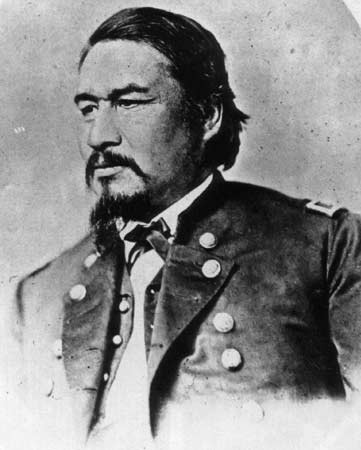
Like many officers and Americans in general, Reynolds had negative views of the Latter Day Saints. Some were gained in his introduction to the territory, where he found that as a “gentile” he was treated as an outsider by the Mormon community. His initial bad disposition was only deepened through his interactions with Governor Brigham Young. The most important of these to Reynolds was an attempt to bring to justice the Indians who had massacred a party of army engineers under the command of Captain Gunnison the previous summer. Reynolds for that the Mormon led government, particularly Governor Young had convicted the Indians of manslaughter and sentenced them to prison for manslaughter. This act angered Reynolds. He wrote his sisters:

“They have been since tried by the Mormons and found guilty of manslaughter, tho’ the proof was positive and clear. But their jury was counseled by Brigham Young as to their verdict and perjured themselves. May God have mercy upon them, they would hang two Indians for killing two Mormon boys last summer when there was scarcely any proof at all, but when a Gentile is murdered it is only manslaughter!! I cannot write the truth about these people here – but will sometime later.” [16]

After Utah Reynolds served in Kansas and briefly in the Pacific Northwest. During that time he developed a dislike for radical abolitionists who he believed were responsible for much of the division of the country.

But with tensions growing in 1860 Reynolds was appointed as Commandant of the Corps of Cadets at West Point. During the interregnum of the election of Abraham Lincoln and his inauguration he “hoped for a moderate course that might avoid war.” [17] However, the Confederate seizure of U.S. facilities and siege of Fort Sumter and the tensions building between Southerners and Northerners at the Academy weighed on Reynolds and soon brought about a break with his family’s longtime political ally and benefactor President James Buchannan. Though normally not outspoken about his political beliefs on thing was sure, he valued the Union and as with the Mormons opposed those who sought to undermine it. He wrote his sister Ellie about his feelings for the President at his administration:

“What will history say of us, our Government, and Mr. B’s Administration makes one wish to disown him….”I have said but little, except among ourselves here, on the present difficulties that surround the Government but a more disgraceful plot, on the part of our friend B’s cabinet and the leading politicians of the South, to break up our Government, without cause, has never blackened the pages of history in any nation’s record.” [18]

However, Reynolds’s harshest and most bitter words were reserved for Jefferson Davis who he had served with in Mexico:

“…Who would have believed that when I came here last September and found Mr. Jeff Davis laboring with a Committee of Congress and civilians to re-organize the Academy; our national school! Whose sons, never until the seeds sown by his parricidal hand had filled it with the poisonous weed of secession, had known any other allegiance than the one to the whole country, or worshipped any other flag, than that which has moved our own youthful hopes and aspirations and under which we marched so proudly in our boyish days – who! I dare say, would have believed, that he was brooding over his systematic plans for disorganizing the whole country. The depth of his treachery has not been plumbed yet, but it will be.” [19]

Reynolds served at the Academy until June of 1861 when it graduated its final class before the war began. Departing West Point he was initially appointed as Lieutenant Colonel of the 14th U.S. Infantry regiment. [20] He would have preferred the artillery but wrote that he “could not refuse this promotion offered me under any circumstances, much less at this time, when the Government has a right to my services in any capacity.” [21] How much different was Reynolds than another politically moderate and illustrious soldier, Robert E. Lee, who barely a month after accepting a promotion to full Colonel in the Regular Army resigned his commission to serve his state of Virginia and the Confederacy rather than lead an army “in an invasion of the Southern States” whatever Virginia decided.” [22]

Before Reynolds could take command of the 14th United States, he was promoted to Brigadier General. He commanded a brigade of Pennsylvania volunteers during the Peninsula Campaign and was captured on June 28th after leading his troops successful at Gaines Mill, as McClellan began his withdraw from the gates of Richmond. He spent six weeks in Confederate captivity but was released in a general prisoner exchange on August 15th 1862. [23] Despite being captured Reynolds’s performance during the Seven Days was praised by friend and foe alike and even his Confederate enemies in the city of Fredericksburg petitioned Richmond to release Reynolds who they said:

“when inasmuch as we were prisoners in the hands of General Reynolds we received from him a treatment distinguished by a marked and considerable respect for our opinions and feelings, it becomes us to use our feeble influence in invoking for him, now a prisoner of our Government as kind and as considerate as was extended by him to us. We would therefore hope that he might be placed on parole…” [24]

In doing so they returned to the Army of the Potomac the man who would help decide the fate of the Confederacy barely ten months later.

Reynolds returned to command a division at Second Bull Run where his division held firm as much of the army retreated. Reynolds missed the battle of Antietam as he was called to “the fruitless and frustrating task of trying to organize Pennsylvania’s militia” [25] by Governor Curtin. He returned to the Army of the Potomac and again commanded First Corps at Fredericksburg and again at Chancellorsville.

Reynolds was reportedly offered command of the Army of the Potomac by Lincoln in early June of 1863 but declined it. He went to the White House when he heard that he was under consideration for the post and ensured that he would not get the job by stating the his conditions for taking it. However, he did “urge the president to appoint Meade in Hooker’s place.” [26] He told his artillery chief Colonel Wainwright that he “refused it because he would have been under the same constraints as Burnside and Hooker.” [27] Colonel Wainwright believed that it was in large part due to “Reynolds’s recommendation that General Meade received his appointment.” [28]

The Army of the Potomac’s senior leadership had been the source of much political consternation during 1862 and 1863 for Abraham Lincoln. It was split among Lincoln’s supporters and detractors, Radical Republican abolitionists and moderate Democrats. To complicate matters some of senior leaders of the Army of the Potomac including McClellan, Hooker and Sickles had their own, scarcely hidden aspirations for the presidency.

However, Reynolds was of a different character than the politically connected and conniving commanders who used their position in the army to advance their career. Reynolds was a moderate Pennsylvania Democrat and prior to the war had been no supporter of Lincoln, once comparing him to a “baboon.” That opinion being noted, Reynolds did not allow his political beliefs and opinions to influence the manner in which he upheld his oath to the nation in time of civil war. Lincoln was President and was attempting to hold the Union together against forces that Reynolds found decidedly treacherous. It was a tribute to Reynold’s personal manner of keeping politics out of his command, which allowed him, a moderate Democrat to successfully command a corps whose divisions “were commanded by some of the Army’s most fervent abolitionists – Abner Doubleday, James S. Wadsworth, and John Cleveland Robinson.” [29]

Reynolds was “a serious unbending professional, who unlike McClellan, actually lived by the principle of “obedience to the powers that be.” [30] The Pennsylvanian was “universally respected” in the army “for his high character and sterling generalship” [31] it was noted that unlike others who so quickly interjected themselves into the political turmoil which had embroiled the nation that Reynolds had a policy of holding back. He stood “stoutly aloof from all personal or partisan quarrels, and keeping guardedly free from any of the heart-burnings and jealousies that did so much to cripple the usefulness and endanger the reputation of many gallant officers.” [32]

Oliver Howard noted that unlike many commanders that Reynolds was a commander “who had a steady hand in governing, were generous to a fault, quick to recognize merit, trusted you and sought to gain your confidence, and, as one would anticipate, were the foremost in battle.” [33] George McClellan noted that Reynolds was “remarkably brave and intelligent, an honest, true gentleman.” [34] In his autobiography Howard wrote about Reynolds:

“From soldiers, cadets, and officers, junior and senior, he always secured reverence for his serious character, respect for his ability, care for his uniform discipline, admiration for his fearlessness, and love for his unfailing generosity.” [35]

On the night of June 30th Reynolds was awash in reports, some of them conflicting and even though he was without Meade’s course of action for the next day “concluded that Lee’s army was close by and in force.” [36] He spent the night at his headquarters “studying the military situation with Howard and keeping in touch with army headquarters.” [37] Howard noted Reynolds anxiety and “received the impression that Reynolds was depressed.” [38] After Howard’s departure Reynolds took the opportunity to get a few hours of fitful sleep before arising again at 4 a.m. on July 1st.

When morning came, Reynolds was awakened by his aide Major William Riddle with Meade’s order to “advance the First and Eleventh Corps to Gettysburg.” [39] Reynolds studied the order and though he expected no battle that morning, expecting “only moving up to be in supporting distance to Buford” [40] took the prudent and reasonable precautions that his Confederate opponents A.P. Hill and Harry Heth refused to take as they prepared to move on Gettysburg.

His troops were in fine spirits that morning even though it had been busy. After a breakfast of hardtack, pork and coffee the troops moved out. An officer of the Iron Brigade noted that the soldiers of that brigade were “all in the highest spirits” while Lieutenant Colonel Rufus Dawes of the “placed the fifes and drums at the head of the Sixth Wisconsin and ordered the colors unfurled” as the proud veterans marched forward into the sound of the raging battle to the tune of “The Campbell’s are Coming.” [41]

Though Reynolds was not expecting a fight he organized his march in a manner that ensured if one did happen that he was fully prepared. The precautionary measures that he took were those that any prudent commander having knowledge that strong enemy forces were nearby would take. Reynolds certainly took to heart the words of Napoleon who said “A General should say to himself many times a day: If the hostile army were to make its appearance in front, on my right, or on my left, what should I do?” [42]

This was a question that A.P. Hill and Harry Heth seemed not to consider on that warm and muggy July morning when Heth was committing Lee’s army to battle on his own authority. Reynolds was also about to commit the Army of the Potomac to battle, but unlike Heth who had no authority to do so, Reynolds “had at least been delegated the authority for making such a decision.” [43] While Meade was unaware of what was transpiring in the hills beyond Gettysburg he implicitly trusted the judgement of Reynolds, and he been with the advanced elements of Reynold’s wing Meade too “probably would have endorsed any decision he made.” [44]

Reynolds placed himself with the lead division, that of Wadsworth, and “had directed Doubleday to bring up the other divisions and guns of the First Corps and had ordered Howard’s Eleventh Corps up from Emmitsburg.” [45] Reynold’s also understood the urgency of the situation and “wanted all the fighting troops to be up front, so he instructed Howard not to intermingle his supply wagons with his infantry. Similar instructions had been given to Abner Doubleday; to ensure that the First Corps wagons would wait until the Eleventh Corps foot soldiers had passed.” [46]

Instead operating in the normal fashion of rotating units on the march, Reynolds opted to save time. Since the First Division under the command of James Wadsworth was further advanced than other I Corps divisions, Reynolds instructed it to move first with Cutler’s brigade in the lead followed by the Iron Brigade under Colonel Solomon Meredith. In doing so he countermanded the order of the acting corps commander Doubleday who had ordered that division to allow the other divisions of First Corps to pass his before advancing. Reynolds told Wadsworth that Doubleday’s order “was a mistake and that I should move on directly.” [47]

He went forward with Wadsworth’s division and gave Doubleday his orders for the coming engagement. Doubleday later recalled that when Reynolds arrived to discuss the situation that Reynolds:

“read to me the various dispatches he had received from Meade and Buford, and told me that he should go at once forward with the leading division – that of Wadsworth – to aid the cavalry. He then instructed me to draw in my pickets, assemble the artillery and the remainder of the corps and join him as soon as possible. Having given me these orders, he rode off at the head of the column, and I never saw him again.” [48]

Reynolds ordered Howard’s XI Corps to follow and according to Doubleday directed an aid of Howard to have Howard “bring his corps forward at once and form them on Cemetery Hill as a reserve.” [49] While some writers that he directed Oliver Howard to prepare Cemetery Hill as a fallback position [50] there is more evidence that points to Howard selecting the that commanding hill himself. [51]

Likewise Reynolds ordered Sickles’ III Corps to come up from Emmitsburg where that corps had bivouacked the previous night. [52] Sickles had heard the guns in the distance that morning and sent his senior aide, Major Henry Tremain to find Reynolds. Reynolds told Tremain “Tell General Sickles I think he had better come up” but the order left Sickles in a quandary. He recalled “he spend an anxious hour deciding what to do” [53] for he had “been ordered by Meade to hold his position at Emmitsburg” [54] and Sickles sent another rider to Reynolds and awaited the response of his wing commander instead of immediately advancing to battle on 1 July and it would not be until after 3 P.M. that he would send his lead division to Gettysburg.

Reynolds’ intention according to Doubleday was “to fight the enemy as soon as I could meet him.” [55] Reynolds rode forward with some of his staff into the town as the infantry of I Corps and XI Corps moved advanced. In the town they were met by “a fleeing, badly frightened civilian, who gasped out the news that the cavalry was in a fight.” [56] When he came to the Lutheran Seminary he came across Buford. It was a defining moment of the Civil War, a moment that shaped the battle to come. It has been recounted many times and immortalized on screen in the movie Gettysburg, a time “when the entire battle would come down to a matter of minutes getting one place to another.” [57]

As the rough and tumble Kentuckian, Buford, and Reynolds, the dashing Pennsylvanian, discussed the situation they had to know that odd that they were facing. With close to 32,000 rebels from the four divisions of Hill’s and Ewell’s corps closing in from the west and the north with only about 18,000 men of First Corps, Eleventh Corps and Buford’s cavalry division the odds did not favor them, but unlike other battles that the army of the Potomac faced, this time the army and its commanders were determined not to lose and not to retreat.

Reynolds and Buford committed their eighteen thousand men against Lee’s thirty-two thousand in a meeting engagement that develop into a battle that would decide the outcome of Lee’s invasion. Likewise it was a battle for the very existence of the Union. Abner Doubleday noted the incontestable and eternal significance of the encounter to which Buford and Reynolds were committing the Army of the Potomac:

“The two armies about to contest on the perilous ridges of Gettysburg the possession of the Northern States, and the ultimate triumph of freedom or slavery….” [58]

Notes

[1] Ibid. Clausewitz On War p.102

[2] Nichols, Edward J. Toward Gettysburg: A Biography of John Fulton Reynolds Pennsylvania State University Press, Philadelphia 1958. Reprinted by Old Soldier Books, Gaithersburg MD 1987 p.4

[3] Ibid. Nichols Toward Gettysburg p.13

[4] Tagg, Larry The Generals of Gettysburg: The Leaders of America’s Greatest Battle Da Capo Press Cambridge MA 1998 Amazon Kindle Edition p.10

[5] Ibid. Nichols Toward Gettysburg pp.43-44

[6] Pfanz Harry W. Gettysburg: The First Day University of North Carolina Press, Chapel Hill and London 2001pp.47-48

[7] Ibid. Nichols Toward Gettysburg p.46

[8] Ibid. Pfanz Gettysburg: The First Day p.48

[9] Gonzalez, Justo L. The History of Christianity Volume 2: The Reformation to the Present Day Harper and Row Publishers San Francisco 1985 p.259

[10] Ehat, Andrew” It Seems Like Heaven Began on Earth”: Joseph Smith and the Constitution of the Kingdom of God in BYU Studies Vol 20. No 3 1980) retrieved from https://ojs.lib.byu.edu/spc/index.php/BYUStudies/article/view/5144/4794 20 May 2015 p.258

[11] Ibid. Gonzales p.259

[12] Ibid. Gonzales p.259

[13] Potter, David M. The Impending Crisis: America before the Civil War 1848-1861 completed and edited by Don E. Fehrenbacher Harper Collins Publishers, New York 1976 p.158

[14] Goldfield, David. America Aflame: How the Civil War Created a Nation Bloomsbury Press, New York 2011 p.122

[15] Ibid. Nichols Toward Gettysburg p.58

[16] Ibid. Nichols Toward Gettysburg p.58

[17] Ibid. Nichols Toward Gettysburg p.73

[18] Ibid. Nichols Toward Gettysburg p.73

[19] Ibid. Nichols Toward Gettysburg p.73

[20] Ibid. Pfanz Gettysburg: The First Day p.48

[21] Ibid. Nichols Toward Gettysburg p.75

[22] Korda, Michael. Clouds of Glory: The Life and Legend of Robert E. Lee Harper Collins Publishers, New York 2014 p.228


[23] Foote, Shelby, The Civil War, A Narrative. Volume One Fort Sumter to Perryville Random House, New York 1958 p.493

[24] Ibid. Nichols Toward Gettysburg p.100

[25] Ibid. Pfanz Gettysburg: The First Day p.48

[26] Sears, Stephen W. Controversies and Commanders Mariner Books, Houghton-Mifflin Company, Boston and New York 1999 p.162

[27] Sears, Stephen W. Gettysburg. Houghton Mifflin Co. Boston and New York 2003 pp. 40-42

[28] Nevins. Allan editor. A Diary of Battle: The Personal Journals of Colonel Charles Wainwright 1861-1865 with an introduction by Stephen W. Sears Da Capo Press, New York 1998 p.229

[29] Guelzo, Allen C. Gettysburg: The Last Invasion Vintage Books a Division of Random House, New York 2013 p.30

[30] Ibid. Guelzo Gettysburg: The Last Invasion pp.29-30

[31] Ibid. Sears, Gettysburg. p. 34

[32] Ibid. Guelzo, Gettysburg: The Last Invasion p.30

[33] Howard, Oliver O. Autobiography of Oliver Otis Howard, Major General, U.S. Army Volume 1 The Baker and Taylor Company, New York 1907 Made available by the Internet Achieve through Amazon Kindle location 5908 of 9221

[34] Wert, Jeffry D. The Sword of Lincoln: The Army of the Potomac Simon and Schuster, New York and London 2005 p.101

[35] Ibid. Howard Autobiography of Oliver Otis Howard location 5908 of 9221

[36] Ibid. Pfanz Gettysburg: The First Day p.48

[37] Ibid. Coddington The Gettysburg Campaign: A Study in Command p.261

[38] Ibid. Pfanz Gettysburg: The First Day p.48

[39] Ibid. Coddington The Gettysburg Campaign: A Study in Command, p.261

[40] Ibid. Sears, Gettysburg. p. 158

[41] Nolan, Alan T. The Iron Brigade: A Military History Indiana University Press, Bloomington IN, 1961 and 1994 pp.233-234

[42] Napoleon Bonaparte, Military Maxims of Napoleon in Roots of Strategy: The Five Greatest Military Classics of All Time edited by Phillips, Thomas R Stackpole Books Mechanicsburg PA 1985 p.410

[43] Ibid. Sears, Gettysburg. p. 165

[44] Ibid. Pfanz Gettysburg: The First Day p.49

[45] Ibid. Nolan The Iron Brigade p.233

[46] Trudeau, Noah Andre. Gettysburg: A Testing of Courage, Harper Collins Publishers, New York 2002 p.159

[47] Ibid. Trudeau, Gettysburg: A Testing of Courage p.156

[48] Doubleday, Abner Chancellorsville and Gettysburg: Campaigns of the Civil War VI Charles Scribner’s Sons, Bew York 1882 pp.70-71

[49] Ibid. Doubleday Chancellorsville and Gettysburg p.71

[50] Ibid. Pfanz Gettysburg: The First Day p.76

[51] Green, A. Wilson. From Chancellorsville to Gettysburg: O. O. Howard and Eleventh Corps Leadership in The First Day at Gettysburg edited by Gallagher, Gary W. Kent State University Press, Kent Ohio 1992 p. 70

[52] Ibid. Sears, Gettysburg. p. 158

[53] Keneally, Thomas American Scoundrel: The Life of the Notorious Civil war General Dan Sickles Anchor Books, a Division of Random House, New York 2003 p.275

[54] Swanberg, W.A. Sickles the Incredible Copyright by the author 1958 and 1984 Stan Clark Military Books, Gettysburg PA 1991 p.202

[55] Ibid. Trudeau, Gettysburg: A Testing of Courage p.156

[56] Ibid. Sears, Gettysburg. p. 165

[57] Ibid. Guelzo, Gettysburg: The Last Invasion p.142

[58] Ibid. Doubleday Chancellorsville and Gettysburg p.68


Leave a comment

Filed under civil war, History, leadership, Military

The Best Cavalry General We Had: John Buford


Friends of Padre Steve’s World

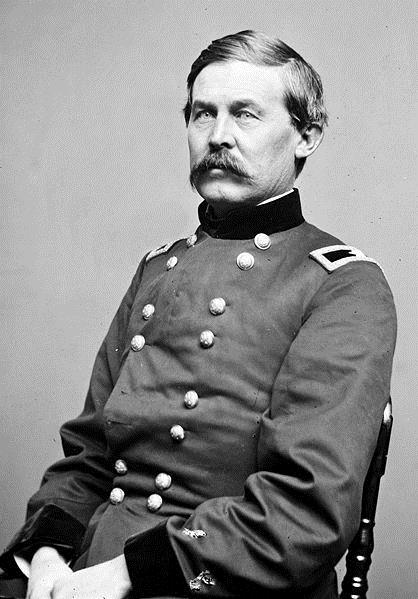
I am at Gettysburg this weekend leading my students on our spring “staff ride.” Since the morning begins with the delaying action fought by General John Buford’s Union cavalry I have included one of my short biographic articles about the leaders who fought at Gettysburg, this one about an amazing patriot and military leader who when push came to shove remained loyal to the Union, and whose military abilities as a modern leader were unmatched in his day. 

I hope you enjoy this little piece about a most amazing man. 

Peace

Padre Steve+

buford

“He was decidedly the best cavalry general we had, and was acknowledged as such in the army, though being no friend to newspaper reporters…In many respects he resembled Reynolds, being rough in the exterior, never looking after his own comfort, untiring on the march and in the supervision of all the militia in his command, quiet and unassuming in his manners.” Colonel Charles Wainwright on Buford (Diary of Battle, p.309)

John Buford was born in Kentucky and came from a family with a long military history of military service, including family members who had fought in the Revolutionary War and War of 1812. In fact according to some the family military pedigree reaches back to England’s War of the Roses.

Buford’s family was well off with a spacious plantation near Versailles on which labored forty-five slaves, and his father also established a stage line which carried “passengers and freight between Frankfort and Lexington.” His father divested himself of his property, selling his home, business and slaves and moved to Stephenson Illinois in 1838. [1] The young Buford developed an interest in military life which was enlivened by his half-brother Napoleon Bonaparte Buford who graduated from West Point in 1827, and his brother would be influential in helping John into West Point, which he entered in 1844.

Buford graduated with the class of 1848 which included the distinguished Union artilleryman John Tidball, and the future Confederate brigadier generals “Grumble Jones and “Maryland” Steuart. Among his best friends was Ambrose Burnside of the class of 1847. He did well academically but his conduct marks kept him from graduating in the top quarter of his class.

Upon graduation he was commissioned as a Brevet Second Lieutenant of Dragoons, however too late to serve in Mexico. Instead he was initially assigned to the First United States Dragoons but less than six months after joining was transferred to the Second Dragoons when he was promoted to full Second Lieutenant.

Instead of going to Mexico Buford “spent most of the 1850s tracking and fighting Indians on the Plains.” [2] During this period, the young dragoon served on the Great Plains against the Sioux, where he distinguished himself at the Battle of Ash Creek and on peacekeeping duty in the bitterly divided State of Kansas and in the Utah War of 1858.

His assignments alternated between field and staff assignments and he gained a great deal of tactical and administrative expertise that would serve him well. This was especially true in the realm of the tactics that he would employ so well at Gettysburg and on other battlefields against Confederate infantry and cavalry during the Civil War. Buford took note of the prevailing tactics of the day which still stressed a rigid adherence to outdated Napoleonic tactics which stressed mounted charges and “little cooperation with units of other arms or in the taking and holding of disputed ground.” [3] While he appreciated the shock value of mounted charges against disorganized troops he had no prejudice against “fighting dismounted when the circumstances of the case called for or seemed to justify it.” [4] Buford’s pre-war experience turned him into a modern soldier who appreciated and employed the rapid advances in weaponry, including the repeating rifle with tremendous effect.

Despite moving to Illinois Buford’s family still held Southern sympathies; his father was a Democrat who had opposed Abraham Lincoln. Buford himself was a political moderate and though he had some sympathy for slave owners:

“he despised lawlessness in any form – especially that directed against federal institutions, which he saw as the bulwark of democracy…..He especially abhorred the outspoken belief of some pro-slavery men that the federal government was their sworn enemy.” [5]

After the election of Abraham Lincoln, the officers of Buford’s regiment split on slavery. His regimental commander, Colonel Philip St. George Cooke, a Virginian and the father-in-law of J.E.B. Stewart announced that he would remain loyal to the Union, others like Beverly Robertson who would command a brigade of cavalry during the Gettysburg campaign resigned their commissions.

For many officers, both those who remained loyal to the Union and those who joined the Confederate cause the decision was often difficult, and many anguished over their decisions as they weighed their allegiance to the Union against their loyalty to home and family. Buford was not one of them.

Since Buford’s family had longstanding ties to Kentucky, the pro-secession governor of Kentucky, Beriah Magoffin offered Buford a commission in that states’ militia. At the time Kentucky was still an “undeclared border slave state” and Buford loyal to his oath refused the governor’s offer. He wrote a brief letter to Magoffin and told his comrades that “I sent him word that I was a Captain in the United States Army and I intend to remain one.” [6] Around the same time the new provisional government of the Confederacy “offered Buford a general officer’s commission, which reached him by mail at Fort Crittenden.” [7] According to Buford’s biographer Edward Longacre “a well-known anecdote has him wadding up the letter while angrily announcing that whatever future had in store he would “live and die under the flag of the Union.” [8]

However Buford’s family’s southern ties, and lack of political support from the few remaining loyal Kentucky legislators initially kept him from field command. Instead he received a promotion to Colonel and an assignment to the Inspector General’s Office, although it was not the field assignment that he desired it was of critical importance to the army in those early days of the war as the Union gathered its strength for the war. Buford was assigned to mustering in, and training the new regiments being organized for war. Traveling about the country he evaluated each unit in regard to “unit dress, deportment and discipline, the quality and quantity of weapons, ammunition, equipment, quarters, animals and transportation; the general health of the unit and medical facilities available to it; and the training progress of officers and men.” [9] Buford was a hard and devastatingly honest trainer and evaluator of the new regiments. He was especially so in dealing with commanding officers as well as field and company officers. Additionally he was a stickler regarding supply officers, those he found to be incompetent or less than honest were cashiered.

Buford performed these duties well but desired command. Eventually he got the chance when the politically well-connected but ill-fated Major General John Pope who “could unreservedly vouch for his loyalty wrangled for him command of a brigade of cavalry.” [10] After Pope’s disastrous defeat at Second Bull Run in August 1862 Buford was wounded in the desperate fighting at Second Manassas and returned to staff duties until January 1863 when he was again given a brigade. However, unlike many of the officers who served under Pope, Buford’s reputation as a leader of cavalry and field commander was increased during that campaign.

Buford was given the titular title of “Chief of Cavalry of the Army of the Potomac” by George McClellan, a title which sounded impressive but involved no command during the Antietam campaign. Following that frustrating task he continued in the same position under his old West Point friend Ambrose Burnside during the Fredericksburg campaign. Buford lost confidence in his old friend and was likely “shocked by his friend’s deadly ineptitude, his dogged insistence on turning defeat into nightmare.” [11]

When Burnside was relieved and Fighting Joe Hooker appointed to command the army, Buford’s star began to rise. While he was passed over by Hooker for command of the newly organized First Cavalry division in favor of Alfred Pleasanton who was eleven days his senior, he received command of the elite Reserve Brigade composed of mostly Regular Army cavalry regiments. When Major General George Stoneman was relieved of command following the Chancellorsville campaign, Pleasanton was again promoted over Buford.

In later years Hooker recognized that Buford “would have been a better man for the position of chief” [12] but in retrospect Buford’s pass over was good fortune for the Army of the Potomac on June 30th and July 1st 1863. Despite being passed over for the Cavalry Corps command, Buford, a consummate professional never faltered or became bitter. Despite the Pleasanton’s interference and “lax intelligence-gathering” [13]   During the Gettysburg campaign he led his brigade well at Brandy Station as it battled J.E.B. Stuart’s troopers, after which he was recommended for promotion and given command of the First Cavalry division of the Cavalry Corps. [14]

Following Brandy Station Buford led his troopers aggressively as they battled Stuart’s troopers along the Blue Ridge at the battles of Aldie, Philmont, Middleburg and Upperville. It was at Upperville while fighting a hard action Confederate Brigadier general “Grumble Jones’s brigade that Buford’s troopers provided Hooker with the first visual evidence that Lee’s infantry was moving north into Maryland and Pennsylvania.

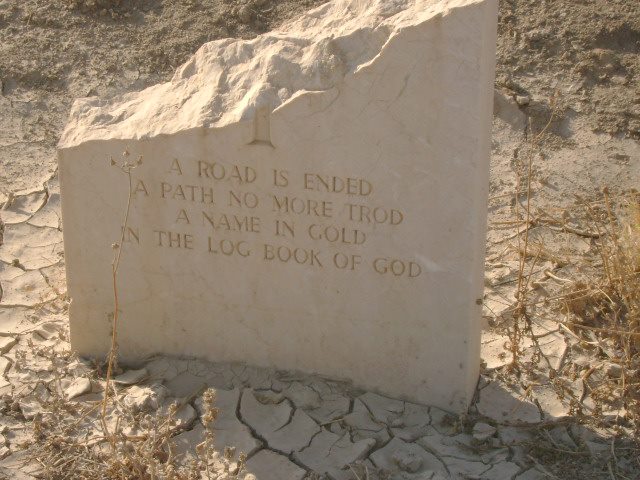
burford reynolds monuments

When Hooker was relieved on the night of June 27th and 28th George Meade gave Buford the chance at semi-independent command without Pleasanton looking over his shoulder. Meade appreciated Pleasanton’s administrative and organizational expertise and took him out of direct field command. Meade had his Cavalry Corps commander “pitch his tent next to his own on almost every leg of the trip to Pennsylvania and rarely let him out of sight or earshot.” [15]

One of Meade’s staff officers, Theodore Lyman gave this description of Buford:

“He is one of the best of the officers…and is a singular looking party. Figurez-vous a compactly built man of middle height, with a tawny mustache and a little, triangular gray eye, whose expression is determined, not to say sinister. His ancient corduroys are tucked into a pair of ordinary cowhide boots, his blue blouse is ornamented with holes; from which one pocket thereof peeps a huge pipe, while the other is fat with a tobacco pouch. Notwithstanding this get-up he is a very soldierly looking man. Hype is of a good natured disposition, but is not to be trifled with.” [16]

When he was ordered to screen the army as it moved into Pennsylvania, Buford was confident about his troopers and their ability and he and his men performed their duties admirably. On June 29th Buford’s men skirmished with two of Harry Heth’s regiments near the town of Fairfield, which Buford promptly reported to Meade and John Reynolds after ascertaining their size and composition.

The Battle of Gettysburg would be the zenith of Buford’s career. His masterful delaying action against Harry Heth’s division on July 1st 1863 enabled John Reynold’s wing of the army to arrive in time to keep the Confederates from taking the town and all of the high ground which would have doomed any union assault against them. Following Gettysburg Buford continued to command his cavalry leading his division in a number of engagements. In early November the worn out cavalryman who had been in so many actions over the past year came down with Typhoid. In hopes that he would recover he was told that he would be appointed to command all the cavalry in the West, however his health continued to decline. He was officially promoted to Major General of Volunteers by President Lincoln, over the objection of Secretary of War Stanton who disliked deathbed promotions. “Upon learning of the honor. Buford is supposed to have whispered, “I wish I could have lived now.” [17] He died later that evening, the last words warning his officers “patrol the roads and halt fugitives at the front.” [18]

John Pope wrote of Buford:

“Buford’s coolness, his fine judgment, and his splendid courage were well known of all men who had to do with him… His quiet dignity, covering a fiery spirit and a military sagacity as far reaching as it was accurate made him…one of the best and most trusted officers in the service.” [19]

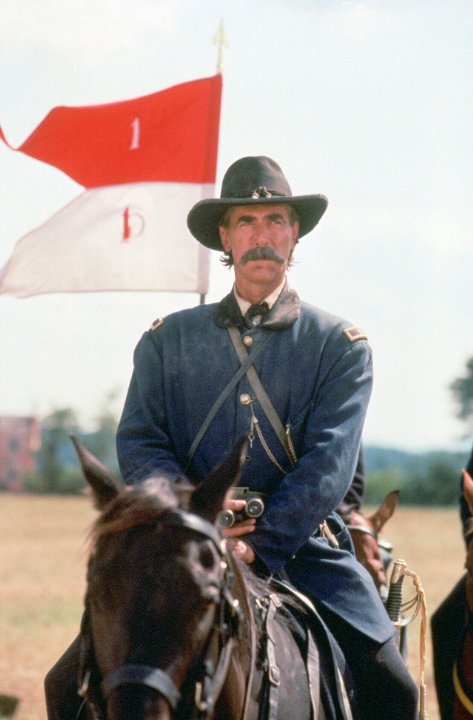
Sam Elliot as Buford

Buford was buried at West Point and he is immortalized in the monument dedicated to him on McPherson’s Ridge at Gettysburg where he with binoculars in hand looks defiantly west in the direction of the advancing Confederates. The monument is surrounded by the gun tubes of four Union 3” Rifles, three of which were part of Lieutenant John Calef’s Battery which he directed on the fateful morning of July 1st 1863. He was portrayed masterfully portrayed by Sam Elliott in the movie Gettysburg.

Notes

[1] Longacre, Edward G. John Buford: A Military Biography Da Capo Press, Perseus Book Group, Cambridge MA p.17

[2] Ibid. Guelzo. Gettysburg: The Last Invasion p.121

[3] Ibid. Longacre John Buford p.36

[4] Ibid. Longacre John Buford p.36

[5] Ibid. Longacre John Buford p.54

[6] Ibid. Guelzo. Gettysburg: The Last Invasion p.121

[7] Ibid. Longacre John Buford p.70

[8] Ibid. Longacre John Buford p.70

[9] Ibid. Longacre John Buford p.78

[10] Ibid. Guelzo. Gettysburg: The Last Invasion p.121

[11] Ibid. Longacre John Buford p.122

[12] Ibid. Coddington The Gettysburg Campaign, A Study in Command p.44

[13] Ibid. Longacre John Buford p.173

[14] Ibid. Coddington The Gettysburg Campaign, A Study in Command p.64

[15] Longacre, Edward G. The Cavalry at Gettysburg: A Tactical Study of Mounted Operations during the Civil War’s Pivotal Campaign, 9 June-14 July 1863 University of Nebraska Press, Lincoln and London 1986 p.168

[16] Girardi, Robert I. The Civil War Generals: Comrades, Peers, Rivals in Their Own Words Zenith Press, MBI Publishing, Minneapolis MN 2013 p.38

[17] Ibid. Longacre John Buford p.245

[18] Ibid. Longacre John Buford p.246

[19] Ibid. Girardi The Civil War General p.38


1 Comment

Filed under civil war, Gettysburg, History, leadership, Military

A Stillness in Baltimore

no fans

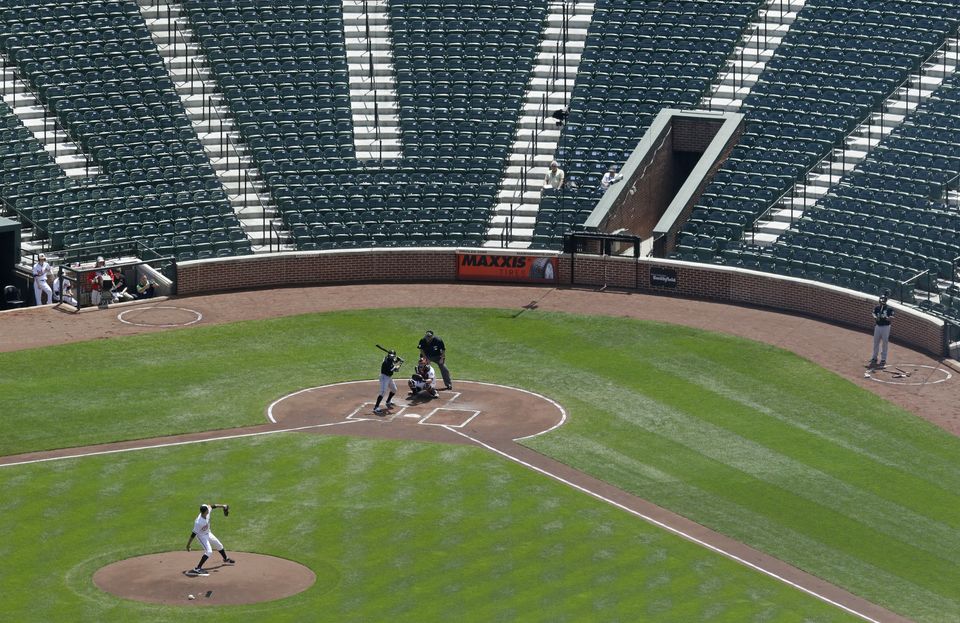
Yesterday the Baltimore Orioles defeated the Chicago White Sox by a score of 8-2 at Baltimore’s Camden Yards “Oriole Park.” Normally an afternoon game in April would pass nearly unnoticed except for the fans of the teams involved and those who just love the game. But this game was remarkable, for the first time in over 140 years of Major League Baseball, no fans were in attendance. The ballpark stood empty as the teams played a game that is probably more associated with the connection that fans feel towards players and teams than any other sport. Home runs were hit and the only sound was the crack of the bat sound of the ball landing in the stands. Players could hear the raidio and television announcers as they gave their play by play and the pitchers in the bullpens could hear every word spoken by the outfielders. It was surreal and somewhat symbolic. 

But the silence and emptiness at Oriole Park was emblematic of the plight of the people who live in the decaying inner cities of America, and a clarion call for us as a nation to address the root causes of what happened in Baltimore, what happened in Ferguson and what will happen in other cities if we do not take action to deal with the root causes.

The reason for this was the rioting and violence that followed in the wake of the death of Freddie Gray, a young African-American who had been arrested, and severely injured while in police custody and not given immediate or adequate medical attention for a spinal injury from which he subsequently died. What was Freddie Gray’s crime? He ran from the police, as far as I know he was engaged in no criminal activity and from what I understand, running from the police is not a crime.

As always there are conflicting accounts of the incident and the official State Police report has not been completed, and will probably not be made immediately available leaving his grieving family to wonder what happened and to suspicions of another cover-up. But the key thing is that we do not yet know what happened. In order to be fair I want am placing a link to the press conference of the Baltimore Mayor and Police regarding the arrest and the timeline of what happened to Freddie Gray in the police van:

http://www.baltimoresun.com/news/maryland/crime/blog/bs-md-ci-freddie-gray-arrest-documents-20150420-story.html

riots

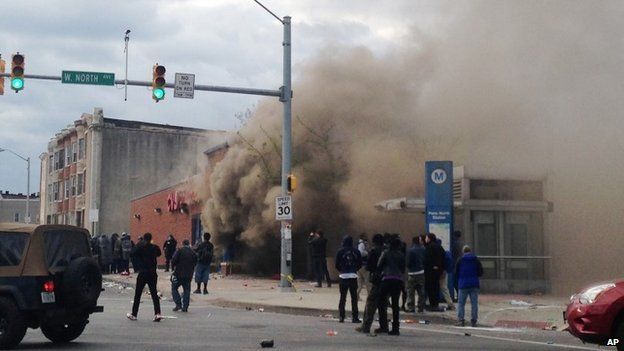
The riots caused much property damage and many people were injured and arrested. The Baltimore Police and the Mayor were overwhelmed and allowed the rioting to get out of hand before requesting that the National Guard assist. President Obama called those who rioted and looted calling them “a handful of people taking advantage of the situation for their own purposes,” who should “be treated as criminals.” The President also said “We have seen too many instances of what appears to be police officers interacting with individuals, primarily African-American, often poor, in ways that raise troubling questions,” and noted that “This has been a slow-rolling crisis. This has been going on for a long time. This is not new, and we shouldn’t pretend that it’s new.” He sought balance though and expressed a measure of sympathy for police who have to “do the dirty work of containing the problems that arise” in broken urban communities where fathers are absent, drugs dominate and education, jobs and opportunities are nonexistent.

President Obama has been criticized by those who think he has not done enough to address the numerous accounts of police violence, and those on the political right like Senator Cruz who blame him for “inflaming racial tensions.” Frankly President Obama’s plight reminds me much of the tensions that Abraham Lincoln had to deal with in dealing with the various political factions in the North during the Civil War. The issues are not the same, but the political climate is quite similar. Lincoln was somehow able to navigate through the various crisis including some that involved his closest advisors and even political allies.

American conservatives today, especially those on the “Religious Right” are quick to blame the problems on the disintegration of the family unit, there may be some truth in this but is certainly not at the heart of the problem, otherwise all the white kids from broken families would be out doing the same thing.

But the difference is that many, if not most of those white kids, even those from broken families have educational, economic and social advantages that kids in the inner city ghettos, be they African American, Mexican American or Hispanic, or any other racial or ethnic minority trapped in the hellholes of the inner cities; hellholes that were not created by them but by decades of neglect and intentional political and social policies that served to marginalize Blacks and other minorities, leaving them without hope. As such I think there is a measure of racism in the argument of American conservatives in attributing the riots to the collapse of the family unit in Black communities, which they cannot admit, but secretly harbor.

This has been going on since the 1960s at least and there are historical examples of other Americans trapped in similar situations who resorted to rioting as well, notably the 1863 New York Draft Riots which mainly involved the poor Irish immigrants who were shouldering much of the burden of the war and were trapped in similar social and economic conditions in the Irish ghettos of New York. Those riots cost many lives and because the New York Police could not control them Federal troops, fresh from their victory at Gettysburg were sent to New York to restore order.

The simplistic “answers” of the conservative pundits, politicians and preachers who seek to blame this on the demise of the family unit are wrong. As I mentioned the issue is not broken families, it is the lack of opportunity that we as a white dominated society have sentenced those who inhabit our inner cities to, a lack of opportunity that has bred a culture of despair, a culture where hope is absent and dreams die, and after seeing incident after incident of what looks like police brutality and the seeming abuse of power by white dominated police forces, people are taking matters into their own hands and are venting years of pent up anger and frustration.

freddie gray

Back in 1967 Dr. Martin Luther King Jr. spoke about the rioting and violence that were occurring in his day. They are words that we need to heed today, because things really haven’t changed that much for those who are trapped in the inner cities. He said:

“Urban riots must now be recognized as durable social phenomena. They may be deplored, but they are there and should be understood. Urban riots are a special form of violence. They are not insurrections. The rioters are not seeking to seize territory or to attain control of institutions. They are mainly intended to shock the white community. They are a distorted form of social protest. The looting which is their principal feature serves many functions. It enables the most enraged and deprived Negro to take hold of consumer goods with the ease the white man does by using his purse. Often the Negro does not even want what he takes; he wants the experience of taking. But most of all, alienated from society and knowing that this society cherishes property above people, he is shocking it by abusing property rights. There are thus elements of emotional catharsis in the violent act. This may explain why most cities in which riots have occurred have not had a repetition, even though the causative conditions remain. It is also noteworthy that the amount of physical harm done to white people other than police is infinitesimal and in Detroit whites and Negroes looted in unity.

A profound judgment of today’s riots was expressed by Victor Hugo a century ago. He said, ‘If a soul is left in the darkness, sins will be committed. The guilty one is not he who commits the sin, but he who causes the darkness.’

The policymakers of the white society have caused the darkness; they create discrimination; they structured slums; and they perpetuate unemployment, ignorance and poverty. It is incontestable and deplorable that Negroes have committed crimes; but they are derivative crimes. They are born of the greater crimes of the white society. When we ask Negroes to abide by the law, let us also demand that the white man abide by law in the ghettos. Day-in and day-out he violates welfare laws to deprive the poor of their meager allotments; he flagrantly violates building codes and regulations; his police make a mockery of law; and he violates laws on equal employment and education and the provisions for civic services. The slums are the handiwork of a vicious system of the white society; Negroes live in them but do not make them any more than a prisoner makes a prison. Let us say boldly that if the violations of law by the white man in the slums over the years were calculated and compared with the law-breaking of a few days of riots, the hardened criminal would be the white man. These are often difficult things to say but I have come to see more and more that it is necessary to utter the truth in order to deal with the great problems that we face in our society.”

We as a society, as Americans need to deal with this. We cannot go on as a society if we fail to address the legitimate claims of those trapped by our neglect, our social policies, and our economic policies which have doomed millions of Americans to live without hope.

I pray that somehow something good will come out of this and that the silence at Camden Yards will echo across this nation and open our eyes to see our collective responsibility to address these issues, something that our political, social and business leaders seem so want to do. If we do not, what does that say about us as a nation?

Peace

Padre Steve+

1 Comment

Filed under Baseball, civil rights, News and current events, Political Commentary

Dred Scott: A Warning for Today

Friends of Padre Steve’s World

I am a historian, and as such I look to history to understand people and current events. As such I am looking at the upcoming Supreme Court hearing in the case of Obergefell v. Hodges and thinking about it in relation to the Dred Scott Ruling of 1856.

This case deals with Gay marriage and the attempts of mainly Christian Conservatives to roll back the rights of those in the LBGTQ community to marry. Not only does they seek to prevent Gay marriage where it is not permitted but they seek to roll back those rights in states where the majority of voters through their legislators have passed those laws, and negate the traditional understanding of reciprocity between states concerning recognition of marriages performed in other states. As such it is a major case with big ramifications. 

On one hand if the justices rule in favor of those challenging the laws which allow gays to marry it will strike at the very heart of the meaning of the Declaration of Independence’s  central message that “all men are created equal.” Likewise such a ruling will return LBGTQ citizens to a second class status in which though they pay taxes and serve their country in many ways, and contribute to the positive good of all Americans, they will not enjoy the liberties of other citizens and can be denied basic services, or even the right to be at the bedside of a dying spouse. 

Though Gay marriage harms no one its opponents have announced that it will have apocalyptic consequences and will result in a massive persecution of Christians who oppose it. The legal arguments espoused by the opponents of Gay marriage are similar to those who supported the both the protection and expansion of slavery in the 1850s, and those who after emancipation and the Thirteenth Amendment enacted “Black” or “Jim Crow” laws. Sadly, if Gay marriage is upheld by the Court, a number of States are pledging to enact similar laws regarding Gays, and some states are already doing so. 

From more recent Court rulings it appears that the Gay marriage will be upheld, but you never know with the Roberts Court. Several members, Justices Thomas, Alito and Scalia have long histories of opposing and ruling against the rights of gays.  

Today I am looking at the effects of the Dred Scott decision of the Supreme Court. The decision was one of the worst, if not the worst ever enacted by the Supreme Court. The consequences were chilling as it proclaimed that Blacks were a “subordinate and inferior class of beings” who had no rights. It also in combination with the Compromise of 1850 opened territories to slavery and put Blacks in Free States at jeopardy of being re-enslaved.

I ask my readers to imagine what it will be like for Gays if the Supreme Court rules against Gay marriage. I will probably post something tomorrow about the use of the “Black laws” and “Jim Crow” and relate that to the “Gay laws” that are being enacted in many states and locales, laws which serve no purpose than to deprive citizens of basic rights, services and freedoms enjoyed by other citizens. 

This article is an edited part of one of the chapters of my Gettysburg/ Civil War text. I have worked it so that here it is a stand alone article. So please read this and share, it is important and none of us can be complacent.

Peace,

Padre Steve+

the-dred-scott-case-1846-1857-402x618

As the 1850s wore on, the divisions over slavery became deeper and voices of moderation retreated. The trigger for the worsening of the division was the political battle regarding the expansion of slavery; even the status of free blacks in the north who were previously slaves, over whom their owners asserted their ownership. Southerners considered the network to help fugitive slaves escape to non-slave states, called the Underground Railroad “an affront to the slaveholders pride” and “anyone who helped a man or woman escape bondage was simply a thief” who had robbed them of their property and livelihood, as an “adult field hand could cost as much as $2000, the equivalent of a substantial house.” (1)

In 1856 the Supreme Court, dominated by southern Democrats ruled in favor of southern views in the Dred Scott decision, one pillar of which gave slavery the right to expand by denying to Congress the power to prohibit slavery in Federal territories. Taney’s ruling in the case insisted that “Neither the Declaration of Independence nor the Constitution had been intended to apply to blacks he said. Blacks were “so far inferior that they had no rights which the white man was bound to respect.” Taney did not stop with this but he declared the Missouri Compromise itself unconstitutional for “Congress had exceeded its authority when it forbade slavery in the territories by such legislation as the Missouri Compromise, for slaves were private property protected by the Constitution.” (2)

The decision was momentous, but the judicial fiat of Taney and his court majority was a disaster for the American people. It solved nothing and further divided the nation:

“In the South, for instance, it encouraged southern rights advocates to believe that their utmost demands were legitimatized by constitutional sanction and, therefore, to stiffen their insistence upon their “rights.” In the North, on the other hand, it strengthened a conviction that an aggressive slavocracy was conspiring to impose slavery upon the nation, and that any effort to reach an accommodation with such aggressors was futile. While strengthening the extremists, it cut the ground from under the moderates.” (3)

The decision in the case is frightening when one looks upon its tenor and implications. The majority opinion which was written by Chief Justice Roger Taney was chilling, not only in its views of race, but the fact that blacks were perpetually property without the rights of citizens. Taney wrote:

“Can a negro, whose ancestors were imported into this country, sold as slaves, become a member of the political community formed and brought into existence by the Constitution of the United States, and as such become entitled to all the rights, and privileges, and immunities, guaranteed by that instrument to the citizen?…It is absolutely certain that the African race were not included under the name of citizens of a state…and that they were not included, and were not intended to be included, under the word “citizens” in the Constitution, and therefore claim none of the rights and privileges which that instrument provides for and secures to citizens of the United States. On the contrary, they were at that time considered as a subordinate and inferior class of beings, who had been subjugated by the dominant race, and, whether emancipated or not, yet remain subject to their authority, and had no rights or privileges but those who held the power and the Government might choose to grant them” (4)

The effect of the ruling on individuals and the states was far reaching. “No territorial government in any federally administered territory had the authority to alter the status of a white citizen’s property, much less to take that property out of a citizen’s hands, without due process of law or as punishment for some crime.” (5) Free slaves were no longer safe, even in Free States, from the possibility of being returned to slavery, because they were considered property. The tens of thousands of free blacks in the South were effectively stripped of citizenship, and became vulnerable to either expulsion or re-enslavement, something that the legislatures in Virginia, North Carolina and Missouri debated in 1858. Likewise the decision “cast doubt on the free status of every African American regardless of residence.” (6) 

But the decision had been influenced by President-Elect James Buchanan’s secret intervention in the Supreme Court deliberations two weeks before his inauguration. Buchanan hoped by working with the Justices that he would save the Union from breaking apart by appeasing slave owners and catering to their agenda. “The president-elect wanted to know not only when, but if the Court would save the new administration and the Union from the issue of slavery in the territories. Would the judges thankfully declare the explosive subject out of bounds, for everyone who exerted federal power? The shattering question need never bother President Buchanan.” (7) In his inaugural address he attempted to camouflage his intervention and “declared that the Court’s decision, whatever it turned out to be, would settle the slavery issue forever.” (8) 

But Buchanan was mistaken. The case made the situation even more volatile as it impaired “the power of Congress- a power which had remained intact to this time- to occupy the middle ground.” (9)  Taney’s decision held that Congress “never had the right to limit slavery’s expansion, and that the Missouri Compromise had been null and void on the day of its formulation.” (10)

The Court’s decision “that a free negro was not a citizen and the decision that Congress could not exclude slavery from the territories were intensely repugnant to many people in the free states” (11)  and it ignited a firestorm in the north where Republicans now led by Abraham Lincoln, decried the decision and southerners basked in their judicial victory. Southerners were exultant, the Richmond Enquirer wrote that the Court had destroyed “the foundation of the theory upon which their warfare has been waged against the institutions of the South.” (12) Northerners now quite rightly feared that an activist court would rule to deny their states the right to forbid slavery. As early as 1854 Lincoln posed the idea that the Declaration of Independence was “the standard maxim of free society …constantly spreading and deepening its influence,” ultimately applicable “to peoples of all colors everywhere.” (13) 

After the Dred Scott decision Lincoln warned that the Declaration was being cheapened and diluted, he remained insistent on this point, he noted:

“Our Declaration of Independence was held sacred by all, and thought to include all” Lincoln declared, “but now, to aid in making the bondage of the Negro universal and eternal, it is assaulted, and sneered at, and construed, and hawked at, and torn, till, its framers could ride from their graves, they could not recognize it at all.” (14)

Lincoln attacked the decision noting that Taney “insists at great length that negroes were no part of the people who made, or for whom made, the declaration of Independence or the Constitution.” But as Doris Kearns Goodwin notes “in at least five states, black voters action on the ratification of the Constitution and were among the “We the People” by whom the Constitution was ordained and established.” Lincoln acknowledged that the founders “did not declare all men equal in all respects. They did not mean to say that all were equal in color, size, intellect, moral developments, or social capacity.” But they dis declare all men “equal in ‘certain inalienable rights, among which are life, liberty, and the pursuit of happiness.’…They meant simply to declare the right, so the enforcement of it might follow as circumstances permit.” (15)

Not only that, Lincoln asked the logical question regarding Taney’s judicial activism. Lincoln and other Republican leaders “noted that all slavery needed was one more Dred Scott decision that a state could not bar slavery and the objective of Slave Power to nationalize slavery would be accomplished.” (16) How long would it be, asked Abraham Lincoln, before the Court took the next logical step and ruled explicitly that the:

“Constitution of the United States does not permit a state to exclude slavery from its limits?” How far off was the day when “we shall lie down pleasantly thinking that the people of Missouri are on the verge of making their State free; and shall awake to the reality, instead, that the Supreme Court has made Illinois a slave State?” (17)

Lincoln discussed the ramification of the ruling for blacks, both slave and free:

“to aid in making the bondage of the Negro universal and eternal….All the powers of the earth seem rapidly combining against him. Mammon is after him; ambition follows, and philosophy follows, and the theology of the day is fast joining the cry. They have him in his prison house;…One after another they have closed the heavy doors upon him…and they stand musing as to what invention, in all the dominions of mind and matter, can be produced the impossibility of his escape more complete than it is.” (18)

Frederick Douglass noted that “Judge Taney can do many things…but he cannot…change the essential nature of things – making evil good, and good, evil.” (19)

Lincoln was not wrong in his assessment of the potential effects of the Dred Scott decision on Free States. State courts in free-states made decisions on the basis of Dred Scott that bode ill for blacks and cheered slave owners. In newly admitted California the state supreme court ominously “upheld a slaveowner’s right to retain his property contrary to the state’s constitution.” (20)

A similar decision by a New York Court was being used by slave-states to bring that issue to the Taney Court following Dred Scott. “In 1852 a New York judge upheld the freedom of eight slaves who had left their Virginia owner while in New York City on their way to Texas.” (21) The Dred Scott decision brought that case, Lemon v. The People back to the fore and “Virginia decided to take the case to the highest New York court (which upheld the law in 1860) and would have undoubtedly appealed it to Taney’s Supreme Court had not secession intervened.” (22) Even non-Republican parties such as the Democrats could see the writing on the wall. The national publication of the Democratic Party, the Washington Union “announced that the clear implication of the Dred Scott decision was that all state laws prohibiting a citizen from another state, either permanently or temporarily, were unconstitutional.” (23)

Notes

1. Goodheart, Adam. Moses’ Last Exodus in The New York Times: Disunion, 106 Articles from the New York Times Opinionator: Modern Historians Revisit and Reconsider the Civil War from Lincoln’s Election to the Emancipation Proclamation Edited by Ted Widmer, Black Dog and Leventhal Publishers, New York 2013 p.15

2.  Goodwin, Doris Kearns Team of Rivals: The Political Genius of Abraham Lincoln Simon and Schuster, New York 2005 p. 189

3.  Potter, David M. The Impending Crisis: America before the Civil War 1848-1861 completed and edited by Don E. Fehrenbacher Harper Collins Publishers, New York 1976Ibid. Potter The Impending Crisis p.291

4. Guelzo Allen C. Fateful Lightening: A New History of the Civil War Era and Reconstruction Oxford University Press, Oxford and New York 2012 p.91

5. Ibid. Guelzo Fateful Lightening pp.91-92

6. Goldfield, David America Aflame: How the Civil War Created a Nation Bloomsbury Press, New York, London New Delhi and Sidney 2011p.142

7. Freehling, William. The Road to Disunion Volume II: Secessionists Triumphant 1854-1861 Oxford University Press, Oxford and New York 2007 p.115

8. Ibid. Freehling, The Road to Disunion Volume II: Secessionists Triumphant 1854-1861 p.109

9. Ibid. Potter The Impending Crisis p.291

10. Levine, Bruce Half Slave and Half Free: The Roots of the Civil War Revised Edition, Hill and Wang, a division of Farrar, Strauss and Giroux, New York 1992 and 1995   p.210

11. Ibid. Potter The Impending Crisis p.279

12. Ibid. Goodwin Team of Rivals p. 190

13.  Catton, William and Bruce, Two Roads to Sumter: Abraham Lincoln, Jefferson Davis and the March to Civil War McGraw Hill Book Company New York 1963, Phoenix Press edition London p.139

14. Ibid. Guelzo Fateful Lightening p.93

15. Ibid. Goodwin Team of Rivals p. 190

16. Gienapp, William The Republican Party and Slave Power in The Civil War and Reconstruction Documents and Essays Third Edition edited by Michael Perman and Amy Murrell Taylor Wadsworth Cengage Learning Boston MA 2011 p.81

17. Ibid. Levine Half Slave and Half Free p.211

18. Ibid. Catton Two Roads to Sumter p.139

19. Ibid. Goodwin Team of Rivals p. 190

20. Ibid. Gienapp The Republican Party and Slave Power p.81

21. McPherson, James. The Battle Cry of Freedom: The Civil War Era Oxford University Press, Oxford and New York 1988 p.181

22. Ibid. McPherson The Battle Cry of Freedom p.181

23. Ibid. Gienapp The Republican Party and Slave Power p.82

2 Comments

Filed under civil rights, civil war, History, laws and legislation, LGBT issues, marriage and relationships, Political Commentary

Teaching, Taxes, Texas and Lincoln

IMG_0535

Well my friends it has been a very busy day. A day full of teaching and writing. A day of filing taxes, thankfully I’ll get some of what I paid in back, and tomorrow I will be heading to Houston, Texas for a Chaplain Training conference at my denomination headquarters. I will return home on Monday afternoon.

Today it was the first meeting of my ethics class and the first meeting for the Gettysburg Staff Ride. I also did a modified version of last night’s post  on the assassination of Abraham Lincoln to send to my colleagues and students at the Staff College.

While doing my taxes tonight I watched the movie Lincoln again and as I saw the flags flying half-staff on the base this afternoon I pondered the depth of the loss of the late President 150 years ago today. As I did so I thought of both the Gettysburg Address and his Second Inaugural Address, for I so much desire the day that all of our citizens shall embrace the ideal that these dead shall not have died in vain — that this nation, under God, shall have a new birth of freedom — and that government of the people, by the people, for the people, shall not perish from the earth.

But now, I need to pack as I need to be at the airport at 4:30 A.M. and get to bed. So until tomorrow,

Peace

Padre Steve+

1 Comment

Filed under civil rights, civil war, History, leadership

A Terrible Good Friday: The Assassination of Abraham Lincoln

gburg address

Good Friday is somber day, and I think that there was none more somber than Good Friday 1865. Shortly after 10 P.M. at Ford’s theater a handsome and well known actor walked into the booth occupied by President Lincoln at Washington’s Ford’s Theater. The President was there with his wife Mary Todd Lincoln and another couple after a very full day of business to watch the play Our American Cousin a farcical look at the visit of an American visiting his English relatives when going to settle the family estate.

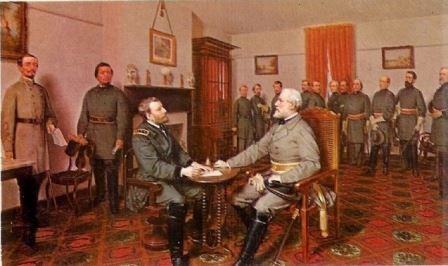
Lincoln was looking forward to the play. Though the war continued the surrender of Robert E. Lee’s Army of Northern Virginia to Ulysses S. Grant on April 9th for all intents and purposes had placed the final nail in the Confederacy’s malevolent coffin, and it was if a burden have been removed from Lincoln’s shoulders. His task now what the reintegration of the rebellious states back into the Union, a task that he believed needed to be accomplished without malice while still seeking justice. He made this clear in his Second Inaugural Address just over a month before:

“With malice toward none, with charity for all, with firmness in the right as God gives us to see the right, let us strive on to finish the work we are in, to bind up the nation’s wounds, to care for him who shall have borne the battle and for his widow and his orphan, to do all which may achieve and cherish a just and lasting peace among ourselves and with all nations.”

Just three days before Lincoln had given his last public speech at the White House. It was a practical speech dealing with the nuts and bolts reuniting the country including announcing his support for Negro Suffrage. He said:

“By these recent successes the re-inauguration of the national authority — reconstruction — which has had a large share of thought from the first, is pressed much more closely upon our attention. It is fraught with great difficulty. Unlike a case of a war between independent nations, there is no authorized organ for us to treat with. No one man has authority to give up the rebellion for any other man. We simply must begin with, and mould from, disorganized and discordant elements. Nor is it a small additional embarrassment that we, the loyal people, differ among ourselves as to the mode, manner, and means of reconstruction.”

In the speech Lincoln discussed the issues related to the new government of Louisiana and its dealings with African Americans, which did not go far enough for Lincoln, who was intent on extending the franchise to vote for all blacks, even if it took time to make it so. John Wilkes Booth was in attendance that day and as he listened he became ever angrier and he vowed to a fellow conspirator Lewis Powell, “That is the last speech he will make” and Booth was going to ensure this himself.

Lincoln had been troubled for some time by terrible insomnia and dreams, both bizarre and ghoulish. A few days before he had told Mary and others sharing dinner with them of a troubling dream which he described in detail, Mary and those at the table so accustomed to Lincoln’s customary wit and humor were stunned as Lincoln spoke. He closed the description with these words:

“Determined to find the cause of a state of things so mysterious and shocking, I kept on until I entered the East Room, which I entered. There I was met with a sickening surprise. Before me was a catafalque, on which rested a corpse wrapped in funeral vestments. Around it were stationed soldiers who were acting as guards; and a throng of people, some gazing mournfully at the corpse, whose face was covered, others weeping pitifully: ‘Who is dead in the White House?’ I demanded of one of the soldiers. ‘The President’ was the answer; ‘he was killed by an assassin!’ “Then came a loud burst of grief from the crowd…” [1]

Mary and the others were so upset, particularly with the large number of death threats Lincoln had received throughout the war. However, Lincoln told them all not to worry as “it was only a dream.”

On that Good Friday Lincoln was determined not to mourn, instead of attending Good Friday services or contemplating the war, or reconstruction, he simply wanted to laugh and chose to attend the play, wanting General Grant and his wife to attend. However Grant needed to travel to New Jersey and declined the offer.

Despite this Lincoln was in a cheerful mood, looking forward to the future and discussing all the things that he wanted to see and do after his term in office. Mary was startled by his cheerfulness and Lincoln told her “I have never felt better in my life.” [2] Lincoln and his party arrived late to the cheers of the cast and took their seats in the box about 8:30 to the strains of Hail to the Chief. As the play resumes Lincoln’s bodyguard slips away to get a drink and about twelve minutes after ten Booth slipped into the box where Lincoln sat watching the play. As the crowd roared its delight at a particularly funny scene a shot rings out and Lincoln’s arm jerks up and he slumps over. Booth then jumped to the stage from the box, injuring his leg and shouting “Sic semper tyrannis” or thus always to tyrants. It was the beginning of a series of attempted assassinations designed to decapitate the Federal government, Secretary of State Seward was badly wounded by Lewis Payne, a third assassin backed out at the last minute and failed to attack Vice President Johnson.

Though physicians sought to save the President the wound was mortal, the bullet having ender the back of his head, and dug deep into his brain, lodging behind his left eye. At 7:22 A.M. Abraham Lincoln was dead. It was a disaster for the nation as the new President, Andrew Johnson was a political enemy of Lincoln and not in line with Lincoln’s understanding of reconstruction and reconciliation. A poor Southerner from Tennessee, Johnson hated the Southern plantation aristocracy and would act as a punisher, while radical reconstructionist members of the cabinet and Congress would act in such a way that reconstruction would never achieve all that Lincoln believed that it could.

While radical Confederates rejoiced in Lincoln’s death others were more circumspect. Jefferson Davis who was fleeing and hoping to continue the war realized that the South would not fare as well under Johnson as Lincoln. In fact Johnson’s lack of understanding of the nuances of northern politics as well as his loathing of blacks, his “beliefs, prejudices, personality traits were a recipe for disaster at a time when an unprecedented national crisis put a premium on the capacity to think in new and creative ways.” [3]

The Army of the Potomac learned of Lincoln’s assassination on Easter Sunday. Joshua Chamberlain told a woman whose mansion was at the center of his division’s camp when she asked what disturbed him “It is bad news for the South.” When the woman asked if it was Lee or Davis Chamberlain told her that it was Lincoln and said “The South has lost its best friend, Madam.” [4]

Chamberlain ordered chaplain to conduct a field memorial for the fallen President. The division chaplain a Catholic Priest, Father Egan spoke and roused the men, and Egan ended his service “Better so, Better to die glorious, than live infamous. Better to be buried beneath a nation’s tears, than to walk the earth guilty of the nation’s blood.” [5]

During the war Lincoln had endeared himself to his soldiers and they responded with great emotion. One burst into tears and sobbed “He was our best friend. God bless him,” another wrote home “What a hold Old Abe had on the hearts of the soldiers of the army could only be told by the way they showed their mourning for him.” Admiral David Dixon Porter wrote “The United States has lost the greatest man she ever produced.” [6]

The bullet fired by John Wilkes Booth was a disaster for the country. Sadly, there are some today, in particular the White Supremacist group The League of the South are choosing to celebrate the assassination of the man that they so hate, and honor the assassin as a hero. However, I have to agree with Admiral Porter, there has never been a President before or after who was anything like this man, and I dedicate myself to the quest for equality of all people and for a reconciliation like the leaders of the League of the South and their forbearers will never embrace, for they hate this nation as much as they hate Lincoln. I also fear what such people would do to President Obama should they ever get the opportunity.

Peace

Padre Steve+

Notes

[1] Winik, Jay April 1865: The Month that Saved America Harper Collins, New York 2001 p.205

[2] Ibid. Winik April 1865 p.220

[3] Foner, Eric Forever Free: The Story of Emancipation and Reconstruction Vintage Books, New York 2005 p.109

[4] Wallace, Willard. The Soul of the Lion: A Biography of Joshua L. Chamberlain Stan Clark Military Books, Gettysburg PA 1960 p.193

[5] Ibid. Wallace The Soul of the Lion p.194.

[6] Flood, Charles Bracelen Grant and Sherman: The Friendship that Won the War Harper Perennial, New York 2005 pp.329-330

Leave a comment

Filed under civil war, History, leadership, Political Commentary

The Lost Cause Lives in Texas

confederate_flag_memorial

Over the past few years there has been an increase in Neo-Confederate propaganda, talk of secession and civil war coming from people who for the most part call themselves Christians. To be honest there is a reason for this, and that reason is because a Black Man was elected as President and all the underlying pent-up racism that never died despite the great advances that we have seen since the dawn of the Civil Rights Era. Doctor King may have a Holiday, but racism is not dead and often it is cloaked in the myth of the Lost Cause.

Over the past few weeks down in Orange Texas, the Local Sons of the Confederate Veterans chapter have decided to spruce up the monument to the Texas Confederate dead. Now I have lived throughout the South and in most of the former Confederate states there are monuments to the Confederate war dead, and it seems that almost every town has one. They are a part of history and those I vehemently disagree with what those men fought for and would have fought against them, such monument are a part of our history. Monuments to fallen soldiers are part of every almost every western culture and a way for families and communities to remember those who died.

However, the kerfuffle in Orange is a bit different. The monument has been there a long time and truthfully, the Sons of Confederate Veterans own it and the land that it is on. It not on public property actually, if the monument has fallen into disrepair I have no problem with them doing that. However, what they are doing is different. They are erecting flagpoles for 32 Confederate flags. Eight of them are various renditions of the flags of the Confederacy itself and twenty-four are going to be replicas of the flags of Texas Regiments that fought in the war.

Now I do understand that those flags do have some historical meaning and significance, at the same time that historical meaning and significance is connected to a cause that was about the rights of states to promote White Supremacy and slavery. The supporters of the Confederate flag project in Orange are saying that this was not the case.

“David Moore, Lieutenant Division Commander of the Texas Sons of Confederate Veterans, told The Post that Southern states did not fight the Civil War to defend slavery, but instead to defend state’s rights after they were “invaded by Northern troops.” He said the monument in Orange honors the ancestors of the 2,600 members of Texas Sons of Confederate Veterans.” [1]

My feeling is if the Sons of Confederate Veterans wanted to honor their ancestors and remember the military organizations they could place plaques with the regimental histories and the names of those killed in action. They could actually try to make it somewhat reverent and at the same time educational, but this, the display of so many flags looks more like a display designed to incite division and make current the Lost Cause.

A couple of years ago washed up rocker, draft dodger and professional muckraker Ted Nugent made the comment that he wondered if it would have been better that the South had won the Civil War. Nugent’s statements, like those of the Sons of Confederate Veterans in Texas are blatant examples of the enduring influence of the Lost Cause Myth, and show the revisionism and dishonest “scholarship” of the Neo-Confederates. The dishonesty and lack of truth in this quote, which is typical of the movement finds its genus in the discredited myth of the Lost Cause.

Sadly, a lot of the proponents of this are leaders in the radical, theocratic movement known as Christian Dominionism. This movement and its leaders believe that it is the duty of Christians to claim all of culture, politics and economics for God, and to disenfranchise or even kill those who do not agree. Many times their rhetoric is tinged with violence, racism, xenophobia and frankly paranoid and conspiratorial views of anyone that does not agree with them. Leaders of this movement are closely connected to, and often are advisers to prominent current and former Republican elected officials including Rand and Ron Paul, Ted Cruz, Sarah Palin, Michelle Bachmann, Rick Perry, Bobby Jindal and Sam Brownback.

One of the most troubling things about this movement is its growing ties to and sympathy for neo-Confederate movements and the myth of the Lost Cause.

I have written about the ideological and religious roots of the American Civil War. While I was researching that article I began to see just who closely the language of this allegedly Christian movement parallels that of those who led the South to disaster in the Civil War and then to cover their crimes and to justify their actions.

These people are part of a growing fringe movement which advocates all the ideas espoused by the leaders of the Confederacy: secession, nullification, White Supremacy and some advocate violence and insurrection. Many of these despise Abraham Lincoln; they use state legislatures to pass Jim Crow like voting restrictions that particularly impact the poor, the elderly and minorities, and they use the cover of their religious rights to establish laws that allow the open discrimination against Gays. They favor an oligarchy of the rich and corporations that is very similar in its philosophy and ideology to that of the Southern elites and the plantation owners. People who not only enslaved blacks, but used their economic power to keep poor whites in their place.

Some of the Dominionists echo the words of the defenders of slavery. Douglas Wilson, a pastor in the Presbyterian Church of America in Idaho and apologist for Confederate views wrote: “slavery produced in the South a genuine affection between the races that we believe we can say has never existed in any nation before the War or since.” Wilson also wrote that “There has never been, a multi-racial society that has existed with such mutual intimacy and harmony in the history of the world.” Of course there is no truth in that statement whatsoever as any actual student of the ante-bellum South would know. It is fiction and lies being propertied as truth by a Christian pastor in an established denomination.

The cause of the Civil War to the Christian neo-Confederates was not slavery, not economics or even Constitutional issues or anything else that real historians debate but rather a theological myth, as Steven Wilkins explained: “the cause of the Civil War was theological incompatibility between North and South, the former having ‘rejected Biblical Calvinism…“there was radical hatred of Scripture and the old theology [and] Northern radicals were trying to throw off this Biblical culture and turn the country in a different direction….” 

These thoughts are reiterated in many parts of the Dominionist movement in the writings of its godfather R. J. Rushdoony who through his own writings and the continued work of his son-in-law Gary North influence both Ron and his son U.S. Senator and now Republican Presidential Candidate Rand Paul as well as many others in the so called “Christian Right.”

So I have decided to post just a bit of my research on the Lost Cause here, just to show some of the similarities of thought.

As the Southern States seceded, the Reverend William Leacock of Christ Church, New Orleans declared in his Thanksgiving sermon in December of 1860: “Our enemies…have “defamed” our characters, “lacerated” our feelings, “invaded “our rights, “stolen” our property, and let “murderers…loose upon us, stimulated by weak or designing or infidel preachers. With “the deepest and blackest malice,” they have “proscribed” us “as unworthy members… of the society of men and accursed before God.” Unless we sink to “craven” beginning that they “not disturb us,…nothing is now left us but secession.” [2]

The people who drove the nation to war incited secession, not for just any “state’s rights” but for White Supremacy and slavery. Henry Benning of Georgia was a strong Separatist, as proponents of secession were known in Georgia. He led the debate for secession at the Georgia convention, and spoke as a representative at the Virginia secession debate. At both debates the fiery justice proclaimed the disaster that would befall the South under Republican rule: In Virginia he presented a nearly apocalyptic vision of Republican rule:

“On the “not distant” day when the South contains “the only slave States,” climaxed Benning, “The North will have the power to amend the Constitution” and declare “slavery…abolished.” Then the master who “refuses to yield” will doubtless be hung.” Race “war will break out everywhere, like hidden fire from the earth. Eventually “our men will be compelled to wander like vagabonds.” And “as far as our women, the horrors of their state we cannot contemplate.” [3]

He closed his speech with the prediction that under Lincoln and the “Black Republicans” that: “We will be completely exterminated…and the land will be left in the possession of the blacks…” [4]

When you read the words of many of the Dominionist and the Christian neo-Confederate leaders you see a similar cry of victimhood and an apocalyptic vision that is best described as paranoia run rampant. This is only a sample, my research on the Lost Cause, the ante-Bellum South and the contemporary Neo-Confederate Christians connection with the Dominionists continues. What follows here is just a sample of the research that his going into my Civil War and Gettysburg texts plus some additional commentary.

When Edmund Ruffin pulled the lanyard of the cannon that fired the first shot at Fort Sumter it marked the end of an era and despite Ruffin, Stephens and Davis’ plans gave birth to what Lincoln would describe as “a new birth of freedom.”

When the war ended with the Confederacy defeated and the south in ruins, Ruffin still could not abide the result. In a carefully crafted suicide note he sent to his son the bitter and hate filled old man wrote on June 14th 1865:

“I here declare my unmitigated hatred to Yankee rule- to all political, social and business connections with the Yankees and to the Yankee race. Would that I could impress these sentiments, in their full force, on every living Southerner and bequeath them to every one yet to be born! May such sentiments be held universally in the outraged and down trodden South, though in silence and stillness, until the now far-distant day shall arrive for just retribution for Yankee usurpation, oppression and outrages, and for deliverance and vengeance for the now ruined, subjugated and enslaved Southern States! … And now with my latest writing and utterance, and with what will be near my last breath, I here repeat and would willingly proclaim my unmitigated hatred to Yankee rule — to all political, social and business connections with Yankees, and the perfidious, malignant and vile Yankee race.” [5]

Though Ruffin was dead in the coming years the southern states would again find themselves under the governance of former secessionists who were unabashed white supremacists. Former secessionist firebrands who had boldly proclaimed slavery to be the deciding issue when the war changed their story. Instead of slavery being the primary cause of Southern secession and the war, it was “trivialized as the cause of the war in favor of such things as tariff disputes, control of investment banking and the means of wealth, cultural differences, and the conflict between industrial and agricultural societies.” [6]

Alexander Stephens who had authored the infamous1861 Cornerstone Speech that “that the negro is not equal to the white man; that slavery — subordination to the superior race — is his natural and normal condition” argued after the war that the war was not about slavery at all, that it:

“had its origins in opposing principles….It was a strife between the principles of Federation, on the one side, and Centralism, or Consolidation on the other.” He concluded “that the American Civil War “represented a struggle between “the friends of Constitutional liberty” and “the Demon of Centralism, Absolutism, [and] Despotism!” [7]

Jefferson Davis, who had masterfully crafted “moderate” language which radicals in the South used to their advantage regarding the expansion and protection of the rights of slave owners in the late 1850s to mollify Northern Democrats, and who wrote in October 1860 that: “The recent declarations of the Black Republican party…must suffice to convince many who have formerly doubted the purpose to attack the institution of slavery in the states. The undying opposition to slavery in the United States means war upon it where it is, not where it is not.” [8]

After the war a revisionist Davis wrote:

“The Southern States and Southern people have been sedulously represented as “propagandists” of slavery, and the Northern as the champions of universal freedom…” and “the attentive reader…will already found enough evidence to discern the falsehood of these representations, and to perceive that, to whatever extent the question of slavery may have served as an occasion, it was far from being the cause for the conflict.” [9]

Instead of being about slavery the Confederate cause was mythologized by those promoting the false history of the “Lost Cause” a term coined by William Pollard in 1866, which “touching almost every aspect of the struggle, originated in Southern rationalizations of the war.” [10] By 1877 many southerners were taking as much pride in the “Lost Cause” as Northerners took in Appomattox. [11] Alan Nolen notes: “Leaders of such a catastrophe must account for themselves. Justification is necessary. Those who followed their leaders into the catastrophe required similar rationalization.” [12]

The Lost Cause was elevated by some to the level of a religion. In September 1906, Lawrence Griffith speaking to a meeting of the United Confederate Veterans stated that when the Confederates returned home to their devastated lands, “there was born in the South a new religion.” [13] The mentality of the Lost Cause took on “the proportions of a heroic legend, a Southern Götterdämmerung with Robert E. Lee as a latter day Siegfried.” [14]

This new religion that Griffith referenced was replete with signs, symbols and ritual:

“this worship of the Immortal Confederacy, had its foundation in myth of the Lost Cause. Conceived in the ashes of a defeated and broken Dixie, this powerful, pervasive idea claimed the devotion of countless Confederates and their counterparts. When it reached fruition in the 1880s its votaries not only pledged their allegiance to the Lost Cause, but they also elevated it above the realm of common patriotic impulse, making it perform a clearly religious function….The Stars and Bars, “Dixie,” and the army’s gray jacket became religious emblems, symbolic of a holy cause and of the sacrifices made on its behalf. Confederate heroes also functioned as sacred symbols: Lee and Davis emerged as Christ figures, the common soldier attained sainthood, and Southern women became Marys who guarded the tomb of the Confederacy and heralded its resurrection.” [15]

Jefferson Davis became an incarnational figure for the adherents of this new religion. A Christ figure who Confederates believed “was the sacrifice selected-by the North or by Providence- as the price for Southern atonement. Pastors theologized about his “passion” and described Davis as a “vicarious victim”…who stood mute as Northerners “laid on him the falsely alleged iniquities of us all.” [16]

In 1923 a song about Davis repeated this theme:

Jefferson Davis! Still we honor thee! Our Lamb victorious, who for us endur’d A cross of martyrdom, a crown of thorns, soul’s Gethsemane, a nation’s hate, A dungeon’s gloom! Another God in chains!” [17]

The myth also painted another picture, that of slavery being a benevolent institution which has carried forth into our own time. The contention of Southern politicians, teachers, preachers and journalists was that slaves liked their status; they echoed the words of slave owner Hiram Tibbetts to his brother in 1842 “If only the abolitionists could see how happy our people are…..The idea of unhappiness would never enter the mind of any one witnessing their enjoyments” [18] as well as Jefferson Davis who in response to the Emancipation Proclamation called the slaves “peaceful and contented laborers.” [19]

The images of the Lost Cause, was conveyed by numerous writers and Hollywood producers including Thomas Dixon Jr. whose play and novel The Clansman became D.W. Griffith’s The Birth of a Nation, a groundbreaking part of American cinematography which was released in 1915; Margaret Mitchell who penned the epic Pulitzer Prize winning novel Gone With the Wind which in its 1939 film form won ten academy awards immortalized the good old days of the old South with images of faithful slaves, a theme which found its way into Walt Disney’s famed 1946 animated Song of the South.

The Lost Cause helped buttress the myths that both comforted and inspired many Southerners following the war. “It defended the old order, including slavery (on the grounds of white supremacy), and in Pollard’s case even predicted that the superior virtues of cause it to rise ineluctably from the ashes of its unworthy defeat.” [20] The myth helped pave the way to nearly a hundred more years of effective second class citizenship for now free blacks who were often deprived of the vote and forced into “separate but equal” public and private facilities, schools and recreational activities. The Ku Klux Klan and other violent organizations harassed, intimidated, persecuted and used violence against blacks.

“From the 1880s onward, the post-Reconstruction white governments grew unwilling to rely just on intimidation at the ballot box and themselves in power, and turned instead to systematic legal disenfranchisement.” [21] Lynching was common and even churches were not safe. It would not be until the Civil Rights movement of the 1950s and 1960s that blacks would finally begin to gain the same rights enjoyed by whites in most of the South.

That radical thought is still out there. The League of the South posted this on its website:

This 14th of April will mark the 150th anniversary of John Wilkes Booth’s execution of the tyrant Abraham Lincoln. The League will, in some form or fashion, celebrate this event. We remember Booth’s diary entry: “Our country owed all her troubles to him, and God simply made me the instrument of his punishment.” A century and a half after the fact, The League of the South thanks Mr. Booth for his service to the South and to humanity. [22]

Michael Hill, the co-founder of this organization wrote:

“As a traditional Christian Southerner, I want no part of “America.” I’m not talking about a particular piece of land in the western hemisphere; rather, I am talking about an idea, a proposition, a regime, a way of life. I am a Southerner, an old-fashioned Christian. The status of “American” is my antithesis.

Now before you tell me to “Love it or leave it” and pack up and move somewhere else, let me explain. The South, Alabama in particular, is my home. It is also a captive colony of this American monstrosity. Yes, many of our citizens have, wittingly or unwittingly, embraced Americanism for either survival or profit. I have not, and I intend to convince my fellow Southerners to join my side. I do not intend to leave Alabama or the South. Nor do I intend to leave them in the clutches of America. I intend to fight, and if necessary kill and die, for their survival, well-being, and independence.” [23]

William Ruffin outlived Lincoln who was killed by the assassin John Wilkes Booth on April 14th 1864. However the difference between the two men was marked. In his Second Inaugural Address Lincoln spoke in a different manner than Ruffin. He concluded that address with these thoughts:

“With malice toward none, with charity for all, with firmness in the right as God gives us to see the right, let us strive on to finish the work we are in, to bind up the nation’s wounds, to care for him who shall have borne the battle and for his widow and his orphan, to do all which may achieve and cherish a just and lasting peace among ourselves and with all nations.” [24]

I have ancestors on both sides of my family who fought for the Confederacy. While they are my ancestors I cannot subscribe to or honor the cause for which they fought, and for which at least one died. The Confederate flag, though a part of American history is a symbol of White Supremacy, hatred and rebellion. The only reason that I can think that any group would want to fly thirty-two of them is to proclaim that their cause still lives and that they have not abandoned the ideology and beliefs of their ancestors. This is not about displaying history. It is all about promoting White-Christian Supremacy and to again elevate the myth of the Lost Cause as truth.

For me, the words and actions as well as the symbols of the old and new Confederates stand in stark contrast to those support and defend. I sincerely hope that they and their cause eventually fade away to insignificance without again bringing us to civil war.

Peace

Padre Steve+

Notes

[1] Holley, Peter These Texas rebels say the American flag is more racist than the Confederate flag Washington Post 8 April 2015 retrieved 10 April 2015 from http://www.washingtonpost.com/news/morning-mix/wp/2015/04/08/these-texas-rebels-say-the-american-flag-is-more-racist-than-the-confederate-flag/?tid=sm_fb


[2] Freehling, William. The Road to Disunion Volume II: Secessionists Triumphant 1854-1861 Oxford University Press, Oxford and New York 2007 p.511

[3] Ibid. Freehling The Road to Disunion Volume II p.511

[4] Dew, Charles B. Apostles of Disunion: Southern Secession Commissioners and the Causes of the Civil War University Press of Virginia, Charlottesville and London 2001 p.67

[5] Edmund Ruffin (1794-1865). Diary entry, June 18, 1865. Manuscript Division, Library of Congress Retrieved from http://blogs.loc.gov/civil-war-voices/about/edmund-ruffin/ 24 March 2014

[6] Gallagher, Gary W. and Nolan Alan T. editors The Myth of the Lost Cause and Civil War History Indiana University Press, Bloomington and Indianapolis 2000 p.15

[7] Dew, Charles Apostles of Disunion p.16

[8] Catton, Bruce The Coming Fury p.104

[9] Davis, Jefferson The Rise and Fall of the Confederate Government Volume One of Two, A public Domain Book, Amazon Kindle edition pp.76-77


[10] Gallagher, Gary and Nolan, Alan The Myth of the Lost Cause and Civil War History p.12

[11] Millet Allen R and Maslowski, Peter. For the Common Defense: A Military History of the United States of America The Free Press, a division of McMillan Publishers, New York 1984 p.230

[12] Ibid. Gallagher and Nolan The Myth of the Lost Cause and Civil War History p.12

[13] Hunter, Lloyd The Immortal Confederacy: Another Look at the Lost Cause Religion in Gallagher and Nolan The Myth of the Lost Cause and Civil War p.185

[14] McPherson, James The Battle Cry of Freedom p.854

[15] Ibid. Hunter The Immortal Confederacy Religion in Gallagher and Nolan The Myth of the Lost Cause and Civil War p.186

[16] Ibid. Hunter The Immortal Confederacy Religion in Gallagher and Nolan The Myth of the Lost Cause and Civil War p.198

[17] Ibid. Hunter The Immortal Confederacy Religion in Gallagher and Nolan The Myth of the Lost Cause and Civil War p.198

[18] Levine, Bruce Half Slave and Half Free p.106

[19] Ibid. Gallagher and Nolan The Myth of the Lost Cause and Civil War History p.16

[20] Guelzo, Allen Fateful Lightening p.525

[21] Ibid. Guelzo Fateful Lightening p.526

[22] Hill, Michael Honoring John Wilkes Booth League of the South Website http://leagueofthesouth.com/honoring-john-wilkes-booth569/ retrieved 10 April 2015

[23] Hill, Michael. Why I am Not an American League of the South Website http://leagueofthesouth.com/why-i-am-not-an-american-566/ retrieved 10 April 2015

[24] Ibid. Lincoln Second Inaugural Address


2 Comments

Filed under civil rights, civil war, History, News and current events, Political Commentary

“We Are All Americans” Surrender at Appomattox

appomattox surrender

One hundred and fifty years ago on the 9th and 10th of April 1865, four men, Ulysses S Grant, Robert E. Lee, Joshua Lawrence Chamberlain and Ely Parker, taught succeeding generations the value of mutual respect and reconciliation. They would do so after a bitter and bloody war that had cost the lives of over 600,000 Americans which had left hundreds of thousands others maimed, shattered or without a place to live, and seen vast swaths of the country ravaged by war and its attendant plagues.

The men were all very different, Lee was a Southern aristocrat and career army officer, Grant, the officer of humble means who had struggled with alcoholism and failed in his civilian life before returning to the army when war began. Chamberlain, was the professor of rhetoric and natural and revealed religion, the hero of Little Round Top, who helped exemplify the importance of citizen soldiers in peace and war. Finally there was Parker, a full-blooded Seneca Indian; a professional engineer, a man who was barred from being an attorney because as a Native American he was never considered a citizen. Although he had been rejected from serving in the army for the same reason, his friend Grant had obtained him a commission and kept him on his staff.

On the morning of the 9th Confederate General Robert E. Lee replied to an entreaty of Lieutenant General Ulysses S. Grant requesting that he and his Army of Northern Virginia be allowed to surrender. Lee wrote to Grant:

HEADQUARTERS ARMY OF NORTHERN VIRGINIA, APRIL 9, 1865

Lieut. Gen. U.S. GRANT:

I received your note of this morning on the picket-line, whither I had come to meet you and ascertain definitely what terms were embraced in your proposal of yesterday with reference to the surrender of this army. I now ask an interview in accordance with the offer contained in your letter of yesterday for that purpose.

R.E. LEE, General.

The once mighty Army of Northern Virginia which had won so many victories was now a haggard but proud force of about 15,000 soldiers. For Lee to continue the war now would mean that they face hopeless odds against a vastly superior enemy. Grant recognized this and wrote Lee:

I am equally anxious for peace with yourself, and the whole North entertains the same feeling. The terms upon which peace can be had are well understood. By the South laying down their arms they will hasten that most desirable event, save thousands of human lives, and hundreds of millions of property not yet destroyed. Seriously hoping that all our difficulties may be set-tied without the loss of another life, I subscribe myself, &c.,

Since the high water mark at Gettysburg, Lee’s army had been on the defensive. His ill-fated offensive into Pennsylvania being one of the two climactic events that sealed the doom of the Confederacy. The other was Grant’s victory at Vicksburg which fell to him a day after Pickett’s Charge.

The bloody defensive struggle lasted through 1864 as Grant bled the Confederates dry during the Overland Campaign, leading to the long siege of Petersburg. Likewise the armies of William Tecumseh Sherman had cut a swath through the Deep South and were moving toward Virginia from the Carolinas.

With each battle following Gettysburg the Army of Northern Virginia became weaker and finally after the nine month long siege of Petersburg ended with a Union victory there was little else to do. On the morning of April 9th a final attempt to break through the Union lines by John Gordon’s division was turned back by vastly superior Union forces.

grant 1

Lieutenant General Ulysses S. Grant, United States Army

On April 7th Grant wrote a letter to Lee which began the process of ending the war in Virginia. He wrote:

General R. E. LEE:

The result of the last week must convince you of the hopelessness of further resistance on the part of the Army of Northern Virginia in this struggle. I feel that it is so, and regard it as my duty to shift from myself the responsibility of any further effusion of blood, by asking of you the surrender of that portion of the C. S. Army known as the Army of Northern Virginia.

U.S. GRANT, Lieutenant-General

Lee was hesitant to surrender knowing Grant’s reputation for insisting on unconditional surrender, terms that Lee could not accept. He replied to Grant:

HEADQUARTERS ARMY OF NORTHERN VIRGINIA, APRIL 7, 1865 Lieut. Gen. U.S. GRANT:

I have received your note of this date. Though not entertaining the opinion you express on the hopelessness of further resistance on the part of the Army of Northern Virginia, I reciprocate your desire to avoid useless effusion of blood, and therefore, before considering your proposition, ask the terms you will offer on condition of its surrender.

R.E. LEE, General.

The correspondence continued over the next day even as the Confederates hoped to fight their way out of the trap that they were in. But now Robert E. Lee, who had through his efforts extended the war for at least six months knew that he could no longer continue. Even so some of his younger subordinates wanted to continue the fight. When his artillery chief Porter Alexander recommended that the Army be released, “take to the woods and report to their state governors” Lee replied:

“We have simply now to face the fact that the Confederacy has failed. And as Christian men, Gen. Alexander, you & I have no right to think for one moment of our personal feelings or affairs. We must consider only the effect which our action will have upon the country at large.”

Lee continued:

“Already [the country] is demoralized by the four years of war. If I took your advice, the men would be without rations and under no control of their officers. They would be compelled to rob and steal in order to live…. We would bring on a state of affairs it would take the country years to recover from… You young fellows might go bushwhacking, but the only dignified course for me would be to go to General Grant and surrender myself and take the consequences of my acts.”

Alexander was so humbled at Lee’s reply he later wrote “I was so ashamed of having proposed such a foolish and wild cat scheme that I felt like begging him to forget he had ever heard it.” When Alexander saw the gracious terms of the surrender he was particularly impressed with how non-vindictive the terms were, especially in terms of parole and amnesty for the surrendered soldiers.

Abraham Lincoln had already set the tone for the surrender in his Second Inaugural Address given just over a month before the surrender of Lee’s army. Lincoln closed that speech with these words of reconciliation:

“With malice toward none, with charity for all, with firmness in the right as God gives us to see the right, let us strive on to finish the work we are in, to bind up the nation’s wounds, to care for him who shall have borne the battle and for his widow and his orphan, to do all which may achieve and cherish a just and lasting peace among ourselves and with all nations.”

Lee1

General Robert E. Lee, CSA

Lee met Grant at the house of Wilmer McLean, who had moved to Appomattox in 1861 after his home near Manassas had been used as a Confederate headquarters and was damaged by artillery fire. Lee was dressed in his finest uniform complete with sash, while Grant was dressed in a mud splattered uniform and overcoat only distinguished from his soldiers by the three stars on his should boards. Grant’s dress uniforms were far to the rear in the baggage trains and Grant was afraid that his slovenly appearance would insult Lee, but it did not. It was a friendly meeting, before getting down to business the two reminisced about the Mexican War.

Grant provided his vanquished foe very generous surrender terms:

“In accordance with the substance of my letter to you of the 8th inst., I propose to receive the surrender of the Army of N. Va. on the following terms, to wit: Rolls of all the officers and men to be made in duplicate. One copy to be given to an officer designated by me, the other to be retained by such officer or officers as you may designate. The officers to give their individual paroles not to take up arms against the Government of the United States until properly exchanged, and each company or regimental commander sign a like parole for the men of their commands. The arms, artillery and public property to be parked and stacked, and turned over to the officer appointed by me to receive them. This will not embrace the side-arms of the officers, nor their private horses or baggage. This done, each officer and man will be allowed to return to their homes, not to be disturbed by United States authority so long as they observe their paroles and the laws in force where they may reside.”

When Lee left the building Federal troops began cheering but Grant ordered them to stop. Grant felt a sense of melancholy and wrote “I felt…sad and depressed, at the downfall of a foe who had fought so long and valiantly, and had suffered so much for a cause, though that cause was, I believe, one of the worst for which a people has fought.” He later noted: “The Confederates were now our countrymen, and we did not want to exult over their downfall.”

In the hours before and after the signing of the surrender documents old friends and classmates, separated by four long years of war gathered on the porch or around the house. Grant and others were gracious to their now defeated friends and the bitterness of war began to melt away. Some Union officers offered money to help their Confederate friends get through the coming months. It was an emotional reunion, especially for the former West Point classmates gathered there:

“It had never been in their hearts to hate the classmates they were fighting. Their lives and affections for one another had been indelibly framed and inextricably intertwined in their academy days. No adversity, war, killing, or political estrangement could undo that. Now, meeting together when the guns were quiet, they yearned to know that they would never hear their thunder or be ordered to take up arms against one another again.”

Grant also sent 25,000 rations to the starving Confederate army waiting to surrender. The gesture meant much to the defeated Confederate soldiers who had had little to eat ever since the retreat began.

The surrender itself was accomplished with a recognition that soldiers who have given the full measure of devotion can know when confronting a defeated enemy. Major General Joshua Lawrence Chamberlain, the heroic victor of Little Round Top was directed by Grant to receive the final surrender of the defeated Confederate infantry on the morning of April 12th.

It was a rainy and gloomy morning as the beaten Confederates marched to the surrender grounds. As the initial units under the command of John Gordon passed him, Chamberlain was moved with emotion he ordered his soldiers to salute the defeated enemy for whose cause he had no sympathy, Chamberlain honored the defeated Rebel army by bringing his division to present arms.

chamberlian gordon appomattox

John Gordon, who was “riding with heavy spirit and downcast face,” looked up, surveyed the scene, wheeled about on his horse, and “with profound salutation returned the gesture by lowering his saber to the toe of his boot. The Georgian then ordered each following brigade to carry arms as they passed third brigade, “honor answering honor.”

joshua_chamberlain_-_brady-handy

Major General Joshua Lawrence Chamberlain, U.S. Army

Chamberlain was not just a soldier, but before the war had been Professor of Natural and Revealed Religions at Bowdoin College, and a student of theology before the war. He could not help to see the significance of the occasion. He understood that he would be criticized by some for offering the salute. However, Chamberlain, unlike some, understood the value of reconciliation. Chamberlain was a staunch abolitionist and Unionist who had nearly died on more than one occasion fighting the defeated Confederate Army, and he understood that no true peace could transpire unless the enemies became reconciled to one another.

He noted that his chief reason for doing so:

“The momentous meaning of this occasion impressed me deeply. I resolved to mark it by some token of recognition, which could be no other than a salute of arms. Well aware of the responsibility assumed, and of the criticisms that would follow, as the sequel proved, nothing of that kind could move me in the least. The act could be defended, if needful, by the suggestion that such a salute was not to the cause for which the flag of the Confederacy stood, but to its going down before the flag of the Union. My main reason, however, was one for which I sought no authority nor asked forgiveness. Before us in proud humiliation stood the embodiment of manhood: men whom neither toils and sufferings, nor the fact of death, nor disaster, nor hopelessness could bend from their resolve; standing before us now, thin, worn, and famished, but erect, and with eyes looking level into ours, waking memories that bound us together as no other bond;—was not such manhood to be welcomed back into a Union so tested and assured? Instructions had been given; and when the head of each division column comes opposite our group, our bugle sounds the signal and instantly our whole line from right to left, regiment by regiment in succession, gives the soldier’s salutation, from the “order arms” to the old “carry”—the marching salute. Gordon at the head of the column, riding with heavy spirit and downcast face, catches the sound of shifting arms, looks up, and, taking the meaning, wheels superbly, making with himself and his horse one uplifted figure, with profound salutation as he drops the point of his sword to the boot toe; then facing to his own command, gives word for his successive brigades to pass us with the same position of the manual,—honor answering honor. On our part not a sound of trumpet more, nor roll of drum; not a cheer, nor word nor whisper of vain-glorying, nor motion of man standing again at the order, but an awed stillness rather, and breath-holding, as if it were the passing of the dead!”

The next day Robert E Lee addressed his soldiers for the last time. Lee’s final order to his loyal troops was published the day after the surrender. It was a gracious letter of thanks to men that had served their beloved commander well in the course of the three years since he assumed command of them outside Richmond in 1862.

General Order
No. 9

After four years of arduous service marked by unsurpassed courage and fortitude, the Army of Northern Virginia has been compelled to yield to overwhelming numbers and resources.

I need not tell the survivors of so many hard fought battles, who have remained steadfast to the last, that I have consented to the result from no distrust of them.

But feeling that valour and devotion could accomplish nothing that could compensate for the loss that must have attended the continuance of the contest, I have determined to avoid the useless sacrifice of those whose past services have endeared them to their countrymen.

By the terms of the agreement, officers and men can return to their homes and remain until exchanged. You will take with you the satisfaction that proceeds from the consciousness of duty faithfully performed, and I earnestly pray that a merciful God will extend to you his blessing and protection.

With an unceasing admiration of your constancy and devotion to your Country, and a grateful remembrance of your kind and generous consideration for myself, I bid you an affectionate farewell. — R. E. Lee, General

The surrender was the beginning of the end. Other Confederate forces continued to resist for several weeks, but with the surrender of the Army of Northern Virginia led by the man that nearly all Southerners saw as the embodiment of their nation the war was effectively over.

Lee had fought hard and after the war was still under the charge of treason, but he understood the significance of defeat and the necessity of moving forward as one nation. In August 1865 Lee wrote to the trustees of Washington College of which he was now President:

“I think it is the duty of every citizen, in the present condition of the Country, to do all in his power to aid the restoration of peace and harmony… It is particularly incumbent upon those charged with the instruction of the young to set them an example of submission to authority.

It is a lesson that all of us in our terribly divided land need to learn regardless of or political affiliation or ideology. After he had signed the surrender document, Lee learned that Grant’s Aide-de-Camp Colonel Ely Parker, was a full-blooded Seneca Indian. He stared at Parker’s dark features and said: “It is good to have one real American here.”

eparker05-966-g

Brigadier General Ely Parker, United States Army

Parker, a man whose people had known the brutality of the white man, a man who was not considered a citizen and would never gain the right to vote, replied, “Sir, we are all Americans.” That afternoon Parker would receive a commission as a Brevet Brigadier General of Volunteers, making him the first Native American to hold that rank in the United States Army. He would later be made a Brigadier General in the Regular Army.

I don’t know what Lee thought of that. His reaction is not recorded and he never wrote about it after the war, but it might have been in some way led to Lee’s letter to the trustees of Washington College. I think with our land so divided, ands that is time again that we learn the lessons so evidenced in the actions and words of Ely Parker, Ulysses Grant, Robert E. Lee and Joshua Chamberlain, for we are all Americans.

Sadly, I think that there is a portion of the population who will not heed these words and will continue to agitate for policies and laws similar to those that led to the Civil War, and which those the could not reconcile defeat instituted again during the Post-Reconstruction and Jim Crow eras.

But I still maintain hope that in spite of everything, that we can overcome.

Peace

Padre Steve+


1 Comment

Filed under civil war, History, leadership, Military, Political Commentary

War is Cruelty

481801_10151367001287059_1003164983_n-1.jpg

Destroyed Tombstone at the British Cemetery: Habbinyah Iraq  

I am a career military officer, an Iraq veteran and an anti-war liberal, but I am also a realist in terms of the world. I have no illusions about the world. I do not believe that the United States always acts with honor and I know in my heart of hearts that much of the chaos that we are seeing in the world, particularly the Middle East comes from years of American intrigue and intervention. But I also know that once you have let the genie of war and chaos out of the bottle that it seldom returns to it without creating more chaos, death and destruction. Since I am a realist, I understand that whether I want it or not, and regardless of who is President that this war will remain part of our lives, maybe for a generation or more. Thus we have to understand that this war is not a movie, it is not a video game, and it has the potential to change all of our lives, and not for the better.

I fully agree with two time Medal of Honor Winner and Marine Corps Major General, Smedley Butler who wrote in his book War is a Racket:

“What is the cost of war? what is the bill?…This bill renders a horrible accounting. Newly placed gravestones. Mangled bodies. Shattered minds. Broken hearts and homes. Economic instability. Depression and all of its attendant miseries. Back -breaking taxation for generations and generations. For a great many years as a soldier I had a suspicion that war was a racket; not only until I retired to civilian life did I fully realize it….”

Today I am taking some time to write about the nature of war. It is something that the vast majority of Americans have only vicariously experienced in news accounts, movies, television shows and video games which desensitize people to the horror of war as they kill virtual enemies in often the most violent ways. Abraham Lincoln noted “There’s no honorable way to kill, no gentle way to destroy. There is nothing good in war. Except its ending.”

This is amazing since we have been at war for over thirteen years now. This war has been extended indefinitely by the actions of the Islamic State and the announced intentions of President Obama to fight. Sadly, it will become much worse than people want to believe regardless of whether it is a long or a short war and believe me it will not be a short war. The Islamic State seems to up the ante every day with new atrocities against the peoples of the areas that they control, desecration of religious shrines and the destruction of irreparable historical sites and artifacts.

Americans have grown up for the past twenty years with hi-tech wars that with a few exceptions of terrorism inflicted on American civilians have been waged by a comparatively small professional military; a military that at any given time over the last 20 years has comprised less than one percent of the American population. As such war is a spectator sport for most Americans, we watch it on television, or on You Tube videos on the internet, but it is a distant thing, happening to others that doesn’t touch us too deeply because most of us think that we have no skin in the game. In fact people that bet on baseball have more skin in the game than most Americans do in the current war, but that will probably change.

Since I have written much about that military at its sacrifices in the war that began on September 11th 2001 I am not going to belabor that today. Instead I am going to go back to the nature of war, even wars that may be fought in self-defense and with just cause. It was General William Tecumseh Sherman who wrote:

“You cannot qualify war in harsher terms than I will. War is cruelty, and you cannot refine it; and those who brought war into our country deserve all the curses and maledictions a people can pour out…

Chris Hedges wrote: “Violence is a disease, a disease that corrupts all who use it regardless of the cause,” and as Clausewitz noted of war’s nature, that it is: “a paradoxical trinity-composed of primordial violence, hatred and enmity…”

We try to use language to soften war; to make it more palatable, but to do so is an Orwellian charade that is deceptive and destructive to the soul. Dave Grossman, the army infantry officer who has spent his post military life writing about the psychology of war and killing wrote:

“Even the language of men at war is the full denial of the enormity of what they have done. Most solders do not “kill,” instead the enemy was knocked over, wasted, greased, taken out, and mopped up. The enemy is hosed, zapped, probed, and fired on. The enemy’s humanity is denied, and he becomes a strange beast called a Jap, Reb, Yank, dink, slant, or slope. Even the weapons of war receive benign names- Puff the Magic Dragon, Walleye, TOW, Fat Boy, Thin Man- and the killing weapon of the individual soldier becomes a piece or a hog, and a bullet becomes a round.”

Likewise Thucydides wrote:

“Words had to change their ordinary meaning and to take that which was now given them. Reckless audacity came to be considered the courage of a loyal supporter; prudent hesitation, specious cowardice; moderation was held to be a cloak for unmanliness; ability to see all sides of a question incapacity to act on any….”

Such language gives those who have never been to war but cannot live without it to bring it on, but as Sherman noted: “It is only those who have neither fired a shot nor heard the shrieks and groans of the wounded who cry aloud for blood, more vengeance, more desolation. War is hell.”

President Obama in his address to the nation, and the world on the eve of September 11th talked of a war against the Islamic State, using far more diplomatic, restrained and less warlike language than did Vice President Biden who said:

“As a nation we are united and when people harm Americans we don’t retreat, we don’t forget. We take care of those who are grieving and when that’s finished, they should know we will follow them to the gates of hell until they are brought to justice because hell is where they will reside. Hell is where they will reside.”

I commend the President for his humanity and desire to fight the Islamic State with a matter of restraint. That restraint will last so long as the Islamic State is unable or unwilling to strike at American civilians in the American homeland, or in a country that is not in the war zone, or an American ship or military installation at home or abroad. But once that happens, and it will the pretense of restraint will drop and what the Vice President said will become our goal, even if we do not officially say it. But once those restraints are passed, the war will get really messy. Michael Walzer wrote in his book Just and Unjust Wars:

“We don’t call war hell because it is fought without restraint. It is more nearly right to say that, when certain restraints are passed, the hellishness of war drives us to break with every remaining restraint in order to win. Here is the ultimate tyranny: those who resist aggression are forced to imitate, and perhaps even to exceed, the brutality of the aggressor.”

The problem with this war is that it has lasted so long already, and such long wars are detrimental to the nations and peoples that fight them, as Sun Tzu wrote: “There is no instance of a nation benefitting from prolonged warfare,” as such the longer we drag this war against the Islamic State and other similar groups out, the longer the war continues, the crueler it will become and the more damage it will do to our civil liberties, our economy and even more importantly to the spirit of our nation. One can only look at the Patriot Act and related measures undertaken in the name of national security after 9-11-2001 and recall the words of President John F Kennedy who said in respect to the epidemic of loyalty oaths and restrictions on civil liberties enacted in the 1950s:

“We have also seen a sharpening and refinement of abusive power. The legislative investigation, designed and often exercised for the achievement of high ends, has too frequently been used by the Nation and the States as a means for effecting the disgrace and degradation of private persons. Unscrupulous demagogues have used the power to investigate as tyrants of an earlier day used the bill of attainder.

The architects of fear have converted a wholesome law against conspiracy into an instrument for making association a crime. Pretending to fear government they have asked government to outlaw private protest. They glorify “togetherness” when it is theirs, and call it conspiracy when it is that of others.”

Thus the place that we now find ourselves is not good. On one hand by using restraint the war goes on and on, war without end, and if we embrace Sherman’s realism and admit that “War is cruelty. There’s no use trying to reform it. The crueler it is, the sooner it will be over” is that we will imitate or exceed the brutality of the Islamic State. Either way, we lose something of ourselves.

My hope is that somehow, when this is war is done, maybe in our time or in another generation or two, that we will be able to establish peace by making our enemies our friends.

Peace

Padre Steve+

3 Comments

Filed under Foreign Policy, History, iraq,afghanistan, middle east, Military, national security, News and current events

Fighting Joe Hooker: Part One


Friends of Padre Steve’s World

Another biographic vignette from my Gettysburg text, the first part of a section dealing with Major General Joseph Hooker who almost commanded the Army of the Potomac at Gettysburg. This section of the text deals with Hooker and his command of the Army leading up to the Battle of Chancellorsville. I find him to be one of the most complex and intriguing commanders of the Civil War. He was vain, profane and ambitious, as well as a gifted administrator who actually cared about the welfare of his soldiers. At the same time as a division and corps commander he was outstanding. As the commander of the army he was singularly unsuccessful in battle, but what he had done in the months between his appointment and the disaster at Chancellorsville he turned the Army of the Potomac around. The improvements that he made to the army were very important when it won the Battle of Gettysburg under the command of George Gordon Meade. What Hooker’s legacy shows me is that some men have different talents. Had Hooker been successful at Chancellorsville he would be hailed and what he did before the battle to care for his troops and improve the army would be used as examples of how one should lead. Since he lost and eventually was relieved by Lincoln days before Gettysburg, what he did to make the Army of the Potomac a fighting machine is largely forgotten.

Peace

Padre Steve+

hooker

“Fighting Joe” Hooker had been in command of the Army of the Potomac about five months, assuming command from Burnside, who Lincoln had relieved following the crushing defeat at Fredericksburg, and after that general had demanded the wholesale firing of ten generals from the army of the Potomac, including Hooker. Hooker was a graduate of West Point, class of 1837 and veteran of the Mexican War. During that war he was brevetted three times for bravery acting as Chief of Staff to General Pillow and his division, and as well as the commander of a mixed infantry-cavalry regiment known as the Voltiguers. He received his third brevet of the war to Lieutenant Colonel at Chapultepec. General Winfield Scott “mentioned him prominently in his report on the capture of Mexico, and Pillow testified that he was distinguished by his extraordinary activity, energy and gallantry.” [1]

However, by 1863 he was not well regarded by some of his peers and one very important superior, Major General Halleck, who he had run afoul of in California. “While on Garrison duty in California in the 1850s, he cultivated “bad habits and excesses”- too much liquor, and too many women. He left the army, failed at business, and amassed gambling debts and legal problems.” [2] Hooker, like many contemporaries, finding advancement slow and pay bad resigned from the army in February 1853, and engaged in a series of less than successful business operations in Northern California, and also became active in California politics. However in 1858 Hooker was the recipient of a political plum, and “was appointed Superintendent of Military Roads in Oregon” and in 1859 was appointed a Colonel in the California State Militia. [3]

When war came Hooker managed to obtain an appointment as a Brigadier General of volunteers over the objections of General Winfield Scott from McClellan. Hooker was a “capable commander and brave soldier” [4] and became an excellent brigade commander. He combined strict training and discipline with care and concern for his troops. He “made himself accessible to officers and men who had complaints to air or favors to ask. He also took care that his brigade received its rightful share of rations, clothing and other supplies. He early struck upon the right balance of discipline and paternalism which marks those generals who gain the good will of their men.” [5]

But Hooker had a dark side, his unchecked ego and boundless ambition which were unconstrained by ethical considerations or loyalty to superiors and peers. He worked shamelessly against previous army commanders, including George McClellan, to whom he owed his appointment as a Brigadier General in the Regular Army.

In appearance, Hooker was “a strikingly handsome man” with “erect soldierly bearing…” but he was also “arrogant and stubborn, more than willing to work behind the scenes to advance himself, and reputed to have a headquarters that Charles Francis Adams Jr. described as “a combination barroom and brothel.” [6] The commander of XII Corps, Henry Slocum had “no faith whatever in Hooke’s ability as a military man, in his integrity or honor,” [7] a sentiment echoed by many other officers. However, George Meade was more circumspect, and wrote to his wife “He is a very good soldier, capital general for an army corps, but I am not prepared to say as to his abilities for carrying out a campaign and commanding a large army. I should fear his judgment and prudence…” [8]

Hooker genuinely believed in his abilities and much of the “criticism which he so freely bestowed on his superiors came simply because his professional competence was outraged by the blunders that he had to witness[9] on battlefields such as Second Manassas, Antietam and Fredericksburg. But his enemies, and “there would be a host of them- regarded him as “thoroughly unprincipled.” Hooker was driven by an “all consuming” ambition and undoubted self-confidence…. War intoxicated hi m and offered salvation for a troubled life. As a gambler he liked the odds.” [10]

During the war Hooker was what we would call now “media savvy.” He used the press of his day to shamelessly promote his image and “deliberately played up to the press to swell his image as a stern, remorseless campaigner, and he reveled in the nickname the newspapers happily bestowed on him, “Fighting Joe.” [11] However, he would later express his “deep regret that it was ever applied to him. “People will think that I am a highwayman or bandit,” he said; when in fact he was one of the most kindly and tender-hearted of men.” [12]

But Hooker was not just disrespectful of his military superiors, but also those in the Lincoln administration, including Abraham Lincoln himself. Hooker told reporters after Fredericksburg that Lincoln “was an imbecile for keeping Burnside on but also in his own right, and that the administration itself “was all played out.” What the country needed was a dictator….” [13] Hooker was an intriguer for sure but unlike many generals who did so anonymously. Hooker was quite open and public going before the “Joint Committee on the Conduct of the War investigating Fredericksburg” [14] where he not only provided damning testimony against Burnside, but against potential rivals, and after Fredericksburg the press clamored for Hooker to be named commander. One paper wrote:

We have in the Army of the Potomac, however, a General of the heroic stamp. A general who feels the enthusiasm of a soldier and who loves battle from an innate instinct for his business. The cry is universal, Hooker to the command.” [15]

After the failure at Fredericksburg Burnside had to contend with a “General’s Revolt” within the army. Numerous senior officers were involved, some speaking to the media, others to the high command in Washington and still others to influential congressmen, among these was Hooker.

After the infamous “mud march” Ambrose Burnside, now tired of Hooker and his other subordinates machinations drew up General Order Number 8 in which he planned to relieve seven generals, “two of his three Grand Division chiefs (along with the third Grand Division’s chief of staff), one corps commander, two division commanders, and one brigade commander.” [16] At the insistence of personal friends and staff who pointed out that only Lincoln had that authority, Burnside requested a meeting with the President during which he showed the order to Lincoln and also his letter of resignation if Lincoln refused to back him against his generals. The order stated in part:

“General Joseph Hooker…having been found guilty of unjust and unnecessary criticisms of the actions of his superior officers, and of the authorities, and having, by the general tone of his conversations, endeavored to create distrust in the minds of officers who have associated with him, by having, by omissions and otherwise, made reports and statements that were calculated to create incorrect impressions, and habitually speaking in disparaging terms of other officers, is hereby dismissed from the service of the United States as a man unfit to hold an important commission, during a crisis like the present…” [17]

Burnside was fed up with Hooker and since he did not have the authority to dismiss senior officers from the service he took the matter to Lincoln. Meeting the President at the White House Burnside “confronted Lincoln with this order and his own resignation, either the dissident generals had to go, he said, or he would. Lincoln agreed- and accepted Burnside’s resignation.” [18]

Much to Burnside’s dismay, Lincoln appointed Hooker, Burnside’s nemesis, to command the Army of the Potomac and sent Burnside west to command a corps. As far as the other conspirators of the Generals Revolt, none gained profit of honor from their machinations, and most, with the exception of Hooker ended the war in obscurity or out of the army.

Hooker Appointed to Command

Lincoln knew Hooker’s unsavory side, but the President “considered him an aggressive, hard fighting general…and hoped that Hooker could infuse that spirit into the army,” [19] which now was at its nadir. When Lincoln appointed Hooker to the command of the Army of the Potomac, he gave his new army commander a letter that is unique in American military history. In the letter, Lincoln lectured Hooker as to his conduct while under the command of Burnside, “and just how much he disapproved of the unbounded ambition Hooker had displayed in Undercutting Burnside.” [20] In the letter and during his meeting with Hooker Lincoln laid out his expectations, as well as concerns that he had for him in his new command:

“you may have taken counsel of your ambition, and thwarted him as much as you could, in which you did a great wrong to the country.” Continuing: “I have heard, in such a way as to believe it, of your recently saying that both the Army and the government needed a Dictator. Of course it was not for this, but in spite of it, that I have given you command. Only those generals who gain successes, can set up dictators. What I ask now is military success, and I will risk dictatorship.” [21] However, Lincoln pledged his support to Hooker saying “The government will support you to the utmost of its ability” but warned “I much fear the spirit which you have aided to infuse into the army, of criticizing their commander and withholding confidence in him, will now turn upon you. I shall assist you as far as I can to put it down. Neither you, nor Napoleon, if he were alive again, could get any good out of an army while such a spirit prevails in it.” [22]

Never before or since has an officer been given such responsibility by a President who recognized the man’s qualities, in this case a fighting spirit, as well as his personal vices and shortcomings in character. In fact, the letter can be viewed as “a model for a leader dealing with a flawed, willful, but energetic and useful subordinate.” [23] Lincoln finished the latter to Hooker with the admonition “And now, beware of rashness. Beware of rashness, but with energy and sleepless vigilance go forward and give us victories.” [24] Hooker believed the last comment was due to the way he was portrayed in the press, the “Fighting Joe Hooker” moniker had stuck.

The letter “engendered neither resentment nor misunderstanding” [25] and Hooker’s reaction to the letter was an interesting commentary to say the least. He recalled a few days later that, when he read it, he “informed him personally of the great value I placed on the letter notwithstanding his erroneous views of myself, and that sometime I intended to have it framed and posted in some conspicuous place for the benefit of those who might come after men.” [26] He read it to a number of others and told a journalist “It is a beautiful letter…and, although I think he was harder on me than I deserved, I will say that I love the man who wrote it.” [27] Hooker was certainly sincere in this as he not only preserved it but ensured that it was published after the war was over.

The Positive Contributions of Hooker to the Army of the Potomac

Despite the misgivings of the President and many of his peers, Hooker began a turnaround in the army that changed it for the better. At the beginning of his tenure he inspired confidence among his troops. He reorganized the Cavalry Corps and instituted many other reforms. Hooker discarded Burnside’s failed “Grand Division” organization and returned to the corps system. He was aided by experienced Corps commanders who had earned their promotions in combat and not due to political patronage, even the political animal Dan Sickles of III Corps had shown his abilities as a leader and commander, gone were the last remnants of McClellan’s regime.

Despite the many positives gained during the reorganization, Hooker made one significant mistake during the reorganization which hurt him at Chancellorsville, this was in regard to the artillery. Before that battle decided to “strip General Hunt of command of the artillery and restrict him to purely administrative duties…he had restored Hunt to command the night of May 3 after the Confederates had driven him out of Chancellorsville.” This act ensured that “The advantages traditionally possessed by the Union artillery in the quality of its material and cannon disappeared in this battle through Hooker’s inept handling of his forces.” [28]

When Hooker took command many of the men in the army were “disheartened, homesick, in poor health and without confidence in their officers. Thousands died in their quarters from lack of proper care or medicines for which there was no excuse.” [29] Hooker became immensely popular with the men as he conducted reforms which improved their lives. “He took immediate steps to cashier corrupt quartermasters, improve food, clean up the camps and hospitals, grant furloughs, and instill unit pride by creating insignia badges for each corps…Sickness declined, desertions dropped, and a grant of amnesty brought back many AWOLs back into the ranks.” [30] Additionally “paydays were reestablished and new clothing issued…. Boards of inspection searched out and dismissed incompetent officers.[31] Soldiers sang a ditty about him:

“Joe Hooker is our leader, he takes his whisky strong-” [32]

The most important thing that Hooker did was inspire his troops, both to them and for the cause of the nation was the way he saw that the troops were cared for, no previous Union commander had made troop welfare a priority. Hooker’s “sober, unimaginative, routine work of eternally checking up on rations, clothing, hospitals, living quarters, and other little details which in the long run make all the difference.” [33]

But nothing impacted morale more that his order that “soft bread would henceforth be issued to the troops four times a week. Fresh potatoes and onions were to be issued twice a week, and desiccated vegetables once a week.” [34] The most singularly important accomplishment of Joe Hooker as commander of the army was to demonstrate that he actually cared for his soldiers. It was radically different than Burnside, and even an improvement over the days of McClellan. Such actions made a huge difference in army morale. One officer wrote home “His ‘soft bread’ order reaches us in a tender spot….” [35] Regimental commanders were ordered to ensure that “regular company cooks went to work, and if there were no company cooks they were instructed to create some, so that the soldier could get some decent meals in place of the intestine-destroying stuff he cooked for himself.” [36] Hooker announced “My men shall eat before I am fed, and before my officers are fed” and he clearly meant it.” [37] Hooker’s actions to supply his troops with better food and living conditions as well as his attitude that the welfare of his troops came above his own and his officers was a remarkable example of leadership by example. These very concrete actions of Hooker “did more than anything else to enhance his popularity.” [38] One veteran recalled:

“From the commissary came less whisky for the officers and better rations, including vegetables for the men. Hospitals were renovated, new ones built, drunken surgeons discharged, sanitary supplies furnished, and the sick no longer had to suffer and die without proper care and attention. Officers and men who from incompetence or disability could be of no further use to the service were allowed to resign or were discharged, and those who were playing sick in the hospitals were sent to their regiments for duty.” [39]

Additionally Hooker reformed training in the army. He knew that bored soldiers were their own worst enemy, and instituted a stringent training regimen that paid dividends on the battlefield. “From morning to night the drill fields rumbled with the tramp of many feet. Officers went to school evenings and the next day went out to maneuver companies, regiments, brigades, and divisions in the tactics just studied.” [40] Fitzhugh Lee noted of Hooker that “it must be admitted his preliminary steps toward reorganization and the promotion of the battle power of his army were well taken.” [41] Not only did Hooker mandate such training he frequently showed up and observed the training as well as spent time visiting isolated pickets along the Rappahannock.

Hooker ridded himself of the last vestiges of McClellan’s reliance on the Pinkerton detective agency, and for his uncoordinated use of spies, cavalry and balloons while no “coordinated bureau compiled this information.” [42] Hooker consolidated intelligence operations and created a new staff office in the army, the “Bureau of Military Intelligence, led by Colonel George Sharpe” who “built a network of spies, who soon supplied Hooker with accurate information on Lee’s numerical strength and the unit composition of the Confederate army.” [43] Additionally Hooker helped quash key sources of information relied on by Lee, the local residents along the Rappahannock and Union newspapers. In regard to the former he restricted the movement of civilians along his lines, and cleared out Confederate partisans. As far as the newspapers he “found it expedient to ask Stanton to take action against certain Northern newspapers which were publishing revealing information about the army and offsetting his efforts to retain some secrecy.” [44]

Hooker also reorganized and systematized the Medical Department of the army, and “placed it under the supervision of the competent medical director Dr. Jonathan Letterman.” [45] Under Letterman’s direction and Hooker’s supervision “new hospitals were built and old ones renovated,” [46] this attention to the health of his soldiers paid dividends. Within weeks, “sick rolls had been reduced, and by April, scurvy had virtually disappeared. A veteran contended that Hooker “is a good man to feed an army for we have lived in the best since he took command that we ever did since we have been in the army.” [47]

Hooker worked to combat the vast number of desertions which were plaguing the Army of the Potomac which when he took command were averaging an estimated 200 per day. Tens of thousands of soldiers, some 85,000 according to Hooker’s estimate were absent from the army when he took command. In addition to his work to improve living conditions and the lives of his soldiers in camp Hooker revitalized the office of the Inspector General and used it aggressively to monitor conditions in the camps. One of Hooker’s first initiatives was to systematize “the granting if leaves of absences…..In those regiments lacking discipline, inspection reports were used as a basis for canceling leaves and furloughs, while leaves were increased for those units earning high commendations.” [48]

It was a remarkable turnaround which even impressed his soldiers, his critics, and enemies and his enemies alike. Darius Couch of Second Corps, who later resigned and became Hooker’s arch-enemy, wrote that Hooker had, “by adopting vigorous measures stopped the almost wholesale desertions, and infused new life and discipline into the army.” [49]

The actions of Hooker in the three months between his assumption of command and Chancellorsville were some of the most important of any Federal commander during the war. One senior officer who was not fond of Hooker noted “The Army of the Potomac never spent three months to better advantage.” [50]

The Crisis in Command: Hooker, Lincoln, and Halleck

Hooker had gone into the Battle of Chancellorsville with high hopes and great confidence, but the disaster at Chancellorsville Hooker was not the same. During that battle it was as if he was two persons, the first supremely confident and competent and the second lost and out of his league. During the campaign Hooker had: “planned his campaign like a master and carried out the first half with great skill, and then when the pinch came he simply folded up. There had been no courage in him, no life, no spark; during most of the battle the army had to all intents and purposes had no commander at all.” [51]

The defeat had a lasting effect on Hooker, the connection with his soldiers which he prized was broken. The general who had “once been so popular, was no longer well received in the camps – “there was something in the air of the men which said: ‘We have no further use for you.’” [52] In the immediate aftermath of the battle “Hooker had been deeply depressed… he told Meade that he “almost wished that he had never been born.” [53] However, it was a visit from Lincoln which helped revive him as “Lincoln let it be known that he blamed no one for the defeat.” [54] Henry Halleck who accompanied Lincoln told the President afterward that “Hooker was so dispirited that he offered to reign his command. Not surprisingly, Halleck thought Lincoln should accept the resignation, but the President disagreed. He wanted to give Hooker another chance to show his mettle.” [55]

After Lincoln’s visit he did begin to recover some his self-confidence. Hooker, a slave to his vanity who had little capacity for reflection and blamed various corps commanders including Oliver Howard, John Sedgwick and cavalry commander George Stoneman for the defeat. Unlike the unpopular Ambrose Burnside who after Fredericksburg, had “taken responsibility for the defeat on his shoulders,” [56] Hooker refused to take any responsibility for it. Years later, Hooker when asked about the defeat, “knew a rare moment of humility and remarked, “Well, to tell the truth, I just lost confidence in Joe Hooker.” [57]

Notes

[1] Hebert, Walter H. Fighting Joe Hooker University of Nebraska Press, Lincoln and London 1999. Originally published by Bobbs-Merrill, New York 1944 p.33

[2] Ibid. Wert The Sword of Lincoln p.74

[3] Ibid. Hebert Fighting Joe Hooker p.42

[4] Jordan, David M. Winfield Scott Hancock: A Soldier’s Life Indian University Press, Bloomington and Indianapolis 1988 p.67

[5] Ibid. Hebert Fighting Joe Hooker p.53

[6] Marszalek, John F. Commander of All of Lincoln’s Armies: A Life of General Henry W. Halleck The Belknap Press of Harvard University Press, Cambridge MA and London 2004 p.165

[7] Ibid. Guelzo Fateful Lightening p.331

[8] Huntington, Tom Searching for George Gordon Meade: The Forgotten Victor of Gettysburg Stackpole Books, Mechanicsburg PA 2013 p.127

[9] Catton, Bruce The Army of the Potomac: Glory Road Doubleday and Company, Garden City New York, 1952 p.7

[10] Ibid. Wert The Sword of Lincoln pp.74-75

[11] Ibid. Guelzo Fateful Lightening p.331

[12] Bates, Samuel P. Hooker’s Comments on Chancellorsville in Battles and Leaders of the Civil War Volume III, The Tide Shifts. Edited by Robert Underwood Johnson and Clarence Clough Buel Castle, Secaucus NJ p.217

[13] Ibid. Foote The Civil War, A Narrative. Volume Two p.136

[14] Sears, Stephen W. Controversies and Commanders Mariner Books, Houghton-Mifflin Company, Boston and New York 1999 p.150

[15] Ibid. Hebert Fighting Joe Hooker p.165

[16] Ibid. Sears Controversies and Commanders p.154

[17] Ibid. Hebert Fighting Joe Hooker p.165

[18] McPherson, James M. Tried by War: Abraham Lincoln as Commander in Chief Penguin Books, New York and London 2008 p.162

[19] Ibid. McPherson Tried by War p.162

[20] Ibid. Sears Controversies and Commanders p.157

[21] Ibid. Wert The Sword of Lincoln p.219

[22] Ibid. Foote The Civil War, A Narrative. Volume Two pp.132-133

[23] Cohen, Elliot A. Supreme Command: Soldiers, Statesman and Leadership in Wartime The Free Press, New York 2002 p.20

[24] Ibid. Foote The Civil War, A Narrative. Volume Two p.133

[25] Ibid. Cohen Supreme Command p.20

[26] Sears, Stephen W. Chancellorsville Houghton Mifflin Co. Boston and New York 1996 p.62

[27] Godwin, Doris Kearns Team of Rivals: The Political Genius of Abraham Lincoln Simon and Shuster, New York and London 2005 p.514

[28] Ibid. Coddington The Gettysburg Campaign p.31

[29] Ibid. Hebert Fighting Joe Hooker p.179

[30] McPherson, James. The Battle Cry of Freedom: The Civil War Era Oxford University Press, Oxford and New York 1988 p.133

[31] Ibid. Sears. Chancellorsville p.73

[32] Ibid. Catton Glory Road p.141

[33] Ibid. Catton Glory Road pp.141-142

[34] Ibid. Sears Chancellorsville p.73

[35] Ibid. Sears Chancellorsville p.73

[36] Ibid. Catton Glory Road p.143

[37] Ibid. Sears Chancellorsville p.73

[38] Ibid. Hebert Fighting Joe Hooker p.179

[39] Ibid. Catton Glory Road p.143

[40] Ibid. Catton Glory Road p.145

[41] Girardi, Robert I. The Civil War Generals: Comrades, Peers, Rivals in Their Own Words Zenith Press, MBI Publishing, Minneapolis MN 2013 p.89

[42] Ibid. Hebert Fighting Joe Hooker p.180

[43] Ibid. Wert The Sword of Lincoln p.229

[44] Ibid. Hebert Fighting Joe Hooker p.181

[45] Ibid. Wert The Sword of Lincoln p.225

[46] Ibid. Hebert Fighting Joe Hooker p.179

[47] Ibid. Wert The Sword of Lincoln pp.225-226

[48] Ibid. Hebert Fighting Joe Hooker p.179

[49] Ibid. Sears Controversies and Commanders p.157

[50] Ibid. Hebert Fighting Joe Hooker p.184

[51] Ibid. Catton Glory Road p.210

[52] Cleaves, Freeman Meade of Gettysburg University of Oklahoma Press, Norman and London 1960 p.114

[53] McPherson, James M. Tried by War: Abraham Lincoln as Commander in Chief Penguin Books, New York and London 2008 p.177

[54] Ibid. Marszalek, Commander of All of Lincoln’s Armies p.171

[55] Ibid. Marszalek, Commander of All of Lincoln’s Armies p.171

[56] Ibid. Sears Controversies and Commanders p.158

[57] Ibid. Catton Glory Road p.211

2 Comments

Filed under civil war, Gettysburg, History, leadership, Military