Tag Archives: american civil war

A Trip to Gettysburg

mkholrt

“In great deeds, something abides. On great fields something stays. Forms change and pass; bodies disappear, but spirits linger, to consecrate the ground for the vision-place of souls. And reverent men and women from afar, and generations that know us not and that we know not of, heart-drawn to see where and by whom great things were suffered and done for them….” Joshua Lawrence Chamberlain 

I am in Gettysburg this weekend as part of a Staff Ride with members of my Joint Forces Staff College course. I have been to Gettysburg many times but each time I go my appreciation for what occurred there 150 years ago grows. As I muse about the battle, as well as the entire war my thoughts are often drawn to the words of Joshua Lawrence Chamberlain, Colonel of the 20th Maine at Little Round Top.

In a few weeks the nation will mark the 150th anniversary of President Abraham Lincoln’s Gettysburg Address and I am staying not far from where Lincoln delivered the speech.

On Saturday and Sunday we will tour the battlefield and discuss the battle. I will be taking a good number of photos and probably do some writing about what I see and my thoughts on the events of the battle over the next few days.

However even though I will be thinking about the battle, I will also be thinking of the sacrifice made there to preserve the Union and defeat a rebellion that at its heart was based on maintaining a social and economic system that enslaved a race of people and treated them as less than human. If course the defenders of that revolt point to it being about “states rights” but those rights were fundamentally about preserving and expanding the practice of slavery and subjugating the black race in order to maintain the economic and political power of slave owners and traders.

images-61

Until then I will leave you with the immortal words of President Lincoln.

Four score and seven years ago our fathers brought forth on this continent, a new nation, conceived in Liberty, and dedicated to the proposition that all men are created equal.

Now we are engaged in a great civil war, testing whether that nation, or any nation so conceived and so dedicated, can long endure. We are met on a great battle-field of that war. We have come to dedicate a portion of that field, as a final resting place for those who here gave their lives that that nation might live. It is altogether fitting and proper that we should do this.

But, in a larger sense, we can not dedicate — we can not consecrate — we can not hallow — this ground. The brave men, living and dead, who struggled here, have consecrated it, far above our poor power to add or detract. The world will little note, nor long remember what we say here, but it can never forget what they did here. It is for us the living, rather, to be dedicated here to the unfinished work which they who fought here have thus far so nobly advanced. It is rather for us to be here dedicated to the great task remaining before us — that from these honored dead we take increased devotion to that cause for which they gave the last full measure of devotion — that we here highly resolve that these dead shall not have died in vain — that this nation, under God, shall have a new birth of freedom — and that government of the people, by the people, for the people, shall not perish from the earth.

Peace

Padre Steve+

Leave a comment

Filed under civil war, History

Antietam and Syria…Beginning to Understand How Societies Slip Into Carnage

24-2

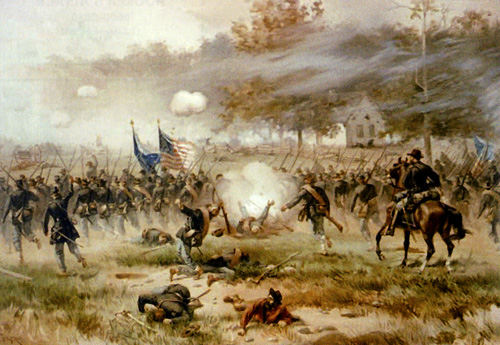
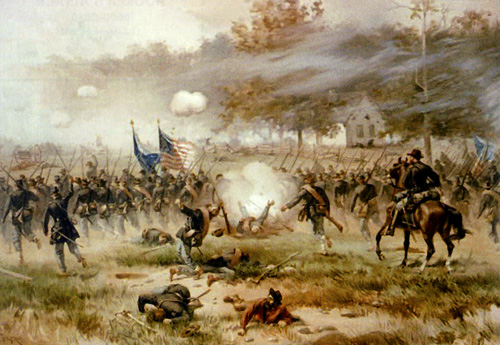
On September 17th 1862 the there was a battle in the War Against the Slaveholder’s Rebellion, sometimes called the American Civil War. It occurred when the Rebel Army under the command of Robert E Lee invaded the North, moving into Maryland. After a series of smaller engagements the Army of the Potomac under Major General McClellan engaged the Rebel forces at the town of Sharpsburg on the banks of the Antietam Creek.

The ensuing battle was the bloodiest single day engagement fought on the North American Continent. Almost 23,000 Union and Confederate soldiers were killed or wounded that day. Historian Stephen Sears titled his book about the battle Landscape Turned Red: The Battle of Antietam. 

I have been to that battlefield a number of times, both on my own and as part of a formal “Staff Ride.” My own military career touches the battle because when I served in the Texas and Virginia National Guard units that I was a part of traced their lineage to units that fought on that blood drenched parcel of land. In Texas units I served with were part of the 1st and 5th Texas Regiments which served in John Bell Hood’s Texas Brigade and in Virginia the 2nd and 17th Virginia Infantry Regiments.

Each time that I have been there I have never failed to be overwhelmed by the carnage inflicted on Americans by other Americans in the space of under 12 hours.

Then I think about other current civil wars and I begin to understand how places like Syria or Iraq can degenerate into sectarian bloodbaths. Both of those countries have only existed in their present form about 80 years and even then they were under the rule of military leaders for decades.

Actually it is not that hard for this to happen. We in the United States like to hold ourselves up as a model of how to do things right. But our own “Civil War” or the Slaveholder’s Revolt shows just how easily the populace a supposedly Christian and religious society can turn against each other and in the course of a day slaughter thousands and in the space of a few short years kill nearly 600,000 of their own countrymen.

Thus when I look at what is happening in other nations I am less likely to judge them so harshly. I wonder how bad the carnage of our civil war would have been had we had modern weapons including chemical weapons. Somehow I think that we would have used them quite effectively against each other and that the casualties of the war would have been at least twice as great as the Civil War.

What would the rest of the world think if it was happening here today? But more importantly what would we do?

Peace

Padre Steve+

Leave a comment

Filed under civil war, History

Confederate Army Strong? I Think Not

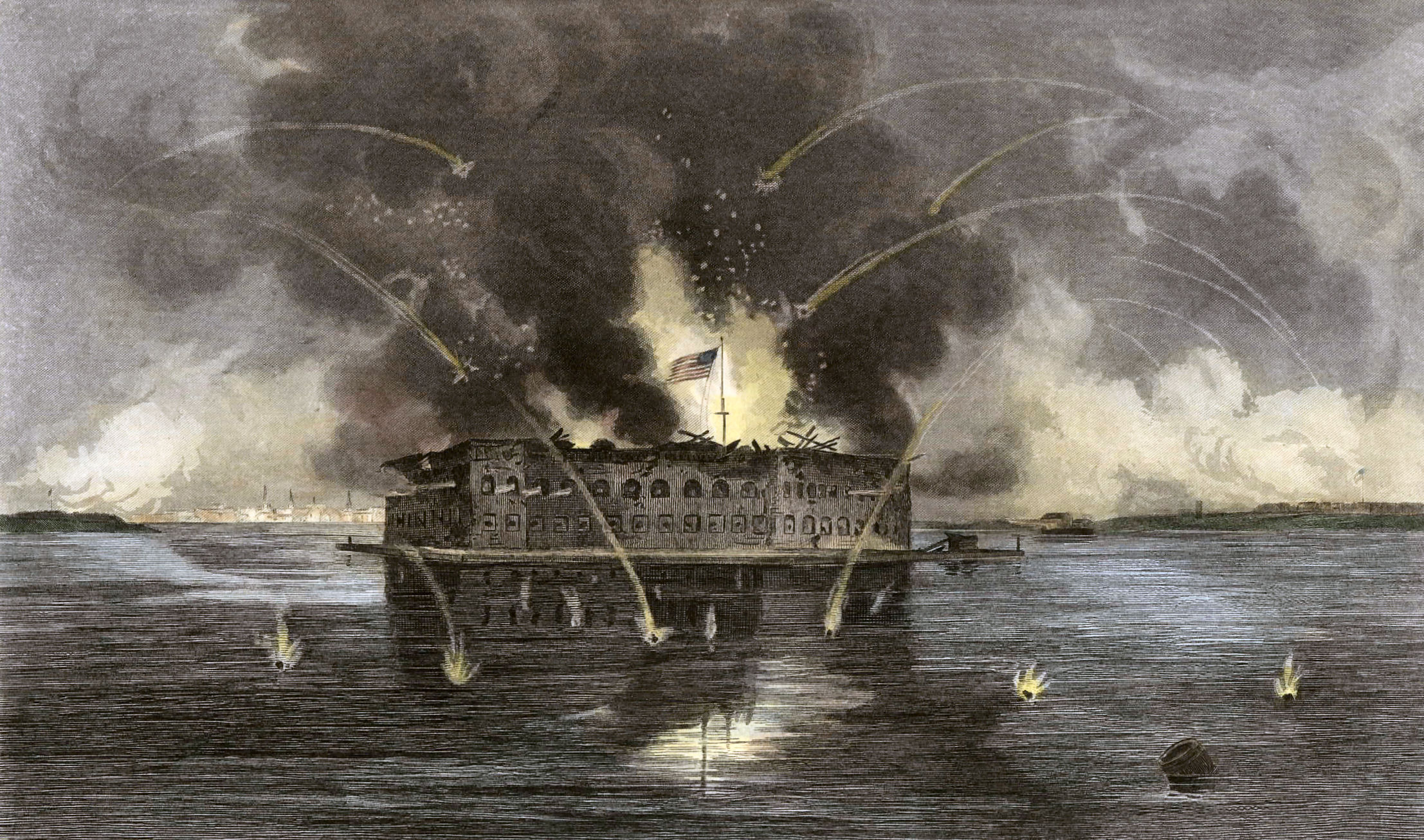
fort-sumter-bombardmentAttack on Ft Sumpter 

“THE CAUSE of the great War of the Rebellion against the United Status will have to be attributed to slavery. For some years before the war began it was a trite saying among some politicians that “A state half slave and half free cannot exist.” All must become slave or all free, or the state will go down. I took no part myself in any such view of the case at the time, but since the war is over, reviewing the whole question, I have come to the conclusion that the saying is quite true.” ― Ulysses S. Grant, Personal Memoirs, Vol. 2

I have served my country, not just Red or Blue States or members of either major political party, or minor political party for 32 years. I have served and as a Chaplain have guarded the religious and free speech rights of Christians, Jews, Moslems, Buddhists, Hindus, Wiccans, Atheists and Agnostics as a Chaplain for 21 of those years.

My family on my mother’s side came to the British Colonies in North America in  the 1680s or 1690s from England and France. My father’s family came in the 1740s from Scotland. During the War for Independence much of my family fought for the colonies or was neutral and some were Tories. One of my direct relatives lived in Philadelphia and worked as a supply officer for the Colonial Army throughout the war. He is buried not far from Benjamin Franklin and other heroes of the Revolution in the Christ Church Cemetery in Philadelphia, something that get’s me free admittance to the historic site anytime that I am in the city.

Those that were Tories ended up in  what is not Canada after the war. I even had distant relatives who were British Redcoats, one a Lieutenant Colonel Thomas Dundas, later Major General Sir Thomas Dundas commanded one of Lord Cornwallis’ brigades at Yorktown and was one of two British Officers who arranged the surrender at Yorktown.

Thus said my family has a long pedigree in this country and when the war of the Souther Slaveholder Rebellion broke out in 1861 I had family on both sides of the conflict. Most served in the Confederacy, though the part of Virginia they lived in seceded from the Commonwealth because Virginia seceded from the Union.

All this being said I can claim my heritage as a Son of the American Revolution or a Son of the Confederacy.

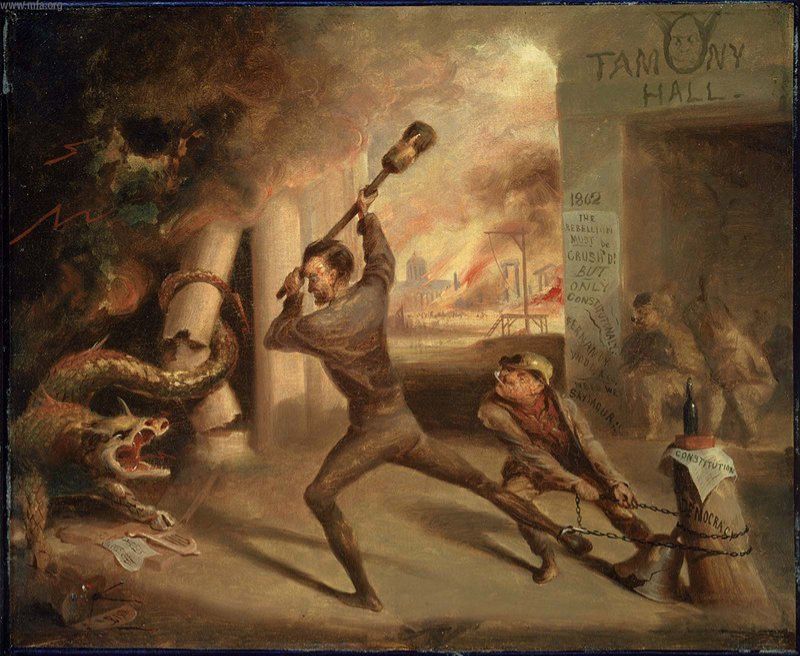
lincoln_rebellion_dragon

Today I saw something that made my blood boil. As I said I have served this country for 32 years in both the Army and the Navy. Part of my service has included time in both the Virginia and Texas Army National Guard. In my time in Virginia or Texas the units that I served traced their linage to either the 1st or 5 Texas Regiments of Hood’s Brigade or the 2nd or 17th Virginia Regiments which fought under Jackson or Pickett during that war.

fort-pillow

As I was saying I saw something today that made my blood boil. I saw a bumper sticker on a pickup truck at the local Home Depot that looked a bit like the US Army “Army Strong” complete with the star featured on the Army bumper sticker. However this one was different. It said “Confederate Army Strong.” To be fair I have seen this sticker on a number of vehicles in Virginia over the past few years but this one got me. The man also has numerous other Confederate or neo-Confederate stickers as well as partisan political comments and conspiracy theory comments about 9-11 being an “inside job” as well as a sticker for the conspiracy theory nutcase Alex Jones’ “Info Wars” website.

IJ2ZD00Z

What I find offensive about the “Confederate Army Strong” sticker is that it is a slap in the face to all who died to preserve the Union. Likewise it is the symbol of a political movement designed to promote, defend and expand an economic system built on slavery using the language of “States Rights.” That being said those states and their political leaders who claimed “States Rights” only cared about their own rights and in the decade leading up to the War of the Slaveholders Rebellion, now known as the Civil War used Federal statutes against non-slave States whenever they needed to and fought for tougher Federal laws to keep their “freedom” to maintain slavery.

351px-Andersonvillesurvivor

Freed Union Prisoner at Andersonville

The fact is that the Confederate Army was responsible for the more deaths and other casualties than all other enemies of the United States before or after the War of the Slaveholders Rebellion. The real fact is that those “noble Confederates” like Robert E. Lee and Stonewall Jackson and others that by the way included men from my family who owned slaves were rebels who when they did not like the result of an elected seceded from the Union and declared war on their fellow citizens in order to maintain their racist economic and political power. They were not about due process or the will of the people, but their will.

These were the same men who condoned the atrocities committed at places like Andersonville and Belle Isle and when they invaded non-slave states had no qualms about taking any black men, women and children from their homes and sending them to the South, even if the were Free Men and not escaped slaves.

However it is now impolitic to say this. But that is the case and whenever I see such displays of hatred against the country, constitution and citizens who I have sworn an oath to support and defend “against all enemies foreign and domestic” for 32 years I get angry.

I saw the man get into his vehicle and almost confronted him, but in the current climate had I done so I would have been the person condemned in the hate filled right wing media and blogosphere which wants nothing more than to have anyone connected to the Federal Government look like they are being intolerant. Such is the victim culture of many on the political right.

So I held back, took a picture of his stickers and went on my way. I have been far too busy trying to catch up on things left unattended by the past 7 years of service to this nation which has cost me much of my mind, my health and finances being away from home, deployed to Iraq or serving as a geographic bachelor, the latter alone which has cost me over $50,000 that I will never get back. Likewise I figured out that the last 17 years of my military career I have been away from home for 10 years. Since I returned from Iraq I have had to deal with the “Mad Cow” of PTSD.

Thus when I see some old fat codger running around spouting hate who probably has not served a day in uniform, or if he did served an enlistment and then got out I get pissed off. To tell the truth I think that I have good reason. There are times that I think that maybe William Tecumseh Sherman was too gentle on the South and that maybe the Radical Reconstructionists like Thaddeus Stevens were right about the South and what needed to be done to eradicate slavery and restore the Union.

Now that is not me, I am more of a Lincoln “with malice toward none and with charity toward all” kind of person. As a soldier I can be gracious toward a defeated enemy.  But when I see that thrown back in my face by the neo-Confederates of my day I wonder if maybe I and men like Sherman, Grant, Hancock and Chamberlain were wrong. Maybe the rebels should have been tried, executed, exiled or imprisoned for their crimes against the Constitution and their fellow citizens.

That being said Grant noticed how the landed elites of the South not only enslaved the blacks but used poor whites who had nothing to gain from their economics or slavery. The sad thing is the descendants of those who enslaved blacks and used poor whites as their political and later military fodder are at it again. Grant noted:

“The great bulk of the legal voters of the South were men who owned no slaves; their homes were generally in the hills and poor country; their facilities for educating their children, even up to the point of reading and writing, were very limited; their interest in the contest was very meagre–what there was, if they had been capable of seeing it, was with the North; they too needed emancipation. Under the old regime they were looked down upon by those who controlled all the affairs in the interest of slave-owners, as poor white trash who were allowed the ballot so long as they cast it according to direction.”

It really is a sad state of affairs and I grieve for the United States. To think I swear on my life an honor to ensure that all citizens have their right to freedom of speech including the man with his message of hate. However I don’t think that he or others like him would  do the same for me.

Peace

Padre Steve+


4 Comments

Filed under civil war, History, national security, Political Commentary

What Goes Around…The Problem of Trolls

troll_2

I find it amazing just how nasty some people can be in cyberspace. The behavior of some towards people that they know nothing about on sites like Facebook, Twitter and even comments on news articles or blogs is mind boggling in terms of outright rudeness.

A lot of people refer to such purveyors of hate and ignorance, and that is really what it is, as Trolls.

The sad thing is that most of the Trolls that I am accosted by claim to be Christians or those who are claim to be family values type conservatives or anti-government types. Actually it makes me tired.

It has been a while since I had any of these, but today I got hit on Twitter by someone who decided to insult first and then not ask questions later. I gave a short terse response, then blocked and ignored him. I looked at his Twitter profile and he kind of fit the conservative anti-government mold. I know that some conservatives experience similar behaviors from some people on the political left so I don’t think that it is limited to any particular group. Anti-social and rude behavior is common to humanity and has been made worse by our wonderful technology.

Unfortunately that is the common denominator of Trolls regardless of their politics, religion. ideology or alma mater. Personally I don’t know how people can be so angry and it does cause me great concern.

As a historian it kind of scares me. It reminds me of what I read about the United States in the 1850s before the Civil War and after Reconstruction, or Weimar Germany.

185615_1857288397412_3950321_n

Likewise from my experience in Iraq I learned from Iraqi officers just how they felt about the extremists, especially the religious types both Sunni and Shia who helped drive that country into a civil war. A civil war that is threatening to again envelop that unfortunate country that we helped destroy. In fact though they had billets for Imam’s in thier units most Iraq commanders would not fill them because the Imam’s and Mullahs of both sides were seen to be a big part of the problem. It is a warning that our religious leaders who want to establish their religion above all others should heed. But I digress…

The fact is that for all its wonders the world of cyberspace has removed many of the boundaries and filters that many people used to take for granted. Most people would never say the things to someone in person that they do on the internet. I believe that this has made us a much less civil society and in fact it is a cancer that will destroy us if we are not careful.

Oh well, Karma is a bitch. Though I will not be the one to take matters in my own hands, the truth of the matter is that Trolls will see that what goes around comes around.

Peace

Padre Steve+

Leave a comment

Filed under Loose thoughts and musings, philosophy

Sequester, Lent and Hope

198177_10151361204842059_1890411795_n

“As lousy as things are now, tomorrow they will be somebody’s good old days.” Gerald Barzan

Sequester is here and with it the era of mutual assured destruction by our political, economic and media elites continues in an unabated form.

At the same time sequester occurs during the season of Lent when Christians are called on to make voluntary sacrifices of things that are important to them in the forms of fasting and abstinence. Lent is a season of penitence which hopefully builds in the heart of the believer a new love for God and neighbor, a season that changes a person from a “me first” attitude to an attitude of thanksgiving, gratitude and service to those in distress. That being said, the season of Lent should be a season of hope.

However it is difficult at times to be hopeful when all around there is bad news. We seem to be living the ancient Chinese curse that says “May you live in interesting times.” The times are certainly interesting with lots going on of historic significance that may years from now be remembered as one of those tumultuous times where the world changed before our eyes.

History of course is replete with such times, the rise and fall of ancient empires, the age of exploration, the Reformation, the French and American Revolutions, the Napoleonic era, the American Civil War, the Industrial Revolution, the First and Second World War with the Great Depression sandwich, the 1960’s, the post Cold War era and the post-911 era just for a start.

I could go back further in history for other epochal periods, but I think that the reason that today’s crisis seem so much more dire is that we are both the beneficiaries and the victims of the instantaneous communication revolution in which common people have real time access to events that are impacting their lives.  This causes many a great deal of anxiety both real and imagined, anxiety which usually finds expression in a desire for the good old days as well as seeks solace and security from those who feverishly exploit that anxiety.  It does not matter if the security comes from religion, political ideology and matters neither if it comes from the left or the right so long as the call resonates with them they will follow it. They will faithfully follow even as the purveyors of the message drive up their worry and anxiety that they no longer can actually enjoy life or be thankful because they are so consumed with how “lousy” things are or “evil” their opponents are.

Thus even during the season of Lent it is hard for many people to grasp the meaning of it when all around them appears to be falling apart and in chaos.

It is in times like these that one has to take a deep breath, look around at all that they have to be thankful for and just really examine of the nostalgia that they feel for “better times” is that or an escape from an unpleasant present and fear of the future if the other side wins.

The fact is that we have seen such times before and somehow made it through.  I hear from friends and relatives who lived through the Great Depression and World War II that those were good times in spite of everything happening, much of which is present today but somehow things are worse now.  Even I fall into the trap about somehow thinking that the times that I grew up in were somehow better than the present, this may be true for music but overall things were not that good for a lot of people but somehow we made it through them.  Lent is a time to step back from the brink, take stock and renew our life with God and our neighbor.

When I returned from Iraq back in February 2008 I soon discovered that the bombardment of bad news and über-partisan political battles took its toll on me.  I was neither as resilient as I thought that I was nor as consumed by the need to continue to ratchet up rhetoric on one side or the other as the more extreme elements on the right or left were doing.  PTSD or not I realized that the purveyors of the 24/7 bad news cycle were driving people with legitimate ideological differences to extremes that I had never seen, but which I recognized from history have a lot of precedent and can lead to making things even worse.  One only has to look at Weimar Germany to realize how things can go so very wrong when extremes on both sides of the ideological spectrums squeeze out those in the middle or chance at mutually beneficial solutions and that was in the days before type of information overload that is the bedrock of the political and ideological landscape of today.

I am not attacking those who get caught up in this but I do question the politicians, pundits, “news-networks” and talk show hosts who continue to ratchet up rhetoric to the point that many feel that the only alternative is some kind of “revolution.”  Again those that call for “radical change” or revolt against those who are in favor of that kind of change are both calling for revolution when revolutionary talk reaches a point where one side or the other does not see a way to resolve things in a civil manner then the those alternatives slip away and the only recourse is violence.

It is not the fault of one side or the other as those that stoke this talk are found on both sides of the American as well as other nations political and ideological spectrum testify to daily.  In the United States we also have a long history of apocalyptic thought which presents the lousy state of current events in any generation as something that will certainly bring the end of life as we know it or the return of the Lord, the Great Tribulation or whatever you chalk it up to. There are those on both the religious and secular side of the spectrum who have apocalyptic visions related to their world view.  For some reason we Americans do the apocalyptic quite well whether we believe in God or not.

The thing that has been most on my mind this Lent, as it has been the past several years has been the idea of being reconciled both to God and to one another.  Lent is a season of self examination, repentance and forgiveness.  The call to “be reconciled to one another” is a never ending command and applies across the variety and spectrum of life.

cross-ash-wednesday

Lent reminds us that that “we are dust and to dust we shall return” but that we are also all made in the image of the God who created us, redeems us and sanctifies us who calls us to himself and reminds us that mercy triumphs over judgment and “not be conformed to this world, but be transformed by the renewing of your minds, so that you may discern what is the will of God—what is good and acceptable and perfect.” I am afraid that in times like these even the best intentioned of people can find themselves pulled into the orbit of those that in less stressful or trying times that they would never be involved with.

The German martyr Dietrich Bonhoeffer once wrote: “Our enemies are those who harbor hostility against us, not those against whom we cherish hostility… As a Christian I am called to treat my enemy as a brother and to meet hostility with love. My behavior is thus determined not by the way others treat me, but by the treatment I receive from Jesus.”

I know for some that call themselves “Christians” this message is lost. However, I believe that it is not because they are consciously rejecting the message of the Gospel but because that have become so deeply involved in whatever cause they endorese that they have lost the ability at least temporarily to see the good that may rest in their opponents and their ideas.

As Bonhoeffer also wrote “Judging others makes us blind, whereas love is illuminating. By judging others, we blind ourselves to our own evil and to the grace which others are just as entitled to as ourselves.”  Now of course Bonhoeffer knew the evil that was the Nazis and eventually gave his life by supporting the German resistance to Hitler.  Loving our enemies does not absolve us from public responsibility but in ensuring that we do not ensnare ourselves in ideology that restricts our ability to love them as Christ has commanded.

I think in the past few years that I have gained a new perspective on life that has changed the way that I look at the world.  I know that things are not good right now and that there are a lot of things to be legitimately concerned. That said I know too that somehow our country as well as much of humanity have weathered worse and like Barzan said that for some these will be the good old days someday.

That thought helps me to live in the present knowing that the future is not yet written and known only to God who in his grace condescends to love us and desires that we better love him and one another and not be conformed to any ideology that would prevent that. Sequestration and political division aside I do pray that we will both see better days as well as be reconciled to God and to one another.

It is in times like this that I think of Bonhoeffer’s words:

“God loves human beings. God loves the world. Not an ideal human, but human beings as they are; not an ideal world, but the real world. What we find repulsive in their opposition to God, what we shrink back from with pain and hostility, namely, real human beings, the real world, this is for God the ground of unfathomable love.”

That is my Lenten prayer.

Peace,

Padre Steve+

1 Comment

Filed under christian life, faith, History, News and current events, Political Commentary

Remembering the Deal with the Devil that Has Brought us the Sequester

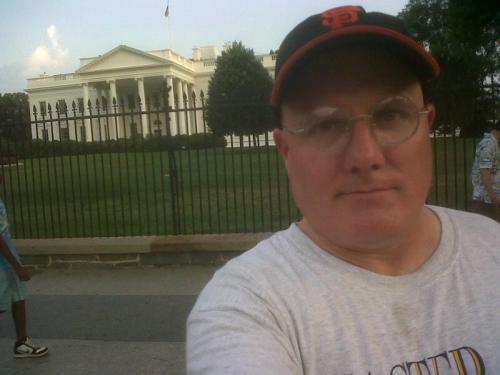
me-white-house1

“But we have no one to blame but ourselves. We voted them all into office and we have encouraged their repugnant behavior with our votes which more often than not were purchased by the fear mongering engaged by each side and our desire to have our special interests and or ideology come out on top.” Padre Steve August 2nd 2011

Back in late July 2011 it appeared that the Federal Government would o what it had never done, default on the payments for the National Debt. I was in Washington that week and could not believe what had become of the country.

For me it was a week that I remember well because on a nighttime picture taking expedition on the National Mall I fell off a darkened ledge at the Washington Monument while turning to line up another picture while walking in the dark.

That week I wrote a number of articles on my observations of what was happening. Since it appears there is a strong chance of the dreaded “Sequester” occurring in a bit over 48 hours I am posting those articles in their entirety here along with the links to the articles on this website.

As a historian and serving Naval Officer I really have a hard time believing what is happening in our government. I can only imagine it is the same kind of feeling that officers in service in 1860 and 1861 felt as their families, friends and the elected officials home states were pushing the country into the abyss. Unfortunately now, as it was then there is enough blame to spread copious amounts between politicians, preachers, and pundits the Unholy Trinity of both parties and across the political spectrum. Men, women and institutions that care more for their special interests than the country that gives them the opportunity to achieve great things.

These are my writings from that unfortunate week in our history. Unfortunately nothing leads me to believe that anything has changed since then and that the leaders of both of our political parties and their supporters in their respective media, corporate and lobbying interests and partisan pundits and preachers on both sides will not do all they can to ensure the ruin of this country.

While I have my own opinions about the root causes of this situation and my own political leanings. That being said I cannot fail to note that among our political classes and their supporters that to some degree they and we are all to blame.  No one wants to hear that but it is the truth. Most of us and certainly our political leaders, lobbyists, business leaders and pundits have by refusing to listen to those we disagree with have brought us to this point. Just like 1860. This is something that need not have ever had to happen. I agree with the hero of the first day of the Battle of Gettysburg, Union General John Buford: “I am disgusted and worn out with the system that seems to prevail.”

God help us because I do not believe that our leaders have the capacity in themselves to do anything.

Peace

Padre Steve+

dscn9994

A Tuesday in DC: Lunch with a Dear Friend and a Night walk through the Monuments

Today was another good day, in fact really good day at the conference I am attending with the George Washington Institute for Spirituality and Health.  At lunch I was able to spend some time with my former commanding officer at Marine Security Forces.  It was good to see Mike again.  He and I went through some very trying times together and I treasure his friendship as well of that of his family.  I think that of all the commanding officers that have served under which have included some incredible men that he was the best.  We are a lot alike in many ways both rather cerebral and out of the box thinkers. We basically are the same generation as far as military service goes, when he was a young Marine Corps Officer I was a young Army Officer.

We reminisced about the way the country was back then how our leaders still worked together and even if we disagreed with the policies of those in the opposing party that we still knew that we were Americans and that at the end of the day we were friends.  I guess that Mike and I are dinosaurs now; we tend to look at the big picture and both being career officers of the same generation have seen the country change. We both entered the military during the Cold War and after the loss of Vietnam.  Our teachers were the men that served in that war, those who came home to a then hostile country.  Neither Mike nor I are service academy types nor the products of conservative military schools, Mike went to Harvard and attended Navy ROTC and I went to a California State University School, CSU Northridge and took Army ROTC at UCLA.  We both come from strong yet tolerant religious traditions and were influenced by chaplains early in our careers.  Mike’s academic background is Economics mine Theology and Military History and both of us hold advanced degrees in those subjects.  We both graduated from the Marine Corps Command and Staff College.  We have both served overseas and in combat.  We love our country and treasure our military service and that of the men and women that we have served with over so many decades.

I am honored that Mike will administer the Oath of Office when I am promoted on September 1st at Harbor Park in Norfolk Virginia.  By the way Mike loves baseball too and being from Boston he is a Red Sox fan.  His dad, a die hard fan died a few months before the Sox broke the “Curse of the Bambino” in 2004. My dad died a few months before his San Francisco Giants won the World Series in 2010.

Talking with Mike today made me think back to a time when things were not like what they are now, where political opponents were simply opponents and not “the enemy.”  I shared with Mike the terms the German Military used in the Second World War to describe those that they fought against.  The Western Allies were “die Gegener” or simply opponents and for the most part the German military observed the Geneva Convention and Laws of War when fighting the Americans, British and French.  However with the Soviet Unionit was different.  The Soviets were “Der Feind” or the enemy.

As divided as we were in the 1970s and 1980s there was still a modicum of respect for the other side and ability to work together when we needed and Mike brought up the relationship of Ronald Reagan and Thomas “Tip” O’ Neill, vigorous political opponents who remained friends.  However there is today and has been for the past 20 years or so for members of the extreme wings of both major parties to identify their opponents as “enemies.”  The language difference is significant. An opponent is a adversary that you hope to defeat but there is not a hatred involved and when the competition ceases the opponents remain friends and even colleagues even as they prepare for the next “game” so to speak.

Enemies are another matter.  To be an enemy is to assume that the other side poses an existential threat to your side or your agenda.  Thus there can be no compromise and the opponent is not simply to be defeated but destroyed and annihilated much like the Old Testament when the Israelites were commanded by God to kill everything even the babies and pregnant women.  So much for being pro-life but I digress….

Today we are more divided than any time since the Civil War, blood is boiling and if there is compromise it will be a mere truce until the next round of political bloodletting which if we are not careful may become actual bloodletting and the enemies allow their unbridled hatred of each other spill out into open conflict.  Such affairs never end well and if we remember our history our Civil War’s military conflict was over in a few years and yet with the relatively primitive weapons of the ay killed more Americans than any other conflict.  The after effects well, frankly Scarlett took over a hundred years to recover from and I would dare posit that some believe that the war is not yet over.

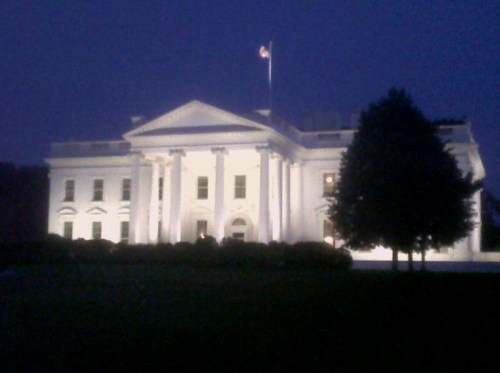
Tonight I went to dinner alone cancelling my plans to head out to watch the Nationals play the Marlins. I needed the time and solitude and somehow a trip on the DC Metro seemed the last place that I would find it. I walked to the Gordon Biersch where I had dinner, drank a few beers and watched the Orioles beat the Blue Jays.  After dinner I detoured from my normal route back to my campus housing which takes me in front of the White House.

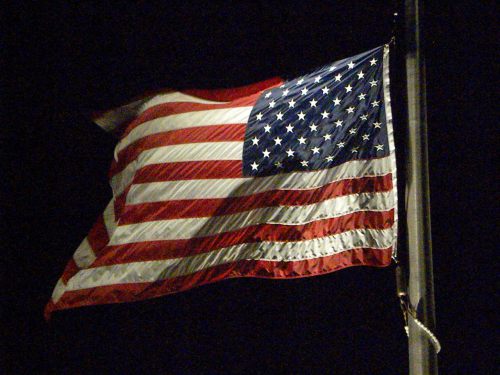
Amid the lights and the amazing splendor of the buildings adorned with American and District of Columbia Flags I walked and simply observed people.  Tourists from across the nation and the world were taking pictures, business people and government workers hurried about, vendors hawked their patriotic wares, mostly made in China I might add or snack foods.  Here and there a protester sought to draw attention to their pet cause, there is the anti-nuclear weapons protestor that has been camped across from the White House since 1981, people demanding to see the Birth Certificate, those protesting for the removal of various Arab dictators and others peppered about. Capitol Police and Secret Service officers were out in force and amid the fortress like surroundings of many government buildings and the offices such as the World Bank and major business and financial institutions armed police and private security stood watch with cameras watching every move.

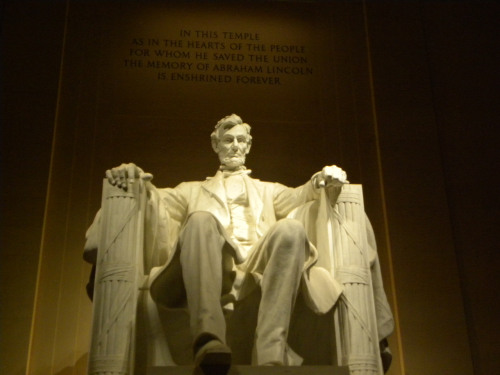
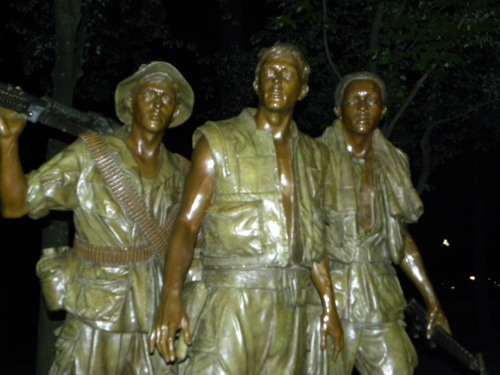
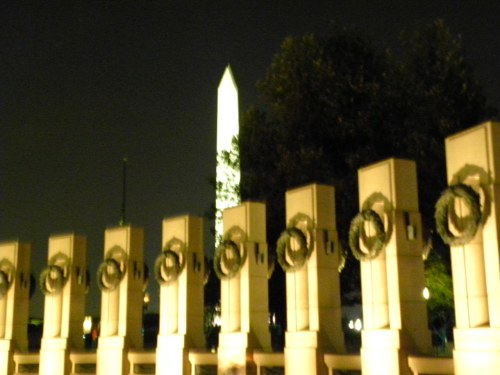
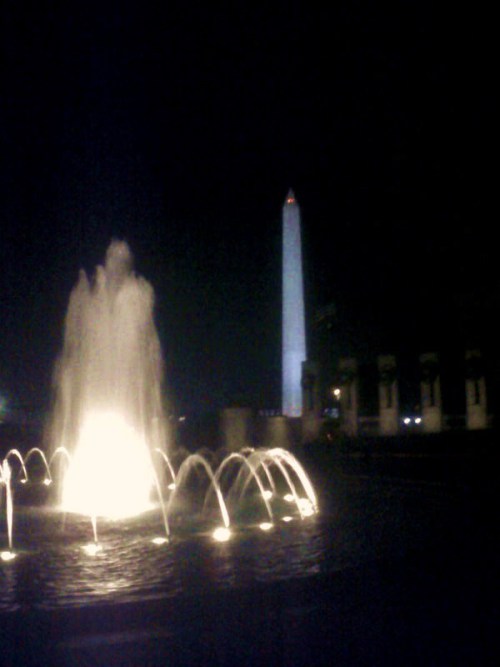
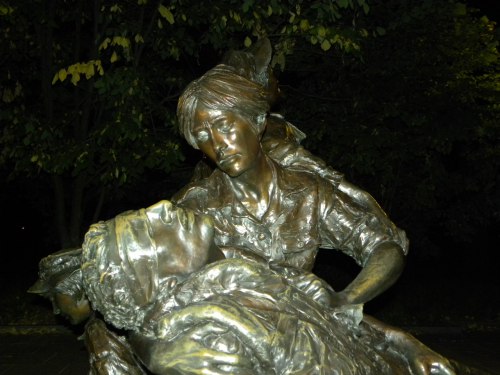
When I passed the White House I was rather down.  So I decided to walk the monuments that adorn the Capitol Mall.  I passed the Executive Office Building and Washington Monument and crossed the street to the World War Two Memorial.  At each place I paused before I continued to walk into the night.  I then stopped by the Korean War Memorial and the Vietnam War Memorial, the stark reminder of the men and women killed and missing in that war as well as the rip in the fabric of the nation that I am not sure we have ever gotten past.  I then went and paused before the Lincoln Memorial and I thought of the immortal words spoken by President Lincoln in his Second Inaugural Address shortly before he was cut down by a bullet fired by John Wilkes Booth.  They are words of reconciliation spoken even while Americans fought Americans in the last months of the war.

dscn0061

Fellow-Countrymen:  At this second appearing to take the oath of the Presidential office there is less occasion for an extended address than there was at the first. Then a statement somewhat in detail of a course to be pursued seemed fitting and proper. Now, at the expiration of four years, during which public declarations have been constantly called forth on every point and phase of the great contest which still absorbs the attention and engrosses the energies of the nation, little that is new could be presented. The progress of our arms, upon which all else chiefly depends, is as well known to the public as to myself, and it is, I trust, reasonably satisfactory and encouraging to all. With high hope for the future, no prediction in regard to it is ventured.

On the occasion corresponding to this four years ago all thoughts were anxiously directed to an impending civil war. All dreaded it, all sought to avert it. While the inaugural address was being delivered from this place, devoted altogether to saving the Union without war, insurgent agents were in the city seeking to destroy it without war—seeking to dissolve the Union and divide effects by negotiation. Both parties deprecated war, but one of them would make war rather than let the nation survive, and the other would accept war rather than let it perish, and the war came.

One-eighth of the whole population were colored slaves, not distributed generally over the Union, but localized in the southern part of it. These slaves constituted a peculiar and powerful interest. All knew that this interest was somehow the cause of the war. To strengthen, perpetuate, and extend this interest was the object for which the insurgents would rend the Union even by war, while the Government claimed no right to do more than to restrict the territorial enlargement of it. Neither party expected for the war the magnitude or the duration which it has already attained. Neither anticipated that the cause of the conflict might cease with or even before the conflict itself should cease. Each looked for an easier triumph, and a result less fundamental and astounding. Both read the same Bible and pray to the same God, and each invokes His aid against the other. It may seem strange that any men should dare to ask a just God’s assistance in wringing their bread from the sweat of other men’s faces, but let us judge not, that we be not judged. The prayers of both could not be answered. That of neither has been answered fully. The Almighty has His own purposes. “Woe unto the world because of offenses; for it must needs be that offenses come, but woe to that man by whom the offense cometh.” If we shall suppose that American slavery is one of those offenses which, in the providence of God, must needs come, but which, having continued through His appointed time, He now wills to remove, and that He gives to both North and South this terrible war as the woe due to those by whom the offense came, shall we discern therein any departure from those divine attributes which the believers in a living God always ascribe to Him? Fondly do we hope, fervently do we pray, that this mighty scourge of war may speedily pass away. Yet, if God wills that it continue until all the wealth piled by the bondsman’s two hundred and fifty years of unrequited toil shall be sunk, and until every drop of blood drawn with the lash shall be paid by another drawn with the sword, as was said three thousand years ago, so still it must be said “the judgments of the Lord are true and righteous altogether.”

With malice toward none, with charity for all, with firmness in the right as God gives us to see the right, let us strive on to finish the work we are in, to bind up the nation’s wounds, to care for him who shall have borne the battle and for his widow and his orphan, to do all which may achieve and cherish a just and lasting peace among ourselves and with all nations.

As I walked through the warm and humid night air I imagined what it must have been like for officers of the United States Army, Navy and Marine Corps as the nation split in 1861 with many Southerners leaving the service to enter the service of their own states.  Many tearful goodbyes were spoken by men that had served together in war and peace and on the lonely frontier of the nation, men who in a few moths time would be commanding American armies and killing their fellow Americans.  My family fought for the South being from Virginia.  I cannot say that I would have done different like them and so many Southerners or if like General George Thomas of Virginia I would have remained with the Union incurring the wrath of his family for the rest of his life.  Since I have never taken my Oath lightly I can only imagine that I would have done what Thomas did even if it meant the loss of family.

Today I fear that even if our leaders can avert a default on or debts that they have now set the stage for worse I the coming months and years. The open hatred and contempt of our leaders for one another and the ideas that each stand for has wounded the nation more deeply than any default or government shutdown could ever do. This is not simply partisan discourse it is a deep enmity and hatred that has not been seen in this country for 150 years.  If cooler heads do not prevail soon the damage may be irreparable and the consequences more terrible than we can imagine and why anyone would willingly continue down this road is beyond me, but hatred does terrible things to people and nations.

Since it was nearing10 PMI hailed a taxi by the Lincoln Memorial.  I entered into a conversation with the driver, an immigrant from Morocco who has been in the United States 22 years.  I mentioned my concern and he was far more hopeful than me. He said he believed that a shutdown would be averted.  I love immigrants especially recent ones who have left home and family to become Americans.  My dad’s side family has been in this country since 1747 and my mother’s even longer.  It was inspiring for me to hear this man still be in awe of this nation despite all of our troubles. When I left the cab I thanked him, gave him a decent tip shook his hand and in my woeful Arabic said “Assalamu alaikum” or peace be unto you.

As a historian I tend to see the dangers in what is happening in our country and I do have legitimate concerns, but when I hear the words of hope and awe that this country engenders in those who come here to be free I hope again in spite of myself.

img00156-20110726-2050

Meditations on a Wednesday Night in Washington DC 

I was reflective tonight and thinking about all of those great men and women who sacrificed so much to the sake of this land and also the world as I walked the capitol late this evening.  As I saw the flags around the Washington Monument at half staff in honor of former Chairman of the Joint Chiefs of Staff General John Shalikashvili my thoughts turned to the words of America the Beautiful.

O beautiful for spacious skies,

For amber waves of grain,

For purple mountain majesties

Above the fruited plain!

America! America!

God shed His grace on thee,

And crown thy good with brotherhood

From sea to shining sea!

Today was another very good day in regard to the conference I have been attending at the George Washington University Medical School Institute for Spirituality and Healthcare.  Today was a day to practice what we have earned so far with men and women that are employed by the Medical School as “model patients.”  These are people that work with medical students before they even see a real patient and that simulate what the students might encounter when they actually start seeing patients as senior medical students and then as in their various internships and residencies following graduation.  I was very enlightening as we had the chance to be the physician in our encounters with the various actors.  Mine went very well and I thank God for the fact that I have worked with some very fine physicians that have modeled wonderful, compassionate and human care of patients on the various ICUs that I have worked in.

I have been very pensive this week due to the chaos that seems to reign in the halls of Congress in regard to the debt ceiling and intransigence of the members of that esteemed body to bother to work with each other or the President.

This evening I went out with my cousin Becky, actually she is my wife Judy’s cousin and works with one of the “Men in Black” law enforcement agencies headquartered in our nation’s capitol.  She was with a co-worker who has served at the end of the Cold War in Germany and in the Gulf War and we had a wonderful night talking, eating and drinking good beer at the Rock Bottom Brewery in Arlington.  After we were one I had Becky drop me off near the White House because I wanted to wander again about some of the monuments this time with my good camera as I wanted some good pictures from what I observed Tuesday night.

O beautiful for pilgrim feet

Whose stern impassion’d stress

A thoroughfare for freedom beat

Across the wilderness.

America! America!

God mend thine ev’ry flaw,

Confirm thy soul in self-control,

Thy liberty in law.

Since I have been at the conference or out most of the day I have only heard bits and pieces of the news, just enough to know that the Republicans and Democrats are still driving the train over the cliff even as some in each party attempt to throw the emergency brake to try to stop disaster from overtaking our fragile economy as well as that of the world.  The problem as I see it is that a vocal minority is hell bent on forcing their agenda at any cost and sabotaging the cooler heads in their own and the opposition party.

O beautiful for heroes prov’d

In liberating strife,

Who more than self their country lov’d,

And mercy more than life.

America! America!

May God thy gold refine

Till all success be nobleness,

And ev’ry gain divine.

Last night I was out and was a bit melancholy as I walked the monuments but came home encouraged by an immigrant cabbie from Morocco who still holds this nation in awe and wonder. It was something that I didn’t expect because it seems that so many of us that have lived here for all of our lives no longer have that sense of awe, wonder and appreciation for this now battered land.

I started at the White House and the proceeded past the Washington Monument to the World War Two Memorial, down the National Mall and pat the reflecting pool to the Korean War Memorial, the Lincoln Memorial and the Vietnam War Memorial before walking the 7 or 8 blocks back to the GWU campus where I am staying.

O beautiful for patriot dream

That sees beyond the years

Thine alabaster cities gleam

Undimmed by human tears.

America! America!

God shed His grace on thee,

And crown thy good with brotherhood

From sea to shining sea.

Tonight I took my time and did not get back to my room until 1230 AM.  I was more deliberate than last night and really pondered then things that made this country great and the sacrifices made by so many that we might enjoy freedom that most of the world cannot imagine.  I realized that it was not our economic or military might that made us great but the ideals that this country was founded upon and the sacrifices of men and women of many races and faiths who have each in their own way worked for the cause of liberty many at the cost of their lives in war or sadly in some cases at the hands of their own countrymen.

I do pray that the politicians, pundits and preachers, that “unholy Trinity” who have so terribly afflicted out nation and people with their loathing of all that are different than them will realize the damage that they have done to the peace and the very fabric of this country.  I pray that we are able to be one nation, or as it so well expressed on the Great Seal of the United States E Plurbus Unum, “out of many one.”

As I settled down and prepared for bed I came across a poem in a book of prayers that Judy put together for my birthday during one of those very lean seminary years.  It is by Alan Paton, a South African educator, writer and anti-apartheid activist who died in 1988 five years before the end of that evil system.  It is a poem but also a prayer and I think that it speaks as much to me now as the first time that I read it when Judy gave me this gift.

O Lord, open my eyes that I might see the needs of others;

Open my ears that I may hear their cries;

Open my heart that they need not be without succor;

Let me not be afraid to defend the weak because of the anger of the strong,

Nor defend the poor because of the anger of the rich.

Show me where love and faith are needed and bring me to those places;

And so open my eyes and my ears that I may this coming day

Be able to do some work of peace for thee. Amen.

dscn0064

A Physically Painful Thursday Night in DC: Dinner with a Classmate and watching Our Government Implode

I have spent most of the day in some bad physical pain. Last night while walking around the National Mall taking pictures I hurt myself.  I was walking from the Washington Monument toward the World War Two Memorial looking at the Lincoln Memorial and trying to figure out a good camera angle.  I wanted good pictures so instead of walking down either of the sidewalks that line the Mall I wanted to stay in the center which meant walking “cross country” so to speak in the dark.

I was sizing up the shot of the Lincoln Memorial while walking forward and I turned briefly to look back to see if I had a good shot of the Washington Monument and the Capitol Dome.  As I made this slight turn I found that there was nothing under my right foot and I went crashing down onto a sidewalk about three feet below.  I landed on the side of my right leg with the main impact seeming to be at the place where the fibula and tibia come together just below the knee.  I felt a sharp pain but got up and limped back to GWU while getting shots of the WWII Memorial, the Korean andVietnamand Lincoln Memorials.  I got back to my room in a substantial amount of pain and it took forever to get comfortable enough to get to sleep.  When I got up all I could do was hold onto walls as I made my way across the room and put my leg up on the coffee table in the living area.  Eventually I made my way over to the conference site where thankfully I was able to keep my leg up most of the day.

When the conference was over I changed clothes to meet my friend Pat, a Marine Lieutenant Colonel who I attended the Marine Corps Command and Staff College with and met up with inIraqin 2007.  We met at Fado’s an Irish Pub where I had a very tasty Shepherd’s Pie and several pints of Kilkenny Ale which I have not had since traveling in the Mediterranean and the Gulf.  On the way there I rode the DC Metro and was very careful to not put any extra pressure on my leg than was absolutely necessary until I got caught in a crosswalk and had to try to run across to beat the light.  I am in good physical shape and I figured since I could walk I could probably still run.  I was wrong. The first time my right foot hit the ground a shock wave went through my leg with the area that I had injured erupting in pain bad enough to bring tears to my eyes.

After dinner I left the Metro station near GWU and stepped off what I thought was a short one step which were actually two steps again landing on my already throbbing leg.  I managed to get to my room where after a couple of Aleve tablets the edge is starting to come off of the pain.  Tomorrow I will check out of my room and the conference and about 900-930 AM will hit the road out of town.  I am in enough pain that as soon as I get into Virginia Beach I will stop at the Navy Clinic at Joint Base Little Creek or the Naval Medical Center to get my leg checked out.

I was very glad to get together with Pat and to enjoy the fellowship.  There is something about the shared military experience including war that binds people together.  It was as if we had seen each other yesterday, but then we chat often on Facebook and comment a lot on “The New Adventures of Doctrine Man!”

While we were talking another stake was placed in the talks to raise the nation’s debt ceiling. I believe that the nation is now being held hostage by a minority of people on the political right and left who have decided it is better for them to destroy the economy of the nation and livelihood of the vast majority of Americans to gain a short term political advantage in the 2012 elections.

This is not the first time this national suicide pact has happened.  It is now so late and the sides so far apart with such great enmity between them that even if in the now unlikely event a debt ceiling deal is reached the damage is done. Our national credit rating will be downgraded and although the nation will survive life will become exponentially more difficult for most Americans and the chaos will spread around the globe.

Back in the late 1920s the radical left and radical right in the German Weimar Republic represented by the German Communist Party on the Left and Hitler’s National Socialist Party of Germany on the Right sabotaged the more moderate politicians of the Center Party and the Socialist Party of Germany.  When Wall Street Crashed and the World entered the “Great Depression” the parties of the Left and Right became even more polarized leading President Paul Von Hindenburg to appoint Hitler to form a government.

Of course the rest as we historians are prone to say is history. The short sighted policies and actions of the German political parties after the collapse of the Empire eventually brought about the Nazi dictatorship.  If our political leaders continue down this path we can expect that the already fragile economy will take a terrible hit.  We can expect that many people in the United Statesand around the World will suffer the economic effects of the actions of these so called leaders.  As things get worse the extremists in both major political parties aided and abetted by those that think that they can gain by this tragedy will fight it out until one or the other beats the other party into submission.

This will not be good and I expect that the pain of what our political leaders inflict on us will be far greater than the physical pain that I feel now. God help us all.

dscn0044

Be Careful…there is a point of no return and we may have crossed it

Be careful with your thoughts because they turn into words

Be careful with your words because they turn into actions

Be careful with your actions because they turn into habits

Be careful with your habits because they become your character

Be careful with your character because it defines you 

Ezra Taft Benson (former Secretary of Agriculture) quoted by Buck O’Neil

On Wednesday night I took a walk about our Nation’s Capitol.  It was a beautiful night and the buildings and monuments were illuminated in the most spectacular ways.  It was inspiring in a sense to see them, symbols of the greatness of the country and the people how sacrificed themselves to build it.  I can understand why so many millions of people have come to this country from all over the world to become Americans and be part of our dream.

In fact I became so engrossed I taking pictures that night that in the darkness I did not see an unilluminated ledge not far from theWashingtonMonument.  I fell from it onto the waiting sidewalk below and crunched my right leg pretty bad.  I had it checked out and x-rayed at the Naval Health Clinic at Joint Base Little Creek when I returned to Virginia. The doctor assumes that there is a good chance that I have a hairline fracture of either my tibia or fibula just below the knee and I am being referred for further tests when I return to Camp LeJeune Monday.  Until then I am on crutches and pain meds.

I fell over the ledge that I had no idea was where it was.  It was inadvertent and even when I got up and looked at it I had a hard time making it out.  However there are those in the country including many in the political leadership and media that seem to want us to go over a cliff because they perceive that it helps them and their agenda.  They see the ledge and they know the danger but they unfortunately enabled by “we” press on to the abyss.

For many years the political ideologues on the extremes of the Left and the Right in the United States have harbored the worst thoughts about those that do not match up with their ideologies. I have been writing for quite some time about how divided our body politic is and how dangerous the situation has become.

The contemptuous thoughts of the Left for the Right and Right for the Left first turned to words and those words became commonplace, so common that they became habitual.  In a sense they have become part of the political DNA of the most extreme among us.

The attitudes that we have formed and angry words which we now use so ubiquitously are reflective of a deep hatred that now is becoming what defines us as a people.  In fact the deep and abiding hatred which now permeates our society is now threatening the international standing and I would say the national security of the United States.  We have only ourselves to blame because through our actions and inactions of the past decade we have made our choice to be what we have become and there is no one group especially in our political, media and business elites that have served us well.  In fact we have as voters chosen this toxic mix of elected officials often more influenced by hate spewing pundits and our own self interests rather than that of the nation and future generations much as we would like to claim that we are looking out for the future.

We have chosen badly and we are paying for it.  We are being held hostage by those that we elected, men and women who supposedly know better than to destroy the country in order to save it as was about the village of Bien Tre in the Vietnam War… “we had to destroy the village in order to save it.” The Left and right have racked up massive debt over the past decade which has made previous debt pale in significance.  Each like to blame one another as “mostly to blame” but each has a major part of the responsibility for the mess that we are in.  However the amazing thing is that neither side nor we the electorate seems to be able to hold ourselves responsible.

Without going into the whole debt ceiling debacle which now has us on the edge of a default which we can only pray will not be as bad as real economists around the world say it will be; the fact is that we have made the mess and now our leaders are failing us. I have to say that all of them have used this made up crisis to some extent to further their goals and agendas at the expense of the country.  That is a shame and our elected leaders of all parties and factions are at fault and it comes back to character, theirs and ours.

You see it is about more than the budget or the debt ceiling. It is about hatred of fellow Americans which has been preached by hypocritical ideologues for decades on the radio, television and now the internet.  Much of it is as raw, hateful and disingenuous propaganda disguised as “news” as was Julius Streicher’s Nazi Der Sturmer and the Communist Party Die Rote Fahne were in Weimar Germany.  That poison has infected us and most of us line up on one side of the propaganda machine or the other.  We know what happened to the Weimar Republic, racked by bills it could not pay, massive unemployment brought on by the Great Depression and a desperate population led by politicians that intentionally used their misery to derail the efforts of government after government to try to manage the crisis.  They ended up with Hitler, the head of a large and vocal political movement which refused to compromise with anyone to bring down the Republic that they hated.

Whatever happens in regard to the debt ceiling and future budget negotiations the damage has been done.  The soul of our nation and our national character has been damaged perhaps irreparably.  Our leaders hate each other and the most influential media in the country, the talk radio and cable news pundits of all stripes throw gasoline on the fire every day. The social and political anarchy will reign until one side or the other has crushed their opposition.  Those in the middle lose either way as they will be crushed by whichever side wins unless they ally themselves with the winning side no matter who it is.

History teaches us that such times are at best tumultuous and at worst cataclysmic.  The consequences when great nations engage in such political fratricide it usually has grave consequences that effect it as well as nations and peoples far beyond its borders.

It is time for everyone to take a step back from the abyss before we plunge headlong into something that we will regret which will only benefit those that seek to benefit from it.  Or are we too stupid to see what is happening?

Thoughts, words, habits, character….be careful.

God help us all

img00169-20110726-2126

We won’t let this Happen again….Until the Next Time

“I am disgusted and worn out with the system that seems to prevail.” Brigadier General John Buford 

The news is abuzz tonight about the bi-partisan deal that has been agreed to by the President, the Speaker of the House and Majority Leader of the Senate.  The details will come out but certainly there will be those unhappy with the deal.  I don’t know what is in it and the devil is always in the details.

I am a realist and the details seldom bode well. Like John Buford a career Officer during the Civil War I have become disgusted and worn out watching the men and women that we have elected to public office work so hard to fracture this country that I hold so dear.

Tomorrow I expect that the deal will pass in the House and Senate unless the hard core right and left work together to embarrass their respective leaders. Since neither side had enough votes to do this on their own despite weeks of impassioned and often bitter argument with neither side listening to the other it has come down to this moment.  Personally in light of all that has transpired between the current Congress and the Obama administration even if this is passed Monday on Tuesday the death struggle will resume. Of course the deal may not pass and like Confederate General Robert E. Lee perhaps questioning his own rejection of  Union we might someday say  “the war… was an unnecessary condition of affairs, and might have been avoided if forbearance and wisdom had been practiced on both sides.”  

That struggle has already begun as some Tea Party leader declared Congressman Allen West and three other Tea Party Supported House Members as “Tea Party defectors” for supporting Speaker of the House John Boehner’s plan over the weekend.  On July 27th Tea Party Nation leader Judson Phillips urged Boehner “to go” and be replaced by a “Tea Party Speaker of the House” while The Party Patriot co-founder Jenny Beth Martin suggested a similar thing.  Many Liberals are equally critical of the President and Majority Leader Harry Reid with a growing number stating that they believe that President Obama has betrayed their ideals one Democrat Congressman calling the deal a “sugar coated Satan sandwich.”

The battle lines are still drawn and the language except for the utilitarian language that compromise was necessary to stave off a default has not changed an iota.  The language of compromise does not sit well with the most vocal members of the Tea Party faction nor those on the hard Left.  Many Tea Party leaders and members continue to argue that their leadership to push the government into default to achieve their goals.

The default may not happen now but the crisis is not past.  No it will be with us for a long time with more division, more bitterness and more fuel being poured onto the flames of hatred that have consumed us.  Much like the various crises and compromises on the road to the Civil War nothing substantial has changed.  In fact William Gross the head of PIMCO one of the major global investment groups said that a downgrade was “inevitable” and that “Congress has basically proven itself to be dysfunctional and this will carry on for months even if the crisis is basically resolved in the next few days.”

We have crossed the Rubicon and unless an external and existential threat to our nation forces our leaders to work together I seriously doubt that this will end well.  The President failed to lead when he had a super-majority and his allies in Congress squandered the chance that they were given in 2008.  The Republicans after taking the House in 2010 are doing the same.  Neither side will admit to their behavior. Both will with good reason to point the finger of blame at their opponents while ignoring their own contributions to this sordid state of affairs.

I can see it as if has already happened. The Unholy Trinity of politicians, pundits and preachers will step up their rhetoric inciting their followers to adopt even more uncompromising positions.  The already fearful enmity will deepen and the center will disappear. Emotion in the form of hatred will drive the arguments that neither side will listen to even as the United States and the world economy worsens and the wars continue.  Young Americans will give their lives in Iraq and Afghanistan even as their political leaders on both sides of the aisle seek ways to reduce the force and even the pay and benefits that they have earned after 10 years of unending war that the rest of the nation while seemingly grateful does not understand nor share. “We few, we happy few…” William Shakespeare quotes Henry V before the Battle of Agincourt.

Tonight I have been watching the movie Gettysburg which I think is a fitting reminder of what happens when the Unholy Trinity finally achieves their goal of destroying the very fabric of the nation and pits brother against brother.  Hopefully cooler heads will prevail and somehow, some way we will get through this before we long for the day that makes what we are experiencing now look good.

Like General James Longstreet I wonder “Why do men fight who were born to be brothers?”

dscn0066

The Deal is Done and are We? There are Always Results

“but this momentous question, like a fire bell in the night, awakened and filled me with terror. I considered it at once as the knell of the Union. it is hushed indeed for the moment. but this is a reprieve only, not a final sentence. a geographical line, coinciding with a marked principle, moral and political, once conceived and held up to the angry passions of men, will never be obliterated; and every new irritation will mark it deeper and deeper.” Thomas Jefferson on the Missouri Compromise

I believe that Thomas Jefferson in describing the results of the Missouri Compromise aptly describes the mood of our times and the consequences of politicians that lead us to the dark abyss of hatred and civil war.   There are times that I wish that I was not a historian or theologian for then I could simply be ignorant of the place that our elected leaders are leading us.

Yesterday and today I sat convalescing at home trying to stay off of my injured leg as the final actions were taken in the House and the Senate on the Debt Ceiling Compromise. I felt as if I was watching a national tragedy being marketed as by some as a triumph of cooperation.  I was amazed that talk which was paired with the opponents of the measure in both parties.  I felt that those praising their actions to pass the increase and related budgetary cuts were saying it all for show even as they sharpened their swords for the next battle even as the vast majority of Americans expressed anger and frustration with the behavior of their elected officials.  A Pew Research poll indicated “72 percent of American characterized the recent budget negotiations as “ridiculous, disgusting, stupid, and frustrating.”

But we have no one to blame but ourselves. We voted them all into office and we have encouraged their repugnant behavior with our votes which more often than not were purchased by the fear mongering engaged by each side and our desire to have our special interests and or ideology come out on top. We have been engaged in what conservative columnist Pat Buchanan declared a “culture war” for the past two decades and wars be they cultural, ideological, and economic or military have consequences.  The longer they go on the worse and more violent they become until one side finally loses and the landscape is destroyed. A conservative German newspaper noted “It is this war-like rhetoric that has so poisoned American politics.” The Germans should know something of this.  The “Kulturkrieg” and the violent hatred of their countrymen in the wake of the defeat of the First World War and humiliation of Versailles brought about civil war.  The pursuit of radical ideologies in the following years is what doomed the ill-fated Weimar Republic when the economic calamity of the Great Depression struck and led to the tragedy of the Nazi takeover and ultimately led to World War Two.

I believe that the actions of all parties in this forced crisis were a disservice to the citizens of this country, the memory of all who have gone before us and done more to damage our standing in the world than I could ever imagine.  It is as if the leaders of the country have forgotten why they are even in Washington.  There is no unity of purpose, only the language of war being used against fellow Americans.  A German newspaper wrote “No one can forget the Civil War atmosphere in which this debt fight has taken place. It weighs on America’s international reputation. From the point of view of financial markets, the dysfunctional nature of Washington is a risk factor that must be calculated for in the future.”

The sad thing is that there is so much work that has to be done and it is more than reducing Federal Government spending. Our industries have been shipped wholesale overseas using the treaties that business has foisted upon their willing accomplices in both parties in the name of “free trade.”  Our unemployment continues to rise and many economic experts believe that we are entering a “double dip” recession which some believe could easily become a depression. The infrastructure of the nation crumbling with the businesses that benefit from them refusing to contribute to their maintenance unless they receive government contracts and money in return.  We are committed to long term ground wars that have sapped the economy and worn out the military which now seem to serve little strategic purpose.   In fact the position of the Army in Afghanistan could be disastrous if Pakistan decides to stop cooperating and not allow us to supply the Army through it.

It is apparent to me that those that can afford it the least and the military will bear the brunt of the cuts that will come and that it will be a long time before this crisis passes.  No one seems to be addressing the major issue of unemployment or economic growth without which there is no recovery.  I heard the President and Senate Majority Leader McConnell repeat what they have said for years but no plans and no action.  As for the military we are worn to a nub, our equipment needs to be replaced and modernized and our troops still deserve the best that we can give them, but even this is on the chopping block, military retirement is called “an expensive entitlement program” by those advocating that the military adopt a private sector pay and benefit plan of little value especially to those that have spent 10 years at war paying with their minds, bodies and spirit fighting wars that the Wall Street bunch has benefited from, the same Wall Street leaders that now call for reductions in military pay and benefits.  It is obscene.

I would like to believe that this is a rough patch that we will get through, but right now with the terrible acrimony present in Washington and all the State Capitols I have a hard time believing that we will.  The President has failed to enunciate any kind of plan or vision and the Tea Party leadership is acting like the Jacobins in Revolutionary France.

I have no idea who will “win” this “culture war” and does it really matter? The result will be a Pyrrhic victory with the winners celebrating on the ruins of the country.  I only know that we all lose.

Leave a comment

Filed under civil war, economics and financial policy, History, laws and legislation, leadership, News and current events, Political Commentary

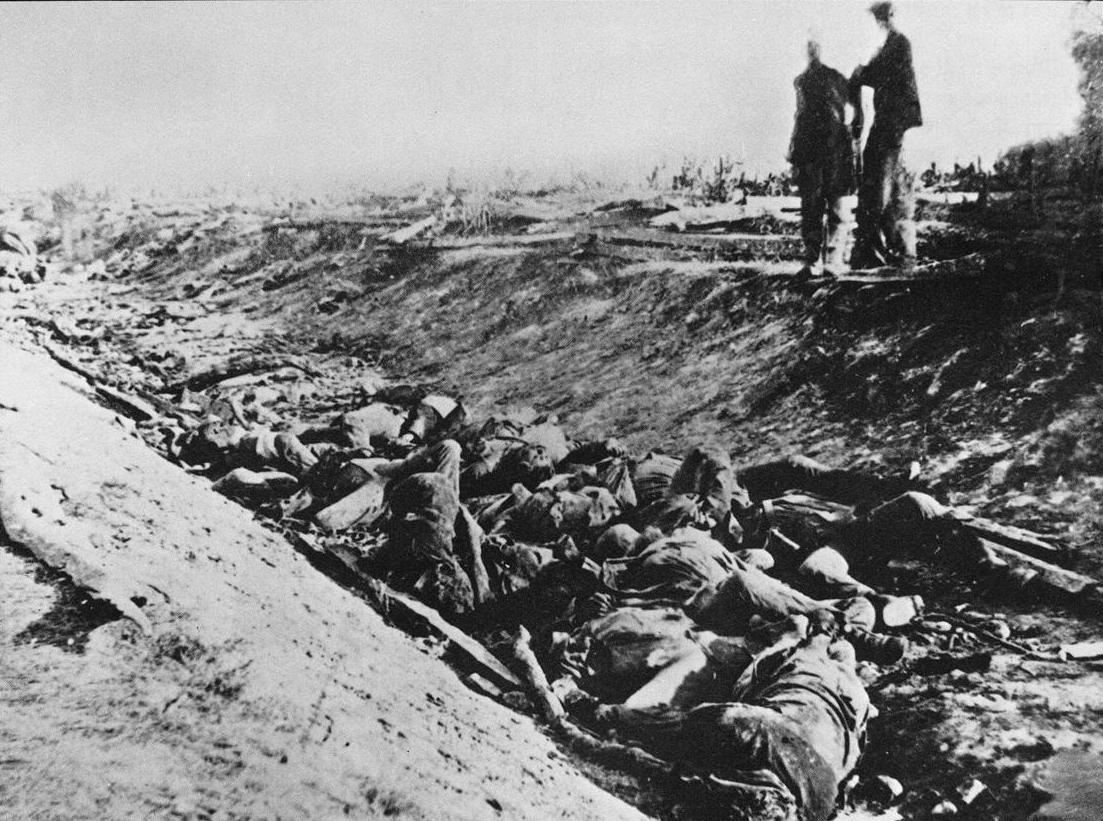
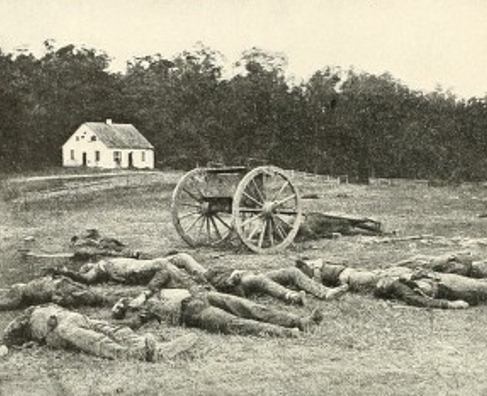
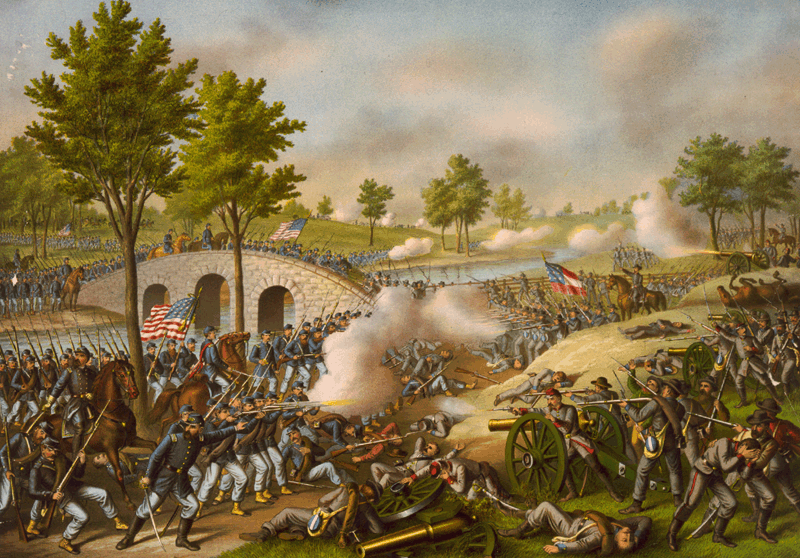
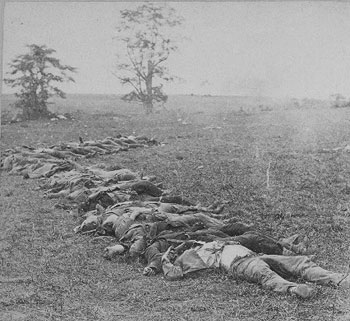
The Bloodiest Day: The Battle of Antietam 17 September 1863

“Of all the days on all the fields where American soldiers have fought, the most terrible by almost any measure was September 17, 1862. The battle waged on that date, close by Antietam Creek at Sharpsburg in western Maryland, took a human toll never exceeded on any other single day in the nation’s history. So intense and sustained was the violence, a man recalled, that for a moment in his mind’s eye the very landscape around him turned red.” Stephen W Sears

“I have heard of ‘the dead lying in heaps’, but never saw it till this battle. Whole ranks fell together.” Captain Emory Upton, 2nd U.S. Artillery, at Antietam

“We were in the very maelstrom of the battle. Men were falling every moment. The horrible noise was incessant and almost deafening. Except that my mind was absorbed in my duties, I do not know how I could have endured the strain.” Lt. Frederick L. Hitchcock, 132nd Pennsylvania, at Bloody Lane, Sept. 17, 1862

To the west of Frederick Maryland a small town named Sharpsburg sits on the west side of a creek. Named Antietam the creek’s headwaters are in Franklin County Pennsylvania and it meanders south where just to the south of Sharpsburg it empties into the Potomac River.

It is a peaceful place, rolling hills and agricultural country with some well preserved stone arch bridges, including one just outside of Sharpsburg. It is hard to believe that 150 years ago the town and the creek were the scene of the bloodiest single day of battle in American history.

On that indian summer day of 1862 the Confederate Army of Northern Virginia, General Robert E Lee, commanding made a stand against the much larger Union Army of the Potomac, Major General George B. McClellan, commanding.

Lee had invaded Maryland following a string of successes in Northern Virginia during that summer of 1862, defeating McClellan outside of Richmond in the Seven Days, and in a campaign of maneuver bested a newly formed Army, the Union Army of Virginia commanded by Major General John Pope defeating it at the Second Battle of Bull Run between 28-30 August 1862. With Northern Virginia’s crops and livestock depleted and his opponents in crisis Lee moved his army north into Maryland. The decision was driven partly by the need to provision his army, but also had the hope of drawing Maryland away from the Union mistakenly believing that public sentiment in that state was pro-Confederate. If the people of Maryland rose up to support Lee it would be disastrous to the Union and endanger the capital itself. A final consideration was the hope that a Confederate victory on Northern soil would bring about the foreign recognition and possibly the intervention of Great Britain on the side of the Confederacy.

The Lost Order

Lee crossed the Potomac on September 3rd and sent his Second Corps west with some elements seizing the Union armory in Harper’s Ferry, others to secure the Baltimore and Ohio Railroad at Martinsburg the rest of the Army was in the area of Frederick. He was pursued by the very cautious McClellan at the head of the Army of the Potomac.

On September 9th Lee issued General Order 191, the infamous “lost order” which a copy of which was found by Union soldiers wrapped around three cigars at a campground recently occupied by Lee’s rear guard element, the division of D.H. Hill on September 13th. The order detailed the disposition of Lee’s army and McClellan seized the opportunity. On the 14th the Army of the Potomac attacked part of Lee’s army at the Battle of South Mountain. The Union won that battle forcing the outnumbered Confederate forces to withdraw, though the delay allowed Lee to concentrate more of his army at Sharpsburg on the 15th.

Although he outnumbered Lee McClellan believed the reports of the Pinkerton Detective Agency which provided intelligence to the army. Those estimates which credited Lee with more than 100,000 troops. He delayed his attack until he had drawn up his full army on the on the 17th.

When he did attack on the 17th his attacks were uncoordinated and though he came close to decisive breakthrough Lee’s army desperately clung to its positions. The action began to the north of the town in the morning and both sides showed incredible ferocity at the Cornfield, where in the space of about three hours nearly 8000 soldiers were killed or wounded. The fighting shifted to the center of the line opposite the town by mid-day. Amid the destructive storm of artillery the armies fought around the Dunker Church and a sunken lane now known as “Bloody Lane.” In the confines of that 800 yard stretch of road over 5000 soldiers were killed or wounded in the course of about four hours. The Union forces broke the Confederate line but reinforcements were not sent and when the the division commander, Major General Israel Richardson was mortally wounded the attack lost its verve and the Confederates under Lieutenant General James Longstreet were able to restore the line.

The south remained quiet as McClellan ordered Major General Ambrose Burnside’s IX Corps to hold off on attacking. Burnside did not receive his orders to attack until 1000. He finally attacked across the south bridge, now known as Burnside’s Bridge in the afternoon. It was another tough fight and Burnside, after several attempts move to the south to flank Confederate forces in the late afternoon with the intention of cutting Lee from off his only escape route.  The Confederates were in a desperate condition. It was at this point, about 3 PM when the division of Major General A.P. Hill arrived and immediately counterattacked breaking up Burnside’s attack. Burnside requested reinforcements from McClellan who refused saying that he had none available. This was not the case, McClellan had two full corps of infantry uncommitted to the battle but still believing that he was outnumbered and that Lee was attempting to trap him.

The actioned ended by 530 PM with both sides rested and reorganized for action the next day. Lee prepared to defend but no Union attack was offered on the 18th. An informal truce was observed to allow the evacuation of the wounded and Lee began his withdraw across the Potomac into Virginia that night. Despite being goaded by Lincoln to pursue McClellan did not and the Union lost the opportunity to destroy Lee’s army n Union territory.

Casualty estimates vary but according to Stephen W Sears in his book Landscape Turned Red that the Army of the Potomac lost 2108 dead, 9540 wounded and 753 missing. He states the best estimate of Confederate casualties are 1546 dead, 7752 wounded and 1018 missing. Most of the missing were likely killed and buried in mass graves or discovered and buried by civilians after the battle. In the space of 12 hours 22719 Americans were killed or wounded. It was the bloodiest single day in American military history.

Though the battle was inconclusive in that Lee’s army survived but had to break off its offensive it had more influence than expected. President Lincoln issued the Emancipation Proclamation on September 22nd and though it did not take effect until January 1st 1863 it marked a turning point in the war.

McClellan failed to take up the offensive in the next tow months and Lincoln relieved him of command giving the Army of the Potomac to Burnside who goaded by Lincoln took the army into battle at Fredericksburg where it met with defeat.

I have been to the battlefield a number of times, once as part of a “staff ride” with the Marine battalion that I was assigned in May of 2000. Each time I go I take the time to ponder the great losses endured by both armies and the individual courage of the soldiers involved. Some of the units that I served with in the Army National Guard in Texas and Virginia trace their lineage and honors to regiments that fought at Antietam and I have felt a connection to the battle because of that. It is hard to imagine the amount of death and carnage taking place in such a placid location in such a short amount of time.

It is something to ponder when some Americans openly suggest another civil war if their party does not win the election.

Peace

Padre Steve+

1 Comment

Filed under civil war, History, Military

“Unprecedented, unmerciful and unrelenting harshness…”: Terror and Ideology in the German Campaigns In Poland and Russia


The following is an article that I first published on this site in 2009 “The Ideological War: How Hitler’s Racial Theories Influenced German Operations in Poland and Russia.” Since I am getting ready to write a number of articles on the subject of politicized military and police forces, the Concentration Camps and the Einsatzgrüppen I wanted to give my readers an overview of the subject. The focus is the ideology that framed and justified to the perpetrators the mass murders of Jews, Poles, Russians and others during the German invasions of Poland and the Soviet Union. I will be writing about policy as well as key personalities involved in the planning and execution of these crimes over the coming months since I have renewed my studies of the crimes and their prosecution at Nuremberg over the past year. In a sense this article is simply an introduction to more specific articles that I will write.  

Peace, Padre Steve+

Introduction: Ideology and Genocide 

Architects of Annihilation: Heinrich Himmler with Adolf Hitler 

The German war against the Soviet Union was the first truly race-based ideological war in history with the campaign against Poland its precursor.  Adolf Hitler’s racial theories and beliefs played a dominant role in Germany’s conduct of the war in the East in both the military campaign and occupation.  This has become clearer in recent years as historians have had the opportunity to examine Hitler’s writings, those of senior Nazi officials and military officers and documents which had been unavailable until the end of the Cold War.  Understanding the Nazi ideological basis and the underlying cultural prejudice against the Jews and eastern Europeans in general is foundational to understanding Hitler’s conduct of the war and why the destruction of the Jews figured so highly in his calculations.  One must also understand the military and police cultures and doctrines that enabled them to cooperate so closely in the conduct of the war.

The German war in the east would differ from any previous war.  Its underlying basis was ideological. Economic and geopolitical considerations were given importance in relationship to the understanding of the German “Master Race.”  Race and Lebensraum was the goal of the State that “concentrates all of its strength on marking out a way of life for our people through the allocation of Lebensraum for the next one hundred years…the goal corresponds equally to the highest national and ethnic requirements.[1] Hitler believed that Germany was “entitled to more land…because it was the “mother of life” not just some “little nigger nation or another.”” [2] The Germans planned to “clear” the vast majority of the Slavic population and the “settlement of millions of hectares of eastern Lebensraum with German colonists” complimented by a short term exploitation of the land to “secure the food balance of the German Grossraum.”[3] Joachim Fest notes that Hitler called it a “crime” to wage war only for the acquisition of raw materials. Only the issue of living space permitted resort to arms.”[4]

Previous wars emphasized conquest of territory and natural resources be they for empire or self sufficiency. The Thirty Years War had a heavy religious component but was more about increasing the power of emerging nation states led by men not necessarily loyal to their religious brethren.[5] The American and Russian Civil wars had some ideological basis and helped usher in the brutality of total war. Both had major effect in these nations’ development and both were bitterly contested with the winners imposing to various degrees political changes on their vanquished brothers they were civil wars.[6] While Adam Tooze sees the Holocaust as the first step of the “last great land grab in the long and bloody history of European colonialism…”[7] this argument does not take away from the basic premise that the war was at its heart ideological.
The root of this war was in the mind of Adolf Hitler himself. His years in Vienna were foundational as he absorbed the ideas of Pan-German, anti-Semitic groups and newspapers like the Deutsches Volksblatt. [8] In Vienna he made the connection between the Jews and Marxism.[9] Joachim Fest notes that in Vienna Hitler became obsessed by the fear of the Slavs and Jews, hated the House of Hapsburg, the Social Democratic Party, and “envisioned the end of Germanism.”[10] His racial views were amplified after the war in turbulent Weimar Germany where he became a member of the NDSAP, rising rapidly within it, eventually taking over party leadership, reorganizing it so that it “became the instrument of Hitler’s policies.”[11] Following the unsuccessful Beer Hall Putsch of 1923 Hitler wrote Mein Kampf while imprisoned in the Landsberg prison in which he enunciated his views about the Jews, Slavs and Lebensraum. Hitler believed that Imperial Germany had been “hopelessly negligent” in regard to the Jews[12] and that the Jews in conjunction with the Catholic Center Party and Socialists worked together for “maximum damage to Germany.”[13] Likewise he saw the Jews as heading the “main ideological scourges of the nineteenth and twentieth century’s.”[14] It was the ideology of Hitler’s “obsessive anti-Semitism”[15] that drove Nazi Germany’s policy in regard to the Jews and against Jewish-Bolshevism.

By the 1920s Hitler had “combined his hatred of the Jews and of the supposedly Jewish dominated Soviet state with existing calls to conquer additional Lebensraum, or living space, in the east.”[16] Hitler wrote: “The fight against Jewish world Bolshevism requires a clear attitude toward Soviet Russia. You cannot drive out the Devil with Beelzebub.”[17] Richard Evans notes that Mein Kampf clearly enunciated that “Hitler considered racial conflict…the essence of history, and the Jews to be the sworn enemy of the German race ….” And that the “Jews were now linked indissolubly in Hitler’s mind with “Bolshevism” and “Marxism.” [18] When Hitler became the dictator of Germany “his ideology and strategy became the ends and means of German foreign policy.”[19] His aims were clear, Hitler remarked to Czech Foreign Minister Chvalkovsky on 21 January 1939: “We are going to destroy the Jews.”[20] It was clear that Hitler understood his own role in this effort noting to General Heinrici that “he was the first man since Charlemagne to hold unlimited power in his own hand. He did not hold this power in vain, he said, but would know how to use it in the struggle for Germany…”[21]

This study will focus on the German policy of ideological-racial war in Poland and Russia. The German war against the Soviet Union and to a certain extent Poland was waged with an unforgiving ferocity against Hitler’s enemy, the Jewish-Bolshevik state and the Slavic Untermenschen. It was characterized by the rise of “political-ideological strategy”[22] in which “Barbarossa showed the fusion of technocracy and ideology in the context of competitive military planning.”[23]
Field Marshal Wilhelm Keitel “war was a fight for survival….dispense with outdated and traditional ideas about chivalry and the generally accepted rules of warfare…” Bundesarchiv Bild

Hitler’s “ideological and grandiose objectives, expressed in racial and semi-mystical terms, made the war absolute.”[24] Field Marshal Keitel noted a speech in March 1941 where Hitler talked about the inevitability of conflict between “diametrically opposed ideologies” and that the “war was a fight for survival and that they dispense with their outdated and traditional ideas about chivalry and the generally accepted rules of warfare.”[25] General Halder, Chief of the OKH in his War Dairy for that meeting noted “Annihilating verdict on Bolshevism…the leaders must demand of themselves the sacrifice of understanding their scruples.”[26] Based on Lebensraum and race, the German approach to war would combine “racism and political ideology” for the purpose of the “conquest of new living space in the east and its ruthless Germanization.”[27] Hitler explained that the “struggle for the hegemony of the world will be decided in favor of Europe by the possession of the Russian space.”[28] Conquered territories would be “Reich protectorates…and that these areas were to be deprived of anything in the nature of a Slav intelligentsia.”[29] This goal was manifest in the “Criminal Order” issued by OKW which stated that the war was “more than mere armed conflict; it is a collision between two different ideologies…The Bolshevist-Jewish intelligentsia must be eliminated….”[30] Other displaced inhabitants of the conquered eastern lands would be killed or allowed to starve.[31] Part of this was due to economic considerations in the Reich, which gave Germans priority in distribution of food, even that from the conquered lands. Starvation was a population control measure that supplemented other forms of annihilation.[32] As Fest notes in Russia Hitler was “seeking nothing but “final solutions.””[33] Despite numerous post-war justifications by various Wehrmacht generals, the “Wehrmacht and army fell into line with Hitler because there was “a substantial measure of agreement of “ideological questions.””[34]

Ideology was key to Hitler’s worldview and fundamental to understanding his actions in the war.[35] However twisted Hitler’s ideological formulations were his ideas found acceptance beyond the Nazi faithful to the Army and Police, who would execute the campaigns in Poland and Russia in conjunction with the Einsatzgrüppen and Nazi party organizations.  In these organizations he found allies with pre-existing cultural, political and doctrinal understandings which allowed them to be willing participants in Hitler’s grand scheme of eastern conquest.

Doctrinal and Ideological Foundations

While Hitler’s racial ideology was more extreme than many in the German military and police, these organizations had cultural beliefs and prejudices as well as doctrinal and ideological foundations which helped them become willing accomplices to Hitler.  These factors were often, consciously or unconsciously, excluded from early histories of World War II. The Allies relied on German officers to write these histories at the beginning of the Cold War, developing the “dual myth of German military brilliance and moral correctness.”[36] B.H. Liddell-Hart makes the astounding statement that “one of the surprising features of the Second World War was that German Army in the field on the whole observed the rules of war than it did in 1914-1918-at any rate in fighting its western opponents….”[37] While he might be excused by lack of knowledge of German army atrocities, not just the SS who he blamed the atrocities, it helps present a myth as truth.[38] The myths were helped by the trials of Manstein and Kesselring where “historical truth had to be sacrificed…to the demands of the Cold War.”[39] Kenneth Macksey confronts the myth that only the “Waffen SS committed barbaric and criminal acts” noting: “Not even the Knights of the Teutonic Order and their followers in the Middle Ages sank to the depths of the anti-Bolshevik Wehrmacht of 1941.”[40]
Pre-Nazi Exterminator: General Lothar Von Trotha led the Genocide against the Herero in Namibia

Germany had a long running history of anti-Semitism before Hitler.  German anti-Semitism often exhibited a “paranoid fear of the power of the Jews,”[41] and included a “fashionable or acceptable anti-Semitism”[42] which became more pronounced as the conditions of the Jews became better and Jews who had fled to Eastern Europe returned to Germany.[43] Sometimes this was tied to religious attitudes, but more often focused on the belief that the Jews “controlled certain aspects of life” and presented in “pseudo-scientific garb” along with the “myth of a secret Jewish plot for world domination which was simultaneously part of the internationalism of Freemasonry.”[44] Admiral Wilhelm Canaris provides an example as he “had grown up in the atmosphere of “moderate” anti-Semitism prevailing in the Ruhr middle class and in the Navy believed in the existence of a “Jewish problem”” and would “suggest during 1935-1936 that German Jews should be identified by a Star of David as special category citizens….”[45] Wehrmacht soldiers were “subject to daily doses of propaganda since the 1930s” and that with the “start of the Russian campaign propaganda concerning Jews became more and more aggressive.”[46] Some objected to Nazi actions against Jews. Von Manstein protested the “Aryan paragraph” in the Reichswehr on general principal.”[47] Yet some who planned and executed the most heinous crimes like Adolf Eichmann had “no fanatical anti-Semitism or indoctrination of any kind.”[48]

The military “looked to the regime to reshape society in every respect: political, ideological, economic and military…Propaganda would hammer home absolute nature of the struggle…”[49] Ideological training began in the Hitler Youth and Reichsarbeitsdienst and produced a soldier in which “Anti-Semitism, anti-communism, Lebensraum – these central tenants of Nazism were all inextricably linked with the Landser’s conception of duty, with his place and role in the vast machinery of war.”[50] Following the dismissal of General Fritsch in 1938, General Brauchitsch promised that “he would make every effort to bring the Army closer to the State and the State’s ideology.”[51] Alfred Novotny, a Austrian soldier in the Gross Deutschland division noted how training depicted the Russians as Untermenschen and how they were “subjected to official rantings about how the supposedly insidious, endless influence of the Jews in practically every aspect of the enemy’s endeavors…Jews were portrayed as rats, which were overrunning the world….”[52] This added to the already “harsh military discipline” which had a long tradition in Germany conditioning soldiers to violence and brutalization of their enemy. Similar programs existed in the Order Police which would play a large part in the eastern campaign, the “image of “treasonous” leftists and Jews helped shape the personal and political beliefs of many policemen throughout the interwar period.”[53] Even ordinary police training before the war in German speaking Europe was brutalizing.”[54] These troops were recipients of an ideological formation which “aimed at shaping the worldview of the police leading to the internalization of belief along National Socialist lines.”[55] Waffen SS soldiers, especially those of the Totenkopf division were subjected to even more systematic political indoctrination on the enemies of National Socialism, the Jews, freemasonry, Bolshevism and the churches.[56]

Along with cultural anti-Semitism and the Nazification of German thought in the 1930s, there were aspects of military doctrine which helped prepare the way for the eastern campaign. The most important were the Army’s anti-partisan and rear area security doctrine.  The history of security anti-partisan operations dated back to the Prussian Army’s Ettapen, which began in 1813 with the Landwehr’s role in security against looters and others.[57] These units supported and supplied offensive operations from the rear to the combat zone with a secondary mission of countering partisans and preventing disruptions in the rear area. The Ettapen would be reformed and regulated in 1872 following the Franco-Prussian War.[58] The German experience fighting guerrillas and partisans, the francs-tireurs in the Franco-Prussian War, “scarred the Army’s institutional mentality.”[59] Von Moltke was “shattered,” writing his brother that “war was now taking on an ever more hate-inspired character.”[60] He was “appalled by improvised armies, irregular elements, and appeals to popular passion, which he described as a “return to barbarism.”[61] He wrote: “Their gruesome work had to be answered by bloody coercion. Because of this our conduct of the war finally achieved a harshness that we deplored, but which we could not avoid.”[62] The brutal German response to the franc-tireurs found legal justification in Franz Lieber’s principles for classification of belligerents and non-belligerents, which determined that guerrillas were outlaws or bandits.[63] In response, the Germans systematically reorganized the Ettapen to include railroad and security troops, special military courts, military police, intelligence and non-military police, including the Landespolizei and the Grenzschutzpolizei.[64]

The doctrinal response to partisans, or as they would become known in German writings as “bandits,” was that bandits should be encircled and destroyed. This was employed in the Southwest Africa German colonies.  The Germans, influenced by the experience in France, “displayed a ferocity surpassing even that of the racially brutalized campaigns of its imperialist peers.”[65] The campaign against the Herero tribes which resisted the occupation of Namibia from 1904-1912 utilized encirclement operations, racial cleansing and what would become known as Bandenkämpfung operations.[66] This was further developed in the First World War, especially in the east where General Fritz Gempp described the security problem as a “ruthless struggle” in which German pacification policy “was in reality the application of terror to galvanize the population into accepting German rule.”[67] Anti-partisan doctrine was codified in the Truppenführung of 1933 which stated that “area defense against partisan warfare is the mission of all units” and that the preferred method of combating partisan bands was that they be surrounded and destroyed.[68] General Erhard Rauss later described active and passive measures used to deal with partisans, focusing on the tactic of encirclement to destroy the enemy.[69]

Anti-partisan doctrine focused on the destruction of the partisans, was coupled a total war philosophy and provided fit well with Hitler’s radical ideology.  The “propensity for brutality in anti-guerrilla warfare was complimented by officers’ growing preoccupation, both during and after World War I, with the mastery and application of violence.”[70] Michael Geyer notes: “ideological mobilization for the creation of a new national and international order increasingly defined the parameters of technocratic planning.”[71] The acceptance of long used brutal tactics to destroy the enemy combined with Hitler’s radical racial animus against the Jews could only be expected to create a maelstrom in which all international legal and moral standards would be breached.

Beginnings in Poland
Einsatzgrüppen in Poland

The Polish campaign was a precursor to the Russian campaign and was not totally race driven. It contained elements of Germany’s perception of the injustice of Versailles which gave Poland the Danzig corridor and Germany’s desire to reconnect East Prussia to the Reich, as well as the perceived necessity to remove a potential enemy from its rear as it faced France, yet it was a campaign steeped in Nazi racial ideology.  Poland resisted German efforts to ally itself with Germany in 1939, thus Hitler determined it “would be crushed first.”[72] Meeting with military leaders on 23 May 1939 Hitler “made it plain that the real issue was not Danzig, but securing of Germany’s Lebensraum….”[73] On 22 August he enjoined the generals to “Close your hearts to pity! Act brutally! Eighty million people must obtain what is their right.”[74]
General Johannes Blaskowitz 

Even so, most military leaders failed to appreciate what Hitler was calling on them to do; Manstein would note that “what Hitler had to say about an eventual war with Poland, could not, in my opinion, be interpreted as a policy of annihilation.”[75] Others such as Canaris was “utterly horrified” as he read his notes to his closest colleagues “His voice trembled as he read, Canaris was acutely aware that he had witnessed something monstrous.”[76] General Johannes Blaskowitz, commander of 8th Army who would be the military commander in Poland did not leave any notes about the meeting, but his biographer notes that he “may have naively attached a military meaning to these terms since he was busy with military matters and soon to begin operations.”[77] This was the interpretation of Manstein as well.[78] Keitel noted that the speech was “delivered in the finest sense of psychological timing and application,” molding “his words and phrases to suit his audience.”[79] In light of the mixed interpretations by military leaders, it is possible that many misinterpreted Hitler’s intent and did not fully appreciated his ideology as they went into Poland, carefully secluding themselves in the narrow confines of their military world. While such an explanation is plausible for some, it is also true that many others in light of subsequent actions were in full agreement with Hitler. One author notes that “no man who participated in the Führer Conferences….and there were present the highest ranking officers of the three services, could thereafter plead ignorance of the fact that Hitler had laid bare his every depth of infamy before them, and they had raised no voice in protest either then or later.”[80] In July, General Wagner, the Quartermaster General issued orders that “authorized German soldiers to take and execute hostages in the event of attacks by snipers or irregulars.”[81]

Regardless of the meaning ascribed to Hitler’s speech, Hitler had already laid plans to destroy the Jews in Poland and decimate the Polish intelligentsia and leadership.   Hitler gave Himmler the task of forming “Einsatzgrüppen to follow the German troops as they advanced into Poland and liquidate Poland’s upper class wherever it was to be found.”[82] While senior party leaders remained at Hitler’s side following the conference, Himmler worked to coordinate his troops, including the reinforced Totenkopf battalions and Einsatzgrüppen with the Army.[83]
SS Obergruppenfuhrer Reinhard Heydrich: Hitler’s Hangman

Himmler began planning in early May and the Army decided to “use SS and police units to augment their own forces for security tasks.”[84] Himmler established “five Einsatzgrüppen to accompany each of the numbered German armies at the start of the campaign.”[85] Placed under the aegis of Reinhard Heydrich the groups were broken down into smaller units of 100-150 men and allotted to army corps.  All senior posts were occupied by officers of the SS Intelligence Service the SD or Sicherhietsdienst.[86] Two additional groups were formed shortly after the invasion.[87] Additionally 3 regiments of the SS Totenkopfverbande, under the direction of SS General Theodore Eicke were deployed in the rear areas of the advancing armies.[88] The purpose of these units was shielded from the Army in the planning stages,[89] although Heydrich worked with the Army to develop lists of up to 30,000 people to be arrested.[90] To eliminate the Polish elites without disturbing the Army, Himmler and Heydrich gave the Army “only the bare minimum of information.”[91] The deception was initially successful.  Blaskowitz’s 8th Army defined the mission of the Einsatzgrüppen in a traditional manner, noting their mission as “the suppression of all anti-Reich and anti-German elements in the rear of the “fighting troops, in particular, counter espionage arrests of politically unreliable persons, confiscation of weapons, safeguarding of important counter-espionage materials etc…”[92] General Wagner issued orders in July 1939 that “authorized German soldiers to take and execute hostages in the event of attacks by snipers or irregulars.” Despite the deception, there was no way to disguise the murder of Polish intelligentsia and Jews, and had the Army had the political acumen it could have considerably restricted the terror campaign.[93] .

The campaign demonstrated Hitler’s intent. Heydrich talked about the “murdering the Polish ruling class” of the aristocracy, Catholic clergy, communists and Jews on 7 September.[94] The Army moved east with the Einsatzgruppen and Totenkopf Verbande, conducting arrests and executions in its wake.  The Army worried about Polish soldiers left behind in rear areas, and a paranoia developed as some generals believed that a “brutal guerilla campaign has broken out everywhere and we are ruthlessly stamping it out.”[95] Yet some actions against the Polish elites and the Jews drew Army reactions. The unit commanded by SS General Woyrsch “behaved with such unparalleled bestiality that it was throw out of the operational area” by General List of 14th Army.[96] Totenkopfverbande Brandenburg came to Army attention when its commander remarked that the “SSVT would not obey Army orders,” and the conclusion of the Army General was that “the SSVT commander was following orders from some non-military authority to terrorize the local Jews.”[97]

These atrocities as well as those of other Waffen-SS units were hard to hide and brought reactions out of army commanders who sought to punish the offenders. Blaskowitz and others attempted to put a halt to SS actions against Poles and Jews,[98] but most officers turned a blind eye to the atrocities or outright condoned them.  It is believed that General Walter Model and others “not only knew what was occurring in Poland but actually took part in what Halder himself described in October as “this devilish plan.””[99] It appears that many who objected were not motivated so much by humanitarian, moral or legal considerations, but rather by the effect on good order and discipline.[100] Likewise it is clear that many officers, even if they did not participate in the actions probably approved of them.  Many biographies and histories of this period written by authors influenced by surviving German officers make no or little mention of the Army’s part in these actions.

Einsatzgruppe Members killing Polish Jews

Himmler and Heydrich were sensitive to the perception of the Army and resented the fact that the Army believed them to be responsible for actions that they were carrying out under the direction and order of Hitler and that their troops were “undisciplined gangs of murderers.”[101] After the establishment of the Government General led by Hans Frank there was conflict between the Army under Blaskowitz, the SS, Police and the Nazi administration. Blaskowitz made an “elaborate report on the atrocities of the SS,”[102] expressing concern about his “extreme alarm about illegal executions, his worries about maintaining troop discipline under those circumstances, the failure of discussions with the SD and Gestapo and their assertions that they were only following SS Orders.”[103] While it is unclear if the memorandum made it to Hitler, it is clear that Hitler did know about the protest and Blaskowitz fell into disfavor and was reassigned after a period of continued conflict with the Nazi administration. Hitler’s reaction according to his adjutant was that the Army’s leaders used “Salvation Army” methods, and their ideas “childish.”[104] Likewise General Georg von Külcher was relieved of command for protesting SS and police atrocities.[105] SS Officers convicted by Army courts-martial were given amnesty by Hitler on “4 October 1939 who two weeks later removed SS units from the jurisdiction of military courts.”[106] While the army remained, it was not longer in charge and would assist the SS and Police in combat and further atrocities. One German officer, later a conspirator in the July 20th plot, remarked in November 1939 about the killings that he “was ashamed to be German! The minority are dragging our good through the mud by murdering, looting and torching houses will bring disaster on the whole German people if we do not stop it soon…”[107]

The Army was relieved of responsibility for policing Poland which fell on the Ordungspolizei battalions and Gendarmerie.  These units would wreak their own devastation on Poland in the coming months and years.[108] Poland would also be the first Nazi driven shift in population to exploit the newly won Lebensraum as Poles were driven into the newly formed Government General and ethnic Germans moved into previously Polish occupied territories. By 1941 over 1,200,000 Poles and 300,000 Jews had been expelled and 497,000 ethnic Germans brought into provinces lost in 1919.[109] Prior to the war about 3.3 million Jews lived in Poland. After the war 50-70,000 were found to have survived in Poland, the Polish Army and camps in Germany. A further 180,000 were repatriated from the Soviet Union.[110]

Russia
The Nazi war against Russia was the penultimate test of Hitler’s ideology. Planning began after 21 July, when Hitler made “his intentions plain” and “von Brauchitsch set his planners to work.”[111] Detailed preparations began in the winter of 1940-41 following the Luftwaffe’s failure against Britain and postponement of Operation Sea Lion.  Hitler intended to “crush Soviet Russia in a quick campaign which was to begin no later than March 15, 1941, and before the end of the war with England.”[112] Keitel noted the final decision came in “early December 1940” and from then he had “no doubt whatsoever that only some unforeseen circumstance could possibly alter his decision to attack.”[113] The plan focused on the destruction of “the Red Army rather than on any specific terrain or political objective,”[114] although these objectives would arise in later planning and in the campaign.  Hitler stated: “What matters is that Bolshevism must be exterminated. In case of necessity, we shall renew our advance whenever a new center of resistance is formed. Moscow as the center of doctrine must disappear from the earth’s center….”[115]

Besides preparations aimed at the destruction of the Red Army and overthrow of the Soviet State, the “war against the Soviet Union was more openly ideological from the start.”[116] Hitler set the stage on March 3rd 1941: “the forthcoming campaign is more than a mere armed conflict; it is a collision between two different ideologies…this war will not be ended merely by the defeat of the enemy armed forces” and that “the Jewish-Bolshevist intelligentsia must be eliminated….”[117] Hitler noted that “this is a task so difficult that it cannot be entrusted to the Army.”[118] Reichskommissars would be appointed in the conquered areas, but since normal civilian powers would be insufficient to eliminate the Bolshevists, that it “might be necessary “to establish organs of the Reichsführer SS alongside the army’s Secret Field Police, even in the operational areas….”[119] The “primary task was to liquidate “all Bolshevist leaders or commissars” if possible while still in the operations zones,”[120] yet the orders did not contain “a syllable that in practice every Jew would be handed over to the extermination machine.”[121] This was followed on 13 March by an agreement between the Army represented by General Wagner and the SS, which stated in part that “the Reichsführer SS has been given by the Führer special tasks within the operations zone of the Army…to settle the conflict between two opposing political systems.”[122] Likewise the agreement dictated that Himmler would “act independently and on his own responsibility” while ensuring that “military operations are not affected by measures necessary to carry out his task.”[123] A further instruction of 26 March issued by Wagner gave the Army’s agreement to the use of the Einsatzgrüppen in the operations zone, specifying coordination between them and army authorities in the operational zone and communications zones to the rear.  Cooperation was based on the “principals for co-operation between the State Secret Police and the Field Security organization of the Wehrmacht agreed with the Security branch of the War Ministry on 1 January 1937.”[124]

Police Battalion in the Soviet Union

The most significant act for the Army in this was the Commissar Order, sometimes known as the “Criminal Order” which was used war as evidence at Nuremberg as against Keitel and the High Command of the Wehrmacht.  The order specified the killing of Soviet Political Commissars attached to the Red Army and as “they were not prisoners of war” and another order specified that “in the event that a German soldier committed against civilians or prisoners, disciplinary action was optional….”[125] The order noted regarding political commissars that “in this struggle consideration and respect for international law with regard to these elements is wrong.” [126] The “Guidelines for the Conduct of Troops in Russia” issued on May 19, 1941 called for “ruthless and vigorous measures against Bolshevist inciters, saboteurs [and] Jews.”[127]
Shortly before the order was issued, Hitler previewed it to the generals saying that the war in Russia “cannot be conducted in a knightly fashion” and that it would have to be waged with “unprecedented, unmerciful and unrelenting harshness…”[128] and that they would have to “dispense with all of their outdated and traditional ideas about chivalry and the generally accepted rules of warfare: the Bolsheviks had long since dispensed with them.”[129] He explained that his orders were beyond their comprehension stating “I cannot and will not change my orders and I insist that that they be carried out with unquestioning and unconditional obedience.”[130]

Himmler visiting POW Camp holding Red Army Prisoners, most would die in German Captivity

Hitler’s speech was protested by some according to Von Brauchitsch,[131] who refused to protest to Hitler but issued an order “threatening dire penalties for excesses against civilians and prisoners of war” which he maintained at Nurnberg “was sufficient to nullify the Commissar Order.”[132] Yet Von Brauchitsch would tell commanders to “proceed with the necessary hardness.”[133] Warlimont noted that Von Bock, who would “later emerge as an opponent of the Commissar Order…makes no special comment on the meeting or the restricted conference that followed.” [134] Keitel said that he “stubbornly contested” the clause “relating to the authority of the SS-Reichsführer… in the rearward operational areas.”[135] Keitel blamed the Army High Command, but the order came out with his signature on behalf of Hitler, which was key evidence against him at Nuremberg. He stated that “there was never any possibility of justifying them in retrospect by circumstances obtaining in the Russian campaign.”[136] Some commanders refused to publish the orders and “insisted that the Wehrmacht never implemented such policies…” blaming them instead on the SS. One writer states “such protests were undoubtedly sincere, but in practice German soldiers were far from innocent. The senior professional officers were often out of touch with their subordinates.”[137] The orders were a “license to kill, although not a great departure from German military traditions….”[138] The effect was terrifying, for in a sense the Einsatzgruppen, “could commit ever crime known to God and man, so long as they were a mile or two away from the firing line.”[139] Security Divisions were “instructed to give material and logistical support to…units of the Einsatzgruppen.”[140] Even worse, army units in rear areas “could be called on to assist Himmler’s SS police leaders.”[141]
SS Brigadefuhrer Otto Ohlendorf Commander of Einstazgruppe D

The SS formed four Einsatzgruppen composed of SD, Waffen-SS and Police troops designated A-D with “A” being assigned to Army Group North, B to Army Group Center, C to Army Group South and “D” to 11th Army.  They were not standardized in manpower or equipment, the largest unit being A in the North at 990 personnel[142] and D with only 550.[143] These units had SS, SD or Police commanders. Additionally nine Ordnungspolizei battalions were initially assigned to the invasion forces.[144] The police contingent would grow over time so that by 1943, these units would be grouped under regiments and number about 180,000 men assisted by 301,000 auxiliaries.[145] These units would act in concert with 9 Army Security Divisions which handled rear area security.[146] Himmler initially did not reveal their intent and planned use to Einsatzgruppen commanders, only speaking of a “heavy task…to “secure and pacify” the Russian area using Sicherheitspolizei and SD methods.”[147] Understanding the effect of these operations, Himmler would state that “in many cases it is considerably easier to lead a company in battle than to command a company responsible to…carry out executions, to deport people…to be always consistent, always uncompromising-that is in many cases far, far harder.”[148]

Nazi actions are well documented; the Einsatzgruppen, Police, Army and locally recruited Schutzmannschaft battalions[149] ruthlessly exterminated Jews and others in the operational area. No sooner had an Einsatzgruppe unit entered a city, a “deadly stranglehold” would grip the “Jewish inhabitants claiming thousands and thousands of victims day by day and hour by hour.”[150] Non-Jewish Russians were encouraged to conduct programs which Heydrich noted “had to be encouraged.”[151] Einsatzgruppen D report 153 noted: “During period covered by this report 3,176 Jews, 85 Partisans, 12 looters, 122 Communist functionaries shot. Total 79,276.”[152] By the spring of 1942 Einsatzgruppe A had claimed “more than 270,000 victims, the overwhelming majority of whom were Jewish.”[153] The total killed for all groups then was 518,388 people, mostly Jews.[154] Germany’s Romanian ally acted against Jews in Odessa as well; “on 23 October 1941 19,000 Jews were shot near the harbor… probably 200,000 Jews perished either at Romanian hands or after being turned over by the Romanians to the Germans.”[155]

Operations against Jews were often called anti-partisan operations.  Himmler referred to Einsatzgruppen as “anti-Partisan formations[156] while Wehrmacht Security divisions “murdered countless Soviet civilians and burned Russian settlements to the ground under the pretext of subduing partisan resistance.”[157] The attitude in 1941-1942 was that “’all Jews are partisans and all partisans are Jews.” From 1943, all armed resistance was “banditry” and all Jews irrespective of circumstances were treated as “bandits.””[158] The commander of the 221st Security Division endeavored to persuade his “subordinate units that the Jews were carriers of Bolshevik contamination and, therefore, the ultimate source of any sabotage or difficulty the division faced.”[159] The extermination of the Jews and partisan war were closely intertwined with the Reich’s economic policies designed to exploit the natural resources of the Russia. This included the “hunger plan” which German authorities seemed to imagine that “millionfold starvation could be induced by requisitioning off all available grain and “shutting off” the cities.”[160] Hitler told Halder that in 1941 that he “intended to level Moscow and Leningrad, to make them uninhabitable, so there would be no need to feed their populations during the winter.”[161] Economic officials held life and death power over villages. Those that met agricultural quotas were “likely to be spared annihilation and evacuation…the culmination of this process, during 1943, would be the widespread creation of “dead zones.””[162] All told the German killed nearly 1.5 million Russian Jews.[163] By 1942, 2 million Soviet POW’s were killed.  600,000 shot outright, 140,000 by the Einsatzkommandos.[164] All told 3.3 million Soviet POWs died in German captivity through starvation, disease and exposure,[165] are included in a total of over 10 million Red Army Combat deaths.[166] Bracher notes: “The reality and irreality of the National Socialism were given their most terrible expression in the extermination of the Jews.”[167]

SS Gruppenfuhrer Arthur Nebe: “I have looked after so many criminals and now I have become one myself.”

Himmler and others continued to use euphemistic language to describe their efforts talking in terms of “Jewish resettlement.”[168] Terms such as special actions, special treatment, execution activity, cleansing and resettlement were used in place of the word murder.[169] At the same time these operations led to problems in the ranks, one SS trooper observed: “deterioration in morale among his own men who had to be issued increasing rations of vodka to carry out their killing orders.”[170] Even commanders were affected, Nebe would say “I have looked after so many criminals and now I have become one myself.”[171] A fellow conspirator would describe him as a “shadow of his former self, nerves on edge and depressed.”[172] Erich Bach-Zelewski, who led the SS anti-partisan efforts would suffer a nervous breakdown which included “hallucinations connected to the shootings of Jews” which hospitalized him in 1942.[173] Himmler would state in October 1943 that “to have gone through” the elimination of the Jews had “and remained decent, that has made us tough. This is an unwritten, never to be written, glorious page in our history.”[174]

Conclusion

The German war against Poland and Russia was heavily dependent on the racist ideology of Adolf Hitler.  He was the true spirit behind the atrocities committed by his nation as one noted in Russia: “Here too the Führer is the moving spirit of a radical solution in both word and deed.”[175] He saw the partisan war as “the chance to stamp out everything that stands against us.”[176] Belief in Germany’s right to Lebensraum the superiority of the German Volk and necessity to settle the Jewish problem provided a fertile ground for Hitler’s plans.  German military doctrines, especially those of anti-partisan and total warfare abetted Hitler’s goals.

Einsatzgruppen Trial at Nuremberg 

It is quite clear that many in the Wehrmacht were in agreement with Hitler’s ideology of racial-war. Prepared by cultural prejudice and long traditions of thought, the “Prussian and in later German military must be regarded as a significant part of the ideological background of the Second World War.”[177] General Reichenau’s orders to his troops are revealing: “The most important goal of the campaign against Jewish-Bolshevism is the complete destruction of its grip on power and the elimination of the Asian influence from our European cultural sphere.”[178] Von Rundstedt appeared to agree with Reichenau to “use the partisan threat as excuse for persecuting Jews, so long as the dirty work was largely left to SS Einsatzgruppen.”[179] The Army command…on the whole acquiesced in the extermination of the Jews, or at least closed its eyes to what was happening.”[180] Even if the Generals had been more forceful in their opposition, they would have been opposed by the highly Nazified youth that made up the bulk of their Army, especially junior officers. SS leaders fanatically executed Hitler’s policies aided by the civil administration. Genocide was to bring the Reich “long term economic gains and trading advantages” and was seen as a way of “financing the war debt without burdening the German taxpayer.”[181] Some individuals attempted to resist the most brutal aspects of the Nazi campaign against the Jews. Some like Wilhelm Kube, Reichskommissar for White Russia and a virulent anti-Semite was shocked at the murders of the Jews calling them “unworthy of the German cause and damaging to the German reputation” and would later attempt to spare Jews by employing them in war industries, would be “defeated by Himmler’s zealots.”[182] Army officers who objected like Blaskowitz and Külcher were relieved, or like Von Leeb, told by Hitler to “in so many words told to mind his own business.” Leeb stated: “the only thing to do is to hold oneself at a distance.”[183] Rommel knew of crimes through Blaskowitz but blamed the crimes “on Hitler’s subordinates, not Hitler himself.”[184]

Hitler’s ideology permeated German military campaigns and administration of the areas conquered by his armies. No branch of the German military, police or civil administration in occupied Poland or Russia was exempt guiltless in the crimes committed by the Nazi regime. It is a chilling warning of the consequences awaiting any nation that allows it to become caught up in hate-filled political, racial or even religious ideologies which dehumanizes opponents and of the tragedy that awaits them and the world. In Germany the internal and external checks that govern the moral behavior of the nation and individuals failed. Caught up in the Nazi system, the Germans, especially the police and military abandoned the norms of international law, morality and decency, banally committing crimes which still reverberate today and which are seen in the ethnic cleansing actions in the former Yugoslavia and other nations.

Bibliography

Aly, Gotz and Heim, Susanne. Architects of Annihilation: Auschwitz and the Logic of Destruction Phoenix Paperbacks, London, 2003, originally published as Vordenker der Vernichtung, Hoffman und Campe, Germany 1991, English translation by Allan Blunden.  First published in Great Britain Weidenfeld & Nicholson, London, 2002

Arendt, Hannah, Eichmann in Jerusalem: A Report on the Banality of Evil. Revised and Enlarged Edition. Penguin Books, Harmondsworth, England and New York, NY 1965. Originally published by Viking Press, New York, NY 1963

Blood, Philip. Hitler’s Bandit Hunters: The SS and the Occupation of Europe. Potomoac Books Inc. Washington, DC 2008

Bracher, Karl Dietrich. The German Dictatorship: The Origins, Structure, and Effects of National Socialism. Translated by Jean Steinberg, Holt Rinehart and Winston, New York, NY 1979. Originally Published under the title Die Deutsche Diktatur: Entstehung, Struktur,Folgen des Nationalsocialismus. Verlag Kiepenheuer & Witsch. Koln and Berlin, 1969

Browning, Christopher R. Ordinary Men: Reserve Police Battalion 101 and the Final Solution in Poland. Harper Perennial Books, New York, New York 1993 reissued 1996.

Burleigh, Michael and Wippermann, Wolfgang. The Racial State: Germany 1933-1945 Cambridge University Press, New York NY and Cambridge UK 1991

Condell, Bruce and Zabecki, David T. Editors. On the German Art of War: Truppenführung , Lynn Rienner Publishers, Boulder CO and London 2001

Craig, Gordon A. The Politics of the Prussian Army 1640-1945. Oxford University Press, London and New York, 1955

Davidowicz, Lucy S. The War Against the Jews 1933-1945 Bantam Books, New York, NY 1986.

Di Nardo, Richard L. Germany and the Axis Powers: From Coalition to Collapse. University Press of Kansas, Lawrence, KS. 2005

Erickson, John. The Road to Berlin. Cassel Military Paperbacks, London, 2003. First Published by Weidenfeld and Nicholson, 1983

Evans, Richard J. The Coming of the Third Reich Penguin Books, New York 2004.  First published by Allen Lane 2003

Evans, Richard J. The Third Reich in Power 1933-1939. Penguin Press, New York, NY 2005

Ferguson, Niall. The War of the Worlds: Twentieth Century Conflict and the Descent of the West. The Penguin Press, New York, 2006

Fest, Joachim, Hitler. Translated by Richard and Clara Winston. Harcourt Brace Jovanovich Publishers, San Diego, New York, London, 1974.  German Edition by Verlag Ullstein 1973

Fraser, David. Knight’s Cross: A Life of Field Marshal Erwin Rommel Harper Perennial, New York 1995, first published by Harper Collins in Britain, 1993

Friedlander, Saul Nazi Germany and the Jews 1939-1945: The Years of Extermination. Harper Perennial, New York, NY 2007

Fritz, Stephen G. Frontsoldaten: The German Soldier in World War II.  The University Press of Kentucky, Lexington, KY 1995

Geyer, Michael. German Strategy 1914-1945 in Makers of Modern Strategy from Machiavelli to the Nuclear Age. Peter Paret, editor. Princeton University Press, Princeton NJ. 198

Giziowski, Richard. The Enigma of General Blaskowitz. Hippocrene Books, New York 1997

Glantz, David M. and House, Jonathan. When Titans Clashed: How the Red Army Stopped Hitler. University Press of Kansas, Lawrence, KS. 1995

Goerlitz, Walter. History of the German General Staff. Translated by Brian Battershaw, Westview Press, Boulder and London, 1985. Originally published as Die Deutsche Generalstab Verlag der Frankfurter Hefte, Frankfurt am Main, 1953

Goerlitz, Walter. The Memiors of Field Marshal Wilhelm Keitel: Chief of the German High Command 1938-1945.  Translated by David Irving. Cooper Square Press 2000,  First English Edition 1966 William Kimber and Company Ltd.  German edition published by Musterschmnidt-Verlad, Gottigen 1961 .

Hitler, Adolf Mein Kampf translated by Ralph Manheim. Mariner Books, Houghton Mifflin Company, New York, NY 1999. Houghton Mifflin Company 1943, copyright renewed 1971. Originally published in Germany by Verlag Frz. Eher Nachf. GmbH 1925

Höhne, Heinze. Canaris: Hitler’s Master Spy. Traslated by J. Maxwell Brownjohn. Cooper Square Press,

New York 1999. Originally published by C. Bertelsmann Verlag Gmbh, Munich 1976, first English edition by Doubleday and Company 1979

Höhne, Heinze. The Order of the Death’s Head: The Story of Hitler’s SS. Translated by Richard Barry. Penguin Books, New York and London, 2000. First English edition published by Martin Secker and Warburg Ltd. London 1969. Originally published as Der Orden unter dem Totenkopf, Verlag Der Spiegel, Hamburg 1966.

Hughes, Daniel J. editor. Moltke on the Art of War: Selected Writings, translated by Harry Bell and Daniel J Hughes. Presidio Press, Novato CA 1993

Liddell-Hart, B.H. The German Generals Talk. Quill Publishing, New York, NY. 1979. Copyright 1948 by B.H. Liddell-Hart

Macksey, Kenneth. Why the Germans Lose at War: The Myth of German Military Superiority. Barnes and Noble Books, New York 2006, originally published by Greenhill Books, 1996

Manstein, Erich von. Forward by B.H. Liddle Hart, Introduction by Martin Blumenson. Lost victories: The War Memoirs of Hitler’s Most Brilliant General. Zenith Press, St Paul MN 2004. First Published 1955 as Verlorene Siege, English Translation 1958 by Methuen Company

Shirer, William L. The Rise and Fall of the Third Reich. A Touchstone Book published by Simon and Schuster, 1981, Copyright 1959 and 1960

Megargee, Geoffrey P. War of Annihilation: Combat and Genocide on the Eastern Front 1941.Bowman and Littlefield Publishers Inc. Lanham, Boulder, New York. 2007

Messinger, Charles, The Last Prussian: A Biography of Field Marshal Gerd Von Rundstedt 1875-1953 Brassey’s (UK) London England 1991

Newton, Steven H. Hitler’s Commander: Field Marshal Walter Model-Hitler’s Favorite General DaCapo Press a division of Perseus Books Group, Cambridge MA 2005

Novatny, Alfred. The Good Soldier. The Aberjona Press, Bedford, PA 2003

Padfield, Peter. Himmler. MJF Books, New York. 1990

Reitlinger, Gerald.  The SS: Alibi of a Nation. The Viking Press, New York, 1957. Republished by Da Capo Press, New York, NY.

Rhodes, Richard. Masters of Death: The SS Einsatzgruppen and the Invention of the Holocaust. Vintage Books a division of Random House, New York, NY 2002

Shepherd, Ben. War in the Wild East: The German Army and Soviet Partisans. Harvard University Press, Cambridge, MA 2004

Sofsky, Wolfgang. The Order of Terror: The Concentration Camp. Translated by William Templer. Princeton University Press. Princeton, NJ 1997. Originally published as Die Ordnung des Terros: Das Konzentrationslager. S. Fischer Verlag, GmbH, Frankfurt am Main, 1993

Speer, Albert. Inside the Third Reich. Collier Books, a Division of MacMillan Publishers, Inc. New York, NY 1970.

Strachan, Hew. European Armies and the Conduct of War. George, Allen and Unwin, London, UK 1983

Stein, George H. The Waffen SS 1939-1945: Hitler’s Elite Guard at War. Cornell University Press, Ithaca and London, 1966

Stern, Fritz. Gold and Iron: Bismarck, Bleichroder and Building of the German Empire. Vintage Books a division of Random House, New York 1979 First published by Alfred a Knopf 1977

Sydnor, Charles W. Soldiers of Destruction: The SS Death’s Head Division, 1933-1945. Princeton University Press, Princeton, NY 1977 Taylor, Fred, Editor and Translator. The Goebbels Diaries 1939-1941, Penguin Books Ltd, Harmondsworth UK and New York NY 1984.

Tooze, Adam. The Wages of Destruction Penguin Books, New York, NY, 2008. First Published by Allen Lane Books, Penguin Group, London UK, 2006

Trevor-Roper, H.R. Hitler’s Table Talk 1941-1944 with an introduction by Gerhard L Weinberg,  Translated by Norman Cameron and R.H. Stevens, Enigma Books, New York, NY 2000. Originally published in Great Britain by Weidenfeld & Nicholoson, London 1953.

Warlimont, Walter. Inside Hitler’s Headquarters 1939-45. Translated by R.H. Berry, Presido Press, Novato CA, 1964.

Weinberg, Gerhard L. Germany Hitler and World War II . Cambridge University Press, New York, NY 1995

Weinberg, Gerhard L. Ed. Hitler’s Second Book: The Unpublished Sequel to Mein Kampf by Adolph Hitler. Translated by Krista Smith, Enigma Books,  New York, NY 2006. Originally published as Hitlers zweites Buch, Gerhard Weinberg editor, 1961.

Weinberg, Gerhard L. Visions of Victory: The Hopes of Eight World War II Leasers. Cambridge University Press, New York, NY 2005

Westermann, Edward B. Hitler’s Police Battalions: Enforcing Racial War in the East. University Press of Kansas, Lawrence, KS. 2005

Wette, Wolfram. The Wehrmacht: History, Myth, Reality. Translated by Deborah Lucas Schneider. Harvard University Press, Cambridge, MA 2006. Originally published as Die Wehrmacht: Feindbilder, Vernichtungskreig, Legenden. S. Fischer Verlag, GmbH, Frankfurt am Main, 2002

Wheeler-Bennett, John. The Nemesis of Power: The German Army in Politics 1918-1945. St. Martin’s Press Inc. New York, NY 1954

Notes

[1] Weinberg, Gerhard L. Ed. Hitler’s Second Book: The Unpublished Sequel to Mein Kampf by Adolph Hitler. Translated by Krista Smith, Enigma Books, New York, NY 2006. Originally published as Hitlers zweites Buch, Gerhard Weinberg editor, 1961 p. 159

[2] Davidowicz, Lucy S. The War Against the Jews 1933-1945 Bantam Books, New York, NY 1986. p.91

[3] Tooze, Adam. The Wages of Destruction Penguin Books, New York, NY, 2008. First Published by Allen Lane Books, Penguin Group, London UK, 2006. p.463

[4] Fest, Joachim, Hitler. Translated by Richard and Clara Winston. Harcourt Brace Jovanovich Publishers, San Diego, New York, London, 1974.  German Edition by Verlag Ullstein 1973 pp. 607-608

[5] Note the actions of Cardinal Richelieu in France who worked to expand French power at the expense of other Catholic nations and the Vatican itself.

[6] In the United States the Reconstruction policies produced great resentment in the south with decidedly negative results for the newly freed slaves which lasted another 100 years, while in the Soviet Union great numbers of “opponents of Socialism” were killed, imprisoned or driven out of the county.

[7] Ibid. Tooze. The Wages of Destruction p.462

[8] Ibid. Davidowicz, The War Against the Jews pp.8-9

[9] Ibid. Davidowicz. The War Against the Jews p.12

[10] Ibid. Fest  Hitler. p.47

[11] Bracher, Karl Dietrich. The German Dictatorship: The Origins, Structure, and Effects of  National Socialism. Translated by Jean Steinberg, Holt Rinehart and Winston, New York, NY 1979. Originally Published under the title Die Deutsche Diktatur: Entstehung, Struktur,Folgen des Nationalsocialismus. Verlag Kiepenheuer & Witsch. Koln and Berlin, 1969 p.93

[12] Weinberg, Gerhard L. Germany Hitler and World War II . Cambridge University Press, New York, NY 1995 p.61

[13] Ibid. Weinberg, Hitler’s Second Book p.60

[14] Friedlander, Saul Nazi Germany and the Jews 1939-1945: The Years of Extermination. Harper Perennial, New York, NY 2007 p.xviii

[15] Ibid. Friedlander, The Years of Extermination p.xvii  Friedlander called this anti-Semitism “Redemptive anti-Semitism” in which “Hitler perceived his mission as a kind of crusade to redeem the world by eliminating the Jews.

[16] Megargee, Geoffrey P. War of Annihilation: Combat and Genocide on the Eastern Front 1941.Bowman and Littlefield Publishers Inc. Lanham, Boulder, New York. 2007 p.4

[17] Hitler, Adolf Mein Kampf translated by Ralph Manheim. Mariner Books, Houghton Mifflin Company, New York, NY 1999. Houghton Mifflin Company 1943, copyright renewed 1971. Originally published in Germany by Verlag Frz. Eher Nachf. GmbH 1925. p.662.

[18] Evans, Richard J. The Coming of the Third Reich Penguin Books, New York 2004.  First published by Allen Lane 2003 p.197

[19] Ibid. Davidowicz The War Against the Jews pp. 88-89

[20] Rhodes, Richard. Masters of Death: The SS Einsatzgruppen and the Invention of the Holocaust. Vintage Books a division of Random House, New York, NY 2002 p.37

[21] Speer, Albert. Inside the Third Reich. Collier Books, a Division of MacMillan Publishers, Inc. New York, NY 1970 p.166

[22] Geyer, Michael. German Strategy 1914-1945 in Makers of Modern Strategy from Machiavelli to the Nuclear Age. Peter Paret, editor. Princeton University Press, Princeton NJ. 1986. p.582

[23] Ibid. Geyer. German Strategy p.587

[24] Strachan, Hew. European Armies and the Conduct of War. George, Allen and Unwin, London, UK 1983 p.174

[25] Goerlitz, Walter. The Memoirs of Field Marshal Wilhelm Keitel: Chief of the German High Command 1938-1945.  Translated by David Irving. Cooper Square Press 2000,  First English Edition 1966 William Kimber and Company Ltd.  German edition published by Musterschmnidt-Verlad, Gottigen 1961 p. 135

[26] Ibid. Fest, Hitler.  p. 649

[27] Ibid. Megargee, War of Annihilation p.7

[28] Trevor-Roper, H.R. Hitler’s Table Talk 1941-1944 with an introduction by Gerhard L Weinberg,  Translated by Norman Cameron and R.H. Stevens, Enigma Books, New York, NY 2000. Originally published in Great Britain by Weidenfeld & Nicholoson, London 1953 p. 27 Goebbels notes a similar theme in his recollection of Hitler’s reasons for destroying Russia a power .  See Taylor, Fred, Editor and Translator. The Goebbels Diaries 1939-1941, Penguin Books Ltd, Harmondsworth UK and New York NY 1984 pp. 413-415.

[29] Goerlitz, Walter. History of the German General Staff.” Translated by Brian Battershaw, Westview Press, Boulder and London, 1985. Originally published as Die Deutsche Generalstab Verlag der Frankfurter Hefte, Frankfur am Main, 1953 p.390

[30] Warlimont, Walter. Inside Hitler’s Headquarters 1939-45. Translated by R.H. Berry, Presido Press, Novato CA, 1964 p. 150

[31] Weinberg, Gerhard L. Visions of Victory: The Hopes of Eight World War II Leasers. Cambridge University Press, New York, NY 2005. p. 24

[32] Aly, Gotz and Heim, Susanne. Architects of Annihilation :Auschwitz and the Logic of Destruction Phoenix Paperbacks, London, 2003, Originally published as  Vordenker der Vernichtung, Hoffman und Campe, Germany 1991, English translation by Allan Blunden.  First published in Great Britain Weidenfeld & Nicholson, London, 2002 pp. 245-246

[33] Ibid. Fest. Hitler p.649

[34] Wette, Wolfram. The Wehrmacht: History, Myth, Reality. Translated by Deborah Lucas Schneider. Harvard University Press, Cambridge, MA 2006. Originally published as Die Wehrmacht: Feindbilder, Vernichtungskreig, Legenden. S. Fischer Verlag, GmbH, Frankfurt am Main, 2002 p.93

[35] This understanding is different than many historians who as Friedlander notes advocate something like this: “The persecution and extermination of the Jews of Europe was but a secondary consequence of major German policies pursued toward entirely different goals.” Friedlander p.xvi

[36] Ibid. Megargee. War of Annihilation p.xii

[37] Liddell-Hart, B.H. The German Generals Talk. Quill Publishing, New York, NY. 1979. Copyright 1948 by B.H. Liddell-Hart p.22

[38] It has to be noted that Liddle-Hart published this work in 1948 and was limited in the materials available, his primary sources being German officers who he viewed with sympathy because he saw them as exponents of his theory of the indirect approach.

[39] Ibid. Wette. The Wehrmacht p.224

[40] Macksey, Kenneth. Why the Germans Lose at War: The Myth of German Military Superiority. Barnes and Noble Books, New York 2006, originally published by Greenhill Books, 1996. p.139

[41] Stern, Fritz. Gold and Iron: Bismarck, Bleichroder and Building of the German Empire. Vintage Books a division of Random House, New York 1979 First published by Alfred a Knopf 1977.  p.495

[42] Ibid. Stern. Gold and Iron p.494

[43] Ibid. Bracher. The German Dictatorship p.34

[44] Ibid. Bracher The German Dictatorship pp.34-35

[45] Höhne, Heinze. Canaris: Hitler’s Master Spy. Translated by J. Maxwell, Brownjohn. Cooper Square Press,

New York 1999. Originally published by C. Bertelsmann Verlag Gmbh, Munich 1976, first English edition by Doubleday and Company 1979 p. 216.  Canaris would later protest the Kristalnacht to Keitel (p.334) and become convinced of the crime of the Nazis against the Jews.

[46] Ibid. Witte. The Wehrmacht p.98

[47] Ibid Witte The Wehrmacht, p.73

[48] Arendt, Hannah, Eichmann in Jerusalem: A Report on the Banality of Evil. Revised and Enlarged Edition. Penguin Books, Harmondsworth, England and New York, NY 1965. Originally published by Viking Press, New York, NY 1963 p.26

[49] Ibid. Megargee. War of Annihilation p.6

[50] Fritz, Stephen G. Frontsoldaten: The German Soldier in World War II.  The University Press of Kentucky, Lexington, KY 1995 p.195

[51] Craig, Gordon A. The Politics of the Prussian Army 1640-1945. Oxford University Press, London and New York, 1955 p.495

[52] Novatny, Alfred. The Good Soldier. The Aberjona Press, Bedford, PA 2003 p.40

[53] Westermann, Edward B. Hitler’s Police Battalions: Enforcing Racial War in the East. University Press of Kansas, Lawrence, KS. 2005 p.64  Westermann also notes the preponderance of SA men who entered the Order Police in the 1930s, a factor which helped further the politicization of that organization.

[54] Ibid. Rhodes Masters of Death p.23

[55] Ibid. Westermann Hitler’s Police Battalions p.103

[56] Sydnor, Charles W. Soldiers of Destruction: The SS Death’s Head Division, 1933-1945. Princeton University Press, Princeton, NY 1977 p. 28

[57] Shepherd, Ben. War in the Wild East: The German Army and Soviet Partisans. Harvard University Press, Cambridge, MA 2004 p.41

[58] Blood, Philip. Hitler’s Bandit Hunters: The SS and the Occupation of Europe. Potomac Books Inc. Washington, DC 2008 p.11

[59] Ibid. Shepherd. War in the Wild East p.42

[60] Ibid. Goerlitz. History of the German General Staff p.93

[61] Rothenburg, Gunther. Moltke, Schieffen, and the Doctrine of Strategic Envelopment in Makers of Modern Strategy from Machiavelli to the Nuclear Age. Peter Paret, editor. Princeton University Press, Princeton NJ. 1986 p.305

[62] Hughes, Daniel J. editor. Moltke on the Art of War: Selected Writings, translated by Harry Bell and Daniel J Hughes. Presidio Press, Novato CA 1993. p.32

[63] Ibid. Blood Hitler’s Bandit Hunters p.6   Lieber was a Prussian emigrant to the US who taught law at Columbia University.

[64] Ibid. Blood Hitler’s Bandit Hunters pp.12-13

[65] Ibid. Shepherd Wild War in the East p.42

[66] Ibid. Blood. Hitler’s Bandit Hunters pp.16-19

[67] Ibid. Blood. Hitler’s Bandit Hunters p.22

[68] Condell, Bruce and Zabecki, David T. Editors. On the German Art of War: Truppenführung , Lynn Rienner Publishers, Boulder CO and London 2001. p.172

[69] Tsouras, Peter G. Editor, Fighting in Hell: The German Ordeal on the Eastern Front The Ballantine Publishing Group, New York, 1998. First published 1995 by Greenhill Books. Pp. 142-146.  It is interesting to note that Rauss does not describe any actual anti-partisan operation.

[70] Ibid. Shepherd. War in the Wild East p.45

[71] Ibid. Geyer. German Strategy p.584

[72] Ibid. Weinberg. Visions of Victory p.8

[73] Ibid. Goerlitz, History of the German General Staff p.346

[74] Höhne, Heinze. The Order of the Death’s Head: The Story of Hitler’s SS. Translated by Richard Barry. Penguin Books, New York and London, 2000. First English edition published by Martin Secker and Warburg Ltd. London 1969. Originally published as Der Orden unter dem Totenkopf, Verlag Der Spiegel, Hamburg 1966 p.259

[75] Manstein, Erich von. Forward by B.H. Liddle Hart, Introduction by Martin Blumenson. Lost victories: The War Memoirs of Hitler’s Most Brilliant General. Zenith Press, St Paul MN 2004. First Published 1955 as Verlorene Siege, English Translation 1958 by Methuen Company p.29

[76] Ibid. Hohne. Canaris p.347

[77] Giziowski, Richard. The Enigma of General Blaskowitz. Hppocrene Books, New York 1997 p.119

[78] Ibid. Manstein. Lost Victories p.29

[79] Ibid. Goerlitz. The Memoirs of Field Marshal Keitel p.87

[80] Wheeler-Bennett, John. The Nemesis of Power: The German Army in Politics 1918-1945. St. Martin’s Press Inc. New York, NY 1954 p.448

[81] Ibid. Megargee. War of Annihilation p.13

[82] Ibid. Höhne The Order of the Death’s Head p.297

[83] Padfield, Peter. Himmler. MJF Books, New York 1990 p.264

[84] Ibid. Megargee. War of Annihilation p.13

[85] Ibid. Westermann. Hitler’s Police Battalions p.127

[86] Ibid.  Höhne The Order of the Death’s Head p.297

[87] Ibid. Westermann. Hitler’s Police Battalions p.127

[88] Ibid. Sydnor Soldiers of Destruction p.37 These would become the nucleus of the Totenkopf Division

[89] Ibid. Giziowski Blaskowitz p.120

[90] Ibid. Witte. The Wehrmacht p.100

[91] Ibid. Höhne The Order of the Death’s Head pp. 297-298

[92] Ibid. Giziowski Blaskowitz p.120

[93] Ibid. Höhne The Order of the Death’s Head p.298

[94] Ibid. Witte. The Wehrmacht p.100

[95] Newton, Steven H. Hitler’s Commander: Field Marshal Walter Model-Hitler’s Favorite General Da Capo Press a division of Perseus Books Group, Cambridge MA 2005. p.74

[96] Ibid. Giziowski. The Enigma of General Blaskowitz pp.165-166

[97] Ibid. Sydnor, Soldiers of Destruction pp. 42-43 Note SSVT is the common abbreviation for the SS Totenkopf Verbande

[98] Ibid. Goerlitz. History of the German General Staff p.359

[99] Ibid. Newton. Hitler’s Commander p.78

[100] Ibid. Witte The Wehrmacht p.102

[101] Ibid. Höhne The Order of the Death’s Head p.298

[102] Ibid. Goerlitz. History of the German General Staff .p.359

[103] Ibid. Giziowski. The Enigma of General Blaskowitz p.173

[104] Ibid. Giziowski. The Enigma of General Blaskowitz p.173

[105] Ibid. Witte The Wehrmacht p.102

[106] Burleigh, Michael and Wippermann, Wolfgang. The Racial State: Germany 1933-1945 Cambridge University Press, New York NY and Cambridge UK 1991. p.100

[107] Ibid. Witte The Wehrmacht p.102

[108] For a good account of one of the Police Battalions see Ordinary Men: Reserve Police Battalion 101mand the Final Solution in Poland by Christopher Browning Harper Perennial Publishers, San Francisco CA 1992

[109] Reitlinger, Gerald.  The SS: Alibi of a Nation. The Viking Press, New York, 1957. Republished by Da Capo Press, New York, NY p.131

[110] Ibid. Davidowicz The War Against the Jews pp.395-397

[111] Ibid. Megargee. War of Annihilation p.24

[112] Ibid. Wheeler-Bennett The Nemesis of Power p.511

[113] Ibid. Goerlitz. The Memoirs of Field Marshal Wilhelm Keitel. P.132

[114] Glantz, David M. and House, Jonathan. When Titans Clashed: How the Red Army Stopped Hitler. University Press of Kansas, Lawrence, KS. 1995 p.31

[115] Trevor-Roper, H.R. Hitler’s Table Talk 1941-1944 with an introduction by Gerhard L Weinberg,  Translated by Norman Cameron and R.H. Stevens, Enigma Books, New York, NY 2000. Originally published in Great Britain by Weidenfeld & Nicholoson, London 1953 p.6

[116] Ibid. Megargee. War of Annihilation p.10 More openly ideological as compared to Poland.

[117] Ibid. Warlimont. Inside Hitler’s Headquarters p.150

[118] Ibid. Warlimont. Inside Hitler’s Headquarters p.151

[119] Ibid. Reitlinger, The SS p.175

[120] Ibid. Höhne The Order of the Death’s Head p. 354

[121] Ibid. Höhne The Order of the Death’s Head p. 354  Again another deception.

[122] Ibid. Warlimont. Inside Hitler’s Headquarters p.153

[123] Ibid. Warlimont. Inside Hitler’s Headquarters p.153

[124] Ibid. Warlimont. Inside Hitler’s Headquarters pp. 158-159

[125] Ibid. Glantz and House. When Titans Clashed p.56

[126] Ibid. Davidowicz. The War Against the Jews p.123

[127] Ferguson, Niall. The War of the Worlds: Twentieth Century Conflict and the Descent of the West. The Penguin Press, New York, 2006 p.442

[128] Ibid. Wheeler-Bennett. Nemesis of Power p.513

[129] Ibid. Goerlitz. The Memoirs of Field Marshal Keitel p.135

[130] Ibid. Wheeler-Bennett. Nemesis of Power p.513

[131] Ibid. Wheeler-Bennett Nemesis of Power p.513 and footnote. He cites the three Army Group commanders, Leeb, Rundstedt and Bock. However Von Rundstedt’s biographer notes that “no evidence exists as to what Von Rundstedt’s to this was at the time.” Messenger, Charles, The Last Prussian: A Biography of Field Marshal Gerd Von Rundstedt 1875-1953 Brassey’s (UK) London England 1991. p.134

[132] Ibid. Reitlinger, The SS p.176

[133] Ibid. Megargee. War of Annihilation p.33

[134] Ibid. Warlimont. Inside Hitler’s Headquarters p.162

[135] Ibid. Goerlitz. The Memoirs of Field Marshal Keitel p.136

[136] Ibid. Goerlitz. The Memoirs of Field Marshal Keitel pp.136-137

[137] Ibid. Glantz and House. When Titans Clashed p.56

[138] Ibid. Blood. Hitler’s Bandit Hunters p.52

[139] Ibid. Reitlinger The SS p. 177

[140] Ibid. Shepherd. War in the Wild East p.54

[141] Ibid. Reitlinger The SS p. 177

[142] Ibid. Rhodes Masters of Death pp.12-13

[143] Ibid. Westermann. Hitler’s Police Battalions p.167

[144] Ibid. Westermann. Hitler’s Police Battalions p.164

[145] Ibid. Blood Hitler’s Bandit Hunters p.141

[146] Ibid. Shepherd Wild War in the East p.48. Shepherd notes the deficiencies of these units in terms of organization, manpower and equipment which he calls “far short of the yardstick of military excellence with which the Wehrmacht is so widely associated.

[147] Ibid.  Höhne The Order of the Death’s Head p. 356 Only one of the Einsatzgruppen commanding officers was a volunteer, Arthur Nebe who was involved in the conspiracy to kill Hitler. It is believed by many that Nebe volunteered to earn the clasp to the Iron Cross to curry favor with Heydrich and that initially “Nebe certainly did not know that “employment in the east” was synonymous with the greatest mass murder in history.

[148] Ibid. Bracher. The German Dictatorship p.422

[149] Ibid. Blood Hitler’s Bandit Hunters p.55

[150] Ibid. Höhne The Order of the Death’s Head p. 360

[151] Ibid.  Friedlander The Years of Extermination p.207

[152] Ibid. Höhne The Order of the Death’s Head p. 360

[153] Ibid. Tooze The Wages of Destruction p.481

[154] Ibid. Ferguson. The War of the World p.446

[155] Di Nardo, Richard L. Germany and the Axis Powers: From Coalition to Collapse. University Press of Kansas, Lawrence, KS. 2005 p.133 The Hungarians would also engage in ant-Jewish operations. Only the Italian army would not conduct operations against the Jews.

[156] Ibid. Höhne The Order of the Death’s Head p. 369

[157] Ibid. Wette The Wehrmacht p.127

[158] Ibid. Blood. Hitler’s Bandit Hunters p.117

[159] Ibid. Shepherd. War in the Wild East pp.90-91

[160] Ibid. Tooze The Wages of Destruction p.481

[161] Ibid. Magargee. War of Annihilation p.64

[162] Ibid. Shepherd. War in the Wild East pp.127-128

[163] Ibid. Davidowicz The War Against the Jews from the table on page 403. This included 228,000 from the Baltic republics (90%) 245,000 from White Russia (65%) 900,000 from the Ukraine (60%) and 107,000 from Russia proper (11%)

[164] Ibid. Rhodes. Masters of Death p.241

[165] Ibid. Glantz and House When Titans Clashed p.57

[166] Ibid. Glantz and House. When Titans Clashed table on p.292

[167] Ibid. Bracher. The German Dictatorship p.431

[168] Ibid. Bracher. The German Dictatorship p.430

[169] Ibid. Höhne The Order of the Death’s Head p. 367

[170] Ibid. Rhodes. Masters of Death p.225

[171] Ibid. Rhodes Masters of Death p.225

[172] Ibid. Höhne The Order of the Death’s Head p. 363

[173] Ibid. Höhne The Order of the Death’s Head p. 363

[174] Ibid. Bracher. The German Dictatorship p.423

[175] Ibid. Bracher. The German Dictatorship p.430

[176] Ibid. Megargee War of Annihilation p.65

[177] Ibid. Wette. The Wehrmacht p.293

[178] Ibid. Wette. The Wehrmacht p.97

[179] Messenger, Charles. The Last Prussian A Biography of Field Marshal Gerd Von Rundstedt 1875-1953 Brassey’s London, 1991 p148

[180] Ibid. Bracher The German Dictatorship pp.430-431

[181] Ibid. Aly and Heim Architects of Annihilation p.242

[182] Ibid. Padfield Himmler pp.341-342

[183] Ibid. Megargee War of Annihilation p.97

[184] Fraser, David. Knight’s Cross: A Life of Field Marshal Erwin Rommel Harper Perennial, New York 1995, first published by Harper Collins in Britain, 1993. p.536

3 Comments

Filed under History, Military, nazi germany, Political Commentary, world war two in europe

Gettysburg Day Three: The Tragedy of Friends at War; Lewis Armistead and Winfield Scott Hancock

“Armistead at Gettysburg” by Keith Rocco

The bonds of friendship forged by soldiers are some of deepest and long lasting that are formed anywhere.  Those bonds are formed by military professionals in the small rather closed society that is the regular United States military over years of deployments, isolated duty, combat and a culture that is often quite different than that of civilian society.

When the people of a nation goes to war against each other the military is often the last to split and when it does men that were friends and comrades turn their weapons against each other and seldom with pleasure. Mass levies of civilian volunteers motivated by ideological, sectional or religious hatred tend to take up such causes with great aplomb. But those that serve together, even those that may believe in their cause are often torn between oaths that they swore to defend their country and their family and home. When their decisions are made they often part with great sadness knowing that they could one day meet each other on a battlefield.

The American Civil War has many such tales. One of the most remembered due to it being a key story line in Michael Shaara’s Pulitzer Prize winning novel The Killer Angels is that of Union General Winfield Scott Hancock and Confederate General Lewis Armistead. This friendship was immortalized in the movie Gettysburg which is based on Shaara’s novel.

Major General Winfield Scott Hancock USA

Hancock was from Pennsylvania was a career soldier and Infantry officer, a graduate of West Point Class of 1844. He served in Mexico and held numerous positions and in 1861 he was stationed in California as a Quartermaster under the command of Colonel (Brevet Brigadier General) Albert Sidney Johnston. One of his fellow officers, who he and his wife Almira became fast friends with was Captain Lewis Armistead, a twice widowed Virginian who also served as a commander of the New San Diego Garrison under Johnston’s command. Armistead was a nephew of the officer who defended Fort McHenry from the British in the War of 1812, a battle which occasioned Francis Scott Key to pen the Star Spangled Banner.  Armistead had academic difficulties at West Point and also had an altercation with Jubal Early in which he broke a plate over Early’s head.  His father helped him obtain a commission as an Infantry officer and his career was similar to many other officers of his day, Mexico, the Great Plains, Kansas, Utah and California.

As the war clouds built and various southern states seceded from the Union numerous officers were torn between their oath, their friendships with their fellow officers and their deep loyalty to their home state and families even if they personally opposed secession. In the end it was a decided minority of of Southern born officers that remained loyal to the Union, the most prominent of these men were General Winfield Scott and Major General George Thomas, the Rock of Chickamauga. Thomas’s action cost him his relationship with his immediate family who deemed him to be a traitor. Both men were pilloried and demonized in the most base ways by many in the South, during and after the war. Some Southerners who served the Union were executed when captured, George Pickett, who called for Thomas’ death ordered 22 North Carolinians captured fighting for the Union in Kinston North Carolina and he was not alone.

Brigadier General Lewis Armistead CSA

Armistead and other officers asked Hancock, who was a Democrat advice on what he would do if war came. Hancock’s reply was simple. I shall not fight upon the principle of state-rights, but for the Union, whole and undivided” 

The Hancock’s hosted a going away party for their friends departing from the service to join the Confederacy. Almira Hancock wrote that “Hearts were filled with sadness over the surrendering of life-long ties.”with the Johnston’s wife Eliza singing the popular Irish song Kathleen Mavourneen:

“Mavourneen, mavourneen, my sad tears are falling, To think that from Erin and thee I must part!

It may be for years, and it may be forever, Then why art thou silent, thou voice of my heart?…”

Armistead was tearful and said “Hancock, good-by; you can never know what this has cost me, and I hope God will strike me dead if I am ever induced to leave my native soil, should worse come to worse.”

At Gettysburg Armistead spoke his fears to his comrades, including Brigadier General Dick Garnett, another of his comrades from the California days as they met the night before the fateful charge of July 3rd. The next afternoon Armistead and Garnett led their brigades of Pickett’s Division against Hancock’s II Corps which was defending Cemetery Ridge.

During the engagement Garnett was killed just before reaching the Union lines and Hancock gravely wounded. Armistead, leading his brigade breached the Union line with his black hat atop his sword was wounded in the right arm and shoulder and fell near one of the Union artillery pieces, a point now known as “The High Water Mark” of the Confederacy.  As Armistead lay wounded he was approached by Major Bingham of Hancock’s staff who was responding to Armistead’s making a Masonic sign of distress. When Bingham told Armistead of Hancock’s injury Armistead was grieved and told Bingham to “Tell General Hancock for me that I have done him and you all an injury which I shall regret the longest day I live.” He gave Bignham a wrapped Bible and Prayer book to give to Almira Hancock, inscribed were the words “Trust in God and fear nothing.” 

“Minnesota Forward” Hancock directing the Defense by Dale Gallon

Armistead would die from infections caused by his wounds which were initially not thought to be life threatening. Hancock would go on to continued fame and be one of the most admired and respected leaders of the Army during and after the war. He was gracious as a victor and spoke out against reprisals committed against Southerners after the war. He was the Democratic nominee for President losing a close election to James Garfield, losing the popular vote by under 40,000 votes.  It was an era of great political corruption and Hancock was one of the few major public figures Even his political opponents respected him for his integrity and honesty. Former President Rutherford B Hayes said “[i]f, when we make up our estimate of a public man, conspicuous both as a soldier and in civil life, we are to think first and chiefly of his manhood, his integrity, his purity, his singleness of purpose, and his unselfish devotion to duty, we can truthfully say of Hancock that he was through and through pure gold.” 

A few years after his death Republican General Francis A Walker, lamenting the great corruption of the time said:

“Although I did not vote for General Hancock, I am strongly disposed to believe that one of the best things the nation has lost in recent years has been the example and the influence of that chivalric, stately, and splendid gentleman in the White House. Perhaps much which both parties now recognize as having been unfortunate and mischievous during the past thirteen years would have been avoided had General Hancock been elected.”

The story of Hancock and Armistead is one that reminds us of how hardened ideologues can divide a nation to the point of civil war. It is a story that should give pause to any political or spiritual leader that incites people to war against their neighbor and use their ideology to enslave or brutalize their political opponents.

The blood of the approximately 50,000 soldiers that were killed or wounded during the three days of the Battle of Gettysburg is ample reminder of the human suffering brought about by unrestrained ideologues.

Peace

Padre Steve+

8 Comments

Filed under civil war, History

The First Memorial Day

The acrid smell of smoke of the last battles of the American Civil War was still lingering over many towns and cities in the South on May 1st 1865.  Charleston South Carolina, a hotbed of secession was particularly hard hit during the war. In 1861 Cadets of the Citadel and South Carolina militia forces began the war with the bombardment of Fort Sumter. Union Forces laid siege to the city in late 1863 which ended with the city’s surrender on 18 February 1865. By this time much of the city had been destroyed by Union siege artillery and naval forces.

Charleston had also been the home of three of the Prisoner of War Camps erected by the Confederacy, one in the Charleston City Jail and the other at Castle Pinckney. Another camp was erected on the site of the Washington Race Course and Jockey Club in 1864. This was an open air camp and Yale Historian David Blight wrote that “Union soldiers were kept in horrible conditions in the interior of the track; at least 257 died of exposure and disease and were hastily buried in a mass grave behind the grandstand.” (See http://www.davidwblight.com/memorial.htm)

By the end of the war most of the white population of the city had left and most of those remaining were recently freed slaves. After their liberation and the city’s occupation by Federal forces including the famous 54th Massachusetts as well as the 20th, 35th and 104th US Colored Troops Regiments. A number, about 28 Black men went to work and properly reinterred these 257 Union dead on the raceway building a high fence around it. They inscribed “Martyrs of the Race Course” on an arch above the cemetery entrance.

On May 1st over 10,000 Black Charlestonians gathered at the site to honor the fallen. Psalms, Scriptures and prayers were said, hymns were sung and many brought flowers. A parade of 2800 children covered the burial ground with flowers.  They were followed by members of the Patriotic Association of Colored Men and the Mutual Aid Society whose members provided relief supplies to Freedmen and provided aid to bury those Blacks who were too poor to afford burial. More citizens followed many laying flower bouquets on the graves. Children then led the singing of The Star Spangled Banner, America and Rally Around the Flag. The Brigade composed of the 54th Massachusetts and the 35th and 104th Colored Regiments marched in honor of their fallen comrades. Following the formalities many remained behind for a picnic.  A contemporary account can be found here: http://media.charleston.net/2009/pdf/firstmemorial_day_052409.pdf

Other communities would establish their own Memorial Day observances in the years following the war, with the Charleston event preceding the next earliest event by a full year. The first “Official” commemoration was on 30 May 1868 when Union General John Logan and head of the veteran’s organization called The Grand Army of the Republic appealed to communities to honor the dead by holding ceremonies and decorating the graves of the fallen. In the South three different days served a similar purpose.  In Virginia people commemorated the day on June 3rd, the birthday of Confederate President Jefferson Davis, the Carolinas marked the day on 10 May, the birthday of General Thomas “Stonewall” Jackson, while in the Deep South the event was conducted on the anniversary of the surrender of General Joseph Johnson’s Army to General William Tecumseh Sherman.  For many in the South the day would become about “The Lost Cause” or “the defense of Liberty” or “States Rights” and was often caused the “War of Northern Aggression.”

The “Martyrs of the Racecourse” cemetery is no longer there. The site is now a park honoring Confederate General and the White Supremacist “Redeemer Governor” of South Carolina Wade Hampton. An oval track remains in the park and is used by the local population and cadets from the Citadel to run on. The Union dead who had been so beautifully honored by the Black population were moved to the National Cemetery at Beaufort South Carolina in the 1880s and the event conveniently erased from memory. Had not historian David Blight found the documentation we probably still would not know of this touching act which so honored those that fought the battles that won their freedom.

The African American population of Charleston who understood the bonds of slavery and oppression, the tyranny of prejudice in which they only counted as 3/5ths of a person and saw the suffering of those that were taken prisoner while attempting to liberate them stand as an example for us today.  Within little more than a decade they would be subject to Jim Crow and again treated by many whites as something less than human.  The struggle of them and their descendants against the tyranny of racial prejudice, discrimination and violence over the next 100 years would finally bear fruit in the Civil Rights movement whose leaders, like the Reverend Doctor Martin Luther King Jr. would also become martyrs.

Frederick Douglass spoke to Union Veterans on Memorial Day 1878.  His words, particularly in light of the war and the struggles of African Americans since and the understanding of what those who were enslaved understood liberation to be are most significant to our time. It was not merely a war based on sectionalism or even “States rights,” it was a war of ideas. He said:

“But the sectional character of this war was merely accidental and its least significant feature.  It was a war of ideas, a battle of principles and ideas which united one section and divided the other; a war between the old and new, slavery and freedom, barbarism and civilization; between a government based upon the broadest and grandest declaration of human rights the world ever heard or read, and another pretended government, based upon an open, bold and shocking denial of all rights, except the right of the strongest.” 

I do hope in the days ahead as we prepare to celebrate Memorial Day, as we prepare to honor those Americans who died that others might be free to look back at what freedom actually means and not forget the sacrifices of those that give their lives that others might live.

Peace

Padre Steve+

20 Comments

Filed under History, Military