Tag Archives: major general dan sickles

July 2nd at Gettysburg: Part 1, Preparations

The Enemy is There

Friends of Padre Steve’s World

For those that have followed my writing for some time you know that I teach military history and ethics at the Joint Forces Staff College. One of the great joys that I have is leading the Gettysburg Staff Ride, which is an optional event for students that want to participate. When I took the position here I took some of my older writings on Gettysburg and put them into a student study guide and text. That was two years ago. Then the text was about 70 pages long. It is now about 925 pages long and eventually I hope to get it published. When and if that happens I expect it to become two, and possibly three books.

This is the first of a series of articles that I will be posting potions of a chapter that I have rewritten about the critical battles on the south side of the battlefield on July 2nd 1863, the battle for Devil’s Den, the Wheatfield, the Peach Orchard, and the final repulse on Cemetery Ridge.

As you read this don’t just look at the events, but look at the people, and their reaction to the what they encountered on the battlefield, for that understanding of people is where we come to understand history.

So even if you are not a Civil War buff, or even a history buff, take the time to look at the people, their actions, and the things that made them who they were, and influenced what they did. History is about people.

So please enjoy,

Peace

Padre Steve+

Preparations

On July 2nd 1863 as on the first day of battle and throughout the Gettysburg campaign issues of command and control would be of paramount importance to both armies. On the second day the glaring deficiencies of Robert E Lee and his corps commanders command and control at Gettysburg would again be brought to the fore. Likewise the exemplary command of the Army of the Potomac by George Meade, Winfield Scott Hancock, staff artillery officer Henry Hunt and staff engineer Gouverneur Warren exemplified the best aspects of what we now define as Mission Command.

The definition of mission command as currently defined in American doctrine helps us in some ways to understand what happened on July 2nd 1863. Without imposing current doctrine on the leaders at Gettysburg, the definition describes the timeless aspect of leadership in battle and the importance of the human dynamic in war.

“Mission command is the conduct of military operations through decentralized execution based upon mission-type orders. Successful mission command demands that subordinate leaders at all echelons exercise disciplined initiative, acting aggressively and independently to accomplish the mission. Essential to mission command is the thorough knowledge and understanding of the commander’s intent at every level of command.” [1]

It is with this in mind that we look at the actions of various commanders during the critical second day of the battle of Gettysburg, and as we do so we also try to examine their lives and in a sense try to bring them to life. It is important because the actions of a number of commanders, including Robert E. Lee, George Meade, James Longstreet, Dan Sickles, and to a lesser degree A.P. Hill would be the subject of a great amount of controversy and partisan bickering that still lingers a century and a half later.

Confederate Consternation

Before the sun rose on July 2nd James Longstreet took stock of the situation. The burly commander of First Corps was now working to bring the divisions of McLaws and Hood from their bivouac sites west of Herr’s Ridge and onto the battlefield. While his divisions moved out, Longstreet met with Lee to again express his opposition to taking the offensive. He again brought up the subject of making a “broad turning movement around the enemy’s left flank that would place the Confederate army between the Federal capital and George Meade’s army.” [2] As he did the previous night, Lee again rebuffed Longstreet’s suggestion and apparently frustrated by Longstreet’s continued resistance to his decision Lee “walked off by himself, away from the conflict.” [3] Lee then left Longstreet and went to confer with Dick Ewell to discuss the possibility of attacking the Federal right, and he sent his staff topographical engineer, Captain Samuel Johnson to reconnoiter the Federal left.

At this point Lee had not yet decided where to attack. Again he conferred with Ewell about the possibility of attacking the Federal right, but Ewell again dissuaded him from doing so. Ewell insisted that a “daylight attack on Culp’s Hill or Cemetery Hill would be costly and of doubtful success.” [4] For a second time Lee brought up the possibility of Ewell redeploying his corps from its positions around the “fishhook” of the Federal line to the west where they could better support an assault on the Federal left, but as he had the previous night “Ewell persuaded the general commanding to leave his corps where it was.” [5] In doing so Ewell promised to create a demonstration on the Federal right when he heard Longstreet’s attack commence. But, “according to Fitzhugh Lee, He decided to turn Meade’s left with Longstreet’s corps, demonstrate against his centre and right with Hill’s and Ewell’s corps, and then convert this demonstration into a real attack directly Longstreet’s attack succeeded.” [6] Ewell’s corps was to be the “anvil against which Longstreet would smash whatever was left of the 1st and 11th Corps, or any other Union reinforcements might have arrived overnight.” [7] However, the position of Second Corps around the fishhook was a poor position. “It greatly extended the army’s lines, and confronted the most defensible part of the Federal lines.” [8] Likewise, the position offered little advantage for Ewell’s artillery.

By the time Lee returned to his headquarters the divisions of Hood and McLaws, with the exception of Law’s brigade of Hood’s division, “which had been “left by Hood on picket” below the pike stretching back to Chambersburg, and was far behind the others” [9] were marching onto the field and halted just west of Seminary Ridge while the Confederate leaders conferred. But Longstreet was also troubled by the absence of George Pickett’s division of Virginians, which due to the lack of cavalry had been left at Chambersburg to guard the Confederate supply trains and would not be available for action until late in the evening.

Captain Johnson returned to the headquarters following his reconnaissance of the Federal left. He reported that the Federal left was weakly held and that there were no Federal troops on the Round Tops. But Johnson’s reconnaissance was not nearly as thorough or accurate as he reported. Johnson made “no detailed sketches of the hazardously rough ground at the southern end of the Federal line” and gave “an inadequate picture of the obstacles to mass troop movement.”[10] Despite getting up to the Round Tops he did not observe the large number of Union troops from Sickles’ Third Corps in the woods to the north and northwest of Little Round Top. The latter omission appears to be more to bad timing, lack of attention, Johnson’s lack of familiarity with the terrain and lack of experience in conducting a reconnaissance that should have been undertaken by cavalry scouts.

Johnson arrived with his report as Lee was conferring with Hill and Longstreet. He traced his route on the map. Johnson’s replies to Lee’s questions satisfied Lee that the Federal left was again up in the air and unprotected as it had been at Chancellorsville. However, this was not the case. First, had Johnson taken the route that he described he “would have come upon the encampments of the Third Corps, located north and west of Little Round Top. He would have also encountered trouble from John Buford’s cavalry vedettes, some of whom were posted about Sherfy’s peach orchard.” [11] Johnson claimed to have gotten up to Little Round Top, and if he did the only way he could not have seen Federal troops was if he had gotten there “just after the guarding troops of the night had been withdrawn and just before their replacements had arrived.” [12] Even if that was the case it would have been hard for Johnson to miss the Third Corps troop bivouacs. The Federals might have been obscured from the Captain’s view by the morning mist, but “Johnson should have detected the noise of men and animals, drums and bugles.” [13] A more likely scenario is that the inexperienced Johnson went further south and scaled Big Round Top from which his report of seeing no troops would have been completely accurate, but the inaccuracies of Johnson’s report were to cause serious complications and consequences for Lee’s plan.

Johnson’s report convinced Lee of the soundness of his plan to roll up the Federal left. He again conferred with Longstreet and announced his intention to attack Meade’s left flank with Hood and McLaws divisions. Lee went directly to McLaws and described his plan. He desired McLaws division to move south to a position perpendicular to the Emmitsburg Road south of the Peach Orchard. McLaws said it was possible but wanted to make a personal reconnaissance and Longstreet objected to the position that Lee indicated for McLaws division. Longstreet said “No, sir, I do not want wish for you to leave your division,” and tracing with his finger a line perpendicular to that drawn on the map, said, “I wish your division placed so.” “No, General,” Lee objected, “I wish it placed just so.” [14] Lee’s statement ended the conversation and after another consult with Ewell, Lee returned to lay out his plan. As he left for his division McLaws recalled that “General Longstreet appeared if he was irritated and annoyed,… but the cause I did not ask.” [15]

The divisions of Hood and McLaws were still about a mile and a half to the rear of the Confederate line. As soon as those divisions were in position they would march south while attempting to remain unseen by Federal troops on the high ground to the east, and then wheel left and come up the Emmitsburg Road into what Lee believed was the rear of the Federal position. After his brief consultation with Ewell regarding the security of his left flank, Lee returned to check the progress of Longstreet. Longstreet had not been completely inactive. He had already sent out his artillery led by Porter Alexander to find a suitable position to support the impending attack, but he did not make any further consultations with Hood of McLaws, nor send any officers to make a further reconnaissance until receiving definitive orders from Lee to launch the attack. For some reason, perhaps his misunderstanding with Lee concerning the nature of the campaign, or Lee’s rejection of his course of action, Longstreet did not demonstrate his usual energy and the careful preparation that he showed in previous actions. His biographer, Jeffry Wert noted “He allowed his disagreement with Lee to affect his conduct….The concern for detail, the regard for timely information, and the need for preparation were absent. Or, as Moxley Sorrell admitted, “there was apparent apathy in his movements. They lacked the fire and point of his usual bearing on the battlefield.” [16]

Like all movements to contact made by large armies was fraught with logistical complications and irritating, yet unavoidable delays in moving large numbers of troops over unfamiliar terrain. Even if Longstreet had acted with greater alacrity, and if the Confederates at all levels had been more efficient managers, “it would take several hours for to march them a distance of four miles or more to the place where they would be deployed for battle.” [17] Lee desired for McLaws division to lead the assault. However, McLaws division was trailing Hood’s troops on the Chambersburg Pike west of town, and would have to pass around Hood’s division to take up its position in the Confederate van. Another delay occurred when Longstreet requested additional time for Law’s brigade of Hood’s division, marching up from Guilford to rejoin Hood before he began his movement. Lee acquiesced to Longstreet and Law’s men reached Hood about an hour later.

Lee’s plan required that Anderson’s division of Hill’s Corps would have to move first to take up a supporting position along Seminary Ridge so it could launch a supporting attack as Longstreet’s corps advanced up the Emmitsburg Road. However, elements of Anderson’s division had become embroiled in a firefight at the Bliss farm which delayed his movement to reach his start position for the attack. But in addition to this, lee complicated matters by not removing Anderson from Hill’s command and giving Longstreet operational control. Instead Lee, possibly to avoid hurting the “sensitive Hill by removing a division that had not yet fought with his corps, and yet allow Longstreet to call on Anderson without going through Hill, Lee instructed Anderson “to cooperate…in Longstreet’s attack.” [18] It was another example of Lee’s vague orders which plagued the campaign, as one historian observed, “This order was the vaguest he ever gave. He did not specify whether Anderson was to act under the orders of Longstreet, or of Hill. His new corps commander, or Lee’s own. He seemed to be reverting to the loose structure of his early days in command.” [19]

But even more importantly it was an offensive that required “careful coordination and expert timing. If his plan was sound, which is debatable, there was still the question of whether the army was equal to the task.” [20]

As the various Confederate commands struggled to get in position to attack, without being observed, the Army of the Potomac readied itself for action. After the near disaster of July 1st, the army had recovered its “operational balance, setting in place the systems necessary for command and control.” [21] Meade and his subordinates had chosen a strong position from which they could maximize their strengths, and in addition to this they ensured that each corps had established headquarters and reported their position to the army staff. Wireless was set up to allow Meade to communicate directly to Washington, while the army’s Signal Corps detachments set up observation points on every bit of high ground under Federal control, including Little Round Top, which allowed them communicate with Meade’s headquarters by semaphore. Meanwhile, Henry Hunt had brought up the reserve artillery and began refitting damaged guns while supervising the emplacement of newly arrived batteries along the Federal line. Even more importantly, unlike Lee whose exterior lines refusal to use semaphore created undue delays in communications, Meade’s little headquarters at the Leister house was “almost up to the line of battle and little time would be wasted in the transmittal of orders.” [22]

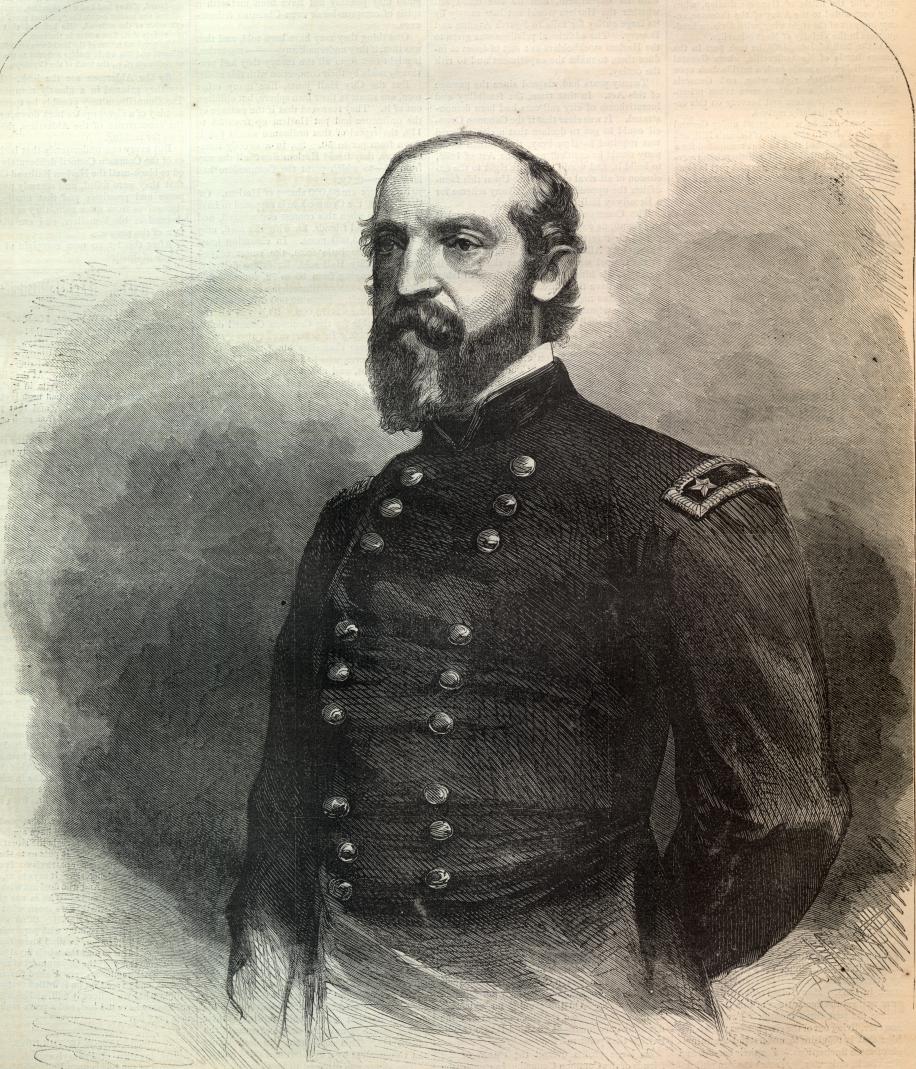
general-george-meade

Meade’s Defensive Preparation

On the morning of July 2nd the Army of the Potomac was mostly assembled on the high ground from Culp’s Hill to Cemetery Hill and along Cemetery Ridge. In the north and east, the Twelfth Corps under the command of Major General Henry Slocum held Culp’s Hill and protected the Federal right. His troops began fortifying the already formidable position as soon as they arrived on the night of July 1st and continued to strengthen their positions throughout the day.

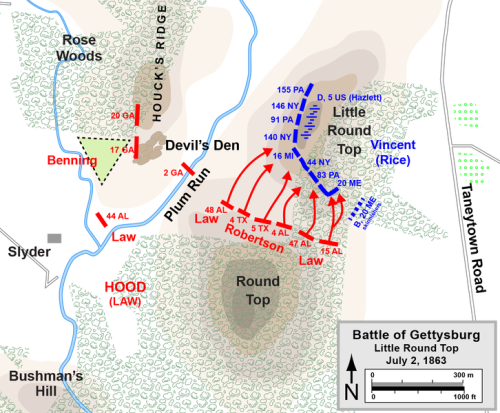
413px-Gettysburg_Battle_Map_Day2

The battered remnants of the First and Eleventh Corps held Cemetery Hill where they had made their final stand on the night of July 1st. Oliver Howard retained command of Eleventh Corps, while Meade returned Doubleday to command of his division and brought John Newton from Sixth Corps to command the remnants of the battered First Corps. Winfield Scott Hancock’s crack Second Corps extended the line down southward down Cemetery Ridge. To Second Corps right was Dan Sickles’ Third Corps. George Sykes Fifth Corps was in reserve just to the north and east of Little Round Top, while John Sedgwick’s massive Sixth Corps was still enroute, marching up the Baltimore Pike. “The convex character of the Union line facilitated the rapid movement of troops to reinforce any threatened section.” [23] Unlike Lee’s troops who had to make long marches to support each other, the Union men “never had to march more than two and half miles, usually less.” [24]This would provide Meade with a vital advantage during the viscous battle that was to ensue on July 2nd and as the ever observant Porter Alexander noted, “Communication between our flanks was very long – roundabout & slow while the enemy were practically all in one convenient sized bunch. Reinforcements from their extreme right marched across in ample time to repulse our attack on their extreme left. But Ewell’s men could hardly have come to our help in half a day – & only under view & fire.” [25]

The Army of the Potomac now occupied a solid and well laid out position which commanded the battlefield. Meade and Warren were worried that Lee might attempt to turn them out of their position by moving south, as Longstreet was begging Lee to do, but in reality there was little threat. Even so, Major General Gouverneur Warren, the Army’s Staff Engineer Officer who had been sent by Meade to assist Hancock the night of the first wrote his wife that morning: “we are now all in line of battle before the enemy in a position where we cannot be beaten but fear being turned.” [26]

There was one notable problem, the commander of the Third Corps, Major General Dan Sickles did not like the position assigned to his corps on the south end of Cemetery Ridge.

To be continued…

Notes

[1] __________ Mission Command White Paper and JP 3-31

[2] Wert, Jeffry D. General James Longstreet The Confederacy’s Most Controversial Soldier, A Touchstone Book, Simon and Schuster, New York and London 1993 pp. 260-261

[3] Thomas, Emory Robert E. Lee W.W. Norton and Company, New York and London 1995 p.297

[4] Pfanz, Donald. Richard S. Ewell: A Soldier’s Life University of North Carolina Press, Chapel Hill and London 1998 p.315

[5] Sears, Stephen Gettysburg Houghton Mifflin Company Boston and New York 2004 p.256

[6] Fuller, J.F.C. Grant and Lee: A Study in Personality and Generalship, Indiana University Press, Bloomington IN 1957 p.197

[7] Guelzo, Allen C. Gettysburg: The Last Invasion Vintage Books a Division of Random House, New York 2013 p.236

[8] Ibid. Sears Gettysburg p.256

[9] Ibid. Guelzo, Gettysburg The Last Invasion p.237

[10] Dowdy, Clifford. Lee and His Men at Gettysburg: The Death of a Nation Skyhorse Publishing, New York 1986, originally published as Death of a Nation Knopf, New York 1958 p.186

[11] Trudeau, Noah Andre Gettysburg a Testing of Courage Perennial Books, Harper Collins Publishers, New York 2002 p.289

[12] Ibid. Dowdy Lee and His Men at Gettysburg p.186

[13] Ibid. Wert General James Longstreet p.262

[14] Pfanz, Harry W. Gettysburg the Second Day University of North Carolina Press, Charlotte and London, 1987 p.110

[15] Ibid. Trudeau Gettysburg a Testing of Courage p.290

[16] Ibid. Wert General James Longstreet p.268

[17] Coddington, Edwin B. The Gettysburg Campaign a Study in Command A Touchstone Book, Simon and Schuster, New York 1968 p.376

[18] Ibid. Dowdy Lee and His Men at Gettysburg p.193

[19] Ibid. Dowdy Lee and His Men at Gettysburg p.193

[20] Ibid. Coddington The Gettysburg Campaign p.384

[21] Ibid. Trudeau Gettysburg a Testing of Courage p.292

[22] Cleaves, Freeman Meade of Gettysburg University of Oklahoma Press, Norman and London 1960 p.142

[23] Ibid. Coddington The Gettysburg Campaign a Study in Command p.332

[24] Ibid. Coddington The Gettysburg Campaign a Study in Command p.332

[25] Alexander, Edward Porter. Fighting for the Confederacy: The Personal Recollections of General Edward Porter Alexander edited by Gary Gallagher University of North Carolina Press, Chapel Hill 1989 p242

[26] Jordan, David M. Happiness is Not My Companion: The Life of G.K. Warren Indiana University Press, Bloomington Indiana 2001 p.89

Leave a comment

Filed under civil war, Gettysburg, History, Loose thoughts and musings, Military

War and Redemption: Dan Sickles Pt.5

sickles as brigadier

Friends of Padre Steve’s World

I am a historian as well as a chaplain and priest. I do a lot of work with the Battle of Gettysburg and much of my work involves biography as I believe that the one constant in history is people. Technology and many other things may change, but people and human nature are constant, for good and for bad, and frankly I find people fascinating.

One of the most fascinating people of the Battle of Gettysburg is Union Major General Daniel E. Sickles, a man who was one of the most fascinating, salacious, scandalous, and incredible figures ever to grace and disgrace American history.

This is the fifth of a multi-part series taken from my Gettysburg and Civil War text. I hope that you enjoy.

Peace,

Padre Steve+

Dan Sickles completed his term in Congress making few speeches and maintaining a relatively low profile, frequently entering and leaving through side entrances. But as tensions rose and secession fever built, Sickles, the longstanding supporter of Southern states rights, who had declined to run for reelection “briefly transformed himself from outcast to firebrand” [1] when secessionist troops opened fire on the transport Star of the West when that ship attempted to deliver supplies to Fort Sumter. Surprising his Southern colleagues he declared the attack on the ship as “naked, unmitigated war,” and declared:

It will never do, sir, for them [the South] to protest against coercion and, at the same moment, seize all the arms and arsenals and forts and navy-yards and ships… when sovereign states by their own deliberate acts, make war, they must not cry peace… When the flag of the Union is insulted, when the fortified place provided for the common defense are assaulted and seized, when the South abandons its Northern friends for English and French alliances, then the loyal and patriotic population of that imperial city [New York] are unanimous for the Union.” [2]

He declared the assault to an act of war, and predicted that “the men of New York would go in untold thousands anywhere to protect the flag of its country and to maintain its legitimate authority.” [3] Sickles’ speech was electrifying and heartened back to his early career and what might have been, and during the remaining days of his term he continued to speak out in the House against the actions of the South and sponsored legislation to bills to suspend postal service with the South and recover the funds in the United States Mint buildings which had been seized by seceding states. He thundered in the presence of Southern friends still serving in the House, “Surely the chivalrous men of the South would scorn to receive the benefit of our postal laws,… “They cannot intend to remain, like Mahomid’s coffin, between heaven and earth, neither in nor out of the Union, getting all the benefits, and subjecting us to all its burdens.” [4]

Shortly thereafter Dan Sickles left Washington to what many thought would be political and possibly personal oblivion, but they underestimated Sickles. Ambition and the desire for redemption still burned in his heart, and shortly after President Lincoln called for 75,000 volunteers to put down the rebellion, Sickles volunteered to help raise and lead the men of the Empire State into battle to restore the Union. As the future commander of a one of the regiments, the French born journalist, Regis De Trobriand, noted “during the lead-up to Sumter, Dan had been among the conciliatory and moderate, “but when the sword was drawn, he was one of the first to throw away the scabbard.” [5]

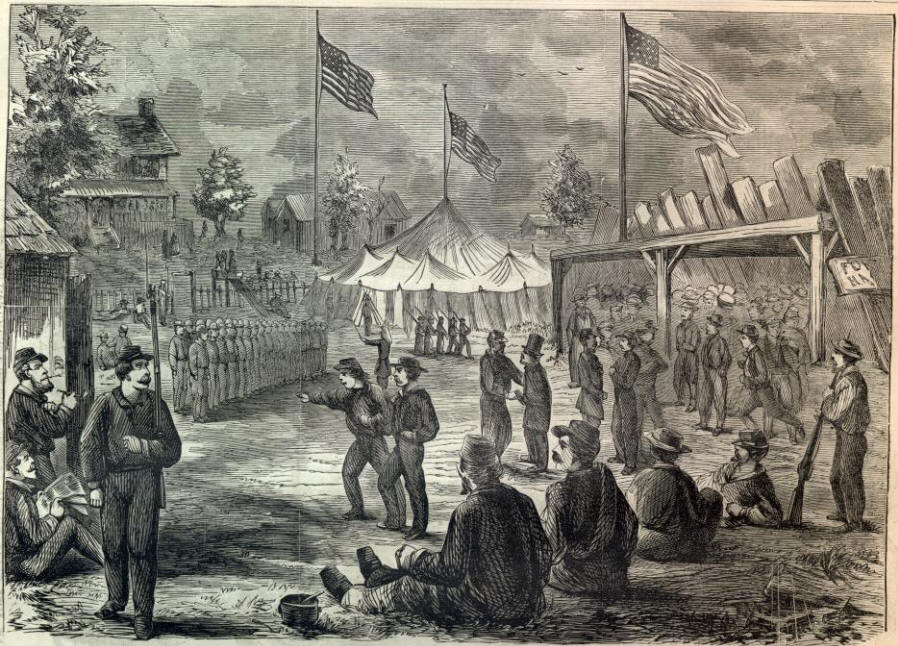
sickles-brigade

Taking up the challenge to raise a regiment sickles went to work, and “almost overnight, using flag-waving oratory, organizational skills, and promissory notes, he had his regiment, the 70th New York volunteers well in hand.” [6] Soon his authority was expanded to recruit a brigade, which rapidly filled with volunteers, soon over 3,000 men were under his command, and the new brigade, consisting of the 70th, 71st, 72nd, 73rd and 74th New York Volunteers which Sickles promptly christened the Excelsior Brigade, taking on the Empire State’s motto. However many of the brigade’s volunteers were scorned because of Sickles’ reputation, the brigade’s historian wrote, “no name was too bad for you; one would call you this and another would call you that, and even a person’s own relatives would censure him for joining such a Brigade as that of Daniel E. Sickles.” [7]

Even so, Sickles rapidly captured the hearts of his men. Volunteers were found throughout New York, as well as New Jersey, Ohio, and Pennsylvania, and the men represented the spectrum of White America; men of traditional Anglo-Saxon origin mingled with Irish, Germans, and Dutch. But he was so successful in recruiting that organizers of other regiments, especially in rural New York counties demanded that the Republican governor, Edward Morgan, order Sickles to disband most of the brigade. Believing the action politically motivated, Sickles refused and went directly to Lincoln to get the brigade Federal recognition. At first Lincoln balked at the request, he needed troops but was yet unwilling to get in the way of what he saw as the individual state control of their militias. The result was an impasse as Federal and New York officials argued about the brigade and the status of Sickles himself.

Sickles organizational and leadership skills were tested by the situation, and he went to extraordinary lengths to meet the needs of his soldiers for housing, food and sanitation, “and financed its camp for some time out of his own purse…. At one point he rented a circus tent from P.T. Barnum to house several hundred of his recruits. At another, with several companies or more quartered in a bare hall on lower Broadway, he contracted a cheap bath-house to give fourteen hundred men a shave and shower at ten cents apiece.” [8] To meet the need for cooked meals Sickles’ old friend Captain Wiley “commandeered cooks for the brigade from Delmonico’s, working in inadequate kitchens in side streets, they tried to turn out enough food for the men.” [9] Eventually the brigade was given a campsite on “Staten Island, near Fort Wadsworth, where he and his men could wait until the issue of mustering-in was settled.” [10]

Finally in July of 1861 the Excelsiors were officially mustered in to service as New York Volunteer troops and Sickles commissioned as a Colonel, functioning as the commander of the 70th New York and the de-facto commander of the brigade. Lincoln nominated Sickles for a commission as a Brigadier General of Volunteers but due to pressure from New York officials, still steaming at Sickles for going to Lincoln, and the Senate delated confirmation for months, forcing Lincoln to re-nominate him a second time after which they confirmed him in May 1862, in some measure due to the influence of Sickles former defense attorney, Edwin Stanton who had succeeded Simon Cameron as Secretary of War.

Sickles and his brigade first saw combat at Fair Oaks during the Seven Day’s battle. Sickles acquitted himself well during the fighting, he seemed to be a natural leader of men, who cheered him as he led them into battle. The actions of the Excelsiors and their newly minted Brigadier were praised by the Army commander, George McClellan in a letter to Stanton, “The dashing charge of the Second and Fourth Regiments,…”the cool and steady advance of the Third, occurred under my immediate observation and could not have been surpassed.” [11] A news correspondent attached to the army wrote:

“Gen. Sickles had several narrow escapes; he was always to be found in the thickest of the fight. Had those gifted Senators who refused to confirm his nomination, but witnessed the enthusiasm of his troops when serving under him, and his military qualifications for office, they would do penance until re-elected.” [12]

The success at Fair Oaks was not followed up by McClellan, despite the urging of many officers, including Sickles and Richmond, which many believed could have been taken, remained in Confederate hands. Sickles performance during the Peninsular Campaign won Dan the respect and affection of his soldiers, as well as the respect of his division commander Fighting Joe Hooker. Unlike many other leaders who in their first taste of combat on the Peninsula saw the terrible carnage of battle, the immense numbers of casualties, and the suffering of the troops, Sickles maintained his composure, as others collapsed, “neither the casualties nor the state of the earth daunted Sickles.” [13] Hundreds of his Excelsiors, including his own aid-de-camp were killed or wounded during the campaign, and “the Excelsior Brigade, through steadily reduced by deaths, wounds and illness, had been forged into a body of hard-bitten, battle-wise soldiers educated in the necessities of war and in the tricks of self-preservation.” [14] A member of the brigade wrote, “It is no fable about the men of this Brigade thinking a great deal of the General.” [15]

Following the army’s withdraw from the Peninsula and its return to encampments near Washington D.C. Sickles went back to New York to raise new troops to replace those killed or wounded during the campaign. He also took time to organize efforts to care of the children of the brigade’s soldiers, living and dead who were being taken care of at the Union Home School. Due to this he missed the battles of Second Bull Run and Antietam. His recruiting efforts were successful, even former political enemies were impressed by his service, and his ability to raise and organize troops. His reputation had been so completely rehabilitated by his war service that some of his “old backers in Tammany wanted him to run again for Congress,” [16] but he was opposed by others, like his old friend Sam Butterworth, who had become a “Copperhead,” an anti-war, faction that wanted to end the war and let the South go on its way; “to them, Dan had become a Lincoln man, a crypto-Republican.” [17] the relief of many of his troops he declined the offer to run again. As one of his Chaplains, Joseph Twitchell noted Sickles, “is getting fixed in his new place most successfully and will probably serve himself, as well as the country, better here than in a war of words.” [18]

Sickles-Excelsior-Brigade-Headquarters-City-Hall-Park.-Yorktown

During his recruiting efforts Sickles, now a military, as well as political realist, made many speeches, in which he recognized that conscription was inevitable. Having seen the brutal cost of war and the suffering of his men, Sickles complained of the lack of effort being provided in New York to the war effort. In a speech at the Produce Exchange, he praised the leadership and nerve of President Lincoln, and said, “A man may pass through New York, and unless he is told of it, he would not know that this country is a war…. In God’s name, let the state of New York have it to say hereafter that she furnished her quota for the army without conscription – without resorting to a draft!” [19]

When he returned to the army in November of 1862 his old division commander, Hooker had been promoted to corps command following the relief of George McClellan, and as the senior brigadier was promoted to command of the division. His, division, the Second Division of Third Corps was used in a support role at Fredericksburg and saw little action in that fight and only suffered about 100 casualties. His old friend and defense counsel Thomas Meagher, now commanding the Irish Brigade saw his brigade shattered in the carnage of at Fredericksburg. After Ambrose Burnside who had commanded the army during that fiasco was relieved of command Hooker was appointed by Lincoln as commander of the Army of the Potomac.

One of Hooker’s organizational changes was to establish a Cavalry Corps which was to be commanded by Major General George Stoneman, the commander of Third Corps. This left “Sickles as the corps’ ranking officer.” [20] Sickles was promoted to command the Third Corps by Hooker, who chose Sickles over another volunteer officer, David Birney. Had a professional officer rather than Birney been his competition, “Sickles would have remained division commander.” [21] Sickles was given the corps “on a provisional basis, for his appointment as a major general had not yet been confirmed by the Senate and corps command was definitely a two-star job.” [22] Once again it was political enemies in the Senate, this time Republicans who did not trust the Democrat, who delayed Sickles’ promotion to Major General, but he was finally confirmed on March 9th 1863, with his promotion backdated to November 29th of 1862. “Professionals in the army attributed his rise to his “skill as a political maneuverer.” Few men, however, questioned his personal bravery.” [23]

To be continued…

Notes

[1] Ibid. Hessler Sickles at Gettysburg p.21

[2] Ibid. Hessler Sickles at Gettysburg p.111

[3] Ibid. Keneally American Scoundrel p. 212

[4] Ibid. Keneally American Scoundrel p.214

[5] Ibid. Keneally American Scoundrel p.219

[6] Ibid. Sears Controversies and Commanders p.201

[7] Ibid. Hessler Sickles at Gettysburg p.23

[8] Ibid. Catton Glory Road p. 153

[9] Ibid. Keneally American Scoundrel p.222

[10] Ibid. Keneally American Scoundrel p.222

[11] Ibid. Hessler Sickles at Gettysburg pp.30-31

[12] Ibid. Swanberg Sickles the Incredible p.149

[13] Ibid. Keneally American Scoundrel p.245

[14] Ibid. Swanberg Sickles the Incredible p.153

[15] Ibid. Wert The Sword of Lincoln p.222

[16] Ibid. Hessler Sickles at Gettysburg p.32

[17] Ibid. Keneally American Scoundrel p.245

[18] Ibid. Hessler Sickles at Gettysburg p.32

[19] Ibid. Keneally American Scoundrel p.252

[20] Ibid. Wert The Sword of Lincoln p.223

[21] Ibid. Sears Controversies and Commanders p.206

[22] Ibid. Swanberg Sickles the Incredible p.168

[23] Ibid. Wert The Sword of Lincoln p.223

2 Comments

Filed under civil war, History, leadership, Military

Incredible Scoundrel Pt.2: A Murder in Washington

philip-barton-key-granger

Friends of Padre Steve’s World

I am a historian as well as a chaplain and priest. I do a lot of work with the Battle of Gettysburg and much of my work involves biography as I believe that the one constant in history is people. Technology and many other things may change, but people and human nature are constant, for good and for bad, and frankly I find people fascinating.

One of the most fascinating people of the Battle of Gettysburg is Union Major General Daniel E. Sickles, a man who was one of the most fascinating, salacious, scandalous, and incredible figures ever to grace and disgrace American history.

This is the second of a three part series taken from my Gettysburg and Civil War text. I hope that you enjoy.

Peace,

Padre Steve+

Within a year of his assignment Sickles returned to the United States to help prepare the Democratic nomination for his friend Buchanan who had long desired the office, and return to his lucrative post in New York. In the spring of 1856 Sickles began to work on Buchanan’s nomination for the Presidency and while doing so began his own campaign for New York’s Third District’s Congressional seat. Buchanan won the election of 1856 against an opposition divided between the Know Nothing candidacy of former President Millard Fillmore and the candidate of the new Republican Party, John C. Fremont.

In the election of 1856, Sickles carried the district easily. For Sickles it was a triumph, he was “riding a flood tide of political fortune that might carry him far,” [1] and like any wife Teresa too was delighted with the result. Even so, Teresa must have wondered if her husband would mend his ways now that he was on the national spotlight, or if he would continue his extramarital romps around the nation’s capital. Following the election Dan and Teresa moved to Washington D.C. where they took up a fashionable residence, the Stockton Mansion, on Lafayette Square, not far from the White House and Sickles friend, James Buchanan.

Once he was established in Washington Sickles was in his element, politics at its grandest. It was a different style than of politics than Tammany, where brass knuckled force often ruled, but it suited Sickles, who was “a fixer who knew all the tricks of Tammany at its crookedest but who seems not to have taken graft himself. He had his sights fixed on the presidency, and he was making about as much progress in that direction as a Tammany man can,” [2]   until a strange combination of unrequited love, infidelity, the personal betrayal of a friend, and a murder intervened.

HarpersMagazineMrs.Sickles

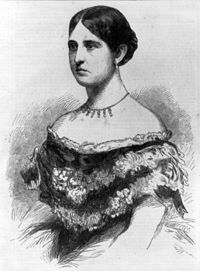
Teresa Sickles

While her husband politicked along the Potomac, the new congressman’s wife was adapting to her life in Washington D.C. The wives were expected to entertain and host parties on a regular basis at their residences, but they also knew their share of loneliness and neglect. Since legislators routinely were “busy with night sessions, committee meetings, and plain nocturnal politicking over whiskey punch, that their wives either accepted other escorts or spent lonely evenings at home with fancywork or a book.” thus it was not surprising that Teresa, “should seek the gayety of the capital in her first year there.” [3] In the absence of their husbands it “was not uncommon for available bachelors to act as escorts for married women when their husbands were unavailable.” [4] Since Dan Sickles was frequently unavailable and since Teresa probably still suspected that Dan was still engaged in extramarital affairs, it is not surprising that the young Mediterranean beauty found comfort in another man.

The years of 1857 and 1858 would be a tumultuous time for the nation as well as the Sickles. Buchanan had been elected because of his stability and moderation in an age of pro and anti-slavery radicalism. However, over the next year his presidency, and his would be overwhelmed by events and Buchanan’s decisions supporting the expansion of slavery. While Sickles was neither a slave owner, nor himself fond of the institution, it was part of life, and many of his friends in Washington D.C. and in Congress were slave holders. Buchanan had schemed before his inauguration with Chief Justice of the Supreme Court Roger Taney in the Dred Scott decision, which was handed down in the days following Buchanan’s inauguration, followed by the fiasco over the Lecompton constitution and the attempted admission of Kansas as a Slave State, an event which split the Democratic party in the 1860 election, ensuring Abraham Lincoln’s defeat of Buchanan’s Lecompton foe in the Senate, Senator Stephen A. Douglas who would have been the prohibitive favorite in the election had the split not occurred.

Likewise, Sickles and his beautiful young wife would become part of one of the most sensational trials of American history, rivaling the Lindbergh kidnapping trial, the trial of O.J. Simpson, the Scopes Monkey Trial, and the Impeachment of President Bill Clinton in its captivation of America. As in London, Teresa became popular and she and Dan were much sought after and their home “became the scene of a gradual number of and entertainments,” [5] and even as Sickles continued his robust politicking and philandering Teresa became the object of another’s affection, the District of Attorney for the District of Columbia, Philip Barton Key, the son Francis Scott key, the writer of the Star Spangled Banner. Interestingly enough it was Sickles who had helped Key the troubled man to be reappointed to his office in early 1857 after Key had helped Sickles overcome legal and financial difficulties to secure Sickles in the Stockton Mansion and the two men developed a warm friendship.

Philip Key was extraordinarily handsome, especially when outfitted in his green and gold militia uniform of the Montgomery Guards, and was considered one of the most desirable men in Washington. An accomplished horsemen he rode about town on his “horse Lucifer – a nobly bred, dapple gray hunter.” [6] When he gained Sickles’ friendship many of his well to do political and society friends became frequent visitors to the Sickles household. After Sickles had helped Key to be reappointed to his office, Key was instrumental in helping make the arrangements for Sickles to rent the Stockton Mansion.

During his first term in office Key was not known for being a particularly good District Attorney and spent much time away from the office complaining about his allegedly poor health. But his health did not keep him away from Washington’s party scene and “One hostess called him “the handsomest man in all Washington… he was a prominent figure at all the principle functions; a graceful dancer, her was a favorite of every hostess of the day.” [7] When he met Teresa, the dashing bachelor took an intense interest in the wife of the man who had helped him retain his job. The two were soon attending many functions together that Sickles, due to his work schedule could seldom attend.

Within weeks Key became a frequent guest at the Sickles home and few were surprised at this, as most observers knew that Sickles was responsible for Key’s reappointment. With Sickles now fully engaged in the dramatic political battles of late 1857, Teresa and Key began to spend much more time together. The two were seen together at the “theater, at teas, at hops. But most of all they went riding together.” [8] The frequency of these visits was noted and became the source of much gossip but Sickles was unaware of it and entertained no suspicions that his new friend was becoming deeply involved with his wife, and that Key had rented a room where the two could intimate.

That was until a young man equally smitten by Teresa had a few drinks with a colleague and the colleague shared the information with a loyal Sickles ally who then told Sickles. Sickles was shocked and called for a meeting with Key, however, after a brief conversation, Key convinced Sickles that there was nothing to the rumors, and Sickles was satisfied.

Though Sickles had been satisfied by the explanation, “despite his own well-publicized moral lapses, Daniel Sickles was a man of intense personal pride who would not countenance the breath of scandal attaching to his wife.” [9] He took the time to warn her to make sure that she was not involved in any other indiscretions, and left the subject. However, Key and Teresa continued to see each other, and “she and Barton thought that they were taking more care, and being less observed by people than they were.” [10] Yet as they pursued one another their affair became increasingly public, and seen by too many people not to go unnoticed. The two were seen together in at the Congressional Cemetery, and frequently at a house at “385 15th Street where he would enter the by the front door – and she the back.” [11] When a mutual friend expressed his concerns, Key shrugged off the warning, and “with the bravado of a proud weakling, he still held his course. And Teresa, ductile, enamored, blindly followed his lead.” [12] Another friend of Key suggested to him that he could be in danger, but Key “bridled and patted the breast of his coat. “I am prepared for any emergency,” he snapped. Key was a crack pistol shot and his friend believed that Key was preparing for a possible confrontation. [13]

Like so many people young spouses who find their needs unfulfilled at home, and who suspect their spouse of infidelity, , “Teresa did not see this love affair as tragic and dangerous. She lived within it as a secret fantasy, as in a virtual and time-consuming experience that lacked any power to inflict damage on other areas of her life.” [14] She became less discreet, Key would signal to her from across the street to confirm their dalliances and despite their insipidly inept attempt to hide the affair it became clear to Sickles’ coachman and household maids that the two were engaged in sexual encounters in the Sickles carriage and in the Stockton Mansion itself.

The situation finally came to a head in February 1859 following Sickles reelection and return to Washington. “Made more reckless than ever by their recent separation, Barton and Teresa now again were seen everywhere together.” [15] The couple were now making clandestine liaisons on a nearly daily basis, and eventually, one of the observers decided to tell Sickles. The anonymous source, using the initials of R.P.G. sent Sickles a letter detailing the affair. Sickles received the letter from a butler on the night of Thursday February 24th as he was leaving the usual dinner party at his house for the traditional hop that followed at the Willard Hotel.

Sickles did not read the letter until after the couple returned home and Teresa had gone to bed. Sickles was stunned and at first did not believe the contents as he placed little stock in anonymous messages. So he had George Wooldridge, a longtime friend and congressional clerk investigate, and on Saturday February 26th Wooldridge confirmed Sickles worst fears. That evening at their home Sickles confronted Teresa about the letter and as he stormed about angrily in their bedroom she confessed, after which Sickles had her write out her confession detailing everything. He may have been desolate and angry, but he was a lawyer, and he got his written proof.

But scandal was the last thing that Sickles wanted, as he had higher aspirations in politics, so he immediately called his friends for counsel and by Sunday morning several, including Wooldridge and Samuel Butterworth were at the Stockton Mansion with Sickles. As always, Sickles’ “first thoughts were for himself, and he melodramatically”[16] exclaimed to Butterworth, “I am a dishonored and ruined man…I cannot look you in the face.” [17]

4P8V9475

Murder

His friends “were profoundly touched by the depth of his feeling, and were convinced that he needed to be saved from a severe derangement of his senses; from lunacy, that is.” [18] his friends attempts to calm him, Sickles was beside himself with anger, and his anger now swirled around his marriage and what he believed was the scandal that would cost hi his career. That afternoon, Key again tempted fate, this time, for the last time. He had been tipped off by an anonymous letter that the affair was public, but he was determined to see Teresa. He made several passes by the house, each time signaling with a handkerchief, until Sickles observed him. Sickles called out to Butterworth “That villain has just passed my house! My God, this is horrible!” [19]

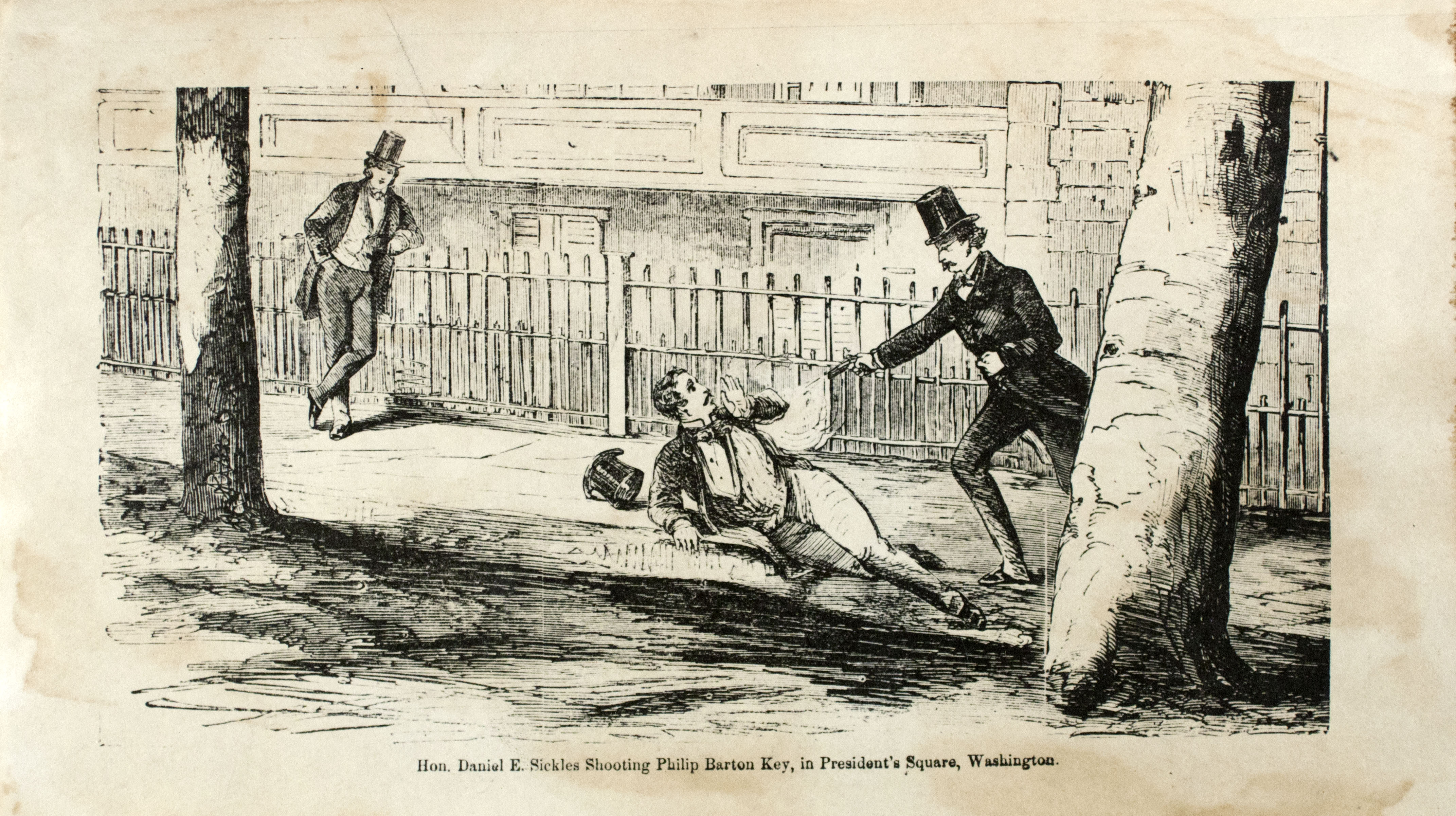
Butterworth left the house first and met Key at the southeast corner of Lafayette Square across from the White House. Allegedly not knowing Sickles intended any harm, Butterworth walked with Key to for a few minutes and then left. The exchange delayed Key and gave Sickles, who had armed himself with a single shot large caliber Derringer, and a muzzle-loading Colt revolver, enough time to catch up with Key near the Club House on Madison on the east side of the square. Sickles was raving but Dan’s fury transcended reality,” [20] as at least a dozen witnesses were nearby as he screamed, “Key, you scoundrel, … you have dishonored my bed – and you must die!” [21] Sickles pulled out the revolver, the first shot from which grazed Key, and the second which misfired. A brief scuffle ensued as Key lunged at his assailant, but Sickles flung him to the ground, and drew the Derringer as Key threw the opera glasses that he viewed Teresa at Dan. A third shot hit Key in the groin and he slumped to the ground screaming “Murder! Murder!… Don’t shoot!” [22]

If there was a chance for Sickles to prove that he acted in self-defense it was now, but he could not control himself. He fired the revolver yet again and it misfired. He placed the weapon in his pocket and drew the Derringer, and fired a shot which hit Key in the Liver. As Key writhed on the ground Sickles tossed the Derringer to the ground and he again drew the Colt. As the stunned witnesses to the attack looked on, Sickles advanced toward the fallen Key and placed the gun at his head and pulled the trigger, but again the weapon misfired. As Sickles attempted to place another cap in the pistol, a number of witnesses began to intervene. One man, “a member of the club, running up, stopped him. Mr. sickles – for God’s sake!” And Butterworth, coming forward, took Dan by the arm. Without a word, they walked away together.” [23] Witnesses took the mortally wounded Key away to the Club, where he expired.

President Buchanan was almost immediately told of the murder by a White House page boy, was aware of the implications of the scandal, Sickles was a friend and political ally with much promise. Buchanan told the boy leave town and gave him a sum of money to facilitate his departure. Soon after Sickles and Butterworth went by carriage “to the home of Attorney General Black, where the Congressman formally surrenders himself to the silver-haired Cabinet member who had regarded him as a protégé.” [24] He declined bail in favor of a speedy trial, was allowed to go home where he told Teresa that he had killed her lover, retrieved some personal items and then went to the District jail, “a foul hole, swarming with vermin, destitute of sewage, bath, water, ventilation, and so inadequate to its purpose that often a dozen or more prisoners were herded into a single narrow cell.” [25] When he arrived he reportedly asked the jailer if they were the best accommodations available, to which the jailer responded “this is the best place you members of Congress have afforded us.” [26] Dejected, but undeterred Sickles sent a message to the public, “In doing what I had to do I have broken the law. Therefore I place myself behind bars. It is for you to set me free.” [27] The stage was now set for the one of the most unbelievable and storied trials in American history.

Notes

[1] Ibid. Swanberg Sickles the Incredible p.4

[2] Ibid. Catton The Army of the Potomac: Glory Road p.151

[3] Ibid. Swanberg Sickles the Incredible p.15

[4] Ibid. Hessler Sickles at Gettysburg p.8

[5] Ibid. Swanberg Sickles the Incredible p.16

[6] Ibid. Pinchon Dan Sickles p.74

[7] Ibid. Hessler Sickles at Gettysburg p.9

[8] ibid. Swanberg Sickles the Incredible p.20

[9] Ibid. Swanberg Sickles the Incredible p.25

[10] Ibid. Keneally American Scoundrel p.92

[11] Ibid. Wilson and Clair They Also Served p.99

[12] Ibid. Pinchon Dan Sickles p.94

[13] Ibid. Swanberg Sickles the Incredible p.44

[14] Ibid. Keneally American Scoundrel p.92

[15] Ibid. Pinchon Dan Sickles p.93

[16] Ibid. Hessler Sickles at Gettysburg p.10

[17] Ibid. Swanberg Sickles the Incredible p.53

[18] Ibid Keneally American Scoundrel p.121

[19] Ibid. Hessler Sickles at Gettysburg p.10

[20] Ibid. Keneally American Scoundrel p.127

[21] Ibid. Swanberg Sickles the Incredible p.54

[22] Ibid. Hessler Sickles at Gettysburg p.11

[23] Ibid. Pinchon Dan Sickles p.112

[24] Ibid. Swanberg Sickles the Incredible p.55

[25] Ibid. Pinchon Dan Sickles p.114

[26] Ibid. Keneally American Scoundrel p.135

[27] Ibid. Swanberg Sickles the Incredible p.114

3 Comments

Filed under civil war, crime, Gettysburg, History, laws and legislation, Political Commentary

Incredible Scoundrel: Dan Sickles Pt.1

6517740_orig

Friends of Padre Steve’s World

I am a historian as well as a chaplain and priest. I do a lot of work with the Battle of Gettysburg and much of my work involves biography as I believe that the one constant in history is people. Technology and many other things may change, but people and human nature are constant, for good and for bad, and frankly I find people fascinating. In fact from the point of view of history and biography, sinners are much more interesting to write about than saints, but I digress…

One of the most fascinating people of the Battle of Gettysburg is Union Major General Daniel E. Sickles, a man who was one of the most fascinating, salacious, scandalous, and incredible figures ever to grace and disgrace American history. 

This is the first of a three part series taken from my Gettysburg and Civil War text. I hope that you enjoy.

Peace,

Padre Steve+

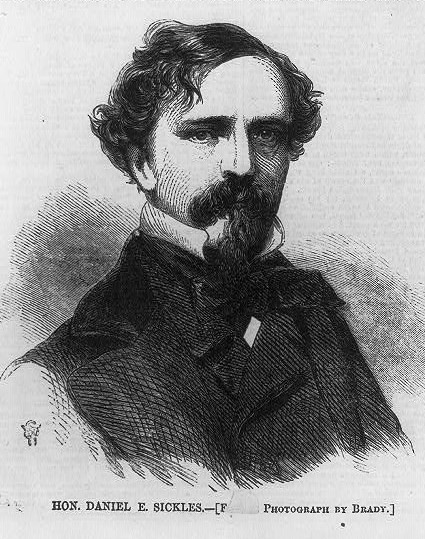
George Meade had made his dispositions on July 2nd 1863 with care, but there was one notable problem, the commander of III Corps, Major General Dan Sickles did not like the position assigned to his corps on the south end of Cemetery Ridge. But before discussing that it is worth chasing the rabbit so to speak and spend some time on the life of a man referred to by one by one biographer as an American Scoundrel and another as Sickles the Incredible. The interesting thing is that lie most complex characters in history that Dan Sickles was both and, “he might have had more faults than virtues, but everything about him was perfectly genuine.” [1] That is one of the reason that he is so fascinating.

Sickles was certainly a scoundrel and at the same time incredible, charming yet terribly vain and often insincere. “He was quick-witted, willful, brash, and ambitious, with pliable moral principles.” [2] But he was also incredibly brilliant, far sighted, patriotic, and civic minded. He was a political general, “flamboyant, impulsive, and brave, some would wonder about his discipline and military judgement.” [3] His notoriety and unpopularity among the West Point trained professional officers in the Army of the Potomac, as well as his tactical decision to move his corps on the afternoon of July 2nd 1863, and his subsequent political machinations ensured that he would be the only corps commander of that army not commemorated with a monument at Gettysburg.

Dan Sickles was one of the most colorful, controversial, and perhaps the most scandalous officer ever to command a corps in the history of the United States Army. While he lacked professional training he had done a fair amount of study of the military arts in his spare time, and he “made up for his lack of military training by acting on the battlefield with reckless courage, and was much admired for it by his men.” [4]

After having served as a brigade and division commander Sickles was promoted to corps command. “Sickles owed his elevation to corps command to the patronage of his friend Joseph Hooker…. And while man of the West Point officer….regarded Sickles military acumen with the greatest skepticism, many in the volunteer ranks were of a different mind. “Sickles is a great favorite in this corps,” asserted Private John Haley of the 17th Maine. “The men worship him. He is every inch a soldier and looking like a game cock. No one questions his bravery or patriotism.” [5] General Alpheus Williams who commanded a division in the Union Twelfth Corps despised Sickles, and after Chancellorsville Williams wrote “A Sickles’ would beat Napoleon in winning glory not earned,,, He is a hero without a heroic deed! Literally made by scribblers.” [6] Likewise, Sickles, the political general was no favorite of George Gordon Meade.

On July 2nd 1863 Sickles would be responsible for an act that threw George Meade’s defensive plan into chaos, and according to most historians and analysts nearly lost the battle, however, there are some who defend his actions and give him credit for upsetting Lee’s plan of attack. However, the truth lays somewhat in the middle as both observations are correct. Sickles’ decision created a massive controversy in the months following the battle as public hearings in Congress, where Sickles, a former congressman from New York had many friends, as well as enemies, sought a political advantage from a near military disaster.

Sickles was a mercurial, vain and scandal plagued man who “wore notoriety like a cloak” and “whether he was drinking, fighting, wenching or plotting, he was always operating with the throttle wide open.” [7] Sickles was born in New York to George and Susan Marsh Sickles in late 1819, though a number of sources, including Sickles himself cite dates ranging from 1819 through 1825. “There is little reliable information about Sickles’ early days,” [8] and he did not talk much about them, especially after the war, when Gettysburg and the Civil War became his main subjects of conversation. His father, a sixth generation American whose family were early Dutch settlers in Manhattan became wealthy through real estate speculation, “and he passed on to his son a pride in being a congenital Knickerbocker,” charming, witty, and clever, in whom “hardheadedness and impulsiveness were combined.” [9]

The young Sickles was an impetuous child and his father’s wealth ensured that Dan Sickles had “the finest of tutors…. And an unceasing bankroll of funding for lascivious escapades.” [10] To get their son special tutoring to prepare him for college, his parents “arranged for him to live in the scholarly house of the Da Pont family…. It was a household like few others in that hardheaded, mercantile city, at a time when New York had little of the Italian character it would later take on.” [11] The home was a place of learning, culture, and unusual relationships. The head of the house was Lorenzo L. Da Pont, a Professor at Columbia, as well as a practicing attorney. Also living in the home was Da Pont’s father, the ninety-year-old Professor Lorenzo Da Pont, who “had been the librettist for three of Mozart’s operas” [12] and “held the chair of Italian and Columbia University” [13] Additionally, the elder Da Pont’s “adopted daughter Maria and her husband, Antonio Bagioli, a successful composer and music teacher” [14] lived under the same roof.

Maria was only about twenty-years-old when Sickles moved in. By this time she and Bagioli already had a child of their own, a three year old daughter named Teresa, which Sickles would eventually marry. While the elder Da Pont claimed Maria as an adopted daughter, it was “widely believed that she was his “natural child” … from an American liaison conducted when he was near the age of seventy.” [15] This spawned rumors, even at the time of Gettysburg that the young Sickles “and his future mother-in-law had a sexual affair.” [16]

Whether the liaison with Maria Bagioli occurred is a matter of innuendo and conjecture, but it would not be out of character for Sickles, who, to put it mildly, had a wild proclivity for the opposite sex. As a young man he frequented brothels, and as his social and political status increased, he moved from the brothels frequented by the middle class to those which catered to the more socially well to do. One of his affairs was with the a prostitute named Fanny White, a woman who was smart, pretty, and upwardly mobile who ran her own bordello. His affair with Fanny was well publicized, but did not prevent him from being elected to the state legislature in 1847. She and Sickles would continue their relationship for years with her asking nothing more than expensive gifts, and there are inklings that Fanny help to fund Sickles’ early political campaigns. There is also speculation that in 1854 following his marriage, that Fanny spent time with him in London while he was working with James Buchanan and that that he “may have brought Fanny to one of the Queens’s receptions and introducing the prostitute to Her Majesty.” [17] But Fanny eventually moved on to a man older and richer than Sickles. Eventually she retired from her business and married another New York lawyer but died of complications of tuberculosis and possibly syphilis in 1860. Her property at the time of her death was conservatively “estimated at $50,000 to $100,000” [18] a considerable fortune for a woman of her day and age.

While he lived with the Da Pont family, Sickles gained an appreciation for foreign languages, as well as theater and opera. The elder Professor Da Pont was a major part of his academic life and quite possibly in the development of Sickles liberal education and his rather libertine morality. Lorenzo had been a Catholic Priest and theologian in Italy, but like his young American admirer had quite the attraction for women, and was a connoisseur of erotic literature and poetry. His activities resulted in him being expelled from his teaching position in the seminary, after which he became fast friends with a man whose name is synonymous with smooth talking, suave, amorous men, Giacomo Casanova, and in Europe “his affairs with women had been almost as notorious as those of his good friend.” [19] Certainly the elder Lorenzo’s tales “of Casanova, the fabled prince of Priapus, did nothing to quell Dan’s adolescent sexual appetite.” [20]

Noted Civil War and Gettysburg historian Allen Guelzo describes the Sickles in even less flattering terms, “Sickles was from the beginning, a spoiled brat, and he matured from there into a suave, charming, pathological liar, not unlike certain characters in Mozart operas.” [21]

Following the deaths of both the elder and younger Professor Da Pont, Sickles was stricken with grief. At the funeral of the younger Professor Da Pont Sickles “raved and tore up and down the graveyard shrieking,” [22] forcing other mourners to take him away by force. Soon after, Sickles left New York University and began to work in the law office of the very formidable New York lawyer and former U.S. Attorney General, Benjamin F. Butler.

While he was studying for the bar under Butler, he was joined by his father who would also become an attorney. It was under the influence of his father, who was now a wealthy Wall Street investor, and the Democrats of Tammany Hall that the incredibly talented Sickles was groomed for political leadership. Tammany was a rough and tumble world of hardnosed politics, backroom deals, corruption and graft.

He passed the bar in 1843 and soon was making a name for himself in the legal world, and in politics, despite his well-known questionable ethics and morality. His political career began in 1844 when “he wrote a campaign paper for James Polk and became involved in the Tammany Hall political machine.” [23] The ever ambitious Sickles “clambered up the city’s Democratic party ladder, on the way collecting allies and enemies with utter disregard for the consequences, attending the typically unruly Tammany meetings armed with bowie knife and pistol.” [24]

Like many of his fellow New York Democrats he was a proponent of “Manifest Destiny, and the right of the United States to acquire and hold Texas, New Mexico, California, perhaps the isthmus of Central American, and certainly Cuba.” [25] He was also a political ally of many states rights Southern Democrats and “largely opposed anti-slavery legislation.” [26] This was in large part due to the commercial interests of New York, which between banking and commercial shipping interests profited from the South’s slave economy.

He was elected to the New York State legislature in 1847 and his political star continued to rise even as his personal reputation sank among many of his peers. An attorney who knew him described Sickles as “one of the bigger bubbles in the scum of the profession, swollen, and windy, and puffed out with fetid gas.” [27] Sickles rivals any American politician, before or since in his ability to rise even as the slime ran down his body, the term “Teflon” applied to politicians like Presidents Ronald Reagan and Bill Clinton comes to mind when one studies Sickles’ career. New York lawyer and diarist George Templeton Strong wrote, “One might as well try to spoil a rotten egg as to damage Dan’s career.” [28]

But there was no denying that Sickles was a brilliant lawyer, politician, and debater. One observed that Sickles was “a lawyer by intuition – careful in reaching his conclusions, but quick and bold in pushing them.” [29] New York Governor “William Marcy grudgingly said that as a debater Sickles excelled any man of his years, and the astute Henry Raymond declared that as a parliamentary leader he was unsurpassed.” [30] Soon Sickles was a delegate to the 1848 Democratic Convention where he helped nominate Franklin Pierce for his unsuccessful run at the democratic nomination. The convention enabled Sickles to enter the world of national politics making friends with many influential politicians and financiers, including Pierce, the Van Burens, and James Buchanan. On his return to New York he received an appointed as a Major in the New York Militia.

Even as Sickles rose in the tumultuous world of American law and politics, and chased Fanny White he became enamored with the now teenage daughter of Antonio and Maria Bagioli, Miss Teresa Bagioli who though only fifteen was beautiful, wise beyond her years, fluent in French and Italian, devoted to the arts, and entirely besotted by Dan Sickles. Both the parents of Sickles and Teresa opposed the relationship, but both were madly in love, and Teresa was as headstrong as Dan regarding the relationship. Though such a relationship would be considered completely scandalous today, such marriages were not uncommon then, though they were certainly less common in the upper society of New York. Sickles “was enchanted by her” and “courted her with the sensibility of being a friend of her parents and he must have suspected that he loved her with a fated and exclusive love.” [31] When she was just sixteen Teresa quit school and married the thirty-three year-old assemblyman in a civil ceremony officiated by New York Mayor Ambrose Kingsland on September 27th 1852. Six months later, the two were married in the Catholic Church by Archbishop John Hughes, in a “gala and largely attended affair.” [32] Just three months after the church wedding their daughter, Laura, was born. Though there can be no doubt that Sickles loved Teresa, and she him, it did not stop him from other extramarital affairs, nor did it take much away from his political machinations at Tammany Hall.

Following the 1852 Democratic convention where he again supported Franklin Pierce, Sickles hard fighting and influence at in the Wigwam of was rewarded with political plum prize of being appointed “corporation counsel of New York City, a post that paid a flattering salary with extra emoluments and also left room for profitable legal work on the side.” [33] His political and social acumen were again demonstrated as he convinced the state legislature, through personal force of will, to enable the New York City Corporation “to go ahead with creating a great central park,” [34] a park that we now know today as Central Park. He also helped push forward a proposal to create New York’s first mass transportation system, that of horse drawn omnibuses.

Later in the year Sickles was appointed as secretary of the American legation to the Court of St. James n London, headed by former Secretary of State James Buchanan. The position paid a pittance of what Sickles was earning in New York, but he realized that the serving overseas in such a position could not but help him on the national political stage. Though Buchanan and Pierce wanted Sickles, the new Secretary of State, the former New York Governor William Marcy refused to sign Sickles’ commission for the post. Eventually, Pierce prevailed and Sickles got the job.

As their baby, Laura, was still very young and sea travel still quite hazardous, Teresa remained at home, and joined her husband in London the following year. However, when she arrived in London, the teenage wife of Dan Sickles charmed Americans and Britons alike. Aided by her multilingual gifts, which “were rare among American diplomats’ wives,” [35] she became a great success and the unmarried Buchanan appointed her as hostess for the legation. She rapidly became a celebrity due to her stunning beauty and charm, and like he had Fanny, Sickles had Teresa introduced to the Queen. Her celebrity status evoked different responses from those that observed her. “One contemporary described Teresa as an Italian beauty, warm, openhearted, and unselfish. Another described her as being “… without shame or brain and [having] a lust for men.” [36] That “lust for men” coupled with the neglect of her husband may well have been the catalyst for the scandal which overwhelmed them in Dan’s congressional career.

It was during his service in London with Buchanan that Sickles became embroiled in one of the most embarrassing diplomatic incidents in American history. The proponents of Manifest Destiny and American expansion had long desired to take Cuba from Spain through diplomacy, or if needed force. Following a failed attempt by American “Filibusters” to seize the island in 1852 which ended in the execution of fifty Americans, including the son of U.S. Attorney General John Crittenden by Spanish authorities, and in 1854 President Franklin Pierce authorized Buchanan to attempt to negotiate the acquisition of Cuba.

Pierce authorized Buchanan to meet with James Mason, the United States Ambassador to France and Pierre Soule, the United States Ambassador to Spain secretly in order to draft “a statement on the future of Cuba and the proposed role of the United States.” [37] Soule dominated the meeting and the statement, which was in large part drafted by Dan Sickles, was highly inflammatory. Despite this the statement was released to the press in defiance of the order to maintain the strictest secrecy and it resulted in a diplomatic disaster for the Pierce Administration.

The document was prepared by Soule and Sickles and endorsed by Buchanan and Mason was known as the Ostend Manifesto, and it “was one of the most truly American, and at the same time most undiplomatic, documents every devised.” [38] The manifesto prepared by Soule and Sickles proclaimed that “Cuba is as necessary to the North American Republic as any of its present members, and that it belongs naturally to the great family of states of which the Union is the Providential Nursery.” [39] The authors of the manifesto also threatened Spain should the Spanish fail to accede to American demands. The authors declared that if the United States “decided its sovereignty depended on acquiring Cuba, and if Spain would not pass on sovereignty in the island to the United States by peaceful means, including sale, then, “by every law, human and Divine, we shall be justified in wresting it from Spain.” [40]

The Ostend Manifesto “sent shivers through the chancelleries of Europe, provoked hurried conversations between the heads of the French and British admiralties.” [41] European diplomats and leaders reacted harshly to the statement and Secretary of State William Marcy who had previously supported the ideas in the document immediately distance himself and official American policy from it and the authors. Marcy then “forced Soule’s resignation by repudiating the whole thing, but the damage was done.” For months the Pierce administration was on the defensive, and was condemned “as the advocate of a policy of “shame and dishonor,” the supporter of a “buccaneering document,” a “highwayman’s plea.” American diplomacy, said the London Times, was given to “the habitual pursuit of dishonorable object by clandestine means.” [42] The incident ended official and unofficial attempts by Americans to obtain Cuba by legal or extralegal means until the Spanish American War in 1898.

Too be continued…

Notes

[1] Catton, Bruce The Army of the Potomac: Glory Road Doubleday and Company, Garden City New York, 1952 p.151

[2] Wert, Jeffry D. The Sword of Lincoln: The Army of the Potomac Simon and Schuster, New York and London 2005 p.222

[3] Ibid. Coddington The Gettysburg Campaign a Study in Command p.45

[4] Sears, Stephen W. Chancellorsville Houghton Mifflin Co. Boston and New York 1996 p.65

[5] Ibid. Trudeau Gettysburg a Testing of Courage p.110

[6] Ibid. Sears Gettysburg p.35

[7] Ibid. Catton The Army of the Potomac: Glory Road pp.150-151

[8] Hessler, James A. Sickles at Gettysburg Savas Beatie New York and El Dorado Hills CA, 2009, 2010 p.1

[9] Keneally, Thomas American Scoundrel: The Life of the Notorious Civil War General Dan Sickles Anchor Books, a Division of Random House, New York 2003 p.7

[10] Ibid. Guelzo, Gettysburg The Last Invasion p.243

[11] Ibid. Keneally American Scoundrel p.3

[12] Ibid. Hessler Sickles at Gettysburg p.2

[13] Ibid. Keneally American Scoundrel p.3

[14] Ibid. Hessler Sickles at Gettysburg p.3

[15] Ibid. Keneally American Scoundrel p.4

[16] Ibid. Hessler Sickles at Gettysburg p.3

[17] Ibid. Hessler Sickles at Gettysburg p.6

[18] Ibid. Keneally American Scoundrel p.215

[19] Swanberg, W.A. Sickles the Incredible copyright by the author 1958 and 1984 Stan Clark Military Books, Gettysburg PA 1991 p.79

[20] Ibid. Swanberg Sickles the Incredible p.80

[21] Ibid. Guelzo, Gettysburg The Last Invasion p.243

[22] Ibid. Swanberg Sickles the Incredible p.81

[23] Ibid. Hessler Sickles at Gettysburg p.4

[24] Sears, Stephen W. Controversies and Commanders Mariner Books, Houghton-Mifflin Company, Boston and New York 1999 p.198

[25] Ibid. Keneally American Scoundrel p.12

[26] Ibid. Swanberg Sickles the Incredible p.82

[27] Ibid. Wert The Sword of Lincoln p.222

[28] Ibid. Hessler Sickles at Gettysburg p.4

[29] Ibid. Swanberg Sickles the Incredible p.84

[30] Ibid. Swanberg Sickles the Incredible p.84

[31] Ibid. Keneally American Scoundrel p.21

[32] Wilson Robert and Clair, Carl They Also Served: Wives of Civil War Generals Xlibris Corporation 2006 p.98

[33] Ibid. Swanberg Sickles the Incredible p.88

[34] Ibid. Keneally American Scoundrel p.21

[35] Ibid. Keneally American Scoundrel p.39

[36] Ibid. Wilson and Clair They Also Served p.98

[37] Ibid. Keneally American Scoundrel p.44

[38] Pinchon, Edgcumb Dan Sickles: Hero of Gettysburg and “Yankee King of Spain” Doubleday, Doran and Company Inc. Garden City NY 1945 p.48

[39] Ibid. Potter The Impending Crisis p.190

[40] Ibid. Keneally American Scoundrel p.45

[41] Ibid. Pinchon Dan Sickles p.48

[42] Potter, David M. The Impending Crisis: America before the Civil War 1848-1861 completed and edited by Don E. Fehrenbacher Harper Collins Publishers, New York 1976 p.193

2 Comments

Filed under civil war, ethics, History

A Christian & an Enthusiast: General Oliver O. Howard

Friends of Padre Steve’s World,

A change of pace as I get ready for a new class and a section of my Gettysburg Text about Major General Oliver O. Howard. Howard is interesting because alone of senior Union generals his Christian Faith guided his actions and he was maligned by some for that faith. 

This section is only biographic sketch before his Eleventh Corps went into action at Gettysburg. Likewise it does not discuss his very successful command of a corps and army in the West under William Tecumseh Sherman, nor his post war service. I think that he makes an interesting character study; after all, the one constant in history is humanity. We learn from men like Howard and that is important.

Peace

Padre Steve+

Oliver-Otis-Howard-9345101-1-402

Major General Oliver O. Howard, U.S. Army

With John Reynolds dead and Abner Doubleday directing First Corps in its defense west of Gettysburg Major General Oliver O. Howard, commander of Eleventh Corps assumed command of the Federal forces around Gettysburg. Howard was one of the more unusual characters in the senior leadership of the Army of the Potomac, and later when he served under William Tecumseh Sherman’s command in the west, mostly because of his strong Evangelical Christian religious convictions and the fact that he did not drink. Sherman remarked to a group of generals who were mocking Howard’s temperance, “Let Howard alone! I want one officer who don’t drink!” [1]

“A Christian and an Enthusiast”

The thirty-three year old Howard was from Maine, his father had died when he was ten and in 1846 at the age of sixteen he entered Bowdoin College. He graduated from Bowdoin in 1850 near the top of his small class, and education, far from being something simply to prepare himself for a career was important of itself, and he told his mother, “Education is my first aim…. I seek not money, but a cultivated and enlightened mind, becoming & corresponding with the age in which we live.” [2] During his time at Bowdoin Howard was introspective and frequently mused on his own shortcomings and failures. He also showed little interest in world or national events, including the war with Mexico, but in his first year at Bowdoin he did take an interest in the cousin of a classmate, Elizabeth Ann Waite, or Lizzie who eventually became his wife.

While he was finishing his time at Bowdoin he was still uncertain of what he would do. It was then that his uncle, Congressman John Otis who had help to raise him following the death of his father secured for him an appointment to West Point. He did very well academically but at times struggled with some of his fellow students, some of who considered him “priggish, self-righteous, and opinionated.” [3] This was most likely due to a number of reasons, first his moderate abolitionist views, which were unpopular with many cadets, his active participation in the Bible class, which some classmates ridiculed, and his high academic standing, which provoked the jealousy of others. Howard was also resented by some for his friendship with Sergeant Warren Lothrop, a Mexican War veteran, a childhood friend who was “the son of a close friend of his own father” [4] as well as maintaining a friendship with a cadet “who had been “cut” – shunned – by the corps.” [5] While he stood by the cadet, he was forbidden to maintain the friendship by the Commandant of Cadets due to rules on fraternization, but in the eyes of some classmates, the damage had been done. One cadet who never accepted Howard was Custis Lee, an academic rival and the son of Robert E. Lee.

Despite a rough start Howard became friends with many cadets, including some who had shunned him early in his West Point experience. However, one friend who stood by Howard throughout was a cadet from Virginia named J.E.B. Stuart, who he knew from the Bible class. Howard wrote of that friendship, “I can never forget the manliness of J.E.B. Stuart…. He spoke to me, he visited me, and we became warm friends, often, on Saturday afternoons, visiting the young ladies of the post together.” [6] Howard’s friends included cadets from north and south, and never appeared to let political or ideological differences influence his choice of friends.

He graduated fourth in the class of 1854 and commissioned as a Brevet Second Lieutenant in the highly technical Ordinance Corps. He married Lizzie the following year and held a number of assignments in his corps before being assigned to Florida at the tail end of the Seminole Wars where as an Ordinance officer he saw no action. However, during his time in Florida he experienced his conversion to Evangelical Christianity, following his attendance of a number of Methodist revival meetings and his future life would bear evidence of the influence of the founder of Methodism, John Wesley. His faith became a facet of his life that he would never waver from incurring the praise as well as the criticism of various contemporaries. He wrote Lizzie:

“I then bore hat the text above in mind, & said in my heart oh! My Saviour, I know that thou canst save me! I made an effort to fully believe that my sins were washed in the blood of the Lamb, that my dear Saviour had actually saved me at that moment, i.e. had pardoned all my transgressions of the laws of God, & all the wickedness of a corrupt heart – The fullness of the glow of happiness came into my heart, the tugging & burning left me – the choking sensation was gone…my mind is as clear as when making out an Ordinance Return…” [7]

Following his conversion he led prayers and Bible studies, had enlisted me to his quarters for morning devotions and even considered leaving the army for the ministry. It was fortunate for Howard that his commander, an elderly Colonel, Gustavus Loomis, was a devout Christian who had first taken him to the Methodist revival meetings, for many other senior officers would have not approved of such overtly evangelical behavior.

Howard was transferred back to West Point in September of 1857 where now as a First Lieutenant he was assigned as an instructor in Mathematics, and was able to again be with Lizzie and their children. At West Point he continued his religious activities, leading Bible studies and became the superintendent of a Sunday school for the children of enlisted men and briefly explored the possibility of entering the ministry with a local Episcopal priest and even studied Hebrew for a time.

During his time as an instructor at West Point the young officer, like many devout converts to any religion, wrestled with his faith. Always introspective Howard became even more so, do much soul-searching and with two issues that he recognized in himself, vanity and pride. He wrote: “the pride & haughtiness of my heart is more than pen can tell, but I believe God will so school me, by failures when I act without Christ, by disappointments & afflictions, as to bring my miserably foolish soul into full subjection to himself…. I fear if God would give me success with my heart as it is now, that I would be puffed up with pride & thus lose the countenance of my blessed Saviour.” [8] That struggle to harmonize the tension between his desire to excel in the army and life, with his concerns for his soul should he become consumed by ambition and vanity would become more pronounced within a few very short years.

As he had for most of his life Howard took little interest in political questions and the growing movement toward secession. This was not surprising because Howard, whose religious commitment was continuing to grow was planning to take a leave of absence from the army to attend Bangor Theological Seminary, where his brother, Charles was already a student. However, when Fort Sumter was fired on Howard “abandoned the plan to enter the ministry and determined to stay as a regular or volunteer until the war was over.” [9]

As the officers who made their choice to remain loyal to the Union were now confronted with the decision to remain in the Regular Army or join the new volunteer regiments being formed by Northern states. For many, loyalty and the desire to fight to protect the Union was mixed with a certain amount of pragmatic ambition. Remaining in the relatively small Regular Army might leave them in the position of assisting the training of new volunteer units, or involved with the administration or organizing and equipping them, possibly with limited promotion opportunity while taking a volunteer commission could lead to rapid promotion, command of a regiment or even a brigade.

But initially “the was “a prevalent opposition to regular officers accepting commissions in the volunteers,” [10] but soon the reality that the Regular army was insufficient to bring the rebellious states back into the Union caused the army to allow officers to serve with the volunteers. Howard’s fellow Mathematics instructor, Lieutenant Gouverneur Warren was one of the first young officers at West Point to accept a volunteer commission in the Fifth New York Infantry, the Duryea Zouaves. Howard wrote to Maine’s governor, Israel Washburne offering his services to the State, and after an initial rebuff was offered command of the Third Maine Volunteer Infantry. When he received the offer from Maine Howard took it to Lieutenant Colonel John Reynolds, the Commandant of Cadets and told Reynolds of the offer and asked, “I’ve had the tender, or what amounts to it, of a Maine Regiment. What answer would you give, colonel?’ Reynolds replied, “You’ll accept, of course, Howard,” [11] and then preceded to give the young officer a lesson on what colonels needed to know.

One thing Howard had settled in his mind was the legitimacy of war. As a cadet at West Point he had studied the works of Henry Wager Halleck, who wrote one of the first comprehensive books on strategy by an American and who included in his work a synopsis of the traditional Just War Theory. Halleck, like Howard, was a devout Christian and in his book he wrote “The prevention and punishment of crime causes much human suffering; nevertheless the good of the community requires that crime should be prevented and punished. So, as a nation, we employ military officers to man our ships and forts, to protect our property and our persons, and to repel and punish those who seek to rob us of our life, liberty, and pursuit of happiness…” [12] When Fort Sumter was attacked and other Federal installations in the South being overrun Howard believed that “it was a citizen’s duty to defend his country just as a father would defend his wife and children from an assassin.” [13] When the regiment arrived in New York on its way to Washington it was presented a flag by patriotic Maine citizens living there. Upon receiving it, Howard thanked them and his words reflected his thoughts about war and duty, as well as his religious faith: “I was born in the East, but I was educated by my country. I know no section; I know no party; I never did. I know only my country to love it, and my God who is over my country. We go forth to battle in defense of righteousness and liberty, civil and religious. We go strong in muscle, strong in heart, strong in soul, because we are right…” [14]

Howard’s faith would be a source of personal strength throughout the war and while some like Joseph Hooker ridiculed his faith saying “He was always taken up with Sunday Schools and the temperance cause. Those things are all very good, you know, but have little to do with commanding an army corps. He would command a prayer meeting with a good deal more ability than he would an army.” [15] Likewise his “reputation as a Christian “hampered his acceptance by both fellow officers and enlisted men.” [16] Despite this, many soldiers and officers in every unit Howard commanded came to admire him

Despite this Howard did eventually succeed and became the only officer of his West Point class of 1854 to become a Major General in the Regular Army of the United States. It was not always an easy road, but Howard displayed a resiliency in the face difficulty and even defeat, a resiliency that enabled him to grow as an officer and commander as the war went on.

Shortly after the Third Maine joined the army at Washington Howard was made a brigade commander. His brigade was involved in the final attack at Bull Run were it was caught up in the disaster that overtook the army of Irvin McDowell. He was promoted to brigadier general and commanded a brigade during McClellan’s inept Peninsular Campaign and “at Fair Oaks on June 1, he was hit twice in the right arm while leading a charge; a second bullet shattered the bone near the elbow, and the arm had to be amputated.” [17] Howard’s bravery in the face of the enemy was noted, especially after having received the first wound he continued to lead his men despite having three horses shot from under him. One of his regimental commanders wrote, “The General was the only Brigadier that I saw on the field who led his men into battle & handled them there – He acted with a bravery bordering on rashness & nobly sustained his reputation as a brave and efficient officer.” [18]

Within two months Howard was back with the army, his former officers writing McClellan to recommend that Howard be given command of a division. He did not immediately get that, but was given command of a brigade of Pennsylvania Reserves, the Philadelphia Brigade in John Sedgwick’s division. He took command of that division when Sedgwick was wounded at Antietam. He commanded the division when it was thrown into General Ambrose Burnside’s ill-advised and doomed assault of Marye’s Heights at the Battle of Fredericksburg. Though his division could not break the Confederate line he was commended by Major General Charles Sumner and Major General Darius Couch for his actions. Sumner noted Howard’s “judicious disposition” in driving the Confederates from Fredericksburg” while “Couch, in speak of the corps losses, stated: “Howard, coming up late, lost 700 men, besides 150 on the 11th. He did well in the part assigned to him.” [19]

During the winter following Burnside’s relief and the appointment of Major General Joseph Hooker to command the Army of the Potomac, Howard remained in command of his division. The vanity that he wrestled with in his spiritual life got the better of him when Daniel Sickles, a political general with no formal military training was appointed to command the Third Corps. Howard, who was senior to Sickles protested to Hooker and was promised the newly arrived Eleventh Corps. The corps, which had just become part of Hooker’s army was never “accepted as a true part of the Army of the Potomac,” where it was viewed as a “foreign contingent,” [20] “and was looked upon by the older units with some distain, despite its having seen considerable action.” [21] The previous Corps commander, Major General Fritz Sigel had just left the army after a disagreement regarding not receiving a larger command during the reorganization of the army. When he left many of the corps’ soldiers remained very loyal to their old commander, and “thought Howard was being advanced at Sigel’s expense.” [22]

But Hooker had created a problem for himself. Eleventh Corps was the only large unit in the Federal Army with a high concentration of Germans. Many of the soldiers had enlisted to serve under men that they knew and trusted, Fritz Sigel and Carl Schurz. When Sigel left command Hooker could have appointed Carl Schurz to command the corps, but “Hooker had little use for Schurz’s generalship,” [23] and bluntly told Secretary of War Stanton that he would not appoint Schurz to corps command. For Howard, this was not good, for “in his anxiety to receive a command commensurate with his rank he had failed to consider all the consequences.” [24]

Howard took command of Eleventh Corps barely a month before Hooker launched his offensive against Robert E. Lee’s Army of Northern Virginia, which culminated in the Battle of Chancellorsville. Howard struggled to gain the acceptance of the German soldiers of his new command, many of whom were resentful of having to serve under a non-German officer who did not understand them. Howard’s overtly Evangelical Christian approach to command and stress on temperance, which included the distribution of religious tracts did not endear him to the Germans, many of who were Catholics, free-thinkers and beer drinkers. While Howard’s piety was appreciated many soldiers of English and Scottish descent with Protestant roots, the “Germans of the Eleventh Corps, many of whom were freethinkers, the activities of “Old Prayer Book” were not welcome…. The Eleventh Corps would go on campaign under a general it neither liked nor trusted, and Howard was marching quite out of step with his command.” [25] Some understood this, Colonel Charles Wainwright, commander of the First Corps artillery wrote, “Howard, who succeeds Sigel in the Eleventh is brave enough, and a most perfect gentleman. He is a Christian and an enthusiast, as well as a man of ability, but there is some doubt as to his having snap enough to manage the Germans, who require to be ruled with a rod of iron.” [26]

In the ensuing battle Howard’s Eleventh Corps was taken in the flank by Stonewall Jackson’s troops which outnumbered his badly situated corps by nearly three-to-one, his only reserve brigade having been taken by Hooker to support Sickle’s Third Corps. The ensuing action was a disaster as regiment after regiment was rolled up by the rapidly advancing Confederate phalanx.

Blame could be assigned to both Hooker and Howard, Hooker for leaving Eleventh Corps unsupported and isolated on the flank without a reserve, and Howard for not taking better precautions to secure his right flank from a surprise attack. Neither Howard, nor his senior division commander Brigadier general Charles Devens “personally investigated any of the reports of Rebel activity on their front, and Howard compounded his negligence by leaving his command for two critical hours.” [27] Only Carl Schurz took any action to protect the corps flank and rear by quietly facing three of his regiments west. When the night was over Howard admitted “I wanted to die…. That night I did all in my power to remedy the mistake, and I sought death everywhere I could find an excuse to go to the field.” [28] However, Jackson’s victory was more tactical than strategic and as one historian noted “the corps had generally acquitted itself well in a nearly hopeless situation and delayed Confederate progress until dark,” [29]at which time the Confederates experienced the loss of Stonewall Jackson who was mortally wounded in the darkness by his own troops as he tried to push his corps forward.

However, the morale of the Eleventh Corps was crushed and it would not get a chance to redeem itself during the rest of the Chancellorsville campaign. When Hooker lost his nerve, refused to counter-attack, and then decided to withdraw he was opposed by Howard, George Meade, Darius Couch and John Reynolds who advocated a renewal of the offensive against Lee who they knew to have taken heavy casualties and had to be outnumbered by the Army of the Potomac.

The ever insightful Charles Wainwright wrote, “Some of the papers are very severe on Hooker, and insist upon that he was drunk, which I do not believe. Others go quite as far the other way, and try to screen him from all blame, seeking to throw it on one or the other of his subordinates. The attacks on General Howard are outrageous. He had been in command of the Eleventh Corps but a month before the fight, and was previously unknown to its officers and men…. He is the only religious man of high rank I know in this army, and, in the little intercourse I have had with him, shewed himself the most polished gentleman I have met. I know that he was very anxious to attack Lee on Monday, and together with Couch, Reynolds, and Meade was decidedly opposed to our withdraw on Wednesday night…” [30]

But the damage to the Eleventh Corps had been done. In the search for blame the old line prejudice and sentiment of the “Know nothings” against the immigrant Germans was once again unleashed. Inside and outside the Army of the Potomac, the Eleventh Corps was given the derisive nickname of “the flying Dutchmen” despite the fact that approximately half of its soldiers were of old line Yankee stock. The Eleventh Corps was not without good soldiers or good leaders, the real issue came from “the prejudice of Americans and the defensive attitude of the Germans…” [31] The soldiers of the corps had to endure the mocking of soldiers of other units and the scorn of the press, which “spoke of the “unexampled conduct” of the Eleventh Corps and how “the whole failure of the Army of the Potomac was owing to [its] scandalous poltroonery.” [32] In defense of the Corps Brigadier General Alexander Schimmelpfennig wrote “It would seem a nest of vipers had but waited for an auspicious moment to spit out their poisonous slanders upon this heretofore honored corps…. I have been proud to command the brave men in this brigade; but I am sure that unless these infamous falsehoods be retracted and reparations made, their good will and soldierly spirit will be broken…” [33]

Like his army commander, Fighting Joe Hooker, Howard never “conceded that he was in any way negligent, but he once hinted that at Chancellorsville he was inexperienced and that he had learned a lesson. “When I was a lad, a larger boy gave me a drubbing, but I grew in size and strength till he could do it no longer. The war experience of some of us was like that.” [34] To his credit, Howard did learn from his mistakes and never was surprised again as Eleventh Corps commander or the Commander of the Army of Tennessee under the command of William Tecumseh Sherman. However, Hooker, not only refused to take any blame, but proceeded to blame “squarely upon three of the army’s eight corps commanders…” [35] Howard, John Sedgwick and cavalry corps commander George Stoneman.

The troops were discouraged and resentful of their treatment; one officer wrote of the corps’ withdraw from Chancellorsville “I recrossed with a heavy heart, and… I felt tears rolling down my cheeks. I was ashamed of the battle, and deplored the sad experience of the Eleventh Corps…” while Howard noted, “there was no gloomier period during the great war than the month which followed the disasters at Chancellorsville.” [36] Carl Schurz wrote “The spirit of this corps is broken, and something must be done to revive it.” [37] It was in this depressed environment, commanding a corps that was defeated and demoralized that Oliver Howard advanced into Gettysburg on July 1st 1863.

Notes

[1] Hebert, Walter H. Fighting Joe Hooker University of Nebraska Press, Lincoln and London 1999. Originally published by Bobbs-Merrill, New York 1944 p.178

[2] Carpenter, John A. Sword and Olive Branch: Oliver Otis Howard Fordham University Press, New York 1999 p.3

[3] Thomas, Emory M. Bold Dragoon: The Life of J.E.B. Stuart University of Oklahoma Press, Norman OK 1986 and 1999 p.24

[4] Ibid. Carpenter Sword and Olive Branch p.8

[5] Ibid. Thomas Bold Dragoon p.24

[6] Ibid. Thomas Bold Dragoon p.25

[7] Ibid. Carpenter Sword and Olive Branch p.17

[8] Ibid. Carpenter Sword and Olive Branch p.20

[9] Ibid. Carpenter Sword and Olive Branch p.21

[10] Jordan, David M. Happiness is Not My Companion: The Life of G.K. Warren Indiana University Press, Bloomington Indiana 2001 p.34

[11] Howard, Oliver O. Autobiography of Oliver Otis Howard, Major General, U.S. Army Volume 1 The Baker and Taylor Company, New York 1907 Made available by the Internet Achieve through Amazon Kindle location1627 of 9221

[12] Halleck, Henry Wager. Elements of Military Art and Science Or, Course Instruction In Strategy, Fortification Tactics of Battles, &c. Embracing the Duties of Staff, Infantry, Cavalry, Artillery, and Engineers, Adapted for the Use of Volunteers and Militia Third Edition D. Appleton & Company, New York and London 1862 Amazon Kindle edition location 149 of 6332

[13] Ibid. Carpenter Sword and Olive Branch p.21

[14] Ibid. Howard Autobiography of Oliver Otis Howard location 1983 of 9221

[15] Girardi, Robert I. The Civil War Generals: Comrades, Peers, Rivals in Their Own Words Zenith Press, MBI Publishing, Minneapolis MN 2013 p.92

[16] Ibid. Carpenter Sword and Olive Branch p.25

[17] Tagg, Larry The Generals of Gettysburg: The Leaders of America’s Greatest Battle Da Capo Press Cambridge MA 1998 Amazon Kindle Edition p. 121

[18] Ibid. Girardi The Civil War Generals: Comrades, Peers, Rivals in Their Own Words p.91

[19] Ibid. Carpenter Sword and Olive Branch p.41

[20] Ibid. Hebert Fighting Joe Hooker p.178

[21] Ibid. Carpenter Sword and Olive Branch p.43

[22] Ibid. Hebert Fighting Joe Hooker p.178

[23] Sears, Stephen W. Chancellorsville Houghton Mifflin Co. Boston and New York 1996 p.64

[24] Ibid. Carpenter Sword and Olive Branch p.43

[25] Ibid. Sears Chancellorsville p.65

[26] Wainwright, Charles S. A Diary of Battle: The Personal Journal of Colonel Charles S. Wainwright 1861-1865 edited by Allan Nevins, Da Capo Press, New York 1998 p.183

[27] Ibid. Sears Chancellorsville p.270

[28] Ibid. Sears Chancellorsville p.286

[29] Greene, A. Wilson. From Chancellorsville to Gettysburg: O. O. Howard and Eleventh Corps Leadership in The First Day at Gettysburg edited by Gallagher, Gary W. Kent State University Press, Kent Ohio 1992 p.57

[30] Ibid. Wainwright A Diary of Battle p.210

[31] Coddington, Edwin B. The Gettysburg Campaign: A Study in Command, A Touchstone Book, Simon and Schuster New York, 1968 p.306

[32] Ibid. Green From Chancellorsville to Gettysburg: O. O. Howard and Eleventh Corps Leadership p.58

[33] Ibid. Green From Chancellorsville to Gettysburg: O. O. Howard and Eleventh Corps Leadership p.58

[34] Ibid. Carpenter Sword and Olive Branch p.49

[35] Sears, Stephen W Gettysburg Houghton Mifflin Company, New York 2003 pp.193-194 and Coddington p.20

[36] Ibid. Green From Chancellorsville to Gettysburg: O. O. Howard and Eleventh Corps Leadership p.57

[37] Ibid. Sears Gettysburg p.37

Leave a comment

Filed under civil war, Gettysburg, History, leadership, Military

Hell at the Peach Orchard

Friends of Padre Steve’s World

Today is another visitation of the Battle of Gettysburg. This too is part of my Gettysburg text, and in the next couple of months I plan on revising, editing and adding to this section. However, since I have recently posted the more recent revisions to parts of that text I have I have tried to avoid repeating those and instead posting this. The Battle of the Peach Orchard, Devil’s Den and the Wheat Field were some of the bloodiest and most confusing battles not only of July 2nd at Gettysburg, but of any during the Civil War. 

Though this is pretty much an unedited version of past work that I will be updating I do hope that you will find it interesting as well as informative.

Peace

Padre Steve+

12 pound napoleon

On July 2nd 1863 as on the first day of battle and throughout the Gettysburg campaign issues of command and control would be of paramount importance to both armies. On the second day the glaring deficiencies of Robert E Lee and his corps commanders command and control at Gettysburg would again be brought to the fore. Likewise the exemplary command of the Army of the Potomac by George Meade, Winfield Scott Hancock, staff artillery officer Henry Hunt and staff engineer Gouverneur Warren exemplified the best aspects of what we now define as Mission Command.

On the morning of July 2nd the Army of the Potomac was mostly assembled on the high ground from Culp’s Hill to Cemetery Hill and along Cemetery Ridge. In the north XII Corps under the command of Major General Henry Slocum held Culp’s Hill. The battered remnants of I and XI Corps under the command of Oliver Howard and Abner Doubleday held Cemetery Hill while Winfield Scott Hancock’s crack II Corps extended the line down Cemetery Ridge. To II Corps right was Dan Sickles’ III Corps with George Sykes V Corps in Reserve. John Sedgwick’s VI Corps was still enroute, marching up the Baltimore Pike.

corby

Father Corby gives General Absolution to the Irish Brigade on July 2nd 

It was a solid and well laid out position which commanded the battlefield. Major General Gouverneur Warren the Army’s Staff Engineer Officer who had been sent by Meade to assist Hancock the night of the first wrote his wife that morning: “we are now all in line of battle before the enemy in a position where we cannot be beaten but fear being turned.”[1]

There was one notable problem, Dan Sickles did not like the position assigned to his corps. His corps which joined the left flank of II Corps was to extend down Cemetery Ridge to Devil’s Den and Little Round Top. All morning he had been lobbying Meade, through Meade son and Aide-de-Camp Captain George Meade, the Artillery Reserve Commander Henry Hunt, Warren and even Meade himself to no avail. Sickles was disturbed because John Buford’s Cavalry division which has been deployed on the Federal left had been moved to the rear by Pleasanton the Cavalry Corps commander and not replaced.

GeneralBarksdale_zps3678f799

Hunt who had accompanied Sickles back to his corps pointed out that the position was too exposed and too expansive for the number of troops Sickles had in his corps. He advised Sickles not to advance and assured Sickles that he would discuss Sickles’ concerns with Meade. [2]

To remedy the situation he sent out four companies of Sharpshooters supported by the 3rd Maine Infantry to make a reconnaissance. Those troops ran into a large force of advancing Confederate Infantry near Seminary Ridge and withdrew, Colonel Brenden of the Sharpshooters informing Sickles of the Confederate advance.

sickles

Major General Dan Sickles 

Sickles now felt that the Union line was about to be turned as it had been at Chancellorsville and without consulting Meade or Hancock took it upon himself to save the situation. It was an act of brazen insubordination, but typical of the mercurial, vain and scandal plagued man who “wore notoriety like a cloak” and “whether he was drinking, fighting, wenching or plotting, he was always operating with the throttle wide open.”[3]

About mid-afternoon Sickles advanced III Corps forward in a “mile long line of battle with waving flags and rumbling batteries rolling west into the afternoon sunlight.” [4] The sight confused other commanders such as John Gibbon commanding a division in II Corps who watched in amazement from his vantage point on Cemetery Ridge. Sickles advanced nearly a mile in front of his previous position opening a gap between III Corps and II Corps. He attempted to hold a new line that was longer and more exposed than the number of troops that he had available. He placed Humphrey’s division along the Emmitsburg Road and extended Birney’s division through the Peach Orchard, a wheat field down to Devil’s Den where he ran out of troops.

Sickles had formed an exposed and vulnerable salient which was too thinly manned for its length. It was open to attack on three sides, had little depth, no reserves and no place to fall back to as an alternate position.[5] It was also about to be hit by the full fury and power of Hood’s and McLaws’ divisions of Longstreet’s First Corps supported by Alexander’s 46 well placed artillery pieces [6] all about to open fire on Sickles badly deployed corps.

About 3 PM Meade broke from a planned commander’s conference to investigate what had happened to Sickles and III Corps, accompanying Meade was Warren. Warren who was most familiar with that part of the battlefield noted that III Corps was “very badly disposed on that part of the field.” [7]

Confronting Sickles in the Peach Orchard Meade was visibly perturbed. Meade informed Sickles that “General I am afraid that you are too far out” [8] attempting to control his temper. Sickles disagreed and said with support he could hold the position because it was higher ground than what he had previously occupied. Meade then pointed out the obvious stating “General Sickles this is in some respects higher ground than that to the rear, but there is still higher in front of you…” [9] As the conversation progressed Meade told Sickles that “this is neutral ground, our guns command it as well as the enemy’s. The reason you cannot hold it applies to them.” [10]

Sickles offered to withdraw but as he did so the Confederate cannonade began signaling the beginning of Longstreet’s attack. Meade told Sickles “I wish to God you could [withdraw]…but those people will not permit it.”[11]Another account states that Meade told Sickles “You cannot hold this position but the enemy will not let you get away without a fight.” [12]

Since Sedgwick’s powerful VI Corps had just arrived Meade ordered it into reserve. He then ordered Sykes V Corps from its reserve position and one division of II Corps to support the dangerously exposed III Corps around the Peach Orchard and Wheat Field. He then told Sickles “if you need more artillery call on the reserve!” [13] It was an action that very likely saved the day, another example of Meade taking control of a bad situation preventing it from becoming even worse.

For Lee and Longstreet the morning had been spent disagreeing on a plan to crush Meade. Though his army was operating on exterior lines with his corps having no way to effectively coordinate their actions and still lacking Stuart’s Cavalry, Pickett’s Infantry division and Law’s brigade of Hood’s division Lee insisted that Longstreet and First Corps make a frontal attack on the Union left. Longstreet demurred and tried to convince Lee of turning the Union flank to the south of the Round Tops. Longstreet told Hood “The General is a little nervous this morning; he wishes me to attack; I do not wish to do so without Pickett. I never like to go into battle with one boot off.” [14]

Lee did not believe that such a move could succeed without the assistance of Stuart’s cavalry and Longstreet did not believe that with Pickett’s division that his corps had the combat power to successfully complete the mission. Hood objected to the attack pleading with Longstreet that it was “unwise to attack up the Emmitsburg Road, as ordered” and requested that he be allowed to “turn Round Top and attack the enemy flank and rear.” [15]

The debate between Longstreet and Hood continued as Hood objected and Longstreet reiterated Lee’s insistence on the planned attack. Hood pleaded for freedom of maneuver believing that an attack up the rocky hills was doomed and later noted “it seemed to me that the enemy occupied a position so strong- I may say impregnable – that independently of their flank fire, they could easily repulse our attack by merely throwing or rolling stones down the mountainside as we approached.” [16] Despite his objections to the plan Longstreet ordered Hood to attack as Lee planned and after a fourth attempt by Hood to persuade Longstreet to change the plan Longstreet told his subordinate “We must obey the orders of General Lee.” [17]

However in addition to his contention with Lee and Hood Longstreet had to deal with Lee jumping the chain of command. With Longstreet in earshot order McLaws to make an attack on the Peach Orchard and ignored McLaws repeated requests to make a further reconnaissance before launching the attack. By the time Hood and McLaws divisions were in place along with Anderson’s division from Hill’s Third Corps it was nearly four o’clock. The senior commanders of the Army of Northern Virginia had functioned poorly throughout the day but when the attack began it was like a violent storm as Confederate troops fell upon the exposed Federal III Corps.

When the attack was launched McLaws division and the left wing of Hood’s division struck the exposed positions of III Corps. Sickles was severely wounded by a bouncing cannon ball which shattered a leg and knocked him out of the fight. Hood too was badly wounded early in the action leaving command of his division to Brigadier General Evander Law. Law whose brigade had just arrived on the battlefield after a long march from New Guilford in the Cumberland Valley continued to command his own brigade in the assault leaving the rest of the division to fend for themselves and Robertson took the initiative to bring up the rest of the division. [18]

McLaws’ and Hood’s soldiers hit Sickles Corps hard shattering it. Despite fierce resistance from the Federal forces Sickles’ corps was forced to retreat. The reinforcements ordered to the sector from V Corps, II Corps and the artillery reserve arrived piecemeal and also sustained heavy casualties but eventually helped to stem the Confederate tide. III Corps was wrecked and effectively out of the battle but the actions of Meade, Hancock, Warren, Gibbon, Sykes and Hunt to respond to Sickles folly kept the Confederates from sweeping the field.

Law, Robertson’s and Benning’s brigades opened Hood’s attack toward Devil’s Den and Little Round Top. Fierce fighting ensued at Devil’s Den where the Federal line, occupied by Colonel A. Van Horn Ellis’ 124th New York and 4 guns of Smith’s artillery battery put up a stiff resistance. Ellis’s small regiment numbered but 18 officers and 220 men when it entered the fight but it held off several charges of the Texans and even conducted a counter-attack before being overwhelmed by fresh troops from Benning’s brigade.

During the fight Ellis mounted his horse noting that “The men must see us today.” [19] Ellis died in the action as did many of his brave soldiers. In the valley between Devil’s Den and the Round Tops the 4th Maine and Smith’s 2 remaining guns fought large numbers of Hood’s troops and as the outnumbered Federals fell back the Texan’s of Robertson’s brigade and Law’s Alabamians surged toward the rocky hill.

Brigadier General William Barksdale’s Mississippi brigade had distinguished itself at Fredericksburg now stormed the Federal positions. The Mississippians broke through the salient and drove forward driving broken Federal regiments and batteries before them. Barksdale continued to lead his brigade forward though it had suffered significant casualties and was losing cohesion. Barksdale insisted on continuing to advance and would not stop to take time to reform his lines shouting at one of his regimental commanders “No! Crowd them- we have them on the run. Move your regiments.” [20]

willard

George Willard 

As the brigade reached the lower portion of Cemetery Ridge a fresh Federal brigade commanded by Colonel George Willard struck the Mississippians. Willard’s brigade was seeking redemption having been one of the units forced to surrender at Harpers Ferry the previous September. His troops fresh and full of fight fell upon the Mississippians who were spent and disorganized having reached their culminating point. Barksdale continued to urge on his men but was mortally wounded and his troops driven back by the New Yorkers. Willard did not live long to savor the redemption as he was hit by a cannon ball and killed instantly.

To the north of the salient Anderson’s division of Hill’s corps attacked toward Cemetery Ridge meeting heavy resistance. Cadmus Wilcox’s brigade advanced unsupported up to Cemetery Ridge which due to the dispatch of troops to the Peach Orchard was only lightly defended. When Hancock saw the threat he ordered the 1st Minnesota commanded by Colonel William Covill, all of 262 men to charge the advancing Confederates telling Covill: “Colonel, do you see those colors?…Then take them.” [21] Between 170-178 of the Minnesotans fell in the counter-attack but they succeeded in blunting Wilcox’s attack and Wilcox seeing no help or support withdrew from Cemetery Ridge.

The First Minnesota

The Charge of Willard’s Brigade 

By the evening fresh Federal troops directed by Meade, Hancock and Hunt poured into the sector. By the end of the day despite sustaining massive casualties the Federal Army held its ground in large part thanks to the active role played by Meade, Hancock, Warren and Hunt in anticipating danger and bringing the appropriate forces to bear.

The fighting around the Peach Orchard, the Wheat field and Devil’s Den was confusing as units of both sides became mixed up and cohesion was lost. Both sides sustained heavy casualties but Lee’s Army could ill afford to sustain such heavy losses. By the end of the evening both McLaws and Hood’s divisions were spent having lost almost half of their troops as casualties. Hood was severely wounded early in the fight, and many other Confederate commanders were killed or mortally wounded including the irrepressible Barksdale. Combined with the repulse at Little Round Top the Confederate troops consolidated their positions.

In the end though McLaws’ and Hood’s divisions had succeeded in thrashing Sickles’ exposed salient they were unsuccessful at breaking the Federal line. Casualties were heavy on both sides but the attack had failed and it had failed because of senior leadership of Lee and his corps commanders. One of Lee’s biographer’s wrote “Longstreet was disgruntled, Ewell was inept and Hill was unwell.” [22] To make matters worse Lee did not assert himself and even his most devoted biographer Douglas Southall Freeman would write that on July 2d “the Army of Northern Virginia was without a commander.” [23]

mcgilvery

Freeman McGilvery

This Fiery Line” Lieutenant Colonel Freeman McGilvery and the Artillery at the Trostle Farm and Plum Run

The disaster that engulfed Sickles’ III Corps now threatened the Federal center. Meade and Hancock rushed reinforcements in the form of V Corps and much of II Corps. The tip of the Sickle’s salient at Sherfy’s Peach Orchard manned by Graham’s brigade of David Birney’s division was overwhelmed and retreated in disorder. Once “the angle had been breached, the lines connecting to it on the east and north were doomed.” [24] This exposed the left of Humphrey’s division and it too was forced to retreat under heavy pressure sustaining heavy casualties. The final collapse of Humphrey’s division a large gap opened in the Federal lines between the elements of V Corps fighting along Devil’s Den and Little Round Top and II Corps along the central portion of Cemetery Ridge.

When Meade realized the seriousness of the situation he gave Sickles’ free reign to call for reinforcements from Harry Hunt’s Artillery Reserve as III Corps had only batteries organic to it. Those five batteries were in the thick of the fighting providing invaluable support to Sickles’ hard pressed and outnumbered corps. Firing canister and grapeshot they cut swaths of death and destruction through the massed ranks of wildly cheering Confederates of Kershaw and Semmes and Barksdale’s brigades of McLaws’ division. Kershaw recalled:

“The Federals…opened on these doomed regiments a raking fire of grape and canister, at short distance, which proved most disastrous, and for a time destroyed their usefulness. Hundreds of the bravest and best men of Carolina fell….” [25]

The Confederates believed that they had cut the Union line in half and advanced through the Peach Orchard and across the Wheat Field toward Cemetery Ridge. But they were to befall another furiously conducted defense, this by artillery hastily collected along what is known as the Plum Run Line.

fig23

Among the artillery called into action was the First Volunteer Brigade under the command of Lieutenant Colonel Freeman McGilvery. McGilvery, a Maine native was a former sea captain who had organized and commanded the 6th Maine Battery at the beginning of the war. He commanded it with distinction in a number of engagements. Promoted to Major in early 1863 he assumed command of the Brigade and fought at Chancellorsville and was promoted to Lieutenant Colonel in June as the Army of the Potomac pursued Lee’s Army.

McGilvery rode into the maelstrom of the retreating III Corps soldiers and broken guns. His horse was hit four times but he remained unwounded despite “exposing himself to enemy missiles on all parts of the field from Cemetery Ridge to the Peach Orchard.” [26] He noted that there was no infantry anywhere that could plug the gap and acted instantly on his own authority to make a decision that likely saved the Union line.

fig20

Bigelow’s Artillery

In the confusion of III Corps disintegration three of his batteries had withdrawn leaving Captain John Bigelow’s 9th Massachusetts battery alone at the Trostle farm telling them they must “hold at all hazards.” [27] Bigelow later explained that McGilvery said that “for 4 or 500 yards in my rear there were no Union troops.” He was then instructed by McGilvery “For heavens [sic] sake hold that line…until he could get some other batteries in position…” [28] In another account Bigelow recorded “Captain Bigelow…there is not an infantryman back of you along the whole line which Sickles moved out; you must remain where you are and hold your position at all hazards, and sacrifice your battery if need be, until at least I can find some batteries to put in position and cover you.” [29]

The order could have been considered suicidal; the 21st Mississippi was nearly upon them and they were but one battery and barely one hundred troops. Bigelow did not hesitate to obey; he brought his guns into line at the Trostle house “facing one section slightly to the southwest and the other two sections directly into the path of the oncoming Confederates.” [30]

barksdales_charge_lg

Barksdale’s Charge

Bigelow’s artillerymen fought like demons he described the effect of his fire on Kershaw’s South Carolinians “the Battery immediately enfiladed them with a rapid fire of canister, which tore through their ranks and sprinkled the field with their dead and wound, until they disappeared in the woods on our left, apparently a mob.” [31] They poured a merciless stream of fire into the advancing Confederates until “they had exhausted their supply of canister and the enemy began to close in on his flanks.” [32] A German born gunner noted “we mowed them down like grass, but they were thick and rushed up.” [33] A hand to hand fight ensued among the guns but the Massachusetts men escaped losing 28 of its 104 men engaged,[34] the brave commander Bigelow was wounded and nearly captured but one of his men helped him to the rear.

Their sacrifice was not in vain. They bought McGilvery an additional 30 minutes to set up a line of guns along Plum Run. Hunt praised the battery “As the battery had sacrificed itself for the safety of the line, its work is specially noticed as typical of the service that artillery is not infrequently called to render, and did render in other instances at Gettysburg besides this one.”[35]

Barksdale’s brigade did not pause and continued in their relentless advance towards Cemetery Ridge, sweeping Union stragglers up as they moved forward led by their irrepressible Colonel. Before them was McGilvery’s new line, hastily cobbled together from any batteries and guns that he could find. Initially composed of 13-15 guns of four different batteries he was joined by two more batteries giving him about 25 guns in all. Subjected to intense Confederate artillery fire and infantry attacks his guns held on even as their numbers were reduced until only six guns remained operational. “Expertly directed by McGilvery a few stouthearted artillerymen continued to blaze away and keep the low bushes in front of them clear of lurking sharpshooters. Although they had no infantry supports, they somehow managed to create the illusion that the woods to their rear were filled with them, and they closed the breach until the Union high command could bring up reinforcements.” [36]

The reinforcements came in the form of Colonel George Willard’s “Harper’s Ferry” Brigade which was looking for revenge and redemption. This unit hit Barksdale’s now disorganized force which had reached its cumulating point hard. Willard was killed and Barksdale mortally wounded and captured in the violent clash which spelled the end of one of the greatest threats to the Union line of the entire battle. Philip Tucker in his book Barksdale’s Charge: The True High Tide of the Confederacy at Gettysburg, July 2, 1863 refers to Barksdale’s charge as the real “high water mark of the Confederacy.”

However it was McGilvery who recognized the emergency confronting the line and on his own took responsibility to rectify the situation. He courageously risked “his career in assuming authority beyond his rank” [37] and without his quick action, courage under fire and expert direction of his guns Barksdale’s men might have completed the breakthrough that could have won the battle for General Lee despite all of the mistakes committed by his senior leaders that day.

It was another example of an officer who had the trust of his superiors who did the right thing at the right time. It is an example of an officer used the principles of what we today call Mission Command to decisively impact a battle. McGilvery rose higher in the Federal service and was promoted to Colonel and command of the artillery of X Corps. He was slightly wounded in a finger at the battle of Deep Bottom in August 1864. The wound did not heal properly so surgeon’s decided to amputate the finger. However they administered a lethal dose of chloroform anesthesia and he died on September 9th, the Union losing one its finest artillerymen. He was buried in his native Maine and the State legislature designated the first Saturday in September as Colonel Freeman McGilvery Day in 2001.

Notes

[1] Jordan, David M. Happiness is Not My Companion: The Life of G.K. Warren Indiana University Press, Bloomington Indiana 2001 p.89

[2] Foote, Shelby The Civil War, A Narrative: Fredericksburg to Meridian. Vintage Books, a Division of Random House, New York 1963 p.495

[3] Catton, Bruce The Army of the Potomac: Glory Road Doubleday and Company, Garden City New York, 1952 pp.150-151

[4] Ibid p.288

[5] Ibid. Foote p.496

[6] Ibid. p.289

[7] Ibid. Jordan p.90

[8] Ibid. Foote p.496

[9] Schultz, Duane The Most Glorious Fourth: Vicksburg and Gettysburg July 4th 1863. W.W. Norton and Company New York and London, 2002 p.251

[10] Sears, Stephen Gettysburg Houghton Mifflin Company Boston and New York 2004 p.263

[11] Ibid.

[12] Ibid. Sears p.263

[13] Ibid. Foote p.497

[14] Pfanz, Harry W. Gettysburg the Second Day University of North Carolina Press, Charlotte and London, 1987 p.112

[15] Ibid. Foote p.499

[16] Ibid.

[17] Ibid.

[18] Coddington, Edwin B. The Gettysburg Campaign a Study in Command A Touchstone Book, Simon and Schuster, New York 1968 pp.402-403

[19] Ibid. Pfanz p.293

[20] Trudeau, Noah Andre Gettysburg a Testing of Courage Perennial Books, Harper Collins Publishers, New York 2002 p.368

[21] Ibid. p.393

[22] Taylor, John M. Duty Faithfully Performed: Robert E Lee and His Critics Brassey’s, Dulles VA 1999 p.149

[23] Freeman, Douglas S. R.E. Lee volume 3 Charles Scribner’s Sons, New York 1935 p.150

[24] Trudeau, Noah Andre Gettysburg: A Testing of Courage Harper Collins, New York 2002 p.368

[25] Kershaw, J.B. Kershaw’s Brigade at Gettysburg in Battles and Leaders of the Civil War Volume III, The Tide Shifts. Edited by Robert Underwood Johnson and Clarence Clough Buel Castle, Secaucus NJ p.335

[26] Coco, Gregory A A Concise Guide to the Artillery at Gettysburg Colecraft Industries, Orrtanna PA 1998 p.31

[27] Hunt, Harry I Proceeded to Cemetery Hill in Battles and Leaders of the Civil War Bradford, Ned editor, Meridian Books, New York 1956 p.378

[28] Guelzo, Allen C Gettysburg, The Last Invasion Vintage Books, a Division of Random House, New York 2013 p.314

[29] Ibid. Trudeau p.385

[30] Ibid.

[31] Bigelow, The Peach Orchard, 54; History of the Fifth, 638 retrieved from WE SAVED THE LINE FROM BEING BROKEN: Freeman McGilvery, John Bigelow, Charles Reed and the Battle of Gettysburg by Eric Campbell http://www.nps.gov/history/history/online_books/gett/gettysburg_seminars/5/essay4.htm#52

[32] Coddington, Edwin. The Gettysburg Campaign: A Study in Command Touchstone Books, New York 1960 p.416

[33] Ibid. Guelzo pp.314-315

[34] Ibid Hunt p.379

[35] Ibid. Hunt. P.379

[36] Ibid. Coddington p.417.

[37] Ibid. Coddington.

Leave a comment

Filed under civil war, Gettysburg, History, leadership, Military

Regulars, Volunteers and Conscripts: Civil War Mobilization

Friends of Padre Steve’s World

A bit of a break from the past few days of confronting the civil rights issues and racism at work in the aftermath of the Emmanuel A.M.E. church massacre. I’m sure that I will be doing more to follow that up in the near future, but it looks like the most prominent symbol of the ideological and sometimes religious hatred that has been at the heart of American racism since the Civil War is beginning to come down, even in the South as people finally begin to face up to the evil for which that flag stood.

This is another part of my Civil War and Gettysburg text on the formation of the armies that fought the Civil War. 

When one thinks of our all-volunteer force today it is hard to imagine forming armies of this size and scope around such small regular forces. The story of how North and South raised their armies, and the stories of the volunteers of the first part of the war is amazing. I hope that you enjoy.

Peace

Padre Steve+

MenBrooklyn


The Secession Crisis, Mobilization, and Volunteer Armies

The American Civil War was the first American war fought by massed armies of mobilized citizens. All previous wars had been fought by small numbers of Regular Army troops supported by various numbers of mobilized State Militia formations or volunteer formations raised for the particular war; “The fighting force of the 1860s was a conglomerate of diverse units, each with its own degree of importance, pride, proficiency, and jealousy. Whether of North or South, an army began as little more than a loosely organized mob actuated by more enthusiasm than by experience. Its composition ran the full gauntlet of humankind.” [1]

In 1860 the Regular Army numbered 16,000 troops at the beginning of the war. These included some 1105 officers, and were organized into “ten regiments of infantry, four of artillery, and five of cavalry (including dragoons and mounted riflemen)” [2] These regiments were broken up into small units and they and their soldiers were scattered about in far flung isolated posts around the country and in the new western territories. The units primarily fought Indians and performed what best could be described as constabulary duties. Others, mostly from artillery units manned the coastal defense fortifications that protected American’s key ports and entrances to key waterways along the eastern seaboard. Even so, after the War with Mexico “three quarters army’s artillery had been scrapped” and most of the army’s artillerymen and their units were “made to serve as infantry or cavalry, thus destroying almost completely their efficacy as artillery.” [3]

The secession crisis and the outbreak of the war fractured the army, particularly the officer corps. The officer corps was heavily Southern and many Northern officers had some sympathy with their Southern brothers in arms. It has to be said that of the men holding positions of high command from 1849 to 1861 that many were Southerners:

“all of the secretaries of war were Southerners, as were the general in chief, two of the three brigadier generals, all but one of the army’s geographical departments on the eve of the Civil War, the authors of the two manuals on infantry tactics, and the artillery manual used at West Point, and the professor who taught tactics and strategy at the military academy.” [4]

Most of the Army remained loyal to the Union, “except for 313 officers who resigned their commissions.” [5] Those who remained loyal to the Union included the General in Chief, Winfield Scott, as well as the professor who had taught so many of those now leaving to serve the Confederacy, Dennis Hart Mahan. However, of the others brigadier generals William Harney, David Twiggs and Joseph E. Johnston, Brevet Brigadier General Albert Sidney Johnston, and the army’s Adjutant General, Colonel Samuel Cooper, and the newly promoted Colonel Robert E. Lee all went south. “Even so, 40 to 50 per cent of the Southern West Point graduates on active duty in 1860 held to their posts and remained loyal to the Union.” [6]

A Political Backlash against West Point and the Officer Corps

The exodus of these officers created a backlash against West Point and the professional officers who remained in service of the Union, especially those who were Democrats and to radical Republicans were soft on slavery. Some Republican members of Congress including Senator Ben Wade of Ohio, “figured that political apostasy had been taught at West Point as well, and he didn’t know which sin was worse – it or treason.” [7] The fact that the leaders of the Union forces defeated at Bull run were West Point graduates added incompetence to the list of the crimes, real and imagined committed by the officers of the Regular Army. When Congress reconvened in 1861 Wade said:

I cannot help thinking…that there is something wrong with this whole institution. I do not believe that in the history of the world you can find so many men who have proved themselves utterly faithless to their oaths, ungrateful to the Government that supported them, guilty of treason and a deliberate intention to overthrow that Government which educated them and given them support, as have emanated from this institution…I believe from the idleness of these military educated gentlemen this great treason was hatched.” [8]

Wade did not mention in his blanket his condemnation of the “traitors” that many “West Pointers from the Southern States – 162 of them – had withstood the pull of birth and kin to remain with the Union.” [9]

Wade’s fellow radical Senator Zachariah Chandler of Michigan urged Congress to dissolve the Military Academy. The academy, he said “has produced more traitors within the last fifty years than all the institutions of learning and education that have existed since Judas Iscariot’s time.” [10] Despite the words and accusations of the radical fire-eaters like Wade and Chandler and other like them, more level headed men prevailed and reminded the nation that there had been many other traitors. Senator James Nesmith of Oregon said: “Treason was hatched and incubated at these very decks around me.” [11]

Politicians and Professionals: Building Volunteer Armies

20110930-poster.png_

Many of the officers who left the army to serve the Confederacy were among the Army’s best and brightest, and many of them later rose to prominence and fame in their service to the Confederacy. In contrast to the officers who remained loyal to the Union, those that many in Congress despised and “pushed aside and passed over” in favor of “officers called back into service or directly appointed from civil life, the “South welcomed its professionals and capitalized on their talents. Sixty-four per cent of the Regular Army officers who went South became generals; less than 30 per cent of those who stayed with the Union achieved that rank.” [12]

The Union had a small Regular Army, which did undergo a significant expansion during the war, and the Confederacy did not even have that. During the war the “Confederacy established a regular army that attained an authorized strength of 15,000” [13] but few men ever enlisted in it. This was in large part due to the same distrust of the central government in Richmond that had been exhibited to Washington before the war.

Thus both sides fell back on the British tradition of calling up volunteers. The British had “invented volunteer system during the Napoleonic Wars, also to save themselves from the expense of permanent expansions of their army, and the United States had taken over the example in the Mexican War…” [14] The volunteer system was different from the militias which were completely under the control of their State and only given to the service of the national government for very limited amounts of time. The volunteers were makeshift organizations operating in a place somewhere between the Regular Army and the State militias and like the British system they saved “Congress the expense of permanently commissioning officers and mustering men into a dramatically expanded Federal service.” [15] As such the volunteer regiments that were raised by the States “were recruited by the states, marched under state-appointed officers carrying their state flag as well as the Stars and Stripes.” [16]

President Lincoln’s call for volunteers appealed “to all loyal citizens to favor, facilitate and aid this effort to maintain the honor, the integrity, and the existence of our Northern Union, and the perpetuity of the popular government; and to redress the wrongs already long enough endured.” [17] The Boston Herald proclaimed “In order to preserve this glorious heritage, vouchsafed to us by the fathers of the Republic, it is essential that every man perform his whole duty in a crisis like the present.” [18] The legislature of the State of Mississippi sated its arguments a bit differently and asserted, “Our position is thoroughly identified with the institution of slavery – the greatest material interest in the world.” Texas explained that it had joined the Union “as a commonwealth holding, maintaining and protecting the institution known as negro slavery – the servitude of the African to the white race within her limits.” [19] A newspaper correspondent wrote:

“All, all of every name and every age to arms! To arms! My father go, my son go, my brother go, your country calls you.” He called out to Southern women as well, “mothers, wives and daughters buckle on the armor of loved ones, the correspondent urged, “bid them with Roman fairness, advance and never return until victory perches on their banner.” [20]

Those who went off to war left their homes and families. Young Rhode Island volunteer Robert Hunt Rhodes wrote that is mother told him “in the spirit worth of a Spartan mother of old said: “My son, other mothers must make sacrifices and why should not I?” [21] The bulk of the soldiers that enlisted on both sides in 1861 were single their median age “was twenty-four. Only one in seven enlistees that first year was eighteen or younger, and fewer than a third were twenty-one or younger.” [22]

Illustrious regiments such as the 1st Minnesota Volunteers, the 20th Maine Volunteers, the 69th New York Volunteer Infantry, and the African American 54th Massachusetts Volunteer Infantry were just a few of the many regiments mustered into Union service under this system. As the war went on and the initial regiments were decimated by losses in combat and to disease, Northern governors “preferred to organize new regiments rather than to replenish old ones whittled down by battle and sickness. Fresh units swelled a state’s contributions, and the provided governors an opportunity to win more political favors by appointing more regimental officers.” [23] This practice produced “an army of shadow units” as “it was up to the regimental commanding officer to keep up a supply of new enlistments from back home for his own regiment, but most commanders could ill afford to detail their precious supply of junior officers for recruiting duty behind the lines.” [24]

Even before secession many Southern states began to prepare for war by building up their militias, both in numbers as well as by sending agents to arms suppliers in the North, as was done by Georgia Governor Joseph E. Brown who “sent an official north to purchase arms, ammunition and accouterments.” [25] After the bombardment of Fort Sumter both sides raced to build up their militaries. Jefferson Davis, the new President of the Confederacy who was a West Point graduate and former Secretary of War called for volunteers. On March 6th 1861 the new Provisional Confederate Congress in Montgomery authorized Davis to “call out the militia for six months and to accept 100,000 twelve-month volunteers.” [26] Within weeks they had passed additional legislation allowing for the calling up of volunteers for six months, twelve months and long-term volunteers up to any length of time. “Virginia’s troops were mustered en masse on July 1, 1861, by which time the state had 41,885 volunteers on its payroll.” [27]

poster

With the legislation in hand Davis rapidly called up over 60,000 troops to the Confederate Cause, and this was before Virginia and North Carolina seceded from the Union. A mixture of former Regular Army officers commanded these men, most of whom occupied the senior leadership positions in the army, volunteer officers, made up the bulk of the Confederate officer corps. “Well over 700 former students at Virginia Military Institute served as officers in the war, most in the Virginia Theater….” [28]Among these men was Robert Rodes who became one of Robert E. Lee’s finest division commanders.

In the North Abraham Lincoln was in a quandary. Congress was out of session, so relying on the Militia Act of 1795 called out 75,000 three-month militiamen to support the Union cause. The legislatures of the Northern States so well that the over-recruited and in this first call up the government “accepted 9,816 men, but governors clamored for the War Department to take still more troops.” [29] Dan Sickles, a rather infamous Democrat politician was one of these men. Sickles had been a Democratic Congressman representing the district of New York City that was in the control of Tammany Hall. In 1859 Sickles stood trial for the murder of Barton Key, the District Attorney for Washington D.C. and the nephew of Francis Scott Key. Key had been conducting an affair with Sickles’ young wife Maria and in a fit of anger Sickles confronted Key, who had been spotted attempting a liaison with Maria and shot him dead near Lafayette Square and the White House. Sickles was acquitted on the basis of temporary insanity becoming the first man in the United States to have that distinction.

The ambitious Sickles, “almost overnight, using flag-waving oratory, organizational skills, and promissory notes, had his regiment, the 70th New York Volunteers, well in hand.” [30] Not content with a regiment and knowing that a brigade would bring him his star as a brigadier general, he quickly the Excelsior Brigade in New York.

Daniel_Edgar_Sickles

Major General Dan Sickles

Within weeks Sickles had raised over 3000 men, a full forty companies and the New York Newspapers praised Sickles’ efforts. But partisan politics was at play. To Governor Edward Morgan, the fact that a Tammany Hall Democrat “was getting too far out ahead in the state’s race to supply manpower to the endangered Union” [31] was embarrassing and the Governor ordered Sickles to “disband all but eight of his forty companies.” [32] The incredulous, yet ambitious Sickles, knowing that Lincoln needed Democratic support to prosecute the war, traveled to Washington where after seeking an audience with the President. Lincoln was hesitant to infringe on any governor’s control of state units, but he was loath to lose the services of any soldiers. Lincoln discussed the matter with Secretary of War Simon Cameron and they ordered that Sickles “keep his men together until they could be inducted by United States officers.” [33] That process took two moths but in July Sickles was able to have the brigade sworn into service as a brigade of United States Volunteers.

For Sickles and most officers, volunteer and regular alike a regiment was a large military formation Likewise, a brigade massive and for most of these men divisions and corps on the scale of those found in Europe were almost unthinkable, but war was changing and this would be the scope of the coming war.

More troops were needed and with Congress out of session, President Lincoln acted “without legal authority…and increased the Regular Army by 22,714 men and the Navy by 18,000 and called for 42,034 three-year volunteers.” [34] On July 4th 1861 Lincoln “asked sanction for his extralegal action and for authority to raise at least another 400,000 three-year volunteers.” [35] Congress approved both of the President’s requests, retroactively, and in fact, “greatly expanded the numbers of volunteer recruitments, up to a million men – nothing more than the 1795 statute authorized either of these follow-up calls, and Lincoln would later have to justify his actions on the admittedly rather vague basis of the “war powers of the government.” [36]

In the North “the war department was staggered by the task of finding competent officers for an already numbering nearly half a million.” [37] There were so few professional officers available to either side that vast numbers of volunteer officers of often dubious character and ability were appointed to command the large number of volunteer regiments and brigades which were being rapidly mustered into service. Within months of the secession crisis the Regular Army of the United States, minus the officers who resigned to serve the Confederacy, “was swamped by a Union war army that reached about 500,000 within four months of the firing on Fort Sumter.” [38]

The Regular Army officers who remained loyal to the Union as well as those who left the army and joined the newly formed Confederacy were joined by a host of volunteer officers. Some of these officers, men like Ulysses Grant, William Tecumseh Sherman, George McClellan, Braxton Bragg, Thomas “Stonewall” Jackson, Jubal Early, and many others had left the army for any number of reasons only to return to the colors of the Union or the Confederacy during the secession crisis or at the outbreak of the war. Some of these men like George Sears Greene and Isaac Trimble Many were West Point graduates who had left the army decades before the war and almost to a man “nearly all of them displayed an old regular’s distrust of any general who had risen by political means.” [39] The hold of West Point and the teachings of Dennis Hart Mahan regarding professionalism had left a lasting imprint on these men.

2nd michigan

Another issue faced by all of the officers now commanding large formations in the Civil War was their inexperience in dealing with such large numbers of troops. When the war began, the officers educated at West Point, as well as others who had been directly appointed had previously only commanded small units. Even regimental commanders such as Joseph Johnston, Albert Sidney Johnston, and Robert E. Lee seldom had more than a few companies of their regiments with them at any given time for any given operation. Likewise, the men who had campaigned and fought in Mexico who had some experience in handling larger formations had for the most part left the service. The senior officers who had served in Mexico and that remained on active duty were handicapped because the Mexican war was still very much a limited Napoleonic War fought with Napoleonic era weapons against a more numerous but poorly equipped and trained enemy.

Other volunteer officers had little or no military experience or training and owed their appointments as officers to their political connections, business acumen or their ability to raise troops. It was not atypical for a volunteer officer to gain his rank and appointment based on the number of that he brought into the army, “if he recruited a regiment he became a colonel, while if he brought in a brigade he was rewarded with the shining star of a brigadier general.” [40] This led to a type of general “appointed for their political influence or – at least in the North with its more heterogeneous population – their leadership of ethnic groups.” [41] Despite the dangers of their inexperience, both Abraham Lincoln and Jefferson Davis had to appoint such men in order to maintain political support for the war.

Some of these men proved disastrous as commanders and their ineptness cost many lives. Henry Wager Halleck, wrote “It seems but little better than murder to give important commands to such men as Banks, Butler, McClernand, Sigel, and Lew Wallace…yet it seems impossible to prevent it.” [42] That being said some of the volunteer politically appointed generals proved to be exceptional learners of the art of war and impressive commanders in the own right.

Among the officers appointed for political considerations by Abraham Lincoln were the prominent Democratic politicians “Benjamin F. Butler, Daniel E. Sickles, John A. McClernand, John A. Logan.” [43] Among those commissioned to enlist immigrant support were Major General Carl Schurz and Brigadier General Alexander Schimmelpfennig who helped mobilize German immigrants to the Union cause. Both men were refugees from the failed revolution of 1848. Likewise, Brigadier General Thomas Francis Meagher, a survivor of the 1848 revolt in Ireland, who had escaped imprisonment in Australia helped to recruit and then commanded the famous Irish Brigade, whose regiments of Irish immigrants marched under the colors of the United States and the Green flag with the Harp of Erin.

corby

The Irish and the German soldiers volunteered in large part because they saw the Union as the hope of their people that had given them refuge from tyranny in Europe. The Irish, under the religious, political and economic thumb of Britain fled to the United States, many the victims of famine. The Irish were not sympathetic as a whole to the plight of slave and many sympathized with the South, their desire to save the Union was greater and they volunteered in overwhelming numbers. One Irish Sergeant wrote his family in Ireland who did not understand why he fought for the Union:

“Destroy this republic and her hopes are blasted If Irland is ever ever [sic] free the means to accomplish it must come from the shore of America…When we are fighting for America we are fighting for the intrest of Irland striking a double blow cutting with a two edged sword For while we strike in defense of the rights of Irishmen here we are striking a blow at Irlands enemy and oppressor England hates this country because of its growing power and greatness She hates it for its republican liberty and she hates it because Irishmen have a home and government here and a voice in the counsels of the nation that is growing stronger every day which bodes no good for her.” [44]

Thus for many Irishmen fighting for the Union had a twofold purpose, seeing the war as Americans as well as Irishmen, they were fighting for Ireland as much as they were fighting for the Union. Some too believed that the war would be a training ground for Irishmen who would someday return home to drive the English from their homeland. Thomas Meagher the commander of the Irish Brigade explained,

“It is a moral certainty that many of our countrymen who enlist in this struggle for the maintenance of the Union will fall in the contest. But, even so; I hold that if only one in ten of us come back when this war is over, the military experience gained by that one will be of more service in the fight for Ireland’s freedom than would that of the entire ten as they are now.” [45]

Many Germans and others were driven from their homeland in the wake of the failed revolutions of 1848. Having been long under autocratic and oligarchic rule in the old country many of the German, Polish and other volunteers who fled after the failed revolutions of 1848 “felt that not only was the safety of the great Republic, the home of their exiled race, at stake, but also the great principle of democracy were at issue with the aristocratic doctrines of monarchism. Should the latter prevail, there was no longer any hope for the struggling nationalities of the Old World.” [46] These immigrant soldiers saw the preservation of the Union in a profoundly universal way, as the last hope of the oppressed everywhere. Eventually the Germans became “the most numerous foreign nationality in the Union armies. Some 200,000 of them wore the blue. The 9th Wisconsin was an all-German regiment. The 46th New York was one of ten Empire State units almost totally German in makeup.” [47]

In the North a parallel system “composed of three kinds of military organizations” developed as calls for “militia, volunteers and an expanded regular army” went out. [48] A number of regular army officers were allowed to command State regiments or brigades formed of State units, but this was the exception rather than the rule. One of these men was John Gibbon who commanded the legendary Iron Brigade at the beginning of its existence through its first year of combat.

In the South too men without little or no military training and experience raised companies and regiments for the Confederate cause. Like Lincoln Jefferson Davis had to satisfy political faction as well as some prominent politicians aspirations for military glory. Thus Davis “named such men as Robert A. Toombs of Georgia and John B. Floyd and Henry A. Wise of Virginia as generals.” [49] These men were not alone; many more politicians would receive appointments from Davis and the Confederate Congress.

Some of these men were gifted in recruiting but were sadly deficient as commanders. Men like John Brockenbrough and Edward O’Neal were capable of raising troops but in combat proved to be so inept that they got their men slaughtered and were removed from the army of Northern Virginia by Robert E. Lee. But others including South Carolina’s Wade Hampton, Georgia’s John Gordon and Virginia’s William “Little Billy” Mahone, none of who had any appreciable military experience proved to be among the best division commanders in Lee’s army. By 1864 Gordon was serving as an acting Corps commander and Hampton had succeeded the legendary J.E.B. Stuart as commander of the Cavalry Corps of the Army of Northern Virginia.

Lower ranking officers in the regiments formed by the states on both sides of the Mason-Dixon Line, were most often elected by their units. During the war, some of these lower ranking officers rapidly progressed up the ranks and rose to command regiments and brigades, mostly due to their natural leadership abilities. That being said the volunteer system in which units elected their officers often to be fraught with problems. “Officers who might be popular as good fellows but who knew neither how to give orders and to get them obeyed nor even what kind of orders to give….At his worst, the volunteer officer could be as fully ignorant and irresponsible as the men he was supposed to command.” [50] Such officers proved to be a source of repeated concern for the professional officers who served alongside them.

John Reynolds, fresh from his assignment as Commandant of Cadets at West Point noted of the Pennsylvania volunteers that he commanded, “They do not any of them, officers or men, seem to have the least idea of the solemn duty they have imposed on themselves in becoming soldiers. Soldiers they are not in any sense of the word.” [51] In time both the Federal and Confederate armies instituted systems of qualifying exams for commissioned officers in order to weed out the worst of the incompetent officers.

Given the limitations of the volunteer officers who made up the bulk of the men commanding companies, battalions and regiments, “for the average soldier was that drill became his training for the realities of actual battlefield fighting.” This was helpful in getting “large and unwieldy bodies of men to the battlefield itself, but it generally turned out to be useless one the shooting started, especially as units lost cohesion and started to take casualties.” [52] This was much in evidence on the first day of the Battle of Gettysburg when Brigadier General Joseph Davis’s untested brigade got caught in the Railroad Cut and was decimated by Union troops.

These men, the regulars and the volunteers, were now faced with the task of organizing, training and employing large armies made up primarily of militia units and volunteers. Most had little experience commanding such units and their experience with militia and volunteer formations during the Mexican War did not increase the appreciation of Regulars for them or for their leaders. J.F.C Fuller noted that at the beginning of the war “the Federal soldier was semiregular and the Confederate semiguerilla. The one strove after discipline, the other unleashed initiative. In battle the Confederate fought like a berserker, but out of battle he ceased to be a soldier.” [53] Both required certain kinds of leadership and Regular officers serving in both the Union and Confederate armies “embedded with the volunteers to give them some professional stiffening privately regarded them as uncontrollable adolescents who kicked off every back-home restraint the moment they were on campaign.” [54] Over the course of time this did change as the units of both armies learned to be professional soldiers.

At the beginning of the war General George McClellan successful fought the break-up of the Regular United States Army, “which some argued should be split up to train volunteer brigades” [55] as had his predecessor General Winfield Scott. He and Scott helped keep it separate from the militia units organized by the States, “keeping it intact as the nucleus of an expandable army.” [56] This preserved a professional core in a time where the new volunteer units were learning their craft, but McClellan did approve of a measure to have regular officers command some of the new volunteer brigades.

Regular Army units were formed for the duration of the war and were exclusively under the control of the Federal government. While comparatively few in number, they often held the line and kept the Army of the Potomac intact during some early battles where volunteer units collapsed. Volunteer regiments, often officered by regulars or former regulars “remained state-based, and they signed up for two- or three- year periods, after which they returned to civilian life and their evaporated without any further fiscal obligations.” [57] Some of the volunteer regiments were formed from various state militia units, but since few states had effective militia systems, militia units “were usually employed only on emergency rear-echelon duties, to free up the volunteers and regulars.” [58]

railroad_cut

The Confederacy faced a similar situation to the Union, but it did not have a Regular Army and all of its units were raised by the various states. “In early 1861 the Confederate Congress authorized the creation of a provisional army of 100,000 men. To get these troops [the first Confederate Secretary of War Leroy Pope] Walker asked state governors to raise regiments and transfer them to the national army. The War Office provided generals and staff officers and, in theory at least, could employ the troops and their officers in any way it pleased once they mustered the provisional army.” [59] Some states were quite cooperative but others were not and the tension between the central government in Richmond in regard to military policy and some states would continue throughout the war. The quality of these units varied widely, mostly based on the leadership provided by their officers. That being said, many of the regiments mustered into service early in the war proved tough and resilient serving with distinction throughout the war.

Like the Federal forces, Southern units were officered by a collection of professionals from the ante-bellum Army, militia officers, political appointees or anyone with enough money to raise a unit. However command of divisional sized units and above was nearly always reserved to former professional soldiers from the old Army, most being graduates of West Point. At Gettysburg only one officer commanding a division or above in the Army of Northern Virginia was a non-academy graduate. This was the young and dashing Robert Rodes, who was a graduate of VMI. The quality of these officers varied greatly, as some of the old regulars failed miserably in combat and some of the volunteers such as John Gordon were remarkably successful as leaders of troops in combat.

As in the North, Southern militia and home guard units remained to free up the volunteer regiments and brigades fighting with the field armies. However, due to the South was always wrestling with the intense independence of every state government, each of which often held back units from service with the field armies in order to ensure their own states’ defense.

The withholding of troops and manpower by the states hindered Confederate war efforts, even though “the draft had been “eminently successful” in Virginia, North Carolina and South Carolina, but less so in Georgia, Mississippi, Alabama and Florida.[60] In the latter states, especially Georgia some Confederate Governors used militia appointments to protect men from the draft, classifying them as key civil servants in defiance of the needs of Richmond and the field armies for troops to fight the war.

The Changing Character of the Armies and Society: From All-Volunteer to Conscription: The Beginning of the Draft

Gettysburg was the last battle where the original volunteer armies predominated as the nature of both armies was changed by the war. Initially both sides sought to fight the war with volunteers but the increasingly costly battles which consumed vast numbers of men necessitated conscription and the creation of draft laws and bureaus.

The in April 1862 Confederate Congress passed the Conscription Act of 1862 which stated that “all persons residing in the Confederate States, between the ages of 18 and 35 years, and rightfully subject to military duty, shall be held to be in the military service of the Confederate States, and that a plain and simple method be adopted for their prompt enrollment and organization.” [61] The act was highly controversial, often resisted and the Confederate Congress issued a large number of class exemptions. Despite the exemptions “many Southerners resisted the draft or assisted evasion by others” [62] The main purpose of the conscription act was “to stimulate volunteering rather than by its actual use” [63] and while it did help increase the number of soldiers in Confederate service by the end of 1862 it was decidedly unpopular among soldiers, chafing at an exemption for “owners or overseers of twenty or more slaves” [64] who referred to the war as a “rich man’s war but a poor man’s fight.” [65]

Some governors who espoused state’s rights viewpoints “utilized their state forces to challenge Richmond’s centralized authority, hindering efficient manpower mobilization.” [66] Some, most notably Georgia’s governor Joseph Brown “denounced the draft as “a most dangerous usurpation by Congress of the rights of the States…at war with all principles for which Georgia entered the revolution.” [67] Governor Brown and a number of other governors, including Zebulon Vance of North Carolina fought the law in the courts but when overruled resisted it through the many exemption loopholes, especially that which they could grant to civil servants.

In Georgia, Governor Brown “insisted that militia officers were included in this category, and proceeded to appoint hundreds of new officers.” [68] Due to the problems with the Conscription Act of 1862 and the abuses by the governors, Jefferson Davis lobbied Congress to pass the Conscription Act of 1864. This act was designed to correct problems related to exemptions and “severely limited the number of draft exemption categories and expanded military age limits from eighteen to forty-five and seventeen to fifty. The most significant feature of the new act, however, was the vast prerogatives it gave to the President and War Department to control the South’s labor pool.” [69] Despite these problems the Confederacy eventually “mobilized 75 to 80 percent of its available draft age military population.” [70]

The Congress of the United States authorized conscription in 1863 as the Union Army had reached an impasse as in terms of the vast number of men motivated to serve “for patriotic reasons or peer group pressure were already in the army” while “War weariness and the grim realities of army life discouraged further volunteering” and “the booming war economy had shrunk the number of unemployed men to the vanishing point.” [71] Like the Confederate legislation it was also tremendously unpopular and ridden with exemptions and abuses. The Federal draft was conducted by lottery in each congressional district with each district being assigned a quota to meet by the War Department. Under one third of the men drafted actually were inducted into the army, “more than one-fifth (161,000 of 776,000) “failed to report” and about 300,000 “were exempted for physical or mental disability or because they convinced the inducting officer that they were the sole means of support for a widow, an orphan sibling, a motherless child, or an indigent parent.” [72]

There was also a provision in the Federal draft law that allowed well off men to purchase a substitute who they would pay other men to take their place. Some 26,000 men paid for this privilege, including future President Grover Cleveland. Another “50,000 Northerners escaped service by another provision in the Enrollment Act known as “commutation,” which allowed draftees to bay $300 as an exemption fee to escape the draft.” [73] Many people found the notion that the rich could buy their way out of war found the provision repulsive to the point that violence ensued in a number of large cities.

The Union draft law provoked great resentment, not because people were unwilling to serve, but from the way that it was administered, for it “brought the naked power of military government into play on the home front and went much against the national grain.[74] Open clashes and violence erupted in several cities and President Lincoln was forced to use Union Soldiers, recently victorious at Gettysburg to end the rioting and violence taking place in New York where protestors involved in a three day riot, many of whom were Irish immigrants urged on by Democratic Tammany Hall politicians, “soon degenerated into violence for its own sake” [75] wrecking the draft office, seizing the Second Avenue armory, attacking police and soldiers on the streets. Soon “the mob had undisputed control of the city.” [76] These rioters also took out their anger on blacks, and during their rampage the rioters “had lynched black people and burned the Colored Orphan Asylum.” [77] The newly arrived veteran Union troops quickly and violently put down the insurrection and “poured volleys into the ranks of protestors with the same deadly effect they had produced against the rebels at Gettysburg two weeks earlier.” [78] Republican newspapers which supported abolition and emancipation were quick to point out the moral of the riots; “that black men who fought for the Union deserved more respect than white men who fought against it.” [79]

Notes

[1] Ibid. Robertson Soldiers Blue and Gray p.19

[2] Ibid. Guelzo Fateful Lighteningp.141

[3] Ibid. Guelzo Fateful Lightening p.141

[4] McPherson, James M. Drawn With the Sword: Reflections on the American Civil War Oxford University Press, Oxford and New York 1996 pp.17-18

[5] Ibid. Weigley, American Strategy from Its Beginnings through the First World War in Makers of Modern Strategy, from Machiavelli to the Nuclear Age p.419

[6] Ibid. Huntington The Soldier and the State p.213

[7] Ibid Waugh The Class of 1846, p. 513

[8] Ibid Waugh The Class of 1846, pp. 512-513

[9] Ibid Waugh The Class of 1846, p. 513

[10] Ibid Waugh The Class of 1846, p. 513

[11] Ibid Waugh The Class of 1846, p. 513

[12] Ibid. Huntington The Soldier and the State p.213

[13] Millet, Allan R. and Maslowski, Peter For the Common Defense: A Military History of the United States of America, revised and expanded edition The Free Press, New York 1994 p.175

[14] Ibid. Guelzo Fateful Lightening p.143

[15] Ibid. Guelzo Fateful Lightening p.143

[16] Ibid. Guelzo Fateful Lightening p.142

[17] Moe, Richard The Last Full Measure: The Life and Death of the 1st Minnesota Volunteers Minnesota Historical Society Press, St Paul MN 1993 p.13

[18] Ibid. Robertson Soldiers Blue and Gray p.6

[19] Glatthaar, Joseph T. General Lee’s Army from Victory to Collapse The Free Press, Simon and Schuster, New York and London 2008 p.15

[20] McCurry, Stephanie Confederate Reckoning: Power and Politics in the Civil War South Harvard University Press, Cambridge and London 2010 pp. 82-83

[21] Rhodes, Robert Hunt ed. All for the Union: The Civil War Diaries and Letters of Elisha Hunt Rhodes, Vintage Civil War Library, Vintage Books a Division of Random House, New York 1985 p.4

[22] Ibid. Glatthaar General Lee’s Army from Victory to Collapse p.18

[23] Ibid. Robertson Soldiers Blue and Gray p.24

[24] Ibid. Guelzo Fateful Lightening p.263

[25] Ibid. Glatthaar General Lee’s Army from Victory to Collapse p.15

[26] Ibid. Millet and Maslowski For the Common Defensep.165

[27] Sheehan-Dean, Aaron Confederate Enlistment in Civil War Virginia in Major Problems in the Civil War and Reconstruction, Third Edition edited by Michael Perman and Amy Murrell Taylor Wadsworth Cengage Learning Boston MA 2011 p.189

[28] Ibid. Glatthaar General Lee’s Army from Victory to Collapse p.26

[29] Ibid. Millet and Maslowski For the Common Defensep.165

[30] Sears, Stephen W. Controversies and Commanders Mariner Books, Houghton-Mifflin Company, Boston and New York 1999 p.201

[31] Ibid. Sears Controversies and Commanders p.201

[32] Swanberg, W.A. Sickles the Incredible copyright by the author 1958 and 1984 Stan Clark Military Books, Gettysburg PA 1991 p.117

[33] Keneally, Thomas American Scoundrel: The Life of the Notorious Civil War General Dan Sickles Anchor Books a Division of Random House 2003 p.222

[34] Ibid. Millet and Maslowski For the Common Defensep.165

[35] Ibid. Millet and Maslowski For the Common Defensep.165

[36] Ibid. Guelzo Fateful Lightening p.142

[37] Nichols, Edward J. Toward Gettysburg: A Biography of John Fulton Reynolds Pennsylvania State University Press, Philadelphia 1958. Reprinted by Old Soldier Books, Gaithersburg MD 1987 p.78

[38] Ibid. Weigley, American Strategy from Its Beginnings through the First World War in Makers of Modern Strategy, from Machiavelli to the Nuclear Age p.419

[39] Ibid. Sears Controversies and Commanders p.202

[40] Ibid. Swanberg, Sickles the Incredible p.117

[41] Ibid. Millet and Maslowski For the Common Defensep.172

[42] Ibid. McPherson The Battle Cry of Freedom p.328

[43] Ibid. McPherson The Battle Cry of Freedom p.328

[44] Bruce, Susannah Ural The Harp and the Flag: Irish American Volunteers and the Union Army, 1861-1865 New York University Press, New York and London 2006 pp.54-55

[45] Ibid. Bruce The Harp and the Flag p55

[46] Gallagher, Gary W. The Union War Harvard University Press, Cambridge MA and London 2011

[47] Ibid. Robertson Soldiers Blue and Gray p.28

[48] Ibid. Guelzo Fateful Lighteningp.143

[49] Ibid. McPherson The Battle Cry of Freedom p.328

[50] Ibid. Guelzo Fateful Lightening p.245

[51] Ibid. Nichols Toward Gettysburg p.79

[52] Ibid. Guelzo Fateful Lightening p.246

[53] Fuller, J.F.C. Decisive Battles of the U.S.A. 1776-1918 University of Nebraska Press, Lincoln 2007 copyright 1942 The Royal Society for the Prevention of Cruelty to Animals p.182

[54] Guelzo, Allen C. Gettysburg: The Last Invasion Vintage Books a Division of Random House, New York 2013 p.12

[55] Ibid. Hagerman The American Civil War and the Origins of Modern Warfare p.37

[56] Ibid. Hagerman The American Civil War and the Origins of Modern Warfare p.38

[57] Ibid. Guelzo Fateful Lightening p.143

[58] Ibid. Guelzo Fateful Lightening p.143

[59] Thomas, Emory The Confederate Nation 1861-1865 Harper Perennial, New York and London 1979 p.74

[60] Gallagher, Gary W. The Confederate War: How Popular Will, Nationalism and Military Strategy Could not Stave Off Defeat Harvard University Press, Cambridge MA and London 1999 p.34

[61] Ibid. Thomas, The Confederate Nation p.152

[62] Ibid. Thomas, The Confederate Nation p.152

[63] Ibid. McPherson. The Battle Cry of Freedom p. 432

[64] Ibid. Thomas, The Confederate Nation p.154

[65] Ibid. McPherson. The Battle Cry of Freedom p.431

[66] Millet, Allan R. and Maslowski, Peter, For the Common Defense: A Military History of the United States The Free Press a Division of Macmillan Inc. New York, 1984 p.166

[67] Ibid. McPherson. The Battle Cry of Freedom p.433

[68] Ibid. McPherson. The Battle Cry of Freedom p.431

[69] Ibid. Thomas, The Confederate Nation p.261

[70] Ibid. Gallagher The Confederate War p.28

[71] Ibid. McPherson. The Battle Cry of Freedom p.600

[72] Ibid. McPherson. The Battle Cry of Freedom p.601

[73] Ibid. Guelzo Fateful Lightening p.460

[74] Ibid. Foote. The Civil War, A Narrative Volume Two p.635

[75] Ibid. Foote. The Civil War, A Narrative. Volume Two p.636

[76] Ibid. Foote. The Civil War, A Narrative. Volume Two p.637

[77] Ibid. McPherson. The Battle Cry of Freedom p.687

[78] Ibid. McPherson. The Battle Cry of Freedom p.610

[79] Ibid. McPherson. The Battle Cry of Freedom p.687


1 Comment

Filed under civil war, History, leadership, Military

I Will Fight Them: John Reynolds at Gettysburg

IronBrigade10161001

Friends of Padre Steve’s World

This is another part of my Gettysburg text Chapter on John Reynolds. I have divided it up into three sections. The first was the biographic section, the second, published yesterday was about Kate Hewitt, the girl he left behind.  Today is an expanded version of what was the original chapter which focused almost exclusively on Reynolds’s and his actions at Gettysburg on the morning of July 1st 1863.

I hope that you enjoy.

Peace

Padre Steve+

On the night of June 30th Reynolds was awash in reports, some of them conflicting and even though he was without Meade’s course of action for the next day “concluded that Lee’s army was close by and in force.” [1] He spent the night at his headquarters “studying the military situation with Howard and keeping in touch with army headquarters.” [2] Howard noted Reynolds anxiety and “received the impression that Reynolds was depressed.” [3] After Howard’s departure Reynolds took the opportunity to get a few hours of fitful sleep before arising again at 4 a.m. on July 1st.

When morning came, Reynolds was awakened by his aide Major William Riddle with Meade’s order to “advance the First and Eleventh Corps to Gettysburg.” [4] Reynolds studied the order and though he expected no battle that morning, expecting “only moving up to be in supporting distance to Buford” [5] took the prudent and reasonable precautions that his Confederate opponents A.P. Hill and Harry Heth refused to take as they prepared to move on Gettysburg.

His troops were in fine spirits that morning even though it had been busy. After a breakfast of hardtack, pork and coffee the troops moved out. An officer of the Iron Brigade noted that the soldiers of that brigade were “all in the highest spirits” while Lieutenant Colonel Rufus Dawes of the “placed the fifes and drums at the head of the Sixth Wisconsin and ordered the colors unfurled” as the proud veterans marched forward into the sound of the raging battle to the tune of “The Campbell’s are Coming.” [6]

Though Reynolds was not expecting a fight he organized his march in a manner that ensured if one did happen that he was fully prepared. The precautionary measures that he took were those that any prudent commander having knowledge that strong enemy forces were nearby would take. Reynolds certainly took to heart the words of Napoleon who said “A General should say to himself many times a day: If the hostile army were to make its appearance in front, on my right, or on my left, what should I do?” [7]

This was a question that A.P. Hill and Harry Heth seemed not to consider on that warm and muggy July morning when Heth was committing Lee’s army to battle on his own authority. Reynolds was also about to commit the Army of the Potomac to battle, but unlike Heth who had no authority to do so, Reynolds “had at least been delegated the authority for making such a decision” [8] by his army commander George Meade. Though Meade was unaware of what was transpiring in the hills beyond Gettysburg he implicitly trusted the judgement of Reynolds, and Meade been with the advanced elements of Reynold’s wing he too “probably would have endorsed any decision he made.” [9]

Reynolds placed himself with the lead division, that of Wadsworth, and “directed Doubleday to bring up the other divisions and guns of the First Corps and had ordered Howard’s Eleventh Corps up from Emmitsburg.” [10] Reynold’s also understood the urgency of the situation and “wanted all the fighting troops to be up front, so he instructed Howard not to intermingle his supply wagons with his infantry. Similar instructions had been given to Abner Doubleday; to ensure that the First Corps wagons would wait until the Eleventh Corps foot soldiers had passed.” [11]

Instead operating in the normal fashion of rotating units on the march, Reynolds opted to save time. Since Wadsworth’s First Division was further advanced than his other First Corps divisions, Reynolds instructed it to move out first with Cutler’s brigade in the lead followed by the Iron Brigade under Brigadier General Solomon Meredith. In doing so Reynolds countermanded the order of the acting corps commander Doubleday who had ordered Wadsworth’s division to allow the other divisions of First Corps to pass his before advancing. Reynolds told Wadsworth that Doubleday’s order “was a mistake and that I should move on directly.” [12]

He went forward with Wadsworth’s division and gave Doubleday his orders for the coming engagement. Doubleday later recalled that when Reynolds arrived to discuss the situation that Reynolds:

“read to me the various dispatches he had received from Meade and Buford, and told me that he should go at once forward with the leading division – that of Wadsworth – to aid the cavalry. He then instructed me to draw in my pickets, assemble the artillery and the remainder of the corps and join him as soon as possible. Having given me these orders, he rode off at the head of the column, and I never saw him again.” [13]

Reynolds ordered Howard’s Eleventh Corps to follow First Corps and according to Doubleday directed an aid of Howard to have Howard “bring his corps forward at once and form them on Cemetery Hill as a reserve.” [14] Howard received the order and since his troops were ready to move out “no time was lost in setting them in motion.” [15] While some writers believe that Reynolds directed Oliver Howard to prepare Cemetery Hill as a fallback position [16] there is more evidence that points to Howard selecting the that commanding hill himself. [17] Regardless of which is correct the result was that both Reynolds and Howard recognized the importance of the position and took action to secure it.

Likewise Reynolds ordered Sickles’ III Corps to come up from Emmitsburg where that corps had bivouacked the previous night. [18] Sickles had heard the guns in the distance that morning and sent his senior aide, Major Henry Tremain to find Reynolds. Reynolds told Tremain “Tell General Sickles I think he had better come up” but the order left Sickles in a quandary. He recalled “he spend an anxious hour deciding what to do” [19] for he had “been ordered by Meade to hold his position at Emmitsburg” [20] and Sickles sent another rider to Reynolds and awaited the response of his wing commander instead of immediately advancing to battle on 1 July and it would not be until after 3 P.M. that he would send his lead division to Gettysburg.

According to Doubleday Reynolds’s intention was “to fight the enemy as soon as I could meet him.” [21] Reynolds rode forward with some of his staff into the town as the infantry of the First Corps and the Eleventh Corps moved advanced. As they rode through the town Reynolds and his party were met by “a fleeing, badly frightened civilian, who gasped out the news that the cavalry was in a fight.” [22] When he came to the Lutheran Seminary he came across Buford. It was a defining moment of the Civil War, a moment that shaped the battle to come. It has been recounted many times and immortalized on screen in the movie Gettysburg, a time “when the entire battle would come down to a matter of minutes getting one place to another.” [23]

As the rough and tumble Kentuckian, Buford, and Reynolds, the dashing Pennsylvanian, discussed the situation they had to know that odd that they were facing. With close to 32,000 rebels from the four divisions of Hill’s and Ewell’s corps closing in from the west and the north and with only about 18,000 men of First Corps, Eleventh Corps and Buford’s cavalry division to meet them, the odds were not in his favor, but unlike other battles that the army of the Potomac faced, this time the army and its commanders were determined not to lose the battle and not to retreat and for the first time John Reynolds “led the advance” and for the first time in the war “might have some say about fighting.” [24]

Reynolds and Buford committed their eighteen thousand men against Lee’s thirty-two thousand in a meeting engagement that develop into a battle that would decide the outcome of Lee’s invasion. Likewise it was a battle for the very existence of the Union. Abner Doubleday noted the incontestable and eternal significance of the encounter to which Buford and Reynolds were committing the Army of the Potomac on July 1st 1863:

“The two armies about to contest on the perilous ridges of Gettysburg the possession of the Northern States, and the ultimate triumph of freedom or slavery….” [25]

Even though they understood that they were outmanned and outgunned by the advancing Confederates, both Buford and Reynolds knew that this was where the battle must be waged. It was here on this spot, for the ground gave them an advantage that they would not have elsewhere; but only if they could hold on long enough for the rest of the army to arrive. As Alan Nolan wrote: “this Pennsylvania ground – was defensible, and behind it, through the town, loomed Cemetery Hill, another natural point of defense if the battle at Seminary Ridge went against the Federals.” [26]

200px-Gettysburg_Day1_1045

Reynolds vs. Heth July 1st

When John Buford saw Reynolds infantry advancing as the Confederates increased the pressure on his outnumbered cavalry, he remarked to a staff member “now we can hold this place.” [27] Buford was not mistaken, when Reynolds rode up to the scene of the battle on Seminary Ridge he greeted Buford, who was in the cupola of the seminary. He called out “What’s the matter John?” to which Buford replied “The devil’s to pay” before he came down to discuss the tactical situation with Reynolds. [28] Buford explained the situation noting that “I have come upon some regiments of infantry…they are in the woods…and I am unable to dislodge them.” [29]

Reynolds needed no other convincing. He asked Buford if he could hold and quickly sent off a number of messages. One officer wrote: “The Genl ordered Genl Buford to hold the enemy in check as long as possible, to keep them from getting into town and at the same time sent orders to Genl Sickles…& Genl Howard to come as fast as possible.” [30] Additionally, Reynolds sent a message to Meade stating: “The enemy are advancing in strong force. I fear they will get to the heights beyond the own before I can. I will fight them inch by inch, and if driven into the town, I will barricade the streets and hold them back as long as possible.” [31] He directed Major Weld of his staff to take it to Meade with all haste as Weld recalled: “with the greatest speed I could, no matter if I killed my horse.” [32] When Meade received the report he was concerned, but with great confidence in Reynolds’s ability he remarked “Good!…That is just like Reynolds; he will hold on to the bitter end.[33]

After dictating his instructions and sending off his messengers, Reynolds then did what no senior Confederate commander did during the entirety of the battle, he rode back and took personal charge of the movements of his troops to hurry them forward. Unlike Heth who so badly misjudged the tactical situation, he had taken note of the ground and recognized from Buford’s reports that “the Confederates were marching only on that single road and thus would not be able to push their forces to the front any faster than Reynolds could reach the battlefield with his First Corps divisions.” [34] It was a key observation on his part which again allowed him to make appropriate decisions as to how he shaped the battle.

explorepahistory-a0h4p1-a_349

Reynolds leadership at this point might be considered reckless by the standards of our day when senior commanders control battles from miles away with the help of real time intelligence and reporting, including live video feeds, or even the standards of the Second World War. But then in the Civil War a commander in combat could only really control the actions of troops that he could see and because of the time that it took to get messages to subordinate commanders, and the real possibility that verbal orders could be badly misinterpreted in the heat of battle.

Reynolds exercised command directing infantry formations into battle and assisting his artillery battery commanders in the placement of their guns. This was far different than the way that most senior Confederate leaders, including Lee, Longstreet, Hill and Ewell directed their units during the battle of Gettysburg. But such action such action was in keeping with Reynolds’s character, especially in the defense of his home state. Reynolds’ philosophy of command regarding volunteer troops was that they “were better led than driven” [35] and as such he led from the front and Abner Doubleday noted that Reynolds was “inflamed by at seeing the devastation of his native state, was most desirous of getting at the enemy as soon as possible.” [36]

iron brigade forward

“For God’s Sake Forward!” McPherson’s Ridge

John Reynolds recognized that time was of the essence if his forces were to hold the ground west of the town selected a shortcut around the town for First Corps. Those forces were directed across the fields near the Condori farm toward the back side of Seminary Ridge, with Reynolds’ staff helping to remove fences to speed the advance. [37] It was not an easy advance as the troops had to move across the farm fields at an oblique and have to “double-quick for a mile and a quarter in the thick humidity just to reach the seminary.” [38] One member of the corps recalled “I never saw men more willing to fight than they were at Gettysburg.” [39]

Recognizing that “after two full hours of fighting, Buford’s troopers” fighting on McPherson’s Ridge, were “at the limits of their endurance,” Reynolds ordered Wadsworth’s brigades “to bolster the cavalry and oppose the rebel infantry coming at them.” [40]

As troops arrived Reynolds directed them into position. He directed the artillery of Captain James Hall’s 2nd Maine Battery to McPherson’s Ridge instructing Hall “I desire you to damage their artillery to the greatest possible extent, and to keep their fire from our infantry until they are deployed….” [41]

The leading infantry of First Corps was Major General James Wadsworth’s understrength division containing just two brigades, just over 3000 soldiers, its losses from Chancellorsville not being made good and as the result of the loss of regiments discharged because their enlistments had expired. [42] Wadsworth was not a professional soldier, but like many generals on both sides was a political general who despite his lack of military experience was a natural leader of men. Wadsworth was “a vigorous white-haired old man who had been a well-to-do gentleman farmer in New York State before the war” [43] and he “had interrupted his service in the war to run for and lose his state’s governorship the preceding fall.” [44] He ran against the anti-war, anti-administration and frequently pro-Southern Copperhead Horatio Seymour, but he did not leave the army in order return to the state to mount a personal campaign “on the ground that it did not befit a soldier.” [45]

“What the gray haired general lacked in experience and skill, he compensated with a fighting spirit.” [46] Oliver Howard of Eleventh Corps said that Wadsworth was “always generous and a natural soldier” [47] and while Wadsworth was no professional but he performed admirably on July 1st 1863. Wadsworth was beloved by his men because he demonstrated true concern and care for their living conditions and training and on that morning Wadsworth was commanding his division leading it into action with “an old Revolutionary War saber in his hand.” [48] The gallant Wadsworth would be mortally wounded ten months later leading a division of Gouverneur Warren’s Fifth Corps in the opening engagements of the Wilderness. Secretary of the Navy Gideon Welles noted in his diary when Wadsworth died that Wadsworth “should, by right and fair-dealing, have been at this moment Governor of New York…No purer or single-minded patriot than Wadsworth has shown himself in this war. He left home and comforts and wealth to fight the battles of the Union.” [49]

With their gallant commander at their head the division may not have had much in force in the way of numbers, but the units of the division were “good ones,” composed of hardened combat veterans that went into battle with an eye to victory. In the van was Brigadier General Zylander Cutler’s brigade of New Yorkers and Pennsylvanians, the “celebrated Bucktails.” [50] When they were mustered into service the soldiers of the 13th Pennsylvania had adopted a “bucktail” attached to their service caps as a distinctive insignia, a practice that spread to other regiments of the brigade and for which the brigade became known throughout the army.

Cutler had spent much of his early life in Maine working in a number of fields and businesses. He made a fortune several times and lost it, first when his mill burned down, but he rebuilt his businesses and diversified and “as a leading businessman, Cutler was elected to the Maine senate, college trusteeships and a railroad directorship, but he was financially ruined by the panic of 1866 and moved to Milwaukee to start his career over again.” [51] The tough-minded Cutler had some previous military experience fighting Indians as a member of the Maine militia and was made Colonel of the 6th Wisconsin. Cutler was described by one of his soldiers as “being as “rugged as a wolf” and was “a tenacious fighter, a trait that endeared him to the tough-minded Gibbon.” [52] After Antietam Gibbon recommended Cutler for promotion to Brigadier General and command of the Iron Brigade, but Cutler had been wounded at the bloody Battle of Brawner’s Farm and Solomon Meredith gained a promotion and command of that celebrated brigade. However, in on November 29th 1862 having recuperated from his wounds Cutler was promoted to brigadier general and received command of his Bucktails in March of 1863. The brigade saw only minor action at Chancellorsville and Gettysburg would be the fierce brigadier’s first chance since being wounded to command in combat.

This fine brigade was followed by Brigadier General Solomon Meredith’s “Iron Brigade” composed of westerners in their distinctive black “Jefferson Davis” or “Hardie” hats. The brigade had been initially commanded by Major General John Gibbon, now commanding a division in Winfield Scott Hancock’s Second Corps. Gibbon turned the brigade into one of the finest in the army. At the Battle of Turner’s Gap on South Mountain during the Antietam campaign, the brigade earned its name.

After that bloody battle George McClellan exclaimed “They must be made of Iron!” and Hooker replied, “By the Eternal, they are iron! If you had seen them at Bull Run as I did, you would know them to be iron.” [53] In the fierce battle at South Mountain the brigade had lost over a quarter of its strength, but had gained a share of immortality among the ranks of the United States Army. “The Western soldiers immediately seized on this as their title, and the reputation of the brigade and its new name were soon broadcast around Federal campfires.” [54] The regiments of the brigade rivalled many Regular Army units in effectiveness and discipline and “the black hats became their trademark.” [55] Often committed to the fiercest battles the brigade had been decimated, but now along with the Bucktails it advanced up down Seminary Ridge and up the back side of McPherson’s Ridge. A member of an artillery battery who saw the Bucktails and the Iron Brigade advance recalled:

“No one…will ever again see those two brigades of Wadsworth’s Division – Cutler’s and the Iron Brigade – file by as they did that morning. The little creek made a depression in the road, with a gentle ascent on either side, so that from our point of view the column, as it came down the slope and up the other, had the effect of huge blue billows of men topped with a spray of shining steel, and the whole spectacle was calculated to give nerve to a man who never had one before.[56]

Reynolds directed Cutler’s Bucktails to proceed north of the Cashtown Pike and then “called the Iron Brigade into action on the south side” [57] leading the hearty Westerners himself. Reynolds directed then Wadsworth to take change of the action on the north side of the road while he looked after the left. [58] When Reynolds made that decision he made another. He ordered the 6th Wisconsin of the Iron Brigade into reserve, leaving the Iron Brigade a regiment short but giving him the advantage of having a ready reserve which “permitted them to take full advantage of their interior lines, shift their strength about, and apply it where most needed.” [59]

At about 10:30 the 2nd Wisconsin advanced into the woods Reynolds urged them forward: “Forward men, for God’s sake and drive those fellows out of those woods….” [60] As he looked around toward the seminary to see the progress of reinforcements, Reynolds was struck in the back of the neck by a bullet and fell dead. “Had it come a short time earlier, Reynolds’s death might have thrown the I Corps into fatal confusion.” [61] But Doubleday, who command now fell was up to the task on that sultry July morning.

MenBrooklyn

Cutler’s brigade moved north and engaged Davis’ men near the railroad cut. Here the Cutler’s line was “hardly formed when it was struck by Davis’s Confederate brigade on its front and right flank.” [62] His troops were heavily outnumbered by the advancing Confederates and Davis’ troops initially had the upper hand. In a savage fight they inflicted massive casualties on Cutler’s regiments which outnumbered and being flanked were ordered to withdraw by Wadsworth in order to save them, with the exception of one regiment, the 147th New York nicknamed the Ploughboys which “did not get the order” [63] and though isolated held its ground, “with the support of a fresh six-gun battery whose gunners simply refused to quit.” [64] This was the 2nd Maine Battery under the command of Captain James Hall. Though caught in a cross fire of Rebel artillery and assailed by skirmishers Hall’s artillerymen gamely continued the fight withdrawing by sections, “fighting a close canister range and suffering severely.” [65] The New Yorkers and Hall’s battery battled the Mississippians and the “Ploughboys fell “like autumn leaves; the air was full of lead.” [66]

railroad_cut

The inexperienced Davis and his green troops were buoyed by this “gratifying local success” [67] and attempted to exploit it. At this point the Confederates were fatigued by the long march and the fighting and the troops of the 2nd Mississippi and 55th North Carolina “were all jumbled together without regiment or company.” [68] Davis attempted to use the unfinished railroad cut “as cover for getting on the enemy’s flank without exposure.[69] It was a decision that Davis lived to regret. As his troops his units crowed into it, the two regiments of Cutler’s brigade south of the turnpike, the 14th Brooklyn and the 95th New York turned to meet them and were joined by the reserve regiment of the Iron Brigade, the 6nd Wisconsin under Lieutenant Colonel Rufus Dawes. Dawes ordered an immediate advance and called out to Major Edward Pye of the 95th “Let’s go for them Major.” The 6th Wisconsin and the New Yorkers took the Confederates in the flank with enfilade fire, “it was like shooting fish in a barrel.” [70] Dawes’ men slaughtered many of those unfortunate soldiers, and the battle soon became a hand to hand struggle as North Carolinians and Mississippians struggled with the Wisconsin men and New Yorkers.

fightforthecolors2la

The melee in and around the cut did not last long:

“for the Confederates were unable to resist their attackers….From the brow of the cut Dawes shouted down to the Confederates below him: “Where is the colonel of this regiment?” A Confederate field officer heard him and replied, “Who are you?” Dawes answered, “I command this regiment. Surrender or I will fire.” [71] Dawes’s men took over 200 prisoners, [72] and the battle flag of the 2nd Mississippi. [73]

The charge had last but minutes yet had shattered Joe Davis’s brigade. Davis was wholly unprepared for this reverse and signaled his forces to pull back convinced that “a heavy force was…moving rapidly to our right.” [74] However, the cost to the 6th Wisconsin was great, “Dawes estimated that 160 men of the 6th fell, not including the brigade guard, whose casualties he did not know.” [75]

Brigadier General Solomon Meredith’s Iron Brigade, which had been brought forward by Doubleday hit Archer’s brigade in the front in the woods on McPherson’s Ridge. Meredith was an unmarried North Carolina Quaker who had moved to Indiana in 1840 owning little more than the clothes that he was wearing. He became a farmer but found politics more to his liking and was elected as a county sheriff and to the state legislature. When the war came he was serving as the Clerk of Wayne County. Meredith, like so many volunteer officers on both sides owed much of his advancement in the army to his political connections. In Meredith’s case this was to Meredith’s friend Governor Oliver Morton. Critics of Meredith decried his appointment as Colonel of the 19th Indiana as “a damnable swindle.” [76] Yet Meredith commanded the regiment effectively and received command of the brigade in November 1862. John Gibbon, the regular officer who initially commanded the brigade was critical of Meredith’s appointment but the soldiers appreciated their kind, six-foot seven-inch tall commander who they affectionately knew as “Long Sol.” But despite the carping of his political enemies and the opposition of Gibbon, Meredith like so many others like him who, “extroverted and ambitious by nature, accustomed to asserting themselves, these men did the best that they could, for themselves and their responsibilities, and they somehow sufficed” [77] though they had no formal military training or experience.

As the Iron Brigade advanced toward McPherson’s Ridge and engaged the enemy, Doubleday “urged the men…to hold it all hazards.” Doubleday later wrote that the troops of the brigade, “full of enthusiasm and the memory of their past achievements they said to me proudly, “If we can’t hold it, where will you find men who can?” [78]

Animated by the leadership of Reynolds and now Doubleday they “rushed to the charge, struck successive heavy blows, outflanked and turned the enemy’s right, captured General Archer and a large portion of his brigade, and pursued the remainder across Willoughby Run.” [79] The effect was dramatic as the Iron Brigade overwhelmed Archer’s brigade, whose soldiers now realized they were facing “the first team.” Members of the Iron Brigade recalling the voices of Confederate soldiers exclaiming “Here are those damned black-hat fellers again…’Taint no militia-that’s the Army of the Potomac.” [80] As they attempted to withdraw they piled up at a fence near Willoughby Run and were hit in the flank by “a Michigan regiment that had worked its way around through the woods to the south.” [81] Archer’s Confederates were unable to resist the assault of the Iron Brigade, “Some fled; others threw down their arms and trembling asked where they should go, while others simply dropped their rifles and ducked through the Union formations to the Union rear.” [82]

As for their commander, Archer the ignominy only got worse. “A muscular Irish private in the 2nd Wisconsin ran forward and seized General Archer bodily and made a prisoner of him.” [83] Coddington wrote: “It was a bad moment for the Army of Northern Virginia, and Archer gained the unenviable distinction of being the first of its general officers to be captured after Lee took command.” [84] Doubleday, who knew Archer from the old army, wrote of meeting Archer after that very angry general after had been taken prisoner and roughed up by the aforementioned Private Maloney. Doubleday greeted his old comrade saying: “Archer! I’m glad to see you,” and reached out his hand to greet his friend, to which Archer replied “Well, I’m not glad to see you by a damn sight” and refused to shake Doubleday’s hand. [85]

With the Archer’s brigade whipped and Davis’s in flight Solomon Meredith pulled back the brigade and “was reforming his lines when a shell exploded near him.” [86] Meredith’s horse was killed and fell on him and the tall general was struck in the head by a shell fragment which fractured his skull and rendered him hors d ’combat for the rest of the battle.

Contrary to the reports of many of the Confederates involved, stating that they were outnumbered, some of which have achieved nearly mythic status in some accounts of the battle, the forces engaged were relatively evenly matched. [87] Clifford Dowdey says that the Iron Brigade “heavily outnumbered the one brigade they met. Archer’s….” [88] Such accounts are usually based on the reports of Heth and other confederate commanders. Heth in his after action report wrote that “Archer, encountered heavy masses in his front, and his gallant little brigade, after being almost surrounded by overwhelming forces in front and on both flanks, was forced back….” [89]

However, such was not the case. The reason for this repulse was not that the Union forces had “overwhelming forces” or “greatly superior numbers.” Instead the Archer’s brigade and the Iron Brigade were fairly evenly matched with Archer having about 1,130 men and the Iron Brigade 1,400 while Davis outnumbered Cutler nearly two to one having between 2,400 and 2,600 men in the battle to Cutler’s 1,300. [90]

Following the repulse of Archer and Davis’s brigades by Reynolds’s First Corps, Heth withdrew his badly mauled brigades back to Herr’s Ridge in order to reform them and bring up the brigades of Brockenbrough and Pettigrew before he could resume his attack. In his next assault he would also be supported by Pender’s fresh division which was now coming up.

Coddington notes that the outcome of the opening engagement came down to leadership and “the superior tactical skills of the Northern generals,” who “created a reserve force” with one regiment of the Iron Brigade which “permitted them to take full advantage of their interior lines, shift their strength about, and apply it where most needed.” [91] It was a “calculated risk,” for it assumed that the depleted Iron Brigade could handle Archer’s brigade effectively with only four of their five assigned regiments. [92] Again, even with the loss of Reynolds it was a case of Harry Heth being out-generaled, this time by Abner Doubleday. Heth “had not exercised the close field command by means of which Doubleday had won the brief, furious action.” [93]

death of reynolds

The Death of Reynolds

Reynolds was dead, but the series of command decisions reached by Reynolds under the pressure of a meeting engagement “where neither side held an immediate advantage” [94] were critical to the army. Likewise, because he had effectively communicated his intent to his subordinate commanders they were able to continue the fight despite his death, and his superiors and successors were able to effectively continue the battle that he had initiated. When he went into action he had “barely a third of his corps available, and confronting a force of unknown size, he had put himself at the head of his troops to lead them in a vigorous attack.” [95]

Though shaken by Reynolds’ loss, the Union troops fought on at McPherson and Seminary Ridge under the command of Doubleday until the assault of Ewell on their left and the arrival of Pender’s fresh division forced them from their positions. However Reynolds’s death was a major blow for the Federal forces for it “removed from the equation the one person with enough vision and sense of purpose to manage this battle.” [96] Despite this Reynolds, by pushing forward with his troops on McPherson’s Ridge ensured that Howard was able to secure Cemetery Hill and Cemetery Ridge, without which Gettysburg would have been lost.

The contrast between Reynolds and his opponents was marked. Hill was ten miles away from the action. Heth was too far to the rear of his troops to direct their advance when they ran into trouble and did not begin to take control until after the brigades of Davis and Archer had staggered “back up the ravine, with Davis’s temporarily wrecked.” [97] In contrast to Heth, Reynolds “hurried to the front, where he was able to inspirit the defense and throw troops into the decisive zone.” [98] At every point in the brief encounter John Reynolds showed himself superior to his opponents as he directed the battle. “Dedicated to an aggressive forward defense in the vanguard of the entire Army of the Potomac, Reynolds, at the cost of his own life had blunted the Rebel thrust and bought valuable time that permitted the balance of Meade’s army to take possession of the coveted high ground….” [99]

Though he paid for his efforts with his life but his sacrifice was not in vain. Reynolds’s tactics “gave the First Corps room for maneuver in front of Gettysburg and upset General Hill’s timetable.” [100] Harry Hunt noted: “…by his promptitude and gallantry he had determined the decisive field of the war, and he opened brilliantly a battle which required three days of hard fighting to close with a victory.” [101]

Notes

[1] Ibid. Pfanz Gettysburg: The First Day p.48

[2] Ibid. Coddington The Gettysburg Campaign: A Study in Command p.261

[3] Ibid. Pfanz Gettysburg: The First Day p.48

[4] Ibid. Coddington The Gettysburg Campaign: A Study in Command, p.261

[5] Ibid. Sears, Gettysburg. p. 158

[6] Nolan, Alan T. The Iron Brigade: A Military History Indiana University Press, Bloomington IN, 1961 and 1994 pp.233-234

[7] Napoleon Bonaparte, Military Maxims of Napoleon in Roots of Strategy: The Five Greatest Military Classics of All Time edited by Phillips, Thomas R Stackpole Books Mechanicsburg PA 1985 p.410

[8] Ibid. Sears, Gettysburg. p. 165

[9] Ibid. Pfanz Gettysburg: The First Day p.49

[10] Ibid. Nolan The Iron Brigade p.233

[11] Trudeau, Noah Andre. Gettysburg: A Testing of Courage, Harper Collins Publishers, New York 2002 p.159

[12] Ibid. Trudeau, Gettysburg: A Testing of Courage p.156

[13] Doubleday, Abner Chancellorsville and Gettysburg: Campaigns of the Civil War VI Charles Scribner’s Sons, Bew York 1882 pp.70-71

[14] Ibid. Doubleday Chancellorsville and Gettysburg p.71

[15] Carpenter, John A. Sword and Olive Branch: Oliver Otis Howard Fordham University Press, New York 1999 p.51

[16] Ibid. Pfanz Gettysburg: The First Day p.76

[17] Green, A. Wilson. From Chancellorsville to Gettysburg: O. O. Howard and Eleventh Corps Leadership in The First Day at Gettysburg edited by Gallagher, Gary W. Kent State University Press, Kent Ohio 1992 p. 70

[18] Ibid. Sears, Gettysburg. p. 158

[19] Keneally, Thomas American Scoundrel: The Life of the Notorious Civil war General Dan Sickles Anchor Books, a Division of Random House, New York 2003 p.275

[20] Swanberg, W.A. Sickles the Incredible Copyright by the author 1958 and 1984 Stan Clark Military Books, Gettysburg PA 1991 p.202

[21] Ibid. Trudeau, Gettysburg: A Testing of Courage p.156

[22] Ibid. Sears, Gettysburg. p. 165

[23] Ibid. Guelzo, Gettysburg: The Last Invasion p.142

[24] Ibid. Nichols Toward Gettysburg p.200

[25] Ibid. Doubleday Chancellorsville and Gettysburg p.68

[26] Ibid. Nolan The Iron Brigade p.235

[27] Ibid. Guelzo, Gettysburg: The Last Invasion p.142

[28] Ibid. Sears, Gettysburg. p. 172

[29] Ibid. Guelzo, Gettysburg: The Last Invasion p.143

[30] Ibid. Trudeau, Gettysburg: A Testing of Courage p.172-173

[31] Schultz, Duane The Most Glorious Fourth: Vicksburg and Gettysburg July 4th 1863. W.W. Norton and Company New York and London, 2002 p.202

[32] Ibid. Trudeau, Gettysburg: A Testing of Courage p.173

[33] Huntington, Tom Searching for George Gordon Meade: The Forgotten Victor of Gettysburg Stackpole Books, Mechanicsburg PA 2013 p.154

[34] Ibid. Sears, Gettysburg. p. 166

[35] Ibid. Coddington The Gettysburg Campaign: A Study in Command, p.277

[36] Doubleday, Abner. Chancellorsville and Gettysburg: Campaigns of the Civil War – VI Charles Scribner’s Sons, New York 1882 p.68

[37] Ibid. Pfanz Gettysburg: The First Day p.75

[38] Ibid. Guelzo, Gettysburg: The Last Invasion p.145

[39] Ibid. Wert The Sword of Lincoln p.275

[40] Foote, Shelby, The Civil War, A Narrative. Volume Two Fredericksburg to Meridian Random House, New York 1963 p.469

[41] Gottfried, Bradley The Artillery of Gettysburg Cumberland House Publishing, Nashville TN 2008 pp.28-29

[42] Ibid. Sears, Gettysburg. p. 34 Sears notes that in between Chancellorsville and Gettysburg, First Division of I Corps had lost a full brigade due to the expiration of enlistments.

[43] Catton, Bruce The Army of the Potomac: Glory Road Doubleday and Company, Garden City New York, 1952 p.270

[44] Ibid. Sears, Gettysburg. p. 34

[45] Ibid. Catton The Army of the Potomac: Glory Road p.271

[46] Ibid. Wert The Sword of Lincoln p.275

[47] Ibid. Howard Autobiography of Oliver Otis Howard 5995 of 9221

[48] Ibid. Catton The Army of the Potomac: Glory Road p.271

[49] Girardi, Robert I. The Civil War Generals: Comrades, Peers, Rivals in Their Own Words Zenith Press, MBI Publishing, Minneapolis MN 2013 p.184

[50] Ibid. Sears, Gettysburg. p. 34

[51] Ibid. Nolan The Iron Brigade p.16

[52] Tagg, Larry The Generals of Gettysburg: The Leaders of America’s Greatest Battle Da Capo Press Cambridge MA 1998 Amazon Kindle Edition p.19

[53] Hebert, Walter H. Fighting Joe Hooker University of Nebraska Press, Lincoln and London 1999. Originally published by Bobbs-Merrill, New York 1944 p.137

[54] Ibid. Nolan The Iron Brigade p.130

[55] Ibid. Nolan The Iron Brigade p. 54

[56] Ibid. Nolan The Iron Brigade p. 234

[57] Ibid. Catton The Army of the Potomac: Glory Road p.271

[58] Ibid. Pfanz Gettysburg: The First Day pp.75-76

[59] Ibid. Coddington The Gettysburg Campaign: A Study in Command, p.275

[60] Ibid. Coddington The Gettysburg Campaign: A Study in Command, p.271

[61] Longacre, Edward G. John Buford: A Military Biography Da Capo Press, Perseus Book Group, Cambridge MA p.194

[62] Ibid. Hunt, The First Day at Gettysburg in Battles and Leaders of the Civil War Volume III, The Tide Shifts p.277

[63] Ibid. Catton The Army of the Potomac: Glory Road p.272

[64] Dowdy, Clifford. Lee and His Men at Gettysburg: The Death of a Nation Skyhorse Publishing, New York 1986, originally published as Death of a Nation Knopf, New York 1958 p.96

[65] Ibid. Hunt, The First Day at Gettysburg in Battles and Leaders of the Civil War Volume III, The Tide Shifts p.277

[66] Ibid. Pfanz Gettysburg: The First Day p.86

[67] Ibid. Dowdy Lee and His Men at Gettysburg p.96

[68] Ibid. Pfanz Gettysburg: The First Day p.104

[69] Ibid. Dowdy Lee and His Men at Gettysburg p.96

[70] Ibid. Dowdy Lee and His Men at Gettysburg p.97

[71] Ibid. Pfanz Gettysburg: The First Day p.112

[72] Ibid. Guelzo, Gettysburg: The Last Invasion p.153

[73] Ibid. Sears, Gettysburg. p. 178

[74] Ibid. Guelzo, Gettysburg: The Last Invasion p.153

[75] Ibid. Pfanz Gettysburg: The First Day p.109

[76] Ibid. Nolan The Iron Brigade p.20

[77] Ibid. Nolan The Iron Brigade p.173

[78] Ibid. Doubleday Chancellorsville and Gettysburg p.73

[79] Hunt, Henry. The First Day at Gettysburg in Battles and Leaders of the Civil War Volume III, The Tide Shifts. Edited by Robert Underwood Johnson and Clarence Clough Buel Castle, Secaucus NJ p.277

[80] Ibid. Catton The Army of the Potomac: Glory Road p.273

[81] Foote, Shelby, The Civil War, A Narrative. Volume Two Fredericksburg to Meridian Random House, New York 1963 pp.470-471

[82] Ibid. Pfanz Gettysburg: The First Day p.99

[83] Ibid. Catton The Army of the Potomac: Glory Road p.274

[84] Ibid. Coddington The Gettysburg Campaign: A Study in Command, p.271

[85] Ibid. Foote The Civil War, A Narrative. Volume Two Fredericksburg to Meridian p.470

[86] Ibid. Tagg The Generals of Gettysburg p.17

[87] Ibid. Foote The Civil War, A Narrative. Volume Two Fredericksburg to Meridian p.469 Even Foote in his account of Archer’s brigade makes the comment “Staggered by the ambush and outnumbered as they were….”

[88] Dowdy. Lee and His Men at Gettysburg: The Death of a Nation p.95

[89] Luvaas, Jay and Nelson Harold W editors. The U.S. Army War College Guide to the Battle of Gettysburg South Mountain Press, Carlisle PA 1986 p.9

[90] Ibid. Coddington The Gettysburg Campaign: A Study in Command, p.274

[91] Ibid. Coddington The Gettysburg Campaign: A Study in Command, p.274

[92] Ibid. Coddington The Gettysburg Campaign: A Study in Command, p.274

[93] Ibid. Dowdy Lee and His Men at Gettysburg: The Death of a Nation p.97

[94] Ibid. Sears, Gettysburg. p. 168

[95] Ibid. Coddington The Gettysburg Campaign: A Study in Command, p.277

[96] Ibid. Trudeau, Gettysburg: A Testing of Courage p.171

[97] Ibid. Dowdy. Lee and His Men at Gettysburg: The Death of a Nation p.97

[98] Krick, Robert K. Three Confederate Disasters on Oak Ridge: Failures of Brigade Leadership on the First Day of Gettysburg in The First Day at Gettysburg edited by Gallagher, Gary W. Kent State University Press, Kent Ohio 1992 p.113

[99] Ibid. Tagg The Generals of Gettysburg p.12

[100] Ibid. Coddington The Gettysburg Campaign: A Study in Command, p.277

[101] Ibid. Hunt, The First Day at Gettysburg in Battles and Leaders of the Civil War Volume III, The Tide Shifts p.277

4 Comments

Filed under civil war, Gettysburg, History, leadership, Military

The Importance of Citizen Soldiers: Strong Vincent and Joshua Chamberlain at Little Round Top and American Military Sociology

dont give an inch

“As soldier and citizen, today’s armed forces officer is a champion of both the nation’s defense and the principles upon which the nation was founded. Taking an oath to support and defend the Constitution means swearing to uphold the core values that define the essence of American citizenship; the armed forces officer is first and foremost a citizen who has embraced the ideals of the nation—only then can he or she defend those principles with true conviction.” [1]

While the professional Gouverneur Warren through himself into the battle to save Little Round Top, as did many others the story of the battle dictates that we must discuss the actions of two “citizen soldiers” without whom the battle may have been lost, Colonel Strong Vincent and Colonel Joshua Chamberlain. Both are depicted and immortalized in the film Gettysburg which is based on Michael Shaara’s Pulitzer Prize winning novel The Killer Angels. As such their actions are known more than many others that are covered in this account of the Battle of Gettysburg.

Within the U.S. Army the example of Chamberlain at the Battle of Little Round Top has occupied a prominent place in Army leadership manuals including FM 22-100 and its successor FM 6-22, however, that being said even those that learn about Chamberlain from this seldom delve deeper into his character, development as a leader and significance, at Little Round Top, Appomattox and after the war, likewise the examples of both Warren and Vincent which are key to Chamberlain and his regiment even being on the hill are ignored in that publication.

It is important to discuss Vincent and Chamberlain for more than their direct contributions to the battle. Those are widely known and in a sense have become part of the myth that is our understanding of Gettysburg. While discussing those actions it is also necessary to put them into context with the character of both men, the cause that they fought. Likewise it is important to address in this age of the professional all volunteer force the importance of Citizen Soldiers in any kind of democracy or representative republic, a sociological question that military professionals as well as our elected officials and citizenry would do well to revisit.

This is particularly important now as various elected leaders, think tanks, defense contractors and lobbyists are all questioning the economic “liabilities” of the All-Volunteer force as well as the disconnect between the broader military and society at large. This means that there will be efforts to determine how the military will be manned, trained and employed, and if military leaders are ignorant of our history, the vital connection between the military and the citizenry and the contributions of Citizen Soldiers then we will be caught flat footed and unprepared in the coming debates. If that happens those decisions could be made by “bean counters” with little appreciation for what military professionalism and readiness entails, as well as think tanks and lobbyists for the defense industry who have their own motivations for what they do, often more related to their profits, power and influence than national security.

The armies that fought the Civil War for the most part were composed of volunteers who of a myriad of reasons went off to fight that war. Gouverneur Warren is a character whose life and career before and after the Civil War was much more like currently serving regular officers and to some extent the much more professional and hardened by war officer corps of the Reserve Components of each of our Armed Services, in particular the much active and deployed Army National Guard and Army Reserve. The reserve components still do reflect much of the Citizen Soldier tradition but that being said between deployments, other activations and required schooling, those assets are much more on par with their active counterparts than they ever have been in our history.

“American defense policy has traditionally been built upon pluralistic military institutions, most notably a mix force of professionals and citizen soldiers.” [2] Warren represented what until the beginning of the Cold War was the smaller pillar of that pluralistic institution that of the long term professional while Vincent and Chamberlain represented the volunteer citizen soldier who enlisted to meet the crisis.

Until World War II and the advent of the Cold War these dual pillars existed side by side. Following the Second World War along with the small-wars that went along as part of it the world changed, and the wars that occurred, such as Korea and Vietnam “occurred on a scale too small to elicit a sustained, full-fledged national commitment, yet too large for a prewar-style regular army to handle.” [3] Because of this “military requirements thus became a fundamental ingredient of foreign policy, and military men and institutions acquired authority and influence far surpassing that ever previously possessed by military professionals on the American scene.” [4] General Tony Zinni noted that the foreign policy results of this transformation have resulted in the United States becoming “an empire” [5] something that no American living in 1863 could have ever contemplated.

This was part of a revolution in military affairs far more important than the application of technology which brought it about, the Atomic Bomb; it was a revolution in national strategy which fundamentally changed American thinking regarding the use of the military instrument in relationship to diplomacy, and the relationship of the military to society at large. Russell Weigley noted: “To shift the American definition of strategy from the use of combats for the object of wars to the use of military force for the deterrence of war, albeit while still serving the national interests in an active manner, amounted to a revolution in the history of American military policy….” [6]

The policy worked reasonably well until Vietnam and the inequities of the system showed its liabilities and brought about a change from politicians. Lieutenant General Hal Moore wrote of the Vietnam era: “The class of 1965 came out of the old America, a nation that disappeared forever in the smoke that billowed off the jungle battlegrounds where we fought and bled. The country that sent us off to war was not there to welcome us home. It no longer existed.” [7]

The debacle of Vietnam and the societal tidal wave that followed brought about the end of the selective service system, by which the large army needed to fight wars was connected to the society at large and the creation of the All-Volunteer force by President Nixon in 1974. The ethos that every citizen was a soldier was destroyed by Vietnam and even men like General William Westmoreland who warned that “absent “the continuous movement of citizens in and out of the service,…the army could “become a danger to our society-a danger that our forefathers so carefully tried to preclude.” [8]

This cultural shift is something that none of the professional officers of the small ante-bellum army like Warren would have ever imagined much less men like Vincent or Chamberlain who were true citizen-soldiers. Thus for currently serving officers it is important to recognize this key change as it applies to American military strategy as well as the place the military occupies in our society. This makes it important to our study as we examine the actions of Vincent and Chamberlain outside of myth and legend and see the implications that they can have not only on the battlefield but in our relationship to the American citizenry and society. It is to put in in classic terms a return to understanding the relationship between the military and the people so powerfully enunciate in Clausewitz’s Trinity.

While Warren represents the Strong Vincent and Joshua Chamberlain represented that important part of our military tradition that really, except in the case of young men and women that volunteer to serve and leave the military after their obligated service really no longer exists. We no longer have a system that allows, nor do we actively encourage men like Vincent and Chamberlain to leave lucrative civilian employment or academia to serve alongside the professionals in positions of responsibility leading regiments or brigades or serving as senior staff officers unless they are already part of the military in our reserve components.

vincent

Colonel Strong Vincent was a 26 year old Harvard graduate and lawyer from Erie Pennsylvania. Vincent enlisted and then was appointed as a 1st Lieutenant and Adjutant of the Erie Regiment because of his academic and administrative acumen. He married his wife Elizabeth the same day. Vincent like many young northerners believed in the cause of the Union undivided, and he wrote his wife shortly after after the regiment went to war on the Peninsula:

“Surely the right will prevail. If I live we will rejoice in our country’s success. If I fall, remember you have given your husband to the most righteous cause that ever widowed a woman.”[9]

Vincent was commissioned as a Lieutenant Colonel in the 83rd Pennsylvania September 14th 1861. The young officer learned his trade well and was considered a “strict disciplinarian and master of drill.” [10] That being said one enlisted man remarked that “no officer in the army was more thoughtful and considerate of  the health and comfort of his men.” He assumed command of the regiment when the commander was killed during the Seven Days in June of 1862 where he learned lessons that he would help impart to his fellow officers as well as subordinates, including Chamberlain. Following a bout with a combination of Malaria and Typhoid that almost killed him, he took command of the regiment. He commanded the regiment at Fredericksburg and was promoted to command the 3rd Brigade when its commander was killed at Chancellorsville in May 1863. Vincent was offered the chance to serve as the Judge Advocate General of the Army of the Potomac in the spring of 1863 after spending three months on court-martial duty. But refused the offer in order to remain in the fight commanding troops. [11]

Unlike most other brigade commanders, Vincent was still a Colonel, and he, like many others would in his place hoped that going into action to save Sickles’ command “will either bring me my stars, or finish my career as a soldier.” [12] On July first, Vincent, a native Pennsylvanian came to Hanover and learning that battle had been joined, ordered “the pipes and drums of the 83rd Pennsylvania to play his brigade through the town and ordered the regiments to uncover their flags again….” [13] As the brigade marched through the town Vincent “reverently bared his head” and announced to his adjutant, “What death more glorious can any man desire than to die on the soil of old Pennsylvania fighting for that flag?” [14]

Vincent was known for his personal courage and a soldier of the 83rd Pennsylvania observed “Vincent had a particular penchant for being in the lead….Whenever or wherever his brigade might be in a position to get ahead…, he was sure to be ahead.” [15] That courage and acumen to be in the right place at the right time was in evidence when he led his brigade into battle on July second.

On July 2nd Barnes’ division of V Corps, which Vincent’s brigade was a part was being deployed to the threat posed by the Confederate attack of McLaws’ division on the Peach Orchard and the Wheat Field to reinforce Sickles’ III Corps. While that division marched toward the Peach Orchard, Vincent’s 3rd Brigade was the trail unit. When Gouverneur Warren’s aide, Lieutenant Randall Mackenzie [16] came toward the unit in search of Barnes he came across Vincent and his brigade near the George Weikert house on Cemetery Ridge awaiting further orders. [17] Vincent intercepted him and demanded what his orders were. Upon being told that Sykes’ orders to Barnes were to “send one of his brigades to occupy that hill yonder,” [18] Vincent, defied normal protocol assuming that Barnes was drunk [19] told Mackenzie “I will take responsibility of taking my brigade there.” [20]

It was a fortunate thing for the Union that he did. His quick action to get his brigade, clear orders to his subordinate commanders and skilled analysis of the ground were a decisive factor in the Union forces holding Little Round Top. He ordered Colonel James C. Rice of the 44th New York to lead the brigade up to the hill while he and his aide went forward to scout positions as the brigade moved forward at the double quick “across the field to the road leading up the north shoulder of the hill” with Chamberlain’s 20th Maine in the lead. [21] Looking at the ground which had the valley and Devil’s Den, occupied by the end of Sickles’ line, he chose a position along a spur of the hill running from the northwest to the southeast to place his regiments where they could intercept the Confederate troops of Hood’s division which he could see advancing toward the hill.

The 16th Michigan, his smallest regiment was placed on the right of the brigade. That section of the line was located on massive boulders that placed it high above the valley below, making it nearly impregnable to frontal attack. He deployed the 83rd Pennsylvania and 44th New York, known as Butterfield’s Twins to their left at the request of Rice who told him “In every battle that we have engaged the Eighty-third and Forty-fourth have fought side by side. I wish that it might be so today.” [22] Those units were deployed below the crest among the large number of boulders; the 83rd was about two-thirds of the way down the way down the slope where it joined the right of the 44th, whose line angled back up the slope to the southeast.

Vincent deployed the 20th Maine on his extreme left of his line, and in fact the extreme end of the Union line. Vincent knew that if this flank was turned and Chamberlain overrun that it would imperil the entire Union position. Vincent came up to Chamberlain who remembered that Vincent said “in an awed, faraway voice. “I place you here….This is the left of the Union line. You understand. You are to hold this ground at all costs.” [23]

chamberlain

Colonel Joshua Chamberlain was another one of the citizen soldiers whose performance and leadership on Little Round Top saved the Union line that hot July evening. A graduate of Bowdoin College and Bangor Theological Seminary, Chamberlain was fluent in nine languages other than English. He was Professor of Rhetoric at Bowdoin before seeking an appointment in a Maine Regiment without consulting either the college or his family. He was offered command of the 20th Maine but asked to be appointed as a Lieutenant Colonel which he was in August 1862. He fought at Fredericksburg and was named commander of the regiment when Colonel Adelbert Ames, his commander was promoted following Chancellorsville.

Like Vincent, Chamberlain was also a quick student and rapidly adapted to being a soldier, officer and commander of troops in combat. On receiving his orders Chamberlain deployed his small regiment halfway down the southern slope facing the small valley between Little and Big Round Top. As a result of his experience in battle and the tenacity of the Confederate army he became an advocate of the tactics that William Tecumseh Sherman would later employ during his march to the sea in 1864. He wrote his wife before Chancellorsville:

“We must fight them more vindictively, or we shall be foiled at every step.  We must desolate the country as we pass through it, and not leave a trace of a doubtful friend or foe behind us; make them believe that we are in earnest, terribly in earnest; that to break this band in twain is monstrous and impossible; that the life of every man, yea, of every weak woman or child in the entire South, is of no value whatever compared with the integrity of the Union.”

Since Chamberlain’s account is so important I will forgo a discussion of his tactics and instead quote the sections of his after action report that explains his actions. Chamberlain wrote:

“On reaching the field at about 4 p.m. July 2d, Col. Vincent commanding the Brigade, placing me on the left of the Brigade and consequently on the extreme left of our entire line of battle, instructed me that the enemy were expected shortly to make a desperate attempt to turn our left flank, and that the position assigned to me must be held at every hazard.

I established my line on the crest of a small spur of a rocky and wooded hill, and sent out at once a company of skirmishers on my left to guard against surprise on that unprotected flank.

These dispositions were scarcely made when the attack commenced, and the right of the Regt. found itself at once hotly engaged. Almost at the same moment, from a high rock which gave me a full view of the enemy, I perceived a heavy force in rear of their principal line, moving rapidly but stealthily toward our left, with the intention, as I judged, of gaining our rear unperceived. Without betraying our peril to any but one or two officers, I had the right wing move by the left flank, taking intervals of a pace or two, according to the shelter afforded by rocks or trees, extending so as to cover the whole front then engaged; and at the same time moved the left wing to the left and rear, making a large angle at the color, which was now brought to the front where our left had first rested.

This hazardous maneuvre was so admirably executed by my men that our fire was not materially slackened in front, and the enemy gained no advantage there, while the left wing in the meantime had formed a solid and steady line in a direction to meet the expected assault. We were not a moment too soon; for the enemy having gained their desired point of attack came to a front, and rushed forward with an impetuosity which showed their sanguine expectations.

Their astonishment however was evident, when emerging from their cover, they met instead of an unsuspecting flank, a firm and ready front. A strong fire opened at once from both sides, and with great effect, the enemy still advancing until they came within ten paces of our line, where our steady and telling volleys brought them to a stand. From that moment began a struggle fierce and bloody beyond any that I have witnessed, and which lasted in all its fury, a full hour. The two lines met, and broke and mingled in the shock. At times I saw around me more of the enemy than of my own men. The edge of conflict swayed to and fro -now one and now the other party holding the contested ground. Three times our line was forced back, but only to rally and repulse the enemy. As often as the enemy’s line was broken and routed, a new line was unmasked, which advanced with fresh vigor. Our “sixty rounds” were rapidly reduced; I sent several messengers to the rear for ammunition, and also for reinforcements. In the mean time we seized the opportunity of a momentary lull to gather ammunition and more serviceable arms, from the dead and dying on the field. With these we met the enemy’s last and fiercest assault. Their own rifles and their own bullets were turned against them. In the midst of this struggle, our ammunition utterly failed. The enemy were close upon us with a fresh line, pouring on us a terrible fire. Half the left wing already lay on the field. Although I had brought two companies from the right to its support, it was now scarcely more than a skirmish line. The heroic energy of my officers could avail no more. Our gallant line withered and shrunk before the fire it could not repel. It was too evident that we could maintain the defensive no longer. As a last desperate resort, I ordered a charge. The word “fix bayonets” flew from man to man. The click of the steel seemed to give new zeal to all. The men dashed forward with a shout. The two wings came into one line again, and extending to the left, and at the same time wheeling to the right, the whole Regiment described nearly a half circle, the left passing over the space of half a mile, while the right kept within the support of the 83d Penna. thus leaving no chance of escape to the enemy except to climb the steep side of the mountain or to pass by the whole front of the 83d Penna. The enemy’s first line scarcely tried to run-they stood amazed, threw down their loaded arms and surrendered in whole companies. Those in their rear had more time and gave us more trouble. My skirmishing company threw itself upon the enemy’s flank behind a stone wall, and their effective fire added to the enemy’s confusion. In this charge we captured three hundred and sixty eight prisoners, many of them officers, and took three hundred stand of arms. The prisoners were from four different regiments, and admitted that they had attacked with a Brigade.” [24]

Colonel William Oates of the 15th Alabama would give Chamberlain and his regiment the credit for stopping his attack. Oates wrote: “There have never been harder fighters than the Twentieth Maine and their gallant Colonel. His skill and persistency and the great bravery of his men saved Little Round Top and the Army of the Potomac from defeat.” [25]

chamberlain lrt

As with any firsthand account, aspects of Chamberlain’s accounts are contested by others at the scene. Oates notes that he ordered the retreat and that there were not as many prisoners taken, one of Chamberlain’s company commanders disputes the account of the order of the bayonet charge however the fact is that Chamberlain who was outnumbered nearly two to one by the 15th and 47th Alabama regiments “offset this superiority with strength of position, iron determination and better tactics.” [26] Also a factor was the fatigue of the Confederates, these regiments and their parent unit, Law’s brigade of Hood’s division had conducted a grueling 28 mile march to get to the battlefield and were exhausted by the time that they arrived.

Vincent was mortally wounded while leading the defense of the hill. While he was standing on a large boulder with a riding crop ordering the men of the 16th Michigan who were beginning to waiver he cried out “Don’t yield an inch now men or all is lost,[27]he was struck by a bullet which hit him in the groin. As he was being carried from the field to the hospital where he died on July 7th, “This is the fourth or fifth time they have shot at me…and they have hit me at last.” [28]

As Vincent lay dying he was visited by many comrades, visited by Sykes and Barnes he told them “I presume… I have dune my last fighting.” Meade recommended Vincent for posthumous promotion to Brigadier General, but the request was lost.

Two months after his death his wife gave birth to a baby girl. The baby would not live a year and was buried next to him. One wonders what heights of leadership the young colonel might have achieved had he not died at Gettysburg. He was a man who understood the nature of total war, an excellent leader and skilled tactician.

Chamberlain survived the war to great acclaim being wounded three times and receiving the surrender of the Army of Northern Virginia at Appomattox on April 9th 1865.

The examples of these two citizen soldiers demonstrate the importance of this legacy, which is still to some extent carried on by the reserve components of the United States military service. That being said, in the coming years military professionals will have to engage lawmakers and the bureaucracy of the Pentagon as the shape of the future military, especially the land components is debated and decided upon by politicians. Thus, it is of the utmost importance of revisiting the tradition of the citizen soldier and how it can be renewed in the coming years.

Chamberlain’s words about the men that he served alongside like his commanding officer, Strong Vincent are a fitting way to close.

“It is something great and greatening to cherish an ideal; to act in the light of truth that is far-away and far above; to set aside the near advantage, the momentary pleasure; the snatching of seeming good to self; and to act for remoter ends, for higher good, and for interests other than our own.” [29]

Notes

[1] _______. The Armed forces Officer U.S. Department of Defense Publication, Washington DC. January 2006 p.2

[2] Millet, Allan R. and Maslowski, Peter, For the Common Defense: A Military History of the United States The Free Press a Division of Macmillan Inc. New York, 1984 p.xii

[3] Bacevich, Andrew J. Breach of Trust: How Americans Failed their Soldiers and Their Country Metropolitan Books, Henry Holt and Company, New York 2013 Kindle Edition Amazon Edition p.50

[4] Huntington, Samuel P. The Soldier and the State: The Theory and Politics of Civil-Military Relations, The Belknap Press of Harvard University Press, Cambridge MA and London 1957 p.345

[5] Zinni, Tony. The Battle for Peace: A Frontline Vision of America’s Power and Purpose Palgrave McMillian, New York 2006 p.4

[6] Weigley, Russell F. The American Way of War: A History of United States Military History and Policy University of Indiana Press, Bloomington IN, 1973 pp.367-368

[7] Moore, Harold G. and Galloway Joseph L We Were Soldiers Once…And Young Harper Perennial Books, 1992 pp. xix-xx

[8] Ibid. Bacevich Breach of Trust p.58

[9] ________. Erie County Historical Society http://www.eriecountyhistory.org/wp-content/uploads/2008/10/strongvincent.pdfretrieved 9 June 2014

[10] Golay, Michael. To Gettysburg and Beyond: The Parallel Lives of Joshua Lawrence Chamberlain and Edward Porter Alexander Crown Publishers Inc. New York 1994 p.129

[11] Leonardi, Ron Strong Vincent at Gettysburg Barringer-Erie Times News retrieved June 9th 2014 from http://history.goerie.com/2013/06/30/strong-vincent-at-gettysburg/

[12] Guelzo, Allen C. Gettysburg: The Last Invasion Vintage Books a Division of Random House, New York 2013 p.264

[13] Pfanz, Harry F. Gettysburg: The Second Day. University of North Carolina Press, Chapel Hill 1987 p.51
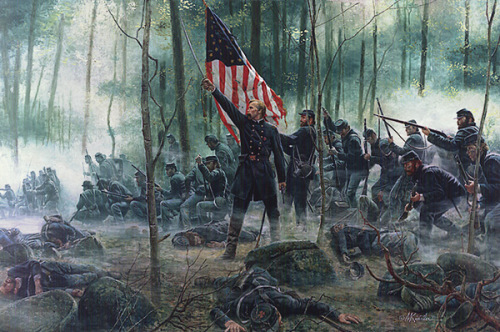
[14] Ibid. Guelzo Gettysburg: The Last Invasion Vintage p.159

[15] Tredeau, Noah Andre. Gettysburg: A Testing of Courage, Harper Collins Publishers, New York 2002 p.305

[16] Some such as Guelzo believe this may have been Captain William Jay of Sykes staff.

[17] Ibid. Tredeau, Gettysburg: A Testing of Courage p.327

[18] Ibid. Guelzo Gettysburg: The Last Invasion Vintage p.262

[19] Ibid. Guelzo Gettysburg: The Last Invasion Vintage p.262

[20] Ibid. Tredeau, Gettysburg: A Testing of Courage p.327

[21] Coddington, Edwin B. The Gettysburg Campaign: A Study in Command, A Touchstone Book, Simon and Schuster New York, 1968 p.389

[22] Ibid. Pfanz, Gettysburg: The Second Day. p.213

[23] Ibid. Golay To Gettysburg and Beyond p.157

[24] Chamberlain, Joshua Lawrence. Official Narrative of Joshua Chamberlain of July 6th 1863, Maine Military Historical Society, Inc., Augusta, Maine, copyright 1989 U.S. Army Combat Studies Institute Reprint, retrieved from http://usacac.army.mil/cac2/cgsc/carl/download/csipubs/chamberlain.pdf June 15th 2014

[25] Oates, Willam C. and Haskell, Frank A. Gettysburg Bantam Books edition, New York 1992, originally published in 1905 p.98

[26] Ibid.Coddington The Gettysburg Campaign: A Study in Command p.393

[27] Ibid. Guelzo Gettysburg: The Last Invasion Vintage p.272

[28] Ibid. Tredeau, Gettysburg: A Testing of Courage p.361

[29] Chamberlain, Joshua Lawrence. Chamberlain’s Address at the dedication of the Maine Monuments at Gettysburg, October 3rd 1888 retrieved from http://www.joshualawrencechamberlain.com/maineatgettysburg.php 4 June 2014

Leave a comment

Filed under civil war, History, leadership, Military, national security

Gettysburg Day Two: The Complex Character of Gouverneur Warren and Little Round Top

gkwarren

Brigadier General Gouverneur Warren

Throughout this study we have been looking at how leaders at various levels in conduct of campaigns as well as battles make decisions. Likewise we examine the lives and character of those leaders as it applies to their actions at critical points of a battle. In this chapter we will examine three officers whose lives, character and actions at Gettysburg, specifically at Little Round Top exemplify two of the Chairman of the Joint Chiefs of Staff Desired Leader Attributes, “to anticipate and adapt to surprise and uncertainty” and the principle of Mission Command, to “operate on intent through trust, empowerment and understanding.” It is from those perspectives that we will look at this part of the battle, but we would be amiss if we did not address the nearly mythical status to which this action has risen.

The actions of three men at the Battle of Little Round Top; Brigadier General Gouverneur Warren, the Chief Engineer of the Army of the Potomac, Colonel Strong Vincent, commanding Third Brigade, First Division, V Corps and Colonel Joshua Lawrence Chamberlain, commanding the 20th Maine Infantry Regiment of Vincent’s brigade are very important to the outcome of the battle, but also for what they teach us about leadership and the profession of arms. This chapter focuses on Warren, in particular with his work with the Commander of the Army of the Potomac, George Meade and his actions to secure Little Round Top on July 2nd 1863, the next will deal with Chamberlain and Vincent.

The battle at Little Round Top is an iconic part of American History and in particular for the Army, a key element of how leadership has been studied. It has achieved nearly mythical status due to the actions of Colonel Joshua Chamberlain which have been told many times in history, fiction and in film, particularly Michael Shaara’s classic historical novel The Killer Angels and its film adaptation Gettysburg. While these accounts are certainly inspiring and allow us to experience the emotion and near spiritual quality of what Chamberlain writes, there is much more to learn.

That near spiritual quality and mythic status that we accord Gettysburg is important, for in large part it is why we come to the battlefield, and why we study. Chamberlain said it well many years after Gettysburg at the dedication of the Maine Monuments:

“In great deeds, something abides. On great fields, something stays. Forms change and pass; bodies disappear; but spirits linger, to consecrate ground for the vision-place of souls… generations that know us not and that we know not of, heart-drawn to see where and by whom great things were suffered and done for them, shall come to this deathless field, to ponder and dream; and lo! the shadow of a mighty presence shall wrap them in its bosom, and the power of the vision pass into their souls.” [1]

So as we endeavor to look at the actions of these leaders on that fateful day it is important to recognize that we cannot totally separate those actions that helped decide the battle from the mythos that surrounds the story. [2] Likewise, it important to acknowledge that we cannot separate their character and the totality of military leaders lives from their actions on a particular battlefield. Unlike Chamberlain Warren does not engender myth, and that is why he is often overlooked by many casual students and observers of the Battle of Gettysburg.

For the purposes of this study it is important to note that Warren was not a commander during this action, he was, like most senior officers today, a staff officer. Many times students of military history and theory are inclined to dismiss the contributions of staff officers because they do not have the overall responsibility of a battle, or the glamour of the limelight of the commanders that they serve under. However, for military professionals, especially those serving on senior staffs who prepare campaign plans, contingency plans and crisis plans the study of officers like Warren is essential.

The Federal Army at Gettysburg, like its Confederate opponent had a wide variety of officers serving in its ranks. Many of its senior officers were graduates of West Point. Many had served together in Mexico and in the various campaigns against Native American tribes. Those who stayed in the Army during the long “peace” between the Mexican War and the outbreak of the Civil War endured the monotony, boredom and often miserable conditions of isolated army posts, long family separations, as well as low pay, slow promotion and often low social status.[3] In light of such conditions, many resigned their commissions to undertake various professional, business or academic pursuits; in fact Samuel Huntington noted that in the years before the Civil War that “West Point produced more railroad presidents than generals.” [4] However, on the outbreak of the war returned to service whether in the service of the Union, or the Confederate States.

When the war began the Army underwent a massive expansion, which it met through and the call of up militia and raising new units from the various states. In the expansion many officers were appointed who had no prior military service, or if they did it was performed years or even decades before the war. Some of these men were simply patriots who rallied to the flag, others due to a sense of righteousness about their cause, while others were political opportunists or appointees. In the north this was a particular problem as “professional officers were pushed aside and passed over in the Union, the higher commissions going, in the first stages of the war at least to officers called back into service or directly appointed from civilian life, many of them “political” appointees.” [5]

At times the lack of experience, training and sometimes the poor character of these men was tragic. However, many of these men performed as well or better than some of their regular army counterparts at various levels of command. At the same time a good number of Regular Army officers were allowed to assist states in the formation and training of these new units, one of whom was Gouverneur Warren. Gettysburg would provide opportunity for the best and worst of all of these types of officers to succeed or fail. In this chapter we will look at one of the regular officers and two of the volunteer whose lives intersected on July 2nd 1863.

Brigadier General Gouverneur Warren was typical of the many professional officers of the old army. An 1850 graduate of West Point, Warren was a bright student who had absorbed the teachings of his professor, Dennis Hart Mahan as the core of his own military thought, both in his senior year in college and through reinforcement as a faculty member. [6] Warren was commissioned as a Brevet Second Lieutenant and because of his high standing in his class was assigned to Corps of Topographical Engineers. He spent his first seven years in a number of assignments which took him throughout much of the country.

Warren’s work involved exploring and mapping for various enterprises including the project to help tame the Mississippi River, and the exploration of the Great Plains and Black Hills where he developed a sympathy for the various Sioux tribes he encountered noting on completion of his mission in 1858, writing that He had never heard a Sioux chief express an opinion in regard to what was due them in which I do not concur and that many of them view the extinction of their race as an inevitable result of the operation of present causes, and do so with all the feelings of despair with which we should contemplate the extinction of our nationality. [7] Following his years in the west he returned as faculty to West Point where he as an Assistant Professor, shared mathematics instructional duties with Oliver O. Howard and resumed his relationship with his former professor Mahan. [8]

On the outbreak of war Warren was granted leave from his duties at West Point to serve as Lieutenant Colonel of Volunteers in the 5th New York Infantry Regiment, also known as Duryee’s Zouaves. Where Duryee was appointed as a Brigadier General, Warren became its Colonel, serving with it during the Peninsula campaign where he was eventually given command of a provisional brigade and promoted to Brigadier General, serving as a Brigade Commander in at Second Manassas, Antietam and Fredericksburg.

At Chancellorsville he was pulled from his brigade duties by Hooker who employed him with good effect to assist his engineering staff, first with mapping and then building the fortifications that stopped the ferocious Confederate storm on the second day of battle. [9] In less than 48 hours Warren’s troops threw up five miles of the most formidable entrenchments yet constructed under battlefield conditions. [10] Edward Alexander, Longstreet’s artillery officer noted that when the Confederates came upon the fortifications after Hooker’s withdraw that “they were amazed at the strength and completeness of the enemys fortifications. [11] Following the battle Warren was appointed as Chief Engineer of the Army of the Potomac on May 12th 1863 by Hooker. When Hooker was relieved of command and was replaced by Meade on June 28th 1863, he was kept in that position by his fellow engineer Meade rather than being promoted to a division or being assigned as Meade’s Chief of Staff. As this turned out it was a wise choice.

Warren along with Major General Winfield Scott Hancock arrived at Cemetery Hill on the night of July 1st. As Meade organized his defenses he not only depended on his advice about the ground, but “consulted him constantly at headquarters or sent him off on matters of highest importance.” [12] Meade respected Warren and had offered Warren the chance to serve as his Chief of Staff, a position that Warren, like Seth Williams, the Adjutant General declined that offer indicating that he had too much work in their departments to take on the burdens of a new job. [13] Lee appreciated Warren’s calm, absorbed, and earnest manner, his professional skill and sound judgment.[14] These qualities would serve both men and the army well on July 2nd.

When Sickles moved III Corps forward during the afternoon without permission moved his Corps forming a vulnerable salient at the Peach Orchard leaving the southern flank in the air, Meade was aghast. Warren who from his reconnaissance of the previous day and the morning knew the position better than anyone recognized that something was badly awry on Sickles Third Corps front matters there were not all straight. [15] He had sent an officer to discover to investigate Sickles’ front and that officer reported that the section of Cemetery Ridge assigned to III Corps was not occupied. [16]

Meade and Warren discussed the situation and realized that III Corps “could hardly be said to be in position” [17] and knowing VI Corps was now close at hand order V Corps, at the time his only reserve into the position vacated by Sickles. They went forward and seeing the empty spaces Warren told Meade “here is where our line should be” to which Meade replied: “It’s too late now.” [18] Warren, whose familiarity with the whole of the battlefield gave him concern about Sickles’ corps dispositions suggest that Meade send him to the Federal left, “to examine the condition of affairs.” [19]

Meade concurred with his Engineer and in dispatching him he also gave Warren the authority to take charge as needed saying “I wish you would ride over there and if anything serious is going on, attend to it.” [20] Again Meade’s choice of Warren for the task demonstrated the trust that is essential in command. The two officers worked together seamlessly and as Coddington described their relationship that day: “Meade chose him to act as his alter ego in crucial moments of the battle, and Warren rendered services for which Meade and the country were to be eternally grateful.” [21] Warren would not see Meade again “until the attack had spent its force.” [22]

little round top map

Hunt noted that “The duty could not have been in better hands.” [23] When Warren arrived on Little Round Top he found it unoccupied save for a few signal corps soldiers. Warren immediately recognized the tactical value of Little Round Top and noted that it was “the key of the whole position.” [24] Warren saw that the Confederates were massing not more than a mile away and that there were no troops on the hill to stop them. He believed that an area “of woods on the near side of the Emmitsburg Road as “an excellent place for the enemy to form out of sight” [25] which was exactly what Major General John Bell Hood’s division was doing, as Henry Hunt noted “The enemy at the time lay concealed, awaiting signal for the assault…” [26] To test his suspicions Warren sent a messenger to Captain James Smith’s 4th New York artillery battery on Devil’s Den to fire a single shot into the woods. Warren described the situation:

“As the shot went whistling through the air the sound of it reached the enemy’s troops and caused every one to look in the direction of it. This motion revealed to me the glistening gun-barrels and bayonets of the enemy’s line of battle, already formed and far outflanking the position of any of our troops; so that the line of his advance from the right to Little Round Top was unopposed. I have been particular in telling this, as the discovery was intensely thrilling to my feelings, and almost appalling.” [27]

warren lrt

Upon confirming his fears Warren resorted to ruse and action. He order the “signalmen to keep up their wigwag activity, simply as a pretense of alertness, whether they had any real signals to transmit or not…” [28] He also sent messengers to Meade, Sickles and Sykes, the commander of V Corps asking Meade to “Send at least a division to me” [29] instructing the messenger, Lieutenant Randall Mackenzie to tell Meade “that we would at once have to occupy that place very strongly.” [30] Sickles refused on account of how badly stretched his lines were, however George Sykes of V Corps responded sending Captain William Jay to find Barnes commander of his 1st Division. The messenger could not find Barnes, but instead came across the commander of the division’s 3rd Brigade Colonel Strong Vincent. Vincent knew that Barnes was self-medicating his “pre-battle anxieties out of a black commissary quart bottle” and was already “hollow from skull to boots” and demanded “What are your orders? Give me your orders.” [31] Upon learning that Sykes wanted a brigade to proceed to Little Round Top Vincent responded immediately to take the initiative and ordered his four regiments up Little Round Top without waiting for permission. Vincent told Sykes messenger “I will take the responsibility myself of taking my brigade there.” [32]

Meade’s choice of Warren was demonstrated in how Warren continued to act with alacrity and decisiveness throughout the afternoon. “As the Union line began to crumble on Little Round Top, Warren, vested with the authority of Meade’s chief representative, emerged as the right man at the right place at the right time.” [33] Warren did not stop with sending messengers, but seeing the danger building he noted that the northwest face of the hill was still unoccupied and open to attack. Warren forgot “all about a general’s dignity” he “sprinted down the east slope of the hill like a rabbit.” [34] There he found Brigadier General Stephen Weed’s brigade which he had previously commanded. Since he did not see Weed, but he found Colonel Patrick O’Rorke of the 140th New York and ordered him to follow him up the hill, saying “Paddy…give me a regiment.” [35] When O’Rorke said that Weed expected him to be following him Warren took the responsibility telling O’Rorke “Bring them up on the double quick, and don’t stop for aligning. I’ll take responsibility.” [36] O’Rorke followed with his gallant regiment with the rest of the brigade under Weed following. Warren’s actions were fortuitous as the 140th New York and Lieutenant Charles Hazlett’s battery of the 5th Artillery arrived at the crest just in time to repulse the advancing Confederates. In the fight the brigade would take fearful casualties and by the end of the battle, Weed, O’Rorke and Hazlett would all be dead, but with Vincent’s brigade they held on and saved the Union line.[37]

Warren continued to urge on the Federal troops despite being wounded, in the words of a reporter who observed him in “a most gallant and heroic manner, riding with utmost confidence over fields swept by the enemy’s fire, seemingly everywhere present, directing, aiding, and cheering the troops.” [38] Once he was assured that Little Round Top was secure he proceeded to rejoin Meade “near the center of the battlefield where another crisis was at hand.” [39]

Warren distinguished as a Corps commander until he ran afoul of the fiery General Phillip Sheridan in 1865. Sheridan relieved Warren of command of V Corps following the Battle of Five Forks where Sheridan believed that Warren’s Corps had moved too slowly in the attack. The relief was brutal and ruined his career. Warren was a professional soldier and took the relief hard. Unfortunately as a topographic engineer he was an outsider to many in the army and not fully appreciated by Grant or Sheridan who in their haste at Five Forks destroyed his career.

After the war Warren resigned his commission as a Major General of Volunteers and returned to his permanent rank as a Major of Engineers. He served another 17 years doing engineeringduty and was promoted to Lieutenant Colonel in 1879, but his past always haunted him, even his sleep. He wrote his wife while supervising a major bridge construction project over the Mississippi River in 1867: “I wish I did not dream so much. They make me sometimes to dread to go to sleep. Scenes from the war, are so constantly recalled, with bitter feelings I wish never to experience again. Lies, vanity, treachery, and carnage.” [40]

He sought a Court of Inquiry to exonerate himself but this was refused until President Grant left office. The Court eventually exonerated him but he died three months before the results were published. Embittered he directed that he be buried in civilian clothes and without military honors. His funeral was attended by his friends Winfield Scott Hancock and Samuel Crawford, his oldest army friend and mentor Andrew Humphreys was called away before the service due to the sudden illness of his son. [41] The Washington Post noted that Warren “had gone “where neither the malevolence nor the justice of this world can reach him. He had enough of the former; and denial of the latter not only embittered his closing months of his life, but undoubtedly hastened his end.” [42]

Warren’s actions on that hot and muggy July 2nd exemplified the leadership qualities that we as an institution strive for, and from a leadership perspective demonstrate how the Chairman’s Desired Leader Attributes and the principles of Mission Command: “the ability to operate on intent through trust, empowerment and understanding” should work in a relationship between seniors and subordinates. But his life also serves to remind us of the ethics of our profession. Loomis Langdon, who served as the official recorder for the board of inquiry wrote of Warren:

“I had never met General Warren till he came before his Court of Inquiry…I learned to value his good opinion – and while I admired him for his great patience, his wonderful energy, habit of concentration, his vast learning and untiring application, I loved him for his tenderness, gentleness and charity, even to those whom he believed had combined to do him a cruel wrong; and I admired him for his nobleness of character and his courage and unselfish patriotism.” [43]

It is easy for military professionals to become totally focused in our profession, especially the details of planning and process to forget the humanity of those that we serve alongside. Warren is one of those complex figures who are not easy to categorize. His biographer Jordan wrote that:

“Warren was a man with fine intellect, widely read, and of keen sensibilities. He was also an excellent engineer, mapmaker, and scientist. He was a soldier who cared much for the safety and welfare of the men under him, and he was sickened by the appalling carnage of the war in which he took such a prominent part. He was arrogant and proud, and he hesitated hardly at all in putting down those of his colleagues he regarded as inferiors. His mind’s eye took in much beyond what was his immediate concern, but this gift worked against him in the hierarchical realm of military life. Warren was prone to long sieges of depression, and he himself agreed that others found him morose and unsmiling…” [44]

Warren

In reading military history is far too easy to isolate and analyze a commander’s actions in battle and ignore the rest of their lives. I think that this does a great disservice to the men themselves. In time of war gives up something of themselves and sometimes even heroes like Gouverneur Warren are destroyed by the actions of institutions that they serve.

Notes

[1] Chamberlain, Joshua Lawrence. Chamberlain’s Address at the dedication of the Maine Monuments at Gettysburg, October 3rd 1888 retrieved from http://www.joshualawrencechamberlain.com/maineatgettysburg.php 4 June 2014

[2] Note: My use of the terms myth, mythology or mythos should not be considered negative, and the use of the terms does not mean that there is not some degree of fact or truth in them. The definitions of the term mythos are important to understanding my use of the term here, first it denotes a traditional or recurrent narrative theme or plot structure of a story, and secondly a set of beliefs or assumptions about something. (See the Oxford American Dictionary.)

[3] Taylor, John M. Duty Faithfully Performed: Robert E Lee and His CriticsBrassey’s, Dulles VA 1999 pp.37-38.

[4] Huntington, Samuel P. The Soldier and the State: The Theory and Politics of Civil-Military Relations The Belknap Press of Harvard University Press, Cambridge MA and London 1957 p.199

[5] Ibid. Huntington. The Soldier and the State: The Theory and Politics of Civil-Military Relations p.213

[6] Jordan, David M. Happiness is Not My Companion: The Life of G.K. Warren Indiana University Press, Bloomington Indiana 2001 p.6

[7] Ibid. Jordan Happiness is Not My Companion: The Life of G.K. Warren p.30

[8] Ibid. Jordan Happiness is Not My Companion: The Life of G.K. Warren p.33

[9] Sears, Stephen W. ChancellorsvilleHoughton Mifflin Co. Boston and New York 1996 p.372

[10] Hagerman, Edward. The American Civil War and the Origins of Modern Warfare. Midland Book Editions, Indiana University Press. Bloomington IN. 1992 p.91

[11] Alexander, Edward Porter Military Memoirs of a Confederate: A Critical Narrative 1907 republished 2013 by Pickle Partners Publishing, Amazon Kindle Edition location 7007

[12] Coddington, Edwin B. The Gettysburg Campaign: A Study in Command, A Touchstone Book, Simon and Schuster New York, 1968 p.332

[13] Sears, Stephen W. Gettysburg. Houghton Mifflin Co. Boston and New York 2003 pp.129-130

[14] Ibid. Coddington, The Gettysburg Campaign: A Study in Command, p.332

[15] Ibid. Sears Gettysburg p.262

[16] Tredeau, Noah Andre. Gettysburg: A Testing of Courage, Harper Collins Publishers, New York 2002 p.319

[17] Ibid. Tredeau. Gettysburg: A Testing of Courage, p.319

[18] Ibid. Tredeau. Gettysburg: A Testing of Courage, p.320

[19] Ibid. Jordan Happiness is Not My Companion: The Life of G.K. Warren p.90

[20] Ibid. Tredeau. Gettysburg: A Testing of Courage, p.320

[21] Ibid. Coddington, The Gettysburg Campaign: A Study in Command, p.388

[22] Guelzo, Allen C. Gettysburg: The Last Invasion Vintage Books a Division of Random House, New York 2013 p.260

[23] Hunt, Henry. The Second Day at Gettysburg in Battles and Leaders of the Civil War Volume III, The Tide Shifts. Edited by Robert Underwood Johnson and Clarence Clough Buel Castle, Secaucus NJ p. 307

[24] Ibid. Jordan Happiness is Not My Companion: The Life of G.K. Warren p.92

[25] Ibid. Jordan Happiness is Not My Companion: The Life of G.K. Warren p.92

[26] Ibid. Hunt The Second Day at Gettysburg in Battles and Leaders of the Civil War Volume III, The Tide Shifts. p. 307

[27] Pfanz, Harry F. Gettysburg: The Second Day. University of North Carolina Press, Chapel Hill 1987 p.206

[28] Foote, Shelby, The Civil War, A Narrative. Volume Two Fredericksburg to Meridian Random House, New York 1963 p.503

[29] Ibid. Jordan Happiness is Not My Companion: The Life of G.K. Warren p.92

[30] Ibid. Guelzo Gettysburg: The Last Invasion Vintage p.261

[31] Ibid. Guelzo Gettysburg: The Last Invasion Vintage p.262

[32] Longacre, Edward Joshua Chamberlain: The Soldier and the Man Combined Publishing Conshohocken PA 1999 p.127

[33] Ibid. Coddington, The Gettysburg Campaign: A Study in Command, p.395

[34] Swanberg, W.A. Sickles the IncredibleStan Clark Military Books, Gettysburg PA 1957 p.214

[35] Ibid. Jordan Happiness is Not My Companion: The Life of G.K. Warren p.93

[36] Ibid. Foote The Civil War, A Narrative. Volume Two Fredericksburg to Meridian p.504

[37] Ibid. Jordan Happiness is Not My Companion: The Life of G.K. Warren pp. 93-94

[38] Ibid. Coddington, The Gettysburg Campaign: A Study in Command, p.388

[39] Ibid. Coddington, The Gettysburg Campaign: A Study in Command, p.396

[40] Ibid. Jordan Happiness is Not My Companion: The Life of G.K. Warren p.249

[41] Ibid. Jordan Happiness is Not My Companion: The Life of G.K. Warren p.309

[42] Ibid. Jordan Happiness is Not My Companion: The Life of G.K. Warren p.308

[43] Ibid. Jordan Happiness is Not My Companion: The Life of G.K. Warren p.309

[44] Ibid. Jordan Happiness is Not My Companion: The Life of G.K. Warren preface pp.x-xi

3 Comments

Filed under civil war, History, leadership, Military