Tag Archives: president donald trump

Trump and Vichy: How Republics Die

img_0327

Friends  of Padre Steve’s World,

Kind of a rerun of an older article that seems to become more pertinent every day. Last night we were out late and came home to find something wrong with our cable internet modem. I got a new one today but the problem has to be beyond it. So I have a tech coming out Friday, so without our LTE settings on our iPhones and iPads we would be out of luck. So it goes.

So here is that article:

President Trump has long established his love and admiration for despots. First it was Vladimir Putin of Russia, then Recip Erdogan the soon to be dictator of Turkey, then Rodrigo Duterte, the murderous President of the Philippines, and even praise for Kim Jong Un of North Korea. Let us not go into the list of draconian despots, dictators from history that the President has expressed his fondness. His favorite President is Andrew Jackson who defied a Supreme Court ruling and executed the Trail of Tears.

Honestly, if the President’s admiration, praise, and fondness for authoritarian and anti-democratic rulers remained just his opinion with no consequences it wouldn’t be such a big deal. However, it is much bigger than his personal opinions, but the nature his office of President, his words, his tweets, his opinions, become the policy of the United States, and end up staining the honor of the nation.

These actions have consequences. The first is the loss of moral authority of the nations who encourage and help dictators. Second, the loss of that moral authority makes it difficult when the chips are down to gain domestic or international support once a nation’s leaders determine that aggressive dictatorships must be stopped, finally it is the death of the Republic, its Constitution, and its founding principles. Just in the past few days the President has bowed to the wishes of the Chinese Communists on trade and the North Koreans on our alliance with South Korea. As he did these things he made more and ever more threatening attacks on the Department of Justice and the FBI in order to discredit them and end the investigation of his family and presidential campaign ties to Russia and other foreign enemies.

What the President and his administration since they took power is amoral and it is dragging the reputation of the United States into the sewer. Sadly, it will have real world consequences, as well as dangerous ramifications for our own system of Constitutional government and representative democracy.

This is not new, during the 1930s many leaders of struggling democracies caught up in the Great Depression, including the United States offered up praise for the accomplishments of Mussolini, Stalin, and Hitler. By their encouragement, accommodation, and appeasement these leaders were complicit in some of the greatest crimes against humanity ever seen in the world. Some of these leaders, especially in France actively worked against their own democratic form of government in the hopes of overthrowing it and setting up a Fascist state. Once France was defeated by Germany the anti-democratic leaders of that country voted out the Republic and established a dictatorship at Vichy headed by Marshal Petain, the hero of the First World War.

Petain with Hitler

The Premier of France under Vichy, Pierre Laval, led the successful move to abolish the constitution of the Third Republic. He said: “Parliament must be dissolved. The Constitution must be reformed. It must align itself with the totalitarian states…” He told the Assembly: “We are going to destroy the totality of what was. We’re going to create something entirely different…. Henceforth there will be only one party, that of all the French.” He concluded “We are paying today for the fetish which chained us to democracy and led us to the worst excesses of capitalism, which all around us Europe was forging, without us, a new world.”

Another, Charles Spinasse, a Socialist who had come to believe in Fascism told the Assembly: “We must break from the past. It was full of illusions…. We believed in individual freedom, in the independence of man. It was but anticipation of the future which was beyond our grasp. We must have a new faith based on new values…. France abandoned itself. It must begin anew.”

One opponent rushed to Vichy to oppose the measures, Pierre-Etienne Flandin, told his colleagues: “Change the Constitution? But why? What need is there to change our institutions? The reproach is that we did not respect them.” However, Flandin too had no problem with giving the reigns of power to an authoritarian, Fascist regime that would cooperate with the Nazis, turn on its allies, and murder its own citizens. His words were absolutely correct, but he betrayed himself at the end.

Pierre Laval

In the end Laval won the day. He told the assembly: “Parliamentary democracy lost the war. It must give way to a new regime: audacious, authoritarian, social, and national.” In the end the vast majority of the delegates from across the political spectrum voted to end the Republic. Opponents who wished to continue to fight against Germany were condemned, jailed, and even killed. Leon Blum, a former Socialist leader who Laval despised wrote of Laval’s manner as the Republic was dissolved: “An unbelievable arrogance puffed up his small person. In a dry voice and with an irritated glance he flung out verdicts and orders… “I do… I say… I refuse… that’s the way it is…” President Trump has much the same attitude as he issues executive orders with abandon, even as others are struck down by the Courts.

Likewise when questioned about allowing opposition newspapers to publish, Laval told Blum in words that one can almost hear President Trump say if he were granted the right to restrict the freedom of the press:

“When I decide, no newspaper will appear if it shows the slightest reticence about my policies. The press must follow me absolutely, without reserve—and I will not let myself be duped.”

But just as troubling on the domestic front is the President’s stated desire to crush the parts of our Constitutional system that inconvenience him, and with his malleable GOP majorities in the House and Senate he may eventually succeed in doing if not opposed by courageous Senators and Representatives, and the Courts. He has on a number of occasions threatened the independence of the judiciary, he has expressed a desire to amend the Constitution to limit freedom of the press, freedom of association, and freedom of speech. He has also urged Congress to end the Filibuster which is the last resort by which a minority party can prevent bare majority of Senators or Representatives of one party to impose its will on the entire nation, even if the majority of people in the nation voted against their party. As of now GOP Senate leaders have announced their opposition to such legislation realizing that they could once again be in the minority. However, for Trump that does not matter as he has no loyalty to the Republican Party; sadly, most Republicans do not seem to understand that fact, and I wonder how firm they will stand when push comes to shove. History shows us that all too often, even the opponents of authoritarianism can easily turn from defending their Constitutional liberties to supporting nationalist, racist, and authoritarian leaders.

That my friends should frighten any American who has not lost their belief in our system of government which for all of its inefficiencies guarantees more liberty than any other system in the world.  History shows that once those liberties are gone you do not get them back without the despot who has taken them away being defeated, often by military conquest.

The fact is that as Timothy Snyder wrote: “The European history of the twentieth century shows us that societies can break, democracies can fall, ethics can collapse, and ordinary men can find themselves standing over death pits with guns in their hands. It would serve us well today to understand why.”

Will our epitaph be like the words of French Senator Bovin-Champeaux who said: “Is it not without sadness that we shall bid adieu to the Constitution of 1875. It made France a free country…. It died less from its imperfections than from the fault of men charged with guarding it and making it work.”

Unlike Laval’s Vichy Government the United States has not been overrun and invaded by an enemy Army. We don’t have Russian Tanks rolling down Pennsylvania Avenue, or Vladimir Putin doing a jig at the Washington Monument, but the President’s surrender to Putin, and other despots and his attacks on our Constitution and legal systems will destroy us and all of our rights; and that means even the rights of those people who for whatever reason support him. If this continues, they too will become victims of an American version of the Night of the Long Knives. 

Take my warning for what it is. Trump’s opponents are already damned and doomed if he succeeds, but his supporters will have signed their own death sentences and they are too stupid to know it. But then, such is bliss of ignorance.

Until tomorrow,

Peace

Padre Steve+

1 Comment

Filed under History, Loose thoughts and musings, Navy Ships, Political Commentary, world war two in europe

Of Pardoning War Criminals: Trump and the Consequences Of Ignoring Justice

Friends of Padre Steve’s World,

There are reports that this Memorial Day weekend that President Trump will Pardon convicted or accused War Criminals, men whose conduct dishonored the military and the country, men whose fellow soldiers, Marines, or Sailors have voluntarily testified against. These men murdered prisoners and committed other crimes forbidden by the law of war. If he does so this weekend it will be the ultimate betrayal of the military by the Commander in Chief.

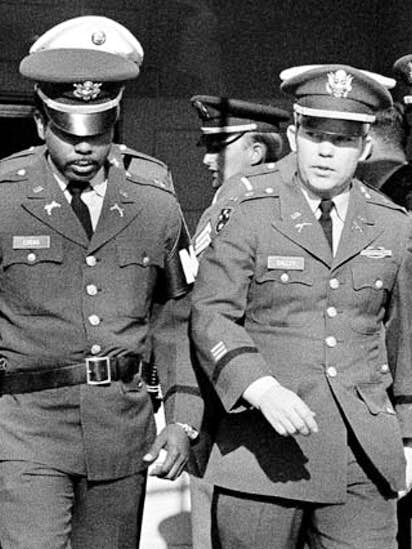
When Richard Nixon Pardoned Lieutenant William Calley, convicted of leading his platoon in the deadliest atrocity committed by American Troops in the Vietnam War at a village called My Lai. His men’s butchery had to be stopped by an American helicopter and its crew who interposed their bird between Carley’s men and other potential victims, and threatened to shoot at Calley’s men. The crime was initially covered up by Calley’s chain-of-command. Eventually it became public and the Army was forced to deal with it. Of all the officers charged and soldiers charged, only Calley was convicted. It took thirty years for the military to award the heroes who stopped the massacre.

In the six degrees of separation I am just twice removed from My Lai, two times. In my MSIII, junior year of Army ROTC in the Fall of 1981. My instructor was Major Barry Towne, during the investigation he was Commanding part of the security force. He told us what kind of criminal element that Calley and his platoon was. Calley’s defense at Court Martial was that “he was just following orders.”

Major Towne told us of its effect on the troops, the public, and the war. He told us that we would be war criminals if we ever allowed that to happen under my command. So I knew one of the Officers with first hand knowledge of the crime and the crime scene. Then, in June of 1998 while serving as the Garrison Chaplain at Fort Indiantown Gap, Pennsylvania I did the funeral of Calley’s Brigade Commander, Colonel Oran Henderson. He was acquitted of all charges including the cover-up which he began the day of the massacre. At the time I didn’t know his fully complicity in the massacre. Telford Taylor, one of the Senior American prosecutors at Nuremberg “wrote that legal principles established at the war crimes trials could have been used to prosecute senior American military commanders for failing to prevent atrocities such as the one at My Lai.” Those included Generals, and many other senior officers.

President Nixon commuted Calley’s prison time to House Arrest, and in September 1974 Calley was pardoned by the Secretary of the Army. That man said he did it because Calley really did believe that he was following orders.

So if the President begins pardoning War criminals it will be a watershed from which there will be no going back, unless the Generals and Admirals protest. If course if they do, Trump will replace them with men who will go all the way, and his base, especially his allegedly pro-life Christians, who believe that he has been ordained by God to Make America Great Again.

Just before the invasion of Poland Hitler told his military commanders:

“I shall give a propagandist cause for starting war -never mind whether it be plausible or not. The victor shall not be asked later on whether we told the truth or not. In starting and making a war, it is not the right that matters, but victory.”

In May 1941, Field Marshal Wilhelm Keitel disseminated the Barbarossa Decree in the name of Adolf Hitler which absolved German Soldiers from war crimes, even those against German law. Army Group and Army Commanders had the authority to be more severe than Keitel’s order. The Severity Order issued by Field Marshal Walter Reichenau of Army Group, Commander of 6th Army. That order stated:

The most important objective of this campaign against the Jewish-Bolshevik system is the complete destruction of its sources of power and the extermination of the Asiatic influence in European civilization.

In this eastern theatre, the soldier is not only a man fighting in accordance with the rules of the art of war, but also the ruthless standard bearer of a national conception and the avenger of bestialities which have been inflicted upon German and racially related nations. For this reason the soldier must learn fully to appreciate the necessity for the severe but just retribution that must be meted out to the subhuman species of Jewry. The Army has to aim at another purpose, i. e., the annihilation of revolts in hinterland which, as experience proves, have always been caused by Jews.

Other Wehrmacht Commanders wrote similar orders, unleashing the beast in their soldiers and classifying their enemies as less than human, a typical charge leveled at racial and religious minorities, as well as immigrants, and potential enemies by the President.

General Erich Hoepner issued this order to his soldiers of Panzer Group Four, Later known as the 4th Panzer Army:

The war against Russia is an important chapter in the German nation’s struggle for existence. It is the old battle of the Germanic against the Slavic people, of the defence of European culture against Muscovite-Asiatic inundation and of the repulse of Jewish Bolshevism. The objective of this battle must be the demolition of present-day Russia and must therefore be conducted with unprecedented severity. Every military action must be guided in planning and execution by an iron resolution to exterminate the enemy remorselessly and totally. In particular, no adherents of the contemporary Russian Bolshevik system are to be spared.

Unopposed Pardons will release unprecedented evil by otherwise honorable men who either believer that they are just following orders or approved by God through the words of their leader.

I take this very seriously. War Crimes are war crime whether committed by Nazis, Communists, the Iranian Revolutionary Guard, or American soldiers. Supreme Court Justice Robert Jackson who organized the Nuremberg Trials and prosecuted the leading Nazis noted before the trials began:

“If certain acts of violation of treaties are crimes, they are crimes whether the United States does them or whether Germany does them, and we are not prepared to lay down a rule of criminal conduct against others which we would not be willing to have invoked against us.” Justice Robert Jackson International Conference on Military Trials, London, 1945, Dept. of State Pub.No. 3080 (1949), p.330.

If Trump Pardons these men he will be spitting in the face of American and International Justice. He will be blessing war crimes and if there is no push back from the Joint Chiefs of Staff or the Regional Combatant Command Commanders we are doomed to repeat what criminal regimes have done. We will be a rogue and outcast nation whose word will not be believed, and whose military members will be considered criminals, even if they serve honorably and have never committed any crimes. Ask any Vietnam Veteran if you don’t believe me. I wasn’t a Vietnam veteran, but my dad was. When I enlisted and joined the ROTC program at UCLA I had a man come out from nowhere and start screaming at me “off campus ROTC Nazi!”

I haven’t forgotten that. I was a kid when Calley committed his crimes. I had never fired a shot in anger, and my primary focus of study over the previous year had been the guilt of the Nazis and their genocidal policies. What leaders do matters, and there is no escaping that, especially if you volunteer to serve in the military.

These are big issues and cannot be allowed to go unnoticed. The rot begins in the head of the fish. We are well on our way to to becoming a criminal and outlaw nation, something our Founders thought they had prevented by devising our system of government, a system intentionally designed to limit the powers of the Executive.

This does matter. If Trump Pardons these men and there is no push back from the Senior Commanders I would advise no one to enlist or take a commission in the United States military, and I have almost 38 years of service in the Army and Navy to prove my devotion to the Constitution and Country, including combat tours in which I was shot at and was in danger on a daily basis. As a historian, priest, and officer I cannot be silent if the President Pardons War criminals. The very thought is abhorrent to my nature.

Until tomorrow,

Peace

Padre Steve+

6 Comments

Filed under ethics, History, holocaust, iraq,afghanistan, laws and legislation, leadership, Military, national security, nazi germany, News and current events, Political Commentary

What Do We Stand For? Hard Questions in the Trump Era from Judgement at Nuremberg

img_0333-1

Friends of Padre Steve’s World,

I have written about the classic film Judgment at Nuremberg many times. I am doing it again because I have been doing a lot of reading about some of the other war crimes trials conducted in post-World War II Germany, today I began reading Hitler’s American Friends: The Third Reich’s Supporters in the United States by Bradley Hart.

Today I am following those earlier writings up with another, albeit, short post regarding one of the most riveting monologues in film history, from Judgement at Nuremberg. Since Holocaust Remembrance Day was just a couple of weeks back it is appropriate to take the time, and never forget, for while we may not want to admit it, as human beings we are capable of the same inhumanity.

In this segment of the film, which is a fictionalized version of the Judges Trial, Spencer Tracy plays the role of Chief Judge Dan Heywood who gives his verdict is one of the most telling sequences in cinema regarding what it means to be an American. I used to show it in the first session of my military ethics class at the Staff College and since the majority of my students had never seen the film, it usually left them in silence. So tonight I am just going to leave it with you to watch, read, and contemplate. Ask yourself, who are we, and what do we stand for?

This is especially true when the President, politicians of the majority party in the legislature, pundits, and politically minded preachers make no bones that they have every intent of persecuting those who are of certain races, religions, or political beliefs that they abhor, often using the most scurrilous charges, and outright lies in order to demonize them, dehumanize them, and  open the door for normal, decent, and even brilliant people to justify government sponsored cruelty and injustice that defies the ideals of the Declaration of Independence, the Gettysburg Address, and the Constitution itself.

Please, watch the video and read the text. Ponder it in your heart, because it speaks to something that is not a historical aberration, not just a dramatic film, but something that affects the human condition and is present right here and right now in our own country.

“The trial conducted before this Tribunal began over eight months ago. The record of evidence is more than ten thousand pages long, and final arguments of counsel have been concluded.

Simple murders and atrocities do not constitute the gravamen of the charges in this indictment. Rather, the charge is that of conscious participation in a nationwide, government organized system of cruelty and injustice in violation of every moral and legal principle known to all civilized nations. The Tribunal has carefully studied the record and found therein abundant evidence to support beyond a reasonable doubt the charges against these defendants.

Herr Rolfe, in his very skillful defense, has asserted that there are others who must share the ultimate responsibility for what happened here in Germany. There is truth in this. The real complaining party at the bar in this courtroom is civilization. But the Tribunal does say that the men in the dock are responsible for their actions, men who sat in black robes in judgment on other men, men who took part in the enactment of laws and decrees, the purpose of which was the extermination of humans beings, men who in executive positions actively participated in the enforcement of these laws — illegal even under German law. The principle of criminal law in every civilized society has this in common: Any person who sways another to commit murder, any person who furnishes the lethal weapon for the purpose of the crime, any person who is an accessory to the crime — is guilty.

Herr Rolfe further asserts that the defendant, Janning, was an extraordinary jurist and acted in what he thought was the best interest of this country. There is truth in this also. Janning, to be sure, is a tragic figure. We believe he loathed the evil he did. But compassion for the present torture of his soul must not beget forgetfulness of the torture and the death of millions by the Government of which he was a part. Janning’s record and his fate illuminate the most shattering truth that has emerged from this trial: If he and all of the other defendants had been degraded perverts, if all of the leaders of the Third Reich had been sadistic monsters and maniacs, then these events would have no more moral significance than an earthquake, or any other natural catastrophe. But this trial has shown that under a national crisis, ordinary — even able and extraordinary — men can delude themselves into the commission of crimes so vast and heinous that they beggar the imagination. No one who has sat at through trial can ever forget them: men sterilized because of political belief; a mockery made of friendship and faith; the murder of children. How easily it can happen.

There are those in our own country too who today speak of the “protection of country” — of “survival.” A decision must be made in the life of every nation at the very moment when the grasp of the enemy is at its throat. Then, it seems that the only way to survive is to use the means of the enemy, to rest survival upon what is expedient — to look the other way.

Well, the answer to that is “survival as what?” A country isn’t a rock. It’s not an extension of one’s self. It’s what it stands for. It’s what it stands for when standing for something is the most difficult!

Before the people of the world, let it now be noted that here, in our decision, this is what we stand for: justice, truth, and the value of a single human being.”

Think about it…

Have a nice night.

Peace

Padre Steve+

2 Comments

Filed under History, holocaust, movies, nazi germany, News and current events

They Thought They Were Free: Some Things Never Change, Totalitarianism and Support for Evil

they thought they were free

Friends of Padre Steve’s World,

One of the most powerful books I have ever read was Milton Mayer’s “They Thought They Were Free: The Germans 1933-1945.” Mayer was a visiting professor at the University of Frankfurt in the 1950s and lived in a small Hessian town near the city. The book is about the relationships that he built with ten ordinary citizens in the town and how they lived under Nazism and how most saw little wrong with it in the end.

The book is well worth the read and very timely when one compares the attitudes of the men who became Mayer’s friends and many people in the United States today. The last few chapters of the book are a reflection of the author’s opinions of the future of Germany at the time of his writing and he was mistaken on how the Germans would eventually become a society that embraced democracy and rejected authoritarianism (at the time he felt that it was very possible that democracy would fail in Germany,) they do not take away anything from the heart of the book and its message about how people adjust to authoritarian rule.

One chapter in particular struck me, it was a conversion that Mayer had with a colleague at the University who also reflected what it was like to live in the Third Reich and how in doing so he compromised himself and lost the opportunity to resist when resistance might have changed the course of events as Germany proceeded down the road to dictatorship and destruction. The chapter is particularly painful to read as the man understood that he should have known better but didn’t recognize the warning signs of the gradual nature of how life was changing with each new law or dictate from the Fuhrer.

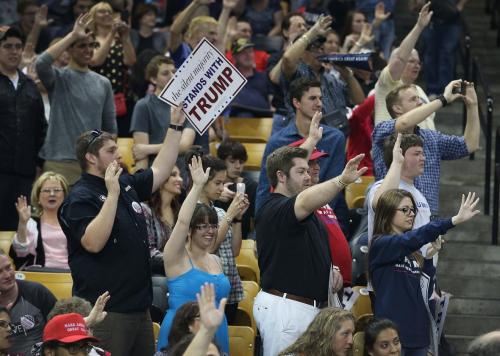
In reading the chapter I see parallels in American society today. There are the Trump loyalists, many of who openly call for restrictions of liberty and crushing opposition to the President’s policies using extra-constitutional means including violence. Many are quite extreme while others, persuaded by years of right-wing talk radio, politically charged sermons by their pastors, and the daily dose of Fox News believe everything said by the President even when confronted by facts. Then there are Trump’s opponents, but many of the opponents are divided and cannot get along with each other. Some of these opponents actually helped Trump into office by circulating the Russian anti-Clinton conspiracy theories and falsehoods throughout the campaign. Each of these groups probably composes about 25-30% of the electorate each. The remaining segment are the people who simply go with the flow because life is too busy and crisis laden to get too deeply enmeshed in the political debate, and many have become so cynical that they see no difference in either side and are much more concerned about making it in a still uncertain economy.

So I invite you to read this and draw your own conclusions. Have a great day.

Peace

Padre Steve+

Chapter 13: But Then It Was Too Late

“What no one seemed to notice,” said a colleague of mine, a philologist, “was the ever widening gap, after 1933, between the government and the people. Just think how very wide this gap was to begin with, here in Germany. And it became always wider. You know, it doesn’t make people close to their government to be told that this is a people’s government, a true democracy, or to be enrolled in civilian defense, or even to vote. All this has little, really nothing, to do with knowing one is governing.

“What happened here was the gradual habituation of the people, little by little, to being governed by surprise; to receiving decisions deliberated in secret; to believing that the situation was so complicated that the government had to act on information which the people could not understand, or so dangerous that, even if the people could not understand it, it could not be released because of national security. And their sense of identification with Hitler, their trust in him, made it easier to widen this gap and reassured those who would otherwise have worried about it.

“This separation of government from people, this widening of the gap, took place so gradually and so insensibly, each step disguised (perhaps not even intentionally) as a temporary emergency measure or associated with true patriotic allegiance or with real social purposes. And all the crises and reforms (real reforms, too) so occupied the people that they did not see the slow motion underneath, of the whole process of government growing remoter and remoter.

“You will understand me when I say that my Middle High German was my life. It was all I cared about. I was a scholar, a specialist. Then, suddenly, I was plunged into all the new activity, as the university was drawn into the new situation; meetings, conferences, interviews, ceremonies, and, above all, papers to be filled out, reports, bibliographies, lists, questionnaires. And on top of that were the demands in the community, the things in which one had to, was ‘expected to’ participate that had not been there or had not been important before. It was all rigmarole, of course, but it consumed all one’s energies, coming on top of the work one really wanted to do. You can see how easy it was, then, not to think about fundamental things. One had no time.”

“Those,” I said, “are the words of my friend the baker. ‘One had no time to think. There was so much going on.’”

“Your friend the baker was right,” said my colleague. “The dictatorship, and the whole process of its coming into being, was above all diverting. It provided an excuse not to think for people who did not want to think anyway. I do not speak of your ‘little men,’ your baker and so on; I speak of my colleagues and myself, learned men, mind you. Most of us did not want to think about fundamental things and never had. There was no need to. Nazism gave us some dreadful, fundamental things to think about—we were decent people—and kept us so busy with continuous changes and ‘crises’ and so fascinated, yes, fascinated, by the machinations of the ‘national enemies,’ without and within, that we had no time to think about these dreadful things that were growing, little by little, all around us. Unconsciously, I suppose, we were grateful. Who wants to think?

“To live in this process is absolutely not to be able to notice it—please try to believe me—unless one has a much greater degree of political awareness, acuity, than most of us had ever had occasion to develop. Each step was so small, so inconsequential, so well explained or, on occasion, ‘regretted,’ that, unless one were detached from the whole process from the beginning, unless one understood what the whole thing was in principle, what all these ‘little measures’ that no ‘patriotic German’ could resent must some day lead to, one no more saw it developing from day to day than a farmer in his field sees the corn growing. One day it is over his head.

“How is this to be avoided, among ordinary men, even highly educated ordinary men? Frankly, I do not know. I do not see, even now. Many, many times since it all happened I have pondered that pair of great maxims, Principiis obsta and Finem respice—‘Resist the beginnings’ and ‘Consider the end.’ But one must foresee the end in order to resist, or even see, the beginnings. One must foresee the end clearly and certainly and how is this to be done, by ordinary men or even by extraordinary men? Things might have. And everyone counts on that might.

“Your ‘little men,’ your Nazi friends, were not against National Socialism in principle. Men like me, who were, are the greater offenders, not because we knew better (that would be too much to say) but because we sensed better. Pastor Niemöller spoke for the thousands and thousands of men like me when he spoke (too modestly of himself) and said that, when the Nazis attacked the Communists, he was a little uneasy, but, after all, he was not a Communist, and so he did nothing; and then they attacked the Socialists, and he was a little uneasier, but, still, he was not a Socialist, and he did nothing; and then the schools, the press, the Jews, and so on, and he was always uneasier, but still he did nothing. And then they attacked the Church, and he was a Churchman, and he did something—but then it was too late.”

“Yes,” I said.

“You see,” my colleague went on, “one doesn’t see exactly where or how to move. Believe me, this is true. Each act, each occasion, is worse than the last, but only a little worse. You wait for the next and the next. You wait for one great shocking occasion, thinking that others, when such a shock comes, will join with you in resisting somehow. You don’t want to act, or even talk, alone; you don’t want to ‘go out of your way to make trouble.’ Why not?—Well, you are not in the habit of doing it. And it is not just fear, fear of standing alone, that restrains you; it is also genuine uncertainty.

“Uncertainty is a very important factor, and, instead of decreasing as time goes on, it grows. Outside, in the streets, in the general community, ‘everyone’ is happy. One hears no protest, and certainly sees none. You know, in France or Italy there would be slogans against the government painted on walls and fences; in Germany, outside the great cities, perhaps, there is not even this. In the university community, in your own community, you speak privately to your colleagues, some of whom certainly feel as you do; but what do they say? They say, ‘It’s not so bad’ or ‘You’re seeing things’ or ‘You’re an alarmist.’

“And you are an alarmist. You are saying that this must lead to this, and you can’t prove it. These are the beginnings, yes; but how do you know for sure when you don’t know the end, and how do you know, or even surmise, the end? On the one hand, your enemies, the law, the regime, the Party, intimidate you. On the other, your colleagues pooh-pooh you as pessimistic or even neurotic. You are left with your close friends, who are, naturally, people who have always thought as you have.

“But your friends are fewer now. Some have drifted off somewhere or submerged themselves in their work. You no longer see as many as you did at meetings or gatherings. Informal groups become smaller; attendance drops off in little organizations, and the organizations themselves wither. Now, in small gatherings of your oldest friends, you feel that you are talking to yourselves, that you are isolated from the reality of things. This weakens your confidence still further and serves as a further deterrent to—to what? It is clearer all the time that, if you are going to do anything, you must make an occasion to do it, and then you are obviously a troublemaker. So you wait, and you wait.

“But the one great shocking occasion, when tens or hundreds or thousands will join with you, never comes. That’s the difficulty. If the last and worst act of the whole regime had come immediately after the first and smallest, thousands, yes, millions would have been sufficiently shocked—if, let us say, the gassing of the Jews in ’43 had come immediately after the ‘German Firm’ stickers on the windows of non-Jewish shops in ’33. But of course this isn’t the way it happens. In between come all the hundreds of little steps, some of them imperceptible, each of them preparing you not to be shocked by the next. Step C is not so much worse than Step B, and, if you did not make a stand at Step B, why should you at Step C? And so on to Step D.

“And one day, too late, your principles, if you were ever sensible of them, all rush in upon you. The burden of self-deception has grown too heavy, and some minor incident, in my case my little boy, hardly more than a baby, saying ‘Jewish swine,’ collapses it all at once, and you see that everything, everything, has changed and changed completely under your nose. The world you live in—your nation, your people—is not the world you were born in at all. The forms are all there, all untouched, all reassuring, the houses, the shops, the jobs, the mealtimes, the visits, the concerts, the cinema, the holidays. But the spirit, which you never noticed because you made the lifelong mistake of identifying it with the forms, is changed. Now you live in a world of hate and fear, and the people who hate and fear do not even know it themselves; when everyone is transformed, no one is transformed. Now you live in a system which rules without responsibility even to God. The system itself could not have intended this in the beginning, but in order to sustain itself it was compelled to go all the way.

“You have gone almost all the way yourself. Life is a continuing process, a flow, not a succession of acts and events at all. It has flowed to a new level, carrying you with it, without any effort on your part. On this new level you live, you have been living more comfortably every day, with new morals, new principles. You have accepted things you would not have accepted five years ago, a year ago, things that your father, even in Germany, could not have imagined.

“Suddenly it all comes down, all at once. You see what you are, what you have done, or, more accurately, what you haven’t done (for that was all that was required of most of us: that we do nothing). You remember those early meetings of your department in the university when, if one had stood, others would have stood, perhaps, but no one stood. A small matter, a matter of hiring this man or that, and you hired this one rather than that. You remember everything now, and your heart breaks. Too late. You are compromised beyond repair.

“What then? You must then shoot yourself. A few did. Or ‘adjust’ your principles. Many tried, and some, I suppose, succeeded; not I, however. Or learn to live the rest of your life with your shame. This last is the nearest there is, under the circumstances, to heroism: shame. Many Germans became this poor kind of hero, many more, I think, than the world knows or cares to know.”

I said nothing. I thought of nothing to say.

“I can tell you,” my colleague went on, “of a man in Leipzig, a judge. He was not a Nazi, except nominally, but he certainly wasn’t an anti-Nazi. He was just—a judge. In ’42 or ’43, early ’43, I think it was, a Jew was tried before him in a case involving, but only incidentally, relations with an ‘Aryan’ woman. This was ‘race injury,’ something the Party was especially anxious to punish. In the case at bar, however, the judge had the power to convict the man of a ‘nonracial’ offense and send him to an ordinary prison for a very long term, thus saving him from Party ‘processing’ which would have meant concentration camp or, more probably, deportation and death. But the man was innocent of the ‘nonracial’ charge, in the judge’s opinion, and so, as an honorable judge, he acquitted him. Of course, the Party seized the Jew as soon as he left the courtroom.”

“And the judge?”

“Yes, the judge. He could not get the case off his conscience—a case, mind you, in which he had acquitted an innocent man. He thought that he should have convicted him and saved him from the Party, but how could he have convicted an innocent man? The thing preyed on him more and more, and he had to talk about it, first to his family, then to his friends, and then to acquaintances. (That’s how I heard about it.) After the ’44 Putsch they arrested him. After that, I don’t know.”

I said nothing.

“Once the war began,” my colleague continued, “resistance, protest, criticism, complaint, all carried with them a multiplied likelihood of the greatest punishment. Mere lack of enthusiasm, or failure to show it in public, was ‘defeatism.’ You assumed that there were lists of those who would be ‘dealt with’ later, after the victory. Goebbels was very clever here, too. He continually promised a ‘victory orgy’ to ‘take care of’ those who thought that their ‘treasonable attitude’ had escaped notice. And he meant it; that was not just propaganda. And that was enough to put an end to all uncertainty.

“Once the war began, the government could do anything ‘necessary’ to win it; so it was with the ‘final solution of the Jewish problem,’ which the Nazis always talked about but never dared undertake, not even the Nazis, until war and its ‘necessities’ gave them the knowledge that they could get away with it. The people abroad who thought that war against Hitler would help the Jews were wrong. And the people in Germany who, once the war had begun, still thought of complaining, protesting, resisting, were betting on Germany’s losing the war. It was a long bet. Not many made it.”

Copyright notice: Excerpt from pages 166-73 of They Thought They Were Free: The Germans, 1933-45 by Milton Mayer, published by the University of Chicago Press. ©1955, 1966 by the University of Chicago. All rights reserved. This text may be used and shared in accordance with the fair-use provisions of U.S. copyright law, and it may be archived and redistributed in electronic form, provided that this entire notice, including copyright information, is carried and provided that the University of Chicago Press is notified and no fee is charged for access. Archiving, redistribution, or republication of this text on other terms, in any medium, requires the consent of the University of Chicago Press. (Footnotes and other references included in the book may have been removed from this online version of the text.)

13 Comments

Filed under ethics, History, holocaust, nazi germany, News and current events, Political Commentary

Re-Thinking the Unthinkable: When Trump and His Followers Refuse to Give up Power

img_0476

Friends of Padre Steve’s World,

This is the first article I have written in the wake of the release of the Mueller Report, the actions of Attorney General Barr, and the defiant words of the President and his loyal supporters.

For those that rejoiced in the continued revelations of President Trump’s malfeasance and incompetence hoping that this will soon trigger his removal either by impeachment or the use of the 25th Amendment, including me were wrong.

Back on May 18th Of 2017 I wrote these words on this blog:

“be assured that unless something totally unexpected occurs that this will not end soon, nor well.

Donald Trump is a unique creature in American politics, he has succeeded in establishing himself as the center of a political cult that has taken over the Republican Party. Despite his overall approval ratings consistently being below 40% with terrible numbers pertaining to his basic character and trustworthiness, well over 80% of Republicans in every poll continue to support him. They reject any fact that is contrary to what they believe about their leader, and they tend to support the most unconstitutional aspects of his ill-defined political ideology, which more resembles the Nazi Fuhrerprinzip than anything from the American political tradition. They abhor those who raise objections of any kind based on fact so much that they have gone resorted to repeating what they sometimes refer to as alternative facts or alternative truths.

Guided by an uncompromising propaganda network of talk radio and television hosts as well as internet based organizations they have little loyalty to anyone but the President. This mass movement supported by such propaganda is well described by the great American philosopher Eric Hoffer who wrote:

“All mass movements strive, therefore, to interpose a fact-proof screen between the faithful and the realities of the world. They do this by claiming that the ultimate and absolute truth is already embodied in their doctrine and that there is no truth nor certitude outside it. The facts on which the true believer bases his conclusions must not be derived from his experience or observation but from holy writ.”

This is the world of alternative facts, and the prelude to dictatorship if the trend is allowed to continue. Likewise the true believers, those who follow the President as if he were some sort of Messiah intent on destroying the old order and establishing a new will not stand easily aside. Their support for the President is much deeper than normal political attachment, he is an extension of them who gives voice to their innermost fears, passions, and insecurity. They are defiant in their stand against those that he is against. Historian Timothy Snyder wrote of how the language of their leader and his propaganda works in the minds of the followers:

“Victor Klemperer, a literary scholar of Jewish origin, turned his philological training against Nazi propaganda. He noticed how Hitler’s language rejected legitimate opposition: The people always meant some people and not others (the president uses the word in this way), encounters were always struggles (the president says winning), and any attempt by free people to understand the world in a different way was defamation of the leader (or, as the president puts it, libel).”  

513917024-people-raise-their-arms-as-republican-presidential_1_jpg_CROP_promo-xlarge2

Thus they cannot be convinced by normal argument or fact. Hoffer noted:

“The leader personifies the certitude of the creed and the defiance and grandeur of power. He articulates and justifies the resentment damned up in the souls of the frustrated. He kindles the vision of a breath-taking future so as to justify the sacrifice of a transitory present. He stages a world of make-believe so indispensable for the realization of self-sacrifice and united action.”

Even when everything comes apart around them and their leader collapses they cannot admit that he was deceiving them. At the end of the war a German soldier told Victor Klemperer that “Hitler has never lied, I believe the Fuhrer.” Snyder writes: “The final mode is misplaced faith. It involves the sort of self-deifying claims the president made when he said that “I alone can solve it” or “I am your voice.” When faith descends from heaven to earth in this way, no room remains for the small truths of our individual discernment and experience. What terrified Klemperer was the way that this transition seemed permanent. Once truth had become oracular rather than factual, evidence was irrelevant.”

The man is not normal, he is not stable, and he knows nothing but conflict. His followers believe in him almost as a Messiah figure who cannot be wrong and must be defended to the last and experience has shown us that some of would resort to violence to silence his critics.

Like Hitler and other despots, he and his most loyal followers see this as a fight to the finish which Trump which he must win or be defeated. It is a zero sum conflict, and I do not expect it to end well, even if Trump is eventually removed by impeachment or the 25th Amendment.”

Let us also add losing the 2020 election to that list. With Trump and his followers relentless attacks on Congress, individual political opponents in Congress, presidential candidates, State officials, judges, the FBI and members of the Justice Department, distinguished journalists, entertainers and sports figures, for that matter anyone who speaks the truth or attempts to uphold the law and Constitution; the likelihood that he will not leave office, or will attempt to find a way to secure a permanent way to stay in office. Mind you, there are many ways he could do this, and possibly secure the approval of a majority of Americans.

Many, if not most of his supporters believe that his Presidency is divinely ordained. When people believe that their leaders are backed by God they are capable of great evil. One only has to look to history and the link between religion and political repression to see this.

Timothy Snyder wrote in his book On Tyranny:

“Be calm when the unthinkable arrives. Modern tyranny is terror management. When the terrorist attack comes, remember that authoritarians exploit such events in order to consolidate power. The sudden disaster that requires the end of checks and balances, the dissolution of political parties, the suspension of freedom of expression, the right to a fair trial, and so on, is the oldest trick in the Hitlerian book. DO NOT FALL FOR IT.”

So until tomorrow,

Peace

Padre Steve+

6 Comments

Filed under Loose thoughts and musings, nazi germany, Political Commentary

“To Be Ignorant of What Occurred Before…” The Willful Ignorance Of History

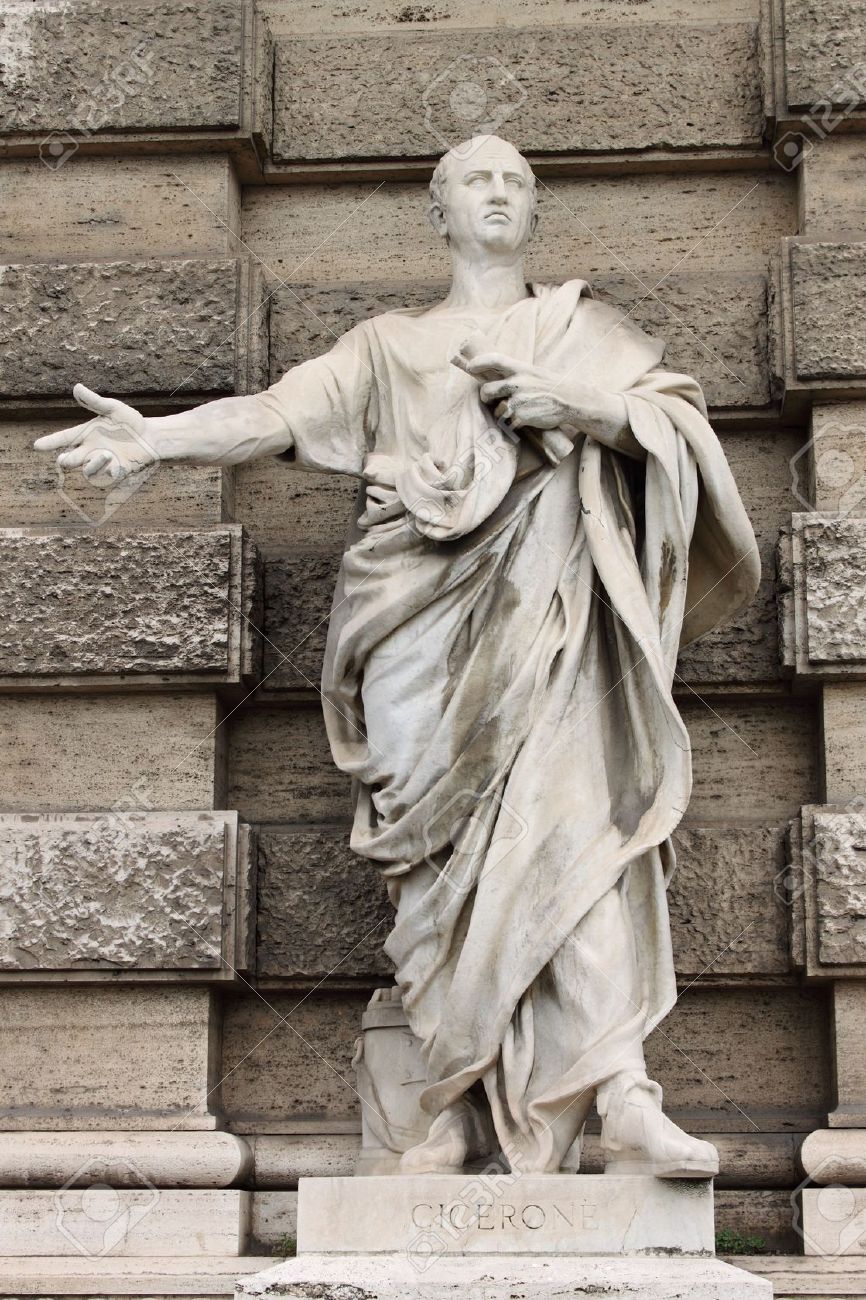
Statue-of-Cicero-Stock-Photo-rome

Friends of Padre Steve’s World,

I have been writing a lot about the Holocaust of late and as I was working on my latest book I came across a quote by British Historian Laurence Rees from his book “Auschwitz, a New History:

“Soon the last survivor and the last perpetrator from Auschwitz will have joined those murdered at the camp. There will be no one on this earth left alive who has a personal experience of the place. When that happens, there is a terrible danger that this history will merge into the distant past and just become one terrible event among many…. But that should not be allowed to happen.

We must judge behavior by the context of the times, and judged by the context of mid-twentieth century, sophisticated European culture, Auschwitz and the Nazis’ “Final Solution” represent the lowest act in all history. Through their crime, the Nazis brought into the world an awareness of what educated, technologically advanced human beings can do – as long as they possess a cold heart. Once allowed into the world, knowledge of what they did must not be unlearned. It lies there – ugly, inert, waiting to be discovered by each new generation. A warning for us, and for those who will come after. (Rees, Auschwitz p.299)

I have been reading about the declining number of students studying history, and the relative ignorance of Americans as a whole as to history, including the gross and willful ignorance of it by the President. As a historian that frightens me.

The great Roman philosopher and political theorist Marcus Tullius Cicero wrote, “History is the witness that testifies to the passing of time; it illumines reality, vitalizes memory, provides guidance in daily life and brings us tidings of antiquities.”

Those who follow my writings here on this site know that I am a historian and that much of what I write, even regarding current events, is framed by history and the stories of those who came before us. That is one of my driving passions, a passion for historical truth, and a passion to ensure that the past is not forgotten.

Cicero is an important figure in history. He resisted the moves toward the dictatorship of the Caesars and would die for his belief in the Republic. As such he inspired the founders of the United States, including Thomas Jefferson and John Adams. Adams wrote of the Roman:

“As all the ages of the world have not produced a greater statesman and philosopher united than Cicero, his authority should have great weight.”

Sadly, it seems that our society, and even our education system is disconnecting itself from history. We have pretty much stopped teaching history in schools, and often what is taught is myth. As such we have become a society that through its ignorance of the past is ever repeating the worst aspects of our history. As a whole we are ignorant of our past, and that ignorance is demonstrated by many of our political, business, journalism, educational, and military leaders on a daily basis.

Cicero wrote “To be ignorant of what occurred before you were born is to remain always a child. For what is the worth of human life, unless it is woven into the life of our ancestors by the records of history?”

Our lives must be woven together with those who came before us, without that sacred connection to the past, we endanger the future, and doom those who follow us. Cicero wrote, “The life of the dead is placed in the memory of the living.” Thus, it is for us the living to remember and never forget those who have gone before. That is why I write.

At some point I will write more on things that Cicero wrote and said, including political and social lessons that are as relevant today as when he wrote them, but as historian George Santayana noted: “Those who do not remember the past are condemned to repeat it.”

I fear that the President and his sycophants in the GOP and his Cult like followers in their ignorance of history and willful disregard for the Constitution and our institutions will end in the kind of political disaster that brought an end to the Roman Republic.

These are perilous times and I am afraid that the lessons of Cicero, Santayana, and Rees have not been learned.

Until tomorrow,

Peace

Padre Steve+

2 Comments

Filed under History, holocaust, News and current events, philosophy, Political Commentary

Presidents are Neither Above the Law or Criticism: Wisdom from Theodore Roosevelt and Stephen A. Douglas

Friends of Padre Steve’s World,

I find it both interesting and troubling to listen to many supporters of President Trump castigate anyone for any criticism offered about the President, sometimes going as far to say that critics are being “unfair,” “disrespectful,”or most disturbing, “disloyal” or “treasonous.” Even the President tweets out those kind of accusations on a whim.

Admittedly some forms of criticism cross boundaries and are personally insulting and disrespectful of the President. In my writings I try, even when being very critical of his policies, words, or actions, to refrain from personal insults that could be considered disrespectful to the President because I am still on active duty.  As my readers know I am a historian as well as an theologian/ethicist and when I do write about the actions of the President and his administration I do so based on careful study and comparison with historical, ethical, or legal precedents. My views are likewise informed by my education and and belief in the principles of the Enlightenment, my belief in human rights as set out in the Preamble of the Declaration of Independence, the U.S. Constitution, and the French Rights of Man and the Citizen, as well as my understanding of the Anglican Christian tradition of “Scripture, Tradition, and Reason” being the foundations of faith.

But it is not disloyal or treasonous to offer criticism of policies, legislative proposals, executive orders, or actions and words of the President or his advisers that could endanger the security of the United States, its citizens, and its alliances, or potentially be unlawful.

Even so I am occasionally criticized for offering historical examples that compare the President and his most ardent supporters in an unfair way, some even calling those disrespectful. I find their double standards and lack of appreciation of irony quite fascinating as most of these people have spent the last eight years or more disparaging and disrespecting President Obama with some of the most racist, vile, contemptible, and false accusations ever made against a sitting President, while at the same time condemning others for simply repeating what the President himself has said.

I found out that a couple of years when I had a couple of students criticize some of my teaching at Gettysburg when comparing the anti-immigrant Know Nothings of the 1830s-1850s to current anti-immigrant Trump supporters, and stated that some Trump Administration Civil Rights proposals to be a throwback to Jim Crow. My words then were not insulting nor disrespectful, but simply valid historical criticism; but some Trump supporters are so thin-skinned that they cannot abide any criticism of the President, despite dishing out incredibly racist and disgusting personal comments about President Obama, which were mostly devoid of any non-racially based political or ideological principles.

Last summer I experienced the threat to my career from one of my chapel parishioners who lied about the contents of a sermon and asked my Commander to have me investigated and tried by Court Martial for simply criticizing the actions of the administration on the southern border using Scripture, Tradition, Reason, and History. I did not mention the President but I was accused of comparing him to Hitler and my critic, who never spoke to me and who I still would not recognize wanted me charged with Conduct unbecoming of an officer and disrespect to the President of the United States. About a quarter of the congregation was questioned and I was exonerated, but I have learned the hard way that the President’s supporters will go to any length to silence anything the believe critical,of him.

Unlike President Obama the current President is ensnared in numerous legal, criminal, and Constitutionally backed investigations which range from simply enriching himself as a public official (the emoluments clause) and his family, or more seriously collusion with not only Russian, but Saudi, and other nations to influence his election. The Senate committee investigating the Russian connection said that this actually happened and backed up the evidence submitted by U.S. law enforcement, military, and intelligence agencies concerning this. The Saudi and other Sunni Arab connections were just brought to public light about a year ago. Lord knows how many other governments were involved with Donald Trump Jr., and others to seek to influence the 2016 elections and U.S. foreign policy since then.

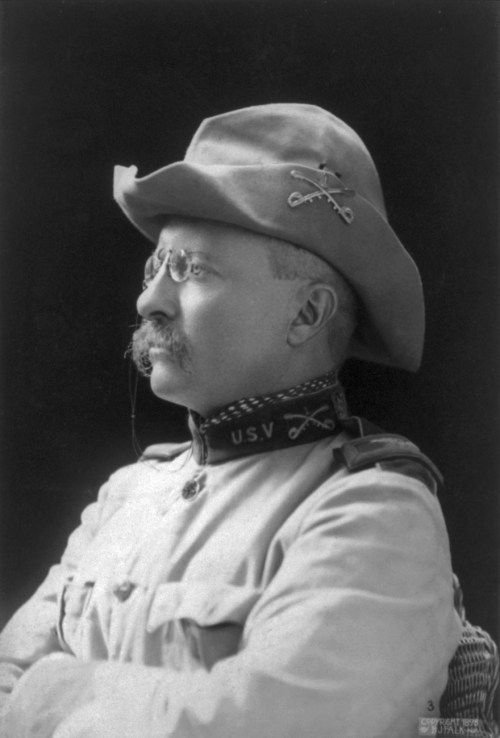
Theodore Roosevelt had to defend himself in 1918 from such criticism from the supporters of President Woodrow Wilson. Roosevelt was criticizing the Wilson administration because of how badly he thought they were pursuing the war effort against Germany. For this people were castigating him. People said that newspapers should not print what Roosevelt had to say as well as “He should stand by the President” and “He should be stood before a stone wall and shot.” Roosevelt ended up writing an op-ed in the Kansas City Star in which he noted:

“The President is merely the most important among a large number of public servants. He should be supported or opposed exactly to the degree which is warranted by his good conduct or bad conduct, his efficiency or inefficiency in rendering loyal, able, and disinterested service to the Nation as a whole. Therefore it is absolutely necessary that there should be full liberty to tell the truth about his acts, and this means that it is exactly necessary to blame him when he does wrong as to praise him when he does right. Any other attitude in an American citizen is both base and servile. To announce that there must be no criticism of the President, or that we are to stand by the President, right or wrong, is not only unpatriotic and servile, but is morally treasonable to the American public. Nothing but the truth should be spoken about him or any one else. But it is even more important to tell the truth, pleasant or unpleasant, about him than about any one else.”

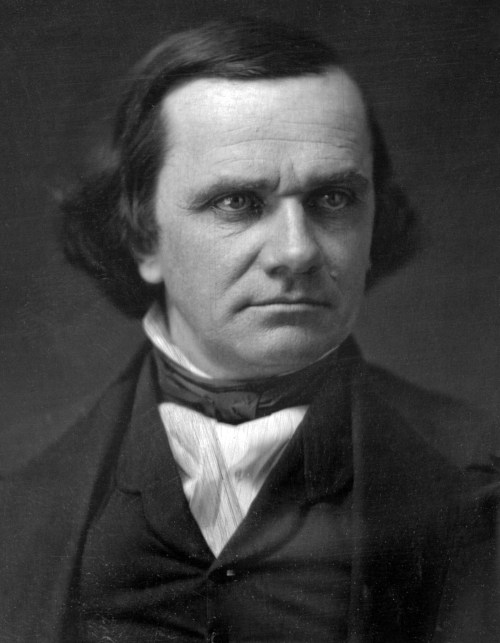
Senator Stephen A. Douglas

This is exactly how I base any criticism I offer of the President, his policies, words, and actions. I heartily agree with the words of Senator Stephen A. Douglas when he battled President James Buchanan over the pro-slavery attempt to have Kansas admitted to the Union as a Slave State in 1858. Douglas said of his encounter with Buchanan:

“God forbid,” I said “that I ever surrender my right to differ from a President of the United States for my own choice. I am not a tool of any President!” 

Sadly, there are very few GOP Senators who would have the moral courage to do what Stephen Douglas did in 1858. He did so even though it doomed his chances to be President.

I admire Stephan Douglas but there is a difference. Now there is a difference, I am not a Senator or elected Representative, I am an officer and must carry out the orders of the President. However, if I ever come to believe that I cannot in good conscience carry them out, or if I believe that they are un-Constitutional I will retire from the military in order to allow myself the freedom to speak out more openly. To ‘this point in time I have not to have been forced to Carr out any illegal or unconstitutional orders, and as a Chaplain I have been able to speak my thoughts openly, though I am careful in how I say them at least in order to maintain my respect for the office of the President.

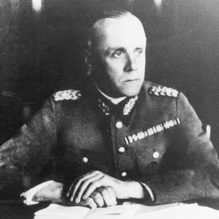
General Ludwig Beck

One of my examples is the German General Ludwig Beck, who resigned as head of the German Army in 1938 over Hitler’s aggression and his plan to attack Czechoslovakia. He wrote something that I hold particularly important in my service at this point in history:

“It is a lack of character and insight, when a soldier in high command sees his duty and mission only in the context of his military orders without realizing that the highest responsibility is to the people of his country.” 

Unlike the current President who sought numerous deferments from entering the military in a time of war: Stephen Douglas put his political career on the line to follow the Constitution, Theodore Roosevelt resigned from his office as Assistant Secretary of the Navy Since to go to war and place himself in harms way, Ludwig Beck would die in the failed attempt to kill Hitler in July 1944. All three men were far more honorable than President Trump, and their words should be heeded by Americans regardless of their political affiliation.

Over the past few weeks the President and his media cohorts have been suggesting unconstitutional and illegal actions against his critics Following the end of the Mueller investigation. His administration members are refusing Congressional subpoenas, and he is hiding behind executive privilege. In a different era his own party members in Congress would hold him to account, but these are different times. The actions of the President and his administration members, supported by the GOP majority in the Senate will likely bring about a Constitutional Crisis that will test the very foundations of the Republic, at the same time he is sending significant military assets to confront an undisclosed threat from Iran, while increasing sanctions on that country, while readying economic tariffs on China. I could go on, but I won’t.

Theodore Roosevelt was absolutely correct. Presidents are not beyond criticism, rebuke, or the law. Any real patriot understands that.

Until tomorrow,

Peace,

Padre Steve+

5 Comments

Filed under History, laws and legislation, leadership, Military, News and current events, Political Commentary

Americans should Always “Choose a President Wise, Well Read in History and Exceedingly Slow to Draw the Sword” Wise Words from the Late General Hal Moore in the Trump Era

29f03605f6b48a52887c2b51a20b5382

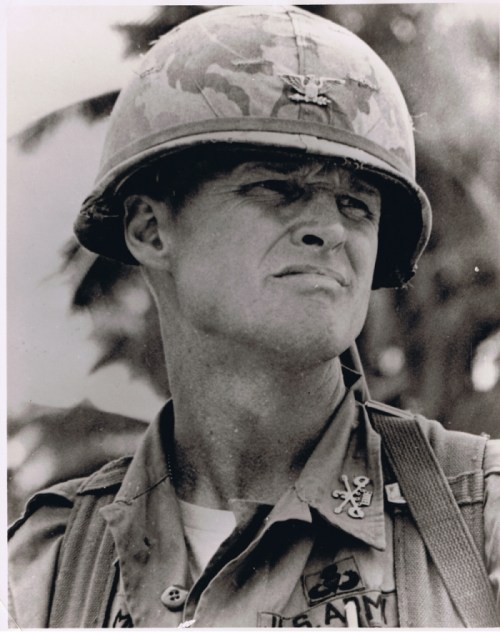
LTG Hal Moore as a Colonel in Vietnam

Friends of Padre Steve’s World,

Even since I was a child I was an avid reader of history, especially military history and biography. I idolized the military men that I read about and many of the things that they said and did, and almost always skewed them into an almost perverse form of patriotism. After the attacks of 9-11-2001 and during the run up to the invasion of Iraq I got into a internet argument with a man who later became the Presiding Bishop of my former denomination. He was and still is a very honorable man. He opposed the war on good historical, social, and moral grounds.

While he was very conservative theologically he had a strong sense of social justice and having come to adulthood during Vietnam war era he had a certain sense of distrust about military adventurism that I, an officer who at that time had some twenty years of military service did not fully appreciate. I responded to one of his comments with a quote from one of my favorite American Naval heroes, Captain Stephen Decatur who once remarked:

“Our Country! In her intercourse with foreign nations may she always be in the right; but right or wrong, our country!”

decatur 2 sqaure

There is some truth in what Decatur said, but his words should not be used to justify imperialistic nationalism, racism, or militarism. Sadly back then that was exactly how I used it to attempt to shut down the arguments of an honorable man. If he ever reads this I hope that Bishop Craig Bates accepts my heartfelt apology for how I treated him back then.

It took me two combat tours, one at sea where I was a member of a boarding team, and the other in Iraq’s Al Anbar Province, and a lot more military and historical education that I realized how wrong that I was in doing this. Using patriotic quotes to buttress immoral, illegal, unconstitutional, and un-Christian policies is damnable. G. K. Chesterton noted: “‘My country, right or wrong,’ is a thing that no patriot would think of saying. It is like saying, ‘My mother, drunk or sober.’”

But, I am afraid that my former understanding of patriotism is exactly what many Americans follow today, regardless of their political affiliation or ideology seem to automatically defer to the decisions of the President, no matter what his party in launching military strikes. This has been largely true since the end of Second World War until now with the exception of the latter stages of the Vietnam War when the bankruptcy of American policy became evident.

No one wants to be “against the troops” and I am still one of those troops, but opposing nationalism, imperialism, and militarism is not the same as “supporting the troops.” The late Army Lieutenant General Hal Moore, who led his battalion into the Battle of the Ia Drang in 1965 and was memorialized in the film We Were Soldiers told West Point Cadets in 2005:

“The war in Iraq, I said, is not worth the life of even one American soldier. As for Secretary Rumsfeld, I told them, I never thought I would live long enough to see someone chosen to preside over the Pentagon who made Vietnam-era Defense Secretary Robert McNamara look good by comparison. The cadets sat in stunned silence; their professors were astonished. Some of these cadets would be leading young soldiers in combat in a matter of a few months. They deserved a straight answer.

The expensive lessons learned in Vietnam have been forgotten and a new generation of young American soldiers and Marines are paying the price today, following the orders of civilian political leaders as they are sworn to do. The soldiers and those who lead them will never fail to do their duty. They never have in our history. This is their burden. But there is another duty, another burden, that rests squarely on the shoulders of the American people. They should, by their vote, always choose a commander in chief who is wise, well read in history, thoughtful, and slow-exceedingly slow-to draw the sword and send young men and women out to fight and die for their country. We should not choose for so powerful an office someone who merely looks good on a television screen, speaks and thinks in sixty-second sound bites, and is adept at raising money for a campaign.

If we can’t get that part right then there will never be an end to the insanity that is war and the unending suffering that follows in war’s wake-and we must get it right if we are to survive and prosper as free Americans in this land a million Americans gave their lives to protect and defend.”

I remember reading General Moore’s back words then and despite my respect for him I didn’t see their truth, I still believed the lies of Donald Rumsfeld, the Bush Administration, and the Right wing media. I was wrong, and within two and a half years I would discover just how right that he was.

Today, some eleven years after I returned from Iraq I find that we now have a President whose historical, ethical, and policy blindness is subjected to his narcissistic and paranoid personality. He is a man who dodged the draft, avoided military service, condemned men and women wounded. killed, or captured in combat as losers while bragging that avoiding sexually transmitted diseases in the 1980s was his Vietnam. Even now he is rushing a Carrier Strike Group and heavy bombers to challenge Iran for as of yet undisclosed threats to American interests in the Middle East, as well as suggesting military options to deal with the failing and flailing government of Venezuelan President Maduro.

War is a great way to distract from other real concerns, especially if it gives the President, any President, a chance to divert attention from his own malfeasance and criminality. Our Republic is in danger and I do not think that the danger will soon pass. I only wish that it would. Sadly, Hal Moore passed away in February of 2017. If he were alive today I am sure that he would be sounding the alarm.

So until tomorrow,

Peace

Padre Steve+

Leave a comment

Filed under Foreign Policy, History, leadership, middle east, Military, national security, News and current events

Dien Bien Phu: The Soldiers and the Lessons Forgotten and Unlearned 65 Years Later

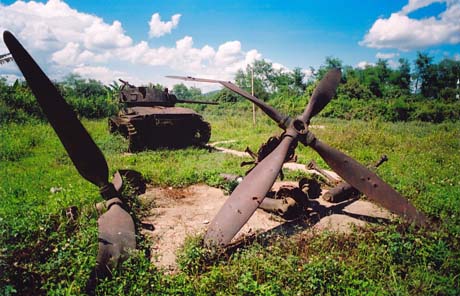
Dien Bien Phu War Remnants

Dien Bien Phu Today

It was an epic battle in a tragic war and most people neither know or care what happened in the valley where a small border post named Dien Bien Phu became synonymous with forgotten sacrifice. This year fewer remembrances are taking place. Some are in Vietnam and others in France. Last year, the French Prime Minister Edouard Philippe laid a wreath at the French Monument at Dien Bien Phu, accompanied by several elderly veterans of the battle. The French veterans were met with kindness by their former opponents.

French Prime Minister Edouard Philippe at Dien Bien Phu’s French Memorial

Diplomat_Sep10059-227x300

General Vo Nguyen Giap in 2011

Years before, on May 7th 2011 in Hanoi a small remembrance was held to mark the fall of Dien Bien Phu and honor the victor, 101 year old General Vo Nguyen Giap at his home. Giap was the last senior commander on either side at that time, and he died a year and a half later at the age of 102.  That 2011 ceremony was one of the few remembrances held anywhere marking that battle which was one of the watersheds of the 20th Century. A half a world away in Houston Texas a small group of French veterans, expatriates and historians laid a wreath at the Vietnam War Memorial.  In Paris an ever shrinking number of French survivors used to gather each year on May 7th at 1815 hours for a religious service at the Church of Saint Louis des Invalides to remember the dead and missing of the French Expeditionary Corps who were lost in Indochina. A small number of other small ceremonies were held as late as 2014. There appear to be no services to honor their memory this year.

155fdecaef82e8d699102f2c5390203c

Legionnaires of the Second Foreign Legion Parachute Battalion at Dien Bien Phu 

This battle is nearly forgotten by time even though it and the war that it symbolized is probably the one that we need to learn from before Afghanistan becomes our Indochina.

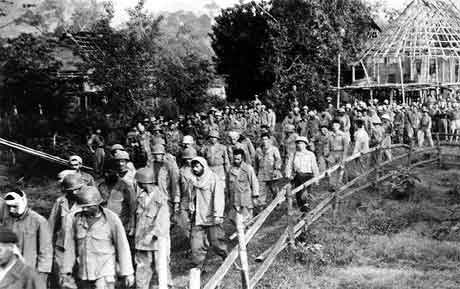
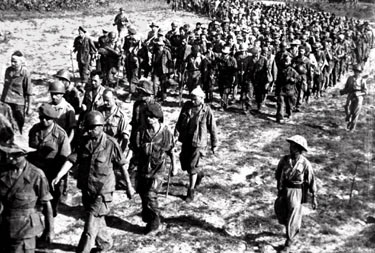
<img src="https://padresteve.com/wp-content/uploads/2013/05/french_surrender_at_dien_bien_phu1.jpg?w=500&quot; class="aligncenter size-full wp-image-11759" data-attachment-id="11759" data-permalink="https://padresteve.com/2013/05/06/remembering-hell-the-fall-of-dien-bien-phu-59-years-gone-by-and-still-forgotten/french-soldiers-surrender-3/&quot; data-orig-file="https://padresteve.com/wp-content/uploads/2013/05/french_surrender_at_dien_bien_phu1.jpg&quot; data-orig-size="375,253" data-comments-opened="1" data-image-meta="{"aperture":"0","credit":"AP","camera":"","caption":"Captured French soldiers are marched through the fields after their surrender at Dien Bien Phu in 1954. More than 10,000 French troops were captured after a 55 day siege . The French defeat ended nearly a century of French occupation of Indochina. (AP Photo\/Vietnam News Agency)","created_timestamp":"0","copyright":"","focal_length":"0","iso":"0","shutter_speed":"0","title":"FRENCH SOLDIERS SURRENDER"}" data-image-title="FRENCH SOLDIERS SURRENDER" data-image-description="

Captured French soldiers are marched through the fields after their surrender at Dien Bien Phu in 1954. More than 10,000 French troops were captured after a 55 day siege . The French defeat ended nearly a century of French occupation of Indochina. (AP Photo/Vietnam News Agency)

” data-medium-file=”https://padresteve.com/wp-content/uploads/2013/05/french_surrender_at_dien_bien_phu1.jpg?w=300&#8243; data-large-file=”https://padresteve.com/wp-content/uploads/2013/05/french_surrender_at_dien_bien_phu1.jpg?w=375&#8243; alt=”FRENCH SOLDIERS SURRENDER” srcset=”https://padresteve.com/wp-content/uploads/2013/05/french_surrender_at_dien_bien_phu1.jpg 375w, https://padresteve.com/wp-content/uploads/2013/05/french_surrender_at_dien_bien_phu1.jpg?w=150 150w, https://padresteve.com/wp-content/uploads/2013/05/french_surrender_at_dien_bien_phu1.jpg?w=300 300w” sizes=”(max-width: 375px) 100vw, 375px” style=”height: auto; max-width: 100%; margin-bottom: 2px; clear: both; display: block; margin-left: auto; margin-right: auto”>

French Prisoners

On May 8th 1954 the French garrison of Dien Bien Phu surrendered to the Viet Minh.  It was the end of the ill-fated Operation Castor in which the French had planned to lure the Viet Minh Regulars into open battle and use superior firepower to decimate them.  The strategy which had been used on a smaller scale the previous year at Na Son.

The French had thought they had come up with a template for victory based on their battle at Na Son in how to engage and destroy the Viet Minh. The plan was called the “Air-land base.”  It involved having strong forces in a defensible position deep behind enemy lines supplied by air.  At Na Son the plan worked as the French were on high ground, had superior artillery and were blessed by General Giap using human wave assaults which made the Viet Minh troops fodder for the French defenders.  Even still Na Son was a near run thing for the French and had almost no effect on Viet Minh operations elsewhere while tying down a light division equivalent and a large portion of French air power.

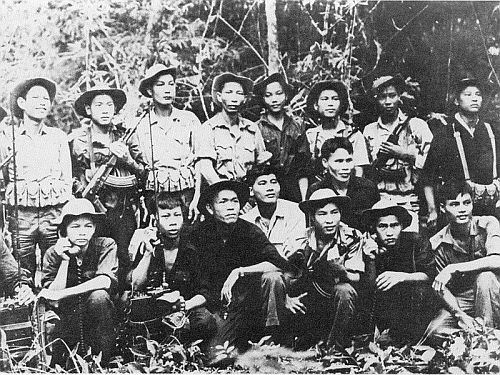
nlfmainforce

Viet Minh Regulars

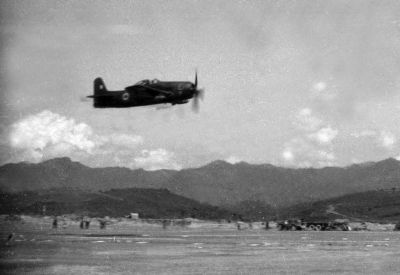
The French took away the wrong lesson from Na-Son and repeated it at Dien Bien Phu.  The French desired to use Dien Bien Phu as a base of operations against the Viet Minh.  Unfortunately the French chose badly. Instead of high ground they elected to occupy a marshy valley surrounded by hills covered in dense jungle. They went light on artillery and the air head was at the far end of the range of French aircraft, especially tactical air forces which were in short supply.  To make matters worse, General Navarre, commander of French forces in Indochina was informed that the French government was going to begin peace talks and that he would receive no further reinforcements. Despite this, he elected to continue the operation.

dien-bien-phu

French Paras Drop into Dien Bien Phu

Once on the ground French logistics needs were greater than the French Air Force and American contractors could supply.  French positions at Dien Bien Phu were exposed to an an enemy who held the high ground, had more powerful artillery, and placed in defensive positions that were not mutually supporting. The terrain was so poor that French units were incapable of any meaningful offensive operations against the Viet Minh. As such they could only dig in and wait for battle. Despite this many positions were not adequately fortified and the artillery was in emplaced positions that were easily targeted by Viet Minh artillery and not hardened.

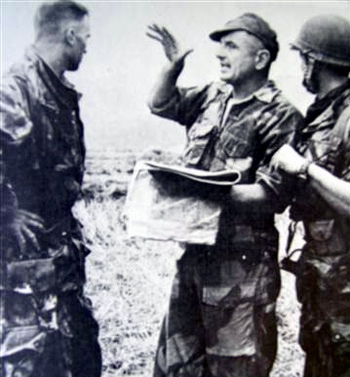
bigeard_instruction_saut

Major Marcel Bigeard 

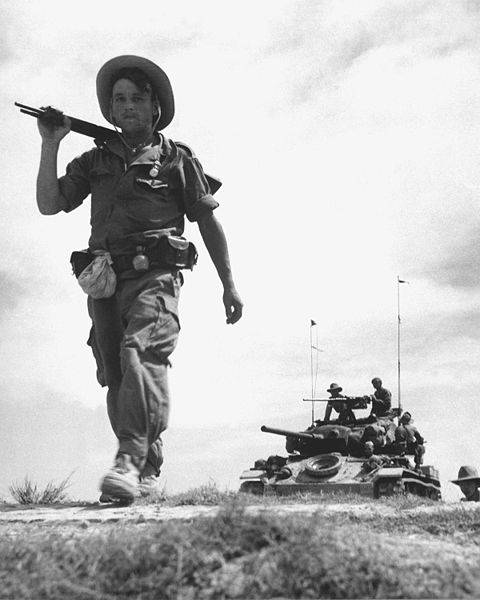
The French garrison was a good quality military force composed of veteran units. It was comprised of Paras, Foreign Legion, Colonials (Marines), North Africans and Vietnamese troops. Ordinarily in a pitched battle it would have done well, but this was no ordinary battle and their Viet Minh opponents were equally combat hardened, well led and well supplied and fighting for their independence.

Many of the French officers including Lieutenant Colonel Langlais and Major Marcel Bigeard commander of the 6th Colonial Parachute Battalion were among the best leaders in the French Army. Others who served in Indochina including David Galula and Roger Trinquier would write books and develop counter-insurgency tactics which would help Americans in Iraq. Unfortunately the French High Command badly underestimated the capabilities and wherewithal of the Giap and his divisions.

65193421-small_269244

Viet Minh Supply Column

Giap rapidly concentrated his forces and built excellent logistics support.  He placed his artillery in well concealed and fortified positions which could use direct fire on French positions. Giap also had more and heavier artillery than the French believed him to have.  Additionally he brought in a large number of anti-aircraft batteries whose firepower from well concealed positions enabled the Viet Minh to take a heavy toll among the French aircraft that attempted to supply the base.  Unlike at Na-Son, Giap did not throw his men away in human assaults.  Instead he used his Sappers (combat engineers) to build protective trenches leading up to the very wire of French defensive positions. These trenches provided both concealment and protection from the French. In time these trenches came to resemble a spider web that enveloped the French base.

Without belaboring the point the French fought hard as did the Viet Minh. One after one French positions were overwhelmed by accurate artillery and well planned attacks.  The French hoped for U.S. air intervention, even the possibility of the United States using nuclear weapons against the Viet Minh. They were turned down by a US Government that had grown tired of a war in Korea.

dien bien phu6

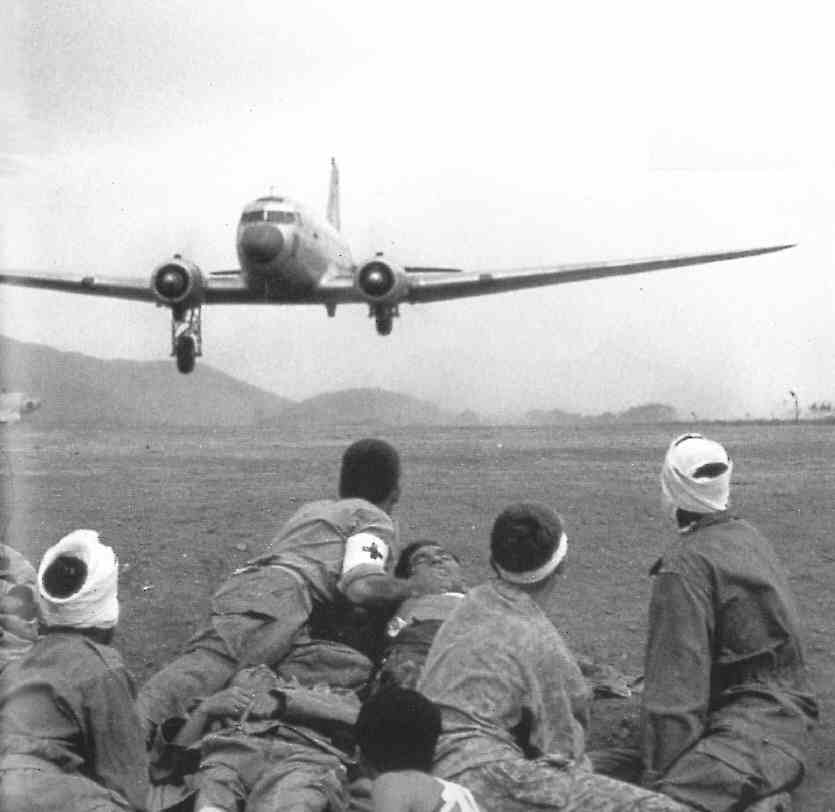
Wounded Awaiting Medivac 

Relief forces were unable to get through and the garrison died, despite the bravery of the Paratroops. Colonials and Legionaries. The French garrison was let down by their high command and their government and lost the battle due to inadequate logistics and air power. The survivors endured a brutal forced march of nearly 400 miles on foot to POW camps in which many died. Many soldiers who survived the hell of Dien Bien Phu were subjected to torture, including a practice that we call “water boarding.” General Georges Catroux who presided over the official inquiry into the debacle at Dien Bien Phu wrote in his memoirs: “It is obvious that there was, on the part of our commanding structure, an excess of confidence in the merit of our troops and in the superiority of our material means.”

Few French troops caved to the Viet Minh interrogations and torture but some would come away with the belief that one had to use such means to fight the revolutionaries.  Some French troops and their Algerian comrades would apply these lessons against each other within a year of their release. French soldiers and officers were shipped directly from Indochina to Algeria to wage another protracted counterinsurgency often against Algerians that they had served alongside in Indochina. The Algerian campaign proved to be even more brutal and it was lost politically before it even began.

dien_bien_phu

The March to Captivity

The wars in Indochina and Algeria tore the heart out of the French Army. The defeats inflicted a terrible toll. In Indochina many French career soldiers felt that the government’s “lack of interest in the fate of both thousands of missing French prisoners and loyal North Vietnamese…as dishonorable.” Divisions arose between those who served and those who remained in France or Germany and created bitter enmity between soldiers. France would endure a military coup which involved many who had fought in Vietnam and Algeria. Having militarily won that war these men called The Centurions by Jean Lartenguy had been turned into liars by their government.  They were forced to abandon those who they had fought for and following the mutiny, tried, imprisoned, exiled or disgraced. Colonial troops who remained loyal to France were left without homes in their now “independent” nations. They saw Dien Bien Phu as the defining moment. “They responded with that terrible cry of pain which pretends to free a man from his sworn duty, and promises such chaos to come: ‘Nous sommes trahis!’-‘We are betrayed.’

The effects of the wars in French Indochina, Algeria and Vietnam on the French military establishment were long lasting and often tragic. The acceptance of torture as a means to an end sullied even the hardest French officers. Men like Galula and Marcel Bigeard refused to countenance it, while others like Paul Aussaresses never recanted.

One of the most heart rending parts of the Dien Bien Phu story for me is that of Easter 1954 which fell just prior to the end for the French:

“In all Christendom, in Hanoi Cathedral as in the churches of Europe the first hallelujahs were being sung. At Dienbeinphu, where the men went to confession and communion in little groups, Chaplain Trinquant, who was celebrating Mass in a shelter near the hospital, uttered that cry of liturgical joy with a heart steeped in sadness; it was not victory that was approaching but death.” A battalion commander went to another priest and told him “we are heading toward disaster.” (The Battle of Dienbeinphu, Jules Roy, Carroll and Graf Publishers, New York, 1984 p.239)

Like many American veterans of Vietnam, many of the survivors of Dien Bien Phu made peace and reconciled with the Vietnamese soldiers who opposed them. While many still regretted losing they respected their Vietnamese opponents and questioned the leadership of their country and army. Colonel Jacques Allaire, who served as a lieutenant in a battalion under the command of MajorMarcel Bigeard reflected to a Vietnamese correspondent in 2014:

“I am now 92 years old and not a single day has gone by since the Dien Bien Phu loss that I haven’t wondered to myself about why the French army lost…Victory was impossible and too far away from us. The aircrafts were not able to give us relief. The French Government changed 19 times in nine years and that messed everything up. General Navarre did not know anything about the battlefield in Vietnam. After the Na San battle, the French commanders thought they could win and decided to attack at Dien Bien Phu, but they were wrong. It was Vietnamese soldiers who owned the hills, because it was their country… I respect my own enemies, who fought hard for national independence…Vietnam Minh soldiers were true soldiers with the will, courage and morality…” 

As a veteran of Iraq whose father served in Vietnam I feel an almost a spiritual link to our American and French brothers in arms who fought at Dien Bien Phu, the Street Without Joy, Algiers and places like Khe Sanh, Hue City, the Ia Drang and the Mekong. When it comes to this time of year I always have a sense of melancholy and dread as I think of the unlearned lessons and future sacrifices that we may be asked to make.

FrenchForeignLegionaireVtNamDOD

Legionairs on the Street Without Joy

The lessons of the French at Dien Bien Phu and in Indochina were not learned by the United States as it entered Vietnam, Iraq or Afghanistan. Nor were the lessons of Algeria. It was an arrogance for which we paid dearly and I do not think that many in our political, media and pundits or military have entirely learned or that we in the military have completely shaken ourselves. We lost 54,000 dead in Vietnam, nearly 4500 in Iraq and so far over 2400 in Afghanistan, and 20,000 wounded which does not count many of the PTSD or TBI cases. Add the casualties suffered by our NATO allies the number of allied dead is now over 3500. Some 36,000 Afghan National Army soldiers and Police officers have been killed. Afghan civilian deaths are estimated between 100,000 and 400,000, not counting the wounded or those killed in Pakistan. In January 2018 the Pentagon classified data on Afghan military, police, and civilian casualties.

The Afghan debacle has spanned three Presidential administrations so there accountability for it must be shared between Presidents Bush, Obama, and Trump, as well as their administrations, the military, and Congress. President Trump has shifted gears from the time he was a candidate when he pronounced the war “lost” to when addressed it as President on August 21st 2017. In his speech at fort Myer Virginia he said:

“When I became President, I was given a bad and very complex hand, but I fully knew what I was getting into:  big and intricate problems.  But, one way or another, these problems will be solved — I’m a problem solver — and, in the end, we will win.” 

But he also said:

“Someday, after an effective military effort, perhaps it will be possible to have a political settlement that includes elements of the Taliban in Afghanistan, but nobody knows if or when that will ever happen…” 

There are those even as we have been at war for almost 18 years in Afghanistan who advocate even more interventions in places that there is no good potential outcome, only variations on bad. I do not know how the President who calls himself a “problem solver” will define winning, but how many more American Soldiers, Sailors, Marines and Airmen will need die  for a “victory” that we cannot even define?

normal_03_56_F8F_decollage_a_DBP_Beriel_ph

French Navy F-8 Bearcat at Dien Bien Phu

Like the French our troops who returned from Vietnam were forgotten.The U.S. Army left Vietnam and returned to a country deeply divided by the war. Vietnam veterans remained ostracized by the society until the 1980s. As Lieutenant General Harold Moore  who commanded the battalion at the Ia Drang immortalized in the film We Were Soldiers recounted “in our time battles were forgotten, our sacrifices were discounted, and both our sanity and suitability for life in polite American society were publicly questioned.”

I think that will be the case for those of us who served in Iraq, Afghanistan, or Syria. Americans love to say they support the troops and are overwhelmingly polite and even kind when they encounter veterans. But that being said even as they do that they don’t are ignorant about our campaigns, battles, and sacrifices; and even worse fail to hold the government regardless of administration accountable for sending American troops into wars that they cannot win. That being said the Trump administration is talking up and ramping up for a possible showdown with Iran.

I guess that is why I identify so much with the men of Dien Bien Phu. The survivors of that battle are now in their nineties and dissolved their Veterans of Dien Bien Phu association in 2014 due to the difficulties most had in traveling.

For those interested in the French campaign in Indochina it has much to teach us. Good books on the subject include The Last Valley by Martin Windrow, Hell in a Very Small Place by Bernard Fall; The Battle of Dien Bien Phu by Jules Roy; and The Battle of Dien Bien Phu – The Battle America Forgot by Howard Simpson. For a history of the whole campaign, read Street Without Joy by Bernard Fall. A novel that has some really good insights into the battle and the French Paras and Legionnaires who fought in Indochina and Algeria is Jean Larteguy’s  The Centurions. 

I always find Fall’s work poignant.  The French journalist served as a member of the French Resistance in the Second World War and soldier later and then became a journalist covering the Nuremberg Trials and both the French and American wars in Vietnam. He was killed on February 21st 1967 near Hue by what was then known as a “booby-trap” and what would now be called an IED while covering a platoon of U.S. Marines.

I do pray that we will learn the lessons before we enter yet another hell somewhere else.

Peace

Padre Steve+

2 Comments

Filed under counterinsurency in afghanistan, Foreign Policy, History, leadership, Military, national security, News and current events, Political Commentary, shipmates and veterans, vietnam

The Psychology Of Dictatorship: Why Don’t We Learn From History?

Friends of Padre Steve’s World,

Another weekend, another attack on a synagogue, and another crazed rally in which the President again made wild swings directed at his opponents and admitted it was his “sick idea” to try to send detainees from the border to Sanctuary Cities. His words, his sick idea, even as his Attorney General hints that he will not submit to testifying to Congress on the Muller Report.

Normal American Presidents and their officials do not carry on this way. Dictators do, but not American Presidents, however it is part and parcel of everything that the President and his administration says or does. So tonight I am reposting something that I wrote a while back after reading British Military Historian Sir Basil Liddell-Hart’s little, but important book, “Why Don’t We Learn From History.”

NPG x25404; Sir Basil Henry Liddell Hart by Howard Coster

B.H. Liddell-Hart

Friends of Padre Steve’s World,

I have Read the short but poignant little but by the British military historian B.H. Liddell-Hart entitled Why Don’t We Learn from History, several times. The book was written in not long before his death in 1970 and it is good quite good. It deals with a number of issues, including the conflict between history and propaganda; or when faith, especially religious faith as treated as historic or scientific fact; and when propaganda or faith is preached as if it were history, if it were truth. In doing this he also contrasted democracy and lure of totalitarianism.

Liddell-Hart was a realist, especially about democracy and totalitarianism. He served on the Western Front in the First World War and was wounded in a German gas attack. Between the wars he was one of the theorists of armored warfare and the use of tanks in a combined arms force, and he was also quite observant of the trends toward totalitarianism in the late 1920s and 1930s.

Hart, like many others admitted the inefficiencies of democracy, however, he realized that it was far less dangerous than the “stupidity” of totalitarianism. In fact it was important for him to note just how this inefficient system was for freedom. He wrote:

“What is of value in “England” and “America” and worth defending is its tradition of freedom, the guarantee of its vitality. Our civilization, like the Greek, has, for all its blundering way, taught the value of freedom, of criticism of authority, and of harmonising this with order. Anyone who urges a different system, for efficiency’s sake, is betraying the vital tradition.”

There is much to ponder in his book and I will be posting some more of my thoughts on it, but when I looked at it again I was struck by just how much Liddell-Hart in his description of a despot described President Donald Trump through the his campaign and after his election and inauguration.

“We learn from history that self-made despotic rulers follow a standard pattern. In gaining power: They exploit, consciously or unconsciously, a state of popular dissatisfaction with the existing regime or of hostility between different sections of the people. They attack the existing regime violently and combine their appeal to discontent with unlimited promises (which, if successful, they fulfil only to a limited extent). They claim that they want absolute power for only a short time (but “find” subsequently that the time to relinquish it never comes). They excite popular sympathy by presenting the picture of a conspiracy against them and use this as a lever to gain a firmer hold at some crucial stage.” 

Once authoritarian, despotic, or dictatorial leaders gain power through the democratic process they seldom deviate from how they behave when seeking power. Liddell-Hart wrote:

“We learn from history that time does little to alter the psychology of dictatorship. The effect of power on the mind of the man who possesses it, especially when he has gained it by successful aggression, tends to be remarkably similar in every age and in every country.”

So please, take a breathe for a second and think about this in terms of President Trump and his actions during his first two weeks in office. Liddell-Hart noted that once a despot achieves power that their reign is marked by the following types of events:

“On gaining power:  They soon begin to rid themselves of their chief helpers, “discovering” that those who brought about the new order have suddenly become traitors to it. 

They suppress criticism on one pretext or another and punish anyone who mentions facts which, however true, are unfavourable to their policy. They enlist religion on their side, if possible, or, if its leaders are not compliant, foster a new kind of religion subservient to their ends. 

They spend public money lavishly on material works of a striking kind, in compensation for the freedom of spirit and thought of which they have robbed the public. 

They manipulate the currency to make the economic position of the state appear better than it is in reality. 

They ultimately make war on some other state as a means of diverting attention from internal conditions and allowing discontent to explode outward. 

They use the rallying cry of patriotism as a means of riveting the chains of their personal authority more firmly on the people. 

They expand the superstructure of the state while undermining its foundations by breeding sycophants at the expense of self-respecting collaborators, by appealing to the popular taste for the grandiose and sensational instead of true values, and by fostering a romantic instead of a realistic view, thus ensuring the ultimate collapse, under their successors if not themselves, of what they have created. 

This political confidence trick, itself a familiar string of tricks, has been repeated all down the ages. Yet it rarely fails to take in a fresh generation.”

Now pause for a moment. This is happening all over the world. It began again in Vladimir Putin’s Russia around 2010 and under a veneer of democratic “voting” Putin has become for all intents and purposes the dictator of Russia for as long as he desires. In Turkey Recip Erdogan has done the same thing, and it has also started in Hungary, Poland, and the Czech Republic. In China President Xi managed to abrogate the Chinese Communist Constitution to become ruler for life.

In the United States Donald Trump has been in office for about 27 months. Look at how he is behaving. Read his words, examine his actions, and not just during his presidency but throughout his business career and his campaign for the presidency. Then look at how his followers take it all in.

Then, take the time to let Liddell-Hart’s words sink in.

This is something to think about.

Peace

Padre Steve+
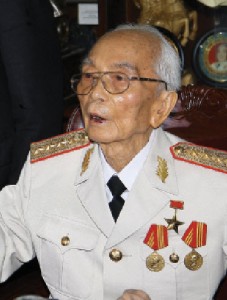
1 Comment

Filed under History, leadership, News and current events, Political Commentary