Tag Archives: republican party

The Day After: Reflections

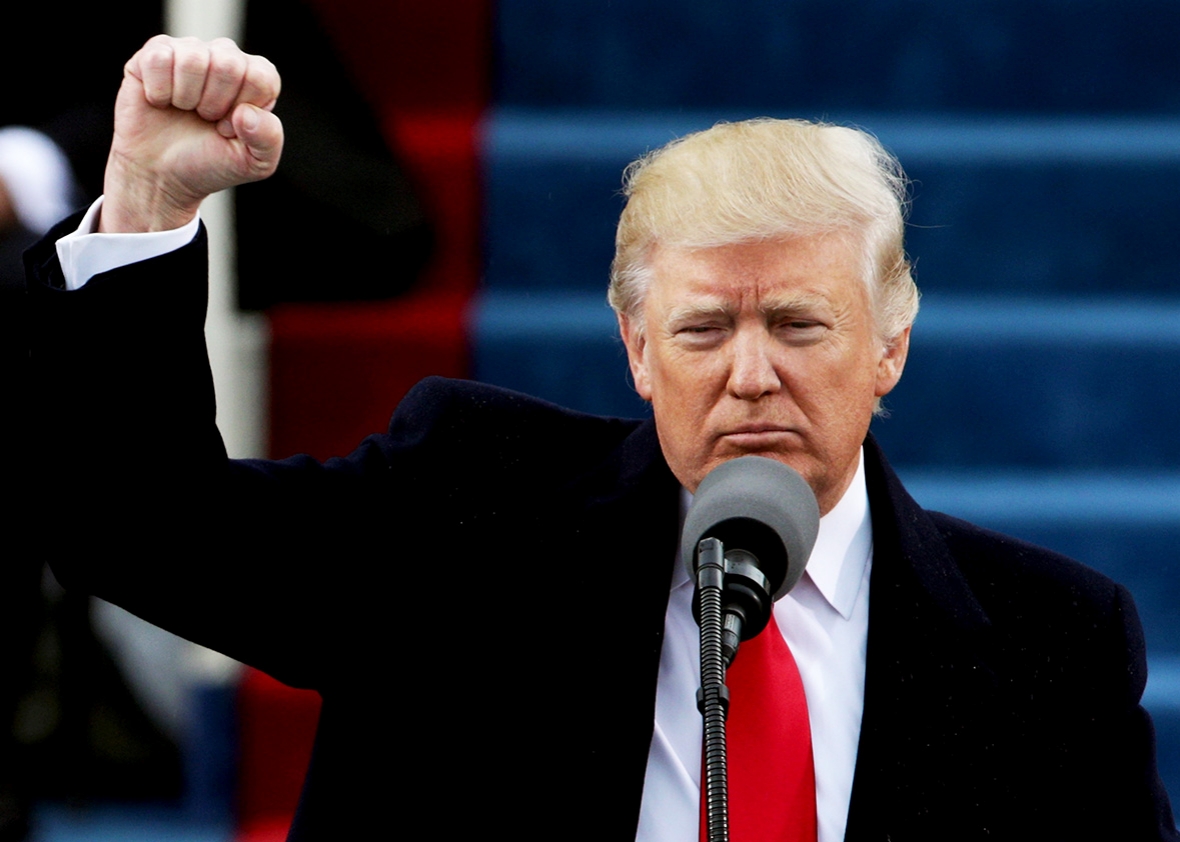
trump-fist-pump

Friends of Padre Steve’s World,

Just a short note this morning. I was pretty busy around the house yesterday and I have been battling a cold for the past week that keeps lingering. I hate being woken up coughing during the night.

Anyway, this morning before I started to do some work around the house I took time to read articles and opinions from around the world and from many points of view on the meaning of President Trump’s assumption of office and inaugural address. They varied with from great concern and near panic to hope. What I am not going to do today is talk about details of those articles. They are all over the web and I encourage my readers to take the time to visit American newspapers and publications of various political and ideological points of view as well as the English language websites of European, Asian, and Middle Eastern news services, newspapers and journals. If you don’t have the time for that the New York Times Opinion section has a great interactive section with many writers of various political views from around the world that you can scroll through at your leisure as it goes on and on. But I really think that no-matter what your political beliefs or ideology are that it does help to read things outside of your bubble or comfort zone. Too many people never leave their bubble and it does us great harm because we don’t understand each other, we don’t know each other, and what we believe about each other is indelibly poisoned because all we see is the caricature, and not real people.

Anyway, the latest book that I finished reading was German historian Heinz Hohne’s tome about Heinrich Himmler and his SS entitled The Order of the Death’s Head: The Story of Hitler’s SS. The book is a fascinating read because it describes the chaotic administration of Nazi Germany which though it was a totalitarian state was a bureaucratic nightmare of competing organizations of the Nazi Party and the German State, bound together, yet each dependent on the graces of Adolf Hitler, who in order to maintain his undisputed power would play them off against each other. But I do highly recommend Hohne’s book. I am not going to go into detail here, I may write something in the near future on the subject as I go through my old texts from my undergraduate and graduate school dealing with the Nazi state, but I digress…

Anyway, my takeaway from President Trump’s inaugural address and subsequent remarks yesterday and today is that he is going to maintain a very small number of trusted advisors, and play off competing factions of the Republican Party and various Federal agencies, maintain his rhetoric to keep his personal base of voters in line all to ensure his personal power. I think that he will be successful in this as he seems to be rather genius at outmaneuvering his opponents. Those in the GOP who think that they can control him or to reign him in to their more traditional conservatism should take note of his words as he ripped the political class of Washington DC; his words were aimed as much at the GOP insiders as they were the Democrats. His administration will be centered on him.

His raised fist served as a visible symbol and reminder to those who think that they can get the best of him. Some of the articles that I read seem to indicate that he will fall afoul of the GOP Congress if he maintains his populist rhetoric and does not tow the GOP think tank policy that has long dominated the GOP caucus. But Congress should beware, Trump does not appear to care about the norms of how things are done in Washington and his followers expect him to act, and he will use them to intimidate Congressional Republicans if they try to use their majority to get in his way. He said as much when he said: “What truly matters is not which party controls our government, but whether our government is controlled by the people.”

I am not going to speculate what the result of this will be, but I do think that it will be chaotic because that seems to be what he thrives on.

After reading all of those reactions, re-watching the speech and his body language, and reading it again, I could not help but think that we are heading toward something we have never seen before in this country: an authoritarian leader at the helm of a populist movement that is not bound by party loyalty or ideology, whose opponents in both parties are disorganized and unable to grasp that the playing field itself has changed, as have the rules.

That is something that gives President Trump with his executive authority a huge advantage. He will invoke this authority through executive orders to move faster than the Republican congressional majority or the divided Democrats can, and to bypass them and the media by communicating directly with his supporters.

Anyway, those are just a few thoughts on the day after.

Peace

Padre Steve+

Leave a comment

Filed under History, laws and legislation, leadership, News and current events, Political Commentary

Direction to His Follower’s Fierce Primal Passions: A Post from Last Year, I Hate Being Right

img_0389

Friends of Padre Steve’s World,

I wrote this post a year ago, December 10th 2015 to be exact. You can look at the original here if you don’t believe me.

The Mob Determined the Theme

I have to admit that I was way ahead of almost all the professional prognosticators, pollsters, and pundits about what Trump had tapped into. Maybe some network or major newspaper needs to hire me. Anyway, read it and weep.

Peace

Padre Steve+

When Albert Speer discussed the ability of Adolf Hitler to captivate the German people he noted something important. He discussed how Hitler and his minions played to them set by the disgruntled and angry German population. Speer wrote, “The mob determined the theme. To compensate for misery, insecurity, unemployment, and hopelessness, this anonymous assemblage wallowed for hours at a time in obsessions, savagery and license. The personal unhappiness caused by the breakdown of the economy was replaced by a frenzy that demanded victims. By lashing out at their opponents and vilifying the Jews, they gave expression and direction to fierce primal passions.”

Hitler played to that misery, insecurity and the obsessions of the politically and economically disaffected “conservative base” that no longer trusted the party establishments of the old-line conservative parties. He also played to the deep-rooted racism and anti-Semitism of those people. Hitler was an outsider, he was not indebted to any traditional party hierarchy and as such was able to throw away convention and play to the fear and anger of many Germans.

heres-what-donald-trump-supporters-really-believe

Donald Trump is doing today and he is running circles around the traditional politicians of the Republican Party. Every time trump says something that would have gotten himself blown out of the race twenty years ago had he said such things, today his poll numbers keep going up. He is now trending around 35% in most polls of GOP voters and my guess is that those numbers are low, as some supporters may not be willing to tell a pollster that they are for Trump, at least yet. My guess is that Trump’s support in the GOP is probably higher than 40% and won’t go down much. The party hierarchy and most of Trump’s primary rivals consistently criticize Trump, but most say that they will back him if he is the nominee. I cannot imagine that being the case twenty years ago when both the party establishment and the voters would have dumped him in a New York minute.

Aug. 21. 2015 Mobile, AL, Trump supporters at his campaign pep rally in Ladd Peebles Stadium. These women are all party of the Republican Party and plan to vote for Trump.  Over 20 thousand came to the Ladd-Peebles Stadium to attend Trumps campaign pep rally. 40,000 were expected to come.

Trump understands the mood of much of the traditionally conservative public better than his Republican establishment competitors. Trump is not stupid, unlike Hitler who actually believed in his message, Trump is not a radical, he cannot be, he has too much invested in the system. Instead, he is a street smart and pragmatic businessman who is exploiting the situation on the ground to his advantage. His opponents and the GOP establishment are frightened, but like the hidebound conservatives of the Weimar Republic who either dismissed or Hitler or thought that they could contain him are not willing to make a stand. As a result, Trump is able to play to the mood of the base and to coin a phrase, to “trump the establishment” by channeling the deepest anger, fear, hatred, xenophobia, and racism that the GOP establishment refuses to acknowledge. When there is a push back by the establishment it further angers the base, and Trump, quite adroitly threatens to leave the party; something which would doom the GOP in the 2016 general election, and possibly shatter the party.

Trump’s GOP opponents should not underestimate him and neither should establishment Democrats. Trump is using his celebrity bombast and the democratic process to take control of a major political party, and he is a lot smarter than most political analysts give him credit. As such, as a non-establishment outsider, Trump has a chance at taking over a major political party, something that has never before happened in the United States.

If he succeeds in his takeover bid, it will forever change American politics, especially if he is able to ride the fear, hatred, and fear to the White House. I don’t think the latter will happen, but I would not exclude it from the realm of the possible. To paraphrase Speer’s words about Hitler and Goebbels: By lashing out at their opponents and vilifying the Muslims and immigrants, Trump gave expression and direction to fierce primal passions of a disaffected GOP base.

Back to the present… I found it hard to believe that Trump could win the election, but I failed to account for the meddling of Russia, the complicity of the FBI Director, and the press’s neglect in not seeking the truth or treating Trump as a serious candidate during last two weeks of the campaign

But apart from that tell me if I was wrong in my assessment of Trump and his ability to read his audience and market himself in order to get their support. 

Peace

Padre Steve+


Leave a comment

Filed under Political Commentary

A Post Election Musing: What Now? 

Friends of Padre Steve’s World,

Tonight I am writing from the outskirts of Washington D.C. as we gather with a group of Papillon dog owners. Our two girls are being very good and once she got used to everyone, Izzy is now trying to get all the other dogs to play. It is nice, I have really enjoyed getting to know some of the people here, especially our hosts. I’m hoping that I get a chance to visit the Manassas Battlefield Park this weekend, it has always been one of those places that I have always driven by but never have had time to stop and see, but I digress…

I have been trying for the last few days to stay off of social media for the most part. Too much of what is out there is just too toxic for me to deal with. Instead I have been reading more reflective articles analyzing the election instead of anything partisan, especially the kind of pseudo news from highly biased people and groups that populates Facebook and some other social media sites. I haven’t turned on the television since the election, there isn’t any baseball on and frankly I have been too busy and tired this week to even want to turn it on, especially cable news. Likewise, I have done some reading and I have a number of books that I am sifting through right now. 

But for me I have spent time trying to sort out what has happened and think about historical context and not just the 24 hour news cycle. As I mentioned Wednesday, I am not going to do to President Elect Trump what so many conservatives did to President Obam. While I disagree with almost all what Trump said his policy would be during the campaign, and while I will not give him a pass on his own conduct during the campaign, I think that as President he does deserve a chance to succeed or fail on his own merits, and the fact is that while Trump frightens me, the thought of a President Pence absolutely terrifies me. Thus when I read people talking about the possibility of impeachment already, including Republicans, I am not about to climb aboard that boat anytime soon. 

So over the next few weeks I will do some articles about what might happen during the Trump Presidency regarding civil rights, the environment, economic policy, healthcare, and foreign policy. I will also write some articles about what I think Democrats need to do to regain the trust of the American people, and not just well off white progressives. I will also delve in to the morass of the Alt-Right and its resurgence, and the rise in political and racial violence that seems to be accompanying the Trump victory. 

Anyway. Have a great Saturday and do not despair; for sometimes the greatest changes that actually shape the future come in the wake of defeat. This is something that we as progressives need to remember and then take concrete actions to enunciate in ways that people can understand. We don’t do that well and it showed during this election. 

Peace,

Padre Steve+

Leave a comment

Filed under News and current events, Political Commentary

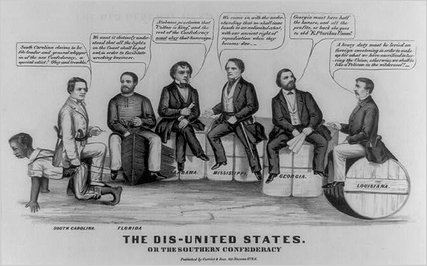
When Political Parties Implode: “Whom the gods intend to destroy, they first make mad” Secession

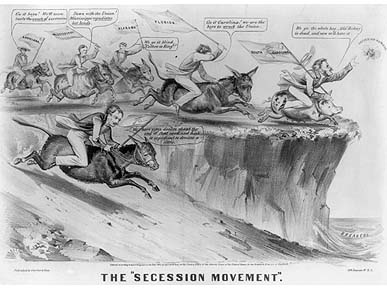
disunion_carolina-blog427

Friends of Padre Steve’s World,

This is the last section that I am posting regarding the breakup of the Whig and Democratic Parties in the years leading up to the Civil War. I think this one is very relevant today as Donald Trump and his supporters are calling the validity of  the election into question and threatening violence, coups, and revolution should Hillary Clinton be elected. There is no wisdom found in their actions. Driven by over 30 years of propaganda and over 50 years of measures that gave persecuted minorities such as African Americans, Hispanics, Women, and Gays the same basic rights as the white majority, the anger has reached a fever pitch and much of the Republican Party and what is so wrongly called the Conservative movement has gone mad. The title of this article includes the comment of William Lloyd Garrison in describing the mood of the South as Southern States began to secede. I wonder who will be the Republican Stephen Douglas who will attempt to pull the party out of the abyss that it is throwing itself headlong into. The irony is, that it is now the Republican Party that is doing what the Democrats did in 1860, but then the Republicans beginning in the 1960s became the old Democratic Party when they brought in the Dixiecrats and adopted the Southern Strategy.

I hope you enjoy,

Peace

Padre Steve+

secession-movement

After the election Lincoln tried to reassure the South that he would remain true to his campaign promise not to interfere with slavery where it already existed, but he also refused to give in to threats of secession. Despite his belief that anything that he said would be twisted into the exact opposite by Southerners, Lincoln released a statement through Senator Lyman Trumbull in Springfield saying:

“The states will be left in complete control of their affairs and property within their respective limits as they have under any administration. I regard it as extremely fortunate for the peace of the whole country, that this point, upon which the Republicans have been for so long, as so presently misrepresented, is now brought to a practical test, and placed beyond the possibility of doubt. Disunionists per se, are now in hot haste to get out of the Union, precisely because they perceive they cannot, much longer, maintain apprehension among the southern people that in their homes, and firesides, and lives, are to be endangered by the action of the Federal Government.” [1]

On his way to Washington D.C. the President Elect stopped in New York and gave a speech  “promising that he would “never of his own volition “consent to the destruction of this Union,” he qualified this promise with “unless it were that to be that thing for which the Union itself was made.” [2]  Two days later Lincoln speaking Independence Hall in Philadelphia Lincoln further detailed what he meant in New York, going back to the premise of the Declaration of Independence in which “he asserted that he “never had a feeling politically that did not spring from the sentiments embodied in the Declaration…. I was not the mere matter of separation of the colonies from the mother land; but rather something in that Declaration” that provided “hope for the world for all future time. It was that which gave promise that in due time the weights should be lifted from the shoulders of all men, and that all should have an equal chance.” [3] It was a thought that he would continue to refine in the Emancipation Proclamation Gettysburg Address, the Thirteenth Amendment and in his Second Inaugural Address.

Stephen A. Douglas tried to reassure the Southern leaders as well even as argued against secession. He reminded Southerners how he had fought against Lincoln and the platform of the Republican Party and stated “that the mere election of any man to the Presidency does not furnish just cause for dissolving the Union.” [4] Addressing Southern concerns in a pragmatic way, the Little Giant tried to diffuse Southern fears by reminding them that the answer to their fears lay in the checks and balances laid out in the Constitution and in the ballot box. Douglas’s next words redound to the present day:

“It is apprehended that the policy of Mr. Lincoln and the principles of his party endanger the peace of the slaveholding states. Is that apprehension founded? No, it is not. Mr. Lincoln and his party lack the power, even if they had the disposition, to disturb or impair the rights and institutions of the South. They certainly cannot harm the South under existing laws. Will they have the power to repeal or change these laws, or to enact others? It is well known that they will be a minority in both houses of Congress, with the Supreme Court against them. Hence no bill can pass either house of Congress impairing or disturbing these rights or institutions of the southern people in any manner whatever, unless a portion of southern senators and representatives absent themselves so as to give an abolition majority in consequence of their actions.

In short, the President will be utterly powerless to do evil…. Four years shall soon pass, when the ballot box will furnish a peaceful, legal, and constitutional remedy for the evils and grievances with which the country might be afflicted.” [5]

An attempt in Congress led by President James Buchanan and Senator John J. Crittenden of Kentucky to bring about a constitutional compromise to mollify both sides was considered. A committee of thirteen senators was convened to entertain various compromise propositions, however, most of the suggested compromises were heavily weighted toward Southern interests, though it promised to restore the prohibition of slavery north of the line drawn in the Missouri Compromise.

A frustrated Lincoln wrote, “I’ll tell you now what bothered me: the compromises measures introduced in Congress required the Republicans to make all the concessions.” [6] Lincoln warned Crittenden that such proposals would not be acceptable: “Entertain no proposition for a compromise in regard to the extension of slavery…. The instant you do they have us under again…. The tug has to come & better now than later.” [7]

Lincoln had seen how for four decades Southerners had pushed for compromises that only benefited them and the extension of slavery, even at the expense of Northern states rights and he was not about to let it happen again. The President Elect wrote:

“The Crittenden plan, I feared, would put the country back on the high road to a slave empire. Whether it was the revival of the Missouri Compromise line or a popular sovereignty, it was all the same. “Let neither be done,” I warned Republicans in Washington, “and immediately filibustering and extending slavery recommences. Within a year, we shall have to take Cuba as a condition on which the South will stay in the Union. Next it will be Mexico, then Central American. On the territorial question, I am inflexible. On that point hold firm as a chain of steel…” [8]

In the South the efforts of staunch Southern Unionists like Alexander Stephens to discourage secession were dismissed as the movement toward secession became a passion filled revolutionary movement, which acted as a cathartic movement for many Southerners. Like Douglas, Stephens had the greatest faith in the checks and balances provided in the Constitution and he pleaded with his fellow Georgians at the state capital of Milledgeville noting that the checks and balances “would render Lincoln “powerless to do any great mischief,” and he warned that “the dissolution of the Union would endanger this “Eden of the world,” that “instead of becoming gods, we shall become demons, and no distant day commence cutting one another’s throats…” [9] While his speech received favorable coverage in the North and even in London, it was met with little enthusiasm at home.

Influential Southern preachers joined in the push for secession and warned of what they saw as the dire consequences of Lincoln’s election. The Baptist clergyman James Furman expressed the outrage and paranoia of many in the South by warning after Lincoln’s election “If you are tame enough to submit, Abolition preachers will be at hand to consummate the marriage of your daughters to black husbands.” [10] Likewise entire southern denominations began to endorse secession, southern Methodists raised “alarms about a Union dominated by abolitionists as they called on the Lord for deliverance from the northern “Egypt.” The division of Israel and Judah (not to mention the nation’s already fractured churches became typologies for the American crisis. Just as southern Methodists had once “seceded from a corrupt church,” a Mississippi politician declared, “We must secede from a corrupt nation.” To drive the point home, Georgia Methodists ministers endorsed disunion by an overwhelming 87-9 vote.” [11]

Despite Lincoln and Douglas’s efforts during and after the election to strike a conciliatory tone, it did not take long before Southern states began to secede from the Union. In light of the profoundly sectional nature of Lincoln’s victory “emboldened many Southern politicians and journalists to insist that they would not be bound by the result.” [12] In his final speech before the Senate, Senator Robert Toombs of Georgia lambasted the “black Republicans” and abolitionists, “We want no negro equality, no negro citizenship, we want no negro race to degrade our own; and as one man [we] would meet you upon the border with the sword in one hand and the torch in the other.” [13] Other Senators, many who would become prominent leaders of the Confederacy made their speeches, some, like that of Jefferson Davis tinged with regret while others like Senator Stephen Mallory, and the future Secretary of the Navy for the Confederacy delivered a fiery broadside against his Northern colleagues, “You cannot conquer us. Imbue your hands in our blood and the rains of a century will not wipe away from them stain, while the coming generation will weep for your wickedness and folly.” [14] As these men finished the left the chambers of Congress where many had served for years many left with tears, while some marked their exit with angry words.

Alexander Stephens

Stephens, still a Unionist at heart lamented the election even as he prepared to leave the Senate before becoming the vice president of the Confederacy, warned that “revolutions are much easier started than controlled, and the men who begin them [often] …themselves become the victims.” [15] Even so the senator noted “If the policy of Mr. Lincoln and his Republican associates be carried out…no man in Georgia will be more willing or ready than myself to defend our rights, interest, and honor at every hazard and to the last extremity.” [16] But as he resigned his office Stephens replied to a friend’s question, “why must we have civil war?”

“Because there are not virtue and patriotism and sense enough left in the country to avoid it. Mark me, when I repeat that in less than twelve months we shall be in the midst of a bloody war. What will become of us then God only knows.” [17]

But Stephens’ warning fell on deaf ears as passionate secessionist commissioners went throughout the South spreading their message of fear. “Thus fanned, mob spirit ran close enough to the surface to intimidate many moderates – the very temperament that inclines men toward moderation is apt to respond timidly when threatened or abused – and to push others closer to the extremist position.” [18] Such was the case with Southern moderates and Unionists as men like Stephens were swept up in the tumult as their states seceded from the Union. Senator Judah P. Benjamin of Louisiana wrote, “The prudent and conservative men South… were not able to stem the wild torrent of passion which is carrying everything before it…. It is a revolution…of the most intense character…and it can no more be checked by human effort, for the time, than a prairie fire by a gardener’s watering pot.” [19]

The Palmetto State of South Carolina was the first state to secede. Its senior senator, James Chesnut launched a fusillade against the North in a speech before the state legislature in which he argued that the South could not wait for another election: He thundered:

“Because of the Yankee puritans’ invasive mentality, incendiary documents would flood our region, Southern Republicans would fill our offices. Enemies would control our mails. The resulting upheaval would make “Lincoln’s election…a decree for emancipation. Slavery cannot survive the four years of an administration whose overwhelming influences” will be “brought to bear against it.” To submit now is to guarantee that before 1865, we must “slay the Negro, or ourselves be slain.”  [20]

William Tecumseh Sherman was serving as the President the Louisiana State Seminary of Learning and Military Academy, what is now Louisiana State University. Like many men in the ante-bellum era, Sherman had thought little about the slavery issue, though he was very concerned with the preservation of the Union. He thought secession made no sense, especially for the people of the South. When Sherman read the news of South Carolina’s secession it “cut to the depths of his nationalistic soul.” The future general wept, and told his friend David Boyd “Boyd, you people of the South don’t know what you are doing! You think you can tear to pieces this great union without war…. “The North can make a steam-engine, locomotive, or railway car; hardly a yard of cloth or shoes can you make. You are rushing into war with one of the most powerful, ingeniously mechanical and determined people on earth…. You are bound to fail. Only in spirit and determination are you prepared for war.” [21] Sherman, the man who later proclaimed that “War is Hell” proved to be a remarkably accurate seer regarding the fate of the Confederacy.

South Carolina was followed by Mississippi, Florida, Alabama, Georgia, Louisiana and Texas. “A belt of seven states from South Carolina to Texas, embracing nearly one-sixth of the country’s population and nearly one-fifth of the national domain, had proclaimed independence and severed its ties with the Union.” [22] Many of the declarations of causes for secession made it quite clear and explicit that slavery, and fear that the institution was threatened by Northern abolitionists was the root cause. The declaration of South Carolina is typical of these and is instructive of the basic root cause of the war:

“all the States north of that line have united in the election of a man to the high office of President of the United States, whose opinions and purposes are hostile to slavery. He is to be entrusted with the administration of the common Government, because he has declared that that “Government cannot endure permanently half slave, half free,” and that the public mind must rest in the belief that slavery is in the course of ultimate extinction.” [23]

Throughout the war slavery loomed large, even though in the beginning of the abolition controversies of the 1830s many northerners “were content to tolerate slavery’s indefinite survival in the South so long as it did not impinge on their own rights and aspirations at home.” [24] Such attitudes were still common in the North during the late 1850s, especially among Democrats.

But it was the continued actions and multiple transgressions of slavery supporters that energized northerners as never before. Their use of the courts to advance their rights and the cause of slavery, by the compromises that had extended slavery to the territories; their use of the courts especially the Dred Scott to allow slaveholders to recover their human property, even in Free States provoked no end of indignation throughout the North, even for those sympathetic to Southern concerns. Those actions demonstrated to Northerners:

“just how fundamental and intractable the differences with Southern political leaders were. Thus educated, most northern voters had decided by 1860 that only an explicitly anti-slavery party could protect their interests.” [25]

The fiery abolitionist and profoundly religious editor of The Liberator, William Lloyd Garrison, used biblical imagery in a rather astute analysis of the behavior of Southern leaders after the election of 1860. He wrote of the Southern response to Lincoln’s election:

“Never had the truth of the ancient proverb “Whom the gods intend to destroy, they first make mad” been more signally illustrated than in the condition of southern slaveholders following Lincoln’s election. They were insane from their fears, their guilty forebodings, their lust for power and rule, hatred of free institutions, their merited consciousness of merited judgments; so that they may be properly classed as the inmates of a lunatic asylum. Their dread of Mr. Lincoln, of his Administration, of the Republican Party, demonstrated their insanity. In vain did Mr. Lincoln tell them, “I do not stand pledged to the abolition of slavery where it already exists.” They raved just as fiercely as though he were another John Brown, armed for southern invasion and universal emancipation! In vain did the Republican party present one point of antagonism to slavery – to wit, no more territorial expansion. In vain did that party exhibit the utmost caution not to give offense to any other direction – and make itself hoarse in uttering professions of loyalty to the Constitution and the Union. The South protested that its designs were infernal, and for them was “sleep no more!” Were these not the signs of a demented people?” [26]

But both sides were blind to their actions and with few exceptions, most leaders, especially in the South badly miscalculated the effects of the election of 1860. The leaders in the North did not realize that the election of Lincoln would mean the secession of one or more Southern states, and Southerners “were not able to see that secession would finally mean war” [27] despite the warnings of Alexander Stephens to the contrary. In fact throughout the South it was believed that there would be no war because “they believed that the Yankees were cowards and would not fight”… “Senator James Chesnut of South Carolina offered to drink all the blood shed as a consequence of secession. It became a common saying in the South during the secession winter that “a lady’s thimble will hold all the blood that will be shed.” [28]

Following their secession the five slave states of the lower South: “appointed commissioners to the other slave states, and instructed them to spread the secessionist message across the entire region. These commissioners often explained in detail why their states were exiting the Union, and they did everything in their power to persuade laggard slave states to join the secessionist cause. From December 1860 to April 1861 they carried the gospel of disunion to the far corners of the South.” [29]

The editors of the Philadelphia Press accused the Southern secessionists of being enemies of democracy and wrote:

“should the Cotton States go out in a body, we shall witness the beginning of an experiment to establish, on this continent, a great slaveholding monarchy. With few exceptions, the leaders of the Disunion cabal are men of the most aristocratic pretensions – men who…easily adopt the habits and titles of the European nobility. South Carolina, which is the head of Secession, is almost a monarchy herself. Her representatives in both branches of Congress, for years past, have acted upon the idea that the people of the free states are servile, and Mr. Hammond, the most candid and straightforward of the set, denounced the laboring white masses of the free States as the mudsills of society …” [30]

The mood of the South in the fall of 1860 was “fearful, uncertain, impatient and volatile, eager to adopt the course that best offered hope of deliverance – which was ideally suited for the immediacy and urgency of the radical secessionists.” [31] Using the political machinery of the Democratic Party in the South which they now possessed, the proponents of secession were far better organized than Southern Unionists who had a difficult time putting up a united front in the face of the radicals.

Slavery and the superiority of the white race over blacks were at the heart of the message brought by these commissioners to the legislatures of the yet undecided states. Former Congressman John McQueen of South Carolina wrote to secessionists in Virginia “We, of South Carolina, hope to greet you in a Southern Confederacy, where white men shall rule our destinies, and from which we may transmit our posterity the rights, privileges and honor left us by our ancestors.” [32] In Texas McQueen told the Texas Convention: “Lincoln was elected by a sectional vote, whose platform was that of the Black Republican part and whose policy was to be the abolition of slavery upon this continent and the elevation of our own slaves to an equality with ourselves and our children.” [33] These Southern secessionists were realists, they knew that the election of 1860 was a watershed in terms of the history of slavery in the United States, emancipation was coming, it might take a decade, it might take twenty-five or even fifty years, but they knew that it was coming, and for them secession was the only logical action left that was “consistent with their ideology.” [34] Many of these men now viewed it as an issue of now or never.

In his First Inaugural Address Lincoln cut to the heart of the division in the country: “One section of our country believes slavery is right and ought to be extended, while the other believes it is wrong and ought not to be extended. This is the only substantial dispute.” [35] Of course he was right, and his Southern opponents agreed. Jefferson Davis wrote: “The great northern party, thus organized, succeeded in electing to the office of the Presidency a man who openly proclaimed his hatred of slavery, who declared that the government could not endure “half slave and half free.” [36]

As the war began, white Southerners of all types and classes rallied to the call of war against the hated Yankee. The common people, the poor yeomen farmers were often the most stalwart defenders of the South. With the Orwellian slogan “Freedom is not possible without slavery” ringing in their ears, they went to war against the Yankees alongside their slave-owning neighbors to “perpetuate and diffuse the very liberty for which Washington bled, and which the heroes of the Revolution achieved.” [37]

Alexander Stephens, the longtime friend of Lincoln who had been a devout Unionist, who had supported Stephen Douglas until the bitter end, and who had strenuously opposed secession in the months leading to the election of 1860 was now the Vice President of the Confederacy. He had been elected Vice President the same day as Jefferson Davis was elected President by the new Confederate Congress and now went through the South speaking about the nature of the new government.  Stephens explained the foundations of the Southern state in his Cornerstone Speech of March 21st 1861, the speech echoed what many Southerners had believed for years regarding slavery and the status of Blacks, namely that Blacks were a lesser order of humanity:

Our new government is founded upon exactly the opposite idea; its foundations are laid, its corner- stone rests upon the great truth, that the negro is not equal to the white man; that slavery — subordination to the superior race — is his natural and normal condition. [Applause.] This, our new government, is the first, in the history of the world, based upon this great physical, philosophical, and moral truth.” [38]

Jefferson Davis had issued instructions to cabinet members to downplay slavery as an issue and was infuriated. The new President of the Confederacy wrote: “That speech infuriated me, Oh, what Stephens had said was true, perfectly true, but could anything hurt us more abroad than such impolitic remarks? It was the beginning of a fatal falling out between me and that rebellious and vindictive dwarf, who was hell-bent on forming his own policies and disputing mine with niggardly deviousness.” [39]

The Orwellian definition of slavery as being necessary to liberty and the Confederate leader’s proclamations that they were comparable to the founding fathers was condemned throughout the North. The editors of the New York Evening Post wrote:

“The founders fought to “establish the rights of man… an principles of universal liberty.” The South was rebelling “not in the interest of general humanity, but of a domestic despotism…. Their motto is not liberty, but slavery.” Thomas Jefferson’s Declaration of Independence spoke for “Natural Rights against Established Institutions,” added the New York Tribune, while “Mr. Jeff. Davis’s caricature thereof is made in the interest of an unjust, outgrown, decaying institution against the apprehended encroachments of human rights.” It was, in short, not a revolution for liberty but a counterrevolution “reversing the wheels of progress…. to hurl everything backward into deepest darkness… despotism and oppression.” [40]

Secession commissioners from the first seven Confederate States fanned out to the undecided Slave states to spread the message of secession. One of these men was Henry Benning of Georgia. Benning spoke to the secession convention of Virginia, a state that the new Confederacy deemed all-important to its cause and which it had to have on its side in the coming confrontation with the Union. There the Georgia Supreme Court Justice used the time-honored method of racial fear mongering to sway the men of the Virginia House of Delegates, he thundered:

“If things are allowed to go on as they are, it is certain that slavery is be abolished except in Georgia and the other cotton States, and…ultimately in these States also,” Benning insisted. “By the time the North shall have attained the power, the black race will be a large majority, and we will have black governors, black legislatures, black juries, black everything.” [41] 

Not letting up the fiery Georgian told the Virginians that the North would invade the South to end slavery and of the outcome of such an invasion:

“We will be overpowered and our men compelled to wander like vagabonds all over the earth,” he told his audience, “and for our women, the horrors of their state cannot contemplate in imagination.” This then, was “the fate that Abolition will bring upon the white race….We will be exterminated.” [42]

Virginia’s Governor, John Letcher was “a longtime foe of secession and had wanted to bring slavery to an end in Virginia, but once elected to the governorship he adroitly put all that behind him, and rather like [Robert E.] Lee, he went to work with considerable efficiency for two causes in which he did not believe.” [43] One Unionist delegate to the convention wrote of the proceedings, “The scenes witnessed within the wall of that room…have no parallel in the annals of ancient or modern times. On the morning of the 17th, Mr. Wise rose from his seat and drawing a large Virginia horse-pistol from his bosom laid it before him and proceeded to harangue the body in the most violent and denunciatory manner. He concluded by taking his watch from his pocket and, with glaring eyes and bated breath, declared that events were now transpiring which caused a hush to come over his soul.” [44] Those events were a planned seizure of Federal facilities including the arsenal at Harpers Ferry and the Naval Yard at Norfolk. But not all in Virginia were convinced. The strongly Unionist western counties of the state, where few people owned slaves and those who did held very few, voted heavily against secession. The counties withstood the initial shock of secession and would “in a wholly extra-legal way, abetted by Washington – perform its own act of secession, breaking away from Virginia and clinging to the Union as a bob-tailed but finally acceptable new state.” [45]

Former President John Tyler added his voice to the secession cause in Virginia and “personally drafted a document placing the state’s military force under Jefferson Davis’s direct command.” Shortly thereafter he was “elected to the Confederate Congress – becoming the only former President to win office in a foreign country.” [46] However, before he could take office, the former President, now an intractable enemy of the country that he once led, died in Richmond. Shortly thereafter his portrait was removed from its place of honor in the capital.

Tennessee was another state where secession was problematic. Eastern Tennessee was strongly Unionist and the counties “held a convention, denounced the governor and legislature for making the alliance with the Confederacy, and sent a memorial asking that the eastern counties be allowed to form a new state.” [47] The legislature and governor refused this but the area would prove a problem for Jefferson Davis as well as Lincoln who would have liked to help the Tennessee Unionists, but had no military way to do so.

The highly divided border states of Kentucky and Missouri remained in the Union, but became highly partisan battlegrounds between secessionists and Unionists in which insurgents used terrorist methods against their fellow citizens throughout the war. Kentucky’s pro-secession Governor, Beriah Magoffin called the legislature into convention to decide secession “but the legislature, by a vote of 54 to 36 in the lower house, refused to call one and adjourned on February 11 without taking any decisive action.” [48] Losing that vote, he issued a declaration of neutrality which caused both Lincoln and Jefferson Davis to move with caution in the state. Lincoln understood the strategic importance of Kentucky and said “I think to lose Kentucky is nearly the same as to lose the whole game….Kentucky gone, we cannot hold Missouri, nor, as I think, Maryland. These all against us, and the job on our hands is too large for us. We may as well consent to separation at once, including the surrender of this capital.” [49] Lincoln’s use of caution, diplomacy, and when needed the force of the law, courts, and the military paid strategic military and economic dividends for the North as the Ohio River remained under Union control.

Maryland too remained in the Union as Governor Thomas H. Hicks, with the help of federal troops resisted a call in the legislature for a secession vote, even so as Union volunteers marched to Washington in response to Lincoln’s calls for troops some regiments were attacked in Baltimore. The 6th Massachusetts Volunteer Infantry was set upon as a “crowd of southern sympathizers threw bricks and stones and fired into their ranks as they changed trains. They returned the fire, killing twelve citizens and wounding many more, then packed their four dead on ice for shipment north, and came on to Washington, bearing their seventeen wounded on stretchers.” [50]

To Lincoln, the issue of secession as well as territory was “never just about politics. To him it spoke about the nation, even if primarily as a symbol. In his mind the nation must be about freedom, never slavery.” [51] For him the Union was sacred and could not be dissolved for any reason, especially the cause of slavery. In contrast to the secessionists who proclaimed that the states had formed the Federal Government and had the right to dissolve the Union, Lincoln, using the reasoning and arguments of Daniel Webster asserted in his inaugural address that the Union actually predated the Constitution:

“Descending from these general principles, we find the propositions that, in legal contemplation, the Union is perpetual, confirmed by the history of the Union itself. The Union is much older than the Constitution. It was formed, in fact, by the Articles of Association in 1774. It was matured and continued by the Declaration of Independence in 1776. It was further matured, and the faith of all the then thirteen States expressly plighted and engaged that it should be perpetual, by the Articles of Confederation in 1778. And final, in 1787, one of the declared objects for ordaining and establishing the Constitution, was “to form a more perfect Union.” [52]

In early April 1861, a few days before the first shot was fired at Fort Sumter, a New York Times editorial made a proposition that unveiled the reality of the situation now confronting the divided nation, and which so many had for so long refused to face: “If two sections can no longer live together, they can no longer live apart in quiet until it is determined which is master. No two civilizations ever did, or can, come into contact as the North and South threaten to do, without a trial of strength, in which the weaker goes to the wall…. We must remain master of the occasion and the dominant power on this continent.” [53]

Thus, the American ideological war was born; it had taken decades to reach the point of no return. It had taken years of frustration, and attempts at compromise by politicians who attempted to dodge the moral issues inherent in slavery. Time could not heal the wounds caused by slavery as long as “one section of the country regarded it as a blessing, the other as a curse.” [54] Frederick Douglass observed: “Whatever was done or attempted with a view to the support and secularity of slavery on served to fuel the fire, and heated the furnace of [anti-slavery] agitation to a higher degree than had any before attained.” [55]

Notes

[1] Ibid. Oates The Approaching Fury pp.355-356

[2] Ibid. Goodwin Team of Rivals p. 310

[3] Ibid. Goodwin Team of Rivals p. 310

[4] Ibid. Oates The Approaching Fury p.338

[5] Ibid. Oates The Approaching Fury pp.338-339

[6] Ibid. Oates The Approaching Fury p.355

[7] Ibid. Guelzo Fateful Lightning p.134

[8] Ibid. Oates The Approaching Fury pp.354-355

[9] Ibid. Goldfield America Aflame p.184

[10] Ibid. McPherson Drawn With Sword p.50 These words are little different than the words of many conservative Evangelical Christian pastors, pundits and politicians today in relation to the legalization of Gay marriage.

[11] Ibid. Rable God’s Almost Chosen Peoples pp.38-39

[12] Ibid. Holzer Lincoln and the Power of the Press p.256

[13] Ibid. Goodheart 1861 p.77

[14] Ibid. Goodheart 1861 p.77

[15] Ibid. McPherson The Battle Cry of Freedom p.238

[16] Cooper, William J. We Have the War Upon Us: The Onset of the Civil War November 1860-April 1861 Alfred a Knopf, New York 2012 p.75

[17] Ibid. Catton The Coming Fury pp.46-47

[18] Ibid. Catton Two Roads to Sumter pp.250-251

[19] Ibid. McPherson The Battle Cry of Freedom p.237

[20] Ibid. Freehling The Road to Disunion Volume II p.398

[21] O’Connell Robert L. Fierce Patriot: The Tangled Lives of William Tecumseh Sherman Random House, New York 2013 p65

[22] Ibid. Catton Two Roads to Sumter p.248

[23] __________ Declaration of the Immediate Causes Which Induce and Justify the Secession of South Carolina from the Federal Union. Retrieved from The Avalon Project, Yale School of Law http://avalon.law.yale.edu/19th_century/csa_scarsec.asp 24 March 2014

[24] Ibid. Levine Half Slave and Half Free p.251

[25] Ibid. Levine Half Slave and Half Free p.253

[26] Ibid. Oates The Approaching Fury p.342

[27] Ibid. Catton The Coming Fury p.122

[28] Ibid. McPherson The Battle Cry of Freedom p.238

[29] Ibid. Dew Apostles of Disunion p.18

[30] Ibid. Stampp The Causes of the Civil War p.189

[31] Ibid. Catton Two Roads to Sumter p.250

[32] Ibid. Dew Apostles of Disunion p.48

[33] Ibid. Dew Apostles of Disunion p.48

[34] Ibid. Foner Free Soil, Free Labor, Free Men p.145

[35] Lincoln, Abraham First Inaugural Address March 4th 1861 retrieved from www.bartleby.com/124/pres31.html 24 March 2014

[36] Ibid. Oates The Approaching Fury p.429

[37] Ibid. McPherson Drawn With Sword pp.50-51

[38] Cleveland, Henry Alexander H. Stevens, in Public and Private: With Letters and Speeches, before, during and since the War, Philadelphia 1886 pp.717-729 retrieved from http://civilwarcauses.org/corner.htm 24 March 2014

[39] Ibid. Oates The Approaching Fury p.382

[40] Ibid. McPherson The Battle Cry of Freedom p.244

[41] Ibid. Dew Apostles of Disunion p.66

[42] Ibid. Dew Apostles of Disunion p.67

[43] Ibid. Korda Clouds of Glory p.232

[44] Osborne, Charles C. Jubal: The Life and Times of General Jubal A. Earl, CSA Algonquin Books of Chapel Hill, Chapel Hill NC 1992 p.49

[45] Ibid. Catton The Coming Fury p.365

[46] Goodheart, Adam The Ashen Ruin in  The New York Times: Disunion, 106 Articles from the New York Times Opinionator: Modern Historians Revisit and Reconsider the Civil War from Lincoln’s Election to the Emancipation Proclamation Edited by Ted Widmer, Black Dog and Leventhal Publishers, New York 2013 p.71

[47] Ibid. Catton The Coming Fury p.365

[48] Ibid. Potter The Impending Crisis p.510

[49] Ibid. Foote The Civil War, A Narrative. Volume One: Fort Sumter to Perryville p.53

[50] Ibid. Foote The Civil War, A Narrative. Volume One p.53

[51] Ibid. Cooper We Have the War Upon Us p.80

[52] Ibid. Wills  Lincoln at Gettysburg p.130-131

[53] Ibid. Foote The Civil War, A Narrative. Volume One p.43

[54] Ibid. Catton Two Roads to Sumter p.143

[55] Ibid. Levine Half Slave and Half Free p.253

2 Comments

Filed under civil war, History, Political Commentary

When Political Parties Implode: “I refused to unite with a bunch of traitors and disunionists…” The 1860 Election

election-results-1860-map

Friends of Padre Steve’s World,

Instead of making direct comments regarding the developments in the current 2016 Presidential campaign, especially the repeated charges by Donald Trump that the election is rigged and continuing threats of violence coming from many of his supporters I have decided to push on with the series that I began last Friday which is excerpted from my draft book “Mine Eyes Have Seen the Glory” Race, Religion, Ideology, and Politics in the Civil War Era. The past three articles dealt with the breakup of the Whig and Democratic Parties and this one deals with the final break in the Democrats during the election of 1860. I took the title from what Stephen Douglas, the leader of the Northern Democrats and one of the two Democrat Presidential nominees said when Southern Democrats asked him to drop out of the race. I hope that you enjoy.

Peace

Padre Steve+

The crisis continued to fester and when Lincoln was elected to the Presidency in November 1860, with no southern states voting Republican, the long festering volcano erupted. The various crises of the 1850s had brought the political emotions nation to a fever pitch and 1860 election season saw a dramatic rise in the overtly racial invective of the pro-slavery Democrats, including many in the North. It was also the election that “marked the crystallization of two fully sectionalized parties,” [1] neither of which could find a place of compromise in order to save the Union. A Mississippian observed that “the minds of the people are aroused to a pitch of excitement probably unparalleled in the history of our country.” [2]

Like the present time where the rise of the internet, social media and other platforms allows people, including radical ideologues of various stripes an unparalleled opportunity to spew hate, the changing nature of technology made the campaign one of the most merciless in American history. “Cheap printing and the telegraph made it easier and easier for the shrillest of ideologues to find audiences, even national ones.” [3] As such the campaign prefigured those of the present time. The newspapers and the ideologues may not have changed many the minds of many voters, most of whom were by now hardened in their position, but “they likely helped spur a gigantic voter turnout – some 80 percent of eligible white males nationwide – which was deemed crucial to Republican success in swing states like Indiana and Pennsylvania.” [4]

Lincoln had run a masterful campaign, rising from a comparatively unknown to a national figure due to his debates with Stephen Douglas during the 1858 Illinois Senate campaign. The Republican Party that he represented was a “coalition of old Democrats, former Whigs, and members of the nativist American Party.” [5] Lincoln defeated the odds on favorite to win the Republican nomination, Senator William Seward, as well as Senator Salmon Chase and Missouri’s elder statesman Edward Bates. Lincoln took the nomination on the third ballot and then went on to defeat a fractured opposition which was composed of three different tickets, those of the Northern Democrat Stephen Douglas, the Southern Democrat John C. Breckenridge, and the third, a fusion Constitutional Union Party ticket of John C. Bell and Edward Everett.

The split in the Democrat ticket won the election for Lincoln and was in part the idea of fire-eaters in the South, especially those in South Carolina who could not abide the candidacy of Douglas. These Southern Democrats envisioned “the destruction of the national Democratic Party – and its powerful contingent of moderates in the state – as a visible vehicle for protecting slavery in the Union.” [6]   These men hated Douglas, a man that they once cheered, for his opposition to the Lecompton Constitution and the admission of Kansas as a Slave state.  When the Democratic national convention met to nominate a presidential candidate the delegates especially the leaders of the Gulf state delegations “redoubled their sworn efforts to keep the nomination away from Douglas.” Douglas and his team of advisors attempted to work out a deal to secure the nomination with them, but they met with a stubborn refusal to cede the nomination to Douglas. The result was “an open party rupture” [7] which destroyed any chance of defeating Lincoln and the Republicans. The ever pragmatic Unionist Alexander Stephens “who stood with Douglas to the last, despaired, not only for his party but for his country: “There is a tendency everywhere, not only in the North, but the South, to strife, dissention, disorder, and anarchy.” [8]

Opponents of Lincoln turned the election to a referendum on race. The New York Herald, which was a strongly Democrat paper and had the largest circulation of any paper in the nation was typical of papers that used race to attack the Republicans. The Herald served up “a patented blend of sarcasm and sensationalism. The Herald’s editorial page cracked wise almost every day about “the Eternal nigger,” the “Almighty nigger,” the “Irrepressible nigger” and the “nigger-loving black republicans.” [9] In both the North and South opponents of Lincoln and the Republicans conjured up the fear of a future black president in order to further stoke the flames of racial hatred and division.

During the campaign Lincoln was careful to not to go beyond the printed words of his published speeches and he refused to issue any statements to mollify the conspiracy theory hysteria that was enveloping the South. “What is it I should say to quiet alarm?” he asked in October. “Is it that no interference by the government, with slaves or slavery within the states, is intended? I have said this so often already, that a repetition of it is but mockery, bearing an appearance of weakness.” [10] To be frank, Lincoln and other Republicans misread the true feelings of the South and “considered the movement South as sort of a political game of bluff, gotten up by politicians, and meant solely to frighten the North. He believed that when the leaders saw their efforts in that direction unavailing, the tumult would subside.” [11] William Seward equated the Southern threats to cries of “wolf” which had little meaning and told a gathering in New York, “For ten, aye twenty years, these threats have been renewed in the same language and in the same form, about the first day of November every four years. I do not doubt that these Southern statesmen and politicians think that they are going to dissolve the Union, but I think that they are going to do no such thing.” [12]  The editor of a Tennessee paper admitted “the cry of disunion had been raised so often that few had taken it seriously in the campaign. Evidently, the ‘Northern sectionalists’ had believed it to be ‘all talk’… while most intelligent Southerners had assumed that it was ‘an idle menace, made to sway Northern sentiment.’” [13]

The Republican Party itself was a coalition of individuals who often held opposing views, and Lincoln understood that the election, as nearly every election tends to be, was not going to be about one issue alone and even the Republican doctrine of Free Soil was seen by them more as “an economic policy than an anti-slave policy.” [14] As important as abolition was to the founding of the Republican Party, other interests had to be taken into account. These included protective tariffs, infrastructure and railroads, and homestead legislation. Thus he could not go too far in any direction that might deviate from the party platform without risking a fracture in his own party He noted: “It would be both impudent, and contrary to the reasonable expectation of friends for me to write, or speak anything upon doctrinal points right now. Besides this my published speeches contain nearly all I could willingly say.” [15]

The Presidential campaign of 1860 was unique since it had four different tickets vying for the office and it unfolded into “three distinct campaigns: Douglas against Lincoln in the North; Breckinridge versus Bell in the South; and Douglas contesting Bell in the border states, with Lincoln and Breckinridge hoping for some support there as well.” [16] As purely sectional candidates Breckinridge had no hope of winning in the North and Lincoln no chance of winning in the South.

In the South politicians, preachers and newspaper editors sounded the alarm at the possibility of a Lincoln presidency which bordered on outright paranoid hysteria. Conspiracy theories and outright falsehoods about Negro atrocities were flouted as truth in the South, whipping up passions and stoking rampant fear, “R.S. Holt, a wealthy Mississippi planter and brother of the U.S. postmaster general, reported that “we have constantly a foretaste of what Northern-brotherhood means, in almost daily conflagrations & in discovery of poison, knives & pistols distributed among our slaves by the emissaries sent out for that purpose…. There cannot be found in all the planting States a territory ten miles square in which the footprints of these miscreants have not been discovered.” [17]

One of the most consistent defenders of slavery and long term proponents of secession, Virginia Edmund Ruffin wrote to Yancey that “a Republican victory was obviously coming and that it would be “a clear and unmistakable indication of future & fixed domination of the Northern section & its abolition party over the Southern states & their institutions, & the speedy progress to the extermination of Negro slavery & and the consequent ruin of the South.” [18] A newspaper editorial in Georgia warned “Let the consequences be what they may – whether the Potomac is crimsoned in human gore, and Pennsylvania Avenue is paved ten fathoms deep with mangled bodies…the South will never submit to such humiliation and degradation as the inauguration of Abraham Lincoln.” [19]

Prominent Southern ministers, though more cautious than the newspapermen and politicians sounded the alarm. Evangelical “proslavery had popularized the South’s unique approach to the Bible and the founding of the nation. The bible supported slaveholding; God supported the South. The formula was clear. Right made might. The South had to triumph.” [20] A Presbyterian editor counseled prayer to deal with the crisis but added: “An agitation that perpetually sends dread and disturbance in to every hamlet, and to every home and fireside in the land is intolerable. No people can abide it long. They will prefer the hazard of any convulsion, the perils of any terrible adventure, to a life of anxiety and disquiet. The instincts of nature will drive them to seek relief by any, even the most dangerous means.” [21]  A prominent Southern journal remarked “In religious sentiment the South stands as a unit. Its pure doctrines are linked insuperably, though not by legal constraint, with the laws of the land. No isms and schism rankle our hearts. Christ is acknowledged as the common bond of union.” [22] Prominent church leaders like Leonidas Polk Episcopal Bishop of Louisiana made outright demands for secession if the Lincoln won. As it had so many times in the past two decades, religious sentiment helped fuel the Southern fire.

The only hope for the Democrats was for a “fusion” of the three opposition in key northern states to deny Lincoln their electoral votes and throw the election into the House.” [23] But this was not to be as there was far too much bad blood between the Buchanan faction headed by Breckinridge and Douglas, as well as distrust of the Bell ticket due to its connections with the earlier Know Nothing Party and movement. Jefferson Davis, long a proponent of secession went to Douglas to try to sway him from dropping out of the race in favor of a fusion ticket that could unite the Southern vote. Douglas recalled the conversation “If the Democrats run two candidates,” he said, “the Black Republicans will win the election. In that event the slave states will secede…” [24] Davis tried to convince Douglas to drop out saying that Breckinridge and Bell had agreed to if he would, and Douglas, who had a long standing enmity with the Mississippian wrote:

“This was strange talk from Davis, and I was damned suspicious that it might be a trap. It was all I could do to control my hatred for the Goddamned bastard. “The plan is impractical I said coldly. “If I withdraw, my friends in the North will go over to Lincoln. I’m in the hands of my friends and they won’t accept this proposition.

“Then I’ve done all that I can,” he said, rose and walked out.

Why the Goddamned hell should I withdraw? I asked my aides. I was a matter of honor with me. I had won my nomination fairly, on the basis of the party’s time honored principles. I refused to unite with a bunch of traitors and disunionists…

Others pressed me to unite with the “vandals,” as we called the Breckinridge party, but I answered with a thundering no. “I’m utterly opposed to fusing with any man or party who’ll not enforce the laws, maintain the Constitution, and preserve the Union in all contingencies,” I said. I wish to God Old Hickory was still alive, so that he could hang northern and southern traitors from the same gallows.” [25]

The split in the Democratic Party was irrevocable. While all factions of the party had some measure of responsibility for the party’s implosion in 1860, it was the old Southern leaders whose actions doomed the party. Bruce Catton wrote:

“Primary responsibility for the Democratic split in 1860 – the act that ensured a Republican triumph and left the South no cohesive national institution through which it could hope to share or regain power – belongs to those respected Southern leaders whose threats of party rupture and secession as political tactics, in the vain hope that a majority in the party and nation would fall in behind them before the tactic got out of hand. Because they would not adjust to circumstances they were engulfed by them – all without understanding that they were the leading architects of their disaster.”  [26]

Despite the cleavage in the Democratic Party, the election of 1860 enthralled the nation as candidates and their surrogates made the cases for each.  “Americans everywhere – North and South, men and women, slave and free – took an active part in the four-way campaign of 1860. Issues, platforms, speeches, and candidates were reviewed and debated in corn fields and cotton fields, workshops and markets, family gatherings, churches, picnics, races, sewing circles, family gathering, schoolhouses, slave quarters, taverns and beer gardens.” [27]

Unlike now when all states vote the same day for President, the elections of 1860 consisted of votes over a two month period of time in the different states. When Lincoln began to win early contests in the Northern states Douglas took his campaign south where he did not mince words and defied secessionists in his stated desire to preserve the Union. He told his secretary “That does it…Lincoln is the next President. We must try to preserve the Union. I’ll go to the Deep South where the secession spirit is strongest.” [28] In the South the Little Giant was met with scorn.

When all was said and done “some 4,700,000 Americans – well over two thirds of the electorate – marched to the polls and cast their ballots. By the early hours of November 7th it was clear that Lincoln had won, and when the final results were tallied it was clear that he had won rather decisively,” [29] at least in the Electoral College. Douglas received twenty-nine percent of the national vote, Breckinridge eighteen percent, and Bell thirteen. “Lincoln carried seventeen free states and no slave states; Breckinridge, eleven slave states and no free states, Bell three slave states and no free states.” [30] Douglas only won the embattled state of Missouri despite having more of the national popular vote than either Bell or Breckinridge. Lincoln captured forty percent but took 180 electoral votes, far more than the minimum of 152 needed to elect. Lincoln’s gains among former Whigs who were attracted to him by economic versus anti-slavery policies allowed Lincoln to sweep the Northern states and secure the electoral majority. When Douglas heard the final results he was in Mobile Alabama. He told his friend John Forsyth, “Well, John, I am beaten, I said hoarsely. “Lincoln will win by a big margin in the Electoral College. Even if Breckinridge, Bell, and I had withdrawn and united behind a single Democratic candidate, Lincoln would still have won a majority of electoral votes.” [31]

For decades “Southerners had shown how minorities dominate majoritarian processes. The overwhelmingly anti-Slave Power North had now shown how an awakened majority routs a minority.” [32] Even so by November the new President elect realized that the South was not bluffing in terms of secession. “The election had clarified nothing. It simply meant that a nation which had spent a long generation arguing about slavery had grown tired of talk and wanted something done – without specifying what that something might be.” [33] The process “of sectional polarization was almost complete, and it remained to see what the response would come from the section that was at the losing end of the axis.” [34] The answer was not long in coming, in the South those who had talked threatened secession for years now put their words into action as the leaders of states of the Lower South met to plan their exit from the Union.

Notes

[1] Ibid. Potter The Impending Crisis p.447

[2] Ibid. McPherson The Battle Cry of Freedom p.229

[3] Ibid. Goodheart 1861 p.45

[4] Holzer, Harold Lincoln and the Power of the Press: The War For Public Opinion Simon and Schuster, New York 2014 p.255

[5] Ibid. Goodwin Team of Rivals p. 267

[6] Ibid. McCurry Confederate Reckoning p.44

[7] Ibid. Catton Two Roads to Sumter p.202

[8] Ibid. Goldfield America Aflame p.168

[9] Ibid. Goodheart 1861 p.45

[10] Ibid. McPherson The Battle Cry of Freedom p.231

[11] Ibid. Potter The Impending Crisis p.432

[12] Ibid. Catton The Coming Fury p.95

[13] Ibid. Goodwin Team of Rivals pp.274-275

[14] Ibid. Egnal Clash of Extremes p.255

[15] Ibid. Goodwin Team of Rivals p. 266

[16] Ibid. Goldfield America Aflame p.168

[17] Ibid. McPherson The Battle Cry of Freedom p.229

[18] Ibid. Catton The Coming Fury p.97

[19] Ibid. McPherson The Battle Cry of Freedom p.230

[20] Ibid. Daly When Slavery Was Called Freedom p.135

[21] Ibid. Rable God’s Almost Chosen Peoples pp.34-35

[22] Ibid. Daly When Slavery Was Called Freedom p.135

[23] Ibid. McPherson The Battle Cry of Freedom p.232

[24] Ibid. Oates The Approaching Fury p.329

[25] Ibid. Oates The Approaching Fury pp.329-330

[26] Ibid. Catton Two Roads to Sumter p.211

[27] Ibid. Levine Half Slave and Half Free p.223

[28] Ibid. Oates The Approaching Fury p.331

[29] Ibid. Catton Two Roads to Sumter p.243

[30] Ibid. Potter The Impending Crisis p.447

[31] Ibid. Oates The Approaching Fury p.337

[32] Ibid. Freehling The Road to Disunion Volume II pp.338-339

[33] Ibid. Catton The Coming Fury p.119

[34] Ibid. Potter The Impending Crisis p.447

Leave a comment

Filed under civil war, History, News and current events, Political Commentary

When Your Vote Will Not Count

provisional-ballot-notice

Friends of Padre Steve’s World,

I wasn’t planning on publishing another article today but this worked me up.

I returned from Germany on Saturday and got my mail today. Among the things I got was my absentee ballot from West Virginia. I opened it and marked it and then found this note. Evidently someone there knowing that I am military and a registered Democrat has challenged my right to vote. Chances are that the person who did this does not know me but rather is a GOP hack who is trying to suppress my vote.

In the last six years West Virginia has made it progressively harder for active duty military personnel to vote. In 2012 i almost was not allowed to vote because I didn’t know that the legislature had changed the law and now require those requesting absentee ballots to request one in every election, if you forget to request one, you don’t vote.

Today I will contact the County Clerk’s office, the Secretary of State office, my State Representative, the Governor, the Democratic Party of West Virginia as well as a number of military and veteran voters organizations. I may even have to get a lawyer. This is voter suppression. An unknown person or entity can challenge your vote and you cannot know who it is or even if your vote counted until after the election.

It’s a foretaste of our totalitarian future of the present bunch of Republicans led by Trump gets power.

I thought that you should know just what power hungry Republicans are willing to do to suppress the vote, even the vote of career active military people who are combat vets simply because they are Democrats. If you are an active duty military person who is a Democrat you had better make sure that your state count’s your vote.

This is war and I won’t go down and let my vote be tossed aside without being heard.

Padre Steve+

7 Comments

Filed under laws and legislation, Military, Political Commentary

Jackie Robinson and the Freedom Summer

Jackie Robinson Speaking with the Press

Friends of Padre Steve’s World,

I am still on vacation and will posting some new material have brought an older article out of the vault. I think it is important because it covers a watershed moment in American politics, a moment that started the Republican Party down the path that has culminated today. It is about the Freedom Summer of 1964 and baseball icon and civil rights pioneer Jackie Robinson’s trip to the 1964 Republican National Convention. Though the events happened some fifty-two years ago, they are not ancient history, and the spirit and ideology that characterized them is all to present today, especially in the modern Republican Party. 

So have a great day. 

Peace

Padre Steve+

republican-national-convention-delegates_1964

“A new breed of Republicans had taken over the GOP. As I watched this steamroller operation in San Francisco, I had a better understanding of how it must have felt to be a Jew in Hitler’s Germany.” Jackie Robinson on his observations of the 1964 Republican National Convention

Jackie Robinson was a Republican. So was I for 32 years and for much of that time I considered myself a “conservative” whatever that means, though I thought it meant freedom, limited government and opportunity for all regardless of race, color, religion or any other trait or belief. I also believed and still do in a strong defense, but I can no longer consider myself a man that blesses American intervention in other people’s wars unless there is a clear and present danger to the United States, not simply our so called “interests” which may not be those of the nation at all but of multi-national corporations which were originally American businesses but not only need our military, diplomatic and intelligence resources to increase their profits.

My parents were Kennedy type Democrats, but in the 1970s, torn by the extremism of the 1972 Democratic Convention in Chicago and feeling the hatred of people for those in the military, including a Sunday School teacher who told me that my dad, then serving in Vietnam was “baby killer” I at the age of 12 decided that I would be a Republican. I was a Republican until I returned from Iraq in 2008, fully aware of the lies that took us into that war and seeing the cost both to American servicemen and the people of Iraq.

fsms1

I have been doing a lot of reading lately on a period of history that as a historian I had pretty much skipped over. That is the period of the Civil Rights movement of the early to mid-1960s. I guess I skipped over it because I was more interested in the glory of war and patriotism wrapped in historic myth than in the experiences of fellow citizens who had been killed, abused, tormented and persecuted by people like me simply because of the color of their skin. I had not yet begun to appreciate the concept of justice at home being interconnected to our deepest held principles and how we embody them in our foreign policy.

For many years I echoed the point made by some conservatives that it was the GOP that helped make the Voter’s Rights Act of 1964 and Civil Rights Act of 1965 passed into law. That is true. Most Republicans voted for them, with a notable exception, Barry Goldwater. However, what is also true is that the Republicans that voted for the 1964 act were considered “liberals” and treated shamefully at the 1964 convention, whose delegates voted down a part of the platform that would have supported that act. Of the Democrats that voted against those bills almost all came from the Deep South, a region which within a decade become a Republican stronghold and a key part of the Southern Strategy of every GOP Presidential Candidate since Richard Nixon. A Republican aide at the 1964 convention told a reporter that “the nigger issue was sure to put Goldwater in the White House.” (See Freedom Summer by Bruce Watson p.163)

However as a life long baseball fan there is one thing that I know, that if there had been no Branch Rickey and Jackie Robinson we might not have gotten Rosa Parks or the Reverend Martin Luther King Jr.

$(KGrHqF,!qEF!GdOTlS(BQOjfQWE0w~~60_57

Robinson was appointed as a special delegate to New York Governor Nelson Rockefeller who was running against Goldwater and attended the convention. He had given up his job as a spokesman for and Vice President of the Chock Full O’Nuts Coffee Company to assist Rockefeller’s campaign in 1964.

Robinson knew what it was like to be the “point man” in the integration of baseball and in his career was threatened with physical violence and death on many occasions. Some teammates circulated petitions that they would not play for a team that had a “black” on it. Robinson, encouraged by Rickey persevered and became an icon in baseball, the Civil Rights movement and the history of the United States. However, not even 10 years after his retirement from baseball and 2 years after he was elected to the Hall of Fame he once again discovered just how deep racism still ran in this country. As he attended the convention FBI agents and other Federal authorities attempted to find the bodies of three young Voting Rights staff who were part of the 1964 Freedom Summer campaign in Mississippi. Eventually, later in the summer the bodies of James Chaney, Andrew Goodman and Michael Schwerner would be discovered buried in the base of a dam near Philadelphia Mississippi. Their killers were local law enforcement officers and members of the Ku Klux Klan.

200px-AndrewGoodman-JamesChaney-MichaelSchwerner

Maybe I lived in my own fantasy world. My experience growing up was on the West Coast living in a military family in small towns and big cities. I am proud to be part of the first class that attended high school in my home town when the courts ordered desegregation in our schools. That experience at Edison High School of Stockton California from 1975-78 changed me, as did having a black roommate in college.

However, that being said it took me a long time to realize that things really haven’t changed that much from 1964 in many parts of the country, especially since I have lived most of my adult live in the historic States that comprised the Confederacy. I can say from practical observation and knowledge that racism and other forms of more acceptable prejudice live on in this country. There is not a day that goes by that I do not run into the vestiges of the hate that lived during the Freedom Summer of 1964. It is more subtle in some cases, but other times is so blatant that is sickening. I never expected that I would ever be called a “nigger lover” or “wigger” until I had people make those comments on this website in response to articles that had nothing to do with race relations or civil rights, nor did I expect physical threats from people who call themselves “Christian.” Those were learning experiences that I won’t soon forget.

G21767P

Robinson wrote of his experience at the 1964 Convention:

“I wasn’t altogether caught of guard by the victory of the reactionary forces in the Republican party, but I was appalled by the tactics they used to stifle their liberal opposition. I was a special delegate to the convention through an arrangement made by the Rockefeller office. That convention was one of the most unforgettable and frightening experiences of my life. The hatred I saw was unique to me because it was hatred directed against a white man. It embodied a revulsion for all he stood for, including his enlightened attitude toward black people.

A new breed of Republicans had taken over the GOP. As I watched this steamroller operation in San Francisco, I had a better understanding of how it must have felt to be a Jew in Hitler’s Germany.

The same high-handed methods had been there.

The same belief in the superiority of one religious or racial group over another was here. Liberals who fought so hard and so vainly were afraid not only of what would happen to the GOP but of what would happen to America. The Goldwaterites were afraid – afraid not to hew strictly to the line they had been spoon-fed, afraid to listen to logic and reason if it was not in their script.

I will never forget the fantastic scene of Governor Rockefeller’s ordeal as he endured what must have been three minutes of hysterical abuse and booing which interrupted his fighting statement which the convention managers had managed to delay until the wee hours of the morning. Since the telecast was coming from the West Coast, that meant that many people in other sections of the country, because of the time differential, would be in their beds. I don’t think he has ever stood taller than that night when he refused to be silenced until he had had his say.

It was a terrible hour for the relatively few black delegates who were present. Distinguished in their communities, identified with the cause of Republicanism, an extremely unpopular cause among blacks, they had been served notice that the party they had fought for considered them just another bunch of “niggers”. They had no real standing in the convention, no clout. They were unimportant and ignored. One bigot from one of the Deep South states actually threw acid on a black delegate’s suit jacket and burned it. Another one, from the Alabama delegation where I was standing at the time of the Rockefeller speech, turned on me menacingly while I was shouting “C’mon Rocky” as the governor stood his ground. He started up in his seat as if to come after me. His wife grabbed his arm and pulled him back.

“Turn him loose, lady, turn him loose,” I shouted.

I was ready for him. I wanted him badly, but luckily for him he obeyed his wife…” From Jackie Robinson “I Never Had it Made” Chapter XV On Being Black Among the Republicans

1*HLP1tcduxglV4VtdWHUI0Q

Belva Davis, then a young journalist wrote of her experiences at that convention:

While the Goldwater organization tried to keep its delegates in check on the floor, snarling Goldwater fans in the galleries around us were off the leash. The mood turned unmistakably menacing…

Suddenly Louis and I heard a voice yell, “Hey, look at those two up there!” The accuser pointed us out, and several spectators swarmed beneath us. “Hey niggers!” they yelled. “What the hell are you niggers doing in here?’”

I could feel the hair rising on the back of my neck as I looked into faces turned scarlet and sweaty by heat and hostility. Louis, in suit and tie and perpetually dignified, turned to me and said with all the nonchalance he could muster, “Well, I think that’s enough for today.” Methodically we began wrapping up our equipment into suitcases.

As we began our descent down the ramps of the Cow Palace, a self-appointed posse dangled over the railings, taunting. “Niggers!” “Get out of here, boy!” “You too, nigger bitch!” “Go on, get out!” “I’m gonna kill your ass!”

I stared straight ahead, putting one foot in front of the other like a soldier who would not be deterred from a mission. The throng began tossing garbage at us: wadded up convention programs, mustard-soaked hot dogs, half-eaten Snickers bars. My goal was to appear deceptively serene, mastering the mask of dispassion I had perfected since childhood to steel myself against any insults the outside world hurled my way.

Then a glass soda bottle whizzed within inches of my skull. I heard it whack against the concrete and shatter. I didn’t look back, but I glanced sideways at Louis and felt my lower lip began to quiver. He was determined we would give our tormentors no satisfaction.

“If you start to cry,” he muttered, “I’ll break your leg.” ( Belva Davis “Never in My Wildest Dreams: A Black Woman’s Life in Journalism)

The sad thing is that in many states the new GOP has taken a page out of the past and has been either passing legislation or attempting to pass legislation that makes it harder for Blacks and other minorities to vote. Groups have shown up armed at heavily black polling sites in recent elections and efforts have been made to ensure that minorities cannot vote. They have also challenged the 1964 Voter’s Rights Act in Court and have a friend in Justice Antonine Scalia who called it a “racial entitlement” and violation of State sovereignty.

8399w

The tactics are quite similar to those used in the Deep South prior to 1964 which made it virtually impossible for a Black man or woman to cast a vote, and if they tried even to register to vote did so at the peril of their lives or families. The opponents of integration, voter’s rights and equal rights used some of the same lines used today against those that support these rights. “Communists sympathizers, Socialists, Atheists, Anti-Christian, Anti-American, Anti-Constitution,” you name it the same labels are being applied to those that simply want to be at the table. The sad thing that many of the most vicious users of such untruths are my fellow Christians.

ae-eop-freedom-school_tx700

These are hard things to look at and it is far easier to believe myth than it is to actually seek truth. A few years back I cannot every in a million years having written this article. However the threats to minorities be they racial, religious or even gender have become part an parcel of the new GOP, the GOP that I could not remain a part of when I returned from Iraq.

I guess that I am becoming a Civil Rights advocate, or then, maybe it’s that I’m actually becoming more of a Christian. Branch Rickey said “I may not be able to do something about racism in every field, but I can sure do something about it in baseball.” Oh well, I amy not be able to do something about racism and other prejudice everywhere but I can do it here and wherever I work or preach.

freedom_cross1

Oh well whatever, it really doesn’t matter so long as I can live with myself. Besides, I’ll get labeled anyway so what does it matter? I would rather be in the same camp as someone like Jackie Robinson and Branch Rickey than Antonine Scalia or those that seek to keep people down simply because they are different anyway.

Martin Niemoller once said:

First they came for the , communist
and I didn’t speak out because I wasn’t a communist.

Then they came for the socialists,
and I didn’t speak out because I wasn’t a socialist.

Then they came for the trade unionists,
and I didn’t speak out because I wasn’t a trade unionist.

Then they came for me,
and there was no one left to speak for me.

Friends, it is all too important that we not forget this, even as Donald Trump and many of his supporters who include most of the White Supremacists, Klansmen, and Neo-Nazis in this country offer the same threats against blacks, other minorities, and political moderates and liberals. Make no mistake, what is happening now is nothing more than a resurgence of the hatred and violence that was unleashed against those who fought for civil rights fifty years ago.


Leave a comment

Filed under civil rights, History, Political Commentary

Be Careful What You Vote Against

Friends of Padre Steve’s Worl

Since the Illinois and Missouri primary results will not be settled before I pass out tonight I will save my article about the results of what happened last night until tomorrow. As such I see no reason to do much commentary other than to note that Missouri is going to be close in both the Republican and Democratic races. 

Because of that  I am republishing an article that I wrote almost four years ago. Truthfully, no matter what your political leanings are I think that is important and well worth the read. I find that too many people don’t take the time to examine the second, third, and fourth order consequences of their actions, and that includes the action of casting a vote. Far to many votes are cast out of emotions, especially those of fear and anger, and without thought of the long term consequences. That was the case in less than a century ago in Germany. 

was reminded oft his article when a friend of mine remembered it and posted a link to it on Facebook a couple of days ago. In his note about it he noted that I was well ahead of the media. I hate it when that happens, but such is the danger of being a historian who has the capacity of self-reflection. The article is here in its entirety. I have not updated it with any references to Donald Trump or the violence that is occurring with startling regularity on the campaign trail. Even so it is decidedly uncomfortable reading, especially when I see quite a few Evangelical leaders, including pastors, and media pundits endorsing Trump. 

Peace

Padre Steve+

German Pastor Martin Niemoller wrote: “I hated the growing atheistic movement, which was fostered and promoted by the Social Democrats and the Communists. Their hostility toward the Church made me pin my hopes on Hitler for a while. I am paying for that mistake now; and not me alone, but thousands of other persons like me.” 

79623

Martin Niemöller

Martin Niemöller was a war hero. He had served on U-Boats during the First World War and commanded a U-Boat in 1918 sinking a number of ships. After the war he resigned his commission in the Navy in opposition to the Weimar Republic and briefly was a commander in a local Freikorps unit. His book Vom U-Boot zur Kanzel (From U-boat to Pulpit) traced his journey from the Navy to the pastorate. He became a Pastor and as a Christian opposed what he believed to be the evils of Godless Communism and Socialism. This placed him in the very conservative camp in the years of the Weimar Republic and he rose in the ranks of the United Evangelical Church of the Old Prussian Union. Active in conservative politics, Niemöller initially support the appointment of Adolf Hitler as Chancellor.

However, he quickly soured on Hitler due to his insistence on the state taking precedence over the Church. Niemöller was typical of many Germans of his era and harbored ant-Semitic sentiments that he only completely abandoned his anti-Semitic views until after he was imprisoned. He would spend 8 years as a prisoner of the Nazis a period hat he said changed him including his views about Jews, Communists and Socialists. Niemöller was one of the founding members of the Pfarrernotbund (Pastor’s Emergency Federation) and later the Confessing Church. He was tried and imprisoned in concentration camps due to his now outspoken criticism of the Hitler regime.

338101

Herman Maas

Herman Maas was another Evangelical Pastor. Unlike Niemöller, Maas was a active participant in the ecumenical movement, built bridges to the Jewish community and defended the rights of Jews as German citizens. He received a fair amount of criticism for his attendance of Reichspräsident Friedrich Ebert’s funeral. Ebert was both a Socialist and avowed atheist. Maas too was active in the Pfarrernotbund and the Confessing church, and unlike Niemöller maintained his opposition to anti-Semitism and the Nazi policies against the Jews. He would help draft the Barmen declaration. He too would be imprisoned and survive the war. Maas was the first non-Jewish German to be officially invited to the newly formed state of Israelin 1950. In July 1964 Yad Vashem recognized the Maas as one of the Righteous Among the Nations.

Bonhoeffer-194x300

Dietrich Bonhoeffer

Dietrich Bonhoeffer a young Pastor and theologian would also step up to oppose the Nazis and offer support for the Jews. He helped draft the Bethel Confession which among other things rejected “every attempt to establish a visible theocracy on earth by the church as a infraction in the order of secular authority. This makes the gospel into a law. The church cannot protect or sustain life on earth. This remains the office of secular authority.” He also helped draft the Barmen declaration which opposed and condemned Nazi Christianity. Bonhoeffer would eventually along with members of his family take an active role in the anti-Nazi resistance as a double agent for Admiral Canaris’ Abwehr. For this he would be executed after his final sermon in the concentration camp at Flossenburg just a month prior to the end of the war. Bonhoeffer wrote “If you board the wrong train, it is no use running along the corridor in the other direction.”

Another opponent of the Nazis in the Confessing Church was Swiss-German theologian Karl Barth. Barth went into exile as a Swiss citizen but remained active in the criticism of the Nazi regime.

P8-Bernard

Bernard Lichtenberg

Catholic Bishop Galen of Münster and others including Father Rupert Meyer in Munich who opposed Hitler in the early 1920s would also oppose the Nazi policies toward the Church and the Jews. Some like Meyer would end up in concentrations camps with some like Canon Bernard Lichtenberg of Berlin dying at the hands of the Nazis.

mayer

Rupert Meyer

All these men took risks to defend the Jews who were religious minority group that had been traditionally discriminated against in Germany. They opposed the Nazi policies which were widely supported by much of the German populace making them unpopular in their own churches as among the traditionally conservative supporters of the Evangelical and Catholic Churches. The Jews were not simply discriminated against as a racial or religious group but also identified with the political left, especially the Social Democrats, Independent Socialists, Communists and the Spartacists.

Since the Independent Socialists, Communists and Spartacists were all involved in attempts to create a Soviet state during the early tumultuous years of Weimar and been involved in many acts of violence against traditional German institutions and the state, they were viewed by Hitler and others as part of the Bolshevik-Jewish threat to Germany. A sentiment harbored by many non-Nazi conservatives and Christians.

Karl Liebnicht and Rosa Luxembourg were among the high profile leaders of this movement in Germany and both were Jewish. The fact that many in the leadership of the Bolshevik movement in theSoviet Union were Jewish added fuel to the fire that the Nazis stoked in Germany. Hitler and the Nazis played on the historic, but muted prejudice against German Jews who in many cases were more secular and German than religious and had assimilated well in Germany. Hitler’s rhetoric as well as that of other Nazis and Nazi publications helped identify the Jews as part of the “Stab in the back” myth that was commonly used by the German right to explain the defeat in the First World War. Thus they were painted as a political and social threat to Germany.

sachs-pris

Nazi Political and Religious Opponents in Concentration Camps

When Hitler took power persecution of the Jews began in earnest. Jews were along with Communists, Trade Unions and Socialists enemies of the state. They were banned from the military, civil service and other government employment, professional associations and forced to wear a gold Star of David on their clothing. Their property was seized, many were abused by SA men acting as deputized auxiliary police and many times their businesses, Synagogues and homes were vandalized, burned or seized by the state. Many would be forced to flee in order not to be sent to ghettos and concentration camps. Even those leaving only escaped with the minimum of their possessions as the Nazi regime extorted anything of value from them as they left Germany. This was all done because Hitler and those like him portrayed the Jews as not only an inferior race, but enemies of the state and the German people.

Hitler portrayed himself and his movement as defenders of Christianity. He was not the first or last to do so but his speech of February 1st 1933, the day after he was appointed Chancellor by President Hindenburg made it abundantly clear that he was bent on securing the support of Christians to solidify his grip on power: “The National Government will regard it as its first and foremost duty to revive in the nation the spirit of unity and co-operation. It will preserve and defend those basic principles on which our nation has been built. It regards Christianity as the foundation of our national morality, and the family as the basis of national life. . . .”

23nazibrownshirtschurch

The Sturmabteilung (SA) at Church

Churches became sponsors of Nazi meetings, the Swastika banner hung in the sanctuaries of churches throughout the Reich and Bishops, Priests and Pastors joined Nazi organizations and gave the Nazi salute. They had sold their soul to Hitler and the Nazis out of fear of the Communists, Socialists, Jews and Slavs.

Eric Hoffer noted that “It is when power is wedded to chronic fear that it becomes formidable.” Hitler and his enablers spread fear and took advantage of it to bring those fearful of the left to his support.

20hitlercatholicchurch

Hitler leaving a Church

Today we face a similar phenomena in conservative circles in the United States. This time it is not the Jews but Moslems, Gays, immigrants and racial minorities who are the targets of the xenophobic rage by many influential members of the “conservative” media including Rush Limbaugh, Sean Hannity and numerous others. Their popularity in voicing support for “Christian morale values” such as being against abortion has ingratiated them with conservative Christians. It is so bad that that many “conservative” Christians cannot differentiate between their vitriolic and un-Christian rage against Moslems, Gays and Lesbians, trade unionists, Democrats or anyone else portrayed by the big media talkers and the Gospel.

It is if they have become an appendage to Republican or “conservative” politicians rather than a Christian church. It is not uncommon to see Christians on the web or on the call in talk radio programs identify lock stock and barrel with Limbaugh and others identifying the crass materialism and social Darwinism of “pure” Capitalism and the anti-Christian policy of pre-emptive war. That may seem harsh, but many of these people in the “Conservative Bible project” seek to re-translate the Bible into their own political, social and economic policies even seeking to change or minimize any Scripture that might be equated with the “Social Gospel.” Unfortunately many Christians and others have jumped in on the anti-Moslem and anti-immigrant crusades and anti-Gay launched by those on the far right.

There are those on the far right that advocate eliminating all Moslems from the military, government, security intelligence and police forces and even universities. Similar threats are made against non-European immigrants, legal and illegal alike especially those from Mexico or Latin America. I have a friend; a Navy Officer who served a year in Iraq that was confronted by a member of the “Minutemen” in Texas to show his Green Card and threatened simply because he is Mexican. Others especially conservative Christians suggest criminalizing homosexuality, jailing homosexuals or putting them in concentration camps, deporting them or even punishing gays with the death penalty.

This is so similar to the Nuremberg Laws and the Aryan Paragraph issued by the Nazis that it is scary. Likewise the threats to American Moslems or Gays of placing them “behind razor wire” as we did to American Japanese citizens in World War II are chilling. I wonder how Christians would react if an atheist or someone on the political left suggested all conservative Christians or members of pro-Life groups be imprisoned for the actions of Christians or pro-Life movement members like Scott Roeder or Eric Rudolph who killed to stop abortion or Fred Phelps and his Westboro Baptist Church?

This new found militancy has swept up the “Christian right” and others since 9-11 and has reached proportions that I could never have imagined. After my tour in Iraq I realized that much of what these people were saying was not Christian at all and when taken to their logical conclusion would be a police state in which anyone who opposed them would be persecuted. I question the motivations of the leaders of the movement but believe that most of the Christian conservatives have been caught up in the anger and the emotion of the times versus being true believers in what these men say. That being said, you don’t have to be a true believer to be a willing accomplice in actions that first are not Christian and second trample on the Constitutional rights of American citizens.

I could keep citing examples but if someone can show me where this is condoned in the Gospels I would like to know. The fact is that Christians are to place God first and defend the rights of others, even non-believers. This is found not only in Scripture but runs through the Christian tradition across the denominational spectrum.

The persecution of American Moslems, minorities, Gays and others is dangerous, not just for those minorities but ultimately for Christians who endorse and advocate against those groups. American and English law is based on legal precedence. Once something has been determined to be legal, or constitutional it is considered by the law to be settled law. This is a point made by Chief Justice Roberts regarding Roe v. Wade at his confirmation hearings. If Christians want to use the law against Moslems or for that matter any other minority be it religious or political they tread on very dangerous ground. Not only do they make a mockery of the Gospel command to love our neighbors, care for the foreigners among us and to be a witness to non-Christians support policies or laws that if enacted could and very well would be used against them by their opponents.

During the Republican Presidential primaries major leaders of the Evangelical movement and churches did all that they could to paint Mitt Romney as a religious cultist because he is Mormon. When Romney secured the nomination those same people started backtracking and committing their support to him because they believe that President Obama is an enemy of the country. They don’t like Romney, they are just against Obama. Romney will remember what they called him and their tepid support. If he becomes President he will not be beholden to them and will govern as he desires. Laws and Executive orders that give expanded power to the Executive Branch will not be overturned and if Evangelicals decide that they don’t like what he is doing and act toward him as they have President Obama they could find themselves on the outside and abandoned by the man that they supported.

Law is all about precedent and if such laws were enacted and upheld by the courts they would be settled law that could be used against anyone. What these dear brothers and sisters fail to realize is that such laws can be turned against them if the state should ever decided based on the statements of actions of some that the Christian community is a threat to state security of the public welfare. With the actions of some radical Christians who have committed murder and violence against political, social and religious opponents it would not be hard for the government to label whole churches as enemies of the state. The law is a two edged sword and those who want to use it to have the state enforce their religious, social, ideological or political beliefs on others need to remember what comes around goes around.

The Confessing church understood this and many were imprisoned, exiled or killed for this belief. The founding fathers of this country understood this too, that is why there is the Constitutional protection of Religion in the First Amendment. This was put in because Virginia Baptists who had been persecuted by Anglicans lobbied James Madison for the amendment in the Bill of Rights threatening to withdraw their support for his candidacy if he did not. Niemöller would discover the depths of his earlier folly in prison telling one interviewer after the war:

“I find myself wondering about that too. I wonder about it as much as I regret it. Still, it is true that Hitler betrayed me. I had an audience with him, as a representative of the Protestant Church, shortly before he became Chancellor, in 1932. Hitler promised me on his word of honor, to protect the Church, and not to issue any anti-Church laws. He also agreed not to allow pogroms against the Jews, assuring me as follows: ‘There will be restrictions against the Jews, but there will be no ghettos, no pogroms, in Germany. I really believed given the widespread anti-Semitism in Germany, at that time—that Jews should avoid aspiring to Government positions or seats in the Reichstag. There were many Jews, especially among the Zionists, who took a similar stand. Hitler’s assurance satisfied me at the time. On the other hand, I hated the growing atheistic movement, which was fostered and promoted by the Social Democrats and the Communists. Their hostility toward the Church made me pin my hopes on Hitler for a while. I am paying for that mistake now; and not me alone, but thousands of other persons like me.”

It is easy for well meaning people Niemöller to be bought with promises of support by politicians and media types who speak the words they want to hear in difficult times. So today I suggest the formation of an ecumenical Pastor’s Emergency League which will not be bought by the empty and godless promises of hate mongers on the right or the left. Such a group of men and women spanning the breadth of the Christian tradition and others that see the danger of extremism of all types is becoming necessary. Such a step is becoming necessary due to the militancy of the Christian right as well as the militancy of atheist groups who lobby against all public religious expression by any religion. Such a League would respect the various creeds and statements of faith of each member’s denomination. The movement of the right has set a dangerous course fraught with perils that they do not comprehend.

We have entered a dangerous phase of American history. These movements have the potential not only to oppress law-abiding and patriotic Americans of all faiths and to crush the religious freedoms of all in this county. Suggesting that American citizens, including those who serve the county in the military or government of entire religious, ethnic, political, religious affiliation or sexual preference be jailed, banned from office or fired is totalitarian and dare I say Nazi like.

Niemöller would say it well in this poem:

First they came for the communists, and I did not speak out—because I was not a communist;
Then they came for the socialists, and I did not speak out—because I was not a socialist;
Then they came for the trade unionists, and I did not speak out—because I was not a trade unionist;
Then they came for the Jews, and I did not speak out—because I was not a Jew;
Then they came for me—and there was no one left to speak out for me.

1 Comment

Filed under civil rights, ethics, faith, History, nazi germany, News and current events, Political Commentary

Fort Sumter Pt 2: Only Two Parties Now

sumterflag

The Flag of Fort Sumter

Friends of Padre Steve’s World,

Here is part two of another two-part installment of my Civil War text. The story follows the implosion of the Democratic Party, the election of Abraham Lincoln, and the secession crisis. It describes who the attack came about and the reactions of people in all parts of the country, as well as the Army to those fateful shots. I hope that you enjoy.

Peace

Padre Steve+

When the Stars and Stripes came down on April 14th 1861 the North was galvanized as never before, and “the clash at Fort Sumter brought forth an outpouring of support for the Union and President Lincoln.” [1] Abner Doubleday wrote “With the first shot fired against Fort Sumter the whole North became united.” [2] Another observer wrote: “The heather is on fire….I never knew what popular excitement can be… The whole population, men, women, and children, seem to be in the streets with Union favors and flags.” [3] The assault on Fort Sumter help to unify the North in ways not thought possible by Southern politicians who did not believe that Northerners had the mettle to go to war against them. But they were wrong, those shots, which Jefferson Davis ordered had the opposite reaction, for Northerners, even opponents of abolition who were not supporters of Lincoln, slavery in the South was one thing, but the attack on a Federal garrison by massed artillery was another; even Senator Stephen Douglas, Lincoln’s stalwart opponent of so many campaigns went to the White House for a call to national unity. Returning to Chicago he told a huge crowd just a month before his untimely death:

“There are only two sides to the question. Every man must be for the United States or against it. There can be no neutrals in this war, only patriots – or traitors” [4]

For Frederick Douglass the shots marked a new phase in abolition:

“The first flash of rebel gunpowder and shell upon the starving handful of men at Sumter instantly changed the nation’s whole policy. Until then, the ever hopeful North was dreaming of compromise…

I wrote in my newspaper; “On behalf of our enslaved and bleeding brothers and sisters, thank God! The slaveholders themselves have saved the abolition cause from ruin! The government is aroused, the dead North is alive, and its divided people united. Never was a change so sudden, so universal, and so portentous. The whole North from East to West is in arms…” [5]

Douglas died less than a month later, possibly from cirrhosis of the liver, but his impact on the Democrats in the North was immense, “for a year of more his war spirit lived among most Democrats. “Let our enemies perish by the sword,” was the theme of democratic editorials in the spring of 1861. “All squeamish sentimentality should be discarded, and bloody vengeance wreaked upon the heads of the contemptable traitors who have provoked it by their dastardly impertinence and rebellious acts.” [6]

sickles as brigadier

Dan Sickles

One of these Democrats was New York Congressman Dan Sickles. He was one of many men whose outlook toward the South changed when Sumter was fired upon. Sickles had stridently defended Southerners and Southern states rights just months before, so long as they remained in the Union, and he took the actions of his former friends personally. He then became one of the first of men who were known as Union Democrats who followed Lincoln into the war, and despite his lack of ethics in much of his life it was a cause for which he would remain true, during and after the war.

When the soldiers of South Carolina opened fire on Fort Sumter, Sickles, who had said that no troops would cross through New York to invade the South in 1859 proclaimed “the men of New York would go in untold thousands anywhere to protect the flag of their country and to maintain its legitimate authority.” [7] In one of his last congressional speeches Sickles lambasted the South for its threat to the United States as a whole, and condemned the new Confederacy’s policies in spite of Northern attempts to conciliate them, “has been followed by insults to our flag; by the expulsion of the United States troops and authorities from navy yards and forts and arsenals; by measures to control the vast commerce of the Mississippi and its tributaries….” [8] He also condemned the South for its seizure of U.S. funds in the sub-treasuries and mints in the South as well sending envoys to England and France.

Sickles-Excelsior-Brigade-Headquarters-City-Hall-Park.-Yorktown

After the war Sickles, who had lost his leg in the Battle of Gettysburg fighting for the Union, oversaw the early efforts of reconstruction in North Carolina and for ordering the end to the public whippings of blacks by state officials was fired by President Andrew Johnston for supporting voting rights for African Americans. Congress reinstated him but Sickles who had so earnestly supported the South as late as 1860 no longer could stomach such abuse by those men who at one time his political friends and allies. During the election of 1876 Sickles, a lifelong Democrat labeled his party as “the party of treason.” [9] He joined forces with Republicans and helped to prevent the election of New York Democrat Samuel Tilden through shrewd political electioneering in key battleground states.

For Stephen Douglas the attack on Fort Sumter meant the end of his efforts to bring about some kind of reconciliation to reunite the country and restore the Union. When the Little Giant heard the news of the attack and reports of the statements of Confederate leaders he rushed to Lincoln to offer his support. Douglas wrote of the meeting:

“I heartily approve of your proclamation calling up 75,000 militia,” I told him. “Except that I would make it 200,000. You don’t know the dishonest purposes of these southern men as well as I do.” After a review of the strategic situation with the President Douglas continued, “Mr. President,” I said. “Let me speak plainly. I remain unalterably opposed to your Administration on purely its political issues. Yet I’m prepared to sustain you in the exercise of all your constitutional functions to preserve the Union, maintain the government, and defend the capital. A firm policy and prompt action are necessary. The capital of our country is in danger, and must be defended at all hazards, and at any expense of men and money. I speak of the present and future without reference to the past.

He shook my hand, hard. “We need more patriots like you, Douglas,” he said as he walked me to the door.

“I depreciate war,” I said in parting, “but if it must come, I’m with my country and for my country, under all circumstances and in every contingency.” [10]

Douglas then went to his fellow Democrats in Washington and told them: “We must fight for our country and forget all differences. There can be only two parties now – the party of patriots and the party of traitors. We belong to the first.” [11]

ewell

Richard Ewell

Army officers were conflicted between the Army that they had served, often for many years, the flag that they had fought under, longstanding friendships, and loyalty to their states and families. Richard Ewell who would rise to corps command in the Army of Northern Virginia, described the feelings of many officers in the ante-bellum Army: “Officers generally are very much adverse to any thing like civil war, though some of the younger ones are a bit warlike. The truth is in the army there are no sectional feelings and many from extreme ends of the Union are the most intimate friends.” [12] In California a number of those friends and their families bade tearful farewells as they parted ways. Brigadier General Albert Sidney Johnston and Captains Winfield Scott Hancock and Lewis Armistead gathered one last time. Hancock had already, who had great sympathy for his Southern friends, made his views known had previously announced “I shall fight not upon the principle of state-rights, but for the Union, whole and undivided.” [13] His commander, Johnston, and dear friend Armistead were departing to serve the Confederacy and the parting was painful. Almira Hancock wrote of the final night together in Los Angeles:

“The most crushed was Major Armistead, who with tears, which were contagious, streaming down his face, put his hands upon Mr. Hancock’s shoulders, while looking him steadily in the eye, said, “Hancock, good-bye; you can never know what this has cost me; and I hope God will strike me dead if I am ever induced to leave my native soil, should worse come to worst….” [14]

Colonel Robert E. Lee of Virginia looked askance at secession, but he had made the decision that no matter what he would not lead armies against the South. In fact it was clear when he left Texas to come east where his sentiments lay. He told a friend “If Virginia stands by the old Union, so will I. But if she secedes (though I do believe in secession as a constitutional right, nor that there is sufficient cause for revolution), then I will follow my native State with my sword, and if need be, with my life.” [15] When he returned to Washington D.C. he accepted a promotion to Colonel in the Regular Army less than a month before he was offered command of the Union armies by Abraham Lincoln, a position that he turned down. In his final interview with General Winfield Scott to announce his decision, he admitted that “the struggle had been hard. He did not believe in secession, he said, and if he owned every slave in the South he would free them all to bring peace; but to fight against Virginia was not in him.” [16] When Virginia seceded Lee submitted his resignation from the Army for a cause that he did not really believe was constitutional or necessary, noting in his letter:

“With all my devotion to the Union and feeling of loyalty and duty of an American citizen, I have not been able to make up my mind to raise my hand against my relatives, my children, my home. I have therefore, resigned my commission in the Army, and save in the defense of my native State…I hope I may never be called upon to draw my sword.” [17]

Within days Lee was appointed as a General and commander of the military forces of Virginia. When he arrived at the State House and “before he had much time to ruminate, he found himself being presented with George Washington’s sword, and hailed as a hero in a powerful tribute by the president of the convention.” [18] Even so, Lee’s decision was assailed by much of his Unionist oriented family, and many of them went on to serve the Union with distinction during the war. One relative wrote of Lee’s decision, “I feel no exalted respect for a man who takes part in a movement in which he says he can see nothing but ‘anarchy and ruin’… and yet very utterance scare passed Robt Lees lips… when he starts off with delegates to treat traitors.” [19]

Lee’s future right hand man and chief lieutenant, Thomas Jackson, the soon to be “Stonewall” Jackson was then a professor at the Virginia Military Institute. The often grim and serious Jackson saw the issue of secession as he did all of life through the prism of his Evangelical Protestant Calvinistic faith. For him it disunion was a matter of Divine Providence. When secession came and Jackson heard a minister friend in Lexington lamenting the nation’s troubles he noted:

“Why should Christians be at all disturbed about the dissolution of the Union? It can only come by God’s permission, and only will be permitted, if it is for his people’s good, for does he not say that all things shall work together for the good to them that love God?” [20]

In San Francisco Lieutenant James McPherson of the Corps of Engineers attempted to convince Lieutenant Porter Alexander from going home and joining the cause of the Confederacy. He bluntly spoke the facts of what would happen to the South in coming the war to the future Confederate artillery general:

“The population of the seceding states is only eight million while the North has twenty million. Of your 8 million over 3 million are slaves & may pose a dangerous element. You have no army, no navy, no treasury, no organization & practically none of the manufacturers – the machine shops, coal & iron mines & such things – which are necessary for the support of armies & carrying on war on a large scale.

You are but scattered agricultural communities & will be isolated from the world by blockades.

It is not possible for your cause to succeed in the end…” [21]

But Alexander, like so many Southern officers realized “that a crisis in my life was at hand. But I felt helpless to avert it or even debate the question what I should do. I could not doubt or controvert one of McPherson’s statements or arguments…” [22]

buford

John Buford

However, many Southern born officers serving in the Army did not leave. Close to half of the “Southern West Point graduates on active duty in 1860 held to their posts and remained loyal to the Union.” [23] One was Kentucky’s John Buford who would gain immortal fame at the Battle of Gettysburg. Since Buford’s family had longstanding ties to Kentucky, the pro-secession governor of Kentucky, Beriah Magoffin offered Buford a commission in that states’ militia. At the time Kentucky was still an “undeclared border slave state” and Buford loyal to his oath refused the governor’s offer. He wrote a brief letter to Magoffin and told his comrades that “I sent him word that I was a Captain in the United States Army and I intend to remain one.” [24] Around the same time the new provisional government of the Confederacy “offered Buford a general officer’s commission, which reached him by mail at Fort Crittenden.” [25] According to Buford’s biographer Edward Longacre “a well-known anecdote has him wadding up the letter while angrily announcing that whatever future had in store he would “live and die under the flag of the Union.” [26] A starker contrast could not be drawn.

Close to forty-percent of the Virginians serving on active-duty in the army remained faithful to the Union, including the Commander of the Army, General Winfield Scott and Robert E. Lee’s friend George Thomas and both were ostracized in the Old Dominion. “Thomas’s family never again communicated with him except to ask him to change his name. A young Virginian just out of West Point, acknowledged that by retaining his commission he had been shunned by all of his Southern associates; yet he still derided those who would hold their obligations so lightly as to abandon the nation when it most needed them.” [27]

But throughout the South, most people were less than circumspect and openly rejoiced at the surrender of Fort Sumter. In Richmond the night following the surrender “bonfires and fireworks of every description were illuminating in every direction- the whole city was a scene of joy owing to [the] surrender of Fort Sumter” – and Virginia wasn’t even part of the Confederacy.” [28] John Gordon, the future Confederate General was leading his Georgia volunteers to the new Confederate capital and “found the line of march an unbroken celebration: fires lighted the hilltops; fife-and-drum corps shrilled and thumped; cannons exploded their welcome.” [29]

poor--ulysses-s-grant-president-1040cs021412

Ulysses Grant

Far to the north in Bangor Maine a little known professor at Bowdin College named Joshua Lawrence Chamberlain read the news “could not abide the thought of a divided nation; the Founding Fathers “did not vote themselves into a people; they recognized and declared that they were a people” whose bonds out not to be severed by political, social, or economic grievances.” [30] The professor “was seized with anger that “the flag of the Nation had been insulted” and “the integrity and existence of the people of the United States had been assailed in open and bitter war.” [31] In Illinois, a former struggling former Regular Army officer and veteran of the War with Mexico, Ulysses S. Grant whose in-laws were sympathetic to the Southern cause who had volunteered to lead a regiment of Illinois volunteers, wrote “Whatever may have been my opinions before, I have but one sentiment now. That is to have a Government, and laws and a flag and they all must be sustained….There are but two parties now, Traitors and Patriots and I want hereafter to be ranked with the latter.” [32]

1st_7th_Reg_Departs

Even in cities that had often leaned toward the South like Cincinnati, people rushed to proclaim their patriotism and support of the Union. George Ticknor told an English friend “The whole population, men, women, and children, seem to be in the streets with Union favours and flags…. Civil war is freely accepted everywhere… by all, anarchy being the obvious, and perhaps the only alternative.” Pacifists who had rejected violence, even in support of righteous causes, turned bellicose. Ralph Waldo Emerson enthused, “Sometimes gunpowder smells good.” [33] As the Sixth Massachusetts Volunteer Infantry marched through the streets of New York on their way to Washington were greeted with cheers from thousands of New Yorkers. The New York Times reported the event:

“Flags were displayed at all the hotels on the route, and waving handkerchiefs from the balconies and windows signified the warm greetings of the fair sex to the brave Bay State soldiers. Opposite the New York Hotel a gray-haired old man mounted a stoop and addressing the soldiers and people, said that he had fought under the Stars and Stripes in the War of 1812 against a foreign power, and now that the flag was spit upon by those who should be its defenders. He closed his remarks by a “God bless our flag,” and left the crowd with tears streaming down his wrinkled cheeks.” [34]

The Rubicon had been crossed and there was now no going back for either side. Poet Walt Whitman wrote:

War! An arm’d race is advancing! The welcome for battle, no turning away;

War! Be it weeks, months, or years, an arm’d race is advancing to welcome it.” [35]

Notes

[1] Ibid. Cooper We Have the War Upon Us p.270

[2] Doubleday, Abner From Moultrie to Sumter in Battles and Leaders of the Civil War Volume I Edited by Robert Underwood Johnson and Clarence Clough Buel Castle, Secaucus NJ p.48

[3] Ibid. McPherson The Battle Cry of Freedom p.274

[4] Ibid. McPherson The Battle Cry of Freedom p.274

[5] Ibid. Oates The Approaching Fury p.423

[6] Ibid. McPherson The Battle Cry of Freedom pp.274-275

[7] Ibid. Keneally American Scoundrel p.212

[8] Ibid. Keneally American Scoundrel p.214

[9] Ibid. Goldfield America Aflame p.525

[10] Ibid. Oates The Approaching Fury pp.421-422

[11] Ibid. Oates The Approaching Fury p.422

[12] Pfanz, Donald. Richard S. Ewell: A Soldier’s Life University of North Carolina Press, Chapel Hill and London 1998 p.120

[13] Jordan, David M. Winfield Scott Hancock: A Soldier’s Life Indiana University Press, Bloomington and Indianapolis 1988 p.33

[14] Hancock, Almira Reminiscences of Winfield Scott Hancock Charles L Webster and Company, New York 1887 pp.69-70

[15] Thomas, Emory Robert E. Lee W.W. Norton and Company, New York and London 1995 p.187

[16] Ibid. Catton The Coming Fury p.335

[17] Ibid. Thomas The Confederate Nation p.85

[18] Pryor, Elizabeth Brown. Reading the Man: A Portrait of Robert E. Lee Through His Private Letters Penguin Books, New York and London 2007 p.295

[19] Ibid. Pryor Reading the Man p.295

[20] Ibid. Rable God’s Almost Chosen Peoples p.38

[21] Alexander, Edward Porter. Fighting for the Confederacy: The Personal Recollections of General Edward Porter Alexander edited by Gary Gallagher University of North Carolina Press, Chapel Hill 1989 p.24

[22] Ibid. Alexander Fighting for the Confederacy p.25

[23] Huntington, Samuel P. The Soldier and the State: The Theory and Politics of Civil-Military Relations, The Belknap Press of Harvard University Press, Cambridge MA and London 1957

[24] Ibid. Guelzo. Gettysburg: The Last Invasion p.121

[25] Longacre, Edward G. John Buford: A Military Biography Da Capo Press, Perseus Book Group, Cambridge MA p.70

[26] Ibid. Longacre John Buford p.70

[27] Pryor, Elizabeth Brown. Reading the Man: A Portrait of Robert E. Lee Through His Private Letters Penguin Books, New York and London 2007 p.292

[28] Ibid. Guelzo Fateful Lightening p.140

[29] Smith, Jean Edward. Grant Simon and Schuster, New York and London 2001 p.99

[30] Longacre, Edward G. Joshua Chamberlain: The Soldier and the Man Combined Publishing Conshohocken PA 1999 pp.49-50

[31] Ibid. Guelzo. Gettysburg: The Last Invasion p.139

[32] Ibid. Smith Grant p.103

[33] Ibid. Goldfield America Aflame p.205

[34] Holzer, Harold and Symonds, Craig L. Editors, The New York Times Complete Civil War 1861-1865 Black Dog and Leventhal Publishers, New York 2010 p.75

[35] Ibid. Goldfield America Aflame p.205

2 Comments

Filed under civil war, History, Military, Political Commentary

Super Tuesday Analysis

election

Friends of Padre Steve’s World,

I am a little bit late posting today as I wanted to see how the Super Tuesday primaries turned out and I was not surprised.

Last night I watched results from the Super Tuesday primary states with great interest. Mind you I did not turn on my television to do so. The maddening number of politicians, pundits, and propagandists masquerading as spokespeople, consultants, and experts on every cable news outlet wears me out. Instead I simply pulled up a website that simply let me watch the election returns come up in real time.

I didn’t listen to a single “victory speech” by Cruz, Clinton, Sanders, Trump, or Rubio because such speeches are basically propaganda and spin, though I did read some of the excerpts from each candidate’s speech, carefully parsing them for truth in light of the actual data from the primaries, not just the total votes or delegates won, but where each candidate did well, or fell on their ass.

So here is my bottom line and what I think will probably happen next.

One the Democratic side Clinton won seven states and Sanders four states. But the states that Hillary one were big delegate rich states which are more reflective of the Democratic Party as a whole than the four states that Sanders won she now has 1034 of the 2383 that she needs for the nomination while Sanders lags over 600 delegates behind with just 408. The polling data from big delegate laden state primaries coming up show that she will further extend her lead over Bernie and it appears that Hillary will continue her march to become the Democratic nominee. The good thing for the Democrats is that Sanders challenge has forced Hillary to recognize progressives and move her campaign more to embrace policies enunciated by Sanders, this will in effect serve to unify the Democrats in the lead up to November.

The Republican race is more complicated than that of the Democrats. The campaign of Donald Trump has blown away the influence of what had been known as Republican Establishment. His opposition is fragmented and that fragmentation will not end anytime soon. Trump currently has 316 of the 1230 delegates needed to clinch the nomination. Cruz has 226 and Rubio 106. But the apparent closeness of those numbers is deceptive. Trump benefits from the completion between Cruz and Rubio and neither is likely to drop out of the race, Cruz because he honestly believes that God has chosen him for the job and Rubio because despite his poor showing in most primaries is the face that the GOP wants to project, and as a result he will retain the support of realists and moderates in the party.

The split between Cruz and Rubio will ensure that Trump continues to rack up primary victories in big states. Complicating the situation for Rubio is fact that John Kasich has gained some traction and in Vermont and Virginia played spoiler, probably keeping Rubio from winning those states. Rubio won in Minnesota but has lost thirteen of fourteen times.

On Super Tuesday Cruz won in three states Texas, Oklahoma, and Alaska. But even in Texas he needed to do better than he did and he was blasted by Trump in the Deep South, which he has to win to get the nomination. To put Cruz’s Texas win in perspective, it is the lowest percentage that any Republican Presidential candidate has received since 1912. He is under performing even when wins, his polling numbers in many states are abysmal and no amount of spin will change that fact. 

Cruz has a different problem, if Trump is seen to be a bully, Cruz is seen to be a completely dishonest and slimy bully that most people in his party cannot stand to be around. One of those people is Ben Carson, who Cruz went out of the way to cheat in Iowa by having his staff call potential Carson voters to switch their vote to him as Carson had dropped out of the race. It probably gave Cruz his narrow victory over Trump in the Iowa caucus and in the process made Carson his mortal enemy. Carson has no chance at winning and he knows it, but he is not formally dropping out. My guess is he will do this simply to draw voters away from Cruz since they cater to the same base of conservative Evangelical Christian voters. Since he is skipping the next debate this may have less impact than if he participated in it.

My prediction is that Clinton and Trump will clinch their party nominations by the beginning of April unless something really strange happens.

Now a minor editorial note. I am a Democrat and would have to call myself a pragmatic progressive and possibly a Democratic Socialist based on what I believe. That being said I spent thirty-two years of my life as a Republican beginning in 1976 when I worked for the Gerald Ford campaign as a high school student, but I was a “big tent Republican.” I became disillusioned with the party based on my experiences in Iraq, when I realized that the rational for going in was lies, and I was repelled by the stridently militant demands of right-wing Christians who seemed to be attempting to turn the party into their religious party. As a result I left the GOP in 2008.

While some democrats rejoice in what is happening to the GOP today, but I do not. As a historian I honestly believe that the GOP will implode. Senate Mitch McConnell is trying to limit losses by distancing himself from Trump hoping that if he and others do so they might retain control of the House and Senate.  The coming GOP implosion may benefit the Democrats in November, but such implosions of major political parties are generally not good for the country. One only has to look at the implosion of the Whigs in 1854 and the Democrats between 1858 and 1860 to see how badly such events can turn out for the country.

I will be writing something about that in a day or two.

Have a great day,

Peace

Padre Steve+

3 Comments

Filed under News and current events, Political Commentary