Tag Archives: ulysses s grant

Birth Pangs of Freedom: Blacks in the U.S. Military

negro-regiment-54th-ma

Friends of Padre Steve’s World,

This is a section of my Civil War and Gettysburg text, and I think it is important in light of our remembrance of the life and work of Dr. Martin Luther King Jr. As Dr. King noted in his I Have a Dream speech, “Five score years ago, a great American, in whose symbolic shadow we stand today, signed the Emancipation Proclamation. This momentous decree came as a great beacon light of hope to millions of Negro slaves who had been seared in the flames of withering injustice. It came as a joyous daybreak to end the long night of their captivity.” That Emancipation Proclamation began a slow and often tedious path towards freedom for African Americans, a path that was often paved with the toil, service, and blood of African Americans who served as Soldiers and Sailors, and later Airmen and Marines, who served even as their relatives and friends suffered under Jim Crow, and violence at home. Their sacrifices and service helped pave the way for Dr. King and the pursuit of civil rights in this country. This is part of their story.

Peace

Padre Steve+

Emancipation and the U.S. Military

The war brought about another change to warfare in America. This was a societal and political change that has shaped American military history, culture and life ever since. The Emancipation Proclamation gave African Americans, both Freedmen and recently freed slaves the opportunity to serve in the Union Army. The change of policy instituted by Lincoln was revolutionary as well as controversial and it had strategic implications for the war effort. There were many doubters in the north whose attitudes towards African Americans were not much different than Southerners, especially among the Copperheads.

Prior to the Emancipation some Union commanders in occupied Confederate territory “had unofficially recruited black soldiers in Kansas and in occupied portions of South Carolina and Louisiana in 1862. But the administration had not sanctioned these activities.” [1] The issue for Lincoln in 1861 and 1862 was the necessity of keeping the Border-Slave Sates of Kentucky, Missouri and Maryland, which had not seceded from the Union. Lincoln repudiated the orders of General John Fremont, in Missouri, and his friend General David Hunter, who commanded the Department of the South regarding emancipation, not because he was in complete disagreement, but because he felt that the officers had overstepped their authority.

Lincoln understood that this might hurt him with the abolitionist wing of the Republican Party. While Lincoln was certainly sympathetic to their cause, he insisted that such decisions were not within the prevue of local commanders, but that any such proclamations had to come from him, as Commander-in-Chief. He told Treasure Secretary Salmon Chase, who supported the measures of Hunter and Fremont, “No commanding general shall do such a thing, upon my responsibility, without consulting me.” [2] Lincoln’s decision to reverse and repudiate the decisions of local commanders infuriated some in his cabinet and in the Congress. But Lincoln remained firm in that conviction due to the need to ensure the cooperation of the Border States the continued loyalty of which were absolutely vital to winning the war, without which no meaningful emancipation would be possible.

However, Lincoln did support the efforts of General Benjamin Butler. Butler commanded the Federal forces at Fort Monroe in Hampton Roads. Butler had been a former pro-slavery Democrat who learned that the Confederates were using slaves to construct fortifications and to support their army on the Peninsula. In May 1862 twenty-three slaves escaped to his lines and their owner, a Confederate Colonel, “demanded the return of his property under the Fugitive Slave Law! With as deadpan expression as possible (given his cocked eye), Butler informed him that since Virginia claimed to have left the Union, the Fugitive Slave Law no longer applied.” [3] Butler then declared that since the escaped slaves had worked for the Confederate Army that they were “contraband of war – enemy property subject to seizure.” [4] It was a solid argument, since Southerners themselves referred to African American slaves as property was subject to seizure. Lincoln and Secretary of War Cameron approved of Butler’s action and “eventually, the Congress passed a confiscation law ending the rights of masters over fugitive slaves used to support Confederate troops.” [5]

Salmon Chase and other strong abolitionists opposed Lincoln vehemently for this, but it would not be long until Lincoln made the decision for emancipation. This was first accomplished by the Emancipation Proclamation, a military order that only applied to the states that had seceded. However, Lincoln would follow this by pushing for a constitutional amendment to end slavery. The latter occurred when Congress passed the Thirteenth Amendment was passed in January 1865. This amendment abolished slavery in the United States.

Lincoln had already decided upon emancipation in the spring of 1862, however, following the defeat of McClellan on the Peninsula he decided to postpone announcing it, Secretary of State Seward recommended against it until “until you can give it to the country supported by military success.” Otherwise the world might view it as an incitement for slave insurrections, “as the last measure of an exhausted government, a cry for help…our last shriek, on the retreat.” [6] The wisdom of Seward’s advice was profound, and Lincoln put off the announcement until after the Battle of Antietam.

McClellan, true to form opposed any such policy. When Lincoln visited him after his withdraw from the Peninsula, the defeated but still arrogant General handed Lincoln a memorandum on what McClellan viewed as the “proper conduct of the war.” McClellan advised Lincoln that the war “should not be a war looking to the subjugation of any State in any event…but against armed forces and political organizations. Neither confiscation of property, political executions of persons, the territorial organization of States, or the forcible abolition of slavery should be contemplated for a moment.” [7]

Lincoln was not seeking advice from his recalcitrant commander and put the letter in his pocket and simply told McClellan, “All right.” Interestingly enough just a few months earlier Lincoln would have agreed with McClellan’s views on the conduct of the war. However, with the passage of time and the realization that the Confederacy was fully committed to its independence as well as the continuance and even the expansion of slavery had come to the view that fighting a limited war with limited aims was foolish. He told another Unionist Democrat a few days after McClellan offered his advice that the war could not be fought:

“with elder-stalk squirts, charged with rose water….This government cannot much longer play a game in which it stakes all, and its enemies stake nothing. Those enemies must understand that they cannot experiment for ten years trying to destroy this government, and if they fail still come back into the Union unhurt.” [8]

But as the war continued on, consuming vast numbers of lives the attitude of Lincoln and his administration began to change. After a year and a half of war, Lincoln and the closest members of his cabinet were beginning to understand that the “North could not win the war without mobilizing all of its resources and striking against Southern resources used to sustain the Confederate war effort.” [9] Slave labor was essential to the Confederate war effort, not only did slaves still work the plantations, they were impressed into service in war industries as well as in the Confederate Army.

Lieutenant Colonel Arthur Freemantle, a British observer who was with Lee’s army at Gettysburg noted, “in the rear of each regiment were from twenty to thirty negro slaves.” [10] The fact is that the slaves who accompanied the army remained slaves, they were not the mythical thousands of black soldiers who rallied to the Confederate cause, nor were they employees. “Tens of thousands of slaves accompanied their owners to army camps as servants or were impressed into service to construct fortifications and do other work for the Confederate army.” [11] This fact attested to by Colonel William Allan, one of Stonewall Jackson’s staff members who wrote “there were no employees in the Confederate army.” [12] slaves served in a number of capacities to free up white soldiers for combat duties, “from driving wagons to unloading trains and other conveyances. In hospitals they could perform work as nurses and laborers to ease the burdens of patients.” [13] An English-born artilleryman in Lee’s army wrote in 1863 that “in our whole army there must be at least thirty thousand colored servants….” [14] When Lee marched to Gettysburg he did so with somewhere between ten and thirty-thousand slaves in support roles and during the advance into Virginia Confederate troops rounded up and re-enslaved as many blacks as they could, including Freedmen.

emancipation

Lincoln’s Secretary of War, Edwin Stanton; who was a passionate believer in the justice of emancipation was on of the first to grasp the importance of slave labor to the Confederate armies and how emancipation was of decided military necessity. Stanton, “Instantly grasped the military value of the proclamation. Having spent more time than any of his colleagues contemplating the logistical problems facing the army, he understood the tremendous advantage to be gained if the massive workforce of slaves could be transferred from the Confederacy to the Union.” [15]

Lincoln emphasized the “military necessity” of emancipation and “justified the step as a “fit and necessary war measure for suppressing the rebellion.” [16] The process of emancipation now became not only a moral crusade, but now became a key part of national strategy, not just in a military means, but politically, economically and diplomatically as Lincoln “also calculated that making slavery a target of the war would counteract the rising clamor in Britain for recognition of the Confederacy.” [17]

Lincoln wrote to his future Vice President, Andrew Johnson, then the military governor of occupied Tennessee that “The colored population is the great available and yet unavailed of, force for restoration of the Union.” [18] The idea of simply mollifying the border states was dropped and policy changed that of “depriving the Confederacy of slave labor. Mobilizing that manpower for the Union- as soldiers as well as laborers- was a natural corollary.” [19] Reflecting President Lincoln’s and Stanton’s argument for the military necessity of emancipation, General Henry Halleck wrote to Ulysses Grant that:

“the character of the war has very much changed within the past year. There is now no possibility of reconciliation with the rebels… We must conquer the rebels or be conquered by them….Every slave withdrawn from the enemy is the equivalent of a white man put hors de combat.” [20]

Grant concurred with the decision. Grant wrote to in a letter to Lincoln after the assault on Battery Wagner “by arming the negro we have added a powerful ally. They will make good soldiers and taking them from the enemy weakens him in the same proportion as it strengthens us.” [21] Lincoln wrote after the Emancipation Proclamation that “the emancipation policy, and the use of colored troops, constitute the heaviest blow yet dealt to the rebellion.” [22] The change was a watershed in both American history as well as the future of the U.S. Military services.

“Once the Lincoln administration broke the color barrier of the army, blacks stepped forward in large numbers. Service in the army offered to blacks the opportunity to strike a decisive blow for freedom….” [23] Emancipation allowed for the formation of regiments of United States Colored Troops (USCT), mustered directly into Federal service, which in numbers soon dwarfed the few state raised Black Regiments. However, it was the inspiration provided by those first state raised regiments, the heroic accounts of those units reported in Northern newspapers, as well as the unprovoked violence directed against Blacks in the 1863 draft riots that helped to provoke “many northerners into a backlash against the consequences of violent racism.” [24]

Despite the hurdles that blacks faced even in the North, Henry Gooding, an black sergeant from Massachusetts wrote the editor of the New Bedford Mercury urging fellow blacks to enlist despite the dangers, “As one of the race, I beseech you not to trust a fancied security, laying in your minds, that our condition will be bettered because slavery must die…[If we] allow that slavery will die without the aid of our race to kill it – language cannot depict the indignity, the scorn, and perhaps the violence that will be heaped upon us.” [25]

The valor of the state regiments, as well as the USCT units that managed to get into action was remarkable, especially in regard to the amount of discrimination levied at them by some northerners, and the very real threat of death that they faced of captured by Confederates.

In May of 1863 Major General Nathaniel Banks dared to send the First and Third Regiments of “Louisiana Native Home Guard regiments on a series of attacks on Confederate positions at Port Hudson, Louisiana” [26] where they received their baptism of fire. They suffered heavy losses and “of the 1080 men in the ranks, 271 were hit, or one out of every four.” [27] Banks said of them in his after action report: “They answered every expectation…In many respects their conduct was heroic…The severe test to which they were subjected, and the determined manner in which they encountered the enemy, leave upon my mind no doubt of their ultimate success.” [28]
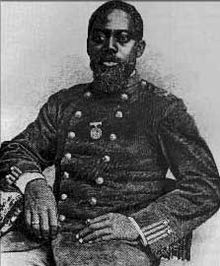
220px-WilliamCarney

Sergeant William H. Carney of the 54th Massachusetts, Medal of Honor

But the most famous African American volunteer regiment was the 54th Massachusetts, commanded by Colonel Robert Gould Shaw, the “North’s showcase black regiment.” [29] Raised in Boston and officered by many men who were the sons of Boston’s blue blood abolitionist elite, the regiment was authorized in March 1863. Since there was still opposition to the formation of units made up of African Americans, Massachusetts Governor John Andrew authorized the formation of the 54th under the command of white officers, a practice that with few exceptions, became standard in the U.S. military until President Truman desegregated the armed forces in 1948. Governor Andrew was determined to ensure that the officers of the 54th were men of “firm antislavery principles…superior to a vulgar contempt for color.” [30]

The_Storming_of_Ft_Wagner-lithograph_by_Kurz_and_Allison_1890a

The 54th Massachusetts first saw action in early June 1863 and at Shaw’s urging were sent into battle against the Confederate positions at Fort Wagner on July 18th 1863. Leading the attack the 54th lost nearly half its men, “including Colonel Shaw with a bullet through his heart. Black soldiers gained Wagner’s parapet and held it for an hour before falling back.” [31] Though they tried to hold on they were pushed back after a stubborn fight to secure a breach in the fort’s defenses. “Sergeant William H Carney staggered back from the fort with wounds in his chest and right arm, but with the regiment’s Stars and Stripes securely in his grasp. “The old flag never touched the ground, boys,” Carney gasped as he collapsed at the first field hospital he could find.” [32] Shaw was buried with his men by the Confederates and when Union commanders asked for the return of his body were told “We have buried him with his niggers,” Shaw’s father quelled a northern effort to recover his son’s body with these words: We hold that a soldier’s most appropriate burial-place is on the field where he has fallen.” [33] As with so many frontal attacks on prepared positions throughout the war, valor alone could not overcome a well dug in enemy. “Negro troops proved that they could stop bullets and shell fragments as good as white men, but that was about all.” [34]

Despite the setback, the regiment went on to further actions where it continued to distinguish itself. The Northern press, particularly abolitionist newspapers brought about a change in the way that many Americans in the North, civilians as well as soldiers, saw blacks. The Atlantic Monthly noted, “Through the cannon smoke of that dark night, the manhood of the colored race shines before many eyes that would not see.” [35]

Frederick Douglass, who had two sons serving in the 54th Massachusetts, understood the importance of African Americans taking up arms against those that had enslaved them in order to win their freedom:

“Once let a black man get upon his person the brass letters U.S… let him get an eagle on his button, and a musket on his shoulder and bullets in his pockets, and there is no power on earth which can deny he has won the right to citizenship in the United States.” [36]

Other African American units less famous than the illustrious 54th Massachusetts distinguished themselves in action against Confederate forces. Two regiments of newly recruited blacks were encamped at Milliken’s Bend Louisiana when a Confederate brigade attempting to relieve the Vicksburg Garrison attacked them. The troops were untrained and ill-armed but held on against a determined enemy:

“Untrained and armed with old muskets, most of the black troops nevertheless fought desperately. With the aid of two gunboats they finally drove off the enemy. For raw troops, wrote Grant, the freedmen “behaved well.” Assistant Secretary of War Dana, still with Grant’s army, spoke with more enthusiasm. “The bravery of the blacks,” he declared, “completely revolutionized the sentiment in the army with regard to the employment of negro troops. I heard prominent officers who had formerly in private had sneered at the idea of negroes fighting express after that as heartily in favor of it.” [37]

pride_over_prejudice-reeves-b-of-nashville

By the end of the war over 179,000 African American Soldiers, commanded by 7,000 white officers served in the Union armies. For a number of reasons most of these units were confined to rear area duties or working with logistics and transportation operations. The policies to regulate USCT regiments to supporting tasks in non-combat roles “frustrated many African American soldiers who wanted a chance to prove themselves in battle.” [38] Many of the soldiers and their white officers argued to be let into the fight as they felt that “only by proving themselves in combat could blacks overcome stereotypes of inferiority and prove their “manhood.” [39] Even so in many places in the army the USCT and state regiments made up of blacks were scorned:

“A young officer who left his place in a white regiment to become colonel of a colored regiment was frankly told by a staff officer that “we don’t want any nigger soldiers in the Army of the Potomac,” and his general took him aside to say: “I’m sorry to have you leave my command, and am still more sorry that you are going to serve with Negroes. I think that it is a disgrace to the army to make soldiers of them.” The general added that he felt this way because he was sure that colored soldiers just would not fight.” [40]

The general of course, was wrong. In the engagements where USCT units were allowed to fight, they did so with varying success most often attributable to the direction of their senior officers. When given the chance they almost always fought well, even when badly commanded. This was true as well when they were thrown into hopeless situations. One such instance was when Ferrero’s Division, comprised of colored troops were thrown into the Battle of the Crater at Petersburg when “that battle lost beyond all recall.” [41] The troops advanced in good order singing as they went, while their commander, General Ferrero took cover in a dugout and started drinking; but the Confederate defenders had been reinforced and “Unsupported, subjected to a galling fire from batteries on the flanks, and from infantry fire in front and partly on the flank,” a witness write, “they broke up in disorder and fell back into the crater.” [42] Pressed into the carnage of the crater where white troops from the three divisions already savaged by the fighting had taken cover, the “black troops fought with desperation, uncertain of their fate if captured.” [43] In the battle Ferrero’s division lost 1327 of the approximately 4000 men who made the attack. [44]

Major General Benjamin Butler railed to his wife in a letter against those who questioned the courage of African American soldiers seeing the gallantry of black troops assaulting the defenses of Petersburg in September 1864: The man who says that the negro will not fight is a coward….His soul is blacker than then dead faces of these dead negroes, upturned to heaven in solemn protest against him and his prejudices.” [45]

When captured by Confederates, black soldiers and their white officers received no quarter from many Confederate opponents. General Edmund Kirby Smith who held overall command of Confederate forces west of the Mississippi instructed General Richard Taylor to simply execute black soldiers and their white officers: “I hope…that your subordinates who may have been in command of capturing parties may have recognized the propriety of giving no quarter to armed negroes and their officers. In this way we may be relieved from a disagreeable dilemma.” [46] This was not only a local policy, but echoed at the highest levels of the Confederate government. In 1862 the Confederate government issued an order that threatened white officers commanding blacks: “any commissioned officer employed in the drilling, organizing or instructing slaves with their view to armed service in this war…as outlaws” would be “held in close confinement for execution as a felon.” [47] After the assault of the 54th Massachusetts at Fort Wagner a Georgia soldier “reported with satisfaction that the prisoners were “literally shot down while on their knees begging for quarter and mercy.” [48]

On April 12th 1864 at Fort Pillow, troops under the command of General Nathan Bedford Forrest massacred the bulk of over 231 Union most of them black as they tried to surrender. While it is fairly clear that Forrest did not order the massacre and even attempted to stop it, it was clear that he had lost control of his troops. Forrest’s soldiers fought with the fury of men possessed by hatred of an enemy that they considered ‘a lesser race’ and slaughtered the Union troops as they either tried to surrender or flee; but while Forrest did not order the massacre, he certainly was not displeased with the result. Ulysses Grant wrote that:

“These troops fought bravely, but were overpowered I will leave Forrest in his dispatches to tell what he did with them.

“The river was dyed,” he says, “with the blood of the slaughtered for up to 200 years. The approximate loss was upward of five hundred killed; but few of the officers escaped. My loss was about twenty killed. It is hoped that these facts will demonstrate to the Northern people that negro soldiers cannot cope with Southerners.” Subsequently Forrest made a report in which he left out the part that shocks humanity to read.” [49]

The bulk of the killing was directed at the black soldiers of the 6th U.S. Colored Heavy Artillery, which composed over a third of the garrison. “Of the 262 Negro members of the garrison, only 58- just over 20 percent- were marched away as prisoners; while of the 295 whites, 168- just under sixty percent were taken.” [50] A white survivor of the 13th West Tennessee Cavalry, a Union unit at the fort wrote:

We all threw down our arms and gave tokens of surrender, asking for quarter…but no quarter was given….I saw 4 white men and at least 25 negroes shot while begging for mercy….These were all soldiers. There were also 2 negro women and 3 little children standing within 25 steps of me, when a rebel stepped up to them and said, “Yes, God damn you, you thought you were free, did you?” and shot them all. They all fell but one child, when he knocked it in the head with the breech of his gun.” [51]

A Confederate Sergeant who was at Fort Pillow wrote home a week after the massacre: “the poor deluded negroes would run up to our men, fall upon their knees and with uplifted hands scream for mercy, but were ordered to their feet and shot down.” [52]

African American soldiers proved themselves during the war and their efforts paved the way for Lincoln and others to begin considering the full equality of blacks as citizens. If they could fight and die for the country, how could they be denied the right to votes, be elected to office, serve on juries or go to public schools? Under political pressure to end the war during the stalemate before Petersburg and Atlanta in the summer of 1864, Lincoln reacted angrily to Copperheads as well as wavering Republicans on the issue of emancipation:

“But no human power can subdue this rebellion without using the Emancipation lever as I have done.” More than 100,000 black soldiers were fighting for the Union and their efforts were crucial to northern victory. They would not continue fighting if they thought the North intended to betray them….If they stake their lives for us they must be prompted by the strongest motive…the promise of freedom. And the promise being made, must be kept…There have been men who proposed to me to return to slavery the black warriors. “I should be damned in time & in eternity for so doing. The world shall know that I will keep my faith to friends & enemies, come what will.” [53]

The importance of African Americans cannot be minimized, without them the war could have dragged on much longer or even ended in stalemate, which would have been a Confederate victory. Lincoln wrote about their importance in 1864:

“Any different policy in regard to the colored man, deprives us of his help, and this is more than we can bear. We can not spare the hundred and forty or hundred and fifty thousand now serving us as soldiers, seamen, and laborers. This is not a question of sentiment or taste, but one of physical force which may be measured and estimated as horse-power and Steam-power are measured and estimated. Keep it and you save the Union. Throw it away, and the Union goes with it.” [54]

Despite this, even in the North during and after the war, blacks, including former soldiers faced discrimination, sometimes that of the white men that they served alongside, but more often from those who did not support the war effort. Lincoln noted after the war:

“there will there will be some black men who can remember that, with silent tongue, the clenched teeth, the steady eye, the well poised bayonet, they have helped mankind on to this great consummation; while, I fear, there will be some white ones, unable to forget that, with malignant heart, and deceitful speech, they have strove to hinder it.” [55]

Those rights would be fought for another century and what began in 1863 with the brave service and sacrifice of these African American soldiers began a process of increased civil rights that is still going on today. It would not be until after the war that some blacks were commissioned as officers in the Army. When Governor John Andrew, the man who had raised the 54th Massachusetts attempted to:

“issue a state commission to Sergeant Stephen Swails of the 54th…the Bureau of Colored Troops obstinately refused to issue Swails a discharge from his sergeant’s rank, and Swails promotion was held up until after the end of the war. “How can we hope for success to our arms or God’s blessing,” raged the white colonel of the 54th, Edward Hallowell, “while we as a people are so blind to justice?” [56]

The families of the free blacks who volunteered also suffered, especially those who still had families enslaved in Confederate occupied areas or Union States which still allowed slavery. One women in Missouri wrote her husband begging him to come home “I have had nothing but trouble since you left….They abuse me because you went & say they will not take care of our children & do nothing but quarrel with me all the time and beat me scandalously the day before yesterday.” [57]

However, the Emancipation Proclamation transformed the war, and even jaded White Union soldiers who had been against emancipation and who were deeply prejudiced against blacks began to change their outlook as the armies marched into the South and saw the horrors of slavery. Russell Weigley wrote that Union soldiers:

“confronting the scarred bodies and crippled souls of African Americans as they marched into the South experienced a strong motivation to become anti-slavery men…Men do not need to play a role long, furthermore, until the role grows to seem natural and customary to them. That of liberators was sufficiently fulfilling to their pride that soldiers found themselves growing more accustomed to it all the more readily.” [58]

At peak one in eight Union troops were African American, and Black troops made an immense contribution to the Union victory. “Black troops fought on 41 major battlefields and in 449 minor engagements. Sixteen soldiers and seven sailors received Medals of Honor for valor. 37,000 blacks in army uniform gave their lives and untold sailors did, too.” [59]

After the war many of the African American soldiers became leaders in the African American community and no less than 130 held elected office including the U.S. Congress and various state legislatures. Sadly the nation has forgotten the efforts of the Free Black Soldiers and Sailors who fought for freedom, but even so the “contribution of black soldiers to Union victory remained a point of pride in black communities. “They say,” an Alabama planter reported in 1867, “the Yankees never could have whipped the South without the aid of the Negroes.” Well into the twentieth century, black families throughout the United States would recall with pride that their fathers and grandfathers had fought for freedom.” [60]

The Southern Debate about Emancipation and Black Soldiers

In the South, politicians and many senior Confederate Officers fought against any allowance for blacks to serve, for they knew if they allowed this, that slavery itself must be swept away. Despite this, a few such as General Patrick Cleburne, an Irish immigrant and a division commander in the Army of Tennessee demonstrated the capacity for forward thinking in terms of race: Cleburne advocated that blacks serve as soldiers should be emancipated.
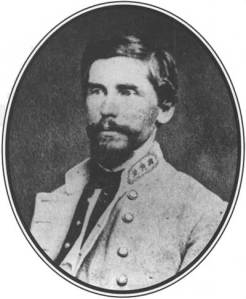
fig25

General Patrick Cleburne CSA

Cleburne, known as “the Stonewall Jackson of the West” was a bold fighter who put together a comprehensive plan. He noted that the Confederacy was losing the war because it did not have soldiers, the supplies or resources; and most significantly that “slavery, from being one of our chief sources of strength at the beginning of the war, has now become in a military point of view, one of our chief sources of weakness.” [61] Cleburne recommended that “we immediately commence training a large reserve of the most courageous of our slaves, and further that we guarantee freedom within a reasonable time to every slave in the South who shall remain to the confederacy in this war.” [62]

Cleburne’s realism came through in his appeal:

“Ever since the agitation of the subject of slavery commenced the negro has been dreaming of freedom and his vivid imagination has surrounded the condition with so many gratifications that it has become the paradise of his hopes.” It was also shrewd politically: “The measure we propose,” he added, “will strike dead all John Brown fanaticism, and will compel the enemy to draw off altogether or in the eyes of the world to swallow the Declaration of Independence without the sauce and disguise of philanthropy.” [63]

The Irishman’s “logic was military, the goal more men in uniform, but the political vision was radical indeed.” [64] He was asking more from his fellow Southerners than they could risk. He was “asking them to surrender the cornerstone of white racism to preserve their nation” [65] and he presented it in stark terms that few could stomach “As between the loss of independence and the loss of slavery, we can assume that every patriot will freely give up the latter- give up the Negro slave rather than be a slave himself.” [66] Cleburne’s words were those of a heretic, he noted “When we make soldiers of them we must make free men of them beyond all question…and thus enlist their sympathies also.” [67]

In January 1864 General W.H.T Walker obtained a copy of Cleburne’s proposal and sent it to Davis. Walker opposed it and expressed his outrage over it. Cleburne’s proposal went from being a military matter to a political matter and Davis intervened to quash the proposal. “Convinced that the “propagation of such opinions” would cause “discouragements, distraction, and dissension” in the army, Jefferson Davis ordered the Generals to stop discussing the matter…The only consequence of Cleburne’s action seemed to be the denial of promotion to this ablest of the army’s division commanders, who was killed ten months later at the Battle of Franklin.” [68] In fact Cleburne was “passed over for command of an army corps and promotion to lieutenant general” three times in the next eight months, and in “each care less distinguished, less controversial men received the honors.” [69] All copies of Cleburne’s proposal were destroyed by the order of Davis.

Cleburne was not the only military man to advocate the formation of Negro units or even emancipation. Richard Ewell suggested to Jefferson Davis the idea of arming the slaves and offering them emancipation as early as 1861, and Ewell went as far as “volunteering to “command a brigade of Negroes.” [70] During the war Robert E. Lee became one of the chief proponents of this. Lee said after the war that he had told Davis “often and early in the war that the slaves should be emancipated, that it was the only way to remove a weakness at home and to get sympathy abroad, and divide our enemies, but Davis would not hear of it.” [71]

Ten months later Davis raised the issue of arming slaves, as he now believed that military necessity left him little choice. On November 7th 1864 he made his views known to the Confederate Congress, and they were a radical departure from the hitherto political orthodoxy of slavery. In light of the manpower needs of the South as well as the inability to achieve foreign recognition Davis asked their “consideration…of a radical modification in the theory of law” of slavery…” and he noted that the Confederacy “might have to hold out “his emancipation …as a reward for faithful service.” [72]

This drew the opposition of previously faithful supporters. Davis was now opposed by some of his closest political allies including Howell Cobb who warned “The day that you make soldiers of them is the beginning of the end of the revolution. If slaves will make good soldiers our whole theory of slavery is wrong.” [73] Brigadier General Clement H. Stevens of South Carolina declared “I do not want independence if it is to be won by the help of the Negro.” [74]

Robert E. Lee began to be a formidable voice in the political debate going on in the Confederacy regarding the issue of blacks serving as soldiers and emancipation. He wrote to a member of Virginia’s legislature:

“we must decide whether slavery shall be extinguished by our enemies and the slaves used against us, or use them ourselves at the risk of the effects which may be produced on our social institutions…” and he pointed out that “any act for the enrolling of slaves as soldiers must contain a “well digested plan of gradual and general emancipation”: the slaves could not be expected to fight well if their service was not rewarded with freedom.” [75]

When Howell Cobb heard of Lee’s support for black soldiers and emancipation he fired of a letter to Secretary of War Seddon, “I think that the proposition to make soldiers of our slaves is the most pernicious idea that has ever been suggested since the war began. It is to me a source of deep mortification and regret to see the name of that good and great man and soldier, General R. E. Le, given as authority for such policy.” [76]

The debate began in earnest in the fall of 1864 and revealed a sharp divide in the Confederacy between those who supported the measure and those against it. Cabinet members such as Judah Benjamin and a few governors “generally supported arming the slaves.” [77] The Southern proponents of limited emancipation were opposed by the powerful governors of Georgia and North Carolina, Joe Brown and Zebulon Vance, and by the President pro-tem of the Confederate Senate R.M.T. Hunter, who forcibly opposed the measure. Robert Toombs of Georgia declared “the day that the army of Virginia allows a negro regiment to enter their lines as soldiers the will be degraded, ruined, and disgraced…” [78]

Much of the Southern press added its voice to the opposition. Newspapers in North Carolina declared the proposal “farcical” – “all this was done for the preservation and the perpetuation of slavery,” and if “sober men…are willing to enquire if the South is willing to abolish slavery as a condition of carrying on the war, why may it not be done, as a condition of ending the war?” [79] The Charleston Mercury considered the proposal apostasy and proclaimed “Assert the right in the Confederate government to emancipate slaves, and it is stone dead…” [80]

Some states in the Confederacy began to realize that slaves were needed in the ranks, but did not support emancipation. Led by Governor “Extra Billy” Smith, Virginia’s General Assembly finally approved a law in 1865 “to permit the arming of slaves but included no provision for emancipation, either before or after military service.” [81] Smith declared that without slavery the South “would no longer have a motive to fight.” [82]

Many Confederate soldiers displayed the attitude that would later propel them into the ranks of the Ku Klux Klan, the Red Shirts, the White League and the White Liners after the war. A North Carolina soldier wrote, “I did not volunteer to fight for a free negroes country… I do not think I love my country well enough to fight with black soldiers.” [83]

Finally in March of 1865 the Confederate Congress passed by one vote a watered down measure to allow for the recruitment of slaves. It stipulated that “the recruits must all be volunteers” [84] and those who volunteered must also have “the approbation of his master by a written instrument conferring, as far as he may, the rights of a freed man.” [85] While this in itself was a radical proposition for a nation which had went to war to maintain slavery, the fact was that the slave’s service and freedom were granted not by the government, but by his owner, and even at this stage of the war, few owners were willing to part with their property. It was understood by many that giving freedom to a few was a means of saving the “particular institution.” The Richmond Sentinel noted during the November debate: “If the emancipation of a part is the means of saving the rest, this partial emancipation is eminently a pro-slavery measure.” [86] Thus the law made “no mention of emancipation as a reward of military service” [87] and in deference to “state’s rights, the bill did not mandate freedom for slave soldiers.” [88]

But diehards opposed even the watered down measure. Robert Kean, who headed the Bureau of War and should have understood the stark reality of the Confederacy’s strategic situation, note in his diary, that the law:

“was passed by a panic in the Congress and the Virginia Legislature, under all the pressure the President indirectly, and General Lee directly, could bring to bear. My own judgment of the whole thing is that it is a colossal blunder, a dislocation of the foundations of society from which no practical results will be reaped by us.” [89]

It was Lee’s prestige alone that allowed the measure to pass, but even that caused some to question Lee’s patriotism. The Richmond Examiner dared to express a doubt whether Lee was “a ‘good Southerner’: that is, whether he is thoroughly satisfied of the justice and beneficence of negro slavery.” [90] Robert Toombs of Georgia stated that “the worst calamity that could befall us would be to gain our independence by the valor of our slaves” [91] and a Mississippi congressman stated, “Victory itself would be robbed of its glory if shared with slaves.” [92]

On March 23rd 1865 the War Office issued General Order Number 14, which authorized the call up and recruitment of slaves to the Confederate cause. The order read in part: “In order to provide additional forces to repel invasion…the President be, and he is hereby authorized to ask for and to accept from the owners of slaves, the services of such able-bodied negro men as he may deem expedient, for and during the war, to perform military service in whatever capacity he may direct…” While the order authorized that black soldiers “receive the same rations, clothing and compensation as are allowed to other troops in the same branch of service,” it did not provide for the emancipation of any of the black soldiers that might volunteer. Instead it ended “That nothing in this act shall be construed to authorize a change in the relation which the said slaves shall bear to their owners, except by the consent of the owners and of the States which they may reside….” [93]

Twelve days after the approval of the act, on March 25th two companies of blacks were formed for drill in Richmond’s Capitol Square. As the mobilized slaves assembled to the sounds of fifes and drums they were met with derision and violence as even “Small boys jeered and threw rocks” [94] at them. None of those few volunteers would see action as within a week the Confederate government had fled Richmond.

But some would see that history was moving, and attitudes were beginning to change. It took time, and the process is still ongoing. As imperfect as emancipation was and though discrimination and racism remained, African Americans had reached “levels that none had ever dreamed possible before the war.” [95] In April 1865 as Jefferson Davis and his government fled Richmond, with Davis proclaiming, “again and again we shall return, until the baffled and exhausted enemy shall abandon in despair his endless and impossible task of making slaves of a people resolved to be free.” [96]

The irony in Davis’s empty vow was stunning. Within a week Lee had surrendered and in a month Davis himself would be in a Federal prison. The Federal troops who led the army into Richmond came from General Godfrey Weitzel’s Twenty-fifth Corps, of Ord’s Army of the James. The Every black regiment in the Army of the James was consolidated in Weitzel’s Corps, along with Ferrero’s former division that had suffered so badly at the Battle of the Crater. “Two years earlier in New Orleans, Weitzel had protested that he did not believe in colored troops and did not want to command them, and now he sat at the gates of Richmond in command of many thousands of them, and when the citadel fell he would lead them in and share with them the glory of occupying the Rebel capital.” [97] Among Weitzel’s units were regiments of black “cavalrymen and infantrymen. Many were former slaves; their presence showed their resolve to be free.” [98]

The Post War Experience of Blacks in the U.S. Army

Some of those early African American soldiers went on to distinguish themselves on the prairie as the immortal Buffalo Soldiers. Other African Americans would fight in Cuba and the Philippines during the Spanish American War, however after the war the “contributions of black soldiers to the war were generally ignored, white Southern soldiers were hailed for their valor” [99] as part of a campaign to reintegrate the South into the life of the nation.

la-yosemite-buffalo-soldiers-slated-for-nation-001

Buffalo Soldiers

In the First World War, despite there being some instances of racial harmony, blacks, including officers faced discrimination and met with violent acts. “Refusals to arrest white soldiers who physically assaulted black soldiers accompanied by the tendency to rescind unpopular racial orders and to discourage black officers from demanding salutes from white soldiers” [100] was common.

Most of the Regular Army “Buffalo Soldier” units were not allowed to fight in the First World War. Instead they were left on the frontier and a new generation of draftees and volunteers became the nucleus of two infantry divisions, the 92nd and 93rd. However, at the beginning they were regulated to labor service units. The protests of organizations such as the NAACP and men like W.E.B. DuBois, and Phillip Randolph forced the War Department to reconsider the second-class status of these men and to form them into combat units.

Harlem_Hell_Fighters

Despite this, the leadership of the AEF, or the American Expeditionary Force, refused to allow these divisions to serve under American command. Instead they were broken up and the regiments of the 93rd Division were attached to French divisions. The 369th “Harlem Hellfighters” were assigned to the French 16th Division and then to the 161st Division. The 370th “Black Devils” were attached to the French 26th Division, while the 371st and 372nd were assigned to the French 157th (Colonial) Division, which was also known as the Red Hand Division. The 157th Division had suffered badly during the war and been decimated in the unrelenting assaults in the trench warfare of the Western Front. It was reconstituted in 1918 with one French Regiment and the two African American regiments. Both fought exceptionally well and were cited by the French government for their efforts. The 371st was awarded the French Croix de Guerre and Légion d’honeur. Corporal Freddie Stowers of the 1st Battalion 371st was the only African American awarded the Congressional Medal of Honor in the First World War. The 372nd was also awarded the Croix de Guerre and Légion d’honeur for its service with the 157th Division.

While many white American soldiers depreciated their French hosts and attempted to sow the seeds of their own racial prejudice against the black soldiers among the French, Southerners in particular warned the French of “black rapist beasts.” However the French experience of American blacks was far different than the often-scornful treatment that they received from white American soldiers.

“Soldiers from the four regiments that served directly with the French Army attested to the willingness of the French to let men fight and to honor them for their achievements. Social interactions with French civilians- and white southern soldiers’ reactions to them- also highlighted crucial differences between the two societies. Unlike white soldiers, African Americans did not complain about high prices in French stores. Instead they focused on the fact that “they were welcomed” by every shopkeeper that they encountered.” [101]

Official and unofficial efforts by those in the Army command and individual soldiers to stigmatize them and to try to force the French into applying Jim Crow to laws and attitudes backfired. Villages now expressed a preference for black over white American troops. “Take back these soldiers and send us some real Americans, black Americans,” wrote one village mayor after a group of rowdy white Americans disrupted the town.” [102]

761st-Tank-Bn

Even after President Truman desegregated the armed forces in 1948, African Americans, as well as other racial minorities, women and gays have faced very real discrimination. The military continues to make great strides, and while overt racist acts and other types of discrimination are outlawed, racism still remains a part of American life.

colin powell

General Colin Powell at the Buffalo Soldier Monument

Today things have changed, and that in large part is due to the unselfish sacrifice in the face of hatred and discrimination of the men of the USCT and the State Black Regiments like the 54th Massachusetts and the Louisiana Home Guards who blazed a way to freedom for so many. Those who followed them as Buffalo Soldiers and volunteers during the World Wars continued to be trailblazers in the struggle for equal rights. A white soldier who served with the 49th Massachusetts wrote, “all honor to our negro soldiers. They deserve citizenship. They will secure it! There would be much suffering in what he termed “the transition state” but a “nation is not born without pangs.” [103]

Those birth pangs helped to bring about a new birth of freedom for the United States, and not just for African Americans, but Women and  Gays as well.

Notes

[1] McPherson, James M. Tried by War: Abraham Lincoln as Commander in Chief Penguin Books, New York and London 2008

[2] Ibid. Goodwin Team of Rivals p.435

[3] Ibid. McPherson Tried by War p.58

[4] Ibid. McPherson Tried by War p.58

[5] Ibid. Goodwin Team of Rivals p.369

[6] Ibid. McPherson Tried by War p.109

[7] Ibid. Foote, The Civil War, A Narrative Volume Two p.531

[8] Ibid. McPherson. The Battle Cry of Freedom p.503

[9] Ibid. McPherson Drawn With the Sword: Reflections on the American Civil War p.101

[10] Ibid. Guelzo Gettysburg: The Last Invasion p.160

[11] Foner, Eric Forever Free: The Story of Emancipation and Reconstruction Vintage Books a Division of Random House, New York 2005 p.45

[12] Ibid. Guelzo Gettysburg: The Last Invasion p.160

[13] Ibid. Glatthaar General Lee’s Army from Victory to Collapse p.313

[14] Ibid. Guelzo Gettysburg: The Last Invasion p.160

[15] Ibid. Goodwin Team of Rivals p.465

[16] Egnal, Marc Clash of Extremes: The Economic Origins of the Civil War Hill and Wang a division of Farrar, Straus and Giroux New York 2009 p.318

[17] Ibid. Foner Forever Free p.48

[18] Ibid. McPherson Tried by War p.159

[19] Ibid. McPherson Drawn With the Sword p.159

[20] McPherson, James M. Abraham Lincoln and the Second American Revolution Oxford University Press, New York and Oxford 1991 p.35

[21] Ibid. Guelzo Fateful Lighteningp.381

[22] Ibid. McPherson Abraham Lincoln and the Second American Revolution p.35

[23] Glatthaar, Joseph T. Black Glory: The African American Role in Union Victory in Why the Confederacy Lost edited by Gabor S. Boritt Oxford University Press, Oxford and New York 1992

[24] Ibid. McPherson. The Battle Cry of Freedom p.686

[25] Ibid. Goldfield America Aflame p.282

[26] Ibid. Guelzo Fateful Lightening p.379

[27] Ibid. Foote The Civil War, A Narrative Volume Two p.398

[28] Ibid. Guelzo Fateful Lightening p.379

[29] Ibid. McPherson. The Battle Cry of Freedom p.686

[30] Ibid. McPherson Drawn With the Sword p.101

[31] Ibid. McPherson. The Battle Cry of Freedom p.686

[32] Ibid. Guelzo Fateful Lightening pp. 380-381

[33] Ibid. McPherson. The Battle Cry of Freedom pp.686-687

[34] Ibid. Foote, The Civil War, A Narrative Volume Two p.697

[35] Ibid. McPherson. The Battle Cry of Freedom p.686

[36] Ibid. Guelzo Fateful Lightening p. 381

[37] Ibid. McPherson. The Battle Cry of Freedom p.634

[38] Gallagher, Gary W. The Union War Harvard University Press, Cambridge MA and London 2011

[39] Ibid. McPherson Drawn With the Sword p.89

[40] Catton, Bruce. A Stillness at Appomattox Doubleday and Company Garden City, New York 1953 p.227

[41] Ibid. Catton A Stillness at Appomattox p.249

[42] Foote, Shelby, The Civil War, A Narrative. Volume Three Red River to Appomattox Random House, New York 1974 p.537

[43] Wert, Jeffry D. The Sword of Lincoln: The Army of the Potomac Simon and Schuster, New York and London 2005 pp.384-385

[44] Ibid. Foote The Civil War, A Narrative Volume Three p.537

[45] Ibid. Robertson Soldiers Blue and Gray p.34

[46] Ibid. Guelzo Fateful Lightening p. 377

[47] Ibid. Guelzo Fateful Lightening p. 377

[48] Ibid. Goldfield America Aflame p.281

[49] Grant, Ulysses S. Preparing for the Campaigns of ’64 in Battles and Leaders of the Civil War Volume IV, Retreat With Honor Edited by Robert Underwood Johnson and Clarence Clough Buel Castle, Secaucus NJ pp.107-108

[50] Ibid. Foote The Civil War, A Narrative Volume Three p.111

[51] Ibid. Guelzo Fateful Lightening p. 378

[52] Ibid. Foote The Civil War, A Narrative Volume Three p.112

[53] Ibid. McPherson Abraham Lincoln and the Second American Revolution p.89

[54] Ibid. Glatthaar Black Glory: The African American Role in Union Victory p.138

[55] Ibid. McPherson The War that Forged a Nation p. 113

[56] Ibid. Guelzo Fateful Lightening p. 376

[57] Ibid. Goldfield America Aflame p.282

[58] Ibid. Weigley A Great Civil War p.192

[59] Gallagher, Gary, Engle, Stephen, Krick, Robert K. and Glatthaar editors The American Civil War: The Mighty Scourge of War Osprey Publishing, Oxford UK 2003 p.296

[60] Ibid. Foner Forever Free p.55

[61] Ibid. Thomas, The Confederate Nation p.262

[62] Ibid. Thomas, The Confederate Nation p.262

[63] Winik, Jay April 1865: The Month that Saved America Perennial an Imprint of Harper Collins Publishers New York 2002 p.53

[64] Ibid. McCurry Confederate Reckoning p.327

[65] Ibid. Guelzo Fateful Lightening p. 370

[66] Ibid. Thomas, The Confederate Nation p.262

[67] Ibid. McCurry Confederate Reckoning p.327

[68] Ibid. McPherson. The Battle Cry of Freedom p.833

[69] Ibid. Thomas, The Confederate Nation p.262

[70] Ibid. Guelzo Fateful Lightening p. 370

[71] Ibid. Gallagher The Confederate War p.47

[72] Ibid. McCurry Confederate Reckoning p.335

[73] Ibid. Guelzo Fateful Lightening p. 370

[74] Ibid. Foner Forever Free p.55

[75] Korda, Michael. Clouds of Glory: The Life and Legend of Robert E. Lee Harper Collins Publishers, New York 2014 p.643

[76] Cobb, Howell Letter to James A. Seddon, Secretary of War, January 8, 1865 in the Confederate and Neo-Confederate Reader: The “Great Truth” about the “Lost Cause” Loewen, James W. and Sebesta, Edward H. Editors, University Press of Mississippi, Jackson 2010 Amazon Kindle edition location 4221 of 8647  

[77] Ibid. Thomas, The Confederate Nation p.293

[78] Ibid. McPherson. The Battle Cry of Freedom p.835

[79] Ibid. Guelzo Fateful Lightening p. 370

[80] Ibid. McCurry Confederate Reckoning p.337

[81] Ibid. Foote. The Civil War, A Narrative Volume Three pp.754-755

[82] Ibid. Guelzo Fateful Lightening p. 370

[83] Ibid. Guelzo Fateful Lightening p. 370

[84] Ibid. Foote. The Civil War, A Narrative Volume Three p. 755

[85] Ibid. Thomas, The Confederate Nation p.296

[86] Ibid. McPherson. The Battle Cry of Freedom p.836

[87] Ibid. Foote. The Civil War, A Narrative Volume Three p.755

[88] Ibid. McPherson. The Battle Cry of Freedom p.837

[89] Ibid. Foote. The Civil War, A Narrative Volume Three p.860

[90] Ibid. McPherson. The Battle Cry of Freedom p.837

[91] Ibid. Foote. The Civil War, A Narrative Volume Three p.860

[92] Ibid. McPherson. The Battle Cry of Freedom p.835

[93] Confederate Congress General Orders, No. 14, An Act to Increase the Military Force of the Confederate States, Approved March 13, 1865 in the Confederate and Neo-Confederate Reader: The “Great Truth” about the “Lost Cause” Loewen, James W. and Sebesta, Edward H. Editors, University Press of Mississippi, Jackson 2010 Amazon Kindle edition location4348 of 8647

[94] Ibid. Foote. The Civil War, A Narrative Volume Three p.860

[95] Ibid. Guelzo Fateful Lightening p. 386

[96] Levine, Bruce Half Slave and Half Free: The Roots of the Civil War Revised Edition, Hill and Wang, a division of Farrar, Strauss and Giroux, New York 1992 and 1995 p.241

[97] Catton, Bruce Grant Takes Command Little, Brown and Company Boston, Toronto and London 1968 p.411

[98] Ibid. Levine Half Slave and Half Free pp.241-242

[99] Huntington, Samuel P. Who Are We? America’s Great Debate The Free Press, Simon and Schuster Europe, London 2004 p.124

[100] Keene, Jennifer D. Doughboys, the Great War, and the Remaking of America The Johns Hopkins University Press, Baltimore and London 2001 p.88

[101] Ibid. Keane Doughboys, the Great War, and the Remaking of America p.128

[102] Ibid. Keane Doughboys, the Great War, and the Remaking of America p.129

[103] Ibid Gallagher The Union War p.113
1 Comment

Filed under civil rights, civil war, History, Loose thoughts and musings

Try to Understand: The Kindest, Noblest, & Best Thing You Will Ever Do

grant and sherman

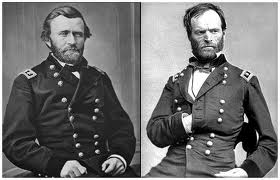
Grant and Sherman

Friends of Padre Steve’s World,

The great American Civil War general William Tecumseh Sherman once said of his relationship with Ulysses S. Grant, “Grant stood by me when I was crazy, and I stood by him when he was drunk. Now we stand together.” Having been both crazy, and at times drunk, I can relate to both men, both of whom also often suffered from severe and often disabling depression at different points in their lives.

Yesterday I wrote an article about depression and I decided to follow it up with another on the same subject. Yesterday I mentioned the late Iris Chang and her comments about how depression is not rational, and C.S. Lewis who talked about how mental pain is harder to deal with than physical pain. During my worst phases of depression in the years after I came back from Iraq, I fought every day to find something to hold onto, something to keep me from ending my life. If you have never experienced real depression, the kind that slowly eats away the very fabric of your being, you might not understand. In fact it was something that I really didn’t understand until I went through years of it.

Depression is far different than being sad. It is like the difference between having a cold, which you know should pass, and having an insidious cancer which even if it goes into remission lurks for another chance to strike again.

I think that Elizabeth Wurtzel, the author of the book Prozac Nation, hit what I am describing on the head, “That’s the thing about depression: A human being can survive almost anything, as long as he sees the end in sight. But depression is so insidious, and in compounds daily, that it’s impossible to ever see the end.”

In a similar manner, J.K. Rowling, the author of the Harry Potter books noted, “Depression is the most unpleasant thing I have ever experienced. . . . It is that absence of being able to envisage that you will ever be cheerful again. The absence of hope. That very deadened feeling, which is so very different from feeling sad. Sad hurts but it’s a healthy feeling. It is a necessary thing to feel. Depression is very different.”

I have to agree with both of these writers, depression is the worst. I can live with insomnia, and night terrors, even with anxiety, but depression is the worst, it never seems like it will end. I was fortunate that I got through my most difficult times, including a period just over a year ago where I was nearly suicidal after very bad treatment in the Mental Health Department at the local naval medical center. It took the intervention of my former commanding officer, a doctor named David Lane, who had just been selected for promotion to admiral to get me the help that I needed, but not everyone has that kind of ace in the hole. I wouldn’t have thought of asking him, but his Command Master Chief, and my friend Ed Moreno, intervened, told him of how bad I was doing and that made all the difference. Ed didn’t try to fix me, he just stood beside me and when I needed help, he came through as a friend, and he is still a friend. That is what friends do.

I still struggle, sometimes with depression, but more often the nightmares and night terrors associated with my PTSD. Last night my wife woke me up when in one of my high definition nightmares I was thrashing around trying to defend myself from an enemy insurgent in Iraq. Now mind you, I was never in a close combat situation, but I took part in a number of missions where we didn’t know who the good guys or bad guys were and I was unarmed. But I can live with that, depression without end is far different.

In my worst times I had a lot of people tell me what I needed to do to get out of being depressed. Most were well meaning but didn’t have a clue as to what I really needed. I didn’t need someone to fix me. I didn’t need a checklist of things to make me well. I didn’t need to pray more, or read my Bible more. I didn’t need to work ungodly numbers of hours in ICUs where lives of people were hanging in the balance… all I needed was people who would say I love you, I care for you, and I value you for who you are, not what I want you to be, and will be there for you no matter what, or maybe, let me buy you a beer. Thankfully, there were a few people who did all of those things, and they have been there for me since I emerged from that darkness.

As for the others, who seemed more like “Job’s helpers” it is sometime embarrassing to come across them. Of course I am polite and I do not avoid them. That being said, once you have gone through this, you can see just how uncomfortable that they are to be around you. So those encounters tend to be brief and uncomfortable, as Job’s helpers quickly move along to avoid the awkwardness of the situation. The interesting thing is now I am perfectly fine with their discomfort.

I think that some of the best advice for those who live with, work with, or are friends with a person struggling with depression was written by English comedian Stephen Fry, who said, “Try to understand the blackness, lethargy, hopelessness, and loneliness they’re going through. Be there for them when they come through the other side. It’s hard to be a friend to someone who’s depressed, but it is one of the kindest, noblest, and best things you will ever do.” That is empathy in action.

I have a number of friends; classmates, and other people I have served with in the military who this very day just hope to stay alive, to find something to live for. The depression that they feel is often overwhelming. They are wonderful, talented and gifted people, people who have a strong amount of empathy for others, but they are enveloped by a darkness and fog which makes it hard for them to see any sign that the depression will ever lift. I have been there, and now I try to be there for them. For me it comes back to what Sherman said about Grant, If I don’t stand with those who suffer from depression after what I have been through, what good would I be?

Peace

Padre Steve+

2 Comments

Filed under faith, healthcare, mental health

Accomplices to Tyranny: The North & Reconstruction

Friends of Padre Steve’s World

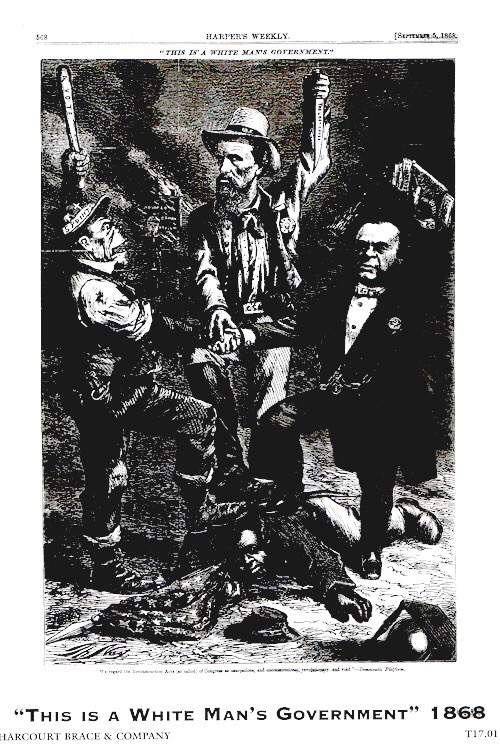
Today I look at another aspect of what happened in the post-Civil War United States, that of the responsibility of many leaders and citizens in the North for the failure of Reconstruction and the return of “White Man’s Rule” to the South, with its impact on Southern African Americans that in cases still linger today. Like today, people faced with economic difficulties sought out scapegoats and and it was easy for Northern whites, many of who were willing to concede “freedom” to blacks were still deeply racist, and for many, economic considerations trumped justice as the North tried to move away from Reconstruction and on to new conquests, including joining European powers in attempts to gain overseas colonies and territories.

It is all too easy to simply blame Southern whites for what happened during Reconstruction and in the “Redeemed South” of the post-Reconstruction era. However, without the willing cooperation of Northern politicians, businessmen, media with their Southern counterparts, coupled with an ambivalent Northern population Reconstruction might have worked.

This is yet another portion of my ever growing Civil War and Gettysburg text, and it is important too many people today are willing to sacrifice justice for their own prosperity.

Have a thoughtful night

Peace

Padre Steve+

IMG_1879

As Southern extremists turned the Federal effort at Reconstruction into a violent quagmire that seemed to have no end, many Northerners increasingly turned against the effort and against Blacks themselves. Like so many victorious peoples they did not have the political or moral capacity to remain committed to a cause for which so many had sacrificed and they began to abandon the effort after two short years of congressionally mandated Radical Reconstruction.

Likewise, the men who had so nobly began the effort to enfranchise African Americans failed to understand the social and political reality of the South. To the average Southerner of the era “political equality automatically led to social equality, which in turn automatically led to race-mixing. It was inevitable and unthinkable. To a people brought up to believe that Negroes were genetically inferior – after all, that was why they were slaves – the mere hint of “mongrelization” was appalling.” [1] This was something that most Northerners, even those committed to the political equality of African Americans could not comprehend, and the ignorance of this fact would be a major reason for the collapse of Northern political and social support for Reconstruction.

Congressman Thaddeus Stevens, one of the most effective leaders of the Radical Republicans died in 1868 in despair that the rights of blacks were being rolled back even as legislation was passed supporting them. A few weeks before his death Stevens told a friend “My life has been a failure…I see little hope for the republic.” [2] The old firebrand asked “to be buried in a segregated cemetery for African American paupers so that “I might illustrate in death the principles which I advocated through a long life, Equality of man before his creator.” [3] Others including Senator Ben Wade, were not returned to office while others including Edwin Stanton, Salmon Chase and Charles Summer all died during Grant’s administration.

While Grant attempted to smash the Ku Klux Klan by military means, both his administration and Congress were of little help. He faced increased opposition from economic conservative Republicans who had little interest in the rights of African Americans and who gave little support to those fighting for equal rights for blacks. The situation was further complicated by the “financial panic which hit the stock market in 1873 produced an economic downturn that soon worsened into a depression, which continued for the rest of the decade.” [4] The result was that Republicans lost their majorities in the House and in many states, even in the North.

It was clear that “1870 Radical Republicanism as a coherent political movement was rapidly disintegrating” [5] and during the early 1870s many of the antislavery activists had left the Republican party either to death or defection, many “no longer felt at home in a party that catered to big business and lacked the resolve to protect black rights.” [6]

In 1872, some former radical Republicans revolted against Grant and the corruption in the Republican Party. Calling themselves “Liberal Republicans” they supported the candidacy of Horace Greeley uniting with Democrats to call for an end to Reconstruction. For many this was not so much because they no longer supported the rights of African Americans, but because for them, like so many, “economic concerns now trumped race relations…. Henry Adams, who shared the views of his father, Charles Francis Adams, remarked that “the day is at hand when corporations far greater than [the] Erie [Railroad]…will ultimately succeed in directing the government itself.” [7] The numbers of Federal troops in the South continued to be reduced to the point where they could offer little or no support to state militia.

The combination of all of these factors, political, racial, economic, and judicial doomed Grant’s continued efforts at Reconstruction by executive means. Despite the hard fought battle to provide all the rights of citizenship and the vote to African Americans racism remained heavily intrenched in all regions of the country. In the North and the South the economic crisis of 1873 caused people to look for scapegoats, and blacks were an easy target. With economics easily trumping the cause of justice “racism increasingly asserted its hold on northern thought and behavior.” [8] The Northern press and politicians, including former abolitionists increasingly took the side of Southerners, condemning Freedmen as lazy and slothful usurpers of white civilization.

Likewise the growing problem of labor unrest in the North brought about by the economic depression made “many white northerners more sympathetic to white southern complaints about Reconstruction. Racial and class prejudices reinforced one another, as increasing numbers of middle-class northerners identified what they considered the illegitimate demands of workers and farmers in their own society with the alleged misconduct of the former slaves in the South.” [9]

The depression hit Freedmen in the South with a vengeance and unable to pay their bills and mortgages many lost everything and were at the mercy of their former white masters. Those still working for Reconstruction in the South were increasingly marginalized, stigmatized and victimized by a systemized campaign of propaganda which labeled them Carpetbaggers and Scalawags who were had gained power through the votes of blacks and who were profiting by looting Southern Whites. In the end Southern intransigence wore out the political will of Northerners to carry on, even that of strongest supporters of emancipation and equality.

Violence now became a means to further politics in the South and carried out in broad daylight and “intended to demoralize black voters and fatally undermine the Republican Party…. They paraded at regular intervals through African American sections of small towns in the rural black majority areas, intimidating the residents and inciting racial confrontations.” [10] These armed bands were highly successful, if they were successful in provoking a racial incident they would then fan out throughout the area to find blacks in order to beat up and kill, hundreds of blacks were killed by them. During the elections of 1876 the White Liners, Red Shirts, White League and others would be seen in threatening positions near Republican rallies and on Election Day swarmed the polls to keep blacks and Republicans out, even seizing ballot boxes either destroying them or counting the votes for Democrats. The strategy employed was to use “Lawless and utterly undemocratic means…to secure the desired outcome, which was to win a lawful, democratic election.” [11] The pressure was too much for most Republicans in the South, and many who did not leave the South “crossed over to the Democratic fold; only a few stood by the helpless mass of Negroes….” [12]

The elected governor of Mississippi, Republican General Adelbert Ames, who was one of the most able and honest of all the Northerners to hold elected office in the South wrote in 1875 about the power of the paramilitary groups, “The “white liners” have gained their point – they have, by killing and wounding, so intimidated the poor Negroes that they can in all human probability prevail over them at the election. I shall try at once to get troops form the general government. Of course it will be a difficult thing to do.” [13] Ames requested Federal troops “to restore peace and supervise the coming elections” [14] but did not get them. Grant’s Attorney general wrote “The whole public are tired out with these autumnal outbreaks in the South…and the great majority are now ready to condemn any interference on the part of the government….Preserve the peace by the forces in your own state….” [15] Ames, who had been a strong proponent of emancipation and black suffrage understood that he was being abandoned and in order to prevent more bloodshed gave up the fight. Sadly, he like Grant realized that most of the country “had never been for Negro civil rights in the first place. Freedom, yes; but that didn’t mean all the privileges of citizenship.” [16] He negotiated a deal with Democrats which resulted in blacks being forced form the polls and the Democrats returning to power in the state. When he left the state, the discouraged veteran of so many battles including Gettysburg wrote, “A revolution has taken place – by force of arms – and a race disenfranchised – they are to be returned to a condition of serfdom – an era of second slavery.” [17]

Notes

[1] Ibid. Lord The Past the Would Not Die p.11

[2] Ibid. Langguth, A.J. After Lincoln p.233

[3] Ibid. Guelzo Fateful Lightening p.504

[4] Ibid. Perman Illegitimacy and Insurgency in the Reconstructed South p.458

[5] Ibid. Foner Forever Free p.170

[6] Ibid. Egnal Clash of Extremes p.337

[7] Ibid. Egnal Clash of Extremes p.337

[8] Ibid. Foner Forever Free p.192

[9] Ibid. Foner Forever Free p.191

[10] Ibid. Perman Illegitimacy and Insurgency in the Reconstructed South pp.459-460

[11] Ibid. Perman Illegitimacy and Insurgency in the Reconstructed South p.461

[12] Ibid. Lord The Past the Would Not Die p.15

[13] Ames, Adelbert Governor Adelbert Ames deplores Violence in Mississippi, September 1875 in The Civil War and Reconstruction Documents and Essays Third Edition edited by Michael Perman and Amy Murrell Taylor Wadsworth Cengage Learning Boston MA 2011 p.434

[14] Ibid. Lord The Past the Would Not Die p.17

[15] Ibid. McPherson The War that Forged a Nation p. 190

[16] Ibid. Lord The Past that Wouldn’t Die p.17

[17] Watson, Bruce Freedom Summer: The Savage Summer of 1964 that Made Mississippi Burn and Made America a Democracy Viking Press, the Penguin Group New York and London 2010 p.41

1 Comment

Filed under civil rights, civil war, History, Political Commentary

Ulysses Grant’s Fight Against the KKK

Friends of Padre Steve’s World

This is another article excerpted from my Civil War and Gettysburg texts, this dealing with the fight against the Ku Klux Klan and other racist terrorist groups operating in the South. Unlike his predecessor, Andre Johnson, Ulysses S. Grant believed in freedom and equality for African Americans and was willing to use to the military and police power of the Federal Government to crush violent terrorist groups. In the end his effort failed, however among U.S. Presidents after Abraham Lincoln, Grant was most committed to ending racism and promoting equality in the United States.

Sadly, while the Klan and other groups like operate only on the margins of society, only popping up for Confederate Flag rallies, a protest here or there and of course the occasional mass killing; there are millions of others who harbor many of the same attitudes held by the Klan against African Americans, other minority groups, immigrants, and non-Christian religions. These people just maintain a tidier act. They wear expensive suits, Hang out with presidential candidates and popular preachers. They get interviewed on cable news to spread fear and loathing of those that they hate, and then capitalizing on that fear they use political action and the courts to push their agenda. Interestingly enough these well to do hatemongers almost never criticize or condemn the attitudes and action of Klan members or other white supremacists. If they do they brush it off as an “isolated” incident unconnected to their own ideology. 

The fact is they don’t condemn them because they share the same goal; a racially pure white supposedly Christian country. That my friends is why this still matters and why I admire that great General and far too under appreciated, President, Ulysses S Grant.

Have a great and thoughtful day,

Peace

Padre Steve+

ulysses-s-grant-book

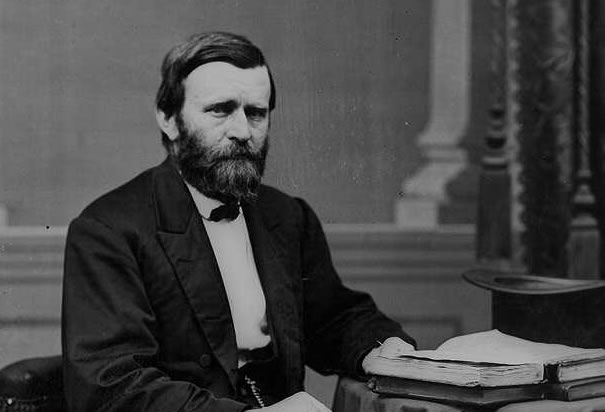
President Ulysses S. Grant

The passage of the Fourteenth and Fifteenth Amendments provoked even more violence from enraged Southerners. Thousands of Southerners, many former Confederate soldiers, formed a variety of violent racist organizations which turned the violence from sporadic attacks to what amounted to a full-fledged insurgency against the new Reconstructionist state governments and African Americans. Organizations like the Ku Klux Klan which engaged in terroristic violence while heavily armed so called  “social clubs” that operated under the aegis of the state Democratic Party leadership in most Southern states did the same. Under the leadership of former Confederate general Nathan Bedford Forrest whose troops had conducted the Fort Pillow massacre, the Klan’s membership throughout the South “was estimated at five hundred thousand” [1] and the majority were former Confederate soldiers. As the shadowy organization grew it became bolder and more violent in its attacks on African Americans, Republican members of the Reconstruction governments, and even Southern Jews.

64982-004-E91C3D02

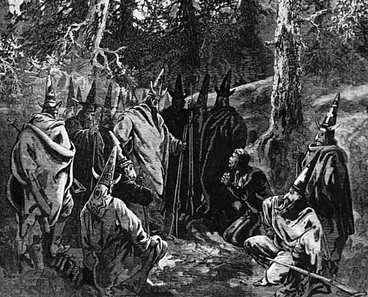
Early KKK Gathering

Allegedly organized for self-defense against state militia units composed of freed blacks they named themselves “White Leagues (Louisiana), White Liners or Rifle Clubs (Mississippi), or Red Shirts (South Carolina). They were, in fact, paramilitary organizations that functioned as armed auxiliaries of the Democratic Party in southern states in their drive to “redeem” the South from “black and tan Negro-Carpetbag rule.” [2] These men, mostly Confederate veterans “rode roughshod over the South, terrorizing newly freed slaves, their carpetbagger allies, and anyone who dared to imagine a biracial democracy as the war’s change.” [3] This unrequited violence and hatred set the stage for the continued persecution, murder and violence against blacks and those who supported their efforts to achieve equality in the South for the next century.

Throughout his term in office Johnson appealed to arguments used throughout later American history by “critics of civil rights legislation and affirmative action. He appealed to fiscal conservatism, raised the specter of an immense federal bureaucracy trampling on citizens’ rights, and insisted that self-help, not government handouts, was the path to individual advancement.” [4]

black-voter-threatening

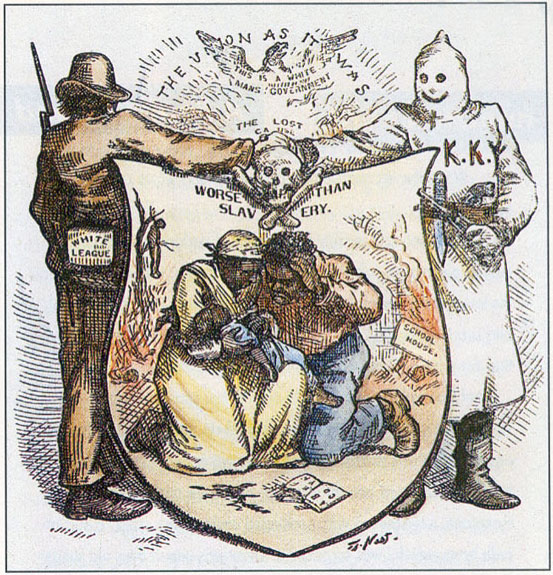
White League Members Intimidating Blacks at the Polls

Ulysses S. Grant succeeded Johnson as President in 1869. “For Grant, freedom and equal rights were matters of principle, not symbolism.” [5] Grant used his political capital to fight for the passage of the Fifteenth Amendment which gave black men the right to vote. It was one of the things that he remained most proud of in his life, he noted, “A measure which makes at once four million people voter who were heretofore declared by the highest tribunal in the land to be not citizens of the United States, nor eligible to become so…is indeed a measure of grander importance than any other act of the kind from the foundation of our free government to the present day.” [6] Grant ordered his generals in the South to enforce the Reconstruction Act and when the Ku Klux Klan attempted to stop blacks from voting Grant got Congress to pass the “enforcement Act, which made racist terrorism a federal offense.” [7] He created the Justice Department to deal with crimes against Federal law and in 1871 pushed Congress to pass a law known as the Ku Klux Klan Act and sent in the army and federal agents to enforce the law.

KKK-Nast

White League and KKK Poster

Grant’s efforts using the military as well as agents of the Justice Department and the Secret Service against the Klan were hugely successful, thousands were arrested, hundreds of Klansmen were convicted and others were either driven underground or disbanded their groups. The 1872 election, was the first and last in which blacks were nearly unencumbered as they voted until the passage of the 1964 Civil Rights Act and 1965 Voting Rights Act.

However, Grant’s actions triggered a political backlash which doomed reconstruction. The seminal moment in this came 1873 when General Philip Sheridan working in Louisiana, asked Grant for “permission to arrest leaders of the White League and try them by courts-martial” [8] for their violent acts against blacks and their seizure of the New Orleans City Hall in a brazen coup attempt. The leak of Sheridan’s request sparked outrage and even northern papers condemned the president’s actions in the harshest of terms.

Apart from the effort to support voting rights for African Americans Grant’s efforts at Reconstruction were met mostly by failure. Part of this was due to a weariness on the part of many Northerners to continue to invest any more effort into the effort. Slowly even proponents of Reconstruction began to retreat from it, some like Carl Schurz were afraid that the use of the military against the Klan in the South could set precedent to use it elsewhere. Others, embraced an understanding of Social Darwinism which stood against all types of government interference what they called the “natural” workings of society, especially misguided efforts to uplift those at the bottom of the social order…and African Americans were consigned by nature to occupy the lowest rungs of the social ladder.” [9]

Southerners knew that they were winning the political battle and continued their pressure in Congress and in the media to demonize supporters of Reconstruction as well as African Americans. Southerners worked to rig the political and judicial process through the use of terror to demoralize and drive from power anyone, black or white, who supported Reconstruction. By 1870 every former Confederate state had been readmitted to the Union, in a sense fulfilling a part Lincoln’s war policy, but at the same time denying what the war was waged for.

To be continued….

Notes

[1] Ibid. Lane The Day Freedom Died p.230

[2] Ibid. McPherson The War that Forged a Nation p. 178

[3] Ibid. Jordan Marching Home p.118

[4] Ibid. Foner Forever Free p.116

[5] Ibid. Lane The Day Freedom Died: p.2

[6] Flood, Charles Bracelen, Grant’s Final Victory: Ulysses S. Grant’s Heroic Last Year DaCapo Press, Boston 2011 pp.78-79

[7] Ibid. Lane The Day Freedom Died p.4

[8] Ibid. Langguth, A.J. After Lincoln p.314

[9] Ibid. Foner Forever Free pp.192-193

3 Comments

Filed under civil rights, civil war, History, Political Commentary

Truth and Un-sanitized History

10570298_10152872503382059_5058681841617456899_n

Friends of Padre Steve’s World,

I have spent the last couple of days introducing to new readers to things that I have come to believe. Since I am a historian I will continue to do that today.

I have a passion for truth, especially in the realm of historical thought, in fact over the past few years this passion has deepened to a level of profoundness that I never dreamed. In fact for me this passion has become a duty, a duty to truth; an un-sanitized, warts and all examination of subjects attempting to strip away the veneer of myth in order to find truth. This is not easy, but it is what my life has become, knowing that in the long run I will not discover all truth, but hopefully point others to examine history, the sciences, philosophy and even theology to find truth. The process can be uncomfortable, especially when confronted by facts, documents, scientific and archeological data which shows what we used to think was truth, as either incomplete, romantic myth, or even complete lies, untruths and fabrication. Oscar Wilde once wrote,“The truth is rarely pure and never simple.”

Barbara Tuchman once wrote: “The reality of a question is inevitably more complicated than we would like to suppose.” That is the nature of truth. It does not matter if it is truth about history, biography, philosophy and religion, science, politics, economics or any part of life. To actively seek truth means that one must open up themselves to the possibility of doubting, as Rene Descartes wrote: “If you would be a real seeker after truth, it is necessary that at least once in your life you doubt, as far as possible, all things.” I admit that this is not comfortable, but it is necessary.

As a historian I have a tremendous passion for truth, and for unsanitized history and for me this means looking at what we know with a critical eye, to compare and examine sources to question what we or others knew before. Far too often what we believe about our own history is often more preserving myth more than by asking hard questions and applying reasoned critical study. To do this is dangerous, because to do so we have to admit that what we know today could be proven wrong at some time in the future when new facts, documents, archeological finds or other historical or scientific are discovered. To those content with half-truth, partial truth or even myth this is disconcerting, and those of us who attempt to unravel myth from fact and present things in a new way are called “revisionists” as if that is somehow a bad thing. The sad thing is we are having to revise in many cases, supposed history that was revised by people who needed to propagate myth, such as with those who promoted the myth of the Lost Cause, the romantic, noble Confederacy which for well over a half century was propagated as historical truth. This myth was sold to the American public in such in film, television and books, fiction and non-fiction alike, to the point that much of white America, even outside the South accepted the myth of the Lost Cause as truth. Films like Birth of a Nation, Gone with the Wind and even Disney’s Song of the South, helped ingrain the myth as truth, and even today when so much more is known, many people hold on to the myth and attack those who differ. 

A lot of my readers may wonder why I write so much about the American Civil War as well as the ante-bellum and Reconstruction eras of American history. For me they are very important for a couple of reasons; first they are eras, that for good and bad define us as a nation and people. Second, they still have relevance to what happens today, especially in the understanding of liberty, civil rights and race relations.

I have a passion for this. The American Civil War and the Battle of Gettysburg are intrinsic parts of who we are as Americans today. The events of that war and this battle continue to reverberate in many aspects of our political, social and national life. Thus for me teaching about this event and what happened on the “hallowed ground” of Gettysburg, as Abraham Lincoln called it, and even 150 years later it matters far more than most of us realize.

Civil War hero Joshua Chamberlain is an icon of the Civil War and American history. A professor of Rhetoric and Natural and Revealed Religions at Bowdoin College he volunteered to serve with the 20th Maine Infantry, his military career in the Civil War has been depicted in movies such as Gettysburg and Gods and Generals and written about in biographies and even historical fiction. Chamberlain was one of the heroes of Gettysburg, and his story has a myth like quality, but he too was a complex, contradictory and sometimes flawed character. However, Chamberlain attached a great importance to passing down the stories of people who did noble deeds and who lived exemplary lives. He wrote, “The power of noble deeds is to be preserved and passed on to the future.”

I sincerely believe what Chamberlain said and I am getting ready to lead another Staff Ride for students from our Staff College to Gettysburg next month.  I do beleive that the power of noble deeds needs to be preserved and passed on to the future.  Even the deeds of less than perfect, often contradictory and sometimes even scandalous  individuals. That is part of the task of the historian. I do this in what I teach and what I write, both in the academic setting as well as on this website.

We live in a time of great cynicism, some of which I can understand. We also live in a time where many people and our institutions operate in a “zero defect” culture, those who fail in any way are shunted aside, punished or even chastised or ostracized. However, when I look at the men who fought at Gettysburg, or for that matter almost any individual who has accomplished great things, none are perfect people and many have great flaws in character, or supported causes or ideologies that were evil. That being said, even less than perfect people can rise to do great deeds, deeds that need to be remembered, passed down and told to succeeding generations.

Many great leaders, or other men and women that we consider today to be great, influential or important were or are quite fallible. Even those who did great things often made gross mistakes, had great flaws in their character, and some lived scandalous lives. Such deeds may tarnish their legacy or take some of the luster away from their accomplishments. But I think that these flaws are often as important as their successes for they demonstrate the amazing capacity of imperfect people to accomplish great things, as well as the incredible complexity of who we are as people. No one is perfect. There are degrees of goodness and even evil in all of us. It is part of the human condition. That is the beauty of un-sanitized history, that is the beauty of stripping away myth to discover the humanity of people, and to recognize who they are, who we are, the good, the bad and even the ugly.

When I look at the perfection that imperfect people expect of others I am reminded of something that William Tecumseh Sherman said about his relationship with Ulysses Grant. These were flawed men, but they were in large part responsible for the Union victory in the Civil War. However, to be honest, neither man would never reach the level of command that they rose to in our current military culture, nor would they rise to the top in corporate America. They are too flawed. Sherman said it well, “Grant stood by me when I was crazy, and I stood by him when he was drunk, and now we stand by each other.” 

That is a part of my passion about Gettysburg and my appreciation and admiration of the brave men who fought in that battle. As I continue to write about that battle and about those men I hope that my readers will gain a new appreciation of their complex and contradictory natures, as well as think about what that means to us today, as individuals and as a society, for it is only when we strip away the myth and seek the truth. Marcus Aurelius wrote:

“If someone is able to show me that what I think or do is not right, I will happily change, for I seek the truth, by which no one was ever truly harmed. It is the person who continues in his self-deception and ignorance who is harmed.”

Those truths can be scientific, they can be historical or literary, and quite often the truth can also be quite personal.

As John F Kennedy said at Yale in 1962: “The great enemy of truth is very often not the lie–deliberate, contrived and dishonest–but the myth–persistent, persuasive and unrealistic. Too often we hold fast to the cliches of our forebears. We subject all facts to a prefabricated set of interpretations. We enjoy the comfort of opinion without the discomfort of thought.”

So until tomorrow, have a thoughtful night.

Peace

Padre Steve+


1 Comment

Filed under civil war, History, philosophy

Confederate Sunset in South Carolina 

confederate-flag

Friends of Padre Steve’s World

Historian George Santayana said “Loyalty to our ancestors does not include loyalty to their mistakes.” Today it appears that at least one legislature and governor has agreed with him.

This afternoon South Carolina Governor Nikki Haley signed a bill passed by overwhelming majorities in the South Carolina Senate and House to remove the Confederate Battle flag from grounds of the South Carolina State Capital. The ceremonial lowering will occur at 10 AM tomorrow, July 10th 2015, when it is lowered it will be transferred to a museum, which is an appropriate place. 

This is important, I did not imagine that it would occur in my lifetime, and I expect to live a fair number of years. The sad thing is that it took the murder of nine innocent African American church members at Emmanuel African American Episcopal Church in Charleston by a young man named Dylan Roof, who harbored White Supremacist dreams of a race war to bring this about. It took the abject horror of people being murdered in church to do make people begin to realize that maybe, just maybe that continuing to display this symbol of the Confederacy on state grounds was not a good idea.

I know that there are many who defend that flag. I am not among them, although I once was as members of both sides of my family fought under it during the Confederate rebellion against the United States. But it does belong to history and what it stood for, not what it stands for in myth, but what it stood for the men who raised it in rebellion in order to defend and expand what they referred to as the “peculiar institution,” the political, social, religious and economic system known as slavery.  That is a fact, simply read Confederate Vice President Alexander Stephen’s Cornerstone Speech of 1861 where he said:

“Our new government is founded upon exactly the opposite idea; its foundations are laid, its corner- stone rests upon the great truth, that the negro is not equal to the white man; that slavery — subordination to the superior race — is his natural and normal condition. [Applause.] This, our new government, is the first, in the history of the world, based upon this great physical, philosophical, and moral truth.”

In fact if you read every declaration of secession issued by the various states of the Confederacy, all insist that slavery was the main issue for which they seceded and for which they went to war. That did not change during the war and after the fighting was over, the flag of the Confederacy became the standard of White Supremacists throughout the South as they worked in the legislatures and in the courts to roll back the rights of blacks, using violence, intimidation and fraud to do so.

However, it was not until April 11th 1961 during the early days of the Civil Rights movement that the legislature of South Carolina voted to fly the Confederate Battle Flag over the state house in Columbia. This coincided with the centennial of the beginning of the Civil War when South Carolina troops on the orders of President Jefferson Davis opened fire on Fort Sumter. Ten years ago the flag was moved from the dome of the state house to a monument to Confederate veterans on the grounds of that complex.

Tomorrow morning that flag will come down, and I think that is a good thing for I do not believe that this symbol of rebellion and sadly white supremacy and racism should fly from any government building or complex. That being said if an individual chooses to fly the flag they should not be forbidden from doing so. I may object to that but I can only hope that with time and exposure to the truth that even these displays will come down. As to the people that fly these banners in order to display their racism, their hatred of other Americans and their desire for yet another rebellion, I am glad that they fly it so that I will know who they are, after all I favor truth in advertising and if I see this flag flying from a business I am sure that I will not spend my money in  those establishments.

As far as the people who honestly believe that in flying the flag they are honoring their heritage or ancestors, I can offer a measure of sympathy, but I encourage them not to sanitize history from facts. The fact is that the sacrifice and “heritage” our our ancestors, and I do include mine cannot be separated from the cause for which they fought, slavery, and for which those that came after them worked to ensure; racism, discrimination and even murder.

As gallant and even as chivalrous soldiers as many Confederate soldiers were, their sacrifice cannot be separated from the cause for which they fought, just like any other “honorable” soldiers who fought for evil causes. There are many such people that I admire for their soldierly qualities, while not espousing their cause.

Like Ulysses S. Grant I can mourn their sacrifice and admire the gallantry of soldiers even while acknowledging the injustice of the Confederate cause. After Lee’s surrender at Appomattox Grant wrote, “I felt…sad and depressed, at the downfall of a foe who had fought so long and valiantly, and had suffered so much for a cause, though that cause was, I believe, one of the worst for which a people has fought.” He later noted: “The Confederates were now our countrymen, and we did not want to exult over their downfall.”

It is time for this symbol of the Confederacy to come down forever and for the war that three quarters of a million American soldiers, Union and Confederates died, and for which millions of African Americans were enslaved and after the war thousands of freed blacks murdered or lynched, even as millions more were legally disenfranchised and discriminated against under Jim Crow. It is time for that to end, here and now. As far as me, I may honor my ancestors, but I will not honor the cause for which they fought.

Peace

Padre Steve+


Leave a comment

Filed under civil rights, civil war, History, News and current events, Political Commentary

Racism & the Failure of Reconstruction

this-is-a-white-mans-government


Friends of Padre Steve’s World

Some events and attitudes are timeless, one of these is racism. Being white myself, I know that many whites are loath to admit that the scourge of racism still exists, but it does and it runs deep in our history. The more that I work on my Civil War and Gettysburg text, which now appears will morph into at least two and maybe three books when I am done, I find terribly distressing parallels to attitudes and actions of some which mirror the attitudes and actions of our ancestors, Northern and Southern following the Civil War. When the shooting stopped and the South was vanquished, many Southerners continued the war by other means and Northerners, divided after the death of Abraham Lincoln failed to achieve the most important political goal, after the restoration of the Union, that of true freedom for African Americans. Sadly, for some that war is still not over, as was evidenced in the aftermath of the Emanuel A.M.E. Massacre just two weeks ago. Likewise the burnings of six predominantly black churches across the South raises the specter of the racial violence that targeted blacks for a century after the Civil War.

This is another section of my text. I do hope that it challenges you as much as writing it challenged me.

Peace

Padre Steve+


When the war ended the Confederacy was beaten and most people in the South would have agreed to anything that the North presented regarding peace and return to the Union. In a sense Reconstruction was “what the war was about.” [1] Richard Henry Dana, the declared that “a war is over when its purpose is secured. It is a fatal mistake to hold that this war is over because the fighting has ceased. This war is not over…” [2] As Dana, and Clausewitz understood so well that war is a continuation of policy and politics by other means, and the failure of the North to fully grasp this fact led to over a century of subjugation of emancipated African Americans and has fueled a continual racial divide in the United States that is still felt today. Defeated on the battlefield Southerners soon turned to political, psychological and violent means to reverse their losses.

Frederick Douglass understood that simple emancipation was not enough, and that the “war and its outcome demanded racial equality.” [3] Despite the that efforts of many in the North this would not happen during Reconstruction and Douglass knew that the failure to accomplish this would be disastrous, “Whether the tremendous war so heroically fought…shall pass into history a miserable failure…or whether on the other hand, we shall, as the rightful reward of victory over treason have a solid nation, entirely delivered from all contradictions and social antagonisms, must be determined one way or another.” [4]

There was a problem with implementing Reconstruction; when John Wilkes Booth assassinated Abraham Lincoln, the political leaders of the North could not agree on how to do this. The new President, Andrew Johnson was probably the worst possible leader to lead the country in the aftermath of war for all practical purposes Johnson was a Democrat who believed in white supremacy, he had been brought onto the ticket for his efforts to keep Kentucky in the Union and to support Unionist elements in Tennessee. While his selection helped Lincoln in parts of the North and the Border States it was a disaster for the post-war era. Johnson’s approach to reconstruction was very simply to “impose minimal demands on the South. He required only minor concessions from the former Confederates before allowing them to resume their political rights and retain their land. As for freedmen, he seemed to think that the needed no further protection beyond the fact of their emancipation.” [5]

Johnson was “a lonely stubborn man with few confidants, who seemed to develop his policies without consulting anyone, then stuck to them inflexibly in the face of any and all criticism. He lacked Lincoln’s ability to conciliate his foes and his capacity for growth, which was best illustrated by Lincoln’s evolving attitude to black suffrage during the Civil War.” [6] In the months after his unexpected accession to the presidency Johnson demonstrated that he had no understanding of Lincoln’s political goals for the South and the desires of the Republican dominated Congress.

By the summer of 1865 Johnson was already demonstrating “that his sympathies were with the Southern white population and that he believed that their interests should be cared for even at the expense of freedmen.” [7] Johnson’s approach to reconstruction was very simply to “impose minimal demands on the South. He required only minor concessions from the former Confederates before allowing them to resume their political rights and retain their land. As for freedmen, he seemed to think that the needed no further protection beyond the fact of their emancipation.” [8] Johnson gave individual pardons to more than thirteen thousand “high-ranking Confederate civil and military officers and wealthy Southerners.” [9] While doing this he minimized political influence the Southern Unionists who had not supported the Confederacy and ensured that freed slaves were excluded from the political process. He issued a number of orders “appointing interim provisional governors and urging the writing of new state constitutions based upon the voter qualifications in force at the time of secession in 1861 – which meant, in large but invisible letters, no blacks.” [10]

When Frederick Douglass led a delegation of blacks to meet with Johnson in February 1865 Johnson preached that it was impossible to give political freedom to blacks. When Douglass attempted to object Johnson became angry and told Douglass “I do not like to be arraigned by some who can get up handsomely-rounded periods and rhetoric, and talk about abstract ideas of liberty, who never periled life, liberty, or property.” [11] When Douglass took his objections to Johnson’s harangue to a Washington newspaper, Johnson railed against Douglass “I know that d—–d Douglass…he’s just like any other nigger & would sooner cut a white man’s throat than not.” [12]

White Southerners including the newly pardoned Confederates enacted black codes that “codified explicit second-class citizenship for freedpeople.” [13] The legislature of Mississippi refused to ratify the Thirteenth Amendment, and did not do so until 1995. One Southerner noted that “Johnson “held up before us the hope of a ‘white man’s government,’ and this led us to set aside negro suffrage…. It was natural that we should yield to our old prejudices.” [14] Former Confederates, including Alexander Stephens the former Vice President of the Confederacy were elected to high office, Stephens to the United States Senate and the aggrieved Republicans in Congress in turn refused to admit the former Confederates. Many Union veterans were incensed by Johnson’s actions, one New York artilleryman noted “I would not pardon the rebels, especially the leaders, until they should kneel in the dust of humiliation and show their deeds that they sincerely repent.” [15] He was not alone, many Northern Veterans who formed the integrated Grand Army of the Republic veterans maintained a patent disregard, if not hatred of what the old South stood for and felt that their efforts in the war had been betrayed by the government.

Johnson’s restoration of property to the former white owners drove tens of thousands of blacks off lands that they had been farming, or left them as laborers for their former slave masters. Johnson countermanded General William Tecumseh Sherman and Secretary of War Edwin Stanton’s Field Order 15 to “divide abandoned and confiscated lands on the Sea Islands and in a portion of the Low Country coast south of Charleston into forty-acre plots for each black family.” [16] As such many freed blacks were now at the mercy of their former white owners for any hope of economic sustenance. Johnson stridently to frustrate the efforts of the Freedmen’s Bureau headed by Major General Oliver Howard to help freed blacks to become landowners. Johnson vetoed the Civil Rights bill but Congress overrode his veto. Eventually the battled between Johnson and Congress resulted in Johnson’s impeachment and narrow acquittal by one vote in the Senate in 1868.

The various black codes enacted throughout the South:

“passed labor laws that bound blacks to employers almost as tightly as slavery once bound them to their masters. Other codes established patterns of racial segregation that had been impossible under slavery, barred African Americans from serving on juries or offering testimony in court against whites, made “vagrancy,” “insulting gestures,” and “mischief” offenses by blacks punishable by fines or imprisonment, forbade black-white intermarriage, ad banned ownership by blacks of “fire-arms of any kind, or any ammunition, dirk or bowie-knife.” [17]

Likewise within weeks of the end of the violence against blacks began to break out in different parts of the South and it continued to spread as Johnson and Congress battled each other in regard to Reconstruction policy. “In Memphis, Tennessee, in May of 1866, whites on a rampage of murder killed forty-six Negroes, most of them veterans of the Union army, as well as two white sympathizers. Five Negro women were raped. Ninety homes, twelve schools and four churches were burned. In New Orleans in the summer of 1866, another riot against blacks killed thirty-five Negroes and three whites.” [18]

This alienated him from the Republican majority who passed legislation over Johnson’s veto to give black men the right to vote and hold office, and to overturn the white only elections which had propelled so many ex-Confederates into political power. Over Johnson’s opposition congress took power over Reconstruction and “Constitutional amendments were passed, the laws for racial equality were passed, and the black man began to vote and to hold office.” [19] Congress passed measures in 1867 that mandated that the new constitutions written in the South provide for “universal suffrage and for the temporary political disqualification of many ex-Confederates.” [20]   These measures helped elect bi-racial legislatures in the South which for the first time enacted a series of progressive reforms including the creation of public schools. They also ratified the Thirteenth and the Fourteenth Amendments, but these governments, composed of Southern Unionists, Northern Republicans and newly freed blacks were “elicited scorn from the former Confederates and from the South’s political class in general.” [21] Seen as an alien presence by most Southerners the Republican governments in the South faced political and was as violent opposition.

The Fourteenth Amendment was of particular importance for it overturned the Dred Scott decision which denied citizenship to blacks. Johnson opposed the amendment and worked against its passage by campaigning for men who would oppose it in the 1866 elections. His efforts earned him the opposition of former supporters including the influential New York Herald declared that Johnson “forgets that we have passed through a fiery ordeal of a mighty revolution, and the pre-existing order of things is gone and can return no more.” [22]

When passed by Congress the amendment was a watershed which would set Constitutional precedent for future laws to give women the right to votes, end Jim Crow laws, enact the Voting Rights Act of 1965, and most recently to give homosexuals the right to marry. Section one of the amendment read:

“All persons born or naturalized in the United States, and subject to the jurisdiction thereof, are citizens of the United States and of the state wherein they reside. No state shall make or enforce any law which shall abridge the privileges or immunities of citizens of the United States; nor shall any state deprive any person of life, liberty, or property, without due process of law; nor deny to any person within its jurisdiction the equal protection of the laws.” [23]

But these measures provoked even more violence from enraged Southerners who formed a variety of violent racist organizations which turned the violence from sporadic attacks to what amounted to a full-fledged insurgency against the new state governments and African Americans. Organizations like the Ku Klux Klan which engaged in terroristic violence to heavily armed “social clubs” which operated under the aegis of the state Democratic Party leadership in most Southern states. Allegedly organized for self-defense against state militia units composed of freed blacks they named themselves “White Leagues (Louisiana), White Liners or Rifle Clubs (Mississippi), or Red Shirts (South Carolina). They were, in fact, paramilitary organizations that functioned as armed auxiliaries of the Democratic Party in southern states in their drive to “redeem” the South from “black and tan Negro-Carpetbag rule.” [24] These men, mostly Confederate veterans “rode roughshod over the South, terrorizing newly freed slaves, their carpetbagger allies, and anyone who dared to imagine a biracial democracy as the war’s change.” [25] This unrequited violence and hatred set the stage for the continued persecution, murder and violence against blacks and those who supported their efforts to achieve equality in the South for the next century.

Throughout his term in office Johnson appealed to arguments used throughout later American history by “critics of civil rights legislation and affirmative action. He appealed to fiscal conservatism, raised the specter of an immense federal bureaucracy trampling on citizens’ rights, and insisted that self-help, not government handouts, was the path to individual advancement.” [26] While many of his Republican opponents supported these measures, many moderate Republicans could not abandon their support of or and ties to big corporations, and

Ulysses S. Grant succeeded Johnson as President in 1869 but his efforts at Reconstruction were met mostly by failure as well as a weariness on the part of many Northerners to continue to invest any more effort into it. Slowly even proponents of Reconstruction began to retreat from it and Southerners, knowing that they were winning the political battle continued their pressure. Both politically and through the use of terror to demoralize and drive from power anyone who supported it. By 1870 every former Confederate state had been readmitted to the Union, in a sense fulfilling a part Lincoln’s war policy, but at the same time denying what the war was waged for.

Congressman Thaddeus Stevens, one of the most effective leaders of the Radical Republicans died in 1868 in despair that the rights of blacks were being rolled back even as legislation was passed supporting them. The old firebrand asked “to be buried in a segregated cemetery for African American paupers so that “I might illustrate in death the principles which I advocated through a long life, Equality of man before his creator.” [27] Others including Senator Ben Wade, were not returned to office while others including Edwin Stanton, Salmon Chase and Charles Summer all died during Grant’s administration.

While Grant attempted to smash the Ku Klux Klan by military means his administration, heavily made up of economic conservative Republicans who had little interest in the rights of African Americans gave little other support to those fighting for equal rights for blacks. In the end Southern intransigence wore out the political will of Northerners to carry on, even the strongest supporters of equality.

By “1870 Radical Republicanism as a coherent political movement was rapitdl6y disintegrating” [28] and during the early 1870s many of the antislavery activists had left the Republican party either to death or defection, many “no longer felt at home in a party that catered to big business and lacked the resolve to protect black rights.” [29]

In 1872, some former radical Republicans revolted against Grant and the corruption in the Republican Party. Calling themselves “Liberal Republicans” they supported the candidacy of Horace Greeley uniting with Democrats to call for an end to Reconstruction. For many this was not so much because they no longer supported the rights of African Americans, but because for them, like so many, “economic concerns now trumped race relations…. Henry Adams, who shared the views of his father, Charles Francis Adams, remarked that “the day is at hand when corporations far greater than [the] Erie [Railroad]…will ultimately succeed in directing the government itself.” [30] The numbers of Federal troops in the South continued to be reduced to the point where they could offer little or no support to state militia.

Violence now became a means to further politics in the South and carried out in broad daylight and “intended to demoralize black voters and fatally undermine the Republican Party…. They paraded at regular intervals through African American sections of small towns in the rural black majority areas, intimidating the residents and inciting racial confrontations.” [31] These armed bands were highly successful, if they were successful in provoking a racial incident they would then fan out throughout the area to find blacks in order to beat up and kill, hundreds of blacks were killed by them. During the elections of 1876 the White Liners, Red Shirts and others would be seen in threatening positions near Republican rallies and on Election Day swarmed the polls to keep blacks and Republicans out, even seizing ballot boxes. The strategy employed was to use “Lawless and utterly undemocratic means…to secure the desired outcome, which was to win a lawful, democratic election.” [32]

The elected governor of Mississippi, Republican General Adelbert Ames, who was one of the most able and honest of all the Northerners to hold elected office in the South wrote in 1875 about the power of the paramilitary groups, “The “white liners” have gained their point – they have, by killing and wounding, so intimidated the poor Negroes that they can in all human probability prevail over them at the election. I shall try at once to get troops form the general government. Of course it will be a difficult thing to do.” [33] Ames did not get his troops. Grant’s Attorney general wrote “The whole public are tired out with these autumnal outbreaks in the South…and the great majority are now ready to condemn any interference on the part of the government….Preserve the peace by the forces in your own state….” [34] Ames, who had been a strong proponent of emancipation and black suffrage understood that he was being abandoned and in order to prevent more bloodshed gave up the fight. He negotiated a deal with Democrats which resulted in blacks being forced form the polls and the Democrats returning to power in the state.

The White League in Louisiana was particularly brutal and on Easter Sunday massacred blacks in Colfax Louisiana killing at least seventy-one and possibly as many as three-hundred blacks, killing many as they tried to surrender. Another White League detachment southwest of Shreveport “forced six white Republicans to resign their office on pain of death – and then brutally murdered them after they had resigned.” [35]

Reconstruction was officially ended in 1877 by newly elected President Rutherford B. Hayes and all Federal troops assigned to enforce it were withdrawn. Despite this, some people in the South attempted to fight for the rights of African Americans, including men like former Confederate Generals James Longstreet, William Mahone and Wade Hampton. Hampton was elected as the first post-Reconstruction governor of South Carolina in and campaigned against the black codes, and during his term in office even appointed African Americans to political offices in the state and maintained a regiment of African American state militia in Charleston against strident opposition.

While Hampton remained a white supremacist he also was committed to the upholding the law and “promoting the political rights to which freedmen were entitled to under law, and he consistently strove to protect those rights.” [36] This made him anathema to many South Carolina politicians, including Benjamine Tillman who as governor during the 1890s dismantled policies that Hampton had introduced to allow blacks to political patronage appointments. Once he did that Tillman set out to deprive South Carolina’s blacks of almost ever basic civil right, and in 1895 he led “a successful effort to rewrite the South Carolina constitution in such a way as to virtually disenfranchise every black resident of the state.” [37] Longstreet, who had become a Republican was wounded while leading Louisiana militia in an unsuccessful fight against White Leaguers in New Orleans on September 14th 1873.

The legislation which helped provide blacks with some measure of freedom was rolled back after Reconstruction ended. In 1883 “the Civil Rights Act of 1875, outlawing discrimination against Negroes using public facilities, was nullified by the Supreme Court, which said: “individual invasion of individual rights is not the subject-matter of the amendment.” The Fourteenth Amendment, it said, was aimed at state action only. No state shall…” [38]

The actions of the court and alliances between Northern corporations and Southern landowners led to even more discrimination and disenfranchisement for blacks, “From the 1880s onward, the post-Reconstruction white governments grew unwilling to rely just on intimidation at the ballot box and themselves in power, and turned instead to systematic legal disenfranchisement” [39] which furthered the black codes into what we now call the era of Jim Crow.

In 1896 the black codes were upheld by the Supreme Court in the case of Plessy v. Ferguson. That ruling established the “separate but equal” doctrine and ushered in an era of de jure segregation in almost all arenas of life including education, transportation, entertainment and health care. The limited social equity and privileges enjoyed by blacks, not only in the South, but in the entire nation were erased by the stroke of the judicial pen. The justices ruled on the concept that only people’s political rights were protected by the Constitution and that in the social arena that African-Americans could not interact with whites and assumed their racial inferiority.

Associate Justice John Harlan, a former slaveholder who had dissented in Court’s decision to overturn the Civil Rights Act of 1875 insisted “our Constitution is color blind” [40] and wrote in dissent:

“The destinies of two races, in this country are indissolubly linked together, and the interests of both require that the common government of all should not permit the seeds of race hate to be planted under the sanction of law. What can more certainly arouse race hate, what more certainly create and perpetuate a feeling of distrust between these races, than state enactments, which, in fact, proceed on the ground that colored citizens are so inferior and degraded that they cannot be allowed to sit in public coaches occupied by white citizens? That, as all will admit, is the real meaning of such legislation as was enacted in Louisiana.” [41]

These court decisions and legislation strengthened racism and discrimination against blacks, “effectively excluding blacks from public places, from the right to votes, from good public education, and so forth.” [42] The Plessy ruling was followed by “state laws mandating racial segregation in every aspect of life, from schools to hospitals, waiting rooms to toilets, drinking fountains to cemeteries…segregation was part of a complex system of white domination, in which each component – disenfranchisement, unequal economic status, inferior education – reinforced the others.” [43] Violence was used with great effect and between 1880 and 1968 approximately 3,500 people were murdered or lynched throughout the South. The “separate but equal” measures of the Jim Crow era took nearly a century to reverse, and “only began to disappear with Brown v. Board of Education in 1954 and the Civil Rights and Voting Rights Acts of 1964 and 1965.” [44]

The example of Reconstruction’s failure shows that in order to secure peace that military victory must be accompanied by the political will to ensure that the avowed goals of that victory are secured after the war in ensuring a just peace. Southerners may have lost the shooting war, but they did not accept the peace and resorted to all means to reverse their military defeat through political, social, economic and judicial means and “justice was sacrificed for the unjust peace ushered in by “redemption” of the South, a peace marred by Jim Crow, poverty and lynching.” [45] Most Northern leaders failed to appreciate this until far too late, and hindered by President Johnson’s opposition failed to win the peace in the South. They failed to appreciate that even after the shooting is often that “there is a need for further threats, and indeed action, because postwar disorder and even chaos will have to be address, and victorious allies are always likely to squabble over the spoils of victory” [46] as certain was the case in the divided Republican Party of the Reconstruction era.


Notes

[1] Perman, Michael and Murrell Taylor, Amy editors The Civil War and Reconstruction Documents and Essays Third Edition Wadsworth Cengage Learning Boston MA 2011 p.323

[2] Ibid. McPherson The War that Forged a Nation p. 175

[3] Ibid. Goldfield America Aflame p.407

[4] Ibid. Goldfield America Aflame p.407

[5] Ibid. Perman and Taylor The Civil War and Reconstruction Documents and Essays Third Edition p.323

[6] Foner, Eric Forever Free: The Story of Emancipation and Reconstruction Vintage Books a Division of Random House, New York 2005 p.108

[7] Carpenter, John A. Sword and Olive Branch: Oliver Otis Howard Fordham University Press, New York 1999 p.109


[8] Ibid. Perman and Taylor The Civil War and Reconstruction Documents and Essays Third Edition p.323

[9] Ibid. McPherson The War that Forged a Nation p. 177

[10] Ibid. Guelzo Fateful Lightening p.490

[11] Ibid. Guelzo Fateful Lightening p.494

[12] Ibid. Guelzo Fateful Lightening p.494

[13] Ibid. McPherson The War that Forged a Nation p. 177

[14] Ibid. Guelzo Fateful Lightening p.491

[15] Jordan, Brian Matthew. Marching Home: Union Veterans and Their Unending Civil War Liveright Publishing Corporation a Division of W.W. Norton and Company Inc. New York and London 2014 p.119

[16] Ibid. Goldfield America Aflame p.411

[17] Ibid. Guelzo Fateful Lightening p.491

[18] Ibid. Zinn The Other Civil War p.55

[19] Ibid. Zinn The Other Civil War p.54

[20] Ibid. McPherson The War that Forged a Nation p. 178

[21] Perman, Michael Illegitimacy and Insurgency in the Reconstructed South in The Civil War and Reconstruction Documents and Essays Third Edition edited by Michael Perman and Amy Murrell Taylor Wadsworth Cengage Learning Boston MA 2011 p.451

[22] Ibid. Foner Forever Free p.121

[23] _____________ The 14th Amendment to the U.S. Constitution retrieved from https://www.law.cornell.edu/constitution/amendmentxiv 29 June 2015

[24] Ibid. McPherson The War that Forged a Nation p. 178

[25] Ibid. Jordan Marching Home p.118

[26] Ibid. Foner Forever Free p.116

[27] Ibid. Guelzo Fateful Lightening p.504

[28] Ibid. Foner Forever Free p.170

[29] Ibid. Egnal Clash of Extremes p.337

[30] Ibid. Egnal Clash of Extremes p.337

[31] Ibid. Perman Illegitimacy and Insurgency in the Reconstructed South pp.459-460

[32] Ibid. Perman Illegitimacy and Insurgency in the Reconstructed South p.461

[33] Ames, Adelbert Governor Adelbert Ames deplores Violence in Mississippi, September 1875 in The Civil War and Reconstruction Documents and Essays Third Edition edited by Michael Perman and Amy Murrell Taylor Wadsworth Cengage Learning Boston MA 2011 p.434

[34] Ibid. McPherson The War that Forged a Nation p. 190

[35] Ibid. McPherson The War that Forged a Nation p. 185

[36] Longacre, Edward G. Gentleman and Soldier: The Extraordinary Life of General Wade Hampton Rutledge Hill Press, Nashville TN 2003 p.265

[37] Ibid. Longacre Gentleman and Soldier p.274

[38] Ibid. Zinn The Other Civil War p.57

[39] Ibid. Guelzo Fateful Lightening p.526

[40] Ibid. Zinn The Other Civil War p.58

[41] LaMorte, Michael W. School Law: Cases and Concepts 9th Edition 2008 Allyn and Bacon Inc. 2008 p.300

[42] Gonzalez, Justo L. The History of Christianity Volume 2: The Reformation to the Present Day Harper and Row Publishers San Francisco 1985 p.252

[43] Ibid. Foner Forever Free p.208

[44] Ibid. Huntington Who are We? p.54

[45] Ibid. McPherson The War that Forged a Nation p. 191

[46] Ibid. Gray Fighting Talk p.14


2 Comments

Filed under civil rights, civil war, History, laws and legislation, News and current events, Political Commentary

Time for It to Come Down

confederate-flag-picture

It has been 150 years since the revolt of the Confederate States of America officially ended. However, the flag of that revolt still flies over on the grounds of the South Carolina capitol, remains part of the state flags of a number of former Confederate states, and is displayed in many fashions by people with various motives. Some belief, even genuinely that in displaying it they are honoring the men who fought under it. For others it is a symbol of continued defiance against a government that they hate, while for others it is a potent symbol of their hatred of African Americans and their earnest longing for a racist past that they believe were the good times.

That flag in its various guises, the Confederate Battle Flag, the Confederate Naval Ensign, or the National Flag of the Confederacy, sometimes called the Stars and Bars is an important part of American history. As such it cannot be completely done away with, it should remain as a part of history and as such confined to museums and things like reenactments of the battles. That being said, it has no place being flown over statehouses and should also be removed from the state flags that still retain it.

That flag is a part of my family’s history. If I wanted to I could join the Son’s of Confederate Veterans in a heartbeat. I have ancestors on both sides of my family who volunteered to serve the Confederacy even as their neighbors were declaring for the Union in what was then the western part of Virginia, what is now West Virginia. They were small time slave owners as well as yeoman farmers and they chose to serve a regime that despised them almost as much as it did the blacks. As members of the 8th Virginia Cavalry they fought until 1865 and following the war, some were reconciled to the Union while others refused to be and continued their revolt in other ways. Only one thing could have caused them to fight for a flag that offered them so little and that was they, like so many Southerners of similar means believed that keeping the black down ensured that they were superior to someone. If that meant enslaving blacks and fighting for a regime that did so, so be it. In fact after the war the patriarch of my paternal side refused to sign the loyalty oath to the United States and lost his family’s lands and plantation in addition to the slaves that he had already lost.

There was a time when I was young and desiring some kind of American military heritage to be proud of took a type of pride in the purely military side of the family, no matter what it was, Revolutionary War, Civil War (North and South), the World Wars as well as the service of my own father in Vietnam. As such I turned a blind eye to the cause that my ancestors who served the South fought and in some cases died to not only defend but to expand, if need be by the overthrow of the Union through force of arms. That cause was slavery, and while so many want to clothe secession and the term “states rights” the one right for which the South seceded was the right to enslave blacks and to expand that institution to non-slave territories, and even force anti-slavery Northerners to cooperate with through laws such as the Fugitive Slave Act of 1850, the Kansas-Nebraska Act and the Dred Scott Decision.

But this is not surprising, the revisionist historians of the Lost Cause triumphed in telling the story of the Civil War where force of arms failed. These people, including some historians managed to shift the focus of the war to the stories of the great soldiers who fought in the war, and to the lie that the war was about “constitutional” issues when in fact the South was winning almost every court and congressional battle regarding slavery in the decade and a half before secession. The South’s over-reaction to the election of Abraham Lincoln, an election that they sabotaged for their cause by splitting their electoral votes between the candidacies of Stephen Douglas and John C. Breckenridge is to this day lost on them.

The fact is that the Confederate Flag in all of its forms is not a symbol of freedom, it is not a symbol of a heritage that any person, even descendants of Southern veterans should take pride in.

Instead it is a symbol of treason. It is the symbol of men who sworn to uphold the Constitution that Senators, Congressmen, military officers, and other Federal officers and officials callously abandoned when their side did not win an election.

It is a flag of a republic which Alexander Stephens its Vice President described in his Cornerstone Speech:

Our new government is founded upon exactly the opposite idea; its foundations are laid, its corner- stone rests upon the great truth, that the negro is not equal to the white man; that slavery — subordination to the superior race — is his natural and normal condition. [Applause.] This, our new government, is the first, in the history of the world, based upon this great physical, philosophical, and moral truth.”

It is the symbol of a rebellion that brought about a war that cost between 650,000 and 750,000 military deaths, many more wounded and billions of dollars of damage to the country.

It is the symbol of men who after they regained control of their states passed innumerable laws to prescribe slavery in all but name through “Black” and “Jim Crow” laws.

It is the symbol of the original American terrorist organization, the Ku Klux Klan that used violence and murder to oppress and kill blacks and their supporters for a hundred years after Appomattox.

It is the symbol that neo-Confederates, White Supremacists, neo-Nazis and other racist and hate-groups rally around.

It has also found a home in some parts of the Tea Party Movement and the current Republican Party.

Some Southerners and others have defended it and fought to keep it flying on various state capitol grounds, war memorials and state parks. It is flown or displayed by individuals over homes and on vehicles, even in states that shed thousands of lives to end the Confederate rebellion.

As for me, a career military officer and descendent of Confederate veterans I find the Confederate flags in all of its forms hateful, divisive and treasonous. When I see it displayed outside of museums and reenactments my blood boils, especially when I see it displayed as a political statement against a government and Constitution that I have committed my life to defend.

I believe that all Americans should oppose its display, especially on the grounds of government facilities. I find it little different in substance than the Swastika banner of the Nazi Party, which became the national flag of Germany. Both flags were the symbols of regimes that were based on the belief in a superior “master race” and which desired to expand their racial views to other lands. While there was a difference that the Nazis believed in exterminating as well as enslaving those that they deemed to be “sub-human” the ultimate goal of the Confederacy was to perpetuate slavery and expand it over a people that they also believed to be sub-human.

Now I do believe that the Confederate flag does have a place, and the proper place for it is in museums and historical reenactments. I think that it also can be legitimately displayed on the graves of men who fought under it. As for the men who died for that flag, despite their cause I have a measure of sympathy as one who has served in war. They were valiant and brave soldiers even if the cause that they served was evil. I agree with Ulysses S. Grant who at Appomattox stopped the cheers of his soldiers noting:

I felt…sad and depressed, at the downfall of a foe who had fought so long and valiantly, and had suffered so much for a cause, though that cause was, I believe, one of the worst for which a people has fought.” He later noted: “The Confederates were now our countrymen, and we did not want to exult over their downfall.”

Apart from that I believe that displays of this flag only serve to show either historical ignorance or to display racist or anti-government attitudes that serve no constructive purpose and which only serve to encourage totalitarian enemies of freedom.

Thankfully, for the first time prominent Republican politicians beginning with Mitt Romney but now including South Carolina Governor Nikki Haley and South Carolina Senator Lindsey Graham are calling for the removal of the flag from the grounds of the South Carolina State Capitol. Others need to as well. It is about time that the Confederate flag, and the racist ideology that it stands for comes down for good.

Peace

Padre Steve+

1 Comment

Filed under civil war, History, News and current events, Political Commentary

Slavery, Economics & Politics: The Compromise of 1850

Friends of Padre Steve’s World,

I have been sharing parts of my Civil War and Gettysburg Staff Ride text here for some time. We often don’t like to admit it but all to often racism and other forms of prejudice, intolerance and hate line up perfectly with some peoples and groups political and economic agenda. The Compromise of 1850 shows how in American history that confluence of hatred, racism, political power and economic gain  come together to create the perfect storm of oppression. 

We are not alone in this, such has been the case in many other cultures and in many other nations for millennia and continue to be today. 

The lesson of this should be taken to heart as anyone seeks political and economic aggrandizement on the backs of other people and sadly it happens all too often here in the United States and Western Europe. 

I do plan on weighing in on the issue of the Confederate flag either tonight or tomorrow. But until then have a great as well as a thoughtful night.

Peace

Padre Steve+

fugitive-slave-act-1850-granger-1

Slavery and National Expansion: The Compromise of 1850

The Ante-Bellum South was an agrarian society that depended on the free labor provided by slaves. In a socio-political sense the South was an oligarchy that offered no freedom to slaves, openly discriminated against free blacks and provided little hope of social or economic advancement for poor and middle class whites. However, despite this, even poor whites supported it. Many Southern Yeoman farmers were willing to tolerate their second class status because they: “feared the fall from independent producer to dependent proletarian, a status he equated with enslavement” [1] more than remaining subservient to planters and plantation owners. In fact, for them slavery was the one institution that kept them above the despised black.

While all Northern states had abolished slavery, or were in the process of gradual abolition in the after independence and the Civil War and had moved to an economic concept of free labor, the South had tied its economy and society to the institution of slavery. The contrast was well said by the members of an Alabama agricultural society, which noted in 1846:

“Our condition is quite different from that of the non-slaveholding section of the United States. With them their only property consists of lands, cattle and planting implements. Their laborers are merely hirelings, while with us our laborers are our property.” [2]

Northerners on the other hand, even in states where the last vestiges of slavery held on, nearly universally ascribed to the understanding that there was a dignity to labor and that free labor was essential if people were to have a better life. It undergirded their understanding of human dignity and that “labor was the source of all value.” [3]

That understanding of the intrinsic value of free labor continued to gain ground in the North in the decades preceding the Civil War and found much of its support in the Calvinist theology that predominated in most Protestant Northern denominations. Labor was intrinsic to one’s calling as a Christian and a human being, slave labor, at least in the eyes of many Northerners undercut that idea. Success in one’s calling glorified God and provided earthly evidence that a person was among the elect. For many Northern Christians, “the pursuit of wealth thus became a way of serving God on earth, and labor, which had been imposed on fallen man as a curse, was transmuted into a religious value, a Christian calling.” [4] Such ideas found their way into Republican political thought even when not directly related to religion. William Evarts said in 1856 “Labor gentlemen, we of the free States acknowledge to be the source of all of our wealth, of all our progress, of all our dignity and value.” [5] Abraham Lincoln noted that “the free labor system…opens the way for all, and energy and progress, and improvement in condition for all,” [6] and noted something inherent in the economic theory of Adam Smith that Labor is prior to, and independent of capital…in fact, capital is the fruit of labor.” [7]

However, the South by the 1830s had completely wedded itself to slavery and southern advocates of slavery deplored the free-labor movement as wage slavery and extolled the virtue of slavery. James H. Hammond condemned the free-labor movement in his King Cotton speech to the Senate in 1858:

“In all social systems there must be a class to do the menial duties, to perform the drudgery of life…. It constitutes the very mudsill of society….Such a class you must have, or you would not have that other that leads to progress, civilization and refinement….Your whole hireling class of manual laborers and ‘operatives,’ as you call them, are essentially slaves. The difference between us is, that our slaves are hired for life and well compensated…yours are hired by the day, not cared for, and scantily compensated.” [8]

Even so, the fact that the slave barons “were forced at every election to solicit the votes of “ignorant, slovenly, white trash in the country” with “frequent treats that disgrace our elections,” [9] rankled and humiliated many members of the Southern aristocracy. It was a marriage of two disparate parties linked by their membership in a superior race, something that only the continued existence of slavery ensured.

Lincoln extolled the virtues of free-labor, noting his own experiences after his election: “I am not ashamed to confess that twenty five years ago I was a hired laborer, mauling rails, at work on a flat boat – just what might happen to any poor man’s son.” [10] Other Northerners lauded free-labor as the basis of upward mobility, and the New York Times noted that “Our paupers to-day, thanks to free labor, are our yeomen and merchants of tomorrow.” [11]

But whites in the South held labor in contempt due to the system of slavery, and the divergent views of each side were noted by Thomas Ewing who noted that labor “is held honorable by all on one side of the line because it is the vocation of freedmen – degrading in the eyes of some on the other side because it is the task of slaves.” [12] Of course with labor being the task of African slaves for southerners, the issue was entwined with race, and “Even if slavery was wrong, its wrongs were cancelled out for nonslaveholders by the more monstrous specter of racial equity.” [13]

Georgia Governor Joseph E. Brown emphasized the threat to whites in that blacks would be their social equals and competitors. The racial component assured poor southern whites that they were superior to blacks and an Alabama lawyer wrote “The privilege of belonging to the superior race and being free was a bond that tied all Southern whites together… and it seemed from a Southern stand-point, to have for its purpose the leveling of all distinctions between the white man and the slave hard by.” [14] But poor white workers who remained in the South “repeatedly complained about having to compete with slaves as well as poorly paid free blacks” [15] leading many to seek a new livelihood in either Free States or the new territories.

For Southern politicians and slaveholders, the expansion of slavery was essential to its continued maintenance in the states where it was already legal. “Because of the need to maintain a balance in the Senate, check unruly slaves, and cultivate fertile soils, many planters and small plantation owners- particularly those living in the southern districts of the cotton states- asserted that their survival depended on new territory.” [16] In those decades “a huge involuntary migration took place. Between 800,000 and 1 million slaves were moved westward….” [17]

The need for slaves caused prices to soar, largely due to the ban on the import of slaves from Africa. This made the interregional trade much more important and linked the upper and lower south as well as the new slave-holding territories into “a regionwide slave market that tied together all of the various slaveowning interests into a common economic concern.” [18] In some older states like Virginia where fewer slaves were required, the exportation of slaves became a major industry:

“male slaves were marched in coffles of forty or fifty, handcuffed to each other in pairs, with a long chain through the handcuffs passing down the column to keep it together, closely guarded by mounted slave traders followed by an equal number of female slaves and their children. Most of them were taken to Wheeling, Virginia, the “busiest slave port” in the United States, and from there they were transported by steamboat to New Orleans, Natchez, and Memphis.” [19]

Economic Effects of the Compromise

The interregional slave trade guaranteed slave owners of a source of slaves even if they were cut off from the international trade and it was an immense part of not just the Southern economy but the American economy. Slave owners “hitched their future to slavery; a single cash crop and fresh land,” [20] and refused to take an interest in manufacturing or diversifying their agricultural production outside of King Cotton. Slave prices tripled between 1800 and 1860 making human property one of the most lucrative markets for investment. The price of a “prime male field hand in New Orleans began at around $500 in 1800 and rose as high as $1,800 by the time of the Civil War.” [21] The result was that slave owners and those who benefitted from the interregional slave trade had a vested interest in not only seeing slavery preserved, but expanded.

This resulted in two significant trends in the South, first was that slave owners grew significantly richer as the value of the slave population increased. Using even a conservative number of $750 dollars as the value of a single slave in 1860 the amount of value in this human property was significantly more than almost any other investment in the nation. It was enormous. Steven Deyle notes that:

“It was roughly three times greater than the total amount of all capital invested in manufacturing in the North and in the South combined, three times the amount invested in railroads, and seven times the amount invested in banks. It was about equal to about seven times the value of all currency in circulation in the country three times the value of the entire livestock population, twelve times the value of the entire U.S. cotton crop, and forty-eight times the expenditures of the federal government that year. ….”by 1860, in fact in the slaveowning states alone, slave property had surpassed the assessed value of real estate.” [22]

The rise in slave values and the increasing wealth of slave owners had a depreciating effect on poor southern whites by ensuring that there was no middle class, which “blocked any hope of social advancement for the mass of poor whites, for it was all but impossible for a non-slaveholder to rise in the southern aristocracy.” [23] The impoverishment of southern whites created some worry for those astute enough to take an interest in such matters. “In 1850, about 40 percent of the South’s white farmers owned real estate at all. There was thus, worried the Southern Cultivator in 1856, “a large number at the South who have no legal right or interest in the soil [and] no homes of their own.” The editor of a South Carolina newspaper that year framed the matter in less sympathetic terms: “There is in this State,” he wrote, “as impoverished and ignorant as white population as can be found in any other in the Union.” [24]

Some Southerners recognized the growing issue that the south was falling behind the north in terms of real economic advancement and that slavery was the culprit. Hinton Helper, a non-slave owning North Carolinian who had made his fortune in the California Gold Rush of 1849 and returned home to become disillusioned with what he saw wrote a book that had a major impact in the North among Republican politicians, but which was either banned or restricted in much of the South. That book “The Impending Crisis of the South: How to Meet It (1857) was “a book on the debilitating impact of slavery on the South in general and on southern whites in particular.” [25] Helper’s attack on the slavery system was as devastating as that of any abolitionist, and since he was a southerner the effects of his words helped further anti-slavery sentiment in the North and would be used by the Republican party in an abridged form as a campaign tool that they printed and distributed during the build up to the election n of 1860. Helper wrote that:

Slavery lies at the root of all the shame, poverty, tyranny and imbecility of the South.” Echoing the free-soil argument Helper maintained that slavery degraded all labor to the level of bond labor. Planters looked down their noses at nonslaveholders and refused to tax themselves to provide a decent school system. “Slavery is hostile to general education…Its very life, is in the ignorance and stolidity of the masses.” [26]

Many southern leaders saw Helper’s book as a danger and worried that should Helper and others like him speak freely long enough “that they will have an Abolition party in the South, of Southern men.” When that happened, “the contest for slavery will no longer be one between the North and the South. It will be in the South between the people of the South.” [27] That was something that the landed gentry of the slave owning oligarchy could never tolerate for if the non-slave holding whites rejected slavery, the institution would die. Thus, Helper, who was no fan of black people and held many violently racist attitudes, was denounced “as a traitor, a renegade, an apostate, a “dishonest, degraded and disgraced man.” [28]

In the years the before the war, the North embraced the Industrial Revolution leading to advances which gave it a marked economic advantage over the South in which through its “commitment to the use of slave labor inhibited economic diversification and industrialization and strengthened the tyranny of King Cotton.” [29] The population of the North also expanded at a clip that far outpaced the South as European immigrants swelled the population.

The divide was not helped by the various compromises worked out between northern and southern legislators. After the Missouri Compromise Thomas Jefferson wrote:

“but this momentous question, like a fire bell in the night, awakened and filled me with terror. I considered it at once as the knell of the Union. It is hushed indeed for the moment, but this is a reprieve only, not a final sentence. A geographical line, coinciding with a marked principle, moral and political, once conceived and held up to the angry passions of men, will never be obliterated; and every new irritation will mark it deeper and deeper.” [30]

The trigger for the increase in tensions was the war with Mexico in which the United States annexed nearly half of Mexico. The new territories were viewed by those who advocated the expansion of slavery as fresh and fertile ground for its spread. Ulysses S Grant, who served in the war, noted the effects of the war with Mexico in his memoirs:

“In taking military possession of Texas after annexation, the army of occupation, under General [Zachary] Taylor, was directed to occupy the disputed territory.  The army did not stop at the Nueces and offer to negotiate for a settlement of the boundary question, but went beyond, apparently in order to force Mexico to initiate war….To us it was an empire and of incalculable value; but it might have been obtained by other means.  The Southern rebellion was largely the outgrowth of the Mexican war.” [31]

Robert Toombs of Georgia was an advocate for the expansion of slavery into the lands conquered during the war. Toombs warned his colleagues in Congress “in the presence of the living God, that if you by your legislation you seek to drive us from the territories of California and New Mexico, purchased by the common blood and treasure of the whole people…thereby attempting to fix a national degradation upon half the states of this Confederacy, I am for disunion.” [32]

The tensions in the aftermath of the war with Mexico escalated over the issue of slavery in the newly conquered territories brought heated calls by some southerners for secession and disunion. To preserve the Union, Henry Clay and Daniel Webster, supported by the new President Millard Fillmore were able to pass the compromise of 1850 solved a number of issues related to the admission of California to the Union and boundary disputes involving Texas and the new territories. But among the bills that were contained in it was the Fugitive Slave Law, or The Fugitive Slave Act of 1850. The act was the device of Henry Clay which was meant to sweeten the deal for southerners. The law would “give slaveholders broader powers to stop the flow of runaway slaves northward to the free states, and offered a final resolution denying that Congress had any authority to regulate the interstate slave trade.” [33]

For all practical purposes the Compromise of 1850 and its associated legislation nationalized the institution of slavery, even in Free States. It did this by forcing all citizens to assist law enforcement in apprehending fugitive slaves. It also voided state laws in Massachusetts, Vermont, Ohio, Connecticut, Pennsylvania and Rhode Island, which barred state officials from aiding in the capture, arrest or imprisonment of fugitive slaves. “Congress’s law had nationalized slavery. No black person was safe on American soil. The old division of free state/slave state had vanished….” [34] If there was any question as to whose “States Rights” the leaders of the South were advocating, it was certainly not those of the states whose laws were voided by the act.

That law required all Federal law enforcement officials, even in non-slave states to arrest fugitive slaves and anyone who assisted them, and threatened law enforcement officials with punishment if they failed to enforce the law. The law stipulated that should “any marshal or deputy marshal refuse to receive such warrant, or other process, when tendered, or to use all proper means diligently to execute the same, he shall, on conviction thereof, be fined in the sum of one thousand dollars.” [35]

Likewise the act compelled citizens in Free states to “aid and assist in the prompt and efficient execution of this law, whenever their services may be required….” [36] Penalties were harsh and financial incentives for compliance attractive.

“Anyone caught providing food and shelter to an escaped slave, assuming northern whites could discern who was a runaway, would be subject to a fine of one thousand dollars and six months in prison. The law also suspended habeas corpus and the right to trial by jury for captured blacks. Judges received a hundred dollars for every slave returned to his or her owner, providing a monetary incentive for jurists to rule in favor of slave catchers.” [37]

The law gave no protection for even black freedmen. The legislation created a new extra-judicial bureaucratic office to decide the fate of blacks. This was the office of Federal Commissioner and it was purposely designed to adjudicate the claims of slaveholders and their agents, and to avoid the normal Federal Court system where often those claims were denied.

When slave owners or their agents went before these commissioners, they needed little in the way of proof to take a black back into captivity. The only proof or evidence other than the sworn statement by of the owner with an “affidavit from a slave-state court or by the testimony of white witnesses” [38] that a black was or had been his property was required to return any black to slavery. Since blacks could not testify on their own behalf and were denied representation the act created an onerous extrajudicial process that defied imagination. Likewise, these commissioners had a strong financial incentive to send blacks back to slavery. “If the commissioner decided against the claimant he would receive a fee of five dollars; if in favor ten. This provision, supposedly justified by the paper work needed to remand a fugitive to the South, became notorious among abolitionists as a bribe to commissioners.” [39] It was a system rigged to ensure that African Americans had no chance, and it imposed on the citizens of free states the legal obligation to participate in a system that many wanted nothing to do with.

Frederick Douglass said:

“By an act of the American Congress…slavery has been nationalized in its most horrible and revolting form. By that act, Mason & Dixon’s line has been obliterated;…and the power to hold, hunt, and sell men, women, and children remains no longer a mere state institution, but is now an institution of the whole United States.” [40]

On his deathbed Henry Clay praised the act, which he wrote “The new fugitive slave law, I believe, kept the South in the Union in ‘fifty and ‘fifty-one. Not only does it deny fugitives trial by jury and the right to testify; it also imposes a fine and imprisonment upon any citizen found guilty of preventing a fugitive’s arrest…” Likewise Clay depreciated the opposition noting “Yes, since the passage of the compromise, the abolitionists and free coloreds of the North have howled in protest and viciously assailed me, and twice in Boston there has been a failure to execute the law, which shocks and astounds me…. But such people belong to the lunatic fringe. The vast majority of Americans, North and South, support our handiwork, the great compromise that pulled the nation back from the brink.” [41]

The compromise had “averted a showdown over who would control the new western territories” [42] but it only delayed disunion. In arguing against the compromise South Carolina Senator John C. Calhoun realized that for Southerners it did not do enough and that it would inspire abolitionists to greater efforts in their cause. He argued for permanent protection of slavery:

“He understood that slavery stood at the heart of southern society, and that without a mechanism to protect it for all time, the Union’s days were numbered.” Almost prophetically he said “I fix its probable [breakup] within twelve years or three presidential terms…. The probability is it will explode in a presidential election.” [43]

Of course it was Calhoun and not the authors of the compromise who proved correct. The leap into the abyss of disunion and civil war had only been temporarily avoided. However, none of the supporters anticipated what would occur in just six years when a “train of unexpected consequences would throw an entirely new light on the popular sovereignty doctrine, and both it and the Compromise of 1850 would be wreaked with the stroke of a single judicial pen.” [44]

Notes

[1] Ibid. McPherson Drawn With Sword p.50

[2] Ibid. Levine Half Slave and Half Free p.19

[3] Foner, Eric Free Soil, Free Labor, Free Men: The Ideology of the Republican Party Before the Civil War Oxford University Press, Oxford and New York 1970 and 1995 p.7

[4] Ibid. Foner Free Soil, Free Labor, Free Men pp.12-13

[5] Ibid. Foner Free Soil, Free Labor, Free Men p.12

[6] McPherson, James. The Battle Cry of Freedom: The Civil War Era Oxford University Press, Oxford and New York 1988 p.28

[7] Ibid. Foner Free Soil, Free Labor, Free Men p.12

[8] Ibid. McPherson The Battle Cry of Freedom p.196

[9] Ibid. Guelzo Fateful Lightening p.38

[10] Ibid. McPherson The Battle Cry of Freedom p.28

[11] Ibid. Foner Free Soil, Free Labor, Free Men p.16

[12] Ibid. Foner Free Soil, Free Labor, Free Men p.16

[13] Ibid. Guelzo Fateful Lightening p.38

[14] Ibid. Guelzo Fateful Lightening p.39

[15] Ibid. Levine Half Slave and Half Free p.44

[16] Ibid. Egnal Clash of Extremes pp.125-126

[17] Korda, Michael. Clouds of Glory: The Life and Legend of Robert E. Lee Harper Collins Publishers, New York 2014 p.203

[18] Deyle, Steven The Domestic Slave Trade in Major Problems in the Civil War and Reconstruction Documents and Essays Third Edition edited by Michael Perman and Amy Murrell Taylor Wadsworth Cengage Learning Boston MA 2011 p.53

[19] Ibid. Korda Clouds of Glory: The Life and Legend of Robert E. Lee p.203

[20] Ibid. Egnal Clash of Extremes p.10

[21] Ibid. Deyle The Domestic Slave Trade p.53 Deyle’s numbers come from the 1860 census.

[22] Ibid. Egnal Clash of Extremes p.54

[23] Ibid. Foner Free Soil, Free Labor, Free Men p.48

[24] Ibid. Levine Half Slave and Half Free p.37

[25] Goldfield, David America Aflame: How the Civil War Created a Nation Bloomsbury Press, New York, London New Delhi and Sidney 2011 p.177

[26] Ibid. McPherson The Battle Cry of Freedom p.199

[27] Ibid. Levine Half Slave and Half Free p.235

[28] Ibid. Potter The Impending Crisis p.397

[29] Ibid. Potter The Impending Crisis p.42

[30] Jefferson, Thomas Letter to John Holmes dated April 22nd 1824 retrieved from http://www.loc.gov/exhibits/jefferson/159.html 24 March 2014

[31] U.S. Grant, Personal Memoirs of U.S. Grant New York 1885 pp.243-245

[32] Ibid. Guelzo Fateful Lightening pp.62-63

[33] Ibid. Guelzo Fateful Lightening p.68

[34] Ibid. Goldfield America Aflame p.71

[35] ______________Fugitive Slave Act of 1850 retrieved from the Avalon Project, Yale School of Law http://avalon.law.yale.edu/19th_century/fugitive.asp 11 December 2014

[36] Ibid. Fugitive Slave Act of 1850

[37] Ibid. Goldfield America Aflame p.71

[38] Ibid. McPherson The Battle Cry of Freedom p.80

[39] Ibid. McPherson The Battle Cry of Freedom p.80

[40] Ibid. Goldfield America Aflame p.72

[41] Ibid. Oates The Approaching Fury p.94

[42] Ibid. Guelzo Fateful Lightening p.71

[43] Ibid. Goldfield America Aflame p.64

[44] Ibid. Guelzo Fateful Lightening p.71

2 Comments

Filed under civil rights, civil war, History, Political Commentary