Tag Archives: ulysses s grant

A Terrible Good Friday: The Assassination of Abraham Lincoln

gburg address

Good Friday is somber day, and I think that there was none more somber than Good Friday 1865. Shortly after 10 P.M. at Ford’s theater a handsome and well known actor walked into the booth occupied by President Lincoln at Washington’s Ford’s Theater. The President was there with his wife Mary Todd Lincoln and another couple after a very full day of business to watch the play Our American Cousin a farcical look at the visit of an American visiting his English relatives when going to settle the family estate.

Lincoln was looking forward to the play. Though the war continued the surrender of Robert E. Lee’s Army of Northern Virginia to Ulysses S. Grant on April 9th for all intents and purposes had placed the final nail in the Confederacy’s malevolent coffin, and it was if a burden have been removed from Lincoln’s shoulders. His task now what the reintegration of the rebellious states back into the Union, a task that he believed needed to be accomplished without malice while still seeking justice. He made this clear in his Second Inaugural Address just over a month before:

“With malice toward none, with charity for all, with firmness in the right as God gives us to see the right, let us strive on to finish the work we are in, to bind up the nation’s wounds, to care for him who shall have borne the battle and for his widow and his orphan, to do all which may achieve and cherish a just and lasting peace among ourselves and with all nations.”

Just three days before Lincoln had given his last public speech at the White House. It was a practical speech dealing with the nuts and bolts reuniting the country including announcing his support for Negro Suffrage. He said:

“By these recent successes the re-inauguration of the national authority — reconstruction — which has had a large share of thought from the first, is pressed much more closely upon our attention. It is fraught with great difficulty. Unlike a case of a war between independent nations, there is no authorized organ for us to treat with. No one man has authority to give up the rebellion for any other man. We simply must begin with, and mould from, disorganized and discordant elements. Nor is it a small additional embarrassment that we, the loyal people, differ among ourselves as to the mode, manner, and means of reconstruction.”

In the speech Lincoln discussed the issues related to the new government of Louisiana and its dealings with African Americans, which did not go far enough for Lincoln, who was intent on extending the franchise to vote for all blacks, even if it took time to make it so. John Wilkes Booth was in attendance that day and as he listened he became ever angrier and he vowed to a fellow conspirator Lewis Powell, “That is the last speech he will make” and Booth was going to ensure this himself.

Lincoln had been troubled for some time by terrible insomnia and dreams, both bizarre and ghoulish. A few days before he had told Mary and others sharing dinner with them of a troubling dream which he described in detail, Mary and those at the table so accustomed to Lincoln’s customary wit and humor were stunned as Lincoln spoke. He closed the description with these words:

“Determined to find the cause of a state of things so mysterious and shocking, I kept on until I entered the East Room, which I entered. There I was met with a sickening surprise. Before me was a catafalque, on which rested a corpse wrapped in funeral vestments. Around it were stationed soldiers who were acting as guards; and a throng of people, some gazing mournfully at the corpse, whose face was covered, others weeping pitifully: ‘Who is dead in the White House?’ I demanded of one of the soldiers. ‘The President’ was the answer; ‘he was killed by an assassin!’ “Then came a loud burst of grief from the crowd…” [1]

Mary and the others were so upset, particularly with the large number of death threats Lincoln had received throughout the war. However, Lincoln told them all not to worry as “it was only a dream.”

On that Good Friday Lincoln was determined not to mourn, instead of attending Good Friday services or contemplating the war, or reconstruction, he simply wanted to laugh and chose to attend the play, wanting General Grant and his wife to attend. However Grant needed to travel to New Jersey and declined the offer.

Despite this Lincoln was in a cheerful mood, looking forward to the future and discussing all the things that he wanted to see and do after his term in office. Mary was startled by his cheerfulness and Lincoln told her “I have never felt better in my life.” [2] Lincoln and his party arrived late to the cheers of the cast and took their seats in the box about 8:30 to the strains of Hail to the Chief. As the play resumes Lincoln’s bodyguard slips away to get a drink and about twelve minutes after ten Booth slipped into the box where Lincoln sat watching the play. As the crowd roared its delight at a particularly funny scene a shot rings out and Lincoln’s arm jerks up and he slumps over. Booth then jumped to the stage from the box, injuring his leg and shouting “Sic semper tyrannis” or thus always to tyrants. It was the beginning of a series of attempted assassinations designed to decapitate the Federal government, Secretary of State Seward was badly wounded by Lewis Payne, a third assassin backed out at the last minute and failed to attack Vice President Johnson.

Though physicians sought to save the President the wound was mortal, the bullet having ender the back of his head, and dug deep into his brain, lodging behind his left eye. At 7:22 A.M. Abraham Lincoln was dead. It was a disaster for the nation as the new President, Andrew Johnson was a political enemy of Lincoln and not in line with Lincoln’s understanding of reconstruction and reconciliation. A poor Southerner from Tennessee, Johnson hated the Southern plantation aristocracy and would act as a punisher, while radical reconstructionist members of the cabinet and Congress would act in such a way that reconstruction would never achieve all that Lincoln believed that it could.

While radical Confederates rejoiced in Lincoln’s death others were more circumspect. Jefferson Davis who was fleeing and hoping to continue the war realized that the South would not fare as well under Johnson as Lincoln. In fact Johnson’s lack of understanding of the nuances of northern politics as well as his loathing of blacks, his “beliefs, prejudices, personality traits were a recipe for disaster at a time when an unprecedented national crisis put a premium on the capacity to think in new and creative ways.” [3]

The Army of the Potomac learned of Lincoln’s assassination on Easter Sunday. Joshua Chamberlain told a woman whose mansion was at the center of his division’s camp when she asked what disturbed him “It is bad news for the South.” When the woman asked if it was Lee or Davis Chamberlain told her that it was Lincoln and said “The South has lost its best friend, Madam.” [4]

Chamberlain ordered chaplain to conduct a field memorial for the fallen President. The division chaplain a Catholic Priest, Father Egan spoke and roused the men, and Egan ended his service “Better so, Better to die glorious, than live infamous. Better to be buried beneath a nation’s tears, than to walk the earth guilty of the nation’s blood.” [5]

During the war Lincoln had endeared himself to his soldiers and they responded with great emotion. One burst into tears and sobbed “He was our best friend. God bless him,” another wrote home “What a hold Old Abe had on the hearts of the soldiers of the army could only be told by the way they showed their mourning for him.” Admiral David Dixon Porter wrote “The United States has lost the greatest man she ever produced.” [6]

The bullet fired by John Wilkes Booth was a disaster for the country. Sadly, there are some today, in particular the White Supremacist group The League of the South are choosing to celebrate the assassination of the man that they so hate, and honor the assassin as a hero. However, I have to agree with Admiral Porter, there has never been a President before or after who was anything like this man, and I dedicate myself to the quest for equality of all people and for a reconciliation like the leaders of the League of the South and their forbearers will never embrace, for they hate this nation as much as they hate Lincoln. I also fear what such people would do to President Obama should they ever get the opportunity.

Peace

Padre Steve+

Notes

[1] Winik, Jay April 1865: The Month that Saved America Harper Collins, New York 2001 p.205

[2] Ibid. Winik April 1865 p.220

[3] Foner, Eric Forever Free: The Story of Emancipation and Reconstruction Vintage Books, New York 2005 p.109

[4] Wallace, Willard. The Soul of the Lion: A Biography of Joshua L. Chamberlain Stan Clark Military Books, Gettysburg PA 1960 p.193

[5] Ibid. Wallace The Soul of the Lion p.194.

[6] Flood, Charles Bracelen Grant and Sherman: The Friendship that Won the War Harper Perennial, New York 2005 pp.329-330

Leave a comment

Filed under civil war, History, leadership, Political Commentary

“We Are All Americans” Surrender at Appomattox

appomattox surrender

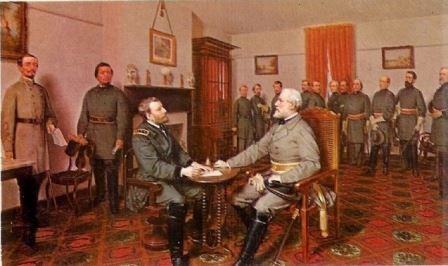
One hundred and fifty years ago on the 9th and 10th of April 1865, four men, Ulysses S Grant, Robert E. Lee, Joshua Lawrence Chamberlain and Ely Parker, taught succeeding generations the value of mutual respect and reconciliation. They would do so after a bitter and bloody war that had cost the lives of over 600,000 Americans which had left hundreds of thousands others maimed, shattered or without a place to live, and seen vast swaths of the country ravaged by war and its attendant plagues.

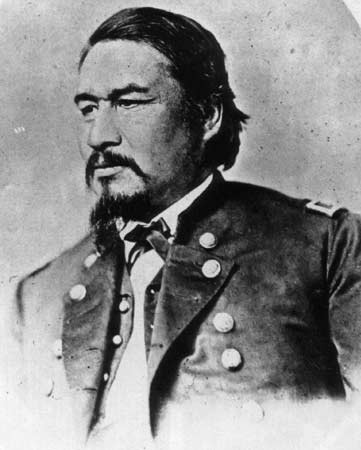
The men were all very different, Lee was a Southern aristocrat and career army officer, Grant, the officer of humble means who had struggled with alcoholism and failed in his civilian life before returning to the army when war began. Chamberlain, was the professor of rhetoric and natural and revealed religion, the hero of Little Round Top, who helped exemplify the importance of citizen soldiers in peace and war. Finally there was Parker, a full-blooded Seneca Indian; a professional engineer, a man who was barred from being an attorney because as a Native American he was never considered a citizen. Although he had been rejected from serving in the army for the same reason, his friend Grant had obtained him a commission and kept him on his staff.

On the morning of the 9th Confederate General Robert E. Lee replied to an entreaty of Lieutenant General Ulysses S. Grant requesting that he and his Army of Northern Virginia be allowed to surrender. Lee wrote to Grant:

HEADQUARTERS ARMY OF NORTHERN VIRGINIA, APRIL 9, 1865

Lieut. Gen. U.S. GRANT:

I received your note of this morning on the picket-line, whither I had come to meet you and ascertain definitely what terms were embraced in your proposal of yesterday with reference to the surrender of this army. I now ask an interview in accordance with the offer contained in your letter of yesterday for that purpose.

R.E. LEE, General.

The once mighty Army of Northern Virginia which had won so many victories was now a haggard but proud force of about 15,000 soldiers. For Lee to continue the war now would mean that they face hopeless odds against a vastly superior enemy. Grant recognized this and wrote Lee:

I am equally anxious for peace with yourself, and the whole North entertains the same feeling. The terms upon which peace can be had are well understood. By the South laying down their arms they will hasten that most desirable event, save thousands of human lives, and hundreds of millions of property not yet destroyed. Seriously hoping that all our difficulties may be set-tied without the loss of another life, I subscribe myself, &c.,

Since the high water mark at Gettysburg, Lee’s army had been on the defensive. His ill-fated offensive into Pennsylvania being one of the two climactic events that sealed the doom of the Confederacy. The other was Grant’s victory at Vicksburg which fell to him a day after Pickett’s Charge.

The bloody defensive struggle lasted through 1864 as Grant bled the Confederates dry during the Overland Campaign, leading to the long siege of Petersburg. Likewise the armies of William Tecumseh Sherman had cut a swath through the Deep South and were moving toward Virginia from the Carolinas.

With each battle following Gettysburg the Army of Northern Virginia became weaker and finally after the nine month long siege of Petersburg ended with a Union victory there was little else to do. On the morning of April 9th a final attempt to break through the Union lines by John Gordon’s division was turned back by vastly superior Union forces.

grant 1

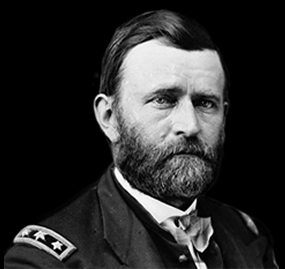
Lieutenant General Ulysses S. Grant, United States Army

On April 7th Grant wrote a letter to Lee which began the process of ending the war in Virginia. He wrote:

General R. E. LEE:

The result of the last week must convince you of the hopelessness of further resistance on the part of the Army of Northern Virginia in this struggle. I feel that it is so, and regard it as my duty to shift from myself the responsibility of any further effusion of blood, by asking of you the surrender of that portion of the C. S. Army known as the Army of Northern Virginia.

U.S. GRANT, Lieutenant-General

Lee was hesitant to surrender knowing Grant’s reputation for insisting on unconditional surrender, terms that Lee could not accept. He replied to Grant:

HEADQUARTERS ARMY OF NORTHERN VIRGINIA, APRIL 7, 1865 Lieut. Gen. U.S. GRANT:

I have received your note of this date. Though not entertaining the opinion you express on the hopelessness of further resistance on the part of the Army of Northern Virginia, I reciprocate your desire to avoid useless effusion of blood, and therefore, before considering your proposition, ask the terms you will offer on condition of its surrender.

R.E. LEE, General.

The correspondence continued over the next day even as the Confederates hoped to fight their way out of the trap that they were in. But now Robert E. Lee, who had through his efforts extended the war for at least six months knew that he could no longer continue. Even so some of his younger subordinates wanted to continue the fight. When his artillery chief Porter Alexander recommended that the Army be released, “take to the woods and report to their state governors” Lee replied:

“We have simply now to face the fact that the Confederacy has failed. And as Christian men, Gen. Alexander, you & I have no right to think for one moment of our personal feelings or affairs. We must consider only the effect which our action will have upon the country at large.”

Lee continued:

“Already [the country] is demoralized by the four years of war. If I took your advice, the men would be without rations and under no control of their officers. They would be compelled to rob and steal in order to live…. We would bring on a state of affairs it would take the country years to recover from… You young fellows might go bushwhacking, but the only dignified course for me would be to go to General Grant and surrender myself and take the consequences of my acts.”

Alexander was so humbled at Lee’s reply he later wrote “I was so ashamed of having proposed such a foolish and wild cat scheme that I felt like begging him to forget he had ever heard it.” When Alexander saw the gracious terms of the surrender he was particularly impressed with how non-vindictive the terms were, especially in terms of parole and amnesty for the surrendered soldiers.

Abraham Lincoln had already set the tone for the surrender in his Second Inaugural Address given just over a month before the surrender of Lee’s army. Lincoln closed that speech with these words of reconciliation:

“With malice toward none, with charity for all, with firmness in the right as God gives us to see the right, let us strive on to finish the work we are in, to bind up the nation’s wounds, to care for him who shall have borne the battle and for his widow and his orphan, to do all which may achieve and cherish a just and lasting peace among ourselves and with all nations.”

Lee1

General Robert E. Lee, CSA

Lee met Grant at the house of Wilmer McLean, who had moved to Appomattox in 1861 after his home near Manassas had been used as a Confederate headquarters and was damaged by artillery fire. Lee was dressed in his finest uniform complete with sash, while Grant was dressed in a mud splattered uniform and overcoat only distinguished from his soldiers by the three stars on his should boards. Grant’s dress uniforms were far to the rear in the baggage trains and Grant was afraid that his slovenly appearance would insult Lee, but it did not. It was a friendly meeting, before getting down to business the two reminisced about the Mexican War.

Grant provided his vanquished foe very generous surrender terms:

“In accordance with the substance of my letter to you of the 8th inst., I propose to receive the surrender of the Army of N. Va. on the following terms, to wit: Rolls of all the officers and men to be made in duplicate. One copy to be given to an officer designated by me, the other to be retained by such officer or officers as you may designate. The officers to give their individual paroles not to take up arms against the Government of the United States until properly exchanged, and each company or regimental commander sign a like parole for the men of their commands. The arms, artillery and public property to be parked and stacked, and turned over to the officer appointed by me to receive them. This will not embrace the side-arms of the officers, nor their private horses or baggage. This done, each officer and man will be allowed to return to their homes, not to be disturbed by United States authority so long as they observe their paroles and the laws in force where they may reside.”

When Lee left the building Federal troops began cheering but Grant ordered them to stop. Grant felt a sense of melancholy and wrote “I felt…sad and depressed, at the downfall of a foe who had fought so long and valiantly, and had suffered so much for a cause, though that cause was, I believe, one of the worst for which a people has fought.” He later noted: “The Confederates were now our countrymen, and we did not want to exult over their downfall.”

In the hours before and after the signing of the surrender documents old friends and classmates, separated by four long years of war gathered on the porch or around the house. Grant and others were gracious to their now defeated friends and the bitterness of war began to melt away. Some Union officers offered money to help their Confederate friends get through the coming months. It was an emotional reunion, especially for the former West Point classmates gathered there:

“It had never been in their hearts to hate the classmates they were fighting. Their lives and affections for one another had been indelibly framed and inextricably intertwined in their academy days. No adversity, war, killing, or political estrangement could undo that. Now, meeting together when the guns were quiet, they yearned to know that they would never hear their thunder or be ordered to take up arms against one another again.”

Grant also sent 25,000 rations to the starving Confederate army waiting to surrender. The gesture meant much to the defeated Confederate soldiers who had had little to eat ever since the retreat began.

The surrender itself was accomplished with a recognition that soldiers who have given the full measure of devotion can know when confronting a defeated enemy. Major General Joshua Lawrence Chamberlain, the heroic victor of Little Round Top was directed by Grant to receive the final surrender of the defeated Confederate infantry on the morning of April 12th.

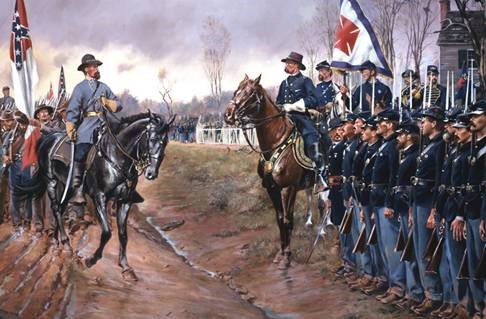
It was a rainy and gloomy morning as the beaten Confederates marched to the surrender grounds. As the initial units under the command of John Gordon passed him, Chamberlain was moved with emotion he ordered his soldiers to salute the defeated enemy for whose cause he had no sympathy, Chamberlain honored the defeated Rebel army by bringing his division to present arms.

chamberlian gordon appomattox

John Gordon, who was “riding with heavy spirit and downcast face,” looked up, surveyed the scene, wheeled about on his horse, and “with profound salutation returned the gesture by lowering his saber to the toe of his boot. The Georgian then ordered each following brigade to carry arms as they passed third brigade, “honor answering honor.”

joshua_chamberlain_-_brady-handy

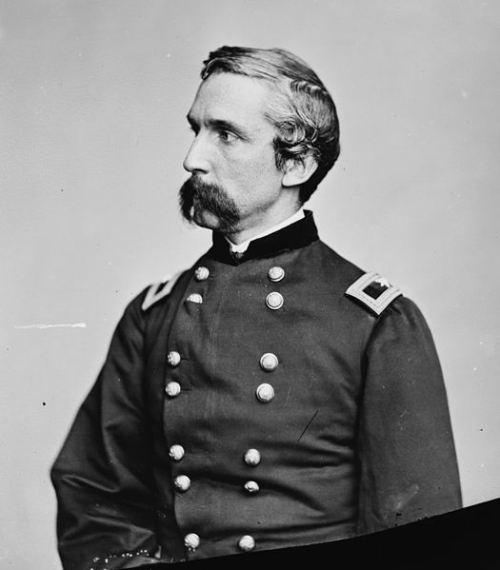
Major General Joshua Lawrence Chamberlain, U.S. Army

Chamberlain was not just a soldier, but before the war had been Professor of Natural and Revealed Religions at Bowdoin College, and a student of theology before the war. He could not help to see the significance of the occasion. He understood that he would be criticized by some for offering the salute. However, Chamberlain, unlike some, understood the value of reconciliation. Chamberlain was a staunch abolitionist and Unionist who had nearly died on more than one occasion fighting the defeated Confederate Army, and he understood that no true peace could transpire unless the enemies became reconciled to one another.

He noted that his chief reason for doing so:

“The momentous meaning of this occasion impressed me deeply. I resolved to mark it by some token of recognition, which could be no other than a salute of arms. Well aware of the responsibility assumed, and of the criticisms that would follow, as the sequel proved, nothing of that kind could move me in the least. The act could be defended, if needful, by the suggestion that such a salute was not to the cause for which the flag of the Confederacy stood, but to its going down before the flag of the Union. My main reason, however, was one for which I sought no authority nor asked forgiveness. Before us in proud humiliation stood the embodiment of manhood: men whom neither toils and sufferings, nor the fact of death, nor disaster, nor hopelessness could bend from their resolve; standing before us now, thin, worn, and famished, but erect, and with eyes looking level into ours, waking memories that bound us together as no other bond;—was not such manhood to be welcomed back into a Union so tested and assured? Instructions had been given; and when the head of each division column comes opposite our group, our bugle sounds the signal and instantly our whole line from right to left, regiment by regiment in succession, gives the soldier’s salutation, from the “order arms” to the old “carry”—the marching salute. Gordon at the head of the column, riding with heavy spirit and downcast face, catches the sound of shifting arms, looks up, and, taking the meaning, wheels superbly, making with himself and his horse one uplifted figure, with profound salutation as he drops the point of his sword to the boot toe; then facing to his own command, gives word for his successive brigades to pass us with the same position of the manual,—honor answering honor. On our part not a sound of trumpet more, nor roll of drum; not a cheer, nor word nor whisper of vain-glorying, nor motion of man standing again at the order, but an awed stillness rather, and breath-holding, as if it were the passing of the dead!”

The next day Robert E Lee addressed his soldiers for the last time. Lee’s final order to his loyal troops was published the day after the surrender. It was a gracious letter of thanks to men that had served their beloved commander well in the course of the three years since he assumed command of them outside Richmond in 1862.

General Order
No. 9

After four years of arduous service marked by unsurpassed courage and fortitude, the Army of Northern Virginia has been compelled to yield to overwhelming numbers and resources.

I need not tell the survivors of so many hard fought battles, who have remained steadfast to the last, that I have consented to the result from no distrust of them.

But feeling that valour and devotion could accomplish nothing that could compensate for the loss that must have attended the continuance of the contest, I have determined to avoid the useless sacrifice of those whose past services have endeared them to their countrymen.

By the terms of the agreement, officers and men can return to their homes and remain until exchanged. You will take with you the satisfaction that proceeds from the consciousness of duty faithfully performed, and I earnestly pray that a merciful God will extend to you his blessing and protection.

With an unceasing admiration of your constancy and devotion to your Country, and a grateful remembrance of your kind and generous consideration for myself, I bid you an affectionate farewell. — R. E. Lee, General

The surrender was the beginning of the end. Other Confederate forces continued to resist for several weeks, but with the surrender of the Army of Northern Virginia led by the man that nearly all Southerners saw as the embodiment of their nation the war was effectively over.

Lee had fought hard and after the war was still under the charge of treason, but he understood the significance of defeat and the necessity of moving forward as one nation. In August 1865 Lee wrote to the trustees of Washington College of which he was now President:

“I think it is the duty of every citizen, in the present condition of the Country, to do all in his power to aid the restoration of peace and harmony… It is particularly incumbent upon those charged with the instruction of the young to set them an example of submission to authority.

It is a lesson that all of us in our terribly divided land need to learn regardless of or political affiliation or ideology. After he had signed the surrender document, Lee learned that Grant’s Aide-de-Camp Colonel Ely Parker, was a full-blooded Seneca Indian. He stared at Parker’s dark features and said: “It is good to have one real American here.”

eparker05-966-g

Brigadier General Ely Parker, United States Army

Parker, a man whose people had known the brutality of the white man, a man who was not considered a citizen and would never gain the right to vote, replied, “Sir, we are all Americans.” That afternoon Parker would receive a commission as a Brevet Brigadier General of Volunteers, making him the first Native American to hold that rank in the United States Army. He would later be made a Brigadier General in the Regular Army.

I don’t know what Lee thought of that. His reaction is not recorded and he never wrote about it after the war, but it might have been in some way led to Lee’s letter to the trustees of Washington College. I think with our land so divided, ands that is time again that we learn the lessons so evidenced in the actions and words of Ely Parker, Ulysses Grant, Robert E. Lee and Joshua Chamberlain, for we are all Americans.

Sadly, I think that there is a portion of the population who will not heed these words and will continue to agitate for policies and laws similar to those that led to the Civil War, and which those the could not reconcile defeat instituted again during the Post-Reconstruction and Jim Crow eras.

But I still maintain hope that in spite of everything, that we can overcome.

Peace

Padre Steve+


1 Comment

Filed under civil war, History, leadership, Military, Political Commentary

The Romantic Rebel: George Pickett

Friends of Padre Steve’s World

I am continuing to periodically intersperse and publish short articles about various commanders at Gettysburg on the site. These all are drawn from my student text and may become a book in their own right.  The reason is I am going to do this is because I have found that readers are often more drawn to the lives of people than they are events. As I have noted before that people matter, even deeply flawed people, and we can learn from them.

Today’s article is about Major General George Edward Pickett who gained immortal fame at Gettysburg. He too is a complex, contradictory and controversial  figure in the Civil War, particularly in regard to the post war controversies regarding who was to blame for the Confederate defeat and his open criticism of Robert E. Lee’s decision to order the ill fated charge that made him famous.

Peace

Padre Steve+

Pickett

George Pickett was born to wealth and privilege in a Neo-feudal society [1] and came from an old and distinguished Virginia family with a long military heritage dating to the Revolution and the War of 1812. He attended the Richmond Academy until he was sixteen and had to withdraw due to the financial losses his parents had suffered during the panic of 1837.

This led to the young Pickett being sent to live with and study law under his mother’s older brother, Andrew Johnston in Quincy Illinois. Johnston was a lawyer, Whig politician and friend of Abraham Lincoln. The family’s continued financial distress led them to get George to consider the free education provided by West Point. His mother asked Johnston to assist and Johnston set about obtaining an appointment for his nephew. As befit an up-and-coming politician, his quest was short and successful. His Springfield acquaintances included a United States Congressman who happened to be a fellow Southerner and brother Whig, Kentucky native John T. Stuart. [2] There is a long running myth that connects Pickett’s appointment to West Point to Abraham Lincoln, but it is fiction, fabricated by Pickett’s widow Sallie long after her husband and Lincoln’s death. [3]

Pickett entered West Point in 1842 where he was described by a fellow cadet thought a jolly good fellow with fine natural gifts sadly neglected [4] through his tendency to demonstrate in word and deed that henhouse neither to authority nor submit to what’re considered the Academys narrow, arbitrary, unrealistic, harshly punitive, and inconsistently applied code of conduct [5] became a loyal patron of Benny Havens tavern where he was stealing away regularly now to life his glass in good fellowship…” [6]

Pickett’s academic performance, as well as his record of disciplinary infractions at West Point was exceptionally undistinguished. He racked up vast amounts of demerits for everything from being late to class, chapel and drill, uniform violations and pranks on the drill field where he mocked those who observed proper drill and ceremonies. Pickett graduated last in the class of 1846, something that his vast amount of demerits contributed.

His widow Sallie wrote after his death that he accumulated them so long as he could afford the black marks and punishments they entailed. He curbed his harmful behavior, however, when he found himself approaching the magic number of 200 demerits per year that constituted grounds for dismissal. [7] Pickett finally graduated only five behavioral demerits short of expulsion. [8] The graduating class included George McClellan, A.P. Hill, Thomas, later “Stonewall” Jackson as well as a number of other cadets, most of whom who went on to distinguished military and other careers. At West Point Pickett was considered to be the class clown by many of his classmates was the most popular and prominent young man in the class. [9] Among the many friends that he made was an upperclassman named Ulysses S. Grant and their friendship would span decades and would survive the fire of a war that placed them at swords point. [10]

Pickett was commissioned into the infantry and served alongside James Longstreet in the Mexican War where they fought valiantly in a number of battles, including Contreras, Churubusco, El Molino Del Rey. [11] Pickett distinguished himself at Chapultepec where he had been the first American to scale the ramparts of Chapultepec, where he planted the flag before the admiring gaze of his friend Longstreet. [12] During that assault Longstreet was wounded and Pickett had snatched the colors and planted them on the castle heights for all to see and cheer. [13] For his actions he received a brevet promotion to First Lieutenant.

Following the war Pickett married but was widowed less than two years later when his wife Sally Minge Pickett died during childbirth along with their infant son in 1852. The loss was devastating to the young officer. He went into a deep depression caused by grief and considered leaving the army. He was persuaded by friends, peers and understanding commanding officers to remain.

While on leave following Sally’s death, he was at Fort Monroe, laying under an umbrella at Point Comfort when a child approached him and took pity on him. The child was the nine year old La Salle “Sallie” Corbell and she broke through his emotional defenses by persistently, as only a child can do asking what the source of his grief was. Pickett told the child that his heart had been broken by a sorrow almost too great to bear. When the child asked how ones heart could break, he replied that God broke it when he took from him his loved ones and left him so lonely. [14] While Pickett may not have thought much of the meeting, he did give the little girl a ring and a golden heart bearing his wife’s name. He likely expected never to see her again but though she was a child she was a willful and determined one. She knew her own mind and heart, both told her that one day she would marry George Pickett. [15]

Pickett returned to Texas to serve with the 8th Infantry and was promoted to Captain and ordered to take command of the newly raised Company “D” 9th Infantry at Fort Monroe. Transferred to the Pacific Northwest he married. Widowed after that war he served in the Pacific Northwest where he took a Native American wife who bore him a son, however she did not survive childbirth and when she died in early 1858 Pickett was again widowed. In 1859 Captain Pickett faced down British troops from the Hudson Bay Company in an incident now known at the Pig War which at its heart was a dispute about whether the British or the Americans own San Juan Island. The dispute, which brought the two nations to the brink of war, was settled without bloodshed, save for the unfortunate pig, and Pickett became a minor celebrity in the United States and anathema to the British.

When Virginia seceded from the Union, Pickett like many other southern officers was conflicted in his feelings and loyalties and hoped to the last that he would have to take up arms against neither state nor country. [16] Pickett resigned his commission on June 25th 1861. He wrote to Sallie with who he now maintained a frequent correspondence about his decision and decidedly mixed feelings as he:

Always strenuously opposed disunion…” But While I love my neighbor, i.e., my country, I love my household, i.e., my state, more, and I could not be an infidel and lift my sword against my own kith and kin, even though I do believethat the measure of American greatness can be achieved only under one flag. [17]

Pickett returned to Virginia by a circuitous route where he was commissioned as a Captain in the new Confederate army on September 14th and two weeks later was promoted to Colonel and assigned to command forces along the Rappahannock. Though he had as yet seen no combat serving in the Confederate army, Pickett was promoted to brigadier General and assigned to command a Virginia brigade belonging to Longstreet’s division.

Pickett led his brigade well on the peninsula and at Williamsburg was instrumental in routing an advancing Federal force, and at Seven Pines had helped repel a dire threat to the Confederate position. At Gaines Mill Pickett was wounded in the shoulder during the assault put out of action and placed on convalescent leave to recover from his wounds. During his convalescence he fell in love with an old acquaintance; La Salle Corbell, who as a young girl had cheered him after the loss of his wife now a beautiful young woman nursed him back to health and started a chain reaction that would nearly engulf the Confederate officer. [18]

Pickett was promoted to Major General in October 1862 and was assigned command of the division formerly commanded by David R. Jones, which was assigned to Longstreet’s First Corps. The division was sent to peripheral areas and took no part in the battles of late 1862 or Chancellorsville serving instead in the Tidewater with Longstreet’s corps. The corps took part in a series of operations against Union forces in the Hampton Roads area and Pickett’s division bested a Federal force at Suffolk on April 24th 1863, though it was hardly a true test of his ability to command the division in combat. During this time Pickett spent much time visiting La Salle, much to the concern of some of his officers and Longstreet’s staff, and by the time the corps left the area the two were engaged to be married.

When the Division returned to the Army of Northern Virginia after Chancellorsville, it was among the forces considered by Jefferson Davis to be sent west for the relief of Vicksburg. Since that operation never materialized, the division was assigned to accompany First Corps with the army during the upcoming Pennsylvania campaign. However, much to the consternation of Lee, Longstreet and Pickett, two of its brigades were detached by the order of Jefferson Davis to protect Richmond from any Federal incursion.

During the advance into Pennsylvania the division, now composed of the brigades of James Kemper, Lewis Armistead and Richard Garnett was the trail division in Longstreet’s corps and often, in the absence of cavalry assigned to guard the corps and army trains. Due to its late release from these duties at Chambersburg, Pickett’s Division did not arrive at Gettysburg until late afternoon on July 2nd. Lee decided that they would not be needed that day and Longstreet placed that the division in bivouac at Marsh Creek for the night, sending word by messenger to tell Pickett I will have work for him tomorrow. [19]

Pickett spent the night with his soldiers and woke them about 3 a.m. After a quick breakfast Pickett moved the division to Seminary Ridge marshaling his troops in Spangler’s Woods where there was a modicum of protection from Federal fires and observation. However, despite these advantages it placed his division about 1000 yards from the extreme right of Pettigrew’s division with which he would have to coordinate his attack that fateful day.

Pickett scribbled a final note to Sallie as his troops prepared to attack. Oh, may God in his mercy help me as He never has helped me beforeremember always that I love you with all my heart and soul That now and forever I am yours. [20]

Pickett was never the same after the charge of July 3rd 1863. Pickett’s after action report which complained about the lack of support his division received was suppressed and destroyed by Lee who wrote Pickett You and your men have crowned yourselves in glory But we have an enemy to fight, and must carefully, at this critical moment, guard against dissections which the reflections in your report will create. [21]

Pickett married La Salle “Sallie” Corbell in September of 1863, and the marriage would last until his death in 1875. Sallie, impoverished by the death of “her soldier” took up writing as well as speaking tours in both the South and the North. Sallie was a stalwart defender of her husband, who she said had the keenest sense of justice, most sensitive consciousness of right, and the highest moral courage but also opposing hatred, sectionalism and strife. [22] Though much of her work was panned by historians and shunned by established magazines and periodicals; her writing were published by newer popular magazines. Her book The Heart of a Soldier, as Revealed in the Intimate Letters of General George Pickett, C.S.A. was for the most part fabrications authored by her, but she found a niche in newer popular magazines and journals, including Cosmopolitan for which she authored a ten part serial of the Pickett family story on the fiftieth anniversary of the battle. Sallie Pickett’s:

idealized portrait of her husband made him a Confederate hero. He never reached the status of Robert E. Lee or Stonewall Jackson, but his association with the famed but futile charge at Gettysburg helped. Virginia veterans and newspapers began romanticizing Picketts all-Virginia divisions role soon after the battle; it was almost by association that George too would share in this idolization…” [23]

Pickett retained command of his division after Gettysburg. The division was reconsituted and shipped off to North Carolina where he and it performed adequately but without marked distinction. Pickett had one moment of glory when reacting to a Federal Army under Benjamin Butler advancing on Petersburg he threw a scratch force together which preserved Petersburg and its vital rail line in early May 1864. This allowed General P.T.G. Beauregard to bring up more troops to hold the city.

The division performed adequately in the defensive battles around Richmond and Petersburg, though it suffered terribly from the lack of rations, medicines, clothing and equipmentaggravated by the rigors of life in the trenches. [24] Morale and desertion was a terrible problem in Pickett’s division and Lee was concerned enough to bring enough to bring the matter to Longstreet. Lee used terms like unsoldierly and unmilitary, lax in discipline, loose in military instruction [25] to describe the division. Though he was fully cognizant of the conditions of the trenches Lee identified the source of the problem as Pickett and his officers who were not sufficiently attentive to the men,not informed as to their condition and he told Longstreet: I desire you to correct the evils in Picketts divisionby every means in your power… I beg that you will insist upon these points. [26]

During the Richmond and Petersburg campaign, Pickett was often sick, and at several intervals he was unable to exercise command, and the poor state of his general health, aggravated by the unusually stressful conditions of the past year, age him beyond his years. [27]

The end came at the battle at Five Forks where Pickett’s division was deployed on the far right of the Confederate line, was overwhelmed by a massive assault by Sheridan’s cavalry and the Fifth Corps which destroyed it as a fighting formation. Pickett, for unknown reasons did not put much effort into the defense of Five Forks. He successfully repulsed an attack by Sheridan on March 31st but evidently did not expect an attack the following day. On the afternoon of April 1st Pickett was away from his division at a Shad bake with Fitzhugh Lee and Thomas Rosser when the attack came and destroyed his division as a fighting unit. No cowardice was involved; Pickett simply misjudged the situation by assuming that no attack was imminent, yet it left a bad taste in everyones mouth. [28] That being said Picketts lackadaisical effort in holding Five Forks is indefensible. So to is his incredible derelict behavior late on the morning of April 1st when he slipped away from his command to the shad bake not even informing the next senior officer, Rooney Lee that he was gone. [29]

Whether cowardice was involved or not, Pickett’s decision to be away from his division with a very aggressive Federal army at his front was ill-advised and demonstrated to Lee that Pickett was unfit for command. Two days later Pickett and two other generals, including Richard Anderson were relieved of their duties and dismissed by Lee. However Pickett remained with his division until the end and at Appomattox Lee was heard to remark in what some believed was a disparaging manner Is that man still with this army? [30]

George Pickett attempted to rebuild his life after the war and the task was not easy, for though he applied for amnesty, his case was complicated by an incident where he had ordered the execution of twenty-two former North Carolina militiamen who had defected to the Union and been re-captured by the Confederates. Pickett’s action was no different than many Confederate commanders who followed the Richmond government’s decision to take ruthless measures to suppress Unionist sentiments and secession of areas of the Confederacy where Union sympathies ran high. The area of Pickett’s operation was a haven for Tories who openly supported U.S. troops. What was worse, hundreds of local Unionists engaged in the most violent guerrilla activities, shooting and burning out their secessionist neighbors, waylaying Confederate supply trains, attacking outposts. [31] Some of these men had previously served in Confederate service which in the eyes of Pickett and many others made them traitors to the Confederate cause.

In a sense Pickett was engaged in what are now known as counter-insurgency operations. Like many commanders involved in such operations, he descended into the same type of barbaric actions of those he was fighting. “By early 1864 the war was turning into a grim, hate-filled struggle that knew few rules and niceties, and Pickett was changing to the pattern. [32] When Pickett captured the former militiamen he refused to treat them as prisoners of war and instead he court-martialed them and hanged them all. [33] He established a military court composed of Virginia, North Carolina and Georgia officers, hauled the deserters-in-arms before it, and approved the death sentences. [34] When the prisoners went to the gallows Pickett reportedly told each of them God damn you, I reckon you will ever hardly go back there again, you damned rascals; Ill have you shot, and all the other damned rascals who desert. [35]

Federal authorities thought about charging him with war crimes. Pickett fled to Canada in late 1865 before returning to Virginia. It took the intervention of Pickett’s faithful friend Ulysses S. Grant to have the charges dismissed and for Pickett to be granted amnesty by President Johnson in 1868. Grant admitted that the punishment was harsh, however, Grant’s judgment was steeped in the fact that many Northern commanders had resorted to similar actions in combating insurgents and deserters. Grant wrote in his friend’s defense:

But it was in time of war and when the enemy no doubt it necessary to retain, by some power, the services of every man within their reach. Gen. Pickett I know personally to be an honorable man but in this case his judgement [sic] prompted him to do what can not well be sustained though I do not see how good, either to the friends of the deceased or by fixing an example for the future, can be secured by his trial now. [36]

Even so, Pickett’s life was difficult. Health difficulties plagued him and employment was scarce, even for a man of Pickett’s stature in Virginia. He refused employment which would take him away from Sallie and his children and finally took a job as an insurance agent in Richmond. It was a job which he felt demeaning, requiring that he attempt to sell insurance policies to destitute and out of work Confederate veterans and their families. Sallie wrote that he could not come to terms with a profession that made its profits through what one colleague called gall, gall, old man, gall and grub. [37] Distinctly unhappy the dejected old soldier told her Id sooner face a canon,than to take out a policy with me. [38]

In 1870 he was convinced by John Singleton Mosby to visit Lee when the latter was visiting Richmond as Lee was making a final tour of battlefields and other sites. For Pickett the visit only reinforced his resentment that he felt for Lee, who he felt blamed him for the defeat at Five Forks and had ostracized him. The meeting occurred in Lees room at the Ballard Hotel was icy and lasted only two or three minutes. [39]

Mosby realized quickly that the meeting was not going well and Sensing the unpleasantness of the meeting, Mosby got up in a few moments and Pickett followed him. Once outside the room, Pickett broke out bitterly against that old man who, he said, had my division massacred at Gettysburg. [40] Mosby attempted to assuage his friend’s feelings but Pickett was not mollified by Mosbys rejoinder that it made you immortal. [41] Edwin Coddington wrote that it would have been better for his reputation if had been called to give his life or if the attack had been known for what it was, Longstreets Second Assault. [42]

George Pickett was a romantic as well as a true believer in the cause of the Confederacy. Pickett was vain, often self-serving and even irresponsible. He certainly as Porter Alexander noted was a better brigade commander than division commander, a position that he desired but at which never excelled. He was a poor administrator, and in the campaigns of 1864 and 1865 demonstrated exceptionally poor leadership.

His temperament, especially his seeming inability to function in a hierarchical structure, and the rebellious streak that he had as a cadet at West Point was never exercised: He resented authority and chafed at deferring to any man as his superiorPickett never understood his place in the hierarchy. He considered himself part of the cream of the Army of Northern Virginia, but without being willing to shoulder all the responsibilities and sacrifices that entailed. [43]

He died in the summer of 1875 while on a business trip to Norfolk with his wife at his side, but a single tragic charge had made his name immortal. [44] Bitter and discouraged at the end of his life he uttered his last words to Sallie’s uncle who had also served in the Army of Northern Virginia Well, Colonel, the enemy is too strong for me againmy ammunition is all out He closed his eyes, and settled back as if at peace for the first time in his life. Sallie never left his side; two hours after his death they gently pried her hands from his. [45]

[1] Ibid. Longacre Pickett p.4

[2] Ibid. Longacre Pickett p.6

[3] See Longacre Pickett pp.6-7. The myth was quite successful and it endures in some accounts of Pickett’s life and in a number of military histories including Larry Tagg’s The Generals of Gettysburg

[4] Waugh, John C. The Class of 1846 from West Point to Appomattox: Stonewall Jackson, George McClellan and their Brothers A Ballantine Book, New York 1994 pp.38-39

[5] Ibid. Longacre Pickett p.7

[6] Ibid. Waugh The Class of 1846 from West Point to Appomattox p.39

[7] Ibid. Longacre Pickett p.12

[8] Guelzo, Allen C. Gettysburg: The Last Invasion Vintage Books a Division of Random House, New York 2013 p.378

[9] Ibid. Guelzo Gettysburg: The Last Invasion p.378

[10] Ibid. Longacre Pickett p.20

[11] Ibid. Hess Picketts Charge p.37

[12] Ibid. Dowdy Lee and His Men at Gettysburg p.264

[13] Ibid. Waugh The Class of 1846 p.457

[14] Ibid. Longacre Pickett p.32

[15] Ibid. Longacre Pickett p.33

[16] Ibid. Longacre Pickett pp.50-51

[17] Ibid. Longacre Pickett p.51

[18] Ibid. Hess Pickett’s Charge p.38

[19] Ibid. Hess Pickett’s Charge p.47

[20] Ibid. Dowdy Lee and his Men at Gettysburg p.296

[21] Ibid. Hess Pickett’s Charge p.354

[22] Ibid. Reardon The Convergence of History and Myth in the Southern Past: Pickett’s Charge p.76

[23] Gordon, Lesley J. “Let the People See the Old Life as it Was” La Salle Corbell Pickett and the Myth of the Lost Cause in The Myth of the Lost Cause and Civil War History edited by Gallagher, Gary W. and Nolan, Alan T. Indiana University Press, Bloomington and Indianapolis 2000 p.170

[24] Ibid. Longacre Pickett p.160

[25] Selcer, Richard F. Lee vs. Pickett: Two Divided by War Thomas Publications, Gettysburg PA 1998 p.66

[26] Ibid. Selcer Lee vs. Pickett p.66

[27] Ibid. Longacre Pickett pp.160-161

[28] Ibid. Hess Pickett’s Charge p.375

[29] Ibid. Longacre Pickett pp.166-167

[30] Ibid. Hess Pickett’s Charge p.375

[31] Ibid. Longacre Pickett p.137

[32] Ibid. Longacre Pickett p.141

[33] Guelzo Allen C. Fateful Lightening: A New History of the Civil War Era and Reconstruction Oxford University Press, Oxford and New York 2012 p.368

[34] Ibid. Longacre Pickett p.140

[35] Ibid. Guelzo Fateful Lightening p.368

[36] Ibid. Longacre Pickett p.175

[37] Ibid. Longacre Pickett p.178

[38] Ibid. Longacre Pickett p.178

[39] Ibid. Hess Pickett’s Charge p.377

[40] Ibid. Freeman Lee p.569

[41] Ibid. Waugh The Class of 1846 p.529

[42] Ibid. Coddington The Gettysburg Campaign p.528

[43] Ibid. Selcer Lee vs. Pickett p.101

[44] Ibid. Waugh The Class of 1846 p.529

[45] Ibid. Longacre Pickett p.180

4 Comments

Filed under civil war, Gettysburg, History, leadership, Military

The Reconcilled Rebel: James Longstreet

Friends of Padre Steve’s World 

 
I am going to periodically interspersing and publishing short articles about various commanders at Gettysburg  on the site. These all come from my student text and the reason is I am going to do this is because I have found that readers are often more drawn to the lives of people than they are events. As I have noted before that people matter, even flawed people, and we can learn from them.

Today’s vignette is about Confederate Lieutenant General James Longstreet who commanded the Confederate First Corps of  Robert E. Lee’s Army of Northern Virginia at Gettysburg, and is considered by many military historians to be the best corps commander on either side during the war. Yet, Longstreet is one of the most controversial figures in the Confederate Army and there are lessons, good and bad to be learned from him. But I think the one thing that can be learned is that for Longstreet the war was never a “holy cause” and he refused to give in to the hatred that consumed so many Confederates during and after the war. Longstreet chose the path of reconciliation when the war was over and in doing so was mailigned by many in the South. 

Peace

Padre Steve+

LongstreetJ_main

James Longstreet was a native of the Piedmont area of northeastern Georgia. His father, a planter, hailed from a Dutch family that had originally migrated to the colonies in 1687. The young Longstreet, nicknamed Peter or Pete by his family had determined as a child that he would have a military career. His father assisted in his admission to the Military Academy which he entered in 1838. Longstreet was neither a model cadet nor student. He graduated in 1842 “ranked fifty-fourth in a class of fifty-six” [1] and was commissioned into the infantry.

At West Point the young Georgian’s academic performance was lackluster, and he accumulated a significant amounts of demerits. However, the husky Longstreet was well liked and made many lifelong friends while at the academy. His class was distinguished and produced ten Confederate and seven Union Generals during the war. Longstreet’s best friend was a cadet from Ohio in the class which followed him, Ulysses S. Grant of whom Longstreet said was “of noble, generous heart, a lovable character, a valued friend.” [2] That friendship would endure for the rest of their lives.

Longstreet served in the West and went to Texas after it was annexed into the Union. Subsequently, he served in Mexico, getting his first taste of combat on the Rio Grande, then at Monterrey and later at Chapultepec. At Chapultepec, Longstreet was in command of Company H of the 8th Infantry Regiment which was leading the assault. He was near the head of the regiment the regiment as they breached the first parapet carrying the regimental colors “which he had grabbed …as they fell from the hands of their wounded bearer[3] Wounded in the thigh, he handed the colors to his friend George Pickett, whose Company A was advancing behind Longstreet’s company.

After his wound healed Longstreet continued to serve in Texas and later in the New Mexico Territory in campaigns against the Comanche. Serving in various command and staff positions including as a company commander, regimental adjutant, and department Quartermaster he became a well-rounded officer. He was promoted to Major and appointed as a Paymaster. With the promotion he was assigned to duties at Fort Leavenworth in 1858 and then again to New Mexico in 1859.

When Abraham Lincoln was elected in 1860 and Southern states began to secede, Longstreet, who was not a proponent of secession, did not hesitate and offered his services to the Governor of Alabama in February 1861. However, there are many questions about this period due to the conflicting story that Longstreet recorded and what the administrative and pay documents record.

Longstreet resigned his commission on May 9th 1861, though he had already accepted a commission in the new Confederate Army dated May 1st 1861 with a date of rank of March 16th 1861 “eight days before he wrote his letter of resignation from the United States Army.” [4] His biographer Jeffry Wert notes that the acceptance of the Confederate commission while he was still serving as an officer in the United States Army, is “a dark story of a man who crossed the delicate line between honor and dishonor” and that “what he did, however, was not the act of an honorable man and officer.” [5] While there may be extenuating circumstances that we do not know, it does appear that Longstreet crossed a line that few, if any other active officers who left the Army for Confederate service crossed.

After his resignation he travelled to Richmond where he was promoted to Brigadier General on June 17th and given command of a brigade that fought at Bull Run. He was consider to be one of the best Brigadiers in the army and was promoted to Major General on October 7th 1861. After this promotion, Longstreet was given command of a division on the Peninsula. He was noted by his aide Moxie Sorrel to be “rather gay in disposition with his chums, fond of a glass, and very skillful at poker.” [6] However, during that time, his family living in Richmond was ravaged by a Scarlett fever outbreak in January 1862 which claimed the lives of three of his children, leaving him a much more serious, and very changed man. “There was no more gaiety, no more poker, and, certainly for the time, no more liquor. Essentially, from that tragic January, he was a soldier and little besides.” [7]

When Lee took over the Army, Longstreet quickly became one of his most trusted subordinates. Following the Seven Days battles Longstreet was promoted to command a wing of the army, with Jackson commanding the other. These were in effect army corps and functioned as such until the Confederate Congress allowed the creation of army corps within the army. The Confederate Congress then promoted each man to the Rank of Lieutenant General. The contrasts between the two men were remarkable. One of Lee’s biographers wrote of the contrast between Jackson and Longstreet and how each man in a sense reflect a part of his military personality:

“In these two latter men Lee seemed to have recognize the Janus face of his own military personality. Longstreet seemed to be steady and dependable, the consummate professional. Jackson, on the other hand, had been by turns brilliant (the Valley) and useless (Mechanicsville and White Oak Swamp). But Jackson was a killer, possessed of the same sorts of aggressive instincts which obsessed Lee.” [8]

During the 1862 campaign Longstreet built a solid reputation as a commander. Douglas Southall Freeman wrote that if there was a word Longstreet’s contemporaries would have used to describe him “they would have agreed on the same soldierly term: dependable. Brilliance there might not be, reliability there undoubtedly was.” [9] He led that corps in the hammer blows that nearly destroyed Pope’s army at Second Manassas, grimly held the line at Antietam, and helped direct the massacre of Burnside’s attacking force at Fredericksburg. His corps was not present at Chancellorsville. As a commander he was noted for his devoted care and concern for the welfare of his soldiers, his reluctance to waste their lives in what he believed to be unwise, foolish, or suicidal attacks and “Under his command, the First Corps was the “bedrock” of the army.” [10]

During their time together Lee and Longstreet developed “a close personal and professional relationship.” [11] Lee would refer to him at times as “the staff in my right hand” and “my old war horse.” After Jackson’s death their relationship grew closer, even when they did not agree, not an uncommon occurrence. Longstreet could be, and was, blunt with Lee and thankfully for the two men, Lee “was a strong enough personality to bear the presence of a contrarian,” [12] Longstreet could indeed be a contrarian. Even so, Longstreet was a trusted subordinate and Longstreet later wrote that the relationship was “one of confidence and esteem, official and personal, which ripened into stronger ties as the mutations of war bore heavier upon us.” [13]

Longstreet’s presence as a gruff but kindhearted Georgian in an army dominated by Virginians who “idolized Lee” brought him to appoint “himself to pronounce on military reality, which was to say that his outlook on war was more practical than romantic.” [14] That outlook and honesty would cause Longstreet great consternation after the war as Jubal Early and other leaders of the Lost Cause branded him a “Judas” for his actions at Gettysburg and criticism of Robert E. Lee. Even at Gettysburg, despite their differences of opinion regarding Lee’s strategy, British Lieutenant Colonel Arthur Freemantle noted “The relations between him and Longstreet are quite touching – they are almost always together.… I believe these two generals to be as little ambitious and as thoroughly unselfish as any men in the world.” [15]

Longstreet was grievously wounded in the throat during the Wilderness campaign but returned to serve through the surrender at Appomattox. In the search for villains in the post war South, Longstreet became a target of those seeking to defend and exalt Robert E. Lee. After the war Longstreet quickly reconciled with the Union, made amends and renewed his friendships with Ulysses Grant and others. When Grant died he remarked that Grant “was the truest and bravest man that had ever lived.” [16]

He also became a Republican and served in various positions in the U.S. Government and converted to Roman Catholicism. The combination of those decisions as well as his criticism of Lee’s generalship have led to decades of debate, argument and recrimination. That being said the soldiers who served under him continued to hold him in high regard at Confederate veteran reunions until his death in 1904. Thomas Goree who served on Longstreet’s First Corps staff wrote him after the war:

With my heart full of gratitude, I often think of you, and your many acts of kindness shown me, and the innumerable marks of esteem and confidence bestowed on me by you during the four long and trying years that we were together. Although we may differ in our political opinions, yet I have always given you credit for honest and sincerity of purpose.” [17]

[1] Ibid. Wert Longstreet p.30

[2] Ibid. Wert Longstreet p.31

[3] Longacre, Edward G. Pickett: Leader of the Charge White Mane Publishing Company, Shippensburg PA 1995 p.26

[4] Ibid. Wert Longstreet p.54

[5] Ibid. Wert Longstreet pp.54-55

[6] Ibid. Wert Longstreet p.91

[7] Ibid. Freeman Lee’s Lieutenant’s p.111

[8] Ibid. Thomas Robert E. Lee p.247

[9] Ibid. Freeman Lee’s Lieutenant’s p.112

[10] Ibid. Wert Longstreet p.405

[11] Ibid. Wert A Glorious Army p.61

[12] Ibid. Korda Clouds of Glory p.527

[13] Ibid. Wert Longstreet p.173

[14] Ibid. Korda Clouds of Glory p.527

[15] Ibid. Freeman Lee’s Lieutenant’s p.552

[16] Ibid. Wert Longstreet p.424

[17] Ibid. Wert Longstreet p.424

Leave a comment

Filed under civil war, Gettysburg, History, leadership, Military

Emancipation and the U.S. Military: the Civil War and After

 HD_4USCinfantryDetail.preview

Friends of Padre Steve’s World

Tomorrow is the holiday where we remember the birth of Dr. Martin Luther King Jr. So I felt it appropriate to put out a revised section of my Civil War and Gettysburg text dealing with Emancipation and beginnings of African Americans being allowed to take their place in serving their country.  Sadly, a country that so often, both before, and after emancipation, treated them as either something less than human, or as second class citizens. But the sacrifice of these pioneers helped pave the way for the civil rights of others: women, other ethnic minorities, and most recently the LGBT community. Without blacks, who certainly endured the most odious treatment under slavery than any other group in this country, the long and slow progress others have made would not have been possible. This is certainly not to say that our system, nor our treatment of minorities, immigrants, women and gays is completely fair and equitable. It is not, there are many flaws, and still much discrimination, prejudice and fear mongering which demonizes certain groups as well as seeks to roll back the gains that individuals belonging to these groups have made to be accepted into American society. Thus we continue to strive for “a more perfect Union.” 

Peace

Padre Steve+

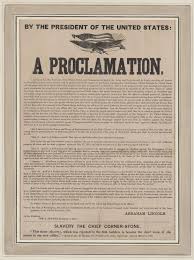
The war brought about another change to warfare in America. This was a societal and political change that has shaped American military history, culture and life ever since. The Emancipation Proclamation gave African Americans, both Freedmen and recently freed slaves the opportunity to serve in the Union Army. The change of policy instituted by Lincoln was revolutionary as well as controversial and it had strategic implications for the war effort. There were many doubters in the north whose attitudes towards African Americans were not much different than Southerners, especially among the Copperheads.

Prior to the Emancipation some Union commanders in occupied Confederate territory “had unofficially recruited black soldiers in Kansas and in occupied portions of South Carolina and Louisiana in 1862. But the administration had not sanctioned these activities.” [1] But as the war continued on, consuming vast numbers of lives the attitude of Lincoln and the administration began to change.

Lincoln and the closest members of his cabinet were beginning to understand that the “North could not win the war without mobilizing all of its resources and striking against Southern resources used to sustain the Confederate war effort.” [2]

Lincoln’s Secretary of War, Edwin Stanton; who was a passionate believer in the justice of emancipation “Instantly grasped the military value of the proclamation. Having spent more time than any of his colleagues contemplating the logistical problems facing the army, he understood the tremendous advantage to be gained if the massive workforce of slaves could be transferred from the Confederacy to the Union.” [3]

emancipation

Lincoln emphasized the “military necessity” of emancipation and “justified the step as a “fit and necessary war measure for suppressing the rebellion.” [4] The process of emancipation now became not only a moral crusade, but now became a key part of national strategy. Lincoln wrote to his future Vice President, Andrew Johnson, then the military governor of occupied Tennessee that “The colored population is the great available and yet unavailed of, force for restoration of the Union.” [5] The idea of simply mollifying the border states was dropped and policy changed that of “depriving the Confederacy of slave labor. Mobilizing that manpower for the Union- as soldiers as well as laborers- was a natural corollary.” [6] Reflecting President Lincoln’s and Stanton’s argument for the military necessity of emancipation, General Henry Halleck wrote to Ulysses Grant that:

“the character of the war has very much changed within the past year. There is now no possibility of reconciliation with the rebels… We must conquer the rebels or be conquered by them….Every slave withdrawn from the enemy is the equivalent of a white man put hors de combat.” [7]

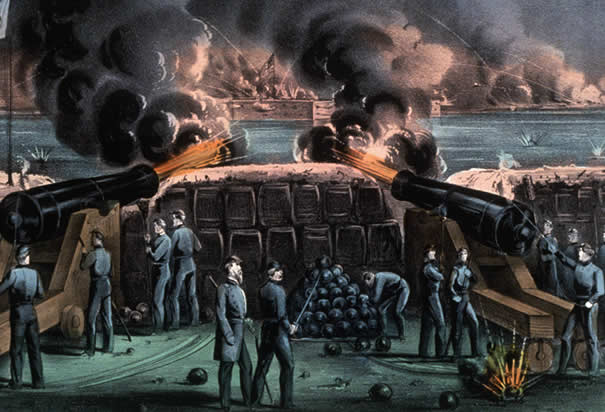
Grant concurred with the decision. Grant wrote to in a letter to Lincoln after the assault on Battery Wagner “by arming the negro we have added a powerful ally. They will make good soldiers and taking them from the enemy weakens him in the same proportion as it strengthens us.” [8] Lincoln wrote after the Emancipation Proclamation that “the emancipation policy, and the use of colored troops, constitute the heaviest blow yet dealt to the rebellion.” [9] The change was a watershed in both American history as well as the future of the U.S. Military services.

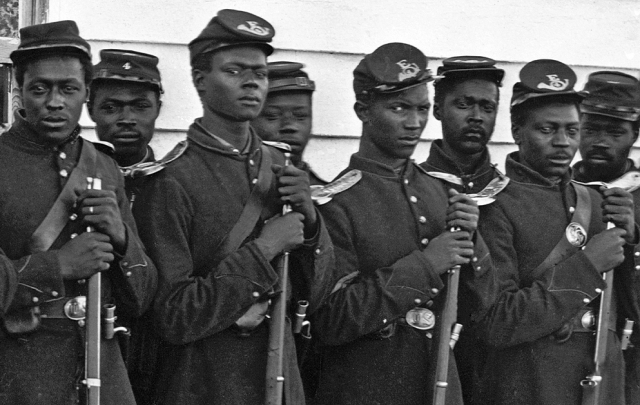
Emancipation allowed for the formation of regiments of United States Colored Troops (USCT), mustered directly into Federal service, which in numbers soon dwarfed the few state raised Black Regiments. However, it was the inspiration provided by those first state raised regiments as well as the violence directed against Blacks in the draft riots helped to provoke “many northerners into a backlash against the consequences of violent racism.” [10] The valor of the state regiments, as well as the USCT units that managed to get into action was remarkable, especially in regard to the amount of discrimination levied at them by some northerners, and the very real threat of death that they faced of captured by Confederates.

In May of 1863 Major General Nathaniel Banks dared to send the First and Third Regiments of “Louisiana Native Home Guard regiments on a series of attacks on Confederate positions at Port Hudson, Louisiana” [11] where they received their baptism of fire. They suffered heavy losses and “of the 1080 men in the ranks, 271 were hit, or one out of every four.” [12] Banks said of them in his after action report: “They answered every expectation…In many respects their conduct was heroic…The severe test to which they were subjected, and the determined manner in which they encountered the enemy, leave upon my mind no doubt of their ultimate success.” [13]

william_carney

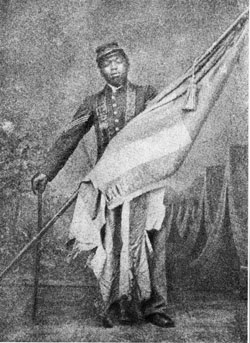
Sergeant William H. Carney of the 54th Massachusetts, Medal of Honor

But the most famous African American volunteer regiment was the 54th Massachusetts, commanded by Colonel Robert Gould Shaw, the “North’s showcase black regiment.” [14] Raised in Boston and officered by many men who were the sons of Boston’s blue blood abolitionist elite, the regiment was authorized in March 1863. Since there was still opposition to the formation of units made up of African Americans, Massachusetts Governor John Andrew authorized the formation of the 54th under the command of white officers, a practice that with few exceptions, became standard in the U.S. military until President Truman desegregated the armed forces in 1948. Governor Andrew was determined to ensure that the officers of the 54th were men of “firm antislavery principles…superior to a vulgar contempt for color.” [15]

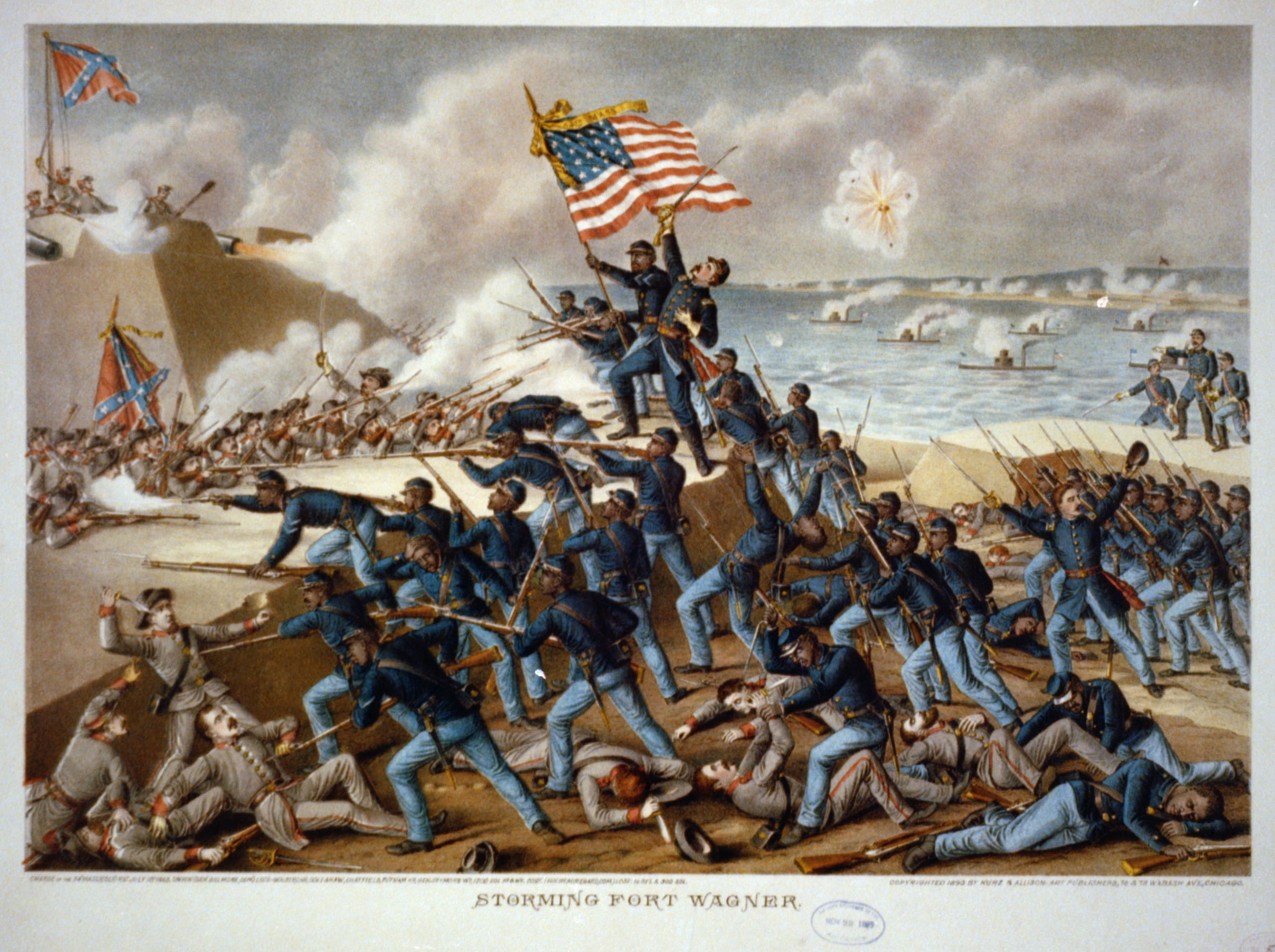
The 54th saw action first in early June and at Gould’s urging sent into battle against the Confederate positions at Fort Wagner on July 18th 1863. Leading the attack the 54th lost nearly half its men, “including Colonel Shaw with a bullet through his heart. Black soldiers gained Wagner’s parapet and held it for an hour before falling back.” [16] Though they tried to hold on they were pushed back after a stubborn fight to secure a breach in the fort’s defenses. “Sergeant William H Carney staggered back from the fort with wounds in his chest and right arm, but with the regiment’s Stars and Stripes securely in his grasp. “The old flag never touched the ground, boys,” Carney gasped as he collapsed at the first field hospital he could find.” [17] Shaw was buried with his men by the Confederates and when Union commanders asked for the return of his body were told “We have buried him with his niggers,” Shaw’s father quelled a northern effort to recover his son’s body with these words: We hold that a soldier’s most appropriate burial-place is on the field where he has fallen.” [18] As with so many frontal attacks on prepared positions throughout the war, valor alone could not overcome a well dug in enemy. “Negro troops proved that they could stop bullets and shell fragments as good as white men, but that was about all.” [19]

Despite the setback, the regiment went on to further actions where it continued to distinguish itself. The Northern press, particularly abolitionists papers brought about a change in the way that many Americans in the North, civilians as well as soldiers, saw blacks. The Atlantic Monthly noted “Through the cannon smoke of that dark night, the manhood of the colored race shines before many eyes that would not see.” [20]

Frederick Douglass, who had two sons serving in the 54th Massachusetts, understood the importance of African Americans taking up arms against those that had enslaved them in order to win their freedom:

“Once let a black man get upon his person the brass letters U.S… let him get an eagle on his button, and a musket on his shoulder and bullets in his pockets, and there is no power on earth which can deny he has won the right to citizenship in the United States.” [21]

The_Storming_of_Ft_Wagner-lithograph_by_Kurz_and_Allison_1890a

Other African American units less famous than the illustrious 54th Massachusetts distinguished themselves in action against Confederate forces. Two regiments of newly recruited blacks were encamped at Milliken’s Bend Louisiana when they were attacked by a Confederate brigade attempting to relieve the Vicksburg Garrison. The troops were untrained and ill-armed but held on against a determined enemy:

“Untrained and armed with old muskets, most of the black troops nevertheless fought desperately. With the aid of two gunboats they finally drove off the enemy. For raw troops, wrote Grant, the freedmen “behaved well.” Assistant Secretary of War Dana, still with Grant’s army, spoke with more enthusiasm. “The bravery of the blacks,” he declared, “completely revolutionized the sentiment in the army with regard to the employment of negro troops. I heard prominent officers who had formerly in private had sneered at the idea of negroes fighting express after that as heartily in favor of it.” [22]

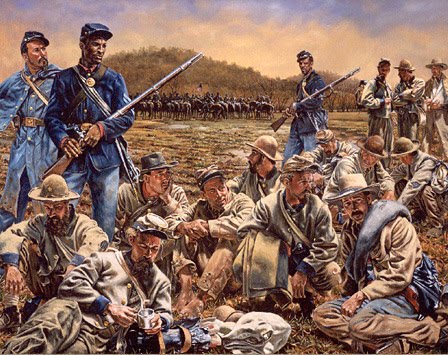
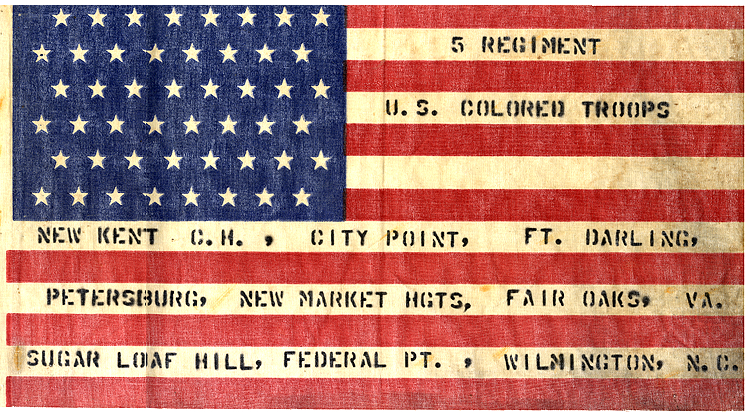
By the end of the war 179,000 African American Soldiers, commanded by 7,000 white officers served in the Union armies. For a number of reasons most of these units were confined to rear area duties or working with logistics and transportation operations. The policies to regulate USCT regiments to supporting tasks in non-combat roles “frustrated many African American soldiers who wanted a chance to prove themselves in battle.” [23] Many of the soldiers and their white officers argued to be let into the fight as they felt that “only by proving themselves in combat could blacks overcome stereotypes of inferiority and prove their “manhood.” [24] Even so in many places in the army the USCT and state regiments made up of blacks were scorned:

“A young officer who left his place in a white regiment to become colonel of a colored regiment was frankly told by a staff officer that “we don’t want any nigger soldiers in the Army of the Potomac,” and his general took him aside to say: “I’m sorry to have you leave my command, and am still more sorry that you are going to serve with Negroes. I think that it is a disgrace to the army to make soldiers of them.” The general added that he felt this way because he was sure that colored soldiers just would not fight.” [25]

The general of course, was wrong. In the engagements where USCT units were allowed to fight, they did so with varying success most often attributable to the direction of their senior officers. When given the chance they almost always fought well, even when badly commanded. This was true as well when they were thrown into hopeless situations. One such instance was when Ferrero’s Division, comprised of colored troops were thrown into the Battle of the Crater at Petersburg when “that battle lost beyond all recall.” [26] The troops advanced in good order singing as they went, while their commander, General Ferrero took cover in a dugout and started drinking; but the Confederate defenders had been reinforced and “Unsupported, subjected to a galling fire from batteries on the flanks, and from infantry fire in front and partly on the flank,” a witness write, “they broke up in disorder and fell back into the crater.” [27] Pressed into the carnage of the crater where white troops from the three divisions already savaged by the fighting had taken cover, the “black troops fought with desperation, uncertain of their fate if captured.” [28] In the battle the division lost 1327 of just under 4000 men. [29]

When captured by Confederates, black soldiers and their white officers received no quarter from many Confederate opponents. General Edmund Kirby Smith who held overall command of Confederate forces west of the Mississippi instructed General Richard Taylor to simply execute black soldiers and their white officers: “I hope…that your subordinates who may have been in command of capturing parties may have recognized the propriety of giving no quarter to armed negroes and their officers. In this way we may be relieved from a disagreeable dilemma.” [30] This was not only a local policy, but echoed at the highest levels of the Confederate government. In 1862 the Confederate government issued an order that threatened white officers commanding blacks: “any commissioned officer employed in the drilling, organizing or instructing slaves with their view to armed service in this war…as outlaws” would be “held in close confinement for execution as a felon.” [31]

On April 12th 1864 at Fort Pillow, troops under the command of General Nathan Bedford Forrest massacred the bulk of over 231 Union most of them black as they tried to surrender. While it is fairly clear that Forrest did not order the massacre and even attempted to stop it, it was clear that he had lost control of his troops. His soldiers fought with the fury of men possessed by hatred of an enemy that they considered ‘a lesser race’ slaughtered the Union troops as they either tried to surrender or flee; but he was not displeased with the result. Ulysses Grant wrote that:

“These troops fought bravely, but were overpowered I will leave Forrest in his dispatches to tell what he did with them.

“The river was dyed,” he says, “with the blood of the slaughtered for up to 200 years. The approximate loss was upward of five hundred killed; but few of the officers escaped. My loss was about twenty killed. It is hoped that these facts will demonstrate to the Northern people that negro soldiers cannot cope with Southerners.” Subsequently Forrest made a report in which he left out the part that shocks humanity to read.” [32]

”The bulk of the killing was directed at the black soldiers of the 6th U.S. Colored Heavy Artillery, which composed over a third of the garrison. “Of the 262 Negro members of the garrison, only 58- just over 20 percent- were marched away as prisoners; while of the 295 whites, 168- just under sixty percent were taken.” [33] A white survivor of the 13th West Tennessee Cavalry, a Union unit at the fort wrote: “We all threw down our arms and gave tokens of surrender, asking for quarter…but no quarter was given….I saw 4 white men and at least 25 negroes shot while begging for mercy….These were all soldiers. There were also 2 negro women and 3 little children standing within 25 steps of me, when a rebel stepped up to them and said, “Yes, God damn you, you thought you were free, did you?” and shot them all. They all fell but one child, when he knocked it in the head with the breech of his gun.” [34]A Confederate Sergeant wrote home a week after the massacre: “the poor deluded negroes would run up to our men, fall upon their knees and with uplifted hands scream for mercy, but were ordered to their feet and shot down.” [35]

pride_over_prejudice-reeves-b-of-nashville

African American soldiers proved themselves during the war and their efforts paved the way for Lincoln and others to begin considering the full equality of blacks as citizens. If they could fight and die for the country, how could they be denied the right to votes, be elected to office, serve on juries or go to public schools? Under political pressure to end the war during the stalemate before Petersburg and Atlanta in the summer of 1864, Lincoln reacted angrily to Copperheads as well as wavering Republicans on the issue of emancipation:

“But no human power can subdue this rebellion without using the Emancipation lever as I have done.” More than 100,000 black soldiers were fighting for the Union and their efforts were crucial to northern victory. They would not continue fighting if they thought the North intended to betray them….If they stake their lives for us they must be prompted by the strongest motive…the promise of freedom. And the promise being made, must be kept…There have been men who proposed to me to return to slavery the black warriors. “I should be damned in time & in eternity for so doing. The world shall know that I will keep my faith to friends & enemies, come what will.” [36]

Despite this, even in the North during and after the war, blacks, including former soldiers would be discriminated against, sometimes by the white men that they served alongside. Those rights would be fought for another century and what began in 1863 with the brave service and sacrifice of these African American soldiers began a process of increased civil rights that is still going on today. It would not be until after the war that some blacks were commissioned as officers in the Army. When Governor John Andrew, the man who had raised the 54th Massachusetts attempted to:

“issue a state commission to Sergeant Stephen Swails of the 54th…the Bureau of Colored Troops obstinately refused to issue Swails a discharge from his sergeant’s rank, and Swails promotion was held up until after the end of the war. “How can we hope for success to our arms or God’s blessing,” raged the white colonel of the 54th, Edward Hallowell, “while we as a people are so blind to justice?” [37]

The Southern Debate about Emancipation and Black Soldiers

In the South, politicians and many senior Confederate Officers fought against any allowance for blacks to serve, for they knew if they allowed this, that slavery itself must be swept away. Despite this, a few such as General Patrick Cleburne, an Irish immigrant and a division commander in the Army of Tennessee demonstrated the capacity for forward thinking in terms of race: Cleburne advocated that blacks serve as soldiers should be emancipated.

Cleburne, known as “the Stonewall Jackson of the West” was a bold fighter who put together a comprehensive plan. He noted that the Confederacy was losing the war because it did not have soldiers, the supplies or resources; and most significantly that “slavery, from being one of our chief sources of strength at the beginning of the war, has now become in a military point of view, one of our chief sources of weakness.” [38] Cleburne recommended that “we immediately commence training a large reserve of the most courageous of our slaves, and further that we guarantee freedom within a reasonable time to every slave in the South who shall remain to the confederacy in this war.” [39]

His proposal was radical. He was asking more from his fellow Southerners than they could risk. He was “asking them to surrender the cornerstone of white racism to preserve their nation” [40] and he presented it in stark terms that few could stomach “As between the loss of independence and the loss of slavery, we can assume that every patriot will freely give up the latter- give up the Negro slave rather than be a slave himself.” [41]

In January 1864 General W.H.T Walker obtained a copy of Cleburne’s proposal and sent it to Davis. Walker opposed it and expressed his outrage over it. Cleburne’s proposal went from being a military matter to a political matter and Davis intervened to quash the proposal. “Convinced that the “propagation of such opinions” would cause “discouragements, distraction, and dissension” in the army, Jefferson Davis ordered the Generals to stop discussing the matter…The only consequence of Cleburne’s action seemed to be the denial of promotion to this ablest of the army’s division commanders, who was killed ten months later at the Battle of Franklin.” [42] In fact Cleburne was “passed over for command of an army corps and promotion to lieutenant general” three times in the next eight months, and in “each care less distinguished, less controversial men received the honors.” [43] All copies of Cleburne’s proposal were destroyed by the order of Davis.

Cleburne was not the only military man to advocate the formation of Negro units or even emancipation. Robert E. Lee was one of the chief proponents of this. Lee said after the war that he had told Davis “often and early in the war that the slaves should be emancipated, that it was the only way to remove a weakness at home and to get sympathy abroad, and divide our enemies, but Davis would not hear of it.” [44]

Ten months later Davis raised the issue of arming slaves as he now believed that military necessity left him little choice. He was opposed by some of his closest political allies including Howell Cobb who warned “The day that you make soldiers of them is the beginning of the end of the revolution. If slaves will make good soldiers our whole theory of slavery is wrong.” [45] Lee wrote to a member of Virginia’s legislature “we must decide whether slavery shall be extinguished by our enemies and the slaves used against us, or use them ourselves at the risk of the effects which may be produced on our social institutions…” and he pointed out that “any act for the enrolling of slaves as soldiers must contain a “well digested plan of gradual and general emancipation”: the slaves could not be expected to fight well if their service was not rewarded with freedom.” [46]

The debate began in earnest in the fall of 1864 and revealed a sharp divide in the Confederacy between those who supported the measure and those against it. Cabinet members such as Judah Benjamin and a few governors “generally supported arming the slaves.” [47] They were opposed by the powerful governors of Georgia and North Carolina, Joe Brown and Zebulon Vance as well as President pro-tem of the Confederate Senate R.M.T. Hunter, who forcibly opposed the measure. Led by Governor “Extra Billy” Smith, Virginia’s General Assembly voted “to permit the arming of slaves but included no provision for emancipation, either before or after military service.” [48]

Finally in March of 1865 the Confederate Congress passed by one vote a watered down measure to allow for the recruitment of slaves. It stipulated that “the recruits must all be volunteers” [49] and those who volunteered must also have “the approbation of his master by a written instrument conferring, as far as he may, the rights of a freed man.” [50] While this in itself was a radical proposition for a nation which had went to war to maintain slavery, the fact was that the slave’s service and freedom were granted not by the government, but by his owner, and even at this stage of the war, few owners were willing to part with their property. It was understood by many that giving freedom to a few was a means of saving the “particular institution.” The Richmond Sentinel noted during the November debate: “If the emancipation of a part is the means of saving the rest, this partial emancipation is eminently a pro-slavery measure.” [51] Thus the law made “no mention of emancipation as a reward of military service” [52] and in deference to “state’s rights, the bill did not mandate freedom for slave soldiers.” [53]

But even the watered down measure was opposed by diehards. Robert Kean, who headed the Bureau of War and should have understood the stark reality of the Confederacy’s strategic situation, note in his diary, that the law:

“was passed by a panic in the Congress and the Virginia Legislature, under all the pressure the President indirectly, and General Lee directly, could bring to bear. My own judgment of the whole thing is that it is a colossal blunder, a dislocation of the foundations of society from which no practical results will be reaped by us.” [54]

It was Lee’s prestige alone that allowed the measure to pass, but even that caused some to question Lee’s patriotism. The Richmond Examiner dared to express a doubt whether Lee was “a ‘good Southerner’: that is, whether he is thoroughly satisfied of the justice and beneficence of negro slavery.” [55] Robert Toombs of Georgia stated that “the worst calamity that could befall us would be to gain our independence by the valor of our slaves” [56] and a Mississippi congressman stated that “Victory itself would be robbed of its glory if shared with slaves.” [57] On March 23rd 1865 the War Office issued General Order Number 14, which authorized the call up and recruitment of slaves to the Confederate cause and on March 25th two companies were formed for drill in Richmond’s Capitol Square and as they did so to the sounds of fifes and drums, “Small boys jeered and threw rocks” [58] at them. None of those few volunteers would see action as within a week the Confederate government had fled Richmond.

But some would see that history was moving, and attitudes were beginning to change. It took time, and the process is still ongoing. As imperfect as emancipation was and though discrimination and racism remained, African Americans had reached “levels that none had ever dreamed possible before the war.” [59] In April 1865 as Jefferson Davis and his government fled Richmond, with Davis proclaiming “again and again we shall return, until the baffled and exhausted enemy shall abandon in despair his endless and impossible task of making slaves of a people resolved to be free.” [60]

The irony in Davis’s empty vow was stunning. Within a week Lee had surrendered and in a month Davis himself would be in a Federal prison. The Federal troops who led the army into Richmond came from General Godfrey Weitzel’s Twenty-fifth Corps, of Ord’s Army of the James. The Every black regiment in the Army of the James was consolidated in Weitzel’s Corps, along with Ferrero’s former division which had suffered so badly at the Battle of the Crater. “Two years earlier in New Orleans, Weitzel had protested that he did not believe in colored troops and did not want to command them, and now he sat at the gates of Richmond in command of many thousands of them, and when the citadel fell he would lead them in and share with them the glory of occupying the Rebel capital.” [61] were regiments of black “cavalrymen and infantrymen. Many were former slaves; their presence showed their resolve to be free.” [62]

The Post War Experience of Blacks in the U.S. Army

Some of those early African American soldiers went on to distinguish themselves on the prairie as the immortal Buffalo Soldiers. Other Blacks would fight in Cuba and the Philippines during the Spanish American War. In the First World War, despite there being some instances of racial harmony, blacks, including officers faced discrimination and met with violent acts. “Refusals to arrest white soldiers who physically assaulted black soldiers accompanied by the tendency to rescind unpopular racial orders and to discourage black officers from demanding salutes from white soldiers” [63] was common.

Most of the Regular Army “Buffalo Soldier” units were not allowed to fight in the First World War. Instead they were left on the frontier and a new generation of draftees and volunteers became the nucleus of two infantry divisions, the 92nd and 93rd. However, at the beginning they were regulated to labor service units. The protests of organizations such as the NAACP and men like W.E.B. DuBois, and Phillip Randolph forced the War Department to reconsider the second class status of these men and to form them into combat units.

Despite this, the leadership of the AEF, or the American Expeditionary Force, refused to allow these divisions to serve under American command. Instead they were broken up and the regiments of the 93rd Division were attached to French divisions. The 369th “Harlem Hellfighters” were assigned to the French 16th Division and then to the 161st Division. The 370th “Black Devils” were attached to the French 26th Division, while the 371st and 372nd were assigned to the French 157th (Colonial) Division, which was also known as the Red Hand Division. The 157th Division had suffered badly during the war and been decimated in the unrelenting assaults in the trench warfare of the Western Front. It was reconstituted in 1918 with one French Regiment and the two African American regiments. Both fought exceptionally well and were cited by the French government for their efforts. The 371st was awarded the French Croix de Guerre and Légion d’honeur. Corporal Freddie Stowers of the 1st Battalion 371st was the only African American awarded the Congressional Medal of Honor in the First World War. The 372nd was also awarded the Croix de Guerre and Légion d’honeur for its service with the 157th Division.

41_090_lg

While many white American soldiers depreciated their French hosts and attempted to sow the seeds of their own racial prejudice against the black soldiers among the French, Southerners in particular warned the French of “black rapist beasts.” However the French experience of American blacks was far different than the often scornful treatment that they received from white American soldiers.

“Soldiers from the four regiments that served directly with the French Army attested to the willingness of the French to let men fight and to honor them for their achievements. Social interactions with French civilians- and white southern soldiers’ reactions to them- also highlighted crucial differences between the two societies. Unlike white soldiers, African Americans did not complain about high prices in French stores. Instead they focused on the fact that “they were welcomed” by every shopkeeper that they encountered.” [64]

Official and unofficial efforts by those in the Army command and individual soldiers to stigmatize them and to try to force the French into applying Jim Crow to laws and attitudes backfired. Villages now expressed a preference for black over white American troops. “Take back these soldiers and send us some real Americans, black Americans,” wrote one village mayor after a group of rowdy white Americans disrupted the town.” [65]

Even after President Truman desegregated the armed forces in 1948, African Americans, as well as other racial minorities, women and gays have faced very real discrimination. The military continues to make great strides, and while overt racist acts and other types of discrimination are outlawed, racism still remains a part of American life.

Today things have changed, and that in large part is due to the unselfish sacrifice in the face of hatred and discrimination of the men of the USCT and the State Black Regiments like the 54th Massachusetts and the Louisiana Home Guards who blazed a way to freedom for so many. Those who followed them as Buffalo Soldiers and volunteers during the World Wars continued to be trail blazers in the struggle for equal rights. A white soldier who served with the 49th Massachusetts wrote “all honor to our negro soldiers. They deserve citizenship. They will secure it! There would be much suffering in what he termed “the transition state” but a “nation is not born without pangs.” [66]

Those birth pangs helped to bring about a new birth of freedom for the United States.

Notes

[1] McPherson, James M. Tried by War: Abraham Lincoln as Commander in Chief Penguin Books, New York and London 2008

[2] McPherson, James M. Drawn With the Sword: Reflections on the American Civil War Oxford University Press, Oxford and New York 1996 p.101

[3] Godwin, Doris Kearns Team of Rivals: The Political Genius of Abraham Lincoln Simon and Shuster, New York and London 2005

[4] Egnal, Marc Clash of Extremes: The Economic Origins of the Civil War Hill and Wang a division of Farrar, Straus and Giroux New York 2009 p.318

[5] Ibid. McPherson Tried by War p.159

[6] Ibid. McPherson Drawn With the Sword p.159

[7] McPherson, James M. Abraham Lincoln and the Second American Revolution Oxford University Press, New York and Oxford 1991 p.35

[8] Ibid. Guelzo Fateful Lighteningp.381

[9] Ibid. McPherson Abraham Lincoln and the Second American Revolution p.35

[10] Ibid. McPherson. The Battle Cry of Freedom p.686

[11] Ibid. Guelzo Fateful Lightening p.379

[12] Ibid. Foote , The Civil War, A Narrative. Volume Two p.398

[13] Ibid. Guelzo Fateful Lightening p.379

[14] Ibid. McPherson. The Battle Cry of Freedom p.686

[15] Ibid. McPherson Drawn With the Sword p.101

[16] Ibid. McPherson. The Battle Cry of Freedom p.686

[17] Ibid. Guelzo Fateful Lightening pp. 380-381

[18] Ibid. McPherson. The Battle Cry of Freedom pp.686-687

[19] Ibid. Foote , The Civil War, A Narrative. Volume Two p.697

[20] Ibid. McPherson. The Battle Cry of Freedom p.686

[21] Ibid. Guelzo Fateful Lightening p. 381

[22] Ibid. McPherson. The Battle Cry of Freedom p.634

[23] Gallagher, Gary W. The Union War Harvard University Press, Cambridge MA and London 2011

[24] Ibid. McPherson Drawn With the Sword p.89

[25] Catton, Bruce. A Stillness at Appomattox Doubleday and Company Garden City, New York 1953 p.227

[26] Ibid. Catton A Stillness at Appomattox p.249

[27] Foote, Shelby, The Civil War, A Narrative. Volume Three Red River to Appomattox Random House, New York 1974 p.537

[28] Wert, Jeffry D. The Sword of Lincoln: The Army of the Potomac Simon and Schuster, New York and London 2005 pp.384-385

[29] Ibid. Foote The Civil War, A Narrative. Volume Three p.537

[30] Ibid. Guelzo Fateful Lightening p. 377

[31] Ibid. Guelzo Fateful Lightening p. 377

[32] Grant, Ulysses S. Preparing for the Campaigns of ’64 in Battles and Leaders of the Civil War Volume IV, Retreat With Honor Edited by Robert Underwood Johnson and Clarence Clough Buel Castle, Secaucus NJ pp.107-108

[33] Ibid. Foote The Civil War, A Narrative. Volume Three p.111

[34] Ibid. Guelzo Fateful Lightening p. 378

[35] Ibid. Foote The Civil War, A Narrative. Volume Three p.112

[36] Ibid. McPherson Abraham Lincoln and the Second American Revolution p.89

[37] Ibid. Guelzo Fateful Lightening p. 376

[38] Ibid. Thomas, The Confederate Nation p.262

[39] Ibid. Thomas, The Confederate Nation p.262

[40] Ibid. Guelzo Fateful Lightening p. 370

[41] Ibid. Thomas, The Confederate Nation p.262

[42] Ibid. McPherson. The Battle Cry of Freedom p.833

[43] Ibid. Thomas, The Confederate Nation p.262

[44] Ibid. Gallagher The Confederate War p.47.

[45] Ibid. Guelzo Fateful Lightening p. 370

[46] Korda, Michael. Clouds of Glory: The Life and Legend of Robert E. Lee Harper Collins Publishers, New York 2014 p.643

[47] Ibid. Thomas, The Confederate Nation p.293

[48] Ibid. Foote. The Civil War, A Narrative. Volume Three pp.754-755

[49] Ibid. Foote. The Civil War, A Narrative. Volume Three p. 755

[50] Ibid. Thomas, The Confederate Nation p.296

[51] Ibid. McPherson. The Battle Cry of Freedom p.836

[52] Ibid. Foote. The Civil War, A Narrative. Volume Three p.755

[53] Ibid. McPherson. The Battle Cry of Freedom p.837

[54] Ibid. Foote. The Civil War, A Narrative. Volume Three p.860

[55] Ibid. McPherson. The Battle Cry of Freedom p.837

[56] Ibid. Foote. The Civil War, A Narrative. Volume Three p.860

[57] Ibid. McPherson. The Battle Cry of Freedom p.835

[58] Ibid. Foote. The Civil War, A Narrative. Volume Three p.860

[59] Ibid. Guelzo Fateful Lightening p. 386

[60] Levine, Bruce Half Slave and Half Free: The Roots of the Civil War Revised Edition, Hill and Wang, a division of Farrar, Strauss and Giroux, New York 1992 and 1995 p.241

[61] Catton, Bruce Grant Takes Command Little, Brown and Company Boston, Toronto and London 1968 p.411

[62] Ibid. Levine Half Slave and Half Free pp.241-242

[63] Keene, Jennifer D. Doughboys, the Great War, and the Remaking of America The Johns Hopkins University Press, Baltimore and London 2001 p.88

[64] Ibid. Keane Doughboys, the Great War, and the Remaking of America p.128

[65] Ibid. Keane Doughboys, the Great War, and the Remaking of America p.129

[66] Ibid Gallagher The Union War p.113

1 Comment

Filed under civil rights, civil war, History, Military

Mine Eyes Have Seen The Glory: Religion, Ideology & the Civil War Part 1

Friends of Padre Steve’s World

This is part one of a very long chapter in my Gettysburg Staff Ride Text. The chapter is different because instead of simply studying the battle my students also get some very detailed history about the ideological components of war that helped make the American Civil War not only a definitive event in our history; but a war of utmost brutality in which religion drove people and leaders on both sides to advocate not just defeating their opponent, but exterminating them.

But the study of this religious and ideological war is timeless, for it helps us to understand the ideology of current rivals and opponents, some of whom we are in engaged in battle and others who we spar with by other means, nations, tribes and peoples whose world view, and response to the United States and the West, is dictated by their religion. 

Yet for those more interested in current American political and social issues the period is very instructive, for the religious, ideological and political arguments used by Evangelical Christians in the ante-bellum period, as well as many of the attitudes displayed by Christians in the North and the South are still on display in our current political and social debates. 

I will be posting the next two parts over the next two days. 

Peace

Padre Steve+

illustration-fort-sumter

“At length on 12th April, the tension could no longer bear the strain. Contrary to instructions, in the morning twilight, and when none could see clearly what the historic day portended, the Confederates in Charleston bombarded Fort Sumter, and the thunder of their guns announced that the argument of a generation should be decided by the ordeal of war. A war, not between two antagonistic political parties, but a struggle to the death between two societies, each championing a different civilization…” 1

War cannot be separated from Ideology, Politics or Religion One can never separate war and the means by which it is fought from its political ends. According to Clausewitz war is an extension or continuation of politics. Of course Clausewitz understood the term politics or policy in the light of the concept of a “World View” or to use the German term Weltungschauung. The term is not limited to doctrine or party politics, but it encompasses the world view of a people or culture. The world view is oft used by the political, media and religious leadership of countries and can be quite instrumental in the decision by a people to go to war; who they war against, their reasons for going to war, the means by which they fight the war, and the end state that they envision. This concept includes racial, religious, cultural, economic and social dimensions of a world view.

One of the problems that modern Americans and Western Europeans have is that we tend to look at the world, particularly in terms of politics and policy, be it foreign or domestic, through a prism from which we cannot see the forest for the trees. We look at individual components of issues such as economic factors, military capabilities, existing political systems, diplomatic considerations and the way societies get information in isolation from each other. We dissect them, we analyze them, and we do a very good job in examining and evaluating each individual component; but we often do this without understanding the world view and ideological factors that link how a particular people, nation or party understand these components of policy.

Likewise policy makers tend to take any information they receive and interpret it through their own world view. This is true even if they have no idea what their world-view is or how they came to it. Most often a world view is absorbed over years. Barbara Tuchman wrote that “When information is relayed to policy-makers, they respond in terms of what is already inside their heads and consequently make policy less to fit the facts than to fit the notions and intentions formed out of the mental baggage that has accumulated in their minds since childhood.” 2

Policy makers often fail to see just how interconnected the most primal elements of the human experience are to the world view of others as well as their own.

Because of this many policy makers, be they military or civilian do not understand how critical the understanding of world view to designing effective polices. Likewise many fail to see how the world view of others influences their application of economic, political, diplomatic and military power as well as the use and dissemination of information in their nation or culture. This is true no matter which religion or sect is involved, even if a people or nation is decidedly secular, and at least outwardly non-religious.

Perhaps this is because we do not want to admit that our Western culture itself is very much a product of primal religious beliefs which informed politics, philosophy, ethics, law, economics, views of race, and even the arts for nearly two millennia. Perhaps it is because we are justifiably appalled and maybe even embarrassed at the excesses and brutality of our ancestors in using religion to incite the faithful to war; to use race and religion justification to subjugate or exterminate peoples that they found to be less than human; or to punish and conquer heretics.

The United States Military made a belated attempt to address ideology, culture and religion in terms of counter-insurgency doctrine when it published the U.S. Army/Marine Counterinsurgency Manual. The discussion of these issues is limited to two pages that specifically deal with various extreme Moslem groups that use that religion as a pillar of their ideology, strategy and operations. But the analysis in the counterinsurgency manual of is limited because its focus is very general and focused at a tactical level.

Likewise the analysis of world view, ideology and religion in the counterinsurgency manual is done in a manner of “us versus them” and though it encourages leaders to attempt to understand the cultural differences there is little in it to help leaders to understand who to do this. Commendably the manual discusses how terrorist and insurgent groups use ideology, frequently based on religion to create a narrative. The narrative often involves a significant amount of myth presented as history, such as how Al Qaida and ISIL using the Caliphate as a religious and political ideal to strive to achieve, because for many Moslems “produces a positive image of the golden age of Islamic civilization.” 3 However, we frequently cannot see how Americans have used, and in some cases continue to the Puritan understanding of a city set on a hill which undergirded Manifest Destiny, the extermination of Native Americans, the War with Mexico, the romanticism of the ante-bellum South and later the Lost Cause.

Policy makers and military leaders must realize that if they want to understand how culture and religious ideology drive others to conquer, subjugate and terrorize in the name of God, they first have to understand how our ancestors did the same thing. It is only when they do that that they can understand that this behavior and use of ideology for such ends is much more universal and easier to understand.

If one wants to see how the use of this compulsion to conquer in the name of God in American by a national leader one needs to go no farther than to examine the process whereby President McKinley, himself a veteran of the Civil War, decided to annex the Philippine in 1898 following the defeat of the Spanish. That war against the Filipinos that we had helped liberate from Spanish rule saw some of the most bloodthirsty tactics employed in fighting the Filipino insurgents, who merely wanted independence. It was a stain on our national honor which of which Mark Twain wrote: “There must be two Americas: one that sets the captive free, and one that takes a once-captive’s new freedom away from him, and picks a quarrel with him with nothing to found it on; then kills him to get his land. . .


A Doubtlessly sincere McKinley sought counsel from God about whether he should annex the the Philippines or not.

“He went down on his knees, according to his own account, and “prayed to Almighty God for light and guidance.” He was accordingly guided to conclude “that there was nothing left to do for us but to take them all, and to educate the Filipinos. And uplift and civilize and Christianize them, by God’s grace to do the very best we could by them, as our fellowmen for whom Christ died.” 4

On the positive side the counterinsurgency manual does mention how “Ideology provides a prism, including a vocabulary and analytical categories, through which followers perceive their situation.” 5 But again it does so at a micro-level and the lessons of it are not applied at the higher levels of strategic thinking and policy.

Thus when faced with cultures for which religion provides the adhesive which binds each of these elements, such as the Islamic State or ISIL we attempt to deal with each element separately, as if they have no connection to each other. But that is where we err, for even if the religious cause or belief has little grounding in fact, science or logic, and may be the result of a cultures attempting to seize upon mythology to build a new reality, it is, in the words of Reggie Jackson the “straw that stirs the drink” and to ignore or minimize it is to doom our efforts to combat its proponents.

Perhaps that is because we do not like to look at ourselves and our own history in the mirror. Perhaps it is because we are uncomfortable with the fact that the face that we see in the mirror is face too similar to those we oppose who are perfectly willing to commit genocide in the name of their God, than we want to admit. Whether this is because we are now predominantly secularist in the way that we do life, or because we are embarrassed by the religiously motivated actions of our forefathers, the result is strikingly and tragically similar.

Clausewitz was a product of classic German Liberalism. He understood the effects of the moral and spiritual concerns inherent in policy, and it flows from his pen, as where he wrote “that the aim of policy is to unify and reconcile all aspects of internal administration as well as of spiritual values, and whatever else the moral philosopher may care to add.” 6 Clausewitz understood that when the motivation behind politics becomes more extreme and powerful; when the politics becomes more than a simple disagreement about isolated policy issues; when the ideology that lays behind the politics, especially ideology rooted in religion evokes primal hatred between peoples, war can come close to reaching the abstract concept of absolute or total war.

Clausewitz wrote:

“The more powerful and inspiring the motives for war, the more they affect the belligerent nations and the fiercer the tensions that precede the outbreak, the closer will war approach its abstract concept, the more important will be the destruction of the enemy, the more closely will the military and the political objects of war coincide, and the more military and less political will war appear to be….” 7

The American Civil War was the first modern war based on the advancement of technology and the changing character of war. But it was also a modern war which reached back to the most primal urges of the people involved, including the primal expressions of religious justification for their actions that both sides accepted as normal.

The American Civil War was caused by the clash of radically different ideologies, ideologies which championed two very different views of civilization, government, economics and the rights of people. However, these different world views were based based upon a common religious understanding:

“whatever their differences over such matters as slavery and political preaching, both sides read their Bibles in remarkably similar ways Ministers had long seen the American republic as a new Israel, and Confederate preachers viewed the southern nation in roughly the same light. The relentless, often careless application of biblical typologies to national problems, the ransacking of scripture for parallels between ancient and modern events produced a nationalistic theology at once bizarre, inspiring and dangerous. Favorite scripture passages offered meaning and hope to a people in the darkest hours and, at the same time, justified remorseless bloodshed.” 8

This understanding manifested itself in each side’s appeal to their Puritan ancestor’s concept of a “city set on a hill,” a mantle that each side claimed to be the legitimate heir. Though they seem radically different, they are actually two sides of the same religious-ideological coin.

The American Civil War was a religious and ideological war. “Like the total wars of the twentieth century, it was preceded by years of violent propaganda, which long before the war had obliterated all sense of moderation, and had awakened in the contending parties the primitive spirit of tribal fanaticism.” 9 It was preceded by the fracturing of political parties and alliances which had worked for compromise in the previous decades to preserve the Union even at the cost of maintaining slavery.

Far from being irrational as some have posited, the actions and behavior of politicians in both the North and the South was completely rational based on their conflicting ideologies and views of their opponents. The “South’s fears of territorial and economic strangulation and the North’s fears of a “slave power” conspiracy are anything but irrational, and only someone who refuses to think through the evidence available to Americans in the 1850s would find either of them at all illogical.” 10

Understanding How Religiously Based Ideology influences Policy, Politics and War Samuel Huntington wrote:

“Blood, language, religion, way of life were what the Greeks had in common and what distinguished them from the Persians and other non-Greeks. Of all the objective elements which define civilizations, however, the most important is usually religion, as the Athenians emphasized. To a very large degree, the major civilizations in human history have been closely identified with the world’s great religions; and who share ethnicity and language but differ in religion may slaughter each other…” 11

The very realistic fears of both sides brought about clash of extremes in politics which defied efforts at compromise and was already resulting in violent and bloody conflicts between ideologues in Kansas, Missouri and Kentucky years before the firing on Fort Sumter. For both sides their views became a moral cause that in the minds of many became an article of their religious faith, and “Religious faith itself became a key part of the war’s unfolding story for countless Americans….” 12 British theorist and military historian J.F.C. Fuller wrote of the religious undergirding of the war:

“As a moral issue, the dispute acquired a religious significance, state rights becoming wrapped up in a politico-mysticism, which defying definition, could be argued for ever without any hope of a final conclusion being reached.” 13

That is why it impossible to simply examine the military campaigns and battles of the Civil War in isolation from the politics, polices, the competing philosophies and the underlying theology which were the worldview that undergirded the arguments of both sides. Those competing philosophies and world views, undergirded by a pervasive nationalistic understanding of religion not only helped to cause on the war but made the war a total war.

Some might wonder where this fits in a text that is about a specific campaign and battle in a war, but for those entrusted with planning national defense and conducting military campaign the understanding of why wars are fought, in particular the ideological causes of war matter in ways that military planners, commanders and even elected political leadership often overlook. Colin Gray notes: “Wars are not free floating events, sufficient unto themselves as objects for study and understanding. Instead, they are entirely the product of their contexts.” 14

Studying the context of the American Civil War is very important in understanding not just it, but also civil wars in other nations which are currently raging. The study of these contexts brings an American or Western historical perspective to those wars, not so much in trying to place a western template over non-western conflicts; but a human perspective from our own past from which we can gain insight into how the people, even people who share a common language, religion and history, can war against each other in the most brutal of fashions. Again I refer to Colin Gray who noted “Policy and strategy will be influenced by the cultural preferences bequeathed by a community’s interpretation of its history as well as by its geopolitical-geostrategic context.” 15

For American and other Western political and military policy makers this is particularly important in Iraq where so many Americans have fought, and in the related civil war in Syria which has brought about the emergence of the Islamic State of Iraq and the Levant.

Likewise in our Western tradition we can see how radical ideology, based on race was central to Hitler’s conduct of war, especially in the East during the Second World War. Hitler’s ideology permeated German military campaigns and administration of the areas conquered by his armies. No branch of the German military, police or civil administration in occupied Poland or Russia was exempt guiltless in the crimes committed by the Nazi regime. It is a chilling warning of the consequences awaiting any nation that allows it to become caught up in hate-filled political, racial or even religious ideologies which dehumanizes opponents and of the tragedy that awaits them and the world. In Germany the internal and external checks that govern the moral behavior of the nation and individuals failed. Caught up in the Nazi system, the Germans, especially the police and military abandoned the norms of international law, morality and decency, banally committing crimes which still reverberate today and which are seen in the ethnic cleansing actions in the former Yugoslavia and other European nations.

Thus the study of the American Civil War, from the cultural, economic, social and religious differences which divided the nation helps us in understanding war. But even more importantly we have to understand the ideological clash between Abolitionists in the North, and Southern proponents of slavery. Both the ideologies of the Abolitionists who believed that African Americans were created by God and had the same rights as whites, as well as the Southern arguments that blacks were inferior and slavery was a positive good, were buttressed by profoundly religious arguments related directly to a divergence in values. It was in this “conflict of values, rather than a conflict of interests or a conflict of cultures, lay at the root of the sectional schism.” 16

Understanding this component of our own nation’s history helps us to understand how those same factors influence the politics, policies, the primal passions and hatreds of people in other parts of the world. Thus they are helpful for us to understand when we as a nation involve ourselves in the affairs of other peoples whose conflicts are rooted in religiously motivated ideology and differences in values, such as in the current Sunni-Shia conflict raging in various guises throughout the Middle East where culture, ideology and economic motivations of the groups involved cannot be separated. We may want to neatly separate economic, strategic, military and geopolitical factors from religious or ideological factors assuming that each exists in some sort of hermetically sealed environment. But to think this is a fallacy of the greatest magnitude. As we have learned too late in the century in our Middle East muddling, it is impossible to separate geopolitical, strategic, military and economic issues from ideological issues rooted in distinctly religious world views, world views that dictate a nation, people or culture’s understanding of the world.

David M. Potter summed up this understanding of the connection between the ideological, cultural and economic aspects and how the issue of slavery connected all three realms in the American Civil War:

“These three explanations – cultural, economic and ideological – have long been the standard formulas for explaining the sectional conflict. Each has been defended as though it were necessarily incompatible with the other two. But culture, economic interest, and values may all reflect the same fundamental forces at work in a society, in which case each will appear as an aspect of the other. Diversity of culture may produce both diversity of interests and diversity of values. Further, the differences between a slaveholding and a nonslaveholding society would be reflected in all three aspects. Slavery represented an inescapable ethical question which precipitated a sharp conflict of values.” 17
o-SLAVERY-facebook


The Impact of Slavery on the Growing Divide between North and South

The political ends of the Civil War came out of the growing cultural, economic, ideological and religious differences between the North and South that had been widening since the 1830s. However, slavery was the one issue which helped produce this conflict in values and it was “basic to the cultural divergence of the North and South, because it was inextricably fused into the key elements of southern life – the staple crop of the plantation system, the social and political ascendency of the planter class, the authoritarian system of social control.” 18 Without slavery and the southern commitment to an economy based on slave labor, the southern economy would have most likely undergone a similar transformation as what happened in the North; thus the economic divergence between North and South would “been less clear cut, and would have not met in such head-on collision.” 19 But slavery was much more than an economic policy for Southerners; it was a key component of their religious, racial and philosophic world view.

The issue of slavery even divided the ante-Bellum United States on what the words freedom and liberty meant, the dispute can be seen in the writings of many before the war, with each side emphasizing their particular understanding of these concepts. Many Southerners, including poor whites saw slavery as the guarantee of their economic freedom. John C. Calhoun said to the Senate in 1848 that “With us, the two great divisions of society are not the rich and poor, but white and black; and all of the former, the poor as well as the rich, belong to the upper class, and are respected and treated as equals.” 20

But it was Abraham Lincoln who cut to the heart of the matter when he noted that “We all declare for liberty” but:

“in using the same word we do not all mean the same thing. With some the word liberty may mean for each man to do as he pleases with himself and the product of his labor; while with others the same word may mean for some men to do as they please with other men and the product of other men’s labor.” 21

The growing economic disparity between the Slave and Free states became more about the expansion of slavery in federal territories as disunion and war approached; for a number of often competing reasons. These differences were amplified by the issue of slavery led to the substitution of stereotypes of each other and had the “effect of changing men’s attitudes toward the disagreements which are always certain to arise in politics: ordinary, resolvable disputes were converted into questions of principle, involving rigid, unnegotiable dogma.” 22 The editor of the Charleston Mercury noted in 1858 that “on the subject of slavery…the North and the South…are not only two peoples, but they are rival, hostile peoples.” 23

This was driven both by the South’s insistence on both maintaining slavery where it was already legal and expanding it into new territories which was set against the vocal abolitionist movement. They were also fighting an even more powerful enemy, Northern industrialists who were not so idealistic, and much more concerned with “economic policy designed to secure Northern domination of Western lands than the initial step in a broad plan to end slavery.” 24 This completion between the regions not only affected politics, it affected religion and culture In the South it produced a growing culture of victimhood which is manifest in the words of Robert Toombs who authored Georgia’s declaration of causes for secession:

“For twenty years past, the Abolitionists and their allies in the Northern states, have been engaged in constant efforts to subvert our institutions, and to excite insurrection and servile war among us…” whose “avowed purpose is to subject our society, subject us, not only to the loss of our property but the destruction of ourselves, our wives and our children, and the dissolution of our homes, our altars, and our firesides.” 25

As the differences grew and tensions rose the South became ever more closed off from the North. “More than other Americans, Southerners developed a sectional identity outside the national mainstream. The Southern life style tended to contradict the national norm in ways that life styles of other sections did not.” 26

The complex relationship of Southern society where the “Southern bodies social, economic, intellectual, and political were decidedly commingled” 27 and politics of the South came more to embrace the need for slavery and its importance, even to poor whites in the South who it did not benefit and actually harmed economically: “the system of subordination reached out still further to require a certain kind of society, one in which certain questions were not publically discussed. It must give blacks no hope of cultivating dissention among the whites. It must commit non slaveholders to the unquestioning support of racial subordination….In short, the South became increasingly a closed society, distrustful of isms from outside and unsympathetic to dissenters. Such were the pervasive consequences of giving top priority to the maintenance of a system of racial subordination.” 28
4.0.4


Southern planters declared war on all critics of their “particular institution” beginning in the 1820s. As Northern abolitionists like William Lloyd Garrison and his newspaper The Liberator grew in its distribution and began to appear in the South various elected officials throughout the South “suppressed antislavery books, newspapers, lectures, and sermons and strove generally to deny critics of bondage access to any public forum.” 29

In response to the proliferation of abolitionist literature in the South, John C. Calhoun proposed that Congress pass a law to prosecute “any postmaster who would “knowingly receive or put into the mail any pamphlet, newspaper, handbill, or any printed, written, or pictorial representation touching the subject of slavery.” 30 Calhoun was not alone as other members of Congress as well as state legislatures worked to restrict the import of what they considered subversive and dangerous literature.

Beginning in 1836 the House of Representatives passed a “gag rule” for its members which “banned all petitions, memorials, resolutions, propositions, or papers related in any way or to any extent whatever to the subject of slavery.” 31 This was challenged by former President John Quincy Adams in 1842 as well as by others so that in 1844 the House voted to rescind it. However Southern politicians “began to spout demands that the federal government and the Northern states issue assurances that the abolitionists would never be allowed to tamper with what John Calhoun had described as the South’s “peculiar domestic institution.” 32 The issue of slavery more than any other “transformed political action from a process of accommodation to a mode of combat.” 33

Around the same time as the gag rule was played out in Congress the Supreme Court had ruled that the Federal government alone “had jurisdiction where escaped slaves were concerned” which resulted in several states enacting “personal liberty laws” to “forbid their own elected officials from those pursuing fugitives.” Southern politicians at the federal and state levels reacted strongly to these moves which they believed to be an assault on their institutions and their rights to their human property. Virginia legislators protested that these laws were a “disgusting and revolting exhibition of faithless and unconstitutional legislation.” 34

The issue of slavery shaped political debate and “structured and polarized many random, unoriented points of conflict on which sectional interest diverged.” 35 As the divide grew leaders and people in both the North and the South began to react to the most distorted images of each other imaginable- “the North to an image of a southern world of lascivious and sadistic slave drivers; the South to the image of a northern world of cunning Yankee traders and radical abolitionists plotting slave insurrections.” 36
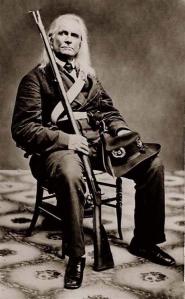
Edmund-Ruffin

The Slaveholder Ideology Personified: Edmund Ruffin

Among the people most enraged by Northern opposition to slavery was Edmund Ruffin. Ruffin was a very successful farm paper editor, plantation owner and ardent old line secessionist from Virginia. In 1860 the then 67 year old Ruffin helped change the world forever when, according to popular legend he pulled the lanyard which fired the first shot at Fort Sumter. While he was there and probably was given the honor of firing the first shot from his battery; other guns from other emplacements may have fired first. 37

Ruffin was a radical ideologue, he had been passionately arguing for secession and Southern independence for fifteen years. Ruffin “perceived the planter civilization of the South in peril; the source of the peril was “Yankee” and union with “Yankees.” Thus he preached revolution, Ruffin was a rebel with a cause, a secular prophet…” 38 He was a type of man who understood reality far better than some of the more moderate oligarchs that populated the Southern political and social elite. While in the years leading up to the war these men, including John Calhoun attempted to secure the continued existence and spread of slavery within the Union through the Congress and the courts, as early as 1850, Ruffin recognized that in order for slavery to survive the slaveholding South would have to secede from the Union. Ruffin and other radical secessionists believed that there could be no compromise with the north. In 1850 he and James Hammond attempted to use a meeting in Nashville to “secure Cooperative State Secession” and wrote to Hammond, against those who sought to use the meeting to preserve the Union, “If the Convention does not open the way to dissolution…I hope it shall never meet.” 39 He believed that in order to maintain the institution of slavery the slave holding states that those states had to be independent from the North.

Ruffin’s views were not unique to him, the formed the basis of how most slave owners and supporters felt about slavery’s economic benefits, Ruffin wrote:

“Still, even this worst and least profitable kind of slavery (the subjection of equals and men of the same race with their masters) served as the foundation and the essential first cause of all the civilization and refinement, and improvement of arts and learning, that distinguished the oldest nations. Except where the special Providence and care of God may have interposed to guard a particular family and its descendants, there was nothing but the existence of slavery to prevent any race or society in a state of nature from sinking into the rudest barbarism. And no people could ever have been raised from that low condition without the aid and operation of slavery, either by some individuals of the community being enslaved, by conquest and subjugation, in some form, to a foreign and more enlightened people.”40

a2a9c088d75423b7f457b194d7c9ea9a

Slavery and National Expansion: The Compromise of 1850

The Ante-Bellum South was an agrarian society which depended on the free labor provided by slaves and in a socio-political sense it was an oligarchy that offered no freedom to slaves, openly discriminated against free blacks and provided little hope of social or economic advancement for poor and middle class whites, but it was maintained because in many cases the Southern Yeoman farmer “feared the fall from independent producer to dependent proletarian, a status he equated with enslavement.” 41 But northerners often driven by religious understandings of human rights founded in the concept of a higher law over a period of a few decades abolished slavery in the years after the United States had gained independence.

However, the South had tied its economy and society to the institution of slavery, and was not content to see it remain just in the original states of the Old South.

The expansion of slavery was essential to its continued maintenance in the states where it was already legal. “Because of the need to maintain a balance in the Senate, check unruly slaves, and cultivate fertile soils, many planters and small plantation owners- particularly those living in the southern districts of the cotton states- asserted that their survival depended on new territory.” 42 In those decades “a huge involuntary migration took place. Between 800,000 and 1 million slaves were moved westward….” 43

slavescars

The need for slaves caused prices to soar. In some older states like Virginia where fewer slaves were required the exportation of slaves became a major industry:

“male slaves were marched in coffles of forty or fifty, handcuffed to each other in pairs, with a long chain through the handcuffs passing down the column to keep it together, closely guarded by mounted slave traders followed by an equal number of female slaves and their children. Most of them were taken to Wheeling, Virginia, the “busiest slave port” in the United States, and from there they were transported by steamboat to New Orleans, Natchez, and Memphis.” 44

In the years the before the war, the North embraced the Industrial Revolution leading to advances which gave it a marked economic advantage over the South in which through its “commitment to the use of slave labor inhibited economic diversification and industrialization and strengthened the tyranny of King Cotton.” 45 The population of the North also expanded at a clip that far outpaced the South as European immigrants swelled the population.

The divide was not helped by the various compromises worked out between northern and southern legislators. After the Missouri Compromise Thomas Jefferson wrote:

“but this momentous question, like a fire bell in the night, awakened and filled me with terror. I considered it at once as the knell of the Union. It is hushed indeed for the moment, but this is a reprieve only, not a final sentence. A geographical line, coinciding with a marked principle, moral and political, once conceived and held up to the angry passions of men, will never be obliterated; and every new irritation will mark it deeper and deeper.” 46

The trigger for the increase in tensions was the war with Mexico in which the United States annexed nearly half of Mexico.

The new territories were viewed by those who advocated the expansion of slavery as fresh and fertile ground for its spread. Ulysses S Grant, who served in the war, noted the effects of the war with Mexico in his memoirs:

“In taking military possession of Texas after annexation, the army of occupation, under General [Zachary] Taylor, was directed to occupy the disputed territory.  The army did not stop at the Nueces and offer to negotiate for a settlement of the boundary question, but went beyond, apparently in order to force Mexico to initiate war….To us it was an empire and of incalculable value; but it might have been obtained by other means.  The Southern rebellion was largely the outgrowth of the Mexican war.”47

Robert Toombs of Georgia was an advocate for the expansion of slavery into the lands conquered during the war. Toombs warned his colleagues in Congress “in the presence of the living God, that if you by your legislation you seek to drive us from the territories of California and New Mexico, purchased by the common blood and treasure of the whole people…thereby attempting to fix a national degradation upon half the states of this Confederacy, I am for disunion.” 48

The tensions in the aftermath of the war with Mexico escalated over the issue of slavery in the newly conquered territories brought heated calls by some southerners for secession and disunion. To preserve the Union, Henry Clay and Daniel Webster, supported by the new President Millard Fillmore were able to pass the compromise of 1850 solved a number of issues related to the admission of California to the Union and boundary disputes involving Texas and the new territories. But among the bills that were contained in it was the Fugitive Slave Law, or The Fugitive Slave Act of 1850. The act was the devise of Henry Clay which was meant to sweeten the deal for southerners. The law would “give slaveholders broader powers to stop the flow of runaway slaves northward to the free states, and offered a final resolution denying that Congress had any authority to regulate the interstate slave trade.” 49 which for all practical purposes nationalized the institution of slavery, even in Free states by forcing all citizens to assist law enforcement in apprehending fugitive slaves and voided state laws in Massachusetts, Vermont, Ohio, Connecticut, Pennsylvania and Rhode Island which barred state officials from aiding in the capture, arrest or imprisonment of fugitive slaves. “Congress’s law had nationalized slavery. No black person was safe on American soil. The old division of free state/slave state had vanished….” 50

fugitive-slave-act-1850-granger-1

That law required all Federal law enforcement officials, even in non-slave states to arrest fugitive slaves and anyone who assisted them, and threatened law enforcement officials with punishment if they failed to enforce the law. The law stipulated that should “any marshal or deputy marshal refuse to receive such warrant, or other process, when tendered, or to use all proper means diligently to execute the same, he shall, on conviction thereof, be fined in the sum of one thousand dollars.” 51

Likewise the act compelled citizens in Free states to “aid and assist in the prompt and efficient execution of this law, whenever their services may be required….” 52 Penalties were harsh and financial incentives for compliance attractive.

“Anyone caught providing food and shelter to an escaped slave, assuming northern whites could discern who was a runaway, would be subject to a fine of one thousand dollars and six months in prison. The law also suspended habeas corpus and the right to trial by jury for captured blacks. Judges received a hundred dollars for every slave returned to his or her owner, providing a monetary incentive for jurists to rule in favor of slave catchers.” 53

The law gave no protection for even black freedmen. No proof or evidence other than the sworn statement of the owner that a black was or had been his property was required to return any black to slavery. Frederick Douglass said:

“By an act of the American Congress…slavery has been nationalized in its most horrible and revolting form. By that act, Mason & Dixon’s line has been obliterated;…and the power to hold, hunt, and sell men, women, and children remains no longer a mere state institution, but is now an institution of the whole United States.” 54

On his deathbed Henry Clay praised the act, which he wrote “The new fugitive slave law, I believe, kept the South in the Union in ‘fifty and ‘fifty-one. Not only does it deny fugitives trial by jury and the right to testify; it also imposes a fine and imprisonment upon any citizen found guilty of preventing a fugitive’s arrest…” Likewise Clay depreciated the opposition noting “Yes, since the passage of the compromise, the abolitionists and free coloreds of the North have howled in protest and viciously assailed me, and twice in Boston there has been a failure to execute the law, which shocks and astounds me…. But such people belong to the lunatic fringe. The vast majority of Americans, North and South, support our handiwork, the great compromise that pulled the nation back from the brink.” 55

To be continued tomorrow….

Notes 

1 Fuller, J.F.C. The Conduct of War 1789-1961 Da Capo Press, New York 1992. Originally published by Rutgers University Press, New Brunswick N.J p.98

2 Tuchman, Barbara W. Practicing History Alfred A. Knopf, New Your 1981 p.289

3 ___________ U.S. Army/ Marine Counterinsurgency Field Manual FM 3-24 MCWP 3-33.5 15 December 2006 with and forward by General David A Petreus and General James Amos, Konecky and Konecky, Old Saybrook CT 2007 p.26

4 Ibid. Tuchman Practicing History p.289

5 Ibid. U.S. Army/ Marine Counterinsurgency Field Manual p.27

6 Clausewitz, Carl von On War Indexed edition, edited and translated by Michael Howard and Peter Paret, Princeton University Press, Princeton NJ 1976 p.606

7 Ibid. Clausewitz On War pp.87-88

8 Rable, George C. God’s Almost Chosen Peoples: A Religious History of the American Civil War University of North Carolina Press, Chapel Hill 2010 p.4

9 Ibid. Fuller The Conduct of War 1789-1961 p.99

10 Guelzo Allen C. Fateful Lightening: A New History of the Civil War Era and Reconstruction Oxford University Press, Oxford and New York 2012 p.95

11 Huntington, Samuel P. The Clash of Civilizations and the Remaking of the World Order Touchstone Books, New York 1997 p.42

12 Ibid. Rable God’s Almost Chosen Peoples p.5

13 Fuller, J.F.C. Decisive Battles of the U.S.A. 1776-1918 University of Nebraska Press, Lincoln 2007 copyright 1942 The Royal Society for the Prevention of Cruelty to Animals p.174

14 Gray, Colin S. Fighting Talk: Forty Maxims on War, Peace, and Strategy Potomac Books, Dulles VA 2009 p.3

15 Ibid. Gray Fighting Talk p.25

16 Potter, David M. The Impending Crisis: America before the Civil War 1848-1861 completed and edited by Don E. Fehrenbacher Harper Collins Publishers, New York 1976 p.41

17 Ibid. Potter The Impending Crisis p.41

18 Ibid. Potter The Impending Crisis p.42

19 Ibid. Potter The Impending Crisis p.42

20 McPherson, James M. Drawn With the Sword: Reflections on the American Civil War Oxford University Press, Oxford and New York 1996 p.50

21 Levine, Bruce Half Slave and Half Free: The Roots of the Civil War Revised Edition, Hill and Wang, a division of Farrar, Strauss and Giroux, New York 1992 and 1995 p.122

22 Ibid. Potter The Impending Crisis p.43

23 Ibid. McPherson Drawn With the Sword p.16

24 Egnal, Marc Clash of Extremes: The Economic Origins of the Civil War Hill and Wang a division of Farrar, Straus and Giroux New York 2009 p.6

25 Dew, Charles B. Apostles of Disunion: Southern Secession Commissioners and the Causes of the Civil War University Press of Virginia, Charlottesville and London 2001 p.12

26 Thomas, Emory The Confederate Nation 1861-1865 Harper Perennial, New York and London 1979 p.5

27 Ibid. Thomas The Confederate Nation p.5

28 Ibid. Potter The Impending Crisis pp.457-458

29 Ibid. Levine Half Slave and Half Free p.166

30 Ibid. Guelzo Fateful Lightening pp.50-51

31 Ibid. Levine Half Slave and Half Free pp.169-170

32 Ibid. Guelzo Fateful Lightening pp.51-52

33 Ibid. Potter The Impending Crisis p.43

34 Ibid. Levine Half Slave and Half Free pp.169-170

35 Ibid. Potter The Impending Crisis p.43

36 Ibid. Potter The Impending Crisis p.43

37 Catton, Bruce The Coming Fury Phoenix Press, London 1961 pp.314-315

38 Ibid. Thomas The Confederate Nation p.1

39 Freehling, William W. The Road to Disunion Volume One: Secessionists at Bay Oxford University Press, Oxford and New York 1990 p.481

40 Ruffin, Edmund The Political Economy of Slavery in McKitrick, Eric L. ed. Slavery Defended: The Views of the Old South. Englewood Cliffs, NJ: Prentice Hall/Spectrum Books, 1963.Retrieved from http://www.pbs.org/wgbh/americanexperience/features/primary-resources/lincolns-political-economy/ 24 March 2014

41 Ibid. McPherson Drawn With the Sword p.50

42 Ibid. Egnal Clash of Extremes pp.125-126

43 Korda, Michael. Clouds of Glory: The Life and Legend of Robert E. Lee Harper Collins Publishers, New York 2014 p.203

44 Ibid. Korda Clouds of Glory: The Life and Legend of Robert E. Lee p.203

45 Ibid. Potter The Impending Crisis p.42

46 Jefferson, Thomas Letter to John Holmes dated April 22nd 1824 retrieved from http://www.loc.gov/exhibits/jefferson/159.html 24 March 2014

47 U.S. Grant, Personal Memoirs of U.S. Grant New York 1885 pp.243-245

48 Ibid. Guelzo Fateful Lightening pp.62-63

49 Ibid. Guelzo Fateful Lightening p.68

50 Goldfield, David America Aflame: How the Civil War Created a Nation Bloomsbury Press, New York, London New Delhi and Sidney 2011 p.71

51 ______________Fugitive Slave of Act 1850 retrieved from the Avalon Project, Yale School of Law http://avalon.law.yale.edu/19th_century/fugitive.asp 11 December 2014

52 Ibid. Fugitive Slave Act of 1850

53 Ibid. Goldfield America Aflame p.71

54 Ibid. Goldfield America Aflame p.72

55 Ibid. Oates The Approaching Fury p.94

3 Comments

Filed under civil rights, civil war, faith, History, laws and legislation, Religion

Interpreting a Life

GeorgePickett

Friends of Padre Steve’s World,

I have been working on an update to my Gettysburg text dealing with Pickett’s Charge, in particular focusing a lot of attention on the life of the man whose name is forever linked to that calamitous attack, Major General George Pickett. Like what I have written recently about the tragic heroes of Little Round Top, Colonel Joshua Chamberlain, Colonel Strong Vincent and Brigadier General Gouverneur Warren I am finding a character who is different than much of the myth surrounding him. Though not the intellectual equal of the three men mentioned above he too is a tragic figure in his own way. I expect to be publishing that update to that chapter tomorrow.

Like so much of what I do the pursuit of a fair treatment of this man leads me to find more and more information that like everything else that I write about must be questioned and examined in light of circumstance, the motivation of the chroniclers, as well as what we now know about psychology and sociology. When we do this we are able to see beyond the romanticized portrait of Pickett seen in the movie Gettysburg where he is played by Stephen Lang, and see a much more complex individual, a man of many contradictions and much personal tragedy, even before Gettysburg.

I will mention one thing that gave me an insight into Pickett was the fact that he was a chronic rule breaker at West Point, almost always on the edge of being expelled for behavior demerits. He was also a man who had no problem in bucking the system, especially in school and at West Point. One might find that trait inconstant for a man who became a career Army officer, but I can relate to it in many ways. While I identify more with men like Warren and Chamberlain in terms of their intellectual interests and often contradictory personalities, I find in Pickett’s antics at West Point a kindred spirit who didn’t have a problem breaking rules and pushing a system that he thought was dehumanizing and arbitrary. I have been that way through much of my military career when it comes to breaking or bending rules when it appeared that they made no sense. Many people who know me are often perplexed that someone who has served as a commissioned officer for over thirty years can be such a rebel.

I think that is part of the attraction of looking at the lives of leaders and not isolating their actions at any one particular event. We are all products of our entire life experience, our family background and often owe our place in life not just to our own achievements but to the actions of others who work to give us the opportunity to succeed, sometimes in spite of ourselves. We also have the benefit of friends who remain friends in spite of circumstances; for George Pickett one of these lifelong friends was another misfit, Ulysses S. Grant. Pickett also gained enemies, often people who did not appreciate his lightness or humor, and those like Robert E. Lee who could not abide his honesty after the battle of Gettysburg and for what can be deciphered from the available records held it against him until he died.

Pickett was also a men who felt betrayed by some leaders, especially Lee. The disaster that afflicted his division during the great charge took something from him. He was a true believer in the “cause” but saw his division and later his own reputation destroyed by the man who became the heart and soul of the lost cause, Robert E. Lee.

History is never easy to put together especially when we examine the often contradictory lives of the individuals involved, their sometimes unusual motivations, strange personalities and their quirky behaviors. Much as it is with ourselves. We often learn too that we don’t make our way alone, we all have the help of others in getting us where we go and quite often the faithful companionship of friends. These are all part of examining history and life and things that matter…at least to me.

So anyway my friends, until tomorrow I am yours.

Peace

Padre Steve+


Leave a comment

Filed under civil war, leadership, Military

Friday Morning Myth Busting before a Trip to Gettysburg

IMG_1915

Dear Friends of Padre Steve’s World,

Today I head up with my class to Gettysburg for our Staff Ride. Of course this comes on the heals of the San Francisco amazing game seven victory in the 2014 World Series, and if you read this site you understand that I was up until the wee hours of the morning because I was much too excited to sleep. This is actually, despite the lack of sleep a blessing because most of the time that I don’t sleep it is because of anxiety, nightmares, flashbacks and night terrors that torment me. As Gouverneur Warren, one of the heroes of Gettysburg wrote after the war:

“I wish I did not dream that much. They make me sometimes dread to go to sleep. Scenes from the war, are so constantly recalled, with bitter feelings I wish to never experience again. Lies, vanity, treachery, and carnage.”

But last night was different, to was hard to get to sleep because of the excitement of one of the best World Series games in history. That being said I am tired. I revised my chapter on the ideological nature of the American Civil War, and I should have another chapter revision on the Confederate decision to allow Robert E. Lee to invade Pennsylvania in the late spring of 1863 done by the time that I leave tomorrow. But those chapters, which are around 80 pages long are now too big to post in one fell swoop here.

However, in my readings I encountered a quote by historian Drew Faust Gilpin, as well as another that was part of a Methodist tract from 1860 that both seem absolutely timely today. I included both in the chapter, but I am going to post it here as well, because in the religious-historical myth that has become the staple that frauds like David Barton, Glenn Beck and their political and media allies flood the the airways and internet with, it is timely. Gilpin wrote:

“Sacred and secular history, like religion and politics, had become all but indistinguishable…The analogy between the Confederacy and the chosen Hebrew nation was invoked so often as to be transformed into a figure of everyday speech. Like the United States before it, the Confederacy became a redeemer nation, the new Israel.”

The Methodist tract noted:

“Confederate independence, explained a Methodist tract quoting Puritan John Winthrop, was intended to enable the South, “like a city set on a hill’ [to] fulfill her God given mission to exalt in civilization and Christianity the nations of the earth.”

Personally I cannot imagine anymore hatful projections of the Christian faith, but then I was reminded by the Fox News Channel resident Shrink, Dr Keith Ablow, that the United States needs to be conducting it’s own Jihad, its own wars of conquest to impose the American way on the rest of the world. Of course the blowhard shrink Ablow who has no skin in the game doesn’t seem to mind putting the sons and daughters of the nation in harm’s way, to die in unjust, unrighteous, illegal, immoral and certainly un-Christian wars to satiate his bloodlust. Ablow revels in diagnosing the pathologies and motivations of people that he has never met, not a very professional way of doing business as a shrink, but just watching Ablow’s rants on television and reading what he puts out on the internet I wonder if he is a sociopath, a man without empathy, a man who does not seam to be motivated by the desire to help people, nor by the upholding the Hippocratic oath, to do no harm.

I find it fascinating to read what General and later President Ulysses S Grant said about such ideas:

“As the United States is the freest of all nations, so, too, its people sympathize with all people struggling for liberty and self-government; but while so sympathizing it is due to our honor that we should abstain from enforcing our views upon unwilling nations and from taking an interested part, without invitation, in the quarrels between different nations or between governments and their subjects. Our course should always be in conformity with strict justice and law, international and local.”

But that my friends is why history matters, and why you should take your time to study it, including the uncomfortable things that destroy the myths perpetuated by the Lost Causers of the modern “Conservative Christian” revisionists and their allies who sell their crap as truth to people who want to believe it because they have been conditioned by thirty years and more of propaganda, that the myth is true.

Clothed in  the garb of faith and patriotism these lies, and the political, military and economic consequences  that they have spawned over the past thirteen years, have cost more American lives and treasure, as well as destroyed our stature in the world than any series of events in our history. heretical These filthy and polluted ideas helped destroy what could have been a renaissance in international relations because their proponents painted everything in terms of black and white and you either are for us or against us. Yes let me say it, President George Bush’s, uninspired,misguided and down right ignorant  religious world views have taken us to the abyss.

This my friends is why history matters. Sometimes it may seem dry and dusty, and no you cannot get rich as a real historian, while the fake ones like Barton, Beck and Bill O’Reilly are able to make a lot of money because they appear to what people want to hear by lying, by so linking their religion with their politics and their distorted view of history that the reality of history is ground to dust under the heals of their designer jackboots.

So, tomorrow, or is it already today now, I head up to Gettysburg where the brave men of the Army of the Potomac, whose veterans, like those of other Union armies engaged in the struggle for freedom helped give our nation a “new birth of freedom.” 

I think that how the Army of Tennessee, a Union army in the West described the war is at the heart of the issue.

“The Society of the Army of the Tennessee described the war as a struggle “that involved the life of the Nation, the preservation of the Union, the triumph of liberty and the death of slavery.” They had fought every battle…from the firing on the Union flag Fort Sumter to the surrender of Lee at Appomattox…in the cause of human liberty,” burying “treason and slavery in the Potter’s Field of nations” and “making all our citizens equal before the law, from the gulf to the lakes, and from ocean to ocean.”

It is amazing what the study of history and going to the places that it was made can do in someone’s heart. For me, the study of the Battle of Gettysburg and the American Civil War, and not just the military aspects of it has motivated me to be more forceful and speak up against the lies of those like Barton, Beck, O’Reilly, Ablow and the hosts of pundits, preachers and politicians who spread their lies as truth.

But then for me, truth matters. In this I am reminded of a quote from Star Trek the Next Generation. It is from an episode called “The First Duty.” In it the seasoned Captain Jean Luc Picard confronts his young protege Wesley Crusher after a disastrous accident that leaves a Star Fleet Academy cadet dead. Picard tells the young Crusher that “the first duty of every Starfleet officer is to the truth, whether it’s scientific truth, historical truth or personnel truth…

To me, as a miscreant priest, and career officer that quote strikes home. I have a duty to the truth, believe it or not it does matter to me, and sometimes that means that I have to be a myth buster and call out the professional liars who posit themselves as historians, political scientists or experts on military strategy, when none of them have either the education or the experience to be experts in anything but being able to lie for fun and profit.

You see when I go to Gettysburg, and I stand where so many men died do make others free I become ever more inspired to confront the liars.

But now I am preaching and I try not to do that. I do need to attempt to get some sleep, so have a nice night.

Peace

Padre Steve+


Leave a comment

Filed under civil rights, civil war, History, Military, News and current events, Political Commentary, star trek

They Answered Every Expectation: Black Regiments in the Civil War

41_090_lg

Friends of Padre Steve’s World,

The following is a newly added except to the first chapter of my Gettysburg Text. It is part of the chapter the “First Modern War” which I recently updated on this site. In order not to simply repost a massive article I have only posted the new material.

Peace

Padre Steve+

The war brought about another change to warfare in America. This was a societal and political and a political change that has shaped American military history, culture and life ever since. The Emancipation Proclamation gave African Americans, both Freedmen and recently freed slaves the opportunity to serve in the Union Army. The change of policy instituted by Lincoln was revolutionary as well as controversial and it had strategic implications for the war effort. There were many doubters in the north whose attitudes towards African Americans were not much different than Southerners, especially among the Copperheads.

8thUSCT_Olustee

Prior to the Emancipation some Union commanders in occupied Confederate territory “had unofficially recruited black soldiers in Kansas and in occupied portions of South Carolina and Louisiana in 1862. But the administration had not sanctioned these activities.” [1] But as the war continued on, consuming vast numbers of lives the attitude of Lincoln and the administration began to change.

Lincoln and the closest members of his cabinet were beginning to understand that the “North could not win the war without mobilizing all of its resources and striking against Southern resources used to sustain the Confederate war effort.” [2]

Lincoln’s Secretary of War, Edwin Stanton; who was a passionate believer in the justice of emancipation “Instantly grasped the military value of the proclamation. Having spent more time than any of his colleagues contemplating the logistical problems facing the army, he understood the tremendous advantage to be gained if the massive workforce of slaves could be transferred from the Confederacy to the Union.” [3]

emancipation

Lincoln emphasized the “military necessity” of emancipation and “justified the step as a “fit and necessary war measure for suppressing the rebellion.” [4] The process of emancipation now became not only a moral crusade, but now became a key part of national strategy. Lincoln wrote to his future Vice President, Andrew Johnson, then the military governor of occupied Tennessee that “The colored population is the great available and yet unavailed of, force for restoration of the Union.” [5] The idea of simply mollifying the border states was dropped and policy changed that of “depriving the Confederacy of slave labor. Mobilizing that manpower for the Union- as soldiers as well as laborers- was a natural corollary.” [6] Reflecting President Lincoln’s and Stanton’s argument for the military necessity of emancipation, General Henry Halleck wrote to Ulysses Grant that:

“the character of the war has very much changed within the past year. There is now no possibility of reconciliation with the rebels… We must conquer the rebels or be conquered by them….Every slave withdrawn from the enemy is the equivalent of a white man put hors de combat.” [7]

Grant concurred with the decision. Grant wrote to in a letter to Lincoln after the assault on Battery Wagner “by arming the negro we have added a powerful ally. They will make good soldiers and taking them from the enemy weakens him in the same proportion as it strengthens us.” [8] Lincoln wrote after the Emancipation Proclamation that “the emancipation policy, and the use of colored troops, constitute the heaviest blow yet dealt to the rebellion.” [9] The change was a watershed in both American history as well as the future of the U.S. Military services.

Emancipation allowed for the formation of regiments of United States Colored Troops (USCT), mustered directly into Federal service, which in numbers soon dwarfed the few state raised Black Regiments. However, it was the the inspiration provided by those first state raised regiments as well as the violence directed against Blacks in the draft riots helped to provoke “many northerners into a backlash against the consequences of violent racism.” [10] The valor of the state regiments, as well as the USCT units that managed to get into action was remarkable, especially in regard to the amount of discrimination levied at them by some northerners, and the very real threat of death that they faced of captured by Confederates.

In May of 1863 Major General Nathaniel Banks dared to send the First and Third Regiments of “Louisiana Native Home Guard regiments on a series of attacks on Confederate positions at Port Hudson, Louisiana” [11] where they received their baptism of fire. They suffered heavy losses and “of the 1080 men in the ranks, 271 were hit, or one out of every four.” [12] Banks said of them in his after action report: “They answered every expectation…In many respects their conduct was heroic…The severe test to which they were subjected, and the determined manner in which they encountered the enemy, leave upon my mind no doubt of their ultimate success.” [13]

negro-regiment-54th-ma

But the most famous African American volunteer regiment was the 54th Massachusetts, commanded by Colonel Robert Gould Shaw, the “North’s showcase black regiment.” [14] Raised in Boston and officered by many men who were the sons of Boston’s blue blood abolitionist elite, the regiment was authorized in March 1863. Since there was still opposition to the formation of units made up of African Americans, Massachusetts Governor John Andrew authorized the formation of the 54th under the command of white officers, a practice that with few exceptions, became standard in the U.S. military until President Truman desegregated the armed forces in 1948. Governor Andrew was determined to ensure that the officers of the 54th were men of “firm antislavery principles…superior to a vulgar contempt for color.” [15]

220px-WilliamCarney

Sergeant William H Carney of the 54th Massachusetts

The 54th saw action first in early June and at Gould’s urging sent into battle against the Confederate positions at Fort Wagner on July 18th 1863. Leading the attack the 54th lost nearly half its men, “including Colonel Shaw with a bullet through his heart. Black soldiers gained Wagner’s parapet and held it for an hour before falling back.” [16] Though they tried to hold on they were pushed back after a stubborn fight to secure a breach in the fort’s defenses. “Sergeant William H Carney staggered back from the fort with wounds in his chest and right arm, but with the regiment’s Stars and Stripes securely in his grasp. “The old flag never touched the ground, boys,” Carney gasped as he collapsed at the first field hospital he could find.” [17] For his actions at Fort Wagner Carney became the first African American awarded the Medal of Honor.

The_Storming_of_Ft_Wagner-lithograph_by_Kurz_and_Allison_1890a

Shaw was buried with his men by the Confederates and when Union commanders asked for the return of his body were told “We have buried him with his niggers,” Shaw’s father quelled a northern effort to recover his son’s body with these words: We hold that a soldier’s most appropriate burial-place is on the field where he has fallen.” [18] As with so many frontal attacks on prepared positions throughout the war, valor alone could not overcome a well dug in enemy. “Negro troops proved that they could stop bullets and shell fragments as good as white men, but that was about all.” [19]

Despite the setback, the regiment went on to further actions where it continued to distinguish itself. The Northern press, particularly abolitionists papers brought about a change in the way that many Americans in the North, civilians as well as soldiers, saw blacks. The Atlantic Monthly noted “Through the cannon smoke of that dark night, the manhood of the colored race shines before many eyes that would not see.” [20]

Douglass.JPG

Frederick Douglass, who had two sons serving in the 54th Massachusetts, understood the importance of African Americans taking up arms against those that had enslaved them in order to win their freedom:

“Once let a black man get upon his person the brass letters U.S… let him get an eagle on his button, and a musket on his shoulder and bullets in his pockets, and there is no power on earth which can deny he has won the right to citizenship in the United States.” [21]

HD_NgroWarFL640116p264cz.preview

At the Battle of Milliken’s Bend, Louisiana a training camp where two regiments of newly recruited blacks were camped was attacked by a Confederate brigade attempting to provide relief to the Vicksburg garrison was repulsed by raw, ill-armed and untrained black troops:

“Untrained and armed with old muskets, most of the black troops nevertheless fought desperately. With the aid of two gunboats they finally drove off the enemy. For raw troops, wrote Grant, the freedmen “behaved well.” Assistant Secretary of War Dana, still with Grant’s army, spoke with more enthusiasm. “The bravery of the blacks,” he declared, “completely revolutionized the sentiment in the army with regard to the employment of negro troops. I heard prominent officers who had formerly in private had sneered at the idea of negroes fighting express after that as heartily in favor of it.” [22]

HD_4USCinfantryDetail.preview

Soldiers of the 4th USCT Regiment 

By the end of the war 179,000 African American Soldiers, commanded by 7,000 white officers served in the Union armies. While most were confined to rear area duties or working with logistics and transportation. The policies to regulate USCT regiments to supporting tasks in non-combat roles “frustrated many African American soldiers who wanted a chance to prove themselves in battle.” [23] Many of the soldiers and their white officers argued to be let into the fight as they felt that “only by proving themselves in combat could blacks overcome stereotypes of inferiority and prove their “manhood.” [24] Even so in many places in the army the USCT and state regiments made up of blacks were scorned:

“A young officer who left his place in a white regiment to become colonel of a colored regiment was frankly told by a staff officer that “we don’t want any nigger soldiers in the Army of the Potomac,” and his general took him aside to say: “I’m sorry to have you leave my command, and am still more sorry that you are going to serve with Negroes. I think that it is a disgrace to the army to make soldiers of them.” The general added that he felt this way because he was sure that colored soldiers just would not fight.” [25]

The general of course was wrong. In the engagements they USCT units were allowed to fight, they did so with varying success most often attributable to the direction of their senior officers. When given the chance they almost always fought well, even when badly commanded, this was true even when they were thrown into hopeless situations as when Ferrero’s Division, comprised of colored troops were thrown into the Battle of the Crater at Petersburg when “that battle lost beyond all recall.” [26] They advanced in good order singing as they went, while their commander, General Ferrero took cover in a dugout and started drinking; but the Confederate defenders had been reinforced and “Unsupported, subjected to a galling fire from batteries on the flanks, and from infantry fire in front and partly on the flank,” a witness write, “they broke up in disorder and fell back into the crater.” [27] Pressed into to carnage of the crater with white troops from the three divisions already savaged by the fighting had taken cover, the “black troops fought with desperation, uncertain of their fate if captured.” [28] In the battle the division lost 1327 of just under 4000 men. [29]

When captured by Confederates, black soldiers and their white officers received no quarter from many Confederate opponents. General Edmund Kirby Smith who held overall command of Confederate forces west of the Mississippi instructed General Richard Taylor to simply execute black soldiers and their white officers: “I hope…that your subordinates who may have been in command of capturing parties may have recognized the propriety of giving no quarter to armed negroes and their officers. In this way we may be relieved from a disagreeable dilemma.” [30] This was not only a local policy, but echoed at the highest levels of the Confederate government. In 1862 the Confederate government issued an order that threatened white officers commanding blacks: “any commissioned officer employed in the drilling, organizing or instructing slaves with their view to armed service in this war…as outlaws” would be “held in close confinement for execution as a felon.” [31]

On April 12th 1864 at Fort Pillow, troops under the command of General Nathan Bedford Forrest massacred the bulk of over 231 Union most of them black as they tried to surrender. While it is fairly clear that Forrest did not order the massacre and even attempted to stop it, that he had lost control of his troops, who with the fury of men possessed by hatred of a lesser race slaughtered the Union troops as they either tried to surrender or flee; but he was not displeased with the result. Ulysses Grant wrote that:

“These troops fought bravely, but were overpowered I will leave Forrest in his dispatches to tell what he did with them.

“The river was dyed,” he says, “with the blood of the slaughtered for up to 200 years. The approximate loss was upward of five hundred killed; but few of the officers escaped. My loss was about twenty killed. It is hoped that these facts will demonstrate to the Northern people that negro soldiers cannot cope with Southerners.” Subsequently Forrest made a report in which he left out the part that shocks humanity to read.” [32]

”The bulk of the killing was directed at the black soldiers of the 6th U.S. Colored Heavy Artillery which composed over a third of the garrison. “Of the 262 Negro members of the garrison, only 58- just over 20 percent- were marched away as prisoners; while of the 295 whites, 168- just under sixty percent were taken.” [33] A white survivor of the 13th West Tennessee Cavalry, a Union unit at the fort wrote: “We all threw down our arms and gave tokens of surrender, asking for quarter…but no quarter was given….I saw 4 white men and at least 25 negroes shot while begging for mercy….These were all soldiers. There were also 2 negro women and 3 little children standing within 25 steps of me, when a rebel stepped up to the and said, “Yes, God damn you, you thought you were free, did you?” and shot them all. They all fell but one child, when he knocked it in the head with the breech of his gun.” [34]A Confederate Sergeant wrote home a week after the massacre: “the poor deluded negroes would run up to our men, fall upon their knees and with uplifted hands scream for mercy, but were ordered to their feet and shot down.” [35]

African American soldiers proved themselves during the war and their efforts paved the way for Lincoln and others to begin considering the full equality of blacks as citizens. If they could fight and die for the country, how could they be denied the right to votes, be elected to office, serve on juries or go to public schools? Under political pressure to end the war during the stalemate before Petersburg and Atlanta in the summer of 1864 Lincoln reacted angrily to Copperheads as well as wavering Republicans on the issue of emancipation:

“But no human power can subdue this rebellion without using the Emancipation lever as I have done.” More than 100,000 black soldiers were fighting for the Union and their efforts were crucial to northern victory. They would not continue fighting if they thought the North intended to betray them….If they stake their lives for us they must be prompted by the strongest motive…the promise of freedom. And the promise being made, must be kept…There have been men who proposed to me to return to slavery the black warriors. “I should be damned in time & in eternity for so doing. The world shall know that I will keep my faith to friends & enemies, come what will.” [36]

Despite this, even in the North during and after the war, blacks, including former soldiers would be discriminated against sometimes by the white men that they served alongside. Those rights would be fought for another century and what began in 1863 with the brave service and sacrifice of these African American soldiers began a process of increased civil rights that is still going on today. It would not be until after the war that some blacks were commissioned as officers in the Army. When Governor John Andrew, the man who had raised the 54th Massachusetts attempted to:

“issue a state commission to Sergeant Stephen Swails of the 54th…the Bureau of Colored Troops obstinately refused to issue Swails a discharge from his sergeant’s rank, and Swails promotion was held up until after the end of the war. “How can we hope for success to our arms or God’s blessing,” raged the white colonel of the 54th, Edward Hallowell, “while we as a people are so blind to justice?” [37]

8512218

Lieutenant Stephen Swails 

In the South, politicians and many senior Confederate Officers fought against any allowance for blacks to serve, for they knew if they allowed this, that slavery itself must be swept away. Despite this a few such as General Patrick Cleburne, an Irish immigrant, a non-slave owner who commanded a division in the Army of Tennessee demonstrated the capacity for forward thinking in terms of race, blacks serving as soldiers and emancipation.

fig25

Major General Patrick Cleburne 

Cleburne, known as “the Stonewall Jackson of the West” was a bold fighter who put together a comprehensive plan. He noted that the Confederacy was losing the war because it did not have soldiers, that it did not have supplies or resources and most significantly that “slavery, from being one of our chief sources of strength at the beginning of the war, has now become in a military point of view, one of our chief sources of weakness.” [38] Cleburne recommended that “we immediately commence training a large reserve of the most courageous of our slaves, and further that we guarantee freedom within a reasonable time to every slave in the South who shall remain to the confederacy in this war.” [39]

His proposal was radical. He was asking more from his fellow Southerners than they could risk. He was “asking them to surrender the cornerstone of white racism to preserve their nation” [40] and he presented it in stark terms that few could stomach “As between the loss of independence and the loss of slavery, we can assume that every patriot will freely give up the latter- give up the Negro slave rather than be a slave himself.” [41]

In January 1864 General W.H.T Walker obtained a copy of Cleburne’s proposal and sent it to Davis. Walker opposed it and expressed his outrage over it, rather than being a military matter it was now a political matter and Davis intervened to quash the proposal. “Convinced that the “propagation of such opinions” would cause “discouragements, distraction, and dissention” in the army, Jefferson Davis ordered the Generals to stop discussing the matter…The only consequence of Cleburne’s action seemed to be the denial of promotion to this ablest of the army’s division commanders, who was killed ten months later at the Battle of Franklin.” [42] In fact Cleburne was “passed over for command of an army corps and promotion to lieutenant general” three times in the next eight months, and in “each care less distinguished, less controversial men received the honors.” [43] All copies of Cleburne’s proposal were destroyed by the order of Davis.

Cleburne was not the only military man to advocate the formation of Negro units or even emancipation. Robert E. Lee was one of the chief proponents of this. Lee said after the war that he had told Davis “often and early in the war that the slaves should be emancipated, that it was the only way to remove a weakness at home and to get sympathy abroad, and divide our enemies, but Davis would not hear of it.” [44]

Ten months later Davis raised the issue of arming slaves as he now believed that military necessity left him little choice. He was opposed by some of his closest political allies including Howell Cobb who warned “The day that you make soldiers of them is the beginning of the end of the revolution. If slaves will make good soldiers our whole theory of slavery is wrong.” [45] Lee wrote to a member of Virginia’s legislature “we must decide whether slavery shall be extinguished by our enemies and the slaves used against us, or use them ourselves at the risk of the effects which may be produced on our social institutions…” and he pointed out that “any act for the enrolling of slaves as soldiers must contain a “well digested plan of gradual and general emancipation”: the slaves could not be expected to fight well if their service was not rewarded with freedom.” [46]

The debate began in earnest in the fall of 1864 and revealed a sharp divide in the Confederacy between those who supported the measure and those against it. Cabinet members such as Judah Benjamin and a few governors “generally supported arming the slaves.” [47] They were opposed by the powerful governors of Georgia and North Carolina, Joe Brown and Zebulon Vance as well as the president-pro tem of the Confederate Senate R.M.T. Hunter, who forcibly opposed the measure. Led by Governor “Extra Billy” Smith Virginia’s General Assembly voted “to permit the arming of slaves but included no provision for emancipation, either before or after military service.” [48]

Finally in March of 1865 the Confederate Congress passed by one vote a watered down measure to allow for the recruitment of slaves. It stipulated that “the recruits must all be volunteers” [49] and those who volunteered must also have “the approbation of his master by a written instrument conferring, as far as he may, the rights of a freed man.” [50] While this in itself was a radical proposition for a nation which had went to war to maintain slavery, the fact was that the slave’s service and freedom were granted not by the government, but by his owner, and even at this stage of the war, few owners were willing to part with their property. It was understood by many that giving freedom to a few was a means of saving the “particular institution.” The Richmond Sentinel noted during the November debate: “If the emancipation of a part is the means of saving the rest, this partial emancipation is eminently a pro-slavery measure.” [51] Thus the law made “no mention of emancipation as a reward of military service” [52] and in deference to “state’s rights, the bill did not mandate freedom for slave soldiers.” [53]

But even the watered down measure was opposed by diehards. Robert Kean, who headed the Bureau of War and should have understood the stark reality of the Confederacy’s strategic situation, note in his diary, that the law:

“was passed by a panic in the Congress and the Virginia Legislature, under all the pressure the President indirectly, and General Lee directly, could bring to bear. My own judgment of the whole thing is that it is a colossal blunder, a dislocation of the foundations of society from which no practical results will be reaped by us.” [54]

It was Lee’s prestige alone that allowed the measure to pass, but even that caused some to question Lee’s patriotism. The Richmond Examiner dared to express a doubt whether Lee was “a ‘good Southerner’: that is, whether he is thoroughly satisfied of the justice and beneficence of negro slavery.” [55] Robert Toombs of Georgia stated that “the worst calamity that could befall us would be to gain our independence by the valor of our slaves” [56] and a Mississippi congressman stated that “Victory itself would be robbed of its glory if shared with slaves.” [57] On March 23rd 1865 the War Office issued General Order Number 14, which authorized the call up and recruitment of slaves to the Confederate cause and on March 25th two companies were formed for drill in Richmond’s Capitol Square and as they did so to the sounds of fifes and drums, “Small boys jeered and threw rocks” [58] at them. None of those few volunteers would see action as within a week the Confederate government had fled Richmond.

But some would see that history was moving, and attitudes were beginning to change. It took time, and the process is still ongoing. As imperfect as emancipation was and though discrimination and racism remained, African Americans had reached “levels that none had ever dreamed possible before the war.” [59] In April 1865 as Jefferson Davis and his government fled Richmond, with Davis proclaiming “again and again we shall return, until the baffled and exhausted enemy shall abandon in despair his endless and impossible task of making slaves of a people resolved to be free.” [60]

richmond

Entering Richmond 

The irony in Davis’s empty vow was stunning, with a week Lee had surrendered and in a month Davis himself would be in a Federal prison. The Federal troops who led the army into Richmond came from General Godfrey Weitzel’s Twenty-fifth Corps, of Ord’s Army of the James. The Every black regiment in the Army of the James was consolidated in Weitzel’s Corps, along with Ferrero’s former division which had suffered so badly at the Battle of the Crater. “Two years earlier in New Orleans, Weitzel had protested that he did not believe in colored troops and did not want to command them, and now he sat at the gates of Richmond in command of many thousands of them, and when the citadel fell he would lead them in and share with them the glory of occupying the Rebel capital.” [61] were regiments of black “cavalrymen and infantrymen. Many were former slaves; their presence showed their resolve to be free.” [62]

Some of those early African American soldiers went on to distinguish themselves on the prairie as the immortal Buffalo Soldiers. Other blacks would fight in Cuba and the Philippines during the Spanish American War. In the First World War, despite there being some instances of racial harmony, blacks, including officers faced discrimination and met with violent acts. “Refusals to arrest white soldiers who physically assaulted black soldiers accompanied by the tendency to rescind unpopular racial orders and to discourage black officers from demanding salutes from white soldiers” [63] was common.

The all black 94th Division fought in combat under French command in World War one when it was denied the chance to fight as part of the American Army, which mainly regulated black units to rear echelon duties, something that was the standard practice again in the Second World War. Even after President Truman desegregated the armed forces in 1948 African Americans, as well as other racial minorities, women and gays have faced very real discrimination. The military continues to make great strides, and while overt racist acts and other types of discrimination are outlawed, racism still remains a part of American life.

pride_over_prejudice-reeves-b-of-nashville

USCT Guarding Confederate Prisoners after Battle of Nashville

But things have changed, and that in large part is due to the unselfish sacrifice in the face of hatred and discrimination of the men of the USCT and the State Black Regiments like the 54th Massachusetts and the Louisiana Home Guards who blazed a way to freedom for so many. A white soldier who served with the 49th Massachusetts wrote “all honor to our negro soldiers. They deserve citizenship. They will secure it! There would be much suffering in what he termed “the transition state” but a “nation is not born without pangs.” [64]

Those birth pangs helped to bring about a new birth of freedom for the United States.

Notes

[1] McPherson, James M. Tried by War: Abraham Lincoln as Commander in Chief Penguin Books, New York and London 2008

[2] McPherson, James M. Drawn With the Sword: Reflections on the American Civil War Oxford University Press, Oxford and New York 1996 p.101

[3] Godwin, Doris Kearns Team of Rivals: The Political Genius of Abraham Lincoln Simon and Shuster, New York and London 2005

[4] Egnal, Marc Clash of Extremes: The Economic Origins of the Civil War Hill and Wang a division of Farrar, Straus and Giroux New York 2009 p.318

[5] Ibid. McPherson Tried by War p.159

[6] Ibid. McPherson Drawn With the Sword p.159

[7] McPherson, James M. Abraham Lincoln and the Second American Revolution Oxford University Press, New York and Oxford 1991 p.35

[8] Ibid. Guelzo Fateful Lighteningp.381

[9] Ibid. McPherson Abraham Lincoln and the Second American Revolution p.35

[10] Ibid. McPherson. The Battle Cry of Freedom p.686

[11] Ibid. Guelzo Fateful Lightening p.379

[12] Ibid. Foote , The Civil War, A Narrative. Volume Two p.398

[13] Ibid. Guelzo Fateful Lightening p.379

[14] Ibid. McPherson. The Battle Cry of Freedom p.686

[15] Ibid. McPherson Drawn With the Sword p.101

[16] Ibid. McPherson. The Battle Cry of Freedom p.686

[17] Ibid. Guelzo Fateful Lightening pp. 380-381

[18] Ibid. McPherson. The Battle Cry of Freedom pp.686-687

[19] Ibid. Foote , The Civil War, A Narrative. Volume Two p.697

[20] Ibid. McPherson. The Battle Cry of Freedom p.686

[21] Ibid. Guelzo Fateful Lightening p. 381

[22] Ibid. McPherson. The Battle Cry of Freedom p.634

[23] Gallagher, Gary W. The Union War Harvard University Press, Cambridge MA and London 2011

[24] Ibid. McPherson Drawn With the Sword p.89

[25] Catton, Bruce. A Stillness at Appomattox Doubleday and Company Garden City, New York 1953 p.227

[26] Ibid. Catton A Stillness at Appomattox p.249

[27] Foote, Shelby, The Civil War, A Narrative. Volume Three Red River to Appomattox Random House, New York 1974 p.537

[28] Wert, Jeffry D. The Sword of Lincoln: The Army of the Potomac Simon and Schuster, New York and London 2005 pp.384-385

[29] Ibid. Foote The Civil War, A Narrative. Volume Three p.537

[30] Ibid. Guelzo Fateful Lightening p. 377

[31] Ibid. Guelzo Fateful Lightening p. 377

[32] Grant, Ulysses S. Preparing for the Campaigns of ’64 in Battles and Leaders of the Civil War Volume IV, Retreat With Honor Edited by Robert Underwood Johnson and Clarence Clough Buel Castle, Secaucus NJ pp.107-108

[33] Ibid. Foote The Civil War, A Narrative. Volume Three p.111

[34] Ibid. Guelzo Fateful Lightening p. 378

[35] Ibid. Foote The Civil War, A Narrative. Volume Three p.112

[36] Ibid. McPherson Abraham Lincoln and the Second American Revolution p.89

[37] Ibid. Guelzo Fateful Lightening p. 376

[38] Ibid. Thomas, The Confederate Nation p.262

[39] Ibid. Thomas, The Confederate Nation p.262

[40] Ibid. Guelzo Fateful Lightening p. 370

[41] Ibid. Thomas, The Confederate Nation p.262

[42] Ibid. McPherson. The Battle Cry of Freedom p.833

[43] Ibid. Thomas, The Confederate Nation p.262

[44] Ibid. Gallagher The Confederate War p.47.

[45] Ibid. Guelzo Fateful Lightening p. 370

[46] Korda, Michael. Clouds of Glory: The Life and Legend of Robert E. Lee Harper Collins Publishers, New York 2014 p.643

[47] Ibid. Thomas, The Confederate Nation p.293

[48] Ibid. Foote. The Civil War, A Narrative. Volume Three pp.754-755

[49] Ibid. Foote. The Civil War, A Narrative. Volume Three p. 755

[50] Ibid. Thomas, The Confederate Nation p.296

[51] Ibid. McPherson. The Battle Cry of Freedom p.836

[52] Ibid. Foote. The Civil War, A Narrative. Volume Three p.755

[53] Ibid. McPherson. The Battle Cry of Freedom p.837

[54] Ibid. Foote. The Civil War, A Narrative. Volume Three p.860

[55] Ibid. McPherson. The Battle Cry of Freedom p.837

[56] Ibid. Foote. The Civil War, A Narrative. Volume Three p.860

[57] Ibid. McPherson. The Battle Cry of Freedom p.835

[58] Ibid. Foote. The Civil War, A Narrative. Volume Three p.860

[59] Ibid. Guelzo Fateful Lightening p. 386

[60] Levine, Bruce Half Slave and Half Free: The Roots of the Civil War Revised Edition, Hill and Wang, a division of Farrar, Strauss and Giroux, New York 1992 and 1995 p.241

[61] Catton, Bruce Grant Takes Command Little, Brown and Company Boston, Toronto and London 1968 p.411

[62] Ibid. Levine Half Slave and Half Free pp.241-242

[63] Keene, Jennifer D. Doughboys, the Great War, and the Remaking of America The Johns Hopkins University Press, Baltimore and London 2001 p.88

[64] Ibid Gallagher The Union War p.113

5 Comments

Filed under civil rights, civil war, History, Military

The U.S. Civil War: Beginning of Modern Warfare Part One

culp's hill

Note: This is the first part of a major revision to my article on the American Civil War being the first modern war. Part two will follow tomorrow. This is actually the beginning of the first chapter of my Gettysburg text, much of which has been appearing in various forms on this site for the past year, much of this deals with the connection between policy and strategy and the relationship of political leaders to the military.

The American Civil War was the first modern war. It was a watershed time which introduced changes in tactics, logistics, communications and the concept of total war to the world. Though it did not change the essential nature of war, which Clausewitz says is “is an act of violence to compel our opponent to fulfil our will” [1] it expanded the parameters of it and re-introduced the concept of “total war” to the world and “because its aim was all embracing, the war was to be absolute in character.”[2] In a sense it was a true revolution in military affairs.

While the essential nature of war remains constant, wars and the manner in which they are fought have changed in their character throughout history, and this distinction matters not only for military professionals, but also policy makers. The changing character of war was something that military leaders as well as policy makers struggled with during the American Civil War much as today’s military leaders and policy makers seek to understand the character of warfare today. British military theorist Colin Gray writes “Since the character of every war is unique in the details of its contexts (political, social-cultural, economic, technological, military strategic, geographical, and historical), the policymaker most probably will struggle of the warfare that is unleashed.” [3] That was not just an issue for Abraham Lincoln and Jefferson Davis, both of whom struggled with the nature of the war which had been unleashed, but it is one for our present political leaders, who as civilian politicians are “likely to be challenged by a deficient grasp of both the nature of war as well as its contemporary context-specific character.” [4]

In addition to being the first modern war, or maybe I should say, the first war of the Industrial Age, the Civil War became a “total war.” It was the product of both the massive number of technological advances which both preceded and occurred during it, in which the philosophical nature of the Industrial Revolution came to the fore. Likewise, the enmity of the two sides for one another which had been fostered by a half century of relentless and violent propaganda which ushered from the mouths of politicians, the press and even from the pulpit, even to the point of outright armed conflict and murder in “Bleeding Kansas” during the 1850s.

As a total war it became a war that was as close to Clausewitz’s understanding of absolute war in its in character waged on the American continent, and it prefigured the great ideological wars of the twentieth century, as J.F.C. Fuller noted “for the first time in modern history the aim of war became not only the destruction of the enemy’s armed forces, but also of their foundations- his entire political, social and economic order.” [5] It was the first war where at least some of the commanders, especially Ulysses S. Grant and William Tecumseh Sherman were men of the Industrial Age, in their thought and in the way that they waged war, in strategy, tactics even more importantly, psychologically. Fuller wrote:

“Spiritually and morally they belonged to the age of the Industrial Revolution. Their guiding principle was that of the machine which was fashioning them, namely, efficiency. And as efficiency is governed by a single end- that every means is justified- no moral or spiritual conceptions of traditional behavior must stand in its way.” [6]

Both men realized in early 1864 that “the South was indeed a nation in arms and that the common European practice of having standing armies engaged each other in set-piece battles to determine the outcome of a war was not enough to win this struggle.” [7] Though neither man was a student of Clausewitz, their method of waging war was in agreement with the Prussian who wrote that “the fighting forces must be destroyed; that is, they must be put in such a position that they can no longer carry on the fight” but also that “the animosity and the reciprocal effects of hostile elements, cannot be considered to have ended so long as the enemy’s will has not been broken.” [8] Sherman told the mayor of Atlanta after ordering the civilian population expelled that “we are not only fighting hostile armies, but a hostile people, and must make the old and young, the rich and poor, feel the hard hand of war.” [9] Sherman not only “carried on war against the enemy’s resources more extensively and systematically than anyone else had done, but he developed also a deliberate strategy of terror directed against the enemy’s minds.” [10]

Abraham Lincoln came to embrace eternal nature of war as well as the change in the character of the war over time. Lincoln had gone to war for the preservation of the Union, something that for him was almost spiritual in nature, as is evidenced by the language he used in both of his inaugural addresses and the Gettysburg Address. Instead of a war to re-unite the Union with the Emancipation Proclamation the war became a war for the liberation of enslaved African Americans, After January 1st 1863 when the Emancipation Proclamation went into effect, Lincoln “told an official of the Interior Department, “the character of the war will be changed. It will be one of subjugation…The [old] South is to be destroyed and replaced by new propositions and ideas.” [11]

Of course, the revolution in military affairs took time and it was the political and military leaders of the North who better adapted themselves and their nation to the kind of war that was being fought. “Lincoln’s remarkable abilities gave him a wide edge over Davis as a war leader, while in Grant and Sherman the North acquired commanders with a concept of total war and the determination to make it succeed.” [12]

At the beginning of the war the leaders and populace of both sides still held a romantic idea of war. The belief that the war would be over in a few months and that would be settled by a few decisive battles was held by most, including many military officers on both sides, there were some naysayers like the venerable General Winfield Scott, but they were mocked by both politicians and the press.

The Civil War became an archetype of the wars of the twentieth century, and the twenty-first century. It became a war where a clash between peoples and ideologies which extended beyond the province of purely military action as “it was preceded by years of violent propaganda, which long before the war had obliterated all sense of moderation, and awakened in the contending parties the primitive spirit of tribal fanaticism.” [13]

The conduct of the American Civil War added new dimensions to war, increased its lethality and for the first time since the 30 Years’ War saw opponents intentionally target the property, homes and businesses of civilian populations as part of their military campaign. The Civil War was a precursor to the wars that followed, especially the First World War which it prefigured in so many ways. [14]

However, like all wars many of its lessons were forgotten by military professionals in the United States as well as in Europe. Thus 50 years later during World War One, British, French, German, Austrian and Russian wasted vast amounts of manpower and destroyed the flower of a generation because they did not heed the lessons of the Civil War. Fuller noted:

“Had the nations of Europe studied the lessons of the Civil War and taken them to heart they could not in 1914-1918 have perpetuated the enormous tactical blunders of which that war bears record.” [15]

The lessons of the war are still relevant today. Despite vast advances in weaponry, technology and the distances with which force can be applied by opponents, war remains an act of violence to compel an enemy to fulfill our will. War according to Clausewitz is “more than a chameleon that slightly adapts its characteristics to the given case.” [16] but it is always characterized by the violence of its elements, the province of chance and its subordination to the political objective and as such forces political and military leaders as well as policy makers to wrestle with “the practical challenge of somehow mastering the challenge of strategy in an actual historical context.” [17]

The study of the Civil War can be helpful to the joint planner and commander because it so wonderfully shows the interplay of Clausewitz’s “paradoxical trinity- composed of primordial violence, hatred, and enmity, which are to be regarded as a blind natural force; of the play of chance and the element of subordination, as an instrument of policy, which makes it subject to reason alone.” [18] during an era of great technological and philosophical change. The importance of this cannot be underestimated, for in this era of change, like in every era, some leaders and commanders were either resistant to, or failed to understand the changes being forced upon them in their conduct of war by the industrialization of war and its attendant technology; while others, like Sherman, Grant and Sheridan not only understood them, but embraced them and applied them with skill and vigor in ways that stunned the people of the South.

Over time the Union developed what we would now refer to as a “whole of government approach” to the war. This included not only the military instrument but the use of every imaginable means of national power, from the diplomatic, the economic and the informational aspects of the Union in the effort to subdue the Confederacy. The understanding and use of the “whole of government approach” to war and conflict is still a cornerstone of United States military policy in “unified action, to achieve leverage across different domains that will ensure conditions favorable to the U.S. and its allies will endure.” [19] The working staff of the War Department headed by Edwin Stanton and Major General Montgomery Meigs developed rapidly. It effectively coordinated with railroads, weapons manufactures and suppliers of clothing, food and other necessities to supply the army and navy so well that “Union forces never seriously lacked the materials necessary to win the war.” [20] Stanton and Meigs were “aided by the entrepreneurial talent of northern businessmen” which allowed “the Union developed a superior managerial talent to mobilize and organize the North’s greater resources for victory in the modern industrialized conflict that the Civil War became.” [21]

The understanding of this eternal nature and ever changing character of war to leaders of nations as well as military commanders and planners has been very important throughout history. It can be seen in the ways that Jefferson Davis and Abraham Lincoln conducted their relationships with their military commanders, including during the Gettysburg campaign and we are reminded by Colin Gray notes that political leaders and policy makers who are in charge of policy often ignorant of the nature and character of war, and this fact “directs attention to the difficulties of translating political judgment into effective warmaking.” [22] Military leaders should be the people to advise and instruct policy makers in aligning their policy to what is actually feasible based on the ends ways and means, as well as the strengths and limitations of the military to carry out policy decisions and history reminds us “that policymakers committed strongly to their political desires are not easily deflected by military advice of a kind that they do not want to hear.” [23]

While there was much support for the Confederacy in the aristocracies of Europe, the effectiveness of the Union military in winning the key battles that allowed Lincoln to make his Emancipation Proclamation ensured that Europe would not recognize the Confederacy, . Charles F. Adams, the United States minister to Britain successfully defused the crisis of the Trent affair, which could have led to British recognition of the Confederacy and intervention in the war. Adams’ efforts were so successful that they “left Anglo-American relations in better shape than before the crisis.” [24]

Related to this understanding of warfare one has to also look at the importance of diplomacy, especially in picking the right diplomat for a critical post is a part of a whole of government approach to war and warfare. This was very important in the early stages of the Civil War as there was much support for the Confederacy in the aristocracies of Europe. The effectiveness of the diplomacy was increased by the Union military efforts. The Union suffered many failures at the outset of the war by the time of the Gettysburg campaign they did enough to prevent English or French intervention on the side of the Confederacy, which was also aided by tensions in Europe regarding the Schleswig-Holstein problem between Prussia and Austria as well as unrest in Poland, and the British in particular were loath to risk intervening in a conflict that might be “a disturbance in the precarious balance of power which might be the signal for a general conflagration, they recalled Voltaire’s comment that a torch lighted in 1756 in the forests of the new world had promptly wrapped the old world in flames.” [25] Thus, European leaders and diplomats were very hesitant to allow Southern legations to convince them to intervene.

Though the Confederates won many battles it was the Union military whose success Island Number Ten, Fort Donaldson and Shiloh in the West, and the bloody repulses of Confederate armies at Perryville and Antietam; as well as the joint operations conducted by the Union Navy and Army confederacy through the blockade and capture of key ports such as New Orleans early in the war that allowed Lincoln to make his Emancipation Proclamation. These military successes enabled Lord Palmerston to reject a French proposal for France, England and Russia to propose to the warring parties, a “North-South armistice, accompanied by a six month lifting of the blockade. The result, if they had agreed- as they had been in no uncertain terms warned by Seward in private conversations with British representatives overseas- would have been a complete diplomatic rupture, if not an outright declaration of war.” [26]

The issuance of that proclamation ensured that Europe would not recognize the Confederacy because even pro-Southern English political leaders could not appear to even give the appearance of supporting slavery, especially as both England and France had abolished slavery decades before, while Russia had only recently emancipated its serfs and “was pro-Union from the start….” [27] Popular sentiment in those countries, outside of the ruling class and business elites, was heavily in favor of emancipation, especially among the working classes. The leaders of the workingmen of Manchester England, a major textile producer, who which had been among the “hardest hit by the cotton famine, sent him [Lincoln] an address approved at a meeting on New Year’s Eve, announcing their support of the North in its efforts to “strike off the fetters of the slave.” [28]

There were issues related to the blockade but Charles F. Adams, the United States minister to Britain successfully defused the crisis of the Trent affair, which could have led to British recognition of the Confederacy and intervention in the war in a manner that “left Anglo-American relations in better shape than before the crisis.” [29]

The Union blockade was a key factor in the diplomatic efforts. As I have noted there were many in both Britain and France who sympathized with the South and hoped for Southern victory that were not impressed by Southern moves to subject them to an embargo of Southern cotton until they received recognition. While many Englishmen were offended by Seward’s bluster, many “resented even more the Confederacy’s attempt at economic blackmail.” [30]

The British especially were keen on not going to war for the sake of the South, there was far too much at stake for them, something that the Southern leaders and representatives did not fully comprehend. Prime Minister Viscount Palmerston and Foreign Minister Lord Russell were concerned about the economic impact of the loss of Southern cotton but also “recognized that any action against the blockade could lead to a conflict with the United States more harmful to England’s interests than the temporary loss of Southern cotton.” [31] Palmerston well remembered the war of 1812 when he served as Minister of War, and the disastrous results for the British Merchant Marine, and he realized that “England could not only afford the risk of a loss in a sideline war; she could not even afford to win one.” [32]

[1] Clausewitz, Carl von. On War Indexed edition, edited and translated by Michael Howard and Peter Paret, Princeton University Press, Princeton NJ 1976 p.75

[2] Fuller, J.F.C. The Conduct of War 1789-1961 Da Capo Press, New York 1992. Originally published by Rutgers University Press, New Brunswick N.J p.99

[3] Gray, Colin S. Fighting Talk: Forty Maxims on War, Peace, and Strategy Potomac Book, Dulles VA 2009 p.36

[4] Ibid. Gray Fighting Talk p.36

[5] Fuller, J.F.C. A Military History of the Modern World, Volume Three: From the Seven Days Battle, 1862, to the Battle of Leyte Gulf, 1944 Minerva Press 1956 p.88

[6] Ibid. Fuller A Military History of the Modern World, Volume Three p.88

[7] Flood, Charles Bracelen, Grant and Sherman: The Friendship that Won the War, Harper Perennial, New York 2005 p.238

[8] Ibid. Clausewitz p.90

[9] McPherson, James. The Battle Cry of Freedom: The Civil War Era Oxford University Press, Oxford and New York 1988 p.809

[10] Weigley, Russell F. The American Way of War: A History of United States Military History and Policy University of Indiana Press, Bloomington IN, 1973 p.149

[11] Ibid. McPherson The Battle Cry of Freedom p.558

[12] Ibid. McPherson The Battle Cry of Freedom p.857

[13] Ibid. Fuller The Conduct of War 1789-1961 p.99

[14] Fuller has an excellent synopsis of this in his book A Military History of the Modern World, Volume Three (p.89). He wrote: The war fought by Grant and Lee, Sherman and Johnston, and others closely resembled the First of the World Wars. No other war, not even the Russo-Japanese War of 1904-1905, offers so exact a parallel. It was a war of rifle bullets and trenches, of slashings, abattis, and even of wire entanglements- an obstacle the Confederates called “a devilish contrivance which none but a Yankee could devise” because at Drewry’s Bluff they had been trapped in them and slaughtered like partridges.” It was a war of astonishing in its modernity, with wooden wire-bound mortars hand and winged grenades, rockets, and many forms of booby traps. Magazine rifles and Requa’s machine gune were introduced and balloons were used by both sides although the confederates did not think much of them. Explosive bullets are mentioned and also a flame projector, and in June, 1864, General Pendleton asked the chief ordnance officer at Richmond whether he could supply him with “stink-shells” which would give off “offensive gases” and cause “suffocating effect.” The answer he got was “stink-shells, none on hand; don’t keep them; will make them if ordered.” Nor did modernity end there; armoured ships, armoured trains, land mines and torpedoes were used. A submarine was built by Horace H. Hundley at Mobile….”

[15] Ibid. Fuller A Military History of the Modern World, Volume Three p.89

[16] Ibid. Clausewitz p.89

[17] Ibid. Gray Fighting Talk p.38

[18] Ibid. Clausewitz p.89

[19] ________ JCWS Student Text 1 3rd Edition, 14 June 2013 p.2-4

[20] Guelzo Allen C. Fateful Lightening: A New History of the Civil War Era and Reconstruction Oxford University Press, Oxford and New York 2012

[21] Ibid. McPherson. The Battle Cry of Freedom p.857

[22] Ibid. Gray Fighting Talk p.38

[23] Ibid. Gray Fighting Talk p.38

[24] Ibid. McPherson. The Battle Cry of Freedom p.391

[25] Foote, Shelby, The Civil War, A Narrative. Volume Two Fredericksburg to Meridian Random House, New York 1963 p.154

[26] Ibid. Foote , The Civil War, A Narrative. Volume Two p.153

[27] Ibid. Foote , The Civil War, A Narrative. Volume Two p.153

[28] Ibid. Foote , The Civil War, A Narrative. Volume Two p.155

[29] Ibid. McPherson. The Battle Cry of Freedom p.391

[30] Ibid. McPherson. The Battle Cry of Freedom p.384

[31] Ibid. McPherson. The Battle Cry of Freedom p.384

[32] Ibid. Foote , The Civil War, A Narrative. Volume Two p.154

Leave a comment

Filed under civil war, Foreign Policy, History, Military, national security