Tag Archives: world war ii

V.E. Day at 70: Remember Sacrifice 

dscn0044

Seventy years ago World War Two in Europe officially ended. It is hard to believe that it has been that long. The men and women who fought in the war, known as the Greatest Generation now had endured the collapse of one world order after the First World War, the Great Depression and finally fought the Second World War which on May 8th 1945 was ending in Europe even as it raged on in Asia and the Pacific.

For most Americans the 1920s and 1930s were decades of isolationism, where idealists believed that the United States could stay out of the wars and rumors of wars. In 1939 Hitler’s legions stormed across Europe after bamboozling the British, French and even the Soviet Union about their intentions. Even so in 1939 many Americans believed that we could remain neutral in any conflict, but by mid-1941, with France and most of Europe under Nazi rule, with Hitler’s armies advancing on Moscow and Great Britian standing alone the writing on the wall was growing increasing legible. As such the reluctant nation began to mobilize large numbers of soldiers and to build up its Navy and Air Force, and on December 7th 1941 Japan attacked Pearl Harbor and other U.S. Installations thoughout the Western Pacific and a day later Nazi Germany declared war on the United States. The latter was really a huge mistake by Hitler who had he been thinking should have done everything in his power to keep the United States out of Europe. It would be a fatal mistake.

The United States and Britian determined that Germany was a greater threat than Japan decided that the defeat of Germany took precedence and devoted their efforts to that. Even so U.S. Forces in the Pacific, primarily built around the Navy took the offensive against Japan in August 1942 at Guadalcanal. But in Europe the U.S. And Britian invaded North Africa to drive the Germans and their Italian allies out, moved in to Sicily and Itslly, knocking the Itslians out of the war in 1943. At sea allied naval forces won the Battle of the Atlantic against Hitler’s U-Boats which had sunk thousands of ships totaling millions of tons of cargo and lost lives. American war materials and supplies provided massive assistance to the British and to the Soviet Union, the latter whose Red Army had broken the back of the vaunted Wehrmacht on the Eastern Front and who by 1944 were on the offensive. In the air the United States Army Air Corps and the British Royal Air Force  waged a non-stop air campaign to defeat Hitler’s Luftwaffe and bomb German industrial targets and population centers. 

Then on June 6th 1944 came D-Day, the Allied invasion of Europe, Hitler meddled in the affairs of his commanders ordering a no-retreat policy in Normandy. After a brutal campaign the Allies broke out of Normandy liberating France, much of Belgium and about half of the Netherlands by the end of September. The Germans launched a last ditch offensive against the Americans in December 1994, that battle, nicknamed the Battle of the Bulge hastened the end of the war. By the early Spring of 1945 the American, British, French and Soviet forces, aided by military forces of liberated nations were closing in on the heart of Germany. With the American Army on the Elbe River and the Soviets battling street by street in Berlin and just blocks away, Hitler committed suicide in his Fuhrer Bunker on April 30th 1945. Within days his successor, Admiral Karl Donitz was seeking an end to the war. Forced to surrender unconditionally Donitz ordered German forces to surrender on May 8th 1945. 

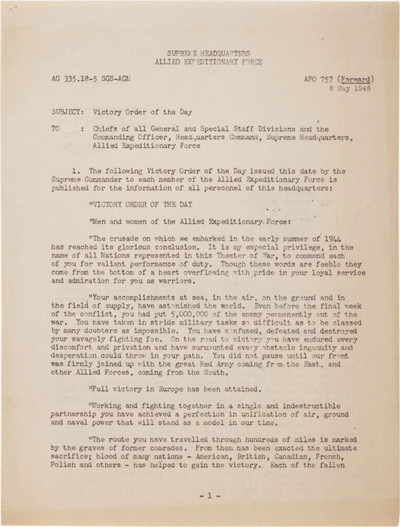
General Dwight Eisenhower issued his announcement of the endo of the war: 

eisenhower ve day message


ny times ve day


Men and women of the Allied Expeditionary Force:

The crusade on which we embarked in the early summer of 1944 has reached its glorious conclusion . . .

“Your accomplishments at sea, in the air, on the ground and in the field of supply, have astonished the world. Even before the final week of the conflict, you had put 5,000,000 of the enemy permanently out of the war. You have taken in stride military tasks so difficult as to be classed by many doubters as impossible. You have confused, defeated and destroyed your savagely fighting foe. On the road to victory you have endured every discomfort and privation and have surmounted every obstacle ingenuity and desperation could throw in your path. You did not pause until our front was firmly joined up with the great Red Army coming from the East, and other Allied Forces, coming from the South.

Full victory in Europe has been attained. 

Eisenhower’s announcement of the end of the war is shown in the link below. 

https://www.youtube.com/watch?v=wR99iTgKedc

Now the men and women of the Greatest Generation are passing away, most of those that I personally knew have died. The young ones who are still with us are in their late 80s and early 90s, most if not all will be gone in the next 10-15 years. 

So as you think about today, remember those men and women. Remember the evil that they fought to defeat and hope that if Americans, and by the way I don’t just mean the professional military which has been fighting our wars for the past 14 years, but all Americans have to make such sacrifices again, that we will be up to it. Sadly, I don’t know if we would be. 

That may sound harsh but that generation sacrificed to win the war. Their political leaders did not cut taxes and then telli people to go shopping while the less than one percent that constituted the military went and fought the wars. No they gave up things, and millions served in the military or in war related industries. When I came home from Iraq I was stunned at just how distant the country was from the war. Unlike World War II only a few Americans even have skin in the game that we call war. That is so different than World War II. But that my friends is just my opinion. 

So please don’t forget that true greatness requires both sacrifice and magnanimity. 

Peace

Padre Steve+ 

2 Comments

Filed under History, world war two in europe

Wars Without Mercy: The New Old Way of War

MacArthur Shigemitsu

Today is significant for it marks the end of the World War Two in the Pacific. Sixty-nine years ago a delegation from the Imperial Japanese government signed surrender documents with the Americans and their Allies aboard the Battleship Missouri in Tokyo Bay. The surrender marked the end of one of the most brutal wars ever fought, a war between two sides where in many cases no quarter was given. Violations of the Geneva and Hague conventions ran rampant on both sides as the respective governments and the media of each nation dehumanized and demonized their opponents, making it that much easier to excuse wanton barbarism and cruelty. 

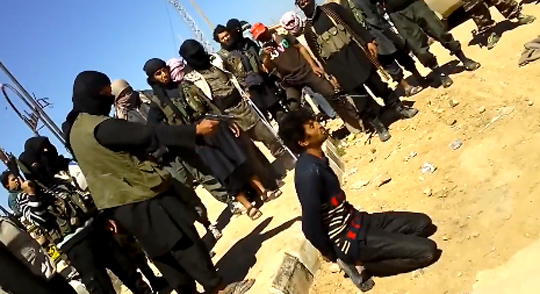
Today another American reporter, Steven Sotloff, was beheaded by the ISIS/ISIL Islamic Caliphate, and as it does so often it released the video of the execution. The Caliphate, which developed out of Al Qaeda fighting the United States in Iraq has become a formidable fighting organization, with deep financial resource is gaining radicalized adherents around the world, and its brutality toward all enemies, even other Moslems is unmatched. The propaganda of the Caliphate against its enemies is similar to what was used by both sides in the Second World War and with each massacre of civilians, each execution of innocent reporters, humanitarian workers and others they ensure that they will reap the whirlwind.

What ISIS forgets is that beneath the civilized veneer of the West, that part of us that likes to abide by treaties and focus on human rights, is that when enraged Americans, Britons, Australians, Germans, Russians and even the French can be just as brutal and also fight wars without mercy. Our histories are full of such examples. The problem is that since we haven’t had to fight such a total war since the Second World War, the leaders of groups such as ISIS assume we are weak and decadent, easy targets. They forget the manner in which all sides, even the Allies waged the Second World War, especially in the Pacific, where the war was fought without mercy. 

isis-terrorists

By waging war in the manner it is doing, ISIS will ensure that its leaders and members will receive no mercy. The post 9-11 response of the United States to Al Qaeda will look like a game compared to what is coming. And unfortunately, we will all lose a bit of our humanity, maybe even a lot of it the longer this war goes on. As far as propaganda, many U.S. politicians , corporate interests and our corporate media are great at promoting war and demonizing opponents. This will be brutal my friends and I for one wish it had never come about. I want peace, I went to Iraq believing that the Iraqis I served alongside and those who had me in their homes would eventually know peace. I grieve for them, as I grieve for all that will suffer in this new war without mercy. 

61VVOf2iniL

I have reposted a book review of John Dower’s book “War without Mercy: Race and Power in the Pacific War.” Pantheon Books, a Division of Random House, New York, NY 1986. I highly recommend the book to anyone who thinks that the conflict with ISIS will be anything but uncivilized and barbarous. It has all the elements to make it so: race, religion, ideology and power, it will mark a return to barbarism that many of us thought would never happen again. 

Here is that review.

The study of war cannot simply be confined to the study of battles, weapons and leaders. While all of these are important one must as Clausewitz understood examine the human element of policy, ideology and the motivations of nations as they wage war. Clausewitz understood that war could not be reduced to formulas and templates but involved what he called the “remarkable trinity” which he described in on war as (1) primordial violence, hatred, and enmity; (2) the play of chance and probability; and (3) war’s element of subordination to rational policy. Clausewitz connects this with the people being connected to the primordial forces of war, the military with the non-rational elements of friction, chance and probability and the government.

The Clausewitzian understanding of war is rooted in the Enlightenment and classic German Liberalism, born out of his experience in the Napoleonic Wars, which forever changed the face of warfare. From the defeat of Prussia and its liberation from Napoleonic rule under Scharnhorst and Gneisenau Clausewitz developed the understanding that war was more than simply tactics and weapons. Thus when we examine war today we deprive ourselves of properly understanding the dynamic of war if we fail to appreciate the human factor which is frequently not rational. Such is especially the case when one fights an enemy who wages war on religious, racial or ideological grounds as is the case in the current war against Al Qaida and other extremist Moslem groups. Such groups would like to turn this war into such a conflict as do certain figures in the American political milieu who repeatedly label all of Islam as the enemy. In such a climate it is imperative to look at history to show us the results of such primal passions.

It is in such conflict as we are engaged in today it is good to look at previous wars from the human experiential component and not simply military operations. If one wants to look at how inflamed passion driven by racial prejudice and hatred took war to a level of barbarity and totality that defy our comprehension we only need to look back to the Pacific war between Japan and the United States. In another post I dealt with the how racial ideology influenced Nazi Germany’s conduct of the war against Poland and the Soviet Union. https://padresteve.wordpress.com/2009/09/14/the-ideological-war-how-hitlers-racial-theories-influenced-german-operations-in-poland-and-russia/

To do this I will look at John Dower’s “War Without Mercy.” In this book Dower examines World War Two in the Pacific from the cultural and ideological viewpoints of the opposing sides. He looks at the war as a race war, which he says “remains one of the great neglected subjects of World War Two.”[i] Dower examines race hated and its influence on both the Japanese and the Allies, particularly in the way that each side viewed one another and conducted the war. He examines the nature of racial prejudice and hate in each society, including its religious, psychological, ideological, scientific and mythological components. He also examines the use of media and propaganda, and how racial attitudes not only influenced national and individual attitudes, but also the military and intelligence operations of both sides. This book is not about military campaigns, thus it is much more like “In the Name of War” by Jill Lepore[ii] than any history of the Pacific war.

Dower uses sources such as songs, movies, cartoons and various writings of the times to demonstrate the totality of the war. Dower admits many of these are difficult to handle and “not respectable sources in some academic sources.”[iii] Despite this he puts together a work that is sometimes chilling, especially when one looks at the current war that our country is engaged in. He also endeavors to explain how after a war where “extraordinarily fierce and Manichean”[iv] race hate predominated, it could “have dissipated so easily”[v] after the war was over.

Dower divides his work into three major sections. The first which examines how the aspect of race effected the fighting of the war, the second, the war through Western eyes and the third the war through Japanese eyes. The first section begins with how racial attitudes in Western and Japanese societies helped fuel the war and compares similar attitudes and concepts in Western and Japanese thought, including how “prejudice and racial stereotypes frequently distorted both Japanese and Allied evaluations of the enemy’s intentions and capabilities.”[vi] He looks at the language of the conflict; at how war words and race words came together “in a manner which did not reflect the savagery of the war, but truly contributed to it….”[vii] the result being “an obsession with extermination on both sides.”[viii] He comes back to this theme throughout the book comparing the two sides and occasionally contrasting these attitudes with corresponding attitudes of the Allies to their German and Italian foes in Europe.[ix]

In the first chapter Dower examines the role played by the propaganda used by both sides. In particular he expalins how the “Know Your Enemy: Japan” movies commissioned by the War Department and directed by Frank Capra, and the Japanese works “Read this and the War is Won” and “The Way of the Subject” helped shape the view of each side. Propaganda developed the idea of the war in terms of good versus evil and the mortal threat posed to their respective cultures by the enemy.

From this he looks at the visceral emotions that the war engendered and how those emotions spilled over into the conduct of the war especially in regard to its ferocity and the war crimes that were spawned by the unbridled hatred of both sides. He notes the targeted terror bombings of civilians by both sides and how those actions were portrayed as “barbaric” by the other side when they were the victim.[x] He notes the viciousness of the war and how for the Americans the war brought forth “emotions forgotten since our most savage Indian wars.”[xi] He contrasts this with European war in particular how the Japanese and their actions were portrayed in Western media, and how similar actions by the Germans, such as the Holocaust, were ignored by Western media until the war was over.[xii] He traces some of this to the understanding of the psychological effects of the defeats and humiliations of the Allies at the hands of the Japanese, and the corresponding brutality toward Allied prisoners by the Japanese as compared to that of the Germans.[xiii] He uses this section to also examine the prevailing attitudes of the Japanese toward the Allies as being weak and “psychologically incapable of recovery” from blows such as the Pearl Harbor attack, and the Allied view of the Japanese as “treacherous.”[xiv]

Dower’s second major section describes the attitudes and actions of the Americans and British toward their Japanese enemy. He looks at the view that the Japanese were less than human and often portrayed as apes or other primates such as monkeys. To do this he examines cartoons and illustrations in popular magazines and military publications, and includes those cartoons in the book. The sheer vulgarity of these cartoons is easily contrasted with those promoted and published by Nazis such as Julius Streicher in Der Stürmer, something often overlooked or ignored in other histories.[xv] The early Western views of Japan as sub-human continued throughout the war, while at the same time, especially after the rapid series of Allied defeats and Japanese victories they were viewed as almost “super-human.” Paradoxically some allied leaders turned the Japanese from “the one time “little man” into a Goliath.”[xvi] They were now “tough, disciplined and well equipped.”[xvii] Ambassador Joseph Grew, reported on his return from Japan, that the Japanese were; “”sturdy,” “Spartan,” “clever and dangerous,” and that “his will to conquer was “utterly ruthless, utterly cruel and utterly blind to the values that make up our civilization….””[xviii] The juxtaposition of such conflicting attitudes is curious, although understandable, especially in light of other Western wars against Asians or Arabs.[xix]

Dower then examines how some Americans and British explained the Japanese “National Character,” their approach to war, and actions during the war from Freudian psychiatry as well as Anthropology and other social and behavioral sciences. Beginning with the widespread Allied understanding that the Japanese were “dressed-up primitives-or “savages” in modern garb…”[xx] he notes that these interpretations of the Japanese national character stemmed from “child-rearing practices and early childhood experiences,”[xxi] including toilet training and Freudian interpretations that saw an arrested psychic development at the “infantile (anal or genital) stage of development.”[xxii] Dower deduces that it was not hard to see how “Japanese overseas aggression became explicable in terms of penis envy or a castration complex….”[xxiii] The views were widespread and emphasized that the “Japanese were collectively unstable.”[xxiv] Dower notes that the “very notion of “national character”-was the application to whole nations and cultures of an analytical language that had been developed through personal case studies…”[xxv] which he is rightly critical in suggesting that this premise “was itself questionable.”[xxvi] In addition to this was the understanding of Margaret Mead and others of the Japanese as “adolescents” and “bullies,”[xxvii] and notes that from “the diagnosis of the Japanese as problem children and juvenile delinquents, it was but a small step to see them as emotionally maladjusted adolescents and, finally as a deranged race in general.”[xxviii] Dower cites numerous other “experts” of the time and their interpretations of the Japanese national character, but the overwhelming message is that the application of these theories, regardless of their validity had a major impact on the Allied war against Japan.

He follows this chapter with one with much importance in explaining the similarities in how Americans and Westerners in general viewed the Japanese in relationship to other races that they had dealt with including Blacks, Chinese, Filipinos, and American Indians. Common themes include the views of each as primitives, children and madmen and the view of the Japanese as part of the “Yellow Peril.” Of particular note is his analysis of the work of Homer Lea’s 1909 book The Valor of Ignorance and the vision of Japanese supermen which enjoyed a revival after Pearl Harbor.[xxix] Dower examines depictions of Asians in general in the Fu Manchu and Charlie Chan series of films and other racial aspects hearkening back to the “specter of Genghis Khan and the prospect that the white races “may be liquidated.”[xxx] He notes how Japanese propagandists attempted to use Allied prejudice to influence the Chinese and other Asians against the Allies[xxxi] and American blacks against whites,[xxxii] while attempting to maintain their own racial superiority which is the subject of the next section.

The chapters dealing with the Japanese view of themselves and their opponents tie together neatly. These deal with the Japanese view of themselves as the leading race in Asia and the world. Dower talks about symbols and the understanding of racial purity that motivated the Japanese from the 1800s to the rejection of Japan’s request for a declaration of “racial equity” at the League of Nations.[xxxiii] He notes the “propagation of an elaborate mythohistory in Japan and the time spent “wrestling with the question of what it really meant to be “Japanese” and how the “Yamato race” was unique among races….”[xxxiv] He notes the relationship of Shinto with whiteness and purity and connotations of how the Japanese indulged in “Caucasianization” of themselves vis-à-vis other Asians during World War Two,”[xxxv] and their emphasis on a Japanese racial worldview.[xxxvi] He also tackles the way in which the Japanese wrestled with evolution and its relationship to other racial theories contrasting books such as A History of Changing Theories about the Japanese Race and Evolution of Life with Cardinal Principles of the National Polity published by the Thought Bureau of the Ministry of Education in1937. These declared that the Japanese were “intrinsically different from the so-called citizens of Occidental countries.”[xxxvii] He also deals with the Kyoto school and the Taiwa concept.[xxxviii] In Chapter Nine Dower looks at how the Japanese viewed themselves and outsiders, in particular the characterization of Westerners as nanbanjin or barbarians and how this eventually train of thought carried through the war led to the “Anglo-American foe emerged full blown as the demonic other.”[xxxix] Dowers final chapter deals with how quickly the race hatred dissipated and genuine goodwill that developed between the Japanese and Americans after the war.[xl]

This book holds a unique place in the literature of the Pacific war. It is not a comfortable book, it is challenging. No other deals with these matters in any systemic way. If there is a weakness in Dower is that he does not, like Lepore in “In the Name of War” deal with the attitudes of soldiers and those who actually fought the war. His examples are good and go a long way in explaining the savagery with which the war was conducted, but could have been enhanced with reflections and accounts of those who fought the war and survived as well as the writings of those who did not, and the way those attitudes were reflected in different services, times and theaters during the war, including adjustments that commanders made during the war.[xli] His description of how Japanese “reluctance to surrender had meshed horrifically with Allied disinterest …in contemplating anything short of Japan’s “thoroughgoing defeat.”[xlii]

The lessons of the book are also contemporary in light of the cultural and religious differences between the West and its Moslem opponents in the current war. Possibly even more so than the war between the United States and Japan which was fought by nation states that still were signatories to international conventions, not nation states against terrorists unbound by any Western code or law or indigenous forces engaged in revolutionary war against the west such as the Taliban.[xliii] The temptation is for both sides to demonize one’s opponent while exalting one’s own way of life through official propaganda and popular media, with a result of increased viciousness and inhumanity in pursuit of ultimate victory. In today’s world with the exponential rise in the radicalization of whole people groups and the availability of weapons of mass destruction, it is possibility that the war could develop into one that is a racial as well as religious and ideological war that would make the War in the Pacific look like a schoolyard brawl.

As William Tecumseh Sherman said: “You cannot qualify war in harsher terms than I will. War is cruelty, and you cannot refine it…”

Bibliography

Alexander, Joseph H. Utmost Savagery: The Three Days of Tarawa. Ivy Books, Published by Ballantine Books, New York, NY 1995

Dower, John W. War without Mercy: Race and Power in the Pacific War.” Pantheon Books, A Division of Random House, New York, NY 1986.

Leckie, Robert. Okinawa. Penguin Books USA, New York NY, 1996

Lepore, Jill The Name of War Vintage Books a Division of Random House, New York, NY 1998

Tregaskis, Richard Guadalcanal Diary Random House, New York NY 1943, Modern Library Edition, 2000.

[i] Dower, John W. War without Mercy: Race and Power in the Pacific War.” Pantheon Books, A Division of Random House, New York, NY 1986. p.4
[ii] Lepore, Jill The Name of War Vintage Books a Division of Random House, New York, NY 1998. Lepore’s book deals with King Phillip’s War and how that war shaped the future of American war and how it shaped the views of Indians and the English Colonists and their later American descendants both in the language used to describe it, the histories written of it and the viciousness of the war.

[iii] Ibid. p.x

[iv] Ibid. p.ix

[v] Ibid. p.x

[vi] Ibid. p.11

[vii] Ibid.

[viii] Ibid. Also see Alexander, Joseph H. Utmost Savagery: The Three Days of Tarawa. Ivy Books, Published by Ballantine Books, New York, NY 1995 Alexander notes an incident that shows a practical application of the Japanese views and the ruthlessness inflicted on their enemies, in this case prisoners in response to an American bombing raid. In 1942 the commander of the Japanese Garrison of Makin Island ordered 22 prisoners beheaded after one cheered following a bombing raid. (p.32)

[ix] An interesting point which Dower does not mention but is interesting for this study is how the Germans referred to the British and Americans as “Die gegener” (opponents) and the Soviets as “Die Feinde” (the enemy), the implication being that one die gegener was a common foe, much like an opposing team in a sport, and the other a mortal enemy, the implication of Feinde being evil, or demonic.

[x] In particular he makes note of the Japanese actions during the “Rape of Nanking,” and the 1945 sack of Manila, as well as the fire bombing of Japanese cities by the US Army Air Corps in 1945.

[xi] Ibid. Dower. p.33

[xii] Ibid. p.35

[xiii] Ibid. This is important in the fact that the Allies tended not to make much of German brutality to the Jews, Russians and other Eastern Europeans.

[xiv] Ibid. p.36.

[xv] Dower does not make this implicit comparison, but having seen both and studied the Nazi propaganda directed toward the Jews, Russians and other Slavic peoples considered to be Untermenschen (sub-humans) by the Nazis the similarities are striking.

[xvi] Ibid. pp.112-113.

[xvii] Ibid. p.113

[xviii] Ibid.

[xix] In the 2006 Israeli invasion of Lebanon, Israeli soldiers who previously showed no respect to any Arab fighter described their Hezbollah opponents as “soldiers and warriors.” Similar attitudes were voiced by American soldiers in Vietnam when they fought NVA regulars.

[xx] Ibid. p.123

[xxi] Ibid.

[xxii] Ibid.

[xxiii] Ibid.

[xxiv] Ibid. p.124

[xxv] Ibid.

[xxvi] Ibid.

[xxvii] Ibid. p.129

[xxviii] Ibid. p.143

[xxix] Ibid. P.157. Lea is interesting because he predicts a decline in the stature of the British Empire and softness of both the Americans and British as peoples. Also see John Costello in The Pacific War 1941-1945 Quill Books, New York, NY 1982 pp.31-32 notes Lea’s concerns and how they drove the American Pacific strategy until the outbreak of World War Two.

[xxx] Ibid. p.161

[xxxi] Ibid. p.169

[xxxii] Ibid. pp.174-180. This is an interesting section. One of the most interesting topics being the reaction of the NAACP’s Walter White’s book A Rising Wind published which “suggested a sense of kinship with other colored-and also oppressed-peoples of the world….he senses that the struggle of the Negro in the United States is part and parcel of the struggle against imperialism and exploitation in India, China, Burma….” (p.177-178)

[xxxiii] Ibid. p.204

[xxxiv] Ibid. p.205

[xxxv] Ibid. p.209 This is interesting when one compares the Japanese emphasis on “Pan-Asianism” and the inherent contradiction between the two.

[xxxvi] Ibid. p.211 Dower notes that the article Establishing a Japanese Racial Worldview in the monthly Bungei Shunju “clarified the Japanese character, whose basic traits were brightness, strength and uprightness. These qualities made the Japanese “the most superior race in the world.”

[xxxvii] Ibid. p.221

[xxxviii] Ibid. p.227 This was the theory of Zen Buddhism’s Suzuki Daisetsu (D.T. Suzuki) in his teaching of the struggle for the Great Harmony “Taiwa” which attempted to identify “an intuitive sense of harmony and oneness that he declared to be characteristic of Oriental thought.”

[xxxix] Ibid. p.247. Descriptions of the Allies as Barbarians, Gangsters and Demons permeated Japanese propaganda.

[xl] Ibid. Dower makes a number of observations relating to how the Japanese were able to use their own self concept to adapt to their defeat. He also notes that the Japanese were able to transfer their self concept to a peaceful orientation.

[xli] See Leckie, Robert. Okinawa. Penguin Books USA, New York NY, 1996 p.35. Leckie quotes General Ushijima “You cannot regard the enemy as on par with you,” he told his men. “You must realize that material power usually overcomes spiritual power in the present war. The enemy is clearly our superior in machines. Do not depend on your spirits overcoming this enemy. Devise combat method [sic] based on mathematical precision-then think about displaying your spiritual power.” Leckie comments: “Ushijima’s order was perhaps the most honest issued by a Japanese commander during the war. It was Bushido revised, turned upside down and inside out-but the revision had been made too late.”

[xlii] Ibid. Dower. p.37

[xliii] See Tregaskis, Richard Guadalcanal Diary Random House, New York NY 1943, Modern Library Edition, 2000. p.95. Tregaskis notes when commenting on Japanese POWs on Guadalcanal “We stared at them and they stared back at us. There was no doubt what we or they would have liked to do at that moment-if we had not remembered our code of civilization or if they had not been unarmed.”

1 Comment

Filed under Foreign Policy, History, history, iraq,afghanistan, middle east, Military, Religion, world war two in the pacific

The Stab in the Back: The Destructive Power of Myth in the Life of a Nation

stab-in-the-back

In light of the many historical myths and conspiracy theories being floated by pseudo “historians” like the infamous David Barton it is always appropriate to look at examples of the power of those myths in the lives of nations and their influence on citizens. Some myths can be positive and inspiring, but others can lead to conspiracy theories, false accusations and the demonization of others for the purpose of inciting hatred against political, social or religious opponents. They also can be used to perpetuate false beliefs about other countries that influence policy decisions, including the decision to go to war that ultimately doom those that believe them. A good example of this is the Stab in the Back myth that began after the armistice that ended the First World War, as well as the false beliefs held by Hitler and other Nazi leaders about the United States.

There are many times in history where leaders of nations and peoples embrace myths about their history even when historical, biographical and archeological evidence points to an entirely different record.  Myths are powerful in the way that they inspire and motivate people. They can provide a cultural continuity as a people celebrates the key events and people that shaped their past, even if they are not entirely true.  At the same time myths can be dangerous when they cause leaders and people to make bad choices and actually become destructive. Such was the case in Germany following the First World War.

After the war the belief that the German Army was not defeated but was betrayed by the German people, especially those of the political left.  Like all myths there was an element of truth in the “stab in the back” myth, there were revolts against the Monarchy of Kaiser Wilhelm II and even mutiny on elements of the German High Seas Fleet and Army units stationed in Germany. However the crisis had been brought about by General Ludendorff who until the last month of the war refused to tell the truth about the gravity of Germany’s position to those in the German government.

So when everything came crashing down in late October and early November 1918 the debacle came as a surprise to most Germans.  The myth arose because the truth had not been told by Ludendorff who was arguably the most powerful figure in Germany from 1916-1918.  In the looming crisis which included Ludendorff’s collapse and relief, General Wilhelm Groener presented the facts to the Kaiser and insisted on his abdication.  The Republic that was proclaimed on the 9th of November was saddled with the defeat and endured revolution, civil war and threats from the extreme left and right.  When it signed the Treaty of Versailles it accepted the sole responsibility of Germany for the war and its damages. Ordered to dismantle its military, cede territory that had not been lost in battle and pay massive reparations the legend of the “stab in the back” gained widespread acceptance in Germany.

Hitler always believed that the defeat of Germany in the First World War was due to the efforts of internal enemies of the German Reich on the home front and not due to battlefield losses or the entry of the United States.  This was a fundamental belief for him and was expressed in his writings, speeches and actions.  The internal enemies of Germany for Hitler included the Jews, as well as the Socialists and Communists who he believed were at the heart of the collapse on the home front.  Gerhard Weinberg believes that the effect of this misguided belief on Hitler’s actions has “generally been ignored” by historians. (Germany, Hitler and World War II p. 196)

Hitler believed that those people and groups that perpetrated the “stab in the back” were “beguiled by the by the promises of President Wilson” (World in the Balance p.92) in his 14 Points.  Thus for him Americans were in part responsible for undermining the German home front, something that he would not allow to happen again.  In fact Hitler characterization of Wilson’s effect on the German people in speaking about South Tyrol.  It is representative of his belief about not only the loss of that region but the war: “South Tyrol was lost by those who, from within Germany, caused attrition at the front, and by the contamination of German thinking with the sham declarations of Woodrow Wilson.” (Hitler’s Second Book p.221)

While others will note Hitler’s lack of respect for the potential power of the United States, no other author that I am familiar with links Hitler’s actions and the reaction of the German political, military and diplomatic elites to the entry of the United States into the war to the underlying belief in the “stab in the back.”   Likewise Hitler had little regard for the military abilities or potential of the United States. Albert Speer notes that Hitler believed “the Americans had not played a very prominent role in the war of 1914-1918,” and that “they would certainly not withstand a great trial by fire, for their fighting qualities were low.” (Inside the Third Reich: Memoirs by Albert Speer p.121)

Hitler not only dismissed the capabilities of the Americans but also emphasized the distance that they were from Germany and saw no reason to fear the United States when “he anticipated major victories on the Eastern Front.” (Germany Hitler and World War II p.92)   Hitler’s attitude was reflected by the majority of the military high command and high Nazi officials. Ribbentrop believed that the Americans would be unable to wage war if it broke out “as they would never get their armies across the Atlantic.” (History of the German General Staff, Walter Goerlitz, p.408).  General Walter Warlimont notes the “ecstasy of rejoicing” found at Hitler’s headquarters after Pearl Harbor and the fact that the he and Jodl at OKW caught by surprise by Hitler’s declaration of war. (Inside Hitler’s Headquarters 1939-1945 pp.207-209) Kenneth Macksey notes Warlimont’s comments about Hitler’s beliefs; that Hitler “tended to dismiss American fighting qualities and industrial capability,” and that Hitler “regarded anyone who tried to show him such information [about growing American strength] as defeatist.” (Why the Germans Lose at War, Kenneth Macksey, p.153.)

Others like Field Marshal Erwin Rommel record the disregard of senior Nazis toward American capabilities in weaponry.  Quoting Goering who when Rommel discussed 40mm anti-aircraft guns on aircraft that were devastating his armored forces Goering replied “That’s impossible. The Americans only know how to make razor blades.” (The Rommel Papers edited by B.H. Liddell-Hart p.295) Rommel was one of the few German commanders who recognized the folly of Hitler’s declaration of war on the United States noting that “By declaring war on America, we had brought the entire American industrial potential into the service of Allied war production. We in Africa knew all about the quality of its achievements.” (The Rommel Papers p.296)

When one also takes into account the general disrespect of the German military for the fighting qualities of American soldiers though often with good reason (see Russell Weigley’s books Eisenhower’s Lieutenants and The American Way of War) one sees how the myth impacted German thought.  This is evidenced by the disparaging comments of the pre-war German military attaché to the United States; General Boeticher, on the American military, national character and capability. (See World in the Balance pp. 61-62)

The overall negative view held by many Germans in regard to the military and industrial power and potential of the United States reinforced other parts of the myth. Such false beliefs served to bolster belief in the stab-in-the back theory as certainly the Americans could not have played any important role in the German defeat save Wilson’s alleged demoralization of the German population.  This was true not only of Hitler, but by most of his retinue and the military, diplomatic and industrial leadership of the Reich. Hitler’s ultimate belief shaped by the stab-in-the back and reinforced by his racial views which held the United States to be an inferior mongrel people. This led him to disregard the impact that the United States could have in the war and ultimately influenced his decision to declare war on the United States, a decision that would be a key factor in the ultimate defeat of Germany.

Myth can have positive value, but myth which becomes toxic can and often does lead to tragic consequences. All societies have some degree of myth in relationship to their history including the United States.  The myths are not all the same, various subgroups within the society create their own myth surrounding historic events. The danger is that those myths can supplant reason in the minds of political, military, media and religious figures and lead those people into taking actions that work to their own detriment or even destruction.

It is the duty of historians, philosophers and others in the society to ensure that myth does not override reality to the point that it moves policy both domestic and foreign in a manner that is ultimately detrimental to the nation.  The lesson of history demonstrated by myths surrounding the German defeat and role of the United States in that defeat shows just how myth can drive a nation to irrational, evil and ultimately tragic actions not only for that nation and its people, but for the world.

Peace,

Padre Steve+

1 Comment

Filed under History, nazi germany, philosophy

The Importance of Citizen Soldiers: Strong Vincent and Joshua Chamberlain at Little Round Top and American Military Sociology

dont give an inch

“As soldier and citizen, today’s armed forces officer is a champion of both the nation’s defense and the principles upon which the nation was founded. Taking an oath to support and defend the Constitution means swearing to uphold the core values that define the essence of American citizenship; the armed forces officer is first and foremost a citizen who has embraced the ideals of the nation—only then can he or she defend those principles with true conviction.” [1]

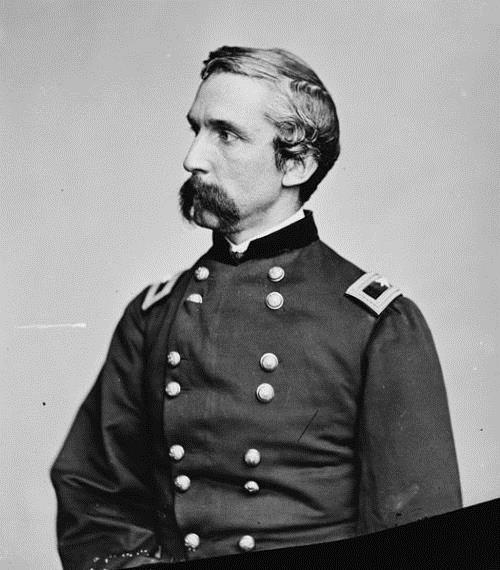
While the professional Gouverneur Warren through himself into the battle to save Little Round Top, as did many others the story of the battle dictates that we must discuss the actions of two “citizen soldiers” without whom the battle may have been lost, Colonel Strong Vincent and Colonel Joshua Chamberlain. Both are depicted and immortalized in the film Gettysburg which is based on Michael Shaara’s Pulitzer Prize winning novel The Killer Angels. As such their actions are known more than many others that are covered in this account of the Battle of Gettysburg.

Within the U.S. Army the example of Chamberlain at the Battle of Little Round Top has occupied a prominent place in Army leadership manuals including FM 22-100 and its successor FM 6-22, however, that being said even those that learn about Chamberlain from this seldom delve deeper into his character, development as a leader and significance, at Little Round Top, Appomattox and after the war, likewise the examples of both Warren and Vincent which are key to Chamberlain and his regiment even being on the hill are ignored in that publication.

It is important to discuss Vincent and Chamberlain for more than their direct contributions to the battle. Those are widely known and in a sense have become part of the myth that is our understanding of Gettysburg. While discussing those actions it is also necessary to put them into context with the character of both men, the cause that they fought. Likewise it is important to address in this age of the professional all volunteer force the importance of Citizen Soldiers in any kind of democracy or representative republic, a sociological question that military professionals as well as our elected officials and citizenry would do well to revisit.

This is particularly important now as various elected leaders, think tanks, defense contractors and lobbyists are all questioning the economic “liabilities” of the All-Volunteer force as well as the disconnect between the broader military and society at large. This means that there will be efforts to determine how the military will be manned, trained and employed, and if military leaders are ignorant of our history, the vital connection between the military and the citizenry and the contributions of Citizen Soldiers then we will be caught flat footed and unprepared in the coming debates. If that happens those decisions could be made by “bean counters” with little appreciation for what military professionalism and readiness entails, as well as think tanks and lobbyists for the defense industry who have their own motivations for what they do, often more related to their profits, power and influence than national security.

The armies that fought the Civil War for the most part were composed of volunteers who of a myriad of reasons went off to fight that war. Gouverneur Warren is a character whose life and career before and after the Civil War was much more like currently serving regular officers and to some extent the much more professional and hardened by war officer corps of the Reserve Components of each of our Armed Services, in particular the much active and deployed Army National Guard and Army Reserve. The reserve components still do reflect much of the Citizen Soldier tradition but that being said between deployments, other activations and required schooling, those assets are much more on par with their active counterparts than they ever have been in our history.

“American defense policy has traditionally been built upon pluralistic military institutions, most notably a mix force of professionals and citizen soldiers.” [2] Warren represented what until the beginning of the Cold War was the smaller pillar of that pluralistic institution that of the long term professional while Vincent and Chamberlain represented the volunteer citizen soldier who enlisted to meet the crisis.

Until World War II and the advent of the Cold War these dual pillars existed side by side. Following the Second World War along with the small-wars that went along as part of it the world changed, and the wars that occurred, such as Korea and Vietnam “occurred on a scale too small to elicit a sustained, full-fledged national commitment, yet too large for a prewar-style regular army to handle.” [3] Because of this “military requirements thus became a fundamental ingredient of foreign policy, and military men and institutions acquired authority and influence far surpassing that ever previously possessed by military professionals on the American scene.” [4] General Tony Zinni noted that the foreign policy results of this transformation have resulted in the United States becoming “an empire” [5] something that no American living in 1863 could have ever contemplated.

This was part of a revolution in military affairs far more important than the application of technology which brought it about, the Atomic Bomb; it was a revolution in national strategy which fundamentally changed American thinking regarding the use of the military instrument in relationship to diplomacy, and the relationship of the military to society at large. Russell Weigley noted: “To shift the American definition of strategy from the use of combats for the object of wars to the use of military force for the deterrence of war, albeit while still serving the national interests in an active manner, amounted to a revolution in the history of American military policy….” [6]

The policy worked reasonably well until Vietnam and the inequities of the system showed its liabilities and brought about a change from politicians. Lieutenant General Hal Moore wrote of the Vietnam era: “The class of 1965 came out of the old America, a nation that disappeared forever in the smoke that billowed off the jungle battlegrounds where we fought and bled. The country that sent us off to war was not there to welcome us home. It no longer existed.” [7]

The debacle of Vietnam and the societal tidal wave that followed brought about the end of the selective service system, by which the large army needed to fight wars was connected to the society at large and the creation of the All-Volunteer force by President Nixon in 1974. The ethos that every citizen was a soldier was destroyed by Vietnam and even men like General William Westmoreland who warned that “absent “the continuous movement of citizens in and out of the service,…the army could “become a danger to our society-a danger that our forefathers so carefully tried to preclude.” [8]

This cultural shift is something that none of the professional officers of the small ante-bellum army like Warren would have ever imagined much less men like Vincent or Chamberlain who were true citizen-soldiers. Thus for currently serving officers it is important to recognize this key change as it applies to American military strategy as well as the place the military occupies in our society. This makes it important to our study as we examine the actions of Vincent and Chamberlain outside of myth and legend and see the implications that they can have not only on the battlefield but in our relationship to the American citizenry and society. It is to put in in classic terms a return to understanding the relationship between the military and the people so powerfully enunciate in Clausewitz’s Trinity.

While Warren represents the Strong Vincent and Joshua Chamberlain represented that important part of our military tradition that really, except in the case of young men and women that volunteer to serve and leave the military after their obligated service really no longer exists. We no longer have a system that allows, nor do we actively encourage men like Vincent and Chamberlain to leave lucrative civilian employment or academia to serve alongside the professionals in positions of responsibility leading regiments or brigades or serving as senior staff officers unless they are already part of the military in our reserve components.

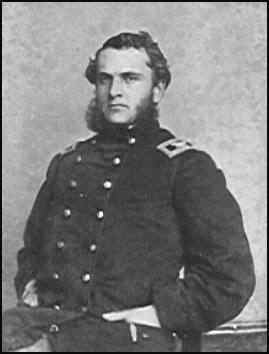
vincent

Colonel Strong Vincent was a 26 year old Harvard graduate and lawyer from Erie Pennsylvania. Vincent enlisted and then was appointed as a 1st Lieutenant and Adjutant of the Erie Regiment because of his academic and administrative acumen. He married his wife Elizabeth the same day. Vincent like many young northerners believed in the cause of the Union undivided, and he wrote his wife shortly after after the regiment went to war on the Peninsula:

“Surely the right will prevail. If I live we will rejoice in our country’s success. If I fall, remember you have given your husband to the most righteous cause that ever widowed a woman.”[9]

Vincent was commissioned as a Lieutenant Colonel in the 83rd Pennsylvania September 14th 1861. The young officer learned his trade well and was considered a “strict disciplinarian and master of drill.” [10] That being said one enlisted man remarked that “no officer in the army was more thoughtful and considerate of  the health and comfort of his men.” He assumed command of the regiment when the commander was killed during the Seven Days in June of 1862 where he learned lessons that he would help impart to his fellow officers as well as subordinates, including Chamberlain. Following a bout with a combination of Malaria and Typhoid that almost killed him, he took command of the regiment. He commanded the regiment at Fredericksburg and was promoted to command the 3rd Brigade when its commander was killed at Chancellorsville in May 1863. Vincent was offered the chance to serve as the Judge Advocate General of the Army of the Potomac in the spring of 1863 after spending three months on court-martial duty. But refused the offer in order to remain in the fight commanding troops. [11]

Unlike most other brigade commanders, Vincent was still a Colonel, and he, like many others would in his place hoped that going into action to save Sickles’ command “will either bring me my stars, or finish my career as a soldier.” [12] On July first, Vincent, a native Pennsylvanian came to Hanover and learning that battle had been joined, ordered “the pipes and drums of the 83rd Pennsylvania to play his brigade through the town and ordered the regiments to uncover their flags again….” [13] As the brigade marched through the town Vincent “reverently bared his head” and announced to his adjutant, “What death more glorious can any man desire than to die on the soil of old Pennsylvania fighting for that flag?” [14]

Vincent was known for his personal courage and a soldier of the 83rd Pennsylvania observed “Vincent had a particular penchant for being in the lead….Whenever or wherever his brigade might be in a position to get ahead…, he was sure to be ahead.” [15] That courage and acumen to be in the right place at the right time was in evidence when he led his brigade into battle on July second.

On July 2nd Barnes’ division of V Corps, which Vincent’s brigade was a part was being deployed to the threat posed by the Confederate attack of McLaws’ division on the Peach Orchard and the Wheat Field to reinforce Sickles’ III Corps. While that division marched toward the Peach Orchard, Vincent’s 3rd Brigade was the trail unit. When Gouverneur Warren’s aide, Lieutenant Randall Mackenzie [16] came toward the unit in search of Barnes he came across Vincent and his brigade near the George Weikert house on Cemetery Ridge awaiting further orders. [17] Vincent intercepted him and demanded what his orders were. Upon being told that Sykes’ orders to Barnes were to “send one of his brigades to occupy that hill yonder,” [18] Vincent, defied normal protocol assuming that Barnes was drunk [19] told Mackenzie “I will take responsibility of taking my brigade there.” [20]

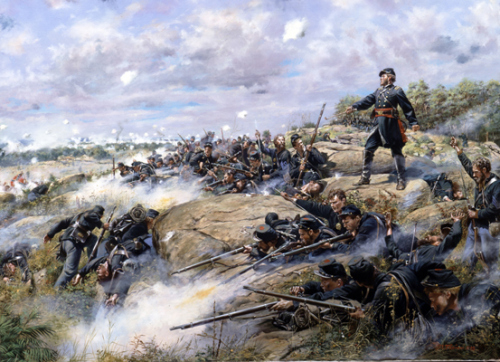
It was a fortunate thing for the Union that he did. His quick action to get his brigade, clear orders to his subordinate commanders and skilled analysis of the ground were a decisive factor in the Union forces holding Little Round Top. He ordered Colonel James C. Rice of the 44th New York to lead the brigade up to the hill while he and his aide went forward to scout positions as the brigade moved forward at the double quick “across the field to the road leading up the north shoulder of the hill” with Chamberlain’s 20th Maine in the lead. [21] Looking at the ground which had the valley and Devil’s Den, occupied by the end of Sickles’ line, he chose a position along a spur of the hill running from the northwest to the southeast to place his regiments where they could intercept the Confederate troops of Hood’s division which he could see advancing toward the hill.

The 16th Michigan, his smallest regiment was placed on the right of the brigade. That section of the line was located on massive boulders that placed it high above the valley below, making it nearly impregnable to frontal attack. He deployed the 83rd Pennsylvania and 44th New York, known as Butterfield’s Twins to their left at the request of Rice who told him “In every battle that we have engaged the Eighty-third and Forty-fourth have fought side by side. I wish that it might be so today.” [22] Those units were deployed below the crest among the large number of boulders; the 83rd was about two-thirds of the way down the way down the slope where it joined the right of the 44th, whose line angled back up the slope to the southeast.

Vincent deployed the 20th Maine on his extreme left of his line, and in fact the extreme end of the Union line. Vincent knew that if this flank was turned and Chamberlain overrun that it would imperil the entire Union position. Vincent came up to Chamberlain who remembered that Vincent said “in an awed, faraway voice. “I place you here….This is the left of the Union line. You understand. You are to hold this ground at all costs.” [23]
chamberlain

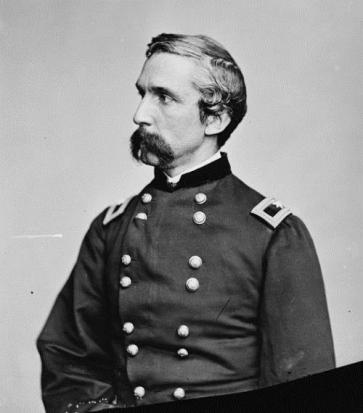
Colonel Joshua Chamberlain was another one of the citizen soldiers whose performance and leadership on Little Round Top saved the Union line that hot July evening. A graduate of Bowdoin College and Bangor Theological Seminary, Chamberlain was fluent in nine languages other than English. He was Professor of Rhetoric at Bowdoin before seeking an appointment in a Maine Regiment without consulting either the college or his family. He was offered command of the 20th Maine but asked to be appointed as a Lieutenant Colonel which he was in August 1862. He fought at Fredericksburg and was named commander of the regiment when Colonel Adelbert Ames, his commander was promoted following Chancellorsville.

Like Vincent, Chamberlain was also a quick student and rapidly adapted to being a soldier, officer and commander of troops in combat. On receiving his orders Chamberlain deployed his small regiment halfway down the southern slope facing the small valley between Little and Big Round Top. As a result of his experience in battle and the tenacity of the Confederate army he became an advocate of the tactics that William Tecumseh Sherman would later employ during his march to the sea in 1864. He wrote his wife before Chancellorsville:

“We must fight them more vindictively, or we shall be foiled at every step.  We must desolate the country as we pass through it, and not leave a trace of a doubtful friend or foe behind us; make them believe that we are in earnest, terribly in earnest; that to break this band in twain is monstrous and impossible; that the life of every man, yea, of every weak woman or child in the entire South, is of no value whatever compared with the integrity of the Union.”

Since Chamberlain’s account is so important I will forgo a discussion of his tactics and instead quote the sections of his after action report that explains his actions. Chamberlain wrote:

“On reaching the field at about 4 p.m. July 2d, Col. Vincent commanding the Brigade, placing me on the left of the Brigade and consequently on the extreme left of our entire line of battle, instructed me that the enemy were expected shortly to make a desperate attempt to turn our left flank, and that the position assigned to me must be held at every hazard.

I established my line on the crest of a small spur of a rocky and wooded hill, and sent out at once a company of skirmishers on my left to guard against surprise on that unprotected flank.

These dispositions were scarcely made when the attack commenced, and the right of the Regt. found itself at once hotly engaged. Almost at the same moment, from a high rock which gave me a full view of the enemy, I perceived a heavy force in rear of their principal line, moving rapidly but stealthily toward our left, with the intention, as I judged, of gaining our rear unperceived. Without betraying our peril to any but one or two officers, I had the right wing move by the left flank, taking intervals of a pace or two, according to the shelter afforded by rocks or trees, extending so as to cover the whole front then engaged; and at the same time moved the left wing to the left and rear, making a large angle at the color, which was now brought to the front where our left had first rested.

This hazardous maneuvre was so admirably executed by my men that our fire was not materially slackened in front, and the enemy gained no advantage there, while the left wing in the meantime had formed a solid and steady line in a direction to meet the expected assault. We were not a moment too soon; for the enemy having gained their desired point of attack came to a front, and rushed forward with an impetuosity which showed their sanguine expectations.

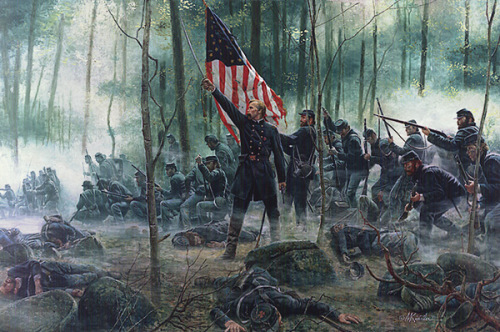
Their astonishment however was evident, when emerging from their cover, they met instead of an unsuspecting flank, a firm and ready front. A strong fire opened at once from both sides, and with great effect, the enemy still advancing until they came within ten paces of our line, where our steady and telling volleys brought them to a stand. From that moment began a struggle fierce and bloody beyond any that I have witnessed, and which lasted in all its fury, a full hour. The two lines met, and broke and mingled in the shock. At times I saw around me more of the enemy than of my own men. The edge of conflict swayed to and fro -now one and now the other party holding the contested ground. Three times our line was forced back, but only to rally and repulse the enemy. As often as the enemy’s line was broken and routed, a new line was unmasked, which advanced with fresh vigor. Our “sixty rounds” were rapidly reduced; I sent several messengers to the rear for ammunition, and also for reinforcements. In the mean time we seized the opportunity of a momentary lull to gather ammunition and more serviceable arms, from the dead and dying on the field. With these we met the enemy’s last and fiercest assault. Their own rifles and their own bullets were turned against them. In the midst of this struggle, our ammunition utterly failed. The enemy were close upon us with a fresh line, pouring on us a terrible fire. Half the left wing already lay on the field. Although I had brought two companies from the right to its support, it was now scarcely more than a skirmish line. The heroic energy of my officers could avail no more. Our gallant line withered and shrunk before the fire it could not repel. It was too evident that we could maintain the defensive no longer. As a last desperate resort, I ordered a charge. The word “fix bayonets” flew from man to man. The click of the steel seemed to give new zeal to all. The men dashed forward with a shout. The two wings came into one line again, and extending to the left, and at the same time wheeling to the right, the whole Regiment described nearly a half circle, the left passing over the space of half a mile, while the right kept within the support of the 83d Penna. thus leaving no chance of escape to the enemy except to climb the steep side of the mountain or to pass by the whole front of the 83d Penna. The enemy’s first line scarcely tried to run-they stood amazed, threw down their loaded arms and surrendered in whole companies. Those in their rear had more time and gave us more trouble. My skirmishing company threw itself upon the enemy’s flank behind a stone wall, and their effective fire added to the enemy’s confusion. In this charge we captured three hundred and sixty eight prisoners, many of them officers, and took three hundred stand of arms. The prisoners were from four different regiments, and admitted that they had attacked with a Brigade.” [24]

Colonel William Oates of the 15th Alabama would give Chamberlain and his regiment the credit for stopping his attack. Oates wrote: “There have never been harder fighters than the Twentieth Maine and their gallant Colonel. His skill and persistency and the great bravery of his men saved Little Round Top and the Army of the Potomac from defeat.” [25]

chamberlain lrt

As with any firsthand account, aspects of Chamberlain’s accounts are contested by others at the scene. Oates notes that he ordered the retreat and that there were not as many prisoners taken, one of Chamberlain’s company commanders disputes the account of the order of the bayonet charge however the fact is that Chamberlain who was outnumbered nearly two to one by the 15th and 47th Alabama regiments “offset this superiority with strength of position, iron determination and better tactics.” [26] Also a factor was the fatigue of the Confederates, these regiments and their parent unit, Law’s brigade of Hood’s division had conducted a grueling 28 mile march to get to the battlefield and were exhausted by the time that they arrived.

Vincent was mortally wounded while leading the defense of the hill. While he was standing on a large boulder with a riding crop ordering the men of the 16th Michigan who were beginning to waiver he cried out “Don’t yield an inch now men or all is lost,[27]he was struck by a bullet which hit him in the groin. As he was being carried from the field to the hospital where he died on July 7th, “This is the fourth or fifth time they have shot at me…and they have hit me at last.” [28]

As Vincent lay dying he was visited by many comrades, visited by Sykes and Barnes he told them “I presume… I have dune my last fighting.” Meade recommended Vincent for posthumous promotion to Brigadier General, but the request was lost.

Two months after his death his wife gave birth to a baby girl. The baby would not live a year and was buried next to him. One wonders what heights of leadership the young colonel might have achieved had he not died at Gettysburg. He was a man who understood the nature of total war, an excellent leader and skilled tactician.

Chamberlain survived the war to great acclaim being wounded three times and receiving the surrender of the Army of Northern Virginia at Appomattox on April 9th 1865.

The examples of these two citizen soldiers demonstrate the importance of this legacy, which is still to some extent carried on by the reserve components of the United States military service. That being said, in the coming years military professionals will have to engage lawmakers and the bureaucracy of the Pentagon as the shape of the future military, especially the land components is debated and decided upon by politicians. Thus, it is of the utmost importance of revisiting the tradition of the citizen soldier and how it can be renewed in the coming years.

Chamberlain’s words about the men that he served alongside like his commanding officer, Strong Vincent are a fitting way to close.

“It is something great and greatening to cherish an ideal; to act in the light of truth that is far-away and far above; to set aside the near advantage, the momentary pleasure; the snatching of seeming good to self; and to act for remoter ends, for higher good, and for interests other than our own.” [29]

Notes

[1] _______. The Armed forces Officer U.S. Department of Defense Publication, Washington DC. January 2006 p.2

[2] Millet, Allan R. and Maslowski, Peter, For the Common Defense: A Military History of the United States The Free Press a Division of Macmillan Inc. New York, 1984 p.xii

[3] Bacevich, Andrew J. Breach of Trust: How Americans Failed their Soldiers and Their Country Metropolitan Books, Henry Holt and Company, New York 2013 Kindle Edition Amazon Edition p.50

[4] Huntington, Samuel P. The Soldier and the State: The Theory and Politics of Civil-Military Relations, The Belknap Press of Harvard University Press, Cambridge MA and London 1957 p.345

[5] Zinni, Tony. The Battle for Peace: A Frontline Vision of America’s Power and Purpose Palgrave McMillian, New York 2006 p.4

[6] Weigley, Russell F. The American Way of War: A History of United States Military History and Policy University of Indiana Press, Bloomington IN, 1973 pp.367-368

[7] Moore, Harold G. and Galloway Joseph L We Were Soldiers Once…And Young Harper Perennial Books, 1992 pp. xix-xx

[8] Ibid. Bacevich Breach of Trust p.58

[9] ________. Erie County Historical Society http://www.eriecountyhistory.org/wp-content/uploads/2008/10/strongvincent.pdfretrieved 9 June 2014

[10] Golay, Michael. To Gettysburg and Beyond: The Parallel Lives of Joshua Lawrence Chamberlain and Edward Porter Alexander Crown Publishers Inc. New York 1994 p.129

[11] Leonardi, Ron Strong Vincent at Gettysburg Barringer-Erie Times News retrieved June 9th 2014 from http://history.goerie.com/2013/06/30/strong-vincent-at-gettysburg/

[12] Guelzo, Allen C. Gettysburg: The Last Invasion Vintage Books a Division of Random House, New York 2013 p.264

[13] Pfanz, Harry F. Gettysburg: The Second Day. University of North Carolina Press, Chapel Hill 1987 p.51

[14] Ibid. Guelzo Gettysburg: The Last Invasion Vintage p.159

[15] Tredeau, Noah Andre. Gettysburg: A Testing of Courage, Harper Collins Publishers, New York 2002 p.305

[16] Some such as Guelzo believe this may have been Captain William Jay of Sykes staff.

[17] Ibid. Tredeau, Gettysburg: A Testing of Courage p.327

[18] Ibid. Guelzo Gettysburg: The Last Invasion Vintage p.262

[19] Ibid. Guelzo Gettysburg: The Last Invasion Vintage p.262

[20] Ibid. Tredeau, Gettysburg: A Testing of Courage p.327

[21] Coddington, Edwin B. The Gettysburg Campaign: A Study in Command, A Touchstone Book, Simon and Schuster New York, 1968 p.389

[22] Ibid. Pfanz, Gettysburg: The Second Day. p.213

[23] Ibid. Golay To Gettysburg and Beyond p.157

[24] Chamberlain, Joshua Lawrence. Official Narrative of Joshua Chamberlain of July 6th 1863, Maine Military Historical Society, Inc., Augusta, Maine, copyright 1989 U.S. Army Combat Studies Institute Reprint, retrieved from http://usacac.army.mil/cac2/cgsc/carl/download/csipubs/chamberlain.pdf June 15th 2014

[25] Oates, Willam C. and Haskell, Frank A. Gettysburg Bantam Books edition, New York 1992, originally published in 1905 p.98

[26] Ibid.Coddington The Gettysburg Campaign: A Study in Command p.393

[27] Ibid. Guelzo Gettysburg: The Last Invasion Vintage p.272

[28] Ibid. Tredeau, Gettysburg: A Testing of Courage p.361

[29] Chamberlain, Joshua Lawrence. Chamberlain’s Address at the dedication of the Maine Monuments at Gettysburg, October 3rd 1888 retrieved from http://www.joshualawrencechamberlain.com/maineatgettysburg.php 4 June 2014

Leave a comment

Filed under civil war, History, leadership, Military, national security

D-Day, Midway and a Nation at War: Thoughts on History as the Greatest Generation Passes Away

d-day-orderDwight Eisenhower speaking with men of the 101st Airborne Division before they jumped into Normandy

“At the end of the twentieth century the contributions of this generation would be in bold print in any review of this turbulent and earth-altering time. It may be historically premature to judge the greatness of a whole generation, but indisputably, there are common traits that cannot be denied. It is a generation that, by and large, made no demands of homage from those who followed and prospered economically, politically, and culturally because of its sacrifices. It is a generation of towering achievement and modest demeanor, a legacy of their formative years when they were participants in and witness to sacrifices of the highest order. They know how many of the best of their generation didn’t make it to their early twenties, how many brilliant scientists, teachers, spiritual and business leaders, politicians and artists were lost in the ravages of the greatest war the world has seen.” Tom Brokaw, The Greatest Generation

I was born in 1960 and thankfully for whatever reason I developed a love of history and heritage. I began reading history books as early as second and third grade. The American Heritage Publishing Company had a Junior Library series that I could not get enough of awhile another publisher (it may have also been American Heritage) had a series of biographies which drew me into the lives of many famous people. From 3rd grade on I spent every spare moment at school in the library, even frequently cutting geometry class in 10th grade to explore the history reference books that I could not check out and take home.

tumblr_lahyzakLSB1qbjz0go1_500Marine Colonel Francis I. Fenton, kneeling prays at the foot of his son’s grave on Okinawa 1945

I think that anyone that knew me then could probably associate me with a big stack of books that I lugged to and from class and back and forth from home to school. The ironic thing is that as I pack for work or to come home every day at the Staff College my back pack from my tour in Iraq is filled with the books that I am reading or using for research. Maybe it is not ironic, maybe it is the fact that some things never change. For me the quest for knowledge and historical, philosophical, or scientific truth is something that I cannot get enough of, nor be content to think that I know everything on any given subject.

This little introduction takes me into today’s subject. For those that don’t know we are coming up on the anniversaries of two of the most amazing historical events of the past 100 years next week. They are the battles of Midway, June 4th through June 6th 1942 and the the invasion of France, or D-Day, June 6th 1944.

ts8The pilots of Torpedo 8, only one survived Midway

I have always been amazed by the men who faced the Japanese at Midway, a battle that by any reasonable means should have resulted in a Japanese victory as well as them men that stormed the beaches at Normandy just two years later. When I first started reading about these battles many of the veterans were still alive, many not much older than I am today. However today not many are left, and the few that remain generally served as junior officers or enlisted personnel, none in high command.

Both battles are remarkable because an American or Allied loss could have changed the course of history. Had the United States Navy been defeated at Midway it could have brought about a Japanese victory, or more likely made the ultimate American victory much more costly and drawn out. Had the Allies been repulsed at Normandy it could have split the allied coalition or given the Germans the chance to renew their fight against the Soviet Union and possibly change history.

Thus when I look at these two events, battles that for most are now ancient history I am in awe of the men who fought them. They are not academic exercises for me, but as someone who has served at sea and on land in war I feel a certain camaraderie with these men.

I remember reading Cornelius Ryan’s classic book “The Longest Day” and seeing the movie of the same name in grade school, and reading Walter Lord’s classic on Midway “Incredible Victory” when I was in 7th grade. Both are excellent books which have stood the test of time and though I have read and done much more research and writing on both battles I still keep a copy of each book and probably re-read each every few years and consult them for any new projects. Likewise have been fortunate enough to meet some of the men who served in both of these battles, and even in my time as an Army chaplain be with them in their declining years. Men like Frank Smoker and Henry Boyd, both Normandy vets who have since passed away mean much to me.

442ndRCTThe 442nd Regimental Combat Team

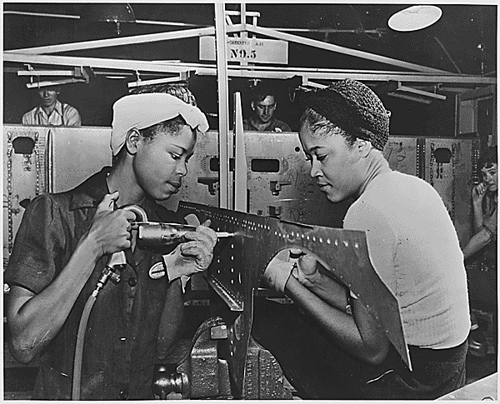
Today when I see a World War Two veteran, no matter where I encounter them, I make sure that I thank them for their service. They are part of an amazing generation of Americans who bequeathed those of us who live today so much, both during the war and after the war. Many millions served in the military, while many more served in war industries. All contributed to war bond drives, victory gardens and yes even increased taxes and decreased civil liberties to win the war.

The fact that Japanese Americans served in the most highly decorated Army units of the war despite their families being incarcerated in American versions of concentration camps is a testimony to sacrifice.

1329663819

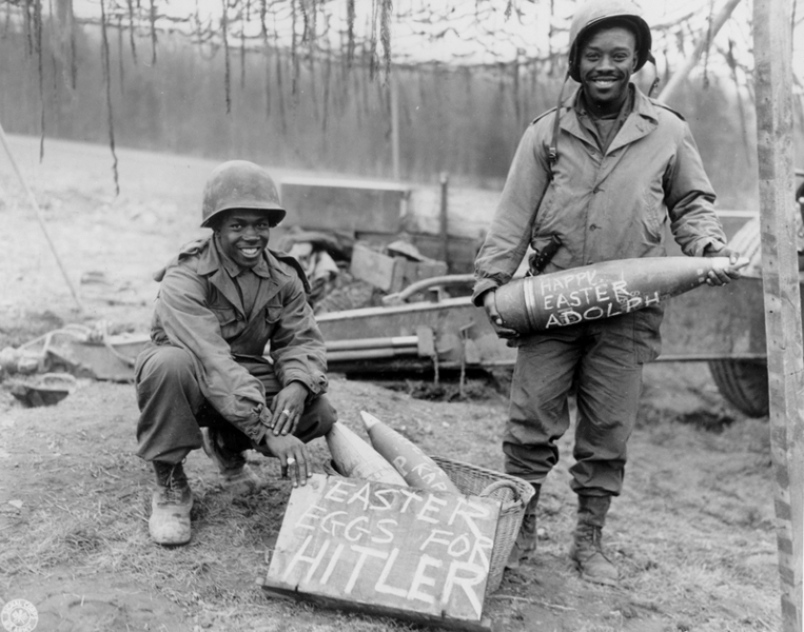
Likewise the efforts of African Americans who went to war despite being second class citizens and discriminated against under the Jim Crow Laws, which even Nazis like Hermann Goering recognized were only different from the the Nazi anti-Semitic laws and persecution in manner of degree.

That was an amazing an unique generation of Citizen Soldiers. With few exceptions they were not the professional career soldiers, sailors, marines and airmen who serve today. Most would not have considered themselves “warriors.” They were there to do a job, win a war and go home. It was part of who they were as Americans.

tumblr_mkp1mvf4gC1qbjz0go1_500

How many today would do any of those things? Today we have well under one percent of the population who have served in the wars of the past 13 years, fewer who have served in combat or in a combat zone. Likewise the population in general and in particular the bankers, businesses, lobbyists and defense contractors are not asked to sacrifice anything, instead when the country was attacked the President and others decried the fact that war might prevent people from doing business, shopping or living a normal life. For God’s sake, were at war and that attitude would have been incomprehensible to those of the Greatest Generation who for the most part either went to war, or supported the war effort with their work and other contributions. For them patriotism was not a bumper sticker.

Rachel Maddow said it well in her book Drift The Unmooring of American Military Power:

“When civilians are not asked to pay any price, it’s easy to be at war – not just to intervene in a foreign land in the first place, but to keep on fighting there. The justifications for staying at war don’t have to be particularly rational or cogently argued when so few Americans are making the sacrifice that it takes to stay.”

scan002411-483x600Jimmy Stewart and his Bomber Crew

Because of the sacrifice of people of the Greatest Generation I am grateful for them. I believe that we can learn so much from them. Even A-List Hollywood stars and professional sport heroes left their careers to serve their country. Clarke Gable, Audie Murphy, Glenn Miller, Jimmy Stewart, Bob Feller, Ted Williams and Joe DiMaggio just to name a few sacrificed major portions of their careers to serve. With the exception of Pat Tillman who died in a friendly fire incident in Afghanistan which was covered up by the Army and Bush administration, how many of the 1%, the A-List or professional athletes can you name that have left sacrificed their fortunes to serve in the front lines? I can’t name any others, but in the Second World War even the 1% had skin in the game so to speak, the Kennedy’s, Roosevelt’s and the Bush’s to name just a few.

2339073617_3b27cdf95c

I think that is why I am in awe of those of the Greatest Generation and why as the anniversaries of Midway and D-Day approach I am extra thoughtful, quite reflective and very thankful for those who through their sacrifice made so much of what we have today possible. What bothers me today is how few, especially of those who either advocate for war, lobby for it or profit from it no matter what their political, economic or religious persuasion is, offers to serve or pay for the cost of war.

Today those costs are borne by a tiny minority of Americans, military professionals of the all-volunteer military, both active duty and reserve who have endured deployment after deployment as the bulk of the nation stood by, mostly cheering them on. Of course as one who had his father serve in Vietnam and entered the military not long after had to endure the jeers of Americans, cheers are nice. They are much better than being called a “Nazi” for wearing your uniform to class. However, sometimes I think that many that cheer us on are able to due so because vicarious patriotism is easy. Vicarious patriotism anything, someone else serves, and someone else dies while they “support the troops” without actually doing anything.

crops_0201

Now please don’t get me wrong. There are a lot of good people who have never served in the military and who do care. Men and women who take action to support the troops, both those serving and the veterans, including those disabled in some way by war. For them I am grateful, they donate time, money and personal effort to care, and I do not care if the are conservatives or liberals, Republicans, Democrats or Independents, religious or atheist. They are Americans who are doing something. Likewise I do not disparage those who take the time to learn the issues that the nation faces and the domestic policies that impact the country and in a healthy body politic it doesn’t mean that we have to completely agree with each other to be patriots. Such an understanding would have been unthinkable to our founders much less most of the Greatest Generation. Veterans issues are important but national security also involves so much more, everything from the infrastructure that the Greatest Generation had the vision and wherewithal to build to the environment.

I have been to Normandy as well as other World War II battlefields in Europe and the Pacific. I can only agree with Tom Brokaw who wrote: “there on the beaches of Normandy I began to reflect on the wonders of these ordinary people whose lives were laced with the markings of greatness.”

So, when you read anything I write or re-publish during the next couple of weeks, be it about D-Day, Midway or even Gettysburg, please read what I write though those lenses. It is not that I am bitter. I have chosen my life in the military, but I wonder why so few of us bear the burden. It is a question that every citizen must ask themselves and their political representatives.

Rabbi Roland Gittlesohn, a Navy Chaplain serving with the Marines gave a eulogy at the dedication of a cemetery on Iwo Jima that puts it all in perspective.

“Here lie men who loved America because their ancestors generations ago helped in her founding, and other men who loved her with equal passion because they themselves or their own fathers escaped from oppression to her blessed shores.

Here lie officers and men, Negroes and whites, rich men and poor . . .together. Here are Protestants, Catholics and Jews together. Here no man prefers another because of his faith or despises him because of his color. Here there are no quotas of how many men of each group are admitted or allowed. Among these men there is no discrimination. No prejudices. No hatred. Theirs is the highest and purest democracy.

Whosoever of us lifts his hand in hate against a brother, or who thinks himself superior to those who happen to be in the minority, makes of this ceremony and the bloody sacrifice it commemorates, an empty, hollow mockery. To this, then, as our solemn duty, sacred duty do we the living now dedicate ourselves: to the right of Protestants, Catholics and Jews, of white men and Negroes alike, to enjoy the democracy for which all of them have here paid the price. .

We here solemnly swear that this shall not be in vain. Out of this and from the suffering and sorrow of those who mourn this will come, we promise, the birth of a new freedom for the sons of men everywhere.”

Since the last members of the Greatest Generation are passing away at an ever increasing rate and few will remain among us; I will ask you to ask yourself the question posed by the World War II veteran and hero John F Kennedy: “Ask not what your country can do for you; ask what you can do for your country.”

Peace

Padre Steve+

2 Comments

Filed under History, Military, national security, Political Commentary

Remembering the “Mighty Hood” and the Battle of the Denmark Strait

hms-hood-sinking11Artist rendition of the Loss of the HMS Hood

Seventy-three years ago today the “Mighty Hood” was sunk by the German Battleship Bismarck. It is an anniversary that I always mark. I first read about this battle in C.S Forrester’s little book Hunting the Bismarck which was used as the screenplay for the 1960 film Sink the Bismarck. This essay is in honor of the gallant HMS Hood and her crew.  It is fitting although the HMS Hood and her killer, the German battleship Bismarck were American. Both were great ships manned by gallant crews and the loss of both ships was tragic, especially from the aspect of the great loss of human life. May we never forget the sacrifice of these men and all others who have gone down to the sea in great ships.

hood-malta1HMS Hood at Malta

There are some warships and naval engagements which assume legendary proportions.  The Battle of the Denmark Strait on 24 May 1941 between the two largest battleships in commission at the time, the pride of the British Royal Navy the HMS Hood and the German behemoth Bismarck is legendary as are those two mighty ships.  The battle came at a critical time as the Britain stood alone against the seemingly invincible German Blitzkrieg.

hood-at-san-francisco1Hood in San Francisco on 1920s goodwill tour

Britain had been driven from Western Europe and was being bombed regularly by Herman Goering’s Luftwaffe while a British expeditionary force that had been sent to Greece had been defeated and the Germans were assaulting Crete with airborne forces.  In the Western Desert the Afrika Korps under Field Marshall Erwin Rommel had driven off a British counter-offensive on the Libyan-Egyptian frontier and were laying siege to Tobruk and in the Atlantic German U-Boats sank 66 Allied Merchant Ships of over 375,000 tons and the Royal Navy would lose 25 warships not including the Hood.

hms_hood_march_17_19241

The Hood was the pride of the Royal Navy and was world famous due to her inter-war international presence and goodwill visits.  Displacing 47,430 tons full load she was armed with eight 15” guns in four twin turrets.  Designed as a battle cruiser she was less heavily armored than contemporary battleships and had very weak vertical protection from plunging shellfire.  This was a fault which was known but never rectified between the wars and when the war came the Royal Navy could ill-afford to take her out of service for the necessary improvements to her protection system.  She was fast with a designed speed of 31 knots which been reduced to 28 knots by 1939 as a result of modifications which increased her displacement.   This was further reduced by the wear and tear on her propulsion plant to 26.5 knots by 1940.

Hood was designed before the battle of Jutland (May 1916) where the weaknesses in the armor protection of British Battlecruisers was exposed as three, the HMS Invincible, HMS Queen Mary and HMS Indefatigable were destroyed by plunging fire which exploded their magazines.  Though her design was modified during construction she still was vulnerable to plunging fire. She was scheduled for a major refit which would have included significant improvement in armor protection in 1941 but the war prevented the Hood from receiving anything more than improvements to her anti-aircraft batteries.

Combat1lgHood (nearly hidden by falling shells) in action at Mers-El-Kebir

During the war Hood was engaged in patrol and search operations against German raiders in the North Atlantic and in June 1940 joined Force “H” in the Mediterranean.  As Flagship of Force “H” she took part in the sinking of French Fleet Units including the Battleship Bretagne at Mers-El-Kebir on 3 July 1940 following the French surrender to the Germans and remained in operation searching for the German Pocket Battleship Admiral Scheer and Heavy Cruiser Admiral Hipper until she was withdrawn for a brief refit in January 1941. Following another brief refit in mid-March, Hood was underway from mid-March searching for the German raiders Scharnhorst and Gneisenau and a false report of Bismarck breaking out into the Atlantic in April 1941. She returned to Scapa Flow on 6 May 1941.

bismarck1Bismarck

When the British discovered that Bismarck had entered the Atlantic, Hood as the flagship of Vice Admiral Lancelot Holland was dispatched with the newly commissioned battleship HMS Prince of Wales to join the Heavy Cruisers HMS Suffolk and HMS Norfolk at the entrance to the Denmark Strait.  When the cruisers discovered Bismarck along with her consort the Heavy Cruiser Prinz Eugen the two British battleships steamed into naval history.

flagshippg213

Bismarck was slightly larger than Hood and mounted the same main armament but that was about all the two ships had in common. If the battle was a battle between heavyweight prize fighters Hood was the valiant but crippled champion and Bismarck the young and overpowering challenger.  Bismarck was slightly faster than the limping Hood and was one of the most well protected ships ever built.  Her gunnery officers and the men that manned those deadly 15” guns were like previous generations of German sailors’ gunnery experts working some of the finest naval guns ever made.

Schlachtschiff Bismarck, SeegefechtBismarck firing on Hood

gallbismdenmarkstrait11

The German ships shadowed at a distance by the Norfolk and Suffolk German task force under the command of Admiral Gunther Lütjens emerged from the strait and was sighted by the British at 0537.  Knowing his ship’s weakness in regard to plunging fire Admiral Holland desired to steer a direct course at the German ships in order to close the range quickly. Events dictated otherwise and the British were forced to close the range much more slowly and exposing Hood and Prince of Wales to German plunging fire for a longer period of time.  Holland turned to close faster with the result that his gunnery was degraded by wind and spray coming over the bows of his ships and the inability to fire his after turrets.

hood0231Hood from Prince of Wales moments before being hit and sunk

At 0553 Holland ordered his ships to open fire without the benefit of Suffolk and Norfolk being in position to engage the Prinz Eugen.  The Hood initially concentrated her fire on Prinz Eugen assuming her to be the Bismarck while Prince of Wales engaged Bismarck.  Prince of Wales drew first blood striking Bismarck three times. One which damaged her seaplane catapult, a second which did minor damage to machinery spaces and a third which passed through the bow near the waterline which severed fuel lines from her forward fuel tanks.

prinzeugen-21Prinz Eugen

Both German ships opened fire at 0555 concentrating on the Hood.  Prinz Eugen immediately hit Hood with at least one 8” shell which set a large fire among the ready to use 4”ammunition stored in lockers near the mainmast. The hit started a large fire which Hood’s damage control teams raced to contain.  At 0600 Holland ordered his ships to turn to port in order to bring his rear turrets into the fight. As the squadron executed the turn Hood was straddled by a salvo from Bismarck and observers on Prince of Wales observed an explosion between “X” turret and the mainmast which consumed the Hood causing her bow to jut sharply out of the water before sinking beneath the waves in under 3 minutes time. Witnesses on both sides of the engagement were stunned by the sudden and violent end of the Hood and the Germans rapidly shifted fire to the Prince of Wales knocking her out of the action.  Against the advice of Bismarck’s Captain Ernst Lindemann, Lütjens did not follow up his advantage to sink the crippled British ship.

hood_explosion_sketch1Hood blows up. Drawing by the Captain of HMS Prince of Wales J.C. Leach

Only three crewmen Petty Officer Ted Briggs, Seaman Bob Tilburn and Midshipman Bill Dundas survived the sinking of Hood out of a total of 1415 souls embarked. They were rescued 4 hours later nearly dead of hypothermia staying awake by sinking “Roll out the Barrel” by the destroyer HMS Electra.

hood_blowup1

Briggs who died in 2008 recounted the sinking:

“Then she started listing to starboard. She righted herself, and started going over to port. When she had gone over by about 40 degrees we realised she was not coming back…” Briggs was sucked under the water “I had heard it was nice to drown. I stopped trying to swim upwards. The water was a peaceful cradle – I was ready to meet my God. My blissful acceptance of death ended in a sudden surge beneath me, which shot me to the surface like a decanted cork in a champagne bottle. I turned, and 50 yards away I could see the bows of the Hood vertical in the sea. It was the most frightening aspect of my ordeal, and a vision which was to recur terrifyingly in nightmares for the next 40 years.” (The Daily Telegraph 5 October 2008)

briggs1Ted Briggs

tilburn4111Bob Tilburn

The Admiralty reported the loss of the Hood later in the day saying Hoodreceived an unlucky hit in a magazine and blew up.”  The official report of the sinking released later in the year said:

That the sinking of Hood was due to a hit from Bismarck’s 15-inch shell in or adjacent to Hood’s 4-inch or 15-inch magazines, causing them all to explode and wreck the after part of the ship. The probability is that the 4-inch magazines exploded first.”

The commission’s findings have been challenged by a number of naval historians and there are several theories of how the magazines might have exploded but all point to a massive magazine explosion but probably not due to a plunging round but from another hit which detonated the unprotected 4” magazines or a hit from Bismarck below Hood’s waterline which stuck a magazine.  Hood’s wreckage was located in 2001 lying across two debris fields and the examination revealed that the after magazines had exploded.  The site is designated as a War Grave by Britain and protected site under the Protection of Military Remains Act of 1986.

bismarck-sinking1Bismarck sinking

Bismarck and her crew did not long survive her victory being crippled by a lucky aerial torpedo hit from a Fairley Swordfish bomber flying from the HMS Ark Royal on 26 May and being scuttled by her crew after absorbing massive damage from the HMS King George V, HMS Rodney and several cruisers including HMS Dorsetshire the plucky and persistent Norfolk and several destroyers. When she went down she took with her all but 115 souls of her crew of over 2200 which included the Fleet Staff of Admiral Lütjens.

hms-prince-of-wales1HMS Prince of Wales

Prince of Wales would take Winston Churchill to Argentia Bay Newfoundland to meet with Franklin Roosevelt from 9-12 August 1941 where the Atlantic Charter was drafted. She reported to the Far East where she was sunk along with the Battlecruiser HMS Repulse on 9 December 1941 by a force of land based Japanese aircraft.  The Prinz Eugen was the only heavy ship of the German Navy to survive the war and was taken by the US Navy at the end of the war. She was expended as a target during the Able and Baker nuclear tests at Bikini Atoll.  Too radioactive to be repaired she was towed to Kwajalein Atoll where she capsized and sank on 22 December 1946. Her wreck is still visible.

The loss of the Hood traumatized the people of Britain and the Royal Navy; she had been the symbol of British Naval power for over 20 years and people around the world were likewise stunned at her demise. The sinking of the Hood and the loss of her crew was a tragedy which all sailors assigned to large and prestigious ships and the nations that they sail for need to keep in mind.

No matter how mighty any ship may be, every ship has an Achilles heel and no ship is unsinkable.  Of the over 3600 officers and crew of the Hood and the Bismarck only 118 survived.

dundasw1

I will remember the Hood, her gallant crew especially my very distant relative Midshipman Bill Dundas who I never met.  He left the Royal Navy about 1960 and was killed in a car wreck in 1965.  According to the Hood Association website he was troubled by the sinking for the rest of his life.  One can understand.

Peace

Padre Steve+

4 Comments

Filed under History, Military, Navy Ships, world war two in europe

24 Heroes: An Honor Long Overdue Finally Rectified

US-POLITICS-OBAMA-MEDAL OF HONOR

In a White House ceremony President Barak Obama awarded 24 Congressional Medals of Honor to soldiers who in World War II, Korea and Vietnam for heroism above and beyond the call of duty. All fought in desperate actions and gave their full measure of devotion for their comrades. For many it was the last full measure of devotion as they were killed or mortally wounded in battle. All were initially denied the Medal of Honor due to their race or religion. African Americans, Hispanics and Jewish Soldiers were represented.

It took nearly a dozen years after Congress put language in the 2002 Defense Department Authorization to see if there were soldiers denied the award due to their race or religion. The records of thousands of soldiers were reviewed, thousands of records, including award citations, unit diaries and after action reports were reviewed while as many living witnesses as could be found were interviewed by investigators.

Three of the soldiers were present. The other twenty one died, either in combat or after their return home. Seven awards were for World War Two service in Europe and the Pacific. Nine were for heroic actions in Korea, and eight for Vietnam.

Three living soldiers, all Vietnam veterans were present at the ceremony.

morrisMorris

Sergeant First Class Melvin Morris of Cocoa, Florida born in Okmulgee, Oklahoma, was commended for courageous actions while a staff sergeant during combat operations in the vicinity of Chi Lang, South Vietnam, on Sept. 17, 1969.

santiago-j-ervia-medal-of-honorErevia

Specialist 4th Class Santiago J. Erevia of San Antonio, born in Nordheim, Texas, was cited for courage during a search and clear mission near Tam Ky, South Vietnam, on May 21, 1969.

RodelaRodela

Master Sergeant Jose Rodela of San Antonio, born in Corpus Christi, Texas, was cited for courage during combat operations in Phuoc Long province, South Vietnam, on Sept. 1, 1969. All of their actions took place 45 years ago, in a war that many still long to forget.

W_1_14_68
The posthumous awards for Vietnam were awarded to the relatives of the deceased.

garciaGarcia

Sergeant Candelario Garcia, born in Corsicana, Texas, was cited for courageous actions during combat operations in Lai Khe, South Vietnam, on Dec. 8, 1968.

alvaradoAlvarado

Specialist 4th Class Leonard L. Alvarado, born in Bakersfield, California, who died during combat operations in Phuoc Long province, South Vietnam, on Aug. 12, 1969.

conde-falconConde-Falcon

Staff Sergeant Felix M. Conde-Falcon, born in Juncos, Puerto Rico, who was killed during combat operations in Ap Tan Hoa, South Vietnam, on April 4, 1969.

copasCopas

Specialist 4th Class Ardie R. Copas of Fort Pierce, Florida who was killed during combat operations near Ph Romeas Hek, Cambodia, on May 12, 1970.

duranDuran

Specialist 4th Class Jesus S. Duran of San Bernardino, Calif., for courageous actions during combat operations in South Vietnam on April 10, 1969.

Nine Soldiers were awarded the Medal of Honor for their heroism in Korea.

koreaassault

baldonadoBaldonado

Corporal Joe R. Baldonado, born in Colorado, was killed during combat operations in Kangdong, North Korea, on Nov. 25, 1950.

espinozaEspinoza

Corporal Victor H. Espinoza of El Paso, Texas, was cited for courageous actions during combat operations in Chorwon, North Korea, on Aug. 1, 1952.

gomezGomez

Sergeant Eduardo C. Gomez, born in Los Angeles, was cited for courageous actions during combat operations in Tabu-dong, South Korea, on Sept. 3, 1950.

kravitzKravitz

Private First Class Leonard M. Kravitz, born in New York City, was killed during combat operations in Yangpyong, South Korea, on March 6-7, 1951.

negronNegron

Master Sergeant Juan E. Negron of Bayamon, Puerto Rico, was cited for courageous actions during combat operations in Kalma-Eri, North Korea, on April 28, 1951.

penaPena

Master Sergeant Mike C. Pena, born in Newgulf, Texas, was killed in action during combat operations in Waegwan, South Korea, on Sept. 4, 1950.

Private Demensio Rivera, born in Cabo Rojo, Puerto Rico, was cited for courageous actions during combat operations in Changyong-ni, South Korea, on May 23, 1951.

veraVera

Private Miguel A. Vera, born in Puerto Rico, was killed during combat operations in Chorwon, North Korea, on Sept. 21, 1952.

weinsteinWeinstein

Sergeant Jack Weinstein of Saint Francis, Kansas was cited for courageous actions during combat operations in Kumsong, South Korea, on Oct. 19, 1951.

size0-army.mil-39573-2009-06-04-070603

Seven Soldiers received the Medal of Honor for their Service in World War Two.

canoCano

Private Pedro Cano, born in La Morita, Mexico, was cited for courageous actions during combat operations in Schevenhutte, Germany, on Dec. 3, 1944.

gandaraGandara

Private Joe Gandara, born in Santa Monica, California was cited for courageous actions during combat operations in Amfreville, France, on June 9, 1944.

laraLara

Private First Class Salvador J. Lara, of Riverside, California was cited for courageous actions during combat operations in Aprilia, Italy, May 27-28, 1944.

leonardLeonard

Sergeant William F. Leonard, of Lockport, New Jersey was cited for courageous actions during combat operations near St. Die, France, on Nov. 7, 1944.

mendozaMendoza

Staff Sergeant Manuel V. Mendoza, born in Miami, Arizona was cited for courageous actions during combat operations on Mount Battaglia, Italy, on Oct. 4, 1944.

Sergeant Alfred B. Nietzel, born in New York City, was cited for courageous actions during combat operations in Heistern, Germany, on Nov. 18, 1944.

schwabSchwab

1st Lieutenant Donald K. Schwab, born Hooper, Nebraska, for courageous actions during combat operations near Lure, France, on Sept. 17, 1944.

As I listened to the citations being read I full of admiration for all of these men, as well as others who have sacrificed so much who have been awarded the Medal of Honor and those whose sacrifices have not. Of course for every recipient, living or dead there are many more who made gave their last full measure of devotion in desperate and forgotten battles and those who came back from war changed.

I have had the honor of meeting a number of Medal of Honor recipients from World War II, Korea and Vietnam. When I meet them I am always humbled to hear their stories and  see the scars that they still bear.

Today was a special day. Twenty four brave men were recognized for heroism above and beyond the call of duty.

Peace

Padre Steve+

Leave a comment

Filed under History, Military, News and current events

God in the Empty Places, Six Years After Iraq

313_34838767058_2205_n

Leaving Iraq, January 31st 2008

Six years ago I arrived home from Iraq. It was the beginning of a new phase in my life.  I wrote an article shortly after my return for the church that I belonged to at the time and I have republished it around this time of year a number of times.

When I wrote it I really had no idea how much I had changed and what had happened to me. When I wrote it I was well on my way to a complete emotional and spiritual collapse due to PTSD.  Things are better now but it was a very dark time for several years and occasionally I still have my bad days.

These wars in Iraq and Afghanistan have been terribly costly in lives, treasure and they have lost almost all sense of public support. I have been in the military almost all of my adult life, over 32 years. I am also a historian and the son of a Vietnam Veteran. Thus, I feel special kinship with those that have fought in unpopular wars before me. French Indochina, Algeria and Vietnam, even the Soviet troops in Afghanistan before we ever went there. 

533506_10151366982462059_34997654_n

I am honored to have served with or known veterans of Vietnam, particularly the Marines that served at the Battle of Hue City, who are remembering the 44th anniversary of the beginning of that battle.  My dad also served in Vietnam at a place called An Loc. He didn’t talk about it much and I can understand having seen war myself. 

When I look up at the moonlit sky I think about seeing all of those stars and the brilliance of the moon over the western desert of Iraq near Syria. Somehow, when I see that brilliant sight it comforts me instead of frightens me. 

295_26912092058_3949_n

Tonight our Soldiers, Marines, Sailors and Airmen serve in harm’s way nearly 35,000 in Afghanistan alone. We are sort of out of Iraq but Lord knows how things will turn out in the long run, and it appears that another major Battle of Fallujah is shaping up.  

Tonight I am thinking about them, as well as those men who fought in other unpopular wars which their nation’s government’s sent them. 

dien-bien-phu6

When I left Iraq I was traumatized. All that I had read about our Vietnam veterans, the French veterans of Indochina and Algeria and the Soviet veterans of Afghanistan resonated in my heart. The words of T. E. Lawrence, Smedley Butler, Erich Maria Remarque and Guy Sager also penetrated the shields I had put around my heart. 

So I wrote, and I wrote, and I still write. But tonight here is God in the empty Places.

262_29132262058_8844_n-2

God in the Empty Places. 

I have been doing a lot of reflecting on ministry and history over the past few months. While both have been part of my life for many years, they have taken on a new dimension after serving in Iraq. I can’t really explain it; I guess I am trying to integrate my theological and academic disciplines with my military, life and faith experience since my return.

The Chaplain ministry is unlike civilian ministry in many ways. As Chaplains we never lose the calling of being priests, and as priests in uniform, we are also professional officers and go where our nations send us to serve our Soldiers, Sailors, Marines and Airmen. There is always a tension, especially when the wars that we are sent to are unpopular at home and seem to drag on without the benefit of a nice clear victory such as VE or VJ Day in World War II or the homecoming after Desert Shield and Desert Storm.

french-chaplain-and-soldiers-2

It is my belief that when things go well and we have easy victories that it is easy for us to give the credit to the Lord and equally easy for others to give the credit to superior strategy, weaponry or tactics to the point of denying the possibility that God might have been involved. Such is the case in almost every war and Americans since World War Two have loved the technology of war seeing it as a way to easy and “bloodless” victory. In such an environment ministry can take on an almost “cheer-leading” dimension. It is hard to get around it, because it is a heady experience to be on a winning Army in a popular cause. The challenge here is to keep our ministry of reconciliation in focus, by caring for the least, the lost and the lonely, and in our case, to never forget the victims of war, especially the innocent among the vanquished, as well as our own wounded, killed and their families.

377

But there are other wars, many like the current conflict less popular and not easily finished. The task of chaplains in the current war, and similar wars fought by other nations is different. In these wars, sometimes called counter-insurgency operations, guerrilla wars or peace keeping operations, there is no easily discernible victory. These types of wars can drag on and on, sometimes with no end in sight. Since they are fought by volunteers and professionals, much of the population acts as if there is no war since it does often not affect them, while others oppose the war.

Likewise, there are supporters of war who seem more interested in political points of victory for their particular political party than for the welfare of those that are sent to fight the wars. This has been the case in about every war fought by the US since World War II. It is not a new phenomenon. Only the cast members have changed.

legion-algeria1

This is not only the case with the United States. I think that we can find parallels in other militaries. I think particularly of the French professional soldiers, the paratroops and Foreign Legion who bore the brunt of the fighting in Indochina, placed in a difficult situation by their government and alienated from their own people. In particular I think of the Chaplains, all Catholic priests save one Protestant, at the Battle of Dien Bien Phu, the epic defeat of the French forces that sealed the end of their rule in Vietnam. The Chaplains there went in with the Legion and Paras. They endured all that their soldiers went through while ministering the Sacraments and helping to alleviate the suffering of the wounded and dying. Their service is mentioned in nearly every account of the battle. During the campaign which lasted 6 months from November 1953 to May 1954 these men observed most of the major feasts from Advent through the first few weeks of Easter with their soldiers in what one author called “Hell in a Very Small Place.”

frenchforeignlegionairevtnamdod-2

Another author describes Easter 1954: “In all Christendom, in Hanoi Cathedral as in the churches of Europe the first hallelujahs were being sung. At Dienbeinphu, where the men went to confession and communion in little groups, Chaplain Trinquant, who was celebrating Mass in a shelter near the hospital, uttered that cry of liturgical joy with a heart steeped in sadness; it was not victory that was approaching but death.” A battalion commander went to another priest and told him “we are heading toward disaster.” (The Battle of Dienbeinphu, Jules Roy, Carroll and Graf Publishers, New York, 1984 p.239)

Of course one can find examples in American military history such as Bataan, Corregidor, and certain battles of the Korean War to understand that our ministry can bear fruit even in tragic defeat. At Khe Sahn in our Vietnam War we almost experienced a defeat on the order of Dien Bien Phu. It was the tenacity of the Marines and tremendous air-support that kept our forces from being overrun.

You probably wonder where I am going with this. I wonder a little bit too. But here is where I think I am going. It is the most difficult of times; especially when units we are with take casualties and our troops’ sacrifice is not fully appreciated by a nation absorbed with its own issues.

legion-indo-china

For the French the events and sacrifices of their soldiers during Easter 1954 was page five news in a nation that was more focused on the coming summer. This is very similar to our circumstances today because it often seems that own people are more concerned about economic considerations and the latest in entertainment news than what is going on in Iraq or Afghanistan.

french-at-dien-bien-phu

The French soldiers in Indochina were professionals and volunteers, much like our own troops today. Their institutional culture and experience of war was not truly appreciated by their own people, or by their government which sent them into a war against an opponent that would sacrifice anything and take as many years as needed to secure their aim, while their own countrymen were unwilling to make the sacrifice and in fact had already given up their cause as lost. Their sacrifice would be lost on their own people and their experience ignored by the United States when we sent major combat formations to Vietnam in the 1960s.

In a way the French professional soldiers of that era, as well as British colonial troops before them have more in common with our current all volunteer force than the citizen soldier heroes of the “Greatest Generation.” Most of them were citizen soldiers who did their service in an epic war and then went home to build a better country as civilians. We are now a professional military and that makes our service a bit different than those who went before us.

943043_10151694525692059_632653331_n

Yet it is in this very world that we minister, a world of volunteers who serve with the highest ideals. We go where we are sent, even when it is unpopular. It is here that we make our mark; it is here that we serve our Soldiers, Sailors, Marines and Airmen. Our duty is to bring God’s grace, mercy and reconciliation to men and women, and their families who may not see it anywhere else. Likewise we are always to be a prophetic voice within the ranks.

When my dad was serving in Vietnam in 1972 I had a Sunday school teacher tell me that he was a “Baby Killer.” It was a Catholic Priest and Navy Chaplain who showed me and my family the love of God when others didn’t. In the current election year anticipate that people from all parts of the political spectrum will offer criticism or support to our troops. Our duty is to be there as priests, not be discouraged in caring for our men and women and their families because most churches, even those supportive of our people really don’t understand the nature of our service or the culture that we represent. We live in a culture where the military professional is in a distinct minority group upholding values of honor, courage, sacrifice and duty which are foreign to most Americans. We are called to that ministry in victory and if it happens someday, defeat. In such circumstances we must always remain faithful.

For those interested in the French campaign in Indochina it has much to teach us. Good books on the subject include The Last Valley by Martin Windrow, Hell in a Very Small Place by Bernard Fall; The Battle of Dienbeinphu by Jules Roy; and The Battle of Dien Bien Phu- The Battle America Forgot by Howard Simpson. For a history of the whole campaign, read Street Without Joy by Bernard Fall. I always find Fall’s work poignant, he served as a member of the French Resistance in the Second World War and soldier later and then became a journalist covering the Nuremberg Trials and both the French and American wars in Vietnam and was killed by what was then known as a “booby-trap” while covering a platoon of U.S. Marines.

madonna-of-stalingrad-2

There is a picture that has become quite meaningful to me called the Madonna of Stalingrad. It was drawn by a German chaplain-physician named Kurt Reuber at Stalingrad at Christmas 1942 during that siege. He drew it for the wounded in his field aid station, for most of whom it would be their last Christmas. The priest would die in Soviet captivity and the picture was given to one of the last officers to be evacuated from the doomed garrison. It was drawn on the back of a Soviet map and now hangs in the Kaiser Wilhelm Memorial Church in Berlin where it is displayed with the Cross of Nails from Coventry Cathedral as a symbol of reconciliation. I have had it with me since before I went to Iraq. The words around it say: “Christmas in the Cauldron 1942, Fortress Stalingrad, Light, Life, Love.” I am always touched by it, and it is symbolic of God’s care even in the midst of the worst of war’s suffering and tragedy. I have kept a a copy hanging over my desk in my office since late 2008. It still hangs in my new office.

Peace

Padre Steve+

1 Comment

Filed under History, iraq,afghanistan, middle east, ministry, PTSD, Tour in Iraq

The Guns of September: Beginnings, Endings and Beginnings

tumblr_mcwtrr8DcW1rpl538o1_500

“Do not try to do too much with your own hands. Better the Arabs do it tolerably than that you do it perfectly. It is their war, and you are to help them, not to win it for them. Actually, also, under the very odd conditions of Arabia, your practical work will not be as good as, perhaps, you think it is.”  T. E. Lawrence

In September 1939 Adolf Hitler led his Nazi regime into the bloodiest war in human history. In September 1945 that war ended when representatives of Germany’s ally Imperial Japan signed the instruments of surrender on the deck of the Battleship USS Missouri in Tokyo Bay. In those 5 years  over 60 million people died and the world changed.

Twenty five years before Hitler ordered the Wehrmacht into Poland the former leaders of the imperial dynasties of Europe as well as France  had led their world into the abyss of the First World War. In that war close to 37 million people, both military and civilian died.

EVN-385_Japanese-surrender-aboard-USS-Missouri_1945

In both conflicts leaders schemed to ensure that their nations would come out on top and the human costs were simply counted as immaterial so long as the overall goals of conquest and domination were achieved.

Since the Second World War ended the world has not become a safer place. In fact because the United Nations which was in essence created to prevent war and mitigate its effects has been so politicized where just five nations on the Security Council hold the key to it being able to act forcibly to stop genocide and the used of weapons of mass destruction. More often than not at least one of those five nations, the United States, Russia, China, Britain and France have ensured that whichever despot they they support is protected from any action by the world body through the use of their veto in the UN Security Council.

No we stand at the precipice of war again. This time in Syria. The United States, France and a number of other countries have concluded that the regime of Bashir Assad has employed the nerve agent Sarin against its own people in their bloody civil war.  This is disputed by the Russians as well as the Syrians but backed up by the Israelis and Saudi Arabians.

hi-syria-gas-rtx12sc9

As for the United States leading any strike on Syria to either degrade or weaken the Assad regime’s ability to use chemical weapons or any other weapons of mass destruction that they might have it finds itself on the horns of a dilemma. If it does nothing then the Assad regime can claim hat it forced the United States to back down and continue to slaughter its own people. If the United States attacks there is some chance of the strikes having some effect on the Syria ability to make war on their own people but opens the possibility of a wider and more bloody conflict, a conflict that may solve nothing but actually make matters worse.

The United State is also hindered on the world stage and at home by the Iraq debacle brought on by the Bush Administration. Despite the fact that less than one percent of the population has served in the military since the attacks of 9-11-2001 and even fewer have served in combat zones the political leaders, talking heads, pundits, preachers and media in general referrer to the country as “war weary.” The retired former Chief prosecutor at Guantanamo Bay made the comment on Twitter that they must be tired of shopping since so few have actually served. If there is war weariness it is in the military which has been in continuous action since 9-11-2001 and if we want to be honest almost ever since the First Gulf War with stops in the Balkans and Somalia along the way. I have been in the military 32 years and I have lost count of the number of places that we have deployed forces to and the amount of time that I have spent away from home. I think I have been away from my wife 10 of the last 17 years due to deployments and assignments that took me away from home. But I digress…

The fact of the matter that there are a number of layers to the situation in Syria that all need to be addressed but will not be. Instead they will be spun by those in favor or those opposed to war and mostly for for a very fleeting political advantage. An advantage only as good as today’s polls.

saddam0978

In the past couple of days the Obama Administration has been taking its case for action against Syria to the American people and Congress and also to other nations. The reasons for intervention have been primarily moral as well as citing the precedent of international law regarding chemical weapons. Real politic has not played much of a role, at least yet but it should.

The reality is that the Obama Administration as well as the UN, the Arab League, NATO, the EU and other nations with an interest in what happens in Syria have to deal with the moral and ethical level of the arguments for or against intervention. They also have to look at the legal justification which depending on which part of international law you examine could be used to argue for or against the legality of intervention. Finally there is the real politic of the situation, not only the chances of a successful intervention but the consequences of action versus inaction, action versus delay in the hopes of finding another solution and the results of whatever course of action is taken. After all, there are always results and even the most well intended and executed plans result in unintended consequences.

As I have said a number of times I think that President Obama is damned no matter what he decides to do and that this war no matter what we do in the next week will most likely spill over the borders of Syria into adjoining countries. That is already happening in the form of refugees going into Turkey, Jordan and Iraq, further instability in Lebanon and occasional skirmishes along the Syria and Lebanon borders with Israel. The question is not “if” but rather when and how the military conflict and sectarian violence spreads to other countries surrounding Syria. That has t be weighed with the consequences of and consideration of the “branches and sequels” to any intervention or non-intervention strategy employed by the United States and whatever allies choose to go along for the ride.

Syria03_GQ_07Dec12_getty_b_642x390

I am not in favor of war. That being said I do not know if there is a way to avoid it yet still enforce the norms of moral behavior in terms of the use of chemical, biological or even nuclear weapons.

There are times that I wonder about those who believe that they can orchestrate policy that only benefits their country or political-economic interests. The fact is that the “war genie” is out of the bottle and where the situation in Syria ends is anybody’s best guess. What we do have to remember is that those rebelling against the Assad regime are not doing so for our benefit or for that matter any other nation’s benefit. What T. E. Lawrence said of the Arabs who revolted against the Ottoman Empire in the First World War is as true now as it was then:

“The Arabs rebelled against the Turks during the war not because the Turk Government was notably bad, but because they wanted independence. They did not risk their lives in battle to change masters, to become British subjects or French citizens, but to win a show of their own.”

There are nations and groups attempting to use this for their own interests and ultimately it will blow back on them. The region is perched on the abyss of war, possibly without end. What happens now will be less decided by what happens in Washington or the capitals or Europe or the United Nations but with the people actually fighting the war, their active supporters and their proxies.

As far as the United States political scene if a single leader votes for or against war based purely on their individual or political party’s gain in either the 2014 or 2016 elections or to undermine the current President a pox on them. I want an honest debate about the real world consequences, ethical, legal, moral, economic, military and geopolitical of any intervention or non-intervention in Syria. We owe it to the Syrians, those people in the region as well as our own people, especially those who will certainly bear the burden of whatever war ensues.

Honestly, we really need to think this through before so much as one missile is launched.

Peace

Padre Steve+

Leave a comment

Filed under Foreign Policy, History, middle east, national security

Padre Steve’s 2013 Down and Dirty Primer on the Muddle East

Free Syrian Army soldiers in Idlib

“When you are up to your arse in alligators it is hard to remember that your mission is to drain the swamp.” Old British Colonial Saying

Note: This is an update to my 2011 Primer on the Muddle East

During the dark days of World War Two when Field Marshal Erwin Rommel was making fools of a series of British commanders in North Africa people including senior British military and government leaders sometimes referred to the theater of operations as “the Muddle East.” Some things never seem to change. The Muddle East today is quite frankly speaking in a real muddled state if there ever was one with world leaders and regional leaders muddling about as if they were the New York Mets.

A large part of the muddle goes back to the fall of the Ottoman Empire at the close of the First World War when the victorious Allied Powers redrew the map of the Middle East and made alliances with various local tribal sheiks who many times were crowned king over other tribes who didn’t necessarily want them as king. This along with heavy handed European military actions such as the British using poison gas dropped from aircraft in Iraq and a real lack of effort to better the lives of the newly “liberated” peoples of the region was just the start. Add to the cesspool a bunch of oil presided over by major oil companies, the anti-colonial movements that flourished in the years after World War Two when the French, British and Italians had to divest themselves of their Middle Eastern holdings. The French had to fight a real war in Algeria but finally withdrew leaving Algeria’s new rulers to goof up the country and oppress their people for decades to come.  In the coming years many of these newly independent nations found that life still sucked so in a number of countries military officers overthrew the despised monarchs promising reforms but oppressing their people while blaming all their problems on the Israelis.  They got their asses kicked by the Israelis in a series of wars which did a number of things that made the Middle East Muddle even worse.

First it ensured that Palestinian Arabs ended up under Israeli rule and were used with great aplomb by the Middle Eastern despots to prop up support for their regimes while doing nothing to help the Palestinians other than to put them in camps in Lebanon.  Even when the Egyptians made a peace deal with Israel most of the Arab World ostracized them.  Then in 1979 the Shah of Iran was sent packing by a bunch of Mullahs and in 1981 Saddam Hussein’s Iraq attacked Iran in one of the bloodier wars of the late 20th Century which finally ended in 1988. Of course the United States was pissed at the Mullahs so Saddam became our favorite Arab despot for a while.  Add to the mix the Soviet Union and the United States arming their favorite Arab dictators who were given carte blanche to continue oppressing their people so long as it didn’t interfere with their support of either party or the oil supply. Finally the Soviets went Tango Uniform in 1989 not long after being forced out of Afghanistan by the U.S. supplied, Pakistani supported and Saudi Arabian fundamentalist financed Mujahideen.

With the Soviets “Tango Uniform” and the Warsaw Pact nations trying to get into NATO the United States was now the uncontested Numero Uno country in the world Saddam presumed upon his late supporters and invaded Kuwait, albeit after thinking that the U.S. Ambassador to Iraq said that we wouldn’t mind.

Well he was wrong we did mind and got a lot of countries from NATO and including a bunch of Arab countries like Egypt, Syria and Saudi Arabia to get on board on a mission to get Saddam’s troops out of Kuwait. It was a kick ass mission and since the United Nations didn’t authorize removing Saddam and because President George H.W. Bush was smart enough to not to drive on Baghdad to kick him out preferring the despot we knew to a quagmire Saddam was left in power.

So we stationed ground and air forces around the Gulf to keep Saddam and Iran in check and even put them in Saudi Arabia which a large number of radicals such as Osama Bin Laden equated to letting the Devil play in Allah’s Holy Sandbox.  So Osama went and set up a base with the Medieval bunch of Pashtun known as the Taliban in Afghanistan stirred up a bunch of shit killing Americans and blowing up stuff including the World Trade Center in 1993, the Khobar Towers barracks complex in 1996, the USS Cole in 2000 and then 2001 another attack on the World Trade Center which took down the towers with hijacked aircraft and also struck the Pentagon triggered an American response against Bin Laden and his Taliban hosts.  The United States then invaded in Iraq in 2003 and succeeded in taking out Saddam but also succeeded in alienating a good many Iraqis who greeted us with open arms because we goofed up the occupation and pissed a lot of them off by dissolving the Army, Police and Civil Service and letting thugs and opportunists take over. Unfortunately since we didn’t go in with enough troops to secure all the Iraqi bases, their weapons depots and actually take control of surrendering Iraqi units these newly unemployed and dishonored people launched an insurgency bolstered by Al Qaeda and other foreign fighters even as Sunni and Shi’a Moslems began to settle scores with each other. Insurgency and civil war, two great tastes that go great together, but what the heck right?

Of course it took years to get control of the situation on the ground and thankfully the United States forces in Iraq were helped when the Sunni Moslems in Al Anbar Province realized that these foreign fighters were a worse enemy than the United States and switched sides. This turned the tables in Iraq and the insurgency was brought under control and an elected government managed to start to get their stuff together and allow us to begin withdrawing from Iraq. Of course the focus on Iraq gave the Taliban a chance to regroup as the Afghani Government proved itself corrupt, incompetent and not to give a shit about the Afghani people. So the Taliban who had been hated made a comeback and made our lives much harder so that now almost 10 years into the fight we are having a really hard time.  Well enough about us there was plenty more going on in the Muddle East besides the Iraq and Afghanistan wars.

Let’s see….there was the law of unintended consequences in that by taking Saddam Down and weakening Iraq we took away Iran’s natural enemy and the key to the balance of power in the region. Iran was strengthened and began a nuclear program that everyone with half a brain knows in intended for military use and expanded its influence in Lebanon where the Iranian backed Hezbollah took power.  Now Hezbollah which actually has an experienced military force and probably owns 40,000 or so rockets and missiles a good number of which can hit deep in Israel seems to be ready for war especially because they fought the Israelis to a stalemate in 2008, the first time an Arab military ever did that. Not only did they take on the Israelis but they are also helping Syrian dictator Bashir Assad turn the tide against the polyglot Syrian rebel forces which are being assisted by Sunni foreign fighters from all over the Middle East and the ever present Al Qaida presence.

Then was the effect that the wars in those countries made things harder for us in many other friendly Arab nations.  Of course there is the problem of a nuclear armed Pakistan which is about as stable as a Japanese nuclear reactor after getting hit by a tsunami and plays both sides of the street in the war on terror.  The Palestinians and Israelis continued their love affair and since Fatah which ran Palestinian Authority was so corrupt and gooned up a more militant group, Hamas took power in the Gaza strip. Hamas is a pretty bloodthirsty lot too but not the same level of threat as Hezbollah to the Israelis.  Of course the Israelis have done little to help the situation by their often heavy handed treatment of Palestinians and Israeli Arabs.

The witches’ cauldron of the Muddle East is getting even more muddled on a daily basis as young Arabs throughout the Muddle East are rising up against their despotic rulers and it doesn’t seem that any are safe, those allied with the United States and the West as well as those that have been a thorn in the side of the United States and the West. It just seems that despots and tyrants are no longer in vogue. The uprisings began in Iran after a disputed election where reformers were cheated of power and the revolt crushed by the Revolutionary Guard and other thugs of the Iranian regime. However with the election of “moderate” whatever that means cleric Hasan Rowhani as President hopes are that Iran, despite the machinations of many other clerics and the Revolutionary Guard might be brought to the negotiating table. That being said Iran is reportedly sending about 4000 troops to go help Assad in Syria so go figure.

Elsewhere in the Middle East things continue to boil. In December 2010 the people of Tunisia rose up and overthrew their President for Life Ben Ali in a peaceful uprising followed shortly after by the Egyptians who tossed out long term President and U.S. ally Hosni Mubarak. In Tunisia a “moderate Islamist” regime has been attempting to maintain control of radicals and keep some semblance of balance in that country while in Egypt the Islamic Brotherhood was able to get majorities elected in the Parliament and elect Mohammed Morsi as President. Needless to say both countries are still in turmoil.

In Iraq the Sunni Shi’a divide is as wide as ever and that country is threatening to become engulfed in yet another civil war as sectarian violence increases and the Kurds make more moves toward independence.

2013-05-31T115012Z_01_IST12_RTRIDSP_3_TURKEY-PROTESTS

Turkey, the heart of the old Ottoman Empire is now beginning to erupt as secularist elements in the society are protesting the policies of Islamist President Recep Tayyip Erdoğan leading to repeated clashes over the past two weeks between protestors and police.

054

Afghanistan though technically not part of the Middle East continues to be a problem for US and NATO consuming intelligence, economic diplomatic and military resources that could be put to play with better effect elsewhere.  What T.E. Lawrence said of the British occupation of a restive Mesopotamia  in 1920:

“We realise the burden the army in Mesopotamia is to the Imperial Exchequer, but we do not see as clearly the burden it is to Mesopotamia. It has to be fed, and all its animals have to be fed. The fighting forces are now eighty-three thousand strong, but the ration strength is three hundred thousand. There are three labourers to every soldier, to supply and serve him.” ‘France, Britain, and the Arabs’ by Col. T. E. Lawrence The Observer, 8 August 1920

In Libya the Arab Spring claimed the long time pain in the ass Moammar Gaddafi. That conflict center of the action in 2011 until Gaddafi was overthrown and murdered. Since then Libya has remained in turmoil despite elections, militias run amok and the US Ambassador Chris Stevens was killed in an attack on the US Consulate and CIA base in Benghazi on September 11th 2012.

Yemen and Bahrain, Algeria, and Jordan have or are experiencing demonstrations which look to be revolts in the making and even Saudi Arabia is trying to head off a potential popular uprising.

However the real problem now, the problem that threatens to send the region into a regional war is the revolt in Syria which began with peaceful protests by reformers against the Assad regime. However the hard line response of that regime to the protests spawned a civil war which now threatens to overflow the borders of Syria. France, Britain and the US have stated that they believe that there is evidence that the Syria government has used chemical weapons, in particular Sarin nerve agents against the rebels. The conflict has claimed the lives of an estimated 80,000 people with hundreds of thousands more now living as refugees.

The conflict in Syria epitomizes one of the greatest challenges in the Middle East that many in the West are just beginning to recognize, the Sunni Shi’a divide. That divide is becoming more serious with every passing day as Iran continues to lead and assist Shi’a elements in predominantly Sunni Arab countries, as well as in Iraq where the Arab Shi’a are in the majority. The conflict in Syria is predominantly Sunni versus Shi’a though in that patchwork nation of Sunni, Shi’a, Alawite Shi’a tribe of the Assad clan, various Christian and Druse groups. Lebanon which borders Syria is as divided as its larger neighbor and Hezbollah holds tremendous power in that country.

Yes my friends this is a mess and almost everybody that is anybody in the military and economic power houses of the world doesn’t have their handprints all over at least some part of this mess. All of these own some of the blame for what is going on, both the rulers of the nations in the region as well as world powers who all try to influence the nations and peoples for their own diplomatic, intelligence, military or economic gain. Almost no one is unsoiled by their involvement in the Muddle East over the past 90 years or so and so in a way all of great world powers, as well as the despots who ran these countries are to blame.

images-46

The region is more volatile than at any time in recent history and events there could easily ignite a regional war with worldwide implications.  That is why the region has been called the Muddle East for decades.  We all hope and pray for the best and that somehow all of this that the promise of a peaceful and democratic “Arab Spring” will become a reality, but there are better than even odds that things get way worse before they get better. There are just too many wild cards in this deck and the swamp is full of hungry alligators.

With the announcement this week that the US would provide military aid and training to the Syrian rebels and that US forces will remain in Jordan even as US and NATO Patriot missile batteries stand ready in Turkey there is a really good chance that the conflict in Syria will not stay in Syria.

Of course there is always the wild card if what Israel may do in what it perceives to be its security interests against outward foes such as Iran and Syria but also inside its borders and occupied territories, especially if it is attacked or provoked by Iran, Hezbollah or Hamas.

May God help us all and bring about peaceful change, or as my Iraqi friends simply say “Inshallah, God willing.”

Peace

Padre Steve+

Leave a comment

Filed under History, iraq,afghanistan, middle east, Military, national security