Monthly Archives: February 2015

Mine Eyes Have Seen the Glory: Racism Still Exists

cover22

Friends of Padre Steve’s World

In a week and a half I shall be off to Gettysburg again with a new band of students, bracing the very cold and possibly even nasty winter weather to experience and learn about the people, whose courage, sacrifice and service helped change this country for the better.

That is not to say that we have arrived in any sense of the word. Today I was confronted on a social media site about a quote that I posted from the late Associate Supreme Court Justice Thurgood Marshall which said:

“None of us got where we are solely by pulling up our bootstraps. We got there because somebody – a parent, a teacher, an Ivy League crony, or a few nuns, bent down and helped us pick up our boots…” 

When I posted it I wasn’t thinking of anything more than that all of us owe something to someone else for what we have achieved.

The person who confronted me on this, a retired Navy Chaplain chastised me because of “institutionalized affirmative action programs.” When I defended Marshall’s comments I got a a comment that “those days are long gone….” 

When  I read that with or new puppy Izzy snuggled beside me I thought, “what the fuck?” I really didn’t know how to respond. I was astounded to hear those words coming from a person who served a full career in the military. Heck the Admiral I work for, who is one of under twenty African Americans serving at that rank today was told by a white Commanding Officer that he would never command anything because he was black. He entered the military a year after I did during the early part of the Reagan build up. I enlisted in 1981 and was commissioned in 1983, he was commissioned in late 1982.

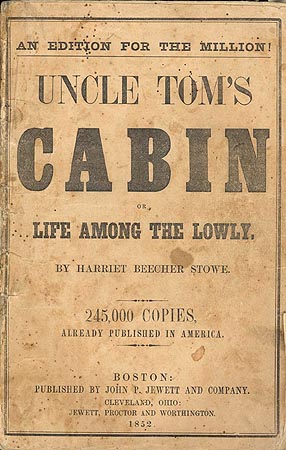
So please keep telling me that institutional and personal racism does’t exist. It does and it is still a part of life, no matter what Ben Carson, Alan West or Starr Parker say. Those people are no different than Stephen, the character played by Samuel L. Jackson in Django Unchained. They benefit from being the black henchmen of those that oppress other blacks. In Harriet Beecher Stowe’s era they were called Uncle Tom. The sad thing is that such people never understand that the system that they defend and advocate still hates them. I’ll go back to that in another two articles this weekend, which will be entitled They Still Hate You and another We the Good White God Fearing Citizens of Rock Ridge Again both will have a film reference and if you don’t know those films you should.

Sadly it seems they one people that really believe that are white American conservative Christians. But I digress….

The heart of why over 600,000 Americans died in the Civil War, and the country was devastated by a total war, the effects of which still linger today was rooted in racism, the institution of slavery, the belief that Blacks were less that human and that States, backed by legislative “compromises” and Supreme Court decisions could and should be able to maintain and even expand an evil  social and economic system that treated Blacks as less than human, enslaved them and treated them not as human beings but as the property of slave owners.

That my friends is not just a fact, it is history and it is uncomfortable as hell because my family owned slaves and fought for the Confederacy, something that I am neither proud of or ashamed to admit. It is history. It is reality, and it is shameful. I will not simply resort to the lie that my ancestors who owned slaves and fought to keep that right were simply products of their time. They and thousands of others like them knew better, and they not only intellectually assented to the system, but the profited from it and fought for it.

What I am saying, and this will not be comfortable to those who want to believe that racism, or other forms of social discrimination exist and are being re-legislated into law in certain state legislatures in actions to roll back voting rights, civil rights and economic liberty.

No they will not, especially to those who hold those beliefs and back them with their religion. Just because an elected official, or a law enforcement officer who happens to be Black expresses an opinion that racism still exists and that the laws on the books designed to ensure equal rights are enforced does not mean that they are racist. It seems to me that the racism label today is used by the very proponents of racism, racism that seeks to assign blacks, women, other people of color, and gays to less than full social, political and racial equity. But then I could be wrong, maybe in  the words of Supertramp’s Logical Song I’m just a radical, liberal, fanatical, criminal…. but then maybe all the world is asleep…. and my questions run too deep….

That my friends is just one of the reasons that I believe that history matters and that such evils, and yes they are evil, need to be confronted today. The history must be told and it cannot be varnished with the lacquer of the myth of the Lost Cause, or any sort of neo-Confederate romanticism, the politicians, pundits and preachers who do so be damned to the pit of the hell that they so adamantly assign those that do not agree with them.

So tonight I am reposting a link to the first of three previously published articles, which are one full chapter of my Civil War and Gettysburg text. They are uncomfortable as hell to read, because I know for a fact that from my own research, and family history that they are just that. The accounts, the words of the defenders of slavery and the racist ideology behind it and today behind much of the preachers, politicians and pundits of the Tea Party must be confronted. Not just because it is part of their ideology, but because it is an integral part of the ideology of the Islamic State, Boko Haram and all evil that go with them. Ideology, religion and racism matters, not just in the past but today.

So tonight I give you 

Mine Eyes Have Seen The Glory: Religion, Ideology & the Civil War Part 1

I’ll repost part two tomorrow and part three Friday with a few more editorial comments because as you an see I am really spun up about this.

Have a great night.

Peace

Padre Steve+


2 Comments

Filed under civil rights, civil war, faith, Gettysburg, History, philosophy, Political Commentary, Religion

Snow Days and a New Puppy

B-JOugIIUAAPOEF

We got hammered with some pretty good winter weather here in Hampton Roads, below freezing temperatures for several days followed by 5-6 inches of snow followed by sleet, ice and freezing rain. While not New England, and believe me I am not complaining this is a bit much for our local resources. VDOT and the local city workers are doing a good job clearing the main roads, but secondary roads as well as business, government and school parking lots are a mess.

The road network on the base where I work dates from when it was built in WWII. It is now the site of a number of Navy, Marine, Joint and NATO  headquarters, along with the Staff College. It takes forever to clear everything as the roads are narrow, developed land at a premium and nowhere to put the snow and ice. As a result, we were shut down yesterday and today. But we are not alone, school districts, colleges, businesses throughout the area are either shut down or running at the bare minimum capacity. Such as life in the coastal mid-Altantic. I would hate to see what would happen if we experienced what Boston and New England are going through.

Tonight, more snow in the forecast followed by extreme cold the next two days before things start warming over the weekend.

But the snow days have allowed me to have some daddy-puppy bonding time with the newest member of our little family, Izzy Bella.

Izzy is a Papillon and she and her breeder flew here yesterday from South Dakota. Izzy has already adapted and our two other girls, Molly our nearly 14 year old Papillon Dachshund mix, and Minnie our three year old Papillon are as well to having a new little sister. By the way, Izzy’s breeder has two boys still unspoken for, and if you want I can help you get in touch with her.

If you don’t know Papillons, they are a wonderful breed. They are in the top ten breeds for intelligence, very smart, very sweet, very playful and funny and great companions or therapy dogs. Molly, though only half-Papillon helped keep me alive during the worst of my PTSD times after Iraq. If either of us are having a bad day it is hard to be depressed as Minnie won’t let that happen.

For little dogs they are great dogs for guys. I am amazed at all the pictures on the Facebook Papillon sites of big brawny men with these dogs. They are playful, funny and tough.

Anyway, I digress. I hope you have a good day wherever you are and look for some more scintillating commentary, hard hitting articles and of course a lot of history on the site in the coming days.

Peace

Padre Steve+

3 Comments

Filed under dogs, Loose thoughts and musings, papillons

There Comes a Time… A Bloom County Reality Check

5663117546_c4150a82fc_b

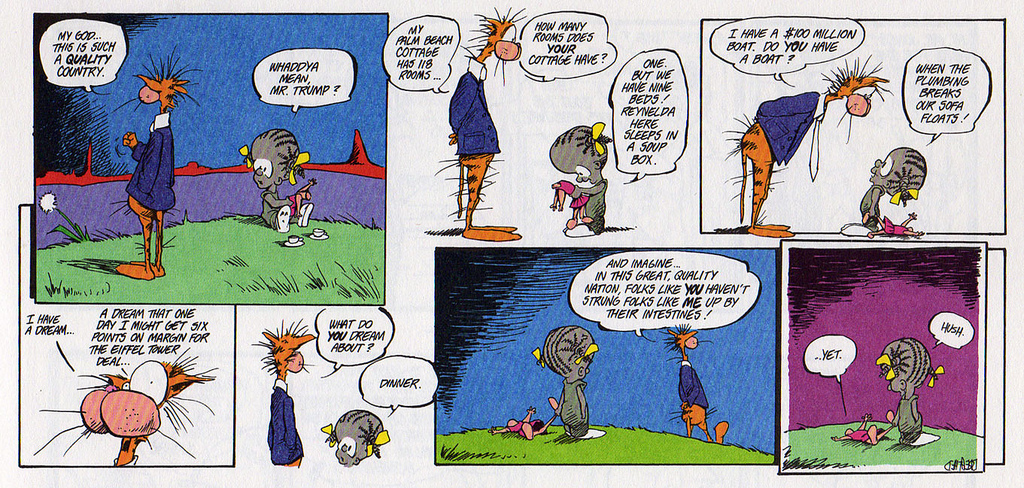
If the print on the strip is too spall on your phone or tablet the link is here: http://www.gocomics.com/bloomcounty/2015/02/17

Likewise if you click on the picture it should be larger and more readable

“Our lives begin to end the day we become silent about things that matter.” Dr. Martin Luther King Jr. 

It is funny how timeless the social commentary of Berkeley Breathed’s classic comic strip Bloom County is even today. The strip shown above is from 1987. It is part of a series of strips where Donald Trump’s brain is transplanted into Bill the Cat’s body leading to some interesting encounters with the citizens of Bloom County.

In this strip, a little Black girl named “Ronald Ann,” named such by her dad after Ronald Reagan meets Mr Trump. The Donald, like all of us has a dream, but his is a bit different, and in the strip he is symbolic of the worst part of our humanity, that which has everything, while denying others of even the chance to achieve. A class of people who have no empathy, and for whom nothing matters but their bottom line, and they have an army of politicians to enshrine their policies into law, pundits who shamelessly defend them, media empires that promote them and their lifestyles as good, and preachers who give the blessing of something that they call “God” to their most ungodly world view.

The amazing thing is that those who promote this vast imbalance don’t even recognize what they are doing to civilization. Barbara Tuchman wrote in her book A Distant Mirror: The Calamitous 14th Century that “When the gap between ideal and real becomes too wide, the system breaks down.”

We are watching this unfold before our very eyes and those leading the charge, the politicians, bankers, moguls, media empires, pundits and preachers are blind to what they are sowing. Sadly they don’t seem to care so long as they have power and their profit margins increase.

What they are sowing is the seed of violent revolution, and not just in the United States, but around the world. They are sowing the seeds of war, they have helped create the growing threat of the Islamic State and Boko Haram, and their short sighted policies will bring down nations and economic systems.

Bu then such people and those who allow them to do what they do do not study history, except for the sanitized kind of myth that makes them feel good and justifies their actions. The same is true of how they view philosophy and religion. That is why they love the pseudo-history of people like David Barton, the philosophy of Ayn Rand, and the theology of Christian Dominionism and the Prosperity Gospel. Sadly, those who call themselves “Christians” and promote this seem oblivious to the fact that it is all based on Social Darwinism, the survival of the fittest. But then to the preachers who support those who benefit by such thought believe that a lie told for the glory of God is justified.

As such they seem to have little capacity for empathy or compassion, the death and suffering of people from disease, poverty and war makes no impact on them. Tuchman wrote “[T]he obverse of facile emotion in the 14th century was a general insensitivity to the spectacle of pain and death.” 

The same is true with technology. We have the most wonderful technological capabilities but instead of harnessing them for good, we turn them into instruments of destruction, instruments that may one day destroy all of us. Tuchman wrote: “For belligerent purposes, the 14th century, like the 20th, commanded a technology more sophisticated than the mental and moral capacity that guided its use.” Sadly, that gap between technology and mental and moral capacity to use it has only grown exponentially in this new century 21st century.

Sadly, that bit of satire about Donald Trump and Ronald Ann in this 1987 Bloom County comic strip is even more true today than when Berkeley Breathed drew it and penned the words. The power of the pen can be seen even today as people who speak out, write or pen satire become targets of those that they critique.

But I can no longer be silent when I see such institutionalized evil that is blessed by the politicians, pundits and preachers, who I call the Trinity of Evil. I would rather be called every epitaph that the promotors and supporters of such a hateful, tyrannical and perverse system can muster, than not to speak the truth. It’s funny how the words to the The Logical Song by Supertramp ring true for me:

“Now watch what you say or they’ll be calling you a radical, liberal, fanatical, criminal.”

I’ll have to write about that song sometime soon, as it seems to speak volumes about my own journey, but I digress…

I said at the beginning of this year that I would seek truth and speak truth. Until I came back from Iraq in 2008, having seen and experienced the horror of war, the lies of my government in launching that war in Iraq that has latterly sowed the wind and is reaping the whirlwind with the Islamic State’s advance, I said nothing, and at times even defended the system. But since then I cannot. I have already paid a price, men who I thought were friends abandoned me, a church that I had faithfully served, threw me out and I have been threatened, harassed and trolled by white supremacists; religious fanatics of various denominations, and political ideologues.

But truth is truth and I cannot be silent. As Dr. King so well put it: “There comes a time when one must take a position that is neither safe, nor politic, nor popular, but he must take it because conscience tells him it is right.”

Peace

Padre Steve+

4 Comments

Filed under civil rights, economics and financial policy, ethics, faith, History, News and current events, philosophy, Political Commentary, Religion

Remembering: Lincoln’s 2nd Inaugural Address

abraham-lincoln-secondinauguration3

Today is President’s Day and instead of doing much I am simply going to post one of the most poignant and meaningful speeches ever given by a President,  Abraham Lincoln’s Second Inaugural Address.

The address was delivered on March 4th 1865 just over a month before Robert E. Lee’s Army surrendered at Appomattox, and just 41 days before Lincoln died at the hands of John Wilkes Booth. A man who the League of the South, a radical group bent on returning the whole country to their neo-Confederate ways plans to honor on April 14th for “executing” Lincoln who they call a criminal tyrant.

Lincoln’s words need to be remembered for what they are, a remarkable statement of reality as well as hope for the future. When he spoke them the war was all but over, but much blood was still being spilt on battlefields across the South. By the time the war, which began in 1861 was over, more than 600,000 Americans would be dead. It was the bloodiest conflict in American History.

To really understand what Lincoln was speaking of one has to remember that just nine years before the Supreme Court had seemed to demolish any hope at all for Blacks in the United States, and not just the enslaved Blacks of the South, in it’s notorious Dred Scott decision. Roger Taney, the Chief Justice writing for the majority, most of whom were Southerners said about Blacks when denying them any form of Constitutional Rights:

“Can a negro, whose ancestors were imported into this country, sold as slaves, become a member of the political community formed and brought into existence by the Constitution of the United States, and as such become entitled to all the rights, and privileges, and immunities, guaranteed by that instrument to the citizen?…It is absolutely certain that the African race were not included under the name of citizens of a state…and that they were not included, and were not intended to be included, under the word “citizens” in the Constitution, and therefore claim none of the rights and privileges which that instrument provides for and secures to citizens of the United States. On the contrary, they were at that time considered as a subordinate and inferior class of beings, who had been subjugated by the dominant race, and, whether emancipated or not, yet remain subject to their authority, and had no rights or privileges but those who held the power and the Government might choose to grant them”

Before that there was the equally noxious Compromise of 1850 which included the Fugitive Slave Act which gave any Southerner claiming his human “property” not only the rights but a legal mechanism to hunt them down in the North and penalize anyone hindering them with weighty fines and jail terms.

One has to look at the words of Confederate Vice President Alexander Stephens in his Cornerstone Speech to understand the truth of what Lincoln spoke on that day in March 1865. Stephens, just four years before had declared in the starkest terms what the war was about and what the Confederacy’s foundation was:

Our new government is founded upon exactly the opposite idea; its foundations are laid, its corner- stone rests upon the great truth, that the negro is not equal to the white man; that slavery — subordination to the superior race — is his natural and normal condition. [Applause.] This, our new government, is the first, in the history of the world, based upon this great physical, philosophical, and moral truth.”

It took four years of bloody war, the first total war waged on American soil to end slavery, sadly within just a few years the Jim Crow laws had regulated Southern Blacks to a status not much better than their previous estate, and again became victims of often state sanctioned violence, discrimination, prejudice and death through lynching.

Southern leaders like Stephens and Jefferson Davis denied that slavery was the cause of the war and the foundation of the Confederacy in their revisionist histories after the war was over. They did so even though the litany of their letters, speeches and laws they supported, damned their words as the bold faced lies that they were. In the mean time many in the South sought to reclaim their pre-war glory in the myth of the Lost Cause which permeated much of the United States in the decades after the war, being glorified by Hollywood in Birth of a Nation, Gone with the Wind, and Walt Disney’s Song of the South. The unconscionable racism and white supremacy promoted by these masterpieces of cinema helped perpetuate racism across the country.

In the North, blacks faced discrimination and prejudice as well. another Supreme Court decision (Plessy v. Ferguson 1896) had legalized segregation and discrimination against Blacks in the form of “Separate but Equal” across the entire United States, something that would remain until a later Supreme Court would overturn Plessy in Brown v. Board of Education in 1954.

Despite all the reverses and the continued fight against the rights of Blacks, as well as women, other minorities and Gays, the struggle continues.

In August 1863, Lincoln was asked to speak at a gathering wrote in support of stronger war efforts and enlistments. Lincoln could not attend and wrote James Conkling a letter to be read on his behalf. That letter addressed those who disagreed with Lincoln on emancipation while still be claiming to be for the Union. Lincoln ended that letter with this:

“Peace does not appear so distant as it did. I hope it will come soon, and come to stay; and so come as to be worth the keeping in all future time. It will then have to be proved that among freemen that there can be no successful appeal from the ballot to to bullet, and that they who take such appeal are sure to lose their case and pay the cost. And there will be some black men who can remember that with silent tongue, and with clenched teeth, and steady eye, and well-poised bayonet, that they will have helped mankind on to this great consummation, while I fear there will be some white ones unable to forget that with malignant heart and deceitful speech they strove to hinder it….” 

Lincoln, unlike many even in the North recognized the heroic nature of African Americans fighting for their rights and how their struggle was beneficial for every American.

Lincoln died too soon, his death was a tragedy for the nation, but today, on President’s Day let us remember the words of the Lincoln’s Second Inaugural Address and the truth that they express. Lincoln’s concluding sentences which began with “With malice toward none, with charity for all…” should be at the heart of our dealings with all people so that we, as Lincoln said so eloquently “may achieve and cherish a just and lasting peace among ourselves and with all nations.”

It is a speech that always encourages me to fight for freedom and truth, even when that truth is less than popular and often uncomfortable. Lincoln’s words still inspire me, because he spoke the truth that many even today do not want to hear:

At this second appearing to take the oath of the Presidential office there is less occasion for an extended address than there was at the first. Then a statement somewhat in detail of a course to be pursued seemed fitting and proper. Now, at the expiration of four years, during which public declarations have been constantly called forth on every point and phase of the great contest which still absorbs the attention and engrosses the energies of the nation, little that is new could be presented. The progress of our arms, upon which all else chiefly depends, is as well known to the public as to myself, and it is, I trust, reasonably satisfactory and encouraging to all. With high hope for the future, no prediction in regard to it is ventured.

On the occasion corresponding to this four years ago all thoughts were anxiously directed to an impending civil war. All dreaded it, all sought to avert it. While the inaugural address was being delivered from this place, devoted altogether to saving the Union without war, insurgent agents were in the city seeking to destroy it without war–seeking to dissolve the Union and divide effects by negotiation. Both parties deprecated war, but one of them would make war rather than let the nation survive, and the other would accept war rather than let it perish, and the war came.

One-eighth of the whole population were colored slaves, not distributed generally over the Union, but localized in the southern part of it. These slaves constituted a peculiar and powerful interest. All knew that this interest was somehow the cause of the war. To strengthen, perpetuate, and extend this interest was the object for which the insurgents would rend the Union even by war, while the Government claimed no right to do more than to restrict the territorial enlargement of it. Neither party expected for the war the magnitude or the duration which it has already attained. Neither anticipated that the cause of the conflict might cease with or even before the conflict itself should cease. Each looked for an easier triumph, and a result less fundamental and astounding. Both read the same Bible and pray to the same God, and each invokes His aid against the other. It may seem strange that any men should dare to ask a just God’s assistance in wringing their bread from the sweat of other men’s faces, but let us judge not, that we be not judged. The prayers of both could not be answered. That of neither has been answered fully. The Almighty has His own purposes. “Woe unto the world because of offenses; for it must needs be that offenses come, but woe to that man by whom the offense cometh.” If we shall suppose that American slavery is one of those offenses which, in the providence of God, must needs come, but which, having continued through His appointed time, He now wills to remove, and that He gives to both North and South this terrible war as the woe due to those by whom the offense came, shall we discern therein any departure from those divine attributes which the believers in a living God always ascribe to Him? Fondly do we hope, fervently do we pray, that this mighty scourge of war may speedily pass away. Yet, if God wills that it continue until all the wealth piled by the bondsman’s two hundred and fifty years of unrequited toil shall be sunk, and until every drop of blood drawn with the lash shall be paid by another drawn with the sword, as was said three thousand years ago, so still it must be said “the judgments of the Lord are true and righteous altogether.”

With malice toward none, with charity for all, with firmness in the right as God gives us to see the right, let us strive on to finish the work we are in, to bind up the nation’s wounds, to care for him who shall have borne the battle and for his widow and his orphan, to do all which may achieve and cherish a just and lasting peace among ourselves and with all nations.

Peace

Padre Steve+

1 Comment

Filed under civil war, History, leadership, Political Commentary

Abraham Lincoln & the New Birth of Freedom

Friends of Padre Steve’s World

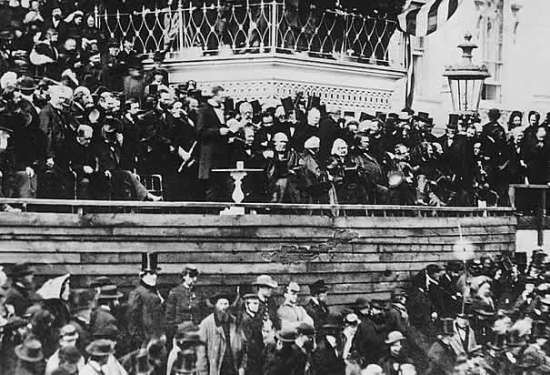
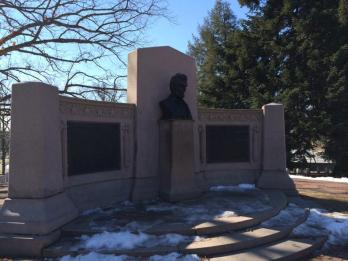
On this weekend which we call the “President’s Day Weekend” I think it is appropriate to remember Abraham Lincoln and the Gettysburg Address. This is the last chapter of my Gettysburg text and since Lincoln is most closely connected with Emancipation and the End of Slavery I think that it is important to pause and remember his brief remarks at the dedication of the Gettysburg Soldier’s Cemetery. Those remarks are really important because they draw us back to the real source document of who we are as Americans, the Declaration of Independence. That document made the incredibly bold, and even revolutionary statement, that “all men are created equal.” Lincoln expanded those words to their logical end, that indeed all men, not just white landowners, were created equal. It is a concept that some in our country still struggle to accept. 

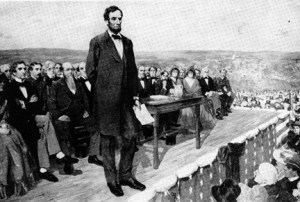
In a couple of weeks I will be going back to Gettysburg again with a group of my students.  The last stop on our “staff ride” is the Soldier’s cemetery. We go to the spot where it is believed that Lincoln gave his remarks and I take a few minutes to read his address. 


Have a great weekend and remember that freedom always comes with a price, and that the struggle for freedom, equality and justice has not ended.

Peace

Padre Steve+
gburg address 

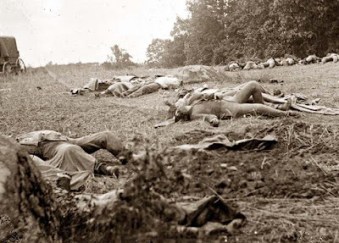
I am always humbled when I travel to Gettysburg as I will again in a couple of weeks. It is hard to believe in that now peaceful pastoral setting that over 157,000 Americans, almost 82,000 Union and 75,000 Confederate met in a three day battle. In those three days over 28,000 Confederates and 23,000 Union soldiers were killed, wounded, missing or captured. It was the greatest number of casualties inflicted in one battle on American soil in history.

The places that the battle was fought have become legendary, for they are “hallowed ground” as President Abraham Lincoln so eloquently put it. The places, McPherson’s and Herr’s Ridge, Seminary Ridge, the Railroad Cut, Barlow’s Knoll, Cemetery Hill, Culp’s Hill, The Wheat Field, Devil’s Den, the Peach Orchard, Little Round Top, Cemetery Ridge, the Apse of Trees, the Angle and the High Water Mark are in a sense holy, or hallowed, consecrated by those who struggled there, those who lived and those who gave the last full measure of devotion to their country. When I take my students there I always finish at the Soldier’s Cemetery where Abraham Lincoln delivered the Gettysburg Address.

I think about those men of both sides, fully convinced of the rightness of their cause who fought valiantly in the struggle. That being said when I go there though my family predominantly fought for the Confederacy my heart is drawn to those men who remained loyal to the Union and those who answered the call of Abraham Lincoln to serve in a cause greater than their own interests, the great and the small alike.

Lincoln was a masterful orator who managed to rally the Union and bring hundreds of thousands of men volunteer before Gettysburg. They came for an ideal an ideal which Lincoln’s oratory was probably the most effective at articulating in a way that men would volunteer to suffer hardship, fight and die to bring about. It was well put in the movie Gettysburg where Colonel Joshua Chamberlain, played by Jeff Daniels said:

“This is a different kind of army. If you look at history you’ll see men fight for pay, or women, or some other kind of loot. They fight for land, or because a king makes them, or just because they like killing. But we’re here for something new. This has not happened much, in the history of the world: We are an army out to set other men free. America should be free ground, all of it, from here to the Pacific Ocean. No man has to bow, no man born to royalty. Here we judge you by what you do, not by who your father was. Here you can be something. Here is the place to build a home. But it’s not the land. There’s always more land. It’s the idea that we all have value, you and me. What we’re fighting for, in the end… we’re fighting for each other…” [1]

On November 19th 1863 Lincoln delivered a “few words” at Gettysburg which were in all practical aspects a benediction at the dedication of the battlefield cemetery. Lincoln was the second speaker at the ceremony following former Pennsylvania Congressman Edward Everett who spoke for more than two hours, a typical speech from the period.

Everett was one of the leading orators of his day. Everett was “a scholar and Ivy-League diplomat who could hold mass audiences in thrall. His voice, diction, and gestures were successfully dramatic, and he always performed his carefully written text, no matter how long, from memory.” [2]

The 270 words of Lincoln’s address are perhaps the most important of any speech or document in American history save the Declaration of Independence and the Constitution of the United States, in those words “Lincoln, nevertheless managed to justify the ways of democracy more than anyone, then or now.” [3]

The speech was so powerful that Everett wrote Lincoln the next day:

“Permit me also to express my great admiration of the thoughts expressed by you, with such eloquent simplicity & appropriateness, at the consecration of the Cemetery. I should be glad, if I could flatter myself that I came as near to the central idea of the occasion, in two hours, as you did in two minutes.” [4]

The speech is short, but its eloquence is unmatched. Lincoln wrapped ideas, concepts and ideals that men have written volumes about into a speech so powerful that many have memorized it.

But few realize the context that it must be placed. Though the Union had defeated Lee’s Army at Gettysburg and Grant had taken Vicksburg to cut the Confederacy in half the North was growing war weary. During the fall of 1863 after a series of inconclusive battles in northern Virginia both Lee and Meade’s armies had sent significant numbers of troops to the west, to support operations in eastern Tennessee.

Lee sent Longstreet’s First Corps, which took part in the bloody battle of Chickamauga, which “is a Cherokee word meaning “river of death.” [5] where on September 19th and 20th the Federal Army of the Cumberland under General Rosecrans “were soundly whipped at …and driven back into the strategic point of Chattanooga.” [6] The number of casualties on both sides, over 16,000 Federal and 18,000 Confederate, a “combined total of 34,634 was exceeded only the three day slaughter at Gettysburg and by the week-long series of five battles known collectively as the Seven Days.” [7] Despite the number of casualties it was one of the biggest Confederate victories of the war. A clerk in Richmond wrote “The whole South will be filled again with patriotic fervor, and in the North there will be a corresponding depression.” [8] That changed rapidly when the Union reacted quickly and reversed the strategic situation. One action taken was to deploy Oliver Howard’s XI Corps and Henry Slocum’s XII Corps west, where “they would be commanded by Joe Hooker, who was conveniently at hand and unemployed.” [9]

In the east during the following weeks “Lee and Meade, like two wounded, spent gladiators, sparred listlessly along the Rapidan. It seemed to Northerners that the fruits of Gettysburg had been thrown away.” [10] Lee sensed an opportunity to go back on the offensive against Meade’s weakened army, but his offensive was stopped on October 14th when “the Union Second Corps shattered a reckless attack by A.P. Hill’s corps at Bristoe Station, five miles south of Manassas.[11]

There was a faction in the North, the Copperheads, who were willing even after Gettysburg and Vicksburg to end the war on terms favorable to the Confederacy, even allowing for Confederate independence and the continuation of slavery. They “clamored for negotiations with the Confederacy to restore the Union on the basis of status quo antebellum and, until the closing months of the war charged that as long as the antislavery party remained in power the restoration of the Union could not be achieved.” [12] They believed that the war was a failure and that military action could not be achieved by force of arms.

The leading Copperheads included Clement Vallandigham of Ohio and George W. Woodward of Pennsylvania were typical, both opposed the use of force against Confederate secession; Woodward had written in 1860 that “Slavery was intended as a special blessing to the people of the United States,” that “Secession is not disloyalty” and “I cannot condemn the South for withdrawing….I wish Pennsylvania could go with them.” [13] The efforts of the Copperheads to gain governorships in Ohio and Pennsylvania met defeat in November 1863, as the Union victories at Gettysburg and Vicksburg “undercut their theme of the war’s failure.” [14] Their efforts would persist through the 1864 Presidential election, but instead of preaching the war’s failure they would concentrate on defeating emancipation. The Copperheads, “labeled all Republicans, including Lincoln, as radicals bent upon destroying the Union and undermining the Constitution.” [15]

However, the anti-abolitionist and racist views espoused by the northern Democrat Copperheads had begun to lose their potency in the North after July of 1863 with the onset of “the New York draft riot, which shocked many northerners into a backlash against the consequences of virulent racism” [16] and the sacrifice of the African American 54th Massachusetts Infantry when it assaulted Fort Wagner outside of Charleston South Carolina, which occurred “just after the Democratic rioters in New York had lynched black people and burned the Colored Orphan Asylum. Few Republican newspapers failed to point the moral: black men who fought for the Union deserved more respect than white men who fought against it.” [17]
GAFac1

It is also important to understand how Lincoln’s address at Gettysburg is reflective of the various intellectual and philosophical movements of the time. Even the location of the cemetery and the burial plots within it was significant. A Gettysburg lawyer, David Wills proposed to “Governor Andrew Curtain of Pennsylvania the establishment of a soldiers’ cemetery where the Union dead could be reburied with dignity and honor.” [18] The place was then outside the city, a plot of 17 acres purchased by Wills adjacent to the existing town cemetery on Cemetery Hill. That was significant culturally, for the Gettysburg Cemetery was part of a movement called the Rural Cemetery movement. The movement was part of the Greek revival in the United States and connected with the Transcendentalist movement.

The Rural Cemetery movement was launched at Cambridge’s Mount Auburn Cemetery, and Edward Everett was a key figure in it. Mount Auburn “took Athens’s Kerameikos as its model, since that ancient burial ground existed outside the city proper, near the groves of the Akademy, in what was still countryside.” [19] In his speech at Mount Auburn’s dedication, U.S. Supreme Court Justice Joseph Story noted:

“The Greeks exhausted the resources of their exquisite art in adorning the habitations of the dead. They discouraged internments within the limits of their cities; and consigned their relics to shady groves, in the neighborhood of murmuring streams and merry fountains, close by the favorite resorts of those who were engaged in the study of philosophy and nature, and called them, with the elegant expressiveness of their own beautiful language, cemeteries or “places of repose.” [20]

He further noted:

“Our cemeteries, rightly selected and properly arranged, may be made subservient to some of the highest purposes of religion and human duty. They may preach lessons to which none may refuse to listen and which all that live must hear. Truths may there be felt and taught, in the silence of our meditations, more persuasive and more enduring than ever flowed from human lips.” [21]

Everett in his Gettysburg oration linked what they were doing at the Soldiers’ Cemetery with the Greek tradition:

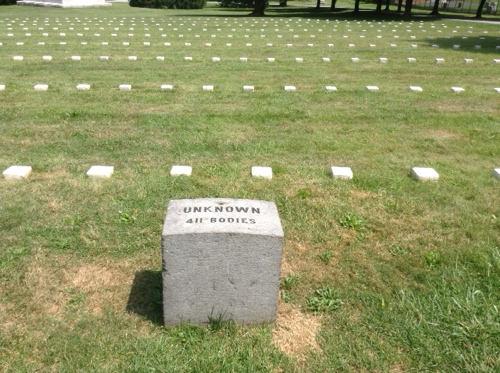
“It was appointed by law in Athens, that the obsequies of the citizens who fell in battle should be performed at the public expense, and in the most honorable manner. Their bones were carefully gathered up from the funeral pyre where their bodies were consumed, and brought home to the city. There, for three days before the interment, they lay in state, beneath tents of honor, to receive the votive offerings of friends and relatives,–flowers, weapons, precious ornaments, painted vases (wonders of art, which after two thousand years adorn the museums of modern Europe),–the last tributes of surviving affection. Ten coffins of funereal cypress received the honorable deposit, one for each of the tribes of the city, and an eleventh in memory of the unrecognized, but not therefore unhonored, dead, and of those whose remains could not be recovered….” [22]

The layout of the cemetery, and the manner in which the dead were buried was also significant when one considers the messages of both Everett and Lincoln that day. “The cemetery at Gettysburg was arranged so that every grave was of equal importance; William Saunders’s design, like Lincoln’s speech, affirmed that every dead soldier mattered equally regardless of rank or station.” [23] In this place “some 3,577 Union soldiers (half of them unknown) from eighteen states are buried.” [24]

The speeches of Everett and Lincoln are deeply connected with Romanticism, the Greek revival and the Transcendentalist movement in the United States. Both were children of the enlightenment, and Everett, a former President of Harvard was well versed in these subjects and Lincoln, though a politician who appealed to the tenets of the Enlightenment, the Declaration of Independence and the Constitution. Lincoln appealed to the “sacred principles of the laws of nature,” and hailed “the constitution and laws” as “hewn from the solid quarry of sober reason.” For Lincoln, the war was a test of the practical worth of liberalism.” [25]

Everett had been a mentor to some of the leading Transcendentalist thinkers of his era including Ralph Waldo Emmerson who found that the experience of “Everett’s classroom gave him an entirely new direction in life. He wrote:

“Germany had created [literary] criticism in vain for us until 1820, when Edward Everett returned from his five years in Europe, and brought to Cambridge his rich results, which no one was so fitted by natural grace and splendor of his rhetoric to introduce and recommend….The novelty of the learning lost northing in the skill and genius of its interpreter, and the rudest undergraduate found a new morning opening to him in the lecture room at Harvard.” [26]

Everett, who had previously dedicated battlefields at Bunker Hill, as well as Lexington and Concord, was at his best when dedicating battlefields and cemeteries. He spent weeks preparing his speech. Everett had studied the battle and knew it well from official reports and talks with those who fought it. Everett painted a vivid picture of the battle for his audience and connected the sacrifice of those who fought and died to preserve the Union form antiquity and from those who founded the nation. He noted why they had gathered:

“We have assembled, friends, fellow-citizens, at the invitation of the Executive of the great central State of Pennsylvania, seconded by the Governors of seventeen other loyal States of the Union, to pay the last tribute of respect to the brave men who, in the hard-fought battles of the first, second, and third days of July last, laid down their lives for the country on these hillsides and the plains before us, and whose remains have been gathered into the cemetery which we consecrate this day. As my eye ranges over the fields whose sods were so lately moistened by the blood of gallant and loyal men, I feel, as never before, how truly it was said of old that it is sweet and becoming to die for one’s country. I feel, as never before, how justly, from the dawn of history to the present time, men have paid the homage of their gratitude and admiration to the memory of those who nobly sacrifice their lives, that their fellow-men may live in safety and in honor. And if this tribute were ever due, to whom could it be more justly paid than to those whose last resting-place we this day commend to the blessing of Heaven and of men?” [27]

In his narrative Everett aspired to more than mere accuracy. Along “with Bancroft and other romantic historians of his time, he meant to create a tradition that would inspire as well as inform. Like the Attic orators- and dramatists- he knew the power of symbols to create a people’s political identity.” [28]

Lincoln was sick when he delivered the address having what was mostly likely a mild form of Smallpox when he gave the address. Thus the tenor, simplicity and philosophical depth of the address are even more remarkable. It is a speech given in the manner of Winston Churchill’s “Blood sweat toil and tears” address to Parliament upon being appoint Prime Minister in 1940. Likewise it echoes the Transcendentalist understanding of the Declaration of Independence as a “test for all other things.”
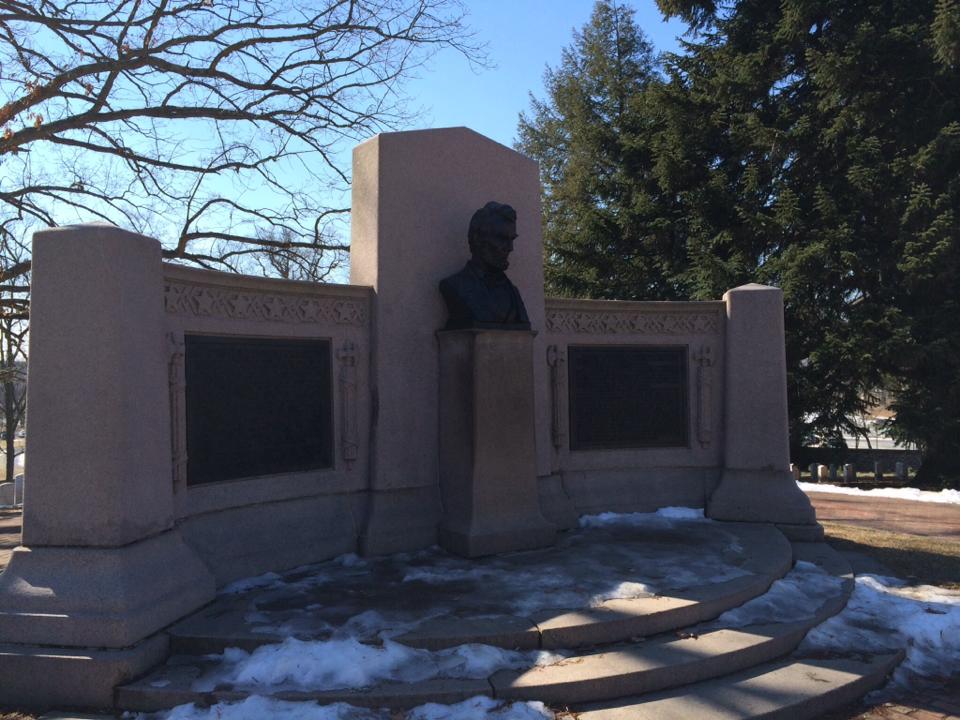
gburgaddressmemorial

Many in the United States and Europe did not agree and argued that no nation found on such principles could long survive. The more reactionary European subscribers of Romanticism ridiculed the “idea that a nation could be founded on a proposition….and they were not reluctant to point to the Civil War as proof that attempting to build a government around something as bloodless and logical as a proposition was futile.” [29]

But Lincoln disagreed. He believed that the “sacrifices of Gettysburg, Shiloh, Murfreesboro, Chancellorsville, and a hundred other places demonstrated otherwise, that men would die rather than to lose hold of that proposition. Reflecting on that dedication, the living should themselves experience a new birth of freedom, a determination- and he drove his point home with a deliberate evocation of the great Whig orator Daniel Webster- “that government of the people, by the people, for the people, shall not perish from the earth.” [30]

The Unitarian pastor and leading Transcendentalist Theodore Parker wrote:

“Our national ideal out-travels our experience, and all experience. We began our national career by setting all history at defiance- for that said, “A republic on a large scale cannot exist.” Our progress since that has shown that we were right in refusing to be limited by the past. The practical ideas of the nation are transcendent, not empirical. Human history could not justify the Declaration of Independence and its large statements of the new idea: the nation went beyond human history and appealed to human nature.” [31]

Likewise Lincoln’s address echoes the thought of George Bancroft who wrote of the Declaration:

“The bill of rights which it promulgates is of rights that are older than human institutions, and spring from the eternal justice…. The heart of Jefferson in writing the Declaration, and of Congress in adopting it, beat for all humanity; the assertion of right was made for the entire world of mankind and all coming generations, without any exceptions whatsoever.” [32]

Parker’s words also prefigured an idea that Lincoln used in his address, that being: The American Revolution, with American history since, is an attempt to prove by experience this transcendental proposition, to organize the transcendental idea of politics. The ideal demands for its organization a democracy- a government of all, for all, and by all…” [33]

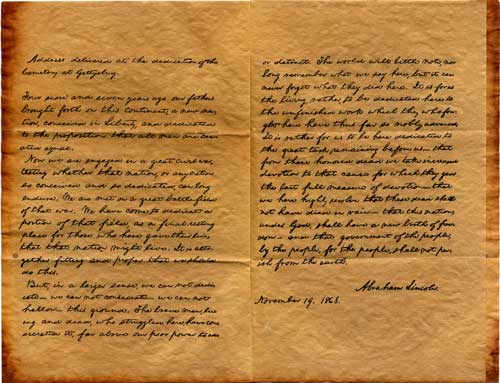
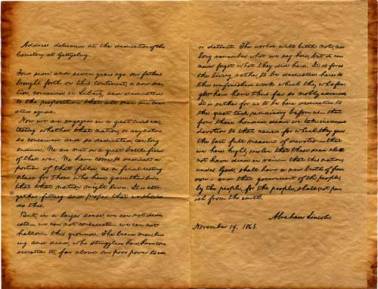
Lincoln delivered these words on that November afternoon:

Four score and seven years ago our fathers brought forth on this continent, a new nation, conceived in Liberty, and dedicated to the proposition that all men are created equal.

Now we are engaged in a great civil war, testing whether that nation, or any nation so conceived and so dedicated, can long endure. We are met on a great battle-field of that war. We have come to dedicate a portion of that field, as a final resting place for those who here gave their lives that that nation might live. It is altogether fitting and proper that we should do this.

But, in a larger sense, we cannot dedicate — we can not consecrate — we can not hallow — this ground. The brave men, living and dead, who struggled here, have consecrated it, far above our poor power to add or detract. The world will little note, nor long remember what we say here, but it can never forget what they did here. It is for us the living, rather, to be dedicated here to the unfinished work which they who fought here have thus far so nobly advanced. It is rather for us to be here dedicated to the great task remaining before us — that from these honored dead we take increased devotion to that cause for which they gave the last full measure of devotion — that we here highly resolve that these dead shall not have died in vain — that this nation, under God, shall have a new birth of freedom — and that government of the people, by the people, for the people, shall not perish from the earth.[34]

In a time where many are wearied by the foibles and follies of our politicians, even wondering about our form of government can survive Lincoln’s words matter. Dr. Allen Guelzo, Professor of Civil War Studies at Gettysburg College wrote in the New York Times:

“The genius of the address thus lay not in its language or in its brevity (virtues though these were), but in the new birth it gave to those who had become discouraged and wearied by democracy’s follies, and in the reminder that democracy’s survival rested ultimately in the hands of citizens who saw something in democracy worth dying for. We could use that reminder again today.” [35]

Dr. Guelzo is quite correct. Many people in this country and around the world are having grave doubts about our democracy. I wonder myself, but I am an optimist. I do believe that we will recover because for the life of me I see no nation anywhere else with our resiliency and ability to overcome the stupidity of politicians, pundits and preachers.

Gettysburg_Unknowns.JPG

The amazing thing was that in spite of everything the Union survived. Lincoln was a big part of that but it was the men who left lives of comfort and security like Joshua Chamberlain and so many others who brought about that victory. Throughout the war, even to the end Southern political leaders failed to understand that Union men would fight and die for an ideal, something greater than themselves, the preservation of the Union and the freedom of an enslaved race. For those men that volunteered to serve, the war was not about personal gain, loot or land, it was about something greater. It was about freedom, and when we realize this fact “then we can contemplate the real meaning of “that cause for which they gave the last full measure of devotion.” [36]
gburg dead2

Now I for one do not think that we are currently living up to the ideals enunciated by Lincoln that day at Gettysburg. I can understand the cynicism disillusionment of Americans as well as those around the world who have for over 200 years looked to us and our system as a “city set on a hill.” That being said, when I read these words and walk that hallowed ground I am again a believer. I believe that we can realize the ideal, even in our lifetime should we desire.

Peace

Padre Steve+

[1] Shaara, Michael. The Killer Angels, Ballantine Books, New York. 1974 p.28

[2] Wills, Garry. Lincoln at Gettysburg: The Words that Remade America Simon and Schuster Paperbacks, New York 1992 p.25

[3] Guelzo Allen C. Fateful Lightening: A New History of the Civil War Era and Reconstruction Oxford University Press, Oxford and New York 2012 p.407

[4] Everett, Edward Letter from Edward Everett to Abraham Lincoln, (Transcription) 20 November 1863 retrieved from http://www.in.gov/judiciary/citc/files/everett-to-lincoln.pdf July 18th 2014

[5] Ibid. Guelzo Fateful Lighteningp.352

[6] Hebert, Walter H. Fighting Joe Hooker University of Nebraska Press, Lincoln and London 1999. Originally published by Bobbs-Merrill, New York 1944

[7] Foote, Shelby, The Civil War, A Narrative. Volume Two Fredericksburg to Meridian Random House, New York 1963 p.758

[8] Ibid. Foote The Civil War, A Narrative. Volume Two p.757

[9] Ibid. Foote The Civil War, A Narrative. Volume Two p.764

[10] Sears, Stephen W. Gettysburg Mariner Books, Houghton Mifflin Company Boston, New York 2004 p.513

[11] McPherson, James M. Tried by War: Abraham Lincoln as Commander in Chief Penguin Books, New York and London 2008 p.200

[12] Harris, William C. With Charity for All: Lincoln and the Restoration of the Union The University Press of Kentucky, Lexington KY 1997 p.7

[13] McPherson, James. The Battle Cry of Freedom: The Civil War Era Oxford University Press, Oxford and New York 1988 p.685

[14] Ibid. McPherson The Battle Cry of Freedom p.685

[15] Ibid. Harris With Charity for All p.7

[16] Ibid. McPherson The Battle Cry of Freedom p.686

[17] Ibid. McPherson The Battle Cry of Freedom p.687

[18] McPherson, James M. This Hallowed Ground Crown Publishers, New York 2003 p.137

[19] Ibid. Wills. Lincoln at Gettysburg p.63

[20] Ibid. Wills. Lincoln at Gettysburg p.64

[21] Ibid. Wills. Lincoln at Gettysburg p.65

[22] Everett, Edward Gettysburg Address retrieved from http://voicesofdemocracy.umd.edu/everett-gettysburg-address-speech-text/ 21 August 2014

[23] Faust, Drew Gilpin, This Republic of Suffering: Death and the American Civil War Vintage Books, a division of Random House, New York 2008 p.100

[24] Ibid. McPherson This Hallowed Ground p.137

[25] Ibid. Guelzo. Fateful Lightening pp.406-407

[26] Ibid. Wills. Lincoln at Gettysburg p.45

[27] Ibid. Everett Gettysburg Address

[28] Ibid. Wills. Lincoln at Gettysburg p.51

[29] Ibid. Guelzo. Fateful Lightening p.409

[30] Ibid. Guelzo. Fateful Lightening p.408

[31] Ibid. Wills. Lincoln at Gettysburg p.110

[32] Ibid. Wills. Lincoln at Gettysburg p.105

[33] Ibid. Wills. Lincoln at Gettysburg p.105

[34] Lincoln, Abraham The Gettysburg Address the Bliss Copy retrieved from http://www.abrahamlincolnonline.org/lincoln/speeches/gettysburg.htm

[35] Guelzo, Allen C. Lincoln’s Sound Bite: Have Faith in Democracy New York Time Opinionator, November 17th 2013 retrieved from http://opinionator.blogs.nytimes.com/2013/11/17/lincolns-sound-bite-have-faith-in-democracy/?_php=true&_type=blogs&_r=0 July 18th 2014

[36] Ibid. McPherson This Hallowed Ground p.138

5 Comments

Filed under civil rights, civil war, Gettysburg, History, leadership, Political Commentary

From the Heart: Padre Steve’s Favorite Songs of Love and Life for Valentine’s Day

Friends of Padre Steve’s World
A Bonus post for Valentine’s Day.
Peace
Padre Steve+

padresteve's avatarThe Inglorius Padre Steve's World

young loves

I have spent many Valentine’s Days away from my wife Judy over the course of my military career. Tonight though, for the second time in a row time. I will be with her. Two years ago  I was stationed away from her and holding the duty pager for the hospital where I served as the Director of Pastoral Care. I added up the time between when I was mobilized from the Army Reserve in 1996 to support the Bosnia Operation until when I returned from Camp Lejeune in August of 2013 and I figured at we had been apart 10 of 17 years due to military assignments. I am glad I am now on my last active duty assignment before retiring in 2017, and God willing won’t have to spend months or years away from her again.

In all of these times I have loved music. I remember dating Judy…

View original post 2,541 more words

Leave a comment

Filed under Loose thoughts and musings

The Desegregation of Baseball and Its Importance Today

robinson-dodgers

John Jorgensen, Pee Wee Reese, Ed Stanky and Jackie Robinson on opening day 1947

“Jackie, we’ve got no army. There’s virtually nobody on our side. No owners, no umpires, very few newspapermen. And I’m afraid that many fans will be hostile. We’ll be in a tough position. We can win only if we can convince the world that I’m doing this because you’re a great ballplayer, a fine gentleman.” Branch Rickey to Jackie Robinson 

My friends, in just a few days pitchers and catchers report for the 2015 Baseball Spring Training and it is time to reflect again on how Branch Rickey’s signing of Jackie Robinson helped advance the Civil Rights of Blacks in the United States. What Rickey did was a watershed, and though it took time for every team in the Major Leagues to integrate, the last being the Boston Red Sox in 1959, a dozen years after Jackie Robinson broke the color barrier.

Branch Rickey shook the foundations of America when he signed Jackie Robinson to a Major League deal in 1947, a year before President Truman desegregated the military and years before Jim Crow laws were overturned in many states.

Robinson and the early pioneers of the game did a service to the nation. They helped many white Americans see that Blacks were not only their equals as human beings, and as it was note about Ernie Banks and others that soon “little white boys wanted to grow up and be Ernie Banks.” 

robinson2-popup

Charles Thomas 

But for Rickey the crusade to integrate baseball began long before 1947. In 1903, Rickey, then a coach for the Ohio Wesleyan University baseball team had to console his star player, Charles Thomas when a hotel in South Bend Indiana refused him a room because he was black. Rickey found Thomas sobbing  rubbing his hands and repeating “Black skin. Black skin. If only I could make them white.” Rickey attempted to console his friend saying “Come on, Tommy, snap out of it, buck up! We’ll lick this one day, but we can’t if you feel sorry for yourself.”

Branch-Rickey

The Young Branch Rickey

Thomas, encouraged by Rickey was remembered by one alumnus who saw a game that Thomas played in noted that “the only unpleasant feature of the game was the coarse slurs cast at Mr. Thomas, the catcher.” However, the writer noted something else about Thomas that caught his eye: “But through it all, he showed himself far more the gentleman than his insolent tormentors though their skin is white.”

Baseball like most of America was not a place for the Black man. Rickey, a devout Christian later remarked “I vowed that I would always do whatever I could to see that other Americans did not have to face the bitter humiliation that was heaped upon Charles Thomas.”

In April 1947 Rickey, now the owner of the Brooklyn Dodgers had one African-American ballplayer at the Dodgers’ Spring Training site in Daytona Beach Florida. The South was still a hotbed of racial prejudice, Jim Crow was the law of the land and Blacks had no place in White Man’s baseball. That player was Jackie Robinson.

Jackie Robinson Shaking Branch Rickey's Hand

Jackie Robinson and Branch Rickey

The Dodgers had been coming to Florida for years. Rickey moved the Dodgers from Jacksonville to Daytona Beach in 1947 after Jacksonville had refused to alter its segregation laws to allow an exhibition game between the Dodgers International League affiliate the Montreal Royals, for whom Robinson starred.

That was the year that Rickey signed Robinson to a minor league contract with the Royals.  When Rickey called up Robinson 6 days prior to the 1947 season, it was  Robinson broke the color barrier for the Dodgers and Major League Baseball. However it would take another 12 years before all Major League teams had a black player on their roster.

It is hard to imagine now that even after Jackie Robinson had broken the color barrier that other teams did not immediately sign black players. However Rickey and Robinson broke the color barrier a year before Harry Truman had integrated the Armed Forces and seven years before the Supreme Court ruled the segregation of public schools illegal. But how could that be a surprise? The country was still rampant with unbridled racism. Outside of a few Blacks in the military and baseball most African Americans had few rights. In the North racism regulated most blacks to ghettos, while in the South, Jim Crow laws and public lynchings of progressive or outspoken Blacks.

But Jackie Robison and Branch Rickey helped bring about change, and soon other teams were following suit.

images-24

Larry Doby (above) and Satchel Paige signed by the Indians

pic1

The Cleveland Indians under their legendary owner Bill Veeck were not far behind the Dodgers in integrating their team. They signed Larry Doby on July 5th 1947. Doby would go on to the Hall of Fame and was a key player on the 1948 Indian team which won the 1948 World Series, the last that the storied franchise has won to this date.

Hank THOMPSON - LENNOX PEARSON BOHEMIA ARCHIVE

Hank Thompson and Roy Campanella

roy-campanella-ap2

The St. Louis Browns signed Third Baseman Hank Thompson 12 days after the Indians signed Doby. But Thompson, Robinson and Doby would be the only Blacks to play in that inaugural season of integration. They would be joined by others in 1948 including the immortal catcher Roy Campanella who signed with the Dodgers and the venerable Negro League pitcher, Satchel Paige who was signed by the Indians.

monte_irvin

Monte Irvin (Above) and Willie Mays

WillieMays

It was not until 1949 when the New York Giants became the next team to integrate. They brought up Monte Irvin and Hank Thompson who they had acquired from the Browns. In 1951 these men would be joined by a young, rookie Willie Mays to become the first all African-American outfield in the Major Leagues. Both Mays and Irvin would enter the Hall of Fame and both are still a key part of the Giants’ story. Despite their age have continued to be active in with the Giants and Major League Baseball.

images-25

Samuel “the Jet” Jethroe

The Boston Braves were the next to desegregate calling up Samuel “the Jet” Jethroe to play Center Field. Jethroe was named the National League Rookie of the Year in 1950.

mlb_a_MinnieMinoso_cmg_600

Minnie Minoso

In 1951 the Chicago White Sox signed Cuban born Minnie Minoso who had played for Cleveland in 1949 and 1951 before signing with the White Sox. Minoso would be elected to 9 All-Star teams and win 3 Golden Gloves.

BANKS-ERNIE

Ernie Banks (above) and Bob Trice

Bob_Trice1953

The Chicago Cubs and Philadelphia Athletics integrated at the end of the 1953 season. The Cubs signed Shortstop Ernie Banks who would go on to be a 14 time All-Star, 2 time National League MVP and be elected to the Hall of Fame in 1977 on the first ballot. The Athletics called up pitcher Bob Trice from their Ottawa Farm team where he had won 21 games. Trice only pitched in 27 Major League games over the course of three seasons with the Athletics.

6RI1

Curt Roberts

Four teams integrated in 1954. The Pittsburgh Pirates acquired Second Baseman Curt Roberts from Denver of the Western League as part of a minor league deal. He would play 171 games in the Majors.  He was sent to the Columbus Jets of the International League in 1956 and though he played in both the Athletics and Yankees farm systems but never again reached the Majors.

1954_alston_tom

Tom Alston

The St. Louis Cardinals, the team that had threatened to not play against the Dodgers and Jackie Robinson in 1947 traded for First Baseman Tom Alston of the Pacific Coast League San Diego Padres. Alston would only play in 91 Major League games with his career hindered by bouts with depression and anxiety.

100005

Nino Escalara (above) and Chuck Harmon

Chuck_Harmon

The Cincinnati Reds brought up Puerto Rican born First Baseman Nino Escalera and Third Baseman Chuck Harmon. Harmon had played in the Negro Leagues and had been a Professional Basketball player in the American Basketball League. Harmon who was almost 30 when called up played just 4 years in the Majors. Both he and Escalera would go on to be Major League scouts. Escalera is considered one of the best First Baseman from Puerto Rico and was elected to the Puerto Rican Baseball Hall of Fame. Harmon’s first game was recognized by the Reds in 2004 and a plaque hangs in his honor.

Carlos-Paula

The Washington Senators called up Cuban born Center Fielder Carlos Paula from their Charlotte Hornets’ farm team in September 1954. Paula played through the 1956 season with the Senators and his contract was sold to the Sacramento Salons of the Pacific Coast League. He hit .271 in 157 plate appearances with 9 home runs and 60 RBIs. He died at the age of 55 in Miami.

elston-howard

Elston Howard

In April 1955 the New York Yankees finally integrated 8 years after the Dodgers and 6 years after the Giants. They signed Catcher/Left Fielder Elston Howard from their International League affiliate where he had been the League MVP in 1954. Howard would play 13 years in the Majors with the Yankees and later the Red Sox retiring in 1968. He would be a 12-time All Star and 6-time World Series Champion as a player and later as a coach for the Yankees. He died of heart disease in 1980.  His number #32 was retired by the Yankees in 1984.

58 kennedy, john f

The Philadelphia Phillies purchased the contract of Shortstop John Kennedy from the Kansas City Monarchs of the Negro League at the end of the 1956 season. Kennedy played in just 5 games in April and May of 1957.

osvaldo4_195

 Ozzie Virgil Sr.

In 1958 the Detroit Tigers obtained Dominican born Utility Player Ozzie Virgil Sr. who had played with the Giants in 1955 and 1956. Virgil would play 9 seasons in the Majors with the Giants, Tigers, Athletics and Pirates and retire from the Giants in 1969. He later coached for 19 years in the Majors with the Giants, Expos, Padres and Mariners.

Pumpsie_Green_1962_Topps

The last team to integrate was the Boston Red Sox who signed Infielder Pumpsie Green. Green made his debut on 21 July 1959 during his three years with the Red Sox was primarily used as a pinch runner. He played his final season with the New York Mets in 1963. He was honored by the Red Sox in 2009 on the 50th anniversary of breaking the Red Sox color barrier.

little-rock-stop-the-race-mixing

voter-registration-mississippi-1960-L-umRewg

luther-king

It took 12 years for all the teams of the Major Leagues to integrate, part of the long struggle of African Americans to achieve equality not just in baseball but in all areas of public life.  These men, few in number paved the way for African Americans in baseball and were part of the inspiration of the Civil Rights Movement itself.  They should be remembered by baseball fans, and all Americans everywhere for their sacrifices and sheer determination to overcome the obstacles and hatreds that they faced. It would not be until August of 1963 that Martin Luther King Jr. would give his I Have a Dream speech and 1964 that African Americans received equal voting rights.

robbyii

Spring training for the 2015 season is about to begin in Florida and Arizona, in what are called the Grapefruit and Cactus Leagues. It is hard to believe that only 68 years ago that only one team and one owner dared to break the color barrier that was, then, and often today is still a part of American life.

However in those 68 years despite opposition and lingering prejudice African Americans in baseball led the way in the Civil Rights Movement and are in large part responsible for many of the breakthroughs in race relations and the advancement of not only African Americans, but so many others.

We can thank men like Charles Thomas, Jackie Robinson and Branch Rickey for this and pray that we who remain, Black and White, Asian, and Latin American, as well as all others who make up our great nation will never relinquish the gains that have been won at such a great cost.

obamafirstpitch

President Obama throwing out the First Pitch for the Washington Nationals

Today we have a Black President who has the same kind of racial epitaphs thrown at him every day by whites who as they did to Charles Thomas, Jackie Robinson and so many other pioneers, Frankly such behavior can only be called what is it, unrepentant, unabashed, and evil racism. The fact is that such people don’t think that any Black man should hold such high an office, just as they did not think that Blacks should be allowed to play integrated baseball. It is anathema to them, and that is why their unabashed hatred for Obama runs so deep. They may disagree with his policies, but I guarantee if Obama was white, their opposition to him would be far more civil and respectful. But because he is half-black, and has a funny name they hate him with a passion, a passion that scares me, because words  and hateful beliefs can easily become actions.

Racism still exists, but one day thanks to the efforts of the early ball-players as well as pioneers like President Obama, and the undying commitment of decent Americans to accept people regardless of race, ethnicity, gender, religion, or even sexual orientation, we will see a new birth of freedom.

Peace

Padre Steve+

Leave a comment

Filed under Baseball, civil rights, History, political commentary

A Time to Stand Against Hate

12CAROLINA2jp-master315

First they came for the communists, and I did not speak out—because I was not a communist;
Then they came for the socialists, and I did not speak out—because I was not a socialist;
Then they came for the trade unionists, and I did not speak out—because I was not a trade unionist;
Then they came for the Jews, and I did not speak out—because I was not a Jew;
Then they came for me—and there was no one left to speak out for me.

 Martin Niemöller

There comes a time in every nation where people of faith need to stand up for the rights of others who do not share their faith. There are times at all decent citizens no matter what their religion, or lack of religion need to stand up for those deemed less than full citizens, less than loyal, and in some cases less than human. This is one of those times.

On Wednesday three young America students at the University of North Carolina; Deah Barakat, his wife Yusor Mohammad Abu-Salha and her sister Razan Mohammad Abu-Salha, were gunned down, execution style, in their home.  They were each shot multiple times in  the head. They were Moslems, and from all account not only good law abiding people who hated intolerance of any kind, even to Jews and Israelis, who were active in helping the poor and homeless in their local community, and just basically good, idealistic, humanitarians.

Their assailant Craig Stephen Hicks, was a man who doesn’t fit a typical right wing, at least from the terms of the Religious Right, or Left Wing stereotype.

All that we really know about him was that neighbors described him as angry and confrontational, that some feared him, that he was anti-government, unemployed, and hated the major religions; especially Christianity, Islam, and Judaism. He was also evidently a pretty big fan of expanded gun rights, which for a man in his state of mind isn’t unusual. His current wife, who is in the process of divorcing him described him as supporting marriage equity, abortion rights and other socially progressive causes.

12CAROLINAweb2-master315

It is quite fascinating to me that Craig Stephen Hicks, was a follower of Richard Dawkins and what is called “the New Atheism” which more appropriately should be called anti-theism. This makes his case somewhat unusual, because he would be one of first of this breed in the United States to kill others in such a manner. Of course this is not to say that such people haven’t committed such acts on a mind-numbingly large scale in the former Soviet Union, Red China and other repressive atheist regimes. Likewise there are nations where state religions working hand in hand with the state do that as well.

But most of the time, recently in this country and Western Europe, those who kill others because of those  peoples religious beliefs, are religious themselves and defending their idea of God and righteousness. That my friends is what makes the act of barbarous hatred committed by Hicks so interesting from a sociological and historical point of view.

It is also why I don’t believe the claims by the soon to be ex-wife of Hicks, the police or the prosecutor that this was an isolated incident dealing with a dispute of guest parking in the condominium complex where the victims and the killer lived. That’ why the story just doesn’t wash, and the fact that it doesn’t wash causes it to stink.

Really, let’s face it, if Hicks was a Moslem and the victims were atheists would anyone believe that story? The hell no. But there are people who will not only believe it but as usual say this is a “isolated incident” because after all, white people in America don’t kill others for their religion, but that Moslems do and so a Moslem is automatically guilty of crimes simply by being a Moslem.

Evidently the killer’s ex-wife described him Hicks as a man without empathy, who incessantly watched the movie Falling Down while laughing his way through it. If you don’t know the movie it is about an unemployed engineer, angry for many reason, who goes mad and ends up in a killing spree. It is a tragic film, and I wonder if Hicks if Hicks saw himself as similar to the lead character played by Michael Douglas.

I don’t know what the final tipping point was for Hicks. From what I read he seemed like a mountain of hatred and anger just waiting to erupt.

While I don’t know his entire motivations, I do know that somewhere in his perverted psyche, he was motivated by hate, and that is all too common. Eric Hoffer said: “Passionate hatreds can give meaning and purpose to an empty life. These people haunted by the purposelessness of their lives try to find a new content not only by dedicating themselves to a holy cause but also by nursing a fanatical grievance.”   

Hicks found some measure of purpose in his hatred of religion. It is said that he was quite angry at the Christians and Jews who  participated together with Moslems and others in the ecumenical memorial services after the attacks of September 11th 2001. Evidently, that anger toward religions and religious people grew until it reached the point of murder.

Sadly, there are many people like this man who are consumed by some kind of hatred. In this case it appears to me, and I could be wrong, that it was Hicks’s hatred of Moslems and other religious people. I cannot think of any other reason why the man would execute unarmed people for a parking space, unless they represented something more to him.

The hatred something that the actions of the Islamic State, Al Qaeda, the Taliban, Boko Haram and other terrorist groups that claim the mantle of Islam  have helped to inspire. That hatred is also fed by much of the media, as well as supposedly Christian political pundits and preachers who lump all Moslems into the same camp as the terrorists and ignores the Moslems who condemn such actions and who put their lives on the line to fight those groups. This “reporting” feeds the fear, it feeds the anger of some, and it leads to people, especially people who are already angry, disturbed and possibly even mentally ill, to commit crimes in name of their religion or their ideology. In Hicks case it appears to be his militant atheism.

But let’s step back from that right now, and sometimes it is good to look at things in with a broader lens.

It seems to me that among the worst of the types of people promoting such hatred of Moslems are supposedly conservative “Christian” preachers. So I feel that I need to speak up. I say this because such hatred against a religion, any religion is not new. Militant Hindus in India kill Moslems and Christians, of course we know of the crimes of the terrorists who kill in the name of Islam, but there are places in Africa where Christians do the killing, and sometimes not even for religious reasons. Does anyone remember the Rwanda Genocide? But that is not an isolated instance, in Central and South America there were the American funded dictators and terrorist groups who had death squads all over the place, many killing to defend their “conservative Christian regimes.”

This kind of thing happens all the time and sometimes it takes place under godless regimes who co-opt religious people to bolster their evil. Chief among the times this happened was in Nazi Germany. My examples from that era include Protestant pastors Martin Niemöller, Dietrich Bonhoeffer, and Herman Maas, and Catholic Biship Galen and Jesuit Priest Father Rupert Meyer of Munich. All were imprisoned or placed in Concentration Camps by the Nazis, and Bonhoeffer was be killed. Maas was the first non-Jewish German to be officially invited to the newly formed state of Israel in 1950. In July 1964 Yad Vashem recognized the Maas as one of the Righteous Among the Nations. Of course there were others who died for attempting to help the Jews, including some European Moslems.

When Hitler took power the Jews, along with Communists, Trade Unions, Socialists were enemies of the state.  They were banned from the military, civil service and other government employment, professional associations and forced to wear a gold Star of David on their clothing.  Their property was seized, they were abused by SA men acting as deputized auxiliary police, times their businesses, Synagogues and homes vandalized, burned or seized by the state. Eventually those who remained were condemned  and sent to concentration camps, where most with nearly 6 million other Jews they would be exterminated.

Today we face a similar situation in United States and Western Europe.  This time it is not the Jews, but Moslems who are the targets of xenophobic rage by many influential members of the “conservative” media.

The ideological inspiration for the killings at Chapel Hill seems to be from English Atheist Richard Dawkins. Dawkins wrote something that the killer repeated almost verbatim in his social media posts: “All three of the Abrahamic religions are deeply evil if they take their teachings seriously. Islam is the only one that does.” Of course Dawkins statement is overblown because there are some Christians and Jews who kill in the name of religion. In fact as far as Christianity goes we have a host of them who litter our history justifying killing in the name of the Lord. To his credit Dawkins condemned the killings soon after they happened, however, his hyperbole and lumping together all religion as evil has the same effect on some people as the teachings of the radical religious preachers of hate whose ranks seem to grow daily.

Others, especially in parts of the Christian Right who have great sway in conservative politics and the Republican party advocate policies similar to the Nazi Nurnberg Laws and the Aryan Paragraph.  Threats to deny loyal American Moslems the right to serve in the military, security organizations, government positions and academia are common today. More extreme are threats to put all-Moslems “behind razor wire” as we did to American Japanese citizens in World War II, or to deport them as the Nazis did to the Jews before the “Final Solution”  are even more chilling.

wade-michael-page-nazi-flag

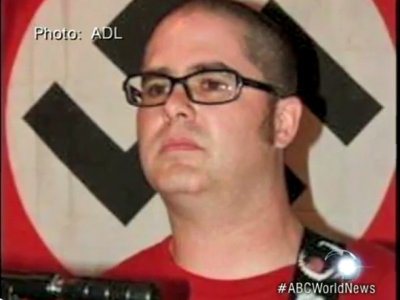
Wade Page

Of course there was the mass killing by neo-Nazi Wade Page in Oak Park Illinois in October 2012, like Hicks he was filled with hate toward religion, and took his out on the members of the Sikh Temple.

roeder190

Scott Roeder

I wonder how Christians would react if an atheist or someone on the political left suggested that all conservative Christians or members of pro-Life groups be imprisoned for the actions of Christians or pro-Life movement members like Scott Roeder or Eric Rudolph who killed to stop abortion or the late Fred Phelps and his Westboro Baptist Church? Likewise I wonder what atheists would do if someone suggested putting everyone who followed Richard Dawkins, Bill Maher, or Sam Harris in camps or depriving them of citizenship for the actions of someone like Hicks?

Thankfully, there are a few on the  Religious Right who have taken a stand. Reverend Rob Schenck, President of the National Clergy Council, commented in regard to the Moslem prayer vigil in Washington D.C. in 2009:  “With over 1.5 billion Muslims in the world, it is important that Christians have an open dialogue with the Islamic community. The church must never be timid in reaching out to peoples and groups with differing beliefs and traditions. Too much is at stake for future generations not to begin this historic conversation. This is an opportunity that we cannot afford to miss.”

What the people who advocate punitive actions against American Moslems do is dangerous, not just for Moslems and other minorities but for them.  American and English law is based on legal precedence.  Once something has been determined to be legal, or constitutional it is considered by the law to be settled law.  The law is a two edged sword and those who want to use it to have the state enforce their religious, social, ideological or political beliefs on others need to remember what comes around goes around.

Niemöller would discover this the hard way prison telling one interviewer after the war:

“I find myself wondering about that too. I wonder about it as much as I regret it. Still, it is true that Hitler betrayed me. I had an audience with him, as a representative of the Protestant Church, shortly before he became Chancellor, in 1932. Hitler promised me on his word of honor, to protect the Church, and not to issue any anti-Church laws. He also agreed not to allow pogroms against the Jews, assuring me as follows: ‘There will be restrictions against the Jews, but there will be no ghettos, no pogroms, in Germany. I really believed given the widespread anti-Semitism in Germany, at that time—that Jews should avoid aspiring to Government positions or seats in the Reichstag. There were many Jews, especially among the Zionists, who took a similar stand. Hitler’s assurance satisfied me at the time. On the other hand, I hated the growing atheistic movement, which was fostered and promoted by the Social Democrats and the Communists. Their hostility toward the Church made me pin my hopes on Hitler for a while. I am paying for that mistake now; and not me alone, but thousands of other persons like me.”

It is easy for well meaning  to be bought with promises of support by politicians and media types who speak the words they want to hear in difficult times. We have entered a dangerous phase of American, and for that matter world history.

The killing of these three young American by this hate filled man should be a wake up call to all of us. It is time to start giving a damn and standing up to those who inspire and promote such hatred, no matter what their race, creed, or ideology. We have to stand up against hate. If we do not we are no better than all of those who throughout history turned their backs as others committed the most horrible crimes against humanity.

Peace,

Padres Steve+

7 Comments

Filed under christian life, civil rights, ethics, faith, History, Political Commentary, Religion

Fighting Prejudice on the Western Front 1918

800px-Harlem_Hell_Fighters

They were Americans who in spite of prejudice and in spite of intolerance and persecution loved their country. They were men who labored under the most difficult circumstance to show all Americans and the world that they were worthy of being soldiers and citizens of the United States of America.

They were all volunteers and many of them were veteran soldiers had already served full careers on the Great Plains. They were the Buffalo Soldiers, and when the United States entered the First World War, they were not wanted. Instead, the veterans  were left on the frontier and a new generation of African American draftees and volunteers became the nucleus of two new infantry divisions, the 92nd and 93rd.

lossy-page1-795px-Negro_Troops_in_France._Picture_shows_part_of_the_15th_Regiment_Infantry_New_York_National_Guard_or_._._._-_NARA_-_533488.tif


However in the beginning they too were kept out of action. These men were initially regulated to doing labor service behind the lines and in the United States. But finally, the protests of organizations such as the NAACP and men like W.E.B.DuBois and Phillip Randolph forced the War Department to reconsider the second class status of these men and form them into combat units.

hqdefault1a

Despite this the leadership of the AEF, or the American Expeditionary Force of General John Pershing refused to allow these divisions to serve under American command. Somehow the concept of such men serving alongside White Americans in the “War to end All War” was offensive to the high command.

Instead these divisions were broken up and the regiments sent to serve out of American areas on the Western Front. The regiments of the 93rd Division were attached to French divisions. The 369th “Harlem Hellfighters” were first assigned to the French 16th Division and then to the 161st Division.

The 370th “Black Devils” were detailed to the French 26th Division and the 371st and 372nd Infantry Regiments were assigned to the French 157th (Colonial) Division, which was also known as the Red Hand Division.

These units performed with distinction. The 371st was awarded the French Croix de Guerre and Légion d’honneur and Corporal Freddie Stowers of the 1st Battalion 371st was the only African American awarded the Congressional Medal of Honor in the First World War. The 372nd was also awarded the Croix de Guerre and Légion d’honneur for its service with the 157th Division.

6ASAF00Z

The 157th (Colonial) Division had suffered badly during the war and been decimated in the unrelenting assaults in the trench warfare of the Western Front. It was reconstituted in 1918 with one French Regiment and two American regiments, the Negro 371st and 372nd Infantry. On July 4th 1918 the commanding General of the French 157th Division, General Mariano Goybet issued the following statement:

“It is striking demonstration of the long standing and blood-cemented friendship which binds together our two great nations. The sons of the soldiers of Lafayette greet the sons of the soldiers of George Washington who have come over to fight as in 1776, in a new and greater way of independence. The same success which followed the glorious fights for the cause of liberty is sure to crown our common effort now and bring about the final victory of right and justice over barbarity and oppression.”

220px-Red_Hand_Division

While many white American soldiers depreciated their French hosts and attempted to sow the seeds of their own racial prejudice against the black soldiers among the French, Southerners in particular warned the French of  the “black rapist beasts.” However the French experience of American blacks was far different than the often scornful treatment that they received from white American soldiers.

“Soldiers from the four regiments that served directly with the French Army attested to the willingness of the French to let men fight and to honor them for their achievements. Social interactions with French civilians- and white southern soldiers’ reactions to them- also highlighted crucial differences between the two societies. Unlike white soldiers, African Americans did not complain about high prices in French stores. Instead they focused on the fact that “they were welcomed” by every shopkeeper that they encountered.”

Official and unofficial efforts by those in the Army command and individual soldiers to stigmatize them and to try to force the French into applying Jim Crow to laws and attitudes backfired. Villages now expressed a preference for black over white American troops. “Take back these soldiers and send us some real Americans, black Americans,” wrote one village mayor after a group of rowdy white Americans disrupted the town.”

Stowers

The citation for Corporal Stowers award of the Medal of Honor reads as follows:

Corporal Stowers, distinguished himself by exceptional heroism on September 28, 1918 while serving as a squad leader in Company C, 371st Infantry Regiment, 93d Division. His company was the lead company during the attack on Hill 188, Champagne Marne Sector, France, during World War I. A few minutes after the attack began, the enemy ceased firing and began climbing up onto the parapets of the trenches, holding up their arms as if wishing to surrender. The enemy’s actions caused the American forces to cease fire and to come out into the open. As the company started forward and when within about 100 meters of the trench line, the enemy jumped back into their trenches and greeted Corporal Stowers’ company with interlocking bands of machine gun fire and mortar fire causing well over fifty percent casualties. Faced with incredible enemy resistance, Corporal Stowers took charge, setting such a courageous example of personal bravery and leadership that he inspired his men to follow him in the attack. With extraordinary heroism and complete disregard of personal danger under devastating fire, he crawled forward leading his squad toward an enemy machine gun nest, which was causing heavy casualties to his company. After fierce fighting, the machine gun position was destroyed and the enemy soldiers were killed. Displaying great courage and intrepidity Corporal Stowers continued to press the attack against a determined enemy. While crawling forward and urging his men to continue the attack on a second trench line, he was gravely wounded by machine gun fire. Although Corporal Stowers was mortally wounded, he pressed forward, urging on the members of his squad, until he died. Inspired by the heroism and display of bravery of Corporal Stowers, his company continued the attack against incredible odds, contributing to the capture of Hill 188 and causing heavy enemy casualties. Corporal Stowers’ conspicuous gallantry, extraordinary heroism, and supreme devotion to his men were well above and beyond the call of duty, follow the finest traditions of military service, and reflect the utmost credit on him and the United States Army.

Corporal Stowers is buried at the Meuse-Argonne American Cemetery. The award of the Medal of Honor was not made until 1991 when President George H. W. Bush presented it to Stowers’ two surviving sisters.

The contrast between the American treatment of its own soldiers and that of the French in the First World War is striking. The fact that it took President Harry S. Truman to integrate the U.S. Military in 1948 is also striking. African Americans had served in the Civil War, on the Great Plains, in Cuba and in both the European and Pacific Theaters of Operation in the Second World War and were treated as less than fully human by many Americans.

770px-369th_15th_New_York

Men of the 371st and 372nd Infantry Regiments of the French 157th Division Awarded the Croix d’Guerre

Even after President Truman desegregated the armed forces in 1948, African Americans, as well as other racial minorities, women and gays have faced very real discrimination. The military continues to make great strides, and while overt racist acts and other types of discrimination are outlawed, racism still remains a part of American life.

Today things have changed, and that in large part is due to the unselfish sacrifice in the face of hatred and discrimination of the men of the USCT and the State Black Regiments like the 54th Massachusetts and the Louisiana Home Guards who blazed a way to freedom for so many. Those who followed them as Buffalo Soldiers and volunteers during the World Wars continued to be trail blazers in the struggle for equal rights. A white soldier who served with the 49th Massachusetts wrote “all honor to our negro soldiers. They deserve citizenship. They will secure it! There would be much suffering in what he termed “the transition state” but a “nation is not born without pangs.”

Unfortunately racial prejudice is still exists in the United States. In spite of all the advances that we have made racism still casts an ugly cloud over our country. Despite the sacrifices of the Buffalo Soldiers, the leaders of the Civil Rights movement and others there are some people who like the leaders of the AEF in 1917 and 1918 cannot stomach having blacks as equals or God forbid in actual leadership roles in this country.

A good friend of mine who is a retired military officer, a white man, an evangelical Christian raised in Georgia who graduated from an elite military school in the South, who is a proponent of racial equality has told me that the problem that many white people in the South have with President Obama is that “he doesn’t know his place.” Yes racism is still real and rears its ugly head all too often.

Peace

Padre Steve+


1 Comment

Filed under civil rights, civil war, History, leadership, Military, Political Commentary

Right Wing Christian Political Correctness

dyer-hanging

“religions give people identity by positing a basic distinction between believers and non-believers, between a superior in-group and a different and inferior out-group.”

There is an epidemic of political correctness in the United States today.

Of course if you listen to Fox News, most Evangelical preachers, or conservative pundits that is always blamed on secularists or liberals who are almost universally defamed by such critics. They are accused of being communists, fascists, atheists and even worse for simply positing that they don’t believe, that they might have doubts, or that like Thomas Jefferson, James Madison or the early Virginia Baptist leader and friend of both Madison and Jefferson, John Leland argued that no religion should have the franchise on or control of the government.

For this they are accused of being politically correct, or enforcing political correctness, when in fact they are actually politically incorrect, because they dare question the minority of people who have the real political and economic power in this country, Conservative Christians.

I have run into this political correctness, that of Christian political correctness. Dare come to the defense of the civil rights of Gays or Lesbians and see what happens. Defend someone who questions the faith, see what happens. Defend the rights of non-Christian minorities and see what happens. If you do you will be attacked, condemned, and defamed. You will be called all matters of things, and if you are a member of such a church you will be expelled. I know, because I was.

You see for me I am an American and I will defend the rights of all Americans to their beliefs so long as they do not try to use the police power of the government to shove those beliefs down my throat. Equity is for all. I have served for over 33 years in the military alongside Americans of every race, creed, political belief and ideology, and yes even sexual preference. I have seen people excel, I have seen people promote the rights of others, and I have seen witch hunts done not in the name of the law, or any real American principle, but on the basis of conservative Christian religious beliefs being sold as the only true American beliefs.

That my friends is the ultimate political correctness. It is the political correctness that has to defend itself by invoking the wrath of the Almighty against unbelievers. It is that of the Inquisitors, the Crusaders, the Taliban, Al Qaeda, Boko Haram, Calvin’s Geneva, Zwingli’s Zurich, Cromwell’s England, Orthodox Russia and a host of other theologically based “government.”

That kind of government is called “theocracy.” It is what many of those who came to this country sought to flee, except that some like the Puritans of the Massachusetts Bay Colony decided to use their new freedom away from the Church of England to persecute Baptists, Quakers and others, especially women who they accused of witchcraft. It as as Robert Heinlein said: “Almost any sect, cult, or religion will legislate its creed into law if it acquires the political power to do so.”

I have seen the results of such religious hatred in the Balkans and the Middle East. I will fight to make sure that it doesn’t happen here, even if that means that fellow Christians condemn me and dare to say that I am not a Christian. I will be politically incorrect, the real kind of political incorrectness that is the most unsettling to “true believers,” that of the questioning believer who defends unbelievers.

Like Eric Hoffer, Thomas Jefferson, James Madison and so many others I recognize the danger posed by those who believe that they are God’s chosen people destined to carry out their understanding of God’s will on earth.

As Jefferson said:

“I know it will give great offense to the clergy, but the advocate of religious freedom is to expect neither peace nor forgiveness from them.” 

I expect neither, and I will advice for all, inspire of the Right Wing Christian Political Correctness that dominates in this country. The people that Eric Hoffer called “true Believers.” people who are likely to see themselves  “as one of the chosen, the salt of the earth, the light of the world, a prince disguised in meekness, who is destined to inherit the earth and the kingdom of heaven too. He who is not of his faith is evil; he who will not listen will perish.”

Just read the people who write and espouse Dominionist or Seven Mountains theology. They are the ones running the asylum of the Christian Right today. Look it up, or look at any of the articles that I have written about them. They are not the fringe anymore, they run the Republican Party and almost every one of the potential Republican Presidential Candidates espouse those views, or are afraid to stand up to them. Likewise most of the mainstream media gives them a pass, because they too are afraid of them, they are afraid of being called “politically correct.”

Barry Goldwater, the progenitor of the modern conservative movement warned us about them: He said in 1994:

“Mark my word, if and when these preachers get control of the [Republican] party, and they’re sure trying to do so, it’s going to be a terrible damn problem. Frankly, these people frighten me. Politics and governing demand compromise. But these Christians believe they are acting in the name of God, so they can’t and won’t compromise. I know, I’ve tried to deal with them.”

I am no longer afraid, because I have nothing to lose besides my soul, at least that’s what I am told. Frankly I would rather be [part of the inferior “out group” than any part of this supposedly superior “in group.” 

Peace,

Padre Steve+

3 Comments

Filed under civil rights, faith, News and current events, Political Commentary, Religion