Monthly Archives: March 2015

Anti-Liberty Religious Liberty

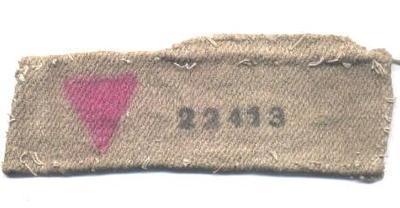
pink-triangle-armband

“History, I believe, furnishes no example of a priest-ridden people maintaining a free civil government. This marks the lowest grade of ignorance, of which their civil as well as religious leaders will always avail themselves for their own purposes.” Thomas Jefferson

While I am a historian and should know better, I am amazed to see many American Christians doing all they can in the name of protecting their Religious Liberty to deny rights to those that they disapprove. I shouldn’t be surprised, Thomas Jefferson wrote of what happens when preachers and priests lead political movements. James Madison, who crafted the Bill of Rights, including the First Amendment wrote:

“Who does not see that the same authority which can establish Christianity, in exclusion of all other religions, may establish with the same ease any particular sect of Christians, in exclusion of all other sects?”

Currently this is the case with the Republican Party, a party which I remind you that I belonged for over three decades, beginning with my work for the Ford campaign as a high school student. I left the GOP in 2008 after years of disillusionment, and lies when I returned from Iraq.

Barry Goldwater, a conservative if there ever was one, a man that would be driven out of today’s GOP spoke on the Senate floor in the early 1980s at the beginning of the Reagan Revolution and the commandeering of the party by politically minded preachers like Jerry Falwell, James Robertson, Dr. D. James Kennedy, James Dobson and of course our local Tidewater Taliban Mullah, Pat Robertson. Goldwater so wisely noted:

“Mark my word, if and when these preachers get control of the [Republican] party, and they’re sure trying to do so, it’s going to be a terrible damn problem. Frankly, these people frighten me. Politics and governing demand compromise. But these Christians believe they are acting in the name of God, so they can’t and won’t compromise. I know, I’ve tried to deal with them.”

Well, now the preachers have control. Some are suggesting that thousands of preachers run for office in the GOP in order to foist their agenda on the rest of the population. Right now Conservative Christians for all intents and purposes run many state legislatures. In the ones that they have controlled for the past number of years they have been enacting all sorts of discriminatory laws against those they find offensive, and have attempted to shackle the study of science, history, and roll back voting rights for minorities.


This is particularly true of the conservative Christian, antipathy towards Gays, Lesbians and others in the LGBT community. In the past number of weeks I have seen proposed legislation in several states that would allow people to discriminate against anyone simply based on a sincerely held religious belief.  

Other laws passed within the past month at the state level in Arkansas and West Virginia nullify any city or county ordinances banning discrimination against gays. In other words, religious zealots in control of state houses are imposing heir beliefs on cities, towns and counties which are more progressive in regard to the treatment of gays. The irony is that the people who complain about Federal laws which trump state law are doing the same thing that they object to in order to ensure that citizens of their states are treated less than equal.

The target of these laws are gays and the LGBT community, but anyone with half a brain knows that once they are on the books they provide ample room for religious zealots of any kind to discriminate and even persecute those that they despise.  They may start with the gays, but be assured, those who pass these laws will extend them to apply to anyone to whom they believe harms or interferes with their sincerely held religious beliefs. Jefferson also noted that “In every country and in every age, the priest has been hostile to liberty. He is always in alliance with the despot, abetting his abuses in return for protection to his own.”

It is something that our founders wisely chose to avoid, not wanting this nation to become like the European nations whose state churches had denied rights, persecuted and killed those that they deemed heretical. While the proponents of these new laws to “protect” religious liberty claim that they are done with no intent to discriminate, there is only one reason to enact them, that to give legal protection to people who want to discriminate. Is this not what is happening throughout the Middle East as Islamic fundamentalists of various sects impose similar laws on Christians as well as others including Moslems of rival sects?

Now just imagine for one moment living in such a society, a society where someone who was not of the right race, or belief did not enjoy the same freedoms of other citizens. Imagine a society where those that started with laws to supposedly defend their religious liberty, or rights then supported other more far reaching laws, laws which deprived those that they demonized and refused to serve of citizenship, freedom of association, freedom of movement, and robbed them of their homes and businesses, banished them to ghettos and eventually exterminated them. While the Nazis primarily went after the Jews, they also went after the gays.

Of course the Nazis did this in the years leading up to World War Two in their actions against loyal German Jews who simply wanted to fit in, and well we Americans, let’s not even go there… but the let’s go there. We have the extermination and the ghettoization of our Native American population, we have the African slave trade and the institution of slavery, we have the human trafficking and exploitation of Chinese workers in the 1800s, the Jim Crow Laws, and yes the incarceration of Japanese Americans in what we called “internment camps” in World War Two.

Now for one minute tell me that those that propose such barbarous laws now to be used against the gays, simply because Christians want to have a law that allows them to discriminate against those they hate and condemn to hell are that much different than those Christians, be they American or German who justified their actions with law based on their deeply and sincerely held religious beliefs? I think not. In fact the whole proposition that we enact such laws flies in the face of the wars that these same people want to send in the ground troops to fight Islamic State over. Heck, the Islamic State is actually acting out the fantasies of the most extreme American Christian anti-gay preachers. They are killing gays, throwing them off the roofs of tall buildings. Sadly, many American Christians, so consumed by the hate and paranoia being preached in their churches and by right-wing political groups posing as Christian ministries don’t see that their actions are simply a different breed of the same animal. Right now, the difference is just a matter of degree.

I think that is why Thomas Jefferson wrote this very pertinent warning to us who might want to return to the barbarous ways of our ancestors:

“I know also, that laws and institutions must go hand in hand with the progress of the human mind. As that becomes more developed, more enlightened, as new discoveries are made, new truths disclosed, and manners and opinions change with the change of circumstances, institutions must advance also, and keep pace with the times. We might as well require a man to wear still the coat which fitted him when a boy, as civilized society to remain ever under the regimen of their barbarous ancestors.” 

I personally do not want to live under the laws of our barbarous ancestors, and I will fight for the rights of those who are being targeted, primarily the LGBT community, but anyone else, by the lawmakers and supporters of such laws.

So have a great Sunday,

Peace

Padre Steve+

6 Comments

Filed under LGBT issues, News and current events, Political Commentary, Religion

Bloody Sunday at 50

bloody-sunday-selma-alabama-1965-852

Today Representative John Lewis led a thousands of people on a march to commemorate the March 7th 1965 Selma march, a march that the then 25 year old Lewis, working for voting rights as a leader of the SNCC, the Student Non-Violent Coordinating Committee both led and organized.  In today’s march, Lewis was accompanied by President Barak Obama and nearly 100 members of Congress. They were joined by former President George W. Bush and his ice Laura. Though about two dozen Republican members attended, sadly, of the Republican House or Senate leadership only Majority Leader Kevin McCarthy bothered to show, changing his mind late Friday. Lewis remarked today:

“We come to Selma to be renewed. We come to be inspired. We come to be reminded that we must do the work that justice and equality calls us to do…”

This is profoundly important today.

In 1965, the political and police leaders of Alabama, including Governor George Wallace, as well as those of Selma, determined to stop any movement that might advance the cause of blacks acted to crush the marchers.  Wallace denounced the march as a threat to public safety and promised to stop it. He ordered the State Police to take all measures to ensure that it did not happened. In Selma, the county sheriff ordered all adult white males to report to the courthouse to be deputized.

background02

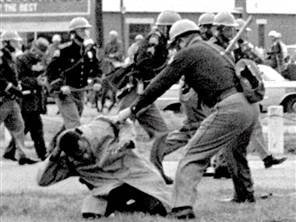
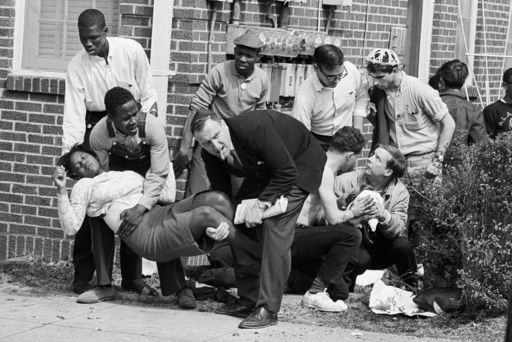
On the 7th some 550-600 protesters led by Lewis and the Reverend Hosea Williams and began their march. All went well until they crossed the Edmund Pettus Bridge. There they ran into a phalanx of State Police. The commander of those men ordered the marchers back. Williams attempted to discuss the matter with him and was rebuffed. It was then that the State Police advanced into the ranks of the demonstrators. They knocked them down, and beat them with nightsticks. Another group of State Police began to launch tear gas which incapacitated the unprepared and peaceful crowd. Still more mounted troopers charged into the now struggling mass of people beating them with nightsticks as they rode through the demonstrators.

riot; chaos; violence

Dozens of marchers, men, women and children, including Lewis were injured. Seventeen required hospitalization. Wallace appeared to have succeeded in stopping the march, but instead the images of the brazen brutal acts committed by his police energized people around the country, including President Johnson.

It triggered additional demonstrations not only in Selma, but in Montgomery, the State Capital. While the demonstrations were peaceful, and the later march which took place on March 21st was protected by U.S. Army soldiers and Alabama National Guard troops under Federal orders, more protesters would be killed or injured. Reverend James Reeb, a Unitarian Universalist minister from Boston was attacked by a white mob armed with clubs. He died of massive brain trauma two days later. On March 25th, Viola Luizzo, a white mother from Detroit who had come to support the marchers, was assassinated by members of the KKK.

The marches led to the passage of the Voting Rights Act of 1965. As he introduced the act to Congress Johnson noted:

“Even if we pass this bill, the battle will not be over. What happened in Selma is part of a far larger movement which reaches into every section and state of America. It is the effort of American Negroes to secure for themselves the full blessings of American life. Their cause must be our cause, too, because it is not just Negroes but really it is all of us who must overcome the crippling legacy of bigotry and injustice. And we shall overcome.”

Fifty years later, the battle is still not over. I know that much progress has been made in my lifetime, from my experience in high school where due to a court order I went to school with people I would have never met, people who today, are among my best friends.  Racism and discrimination are not as bad as they were back in 1965, but sadly they are still all to common and not just in the South, and its reach extends far beyond blacks, although African Americans still suffer the brunt of it.

President Obama gave an amazing and inspiring speech today at the Pettus Bridge. I recommend that you either watch it or read it. Here is just a part of what he said today:

And yet, what could be more American than what happened in this place?

What could more profoundly vindicate the idea of America than plain and humble people – the unsung, the downtrodden, the dreamers not of high station, not born to wealth or privilege, not of one religious tradition but many – coming together to shape their country’s course?

What greater expression of faith in the American experiment than this; what greater form of patriotism is there; than the belief that America is not yet finished, that we are strong enough to be self-critical, that each successive generation can look upon our imperfections and decide that it is in our power to remake this nation to more closely align with our highest ideals?

That’s why Selma is not some outlier in the American experience. That’s why it’s not a museum or static monument to behold from a distance. It is instead the manifestation of a creed written into our founding documents:

“We the People…in order to form a more perfect union.”

“We hold these truths to be self-evident, that all men are created equal.”

These are not just words. They are a living thing, a call to action, a roadmap for citizenship and an insistence in the capacity of free men and women to shape our own destiny… 

The American instinct that led these young men and women to pick up the torch and cross this bridge is the same instinct that moved patriots to choose revolution over tyranny. It’s the same instinct that drew immigrants from across oceans and the Rio Grande; the same instinct that led women to reach for the ballot and workers to organize against an unjust status quo; the same instinct that led us to plant a flag at Iwo Jima and on the surface of the Moon.

It’s the idea held by generations of citizens who believed that America is a constant work in progress; who believed that loving this country requires more than singing its praises or avoiding uncomfortable truths. It requires the occasional disruption, the willingness to speak out for what’s right and shake up the status quo.

That’s what makes us unique, and cements our reputation as a beacon of opportunity…

The actions of those who marched at Selma in 1965 and the words of the President appeal to the Declaration of Independence and the Gettysburg Address, they appeal to what Abraham Lincoln called “the new birth of freedom.”

That being said, we shall overcome.

Peace

Padre Steve+

2 Comments

Filed under civil rights, History, News and current events, Political Commentary

The Continuing Racket of the War Profiteers

 war-business


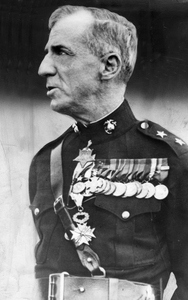
What is the cost of war? what is the bill? Major General Smedley Butler wrote: “This bill renders a horrible accounting. Newly placed gravestones. Mangled bodies. Shattered minds. Broken hearts and homes. Economic instability. Depression and all of its attendant miseries. Back -breaking taxation for generations and generations. For a great many years as a soldier I had a suspicion that war was a racket; not only until I retired to civilian life did I fully realize it….”

With all the domestic political news and the apocalyptic talk and actions surrounding John Roberts the Supreme Court and Obamacare it is hard to believe that we are at war for over 10 years and are at war or now preparing for war all over the Middle East. Iraq, Iran, Syria, Afghanistan, Yemen, Somalia, the Persian Gulf, Libya, Egypt, Pakistan, you name the place there is a real a present danger of US forces becoming involved in even more war. The Trinity of Evil, those Politicians, Pundits and Preachers and over 60% of Americans now are in favor of sending in ground troops to fight the Islamic State.

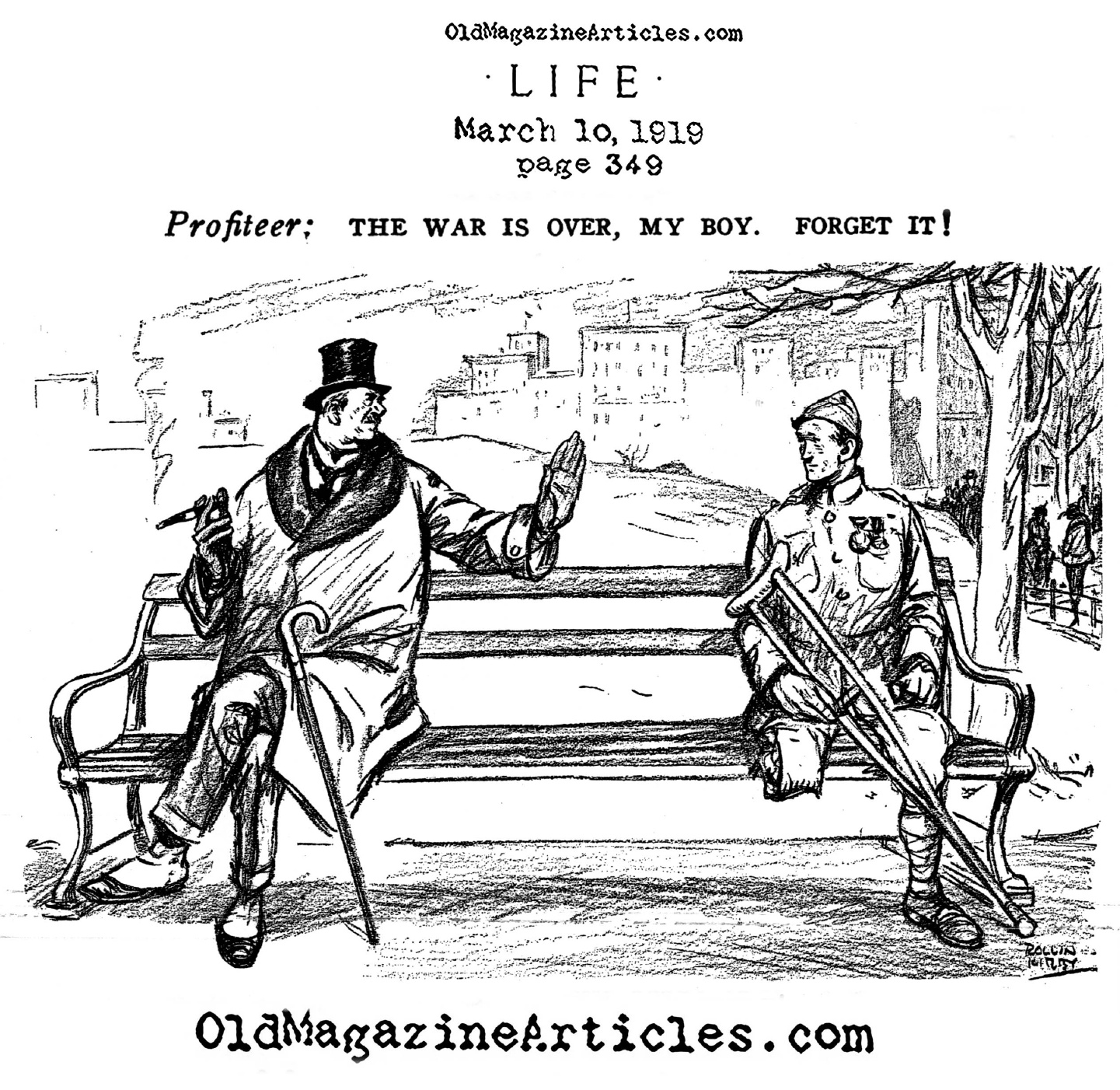
There are no statesmen left in Washington DC only shills of the Right and Left and their masters from Wall Street to K Street. The only people profiting from this are the war profiteers who even if the budget gets cut and they fail to deliver usable weapon systems on time or in budget will still get paid. The losers will be the military personnel who must fight the wars who will get tossed onto the street by those that claim that personnel costs are the problem. Of course those that make this point are almost always the same lobbyists that shill for the defense industries and the banks. But enough about them.

Right now tens of thousands of American military personnel and other Department of Defense, Federal law enforcement, intelligence, diplomatic, humanitarian workers as well as contractors in Afghanistan. Tens of thousands more (mostly contractors)  are helping to shore up the Iraqi government against the Islamic State or are fighting wars by other names in Pakistan, Yemen, the Horn of Africa.  Others are deployed to counter Iran or standing by to assist other allies should the conflict in Iraq and Syria spill over the boarders. Of course this does not take into account the instability in Egypt, Libya, Eastern and Central Africa that threatens even more war or the potential of turmoil in Europe, especially the Ukraine. Likewise a crisis with the Euro Crisis could bring about more financial disasters or even revolutions in countries that are our allies. By the way let’s not forget about the nutcase leaders of North Korea who could provoke war on that side of the world in a heartbeat.

But never mind this, let’s fight each other instead threaten insurrection when we don’t get our way. But wait, I digress…

Did you know that while Americans stand in harms way almost every real or potential enemy has been armed, subsidized or assisted by American corporations and paid for by American tax dollars.  We have armed much of the world with weapons that have already in Iraq and Afghanistan killed thousands of American military personnel. But those were small time weapons compared to what we have provided to Egypt, Pakistan, Saudi Arabia and yes even Israel. F-15, F-16 and F-18 fighter planes, Tomahawk cruise missiles and Harpoon Anti-Ship Missiles, M-1 Tanks, M113 Fighting vehicles, Patriot Air Defense systems, you name the weapons system the war profiteers will sell it and US taxpayers will pay for it. These are weapons that very easily could be used with great effect to attack American interests should leaders in any of those countries decide to use them against us. I only include Israel because in 1967 its forces viciously attacked the USS Liberty which was operating in the Eastern Mediterranean Sea as Israel launched its pre-emptive war against Egypt. Although all of these countries are “allies” we must remember that alliances are only as good as the interests and values that unite nations.

Our defense industries with the support of the government sell advanced weapons to nations that often are less than trustworthy allies, allies of convenience that have little love for the United States but welcome the weapons and training that we provide.  They often use them to suppress the aspirations of their own people and plant the cultivate the seeds of radicalism and revolution.  It is hard not to cringe when pro-democracy protestors are killed by totalitarian regimes whose police and military are armed to the teeth with American made weapons. When those totalitarian regimes fall as did that of the Shah of Iran in 1979 those weapons fall into the hands of people radicalized against us by our support of their former oppressors.

Certainly nobody seriously believes that the angry masses in the countries that we have armed to the teeth with the latest in American weaponry would not use that weaponry against us should they desire.  But wait…. our politicians, arms dealers, bankers and their political, religious and financial backers certainly wouldn’t put Americans in harms way? Perish the thought, but not so quickly. They have done so before and will do it again.

Smedley Butler is one of under two dozen American military personnel to win the Congressional Medal of Honor twice. He saw the dangers of Fascism as well as the danger of unlimited corporate and business power to profit by war. Butler was not only a  valiant Marine he was also a commander that in war and peace cared about those who served. He saw how American finance and banking interests helped drag us into the Fist World War, the promises broken by the government and the lives destroyed by war.

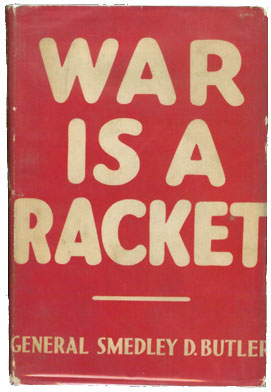
In his book War is a Racket Butler wrote eloquently about how the heads of corporations and their political supporters in both parties were the only benefactors of war. He wrote of the plight of the soldiers that served and returned wounded and often changed by war and he did not mince words in what he saw. He became an anti-war activist. He was a supporter of the Bonus Army, the veterans that “occupied” Washington DC during the last year of the Hoover Administration to get the bonuses promised for their service and were violently evicted by troops under the command of General Douglas MacArthur. If he was alive today I have no doubt that he would be an active supporter of the current “Occupy” movement and opponent of politicians, political activists, lobbyists and even preachers that advocate even more war.

butler-medals1

Butler’s War is a Racket as well as other published works are a worthwhile read and should make the most rabid fan of war think twice. Butler’s patriotism and devotion to the United States and the Constitution is unquestioned. His warnings are strong, he was a prophet in regard to the dangers of the Military-Industrial Complex well before President Eisenhower coined the term as he left office. He detailed how corporations made obscene profits often by selling the US Military vast amounts of materials that it could not possibly use and which taxpayers bought while business leaders and bankers made their fortunes that they never had realized when the nation was at peace. He reminds us of the dangers that our founders recognized about entwining ourselves in other people’s wars. While his answers on how to end war are now utopian dreams because of advances in technology and the wars which now rage without end in sight they are nonetheless not a bad place to start a debate.

Butler writes movingly about the price paid by veterans years after the war, men broken in body, mind and spirit from their war service.

“But the soldier pays the biggest part of this bill.

If you don’t believe this, visit the American cemeteries on the battlefields abroad. Or visit  any of the veterans’ hospitals in the United States….I have visited eighteen government hospitals for veterans. In them are about 50,000 destroyed men- men who were the pick of the nation eighteen years ago. The very able chief surgeon at the government hospital in Milwaukee, where there are 3,800 of the living dead, told me that mortality among veterans is three times as great as among those who stayed home.” 

CARTOONS profiteer_0001

One would think that things would be better now but our veterans’ health care system is a train wreck and there is an epidemic of suicide among active duty troops and veterans. In 2005 after years of hand wringing the Bush administration grudgingly increased the number of Soldiers and Marines even while cutting Navy personnel and ships to the  minimum that they could despite ever increasing operational tempos. The Navy was reduced by over 50,000 sailors during the Bush years and now when the Navy is needed more it has been reduced to the point that 8-10 month deployments with short turn arounds will be normal.

Now the Obama administration is cutting back partly due to the withdraw from Iraq but mostly because of the economic crisis. However the bulk of these cuts are falling on the military personnel and not the war profiteers. The Army will be cut by nearly 80,000 in the coming years the Marines by 20,000 and that may increase if the budget takes the sequestration hit without any reduction in operational tempo. These Soldiers and Marines will enter a bleak job market where many employers give little value to military experience or training, which has resulted in a vastly higher unemployment rate for Iraq and Afghanistan veterans than the general population.

It wasn’t much different in Butler’s day. He writes:

“Boys with a normal viewpoint were taken out of the fields and offices and factories and classrooms and put into the ranks. They were remolded; they were made over; they were made to “about face”; to regard murder as the order of the day. They were put shoulder to shoulder and through mass psychology, they were entirely changed. We used them for a couple of years and trained them to think of nothing but killing and being killed.

The suddenly, we discharged them and told them to make another “about face”! This time they had to do their own readjusting, sans mass psychology, sans officers’ aid and advice, sans nation-wide propaganda. We didn’t need them anymore. So we scattered them about without any “three minute” or “Liberty Loan” speeches or parades.”

Butler recounted another visit to a different veterans’ hospital:

“In the government hospital at Marion, Indiana 1,800 of these boys are in pens! Five hundred of them in a barracks with steel bars and wires all around the outside of the buildings and on the porches. These have already been mentally destroyed. These boys don’t even look like human beings. Oh, the looks on their faces! Physically they are in good shape but mentally they are gone.” 

There are thousands and thousands of these cases and more and more are coming in all the time…

That’s a part of the bill. So much for the dead-they have paid their part of the war profits. So much for the mentally and physically wounded- they are paying now with thier share of the war profits. But others paid with the heartbreaks when they tore themselves away for their firesides and their families to don the uniform of Uncle Sam- on which a profit had been made….”

I could go on but I think that Butler says it quite well and with the passion of a Marine who was wounded on more than one occasion and won the Medal of Honor twice.

The only people that want war are those that profit from it and don’t have to pay the price paid by those that have to fight them and pay for them. When I see pictures of Mitt Romney protesting in support of the Vietnam war while getting deferment after deferment to avoid service it makes my head spin. My head spins even more when I hear him talking brazenly about committing US troops to even more war. For me the pictures of Romney’s pro-war protests as a college student avoiding war on educational and religious service deferments as millions of other Americans went to war are up there with the pictures of “Hanoi” Jane Fonda giving aid and comfort to those that were killing our troops.

Butler’s detractors and they are legion on the political right attempt to paint him as an isolationist or appeaser of Hitler. However they misunderstand him and his work. They don’t understand as Butler understood that there would not have been a Nazi Germany without Versailles and that was not possible without the American intervention on the side of Britain and France in 1917. That involvement was driven by the bankers and industrialists who had supplied raw materials, weapons and technical patents to the British and French, and had done so before with the Germans who believed that they would lose their investments if the Germans won the war. That would have happened in late 1917 or early 1918 had not the Americans declared war and entered the war on the side of the British and French.

Most of Butler’s current critics have never served a day in uniform much less a day in a combat zone. They make their livings and profits by the sacrifice of others and other than a few of his quotes have never read anything about him.

If you sense indignation in my voice it is real. I have lived the nightmare of PTSD for over 7 years. I see and work with the young men and women that have bravely endured the hardship of combat deployments and come home physically, mentally and spiritually wounded. To our credit we are trying to do better, but that doesn’t always happen. But for the war profiteers even that will be too much. If military spending is cut you can bet that they will not take the hit that military personnel, their families and our veterans will take. They and their political benefactors will not allow it.

I am a military man through and through. I have spent nearly my whole life associated with the military as a dependent of a Navy Chief who served in Vietnam and a career of over 30 years divided between the Army and Navy. Some of my friends dads did not return from Vietnam, other friends and those who I have served with have paid with their lives in Iraq or Afghanistan while others suffer the continuing wounds of war.

This is personal for me and it is also motivated by my faith as a Christian. Today when I see prominent and politically influential right wing Evangelical Christian leaders and pastors beat the drums of war I am reminded of how Butler chided the pro-war clergy propagandists of the Great War. He wrote: “So vicious was this war propaganda that even God was brought into it. With few exceptions our clergymen joined in the clamor to kill, kill, kill. To kill Germans. God is on our side…it is his will that the Germans be killed.” Only today, it is not a blood lust for German blood, it is a blood lust for Moslem blood and it gets louder ever day.

Such preaching is not much different from the right wing pro-war preachers who advocate killing Moslems simply because they are Moslems and that go out of their way to preach the value of “pre-emptive war” despite such wars being against the Christian understanding of the  “Just War” or international law against such war that we as Americans helped develop after World War Two at Nuremberg and to which we hold the leaders of what we call “rogue nations.”

I only wish that our leaders; political leaders of both parties, religious leaders, and even business leaders would see the folly of this course and their responsibility for the results.

Someone has to say it.

Peace

Padre Steve+

Note: All quotations from “War is a Racket” by Smedley Butler copyright 1935 and 2003 by the Butler family. Amazon Kindle edition. 

3 Comments

Filed under ethics, History, middle east, Military, News and current events, Political Commentary

Warmongers, Chicken Hawks & War Porn Addicts

Iraq-unrest

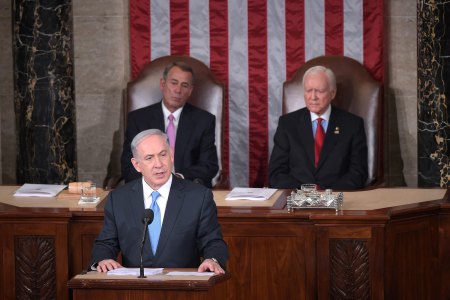
Make no bones about it, the Islamic State, or ISIL needs to be defeated. It is evil, it is ruthless and it is a danger to the people that it controls and those in its path. Likewise it sates that it has larger goals. Because of this many Americans, over 60 percent in the most recent poll favor sending in ground troops to fight the Islamic State. Politicians talk about sending, 5,000, 10,000 or other nice round numbers of troops which they seem to pull from thin air as fast as they can. Others not only want to take on ISIL, but that the same time seem to want to go after Iran as well. Benjamin Netanyahu got a great round of applause for that boner strategy.

But the real fact of the matter is that American boots on the ground are not the answer. Now can American troops help, most certainly, but despite our great technological ability to kill our enemies and overrun territory, we are not the people to win this war.  The Iraqi Sunni and Shia to get their shit together to beat these guys. T.E. Lawrence so wisely wrote:

“Do not try to do too much with your own hands. Better the Arabs do it tolerably than that you do it perfectly. It is their war, and you are to help them, not to win it for them. Actually, also, under the very odd conditions of Arabia, your practical work will not be as good as, perhaps, you think it is.”

Sadly we ignored that and like the British efforts, our efforts to invade, conquer and re-make Iraq in our image have failed miserably. Our failure is as poetic and terrible as Lawrence’s description of British efforts:

“We had been hopelessly labouring to plough waste lands; to make nationality grow in a place full of the certainty of God… Among the tribes our creed could be only like the desert grass – a beautiful swift seeming of spring; which, after a day’s heat, fell dusty.”  

But to the warmongers, the Chicken Hawks and the War Porn addicts who have no skin in the game this counsel doesn’t matter. Despite the fact that American soldiers, sailors, marines and airmen have been continuously in combat or supporting combat operations for the last thirteen and a half years, this country is not a country at war.  That was something that was shattering for me to realize when I stepped off the plane coming home from Iraq. Believe me, there is a big difference between saying “I support the troops” and having skin in the game.

The fact is that all of those who beat the drums of war but are unwilling to pay the cost, be they the Politicians, Pundits and Preachers, the Trinity of Evil as I call them, or their war addicted followers don’t care about the troops.  In my book the war-mongering preachers are the worst of the lot, but then some of those guys like Mike Huckabee are not only preachers, but politicians and pundits, I guess that must be a new twist on the biblical “prophet, priest and king” thing.  But even as these people counsel war, they refuse to raise taxes to support it, or even pay for the equipment needed by the troops. Likewise, they refuse to make national service, including the military draft a part of national policy. Why don’t we do this? The fact is that then we as a nation would actually have to have skin in the game, give up some of our luxuries and lace up the boots and go to war.

But we will die before we raise taxes or institute the draft. Politicians that suggest such things are driven out of office. Instead we will rely on that under one percent of our population who have shouldered the burden of war for over a decade, even while our political and business leaders scheme to find ways to cut military pay and benefits, especially those medical benefits incurred while serving.

It’s funny, well, no, it’s not funny, that the people leading this charge to war are the same assholes who brought about the Iraq debacle in the first place. But be assured, just as last time their sons and daughters will no serve, and they will not only not be held accountable, but they will profit from the war, just as they have since the days of Smedley Butler.

The fact is that those who brought about this debacle from the Bush administration should be tried as war criminals. But now we have potential Republican presidential candidates, and I might add Evangelical Christians say that there should be no war crimes, that war crimes are not bad, I guess as they are not being committed against us, but I digress.

Supreme Court Justice Robert Jackson, who led the prosecution of the major Nazi War Criminals at Nuremburg wrote something that men like Ben Carson, Mike Huckabee and others cannot seem to fathom:

“If certain acts of violation of treaties are crimes, they are crimes whether the United States does them or whether Germany does them, and we are not prepared to lay down a rule of criminal conduct against others which we would not be willing to have invoked against us.”

I say that there is a special place in hell for the warmongers, Chicken Hawks and War Porn addicts who are so willing to throw other people’s kids into wars that are unwinnable, if those who we are there to defend do not step up and do their part.

So with that my friends I wish you a happy and fun Friday.

Peace

Padre Steve+

2 Comments

Filed under Foreign Policy, History, iraq,afghanistan, middle east, Military, national security, Political Commentary

Vanity Seeking a Legacy: JEB Stuart at Gettysburg

Friends of Padre Steve’s World

Back to my work on the Gettysburg text. I have done a lot of edits and work on this chapter. There is a little bit more to do including an edit from my wife Judy before it goes into the text and I start working on the edits for the next chapter. 

Anyway, yet another crazy weather day in Hampton Roads. Yesterday 73 degrees, today rain with sleet and snow later with temperatures tomorrow barely above freezing. I can’t wait for real spring, and by the way I’m issuing a Fat Wahhh on the Groundhog. Not a Fatwah, but a Fat Wahhh, because I’m short stocky and whining. 

Peace

Padre Steve+

While the embattled Hooker slowly pursued Lee with the Army of the Potomac another drama of major significance was unfolding. The developing drama was of Robert E. Lee’s own making and it was beginning to engulf his army’s operations as leave him blind to the intents and movements of the Federal Army, and it is related to the concept of Commander’s Intent.

The concept “Commander’s Intent” is actually quite old and something that even not using today’s terminology that the commanders of the Civil War, especially those educated at West Point would have understood.

While the older understanding enunciated by Frederick the Great, Napoleon, Jomini, Clausewitz and Dennis Hart Mahan would be couched in different language the concept itself was similar. The modern understanding of the concept is found in numerous doctrinal publications of the U.S. Military and the most concise definition in found in Joint Publication 3-0:

“A clear and concise expression of the purpose of the operation and the desired military end state that supports mission command, provides focus to the staff, and helps subordinate and supporting commanders act to achieve the commander’s desired results without further orders, even when the operation does not unfold as planned” [1]

The drama engulfing Lee’s headquarters was the first of a number of operational mistakes committed by Lee, and dealt with his singular inability to get his commanders to understand his intent. The necessity of subordinate commanders understanding the intent of their superior is essential to the success of any military operation. During the Gettysburg campaign, Robert E. Lee failed miserably at this.

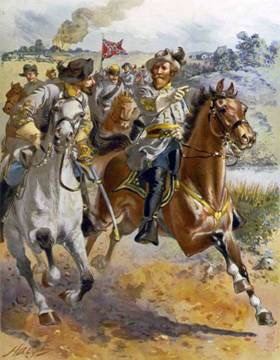
The first instance of this lack of clarity and vagueness in regard to Lee’s orders to his subordinates involved Major General J.E.B. Stuart, who commanded Lee’s cavalry division and the results of this would help doom Lee’s campaign in Pennsylvania.

Lee and Stuart

To understand how this happened we need to start with the character of J.E.B. Stuart and his relationship with Robert E. Lee. Without understanding these men it is impossible for us to understand how such a disastrous series of events and miscommunications could occur in an army which was so used to victory.

Before Brandy Station J.E.B. Stuart was at pinnacle of his fame and celebrity. Only thirty-two years old Stuart had gained an amount of fame, and the romantic aura of a chivalrous, bold and daring commander, something akin the gallant knights of an early era. One of his biographers, Burke Davis, whose work about Stuart is at times closer to hagiography than to history called Stuart “The Last Cavalier.” 

If People magazine had been published in 1863, Stuart would have certainly made the cover.

One of Stuart’s officers wrote after the war “There were few men produced by the war whose character was so mixed with gold and dross as Stuart… He could be “brave as his sword,” but “frivolous to the point of ridicule.” [2] Though faithfully married he was a flirt who women swooned over when they met him. “He possessed a zest for life and a flamboyance of style that made him the embodiment of a knight errant, a cavalier warrior from an evocative past.” [3] This is not to say that Stuart was not a gifted offer, leader or commander. Even before the war he was regarded as “a young officer of great promise, a natural horseman with a reputation for dash and bravery gained in countless clashes with Indians throughout the West, and for steady competence in the pro- and antislavery warfare of Kansas.” [4]

In the early part of the war he proved to be a dependable cavalry officer who supplied Stonewall Jackson, James Longstreet, Joseph Johnston and Robert E. Lee with reliable information regarding the composition, movements and intention of their opponents, and who in battle usually bested his Federal opponents.

However, it was his ride around McClellan during the Seven Days that established Stuart as a Confederate hero.

There had been little good news for Confederates during the previous months, but “there was an air of romantic adventure to Stuart’s exploit which touched every Southerner who read it.” [5] Newspapers published accounts which lauded Stuart’s exploit. The Richmond Examiner called it “one of the most brilliant affairs of the war, bold in its inception and the most brilliant in its execution.” [6] A correspondent from the Charleston Mercury wrote “It is a question of whether the annals of warfare furnish so daring a deed.” [7] The result of the ride was fame for Stuart and a new respect for the Confederate cavalry within the Army of Northern Virginia. “Stuart had become the hero of his troopers and one of the idols of the public.” [8]

The fact that Stuart succeeded in large part due to the inability of the Federal Cavalry commander, General Phillip St. George Cooke, Stuart’s father-in-law, to grasp what was happening or respond in an effectual manner did not dim the luster of the accomplishment. One of Stuart’s officers wrote that the newspapers “were filled with accounts of the expedition, none accurate, and most of them marvelous.” [9] The success and adulation that Stuart received in the Confederate press only cemented in Stuart’s mind that such raids would garner him fame and advance his career.

Stuart was not only adept at using the media to advance himself, but he also used his relationships and cultivated those in power to get ahead. He was a friend of the Lee’s before the war, and Robert E. Lee treated Stuart as if he were a son. He had the good fortune to staying with the Lee’s at Arlington and be at the War Department when John Brown seized Harper’s Ferry, where he had won Lee’s admiration. When Joseph Johnston commanded the army Stuart ingratiated himself to him and used flattery to gain favor saying “Johnston is in capacity head and shoulders above every general in the Southern Confederacy.” [10] At the same time he wrote about Lee’s lack of success in Western Virginia “With profound personal regard for General Lee, he has disappointed me as a General.” [11]

When Johnston was wounded Lee was appointed to command the army and Stuart quickly reconnected with Lee and following the success of his ride around McClellan’s army became Lee’s favorite cavalryman. Following the Seven Days battles when the Cavalry was expanded Lee nominated Stuart to command the division and ensured his promotion to Major General. Stuart responded in kind by recommending Lee’s nephew, Fitzhugh Lee to command a brigade in the division. As the division grew Stuart, knowing Lee’s preference for Virginians in the senior ranks of army leadership appointed “Virginians to command four of his division’s five brigades.” [12] These included Fitzhugh Lee as well as Lee’s son Rooney.

Following the Battle of Antietam Stuart made another spectacular ride around McClellan in Maryland and Pennsylvania, an escapade which helped Lincoln in his decision to relieve that ineffective army commander. Apart from the effect on Northern morale the raid accomplished little of military value, including not achieving its primary objective, the destruction of the B & O railway bridge across the Conococheague River. Porter Alexander wrote that “the raid risked a great deal in proportion to the results it accomplished. It might have easily happened easily happened that the whole command might have been captured.” [13]

At Chancellorsville, after Jackson was mortally wounded and A.P. Hill wounded he took command of Second Corps, and led it well enough that some thought that after Jackson’s death that he should be appointed to command the corps.

Despite his brilliance on the battlefield, Stuart had little capacity for self-reflection and was terribly insecure. “Like many people who rise rapidly from obscurity to prominence, Stuart was insecure in his success.” [14]  During a second raid at the end of the Seven Days his actions helped ensure the escape of the Federal Army, something that fellow commanders and staff officers noticed and which he would not admit. In this action, as well as others, Stuart was “known to take risks with his own life and the lives of his men, sometimes during ill-conceived operations of debatable strategic value.” [15]

Likewise Stuart regarded the Battle of Brandy Station as “the greatest triumph I ever had.” [16] Stuart could not understand how the media or fellow officers could see things differently than him. Brandy Station should have given Stuart ample evidence to reevaluate his performance, but he could not. Instead of working to improve his performance, he insisted “that a poor performance had been just perfect. He seemed more concerned with image than substance because he confused the two.” [17]

A Cavalier Seeks to Redeem His Legacy

After the surprise at Brandy Station Stuart, was unhappy. His pride had been wounded by all of the criticism heaped on him by the Confederate press and well as by politicians and officers of the Army of Northern Virginia. Stuart now found out what many others who have who sought the media spotlight; that the press can rapidly turn from being a friend and promoter, to being strident critic. He expressed his anger to his wife Flora in a number of letters. In one saying “The newspapers are false in every statement except as to the victory….The papers ought to apologize.” [18]

The temptation here would to assume that all that motivated Stuart was the desire to redeem himself, to make up for what happened at Brandy Station. This is at least partially true. However, there was something bigger, and that was Stuart’s need that the myth that he had created around himself, the persona he had taken on, was unsullied. Since the war began he had known nothing but success and celebrity. His unbridled success had not taught him how to deal with failure.

One of more recent biographers, Emory Thomas wrote that Stuart “feared failure perhaps more than anything else in life and certainly more than death. He dealt with failure not by dealing with it, by denying it.” [19] As such his actions are much more than seeking to make up for defeat, but an attempt to build a legacy.

The attacks in the newspapers which had previously fawned over his exploits certainly wounded Stuart. But not all papers had completely lost faith in Stuart, nor doubted that he would redeem himself against the hated Yankee cavalry. The Richmond Whig “concluded an editorial defense of the Beau Sabreur, “We shall be surprised if the gallant Stuart does not, before many days, make the enemy repent sorely the temerity that led them to undertake as bold and insulting feat [as the advance on Brandy]. [20]

The troopers of Stuart’s division screened the right flank of the army as it moved north. The mission of his brigades was to defend the gaps in the Blue Ridge, and to keep Pleasanton’s cavalry from interdicting the march, or discovering the location of Lee’s infantry corps. In this effort Stuart was successful, but not happy.

Between June 17th and June 21st Stuart’s troopers fought a series of engagements at Ashby’s Gap, Middleburg and Upperville. While Stuart’s troopers had held off Pleasanton the “running combats were taking a toll on the Southern mounted arm, however. Stuart had already suffered several hundred casualties defending gaps and passes.” [21] The Confederates also noted the improvements in the Federal cavalry during these battles. Captain William Blackford, who served as an engineer on Stuart’s staff noted:

“the improvement of enemy cavalry was enormous, mainly in the heavy fire from long range carbines, and horse artillery that was a match for Stuart’s own These cavalrymen fought as if they had been taken from infantry regiments, for they knew how to fight with horses left behind.” [22]

Unlike the rest of the army which was now marching into Pennsylvania and Maryland, Stuart’s Cavalry Division had little cause to rejoice. They had been surprised at Brandy Station and Stuart had been humiliated in the Southern press. “Stuart read, raged, and doubtlessly resolved that the Whig’s prediction should be fulfilled. First must come opportunity.” [23]

It would take nearly two weeks before Stuart got his chance as the Federal cavalry under Pleasanton gave him no opportunity to redeem himself during the clashes along the Blue Ridge.

While Pleasanton’s troopers never broke through Stuart’s screen, they had pressed him hard and this had a major effect on Stuart’s division, which was “really fought out during those two weeks from June 9 until the misty morning of June 22….Not only had Stuart’s cavalry been pressed on the defensive as never before, but also they had not been able to gain a spot of information about the enemy.” [24]

In effect, these actions had not only screened Lee’s army from Hooker, but what went unnoticed by Confederate commanders was that “this succession of fights screened the Army of the Potomac as well” leaving Stuart “somewhat in the dark as to the location and intent of the Federal infantry.” [25] This would have exceptionally dire consequences for Lee as Stuart was no longer supplying him with the thing he needed most, information on the location and intentions of the Army of the Potomac.

On the other hand the Federal cavalry, through its interrogations of prisoners and conversations with civilians had now learned that the “main body of the rebel infantry is in the Shenandoah Valley.” [26] Additionally at Ashby’s Gap, some of John Buford’s troopers had gotten past the Confederates and “peering into the valley beyond, they gazed upon a Confederate infantry encampment – tangible evidence at last of Lee’s progress toward Maryland and Pennsylvania.” [27]

Pleasanton’s troopers, under able commanders like John Buford had proved that the days of “easy Confederate cavalry triumphs were gone,” [28] and Stuart “smarting over the cuts to his ego, refused to read the portents.” [29]

The emotional state of Stuart in the wake of Brandy station had much to do with this condition, but where others, including his media critics could see the improvements in the Federal Cavalry arm, Stuart seemed to live with a fair amount of denial regarding the capabilities of his foe. Stuart still not believe that the Union Cavalry arm had reached a point in the war where they could take on his troopers and be successful, despite the mounting evidence.

Stuart had been fighting defensively the entire campaign beginning with the surprise at Brandy Station, but desperately wanted to go on the offensive. As his troops battled Pleasanton’s aggressive and well led troopers at Aldie, Middleburg and Upperville, Stuart formulated a plan to go on the offensive himself, which he submitted to Lee. Stuart reasoned now that “all the infantry were west of the Blue Ridge…that it would be possible to leave one or two brigades of cavalry to defend the gaps and with the remaining three to descend on the enemy and harass Hooker in any advance into Pennsylvania.” [30]

Conditional, Contradictory and Vague: Lee’s Order to Stuart

On the morning of the 22nd of June Stuart noticed that the Federal cavalry which had engaged him at Upperville the previous day was no longer present. This led Stuart to propose an operation to Lee. It was an operation that Stuart hoped would restore his glory, for he had to protect his legend at any cost, and he was extremely sensitive about what people thought, wrote and said about him. “he had cultivated his public image and in turn the poems, songs, and praise seemed to confirm his vision of himself. How could the newspapers and gossips be son wrong?” [31] As such when he found an opportunity he took it. In his after action report he said:


“I submitted to the commanding general the plan of leaving a brigade or so in my present front, passing through Hopewell or some other gap in the Bull Run Mountains, attain the enemy’s rear, passing between his main body and Washington, and cross into Md., joining our army north of the Potomac. The commanding general wrote authorizing this move, if I thought it practicable….” [32]

Lee’s reply via the order that Stuart received from Lee was the first of a series of vague, poorly written and contradictory orders by Lee that were to plague the campaign. It was an order that gave Stuart exactly what needed to embark on an expedition to regain his luster.

The order “offered his cavalry commander wide latitude to select his route in accord with circumstances.” [33] Lee’s order left “the decision to Stuart” [34] as to how he would execute it. It was also an order that gave Stuart the idea “that something better than the drudgery of a march along our flank might be open to him, and that one of General Stuart’s activity and gallantry should not be expected to fail to seek it.” [35]

It was an order that Stuart seized upon to regain his reputation.

Unlike Lee’s two new infantry corps commanders, Ewell and Hill, Stuart was very familiar with Robert E. Lee’s method of command, and Lee had “so much faith in Stuart’s judgment and ability to make the right moves that after indicating his wishes he gave him considerable latitude in carrying them out. His orders were more suggestions than commands….” [36] However well that may have worked for Lee in the past with Jackson and Stuart, at this time it failed Lee.

Lee’s orders to Stuart were conditional in nature, in other words they were operative as long as the conditions allowed. Since they were conditional orders, Lee needed to clearly address “the conditions upon which they are based.” [37] This Lee did not do and it was a critical oversight. His order to Stuart read:


“I judge the efforts of the enemy yesterday were to arrest our progress and ascertain our whereabouts. Perhaps he is satisfied. Do you know where he is and what he is doing? I fear he will steal a march on us and get across the Potomac before we are aware. If you find that he is moving northward and that two brigades can guard the Blue Ridge and take care of your rear, you can move with the other three into Maryland and take position on General Ewell’s right, place yourself in communication with him, guard his flank, keep him informed of the enemy’s movements and collect all the supplies you can….” [38]

Longstreet, who Stuart was cooperating with on the northward march, added his own comments to Lee’s instruction which even further clouded the order:
General Lee has enclosed this letter for you, to be forwarded to you, provided you can be spared from my front, and provided I think that you can move across the Potomac without disclosing our plans. He speaks of your leaving via the Hopewell Gap and passing by the rear of the enemy. If you can get through by that route I think that you will be less likely to indicate what our plans are than if you should be passing to our rear. I forward the letter of instructions with these suggestions. Please advise me of the condition of affairs before you leave, and order General Hampton, whom I suppose will leave here in command, to report to me at Millwood, either by letter or in person, as may be most agreeable to him.” [39] 

Stung by the criticism of his conduct of the Battle of Brandy Station in the Southern press and frustrated by Pleasanton’s constant thrusts Stuart, “who always interpreted cavalry orders to their outer limits” [40] did just that and interpreted them in a manner that appealed to his need to redeem his now tarnished reputation. Stuart believed that he would repeat his triumph of the previous year when he rode around the Army of the Potomac.

For Stuart this was a chance to regain the limelight and add to his luster. Stuart “summed up his interpretation of his orders when he said later: …it was deemed practicable to move entirely in the enemy’s rear, intercepting his communications with his base (Washington), and, inflicting damage upon his rear, to rejoin the army in Pennsylvania in time to participate in its actual conflicts.” [41]

Stuart was already planning his offensive which he believed would restore his glory. Days before Stuart had sent Major John Mosby with a small detachment of troopers to reconnoiter behind the Union lines. Mosby reported the location of all the infantry corps of the Army of the Potomac. Mosby reported to Stuart on June 23rd that the Federal corps of the Army of the Potomac were stationary and “were so widely separated…that a column of cavalry could easily get between them.” [42]

Mosby’s report painted a glowing picture of how an operation using the Hopewell Gap could create havoc in the Federal rear and cause panic in Washington as he could “severe communications between Hooker and Pleasanton, destroy a “large portion” of Hooker’s transportation, and take some of the pressure off Lee by creating a diversion for the Union cavalry.” [43]

The purported inactivity of the Federal army reported by Mosby was exactly the news Stuart wanted to hear, and he asked Lee for permission to plunge into the Federal rear. In his after action report Stuart wrote:

“I submitted to the commanding general the plan of leaving a brigade or so in my present front, and passing through Hopewell, or some other gap in Bull Run Mountain, attaining the enemy’s rear, and passing between his main body and Washington, to cross into Maryland and joining our army north of the Potomac.” [44]

Lee concurred and noted that “Upon the suggestion of the former officer (General Stuart) that he could damage the enemy and delay his passage of the river by getting to his rear, he was authorized to do so.” [45]

In his after action report of the campaign Lee wrote:


“General Stuart was left to guard the passes of the mountains and observe the movements of the enemy, whom he was instructed to impede and harass as much as possible, should he attempt to cross the Potomac. In that event, General Stuart was directed to move into Maryland, crossing the Potomac east or west of the Blue Ridge, as, in his judgment, should be best, and take position on the right of our column as it advanced.” [46]

That night, during a heavy rainstorm Stuart’s chief of staff Major McClellan received Lee’s reply, written by Colonel Charles Marshall, to his superior’s request which he immediately delivered to Stuart. It is this final order which forms the basis of the great controversy of Stuart’s actions during the campaign. Lee’s order stated:
“If General Hooker’s army remains inactive, you can leave two brigades to watch him, and withdraw with three others, but should he not appear to be moving northward, I think you had better withdraw this side of the mountains tomorrow night, cross as Shepherdstown next day, and move over to Frederickstown.

You will, however, be able to judge whether you can pass around their army without hindrance, doing them all the damage you can, and cross the river east of the mountains. In either case, after crossing the river, you must move on and feel the right of Ewell’s troops, collecting information, provisions, etc.” [47]

The order continued with a further paragraph which Stuart seems not to have fully conveyed to the commanders of the brigades being left behind to screen the army:


“Give instructions to the commander of the brigades left behind, to watch the flank and rear of the army, and (in the evidence of the enemy leaving their front) retire from the mountains west of the Shenandoah, leaving sufficient pickets to guard the passes, and bringing everything clear along the Valley, closing upon the rear of the army.” [48]

Finally, Marshall provided an additional admonishment to Stuart “I think the sooner you cross into Maryland, after to-morrow, the better.” [49] However, the orders or suggestions that Lee and Longstreet gave Stuart “are so badly worded that it is difficult to make sense of them.” [50] In them, Stuart was directed maintain contact with Ewell, screen the Blue Ridge gaps, collect information, “raiding around the rear of Hooker’s forces” [51] damaging the enemy, and collecting supplies.

Lee should have “established that Stuart’s most important task was to guard Ewell’s right and report on the direction of Hooker’s advance once Lee crossed the Potomac.” [52]

This he did not do.

Lee’s lack of clarity and vagueness allowed to Stuart interpret the order in the manner that benefited his need to redeem his reputation. The order could easily be interpreted as getting Stuart and his men into Pennsylvania as quickly as possible to guard Ewell’s flank and discern the intentions of the enemy, which in hindsight and according to his aids appears to have been Lee’s intent. But as written, they could easily ben interpreted as permission to conduct a raid to “roam in the enemy’s rear for an unpredictable period of time, raising havoc with his communications, supplies, and isolated commands” and then “seek out Ewell’s corps and use it as a place of refuge from an aroused enemy.” [53]

Porter Alexander was quite critical of Lee’s decision and wrote after the war:
“In view of the issues at stake, and of the fact that he had been deprived of two promised brigades (Corse’s and Jenkins’s), it was unwise even to contemplate sending three brigades of cavalry on such distant service. When one compares the small beneficial results of raids, even when successful, with the risks here involved, it is hard to understand how Lee could have given his consent.” [54]

Stuart, as he was want to do, used “the freedom that he had long enjoyed in implementing Lee’s orders” [55] to carry out his plan. Now smarting from the Brandy Station criticism, Stuart “interpreted them as a sanction for another White House raid….” [56] While it is certain that Lee meant to give Stuart permission for a “joyride around the entire Army of the Potomac or even just the three Federal corps which formed the westernmost wing of Hooker’s pell-mell rush to the Potomac” [57] he had given his knight errant just enough permission to do exactly that, exactly what he wanted to do in the first place.

Had Lee’s orders been clear there is no doubt that Stuart would have obeyed,

The fact is that different standards apply to each of those courses of action, and thus, the orders must be clear. Without such clarity it becomes easy for subordinates to interpret them in a far different way from which they were intended by the issuing commander, with far reaching effects. By giving Stuart the latitude to go around the Federal army Lee had undercut his own preference that Stuart cross into Maryland via Shepherdstown and Frederick on June 24th. Lee had provided Stuart an opportunity for something that “Longstreet half-apologetically called “something better than the drudgery of a march around our flank.” [58] It was a critical mistake, which was then further compounded by Stuart and the movement of the Army of the Potomac.

Porter Alexander compared Stuart’s Ride to Joe Hooker’s use of his cavalry corps at Chancellorsville noting: “I think that Joe Hooker’s defeat was due to the absence of his cavalry on just such a useless raid as this. We ought to have recognized Hooker’s error & avoided repeating it….We took unnecessary risk, which was bad war, & the only bad war too, I think, in all our tactics.” [59] However, in retrospect it does not appear that Lee, Longstreet or Stuart recognized the problems this risk would entail, or just how much it resembled Hooker’s use of his cavalry corps at Chancellorsville.


Historians have long wondered why Lee was not more explicit in his orders to Stuart and why Stuart conducted an operation that left Lee blind and had no obvious advantages, except to allow Stuart to recover his tarnished reputation. Stephen Sears noted in his book Gettysburg that: “The very concept of Stuart’s expedition was fueled by overconfidence and misjudgment at the highest command level.” [60]

In a sense the decision harkens back to the hubris of Lee and others about the superiority of his army, and Lee’s well known distain for the Federal army’s leadership and soldiers. This hubris is even more profound when one considers the fact that as early as June 23rd Lee knew “that the Federals were laying a pontoon bridge at Edward’s Ferry, indicative of a crossing.” [61]

Stuart’s Ride

“Stuart had decided to do what he wanted to do – a march between Hooker’s army and Washington and mix raiding with riding en route to Ewell in Pennsylvania.” [62] In organizing his movement, Stuart decided to take his three best brigades with him, and leave the brigades of “Grumble” Jones and Beverly Robertson to defend gaps and screen the rear of the army. The choice was unfortunate; Jones was considered the “best outpost officer in his command,” [63] but Robertson, though known to be unpredictable was placed in command because he was “senior to the dependable Jones.” [64] The choice ridded Stuart of Robertson, who he did not trust in battle and Jones “whose antipathy for Stuart at least equaled Stuart’s for him.” [65] Stuart instructed Robertson to “observe and harass the Federals as long as they remained in Virginia.” [66]

On the surface to Stuart it appeared the right choice, Robertson “showed neither the initiative or enterprise of a cavalry officer in the Army of Northern Virginia, Robertson could only be used for routine work, such as guarding the mountain passes.” [67]

The intent was that Robertson would screen the army and follow it into Maryland, in fact Stuart gave Robertson “explicit instructions” [68] to do so, but Stuart’s order also contained a statement which Robertson used to justify his actions years later. Stuart instructed Robertson, who could be expected to obey orders:
“After the enemy has moved beyond your reach, leave sufficient pickets in the mountains and withdraw to the west side of the Shenandoah and place a strong and reliable picket to watch the enemy at Harper’s Ferry….

As long as the enemy remains in your front, in force, unless directed otherwise ordered by General R.E. Lee, Lieutenant-General Longstreet, or myself, hold the gaps with a line of pickets reaching across the Shenandoah by Charlestown to the Potomac.

Avail yourselves of every means in your power to increase the efficiency of your command and keep it up to the highest number possible. Particular attention will be paid to the shoeing of horses, and to marching off the turnpikes….” [69]

Robertson, interpreted the order that he was to go to the western side of the Shenandoah and avoid using the turnpikes, which he noted “the only road by which the orders (which particularly specified the avoidance of “turnpikes” on the difficulty and delay of shoeing horses) could be complied with, carried my command to Martinsburg….” [70]

Thus, “the two brigades would remain fixed, as if planted there, in an inanition of command which immobilized the men for whom Lee in Pennsylvania was anxiously watching.” [71] Longstreet had requested the industrious and dependable Hampton to command the remaining cavalry, but Stuart disregarded his counsel and took Hampton with him, after all, he was J.E.B. Stuart, the finest cavalryman on the American continent.

Stuart set off with his three best brigades, those of Wade Hampton, Fitzhugh Lee, and Rooney Lee. Since Lee had been wounded at Brandy Station, his brigade was now under the command of Colonel John R. Chambliss, another former West Pointer retired from the old army. Almost immediately after setting off Stuart and his brigades encountered a situation that should have immediately stopped movement to the Federal rear and instead move west of the Blue Ridge.

Moving through Glasscock’s Gap they “bumped unexpectedly into “an immense wagon train,” which happened to be the tail end of Winfield Hancock’s 2nd Corps, blocking the road in exactly the fashion Lee had described as a hindrance.” [72] In light of his encounter with the Army of the Potomac, it “was now clearly impossible for Stuart to follow the route originally intended.” [73] Stuart was now faced with a critical choice, either withdraw and follow the army, or attempt to continue his raid.

Instead of going back when he had the chance Stuart elected to continue with his “plan to go around the Federal army. It was a crucial decision, for he still could have turned back without losing any more time.” [74] Stuart consulted with “no ranking subordinate or staff member” [75] as he made his decision. On June 25th Stuart’s brigades had to spend a day grazing their horses since they had brought no grain with him, which delayed their advance north and east. This placed him a day behind schedule. Though he made better time on the 26th, advancing twenty-five miles he had to again stop to graze his horses at the Occoquan River. It had “taken forty-eight hours to march thirty-five miles.” [76]

The Price of 125 Wagons

Stuart continued on past the outskirts of Washington on June 27th and was again delayed when attempting to cross the Potomac at Rowser’s Ford by the “water level two feet higher than normal.” [77] He then encountered a large Federal wagon train not far from Washington capturing over 100 wagons and 600 mules. Stuart reveled in that feat and boasted that “he had taken more than one hundred and twenty-five best United States model wagons and splendid teams and gay caparisons,” containing “foodstuffs, oats, hay…bacon, ham, crackers and bread” but his progress was slowed by his enormous wagon train of captured supplies…” [78] He and briefly wondered “whether it might be worth “our entering Washington City” [79] before determining that the effort might be too costly because of the fortifications and proliferation of artillery.

At Fairfax Courthouse Stuart sent a message to Lee, which was never received by Lee, but which did arrive in Richmond on July 1st. It was a dispatch that was late, and even factually incorrect for the bulk of the Army of the Potomac was in Maryland advancing toward Lee in Pennsylvania. His report stated:

“General: – I took possession of Fairfax C.H. this morning at nine o’clock, together with large quantity of stores. The bulk of Hooker’s army has gone toward Lee’sburg, except the garrison at Alexandria and Washington, which has retreated to its fortifications.” [80]

On June 28th, Stuart received word that Hooker and the Army of the Potomac was across the Potomac. It was a major surprise to him, and by now Stuart “knew nothing of Lee’s position,[81] and instead of abandoning the wagon train, he sacrificed the speed and mobility that he needed to support Lee in order to keep it. Douglas Southall Freeman wrote that the “wagon train was Jeb Stuart’s stumbling block.” [82]

Of course it was Lee’s order for Stuart to collect all the supplies that he could justified Stuart’s course of action. Now, Stuart “far from guarding Ewell’s right, he was now moving away from Ewell, with no idea where Hooker’s army might be and no communication with Lee, who frequently inquiring of his aides, “Can you tell me where General Stuart is?” [83] But “ignorant of his chief’s distress, Jeb was not concerned, apparently, over the encumbrance of his wagon train.” [84] Stuart’s chief of staff Henry McClellan wrote after the war that “the capture of the train of wagons was a misfortune. The time occupied in securing it was insignificant; but the delay caused to the subsequent march was serious at a time when minutes counted almost as hours.” [85]

On the wrong side of the federal army, encumbered by the captured wagon train, “Stuart would have to make a half circle of more than fifty miles around Gettysburg before arriving there about noon on the second day of battle with most of his troopers, his artillery, and his wagon train lumbering far behind him.” [86]

On June 30th his men were engaged by Judson Kilpatrick’s Federal near cavalry division near Hanover, and “his men never fought more poorly…and General Stuart and his staff were nearly captured.” [87] As Stuart’s brigades slowly advanced  through Northern Virginia and Maryland the strain was becoming evident. The units had “covered more than one hundred miles since leaving Salem. Horses broke down and were abandoned, with their riders scouring the countryside for replacements. With each successive mile, the problem worsened.” [88]

As Stuart and his men plodded their way around the Army of the Potomac, encumbered by their booty they had to constantly fight off the Federal cavalry units of Judson Kilpatrick who had been dispatched to follow and harass him.

By now, Robert E. Lee was becoming more anxious by the hour. He had no contact with Stuart for nearly five days and he knew little about the locations or intentions of the enemy army. On the 27th at Chambersburg Lee was disquieted and asked various staff members “Can you tell me where General Stuart is?” Have you any news of the enemy’s movements?” [89]

On the morning of July 1st with his army now engaged in battle, “Stuart was practically lost, and had to guess which direction he should go to find Lee’s army.” [90] Lee enquired of Major Campbell Brown of Ewell’s Second Corps staff if Ewell “had heard anything” from Stuart. Brown, who had come to deliver a message from Ewell to Lee noted that Lee’s question was asked “with a particular searching almost quelous impatience.” [91] Lee told Brown that “Gen’l Stuart had not complied with his instructions” but instead had “gone off clear around” the Federal army, because “I see by a (Balto or N.Y.?) paper that he is near Washington.” [92] As Brown left he thought that Lee was “really uneasy & irritated by Stuart’s conduct & had no objection to his [Brown’s] hearing it.” [93]


Return of the Knight Errant

By the time Stuart’s troopers arrived in Gettysburg, “the expedition had occupied eight days, and had traversed in that time about 250 miles.” [94] Meanwhile, Lee had been exceedingly impatient. Stuart’s once proud outfit was “exhausted and too late to be of any service.” [95] The three brigades involved had lost very few men in combat, according to Porter Alexander only eighty-nine men were killed or wounded, [96] however “hundreds, if not thousands, of Stuart’s men had abandoned ranks during the ride, had their mounts break down, or were physically unable to perform their duties.” [97]

Stuart’s arrival at Gettysburg was not a moment of triumph by any means, but was a humiliating experience. Instead of reporting to his commander with information that Lee needed, it was Lee who informed him of the position of his own army and the Army of the Potomac. Lee’s words to his much beloved subordinate were painful. He asked him “General Stuart, where have you been?” [98] Stuart seemed to wilt at his mentor’s words, and attempted to put the best face forward, and told Lee “I have brought you 125 wagons and their teams, General.” This did not mollify Lee, who replied “Yes, General, but they are an impediment to me now.” [99]

Stuart’s raid was disastrous for Lee. He was blind and had no idea where the Federal army was until told by Longstreet’s scout Harrison on June 28th. One historian noted that the ride was “an act of folly- ill-planned, badly conducted, and (until the very end) executed with an almost total disregard for anything for any interest other than the self-promotion of J.E.B. Stuart.” [100] A staff member at Stuart’s headquarters wrote after the war:

“Raiding was Stuart’s hobby…and one which he rode with never failing persistence….What a glorious opportunity was now offered for the indulgence of his love!…What a tempting prize lay within his reach….Here was an undertaking which…would eclipse in brilliance and real importance any exploit of the war.” [101]

Stuart’s actions were heavily criticized by many in the army. Moxey Sorrell who served on Longstreet’s staff described the raid “a useless, showy parade almost under the guns of the Washington forts, and his horse, laurel wreathed, bore the gay rider on amid songs and stories.” [102] Likewise, Lee’s Chief of Staff Colonel Charles Marshall “urged the commanding general to court-martial Stuart” [103]

Lee was gracious to the extreme in his discussion of Stuart’s actions in his after action report. He made but one inference to Staurt without naming him’ but it was damning: “The movements of the army preceding the battle of Gettysburg had been much embarrassed by the absence of the cavalry.” [104] Walter Taylor of Lee’s staff wrote that the report was a “simple statement of facts: a striking illustration of his tendency to always suppress all consideration of self and spare the reputations and feelings of others.” [105]

In his after action report, which was by far the longest of any confederate commander, Stuart admitted to no mistakes. In it he showed a “self-righteous attitude” and showed a “tendency to complain of the failure of others.” [106] and in a manner blamed Lee and the remaining cavalry commanders for the loss, insisting that “he had left Lee with plenty of cavalry and remarked that “properly handled, such a command should have done everything requisite….” [107] There is some truth in this, but at the same time it is a foil which Stuart used to deflect criticism from himself. He blamed Jubal Early and his infantry for not finding him in Pennsylvania, when such responsibility by the doctrine of the day lay with the cavalry and not the infantry and Hill and Longstreet for not conforming their advance to his timetable.

Edward Coddington described Stuart’s report as “a strange document, more of an apology than a report, in which he tried to prove the virtues of his adventure.” [108] It was unfortunate and when Wade Hampton saw the report he wrote to Thomas Munford “Lately I saw for the first time Stuart’s report of the Gettysburg campaign and I never read a more erroneous – to call it no harsher name – one than it was.” [109]

Basically, in Stuart’s fantasy world, the world where his reputation mattered more than truth “Had Lee “properly handled” the cavalry Stuart left with him; had Early’s infantry found the cavalry column; had Hill and Longstreet acted in accord with Stuart’s after the fact assumptions – then all would have been well.” [110]

But despite Stuart’s hearty exaggerations in his after action report and the claims of his post war apologists, John Mosby and Henry McClellan, the raid had little effect on the army of the Potomac. The losses of wagons were rapidly made up by the massive Union war industry, of his prisoners, the majority of who he had to parole, close to half were teamsters and not trained combat soldiers. Though he had destroyed some rail lines, he never severed the ones that Meade used between his army and Washington D.C.

In sum, Stuart’s  gambit to redeem his reputation and build upon his legacywas a major part of Lee’s failure at Gettysburg. It certainly not the only one, Lee, Hill, Ewell, Longstreet and even Jefferson Davis made terrible decisions that contributed to the defeat. But that being said, in terms of the scope of the single decision of a commander which impacted  the campaign, this one is perhaps the only one which is indefensible by any standard of interpretation.

To this point a number of issues important to those involved in planning campaigns became clear: Deception, commander’s intent and unity of command. Lee successfully used deception to prevent the Federals from discerning his purposes. That was counteracted by his lack of clarity in communicating his intent to Stuart, and Stuart’s, Stuart’s own vague orders to Robertson, and the careless disregard by Stuart of any other consideration but his own reputation and vanity.

Notes

[1] ___________. Joint Publication 3-0 Joint Operations Chairman of the Joint Chiefs of Staff, Washington DC August 2011


[2] Guelzo, Allen C. Gettysburg: The Last Invasion Vintage Books a Division of Random House, New York 2013 p.53

[3] Wert, Jeffry D. General James Longstreet The Confederacy’s Most Controversial Soldier, A Touchstone Book, Simon and Schuster, New York and London 1993 p.85

[4] Korda, Michael.

Clouds of Glory: The Life and Legend of Robert E. Lee Harper Collins Publishers, New York 2014 p.xxv


[5] Sears, Stephen W. To the Gates of Richmond: The Peninsula Campaign Houghton Mifflin Company, Boston and New York, 1992 p.173


[6] Wert, Jeffry D. A Glorious Army: Robert E. Lee’s Triumph 1862-1863 Simon and Schuster, New York and London 2011 p.26
[7] Ibid. Sears. To the Gates of Richmond p.173


[8] Freeman, Douglas Southall, Lee’s Lieutenant’s a Study in Command, One volume abridgement by Stephen W Sears, Scribner, New York 1998 p.158


[9] Ibid. Sears. To the Gates of Richmond p.173


[10] Ibid. Guelzo, Gettysburg: The Last Invasion p.53
[11] Davis, Burke J.E.B. Stuart: The Last Cavalier Random House, New York 1957 p.94


[12] Ibid. Guelzo, Gettysburg: The Last Invasion p.53


[13] Alexander, Edward Porter Military Memoirs of a Confederate: A Critical Narrative 1907 republished 2013 by Pickle Partners Publishing, Amazon Kindle Edition location 5633


[14] Thomas, Emory M. Bold Dragoon: The Life of J.E.B. Stuart University of Oklahoma Press, Norman OK 1986 and 1999 p.232


[15] Longacre, Edward G. Gentleman and Soldier: The Extraordinary Life of General Wade Hampton Rutledge Hill Press, Nashville TN 2003 p.82


[16] Ibid. Wert Cavalryman of the Lost Cause p.252


[17] Ibid. Thomas, Emory M. Bold Dragoon p.231
[18] Ibid. Wert Cavalryman of the Lost Cause p.252


[19] Ibid. Thomas Bold Dragoon p.256


[20] Ibid. Freeman Lee’s Lieutenant’s p.552


[21] Petruzzi, J. David and Stanley, Steven The Gettysburg Campaign in Numbers and Losses: Synopses, Orders of Battle, Strengths, Casualties and Maps, June 9 – July 1, 1863 Savas Beatie LLC, El Dorado Hills CA 2012 p.41
[22] Ibid. Davis, Burke J.E.B. Stuart: The Last Cavalier pp.319-320
[23] Ibid. Freeman Lee’s Lieutenant’s p.552


[24] Dowdy, Clifford. Lee and His Men at Gettysburg: The Death of a Nation Skyhorse Publishing, New York 1986, originally published as Death of a Nation Knopf, New York 1958 p.57
[25] Catton, Bruce The Army of the Potomac: Glory Road Doubleday and Company, Garden City New York, 1952 p.253


[26] Ibid. Wert A Glorious Army p.224


[27] Longacre, Edward G. John Buford: A Military Biography Da Capo Press, Perseus Book Group, Cambridge MA p.175


[28] Ibid. Freeman Lee’s Lieutenant’s p.553


[29] Ibid. Dowdy Lee and His Men at Gettysburg p.57
[30] Ibid. Freeman Lee’s Lieutenants p.553


[31] Ibid. Thomas Bold Dragoon p.233


[32] Ibid. Alexander Military Memoirs of a Confederate location 7210


[33] Ibid. Thomas Bold Dragoon p.240


[34] Fuller, J.F.C. Grant and Lee: A Study in Personality and Generalship, Indiana University Press, Bloomington IN 1957 p.195
[35]   McClellan, Henry Brainerd The Life and Campaigns of Major General J.E.B. Stuart Commander of the Cavalry of the Army of Northern Virginia 1885. Digital edition copyright 2011 Strait Gate Publications, Charlotte NC Location 6131
[36] Coddington, Edwin B. The Gettysburg Campaign: A Study in Command, A Touchstone Book, Simon and Schuster New York, 1968 p.108


[37] Ibid. Coddington The Gettysburg Campaign p.108


[38] Ibid. Davis J.E.B. Stuart: The Last Cavalier p.321


[39] Oates, William C. and Haskell, Frank A. Gettysburg: The Confederate and Union Views of the Most Decisive Battle of the War in One Volume Bantam Books edition, New York 1992, originally published in 1905 p.61
[40] Pryor, Elizabeth Brown. Reading the Man: A Portrait of Robert E. Lee Through His Private Letters Penguin Books, New York and London 2007 p.332


[41] Ibid. Freeman Lee’s Lieutenants p.555


[42] Ibid. Coddington The Gettysburg Campaign p.109


[43] Ibid. Coddington The Gettysburg Campaign p.109


[44] Ibid. McClellan The Life and Campaigns of Major General J.E.B. Stuart Location 6087


[45] Ibid. McClellan The Life and Campaigns of Major General J.E.B. Stuart location 6106


[46] Lee, Robert E. Reports of Robert E Lee, C.S. Army, Commanding Army of Northern Virginia Campaign Report Dated January 20th 1864. Amazon Kindle Edition location 285


[47] Ibid. Davis J.E.B. Stuart: The Last Cavalier p.324


[48] Ibid. Wert Cavalryman of the Lost Cause p.259


[49] Ibid. Wert Cavalryman of the Lost Cause p.259


[50] Fuller, J.F.C. Decisive Battles of the U.S.A. 1776-1918 University of Nebraska Press, Lincoln 2007 copyright 1942 The Royal Society for the Prevention of Cruelty to Animals p.226


[51] Ibid Korda Clouds of Glory p.540


[52] Ibid. Korda Clouds of Glory p.540


[53] Ibid. Coddington The Gettysburg Campaign p.110


[54] Ibid. Alexander Military Memoirs of a Confederate location7223 of 12968


[55] Taylor, John M. Duty Faithfully Performed: Robert E Lee and His Critics Brassey’s, Dulles VA 1999 p.136


[56] Ibid. Fuller Decisive Battles of the U.S.A.p.226. Note: The White House Raid was Stuart’s ride around McClellan’s army during the Seven Days.


[57] Ibid. Guelzo, Gettysburg: The Last Invasion p.96
[58] Ibid. Guelzo, Gettysburg: The Last Invasion p.96
[59] Alexander, Edward Porter. Fighting for the Confederacy: The Personal Recollections of General Edward Porter Alexander edited by Gary Gallagher University of North Carolina Press, Chapel Hill 1989 p.228


[60] Sears, Stephen W. Gettysburg, Mariner Books, Houghton Mifflin Company, Boston and New York, 2003 p.106
[61] Ibid. Wert A Glorious Army p.226


[62] Ibid. Thomas Bold Dragoon p.241


[63] Ibid. Davis J.E.B. Stuart: The Last Cavalier p.324


[64] Ibid. Dowdy Lee and His Men at Gettysburg p.63
[65] Ibid. Dowdy Lee and His Men at Gettysburg p.63
[66] Ibid. Thomas Bold Dragoon p.241
[67] Ibid. Coddington The Gettysburg Campaign p.112


[68] Ibid. Coddington The Gettysburg Campaign p.112


[69] Robertson, Beverly The Confederate Cavalry in the Gettysburg Campaign in Battles and Leaders of the Civil War Volume III, The Tide Shifts. Edited by Robert Underwood Johnson and Clarence Clough Buel Castle, Secaucus NJ p.253


[70] Ibid, Robertson The Confederate Cavalry in the Gettysburg Campaign p.253


[71] Ibid. Dowdy Lee and His Men at Gettysburg p.63
[72] Ibid. Guelzo Gettysburg: The Last Invasion p.96


[73] Ibid. Wert Cavalryman of the Lost Cause p.265


[74] Ibid. Coddington The Gettysburg Campaign p.112


[75] Ibid. Wert Cavalryman of the Lost Cause p.266


[76] Ibid. Davis J.E.B. Stuart: The Last Cavalier p.325


[77] Ibid. Coddington The Gettysburg Campaign p.112


[78] Ibid Korda Clouds of Glory p.541


[79] Ibid. Guelzo Gettysburg: The Last Invasion p.98
[80] Ibid. Wert Cavalryman of the Lost Cause p.272


[81] Ibid. Davis J.E.B. Stuart: The Last Cavalier p.325


[82] Ibid. Freeman Lee’s Lieutenants p.558


[83] Ibid Korda Clouds of Glory p.541


[84] Ibid. Freeman Lee’s Lieutenants p.558


[85] Ibid. McClellan The Life and Campaigns of Major General J.E.B. Stuart location 6267 of 12283


[86] Ibid Korda Clouds of Glory p.541


[87] Ibid. Dowdy Lee and His Men at Gettysburg p.73
[88] Ibid. Wert Cavalryman of the Lost Cause p.272


[89] Ibid. Wert Cavalryman of the Lost Cause p.273


[90] Ibid. Alexander Military Memoirs of a Confederate location7248 of 12968


[91] Ibid. Wert Cavalryman of the Lost Cause p.281


[92] Ibid. Coddington The Gettysburg Campaign p.98
[93] Ibid. Wert Cavalryman of the Lost Cause p.281


[94] Ibid. Alexander Military Memoirs of a Confederate location7223 of 12968


[95] Ibid. Fuller Decisive Battles of the U.S.A. 1776-1918 p.227


[96] Ibid. Alexander Military Memoirs of a Confederate location 7261 of 12968


[97] Ibid. Wert Cavalryman of the Lost Cause p.285


[98] Ibid. Davis J.E.B. Stuart: The Last Cavalier p.334


[99] Ibid. Davis J.E.B. Stuart: The Last Cavalier p.334


[100] Ibid. Guelzo Gettysburg: The Last Invasion p.98
[101] Ibid. Wert Cavalryman of the Lost Cause p.268


[102] Sorrell, Moxey G. Recollections of a Confederate Staff Officer [Illustrated Edition] originally published 1905, Pickle Partners Publishing 2013, Amazon Kindle version location 2585 of 5692


[103] Ibid. Thomas Bold Dragoon p.252
[104] Lee, Robert E. Reports of Robert E Lee, C.S. Army, Commanding Army of Northern Virginia Campaign Report Dated January 20th 1864. Amazon Kindle Edition, location 624 of 743


[105] Taylor, Walter. General Lee: His campaigns in Virginia 1861-1865 With Personal Reminiscences University of Nebraska Press, Lincoln Nebraska and London, 1994 previously published 1906 p.185


[106] Ibid. Coddington The Gettysburg Campaign p.202


[107] Ibid. Thomas Bold Dragoon p.254


[108] Ibid. Coddington The Gettysburg Campaign p.202


[109] Ibid. Thomas Bold Dragoon p.253


[110] Ibid. Thomas Bold Dragoon p.255

Leave a comment

Filed under civil war, Gettysburg, History, Military

“They Won’t Get in Our Way…” to Armageddon

US-ISRAEL-CONGRESS-NETANYAHU

“I know what America is. , move it in the right direction. They won’t get in our way…” Prime Minister Benjamin Netanyahu 2001

Yesterday I watched the address of Israeli Prime Minister Benjamin Netanyahu as it occurred live. I watched as the majority of our elected Senators and Congressmen, seem to hang on every word and rise to give thunderous applause to Netanyahu’s blatant attempt to not just hijack but to commandeer U.S. foreign policy to serve Israel. If any other foreign leader had been invited by any other party to do the same at any point in our history there would be an outcry.

 Now please do not get me wrong. Iran is an enemy, they continually work against us in attempting to destabilize the Middle East and advance their Shia’ Moslem version of the Apocalypse. However, they are very pragmatic and with the major demographic shifts there could easily come a point when the young people of Iran, tired of the repression of the Mullah’s overthrow them. Likewise I do believe that the Iranian nuclear program must be monitored and if it looks as if they are about to produce a bomb that can be delivered by air or missile that could harm us or any ally that they will have to be stopped. I have written about this before so I will not go into that here. Likewise, before calling me anti-Semetic please look at the body of my writings which not only are supportive of Israel but those of a realist who understands that anything which involves the United States in yet another pre-emptive war is not in the interest of the United States or Israel. 

 At the same time the speech was insulting because the United States has given Israel everything that it ever has needed since its founding in 1948. American Presidents from Truman to Obama have bent over backwards to support Israel. In 1967 the Israeli Navy and Air Force launched a sustained coordinated attack on the USS Liberty during the Six Day War which killed 34 and wounded 171 United States Navy Sailors. The Israelis, despite evidence to the contrary, including the testimony of the crew of the Liberty claimed that they had mistaken the ship for an Egyptian destroyer. The Johnson administration accepted the Israeli version and quickly buried the incident.

In October 1973, if it had not been for the actions of Richard Nixon Israel very likely would have ceased to exist, Nixon rushed emergency supplies of tanks, aircraft and weapons aboard U.S. ships and cargo aircraft, and confronted the Soviets who were threatening to intervene. 

Since then we have provide Israel advanced weapons and weapons technology in abundance, we share intelligence with Israel that we share with no-one else, and we have always supported Israel in the United States every time there is an attempt to rebuke, condemn or sanction Israel. Even President Obama and his administration has done this with abandon. 

 And what credit do we get? We get a few meaningless platitudes from Netanyahu before he attempts to commandeer U.S. foreign policy with the active aid and support of John Speaker of the House Boehner, support that is in clear violation of one of the oldest laws dealing with foreign policy enacted by this country’s founders in 1799. 

 The speech and the reception of the Representatives and Senators who invited Netanyahu to give it and their wild adulation was not only insulting but flies in the face of what our every one founders believed reference foreign policy and relations and actually a clear violation of the Logan Act of 1799 that prohibits unauthorized citizens from negotiating with a foreign government.

The Logan Act reads:

“Any citizen of the United States, wherever he may be, who, without authority of the United States, directly or indirectly commences or carries on any correspondence or intercourse with any foreign government or any officer or agent thereof, with intent to influence the measures or conduct of any foreign government or of any officer or agent thereof, in relation to any disputes or controversies with the United States, or to defeat the measures of the United States, shall be fined under this title or imprisoned not more than three years, or both.” 

 And this my friends was exactly what happened here. While negotiating with members of the Israeli government as Speaker of the House, Boehner kept his efforts secret for over three weeks. Boehner only told the White House when he had secured a deal for the Israeli Prime Minister to address a Joint Session of Congress, which is in itself a highly unusual event. If fact Winston Churchill was the only foreign leader to receive such an invitation. I do not want to be cheeky, but Netanyahu is not a reincarnated Winston Churchill. Unlike Britain in late 1940 Israel has the capability of destroying every one of its enemies with its large stock of fully operational and deplorable nuclear weapons and delivery systems, most of the latter supplied by the United States and other Western Allies. 

Not only this, but the invitation coincided with the closing weeks of Mr. Netanyahu’s reelection campaign, and is a blatant attempt to sway Israel voters to vote for him.

What the Speaker did was unethical, illegal and against every founding principle of American foreign policy dating back to George Washington and John Adams.

The nearly orgasmic applause of the Republicans to every thing that Netanyahu said was sickening. Especially when Netanyahu demanded that  the United States walk away from the negotiation table, and especially when Netanyahu threatened to attack alone if necessary. Of course, knowing his audience, he said, he knows that would not happen. It was like watching them cheer on Armageddon. 

 Mr. Netanyahu knows that he can use fear to get Americans to do his bidding, as well as the beliefs of the militant Conservative Christians who pray for such a war in order for Jesus to return.

Netanyahu presented a very black and white image of the Middle East. It was as insulting as it was fear based, conflating Iran and the Islamic State competing “for the crown of militant Islam.” He said, “In this deadly game of thrones, there is no place for America or Israel…” and urged no middle ground short of destroying Iran. Netanyahu’s option was to walk away and offer Iran a deal that no nation with any self-respect would agree to, in fact walking away will usher in the war that Netanyahu says that the tactic will avoid. 

 The speech was eerily reminiscent of Netanyahu’s words to a Congressional committee in 2002 in the lead up to the Iraq War, which of course was such a success. Netanyahu has been using the same tactics to get the United States to do Israel’s bidding for two decades, capitalizing on America fears, and the underlying apocalyptic strain of American Evangelical Christianity which has found its way into the political mainstream. Back in 2002 Mr. Netanyahu said:

“There’s no question that [Saddam] has not given upon on his nuclear program, not [sic] whatsoever. There is also no question that he was not satisfied with the arsenal of chemical and biological weapons that he had and was trying to perfect them constantly…So I think, frankly, it is not serious to assume that this man, who 20 years ago was very close to producing an atomic bomb, spent the last 20 years sitting on his hands. He has not. And every indication we have is that he is pursuing, pursuing with abandon, pursuing with every ounce of effort, the establishment of weapons of mass destruction, including nuclear weapons. If anyone makes an opposite assumption or cannot draw the lines connecting the dots, that is simply not an objective assessment of what has happened. Saddam is hell-bent on achieving atomic bombs, atomic capabilities, as soon as he can.”

“Today the United States must destroy the same regime because a nuclear-armed Saddam will place the security of our entire world at risk. And make no mistake about it — if and once Saddam has nuclear weapons, the terror networks will have nuclear weapons.” 

 
“If you take out Saddam’s regime, I guarantee you that it will have enormous positive reverberations on the region… The task and the great opportunity and challenge is not merely to effect the ouster of the regime, but also to transform the region.” 

 The scary thing is that when you look at the Americans who most strongly “support” Israel, they are men like fundamentalist Christian zealots like John Hagee, and Tim LaHaye, who have spent the better part of fifty years preaching a version of Bible prophecy which for Jesus to return and institute his “millennial kingdom” Israel must be devastated by a war that claims two-thirds of Israelis before the “remnant” accept Jesus as their Messiah. By the way this point of view is also held by top contenders for the GOP nomination in 2016 for the GOP nomination in 2016 and many House and Senate GOP leaders. But, my friends, if you disagree with them, some of their “Christian” pundits will call you a traitor who should “be hanged” in from of the Capital Building. 

 Now, be assured, Netanyahu doesn’t believe that for a second, he is a cunning politician, and he has no problem using the political power of the people who believe this to get his way with America. I believe that this will in the long run be bad thing both for the United States and Israel. I think that it is unbelievably unwise and may create an actual rift between our countries and fracture what has been throughout our history a bi-partisan support for Israel, and for what reason, short term political gain, both in Israel and the United States by those that brought it on. 

 My objection to what happened yesterday was not that Iran should not be opposed, nor the security of Israel be compromised. My objection is that what happened yesterday was against everything that our founders believed in and violated the law. Of our land. 

As an American my loyalty is to this country and our Constitution, not to an errant and heretic view of scripture that surrenders American rights to the whim of a particular warmongering Israeli politician. Netanyahu is a politician who has more than once stated his disdain for this country and sees us as a means to achieve his end, even if that means committing the United States to a war from which no good can come.

 Mr. Netanyahu and his American allies pushed us into a war in Iraq which was disastrous, not only for the human lives lost and devastated, the reputation and image of this country, and the economic burdens incurred, but also because it has unleashed turmoil in the region far greater than anyone imagined.

I am an American and my allegiance is not to Israel, it is to this country and our Constitution. I will be damned if allow myself to be silent while religious zealots, be they American, Iranian, the Islamic State, or Jewish try to bring about their version of Armageddon.

 Peace

Padre Steve+

5 Comments

Filed under Foreign Policy, History, laws and legislation, national security, Political Commentary

Busting National Myths

In light of the many historical myths and conspiracy theories being floated by pseudo “historians” like the infamous David Barton it is always appropriate to look at examples of the power of those myths in the lives of nations and their influence on citizens. Some myths can be positive and inspiring, but others can lead to conspiracy theories, false accusations and the demonization of others for the purpose of inciting hatred against political, social or religious opponents. They also can be used to perpetuate false beliefs about other countries that influence policy decisions, including the decision to go to war that ultimately doom those that believe them.

A good example of this is the Stab in the Back myth that began after the armistice that ended the First World War, as well as the false beliefs held by Hitler and other Nazi leaders about the United States.

There are many times in history where leaders of nations and peoples embrace myths about their history even when historical, biographical and archeological evidence points to an entirely different record.

Myths are powerful in the way that they inspire and motivate people. They can provide a cultural continuity as a people celebrates the key events and people that shaped their past, even if they are not entirely true.  At the same time myths can be dangerous when they cause leaders and people to make bad choices and actually become destructive. Such was the case in Germany following the First World War.

After the war the certain parts of the German political right posited that the German Army was not defeated by the Allied powers, but was betrayed by the German people, especially those of the political left. But such was not the case the German Army was on the verge of collapse.

Like all myths there was an element of truth in the “stab in the back” myth. It is true that there were revolts against the Monarchy of Kaiser Wilhelm II, including the mutiny  of the German High Seas Fleet, as well as Army units stationed in Germany. However, in truth, the crisis had been brought about by General Ludendorff who until the last month of the war refused to tell the truth about the gravity of Germany’s position to those in the German government.

So when everything came crashing down in late October and early November 1918, the debacle came as a surprise to most Germans.

The myth arose because the truth had not been told by Ludendorff who was arguably the most powerful figure in Germany from 1916-1918.  In the crisis which Ludendorff suffered what could be called an emotional collapse and  was relieved of his duty. His successor, General Wilhelm Groener presented the facts to the Kaiser and insisted that the Kaiser Wilhelm abdicate his throne.

The Republic that was proclaimed on the 9th of November was saddled with the defeat and endured revolution, civil war and threats from the extreme left and right.  When it signed the Treaty of Versailles it accepted the sole responsibility of Germany for the war and its damages because to not sign was to have the Allies resume the war against Germany.

The treaty required the Germany to dismantle its military, cede territory that had not been lost in battle, and pay massive reparations to the Allies. The  legend of the “stab in the back” gained widespread acceptance in Germany during the chaotic years of the Weimar Republic.

Hitler always believed that the defeat of Germany in the First World War was due to the efforts of internal enemies of the German Reich on the home front and not due to battlefield losses or the entry of the United States.  He made the “stab in the back” a staple of his attacks on the Republic. This was expressed in his writings, speeches and actions.

The internal enemies of Germany for Hitler included the Jews, as well as the Socialists and Communists who he believed were at the heart of the collapse on the home front.  Gerhard Weinberg believes that the effect of this misguided belief on Hitler’s actions has “generally been ignored” by historians. (Germany, Hitler and World War II p. 196)

Hitler believed that those people and groups that perpetrated the “stab in the back” were “beguiled by the by the promises of President Wilson” (World in the Balance p.92) in his 14 Points.

Thus for Hitler, the Americans were in part responsible for undermining the German home front, something that he would not allow to happen again.  In fact Hitler characterization of Wilson’s effect on the German people in speaking about South Tyrol.  It is representative of his belief about not only the loss of that region but the war: “South Tyrol was lost by those who, from within Germany, caused attrition at the front, and by the contamination of German thinking with the sham declarations of Woodrow Wilson.” (Hitler’s Second Book p.221)

While others will note Hitler’s lack of respect for the potential power of the United States, no other author that I am familiar with links Hitler’s actions and the reaction of the German political, military and diplomatic elites to the entry of the United States into the war to the underlying belief in the “stab in the back.”   Likewise Hitler had little regard for the military abilities or potential of the United States. Albert Speer notes that Hitler believed “the Americans had not played a very prominent role in the war of 1914-1918,” and that “they would certainly not withstand a great trial by fire, for their fighting qualities were low.” (Inside the Third Reich: Memoirs by Albert Speer p.121)

Hitler not only dismissed the capabilities of the Americans but also emphasized the distance that they were from Germany and saw no reason to fear the United States when “he anticipated major victories on the Eastern Front.” (Germany Hitler and World War II p.92)   Hitler’s attitude was reflected by the majority of the military high command and high Nazi officials. Ribbentrop believed that the Americans would be unable to wage war if it broke out “as they would never get their armies across the Atlantic.” (History of the German General Staff, Walter Goerlitz, p.408).  General Walter Warlimont notes the “ecstasy of rejoicing” found at Hitler’s headquarters after Pearl Harbor and the fact that the he and Jodl at OKW caught by surprise by Hitler’s declaration of war. (Inside Hitler’s Headquarters 1939-1945 pp.207-209) Kenneth Macksey noted Warlimont’s comments about Hitler’s beliefs; that Hitler “tended to dismiss American fighting qualities and industrial capability,” and that Hitler “regarded anyone who tried to show him such information [about growing American strength] as defeatist.” (Why the Germans Lose at War, Kenneth Macksey, p.153.)

Others like Field Marshal Erwin Rommel wrote about the disregard of senior Nazis toward American capabilities in weaponry.  Quoting Goering who when Rommel discussed 40mm anti-aircraft guns on aircraft that were devastating his armored forces Goering replied “That’s impossible. The Americans only know how to make razor blades.” (The Rommel Papers edited by B.H. Liddell-Hart p.295)

Rommel was one of the few German commanders who recognized the folly of Hitler’s declaration of war on the United States noting that “By declaring war on America, we had brought the entire American industrial potential into the service of Allied war production. We in Africa knew all about the quality of its achievements.” (The Rommel Papers p.296)

When one also takes into account the general disrespect of the German military for the fighting qualities of American soldiers though often with good reason (see Russell Weigley’s books Eisenhower’s Lieutenants and The American Way of War) one sees how the myth impacted German thought.  This is evidenced by the disparaging comments of the pre-war German military attaché to the United States; General Boeticher, on the American military, national character and capability. (See World in the Balance pp. 61-62)

The overall negative view held by many Germans in regard to the military and industrial power and potential of the United States reinforced other parts of the myth.

Such false beliefs served to bolster belief in the stab-in-the back theory as certainly the Americans could not have played any important role in the German defeat save Wilson’s alleged demoralization of the German population.  This was true not only of Hitler, but by most of his retinue and the military, diplomatic and industrial leadership of the Reich. Hitler’s ultimate belief shaped by the stab-in-the back and reinforced by his racial views which held the United States to be an inferior mongrel people. This led him to disregard the impact that the United States could have in the war and ultimately influenced his decision to declare war on the United States, a decision that would be a key factor in the ultimate defeat of Germany.

Myth can have positive value, but myth which becomes toxic can and often does lead to tragic consequences. All societies have some degree of myth in relationship to their history including the United States.  The myths are not all the same, various subgroups within the society create their own myth surrounding historic events.

The danger is that those myths can supplant reason in the minds of political, military, media and religious figures and lead those people into taking actions that work to their own detriment or even destruction.

It is the duty of historians, philosophers and others in the society to ensure that myth does not override reality to the point that it moves policy both domestic and foreign in a manner that is ultimately detrimental to the nation.

The lesson of history demonstrated by myths surrounding the German defeat and role of the United States in that defeat shows just how myth can drive a nation to irrational, evil and ultimately tragic actions not only for that nation and its people, but for the world. Sadly in the case of the United States, a portion of the political Right,  mostly found in the conservative Christian elements of the Tea Party movement are spreading their own version of the “stab in the back.” They blame Democrats, liberals, atheists, racial and religious minority groups, educators, labor unions and a host of others for the calamities that those that they have supported: the big banks and financial instructions that collapsed the economy in 2008, the politicians of the Republican Party who took the country into an unwise, unjust and illegal war in Iraq that not only cost many American lives and treasure but brought on the crisis that has led to the advance and power of the Islamic State, and the list can go on and on, and includes social issues, race, education, and even religion. But ignoring the responsibility of those they support,mother create myth, and cast blame on everyone but themselves.

That myth that they preach has become a staple of our political crisis. It is little differnt in tenor and intent of those who promoted the stab in the back myth during the Weimar Republic.

Peace,

Padre Steve+

Leave a comment

Filed under History, News and current events, Political Commentary

The Reward of Teaching


I love getting to do what I do as an Assistant Professor teaching Ethics and the Gettysburg Staff Ride. Through most of my career, be it as a Medical Service Corps officer and Chaplain in the Army, as well as a Navy Chaplain has been dealt with teaching ethics or history. However, until this assignment those duties have been things I took on in addition to my normal duties. 

I try to challenge my students, no matter what I teach to see issues in relationship to people; their character, intellect, strengths, weaknesses, beliefs, faith, ideology, and their relationships. In other words, their humanity. For it is our humanity that is the common thread in all of history. Technology changes, political models change, and humanity is constantly evolving, or sometimes devolving, but the one constant is people. 

Sadly all to often humanity is left out, we find a way to dehumanize almost everything, even how businesses, governments and even religious bodies refer to people as “human capital,” “resources” or in the case of some money grubbing churches “tithing units.” 

However, when I teach, I may teach about history, philosophy, or ethics, I still concentrate on people; who they and why they matter. That is at least for me is what matters. Events, inventions, theories, methods are all important, but if we leave out the actual part about the people they don’t connect. 

So in addition to the classroom, or touring historic sites, I focus on people, and then, especially on trips where I am out with my students for two or three days. On these trips we travel tighter, we eat and drink together and spend time discussing the events and people we are studying, but also share our life experiences and time together. So for me, teaching is also about my students, and to see their interst piqued, who then come back and later tell me that they went and explored the life of the people that we discussed. It is like them dis coving buried treasure. 

I think that is the joy and the reward of teaching, especially higher education, but I am sure any teacher, even those who teach primary and secondary education could do the same thing if they are creative, for it is the people who connect us, people matter.


Today we had to break off the last day of our Gettybsurg trip due to a winter storm that shifted south and made road conditions really bad. From DC to Richmond I lost count of the number of accidents. Thankfully it looks like things get a bit better south of Richmond. 

But anyway for now, and if you live in the path of this storm, stay safe.

Peace

Padre Steve+

1 Comment

Filed under History, Loose thoughts and musings, philosophy, Teaching and education