Yearly Archives: 2018

The Great Marianas Turkey Shoot

Friends of Padre Steve’s World,

It has been another long day or work in the house, dealing with contractor complications and delays, and running back and forth to Lowe’s and going in to work to take care of business despite being on leave. Tomorrow promises to be similar. So for now part two of my article dealing with my favorite resistors will have to wait.

Because of that I am reposting an older article on the Battle of the Philippine Sea, also known as the Great Marianas Turkey Shoot which was fought on the 19th and 20th of June 1944.
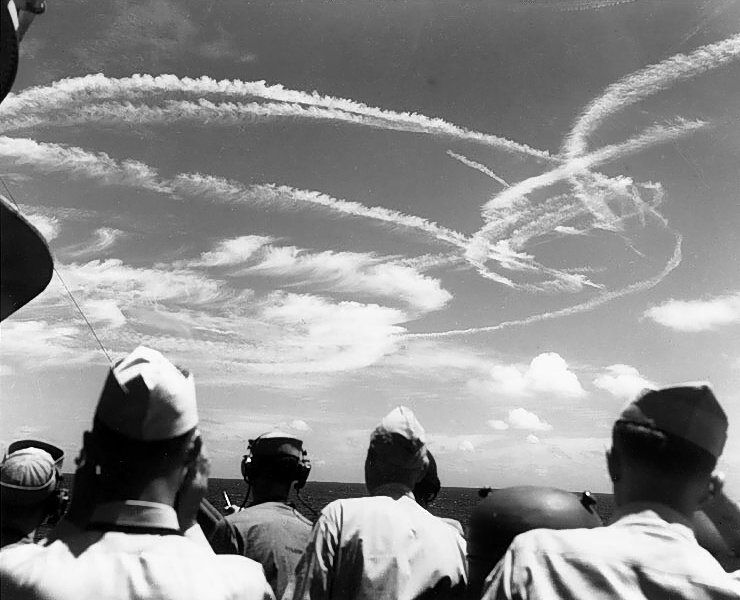
U.S. Navy personnel observe the Air Battle from a Carrier

This battle was the largest battle between aircraft carrier fleets in history.  Twenty four aircraft carriers, 15 American and 9 Japanese embarking over 1400 aircraft dueled in the Central Pacific in a battle that so decimated Japanese Naval Aviation that it never recovered. The battle and the subsequent fall of Saipan brought down the government of General Tojo and was the beginning of the collapse of the Japanese Empire and the “Greater Asia Co-Prosperity Sphere.”

http://dsc.discovery.com/videos/destroyed-in-seconds-marianas-turkey-shoot.html
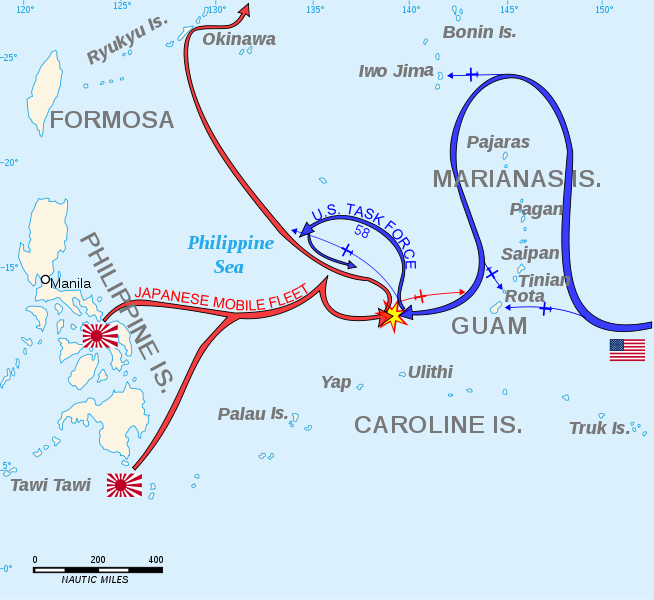
In late 1943 the Japanese realized that they needed to recover the initiative in the Pacific.  Between the Battle of the Coral Sea and the Battle of Santa Cruz Japanese Naval aviation suffered crippling losses especially among the elite pilots and aircrews with who they had begun the war.  These losses were compounded when the Navy attempted to support the operations of the Army to defend the Solomons and New Guinea.  Squadrons sent to battle the United States Navy, Marine Corps and Army Air Corps suffered at the hands of the every more skilled and well equipped American fighter squadrons the victims of which included Admiral Isoruku Yamamoto the Commander of the Combined Fleet when the Betty bomber that he was traveling on was ambushed by U.S. Army Air Corps P-38 Lightening fighters.
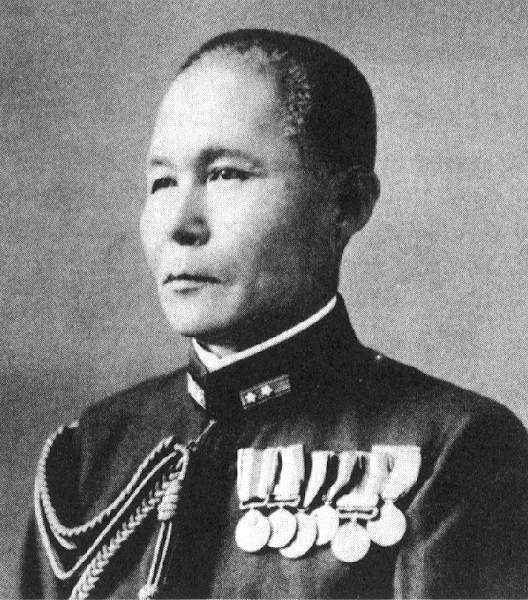
Vice Admiral Jisaburō Ozawa

By late 1943 the Japanese were attempting to train new pilots and aircrews to man the carriers of the Combined Fleet’s Carrier Striking Forces.  Admiral Soemu Toyoda, the new commander of the Combined Fleet and its third commander in less than a year developed “Plan A-Go” as a means to mass carrier and land based aviation assets to defeat the Fast Carrier Task Forces of the United States Navy.  The rebuilt Carrier Striking Groups built around 9 carriers embarking 473 aircraft was commanded by Vice Admiral Jisaburō Ozawa who had taken over from Vice Admiral Chuichi Nagumo.
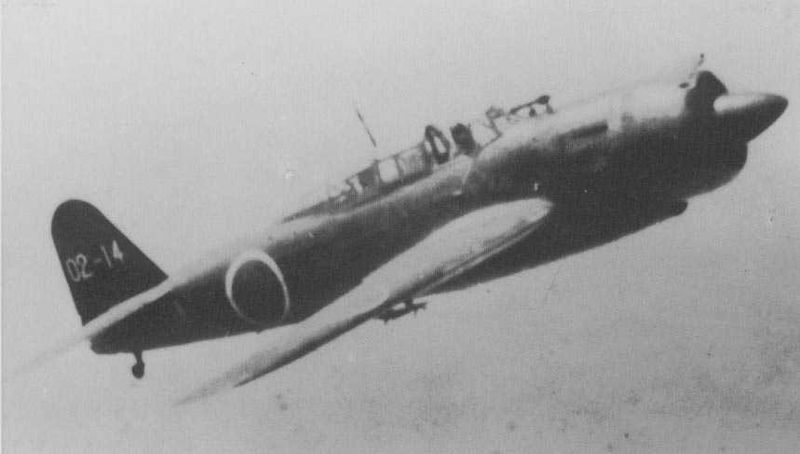
D4Y3 “Judy” Dive Bomber

The Japanese discerned the intentions of the Americans when American Carrier aircraft struck Saipan and Guam. The Japanese had expected the Americans to strike further south and the Marianas had few land-based aircraft in the area. Toyoda made the decision to engage the Americans and ordered the fleet to attack. American submarines discovered the gathering Japanese forces. The Japanese forces were assembled by the 17th and by the 18th the 5th Fleet under the command of Admiral Raymond Spruance spearheaded by Task Force 58 Commanded by Vice Admiral Marc Mitscher had assembled west of Saipan to meet the Japanese.  The Americans fielded 15 carriers including 9 Fleet Carriers of which 6 were the new Essex Class Fleet Carriers which embarked 956 aircraft.
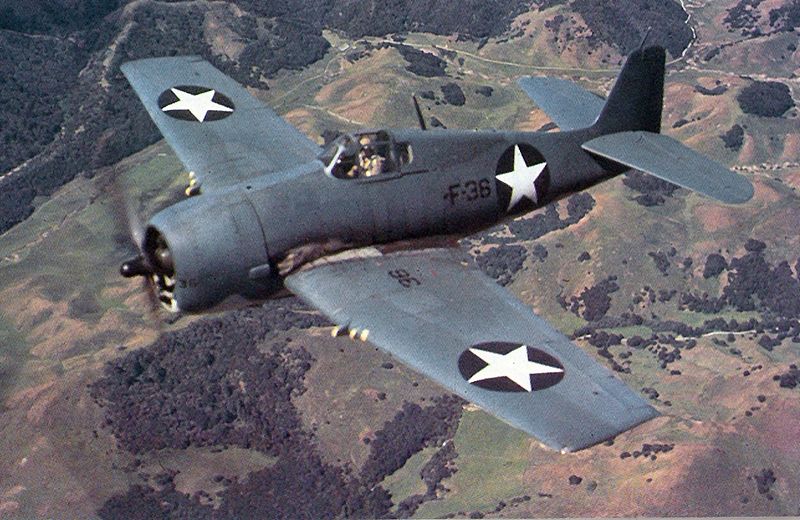
The F6F Hellcat cemented its place as the premier fighter plane of the Pacific war during the “Turkey Shoot”

The Americans held both a quantitative and qualitative advantage against the Japanese. The American fighter squadrons were equipped with the F6F Hellcat which was far superior to the now obsolescent Japanese Zero fighters and their pilots and aircrews were now more experienced and proficient than the newly minted Japanese aviators who by and large had little combat experience and were flying inferior aircraft.  The Japanese had not planned for a long war and had done little to systemically address the heavy losses that their force experienced during 1942 and 1943 at Coral Sea, Midway, Eastern Solomons, Santa Cruz and in the Solomons campaign.
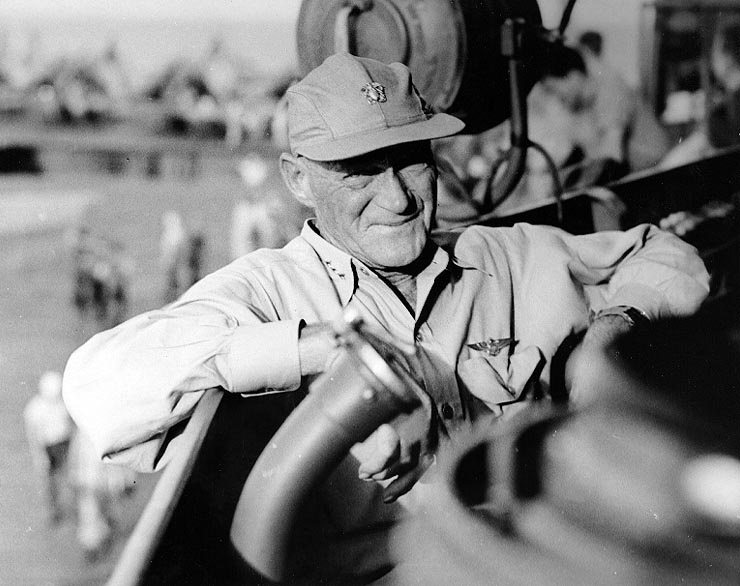
Vice Admiral Marc Mitscher aboard the USS Lexington

Mitscher desired to move aggressively against the Japanese. However he was overruled by Spruance who acting on the advice of his Battle Line Commander Vice Admiral Willis Lee decided that a possible night surface action with the Japanese was not desirable. Spruance instead directed Mitscher to be ready to defend against Japanese air strikes knowing that his carriers and carrier based air groups was more than a match for the Japanese air groups.   Spruance has been criticized for his decision but the words of Willis Lee, a veteran of the Naval Battle of Guadalcanal where he defeated a Japanese force sinking the Battleship Kirishima.  He prevailed in his flagship the USS Washington but losing three of four escorting destroyers and seeing his second battle wagon the USS South Dakota heavily damaged. A night surface engagement was not worth the risk as in Lee’s eyes it evened the playing field for the Japanese and took away the American air power advantages.
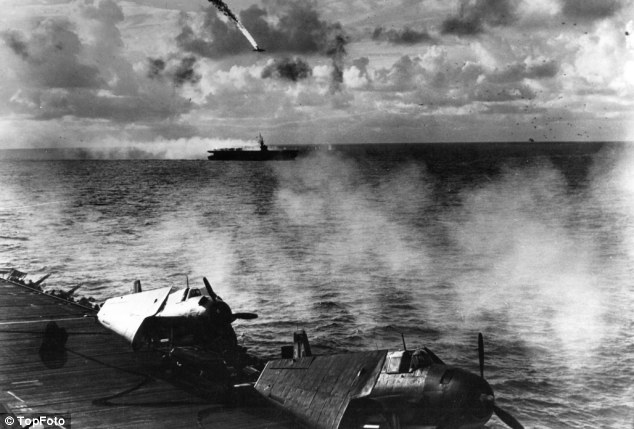
A Japanese aircraft goes down in flames

The Japanese began the action on the 19th sending successive attack waves against Task Force 58. They were met by massed formations of Hellcats vectored in by air controllers in the Combat Information Centers of the American carriers using their superior air search radar systems.  In less than two hours well over 200 Japanese aircraft were downed by the Hellcats.  Lieutenant Alexander Vraicu shot down 6 “Judy” dive bombers in minutes before low on fuel he returned to the USS Lexington.
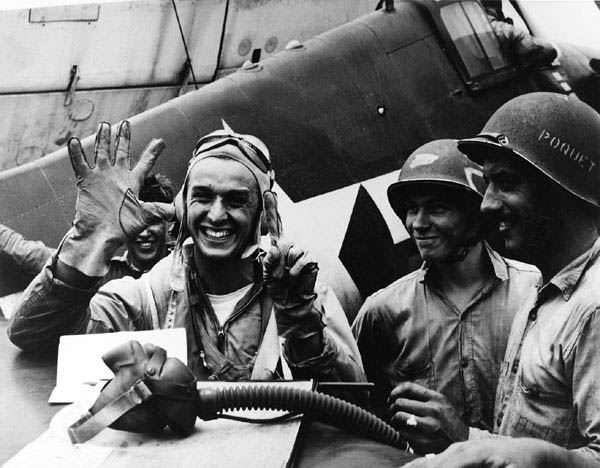
Lieutenant Alexander Vraicu holds up six fingers on board the USS Lexington

While the Hellcats were chewing up the Japanese squadrons the American submarines USS Albacore and USS Cavalla each sank a Japanese Fleet Aircraft Carrier.  The Albacore hit the Ozawa’s flagship, the new Tiaho with a torpedo which caused minimal damage, but ruptured fuel lines. The Japanese damage control officer opened vents in the ship which allowed the fumes to spread throughout the carrier. They were ignited by a generator causing massive explosions and forcing Ozawa to abandon his flagship. Tiaho would sink by late afternoon after being ripped apart by a series of massive explosions taking with her 1650 of 1750 officers and crew. Cavalla hit the Pearl Harbor veteran Shokaku with a spread of three torpedoes causing that ship to burst into flames with aircraft and ordnance adding to the conflagration. A massive explosion ripped through the ship causing her to sink with a loss of over 1200 officers and crew.
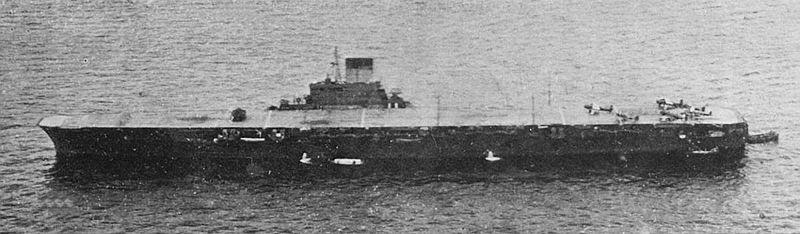
The Japanese flagship Tiaho (above) and her killer the USS Albacore
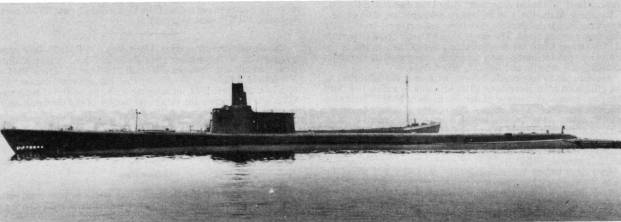
Toyoda desired that Ozawa retire from the battle before he suffered more losses but Ozawa wanted to stay around and hit the Americans with everything that he had left. The Americans sailed west during the night to seek out the Japanese Fleet. It took the majority of the day to find the Japanese. With only 75 minutes of daylight remaining Mitscher launched a strike despite the risk to his aircrew the majority whom were not trained in night landings.  The American strike sank the carrier Hiyo and two tankers and damaged the carriers Zuikaku, Chitoyda and Junyo as well as the battleship Haruna.  By the end of the day Ozawa had 35 aircraft in flyable condition. About 435 of the aircraft operated from the Japanese carriers were lost with the vast majority of their pilots and aircrew.
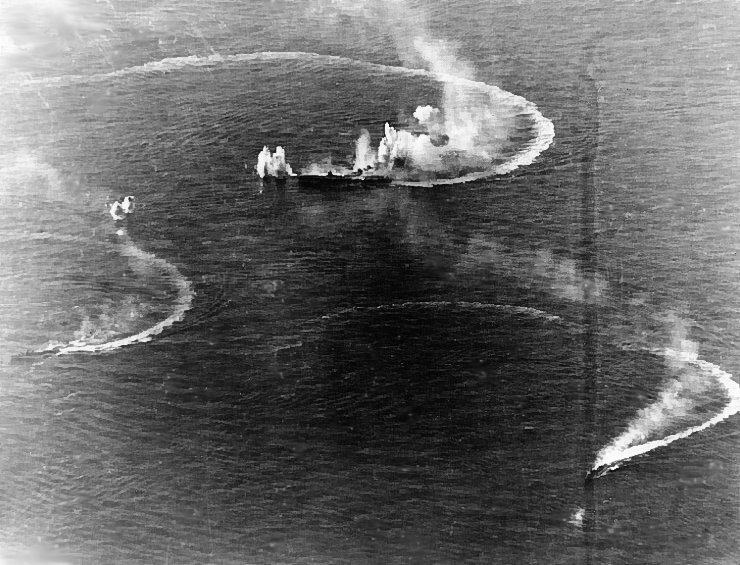
The Japanese Fleet under attack, carrier Zuikaku and two destroyers on June 20th

The final part of the drama was the return of the American strike group to the carriers. Knowing that if he maintained darken ship he would lose many aircraft and the men that flew them Mitscher ordered that the fleet turn on its lights. This act was incredibly risky but helped bring the majority of the returning aircraft to land or ditch near the task force.  The Americans lost less than 100 aircraft during the battle, most due to the night landings and unlike the Japanese who lost the majority of their aircrews, most of the American pilots and aircrew were rescued. In addition to their carrier based losses the Japanese lost nearly 200 land based aircraft.
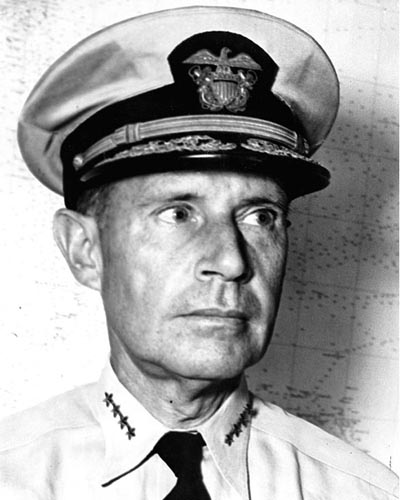
Admiral Raymond Spruance

The battle was the death-kneel of Japanese Naval Aviation. Later in the year the carriers again under Ozawa sailed against the Americans only this time they were a decoy force at the Battle of Leyte Gulf, a role that they succeeded in admirably. The American carriers now had free run of the Pacific only opposed by land based aircraft many used in a Kamikaze role until the end of the war. These would cause fearful losses among the American ships heavily damaging a number of carriers.

The battle is often forgotten by due to its proximity to the Normandy landings but was a significant step in the fight against Japan. The islands captured by the Americans, Saipan, Tinian and Guam would provide major sea and air staging areas for the final assault against Japan. Tinian would become the base of many Army Air Corps B-29 “Superfortress” bombers including those that dropped the Atomic bombs less than 14 months later. It was a turning point both militarily and politically. With the fall of the Tojo government the Japanese leaders began to slowly tell the truth about wartime setbacks and losses to a people that it had lied to since their invasion of China and occupation of Mongolia.  It was a setback that even Tojo and the highest leadership of Japan knew that they could not recover.

Until tomorrow,

Peace,

Padre Steve+
1 Comment

Filed under aircraft, History, Military, Navy Ships, US Navy, world war two in the pacific

Principiis obsta, Finem respice—Resist the beginnings, Consider the end: A Name Change at Padre Steve’s World

Friends of Padre Steve’s World,

img_0027

I have been so busy working in the house the last couple of day, Monday in fact until about 10 PM that I didn’t get much in the way of writing done. Our contractor came today and began work in the house and I have about done almost everything to complete work in the most heavily damaged section of our home. I still have a bit more to do in that room as we get it in shape to be Judy’s art work room and a secondary library and overflow guest room.

I am happy with my work. Tomorrow we should be able to start moving her art supplies, materials, and equipment into it. I will also finally be able to take a crack at our personal belongings that were damaged when our air conditioning condensation pan drains got plugged while we were on leave back in May. We finally got the money from the insurance to begin the repairs and because I am doing much of the work myself have been able to use the much of what I saved to be able to do some badly needed renovations. It has been stressful but in the end it our home will gain a lot in value, but I digress…

Late last night I decided to change the title of this website. I actually did it twice and finally settled on this tonight:

Padre Steve’s World: Resist the beginnings, Consider the end. 

I think it is more appropriate than what I first came up with which was “The Best Little Blog You Never Heard of ” I decided that was a little too pompous despite the fact that I actually do put a lot of research and reflection into almost everything that I post here. The fact is that the twin phrases Principiis obsta and Finem respice, the first from the Roman philosopher Ovid, and the latter most likely from the Book of Ecclesiastes and the writings of the early Christian apologist Tertullian. The were quoted to American Jewish Professor Milton Mayer by a German colleague after the Second World War as a warning of what happens when otherwise good people say nothing and fail to resist evil.

So anyway. I am very tired and need to get some decent sleep since I got so little last night.

Until tomorrow,

Peace

Padre Steve+


Leave a comment

Filed under christian life, History, holocaust, Loose thoughts and musings, philosophy, Political Commentary

The Consequences of Having Scruples: Johannes Steinhoff and Government Service in the Trump Era

Friends of Padre Steve’s World

I have written a lot about the dehumanization of people and genocide, and some of the things that create a climate where such events take place, and how political and religious leaders stir the primal passions of otherwise good, decent and law abiding citizens. I wrote yesterday about some of my favorite resistance figures in history. It will be a multi-part series. I think the next in the series will deal with White and African American abolitionists in the ante-Bellum period and the American Civil War.

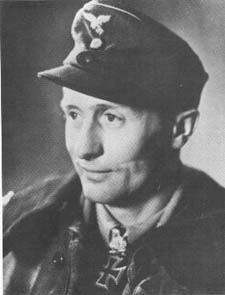
But that being said writing about the anti-Nazi resistors caused me to go back are re-read a book by World War II German Luftwaffe ace Johannes Steinhoff.

Steinhoff was unlike many of the German officers who wrote memoirs following the war, memoirs that historian Williamson Murray wrote “fell generally into two categories; generals writing in the genre of “if the fuhrer had only listened to me!” and fighter pilots or tank busters writing about their heroics against the productive flood from America or the primitively masses of the Soviet Union.”

Steinhoff’s book, The Final Hours: The Luftwaffe Plot Against Goering should be essential reading for any currently serving officer, diplomat, Federal law enforcement, intelligence, or Department of Justice official  as the Trump administration becomes more established and capricious.

steinhoff6

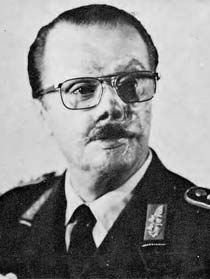
General Johannes Steinhof (above) as a Bundeswehr and NATO officer, showing his burns and before his crash (below)

steinhoff WW II

In his books, Steinhoff does something that you do not see authors do in most military or political memoirs, he actually does serious self reflection on his role in supporting an evil regime. In his introduction to his book The Final Hours the legendary fighter ace who was horribly disfigured when his Me-262 jet fighter crashed and burned two weeks prior to the end of the war wrote:

“In recalling these events, which had been long buried in my memory, it has not been my intention to make excuses. Our unconditional self-sacrifice in the service of the Third Reich is too well documented for that….

So it is because of what is happening today—with freedom threatened in virtually every respect by its own abuse—that I offer this contribution, in the form of an episode in which I was myself involved, to the history of the soldier in the twentieth century. Soldiers have always, in every century of their existence, been victims of the ruthless misuse of power; indeed, given the opportunity, they have joined in the power game themselves. But it fell to our own century to accomplish, with the aid of a whole technology of mass extermination, the most atrocious massacres in the history of mankind. This fact alone makes pacifism a philosophy worthy of respect, and I have a great deal of sympathy with those who profess it. 

The figure of the soldier in all his manifestations is thus symptomatic of the century now nearing its close, and it is to the history of that figure that I wish to contribute by describing what happened to me. I have tried to show what it is possible to do to men, how insidiously they can be manipulated by education, how they can be hoisted onto a pedestal as “heroes,” how they can be so corrupted as even to enjoy the experience—and how they can be dropped and denounced as mutineers when they discover that they have scruples. The complete lack of scruples that such treatment implies is peculiar to rulers who believe that the problems of their own and other peoples can be solved by imposing, through the use of military force, peace on their, the rulers’, terms—in our case a pax germanica, but the second Latin word is readily interchangeable.” from “The Final Hours: The Luftwaffe Plot Against Goring (Aviation Classics)” by Johannes Steinhoff

Since I am a historian and and a career military officer with service in the Iraq War, a war that was illegal and unjust by all measure I can understand Steinhof’s words. Because much of my undergraduate and graduate work focused on German history, particularly that of Imperial Germany after the unification, the Weimar Republic, and the Nazi Reich, I draw a lot of lessons from the period. I also understand how people in this country can fall for the same kind of vitriolic propaganda that the Germans of that era did. I can understand because for years I fell for the lies and propaganda being put out by the politicians, pundits and preachers of the American political right.

In fact I wrote about an incident that happened to me in my own chapel where a dedicated Trump supporter attempted to have me charged with Conduct Unbecoming an Officer and Contempt for the President.  He did this because I used biblical preaching backed by sound theology and history to condemn the President’s comparison of immigrants of darker skin colors as “animals” and an “infestation.” I compared those words with the way Hitler and other totalitarian leaders used such terminology to dehumanize their victims. As I mentioned I was completely cleared by the preliminary inquiry but it sends a chill through my spine.

10665323_10154041610267059_5277331492232210946_n

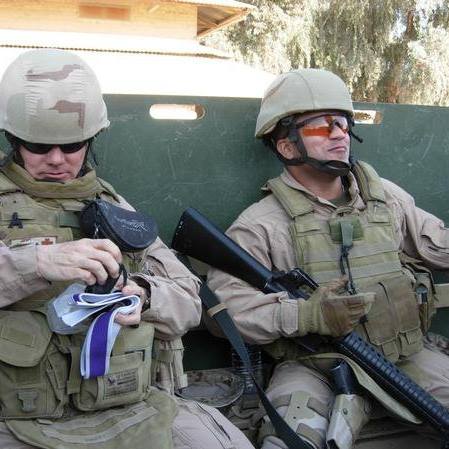
A picture of me (on left) in Iraq 2007 with my assistant and bodyguard RP1 Nelson Lebron

One of those lessons is that in times of crisis, that people, no matter what their race, culture, religious belief system, educational, or economic background are still human. Humanity is the one constant in all of history, our prejudices are often ingrained in us during childhood and reinforced by the words of politicians, pundits, and preachers. In times of stress, crisis, and societal change or upheaval even good people, moral people, people of great intellectual, scientific abilities can fall prey to demagogues who preach hate and blame others, usually racial, ethnic, or religious minorities, as well as civil libertarians who champion the rights of those minorities for the problems of the nation.

Shrewd politicians, preachers, and pundits do this well. They demonize the target group or population and then let the hatred of their disaffected followers flow. The leaders need that disaffected and angry base in order to rise to power; such was how Hitler, Stalin, and so many other despots gained power. They took advantage of a climate of fear, and found others to blame. For Hitler it was the Jews, Slavs, Socialists and Communists; while for Stalin it was various groups like the Ukrainians, or the Poles who were the devil to be feared and destroyed. Timothy Snyder in his book Bloodlands: Europe Between Hitler and Stalin wrote:

“Dead human beings provided retrospective arguments for the rectitude of policy. Hitler and Stalin thus shared a certain politics of tyranny: they brought about catastrophes, blamed the enemy of their choice, and then used the death of millions to make the case that their policies were necessary or desirable. Each of them had a transformative utopia, a group to be blamed when its realization proved impossible, and then a policy of mass murder that could be proclaimed as a kind of ersatz victory.”

But that being said, there are a lot of people who from childhood believe the lies about others without question. In good times such people continue on with life as normal, but in crisis those hatreds and prejudices come to the fore. Rudolf Höss, the notorious sociopath who commanded Auschwitz told American Army psychologist Gustave Gilbert about his reaction when ordered to turn the camp into an extermination center. He said that the order “fitted in with all that had been preached to me for years,” and “at the same time I didn’t think of it as propaganda, but as something one just had to believe.” 

Eugene Davidson in his book on the Nuremberg Trials wrote:

“Every society has in it at all times negative, criminal, sadistic, asocial forces. What holds them in check more than law and police is the consensus of the society – a general belief that despite everything wrong and stupid and muddleheaded in politics, the state is a going concern that will somehow make its way into the future.” (Davidson, The Trial of the Germans p.581)

But when things do not go well, when people do not feel that things will be okay, that the future will be better, and that they have a purpose they look for answers. However, they tend to find their answers in the rantings of demagogues, race baiters, conspiracy theorists, and others who they would tend to dismiss out of hand in good times. In Germany it was the loss of the First World War, the humiliation of Versailles and the economic chaos and social change of the Weimar period which allowed Hitler to gain an audience, then a following, then political power. The demagogues played to what was already in the hearts and minds of the disaffected masses, without that fertile soil, the rantings of Hitler and his propagandists would have never succeeded. Albert Speer wrote:

“As I see it today, Hitler and Goebbels were in fact molded by the mob itself, guided by its yearnings and its daydreams. Of course, Goebbels and Hitler knew how to penetrate through to the instincts of their audiences; but in the deeper sense they derived their whole existence from these audiences. Certainly the masses roared to the beat set by Hitler’s and Goebbels’ baton; yet they were not the true conductors. The mob determined the theme. To compensate for misery, insecurity, unemployment, and hopelessness, this anonymous assemblage wallowed for hours at a time in obsessions, savagery and license. The personal unhappiness caused by the breakdown of the economy was replaced by a frenzy that demanded victims. By lashing out at their opponents and vilifying the Jews, they gave expression and direction to fierce primal passions.”

In a sense a similar thing has happened in the United States which has experienced a series of wars beginning with Vietnam, the shock of the 9-11-2001 attacks, the economic crash of 2007 and 2008 which devastated the savings, home ownership, and investments of many Americans while at the same time benefiting the banking and brokerage houses whose government assisted policies brought about the crash. Of course there are other issues, many religious conservatives hate the progress made by the Women’s and Gay Rights movements, and their leaders play to their fears in apocalyptic terms. I could go on, but I am sure that my readers can identify other issues which demagogues and others use to spread fear and hate to further their goals. The fact is that without the the fertile soil that lays in the hearts of their most fervent followers they would never have a following.

In Weimar Germany hate mongers like Julius Streicher and propagandist Josef Goebbels stuck a chord with disenchanted people who felt that they had lost their country. They were fearful, angry, and desired a leader who would “make Germany great again.” Hitler and his Nazi media sycophants played to that fear, and took advantage of their anger at the existing order. Davidson wrote such people “exist everywhere and in a sick society they can flourish.” 

For decades the way has been prepared for true extremists to take advantage of the fears and doubts of people as modern American versions of Streicher and Goebbels have been at work for years. Rush Limbaugh was a modern pioneer of this in the United States, and he has been joined by so many who are even more extreme in their rantings that it is hard to name them all. Likewise, whole media corporations especially Fox News, websites, and political networks spread such fear every minute of the day, claiming that they, and they alone are real Americans. They actively support politicians who condemn, and sometimes even threaten people who oppose them, and all the while claim that “make America great again.”

When I was younger I devoured that propaganda, despite all of my learning I followed the rantings of men who I realize today are propagandists who promote the basest of lies, and hatred, often in the name of God. I was changed when I was at war, and when I returned home from Iraq in 2008 I realized through hard experience that I had been lied to, and that as a result that thousands of my brothers and sisters were dead, and tens of thousands shattered in body, mind, and spirit. Likewise I saw the massive destruction levied on Iraq and realized how terrible war really is. That was my epiphany, that is what it took to see how much I had been lied to, and it called me to question everything else that I had so willingly believed, things which had been fed to me by years of indoctrination in church, through the media, and by politicians who I believed were truly Christian. I can understand now how Martin Niemoller felt after the Nazi seizure of power when he said, “I hated the growing atheistic movement, which was fostered and promoted by the Social Democrats and the Communists. Their hostility toward the Church made me pin my hopes on Hitler for a while. I am paying for that mistake now; and not me alone, but thousands of other persons like me.”

There was a time that I hated people who espouse the views that I hold today, the views that I write about so often here on this site. I can remember how angry I would get as I listened to the propaganda being put out by Limbaugh, Hannity, the Fox News Channel and all of the others that I listened to every time that I had the chance. But when I changed after Iraq, I felt the sting of that hatred in very real ways. I remember the day I was called by my bishop in my former church, who told me that I had to leave because my views on women, gays, and Moslems were to use his words were now “too liberal.” After that, many men who I considered to be the best of friends turned their backs on me, some in the most bitter and vindictive of ways.

But I realize now that what they did was because I had in a sense left the cult, and had to be ostracized. I can understand that now, because when I was under the spell I too turned my back on people who had fallen out of favor, or people who had rejected the tenants of the church or the political movement, and those are things that I can never undo. But at the time it made sense, it fitted in with all I had been taught for decades, as Albert Speer wrote of Hitler, “One seldom recognizes the devil when he is putting his hand on your shoulder.”

What happened to Steinhoff’s generation is threatening to happen again, in our country, an authoritarian movement is threatening to destroy our democracy and republic. In it soldiers are esteemed, until they realize what is going on and speak out, but by then it is usually too late. I am understanding that fact more and more every day, and having had people troll this blog and call me a traitor and worse, I understand just a bit of what happened to Steinhoff and his fellow officers when they protested to the highest levels what was happening to Germany in early 1945.

In 1944 he and other fighter pilots were subjected to a political indoctrination session and realized that in the Nazi state loyalty and doctrinal purity to Naziism was more important than either combat service or competence. He wrote:

“Now, however, we realized to our horror that a group of officers had decided, after five years of war, to conduct a purge among the troops with the object of eliminating all those “whose past life and present conduct were not consonant with the National-Socialist type” and who did not “stand firm on National-Socialist principles.” We sat there petrified, but some of those present appeared hugely to enjoy the ensuing discussion of what they called “National-Socialist guidelines.” Perhaps, though, for many it was simply an attempt to escape into a less concrete area of discussion than the desperate military situation—and then there was the added satisfaction of being able to censure others. Fanaticism took the place of hopelessness, and phrases like “faith in the Führer,” “rootedness in National-Socialist ideology,” and “irreproachability of character” fell without hesitation from people’s lips. The Luftwaffe leadership, it was said, must be “combed” from top to bottom, and then someone even came out with the “National-Socialist soul…”

We will soon know how military professionals react to being labeled as traitors. President Trump and his followers have been demonizing the personnel of the nation’s intelligence, law enforcement, and diplomatic communities since before the election. The President lambasts critics of any station on his Twitter feed which results in them receiving death threats from his followers. I expect that when Secretary of Defense James Mattis speaks his mind and tells the truth that we will find out.

Personally I expect that when he does that Trump and his most strident supporters will label him as a traitor for doing so. Like a religious cult they have no capacity to tolerate dissent, loyalty to the man will supersede loyalty to the country or the Constitution. When that happens it will be interesting to see the throngs of people in the military and outside of it who make the choice to throw one of the most courageous, selfless, and intellectual soldiers ever produced by our nation under the bus.

Their’s will be a conscious decision. My opinion is that the Constitution and the country will always come first. I wanted to give the President the benefit of the doubt and prayed that he world do the right thing for the country. But I was wrong. I am concerned because of his past and current behavior that his only loyalty is to himself. General Ludwig Beck, who resigned rather than obey Hitler’s order to invade Czechoslovakia in 1938 and died in the anti-Hitler coup attempt in 1944 said:

“It is a lack of character and insight, when a soldier in high command sees his duty and mission only in the context of his military orders without realizing that the highest responsibility is to the people of his country.” 

I have no doubt that General Mattis understands that and will courageously speak his mind, even if he is condemned for doing so. Sadly I have many doubts about other leaders: be they military, political, business, or religious. There are many people who will sell their souls for their personal advancement, the advancement of their agenda, or an increase in their bottom line. It is after all human nature.

But the question is: will we see true men and women of courage who will stand when it appears there is no chance of success? As Atticus Finch said in To Kill a Mockingbird: “Real courage is when you know you’re licked before you begin, but you begin anyway and see it through no matter what.” 

That will be what is demanded in the coming months and years.

Peace

Padre Steve+

4 Comments

Filed under civil rights, faith, History, leadership, Military, nazi germany, News and current events

“Do not forget that every people deserves the regime it is willing to endure.” My Favorite Resistors, Part One: the Anti-Nazis

359212-1081074754-stauffenberg-nazi-germany-stauffenberg-demotivational-poster-1236884536

Friends of Padre Steve’s World,

They are know and unknown but all resisted tyrants and all have become inspirational figures in my life. They are men and women, and many are soldiers or clergy, while others were civil rights leaders. Most were advocates of non-violence, but some due to the incredibly evil nature of the regime under which they lived and served resorted to violence. But all show me and I hope will show you that the path of resistance is not futile.

The problem is that far too many people become discouraged the longer the struggle lasts and end up accommodating themselves to the evil regimes under which they lived. That will probably be the experience of those who struggle against tyranny around the world today as authoritarianism under many guises becomes more entrenched. It is a world wide phenomena but if the classic understanding of democratic liberalism advocated by so many including the founders of the United States is to survive, authoritarians and their tyrannical worldview must be resisted.

Sophie Scholl, a young student at the University of Munich wrote:

“I’ve been thinking of a story from the Old Testament: Moses stood all day and all night with outstretched arms, praying to God for victory. And whenever he let down his arms, the enemy prevailed over the children of Israel. Are there still people today who never weary of directing all their thinking and all their energy, single-heartedly, to one cause?”

That my friends is important.

Yesterday, July 20th was the 74th anniversary of Operation Valkyrie, the attempt of conservative German military officers, diplomats, and others to kill Hitler and end the tyrannical and genocidal Nazi regime. Among the men who died in that attempt were Colonel Claus von Stauffenberg, General Henning von Trescow, General Ludwig Beck, Lieutenant Colonel Mertz von Quirnheim, and General Friedrich Olbricht. Others were implicated and were murdered after kangaroo court proceedings at the hand of the Volksgericht, the “People’s Court” headed by Roland Freisler. Among them was Field Marshal Erich von Witzleben. While Freisler hounded and tried to humiliate him Witzleben remained calm and announced to the court:

“You may hand us over to the executioner, but in three months’ time, the disgusted and harried people will bring you to book and drag you alive through the dirt in the streets!”


tresckow

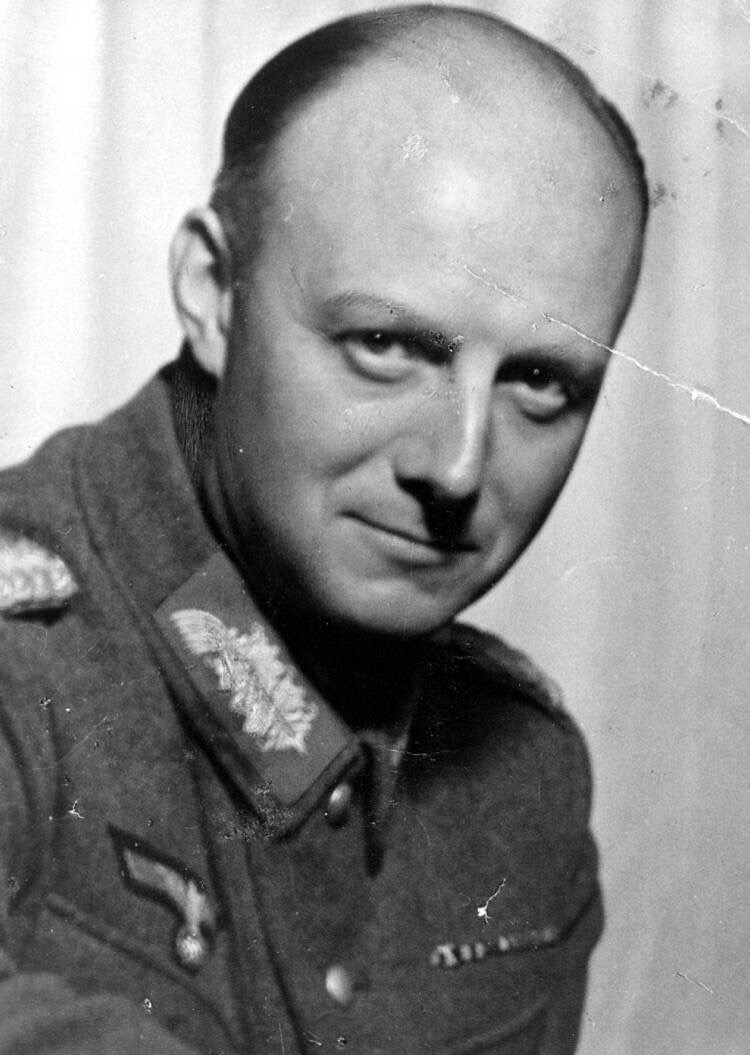
General Henning von Tresckow

“We have to show the world that not all of us are like him. Otherwise, this will always be Hitler’s Germany.” When the attempt failed von Trescow was serving on the Russian front far away from Berlin. To avoid arrest and the possibility that under torture he could implicate others or cause harm to his wife and children von Trescow killed himself. Another participant wrote that before his death von Trescow said:

“The whole world will vilify us now, but I am still totally convinced that we did the right thing. Hitler is the archenemy not only of Germany but of the world. When, in few hours’ time, I go before God to account for what I have done and left undone, I know I will be able to justify what I did in the struggle against Hitler. God promised Abraham that He would not destroy Sodom if only ten righteous men could be found in the city, and so I hope for our sake God will not destroy Germany. No one among us can complain about dying, for whoever joined our ranks put on the shirt of Nessus. A man’s moral worth is established only at the point where he is ready to give his life in defense of his convictions.”

Ludwig Beck

General Ludwig Beck

Beck, who had resigned his post as commander of the German Army in protest of the planned invasion of Czechoslovakia wrote something that has become a key part of my military and personal ethic: “It is a lack of character and insight, when a soldier in high command sees his duty and mission only in the context of his military orders without realizing that the highest responsibility is to the people of his country.” 

Tresckow, a committed Christian also noted of Hitler’s supposedly Christian supporters: “I cannot understand how people can still call themselves Christians and not be furious adversaries of Hitler’s regime.” 

220px-Bundesarchiv_Bild_146-1979-013-43,_Wilhelm_Canaris

Admiral Wilhelm Canaris 

There were other Christian resisters of the Hitler regime. Hans Oster was the son of a pastor and one of the senior officers in the Abwehr, the German military intelligence. His boss, Admiral Wihelm Canaris was also a resister. Both would be executed on the personal order of Hitler in April 1945 along with Pastor Dietrich Bonhoeffer, all had been arrested for their involvement in anti-Hitler activities. For his part Canaris would note something that military, intelligence, or police officials who might be tempted to excuse the actions of modern day tyrants or would be authoritarians:

“One day the world will hold the Wehrmacht responsible for these methods since these things are taking place under its nose.”

bonhoeffer-prison2

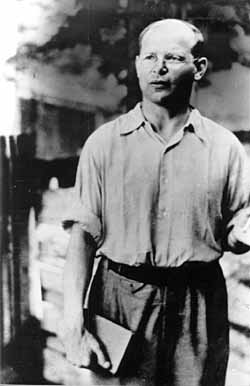
Dietrich Bonhoeffer 

Pastor Bonhoeffer who died with Oster and Canaris at Flossenburg wrote:

“Christianity stands or falls with its revolutionary protest against violence, arbitrariness and pride of power and with its plea for the weak. Christians are doing too little to make these points clear rather than too much. Christendom adjusts itself far too easily to the worship of power. Christians should give more offense, shock the world far more, than they are doing now. Christian should take a stronger stand in favor of the weak rather than considering first the possible right of the strong.”

hermann maas

Hermann Maas 

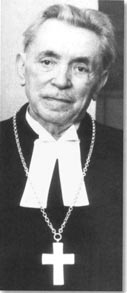
Hermann Maas, another Lutheran pastor made his mark by speaking out in defense of Jews and Socialists. He angered the German political right including the Nazis by doing so. He aided Jews and other non-Aryans to escape Germany, and cared for the elderly Jews who could not. He was removed from his pastorate and imprisoned. He survived the war and would be the first German recognized by Yad Vashem as one of the Righteous Among the Nations. Maas discussed the responsibility of all Germans for the crimes of Hitler and the Nazis, something that Christians and others in nations like the United States, Europe, Asia, Africa, and South America that are threatened by authoritarian leaders and racist regimes:

“Every German bears responsibility for Germany no matter who he is or where he stands, in the homeland or abroad, in public and at home. No one can absolve him of this responsibility. He can transfer it to no one.” 

img_0090

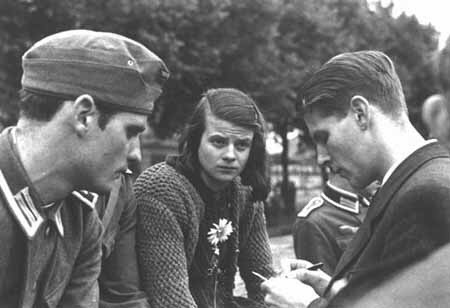
Sophie Scholl

But these men were not the only opponents of the Nazi regime. A young woman, a student at the University of Munich named Sophie Scholl and her brother Hans were at the center of an anti-Nazi resistance called the White Rose. They published and distributed a number of anti-Nazi leaflets and were caught doing so in early 1943.

One of those pamphlets noted:

“Nothing is so unworthy of a civilized nation as allowing itself to be “governed” without opposition by an irresponsible clique that has yielded to base instinct. It is certain that today every honest German is ashamed of his government. Who among us has any conception of the dimensions of shame that will befall us and our children when one day the veil has fallen from our eyes and the most horrible of crimes – crimes that infinitely outdistance every human measure – reach the light of day?

If the German people are already so corrupted and spiritually crushed that they do not raise a hand, frivolously trusting in a questionable faith in lawful order in history; if they surrender man’s highest principle, that which raises him above all other God’s creatures, his free will; if they abandon the will to take decisive action and turn the wheel of history and thus subject it to their own rational decision; if they are so devoid of all individuality, have already gone so far along the road toward turning into a spiritless and cowardly mass – then, yes, they deserve their downfall.

Goethe speaks of the Germans as a tragic people, like the Jews and the Greeks, but today it would appear rather that they are a spineless, will-less herd of hangers-on, who now – the marrow sucked out of their bones, robbed of their center of stability – are waiting to be hounded to their destruction. So it seems – but it is not so. Rather, by means of a gradual, treacherous, systematic abuse, the system has put every man into a spiritual prison. Only now, finding himself lying in fetters, has he become aware of his fate.

Only a few recognized the threat of ruin, and the reward for their heroic warning was death. We will have more to say about the fate of these persons. If everyone waits until the other man makes a start, the messengers of avenging Nemesis will come steadily closer; then even the last victim will have been cast senselessly into the maw of the insatiable demon.

Therefore every individual, conscious of his responsibility as a member of Christian and Western civilization, must defend himself against the scourges of mankind, against fascism and any similar system of totalitarianism. Offer passive resistance – resistance – wherever you may be, forestall the spread of this atheistic war machine before it is too late, before the last cities, like Cologne, have been reduced to rubble, and before the nation’s last young man has given his blood on some battlefield for the hubris of a sub-human. Do not forget that every people deserves the regime it is willing to endure.”

She wrote:

“It’s the reductionist approach to life: if you keep it small, you’ll keep it under control. If you don’t make any noise, the bogeyman won’t find you. But it’s all an illusion, because they die too, those people who roll up their spirits into tiny little balls so as to be safe. Safe?! From what? Life is always on the edge of death; narrow streets lead to the same place as wide avenues, and a little candle burns itself out just like a flaming torch does. I choose my own way to burn.”

I think of all of these people that I admire young Sophie Scholl the most. She had no power. She was not an officer, a government official, a businessman, or a pastor. She was simply a young woman who was informed by her faith and her concern for basic human morality and ethics.

While the Nazi State was consumed by the flames of Hitler’s Götterdämmerung, the lives and message of those few who resisted still redounds to us today. And yes, in comparison to the majority of Germans  of the Hitler era, they were a tiny minority, Of over 2000 German General and Flag officers a mere 22 were involved in anti-Nazi activities and the same is true for most professions in the Third Reich.

Milton Mayer wrote the words of a German University Professor and colleague after the war was over. The professor was reflecting on how people ended up going along with the Nazi regime. Mayer wrote his friends words:

“And one day, too late, your principles, if you were ever sensible of them, all rush in upon you. The burden of self-deception has grown too heavy, and some minor incident, in my case my little boy, hardly more than a baby, saying ‘Jewish swine,’ collapses it all at once, and you see that everything, everything, has changed and changed completely under your nose. The world you live in—your nation, your people—is not the world you were born in at all. The forms are all there, all untouched, all reassuring, the houses, the shops, the jobs, the mealtimes, the visits, the concerts, the cinema, the holidays. But the spirit, which you never noticed because you made the lifelong mistake of identifying it with the forms, is changed. Now you live in a world of hate and fear, and the people who hate and fear do not even know it themselves; when everyone is transformed, no one is transformed. Now you live in a system which rules without responsibility even to God. The system itself could not have intended this in the beginning, but in order to sustain itself it was compelled to go all the way.

“You have gone almost all the way yourself. Life is a continuing process, a flow, not a succession of acts and events at all. It has flowed to a new level, carrying you with it, without any effort on your part. On this new level you live, you have been living more comfortably every day, with new morals, new principles. You have accepted things you would not have accepted five years ago, a year ago, things that your father, even in Germany, could not have imagined.

“Suddenly it all comes down, all at once. You see what you are, what you have done, or, more accurately, what you haven’t done (for that was all that was required of most of us: that we do nothing). You remember those early meetings of your department in the university when, if one had stood, others would have stood, perhaps, but no one stood. A small matter, a matter of hiring this man or that, and you hired this one rather than that. You remember everything now, and your heart breaks. Too late. You are compromised beyond repair.

“What then? You must then shoot yourself. A few did. Or ‘adjust’ your principles. Many tried, and some, I suppose, succeeded; not I, however. Or learn to live the rest of your life with your shame. This last is the nearest there is, under the circumstances, to heroism: shame. Many Germans became this poor kind of hero, many more, I think, than the world knows or cares to know.”

I think that I shall close with that tonight.

Peace

Padre Steve+

1 Comment

Filed under christian life, civil rights, ethics, faith, History, holocaust, laws and legislation, leadership, Military, nazi germany, News and current events, Political Commentary

“We have to show the world that not all of us are like him” Operation Valkyrie In the Age of Trump and Other Authoritarians


Henning Von Trescow 

Friends of Padre Steve’s World,

Seventy-three years ago today a number of German military officers as well as civilian officials attempted to assassinate Adolf Hitler in an attempt to overthrow the Nazi Regime and end the Second World War. Ironically many had been supporters of Hitler’s early policies and few had spoken out against the Nazi seizure of power, elimination of political opponents, the outlawing of trade unions and opposition political parties. Most remained silent when Hitler conducted his brutal Night of the Long Knives massacre of 1934 and took the personal oath of loyalty to him after Hindenburg died soon after.

Some would recognize the threat but offered little resistance as Hitler consolidated his power and began to begin his reign of terror at home even as he began to conquer swaths of Europe without firing a shot. Early plans to overthrow Hitler collapsed because his opponents, so used to being loyal and obedient servants of the State were paralyzed whenever an unexpected contingency arose.

Eleven years after Hitler made opposition political parties illegal and almost five years after he invaded Poland to begin the Second World War a plan called Operation Valkyrie was launched. Two of the key plotters were Colonel Claus Schenk Von Stauffenberg, Major General Henning Von Trescow, and retired General Ludwig Beck.

Most understood that the attempt would likely fail, but they were determined to try. Von Trescow said: “It is almost certain that we will fail. But how will future history judge the German people, if not even a handful of men had the courage to put an end to that criminal?” 

When Stauffenberg detonated a bomb at Hitler’s East Prussian Wolf’s Lair headquarters Beck and other conspirators attempted to seize power in Berlin. However their plans went awry. Hitler survived the blast. Josef Goebbels secured Berlin, and the plot fell apart. Stauffenberg and a number of conspirators were shot that night, Beck attempted to commit suicide but failed and was killed. Over 5,000 more conspirators, suspects, and other Nazi opponents, including some of the most respected officers of the Wehrmacht were tried in show trials and executed. Some like Field Marshal Erwin Rommel were given the choice of committing suicide to save their families.

Von Trescow, who killed himself on the Russian front following the collapse of the coup noted: “We have to show the world that not all of us are like him. Otherwise, this will always be Hitler’s Germany.” Likewise, Beck wrote something that has become a key part of my military and personal ethic: “It is a lack of character and insight, when a soldier in high command sees his duty and mission only in the context of his military orders without realizing that the highest responsibility is to the people of his country.” 

Fabian von Schlabrendorff, a conspirator who was captured and tortured by the Gestapo after the failure of Operation Valkyrie, said: “Obedience is the rule. However, there are cases which demand disobedience. This has been uncontested in the Prussian Army. Blind obedience has its origin with Hitler.” 

When Hitler issued the Commissar or Criminal Order on the eve of Operation Barbarossa in 1941, Von Trescow told a colleague:

“Remember this moment. If we don’t convince the field marshal (Fedor von Bock) to fly to Hitler at once and have these orders (Commissar Order) canceled, the German people will be burdened with a guilt the world will not forget in a hundred years. This guilt will fall not only on Hitler, Himmler, Göring, and their comrades but on you and me, your wife and mine, your children and mine, that woman crossing the street, and those children over there playing ball.” 

Unlike Hitler’s Germany Americans still have some checks and balances to guard against a President attempting to gain control of the country the way Hitler did Germany. However, those checks and balances are delicate, fragile, and if neglected will fail in the crisis. In fact they are showing incredible strain as the Republican majorities in Congress fail to exercise their constitutional responsibilities and political appointees undermine the very agencies that they are responsible for maintaining, and laws that they were sworn to uphold. If they do fail, will we have the courage to stand for the principles and ideals of our country? That we do not yet know but my recent experience says that we very well might fail in the crisis. Historian Timothy Snyder wrote:

“The European history of the twentieth century shows us that societies can break, democracies can fall, ethics can collapse, and ordinary men can find themselves standing over death pits with guns in their hands. It would serve us well today to understand why.”

There are prices to be paid for obedience to unlawful orders and the actions of a criminal state, as well as a price to be paid for disobedience. The men who belatedly and against a nation that was still devoted to Hitler understood those questions and acted accordingly. I do hope that none of us have to face what these men did between 1933 and 1944. However, as time marches on and the President and his Administration continue to defy the law, ignore the Constitution, and undermine the foundations of our Republic, even encouraging their supporters to violence, will our democratic institutions survive?

The administration has implemented and is continuing to implement policies that are quite similar in their intent to crimes that the Nazis were tried for at Nuremberg. If Americans do not rise up against them we too will be to use the words of Von Trescow: “be burdened with a guilt the world will not forget in a hundred years.” 

img_0193-1

Bonhoeffer

That is a question that we have to ask. If they do crumble will we stand the test? Will we have the courage to resist even at the cost of our lives? Dietrich Bonhoeffer who had already been jailed by the Gestapo at the time of Valkyrie wrote:

“If I sit next to a madman as he drives a car into a group of innocent bystanders, I can’t, as a Christian, simply wait for the catastrophe, then comfort the wounded and bury the dead. I must try to wrestle the steering wheel out of the hands of the driver.”

Will we have the courage to resist at that moment? Words are cheap, actions are all to rare. Will we be able to stand against the tide?

That my friends is a question we may all have to answer sooner rather than later.

Until tomorrow,

Peace

Padre Steve+

2 Comments

Filed under christian life, civil rights, ethics, faith, History, Military, nazi germany, News and current events, Political Commentary

Accused and Threatened by a Christian Trump Cultist

Friends of Padre Steve’s World,

Saul Steinberg wrote:

“Baseball is an allegorical play about America, a poetic, complex, and subtle play of courage, fear, good luck, mistakes, patience about fate, and sober self-esteem.” 

Last night I watched what turned out to be an magnificent MLB All Star Game. I had a very good day going into it and anticipated it with the same glorious expectations that I have done since the 1970 All Star Game. For me the MLB All Star Game is an event with nearly religious significance. Baseball is a game that helps me connect spiritually with God as well as exhibits some of the best traits of what until now has defined the United States, as reflected in the words of Steinberg.

For me that was comforting and until last night Saul Steinberg’s words comforted me and allowed me to believe a myth about the inherent goodness of America. Despite our flaws, our mistakes, and yes, even many malevolent policies I still believed that we are basically good people. I don’t think that I believe that anymore, even as I still believe that most Americans want to be good people. We like to think that we are the good guys.

As the game went on I developed a terrible headache and I began to become incredibly depressed. I could feel myself slipping down like I haven’t for a few years. I got up this morning doing better but after a good Staff meeting at our base headquarters began to walk to my car and during that time I began to sink into the pit again. I pulled into my parking spot at the chapel and I was terrified until one of my Catholic parishioners came in to talk to me for a few minutes. She’s a sweet English lady and her kindness is always a blessing and today it made a big difference. My Chief came in to me with a laundry list of things that I needed to help with and then I found out that three young Chaplain Candidate Officers were coming to see me. That put me back in my element because over the past couple of years I have come to realize that the most important thing that I do is to mentor young men and women, especially Chaplains or those aspiring to be Chaplains. I didn’t tell them anything of what I am writing tonight, but I was able to give the, good advice and invite them to contact me any time even if I was no longer on active duty.

The game was a fantastic game but I didn’t enjoy it because I was too caught up in something that happened to me two weeks ago when I received the news that I was being investigated for the allegations of violating the Uniform Code of Military Justice made by a member of my Chapel, a retired Navy Officer.

The man accused me of the violation of Article 88 Contempt for an Official in this case the President of the United States, and of Article 133, Conduct Unbecoming an Officer for the content of my sermon. He accused me of “comparing the President to Adolf Hitler” and “the actions of those enforcing the laws of the nation as Nazis or Nazi Sympathizers.” He accused me of “engaging in political activism on the job.”

Because of his allegations to the command my Commanding Officer had to launch a preliminary investigation. If the allegations were found to be true I could have been charged and tried by Court Martial. My career of 37 years of Army and Navy service including two combat tours and multiple deployments and family separations could have been ended had I been charged or convicted of such an offense.

I wrote about that sermon last month and the allegations were scurrilous, unsubstantiated and purely of his own making. If there was any political motivation it was this retired officer’s allegations which were an attempt to silence legitimate Christian preaching on social justice issues. I found the complaint ironic because one of my predecessors preached against the end of the Defense of Marriage Act and the end of the Don’t Ask Don’t Tell policy. That Chaplain attacked the character of President Obama and pledged to disobey any orders to support marriage equality. But not one person in the congregation complained.

Yet when I criticized President Trump’s words in which he described immigrants and refugees as “animals”, called them an “infestation” and linked all of them to being violent murderers, rapists, and associated with the MS-13 criminal gang as being dehumanizing, against the teachings of the church and similar to the words that Hitler used to demonize and dehumanize the Jews, that was wrong. When I criticized the Attorney General for his misuse of Scripture to defend those polices in front of the Catholic Bishops and the complicity of the White House Press Secretary and Pastor Robert Jeffress of First Baptist Church Dallas in defending those remarks I was a criminal in the mind of my accuser.

The fact that I was preaching within a prophetic Christian social justice tradition as Dietrich Bonhoeffer or Martin Luther King Jr. was irrelevant to my accuser. The fact that I could make legitimate historical comparisons, not only with Nazi Germany but American slavery, the Black Codes, Jim Crow, the extermination of Native American tribes, and the internment of Japanese Americans was irrelevant. It was the fact that I deviated from the Christian Trump Religious cult claims that brought about these scurrilous charges.

When I was called in for an interview by the investigating officer, who I know is a very fair, honest, and decent man I sensed that he was uncomfortable in having to question me as we have worked together over the past year. I told him that I could not submit to an interview and without an attorney present.

I left and immediately called Mikey Weinstein of the Military Religious Freedom Foundation, or MRFF. Mikey took my call immediately and connected me with one of his exceptional attorneys. That was on July 3rd and I spent Independence Day wondering if my military career was about to end. On July 5th I was asked by the Investigating Officer for names of other parishioners who had heard the sermon. I was able to give him a few names, all retired African American Chief Petty Officers or Army and Marine Corps Senior NCOs. He interviewed them and my attorney contacted him. The next morning I was called by the Investigating Officer and the Base Executive Officer to let me know that I had been exonerated and the investigation was over. Both seemed happy for me.

I was supported during the ordeal by the regional Chaplain who is much more conservative than me, and this was not a witch hunt by my command. They as well as my commanding officer are all men of integrity who respect and appreciate my work. If they had not been such men my life could have much more difficult. I was fortunate, but I know other officers who have not been so fortunate or had as solid and feared legal counsel as I received from MRFF. Some of them were convicted of crimes that they did not commit or as in the case of one officer was the victim of a witch hunt by his service chief after his command and civilian police officials had determined that there was no evidence that he had committed any crime. His service overruled them and had him tried by a jury and judge of their choice. I know this because I was called as a character witness. I was flown overseas and within two hours of landing I was thrust onto the witness stand without rest or so much time as to shower or shave. He was convicted anyway. However, during my testimony during the sentencing phase the next day which was not impeached or overruled I told the truth, that the only reason that the officer was on trial and been convicted was because he was gay and not because of the evidence. It was a travesty of justice and I am glad that it didn’t happen to me.

That being said I was fortunate that I have a command that has integrity and seeks the truth. The investigation proved that the charges of the retired officer we’re false and more related to his political allegiance than to any Christian teaching or tradition.

However the most disturbing part of this experience was how that it continues to effect me. The fact is that this retired officer couldn’t even follow the clear commands of Jesus or the Apostle Paul to deal with disagreements between brothers privately or within the Church. Never did any New Testament writer or any of the Ante-Nicene Fathers instruct Christians to turn in other Christians that disagrees with them to the State. What happened to me reminded me of the accounts of German Protestant and Catholic Priests who were turned in to the Gestapo by informants in the Church.

I think that is why I went into such a deep depression last night. The situation in our country has even taken away my ability to enjoy a baseball game and made me incredibly suspicious of the members of my chapel congregation.

Sadly, based on other comments on my Facebook page by some other officers I realize that one cannot reason with members of the Christian Trump Cult even using Scripture and the Christian tradition. Like the German Christians who followed Hitler to his Götterdämmerung they will follow Trump even as he shoots someone on 5th Avenue.

Maybe I will write about the All Star Game tomorrow, but if I don’t it will be first time in nine years on this blog that I haven’t. I think that is one of the worst things about my experience, living on such an edge and under such a real threat that I can no longer enjoy things that used give me such joy and peace.

If this is what it means to Make America Great Again I want nothing to do with it or those who pledge their allegiance to Trump over the Constitution or Christ.

I have more to say but will live it at this for the night.

So until tomorrow,

Peace,

Padre Steve+

11 Comments

Filed under civil rights, ethics, faith, History, holocaust, nazi germany, News and current events, Political Commentary, Religion

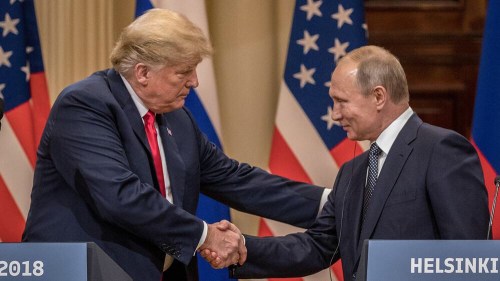
Adhering to or Aiding the Enemy: the President and Putin at Helsinki

Friends of Padre Steve’s World,

I am more concerned than ever about the fate of our country and the world. I have written much about the public statements, tweets, and policies of President Trump. I have written much about his lack of character, his relentless lying, his cruel policies, his unrequited racism, his penchant for preferring dictators to democrats (not the American political party but those who abide by its principles) his distain for the Constitution, the Bill of Rights, and the fundamental premise of the Declaration that “All men are created equal.”

I began writing about my concerns in 2015 not long after he announced his candidacy. I have not stopped doing so even though after his inauguration I really did hope that realization of the gravity of his office would at least provoke a bit of change in him. However, that did not happen, instead the power of the office emboldened him to allow his very worst character traits to become even more corrosive and toxic.

If this was merely an argument between Democrats and Republicans on matters of policy, even hard fought and divisive policies it would be one thing, but this is different. It is a blatant denial of his oath of office and by its very nature involves the very real possibility that the President is committing treason before our very eyes. This isn’t about policy or party politics; it is about the President of the United States openly siding with the leader of a hostile power. A leader whose military intelligence agency, the GRU has been identified by every United States intelligence agency and the FBI as being behind multiple attacks at multiple levels on the United States election system. In fact these attacks are ongoing even today and the President defended Putin and attacked U.S. intelligence services as well as Special Prosecutor Robert Muller who last Friday added the indictments of another dozen Russian GRU officers to his tally, which is now up to 26 Russian officers. When questioned about a tweet in which he blamed the United States and especially the Muller investigation for the poor relationship with Russia in which the President said:

Our relationship with Russia has NEVER been worse thanks to many years of U.S. foolishness and stupidity and now, the Rigged Witch Hunt!

President claimed that Miller’s investigation was “is a disaster for our country.”

Shortly after the President’s defense of Russian President Putin and attacks on U.S. intelligence and law enforcement agencies, the free press, and his domestic political opponents the Director of National Intelligence, Dan Coats a Republican and former Senator from Indiana who had briefed the President about this before the summit issued the following statement:

“The role of the Intelligence Community is to provide the best information and fact-based assessments possible for the President and policymakers. We have been clear in our assessments of Russian meddling in the 2016 election and their ongoing, pervasive efforts to undermine our democracy, and we will continue to provide unvarnished and objective intelligence in support of our national security.” https://www.dni.gov/index.php/newsroom/press-releases/itemlist/category/285-press-releases-2018

Former CIA Director John Brennen tweeted today:

“Donald Trump’s press conference performance in Helsinki rises to & exceeds the threshold of “high crimes & misdemeanors.” It was nothing short of treasonous. Not only were Trump’s comments imbecilic, he is wholly in the pocket of Putin…”

He is correct. The U.S. Constitution, Article III, Section 3 states: “Treason against the United States, shall consist only in levying war against them, or in adhering to their enemies, giving them aid and comfort.”

The U.S. Code amplifies Article III. It states:

18 U.S. Code § 2381 – “Whoever, owing allegiance to the United States, levies war against them or adheres to their enemies, giving them aid and comfort within the United States or elsewhere, is guilty of treason and shall suffer death, or shall be imprisoned not less than five years and fined under this title but not less than $10,000; and shall be incapable of holding any office under the United States.”

It could not be clearer. The President’s actions and words over the past two years regarding Russian attack on our election system have left all Americans a choice. By all measures the President is either a completely self-absorbed imbecile who incapable of dealing with facts and in doing so inadvertently aiding the Russians; or he has something to hide and is knowingly working with the and for Russians who he has previously admitted were behind the attacks on our election system.

I don’t know which it is, or even if it is a combination of all of that. All I know as an old Cold Warrior is that the Russians are not our friends and that trampling American institutions and allies to cozy up to them is very close to the definition of treason as it it defined in the Constitution and the U.S. Code. I would say the same of any President who did as this President has done and I wouldn’t give a damn about what party they belonged.

This is very serious and cannot be swept under the rug of the next scandal or diversion by The Administration. It is the responsibility of Congress and the Courts to retrain an unchecked Executive who appears to likely to be committing treason regardless of if it is intentional or not. If they do not they are complicit in that crime and history will judge them accordingly.

General Ludwig Beck who resigned his office as the head of the German Army over Hitler’s plan to invade Czechoslovakia in 1938 and who died in the failed attempt to kill Hitler on July 20th 1944 said:

“It is a lack of character and insight, when a soldier in high command sees his duty and mission only in the context of his military orders without realizing that the highest responsibility is to the people of his country.”

I will leave you with that. Until tomorrow,

Peace,

Padre Steve+
Leave a comment

Filed under Foreign Policy, History, Loose thoughts and musings, News and current events, Political Commentary

Enforcing White Privilege: The Fugitive Slave Act of 1850 and “the Privilege of Belonging to the Superior Race Part Three

thomas-sims-marched-into-slavery-nypl

Enforcing the Fugitive Slave Act in Boston 

Friends of Padre Steve’s World

Today the third installment of a three part series  of my work dealing with American Slavery in the ante-bellum period. These next articles deal with the subject of what happens when laws are made that further restrict the liberty of already despised, or enslaved people. In this case the subject is the Compromise of 1850 and its associated laws such as the Fugitive Slave Act of 1850.

This is an uncomfortable period of history for Americans with either a sense of conscience, or those who believe the racist myths surrounding the “Noble South” and “The Lost Cause.”  I hope that you find them interesting, especially in light of current events in the United States.

Peace,

Padre Steve+

The Fugitive Slave Act of 1850

Robert Toombs of Georgia was an advocate for the expansion of slavery into the lands conquered during the war. Toombs warned his colleagues in Congress “in the presence of the living God, that if you by your legislation you seek to drive us from the territories of California and New Mexico, purchased by the common blood and treasure of the whole people…thereby attempting to fix a national degradation upon half the states of this Confederacy, I am for disunion.”  [1]

The tensions in the aftermath of the war with Mexico escalated over the issue of slavery in the newly conquered territories brought heated calls by some southerners for secession and disunion. To preserve the Union, Henry Clay and Daniel Webster, supported by the new President Millard Fillmore were able to pass the compromise of 1850 solved a number of issues related to the admission of California to the Union and boundary disputes involving Texas and the new territories.  But among the bills that were contained in it was the Fugitive Slave Law, or The Fugitive Slave Act of 1850. The act was the device of Henry Clay which was meant to sweeten the deal for southerners. The law would “give slaveholders broader powers to stop the flow of runaway slaves northward to the free states, and offered a final resolution denying that Congress had any authority to regulate the interstate slave trade.” [2]

fugitive-slave-law

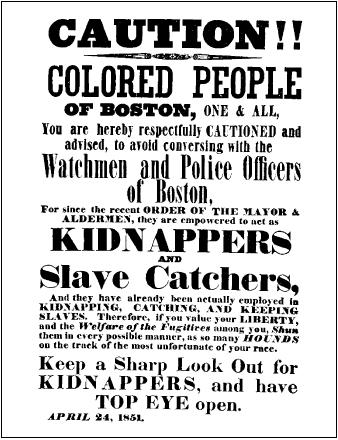
A Warning to Blacks in Boston regarding the Fugitive Slave Law

For all practical purposes the Compromise of 1850 and its associated legislation nationalized the institution of slavery, even in Free States. It did this by forcing all citizens to assist law enforcement in apprehending fugitive slaves. It also voided state laws in Massachusetts, Vermont, Ohio, Connecticut, Pennsylvania and Rhode Island, which barred state officials from aiding in the capture, arrest or imprisonment of fugitive slaves. “Congress’s law had nationalized slavery. No black person was safe on American soil. The old division of free state/slave state had vanished….” [3] If there was any question as to whose “States Rights” the leaders of the South were advocating, it was certainly not those of the states whose laws were voided by the act.

That law required all Federal law enforcement officials, even in non-slave states to arrest fugitive slaves and anyone who assisted them, and threatened law enforcement officials with punishment if they failed to enforce the law. The law stipulated that should “any marshal or deputy marshal refuse to receive such warrant, or other process, when tendered, or to use all proper means diligently to execute the same, he shall, on conviction thereof, be fined in the sum of one thousand dollars.” [4] In effect the law nullified state laws and forced individual citizens and local officials to help escaped slaves regardless of their own convictions, religious views, and state and local laws to the contrary.

Likewise the act compelled citizens in Free states to “aid and assist in the prompt and efficient execution of this law, whenever their services may be required….” [5] Penalties were harsh and financial incentives for compliance attractive.

“Anyone caught providing food and shelter to an escaped slave, assuming northern whites could discern who was a runaway, would be subject to a fine of one thousand dollars and six months in prison. The law also suspended habeas corpus and the right to trial by jury for captured blacks. Judges received a hundred dollars for every slave returned to his or her owner, providing a monetary incentive for jurists to rule in favor of slave catchers.” [6]

The law gave no protection for even black freedmen, who simply because of their race were often seized and returned to slavery. The legislation created a new extra-judicial bureaucratic office to decide the fate of blacks. This was the office of Federal Commissioner and it was purposely designed to favorably adjudicate the claims of slaveholders and their agents, and to avoid the normal Federal Court system. There was good reason for the slave power faction to place this in the law, many Federal courts located in Free States often denied the claims of slave holders, and that could not be permitted if slavery was to not only remain, but to grow with the westward expansion of the nation.

When slave owners or their agents went before these new appointed commissioners, they needed little in the way of proof to take a black back into captivity. The only proof or evidence other than the sworn statement by of the owner with an “affidavit from a slave-state court or by the testimony of white witnesses” [7] that a black was or had been his property was required to return any black to slavery. The affidavit was the only evidence required, even if it was false.

runaway

Since blacks could not testify on their own behalf and were denied legal representation before these commissioners, the act created an onerous extrajudicial process that defied imagination. Likewise, the commissioners had a strong a financial incentive to send blacks back to slavery, unlike normal courts the commissioners received a direct financial reward for returning blacks to slave owners. “If the commissioner decided against the claimant he would receive a fee of five dollars; if in favor ten. This provision, supposedly justified by the paper work needed to remand a fugitive to the South, became notorious among abolitionists as a bribe to commissioners.” [8] It was a system rigged to ensure that African Americans had no chance, and it imposed on the citizens of Free states the legal obligation to participate in a system that many wanted nothing to do with.

Douglass.JPG

Frederick Douglass 

Frederick Douglass wrote about the new law in the most forceful terms:

“By an act of the American Congress…slavery has been nationalized in its most horrible and revolting form. By that act, Mason & Dixon’s line has been obliterated;…and the power to hold, hunt, and sell men, women, and children remains no longer a mere state institution, but is now an institution of the whole United States.” [9]

Douglass was correct as was demonstrated during an incident in Boston in 1854 where an escaped slave named Anthony Burns, who had purchased his freedom, was arrested under the Fugitive Slave Act. The arrest prompted a protest in which, “an urban mob – variously composed of free Negro laborers, radical Unitarian ministers, and others – gathered to free him. They stormed the Federal courthouse, which was surrounded by police and wrapped in protective chains….Amid the melee, one protestor shot and killed a police deputy.” [10] The heated opposition to Burns’ arrest provoked the passions of thousands of Bostonians who protested for his release that caused the Massachusetts governor to deploy two batteries of artillery outside the courthouse to deter any more attacks. When the Federal Fugitive Slave Law commissioner consigned Burns to his Southern owner, the prisoner was placed in shackles and was marched down State Street. Tensions were now running extremely high and a “brigade of Massachusetts militia and local police were required to run Burns through a gauntlet and deposit him on the ship that would remand him to Virginia.” [11]Bostonians began to see their city as it was in the early days of the American Revolution, as a place that resisted tyranny. Neither did they did not forget Burns but raised the money to purchase his freedom. William Lloyd Garrison wrote, “the “deed of infamy… demonstrated as nothing else that “only “the military power of the United States” could sustain slavery.” [12] Nevertheless, Boston’s “mercantile elite had vindicated law and order” [13] but in the process they helped move so abolitionists who had been advocates of pacifism and non-violence to physical resistance to the bounty hunting Southerners. “Across the North, prisons were broken into, posses were disrupted, and juries refused to convict.” [14]

Violence between slave hunters and their protectors did break out in September 1851 when “a Maryland slave owner named Edward Gorsuch crossed into Pennsylvania in pursuit of four runaways.” [15] Gorsuch and his armed posse found them in the Quaker town of Christiana, where they were being sheltered by a free black named William Parker and along with about two dozen other black men armed with a collection of farm implements and a few muskets who vowed to resist capture. Several unarmed Quakers intervened and recommended that Gorsuch and his posse leave for their own sake, but Gorsuch told them “I will have my property, or go to hell.” [16] A fight then broke out in which Gorsuch was killed and his son seriously wounded, and the fugitives escaped through the Underground Railroad to Canada.

The Christiana Riot as it is called now became a national story. In the North it was celebrated as an act of resistance while it was decried with threats of secession in the South. President Millard Fillmore sent in troops and arrested a number of Quakers as well as more than thirty black men. “The trial turned into a test between two cultures: Southern versus Northern, slave versus free.”  [17] The men were charged with treason but the trial became a farce as the government’s case came apart. After a deliberation of just fifteen minutes, “the jury acquitted the first defendant, one of the Quakers, the government dropped the remaining indictments and decided not to press other charges.” [18] Southerners were outraged, and one young man whose name is forever linked with infamy never forgot. A teenager named John Wilkes Booth was a childhood friend of Gorsuch’s son Tommy. “The death of Tommy Gorsuch’s father touched the young Booth personally. While he would move on with his life, he would not forget what happened in Christiana.” [19]

The authors of the compromise had not expected such resistance to the laws. On his deathbed Henry Clay, who had worked his entire career to pass compromises in order to preserve the Union, praised the act, of which he wrote “The new fugitive slave law, I believe, kept the South in the Union in ‘fifty and ‘fifty-one. Not only does it deny fugitives trial by jury and the right to testify; it also imposes a fine and imprisonment upon any citizen found guilty of preventing a fugitive’s arrest…” Likewise Clay depreciated the Northern opposition and condemned the attempt to free Anthony Burns, noting:

“Yes, since the passage of the compromise, the abolitionists and free coloreds of the North have howled in protest and viciously assailed me, and twice in Boston there has been a failure to execute the law, which shocks and astounds me…. But such people belong to the lunatic fringe. The vast majority of Americans, North and South, support our handiwork, the great compromise that pulled the nation back from the brink.” [20] 

While the compromise had “averted a showdown over who would control the new western territories,” [21] it only delayed disunion. In arguing against the compromise South Carolina Senator John C. Calhoun realized that for Southerners it did not do enough to support the peculiar institution and that it would inspire Northern abolitionists to redouble their efforts to abolish slavery. Thus, Calhoun argued not just for the measures secured in the compromise legislation, but for the permanent protection of slavery:

“He understood that slavery stood at the heart of southern society, and that without a mechanism to protect it for all time, the Union’s days were numbered.” Almost prophetically he said “I fix its probable [breakup] within twelve years or three presidential terms…. The probability is it will explode in a presidential election.”  [22]

Of course it was Calhoun and not the authors of the compromise who was proved correct. The leap into the abyss of disunion and civil war had only been temporarily avoided. However, none of the supporters of the Compromise anticipated what would occur in just six years when a “train of unexpected consequences would throw an entirely new light on the popular sovereignty doctrine, and both it and the Compromise of 1850 would be wrecked with the stroke of a single judicial pen.” [23]

To be continued…

Notes

[1] Ibid. Guelzo Fateful Lightning pp.62-63

[2] Ibid. Guelzo Fateful Lightning p.68

[3] Ibid. Goldfield  America Aflame p.71

[4] ______________Fugitive Slave Act of 1850 retrieved from the Avalon Project, Yale School of Law http://avalon.law.yale.edu/19th_century/fugitive.asp 11 December 2014

[5] Ibid. Fugitive Slave Act of 1850

[6] Ibid. Goldfield America Aflame p.71

[7] Ibid. McPherson The Battle Cry of Freedom  p.80

[8] Ibid. McPherson The Battle Cry of Freedom p.80

[9] Ibid. Goldfield America Aflame p.72

[10] Goodheart, Adam 1861: The Civil War Awakening Vintage Books a division of Random House, New York 2011 p.42

[11] Ibid. Varon Disunion! The Coming of the American Civil War 1789-1858 p.241

[12] Mayer, Henry All on Fire: William Lloyd Garrison and the Abolition of Slavery W.W. Norton and Company, New York and London 1998 p.442

[13] Ibid. McPherson The Battle Cry of Freedom p.84

[14] Ibid. Guelzo Fateful Lightning p.73

[15] Ibid. Guelzo Fateful Lightning p.73

[16] Ibid. McPherson The Battle Cry of Freedom p.84

[17] Steers, Edward Jr. Blood on the Moon: The Assassination of Abraham Lincoln The University of Kentucky Press, Lexington 2001 p.33

[18] Ibid. McPherson The Battle Cry of Freedom p.85

[19] Ibid. Steers  Blood on the Moon: The Assassination of Abraham Lincolnp.33

[20] Oates, Stephen B. Editor The Approaching Fury: Voices of the Storm, 1820-1861 University of Nebraska Press, Lincoln and London 1997 p.94

[21] Ibid. Guelzo Fateful Lightning p.71

[22] Ibid. Goldfield America Aflame p.64

[23] Ibid. Guelzo Fateful Lightning p.71

Leave a comment

Filed under civil rights, civil war, History, labor, laws and legislation, Political Commentary

Legislating White Privilege: the Compromise of 1850 and “The Privilege of Belonging to the Superior Race” Part Two

slave-sale

Friends of Padre Steve’s World

Today the second of a multi-part installment of a section of my book “Mine Eyes Have Seen the Glory” Race, Religion, Ideology, and Politics in the Civil War Era which deals with American Slavery in the ante-bellum period. These next articles deal with the subject of what happens when laws are made that further restrict the liberty of already despised, or enslaved people. In this case the subject is the Compromise of 1850 and its associated laws such as the Fugitive Slave Act of 1850.

This is an uncomfortable period of history for Americans with either a sense of conscience, or those who believe the racist myths surrounding the “Noble South” and “The Lost Cause.”  I hope that you find them interesting, especially in light of current events in the United States.

Peace,

Padre Steve+
Economic Effects of the Compromise of 1850

The interregional slave trade guaranteed slave owners of a source of slaves even if they were cut off from the international trade and it was an immense part of not just the Southern economy but the American economy. Slave owners “hitched their future to slavery; a single cash crop and fresh land,”[1] and refused to take an interest in manufacturing or diversifying their agricultural production outside of King Cotton. Slave prices tripled between 1800 and 1860 making human property one of the most lucrative markets for investment. The price of a “prime male field hand in New Orleans began at around $500 in 1800 and rose as high as $1,800 by the time of the Civil War.” [2] The result was that slave owners and those who benefited from the interregional slave trade had a vested interest in not only seeing slavery preserved, but expanded.

This resulted in two significant trends in the South, first was that slave owners grew significantly richer as the value of the slave population increased. Using even a conservative number of $750 dollars as the value of a single slave in 1860 the amount of value in this human property was significantly more than almost any other investment in the nation.  It was enormous. Steven Deyle notes that:

“It was roughly three times greater than the total amount of all capital invested in manufacturing in the North and in the South combined, three times the amount invested in railroads, and seven times the amount invested in banks. It was about equal to about seven times the value of all currency in circulation in the country three times the value of the entire livestock population, twelve times the value of the entire U.S. cotton crop, and forty-eight times the expenditures of the federal government that year. ….”by 1860, in fact in the slaveowning states alone, slave property had surpassed the assessed value of real estate.” [3]

The rise in slave values and the increasing wealth of slave owners had a depreciating effect on poor southern whites by ensuring that there was no middle class, which “blocked any hope of social advancement for the mass of poor whites, for it was all but impossible for a non-slaveholder to rise in the southern aristocracy.” [4] The impoverishment of southern whites created some worry for those astute enough to take an interest in such matters. “In 1850, about 40 percent of the South’s white farmers owned real estate at all. There was thus, worried the Southern Cultivator in 1856, “a large number at the South who have no legal right or interest in the soil [and] no homes of their own.” The editor of a South Carolina newspaper that year framed the matter in less sympathetic terms: “There is in this State,” he wrote, “as impoverished and ignorant as white population as can be found in any other in the Union.” [5]

Some Southerners recognized the growing issue that the south was falling behind the north in terms of real economic advancement and that slavery was the culprit. Hinton Helper, a non-slave owning North Carolinian who had made his fortune in the California Gold Rush of 1849 and returned home to become disillusioned with what he saw wrote a book that had a major impact in the North among Republican politicians, but which was either banned or restricted in much of the South. That book “The Impending Crisis of the South: How to Meet It (1857) was “a book on the debilitating impact of slavery on the South in general and on southern whites in particular.” [6] Helper’s attack on the slavery system was as devastating as that of any abolitionist, and since he was a southerner the effects of his words helped further anti-slavery sentiment in the North and would be used by the Republican party in an abridged form as a campaign tool that they printed and distributed during the build up to the election of 1860. Helper wrote that:

“Slavery lies at the root of all the shame, poverty, tyranny and imbecility of the South.” Echoing the free-soil argument Helper maintained that slavery degraded all labor to the level of bond labor. Planters looked down their noses at nonslaveholders and refused to tax themselves to provide a decent school system. “Slavery is hostile to general education…Its very life, is in the ignorance and stolidity of the masses.”  [7]

Many southern leaders saw Helper’s book as a danger and worried that should Helper and others like him speak freely long enough “that they will have an Abolition party in the South, of Southern men.” When that happened, “the contest for slavery will no longer be one between the North and the South. It will be in the South between the people of the South.” [8] That was something that the landed gentry of the slave owning oligarchy could never tolerate for if the non-slave holding whites rejected slavery, the institution would die. Thus, Helper, who was no fan of black people and held many violently racist attitudes, was denounced “as a traitor, a renegade, an apostate, a “dishonest, degraded and disgraced man.”[9]

Men like Helper were an anomaly in the South, other leaders were much more like Jefferson Davis who urged the creation of a “Southern “system,” internal improvements, building factories, even reforming education to eliminate all textbooks at odds with his notion of the blessings of slavery.” [10]

In the years the before the war, the North embraced the Industrial Revolution leading to advances which gave it a marked economic advantage over the South in which through  its “commitment to the use of slave labor inhibited economic diversification and industrialization and strengthened the tyranny of King Cotton.” [11] The population of the North also expanded at a clip that far outpaced the South as European immigrants swelled the population.

The divide was not helped by the various compromises worked out between northern and southern legislators. After the Missouri Compromise Thomas Jefferson wrote these words of warning:

“but this momentous question, like a fire bell in the night, awakened and filled me with terror. I considered it at once as the knell of the Union. It is hushed indeed for the moment, but this is a reprieve only, not a final sentence. A geographical line, coinciding with a marked principle, moral and political, once conceived and held up to the angry passions of men, will never be obliterated; and every new irritation will mark it deeper and deeper.” [12]

The trigger for the increase in tensions that eventually ignited the powder keg was the war with Mexico in which the United States annexed nearly half of Mexico. The new territories were viewed by those who advocated the expansion of slavery as fresh and fertile ground for its spread. Ulysses S Grant, who served in the war, noted the effects of the war with Mexico in his memoirs:

“In taking military possession of Texas after annexation, the army of occupation, under General [Zachary] Taylor, was directed to occupy the disputed territory.  The army did not stop at the Nueces and offer to negotiate for a settlement of the boundary question, but went beyond, apparently in order to force Mexico to initiate war….To us it was an empire and of incalculable value; but it might have been obtained by other means.  The Southern rebellion was largely the outgrowth of the Mexican war.” [13]

To be continued…

Notes 

[1] Ibid. Egnal  Clash of Extremes p.10

[2] Ibid. Deyle The Domestic Slave Trade p.53 Deyle’s numbers come from the 1860 census.

[3] Ibid. Egnal  Clash of Extremes p.54

[4] Ibid. Foner Free Soil, Free Labor, Free Men p.48

[5] Ibid. Levine Half Slave and Half Free p.37

[6] Ibid. Goldfield  America Aflame  p.177

[7] Ibid. McPherson The Battle Cry of Freedom p.199

[8] Ibid. Levine Half Slave and Half Free p.235

[9] Ibid. Potter The Impending Crisis p.397

[10] Davis, William C. Jefferson Davis: The Man and His Hour Harper Collins Publishers New York 1991 p.258

[11] Ibid. Potter The Impending Crisis p.42

[12] Jefferson, Thomas Letter to John Holmes dated April 22nd 1824 retrieved from www.loc.gov/exhibits/jefferson/159.html  24 March 2014

[13] Grant, Ulysses S. Personal Memoirs of U.S. Grant New York 1885 pp.243-245

Leave a comment

Filed under civil rights, civil war, History, Political Commentary

“The Privilege of Belonging to the Superior Race” The Racist Justification of American Slavery: Part One

negroes_and_negro_-slavery

Friends of Padre Steve’s World

I am tired after working on installing new flooring in my house today and I am too tired to write about any of the fiascos associated with the Trump tantrums against NATO, the UK, and his insults against allies and despicable behavior toward Queen Elizabeth II. The man’s crude, uncivil, impolite, and insulting behavior is beneath his office and harmful to the United States and our allies. The only beneficiary is Russian dictator Vladimir Putin.

So today I’m posting another section my book “Mine Eyes Have Seen the Glory” Race, Religion, Ideology and Politics in the Civil War Era”  dealing with American Slavery in the ante-bellum period. I will do so again the next two days as I will be continuing to work doing flooring and painting in the house.

These next articles deal with the subject of what happens when laws are made that further restrict the liberty of already despised, or enslaved people. In this case the subject is the Compromise of 1850 and its associated laws such as the Fugitive Slave Act of 1850.

This is an uncomfortable period of history for Americans with either a sense of conscience, or those who believe the racist myths surrounding the “Noble South” and “The Lost Cause.”  I hope that you find them interesting, especially in light of current events in the United States as many of the same attitudes and justifications are being used in order to justify discrimination and even violence against immigrants and citizens of darker skin colors. As Mark Twain noted, “history does not repeat itself but it does rhyme.” 

Peace,

Padre Steve+
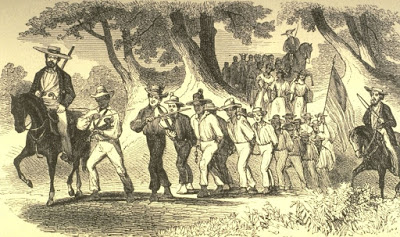
The Background 

The ante-bellum South was an agrarian society that depended on the free labor provided by slaves. In a socio-political sense the South was an oligarchy that offered no freedom to slaves, openly discriminated against free blacks and provided little hope of social or economic advancement for poor and middle class whites.  However, despite this, even poor whites supported it.  Many Southern Yeoman farmers were willing to tolerate their second class status because they: “feared the fall from independent producer to dependent proletarian, a status he equated with enslavement” [1] more than remaining subservient to planters and plantation owners. In fact, for them slavery was the one institution that kept them above the despised black.

In 1861, Dr. J.H. Van Evrie, promoted the scientific racist of ichthyologist Louis Agassiz in a pamphlet entitled “Negroes and Negro Slavery;” The First an Inferior Race – The Latter, Its Normal Condition” expressed how most Southerners felt about African Americans be they slave or free, and Jefferson Davis hoped that Van Evrie’s arguments would persuade people to adopt the view that racial equality was a fallacy which could not be tolerated, Van Evrie wrote:

“He is not a black white man, or merely a man with a black skin, but a DIFFERENT AND INFERIOR SPECIES OF MAN; – that this difference is radical and total… that so called slavery is neither a “wrong” nor an “evil, but a natural relation based upon the “higher law,” in harmony with the order, progress, and general well-being of the superior one, and absolutely in keeping with the existence of the inferior race.”  [2]

While all Northern states had abolished slavery, or were in the process of gradual abolition in the after independence and the Civil War and had moved to an economic concept of free labor, the South had tied its economy and society to the institution of slavery. The contrast was well said by the members of an Alabama agricultural society, which noted in 1846:

“Our condition is quite different from that of the non-slaveholding section of the United States. With them their only property consists of lands, cattle and planting implements. Their laborers are merely hirelings, while with us our laborers are our property.” [3]

Van Evrie was not the only person making such distinction between the races. Dr. Samuel Cartwright wove the pseudo-science of the day into the narrative of the Bible, noting:

“I have thus hastily and imperfectly noticed some of the more striking anatomical and physiological peculiarities of the Negro race. The question may be asked, Does he belong to the same race as the white man? Is he a son of Adam? Does his particular physical confirmation stand in opposition to the Bible, or does it prove its truth?… Anatomy and physiology have been interrogated, and the response is, that the Ethiopian, or Canaanite, is unfitted for the duties of a free man….” [4]

He also noted:

“The Declaration of Independence, which was drawn up at a time when negroes were scarcely regarded as human beings, “That all men are by nature free and equal,” was only intended to apply to white men…” [5]

Northerners on the other hand, even in states where the last vestiges of slavery held on, nearly universally ascribed to the understanding that there was a dignity to labor and that free labor was essential if people were to have a better life. It undergirded their understanding of human dignity and that “labor was the source of all value.” [6]

That understanding of the intrinsic value of free labor continued to gain ground in the North in the decades preceding the Civil War and found much of its support in the Calvinist theology that predominated in most Protestant Northern denominations. Labor was intrinsic to one’s calling as a Christian and a human being, slave labor, at least in the eyes of many Northerners undercut that idea. Success in one’s calling glorified God and provided earthly evidence that a person was among the elect. For many Northern Christians, “the pursuit of wealth thus became a way of serving God on earth, and labor, which had been imposed on fallen man as a curse, was transmuted into a religious value, a Christian calling.” [7]  Such ideas found their way into Republican political thought even when not directly related to religion.  William Evarts said in 1856 “Labor gentlemen, we of the free States acknowledge to be the source of all of our wealth, of all our progress, of all our dignity and value.” [8] Abraham Lincoln noted that “the free labor system…opens the way for all, and energy and progress, and improvement in condition for all,” [9] and Lincoln also noted something inherent in the economic theory of Adam Smith that Labor is prior to, and independent of capital…in fact, capital is the fruit of labor.” [10]

However, the South by the 1830s had completely wedded itself to slavery and southern advocates of slavery deplored the free-labor movement as wage slavery and extolled the virtue of slavery. James H. Hammond condemned the free-labor movement in his King Cotton speech to the Senate in 1858:

“In all social systems there must be a class to do the menial duties, to perform the drudgery of life…. It constitutes the very mudsill of society….Such a class you must have, or you would not have that other that leads to progress, civilization and refinement….Your whole hireling class of manual laborers and ‘operatives,’ as you call them, are essentially slaves. The difference between us is, that our slaves are hired for life and well compensated…yours are hired by the day, not cared for, and scantily compensated.” [11]

Even so, the fact that the slave barons “were forced at every election to solicit the votes of “ignorant, slovenly, white trash in the country” with “frequent treats that disgrace our elections,” [12] rankled and humiliated many members of the Southern aristocracy. It was a marriage of two disparate parties linked by their membership in a superior race, something that only the continued existence of slavery ensured.

Lincoln extolled the virtues of free-labor, noting his own experiences after his election: “I am not ashamed to confess that twenty five years ago I was a hired laborer, mauling rails, at work on a flat boat – just what might happen to any poor man’s son.”  [13] Other Northerners lauded free-labor as the basis of upward mobility, and the New York Times noted that “Our paupers to-day, thanks to free labor, are our yeomen and merchants of tomorrow.” [14]

slave-coffle2

Slave Coffle

But whites in the South held labor in contempt due to the system of slavery, and the divergent views of each side were noted by Thomas Ewing who noted that labor “is held honorable by all on one side of the line because it is the vocation of freedmen – degrading in the eyes of some on the other side because it is the task of slaves.” [15] Of course with labor being the task of African slaves for southerners, the issue was entwined with race, and “Even if slavery was wrong, its wrongs were cancelled out for nonslaveholders by the more monstrous specter of racial equity.”  [16]

Georgia Governor Joseph E. Brown emphasized the threat to whites in that blacks would be their social equals and competitors should slavery end. The racial component assured poor southern whites that they were superior to blacks and an Alabama lawyer wrote “The privilege of belonging to the superior race and being free was a bond that tied all Southern whites together… and it seemed from a Southern stand-point, to have for its purpose the leveling of all distinctions between the white man and the slave hard by.” [17] But poor white workers who remained in the South “repeatedly complained about having to compete with slaves as well as poorly paid free blacks” [18] leading many to seek a new livelihood in either Free States or the new territories.

For Southern politicians and slaveholders, the expansion of slavery was essential to its continued maintenance in the states where it was already legal. “Because of the need to maintain a balance in the Senate, check unruly slaves, and cultivate fertile soils, many planters and small plantation owners- particularly those living in the southern districts of the cotton states- asserted that their survival depended on new territory.” [19] In those decades “a huge involuntary migration took place. Between 800,000 and 1 million slaves were moved westward….” [20]

The need for slaves caused prices to soar, largely due to the ban on the import of slaves from Africa. This made the interregional trade much more important and linked the upper and lower south as well as the new slave-holding territories into “a regionwide slave market that tied together all of the various slaveowning interests into a common economic concern.” [21] In some older states like Virginia where fewer slaves were required, the exportation of slaves became a major industry:

“male slaves were marched in coffles of forty or fifty, handcuffed to each other in pairs, with a long chain through the handcuffs passing down the column to keep it together, closely guarded by mounted slave traders followed by an equal number of female slaves and their children. Most of them were taken to Wheeling, Virginia, the “busiest slave port” in the United States, and from there they were transported by steamboat to New Orleans, Natchez, and Memphis.”[22]

To be continued…

Notes

[1] Ibid. McPherson Drawn With Sword p.50

[2] Van Evrie, J.H. “Negroes and Negro Slavery;” The First an Inferior Race – The Latter, Its Normal Condition 1861 in The Confederate and Neo-Confederate ReaderThe Great Truth about the Lost Cause, Loewen, James W. And Sebesta, Edward H. Editors, University Press of Mississippi, Jackson, 2010 p.75

[3] Ibid. Levine Half Slave and Half Free p.19

[4] Cartwright, Samuel A. Diseases and Peculiarities of the negro Race, 1851 in Loewen, James W and Sebesta, Edward H. The Confederate and Neo-Confederate reader: The Great Truth about the Lost Cause University of Mississippi Press, Jackson 2010 p.66

[5] Ibid. Cartwright Diseases and Peculiarities of the negro Race, 1851 p.70

[6] Foner, Eric Free Soil, Free Labor, Free Men: The Ideology of the Republican Party Before the Civil War Oxford University Press, Oxford and New York 1970 and 1995 p.7

[7] Ibid. Foner Free Soil, Free Labor, Free Men pp.12-13

[8] Ibid. Foner Free Soil, Free Labor, Free Men p.12

[9] Ibid. McPherson The Battle Cry of Freedom: The Civil War Era p.28

[10] Ibid. Foner Free Soil, Free Labor, Free Men p.12

[11] Ibid. McPherson The Battle Cry of Freedom p.196

[12] Ibid. Guelzo Fateful Lightening p.38

[13] Ibid. McPherson The Battle Cry of Freedom p.28

[14] Ibid. Foner Free Soil, Free Labor, Free Men p.16

[15] Ibid. Foner Free Soil, Free Labor, Free Men p.16

[16] Ibid. Guelzo Fateful Lightening p.38

[17] Ibid. Guelzo Fateful Lightening p.39

[18] Ibid. Levine Half Slave and Half Free p.44

[19] Ibid. Egnal  Clash of Extremes pp.125-126

[20] Korda, Michael. Clouds of Glory: The Life and Legend of Robert E. Lee Harper Collins Publishers, New York 2014 p.203

[21] Deyle, Steven The Domestic Slave Trade in Major Problems in the Civil War and Reconstruction Documents and Essays Third Edition edited by Michael Perman and Amy Murrell Taylor Wadsworth Cengage Learning Boston MA 2011 p.53

[22] Ibid. Korda Clouds of Glory: The Life and Legend of Robert E. Lee  p.203

1 Comment

Filed under civil rights, civil war, History, Political Commentary