Category Archives: civil rights

When History Rhymes: Know Nothings, Klansmen, “Shitholes” and Trump


Friends of Padre Steve’s World,

Long before President Trump was elected President and uttered the words Shithole countries” in slandering the people of Haiti as well as African nations I wrote about his penchant for obvious racist terminology and tactics which I trace back to a movement long before he was ever thought of, in fact to a time when his German immigrant ancestors were scorned and hated because of their ethnicity. That being said his grandfather made a small fortune in the Pacific Northwest and the Klondike Gold Rush mostly catering to prospectors and women of ill-repute. Like many immigrants the man was incredibly successful; he made a fortune and returned to Germany where he was discovered was thrown out of the country because the Kingdom of Bavaria believed that he had gone to America to of all things, to avoid military service. The fact that he didn’t have to get a doctor to say he had heel spurs to avoid conscription makes him far more admirable than his grandson. But I digress…

I wrote the following back in July of 2016 simply because the Trump family story happened to coincide with the subject of my draft book “Mine Eyes Have Seen the Glory”: Race, Religion, Ideology, and Politics in the Civil War Era. It just happens to be that the Donald’s father, Fred happened to get arrested during a march of the Ku Klux Klan in New York in 1927 while dressed as a Klansman.

Back then the blowback from friends, including a woman who was one of the bridesmaids at our wedding was so intense that I never want to go through it again. It really is amazing when one makes a credible claim that a candidate for the Presidency is a racist and have long time friends castigate you and condemn you for telling the truth.

But once again I digress but the irony of the current President going after immigrants and defending Klansmen while calling the countries of many current immigrants is far too rich to ignore. But the sad truth is that racism is still to common and is being given voice by the President of the United States in ways that haven’t been seen since the presidency of Woodrow Wilson. Supreme Court Justice Thurgood Marshall noted:

“I wish I could say that racism and prejudice were only distant memories. We must dissent from the indifference. We must dissent from the apathy. We must dissent from the fear, the hatred and the mistrust…We must dissent because America can do better, because America has no choice but to do better.” 

So anyway, here is what I wrote back them.

Enjoy,

Peace

Padre Steve+

Mark Twain reportedly said that “History does not repeat itself, but it often rhymes.” One can see that in the nomination of Donald Trump as the nominee of the Republican Part for President. Eleven months ago I wrote an article called Trump and the Return of the Know Nothings. At the time few people gave him little chance of becoming the Republican nominee, and now he is the nominee and for all practical purposes owns the GOP.

180103-donald-trump-se-253p_1e0ab4bbfc2b637051d31d044ad52abf.nbcnews-ux-2880-1000

Trump’s xenophobic views on immigration charged the debate in the Republican Party during the primaries, and his positions which were fringe positions of most Republicans for decades became the mainstream, just as the same issue did during the 1840s and 1850s. So this is not a new phenomenon, and even over the past few decades the debate has come and gone, but it has returned with a vengeance as Donald Trump made immigration, or rather a virulent anti-immigration platform the centerpiece of his campaign. Trump’s focus on the issue forced other Republican candidates to scramble in order to find a position close enough to Trump’s without completely throwing away the vote of immigrants who they will need to win in many states; if they are to have any hope of winning back the presidency in 2016. But they failed. Trump outmaneuvered them at every point, and in the end Trump’s strongest opponent, Senator Ted Cruz went into the witch’s cauldron of the Republican National Convention not to endorse Trump but to stand on principle and in the process destroy his politic career and maybe endanger his life.

But Trump’s positionresonated with parts of the Republican base, and by appealing to their anger and frustration he has built a solid core of support which loyally supported him in a campaign that featured so many blunders and heneous comments that in a normal election cycle his campaign would not have survived past the Southern Super Tuesday. But he did, and if on the  takes the time to read Trump’s speeches and the reactions to them by his supporters it becomes apparent that Trump has tapped into that vast reservoir of nativism that has always been a part of the American body-politic.


As I said, such attitudes and movements are nothing new. Anti-immigrant movements in the United States go back to our earliest days, ever since the first Irish Catholics showed up in the northeast in the late 1790s and early 1800s. Met with scorn and treated as criminals the Irish Catholics had to work hard to gain any kind of acceptance in Protestant America. But immigrants continued to come, seeking the freedom promised in the Declaration of Independence.

Many White American Protestants viewed Irish, German and other European immigrants to the Unites States in the 1830s, 1840s, and 1850s as interlopers who were attempting to take over the country. The immigrants were regarded as poor, uneducated, uncouth, and immoral, and in the case of Catholic immigrants as representatives and foot soldiers of a hostile government, the Vatican, headed by the Pope and the bishops. Those who opposed immigration formed a movement that was aimed at forbidding immigrants from being granted full rights, especially the rights of citizenship and voting. The fear was pervasive. Many Northern Whites were afraid that immigrants would take their jobs, since like slaves in the South, the new immigrants were a source of cheap labor.

Northern Protestant church leaders and ministers were some of the most vocal anti-immigrant voices and their words were echoed by politicians and in the press. The movement grew and used government action, the courts and violence to oppress the Irish and Germans who were the most frequent targets of their hate. The movement eventually became known as the “Know Nothing” movement.

Know Nothing leaders were not content to simply discuss their agenda in the forum of ideas and political discourse, they often used mob-violence and intimidation to keep Catholics away from the ballot box. Mobs of nativist Know Nothings sometimes numbering in the hundreds or even the thousands attacked immigrants in what they called “Paddy hunts,” Paddy being a slur for the Irish. To combat immigrants who might want to exercise their right to vote, the Know Nothings deployed gangs like the New York’s Bowery Boys and Baltimore’s Plug Uglies. They also deployed their own paramilitary organization to intimidate immigrants on Election Day. This group, known as the Wide Awakes was especially prone to use violence and physical intimidation in pursuit of their goals. The Nativist paramilitaries also provided security for anti-immigrant preachers from angry immigrants who might try to disrupt their “prayer” meetings.

Know Nothing’s and other Nativist organizations, organized mass meetings throughout the country which were attended by thousands of men. The meetings were often led by prominent Protestant ministers who were rich in their use of preaching and prayer to rile up their audiences. The meetings often ended with physical attacks and other violence against German or Irish immigrants and sometimes with the burning of the local Catholic Church. They also provided security for preachers from angry immigrants who might try to disrupt nativist prayer meetings.


Bloody Monday, Louisville 1855

The violence was widespread and reached its peak in the mid-1850s.

Monday, August 6, 1855 was Election Day in Louisville, Kentucky. To prevent German and Irish Catholics from voting, Know Nothing mobs took to the street and launched a violent attack on immigrants as well as their churches and businesses. Known now as “Black Monday” the Nativists burned Armbruster’s Brewery, they rolled cannons to the doors of the St. Martin of Tours Church, the Cathedral of the Assumption and Saint Patrick’s Church, which they then were searched for arms. The private dwellings and the businesses of immigrants were looted. A neighborhood known as “Quinn’s Row” was burned with the inhabitants barricaded inside. At least 22 persons were killed in the violence and many more were injured. In Baltimore the 1856, 1857, and 1858 elections were all marred by violence perpetrated by Nativist mobs. In Maine, Know Nothing followers tarred and feathered a Catholic priest and burned down a Catholic church.

The Know Nothings did not merely seek to disenfranchise immigrants through violence alone, they were more sophisticated than that. They knew that to be successful they had to change the law. Then, as now, a new immigrant had to live in the United States for five years before becoming eligible to become a naturalized of the United States. The Know nothings felt that this was too short of time and their party platform in the 1856 election had this as one of the party planks:

A change in the laws of naturalization, making a continued residence of twenty-one years, of all not heretofore provided for, an indispensable requisite for citizenship hereafter, and excluding all paupers, and persons convicted of crime, from landing upon our shores; but no interference with the vested rights of foreigners.

The rational of the Know Nothings for the 21 year wait was that if a baby born in the United States had to wait until it was 21 years old he could vote, that immigrants were being permitted to “jump the line” and vote sooner than native-born Americans. But really what the Know Nothings wanted to was to destroy the ability of immigrant communities to use the ballot box. In many localities and some states Know Nothing majorities took power. The Massachusetts legislature, which was dominated by Know Nothings, passed a law barring immigrants from voting for two additional years after they became United States citizens.

The 1856 platform Know Nothing Party was synopsized by a Know Nothing supporter:

(1) Repeal of all Naturalization Laws.

(2) None but Americans for office.

(3) A pure American Common School system.

(4) War to the hilt, on political Romanism.

(5) Opposition to the formation of Military Companies, composed of Foreigners.

(6) The advocacy of a sound, healthy and safe Nationality.

(7) Hostility to all Papal influences, when brought to bear against the Republic.

(8) American Constitutions & American sentiments.

(9) More stringent & effective Emigration Laws.

(10) The amplest protection to Protestant Interests.

(11) The doctrines of the revered Washington.

(12) The sending back of all foreign paupers.

(13) Formation of societies to protect American interests.

(14) Eternal enmity to all those who attempt to carry out the principles of a foreign Church or State.

(15) Our Country, our whole Country, and nothing but our Country.

(16) Finally,-American Laws, and American Legislation, and Death to all foreign influences, whether in high places or low

In addition to their violent acts, the use of the courts and political intimidation the Know Nothings waged a culture war against immigrants. Latin mottoes on courthouses were replaced by English translations. Actions were taken to remove immigrants who had become naturalized citizens from public offices and civil service jobs as well as to use the government to persecute Catholic churches. In Philadelphia, all naturalized citizens on the police force were fired, including non-Catholics who has supported Catholic politicians, and in Boston, a special board was set up to investigate the sex lives of nuns and other supposed crimes of the Catholic church.
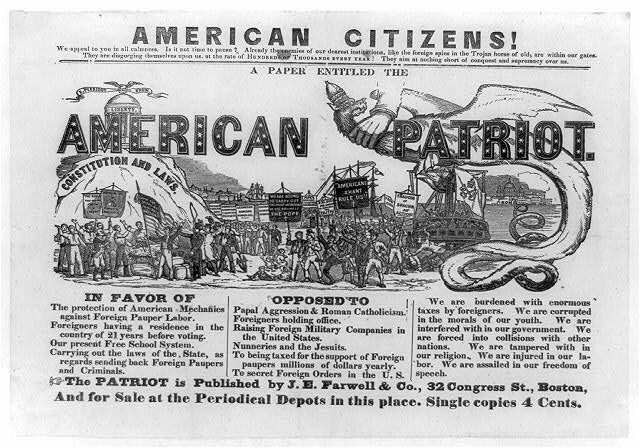

In the political upheaval of the 1850s Nativists tried to find homes in the different political parties. Some Know Nothings who were abolitionists became part of the new Republican Party, and Abraham Lincoln condemned them in harsh terms. He wrote his friend Joshua Speed about the hypocrisy that they displayed by supposedly being against the oppression of blacks while willing to oppress immigrants:

“I am not a Know-Nothing. That is certain. How could I be? How can any one who abhors the oppression of negroes, be in favor or degrading classes of white people? Our progress in degeneracy appears to me to be pretty rapid. As a nation, we began by declaring that “all men are created equal.” We now practically read it “all men are created equal, except negroes” When the Know-Nothings get control, it will read “all men are created equal, except negroes, and foreigners, and Catholics.” When it comes to this I should prefer emigrating to some country where they make no pretence of loving liberty — to Russia, for instance, where despotism can be taken pure, and without the base alloy of hypocracy [sic].”

As an organized movement, the Know Nothings died out by the early 1860s, migrating to different parties and causes. In the North many became part of the pro-slavery Copperhead movement, which opposed Lincoln on emancipation and the Thirteenth Amendment. In the post-war South the anti-Catholic parts of the Nativist movement found a home in the Ku Klux Klan and other white terrorist organizations which also used racist and nativist propaganda to perpetuate violence, and disenfranchise emancipated blacks in the decades following the end of the Civil War and the end of Reconstruction. The Nativist and anti-immigrant sentiments have periodically found a home in different parts of the country and the electorate. Violence was used against Chinese, Japanese and Filipino immigrants on the West Coast, against Mexicans in the Southwest, Italians, Slavs, Eastern Europeans and Jews in the Northeast.

Sadly it seems that the Know Nothing is being turned against others today. I find it strange that there are a host of people, mostly on the political right that are doing their best in their local communities, state legislatures and even Congress to roll back civil liberties for various groups of people. There is a certain amount of xenophobia in regard to immigrants of all types, especially those with darker skin white Americans, but some of the worst is reserved for Arabs and other Middle-Easterners, even Arab Christians who are presumed as all Middle Easterners are to be Moslem terrorists, even those who have been here decades and hold respectable places in their communities.

But immigrants are not alone, there seems to be in some states a systematized attempt to disenfranchise the one group of people that has almost always born the brunt of legal and illegal discrimination, African Americans.

Likewise there have been numerous attempts to roll back the rights of women, especially working women; the use of the legislature by religious conservatives to place limits on the reproductive rights of women, holding them to the standard of a religion that they do not practice. Despite the Supreme Court’s ruling for Marriage Equality in Obergfell v. Hodges there still are numerous attempts to curb any civil rights, including the right to marriage or civil unions of the LGBT community.


As I said, this is nothing new, that hatred and intolerance of some toward anyone who is different than them, who they deem to be a threat is easily exploited by politicians, pundits and preachers, none of whom care for anything but their prosperity, ideology, religion, or cause. While I would not call them a new incarnation of the Know Nothings, I have to notice the similarities in their message and the way that they push their agenda. As for those among them who claim the mantle of Christ and call themselves Christians I am troubled, because I know that when religion is entwined with political movements that are based in repressing or oppressing others that it does not end well. As Brian Cox who played Herman Goering in the television miniseries Nuremberg told the American Army psychologist Captain Gustave Gilbert played by Matt Craven “The segregation laws in your country and the anti-Semitic laws in mine, are they not just a difference of degree?

That difference of degree does matter, and there have been and still could be times when the frustration and anger of people, especially religious people can be whipped into a frenzy of violence and government sanctioned oppression by unscrupulous politicians, preachers and pundits. History is replete with examples of how it can happen. When I think of this I am reminded of the close of Spencer Tracy’s remarks in the movie Judgment at Nuremberg:

But this trial has shown that under a national crisis, ordinary – even able and extraordinary – men can delude themselves into the commission of crimes so vast and heinous that they beggar the imagination. No one who has sat through the trial can ever forget them: men sterilized because of political belief; a mockery made of friendship and faith; the murder of children. How easily it can happen. There are those in our own country too who today speak of the “protection of country” – of ‘survival’. A decision must be made in the life of every nation at the very moment when the grasp of the enemy is at its throat. Then, it seems that the only way to survive is to use the means of the enemy, to rest survival upon what is expedient – to look the other way. Well, the answer to that is ‘survival as what’? A country isn’t a rock. It’s not an extension of one’s self. It’s what it stands for. It’s what it stands for when standing for something is the most difficult! Before the people of the world, let it now be noted that here, in our decision, this is what we stand for: justice, truth, and the value of a single human being.”

So for today I will leave it there. I probably will return to the similarities between the Know Nothings and Trump, but not this moment. I actually do have a life and want to write about other things. But that being said, there are times when history rhymes, and this is one of them.

So have a wonderful day.

Peace,

Padre Steve+

1 Comment

Filed under civil rights, ethics, faith, History, News and current events, Political Commentary

To Stand Up Against Zealots


img_0178

Friends of Padre Steve’s World,

I am not a fan of ideologues or the “fundamentalists” of any point in the political, ideological or religious spectrum. Their lack of courage, stunted intellectualism, and inability to see things from outside their limited field of view does not allow them to face really difficult questions that confront us today.  They claim to hold the keys to the universe but sadly are hold nothing more than the key to their high school gym locker.

The Iranian novelist Salman Rushdie who has been on the run from Iranian fundamentalist ideologues since he wrote the supposedly heretical Satanic Verses once noted:

“The moment you say that any idea system is sacred, whether it’s a religious belief system or a secular ideology, the moment you declare a set of ideas to be immune from criticism, satire, derision, or contempt, freedom of thought becomes impossible.”

I believe that we are at yet another crossroads in Western civilization. This time a crossroads where the classic liberalism that was the basis for democratic societies is being stampeded by zealots of various persuasions who guided by the supposed infallibility of their ideological belief systems, deliberately and without remorse seek to destroy the institutions that are the guardians of liberty.

In my honest opinion I think that the worst of these are the conservative Christian theocrats and their seemingly ideological enemies the Ayn Rand following Social Darwinist “conservative libertarians.” They have no shame, their respective ideologies blind them to truth and turn them into sociopaths that only give a damn about their power and profits and they latched on to President Trump, prostrating themselves and the Republican Party to him in order that they might triumph.

Of course I will be the first to admit that there are some leftists who would be the first to put a bullet in the head of Lady Liberty to further their own cause.  But they are not the danger. They control nothing that would allow them to succeed and most cannot even agree among themselves to work together, they have nothing on Lenin, Stalin, Mao, the Iranian Mullahs, or even Hugo Chavez; may God give rest to his chubby cheeks.

Say what you want about him but President Trump is not an ideologue, he can’t be, he’s too much of a self-absorbed narcissist to be an ideologue. All he wants is the adulation of his audience and the power and wealth that come with it. He may be a sociopath but it is not for the sake of any ideology. If the issue was the President alone we could survive him; but his supporters of the Christian Right and the Ayn Rand Social Darwinists of the GOP are much more dangerous, because they are true believers who actually control many of the apparatuses of government at the local, state, and federal level.

We have seen the results of such movements in history before and each time they succeed in gaining power they have brought disaster to nations, and sometimes the world.

Proponents of ideological purity assume that their ideological bias is equivalent to sacred truth, be it a religious or secular truth. The promoters of such systems promote something more than their opinion, as Hannah Arendt noted: “For an ideology differs from a simple opinion in that it claims to possess either the key to history, or the solution for all the “riddles of the universe,” or the intimate knowledge of the hidden universal laws which are supposed to rule nature and man.”  

As such, ideology is not based on knowledge, but is distinct from it and the enemy of knowledge for it binds the mind in a straitjacket in which all thought must be submitted to the truth of the ideology. As Arendt noted such ideologies must be handled with caution as they “pretend to be keys to history but are actually nothing but desperate efforts to escape responsibility.”  

An ideology protects the true believer from having to think for himself, it allows the insecure to grasp at the protection that it allegedly provides, and allows the believer to deny reality, and to by definition declare everything that contradicts the ideology to be heretical, and opponents to be aligned with the devil himself, allowing the believer to hate the opponent. As Eric Hoffer noted, “Hatred is the most accessible and comprehensive of all the unifying agents. Mass movements can rise and spread without belief in a god, but never without a belief in a devil.” 

As I have mentioned the past couple of days my favorite television character, Raymond Reddington, played by James Spader in The Blacklist once said “I know so many zealots, men and women, who chose a side, an ideology by which to interpret the world. But, to get up every single day and to do the hard work of deciding what to believe. What’s right, today? When to stand up or stand down. That’s courage.” The fact is, no matter how stridently they espouse their beliefs, ideologues are by definition not courageous, because courage takes critical thinking, something that ideologues of any persuasion are incapable of doing.

That is why knowledge and critical thought even when they are uncomfortable and take us out of our comfort zone are so much more powerful and important than ideologies that are followed blindly. My words to the ideologues of the Christian Right and the Ayn Rand followers of so many in the Republican Party is that of Samuel Adams who said:

“If ye love wealth better than liberty, the tranquility of servitude better than the animating contest of freedom, go home from us in peace. We ask not your counsels or arms. Crouch down and lick the hands which feed you. May your chains set lightly upon you, and may posterity forget that ye were our countrymen.” 

It takes no courage to be an ideologue, and once a person surrenders to an ideology as his or her reason for existence, they sacrifice the ability to reason, the ability to think critically, and the capacity to acquire knowledge and in doing so they surrender to tyranny and servitude though they think they will end up on top.

That is the danger of the blind ideologies that are consuming our world today and why as long as anyone who cares about freedom has a breath in them they must be opposed.

Until tomorrow,

Peace

Padre Steve+

2 Comments

Filed under civil rights, ethics, faith, History, News and current events, Political Commentary

No Better than the Tyrant: The Christian Enablers of Evil Leaders

jeffress-and-trump

Conservative Evangelical Pastor Robert Jeffress and President Trump during the 2016 Campaign 

Friends of Padre Steve’s World,

Earlier I wrote about the costs when the Church crawls into bed with Caesar. While there was some criticism of the President in the article it was directed and more of an indictment of the Christians who by their words, deeds, and silence destroy the witness of the Church in their quest for temporal power over those they believe to be unworthy of the grace, love, and mercy of God; not by any sense of Christian theological doctrine, the Creeds, or the Councils, but for reasons of race, ethnicity, religion, sexuality, or their political beliefs.

Unfortunately, this comes at a tremendous cost to those who claim to be Christians and for the Church itself. Paul the Apostle wrote to the church in Corinth: in Christ God was reconciling the world to himself, not counting their trespasses against them, and entrusting the message of reconciliation to us…” (2 Cor 5:19 NRSV)

The ministry of reconciliation has nothing to do with achieving political power no matter how it is done, especially when it comes at the cost of despising God become incarnate by supporting a would be tyrant, even if the tyrant was elected under a system designed to inhibit tyrants, a system that he used, very probably with the help of a hostile foreign power to conquer.

But despite the obvious culpability of the President and his close supporters for this situation, the culpability of the church and the Christian leaders who were his strongest supporters is much greater than the man with no morals, no empathy, and a who seems to suffer a greatly reduced neurological, psychological, and intellectual capacity to govern; a man whose actions are those of a sociopathic narcissist who appears to only care about himself and what profits himself. Throughout his life he has shown through his words and actions that he does not value other people except in regard to how they or their skills profited him, his family, or his businesses. People, regardless of who they are, or their relationship to him are fungible regardless of their personal loyalty, they are expendable: Bannon, Manafort, Flynn, Christie, Priebus, and so many others. Sadly, the Christians that excuse his actions on the basis of political power and expediency throw themselves before the throne of Caesar and crawl into bed with him will never understand because adorned in all of their jewels and riches like the Harlot of the book of Revelation will not understand the costs of their obeisance until the Beast turns upon them.

Dietrich Bonhoeffer wrote in his book Ethics: 

“For the tyrannical despiser of humanity, popularity is a sign of the greatest love for humanity. He hides his profound distrust of all people behind the stolen words of true community. While he declares himself before the masses to be one of them, he praises himself with repulse vanity and despises the rights of every individual. He considers the people stupid, and they become stupid; he considers them weak, and they become weak; he considers them criminal, and they become criminal. His most holy seriousness is frivolous play; his conventional protestations of solicitude for people are bare-faced cynicism. In  his deep contempt for humanity, the more he seeks the favor of those he despises, the more certainty he arouses the masses to declare him a god. Contempt for humanity and idolization of humanity lie close together. Good people, however, who see through all this, who withdraw in disgust from people and leave them to themselves, and who would rather tend to their own gardens than debase themselves in public life, fall prey to the same temptations to have contempt for humanity as do bad people. Their contempt for humanity is of course more noble, more upright, but at the same time less fruitful, poorer in deeds. Faced with God’s becoming human, this contempt will stand the test no better than the tyrant. The despiser of humanity despises what God has loved, despises the very form of God become incarnate.” 

Wittenberg, Nationalsynode

Nazi Reich Bishop Ludwig Müller with the S.A (above) and with Hitler (below)

ReichbishofMueller

Like the German Christians who supported Hitler, be they those who remained loyal to him or those like Bonhoeffer’s colleague Martin Niemoller turned against Hitler when they realized the nature of the beast; conservative American Christians who have supported the presidency of President Trump without regard to the Gospel or the commands of Christ are much more responsible when it comes to the final judgement than the man that they helped put into power. God and history will hold hem accountable for the debacle that they bring upon the world.

Those leaders are well represented by Pastor Robert Jeffress of First Baptist Church Dallas, who said during the 2016 election campaign:

“You know, I was debating an evangelical professor on NPR, and this professor said, ‘Pastor, don’t you want a candidate who embodies the teaching of Jesus and would govern this country according to the principles found in the Sermon on the Mount?’” Jeffress said. “I said, ‘Heck no.’ I would run from that candidate as far as possible, because the Sermon on the Mount was not given as a governing principle for this nation.”

Jeffress would probably agree with Reich Bishop Müller who before the Nazi seizure of power wrote:

“Mere compassion is charity and leads to presumption, paired with bad conscience, and effeminates a nation. We know something about Christian obligation and charity towards the helpless, but we also demand the protection of the nation from the unfit and inferior. We see a great danger to our nationality in the Jewish Mission. It promises to allow foreign blood into our nation…” 

I think that Jeffress and his brand of American Conservative Christianity is no better than that of Reich Bishop Müller which joined by young clergy from lower middle-class or non-academic backgrounds. Richard Evans wrote about them in his book Third Reich in Power: 

“Such men desired a Church whose members were soldiers from Jesus and the Fatherland, tough, hard and uncompromising. Muscular Christianity of this kind appealed particularly to young men who despised the feminization of religion through the involvement in charity, welfare and acts of compassion.”

How many other prominent conservative Evangelicals, Charismatics and others have espoused exactly that type of Christianity?

So until tomorrow,

Peace,

Padre Steve+

3 Comments

Filed under civil rights, ethics, faith, History, nazi germany, News and current events, Political Commentary

The Cost of Crawling into Bed with Caesar: Base Meanness, a Pliant Church, and Trump

        Bonhoeffer in Prison

Friends of Padre Steve’s World,

The leader of the Protestant Reformation, Martin Luther noted: “When the Church crawls in to bed with Caesar, Caesar hogs the covers and leaves the Church exposed and naked”

Is that not exactly what is happening today?

The writings of some authors are timeless. This year I have taken to reading a collection of the writings of the German pastor, theologian, and martyr Dietrich Bonhoeffer as my spiritual reading on a daily basis for this year. I’m also doing 365 days of Martin Luther in German as part of my spiritual journey for the year.

Luther is interesting, but Bonhoeffer I think is more relevant to our time. In his book Ethics which was written during the reign of the Hitler regime Bonhoeffer wrote something that strike to the heart of our present crisis in the United States and even more particularly that of the conservative Christian Church and its relationship to President Trump:

“The message of God’s becoming human attacks the heart of an era when contempt for humanity or idolization of humanity is the height of all wisdom, among bad people as well as good. The weaknesses of human nature appear more clearly in a storm than in the quiet flow of calmer times. Among the overwhelming majority of people, anxiety, greed, lack of independence, and brutality show themselves to be the mainspring of behavior in the face of unsuspected chance and threats. At such a time the tyrannical despiser of humanity (in the case of Bonhoeffer, Adolf Hitler) easily makes use of the meanness of the human heart by nourishing it and giving it other names. Anxiety is called responsibility; greed is called industriousness; lack of independence becomes solidarity; brutality becomes masterfulness. By this ingratiating treatment of human weaknesses, what is base and mean is generated and increased ever anew. The basest contempt for humanity carries on its sinister business under the most holy assertions of love for humanity. The meaner the business becomes, the more willing and pliant a tool it is in the hands of a tyrant. The small number of upright people will be smeared with mud. Courage is called revolt, their discipline Pharisaism, their independence arbitrariness, and their masterfulness arrogance.” 

We have seen this in our own day among President Trump, his supporters in Congress and the media, and especially among conservative Christians. The worst aspects of human nature have been elevated to virtues over the past two decades and like Germany in 1933 there was someone waiting in the wings to exploit it and make it his own.


I’ll leave you to mull that over and I will continue to post these theological and ethical criticisms of the church and of the President, and yes I will keep making the connections with the Nazi state and other authoritarian regimes as I do so. But for me this is a matter of faith, and for me that means confronting and battling the Christians who have gotten in bed with the Trump regime; in the long term they are at least as dangerous, perhaps more than the President for they serve as his enablers; as Bonhoeffer noted:

“If I sit next to a madman as he drives a car into a group of innocent bystanders, I can’t, as a Christian, simply wait for the catastrophe, then comfort the wounded and bury the dead. I must try to wrestle the steering wheel out of the hands of the driver.”

Until the next time,

Peace

Padre Steve

1 Comment

Filed under civil rights, faith, History, leadership, nazi germany, News and current events, Political Commentary

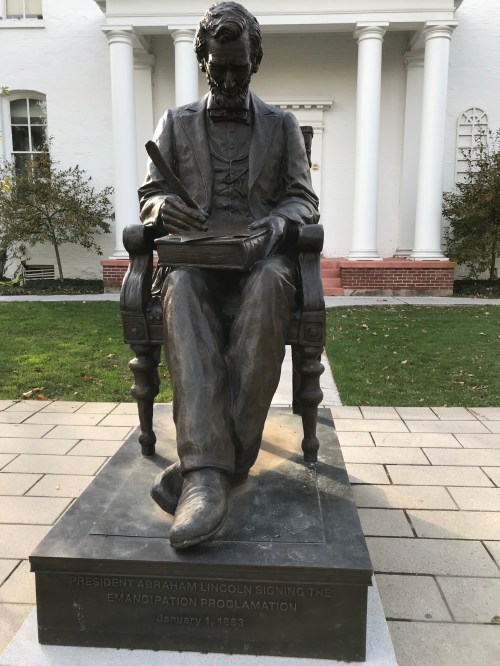
“Sound Loud the Timbrel” The Emancipation Proclamation at 155 Years

Friends of Padre Steve’s World

Today is the 155th anniversary of the Emancipation Proclamation. The proclamation made by Abraham Lincoln when the outcome of the rebellion of the Southern slave states against the Union was still up in the air was a watershed for civil rights in the United States. Though it was a military order that only affected slaves in the rebellious states, it also set the stage for the 13th, 14th, and 15th Amendments and other legal rulings that affected not only African Americans and former slaves, but also Native Americans, Women, other racial minorities and LGBTQ people. It is something that in our era when so many civil rights are under threat that we must remember and continue to fight for in the coming years. Freedom is never free.

This article is a part of my hopefully soon to be published book “Mine Eyes Have Seen the Glory!” Race, Religion, Ideology, and Politics in the civil War Era. 

Peace

Padre Steve+

From the beginning of the war many Northerners, especially abolitionists and radical Republicans believed that “as the “cornerstone” of the confederacy (the oft-cited description by the South’s vice-president, Alexander H. Stephens) slavery must become a military target.” [1]When some Union generals made their own attempts at issuing emancipation orders, Lincoln countermanded them for exceeding their authority. Lincoln resisted the early calls of the abolitionists to make that a primary war goal for very practical reasons, he had to first ensure that the Border Slave States did not secede, something that would have certainly ensured that the Union would not survived. As a result in the first year of the war, Lincoln “maneuvered to hold Border South neutrals in the Union and to lure Union supporters from the Confederacy’s Middle South white belts. He succeeded on both scores. His double success with southern whites gave the Union greater manpower, a stronger economy, and a larger domain. These slave state resources boosted free labor states’ capacity to should the Union’s heavier Civil War burden.” [2] His success in doing this was instrumental in enabling him to turn to emancipation in 1862.

Finally, some twenty months after Fort Sumter fell and after nearly two years of unrelenting slaughter culminating in the bloody battle of Antietam, Abraham Lincoln published the Emancipation Proclamation. Emancipation was a tricky legal issue for Lincoln as “an executive order of emancipation would be beyond the powers of the president, but not, Lincoln concluded, if such an order were issued as furtherance of the executive’s war powers.” [3] Lincoln had desired to issue the order during the summer and sounded out elected officials and soldiers as to his plan.

Lincoln discussed his views with General George McClellan during a visit to the latter’s headquarters. McClellan stated his strident opposition to them in writing. McClellan did not admire slavery but he despised abolitionists and he wrote one of his political backers “Help me to dodge the nigger – we want nothing to do with him. I am fighting for the Union…. To gain that end we cannot afford to mix up the negro question.”  [4]

Lincoln then called border state Congressmen to sound them out on the subject on July 12th 1862 only to be met with opposition. Such opposition caused Lincoln “to give up trying to conciliate conservatives. From then on the president tilted toward the radical position, though this would not become publicly apparent for more than two months.” [5]

Lincoln’s cabinet met to discuss the proclamation on July 22nd 1862 and after some debate decided that it should be issued, although it was opposed by Postmaster General Montgomery Blair who believed that “the Democrats would capitalize on the unpopularity of such a measure in the border states and parts of the North to gain control of the House in the fall elections.” [6] Wisely, Lincoln heeded the advice of Secretary of State Seward to delay the announcement until military victories ensured that people did not see it as a measure of desperation. Seward noted: “I approve of the proclamation, but I question the expediency of its issue at this juncture. The depression of the public mind, consequent on our repeated reverses, is so great I fear…it may be viewed as the last measure of an exhausted government, a cry for help…our last shriek on the retreat.” Seward suggested that Lincoln wait “until the eagle of victory takes his flight,” and buoyed by military success, “hang your proclamation about his neck.” [7]

After the Battle of Antietam, President Lincoln issued the Preliminary Emancipation Proclamation. This document served as a warning to the leaders of the South, and insisted that there was much more at stake in their rebellion unless they surrendered; their slaves, the very “property” for which the seceded. The document “warned that unless the South laid down its arms by the end of 1862, he would emancipate the slaves.” [8] This was something that they could not and would not do, even as their cities burned and Confederacy collapsed around them in 1864.

The proclamation was a military order in which Lincoln ordered the emancipation of slaves located in the Rebel states and areas of those states occupied by Union troops. It was not designed to change law, which would have to wait until Lincoln felt he could have Congress amend the Constitution.  Instead of law it was “the doctrine of military necessity justified Lincoln’s action.” [9] The concept emanated from Boston lawyer William Whiting who argued “the laws of war “give the President full belligerent rights” as commander and chief to seize enemy property (in this case slaves) being used to wage war against the United States.” [10] There was a legitimate military necessity in the action as Confederate armies used slaves as teamsters, laborers, cooks, and other non-combatant roles to free up white soldiers for combat duty, and because slaves were an important part of the Southern war economy which could not function without them. The proclamation gave inspiration to many slaves throughout the South to desert to the Union cause or to labor less efficiently for their Confederate masters. A South Carolina planter wrote in 1865:

“the conduct of the Negro in the late crisis of our affairs has convinced me that we were all laboring under a delusion….I believed that these people were content, happy, and attached to their masters, But events and reflection have caused me to change these positions….If they were content, happy and attached to their masters, why did they desert him in the moment of need and flocked to the enemy, whom they did not know….” [11]

The proclamation authorized that freed blacks be recruited into the Federal army and it ensured that freed slaves would not again be surrendered back into slavery. As Montgomery Blair had warned Lincoln and the Republicans suffered sharp electoral reverses as “Democrats made opposition to emancipation the centerpiece of their campaign, warning that the North would be “Africanized” – inundated by freed slaves competing for jobs and seeking to marry white women.”  [12]

Lincoln’s response was to continue on despite the opposition and issue the Proclamation in spite of electoral reverses and political resistance. The vehemence of some Northern Democrats came close to matching that of white Southerners. The “white Southerner’s view of Lincoln as a despot, hell-bent on achieving some unnatural vision of “equality,” was shared by Northern Democrats, some of whom thought the president was now possessed by a “religious fanaticism.” [13] But Lincoln was not deterred and he understood “that he was sending the war and the country down a very different road than people thought they would go.” [14] He noted in December 1862:

“Fellow citizens, we cannot escape history….This fiery trial through which we pass, will light us down, in honor or dishonor, to the latest generation….In giving freedom to the slave, we assure freedom to the free – honorable alike in what we give, and what we preserve.”[15]

For Lincoln the Emancipation Proclamation was something that he believed was something that he had to do, and he believed that it would be the one thing that he did in life that would be remembered. He had long been convicted of the need for it, but timing mattered, even six months before it might have created a political backlash in the North which would have fractured support for the war effort, and in this case timing and how he made the proclamation mattered.

The Emancipation Proclamation had military, domestic political, and diplomatic implications, as well as moral implications for the conduct of the war.

The military implication would take some time to achieve but were twofold. First, Lincoln hoped that the Emancipation Proclamation would encourage former slaves, as well as already free blacks in the North to join the Union cause and enlist to serve in the Federal Army. The act would vest African Americans in the Union’s cause as little else could, and at the same time begin to choke-off the agricultural labor force that provided the backbone of the Confederate economy. Frederick Douglass eloquently made the case for African Americans to serve in July 1863, telling a crowd in Philadelphia, “Do not flatter yourself, my friends, that you are more important to the Government than the Government is to you. You stand but as a plank to the ship. This rebellion can be put down without your help. Slavery can be abolished by white men: but Liberty so won for the black man, while it may leave him an object of pity, can never make him an object of respect…. Young men of Philadelphia, you are without excuse. The hour has arrived, and your place is in the Union army. Remember that the musket – the United States musket with its bayonet of steel – is better than all the parchment guarantees of Liberty. In you hands the musket means Liberty…” [16] By the end of the war over 180,000 African American men would serve as volunteers in the United States Army.

Politically the proclamation would the diplomatic purpose by isolating the Confederacy from European assistance. This it did, after the proclamation public sentiment, especially among Europe’s working classes turned solidly against the Confederacy. Domestically it would break-ground for the Thirteenth Amendment, which Lincoln, the pragmatic lawyer was needed to actually abolish slavery. Morally, it  would serve as the guarantee of The United States Government’s public, irrevocable pledge of freedom to African Americans if the North won the war.

Lincoln signed the order on January 1st 1863. As he got ready to sign the document he paused and put down the pen, speaking to Seward he said “I never, in my life, felt more certain that I was doing right, than I do now in signing this paper….If my name ever goes down in history it will be for signing this act, and my whole soul is in it.” [17] The opening paragraph read:

“That on the first day of January, in the year of our Lord one thousand eight hundred and sixty-three, all persons held as slaves within any State or designated part of a State, the people whereof shall then be in rebellion against the United States, shall be then, thenceforward, and forever free; and the Executive Government of the United States, including the military and naval authority thereof, will recognize and maintain the freedom of such persons, and will do no act or acts to repress such persons, or any of them, in any efforts they may make for their actual freedom.” [18]

At the ends of the proclamation he added the words suggested by his devoutly Christian Secretary of the Treasury Salmon Chase: “And upon this act, sincerely believed to be an act of justice, warranted by the Constitution, upon military necessity, I invoke the considerate judgment of mankind, and the gracious favor of Almighty God.” [19]

The response throughout the North was euphoric as celebrations took place throughout the North. In some cities one hundred gun salutes were fired. At Boston’s Tremont Temple people broke out singing a hymn “Sound the loud timbrel o’er Egypt’s dark sea, Jehovah hath triumphed, his people are free.” [20] The Boston Daily Evening Telegraph predicted, “Slavery from this hour ceases to be a political power in this country…such a righteous revolution as it inaugurates never goes backward.” [21]

Frederick Douglass wrote about his reactions to the Emancipation proclamation as he had nearly despaired wondering if the Lincoln administration would actually take up the fight for emancipation:

“The fourth of July was great, but the first of January, when we consider it in all of its relations and bearings in incomparably greater. The one we respect to the mere political birth to a nation, the last concerns national life and character, and is to determine whether that life and character shall be radiantly and glorious with all high and noble virtues, or infamously blackened, forevermore, with all the hell-darkened crimes and horrors which we attach to Slavery.” [22]

The proclamation was not all some had hoped for and it was certainly provoked a negative response in the South and among many Northern Democrats. Southerners accused Lincoln of inciting racial warfare and Jefferson Davis responded “The day is not so distant when the old Union will be restored with slavery nationally declared to be the proper condition of all of African descent.” [23]

But the proclamation did something that politicians, lawyers did not comprehend, that “the details of the emancipation decree were less significant than the fact that there was an emancipation decree, and while the proclamation read like a dull legal brief, filled with qualifying clauses and exceptions, it was not language made for this, finally, a moral document. It was its existence, its title, its arrival into this world, its challenge to the accepted order, and from that there was no turning back. In this sense it was a revolutionary statement, like the Declaration itself, and nearly as significant.” [24]That the proclamation most certainly was and it was a watershed from which there was no stepping back. “It irrevocably committed the government of the United States to the termination of slavery. It was an act of political courage, take at the right time, in the right way.” [25]

However, it would take another two years, with the Confederacy crumbling under the combined Federal military onslaught before Lincoln was able to secure passage of the Thirteenth Amendment to the Constitution in January 1865.  The amendment abolished slavery and involuntary servitude throughout the country, as well as nullified the fugitive slave clause and the Three-Fifths Compromise. It would be followed after Lincoln’s death by the Fourteenth Amendment which reversed the result of the Dred Scott decision and declared that all people born in the United States were citizens and entitled to the rights of citizenship. During the Grant administration the Fifteenth Amendment was passed, and this finally extended to African American men, the right to vote in every state.

Though limited in scope, the Emancipation Proclamation had more than a domestic military, social and political effect. It also had an effect on foreign policy which ensured that Britain, and thereby France would not intervene in the war on behalf of the Southern Confederacy. It stopped all British support for the Rebels to include seizing warships that had been contracted for by Confederate agents that were building or being fitted out in British Yards. Likewise the British rejected various proposals of Emperor Napoleon III to intervene in the war in late 1862 and during the summer of 1863.

Effects of the Emancipation Proclamation on Military Law

The Emancipation Proclamation and the elimination of slavery also impacted the Union war effort in terms of law, law that eventually had an impact around the world as nations began to adapt to the changing character of war. It was important because for the first time slavery was accounted for in the laws of war. The “Instructions for the Government of Armies of the United States in the Field, General Orders No. 100 by President Lincoln, April 24, 1863; Prepared by Francis Lieber, LLD noted in Article 42 of that Code:

“Slavery, complicating and confounding the ideas of property, (that is of a thing,) and of personality, (that is of humanity,) exists according to municipal or local law only. The law of nature and nations has never acknowledged it. The digest of the Roman law enacts the early dictum of the pagan jurist, that “so far as the law of nature is concerned, all men are equal.” Fugitives escaping from a country in which they were slaves, villains, or serfs, into another country, have, for centuries past, been held free and acknowledged free by judicial decisions of European countries, even though the municipal law of the country in which the slave had taken refuge acknowledged slavery within its own dominions.” [26]

It continued in Article 43:

“Therefore, in a war between the United States and a belligerent which admits of slavery, if a person held in bondage by that belligerent be captured by or come as a fugitive under the protection of the military forces of the United States, such person is immediately entitled to the rights and privileges of a freeman To return such person into slavery would amount to enslaving a free person, and neither the United States nor any officer under their authority can enslave any human being. Moreover, a person so made free by the law of war is under the shield of the law of nations, and the former owner or State can have, by the law of postliminy, no belligerent lien or claim of service.” [27]

The Continued Fight for Emancipation: Dealing with the Copperheads and the Passage of the Thirteenth Amendment

But there were still legitimate concerns that slavery might survive as the war continued. Lincoln knew that in issuing the Emancipation Proclamation raised the stakes of the war far higher than they had been. He noted, “We shall nobly save, or meanly lose, the last best hope on earth.” [28] The threat of the destruction of the Union and the continuance of slavery in either the states of the Confederacy, the new western states, territories, or the maintenance of the Union without emancipation was too great for some; notably, the American Freedmen’s Commission to contemplate. With Grant’s army stalled outside Richmond the Copperheads and the peace party gained influence and threatened to bring about a peace that allowed Confederate independence and the continuance of slavery; members of that caucus they Edwin Stanton in the spring of 1864:

“In such a state of feeling, under such a state of things, can we doubt the inevitable results? Shall we escape border raids after fleeing fugitives? No man will expect it. Are we to suffer these? We are disgraced! Are we to repel them? It is a renewal of hostilities!…In the case of a foreign war…can we suppose that they will refrain from seeking their own advantage by an alliance with the enemy?”[29]

The effort of the Copperheads and the peace party to was soon crushed under the military successes of William Tecumseh Sherman’s armies in Georgia. This was especially true of the capture of Atlanta, which was followed by Sherman’s march to the sea and the Carolinas. Additionally the naval victory of David Farragut’s fleet at the Battle of Mobile Bay served to break the stranglehold that the Copperheads were beginning to wield in Northern politics.  These efforts helped secure Lincoln’s reelection by a large margin in the 1864 presidential election over a divided Democratic opposition, whose presidential nominee McClellan could not even endorse his party’s platform.

In his Second Inaugural Address, Abraham Lincoln discussed the issue of slavery as the chief cause of the war. In it, Lincoln noted that slavery was the chief cause of the war in no uncertain terms and talked in a language of faith that was difficult for many, especially Christians, who “believed weighty political issues could be parsed into good or evil. Lincoln’s words offered a complexity that many found difficult to accept,” for the war had devastated the playground of evangelical politics, and it had “thrashed the certitude of evangelical Protestantism” [30] as much as the First World War shattered Classic European Protestant Liberalism.  Lincoln’s confrontation of the role that people of faith brought to the war in both the North and the South is both illuminating and a devastating critique of the religious attitudes that so stoked the fires of hatred.  His realism in confronting facts was masterful, and badly needed.  He spoke of “American slavery” as a single offense ascribed to the whole nation.” [31]

“One-eighth of the whole population were colored slaves, not distributed generally over the Union, but localized in the southern part of it. These slaves constituted a peculiar and powerful interest. All knew that this interest was somehow the cause of the war. To strengthen, perpetuate, and extend this interest was the object for which the insurgents would rend the Union even by war, while the Government claimed no right to do more than to restrict the territorial enlargement of it. Neither party expected for the war the magnitude or the duration which it has already attained. Neither anticipated that the cause of the conflict might cease with or even before the conflict itself should cease. Each looked for an easier triumph, and a result less fundamental and astounding. Both read the same Bible and pray to the same God, and each invokes His aid against the other. It may seem strange that any men should dare to ask a just God’s assistance in wringing their bread from the sweat of other men’s faces, but let us judge not, that we be not judged. The prayers of both could not be answered. That of neither has been answered fully. The Almighty has His own purposes. “Woe unto the world because of offenses; for it must needs be that offenses come, but woe to that man by whom the offense cometh.” If we shall suppose that American slavery is one of those offenses which, in the providence of God, must needs come, but which, having continued through His appointed time, He now wills to remove, and that He gives to both North and South this terrible war as the woe due to those by whom the offense came, shall we discern therein any departure from those divine attributes which the believers in a living God always ascribe to Him? Fondly do we hope, fervently do we pray, that this mighty scourge of war may speedily pass away. Yet, if God wills that it continue until all the wealth piled by the bondsman’s two hundred and fifty years of unrequited toil shall be sunk, and until every drop of blood drawn with the lash shall be paid by another drawn with the sword, as was said three thousand years ago, so still it must be said “the judgments of the Lord are true and righteous altogether.” [32]

Notes 

[1] Ibid. Foner Forever Free: The Story of Emancipation and Reconstruction p.42

[2] Ibid. Freehling The South vs. The South p.47

[3] Brewster, Todd. Lincoln’s Gamble: The Tumultuous Six Months that Gave America the Emancipation Proclamation and Changed the Course of the Civil War Scribner a Division of Simon and Schuster, New York and London p.59

[4] Ibid. McPherson The Battle Cry of Freedom p.364

[5] Ibid. McPherson The Battle Cry of Freedom p.504

[6] McPherson, James M. Tried by War: Abraham Lincoln as Commander in Chief Penguin Books, New York and London 2008 p.109

[7] Ibid. Goodwin Team of Rivals p. 468

[8] Ibid. Foner Forever Free p.49

[9] McGovern, George Abraham Lincoln Times Books, Henry Holt and Company, New York 2009 p.70

[10] Ibid. McPherson Tried by War: p.108

[11] Ibid. Zinn The Other Civil War p.39

[12] Ibid. Foner Forever Free p.49

[13] Ibid. Brewster Lincoln’s Gamble p.169

[14] Ibid. Guelzo Fateful Lightning p.184

[15] Ibid. Foner Forever Free p.49

[16] Douglass, Frederick. Philadelphia Speech of July 6th 1863 recorded in the Liberator in The Civil War and Reconstruction: A Documentary Collection edited by William E. Gienapp, W.W. Norton and Company, New York and London 2001 p.221

[17] Ibid. Goodwin Team of Rivals p. 499

[18] Lincoln, Abraham The Emancipation Proclamation The National Archives & Records Administration retrieved from http://www.archives.gov/exhibits/featured_documents/emancipation_proclamation/transcript.html 14 June 2014

[19] Ibid. Lincoln The Emancipation Proclamation

[20] Ibid. Brewster Lincoln’s Gamble p.244

[21] Ibid. McPherson The Battle Cry of Freedom p.501

[22] Ibid. Guelzo Fateful Lightning pp. 180-181

[23] Ibid. Goldfield America Aflame p.263

[24] Ibid. Brewster Lincoln’s Gamble p.245

[25] Ibid. McGovern Abraham Lincoln p.78

[26] Reichberg, Gregory M, Syse Henrik, and Begby, Endre The Ethics of War: Classic and Contemporary Readings Blackwell Publishing Ltd, Malden, MA and Oxford UK 2006 p.570

[27] Ibid. Reichberg et al. The Ethics of War p.570

[28] Ibid. Goldfield America Aflame p.263

[29] Ibid. Guelzo Fateful Lightning p.534

[30] Ibid. Goldfield  America Aflame p.358

[31] Ibid. Wills Lincoln at Gettysburg p.186

[32] Lincoln, Abraham Second Inaugural Address March 4th 1865 retrieved from www.bartleby.com/124/pres32.html 24 March 2014

1 Comment

Filed under civil rights, civil war, History, laws and legislation, leadership, News and current events, Political Commentary

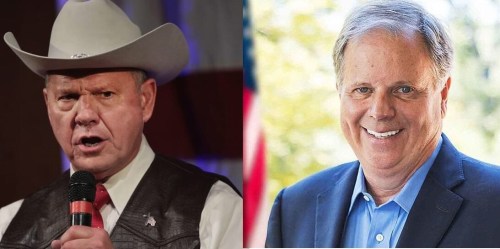
No More Roy Moore: Democrat Doug Jones Wins in Alabama

Friends of Padre Steve’s World,

In an incredibly close special election for United States Senator from Alabama former Judge Roy Moore lost to former U.S. Attorney Doug Jones.

Moore who lost the election had been credibly accused by multiple women of sexual assault when they were minors had previously been removed twice from his office as the Chief Justice of the Alabama Supreme Court for violations of the U.S. Constitution and rulings of the U.S. Supreme Court. Yet Moore, capitalizing on the votes of white Evangelical Christians defeated the very conservative Luther Strange in the Republican primary charged into the special election primed to win the seat of now Attorney General Jeff Sessions. Alabama has not elected a Democrat to the Senate since Hal Heflin was re-elected and retired in 1996. Sessions then won the election to replace Heflin.

Despite everything the mitigated against Moore it seemed that the closing days of the campaign that he would win. Most polls had him ahead and President Trump endorsed him. However, Senator Richard Shelby, the senior Senator of Alabama announced that he would not vote for Moore but for a write-in candidate and said that “Alabama deserved better than Moore.”

During the campaign Moore never backed down from previous racist remarks including that the United States was a better place when slavery was legal, nor his comments about Muslims, Jews, and Gays. Likewise he evoked memories of the Ku Klux Klan in many of his comments and actions. He campaigned as an anti-U.S. Constitution Christian theocrat whose militant religious extremism could be easily compared to the Taliban. The fact that over 80% of people identifying themselves as Evangelical Christians voted for him in this election shows the anti-American bias and moral bankruptcy of American Evangelical Christianity. Whites of all backgrounds voted overwhelmingly for Moore while Blacks who have faced tremendous disenfranchisement due to Alabama’s legislation making it harder for them to vote overwhelmingly voted for Jones more than they did for Hillary Clinton just 13 months ago. Maybe that is a sign of their discomfort with Mrs. Clinton.

In the end Jones won a close race. Twelve counties that voted for Trump in 2016 flipped and voted for Jones over Moore. Likewise a large number of voters voted for write-in candidates, probably depriving Moore of victory. With 100% of the votes counted Jones had 49.9% to Moore’s 48.4%. Write in votes accounted for the remaining 1.7%.

The question is what happens next? Will Republicans dig in and continue to support men like Moore or will they enact a course correction? Honestly I don’t know if the latter is possible as long as GOP leaders tremble before Trump and his fanatical supporters. I do believe that the President will invoke his wrath on Senator Shelby and all others who oppose him regardless of how loyal they might have been to him in the past. From now on Trump will move to crush any dissent in the in the GOP by energizing his still loyal base.

The election will make the passage of Trump’s agenda that much more difficult in the Senate and will likely lead to more radical moves by the President against political opponents on both sides of the aisle, the press, the courts, the Department of Justice and Federal Law Enforcement agencies investigating him. So what happens next is still anybody’s guess. This is perhaps one of the most dangerous moments in American history and the fate of the Republic still hangs in the balance.

As of this time Moore has refused to concede the race despite being 1.5% behind Jones. In Alabama an automatic recount is required when a candidate winds by less than 0.5%. A candidate that loses by a margin more than the 0.5% threshold must request it and pay for it within 48 hours of the election and such requests do not have to be granted. The fact that Moore is doing this again shows his disregard for any law other than his own. The chances of him overcoming Jones’s margin of victory are statistically insignificant but he will not quit because in his heart he hates the Constitution and the American system of government. His political demise should be heralded as a blessing by Republicans if they want to maintain their hold power in the coming 2018and 2020election cycles.

So, with that being said look for fireworks over the coming days and Moore, Trump, Steve Bannon, the Right Wing propaganda machine, and others, particularly politically mined Evangelical preachers promote conspiracy theories and stoke ever more resentment against those who support the Constitution and the laws of our country.

Until tomorrow,

Peace,

Padre Steve+

5 Comments

Filed under christian life, civil rights, ethics, faith, laws and legislation, News and current events, Political Commentary

Drive a Spoke into the Wheel of Injustice: Christ the King Sunday 2017

A Nazi Propaganda Poster Showing the Costs of the Sick and the Disabled

Friends of Padre Steve’s World,

Today I did some substitute preaching at my chapel. For me Thanksgiving weekend can be a challenging time to preach. It always falls on the Solemnity of Christ the King or the First Sunday of Advent, neither one of which works well with the holiday that we call Thanksgiving.

Today was Christ the King Sunday and the Gospel lesson was from Matthew 25 verses 31-46. Believe you me it’s not a lesson that you will hear preached in most of Trumpified Evangelicalism, or anywhere in the Prosperity Gospel movement that has sidled up to Trump and men like Roy Moore. Somehow I can hear the words of Dietrich Bonhoeffer when I read this passage fully understanding that many of my fellow Christians in the United States today have completely abandoned the Gospel message for the raw and shameless pursuit of political power, masking it under the pretense of values that they blatantly; through their lives, actions, and silence, mock. Bonhoeffer wrote:

“Christianity stands or falls with its revolutionary protest against violence, arbitrariness and pride of power and with its plea for the weak. Christians are doing too little to make these points clear rather than too much. Christendom adjusts itself far too easily to the worship of power. Christians should give more offense, shock the world far more, than they are doing now. Christian should take a stronger stand in favor of the weak rather than considering first the possible right of the strong.”

Bonhoeffer’s words like those of the Gospel stand in stark contrast to people who seem intent on pursuing policies that not only are attacks on the poor but on all but the richest of the rich. They stand against the words and actions of Christian people who would in the face of overwhelming evidence would support the actions of men who are serial adulterers, perpetrators of sexual assault, abuse, rape, and even men who force their girlfriends to have abortions all because they support their political agenda. Honestly, if I was not already a Christian there is nothing that these people could say to ever convince me to become one. As Gandhi said: “I like your Christ, I do not like your Christians. Your Christians are so unlike your Christ.”

That being said these are the words of the Gospel in today’s lesson from Matthew 25:

31 “When the Son of Man comes in his glory, and all the angels with him, then he will sit on the throne of his glory. 32 All the nations will be gathered before him, and he will separate people one from another as a shepherd separates the sheep from the goats, 33 and he will put the sheep at his right hand and the goats at the left. 34 Then the king will say to those at his right hand, ‘Come, you that are blessed by my Father, inherit the kingdom prepared for you from the foundation of the world; 35 for I was hungry and you gave me food, I was thirsty and you gave me something to drink, I was a stranger and you welcomed me, 36 I was naked and you gave me clothing, I was sick and you took care of me, I was in prison and you visited me.’ 37 Then the righteous will answer him, ‘Lord, when was it that we saw you hungry and gave you food, or thirsty and gave you something to drink? 38 And when was it that we saw you a stranger and welcomed you, or naked and gave you clothing? 39 And when was it that we saw you sick or in prison and visited you?’ 40 And the king will answer them, ‘Truly I tell you, just as you did it to one of the least of these who are members of my family,[a] you did it to me.’ 41 Then he will say to those at his left hand, ‘You that are accursed, depart from me into the eternal fire prepared for the devil and his angels; 42 for I was hungry and you gave me no food, I was thirsty and you gave me nothing to drink, 43 I was a stranger and you did not welcome me, naked and you did not give me clothing, sick and in prison and you did not visit me.’ 44 Then they also will answer, ‘Lord, when was it that we saw you hungry or thirsty or a stranger or naked or sick or in prison, and did not take care of you?’ 45 Then he will answer them, ‘Truly I tell you, just as you did not do it to one of the least of these, you did not do it to me.’ 46 And these will go away into eternal punishment, but the righteous into eternal life.”

Jesus Christ is a different kind of King. He is not like the Kings of Europe who the founders of the United States rejected. He is not the one who insists on his “divine right to kingship”, nor is he a despot as much as some of the testimony of various church leaders and even biblical writers occasionally make him out to be. He is one who takes up the cause of the poor, the outcast, the sinner, the unbeliever, and yes, even the repentant perpetrator, for because they share his humanity they are all also his brothers and sisters. Juergen Moltmann wrote:

“In the raising and exaltation of Christ, God has chosen the one whom the moral and political powers of this world rejected – the poor, humiliated, suffering and forsaken Christ. God identified himself with him and made him Lord of the new world ….. The God who creates justice for those who suffer violence, the God who exalts the humiliated and executed Christ – that is the God of hope for the new world of righteousness and justice and peace.”

That was the message I preached today in somewhat a truncated form without mentioning any of the names of the politicians, preachers, or pundits that I was critiquing on both sides of the political divide; but the implication was clear. This isn’t just politics it is a matter of faith as my friend Father Kenneth Tanner, a theologically conservative and truly pro-life Priest noted:

“No. It is never OK to turn a blind eye to multiple and credible witnesses against a leader running for public office because utilitarian politics are more important than principles and human decency. It matters not one wit if a presidential agenda or a senate majority or the makeup of the Supreme Court or any other grave moral challenge—like the precious life of the unborn—hangs in the balance.”

I do not know many men like Father Kenneth, but hopefully he and others like him will become that voice that cries out in the wilderness of what calls itself conservative or Evangelical Christianity to bring life to what has become death. Bonhoeffer wrote:

“We are not to simply bandage the wounds of victims beneath the wheels of injustice, we are to drive a spoke into the wheel itself.”

With every breath I take and every word I speak I will endeavor within the scope of my faith, my priesthood, and my office to do exactly that. I never want to have the burden around my neck that Martin Niemoller had around his when he remained silent, and even supported Hitler until too late he recognized his error. His words remind me of how until just ten years ago that I supported men who were willing to turn the Christian faith upside down for the sake of a place at the victor’s table. Niemoller’s words haunt me.

“I hated the growing atheistic movement, which was fostered and promoted by the Social Democrats and the Communists. Their hostility toward the Church made me pin my hopes on Hitler for a while. I am paying for that mistake now; and not me alone, but thousands of other persons like me.”

Thankfully I know a number of Evangelicals with a conscience both inside and outside the military who do not bow the knee to political expediency, not to mention some more moderate, liberal, and progressive Christians who also speak out. That gives me hope to keep speaking and working regardless of the cost because no matter what happens with Donald Trump or Roy Moore I don’t see anything changing the amoral and diabolical political schemes of the Christians that support them. They will simply sell their souls to the next best beast who will satisfy they longing for political and religious power over others, completely disregarding the words of Jesus.

So until tomorrow I wish you a good night,

Peace

Padre Steve+

Leave a comment

Filed under christian life, civil rights, ethics, faith, History, holocaust, News and current events, Political Commentary

Recommitting to A New Birth of Freedom: The Gettysburg Address at 154 Years

Friends of Padre Steve’s World,

In November 1863 President Abraham Lincoln travelled to Gettysburg Pennsylvania yards behind the temporary to attend and say a few words at the dedication of the Soldiers Cemetery where the remains of the Union dead who had not been recovered by their families and taken home for burial were being interred by local laborers. When Lincoln arrived the process was barely halfway complete. The ground on West Cemetery Hill was still scarred by the battle that took place barely four and a half months prior, a battle that was the deadliest in United States military history in which the Army of the Potomac under the command of George Gordon Meade defeated Confederate General Robert E. Lee’s storied Army of Northern Virginia.

Lincoln was not the primary speaker, that honor went to Edward Everett, former Secretary of State, Senator, and Representative from Massachusetts. Everett, an academic from Harvard was also a leader in the Greek Revival and the Rural Cemetery movement in the United States. Gettysburg’s Evergreen Cemetery, less than 100 yards behind the temporary structure from which Everett and Lincoln would speak was a legacy of the movement that Everett had helped to begin. Now Everett was the primary orator at the dedication of of this cemetery dedicated to the Union dead, and Lincoln, the President there as more of window dressing.

Everett spoke for nearly two hours providing an impressive narrative of the battle. When he ended his speech, which was not long by the standards of his day it was left to Lincoln to say a few words. Those few words are now part of the lexicon of American secular scripture along with the Declaration of Independence, the Preamble of the United States Constitution, Franklin Delano Roosevelt’s “Four Freedoms” speech, andDr. Martin Luther King’s “I Have a Dream” speech.

His words are the antithesis of what is so often heard in American political discourse today. The fact is that while many Americans give lip service to all of these speeches, we have to admit that there is a significant portion of our population that not only give lip service to their ideas but actually oppose them, instead valuing theocracy, racism, authoritarianism, and militarism more than the ideals that the United States was founded upon. Despite that, they remain something that we must strive to pursue until this nation actually experiences the new birth of Freedom that Lincoln ended up dying to see established.

Lincoln’s words which he penned over a number of days were not long, and while some like Everett himself thought that they eclipsed his own words, many politicians and members of the press thought little of them. However, those words probably encapsulate the ideas of the founders better than any words outside of the Declaration of Independence. I will leave you with those words. So until tomorrow,

Peace,

Padre Steve+

Four score and seven years ago our fathers brought forth on this continent, a new nation, conceived in Liberty, and dedicated to the proposition that all men are created equal.

Now we are engaged in a great civil war, testing whether that nation, or any nation so conceived and so dedicated, can long endure. We are met on a great battle-field of that war. We have come to dedicate a portion of that field, as a final resting place for those who here gave their lives that that nation might live. It is altogether fitting and proper that we should do this.

But, in a larger sense, we can not dedicate — we can not consecrate — we can not hallow — this ground. The brave men, living and dead, who struggled here, have consecrated it, far above our poor power to add or detract. The world will little note, nor long remember what we say here, but it can never forget what they did here. It is for us the living, rather, to be dedicated here to the unfinished work which they who fought here have thus far so nobly advanced. It is rather for us to be here dedicated to the great task remaining before us — that from these honored dead we take increased devotion to that cause for which they gave the last full measure of devotion — that we here highly resolve that these dead shall not have died in vain — that this nation, under God, shall have a new birth of freedom — and that government of the people, by the people, for the people, shall not perish from the earth.

Abraham Lincoln
November 19, 1863

1 Comment

Filed under civil rights, civil war, Gettysburg, History, leadership, Political Commentary

Not Everyone Deserves a Monument: Military Leaders and War Crimes

Friends of Padre Steve’s World,

Monuments to soldiers who served their country faithfully and honorably are not a bad thing. At the same time one has to look at the context of their service and if they serve in the high command or in other government postings their service needs to be carefully examined to see if the deserve to be memorialized.

In the United States we have frequently memorialized men whose actions as military and political leaders, while commendable in some aspects leaves much to be desired in terms of long standing memorials.

This weekend I had a friend whose family survived the Holocaust ask me where removing memorials to men like Robert E. Lee ends. I replied that it was all about context and the totality of life. We mythologize Robert E. Lee in a manner that his crimes and his flaws are intentionally hidden, though they are many. I will write about that soon, I actually have a draft of that article that I started a while back that I need to complete.

I then talked about German General Erich Hoepner who though he had been a part of plots to overthrow Hitler before the war and took part in the plot to overthrow Hitler in 1944 and was executed after a sham trial. The pictures and films of Hoepner being shamed and degraded by the Nazi Chief inquisitor, Judge Roland Freisler, give an impression that General Hoepner was a victim of the Nazi regime.

To some extent he was a victim of the regime, but while in command of Panzer Group Four during the invasion of the Soviet Union his actions place him in the pantheon of Nazi War Criminals. He fully cooperated with some the most criminal aspects of the Nazi regimes actions. He was a willing accomplice to crimes that stagger the imagination.

In his initial message to his troops Hoepner stated:

The war against Russia is an important chapter in the German nation’s struggle for existence. It is the old battle of the Germanic against the Slavic people, of the defence of European culture against Muscovite-Asiatic inundation and of the repulse of Jewish Bolshevism. The objective of this battle must be the demolition of present-day Russia and must therefore be conducted with unprecedented severity. Every military action must be guided in planning and execution by an iron resolution to exterminate the enemy remorselessly and totally. In particular, no adherents of the contemporary Russian Bolshevik system are to be spared.

Hoepner issued a number of other orders directing how Jews should be treated and the commander of Einsatzgruppe A, SS Brigadier General Walter Stahlecker whose units killed nearly 250,000 Jews between July and December 1941 praised the cooperation of the Wehrmacht and in particular of Hoepner with his execution squads. Stahlecker described the cooperation of the Wehrmacht with his men as “generally very good”, and “in certain cases, as for example, with Panzer Group 4 under the command of General Hoepner, extremely close, one might say even warm.” The fact is that the Einsatzgruppen could not have ran up such massive numbers of deaths without the cooperation of the German Army leaders in Russia.

That leaves us with the question of how does one remember such a military leader? Hoepner demonstrated bravery as a young officer in the First World War, and was prepared to help overthrow Hitler before the war and lost his life in the attempt to kill Hitler on July 20th 1944. But he enabled and participated in war crimes so vast and heinous that they beggar the imagination.

In 1956 a Berlin school was named after Hoepner for his role in the anti-Hitler plot, but in 2008, after his actions in relationship to the Nazi war crimes became public, the school was renamed. Because he perished in the attempt on Hitler’s life, Hoepner was included in the myth of the noble Wehrmacht. But that was a myth, the Wehrmacht was so complicit in the Nazi crimes that it cannot be exculpated from them. It’s leaders for the most part agreed with Nazi racial policies and had no hesitation in cooperating with the SS. Yes, there were exceptions, but they were and forever will remain exceptions, the myth be damned.

So in relation to the American controversy regarding monuments to Confederate leaders, or for that matter to leaders who planned, conducted, or supported our own genocide of Native Americans, the unlawful subjection and conquest of Mexico, the exploitation of territories and peoples gained following the Spanish-American War, those who conducted medical experiments not much different than the Nazi doctors on minorities and the handicapped, and so many other examples which would take too long to list for the purpose of this article: what are we to do?

As I have written before, this is a matter of context and honesty. Honestly I think this is something that we need to address, just as the Germans have since the end of the Second World War. We have to be brutally honest in our assessment of the men and women who we chose to memorialize. If we aren’t we simply bless their crimes and allow their veneration to inspire new generations of racial motivated criminals.

That is where we have to go if we have the moral courage to do so. However, I don’t think that will happen in the next few years, or even in my lifetime.

So until tomorrow,

Peace

Padre Steve+

1 Comment

Filed under civil rights, ethics, History, nazi germany

“But the Jews Weren’t the Only Ones” How Ordinary and Terrifyingly Normal People Minimize and Accept Nazi Ideology

Friends of Padre Steve’s World,

I have to admit that the amount of ignorance in the defense of evil that I see daily is simply mind blowing. It makes me shake my head. But then I cannot be surprised anymore. Over the weekend I saw a poll in which nine percent of Americans said that holding White Supremacist or Neo-Nazi views and ideology was okay.

Now nine percent doesn’t sound like a big number or anything to worry about until you extrapolate that percentage into the numbers of people who hold that view. Based on the population of the United States that nine percent equals about thirty million individuals. Now I’m sure that many of these patriotic Americans are not card carrying Klansmen or Nazis, but the fact that they would turn a blind eye to the evil of both in the name of some incomprehensible moral equivalence as did President Trump after Charlottesville is quite disturbing. Perhaps it is his example that enables them to be so open about their acceptance of evil.

Yesterday on my Facebook page a friend of a friend commented on an article which discussed new research that indicates that the Nazis in their occupation of the Ukraine killed perhaps a half million more Jews than previously believed. That woman made the comment that there were others, and yes that is true. Had the Nazis won the war tens of millions more of the Jews as well as the Slavs who they referred to as Untermenschen or subhumans would have been killed, either directly or through a policy of intentional starvation. But make no bones about it, from the months that Hitler spent in Landsberg prison for his role in the Beer Hall Putsch of 1923 writing Mein Kampf until the end of the war as the Red Army closed in on his bunker in Berlin, the Jews above all were the object of his personal hatred.

Close to six million Jews and millions of others were killed by the Nazis. Millions of Africans were enslaved in the United States and even after emancipation were by law treated as less than full citizens. Under Jim Crow they were discriminated against at every level of government including states that were neither a part of the Confederacy or not even States when the Civil War was fought, they were impressed as forced labor under the Black Codes and thousands were murdered, often in public by people who brought their children to watch Black men die.

But these people were not just numbers. It’s all to easy to blur them into a mass of dehumanized humanity by talking about the millions, when every single one was a human being, yes, I believe created in the image of God. We have to see their faces and we have to recognize their essential humanity as men and women, children, fathers, mothers, brothers, sisters, husbands and wives, whose lives were in the case of the Jews obliterated as if they never existed, and others like African slaves who were simply property.

I explained that in quite a few fewer words and told her that she shouldn’t challenge me on the subject, which of course she did. So I went into more detail and shot her argument down in flames, to the cheers of other commentators on the post. When you have spent much of your academic life studying a subject it really gets old hearing people make excuse for evil by trying to minimize that evil, especially against the targeted people.

It’s like Confederate apologists saying that the institution of slavery which enslaved millions of Africans was actually worse for White people. Yes it is true that many poor whites benefited little from slavery, but they were not bought and sold as chattel, sold away from their wives and children, whipped, and marched across country in chains to new owners, or yes even killed simply because they were not considered human beings but property.

Sadly, as Dr. Timothy Snyder wrote “The history of the Holocaust is not over. Its precedent is eternal, and its lessons have not yet been learned.”

So there are about 30 million Americans who believe that holding Nazi and White Supremacist beliefs is okay. A few years ago I would believed that the number was lower, but after seven months of living in Trump’s America I believe that it might be even higher than the poll indicated. I only say this based on the postings I see on various social media platforms, news comment pages, the proliferation of websites that cater to these beliefs, and the lack of real condemnation of such individuals by the majority of the GOP Senate and House majorities, and the outright defense of them by other GOP representatives at the Federal and State level. These people have not learned the lessons of the Holocaust, nor American slavery.

Again I don’t believe that the majority of these people are real card carrying Nazis or Klansmen. Most would probably be considered great citizens: they work, they raise families, they go to church, and many would claim that they have “a Black or Jewish friend” so obviously they cannot be racists. But that being said they turn a blind eye to the evil of race hatred and White supremacy, and sometimes join in on social media meme wars where they mock the victims. But no matter what, not condemning the purveyors of White Supremacist or Neo-Nazi ideology, or by using the arguments of moral equivalence to minimize those crimes against humanity makes these people as complicit in the past, present, and future crimes of Naziism as if they were.

They may be ordinary people, as seemingly normal as anyone else, but as Hannah Arendt noted about Adolf Eichmann and other Nazis who advanced the destruction of the Jews was that they were so normal. She wrote:

“The trouble with Eichmann was precisely that so many were like him, and that the many were neither perverted nor sadistic, that they were, and still are, terribly and terrifyingly normal. From the viewpoint of our legal institutions and of our moral standards of judgment, this normality was much more terrifying than all the atrocities put together.”

That my friends is as true as the day she wrote it after Eichmann’s trial, as it is today, and why we must constantly educate people in every forum possible that it is all too easy to become either a perpetrator or evil or a bystander. As Snyder wrote: “It is less appealing, but morally more urgent, to understand the actions of the perpetrators. The moral danger, after all, is never that one might become a victim but that one might be a perpetrator or a bystander. It is tempting to say that a Nazi murderer is beyond the pale of understanding. …Yet to deny a human being his human character is to render ethics impossible. To yield to this temptation, to find other people inhuman, is to take a step toward, not away from, the Nazi position. To find other people incomprehensible is to abandon the search for understanding, and thus to abandon history.”

Since they were human beings the Nazis were not unique to history. In every era of history human beings have committed atrocities, many in the name of some kind of ethnic, religious, or nationalist ideology of supremacy that held other people to be less than human. That may sound harsh, but it is all too true based on history.

Yehuda Bauer wrote: “The horror of the Holocaust is not that it deviated from human norms; the horror is that it didn’t. What happened may happen again, to others not necessarily Jews, perpetrated by others, not necessarily Germans. We are all possible victims, possible perpetrators, possible bystanders.”

In the movie Judgment at Nuremberg the judge played by Spencer Tracy noted something important about the defendants in the trial. His words need to be heard today as well:

Janning, to be sure, is a tragic figure. We believe he loathed the evil he did. But compassion for the present torture of his soul must not beget forgetfulness of the torture and the death of millions by the Government of which he was a part. Janning’s record and his fate illuminate the most shattering truth that has emerged from this trial: If he and all of the other defendants had been degraded perverts, if all of the leaders of the Third Reich had been sadistic monsters and maniacs, then these events would have no more moral significance than an earthquake, or any other natural catastrophe.

But this trial has shown that under a national crisis, ordinary – even able and extraordinary – men can delude themselves into the commission of crimes so vast and heinous that they beggar the imagination. No one who has sat through the trial can ever forget them: men sterilized because of political belief; a mockery made of friendship and faith; the murder of children. How easily it can happen. There are those in our own country too who today speak of the “protection of country” – of ‘survival’. A decision must be made in the life of every nation at the very moment when the grasp of the enemy is at its throat. Then, it seems that the only way to survive is to use the means of the enemy, to rest survival upon what is expedient – to look the other way. Well, the answer to that is ‘survival as what’? A country isn’t a rock. It’s not an extension of one’s self. It’s what it stands for. It’s what it stands for when standing for something is the most difficult! Before the people of the world, let it now be noted that here, in our decision, this is what we stand for: justice, truth, and the value of a single human being.

It is high time that we learn that again and that we make up our minds to oppose the ideologies that made the Holocaust and Slavery possible. As Hannah Arendt observed: “The sad truth is that most evil is done by people who never make up their minds to be good or evil.”

So until tomorrow,

Peace

Padre Steve+

4 Comments

Filed under civil rights, History, holocaust, nazi germany, News and current events, Political Commentary