Category Archives: civil rights

We Hold These Truths

Declaration_of_Independence_by_JoeSnuffy

Last night I re-read the Declaration of Independence as I do about this time of year and as I do so I reflect upon the profoundly revolutionary nature of that document. It is not a long read, but quite profound and as I said revolutionary. As I read again I reflected on the beginning of the second sentence of that document.

“We hold these truths to be self-evident, that all men are created equal…” This statement is really the heart of the document and something that when penned by Thomas Jefferson and ratified by the Continental Congress in July 1776 overturned the political philosophy of the day. These words, which begin the second sentence of the Declaration of Independence announced something unimaginable to the people around the world, most of which labored under the rule of ensconced monarchies, nobilities and state religions. In the world where they were written a person’s family pedigree, ownership of property or even religious affiliation counted more than anything else. In that world few commoners had any hope of social advancement, no matter what their talent, ability or genius.

The words of the Declaration were a clarion call of equality and were revolutionary in their impact, not only in the American colonies but around the world. In the coming years people around the world would look to those words as they sought to free themselves from oppressive governments and systems where the vast majority of people had few rights, and in fact no equality existed.

But the liberty and equality stated in the Declaration of Independence did not extend to all in the United States, or in its territories as it expanded westward, and the inequity eventually brought on a great civil war.

Eighty-seven years after those words were published the nation was divided, in the midst of a great civil war, a climactic battle having just been fought at Gettysburg. A few months later President Abraham Lincoln penned one of the most insightful and influential documents ever written, the Gettysburg Address.

One thing that our founders overlooked was that even while proclaiming equality, they later enshrined that one group of people, African slaves were not equal, in fact they only counted as three fifths of a person. Eventually, many states on their own abolished slavery, but because of the invention of the Cotton Gin slavery became even more fully entrenched in the American South, when an oligarchy of land and slave owners held immense power, where nearly half of the population was enslaved and where even poor whites had few rights and little recourse to justice.

After the Dred Scott decision of 1857 which declared that African Americans, no matter if they were slave or free could be American Citizens and had no standing to sue in Federal courts. Scott had sued to gain his family’s freedom after his owner refused to allow him to purchase it, because they were in a territory where slavery was but even more importantly held that the Missouri Compromise of 1824 which had prohibited the introduction of Slavery into Federal territories was unconstitutional and that the Federal government had no right to limit slavery in territories acquired after the creation of the United States. Chief Justice Roger Taney writing for the majority wrote that the authors of the Constitution as viewed all African Americans:

“beings of an inferior order, and altogether unfit to associate with the white race, either in social or political relations, and so far inferior that they had no rights which the white man was bound to respect.”

Taney held that Article V of the Constitution barred any law that would deprive a slave owner of his “property” on entrance into free states or territories and he enunciated a string of negative effects, or “parade of horribles” that would derive if Scott’s petition for freedom was granted. His declaration is amazing in its ignorance and prejudice. Taney wrote:

“It would give to persons of the negro race, …the right to enter every other State whenever they pleased, …to sojourn there as long as they pleased, to go where they pleased …the full liberty of speech in public and in private upon all subjects upon which its own citizens might speak; to hold public meetings upon political affairs, and to keep and carry arms wherever they went.”

The two dissenting Justices, Curtis and McLain disagreed with the proposition that the writers of the Constitution believed as Taney and the majority believed, noting that at the time of the ratification of the Constitution that blacks could vote in five of the thirteen states, making them citizens, not just of those states but the United States. Referring to the Declaration of Independence in 1854 Lincoln wrote: “the standard maxim of free society …constantly spreading and deepening its influence,” ultimately applicable “to peoples of all colors everywhere.”

However, much to the concern of slave holders and the South, the decision energized the abolitionist movement who believed that now no black, even those with a long history of being Freed Men living in non-slave states could be claimed as property by those claiming to be former owners, and that state laws which gave blacks equal rights and citizenship could be overturned. Lincoln again referring to the Declaration wrote of the Dred Scott decision:

“to aid in making the bondage of the Negro universal and eternal….All the powers of the earth seem rapidly combining against him. Mammon is after him; ambition follows, and philosophy follows, and the theology of the day is fast joining the cry. They have him in his prison house;…One after another they have closed the heavy doors upon him…and they stand musing as to what invention, in all the dominions of mind and matter, can be produced the impossibility of his escape more complete than it is.”

Eventually the tensions led to the election of Lincoln along sectional lines and the immediate secession of seven southern states and the establishment of the Confederacy. British military historian and theorist Major General J.F.C. Fuller wrote that the war was “not between two antagonistic political parties, but a struggle to the death between two societies, each championing a different civilization…”

The Confederate Vice President, Alexander Stephens openly proclaimed that the inequity of African Americans was foundational to the Confederacy in his Cornerstone speech of 1861, if there are any doubters about the “rights” the leaders of the Southern States longed to preserve in their secession from the Union, Stephen’s words are all to clear in their intent:

“Our new government is founded upon exactly the opposite idea; its foundations are laid, its corner- stone rests upon the great truth, that the negro is not equal to the white man; that slavery — subordination to the superior race — is his natural and normal condition. [Applause.] This, our new government, is the first, in the history of the world, based upon this great physical, philosophical, and moral truth.”

Lincoln, in his Second Inaugural Address acknowledged what everyone had known, but few, him included in the North were willing to say in 1861:

“One-eighth of the whole population were colored slaves, not distributed generally over the Union, but localized in the southern part of it. These slaves constituted a peculiar and powerful interest. All knew that this interest was somehow the cause of the war. To strengthen, perpetuate, and extend this interest was the object for which the insurgents would rend the Union even by war, while the Government claimed no right to do more than to restrict the territorial enlargement of it….”

Even so it took time for the abolition of slavery to be acknowledged as a major concern by the Federal government, it was not until 1862 after Lee’s failed invasion of Maryland and the Battle of Antietam that Lincoln published the Emancipation Proclamation, and that only applied to Confederate occupied areas.

But in 1863 after Gettysburg Lincoln was asked to speak a “few words” at the dedication of the Soldiers’ cemetery. Lincoln’s words focused the issue of the war in relation to those first words of the second sentence of the Declaration of Independence, the understanding that all men are created equal.

“Four score and seven years ago our fathers brought forth on this continent, a new nation, conceived in Liberty, and dedicated to the proposition that all men are created equal.

Now we are engaged in a great civil war, testing whether that nation, or any nation so conceived and so dedicated, can long endure. We are met on a great battle-field of that war. We have come to dedicate a portion of that field, as a final resting place for those who here gave their lives that that nation might live. It is altogether fitting and proper that we should do this.

But, in a larger sense, we can not dedicate — we can not consecrate — we can not hallow — this ground. The brave men, living and dead, who struggled here, have consecrated it, far above our poor power to add or detract. The world will little note, nor long remember what we say here, but it can never forget what they did here. It is for us the living, rather, to be dedicated here to the unfinished work which they who fought here have thus far so nobly advanced. It is rather for us to be here dedicated to the great task remaining before us — that from these honored dead we take increased devotion to that cause for which they gave the last full measure of devotion — that we here highly resolve that these dead shall not have died in vain — that this nation, under God, shall have a new birth of freedom — and that government of the people, by the people, for the people, shall not perish from the earth.”

Unfortunately, the issue of equality has languished in our political debates. Equality is the sister of and the guarantor of the individual liberties enunciated in the Declaration. However because of human nature always more vulnerable to those that would attempt to enshrine their personal liberty over others, or attempt to use the courts and Constitution to deprive others of the rights that they themselves enjoy, or to enshrine their place in society above others. In some cases this is about race, sometimes religion, sometimes about gender and even sexual orientation. Likewise there are those that would try to roll back the rights of others, as those who seek to disenfranchise the poor and minorities, particularly African Americans at the ballot box.

That is why it is important, even as we celebrate and protect individual liberties that we also seek to fight for the equality of all citizens, irrespective of race, religion, gender or sexual orientation. The Declaration of Independence is our guide for this as Jefferson so eloquently wrote: “We hold these truths to be self-evident, that all men are created equal, that they are endowed by their Creator with certain unalienable Rights, that among these are Life, Liberty and the pursuit of Happiness. –That to secure these rights, Governments are instituted among Men…”

I wish all of my readers a happy Independence Day. I also ask that all of us please remember that unless liberty is liberty for all then it is really only liberty for some; those of great economic power and influence; or who happen to be the right race, religion, gender or sexual preference.I don’t believe that such was the intent of Jefferson and those who ratified the Declaration, and I know that it was not the case for Abraham Lincoln, who eighty-seven years later called Americans to embrace a new birth of freedom.

Peace

Padre Steve+

9 Comments

Filed under civil rights, History, Political Commentary

Racism & the Failure of Reconstruction

this-is-a-white-mans-government


Friends of Padre Steve’s World

Some events and attitudes are timeless, one of these is racism. Being white myself, I know that many whites are loath to admit that the scourge of racism still exists, but it does and it runs deep in our history. The more that I work on my Civil War and Gettysburg text, which now appears will morph into at least two and maybe three books when I am done, I find terribly distressing parallels to attitudes and actions of some which mirror the attitudes and actions of our ancestors, Northern and Southern following the Civil War. When the shooting stopped and the South was vanquished, many Southerners continued the war by other means and Northerners, divided after the death of Abraham Lincoln failed to achieve the most important political goal, after the restoration of the Union, that of true freedom for African Americans. Sadly, for some that war is still not over, as was evidenced in the aftermath of the Emanuel A.M.E. Massacre just two weeks ago. Likewise the burnings of six predominantly black churches across the South raises the specter of the racial violence that targeted blacks for a century after the Civil War.

This is another section of my text. I do hope that it challenges you as much as writing it challenged me.

Peace

Padre Steve+


When the war ended the Confederacy was beaten and most people in the South would have agreed to anything that the North presented regarding peace and return to the Union. In a sense Reconstruction was “what the war was about.” [1] Richard Henry Dana, the declared that “a war is over when its purpose is secured. It is a fatal mistake to hold that this war is over because the fighting has ceased. This war is not over…” [2] As Dana, and Clausewitz understood so well that war is a continuation of policy and politics by other means, and the failure of the North to fully grasp this fact led to over a century of subjugation of emancipated African Americans and has fueled a continual racial divide in the United States that is still felt today. Defeated on the battlefield Southerners soon turned to political, psychological and violent means to reverse their losses.

Frederick Douglass understood that simple emancipation was not enough, and that the “war and its outcome demanded racial equality.” [3] Despite the that efforts of many in the North this would not happen during Reconstruction and Douglass knew that the failure to accomplish this would be disastrous, “Whether the tremendous war so heroically fought…shall pass into history a miserable failure…or whether on the other hand, we shall, as the rightful reward of victory over treason have a solid nation, entirely delivered from all contradictions and social antagonisms, must be determined one way or another.” [4]

There was a problem with implementing Reconstruction; when John Wilkes Booth assassinated Abraham Lincoln, the political leaders of the North could not agree on how to do this. The new President, Andrew Johnson was probably the worst possible leader to lead the country in the aftermath of war for all practical purposes Johnson was a Democrat who believed in white supremacy, he had been brought onto the ticket for his efforts to keep Kentucky in the Union and to support Unionist elements in Tennessee. While his selection helped Lincoln in parts of the North and the Border States it was a disaster for the post-war era. Johnson’s approach to reconstruction was very simply to “impose minimal demands on the South. He required only minor concessions from the former Confederates before allowing them to resume their political rights and retain their land. As for freedmen, he seemed to think that the needed no further protection beyond the fact of their emancipation.” [5]

Johnson was “a lonely stubborn man with few confidants, who seemed to develop his policies without consulting anyone, then stuck to them inflexibly in the face of any and all criticism. He lacked Lincoln’s ability to conciliate his foes and his capacity for growth, which was best illustrated by Lincoln’s evolving attitude to black suffrage during the Civil War.” [6] In the months after his unexpected accession to the presidency Johnson demonstrated that he had no understanding of Lincoln’s political goals for the South and the desires of the Republican dominated Congress.

By the summer of 1865 Johnson was already demonstrating “that his sympathies were with the Southern white population and that he believed that their interests should be cared for even at the expense of freedmen.” [7] Johnson’s approach to reconstruction was very simply to “impose minimal demands on the South. He required only minor concessions from the former Confederates before allowing them to resume their political rights and retain their land. As for freedmen, he seemed to think that the needed no further protection beyond the fact of their emancipation.” [8] Johnson gave individual pardons to more than thirteen thousand “high-ranking Confederate civil and military officers and wealthy Southerners.” [9] While doing this he minimized political influence the Southern Unionists who had not supported the Confederacy and ensured that freed slaves were excluded from the political process. He issued a number of orders “appointing interim provisional governors and urging the writing of new state constitutions based upon the voter qualifications in force at the time of secession in 1861 – which meant, in large but invisible letters, no blacks.” [10]

When Frederick Douglass led a delegation of blacks to meet with Johnson in February 1865 Johnson preached that it was impossible to give political freedom to blacks. When Douglass attempted to object Johnson became angry and told Douglass “I do not like to be arraigned by some who can get up handsomely-rounded periods and rhetoric, and talk about abstract ideas of liberty, who never periled life, liberty, or property.” [11] When Douglass took his objections to Johnson’s harangue to a Washington newspaper, Johnson railed against Douglass “I know that d—–d Douglass…he’s just like any other nigger & would sooner cut a white man’s throat than not.” [12]

White Southerners including the newly pardoned Confederates enacted black codes that “codified explicit second-class citizenship for freedpeople.” [13] The legislature of Mississippi refused to ratify the Thirteenth Amendment, and did not do so until 1995. One Southerner noted that “Johnson “held up before us the hope of a ‘white man’s government,’ and this led us to set aside negro suffrage…. It was natural that we should yield to our old prejudices.” [14] Former Confederates, including Alexander Stephens the former Vice President of the Confederacy were elected to high office, Stephens to the United States Senate and the aggrieved Republicans in Congress in turn refused to admit the former Confederates. Many Union veterans were incensed by Johnson’s actions, one New York artilleryman noted “I would not pardon the rebels, especially the leaders, until they should kneel in the dust of humiliation and show their deeds that they sincerely repent.” [15] He was not alone, many Northern Veterans who formed the integrated Grand Army of the Republic veterans maintained a patent disregard, if not hatred of what the old South stood for and felt that their efforts in the war had been betrayed by the government.

Johnson’s restoration of property to the former white owners drove tens of thousands of blacks off lands that they had been farming, or left them as laborers for their former slave masters. Johnson countermanded General William Tecumseh Sherman and Secretary of War Edwin Stanton’s Field Order 15 to “divide abandoned and confiscated lands on the Sea Islands and in a portion of the Low Country coast south of Charleston into forty-acre plots for each black family.” [16] As such many freed blacks were now at the mercy of their former white owners for any hope of economic sustenance. Johnson stridently to frustrate the efforts of the Freedmen’s Bureau headed by Major General Oliver Howard to help freed blacks to become landowners. Johnson vetoed the Civil Rights bill but Congress overrode his veto. Eventually the battled between Johnson and Congress resulted in Johnson’s impeachment and narrow acquittal by one vote in the Senate in 1868.

The various black codes enacted throughout the South:

“passed labor laws that bound blacks to employers almost as tightly as slavery once bound them to their masters. Other codes established patterns of racial segregation that had been impossible under slavery, barred African Americans from serving on juries or offering testimony in court against whites, made “vagrancy,” “insulting gestures,” and “mischief” offenses by blacks punishable by fines or imprisonment, forbade black-white intermarriage, ad banned ownership by blacks of “fire-arms of any kind, or any ammunition, dirk or bowie-knife.” [17]

Likewise within weeks of the end of the violence against blacks began to break out in different parts of the South and it continued to spread as Johnson and Congress battled each other in regard to Reconstruction policy. “In Memphis, Tennessee, in May of 1866, whites on a rampage of murder killed forty-six Negroes, most of them veterans of the Union army, as well as two white sympathizers. Five Negro women were raped. Ninety homes, twelve schools and four churches were burned. In New Orleans in the summer of 1866, another riot against blacks killed thirty-five Negroes and three whites.” [18]

This alienated him from the Republican majority who passed legislation over Johnson’s veto to give black men the right to vote and hold office, and to overturn the white only elections which had propelled so many ex-Confederates into political power. Over Johnson’s opposition congress took power over Reconstruction and “Constitutional amendments were passed, the laws for racial equality were passed, and the black man began to vote and to hold office.” [19] Congress passed measures in 1867 that mandated that the new constitutions written in the South provide for “universal suffrage and for the temporary political disqualification of many ex-Confederates.” [20]   These measures helped elect bi-racial legislatures in the South which for the first time enacted a series of progressive reforms including the creation of public schools. They also ratified the Thirteenth and the Fourteenth Amendments, but these governments, composed of Southern Unionists, Northern Republicans and newly freed blacks were “elicited scorn from the former Confederates and from the South’s political class in general.” [21] Seen as an alien presence by most Southerners the Republican governments in the South faced political and was as violent opposition.

The Fourteenth Amendment was of particular importance for it overturned the Dred Scott decision which denied citizenship to blacks. Johnson opposed the amendment and worked against its passage by campaigning for men who would oppose it in the 1866 elections. His efforts earned him the opposition of former supporters including the influential New York Herald declared that Johnson “forgets that we have passed through a fiery ordeal of a mighty revolution, and the pre-existing order of things is gone and can return no more.” [22]

When passed by Congress the amendment was a watershed which would set Constitutional precedent for future laws to give women the right to votes, end Jim Crow laws, enact the Voting Rights Act of 1965, and most recently to give homosexuals the right to marry. Section one of the amendment read:

“All persons born or naturalized in the United States, and subject to the jurisdiction thereof, are citizens of the United States and of the state wherein they reside. No state shall make or enforce any law which shall abridge the privileges or immunities of citizens of the United States; nor shall any state deprive any person of life, liberty, or property, without due process of law; nor deny to any person within its jurisdiction the equal protection of the laws.” [23]

But these measures provoked even more violence from enraged Southerners who formed a variety of violent racist organizations which turned the violence from sporadic attacks to what amounted to a full-fledged insurgency against the new state governments and African Americans. Organizations like the Ku Klux Klan which engaged in terroristic violence to heavily armed “social clubs” which operated under the aegis of the state Democratic Party leadership in most Southern states. Allegedly organized for self-defense against state militia units composed of freed blacks they named themselves “White Leagues (Louisiana), White Liners or Rifle Clubs (Mississippi), or Red Shirts (South Carolina). They were, in fact, paramilitary organizations that functioned as armed auxiliaries of the Democratic Party in southern states in their drive to “redeem” the South from “black and tan Negro-Carpetbag rule.” [24] These men, mostly Confederate veterans “rode roughshod over the South, terrorizing newly freed slaves, their carpetbagger allies, and anyone who dared to imagine a biracial democracy as the war’s change.” [25] This unrequited violence and hatred set the stage for the continued persecution, murder and violence against blacks and those who supported their efforts to achieve equality in the South for the next century.

Throughout his term in office Johnson appealed to arguments used throughout later American history by “critics of civil rights legislation and affirmative action. He appealed to fiscal conservatism, raised the specter of an immense federal bureaucracy trampling on citizens’ rights, and insisted that self-help, not government handouts, was the path to individual advancement.” [26] While many of his Republican opponents supported these measures, many moderate Republicans could not abandon their support of or and ties to big corporations, and

Ulysses S. Grant succeeded Johnson as President in 1869 but his efforts at Reconstruction were met mostly by failure as well as a weariness on the part of many Northerners to continue to invest any more effort into it. Slowly even proponents of Reconstruction began to retreat from it and Southerners, knowing that they were winning the political battle continued their pressure. Both politically and through the use of terror to demoralize and drive from power anyone who supported it. By 1870 every former Confederate state had been readmitted to the Union, in a sense fulfilling a part Lincoln’s war policy, but at the same time denying what the war was waged for.

Congressman Thaddeus Stevens, one of the most effective leaders of the Radical Republicans died in 1868 in despair that the rights of blacks were being rolled back even as legislation was passed supporting them. The old firebrand asked “to be buried in a segregated cemetery for African American paupers so that “I might illustrate in death the principles which I advocated through a long life, Equality of man before his creator.” [27] Others including Senator Ben Wade, were not returned to office while others including Edwin Stanton, Salmon Chase and Charles Summer all died during Grant’s administration.

While Grant attempted to smash the Ku Klux Klan by military means his administration, heavily made up of economic conservative Republicans who had little interest in the rights of African Americans gave little other support to those fighting for equal rights for blacks. In the end Southern intransigence wore out the political will of Northerners to carry on, even the strongest supporters of equality.

By “1870 Radical Republicanism as a coherent political movement was rapitdl6y disintegrating” [28] and during the early 1870s many of the antislavery activists had left the Republican party either to death or defection, many “no longer felt at home in a party that catered to big business and lacked the resolve to protect black rights.” [29]

In 1872, some former radical Republicans revolted against Grant and the corruption in the Republican Party. Calling themselves “Liberal Republicans” they supported the candidacy of Horace Greeley uniting with Democrats to call for an end to Reconstruction. For many this was not so much because they no longer supported the rights of African Americans, but because for them, like so many, “economic concerns now trumped race relations…. Henry Adams, who shared the views of his father, Charles Francis Adams, remarked that “the day is at hand when corporations far greater than [the] Erie [Railroad]…will ultimately succeed in directing the government itself.” [30] The numbers of Federal troops in the South continued to be reduced to the point where they could offer little or no support to state militia.

Violence now became a means to further politics in the South and carried out in broad daylight and “intended to demoralize black voters and fatally undermine the Republican Party…. They paraded at regular intervals through African American sections of small towns in the rural black majority areas, intimidating the residents and inciting racial confrontations.” [31] These armed bands were highly successful, if they were successful in provoking a racial incident they would then fan out throughout the area to find blacks in order to beat up and kill, hundreds of blacks were killed by them. During the elections of 1876 the White Liners, Red Shirts and others would be seen in threatening positions near Republican rallies and on Election Day swarmed the polls to keep blacks and Republicans out, even seizing ballot boxes. The strategy employed was to use “Lawless and utterly undemocratic means…to secure the desired outcome, which was to win a lawful, democratic election.” [32]

The elected governor of Mississippi, Republican General Adelbert Ames, who was one of the most able and honest of all the Northerners to hold elected office in the South wrote in 1875 about the power of the paramilitary groups, “The “white liners” have gained their point – they have, by killing and wounding, so intimidated the poor Negroes that they can in all human probability prevail over them at the election. I shall try at once to get troops form the general government. Of course it will be a difficult thing to do.” [33] Ames did not get his troops. Grant’s Attorney general wrote “The whole public are tired out with these autumnal outbreaks in the South…and the great majority are now ready to condemn any interference on the part of the government….Preserve the peace by the forces in your own state….” [34] Ames, who had been a strong proponent of emancipation and black suffrage understood that he was being abandoned and in order to prevent more bloodshed gave up the fight. He negotiated a deal with Democrats which resulted in blacks being forced form the polls and the Democrats returning to power in the state.

The White League in Louisiana was particularly brutal and on Easter Sunday massacred blacks in Colfax Louisiana killing at least seventy-one and possibly as many as three-hundred blacks, killing many as they tried to surrender. Another White League detachment southwest of Shreveport “forced six white Republicans to resign their office on pain of death – and then brutally murdered them after they had resigned.” [35]

Reconstruction was officially ended in 1877 by newly elected President Rutherford B. Hayes and all Federal troops assigned to enforce it were withdrawn. Despite this, some people in the South attempted to fight for the rights of African Americans, including men like former Confederate Generals James Longstreet, William Mahone and Wade Hampton. Hampton was elected as the first post-Reconstruction governor of South Carolina in and campaigned against the black codes, and during his term in office even appointed African Americans to political offices in the state and maintained a regiment of African American state militia in Charleston against strident opposition.

While Hampton remained a white supremacist he also was committed to the upholding the law and “promoting the political rights to which freedmen were entitled to under law, and he consistently strove to protect those rights.” [36] This made him anathema to many South Carolina politicians, including Benjamine Tillman who as governor during the 1890s dismantled policies that Hampton had introduced to allow blacks to political patronage appointments. Once he did that Tillman set out to deprive South Carolina’s blacks of almost ever basic civil right, and in 1895 he led “a successful effort to rewrite the South Carolina constitution in such a way as to virtually disenfranchise every black resident of the state.” [37] Longstreet, who had become a Republican was wounded while leading Louisiana militia in an unsuccessful fight against White Leaguers in New Orleans on September 14th 1873.

The legislation which helped provide blacks with some measure of freedom was rolled back after Reconstruction ended. In 1883 “the Civil Rights Act of 1875, outlawing discrimination against Negroes using public facilities, was nullified by the Supreme Court, which said: “individual invasion of individual rights is not the subject-matter of the amendment.” The Fourteenth Amendment, it said, was aimed at state action only. No state shall…” [38]

The actions of the court and alliances between Northern corporations and Southern landowners led to even more discrimination and disenfranchisement for blacks, “From the 1880s onward, the post-Reconstruction white governments grew unwilling to rely just on intimidation at the ballot box and themselves in power, and turned instead to systematic legal disenfranchisement” [39] which furthered the black codes into what we now call the era of Jim Crow.

In 1896 the black codes were upheld by the Supreme Court in the case of Plessy v. Ferguson. That ruling established the “separate but equal” doctrine and ushered in an era of de jure segregation in almost all arenas of life including education, transportation, entertainment and health care. The limited social equity and privileges enjoyed by blacks, not only in the South, but in the entire nation were erased by the stroke of the judicial pen. The justices ruled on the concept that only people’s political rights were protected by the Constitution and that in the social arena that African-Americans could not interact with whites and assumed their racial inferiority.

Associate Justice John Harlan, a former slaveholder who had dissented in Court’s decision to overturn the Civil Rights Act of 1875 insisted “our Constitution is color blind” [40] and wrote in dissent:

“The destinies of two races, in this country are indissolubly linked together, and the interests of both require that the common government of all should not permit the seeds of race hate to be planted under the sanction of law. What can more certainly arouse race hate, what more certainly create and perpetuate a feeling of distrust between these races, than state enactments, which, in fact, proceed on the ground that colored citizens are so inferior and degraded that they cannot be allowed to sit in public coaches occupied by white citizens? That, as all will admit, is the real meaning of such legislation as was enacted in Louisiana.” [41]

These court decisions and legislation strengthened racism and discrimination against blacks, “effectively excluding blacks from public places, from the right to votes, from good public education, and so forth.” [42] The Plessy ruling was followed by “state laws mandating racial segregation in every aspect of life, from schools to hospitals, waiting rooms to toilets, drinking fountains to cemeteries…segregation was part of a complex system of white domination, in which each component – disenfranchisement, unequal economic status, inferior education – reinforced the others.” [43] Violence was used with great effect and between 1880 and 1968 approximately 3,500 people were murdered or lynched throughout the South. The “separate but equal” measures of the Jim Crow era took nearly a century to reverse, and “only began to disappear with Brown v. Board of Education in 1954 and the Civil Rights and Voting Rights Acts of 1964 and 1965.” [44]

The example of Reconstruction’s failure shows that in order to secure peace that military victory must be accompanied by the political will to ensure that the avowed goals of that victory are secured after the war in ensuring a just peace. Southerners may have lost the shooting war, but they did not accept the peace and resorted to all means to reverse their military defeat through political, social, economic and judicial means and “justice was sacrificed for the unjust peace ushered in by “redemption” of the South, a peace marred by Jim Crow, poverty and lynching.” [45] Most Northern leaders failed to appreciate this until far too late, and hindered by President Johnson’s opposition failed to win the peace in the South. They failed to appreciate that even after the shooting is often that “there is a need for further threats, and indeed action, because postwar disorder and even chaos will have to be address, and victorious allies are always likely to squabble over the spoils of victory” [46] as certain was the case in the divided Republican Party of the Reconstruction era.


Notes

[1] Perman, Michael and Murrell Taylor, Amy editors The Civil War and Reconstruction Documents and Essays Third Edition Wadsworth Cengage Learning Boston MA 2011 p.323

[2] Ibid. McPherson The War that Forged a Nation p. 175

[3] Ibid. Goldfield America Aflame p.407

[4] Ibid. Goldfield America Aflame p.407

[5] Ibid. Perman and Taylor The Civil War and Reconstruction Documents and Essays Third Edition p.323

[6] Foner, Eric Forever Free: The Story of Emancipation and Reconstruction Vintage Books a Division of Random House, New York 2005 p.108

[7] Carpenter, John A. Sword and Olive Branch: Oliver Otis Howard Fordham University Press, New York 1999 p.109


[8] Ibid. Perman and Taylor The Civil War and Reconstruction Documents and Essays Third Edition p.323

[9] Ibid. McPherson The War that Forged a Nation p. 177

[10] Ibid. Guelzo Fateful Lightening p.490

[11] Ibid. Guelzo Fateful Lightening p.494

[12] Ibid. Guelzo Fateful Lightening p.494

[13] Ibid. McPherson The War that Forged a Nation p. 177

[14] Ibid. Guelzo Fateful Lightening p.491

[15] Jordan, Brian Matthew. Marching Home: Union Veterans and Their Unending Civil War Liveright Publishing Corporation a Division of W.W. Norton and Company Inc. New York and London 2014 p.119

[16] Ibid. Goldfield America Aflame p.411

[17] Ibid. Guelzo Fateful Lightening p.491

[18] Ibid. Zinn The Other Civil War p.55

[19] Ibid. Zinn The Other Civil War p.54

[20] Ibid. McPherson The War that Forged a Nation p. 178

[21] Perman, Michael Illegitimacy and Insurgency in the Reconstructed South in The Civil War and Reconstruction Documents and Essays Third Edition edited by Michael Perman and Amy Murrell Taylor Wadsworth Cengage Learning Boston MA 2011 p.451

[22] Ibid. Foner Forever Free p.121

[23] _____________ The 14th Amendment to the U.S. Constitution retrieved from https://www.law.cornell.edu/constitution/amendmentxiv 29 June 2015

[24] Ibid. McPherson The War that Forged a Nation p. 178

[25] Ibid. Jordan Marching Home p.118

[26] Ibid. Foner Forever Free p.116

[27] Ibid. Guelzo Fateful Lightening p.504

[28] Ibid. Foner Forever Free p.170

[29] Ibid. Egnal Clash of Extremes p.337

[30] Ibid. Egnal Clash of Extremes p.337

[31] Ibid. Perman Illegitimacy and Insurgency in the Reconstructed South pp.459-460

[32] Ibid. Perman Illegitimacy and Insurgency in the Reconstructed South p.461

[33] Ames, Adelbert Governor Adelbert Ames deplores Violence in Mississippi, September 1875 in The Civil War and Reconstruction Documents and Essays Third Edition edited by Michael Perman and Amy Murrell Taylor Wadsworth Cengage Learning Boston MA 2011 p.434

[34] Ibid. McPherson The War that Forged a Nation p. 190

[35] Ibid. McPherson The War that Forged a Nation p. 185

[36] Longacre, Edward G. Gentleman and Soldier: The Extraordinary Life of General Wade Hampton Rutledge Hill Press, Nashville TN 2003 p.265

[37] Ibid. Longacre Gentleman and Soldier p.274

[38] Ibid. Zinn The Other Civil War p.57

[39] Ibid. Guelzo Fateful Lightening p.526

[40] Ibid. Zinn The Other Civil War p.58

[41] LaMorte, Michael W. School Law: Cases and Concepts 9th Edition 2008 Allyn and Bacon Inc. 2008 p.300

[42] Gonzalez, Justo L. The History of Christianity Volume 2: The Reformation to the Present Day Harper and Row Publishers San Francisco 1985 p.252

[43] Ibid. Foner Forever Free p.208

[44] Ibid. Huntington Who are We? p.54

[45] Ibid. McPherson The War that Forged a Nation p. 191

[46] Ibid. Gray Fighting Talk p.14


2 Comments

Filed under civil rights, civil war, History, laws and legislation, News and current events, Political Commentary

The Religious Right Unhinged: The Aftermath of Obergfell v. Hodges

313-1qRzQm.AuSt.55

Friends of Padre Steve’s World

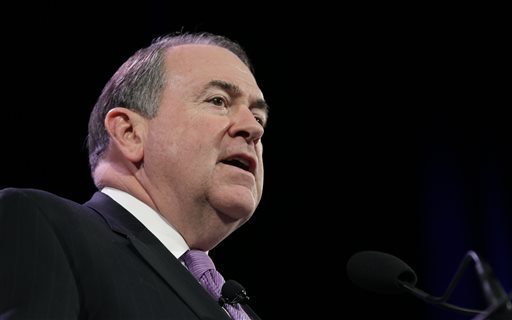
In the past coupled of days since the Supreme Court ruling legalizing Gay marriage and Marriage Equality for all, many conservative Christian leaders, especially those with lofty political aspirations have nearly come unhinged in their responses. Mike Huckabee, the Baptist preacher, seminary dropout and former Governor of Arkansas was perhaps the most ludicrous say that if need be he would call fire down from heaven in his opposition to the ruling. Others like Rick Perry and Rick Santorum have stated that they would work to overturn the decision, Ted Cruz encouraged Texas magistrates, justice of the peace, judges and others who hold government office defy the law if it violates their Christian religion; and Bobby Jindal suggested eliminating the Supreme Court. Funny how that last one works as the Supreme Court is established as one of the three branches of Government in the Constitution and Bobby, Mike, the Ricks and Ted never had a problem with 5-4 decisions that aided conservatives, but I digress…

The sad thing is that none of these men’s arguments come at all from any sense of Christian mission, but rather the raw exercise of hatred directed at a group of people they loath covered in theological gibberish.

Atticus Finch, the hero of the book and film To Kill a Mockingbird said: 

“Sometimes the Bible in the hand of one man is worse than a whisky bottle in the hand of (another)… There are just some kind of men who – who’re so busy worrying about the next world they’ve never learned to live in this one, and you can look down the street and see the results.”

Eric Hoffer wrote, “Hatred is the most accessible and comprehensive of all the unifying agents. Mass movements can rise and spread without belief in a god, but never without a belief in a devil.” We like to believe that religion is a benign or positive influence in the world. As much as I want to believe the positive aspects I have to admit based on the historical and sociological evidence that this is not so, especially during unsettled times of great change. We live in such an era and when it comes to identity and supremacy, God is the ultimate trump card and hatred in the name of God is something that many religious groups and people specialize.

This has been especially true in the lead up to and the aftermath of the Obergfell v. Hodges case that was argued at the Supreme Court regarding Gay marriage. The religious opponents of Gay marriage, in particular conservative Christians have many times resorted to the most unmitigated hatred masked in insipidly shallow theology to condemn the gays and anyone that supports them. Of course the final argument they posit is that God will punish the United States for Gay marriage.

That is fascinating. Ted Cruz called the ruling the “darkest time of American history.” Others proclaimed that God would judge the United States for this and others suggested that Christians flee the country, or that the South should again secede from the United States to form a Christian country.

Really? The darkest time Ted? I guess real oppression committed against American citizens by supposedly Christian citizens doesn’t count.

God will punish the United States for Gay marriage but not for waging unjust, illegal and immoral wars? God will punish the United States for Gay marriage, but not for the way we treat the poor? God will punish the United States for Gay marriage, but not for unabashed materialistic greed that is so condemned throughout the Christian Bible? God will judge the United States for Gay marriage but not the extermination of Native Americans and the enslavement of African Americans? God will punish the United States for Gay marriage, but not the unmitigated quest for material wealth and power that so defines the most popular churches and pastors in the country? God will punish the United States for Gay Marriage but excuse everything else?

I’m sorry these radical supposedly “Christian” politicians, pundits and preachers are the ultimate hypocrites whose hatred is only surpassed by their desire for the temporal power, which if they got it would use against any and all that oppose their theocratic tyranny.

Truthfully I find it stunning that of all the things a supposedly vengeful and just God could punish us for, that Gay marriage is the tipping point. But such is the unhinged message of the preachers, pundits and politicians of the Christian Right who believe in a capricious “God” who coincidently just happens to hate the same people that they hate, which is very convenient. But then as Annie Lamott said: “You can safely assume you’ve created God in your own image when it turns out that God hates all the same people you do.”

Of course they are not alone. In fact the most fanatical individuals and groups on earth are almost all tied to religions, whether it is the Islamic State and Al Qaeda, Boko Haram, Hezbollah, Orthodox Jews, radical Hindus and Buddhists as well as militant Christians. Of course all of these groups have different goals, but their thought and philosophy are quite similar. The fact is that for all of the, God is their trump card, end of argument as one commenter on this blog wrote yesterday “It is finished” a true heretical and blasphemous bastardization of the words of Jesus on the Cross to end his argument that God was against Gay marriage.

Robert Heinlein wrote: “Almost any sect, cult, or religion will legislate its creed into law if it acquires the political power to do so.” Heinlein, the author of the classic Starship Troopers was absolutely correct. Just look at any place in any time where any religion, sect or cult has gained control of a government. They are not loving, they are not forgiving and they use the police power of the state to persecute any individual or group that is judged to be in error, or even worse has the gall to question their authority.

Since the Christian groups tend to thrive in the West, they only speak in terms of violence, most, with the exception of Russian Orthodox Christians in Putin’s Russia do not have a government to translate those words into action. Many, especially conservative Catholics and some Evangelical and Charismatic Protestants seem for a long for the day when they can assume control of a theocratic government.

Samuel Huntington wrote in his book The Clash of Civilizations:

“People do not live by reason alone. They cannot calculate and act rationally in pursuit of their self-interest until they define their self. Interest politics presupposes identity. In times of rapid social change established identities dissolve, the self must be redefined, and new identities created. For people facing the need to determine Who am I? Where do I belong? Religion provides compelling answers….In this process people rediscover or create new historical identities. Whatever universalist goals they may have, religions give people identity by positing a basic distinction between believers and non-believers, between a superior in-group and a different and inferior out-group.”

Huntington was right, you see the true believers, those who follow their religion without question and believe that it is superior to all others also believe that their religion entitles them to be atop the food chain, others who don’t believe like them be damned, if not in this life, the next. That is the certitude of the true believer, especially the religious one. Secular or atheistic fanatics could care less about the next life, for this life is all that they have. But the religious “true believers” are not only interested in destroying someone in this life, but ensuring that in the next that they suffer for eternity, unless they believe in the annihilation of the soul after death, which really spoils the whole Dante’s Inferno perspective of the damned in the afterlife.

Eric Hoffer wrote:

“The impression somehow prevails that the true believer, particularly the religious individual, is a humble person. The truth is the surrendering and humbling of the self breed pride and arrogance. The true believer is apt to see himself as one of the chosen, the salt of the earth, the light of the world, a prince disguised in meekness, who is destined to inherit the earth and the kingdom of heaven too. He who is not of his faith is evil; he who will not listen will perish.”

That is why they, the religious true believers of any faith are capable of such great evil, and why such people can murder innocents in the most brutal manner simply because they do not believe correctly.

Please do not get me wrong. I am a Christian, a priest, a historian and a theologian, but I also know just how insidious those who hold their religion over those of others can be. While I hold faith dear, I know that it can be abused for the claim of some to have God as their final authority is a sort of trump card with which they are able to justify the most obscene and evil acts against others.

One of my heroes of religious liberty is John Leland, a Baptist whose passionate defense of religious freedom prevented Virginia from re-establishing a state church after the American Revolution and whose influence was key in the decision of Madison and Jefferson to amend the Constitution with the Bill of Rights, particularly the First Amendment. In fact, late in life, well after his success in working with Madison and Jefferson Leland wrote:

“The liberty I contend for is more than toleration. The very idea of toleration is despicable; it supposes that some have a pre-eminence above the rest to grant indulgence; whereas all should be equally free, Jews, Turks [Muslims], Pagans and Christians. Test oaths and established creeds should be avoided as the worst of evils.”

Like Leland, I contend for more than tolerance and I contend for acceptance. But that acceptance ends when any person or group is willing to use their religion to enslave, murder, or otherwise dominate other people in the name of their God, not just in this life, but in the next. This is especially true of those who use the police power of the state to enforce their beliefs and hatred on others.  I will do whatever I can to expose them for what they are, regardless of the “faith” they supposedly represent.

I guess that is why I am even more frightened of religious true believers than non-religious true believers. While the non-religious true believer may sacrifice everything for the sake of power and control in this life, and may in fact commit the most heinous crimes against humanity, their hatred is bounded in space and time to this earth. The religious true believer is not content with that; their enemies must be damned and punished in this life, but for eternity, without hope of salvation.

That is why men like Huckabee, Santorum, Jindal, Cruz, Perry and so many others like them are so dangerous for their hatred is unbounded by time, or space, it lasts for eternity, and eternity my friends is a very long time.

With that I wish you a good day, a thoughtful day and try to love someone.

Peace

Padre Steve+

6 Comments

Filed under christian life, civil rights, ethics, faith, History, laws and legislation, leadership, News and current events, Political Commentary, Religion

Liberty & Those who Oppose It: the Aftermath of Obergfell v. Hodges

instagram_0428_obergefell-hodges

Friends of Padre Steve’s World,

I rejoiced yesterday when majority of the Supreme Court ruled in favor of marriage equality throughout the country. I believe that this was an important continuation in or understanding of ever expanding liberty found in the Declaration of Independence that Abraham Lincoln said in 1854 was the standard maxim of free society …constantly spreading and deepening its influence,” ultimately applicable “to peoples of all colors everywhere.” 

Thomas Jefferson wrote a letter to Samuel Kercheval in 1816 that we should take to heart when we look at changes in laws that religious traditionalists oppose so vehemently:

“I know also, that laws and institutions must go hand in hand with the progress of the human mind. As that becomes more developed, more enlightened, as new discoveries are made, new truths disclosed, and manners and opinions change with the change of circumstances, institutions must advance also, and keep pace with the times. We might as well require a man to wear still the coat which fitted him when a boy, as civilized society to remain ever under the regimen of their barbarous ancestors.” 

When Justice Anthony Kennedy wrote the majority opinion in the case of Obergfell v. Hodges he made a comment that echoed the words of Thomas Jefferson when he wrote:

Changes, such as the decline of arranged marriages and the abandonment of the law of coverture, have worked deep transformations in the structure of marriage, affecting aspects of marriage once viewed as essential. These new insights have strengthened, not weakened, the institution. Changed understandings of marriage are characteristic of a Nation where new dimensions of freedom become apparent to new generations.

In the aftermath of Obergfell v. Hodges these people are scrambling to carve out exemptions to the law in order to ensure that the prejudices ingrained in their “sincerely held religious belief” can remain. Of course for churches that is not an issue, churches can grant or deny the sacraments or ordinances of their faith to anyone they chose to and this they routinely do. If you desire to get married in a church you must follow the rules for that church, and the clergy of that church are free to deny sacraments, including marriage to anyone. If you are not a Roman Catholic in good standing you are not permitted to receive the Eucharist, you may not be married in the church, and other churches including many Baptists and other “free” churches have similar prohibitions that no court has dared to overturn. This even includes rules that discriminate against women who cannot be ordained clergy. So when I hear pastors screaming that somehow they will be prosecuted or jailed for refusing to marry gays I have to throw the bullshit flag.

Now this may not apply to the “ministers” who set up their own so called marriage chapels where unconnected to any church they operate as for profit businesses. Sometimes courts do find in favor of litigants in civil proceedings when such businesses use their prejudice to deny services to people, especially gays.

While I am a historian and should know better, I am amazed to see many American Christians doing all they can in the name of protecting their Religious Liberty to deny rights to those that they disapprove. I shouldn’t be surprised, Thomas Jefferson wrote of what happens when preachers and priests lead political movements. Jefferson so rightly noted:

“History, I believe, furnishes no example of a priest-ridden people maintaining a free civil government. This marks the lowest grade of ignorance, of which their civil as well as religious leaders will always avail themselves for their own purposes.”

James Madison, who crafted the Bill of Rights, including the First Amendment wrote:

“Who does not see that the same authority which can establish Christianity, in exclusion of all other religions, may establish with the same ease any particular sect of Christians, in exclusion of all other sects?”

Currently this is the case with the Republican Party, a party that I remind you that I belonged for over three decades, beginning with my work for the Ford campaign as a high school student. I left the GOP in 2008 after years of disillusionment, and lies when I returned from Iraq.

Barry Goldwater, a conservative if there ever was one, a man that would be driven out of today’s GOP spoke on the Senate floor in the early 1980s at the beginning of the Reagan Revolution and the commandeering of the party by politically minded preachers like Jerry Falwell, James Robertson, Dr. D. James Kennedy, James Dobson and of course our local Tidewater Taliban Mullah, Pat Robertson. Goldwater so wisely noted:

“Mark my word, if and when these preachers get control of the [Republican] party, and they’re sure trying to do so, it’s going to be a terrible damn problem. Frankly, these people frighten me. Politics and governing demand compromise. But these Christians believe they are acting in the name of God, so they can’t and won’t compromise. I know, I’ve tried to deal with them.”

Well, now the preachers have control of that party. Every declared candidate for the GOP presidential nomination kowtows to these religious leaders and nearly every one of them has come out to announce their opposition to the Supreme Court ruling.

Some are suggesting that thousands of preachers run for office in the GOP in order to foist their agenda on the rest of the population. Right now Conservative Christians for all intents and purposes run many state legislatures. In the ones that they have controlled for the past number of years they have been enacting all sorts of discriminatory laws against those they find offensive, and have attempted to shackle the study of science, history, and roll back voting rights for minorities.

This is particularly true of the conservative Christian, antipathy towards Gays, Lesbians and others in the LGBT community. In the past number of weeks I have seen proposed legislation in several states that would allow people to discriminate against anyone simply based on a sincerely held religious belief.

Other laws passed within the six moths at the state level in Arkansas and West Virginia to nullify any city or county ordinances banning discrimination against gays. In other words, religious zealots in control of state houses are imposing heir beliefs on cities, towns and counties that are more progressive in regard to the treatment of gays.

The irony is that the people who complain about Federal laws which trump state law are doing the same thing that they object to in order to ensure that citizens of their states are treated less than equal.

The target of these laws are gays and the LGBT community, but anyone with half a brain knows that once they are on the books they provide ample room for religious zealots of any kind to discriminate and even persecute those that they despise.

They may start with the gays, but be assured, those who pass these laws will extend them to apply to anyone to whom they believe harms or interferes with their sincerely held religious beliefs. Jefferson also noted “In every country and in every age, the priest has been hostile to liberty. He is always in alliance with the despot, abetting his abuses in return for protection to his own.”

It is something that our founders wisely chose to avoid, not wanting this nation to become like the European nations whose state churches had denied rights, persecuted and killed those that they deemed heretical. While the proponents of these new laws to “protect” religious liberty claim that they are done with no intent to discriminate, there is only one reason to enact them, that to give legal protection to people who want to discriminate. Is this not what is happening throughout the Middle East as Islamic fundamentalists of various sects impose similar laws on Christians as well as others including Moslems of rival sects?

Now just imagine for one moment living in such a society, a society where someone who was not of the right race, or belief did not enjoy the same freedoms of other citizens. Imagine a society where those that started with laws to supposedly defend their religious liberty, or rights then supported other more far reaching laws, laws which deprived those that they demonized and refused to serve of citizenship, freedom of association, freedom of movement, and robbed them of their homes and businesses, banished them to ghettos and eventually exterminated them. While the Nazis primarily went after the Jews, they also went after the gays.

Of course the Nazis did this in the years leading up to World War Two in their actions against loyal German Jews who simply wanted to fit in, and well we Americans, let’s not even go there… but the let’s go there. We have the extermination and the ghettoization of our Native American population, we have the African slave trade and the institution of slavery, we have the human trafficking and exploitation of Chinese workers in the 1800s, the Jim Crow Laws, and yes the incarceration of Japanese Americans in what we called “internment camps” in World War Two.

Now for one minute tell me that those that propose such barbarous laws now to be used against the gays, simply because Christians want to have a law that allows them to discriminate against those they hate and condemn to hell are that much different than those Christians, be they American or German who justified their actions with law based on their deeply and sincerely held religious beliefs? I think not. In fact the whole proposition that we enact such laws flies in the face of the wars that these same people want to send in the ground troops to fight Islamic State over. Heck, the Islamic State is actually acting out the fantasies of the most extreme American Christian anti-gay preachers. They are killing gays, throwing them off the roofs of tall buildings. Sadly, many American Christians so consumed by the hate and paranoia being preached in their churches and by right-wing political groups which pose, as Christian ministries don’t see that their actions are simply a different breed of the same animal. Right now, the difference is just a matter of degree.

I think that is why Thomas Jefferson wrote this very pertinent warning to us who might want to return to the barbarous ways of our ancestors:

“I know also, that laws and institutions must go hand in hand with the progress of the human mind. As that becomes more developed, more enlightened, as new discoveries are made, new truths disclosed, and manners and opinions change with the change of circumstances, institutions must advance also, and keep pace with the times. We might as well require a man to wear still the coat which fitted him when a boy, as civilized society to remain ever under the regimen of their barbarous ancestors.” 

I personally do not want to live under the laws of our barbarous ancestors, and I will fight for the rights of those who are being targeted, primarily the LGBT community, but anyone else, by the lawmakers and supporters of such laws.

That my friends is why I rejoice in the Supreme Court ruling in Obergfell v. Hodges. It is a step to moving forward in liberty and progress and away from barbarism.

So have a great and thoughtful Saturday,

Peace

Padre Steve+

13 Comments

Filed under civil rights, faith, History, laws and legislation, LGBT issues, News and current events, Political Commentary

A Great Day for Liberty for All

Mini-Stonewall

Friends of Padre Steve’s World

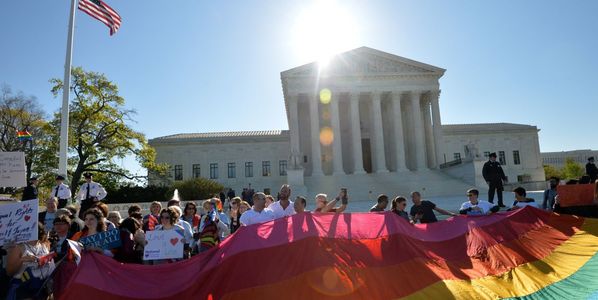
Today is a good day for freedom. It has been to long coming. The Supreme Court, citing the Fourteenth Amendment ruled in favor of Marriage Equality for Gays Lesbians and others in the LGBTQ community in the case of Obergfell v. Hodges. I am quite happy for my Gay and Lesbian friends  for this.

As historian and who has and continues to study the American Civil War, especially the fight for the abolition of slavery, the emancipation of African Americans and the extension of the the full benefits of citizenship and liberty.

As early as 1854 Lincoln posed the idea that the Declaration of Independence was the standard maxim of free society …constantly spreading and deepening its influence,” ultimately applicable “to peoples of all colors everywhere.” 

The understanding that the liberties enunciated in the Declaration extend to first to African-Americans was made part of the Constitution in the Thirteenth, Fourteenth and Fifteenth Amendments to the Constitution. The precedent of Fourteenth Amendment has been used to grant Suffrage to Women, to end Jim Crow laws, Black Codes and Separate but Equal laws. Today it was correctly used to ensure that all people have the freedom to marry.

The ruling was about liberty, it was about equality, it was about due process, and today the Court’s majority noted:

The history of marriage as a union between two persons of the opposite sex marks the beginning of these cases. To the respond- ents, it would demean a timeless institution if marriage were extend- ed to same-sex couples. But the petitioners, far from seeking to devalue marriage, seek it for themselves because of their respect—and need—for its privileges and responsibilities, as illustrated by the petitioners’ own experiences.

The history of marriage is one of both continuity and change.

Changes, such as the decline of arranged marriages and the abandonment of the law of coverture, have worked deep transformations in the structure of marriage, affecting aspects of marriage once viewed as essential. These new insights have strengthened, not weakened, the institution. Changed understandings of marriage are characteristic of a Nation where new dimensions of freedom become apparent to new generations.

They also added:

The fundamental liberties protected by the Fourteenth Amendment’s Due Process Clause extend to certain personal choices central to individual dignity and autonomy, including intimate choic- es defining personal identity and beliefs.

Most of the opposition to Gay marriage and for that matter to all Gay Rights has been from conservative Christians. Sadly it was conservative Christians who have been in the forefront of denying liberty to people in the country since the beginning of the abolition movement in the 1830s. They labeled fellow evangelicals in the abolition movement as “atheists, infidels, communists, free-lovers, Bible-haters, and anti-Christian levelers.” 

This was not limited to Southern  conservative Christians.

The fact that so many Protestant ministers, intellectuals, and theologians, not only Southerners, but men like “Princeton’s venerable theologian Charles B. Hodge – supported the institution of slavery on biblical grounds, often dismissing abolitionists as liberal progressives who did not take the Bible seriously” leaves a troubling question over those who claim to oppose issues on supposedly Biblical grounds. Such men in the North spoke out for it “in order to protect and promote interests concomitant to slavery, namely biblical traditionalism, and social and theological authority.” [1] The Northern clerical defenders of slavery perceived the spread of abolitionist preaching as a threat, not just to slavery “but also to the very principle of social and ecclesiastical hierarchy.” [2]Alistair McGrath asks a very important question for modern Christians who might be tempted to support a position for the same reasons today, “Might not the same mistakes be made all over again, this time over another issue?” [3]

Throughout American history conservative Christians have often espoused a concept of limited liberty, liberty for the few and the powerful. This happened as I have noted during the fight against emancipation, but also Women’s Suffrage and the various Jim Crow laws and rights for other groups. This is happening again today with anti-Gay Christians attacking the ruling and like those who fought abolition proclaiming in apocalyptic language that Christians will be persecuted and that God will judge the United States for allowing Gays to marry.

However, the fact is that very little will change in the country, most people will move along. Christian conservatives will not be persecuted, religious liberties will not be violated they will be enhanced as churches who allow Gays to marry will be able to extend this rite of their churches to their parishioners and others.

Today, despite the cries of many on the American Religious Right liberty has been protected. as Lincoln said: the declaration’s promise of equality was “a beacon to guide” not only “the whole race of man then living” but “their children and their children’s children, and the countless myriads of generations who should inhabit the earth in other ages.” [4]

Marriage-Equality-104371316011_xlarge

I am happy for my Gay friends who have labored for this for so long enduring hatred, violence and social, political, religious and economic discrimination for so many years.

Have a great night,

Peace

Padre Steve+

[1] Ibid. Daly When Slavery Was Called Freedom p.38

[2] Ibid. Varon Disunion! P.108

[3] Ibid. McGrath Christianity’s Dangerous Idea p.324

[4] Ibid. Goodwin Team of Rivals p. 203

3 Comments

Filed under civil rights, ethics, faith, History, laws and legislation, LGBT issues, News and current events, Political Commentary, Religion

Slavery, Economics & Politics: The Compromise of 1850

Friends of Padre Steve’s World,

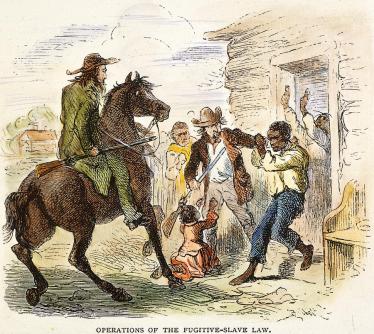
I have been sharing parts of my Civil War and Gettysburg Staff Ride text here for some time. We often don’t like to admit it but all to often racism and other forms of prejudice, intolerance and hate line up perfectly with some peoples and groups political and economic agenda. The Compromise of 1850 shows how in American history that confluence of hatred, racism, political power and economic gain  come together to create the perfect storm of oppression. 

We are not alone in this, such has been the case in many other cultures and in many other nations for millennia and continue to be today. 

The lesson of this should be taken to heart as anyone seeks political and economic aggrandizement on the backs of other people and sadly it happens all too often here in the United States and Western Europe. 

I do plan on weighing in on the issue of the Confederate flag either tonight or tomorrow. But until then have a great as well as a thoughtful night.

Peace

Padre Steve+
fugitive-slave-act-1850-granger-1

Slavery and National Expansion: The Compromise of 1850

The Ante-Bellum South was an agrarian society that depended on the free labor provided by slaves. In a socio-political sense the South was an oligarchy that offered no freedom to slaves, openly discriminated against free blacks and provided little hope of social or economic advancement for poor and middle class whites. However, despite this, even poor whites supported it. Many Southern Yeoman farmers were willing to tolerate their second class status because they: “feared the fall from independent producer to dependent proletarian, a status he equated with enslavement” [1] more than remaining subservient to planters and plantation owners. In fact, for them slavery was the one institution that kept them above the despised black.

While all Northern states had abolished slavery, or were in the process of gradual abolition in the after independence and the Civil War and had moved to an economic concept of free labor, the South had tied its economy and society to the institution of slavery. The contrast was well said by the members of an Alabama agricultural society, which noted in 1846:

“Our condition is quite different from that of the non-slaveholding section of the United States. With them their only property consists of lands, cattle and planting implements. Their laborers are merely hirelings, while with us our laborers are our property.” [2]

Northerners on the other hand, even in states where the last vestiges of slavery held on, nearly universally ascribed to the understanding that there was a dignity to labor and that free labor was essential if people were to have a better life. It undergirded their understanding of human dignity and that “labor was the source of all value.” [3]

That understanding of the intrinsic value of free labor continued to gain ground in the North in the decades preceding the Civil War and found much of its support in the Calvinist theology that predominated in most Protestant Northern denominations. Labor was intrinsic to one’s calling as a Christian and a human being, slave labor, at least in the eyes of many Northerners undercut that idea. Success in one’s calling glorified God and provided earthly evidence that a person was among the elect. For many Northern Christians, “the pursuit of wealth thus became a way of serving God on earth, and labor, which had been imposed on fallen man as a curse, was transmuted into a religious value, a Christian calling.” [4] Such ideas found their way into Republican political thought even when not directly related to religion. William Evarts said in 1856 “Labor gentlemen, we of the free States acknowledge to be the source of all of our wealth, of all our progress, of all our dignity and value.” [5] Abraham Lincoln noted that “the free labor system…opens the way for all, and energy and progress, and improvement in condition for all,” [6] and noted something inherent in the economic theory of Adam Smith that Labor is prior to, and independent of capital…in fact, capital is the fruit of labor.” [7]

However, the South by the 1830s had completely wedded itself to slavery and southern advocates of slavery deplored the free-labor movement as wage slavery and extolled the virtue of slavery. James H. Hammond condemned the free-labor movement in his King Cotton speech to the Senate in 1858:

“In all social systems there must be a class to do the menial duties, to perform the drudgery of life…. It constitutes the very mudsill of society….Such a class you must have, or you would not have that other that leads to progress, civilization and refinement….Your whole hireling class of manual laborers and ‘operatives,’ as you call them, are essentially slaves. The difference between us is, that our slaves are hired for life and well compensated…yours are hired by the day, not cared for, and scantily compensated.” [8]

Even so, the fact that the slave barons “were forced at every election to solicit the votes of “ignorant, slovenly, white trash in the country” with “frequent treats that disgrace our elections,” [9] rankled and humiliated many members of the Southern aristocracy. It was a marriage of two disparate parties linked by their membership in a superior race, something that only the continued existence of slavery ensured.

Lincoln extolled the virtues of free-labor, noting his own experiences after his election: “I am not ashamed to confess that twenty five years ago I was a hired laborer, mauling rails, at work on a flat boat – just what might happen to any poor man’s son.” [10] Other Northerners lauded free-labor as the basis of upward mobility, and the New York Times noted that “Our paupers to-day, thanks to free labor, are our yeomen and merchants of tomorrow.” [11]

But whites in the South held labor in contempt due to the system of slavery, and the divergent views of each side were noted by Thomas Ewing who noted that labor “is held honorable by all on one side of the line because it is the vocation of freedmen – degrading in the eyes of some on the other side because it is the task of slaves.” [12] Of course with labor being the task of African slaves for southerners, the issue was entwined with race, and “Even if slavery was wrong, its wrongs were cancelled out for nonslaveholders by the more monstrous specter of racial equity.” [13]

Georgia Governor Joseph E. Brown emphasized the threat to whites in that blacks would be their social equals and competitors. The racial component assured poor southern whites that they were superior to blacks and an Alabama lawyer wrote “The privilege of belonging to the superior race and being free was a bond that tied all Southern whites together… and it seemed from a Southern stand-point, to have for its purpose the leveling of all distinctions between the white man and the slave hard by.” [14] But poor white workers who remained in the South “repeatedly complained about having to compete with slaves as well as poorly paid free blacks” [15] leading many to seek a new livelihood in either Free States or the new territories.

For Southern politicians and slaveholders, the expansion of slavery was essential to its continued maintenance in the states where it was already legal. “Because of the need to maintain a balance in the Senate, check unruly slaves, and cultivate fertile soils, many planters and small plantation owners- particularly those living in the southern districts of the cotton states- asserted that their survival depended on new territory.” [16] In those decades “a huge involuntary migration took place. Between 800,000 and 1 million slaves were moved westward….” [17]

The need for slaves caused prices to soar, largely due to the ban on the import of slaves from Africa. This made the interregional trade much more important and linked the upper and lower south as well as the new slave-holding territories into “a regionwide slave market that tied together all of the various slaveowning interests into a common economic concern.” [18] In some older states like Virginia where fewer slaves were required, the exportation of slaves became a major industry:

“male slaves were marched in coffles of forty or fifty, handcuffed to each other in pairs, with a long chain through the handcuffs passing down the column to keep it together, closely guarded by mounted slave traders followed by an equal number of female slaves and their children. Most of them were taken to Wheeling, Virginia, the “busiest slave port” in the United States, and from there they were transported by steamboat to New Orleans, Natchez, and Memphis.” [19]

Economic Effects of the Compromise

The interregional slave trade guaranteed slave owners of a source of slaves even if they were cut off from the international trade and it was an immense part of not just the Southern economy but the American economy. Slave owners “hitched their future to slavery; a single cash crop and fresh land,” [20] and refused to take an interest in manufacturing or diversifying their agricultural production outside of King Cotton. Slave prices tripled between 1800 and 1860 making human property one of the most lucrative markets for investment. The price of a “prime male field hand in New Orleans began at around $500 in 1800 and rose as high as $1,800 by the time of the Civil War.” [21] The result was that slave owners and those who benefitted from the interregional slave trade had a vested interest in not only seeing slavery preserved, but expanded.

This resulted in two significant trends in the South, first was that slave owners grew significantly richer as the value of the slave population increased. Using even a conservative number of $750 dollars as the value of a single slave in 1860 the amount of value in this human property was significantly more than almost any other investment in the nation. It was enormous. Steven Deyle notes that:

“It was roughly three times greater than the total amount of all capital invested in manufacturing in the North and in the South combined, three times the amount invested in railroads, and seven times the amount invested in banks. It was about equal to about seven times the value of all currency in circulation in the country three times the value of the entire livestock population, twelve times the value of the entire U.S. cotton crop, and forty-eight times the expenditures of the federal government that year. ….”by 1860, in fact in the slaveowning states alone, slave property had surpassed the assessed value of real estate.” [22]

The rise in slave values and the increasing wealth of slave owners had a depreciating effect on poor southern whites by ensuring that there was no middle class, which “blocked any hope of social advancement for the mass of poor whites, for it was all but impossible for a non-slaveholder to rise in the southern aristocracy.” [23] The impoverishment of southern whites created some worry for those astute enough to take an interest in such matters. “In 1850, about 40 percent of the South’s white farmers owned real estate at all. There was thus, worried the Southern Cultivator in 1856, “a large number at the South who have no legal right or interest in the soil [and] no homes of their own.” The editor of a South Carolina newspaper that year framed the matter in less sympathetic terms: “There is in this State,” he wrote, “as impoverished and ignorant as white population as can be found in any other in the Union.” [24]

Some Southerners recognized the growing issue that the south was falling behind the north in terms of real economic advancement and that slavery was the culprit. Hinton Helper, a non-slave owning North Carolinian who had made his fortune in the California Gold Rush of 1849 and returned home to become disillusioned with what he saw wrote a book that had a major impact in the North among Republican politicians, but which was either banned or restricted in much of the South. That book “The Impending Crisis of the South: How to Meet It (1857) was “a book on the debilitating impact of slavery on the South in general and on southern whites in particular.” [25] Helper’s attack on the slavery system was as devastating as that of any abolitionist, and since he was a southerner the effects of his words helped further anti-slavery sentiment in the North and would be used by the Republican party in an abridged form as a campaign tool that they printed and distributed during the build up to the election n of 1860. Helper wrote that:

Slavery lies at the root of all the shame, poverty, tyranny and imbecility of the South.” Echoing the free-soil argument Helper maintained that slavery degraded all labor to the level of bond labor. Planters looked down their noses at nonslaveholders and refused to tax themselves to provide a decent school system. “Slavery is hostile to general education…Its very life, is in the ignorance and stolidity of the masses.” [26]

Many southern leaders saw Helper’s book as a danger and worried that should Helper and others like him speak freely long enough “that they will have an Abolition party in the South, of Southern men.” When that happened, “the contest for slavery will no longer be one between the North and the South. It will be in the South between the people of the South.” [27] That was something that the landed gentry of the slave owning oligarchy could never tolerate for if the non-slave holding whites rejected slavery, the institution would die. Thus, Helper, who was no fan of black people and held many violently racist attitudes, was denounced “as a traitor, a renegade, an apostate, a “dishonest, degraded and disgraced man.” [28]

In the years the before the war, the North embraced the Industrial Revolution leading to advances which gave it a marked economic advantage over the South in which through its “commitment to the use of slave labor inhibited economic diversification and industrialization and strengthened the tyranny of King Cotton.” [29] The population of the North also expanded at a clip that far outpaced the South as European immigrants swelled the population.

The divide was not helped by the various compromises worked out between northern and southern legislators. After the Missouri Compromise Thomas Jefferson wrote:

“but this momentous question, like a fire bell in the night, awakened and filled me with terror. I considered it at once as the knell of the Union. It is hushed indeed for the moment, but this is a reprieve only, not a final sentence. A geographical line, coinciding with a marked principle, moral and political, once conceived and held up to the angry passions of men, will never be obliterated; and every new irritation will mark it deeper and deeper.” [30]

The trigger for the increase in tensions was the war with Mexico in which the United States annexed nearly half of Mexico. The new territories were viewed by those who advocated the expansion of slavery as fresh and fertile ground for its spread. Ulysses S Grant, who served in the war, noted the effects of the war with Mexico in his memoirs:

“In taking military possession of Texas after annexation, the army of occupation, under General [Zachary] Taylor, was directed to occupy the disputed territory.  The army did not stop at the Nueces and offer to negotiate for a settlement of the boundary question, but went beyond, apparently in order to force Mexico to initiate war….To us it was an empire and of incalculable value; but it might have been obtained by other means.  The Southern rebellion was largely the outgrowth of the Mexican war.” [31]

Robert Toombs of Georgia was an advocate for the expansion of slavery into the lands conquered during the war. Toombs warned his colleagues in Congress “in the presence of the living God, that if you by your legislation you seek to drive us from the territories of California and New Mexico, purchased by the common blood and treasure of the whole people…thereby attempting to fix a national degradation upon half the states of this Confederacy, I am for disunion.” [32]

The tensions in the aftermath of the war with Mexico escalated over the issue of slavery in the newly conquered territories brought heated calls by some southerners for secession and disunion. To preserve the Union, Henry Clay and Daniel Webster, supported by the new President Millard Fillmore were able to pass the compromise of 1850 solved a number of issues related to the admission of California to the Union and boundary disputes involving Texas and the new territories. But among the bills that were contained in it was the Fugitive Slave Law, or The Fugitive Slave Act of 1850. The act was the device of Henry Clay which was meant to sweeten the deal for southerners. The law would “give slaveholders broader powers to stop the flow of runaway slaves northward to the free states, and offered a final resolution denying that Congress had any authority to regulate the interstate slave trade.” [33]

For all practical purposes the Compromise of 1850 and its associated legislation nationalized the institution of slavery, even in Free States. It did this by forcing all citizens to assist law enforcement in apprehending fugitive slaves. It also voided state laws in Massachusetts, Vermont, Ohio, Connecticut, Pennsylvania and Rhode Island, which barred state officials from aiding in the capture, arrest or imprisonment of fugitive slaves. “Congress’s law had nationalized slavery. No black person was safe on American soil. The old division of free state/slave state had vanished….” [34] If there was any question as to whose “States Rights” the leaders of the South were advocating, it was certainly not those of the states whose laws were voided by the act.

That law required all Federal law enforcement officials, even in non-slave states to arrest fugitive slaves and anyone who assisted them, and threatened law enforcement officials with punishment if they failed to enforce the law. The law stipulated that should “any marshal or deputy marshal refuse to receive such warrant, or other process, when tendered, or to use all proper means diligently to execute the same, he shall, on conviction thereof, be fined in the sum of one thousand dollars.” [35]

Likewise the act compelled citizens in Free states to “aid and assist in the prompt and efficient execution of this law, whenever their services may be required….” [36] Penalties were harsh and financial incentives for compliance attractive.

“Anyone caught providing food and shelter to an escaped slave, assuming northern whites could discern who was a runaway, would be subject to a fine of one thousand dollars and six months in prison. The law also suspended habeas corpus and the right to trial by jury for captured blacks. Judges received a hundred dollars for every slave returned to his or her owner, providing a monetary incentive for jurists to rule in favor of slave catchers.” [37]

The law gave no protection for even black freedmen. The legislation created a new extra-judicial bureaucratic office to decide the fate of blacks. This was the office of Federal Commissioner and it was purposely designed to adjudicate the claims of slaveholders and their agents, and to avoid the normal Federal Court system where often those claims were denied.

When slave owners or their agents went before these commissioners, they needed little in the way of proof to take a black back into captivity. The only proof or evidence other than the sworn statement by of the owner with an “affidavit from a slave-state court or by the testimony of white witnesses” [38] that a black was or had been his property was required to return any black to slavery. Since blacks could not testify on their own behalf and were denied representation the act created an onerous extrajudicial process that defied imagination. Likewise, these commissioners had a strong financial incentive to send blacks back to slavery. “If the commissioner decided against the claimant he would receive a fee of five dollars; if in favor ten. This provision, supposedly justified by the paper work needed to remand a fugitive to the South, became notorious among abolitionists as a bribe to commissioners.” [39] It was a system rigged to ensure that African Americans had no chance, and it imposed on the citizens of free states the legal obligation to participate in a system that many wanted nothing to do with.

Frederick Douglass said:

“By an act of the American Congress…slavery has been nationalized in its most horrible and revolting form. By that act, Mason & Dixon’s line has been obliterated;…and the power to hold, hunt, and sell men, women, and children remains no longer a mere state institution, but is now an institution of the whole United States.” [40]

On his deathbed Henry Clay praised the act, which he wrote “The new fugitive slave law, I believe, kept the South in the Union in ‘fifty and ‘fifty-one. Not only does it deny fugitives trial by jury and the right to testify; it also imposes a fine and imprisonment upon any citizen found guilty of preventing a fugitive’s arrest…” Likewise Clay depreciated the opposition noting “Yes, since the passage of the compromise, the abolitionists and free coloreds of the North have howled in protest and viciously assailed me, and twice in Boston there has been a failure to execute the law, which shocks and astounds me…. But such people belong to the lunatic fringe. The vast majority of Americans, North and South, support our handiwork, the great compromise that pulled the nation back from the brink.” [41]

The compromise had “averted a showdown over who would control the new western territories” [42] but it only delayed disunion. In arguing against the compromise South Carolina Senator John C. Calhoun realized that for Southerners it did not do enough and that it would inspire abolitionists to greater efforts in their cause. He argued for permanent protection of slavery:

“He understood that slavery stood at the heart of southern society, and that without a mechanism to protect it for all time, the Union’s days were numbered.” Almost prophetically he said “I fix its probable [breakup] within twelve years or three presidential terms…. The probability is it will explode in a presidential election.” [43]

Of course it was Calhoun and not the authors of the compromise who proved correct. The leap into the abyss of disunion and civil war had only been temporarily avoided. However, none of the supporters anticipated what would occur in just six years when a “train of unexpected consequences would throw an entirely new light on the popular sovereignty doctrine, and both it and the Compromise of 1850 would be wreaked with the stroke of a single judicial pen.” [44]

Notes

[1] Ibid. McPherson Drawn With Sword p.50

[2] Ibid. Levine Half Slave and Half Free p.19

[3] Foner, Eric Free Soil, Free Labor, Free Men: The Ideology of the Republican Party Before the Civil War Oxford University Press, Oxford and New York 1970 and 1995 p.7

[4] Ibid. Foner Free Soil, Free Labor, Free Men pp.12-13

[5] Ibid. Foner Free Soil, Free Labor, Free Men p.12

[6] McPherson, James. The Battle Cry of Freedom: The Civil War Era Oxford University Press, Oxford and New York 1988 p.28

[7] Ibid. Foner Free Soil, Free Labor, Free Men p.12

[8] Ibid. McPherson The Battle Cry of Freedom p.196

[9] Ibid. Guelzo Fateful Lightening p.38

[10] Ibid. McPherson The Battle Cry of Freedom p.28

[11] Ibid. Foner Free Soil, Free Labor, Free Men p.16

[12] Ibid. Foner Free Soil, Free Labor, Free Men p.16

[13] Ibid. Guelzo Fateful Lightening p.38

[14] Ibid. Guelzo Fateful Lightening p.39

[15] Ibid. Levine Half Slave and Half Free p.44

[16] Ibid. Egnal Clash of Extremes pp.125-126

[17] Korda, Michael. Clouds of Glory: The Life and Legend of Robert E. Lee Harper Collins Publishers, New York 2014 p.203

[18] Deyle, Steven The Domestic Slave Trade in Major Problems in the Civil War and Reconstruction Documents and Essays Third Edition edited by Michael Perman and Amy Murrell Taylor Wadsworth Cengage Learning Boston MA 2011 p.53

[19] Ibid. Korda Clouds of Glory: The Life and Legend of Robert E. Lee p.203

[20] Ibid. Egnal Clash of Extremes p.10

[21] Ibid. Deyle The Domestic Slave Trade p.53 Deyle’s numbers come from the 1860 census.

[22] Ibid. Egnal Clash of Extremes p.54

[23] Ibid. Foner Free Soil, Free Labor, Free Men p.48

[24] Ibid. Levine Half Slave and Half Free p.37

[25] Goldfield, David America Aflame: How the Civil War Created a Nation Bloomsbury Press, New York, London New Delhi and Sidney 2011 p.177

[26] Ibid. McPherson The Battle Cry of Freedom p.199

[27] Ibid. Levine Half Slave and Half Free p.235

[28] Ibid. Potter The Impending Crisis p.397

[29] Ibid. Potter The Impending Crisis p.42

[30] Jefferson, Thomas Letter to John Holmes dated April 22nd 1824 retrieved from http://www.loc.gov/exhibits/jefferson/159.html 24 March 2014

[31] U.S. Grant, Personal Memoirs of U.S. Grant New York 1885 pp.243-245

[32] Ibid. Guelzo Fateful Lightening pp.62-63

[33] Ibid. Guelzo Fateful Lightening p.68

[34] Ibid. Goldfield America Aflame p.71

[35] ______________Fugitive Slave Act of 1850 retrieved from the Avalon Project, Yale School of Law http://avalon.law.yale.edu/19th_century/fugitive.asp 11 December 2014

[36] Ibid. Fugitive Slave Act of 1850

[37] Ibid. Goldfield America Aflame p.71

[38] Ibid. McPherson The Battle Cry of Freedom p.80

[39] Ibid. McPherson The Battle Cry of Freedom p.80

[40] Ibid. Goldfield America Aflame p.72

[41] Ibid. Oates The Approaching Fury p.94

[42] Ibid. Guelzo Fateful Lightening p.71

[43] Ibid. Goldfield America Aflame p.64

[44] Ibid. Guelzo Fateful Lightening p.71

2 Comments

Filed under civil rights, civil war, History, Political Commentary

Freedom for the Few: the Curse of Racism 

Friends of Padre Steve’s World 

I have been posting portions of my Civil War and Gettysburg Staff Ride text and in light of the act of terrorism committed in Charleston last Wednesday and the subsequent controversy surrounding the Confederate Battle Flag flying at full staff on the grounds of the South Carolina State Capitol while both the United States and South Carolina flags flew at half-staff. I do plan on addressing the issue of the Confederate flag in a separate article but so often that flag is flow or displayed by people who proclaim the historical revisionism of the tradition of the Lost Cause. which asserts that the Civil War was about everything but slavery as truth. 

This section of the chapter on religion and ideology is important because it addresses the issue in a forthright manner. It is important to tell the truth about the key issue that brought about the Civil War, and why the display of the Confederate Battle Flag only serves to propagate myth and instill a false sense of pride for a system and a war which cost more American lives than any other. 

If you take the time to read the article you will also notice that a number of the defenses of slavery are being used today to deny voting rights and other civil rights to American citizens by people who honestly believe that freedom is for the few. Many Right Wing pundits, politicians and preachers openly advocate this and even attempt to make voting and other civil functions which all citizens have the right are made more difficult or denied entirely. 

If you are curious as to where these people get their ideology look no further than the ante-bellum South. 

Have a thoughtful and reflective day.

Peace

Padre Steve+

slavescars

The Impact of Slavery on the Growing Divide between North and South

Slavery was the key issue that permeated all aspects of the Civil War to include the cultural, the economic and the ideological. David M. Potter summed up this understanding of the connection between the ideological, cultural and economic aspects of the conflict and just how the issue of slavery connected all three realms in the American Civil War:

“These three explanations – cultural, economic and ideological – have long been the standard formulas for explaining the sectional conflict. Each has been defended as though it were necessarily incompatible with the other two. But culture, economic interest, and values may all reflect the same fundamental forces at work in a society, in which case each will appear as an aspect of the other. Diversity of culture may produce both diversity of interests and diversity of values. Further, the differences between a slaveholding and a nonslaveholding society would be reflected in all three aspects. Slavery represented an inescapable ethical question which precipitated a sharp conflict of values.” [1]

The political ends of the Civil War grew out of the growing cultural, economic, ideological and religious differences between the North and South that had been widening since the 1830s. However, slavery was the one issue which helped produce this conflict in values and it was “basic to the cultural divergence of the North and South, because it was inextricably fused into the key elements of southern life – the staple crop of the plantation system, the social and political ascendency of the planter class, the authoritarian system of social control.” [2] Without slavery and the Southern commitment to an economy based on slave labor, the southern economy would have most likely undergone a similar transformation as what happened in the North; thus the economic divergence between North and South would “been less clear cut, and would have not met in such head-on collision.” [3] But slavery was much more than an economic policy for Southerners; it was a key component of their religious, racial and philosophic worldview.

Freedom for the Few

The issue of slavery even divided the ante-bellum United States on what the words freedom and liberty meant. The dispute can be seen in the writings of many before the war, with each side emphasizing their particular understanding of these concepts. In the South, freedom was reserved for those who occupied the positions of economic power; slavery was key to that from not only an economic point of view but as a social philosophy. The concept of human equality, which was so much a part of the Declaration of Independence was downplayed George Fitzhugh, a planter and slave owner in eastern Virginia commented that that concept “is practically impossible, and directly conflicts with all government, all separate property, and all social existence.” [4]

The political philosophy such as Fitzhugh’s, which was quite common, was buttressed by a profound religious belief that it was the South’s God ordained mission to maintain and expand slavery. One Methodist preacher in his justification of slavery wrote, “God as he is infinitely wise, just and holy never could authorize the practice of moral evil. But God has authorized the practice of slavery, not only by bare permission of his providence, but by the express permission of his word.” [5] Buttressed by such scriptural arguments Southerners increasingly felt that they were the only people following God. The Northern abolitionists as well as those who advocated for the concept of human equality and free labor were heretics to be damned. As such the “South’s ideological isolation within an increasingly antislavery world was not a stigma or a source of guilt but a badge of righteousness and a foundation for national identity and pride.” [6]

Speaking of the necessity for slavery, as well as limitations on the equality of human beings no matter what their race or sex, Fitzhugh penned words that explained that human relationships were not to be seen in terms of individual liberty, “but in relations of strict domination and subordination. Successful societies were those whose members acknowledged their places within that hierarchy.” [7]

Fitzhugh was quite caustic when he discussed the real implications of his philosophy:

“We conclude that about nineteen out of twenty individuals have “a natural and inalienable right” to be taken care of and protected, to have guardians, trustees, husbands or masters; in other words they have a natural and inalienable right to be slaves. The one in twenty are clearly born or educated in some way fitted for command and liberty.” [8]

Fitzhugh’s chilling conclusion was summarized in the words “Liberty for the few – slavery in every form, for the mass.” [9]

But many Southerners, including many poor whites, especially the Yeoman farmers who were the backbone of the Southern populace did not see or understand the limitations that were placed on their own liberty by the slavery system and instead saw slavery as the guarantee of their economic freedom. John C. Calhoun said to the Senate in 1848 that “With us, the two great divisions of society are not the rich and poor, but white and black; and all of the former, the poor as well as the rich, belong to the upper class, and are respected and treated as equals.” [10] Calhoun’s racial distinction is important if we are to understand why poor whites would fight and die for a social and economic idea that did not benefit them or their families.

But it was Abraham Lincoln, who cut to the heart of the matter when he noted the difference between his understanding of liberty and that of Calhoun and others in the South who defended slavery and the privileges of the Southern oligarchs:

“We all declare for liberty” but “in using the same word we do not all mean the same thing. With some the word liberty may mean for each man to do as he pleases with himself and the product of his labor; while with others the same word may mean for some men to do as they please with other men and the product of other men’s labor.” [11]

The growing economic disparity between the Slave and Free states became more about the expansion of slavery in federal territories as disunion and war approached; for a number of often competing reasons. These differences, amplified by the issue of slavery led to the substitution of stereotypes of each other and had the “effect of changing men’s attitudes toward the disagreements which are always certain to arise in politics: ordinary, resolvable disputes were converted into questions of principle, involving rigid, unnegotiable dogma.” [12] The Charleston Mercury noted in 1858 “on the subject of slavery…the North and the South…are not only two peoples, but they are rival, hostile peoples.” [13]

This was driven both by the South’s insistence on both maintaining slavery where it was already legal and expanding it into new territories which was set against the vocal abolitionist movement. But Southern exponents of expanding slavery were fighting an even more powerful enemy than the abolitionists, who despite their vocal protests were not yet in a position to influence policy. They were now fighting Northern industrialists who were not as idealistic as the abolitionists who were much more concerned with “economic policy designed to secure Northern domination of Western lands than the initial step in a broad plan to end slavery.” [14]

This competition between the regions not only affected politics, it affected religion and culture. In the South it produced a growing culture of victimhood, which was manifest in the words of Robert Toombs who authored Georgia’s declaration of causes for secession:

“For twenty years past, the Abolitionists and their allies in the Northern states, have been engaged in constant efforts to subvert our institutions, and to excite insurrection and servile war among us…” whose “avowed purpose is to subject our society, subject us, not only to the loss of our property but the destruction of ourselves, our wives and our children, and the dissolution of our homes, our altars, and our firesides.” [15]

As the social, economic, cultural and religious differences between the two regions grew wider and the people of the South became ever more closed off from the North. “More than other Americans, Southerners developed a sectional identity outside the national mainstream. The Southern life style tended to contradict the national norm in ways that life styles of other sections did not.” [16]

The complex relationship of Southern society where “Southern bodies social, economic, intellectual, and political were decidedly commingled” [17] came to embrace the need for slavery and its importance to Southern society. This occurred despite the fact that the system did not benefit poor whites in the South and actually harmed them economically. The Southern: “system of subordination reached out still further to require a certain kind of society, one in which certain questions were not publically discussed. It must give blacks no hope of cultivating dissention among the whites. It must commit non slaveholders to the unquestioning support of racial subordination…. In short, the South became increasingly a closed society, distrustful of isms from outside and unsympathetic to dissenters. Such were the pervasive consequences of giving top priority to the maintenance of a system of racial subordination.” [18]

Silencing the Critics of Slavery 

Southern planters declared war on all critics of their “particular institution” beginning in the 1820s. As Northern abolitionists like William Lloyd Garrison and his newspaper The Liberator grew in its distribution and began to appear in the South various elected officials throughout the South “suppressed antislavery books, newspapers, lectures, and sermons and strove generally to deny critics of bondage access to any public forum.[19] Despite this resistance, abolitionists continued to use the U.S. Mail service to send their literature south provoking even more drastic action from Southern legislators.

In response to the proliferation of abolitionist literature in the South, John C. Calhoun proposed that Congress pass a law to prosecute “any postmaster who would “knowingly receive or put into the mail any pamphlet, newspaper, handbill, or any printed, written, or pictorial representation touching the subject of slavery.” [20] Calhoun was not alone as other members of Congress as well as state legislatures worked to restrict the import of what they considered subversive and dangerous literature.

Beginning in 1836 the House of Representatives, led by Southern members of Congress passed a “gag rule” for its members which “banned all petitions, memorials, resolutions, propositions, or papers related in any way or to any extent whatever to the subject of slavery.” [21] Former President John Quincy Adams challenged the gag-rule in 1842, as did a number of others. The pressure was such that finally in 1844 the House voted to rescind it.

However, Southern politicians were unhappy with this measure and “began to spout demands that the federal government and the Northern states issue assurances that the abolitionists would never be allowed to tamper with what John Calhoun had described as the South’s “peculiar domestic institution.” [22] As tensions grew between the regions, the issue of slavery more than any other issue “transformed political action from a process of accommodation to a mode of combat.” [23]

Around the same time as the gag rule was played out in Congress the Supreme Court had ruled that the Federal government alone “had jurisdiction where escaped slaves were concerned” which resulted in several states enacting “personal liberty laws” to “forbid their own elected officials from those pursuing fugitives.” Southern politicians at the federal and state levels reacted strongly to these moves, which they believed to be an assault on their institutions and their rights to their human property. Virginia legislators said these laws were a “disgusting and revolting exhibition of faithless and unconstitutional legislation.” [24]

The issue of slavery shaped political debate and “structured and polarized many random, unoriented points of conflict on which sectional interest diverged.” [25] As the divide grew leaders and people in both the North and the South began to react to the most distorted images of each other imaginable- “the North to an image of a southern world of lascivious and sadistic slave drivers; the South to the image of a northern world of cunning Yankee traders and radical abolitionists plotting slave insurrections.[26]

Notes

[1] Ibid. Potter The Impending Crisis p.41

[2] Ibid. Potter The Impending Crisis p.42

[3] Ibid. Potter The Impending Crisis p.42

[4] Levine, Bruce Half Slave and Half Free: The Roots of the Civil War Revised Edition, Hill and Wang, a division of Farrar, Strauss and Giroux, New York 1992 and 1995 p.140

[5] Daly, John Patrick When Slavery Was Called Freedom: Evangelicalism, Proslavery, and the Causes of the Civil War The University Press of Kentucky, Lexington KY 2002 pp.63-64

[6] Faust, Drew Gilpin The Creation of Confederate Nationalism: Ideology and Identity in the Civil War South Louisiana State University Press, Baton Rouge and London p.61

[7] Ibid. Levin Half Slave and Half Free p.140

[8] Ibid. Levin Half Slave and Half Free p.140

[9] Ibid. Levin Half Slave and Half Free p.141

[10] McPherson, James M. Drawn With the Sword: Reflections on the American Civil War Oxford University Press, Oxford and New York 1996 p.50

[11] Ibid. Levin Half Slave and Half Free p.122

[12] Ibid. Potter The Impending Crisis p.43

[13] Ibid. McPherson Drawn With the Sword p.16

[14] Egnal, Marc Clash of Extremes: The Economic Origins of the Civil War Hill and Wang a division of Farrar, Straus and Giroux New York 2009 p.6

[15] Dew, Charles B. Apostles of Disunion: Southern Secession Commissioners and the Causes of the Civil War University Press of Virginia, Charlottesville and London 2001 p.12

[16] Thomas, Emory The Confederate Nation 1861-1865 Harper Perennial, New York and London 1979 p.5

[17] Ibid. Thomas The Confederate Nation p.5

[18] Ibid. Potter The Impending Crisis pp.457-458

[19] Ibid. Levine Half Slave and Half Free p.166

[20] Ibid. Guelzo Fateful Lightening pp.50-51

[21] Ibid. Levine Half Slave and Half Free pp.169-170

[22] Ibid. Guelzo Fateful Lightening pp.51-52

[23] Ibid. Potter The Impending Crisis p.43

[24] Ibid. Levine Half Slave and Half Free pp.169-170

[25] Ibid. Potter The Impending Crisis p.43

[26] Ibid. Potter The Impending Crisis p.43

1 Comment

Filed under civil rights, civil war, History, Political Commentary

Silence and Shame after Charleston

Tea_party_flags.PNG

Friends of Padre Steve’s World

I have been amazed over the past couple of days following the terrorist attack committed by Dylann Roof on the pastor and parishioners of Emmanuel African Methodist Episcopal Church. What has amazed me is the number of prominent Republican politicians, including a number running for president who are in full denial mode about the motivation of this young man. Not only that, anyone now asserting the truth that this was a racially motivated terrorist attack committed by a White Supremacist who evidently wrote a manifesto on a White Supremacist website, who told his victims “You rape our women and you’re taking over our country. And you have to go.” He confessed to the killings and even said that he almost didn’t go through with them because the people were so nice to him.

Even so prominent Republicans, Jeb Bush, Lindsey Graham, Mike Huckabee, Rick Perry and Rick Santorum can’t admit that the motivation was race hatred. It is mind boggling and disgusting. I’m sorry these men are no better than the German citizens and politicians of non-Nazi conservative political parties who turned a blind eye as Nazi thugs harassed and murdered Jews even before the Nazi takeover, who then turned a blind eye as Hitler passed his anti-Semetic laws. They may not have committed the act but their silence makes them complicit in the continuing racism that infects our country. They should be ashamed and they should be shamed by all of us for their silent complicity in the face of evil.

However, by saying this, I am now guilty of the latest attempt to silence those who condemn the abject racism which still exists in this country, white shaming. In fact someone accused me of that last night on a social media site. I had never heard of it, so I had to look it up. I was amazed be because of how disingenuous the argument is. If you are honest and speak up you are yourself racist, and if you are white you are suffering from white guilt syndrome. The people who posit this remind me of Reverend William Leacock of Christ Church New Orleans who said in 1860:

“Our enemies…have “defamed” our characters, “lacerated” our feelings, “invaded “our rights, “stolen” our property, and let “murderers…loose upon us, stimulated by weak or designing or infidel preachers. With “the deepest and blackest malice,” they have “proscribed” us “as unworthy members… of the society of men and accursed before God.” Unless we sink to “craven” beginning that they “not disturb us,…nothing is now left us but secession.”

I’m sorry but we American whites have a lot to be ashamed of in our history; slavery, the extermination of the Native Americans and their subsequent de-facto incarceration on reservations, the war with Mexico where we forced Mexico to cede 40% of its territory to us, the exploitation of the Chinese immigrants who helped build the transcontinental railroad and other projects, the Jim Crow laws, the Tuskegee medical experiments on African Americans, the incarceration of Japanese Americans in our own concentration camps in World War Two, the exploitation of Mexican immigrants who labor illegally for American agribusiness and construction firms doing the work Americans will not do all the while treating them with contempt. 

We don’t even hide it, the use of racist terms of nigger, gook, wetback, chink, jap, slope, flip, rag head, camel-jockey and so many others to describe people racial and ethnic minorities are still prevalent in parts of white society. You see them on social media, blogs, and occasionally some political, pundit, preacher, or celebrity gets outed as a racist when they slip up and say those words. I have had people that I know come up and show me supposed “jokes” and cartoons the content of which is racist bile and they don’t even think twice about it.

I could go on and on and on but I would be beating the dead horse that will not die. But then maybe we need more than a little white shaming, after all our history is full of things that we should be ashamed about.

If this is offensive to anyone I dare say that I am not sorry. As a historian I am committed to the truth, and sometimes the truth is unpopular and it matters. It is my first duty. As Marcus Aurelius said:

“If someone is able to show me that what I think or do is not right, I will happily change, for I seek the truth, by which no one was ever truly harmed. It is the person who continues in his self-deception and ignorance who is harmed.” 

Have a great day,

Peace

Padre Steve+

8 Comments

Filed under civil rights, ethics, History, News and current events, Political Commentary

When Ideology Kills Kindness: Dylann Roof at Emmanuel AME

Dylann-Storm-Roof

Dylann Storm Roof has confessed to the terrorist action committed against the people of Emmanuel African Methodist Episcopal Church in Charleston South Carolina. He went to the church with the intent of killing blacks. However, he almost did not do it. According to NBC News:

“Roof, 21, told police he “almost didn’t go through with [the shooting] because everyone was so nice to him,” sources told NBC News’ Craig Melvin. But he ultimately decided to “go through with his mission,” the sources said.”

That cold blooded admission sent chills through my body. It reminded me of the way that many Nazis went through with killing the Jews during the Holocaust. For most of them it was not personal and many knew Jews, some who had even befriended them in their early years. But still, blinded by their ideology and belief that the Jews were less than human and were taking over their county, these men, like Dylann Roof committed atrocities that beggar the imagination.

Yet Dylann Roof killed those nine innocent and defenseless people, most of whom were elderly with cold blooded precision, none of the people he shot survived, that if you do the math is a 100% kill ratio.  He coldly told his victims “You rape our women and you’re taking over our country. And you have to go.”

In writing about the actions of those in the Holocaust, in particular Adolf Eichmann, Hannah Arendt wrote: “it was of great political interest to know how long it takes an average person to overcome his innate repugnance toward crime, and what exactly happens to him once he had reached that point. To this question, the case of Adolf Eichmann supplied an answer that could not have been clearer and more precise.”

For Eichmann this took years, but for Dylann Roof this took one hour of sitting with people who show him kindness before he decided to go through with his mission. Sadly there are other people in this country who harbor the same kind of ideology as Roof and while a minority a lot of their though is seeping into the mainstream through alleged “think tanks” and “new organizations” posing as mainstream but which instead argue for the systematic exclusion of blacks, other racial and religious minorities, women and gays in society. Their spokesmen routinely show up as “experts” or “commentators” on the various cable news channels and talk radio and very seldom are confronted by the hosts of these shows.

The purveyors of this type of ideology play on the fears of people who feel they are “losing their country.” They play on the worst stereotypes to increase that fear and loathing and the result is what happened on an unmatched scale in Germany and for us on Wednesday a large scale. Like the German judge being tried for his part in the Holocaust played by Bert Lancaster such people are swept up in that fear, as Lancaster’s character said:

“There was a fever over the land. A fever of disgrace, of indignity, of hunger. We had a democracy, yes, but it was torn by elements within. Above all, there was fear. Fear of today, fear of tomorrow, fear of our neighbors, and fear of ourselves. Only when you understand that – can you understand what Hitler meant to us. Because he said to us: ‘Lift your heads! Be proud to be German! There are devils among us. Communists, Liberals, Jews, Gypsies! Once these devils will be destroyed, your misery will be destroyed. It was the old, old story of the sacrificial lamb. What about those of us who knew better? We who knew the words were lies and worse than lies? Why did we sit silent? Why did we take part? Because we loved our country! What difference does it make if a few political extremists lose their rights? What difference does it make if a few racial minorities lose their rights? It is only a passing phase. It is only a stage we are going through. It will be discarded sooner or later. Hitler himself will be discarded… sooner or later. The country is in danger. We will march out of the shadows. We will go forward. Forward is the great password. And history tells how well we succeeded, your honor. We succeeded beyond our wildest dreams. The very elements of hate and power about Hitler that mesmerized Germany, mesmerized the world! We found ourselves with sudden powerful allies. Things that had been denied to us as a democracy were open to us now…”

It does not take long before a culture can be poisoned by such ideology and become a place where no person is safe. Dylann Roof is not an isolated case. Craig Stephen Hicks killed three Moslem students who lived in his condominium complex near the University of North Carolina. Wade Michael Page, a Neo-Nazi murdered six people in an attack on a Sikh temple in Oak Creek Wisconsin. Scott Roeder, a militant anti-abortionist walked into a church and gunned down Dr. George Tiller who was a doctor who provided abortions at his clinic. Jim David Atkisson walked into a Unitarian Universalist church in Knoxville Tennessee during a children’s play, he killed two and wounded seven and said that he was motivated by a hatred of liberals. Eric Rudolph committed two bombings to stop abortion, one at the Olympic Park in Atlanta during the 1996 Olympics which killed one person and wounded 111 people, and that other at a Birmingham Alabama abortion clinic in 1998 which killed a police officer and wounded a nurse. Of course the biggest act of terror committed for political reasons by an American was the bombing of the Alfred P. Murrah federal Building in Oklahoma City. In that act Timothy McVeigh killed 168 people and wounded more than 600. That bombing was motivated by his hatred of the U.S. Government.

The problem is that there are many more just like these guys, who for various reasons who given the opportunity would do exactly what Dylann Roof and these other terrorists did when they committed their crimes. Some of these men were motivated to kill based on their supposedly “Christian” beliefs, others not by faith at all but due to their unbending political and ideological hatred of the government, minorities, or political opponents. In the film To Kill a Mockingbird Atticus Finch played by Gregory Peck noted “Sometimes the Bible in the hand of one man is worse than a whisky bottle in the hand of another… There are just some kind of men who – who’re so busy worrying about the next world they’ve never learned to live in this one, and you can look down the street and see the results.”

Likewise, the ideology of hatred, of racial and religious superiority be it Christian or not, even the atheistic nihilism of Timothy McVeigh will claim many more lives, unless we as a society wake up and fight back. It is not enough to pray, we have to speak up and be counted, or this Red White and Blue, supposedly patriotic American non-Islamic terror will become more commonplace.

Peace

Padre Steve+

2 Comments

Filed under civil rights, News and current events, Political Commentary

Call it Terrorism: Massacre at Emmanuel AME

Dylann-Storm-Roof

“You rape our women and you’re taking over our country. And you have to go.” Dylann Storm Roof

Last night a young man who the Charleston Police have identified as Dylann Storm Roof, walked into the historic Emanuel Africa Methodist Episcopal Church in Charleston South Carolina. He sat next to the pastor, Reverend Clementa Pinckney, who also served as a State Senator for an hour before taking out a gun and opening fire as the meeting broke up. According to survivors he stated that he was at the church to kill black people and he did so, killing nine of the 13 people present including Reverend Pinckney. During the attack a survivor noted that he reloaded his gun five times.

usa-charleston-shooting

Reverend Clementa Pinckney

Like many people I am shocked by this but I am not surprised. For decades the mainstream Right Wing media have been chumming the water with enough hatred directed against African Americans, other racial minorities, Moslems and Gays. Such people have been blamed by the Right, and not just the nutty fringe for every evil in our society for so long that it was only a matter of time before an act of terror like the one in this church was committed. Some of those people are already on the air today explaining this away not as an act of racially motivate terrorism, but as another attack on Christians.

However, that was not the case. Yes, these men and women killed by Dylann Roof were Christians, but he killed them because they were black. That is the cold hard fact that no one can get around in this case. He murdered these men and women simply because they were black and they represented a threat to the “White America” that he and other White Supremacists and defend.

The Emanuel African Methodist Episcopal Church is the oldest AME church in the South. Nine people died in a hate crime shooting on June 17, 2015.

The Emanuel African Methodist Episcopal Church is the oldest AME church in the South. Nine people died in a hate crime shooting on June 17, 2015.


Had Roof simply wanted to kill Christians to really make a point he could have gone to any church. There are plenty of the in Charleston, my God it is known as The Holy City because of the vast number of churches. But instead he went to a church which has a long history of standing up for the civil, social and political rights of blacks dating back to 1816. It was the hub of anti-slavery activism and where Denmark Vesey and others plotted a slave revolt which was ruthlessly crushed by South Carolina’s militia. South Carolina’s government burned the church, scattered the congregation and banned blacks from meeting in organized congregations until after South Carolina was liberated by General William Tecumseh Sherman’s Union Army.

We don’t know much about Roof, and I’m sure that we will. However, one thing that I noted was that in one picture Roof was wearing a jacket which had the flag of the old Apartheid South African State and the flag of the also the flag apartheid Rhodesia sewn over the right breast pocket. His car had a decorative Confederate States of America license plate in front. A friend from high school said

“I never heard him say anything, but just he had that kind of Southern pride, I guess some would say. Strong conservative beliefs,” he said. “He made a lot of racist jokes, but you don’t really take them seriously like that. You don’t really think of it like that.” But now, “the things he said were kind of not joking,”

When Roof was captured he appeared to be headed for the Blue Ridge Mountains in Western North Carolina of Eastern Tennessee. Eastern Tennessee, Western North Carolina and Southwestern Virginia are the home of numerous KKK, Neo Nazi and other White Supremacist groups.

article-suspect-0618

So today even on Fox news, that bastion of balance hosts are scrambling to call this anything but racially motivated terrorism called it a crime against Christians which fits into their ideological content more than the truth that this was racially motivate terrorism. However this was the same kind of terrorism as the notorious KKK sponsored Birmingham Church bombing of September 1963, or the burnings and bombings of black churches in the South before and after that.

Mark my word by this evening some of the more prominent Right Wing radio and internet pundits are going to be blaming this on everything but racism and terrorism. Imagine though if the shooter was a Moslem what they would say. They would have been all over the air labeling all Moslems as jihadist’s intent on killing Christians and demanding action against all Moslems based through guilt by association. That my friends is a fact and it is not in dispute.

In the coming days we are going to find out more about this and it will not be pleasant reading. We are going to find a young man whose heart has been poisoned by hate propagated by both mainstream Right Wing media as well as extremist White Supremacist and Neo-Nazi groups.

SixteenthStBaptistBomb05

We want to think that we have progressed, but sadly despite a veneer of progress, there still remains a lot of racism and other hatred that lurk beneath the veneer of the post-racial society. Michael Savage who has one of the most popular right wing radio programs in the country described inner-city children as “ghetto slime,” Ann Coulter said in 2013 “Perhaps, someday, blacks will win the right to be treated like volitional human beings. But not yet.” Rush Limbaugh too many too mention, and sadly there are some who call themselves Christian commentators who say even worse and not just about blacks.

Let us call this crime what it is. Racially motivated terrorism.

Peace,

Padre Steve+

5 Comments

Filed under civil rights, News and current events, Political Commentary