Category Archives: civil rights

A Stillness in Baltimore

no fans

Yesterday the Baltimore Orioles defeated the Chicago White Sox by a score of 8-2 at Baltimore’s Camden Yards “Oriole Park.” Normally an afternoon game in April would pass nearly unnoticed except for the fans of the teams involved and those who just love the game. But this game was remarkable, for the first time in over 140 years of Major League Baseball, no fans were in attendance. The ballpark stood empty as the teams played a game that is probably more associated with the connection that fans feel towards players and teams than any other sport. Home runs were hit and the only sound was the crack of the bat sound of the ball landing in the stands. Players could hear the raidio and television announcers as they gave their play by play and the pitchers in the bullpens could hear every word spoken by the outfielders. It was surreal and somewhat symbolic. 

But the silence and emptiness at Oriole Park was emblematic of the plight of the people who live in the decaying inner cities of America, and a clarion call for us as a nation to address the root causes of what happened in Baltimore, what happened in Ferguson and what will happen in other cities if we do not take action to deal with the root causes.

The reason for this was the rioting and violence that followed in the wake of the death of Freddie Gray, a young African-American who had been arrested, and severely injured while in police custody and not given immediate or adequate medical attention for a spinal injury from which he subsequently died. What was Freddie Gray’s crime? He ran from the police, as far as I know he was engaged in no criminal activity and from what I understand, running from the police is not a crime.

As always there are conflicting accounts of the incident and the official State Police report has not been completed, and will probably not be made immediately available leaving his grieving family to wonder what happened and to suspicions of another cover-up. But the key thing is that we do not yet know what happened. In order to be fair I want am placing a link to the press conference of the Baltimore Mayor and Police regarding the arrest and the timeline of what happened to Freddie Gray in the police van:

http://www.baltimoresun.com/news/maryland/crime/blog/bs-md-ci-freddie-gray-arrest-documents-20150420-story.html

riots

The riots caused much property damage and many people were injured and arrested. The Baltimore Police and the Mayor were overwhelmed and allowed the rioting to get out of hand before requesting that the National Guard assist. President Obama called those who rioted and looted calling them “a handful of people taking advantage of the situation for their own purposes,” who should “be treated as criminals.” The President also said “We have seen too many instances of what appears to be police officers interacting with individuals, primarily African-American, often poor, in ways that raise troubling questions,” and noted that “This has been a slow-rolling crisis. This has been going on for a long time. This is not new, and we shouldn’t pretend that it’s new.” He sought balance though and expressed a measure of sympathy for police who have to “do the dirty work of containing the problems that arise” in broken urban communities where fathers are absent, drugs dominate and education, jobs and opportunities are nonexistent.

President Obama has been criticized by those who think he has not done enough to address the numerous accounts of police violence, and those on the political right like Senator Cruz who blame him for “inflaming racial tensions.” Frankly President Obama’s plight reminds me much of the tensions that Abraham Lincoln had to deal with in dealing with the various political factions in the North during the Civil War. The issues are not the same, but the political climate is quite similar. Lincoln was somehow able to navigate through the various crisis including some that involved his closest advisors and even political allies.

American conservatives today, especially those on the “Religious Right” are quick to blame the problems on the disintegration of the family unit, there may be some truth in this but is certainly not at the heart of the problem, otherwise all the white kids from broken families would be out doing the same thing.

But the difference is that many, if not most of those white kids, even those from broken families have educational, economic and social advantages that kids in the inner city ghettos, be they African American, Mexican American or Hispanic, or any other racial or ethnic minority trapped in the hellholes of the inner cities; hellholes that were not created by them but by decades of neglect and intentional political and social policies that served to marginalize Blacks and other minorities, leaving them without hope. As such I think there is a measure of racism in the argument of American conservatives in attributing the riots to the collapse of the family unit in Black communities, which they cannot admit, but secretly harbor.

This has been going on since the 1960s at least and there are historical examples of other Americans trapped in similar situations who resorted to rioting as well, notably the 1863 New York Draft Riots which mainly involved the poor Irish immigrants who were shouldering much of the burden of the war and were trapped in similar social and economic conditions in the Irish ghettos of New York. Those riots cost many lives and because the New York Police could not control them Federal troops, fresh from their victory at Gettysburg were sent to New York to restore order.

The simplistic “answers” of the conservative pundits, politicians and preachers who seek to blame this on the demise of the family unit are wrong. As I mentioned the issue is not broken families, it is the lack of opportunity that we as a white dominated society have sentenced those who inhabit our inner cities to, a lack of opportunity that has bred a culture of despair, a culture where hope is absent and dreams die, and after seeing incident after incident of what looks like police brutality and the seeming abuse of power by white dominated police forces, people are taking matters into their own hands and are venting years of pent up anger and frustration.

freddie gray

Back in 1967 Dr. Martin Luther King Jr. spoke about the rioting and violence that were occurring in his day. They are words that we need to heed today, because things really haven’t changed that much for those who are trapped in the inner cities. He said:

“Urban riots must now be recognized as durable social phenomena. They may be deplored, but they are there and should be understood. Urban riots are a special form of violence. They are not insurrections. The rioters are not seeking to seize territory or to attain control of institutions. They are mainly intended to shock the white community. They are a distorted form of social protest. The looting which is their principal feature serves many functions. It enables the most enraged and deprived Negro to take hold of consumer goods with the ease the white man does by using his purse. Often the Negro does not even want what he takes; he wants the experience of taking. But most of all, alienated from society and knowing that this society cherishes property above people, he is shocking it by abusing property rights. There are thus elements of emotional catharsis in the violent act. This may explain why most cities in which riots have occurred have not had a repetition, even though the causative conditions remain. It is also noteworthy that the amount of physical harm done to white people other than police is infinitesimal and in Detroit whites and Negroes looted in unity.

A profound judgment of today’s riots was expressed by Victor Hugo a century ago. He said, ‘If a soul is left in the darkness, sins will be committed. The guilty one is not he who commits the sin, but he who causes the darkness.’

The policymakers of the white society have caused the darkness; they create discrimination; they structured slums; and they perpetuate unemployment, ignorance and poverty. It is incontestable and deplorable that Negroes have committed crimes; but they are derivative crimes. They are born of the greater crimes of the white society. When we ask Negroes to abide by the law, let us also demand that the white man abide by law in the ghettos. Day-in and day-out he violates welfare laws to deprive the poor of their meager allotments; he flagrantly violates building codes and regulations; his police make a mockery of law; and he violates laws on equal employment and education and the provisions for civic services. The slums are the handiwork of a vicious system of the white society; Negroes live in them but do not make them any more than a prisoner makes a prison. Let us say boldly that if the violations of law by the white man in the slums over the years were calculated and compared with the law-breaking of a few days of riots, the hardened criminal would be the white man. These are often difficult things to say but I have come to see more and more that it is necessary to utter the truth in order to deal with the great problems that we face in our society.”

We as a society, as Americans need to deal with this. We cannot go on as a society if we fail to address the legitimate claims of those trapped by our neglect, our social policies, and our economic policies which have doomed millions of Americans to live without hope.

I pray that somehow something good will come out of this and that the silence at Camden Yards will echo across this nation and open our eyes to see our collective responsibility to address these issues, something that our political, social and business leaders seem so want to do. If we do not, what does that say about us as a nation?

Peace

Padre Steve+

1 Comment

Filed under Baseball, civil rights, News and current events, Political Commentary

Hatred in the Name of God: The Ultimate Trump Card

GodHatesFags-TsongasArena043

Atticus Finch, the hero of the book and film To Kill a Mockingbird said: 

“Sometimes the Bible in the hand of one man is worse than a whisky bottle in the hand of (another)… There are just some kind of men who – who’re so busy worrying about the next world they’ve never learned to live in this one, and you can look down the street and see the results.”

Eric Hoffer wrote that “Hatred is the most accessible and comprehensive of all the unifying agents. Mass movements can rise and spread without belief in a god, but never without a belief in a devil.” We like to believe that religion is a benign or positive influence in the world. As much as I want to believe the positive aspects I have to admit based on the historical and sociological evidence that this is not so, especially during unsettled times of great change. We live in such an era and when it comes to identity and supremacy, God is the ultimate trump card and hatred in the name of God is something that many religious groups and people specialize.

This has been especially true in the lead up to the Obergfell v. Hodges case that was argued at the Supreme Court regarding Gay marriage. The religious opponents of Gay marriage, in particular conservative Christians have many times resorted to the most unmitigated hatred masked in insipidly shallow theology to condemn the gays and anyone that supports them. Of course the final argument they posit is that God will punish the United States for Gay marriage.

That is fascinating. God will punish the United States for Gay marriage but not for waging unjust, illegal and immoral wars? God will punish the United States for Gay marriage, but not for the way we treat the poor? God will punish the United States for Gay marriage, but not for unabashed materialistic greed that is so condemned throughout the Christian Bible? God will judge the United States for Gay marriage but not the extermination of Native Americans and the enslavement of African Americans? God will punish the United States for Gay marriage, but not the unmitigated quest for material wealth and power that so defines the most popular churches and pastors in the country? God will punish the United States for Gay Marriage but excuse everything else?

Truthfully I find it stunning that of all the things a supposedly vengeful and just God could punish us for, that Gay marriage is the tipping point. But such is the unhinged message of the preachers, pundits and politicians of the Christian Right who believe in a capricious “God” who coincidently just happens to hate the same people that they hate, which is very convenient. But then as Annie Lamott said: You can safely assume you’ve created God in your own image when it turns out that God hates all the same people you do.”

Of course they are not alone. In fact the most fanatical individuals and groups on earth are almost all tied to religions, whether it is the Islamic State and Al Qaeda, Boko Haram, Hezbollah, Orthodox Jews, radical Hindus and Buddhists as well as militant Christians. Of course all of these groups have different goals, but their thought and philosophy are quite similar. The fact is that for all of the, God is their trump card. End of argument.

Robert Heinlein wrote:

“Almost any sect, cult, or religion will legislate its creed into law if it acquires the political power to do so.”

Heinlein, author of the classic Starship Troopers was absolutely correct. Just look at any place in any time where any religion, sect or cult has gained control of a government. They are not loving, they are not forgiving and they use the police power of the state to persecute any individual or group that is judged to be in error, or even worse has the gall to question their authority.

Since the Christian groups tend to thrive in the West, they only speak in terms of violence, most, with the exception of Russian Orthodox Christians, do not have a government to translation of those words into action. Many, especially conservative Catholics and some Evangelical and Charismatic Protestants seem for a long for the day when they can assume control of a theocratic government.

Samuel Huntington wrote in his book The Clash of Civilizations:

“People do not live by reason alone. They cannot calculate and act rationally in pursuit of their self-interest until they define their self. Interest politics presupposes identity. In times of rapid social change established identities dissolve, the self must be redefined, and new identities created. For people facing the need to determine Who am I? Where do I belong? Religion provides compelling answers….In this process people rediscover or create new historical identities. Whatever universalist goals they may have, religions give people identity by positing a basic distinction between believers and non-believers, between a superior in-group and a different and inferior out-group.”

Huntington was right, you see the true believers, those who follow their religion without question and believe that it is superior to all others also believe that their religion entitles them to be atop the food chain, others who don’t believe like them be damned, if not in this life, the next. That is the certitude of the true believer, especially the religious one. Secular or atheistic fanatics could care less about the next life, for this life is all that they have. But the religious “true believers” are not only interested in destroying someone in this life, but ensuring that in the next that they suffer for eternity, unless they believe in the annihilation of the soul after death, which really spoils the whole Dante’s Inferno perspective of the damned in the afterlife.

Eric Hoffer wrote:

“The impression somehow prevails that the true believer, particularly the religious individual, is a humble person. The truth is the surrendering and humbling of the self breed pride and arrogance. The true believer is apt to see himself as one of the chosen, the salt of the earth, the light of the world, a prince disguised in meekness, who is destined to inherit the earth and the kingdom of heaven too. He who is not of his faith is evil; he who will not listen will perish.”

That is why they, the religious true believers of any faith are capable of such great evil, and why such people can murder innocents in the most brutal manner simply because they do not believe correctly.

Please do not get me wrong. I am a Christian, a priest, a historian and a theologian, but I also know just how insidious those who hold their religion over those of others can be. While I hold faith dear, I know that it can be abused for the claim of some to have God as their final authority is a sort of trump card with which they are able to justify the most obscene and evil acts against others.

One of my heroes of religious liberty is John Leland, a Baptist whose passionate defense of religious freedom prevented Virginia from re-establishing a state church after the American Revolution and whose influence was key in the decision of Madison and Jefferson to amend the Constitution with the Bill of Rights, particularly the First Amendment. In fact, late in life, well after his success in working with Madison and Jefferson Leland wrote:

“The liberty I contend for is more than toleration. The very idea of toleration is despicable; it supposes that some have a pre-eminence above the rest to grant indulgence; whereas all should be equally free, Jews, Turks [Muslims], Pagans and Christians. Test oaths and established creeds should be avoided as the worst of evils.”

Like Leland, I contend for more than tolerance and I contend for acceptance. But that acceptance ends when any person or group is willing to use their religion to enslave, murder, or otherwise dominate other people in the name of their God, not just in this life, but in the next. This is especially true of those who use the police power of the state to enforce their beliefs and hatred on others.  I will do whatever I can to expose them for what they are, regardless of the “faith” they supposedly represent.

I guess that is why I am even more frightened of religious true believers than non-religious true believers. While the non-religious true believer may sacrifice everything for the sake of power and control in this life, and may in fact commit the most heinous crimes against humanity, their hatred is bounded in space and time to this earth. The religious true believer is not content with that, their enemies must be damned and punished in this life, but for eternity, without hope of salvation.

That is why they are so dangerous for their hatred is unbounded by time, or space, it lasts for eternity, and eternity my friends is a very long time.

With that I wish you a good day and try to love someone.

Peace

Padre Steve+

Leave a comment

Filed under civil rights, ethics, faith, History, LGBT issues, Political Commentary

Why I Fight for Gay Rights

IMG_0535

Friends of Padre Steve’s World,

I think that the question “why?” is important, and it is important for my readers to know just why I would be spending so much time to defending the rights of Gays and the LGBTQ community. Those who have been reading for this site the past few days know that I have been very passionately speaking out on the behalf of Gays and Lesbians.

“Why?” is an important question my friends, one that far too many people fail to ask of those who set or influence policy. I would love to see the media ask any supposedly Conservative politician “why” they are against gay rights. I mean seriously ask why, and then ask hard follow-up questions.

I am sure that there are some Christians that marvel that another Christian, and a Navy Chaplain with a strong conservative pedigree to boot would defend the rights of Gays, Lesbians and others that they disapprove. However, at this point in my life I can do no other.

I am a historian who also happens to be a priest and senior Navy Chaplain. I know too much, and if I do not speak up I would be culpable of the same crimes that German Christians, clergy and military officers did when they said nothing when the Jews, Gays and others were persecuted, imprisoned and murdered by the Nazi regime.

In the early 1900s the Jews of Germany were making progress, gaining entrance into government, the military and the political process. Germany in those days was a haven for Jews, especially Eastern European Jews who had to live with open persecution and pogroms sanctioned by Czarist Russia and other eastern European states. German Jews in that era were preeminent scientists, physicians and had entered the government and military. The Germany Armaments Minister Walther Rathenau who helped keep the German military in the war through his immense talents was Jewish, as was the commanding officer who recommended the young Corporal Adolf Hitler for the award of the Iron Cross First Class in 1918. However, when Germany was defeated in the First World War, Jews took much of the blame, and conservative German Christians were at the forefront well before anyone knew the name of Adolf Hitler.

Of course, they were a minority, and many were Socialists and in the search for villains after the defeat and the abdication of Kaiser Wilhelm II, the Jews were high on the hit list, especially for conservative Christians of both the Protestant and Catholic faiths who saw their dreams die at the end of the war.

Much is the same for the LGBT community in the United States. Conservative Christians blame Gays for all the social ills and maladies that German Christians did the Jews, Socialists and yes, German homosexuals did in the 1920s. If you actually bother to read the writing of the German right wing and conservatives of that era you will find language that is startlingly similar to the language used by conservative American Christians use today against Gays, liberal Jews, progressives and yes Moslems as well. It is an amazing study if you have the integrity and interest to bother to read it instead of listening to the pundits, politicians and especially the political preachers of the American right. However, if you don’t it matters not, because after all “God hates the gays” so why shouldn’t you?

But then wasn’t that what the German Christians who allied themselves to Hitler did concerning the Jews? After all the Jews were “Christ killers.” Hitler, Goering, Goebbels and all the leading Nazis said so. But today if there is a natural disaster in the United States who is to blame? The Gays of course, and almost every conservative political preacher in America agrees. Pat Robertson, Franklin Graham, Robert Jeffress, James Robison, John Hagee and even soon to be repeat presidential candidate Mike Huckabee all agree that it is all the Gays fault. Just like Hitler, Goering, Goebbels and others said of the Jews in Germany. Get rid of the Gays and voila, problem solved.

Since most of these preachers, pundits and politicians believe that Gays are destined for Hell and are the enemies of God, it is only a matter of time before they not only endorse legal restrictions and persecution, but endorse genocide. If fact some have, Scott Lively and others have actually went to Africa and campaigned for “Kill the Gays” bills in Uganda. They actually promote legislation in other countries that would make it legal not just to ensure that Gays have second or third rate citizenship, but to imprison and execute them. Given the chance they would do so here.

You see, every mass movement of religious and nationalist hate needs a scapegoat. For the German right it was the Jews, for the modern American right it is the Gays. As Eric Hoffer wrote: “Hatred is the most accessible and comprehensive of all the unifying agents. Mass movements can rise and spread without belief in a god, but never without a belief in a devil.” To the German Right in the 1920s and 1930s the Jews were the Devil, to many conservative American Christians the Gays are the Devil.

You see it is just a short jump from thoughts, to words to actions. Those who embrace the hatred of Gays, just as those who embraced the hatred of the Jews are just a little ways from thoughts, to words to actions. Believe me, with a Congress that now has a sizable number of people who honestly believe that the Gays are the enemy, not just of them but of God that actions may well follow. One only has to look at the anti-gay measures in Russia, some parts of Eastern Europe, the Middle East and in particular Africa, where aided by anti-Gay American Christians nations like Uganda are criminalizing homosexuality and even speaking up for gays as a heterosexual.

That being said I think that the tide of history is going the other direction, but that does not mean that such people are not dangerous should they ever be in a place to enforce their religious and ideological beliefs on others.

Mahatma Gandhi wrote:

“Your beliefs become your thoughts, Your thoughts become your words, Your words become your actions, Your actions become your habits, Your habits become your values, Your values become your destiny.”

That is why as a white, male, Christian, Navy Chaplain and priest I must speak out against such hatred and support the rights of the LGBT community. I have to speak out, as do other Christians. As Martin Niemoller, a naval hero of the First World War and conservative German pastor who initially supported Hitler noted:

In Germany they first came for the Communists, and I didn’t speak up because I wasn’t a Communist. Then they came for the Jews, and I didn’t speak up because I wasn’t a Jew. Then they came for the trade unionists, and I didn’t speak up because I wasn’t a trade unionist. Then they came for the Catholics, and I didn’t speak up because I was a Protestant. Then they came for me – and by that time no one was left to speak up.

Sadly, today, most conservative American Christians don’t understand this profound political philosophy. Likewise, they, like Martin Niemoller and others throughout history, will find that some of the people that they support will turn on them once they no longer need their votes or political support.

That my friends is a fact and why anyone should beware of any religious leader or politician who turns any minority group into a Devil should be feared, because they do mean business, and their ruthlessness is only concealed by the veneer of religion and law.

That my friends is why I write, why I speak, and why I fight.

Peace

Padre Steve+

Leave a comment

Filed under civil rights, ethics, faith, History, laws and legislation, LGBT issues

Jim Crow and the Anti-Gay Laws

jimcrowsignsorig

Friends of Padre Steve’s World

Yesterday I wrote about the case of Obergfell v. Hodges which will be argued in the Supreme Court tomorrow. I compared that case with the infamous Dred Scott decision of 1856 and commented on its importance to the LGBTQ community in terms of basic civil rights. Thomas Jefferson wrote in the Declaration of Independence something that is the heart and soul of the American experiment.

“We hold these truths to be self-evident, that all men are created equal, that they are endowed by their Creator with certain unalienable Rights, that among these are Life, Liberty and the pursuit of Happiness.–That to secure these rights, Governments are instituted among Men…” 

It is a concept that has always been practiced imperfectly in the nation, Blacks, Women and others have not always enjoyed the same rights as others, and the same is true for the Gay community today. Sadly, even when civil rights of people who are the targets of legal discrimination are advanced and legislated at the national level, opponents often attempt to use local and state laws to legalize discrimination banned at the federal level.

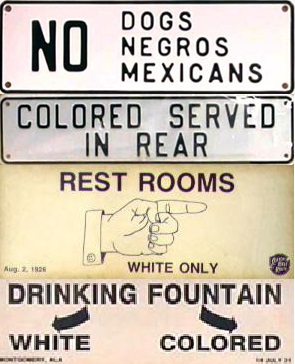
This was done frequently in the post-Reconstruction era, when so called “Black laws” or “Jim Crow” laws were enacted throughout the South. These laws paid lip-service to the Federal law but legalized almost every form of discrimination imaginable and established a culture of legal lawlessness where Blacks were the targets of discrimination, harassment, segregation and violence.

“From the 1880s onward, the post-Reconstruction white governments grew unwilling to rely just on intimidation at the ballot box and themselves in power, and turned instead to systematic legal disenfranchisement.” (1)

In 1896 these codes were upheld by the Supreme Court in the case of Plessy v. Ferguson. That ruling established the “separate but equal” doctrine and ushered in an era of de jure segregation in almost all arenas of life including education, transportation, entertainment and health care. What limited social equity and privileges enjoyed by Blacks were erased with the stroke of the judicial pen. The justices ruled on the concept that only peoples political rights were protected by the Constitution and that in the social arena that African-Americans could not interact with whites and assumed their racial inferiority.

Associate Justice Harlan wrote in dissent:

“The destinies of two races, in this country are indissolubly linked together, and the interests of both require that the common government of all should not permit the seeds of race hate to be planted under the sanction of law. What can more certainly arouse race hate, what more certainly create and perpetuate a feeling of distrust between these races, than state enactments, which, in fact, proceed on the ground that colored citizens are so inferior and degraded that they cannot be allowed to sit in public coaches occupied by white citizens? That, as all will admit, is the real meaning of such legislation as was enacted in Louisiana.” (2)

While the case of 1955 Supreme Court ruling in the case of Brown v. Board of Education swept away most of the effects of Plessy v. Ferguson, the underlying attitudes and actions of those who support legal discrimination are still with us. Prejudice and discrimination, not only towards African Americans and other people of color, but also women and even more so the LGBTQ community  has come back with a vengeance in the decades following Brown v. Board of Education.  Opponents of equality hate the sweeping civil rights advances made in the 1960s and 1970s, and more recently the advances made on behalf of the Gay community in the past decade. The end of the Defense of Marriage Act or DOMA, a law which mush like the Black Codes set up legal barriers for gays to marry and enjoy other civil rights brought forth a plethora of new anti-Gay legislation, especially at the local and state levels. Most of these laws are cloaked in the concept of “Religious Liberty” and permit people to discriminate against Gays in almost any arena of life: to refuse to serve them at their place of business, to deny them service in local government offices and even to deny them health care, should the provider determine that he or she will not serve someone who is gay, all based on the amorphous concept that the providers “sincerely held religious beliefs are at stake.”

These laws are being set up with the full knowledge that Obergfell v. Hodges will likely legalize Gay marriage throughout the country. Knowing that the opponents are raising the specter of Christians being put in concentration camps for opposing Gay marriage, and other equally apocalyptic and patently untrue statements, many coming from leading Republican presidential candidates and their backers in the Christian Right. Justice Harlan was correct about the intent of the Jim Crow laws and correct about the intent of the new anti-Gay laws. The seeds of hate cannot be allowed to be planted under the sanction of law. 

These are the new Jim Crow laws, and they must be fought at every turn even if the Supreme Court affirms the legality of Gay marriage in its ruling in Obergfell v. Hodges.

Opponents of Gay marriage should remember the words of Thomas Jefferson who wrote:

“I know also, that laws and institutions must go hand in hand with the progress of the human mind. As that becomes more developed, more enlightened, as new discoveries are made, new truths disclosed, and manners and opinions change with the change of circumstances, institutions must advance also, and keep pace with the times. We might as well require a man to wear still the coat which fitted him when a boy, as civilized society to remain ever under the regimen of their barbarous ancestors.” 

We must move forward.

Peace

Padre Steve+

1. Guelzo Allen C. Fateful Lightening: A New History of the Civil War Era and Reconstruction Oxford University Press, Oxford and New York 2012 p.526

2. LaMorte, Michael W. School Law: Cases and Concepts 9th Edition 2008 p.300

Leave a comment

Filed under civil rights, History, laws and legislation, LGBT issues, News and current events, Political Commentary

Dred Scott: A Warning for Today

Friends of Padre Steve’s World

I am a historian, and as such I look to history to understand people and current events. As such I am looking at the upcoming Supreme Court hearing in the case of Obergefell v. Hodges and thinking about it in relation to the Dred Scott Ruling of 1856.

This case deals with Gay marriage and the attempts of mainly Christian Conservatives to roll back the rights of those in the LBGTQ community to marry. Not only does they seek to prevent Gay marriage where it is not permitted but they seek to roll back those rights in states where the majority of voters through their legislators have passed those laws, and negate the traditional understanding of reciprocity between states concerning recognition of marriages performed in other states. As such it is a major case with big ramifications. 

On one hand if the justices rule in favor of those challenging the laws which allow gays to marry it will strike at the very heart of the meaning of the Declaration of Independence’s  central message that “all men are created equal.” Likewise such a ruling will return LBGTQ citizens to a second class status in which though they pay taxes and serve their country in many ways, and contribute to the positive good of all Americans, they will not enjoy the liberties of other citizens and can be denied basic services, or even the right to be at the bedside of a dying spouse. 

Though Gay marriage harms no one its opponents have announced that it will have apocalyptic consequences and will result in a massive persecution of Christians who oppose it. The legal arguments espoused by the opponents of Gay marriage are similar to those who supported the both the protection and expansion of slavery in the 1850s, and those who after emancipation and the Thirteenth Amendment enacted “Black” or “Jim Crow” laws. Sadly, if Gay marriage is upheld by the Court, a number of States are pledging to enact similar laws regarding Gays, and some states are already doing so. 

From more recent Court rulings it appears that the Gay marriage will be upheld, but you never know with the Roberts Court. Several members, Justices Thomas, Alito and Scalia have long histories of opposing and ruling against the rights of gays.  

Today I am looking at the effects of the Dred Scott decision of the Supreme Court. The decision was one of the worst, if not the worst ever enacted by the Supreme Court. The consequences were chilling as it proclaimed that Blacks were a “subordinate and inferior class of beings” who had no rights. It also in combination with the Compromise of 1850 opened territories to slavery and put Blacks in Free States at jeopardy of being re-enslaved.

I ask my readers to imagine what it will be like for Gays if the Supreme Court rules against Gay marriage. I will probably post something tomorrow about the use of the “Black laws” and “Jim Crow” and relate that to the “Gay laws” that are being enacted in many states and locales, laws which serve no purpose than to deprive citizens of basic rights, services and freedoms enjoyed by other citizens. 

This article is an edited part of one of the chapters of my Gettysburg/ Civil War text. I have worked it so that here it is a stand alone article. So please read this and share, it is important and none of us can be complacent.

Peace,

Padre Steve+

the-dred-scott-case-1846-1857-402x618

As the 1850s wore on, the divisions over slavery became deeper and voices of moderation retreated. The trigger for the worsening of the division was the political battle regarding the expansion of slavery; even the status of free blacks in the north who were previously slaves, over whom their owners asserted their ownership. Southerners considered the network to help fugitive slaves escape to non-slave states, called the Underground Railroad “an affront to the slaveholders pride” and “anyone who helped a man or woman escape bondage was simply a thief” who had robbed them of their property and livelihood, as an “adult field hand could cost as much as $2000, the equivalent of a substantial house.” (1)

In 1856 the Supreme Court, dominated by southern Democrats ruled in favor of southern views in the Dred Scott decision, one pillar of which gave slavery the right to expand by denying to Congress the power to prohibit slavery in Federal territories. Taney’s ruling in the case insisted that “Neither the Declaration of Independence nor the Constitution had been intended to apply to blacks he said. Blacks were “so far inferior that they had no rights which the white man was bound to respect.” Taney did not stop with this but he declared the Missouri Compromise itself unconstitutional for “Congress had exceeded its authority when it forbade slavery in the territories by such legislation as the Missouri Compromise, for slaves were private property protected by the Constitution.” (2)

The decision was momentous, but the judicial fiat of Taney and his court majority was a disaster for the American people. It solved nothing and further divided the nation:

“In the South, for instance, it encouraged southern rights advocates to believe that their utmost demands were legitimatized by constitutional sanction and, therefore, to stiffen their insistence upon their “rights.” In the North, on the other hand, it strengthened a conviction that an aggressive slavocracy was conspiring to impose slavery upon the nation, and that any effort to reach an accommodation with such aggressors was futile. While strengthening the extremists, it cut the ground from under the moderates.” (3)

The decision in the case is frightening when one looks upon its tenor and implications. The majority opinion which was written by Chief Justice Roger Taney was chilling, not only in its views of race, but the fact that blacks were perpetually property without the rights of citizens. Taney wrote:

“Can a negro, whose ancestors were imported into this country, sold as slaves, become a member of the political community formed and brought into existence by the Constitution of the United States, and as such become entitled to all the rights, and privileges, and immunities, guaranteed by that instrument to the citizen?…It is absolutely certain that the African race were not included under the name of citizens of a state…and that they were not included, and were not intended to be included, under the word “citizens” in the Constitution, and therefore claim none of the rights and privileges which that instrument provides for and secures to citizens of the United States. On the contrary, they were at that time considered as a subordinate and inferior class of beings, who had been subjugated by the dominant race, and, whether emancipated or not, yet remain subject to their authority, and had no rights or privileges but those who held the power and the Government might choose to grant them” (4)

The effect of the ruling on individuals and the states was far reaching. “No territorial government in any federally administered territory had the authority to alter the status of a white citizen’s property, much less to take that property out of a citizen’s hands, without due process of law or as punishment for some crime.” (5) Free slaves were no longer safe, even in Free States, from the possibility of being returned to slavery, because they were considered property. The tens of thousands of free blacks in the South were effectively stripped of citizenship, and became vulnerable to either expulsion or re-enslavement, something that the legislatures in Virginia, North Carolina and Missouri debated in 1858. Likewise the decision “cast doubt on the free status of every African American regardless of residence.” (6) 

But the decision had been influenced by President-Elect James Buchanan’s secret intervention in the Supreme Court deliberations two weeks before his inauguration. Buchanan hoped by working with the Justices that he would save the Union from breaking apart by appeasing slave owners and catering to their agenda. “The president-elect wanted to know not only when, but if the Court would save the new administration and the Union from the issue of slavery in the territories. Would the judges thankfully declare the explosive subject out of bounds, for everyone who exerted federal power? The shattering question need never bother President Buchanan.” (7) In his inaugural address he attempted to camouflage his intervention and “declared that the Court’s decision, whatever it turned out to be, would settle the slavery issue forever.” (8) 

But Buchanan was mistaken. The case made the situation even more volatile as it impaired “the power of Congress- a power which had remained intact to this time- to occupy the middle ground.” (9)  Taney’s decision held that Congress “never had the right to limit slavery’s expansion, and that the Missouri Compromise had been null and void on the day of its formulation.” (10)

The Court’s decision “that a free negro was not a citizen and the decision that Congress could not exclude slavery from the territories were intensely repugnant to many people in the free states” (11)  and it ignited a firestorm in the north where Republicans now led by Abraham Lincoln, decried the decision and southerners basked in their judicial victory. Southerners were exultant, the Richmond Enquirer wrote that the Court had destroyed “the foundation of the theory upon which their warfare has been waged against the institutions of the South.” (12) Northerners now quite rightly feared that an activist court would rule to deny their states the right to forbid slavery. As early as 1854 Lincoln posed the idea that the Declaration of Independence was “the standard maxim of free society …constantly spreading and deepening its influence,” ultimately applicable “to peoples of all colors everywhere.” (13) 

After the Dred Scott decision Lincoln warned that the Declaration was being cheapened and diluted, he remained insistent on this point, he noted:

“Our Declaration of Independence was held sacred by all, and thought to include all” Lincoln declared, “but now, to aid in making the bondage of the Negro universal and eternal, it is assaulted, and sneered at, and construed, and hawked at, and torn, till, its framers could ride from their graves, they could not recognize it at all.” (14)

Lincoln attacked the decision noting that Taney “insists at great length that negroes were no part of the people who made, or for whom made, the declaration of Independence or the Constitution.” But as Doris Kearns Goodwin notes “in at least five states, black voters action on the ratification of the Constitution and were among the “We the People” by whom the Constitution was ordained and established.” Lincoln acknowledged that the founders “did not declare all men equal in all respects. They did not mean to say that all were equal in color, size, intellect, moral developments, or social capacity.” But they dis declare all men “equal in ‘certain inalienable rights, among which are life, liberty, and the pursuit of happiness.’…They meant simply to declare the right, so the enforcement of it might follow as circumstances permit.” (15)

Not only that, Lincoln asked the logical question regarding Taney’s judicial activism. Lincoln and other Republican leaders “noted that all slavery needed was one more Dred Scott decision that a state could not bar slavery and the objective of Slave Power to nationalize slavery would be accomplished.” (16) How long would it be, asked Abraham Lincoln, before the Court took the next logical step and ruled explicitly that the:

“Constitution of the United States does not permit a state to exclude slavery from its limits?” How far off was the day when “we shall lie down pleasantly thinking that the people of Missouri are on the verge of making their State free; and shall awake to the reality, instead, that the Supreme Court has made Illinois a slave State?” (17)

Lincoln discussed the ramification of the ruling for blacks, both slave and free:

“to aid in making the bondage of the Negro universal and eternal….All the powers of the earth seem rapidly combining against him. Mammon is after him; ambition follows, and philosophy follows, and the theology of the day is fast joining the cry. They have him in his prison house;…One after another they have closed the heavy doors upon him…and they stand musing as to what invention, in all the dominions of mind and matter, can be produced the impossibility of his escape more complete than it is.” (18)

Frederick Douglass noted that “Judge Taney can do many things…but he cannot…change the essential nature of things – making evil good, and good, evil.” (19)

Lincoln was not wrong in his assessment of the potential effects of the Dred Scott decision on Free States. State courts in free-states made decisions on the basis of Dred Scott that bode ill for blacks and cheered slave owners. In newly admitted California the state supreme court ominously “upheld a slaveowner’s right to retain his property contrary to the state’s constitution.” (20)

A similar decision by a New York Court was being used by slave-states to bring that issue to the Taney Court following Dred Scott. “In 1852 a New York judge upheld the freedom of eight slaves who had left their Virginia owner while in New York City on their way to Texas.” (21) The Dred Scott decision brought that case, Lemon v. The People back to the fore and “Virginia decided to take the case to the highest New York court (which upheld the law in 1860) and would have undoubtedly appealed it to Taney’s Supreme Court had not secession intervened.” (22) Even non-Republican parties such as the Democrats could see the writing on the wall. The national publication of the Democratic Party, the Washington Union “announced that the clear implication of the Dred Scott decision was that all state laws prohibiting a citizen from another state, either permanently or temporarily, were unconstitutional.” (23)

Notes

1. Goodheart, Adam. Moses’ Last Exodus in The New York Times: Disunion, 106 Articles from the New York Times Opinionator: Modern Historians Revisit and Reconsider the Civil War from Lincoln’s Election to the Emancipation Proclamation Edited by Ted Widmer, Black Dog and Leventhal Publishers, New York 2013 p.15

2.  Goodwin, Doris Kearns Team of Rivals: The Political Genius of Abraham Lincoln Simon and Schuster, New York 2005 p. 189

3.  Potter, David M. The Impending Crisis: America before the Civil War 1848-1861 completed and edited by Don E. Fehrenbacher Harper Collins Publishers, New York 1976Ibid. Potter The Impending Crisis p.291

4. Guelzo Allen C. Fateful Lightening: A New History of the Civil War Era and Reconstruction Oxford University Press, Oxford and New York 2012 p.91

5. Ibid. Guelzo Fateful Lightening pp.91-92

6. Goldfield, David America Aflame: How the Civil War Created a Nation Bloomsbury Press, New York, London New Delhi and Sidney 2011p.142

7. Freehling, William. The Road to Disunion Volume II: Secessionists Triumphant 1854-1861 Oxford University Press, Oxford and New York 2007 p.115

8. Ibid. Freehling, The Road to Disunion Volume II: Secessionists Triumphant 1854-1861 p.109

9. Ibid. Potter The Impending Crisis p.291

10. Levine, Bruce Half Slave and Half Free: The Roots of the Civil War Revised Edition, Hill and Wang, a division of Farrar, Strauss and Giroux, New York 1992 and 1995   p.210

11. Ibid. Potter The Impending Crisis p.279

12. Ibid. Goodwin Team of Rivals p. 190

13.  Catton, William and Bruce, Two Roads to Sumter: Abraham Lincoln, Jefferson Davis and the March to Civil War McGraw Hill Book Company New York 1963, Phoenix Press edition London p.139

14. Ibid. Guelzo Fateful Lightening p.93

15. Ibid. Goodwin Team of Rivals p. 190

16. Gienapp, William The Republican Party and Slave Power in The Civil War and Reconstruction Documents and Essays Third Edition edited by Michael Perman and Amy Murrell Taylor Wadsworth Cengage Learning Boston MA 2011 p.81

17. Ibid. Levine Half Slave and Half Free p.211

18. Ibid. Catton Two Roads to Sumter p.139

19. Ibid. Goodwin Team of Rivals p. 190

20. Ibid. Gienapp The Republican Party and Slave Power p.81

21. McPherson, James. The Battle Cry of Freedom: The Civil War Era Oxford University Press, Oxford and New York 1988 p.181

22. Ibid. McPherson The Battle Cry of Freedom p.181

23. Ibid. Gienapp The Republican Party and Slave Power p.82

2 Comments

Filed under civil rights, civil war, History, laws and legislation, LGBT issues, marriage and relationships, Political Commentary

He Made Us a Better Nation: Jackie Robinson

robinson200-ffbfd794408772ed56c5418c8f637c6b552e5c70-s6-c30

He led America by example. He reminded our people of what was right and he reminded them of what was wrong. I think it can be safely said today that Jackie Robinson made the United States a better nation.” – American League President Gene Budig

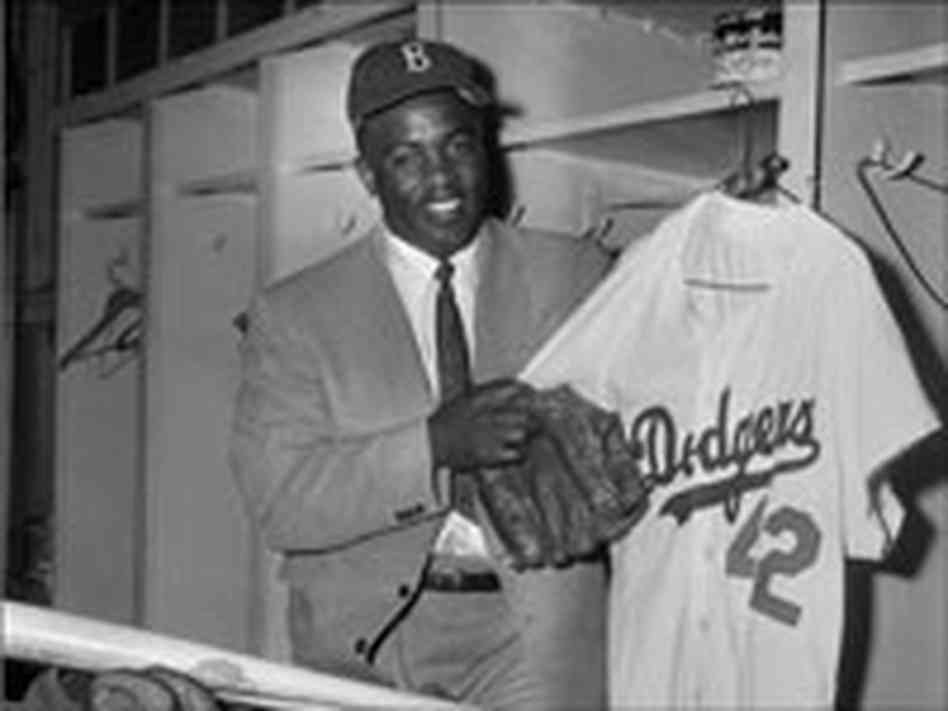
April 15th 2015 was the 68th anniversary of Jackie Robinson’s first game in the Major Leagues with the Brooklyn Dodgers.  Jim Crow was very alive and well when Jackie stepped onto the field that day and no matter how much we want to distance ourselves from those days there are still some in this country who want to go back to that kind of society. Robinson’s first game with the Dodgers came a full year before President Truman integrated the military, a move which infuriated many in the South.  Likewise it occurred a full seven years before the Supreme Court ruled school segregation unconstitutional in the Brown vs Board of Education decision.  It came a full 17 years before Congress passed the Voters Rights Act in 1964.

When Jackie Robinson stepped onto the field it was a watershed moment in Civil Rights for African Americans and paved the way for a change in American society that has continued since his Major League debut. Blacks had struggled for years against Jim Crow laws, discrimination in voting rights and even simple human decencies like where they could use a rest room, sit on a bus or what hotel they could stay in.

In baseball many white fans were upset that blacks were allowed to see Robinson in stadiums that they would not have been allowed in before.  Players from other teams heckled Robinson, he received hate mail, people sent made death threats, he was spiked and spit on.  But Jackie Robinson kept his pledge to Dodgers owner Branch Rickey not to lash out at his tormentors, as Rickey told him that he needed a man “with enough guts not to strike back.”

Jackie Robinson played the game with passion and even anger.  He took the advice of Hank Greenberg who as a Jew suffered continual racial epithets throughout his career “the best ways to combat slurs from the opposing dugout is to beat them on the field.” He would be honored as Rookie of the Year in 1947. He was a MVP and played in six World Series and six All Star Games.  He had a career .311 batting average, .409 on base percentage and .474 Slugging percentage. He was elected to Baseball’s Hall of Fame in 1962.

Today Jackie Robinson’s feat is history, but it should not be forgotten.  He was a pioneer who made it possible for others to move forward.  He would be followed by players like Roy Campinella, Satchel Paige, Don Larson, Larry Dobie and   Willie Mays.  His breakthrough had an effect not just on baseball but on society.

Jackie Robinson would have an effect on my life.  In 1975 the Stockton Unified School District voted to desegregate.  I was in the 9th grade and preparing for high school.  As the school board wrestled with the decision anger boiled throughout the town, especially in the more affluent areas.  Vicious letters were sent to the school board and to the Stockton Record by parents as well as other opponents of the move.  Threats of violence and predictions failure were commonplace.  In the summer of 1975 those who went out for the football team, both the sophomore and varsity squads began to practice.  Black, White, Mexican and Asian, we bonded as a team, the Edison Vikings.  By the time the first buses pulled up to the bus stops throughout town on the first day of school, the sense of foreboding ended.  Students of all races discovered common interests and goals.  New friends became guests in each others homes, and all of us became “Soul Vikes.”

30 years later the Class of 1978, the first class to be desegregated from start to finish graduated from Edison held a reunion.  Our class always had a special feel about it.  Looking back we too were pioneers, like Jackie Robinson we were far ahead of our time.  When I look at my friends on Facebook from Edison I see the same faces that I played ball, rode the bus and went to class with.   Things have changed.  Even 30 years ago none of us imagined a African American President, we believed in each other and we saw potential, but I don’t think that anyone believed that we would see this in our day.

I think that Jackie Robinson prepared the way for other pioneers of Civil Rights including Dr. Martin Luther King.  Today, 68 years later Jackie Robinson looms large not only in baseball, but for the impact of his life and actions on America.

His number “42” is now retired from baseball. The last player to wear it was Mariano Rivera of the Yankees. Rivera had been granted an exemption to wear it until he retired. At least the last Major League ball player to honor the number was a class act who will certainly be in the Hall of Fame.

Robinson said something that still resonates with me: “Life is not a spectator sport. If you’re going to spend your whole life in the grandstand just watching what goes on, in my opinion you’re wasting your life.” It is something that I take into account every day of my life.

May we not forget and always forge ahead in the constant struggle for civil rights and equality, even as many in our nation sink back into the old ways of apathy, and the toleration of injustice and inequity, even seeking to reverse the hard gotten gains that we all have been blessed to see.

So here’s to you Jackie Robinson. Thank you and all the other pioneers.

Peace,

Padre Steve+

1 Comment

Filed under Baseball, civil rights, Political Commentary, sports and life

Teaching, Taxes, Texas and Lincoln

IMG_0535

Well my friends it has been a very busy day. A day full of teaching and writing. A day of filing taxes, thankfully I’ll get some of what I paid in back, and tomorrow I will be heading to Houston, Texas for a Chaplain Training conference at my denomination headquarters. I will return home on Monday afternoon.

Today it was the first meeting of my ethics class and the first meeting for the Gettysburg Staff Ride. I also did a modified version of last night’s post  on the assassination of Abraham Lincoln to send to my colleagues and students at the Staff College.

While doing my taxes tonight I watched the movie Lincoln again and as I saw the flags flying half-staff on the base this afternoon I pondered the depth of the loss of the late President 150 years ago today. As I did so I thought of both the Gettysburg Address and his Second Inaugural Address, for I so much desire the day that all of our citizens shall embrace the ideal that these dead shall not have died in vain — that this nation, under God, shall have a new birth of freedom — and that government of the people, by the people, for the people, shall not perish from the earth.

But now, I need to pack as I need to be at the airport at 4:30 A.M. and get to bed. So until tomorrow,

Peace

Padre Steve+

1 Comment

Filed under civil rights, civil war, History, leadership

The Lost Cause Lives in Texas

confederate_flag_memorial

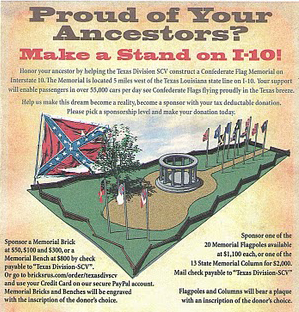
Over the past few years there has been an increase in Neo-Confederate propaganda, talk of secession and civil war coming from people who for the most part call themselves Christians. To be honest there is a reason for this, and that reason is because a Black Man was elected as President and all the underlying pent-up racism that never died despite the great advances that we have seen since the dawn of the Civil Rights Era. Doctor King may have a Holiday, but racism is not dead and often it is cloaked in the myth of the Lost Cause.

Over the past few weeks down in Orange Texas, the Local Sons of the Confederate Veterans chapter have decided to spruce up the monument to the Texas Confederate dead. Now I have lived throughout the South and in most of the former Confederate states there are monuments to the Confederate war dead, and it seems that almost every town has one. They are a part of history and those I vehemently disagree with what those men fought for and would have fought against them, such monument are a part of our history. Monuments to fallen soldiers are part of every almost every western culture and a way for families and communities to remember those who died.

However, the kerfuffle in Orange is a bit different. The monument has been there a long time and truthfully, the Sons of Confederate Veterans own it and the land that it is on. It not on public property actually, if the monument has fallen into disrepair I have no problem with them doing that. However, what they are doing is different. They are erecting flagpoles for 32 Confederate flags. Eight of them are various renditions of the flags of the Confederacy itself and twenty-four are going to be replicas of the flags of Texas Regiments that fought in the war.

Now I do understand that those flags do have some historical meaning and significance, at the same time that historical meaning and significance is connected to a cause that was about the rights of states to promote White Supremacy and slavery. The supporters of the Confederate flag project in Orange are saying that this was not the case.

“David Moore, Lieutenant Division Commander of the Texas Sons of Confederate Veterans, told The Post that Southern states did not fight the Civil War to defend slavery, but instead to defend state’s rights after they were “invaded by Northern troops.” He said the monument in Orange honors the ancestors of the 2,600 members of Texas Sons of Confederate Veterans.” [1]

My feeling is if the Sons of Confederate Veterans wanted to honor their ancestors and remember the military organizations they could place plaques with the regimental histories and the names of those killed in action. They could actually try to make it somewhat reverent and at the same time educational, but this, the display of so many flags looks more like a display designed to incite division and make current the Lost Cause.

A couple of years ago washed up rocker, draft dodger and professional muckraker Ted Nugent made the comment that he wondered if it would have been better that the South had won the Civil War. Nugent’s statements, like those of the Sons of Confederate Veterans in Texas are blatant examples of the enduring influence of the Lost Cause Myth, and show the revisionism and dishonest “scholarship” of the Neo-Confederates. The dishonesty and lack of truth in this quote, which is typical of the movement finds its genus in the discredited myth of the Lost Cause.

Sadly, a lot of the proponents of this are leaders in the radical, theocratic movement known as Christian Dominionism. This movement and its leaders believe that it is the duty of Christians to claim all of culture, politics and economics for God, and to disenfranchise or even kill those who do not agree. Many times their rhetoric is tinged with violence, racism, xenophobia and frankly paranoid and conspiratorial views of anyone that does not agree with them. Leaders of this movement are closely connected to, and often are advisers to prominent current and former Republican elected officials including Rand and Ron Paul, Ted Cruz, Sarah Palin, Michelle Bachmann, Rick Perry, Bobby Jindal and Sam Brownback.

One of the most troubling things about this movement is its growing ties to and sympathy for neo-Confederate movements and the myth of the Lost Cause.

I have written about the ideological and religious roots of the American Civil War. While I was researching that article I began to see just who closely the language of this allegedly Christian movement parallels that of those who led the South to disaster in the Civil War and then to cover their crimes and to justify their actions.

These people are part of a growing fringe movement which advocates all the ideas espoused by the leaders of the Confederacy: secession, nullification, White Supremacy and some advocate violence and insurrection. Many of these despise Abraham Lincoln; they use state legislatures to pass Jim Crow like voting restrictions that particularly impact the poor, the elderly and minorities, and they use the cover of their religious rights to establish laws that allow the open discrimination against Gays. They favor an oligarchy of the rich and corporations that is very similar in its philosophy and ideology to that of the Southern elites and the plantation owners. People who not only enslaved blacks, but used their economic power to keep poor whites in their place.

Some of the Dominionists echo the words of the defenders of slavery. Douglas Wilson, a pastor in the Presbyterian Church of America in Idaho and apologist for Confederate views wrote: “slavery produced in the South a genuine affection between the races that we believe we can say has never existed in any nation before the War or since.” Wilson also wrote that “There has never been, a multi-racial society that has existed with such mutual intimacy and harmony in the history of the world.” Of course there is no truth in that statement whatsoever as any actual student of the ante-bellum South would know. It is fiction and lies being propertied as truth by a Christian pastor in an established denomination.

The cause of the Civil War to the Christian neo-Confederates was not slavery, not economics or even Constitutional issues or anything else that real historians debate but rather a theological myth, as Steven Wilkins explained: “the cause of the Civil War was theological incompatibility between North and South, the former having ‘rejected Biblical Calvinism…“there was radical hatred of Scripture and the old theology [and] Northern radicals were trying to throw off this Biblical culture and turn the country in a different direction….” 

These thoughts are reiterated in many parts of the Dominionist movement in the writings of its godfather R. J. Rushdoony who through his own writings and the continued work of his son-in-law Gary North influence both Ron and his son U.S. Senator and now Republican Presidential Candidate Rand Paul as well as many others in the so called “Christian Right.”

So I have decided to post just a bit of my research on the Lost Cause here, just to show some of the similarities of thought.

As the Southern States seceded, the Reverend William Leacock of Christ Church, New Orleans declared in his Thanksgiving sermon in December of 1860: “Our enemies…have “defamed” our characters, “lacerated” our feelings, “invaded “our rights, “stolen” our property, and let “murderers…loose upon us, stimulated by weak or designing or infidel preachers. With “the deepest and blackest malice,” they have “proscribed” us “as unworthy members… of the society of men and accursed before God.” Unless we sink to “craven” beginning that they “not disturb us,…nothing is now left us but secession.” [2]

The people who drove the nation to war incited secession, not for just any “state’s rights” but for White Supremacy and slavery. Henry Benning of Georgia was a strong Separatist, as proponents of secession were known in Georgia. He led the debate for secession at the Georgia convention, and spoke as a representative at the Virginia secession debate. At both debates the fiery justice proclaimed the disaster that would befall the South under Republican rule: In Virginia he presented a nearly apocalyptic vision of Republican rule:

“On the “not distant” day when the South contains “the only slave States,” climaxed Benning, “The North will have the power to amend the Constitution” and declare “slavery…abolished.” Then the master who “refuses to yield” will doubtless be hung.” Race “war will break out everywhere, like hidden fire from the earth. Eventually “our men will be compelled to wander like vagabonds.” And “as far as our women, the horrors of their state we cannot contemplate.” [3]

He closed his speech with the prediction that under Lincoln and the “Black Republicans” that: “We will be completely exterminated…and the land will be left in the possession of the blacks…” [4]

When you read the words of many of the Dominionist and the Christian neo-Confederate leaders you see a similar cry of victimhood and an apocalyptic vision that is best described as paranoia run rampant. This is only a sample, my research on the Lost Cause, the ante-Bellum South and the contemporary Neo-Confederate Christians connection with the Dominionists continues. What follows here is just a sample of the research that his going into my Civil War and Gettysburg texts plus some additional commentary.

When Edmund Ruffin pulled the lanyard of the cannon that fired the first shot at Fort Sumter it marked the end of an era and despite Ruffin, Stephens and Davis’ plans gave birth to what Lincoln would describe as “a new birth of freedom.”

When the war ended with the Confederacy defeated and the south in ruins, Ruffin still could not abide the result. In a carefully crafted suicide note he sent to his son the bitter and hate filled old man wrote on June 14th 1865:

“I here declare my unmitigated hatred to Yankee rule- to all political, social and business connections with the Yankees and to the Yankee race. Would that I could impress these sentiments, in their full force, on every living Southerner and bequeath them to every one yet to be born! May such sentiments be held universally in the outraged and down trodden South, though in silence and stillness, until the now far-distant day shall arrive for just retribution for Yankee usurpation, oppression and outrages, and for deliverance and vengeance for the now ruined, subjugated and enslaved Southern States! … And now with my latest writing and utterance, and with what will be near my last breath, I here repeat and would willingly proclaim my unmitigated hatred to Yankee rule — to all political, social and business connections with Yankees, and the perfidious, malignant and vile Yankee race.” [5]

Though Ruffin was dead in the coming years the southern states would again find themselves under the governance of former secessionists who were unabashed white supremacists. Former secessionist firebrands who had boldly proclaimed slavery to be the deciding issue when the war changed their story. Instead of slavery being the primary cause of Southern secession and the war, it was “trivialized as the cause of the war in favor of such things as tariff disputes, control of investment banking and the means of wealth, cultural differences, and the conflict between industrial and agricultural societies.” [6]

Alexander Stephens who had authored the infamous1861 Cornerstone Speech that “that the negro is not equal to the white man; that slavery — subordination to the superior race — is his natural and normal condition” argued after the war that the war was not about slavery at all, that it:

“had its origins in opposing principles….It was a strife between the principles of Federation, on the one side, and Centralism, or Consolidation on the other.” He concluded “that the American Civil War “represented a struggle between “the friends of Constitutional liberty” and “the Demon of Centralism, Absolutism, [and] Despotism!” [7]

Jefferson Davis, who had masterfully crafted “moderate” language which radicals in the South used to their advantage regarding the expansion and protection of the rights of slave owners in the late 1850s to mollify Northern Democrats, and who wrote in October 1860 that: “The recent declarations of the Black Republican party…must suffice to convince many who have formerly doubted the purpose to attack the institution of slavery in the states. The undying opposition to slavery in the United States means war upon it where it is, not where it is not.” [8]

After the war a revisionist Davis wrote:

“The Southern States and Southern people have been sedulously represented as “propagandists” of slavery, and the Northern as the champions of universal freedom…” and “the attentive reader…will already found enough evidence to discern the falsehood of these representations, and to perceive that, to whatever extent the question of slavery may have served as an occasion, it was far from being the cause for the conflict.” [9]

Instead of being about slavery the Confederate cause was mythologized by those promoting the false history of the “Lost Cause” a term coined by William Pollard in 1866, which “touching almost every aspect of the struggle, originated in Southern rationalizations of the war.” [10] By 1877 many southerners were taking as much pride in the “Lost Cause” as Northerners took in Appomattox. [11] Alan Nolen notes: “Leaders of such a catastrophe must account for themselves. Justification is necessary. Those who followed their leaders into the catastrophe required similar rationalization.” [12]

The Lost Cause was elevated by some to the level of a religion. In September 1906, Lawrence Griffith speaking to a meeting of the United Confederate Veterans stated that when the Confederates returned home to their devastated lands, “there was born in the South a new religion.” [13] The mentality of the Lost Cause took on “the proportions of a heroic legend, a Southern Götterdämmerung with Robert E. Lee as a latter day Siegfried.” [14]

This new religion that Griffith referenced was replete with signs, symbols and ritual:

“this worship of the Immortal Confederacy, had its foundation in myth of the Lost Cause. Conceived in the ashes of a defeated and broken Dixie, this powerful, pervasive idea claimed the devotion of countless Confederates and their counterparts. When it reached fruition in the 1880s its votaries not only pledged their allegiance to the Lost Cause, but they also elevated it above the realm of common patriotic impulse, making it perform a clearly religious function….The Stars and Bars, “Dixie,” and the army’s gray jacket became religious emblems, symbolic of a holy cause and of the sacrifices made on its behalf. Confederate heroes also functioned as sacred symbols: Lee and Davis emerged as Christ figures, the common soldier attained sainthood, and Southern women became Marys who guarded the tomb of the Confederacy and heralded its resurrection.” [15]

Jefferson Davis became an incarnational figure for the adherents of this new religion. A Christ figure who Confederates believed “was the sacrifice selected-by the North or by Providence- as the price for Southern atonement. Pastors theologized about his “passion” and described Davis as a “vicarious victim”…who stood mute as Northerners “laid on him the falsely alleged iniquities of us all.” [16]

In 1923 a song about Davis repeated this theme:

Jefferson Davis! Still we honor thee! Our Lamb victorious, who for us endur’d A cross of martyrdom, a crown of thorns, soul’s Gethsemane, a nation’s hate, A dungeon’s gloom! Another God in chains!” [17]

The myth also painted another picture, that of slavery being a benevolent institution which has carried forth into our own time. The contention of Southern politicians, teachers, preachers and journalists was that slaves liked their status; they echoed the words of slave owner Hiram Tibbetts to his brother in 1842 “If only the abolitionists could see how happy our people are…..The idea of unhappiness would never enter the mind of any one witnessing their enjoyments” [18] as well as Jefferson Davis who in response to the Emancipation Proclamation called the slaves “peaceful and contented laborers.” [19]

The images of the Lost Cause, was conveyed by numerous writers and Hollywood producers including Thomas Dixon Jr. whose play and novel The Clansman became D.W. Griffith’s The Birth of a Nation, a groundbreaking part of American cinematography which was released in 1915; Margaret Mitchell who penned the epic Pulitzer Prize winning novel Gone With the Wind which in its 1939 film form won ten academy awards immortalized the good old days of the old South with images of faithful slaves, a theme which found its way into Walt Disney’s famed 1946 animated Song of the South.

The Lost Cause helped buttress the myths that both comforted and inspired many Southerners following the war. “It defended the old order, including slavery (on the grounds of white supremacy), and in Pollard’s case even predicted that the superior virtues of cause it to rise ineluctably from the ashes of its unworthy defeat.” [20] The myth helped pave the way to nearly a hundred more years of effective second class citizenship for now free blacks who were often deprived of the vote and forced into “separate but equal” public and private facilities, schools and recreational activities. The Ku Klux Klan and other violent organizations harassed, intimidated, persecuted and used violence against blacks.

“From the 1880s onward, the post-Reconstruction white governments grew unwilling to rely just on intimidation at the ballot box and themselves in power, and turned instead to systematic legal disenfranchisement.” [21] Lynching was common and even churches were not safe. It would not be until the Civil Rights movement of the 1950s and 1960s that blacks would finally begin to gain the same rights enjoyed by whites in most of the South.

That radical thought is still out there. The League of the South posted this on its website:

This 14th of April will mark the 150th anniversary of John Wilkes Booth’s execution of the tyrant Abraham Lincoln. The League will, in some form or fashion, celebrate this event. We remember Booth’s diary entry: “Our country owed all her troubles to him, and God simply made me the instrument of his punishment.” A century and a half after the fact, The League of the South thanks Mr. Booth for his service to the South and to humanity. [22]

Michael Hill, the co-founder of this organization wrote:

“As a traditional Christian Southerner, I want no part of “America.” I’m not talking about a particular piece of land in the western hemisphere; rather, I am talking about an idea, a proposition, a regime, a way of life. I am a Southerner, an old-fashioned Christian. The status of “American” is my antithesis.

Now before you tell me to “Love it or leave it” and pack up and move somewhere else, let me explain. The South, Alabama in particular, is my home. It is also a captive colony of this American monstrosity. Yes, many of our citizens have, wittingly or unwittingly, embraced Americanism for either survival or profit. I have not, and I intend to convince my fellow Southerners to join my side. I do not intend to leave Alabama or the South. Nor do I intend to leave them in the clutches of America. I intend to fight, and if necessary kill and die, for their survival, well-being, and independence.” [23]

William Ruffin outlived Lincoln who was killed by the assassin John Wilkes Booth on April 14th 1864. However the difference between the two men was marked. In his Second Inaugural Address Lincoln spoke in a different manner than Ruffin. He concluded that address with these thoughts:

“With malice toward none, with charity for all, with firmness in the right as God gives us to see the right, let us strive on to finish the work we are in, to bind up the nation’s wounds, to care for him who shall have borne the battle and for his widow and his orphan, to do all which may achieve and cherish a just and lasting peace among ourselves and with all nations.” [24]

I have ancestors on both sides of my family who fought for the Confederacy. While they are my ancestors I cannot subscribe to or honor the cause for which they fought, and for which at least one died. The Confederate flag, though a part of American history is a symbol of White Supremacy, hatred and rebellion. The only reason that I can think that any group would want to fly thirty-two of them is to proclaim that their cause still lives and that they have not abandoned the ideology and beliefs of their ancestors. This is not about displaying history. It is all about promoting White-Christian Supremacy and to again elevate the myth of the Lost Cause as truth.

For me, the words and actions as well as the symbols of the old and new Confederates stand in stark contrast to those support and defend. I sincerely hope that they and their cause eventually fade away to insignificance without again bringing us to civil war.

Peace

Padre Steve+

Notes

[1] Holley, Peter These Texas rebels say the American flag is more racist than the Confederate flag Washington Post 8 April 2015 retrieved 10 April 2015 from http://www.washingtonpost.com/news/morning-mix/wp/2015/04/08/these-texas-rebels-say-the-american-flag-is-more-racist-than-the-confederate-flag/?tid=sm_fb


[2] Freehling, William. The Road to Disunion Volume II: Secessionists Triumphant 1854-1861 Oxford University Press, Oxford and New York 2007 p.511

[3] Ibid. Freehling The Road to Disunion Volume II p.511

[4] Dew, Charles B. Apostles of Disunion: Southern Secession Commissioners and the Causes of the Civil War University Press of Virginia, Charlottesville and London 2001 p.67

[5] Edmund Ruffin (1794-1865). Diary entry, June 18, 1865. Manuscript Division, Library of Congress Retrieved from http://blogs.loc.gov/civil-war-voices/about/edmund-ruffin/ 24 March 2014

[6] Gallagher, Gary W. and Nolan Alan T. editors The Myth of the Lost Cause and Civil War History Indiana University Press, Bloomington and Indianapolis 2000 p.15

[7] Dew, Charles Apostles of Disunion p.16

[8] Catton, Bruce The Coming Fury p.104

[9] Davis, Jefferson The Rise and Fall of the Confederate Government Volume One of Two, A public Domain Book, Amazon Kindle edition pp.76-77


[10] Gallagher, Gary and Nolan, Alan The Myth of the Lost Cause and Civil War History p.12

[11] Millet Allen R and Maslowski, Peter. For the Common Defense: A Military History of the United States of America The Free Press, a division of McMillan Publishers, New York 1984 p.230

[12] Ibid. Gallagher and Nolan The Myth of the Lost Cause and Civil War History p.12

[13] Hunter, Lloyd The Immortal Confederacy: Another Look at the Lost Cause Religion in Gallagher and Nolan The Myth of the Lost Cause and Civil War p.185

[14] McPherson, James The Battle Cry of Freedom p.854

[15] Ibid. Hunter The Immortal Confederacy Religion in Gallagher and Nolan The Myth of the Lost Cause and Civil War p.186

[16] Ibid. Hunter The Immortal Confederacy Religion in Gallagher and Nolan The Myth of the Lost Cause and Civil War p.198

[17] Ibid. Hunter The Immortal Confederacy Religion in Gallagher and Nolan The Myth of the Lost Cause and Civil War p.198

[18] Levine, Bruce Half Slave and Half Free p.106

[19] Ibid. Gallagher and Nolan The Myth of the Lost Cause and Civil War History p.16

[20] Guelzo, Allen Fateful Lightening p.525

[21] Ibid. Guelzo Fateful Lightening p.526

[22] Hill, Michael Honoring John Wilkes Booth League of the South Website http://leagueofthesouth.com/honoring-john-wilkes-booth569/ retrieved 10 April 2015

[23] Hill, Michael. Why I am Not an American League of the South Website http://leagueofthesouth.com/why-i-am-not-an-american-566/ retrieved 10 April 2015

[24] Ibid. Lincoln Second Inaugural Address


2 Comments

Filed under civil rights, civil war, History, News and current events, Political Commentary

Jubal Early: The Unreconstructed Rebel

??????????????????????????????????????????????????????????????????????????????????????????????

Lieutenant General Jubal Early, the Propagandist of the Lost Cause

Friends of Padre Steve’s World

There are some people in history who have a major and sometimes malevolent impact on history who are little known to most people. One of these men is Confederate Lieutenant General Jubal A. Early. You may not have ever heard of him but his influence is still strong today in certain parts of the Republican Party, the Tea Party, the Christian Right and neo-Confederate organizations. Early is a complex, brilliant but malevolent character whose post Civil War activities, and writings influenced how generations of Americans embraced the myth of the Lost Cause as historic truth and why so  many people today support an ideology that is little more than a re-baptized Lost Cause in their fight against supposed liberals, progressives, gays, and minority groups. People who they believe threaten their place in society. 

This article is part of one of the chapters of my Gettysburg which I will continue to periodically publish here. Have a great night.

Peace

Padre Steve+ 

Jubal Early was an unusual character. He is described similarly by many to Dick Ewell in his gruffness and eccentrics. Unlike his corps commander, Ewell, who was modest and charitable, Early was “ambitious, critical, and outspoken to the point of insubordination. Under certain circumstances he could be devious and malevolent.” [1] James Longstreet’s aide Moxey Sorrel wrote of him: “Jubal Early….was one of the ablest soldiers in the army. Intellectually he was perhaps the peer of the best for strategic combinations, but he lacked the ability to handle troops effectively in the field….His irritable disposition and biting tongue made him anything but popular.” [2] Despite this, Early had proved himself as a brigade commander and acting division commander and Lee referred to him affectionately as “my bad old man.” [3]

Early was the son of a tobacco planter in Franklin County Virginia. He was born in 1816 who had served in the Virginia legislature and was a Colonel of militia. Growing up he had an aptitude for science and mathematics. He was accepted into West Point in 1833 at the age of seventeen. He was a good student, but had poor marks for conduct and graduated in the eighteenth of fifty cadets in the class of 1837. His fellow students included Joe Hooker, John Sedgwick, Braxton Bragg, and John Pemberton, later, the doomed defender of Vicksburg. Also in the class was Lewis Armistead, with whom the young Early had an altercation that led to Armistead breaking a plate over his head in the mess hall. For the offense Armistead was dismissed from the academy.

He was commissioned into the artillery on graduation in 1837. However, after experiencing life in the active duty army, including service in the in the Seminole War, Early left the army and became a highly successful lawyer and active Whig politician. He served in the Mexican war as a Major with Virginia volunteers. Unlike some of his classmates, and later contemporaries in the Civil War, Early, and his men did not see combat, instead, serving on occupation duty. In Mexico Zachary Taylor made Early the “military governor of Monterrey, a post that he relished and filled with distinction.” [4]

After his service in Mexico, Early returned to Virginia where he returned to his legal practice, serving as a prosecuting attorney. He also entered local politics where he served as a Whig in the Virginia legislature.

During his time in Mexico, Early contracted rheumatic fever, which left him with painful rheumatoid arthritis for the rest of his life. Due to it he “stooped badly and seemed so much older than his years that his soldiers promptly dubbed him “Old Jube” or Old Jubilee.” [5]

Jubal Early was “notoriously a bachelor and at heart a lonely man.” Unlike many Confederate officers he had “no powerful family connections, and by a somewhat bitter tongue and rasping wit” isolated himself from his peers.[6]

Likewise, in an army dominated by those with deep religious convictions, Early was avowedly irreligious and profane, though he did understand the importance of “the value of religion in keeping his soldiers’ spirits up” and as commander of the Army of the Valley, issued orders for a stricter keeping of the Sabbath. [7] Lee’s adjutant Walter Taylor wrote of him “I feared our friend Early wd not accomplish much because he is such a Godless man. He is a man who utterly sets at defiance all moral laws & such a one heaven cannot favor.” [8] That being said Porter Alexander praised Early and noted that his “greatest quality perhaps was the fearlessness with which he fought against all odds & discouragements.” [9]

Early was a Whig, and a stalwart Unionist who opposed Virginia’s secession, voting against it because he found it “exceedingly difficult to surrender the attachment of a lifetime to that Union which…I have been accustomed to look upon (in the language of Washington) as the palladium of the political safety and prosperity of the country.” [10] Nonetheless, like so many others he volunteered for service after Lincoln called for 75,000 volunteers to crush the rebellion.

Robert E. Lee “appreciated Early’s talents as a soldier and displayed personal fondness for his cantankerous and profane Lieutenant …who only Stonewall Jackson received more difficult assignments from Lee.” [11] Early was the most influential of Ewell’s division commanders, and his “record in battle prior to Gettysburg was unsurpassed.” [12]

After Gettysburg Early remained in command of his division and when Dick Ewell was relieved in 1864 assumed command of the Second Corps. With the corps he conducted operations in the Shenandoah Valley as well as a raid which briefly threatened Washington D.C. in 1864. Early became “a much maligned figure in the Confederacy after his army suffered utter defeat against Philip H. Sheridan’s forces in the Shenandoah Valley during the fall and winter of 1864-65.” [13] The clamor for his relief was so great that Lee relieved Early of command on March 30th 1865, “and sent him home to await orders.” [14] However Lee handled the matter with gentleness that made ensured Early’s undying devotion. Lee wrote:

“while my own confidence in your ability, zeal, and devotion to the cause in unimpaired…I nevertheless felt that I could not oppose what seems to be the current opinion, without injustice to your reputation and injury to the service.” [15]

After the war Early went into voluntary exile until 1869, unable to reconcile life in the United States following defeat. Travelling from Cuba to Mexico and on to Canada his bitterness grew, and for the embittered General it was about honor. For Early, who had fought so hard against secession, now took the opposing view. For him, “honor resided intact in the defeated cause of Southern independence. It was now distilled, for him, in the issue of states’ rights and white supremacy.” [16]

In his efforts Early sought to “elevate Lee above any other Civil War chieftains, and to promote the idea that the South had not been defeated, only compelled to surrender against overwhelming odds.” [17] Early’s hatred for anything to do with the North was demonstrated when he “refused even to donate funds to a monument to Robert E. Lee in Richmond when he learned that the pedestal would be carved from Maine granite.” [18]

Early’s hatred a blacks grew as he got older, and “became particularly virulent when they were involved in anything connected to the war on the Confederacy.” [19] While serving as Governor, James Kemper, who was so grievously wounded during Pickett’s Charge found Early’s views so dangerous that he begged Early not to attend the unveiling of a monument to Stonewall Jackson in 1875. He wrote to Early, “for the sake of public peace and harmony, I beg, beseech and implore you, for God’s sake stay at home.” [20]

Upon his return from his voluntary exile he was sought after by Lee to help in preparation of a memoir that would explain his decisions during the war. In addition to championing Lee and writing polemics against any former Confederate officer who dared to criticize his chief. As such those writing their own memoirs were usually careful to avoid anything that might provoke Early’s wrath, or submitted their work for his imprimatur before going to publication. He shameless attacked James Longstreet and William Mahone for their post war reconciliation with the hated Yankees, as well as Longstreet’s criticism of Lee.

Early was very intelligent and he knew that the controversy surrounding his defeat in the Valley did not enhance his own reputation, so instead “It was on Lee’s credibility that Early built his postwar career.” [21] Over the course of:

“the last twenty-five years of his life the bitter General sought to get his impressions of the war on record. He took an active role in publishing the Southern Historical Papers….and achieved as a leading arbiter of questions concerning relating to Confederate military history.” [22]

Early was immensely successful in this long term effort. The results of Early’s efforts was the successful propagation of the myth of the Lost Cause and its prominence throughout many of the books, journals and other publications published after the war, even Winston Churchill’s history of the Civil War is filled with Early like lost cause images and language in his works. Referring to Southern honor, that concept that Early held so dear Churchill, echoing Early wrote “The South knew they had lost the war, and would be conquered and flattened. It is one of the enduring glories of the American nation that this made no difference to the Confederate resistance.” [23] The idea that Churchill espoused, that Confederate “honor” was one of the enduring glories of  the American nation” is nothing more than myth which promotes everything wrong with the Confederacy.

In February 1894 Lee’s “old bad man” took a fall on the way out of the Lynchburg Post Office. He resisted treatment though he appeared to be in shock and was both mentally and physically unwell. He attempted to continue his business but got worse and he died in Lynchburg on March 2nd 1894.

Sadly, Early’s ideas live on in the minds of many Americans, who like him have not reconciled with the results of the war and who are susceptible to his message. Early set the example for them:

“Like an Old testament prophet, Jubal supported the message by his own extreme example – his “constancy” and intransigence, his unremitting hatred for Grant (even after Jefferson Davis had forgiven the Illinoisan), his refusal to be pardoned or reconstructed or to regard the North, at least in the abstract, as anything but an evil empire.” [24]

Jubal Early’s words and actions read almost as if they come out of current Republican and Christian Right talking points. Instead of Lincoln and the Black Republicans, the enemy is Obama and the Black, Gay and Liberal Democrats. I find it chilling to read about Early and his transformation for an anti-secession Whig to an unreconstructed Rebel whose nearly pathological hatred for the Union that he had once served reminds me of people I know.

Peace

Padre Steve+

Notes

[1] Ibid. Pfanz Richard S. Ewell p.268

[2] Ibid. Girardi. The Civil War Generals p.206

[3] Ibid. Wert A Glorious Army p.155

[4] Ibid. Osborne Jubal p.28

[5] Ibid. Freeman Lee’s Lieutenants p.83

[6] Ibid. Freeman Lee’s Lieutenants p.33

[7] Ibid. Osborne Jubal p.385

[8] Ibid. Girardi. The Civil War Generals p.207

[9] Alexander, Edward Porter. Fighting for the Confederacy: The Personal Recollections of General Edward Porter Alexander edited by Gary Gallagher University of North Carolina Press, Chapel Hill 1989 p.397

[10] Ibid. Osborne Jubal p.50

[11] Gallagher, Gary W. Jubal A. Early, the Lost Cause, and Civil War History: A Persistent Legacy; Frank L Klement Lecture, Alternate Views of the Sectional Conflict Marquette University Press Marquette WI 2003 p.11

[12] Ibid. Tagg The Generals of Gettysburg p.256

[13] Ibid. Gallagher Jubal A. Early, the Lost Cause, and Civil War History p.8

[14] Ibid. Freeman Lee’s Lieutenants p.769

[15] Ibid. Gallagher Jubal A. Early, the Lost Cause, and Civil War History p.11

[16] Ibid. Osborne Jubal p.416

[17] Ibid. Pryor Reading the Man p.469

[18] Guelzo Allen C. Fateful Lightening: A New History of the Civil War Era and Reconstruction Oxford University Press, Oxford and New York 2012 p.526

[19] Ibid. Osborne Jubal p.418

[20] Ibid. Osborne Jubal p.418

[21] Ibid. Osborne Jubal p.476

[22] Ibid. Gallagher Jubal A. Early, the Lost Cause, and Civil War History p.15

[23] Ibid. Gallagher Jubal A. Early, the Lost Cause, and Civil War History p.15

[24] Ibid. Osborne Jubal p.476

Leave a comment

Filed under civil rights, civil war, Gettysburg, History, Military, Political Commentary

Religious Discrimination Restoration Acts


There has been a trend in so called Red States where state legislatures are busy working on legislation with a wonderful sounding name, Religious Liberty Restoration Acts. I mean who could be against religious liberty? I mean when I see what the Taliban, the Islamic State and Boko Haram are doing to Christians, Shia Moslems and others I want to climb on that wagon and say absolutely. But then I realize these laws are not about restoring religious freedom at all, because no one is threatening anyone’s constitutional right to worship or even bear public witness to their faith.

What they are, are horrible laws with incredible bad second and third order effects on every citizen. They have nothing to do with religious liberty, but rather are much more like the restrictive sharia laws of the Taliban and the Islamic State. These laws are designed to allow religious groups to discrimate against individuals and groups that they believe that their God hates.

In every one of these states these laws are directed at one minority group. Gays, or the LGBT community, and are a protest against court rulings and laws which allow Gays to marry, to visit their spouse or significant other in the hospital, or basically enjoy the same legal rights that straight people, even those in illicit relationship enjoy.  The laws almost all allow government employees or employees of private businesses to deny services to gays based on a “sincerely held religious belief.” Some laws like one in Arkansas have even go so far as to allow the state to void local non-discrimination ordinances passed by towns, cities and counties. A similar law is being floated in West Virginia. Arizona and some other states are debating bills similar to that of Indiana.

Indiana passed theirs today and Governor Mike Pence, a conservative Christian says that he is looking forward to signing it.  Of course this ensures that the good Christian people of Indiana are free to discriminate against anyone they want. While targeted at gays the same law could be used against, Jews, Moslems, Hindus, Sikhs, or any other group of people. Logically since some Christian sects believe that Blacks are still under the curse of God, the bill could allow a KKK Christian not to serve a Black man or woman based on their sincerely held religious belief.

A similar bill in Oklahoma disappeared last week after a Democrat representive attached an Ammendment mandating that any business wanting to use religious liberty to deny service had to post a sign saying that they did so. I think that is rights anyone who wants to use the law not to serve someone should make that very clear. Just like the days of Jim Crow, where “No Blacks Allowed” was common, or Nazi Germany where “no Jews allowed” was almost universal.

I think that the wording of such signs should be quite clear and explicit. For instance, if it is a Christian business owner who refuses to serve gays the sign should say: “No Gays served due to my deeply held Christian beliefs.”

If a Moslem wants to claim their deeply held beliefs about sharia, claim that their act is a peaceful  jihad against the infidels in order to discriminate against unbelievers just let them say so, I have no problem with that if Christians have that right.

Orthodox Jews should have the same right in such a world, who cares if the Goyum can’t buy their babka bread or bagels at the Jewish bakery, after all it’s the right of the owner, right?

Likewise I think that the Gay florist should be able to refuse to do business with people having their weddings in churches that refuse to allow gays to be married. So what if they are the only florist in town, they should have that right too and be able to claim a religious reason as to why they can, after all fair is fair.

Now, let’s step back and look at the absurdity of such laws. They open the door for anyone to discriminate against anyone based on their religious beliefs regardless of other established laws.

In reality such laws only work in theocracies where a majority religion can in effect use religious law to discriminate and disenfranchise unbelievers with impunity. When governments attempt to apply such laws in pluralistic societies there can be only one result; a Balkanization of society from which no good can come.

These laws are not laws to promote religious liberty, these laws are designed to allow a specific group of people to usurp laws that apply to everyone because of their religious beliefs.

Sadly, these laws are the last gasp of a religious aristocracy that has lost influence in society and that is dying; conservative Christianity. All the polls and studies say so, and sadly it is in large part the fault of churches and people that identify themselves as such. Their younger members are fleeing at an ever increasing rate and non-believers want nothing to do with them. The days of the “God loves you” type of evangelism are over. Instead, what suffices as public witness is that “God loves me and hates you.”  

Why are people fleeing? Evangelical pollster George Barna’s group did a study and the results paint a picture that shows a church that is now described by the majority as Hypocritical, anti-homosexual, insincere, sheltered and too political. The Pew Survey as well as others that survey religious belief and practice in this country back this up.

These laws show how desperate and increasing irrelevant that church has become. It is a sad commentary and they should know better, but like cultural suicide bombers they will destroy themselves to hurt those that they hate. It is short-sighted, and tied more to the political power of conservative Christians and to preserve their influence than any demonstration of the grace, love, mercy or even the justice of God.

Peace

Padre Steve+

4 Comments

Filed under civil rights, ethics, faith, LGBT issues, Political Commentary, Religion