Category Archives: civil war

Tragic Heroes: Gouverneur Warren Part Three

Friends of Padre Steve’s World

On Monday and Tuesday I posted part one of a several part series about the Union Army general, Gouverneur Warren. have been writing about leadership the past couple of days and despite all that is going on in the news I think that I will continue to do so using some parts of my Gettysburg text. I think it is incredibly important to get to know the men and women behind iconic pictures, statues, and biographies that are often not much more than hagiography. In my studies I have encountered people who I find fascinating and not just because of their achievements but also due to their suffering. One of my seminary professors said that you could never come to grips with Jesus until you came to understand suffering.

That is important especially when we deal with men and women who have been traumatized on the battlefield, who when they return from war they come home changed. Many are great leaders and outstanding people whose courage was proven but their lives after the war can only be considered tragic. One of these is Gouverneur Warren, one of the heroes of the Union in the Civil War, and who was instrumental in stopping the Confederate forces at Gettysburg 0n July 2nd 1863. I have written about him before, but I think now is an appropriate time to revisit his life as well as some other men who fought alongside him at Gettysburg. Thia is part three of my series about him.

Have a great day,

Peace

Padre Steve+

gkwarren_roundtop

Chief Engineer of the Army of the Potomac and Savior of Little Round Top

In January 1863 Warren was pulled from his brigade duties by Hooker who employed him with good effect to assist his engineering staff, first with mapping and then building the fortifications that stopped the ferocious Confederate storm on the second day of battle. [1] In less than 48 hours Warren’s troops threw up five miles of the most formidable entrenchments yet constructed under battlefield conditions. [2] Edward Alexander, Longstreet’s artillery officer noted that when the Confederates came upon the fortifications after Hooker’s withdraw that “they were amazed at the strength and completeness of the enemys fortifications. [3] Following the battle Warren was appointed as Chief Engineer of the Army of the Potomac on May 12th 1863 by Hooker.  When Hooker was relieved of command and was replaced by Meade on June 28th 1863, he was kept in that position by his fellow engineer George Gordon Meade.

Warren and Major General Winfield Scott Hancock arrived at Cemetery Hill on the night of July 1st 1863. He surveyed the ground with Hancock and they concurred that “it would be the best place for the army to fight on if the army was attacked.” [4] As George Gordon Meade organized the defenses of his army at Gettysburg, he not only depended on Warren’s advice about the ground, but consulted him constantly at headquarters or sent him off on matters of highest importance. [5] Meade respected Warren and had offered Warren the chance to serve as his Chief of Staff, a position that Warren, like Seth Williams, the Adjutant General declined that offer indicating that he had too much work in their departments to take on the burdens of a new job. [6]

Meade’s opponent, Robert E. Lee, who knew Warren before the war appreciated Warren’s calm, absorbed, and earnest manner, his professional skill and sound judgment. [7] These qualities would serve both men and the army well on July 2nd 1863.

When Sickles moved III Corps forward during the afternoon without permission of Meade, the result was that his Corps was deployed in a vulnerable salient at the Peach Orchard. This left the southern flank of the army in the air and the Round Tops undefended. Meade was aghast and set about to attempt to rectify the situation. Warren was with Meade and based on the reconnaissance that he conducted the previous day and that morning knew the position better than anyone.  He recognized that something was badly awry on Sickles Third Corps front matters there were not all straight.  [8] He had sent an officer to discover to investigate Sickles’ front and that officer reported that the section of Cemetery Ridge assigned to III Corps was not occupied. [9]

Meade and Warren discussed the situation and realized that III Corps “could hardly be said to be in position” [10] and knowing VI Corps was now close at hand order V Corps, at the time his only reserve into the position vacated by Sickles. They went forward and seeing the empty spaces Warren told Meade “here is where our line should be” to which Meade replied: “It’s too late now.” [11] Warren, whose familiarity with the whole of the battlefield gave him concern about Sickles’ corps dispositions suggest that Meade send him to the Federal left, “to examine the condition of affairs.” [12]

Meade concurred with his Warren and in dispatching him he also gave Warren the authority to take charge as needed saying “I wish you would ride over there and if anything serious is going on, attend to it.” [13] Again Meade’s choice of Warren for the task demonstrated the trust that is essential in command.  The two officers worked together seamlessly and as Coddington described their relationship that day: “Meade chose him to act as his alter ego in crucial moments of the battle, and Warren rendered services for which Meade and the country were to be eternally grateful.” [14] Warren would not see Meade again that day “until the attack had spent its force.” [15]

Hunt noted that “The duty could not have been in better hands.” [16] When Warren arrived on Little Round Top he found it unoccupied save for a few signal corps soldiers. Warren immediately recognized the tactical value of Little Round Top and noted that it was “the key of the whole position.”  [17] Warren saw that the Confederates were massing not more than a mile away and that there were no troops on the hill to stop them. He believed that an area “of woods on the near side of the Emmitsburg Road as “an excellent place for the enemy to form out of sight” [18]  which was exactly what Major General John Bell Hood’s division was doing, as Henry Hunt noted “The enemy at the time lay concealed, awaiting signal for the assault…” [19] To test his suspicions Warren sent a messenger to Captain James Smith’s 4th New York artillery battery on Devil’s Den to fire a single shot into the woods. Warren described the situation:

“As the shot went whistling through the air the sound of it reached the enemy’s troops and caused every one to look in the direction of it. This motion revealed to me the glistening gun-barrels and bayonets of the enemy’s line of battle, already formed and far outflanking the position of any of our troops; so that the line of his advance from the right to Little Round Top was unopposed. I have been particular in telling this, as the discovery was intensely thrilling to my feelings, and almost appalling.” [20]

Upon confirming his fears Warren resorted to ruse and action. He order the “signalmen to keep up their wigwag activity, simply as a pretense of alertness, whether they had any real signals to transmit or not…” [21] He also sent messengers to Meade, Sickles and Sykes, the commander of V Corps asking Meade to “Send at least a division to me” [22] instructing the messenger, Lieutenant Randall Mackenzie to tell Meade “that we would at once have to occupy that place very strongly.” [23] Sickles refused on account of how badly stretched his lines were, however George Sykes of V Corps responded sending Captain William Jay to find Barnes commander of his 1st Division. As he waited Warren stood atop a “flat rock on the summit of Little Round Top, eyes fixed to his field glasses…he spent several nervous minutes wondering if his urgent appeals for help would be answered or ignored.” [24]

The messenger could not find Barnes, but instead came across the commander of the division’s 3rd Brigade, Colonel Strong Vincent. Vincent knew that Barnes was self-medicating his “pre-battle anxieties out of a black commissary quart bottle” and was already “hollow from skull to boots” and demanded “What are your orders? Give me your orders.” [25] Upon learning that Sykes wanted a brigade to proceed to Little Round Top Vincent responded immediately to take the initiative and ordered his four regiments up Little Round Top without waiting for permission. Vincent told Sykes messenger “I will take the responsibility myself of taking my brigade there.” [26]

The Attack of Law’s Brigade on Little Round Top July 2nd

Meade’s choice of Warren for the task was confirmed by how Warren continued to act with alacrity and decisiveness throughout the afternoon. “As the Union line began to crumble on Little Round Top, Warren, vested with the authority of Meade’s chief representative, emerged as the right man at the right place at the right time.” [27] Warren did not stop with sending messengers, but seeing the danger building he noted that the northwest face of the hill was still unoccupied and open to attack. Warren forgot “all about a general’s dignity” he “sprinted down the east slope of the hill like a rabbit.” [28]

There Warren found Brigadier General Stephen Weed’s brigade which he had previously commanded. The troops of the brigade, “seeing their former commander, started cheering, but Warren had no time or accolades.” [29] Warren did not see Weed, but instead he found Colonel Patrick O’Rorke of the 140th New York, who had been one of his students at West Point, and ordered him to follow him up the hill, saying “Paddy…give me a regiment.” [30]

When O’Rorke told Warren that Weed expected him to be following him Warren took the responsibility telling O’Rorke “Bring them up on the double quick, and don’t stop for aligning. I’ll take responsibility.” [31] O’Rorke followed with his gallant regiment with the rest of the brigade under Weed following them. The 140th New York entered the battle to the right of the Vincent’s 16th Michigan which was being swarmed by the 4th and 5th Texas and 4th Alabama, who thought that victory was at hand, slamming the Texans and Alabamians and “at once the Confederate assault began to dissolve” [32]

Warren’s actions were fortuitous as the 140th New York and Lieutenant Charles Hazlett’s battery of the 5th Artillery arrived at the crest just in time to repulse the advancing Confederates, as the battery struggled to get into position Warren “took hold of one of the guns and labored with the gun crew to get the piece over the rocks and up the steep wooded hillside.” [33] The battery went into action immediately and soon drew concentrated enemy fire and “Warren narrowly escaped serious injury when a bullet nicked his throat.” [34]

In the ensuing fight the brigade would take fearful casualties. By the end of the day Weed, O’Rorke and Hazlett would all be dead, but together with Vincent’s brigade they held on and saved the Union line.[35]

Warren continued to urge on the Federal troops despite being wounded,  in the words of a reporter who observed him in “a most gallant and heroic manner, riding with utmost confidence over fields swept by the enemy’s fire, seemingly everywhere present, directing, aiding, and cheering the troops.” [36] Once he was assured that Little Round Top was secure he proceeded to rejoin Meade “near the center of the battlefield where another crisis was at hand.” [37]

After Gettysburg Warren was proud of his accomplishments but did not boast of them. He wrote to his in his journal: “There was no merit in my actions except to secure for our army a position if I could, which would prevent our lines from being flanked and this when attacked was given an opportunity for a fair fight to front, and there our opponents did not win.” [38] However his comments belied his accomplishments on Little Round Top that day “for he alone was responsible for recognizing the crisis there, for Vincent’s brigade being sent up the hill, and for commandeering the 140th New York and the rest of Weed’s brigade as reinforcements.” [39]

Notes

[1] Sears, Stephen W. Chancellorsville Houghton Mifflin Co. Boston and New York 1996 p.372

[2] Hagerman, Edward. The American Civil War and the Origins of Modern Warfare. Midland Book Editions, Indiana University Press. Bloomington IN. 1992 p.91

[3] Alexander, Edward Porter Military Memoirs of a Confederate: A Critical Narrative 1907 republished 2013 by Pickle Partners Publishing, Amazon Kindle Edition location 7007

[4] Sears, Stephen W. Gettysburg. Houghton Mifflin Co. Boston and New York 2003 p.224

[5] Coddington, Edwin B. The Gettysburg Campaign: A Study in Command, A Touchstone Book, Simon and Schuster New York, 1968 p.332

[6] Ibid. Sears Gettysburg  pp.129-130

[7] Ibid. Coddington, The Gettysburg Campaign: A Study in Command, p.332

[8] Ibid. Sears Gettysburg p.262

[9] Trudeau, Noah Andre. Gettysburg: A Testing of Courage, Harper Collins Publishers, New York 2002 p.319

[10] Ibid. Trudeau. Gettysburg: A Testing of Courage,  p.319

[11] Ibid. Trudeau. Gettysburg: A Testing of Courage,  p.320

[12] Ibid. Jordan Happiness is Not My Companion: The Life of G.K. Warren p.90

[13] Ibid. Trudeau. Gettysburg: A Testing of Courage,  p.320

[14] Ibid. Coddington, The Gettysburg Campaign: A Study in Command, p.388

[15] Guelzo, Allen C. Gettysburg: The Last Invasion Vintage Books a Division of Random House, New York 2013 p.260

[16] Hunt, Henry. The Second Day at Gettysburg in Battles and Leaders of the Civil War Volume III, The Tide Shifts. Edited by Robert Underwood Johnson and Clarence Clough Buel Castle, Secaucus NJ p. 307

[17] Ibid. Jordan Happiness is Not My Companion: The Life of G.K. Warren p.92

[18] Ibid. Jordan Happiness is Not My Companion: The Life of G.K. Warren p.92

[19] Ibid. Hunt The Second Day at Gettysburg in Battles and Leaders of the Civil War Volume III, The Tide Shifts. p. 307

[20] Pfanz, Harry F. Gettysburg: The Second Day. University of North Carolina Press, Chapel Hill 1987 p.206

[21] Foote, Shelby, The Civil War, A Narrative. Volume Two Fredericksburg to Meridian Random House, New York 1963 p.503

[22] Ibid. Jordan Happiness is Not My Companion: The Life of G.K. Warren p.92

[23] Ibid. Guelzo  Gettysburg: The Last Invasion Vintage p.261

[24] Ibid. LaFantasie Twilight at Little Round Top p.88

[25] Ibid. Guelzo  Gettysburg: The Last Invasion Vintage p.262

[26] Longacre, Edward Joshua Chamberlain: The Soldier and the Man Combined Publishing Conshohocken PA 1999 p.127

[27] Ibid. Coddington, The Gettysburg Campaign: A Study in Command, p.395

[28] Swanberg, W.A. Sickles the Incredible Stan Clark Military Books, Gettysburg PA 1957 p.214

[29] Ibid. Jordan Happiness is Not My Companion: The Life of G.K. Warren p.93

[30] Ibid. Jordan Happiness is Not My Companion: The Life of G.K. Warren p.93

[31] Ibid. Foote The Civil War, A Narrative. Volume Two Fredericksburg to Meridian p.504

[32] Ibid. LaFantasie, Twilight at Little Round Top p.153

[33] Ibid. LaFantasie, Twilight at Little Round Top p.132

[34] Ibid. Sears Gettysburg  p.281

[35] Ibid. Jordan Happiness is Not My Companion: The Life of G.K. Warren pp. 93-94

[36] Ibid. Coddington, The Gettysburg Campaign: A Study in Command, p.388

[37] Ibid. Coddington, The Gettysburg Campaign: A Study in Command, p.396

[38] Ibid. Jordan Happiness is Not My Companion: The Life of G.K. Warren p.95

[39] Ibid. Sears Gettysburg  p.281
Leave a comment

Filed under civil war, Gettysburg, History, leadership, Military

Tragic Heroes: Gouverneur Warren Part Two

Friends of Padre Steve’s World

Yesterday I posted part one of a several part series about the Union Army general, Gouverneur Warren. have been writing about leadership the past couple of days and despite all that is going on in the news I think that I will continue to do so using some parts of my Gettysburg text. I think it is incredibly important to get to know the men and women behind iconic pictures, statues, and biographies that are often not much more than hagiography. In my studies I have encountered people who I find fascinating and not just because of their achievements but also due to their suffering. One of my seminary professors said that you could never come to grips with Jesus until you came to understand suffering.

That is important especially when we deal with men and women who have been traumatized on the battlefield, who when they return from war they come home changed. Many are great leaders and outstanding people whose courage was proven but their lives after the war can only be considered tragic. One of these is Gouverneur Warren, one of the heroes of the Union in the Civil War, and who was instrumental in stopping the Confederate forces at Gettysburg 0n July 2nd 1863. I have written about him before, but I think now is an appropriate time to revisit his life as well as some other men who fought alongside him at Gettysburg. Thia is part two of my series about him.

Have a great day,

Peace

Padre Steve+

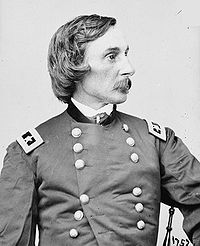
200px-GKWarren


Gouverneur Warren: A Complex Character

It is in this context that we examine Brigadier General Gouverneur Warren’s actions on Little Round Top on the afternoon and evening of July 2nd 1863, the controversy that embroiled his career and left him embittered and disillusioned at the end of the war; and even the possible explanations for what occurs to Warren during and after the war provided by modern medicine and psychological knowledge. We must do this because Warren is one of the most important people who step into history that day and because he is such a contradictory figure, to try to understand him and in doing so attempt to understand ourselves more fully.

At the time of the Battle of Gettysburg, Brigadier General Gouverneur Warren was serving as the Chief Topographical Engineer of the Army of the Potomac, a position that he had been appointed to by Joseph Hooker prior to Chancellorsville. At Chancellorsville Warren took command of the Pioneer brigade and “was responsible for the spectacular display of improvised field fortification during Hooker’s withdraw from Chancellorsville.” [1]

Unlike some of the other characters on Little Round Top that day, particularly Joshua Chamberlain, Warren does not engender myth; in fact some historians almost go out of their way to besmirch him, Joseph Whelan described Warren as “a fussy man who liked limericks, decidedly lacked gravitas.” [2] The description Warren being a “fussy man” who “lacked gravitas” is decidedly unfair for it immediately paints Warren in the mind of the reader as a man lacking in courage or fortitude and it distorts history. As I mentioned earlier when examining the evidence we have to carefully sift through it and not assume that any one characterization of a person is correct.

Whelan’s description of Warren is decidedly prejudicial. Warren was actually a complex and often contradictory figure as many military leaders throughout history have been. Though heroic, he did not look like a hero, and though an intensely proud man did not seek to bolster his image in the media, during or after the war.  Warren’s most recent biographer, David Jordan wrote that Warren was “prone to long sieges of depression, and he himself agreed that others found him to be morose and unsmiling. A complex and enigmatic man, Gouverneur Kemble Warren is not one to be easily categorized.” [3] His peers seemed to either admire or loathe him for he could be openly critical of others and had arrogance about him, which put some people off. Likewise Warren was often openly disdainful of those that he regarded as his inferiors, which at times included some of his superior officers, a trait that worked against him in the “hierarchical realm of military life.” [4]

Though Warren was considered the “savior of Little Round Top” in the years immediately following the war; his story faded. In part this was due to being relieved of command of Fifth Corps by Philip Sheridan at Five Forks, something that Chamberlain and many other officers and men of V Corps “considered an unjust act made cruel by his [Sheridan’s] refusal to reconsider it.”  [5] His story also faded because he resigned his commission as a Major General of Volunteers soon after the war, and returned to relative obscurity working as an Engineer officer along the Mississippi River.

After Warren’s untimely death at the age of fifty-three in 1882, three months before he exonerated by the Board of Inquiry, he was forgotten by many.  Likewise, the book he had prepared from his carefully arranged letters and reports was not published until 1932, forty years after his death.

Conversely, the story and myth of his friend and defender Joshua Chamberlain story grew throughout the late 1890s and early 1900s.  By then, Chamberlain, a superb writer and orator, alone of the men who made the stand at Little Round Top was still alive to tell his story, and this considerably shaped the history that we know.  The rise of the Chamberlain account is one reason why Warren is so often overlooked by many casual students and observers of the Battle of Gettysburg.

But to look at Warren’s actions is by no means to minimize the actions of others such as Colonel Strong Vincent, Colonel Joshua Lawrence Chamberlain, Brigadier General Stephen Weed, Colonel James Rice, or Colonel Patrick “Paddy” O’Rorke. All of these men played an instrumental part in the battle for Little Round Top, but only Warren, Chamberlain and Rice survived the battle, and Rice was killed in action at the Battle of Spotsylvania on May 10th 1864.

Ante-Bellum Staff Officers, Military Culture and an Expanding Army

For the purposes of this study it is important to note that Warren was not acting as a commander during the Battle of Gettysburg. Warren was, like most senior officers today, serving as a staff officer. Many times students of military history and theory are inclined to dismiss the contributions of staff officers because they do not have the overall responsibility of a battle, or the glamour of the limelight of the commanders that they serve under. However, for military professionals, especially those serving on senior staffs who prepare campaign plans, contingency plans and crisis plans the study of officers like Warren is essential.

The Federal Army at Gettysburg, like its Confederate opponent had a wide variety of officers serving in its ranks. Many of its senior officers were graduates of West Point. Many had served together in Mexico and in the various campaigns against Native American tribes. Those who stayed in the Army during the long “peace” between the Mexican War and the outbreak of the Civil War endured the monotony, boredom and often miserable conditions of isolated army posts, long family separations, as well as low pay, slow promotion and often low social status.[6] In light of such conditions, many resigned their commissions to undertake various professional, business or academic pursuits; in fact Samuel Huntington noted that in the years before the Civil War that “West Point produced more railroad presidents than generals.” [7] However, on the outbreak of the war, many of these graduates returned to service whether in the service of the Union, or the Confederate States.

When the war began the Army underwent a massive expansion, which it met through the call of up militia and by raising new volunteer units from the various states. In the expansion many officers were appointed who had no prior military service, or if they did it was performed years or even decades before the war. Some of these men were simply patriots who rallied to the flag, others due to a sense of righteousness about their cause, while others were political opportunists or appointees. In the north this was a particular problem as “professional officers were pushed aside and passed over in the Union, the higher commissions going, in the first stages of the war at least to officers called back into service or directly appointed from civilian life, many of them “political” appointees.” [8] At times the lack of experience, training and sometimes the poor character of some of the volunteers and political appointees was tragic.  However, many of these men in both Union and Confederate service performed as well or better than some of their regular army counterparts at various levels of command. Gettysburg would provide opportunity for the best and worst of all of these types of officers to succeed or fail. In this chapter we will look at how Warren succeeded remarkably at Little Round Top.


Explorer, Engineer and Instructor: The Preparation of a Staff Officer

As the Union mobilized a good number of Regular Army officers were allowed to assist the states in the formation and training of the new volunteer units. One of these officers was First Lieutenant Gouverneur Warren.

Warren was typical of the many professional officers of the old army. An 1850 graduate of West Point Warren was a bright student who had absorbed the teachings of his professor, Dennis Hart Mahan as the core of his own military thought, both in his senior year in college and through reinforcement as a faculty member. [9] Warren was commissioned as a Brevet Second Lieutenant and because of his high standing in his class was assigned to Corps of Topographical Engineers. He spent his first seven years in a number of assignments which took him throughout much of the country. Warren did not look the part of a hero. Short and willowy, he appeared no more substantial in body than a young boy, or as some remarked, a young woman; his uniforms tended to hang off him as if they were several sizes too big. [10]

Warren’s work involved exploring and mapping for various enterprises including the project to help tame the Mississippi River, and the exploration of the Great Plains and Black Hills where he developed a sympathy for the various Sioux tribes he encountered noting on completion of his mission in 1858, writing that He had never heard a Sioux chief express an opinion in regard to what was due them in which I do not concur and that many of them view the extinction of their race as an inevitable result of the operation of present causes, and do so with all the feelings of despair with which we should contemplate the extinction of our nationality. [11] Following his years in the west he returned as faculty to West Point where he as an Assistant Professor, shared mathematics instructional duties with Oliver O. Howard and resumed his relationship with his former professor Mahan. [12]

Commander of the Red Devils: The Peninsula, Gaines Mill and Second Manassas

On the outbreak of war Warren was granted leave from his duties at West Point to serve as Lieutenant Colonel of Volunteers in the 5th New York Infantry Regiment, also known as the Duryee Zouaves. When Abraham Duryee was appointed as a Brigadier General, Warren became the Colonel of the regiment.

He commanded the regiment during the Peninsula campaign where he was eventually given command of a provisional infantry brigade. At Gaines Mill, Warren’s regiment and brigade distinguished itself. Along George Sykes front no troops fought better than the small brigade of two volunteer regiments, the 5th and 10th New York, under Warren’s command. On the afternoon of the battle Warren led the 5th New York in a riveting counter attack.The Red Devils smashed into the 1st South Carolina Rifles and drive them back. The Zouaves were, declared a Regular, the peers of any troops on the hard fought field. Captain John W. Ames of the 11th United States told his parents that the counterattack of the New Yorkers haunted his sleep. Every night, he wrote home a week later, he saw a Zouave, with his arms around a comrade, who was fairly a dead man, walking with his friends support. Ames admitted, the horrors of sudden, accidental, bloody death are here so much augmented and multiplied. [13]

Warren described the action to his wife Nothing you ever saw in the pictures of battles excelled it. The artillery which had been firing stopped on both sides, and the whole armies were now spectators. In less than five minutes 140 of my men were killed or wounded and the other regiment completely destroyed. [14] Warren and his men received many accolades that day. George McClellan credited them with saving the Union left and said that Warren was everywhere conspicuous on the field, and not only directed the movement of his own brigade, which he handled with consummate skill, and placed in the most advantageous of positions, where they could produce the most effect on the enemy, but directed the movement of other regiments. [15] and during the action Warren suffered a slight wound from a spent bullet and had his horse shot out from under him.

Warren’s tiny provisional brigade composed of his 5th New York and the 10th New York was at Second Manassas where they had the bad fortune to be on the exposed Federal flank when Longstreet’s massive attack rolled over them. Warren and his brigade were left to protect the Fifth Corps artillery and trains when that corps was ordered by John Pope to attack Jackson’s corps, and John Reynolds’ division was ordered to withdraw leaving the Fifth Corps’ flank uncovered. On his own initiative Warren moved his brigade to protect the flank when Longstreet’s massive blow hit. Alone the two regiments, numbering about 1100 soldiers were overwhelmed in what one soldier called the very vortex of hell. [16] Robert E. Lee had drawn Pope into a trap and was poised to destroy his army. Longstreet’s corps led by Hood’s Texas brigade struck Warren’s troops and the 10th New York fell back as Warren and the 5th New York hung on long enough for artillery to limber up and withdraw, but they too were forced back with heavy losses. The 10th New York lost 133 killed and wounded, the 5th New York over 300 more. Warren wrote Braver men than those who fought and fell that daycould not be found. It was impossible to do more.  A member of Fifth Corps wrote that Warrens regiment and brigade, commanded by him, sustained heavier losses than any command on that disastrous field. [17] However, Warren’s gallantry was rewarded with promotion to Brigadier General effective September 26th 1862.

Though present at Antietam and Fredericksburg Warren’s brigade was not committed to either fight. However, Warren was in a position to see the disastrous attacks of Union troops against enemy troops in strong defensive positions. As an engineer Warren recognized the advantages that now were afforded to the defense with the advent of the rifled musket, something that would influence many of his decisions as well as his questioning of Meade, Grant and Sheridan for tactical decisions to attack in situations where he viewed such actions to be either unwise or suicidal. Warren was affected by what he had seen, both in the human cost of the war as well as the politics that had engulfed the army. He wrote his wife Emily on Christmas Day:

I today feel very desponding about our government and the management of affairs.I left my home without ambition to save a noble cause. I have seen that cause almost betrayed- I know of bleeding hearts, desolate homes, and unnumbered nameless graves of noble men who have vainly perished. There must be a just God[.] Why does he permit these things…”  [18]

Notes

[1] Hagerman, Edward. The American Civil War and the Origins of Modern Warfare, Midland Book Editions, Indiana University Press, Bloomington IN. 1992 p.96

[2] Whelan, Joseph Bloody Spring: Forty Days that Sealed the Confederacy’s Fate Da Capo Press, Boston 2014 p.65

[3] Jordan, David M. Happiness is Not My Companion: The Life of G.K. Warren Indiana University Press, Bloomington Indiana 2001 p.x

[4] Happiness is Not My Companion The Life of G.K. Warren p. x

[5] Wallace, Willard M. The Soul of the Lion: A Biography of Joshua L. Chamberlain Stan Clark Military Books, Gettysburg PA 1991 p.173

[6] Taylor, John M. Duty Faithfully Performed: Robert E Lee and His Critics Brassey’s, Dulles VA 1999 pp.37-38.

[7] Huntington, Samuel P. The Soldier and the State: The Theory and Politics of Civil-Military Relations The Belknap Press of Harvard University Press, Cambridge MA and London 1957 p.199

[8] Ibid. Huntington. The Soldier and the State: The Theory and Politics of Civil-Military Relations p.213

[9] Ibid. Jordan Happiness is Not My Companion The Life of G.K. Warren p.6

[10] LaFantasie, Glenn W. Twilight at Little Round Top: July 2, 1863 The Tide Turns at Gettysburg Vintage Books, a Division of Random House, New York 2005 p.73

[11] Ibid. Jordan Happiness is Not My Companion: The Life of G.K. Warren p.30

[12] Ibid. Jordan Happiness is Not My Companion: The Life of G.K. Warren p.33

[13] Wert, Jeffry D. The Sword of Lincoln: The Army of the Potomac Simon and Schuster New York 2005 p.104-105

[14] Ibid. Jordan Happiness is Not My Companion: The Life of G.K. Warren p.46

[15] Ibid. Jordan Happiness is Not My Companion: The Life of G.K. Warren p.46

[16] Ibid. Jordan Happiness Is Not My Companion: The Life of G.K. Warren p.56

[17] Ibid. Jordan Happiness is Not My Companion: The Life of G.K. Warren p.56

[18] Ibid. Jordan Happiness is Not My Companion: The Life of G.K. Warren p.64

Leave a comment

Filed under civil war, Gettysburg, History, leadership, Military

Tragic Heroes: Gouverneur Warren, Part One

Friends of Padre Steve’s World

I have been writing about leadership the past couple of days and despite all that is going on in the news I think that I will continue to do so using some parts of my Gettysburg text. I think it is incredibly important to get to know the men and women behind iconic pictures, statues, and biographies that are often not much more than hagiography. In my studies I have encountered people who I find fascinating and not just because of their achievements but also due to their suffering. One of my seminary professors said that you could never come to grips with Jesus until you came to understand suffering.

That is important especially when we deal with men and women who have been traumatized on the battlefield, who when they return from war they come home changed. Many are great leaders and outstanding people whose courage was proven but their lives after the war can only be considered tragic. One of these is Gouverneur Warren, one of the heroes of the Union in the Civil War, and who was instrumental in stopping the Confederate forces at Gettysburg 0n July 2nd 1863. I have written about him before, but I think now is an appropriate time to revisit his life as well as some other men who fought alongside him at Gettysburg.

Have a great day,

Peace

Padre Steve+

Warren

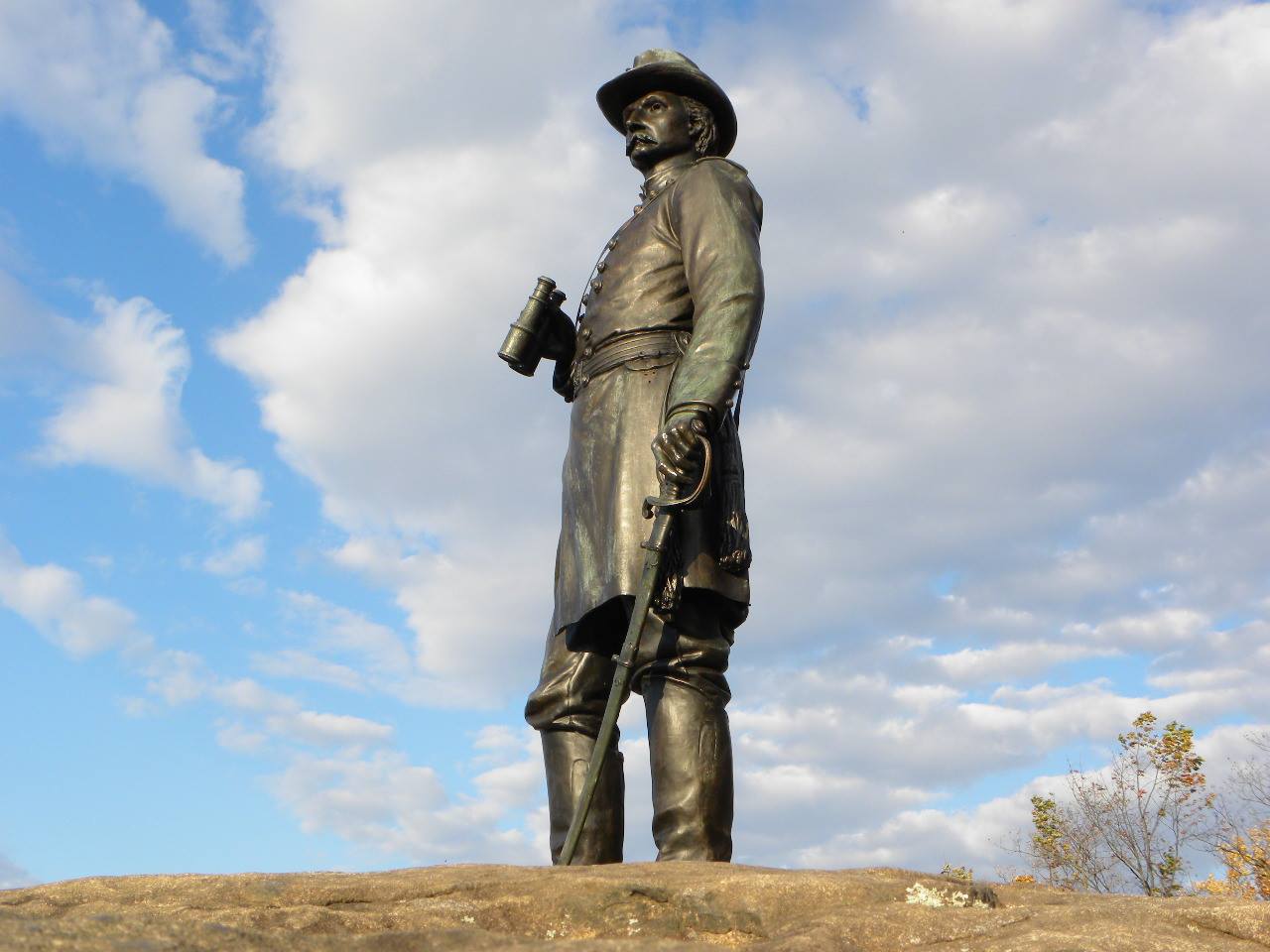
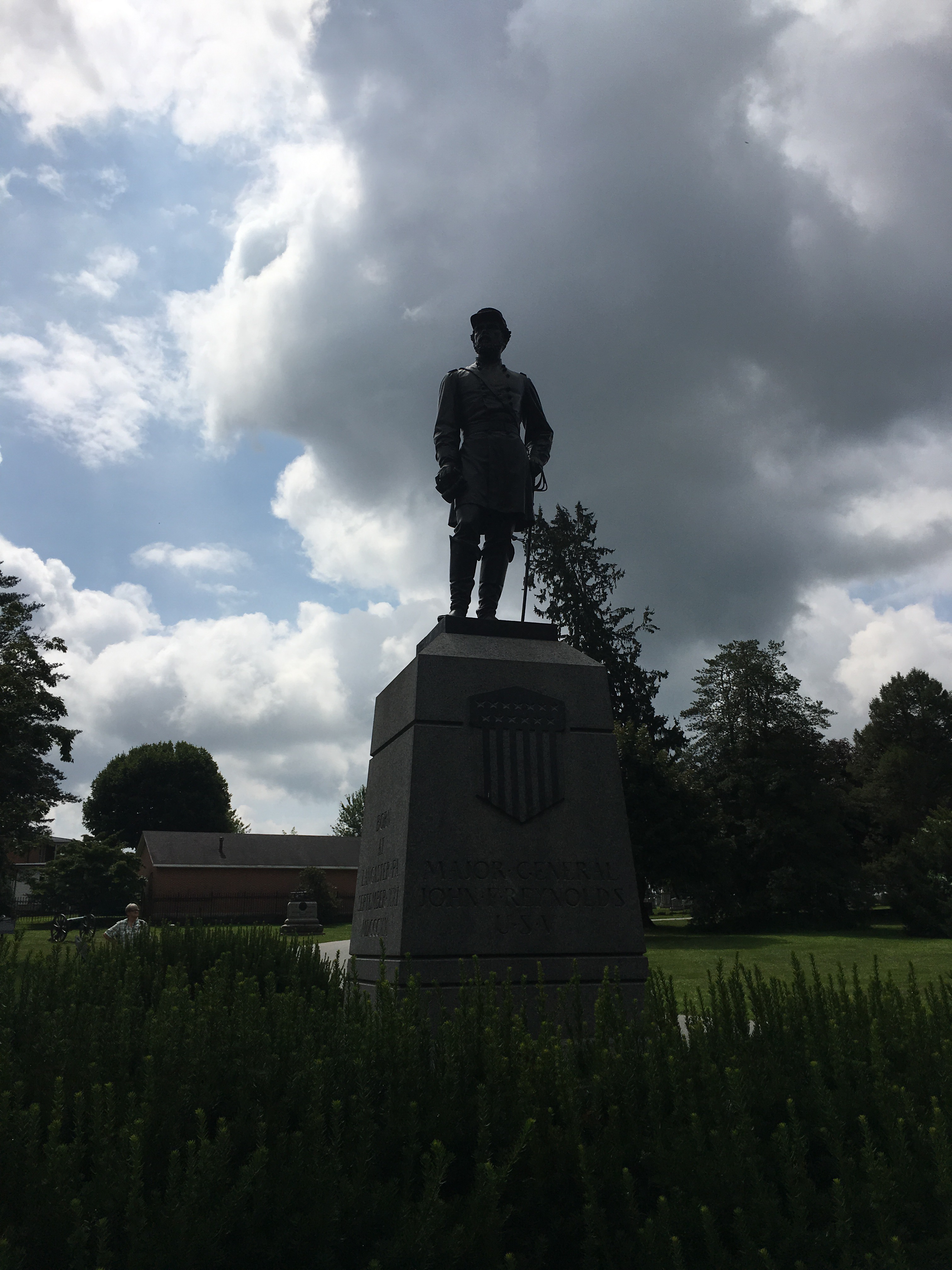
The Statue of Gouverneur Warren on Little Round Top


History, Memory and Myth at Little Round Top 

The battle of Gettysburg is an iconic part of American history. The accounts of Buford’s delaying action and John Reynolds death on July 1st, the savage battle at the Wheat Field, the Peach Orchard and Plum Run on July 2nd and the great charge known as Pickett’s Charge on July 3rd 1863 all draw us to the battlefield. The stories of individual courage and the sacrifice of soldiers from the North and the South that are enshrined on the monuments that now populate the battlefield have a nearly religious quality that draws Americans to Gettysburg by the hundreds of thousands every year.

But there are some places on the battlefield that seem to be the most iconic, the most spiritual, and the most inspirational for various reasons. Two of these places in particular have a nearly magnetic attraction, the “High Water Mark” of the Confederacy on Cemetery Ridge where Pickett’s Charge met its end, and the rocky hill known as Little Round Top. A large part of the reason that these two places hold such an attraction is not just the way that the battle was fought.  Rather, it is often because of the way the stories of those actions and the stories of the men who fought at them have been passed down to us in the accounts of survivors, in history and even in the fictional accounts of the battle. In each of these stories there are elements of courage, devotion, sacrifice, and tragedy that touch us in deeply personal ways and connect us to them and what we see when we experience history tells us as much about us as it does them.

The story of the Battle for Little Round Top has been passed along to us in the many accounts and histories of the battle, but perhaps more importantly in literature and cinema through Michael Shaara’s Pulitzer Prize winning novel, The Killer Angels and that book’s film adaptation, Gettysburg.  Many people who have never read an actual history of the battle know about the Battle for Little Round Top from Jeff Daniels’ inspirational portrayal of Joshua Lawrence Chamberlain in the movie.

The mythic status that we accord Gettysburg is important to Americans as a people. It is a defining moment in our American story and that is why so many of us come to the battlefield. It is a part of who and what we are as a people. Chamberlain said this well a quarter century after the battle at the dedication of the Maine Monuments in 1888:

“In great deeds, something abides. On great fields, something stays. Forms change and pass; bodies disappear; but spirits linger, to consecrate ground for the vision-place of souls… generations that know us not and that we know not of, heart-drawn to see where and by whom great things were suffered and done for them, shall come to this deathless field, to ponder and dream; and lo! the shadow of a mighty presence shall wrap them in its bosom, and the power of the vision pass into their souls.” [1]

While the accounts in the novel and the film are certainly inspiring and allow us to experience the emotion and near spiritual sense of what Chamberlain writes about the battle, there is much more to learn. When we go beyond the mythic portrayal of the battle we find that despite the vast amount of information available that there are a large number of approximations and ambiguities in the accounts of the battle.  So as we endeavor to look at the actions of these leaders on that fateful day it is important to recognize that it is impossible for us to totally separate the actions of the men that helped decide the battle from the mythos that surrounds the story. [2] Likewise, it is important for us to acknowledge, that we cannot completely separate the character of these men and how they lived their lives from their actions on this particular battlefield and afterwards.

That understanding is important if we want to be able to interpret these men and their actions; actions that are recorded in their journals, after action reports, unit histories, individual diaries and letters, as well as the accounts of their contemporaries who served alongside them; accounts which for many reasons are not completely reliable.

As important as these accounts are for us in attempting to sort out the truth of the matter we must apply a hermeneutic of suspicion to them and we must interpret them. [3]  We have to do this because all historical accounts are influenced by the writer’s motivations, ideology or perspective. There are some authors who omit damning or damaging information, especially about their own actions, or the actions of those leaders that they wish to protect, and the writers that “spin” the event in order to build up or destroy the reputations of those present. Even those writers of the contemporary accounts of the battle who wrote their accounts with the best motivations and intentions to record the events as best as they could describe them were often prone to mistakes, even in details such as the time an event took place. The location of people during the event was limited by their physical position on the battlefield and what they could see amid the bullets and bombshells that created carnage around their point of observation. Those not present at the battle, the men who recorded their accounts based on the recollections of those present are similarly limited.

There is also another factor to consider in dealing with these accounts, especially when untrained observers make observations of the actions and behavior of others which seem strange or erratic to them. This is especially true of men who are writing about men who have experienced the horrors of war and combat which might have resulted in some sort of combat stress injury such as PTSD, brain injuries such as TBI or a concussive syndrome or experience which is now called Moral Injury. Thus when we examine the behavior of such leaders and see a marked change in the way that they deal with others after their experience of war, those conditions, unknown to their contemporaries must be considered as a possibility when evaluating their actions.

The problem for the historian or for that matter the writer of military doctrine is how to interpret the information that they have available to them to make it relevant and useful in the art that they practice.  This can be a daunting task with many associated pitfalls that is neither an inductive, nor a deductive process. David Hackett Fischer writes:

“The logic of historical thought is not a formal logic of deductive inference. It is not a symmetrical structure of Aristotelian syllogisms, or Ramean dialectics, or Boolean equations….Instead it is a process of adductive reasoning in the simple sense of adducing answers to specific questions, so that a specific “fit” is obtained. The answers may be general or particular, as circumstances may require. History is, in a sense a problem-solving discipline. A historian is someone (anyone) who asks an open ended question about past events and answers it with selected facts which are arranged in the form of an explanatory paradigm.” [4]

All this is important because it reminds us, that when we study these accounts and attempt to use them as a basis for leadership theories, operation art and strategy, or for any other reason, that all that we know to be “true” is a combination of fact, myth and spin. Our task is to do the best we can with that in mind while admitting that we all have our own prejudices, agendas and ideas that color the glasses by which we interpret the event and the actions of the people involved.

In a sense when we look at the records of the people present or their contemporaries we must entertain a fair amount of suspicion and be able to ask questions as if the writers were talking or writing to us presently. We must ask three questions to do this: Why are they telling this fact or story? Why are they telling it to me? Why are they telling it now? Or more succinctly put “Why this? Why me? Why now?”

Notes

[1] Chamberlain, Joshua Lawrence. Chamberlain’s Address at the dedication of the Maine Monuments at Gettysburg, October 3rd 1888 retrieved from http://www.joshualawrencechamberlain.com/maineatgettysburg.php 4 June 2014

[2] Note: My use of the terms myth, mythology or mythos should not be considered negative, and the use of the terms does not mean that there is not some degree of fact or truth in them. The definitions of the term mythos are important to understanding my use of the term here, first it denotes a traditional or recurrent narrative theme or plot structure of a story, and secondly a set of beliefs or assumptions about something. (See the Oxford American Dictionary.)

[3] I mention the term a hermeneutic of suspicion. Hermeneutics is the theory of understanding and interpreting language and non-linguistic expression. The Stanford Encyclopedia of Philosophy defines it this way: “The term hermeneutics covers both the first order art and the second order theory of understanding and interpretation of linguistic and non-linguistic expressions. As a theory of interpretation, the hermeneutic tradition stretches all the way back to ancient Greek philosophy. In the course of the Middle Ages and the Renaissance, hermeneutics emerges as a crucial branch of Biblical studies. Later on, it comes to include the study of ancient and classic cultures.” 

[4] Fischer, David Hackett Historians’ Fallacies: Toward a Logic of Historical Thought Harper and Row, New York 1970 p.xv  

Leave a comment

Filed under civil war, Gettysburg, History, leadership, mental health, Military, PTSD

The Rollback and the Response: Jim Crow to Civil Rights

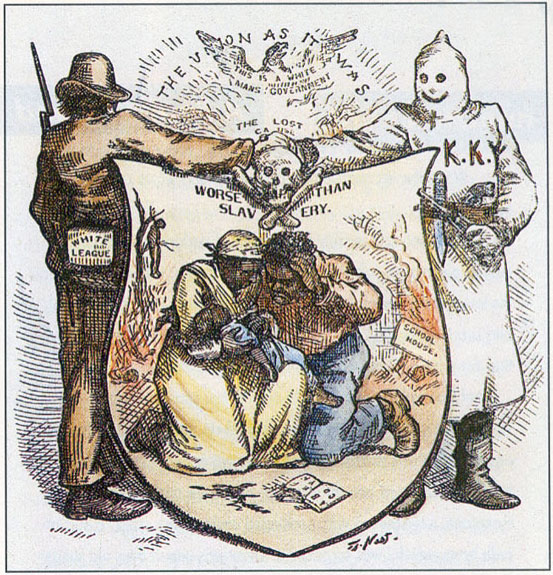
KKK-Nast

Friends of Padre Steve’s World,

Today I have a revised section of my Cicil War text “A Great War in an Age of Revolutionary Change.” I have being doing some final touches on it before I start working on final edits before seeking a publisher. I think it is important and timely in a day when state legislatures throughout the “Old South” are passing laws that seek to restrict voting rights against minorities and the elderly in order to diminish their political power, or to pass legislation designed to discriminate against LGBTQ people based solely on religious dogma. 

In such a world it is important to remember what happened to African Americans after Southern Whites reclaimed power following the collapse of Reconstruction.

Have a great day.

Peace

Padre Steve+

The Supreme Court, Congress, the Presidents as well as state governments systematically rolled back the rights of African Americans after Reconstruction ended. The Courts were the first to do this and once they had set the precedent were followed by the now Democrat controlled Congress and President Grover Cleveland. In 1883 “the Civil Rights Act of 1875, outlawing discrimination against Negroes using public facilities, was nullified by the Supreme Court, which said: “individual invasion of individual rights is not the subject-matter of the amendment.” The Fourteenth Amendment, it said, was aimed at state action only. No state shall…” [1] Associate Justice Joseph Bradley who had so eviscerated the Enforcement Act again played his hand in overturning a law that he despised on principle. He had written when Grant first signed the act in 1875 “to deprive white people of the right of choosing their own company would be to introduce another kind of slavery…. It can never be endured that the white shall be compelled to lodge and eat and sit with the Negro. The latter can have his freedom and all legal and essential privileges without that. The antipathy of race cannot be crushed and annihilated by legal enactment.” [2] In writing to overturn the Civil Rights Act of 1875 Bradley wrote that such laws were made African Americans a “special favorite of laws” and ignored the fact that in most of the country blacks were indeed not a favorite and were in fact still the subject of discrimination, segregation, political disenfranchisement, systematized violence, murder and lynching.

The actions of the court and alliances between Northern corporations and Southern landowners led to even more discrimination and disenfranchisement for blacks, “From the 1880s onward, the post-Reconstruction white governments grew unwilling to rely just on intimidation at the ballot box and themselves in power, and turned instead to systematic legal disenfranchisement” [3] which furthered the black codes into what we now call the era of Jim Crow.

For years after the Supreme Court’s Cruikshank decision blacks throughout the South attempted to vote despite intense opposition from Southern whites and armed bands of thugs. But with White Democrats now in charge of local government and “in control of the state and local vote-counting apparatus, resistance to black voting increasingly took the form of fraud as well as overt violence and intimidation. Men of color who cast Republican votes often found later that they had been counted for the party of white supremacy.” [4]

In 1896 the Supreme Court in the case of Plessy v. Ferguson upheld the black codes and Jim Crow laws. That ruling established the “separate but equal” doctrine and ushered in an era of de jure segregation in almost all arenas of life including education, transportation, entertainment and health care. The limited social equity and privileges enjoyed by blacks, not only in the South, but in the entire nation were erased by the stroke of the judicial pen. The justices ruled on the concept that the Constitution only guaranteed or protected a people’s political rights in the social arena that African-Americans could not interact with whites and assumed their racial inferiority.

Not all on the Court agreed with these rulings. One of them was Associate Justice John Harlan, who was a former slaveholder. Harlan dissented in the Court’s majority decision to overturn the Civil Rights Act of 1875 and also in Plessy v. Ferguson. In the case of the Civil Rights Act ruling Harlan insisted “our Constitution is color blind” [5] and wrote a strongly worded opinion:

“The destinies of two races, in this country are indissolubly linked together, and the interests of both require that the common government of all should not permit the seeds of race hate to be planted under the sanction of law. What can more certainly arouse race hate, what more certainly create and perpetuate a feeling of distrust between these races, than state enactments, which, in fact, proceed on the ground that colored citizens are so inferior and degraded that they cannot be allowed to sit in public coaches occupied by white citizens? That, as all will admit, is the real meaning of such legislation as was enacted in Louisiana.” [6]

As eloquent and as correct as Justice Harlan’s argument was, it was not sufficient to turn the tide of the new Court backed segregation laws. Harlan “was fighting a force greater than the logic of justice; the mood of the Court reflected a new coalition of northern industrialists and southern businessmen-planters.” [7] The “separate but equal” measures approved by the Court majority in Plessy v. Ferguson led to the widespread passage of Jim Crow laws, not only in the South but in other areas of the country. The Jim Crow era took nearly a century to reverse, and “only began to disappear with Brown v. Board of Education in 1954 and the Civil Rights and Voting Rights Acts of 1964 and 1965.” [8]

In order to get around the Fifteenth Amendment state governments in the South employed a strategy of subterfuges to suppress the African American vote. Along with the ever present threats of voter intimidation from armed White Supremacist groups, the states complicated the processes of voter registration and voting in order to make it nearly impossible for blacks to vote and into political oblivion. “Redeemer” governments in the post-Reconstruction South through the use of literary tests and poll taxes, the later which required people to pay in order to vote. The literacy and educational requirements mandated that “perspective registrants to “interpret” a section of the state constitution, and enacted standards which few blacks could fulfill, such as limiting registration to those whose grandfathers had voted.” Of course few blacks could meet the latter requirement as their grandfathers had been slaves and ineligible to vote. The laws were so devious that “when a journalist asked an Alabama lawmaker could pass his state’s understanding” test, the legislator replied, That would depend on entirely on which way he was going to vote.” [9]

These court decisions and legislation strengthened racism and discrimination against blacks, “effectively excluding blacks from public places, from the right to votes, from good public education, and so forth.” [10] The Plessy ruling was a watershed. Southern legislators, now unencumbered by Federal interference passed “state laws mandating racial segregation in every aspect of life, from schools to hospitals, waiting rooms to toilets, drinking fountains to cemeteries…segregation was part of a complex system of white domination, in which each component – disenfranchisement, unequal economic status, inferior education – reinforced the others.” [11]

For decades future courts would cite Plessy and Cruikshank as well as other decisions as precedent in deny rights to blacks. It would not be until 1954 when the Supreme Court overturned Plessy and the “Separate but Equal” Jim Crow laws in Brown v. Board of Education. Brown was a watershed for it deemed that separate schools were “inherently unequal.” The reaction across the South, especially Mississippi was stunned shock, disbelief and anger. “A Mississippi judge bemoaned “black Monday” and across the South “Citizen’s Councils” sprung up to fight the ruling. [12]

Mississippi led the way in disenfranchising black voters through the use of voter qualifications that would eliminate most blacks from the rolls of voters. In 1895 the state legislature passed a measure that would “technically apply to everybody but actually eliminate the Negro without touching the white.” [13] The move was in open defiance of the Fifteenth Amendment and resulted in tens of thousands of black voters being dropped from the rolls, in most cases under 5% of black voters who had been eligible to vote in 1885 remained eligible in 1896. Mississippi was rewarded in 1898 when the Supreme Court in Williams v. Mississippi that “there was no reason to suppose that the state’s new voting qualification were aimed specifically at Negroes.” [14] “In 1900 blacks comprised 62 percent of Mississippi, the highest percentage in the nation. Yet the state had not one black elected official.” [15]

Violence was used with great effect and between 1880 and 1968 approximately 3,500 people were murdered or lynched throughout the South. In 1892 alone 235 blacks were lynched “and throughout the decade, whites lynched an average of 150 southern blacks per year.” [16] This had become a far easier task and far less dangerous for the perpetrators of violence against blacks as Supreme Court “interpreted black people’s other constitutional rights almost out of existence.” [17] Since the court had “limited the federal government’s role in punishing violations of Negro rights” this duty fell to the states, which seldom occurred, and when “those officials refused to act, blacks were left unprotected.” [18]

The effects of these actions were shown in the number of African Americans in elected office. In 1869 there were two African American United States Senators and twenty black members of the House of Representatives. After Reconstruction ended these numbers dwindled and “the last black left Congress in 1901.” [19]

One of these was the case of United States v. Harris where the federal prosecutors had indicted “twenty members of a Tennessee lynch mob for violating section two of the enforcement Act, which outlawed conspiracies to deprive anyone of “equal protection of the laws.” However the Court struck down section 2 because the “lynching was not a federal matter, the Court said, because the mob consisted only of private individuals.” [20]

Many Southern states, especially Mississippi continued to tighten Jim Crow throughout the first half of the twentieth century. “In 1922 a new Jim Crow law kept up with the times by segregating taxis. In 1930 another new law prohibited “publishing, printing, or circulating any literature in favor of or urging inter-racial marriage or social equality.” [21] Not only were physical barriers being erected, but thought and free speech was now illegal if one supported equal rights.

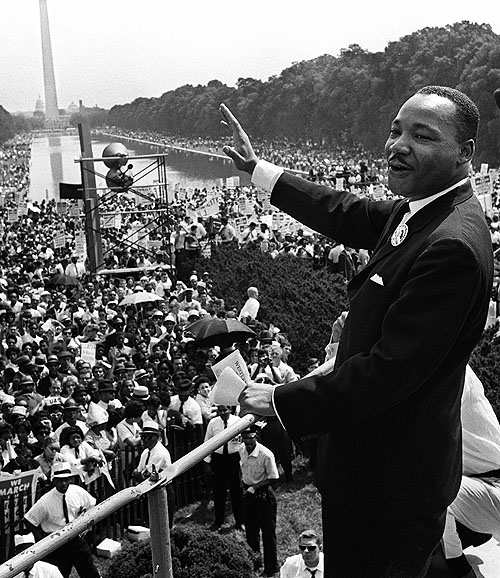
martin-luther-king-jr

This remained the case until the 1960s when during the Freedom Rides when Mississippi again became a battleground in the Civil Rights movement. In 1961 James Meredith, a veteran of the U.S. Air Force, became the first black to ever be admitted to the University of Mississippi. His admission was fought by the university, Mississippi politicians including U.S. Senator James Eastland, Governor Ross Barnett, numerous congressmen and state representatives, and a populace that threatened violence and even war if the Federal government or courts order them to comply. Governor Barnett spoke for many when he made a statewide television address in September 1961 “We must either submit to the unlawful dictates of the federal government or stand up like men and tell them ‘NEVER!’” [22] He then called for the arrest of any federal officials who attempted to hold a state official for defying federal court orders. Backed by federal court orders to admit Meredith, and by the Brown v. Board of Education ruling, Attorney General Robert F. Kennedy called Barnett on September 24th.

“Governor,” Kennedy observed, “you a part of the United States.”

            “We have been a part of the United States, but I don’t know whether we are or not.”

            Are you getting out of the Union?”

            “It looks like we are being kicked around – like we don’t belong to it.”

            Back to specifics again, Kennedy ended the talk with a typical crisp wrap-up. “My job is to enforce the laws of the United States.” [23]

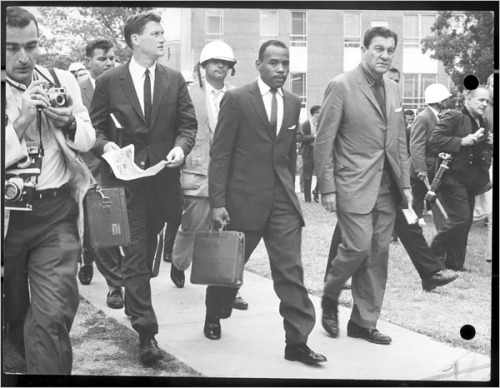
The resultant conflict nearly came to violence as thousands of Mississippians, whipped into an anti-black and anti-federal government frenzy by their elected leaders, radio, and television and newspaper commentators and supported by the KKK, the John Birch Society and other groups mobilized to fight the “invasion.” Eventually a deal was reached to admit Meredith on September 30th. As Meredith entered the campus he was protected by Federal Marshals and Border Patrol officers, as well as the State Police, which had just a few hours before been deployed to keep Meredith and the federals out. Despite this thousands of people ringed the campus, and the Confederate Battle Flag was raised over the Civil War memorial on campus. The rioters uttered death threats and assaulted anyone who supported Meredith. Members of the press, even southerners, faculty members and civilian supporters were beaten, bricks, stones and bottles thrown, tires of federal vehicles slashed. Finally the marshals themselves were attacked and eight injured, forcing them to deploy tear gas to protect themselves and the State police withdrew.

tumblr_ly9o466dxz1r4tvc5o1_500

James Meredith being escorted to Ole Miss

Eventually U.S. Army MPs and mobilized National Guard units were called up and battled Molotov cocktails that were being thrown by the anti-integration protests to relieve the beleaguered marshals and border patrolmen. The troops finally cleared the campus and ended the riot. During the riot 160 marshals were hurt, some 28 of who were wounded by bullets fired by the protestors. The next morning with Meredith admitted to the university a local clergyman saw the Confederate flag still flying and “with firm step, he strode out to the pole, loosened the halyard and lowered the Confederate flag.” [24]

The battle to integrate Ole’ Miss was over. Meredith graduated peacefully in August of 1963 and by then Mississippi abandoned its defiance of Federal authority, but many in the state still protested the admission as well as the later passage of the Civil Rights and Voting Rights Acts. Violence still occurred and even intensified at times as the Civil Rights movement, now led by Dr. Martin Luther King Junior made headway. King wrote in the Letter from a Birmingham Jail:

“One day the South will recognize its real heroes. They will be the James Merediths, with the noble sense of purpose that enables them to face jeering and hostile mobs, and with the agonizing loneliness that characterizes the life of the pioneer. They will be old, oppressed, battered Negro women, symbolized in a seventy two year old woman in Montgomery, Alabama, who rose up with a sense of dignity and with her people decided not to ride segregated buses, and who responded with ungrammatical profundity to one who inquired about her weariness: “My feets is tired, but my soul is at rest.” They will be the young high school and college students, the young ministers of the gospel and a host of their elders, courageously and nonviolently sitting in at lunch counters and willingly going to jail for conscience’ sake. One day the South will know that when these disinherited children of God sat down at lunch counters, they were in reality standing up for what is best in the American dream and for the most sacred values in our Judaeo Christian heritage, thereby bringing our nation back to those great wells of democracy which were dug deep by the founding fathers in their formulation of the Constitution and the Declaration of Independence.” [25]

In South Carolina, which had fought integration in the courts outgoing Governor Ernest F. Hollings read King’s letter and knew that he had been on the wrong side of history. The Democrat Governor realized that the handwriting was on the wall, and that South Carolina was different than Mississippi. Hollings knew that South Carolina’s racism was the old aristocratic type, which gave more value to an orderly society. As such Hollings told the legislature:

“As we meet, South Carolina is running out of courts. If and when every legal remedy has been exhausted, the General Assembly must make clear South Carolina’s choice, a government of laws rather than a government of men. As determined as we are, we of today must realize the lesson of once hundred years ago, and move on for the good of South Carolina and our United States. This should be done with dignity. It must be done with law and order.” [26] When Clemson University admitted its first student later in the year, there was no violence.

Hollings later remembered that for years he had supported and enforced the Jim Crow laws in his state. However, King’s Letter from a Birmingham Jail changed him, it was for him a moment like the Apostle Paul on the Road to Damascus. He admitted, “as governor, for four years, I enforced those Jim Crow laws. I did not understand, I did not appreciate what King had in mind… until he wrote that letter. He opened my eyes and set me free.” [27]

More violence would occur in Mississippi and other states during the 1960s. During the Freedom Rides, students and educators came from around the nation to the state to help register blacks to vote in 1964. This brought generations of barely concealed hatred to the surface. Bruce Watson in his book Freedom Summer wrote:

“In Mississippi’s most remote hamlets, small “klaverns” of ruthless men met in secret to discuss the “nigger-communist invasion of Mississippi.” They stockpiled kerosene, shotguns, and dynamite, then singled out targets – niggers, Jews, “nigger-lovers.” One warm April night, their secret burst into flames. In some sixty counties, blazing crosses lit up courthouse lawns, town squares, and open fields. The Klan was rising again in Mississippi. Like “White Knights” as their splinter group was named, the Klan planned a holy war against the “dedicated agents of Satan…determined to destroy Christian civilization.” The Klan would take care of your business, a recruiting poster said. “Get you Bible out and PRAY! You will hear from us.” [28]

Eventual the violence of these people led to the killings of three of the organizers, Michael Schwerner, James Cheney and Andrew Goldman were killed by a group of Klansmen led by members of the Neshoba County Sheriff’s Department on June 21st 1964. The resultant search for their bodies and the subsequent investigation transfixed the nation and led to the passage of the Civil Rights and Voting Rights Acts of 1964 and 1965.

After he left office, Ulysses Grant gave an interviewer a sober assessment of Reconstruction’s failure. Grant concluded that at the end of the war what the South really needed was a benevolent dictatorship until it could be fully reintegrated into the Union. Instead the South remained defiant and using subterfuge mixed with targeted violence wore down the will northerners to fully pursue and implement Reconstruction. He told the interviewer:

“Military rule would have been just to all… the Negro who wanted freedom, the white man who wanted protection, the Northern man who wanted Union. As state after state showed a willingness to come into the Union, not on their terms but upon ours, I would have admitted them. The trouble about the military rule in the South was that our people did not like it. It was not in accordance with our institutions. I am clear now that it would have been better to suffrage, reconstruction, State governments, for ten year, and held the South in a territorial condition. But we made our scheme, and we must do what we must with it.” [29]

Grant was correct in his analysis. The policies enacted by the North in 1865 that were considered benevolent were seized upon as signs of weakness in the defeated South. The leaders of the South knew that the Republican Party was a coalition and worked to push the fault lines of the Republicans until they broke, and they were successful. The Confederacy may have lost the war in a military and economic sense, but in the “ways that mattered most to white Southerners – socially, politically, and ideologically – the South itself did not.” [30] Grant died in 1885 hailed throughout the nation, but knowing that he was unable to secure the new birth of freedom, that he and his friend Abraham Lincoln and so many others had fought for in the Civil War.

The example of Reconstruction’s failure shows that in order to secure peace that military victory must be accompanied by the political will to ensure that the avowed goals of that victory are secured after the war in ensuring a just peace. In retrospect, a harsh peace and a long period of nation building may have benefited the nation more than botched reconstruction, but as Grant noted “our people did not like it.”

Southerners may have lost the shooting war, but they could not and would not accept the peace. By successfully wearing down the will of the people of the North and exploiting the fissures in varying components of the Republican Party, they succeeded in winning the things most important to them in regard to race relations and White Supremacy.

After the war, White Southerners resorted to all means to reverse their military defeat through political, social, economic and judicial means and “justice was sacrificed for the unjust peace ushered in by “redemption” of the South, a peace marred by Jim Crow, poverty and lynching.” [31] Most Northern leaders, politicians, the media and the clergy failed to appreciate this until it was far too late, and hindered by President Johnson’s opposition failed to win the peace in the South when they had the best chance. They failed to appreciate that even after the shooting is often that “there is a need for further threats, and indeed action, because postwar disorder and even chaos will have to be address, and victorious allies are always likely to squabble over the spoils of victory” [32] as certain was the case in the divided Republican Party of the Reconstruction era. By the time Ulysses S. Grant was elected President many in the North were already tiring of Reconstruction and African Americans and when he resorted to harsh yet effective means of quelling violence and enforcing the laws many, even in his own Republican Party rebelled, ensuring the former Confederates of a political and social victory that took nearly another hundred years to end, if indeed it is truly ended, a proposition that I think is ludicrous as for many the Civil War is not over.

Notes

[1] Ibid. Zinn The Other Civil War p.57

[2] Ibid. Lane The day Freedom Died p.253

[3] Ibid. Guelzo Fateful Lightening p.526

[4] Ibid. Lane The day Freedom Died p.251

[5] Ibid. Zinn The Other Civil War p.58

[6] LaMorte, Michael W. School Law: Cases and Concepts 9th Edition 2008 Allyn and Bacon Inc. 2008 p.300

[7] Ibid. Zinn A People’s History of the United States pp.204-205

[8] Ibid. Huntington Who are We? p.54

[9] Ibid. Goldfield Still Fighting the Civil War: The American South and Southern History p.197

[10] Gonzalez, Justo L. The History of Christianity Volume 2: The Reformation to the Present Day Harper and Row Publishers San Francisco 1985 p.252

[11] Ibid. Foner Forever Free p.208

[12] Ibid. Watson Freedom Summer p.46

[13] Ibid. Lord The Past that Wouldn’t Die p.22

[14] Ibid. Lord The Past that Wouldn’t Die p.23

[15] Ibid. Watson Freedom Summer p.41

[16] Ibid. Goldfield Still Fighting the Civil War: The American South and Southern History, Updated Edition, p.206

[17] Ibid. Lane The day Freedom Died p.253

[18] Ibid. Langguth After Lincoln p.338

[19] Ibid. Zinn A People’s History of the United States p.200

[20] Ibid. Lane The day Freedom Died p.253

[21] Ibid. Lord The Past that Wouldn’t Die p.25

[22] Ibid. Lord The Past that Wouldn’t Die p.139

[23] Ibid. Lord The Past that Wouldn’t Die p.159

[24] Ibid. Lord The Past that Wouldn’t Die p.231

[25] King, Martin Luther Letter from a Birmingham Jail 16 April 1963 Retrieved from https://www.africa.upenn.edu/Articles_Gen/Letter_Birmingham.html 15 September 2016

[26] Bass, Jack and Nelson, Jack The Orangeburg Massacre Mercer University Press, Macon and Atlanta 1984, 1996 & 2002 pp.11-12

[27] Ibid. Goldfield Still Fighting the Civil War: The American South and Southern History, Updated Edition, p.74

[28] Ibid. Watson Freedom Summer p.12

[29] Ibid. Lane The day Freedom Died p.254

[30] Ibid. Lane The day Freedom Died p.254

[31] Ibid. McPherson The War that Forged a Nation p. 191

[32] Ibid. Gray Fighting Talk p.14

2 Comments

Filed under civil rights, civil war, History, Political Commentary

Blacks in the U.S. Navy: 1798-1917

Friends of Padre Steve’s World

I’m back with something fresh, a short article from my text A Great War in a Revolutionary Age of Change. As I was looking at the text I realized that there were some major gaps to fill in regarding the service of African Americans in the military. So over the past couple of weeks I have been working on covering those gaps in order to smooth out the text and show how the social and political changes that began during the Civil War continued to work their way through our history to the present day. This section is about the African American experience in the U.S. Navy from 1798 until World War One.

There will be more so enjoy and have a great day,

Peace

Padre Steve+

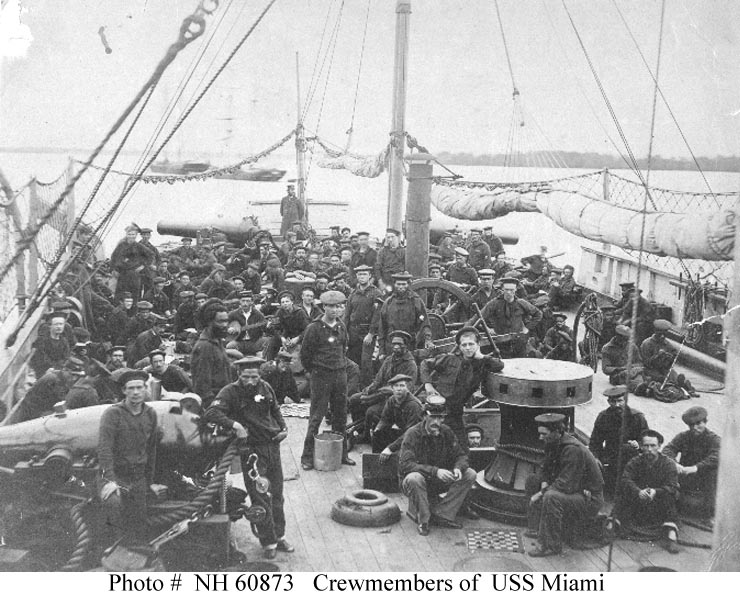
uss-miami-crew

Unlike the Army, African Americans had served aboard United States Naval vessels since the Revolution, and were an important part of ship’s crews all through the age of sail and the Civil War. In 1798, Secretary of the Navy Benjamin Stoddert, a slaveholder “barred “Negroes or Mulattoes” from serving in the new navy, and the Marine Corps did the same. Given the need to fill out their crews, however, captains often took free blacks as crew members. Both free blacks and slaves had served in the Continental Navy, the state navies, and privateers during the revolution, but that precedent had been forgotten.” [1] Even so, the Navy would continue to recruit free African Americans and they would make up a significant percentage of the crews of U.S. Navy ships, part of the reason that since the earliest times in the colonies, free blacks had taken up a seafaring way of life serving on merchantmen or in the Royal Navy. Likewise, “life at sea during the eighteenth century was difficult and dangerous. Therefore navies were forced to enlist practically anyone who was willing to serve.” [2]

During the War of 1812 free blacks comprised between ten and twenty percent of the crews of U.S. Navy ships. Captains like Oliver Hazard Perry who initial complained about having blacks on his ships became believers in their ability. At the Battle of Lake Erie “blacks constituted one-fourth of his 400 man force aboard the 10-vessel fleet.” He was so impressed by their performance under fire that he wrote the Secretary of the Navy “praising their fearlessness in the face of excessive danger.” [3] During the war, the Secretary of the Navy lifted Stoddert’s ban on blacks serving and free blacks responded by joining in increasing numbers.

Unlike the Army, the Navy became a place for free blacks to find a place to serve their country, and when the Civil War erupted these men continued to serve, and they would continue to serve throughout the war, and the Union Navy enlisted a proportionally higher number of its personnel from free blacks, nearly seventeen percent than did the Army, a force of approximately 30,000 sailors. Navy officers like David Dixon Porter praised them. He recruited them for his Mississippi Squadron as “coal heavers, firemen, and even gun crews.” He wrote “They do first rate work, and are far better behaved than their masters,” he declared. “What injustice to these poor people, to say they are only fit for slaves. They are far better than the white people here, who I look upon as brutes.” [4]

In 1862 the Union Navy was facing a manpower shortage the Federal and state governments discouraged whites from serving in the Navy due to the vast manpower needs of the Army. The government did not provide “bounties for those who joined nor counting them in local recruiting quotas.” [5] When confronted with the thousands of escaped slaves, or “contrabands” Secretary of the Navy Gideon Welles authorized their enlistment, and they were treated comparatively well. There were no segregated quarters due to the cramped conditions of shipboard life and as a result the men messed and were quartered in common spaces. Black sailors had complete control of their pay and had the same privileges as their white shipmates.

Most Naval officers had never been abolitionists before the war, and some had been defenders of slavery before the war, but their wartime experiences converted them to the abolitionist cause. Samuel Francis Du Pont wrote “I have never been an abolitionist… on the contrary most of my life a sturdy conservative on the vexed question.” He explained that he had “defended it all over the world, argued for it for it as patriarchal in its tendencies,” he admitted in 1861.“Oh my! What a delusion…. The degradation, the overwork, and ill treatment of the slaves in the cotton states is great than I deemed possible, while the capacity of the Negro for improvement is higher than I believed.” He noted that no officer in his squadron had voted for Lincoln, by April 1862 he wrote “there is not one proslavery man among them.” [6]

Sadly after the war the opportunities for blacks began to decrease in the Navy. They still served but as the Navy became more technological, recruiters began to seek out more educated men to crew the ships of the new steel and steam navy. Increasing segregation and Jim Crow affected naval recruiting and by 1917 only about 7,500 blacks were still in the service. In the 1890s the navy began to exclude blacks from “all but the most undesirable jobs. Moreover, whites still would not tolerate blacks in blacks in positions of authority over them.” As a result promotion was rare, they worked in segregated conditions, and “to avoid friction between the two races,” commanders also segregated their eating and sleeping areas.” [7] With the exception of a successful experiment by Secretary of the Navy to integrate crews of certain auxiliary ships in 1944, these conditions would continue until President Truman ordered to integrate all branches of the military in 1948.

Notes

[1] Daughan, George C. If By Sea: The Forging of the American Navy – From the Revolution to the War of 1812 Basic Books, A Member of the Perseus Books Group, New York 2008 p.320

[2] Fields, Elizabeth Arnett African American Soldiers Before the Civil War in A Historic context for the African American Military Experience – Before the Civil War, Blacks in the Union and Confederate Armies, Buffalo Soldier, Scouts, Spanish American War, World War I and II, U.S. Government, U.S. Department of Defense, U.S. Army Corps of Engineers, Washington D.C. 1998, Amazon Kindle edition Progressive Management location 624  of 11320

[3] Ibid. Fields African American Soldiers Before the Civil War in A Historic context for the African American Military Experience location 668 of 11320

[4] McPherson, James M. War Upon the Waters: The Union and the Confederate Navies, 1861-1865 The University of North Carolina Press, Chapel Hill 2012 p.137

[5] Ibid. Fields African American Soldiers Before the Civil War in A Historic context for the African American Military Experience location 844 of 11320

[6] Ibid. McPherson War Upon the Waters: The Union and the Confederate Navies, 1861-1865 p.137

[7] Kraeczynski, Keith The Spanish American War and After in A Historic context for the African American Military Experience – Before the Civil War, Blacks in the Union and Confederate Armies, Buffalo Soldier, Scouts, Spanish American War, World War I and II, U.S. Government, U.S. Department of Defense, U.S. Army Corps of Engineers, Washington D.C. 1998, Amazon Kindle edition Progressive Management location 2842  of 11320

Leave a comment

Filed under civil rights, civil war, History, Military, US Navy

Opposing Ideas of Liberty: Slave Power vs. the Declaration of Independence

img_0080

Friends of Padre Steve’s World,

This is something that I pulled from the text that I am currently working on regarding the role of race, religion, ideology and politics in the Civil War era. It deals with the thought of George Fitzhugh, a Southern Social social theorist whose views on race and humanity were quite common in the ante-bellum South, and directly opposed to the principles of the Declaration of Independence. In fact, if you look closely at Fitzhugh’s words, they are very similar to those today who seek to reestablish a society built on an aristocracy of race. They are worth taking some time to read, and then to compare with people today who oppose civil rights based on race, religion, gender, or any other difference that they believe makes people undeserving of liberty. 

So until tomorrow,

Peace

Padre Steve+

The issue of slavery even divided the ante-bellum United States on what the words freedom and liberty meant. The dispute can be seen in the writings of many before the war, with each side emphasizing their particular understanding of these concepts. In the South, freedom was reserved for those who occupied the positions of economic power; slavery was key to that from not only an economic point of view but as a social philosophy. The concept of human equality, which was so much a part of the Declaration of Independence was ridiculed by George Fitzhugh, a planter and slave owner in eastern Virginia commented that that concept “is practically impossible, and directly conflicts with all government, all separate property, and all social existence.” [1] Fitzhugh was very critical of the founder’s philosophy of natural liberty and human equality which he found repugnant and error ridden. He wrote:

“We must combat the doctrines of natural liberty and human equality, and the social contract as taught by Locke and the American sages of 1776. Under the spell of Locke and the Enlightenment, Jefferson and other misguided patriots ruined the splendid political edifice they erected by espousing dangerous abstractions – the crazy notions of liberty and equality that they wrote into the Declaration of Independence and the Virginia Bill of Rights. No wonder the abolitionists loved to quote the Declaration of Independence! Its precepts are wholly at war with slavery and equally at war with all government, all subordination, all order. It is full if mendacity and error. Consider its verbose, newborn, false and unmeaning preamble…. There is, finally, no such thing as inalienable rights. Life and liberty are not inalienable…. Jefferson in sum, was the architect of ruin, the inaugurator of anarchy. As his Declaration of Independence Stands, it deserves the appropriate epithets which Major Lee somewhere applies to the thought of Mr. Jefferson, it is “exuberantly false, and absurdly fallacious.”   ” [2]

fitzhugh

George Fitzhugh

The political philosophy such as Fitzhugh’s, which was quite common in the South, and was buttressed by a profound religious belief that it was the South’s God ordained mission to maintain and expand slavery. One Methodist preacher in his justification of slavery wrote, “God as he is infinitely wise, just and holy never could authorize the practice of moral evil. But God has authorized the practice of slavery, not only by bare permission of his providence, but by the express permission of his word.” [3] Buttressed by such scriptural arguments Southerners increasingly felt that they were the only people following God. The Northern abolitionists as well as those who advocated for the concept of human equality and free labor were heretics to be damned. As such the “South’s ideological isolation within an increasingly antislavery world was not a stigma or a source of guilt but a badge of righteousness and a foundation for national identity and pride.” [4]

Speaking of the necessity for slavery, as well as limitations on the equality of human beings no matter what their race or sex; Fitzhugh penned words that explained that human relationships were not to be seen in terms of individual liberty, “but in relations of strict domination and subordination. Successful societies were those whose members acknowledged their places within that hierarchy.” [5]

Fitzhugh was quite caustic when he discussed the real implications of his philosophy:

“We conclude that about nineteen out of twenty individuals have “a natural and inalienable right” to be taken care of and protected, to have guardians, trustees, husbands or masters; in other words they have a natural and inalienable right to be slaves. The one in twenty are clearly born or educated in some way fitted for command and liberty.” [6]

Fitzhugh’s chilling conclusion was summarized in the words “Liberty for the few – slavery in every form, for the mass.” [7]

Calhoun

John C. Calhoun

But many Southerners, including many poor whites, especially the Yeoman farmers who were the backbone of the Southern populace did not see or understand the limitations that were placed on their own liberty by the slavery system and instead saw slavery as the guarantee of their economic freedom. John C. Calhoun said to the Senate in 1848 that “With us, the two great divisions of society are not the rich and poor, but white and black; and all of the former, the poor as well as the rich, belong to the upper class, and are respected and treated as equals.” [8] Calhoun’s racial distinction is important if we are to understand why poor whites would fight and die for a social and economic idea that did not benefit them or their families.

But it was Abraham Lincoln, who cut to the heart of the matter when he noted the difference between his understanding of liberty and that of Calhoun and others in the South who defended slavery and the privileges of the Southern oligarchs:

“We all declare for liberty” but “in using the same word we do not all mean the same thing. With some the word liberty may mean for each man to do as he pleases with himself and the product of his labor; while with others the same word may mean for some men to do as they please with other men and the product of other men’s labor.” [9]

Notes 

[1] Ibid. Levine Half Slave and Half Free: The Roots of the Civil War Revised Edition p.140

[2] Fitzhugh, George. New Haven Lecture 1855, in The Approaching Fury: Voices From the Storm, 1820-1861 Stephen B. Oates, Editor, University of Nebraska Press, Lincoln and London 1997 p.135

[3] Ibid. Daly When Slavery Was Called Freedom: Evangelicalism, Proslavery, and the Causes of the Civil War pp.63-64

[4] Ibid. Faust, Drew The Creation of Confederate Nationalism: Ideology and Identity in the Civil War South p.61

[5] Ibid. Levin Half Slave and Half Free p.140

[6] Ibid. Levin Half Slave and Half Free p.140

[7] Ibid. Levin Half Slave and Half Free p.141

[8] McPherson, James M. Drawn With the Sword: Reflections on the American Civil War Oxford University Press, Oxford and New York 1996 p.50

[9] Ibid. Levin Half Slave and Half Free p.122

1 Comment

Filed under civil rights, civil war, History

A Cyclorama, a Cornerstone, and a Proposition


Friends of Padre Steve’s World

I have been at Gettysburg this weekend and yesterday was spent doing the Staff Ride on the battlefield. Normally we get all of the first two days of the battle done and conclude at Culp’s Hill and East Cemetery Hill before retiring to dinner. Yesterday, the weather got in the way. Thunderstorms came through and while we were able to finish the final assault of the Confederates on Cemetery Ridge, the storms became worse, so I altered the plan. Instead of pushing on and ensuring that my students would be too wet and miserable to learn anything I changed the plan on the fly and took them to the Visitors Center, where we normally begin our Sunday.


This was a good choice because it also got them more time there than if we had done it today. While there I went the the Cyclorama of Pickett’s Charge, which I had not visited since 1997. The cyclorama is the largest oil and canvas painting in the United States. It give a 360 degree view of the battle. Painted in 1883 by Paul Phillipotaux it is 42 feet high and 377 feet in circumference. It was restored between 2005 and 2008 when it was placed in the new Visitors Center. In all of my trips since then I had not re-visited it. Yesterday I did and it was spectacular, far better than it used to be. 

I also spent time in the museum. One of the displays was a video display of Northern and Southern leaders comments about slavery and abolition in the years leading up to the war and shortly after secession. I stopped and watched and listened, as the words of speeches that I had only read were spoken. One of the statements was that of Confederate Vice President Alexander Stephens in his “Cornerstone Speech” of March 1861. In it Stephens laid out the what he called the “cornerstone” of the Confederacy, that it was a nation conceived on the superiority of the white race, the subordination of the black race, and the error of the founders of the United States in the proposition that “all men are created equal.” 

This was an assertion that Stephens to believed was in error, and he noted that the new Confederacy was “founded on exactly the opposite idea; its foundations are laid, its cornerstone rests, upon the great truth that the negro is not equal to the white man; that slavery, subornation to the superior race, is his natural and normal condition…” 

Now I have read that speech many times and it always sends a tremor of revulsion through me. But yesterday was different. I heard an actor speaking those words, and not only did that tremor of revulsion go through me, but I had an emotional reaction, terms filled my eyes in sadness and anger such as I had not experienced when simply reading the words. To hear a voice utter them was to make them real, because I hear all too similar expressions of the racial superiority of the white race from many supporters of Donald Trump, to included prominent White Supremacists, like David Duke and Pat Buchanan as well as many others including the KKK and bro-Nazis. 

 Likewise, it struck me because many people I know who call themselves conservative Evangelical or Catholic Christians use similar terminology not just to describe their racial superiority, but their religious superiority over others. Hearing those words spoken, reminded me of the fact that those who proclaim them are in fact attacking the very foundation, the very e proposition that the founders stated, and which Abraham Lincoln reiterated and universalized, “the proposition that all men are created equal.” 

That proposition is at the heart of the Bill of Rights and if we say that this is wrong, and we attempt to marginalize, disenfranchise, and otherwise discriminate against people based on their race, nationality, skim color, religion, gender, or sexual orientation, then we have forgotten the most important part of who we are as Americans. Thankfully, a number of rooms later I entered a room which dealt with the Gettysburg Address. In it there was a display of that text, with the voice of an actor portraying Abraham Lincoln speaking it. I paused, listened and reflected on the difference of Lincoln’s words and those of Stephens. Truthfully, hearing the words of Stephens and Lincoln being spoke felt like how I reacted the differences between the Trump convention, and the Democratic National Convention. 

The fact is that the United States was founded on that simple proposition that all men are created equal. While we haven’t always practiced it, in this country or abroad, it does not take away the power that simple truth to set people free. In this country it has been an at times grueling task to bring freedom to slaves, to women, to other immigrants, and to the LGBTQ community. It has been 240 years and there are still people trying to roll back the rights of those they think are inferior, or who they believe that their religion condemns. That my friends is not an American concept, it a throwback to the old world, a world which only exists in the Cloud-Cukoo land of ideologues.


So today we finished up the Staff Ride going to Culp’s Hill and East Cemetery Hill prior to retracing the route take by Pickett’s troops as they made their ill-fated charge into the center of the Federal line. The last past is particularly powerful as I quote from the words of the soldiers who observed the attack and the human carnage inflicted by the Federal guns and infantry. As much as I despised the cause of those brave soldiers, I cannot help but to admire their courage in making that attack, call it the common humanity and compassion that I feel towards soldiers who are ordered to do the impossible. When we got to the Angle where Lieutenant William Cushing was killed firing his last rounds of canister at the advancing Confederates, and where the Irishmen of the 69th Pennsylvania joined with others to drive the Confedates back, I am equally amazed by the courage of those Union men.


As always we finished up at the Soldier’s Cemetery where we talked about the human cost of war, and the moves on to talk about the importance of the Gettysburg Address, in particular its relationship to the Declaration of Indpendence and that proposition that is the heart and soul of what makes America different than any other country. The proposition that all men are created equal, and that we are not a nation founded on race, ethnicity, or religion, but on a proposition that most of the world envies, and which we ourselves so often neglect out of fear, of others, much to our detriment. 

So I will write more later to post tomorrow. But for now I am yours.

Peace,

Padre Steve+ 

Leave a comment

Filed under civil rights, civil war, Gettysburg, History, News and current events, Political Commentary

“We Are All Americans”: Tim Kaine Embraces America’s Greatness

Clinton-locks-up-Democratic-ticket-by-picking-Virginia-senator-Kaine-for-VP

Time Kaine

Friends of Padre Steve’s World,

Yesterday was refreshing, after a week of the unrelenting apocalyptic fearmongering of the Donald Trump Party National Convention, Virginia Senator Time Kaine emphasized what is really true about our great country. Instead of the specter of fear presented by Trump, a humble yet comfortable Kaine made the point that this country was not built on fear, but on hope and opportunity. We do not deny problems or challenges, but by facing them with courage, imagination, and determination to succeed and prevail. In the darkest days of the Great Depression, President Franklin Roosevelt reminded a fearful nation that “we have nothing to fear but fear itself.” We do not solve problems by demonizing other citizens, wallowing in cynicism, or by building walls, but by standing together as Americans.

The message that we are all Americans is something that we have nearly all forgotten, but it is a message that and I am so happy that he set that tone, it was something that after a week of unrelenting fear-mongering, ethno-nationalism coming from Donald Trump and his minions at the Republican National Convention that we needed to hear, whether we are the descendants of the colonists who first came here, a citizen, or an immigrant who embraces the proposition of the Declaration of Independence and the Gettysburg Address, that “we hold these truths to be self evident, that all men are created equal…” 

In 1858 Lincoln spoke in Chicago, and in that speech he linked the common connection of all Americans share, even recent immigrants, through the Declaration. It was an era of intense anti-immigrant passions, the American Party, which sprang from the Know Nothing movement which founded upon extreme hatred of immigrants, and Roman Catholics, and violence against them, had run former President Millard Fillmore for election as at heir candidate in 1856 following the collapse of the Whig Party.

In opposition to this party and movement Lincoln proclaimed that immigrants, “cannot carry themselves back into that glorious epoch and make themselves feel a part of us, but when they look through that old Declaration of Independence, they find those old men say that “we hold these truths to be self evident, that all men are created equal,… That is the father of all moral principle to them, and they have a right to claim it as if they were blood of the blood, and flesh of the flesh of the men who wrote the Declaration, and so they are. That is the electric cord in the Declaration that links the hearts of patriotic and Liberty-loving men together, that will link those patriotic hearts as long as the love of freedom exists in the minds of men throughout the world.”

Interestingly enough another Virginian was reminded what it is to be an American on April 9th 1865. After Robert E. Lee surrendered the Confederate Army of Northern Virginia to Ulysses S. Grant at Appomattox, Lee learned that Grant’s Aide-de-Camp, Colonel Ely Parker, was a full-blooded Seneca Indian. Lee stared at Parker’s dark features and said: “It is good to have one real American here.” Parker, a man whose people had known the brutality of the white man, a man who was not considered a citizen, and who in his lifetime would never gain the right to vote, replied, “Sir, we are all Americans.” That afternoon Parker would receive a commission as a Brevet Brigadier General of Volunteers, making him the first Native American to hold that rank in the United States Army. He would later be made a Brigadier General in the Regular Army, without ever being granted the right to vote.

eparker05-966-g

Ely Parker

Today and everyday we need to remember what both Kaine and Ely Parker said, we are all Americans. We don’t need to “make America great again,” but it is our responsibility to embrace these words as Americans, and embrace the vision that made American great. As we do so we need to labor incessantly to achieve what Lincoln talked about at Gettysburg in November 1863, as he spoke of the men who fought and died at Gettysburg:

“It is rather for us to be here dedicated to the great task remaining before us–that from these honored dead we take increased devotion to that cause for which they gave the last full measure of devotion–that we here highly resolve that these dead shall not have died in vain, that this nation under God shall have a new birth of freedom, and that government of the people, by the people, for the people shall not perish from the earth.”


Until tomorrow,

Peace

Padre Steve+

2 Comments

Filed under civil war, Gettysburg, History, leadership, News and current events, Political Commentary

Becoming What We Should Be


Friends of Padre Steve’s World,
Having completed, with the exception of editing and circulating some hard copies of the first volume of my Civil War text A Great War in a Revolutionary Age of Change, I have gone back to work on the second volume of my Civil War text “Mine Eyes Have Seen the Glory” Religious Ideology, Race, and Politics in the Civil War Era. Beginning yesterday I began to go through the approximately 160 pages of text, which had been the second chapter of my Gettysburg Staff Ride text, but like A Great War really needed to be split off and turned into its own separate book. 

Yesterday I went back to figure the natural chapter breaks and to begin some minor editing and creating a bibliography and working table of contents as I prepare to really dig in on it. The good thing is that I have continued to research this section even as I concentrated on work on A Great War and major chapter revisions to the book dealing with the campaign of 1863 and the Battle of Gettysburg. 

As I have done this I become more and more convinced that what I am writing about needs to be told. As I look at responses to the Black Lives Matter movement I am appalled by the willing historical ignorance of much of the country, including white America, which has erased from its collective memory the terrible injustices of slavery, the black codes, Jim Crow, segregation, and violence directed at African Americans over nearly three hundred year period before the Supreme Court stuck down the Jim Crow era segregation laws, and the Congress passed the 1964 Civil Rights Act, and 1965 Voting Rights Act, and less than three years later Dr. Martin Luther King Jr., the champion of peace protest and civil rights was gunned down and assassinated. 

But it is easy for some people to condemn the Black Rights Movement, it is called racist by some, and it is blamed for a host of issues that it is simply exposing and demanding action to solve. Some people respond to criticism of police with the saying that Blue Lives Matter, and I agree that they do, police officers do dangerous work, and with the proliferation of high powered weaponry in the hands of irresponsible and angry people, their lives are always in danger. But that is no reason not to say that Black Lives Matter is wrong in its intent. Some say that All Lives Matter, and I agree with that in principle, but I would challenge the people that flippantly say that in order to dismiss the validity of Black Lives Matter, while doing nothing to work for the rights of people different than themselves, that they need to put their money where their mouth is. 

In the 1850s and 1860s Abraham Lincoln struggled with this in a country that was becoming increasingly diverse due to massive immigration from Ireland and Germany, and in which Congress and the Courts were making decisions which would allow for the expansion of slavery and the definition of African Americans as a subordinate race without any citizenship rights. Lincoln was worried that America was becoming like a plow horse with blinders fastened to the sides of its eyes, capable of seeing only in one direction: ahead of it. He saw Americans as people increasingly interested only with their present and their future, the things still before them, but disinterested with their own historical past, the things already behind them. A condition that is not much different that what we see today. Maybe because I am a historian I am more sensitive to this, but it is concerning. 

Lincoln realized that people had forgotten the heart and soul of America, the secular scripture found in the preamble of the Declaration of Independence. “We hold these truths to be self-evident, that all men are created equal, that they are endowed by their Creator with certain unalienable Rights, that among these are Life, Liberty and the pursuit of Happiness,—That to secure these rights, Governments are instituted among Men…” He realized that for most people of his era the proposition that all men are created equal was in the process of dying. He knew that freedom without equality was no freedom at all, and beginning with the Emancipation Proclamation he began the first step to universalize that proposition. Les than a year later he gave a short speech of under three hundred words at Gettysburg in which he went back to the Declaration noting “Four score and seven years ago our fathers brought forth on this continent, a new nation, conceived in Liberty, and dedicated to the proposition that all men are created equal,” and he called on Americans to renew themselves to that proposition: “It is for us the living, rather, to be dedicated here to the unfinished work which they who fought here have thus far so nobly advanced. It is rather for us to be here dedicated to the great task remaining before us—that from these honored dead we take increased devotion to that cause for which they gave the last full measure of devotion—that we here highly resolve that these dead shall not have died in vain—that this nation, under God, shall have a new birth of freedom—and that government of the people, by the people, for the people, shall not perish from the earth.”

In a book that I just finished on the Gettysburg Address the author noted something that I find quite true. He said: “We should read the Preamble to the Declaration of Independence, and then, the Gettysburg Address. They are, together, our American scriptures. And we should read them aloud, the way they were meant to be. They are words which are most powerful when they are spoken. Their words remain fresh and alive, no matter how many times they are read. All we need to know about what American democracy should be, is found there, among the words of these two ancient manuscripts.”

Now I do not arrogantly claim that we as Americans exemplify those words, or that we even live up to them, but they are something that we need to keep in the forefront of our minds, and strive to achieve if we are to become a better nation. 

I was talking with one of our international officers at the staff college today who has been studying at the Naval War College for the past year before he came to us, and as we talke we agreed that what makes America great is not our military might, nor our economic power, but that proposition of Liberty, the proposition that is so radical that few countries include it in any of their political documents, that proposition, that all men are created equal. It was something that a number of my Korean officers noted at Gettysburg back in May. They all understood something that so many Americans have forgotten. 

So I will continue to read, research, and write, and I am excited about it, especially during this critical time in our nation’s history. I’m sure that in the coming month or two that you will see some of that work appear on this site as I work on Mine Eyes Have Seen the Glory. 

Until tomorrow I wish you peace,

Padre Steve+

Leave a comment

Filed under civil rights, civil war, Gettysburg, History, News and current events, Political Commentary

Celebrating an Achievement 


Friends of Padre Steve’s World,

Things have been very busy, I have been putting the finishing touches on the draft of what used to be the first chapter of my Gettysburg Staff Ride text. The chapter grew to be about 260 pages, far more than a chapter should be. For at least six months I have been planning on splitting it off into its own book, and yes it is a book; but I did not get around to it, instead I kept working on it. 

So about two weeks ago I made the decision to turn all this work into a book. So I spent my time the last two weeks, day and night, at work and at home working on getting it exactly the way I want it to be. I still need to go back and re-read it a number of times to catch mistakes that might have slipped through, as well as re-checking my sources, but when I finished it up this afternoon and sent the draft to m students I was elated. I will have some other people look at it to see if they think I need to do anything differently, but I am pretty sure that this is at least the 90% solution before seeking a publisher. 

One thing I had been stuck on was an appropriate title. For the longest time I was stuck with the rather boring Foundations of the First Modern War. It is accurate in some ways,nut it never really got me. But while working on turning this into a book was just how revolutionary the Civil War really was, and just how many times I had written about the revolutionary nature of the entire era, not just the war. So today I came up with the title: A Great War in a Revolutionary Age of Change. I think that it works as the text deals with change, military, political, social, economic, informational, and diplomatic. In fact if you want to understand who we are as Americans you have to understand the Civil War era. Of course this book is just a small part of understanding it, and I am indebted to so many historians who have worked to unravel, sorting fact from fiction, truth from myth. For so many of these men and women this has been a life’s work, and many of them have been accused of being “revisionists”  especially those who contradicted the myths of the Lost Cause and the Noble South  which were for two many decades the accepted “history”  of the Civil War era. Like them I have taken my share of heat from unrepentant secessionists and Lost Causers, and I don’t care so long as what I write is as truthful and unbiased as possible. 

Over the past couple of weeks I have taken the time to turn the massive chapter into a book. I was able to divide it up into an introduction and twelve chapters in which I try to connect the dots between the development of the Army and developments in society in the years before the war, during the war, and following the war during Reconstruction, Jim Crow, and the Civil Rights movement. I explore the continuum of history and war, war in an age of change, and the context of war. Then I move to talk about how war is more than fighting, and the development of American military culture and theory. Then I shift to technology how technology matters, building armies from scratch, the changing character of armies and society, looking at the effect of conscription on Northern and Southern society. Then I move to the social change regarding Emancipation and Black soldiers, and the beginnings of the Women’s Rights movement, before I move back to discussing how technology pioneered before and during the Civil War set the stage for many things we know today. Then I think I go on to discuss a topic that many people fail to remember, the importance of what happens when the fighting stops, before finishing up talking about the timeless importance of this era today, and how so often we fail to learn the lessons of war. 

Tomorrow I will begin taking my second chapter, another book in its own right and separate it from the bulk of the text that deals with the strategic situation at the beginning of 1863, the Gettysburg campaign, and the Battle of Gettysburg. My regular readers have seen much of this develop from a very embryonic form in 2012 to what it is becoming now, over 1100 pages of text. There is still more work to be done and I am totally motivated to push forward and complete the rest of this work before I move on to other things that I want to write about, some topics that I have written about on this site. 

But tonight is a time to rest and watch the MLB All-Star Game, one of my favorite mid-summer things to do, an event that takes me back to childhood when things were so much simpler. I’ll write about that tomorrow before I move on to other subjects. 

Have a great night,

Peace,

Padre Steve+

2 Comments

Filed under civil rights, civil war, History