Category Archives: faith

No Sympathy for Sarah

Friends of Padre Steve’s World,

Over the past number of years I have had my life threatened by Nazis, White Supremacists, and supposedly Christian zealots. Likewise I had to the real threat to my freedom and career by a Trump supporter in my chapel who tried to have me tried by Court Martial because he disagreed with the administration’s policies on imprisoning children and separating the for their families and recalling from scripture, Christian tradition, and history the duty of Christians to confront evil policies. I was exonerated but I still have legal fees to pay.

Over the past week or so I have had a number of friends and acquaintances when learning of what I went through tell me how sorry they felt for White House Press Secretary Sarah Huckabee Sanders. I had to be blunt and tell them that I feel no sympathy for her. It surprised them.

I told them both that I had no sympathy for someone who works for and lies for the man who supports and encourages the people the very people who have threatened me in such dire ways. I have no sympathy for a person who uses her position to first and foremost blatantly lie on a daily basis.

If that wasn’t enough I have no sympathy for a person serving as the White House Press Secretary speaking against the rights to free speech, the freedom, of the press, and freedom of association guaranteed by the First Amendment.

Likewise, I have no sympathy for a person for a person who uses the position of White House Press Secretary to deride, mock, and impugn the integrity of journalists and to give aid and comfort to those who threaten the lives of those journalists.

Finally, I have no sympathy for any government official who when confronted about the actions of their boss which encourage violence against all opponents and give aid and comfort to those who have and will again commit violence by whining about how she has been disrespected.

I have no sympathy for this spawn of Mike Huckabee. She has enjoyed a life of privilege and power as the daughter of a powerful preacher who became a powerful politician and pundit.

She, like her father and her boss is a sociopath and narcissist. As such she has no capacity for empathy or receiving any kind of criticism. I do not believe that she is a good person for a good person with a good heart could not do what she is doing. To me she is no better that Joseph Goebbels. I believe that if she was ever given the kind of political and governmental power that Goebbels was given by Hitler that she would joyfully exercise it.

Thus, I have no sympathy for Sarah, even less than I have for her boss. She made the decision to serve him and has willingly carried out his desires with the energy of a Nazi propagandist.

Maybe if she grows a conscience and realizes the evil that she has steadfastly defended and encouraged and decides to speak the truth from the James Brady Press Room I might change my mind. But until she decides to honor her Christian faith and obey the Constitution I have no sympathy for Sarah, and neither should you. She has made her bed and one day she will have to answer for her actions.

So until tomorrow,

Peace,

Padre Steve+

8 Comments

Filed under christian life, ethics, faith, History, nazi germany, News and current events, Political Commentary

Dealing With “Christian” Political Extremists: My Recent Experience

img_0535

Friends of Padre Steve’s World,

Last night I wrote about Attorney General Jeff Sessions and his newly formed Religious Tyranny Task Force. The goal of that task force is to make sure that white conservative Christians can impose their beliefs on other and suffer no recriminations from discriminating against Gays and others that they do not want to serve or care for, even if their religious rights trump the civil rights of others. It is perhaps one of the most incestuous and dangerous displays of marriage of the Church and the police power of the state in the history of the United States.

Likewise, last month I wrote an article about having been accused by a chapel congregation member of conduct unbecoming an officer and contempt towards the President of the United States. I wrote the article after I was cleared of the charges during the preliminary inquiry. But it left me with many questions about the people of my congregation; questions that I have been wrestling for the better part of the month.

Since I am the senior supervisory chaplain on my base and come from a tiny denomination of the Old Catholic tradition that is stuck in the middle between Roman Catholicism and Protestantism I am an odd fit. My denomination is orthodox in its theology of God and Christ but very much a part of the the understandings of the Protestant Social Gospel of the early 1900s, the social teachings that came out of the Roman Catholic Church during Vatican II, and the Civil Rights Movement. I am also informed by being a trained historian.  This includes having a strong understanding of influence of the early Baptists in the United States on religious liberty as it came to be written into the Bill of Rights. The Baptists of that period were highly persecuted, in Europe and in the North American colonies by state churches. As a result they were much more progressive and tolerant of the rights of all religious minorities and even non-believers.

These men included Roger Williams who founded the colony of Rhode Island as a colony with no state religion and Virginia Baptist John Leland who was the inspiration for James Madison drafting the Bill of Rights.

I do my best to support the congregation and my junior chaplains regardless of their theological beliefs or political viewpoints. As such I try to allow my junior chaplains the chance to do good by pastoring the congregation while I support by them substituting every four to six weeks so they can get a full weekend off once in a while. In fact my policy is that I will not police their sermon content or how they do ministry so long as they care about the people, are not abusive, do not violate the rights of others, or commit crimes. So if a congregation member were to complain to me about their sermon I would tell that congregant to talk to them and if they could not work it out to contact that chaplains church or religious organization. I cannot police the beliefs

Since the accusations were leveled and I was told that I was exonerated I have been thinking of how next to approach the congregation, and today I got a copy of the investigation. I was heartened by some of the statements given by members of the congregation, while others troubled me. In the investigation was a copy of the letter the complainant sent to my commander. The difference between his letter and even the even the most prejudiced other congregant was amazing for even those somewhat critical of the sermon admitted their prejudices and gave me some benefit of doubt. In fact his letter was over the top and in opposition to what everyone of the others said that the investigating officer decided not to get a statement from him. But I could never believe that someone could make up such venomous lies in an attempt to destroy my name, reputation and career in such a despicable manner.

My review of the investigation and the statements has made me even more concerned about going before the congregation again. Knowing the attitudes of many it feels like by doing so I will be exposing myself to other charges from people who are little different than the Gestapo, Stasi, and KGB informants who routinely denounced priests and pastors. Sadly, with the Justice Department now behind them such people will have free reign to denounce people simply based on their often quite shallow and narrow theological understandings which are far more informed by their right wing politics than by Scripture, Tradition, or Reason.

So in the next few weeks I have a decision to make on how I will deal with this. I have a few ideas and I discuss them with my Protestant pastors who are much more conservative than me are incredibly supportive. I also am thinking and praying about what to do. Whatever I do I will script my remarks and have at least one of my other chaplains in attendance. I may even record it because I don’t want to give any of these Trump cultists to make up anything that cannot be refuted.

The sad thing is that I even have to be concerned about this. I never in a million years could have imagined being denounced by retired military officer for my sermon content. That gives me pause and frankly makes me very concerned. The experience has embittered me.  Don’t get me wrong. There are a few people in the congregation who have stood behind me and encouraged me, but most have either turned their backs on me or remained bystanders.

So I ask for your prayers, thoughts, encouragement, or wisdom in what I should do next. I am struggling with anger while trying to love and forgive the people who hurt me that God still loves and who Christ died to save.

However, there is one thing that I do know. It is something that both Dr. Martin Luther King Jr. and Dietrich Bonhoeffer understood. Dr. King said: “Our lives begin to end the day we become silent about things that matter.”  While Bonhoeffer wrote: “Silence in the face of evil is itself evil: God will not hold us guiltless. Not to speak is to speak. Not to act is to act.” 

So I know I cannot remain silent because what is happening in the church in the United States not to mention the country is a manifestation of evil.

Until tomorrow,

Peace,

Padre Steve+


21 Comments

Filed under christian life, civil rights, culture, ethics, faith, History, leadership, LGBT issues, Military, ministry, nazi germany, Political Commentary, Religion, US Navy

Acting in the Name of God: Sessions Commissions Religious Tyranny Task Force

img_0294

Friends of Padre Steve’s World,

Almost a quarter of a century ago the late Senator Barry Goldwater observed something that is now coming to full fruition. He remarked to John Dean:

“Mark my word, if and when these preachers get control of the [Republican] party, and they’re sure trying to do so, it’s going to be a terrible damn problem. Frankly, these people frighten me. Politics and governing demand compromise. But these Christians believe they are acting in the name of God, so they can’t and won’t compromise. I know, I’ve tried to deal with them.” November, 1994, in John Dean, Conservatives Without Conscience.

They were always up front about who they are and what they believe and they galvanized Christians to follow Republicans for one purpose and one purpose only: to seize control of the government. Gary North was one of the intellectual leaders of the movement. Quiet and less known than the more prominent pastors and televangelists, North has been a long time adviser to Ron and Rand Paul and numerous other GOP leaders. North wrote:

“The long-term goal of Christians in politics should be to gain exclusive control over the franchise. Those who refuse to submit publicly to the eternal sanctions of God by submitting to His Church’s public marks of the covenant–baptism and holy communion–must be denied citizenship, just as they were in ancient Israel.”

Well they did and have made common cause with a President that under any other circumstances they would never have anything to do with and with his unwavering support are about to launch the biggest campaign of government sponsored religious discrimination and persecution ever seen in this country. It began early in the administration picked up a measure of legal empowerment by a with the issuance of an Executive Order by the President in May.

Today, Attorney General Jeff Sessions announced the formation of a Religious Liberty Task Force at the Department of Justice. The goal is to protect the ability of conservative Christians ability to discriminate on people based on “sincere and strongly held religious beliefs.” The sole object of this task force is to support religious zealots with the full police power of the government. This will be wielded mostly at LGBTQ people as the administration and the Justice Department have signaled their intention to roll back civil and legal protections for LGBTQ people having determined that that there is “no basis for these protections.” Be assured it will not stop there. The grossly satanic intertwining of Church and State is exactly what our founders warned against and exactly why the the great Virginia Baptist John Leland fought for the wall of separation between Church and State. Leland proclaimed:

“The notion of a Christian commonwealth should be exploded forever. … Government should protect every man in thinking and speaking freely, and see that one does not abuse another. The liberty I contend for is more than toleration. The very idea of toleration is despicable; it supposes that some have a pre-eminence above the rest to grant indulgence, whereas all should be equally free, Jews, Turks, Pagans and Christians.”

Thankfully his friends Thomas Jefferson and James Madison agreed. Today many of the theological descendants of Leland are in the forefront of the ideas that he believed protected all Americans, not just Baptists.

Likewise, George Truett, the great Southern Baptist Pastor who served as President of Southwestern Baptist Theological Seminary wrote in his book Baptists and Religious Liberty in 1920 about the decidedly negative effect of when the Church became the State religion:

“Constantine, the Emperor, saw something in the religion of Christ’s people which awakened his interest, and now we see him uniting religion to the state and marching up the marble steps of the Emperor’s palace, with the church robed in purple. Thus and there was begun the most baneful misalliance that ever fettered and cursed a suffering world…. When … Constantine crowned the union of church and state, the church was stamped with the spirit of the Caesars…. The long blighting record of the medieval ages is simply the working out of that idea.”

Under Trump todays “Christians” have thrown in  their lot with a modern Constantine, a man with no conscience, no empathy, and even less faith than the Roman Emperor.

There will be dark days ahead for all of us and we will have no one to blame but the so called conservative Christians who like Esau have throw out their faith for bowl of rancid porridge. They will given the chance tear down the wall between the separation of church and state and drive a dagger into the heart of the First Amendment.

God help us because these “Christians” will not. I know, because one in my own congregation tried to get me charged and court-martialed because he disagreed with my sermon. These people are not going to stop until they crush anyone that gets in their way. They must be fought from the pulpit, the polling place, and the public square.

Peace

Padre Steve+

9 Comments

Filed under christian life, civil rights, culture, ethics, faith, History, leadership, LGBT issues, News and current events, Political Commentary, Religion

The Road Built With Hate and Paved by the Indifference of Trump’s Christian Followers

1_PdtRL0EWQD_TJZdqE8BzQg

Friends of Padre Steve’s World,

We are still in the midst of our repairs and renovations of our home. There is still so much to do and as with anything like this it seems that it is taking years. Because I am rather tired I have re-written an article that I think is especially important today in regard to the path that is being trod by President Trump’s passionate followers, the bulk of which are supposedly conservative Evangelical Christians.

Thew fact is that Trump’s followers were prepared for his advent by years of highly politicized propaganda nationalistic covered with a very thin veneer of Christian jibber-jabber, most of which is at odds with 2000 years of the teachings of the Church going back to Jesus. But this propaganda has brought about a wave of hatred that consumes many toward those that they identify as enemies, and indifference to the victims of the policies that their political and clerical leaders espouse.

Historian Ian Kershaw wrote: “The road to Auschwitz was built by hate, but paved with indifference.” I find that comment all too real today when I look at the President, his propagandists, and those who follow him without question even when they know that he is lying to them.

The longer that I live the more that I understand how this happens. Today, as there were in 1930s and 1940s Nazi Germany, there are all too many hate-filled ideologues who desire to destroy or subjugate entire races and ethnic groups, or members of different religions or political ideologies. In the United States they have free reign to do speak and write freely about their goals and for many years we have regarded most of them as fringe characters who had no chance of ever enacting anything that they proposed.

Barry Goldwater, the true conservative scion of the GOP was frightened by the Christians who now form the core of the Trump personality cult. Goldwater said:

“Mark my word, if and when these preachers get control of the [Republican] party, and they’re sure trying to do so, it’s going to be a terrible damn problem. Frankly, these people frighten me. Politics and governing demand compromise. But these Christians believe they are acting in the name of God, so they can’t and won’t compromise. I know, I’ve tried to deal with them.” 

Many of these were and continue to be the most vocal supporters of President Trump, and see in him a man who will help them accomplish their desires as no President has done before. One of them, Steve Bannon serves as his chief policy adviser and strategist, and there are no shortage of civil rights opponents and proponents of a police state in his cabinet, including his Attorney General. The the most recent about the latter, the top law enforcement official in the country joined a chorus of Republican youth chanting “lock her up” meaning former First Lady, Senator, and Secretary of State Hillary Clinton.

e5b0006d86d35ad18a117e40a2e528af

Despite the myriad of actions taken by the Trump administration, its abuses of power, its probable connections to a hostile power, its attempts to shut down law enforcement probes of the Russia connections, its unabashed attempts to silence the press and all other opponents, and its nearly uncountable number of lies and distortions that it makes on a daily basis is that the vast majority of Congressional Republicans nor his supposedly Christian followers seem to care.

Don’t get me wrong, there is plenty of opposition, but among his followers and the great number of people in the middle who prefer not to get involved there is little real opposition; moral, religious, ethical, or political to anything that he says or does, mostly because they do not understand how it effects them or their liberties, nor how toxic it is to the nation. It seems to me that they are not only apathetic to the abuses of power, but have no empathy towards the people that they are directed against.

But as I said at the opening of this article, the were prepared by decades of political propaganda covered with a veneer of Christian jibber-jabber. I know this because for a bit over two decades I was exposed to it and and believed it. Years ago I knew and went to church with Randall Terry, the former head Operation Rescue. He once said: “Let a wave of intolerance wash over you. I want you to let a wave of hatred wash over you. Yes, hate is good…” I have walked in the shoes of Trump’s “Christian” personality cult, and at one time I was as whipped into a frenzy of hate by those preachers, and their colleagues in right wing talk radio. That was before I went to and returned from Iraq. Thus I fully understand them and now I reject them and their intolerant creeds.

img_0476

For the Trump supporters this is not a problem. He represents a chance for them to recover their greatness, just as Hitler did for many of his followers in the 1930s, including those who joined the Party late. One of the greatest film monologues that illustrated this phenomenon is that of Burt Lancaster in his portrayal of a Nazi judge who is on trial in the movie Judgment at Nuremberg. His comments remind me so much of what I see among many Trump supporters today:

“There was a fever over the land. A fever of disgrace, of indignity, of hunger. We had a democracy, yes, but it was torn by elements within. Above all, there was fear. Fear of today, fear of tomorrow, fear of our neighbors, and fear of ourselves. Only when you understand that – can you understand what Hitler meant to us. Because he said to us: ‘Lift your heads! Be proud to be German! There are devils among us. Communists, Liberals, Jews, Gypsies! Once these devils will be destroyed, your misery will be destroyed.’ It was the old, old story of the sacrificial lamb. What about those of us who knew better? We who knew the words were lies and worse than lies? Why did we sit silent? Why did we take part? Because we loved our country! What difference does it make if a few political extremists lose their rights? What difference does it make if a few racial minorities lose their rights? It is only a passing phase. It is only a stage we are going through. It will be discarded sooner or later. Hitler himself will be discarded… sooner or later. The country is in danger. We will march out of the shadows. We will go forward. Forward is the great password. And history tells how well we succeeded, your honor. We succeeded beyond our wildest dreams. The very elements of hate and power about Hitler that mesmerized Germany, mesmerized the world! We found ourselves with sudden powerful allies. Things that had been denied to us as a democracy were open to us now. The world said ‘go ahead, take it, take it! Take Sudetenland, take the Rhineland – remilitarize it – take all of Austria, take it! And then one day we looked around and found that we were in an even more terrible danger. The ritual began in this courtoom swept over the land like a raging, roaring disease. What was going to be a passing phase had become the way of life. Your honor, I was content to sit silent during this trial. I was content to tend my roses. I was even content to let counsel try to save my name, until I realized that in order to save it, he would have to raise the specter again. You have seen him do it – he has done it here in this courtroom. He has suggested that the Third Reich worked for the benefit of people. He has suggested that we sterilized men for the welfare of the country. He has suggested that perhaps the old Jew did sleep with the sixteen year old girl, after all. Once more it is being done for love of country. It is not easy to tell the truth; but if there is to be any salvation for Germany, we who know our guilt must admit it… whatever the pain and humiliation.”

img_0178

While we have not reached the point that the Third Reich did between 1933 and 1938, it will not take much for us to get there. We misjudge ourselves if we belief that such things cannot happen here.

Timothy Snyder wrote:

“The European history of the twentieth century shows us that societies can break, democracies can fall, ethics can collapse, and ordinary men can find themselves standing over death pits with guns in their hands. It would serve us well today to understand why.”

Reinhold Niebuhr, the great American theologian noted: “Ultimately evil is done not so much by evil people, but by good people who do not know themselves and who do not probe deeply.”

We should heed their warnings before we cross that precipice and head into the abyss.

Until tomorrow,

Peace

Padre Steve+

4 Comments

Filed under christian life, civil rights, culture, faith, film, History, leadership, nazi germany, News and current events, Political Commentary

The Consequences of Having Scruples: Johannes Steinhoff and Government Service in the Trump Era

Friends of Padre Steve’s World

I have written a lot about the dehumanization of people and genocide, and some of the things that create a climate where such events take place, and how political and religious leaders stir the primal passions of otherwise good, decent and law abiding citizens. I wrote yesterday about some of my favorite resistance figures in history. It will be a multi-part series. I think the next in the series will deal with White and African American abolitionists in the ante-Bellum period and the American Civil War.

But that being said writing about the anti-Nazi resistors caused me to go back are re-read a book by World War II German Luftwaffe ace Johannes Steinhoff.

Steinhoff was unlike many of the German officers who wrote memoirs following the war, memoirs that historian Williamson Murray wrote “fell generally into two categories; generals writing in the genre of “if the fuhrer had only listened to me!” and fighter pilots or tank busters writing about their heroics against the productive flood from America or the primitively masses of the Soviet Union.”

Steinhoff’s book, The Final Hours: The Luftwaffe Plot Against Goering should be essential reading for any currently serving officer, diplomat, Federal law enforcement, intelligence, or Department of Justice official  as the Trump administration becomes more established and capricious.

steinhoff6

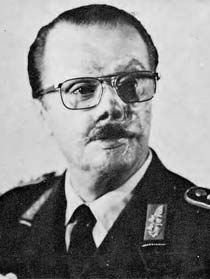
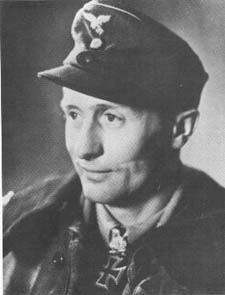
General Johannes Steinhof (above) as a Bundeswehr and NATO officer, showing his burns and before his crash (below)

steinhoff WW II

In his books, Steinhoff does something that you do not see authors do in most military or political memoirs, he actually does serious self reflection on his role in supporting an evil regime. In his introduction to his book The Final Hours the legendary fighter ace who was horribly disfigured when his Me-262 jet fighter crashed and burned two weeks prior to the end of the war wrote:

“In recalling these events, which had been long buried in my memory, it has not been my intention to make excuses. Our unconditional self-sacrifice in the service of the Third Reich is too well documented for that….

So it is because of what is happening today—with freedom threatened in virtually every respect by its own abuse—that I offer this contribution, in the form of an episode in which I was myself involved, to the history of the soldier in the twentieth century. Soldiers have always, in every century of their existence, been victims of the ruthless misuse of power; indeed, given the opportunity, they have joined in the power game themselves. But it fell to our own century to accomplish, with the aid of a whole technology of mass extermination, the most atrocious massacres in the history of mankind. This fact alone makes pacifism a philosophy worthy of respect, and I have a great deal of sympathy with those who profess it. 

The figure of the soldier in all his manifestations is thus symptomatic of the century now nearing its close, and it is to the history of that figure that I wish to contribute by describing what happened to me. I have tried to show what it is possible to do to men, how insidiously they can be manipulated by education, how they can be hoisted onto a pedestal as “heroes,” how they can be so corrupted as even to enjoy the experience—and how they can be dropped and denounced as mutineers when they discover that they have scruples. The complete lack of scruples that such treatment implies is peculiar to rulers who believe that the problems of their own and other peoples can be solved by imposing, through the use of military force, peace on their, the rulers’, terms—in our case a pax germanica, but the second Latin word is readily interchangeable.” from “The Final Hours: The Luftwaffe Plot Against Goring (Aviation Classics)” by Johannes Steinhoff

Since I am a historian and and a career military officer with service in the Iraq War, a war that was illegal and unjust by all measure I can understand Steinhof’s words. Because much of my undergraduate and graduate work focused on German history, particularly that of Imperial Germany after the unification, the Weimar Republic, and the Nazi Reich, I draw a lot of lessons from the period. I also understand how people in this country can fall for the same kind of vitriolic propaganda that the Germans of that era did. I can understand because for years I fell for the lies and propaganda being put out by the politicians, pundits and preachers of the American political right.

In fact I wrote about an incident that happened to me in my own chapel where a dedicated Trump supporter attempted to have me charged with Conduct Unbecoming an Officer and Contempt for the President.  He did this because I used biblical preaching backed by sound theology and history to condemn the President’s comparison of immigrants of darker skin colors as “animals” and an “infestation.” I compared those words with the way Hitler and other totalitarian leaders used such terminology to dehumanize their victims. As I mentioned I was completely cleared by the preliminary inquiry but it sends a chill through my spine.

10665323_10154041610267059_5277331492232210946_n

A picture of me (on left) in Iraq 2007 with my assistant and bodyguard RP1 Nelson Lebron

One of those lessons is that in times of crisis, that people, no matter what their race, culture, religious belief system, educational, or economic background are still human. Humanity is the one constant in all of history, our prejudices are often ingrained in us during childhood and reinforced by the words of politicians, pundits, and preachers. In times of stress, crisis, and societal change or upheaval even good people, moral people, people of great intellectual, scientific abilities can fall prey to demagogues who preach hate and blame others, usually racial, ethnic, or religious minorities, as well as civil libertarians who champion the rights of those minorities for the problems of the nation.

Shrewd politicians, preachers, and pundits do this well. They demonize the target group or population and then let the hatred of their disaffected followers flow. The leaders need that disaffected and angry base in order to rise to power; such was how Hitler, Stalin, and so many other despots gained power. They took advantage of a climate of fear, and found others to blame. For Hitler it was the Jews, Slavs, Socialists and Communists; while for Stalin it was various groups like the Ukrainians, or the Poles who were the devil to be feared and destroyed. Timothy Snyder in his book Bloodlands: Europe Between Hitler and Stalin wrote:

“Dead human beings provided retrospective arguments for the rectitude of policy. Hitler and Stalin thus shared a certain politics of tyranny: they brought about catastrophes, blamed the enemy of their choice, and then used the death of millions to make the case that their policies were necessary or desirable. Each of them had a transformative utopia, a group to be blamed when its realization proved impossible, and then a policy of mass murder that could be proclaimed as a kind of ersatz victory.”

But that being said, there are a lot of people who from childhood believe the lies about others without question. In good times such people continue on with life as normal, but in crisis those hatreds and prejudices come to the fore. Rudolf Höss, the notorious sociopath who commanded Auschwitz told American Army psychologist Gustave Gilbert about his reaction when ordered to turn the camp into an extermination center. He said that the order “fitted in with all that had been preached to me for years,” and “at the same time I didn’t think of it as propaganda, but as something one just had to believe.” 

Eugene Davidson in his book on the Nuremberg Trials wrote:

“Every society has in it at all times negative, criminal, sadistic, asocial forces. What holds them in check more than law and police is the consensus of the society – a general belief that despite everything wrong and stupid and muddleheaded in politics, the state is a going concern that will somehow make its way into the future.” (Davidson, The Trial of the Germans p.581)

But when things do not go well, when people do not feel that things will be okay, that the future will be better, and that they have a purpose they look for answers. However, they tend to find their answers in the rantings of demagogues, race baiters, conspiracy theorists, and others who they would tend to dismiss out of hand in good times. In Germany it was the loss of the First World War, the humiliation of Versailles and the economic chaos and social change of the Weimar period which allowed Hitler to gain an audience, then a following, then political power. The demagogues played to what was already in the hearts and minds of the disaffected masses, without that fertile soil, the rantings of Hitler and his propagandists would have never succeeded. Albert Speer wrote:

“As I see it today, Hitler and Goebbels were in fact molded by the mob itself, guided by its yearnings and its daydreams. Of course, Goebbels and Hitler knew how to penetrate through to the instincts of their audiences; but in the deeper sense they derived their whole existence from these audiences. Certainly the masses roared to the beat set by Hitler’s and Goebbels’ baton; yet they were not the true conductors. The mob determined the theme. To compensate for misery, insecurity, unemployment, and hopelessness, this anonymous assemblage wallowed for hours at a time in obsessions, savagery and license. The personal unhappiness caused by the breakdown of the economy was replaced by a frenzy that demanded victims. By lashing out at their opponents and vilifying the Jews, they gave expression and direction to fierce primal passions.”

In a sense a similar thing has happened in the United States which has experienced a series of wars beginning with Vietnam, the shock of the 9-11-2001 attacks, the economic crash of 2007 and 2008 which devastated the savings, home ownership, and investments of many Americans while at the same time benefiting the banking and brokerage houses whose government assisted policies brought about the crash. Of course there are other issues, many religious conservatives hate the progress made by the Women’s and Gay Rights movements, and their leaders play to their fears in apocalyptic terms. I could go on, but I am sure that my readers can identify other issues which demagogues and others use to spread fear and hate to further their goals. The fact is that without the the fertile soil that lays in the hearts of their most fervent followers they would never have a following.

In Weimar Germany hate mongers like Julius Streicher and propagandist Josef Goebbels stuck a chord with disenchanted people who felt that they had lost their country. They were fearful, angry, and desired a leader who would “make Germany great again.” Hitler and his Nazi media sycophants played to that fear, and took advantage of their anger at the existing order. Davidson wrote such people “exist everywhere and in a sick society they can flourish.” 

For decades the way has been prepared for true extremists to take advantage of the fears and doubts of people as modern American versions of Streicher and Goebbels have been at work for years. Rush Limbaugh was a modern pioneer of this in the United States, and he has been joined by so many who are even more extreme in their rantings that it is hard to name them all. Likewise, whole media corporations especially Fox News, websites, and political networks spread such fear every minute of the day, claiming that they, and they alone are real Americans. They actively support politicians who condemn, and sometimes even threaten people who oppose them, and all the while claim that “make America great again.”

When I was younger I devoured that propaganda, despite all of my learning I followed the rantings of men who I realize today are propagandists who promote the basest of lies, and hatred, often in the name of God. I was changed when I was at war, and when I returned home from Iraq in 2008 I realized through hard experience that I had been lied to, and that as a result that thousands of my brothers and sisters were dead, and tens of thousands shattered in body, mind, and spirit. Likewise I saw the massive destruction levied on Iraq and realized how terrible war really is. That was my epiphany, that is what it took to see how much I had been lied to, and it called me to question everything else that I had so willingly believed, things which had been fed to me by years of indoctrination in church, through the media, and by politicians who I believed were truly Christian. I can understand now how Martin Niemoller felt after the Nazi seizure of power when he said, “I hated the growing atheistic movement, which was fostered and promoted by the Social Democrats and the Communists. Their hostility toward the Church made me pin my hopes on Hitler for a while. I am paying for that mistake now; and not me alone, but thousands of other persons like me.”

There was a time that I hated people who espouse the views that I hold today, the views that I write about so often here on this site. I can remember how angry I would get as I listened to the propaganda being put out by Limbaugh, Hannity, the Fox News Channel and all of the others that I listened to every time that I had the chance. But when I changed after Iraq, I felt the sting of that hatred in very real ways. I remember the day I was called by my bishop in my former church, who told me that I had to leave because my views on women, gays, and Moslems were to use his words were now “too liberal.” After that, many men who I considered to be the best of friends turned their backs on me, some in the most bitter and vindictive of ways.

But I realize now that what they did was because I had in a sense left the cult, and had to be ostracized. I can understand that now, because when I was under the spell I too turned my back on people who had fallen out of favor, or people who had rejected the tenants of the church or the political movement, and those are things that I can never undo. But at the time it made sense, it fitted in with all I had been taught for decades, as Albert Speer wrote of Hitler, “One seldom recognizes the devil when he is putting his hand on your shoulder.”

What happened to Steinhoff’s generation is threatening to happen again, in our country, an authoritarian movement is threatening to destroy our democracy and republic. In it soldiers are esteemed, until they realize what is going on and speak out, but by then it is usually too late. I am understanding that fact more and more every day, and having had people troll this blog and call me a traitor and worse, I understand just a bit of what happened to Steinhoff and his fellow officers when they protested to the highest levels what was happening to Germany in early 1945.

In 1944 he and other fighter pilots were subjected to a political indoctrination session and realized that in the Nazi state loyalty and doctrinal purity to Naziism was more important than either combat service or competence. He wrote:

“Now, however, we realized to our horror that a group of officers had decided, after five years of war, to conduct a purge among the troops with the object of eliminating all those “whose past life and present conduct were not consonant with the National-Socialist type” and who did not “stand firm on National-Socialist principles.” We sat there petrified, but some of those present appeared hugely to enjoy the ensuing discussion of what they called “National-Socialist guidelines.” Perhaps, though, for many it was simply an attempt to escape into a less concrete area of discussion than the desperate military situation—and then there was the added satisfaction of being able to censure others. Fanaticism took the place of hopelessness, and phrases like “faith in the Führer,” “rootedness in National-Socialist ideology,” and “irreproachability of character” fell without hesitation from people’s lips. The Luftwaffe leadership, it was said, must be “combed” from top to bottom, and then someone even came out with the “National-Socialist soul…”

We will soon know how military professionals react to being labeled as traitors. President Trump and his followers have been demonizing the personnel of the nation’s intelligence, law enforcement, and diplomatic communities since before the election. The President lambasts critics of any station on his Twitter feed which results in them receiving death threats from his followers. I expect that when Secretary of Defense James Mattis speaks his mind and tells the truth that we will find out.

Personally I expect that when he does that Trump and his most strident supporters will label him as a traitor for doing so. Like a religious cult they have no capacity to tolerate dissent, loyalty to the man will supersede loyalty to the country or the Constitution. When that happens it will be interesting to see the throngs of people in the military and outside of it who make the choice to throw one of the most courageous, selfless, and intellectual soldiers ever produced by our nation under the bus.

Their’s will be a conscious decision. My opinion is that the Constitution and the country will always come first. I wanted to give the President the benefit of the doubt and prayed that he world do the right thing for the country. But I was wrong. I am concerned because of his past and current behavior that his only loyalty is to himself. General Ludwig Beck, who resigned rather than obey Hitler’s order to invade Czechoslovakia in 1938 and died in the anti-Hitler coup attempt in 1944 said:

“It is a lack of character and insight, when a soldier in high command sees his duty and mission only in the context of his military orders without realizing that the highest responsibility is to the people of his country.” 

I have no doubt that General Mattis understands that and will courageously speak his mind, even if he is condemned for doing so. Sadly I have many doubts about other leaders: be they military, political, business, or religious. There are many people who will sell their souls for their personal advancement, the advancement of their agenda, or an increase in their bottom line. It is after all human nature.

But the question is: will we see true men and women of courage who will stand when it appears there is no chance of success? As Atticus Finch said in To Kill a Mockingbird: “Real courage is when you know you’re licked before you begin, but you begin anyway and see it through no matter what.” 

That will be what is demanded in the coming months and years.

Peace

Padre Steve+

4 Comments

Filed under civil rights, faith, History, leadership, Military, nazi germany, News and current events

“Do not forget that every people deserves the regime it is willing to endure.” My Favorite Resistors, Part One: the Anti-Nazis

359212-1081074754-stauffenberg-nazi-germany-stauffenberg-demotivational-poster-1236884536

Friends of Padre Steve’s World,

They are know and unknown but all resisted tyrants and all have become inspirational figures in my life. They are men and women, and many are soldiers or clergy, while others were civil rights leaders. Most were advocates of non-violence, but some due to the incredibly evil nature of the regime under which they lived and served resorted to violence. But all show me and I hope will show you that the path of resistance is not futile.

The problem is that far too many people become discouraged the longer the struggle lasts and end up accommodating themselves to the evil regimes under which they lived. That will probably be the experience of those who struggle against tyranny around the world today as authoritarianism under many guises becomes more entrenched. It is a world wide phenomena but if the classic understanding of democratic liberalism advocated by so many including the founders of the United States is to survive, authoritarians and their tyrannical worldview must be resisted.

Sophie Scholl, a young student at the University of Munich wrote:

“I’ve been thinking of a story from the Old Testament: Moses stood all day and all night with outstretched arms, praying to God for victory. And whenever he let down his arms, the enemy prevailed over the children of Israel. Are there still people today who never weary of directing all their thinking and all their energy, single-heartedly, to one cause?”

That my friends is important.

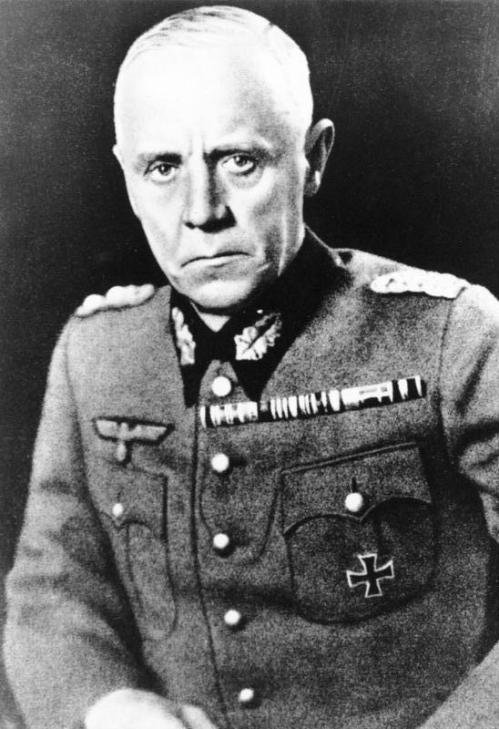
Yesterday, July 20th was the 74th anniversary of Operation Valkyrie, the attempt of conservative German military officers, diplomats, and others to kill Hitler and end the tyrannical and genocidal Nazi regime. Among the men who died in that attempt were Colonel Claus von Stauffenberg, General Henning von Trescow, General Ludwig Beck, Lieutenant Colonel Mertz von Quirnheim, and General Friedrich Olbricht. Others were implicated and were murdered after kangaroo court proceedings at the hand of the Volksgericht, the “People’s Court” headed by Roland Freisler. Among them was Field Marshal Erich von Witzleben. While Freisler hounded and tried to humiliate him Witzleben remained calm and announced to the court:

“You may hand us over to the executioner, but in three months’ time, the disgusted and harried people will bring you to book and drag you alive through the dirt in the streets!”


tresckow

General Henning von Tresckow

“We have to show the world that not all of us are like him. Otherwise, this will always be Hitler’s Germany.” When the attempt failed von Trescow was serving on the Russian front far away from Berlin. To avoid arrest and the possibility that under torture he could implicate others or cause harm to his wife and children von Trescow killed himself. Another participant wrote that before his death von Trescow said:

“The whole world will vilify us now, but I am still totally convinced that we did the right thing. Hitler is the archenemy not only of Germany but of the world. When, in few hours’ time, I go before God to account for what I have done and left undone, I know I will be able to justify what I did in the struggle against Hitler. God promised Abraham that He would not destroy Sodom if only ten righteous men could be found in the city, and so I hope for our sake God will not destroy Germany. No one among us can complain about dying, for whoever joined our ranks put on the shirt of Nessus. A man’s moral worth is established only at the point where he is ready to give his life in defense of his convictions.”

Ludwig Beck

General Ludwig Beck

Beck, who had resigned his post as commander of the German Army in protest of the planned invasion of Czechoslovakia wrote something that has become a key part of my military and personal ethic: “It is a lack of character and insight, when a soldier in high command sees his duty and mission only in the context of his military orders without realizing that the highest responsibility is to the people of his country.” 

Tresckow, a committed Christian also noted of Hitler’s supposedly Christian supporters: “I cannot understand how people can still call themselves Christians and not be furious adversaries of Hitler’s regime.” 

220px-Bundesarchiv_Bild_146-1979-013-43,_Wilhelm_Canaris

Admiral Wilhelm Canaris 

There were other Christian resisters of the Hitler regime. Hans Oster was the son of a pastor and one of the senior officers in the Abwehr, the German military intelligence. His boss, Admiral Wihelm Canaris was also a resister. Both would be executed on the personal order of Hitler in April 1945 along with Pastor Dietrich Bonhoeffer, all had been arrested for their involvement in anti-Hitler activities. For his part Canaris would note something that military, intelligence, or police officials who might be tempted to excuse the actions of modern day tyrants or would be authoritarians:

“One day the world will hold the Wehrmacht responsible for these methods since these things are taking place under its nose.”

bonhoeffer-prison2

Dietrich Bonhoeffer 

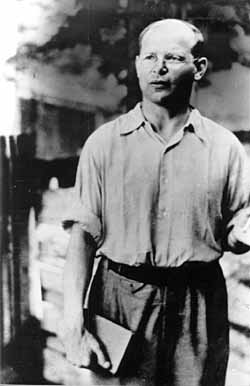
Pastor Bonhoeffer who died with Oster and Canaris at Flossenburg wrote:

“Christianity stands or falls with its revolutionary protest against violence, arbitrariness and pride of power and with its plea for the weak. Christians are doing too little to make these points clear rather than too much. Christendom adjusts itself far too easily to the worship of power. Christians should give more offense, shock the world far more, than they are doing now. Christian should take a stronger stand in favor of the weak rather than considering first the possible right of the strong.”

hermann maas

Hermann Maas 

Hermann Maas, another Lutheran pastor made his mark by speaking out in defense of Jews and Socialists. He angered the German political right including the Nazis by doing so. He aided Jews and other non-Aryans to escape Germany, and cared for the elderly Jews who could not. He was removed from his pastorate and imprisoned. He survived the war and would be the first German recognized by Yad Vashem as one of the Righteous Among the Nations. Maas discussed the responsibility of all Germans for the crimes of Hitler and the Nazis, something that Christians and others in nations like the United States, Europe, Asia, Africa, and South America that are threatened by authoritarian leaders and racist regimes:

“Every German bears responsibility for Germany no matter who he is or where he stands, in the homeland or abroad, in public and at home. No one can absolve him of this responsibility. He can transfer it to no one.” 

img_0090

Sophie Scholl

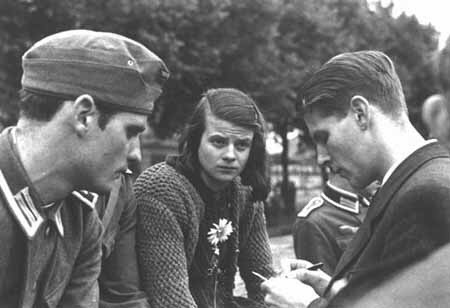
But these men were not the only opponents of the Nazi regime. A young woman, a student at the University of Munich named Sophie Scholl and her brother Hans were at the center of an anti-Nazi resistance called the White Rose. They published and distributed a number of anti-Nazi leaflets and were caught doing so in early 1943.

One of those pamphlets noted:

“Nothing is so unworthy of a civilized nation as allowing itself to be “governed” without opposition by an irresponsible clique that has yielded to base instinct. It is certain that today every honest German is ashamed of his government. Who among us has any conception of the dimensions of shame that will befall us and our children when one day the veil has fallen from our eyes and the most horrible of crimes – crimes that infinitely outdistance every human measure – reach the light of day?

If the German people are already so corrupted and spiritually crushed that they do not raise a hand, frivolously trusting in a questionable faith in lawful order in history; if they surrender man’s highest principle, that which raises him above all other God’s creatures, his free will; if they abandon the will to take decisive action and turn the wheel of history and thus subject it to their own rational decision; if they are so devoid of all individuality, have already gone so far along the road toward turning into a spiritless and cowardly mass – then, yes, they deserve their downfall.

Goethe speaks of the Germans as a tragic people, like the Jews and the Greeks, but today it would appear rather that they are a spineless, will-less herd of hangers-on, who now – the marrow sucked out of their bones, robbed of their center of stability – are waiting to be hounded to their destruction. So it seems – but it is not so. Rather, by means of a gradual, treacherous, systematic abuse, the system has put every man into a spiritual prison. Only now, finding himself lying in fetters, has he become aware of his fate.

Only a few recognized the threat of ruin, and the reward for their heroic warning was death. We will have more to say about the fate of these persons. If everyone waits until the other man makes a start, the messengers of avenging Nemesis will come steadily closer; then even the last victim will have been cast senselessly into the maw of the insatiable demon.

Therefore every individual, conscious of his responsibility as a member of Christian and Western civilization, must defend himself against the scourges of mankind, against fascism and any similar system of totalitarianism. Offer passive resistance – resistance – wherever you may be, forestall the spread of this atheistic war machine before it is too late, before the last cities, like Cologne, have been reduced to rubble, and before the nation’s last young man has given his blood on some battlefield for the hubris of a sub-human. Do not forget that every people deserves the regime it is willing to endure.”

She wrote:

“It’s the reductionist approach to life: if you keep it small, you’ll keep it under control. If you don’t make any noise, the bogeyman won’t find you. But it’s all an illusion, because they die too, those people who roll up their spirits into tiny little balls so as to be safe. Safe?! From what? Life is always on the edge of death; narrow streets lead to the same place as wide avenues, and a little candle burns itself out just like a flaming torch does. I choose my own way to burn.”

I think of all of these people that I admire young Sophie Scholl the most. She had no power. She was not an officer, a government official, a businessman, or a pastor. She was simply a young woman who was informed by her faith and her concern for basic human morality and ethics.

While the Nazi State was consumed by the flames of Hitler’s Götterdämmerung, the lives and message of those few who resisted still redounds to us today. And yes, in comparison to the majority of Germans  of the Hitler era, they were a tiny minority, Of over 2000 German General and Flag officers a mere 22 were involved in anti-Nazi activities and the same is true for most professions in the Third Reich.

Milton Mayer wrote the words of a German University Professor and colleague after the war was over. The professor was reflecting on how people ended up going along with the Nazi regime. Mayer wrote his friends words:

“And one day, too late, your principles, if you were ever sensible of them, all rush in upon you. The burden of self-deception has grown too heavy, and some minor incident, in my case my little boy, hardly more than a baby, saying ‘Jewish swine,’ collapses it all at once, and you see that everything, everything, has changed and changed completely under your nose. The world you live in—your nation, your people—is not the world you were born in at all. The forms are all there, all untouched, all reassuring, the houses, the shops, the jobs, the mealtimes, the visits, the concerts, the cinema, the holidays. But the spirit, which you never noticed because you made the lifelong mistake of identifying it with the forms, is changed. Now you live in a world of hate and fear, and the people who hate and fear do not even know it themselves; when everyone is transformed, no one is transformed. Now you live in a system which rules without responsibility even to God. The system itself could not have intended this in the beginning, but in order to sustain itself it was compelled to go all the way.

“You have gone almost all the way yourself. Life is a continuing process, a flow, not a succession of acts and events at all. It has flowed to a new level, carrying you with it, without any effort on your part. On this new level you live, you have been living more comfortably every day, with new morals, new principles. You have accepted things you would not have accepted five years ago, a year ago, things that your father, even in Germany, could not have imagined.

“Suddenly it all comes down, all at once. You see what you are, what you have done, or, more accurately, what you haven’t done (for that was all that was required of most of us: that we do nothing). You remember those early meetings of your department in the university when, if one had stood, others would have stood, perhaps, but no one stood. A small matter, a matter of hiring this man or that, and you hired this one rather than that. You remember everything now, and your heart breaks. Too late. You are compromised beyond repair.

“What then? You must then shoot yourself. A few did. Or ‘adjust’ your principles. Many tried, and some, I suppose, succeeded; not I, however. Or learn to live the rest of your life with your shame. This last is the nearest there is, under the circumstances, to heroism: shame. Many Germans became this poor kind of hero, many more, I think, than the world knows or cares to know.”

I think that I shall close with that tonight.

Peace

Padre Steve+

1 Comment

Filed under christian life, civil rights, ethics, faith, History, holocaust, laws and legislation, leadership, Military, nazi germany, News and current events, Political Commentary

“We have to show the world that not all of us are like him” Operation Valkyrie In the Age of Trump and Other Authoritarians


Henning Von Trescow 

Friends of Padre Steve’s World,

Seventy-three years ago today a number of German military officers as well as civilian officials attempted to assassinate Adolf Hitler in an attempt to overthrow the Nazi Regime and end the Second World War. Ironically many had been supporters of Hitler’s early policies and few had spoken out against the Nazi seizure of power, elimination of political opponents, the outlawing of trade unions and opposition political parties. Most remained silent when Hitler conducted his brutal Night of the Long Knives massacre of 1934 and took the personal oath of loyalty to him after Hindenburg died soon after.

Some would recognize the threat but offered little resistance as Hitler consolidated his power and began to begin his reign of terror at home even as he began to conquer swaths of Europe without firing a shot. Early plans to overthrow Hitler collapsed because his opponents, so used to being loyal and obedient servants of the State were paralyzed whenever an unexpected contingency arose.

Eleven years after Hitler made opposition political parties illegal and almost five years after he invaded Poland to begin the Second World War a plan called Operation Valkyrie was launched. Two of the key plotters were Colonel Claus Schenk Von Stauffenberg, Major General Henning Von Trescow, and retired General Ludwig Beck.

Most understood that the attempt would likely fail, but they were determined to try. Von Trescow said: “It is almost certain that we will fail. But how will future history judge the German people, if not even a handful of men had the courage to put an end to that criminal?” 

When Stauffenberg detonated a bomb at Hitler’s East Prussian Wolf’s Lair headquarters Beck and other conspirators attempted to seize power in Berlin. However their plans went awry. Hitler survived the blast. Josef Goebbels secured Berlin, and the plot fell apart. Stauffenberg and a number of conspirators were shot that night, Beck attempted to commit suicide but failed and was killed. Over 5,000 more conspirators, suspects, and other Nazi opponents, including some of the most respected officers of the Wehrmacht were tried in show trials and executed. Some like Field Marshal Erwin Rommel were given the choice of committing suicide to save their families.

Von Trescow, who killed himself on the Russian front following the collapse of the coup noted: “We have to show the world that not all of us are like him. Otherwise, this will always be Hitler’s Germany.” Likewise, Beck wrote something that has become a key part of my military and personal ethic: “It is a lack of character and insight, when a soldier in high command sees his duty and mission only in the context of his military orders without realizing that the highest responsibility is to the people of his country.” 

Fabian von Schlabrendorff, a conspirator who was captured and tortured by the Gestapo after the failure of Operation Valkyrie, said: “Obedience is the rule. However, there are cases which demand disobedience. This has been uncontested in the Prussian Army. Blind obedience has its origin with Hitler.” 

When Hitler issued the Commissar or Criminal Order on the eve of Operation Barbarossa in 1941, Von Trescow told a colleague:

“Remember this moment. If we don’t convince the field marshal (Fedor von Bock) to fly to Hitler at once and have these orders (Commissar Order) canceled, the German people will be burdened with a guilt the world will not forget in a hundred years. This guilt will fall not only on Hitler, Himmler, Göring, and their comrades but on you and me, your wife and mine, your children and mine, that woman crossing the street, and those children over there playing ball.” 

Unlike Hitler’s Germany Americans still have some checks and balances to guard against a President attempting to gain control of the country the way Hitler did Germany. However, those checks and balances are delicate, fragile, and if neglected will fail in the crisis. In fact they are showing incredible strain as the Republican majorities in Congress fail to exercise their constitutional responsibilities and political appointees undermine the very agencies that they are responsible for maintaining, and laws that they were sworn to uphold. If they do fail, will we have the courage to stand for the principles and ideals of our country? That we do not yet know but my recent experience says that we very well might fail in the crisis. Historian Timothy Snyder wrote:

“The European history of the twentieth century shows us that societies can break, democracies can fall, ethics can collapse, and ordinary men can find themselves standing over death pits with guns in their hands. It would serve us well today to understand why.”

There are prices to be paid for obedience to unlawful orders and the actions of a criminal state, as well as a price to be paid for disobedience. The men who belatedly and against a nation that was still devoted to Hitler understood those questions and acted accordingly. I do hope that none of us have to face what these men did between 1933 and 1944. However, as time marches on and the President and his Administration continue to defy the law, ignore the Constitution, and undermine the foundations of our Republic, even encouraging their supporters to violence, will our democratic institutions survive?

The administration has implemented and is continuing to implement policies that are quite similar in their intent to crimes that the Nazis were tried for at Nuremberg. If Americans do not rise up against them we too will be to use the words of Von Trescow: “be burdened with a guilt the world will not forget in a hundred years.” 

img_0193-1

Bonhoeffer

That is a question that we have to ask. If they do crumble will we stand the test? Will we have the courage to resist even at the cost of our lives? Dietrich Bonhoeffer who had already been jailed by the Gestapo at the time of Valkyrie wrote:

“If I sit next to a madman as he drives a car into a group of innocent bystanders, I can’t, as a Christian, simply wait for the catastrophe, then comfort the wounded and bury the dead. I must try to wrestle the steering wheel out of the hands of the driver.”

Will we have the courage to resist at that moment? Words are cheap, actions are all to rare. Will we be able to stand against the tide?

That my friends is a question we may all have to answer sooner rather than later.

Until tomorrow,

Peace

Padre Steve+

2 Comments

Filed under christian life, civil rights, ethics, faith, History, Military, nazi germany, News and current events, Political Commentary

Accused and Threatened by a Christian Trump Cultist

Friends of Padre Steve’s World,

Saul Steinberg wrote:

“Baseball is an allegorical play about America, a poetic, complex, and subtle play of courage, fear, good luck, mistakes, patience about fate, and sober self-esteem.” 

Last night I watched what turned out to be an magnificent MLB All Star Game. I had a very good day going into it and anticipated it with the same glorious expectations that I have done since the 1970 All Star Game. For me the MLB All Star Game is an event with nearly religious significance. Baseball is a game that helps me connect spiritually with God as well as exhibits some of the best traits of what until now has defined the United States, as reflected in the words of Steinberg.

For me that was comforting and until last night Saul Steinberg’s words comforted me and allowed me to believe a myth about the inherent goodness of America. Despite our flaws, our mistakes, and yes, even many malevolent policies I still believed that we are basically good people. I don’t think that I believe that anymore, even as I still believe that most Americans want to be good people. We like to think that we are the good guys.

As the game went on I developed a terrible headache and I began to become incredibly depressed. I could feel myself slipping down like I haven’t for a few years. I got up this morning doing better but after a good Staff meeting at our base headquarters began to walk to my car and during that time I began to sink into the pit again. I pulled into my parking spot at the chapel and I was terrified until one of my Catholic parishioners came in to talk to me for a few minutes. She’s a sweet English lady and her kindness is always a blessing and today it made a big difference. My Chief came in to me with a laundry list of things that I needed to help with and then I found out that three young Chaplain Candidate Officers were coming to see me. That put me back in my element because over the past couple of years I have come to realize that the most important thing that I do is to mentor young men and women, especially Chaplains or those aspiring to be Chaplains. I didn’t tell them anything of what I am writing tonight, but I was able to give the, good advice and invite them to contact me any time even if I was no longer on active duty.

The game was a fantastic game but I didn’t enjoy it because I was too caught up in something that happened to me two weeks ago when I received the news that I was being investigated for the allegations of violating the Uniform Code of Military Justice made by a member of my Chapel, a retired Navy Officer.

The man accused me of the violation of Article 88 Contempt for an Official in this case the President of the United States, and of Article 133, Conduct Unbecoming an Officer for the content of my sermon. He accused me of “comparing the President to Adolf Hitler” and “the actions of those enforcing the laws of the nation as Nazis or Nazi Sympathizers.” He accused me of “engaging in political activism on the job.”

Because of his allegations to the command my Commanding Officer had to launch a preliminary investigation. If the allegations were found to be true I could have been charged and tried by Court Martial. My career of 37 years of Army and Navy service including two combat tours and multiple deployments and family separations could have been ended had I been charged or convicted of such an offense.

I wrote about that sermon last month and the allegations were scurrilous, unsubstantiated and purely of his own making. If there was any political motivation it was this retired officer’s allegations which were an attempt to silence legitimate Christian preaching on social justice issues. I found the complaint ironic because one of my predecessors preached against the end of the Defense of Marriage Act and the end of the Don’t Ask Don’t Tell policy. That Chaplain attacked the character of President Obama and pledged to disobey any orders to support marriage equality. But not one person in the congregation complained.

Yet when I criticized President Trump’s words in which he described immigrants and refugees as “animals”, called them an “infestation” and linked all of them to being violent murderers, rapists, and associated with the MS-13 criminal gang as being dehumanizing, against the teachings of the church and similar to the words that Hitler used to demonize and dehumanize the Jews, that was wrong. When I criticized the Attorney General for his misuse of Scripture to defend those polices in front of the Catholic Bishops and the complicity of the White House Press Secretary and Pastor Robert Jeffress of First Baptist Church Dallas in defending those remarks I was a criminal in the mind of my accuser.

The fact that I was preaching within a prophetic Christian social justice tradition as Dietrich Bonhoeffer or Martin Luther King Jr. was irrelevant to my accuser. The fact that I could make legitimate historical comparisons, not only with Nazi Germany but American slavery, the Black Codes, Jim Crow, the extermination of Native American tribes, and the internment of Japanese Americans was irrelevant. It was the fact that I deviated from the Christian Trump Religious cult claims that brought about these scurrilous charges.

When I was called in for an interview by the investigating officer, who I know is a very fair, honest, and decent man I sensed that he was uncomfortable in having to question me as we have worked together over the past year. I told him that I could not submit to an interview and without an attorney present.

I left and immediately called Mikey Weinstein of the Military Religious Freedom Foundation, or MRFF. Mikey took my call immediately and connected me with one of his exceptional attorneys. That was on July 3rd and I spent Independence Day wondering if my military career was about to end. On July 5th I was asked by the Investigating Officer for names of other parishioners who had heard the sermon. I was able to give him a few names, all retired African American Chief Petty Officers or Army and Marine Corps Senior NCOs. He interviewed them and my attorney contacted him. The next morning I was called by the Investigating Officer and the Base Executive Officer to let me know that I had been exonerated and the investigation was over. Both seemed happy for me.

I was supported during the ordeal by the regional Chaplain who is much more conservative than me, and this was not a witch hunt by my command. They as well as my commanding officer are all men of integrity who respect and appreciate my work. If they had not been such men my life could have much more difficult. I was fortunate, but I know other officers who have not been so fortunate or had as solid and feared legal counsel as I received from MRFF. Some of them were convicted of crimes that they did not commit or as in the case of one officer was the victim of a witch hunt by his service chief after his command and civilian police officials had determined that there was no evidence that he had committed any crime. His service overruled them and had him tried by a jury and judge of their choice. I know this because I was called as a character witness. I was flown overseas and within two hours of landing I was thrust onto the witness stand without rest or so much time as to shower or shave. He was convicted anyway. However, during my testimony during the sentencing phase the next day which was not impeached or overruled I told the truth, that the only reason that the officer was on trial and been convicted was because he was gay and not because of the evidence. It was a travesty of justice and I am glad that it didn’t happen to me.

That being said I was fortunate that I have a command that has integrity and seeks the truth. The investigation proved that the charges of the retired officer we’re false and more related to his political allegiance than to any Christian teaching or tradition.

However the most disturbing part of this experience was how that it continues to effect me. The fact is that this retired officer couldn’t even follow the clear commands of Jesus or the Apostle Paul to deal with disagreements between brothers privately or within the Church. Never did any New Testament writer or any of the Ante-Nicene Fathers instruct Christians to turn in other Christians that disagrees with them to the State. What happened to me reminded me of the accounts of German Protestant and Catholic Priests who were turned in to the Gestapo by informants in the Church.

I think that is why I went into such a deep depression last night. The situation in our country has even taken away my ability to enjoy a baseball game and made me incredibly suspicious of the members of my chapel congregation.

Sadly, based on other comments on my Facebook page by some other officers I realize that one cannot reason with members of the Christian Trump Cult even using Scripture and the Christian tradition. Like the German Christians who followed Hitler to his Götterdämmerung they will follow Trump even as he shoots someone on 5th Avenue.

Maybe I will write about the All Star Game tomorrow, but if I don’t it will be first time in nine years on this blog that I haven’t. I think that is one of the worst things about my experience, living on such an edge and under such a real threat that I can no longer enjoy things that used give me such joy and peace.

If this is what it means to Make America Great Again I want nothing to do with it or those who pledge their allegiance to Trump over the Constitution or Christ.

I have more to say but will live it at this for the night.

So until tomorrow,

Peace,

Padre Steve+

11 Comments

Filed under civil rights, ethics, faith, History, holocaust, nazi germany, News and current events, Political Commentary, Religion

Radicals That Make Mainstream Evil Look Good: The Fire Eaters, Slavery, and Secession

Friends of Padre Steve’s World,

Today the third installment of this series on American slavery from my yet to be published book “Mine Eyes Have Seen the Glory” Race, Religion, Ideology and Politics in the Civil War Era” that I will publish this week. Today I discuss a number of the men who were called the “fire eaters,” even by other pro-slavery men due to their radical views on race and the enslavement of people that they considered to be less than human.

The fact is that all forms of systematic evil need men who are able to state their support for positions so extreme that they make the mainstream supporters of that position look good by comparison. We see this every day in our media and in our current presidential administration.

Peace

Padre Steve+

Understanding the Issue, The Importance of people: Edmund Ruffin and the Fire-Eaters

Edmund-Ruffin

Edmund Ruffin

As important as it is to understand the political, religious and ideological debate, we cannot adequately do so unless we begin to understand the people involved in the debates and the controversies of the time. Two of these men stand out. One, Edmund Ruffin, because he can be legitimately called a proponent of Confederate nationalism, and the other, Robert Barnwell Rhett because of his inability to work within any system that required compromise.

Among the people most enraged by Northern opposition to slavery was Edmund Ruffin. Ruffin is one of the more interesting characters who stridently supported slavery, white supremacy and secession in the ante-bellum south. Ruffin became the face of slaveholding ideology, but he not always pro-slavery, or pro-secession. As a younger man he had been a Jeffersonian Republican who as early as 1816 was concerned about growing federal power, but his writings were considered academic, scholarly, and moderate. However that began to change as the country lurched from one sectional crisis to the next.

As early as 1845 Ruffin was beginning to write about the probability of fighting the North, “We shall have to defend our rights by the strong hand against Northern abolitionists and perhaps the tariffites…” [1] But it was the passage of the Compromise of 1850 turned him into an ardent and hardline secessionist. When he did so, “he promptly threw himself into the new cause, replacing his formerly scholarly approach to issues with a fire-eater’s polemical and emotional style. “I will not pretend,” he now announced, “to restrain my pen, nor attempt to be correct in plan or expression – as is more or less usually the case in my writing.” [2]

Likewise, as a young man, Ruffin believed that slavery was an evil. But he began to study the works of Thomas Dew he became convinced of the necessity of slavery and its justification. In his tract The Political Economy of Slavery he wrote,

“Slavery… would be frequently… attended with circumstances of great hardship, injustice, and sometimes atrocious cruelty. Still, the consequences and general results were highly beneficial. By this means only–the compulsion of domestic slaves–in the early conditions of society, could labor be made to produce wealth. By this aid only could leisure be afforded to the master class to cultivate mental improvement and refinement of manners; and artificial wants be created and indulged, which would stimulate the desire and produce the effect, to accumulate the products of labor, which alone constitute private and public wealth. To the operation and first results of domestic slavery were due the gradual civilization and general improvement of manners and of arts among all originally barbarous peoples, who, of themselves, or without being conquered and subjugated (or enslaved politically) by a more enlightened people, have subsequently emerged from barbarism and dark ignorance…” [3]

Ruffin was an agricultural reformer who pioneered the use of lime to enhance the effectiveness of other fertilizers. He edited a successful farm paper and ran a very successful planation outside of Hopewell, Virginia, near Richmond.

Ruffin passionately argued for secession and Southern independence for fifteen years. He “perceived the planter civilization of the South in peril; the source of the peril was “Yankee” and union with “Yankees.” Thus he preached revolution, Ruffin was a rebel with a cause, a secular prophet…” [4] He was a type of man who understood reality far better than some of the more moderate oligarchs that populated the Southern political and social elite. While in the years leading up to the war, these men, including John Calhoun attempted to secure the continued existence and spread of slavery within the Union through the Congress and the courts, Ruffin condemned their efforts.

As early as 1850, Ruffin recognized that in order for slavery to survive the slaveholding South would have to secede from the Union. Ruffin and other radical secessionists believed that there could be no compromise with the north. In 1850 he and James Hammond attempted to use a meeting in Nashville to“secure Cooperative State Secession and wrote to Hammond, against those who sought to use the meeting to preserve the Union, “If the Convention does not open the way to dissolution…I hope it shall never meet.” [5] Ruffin believed that slave holding states had to be independent from the North in order to maintain the institution of slavery.

Ruffin’s views were not unique to him. They formed the basis of how most slave owners and supporters felt about slavery’s economic and social benefits of slavery and the Southern cotton economy. But while many Southerners wrote about the importance and necessity of slavery, Ruffin was one of its most eloquent defenders. He wrote:

“Still, even this worst and least profitable kind of slavery (the subjection of equals and men of the same race with their masters) served as the foundation and the essential first cause of all the civilization and refinement, and improvement of arts and learning, that distinguished the oldest nations. Except where the special Providence and care of God may have interposed to guard a particular family and its descendants, there was nothing but the existence of slavery to prevent any race or society in a state of nature from sinking into the rudest barbarism. And no people could ever have been raised from that low condition without the aid and operation of slavery, either by some individuals of the community being enslaved, by conquest and subjugation, in some form, to a foreign and more enlightened people.” [6]

The most striking thing about Ruffin’s defense of slavery is the distinction that he makes between enslaving people of the same race, which he calls the “worst and least profitable kind of slavery” over the enslavement of inferior races. He did not believe that the enslavement of people of the same race was wise, nor profitable, but he did believe that enslavement of inferior races was not only permissible, but in fact the bedrock of civilization. Likewise his understanding that slavery alone was the only thing that prevented “any race or society in a state of nature from sinking into the rudest barbarism,” was common among the Southern planting class.

In 1860 the then 67-year-old Ruffin helped change the world forever when, according to popular legend he pulled the lanyard that fired the first shot at Fort Sumter. While he had joined the Palmetto Guards and was present, he probably did not fire the first shot. Instead, he was probably was given the honor of firing the first shot from his battery; as other guns from other emplacements may have fired first. [7]

220px-robert_barnwell_rhett_sr

Robert Barnwell Rhett

But Ruffin was not alone, he was numbered with other Fire-Eaters who beginning in the 1840s began urging secession in order to protect the institution of slavery. The real “father” of Southern secession was Robert Barnwell Rhett of South Carolina. Rhett was a lawyer who was born under the name of Robert Barnwell Smith in Beaufort, South Carolina in 1800, but who adopted the surname of a famous ancestor in order to have a name which would befit him more in aristocratic South Carolina.

In a twist of irony, the man who became the father of the secessionist movement studied law under Thomas Grimke, the brother of the two famous abolitionist sisters, and “a leader of South Carolina’s anti-slavery American Colonization Society.” [8] He was a talented attorney with excellent oratorical skills and he was elected to the South Carolina legislature in 1826 as the controversy over nullification began. Rhett, like other opponents of a Federal Tariff led by Senator John C. Calhoun urged secession as early as 1830 he told a crowd that before submitting to the tyranny of Federal Government, that they must be read to destroy the Union:

“Aye – disunion, rather, into a thousand fragments. And why, gentlemen! would I prefer disunion to such a Government? Because under such a Government I would be a slave – a fearful slave, ruled despotically by those who do not represent me … with every base and destructive passion of man bearing upon my shieldless destiny.” [9]

Later, in the face of President Andrew Jackson’s political strength and much congressional opposition led by Henry Clay, South Carolina dropped nullification, Rhett was angry. He told his colleagues in the legislature that “Your “northern brethren,” aye, “the entire world are in arms against your institutions…. Until this Government is made a limited Government… there is no liberty – no security for the South.” [10] He then described disunion as the only way for the South to survive and to escape what he called “unconstitutional legislation.” He described a “Confederacy of the Southern States… [as] a happy termination – happy beyond expectation, of our long struggle for our rights against oppression.” [11]

Rhett worked against compromise at every opportunity, especially compromise which would preserve the Union. Absolutely convinced of the rightness of his cause he distrusted the politicians who favored compromise and had no faith in political parties. He worked from 1833 until the very end in order to support slavery, disunion, and secession, using every crisis as an opportunity. His dream was for “all Southerners – to unite across party lines and unyieldingly defend slavery and Southern interests as he defined them.” [12] During the debate over secession following the Compromise of 1850, Rhett would resign his seat in the U.S. Senate which had been elected to following the death of John C. Calhoun, rather than accept a state convention’s ruling that secession was not justified. After leaving office he became the editor, and later the full owner of the Charleston Mercury newspaper where he continued to advocate for secession in often the most outrageous ways, but The more outrageous the Mercury’s charges, the more they were picked up and reprinted by other papers. Rhett’s propaganda technique was part of a larger secessionist strategy. “Men having both nerve and self-sacrificing patriotism,” he wrote, “must lead the movement and shape its course, controlling and compelling their inferior contemporaries.” He worked to push those without sufficient patriotic nerve – that is, moderate leaders – out of the political arena, believing correctly that without a solid middle ground to stand on, Southern voters would rally increasingly to the fire-eaters’ standard.” [13]

In 1860 Rhett “joined a drive to either rule or ruin the 1860 Democratic convention scheduled for Charleston.” [14] His work was successful, he devised the strategy to destroy the Union by first destroying the Democratic Party, and he wrote in January 1860 that “the destruction of the Union must… begin with the “demolition” of the party. So long as the Democratic Party, as a “National” organization exists in power in the South,… our public men” will “trim their sails.” [15] When South Carolina seceded from the Union, it was Rhett who drafted South Carolina’s secession ordinance, which claimed that South Carolina was not “perpetrating a treasonous revolution, but… simply taking back… the same powers it had temporarily surrendered… when South Carolina ratified the federal Constitution.” [16] However, his inability to compromise and his intemperate behavior alienated from him from Jefferson Davis and other Southern leaders, and he grew increasingly isolated, becoming one of Davis’s most bitter critics. As late as March of 1865 Rhett with Union armies having overrun South Carolina and at the gates of Richmond, Rhett was opposing any move to compromise on the issue of slavery, even the attempt of Jefferson Davis and some in the Confederate Congress to grant limited emancipation to African American slaves who enlisted to fight for the Confederacy.

Notes

[1] Ibid. Potter The Impending Crisis p.463

[2] Abrahamson, James L. The Men of Secession and Civil War, 1859-1861 Scholarly Resources Books, Wilmington DE 2000 pp.43-44

[3] Ruffin, Edmund The Political Economy of Slavery in McKitrick, Eric L. ed. Slavery Defended: The Views of the Old South. Englewood Cliffs, NJ: Prentice Hall/Spectrum Books, 1963.Retrieved from http://www.pbs.org/wgbh/americanexperience/features/primary-resources/lincolns-political-economy/ 24 March 2014

[4] Ibid. Thomas The Confederate Nation p.1

[5] Ibid. Freehling The Road to Disunion Volume One: Secessionists at Bayp.481

[6] Ibid. Ruffin The Political Economy of Slaveryhttp://www.pbs.org/wgbh/americanexperience/features/primary-resources/lincolns-political-economy/

[7] Catton, Bruce The Coming Fury Phoenix Press, London 1961 pp.314-315

[8] Ibid. Abrahamson The Men of Secession and Civil War, 1859-1861 p.33

[9] Goodheart, Adam The Happiest Man in the South in The New York Times Opinionator December 16th 2010 retrieved from http://opinionator.blogs.nytimes.com/2010/12/16/the-happiest-man-in-the-south/?_r=0 26 July 2016

[10] Ibid. Freehling The Road to Disunion Volume One: Secessionists at Bayp.286

[11] Ibid. Abrahamson The Men of Secession and Civil War, 1859-1861 p.34

[12] Ibid. Abrahamson The Men of Secession and Civil War, 1859-1861 p.34

[13] Ibid. Goodheart The Happiest Man in the Southhttp://opinionator.blogs.nytimes.com/2010/12/16/the-happiest-man-in-the-south/?_r=0

[14] Ibid. Abrahamson The Men of Secession and Civil War, 1859-1861 p.34

[15] Freehling, William. The Road to Disunion Volume II: Secessionists Triumphant 1854-1861 Oxford University Press, Oxford and New York 2007 p.295

[16] Ibid. Guelzo Fateful Lightning p.130

Leave a comment

Filed under civil rights, civil war, economics and financial policy, faith, History, Political Commentary

“Liberty for the few – slavery in every form, for the mass” American Slavery

Friends of Padre Steve’s World,

This is the second post from some of my yet to be published book “Mine Eyes Have Seen the Glory” Race, Religion, Ideology and Politics in the Civil War Era which deals with the uncomfortable subject of American slavery that I will post this week. Though it is uncomfortable to some it must be understood if we are to appreciate the struggle of African-Americans for equality, and why the struggle is not over, even today. Another section of this will come out tomorrow.

Peace,

Padre Steve+
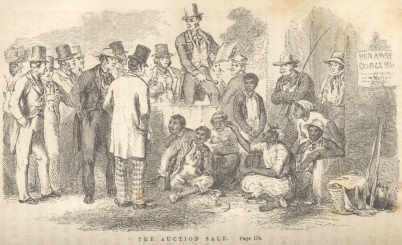
OTCauction

Abolition versus Slave Power

The conflicting ideologies of the Abolitionists who believed that African Americans were created by God and had the same rights as whites, as well as the arguments of Southern political leaders that blacks were inferior and slavery was a positive good, were buttressed by profoundly religious arguments which were related directly to a divergence in values. These diverging values crept into every aspect of life and as such it was this “conflict of values, rather than a conflict of interests or a conflict of cultures, lay at the root of the sectional schism.” [1]   The support of the church in Europe and the Americas was key to the religious and moral belief in the rightness of slavery.

Slavery was the key issue that permeated all aspects of the Civil War to include the cultural, the economic and the ideological. David M. Potter summed up this understanding of the connection between the ideological, cultural and economic aspects of the conflict and just how the issue of slavery connected all three realms in the American Civil War:

“These three explanations – cultural, economic and ideological – have long been the standard formulas for explaining the sectional conflict. Each has been defended as though it were necessarily incompatible with the other two. But culture, economic interest, and values may all reflect the same fundamental forces at work in a society, in which case each will appear as an aspect of the other. Diversity of culture may produce both diversity of interests and diversity of values. Further, the differences between a slaveholding and a nonslaveholding society would be reflected in all three aspects. Slavery represented an inescapable ethical question which precipitated a sharp conflict of values.” [2]

Sadly this is something that those who study the war from a purely military perspective tend to miss, or even willingly gloss over in order make the war more palatable to their own prejudice tend to “blur the reality that slavery was at the heart of the matter, ignore the baser realities of the brutal fighting, romanticize our own home-grown terrorist organization, the Ku Klux Klan, and distort the consequences of the Civil War that still intrude on our national life.” [3] For many people it is far easier not to deal with the harsh reality that slavery and racism was at the heart of the issue and escape to the bloodless romanticism which even ignores the human cost of the war, approximately 750,000 military dead alone. If we extrapolate the percentage of the population that that 750,000 represents and compared it to today’s census that number would be the equivalent of 7.5 million Americans dead. This is a fact that many Civil War buffs tend to ignore.

The political ends of the Civil War grew out of the growing cultural, economic, ideological and religious differences between the North and South that had been widening since the 1830s. However, slavery was the one issue which helped produce this conflict in values and it was “basic to the cultural divergence of the North and South, because it was inextricably fused into the key elements of southern life – the staple crop of the plantation system, the social and political ascendency of the planter class, the authoritarian system of social control.” [4] Without slavery and the Southern commitment to an economy based on slave labor, the southern economy would have most likely undergone a similar transformation as what happened in the North; thus the economic divergence between North and South would “been less clear cut, and would have not met in such head-on collision.” [5] But slavery was much more than an economic policy for Southerners; it was a key component of their religious, racial and philosophic worldview.
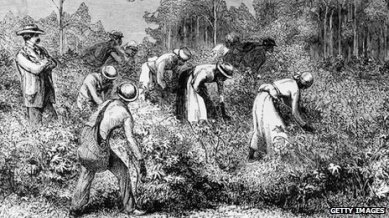
_65344344_cottonpickers1875_getty

The issue of slavery even divided the ante-bellum United States on what the words freedom and liberty meant. The dispute can be seen in the writings of many before the war, with each side emphasizing their particular understanding of these concepts. In the South, freedom was reserved for those who occupied the positions of economic power; slavery was key to that from not only an economic point of view but as a social philosophy. The concept of human equality, which was so much a part of the Declaration of Independence was downplayed George Fitzhugh, a planter and slave owner in eastern Virginia commented that that concept “is practically impossible, and directly conflicts with all government, all separate property, and all social existence.” [6] Fitzhugh was very critical of the founder’s philosophy of natural liberty and human equality which he found repugnant and error ridden. He wrote:

“We must combat the doctrines of natural liberty and human equality, and the social contract as taught by Locke and the American sages of 1776. Under the spell of Locke and the Enlightenment, Jefferson and other misguided patriots ruined the splendid political edifice they erected by espousing dangerous abstractions – the crazy notions of liberty and equality that they wrote into the Declaration of Independence and the Virginia Bill of Rights. No wonder the abolitionists loved to quote the Declaration of Independence! Its precepts are wholly at war with slavery and equally at war with all government, all subordination, all order. It is full if mendacity and error. Consider its verbose, newborn, false and unmeaning preamble…. There is, finally, no such thing as inalienable rights. Life and liberty are not inalienable…. Jefferson in sum, was the architect of ruin, the inaugurator of anarchy. As his Declaration of Independence Stands, it deserves the appropriate epithets which Major Lee somewhere applies to the thought of Mr. Jefferson, it is “exuberantly false, and absurdly fallacious.”   ” [7]

The political philosophy such as Fitzhugh’s, which was quite common in the South, and was buttressed by a profound religious belief that it was the South’s God ordained mission to maintain and expand slavery. One Methodist preacher in his justification of slavery wrote, “God as he is infinitely wise, just and holy never could authorize the practice of moral evil. But God has authorized the practice of slavery, not only by bare permission of his providence, but by the express permission of his word.” [8]Buttressed by such scriptural arguments Southerners increasingly felt that they were the only people following God. The Northern abolitionists as well as those who advocated for the concept of human equality and free labor were heretics to be damned. As such the “South’s ideological isolation within an increasingly antislavery world was not a stigma or a source of guilt but a badge of righteousness and a foundation for national identity and pride.” [9]

Speaking of the necessity for slavery, as well as limitations on the equality of human beings no matter what their race or sex; Fitzhugh penned words that explained that human relationships were not to be seen in terms of individual liberty, “but in relations of strict domination and subordination. Successful societies were those whose members acknowledged their places within that hierarchy.” [10]

Fitzhugh was quite caustic when he discussed the real implications of his philosophy:

“We conclude that about nineteen out of twenty individuals have “a natural and inalienable right” to be taken care of and protected, to have guardians, trustees, husbands or masters; in other words they have a natural and inalienable right to be slaves. The one in twenty are clearly born or educated in some way fitted for command and liberty.” [11]

Fitzhugh’s chilling conclusion was summarized in the words “Liberty for the few – slavery in every form, for the mass.” [12]

But many Southerners, including many poor whites, especially the Yeoman farmers who were the backbone of the Southern populace did not see or understand the limitations that were placed on their own liberty by the slavery system and instead saw slavery as the guarantee of their economic freedom. John C. Calhoun said to the Senate in 1848 that “With us, the two great divisions of society are not the rich and poor, but white and black; and all of the former, the poor as well as the rich, belong to the upper class, and are respected and treated as equals.” [13] Calhoun’s racial distinction is important if we are to understand why poor whites would fight and die for a social and economic idea that did not benefit them or their families.

But it was Abraham Lincoln, who cut to the heart of the matter when he noted the difference between his understanding of liberty and that of Calhoun and others in the South who defended slavery and the privileges of the Southern oligarchs:

“We all declare for liberty” but “in using the same word we do not all mean the same thing. With some the word liberty may mean for each man to do as he pleases with himself and the product of his labor; while with others the same word may mean for some men to do as they please with other men and the product of other men’s labor.” [14]

The growing economic disparity between the Slave and Free states became more about the expansion of slavery in federal territories as disunion and war approached; for a number of often competing reasons. These differences, amplified by the issue of slavery led to the substitution of stereotypes of each other and had the “effect of changing men’s attitudes toward the disagreements which are always certain to arise in politics: ordinary, resolvable disputes were converted into questions of principle, involving rigid, unnegotiable dogma.” [15] The Charleston Mercury noted in 1858 “on the subject of slavery…the North and the South…are not only two peoples, but they are rival, hostile peoples.”[16]

This was driven both by the South’s insistence on both maintaining slavery where it was already legal and expanding it into new territories which was set against the vocal abolitionist movement. But Southern exponents of expanding slavery were fighting an even more powerful enemy than the abolitionists, who despite their vocal protests were not yet in a position to influence policy. They were now fighting Northern industrialists who were not as idealistic as the abolitionists who were much more concerned with “economic policy designed to secure Northern domination of Western lands than the initial step in a broad plan to end slavery.” [17]

This competition between the regions not only affected politics, it affected religion and culture. In the South it produced a growing culture of victimhood, which was manifest in the words of Robert Toombs who authored Georgia’s declaration of causes for secession:

“For twenty years past, the Abolitionists and their allies in the Northern states, have been engaged in constant efforts to subvert our institutions, and to excite insurrection and servile war among us…” whose “avowed purpose is to subject our society, subject us, not only to the loss of our property but the destruction of ourselves, our wives and our children, and the dissolution of our homes, our altars, and our firesides.” [18]

As the social, economic, cultural and religious differences between the two regions grew wider and the people of the South became ever more closed off from the North. “More than other Americans, Southerners developed a sectional identity outside the national mainstream. The Southern life style tended to contradict the national norm in ways that life styles of other sections did not.” [19]

The complex relationship of Southern society where “Southern bodies social, economic, intellectual, and political were decidedly commingled” [20] came to embrace the need for slavery and its importance to Southern society. This occurred despite the fact that the system did not benefit poor whites in the South and actually harmed them economically. The Southern: “system of subordination reached out still further to require a certain kind of society, one in which certain questions were not publically discussed. It must give blacks no hope of cultivating dissention among the whites. It must commit non slaveholders to the unquestioning support of racial subordination…. In short, the South became increasingly a closed society, distrustful of isms from outside and unsympathetic to dissenters. Such were the pervasive consequences of giving top priority to the maintenance of a system of racial subordination.” [21]

A number of slave revolts, and planned slave revolts which were caught before they could erupt serve to heighten the fear and paranoia of Southerners living in the “Black belts” where slaves outnumbered whites by great margins. “In thickly enslaved areas, fancied dangers united white classes and sexes. Whites in black belts shared horror images about freed blacks as rioters, rapists, arsonists, and cannibals. The whites characteristically thought that using slavery to control alleged barbarians meant saving civilization.” [22]

Even before the abolitionist movement took any recognizable form in the North,“with an intensity that escalated through the Civil War, planters declared war on all open criticism of the peculiar institution.” [23]As Northern abolitionists like William Lloyd Garrison and his newspaper The Liberator grew in its distribution and began to appear in the South various elected officials throughout the South “suppressed antislavery books, newspapers, lectures, and sermons and strove generally to deny critics of bondage access to any public forum.” [24] Despite this resistance, abolitionists continued to use the U.S. Mail service to send their literature south provoking even more drastic action from Southern legislators.
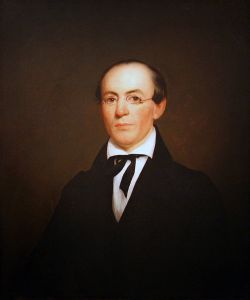
garrison by jocelyn 1833

William Lloyd Garrison 

But Garrison and the more radical abolitionists did not have a great following even in the North, most Northerners who even leaned toward abolition were supporters of a very gradual emancipation and not supportive of the immediate emancipation demanded by Garrison and his allies. In fact in the North, Garrison and his followers were not popular, they were “a small and often despised group.” [25] This was born out by facts that Garrison understood all too well, which made him even more uncompromising in his message. “In 1840, support for Garrison extremism peaked at around 2 percent of the northern voting population. The other 98 percent of northern citizens considered immediate abolition to be too extreme to be American, too problack to be tolerable, too keen on seizing property to be capitalistic, and too antisouthern to be safe for the Union.” [26]Garrison despised his northern opponents and wrote that he found among them “contempt more bitter, opposition more active, detraction more relentless, prejudice more stubborn, and apathy more frozen, than among slave owners themselves.” [27] Opponents broke up his meetings and on one occasion paraded Garrison “through the streets of Boston with a rope around his neck.” [28]

But Southerners, particularly those in the black belts were too outraged by Garrison and his follower’s incendiary words and “almost pornographic diatribes,” which they felt had assaulted their “self-respect and sense of honor.” [29] In response to the proliferation of abolitionist literature in the South which was being sent through the mail, Senator John C. Calhoun proposed that Congress pass a law to prosecute “any postmaster who would “knowingly receive or put into the mail any pamphlet, newspaper, handbill, or any printed, written, or pictorial representation touching the subject of slavery.” [30] Calhoun was not alone as other members of Congress as well as state legislatures worked to restrict the import of what they considered subversive and dangerous literature. The condescending attitude of the radical abolitionists provoked an “emotional wildfire” [31] in the South, which united slave owners and poor whites in the heavily black slave majority regions and served to increase their fear and loathing of Yankees who they believed wanted to destroy them and their way of life. Had they really understood just how united much of the North was with them they may not have pushed as hard to force Northern allies to accept laws that eventually offended the sensibilities of even non-abolitionists Northerners.
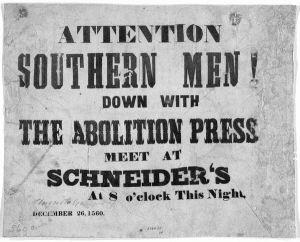
attention-southern-men

But Southern fears of real and imagined slave revolts, and hatred of radicals like Garrison brought about a host of new problems as Southerners attempted to crush the rights of free speech in the north and to blot out any mention of slavery in the House of Representatives. Beginning in 1836 the House of Representatives, led by Southern members of Congress passed a “gag rule” for its members. The “Gag Rule” “banned all petitions, memorials, resolutions, propositions, or papers related in any way or to any extent whatever to the subject of slavery.” [32] Former President John Quincy Adams continually challenged the gag-rule beginning in 1842, as did a number of others. The pressure was such that finally in 1844 the House voted to rescind it.
anti-slavery-meetings

However, Southern politicians were unhappy with the recension of the Gag Rule and “began to spout demands that the federal government and the Northern states issue assurances that the abolitionists would never be allowed to tamper with what John Calhoun had described as the South’s “peculiar domestic institution.” [33] As tensions grew between the regions; the issue of slavery more than any other issue, “transformed political action from a process of accommodation to a mode of combat.” [34]

Around the same time as the gag rule was played out in Congress the Supreme Court had ruled that the Federal government alone “had jurisdiction where escaped slaves were concerned” which resulted in several states enacting “personal liberty laws” to “forbid their own elected officials from those pursuing fugitives.” Southern politicians at the federal and state levels reacted strongly to these moves, which they believed to be an assault on their institutions and their rights to their human property. Virginia legislators said these laws were a “disgusting and revolting exhibition of faithless and unconstitutional legislation.” [35]

The issue of slavery shaped political debate and “structured and polarized many random, unoriented points of conflict on which sectional interest diverged.” [36] As the divide grew leaders and people in both the North and the South began to react to the most distorted images of each other imaginable- “the North to an image of a southern world of lascivious and sadistic slave drivers; the South to the image of a northern world of cunning Yankee traders and radical abolitionists plotting slave insurrections.” [37]

To be continued…

Notes

[1] Potter, David M. The Impending Crisis: America before the Civil War 1848-1861 completed and edited by Don E. Fehrenbacher Harper Collins Publishers, New York 1976 p.41

[2] Ibid. Potter The Impending Crisis p.41

[3] Burns, Ken A Conflict’s Acoustic Shadows in The New York Times Disunion: Modern Historians Revisit and Reconsider the Civil War from Lincoln’s Election to the Emancipation Proclamation Black Dog and Leventhal Publishing, New York 2013 p.102

[4] Ibid. Potter The Impending Crisis p.42

[5] Ibid. Potter The Impending Crisis p.42

[6] Ibid. Levine Half Slave and Half Free: The Roots of the Civil War Revised Edition p.140

[7] Fitzhugh, George. New Haven Lecture 1855, in The Approaching Fury: Voices From the Storm, 1820-1861 Stephen B. Oates, Editor, University of Nebraska Press, Lincoln and London 1997 p.135

[8] Ibid. Daly When Slavery Was Called Freedom: Evangelicalism, Proslavery, and the Causes of the Civil War pp.63-64

[9] Ibid. Faust, Drew The Creation of Confederate Nationalism: Ideology and Identity in the Civil War South p.61

[10] Ibid. Levin Half Slave and Half Free p.140

[11] Ibid. Levin Half Slave and Half Free p.140

[12] Ibid. Levin Half Slave and Half Free p.141

[13] McPherson, James M. Drawn With the Sword: Reflections on the American Civil War Oxford University Press, Oxford and New York 1996 p.50

[14] Ibid. Levin Half Slave and Half Free p.122

[15] Ibid. Potter The Impending Crisis p.43

[16] Ibid. McPherson Drawn With the Sword p.16

[17] Egnal, Marc Clash of Extremes: The Economic Origins of the Civil War Hill and Wang a division of Farrar, Straus and Giroux New York 2009 p.6

[18] Dew, Charles B. Apostles of Disunion: Southern Secession Commissioners and the Causes of the Civil War University Press of Virginia, Charlottesville and London 2001 p.12

[19] Thomas, Emory The Confederate Nation 1861-1865 Harper Perennial, New York and London 1979 p.5

[20] Ibid. Thomas The Confederate Nation p.5

[21] Ibid. Potter The Impending Crisis pp.457-458

[22] Freehling, William W. The South vs. The South: How Anti-Confederate Southerners Shaped the Course of the Civil War Oxford University Press, Oxford and New York 2001 p.20

[23] Ibid. Levine Half Slave and Half Free p.166

[24] Ibid. Levine Half Slave and Half Free p.166

[25] Ibid. Goldfield America Aflame: How the Civil War Created a Nation p.27

[26] Ibid. Freehling The South vs. The South p. 34

[27] Ibid. Varon Disunion! The Coming of the American Civil War 1789-1858pp.70-71

[28] Ibid. Goldfield America Aflame p.27

[29] Ibid. Freehling The South vs. The South p.22

[30] Ibid. Guelzo Fateful Lightning pp.50-51

[31] Ibid. Freehling The South vs. The South p.22

[32] Ibid. Levine Half Slave and Half Free pp.169-170

[33] Ibid. Guelzo Fateful Lightning pp.51-52

[34] Ibid. Potter The Impending Crisis p.43

[35] Ibid. Levine Half Slave and Half Free pp.169-170

[36] Ibid. Potter The Impending Crisis p.43

[37] Ibid. Potter The Impending Crisis p.43

Leave a comment

Filed under civil rights, civil war, economics and financial policy, ethics, faith, History, labor, Loose thoughts and musings, Political Commentary