Category Archives: History

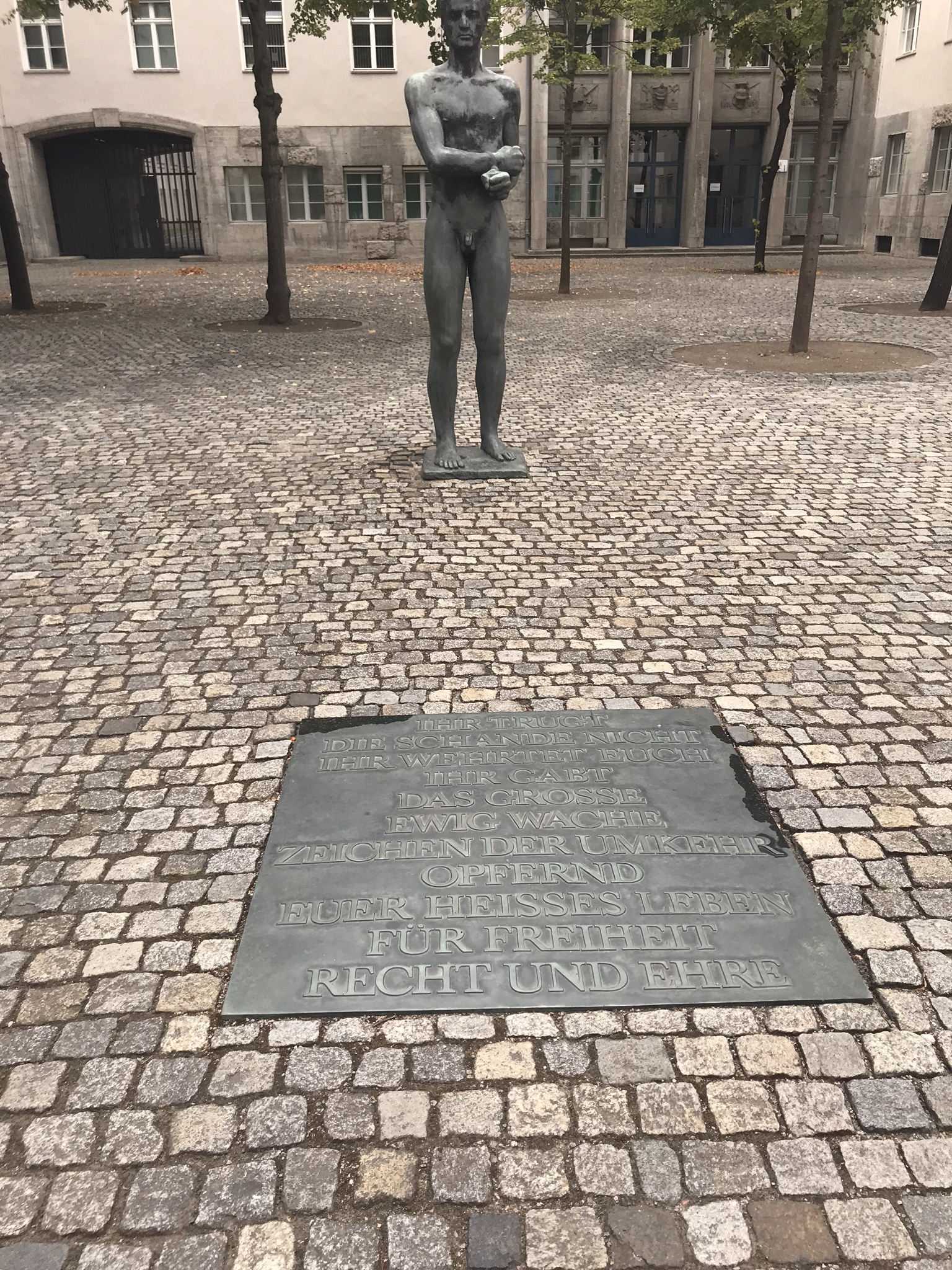
Resistance is Not Futile: Remembering the Men and Women of the German Resistance and Operation Valkyrie

 The Courtyard at Bendlerstraße Where Von Stauffenberg and others Were Executed

Friends of Padre Steve’s World,

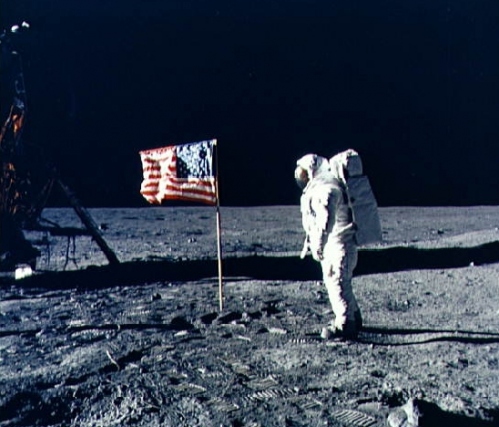
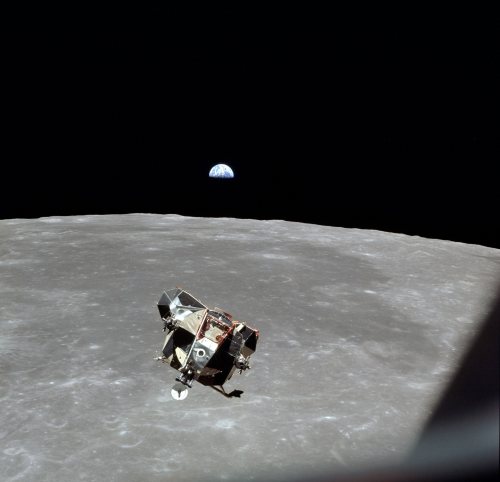
July 20th holds many meanings and provides for inspiration for anyone who is human, with the exception of conspiracy theorists and deniers of history. Today we remember the 50th anniversary of the landing of the Landing Module Eagle of Apollo XI on the Moon. The success of the mission can be described as miraculous, a triumph of human achievement in an era of deep division. But twenty-five years to the day before the landing a few imperfect, yet courageous men and women dared to attempt the overthrow of Adolf Hitler and his genocidal Nazi regime.

Stauffenberg with Colonel Mertz von Quirnheim, another key Conspirator who was murdered with Stauffenberg when the Plot Failed 

The participants knew that if they failed they would be labeled as traitors, and they were right. Colonel Claus von Stauffenberg, who planted a bomb at Hitler’s East Prussian Headquarters was quite correct when he noted:

“I know that he who will act will go down in German history as a traitor; but he who can and does not, will be a traitor to his own conscience.” 

Another conspirator, Major General Henning Von Tresckow was even more blunt about their prospects.

“It is almost certain that we will fail. But how will future history judge the German people, if not even a handful of men had the courage to put an end to that criminal?”

The plot failed, Hitler lived. Stauffenberg, Tresckow, many of their immediate associates died. Eventually, thousands of people, many of whom only were guilty of association. The purge and executions of those connected with the plot would continue to Hitler’s death.

In the days we live we are witnessing our President using the same words and terminology to describe anyone who opposes him. He disrespects the Constitution, and the instructions that were designed by our founders to prevent the rise of a tyrant. His words, actions, and policies tend toward both racism and fascism; and they foster violence. The steady rise in White Nationalist and neo-Nazi groups, that the President has not condemned, as well as the number of open White Nationalist and neo-Nazi men running for office at the local and state level as Republicans show that Trump is not a casual anomaly in the GOP. The President, like it or not, has become the voice of White Nationalism, and the far right. Republican moderates for the most part have acquiesced to the new order. Even long time supporters like former Attorney General Jeff Sessions, hardly a man considered liberal, were ruthlessly jettisoned by the President.

There are times that resistance seems almost hopeless. I was talking with one of my friends who is very discouraged about the situation. He is an idealist. I spent much of the evening trying to buck him up.

British Historian Laurence Rees wrote:

“human behavior is fragile and unpredictable and often at the mercy of the situation. Every individual still, of course, has a choice as to how to behave, it’s just that for many people the situation is the key determinate in that choice.” 

We have to put an end to the Trump regime at the ballot box, or should Congress fulfill its Constitutional duties and begin impeachment hearings, regardless of whether a conviction is attained, he and his supporters have made statements that he may not give up power without a physical fight, that of course would bring about a Constitutional crisis and maybe civil war.

His former attorney, Michael Cohen has said exactly that. Trump is destroying the hard work of Americans and our allies to build a better would, and in almost every country, Trump is destroying the image and moral leadership of the United States. Patriotism requires that those committed to the ideals, institutions, and the laws of the country must resist when those are threatened, from inside or outside the country, and if they resist an elected President who shows no regard for those ideals, institutions, and laws, they will be labeled traitors.  Tresckow said in his time:

“We have to show the world that not all of us are like him. Otherwise, this will always be Hitler’s Germany.”

Henning von Tresckow 

Those are import words, but just substitute the name Trump for Hitler. Tresckow was no socialist or liberal, but he believed in freedom. In fact he wrote regarding the Prussian political tradition and how it could be subverted to support evil:

“The idea of freedom can never be disassociated from real Prussia. The real Prussian spirit means a synthesis between restraint and freedom, between voluntary subordination and conscientious leadership, between pride in oneself and consideration for others, between rigor and compassion. Unless a balance is kept between these qualities, the Prussian spirit is in danger of degenerating into soulless routine and narrow-minded dogmatism.”

Truthfully that is a spirit much like the United States that which is engulfing the United States today, soulless routine and narrow minded dogmatism. The tension that exists in the key ideal of the Declaration of Independence and the United States Constitution, and the words of Trump and his supporters men who desire to rule by fiat and by extra-Constitutional means, cannot be more marked than it is today.

In the movie adaptation of the plot to kill Hitler Valkyrie: Tresckow is quoted:

“God promised Abraham that he would not destroy Sodom if he could find ten righteous men… I have a feeling that for Germany it may come down to one.”

To be sure, Trump is no Hitler, though his words sound more and more Hitlerian every day. I will not call the President a Nazi, though he has give tacit support to Neo-Nazi and White Supremacist groups and frequently engages in racist diatribes. He is certainly acting as any authoritarian leader would, and we have to heed the warning of Russian dissident Gary Kasparov:

“dictators & would be autocrats do not ask “Why?” when it comes to using power for their advantage. They ask “why not?”

To go back to the words of Tresckow in Valkyrie, in noting it may come down to the actions of one man or woman, my friends, that “one” may come down to you or me. We cannot sit silently by as more and more actions that would have been considered as criminal in any other era of United States are perpetrated by the President and his followers.

It was not until the late 1960s that most Germans considered the men who attempted to kill Hitler heroes and not traitors. Those who criticize, and work through legal and constitutional means to oppose Trump are already being labeled by him, his supporters, and the right wing media machine based at Fox News as enemies of the state, traitors, and mislabeled as Socialists and Communists; an old tactic of the American Right since the Russian Revolution. The truth doesn’t matter, it’s simply a way to stake rage against fellow citizens.

At this time we still have recourse to the law, elections, and our institutions. How long that remains is another matter. Once Hitler took absolute power, most Germans found ways to make their peace with his regime and turn a blind eye even to its crimes.

I don’t know if Trump will ever attain such absolute power, but it is possible. In which case the equation will change. If that happens risk of risk of resistance will be so high that many will go silent and just try to get along. Even without that kind of threat most Republicans have already done that.

Sophie Scholl and Members of the White Rose in Munich Near the Ost Bahnhof in 1942

That is the real danger, when people who know better acquiesce for their own safety. Sophie Scholl, a 22 year old student at the University of Munich was part of a resistance movement called The White Rose. She and her friends, students and professors embarked on writing pamphlets to distribute throughout Germany to tell the truth about the evils of the Nazi regime. She wrote about this danger:

“The real damage is done by those millions who want to ‘survive.’ The honest men who just want to be left in peace. Those who don’t want their little lives disturbed by anything bigger than themselves. Those with no sides and no causes. Those who won’t take measure of their own strength, for fear of antagonizing their own weakness. Those who don’t like to make waves—or enemies. Those for whom freedom, honour, truth, and principles are only literature. Those who live small, mate small, die small. It’s the reductionist approach to life: if you keep it small, you’ll keep it under control. If you don’t make any noise, the bogeyman won’t find you. But it’s all an illusion, because they die too, those people who roll up their spirits into tiny little balls so as to be safe. Safe?! From what? Life is always on the edge of death; narrow streets lead to the same place as wide avenues, and a little candle burns itself out just like a flaming torch does. I choose my own way to burn.”

I have more to write on this but will close for the night.

So until tomorrow,

Peace,

Padre Steve+

2 Comments

Filed under ethics, History, holocaust, laws and legislation, leadership, Military, national security, nazi germany, News and current events, Political Commentary, racism, White nationalism

“One Giant Step” at 50 Years

Friends of Padre Steve’s World,

I remember it like it was yesterday, and it was 50 years ago.  It was the stuff that dreams are made of the stuff that inspires a generation.  A tiny and fragile Lunar Module, the Eagle piloted by Astronauts Neil Armstrong and Bud Aldrin landed on the Moon’s Sea of Tranquility. Within hours the two men had made the first walk on the Moon.  Armstrong made the statement “One small step for man, one giant leap for mankind.”  In orbit above the Moon Astronaut Michael Collins piloted the Command Module ColumbiaIt was the stuff that legends are made of and help point humankind to higher and nobler goals.

http://www.dailymotion.com/video/x8rlwp_cbs-news-apollo-11-moon-landing-jul_shortfilms#from=embed

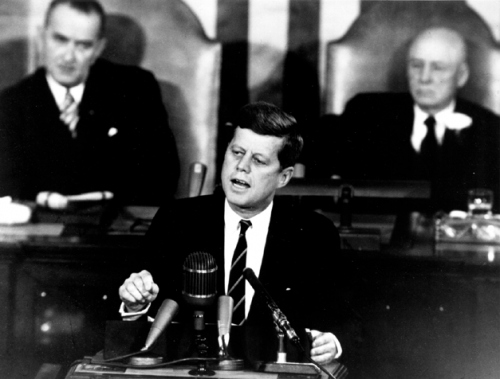
Shortly after he became President, John F. Kennedy promised to have a man on the Moon by the end of the decade.  His comments supporting the Apollo mission before a joint session of Congress are quite remarkable especially in light of the state of the technology available at the time.

http://www.youtube.com/watch?v=ouRbkBAOGEw&feature=player_embedded

“I believe that this nation should commit itself to achieving the goal, before this decade is out, of landing a man on the Moon and returning him safely to the Earth. No single space project in this period will be more impressive to mankind, or more important in the long-range exploration of space; and none will be so difficult or expensive to accomplish.”

The United States wholeheartedly threw itself into the race for the Moon and though Kennedy, struck dead by an assassin’s bullet nearly six years prior did not live to celebrate the occasion it was something that in a time of war and deep political division united the Nation. It did not matter if one was a conservative or liberal, Republican or Democrat the Space Program and in particular the Apollo missions made us glad to be Americans. In the midst of trying times marked by racism and riots, political assassinations, anti-war protests and social unrest.

It was an amazing event which could have ended in disaster but instead helped us as a nation to aspire to higher and nobler goals. The landing on the Moon inspired many to study the sciences and Astronaut camps attended by children furthered that desire.  The invention, innovation and ingenuity sparked by the program helped birth more invention many times providing the basis for devices that are ubiquitous today but unthinkable except possibly to the writers of Star Trek then.

We dreamed and aspired to great things.  We were Americans then.  Now we have become a collection of deeply divided hatred filled special interests.  The last Space Shuttle mission that of the Atlantis will end tomorrow and no one knows what will follow.  But does it matter?

It probably doesn’t matter anymore because we have stopped dreaming or envisioning a hopeful future.  The Moon, Mars and beyond, forget that we need to sacrifice, well everyone but the people that put us in the mess we are in.

What does a space program matter when we are so divided against ourselves?

Our politician’s pundits and preachers of all political leanings and persuasions, but more so Republicans than Democrats drive that poisonous wedge deeper every day and many willingly indulge in the “us against them” mentality promoted by those that beg us to listen to the “three hours a day every day.”

That Unholy Trinity of politicians, pundits and preachers seems so bent promoting their ideologies and theologies that they forget that they all have a responsibility to a nation that is greater than their respective faction, special interest and even religious views.  Now we have politicians signing statements written by special interests groups and there are an ever growing number of them, as if they were the Constitution, binding them and their fealty to unelected and unaccountable power brokers who have only their ideology to promote.  To see politicians shamelessly entering into such pacts to win a nomination or primary makes me wonder what they will do if they are elected to the offices that they aspire.

Back in 1969 the country was a mess, but when the Eagle touched down on the Sea of Tranquility we were Americans again, at least for a few days.  We took a moment and believed again and we achieved again.  Unfortunately I don’t see anything at the present that will make us so again at least in the near future.  I fear for our country. Maybe it’s just my PTSD “Mad Cow” getting to me; maybe it is the fact that as a historian and theologian I know where the path we are traveling under President Trump ends.

Peace

Padre Steve+

5 Comments

Filed under History, Travel

Where Will Trump and His Followers Thoughts, Words, and Actions Lead?

Friends of Padre Steve’s World,

Last night I wrote about the Racial Rubicon that President Trump and his followers at a rally crossed. It was sobering, because what I and others have said about him since the day he announced his candidacy was on full display. Trump had ignited the bonfire three days before by telling people to send four Congresswomen of color back to their country of origin. All are American citizens, three of the four born in the USA and one a naturalized citizen.

Never before has a sitting President opened the doors of racism so wide as President Trump, even James Buchanan and his work to tip the Supreme Court In the Dred Scott decision, and his attempt to overthrow the law by attempting to have Kansas admitted as a Slave State, an effort that was successfully opposed by Senator Stephan A. Douglas, Democrat from Illinois, a member of Buchanan’s own Party. Buchanan threatened him, but Douglas, otherwise not a friend of slaves held his ground and built a bi-partisan coalition in the House and Senate to defeat Buchanan. Unfortunately, there is no one like the late Senator from Illinois. Douglas paid the political price, though the Democratic nominee in 1860, the party split and in a second nominating convention nominated John C. Breckinridge, Splitting the party and bringing Abraham Lincoln to office.

So where does this lead? That is a question one of my readers asked on Twitter today. I wish that I knew. But I remember the words of Mahatma Gandhi:

“Your beliefs become your thoughts, Your thoughts become your words,

Your words become your actions, Your actions become your habits,

Your habits become your values, Your values become your destiny.”

I sincerely believe that Donald J. Trump is incapable of discerning truth from lies. He lies so much that it has become ingrained in his very soul. In regard to this aspect of Of Trump’s personality, I am reminded of the words of Adolf Hitler’s Finance Minister, Count Lutz Schwerin von Krosigk, who noted: “He wasn’t honest with his most intimate confidants…. In my opinion, he was so thoroughly untruthful that he could no longer recognize the difference between truth and lies.

Today the President attempted to pass the blame, and in effect through his chanting supporters under the bus, saying that “He did not like it, he did not agree with it,” but the problem is that he started it, he planted it through his tweets and statements in the days before. He reveled as the crowed chanted as he spoke against Representative Ilan Omar of Minnesota “Send her back, Send her back!” Representative Mark Walker, Republican from North Carolina (who I actually met and drank beer with in 2017 after the Congressional Baseball Game) immediately voiced his concern and consternation about the display, but very few other Republicans found anything to complain about. Senator Lindsey Graham blamed it on Trump’s narcissism, and the statements of Omar and the other Congresswomen, not racism, despite the decades of evidence demonstrating the latter.

Gandhi’s words are as true today as when he wrote them. Americans today have the choice of being, to use the words of Yehuda Bauer “The horror of the Holocaust is not that it deviated from human norms; the horror is that it didn’t. What happened may happen again, to others not necessarily Jews, perpetrated by others, not necessarily Germans. We are all possible victims, possible perpetrators, possible bystanders.” 

If you wonder how such events happen in a democracy, look no further than the words of Yale Historian Timothy Snyder:

“The European history of the twentieth century shows us that societies can break, democracies can fall, ethics can collapse, and ordinary men can find themselves standing over death pits with guns in their hands. It would serve us well today to understand why.”

The questions for all Americans today, will we be perpetrators, victims, or bystanders, or will ordinary Americans find themselves standing over death pits with guns in their hands.

Those are the questions after Trump and his followers actions over the past few days. Believe me, people I know, people I would have believed in ordinary times to be good and decent people are mocking those who criticize the President and making excuses for the illegal and immoral racist words and policies of his administration. For me that is frightening.

Where does it end? I leave that to you, but as a historian, ethicist, and Priest I have to say that if Trump remains in power by ballot or bullet, it will be something that will bring such shame to our country that generations from now our descendants will burdened with, just as the descendants of the Nazis. Sadly, we never did that with our Slave owners and those who brought about the Civil War, including my ancestors.

Until tomorrow,

Peace,

Padre Steve+

3 Comments

Filed under crime, ethics, History, holocaust, laws and legislation, leadership, nazi germany, News and current events, Political Commentary, racism, Religion

“Don’t Believe Him Anymore, He’s Telling the Truth: the Paradox Of Trump’s Lies and Racist Words and Actions

Friends of Padre Steve’s World,

Over the weekend in a series of tweets targeting female Democratic Party members of Congress, President Trump rekindled the subject of his racist and White Nationalist views, which he began the very day that he announced his candidacy for President. In his tweets he challenged their citizenship and told them that they should go home and fix the countries they came from. His tone was similar to when he referred to other countries as shit hole countries. The next day he doubled down on it and so did many of his Congressional, right wing media, and members of his White, Evangelical Christian base.

Likewise, over his first two and a half years the President has told over 8,000 direct lies or distortions of the truth, and regularly charges his critics with lying, fake news, or even treason. Back in 2015 I said that I believed that he was a racist, and I compared his words to those of the racist Know Nothings Of the 1830s to 1860s in a blog article back then.

Those words cost me friends, but I think that the President’s every tweet, word, and policy, as well as his actions have proven me right; from his announcement, to Charlottesville, to his immigration policies, to his “shit hole countries” remarks, to his tweets over the weekend, and remarks Monday. They were all bloody red meat which his followers swallowed hook line and sinker, especially White Evangelical Protestants who form a large part of his base.

The President’s racism is not not a new thing. In the 1990s when five black youths were falsely accused, charged and later acquitted of raping a woman jogger in New York’s Central Park, Trump took out newspaper adds urging their conviction and the use of the death penalty. One of his earliest ventures in the New York Real Estate market was in 1973  in which the Justice Department showed that he discriminated against minorities applying to live in his apartments. Trump settled out of court.

The President’s past anti-Semitic comments wreaked of Nazi comments in the Third Reich. His continued words and policies against non-White Christian immigrants before he was elected and since his election show all the evidence that he is an out and out racist. I would like to believe that such could not be true, but every action of his demonstrates it. The old saying that if it walks like a duck, swims like a duck, and quacks like a duck is most appropriate when dealing with the words, actions, tweets, and policies of this President, his administration, and his Party. Every day I see Republicans tweeting, writing, or saying that this is all President Obama’s fault, which is absolute bullshit.

If you asked me what the President could do to change my mind I would answer the following:

Stop lying. However, this is not possible because he honestly believes everything he says. He lies so much that he cannot tell truth from a lie. Most people understand when they are lying, even when they lie to protect someone from harm, but Trump cannot tell the difference. It’s habitual, and pathological, and his Party, supporters, and media accomplices let it happen. He was all in on the birther  conspiracy theories about President Obama, Hell, even the leaders of the Democrat controlled House of Representatives, and their so-called moderates struggle with accusing him of being a racist.

Second, the President could stop dividing Americans based on race or disagreement with his racial policies. He could easily stop his racist rants on Twitter or at his rallies if he did not personally believe them and revel in the adoration of his followers who pick up his chants.

As a historian it almost feels like the things I studied about the anti-immigrant Know Nothings, the ante-Bellum Slave Power South, Jim Crow, the treatment of almost every ethnic group which has ever arrived in the United States, to include the Irish, Germans, Italians, Poles, other Eastern Europeans, Arabs, Jews, Asians, including the internment of Japanese American citizens in World War Two, the treatment of others including Cubans, Haitians, and others fleeing political persecution or natural disasters. Please let’s not forget what how we treated the inhabitants of the country we took over in regard to Native Americans, Mexicans, and even the French.

Sure, we do have our better angels, but the history Of the United States demonstrates a clear, consistent, and unending history or racism, hatred of immigrants, especially those of darker skin, or non-Christian religions. Sadly, that racism is rising exponentially, in both extremist groups and in the mainstream of the GOP and White America. I can hardly believe what I am seeing. It reminds me of the very racist tenor of the busing debate in my home town back in 1974-75.

As far as the lying, I am reminded of the words of Adolf Hitler’s Finance Minister, Count Lutz Schwerin von Krosigk noted: “He wasn’t honest with his most intimate confidants…. In my opinion, he was so thoroughly untruthful that he could no longer recognize the difference between truth and lies. 

This very evening at one of his rallies Trump supporters began to chant “Send her back” in relation to U.S. Congresswoman Ilhan Omar, Democrat from Minnesota, a naturalized citizen whose parents fled war torn Somalia in the early 1990s. It sounded like a Nazi rally. Trust me, I have watched and listened to plenty of Nazi propaganda and seen just how the President uses the same type of language and gestures to goad his supporters into such behavior.

So my friends I will leave you with that to ponder. I think that the quote fits, and if he is not turned out of office that he will destroy the laws and institutions that made this country great.

And finally, this I hate to say, if after all of this someone still supports the President, they are most likely racist, and White Nationalist. Trump appeals not to the better angels of our nature, but the demonic nature, that which despises that Sacred Secular Scripture Of the Declaration “we hold these truths to be self-evident, that all men are created equal, and endowed by their creator with certain unalienable rights…” 

White Nationalists and Know Nothings hate those words and seek to limit them to themselves, as it appears that the President does. I don’t know them man, but his words and actions, past and current lead me to believe that there is no other answer to the paradox of Donald Trump.

So until tomorrow,

Peace,

Padre Steve+


4 Comments

Filed under civil war, ethics, faith, History, laws and legislation, leadership, News and current events, Political Commentary

The Disadvantages Of Belonging To Supposedly Inferior Races, Part Three: When Law is Opposed to Justice

Friends of Padre Steve’s World

Today the third of a multi-part installment of a section of my book “Mine Eyes Have Seen the Glory” Race, Religion, Ideology, and Politics in the Civil War Era which deals with American Slavery in the ante-bellum period. These next articles deal with the subject of what happens when laws are made that further restrict the liberty of already despised, or enslaved people. In this case the subject is the Compromise of 1850 and its associated laws such as the Fugitive Slave Act of 1850.

This is an uncomfortable period of history for Americans with either a sense of conscience, or those who believe the racist myths surrounding the “Noble South” and “The Lost Cause.”  I hope that you find them interesting, especially in light of current events in the United States.

In the light of two and a half years of racist remarks, policies, actions, and the tweets of President Trump, and members of the GOP, including the Governor Of Tennessee who proclaimed today a day to honor Confederate General Nathan Bedford Forrest who directed one of the most horrific massacres of the Civil War at Fort Pillow, and then after the war founded the original iteration of the Ku Klux Klan, terrorizing newly freed slaves and citizens in the Reconstruction Era demonstrate a return to unabashed racism. Of course that racism also spans the legal and economic spheres of life in our country. It always has. After this series has run I will write about that in some specifics. I want to take my time before I post. I want to make sure that every word I say is the truth and not unduly influenced by emotions or politics.

Today the House voted to condemn President Trump’s racist remarks about four freshmen, women of color Congresswomen. He questioned the citizenship, even though all are native born citizens and challenged them to “go back to their countries.” It is a comment that has been made about almost every immigrant who has ever came to this country; the Irish, the Germans, the Italians, the Poles, the Greeks, Russians, Chinese, Japanese, Arabs of all religions, not to mention people who lived in this country before we took it over, Native Americans, Mexicans, and even the French, and the men and women of African descent who were brought here against her will as slaves, and even after their emancipation are often treated as less than citizens, or even human.

So until tomorrow and where I finish this article or write about the incredibly racist words and behavior of the President and the majority of his Party.

Peace,

Padre Steve+

fugitive-slave-law

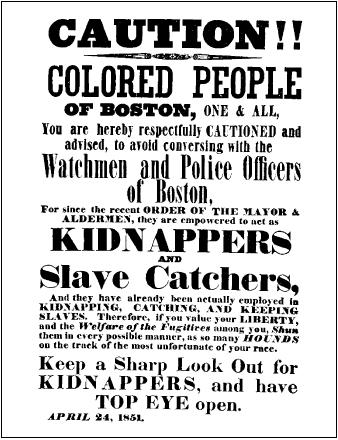
A Warning to Blacks in Boston regarding the Fugitive Slave Law

For all practical purposes the Compromise of 1850 and its associated legislation nationalized the institution of slavery, even in Free States. It did this by forcing all citizens to assist law enforcement in apprehending fugitive slaves. It also voided state laws in Massachusetts, Vermont, Ohio, Connecticut, Pennsylvania and Rhode Island, which barred state officials from aiding in the capture, arrest or imprisonment of fugitive slaves. “Congress’s law had nationalized slavery. No black person was safe on American soil. The old division of free state/slave state had vanished….” [3] If there was any question as to whose “States Rights” the leaders of the South were advocating, it was certainly not those of the states whose laws were voided by the act.

That law required all Federal law enforcement officials, even in non-slave states to arrest fugitive slaves and anyone who assisted them, and threatened law enforcement officials with punishment if they failed to enforce the law. The law stipulated that should “any marshal or deputy marshal refuse to receive such warrant, or other process, when tendered, or to use all proper means diligently to execute the same, he shall, on conviction thereof, be fined in the sum of one thousand dollars.” [4] In effect the law nullified state laws and forced individual citizens and local officials to help escaped slaves regardless of their own convictions, religious views, and state and local laws to the contrary.

Likewise the act compelled citizens in Free states to “aid and assist in the prompt and efficient execution of this law, whenever their services may be required….” [5] Penalties were harsh and financial incentives for compliance attractive.

“Anyone caught providing food and shelter to an escaped slave, assuming northern whites could discern who was a runaway, would be subject to a fine of one thousand dollars and six months in prison. The law also suspended habeas corpus and the right to trial by jury for captured blacks. Judges received a hundred dollars for every slave returned to his or her owner, providing a monetary incentive for jurists to rule in favor of slave catchers.” [6]

The law gave no protection for even black freedmen, who simply because of their race were often seized and returned to slavery. The legislation created a new extra-judicial bureaucratic office to decide the fate of blacks. This was the office of Federal Commissioner and it was purposely designed to favorably adjudicate the claims of slaveholders and their agents, and to avoid the normal Federal Court system. There was good reason for the slave power faction to place this in the law, many Federal courts located in Free States often denied the claims of slave holders, and that could not be permitted if slavery was to not only remain, but to grow with the westward expansion of the nation.

When slave owners or their agents went before these new appointed commissioners, they needed little in the way of proof to take a black back into captivity. The only proof or evidence other than the sworn statement by of the owner with an “affidavit from a slave-state court or by the testimony of white witnesses” [7] that a black was or had been his property was required to return any black to slavery. The affidavit was the only evidence required, even if it was false.

runaway

Since blacks could not testify on their own behalf and were denied legal representation before these commissioners, the act created an onerous extrajudicial process that defied imagination. Likewise, the commissioners had a strong a financial incentive to send blacks back to slavery, unlike normal courts the commissioners received a direct financial reward for returning blacks to slave owners. “If the commissioner decided against the claimant he would receive a fee of five dollars; if in favor ten. This provision, supposedly justified by the paper work needed to remand a fugitive to the South, became notorious among abolitionists as a bribe to commissioners.” [8] It was a system rigged to ensure that African Americans had no chance, and it imposed on the citizens of Free states the legal obligation to participate in a system that many wanted nothing to do with.

Douglass.JPG

                                                Frederick Douglass 

Frederick Douglass wrote about the new law in the most forceful terms:

“By an act of the American Congress…slavery has been nationalized in its most horrible and revolting form. By that act, Mason & Dixon’s line has been obliterated;…and the power to hold, hunt, and sell men, women, and children remains no longer a mere state institution, but is now an institution of the whole United States.” [9]

Douglass was correct as was demonstrated during an incident in Boston in 1854 where an escaped slave named Anthony Burns, who had purchased his freedom, was arrested under the Fugitive Slave Act. The arrest prompted a protest in which, “an urban mob – variously composed of free Negro laborers, radical Unitarian ministers, and others – gathered to free him. They stormed the Federal courthouse, which was surrounded by police and wrapped in protective chains….Amid the melee, one protestor shot and killed a police deputy.” [10] The heated opposition to Burns’ arrest provoked the passions of thousands of Bostonians who protested for his release that caused the Massachusetts governor to deploy two batteries of artillery outside the courthouse to deter any more attacks. When the Federal Fugitive Slave Law commissioner consigned Burns to his Southern owner, the prisoner placed in shackles and was marched down State Street. Tensions were now running extremely high and a “brigade of Massachusetts militia and local police were required to run Burns through a gauntlet and deposit him on the ship that would remand him to Virginia.” [11] Bostonians began to see their city as it was in the early days of the American Revolution, as a place that resisted tyranny. Neither did they did not forget Burns but raised the money to purchase his freedom. William Lloyd Garrison wrote, “the “deed of infamy… demonstrated as nothing else that “only “the military power of the United States” could sustain slavery.” [12] Nevertheless, Boston’s “mercantile elite had vindicated law and order” [13] but in the process they helped move so abolitionists who had been advocates of pacifism and non-violence to physical resistance to the bounty hunting Southerners. “Across the North, prisons were broken into, posses were disrupted, and juries refused to convict.” [14]

Violence between slave hunters and their protectors did break out in September 1851 when “a Maryland slave owner named Edward Gorsuch crossed into Pennsylvania in pursuit of four runaways.” [15] Gorsuch and his armed posse found them in the Quaker town of Christiana, where they were being sheltered by a free black named William Parker and along with about two dozen other black men armed with a collection of farm implements and a few muskets who vowed to resist capture. Several unarmed Quakers intervened and recommended that Gorsuch and his posse leave for their own sake, but Gorsuch told them “I will have my property, or go to hell.” [16] A fight then broke out in which Gorsuch was killed and his son seriously wounded, and the fugitives escaped through the Underground Railroad to Canada.

The Christiana Riot as it is called now became a national story. In the North it was celebrated as an act of resistance while it was decried with threats of secession in the South. President Millard Fillmore sent in troops and arrested a number of Quakers as well as more than thirty black men. “The trial turned into a test between two cultures: Southern versus Northern, slave versus free.”  [17] The men were charged with treason but the trial became a farce as the government’s case came apart. After a deliberation of just fifteen minutes, “the jury acquitted the first defendant, one of the Quakers, the government dropped the remaining indictments and decided not to press other charges.” [18] Southerners were outraged, and one young man whose name is forever linked with infamy never forgot. A teenager named John Wilkes Booth was a childhood friend of Gorsuch’s son Tommy. “The death of Tommy Gorsuch’s father touched the young Booth personally. While he would move on with his life, he would not forget what happened in Christiana.” [19]

The authors of the compromise had not expected such resistance to the laws. On his deathbed Henry Clay, who had worked his entire career to pass compromises in order to preserve the Union, praised the act, of which he wrote “The new fugitive slave law, I believe, kept the South in the Union in ‘fifty and ‘fifty-one. Not only does it deny fugitives trial by jury and the right to testify; it also imposes a fine and imprisonment upon any citizen found guilty of preventing a fugitive’s arrest…” Likewise Clay depreciated the Northern opposition and condemned the attempt to free Anthony Burns, noting “Yes, since the passage of the compromise, the abolitionists and free coloreds of the North have howled in protest and viciously assailed me, and twice in Boston there has been a failure to execute the law, which shocks and astounds me…. But such people belong to the lunatic fringe. The vast majority of Americans, North and South, support our handiwork, the great compromise that pulled the nation back from the brink.” [20] 

While the compromise had “averted a showdown over who would control the new western territories,” [21] it only delayed disunion. In arguing against the compromise South Carolina Senator John C. Calhoun realized that for Southerners it did not do enough to support the peculiar institution and that it would inspire Northern abolitionists to redouble their efforts to abolish slavery. Thus, Calhoun argued not just for the measures secured in the compromise legislation, but for the permanent protection of slavery:

“He understood that slavery stood at the heart of southern society, and that without a mechanism to protect it for all time, the Union’s days were numbered.” Almost prophetically he said “I fix its probable [breakup] within twelve years or three presidential terms…. The probability is it will explode in a presidential election.”  [22]

Of course it was Calhoun and not the authors of the compromise who proved correct. The leap into the abyss of disunion and civil war had only been temporarily avoided. However, none of the supporters anticipated what would occur in just six years when a “train of unexpected consequences would throw an entirely new light on the popular sovereignty doctrine, and both it and the Compromise of 1850 would be wreaked with the stroke of a single judicial pen.” [23]

To be continued…

                                                           Notes

[1] Ibid. Guelzo Fateful Lightning pp.62-63

[2] Ibid. Guelzo Fateful Lightning p.68

[3] Ibid. Goldfield  America Aflame p.71

[4] ______________Fugitive Slave Act of 1850 retrieved from the Avalon Project, Yale School of Law http://avalon.law.yale.edu/19th_century/fugitive.asp 11 December 2014

[5] Ibid. Fugitive Slave Act of 1850

[6] Ibid. Goldfield America Aflame p.71

[7] Ibid. McPherson The Battle Cry of Freedom  p.80

[8] Ibid. McPherson The Battle Cry of Freedom p.80

[9] Ibid. Goldfield America Aflame p.72

[10] Goodheart, Adam 1861: The Civil War Awakening Vintage Books a division of Random House, New York 2011 p.42

[11] Ibid. Varon Disunion! The Coming of the American Civil War 1789-1858 p.241

[12] Mayer, Henry All on Fire: William Lloyd Garrison and the Abolition of Slavery W.W. Norton and Company, New York and London 1998 p.442

[13] Ibid. McPherson The Battle Cry of Freedom p.84

[14] Ibid. Guelzo Fateful Lightning p.73

[15] Ibid. Guelzo Fateful Lightning p.73

[16] Ibid. McPherson The Battle Cry of Freedom p.84

[17] Steers, Edward Jr. Blood on the Moon: The Assassination of Abraham Lincoln The University of Kentucky Press, Lexington 2001 p.33

[18] Ibid. McPherson The Battle Cry of Freedom p.85

[19] Ibid. Steers  Blood on the Moon: The Assassination of Abraham Lincoln p.33

[20] Oates, Stephen B. Editor The Approaching Fury: Voices of the Storm, 1820-1861 University of Nebraska Press, Lincoln and London 1997 p.94

[21] Ibid. Guelzo Fateful Lightning p.71

[22] Ibid. Goldfield America Aflame p.64

[23] Ibid. Guelzo Fateful Lightning p.71

3 Comments

Filed under civil rights, civil war, economics and financial policy, ethics, History, laws and legislation, leadership, News and current events, Political Commentary, racism

The Disadvantage Of Belonging to So Called Inferior Races, Part Two the Compromise Of 1850

slave-sale

Friends of Padre Steve’s World

Today the second of a multi-part installment of a section of my book “Mine Eyes Have Seen the Glory” Race, Religion, Ideology, and Politics in the Civil War Era which deals with American Slavery in the ante-bellum period. These next articles deal with the subject of what happens when laws are made that further restrict the liberty of already despised, or enslaved people. In this case the subject is the Compromise of 1850 and its associated laws such as the Fugitive Slave Act of 1850.

This is an uncomfortable period of history for Americans with either a sense of conscience, or those who believe the racist myths surrounding the “Noble South” and “The Lost Cause.”  I hope that you find them interesting, especially in light of current events in the United States.

In the light of two and a half years of racist remarks, policies, actions, and the tweets of President Trump, and members of the GOP, including the Governor Of Tennessee who proclaimed today a day to honor Confederate General Nathan Bedford Forrest who directed one of the most horrific massacres of the Civil War at Fort Pillow, and then after the war founded the original iteration of the Ku Klux Klan, terrorizing newly freed slaves and citizens in the Reconstruction Era demonstrate a return to unabashed racism. Of course that racism also spans the legal and economic spheres of life in our country. It always has. After this series has run I will write about that in some specifics. I want to take my time before I post. I want to make sure that every word I say is the truth and not unduly influenced by emotions or politics.

So until tomorrow and the last section of this article.

Peace,

Padre Steve+

                Economic Effects of the Compromise of 1850

The interregional slave trade guaranteed slave owners of a source of slaves even if they were cut off from the international trade and it was an immense part of not just the Southern economy but the American economy. Slave owners “hitched their future to slavery; a single cash crop and fresh land,”[1] and refused to take an interest in manufacturing or diversifying their agricultural production outside of King Cotton. Slave prices tripled between 1800 and 1860 making human property one of the most lucrative markets for investment. The price of a “prime male field hand in New Orleans began at around $500 in 1800 and rose as high as $1,800 by the time of the Civil War.” [2] The result was that slave owners and those who benefited from the interregional slave trade had a vested interest in not only seeing slavery preserved, but expanded.

This resulted in two significant trends in the South, first was that slave owners grew significantly richer as the value of the slave population increased. Using even a conservative number of $750 dollars as the value of a single slave in 1860 the amount of value in this human property was significantly more than almost any other investment in the nation.  It was enormous. Steven Deyle notes that:

“It was roughly three times greater than the total amount of all capital invested in manufacturing in the North and in the South combined, three times the amount invested in railroads, and seven times the amount invested in banks. It was about equal to about seven times the value of all currency in circulation in the country three times the value of the entire livestock population, twelve times the value of the entire U.S. cotton crop, and forty-eight times the expenditures of the federal government that year. ….”by 1860, in fact in the slaveowning states alone, slave property had surpassed the assessed value of real estate.” [3]

The rise in slave values and the increasing wealth of slave owners had a depreciating effect on poor southern whites by ensuring that there was no middle class, which “blocked any hope of social advancement for the mass of poor whites, for it was all but impossible for a non-slaveholder to rise in the southern aristocracy.” [4] The impoverishment of southern whites created some worry for those astute enough to take an interest in such matters. “In 1850, about 40 percent of the South’s white farmers owned real estate at all. There was thus, worried the Southern Cultivator in 1856, “a large number at the South who have no legal right or interest in the soil [and] no homes of their own.” The editor of a South Carolina newspaper that year framed the matter in less sympathetic terms: “There is in this State,” he wrote, “as impoverished and ignorant as white population as can be found in any other in the Union.” [5]

Some Southerners recognized the growing issue that the south was falling behind the north in terms of real economic advancement and that slavery was the culprit. Hinton Helper, a non-slave owning North Carolinian who had made his fortune in the California Gold Rush of 1849 and returned home to become disillusioned with what he saw wrote a book that had a major impact in the North among Republican politicians, but which was either banned or restricted in much of the South. That book “The Impending Crisis of the South: How to Meet It (1857) was “a book on the debilitating impact of slavery on the South in general and on southern whites in particular.” [6] Helper’s attack on the slavery system was as devastating as that of any abolitionist, and since he was a southerner the effects of his words helped further anti-slavery sentiment in the North and would be used by the Republican party in an abridged form as a campaign tool that they printed and distributed during the build up to the election of 1860. Helper wrote that:

“Slavery lies at the root of all the shame, poverty, tyranny and imbecility of the South.” Echoing the free-soil argument Helper maintained that slavery degraded all labor to the level of bond labor. Planters looked down their noses at nonslaveholders and refused to tax themselves to provide a decent school system. “Slavery is hostile to general education…Its very life, is in the ignorance and stolidity of the masses.”  [7]

Many southern leaders saw Helper’s book as a danger and worried that should Helper and others like him speak freely long enough “that they will have an Abolition party in the South, of Southern men.” When that happened, “the contest for slavery will no longer be one between the North and the South. It will be in the South between the people of the South.” [8] That was something that the landed gentry of the slave owning oligarchy could never tolerate for if the non-slave holding whites rejected slavery, the institution would die. Thus, Helper, who was no fan of black people and held many violently racist attitudes, was denounced “as a traitor, a renegade, an apostate, a “dishonest, degraded and disgraced man.”[9]

Men like Helper were an anomaly in the South, other leaders were much more like Jefferson Davis who urged the creation of a “Southern “system,” internal improvements, building factories, even reforming education to eliminate all textbooks at odds with his notion of the blessings of slavery.” [10]

In the years the before the war, the North embraced the Industrial Revolution leading to advances which gave it a marked economic advantage over the South in which through  its “commitment to the use of slave labor inhibited economic diversification and industrialization and strengthened the tyranny of King Cotton.” [11] The population of the North also expanded at a clip that far outpaced the South as European immigrants swelled the population.

The divide was not helped by the various compromises worked out between northern and southern legislators. After the Missouri Compromise Thomas Jefferson wrote these words of warning:

“but this momentous question, like a fire bell in the night, awakened and filled me with terror. I considered it at once as the knell of the Union. It is hushed indeed for the moment, but this is a reprieve only, not a final sentence. A geographical line, coinciding with a marked principle, moral and political, once conceived and held up to the angry passions of men, will never be obliterated; and every new irritation will mark it deeper and deeper.” [12]

The trigger for the increase in tensions that eventually ignited the powder keg was the war with Mexico in which the United States annexed nearly half of Mexico. The new territories were viewed by those who advocated the expansion of slavery as fresh and fertile ground for its spread. Ulysses S Grant, who served in the war, noted the effects of the war with Mexico in his memoirs:

“In taking military possession of Texas after annexation, the army of occupation, under General [Zachary] Taylor, was directed to occupy the disputed territory.  The army did not stop at the Nueces and offer to negotiate for a settlement of the boundary question, but went beyond, apparently in order to force Mexico to initiate war….To us it was an empire and of incalculable value; but it might have been obtained by other means.  The Southern rebellion was largely the outgrowth of the Mexican war.” [13]

To be continued…

                                                           Notes 

[1] Ibid. Egnal  Clash of Extremes p.10

[2] Ibid. Deyle The Domestic Slave Trade p.53 Deyle’s numbers come from the 1860 census.

[3] Ibid. Egnal  Clash of Extremes p.54

[4] Ibid. Foner Free Soil, Free Labor, Free Men p.48

[5] Ibid. Levine Half Slave and Half Free p.37

[6] Ibid. Goldfield  America Aflame  p.177

[7] Ibid. McPherson The Battle Cry of Freedom p.199

[8] Ibid. Levine Half Slave and Half Free p.235

[9] Ibid. Potter The Impending Crisis p.397

[10] Davis, William C. Jefferson Davis: The Man and His Hour Harper Collins Publishers New York 1991 p.258

[11] Ibid. Potter The Impending Crisis p.42

[12] Jefferson, Thomas Letter to John Holmes dated April 22nd 1824 retrieved from www.loc.gov/exhibits/jefferson/159.html  24 March 2014

[13] Grant, Ulysses S. Personal Memoirs of U.S. Grant New York 1885 pp.243-245

1 Comment

Filed under civil rights, civil war, ethics, History, laws and legislation

The Disadvantage Of Belonging to so called Inferior Races: Race and Slavery in Ante-Bellum America

negroes_and_negro_-slavery

Friends of Padre Steve’s World

I am tired after working in the house most of the weekend and providing some help to a friend who has fallen on hard times. The good thing is that I am finally really responding well to my aquatic physical therapy and the gel injections in my knees. The damage to both is still there, but my pain levels in both knees have gone from a continuous 7-10 on the pain scale to a livable 2-5. I get my final  set of injections tomorrow morning after aquatic PT. If my recovery progresses as it has I should be, able to do much more than I am now, which is a hell of a lot more than a month ago when I was walking with the aid of a cane or crutches.

So today, and for the next couple of days  I’m posting sections my book “Mine Eyes Have Seen the Glory” Race, Religion, Ideology and Politics in the Civil War Era”  dealing with American Slavery in the ante-bellum period. I will do so again the next two days as I continue to catch up on things needed in the house that I couldn’t do for 10 months. Thankfully, my friend who was helping he with laying down our floors last summer after our upstairs flood is helping me to wrap that up and give me advice that will help us sell our house so we can get a ranch house without all the steps that we have to navigate now. Honestly, when you purchase a house with lots of steps in your mid-40s you don’t think about the ravages of time and what happens to your knees. This past year Judy has had both of her knees replaced, I have had a failed meniscus surgery on my left knee and failed injection treatments on my right knee. I am finally getting better. She is on the road to recovery but still suffering a lot of pain.

These next articles deal with the subject of what happens when laws are made that further restrict the liberty of already despised, or enslaved people. In this case the subject is the Compromise of 1850 and its associated laws such as the Fugitive Slave Act of 1850.

This is an uncomfortable period of history for Americans with either a sense of conscience, or those who believe the racist myths surrounding the “Noble South” and “The Lost Cause.”  I hope that you find them interesting, especially in light of current events in the United States as many of the same attitudes and justifications are being used in order to justify discrimination and even violence against immigrants and citizens of darker skin colors. President Trump’s Tweets today about non-white female Congress members shows that the sentiment that justified the enslavement American Blacks and slaves is still alive and well.  As Mark Twain noted, “history does not repeat itself but it does rhyme.” 

Peace,

Padre Steve+

                                               The Background 

The ante-bellum South was an agrarian society that depended on the free labor provided by slaves. In a socio-political sense the South was an oligarchy that offered no freedom to slaves, openly discriminated against free blacks and provided little hope of social or economic advancement for poor and middle class whites.  However, despite this, even poor whites supported it.  Many Southern Yeoman farmers were willing to tolerate their second class status because they: “feared the fall from independent producer to dependent proletarian, a status he equated with enslavement” [1] more than remaining subservient to planters and plantation owners. In fact, for them slavery was the one institution that kept them above the despised black.

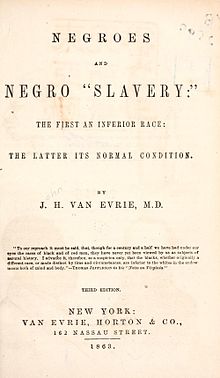
In 1861, Dr. J.H. Van Evrie, promoted the scientific racist of ichthyologist Louis Agassiz in a pamphlet entitled “Negroes and Negro Slavery;” The First an Inferior Race – The Latter, Its Normal Condition” expressed how most Southerners felt about African Americans be they slave or free, and Jefferson Davis hoped that Van Evrie’s arguments would persuade people to adopt the view that racial equality was a fallacy which could not be tolerated, Van Evrie wrote:

“He is not a black white man, or merely a man with a black skin, but a DIFFERENT AND INFERIOR SPECIES OF MAN; – that this difference is radical and total… that so called slavery is neither a “wrong” nor an “evil, but a natural relation based upon the “higher law,” in harmony with the order, progress, and general well-being of the superior one, and absolutely in keeping with the existence of the inferior race.”  [2]

While all Northern states had abolished slavery, or were in the process of gradual abolition in the after independence and the Civil War and had moved to an economic concept of free labor, the South had tied its economy and society to the institution of slavery. The contrast was well said by the members of an Alabama agricultural society, which noted in 1846:

“Our condition is quite different from that of the non-slaveholding section of the United States. With them their only property consists of lands, cattle and planting implements. Their laborers are merely hirelings, while with us our laborers are our property.” [3]

Van Evrie was not the only person making such distinction between the races. Dr. Samuel Cartwright wove the pseudo-science of the day into the narrative of the Bible, noting:

“I have thus hastily and imperfectly noticed some of the more striking anatomical and physiological peculiarities of the Negro race. The question may be asked, Does he belong to the same race as the white man? Is he a son of Adam? Does his particular physical confirmation stand in opposition to the Bible, or does it prove its truth?… Anatomy and physiology have been interrogated, and the response is, that the Ethiopian, or Canaanite, is unfitted for the duties of a free man….” [4]

He also noted:

“The Declaration of Independence, which was drawn up at a time when negroes were scarcely regarded as human beings, “That all men are by nature free and equal,” was only intended to apply to white men…” [5]

Northerners on the other hand, even in states where the last vestiges of slavery held on, nearly universally ascribed to the understanding that there was a dignity to labor and that free labor was essential if people were to have a better life. It undergirded their understanding of human dignity and that “labor was the source of all value.” [6]

That understanding of the intrinsic value of free labor continued to gain ground in the North in the decades preceding the Civil War and found much of its support in the Calvinist theology that predominated in most Protestant Northern denominations. Labor was intrinsic to one’s calling as a Christian and a human being, slave labor, at least in the eyes of many Northerners undercut that idea. Success in one’s calling glorified God and provided earthly evidence that a person was among the elect. For many Northern Christians, “the pursuit of wealth thus became a way of serving God on earth, and labor, which had been imposed on fallen man as a curse, was transmuted into a religious value, a Christian calling.” [7]  Such ideas found their way into Republican political thought even when not directly related to religion.  William Evarts said in 1856 “Labor gentlemen, we of the free States acknowledge to be the source of all of our wealth, of all our progress, of all our dignity and value.” [8] Abraham Lincoln noted that “the free labor system…opens the way for all, and energy and progress, and improvement in condition for all,” [9] and Lincoln also noted something inherent in the economic theory of Adam Smith that Labor is prior to, and independent of capital…in fact, capital is the fruit of labor.” [10]

However, the South by the 1830s had completely wedded itself to slavery and southern advocates of slavery deplored the free-labor movement as wage slavery and extolled the virtue of slavery. James H. Hammond condemned the free-labor movement in his King Cotton speech to the Senate in 1858:

“In all social systems there must be a class to do the menial duties, to perform the drudgery of life…. It constitutes the very mudsill of society….Such a class you must have, or you would not have that other that leads to progress, civilization and refinement….Your whole hireling class of manual laborers and ‘operatives,’ as you call them, are essentially slaves. The difference between us is, that our slaves are hired for life and well compensated…yours are hired by the day, not cared for, and scantily compensated.” [11]

Even so, the fact that the slave barons “were forced at every election to solicit the votes of “ignorant, slovenly, white trash in the country” with “frequent treats that disgrace our elections,” [12] rankled and humiliated many members of the Southern aristocracy. It was a marriage of two disparate parties linked by their membership in a superior race, something that only the continued existence of slavery ensured.

Lincoln extolled the virtues of free-labor, noting his own experiences after his election: “I am not ashamed to confess that twenty five years ago I was a hired laborer, mauling rails, at work on a flat boat – just what might happen to any poor man’s son.”  [13] Other Northerners lauded free-labor as the basis of upward mobility, and the New York Times noted that “Our paupers to-day, thanks to free labor, are our yeomen and merchants of tomorrow.” [14]

slave-coffle2

                                                       Slave Coffle

But whites in the South held labor in contempt due to the system of slavery, and the divergent views of each side were noted by Thomas Ewing who noted that labor “is held honorable by all on one side of the line because it is the vocation of freedmen – degrading in the eyes of some on the other side because it is the task of slaves.” [15] Of course with labor being the task of African slaves for southerners, the issue was entwined with race, and “Even if slavery was wrong, its wrongs were cancelled out for nonslaveholders by the more monstrous specter of racial equity.”  [16]

Georgia Governor Joseph E. Brown emphasized the threat to whites in that blacks would be their social equals and competitors should slavery end. The racial component assured poor southern whites that they were superior to blacks and an Alabama lawyer wrote “The privilege of belonging to the superior race and being free was a bond that tied all Southern whites together… and it seemed from a Southern stand-point, to have for its purpose the leveling of all distinctions between the white man and the slave hard by.” [17] But poor white workers who remained in the South “repeatedly complained about having to compete with slaves as well as poorly paid free blacks” [18] leading many to seek a new livelihood in either Free States or the new territories.

For Southern politicians and slaveholders, the expansion of slavery was essential to its continued maintenance in the states where it was already legal. “Because of the need to maintain a balance in the Senate, check unruly slaves, and cultivate fertile soils, many planters and small plantation owners- particularly those living in the southern districts of the cotton states- asserted that their survival depended on new territory.” [19] In those decades “a huge involuntary migration took place. Between 800,000 and 1 million slaves were moved westward….” [20]

The need for slaves caused prices to soar, largely due to the ban on the import of slaves from Africa. This made the interregional trade much more important and linked the upper and lower south as well as the new slave-holding territories into “a regionwide slave market that tied together all of the various slaveowning interests into a common economic concern.” [21] In some older states like Virginia where fewer slaves were required, the exportation of slaves became a major industry:

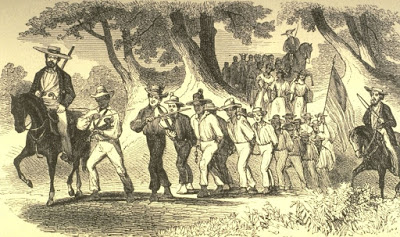
“male slaves were marched in coffles of forty or fifty, handcuffed to each other in pairs, with a long chain through the handcuffs passing down the column to keep it together, closely guarded by mounted slave traders followed by an equal number of female slaves and their children. Most of them were taken to Wheeling, Virginia, the “busiest slave port” in the United States, and from there they were transported by steamboat to New Orleans, Natchez, and Memphis.”[22]

To be continued…

Notes

[1] Ibid. McPherson Drawn With Sword p.50

[2] Van Evrie, J.H. “Negroes and Negro Slavery;” The First an Inferior Race – The Latter, Its Normal Condition 1861 in The Confederate and Neo-Confederate ReaderThe Great Truth about the Lost Cause, Loewen, James W. And Sebesta, Edward H. Editors, University Press of Mississippi, Jackson, 2010 p.75

[3] Ibid. Levine Half Slave and Half Free p.19

[4] Cartwright, Samuel A. Diseases and Peculiarities of the negro Race, 1851 in Loewen, James W and Sebesta, Edward H. The Confederate and Neo-Confederate reader: The Great Truth about the Lost Cause University of Mississippi Press, Jackson 2010 p.66

[5] Ibid. Cartwright Diseases and Peculiarities of the negro Race, 1851 p.70

[6] Foner, Eric Free Soil, Free Labor, Free Men: The Ideology of the Republican Party Before the Civil War Oxford University Press, Oxford and New York 1970 and 1995 p.7

[7] Ibid. Foner Free Soil, Free Labor, Free Men pp.12-13

[8] Ibid. Foner Free Soil, Free Labor, Free Men p.12

[9] Ibid. McPherson The Battle Cry of Freedom: The Civil War Era p.28

[10] Ibid. Foner Free Soil, Free Labor, Free Men p.12

[11] Ibid. McPherson The Battle Cry of Freedom p.196

[12] Ibid. Guelzo Fateful Lightening p.38

[13] Ibid. McPherson The Battle Cry of Freedom p.28

[14] Ibid. Foner Free Soil, Free Labor, Free Men p.16

[15] Ibid. Foner Free Soil, Free Labor, Free Men p.16

[16] Ibid. Guelzo Fateful Lightening p.38

[17] Ibid. Guelzo Fateful Lightening p.39

[18] Ibid. Levine Half Slave and Half Free p.44

[19] Ibid. Egnal  Clash of Extremes pp.125-126

[20] Korda, Michael. Clouds of Glory: The Life and Legend of Robert E. Lee Harper Collins Publishers, New York 2014 p.203

[21] Deyle, Steven The Domestic Slave Trade in Major Problems in the Civil War and Reconstruction Documents and Essays Third Edition edited by Michael Perman and Amy Murrell Taylor Wadsworth Cengage Learning Boston MA 2011 p.53

[22] Ibid. Korda Clouds of Glory: The Life and Legend of Robert E. Lee  p.203

Leave a comment

Filed under civil rights, civil war, ethics, History, laws and legislation, News and current events, Political Commentary, racism

Eliminating Political Opposition and Laws Enabling Crimes Against Humanity: Germany July 14th 1933

Friends of Padre Steve’s World,

On July 14th 1933 two laws were passed by the Nazi led government, less than five and a half months after Hitler’s legal accession to power, and four and a half months after he, under the Weimar Constitution’s Article 48 seized power following the Reichstag Fire. 

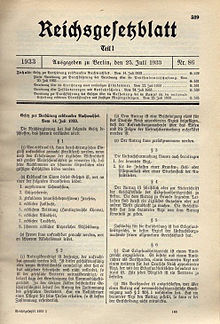
One law, under the policy of Gleichschaltung (coordination) all political parties other than the Nazi Party were prohibited. The Parties of the Right and Center voluntarily dissolved themselves, the Communists had already been made illegal and their surviving leaders went underground. The Social Democrats resisted until the end, but were banned.

The second law, was much easier to enforce without official political parties to oppose it was much more drastic. It did not only deny people their political rights, it determined that some people were life unworthy of life and people who could not be allowed to reproduce and would be sterilized in order to purify the the Aryan race. That law was called Gesetz zur Verhütung erbkranken Nachwuchses or the Law for the Prevention of Genetically Diseased Offspring. 

It read:

The Reich government has passed the following law, which is hereby promulgated:

§ 1.  Anyone suffering from a hereditary disease can be sterilized by a surgical operation if, according to the experience of medical science, there is a high probability that his offspring will suffer from serious physical or mental defects of a hereditary nature.
Anyone suffering from any of the following diseases is considered hereditarily diseased under this law:

1. Congenital mental deficiency

2. Schizophrenia

3. Manic-depression

4. Hereditary epilepsy

5. Hereditary St. Vitus’ Dance (Huntington’s Chorea)

6. Hereditary blindness

7. Hereditary deafness

8. Serious hereditary physical deformity.

Furthermore, anyone suffering from chronic alcoholism can be sterilized.

§ 2.  Applications for sterilization can be made by the individual to be sterilized. If this person is legally incompetent, has been certified on account of mental deficiency, or is not yet 18, a legal representative has the right to make an application on this person’s behalf but needs the consent of the court of guardians to do so. In other cases of limited competency, the application needs to be approved by the legal representative. [ . . . ]

§ 3.  Sterilization can also be requested by the following: 1. the state physician. 2. In the case of inmates of hospitals, nursing homes, and penal institutions, by the head thereof.

§ 4.  The application is to be made to the office of the Eugenics Court; it can either be made in writing or dictated to the court. The facts upon which the application is based should be supported by a medical certificate or confirmed in some other way. The office must inform the state physician of the application.

§ 5.   Responsibility for the decision rests with the Eugenics Court that has jurisdiction over the district in which the person to be sterilized officially resides.

§ 6.  The Eugenics Court is to be attached to a district court [Amtsgericht]. It consists of a district court judge acting as chairman, a state physician, and another physician certified by the German Reich and particularly well trained in eugenics…

§12. Once the Court has decided on sterilization, the operation must be carried out even against the will of the person to be sterilized, unless that person applied for it himself. The state physician has to attend to the necessary measures with the police authorities. Where other measures are insufficient, direct force may be used.

This law comes into effect on January 1, 1934.
Berlin, July 14, 1933.


The Reich Chancellor
Adolf Hitler

The Reich Minister of the Interior
Frick

The Reich Minister of Justice
Dr. Gürtner

During the first year of the law over 64,000 people were forcibly sterilized. During the course of the Reich’s existence over 400,000 people were forcibly sterilized. Fewer than 1% of those who appealed the decision for sterilization gained a reprieve. The law was the first in a series of laws and policy decisions that would lead to the Holocaust. 

Many of the Eugenics laws in the Third Reich modeled themselves on Eugenics laws in many American States, as well as the studies of well know American, and English Eugenicists Of the time, men who approved of the German laws when they were published.

In our own country there are those who want to deny care and insurance for care for people whose conditions are considered a drain on the economy, and while there is a strong political lobby opposed to abortion, most of those allegedly pro-life people and politicians seem to care about the health and quality of life once it emerges from the womb. The law Hitler signed forbade the abortion of Aryan fetuses, but allowed for the abortions of fetuses who might be less than perfect or require expensive medical care to maintain.

With the systematic devaluation of life in this country based on the economic value of people, and the very obvious belief that the lives of racial and certain religious minorities as not having the same value as Americans of European descent. While some would like to believe that a problem isolated to the radical right wing backers of President Trump, there are places where well off white liberals and progressives attempt to insulate themselves from racial and religious minorities.

Irregardless of the seeming contempt for well off white liberals and progressives For the lives and circumstances of minorities so long as they are not their neighbors, the greater threat to life is the political and economic ideology of so called conservatives that devalues life to its economic and racial benefit; the same kind of people who support President Trump’s racial, economic, and medical policies. The same people who espouse explicitly racist views, and whose leader calls his opponents, be they political, educational, or those who dare to criticize him in the media as “enemies of the state.”  The only thing keeping the President and his followers total control is the fact that our constitutional institutions are barely holding and there has been no crisis such as the Reichstag Fire a terrorist event, a Major War to suspend the Constitution and to enable the Executive Branch to take total control of the country, possibly ban political opposition, and freedom of speech and association.

That is what I worry about. Once the basic freedoms under the Constitution are abrogated, once citizens are determined to be enemies of the state then it is possible for that same executive branch to pass laws laws by decree that suspend the liberties, or take the lives of those deem life unworthy of life.

So until tomorrow,

Peace

Padre Steve+


1 Comment

Filed under economics and financial policy, ethics, healthcare, History, holocaust, laws and legislation, nazi germany, News and current events, Political Commentary

The Battle Of Kursk: Nazi Military Operations Cannot be Separated from Hitler’s Genocidal Policies

Friends of Padre Steve’s World,

I am reposting an older article today which was a paper that I wrote for a class as part of my second Masters Degree program.  Tomorrow, July 12th is the anniversary of the one of the largest tank battles in history, The Battle of Prokhorovka, the climax of the Battle Of Kursk, in which nearly 1000 German and Soviet tanks engaged in an often close quarters battle where both suffered staggering casualties, but the Soviets prevented a German breakthrough, and with it a potential German victory. 

The Battle of Kursk was the climactic battle on the Eastern Front from which the Germans never recovered. It was a battle that should not have been fought, at least at the time that it was fought. It was high risk operation with minimal payoff should it succeed. It did not and combined with the Allied landings in Sicily and other setbacks suffered by German forces in 1943 was the battle that doomed Germany to defeat. It was the last time that the German military had a chance to score a major victory against the Soviets and their defeat ensured the defeat of the Third Reich. 

The decision of Hitler and the High Command to launch this offensive is also connected for the need of the Nazis to complete the Final Solution Of the “Jewish Problem,” which was in the process of execution millions of Jews, with an emphasis on the systematic destruction of European Jewry, with the desire to eliminate the Russian Jews who as of yet remained under the protection of the Red Army. The German military campaign in the east can never be disconnected from the genocidal policies of the Nazis, and many of the German troops and commanders involved in Zitadelle were accomplices to Genocide or actively supported it. 

So when you read this article, do not just look at the military dimensions. Remember, that it, like every Nazi military operation was a necessary part of Hitler’s genocidal program. 

Until tomorrow, 

Peace

Padre Steve+


The German Situation and Dilemma in April 1943
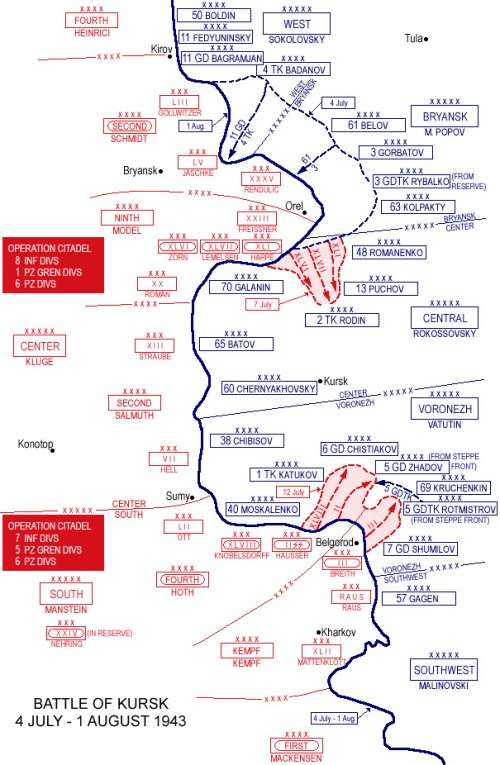
Battle_of_Kursk_(map)

The Germans faced a dilemma in April 1943.  Manstein’s brilliant counter-stroke had turned what could have been disaster into an opportunity to salvage prospects for the Eastern Front. The German action had “repaired its front, shattered the hopes of the Allies, and nipped the Russian spearhead.”[i]Unfortunately for the Germans the spring thaw meant that Manstein could not continue immediately and eliminate the Kursk bulge which had been formed by Rokossovky’s offensive and Manstein’s own counter-stroke.  With the Germans stalled by the weather Stavka cancelled “other significant planned offensives to dispatch reinforcements to the Kursk region.”[ii] Despite the weather Manstein pushed Kluge for an immediate attack on both sides of the bulge but was rebuffed by Kluge who “insisted that his troops needed to rest and refit.”[iii] This rebuff combined with the onset of the Russian mud meant that in “March 1943 the war on the ground came to an end….The front was immobilized.”[iv]

manstein with tanks                 Field Marshal Erich von Manstein with Tiger I Tanks

Manstein’s offensive had “enabled the Germans to consolidate a firm position in the East, and build up strength afresh- not to its former level, but sufficient to provide a good prospect of holding the Russians at bay.”[v] As a result German armies in the south “held again nearly the same positions from which the Blau offensive had begun the previous spring.”[vi] Now the Kursk bulge some 250 Kilometers wide and 160 Kilometers deep[vii] protruded menacingly into the German lines and drew the attention of both sides, to the Germans it appeared to be designed for an encirclement battle.[viii] Thus it appeared that the Kursk bulge was the obvious place for the Germans to resume the offensive and maintain the initiative on the Eastern Front.

But was the Kursk necessary?  Was Operation ZITADELLE as obvious as it seemed to be to Hitler, Zeitzler and others?  The battle is the subject of many books and articles which often focus on tactical and operational details of the German offensive, particularly the battle on the southern side of the bulge and the clash of armor at Prokhorovka.  This essay will focus less on the battle and more on the strategic situation faced by the Germans in the spring of 1943. Key to this are the arguments for and against the operation, the operations timing and the option that the Germans had to conduct a mobile defense.   It is the strategic situation that must be looked at to determine whether Operation ZITADELLE was necessary at all. Manstein believed that had the offensive been launched early enough that it might have succeeded provided it “we launched it early enough we could hope to catch them in a state of unpreparedness.”[ix]Williamson Murray and Allan Millett agree with Manstein’s assessment but note that an early offensive was “riskier…but greater the prospect for a major success.”[x] Guderian on the other hand saw that nothing good could come of ZITADELLE and opposed it from the beginning.[xi] Glantz and House in their detailed study argue that “there is absolutely no basis for assuming that Citadel would have succeeded had it been launched in spring 1943.”[xii]

battle_kursk t 34            The Soviets Reinforced and Fortified the Kursk Salient

The Germans faced a number of major problems in early 1943.  First, among them was manpower.  The armed forces had been mauled on the Eastern Front, “after continuous operations from June 1942 to March 1943, most German units were worn out.”[xiii] Many infantry divisions “were reduced to two thirds of their original strength, with declining mobility and anti-tank defenses.”[xiv] Had the Germans only faced the Russians this might have been overcome, however they not only faced a rejuvenated Red Army, but challenges brought about by multi-theater operations and their weak, ineffective and reluctant allies.  The Allied air offensive which though it “did not decisively effect German arms production it nevertheless prevented a great deal of work from being carried on and had profound moral effects which communicated themselves to all the fronts.”[xv] Likewise the U-Boat campaign had been effectively defeated by May 1943 allowing for increasing numbers of American troops and supplies to reach Europe, including significant Lend-Lease aide for the Soviet Union.  Manpower became a major issue for the the German Army and industry.  Both the military and industryhad difficulty in getting the required number of personnel to meet their personnel needs, in January 1943 the German High Command “demanded 800,000 men-but even the most ruthless call-up was able to produce only 400,000” who were lost to the civilian war economy.[xvi] Even the “belated industrial mobilization of Germany, fueled by slave labor and directed by the organizational genius of men like Speer and Guderian, could do little beyond patching together existing units.”[xvii]

Bild 101I-139-1112-17General Heinz Guderian, Inspector of Panzer Troops was one of Few Senior German Officers to Oppose ZITADELLE from the Beginning

There were other challenges. The German and Italian armies in North Africa had surrendered, and about 330,000 Axis soldiers entered captivity.[xviii] Added to the heavy losses on the Eastern Front, the disasters in North Africa and Stalingrad had “effectively destroyed the Axis military alliance, such as it was.”[xix] Italy, Hungary and Romania all began to pull their forces out of the Eastern front after having them shattered by the Soviet Winter offensive.[xx]Italy, shaken by its losses in North Africa and the Russian front was wavering in its support for Germany; Mussolini’s government itself was on the verge of falling.  Likewise the Hungarian government sought contact with the Allies;[xxi]as did the Romanians.[xxii] Finland too was looking for a way out and limiting its participation in German offensive operations.[xxiii] As her allies looked for a way out, the British and Americans were about to open a new front in Southern Europe, while another had effectively been opened by partisans in Yugoslavia and Greece.[xxiv] The crisis in the south was great enough that OKW under General Jodl began to look at ways of shoring up those fronts in case Italy withdrew from the war including the use of units that would have to be withdrawn from the Eastern Front.[xxv] The Balkans drained German reserves such that the number of German divisions deployed there increased from 5 to 15 between July 1942 and July 1943.[xxvi] Additionally many units had to be created by the Replacement Army to build up the Western Front knowing that an Allied strike there would eventually take place, further depriving the Eastern Front of badly needed infantry replacements and divisions.
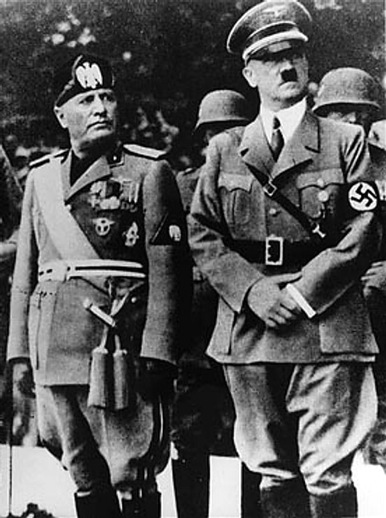
Benito_Mussolini_and_Adolf_HitlerHitler Felt Regaining the Initiative in the East was Critical to Keeping his Allies in the War

The German Options and Decision

The question for the Germans now was whether they “had any strategic options that would allow them to avoid defeat.”[xxvii] It is from this perspective that the necessity of Kursk must be examined. Most in the German High Command now realized that strategy in the east could no longer be “based on the illusion of conquering the vast Soviet Union.”[xxviii] As such the discussion turned to what direction the new strategy should take.  Political considerations came into play: Since the German allies were looking for ways to exit the war it was felt that “it was politically impossible for Germany to surrender the initiative on the Eastern Front.”[xxix] Realistically there were two options available: Wait and counterattack or launch a limited attack on the Kursk salient. The general impression among many German commanders in the East was that they had ended the last campaign “with a relative advantage over the Reds, an advantage that should be exploited as soon as the rasputitsa ended in April or early May.”[xxx] But the only strategy that looked feasible balancing the political and military goal of maintaining the initiative was what Manstein originally had in mind after Kharkov, to continue on, pinch out the Kursk bulge with the cooperation of Kluge’s Army Group Center.  As noted the opportunity to do so was lost with Kluge’s refusal and the onset of the spring thaw.  Yet this idea captured Zeitzler at OKH and Kluge at Army Group Center, though by April and May Manstein was more inclined toward “the ‘backhand’ stroke, which involved giving up the whole Donetz basin and staging a major Panzer offensive southeast from Kharkov.”[xxxi] However, this was too bold for Hitler who was “unwilling to give up the Donetz Basin with its industrial and mineral resources.”[xxxii]

battle_kursk_tiger advancing     The New Tiger Tanks Were to Play a Critical Role in the Attack

Manstein felt that the “moment of opportunity had passed, but his counterpart at Army Group Center…Kluge, was enthusiastic about the proposal.”[xxxiii]Zeitzler believed that an “attack at Kursk would be less risky”[xxxiv] than Manstein’s “backhand” and pushed the plan to Hitler.  There were advantages to this strategy if it could be carried out successfully. The Germans would encircle and destroy Russian forces in the salient and “shorten their own defensive lines after such an encirclement.”[xxxv] Yet the plan was opposed by others. Jodl at OKW argued against ZITADELLE “because he believed that it was dangerous to empty the strategic reserve when so many new crises threatened to develop in the Mediterranean.”[xxxvi] Zeitzler countered that because of German weakness in the east that they could not “wait to be hit.”[xxxvii] Guderian did not believe that either Army Group could be ready to mount the offensive that Zeitzler envisioned and “declared that the attack was pointless…if we attacked according to the plan of the Chief of the General Staff, we were certain to suffer heavy tank casualties, which we would not be in position to replace in 1943.”[xxxviii]Guderian asked Hitler at a separate conference “why he wanted to attack at all in the East in 1943.” When Keitel expressed that the reasons were political, Guderian asked Hitler “How many people do you think even know where Kursk is? It’s a matter of profound indifference to the world whether we hold Kursk or not…”[xxxix] Guderian and Speer both pointed out technical problems in producing the Tigers and Panthers but were overruled.[xl] Hitler himself reportedly had misgivings about the attack at one point reportedly stating that “the thought of the Zitadelle operation ‘made [his] stomach turn over’”[xli] In spite of Jodl and Guderian’s warnings, his own misgivings and those of Manstein and Model in April and May, Hitler “allowed himself to be tempted once more into taking the offensive. The Kursk salient…lured him into mounting his great pincer operation known as Citadel.”[xlii] Glantz and House maintain that he could “see no alternative politically and agreed to the plan.”[xliii]

The Facts on the Ground

Kursk_T34_and_Fieldgun-px800Soviet Forces Expected the Attack and Were well Prepared to Meet it

Once the decision to attack was made the question that remained was the timing of the attack. Manstein had preferred an early attack in May, but the operation was postponed to mid-June and then to July due to the request of Model who believed that his forces were too weak and needed reinforcements.[xliv] The attack was to be one of several “limited offensives designed to consolidate the German defenses while inflicting sufficient damage on the Red Army to delay any Soviet offensive.”[xlv] But the delays insisted on by Model and agreed to by Hitler were a fatal error.  The Germans failed to “factor into their decision was the unpalatable reality that Soviet strength in the Kursk salient was growing much faster than the Wehrmacht could muster forces to attack it.”[xlvi] Not only were the Soviet forces growing they knew about the German plans and could deploy their forces to counter them and for their own offensive.[xlvii] Stalin’s generals were able to convince him not to launch an attack and instead wait on the Germans so they could attack as the Germans exhausted their strength.[xlviii] They knew of it since April and reinforced the flanks of the salient with guns and armor at a faster pace than the Germans opposite them.[xlix] At Kursk “improved intelligence collection and analysis permitted the Red Army to predict almost exactly the strategic focal point of a major German offensive.”[l] Into the bulge “Vatutin and Rokossovsky crammed seven armies.”[li] The Russians deployed in depth in heavy fortified zones and minefields along the very sectors of the bulge that the Germans intended to attack, successfully masking their preparations from the Germans. It was “a measure of Soviet self-confidence that the senior commanders were looking beyond the German attack, beyond its failure, to the first major Soviet summer offensive.”[lii] Had the Germans succeeded in pinching off the salient “they would have faced several additional defensive belts constructed to the east of the salient.”[liii]

Typically when one launches an offensive it is desirable to have numeric advantage over the defender, 3:1 is normally assumed to be sufficient. At Kursk the Germans were outnumbered by the Russians 2.3:1 in men and 1.6:1 in tanks[liv] yet somehow the offensive had now morphed from a spoiling attack into a strategic offensive, albeit with more limited objectives attacking one of the strongest points in the Russian line.  General Raus, commanding a corps in Army Detachment Kempf noted: “Considering Russian dispositions, defenses and terrain, German strength could be considered only minimally sufficient for the assigned mission.”[lv] The Chief of Staff of XLVIII Panzer Corps called Kursk “the strongest fortress in the world.”[lvi]

Danger Signs: Requests for Cancellation

keitel-jodl-hitlerGeneral Alfred Jodl at OKW Protested the Offensive Verbally and in Writing

As more delays occurred Manstein “came out in the open and protested that the operation was no longer feasible and must be abandoned, but it was too late.  The united stand of orthodox General Staff opinion, Keitel, Zeitzler, Kluge, had persuaded the Führer, whose mind, once made up, was never altered.”[lvii]Manstein felt that the idea had been to “attack the enemy before the enemy had replenished his forces and got over the reverses of the winter.”[lviii] He felt there was great danger to the Mius line and to the northern Orel bulge with each delay; and the felt the threat of an attack by the Allies in Western Europe.[lix] On 18 June Jodl and the OKW Operations Staff “recommended to Hitler that he abandon Operation Citadel in order to free strategic reserves for defense in both East and West.”[lx] Warlimont writes that Jodl “raised empathic objection to the premature commitment of the central reserves to the East; he pointed out both verbally and in writing that a local success was all that could be hoped from Operation Citadel and that it could have no strategic significance for the overall situation.”[lxi] Hitler again refused the request.  “The doubts of certain Chiefs of Staff of the attacking armies were disregarded, and in the case of Colonel von Schleinitz, answered with dismissal.”[lxii]

The Battle

battle_kursk tigersTigers Advancing

The attacking forces for ZITADELLE involved units of Army Group Center and Army Group South.  Spearheading the assault for Army Group Center was Model’s 9th Army.  2nd Army from the same Army Group took a defensive role in the center of the bulge while Army Group South’s 4th Panzer Army under Hoth and Army Detachment Kempf composed the Southern attack force.  Von Mellenthin noted that to muster the necessary divisions for the attacking armies “neighboring fronts were to be thinned out beyond the limits of prudence” and from a strategic point of view likened Citadel “to be a veritable ‘death ride.’”[lxiii]Manstein worried about stripping the Mius-Donetz salient which “had to hand over all their available forces.”[lxiv] The Germans sent 17 panzer divisions against Kursk including the elite 2nd Panzer, Grossdeutschland, Leibstandarte, Das Reich and Totenkopf. Hoth’s army was the “strongest force ever put under a single commander in the German Army.”[lxv] While the Germans assembled the Russians waited, and beginning on 1 July the “Red Army defenders were on constant alert, waiting in their bunkers for the first sign of attack.”[lxvi]

battle_kursk_0020                                          Panzers on the Advance

ZITADELLE began on 4 July with a reconnaissance in force, the main blow scheduled for 0300 5 July. The Russians learned of the timing from a prisoner and quickly launched an artillery counter-preparation an hour prior to the German attack, disrupting it while air strikes were ordered against Luftwaffe airfields.[lxvii] Model’s 9th Army on the northern flank attacked the Russian “13th and 70th Armies on a frontage of 50 kilometers”[lxviii] with the focus being a 16 kilometer front where he concentrated 6 infantry divisions, a panzer division and all his Tiger and Ferdinand units.[lxix] He intended to break the Soviet defensive system “by constantly feeding in new units to grind down the defenses.”[lxx] The attack stalled by the 9July making minimal progress of “8 to 12 kilometers into the massive Soviet defenses.”[lxxi] A good deal of his problem was due to limited infantry strength which was  “far below established strength….moreover, the Ninth Army’s infantry- even the veterans- lacked experience in conducting set-piece attacks against prepared positions.”[lxxii]The Russians defined the battleground and forced Model into a battle determined by superior firepower on a constricted battlefield, “a game that the Wehrmacht could not win.”[lxxiii] This nullified any advantage the Germans might have had in mobility for their panzer divisions.  In savage battles to take the high ground at Ponyri station and Ol’khovatka Model’s assaults faltered.  9thArmy sacrificed about 50,000 men and 400 tanks to the god of war.”[lxxiv]Model continued to attack until 12 July when the Russians launched their offensive against the Orel bulge forcing him to redeploy to counter the Russian advance.  The battle in the north became “a savage defensive battle in which considerable parts of the offensive wing of Ninth Army were involved.”[lxxv]Model’s defeat made Hoth’s task “much more challenging.”[lxxvi]

battle_kursk_t-34s and infantry                                          Soviet T-34’s and Infantry

The Fourth Panzer Army and Army Detachment Kempf made better progress, nearly breaking through the Russian defenses after hard fighting. They penetrated “into the third Soviet defensive belt, a depth of 35 kilometers, but were stopped by Katukov’s 1st Tank Army.”[lxxvii] The critical point was reached on 11 and 12 July at Prokhorovka station when 5th Tank Army collided with 4thPanzer Army. “Over 1200 tanks from both sides were engaged in this struggle.”[lxxviii] It was the largest tank engagement of the war, over 700 tanks were destroyed and “German losses were too great to allow a decisive breakthrough.”[lxxix] Both sides took heavy casualties but the Germans could not replace theirs while the Russians still had formidable uncommitted reserves.  On 13 July the battle in the south drifted into a stalemate as XLVIII Panzer Corps and Hausser’s II SS Panzer Corps failed to break the Soviet line[lxxx] as the Russians “kept on throwing in fresh troops, and their reserves seemed inexhaustible.”[lxxxi] Manstein desired to continue the offensive as he believed that for his Army Group “the battle was now at its culminating point, that to break it off at this moment would be tantamount to throwing victory away.”[lxxxii] Although Manstein and Hoth felt that they could continue on and break the Russian line, they were now not in a position to do so. Model’s forces were in no shape to assist in the north and Manstein and Kluge were called to the Wolfsschanze by Hitler who, now preoccupied with the Allied invasion of Sicily necessitating withdraws of strong panzer forces from the east to face the threat in the west.[lxxxiii] Hitler rejected Manstein’s counsel to continue and ordered him to withdraw II SS Panzer Corps,[lxxxiv] effectively ending the ZITADELLE as the Russians launched their offensive on 17 July.
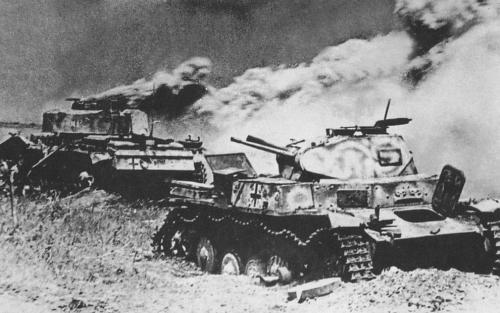
battle_kursk_destroyed panzers                                               Destroyed Panzers

Analysis of the Decision: Zitadelle Was Not Obvious, Necessary nor Well Executed

To Hitler and the supporters of ZITADELLE the operation seemed obvious.  In the two previous years the Germans had dealt punishing blows against the Red Army and the belief of Zeitzler and others was that the Wehrmacht was still qualitatively superior to the Soviets and that even a limited offensive would succeed in its objectives.  But the conditions on the ground had changed and the Germans failed to take the change into account.  The German Army did not have the resources for an offensive of the scope of Barbarossa or Blau. However this lack of resources did not lessen the optimism of some for ZITADELLE; particularly Zeitzler and Kluge. From their perspective the offensive to pinch out the Kursk salient seemed likely to succeed.  Yet as Clark notes the offensive was defined by a “lack of imagination and adaptability….Where the old Blitzkrieg formula….was fed into the computer, with little regard for the changed conditions….” [lxxxv] Von Mellenthin comments that by attacking Kursk, the “German Army threw away all their advantages in mobile tactics, and met the Russians on ground of their own choosing.”[lxxxvi] Glantz and House attribute this to the fact that the Germans “clung to outmoded assumptions about their own superiority over their opponents” due to their previous success. They point out that the Red Army had systematically reviewed its performance after every failure,” so that “Soviet doctrine, organization, and expectations were closer to battlefield reality than were those of the senior German leadership.”[lxxxvii] The German intelligence services failed them[lxxxviii] as they failed to detect the large strategic sized force that the Soviets had concentrated in the spring of 1943.  This was a force that Glantz and House believe would have caused ZITADELLE to fail even had it occurred in May, particularly in regard to the comparatively weak German forces fielded by Manstein.[lxxxix]

An offensive with what appeared to be reasonable objectives that were believed to be within the capabilities of the Wehrmacht failed.  Hitler according to Carell “gambled away not only victory but all hope of a draw.”[xc] Manstein categorized the offensive as a “fiasco.”[xci] Guderian called it “a decisive defeat” that made it “problematical” whether the armored formations could be “rehabilitated in time to defend the Eastern Front.”[xcii] Warlimont who served at OKW commented: “Operation Citadel was more than a battle lost; it handed the Russians the initiative and we never recovered it again right up to the end of the war.”[xciii]Guderian’s biographer Kenneth Macksey wrote that “the failure at Kursk was due to the employment of a faulty plan which lacked the element of strategic as well as tactical surprise.”[xciv] Raus lists several factors for this.  However, his argument is summarized: “once we learned in May and June that this was the area in which the Russians were prepared to offer their stiffest resistance, we should have modified our plans.  Either we should have refrained from attacking at all, or the operation should have been carried out to strike the enemy not at his strongest, but at his weakest point.”[xcv]

Hitler felt that a decisive victory was needed for political and propaganda reasons, yet even a significant victory was unlikely to keep Italy in the war, even if it swayed the lesser allies to stay the course.  ZITADELLE was conducted too late to save the Italians, success in May might have given German supporters in Italy some leverage but the invasion of Sicily and the failure at Kursk emboldened Mussolini’s opponents. The Fascist Grand Council “voted to have Mussolini removed as prime minister” and King Vittorio Emmanuaele “dismissed Mussolini” who was then placed under arrest.[xcvi] Finland refused to take offensive action that might have cut the Murmansk railway[xcvii] and engaged the Americans in a round of “abortive negotiation”[xcviii] while the Hungarians and Romanians provided little assistance to the Germans, partially due to the German reluctance to assist in modernizing and rebuilding their armies.[xcix]

Of the German Generals involved it was only Guderian as Inspector of Armored Troops and Jodl at OKW who consistently opposed ZITADELLE, citing realistic assessments of strengths, risks and dangers in other theaters.  Manstein opposed it when he felt the opportunity had passed, though it was unlikely to succeed had it been launched in May as he desired.  Guderian and Jodl’s arguments proved correct in every respect. ZITADELLE engaged German the preponderance of German forces in a battle that had at best chances of local success. The offensive itself weakened and endangered the German position on all fronts.  In the end, despite the belief and decision of Hitler, Zeitzler Kluge and others in the High Command, Operation ZITADELLE was neither obvious nor necessary and played out with the disastrous results expected by those who opposed it.

                                                        Notes


[i] Clark, Allan. Barbarossa:  The Russian-German Conflict 1941-45. Perennial, an Imprint of Harper Collins Books, New York, NY 2002. Originally published by William Morrow, New York, NY 1965. p. 306

[ii] Glantz, David M and House, Jonathan. The Battle of Kursk.  University Press of Kansas, Lawrence, KS. 1999. p.14

[iii] Ibid. Glantz and House, Jonathan. The Battle of Kursk.  p.14

[iv] Carell, Paul. Scorched Earth: The Russian German War 1943-1944. Translated by Ewald Osers, Ballantine Books, New York, NY 1971, published in arrangement with Little-Brown and Company. p. 335

[v] Liddell-Hart, B.H. The German Generals Talk. Quill Publishing, New York, NY. 1979. Copyright 1948 by B.H. Liddell-Hart. p.212

[vi] Wray, Timothy A. Standing Fast: German Defensive Doctrine on the Russian Front in World War II, Prewar to March 1943. U.S. Army Command and General Staff College, Fort Leavenworth, KS. 1986. p.163

[vii] Glantz, David M. and House, Jonathan. When Titans Clashed: How the Red Army Stopped Hitler. University Press of Kansas, Lawrence, KS. 1995. p.157

[viii] Ibid. Glantz and House. When Titans Clashed. p.157

[ix] Manstein, Erich von. Lost Victories. Translated by Anthony G. Powell, Zenith Press, an imprint of MBI Publishing Company, St Paul, MN. 2004. First Published as Verlorene Siege Athenaum-Verlag, Bonn, GE 1955, English edition Methuen & Company Ltd. 1958  p.447

[x] Murray, Williamson and Millett, Allan R. A War to Be Won: Fighting the Second World War.  The Belknap Press of Harvard University, Cambridge, MA. 2000. p.295

[xi] Macksey, Kenneth. Guderian: Creator of the Blitzkrieg. Stein and Day Publishing, New York, NY 1975 p.206

[xii] Ibid. Glantz and House. The Battle of Kursk. p.261

[xiii] Ibid. Glantz and House. The Battle of Kursk. p.14

[xiv] Ibid. Glantz and House. Clash of Titans. p.174

[xv] Goerlitz, Walter. History of the German General Staff 1657-1945.Translated by Brian Battershaw. Westview Press. Boulder CO and London. 1985 Originally published as Der Deutsche Generalstab, Verlag der Fankfurter Hefte, Frankfurt am Main.  First U.S. publication in 1953 by Preager Publishers. p.441

[xvi] Ibid. Carell. p.336

[xvii] Ibid. Glantz and House. Clash of Titans. p.174

[xviii] Warlimont, Walter. Inside Hitler’s Headquarters 1939-45. Translated by R.H. Berry, Presido Press, Novato CA, 1964. p.312

[xix] DiNardo, Richard L. Germany and the Axis Powers: From Coalition to Collapse. University Press of Kansas, Lawrence, KS. 2005. p.174

[xx] Ibid. DiNardo. p.174. By the summer all Italians units had been withdrawn, all but two Hungarian divisions which were used in anti-partisan operations and nine Romanian divisions.

[xxi] Ibid. Goerlitz. p.441

[xxii] Ibid. Glantz and House. Kursk. p.21

[xxiii] Ibid. DiNardo. p.180

[xxiv] Ibid. Goerlitz. p.441

[xxv] Ibid. Warlimont. pp.317-318

[xxvi] Dunn, Walter S. Jr. Heroes or Traitors: The German Replacement Arm, the July Plot, and Adolf Hitler. Praeger Publishers, Westport CT and London, 2003. p.53

[xxvii] Ibid. Murray and Millett. p.294

[xxviii] Ibid. Carell. p.339

[xxix] Ibid. Glantz and House. Kursk. p.21

[xxx] Ibid. Glantz and House. Kursk. p.21

[xxxi] Ibid. Clark. p.322

[xxxii] Liddell-Hart, B.H. Strategy. A Signet Book, the New American Library, New York, NY. 1974, Originally Published by Faber and Faber Ltd., London. 1954 & 1967. p.280

[xxxiii] Ibid. Glantz and House. When Titans Clashed. p.157

[xxxiv] Ibid. Clark. p.322

[xxxv] Ibid. Glantz and House. p.157

[xxxvi] Ibid. Clark. p.323

[xxxvii] Ibid. Clark. p.323

[xxxviii] Guderian, Heinz. Panzer Leader. (abridged) Translated from the German by Constantine Fitzgibbon, Ballantine Books, New York 1957. pp.245-246

[xxxix] Ibid. Clark. p.325.

[xl] Ibid. Glantz and House. When Titans Clashed. p.157.

[xli] Ibid. Clark. p.325

[xlii] Ibid. Carell. p.341

[xliii] Ibid. Glantz and House. When Titans Clashed. p.158

[xliv]Newton, Steven H. Hitler’s Commander: Field Marshal Walter Model, Hitler’s Favorite General. DeCapo Press, Cambridge MA 2005. pp.218-219

[xlv] Ibid. Glantz and House. When Titans Clashed. p.21

[xlvi] Ibid. Newton. p.219

[xlvii] Ibid. Murray and Millett. p.295

[xlviii] Ibid. Glantz and House. When Titans Clashed. p.158

[xlix] Ibid. Clark. p.326

[l] Ibid. Glantz and House. Kursk. p.63

[li] Overy, Richard. Russia’s War: A History of the Soviet War Effort: 1941-1945. Penguin Books, New York NY and London, 1997. pp.200-201

[lii] Ibid. Glantz and House. When Titans Clashed. p.159

[liii] Ibid. Glantz and House. Kurskp.64

[liv] Ibid. Glantz and House. Kursk. p.65 This reference contains a listing of each sector and the force ratios of men, tanks and guns in each sector.

[lv] Raus, Erhard. Panzer Operation: The Eastern Front Memoir of General Raus, 1941-1945. Compiled and Translated by Steven H Newton. Da Capo Press a member of the Perseus Book Group, Cambridge, MA 2003. p.197

[lvi] Weingartner, James. J. Leibstandarte SS Adolf Hitler: A Military History, 1933-45. Battery Press, Nashville, TN.(no publication date listed)  p.81

[lvii] Ibid. Clark. p.327

[lviii] Ibid. Manstein. p.447

[lix] Ibid. Manstein. pp.447-448

[lx] Ibid. Glantz and House. Kursk. p.55

[lxi] Ibid. Warlimont. p.334

[lxii] Ibid. Goerlitz. p.445

[lxiii] Von Mellenthin, F.W. Panzer Battles: A Study of the Employment of Armor in the Second World War. Translated by H. Betzler, Ballantine Books, New York, NY, 1971. Originally Published University of Oklahoma Press, 1956. p.262

[lxiv] Ibid. Manstein. p.448

[lxv] Ibid. Clark. p.328

[lxvi] Ibid. Glantz and House. Kursk. p.78

[lxvii] Ibid. Glantz and House. Kursk. pp.81-84

[lxviii] Ibid. Glantz and House. When Titans Clashed. p.166

[lxix] Ibid. Erickson. P.99

[lxx] Erickson, John. The Road to Berlin. Cassel Military Paperbacks, London, 2003. First Published by Weidenfeld and Nicholson, 1983. p.99

[lxxi] Ibid. Glantz and House. When Titans Clashed. p.166

[lxxii] Ibid. Newton. p.222

[lxxiii] Ibid. Newton. 234

[lxxiv] Ibid. Glantz and House. Kursk. p.121

[lxxv] Ibid. Carell. p.342

[lxxvi] Ibid. Glantz and House. Kursk. p.121

[lxxvii] Ibid. Glantz and House. When Titans Clashed. p.166

[lxxviii] Ibid. Glantz and House. When Titans Clashed. p.166

[lxxix] Ibid. Overy. p.209

[lxxx] Ibid. Glantz and House. Kursk. pp.215-217

[lxxxi] Ibid. Von Mellenthin. p.274

[lxxxii] Ibid. Manstein. p.449

[lxxxiii] Ibid. Glantz and House. Kursk. pp.217-218.

[lxxxiv] Ibid. Glantz and House. When Titans Clashed. p.167

[lxxxv] Ibid. Clark. pp.329-330

[lxxxvi] Ibid. Von Mellenthin. p.264

[lxxxvii] Ibid. Glantz and House. Kursk. p.269

[lxxxviii] Macksey, Kenneth. Why the Germans Lose at War. Greenhill Books 1996, Barnes and Noble, New York,  2006. p.227

[lxxxix] Ibid. Glantz and House. Kursk. p. 261

[xc] Ibid. Carell. p.342

[xci] Ibid. Manstein. p.449

[xcii] Ibid. Guderian. p.251

[xciii] Ibid. Warlimont. p.334

[xciv] Ibid. Macksey. Guderian p.206

[xcv] Ibid. Raus. p.211

[xcvi] Ibid. DiNardo. p.178

[xcvii] Ibid. DiNardo. p.181

[xcviii] Ibid. Erickson. p.91

[xcix] Ibid. DiNardo. pp.182-188

Bibliography

Carell, Paul. Scorched Earth: The Russian German War 1943-1944. Translated by Ewald Osers, Ballantine Books, New York, NY 1971, published in arrangement with Little-Brown and Company

Clark, Allan. Barbarossa:  The Russian-German Conflict 1941-45. Perennial, an Imprint of Harper Collins Books, New York, NY 2002. Originally published by William Morrow, New York, NY 1965

DiNardo, Richard L. Germany and the Axis Powers: From Coalition to Collapse.University Press of Kansas, Lawrence, KS. 2005

Dunn, Walter S. Jr. Heroes or Traitors: The German Replacement Arm, the July Plot, and Adolf Hitler. Praeger Publishers, Westport CT and London, 2003

Erickson, John. The Road to Berlin. Cassel Military Paperbacks, London, 2003. First Published by Weidenfeld and Nicholson, 1983

Glantz, David M and House, Jonathan. The Battle of Kursk.  University Press of Kansas, Lawrence, KS. 1999.

Glantz, David M. and House, Jonathan. When Titans Clashed: How the Red Army Stopped Hitler. University Press of Kansas, Lawrence, KS. 1995

Goerlitz, Walter. History of the German General Staff 1657-1945. Translated by Brian Battershaw. Westview Press. Boulder CO and London. 1985 Originally published as Der Deutsche Generalstab, Verlag der Fankfurter Hefte, Frankfurt am Main.  First U.S. publication in 1953 by Preager Publishers

Guderian, Heinz. Panzer Leader. (abridged) Translated from the German by Constantine Fitzgibbon, Ballantine Books, New York 1957

Liddell-Hart, B.H. Strategy. A Signet Book, the New American Library, New York, NY. 1974, Originally Published by Faber and Faber Ltd., London. 1954 & 1967

Liddell-Hart, B.H. The German Generals Talk. Quill Publishing, New York, NY. 1979. Copyright 1948 by B.H. Liddell-Hart.

Macksey, Kenneth. Guderian: Creator of the Blitzkrieg. Stein and Day Publishing, New York, NY 1975

Macksey, Kenneth. Why the Germans Lose at War. Greenhill Books 1996, Barnes and Noble, New York, 2006

Manstein, Erich von. Lost Victories. Translated by Anthony G. Powell, Zenith Press, an imprint of MBI Publishing Company, St Paul, MN. 2004. First Published as Verlorene Siege Athenaum-Verlag, Bonn, GE 1955, English edition Methuen & Company Ltd. 1958

Murray, Williamson and Millett, Allan R. A War to Be Won: Fighting the Second World War.  The Belknap Press of Harvard University, Cambridge, MA. 2000

Newton, Steven H. Hitler’s Commander: Field Marshal Walter Model, Hitler’s Favorite General. DeCapo Press, Cambridge MA 2005

Overy, Richard. Russia’s War: A History of the Soviet War Effort: 1941-1945.Penguin Books, New York NY and London, 1997

Raus, Erhard. Panzer Operation: The Eastern Front Memoir of General Raus, 1941-1945. Compiled and Translated by Steven H Newton. Da Capo Press a member of the Perseus Book Group, Cambridge, MA 2003

Von Mellenthin, F.W. Panzer Battles: A Study of the Employment of Armor in the Second World War. Translated by H. Betzler, Ballantine Books, New York, NY, 1971. Originally Published University of Oklahoma Press, 1956.

Warlimont, Walter. Inside Hitler’s Headquarters 1939-45. Translated by R.H. Berry, Presido Press, Novato CA, 1964

Weingartner, James. J. Leibstandarte SS Adolf Hitler: A Military History, 1933-45. Battery Press, Nashville, TN.(no publication date listed)

Wray, Timothy A. Standing Fast: German Defensive Doctrine on the Russian Front in World War II, Prewar to March 1943. U.S. Army Command and General Staff College, Fort Leavenworth, KS. 1986

Leave a comment

Filed under Foreign Policy, History, holocaust, leadership, Military, national security, nazi germany, Political Commentary, war crimes, world war two in europe

To Kill a Mockingbird at 59: Sometimes the Bible in the Hand Of One Man is Worse than a Whiskey Bottle in the Hand Of Another

mock

Friends of Padre Steve’s World,

Tomorrow marks the 59th the anniversary of the release of Harper Lee’s classic novel To Kill a Mockingbird. I have read the book, and seen the film many times. Sadly, it is all too relevant in our time. Race hatred and a belief in the absolutes of aberrant forms of Christianity which bless White Racism are rampant in the United States and Europe, many of these groups are overtly Fascist and Authoritarian.

That alone is to make the novel and the film worth reading and watching, especially if you haven’t read the book or seen the film.

Sadly, such people would “kill the Mockingbird” to ensure that they keep their privileged position in society. The Mockingbirds are those that they have condemned to social inferiority and discrimination and eternal punishment, especially gays and the LGBT community, but others as well.

This is especially the case of the preachers, pundits and politicians that crowd the airwaves and internet with their pronouncements against Gays, immigrants, Arabs, poor blacks, political liberals, progressive Christians, and for that matter anyone who simply wants the same rights enjoyed by these Christians.

In the book there is a line spoken by Miss Maudie Atkinson, a neighbor of Atticus Finch and his children. She says to Atticus’s daughter Scout:

“Sometimes the Bible in the hand of one man is worse than a whisky bottle in the hand of another… There are just some kind of men who – who’re so busy worrying about the next world they’ve never learned to live in this one, and you can look down the street and see the results.”

As I survey the world of Christian conservatives I become surer of this every day. I’ve often wrote about my own fears in regard to dealing with such people as well as the troubling trends that I see. Last week I wrote five articles on the trends that I see in the church, trends toward greed, political power, social isolation and the active campaign of some to deny basic civil rights to people that they hate on purely religious grounds.

The language of some like Matt Staver of Liberty Counsel, Tony Perkins of the American Family Association and a host of others describe actions of governments and courts to ensure equal treatment of all people under the law as threats to Christians, affronts to them and of course to God. Their words are chilling. Matt Staver commented a few years back that if the Supreme Court upheld marriage equity for gays that it would be like the Dred Scott decision. Of course that is one of the most Orwellian statements I have ever heard, for the Dred Scott decision rolled back the few rights that blacks had anywhere in the country and crushed the rights of people in non-slave states.

Again, as a reminder to readers, especially those new to the site, I spent a large amount of my adult Christian life in that conservative Evangelical cocoon. I worked for a prominent television evangelist for several years, a man who has become an extreme spokesman for the religious political right. I know what goes on in such ministries, I know what goes on in such churches. I know the intolerance and the cold hearted political nature of the beast. I know and have gone to church with Randall Terry, the former head Operation Rescue who once said: “Let a wave of intolerance wash over you. I want you to let a wave of hatred wash over you. Yes, hate is good…” I have walked in those shoes, I have been whipped up by those preachers. I fully understand them, and because I do I am in a unique position to critique their words and actions, especially as the supposedly moral majority snuggle up with one of the most amoral men ever to become President, solely to protect and crease their political power. They have surrendered their claim to being a party of morality, and embraced evil for the sake of their power. Without empathy, they judge and condemn others not like them. They are incapable of understanding anything that conflicts with their visions of White Power, racial superiority, and an interpretation of Christianity which needs state support in order to survive.

As Atticus Finch told his children:

“You never really understand a person until you consider things from his point of view… Until you climb inside of his skin and walk around in it.”

They cannot, thus I total reject the message of such people now, not out of ignorance, but because I have walked in their shoes. At times I supported their causes, not to any extreme, but all too often my crime was simply said nothing when I knew that what they preached, taught and lived was not at all Christian, but from the pits of Hell.

As far as them being entitled to hold whatever opinion they want, even if I disagree, yes that is their right. But as Atticus said:

“People are certainly entitled to think that I’m wrong, and they are entitled to full respect for their opinions. But before I can live with other folks I’ve got to live with myself. The only thing that doesn’t abide by majority rule is a person’s conscience.”

My conscience will not allow me to be silent when I see men like Staver, Perkins, Franklin Graham, Robert Jeffress, Pat Robertson, and so many others preach hatred towards those who are different than them. Their reach and power has only increased with their support of President Trump.

In the movie and the book the Mockingbirds were Tom Robinson, the black man falsely accused of rape and assault and Boo Radley, a shy recluse feared by his neighbors, a man who stories were made up about; stories that turned a simple man into a monster in the eyes of people who did not know him. Today they are others who fit the Mockingbird role, people who just want to get along and live in peace, but who endure discrimination and damnation from those who call themselves Conservative Christians.

Jem Finch, the son of Atticus asks his sister a question in the book and the film:

“If there’s just one kind of folks, why can’t they get along with each other? If they’re all alike, why do they go out of their way to despise each other?”

I ask the same question on a daily basis.

So until tomorrow I wish you a good night.

Peace

Padre Steve+

4 Comments

Filed under books, christian life, civil rights, ethics, faith, film, History, LGBT issues, movies, News and current events, Political Commentary