Category Archives: laws and legislation

“The Promise Being Made, Must be Kept…” Abolition, Emancipation, and Freedom for All, 166 Years After the Emancipation Proclamation

Friends of Padre Steve’s World,

February is Black History Month, it’s something that no American of any race, color, or creed should forget. African Americans, the decendants of slaves and slaves themselves fought for freedom that was only at best was in the promissory note of the Emancipation Proclamation.

Those men, and women in the case of Harriett Tubman and Sojourner Truth, paved the way for freedom for African Americans and all others who benefited from what they fought for: women, Native Americans, Mexican Americans, and other Hispanics, Asian Americans, and LGBTQ Americans. That promise being made then, must be kept today, to the descendents of  this men, as well as all who benefited through their sacrifice: even the Southern Whites who at the time did not know then, or all too often today, that they too needed emancipation.

This article is a section of one of my yet unpublished Civil War books in which I spend much time dealing with the importance of emancipation and the role of Black soldiers during the American Civil War. I think it is important to remember as we get ready to close out Black History Month just how important these men are to American history and for the civil rights of all Americans.

Emancipation and the U.S. Military

HD_4USCinfantryDetail.preview

Men of the 4th Regiment of U.S. Colored Troops

The war brought about another change to warfare in America. This was a societal and political change that has shaped American military history, culture and life ever since. The Emancipation Proclamation gave African Americans, both Freedmen and recently freed slaves the opportunity to serve in the Union Army. The change of policy instituted by Lincoln was revolutionary as well as controversial and it had strategic implications for the war effort. There were many doubters in the north whose attitudes towards African Americans were not much different than Southerners, especially among the Copperheads.

Prior to the Emancipation some Union commanders in occupied Confederate territory “had unofficially recruited black soldiers in Kansas and in occupied portions of South Carolina and Louisiana in 1862. But the administration had not sanctioned these activities.” [1] The issue for Lincoln in 1861 and 1862 was the necessity of keeping the Border-Slave Sates of Kentucky, Missouri and Maryland, which had not seceded from the Union. Lincoln repudiated the orders of General John Fremont, in Missouri, and his friend General David Hunter, who commanded the Department of the South regarding emancipation, not because he was in complete disagreement, but because he felt that the officers had overstepped their authority.

Lincoln understood that this might hurt him with the abolitionist wing of the Republican Party. While Lincoln was certainly sympathetic to their cause, he insisted that such decisions were not within the prevue of local commanders, but that any such proclamations had to come from him, as Commander-in-Chief. He told Treasure Secretary Salmon Chase, who supported the measures of Hunter and Fremont, “No commanding general shall do such a thing, upon my responsibility, without consulting me.” [2] Lincoln’s decision to reverse and repudiate the decisions of local commanders infuriated some in his cabinet and in the Congress. But Lincoln remained firm in that conviction due to the need to ensure the cooperation of the Border States the continued loyalty of which were absolutely vital to winning the war, without which no meaningful emancipation would be possible.

However, Lincoln did support the efforts of General Benjamin Butler. Butler commanded the Federal forces at Fort Monroe in Hampton Roads. Butler had been a former pro-slavery Democrat who learned that the Confederates were using slaves to construct fortifications and to support their army on the Peninsula. In May 1862 twenty-three slaves escaped to his lines and their owner, a Confederate Colonel, “demanded the return of his property under the Fugitive Slave Law! With as deadpan expression as possible (given his cocked eye), Butler informed him that since Virginia claimed to have left the Union, the Fugitive Slave Law no longer applied.” [3]Butler then declared that since the escaped slaves had worked for the Confederate Army that they were “contraband of war – enemy property subject to seizure.” [4] It was a solid argument, since Southerners themselves referred to African American slaves as property was subject to seizure. Lincoln and Secretary of War Cameron approved of Butler’s action and “eventually, the Congress passed a confiscation law ending the rights of masters over fugitive slaves used to support Confederate troops.” [5]

Salmon Chase and other strong abolitionists opposed Lincoln vehemently for this, but it would not be long until Lincoln made the decision for full emancipation. This was first accomplished by the Emancipation Proclamation, a military order that only applied to the states that had seceded. However, Lincoln would follow this by pushing for a constitutional amendment to end slavery.   The latter occurred when Congress passed the Thirteenth Amendment was passed in January 1865. This amendment abolished slavery in the United States.

Lincoln had already decided upon emancipation in the spring of 1862, however, following the defeat of McClellan on the Peninsula he decided to postpone announcing it, Secretary of State Seward recommended against it until “until you can give it to the country supported by military success.” Otherwise the world might view it as an incitement for slave insurrections, “as the last measure of an exhausted government, a cry for help…our last shriek, on the retreat.” [6] The wisdom of Seward’s advice was profound, and Lincoln put off the announcement until after the Battle of Antietam.

McClellan, true to form opposed any such policy. When Lincoln visited him after his withdraw from the Peninsula, the defeated but still arrogant General handed Lincoln a memorandum on what McClellan viewed as the “proper conduct of the war.” McClellan advised Lincoln that the war “should not be a war looking to the subjugation of any State in any event…but against armed forces and political organizations. Neither confiscation of property, political executions of persons, the territorial organization of States, or the forcible abolition of slavery should be contemplated for a moment.” [7]

Lincoln was not seeking advice from his recalcitrant commander and put the letter in his pocket and simply told McClellan, “All right.” Interestingly enough just a few months earlier Lincoln would have agreed with McClellan’s views on the conduct of the war. However, with the passage of time and the realization that the Confederacy was fully committed to its independence as well as the continuance and even the expansion of slavery had come to the view that fighting a limited war with limited aims was foolish. He told another Unionist Democrat a few days after McClellan offered his advice that the war could not be fought:

“with elder-stalk squirts, charged with rose water….This government cannot much longer play a game in which it stakes all, and its enemies stake nothing. Those enemies must understand that they cannot experiment for ten years trying to destroy this government, and if they fail still come back into the Union unhurt.”[8]

From Slavery to Soldiering

2nd-colored-light-artillery

Gun Crew of 2nd Colored Light Artillery 

But as the war continued on, consuming vast numbers of lives the attitude of Lincoln and his administration began to change. After a year and a half of war, Lincoln and the closest members of his cabinet were beginning to understand that the “North could not win the war without mobilizing all of its resources and striking against Southern resources used to sustain the Confederate war effort.” [9] Slave labor was essential to the Confederate war effort, not only did slaves still work the plantations, they were impressed into service in war industries as well as in the Confederate Army.

Lieutenant Colonel Arthur Freemantle, a British observer who was with Lee’s army at Gettysburg noted, “in the rear of each regiment were from twenty to thirty negro slaves.” [10] The fact is that the slaves who accompanied the army remained slaves, they were not the mythical thousands of black soldiers who rallied to the Confederate cause, nor were they employees. “Tens of thousands of slaves accompanied their owners to army camps as servants or were impressed into service to construct fortifications and do other work for the Confederate army.” [11] This fact attested to by Colonel William Allan, one of Stonewall Jackson’s staff members who wrote “there were no employees in the Confederate army.” [12] slaves served in a number of capacities to free up white soldiers for combat duties, “from driving wagons to unloading trains and other conveyances. In hospitals they could perform work as nurses and laborers to ease the burdens of patients.” [13] An English-born artilleryman in Lee’s army wrote in 1863 that “in our whole army there must be at least thirty thousand colored servants….” [14] When Lee marched to Gettysburg he did so with somewhere between ten and thirty-thousand slaves in support roles and during the advance into Virginia Confederate troops rounded up and re-enslaved as many blacks as they could, including Freedmen.
istanto001p1

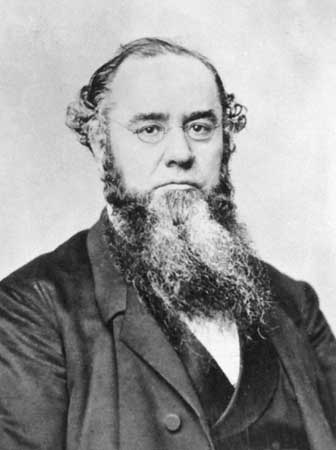
                                       Secretary of War Edwin Stanton

Lincoln’s Secretary of War, Edwin Stanton; who was a passionate believer in the justice of emancipation, was one of the first to grasp the importance of slave labor to the Confederate armies and how emancipation was of decided military necessity. Stanton, “Instantly grasped the military value of the proclamation. Having spent more time than any of his colleagues contemplating the logistical problems facing the army, he understood the tremendous advantage to be gained if the massive workforce of slaves could be transferred from the Confederacy to the Union.” [15]

Lincoln emphasized the “military necessity” of emancipation and “justified the step as a “fit and necessary war measure for suppressing the rebellion.” [16] The process of emancipation now became not only a moral crusade, but now became a key part of national strategy, not just in a military means, but politically, economically and diplomatically as Lincoln “also calculated that making slavery a target of the war would counteract the rising clamor in Britain for recognition of the Confederacy.”  [17]

Lincoln wrote to his future Vice President, Andrew Johnson, then the military governor of occupied Tennessee that “The colored population is the great available and yet unavailed of, force for restoration of the Union.”[18] The idea of simply mollifying the border states was dropped and policy changed that of “depriving the Confederacy of slave labor. Mobilizing that manpower for the Union – as soldiers as well as laborers – was a natural corollary.” [19] Reflecting President Lincoln’s and Stanton’s argument for the military necessity of emancipation, General Henry Halleck wrote to Ulysses Grant:

“the character of the war has very much changed within the past year. There is now no possibility of reconciliation with the rebels… We must conquer the rebels or be conquered by them….Every slave withdrawn from the enemy is the equivalent of a white man put hors de combat.” [20]
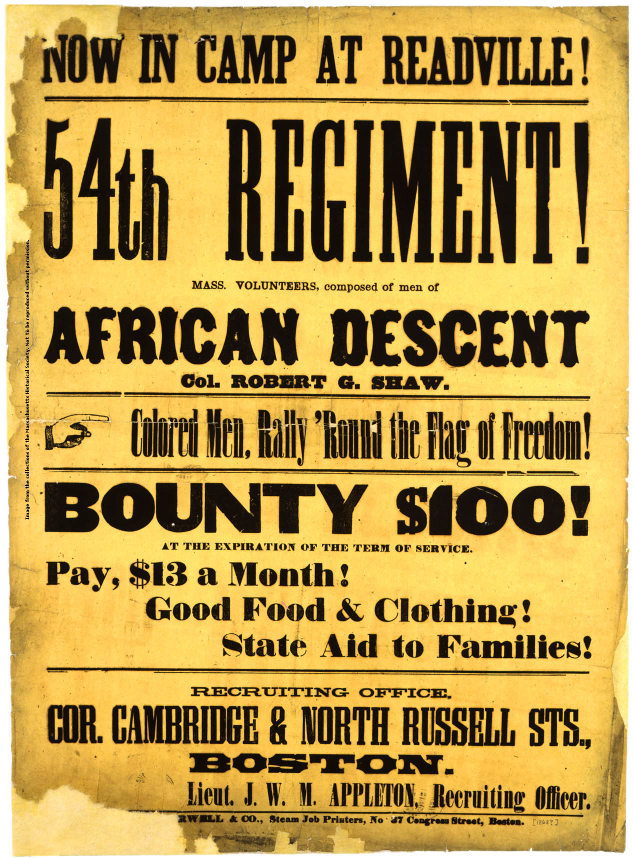
54thmassposter

Ulysses Grant concurred with Lincoln’s decision. Grant wrote to in a letter to Lincoln after the assault on Battery Wagner by the 54th Massachusetts, “by arming the negro we have added a powerful ally. They will make good soldiers and taking them from the enemy weakens him in the same proportion as it strengthens us.” [21] William Tecumseh Sherman was supportive but also noted some facts that some radical abolitionists did not understand. He noted in his correspondence that, “The first step in the liberation of the Negro from bondage will be to get him and his family to a place of safety… then to afford him the means of providing for his family,… then gradually use a proportion – greater and greater each year – as sailors and soldiers.” [22] Lincoln wrote after the Emancipation Proclamation that “the emancipation policy, and the use of colored troops, constitute the heaviest blow yet dealt to the rebellion.” [23] The change was a watershed in both American history as well as for the future of the U.S. Military services.

In conjunction with the Emancipation Proclamation Secretary of War Stanton “authorized General Rufus Saxton to “arm, uniform, equip, and receive into the service of the United States such number of volunteers of African descent as you may deem expedient, not exceeding 5,000, and [you] may detail officers to instruct them in military drill, discipline, and duty, and to command them.”  [24] The initial regiments of African Americans were formed by Union commanders in liberated areas of Louisiana and South Carolina, and most were composed of newly freed slaves. Others like the 54th and 55th Massachusetts Volunteer Infantry regiments were raised from free black men in the north. Stanton’s authorization was followed by the Enrollment Act passed by Congress in March of 1863 which established the draft also allowed blacks to serve. By March Stanton was working with state governors to establish more black regiments. The units became known as United States Colored Troops, or U.S.C.T. and were commanded by white officers and organized into the infantry, cavalry and, artillery regiments organized on the model of white regiments. The U.S.C.T. “grew to include seven regiments of cavalry, more than a dozen of artillery, and well over one hundred of infantry.” [25]

Some Union soldiers and officers initially opposed enlisting blacks at all, and some “charged that making soldiers of blacks would be a threat to white supremacy, and hundreds of Billy Yanks wrote home that they would no serve alongside blacks.” [26]  But most common soldiers accepted emancipation, especially those who had served in the South and seen the misery that many slaves endured, one Illinois soldier, stationed who served in the Western Theater of war wrote, “the necessity of emancipation is forced upon us by the inevitable events of the war… and the only road out of this war is by blows aimed at the heart of the Rebellion…. If slavery should be left undisturbed the war would be protracted until the loss of life and national bankruptcy would make peace desirable on any terms.” [27]

Another soldier’s letters home show his conversion from being against emancipation to being fully for it. Corporal Chauncey B. Welton from Ohio wrote to his father after the Emancipation proclamation:

“Father I want you to write and tell me what you think of Lincoln’s proclamation of setting all the negroes free. I can tell you we don’t think much of it hear in the army for we did not enlist to fight for the negro and I can tell you that we never shall or many of us any how[.] no never.”

Following over two years of combat in which he served with Sherman’s army he became a vocal critic of the anti-abolitionist Copperheads in the North, especially former Ohio Governor Clement Vallandigham, as well as a strong proponent of abolition and opponent of slavery. By February 1865 his tone had changed “dear parents let us trust in Him that never forsakes the faithful, and never cease to pray… that soon we may look upon an undivided Country and that Country free free free yes free from that blighting curs[e] Slavery the cause of four years of Bloody warfare.” [28]

Even so racial prejudice in the Union ranks never went away and sometimes was accompanied by violence. It remained a part and parcel of life in and outside of the army, even though many Union soldiers would come to praise the soldierly accomplishments and bravery of African American Soldiers. An officer who had refused a commission to serve with a U.S.C.T. regiment watched as black troops attacked the defenses of Richmond in September 1864:

“The darkies rushed across the open space fronting the work, under a fire which caused them loss, into the abattis… down into the ditch with ladders, up and over the parapet with flying flags, and down among, and on top of, the astonished enemy, who left in utmost haste…. Then and there I decided that ‘the black man could fight’ for his freedom, and that I had made a mistake in not commanding them.” [29] Likewise, “Once the Lincoln administration broke the color barrier of the army, blacks stepped forward in large numbers. Service in the army offered to blacks the opportunity to strike a decisive blow for freedom….” [30]

HD_NgroWarFL640116p264cz.preview

                                        The Defense of Milliken’s Bend 

Emancipation allowed for the formation of regiments of United States Colored Troops (USCT), which were mustered directly into Federal service. In sheer numbers the U.S.C.T. formations soon dwarfed the few state raised Black Regiments.  However, it was the inspiration provided by those first state raised regiments, the heroic accounts of those units reported in Northern newspapers, as well as the unprovoked violence directed against Blacks in the 1863 New York draft riots that helped to provoke “many northerners into a backlash against the consequences of violent racism.” [31]

Despite the hurdles and prejudices that blacks faced even in the North, many African Americans urged others to enlist, self-help mattered more than self-preservation. Henry Gooding, an black sergeant from Massachusetts wrote the editor of the New Bedford Mercury urging fellow blacks to enlist despite the dangers, “As one of the race, I beseech you not to trust a fancied security, laying in your minds, that our condition will be bettered because slavery must die…[If we] allow that slavery will die without the aid of our race to kill it – language cannot depict the indignity, the scorn, and perhaps the violence that will be heaped upon us.” [32]

The valor of the state regiments, as well as the USCT units that managed to get into action was remarkable, especially in regard to the amount of discrimination levied at them by some northerners, including white Northern soldiers, and the very real threat of death that they faced if captured by Confederates. In response to the Emancipation Proclamation and to the formation of African American regiments the Confederate Congress passed measures that would make Union officers who commanded African American troops as war criminals and return any black soldier captured by Confederate forces return to slavery, if those blacks captured in battle were not summarily tortured by their captors or executed as happened at Fort Wagner, Petersburg, and at Fort Pillow.

In late 1862 Major General Nathaniel Banks was in desperate need of soldiers and received permission to form a number of regiments of free blacks. Known as the First, Second and Third Regiments of the Louisiana Native Guards they were primarily composed of former slaves who had escaped to Union lines, as well as some mulattos who were the children of prominent white citizens of the city. During an inspection, the white Colonel of the Guards told another officer:

“Sir, the best blood of Louisiana is in that regiment! Do you see that tall, slim fellow, third file from the right of the second company? One of the ex-governors of the state is his father. That orderly sergeant in the next company is the son of a man who has been six years in the United States Senate. Just beyond him is the grandson of Judge ______ …; and through all the ranks you will find the same state of facts…. Their fathers are disloyal; [but] these black Ishmaels will more than compensate for their treason by fighting in the field.” [33]

In May of 1863 Banks dared to send the First and Third Regiments of “Louisiana Native Home Guard regiments on a series of attacks on Confederate positions at Port Hudson, Louisiana” [34] where they received their baptism of fire. They suffered heavy losses and “of the 1080 men in the ranks, 271 were hit, or one out of every four.” [35] A white Wisconsin soldier commented that the black soldiers “fought like devils,”while a soldier of the 156th New York wrote, “They charged and re-charged and they didn’t know what retreat meant. They lost in their two regiments some four hundred men as near as I can learn. This settles the question about niggers not fighting well. They on the contrary make splendid soldiers and are as good fighting men as we have.” [36] Banks too was caught up in the moment and said of these troops in his after action report: “They answered every expectation…In many respects their conduct was heroic…The severe test to which they were subjected, and the determined manner in which they encountered the enemy, leave upon my mind no doubt of their ultimate success.” [37]

The_Storming_of_Ft_Wagner-lithograph_by_Kurz_and_Allison_1890a

                                54th Massachusetts at Fort Wagner 

But the most famous African American volunteer regiment was the 54thMassachusetts, commanded by Colonel Robert Gould Shaw, the “North’s showcase black regiment.” [38] Raised in Boston and officered by many men who were the sons of Boston’s blue blood abolitionist elite, the regiment was authorized in March 1863. Since there was still opposition to the formation of units made up of African Americans, Massachusetts Governor John Andrew authorized the formation of the 54th under the command of white officers, a practice that with few exceptions, became standard in the U.S. military until President Truman desegregated the armed forces in 1948. Governor Andrew was determined to ensure that the officers of the 54th were men of “firm antislavery principles…superior to a vulgar contempt for color.”[39]

The 54th Massachusetts first saw action in early June 1863 and at Shaw’s urging were sent into battle against the Confederate positions at Fort Wagner on July 18th 1863. Leading the attack the 54th lost nearly half its men, “including Colonel Shaw with a bullet through his heart. Black soldiers gained Wagner’s parapet and held it for an hour before falling back.” [40]Though they tried to hold on they were pushed back after a stubborn fight to secure a breach in the fort’s defenses. “Sergeant William H Carney staggered back from the fort with wounds in his chest and right arm, but with the regiment’s Stars and Stripes securely in his grasp. “The old flag never touched the ground, boys,” Carney gasped as he collapsed at the first field hospital he could find.” [41] Shaw was buried with his men by the Confederates and when Union commanders asked for the return of his body were told “We have buried him with his niggers,” Shaw’s father quelled a northern effort to recover his son’s body with these words: We hold that a soldier’s most appropriate burial-place is on the field where he has fallen.” [42] As with so many frontal attacks on prepared positions throughout the war, valor alone could not overcome a well dug in enemy. “Negro troops proved that they could stop bullets and shell fragments as good as white men, but that was about all.” [43]

Despite the setback, the regiment went on to further actions where it continued to distinguish itself. The Northern press, particularly abolitionist newspapers brought about a change in the way that many Americans in the North, civilians as well as soldiers, saw blacks. The Atlantic Monthly noted, “Through the cannon smoke of that dark night, the manhood of the colored race shines before many eyes that would not see.”  [44]

55th-mass-at-charleston

                  55th Massachusetts being welcomed in Charleston SC 

In the African American 55th Massachusetts, which was recruited after the 54th, twenty-one year old Sergeant Isaiah Welch wrote a letter which was published in the Philadelphia Christian Recorder from Folly Island South Carolina:

“I will mention a little about the 55th Massachusetts Regiment. They seem to be in good health at the present and are desirous of making a bold dash upon the enemy. I pray God the time will soon come when we, as soldiers of God, and of our race and country, may face the enemy with boldness. For my part I feel willing to suffer all privations incidental to a Christian and a soldier…. In conclusion, let me say, if I fall in the battle anticipated, remember, I fall in defense of my race and country. Some of my friends thought it very wrong of me in setting aside the work of the Lord to take up arms against the enemy…. I am fully able to answer all questions pertaining to rebels. If taking lives will restore the country to what it once was, then God help me to slay them on every hand.” [45]

Like the 54th Massachusetts, the 55th would see much action. After one particularly sharp engagement in July 1864, in which numerous soldiers had demonstrated exceptional valor under fire the regiment’s commander, Colonel Alfred S. Hartwell “recommended that three of the black sergeants of the 55th be promoted to the rank of 2nd Lieutenant.” But Hartwell’s request was turned down, and a member of the regiment complained, “But the U.S. government has refused so far to must them because God did not make them White…. No other objection is, or can be offered.”[46]

Frederick Douglass, who had two sons serving in the 54th Massachusetts, understood the importance of African Americans taking up arms against those that had enslaved them in order to win their freedom:

“Once let a black man get upon his person the brass letters U.S… let him get an eagle on his button, and a musket on his shoulder and bullets in his pockets, and there is no power on earth which can deny he has won the right to citizenship in the United States.” [47]

Douglass urged African American men to enlist to secure their freedom, even while noting the inequities still prevalent in society and in the military, in which they did not receive the same pay as whites, nor could they become officers. Appealing to duty and reality Douglass noted in a speech in Philadelphia urging black men to volunteer. In it he carefully defined the real differences between the purposes of the Confederacy which was to “nothing more than to make the slavery of the African race universal and perpetual on this continent,” which was “based upon the idea that colored men are an inferior race, who may be enslaved and plundered forever.” [48]

220px-WilliamCarney

         Sergeant William Carney 54th Massachusetts, Medal of Honor

But the premier leader of the African Americans of his day, who had himself suffered as a slave, did not stop with that. Douglass understood that winning the war was more important that to what had been the attitude of the Federal government before the war and before emancipation, “Now, what is the attitude of the Washington government towards the colored race? What reasons have we to desire its triumph in the present contest? Mind, I do not ask what was its attitude towards us before the war…. I do not ask you about the dead past. I bring you to the living present.” He noted the advances that had been made in just a few months and appealed to his listeners. “Do not flatter yourselves, my friends, that you are more important to the Government than the Government to you. You stand but as the plank to the ship. This rebellion can be put down without your help. Slavery can be abolished by white men: but liberty so won for the black man, while it may leave him an object of pity, can never make him an object of respect…. Young men of Philadelphia, you are without excuse. The hour has arrived, and your place is in the Union army. Remember that the musket – the United States musket with its bayonet of steel – is better than all the mere parchment guarantees of liberty. In your hands that musket means liberty…” [49]

Other African American units less famous than the illustrious 54thMassachusetts distinguished themselves in action against Confederate forces. Two regiments of newly recruited blacks were encamped at Milliken’s Bend Louisiana when a Confederate brigade attempting to relieve the Vicksburg garrison attacked them. The troops were untrained and ill-armed but held on against a determined enemy:

“Untrained and armed with old muskets, most of the black troops nevertheless fought desperately. With the aid of two gunboats they finally drove off the enemy. For raw troops, wrote Grant, the freedmen “behaved well.” Assistant Secretary of War Dana, still with Grant’s army, spoke with more enthusiasm. “The bravery of the blacks,” he declared, “completely revolutionized the sentiment in the army with regard to the employment of negro troops. I heard prominent officers who had formerly in private had sneered at the idea of negroes fighting express after that as heartily in favor of it.”[50]

The actions of the black units at Milliken’s bend attracted the attention and commendation of Ulysses Grant, who wrote in his cover letter to the after action report, “In this battle most of the troops engaged were Africans, who had little experience in the use of fire-arms. Their conduct is said, however, to have been most gallant, and I doubt not but with good officers that they will make good troops.” [51] They also garnered the attention of the press. Harper’s published an illustrated account of the battle with a “double-page woodcut of the action place a black color bearer in the foreground, flanked by comrades fighting hand-to-hand with Confederates. A brief article called it a “the sharp fight at Milliken’s bend where a small body of black troops with a few whites were attacked by a large force of rebels.” [52] In the South the result was chilling and shocked whites, one woman wrote “It is hard to believe that Southern soldiers – and Texans at that – have been whipped by a mongrel crew of white and black Yankees…. There must be some mistake.” While another woman in Louisiana confided in her diary, “It is terrible to think of such a battle as this, white men and freemen fighting with their slaves, and to be killed by such a hand, the very soul revolts from it, O, may this be the last.” [53]

flporthudsonedml

                               Louisiana Native Guards at Port Hudson 

By the end of the war over 179,000 African American Soldiers, commanded by 7,000 white officers served in the Union armies. For a number of reasons most of these units were confined to rear area duties or working with logistics and transportation operations. The policies to regulate USCT regiments to supporting tasks in non-combat roles “frustrated many African American soldiers who wanted a chance to prove themselves in battle.” [54] Many of the soldiers and their white officers argued to be let into the fight as they felt that “only by proving themselves in combat could blacks overcome stereotypes of inferiority and prove their “manhood.” [55]Even so in many places in the army the USCT and state regiments made up of blacks were scorned:

“A young officer who left his place in a white regiment to become colonel of a colored regiment was frankly told by a staff officer that “we don’t want any nigger soldiers in the Army of the Potomac,” and his general took him aside to say: “I’m sorry to have you leave my command, and am still more sorry that you are going to serve with Negroes. I think that it is a disgrace to the army to make soldiers of them.” The general added that he felt this way because he was sure that colored soldiers just would not fight.”  [56]

The general of course, was wrong, for “Nothing eradicated the prejudices of white soldiers as effectively as black soldiers performing well under fire. And nothing inspired black soldiers to fight as desperately as the fear that capture meant certain death.” [57]  In the engagements where USCT units were allowed to fight, they did so with varying success most of which was often attributable to the direction of their senior officers and the training that they had received. As with any other unit, well led and well trained regiments performed better than those whose leaders had failed their soldiers. When given the chance they almost always fought well, even when badly commanded. This was true as well when they were thrown into hopeless situations.

One such instance was when Ferrero’s Division, comprised of colored troops were thrown into the Battle of the Crater at Petersburg when “that battle lost beyond all recall.” [58] The troops advanced in good order singing as they went, while their commander, General Ferrero took cover in a dugout and started drinking; but the Confederate defenders had been reinforced and “Unsupported, subjected to a galling fire from batteries on the flanks, and from infantry fire in front and partly on the flank,” a witness write, “they broke up in disorder and fell back into the crater.” [59] Pressed into the carnage of the crater where white troops from the three divisions already savaged by the fighting had taken cover, the “black troops fought with desperation, uncertain of their fate if captured.”[60] In the battle Ferrero’s division lost 1,327 of the approximately 4,000 men who made the attack. [61]

Major General Benjamin Butler railed to his wife in a letter against those who questioned the courage of African American soldiers seeing the gallantry of black troops assaulting the defenses of Petersburg in September 1864: The man who says that the negro will not fight is a coward….His soul is blacker than then dead faces of these dead negroes, upturned to heaven in solemn protest against him and his prejudices.” [62]

In another engagement, the 1864 Battle of Saltville in western Virginia the troops of the 5th USCT Cavalry who had been insulted, taunted, and derided by their fellow white Union soldiers went into action against Confederate troops defending the salt works in that town. The regiment’s commander, Colonel Wade, order his troops to attack. Colonel James Brisbin detailed the attack:

“the Negroes rushed upon the works with a yell and after a desperate struggle carried the line killing and wounding a large number of the enemy and capturing some prisoners…. Out of the four hundred men engaged, one hundred and fourteen men and four officers fell killed or wounded. Of this fight I can only say that men could not have behaved more bravely. I have seen white troops in twenty-seven battles and I never saw any fight better…. On the return of the forces those who had scoffed at the Colored Troops on the march out were silent.” [63]

The response of the Confederate government to Emancipation and African Americans serving as soldiers was immediate and uncompromisingly harsh. “When in the autumn of 1862 General Beauregard referred the question of a captured black soldier to Davis’s latest Secretary of War, James A. Seddon, the later replied “…my decision is that the negro is to be executed as an example.” [64] Davis approved of the summary executions of black prisoners carried out in South Carolina in November 1862, and a month later “on Christmas Eve, Davis issued a general order requiring all former slaves and their officers captured in arms to be delivered up to state officials for trial.” [65] Davis warned that “the army would consider black soldiers as “slaves captured in arms,” and therefore subject to execution.” [66] While the Confederacy never formally carried out the edict, there were numerous occasions where Confederate commanders and soldiers massacred captured African American soldiers.

The Lincoln administration responded to the Confederate threats by sending a note to Davis that threatened reprisals against Confederate troops if black soldiers suffered harm. It “was largely the threat of Union reprisals that thereafter gave African-American soldiers a modicum of humane treatment.” [67] Even so, they and their white officers were often in much more danger than the officers and soldiers of all-white regiments if captured by Confederate forces.

When captured by Confederates, black soldiers and their white officers received no quarter from many Confederate opponents. General Edmund Kirby Smith who held overall command of Confederate forces west of the Mississippi instructed General Richard Taylor to simply execute black soldiers and their white officers: “I hope…that your subordinates who may have been in command of capturing parties may have recognized the propriety of giving no quarter to armed negroes and their officers. In this way we may be relieved from a disagreeable dilemma.” [68] This was not only a local policy, but echoed at the highest levels of the Confederate government. In 1862 the Confederate government issued an order that threatened white officers commanding blacks: “any commissioned officer employed in the drilling, organizing or instructing slaves with their view to armed service in this war…as outlaws” would be “held in close confinement for execution as a felon.” [69] After the assault of the 54th Massachusetts at Fort Wagner a Georgia soldier “reported with satisfaction that the prisoners were “literally shot down while on their knees begging for quarter and mercy.” [70]
fortpillowmassacred

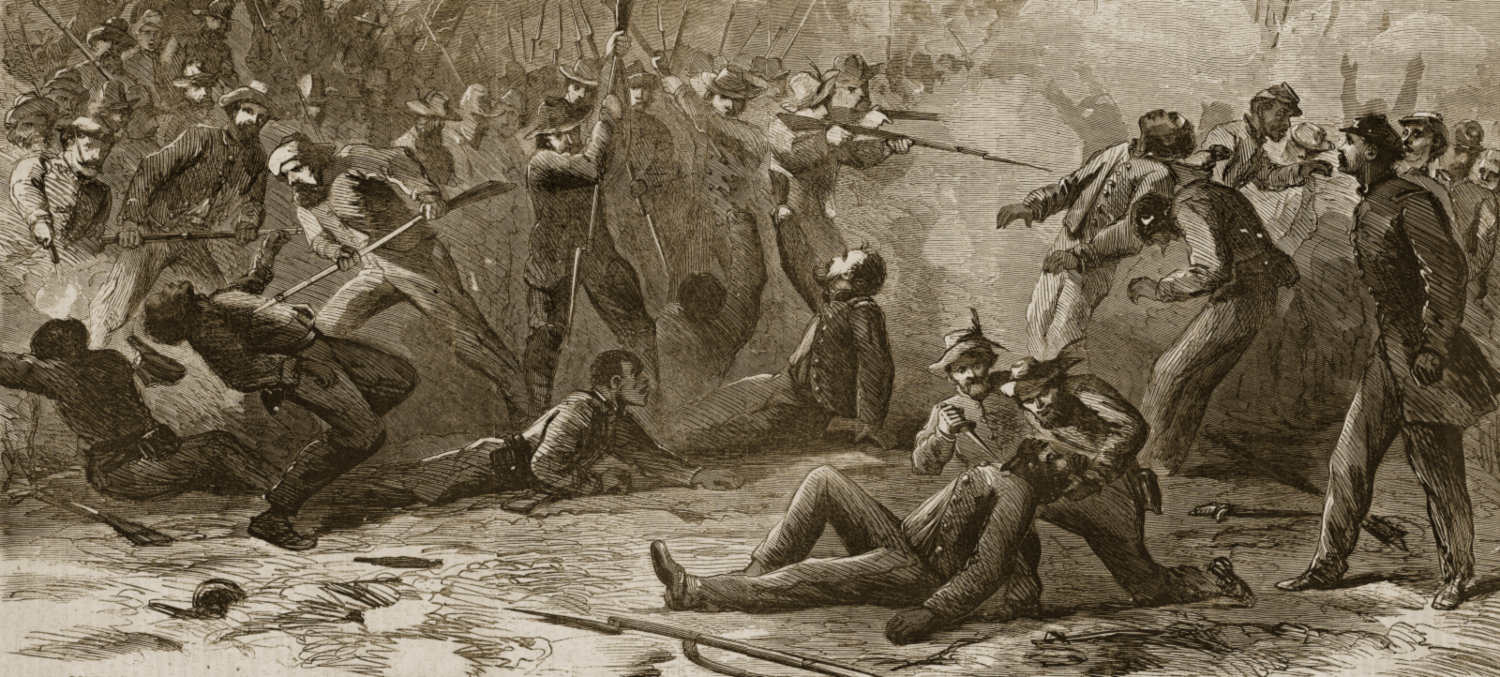
                                                 Fort Pillow Massacre 

On April 12th 1864 at Fort Pillow, troops under the command of General Nathan Bedford Forrest massacred the bulk of over 231 Union most of them black as they tried to surrender. While it is fairly clear that Forrest did not order the massacre and even may have attempted to stop it, it was clear that he had lost control of his troops, and “the best evidence indicates that the “massacre”…was a genuine massacre.” [71] Forrest’s soldiers fought with the fury of men possessed by hatred of an enemy that they considered ‘a lesser race’ and slaughtered the Union troops as they either tried to surrender or flee; but while Forrest did not order the massacre, he certainly was not displeased with the result. His subordinate, General James Chalmers told an officer from the gunboat Silver Cloud that he and Forrest had neither ordered the massacre and had tried to stop their soldiers but that “the men of General Forrest’s command had such a hatred toward the armed negro that they could not be restrained from killing the negroes,” and he added, “it was nothing better than we could expect so long as we persisted in arming the negro.” [72] It was a portent of what some of the same men would do to defenseless blacks and whites sympathetic to them as members of the Ku Klux Klan, the White Liners, White League, and Red Shirts, during and after Reconstruction in places like Colfax Louisiana.

Ulysses Grant was infuriated and threatened reprisals against any Confederates conducting such activities, he a later wrote:

“These troops fought bravely, but were overpowered I will leave Forrest in his dispatches to tell what he did with them.

“The river was dyed,” he says, “with the blood of the slaughtered for up to 200 years. The approximate loss was upward of five hundred killed; but few of the officers escaped. My loss was about twenty killed. It is hoped that these facts will demonstrate to the Northern people that negro soldiers cannot cope with Southerners.” Subsequently Forrest made a report in which he left out the part that shocks humanity to read.”  [73]

The bulk of the fanatical hatred of Forrest’s troops was directed at the black soldiers of the 6th U.S. Colored Heavy Artillery, which composed over a third of the garrison. “Of the 262 Negro members of the garrison, only 58 – just over 20 percent – were marched away as prisoners; while of the 295 whites, 168 – just under sixty percent were taken.”  [74] A white survivor of the 13th West Tennessee Cavalry, a Union unit at the fort wrote:

We all threw down our arms and gave tokens of surrender, asking for quarter…but no quarter was given….I saw 4 white men and at least 25 negroes shot while begging for mercy….These were all soldiers. There were also 2 negro women and 3 little children standing within 25 steps of me, when a rebel stepped up to them and said, “Yes, God damn you, you thought you were free, did you?” and shot them all. They all fell but one child, when he knocked it in the head with the breech of his gun.” [75]

A Confederate Sergeant who was at Fort Pillow wrote home a week after the massacre: “the poor deluded negroes would run up to our men, fall upon their knees and with uplifted hands scream for mercy, but were ordered to their feet and shot down.” [76] The captain of the Union gunboat Silver Cloud was allowed by the Confederate to bring his ship to the Fort to evacuate wounded, and to bury the dead was appalled at the sight, he wrote:

“All the buildings around the fort and the tents and huts in the fort had been burned by the rebels, and among the embers of the charred remains of numbers of our soldiers who had suffered terrible death in the flames could be seen. All the wounded who had strength enough to speak agreed that after the fort was taken an indiscriminate slaughter of our troops was carried on by the enemy…. Around on every side horrible testimony to the truth of this statement could be seen, Bodies with gaping wounds,… some with skulls beaten through, others with hideous wounds as if their bowels had been ripped open with bowie-knives, plainly told that little quarter was shown…. Strewn from the fort to the river bank, in the ravines and the hollows, behind logs and under the brush where they had crept for protection from the assassins who pursued them, we found bodies bayoneted, beaten, and shot to death, showing how cold-blooded and persistent was the slaughter…. Of course, when a work is carried by assault there will always be more or less bloodshed, even when all resistance has ceased; but here there were unmistakable evidences of a massacre carried on long after any resistance could have been offered, with a cold-blooded barbarity and perseverance which nothing can palliate.” [77]

The rabidly pro-slavery members of the Confederate press lent their propaganda to cheer the massacre of the captured blacks. John R. Eakin of the Washington (Arkansas) Washington Telegraph, who later became a justice on the Arkansas Supreme Court after Reconstruction, wrote,

“The Slave Soldiers. – Amongst there are stupendous wrongs against humanity, shocking to the moral sense of the world, like Herod’s massacre of the Innocents, or the eve of St. Bartholomew, the crime of Lincoln in seducing our slaves into the ranks of his army will occupy a prominent position….

How should we treat our slaves arrayed under the banners of the invader, and marching to desolate our homes and firesides….

Meanwhile, the problem has been met our soldiers in the heat of battle, where there has been no time for discussion. They have cut the Gordian knot with the sword. They did right….

It follows that we cannot treat negroes in arms as prisoners of war without a destruction of the social system for which we contend. We must be firm, uncompromising and unfaltering. We must claim the full control of all negroes who may fall into our hands, to punish with death, or any other penalty, or remand them to their owners. If the enemy retaliate, we must do likewise; and if the black flag follows, the blood be upon their heads.” [78]

However, when African American Troops were victorious, and even after they had seen their brothers murdered by Confederate troops, that they often treated their Confederate with great kindness. Colonel Brisbin wrote that following Battle of Saltville that “Such of the Colored Soldiers who fell into the hands of the Enemy during the battle were murdered. The Negroes did not retaliate but treated the Rebel wounded with great kindness, carrying them water in their canteens and doing all they could to alleviate the sufferings of those whom the fortunes of war had placed in their hands.” [79]

African American soldiers proved themselves during the war and their efforts paved the way for Lincoln and others to begin considering the full equality of blacks as citizens. If they could fight and die for the country, how could they be denied the right to votes, be elected to office, serve on juries or go to public schools? Under political pressure to end the war during the stalemate before Petersburg and Atlanta in the summer of 1864, Lincoln reacted angrily to Copperheads as well as wavering Republicans on the issue of emancipation:

“But no human power can subdue this rebellion without using the Emancipation lever as I have done.” More than 100,000 black soldiers were fighting for the Union and their efforts were crucial to northern victory. They would not continue fighting if they thought the North intended to betray them….If they stake their lives for us they must be prompted by the strongest motive…the promise of freedom. And the promise being made, must be kept…There have been men who proposed to me to return to slavery the black warriors. “I should be damned in time & in eternity for so doing. The world shall know that I will keep my faith to friends & enemies, come what will.”  [80]

The importance of African Americans cannot be minimized, without them the war could have dragged on much longer or even ended in stalemate, which would have been a Confederate victory. Lincoln wrote about the importance of the African American contribution to the war effort in 1864:

“Any different policy in regard to the colored man, deprives us of his help, and this is more than we can bear. We can not spare the hundred and forty or hundred and fifty thousand now serving us as soldiers, seamen, and laborers. This is not a question of sentiment or taste, but one of physical force which may be measured and estimated as horse-power and Steam-power are measured and estimated. Keep it and you save the Union. Throw it away, and the Union goes with it.” [81]

Despite this, even in the North during and after the war, blacks, including former soldiers faced discrimination, sometimes that of the white men that they served alongside, but more often from those who did not support the war effort. Lincoln wisely took note of this fact, and wrote that after the war:

“there will there will be some black men who can remember that, with silent tongue, the clenched teeth, the steady eye, the well poised bayonet, they have helped  mankind on to this great consummation; while, I fear, there will be some white ones, unable to forget that, with malignant heart, and deceitful speech, they have strove to hinder it.” [82]

swails

Lt Stephen Swails, First African American Officer of 54th Massachusetts 

Those rights would be fought for another century and what began in 1863 with the brave service and sacrifice of these African American soldiers began a process of increased civil rights that is still going on today. It would not be until after the war that some blacks were commissioned as officers in the Army. When Governor John Andrew, the man who had raised the 54th Massachusetts attempted to “issue a state commission to Sergeant Stephen Swails of the 54th…the Bureau of Colored Troops obstinately refused to issue Swails a discharge from his sergeant’s rank, and Swails promotion was held up until after the end of the war. “How can we hope for success to our arms or God’s blessing,” raged the white colonel of the 54th, Edward Hallowell, “while we as a people are so blind to justice?” [83]

The families of the free blacks who volunteered also suffered, especially those who still had families enslaved in Confederate occupied areas or Union States which still allowed slavery. One women in Missouri wrote her husband begging him to come home “I have had nothing but trouble since you left….They abuse me because you went & say they will not take care of our children & do nothing but quarrel with me all the time and beat me scandalously the day before yesterday.”  [84]

However, the Emancipation Proclamation transformed the war, and even jaded White Union soldiers who had been against emancipation and who were deeply prejudiced against blacks began to change their outlook as the armies marched into the South and saw the horrors of slavery, Russell Weigley wrote that Union soldiers: “confronting the scarred bodies and crippled souls of African Americans as they marched into the South experienced a strong motivation to become anti-slavery men…Men do not need to play a role long, furthermore, until the role grows to seem natural and customary to them. That of liberators was sufficiently fulfilling to their pride that soldiers found themselves growing more accustomed to it all the more readily.” [85]

A sergeant of the 19th Michigan who had already lost a stepson in the war wrote to his wife from Georgia before being killed in action during the Atlanta campaign; “the more I learn of the cursed institution of Slavery, the more I feel willing to endure, for its final destruction…. After this war is over, this whole country will undergo a change for the better…. Abolishing slavery will dignify labor; that fact will revolutionize everything…. Let Christians use all their influence to have justice done to the black man.” [86]

But even more importantly for the cause of liberty, the sight of regiments of free African Americans, marching “through the slave states wearing the uniform of the U.S. Army and carrying rifles on their shoulders was perhaps the most revolutionary event of a war turned into revolution.” [87]
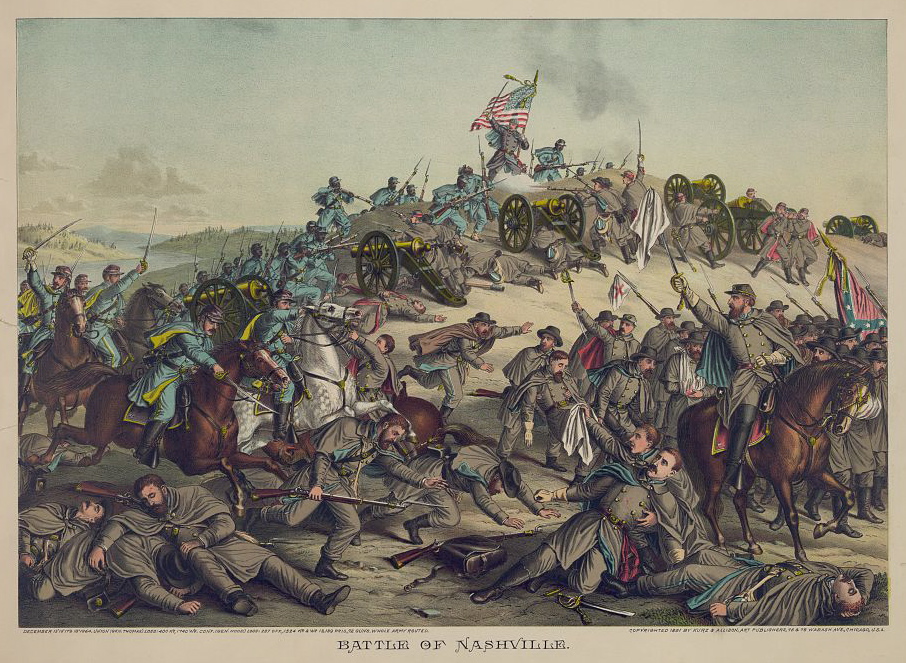
battle_of_nashville_kurz__allison

At peak one in eight Union troops were African American, and Black troops made an immense contribution to the Union victory. “Black troops fought on 41 major battlefields and in 449 minor engagements. Sixteen soldiers and seven sailors received Medals of Honor for valor. 37,000 blacks in army uniform gave their lives and untold sailors did, too.” [88] To fully appreciate the measure as to the importance and significance of the numbers of African American troops serving in the Union ranks has to compare that number with the number of active Confederate troops serving toward the end of the war. The approximately 180,000 African Americans serving in Union ranks at the end of the war outnumbered the “aggregate present” in Confederate ranks on January 1st 1865 by over 20,000 men. Of these troops “134,111 were recruited in states that had stars in the Confederate battle flag, and the latter figure in turn was several thousand greater than the total of 135,994 gray-clad soldiers “present for duty” that same day.” [89]

Of the African American soldiers who faced the Confederates in combat, “deep pride was their compensation. Two black patients in an army hospital began a conversation. One of them looked at the stump of an arm he had once had and remarked: “Oh I should like to have it, but I don’t begrudge it.” His ward mate, minus a leg, replied: “Well, ‘twas [lost] in a glorious cause, and if I’d lost my life I should have been satisfied. I knew what I was fighting for.” [90]

22nd-usct-flags

                                  Flags of the 22nd U.S. Colored Troops 

After the war many of the African American soldiers became leaders in the African American community and no less than 130 of these former soldiers held elected office including in the U.S. Congress and various state legislatures. The liberating aspect of “the black military experience radiated from black soldiers and their families into the larger black community, so it spread into white society as well.” [91]  Many abolitionists who had served as officers, and officers who were assigned to the USCT or volunteered to serve with state raised African American regiments became leaders continued to be voices for expanding civil rights in the years following the war.

Following war’s end, the demobilized African American troops became the target of racial discrimination and violence, but even so, “black veterans continued to play a central role in black communities, North and South. The skills and experience black men gained during the war not only propelled many of them into positions of leaders and sustained the prominence of others, but it also shaped the expectations and aspirations of all black people. The achievements and pride engendered by military service helped to make a new world of freedom.” [92]

Sadly, much of the nation has forgotten the efforts of the Free Black Soldiers and Sailors who fought for freedom, but even so their legacy remains in the “contribution of black soldiers to Union victory remained a point of pride in black communities. “They say,” an Alabama planter reported in 1867, “the Yankees never could have whipped the South without the aid of the Negroes.” Well into the twentieth century, black families throughout the United States would recall with pride that their fathers and grandfathers had fought for freedom.” [93]

Notes 

[1] Ibid. McPherson Tried by War: Abraham Lincoln as Commander in Chief

[2] Ibid. Goodwin Team of Rivals p.435

[3] Ibid. McPherson Tried by War p.58

[4] Ibid. McPherson Tried by War p.58

[5] Ibid. Goodwin Team of Rivals p.369

[6] Ibid. McPherson Tried by War p.109

[7] Ibid. Foote, The Civil War, A Narrative Volume Two p.531

[8] Ibid. McPherson. The Battle Cry of Freedom p.503

[9] Ibid. McPherson Drawn With the Sword: Reflections on the American Civil War p.101

[10] Ibid. Guelzo Gettysburg: The Last Invasion p.160

[11] Foner, Eric Forever Free: The Story of Emancipation and Reconstruction Vintage Books a Division of Random House, New York 2005 p.45

[12] Ibid. Guelzo Gettysburg: The Last Invasion p.160

[13] Ibid. Glatthaar General Lee’s Army from Victory to Collapse p.313

[14] Ibid. Guelzo Gettysburg: The Last Invasion p.160

[15] Ibid. Goodwin Team of Rivals p.465

[16] Egnal, Marc Clash of Extremes: The Economic Origins of the Civil War Hill and Wang a division of Farrar, Straus and Giroux New York 2009 p.318

[17] Ibid. Foner Forever Free p.48

[18] Ibid. McPherson Tried by War p.159

[19] Ibid. McPherson Drawn With the Sword p.159

[20] Ibid. McPherson Abraham Lincoln and the Second American Revolution p.35

[21] Ibid. Guelzo Fateful Lightning p.381

[22] Ibid. Dobak Freedom by the Sword: The U.S. Colored Troops, 1862-1867 p.10

[23] Ibid. McPherson Abraham Lincoln and the Second American Revolution p.35

[24] Ibid. Robertson Soldiers Blue and Gray p.31

[25] Ibid. Dobak Freedom by the Sword: The U.S. Colored Troops, 1862-1867 p.11

[26] Ibid. Robertson Soldiers Blue and Gray p.31

[27] Ibid. Gallagher, Gary W. The Union War Harvard University Press, Cambridge MA and London 2011 p.103

[28] Welton, Chauncey B. A Union Soldier’s Changing Views on Emancipationin The Civil War and Reconstruction: A Documentary Collection edited by William Gienapp, W.W. Norton Company, New York and London 2001 pp.242 and 245

[29] Ibid. Robertson Soldiers Blue and Gray p.34

[30] Glatthaar, Joseph T. Black Glory: The African American Role in Union Victory in Why the Confederacy Lost edited by Gabor S. Boritt Oxford University Press, Oxford and New York 1992

[31] Ibid. McPherson. The Battle Cry of Freedom p.686

[32] Ibid. Goldfield America Aflame p.282

[33] Jones, Terry L. The Free Men of Color Go to War in The new York Times Disunion: 106 Articles from the New York Times Opinionator edited by Ted Widmer with Clay Risen and George Kalogerakis, Black Dog and Leventhal Publishers, New York 2013 p.403

[34] Ibid. Guelzo Fateful Lightening p.379

[35] Ibid. Foote The Civil War, A Narrative Volume Two p.398

[36] Ibid. Trudeau Like Men of War p.44

[37] Ibid. Guelzo Fateful Lightening p.379

[38] Ibid. McPherson. The Battle Cry of Freedom p.686

[39] Ibid. McPherson Drawn With the Sword p.101

[40] Ibid. McPherson. The Battle Cry of Freedom p.686

[41] Ibid. Guelzo Fateful Lightening pp. 380-381

[42] Ibid. McPherson. The Battle Cry of Freedom pp.686-687

[43] Ibid. Foote, The Civil War, A Narrative Volume Two p.697

[44] Ibid. McPherson. The Battle Cry of Freedom p.686

[45] Welch, Isaiah H. Letter in the Christian Recorder 24 October 1863 in The Civil War and Reconstruction: A Documentary Collection edited by William E. Gienapp, W.W. Norton and Company, New York and London 2001 pp.225-226

[46] Trudeau, Noah Andre, Like Men of War: Black Troops in the Civil War 1862-1865 Little, Brown and Company, Boston, New York and London, 1998 p.262

[47] Ibid. Guelzo Fateful Lightening p. 381

[48] Douglass, Frederick Philadelphia Speech of July 6th 1863 recorded in the Liberator in The Civil War and Reconstruction: A Documentary Collection edited by William E. Gienapp, W.W. Norton and Company, New York and London 2001 pp.220-221

[49] Ibid. Douglass Philadelphia Speech of July 6th 1863 p.221

[50] Ibid. McPherson. The Battle Cry of Freedom p.634

[51] Ibid. Trudeau Like Men of War: Black Troops in the Civil War 1862-1865p.58

[52] Ibid. Gallagher The Union War p.97

[53] Ibid. Trudeau Like Men of War: Black Troops in the Civil War 1862-1865 p.59

[54] Ibid. Gallagher The Union War p.92

[55] Ibid. McPherson Drawn With the Sword p.89 p.

[56] Catton, Bruce. A Stillness at Appomattox Doubleday and Company Garden City, New York 1953 p.227

[57] Berlin, Ira, Riedy, Joseph P. and Rowland, Leslie S. editors, Freedom’s Soldiers: The Black Military Experience in the Civil War  Cambridge University Press, Cambridge and New York 1998 pp.133-134

[58] Ibid. Catton A Stillness at Appomattox p.249

[59] Foote, Shelby, The Civil War, A Narrative. Volume Three Red River to Appomattox Random House, New York 1974 p.537

[60] Ibid.Wert The Sword of Lincoln: The Army of the Potomac pp.384-385

[61] Ibid. Foote The Civil War, A Narrative Volume Three p.537

[62] Ibid. Robertson Soldiers Blue and Gray p.34

[63] Ibid. Berlin et al, Freedom’s Soldiers: The Black Military Experience in the Civil War  p.135

[64] Ibid. Weigley A Great Civil War p.189

[65] Ibid. McPherson Battle Cry of Freedom p.566

[66] Ibid. Goldfield America Aflame p. 280

[67] Ibid. Weigley A Great Civil War p.188

[68] Ibid. Guelzo Fateful Lightening p. 377

[69] Ibid. Guelzo Fateful Lightening p. 377

[70] Ibid. Goldfield America Aflame p.281

[71] Ibid. Weigley A Great Civil War p.189

[72] Ibid. Dobak Freedom by the Sword: The U.S. Colored Troops, 1862-1867 p.208

[73] Grant, Ulysses S. Preparing for the Campaigns of ’64 in Battles and Leaders of the Civil War Volume IV, Retreat With Honor Edited by Robert Underwood Johnson and Clarence Clough Buel Castle, Secaucus NJ pp.107-108

[74] Ibid. Foote The Civil War, A Narrative Volume Three p.111

[75] Ibid. Guelzo Fateful Lightning p. 378

[76] Ibid. Foote The Civil War, A Narrative Volume Three p.112

[77] Ibid. Dobak Freedom by the Sword: The U.S. Colored Troops, 1862-1867 p.208

[78] Eakin, John R. The Slave Soldiers, June 8, 1864  in Loewen, James W. and Sebesta, Edward H. editors, The Confederate and Neo-Confederate Reader: The “Great Truth” about “The Lost Cause” University of Mississippi Press, Jackson 2010 pp.210 and 212

[79] Ibid. Berlin et al, Freedom’s Soldiers: The Black Military Experience in the Civil War  p.47

[80] Ibid. McPherson Abraham Lincoln and the Second American Revolution p.89

[81] Ibid. Glatthaar Black Glory: The African American Role in Union Victoryp.138

[82] Ibid. McPherson The War that Forged a Nation p. 113

[83] Ibid. Guelzo Fateful Lightning p. 376

[84] Ibid. Goldfield America Aflame p.282

[85] Ibid. Weigley A Great Civil War p.192

[86] Ibid. McPherson For Cause and Comrades p.130

[87] Ibid. Weigley A Great Civil War p.191

[88] Gallagher, Gary, Engle, Stephen, Krick, Robert K. and Glatthaar editors The American Civil War: The Mighty Scourge of War Osprey Publishing, Oxford UK 2003 p.296

[89] Ibid. Foote The Civil War, A Narrative. Volume Three Red River to Appomattox p.756

[90] Ibid. Robertson Soldiers Blue and Gray p.36

[91] Ibid. Berlin et al, Freedom’s Soldiers: The Black Military Experience in the Civil War  p.47

[92] Ibid. Berlin et al. Freedom’s Soldiers: The Black Military Experience in the Civil War pp.49-50

[93] Ibid. Foner Forever Free p.55

Leave a comment

Filed under civil rights, civil war, ethics, faith, Gettysburg, History, laws and legislation, LGBT issues, Military, Political Commentary, us army, US Navy

An Unnecessary Condition Of Affairs: A Temporary end to the #TRUMPDOWN

Friends of Padre Steve’s World,

I pondered writing this post late last night but was too tired to write it. It’s not long at all and it it is something that I wrote about previous shutdowns. Back in 2011 I wrote the following words regarding the shutdown provoked by Mitch McConnell and Paul Ryan and their Right Wing supporters at Fox News and Right Wing pundits, which ended up with the disastrous policy of sequestration.

“The attitudes that we have formed and angry words which we now use so ubiquitously are reflective of a deep hatred that now is becoming what defines us as a people.  In fact the deep and abiding hatred which now permeates our society is now threatening the international standing and I would say the national security of the United States.  We have only ourselves to blame because through our actions and inactions of the past decade we have made our choice to be what we have become and there is no one group especially in our political, media and business elites that have served us well.  In fact we have as voters chosen this toxic mix of elected officials often more influenced by hate spewing pundits and our own self interests rather than that of the nation and future generations much as we would like to claim that we are looking out for the future.”

Interestingly enough these same people, hitched their wagons to President Trump’s disastrous decision to shut down the government to build his monstrous monument to his morbid #MAGA manhood; that big beautiful wall. Of course anyone with a knowledge of history knows that such walls are expensive and ultimately self defeating.

For now the current Shutdown is over. Increasingly isolated Trump had no other exit for the trap that he laid for himself. Standing alone in the Rose Garden he capitulated to reality.

So for at least three weeks, the shutdown is over. Of course it really isn’t over as long as Trump thinks he can succeed, and there remains the ever present threat of him declaring a National Emergency. I think the latter is more likely, especially if the crisis in Venezuela results in bloodshed at the American Embassy. But for that we have to wait and see. My hope is that a legislative fix is found that actually increases border security without wasting money on that wall. One does not return to provenly ineffectual past remedies to solve present problems, but I digress…

To quote from the testimony of the former Confederate General Robert E. Lee before a Congressional Committee after the disaster of the American Civil War, or as it should still be called the War of the Southern Rebellion.

Before the committee, Lee, who had resigned his commission less than a month of been promoted to full Colonel and rejecting President Lincoln’s offer to command the Armies of the Union accepted commissions by Virginia and the Confederacy said:

“I may have said and I may have believed that the position of the two sections which they held to each other was brought about by the politicians of the country; that if the great mass of the people, if they had understood the real questions would have avoided it. I did believe at the time that it (the war) was an unnecessary condition of affairs, and might have been avoided if forbearance and wisdom had been practiced on both sides.”

But Lee was engaged in the same sort of moral equivalence that many politicians and pundits use today. In his testimony, Lee blamed both sides and conveniently left out his role in the conflict. Before the war Lee inherited the slaves of his father in law who had expressly said that they were to be emancipated. He delayed and did not do it. When he resigned his U.S. Army commission he said that he would only raise his sword in defense of Virginia, but he personally led two invasions of the North, invasions that his Army used to capture free blacks and return them to slavery. Despite the urging of some Confederate Generals, Lee steadfastly opposed the emancipation of slaves to serve in the Confederate Army until February of 1865. When the war was for all purposes lost, Lee redoubled his efforts and had hundreds of deserting Confederate Soldiers sentenced to death at Drumhead Court Martial. The vast majority of those troops were from Georgia and the Carolinas and their states, families, and homes were being ravaged by William Tecumseh Sherman’s Army’s March to the Sea.

Yes the American Civil War was an unnecessary condition of affairs, as was the Trump-McConnell Shutdown. In each case the blame is not shared across the board. These disasters can be laid at the feet of the men who provoked them and demanded them. In the case of the Civil War, those were the leaders of the South, who having the assurance of Lincoln that slavery was safe in the Slave states decided to secede, and who through the Fugitive Slave Law Of 1850 had an instrument to enforce slavery in the Free States.

In the current situation it all comes down to race once again. President Trump and many Republican leaders have blamed immigrants and racial minorities for all the problems of the country. They offer support to White Nationalist, Neo-Confederate, and Neo-Nazi groups, while demonizing anyone with darker skin. Trump’s Wall, like his Red MAGA hats are symbolic of that race hatred, and fear mongering. The Trump Shutdown can only be blamed on that. Trump bragged about the Shutdown and took responsibility for it. He owns it, maybe we should start calling it the #TRUMPDOWN ? It does have a nice ring.

So until tomorrow when I return to other subjects,

Peace,

Padre Steve+

Leave a comment

Filed under civil war, History, laws and legislation, Loose thoughts and musings, national security, News and current events, Political Commentary

“Our Civil Rights Have no Dependency on Our Religious Opinions…” Celebrating the 233rd Anniversary of the Virginia Statute for Religious Liberty

Friends of Padre Steve’s World,

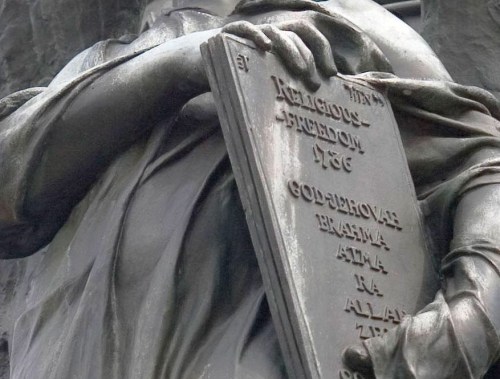
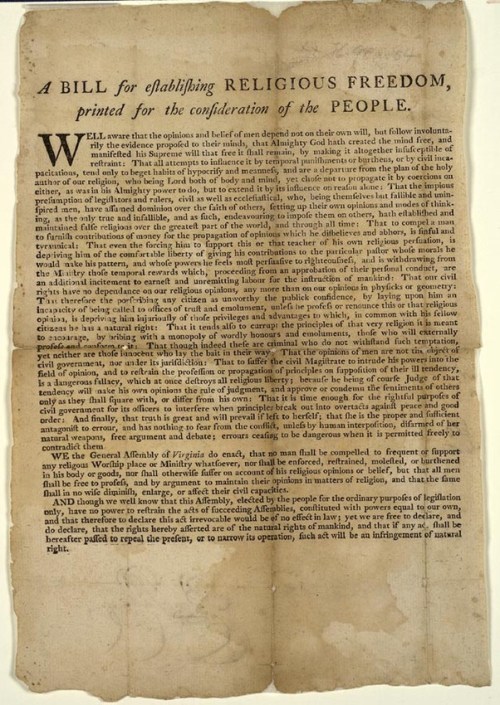
On this day, 233 years ago, the the legislature of the Commonwealth Of Virginia ratified a law written by Thomas Jefferson. It was the precursor to the Establishment and the Free Exercise Clauses Of the First Amendment to the Constitution of the United States.

It is the antithesis of, and the antidote to all theocratic movements, to include contemporary Christian Nationalism and it’s close cousin Christian Dominionism, or as it is sometimes called Seven Mountains Theology.

Jefferson, James Madison, and their Virginia Baptist ally, John Leland understood the threat to a republic such as ours posed by religious theocrats of any type, to include Christians.

The Virginia statute was necessitated by militant Anglicans who desired to re-establish themselves as the state religion in Virginia and had gone about using physical violence against various dissenters, especially Virginia’s Baptist minority. It is fascinating, in a frightening and grotesque sense of the word to see Virginia Baptists like Jerry Falwell Jr., and other Evangelical leaders of the Free Church tradition interpreting Religious Freedom in a manner similar to the Anglicans of Virginia in the 1780s, or in the manner of all Christians who follow the path of Constantine.

Such was the warning of the great Southern Baptist Pastor and seminary president George Truett, who wrote:

“Constantine, the Emperor, saw something in the religion of Christ’s people which awakened his interest, and now we see him uniting religion to the state and marching up the marble steps of the Emperor’s palace, with the church robed in purple. Thus and there was begun the most baneful misalliance that ever fettered and cursed a suffering world…. When … Constantine crowned the union of church and state, the church was stamped with the spirit of the Caesars…. The long blighting record of the medieval ages is simply the working out of that idea.”

The Virginia Statute stood in complete opposition to theocratic minded Americans then, and now. The statute which I post below in its entirety is must reading for anyone who thinks that they understand what the founders of the United States believed about religious liberty:

An Act for establishing religious Freedom

Whereas, Almighty God hath created the mind free;

That all attempts to influence it by temporal punishments or burthens, or by civil incapacitations tend only to beget habits of hypocrisy and meanness, and therefore are a departure from the plan of the holy author of our religion, who being Lord, both of body and mind yet chose not to propagate it by coercions on either, as was in his Almighty power to do,

That the impious presumption of legislators and rulers, civil as well as ecclesiastical, who, being themselves but fallible and uninspired men have assumed dominion over the faith of others, setting up their own opinions and modes of thinking as the only true and infallible, and as such endeavouring to impose them on others, hath established and maintained false religions over the greatest part of the world and through all time;

That to compel a man to furnish contributions of money for the propagation of opinions, which he disbelieves is sinful and tyrannical;

That even the forcing him to support this or that teacher of his own religious persuasion is depriving him of the comfortable liberty of giving his contributions to the particular pastor, whose morals he would make his pattern, and whose powers he feels most persuasive to righteousness, and is withdrawing from the Ministry those temporary rewards, which, proceeding from an approbation of their personal conduct are an additional incitement to earnest and unremitting labours for the instruction of mankind;

That our civil rights have no dependence on our religious opinions any more than our opinions in physics or geometry,

That therefore the proscribing any citizen as unworthy the public confidence, by laying upon him an incapacity of being called to offices of trust and emolument, unless he profess or renounce this or that religious opinion, is depriving him injuriously of those privileges and advantages, to which, in common with his fellow citizens, he has a natural right,

That it tends only to corrupt the principles of that very Religion it is meant to encourage, by bribing with a monopoly of worldly honours and emoluments those who will externally profess and conform to it;

That though indeed, these are criminal who do not withstand such temptation, yet neither are those innocent who lay the bait in their way;

That to suffer the civil magistrate to intrude his powers into the field of opinion and to restrain the profession or propagation of principles on supposition of their ill tendency is a dangerous fallacy which at once destroys all religious liberty because he being of course judge of that tendency will make his opinions the rule of judgment and approve or condemn the sentiments of others only as they shall square with or differ from his own;

That it is time enough for the rightful purposes of civil government, for its officers to interfere when principles break out into overt acts against peace and good order;

And finally, that Truth is great, and will prevail if left to herself, that she is the proper and sufficient antagonist to error, and has nothing to fear from the conflict, unless by human interposition disarmed of her natural weapons free argument and debate, errors ceasing to be dangerous when it is permitted freely to contradict them:

Be it enacted by General Assembly that no man shall be compelled to frequent or support any religious worship, place, or ministry whatsoever, nor shall be enforced, restrained, molested, or burthened in his body or goods, nor shall otherwise suffer on account of his religious opinions or belief, but that all men shall be free to profess, and by argument to maintain, their opinions in matters of Religion, and that the same shall in no wise diminish, enlarge or affect their civil capacities. And though we well know that this Assembly elected by the people for the ordinary purposes of Legislation only, have no power to restrain the acts of succeeding Assemblies constituted with powers equal to our own, and that therefore to declare this act irrevocable would be of no effect in law; yet we are free to declare, and do declare that the rights hereby asserted, are of the natural rights of mankind, and that if any act shall be hereafter passed to repeal the present or to narrow its operation, such act will be an infringement of natural right.

Please, take some time to let those words sink in, especially if you think that religious liberty is only for people of your favorite religion, or the one that you belong to. The fact is, that those who established religious liberty in the United States, many of them like John Leland, professing Christians, did not think that religious liberty was for the powerful, or those who wanted to dominate others on the basis of religion wedded to government and political power.

Leland wrote:

“The notion of a Christian commonwealth should be exploded forever. … Government should protect every man in thinking and speaking freely, and see that one does not abuse another. The liberty I contend for is more than toleration. The very idea of toleration is despicable; it supposes that some have a pre-eminence above the rest to grant indulgence, whereas all should be equally free, Jews, Turks, Pagans and Christians.”

With that I bid you a good night.

Until tomorrow and another day of Trump’s Evangelical supported Shutdown,

Peace,

Padre Steve+

4 Comments

Filed under christian life, civil rights, faith, History, laws and legislation, Loose thoughts and musings, News and current events, Political Commentary, Religion

Wanted, One Senator Of Courage: Will Any Republican Make a Principled Stand Against Trump?

Stephen A. Douglas

Friends of Padre Steve’s World,

I wrote this in June of last year and as we go into the fourth week of a pointless partial government shutdown, the effects of which are now beginning to be felt, I thought it pertinent. So I did a few edits The shutdown and the President’s determination to find a way to build his wall, even publicly musing about declaring an imaginary national emergency to get his way, would be enough by themselves without all the charges that will be proven against him will certainly will enshrine his place as the worst President in American history. As such, James Buchanan is probably rejoicing in his grave that he has competition.

Likewise, it has become apparent that it is very unlikely anyone in his Trumpified Republican Party will rise to the occasion to lead a principled opposition against him, as Senator Stephen Douglas did against Buchanan. But then, Douglas was willing to stake his political career on defending the country and Constitution against the unconstitutional actions of a President of his own political party.

As I watch President Trump’s administration attack the law, the Constitution, and violate the civil rights and human rights of citizens as well as people who have come to the United States to flee oppression and danger at home; to threaten freedom of speech and freedom of the press; to categorize political opponents inside and outside of his party as traitors; to legitimize the most repressive dictatorial regimes while attacking longstanding allies; even as he works to destroy the work of American Presidents and diplomats to build a world order that has brought great benefit to the United States and the world by defeating the Nazis, Imperial Japan, and eventually the Soviet Union. He has chosen the choice of being a rogue superpower rather than being the moderating and stabilizing force in the world that it has played since World War Two. Robert Kagan wrote in the Washington Post on June 14th:

“The United States’ adversaries will do well in this world, for Trump’s America does not want war. It will accommodate powers that can harm it. It will pay them the respect they crave and grant them their spheres of interest. Those that depend on the United States, meanwhile, will be treated with disdain, pushed around and used as pawns. At times, they will be hostages to be traded for U.S. gain. The United States and the postwar liberal order protected them and helped them prosper, but it also left them vulnerable to any American leader willing to offer them up as sacrifices to appease aggressors. That is a kind of realism, too… It recognizes no moral, political or strategic commitments. It feels free to pursue objectives without regard to the effect on allies or, for that matter, the world. It has no sense of responsibility to anything beyond itself.”

The President and his administration show little regard for the Constitution and established law in this country and our treaties and agreements with other nations. He appoints men and women who had they been Germans after the Second World War would have been charged with war crimes and crimes against humanity to high office. He defends White Nationalists and Neo-Nazis. He confounds loyalty to himself with patriotism and loyalty to the country. His threat of declaring a national emergency if he doesn’t get his Wall demonstrates that fact to a tee.

He uses propaganda to demonize those who seek law and justice. In any normal time a cry would arise from his own party saying “no more,” but his party does nothing, and even those leaders who occasionally speak out against his policies take no actions because they are afraid of retribution. That happened to long time conservative Congressman Mark Sanford in South Carolina this week when the President tweeted his support for his primary opponent. During the primary season White Nationalists, self-proclaimed Nazis, and other Trump supporters advocating the most extreme, unconstitutional and abhorrent positions often swept the field against conservatives who themselves would have been considered extremists just a few years ago. The GOP is on the Party if Trump and it took less than two years to become so.

Barbara Tuchman wrote in her book The March of Folly: From Troy to Vietnam something that we are observing up close and personal as President Trump and his administration flounder in a sea of make believe, a cloud cuckoo land of alternative facts, alternative truth, and alternative history:

“Wooden-headedness, the source of self-deception, is a factor that plays a remarkably large role in government. It consists in assessing a situation in terms of preconceived fixed notions while ignoring or rejecting any contrary signs. It is acting according to wish while not allowing oneself to be deflected by the facts.”

To be true, the Trump administration is not the first in history, in fact not even in our own country to ignore facts when making decisions. However, it is remarkable in its ability not only to shun facts but to make up its own narrative that depends on denying reality while impugning the character, honesty, and decency of those who present facts and truth that is verifiable. To be sure, competence and prudence are not and probably will never be marks of President Trump, his closest advisors, or his enablers in Congress. My hope is that some Republican in either the House or Senate rises up to confront the ineptitude and folly being demonstrated on a daily basis.

President James Buchanan

In some ways the incompetence and refusal to deal with reality by the Trump administration reminds me of the administration of James Buchanan during the years before the American Civil War. Buchanan’s collusion with Chief Justice Roger Taney regarding the Dred Scott decision before his inauguration stained him from the beginning and poisoned his relationship with Congress by declaring that the Congress never had the right to limit slavery as it had in the Missouri Compromise. Buchanan’s presidency is considered by most historians to be the worst in American history, incompetent, arrogant, and ineffective.

Likewise, Buchanan’s attempt to jam the Lecompton Constitution through Congress as a reward to Southern Democrats blew up in his face. The Lecompton Constitution was a gerrymandered bill which ignored the will of the vast majority of Kansas’s settlers who were anti-slavery. The work of the pro-slavery element in Kansas was so onerous that it brought Republicans and Northern Democrats together for the first time as Southern Democrats threatened secession if Kansas was not admitted as a Slave State. Ignoring warnings that supporting a measure that would open the door to slavery in all the western territories would split his party, Buchanan pushed on. His intransigence on the matter brought Democratic Senator Stephen A. Douglas of Illinois to the fore in opposing it. Nicknamed “the Little Giant,” Douglas was the odds on favorite to be the Democratic nominee for the Presidency. Douglas was not against the institution of slavery, and he was a racist, but he had no tolerance for those who would upend carefully crafted compromises to expand it through the whole country. Thus he  took his case to the floor of the Senate and to the President himself.

The Confrontation between the Senator and the President was unparalleled. Douglas recalled:

The Lecompton constitution, I told Buchannan bluntly, was a blatant fraud on the people of Kansas and the process of democracy, I warned him not to recommend acceptance of it. With his head titled forward in that bizarre habit of his, he said that he intended to endorse the constitution and send it to Congress. “If you do,” I thundered, “I’ll denounce it the moment that it is read.” His face turned red with anger. “I’ll make Lecompton a party test,” he said. “I expect every democratic Senator to support it.” I will not, sir!

Angry and offended by the confrontation of Douglas, Buchanan cut the senator off and issued his own threat to Douglas and his political career saying:

“But I desire you to remember that no Democrat ever yet differed from an administration of his own choice without being crushed….Beware of the fate of Tallmadge and Rives,” two senators who had gone into political oblivion after crossing Andrew Jackson.” The redoubtable Senator from Illinois was undeterred by the President’s threat and fought back, “Douglas riposted: “Mr. President, I wish to remind you that General Jackson is dead, sir.”  

Douglas,s action was unprecedented. Never before had a sitting Senator, to confront a President of his own party and threatened to oppose him in Congress. It was simply not done, but now Douglas was doing it, but doing so to his President’s face, and the consequences for him, his party, and the country would be immense.

Undeterred by facts, Buchanan and Southern Democrats fought for the bill’s passage. When Buchanan’s supporters pushed for Lecompton’s approval and the admission of Kansas as a Slave State, Douglas fired back, warning:

 “You do,” I said, “and it will lead directly to civil war!” I warned the anti-Lecompton Democrats of the North that the President intended to put the knife to the throat of every man who dared to think for himself on this question and carry out principles in good faith. “God forbid,” I said “that I ever surrender my right to differ from a President of the United States for my own choice. I am not a tool of any President!”

Under Douglas the Northern Democrats joined with Republicans for the first time to defeat the admission of Kansas as a Slave State. Douglas recalled the battle:

“After the Christmas recess, the Administration unleashed its heavy horsemen: Davis, Slidell, Hunter, Toombs, and Hammond, all southerners. They damned me as a traitor and demanded that I be stripped of my chairmanship of the Committee on Territories and read out of the Democratic party. Let the fucking bastards threaten, proscribe, and do their worst, I told my followers; it would not cause any honest man to falter. If my course divided the Democratic party, it would not be my fault. We were engaged in a great struggle for principle, I said, and we would defy the Administration to the bitter end.”

Douglas and his supporters did just that, Buchanan and his supporters were outfought and outmaneuvered by Douglas’s Democrats and their Republican allies. The bill was sent back to Kansas where in a new election the people of Kansas voted solidly against the Lecompton Constitution. In the following Congressional elections the thoroughly discredited Democrats lost their majority, their party now hopelessly divided with Southerners determined to destroy Douglas at any cost, even if it meant losing the presidency, the conflict opened the door for the election of Abraham Lincoln in 1860.

I wonder if there will be a Republican in the Congress with the courage that Stephen A. Douglas displayed in confronting the incompetent and vindictive President Buchanan during the Lecompton Crisis. Will there be a Republican with enough courage to stop the insanity of the Trump administration even if it means in the short term to divide the party and doom their political future? Honestly I doubt it as does conservative Republican political strategist Rick Wilson. Wilson wrote:

“Nothing you do matters to this Congress. No matter what damage you inflict on our economy, our alliances, trade, our stature in the world, our role as an exemplar of democratic values, our ability to serve as an honest broker in the international community, and our security, Paul Ryan and Mitch McConnell will lay supine before you.” 

But if Trump’s march of folly is to be stopped, someone in the Republican Senate or House will have to have the courage to stand up and defend the necessity of thinking for themselves, and doing what is right, sadly there is no Stephen Douglas in today’s GOP.

Have a great day.

Peace

Padre Steve+

3 Comments

Filed under civil war, History, laws and legislation, News and current events, Political Commentary

Waiting for the National Emergency

Friends of Padre Steve’s World,

I am musing about President Trump’s treat to declare a National Emergency if Congress does not bend the knee and surrender it’s Constitutional powers under Article One of the Constitution by not appropriating funding for the construction of his border wall, the one that he promised that Mexico would pay for on many occasions.

Honestly, I have always believed that Trump will declare a National Emergency to consolidate dictatorial powers. However, I did not believe that he would use such a poorly concocted plan to do so. I realize that his contempt for the Constitution, our system of government, the Congress, the Courts and all of our institutions runs deep in him, but if he attempts an end run around Congress by doing this I am positive that the Court challenges will doom it, were emergency powers restricted to finding a way to build his Wall, however, a state of emergency proclamation gives the President nearly dictatorial powers should he or maybe in the future, she decide to use them. Congress needs to reign those powers in, but that won’t happen anytime soon.

Declaring a state of emergency simply to bypass Congress for a pet project will create a Constitutional crisis, and if you can imagine it, throw the country into chaos.

It is not enough that the government shutdown has been going on three weeks. It is not if that the global and the United States economy is not showing signs of weakness.

It is not as if foreign powers, real enemies such as Russia are continuing to attack our institutions at home and interests abroad.

It is not as if authoritarian regimes are taking over power in former democracies, with President Trump’s full approval.

Likewise, it’s not as if that the administration is not in chaos, that the resignation of the last remaining adults in the room, and the indictments, or coming indictments of Trump allies by the investigation of Robert Muller, and the coming hearings in the House Of Representatives will not cut the President’s feet out from under him.

He will be fully revealed for what he is and always has been, and what his most faithful supporters have excused and ignored.

The President is habitual liar, a narcissistic sociopath with delusions of Godhood, and a two bit owner of a family business who has destroyed every business he has led, bamboozled and defrauded and every investor or contractor who put their faith in him, and betrayed every one of his wives. Though he avoided military service, he has derided and mocked honorable military men, men who fought in combat, put their lives on the line, and even were wounded or taken prisoners. To Trump, men like James Mattis, John McCain, Stanley McChrystal, William McRaven, John Allen, John Kelly, H. R. McMaster, John Kerry, and so many others were failures, and he, who dodged the draft, bragged that avoiding sexually transmitted diseases was his personal Vietnam.

So I await his declaration and I hope that the Republicans in the Senate will finally grow a set of testicles and remember that their oath is to the Constitution, not the President. I hope that the courts will stop it, and I hope that military leaders will put their feet down and not obey an unconstitutional and unethical order.

Again, let me reiterate that I have always believed that Trump will try to use a state of emergency, his Reichstag Fire moment, to secure his hands or on power, but I thought he would use a war, a major terrorist attack, financial collapse, or natural disaster to do it. In those kinds of events he would probably have the support of the majority of Americans and Congress, but for this ham fisted attempt to bypass Congress and defy the Constitutional separation of powers should be his undoing if he actually tries it.

Regardless of if he does it or not, it is important for every man and woman who has sworn an oath to support and defend the Constitution of the United States against all enemies, foreign and domestic also applies to defending it against a rogue President who defies the Constitution and collides with foreign powers against his own country. Until Trump such was unthinkable, no President, even the most callous or criminal has ever sank to the moral, legal, and ethical depths of this President.

So, I wait to see what happens. As I do I remember and reflect upon the words of German General Ludwig Beck:

It is a lack of character and insight, when a soldier in high command sees his duty and mission only in the context of his military orders without realizing that the highest responsibility is to the people of his country.”

Until tomorrow,

Peace,

Padre Steve+

11 Comments

Filed under ethics, Foreign Policy, History, laws and legislation, leadership, national security, News and current events, Political Commentary

Know Nothings, Racism, Walls and Trump


Friends of Padre Steve’s World,

Long before President Trump was elected President and uttered the words Shithole countries” in slandering the people of Haiti as well as African nations; long before he said that there were “very good people” among the new-Nazis and White Supremacists at Charlottesville; but not before he had made disparaging comments about Mexicans and began talking about making “Mexico pay for a border wall,” I wrote about his penchant for obvious racist terminology and tactics.

I trace that terminology and tactics back to a movement long before Trump was ever thought of, in fact to a time when his German immigrant ancestors were scorned and hated because of their ethnicity. That being said his immigrant grandfather made a small fortune in the Pacific Northwest and the Klondike Gold Rush mostly catering to prospectors and women of ill-repute. Like many immigrants the man was incredibly successful; he made a fortune and returned to Germany where he was discovered was thrown out of the country because the Kingdom of Bavaria believed that he had gone to America to of all things, to avoid military service. The fact that he didn’t have to get a doctor to say he had heel spurs to avoid conscription makes him far more admirable than his grandson. But I digress…

I wrote the following article back in July of 2016 simply because the Trump family story happened to coincide with the subject of my draft book “Mine Eyes Have Seen the Glory”: Race, Religion, Ideology, and Politics in the Civil War Era. It just happens to be that the Donald’s father, Fred happened to get arrested during a march of the Ku Klux Klan in New York in 1927 while dressed as a Klansman. Imagine that.

Back then the blowback that I received for that article from from friends, including a woman who was one of the bridesmaids at our wedding, was so intense that I never wanted to go through it again. However, I went through worse last year when a parishioner at my Navy Chapel attempted to have me tried by Court Martial for allegedly showing disrespect to the President in a sermon. I did no such thing, and the charges were shown false and politically motivated, but they shook me to the core.

It really is amazing when one makes a credible claim that a candidate for the Presidency is a racist and have long time friends castigate you and condemn you for telling the truth. Thus I found it quite refreshing when Congresswoman Alexandria Ocasio-Cortez told CNN’s Anderson Cooper that President Trump was “no question” a racist before noting, as I have so often on this site:

“When you look at the words that he uses, which are historic dog whistles of white supremacy. When you look at how he reacted to the Charlottesville incident, where neo-Nazis murdered a woman, versus how he manufactures crises like immigrants seeking legal refuge on our borders, it’s — it’s night and day,”

But once again I digress but the irony of the current President going after immigrants and defending Klansmen while calling the countries of many current immigrants is far too rich to ignore. But the sad truth is that racism is still to common and is being given voice by the President of the United States in ways that haven’t been seen since the presidency of Woodrow Wilson. Supreme Court Justice Thurgood Marshall noted:

“I wish I could say that racism and prejudice were only distant memories. We must dissent from the indifference. We must dissent from the apathy. We must dissent from the fear, the hatred and the mistrust…We must dissent because America can do better, because America has no choice but to do better.” 

Now the government has been shut down for two weeks because Trump is holding out on building his wall, a wall that will be another budget buster and not do anything to increase national security or stop terrorists. Despite this, the President is now threatening to declare a State Of Emergency in order to find a way to build his wall. If he does, there are many other powers that he can use to shore up his flailing regime.

It is a very dangerous time.

So anyway, here is what I wrote back in July 2016,

Peace,

Padre Steve+

Mark Twain reportedly said that “History does not repeat itself, but it often rhymes.” One can see that in the nomination of Donald Trump as the nominee of the Republican Part for President. Eleven months ago I wrote an article called Trump and the Return of the Know Nothings. At the time few people gave him little chance of becoming the Republican nominee, and now he is the nominee and for all practical purposes owns the GOP.

180103-donald-trump-se-253p_1e0ab4bbfc2b637051d31d044ad52abf.nbcnews-ux-2880-1000

Trump’s xenophobic views on immigration charged the debate in the Republican Party during the primaries, and his positions which were fringe positions of most Republicans for decades became the mainstream, just as the same issue did during the 1840s and 1850s. So this is not a new phenomenon, and even over the past few decades the debate has come and gone, but it has returned with a vengeance as Donald Trump made immigration, or rather a virulent anti-immigration platform the centerpiece of his campaign. Trump’s focus on the issue forced other Republican candidates to scramble in order to find a position close enough to Trump’s without completely throwing away the vote of immigrants who they will need to win in many states; if they are to have any hope of winning back the presidency in 2016. But they failed. Trump outmaneuvered them at every point, and in the end Trump’s strongest opponent, Senator Ted Cruz went into the witch’s cauldron of the Republican National Convention not to endorse Trump but to stand on principle and in the process destroy his politic career and maybe endanger his life.

But Trump’s positionresonated with parts of the Republican base, and by appealing to their anger and frustration he has built a solid core of support which loyally supported him in a campaign that featured so many blunders and heneous comments that in a normal election cycle his campaign would not have survived past the Southern Super Tuesday. But he did, and if on the  takes the time to read Trump’s speeches and the reactions to them by his supporters it becomes apparent that Trump has tapped into that vast reservoir of nativism that has always been a part of the American body-politic.


As I said, such attitudes and movements are nothing new. Anti-immigrant movements in the United States go back to our earliest days, ever since the first Irish Catholics showed up in the northeast in the late 1790s and early 1800s. Met with scorn and treated as criminals the Irish Catholics had to work hard to gain any kind of acceptance in Protestant America. But immigrants continued to come, seeking the freedom promised in the Declaration of Independence.

Many White American Protestants viewed Irish, German and other European immigrants to the Unites States in the 1830s, 1840s, and 1850s as interlopers who were attempting to take over the country. The immigrants were regarded as poor, uneducated, uncouth, and immoral, and in the case of Catholic immigrants as representatives and foot soldiers of a hostile government, the Vatican, headed by the Pope and the bishops. Those who opposed immigration formed a movement that was aimed at forbidding immigrants from being granted full rights, especially the rights of citizenship and voting. The fear was pervasive. Many Northern Whites were afraid that immigrants would take their jobs, since like slaves in the South, the new immigrants were a source of cheap labor.

Northern Protestant church leaders and ministers were some of the most vocal anti-immigrant voices and their words were echoed by politicians and in the press. The movement grew and used government action, the courts and violence to oppress the Irish and Germans who were the most frequent targets of their hate. The movement eventually became known as the “Know Nothing” movement.

Know Nothing leaders were not content to simply discuss their agenda in the forum of ideas and political discourse, they often used mob-violence and intimidation to keep Catholics away from the ballot box. Mobs of nativist Know Nothings sometimes numbering in the hundreds or even the thousands attacked immigrants in what they called “Paddy hunts,” Paddy being a slur for the Irish. To combat immigrants who might want to exercise their right to vote, the Know Nothings deployed gangs like the New York’s Bowery Boys and Baltimore’s Plug Uglies. They also deployed their own paramilitary organization to intimidate immigrants on Election Day. This group, known as the Wide Awakes was especially prone to use violence and physical intimidation in pursuit of their goals. The Nativist paramilitaries also provided security for anti-immigrant preachers from angry immigrants who might try to disrupt their “prayer” meetings.

Know Nothing’s and other Nativist organizations, organized mass meetings throughout the country which were attended by thousands of men. The meetings were often led by prominent Protestant ministers who were rich in their use of preaching and prayer to rile up their audiences. The meetings often ended with physical attacks and other violence against German or Irish immigrants and sometimes with the burning of the local Catholic Church. They also provided security for preachers from angry immigrants who might try to disrupt nativist prayer meetings.


Bloody Monday, Louisville 1855

The violence was widespread and reached its peak in the mid-1850s.

Monday, August 6, 1855 was Election Day in Louisville, Kentucky. To prevent German and Irish Catholics from voting, Know Nothing mobs took to the street and launched a violent attack on immigrants as well as their churches and businesses. Known now as “Black Monday” the Nativists burned Armbruster’s Brewery, they rolled cannons to the doors of the St. Martin of Tours Church, the Cathedral of the Assumption and Saint Patrick’s Church, which they then were searched for arms. The private dwellings and the businesses of immigrants were looted. A neighborhood known as “Quinn’s Row” was burned with the inhabitants barricaded inside. At least 22 persons were killed in the violence and many more were injured. In Baltimore the 1856, 1857, and 1858 elections were all marred by violence perpetrated by Nativist mobs. In Maine, Know Nothing followers tarred and feathered a Catholic priest and burned down a Catholic church.

The Know Nothings did not merely seek to disenfranchise immigrants through violence alone, they were more sophisticated than that. They knew that to be successful they had to change the law. Then, as now, a new immigrant had to live in the United States for five years before becoming eligible to become a naturalized of the United States. The Know nothings felt that this was too short of time and their party platform in the 1856 election had this as one of the party planks:

A change in the laws of naturalization, making a continued residence of twenty-one years, of all not heretofore provided for, an indispensable requisite for citizenship hereafter, and excluding all paupers, and persons convicted of crime, from landing upon our shores; but no interference with the vested rights of foreigners.

The rational of the Know Nothings for the 21 year wait was that if a baby born in the United States had to wait until it was 21 years old he could vote, that immigrants were being permitted to “jump the line” and vote sooner than native-born Americans. But really what the Know Nothings wanted to was to destroy the ability of immigrant communities to use the ballot box. In many localities and some states Know Nothing majorities took power. The Massachusetts legislature, which was dominated by Know Nothings, passed a law barring immigrants from voting for two additional years after they became United States citizens.

The 1856 platform Know Nothing Party was synopsized by a Know Nothing supporter:

(1) Repeal of all Naturalization Laws.

(2) None but Americans for office.

(3) A pure American Common School system.

(4) War to the hilt, on political Romanism.

(5) Opposition to the formation of Military Companies, composed of Foreigners.

(6) The advocacy of a sound, healthy and safe Nationality.

(7) Hostility to all Papal influences, when brought to bear against the Republic.

(8) American Constitutions & American sentiments.

(9) More stringent & effective Emigration Laws.

(10) The amplest protection to Protestant Interests.

(11) The doctrines of the revered Washington.

(12) The sending back of all foreign paupers.

(13) Formation of societies to protect American interests.

(14) Eternal enmity to all those who attempt to carry out the principles of a foreign Church or State.

(15) Our Country, our whole Country, and nothing but our Country.

(16) Finally,-American Laws, and American Legislation, and Death to all foreign influences, whether in high places or low

In addition to their violent acts, the use of the courts and political intimidation the Know Nothings waged a culture war against immigrants. Latin mottoes on courthouses were replaced by English translations. Actions were taken to remove immigrants who had become naturalized citizens from public offices and civil service jobs as well as to use the government to persecute Catholic churches. In Philadelphia, all naturalized citizens on the police force were fired, including non-Catholics who has supported Catholic politicians, and in Boston, a special board was set up to investigate the sex lives of nuns and other supposed crimes of the Catholic church.


In the political upheaval of the 1850s Nativists tried to find homes in the different political parties. Some Know Nothings who were abolitionists became part of the new Republican Party, and Abraham Lincoln condemned them in harsh terms. He wrote his friend Joshua Speed about the hypocrisy that they displayed by supposedly being against the oppression of blacks while willing to oppress immigrants:

“I am not a Know-Nothing. That is certain. How could I be? How can any one who abhors the oppression of negroes, be in favor or degrading classes of white people? Our progress in degeneracy appears to me to be pretty rapid. As a nation, we began by declaring that “all men are created equal.” We now practically read it “all men are created equal, except negroes” When the Know-Nothings get control, it will read “all men are created equal, except negroes, and foreigners, and Catholics.” When it comes to this I should prefer emigrating to some country where they make no pretence of loving liberty — to Russia, for instance, where despotism can be taken pure, and without the base alloy of hypocracy [sic].”

As an organized movement, the Know Nothings died out by the early 1860s, migrating to different parties and causes. In the North many became part of the pro-slavery Copperhead movement, which opposed Lincoln on emancipation and the Thirteenth Amendment. In the post-war South the anti-Catholic parts of the Nativist movement found a home in the Ku Klux Klan and other white terrorist organizations which also used racist and nativist propaganda to perpetuate violence, and disenfranchise emancipated blacks in the decades following the end of the Civil War and the end of Reconstruction. The Nativist and anti-immigrant sentiments have periodically found a home in different parts of the country and the electorate. Violence was used against Chinese, Japanese and Filipino immigrants on the West Coast, against Mexicans in the Southwest, Italians, Slavs, Eastern Europeans and Jews in the Northeast.

Sadly it seems that the Know Nothing is being turned against others today. I find it strange that there are a host of people, mostly on the political right that are doing their best in their local communities, state legislatures and even Congress to roll back civil liberties for various groups of people. There is a certain amount of xenophobia in regard to immigrants of all types, especially those with darker skin white Americans, but some of the worst is reserved for Arabs and other Middle-Easterners, even Arab Christians who are presumed as all Middle Easterners are to be Moslem terrorists, even those who have been here decades and hold respectable places in their communities.

But immigrants are not alone, there seems to be in some states a systematized attempt to disenfranchise the one group of people that has almost always born the brunt of legal and illegal discrimination, African Americans.

Likewise there have been numerous attempts to roll back the rights of women, especially working women; the use of the legislature by religious conservatives to place limits on the reproductive rights of women, holding them to the standard of a religion that they do not practice. Despite the Supreme Court’s ruling for Marriage Equality in Obergfell v. Hodges there still are numerous attempts to curb any civil rights, including the right to marriage or civil unions of the LGBT community.


As I said, this is nothing new, that hatred and intolerance of some toward anyone who is different than them, who they deem to be a threat is easily exploited by politicians, pundits and preachers, none of whom care for anything but their prosperity, ideology, religion, or cause. While I would not call them a new incarnation of the Know Nothings, I have to notice the similarities in their message and the way that they push their agenda. As for those among them who claim the mantle of Christ and call themselves Christians I am troubled, because I know that when religion is entwined with political movements that are based in repressing or oppressing others that it does not end well. As Brian Cox who played Herman Goering in the television miniseries Nuremberg told the American Army psychologist Captain Gustave Gilbert played by Matt Craven: “The segregation laws in your country and the anti-Semitic laws in mine, are they not just a difference of degree?

That difference of degree does matter, and there have been and still could be times when the frustration and anger of people, especially religious people can be whipped into a frenzy of violence and government sanctioned oppression by unscrupulous politicians, preachers and pundits. History is replete with examples of how it can happen. When I think of this I am reminded of the close of Spencer Tracy’s remarks in the movie Judgment at Nuremberg:

But this trial has shown that under a national crisis, ordinary – even able and extraordinary – men can delude themselves into the commission of crimes so vast and heinous that they beggar the imagination. No one who has sat through the trial can ever forget them: men sterilized because of political belief; a mockery made of friendship and faith; the murder of children. How easily it can happen. There are those in our own country too who today speak of the “protection of country” – of ‘survival’. A decision must be made in the life of every nation at the very moment when the grasp of the enemy is at its throat. Then, it seems that the only way to survive is to use the means of the enemy, to rest survival upon what is expedient – to look the other way. Well, the answer to that is ‘survival as what’? A country isn’t a rock. It’s not an extension of one’s self. It’s what it stands for. It’s what it stands for when standing for something is the most difficult! Before the people of the world, let it now be noted that here, in our decision, this is what we stand for: justice, truth, and the value of a single human being.”

So for today I will leave it there. I probably will return to the similarities between the Know Nothings and Trump, but not this moment. I actually do have a life and want to write about other things. But that being said, there are times when history rhymes, and this is one of them.

So have a wonderful day.

Peace,

Padre Steve+

1 Comment

Filed under civil rights, ethics, History, laws and legislation, leadership, News and current events, Political Commentary

The Emancipation Proclamation: The Antidote to the Cornerstone

Friends of Padre Steve’s World

Yesterday was the 156th anniversary of the Emancipation Proclamation. The proclamation made by Abraham Lincoln when the outcome of the rebellion of the Southern slave states against the Union was still up in the air was a watershed for civil rights in the United States. Though it was a military order that only affected slaves in the rebellious states, it also set the stage for the 13th, 14th, and 15th Amendments and other legal rulings that affected not only African Americans and former slaves, but also Native Americans, Women, other racial minorities and LGBTQ people. It is something that in our era when so many civil rights are under threat that we must remember and continue to fight for in the coming years. Freedom is never free.

This article is a part of my hopefully soon to be published book “Mine Eyes Have Seen the Glory!” Race, Religion, Ideology, and Politics in the civil War Era. 

Peace

Padre Steve+

From the beginning of the war many Northerners, especially abolitionists and radical Republicans believed that “as the “cornerstone” of the confederacy (the oft-cited description by the South’s vice-president, Alexander H. Stephens) slavery must become a military target.” [1]When some Union generals made their own attempts at issuing emancipation orders, Lincoln countermanded them for exceeding their authority. Lincoln resisted the early calls of the abolitionists to make that a primary war goal for very practical reasons, he had to first ensure that the Border Slave States did not secede, something that would have certainly ensured that the Union would not survived. As a result in the first year of the war, Lincoln “maneuvered to hold Border South neutrals in the Union and to lure Union supporters from the Confederacy’s Middle South white belts. He succeeded on both scores. His double success with southern whites gave the Union greater manpower, a stronger economy, and a larger domain. These slave state resources boosted free labor states’ capacity to should the Union’s heavier Civil War burden.” [2] His success in doing this was instrumental in enabling him to turn to emancipation in 1862.

Finally, some twenty months after Fort Sumter fell and after nearly two years of unrelenting slaughter culminating in the bloody battle of Antietam, Abraham Lincoln published the Emancipation Proclamation. Emancipation was a tricky legal issue for Lincoln as “an executive order of emancipation would be beyond the powers of the president, but not, Lincoln concluded, if such an order were issued as furtherance of the executive’s war powers.” [3] Lincoln had desired to issue the order during the summer and sounded out elected officials and soldiers as to his plan.

Lincoln discussed his views with General George McClellan during a visit to the latter’s headquarters. McClellan stated his strident opposition to them in writing. McClellan did not admire slavery but he despised abolitionists and he wrote one of his political backers “Help me to dodge the nigger – we want nothing to do with him. I am fighting for the Union…. To gain that end we cannot afford to mix up the negro question.”  [4]

Lincoln then called border state Congressmen to sound them out on the subject on July 12th 1862 only to be met with opposition. Such opposition caused Lincoln “to give up trying to conciliate conservatives. From then on the president tilted toward the radical position, though this would not become publicly apparent for more than two months.” [5]

Lincoln’s cabinet met to discuss the proclamation on July 22nd 1862 and after some debate decided that it should be issued, although it was opposed by Postmaster General Montgomery Blair who believed that “the Democrats would capitalize on the unpopularity of such a measure in the border states and parts of the North to gain control of the House in the fall elections.” [6] Wisely, Lincoln heeded the advice of Secretary of State Seward to delay the announcement until military victories ensured that people did not see it as a measure of desperation. Seward noted: “I approve of the proclamation, but I question the expediency of its issue at this juncture. The depression of the public mind, consequent on our repeated reverses, is so great I fear…it may be viewed as the last measure of an exhausted government, a cry for help…our last shriek on the retreat.” Seward suggested that Lincoln wait “until the eagle of victory takes his flight,” and buoyed by military success, “hang your proclamation about his neck.” [7]

After the Battle of Antietam, President Lincoln issued the Preliminary Emancipation Proclamation. This document served as a warning to the leaders of the South, and insisted that there was much more at stake in their rebellion unless they surrendered; their slaves, the very “property” for which the seceded. The document “warned that unless the South laid down its arms by the end of 1862, he would emancipate the slaves.” [8] This was something that they could not and would not do, even as their cities burned and Confederacy collapsed around them in 1864.

The proclamation was a military order in which Lincoln ordered the emancipation of slaves located in the Rebel states and areas of those states occupied by Union troops. It was not designed to change law, which would have to wait until Lincoln felt he could have Congress amend the Constitution.  Instead of law it was “the doctrine of military necessity justified Lincoln’s action.” [9] The concept emanated from Boston lawyer William Whiting who argued “the laws of war “give the President full belligerent rights” as commander and chief to seize enemy property (in this case slaves) being used to wage war against the United States.” [10] There was a legitimate military necessity in the action as Confederate armies used slaves as teamsters, laborers, cooks, and other non-combatant roles to free up white soldiers for combat duty, and because slaves were an important part of the Southern war economy which could not function without them. The proclamation gave inspiration to many slaves throughout the South to desert to the Union cause or to labor less efficiently for their Confederate masters. A South Carolina planter wrote in 1865:

“the conduct of the Negro in the late crisis of our affairs has convinced me that we were all laboring under a delusion….I believed that these people were content, happy, and attached to their masters, But events and reflection have caused me to change these positions….If they were content, happy and attached to their masters, why did they desert him in the moment of need and flocked to the enemy, whom they did not know….” [11]

The proclamation authorized that freed blacks be recruited into the Federal army and it ensured that freed slaves would not again be surrendered back into slavery. As Montgomery Blair had warned Lincoln and the Republicans suffered sharp electoral reverses as “Democrats made opposition to emancipation the centerpiece of their campaign, warning that the North would be “Africanized” – inundated by freed slaves competing for jobs and seeking to marry white women.”  [12]

Lincoln’s response was to continue on despite the opposition and issue the Proclamation in spite of electoral reverses and political resistance. The vehemence of some Northern Democrats came close to matching that of white Southerners. The “white Southerner’s view of Lincoln as a despot, hell-bent on achieving some unnatural vision of “equality,” was shared by Northern Democrats, some of whom thought the president was now possessed by a “religious fanaticism.” [13] But Lincoln was not deterred and he understood “that he was sending the war and the country down a very different road than people thought they would go.” [14] He noted in December 1862:

“Fellow citizens, we cannot escape history….This fiery trial through which we pass, will light us down, in honor or dishonor, to the latest generation….In giving freedom to the slave, we assure freedom to the free – honorable alike in what we give, and what we preserve.”[15]

For Lincoln the Emancipation Proclamation was something that he believed was something that he had to do, and he believed that it would be the one thing that he did in life that would be remembered. He had long been convicted of the need for it, but timing mattered, even six months before it might have created a political backlash in the North which would have fractured support for the war effort, and in this case timing and how he made the proclamation mattered.

The Emancipation Proclamation had military, domestic political, and diplomatic implications, as well as moral implications for the conduct of the war.

The military implication would take some time to achieve but were twofold. First, Lincoln hoped that the Emancipation Proclamation would encourage former slaves, as well as already free blacks in the North to join the Union cause and enlist to serve in the Federal Army. The act would vest African Americans in the Union’s cause as little else could, and at the same time begin to choke-off the agricultural labor force that provided the backbone of the Confederate economy. Frederick Douglass eloquently made the case for African Americans to serve in July 1863, telling a crowd in Philadelphia, “Do not flatter yourself, my friends, that you are more important to the Government than the Government is to you. You stand but as a plank to the ship. This rebellion can be put down without your help. Slavery can be abolished by white men: but Liberty so won for the black man, while it may leave him an object of pity, can never make him an object of respect…. Young men of Philadelphia, you are without excuse. The hour has arrived, and your place is in the Union army. Remember that the musket – the United States musket with its bayonet of steel – is better than all the parchment guarantees of Liberty. In you hands the musket means Liberty…” [16] By the end of the war over 180,000 African American men would serve as volunteers in the United States Army.

Politically the proclamation would the diplomatic purpose by isolating the Confederacy from European assistance. This it did, after the proclamation public sentiment, especially among Europe’s working classes turned solidly against the Confederacy. Domestically it would break-ground for the Thirteenth Amendment, which Lincoln, the pragmatic lawyer was needed to actually abolish slavery. Morally, it  would serve as the guarantee of The United States Government’s public, irrevocable pledge of freedom to African Americans if the North won the war.

Lincoln signed the order on January 1st 1863. As he got ready to sign the document he paused and put down the pen, speaking to Seward he said “I never, in my life, felt more certain that I was doing right, than I do now in signing this paper….If my name ever goes down in history it will be for signing this act, and my whole soul is in it.” [17] The opening paragraph read:

“That on the first day of January, in the year of our Lord one thousand eight hundred and sixty-three, all persons held as slaves within any State or designated part of a State, the people whereof shall then be in rebellion against the United States, shall be then, thenceforward, and forever free; and the Executive Government of the United States, including the military and naval authority thereof, will recognize and maintain the freedom of such persons, and will do no act or acts to repress such persons, or any of them, in any efforts they may make for their actual freedom.” [18]

At the ends of the proclamation he added the words suggested by his devoutly Christian Secretary of the Treasury Salmon Chase: “And upon this act, sincerely believed to be an act of justice, warranted by the Constitution, upon military necessity, I invoke the considerate judgment of mankind, and the gracious favor of Almighty God.” [19]

The response throughout the North was euphoric as celebrations took place throughout the North. In some cities one hundred gun salutes were fired. At Boston’s Tremont Temple people broke out singing a hymn “Sound the loud timbrel o’er Egypt’s dark sea, Jehovah hath triumphed, his people are free.” [20] The Boston Daily Evening Telegraph predicted, “Slavery from this hour ceases to be a political power in this country…such a righteous revolution as it inaugurates never goes backward.” [21]

Frederick Douglass wrote about his reactions to the Emancipation proclamation as he had nearly despaired wondering if the Lincoln administration would actually take up the fight for emancipation:

“The fourth of July was great, but the first of January, when we consider it in all of its relations and bearings in incomparably greater. The one we respect to the mere political birth to a nation, the last concerns national life and character, and is to determine whether that life and character shall be radiantly and glorious with all high and noble virtues, or infamously blackened, forevermore, with all the hell-darkened crimes and horrors which we attach to Slavery.” [22]

The proclamation was not all some had hoped for and it was certainly provoked a negative response in the South and among many Northern Democrats. Southerners accused Lincoln of inciting racial warfare and Jefferson Davis responded “The day is not so distant when the old Union will be restored with slavery nationally declared to be the proper condition of all of African descent.” [23]

But the proclamation did something that politicians, lawyers did not comprehend, that “the details of the emancipation decree were less significant than the fact that there was an emancipation decree, and while the proclamation read like a dull legal brief, filled with qualifying clauses and exceptions, it was not language made for this, finally, a moral document. It was its existence, its title, its arrival into this world, its challenge to the accepted order, and from that there was no turning back. In this sense it was a revolutionary statement, like the Declaration itself, and nearly as significant.” [24]That the proclamation most certainly was and it was a watershed from which there was no stepping back. “It irrevocably committed the government of the United States to the termination of slavery. It was an act of political courage, take at the right time, in the right way.” [25]

However, it would take another two years, with the Confederacy crumbling under the combined Federal military onslaught before Lincoln was able to secure passage of the Thirteenth Amendment to the Constitution in January 1865.  The amendment abolished slavery and involuntary servitude throughout the country, as well as nullified the fugitive slave clause and the Three-Fifths Compromise. It would be followed after Lincoln’s death by the Fourteenth Amendment which reversed the result of the Dred Scott decision and declared that all people born in the United States were citizens and entitled to the rights of citizenship. During the Grant administration the Fifteenth Amendment was passed, and this finally extended to African American men, the right to vote in every state.

Though limited in scope, the Emancipation Proclamation had more than a domestic military, social and political effect. It also had an effect on foreign policy which ensured that Britain, and thereby France would not intervene in the war on behalf of the Southern Confederacy. It stopped all British support for the Rebels to include seizing warships that had been contracted for by Confederate agents that were building or being fitted out in British Yards. Likewise the British rejected various proposals of Emperor Napoleon III to intervene in the war in late 1862 and during the summer of 1863.

Effects of the Emancipation Proclamation on Military Law

The Emancipation Proclamation and the elimination of slavery also impacted the Union war effort in terms of law, law that eventually had an impact around the world as nations began to adapt to the changing character of war. It was important because for the first time slavery was accounted for in the laws of war. The “Instructions for the Government of Armies of the United States in the Field, General Orders No. 100 by President Lincoln, April 24, 1863; Prepared by Francis Lieber, LLD noted in Article 42 of that Code:

“Slavery, complicating and confounding the ideas of property, (that is of a thing,) and of personality, (that is of humanity,) exists according to municipal or local law only. The law of nature and nations has never acknowledged it. The digest of the Roman law enacts the early dictum of the pagan jurist, that “so far as the law of nature is concerned, all men are equal.” Fugitives escaping from a country in which they were slaves, villains, or serfs, into another country, have, for centuries past, been held free and acknowledged free by judicial decisions of European countries, even though the municipal law of the country in which the slave had taken refuge acknowledged slavery within its own dominions.” [26]

It continued in Article 43:

“Therefore, in a war between the United States and a belligerent which admits of slavery, if a person held in bondage by that belligerent be captured by or come as a fugitive under the protection of the military forces of the United States, such person is immediately entitled to the rights and privileges of a freeman To return such person into slavery would amount to enslaving a free person, and neither the United States nor any officer under their authority can enslave any human being. Moreover, a person so made free by the law of war is under the shield of the law of nations, and the former owner or State can have, by the law of postliminy, no belligerent lien or claim of service.” [27]

The Continued Fight for Emancipation: Dealing with the Copperheads and the Passage of the Thirteenth Amendment

But there were still legitimate concerns that slavery might survive as the war continued. Lincoln knew that in issuing the Emancipation Proclamation raised the stakes of the war far higher than they had been. He noted, “We shall nobly save, or meanly lose, the last best hope on earth.” [28] The threat of the destruction of the Union and the continuance of slavery in either the states of the Confederacy, the new western states, territories, or the maintenance of the Union without emancipation was too great for some; notably, the American Freedmen’s Commission to contemplate. With Grant’s army stalled outside Richmond the Copperheads and the peace party gained influence and threatened to bring about a peace that allowed Confederate independence and the continuance of slavery; members of that caucus they Edwin Stanton in the spring of 1864:

“In such a state of feeling, under such a state of things, can we doubt the inevitable results? Shall we escape border raids after fleeing fugitives? No man will expect it. Are we to suffer these? We are disgraced! Are we to repel them? It is a renewal of hostilities!…In the case of a foreign war…can we suppose that they will refrain from seeking their own advantage by an alliance with the enemy?”[29]

The effort of the Copperheads and the peace party to was soon crushed under the military successes of William Tecumseh Sherman’s armies in Georgia. This was especially true of the capture of Atlanta, which was followed by Sherman’s march to the sea and the Carolinas. Additionally the naval victory of David Farragut’s fleet at the Battle of Mobile Bay served to break the stranglehold that the Copperheads were beginning to wield in Northern politics.  These efforts helped secure Lincoln’s reelection by a large margin in the 1864 presidential election over a divided Democratic opposition, whose presidential nominee McClellan could not even endorse his party’s platform.

In his Second Inaugural Address, Abraham Lincoln discussed the issue of slavery as the chief cause of the war. In it, Lincoln noted that slavery was the chief cause of the war in no uncertain terms and talked in a language of faith that was difficult for many, especially Christians, who “believed weighty political issues could be parsed into good or evil. Lincoln’s words offered a complexity that many found difficult to accept,” for the war had devastated the playground of evangelical politics, and it had “thrashed the certitude of evangelical Protestantism” [30] as much as the First World War shattered Classic European Protestant Liberalism.  Lincoln’s confrontation of the role that people of faith brought to the war in both the North and the South is both illuminating and a devastating critique of the religious attitudes that so stoked the fires of hatred.  His realism in confronting facts was masterful, and badly needed.  He spoke of “American slavery” as a single offense ascribed to the whole nation.” [31]

“One-eighth of the whole population were colored slaves, not distributed generally over the Union, but localized in the southern part of it. These slaves constituted a peculiar and powerful interest. All knew that this interest was somehow the cause of the war. To strengthen, perpetuate, and extend this interest was the object for which the insurgents would rend the Union even by war, while the Government claimed no right to do more than to restrict the territorial enlargement of it. Neither party expected for the war the magnitude or the duration which it has already attained. Neither anticipated that the cause of the conflict might cease with or even before the conflict itself should cease. Each looked for an easier triumph, and a result less fundamental and astounding. Both read the same Bible and pray to the same God, and each invokes His aid against the other. It may seem strange that any men should dare to ask a just God’s assistance in wringing their bread from the sweat of other men’s faces, but let us judge not, that we be not judged. The prayers of both could not be answered. That of neither has been answered fully. The Almighty has His own purposes. “Woe unto the world because of offenses; for it must needs be that offenses come, but woe to that man by whom the offense cometh.” If we shall suppose that American slavery is one of those offenses which, in the providence of God, must needs come, but which, having continued through His appointed time, He now wills to remove, and that He gives to both North and South this terrible war as the woe due to those by whom the offense came, shall we discern therein any departure from those divine attributes which the believers in a living God always ascribe to Him? Fondly do we hope, fervently do we pray, that this mighty scourge of war may speedily pass away. Yet, if God wills that it continue until all the wealth piled by the bondsman’s two hundred and fifty years of unrequited toil shall be sunk, and until every drop of blood drawn with the lash shall be paid by another drawn with the sword, as was said three thousand years ago, so still it must be said “the judgments of the Lord are true and righteous altogether.” [32]

Notes 

[1] Ibid. Foner Forever Free: The Story of Emancipation and Reconstruction p.42

[2] Ibid. Freehling The South vs. The South p.47

[3] Brewster, Todd. Lincoln’s Gamble: The Tumultuous Six Months that Gave America the Emancipation Proclamation and Changed the Course of the Civil War Scribner a Division of Simon and Schuster, New York and London p.59

[4] Ibid. McPherson The Battle Cry of Freedom p.364

[5] Ibid. McPherson The Battle Cry of Freedom p.504

[6] McPherson, James M. Tried by War: Abraham Lincoln as Commander in Chief Penguin Books, New York and London 2008 p.109

[7] Ibid. Goodwin Team of Rivals p. 468

[8] Ibid. Foner Forever Free p.49

[9] McGovern, George Abraham Lincoln Times Books, Henry Holt and Company, New York 2009 p.70

[10] Ibid. McPherson Tried by War: p.108

[11] Ibid. Zinn The Other Civil War p.39

[12] Ibid. Foner Forever Free p.49

[13] Ibid. Brewster Lincoln’s Gamble p.169

[14] Ibid. Guelzo Fateful Lightning p.184

[15] Ibid. Foner Forever Free p.49

[16] Douglass, Frederick. Philadelphia Speech of July 6th 1863 recorded in the Liberator in The Civil War and Reconstruction: A Documentary Collection edited by William E. Gienapp, W.W. Norton and Company, New York and London 2001 p.221

[17] Ibid. Goodwin Team of Rivals p. 499

[18] Lincoln, Abraham The Emancipation Proclamation The National Archives & Records Administration retrieved from http://www.archives.gov/exhibits/featured_documents/emancipation_proclamation/transcript.html 14 June 2014

[19] Ibid. Lincoln The Emancipation Proclamation

[20] Ibid. Brewster Lincoln’s Gamble p.244

[21] Ibid. McPherson The Battle Cry of Freedom p.501

[22] Ibid. Guelzo Fateful Lightning pp. 180-181

[23] Ibid. Goldfield America Aflame p.263

[24] Ibid. Brewster Lincoln’s Gamble p.245

[25] Ibid. McGovern Abraham Lincoln p.78

[26] Reichberg, Gregory M, Syse Henrik, and Begby, Endre The Ethics of War: Classic and Contemporary Readings Blackwell Publishing Ltd, Malden, MA and Oxford UK 2006 p.570

[27] Ibid. Reichberg et al. The Ethics of War p.570

[28] Ibid. Goldfield America Aflame p.263

[29] Ibid. Guelzo Fateful Lightning p.534

[30] Ibid. Goldfield  America Aflame p.358

[31] Ibid. Wills Lincoln at Gettysburg p.186

[32] Lincoln, Abraham Second Inaugural Address March 4th 1865 retrieved from www.bartleby.com/124/pres32.html 24 March 2014

Leave a comment

Filed under civil rights, civil war, Gettysburg, History, laws and legislation, News and current events, Political Commentary

“Say I Slew them Not” The Individual Responsibility and Lies of the Nuremberg Defendants: Robert Jackson’s Closing Arguments, Part Three

Friends of Padre Steve’s World,

This is the final installment of my introduction and comments regarding Supreme Court Justice and Chief American Prosecutor Robert Jackson’s closing arguments at Nuremberg.

In this final segment of his closing arguments, Jackson confronted the impossibility of a cabal of the most powerful members of the Nazi Party, the German Government, its Military, and Police organizations, the men closest to Adolf Hitler and the center of power in Germany who by their testimony knew nothing of what was going on in the country.

When one reads the transcripts of the trials as I am continuing to do in between reading other books, the defendants universal defense was that they knew nothing, or had learned of the Nazi crimes for the first time during the trial.

What is remarkable is that for every denial there was documented evidence to the contrary, that each in their own way were willing participants in the Nazi crimes. While they pointed fingers at the dead, like Joseph Goebbels, Heinrich Himmler, Reinhard Heydrich, or unaccounted for like Martin Bormann, and on occasion the other defendants in the dock, each attempted to cover his tracks with lies and deception. Even Albert Speer, who was the only one of the defendants to openly admit his guilt during the trial engaged in deception.

The lies of these men and their brutal exposure before the watching world should serve as a warning to the leaders of nations, especially the nations which prosecuted these men, the foremost being the United States of America. Before the trial in the London agreement, Jackson noted:

“If certain acts of violation of treaties are crimes, they are crimes whether the United States does them or whether Germany does them, and we are not prepared to lay down a rule of criminal conduct against others which we would not be willing to have invoked against us.

I have served and continue to serve the United States, but my oath to the Constitution demands that I be intellectually honest and forthright in stating that the United States has not lived up to its founding principles or the words of Justice Jackson. During the Cold War the United States engaged in overthrowing foreign governments and replacing them with dictators more inclined to do our bidding, engineered the pretext to allow massive U. S. Military intervention in Vietnam, and after the Cold War used the real pretext of the terrorism of the 9-11-2001 attacks to invade Iraq, a country that was not involved. The list could go on and on, but because of the protections of the First Amendment, a free press has been able to expose many of those lies, even as the beast of corporate media egged on war like the Yellow Journalism of William Randolph Hearst during the run up to the Spanish American War.

Every government in every nation has engaged in some amount of lying to increase its power, influence, or to cover its malfeasance. The United States is not blameless, but too often Americans, ignorant or history, and the Constitution revel in the myth of American Exceptionalism to justify actions against other nations that do the same, that we have gone to war to confront or prosecuted as war criminals for doing. In fact, some of the Nazis in the dock at Nuremberg defended their actions by citing American history: Slavery, Jim Crow, the extermination of the Native American tribes, the American practice of eugenics, and medical experiments on racial minorities or the mentally ill, and the incarceration of Japanese Americans following Pearl Harbor to justify and defend their crimes, even as they denied their culpability for their crimes.

The Nazis in the dock at Nuremberg included true believers as well as opportunists. The were willing members of a regime founded upon lies. In defeat and on trial they would all repeat those lies, and add to them. Unfortunately, the current American President and his administration seem to be playing the same game with truth as the Nazis did. Hannah Arendt wrote:

“Before mass leaders seize the power to fit reality to their lies, their propaganda is marked by its extreme contempt for facts as such, for in their opinion fact depends entirely on the power of man who can fabricate it.”

Truth and integrity are not fungible assets that one can abandon without consequences. Germany is still hampered in international relations as well as domestic politics by what the Nazis did. The shadows of the Nazi past still enshroud Germans who are two or three generations removed from the Nazi past. The great ethicist Sissela Bok wrote:

“Trust and integrity are precious resources, easily squandered, hard to regain. They can thrive only on a foundation of respect for veracity.” 

As I watch the American President and his consigliere’s of criminal corruption be exposed for what they are by a still free press, and a relentlessly honest special prosecutor, I am reminded of how Robert Jackson and the team of Allied prosecutors used the words and documents of the Nazis themselves to indict and convict them.

With that I give you Robert Jackson’s masterful dissection of the Nazis in the dock at Nuremberg’s Palace of Justice.

Until tomorrow,

Peace,

Padre Steve+

Record of Proceedings: July 26, 1946, continued:

Rudolf Hess

The zealot Hess, before succumbing to wanderlust, was the engineer tending the Party machinery, passing orders and propaganda down to the Leadership Corps, supervising every aspect of Party activities, and maintaining the organization as a loyal and ready instrument of power.

Joachim von Ribbentrop

When apprehensions abroad threatened the success of the Nazi regime for conquest, it was the double-dealing Ribbentrop, the salesman of deception, who was detailed to pour wine on the troubled waters of suspicion by preaching the gospel of limited and peaceful intentions.

Wilhelm Keitel

Keitel, the weak and willing tool, delivered the armed forces, the instrument of aggression, over to the Party and directed them in executing its felonious designs.

Ernst Kaltenbrunner

Kaltenbrunner, the grand inquisitor, assumed the bloody mantle of Heydrich to stifle opposition and terrorise into compliance, and buttressed the power of National Socialism on a foundation of guiltless corpses.

Alfred Rosenberg

It was Rosenberg, the intellectual high priest of the “master race”, who provided the doctrine of hatred which gave the impetus for the annihilation of Jewry, and who put his infidel theories into practice against the Eastern occupied territories. His woolly philosophy also added boredom to the long list of Nazi atrocities.

Hans Frank

The fanatical Frank, who solidified Nazi control by establishing the new order of authority without law, so that the will of the Party was the only test of legality, proceeded to export his lawlessness to Poland, which he governed with the lash of Caesar and whose population he reduced to sorrowing remnants.

Wilhelm Frick

Frick, the ruthless organiser, helped the Party to seize power, supervised the police agencies to ensure that it stayed in power, and chained the economy of Bohemia and Moravia to the German war machine.

Julius Streicher

Streicher, the venomous vulgarian, manufactured and distributed obscene racial libels which incited the populace to accept and assist the progressively savage operations of “race purification”.

Walter Funk

As Minister of Economics Funk accelerated the pace of rearmament, and as Reichsbank president banked for the SS the gold teeth-fillings of concentration camp victims -probably the most ghoulish collateral in banking history.

Hjalmar Schacht

It was Schacht, the facade of starched respectability, who in the early days provided the window-dressing, the bait for the hesitant, and whose wizardry later made it possible for Hitler to finance the colossal rearmament programme, and to do it secretly.

Karl Dönitz

Donitz, Hitler’s legatee of defeat, promoted the success of the Nazi aggressions by instructing his pack of submarine killers to conduct warfare at sea with the illegal ferocity of the jungle.

Erich Raeder

Raeder, the political admiral, stealthily built up the German Navy in defiance of the Versailles Treaty, and then put it to use in a series of aggressions which he had taken a leading part in planning.

Baldur von Schirach

Von Schirach, poisoner of a generation, initiated the German youth in Nazi doctrine, trained them in legions for service in the SS and Wehrmacht, and delivered them up to the Party as fanatic, unquestioning executors of its will.

Fritz Sauckel

Sauckel, the greatest and cruellest slaver since the Pharaohs of Egypt, produced desperately needed manpower by driving foreign peoples into the land of bondage on a scale unknown even in the ancient days of tyranny in the kingdom of the Nile.

Alfred Jodl

Jodl, betrayer of the traditions of his profession, led the Wehrmacht in violating its own code of military honour in order to carry out the barbarous aims of Nazi policy.

Franz von Papen

Von Papen, pious agent of an infidel regime, held the stirrup while Hitler vaulted into the saddle, lubricated the Austrian annexation, and devoted his diplomatic cunning to the service of Nazi objectives abroad.

Arthur Seyess-Inquart

Seyss-Inquart, spearhead of the Austrian fifth column, took over the government of his own country only to make a present of it to Hitler, and then, moving north, brought terror and oppression to the Netherlands and pillaged its economy for the benefit of the German juggernaut.

Konstantin von Neurath

Von Neurath, the old-school diplomat, who cast the pearls of his experience before the Nazis, guided Nazi diplomacy in the early years, soothed the fears of prospective victims, and as Reich Protector of Bohemia and Moravia strengthened the German position for the coming attack on Poland.

Albert Speer

Speer, as Minister of Armaments and Production, joined in planning and executing the programme to dragoon prisoners of war and foreign workers into German war industries, which waxed in output while the labourers waned in starvation.

Hans Fritzsche

Fritzsche, radio propaganda chief, by manipulation of the truth goaded German public opinion into frenzied support of the regime, and anaesthetised the independent judgement of the population so that they did their masters’ bidding without question.

Martin Bormann

Bormann, who has not accepted our invitation to this reunion, sat at the throttle of the vast and powerful engine of the Party, guiding it in the ruthless execution of Nazi policies, from the scourging of the Christian Church to the lynching of captive Allied airmen.

The activities of all these defendants, despite their varied backgrounds and talents, were joined with the efforts of other conspirators not now in the. dock, who played still other essential roles: They blend together into one consistent and militant pattern animated by a common objective to reshape the map of Europe by force of arms. Some of these defendants were ardent members of the Nazi movement from its birth. Others, less fanatical, joined the common enterprise later, after success had made participation attractive by the promise of rewards. This group of latter-day converts remedied a crucial defect in the ranks of the original true believers, for as Dr. Siemers has pointed out in his summation:

“… There were no specialists among the National Socialists for the particular tasks. Most of the National Socialist collaborators did not previously follow a trade requiring technical education.”

It was the fatal weakness of the early Nazi band that it lacked technical competence. It could not from among its own ranks make up a government capable of carrying out all the projects necessary to realize its aims. Therein lies the special crime and betrayal of men like Schacht and von Neurath, Speer and von Papen, Raeder and Donitz, Keitel and Jodl. It is doubtful whether the Nazi master plan could have succeeded without their specialized intelligence which they so willingly put at its command. They did so with knowledge of its announced aims and methods, and continued their services after practice had confirmed the direction in which they were tending. Their superiority to the average run of Nazi mediocrity is not their excuse. It is their condemnation.

The dominant fact which stands out from all the thousands of pages of the record of this trial is that the central crime of the whole group of Nazi crimes -the attack on the peace of the world -was clearly and deliberately planned. The beginning of these wars of aggression was not an unprepared and spontaneous springing to arms by a population excited by some current indignation. A week before the invasion of Poland Hitler told his military commanders:

“I shall give a propagandist cause for starting war -never mind whether it be plausible or not. The victor shall not be asked later on whether we told the truth or not. In starting and making a war, it is not the right that matters, but victory.”

The propagandist incident was duly provided by dressing concentration camp inmates in Polish uniforms, in order to create the appearance of a Polish attack on a German frontier radio station. The plan to occupy Belgium, Holland, and Luxembourg first appeared as early as August, 1938, in connection with the plan for attack on Czechoslovakia. The intention to attack became a programme in May, 1939, when Hitler told his commanders that:

“The Dutch and Belgian air bases must be occupied by armed forces. Declarations of neutrality must be ignored.”

Thus, the follow-up wars were planned before the first was launched. These were the most carefully plotted wars in all history. Scarcely a step in their terrifying succession and progress failed to move according to the master blueprint or the subsidiary schedules and timetables until long after the crimes of aggression were consummated. Nor were the war crimes and the crimes against humanity unplanned, isolated or spontaneous offences. Apart from our undeniable evidence of their plotting, it is sufficient to ask whether six million people could be separated from the population of several nations on the basis of their blood and birth, could be destroyed and their bodies disposed of, unless the operation had fitted into the general scheme of government. Could the enslavement of five millions of labourers, their impressment into service, their transportation to Germany, their allocation to work where they would be most useful, their maintenance, if slow starvation can be called maintenance, and their guarding have been accomplished if it did not fit into the common plan? Could hundreds of concentration camps located throughout Germany, built to accommodate hundreds of thousands of victims, and each requiring labour and materials for construction, manpower to operate and supervise, and close gearing into the economy -could such efforts have been expended under German autocracy if they had not suited the plan? Has the Teutonic passion for organization suddenly become famous for its toleration of non-conforming activity? Each part of the plan fitted into every other. The slave labour programme meshed with the needs of industry and agriculture, and these in turn synchronised with the military machine. The elaborate propaganda apparatus geared with the programme to dominate the people and incite them to a war which their sons would have to fight. The armament industries were fed by the concentration camps. The concentration camps were fed by the Gestapo. The Gestapo was fed by the spy system of the Nazi Party. Nothing was permitted under the Nazi iron rule that was not in accordance with the programme.

Everything of consequence that took place in this regimented society was but a manifestation of a premeditated and unfolding purpose to secure the Nazi State a place in the sun by casting all others into darkness.

COMMON DEFENCES AGAINST THE CHARGE OF COMMON RESPONSIBILITY

The defendants meet this overwhelming case, some by admitting a limited, responsibility, some by putting the blame on others, and some by taking the position, in effect, that while there have been enormous crimes there are no criminals. Time will not permit me to examine each individual and particular defence, but there are certain lines of defence common to so many cases that they deserve some consideration.

Counsel for many of the defendants seek to dismiss the charge of a common plan or conspiracy on the ground that the pattern of the Nazi plan does not fit into the concept of conspiracy applicable in German law to the plotting of a highway robbery or a burglary. Their concept of conspiracy is in the terms of a stealthy meeting in the dead of night, in a secluded hide-out, in which a group of felons plot every detail of a specific crime. The Charter forestalls resort to such parochial and narrow concepts of conspiracy taken from local law by using the additional and non-technical term, “common plan”. Omitting entirely the alternative term of “conspiracy”, the Charter reads that “leaders, organisers, instigators, and accomplices participating in the formulation or execution of a common plan to commit” any of the described crimes “are responsible for all acts performed by any persons in execution of such plan”.

The Charter concept of a common plan really represents the conspiracy principle in an international context. A common plan or conspiracy to seize the machinery of a State, to commit crimes against the peace of the world, to blot a race out of existence, to enslave millions, and to subjugate and loot whole nations cannot be thought of in the same terms as the plotting of petty crimes, although the same underlying principles are applicable. Little gangsters may plan who will carry a pistol and who a stiletto, who will approach a victim from the front and who from behind, and where they will waylay him. But in planning war, the pistol becomes a Wehrmacht, the stiletto a Luftwaffe. Where to strike is not a choice of dark alleys, but a matter of world geography. The operation involves the manipulation of public opinion, the law of the State, the police power, industry, and finance. The baits and bluffs must be translated into a nation’s foreign policy. Likewise, the degree of stealth which points to a guilty purpose in, a conspiracy will depend upon its object. The clandestine preparations of a State against international society, although camouflaged to those abroad, might be quite open and notorious among its own people. But stealth is not an essential ingredient of such planning. Parts of the common plan may be proclaimed from the housetops, as anti-Semitism was, and parts of it kept under cover, as rearmament for a long time was. It is a matter of strategy how much of the preparation shall be made public, as was Goering’s announcement in 1935 of the creation of an air force, and how much shall be kept covert, as in the case of the Nazis’ use of shovels to teach “labour corps” the manual of arms. The forms of this grand type of conspiracy are amorphous, the means are opportunistic, and neither can divert the law from getting at the substance of things.

The defendants counted, however, that there could be no conspiracy involving aggressive war because (1) none of the Nazis wanted war; (2) rearmament was only intended to provide the strength to make Germany’s voice heard in the family of nations; and (3) the wars were not in fact aggressive wars but were defensive wars against a “Bolshevik menace”.

When we analyse the argument that the Nazis did not want war it comes down, in substance, to this: “The record looks bad indeed -objectively -but when you consider the state of my mind -subjectively I hated war. I knew the horrors of war. I wanted peace.” I am not so sure of this. I am even less willing to accept Goering’s description of the General Staff as pacifist. However, it will not injure our case to admit that as an abstract proposition none of these defendants liked war. But they wanted things which they knew they could not get without war. They wanted their neighbours’ lands and goods. Their philosophy seems to be that if the neighbours would not acquiesce, then they are the aggressors and are to blame for the war. The fact is, however, that war never became terrible to the Nazis until it came home to them, until it exposed their deceptive assurances to the German people that German cities, like the ruined one in which we meet, would be invulnerable. From then on, war was terrible.

But again the defendants claim: “To be sure, we were building guns. But not to shoot. They were only to give us weight in negotiating.” At its best this argument amounts to a contention that the military forces were intended for blackmail, not for battle. The threat of military invasion which forced the Austrian Anschluss, the threats which preceded Munich, and Goering’s threat to bomb the beautiful city of Prague if the President of Czechoslovakia did not consent to the Protectorate, are examples of what the defendants had in mind when they talked of arming to back negotiation.

But from the very nature of German demands, the day was bound to come when some country would refuse to buy its peace, would refuse to pay Dane-geld,

“For the end of that game is oppression and shame, And the nation that plays it is lost.”

Did these defendants then intend to withdraw German demands, or was Germany to enforce them and manipulate propaganda so as to place the blame for the war on the nation so unreasonable as to resist? Events have answered that question, and documents such as Admiral Carl’s memorandum, earlier quoted, leave no doubt that the events occurred as anticipated.

But some of the defendants argue that the wars were not aggressive and were only intended to protect Germany against some eventual danger from the “menace of Communism”, which was something of an obsession with many Nazis.

At the outset this argument of self-defence fails because it completely ignores this damning combination of facts clearly established in the record: first, the enormous and rapid German preparations for war; second, the repeatedly avowed intentions of the German leaders to attack, which I have previously cited; and third, the fact that a series of wars occurred in which German forces struck the first blows, without warning, across the borders of other nations.

Even if it could be shown -which it cannot -that the Russian war was really defensive, such is demonstrably not the case with those wars which preceded it.

It may also be pointed out that even those who would have you believe that Germany was menaced by Communism also compete with each other in describing their opposition to the disastrous Russian venture. Is it reasonable that they would have opposed that war if it were undertaken in good faith in self-defence.

It is sought to balance the frivolous self-defence theory against the facts, as advocates often do, by resort to a theory of law. Dr. Jahrreiss, in his scholarly argument for the defence, rightly points out that no treaty provision and no principle of law denied Germany, as a sovereign nation, the right of self-defence. He follows with the assertion for which there is authority in classic International Law, that:

“… every State is alone judge of whether in a given case it is waging a war of self-defence”.

It is not necessary to examine the validity of an abstract principle which does not apply to the facts of our case. I do not doubt that if a nation arrived at a judgement that it must resort to war in self-defence, because of conditions affording reasonable grounds for such an honest judgement, any Tribunal would accord it great and perhaps conclusive weight, even if later events proved that judgement mistaken.

But the facts in this case call for no such deference to honest judgement because no such judgement was ever pretended, much less honestly made.

In all the documents which disclose the planning and rationalisation of these attacks, not one sentence has been or can be cited to show an honest fear of attack. It may be that statesmen of other nations lacked the courage forthrightly and fully to disarm. Perhaps they suspected the secret rearmament of Germany. But if they hesitated to abandon arms, they did not hesitate to neglect them. Germany well knew that her former enemies had allowed their armaments to fall into decay, so little did they contemplate another war. Germany faced a Europe that not only was unwilling to attack, but was too weak and pacifist even adequately to defend, and went to the very verge of dishonour, if not beyond, to buy its peace. The minutes we have shown you of the Nazis’ secret conclaves identify no potential attacker. They bristle with the spirit of aggression and not of defence. They contemplate always territorial expansion, not the maintenance of territorial integrity.

Minister of War von Blomberg, in his 1937 directive prescribing general principles for the preparation for war of the armed forces, has given the lie to these feeble claims of self-defence. He stated at that time:

“The general political situation justifies the supposition that Germany need not consider an attack on any side. Grounds for this are, in addition to the lack of desire for war in almost all nations, particularly the Western Powers, the deficiencies in the preparedness for war in a number of States and of Russia in particular.”

Nevertheless, he recommended: “a continuous preparation for war in order to (a) counter-attack at any time, and (b) to enable the military exploitation of politically favourable opportunities should they occur”.

If these defendants may now cynically plead self-defence, although no honest need of self-defence was asserted or contemplated by any responsible leader at that time, it reduces non-aggression treaties to a legal absurdity. They become additional instruments of deception in the hands of the aggressor, and traps for well-meaning nations. If there be in non-aggression pacts an implied condition that each nation may make a bona fide judgement as to the necessity for self-defence against imminent threatened attack, it certainly cannot be invoked to shelter those who never made any such judgement at all.

In opening this case I ventured to predict that there would be no serious denial that the crimes charged were committed, and that the issue would concern the responsibility of particular defendants. The defendants have fulfilled that prophecy. Generally, they do not deny that these things happened, but it is contended that they “just happened”, and that they were not the result of a common plan or conspiracy.

One of the chief reasons the defendants say why there was no conspiracy is the argument that conspiracy was impossible with a dictator. The argument runs that they all had to obey Hitler’s orders, which had the force of law m the German State, and hence obedience could not be made the basis of a criminal charge. In this way it is explained that while there have been wholesale killings, there have been no murderers.

This argument is an effort to evade Article 8 of the Charter, which provides that the order of the Government or of a superior shall not free a defendant from responsibility but can only be considered in mitigation. This provision of the Charter corresponds with the justice and with the realities of the situation, as indicated in defendant Speer’s description of what he considered to be the common responsibility of the leaders of the German nation; he said that … with reference to decisive matters, there was a joint responsibility. There must be a joint responsibility among the leaders, because who else could take the responsibility for the development of events, if not the close associates who work with and around the head of the State?

And again he told the Tribunal that … it was impossible after the catastrophe to evade this joint responsibility, and that if the war had been won, the leaders would also have laid claim to joint responsibility.

Like much of defence counsel’s abstract arguments, the contention that the absolute power of Hitler precluded a conspiracy crumbles in the face of the facts of record. The Fuehrerprinzip of absolutism was itself a part of the common plan, as Goering has pointed out. The defendants may have become the slaves of a dictator, but he was their dictator. To make him such was, as Goering has testified, the object of the Nazi movement from the beginning. Every Nazi took this oath:

“I pledge eternal allegiance to Adolf Hitler. I pledge unconditional obedience to him and the Fuehrers appointed by him.”

Moreover, they forced everybody else in their power to take it. This oath was illegal under German law, which made it criminal to become a member of an organization in which obedience to “unknown superiors or unconditional obedience to known superiors is pledged”. These men destroyed free government in Germany and now plead to be excused from responsibility because they became slaves. They are in the position of the boy of fiction who murdered his father and mother and then pleaded for leniency because he was an orphan.

What these men have overlooked is that Adolf Hitler’s acts are their acts. It was these men among millions of others, and it was these men leading millions of others, who built up Adolf Hitler and vested in his psychopathic personality not only innumerable lesser decisions but the supreme issue of war or peace. They intoxicated him with power and adulation. They fed his hates and aroused his fears. They put a loaded gun in his eager hands. It was left to Hitler to pull the trigger, and when he did they all at that time approved. His guilt stands admitted, by some defendants reluctantly, by some vindictively. But his guilt is the guilt of the whole dock, and of every man in it.

But it is urged that these defendants could not be in agreement on a common plan or conspiracy because they were fighting among themselves or belonged to different factions or cliques. Of course, it is not necessary that men should agree on everything in order to agree on enough things to make them liable for a criminal conspiracy. Unquestionably there were conspiracies within the conspiracy, and intrigues and rivalries and battles for power. Schacht and Goering disagreed, but over which of them should control the economy, not over whether the economy should be regimented for war. Goering claims to have departed from the plan because, through Dahlerus, he conducted some negotiations with men of influence in England just before the Polish war. But it is perfectly clear that this was not an effort to prevent aggression against Poland but to make that aggression successful and safe by obtaining English neutrality. Rosenberg and Goering may have had some differences as to how stolen art should be distributed, but they had none about how it should be stolen. Jodl and Goering may have disagreed about whether to denounce the Geneva Convention, but they never disagreed about violating it. And so it goes through the whole long and sordid story. Nowhere do we find a single instance where any one of the defendants stood up against the rest and said: “This thing is wrong and I will not take part in it.” Wherever they differed, their differences were as to method or jurisdiction, but always within the framework of the common plan.

Some of the defendants also contend that in any event there was no conspiracy to commit war crimes or crimes against humanity because Cabinet members never met with the military commanders to plan these acts. But these crimes were only the inevitable and incidental results of the plan to commit the aggression for purposes of Lebensraum. Hitler stated, at a conference with his commanders, that:

“The main objective in Poland is the destruction of the enemy and not the reaching of a certain geographical line.”

Frank picked up the tune and suggested that when their usefulness was exhausted,

“… then, for all I care, mincemeat can be made of the Poles and Ukrainians and all the others who run around here -it does not matter what happens”.

Reichskommissar Koch in the Ukraine echoed the refrain:

“I will draw the very last out of this country. I did not come to spread bliss ….”

This was Lebensraum in its seamy side. Could men of their practical intelligence expect to get neighboring lands free from the claims of their tenants without committing crimes against humanity?

The last stand of each defendant is that even if there was a conspiracy, he was not in it. It is therefore important in examining their attempts at avoidance of responsibility to know, first of all, just what it is that a conspiracy charge comprehends and punishes.

In conspiracy we do not punish one man for another man’s crime. We seek to punish each for his own crime of joining a common criminal plan in which others also participated. The measure of the criminality of the plan and therefore of the guilt of each participant is, of course, the sum total of crimes committed by all in executing the plan. But the gist of the offence is participation in the formulation or execution of the plan. These are rules which every society has found necessary in order to reach men, like these defendants, who never get blood on their own hands but who lay plans that result in the shedding of blood. All over Germany today, in every zone of occupation, little men who carried out these criminal policies under orders are being convicted and punished. It would present a vast and unforgivable caricature of justice if the men who planned these policies and directed these little men should escape all penalty.

These men in this dock, on the face of this record, were not strangers to this programme of crime, nor was their connection with it remote or obscure. We find them in the very heart of it. The positions they held show that we have chosen defendants of self-evident responsibility. They are the very highest surviving authorities in their respective fields and in the Nazi State. No one lives who, at least until the very last moments of the war, outranked Goering in position, power, and influence. No soldier stood above Keitel and Jodl, and no sailor above Raeder and Donitz. Who can be responsible for the double-faced diplomacy if not the Foreign Ministers, von Neurath and Ribbentrop, and the diplomatic handyman, von Papen? Who should be answerable for the oppressive administration of occupied countries if Gauleiter, Protectors, Governors and Commissars such as Frank, Seyss-Inquart, Frick, von Schirach, von Neurath, and Rosenberg are not? Where shall we look for those who mobilised the economy for total war if we overlook Schacht and Speer and Funk? Who was the master of the great slaving enterprise if it was not Sauckel? Where shall we find the hand that ran the concentration camps if it was not the hand of Kaltenbrunner? Who whipped up the hates and fears of the public, and manipulated the Party organizations to incite these crimes, if not Hess, von Schirach, Fritzsche, Bormann and the unspeakable Julius Streicher? The list of defendants is made up of men who played indispensable and reciprocal parts in this tragedy. The photographs and the films show them again and again together on important occasions. The documents show them agreed on policies and on methods, and all working aggressively for the expansion of Germany by force of arms.

Hermann Goering

Each of these men made a real contribution to the Nazi plan. Each man had a key part. Deprive the Nazi regime of the functions performed by a Schacht, a Sauckel, a von Papen, or a Goering, and you have a different regime. Look down the rows of fallen men and picture them as the photographic and documentary evidence shows them to have been in their days of power. Is there one who did not substantially advance the conspiracy along its bloody path towards its bloody goal? Can we assume that the great effort of these men’s lives was directed towards ends they never suspected?

To escape the implications of their positions and the inference of guilt from their activities, the defendants are almost unanimous in one defence. The refrain is heard time and again: these men were without authority, without knowledge, without influence, without importance. Funk summed up the general self-abasement of the dock in his plaintive lament that:

“I always, so to speak, came up to the door. But I was not permitted to enter.”

In the testimony of each defendant, at some point there was reached the familiar blank wall: nobody knew anything about what was going on. Time after time we have heard the chorus from the dock:

“I only heard about these things here for the first time.”

These men saw no evil, spoke none, and none was uttered in their presence. This claim might sound very plausible if made by one defendant. But when we put all their stories together, the impression which emerges of the Third Reich, which was to last a thousand years, is ludicrous. If we combine only the stories of the front bench, this is the ridiculous composite picture of Hitler’s Government that emerges. It was composed of:

A No. 2 man who knew nothing of the excesses of the Gestapo which he created, and never suspected the Jewish extermination programme although he was the signer of over a score of decrees which instituted the persecution of that race;

A No. 3 man who was merely an innocent middleman transmitting Hitler’s orders without even reading them, like a postman or delivery boy;

A Foreign Minister who knew little of foreign affairs and nothing of foreign policy;

A Field-Marshal who issued orders to the armed forces but had no idea of the results they would have in practice;

A Security Chief who was of the impression that the policing functions of his Gestapo and SD were somewhat on the lines of directing traffic;

A Party philosopher who was interested in historical research, and had no idea of the violence which his philosophy was inciting in the twentieth century;

A Governor-General of Poland who reigned but did not rule;

A Gauleiter of Franconia whose occupation was to pour forth filthy writings about the Jews, but who had no idea that anybody would read them;

A Minister of the Interior who knew not even what went on in the interior of his own office, much less the interior of his own department, and nothing at all about the interior of Germany;

A Reichsbank President who was totally ignorant of what went in and out of the vaults of his bank;

A Plenipotentiary for the War Economy who secretly marshalled the entire economy for armament, but had no idea it had anything to do with war.

This may seem like a fantastic exaggeration, but this is what you would actually be obliged to conclude if you were to acquit these defendants.

They do protest too much. They deny knowing what was common knowledge. They deny knowing plans and programmes that were as public as Mein Kampf and the Party programme.

They deny even knowing the contents of documents which they received and acted upon. Nearly all the defendants take two or more conflicting positions. Let us illustrate the inconsistencies of their positions by the record of one defendant -who, if pressed, would himself concede that he is the most intelligent, honourable and innocent man in the dock. That is Schacht. And this is the effect of his own testimony -but let us not forget that I recite it not against him alone, but because most of its self-contradictions are found in the testimony of several defendants.

Schacht did not openly join the Nazi movement until it had won, nor openly desert it until it had lost. He admits that he never gave it public opposition, but asserts that he never gave it private loyalty. When we demand of him why he did not stop the criminal course of the regime in which he was a Minister, he says he had not a bit of influence. When we ask why he remained a member of the criminal regime, he tells us that by sticking on he expected to moderate its programme. Like a Brahmin among Untouchables, he could not bear to mingle with the Nazis socially, but never could he afford to separate from them politically. Of all the Nazi aggressions by which he now claims to have been shocked, there is not one that he did not support before the world with the weight of his name and prestige. Having armed Hitler to blackmail a continent, his answer now is to blame England and France for yielding. Schacht always fought for his position in a regime he now affects to despise. He sometimes disagreed with his Nazi confederates about what was expedient in reaching their goal, but he never dissented from the goal itself. When he did break with them in the twilight of the regime, it was over tactics, not principles. From then on he never ceased to urge others to risk their positions and their necks to forward his plots, but never on any occasion did he hazard either of his own. He now boasts that he personally would have shot Hitler if he had had the opportunity, but the German newsreel shows that even after the fall of France, when he faced the living Hitler, he stepped out of line to grasp the hand he now claims to loathe and hung upon the words of the man he now says he thought unworthy of belief. Schacht says he steadily “sabotaged” the Hitler Government. Yet the most relentless secret service in the world never detected him doing the regime any harm until long after, he knew the war to be lost and the Nazis doomed. Schacht, who dealt in “hedges” all his life, always kept himself in a position to claim that he was in either camp. The plea for him is as specious on analysis as it is persuasive on first sight. Schacht represents the most dangerous and reprehensible type of opportunism -that of the man of influential position who is ready to join a movement that he knows to be wrong because he thinks it is winning.

These defendants, unable to deny that they were the men in the very highest ranks of power, and unable to deny that the crimes I have outlined actually happened, know that their own denials are incredible unless they can suggest someone who is guilty.

The defendants have been unanimous, when pressed, in shifting the blame on other men, sometimes on one and sometimes on another. But the names they have repeatedly picked are Hitler, Himmler, Heydrich, Goebbels and Bormann. All of these are dead or missing. No matter how hard we have pressed the defendants on the stand, they have never pointed the finger at a living man as guilty. It is a temptation to ponder the wondrous workings of a fate which has left only the guilty dead and only the innocent alive. It is almost too remarkable.

The chief villain on whom blame is placed -some of the defendants vie with each other in producing appropriate epithets -is Hitler. He is the man at whom nearly every defendant has pointed an accusing finger.

I shall not dissent from this consensus, nor do I deny that all these dead and missing men shared the guilt. In crimes so reprehensible that degrees of guilt have lost their significance they may have played the most evil parts. But their guilt cannot exculpate the defendants. Hitler did not carry all responsibility to the grave with him. All the guilt is not wrapped in Himmler’s shroud. It was these dead men whom these living chose to be their partners in this great conspiratorial brotherhood, and the crimes that they did together they must pay for one by one.

It may well be said that Hitler’s final crime was against the land he had ruled. He was a mad “messiah” who started the war without cause and prolonged it without reason. If he could not rule he cared not what happened to Germany. As Fritzsche has told us from the stand, Hitler tried to use the defeat of Germany for the self-destruction of the German people. He continued the fight when he knew it could not be won, and continuance meant only ruin.

Speer, in this courtroom, has described it as follows:

“… The sacrifices which were made on both sides after January, 1945, were senseless. The dead of this period will be the accusers of the man responsible for the continuation of that fight, Adolf Hitler, and the ruined cities which in this last phase lost tremendous cultural values and in which a colossal number of dwellings were destroyed …. The German people remained faithful to Adolf Hitler until the end. He betrayed them knowingly. He finally tried to throw them into the abyss ….”

Hitler ordered everyone else to fight to the last and then retreated into death by his own hand. But he left life as he lived it, a deceiver; he left the official report that he had died in battle. This was the man whom these defendants exalted to a Fuehrer. It was they who conspired to get him absolute authority over all of Germany. And in the end he and the system they had created for him brought the ruin of them all. As stated by Speer in cross-examination:

“… the tremendous danger of the totalitarian system, however, only became really clear at the moment when we were approaching the end. It was then that one could see what the principle really meant, namely, that every order should be carried out without criticism. Everything that has become known during this trial, especially with regard to orders which were carried out without any consideration, has proved how evil it .was in the end…. Quite apart from the personality of Hitler, on the collapse of the totalitarian system in Germany it became clear what tremendous dangers there are in a system of that kind. The combination of Hitler and this system has brought about these tremendous catastrophes in the world.”

But let me for a moment turn devil’s advocate. I admit that Hitler was the chief villain. But for the defendants to put all blame on him is neither manly nor true. We know that even the head of the State has the same limits to his senses and to the hours of his days as do lesser men. He must rely on others to be his eyes and ears as to most that goes on in a great empire. Other legs must run his errands; other hands must execute his plans.

On whom did Hitler rely for such things more than upon these men in the dock? Who led him to believe he had an invincible air armada if not Goering? Who kept disagreeable facts from him? Did not Goering forbid Field-Marshal Milch to warn Hitler that in his opinion Germany was not equal to the war upon Russia? Did not Goering, according to Speer, relieve General Galland of his air force command for speaking of the weaknesses and bungling of the air force? Who led Hitler, utterly untravelled himself, to believe in the indecision and timidity of democratic peoples if not Ribbentrop, von Neurath, and von Papen? Who fed his illusion of German invincibility if not Keitel, Jodl, Raeder, and Donitz? Who kept his hatred of the Jews inflamed more than Streicher and Rosenberg? Who would Hitler say deceived him about conditions in concentration camps if not Kaltenbrunner, even as he would deceive us? These men had access to Hitler and often could control the information that reached him and on which he must base his policy and his orders. They were the Praetorian Guard, and while they were under Caesar’s orders, Caesar was always in their hands.

If these dead men could take the witness stand and answer what has been said against them, we might have a less distorted picture of the parts played by these defendants. Imagine the stir that would occur in the dock if it should behold Adolf Hitler advancing to the witness box, or Himmler with an armful of dossiers, or Goebbels, or Bormann with the reports of his Party spies, or the murdered Roehm or Canaris. The ghoulish defence that the world is entitled to retribution only from the cadavers is an argument worthy of the crimes at which it is directed.

We have presented to this Tribunal an affirmative case based on incriminating documents which are sufficient, if unexplained, to require a finding of guilt on Count One against each defendant. In the final analysis, the only question is whether the defendants’ own testimony is to be credited as against the documents and other evidence of their guilt. What, then, is their testimony worth?

The fact is that the Nazi habit of economising in the use of truth pulls the foundations out from under their own defences. Lying has always been a highly approved Nazi technique. Hitler, in Mein Kampf, advocated mendacity as a policy. Von Ribbentrop admits the use of the “diplomatic lie”. Keitel advised that the facts of rearmament be kept secret so that they could be denied at Geneva. Raeder deceived about rebuilding the German Navy in violation of Versailles. Goering urged Ribbentrop to tell a “legal lie” to the British Foreign Office about the Anschluss, and in so doing only marshalled him the way he was going. Goering gave his word of honour to the Czechs and proceeded to break it. Even Speer proposed to deceive the French into revealing the specially trained among their prisoners.

Nor is the lie direct the only means of falsehood. They all speak with a Nazi double meaning with which to deceive the unwary. In the Nazi dictionary of sardonic euphemisms “Final solution” of the Jewish problem was a phrase which meant extermination; “Special treatment” of prisoners of war meant killing; “Protective custody” meant concentration camp; “Duty labour” meant slave labour; and an order to “take a firm attitude” or “take positive measures” meant to act with unrestrained savagery. Before we accept their word at what seems to be its face value, we must always look for hidden meanings. Goering assured us, on his oath, that the Reich Defence Council never met “as such”. When we produced the stenographic minutes of a meeting at which he presided and did most of the talking, he reminded us of the “as such” and explained this was not a meeting of the Council “as such” because other persons were present. Goering denies “threatening” Czechoslovakia. He only told President Hacha that he would “hate to bomb the beautiful city of Prague”.

Besides outright false statements and those with double meanings, there are also other circumventions of truth in the nature of fantastic explanations and absurd professions. Streicher has solemnly maintained that his only thought with respect to the Jews was to resettle them on the island of Madagascar. His reason for destroying synagogues, he blandly said, was only because they were architecturally offensive. Rosenberg was stated by his counsel to have always had in mind a “chivalrous solution” to the Jewish problem. When it was necessary to remove Schuschnigg after the Anschluss, Ribbentrop would have had us believe that the Austrian Chancellor was resting at a “villa”. It was left to cross-examination to reveal that the “villa” was Buchenwald concentration camp. The record is full of other examples of dissimulations and evasions. Even Schacht showed that he, too, had adopted the Nazi attitude that truth is any story which succeeds. Confronted on cross-examination with a long record of broken vows and false words, he declared in justification -and I quote from the record:

“I think you can score many more successes when you want to lead someone if you don’t tell them the truth than if you tell them the truth.”

This was the philosophy of the National Socialists. When for years they have deceived the world, and masked falsehood with plausibilities, can anyone be surprised that they continue that habit of a lifetime in this dock? Credibility is one of the main issues of this trial. Only those who have failed to learn the bitter lessons of the last decade can doubt that men who have always played on the unsuspecting credulity of generous opponents would not hesitate to do the same now.

It is against such a background that these defendants now ask this Tribunal to say that they are not guilty of planning, executing, or conspiring to commit this long list of crimes and wrongs. They stand before the record of this trial as bloodstained Gloucester stood by the body of his slain King. He begged of the widow, as they beg of you: “Say I slew them not.” And the Queen replied, “Then say they were not slain. But dead they are ….” If you were to say of these men that they are not guilty, it would be as true to say that there has been no war, there are no slain, there has been no crime.

Leave a comment

Filed under crime, ethics, History, laws and legislation, nazi germany, News and current events, Political Commentary, war crimes, world war two in europe

The Historical Text of the Twentieth Century’s Shame and Depravity: Robert Jackson’s Closing Argument at Nuremberg, Part One

Friends of Padre Steve’s World,

I spent much of the past week discussing the importance of the Nuremberg Trials to today’s world. To do so I went through the five parts of Supreme Court Justice and Chief American Prosecutor, Robert Jackson’s opening address to the Tribunal. Tonight I will begin to work through his closing arguments, which like his opening are considered to be among the most powerful and definitive legal addresses in history.

Jackson’s closing occurred 178 days after his opening address, after nearly nine months of testimony and evidence was presented by the prosecutors and the defense. It was The Nazis own records provided massive amounts of damning evidence which the prosecution and to present in such a manner that it couldn’t be denied by defendants or history.

Jackson was masterful as he made his synopsis of the evidence and testimony presented over those nine months. To do so he had to come back after a poor performance against the former Nazi Reichs Marshal Hermann Goering. It was a day that shook his confidence, but after Jackson’s performance, British prosecutor Maxwell Fyfe destroyed Goering on cross. Many in the media believed that Jackson could not come back, in fact he wanted to resign as Chief Prosecutor. But he remained and delivered his second masterpiece of the trial.

His words should give us all pause when we think that we view the events of the past in a patronizing manner, thinking that we are too advanced to be capable of such such behaviors. We trust in technological advances and affluence but human nature remains unchanged and the crimes of the Twentieth Century which Jackson detailed in his summation could be eclipsed by worse today.

So we begin where Jackson began on the Friday, July 27th 1946.

Peace,

Padre Steve+

Mr. President and members of the Tribunal:

An advocate can be confronted with few more formidable tasks than to select his closing arguments where there is great disparity between his appropriate time and his available material. In eight months -a short time as State trials go -we have introduced evidence which embraces as vast and varied a panorama of events as has ever been compressed within the framework of a litigation. It is impossible in summation to do more than outline with bold strokes the vitals of this trial’s sad and melancholy record, which will live as the historical text of the twentieth century’s shame and depravity.

It is common to think of our own time as standing at the apex of civilisation, from which the deficiencies of preceding ages may patronisingly be viewed in the light of what is assumed to be “progress”. The reality is that in the long perspective of history the present century will not hold an admirable position, unless its second half is to redeem its first. These two-score years in this twentieth century will be recorded in the book of years as some of the most bloody in all annals. Two world wars have left a legacy of dead which number more than all the armies engaged in any war that made ancient or medieval history. No half-century ever witnessed slaughter on such a scale, such cruelties and inhumanities, such wholesale deportations of peoples into slavery, such annihilations of minorities. The terror of Torquemada pales before the Nazi Inquisition. These deeds are the overshadowing historical facts by which generations to come will remember this decade. If we cannot eliminate the causes and prevent the repetition of these barbaric events, it is not an irresponsible prophecy to say that this twentieth century may yet succeed in bringing the doom of civilisation.

Goaded by these facts, we were moved to redress the blight on the record of our era. The defendants complain that our pace is too fast. In drawing the Charter of this Tribunal, we thought we were recording an accomplished advance in International Law. But they say that we have outrun our times, that we have anticipated an advance that should be, but has not yet been made. The Agreement of London, whether it originates or merely records, at all events marks a transition in International Law which roughly corresponds to that in the evolution of local law when men ceased to punish crime by “hue and cry” and began to let reason and inquiry govern punishment. The society of nations has emerged from the primitive “hue and cry”, the law of “catch and kill”. It seeks to apply sanctions to enforce International Law, but to guide their application by evidence, law, and reason instead of outcry. The defendants denounce the law under which their accounting is asked. Their dislike for the law which condemns them is not original. It has been remarked before that:

“No thief e’er felt the halter draw with good opinion of the law.”

I shall not labour the law of this case. The position of the United States was explained in my opening statement. My distinguished colleague, the Attorney-General of Great Britain, will reply on behalf of all the Chief Prosecutors to the defendants’ legal attack. At this stage of the proceedings, I shall rest upon the law of these crimes as laid down in the Charter. The defendants, who except for the Charter would have no right to be heard at all, now ask that the legal basis of this trial be nullified. This Tribunal, of course, is given no power to set aside or modify the Agreement between the Four Powers, to which eighteen other nations have adhered. The terms of the Charter are conclusive upon every party to these proceedings.

In interpreting the Charter, however, we should not overlook the unique and emergent character of this body as an International Military Tribunal. It is no part of the constitutional mechanism of internal justice of any of the signatory nations. Germany has unconditionally surrendered, but no peace treaty has been signed or agreed upon. The Allies are still technically in a state of war with Germany, although the enemy’s political and military institutions have collapsed. As a Military Tribunal, this Tribunal is a continuation of the war effort of the Allied nations. As an International Tribunal, it is not bound by the procedural and substantive refinements of our respective judicial or constitutional systems, nor will its rulings introduce precedents into any country’s internal system of civil justice. As an International Military Tribunal, it rises above the provincial and transient, and seeks guidance not only from International Law but also from the basic principles of jurisprudence, which are assumptions of civilisation and which long have found embodiment in the codes of all nations.

Of one thing we may be sure. The future will never have to ask, with misgiving, what could the Nazis have said in their favour. History will know that whatever could be said, they were allowed to say. They have been given the kind of a trial which they, in the days of their pomp and power, never gave to any man.

But fairness is not weakness. The extraordinary fairness of these hearings is an attribute of our strength. The prosecution’s case, at its close, seemed inherently unassailable because it rested so heavily on German documents of unquestioned authenticity. But it was the weeks upon weeks of pecking at this case, by one after another of the defendants, that has demonstrated its true strength. The fact is that the testimony of the defendants has removed any doubt of guilt which, because of the extraordinary nature and magnitude of these crimes, may have existed before they spoke. They have helped to write their own judgement of condemnation.

But justice in this case has nothing to do with some of the arguments put forth by the defendants or their counsel. We have not previously and we need not now discuss the merits of all their obscure and tortuous philosophy. We are not trying them for the possession of obnoxious ideas. It is their right, if they choose, to renounce the Hebraic heritage in the civilisation of which Germany was once a part. Nor is it our affair that they repudiated the Hellenic influence as well. The intellectual bankruptcy and moral perversion of the Nazi regime might have been no concern of International Law had it not been utilised to goose-step the Herrenvolk across international frontiers. It is not their thoughts, it is their overt acts which we charge to be crimes. Their creed and teachings are important only as evidence of motive, purpose, knowledge and intent.

We charge unlawful aggression but we are not trying the motives, hopes, or frustrations which may have led Germany to resort to aggressive war as an instrument of policy. The law, unlike politics, does not concern itself with the good or evil in the status quo, nor with the merits of the grievances against it. It merely requires that the status quo be not attacked by violent means and that policies be not advanced by war. We may admit that overlapping ethnological and cultural groups, economic barriers, and conflicting national ambitions created in the 1930′ s, as they will continue to create, grave problems for Germany as well as for the other peoples of Europe. We may admit too that the world had failed to provide political or legal remedies which would be honourable and acceptable alternatives to war. We do not underwrite either the ethics or the wisdom of any country, including my own, in the face of these problems. But we do say that it is now, as it was for some time prior to 1939, illegal and criminal for Germany or any other nation to redress grievances or seek expansion by resort to aggressive war.

Let me emphasize one cardinal point. The United States has no interest which would be advanced by the conviction of any defendant if we have not proved him guilty on at least one of the counts charged against him in the Indictment. Any result that the calm and critical judgement of posterity would pronounce unjust would not be a victory for any of the countries associated in this prosecution. But in summation we now have before us the tested evidences of criminality and have heard the flimsy excuses and paltry evasions, of the defendants. The suspended judgement with which we opened this case is no longer appropriate. The time has come for final judgement, and if the case I present seems hard and uncompromising, it is because the evidence makes it so.

I perhaps can do no better service than to try to lift this case out of the morass of detail with which the record is full, and put before you only the bold outlines of a case that is impressive in its simplicity. True, its thousands of documents and more thousands of pages of testimony deal with an epoch and cover a continent, and touch almost every branch of human endeavour.

They illuminate specialities, such as diplomacy, naval development and warfare, land warfare, the genesis of air warfare, the politics of the Nazi rise to power, the finance and economics of totalitarian war, sociology, penology, mass psychology, and mass pathology. I must leave it to experts to comb the evidence and write volumes on their specialities, while I picture in broad strokes the offences whose acceptance as lawful would threaten the continuity of civilisation. I must, as Kipling put it, “splash at a ten-league canvas with brushes of camel’s hair”.

Until tomorrow…

Leave a comment

Filed under ethics, History, holocaust, laws and legislation, nazi germany, News and current events, war crimes

Nazi Crimes in the Conduct of War: Robert Jackson’s Opening Speech at Nuremberg, Part Five: Jackson’s Indictment of Us

Friends of Padre Steve’s World,

This is the the last section of my five part post dealing with the opening statement of American Chief Prosecutor, and Supreme Court Justice Robert Jackson at the major Nuremberg War Crimes Trial. The first four segments of this series dealt with Jackson’s introduction, his dissection of the Nazi wars against free Labor Unions and the Churches; Hitler and his henchmen’s most heinous crimes, the genocide against the Jews, and finally the Nazi’s criminal conduct of war.

During the meetings to set the boundaries and rules of the international tribunal Jackson noted something that many American leaders have ignored for decades:

“If certain acts of violation of treaties are crimes, they are crimes whether the United States does them or whether Germany does them, and we are not prepared to lay down a rule of criminal conduct against others which we would not be willing to have invoked against us.”

Jackson believed that the International Tribunal would serve as a model for future tribunals, unfortunately the Cold War shelved those plans. They were revived after the war crimes and crimes against humanity in the former Yugoslavia and Rwanda. In 2002 the International Criminal Court was established under the authority of the Rome Statute. One hundred twenty three nations are signatories to the pact. Unfortunately, neither the United States, or Russia have refused to ratify the treaty.

Among the men most responsible or the refusal of the United States to ratify the statute and is current National Security Advisor, John Bolton. He was also deeply involved in the propaganda and false intelligence that lead to the Iraq War. In his first address after becoming National Security Advisor he launched a fierce criticism of the Court. Unfortunately, the Court, lacking the cooperation of the United States, Russia, Israel, and a number of influential middle eastern and African nations refuse to recognize the treaty or the Court.

Robert Jackson would have considered Bolton no better than Nazi Foreign Minister Joachim von Ribbentrop. If Bolton and others had been in the dock at Nuremberg for crimes committed during the invasion of Iraq, they would have gone to the gallows.

The refusal of the United States to ratify the Rome Statute and recognize the authority of the ICC is a stain upon our honor and an affront to the civilization and an international community built on law that Jackson and his team of prosecutors hoped to build.

I am not a person who thinks that institutions alone can prevent war or war crimes, human nature being what it is. Nor do I blindly put my faith in treaties. I agree with British military historian B. H. Liddell-Hart who wrote: We must face the fact that international relations are governed by interests and not by moral principles.

Like Liddell-Hart, I understand that nations are often incredibly bent on their presumed interests. I recognize that the leaders of nations will attempt to evade responsibility for criminal acts committed by their military, polices forces, and intelligence services. I also know that nations often mythologize to the point of lying about their history, and enshrining war criminals and others who abetted genocide as national heroes. Name a country where this is not true, okay, maybe Andorra or Lichtenstein, but almost every nation with any real regional or world political, military, or economic power has done this at some point in their history, but I digress…

Jackson’s words in this final part of his address should gave every American with a scintilla of ethics and conscience pause. If they don’t then we are truly lost.

Here again are Jackson’s words.

Peace,

Padre Steve+

Even the most warlike of peoples have recognised in the name of humanity some limitations on the savagery of warfare. Rules to that end have been embodied in international conventions to which Germany became a party. This code had prescribed certain restraints as to the treatment of belligerents. The enemy was entitled to surrender and to receive quarter and good treatment as a prisoner of war. We will show by German documents that these rights were denied, that prisoners of war were given brutal treatment and often murdered. This was particularly true in the case of captured airmen, often my countrymen.

It was ordered that captured English and American airmen should no longer be granted the status of prisoners of war. They were to be treated as criminals and the Army was ordered to refrain from protecting them against lynching by the populace (R-118). The Nazi Government, through its police and propaganda agencies, took pains to incite the civilian population to attack and kill airmen who crash-landed. The order, given by the Reichsfuehrer S.S., Himmler, on 10th August, 1943, directed that:

“It is not the task of the police to interfere in clashes between German and English and American fliers who have bailed out.”

This order was transmitted on the same day by S.S. Obersturmbannfuehrer Brandof, Himmler’s Personal Staff to all Senior Executive S.S. and Police Officers, with these directions:

“I am sending you the enclosed order with the request that the Chief of the Regular Police and of the Security Police be informed. They are to make this instruction known to their subordinate officers verbally.” (R-110)

Similarly, we will show Hitler’s top secret order, dated 18th October, 1942, that Commandos, regardless of condition, were “to be slaughtered to the last man” after capture. (498-PS) We will show the circulation of secret orders, one of which was signed by Hess, to be passed orally to civilians, that enemy fliers or parachutists were to be arrested or liquidated. (062-PS). By such means were murders incited and directed.

This Nazi campaign of ruthless treatment of enemy forces assumed its greatest proportions in the fight against Russia. Eventually all prisoners of war were taken out of control of the Army and put in the hands of Himmler and the S.S. (058-PS.) In the East, the German fury spent itself. Russian prisoners of war were ordered to be branded. They were starved. I shall quote passages from a letter written 28th February, 1942, by defendant Rosenberg to defendant Keitel:

“The fate of the Soviet prisoners of war in Germany is, on the contrary, a tragedy of the greatest extent. Of 3,600,000 prisoners of war, only several hundred thousand are still able to work fully. A large part of them has starved, or died, because of the hazards of the weather. Thousands also died from spotted fever.

The camp commanders have forbidden the civilian population to put food at the disposal of the prisoners, and they have rather let them starve to death.

In many cases, when prisoners of war could no longer keep up on the march because of hunger and exhaustion, they were shot before the eyes of the horrified population, and the corpses were left.

In numerous camps, no shelter for the prisoners of war was provided at all. They lay under the open sky during rain or snow. Even tools were not made available to dig holes or caves.

Finally, the shooting of prisoners of war must be mentioned; for instance, in various camps, all the ‘Asiatics’ were shot.” (081-PS.)

Civilised usage and conventions, to which Germany was a party, had prescribed certain immunities for civilian populations unfortunate enough to dwell in lands overrun by hostile armies. The German occupation forces, controlled or commanded by men on trial before you, committed a long series of outrages against the inhabitants of occupied territory that would be incredible except for captured orders and captured reports which show the fidelity with which those orders were executed.

We deal here with a phase of common criminality designed by the conspirators as part of the Common Plan. We can appreciate why these crimes against their European enemies were not of a casual character but were planned and disciplined crimes when we get at the reason for them. Hitler told his officers on 22nd August, 1939, that “The main objective in Poland is the destruction of the enemy and not the reaching of a certain geographical line.” (1014-PS.) Those words were quoted. The project of deporting promising youth from occupied territories was approved by Rosenberg on the theory that “a desired weakening of the biological force of the conquered people is being achieved.” (03I-PS) To Germanise or to destroy was the programme. Himmler announced, “Either we win over any good blood that we can use for ourselves and give it a place in our people, or, gentlemen -you may call this cruel, but nature is cruel -we destroy this blood.” As to “racially good types” Himmler further advised, “Therefore, I think that it is our duty to take their children with us, to remove them from their environment, if necessary, by robbing or stealing them.” (L-90.) He urged deportation of Slavic children to deprive potential enemies of future soldiers.

The Nazi purpose was to leave Germany’s neighbours so weakened that even if she should eventually lose the war, she would still be the most powerful nation in Europe. Against this background, we must view the plan for ruthless warfare, which means a plan for the commission of War Crimes and Crimes against Humanity.

Hostages in large numbers were demanded and killed. Mass punishments were inflicted, so savage that whole communities were extinguished. Rosenberg was advised of the annihilation of three unidentified villages in Slovakia. In May of 1943, another village of about 40 farms and 220 inhabitants was ordered to be wiped out. The entire population was ordered to be shot, the cattle and property impounded, and the order required that “the village will be destroyed totally by fire.” A secret report from Rosenberg’s Reich Ministry of Eastern territory, where he was responsible reveals that:

“Food rations allowed to the Russian population are so low that they fail to secure their existence and provide only for minimum subsistence of limited duration. The population does not know if they will still live. They are faced with death by starvation.

The roads are clogged by hundreds of thousands of people, sometimes as many as one million according to the estimate of experts, who wander around in search of nourishment.

Sauckel’s action has caused great unrest among the civilians. Russian girls were deloused by men, nude photos in forced positions were taken, women doctors were locked into freight cars for the pleasure of the transport commanders, women in night shirts were fettered and forced through the Russian towns to the railroad station, etc. All this material has been sent to the OKH.”

Perhaps the deportation to slave-labour was the most horrible and extensive slaving operation in history. On few other subjects is our evidence so abundant and so damaging. In a speech made on 25th January, 1944, the defendant Frank, Governor-General of Poland, boasted: “I have sent 1,200,000 Polish workers into the Reich.” The defendant Sauckel reported that “out of the five million foreign workers who arrived in Germany, not even 200,000 came voluntarily.” This fact was reported to the Fuehrer and to the defendants Speer, Goering, and Keitel. (R-124) Children of 10 to 14 years were impressed into service by telegraphic order of Rosenberg’s Ministry for the Occupied Eastern Territories:

“The Command is further charged with the transferring of worthwhile Russian youth between 10-14 years of age, to the Reich. The authority is not affected by the changes connected with the evacuation and transportation to the reception camps of Bialystok, Krajewo, and Olitei, The Fuehrer wishes that this activity be increased even more. (200-PS.)

When enough labour was not forthcoming, prisoners of war were forced into war work in flagrant violation of international conventions. (016-PS.) Slave labour came from France, Belgium, Holland, Italy, and the East. Methods of recruitment were violent. (R-124, 018-PS, 204-PS,) The treatment of these slave labourers was stated in general terms, not difficult to translate into concrete deprivations, in a letter to the defendant Rosenberg from the defendant Sauckel, which stated:

“All prisoners of war, from the territories of the West as well as of the East, actually in Germany, must be completely incorporated into the German armament and munition industries. Their production must be brought to the highest possible level.”

The complete employment of prisoners of war as well as the use of a gigantic number of new civilian workers, men and women, has become an undisputable necessity for the solution of the mobilisation of labour programme in this war.

All the men must be fed, sheltered and treated in such a way as to exploit them to the highest possible extent at the lowest conceivable degrees of expenditure..”( 016-PS.)

In pursuance of the Nazi plan permanently to reduce the living standards of their neighbours and to weaken them physically and economically, a long series of crimes were committed. There was extensive destruction, serving no military purpose, of the property of civilians. Dikes were thrown open in Holland almost at the close of the war, not to achieve military ends but to destroy the resources, and retard the economy, of the thrifty Netherlanders.

There was carefully planned economic siphoning off of the assets of occupied countries. An example of the planning is shown by a report on France dated 7th December, 1942, made by the Economic Research Department of the Reichsbank. The question arose whether French occupation costs should be increased from 15 million Reichsmarks per day to 25 million Reichsmarks per day. The Reichsbank analysed French economy to determine whether it could bear the burden. It pointed out that the armistice had burdened France to that date to the extent of 18 1/ 4 billion Reichsmarks, equalling 370 billion Francs. It pointed out that the burden of these payments within two and a half years equalled the aggregate French national income in the year 1940, and that the amount of payments handed over to Germany in the first six months of 1942 corresponded to the estimate for the total French revenue for that whole year. The report concluded, “In any case, the conclusion is inescapable that relatively heavier tributes have been imposed on France since the armistice in June, 1940, than upon Germany after the First World War. In this connection, it must be noted that the economic powers of France never equalled those of the German Reich, and that the vanquished France could not draw on foreign economic and financial resources in the same degree as Germany after the First World War.”

The defendant Funk was the Reich Minister of Economics and President of the Reichsbank; the defendant Ribbentrop was Foreign Minister; the defendant Goering was Plenipotentiary of the Four-Year Plan; all of them participated in the exchange of views of which this captured document is a part (2149-PS) Notwithstanding this analysis by the Reichsbank, they proceeded to increase the imposition on France from 15 million Reichsmarks to daily to 25 million per day.

It is small wonder that the bottom had been knocked out of French economy. The plan and purpose of the thing appears in a letter from General Stupnagel, head of the German Armistice Commission, to the defendant Jodl as early as 14th September, 1940, when he wrote: “The slogan ‘Systematic weakening of France’ has already been surpassed by far in reality.”

Not only was there a purpose to debilitate and demoralise the economy of Germany’s neighbours for the purpose of destroying their competitive position, but there was looting and pilfering on an unprecedented scale. We need not be hypocritical about this business Of looting. I recognise that no army moves through occupied territory without some pilfering as it goes. Usually the amount of pilfering increases as discipline wanes. If the evidence in this case showed no looting except of that sort, I certainly would ask no conviction of these defendants for it.

But we will show you that looting was not due to the lack of discipline or to the ordinary weaknesses of human nature. The German organised plundering, planned it, disciplined it, and made it official just as he organised everything else, and then he compiled the most meticulous records to show that he had done the best job of looting that was possible under the circumstances. And we have those records.

The defendant Rosenberg was put in charge of a systematic plundering of the objet d’art of Europe by direct order of Hitler dated 29th January 1940. (136-PS) On the 16th April, 1943, Rosenberg reported that up to the 7th April, ninety-two railway cars with 2,775 cases containing objets d’art had been sent to Germany; and that fifty-three pieces of art had been shipped to Hitler direct and 594 to the defendant Goering. (015-PS) The report mentioned something like 20,000 pieces of seized art and the main locations where they were stored.

Moreover, this looting was glorified by Rosenberg. Here we have thirty-nine leather-bound tabulated volumes of his inventory, which in due time we will offer in evidence. One cannot but admire the artistry of this Rosenberg report. The Nazi taste was cosmopolitan. Of the 9,455 articles inventories, there were included 5,255 paintings, 297 sculptures, 1,372 pieces of antique furniture, 307 textiles, and 2,224 small objects of art. Rosenberg observed that there were approximately 10,000 more objects still to be inventoried. (015-PS.) Rosenberg himself estimated that the values involved would come close to a billion dollars. (090-PS.)

I shall not go into further details of the War Crimes and Crimes against Humanity committed by the Nazi gangster ring whose leaders are before you. It is not the purpose in my part of this case to deal with the individual crimes. I am dealing with the Common Plan or design for crime and will not dwell on individual offences. My task is to show the scale on which those crimes occurred, and to show that these are the men who were in the responsible positions and who conceived the plan and design which renders them answerable, regardless of the fact that the plan was actually executed by others.

At length, this reckless and lawless course outraged the world. It recovered from the demoralisation of surprise attack, assembled its forces and stopped these men in their tracks. Once success deserted their banners, one by one the Nazi satellites fell away. Sawdust Caesar collapsed. Resistance forces in every occupied country arose to harry the invader. Even at home, Germans saw that Germany was being led to ruin by those mad men, and the attempt on 20th July, 1944, to assassinate Hitler, an attempt fostered by men of highest station, was a desperate effort by internal forces in Germany to stop short of ruin. Quarrels broke out among the failing conspirators, and the decline of the Nazi power was more swift than its ascendancy. German armed forces surrendered, its government disintegrated, its leaders committed suicide by the dozen, and by the fortunes of war these defendants fell into our hands. Although they are not, by any means, all the guilty ones, they are survivors among the most responsible. Their names appear over and over again in the documents and their faces grace the photographic evidence. We have here the surviving top politicians, militarists, financiers, diplomats, administrators, and propagandists, of the Nazi movement. Who was responsible for these crimes if they were not?

The end of the war and capture of these prisoners presented the victorious Allies with the question whether there is any legal responsibility on high-ranking men for acts which I have described. Must such wrongs either be ignored or redressed in hot blood? Is there no standard in the law for a deliberate and reasoned judgement on such conduct?

The Charter of this Tribunal evidences a faith that the law is not only to govern the conduct of little men, but that even rulers are, as Lord Chief Justice Coke it to King James, “under God and the law.” The United States believed that the law has long afforded standards by which a juridical hearing could be conducted to make sure that we punish only the right men and for the right reasons. Following the instructions of the late President Roosevelt and the decision of the Yalta Conference, President Truman directed representatives of the United States to formulate a proposed International Agreement, which was submitted during the San Francisco Conference to the Foreign Ministers of the United Kingdom, the Soviet Union, and the Provisional Government of France. With many modifications, that proposal has become the Charter of this tribunal.

But the Agreement which sets up the standards by which these prisoners are to be judged does not express the views of the signatory nations alone. Other nations with diverse but highly respected systems of jurisprudence also have signified adherence to it. These are Belgium, The Netherlands, Denmark, Norway, Czechoslovakia, Luxembourg, Poland, Greece, Yugoslavia, Ethiopia, Australia, Haiti, Honduras, Panama, New Zealand, Venezuela and India. You judge, therefore, under an organic act which represents the wisdom, the sense of justice, and the will of twenty-one governments, representing an overwhelming majority of all civilised people.

The Charter by which this Tribunal has its being, embodies certain legal concepts which are inseparable from its jurisdiction and which must govern its decision. These, as I have said, also are conditions attached to the grant of any hearing to defendants. The validity of the provisions of the Charter is conclusive upon us all, whether we have accepted the duty of judging or of prosecuting under it, as well as upon the defendants, who can point to no other law which gives them a right to be heard at all. My able and experienced colleagues believe, as do I, that it will contribute to the expedition and clarity of this trial if I expound briefly the application of the legal philosophy of the Charter to the facts I have recited.

While this declaration of the law by the Charter is final, it may be contended that the prisoners on trial are entitled to have it applied to their conduct only most charitably if at all. It may be said that this is new law, not authoritatively declared at the time they did the acts it condemns, and that this declaration of the law has taken them by surprise.

I cannot, of course, deny that these men are surprised that this is the law; they really are surprised that there is any such thing as law. These defendants did not rely on any law at all. Their programme ignored and defied all law. That this is so will appear from many acts and statements, of which I cite but a few. In the Fuehrer’s speech to all military commanders on 23rd November, 1939, he reminded them that at the moment Germany had a pact with Russia, but declared “Agreements are to be kept only as long as they serve a certain purpose.” Later in the same speech he announced “A violation of the neutrality of Holland and Belgium will be of no importance.” (789-PS.) A Top Secret document, entitled ” Warfare as a Problem of Organisation,” dispatched by the Chief of the High Command to all Commanders on 19th April, 1938, declared that “the normal rules of war toward neutrals must be considered to apply on the basis whether operation of these rules will create greater advantages or disadvantages for the belligerents. (L-211.) And from the files of the German Navy Staff, we have a “Memorandum on Intensified Naval War,” dated 15th October, 1939, which begins by stating a desire to comply with International Law. “However,” it continues, “if decisive successes are expected from any measure considered as a war necessity, it must be carried through even if it is not in agreement with International Law.” (L-184) International Law, Natural Law, German Law, any law at all was to these men simply a propaganda device to be invoked when it helped and to be ignored when it would condemn what they wanted to do. That men may be protected in relying upon the law at the time they act is the reason we find laws of retrospective operation unjust. But these men cannot bring themselves within the reason of the rule which in some systems of jurisprudence prohibits ex post facto laws. They cannot show that they ever relied upon International Law in any state or paid it the slightest regard.

The Third Count of the Indictment is based on the definition of War Crimes contained in the Charter. I have outlined to you the systematic course of conduct toward civilian populations and combat forces which violates international conventions to which Germany was a party. Of the criminal nature of these acts at least, the defendants had, as we shall show, knowledge. Accordingly, they took pains to conceal their violations. It will appear that the defendants Keitel and Jodl were informed by official legal advisers that the orders to brand Russian prisoners of war, to shackle British prisoners of war, and to execute Commando prisoners were clear violations of International Law. Nevertheless, these orders were put into effect. The same is true of orders issued for the assassination of General Giraud and General Weygand, which failed to be executed only because of a ruse on the part of Admiral Canaris, who was himself later executed for his part in the plot to take Hitler’s life on 20th July, 1944.

The Fourth Count of the Indictment is based on Crimes against Humanity. Chief among these are mass killings of countless human beings in cold blood. Does it take these men by surprise that murder is treated as a crime?

The First and Second Counts of the Indictment add to these crimes the crime of plotting and waging wars of aggression and wars in violation of nine treaties to which Germany was a party. There was a time, in fact, I think, the time of the first World War, when it could not have been said that war inciting or war making was a crime in law, however reprehensible in morals.

Of course, it was, under the law of all civilised peoples, a crime for one man with his bare knuckles to assault another. How did it come about that multiplying this crime by a million, and adding fire-arms to bare knuckles, made it a legally innocent act? The doctrine was that one could not be regarded as criminal for committing the usual violent acts in the conduct of legitimate warfare. The age of imperialistic expansion during the eighteenth and nineteenth centuries added the foul doctrine, contrary to the teachings of early Christian and International Law scholars such as Grotius, that all wars are to be regarded as legitimate wars. The sum of these two doctrines was to give war-making a complete immunity from accountability to law.

This was intolerable for an age that called itself civilised. Plain people, with their earthy common sense, revolted at such fictions and legalisms so contrary to ethical principles and demanded checks on war immunities. Statesmen and international lawyers at first cautiously responded by adopting rules of warfare designed to make the conduct of war more civilised. The effort was to set legal limits to the violence that could be done to civilian populations and to combatants as well.

The common sense of men after the First World War demanded, however, that the law’s condemnation of war reach deeper, and that the law condemn not merely uncivilised ways of waging war, but also the waging in any way of uncivilised wars -wars of aggression. The world’s statesmen again, went only as far as they were forced to go. Their efforts were timid and cautious and often less explicit than we might have hoped. But the 1920′ s did outlaw aggressive war.

The re-establishment of the principle that there are unjust wars and that unjust wars are illegal is traceable in many steps. One of the most significant is the Briand-Kellogg Pact of 1928, by which Germany, Italy and Japan, in common with practically all nations of the world, renounced war as an instrument national policy, bound themselves to seek the settlement of disputes only by pacific means, and condemned recourse to war for the solution of international controversies. This pact altered the legal status of a war of aggression. As Mr. Stimson, the United States Secretary of State put it in 1932, such a war “is no longer to be the source and subject of rights. It is no longer to be the principle around which the duties, the conduct, and the rights of nations revolve. It is an illegal thing… By that very act, we have made obsolete many legal precedents and have given the legal profession the task of re-examining many of its codes and treaties.”

The Geneva Protocol of 1924 for the Pacific Settlement of International Disputes, signed by the representatives of forty-eight governments, declared that “a war of aggression constitutes an international crime.” The Eighth Assembly of the League of Nations in 1927, on unanimous resolution of the representatives forty-eight member nations, including Germany, declared that a war of aggression constitutes an international crime. At the Sixth Pan-American Conference of 1928, the twenty-one American Republics unanimously adopted a resolution stating that “war of aggression constitutes an international crime against the human species.”

A failure of these Nazis to heed, or to understand the force and meaning of this evolution in the legal thought of the world, is not a defence or a mitigation. If anything, it aggravates their offence and makes it the more mandatory that the law they have flouted be vindicated by juridical application to their lawless conduct. Indeed, by their own law -had they heeded any law -these principle were binding on these defendants. Article 4 of the Weimar Constitution provided that ” The generally accepted rules of International Law are to be considered as binding integral parts of the law of the German Reich.” (2050-PS.) Can there be any that the outlawry of aggressive war was one of the “generally accepted rules of International Law” in 1939?

Any resort to war -to any kind of a war -is a resort to means that are inherently criminal. War inevitably is a course of killings, assaults, deprivations of liberty, and destruction of property. An honestly defensive war is, of course, legal and saves those lawfully conducting it from criminality. But inherently criminal acts cannot be defended by showing that those who committed them were engaged of in a war, when war itself is illegal. The very minimum legal consequence of the treaties making aggressive wars illegal is to strip those who incite or wage them of every defence the law ever gave, and to leave war-makers subject to judgement by the usually accepted principles of the law of crimes.

But if it be thought that the Charter, whose declarations concededly bind us all, does contain new Law I still do not shrink from demanding its strict application by this Tribunal. The rule of law in the world, flouted by the lawlessness incited by these defendants, had to be restored at the cost to my country of over a million casualties, not to mention those of other nations. I cannot subscribe to the perverted reasoning that society may advance and strengthen the rule of law by the expenditure of morally innocent lives, but that progress in the law may never be made at the price of morally guilty lives.

It is true, of course, that we have no judicial precedent for the Charter. But International Law is more than a scholarly collection of abstract and immutable principles. It is an outgrowth of treaties and agreements between nations and of accepted customs. Yet every custom has its origin in some single act, and every agreement has to be initiated by the action of some State. Unless we are prepared to abandon every principle of growth for International Law, we cannot deny that our own day has the right to institute customs and to conclude agreements that will themselves become sources of a newer and strengthened International Law. International Law is not capable of development by the normal processes of legislation, for there is no continuing international legislative authority. Innovations and revisions in International Law are brought about by the action of governments such as those I have cited, designed to meet a change in circumstances, It grows, as did the Common Law, through decisions reached from time to time in adapting settled principles new situations. The fact is that when the law evolves by the case method, as did the Common Law and as International Law must do if they are to advance at all, it advances at the expense of those who wrongly guessed the law and learned too late their error. The law, as far as International Law can be decreed, had been clearly pronounced when these acts took place. Hence we are not disturbed by the lack of judicial precedent for the inquiry it is proposed to conduct.

The events I have earlier recited clearly fall within the standards of crimes, set out in the Charter, whose perpetrators this Tribunal is convened to judge and to punish fittingly. The standards for War Crimes and Crimes against Humanity are too familiar to need comment. There are, however, certain novel problems in applying other precepts of the Charter which I should call to your attention.

A basic provision of the Charter is that to plan, prepare, initiate, or wage a war of aggression, or a war in violation of international treaties, agreements, and assurances, or to conspire or participate in a common plan to do so, is a crime.

It is perhaps a weakness in this Charter that it fails itself to define a war of aggression. Abstractly, the subject is full of difficult and all kinds of troublesome hypothetical cases can be conjured up. It is a subject which, if the defence should be permitted to go afield beyond the very narrow charge ion the Indictment, would prolong the trial and involve the Tribunal in insoluble political issues. But so far as the question can property be involved in this case, the issue is one of no novelty and is one on which legal opinion has well crystallised.

One of the most authoritative sources of International Law on this subject is the Convention for the Definition of Aggression signed at London on 3rd July, 1933, by Roumania, Estonia, Latvia, Poland, Turkey, the Soviet Union, Persia and Afghanistan. The subject has also been considered by international committees and by commentators whose views are entitled to the greatest respect. It had been little discussed prior to the First World War but has received much attention as International Law has evolved its outlawry of aggressive war. In the light of these materials of International Law, and so far as relevant to the evidence in this case, I suggest that an “aggressor ” is generally held to be that state which is the first to commit any of the following actions:

(1) Declaration of war upon another State;

(2) Invasion by its armed forces, with or without a declaration of war, of the territory of another State;

(3) Attack by its land, naval, or air forces, with or without a declaration of war, on the territory, vessels or aircraft of another State; and

(4) Provision of support to armed bands formed in the territory of another State, or refusal, notwithstanding the request of the invaded State, to take in its own territory, all the measures in its power to deprive those bands of all assistance or protection.

And I further suggest that it is the general view that no political, military, economic or other considerations shall serve as an excuse or justification for such actions but exercise of the right of legitimate self-defence -that is to say, resistance to an act of aggression, or action to assist a State which has been subjected to aggression, shall not constitute a war of aggression.

It is upon such an understanding of the law that our evidence of a conspiracy to provoke and wage an aggressive war is prepared and presented. By this test each of the series of wars begun by these Nazi leaders was unambiguously aggressive.

It is important to the duration and scope of this trial that we bear in mind the difference between our charge that this war was one of aggression and a position that Germany had no grievances. We are not inquiring into the conditions which contributed to causing this war. They are for history to unravel. It is no part of our task to vindicate the European status quo as of 1933, or as of any other date. The United States does not desire to enter into discussion of the complicated pre-war currents of European politics, and it hopes this trial will not be protracted by their consideration. The remote causations avowed are too insincere and inconsistent, too complicated and doctrinaire to be the subject of profitable inquiry in this trial. A familiar example is to be found in the “Lebensraum” slogan, which summarised the contention that Germany needed more living space as a justification for expansion. At the same time that the Nazis were demanding more space for the German people, they were demanding more German people to occupy space. Every known means to increase the birth rate, legitimate and illegitimate, was utilised. “Lebensraum” represented a vicious circle of demand-from neighbours more space, and from Germans more progeny. We need not investigate the verity of doctrines which led to constantly expanding circles of aggression. It is the plot and the act of aggression which we charge to be crimes.

Our position is that whatever grievances a nation may have, however objectionable it finds the status quo, aggressive warfare is not a legal means for settling those grievances or for altering those conditions. It may be that the Germany of the 1920′ s and 1930′ s faced desperate problems, problems that would have warranted the boldest measures short of war. All other methods -persuasion, propaganda, economic competition, diplomacy-were open to an aggrieved country, but aggressive warfare was outlawed. These defendants did make aggressive war, a war in violation of treaties. They did attack and invade their neighbours in order to effectuate a foreign policy which they knew could not be accomplished by measures short of war. And that is as far as we accuse or propose to inquire.

The Charter also recognises individual responsibility on the part of those who commit acts defined as crimes, or who incite others to do so, or who join a common plan with other persons, groups or organisations to bring about their commission.

The principle of individual responsibility for piracy and brigandage, which have long been recognised as crimes punishable under International Law, is old and well established. That is what illegal warfare is. This principle of personal liability is a necessary as well as a logical one if International Law is to render real help to the maintenance of peace. An International Law which operates only on States can be enforced only by war because the most practicable method of coercing a State is warfare. Those familiar with American history know that one of the compelling reasons for adoption of our Constitution was that the laws of the Confederation, which operated only on constituent States, were found in-effective to maintain order among them. The only answer to recalcitrance was impotence or war. Only sanctions which reach individuals can peacefully and effectively be enforced. Hence, the principle of the criminality of aggressive is implemented by the Charter with the principle of personal responsibility.

Of course, the idea that a State, any more than a corporation, commits crimes, is a fiction. Crimes always are committed only by persons. While it is quite proper to employ the fiction of responsibility of a State or corporation for the purpose of imposing a collective liability, it is quite intolerable to let such a legalism become the basis of personal immunity.

The Charter recognises that one who has committed criminal acts may not take refuge in superior orders nor in the doctrine that his crimes were acts of States. These twin principles, working together, have heretofore resulted in immunity for practically everyone concerned in the really great crimes against peace and mankind. Those in lower ranks were protected against liability by the orders of their superiors. The superiors were protected because their orders were called acts of State. Under the Charter, no defence based on either of these doctrines can be entertained. Modern civilisation puts unlimited weapons of destruction in the hands of men. It cannot tolerate so vast an area of legal irresponsibility.

Even the German Military Code provides that:

“If the execution of a military order in the course of duty violates the criminal law, then the superior officer giving the order will bear the sole responsibility therefor. However, the obeying subordinate will share the punishment of the participant: (1) if he has exceeded the order given to him, or (2) if it was within his knowledge that the order of his superior officer concerned an act by which it was intended to commit a civil or military crime or transgression.” (Reichsgesetzblatt, 1926, No. 37, P. 278, Art. 47)

Of course, we do not argue that the circumstances under which one commits an act should be disregarded in judging its legal effect. A conscripted private on a firing squad cannot expect to hold an inquest on the validity of the execution. The Charter implies common sense limits to liability, just as it places common sense limits upon immunity. But none of these men before you acted in minor parts. Each of them was entrusted with broad discretion and exercised great power. Their responsibility is correspondingly great and may not be shifted to that fictional being, “the State,” which cannot be produced for trial, cannot testify, and cannot be sentenced.

The Charter also recognises a vicarious liability, which responsibility is recognised by most modern systems of law, for acts committed by others in carrying out a common plan or conspiracy to which the defendant has become a party. I need not discuss the familiar principles of such liability. Every day in the courts of countries associated in this prosecution, men are convicted for acts that they did not personally commit, but for which they were held responsible of membership in illegal combinations or plans or conspiracies.

Accused before this Tribunal as criminal organisations, are certain political police organisations which the evidence will show to have been instruments of cohesion in planning and executing the crimes I have detailed. Perhaps the worst of the movement were the Leadership Corps of the N.S.D.A.P., the Schutz-stappeln or “S.S.,” and the Sturmabteilung or “S.A.,” and the subsidiary formations which these include. These were the Nazi Party leadership, espionage, and policing groups. They were the real government, above and outside of any law. Also accused as organisations are the Reich Cabinet and the Secret Police, or Gestapo, which were fixtures of the Government but animated solely by the Party.

Except for a late period when some compulsory recruiting was done in the S.S. membership in all these militarised organisations was voluntary. The police organisations were recruited from ardent partisans who enlisted blindly to do the dirty work the leaders planned. The Reich Cabinet was the governmental facade for Nazi Party Government and in its members legal as well as actual responsibility was vested for the programme. Collectively they were responsiblefor the programme in general, individually they were especially reponsible for segments of it. The finding which we will ask you to make, that these are criminal organisations, will subject members to punishment to be hereafter determined by appropriate tribunals, unless some personal defence -such as becoming a member under threat to person or to family, or inducement by false respresentation, or the like be established. Every member will have a chance to be heard in the subsequent forum on his personal relation to the organisation, but your finding in this trial will conclusively establuish the criminal character of the organisation as a whole.

We have also accused as criminal organisations the High Command and the General Staff of the German Armed Forces. We recognise that to plan warfare is the business of professional soldiers in all countries. But it is one thing to plan strategic moves in the event of war coming, and it is another thing to plot and intrigue to bring on that war. We will prove the leaders of the German General Staff and of the High Command to have been guilty of just that. Military men are not before you because they served their country. They are here because they mastered it, and along with others, drove it to war. They are not here because they lost the war, but because they started it. Politicians may have thought of them as soldiers, but soldiers know they were politicians. We ask that the General Staff and the High Command, as defined in the Indictment, be condemned as a criminal group whose existence and tradition constitute a standing menace to the peace of the world.

These individual defendants did not stand alone in crime and will not stand alone in punishment. Your verdict of “guilty” against these organisations will render prima facie, as nearly as we can learn, thousands upon thousands of members now in custody of the United States and of other Armies. To apply the sanctions of the law for the programme in general, individually they were especially reponsible for segments of it. The finding which we will ask you to make, that these are criminal organizations, will subject members to punishment to be hereafter determined by appropriate tribunals, unless some personal defence -such as becoming a member under threat to person or to family, or inducement by false respresentation, or the like be established. Every member will have a chance to be heard in the subsequent forum on his personal relation to the organisation, but your finding in this trial will conclusively establuish the criminal character of the organisation as a whole.

We have also accused as criminal organisations the High Command and the General Staff of the German Armed Forces. We recognise that to plan warfare is the business of professional soldiers in all countries. But it is one thing to plan strategic moves in the event of war coming, and it is another thing to plot and intrigue to bring on that war. We will prove the leaders of the German General Staff and of the High Command to have been guilty of just that. Military men are not before you because they served their country. They are here because they mastered it, and along with others, drove it to war. They are not here because they lost the war, but because they started it. Politicians may have thought of them as soldiers, but soldiers know they were politicians. We ask that the General Staff and the High Command, as defined in the Indictment, be condemned as a criminal group whose existence and tradition constitute a standing menace to the peace of the world.

These individual defendants did not stand alone in crime and will not stand alone in punishment. Your verdict of “guilty” against these organisations will render prima facie, as nearly as we can learn, thousands upon thousands of members now in custody of the United States and of other Armies.

To apply the sanctions of the law to those whose conduct is found criminal by the standards I have outlined, is the responsibility committed to this Tribunal. It is the first court ever to undertake the difficult task of overcoming the confusion of many tongues the conflicting concepts of just procedure among divers systems of law, so as to reach a common judgement. The tasks of all of us are such as to make heavy demands on patience and good will. Although the need for prompt action has admittedly resulted in imperfect work on the part of the prosecution, our great nations bring you their hurriedly assembled contributions of evidence. What remains undiscovered we can only guess. We could, with testimony, prolong the recitals of crime for years -but to what avail? We shall rest the case when we have offered what seems convincing and adequate proof of the crimes charged without unnecessary cumulation of evidence. We doubt very much whether it will be seriously denied that the crimes I have outlined took place. The effort will undoubtedly be to mitigate or escape personal responsibility.

Among the nations which unite in accusing these defendants, the United States is perhaps in a position to be the most dispassionate, for having sustained the least injury, it is perhaps the least animated by vengeance. Our American cities have not been bombed by day and by night, by humans, and by robots. It is not our temples that have been laid in ruins. Our countrymen have not had their homes destroyed over their heads. The menace of Nazi aggression, except to those in actual service, has seemed less personal and immediate to us than to European peoples. But while the United States is not first in rancour, it is not second in determination that the forces of law and order be made equal to the task of dealing with such international lawlessness as I have recited here.

Twice in my lifetime, the United States has sent its Young manhood across the Atlantic, drained its resources, and burdened itself with debt to help defeat Germany. But the real hope and faith that has sustained the American people in these great efforts was that victory for ourselves and our Allies would lay the basis for an ordered international relationship in Europe and would end the centuries of strife on this embattled continent.

Twice we have held back in the early stages of European conflict in the belief that it might be confined to a purely European affair. In the United States, we have tried to build an economy without armament, a system of government without militarism, and a society where men are not regimented for war. This purpose, we know, now, can never be realised if the world periodically is to be embroiled in war. The United States cannot, generation after generation, throw its youth or its resources on to the battlefields of Europe to redress the lack of balance between Germany’s strength and that of her enemies, and to keep the battles from our shores.

The American dream of a peace and plenty economy, as well as the hopes of other nations, can never be fulfilled if these nations are involved in a war every generation, so vast and devastating as to crush the generation that fights and but burden the generation that follows. Experience has shown that wars are no longer local. All modem wars become world wars eventually. And none of the big nations at least can stay out. If we cannot stay out of wars, our only hope is to prevent wars.

I am too well aware of the weaknesses of juridical action alone to contend that in itself your decision under this Charter can prevent future wars. Judicial action always comes after the event. Wars are started only on the theory and in the confidence that they can be won. Personal punishment, to be suffered only in the event the war is lost, will probably not be a sufficient deterrent to prevent a war where the warmers feel the chances of defeat to be negligible.

But the ultimate step in avoiding periodic wars, which are inevitable in systems of international lawlessness, is to make statesmen responsible to law. And let me make clear that while this law is first applied against German aggressors, the law includes, and if it is to serve a useful purpose it must condemn, aggression by any other nations, including those who sit here in judgement. We are able to do away with domestic tyranny and violence and aggression by those in power against the rights of their own people when we make all men answerable to the law. This trial represents mankind’s desperate effort to apply the discipline of law who have used, their powers of state to attack the foundations of the world’s peace, and to commit aggression against The rights of their neighbors.

The usefulness of this effort to do justice is not to be measured by considering the law or your judgment in isolation. This trial is a part of the great effort to make peace more secure. One step in this is direction is the United Nations organization, which may take joint political action to prevent war if possible, and joint military action to insure that any nation which starts a war will lose it. This Charter and this trial, implementing the Kellogg-Briand Pact, constitute another step in the same direction – juridical action of a kind to ensure that those who start a war will pay for it personally.

While the defendants and the prosecutors stand before you as individuals, it is not the triumph of either group alone that is committed to your judgement. Above all personalities there are anonymous and impersonal forces whose conflict makes up much of human history. It is yours to throw the strength of the law behind either the one or the other of these forces for at least another generation. What are the forces that are contending before you?

No charity can disguise the fact that the forces which these defendants represent, the forces that would advantage and delight in their acquittal, are the darkest and most sinister forces in society-dictatorship and oppression, malevolence and passion, militarism and lawlessness. By their fruits we best know them. Their acts have bathed the world in blood and set civilisation back a century. They have subjected their European neighbours to every outrage and torture, every spoliation and deprivation that insolence, cruelty, and greed could inflict. They have brought the German people to the lowest pitch of wretchedness, from which they can entertain no hope of early deliverance. They have stirred hatreds and incited domestic violence on every continent. There are the things that stand in the dock shoulder to shoulder with these prisoners.

The real complaining party at your bar is Civilisation. In all our countries it is still a struggling and imperfect thing. It does not plead that the United States, or any other country, has been blameless of the conditions which made the German people easy victims to the blandishments and intimidations of the Nazi conspirators.

But it points to the dreadful sequence of aggression and crimes I have recited, it points to the weariness of flesh, the exhaustion of resources, and the destruction of all that was beautiful or useful in so much of the world, and to greater potentialities for destruction in the days to come. It is not necessary among the ruins of this ancient and beautiful city with untold members of its civilian inhabitants still buried in its rubble, to argue the proposition that to start or wage an aggressive war has the moral qualities of the worst of crimes. The refuge of the defendants can be only their hope that International Law will lag so far behind the moral sense of mankind that conduct which is crime in the moral sense must be regarded as innocent in law.

Civilisation asks whether law is so laggard as to be utterly helpless to deal with crimes of this magnitude by criminals of this order of importance. It does not expect that you can make war impossible. It does expect that your juridical action will put the forces of International Law, its prospects, its prohibitions and, most of all, its sanctions, on the side of peace, so that men and women of good will, in all countries, may have “leave to live by no man’s leave, underneath the law.”

Leave a comment

Filed under ethics, History, holocaust, laws and legislation, Military, national security, nazi germany, News and current events, Political Commentary, world war two in europe