Category Archives: nazi germany

The Longest Day and Afterwards: D-Day and the Normandy Campaign, an Introduction

The author with Marines at Point du Hoc, Normandy in 2004

Friends of Padre Steve’s World,

Every year about this time I try to write about D-Day.  This year I spent more time on the Battle of Midway writing or rewriting a total of five articles.

Since we are now about to begin a time of major repairs to our home due to flooding from an plugged air conditioning condensation drains I have decided to do is to re-post a short research paper that I did for one of my Master’s degree courses tonight, actually posting it on Sunday night for publication today, and hope to follow it up with some more articles over the week on specific aspects and personalities of the campaign.  What I hope is that people that are not familiar with the campaign as well as those that are can use this as a portal to other resources on the web and in print.

I have visited Normandy once in 2004 on a trip with the Marines of the Marine Security Force Company Europe that took me to Belleau Wood as well as Normandy.  In both places I had the good fortune to be able to explain aspects of both battles, at Normandy discussing the invasion from the German side of the fence.  The Normandy battlefields are well worth visiting.  Hopefully in the next few years I will get a chance to go back and do some serious exploring.

Introduction

General Dwight D Eisenhower Commander in Chief Allied Forces Europe

The American landings on Omaha Beach were critical to the success of the Allied invasion northwestern Europe in the overall Overlord plan.  Without success at Omaha there would have been a strong chance that the German 7th Army and Panzer Group West could have isolated the remaining beachheads, and even if unsuccessful at throwing the Allies into the sea could have produced a stalemate that would have bled the Allies white.  This quite possibly could have led to a political and military debacle for the western allies which would have certainly changed the course of World War II and maybe the course of history.[i] This is not to say the Germans would have won the war, but merely to state that a defeat on Omaha could have changed the outcomes of the war significantly.   Subsequent to the successful landing there were opportunities both for the Allies and the Germans to change the way that the campaign unfolded, thus the battles leading up to the breakout at Avranches are critical to its development and the subsequent campaign in France.

OVERLORD: The Preparations

Eisenhower’s Key Lieutenants: Patton, Bradley and Montgomery

The planning for the Normandy invasion began in earnest after the QUADRANT conference in Quebec in August 1943.  The timetable for the operation was established at the Tehran conference where Stalin sided with the Americans on the need for an invasion of France in the spring of 1944.[ii] Prior to this there had been some planning by both the British and Americans for the eventual invasion initially named ROUNDUP.  These preparations and plans included a large scale raid at Dieppe in 1942 which ended in disaster but which provided needed experience in what not to do in an amphibious assault on a heavily defended beach.        The failure at Dieppe also darkened the mood of the Allies, the British in particular to the success of such operations, bringing to mind the failed Gallipoli campaign of 1915 as well as the opposed landings at Salerno and the USMC experience at Tarawa.[iii] Despite this the Americans led by General Marshall pushed for an early invasion of northwest Europe. Churchill and the British due to their weakness in land power pushed for land operations in the Mediterranean, and even in Norway as an option to the assault in France. The conflicted mindset of the Allies left them in the position of planning almost exclusively for the success of the initial landings and build up to the near exclusion of planning for the subsequent campaign once they landed. This especially included what one writer described as “the maze of troubles awaiting behind the French shore.”[iv]

Field Marshal Erwin Rommel, Commander of Army Group B

Despite conflicts between the Americans and British political and military leadership the planning for the Normandy landings detailed in NEPTUNE and OVERLORD moved ahead.  General Dwight Eisenhower was appointed as the commander of SHAEF with his major subordinates for Land, Air and Sea which caused consternation on both sides of the Atlantic.[v] [vi] The planned operation was expanded from the initial 3 division assault on a narrow front to a minimum 5 division assault on a broad front across Normandy[vii]supplemented by a strong airborne force.[viii] Overall the plan as it developed reflected a distinctly “American willingness to confront the enemy head-on in a collision which Britain’s leaders had sought for so long to defer.”[ix] It is ironic in a sense that the British avoidance of the head on attack was based on their known lack of manpower.  Britain had few infantry reserves to sustain the war effort and the Americans only late recognized their own deficiency in both quantity and quality of infantry forces on which their strategy depended.  That the western allies, so rich in material and natural resources would be so deficient in infantry manpower was a key constraint on the subsequent campaign in France and Germany.  The shortage of infantry forces would cause great consternation among the Allies as the campaign in France wore on.

German Beach Obstacles

The Germans too faced manpower shortages due to the immense losses sustained on the Eastern front, those lost in Africa and those tied down in Italy, the Balkans and Norway as well as the drain caused by Luftwaffe Field Divisions and troops diverted into the Waffen-SS.   The German Army resorted to smaller divisions and the created many “static” divisions manned by elderly or invalid Germans to plug the gaps along the Atlantic wall. The Germans were also forced to recruit “Volksdeutsch” and foreign “volunteers” to fill out both Wehrmacht and Waffen-SS formations.

German fortifications at the Pas de Calais

Prior to the final decision to mount an invasion the Allied planners had contended with the location of the assault in northwestern France.  The Pas de Calais provided a direct route was rejected because it was where the Germans would expect the strike to occur and because it was where the German defenses were strongest.  The fiasco at Dieppe had provided ample proof of what could happen when making an assault into a heavily fortified port.  Likewise the mouth of the Seine near Le Harve was rejected because of the few beaches suitable for landing and because the forces would be split on both sides of the river.  Brittany was excluded due to its distance from the campaigns objectives in Germany.[x]This left Normandy which offered access to a sufficient number of ports and offered some protection from the weather. Normandy offered options to advance the campaign toward the “Breton ports or Le Harve as might be convenient.”[xi] Omaha beach, situated on the center right of the strike would be crucial to the success of the assault situated to the left of UTAH and the right of the British beaches.

Rommel inspecting beach obstacles

Once Normandy was selected as the location for the strike by the Allies, the planning sessions remained contentious.  This was especially true when the Allies debated the amount and type of amphibious lift that could be provided for the landings, particularly the larger types of landing ships and craft to support the Normandy invasion and the planned invasion of southern France, Operation ANVIL.  The increase in OVERLORD requirements for landing craft had an impact in the Mediterranean and resulted in ANVIL being postponed until later in the summer.
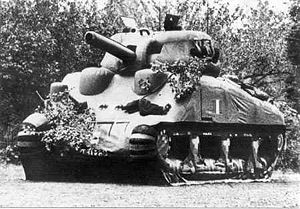
“Dummy” Sherman Tank: The Allies created a fictional Army Group to deceive German planners

As part of their preparations the Allies launched a massive deception campaign, Operation FORTITUDE.  This operation utilized the fictitious First Army Group under the “command” of General George Patton. Patton was still smarting from his relief of command of 7th Army following slapping commanded an “Army Group” which incorporated the use of dummy camp sites, dummy tanks, aircraft and vehicles, falsified orders of battle and communications to deceive German intelligence.[xii] The success of this effort was heightened by the fact that all German intelligence agents in the U.K. had been neutralized or turned by the British secret service.  Additionally the Luftwaffe’s limited air reconnaissance could only confirm the pre-invasion build ups throughout England without determining the target of the invasion.[xiii] The German intelligence chief in the west, Colonel Baron von Roenne “was deceived by FORTITUDE’s fantasy invasion force for the Pas de Calais.”[xiv] Despite this Commander of the 7thArmy recognized by 1943 that Normandy was a likely Allied target and efforts were made to shift 7th Army’s center of gravity from Brittany to Normandy.  The one potential German success in getting wind of when the Allied landings would occur was lost when German intelligence discovered two lines of Verlaine’s “Chason d’ Automme” in June 1944 which were to alert the French Resistance of the invasion.  The security section of 15th Army heard them transmitted on the afternoon of 5 June and notified General Jodl at OKW, but no action was taken to alert forces on the coast.[xv] Allied intelligence was aided by ULTRA intercepts of coded German wireless transmissions. However this was less of a factor than during the African and Italian campaigns as more German communications were sent via secure telephone and telegraph lines vice wireless.[xvi] Allied deception efforts were for the most part successful in identifying German forces deployed in Normandy. However they were uncertain about the location of the 352nd Infantry Division which had been deployed along OMAHA and taken units of the 709th Infantry Division under its command when it moved to the coast.[xvii]

USAAF B-17 Bombers and others helped isolate German forces in Normandy by bombing railroads, bridges, and supply lines

The Allied air campaign leading up to the invasion was based on attempting to isolate the invasion site from German reinforcements. Leigh-Mallory the Air Chief developed the “TRANSPORTATION PLAN” which focused efforts on destroying the French railroad infrastructure.[xviii] A more effective effort was led by General Brereton and his Ninth Air Force which was composed of medium bombers and fighters.  Brereton’s aircraft attacked bridges and rapidly achieved success in crippling German efforts to reinforce Normandy.[xix] Max Hastings gives more credit to the American bombing campaign in Germany to crippling the German defense in the west. General Spaatz and the 8th Air Force destroyed German production capacity in oil and petroleum as well as the degraded the German fighter force.  The American daylight raids so seriously degraded the German fighter force that it could not mount effective resistance to the invasion.[xx] Russell Weigley also notes that Albert Speer the Reich Armaments Minister said that “it was the oil raids of 1944 that decided the war.”[xxi]
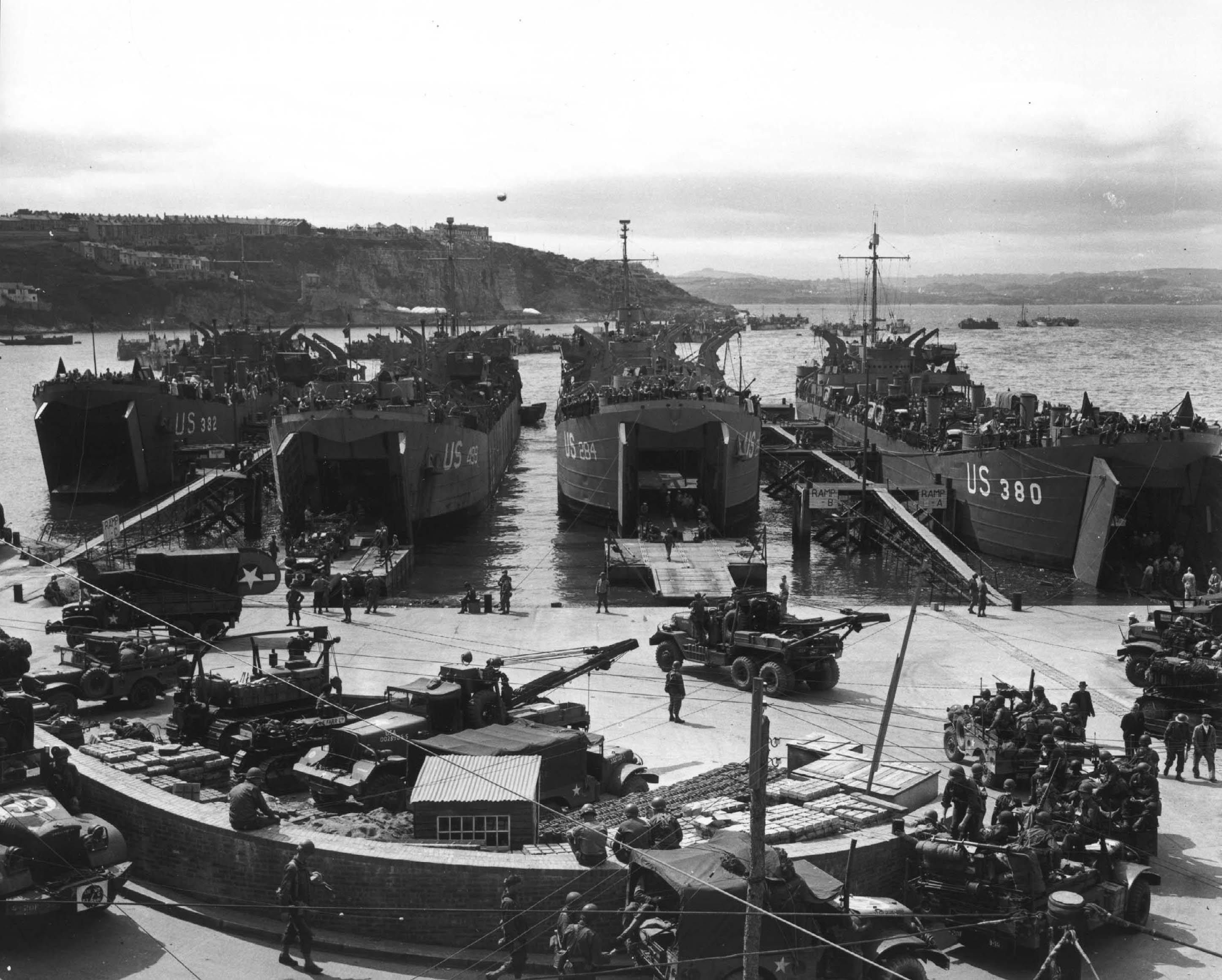
 

US Navy LST’s being loaded for the invasion

Planning and preparations for OMAHA were based around getting the 1st and 29th Infantry Divisions ashore and them securing a beachhead “twenty-five kilometers wide and eight or nine kilometers deep.”[xxii] American preparations were thorough and ambitious, but the American assault would go through the most heavily defended sector of German defenses in Normandy.  The landing beaches were wide and bordered by dunes which were nearly impassable to vehicles and “scrub covered bluffs thirty to fifty meters high…rough and impassable to vehicles even to tracked vehicles except at a few places.  The exits were unimproved roads running through four or five draws that cut the bluffs.”[xxiii] Dug in along those bluffs was the better part of the 352nd Division. The Americans compounded their selection of a difficult and heavily defended landing zone the Americans failed to take advantage of many of the “gadgets” that were offered by the British which in hindsight could have aided the Americans greatly.  The Americans made use of two battalions of DD (Dual Drive) tanks but turned down the offer of flail tanks, flamethrower tanks, and engineer tanks, the “funnies” developed by General Hobart and the British 79th Armored Division.[xxiv]

Dual Drive amphibious tanks were included as part of the US invasion package

Weigley believes that the American view of “tanks as instruments of mobility rather than of breakthrough power.” Likewise the Americans victories in the First World War were won by infantry with little tank support.[xxv] In this aspect the Americans were less receptive to utilizing all available technology to support their landings, something that when considering the fact that Americans were great lovers of gadgets and technology. The British use of the Armor, including the “Funnies” on the beaches to provide direct fire into German strong points lessened their infantry casualties on D-Day. Due to this lack of armor support on the beach American forces on OMAHA had little opportunity to exercise true combined arms operations during the initial landings.[xxvi]


Rommel with Artillerymen of the 21st Panzer Division in Normandy

German preparations for an Allied landing in Normandy were less advanced than the Pas de Calais.  However they had made great strides since late 1943. Field Marshal Rommel greatly increased defensive preparations along the front, including the Normandy beaches.  One of Rommel’s initiatives was to deploy Panzer Divisions near the coast where they could rapidly respond to an invasion.  However Rommel did not get everything that he wanted.  The OKW only allotted him two Panzer Divisions to be deployed near the Normandy beaches.  Only one of these the 21st Panzer Division was deployed near Caen in the British sector.  One wonders the result had the 12th SS Panzer Division been deployed behind OMAHA. [xxvii]

OMAHA: The Landings

The venerable USS Nevada, resurrected from the mud of Pearl Harbor bombarding German positions at Utah Beach

Like the rest of the Allied invasion forces the 1st and 29th U.S. Infantry Divisions set sail from their embarkation ports with the intent of landing on June 5th.  General Bradley, commanding the First Army until the American XII Army Group would be activated accompanied the invasion force.  The OMAHA landing was under the command of General Gerow and his V Corps while VII Corps led by the 4th Infantry Division landed at Utah supported by airdrops of the 82nd and 101st Airborne Divisions inland.  American command and control during the invasion was exercised from sea as in the Pacific, although General Officers were to go ashore with each of the American divisions.  A severe channel storm disrupted the plan to land on the 5th and Eisenhower delayed the invasion one day catching a break in the weather and electing to go on the 6th.[xxviii] This delay while uncomfortable for the embarked troops caused the Germans to believe that no invasion would take place until the next favorable tide and moon cycle later in the month.[xxix] The assumption that no invasion was possible ensured that a number of key senior German leaders, including Rommel were absent from the invasion front when the Allies landed.[xxx]

US Troops ride a LCVP toward Omaha 

The landing beaches at OMAHA stretched about 6500 meters from Colleville-Sur-Mer to Vierville-Sur-Mere in the west.  The beaches are wide with bluffs overlooking them and a seawall between the beaches and the bluffs.  Additionally several small towns dot the beach. To the west of the town of Vierville, a prominent height overlooked the entire beachhead.  Named Pont du Hoc, it was believed to house a 150mm battery sighted where it could enfilade the OMAHA landing zones.  The Americans assigned to the 2nd Ranger Battalion to make a seaborne assault to land, scale the cliffs and take the battery.  Companies from this battalion made a heroic landing and scaled the cliffs to capture the strongpoint only to discover that the guns had not been emplaced.  The Rangers took heavy casualties and held their isolated beachhead against German counterattacks until relieved by the 29th Division on the morning of June 8th.[xxxi]

Landing craft passing the USS Augusta in heavy seas heading toward Omaha Beach

H-Hour for OMAHA was 0630.  Unfortunately the assault troops were transferred to their LCVP landing craft 16-20 kilometers from the beach.  The result was a long and dangerous ride in the small craft for the infantry.  Most of the infantry were completely soaked in sea spay and seasick before going ashore and they carried loads far above what they normally would carry into battle.[xxxii] The Armor support was one battalion of DD tanks, the 741stArmored Battalion, supporting the 16th Infantry Regiment of 1st Infantry Division. These were also launched too far out and nearly all of the tanks were swamped and lost before firing a shot in anger.[xxxiii] Other American support units needed to provide firepower on the beach were equally unfortunate. Weigley notes that at OMAHA “at least 10 of the LCVPs sank” as did “the craft carrying almost all of the 105mm howitzers that were to be the first artillery ashore after the tanks.”[xxxiv] The losses would cripple the assault on OMAHA and nearly cause its abandonment.

Bloody Omaha

As the soldiers of the American divisions on OMAHA came ashore they faced German defenders of the 352nd, 716th and a regiment of the 709th Infantry Division, the latter under the tactical command of the 352nd.   Without the bulk of their tanks artillery and lacking close air support the Americans struggled across the beaches and were cut down in large numbers before being pinned down behind the sea wall.[xxxv] With the Americans pinned down on the beach unable to advance, the time tables for the reinforcing waves became snarled amid the German beach obstacles which had not been cleared.  This was in large part due to 40% casualties among the Combat Engineers and the loss of all but five bulldozers.[xxxvi] Naval officers were frustrated in their attempts to provide naval gunfire support by the lack of identifiable targets on the beaches.  Yet German strongpoint’s were “knocked out by either by superbly directed vigorous gunfire from destroyers steaming as close as 800 yards offshore, or by determined action from Rangers or infantry.[xxxvii]


US Infantry struggles ashore at Omaha

Soldiers ashore discovered that they were not facing the static 716th Division but the veteran 352nd Division as well.[xxxviii] Only the leadership and actions of Brigadier General Norman Cota the 29th Division’s Deputy Commander and Colonel Charles Canham of the 116th Infantry kept the situation from complete collapse.  They were able to rally their troops. Under their leadership small units from the 116th which had its linage back to the “Stonewall Brigade” as well as elements of the 16th and 18th Infantry Regiments began to move forward.  Surviving junior leaders began to lead survivors through the dunes and up the bluffs to attack German defenders of the roads leading up from the beach from the flank and rear.  A mid-day break in the weather allowed some close tactical air support giving the troops badly needed support.

US 1st Infantry Division Troops at the Omaha sea wall

With the situation desperate General Bradley considered the evacuation of OMAHA.  At sea events were as confused as Bradley and his staff attempted to make sense of what was going on.  Even later in the evening there was discussion of diverting all further reinforcements from OMAHA to the British beaches.[xxxix]At 1330 hours “Gerow signaled Bradley: “Troops formerly pinned down on beaches…advancing up heights behind beaches.”[xl] By the end of the day Bradley’s aid Major Hansen noted Bradley’s comments to Collins: “They are digging in on Omaha beach with their fingernails. I hope they can push in and get some stuff ashore.”  And Montgomery: “Someday I’ll tell Gen[eral] Eisenhower just how close it was for a few hours.”[xli]
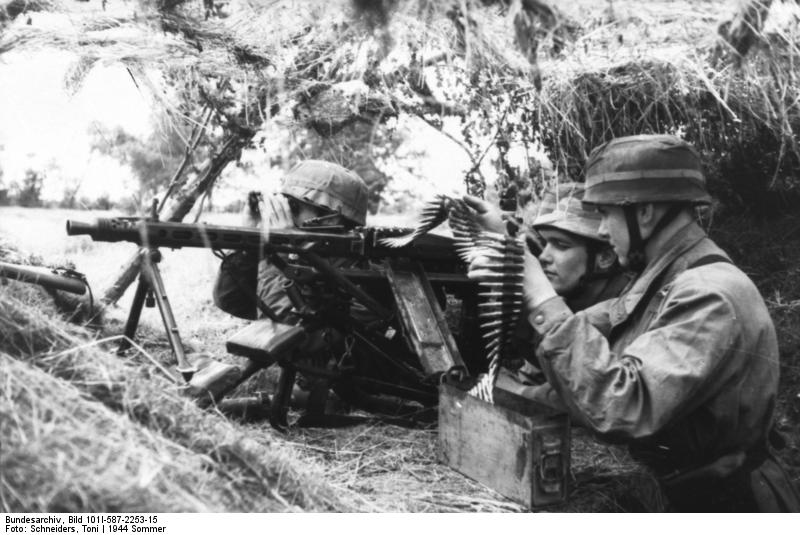
German Fallschirmjaeger Trüppen in Normandy, the German Parachute forces fighting in an infantry role were very effective in the Normandy campaign

The landings at OMAHA succeeded at a cost of over 2000 casualties.  Critical to the success of the landings were the German inability to reinforce their defending troops on the beach.  Likewise the weakness of the units available to mount the standard counterattack that was critical to German defensive plans on D-Day itself kept the Germans from driving the Americans back into the Channel. The 352nd Division fought superbly under the full weight of V Corps and the British XXX Corps on its right suffering heavy casualties as they contested every inch of ground.  The 716th Division composed of second rate troops melted under the onslaught.  Allied air supremacy played a key role as sorties by the 8th and 9th Air Forces helped keep German reinforcements from arriving and interdicted counter attacks inland.  Weigley credits the Allied air superiority with the success of the landings and with limiting casualties.[xlii]Von Rundstedt and other German commanders in France were limited by the delay and refusal of Hitler and OKW to release Panzer reserves when needed most early on June 6th.  By the close of D-Day allied forces had secured the five invasion beaches but not achieved their objectives of taking Caen and Bayuex.  Since the forces on the various beachheads had not linked up the beaches would have been extremely vulnerable had the Germans been able to mount a rapid counterattack by Panzers and strong infantry formations as they had at Salerno.

Major Battles to the Breakout at Avranches

Securing the Beachheads

It took the V and VII Corps nearly a week to secure the beachheads. German forces including the stalwart 352nd Division resisted stubbornly and mounted sharp local counterattacks which kept the Americans off balance.  Elements of the 29th Division and the 90th Division began to push inland and to expand the beachhead toward UTAH. Opposed by the 352nd Division and elements of the 91st Airlanding Division and other non-divisional units the fighting revealed the inexperience of the American infantry formations and the uneven quality of their leadership.  As the Americans tackled the Germans in the labyrinth of the Bocage country the defensive skill of the Germans cost many American lives and delayed the joining of the beachheads. On the 13th the link up was solid enough to enabling the Americans to conduct the follow up operations needed to expand the beachhead, secure Cherbourg and clear the Cotentin.
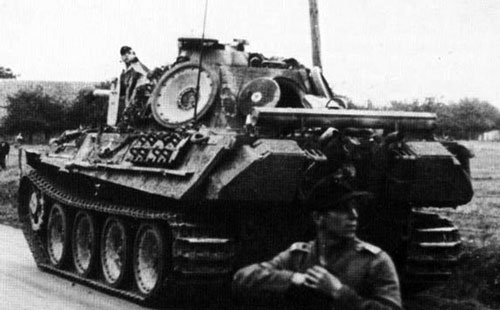
A Panther tank of the Panzer Lehr Division in Normandy

In some American divisions the hard fighting triggered a leadership crisis.  The lack of success of the 90th Division led General “Lightening Joe” Collins of VII Corps relieve the division commander and two regimental commanders of command, a portent of things to come with other American units.[xliii] As the V and VII corps pushed into the “Bocage” they were followed by a massive build up of troops and equipment delivered to the beaches and to the artificial “Mulberry” harbors.  Despite their numeric superiority, air supremacy and massive Naval gunfire support and facing the weakened 352nd, 91st and the 6thParachute Regiment and other less than quality formations, survivors of the static divisions, the Americans made painfully slow progress as they moved off the beachhead and into the Bocage.[xliv]

The Capture of Cherbourg

US Soldiers of the 29th Division surrender to German Fallschirmjaeger in Normandy

Once the beachheads had been consolidated the Americans turned their attention toward Cherbourg. Cherbourg was the major naval port at the far northwest tip of the Cotentin.  D-Day planners counted on its swift capture and rehabilitation to serve as a supply port for the Allied forces. The 9th Division drove south to the coast near Barneville on the 18th of June cutting off the German forces covering the approaches to Cherbourg.[xlv] This put the Germans in a bind as the 7th Army “had to split its forces in the peninsula in order to hold the fortress a little longer and thus to gain time for the establishment of the southern front on the Cotentin peninsula.[xlvi] The German forces arrayed before Cherbourg waged a desperate defense centered around the 243rd Infantry Division and other assorted battle groups of LXXXIV Corps, whose commander General Marcks one of the best German Generals was killed in action on 12 June.[xlvii] The U.S. VII Corps under Collins with the 9th, 4th and 79th Divisions pushed up the peninsula capturing Cherbourg on June 29th.  Bradley pushed hard for the capture of the port as the Mulberries had been ravaged by a severe Channel storm the week prior. The port of Cherbourg was thoroughly demolished by German engineers and would not be fully operational for months. The loss of the Mulberries and delay in Cherbourg’s availability meant that few supplies were landed on the beaches would “hinder the escape from the constricting land of the hedgerows into which the Americans had come in search of a port.[xlviii]

The Battle of Caumont Gap
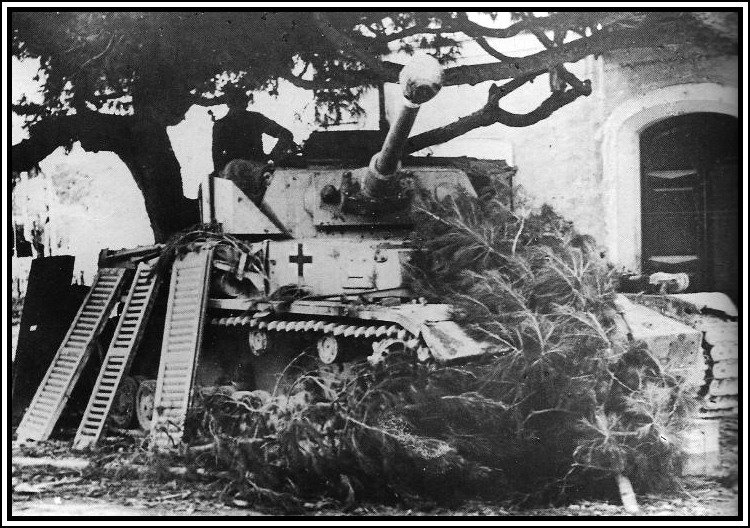
Panzer IV Tank in Normandy

V Corps under Gerow made a cautious advance by phase lines toward Caumont, St Lo and Carentan.  The deliberate advance by the Corps toward a line weakly held by the Reconnaissance battalion of the 17th SS Panzer Grenadier Division was directed by Bradley who did not want to divert attention from the effort against Cherbourg.   After capturing Caumont V Corps halted and continued aggressive patrolling to deceive the Germans while digging in.[xlix] The possibility existed that a strong push against the weak German line could have led to an opportunity to envelope the German line west of Caen. This was a missed opportunity that in part led to the bloody and controversial campaign to capture Caen.[l]

British efforts around Caen

German Panzer Ace Waffen SS Captain Michale Wittman single handedly destroyed a British Battalion at Villers Bocage in his Tiger Tank

Montgomery had ambitious plans to break out of Normandy by capturing Caen on D-Day and driving toward Falaise and Argentan.  The British plans for this were frustrated by the rapid reinforcement of the sector by the Germans and the activities of 21st Panzer, Panzer Lehr, and the 12th SS Panzer Divisions.  A flanking maneuver at Villers-Bocage was frustrated by a few Tiger tanks led by the legendary Waffen SS Panzer commander Captain Michael Wittman whose tanks devastated a British Armored battalion.[li]

Wreckage of a British Battalion at Villers Bocage

A series of disastrous attacks toward Caen (EPSOM, CHARNWOOD and GOODWOOD) strongly supported by air strikes and Naval gunfire finally succeeded in taking that unfortunate city on July 18th but failed to take the heights beyond the town.[lii]

British operations like Operation Epsom met setback after setback against dug in German forces outside of Caen

Against crack well dug in German forces the British took heavy casualties in tanks and infantry seriously straining their ability to conduct high intensity combat operations in the future.[liii] The one benefit, which Montgomery would claim after the war as his original plan was that German forces were fixed before Caen and ground down so they could not be used against Bradley’s breakout in the west at St Lo.[liv]

Clearing the Bocage: The Battle of the Cotentin Plain

US M-5 Light Tank in Normandy

Other German forces arrived, and reinforced the Caumont gap which no longer “yawned invitingly in front of V Corps.” [lv] Bradley wished to push forward rapidly to achieve a breakthrough in the American sector.[lvi] Facing the most difficult terrain in France amid the Bocage and swamps that limited avenues of approach to the American divisions committed to the offensive.  The Americans now faced their old foe the 352nd division as well various elements of II Parachute Corps, the 17th SS Panzer Grenadier and Panzer Lehr Divisions.  American tanks and infantry made slow progress and incurred high losses as they dueled the Germans at close range.  In the VIII Corps sector alone the attack “consumed twelve days and 10,000 casualties to cross eleven kilometers of the Bocage…the achievements of the VII and XIX Corps were no better than comparable.[lvii]

St. Lo
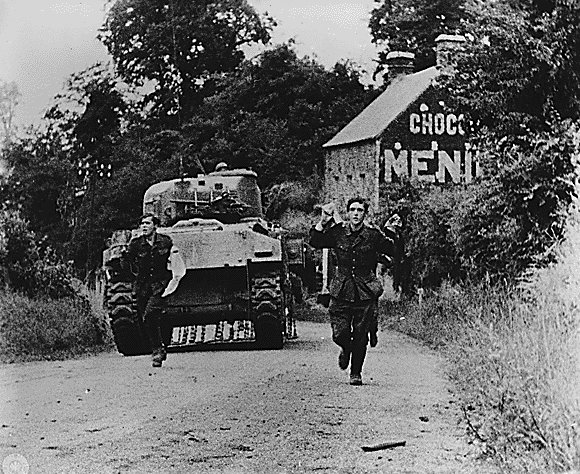
US Tanks advancing with German prisoners moving back to US lines at St Lo

St. Lo was a key to Bradley’s breakout efforts.  His Army had to capture it and the roads leading out of it to launch Operation COBRA along the coast.  The task of capturing St. Lo was assigned to GEROW’S V Corps and Corlett’s XIX Corps.  They faced opposition from the tough paratroops of the German 3rd Parachute Division of II Parachute Corps.  The 2nd, 29th, 30th and 83rd Divisions fought a tough battle advancing eleven kilometers again with high numbers of casualties especially among the infantry to secure St. Lo on 18 July.[lviii] They finally had cleared the hedgerows.  St Lo epitomized the struggle that the American Army had to overcome in the Bocage.  Hard fighting but outnumbered German troops in excellent defensive country exacted a terrible price in American blood despite the Allied control of the skies.[lix]

Operation COBRA

US 155mm Howitzers in Normandy, the Germans had profound respect for American Artillery, a respect that they did not share for American Infantry or Armor forces

With the Bocage behind him Bradley desired to push the Germans hard.  COBRA was his plan to break out of Normandy.  Bradley ably assisted by Collins they realized that the better terrain, road networks favored a breakout.  American preparations included a technical advance that allowed tanks to plow through hedgerows. This was the “Rhino” device fashioned by American troops which was installed on 3 of every 5 First Army Tanks for the operation.[lx] VII Corps was to lead the attack which was to begin on July 24th. American planning was more advanced than in past operations.  Collins and Bradley planned for exploitation operations once the breakthrough had been made. A massive air bombardment would precede the attack along with an artillery barrage by Collins corps artillery which was reinforced by additional battalions.   A mistake by the heavy bombers in the 24th resulted in the American troops being hit with heavy casualties and a postponement of the attack until the 25th.[lxi] The following day the attack commenced.  Another mistake by the bombers led to more American casualties[lxii] but VII Corps units pressed forward against the determined resistance of the survivors of Panzer Lehr and the remnants of units that had fought the Americans since the invasion began.  Although it was a “slow go” on the 25th Bradley and his commanders were already planning for and beginning to execute the breakout before the Germans could move up reinforcements.  The 26th of June brought renewed attacks accompanied by massive air strikes.

The Devastated town of St Lo 

While not much progress was made on the 26th, the Americans discovered on the 27th that the German forces were retreating.  The capture of Marigny allowed VIII Corps to begin exploitation down the coastal highway to Coutances.  On the 27th General Patton was authorized to take immediate command of VIII Corps a precursor to the activation of his 3rdArmy.  COBRA ripped a hole in the German line and inflicted such heavy casualties on the German 7th Army that it could do little to stop the American push.[lxiii] As the American forces pushed forward they reinforced their left flank absorbing the local German counterattacks which were hampered by the Allied close air support.

Avranches and Beyond

US Forces advance through the ruins of St Lo

As the breakthrough was exploited the command of the forces leading it shifted to Patton and the newly activated 3rd Army. By the 28th VIII Corps led by the 4th and 6th Armored Divisions had reached Avranches and established bridgeheads over the See River with additional bridges being captured intact on the 30th.[lxiv] The capture of Avranches allowed the Americans to begin exploitation operations into Brittany and east toward the Seine. Weigley notes that for the first time in the campaign that in Patton the Americans finally had a commander who understood strategic maneuver and would use it to great effect.[lxv]

Conclusion

The American campaign in Normandy cost the U.S. Army a great deal. It revealed weaknesses in the infantry, the inferiority of the M4 Sherman tank to most German types, problems in tank-infantry cooperation and also deficiencies in leadership at senior, mid-grade and junior levels. Heavy casualties among infantry formations would lead to problems later in the campaign. Numerous officers were relieved including Division and Regimental commanders.  Nonetheless during the campaign the Americans grew in their ability to coordinate air and ground forces and adapt to the conditions imposed on them by their placement in the Cotentin.  The deficiencies would show up in later battles but the American Army learned its trade even impressing some German commanders on the ground in Normandy.[lxvi]

[i] See the alternative history of by Peter Tsouras Disaster at D-Day: The Germans Defeat the Allies, June 1944, Greenhill Books, London 1994. Tsouras describes the defeat of the Omaha landings and the effect on the course of the campaign leading to the overthrow of Hitler and a negotiated armistice in the west.  While this outcome could be rigorously debated other outcomes could have led to the fall of the Roosevelt and Churchill governments and their replacement by those not committed to unconditional surrender or a continuation of the war that brought about more German missile attacks on the U.K. and the introduction of other advanced German weapons that could have forced such a settlement. Another option could have led to the dropping of the Atomic Bomb on a German city vice Hiroshima.

Notes 

[ii] Weigley, Russell F. Eisenhower’s Lieutenants: The Campaign of France and Germany, 1944-1945, Indiana University Press, Bloomington IN, 1981 p.33

[iii] Ibid pp. 34-35

[iv] Ibid p.35

[v] General Montgomery 21st Army group and Land Forces, Admiral Sir Bertram Ramsey as Allied Naval Expeditionary Force and Air Marshall Sir Trafford Leigh-Mallory as Commander in Chief Allied Expeditionary Air Force. Weigley p.43

[vi] Max Hastings in Overlord: D-Day and the Battle for Normandy Vintage Books, New York, 1984, comments that many in Britain wondered if Eisenhower with the lack of actual battle experience could be a effective commander and that Eisenhower was disappointed in the appointment of Leigh-Mallory and Ramsey, and had preferred Alexander over Montgomery, pp. 28-29.

[vii] Ibid. Weigley p.40.  Montgomery was the first to object to the 3 division narrow front invasion rightly recognizing that seizing Caen with its road junctions could provide a springboard for the campaign into open country.

[viii] Ibid. p.37

[ix] Hastings, Max. Overlord: D-Day and the Battle for Normandy Vintage Books, New York, 1984 p.29  Hastings finds the irony in the selection of the British officers to execute the plan that reflected the American way of thinking.

[x] The Germans agreed with this in their planning leaving Brittany very lightly defended.  See  Isby, David C. Ed. “The German Army at D-Day: Fighting the Invasion.” p.27 The report of General Blumentritt, Chief of Staff OB West noted that only 3 divisions were assigned to Brittany.

[xi] Ibid. Weigley, pp. 39-40

[xii] Ibid. p.73

[xiii] See Isby p. 69.  General Max Pemsel of 7th Army noted that “During  the spring of 1944, Seventh Army received only tow good photographs of British southern ports, which showed large concentrations of landing craft.”

[xiv] Ibid. Hastings p.63.  Hastings comments also about the success of using the turned Abwehr agents.

[xv] Warlimont, Walter. “Inside Hitler’s Headquarters: 1939-1945.” Translated from theGerman by R.H. Barry. Presidio Press, Novao CA, English Edition Copyright 1964 Wiedenfeld and Nicholson Ltd. Pp.422-423

[xvi] Ibid. Weigley pp. 53-54

[xvii] Ibid. p. 67

[xviii] Ibid. pp.57-64  Weigley spends a great deal of time on the wrangling between Eisenhower, Leigh Mallory and Spaatz on the nature of the plan, the allocation of forces both strategic and tactical assigned to carry it out and its success, or in the light of postwar analysis the lack of effect that it had on German operations.

[xix] Ibid. p.67-68.

[xx] Ibid. Hastings pp. 43-44 In large part due to the long range P-51 Mustang which accompanied the American bombing raids beginning in 1943.  Another comment is that the campaign drew the German fighters home to defend Germany proper and prevented their use in any appreciable numbers over the invasion beaches.

[xxi] Ibid. Weigley p.69

[xxii] Ibid. p.89

[xxiii] Ibid. pp. 88-89

[xxiv] Ibid. p.87

[xxv] Ibid. Weigley also talks about the rejection of General Corlett’s ideas to use Amtracks used by the Marines in the Pacific to land on less desirable, but less defended beaches to lessen casualties on the beaches and the need for additional support equipment even on smooth beaches.  One of Corlett’s criticisms was that too little ammunition was allotted to supporting the landings and not enough supporting equipment was provided. pp. 46-47

[xxvi] Hastings notes that with the strength and firepower of the German forces on OMAHA that many of these vehicles had they been employed would like have ended up destroyed further cluttering the beachhead. “Overlord” p.102

[xxvii] The battle over the deployment of the Panzer Divisions is covered by numerous historians.  The source of the conflict was between Rommel who desired to place the Panzer Divisions on the Coast under his command due to the fear that Allied air superiority would prevent the traditional Panzer counterthrust, General Gyer von Schweppenburg commander of Panzer Group West (Later the 5th Panzer Army) and Field Marshal Von Rundstedt who desired to deploy the divisions order the command of Rundstedt for a counter attack once the invasion had been launched, a strategy which was standard on the Eastern Front, and Hitler who held most of the Panzer reserve including the SS Panzer Divisions under his control at OKW.  Hitler would negotiate a compromise that gave Rommel the satisfaction of having three Panzer Divisions deployed behind coast areas in the Army Group B area of responsibility.  21stPanzer had those duties in Normandy.

[xxviii] Ibid. p.74-75

[xxix] Von Luck, Hans.  “Panzer Commander“ Dell Publishing, New York, 1989 pp. 169-170.  Von Luck a regiment commander in 21st Panzer noted that General Marcks of 84th Corps had predicted a 5 June invasion at a conference May 30th.

[xxx] Almost every D-Day historian talks about the weather factor and its effect on the German high command’s reaction to the invasion.  Rommel was visiting his wife for her birthday and planned to make a call on Hitler. Others including commanders of key divisions such as the 91st Airlanding Division were off to a war game in Rennes and the 21st Panzer Division to Paris.

[xxxi] Ibid. Weigley p. 96

[xxxii] See Cornelius Ryan, “The Longest Day” Popular Library Edition, New York 1959. pp. 189-193 for a vivid description of the challenges faced by soldiers going from ship to landing craft and their ride in to the beaches.

[xxxiii] Ibid. Weigley. p.78 Weigley talks about the order for the tanks to be carried ashore on their LCTs that did not get transmitted to the 741st.

[xxxiv] Ibid.

[xxxv] Ibid. Weigley  p. 87 The weather prevented the aerial bombardment from being effective. Because the bombers could not see their targets they dropped their bomb loads further inland, depriving the infantry of support that they were expecting.  Naval gunfire support had some effect but had to be lifted as the troops hit the beach leaving much of that support to come from Destroyers and specially equipped landing craft which mounted rockets and guns.

[xxxvi] Ibid. Hastings. pp. 90-91.

[xxxvii] Ibid. p.99

[xxxviii] Ibid. Weigley p.80

[xxxix] Ibid. p.101  Also see Weigley p.80

[xl] Ibid. p.99

[xli] Ibid. Weigleyp.95

[xlii] Ibid. p.94

[xliii] Ibid. p.99 Both Weigley and Hastings make note of the failure of both the Americans and British to train their troops to fight in the bocage once they had left the beaches.

[xliv] Ibid. Hastings. pp.152-153

[xlv] Ibid. Weigley p.101

[xlvi] Isby, David C., Ed. “Fighting in Normandy: The German Army from D-Day to Villers-Bocage.” Greenhill Books, London,  2001.  p.143

[xlvii] Ibid. Hastings p.173 Allied fighter bombers exacted a fearful toll among German commanders. The Commanders of the 243rd and 77th Divisions fighting in the Cotentin were also killed by air attacks on the 17th and 18th.   Further east facing the British the commander of the 12th SS Panzer Division, Fritz Witt on the 17th.

[xlviii] Ibid. Weigley. p.108

[xlix] Ibid. p.111-112.

[l] Ibid.

[li] The efforts of the 51st Highland Division and 7th Armored Division were turned aside by the Germans in the area and were dramatized by the destruction of  a British armored battalion by SS Captain Michael Wittman and his platoon of Tiger tanks.  See Hastings pp.131-135.

[lii] The British 8th Corps under General O’Connor lost 270 tanks and 1,500 men on 18 July attempting to crack the German gun line on the ridge beyond Caen. Weigley, pp.145-146.

[liii] Hastings comments about the critical British manpower shortage and the pressures on Montgomery to not take heavy casualties that could not be replaced. Overlord. pp.241-242.

[liv] Ibid. Weigley pp.116-120

[lv] Ibid. p.122

[lvi] Ibid. p121 Bradley told Eisenhower “when we hit the enemy this time we will hit him with such power that we can keep going and cause a major disaster.”

[lvii] Ibid. 134

[lviii] Ibid. Weigley. pp. 138-143.  Weigley notes of 40,000 U.S. casualties in Normandy up to the capture of St. Lo that 90% were concentrated among the infantry.

[lix] Weigley quotes the 329th Regiment, 83rd Division historian “We won the battle of Normandy, [but] considering the high price in American lives we lost. P.143. This is actually a provocative statement that reflects America’s aversion to massive casualties in any war.

[lx] Ibid. p.149

[lxi] Ibid. p. 152

[lxii] Ibid. pp. 152-153.  Among the casualties were the command group of the 9th Division’s 3rd Battalion 47th Infantry and General Leslie McNair who had come to observe the assault.

[lxiii] Ibid. pp.161-169. Weigley notes the advances in U.S. tactical air support, the employment of massive numbers of U.S. divisions against the depleted German LXXXIV Corps, and the advantage that the “Rhino” device gave to American tanks by giving them the ability to maneuver off the roads for the first time.

[lxiv] Ibid. pp.172-173.

[lxv] Ibid. p.172

[lxvi] Ibid. Isby, David C. “Fighting in Normandy,” p.184, an officer of the 352nd Division referred to the American soldier “was to prove himself a in this terrain an agile and superior fighter.”

Bibliography

Carell, Paul. “Invasion: They’re Coming!” Translated from the German by E. Osers, Bantam, New York 1964.

Hastings, Max. Overlord: D-Day and the Battle for Normandy Vintage Books, New York, 1984

Isby, David C. Ed. “The German Army at D-Day: Fighting the Invasion.” Greenhill Books, London 2004

Isby, David C., Ed. “Fighting in Normandy: The German Army from D-Day to Villers-Bocage.” Greenhill Books, London, 2001.

Ryan, Cornelius, “The Longest Day” Popular Library Edition, New York 1959

Tsouras, Peter. “Disaster at D-Day: The Germans Defeat the Allies, June 1944,”Greenhill Books, London 1994.

Von Luck, Hans.  “Panzer Commander“ Dell Publishing, New York, 1989

Warlimont, Walter. “Inside Hitler’s Headquarters: 1939-1945.” Translated from theGerman by R.H. Barry. Presidio Press, Novao CA, English Edition Copyright 1964 Wiedenfeld and Nicholson Ltd. Warlimont, Walter. “Inside Hitler’s Headquarters: 1939-1945.” Translated from theGerman by R.H. Barry. Presidio Press, Novao CA, English Edition Copyright 1964 Wiedenfeld and Nicholson Ltd.

Weigley, Russell F. Eisenhower’s Lieutenants: The Campaign of France and Germany, 1944-1945, Indiana University Press, Bloomington IN, 1981
Leave a comment

Filed under History, leadership, Military, nazi germany, us army, US Army Air Corps, world war two in europe

The Sinking of the Bismarck

FinalBattle

Friends of Padre Steve’s World

This is the final part of my rendition of the great naval tragedy in three acts involving the German Battleship Bismarck. The first part was the sinking of the legendary and graceful pride of the Royal Navy, the Battle Cruiser Hood. The second part was the seemingly futile hunt and chase of the Bismarck by units of the British Home Fleet. What seemed hopeless changed when hours from the protection of night Bismarck was discovered and then torpedoed in a last ditch effort by Swordfish torpedo planes from the HMS Ark Royal. Today, the final act, the sinking of the Bismarck. 

I have written about this before and this is an edited version of that article. As I have mentioned before I have long been fascinated with this naval tragedy. I call it that because I have served at sea and in combat ashore; and because I understand that amid all the technology and weaponry that ultimately it is the men who suffer the terrors of war, and who suffer and die who matter. Soldiers, Sailors, Marines and Airmen seldom get a choice in the wars that the leaders of their nations send them to fight. Thus for me, even the Sailors of the Bismarck, the pride of Adolf Hitler’s Kriegsmarine are as much victims of war as the British Sailors aboard the HMS Hood. 

Peace

Padre Steve+

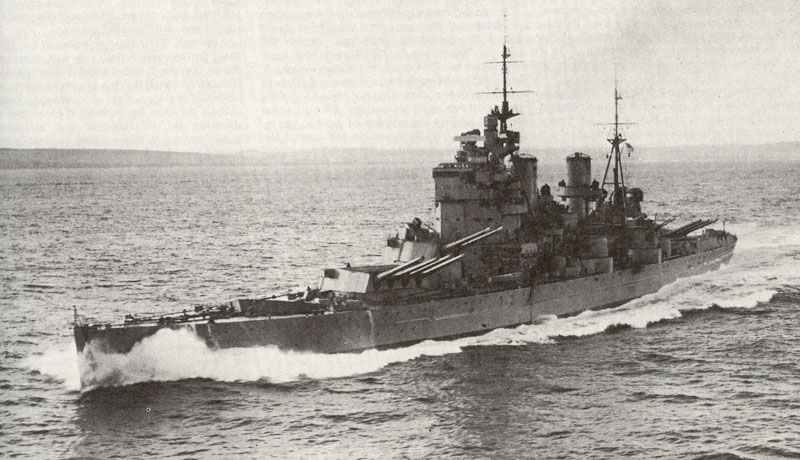
King_George_V-px800

Rodney

HMS King George V (above) and HMS Rodney (below)

The torpedo from the Swordfish from the HMS Ark Royal that struck the Bismarck in her stern, jammed her rudders and wrecked her steering gear at last light on May 26th 1941, doomed the remarkable ship and her crew. It was an astounding turn of events, as just minutes before the hit both the Germans and the British were expecting Bismarck to reach safety of German occupied ports in France to fight again.

Just days before Bismarck had sunk the legendary British Battle Cruiser HMS Hood in minutes and had she persisted in her attack could have sunk the new Battleship HMS Prince of Wales. Instead, Vice Admiral Gunther Lutjens in command of the Bismarck and her consort the Heavy Cruiser Prinz Eugen decided to break off contact and make for safety in the French port of Brest.

Bismarck slipped her pursuers and allowed Prinz Eugen to escape. It seemed that nothing that the British could do would stop her from gaining the safety of the French port and with it the knowledge that she had sunk the most powerful ship in the Royal Navy and gotten away. Then out of nowhere Bismarck was spotted by a Royal Air Force Coastal Command PBY Catalina seaplane piloted by an American Naval Officer. Hours later a relatively small and slow torpedo dropped from an obsolescent Swordfish torpedo bomber, a “Stringbag” hit the Bismarck in in her stern, wrecking her rudders and steering gear. Remarkably it was perhaps the only place that such a torpedo could have changed the developing narrative of a great German naval victory into defeat.

As darkness fell on May 26th, Bismarck, unable to steer towards Brest due to her damage and the following seas steered toward the oncoming British armada at a reduced speed. Her crew, now exhausted from countless hours on watch and at their battle stations knew that they were doomed.

Despite this the officers and sailors aboard Bismarck still labored trying in vain for a way to repair and save their their ship. As Bismarck’s engineers and damage control personnel sought at way to repair the damage on that dark night Royal Navy destroyers under the command of Captain Phillip Vian harassed her, closing to fire torpedoes and keep the exhausted crew of the mighty German ship engaged at their battle stations throughout the long night. Knowing that the end was near the Captain of the Bismarck ordered the contents of the ship’s store to be given to crew members.

photo045

Bismarck under Fire from King George V and Rodney

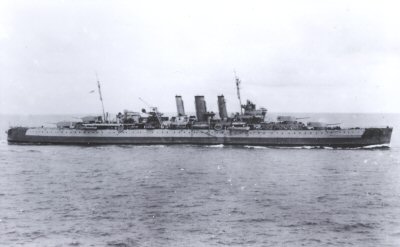
As light broke on the morning of May 27th the remaining heavy units from the Home Fleet which still had enough fuel in their tanks to continue the action, the Battleships HMS King George V and HMS Rodney along with the Heavy Cruisers HMS Norfolk and HMS Dorsetshire which had broke from its convoy escort duties on the 26th closed in for the kill. Norfolk had been in on the hunt since the beginning when she and her sister ship the HMS Suffolk had discovered Bismarck and Prinz Eugen as the transited the Denmark Strait on the night of May 23rd and 24th.

WTBR_Bismarck_Sinking_pic

Bismarck from Dorsetshire

Warily the British ships closed the crippled but still powerful German battleship. At 0847 Admiral Tovey ordered British Battleships to open fire on Bismarck. The crippled German ship replied with accurate salvos and straddled Rodney. However, the British shells hammered the Bismarck. 16” shells from Rodney destroyed the command center of Bismarck and her main fire control stations. Within 30 minutes the mighty guns of the Bismarck which had sunk the Hooddays before were silenced.  With no opposition from the stricken German ship the British battleships and cruisers pounded Bismarck from point blank range with 16”, 14”, 8” and 6” shells as well as torpedoes.

painting28

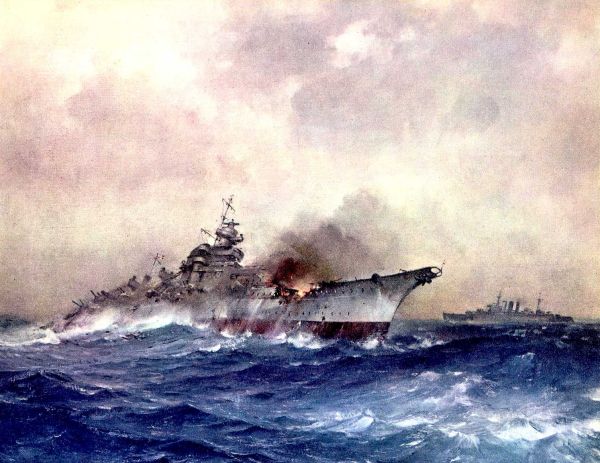
The end of the Bismarck

The British ships scored at least 400 hits on Bismarck and though they had silenced her and reduced the German ship to smoking ruins, the Bismarck remained afloat, defying her attackers. She was burning and certainly doomed but undaunted. The British battlewagons continued to pound Bismarck at point blank range, until finally, with their adversary obviously doomed and their own fuel supplies were dangerously low.  Admiral Tovey then ordered his battleships to break off the action. As he did this the British cruisers continued to fire their guns and torpedoes at the blazing helpless ship.

bismar1

Bismarck Survivors being hauled aboard Dorsetshire

The Bismarck’s First Officer, Fregattenkapitan (Commander) Hans Oels ordered her Chief Engineer Korvettenkapitan (Lieutenant Commander) Gerhard Junack to prepare the ship for scuttling and ordered the crew to abandon ship. The watertight doors were opened by Bismarck’s damage control teams and engineers as the scuttling charges fired at about the same time as HMS Dorsetshire launched her torpedoes at Bismarck. 1039 the Bismarck slipped beneath the waves. To this day those who claim the Bismarck sank because her crew scuttled her, and those who believe the the fish fired by Dorsetshire decided the fate of the ship, but truthfully it doesn’t matter. No matter what happened Bismarck was going to sink and no German forces could save her, or her crew.

hmsdorsetshirempl1284

HMS Dorsetshire 1941

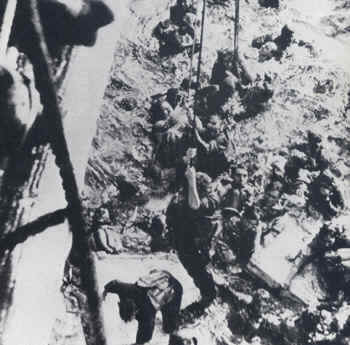
As the great ship slipped beneath the waves into the depths of the North Atlantic, hundreds of survivors bobbed about in the cold Atlantic waters. Of these men, 110 were rescued by British ships, mostly by Dorchester. Then lookouts aboard the cruiser spotted the periscope of a U-Boat, and the British ships broke off their rescue operations leaving hundreds more survivors to die of exposure or their wounds in the Atlantic. In a cruel twist of fate, the U-Boat they believed they spotted had expended all of its torpedoes and was not a threat to them. A few more of the Bismarck’s survivors were rescued later by German ships or U-boats, but about 2200 German sailors went down with their ship or died awaiting rescue that never came. When it was all over just 2 officers and 113 men survived the sinking of the Bismarck, combined with the three men who survived the sinking of the Hood nearly 3700 British and German Sailors perished.

images-40

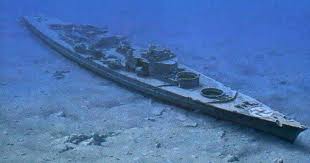
Artist’s image of the Wreck of the Bismarck

Subsequent investigations of the wreck of the Bismarck would show that all the British shells and torpedoes did not sink the Bismarck, and that it was indeed the scuttling charges that sent the mighty ship to the bottom of the Atlantic. But even had she not been scuttled, she was doomed, and the damage that she had sustained would have sent her to the bottom within 12 to 24 hours had Commander Oels not ordered Lieutenant Commander Junack to scuttle the ship.

Within a year the Ark Royal, Prince of Wales, and Dorsetshire would also lie at the bottom of the seas. Prince of Wales along the HMS Repulse was sunk by Japanese land based bombers off Malaya in 1941, Dorsetshire was sunk near Ceylon by Japanese Carrier aircraft in April 1942, and Ark Royal was torpedoed by the U-Boat U-81 in November 1941 not far from Gibraltar. Of the destroyers that harassed Bismarck the night before her sinking only one, the Polish Destroyer ORP Piorun would survive the war.

The tragedy of mission of the Bismarck is that nearly 3700 sailors died aboard the two mightiest ships in the world, and while legendary the losses of the two ships did not materially alter the course of the war. Hood’s loss though tragic did not alter the strategic equation as more new battleships of the King George V class entered service. Likewise the surfing German capital ships were harassed by RAF bomber sorties and attacks by the Royal Navy’s Fleet Air Arm. With few exceptions these ships remained confined to ports in France, Germany or Norway and slipped into irrelevance as the war progressed as the German U-Boat force took the lead in the Battle of the Atlantic.

As an officer who has served at sea on a cruiser at war which came within minutes of a surface engagement with Iranian Revolutionary Guard patrol boats in the Northern Arabian Gulf in 2002 I have often wondered what would happened in the event of an engagement that seriously damaged or sank our ship. Thus I have a profound sense of empathy for the sailors of both sides who perished aboard the Hood and the Bismarck in the fateful days of May 1941.

I hope that no more brave sailors will have to die this way, but I know from what history teaches that tragedies like this will happen again.

Peace

Padre Steve+

1 Comment

Filed under History, Military, Navy Ships, nazi germany, World War II at Sea, world war two in europe

The Death of the Pride of the Royal Navy: The Sinking of HMS Hood

hms-hood-sinking11Artist rendition of the Loss of the HMS Hood

Friends of Padre Steve’s World,

Seventy-seven years ago today the “Mighty Hood” was sunk by the German Battleship Bismarck. The news was broken to most of the world by American journalist Edward R. Murrow who in his radio broadcast reported:

“This is London, Ed Murrow reporting. This island, which is no stranger to bad tiding, received news today that HMS Hood largest warship in the British fleet and pride of the British navy, has been sunk by the German battleship Bismarck. From the Hood’s compliment of 1500 men, there were three survivors.”

The news of the sinking of the great ship stunned the world, and it is a tragic anniversary that I always mark. I first read about this battle in C.S Forrester’s little book Hunting the Bismarck when I was in 4th grade. That book was used as the screenplay for the 1960 film Sink the Bismarck.

This essay is in honor of the gallant HMS Hood and her crew.  It is fitting although the HMS Hood and her killer, the German battleship Bismarck were not American. Both were great ships manned by gallant crews and the loss of both ships was tragic, especially from the aspect of the great loss of human life. I do hope and pray that we never forget the sacrifice of these men and all others who have gone down to the sea in great ships.

hood-malta1HMS Hood at Malta

There are some warships and naval engagements which assume legendary proportions.  The Battle of the Denmark Strait on 24 May 1941 between the two largest battleships in commission at the time, the pride of the British Royal Navy the HMS Hood and the German behemoth Bismarck is legendary as are those two mighty ships.  The battle came at a critical time as the Britain stood alone against the seemingly invincible German Blitzkrieg.

hood-at-san-francisco1Hood in San Francisco on 1920s goodwill tour

Britain had been driven from Western Europe and was being bombed regularly by Herman Goering’s Luftwaffe while a British expeditionary force that had been sent to Greece had been defeated and the Germans were assaulting Crete with airborne forces.  In the Western Desert the Afrika Korps under Field Marshall Erwin Rommel had driven off a British counter-offensive on the Libyan-Egyptian frontier and were laying siege to Tobruk and in the Atlantic German U-Boats sank 66 Allied Merchant Ships of over 375,000 tons and the Royal Navy would lose 25 warships not including the Hood.

hms_hood_march_17_19241

The Hood was the pride of the Royal Navy and was world famous due to her inter-war international presence and goodwill visits.  Displacing 47,430 tons full load she was armed with eight 15” guns in four twin turrets.  Designed as a battle cruiser she was less heavily armored than contemporary battleships and had very weak vertical protection from plunging shellfire.  This was a fault which was known but never rectified between the wars and when the war came the Royal Navy could ill-afford to take her out of service for the necessary improvements to her protection system.  She was fast with a designed speed of 31 knots which been reduced to 28 knots by 1939 as a result of modifications which increased her displacement.   This was further reduced by the wear and tear on her propulsion plant to 26.5 knots by 1940.

Hood was designed before the battle of Jutland (May 1916) where the weaknesses in the armor protection of British Battlecruisers was exposed as three, the HMS Invincible, HMS Queen Mary and HMS Indefatigable were destroyed by plunging fire which exploded their magazines.  Though her design was modified during construction she still was vulnerable to plunging fire. She was scheduled for a major refit which would have included significant improvement in armor protection in 1941, but the war prevented Hood from receiving anything more than improvements to her anti-aircraft batteries.

Combat1lgHood (nearly hidden by falling shells) in action at Mers-El-Kebir

During the war Hood was engaged in patrol and search operations against German raiders in the North Atlantic and in June 1940 joined Force “H” in the Mediterranean.  As Flagship of Force “H” she took part in the sinking of French Fleet Units including the Battleship Bretagne at Mers-El-Kebir on 3 July 1940 following the French surrender to the Germans and remained in operation searching for the German Pocket Battleship Admiral Scheer and the Heavy Cruiser Admiral Hipper until she was withdrawn for a brief refit in January 1941.

Following another brief refit in mid-March, Hood was underway from mid-March searching for the German raiders Scharnhorst and Gneisenau and also false report of Bismarck breaking out into the Atlantic in April 1941. She returned to Scapa Flow on 6 May 1941.

bismarck1Bismarck

When the British discovered that Bismarck had entered the Atlantic, Hood the flagship of Vice Admiral Lancelot Holland, was dispatched to find and sink her with the newly commissioned battleship HMS Prince of Wales.  The battleships were to join the Heavy Cruisers HMS Suffolk and HMS Norfolk at the entrance to the Denmark Strait.  When the cruisers discovered Bismarck along with her consort the Heavy Cruiser Prinz Eugen the two British battleships steamed into naval history.

flagshippg213

Bismarck was slightly larger than Hood and mounted the same main armament but that was about all the two ships had in common. If the battle was a battle between heavyweight prize fighters Hood was the valiant but crippled champion and Bismarck the young and overpowering challenger.  Bismarck was slightly faster than the limping Hood and was one of the most well protected ships ever built.  Her gunnery officers and the men that manned her deadly 15” guns were like previous generations of German sailors, gunnery experts, working with some of the finest naval guns ever made.

Schlachtschiff Bismarck, Seegefecht

Bismarck firing on Hood

gallbismdenmarkstrait11

The German ships were shadowed at a distance by the Norfolk and Suffolk. The German task force under the command of Admiral Gunther Lütjens emerged from the strait and were sighted by the British at 0537.  Knowing his ships weakness in regard to plunging fire Admiral Holland desired to steer a direct course at the German ships in order to close the range quickly in order to narrow the range and prevent being hit by the same kind of plunging fire that doomed the British battle cruisers at Jutland.

However, events dictated otherwise and the British were forced to close the range much more slowly than Admiral Holland desired, and exposed both Hood and Prince of Wales to German plunging fire for a longer period of time.  As such Holland then turned and tried to close the German ships faster. The result was that his gunnery was degraded by wind and spray coming over the bows of his ships compounded by his inability to bring his after turrets to bear on the German ships.

hood0231Hood, photographed from Prince of Wales moments before being hit and sunk by Bismarck

At 0553 Holland ordered his ships to open fire. Unfortunately, he dis so without the benefit of Suffolk and Norfolk being in position to engage the Prinz Eugen.  Due to the similar appearance of the German ships Hood initially concentrated her fire on Prinz Eugen assuming her to be the Bismarck while Prince of Wales engaged Bismarck.

During the initial exchange of fire Prince of Wales drew first blood by hitting Bismarck three times with her 14″ guns. One hit damaged Bismarck’s seaplane catapult. A second did minor damage to machinery spaces, and a third which passed throughBismarck’s bow near the waterline and severed the fuel lines from her forward fuel tanks to her engines. The third hit would prove the might German Leviathan’s undoing.

prinzeugen-21Prinz Eugen

Both German ships opened fire at 0555 and concentred their fires on the Hood.  Prinz Eugen immediately hit Hood with at least one 8” shell which set a large fire among the ready to use 4”ammunition stored in lockers near the mainmast. The hit started a large fire which Hood’s damage control teams raced to contain.  At 0600, Admiral Holland ordered his ships to turn to port in order to bring the rear turrets of his battleships into the fight.

As the squadron executed the turn Hood was straddled by a salvo from Bismarck and observers on Prince of Wales observed an explosion between “X” turret and the mainmast of Hood. The hit set off the 4″ magazine and the resultant explosion consumed the Hood causing her bow to jut sharply out of the water before sinking beneath the waves in under 3 minutes time. Witnesses on both sides of the engagement were stunned by the sudden and violent end of the Hood.

With Hood now destroyed the Germans rapidly shifted their fire to the Prince of Wales, crippling the battleship and knocking her out of the action.  Bismarck was now in a perfect position to finish off Prince of Wales but she did not do so. Against the advice of Bismarck’s Captain Ernst Lindemann, Admiral Lütjens refused to follow up his advantage to sink the crippled British battleship and instead broke off the action.

hood_explosion_sketch1Hood blows up. Drawing by the Captain of HMS Prince of Wales J.C. Leach

Only three crewmen for Hood, Petty Officer Ted Briggs, Seaman Bob Tilburn and Midshipman Bill Dundas survived the cataclysm out of a total of 1415 souls embarked. They were rescued 4 hours later nearly dead of hypothermia. They stayed awake by singing  “Roll out the Barrel” until they were rescued by the destroyer HMS Electra.

hood_blowup1

Briggs who died in 2008 recounted the sinking:

“Then she started listing to starboard. She righted herself, and started going over to port. When she had gone over by about 40 degrees we realised she was not coming back…” Briggs was sucked under the water “I had heard it was nice to drown. I stopped trying to swim upwards. The water was a peaceful cradle – I was ready to meet my God. My blissful acceptance of death ended in a sudden surge beneath me, which shot me to the surface like a decanted cork in a champagne bottle. I turned, and 50 yards away I could see the bows of the Hood vertical in the sea. It was the most frightening aspect of my ordeal, and a vision which was to recur terrifyingly in nightmares for the next 40 years.” (The Daily Telegraph 5 October 2008)

briggs1Ted Briggs

tilburn4111Bob Tilburn

The Admiralty reported the loss of the Hood later in the day saying Hood received an unlucky hit in a magazine and blew up.”  The official report of the sinking released later in the year said:

That the sinking of Hood was due to a hit from Bismarck’s 15-inch shell in or adjacent to Hood’s 4-inch or 15-inch magazines, causing them all to explode and wreck the after part of the ship. The probability is that the 4-inch magazines exploded first.”

The commission’s findings have been challenged by a number of naval historians and there are several theories of how the magazines might have exploded. However, all theories point to a massive magazine explosion which may not have be caused by a plunging round but from a hit which detonated the unprotected 4” magazines or a hit from Bismarck that struck below Hood’s waterline and exploded in a magazine.

For forty years the Hood’s wreckage lay undiscovered. Her wreck was located in 2001 lying across two debris fields. The post mortem examination revealed that Hood’s after magazines had exploded.  Hood’s resting place is designated as a War Grave by Britain and protected site under the Protection of Military Remains Act of 1986.

bismarck-sinking1Bismarck sinking

Bismarck and her crew did not long survive her victory.  When close to refuge in the French port of Brest on May 26th the great ship was crippled by a lucky aerial torpedo hit from a Fairley Swordfish bomber flying from the HMS Ark Royal. 

The hit damaged Bismarck’s rudders and forced her to steer a course towards the approaching British fleet. Throughout the night Bismarck fought off attacks by British and Polish destroyers on the morning of May 27th 1941, after absorbing massive damage from the HMS King George V, HMS Rodney and several cruisers including HMS Dorsetshire, he plucky and persistent Norfolk and several destroyers, Bismarck was scuttled by her crew. When she went down she took with her all but 115 souls of her crew of over 2200 which included the Fleet Staff of Admiral Lütjens.

hms-prince-of-wales1HMS Prince of Wales

A few months later, Prince of Wales would take Winston Churchill to Argentia Bay Newfoundland to meet with Franklin Roosevelt. At the conference that took place in August 1941, the Atlantic Charter was drafted. With the increased threat of Japanese expansion Prince of Wales reported to the Far East where she was sunk along with the Battlecruiser HMS Repulse on 9 December 1941 by a force of land based Japanese aircraft.  The Prinz Eugen was the only heavy ship of the German Navy to survive the war and was taken as a prize by the US Navy when the war ended. She was used as a target during the Able and Baker nuclear tests at Bikini Atoll, but did not sink. She was too radioactive to be repaired and her hulk was towed to Kwajalein Atoll where she capsized and sank on 22 December 1946. Her wreck is still visible.

The loss of the Hood traumatized the people of Britain and the Royal Navy; she had been the symbol of British Naval power for over 20 years and people around the world were likewise stunned at her demise. The sinking of the Hood and the loss of her crew was a tragedy which all sailors assigned to large and prestigious ships and the nations that they sail for need to keep in mind.

No matter how mighty any ship may be, every ship has an Achilles heel and no ship is unsinkable, and human beings bear the brunt of such tragedies.  Of the over 3600 officers and crew of the Hood and the Bismarck only 118 survived.

dundasw1

I will continue to remember the gallant Hood, her brave crew, especially my very distant relative Midshipman Bill Dundas who I never met.  He left the Royal Navy with the rank of Lieutenant Commander in about 1960, and was killed in a car wreck in 1965. According to the Hood Association website he was troubled by the sinking for the rest of his life.  I think that I could understand as I am still troubled by my far less traumatic experience of war in Iraq.

Until tomorrow,

Peace

Padre Steve+

2 Comments

Filed under History, Military, Navy Ships, nazi germany, World War II at Sea

Ordinary Men and Genocide

Friends of Padre Steve’s World,

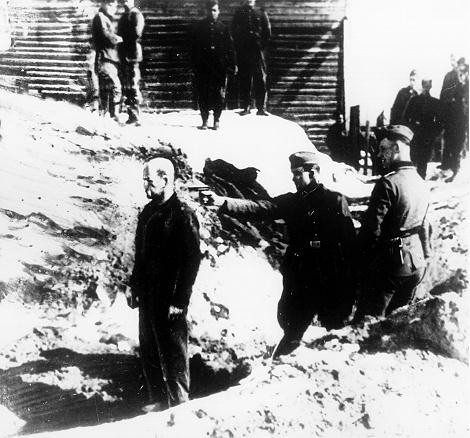
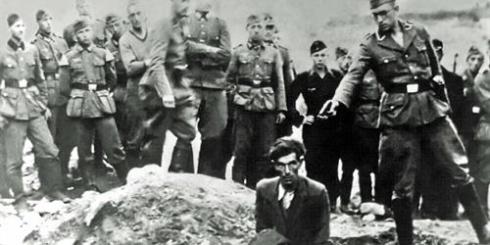
This is another part of my article on the actions of Hitler’s Einsatzgruppen and their campaign of mass murder in Eastern Europe. This section is about the campaign in Russia. It is even more troubling than the previous sections, because in Russia, all pretense of civilization was dropped and even the German Army was heavily engaged in committing some of the grossest and most evil atrocities ever committed by a supposedly civilized and allegedly Christian people.  Likewise, it is important to remember that much of what happened occurred before the decision to implement the Final Solution and the operations of the massive extermination camps such as Auschwitz.

The tragedy is that in so ways that Americans, British, French and the Belgians, as well as the Spanish, not to mention the Russians, Turks, Japanese and so many other have committed genocide. The actions, if they were simply limited to just the Germans of that period could be explained away as a exception, but it is not. That is what makes these heinous crimes so troubling, as the people who committed them were not that different than us, or our own ancestors.

Peace

Padre Steve+

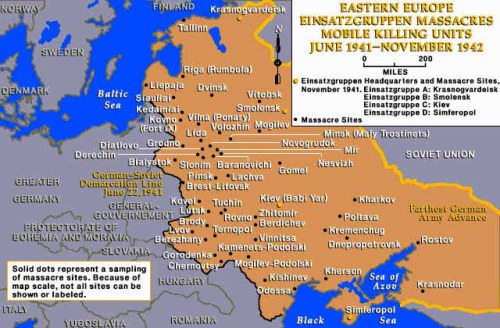
einsattzgruppen map

The Nazi war against Russia was the ultimate test of Hitler’s ideological race war. Planning for the war with the Soviet Union began after the fall of France and during the beginning stages of the Battle of Britain. On 21 July 1940 Hitler made“his intentions plain” to the Army leadership and “von Brauchitsch set his planners to work.” 119 The staff at OKH began preparations for the offensive in the winter of 1940-41 following the Luftwaffe’s failure against Britain and postponement of Operation Sea Lion, the proposed invasion of Great Britain.

Despite the fact that Britain was still in the war and had opened a new front in the Middle East against Italy which required German troops, Hitler decided to open another front and announced his intention to “crush Soviet Russia in a quick campaign which was to begin no later than March 15, 1941, and before the end of the war with England.” 120 Field Marshal Keitel noted the final decision came in “early December 1940” and from then he had “no doubt whatsoever that only some unforeseen circumstance could possibly alter his decision to attack.” 121

The military plan initially focused on the destruction of “the Red Army rather than on any specific terrain or political objective,” 122although the political and geographic objectives would arise in later planning and in the campaign. Hitler stated: “What matters is that Bolshevism must be exterminated. In case of necessity, we shall renew our advance whenever a new center of resistance is formed. Moscow as the center of doctrine must disappear from the earth’s center….” 123

Besides preparations aimed at the destruction of the Red Army and overthrow of the Soviet State, the “war against the Soviet Union was more openly ideological from the start.” 124 Hitler set the stage on March 3rd 1941 by announcing, “the forthcoming campaign is more than a mere armed conflict; it is a collision between two different ideologies…this war will not be ended merely by the defeat of the enemy armed forces” and that “the Jewish-Bolshevist intelligentsia must be eliminated….” 125

ordungspolizie officers

Ordungspolizie Officers

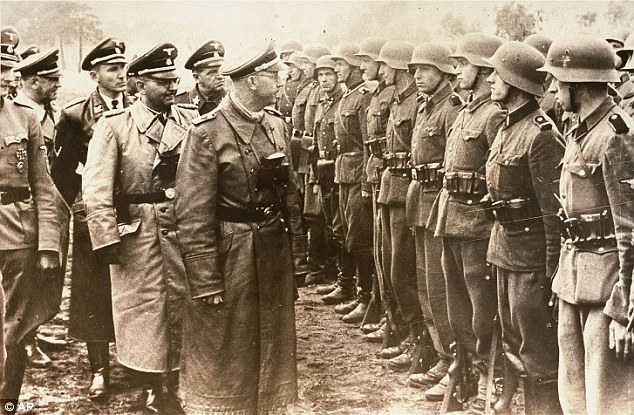
Hitler realized that the task of eliminating the Jews was one that had to be done by his SS men. He noted, that “this is a task so difficult that it cannot be entrusted to the Army.” 126 Reichskommissars, civilian overlords from the Nazi Party would be appointed to administer conquered areas, but since normal civilian powers would be insufficient to eliminate the Bolshevists, Hitler noted that it “might be necessary “to establish organs of the Reichsführer SS alongside the army’s Secret Field Police, even in the operational areas….” 127 The “primary task” of the SS Einsatzgruppen and Police battalions was to liquidate “all Bolshevist leaders or commissars” if possible while still in the operations zones,” 128 yet the orders were vague enough not to offend the sensibilities of Army leaders and did not contain “a syllable that in practice every Jew would be handed over to the extermination machine.” 129

As with almost all German operations which involved cooperation between the Army and the SS, the parties ensured that existing agreements between the agencies, German laws, and army doctrine were followed. On 13 March an agreement was reached between the Army represented by General Wagner and the SS, which stated in part, that “the Reichsführer SS has been given by the Führer special tasks within the operations zone of the Army…to settle the conflict between two opposing political systems.” 130Likewise the agreement dictated that Himmler’s SS units would “act independently and on his own responsibility” while ensuring that “military operations are not affected by measures necessary to carry out his task.” 131

einsatzgruppe troops and victims

Rounding up Jews in Russia

A further instruction was issued by Wagner on 26 March which gave the Army’s agreement for the use of the Einsatzgrüppen in the operations zone. The agreement spelled out the coordinating instructions between the Einsatzgruppen and army authorities in the operational zone and communications zones to the rear. Cooperation between the Army and the SS was based on already existing agreements between the SS and the Army, notably the “principals for co-operation between the State Secret Police and the Field Security organization of the Wehrmacht agreed with the Security branch of the War Ministry on 1 January 1937.” 132

The most significant agreement that the Army reached with the SS was the Commissar Order. This order, sometimes known as the “Criminal Order” was used war as evidence at Nuremberg as against Keitel, Jodl and High Command of the Wehrmacht during the later Generals Trial. The order specified that the Army would cooperated with the SS and kill Soviet Political Commissars attached to the Red Army who were taken prisoner, as “they were not prisoners of war.” Another order specified that “in the event that a German soldier committed against civilians or prisoners, disciplinary action was optional….” 133 The order noted regarding political commissars that “in this struggle consideration and respect for international law with regard to these elements is wrong.” 134 The Army’s “Guidelines for the Conduct of Troops in Russia” issed on May 19, 1941 called for “ruthless and vigorous measures against Bolshevist inciters, saboteurs [and] Jews.” 135

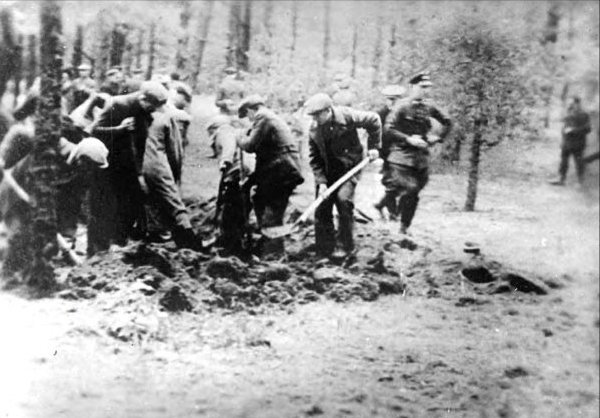
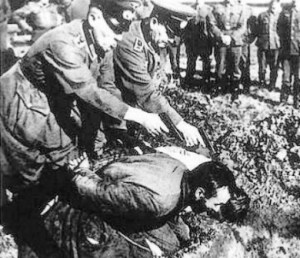
einsatzgruppen executions

Shortly before the Commissar Order was issued, Hitler previewed it to the generals saying that the war in Russia “cannot be conducted in a knightly fashion” and that the war against the Soviet Union would have to be waged with “unprecedented, unmerciful and unrelenting harshness…” 136Hitler told the generals that they would have to “dispense with all of their outdated and traditional ideas about chivalry and the generally accepted rules of warfare: the Bolsheviks had long since dispensed with them.” 137 He explained that he understood that his orders were beyond their comprehension but insisted, “I cannot and will not change my orders and I insist that that they be carried out with unquestioning and unconditional obedience.” 138

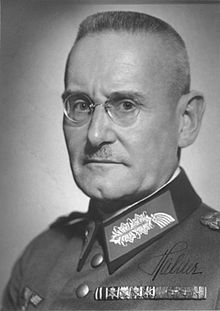
General Franz Halder, Chief of the OKH, or the Army High Command took notes on Hitler’s speech. They are chilling to read as none present could have understood them in any other way than Hitler meant:

“Clash of two ideologies. Crushing denunciation of Bolshevism, identified with asocial criminality….We must forget the comradeship between soldiers. A Communist is no comrade before nor after the battle. This is a war of extermination….We do not wage war to preserve the enemy….War against Russia: Extermination of the Bolshevist Commissars and of the Communist intelligentsia….this is no job for military courts. The individual troop commanders must know the issues at stake. They must be leaders in the fight….This war will be very different from war in the West. In the East harshness today means leniency in the future. Commanders must make the sacrifice of overcoming their personal scruples.”139

220px-Bundesarchiv_Bild_146-1970-052-08,_Franz_Halder

Franz Halder

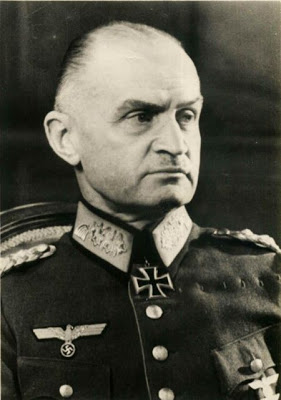
Hitler’s speech was protested by some of the generals according to Von Brauchitsch. 140 Von Brauchitsch refused to protest the order to Hitler but issued an order on his own authority “threatening dire penalties for excesses against civilians and prisoners of war” which he maintained at Nuremberg “was sufficient to nullify the Commissar Order.” 141 Yet during the campaign against the Soviet Union, von Brauchitsch told his commanders to “proceed with the necessary hardness.” 142 Walter Warlimont noted that Field Marshal Fedor von Bock, who would “later emerge as an opponent of the Commissar Order…makes no special comment on the meeting or the restricted conference that followed.”143

At Nuremberg Keitel said that he “stubbornly contested” the clause “relating to the authority of the SS-Reichsführer… in the rearward operational areas.” 144Keitel blamed the Army High Command OKH under Halder, but the order came out with his signature on behalf of Hitler, which was key evidence against him at Nuremberg. Keitel stated that “there was never any possibility of justifying them in retrospect by circumstances obtaining in the Russian campaign.” 145

Some commanders refused to publish the orders and “insisted that the Wehrmacht never implemented such policies…” blaming them instead on the SS. One writer states “such protests were undoubtedly sincere, but in practice German soldiers were far from innocent. The senior professional officers were often out of touch with their subordinates.” 146 The orders were a “license to kill, although not a great departure from German military traditions….” 147 The effect was terrifying, for in a sense the Einsatzgruppen, “could commit ever crime known to God and man, so long as they were a mile or two away from the firing line.” 148 Security Divisions of the Army were “instructed to give material and logistical support to…units of the Einsatzgruppen.” 149 Even worse, other army units in rear areas “could be called on to assist Himmler’s SS police leaders” as the situation dictated, and few commanders refused. 150

For the campaign against the Soviet Union the SS formed four Einsatzgruppen composed of SD, Waffen-SS and Police troops designated A-D. Einsatzgruppe A was assigned to Army Group North, Einsatzgruppe B to Army Group Center, Einsatzgruppe C to Army Group South and Einsatzgruppe D to the 11th Army. The Einsatzgruppen were not standardized in manpower or equipment. In size they were battalion equivalents the largest Einsatzgruppe being Einsatzgruppe A in the North with 990 assigned personnel 151while Einsatzgruppe was the smallest and had only 550 troops assigned. 152 These units had SS, SD or Police commanders. Though these units were not large, they also had the support of nine Ordnungspolizeibattalions, which were initially assigned to the invasion forces to supplement the operations of the Einsatzgruppen153

The police contingent would grow to be a massive force. By 1943, these Ordnungspolizei battalions would be grouped into regiments and number about 180,000 men assisted by 301,000 local non-German auxiliaries. 154 These units acted in concert with nine Army Security Divisions which handled rear area security. 155

197BF44C00000578-3114663-image-a-59_1433720058260

Himmler was so secretive that he initially did not reveal the intent and planned use of their units to the Einsatzgruppen commanders. Instead he spoke to them of a “heavy task…to “secure and pacify” the Russian area using Sicherheitspolizei and SD methods.” 156 Understanding the effect of these operations, Himmler would state that “in many cases it is considerably easier to lead a company in battle than to command a company responsible to…carry out executions, to deport people…to be always consistent, always uncompromising-that is in many cases far, far harder.” 157

The actions of these units are well documented; the Einsatzgruppen, Police, Army and locally recruited Schutzmannschaft battalions 158 ruthlessly exterminated Jews and others in the operational area. No sooner had an Einsatzgruppe unit entered a city, a “deadly stranglehold” would grip the “Jewish inhabitants claiming thousands and thousands of victims day by day and hour by hour.” 159 Non-Jewish Russians were encouraged to conduct programs which Heydrich noted “had to be encouraged.” 160 Einsatzgruppen D report number 153 noted: “During period covered by this report 3,176 Jews, 85 Partisans, 12 looters, 122 Communist functionaries shot. Total 79,276.” 161   By the spring of 1942 Einsatzgruppe A had claimed “more than 270,000 victims, the overwhelming majority of whom were Jewish.” 162 The total killed for all groups by early 1942 was 518,388 people, mostly Jews. 163 Germany’s Romanian ally acted against Jews in their operational areas as well. In Odessa, “on 23 October 1941 19,000 Jews were shot near the harbor… probably 200,000 Jews perished either at Romanian hands or after being turned over by the Romanians to the Germans.” 164

To further cloud the ethics and morality, the operations against Jews were often called anti-partisan operations. Himmler referred to Einsatzgruppen as “anti-Partisan formations” 165 while Wehrmacht Security divisions cooperating with the SS “murdered countless Soviet civilians and burned Russian settlements to the ground under the pretext of subduing partisan resistance.” 166 The attitude by 1941-1942 was that “all Jews are partisans and all partisans are Jews.” From 1943, all armed resistance was “banditry” and all Jews irrespective of circumstances were treated as “bandits.”” 167

Walter_von_Reichenau

Walter von Reichenau

General Von Reichenau issued an order in which he stated: “The soldier in the Eastern territories is not merely a fighter according to the art of war but also a bearer of a ruthless national ideology and the avenger of the bestialities which had been inflicted upon German and racially related nations. Therefore the soldier must have full understanding for the necessity of a severe but just revenge on subhuman Jewry.” 168

Likewise the distinguished Panzer commander General Herman Hoth issued his own order of 17 November 1941 urging his troops to exact revenge on the Jews and Communists:

“Every trace of active or passive resistance or of any kind of machinations by the Bolshevik – Jewish agitators are [sic] to be immediately and pitilessly rooted out. The necessity of severe measures against elements foreign to people and kind must be understood precisely by the soldiers. These circles are the spiritual pillars of Bolshevism, the tablebearers [priests] of its murder organization, the helpers of the partisans. It consists of the same Jewish class of people which have done so much to harm our Fatherland and by its hostile activity…and anti-culture, which promotes anti-German currents in the whole world and which wants to be the bearer of revenge. Their annihilation is a law of self-preservation. Any soldier criticizing these measures has no memory of the former traitorous activity lasting for years carried on among our own people by Jewish-Marxist elements.” 169

 Piaśnica_digging_of_the_graves

Jews digging their own graves

The commander of the 221st Security Division endeavored to persuade his “subordinate units that the Jews were carriers of Bolshevik contamination and, therefore, the ultimate source of any sabotage or difficulty the division faced.” 170 The extermination of the Jews and partisan war were closely intertwined with the Reich’s economic policies designed to exploit the natural resources of the Russia. This included the “hunger plan” which German authorities seemed to imagine that “millionfold starvation could be induced by requisitioning off all available grain and “shutting off” the cities.” 171

einsatzgruppen-brutal-germans-nazi-death-squads1

Einsatzgruppe men and Ordungspolizei above and below in action

“The European history of the twentieth century shows us that societies can break, democracies can fall, ethics can collapse, and ordinary men can find themselves standing over death pits with guns in their hands. It would serve us well today to understand why.” Timothy Snyder

Einsatzgruppe_A

The Wehrmacht’s complicity in these measures is demonstrated in the order drafted by Warlimont and signed by Keitel on 13 May 1941. That order, the “Decree on Exercising Military Jurisdiction in the Area of Barbarossa and Special Measures by the Troops” made it clear that international conventions regarding the treatment of civilians would not be observed in the Soviet Union. The order, relying on the historic precedent of German military law in regard to partisan activity stated

I “Treatment of crimes committed by enemy civilians”

“1. Until further order the military courts and the courts martial will not be competent for crimes committed by enemy civilians.”

2. Francs-tireurs will be liquidated ruthlessly by the troops in combat or while fleeing. “

3. Also all other attacks by enemy civilians against the armed forces, its members, andauxiliaries will be suppressed on the spot by the troops with the most rigorous methods until the assailants are finished (niederkaempfen)”

4. Where such measures were not taken or at least were not possible, persons suspected of the act will be brought before an officer at once. This officer will decide whether they are to be shot. Against localities from which troops have been attacked in or treacherous manner, collective coercive measures be applied immediately upon the order of an officer of the rank of at least battalion etc., commander, if the circumstances do not permit a quick identification of individual perpetrators.”

II. “Treatment of crimes committed against inhabitants by members of the Wehrmacht and its auxiliaries”

1. With regard to offenses committed against enemy civilians by members of the Wehrmacht or by its auxiliaries prosecution is not obligatory, even where the deed is at the same time a military crime or misdemeanor….” 172

Hitler was quite clear in his intent when he told General Halder that in 1941 that he “intended to level Moscow and Leningrad, to make them uninhabitable, so there would be no need to feed their populations during the winter.” 173Economic officials held life and death power over villages. Those that met agricultural quotas were “likely to be spared annihilation and evacuation…the culmination of this process, during 1943, would be the widespread creation of “dead zones.””174All told during the campaign against the Soviet Union the Germans killed nearly 1.5 million Russian Jews. 175

ww2 mizocz1

By 1942, over two million Soviet POW’s had been killed. 600,000 shot outright, 140,000 by the Einsatzkommandos. 176Eventually about 3.3 million Soviet POWs died in German captivity through starvation, disease and exposure, 177are included in a total of over 10 million Red Army Combat deaths. 178 The distinguished German historian Karl Dietrich Bracher wrote, “The reality and irreality of the National Socialism were given their most terrible expression in the extermination of the Jews.” 179

arthur nebe

Arthur Nebe, from Jew killer to anti-Hitler plotter

Himmler and others continued to use euphemistic language to describe their efforts talking in terms of “Jewish resettlement.” 180 Terms such as special actions, special treatment, execution activity, cleansing and resettlement were used in place of the word murder. 181At the same time these operations led to problems in the ranks, one SS trooper observed: “deterioration in morale among his own men who had to be issued increasing rations of vodka to carry out their killing orders.” 182

Even commanders of the Einsatzgruppe were affected. Arthur Nebe would say “I have looked after so many criminals and now I have become one myself.” Nebe became an active participant in the July 20th plot against Hitler 183and a fellow conspirator would describe him as a “shadow of his former self, nerves on edge and depressed.” 184 Erich Bach-Zelewski, who led the SS anti- partisan operations, would suffer a nervous breakdown which included “hallucinations connected to the shootings of Jews” which hospitalized him in 1942. 185 Himmler would state in his Posen speech given in October 1943 that “to have gone through” the elimination of the Jews had “and remained decent, that has made us tough. This is an unwritten, never to be written, glorious page in our history.” 186

To be continued…

Notes

119 Ibid. Megargee. War of Annihilation p.24

120 Ibid. Wheeler-Bennett The Nemesis of Power p.511

121 Ibid. Goerlitz. The Memoirs of Field Marshal Wilhelm Keitel. P.132

122 Glantz, David M. and House, Jonathan. When Titans Clashed: How the Red Army Stopped Hitler. University Press of Kansas, Lawrence, KS. 1995 p.31

123 Trevor-Roper, H.R. Hitler’s Table Talk 1941-1944 with an introduction by Gerhard L Weinberg, Translated byNorman Cameron and R.H. Stevens, Enigma Books, New York, NY 2000. Originally published in Great Britain by Weidenfeld & Nicholoson, London 1953 p.6

124 Ibid. Megargee. War of Annihilation p.10 The campaign against the Soviet Union was to be much more openlyideological as compared to the campaign in Poland.

125 Ibid. Warlimont. Inside Hitler’s Headquarters p.150 126 Ibid. Warlimont. Inside Hitler’s Headquarters p.151

125 Ibid. Warlimont. Inside Hitler’s Headquarters p.150 126 Ibid. Warlimont. Inside Hitler’s Headquarters p.151

127 Ibid. Reitlinger, The SS p.175

128 Ibid. Höhne The Order of the Death’s Head p. 354

129 Ibid. Höhne The Order of the Death’s Head p. 354 Again another deception.

130 Ibid. Warlimont. Inside Hitler’s Headquarters p.153

131 Ibid. Warlimont. Inside Hitler’s Headquarters p.153

132 Ibid. Warlimont. Inside Hitler’s Headquarters pp. 158-159

133 Ibid. Glantz and House. When Titans Clashed p.56

134 Ibid. Davidowicz. The War Against the Jews p.123

135 Ferguson, Niall. The War of the Worlds: Twentieth Century Conflict and the Descent of the West. The Penguin Press, New York, 2006 p.442

136 Ibid. Wheeler-Bennett. Nemesis of Power p.513

137 Ibid. Goerlitz. The Memoirs of Field Marshal Wilhelm Keitel. P.135

138 Ibid. Wheeler-Bennett. Nemesis of Power p.513

139 Hebert, Valerie Genevieve, Hitler’s Generals on Trial: The Last War Crimes Tribunal at Nuremberg University of Kansas Press, Lawrence Kansas 2010 pp.77-78

140 Ibid. Wheeler-Bennett Nemesis of Power p.513 and footnote. He cites the three Army Group commanders, Leeb, Rundstedt and Bock. However Von Rundstedt’s biographer notes that “no evidence exists as to what VonRundstedt’s to this was at the time.” Messenger, Charles, The Last Prussian: A Biography of Field Marshal Gerd Von Rundstedt 1875-1953 Brassey’s (UK) London England 1991. p.134

141 Ibid. Reitlinger, The SS p.176

142 Ibid. Megargee. War of Annihilation p.33

143 Ibid. Warlimont. Inside Hitler’s Headquarters p.162

144 Ibid. Goerlitz. The Memoirs of Field Marshal Keitel p.136

145 Ibid. Goerlitz. The Memoirs of Field Marshal Keitel pp.136-137

146 Ibid. Glantz and House. When Titans Clashed p.56

147 Ibid. Blood. Hitler’s Bandit Hunters p.52

148 Ibid. Reitlinger The SS p. 177

149 Ibid. Shepherd. War in the Wild East p.54

150 Ibid. Reitlinger The SS p. 177

151 Ibid. Rhodes Masters of Death pp.12-13

152 Ibid. Westermann. Hitler’s Police Battalions p.167 153 Ibid. Westermann. Hitler’s Police Battalions p.164 154 Ibid. Blood Hitler’s Bandit Hunters p.141

155 Ibid. Shepherd Wild War in the East p.48. Shepherd notes the deficiencies of these units in terms of organization, manpower and equipment which he calls “far short of the yardstick of military excellence with which the Wehrmacht is so widely associated

156 Ibid. Höhne The Order of the Death’s Head p. 356 Only one of the Einsatzgruppen commanding officers was a

volunteer, Arthur Nebe who was involved in the conspiracy to kill Hitler. It is believed by many that Nebe volunteered to earn the clasp to the Iron Cross to curry favor with Heydrich and that initially “Nebe certainly did not know that “employment in the east” was synonymous with the greatest mass murder in history.

157 Ibid. Bracher. The German Dictatorship p.422

158 Ibid. Blood Hitler’s Bandit Hunters p.55

159 Ibid. Höhne The Order of the Death’s Head p. 360 160 Ibid. Friedlander TheYears of Extermination p.207 161 Ibid. Höhne The Order of the Death’s Head p. 360 162 Ibid. Tooze The Wages of Destruction p.481

163 Ibid. Ferguson. The War of the World p.446

164 Di Nardo, Richard L. Germany and the Axis Powers: From Coalition to Collapse. University Press of Kansas,Lawrence, KS. 2005 p.133 The Hungarians would also engage in ant-Jewish operations. Only the Italian army would not conduct operations against the Jews.

165 Ibid. Höhne The Order of the Death’s Head p. 369

166 Ibid. Wette The Wehrmacht p.127

167 Ibid. Blood. Hitler’s Bandit Hunters p.117

168 Ibid. Hebert p.94

169 Ibid. Hebert pp.94-95

170 Ibid. Shepherd. War in the Wild East pp.90-91

171 Ibid. Tooze The Wages of Destruction p.481

172 Ibid, Hebert p.86

173 Ibid. Magargee. War of Annihilation p.64

174 Ibid. Shepherd. War in the Wild East pp.127-128

175 Ibid. Davidowicz The War Against the Jews from the table on page 403. This included 228,000 from the Baltic republics (90%) 245,000 from White Russia (65%) 900,000 from the Ukraine (60%) and 107,000 from Russia proper

(11%)

176 Ibid. Rhodes. Masters of Death p.241

177 Ibid. Glantz and House When Titans Clashed p.57

178 Ibid. Glantz and House. When Titans Clashed table on p.292

179 Ibid. Bracher. The German Dictatorship p.431

180 Ibid. Bracher. The German Dictatorship p.430

181 Ibid. Höhne The Order of the Death’s Head p. 367

182 Ibid. Rhodes. Masters of Death p.225

183 Ibid. Rhodes Masters of Death p.225

184 Ibid. Höhne The Order of the Death’s Head p. 363 185 Ibid. Höhne The Order of the Death’s Head p. 363 186 Ibid. Bracher. The German Dictatorshipp.423

5 Comments

Filed under ethics, History, holocaust, Military, nazi germany, Political Commentary, war crimes, world war two in europe

Genocide Up Close and Personal: The Einsatzgrüppen in Poland

einsatz1

Friends  of Padre Steve’s World

Another section of the article dealing with the campaign of mass murder and genocide conducted by Hitler’s legions in Eastern Europe. This section deals with the actions of the Einsatzgruppen in Poland in 1939 and 1940. In it you will see that the while most of the killing was done by the SS that the German military high command was not guiltless. Some commanders attempted to stop SS actions, but they were the minority.  Most simply turned a blind eye to what was going on and a few would lend their assistance to the Einsatzgruppen. 

Please note, that all of this took place before the first extermination camps began operations. This killing was done up close and personal by  the men of the Einsatzgruppen and the Police battalions. In all just a few thousand troops massacred hundreds of thousands of Polish Jews as well as the Polish gentile elites.

It is terribly uncomfortable, for as I always say, these men were little different than most of us, they were terribly ordinary.

Peace

Padre Steve+

himmler1

Heinrich Himmler

The Polish campaign was a precursor to the Russian campaign and was not totally race driven. It contained elements of Germany’s perception of the injustice of Versailles which gave Poland the Danzig corridor and Germany’s desire to reconnect East Prussia to the Reich, as well as the perceived necessity to remove a potential enemy from its rear as it faced France, yet it was a campaign steeped in Nazi racial ideology. Poland resisted German efforts to ally itself with Germany in 1939, thus Hitler determined it “would be crushed first.” 80

Meeting with military leaders on 23 May 1939 Hitler “made it plain that the real issue was not Danzig, but securing of Germany’s Lebensraum….” 81 On 22 August Hitler enjoined the generals to “Close your hearts to pity! Act brutally! Eighty million people must obtain what is their right.” 82

Even so, most military leaders failed to appreciate what Hitler was calling on them to do; Erich von Manstein would later note that “what Hitler had to say about an eventual war with Poland, could not, in my opinion, be interpreted as a policy of annihilation.” 83

generaloberst johannes blaskowitz

General Johannes Blaskowitz

Others such as Abwehr director Wilhelm Canaris was “utterly horrified.” As he read his notes to his closest colleagues “His voice trembled as he read, Canaris was acutely aware that he had witnessed something monstrous.” 84 General Johannes Blaskowitz, the controversial commander of the German 8th Army who would become the military commander in Poland did not leave any notes about the meeting. However, his biographer noted that Blaskowitz “may have naively attached a military meaning to these terms since he was busy with military matters and soon to begin operations.” 85 As was noted before this was also the interpretation of Erich Manstein gave Hitler’s words, but one has to wonder as to the veracity of his statements. 86 Field Marshal Keitel noted that the speech was “delivered in the finest sense of psychological timing and application,” with Hitler molding “his words and phrases to suit his audience.” 87

In light of the mixed interpretations by military leaders, it is possible that many misinterpreted Hitler’s intent and did not fully appreciated his ideology as they went into Poland, carefully secluding themselves in the narrow confines of their military world. While such an explanation is plausible for some, it is also true that many others in light of subsequent actions were in full agreement with Hitler. One author notes that “no man who participated in the FührerConferences….and there were present the highest ranking officers of the three services, could thereafter plead ignorance of the fact that Hitler had laid bare his every depth of infamy before them, and they had raised no voice in protest either then or later.” 88 In July, General Wagner, the Quartermaster General issued orders that “authorized German soldiers to take and execute hostages in the event of attacks by snipers or irregulars.” 89

Regardless of the meaning ascribed to Hitler’s speech by his generals, Hitler had already laid plans to destroy the Jews in Poland and decimate the Polish intelligentsia and leadership.   Hitler gave Himmler the task of forming Einsatzgrüppen to follow the German troops as they advanced into Poland and liquidate Poland’s upper class wherever it was to be found.” 90 While senior party leaders remained at Hitler’s side following the conference, Himmler worked to coordinate his troops, including the reinforced Totenkopf battalions and Einsatzgrüppen with the Army. 91

Himmler began planning in early May and the Army, working in close collaboration with the SS decided to “use SS and police units to augment their own forces for security tasks.” 92 Himmler established “five Einsatzgrüppen to accompany each of the numbered German armies at the start of the campaign.” 93 Placed under the aegis of Reinhard Heydrich the groups were broken down into smaller units of 100-150 men and allotted to army corps. All senior posts were occupied by officers of the SD, the Sicherhietsdienst. 94

Two additional Einsatzgrüppen were formed shortly after the invasion. 95Additionally three regiments of the SS Totenkopfverbandeunder the direction of SS General Theodore Eicke were deployed in the rear areas of the advancing armies. These regiments were formed from the Concentration Camp guard units and eventually became the nucleus of the 3rd SS Panzer Division Totenkopf. 96 The SS carefully shielded the real purpose of these units from the Army in the planning stages, while the Army might countenance anti-guerrilla operations and cooperate in arresting people who might lead resistance in Poland, the SS was not yet sure that the Army would support or countenance mass murder. 97 That being said, Heydrich worked with the Army to develop lists of up to 30,000 Poles to be arrested following the invasion including intellectuals, political leaders and clergy. 98

To eliminate the Polish elites without disturbing the Army, Himmler and Heydrich gave the Army “only the bare minimum of information” as to their ultimate intent99 The deception was initially successful and many Wehrmacht commanders welcomed the assistance of the SS units for rear area security missions. Blaskowitz’s 8th Army defined the mission of the Einsatzgrüppen in the traditional doctrinal terms of the Ettapen, noting their mission as “the suppression of all anti-Reich and anti- German elements in the rear of the “fighting troops, in particular, counter espionage arrests of  politically unreliable persons, confiscation of weapons, safeguarding of important counter- espionage materials etc…” 100 General Wagner, the Quartermaster General issued orders in July 1939 that “authorized German soldiers to take and execute hostages in the event of attacks by snipers or irregulars.” Despite the deception, there was no way to disguise the murder of Polish intelligentsia and Jews once it began, and had the Army had the political acumen and moral courage it could have considerably restricted or even halted the terror campaign. 101

The ensuing campaign in Poland demonstrated Hitler’s true intent. Heydrich openly discussed “murdering the Polish ruling class” of the aristocracy, Catholic clergy, communists and Jews at a meeting on September 7th, barely a week after the beginning of the invasion. 102 As the German armies advanced into Poland slicing through the badly deployed and inadequately equipped Polish Army the Einsatzgruppen and the Totenkopf Verbande followed in their wake, conducting mass arrests and executions of those Poles deemed to be a threat.

Many army leaders were worried about Polish soldiers left behind in rear areas as the armies advanced. In some cases that concern became a paranoid mindset and some generals believed that a “brutal guerrilla campaign has broken out everywhere and we are ruthlessly stamping it out.” 103

ordungspolizei

Ordungspolizei Battalion preparing for Mass Murder

Yet some of the actions by Einsatzgruppen and Totenkopf Verbandeagainst the Polish elites and the Jews drew Army reactions. The unit commanded by SS General Woyrsch “behaved with such unparalleled bestiality that it was thrown out of the operational area” by General List of 14th Army.” 104 Another unit, the Totenkopfverbande Brandenburg came to Army attention when its commander remarked that the “SSVT would not obey Army orders.” The conclusion drawn by the Army General was that “the SSVT commander was following orders from some non-military authority to terrorize the local Jews.” 105

These atrocities as well as those of other Waffen-SS units were hard to hide and brought reactions out of army commanders who sought to punish the offenders. Blaskowitz and a few other commanders attempted to put a halt to SS actions against Poles and Jews, 106 but most officers turned a blind eye to the atrocities or outright condoned them. It is believed that General Walter Model and many other senior officers “not only knew what was occurring in Poland but actually took part in what Colonel General Franz Halder himself described in October as “this devilish plan.”” 107

It appears that many of the officers who objected were not motivated so much by humanitarian, moral or legal considerations, but rather by the effect on good order and discipline of their soldiers. 108 Likewise it is clear that many officers, even if they did not participate in the actions probably approved of them. Many of the early biographies and histories of this period were written by authors who were influenced by surviving German officers. Many of these men were being rehabilitated and helping the Americans and British meet the threat of the Soviet Union, made no or little mention of the Army’s part in these actions.

Both Himmler and Heydrich were sensitive to the perception of the Army and resented the fact that the Army believed them to be responsible for actions that they were carrying out under the direction and orders of Hitler himself, They also resented that their troops were characterized as “undisciplined gangs of murderers” by many Army officers. 109

After crushing the Polish armies and dividing Poland with the help of the Red Army, the Germans established what became known as the Government General, which was headed by Hans Frank. The new civilian administration came into conflict with the military governor, General Blaskowitz. Appalled by the actions of the SS, Police and the Nazi administration. Blaskowitz made an “elaborate report on the atrocities of the SS,” 110 expressing concern about his “extreme alarm about illegal executions, his worries about maintaining troop discipline under those circumstances, the failure of discussions with the SD and Gestapo and their assertions that they were only following SS Orders.” 111

While it is unclear if the memorandum made it to Hitler, it is clear that Hitler did know about the protest and Blaskowitz fell into disfavor and was reassigned after a period of continued conflict with the Nazi administration. Hitler was not impressed by the less than ruthless attitudes of Blaskowitz and other commanders. His reaction to Army objections regarding the methods of the SS and police units was characteristically acidic. Hitler’s military adjutant recalled that Hitler accused the Army’s leaders of using “Salvation Army” methods, and called their ideas regarding the occupation as “childish.” 112

Following the reassignment of Blaskowitz, other officers that objected were also relieved of their commands or reassigned. General Georg von Külcher was relieved of command for protesting SS and police atrocities. 113

07102014-461733515

At the beginning of the campaign the SS units and their commanders fell under military justice, and a number of SS officers and their troops were convicted by Army courts-martial for their actions. But soon, SS Officers convicted by Army courts-martial were given amnesty by Hitler and Hitler “removed SS units from the jurisdiction of military courts,” on October 4th 1939. 114 While the army remained, it was no longer in charge and would actively assist the SS and Police in combat and further atrocities against civilians. In November 1939, One German officer, who later was a conspirator in the July 20th plot, remarked, “was ashamed to be German! The minority are dragging our good through the mud by murdering, looting and torching houses will bring disaster on the whole German people if we do not stop it soon…” 115

poland murders

The Army was soon relieved of responsibility for policing Poland which fell on the Ordungspolizei battalions and Gendarmerie. Many officers were pleased as they could now turn their backs on the situation there and begin to prepare for the campaign in the West.

The Ordungspolizei battalions and the Gendarmerie units were composed of mobilized city police and rural constabulary police. These men would soon wreak their own devastation on Poland in the coming months and years. 116Poland was also be the first use of mass evacuations of civilian populations to make room for German settlers, in the newly acquired Lebensraum. Poles were driven into the newly formed Government General and ethnic Germans moved into previously Polish occupied territories. By 1941 over 1,200,000 Poles and 300,000 Jews had been expelled and 497,000 ethnic Germans brought into provinces German had lost in 1919. 117

Prior to the war about 3.3 million Jews lived in Poland. The actions of the Einsatzgruppen and the Police brought a reign of terror to Poland’s Jews. The Jews were rounded up and sent to Ghettos from which they would be dispatched to the death camps following the decision to implement the “Final Solution.”After the war only some 50-70,000 Jews were found to have survived in Poland, the Polish Army and camps in Germany. A further 180,000 were repatriated from the Soviet Union. 118

To be continued….

Notes

80 Ibid. Weinberg. Visions of Victory p.8
81 Ibid. Goerlitz, History of the German General Staff p.346
82 Höhne, Heinze. The Order of the Death’s Head: The Story of Hitler’s SS. Translated by Richard Barry. PenguinBooks, New York and London, 2000. First English edition published by Martin Secker and Warburg Ltd. London 1969. Originally published as Der Orden unter dem Totenkopf, Verlag Der Spiegel, Hamburg 1966 p.259

83 Manstein, Erich von. Forward by B.H. Liddle Hart, Introduction by Martin Blumenson. Lost victories: The War Memoirs of Hitler’s Most Brilliant General. Zenith Press, St Paul MN 2004. First Published 1955 as Verlorene Siege, English Translation 1958 by Methuen Company p.29

84 Ibid. Hohne. Canaris p.347

85 Giziowski, Richard. The Enigma of General Blaskowitz. Hppocrene Books, New York 1997 p.119

86 Ibid. Manstein. Lost Victories p.29

87 Ibid. Goerlitz. The Memoirs of Field Marshal Keitel p.87

88 Wheeler-Bennett, John. The Nemesis of Power: The German Army in Politics 1918-1945. St. Martin’s Press Inc. New York, NY 1954 p.448

89 Ibid. Megargee. War of Annihilation p.13

90 Ibid. Höhne The Order of the Death’s Head p.297

91 Padfield, Peter. Himmler. MJF Books, New York 1990 p.264

92 Ibid. Megargee. War of Annihilation p.13

93 Ibid. Westermann. Hitler’s Police Battalions p.127

94 Ibid. Höhne The Order of the Death’s Head p.297 95 Ibid. Westermann. Hitler’s Police Battalions p.127 96 Ibid. Sydnor Soldiers of Destruction p.37

97 Ibid. Giziowski Blaskowitz p.120

98 Ibid. Witte. The Wehrmacht p.100

99 Ibid. Höhne The Order of the Death’s Head pp. 297-298

100 Ibid. Giziowski Blaskowitz p.120

101 Ibid. Höhne The Order of the Death’s Head p.298

102 Ibid. Witte. The Wehrmacht p.100

103 Newton, Steven H. Hitler’s Commander: Field Marshal Walter Model-Hitler’s Favorite General Da Capo Press a division of Perseus Books Group, Cambridge MA 2005. p.74

104 Ibid. Giziowski. The Enigma of General Blaskowitz pp.165-166

105 Ibid. Sydnor, Soldiers of Destruction pp. 42-43 Note SSVT is the common abbreviation for Verfügungstruppe which was the early designation of the SS Totenkopf Verbande and some other Waffen SS Units.

106 Ibid. Goerlitz. History of the German General Staff p.359

107 Ibid. Newton. Hitler’s Commander p.78

108 Ibid. Witte The Wehrmacht p.102

109 Ibid. Höhne The Order of the Death’s Head p.298

110 Ibid. Goerlitz. History of the German General Staff .p.359 111 Ibid. Giziowski. The Enigma of General Blaskowitz p.173 112 Ibid. Giziowski. TheEnigma of General Blaskowitz p.173

113 Ibid. Witte The Wehrmacht p.102

114 Burleigh, Michael and Wippermann, Wolfgang. The Racial State: Germany 1933-1945 Cambridge University Press, New York NY and Cambridge UK 1991. p.100

115 Ibid. Witte The Wehrmacht p.102

116 For a good account of one of the Police Battalions see Ordinary Men: Reserve Police Battalion 101 and the Final Solution in Poland by Christopher Browning Harper Perennial Publishers, San Francisco CA 1992

117 Reitlinger, Gerald. The SS: Alibi of a Nation. The Viking Press, New York, 1957. Republished by Da Capo Press, New York, NY p.131

118 Ibid. Davidowicz The War Against the Jews pp.395-397

Leave a comment

Filed under History, holocaust, nazi germany, Political Commentary, world war two in europe

Genocide Does Not Occur in a Vacuum: The Necessity of the Appearance of Law and a Compliant Military

Friends of Padre Steve’s World

Many people have no understanding that genocide does not appear in a vacuum. At its core it require a base and evil race hatred. But it needs to be backed by the appearance of law to be accepted, and is helped when there is a military doctrine that supports it, and a military willing to assist in carrying it out, or whose officers look the other way. 

This is the next installment of my article on war crimes, genocide and the role of ordinary people in them. This focuses on the legal, ideological, and military doctrine foundations of the German race war in Poland and Russia. Without these foundations it would have been difficult, maybe even impossible for the Germans to implement genocide on such a vast scale. 

Peace

Padre Steve+

???????????????

Wilhelm Keitel: “war was a fight for survival….dispense with outdated and traditional ideas about chivalry and the generally accepted rules of warfare…” Bundesarchiv Bild

This study will focus on the German policy of ideological-racial war in Poland and Russia. The German war against the Soviet Union and to a certain extent Poland was waged with an unforgiving ferocity against Hitler’s enemy, the Jewish-Bolshevik state and the Slavic Untermenschen.

The campaigns in Poland and the Soviet Union were characterized by the rise of a “political- ideological strategy.” 25 Operation “Barbarossa showed the fusion of technocracy and ideology in the context of competitive military planning.” 26 Hitler’s “ideological and grandiose objectives, expressed in racial and semi-mystical terms, made the war absolute.” 27

Field Marshal Keitel noted a speech in March 1941 where Hitler talked about the inevitability of conflict between “diametrically opposed ideologies” and that the “war was a fight for survival and that they dispense with their outdated and traditional ideas about chivalry and the generally accepted rules of warfare.” 28 General Halder, Chief of the OKH in his War Dairy for that meeting noted “Annihilating verdict on Bolshevism…the leaders must demand of themselves the sacrifice of understanding their scruples.” 29

Based on Lebensraum and race, the German approach to war would combine “racism and political ideology” for the purpose of the “conquest of new living space in the east and its ruthless Germanization.” 30 Hitler explained that the “struggle for the hegemony of the world will be decided in favor of Europe by the possession of the Russian space.”31 Conquered territories would be “Reich protectorates…and that these areas were to be deprived of anything in the nature of a Slav intelligentsia.” 32

This goal was manifest in the “Criminal Order” issued by OKW which stated that the war was “more than mere armed conflict; it is a collision between two different ideologies…The Bolshevist-Jewish intelligentsia must be eliminated….” 33 Other displaced inhabitants of the conquered eastern lands would be killed or allowed to starve. 34 Part of this was due to economic considerations in the Reich, which gave Germans priority in distribution of food, even that from the conquered lands. Starvation was a population control measure that supplemented other forms of annihilation. 35 As Fest notes in Russia Hitler was “seeking nothing but “final solutions.”” 36Despite numerous post-war justifications by various Wehrmacht generals, the “Wehrmacht and army fell into line with Hitler because there was “a substantial measure of agreement of “ideological questions.”” 37

Hitler’s racial ideology was central to his worldview and fundamental to understanding his actions in the war. 38 However twisted Hitler’s ideological formulations were his ideas found acceptance beyond the Nazi faithful to the Army and Police, who would execute the campaigns in Poland and Russia in conjunction with the Einsatzgrüppen and Nazi party organizations. In these organizations he found allies with pre-existing cultural, political and doctrinal understandings which allowed them to be willing participants in Hitler’s grand scheme of eastern conquest.

ss recruiting poster

Military Doctrine and Ideology

While Hitler’s racial ideology was more extreme than many in the German military and police, these organizations had cultural beliefs and prejudices as well as doctrinal and ideological foundations which helped them become willing accomplices to Hitler. These factors were often, consciously or unconsciously, excluded from early histories of World War II. The Allies relied on German officers to write these histories at the beginning of the Cold War, developing the “dual myth of German military brilliance and moral correctness.”39 British historian and military theorist B.H. Liddell-Hart makes the astounding statement that “one of the surprising features of the Second World War was that German Army in the field on the whole observed the rules of war than it did in 1914-1918-at any rate in fighting its western opponents….” 40

While Liddell-Hart might be excused by lack of knowledge of some German army atrocities he could not have been ignorant. It was not just the SS who he blamed the atrocities but many of the men who he interviewed. In doing this Liddell-Hart and others presented a myth as truth. 41 The myths were helped by the trials of Manstein and Kesselring where “historical truth had to be sacrificed…to the demands of the Cold War.” 42 British military historian Kenneth Macksey confronted the myth that only the “Waffen SS committed barbaric and criminal acts” noting: “Not even the Knights of the Teutonic Order and their followers in the Middle Ages sank to the depths of the anti-Bolshevik Wehrmacht of 1941.” 43

Germany had a long running history of anti-Semitism before Hitler. German anti-Semitism often exhibited a “paranoid fear of the power of the Jews,” 44 and included a “fashionable or acceptable anti-Semitism” 45 which became more pronounced as the conditions of the Jews became better and Jews who had fled to Eastern Europe returned to Germany. 46 Sometimes this was tied to religious attitudes, but more often focused on the belief that the Jews “controlled certain aspects of life” and presented in “pseudo-scientific garb” the “myth of a secret Jewish plot for world domination which was simultaneously part of the internationalism of Freemasonry.” 47

Admiral Wilhelm Canaris provides an example as he “had grown up in the atmosphere of “moderate” anti-Semitism prevailing in the Ruhr middle class and in the Navy believed in the existence of a “Jewish problem”” and would “suggest during 1935-1936 that German Jews should be identified by a Star of David as special category citizens….” 48 Wehrmacht soldiers were “subject to daily doses of propaganda since the 1930s” and that with the “start of the Russian campaign propaganda concerning Jews became more and more aggressive.” 49 Some officers objected to Nazi actions against Jews. Von Manstein protested the “Aryan paragraph” in the Reichswehr on general principal.” 50 Yet some of the men who planned and executed the most heinous crimes like, Adolf Eichmann had “no fanatical anti-Semitism or indoctrination of any kind.” 51

The military “looked to the regime to reshape society in every respect: political, ideological, economic and military…Propaganda would hammer home absolute nature of the struggle…” 52 Ideological training began in the Hitler Youth and Reichsarbeitsdienst and produced a soldier in which “Anti-Semitism, anti-communism, Lebensraum – these central tenants of Nazism were all inextricably linked with the Landser’s conception of duty, with his place and role in the vast machinery of war.” 53

Following the dismissal of General Fritsch in 1938, General Brauchitsch promised Hitler that “he would make every effort to bring the Army closer to the State and the State’s ideology.” 54

Alfred Novotny, a Austrian soldier in the Gross Deutschland division noted how training depicted the Russians as Untermenschen and how they were “subjected to official rantings about how the supposedly insidious, endless influence of the Jews in practically every aspect of the enemy’s endeavors…Jews were portrayed as rats, which were overrunning the world….” 55

anti-jewish poster

This ideological component added to the already “harsh military discipline”which had a long tradition in Germany conditioning soldiers to violence and brutalization of their enemy. Similar programs existed in the Order Police which would play a large part in the eastern campaign, the “image of “treasonous” leftists and Jews helped shape the personal and political beliefs of many policemen throughout the interwar period.” 56 Even ordinary police training before the war in German speaking Europe “was brutalizing.”57 These troops were recipients of an ideological formation which “aimed at shaping the worldview of the police leading to the internalization of belief along National Socialist lines.” 58 Waffen SS soldiers, especially those of the Totenkopf division were subjected to even more systematic political indoctrination on the enemies of National Socialism, the Jews, freemasonry, Bolshevism and the churches. 59

Along with cultural anti-Semitism and the Nazification of German thought in the 1930s, there were aspects of military doctrine which helped prepare the way for the eastern campaign. The most important were the Army’s anti-partisan and rear area security doctrine. The history of security anti-partisan operations dated back to the Prussian Army’s Ettapen, which began in 1813 with the Landwehr’srole in security against looters and others. 60 These units supported and supplied offensive operations from the rear to the combat zone with a secondary mission of countering partisans and preventing disruptions in the rear area. The Ettapen would be reformed and regulated in 1872 following the Franco-Prussian War. 61

The German experience fighting guerrillas and partisans, the francs-tireurs in the Franco- Prussian War, “scarred the Army’s institutional mentality.” 62 Field Marshal Von Moltke the elder was “shattered,” and wrote his brother that “war was now taking on an ever more hate-inspired character.” 63 He was “appalled by improvised armies, irregular elements, and appeals to popular passion, which he described as a “return to barbarism.” 64He wrote:  “Their gruesome work had to be answered by bloody coercion. Because of this our conduct of the war finally achieved a harshness that we deplored, but which we could not avoid.” 65

The brutal German response to the franc-tireurs found its legal justification in Franz Lieber’s principles for classification of belligerents and non-belligerents, which determined that guerrillas were outlaws or bandits. 66 Leiber’s principles were written for the Federal Army of the United States during the U.S. Civil War. Propagated as General Order 100 and signed by Abraham Lincoln the sections dealing with irregular forces and partisans dealt with this in section IV of that code:

Article 82 stated: “Men, or squads of men, who commit hostilities, whether by fighting, or inroads for destruction or plunder, or by raids of any kind, without commission, without being part and portion of the organized hostile army, and without sharing continuously in the war, but who do so with intermitting returns to their homes and avocations, or with the occasional assumption of the semblance of peaceful pursuits, divesting themselves of the character or appearance of soldiers – such men, or squads of men, are not public enemies, and, therefore, if captured, are not entitled to the privileges of prisoners of war, but shall be treated summarily as highway robbers or pirates.”

Article 84 stated: “Armed prowlers, by whatever names they may be called, or persons of the enemy’s territory, who steal within the lines of the hostile army for the purpose of robbing, killing, or of destroying bridges, roads or canals, or of robbing or destroying the mail, or of cutting the telegraph wires, are not entitled to the privileges of the prisoner of war.”

Article 85 stated: “War-rebels are persons within an occupied territory who rise in arms against the occupying or conquering army, or against the authorities established by the same. If captured, they may suffer death, whether they rise singly, in small or large bands, and whether called upon to do so by their own, but expelled, government or not. They are not prisoners of war; nor are they if discovered and secured before their conspiracy has matured to an actual rising or armed violence.” 67

The German Army adapted that code and incorporated it in its doctrine for dealing with partisans. In response to their experience in France during the Franco-Prussian War the Germans systematically reorganized the Ettapen to include railroad and security troops, special military courts, military police, intelligence and non-military police, including the Landespolizei and the Grenzschutzpolizei. 68

The doctrinal response to partisans, or as they would become known in German writings as “bandits,” was that bandits should be encircled and destroyed. This was employed in the Southwest Africa German colonies. The Germans, influenced by the experience in France, “displayed a ferocity surpassing even that of the racially brutalized campaigns of its imperialist peers.” 69

von trotha

Lothar Von Trotha

The campaign against the Herero tribes which resisted the occupation of Namibia from 1904- 1912 utilized encirclement operations, racial cleansing and what would become known as Bandenkämpfung operations. 70 In 1904 the Herero were banished from their lands which were handed over to German settlers. When the Herero resisted Von Trotha ordered that they be exterminated. “Every Herero found within German borders with or without weapons, was to be shot. But most of them died without violence. The Germans simply drove them out into the desert and sealed off the border.” 71

20030228_Herero

Of about 80,000 Herero some 60,000 died in the desert, a few thousand survived to be “sentenced to hard labor in German concentration camps.” 72 Despite praise from some in the General Staff the brutality shocked many Germans and General Alfred Von Schielffen who had to defend himself from the “accusations that he had harmed the good name of the army” ensured that “Trotha never served in the field again.” 73 Despite this the application of such Bandenkämpfung operations found their way into German military doctrine.

This was further developed in the First World War, especially in the east where General Fritz Gempp described the security problem as a “ruthless struggle”in which German pacification policy “was in reality the application of terror to galvanize the population into accepting German rule.” 74 Anti-partisan doctrine was codified in the Truppenführung of 1933 which stated that “area defense against partisan warfare is the mission of all units” and that the preferred method of combating partisan bands was that they be surrounded and destroyed. 75 General Erhard Rauss later described active and passive measures used to deal with partisans, focusing on the tactic of encirclement to destroy the enemy. 76

The accounts of the German General Staff praised Von Trotha’s operation. “The month long sealing of desert areas, carried out with iron severity, completed the work of annihilation…the sentence had been carried out” and “the Hereros had ceased to exist as an independent people.” 77

Anti-partisan doctrine focused on the destruction of the partisans, was coupled a total war philosophy and provided fit well with Hitler’s radical ideology. The “propensity for brutality in anti-guerrilla warfare was complimented by officers’ growing preoccupation, both during and after World War I, with the mastery and application of violence.” 78 Michael Geyer notes: “ideological mobilization for the creation of a new national and international order increasingly defined the parameters of technocratic planning.” 79 The acceptance of long used brutal tactics to destroy the enemy combined with Hitler’s radical racial animus against the Jews could only be expected to create a maelstrom in which all international legal and moral standards would be breached.

To be continued…

Notes

25 Geyer, Michael. German Strategy 1914-1945 in Makers of Modern Strategyfrom Machiavelli to the Nuclear Age.

Peter Paret, editor. Princeton University Press, Princeton NJ. 1986. p.582

26 Ibid. Geyer. German Strategy p.587

27 Strachan, Hew. European Armies and the Conduct of War. George, Allen and Unwin, London, UK 1983 p.174

28 Goerlitz, Walter. The Memoirs of Field Marshal Wilhelm Keitel: Chief of the German High Command 1938- 1945. Translated by David Irving. Cooper Square Press 2000, First English Edition 1966 William Kimber and Company Ltd. German edition published by Musterschmnidt-Verlad, Gottigen 1961 p. 135

29 Ibid. Fest, Hitler. p. 649

30 Ibid. Megargee, War of Annihilation p.7

31 Trevor-Roper, H.R. Hitler’s Table Talk 1941-1944 with an introduction by Gerhard L Weinberg, Translated by Norman Cameron and R.H. Stevens, Enigma Books, New York, NY 2000. Originally published in Great Britain by

Weidenfeld & Nicholoson, London 1953 p. 27 Goebbels notes a similar theme in his recollection of Hitler’s reasons for destroying Russia a power . See Taylor, Fred, Editor and Translator. The Goebbels Diaries 1939-1941, Penguin Books Ltd, Harmondsworth UK and New York NY 1984 pp. 413-415.

32 Goerlitz, Walter. History of the German General Staff.” Translated by Brian Battershaw, Westview Press, Boulder

and London, 1985. Originally published as Die Deutsche Generalstab Verlag der Frankfurter Hefte, Frankfur am Main, 1953 p.390

33 Warlimont, Walter. Inside Hitler’s Headquarters 1939-45. Translated by R.H. Berry, Presido Press, Novato CA,

1964 p. 150

34 Weinberg, Gerhard L. Visions of Victory: The Hopes of Eight World War II Leasers. Cambridge University Press, New York, NY 2005. p. 24

35 Aly, Gotz and Heim, Susanne. Architects of Annihilation :Auschwitz and the Logic of Destruction Phoenix

Paperbacks, London, 2003, Originally published as Vordenker der Vernichtung, Hoffman und Campe, Germany 1991, English translation by Allan Blunden. First published in Great Britain Weidenfeld & Nicholson, London, 2002 pp. 245-246

36 Ibid. Fest. Hitler p.649

37 Wette, Wolfram. The Wehrmacht: History, Myth, Reality. Translated by Deborah Lucas Schneider. Harvard University Press, Cambridge, MA 2006. Originally published as Die Wehrmacht: Feindbilder, Vernichtungskreig, Legenden. S. Fischer Verlag, GmbH, Frankfurt am Main, 2002 p.93

38 This understanding is different than many historians who as Friedlander notes advocate something like this: “The persecution and extermination of the Jews of Europe was but a secondary consequence of major German policies pursued toward entirely different goals.” See Friedlander p.xvi

39 Ibid. Megargee. War of Annihilation p.xii

40 Liddell-Hart, B.H. The German Generals Talk. Quill Publishing, New York, NY. 1979. Copyright 1948 by B.H. Liddell-Hart p.22

41 It has to be noted that Liddell-Hart published this work in 1948 and was limited in the materials available, his

primary sources being German officers who he viewed with sympathy because he saw them as exponents of his theory of the indirect approach. The time was also around the beginning of the Cold War and the Berlin Blockade when many American and British leaders were trying to end the war crimes trials and bring the West Germans into the new anti-Communist alliance.

42 Ibid. Wette. The Wehrmacht p.224

43 Macksey, Kenneth. Why the Germans Lose at War: The Myth of German Military Superiority. Barnes and Noble Books, New York 2006, originally published by Greenhill Books, 1996. p.139

44 Stern, Fritz. Gold and Iron: Bismarck, Bleichroder and Building of the German Empire. Vintage Books a division of Random House, New York 1979 First published by Alfred a Knopf 1977. p.495

45 Ibid. Stern. Gold and Iron p.494

46 Ibid. Bracher. The German Dictatorship p.34

47 Ibid. Bracher The German Dictatorship pp.34-35

48 Höhne, Heinze. Canaris: Hitler’s Master Spy. Translated by J. Maxwell, Brownjohn. Cooper Square Press,New York 1999. Originally published by C. Bertelsmann Verlag Gmbh, Munich 1976, first English edition by Doubledayand Company 1979 p. 216. Canaris would later protest the Kristalnacht to Keitel (p.334) and become convinced of the crime of the Nazis against the Jews.

49 Ibid. Witte. The Wehrmacht p.98

50 Ibid Witte The Wehrmacht, p.73

51 Arendt, Hannah, Eichmann in Jerusalem: A Report on the Banality of Evil. Revised and Enlarged Edition. Penguin Books, Harmondsworth, England and New York, NY 1965. Originally published by Viking Press, New York, NY 1963 p.26

52 Ibid. Megargee. War of Annihilation p.6

53 Fritz, Stephen G. Frontsoldaten: The German Soldier in World War II. The University Press of Kentucky, Lexington, KY 1995 p.195

54 Craig, Gordon A. The Politics of the Prussian Army 1640-1945. Oxford University Press, London and New York, 1955 p.495

55 Novatny, Alfred. The Good Soldier. The Aberjona Press, Bedford, PA 2003 p.40

56 Westermann, Edward B. Hitler’s Police Battalions: Enforcing Racial War in the East. University Press of Kansas, Lawrence, KS. 2005 p.64 Westermann also notes the preponderance of SA men who entered the Order Police in the 1930s, a factor which helped further the politicization of that organization.

57 Ibid. Rhodes Masters of Death p.23

58 Ibid. Westermann Hitler’s Police Battalions p.103

59 Sydnor, Charles W. Soldiers of Destruction: The SS Death’s Head Division, 1933-1945. Princeton University Press, Princeton, NY 1977 p. 28

60 Shepherd, Ben. War in the Wild East: The German Army and Soviet Partisans. Harvard University Press, Cambridge, MA 2004 p.41

61 Blood, Philip. Hitler’s Bandit Hunters: The SS and the Occupation of Europe. Potomac Books Inc. Washington, DC 2008 p.11

62 Ibid. Shepherd. War in the Wild East p.42

63 Ibid. Goerlitz. History of the German General Staff p.93

64 Rothenburg, Gunther. Moltke, Schieffen, and the Doctrine of Strategic Envelopment in Makers of ModernStrategy from Machiavelli to the Nuclear Age. Peter Paret, editor. Princeton University Press, Princeton NJ. 1986 p.305

65 Hughes, Daniel J. editor. Moltke on the Art of War: Selected Writings, translated by Harry Bell and Daniel J Hughes. Presidio Press, Novato CA 1993. p.32

66 Ibid. Blood Hitler’s Bandit Hunters p.6 Lieber was a Prussian emigrant to the US who taught law at Columbia University.

67 Instructions for the Government of Armies of the United States in the Field, prepared by Francis Lieber, LL.D., Originally Issued as General Orders No. 100, Adjutant General’s Office, 1863, Washington 1898: Government Printing Office. Retrieved from http://avalon.law.yale.edu/19th_century/lieber.asp 6 May 2014

68 Ibid. Blood Hitler’s Bandit Hunters pp.12-13

69 Ibid. Shepherd Wild War in the East p.42

70 Ibid. Blood. Hitler’s Bandit Hunters pp.16-19 71 Ibid. Lindqvist Exterminatethe Brutes p.149 72 Ibid. Lindqvist Exterminate the Brutes p.149 73 Ibid. Blood. Hitler’s Bandit Hunters p.19

74 Ibid. Blood. Hitler’s Bandit Hunters p.22

75 Condell, Bruce and Zabecki, David T. Editors. On the German Art of War: Truppenführung, Lynn Rienner Publishers, Boulder CO and London 2001. p.172

76 Tsouras, Peter G. Editor, Fighting in Hell: The German Ordeal on the Eastern Front The Ballantine Publishing

Group, New York, 1998. First published 1995 by Greenhill Books pp. 142-146. It is interesting to note that Rauss does not describe any actual anti-partisan operation

77 Ibid. Lindqvist. P.149

78 Ibid. Shepherd. War in the Wild East p.45

79 Ibid. Geyer. German Strategy p.584

Leave a comment

Filed under ethics, Foreign Policy, History, Military, national security, nazi germany, Political Commentary, world war two in europe

The Justification of Genocide: Race Hatred and the Quest for Living Space

hitler

Introduction

Friends of Padre Steve’s World,

This is the second part of an article that deals with war crimes, genocide and how seemingly normal human beings can become complicit in such crimes. To understands this we must look at some of the intellectual and ideological foundations.

Peace

Padre Steve+

The German war against the Soviet Union was the first truly race-based ideological war in history with the campaign against Poland its precursor. Adolf Hitler’s racial theories and beliefs played a dominant role in Germany’s conduct of the war in the East in both the military campaign and occupation. This has become clearer in recent years as historians have had the opportunity to examine Hitler’s writings, those of senior Nazi officials and military officers and documents which had been unavailable until the end of the Cold War. Understanding the Nazi ideological basis and the underlying cultural prejudice against the Jews and eastern Europeans in general is foundational to understanding Hitler’s conduct of the war and why the destruction of the Jews figured so highly in his calculations. One must also understand the military and police cultures and doctrines that enabled them to cooperate so closely in the conduct of the war.

The German war in the east would differ from any previous war. Its underlying basis was ideological. Economic and geopolitical considerations were given importance in relationship to the understanding of the German “Master Race.” Race and Lebensraum was the goal of the State that “concentrates all of its strength on marking out a way of life for our people through the allocation of Lebensraum for the next one hundred years…the goal corresponds equally to the highest national and ethnic requirements.” 1

Hitler believed that Germany was “entitled to more land…because it was the “mother of life” not just some “little nigger nation or another.”” 2 The Germans planned to “clear” the vast majority of the Slavic population and the “settlement of millions of hectares of eastern Lebensraum with German colonists” complimented by a short term exploitation of the land to “secure the food balance of the German Grossraum.” 3 Joachim Fest notes that Hitler called it a “crime” to wage war only for the acquisition of raw materials. Only the issue of living space permitted resort to arms. 4

Following the Peace of Westphalia wars in Europe typically emphasized conquest of territory and natural resources either to expand empires or promote some kind of self-sufficiency. The Thirty Years War, which was ended by the Treaty of Westphalia had a heavy religious component which added to its brutality. However the root of much of this conflict was about increasing the power of emerging nation states led by men not necessarily loyal to their religious brethren. 5

The American and Russian Civil wars had some ideological basis and helped usher in the brutality of total war. Both had major effect in these nations’ development and both were bitterly contested with the winners imposing to various degrees political changes on their vanquished brothers they were civil wars. 6

Adam Tooze sees the Holocaust as the first step of the “last great land grab in the long and bloody history of European colonialism…” 7 This does have merit, Hitler’s desire for Lebensraum or living space was a type of colonialism. However, Tooze’s argument does not take away from the basic premise that Germany’s war in the east was at its heart motivated by ideological factors.

Lebensraum

Lebensraum

German Anti-Semitism and Adolf Hitler

The root of this war was in the mind of Adolf Hitler himself. Hitler was born in Linz Austria during a time when various Pan-German and Ant-Semitic groups, publications and propaganda were widespread. As a young man Hitler moved to Vienna hoping to become an artist, something that he found little commercial success. While struggling to make a living in Vienna he was exposed to a culture far different from the provincial city of his youth, a city that had much culture but was also a meeting ground for the various peoples that populated the Austro- Hungarian Empire, including Slavs and many Jews. While many of the Germanic or Austrian Jews were outwardly little different from their Christian neighbors the Jews from Eastern Europe repulsed Hitler.

This attitude was not unique to German but found its roots in the various anthropologies written by other Europeans as well as Germans regarding the lack of rights of “inferior cultures” as related to their colonial expansion as well as the westward expansion of Americans. Friedrich Ratzel a German anthropologist and a founder of the Pan-German League paired the Jews with “the stunted hunting people of the African interior” into “the class of scattered people with no

land.” 8 Ratzel’s work where he also studied the conquest of the Native American tribes by whites helped form the basis of Hitler’s Understanding of Lebensraum, a concept that he borrowed from Ratzel. Ratzel was originally a zoologist. In his concept of Lebensraum Ratzel “linked the biological theory of life with the geographical theory of space.” Ratzel believed that to “conquer and hold sufficient Lebensraum, others have to be displaced.” Ratzel noted how European settles had taken over land from the Native Americans to take it for themselves. He noted that “the result was an annihilating struggle, the prize for which was the land, the space.” 9

Another German academic and lecturer at the University of Glasgow Alexander Tille, wrote in 1893 that it is “the right of the stronger race to annihilate the lower…when that race does not maintain its ability to resist then it has no right to exist, for anyone who cannot maintain himself must be content to go under.” Tille’s “laws” were easily applied to both primitive peoples as well as to “the economically less successful peoples of Europe.” 10

Hitler’s lack of success, struggle with poverty and resentment of others led him to the writings of the Pan-Germanic and Anti-Semitic movements. His years in Vienna were foundational as he as he absorbed the ideas of these Pan-German, anti-Semitic groups through newspapers like the Deutsches Volksblatt11 In Vienna Hitler began to connect the Jews with Marxism.12 Joachim Fest notes that in Vienna Hitler became obsessed by the fear of the Slavs and Jews, hated the House of Hapsburg, the Social Democratic Party, and “envisioned the end of Germanism.” 13

Hitler’s racial views were amplified after the war in turbulent Weimar Germany where he became a member of the NDSAP, rising rapidly within it, eventually taking over party leadership, reorganizing it so that it “became the instrument of Hitler’s policies.” 14 Following the unsuccessful Beer Hall Putsch of 1923 Hitler wrote Mein Kampf while imprisoned in the Landsberg prison in which he enunciated his views about the Jews, Slavs and Lebensraum. Hitler believed that Imperial Germany had been “hopelessly negligent” in regard to the Jews 15 and that the Jews in conjunction with the Catholic Center Party and Socialists worked together for “maximum damage to Germany.” 16

Likewise he saw the Jews as heading the “main ideological scourges of the nineteenth and twentieth century’s.” 17 It was the ideology of Hitler’s “obsessive anti-Semitism” 18 that drove Nazi Germany’s policy in regard to the Jews and against Jewish-Bolshevism. By the 1920s Hitler had “combined his hatred of the Jews and of the supposedly Jewish dominated Soviet state with existing calls to conquer additional Lebensraum, or living space, in the east.” 19 Hitler wrote: “The fight against Jewish world Bolshevism requires a clear attitude toward Soviet Russia. You cannot drive out the Devil with Beelzebub.” 20 Richard Evans notes that Mein Kampf clearly enunciated that “Hitler considered racial conflict…the essence of history, and the Jews to be the sworn enemy of the German race ….” And that the “Jews were now linked indissolubly in Hitler’s mind with “Bolshevism” and “Marxism.” 21

When Hitler became the dictator of Germany “his ideology and strategy became the ends and means of German foreign policy.” 22 His aims were clear, Hitler remarked to Czech Foreign Minister Chvalkovsky on 21 January 1939: “We are going to destroy the Jews.” 23It was clear that Hitler understood his own role in this effort noting to General Gotthard Heinrici that “he was the first man since Charlemagne to hold unlimited power in his own hand. He did not hold this power in vain, he said, but would know how to use it in the struggle for Germany…” 24

To be continued…

Notes

1 Weinberg, Gerhard L. Ed. Hitler’s Second Book: The Unpublished Sequel to Mein Kampf by Adolph Hitler.  Translated by Krista Smith, Enigma Books, New York, NY 2006. Originally published as Hitlers zweites Buch, Gerhard Weinberg editor, 1961 p. 159

2 Davidowicz, Lucy S. The War Against the Jews 1933-1945 Bantam Books, New York, NY 1986. p.91

3 Tooze, Adam. The Wages of Destruction Penguin Books, New York, NY, 2008. First Published by Allen Lane Books, Penguin Group, London UK, 2006. p.463

4 Fest, Joachim, Hitler. Translated by Richard and Clara Winston. Harcourt Brace Jovanovich Publishers, San Diego,

New York, London, 1974. German Edition by Verlag Ullstein 1973 pp. 607-608

5 Note the actions of Cardinal Richelieu in France who worked to expand French power at the expense of other Catholic nations and the Vatican itself.

6 In the United States the Reconstruction policies produced great resentment in the south with decidedly negative

results for the newly freed slaves which lasted another 100 years, while in the Soviet Union great numbers of “opponents of Socialism” were killed, imprisoned or driven out of the county

7 Ibid. Tooze. The Wages of Destruction p.462

8 Lindqvist, Sven Exterminate All the Brutes: One Man’s Oddessy into the Heart of Darkness and the Origins of European Genocide Translated from the Swedish by Joan Tate, The New Press , New York and London 1992 p.145

9 Ibid. Lindqvist p.154 It is interesting to note that the current American “historian” of the American Religious right

David Barton made the same arguments recently about the American Indians. Barton said: “You have to deal, a lot of it, with how the enemy responds. It’s got to be based on what the enemy responds [to,] you cannot reason with certain types of terrorists; and see that’s why we could not get the Indians to the table to negotiate with us on treaties until after we had thoroughly whipped so many tribes …” “People complain about the fact that the American military and buffalo hunters went out and wiped out all the buffalo in the western plains. Doing that was what brought the Indians to their knees because the Indians lived on those wide western plains where there were very few towns; Indians didn’t go into town to buy supplies, they went to the buffalo herds, that’s where they got their meat, that’s where they got their coats, the hides provided coats, they provided covering for their teepees.

If you don’t have the buffalos, those Indians cannot live on the open western plains without those buffalo and so what happened was the military wiped out the supply line by wiping out the buffalo. That’s what brought those wars to an end, that’s what brought the Indians to their knees and ended all the western conflict.” Retrieved from Barton’s Wallbuilders Live broadcast http://www.wallbuilderslive.com/Historic.asp?cdate=77515 9 May 2014 and text   from   http://www.rightwingwatch.org/content/david-barton-explains-just-war-theory-we-had-destroy-indian-  tribes-until-they-became-civiliz

10 Ibid. Lindqvist p.148

11 Ibid. Davidowicz, The War Against the Jews pp.8-9 12 Ibid. Davidowicz. TheWar Against the Jews p.12 13 Ibid. Fest Hitler. p.47

14 Bracher, Karl Dietrich. The German Dictatorship: The Origins, Structure, and Effects of National Socialism.

Translated by Jean Steinberg, Holt Rinehart and Winston, New York, NY 1979. Originally Published under the title Die Deutsche Diktatur: Entstehung, Struktur,Folgen des Nationalsocialismus. Verlag Kiepenheuer & Witsch. Koln and Berlin, 1969 p.93

15 Weinberg, Gerhard L. Germany Hitler and World War II . Cambridge University Press, New York, NY 1995 p.61

16 Ibid. Weinberg, Hitler’s Second Book p.60

17 Friedlander, Saul Nazi Germany and the Jews 1939-1945: The Years of Extermination. Harper Perennial, New York, NY 2007 p.xviii

18 Ibid. Friedlander, The Years of Extermination p.xvii Friedlander called this anti-Semitism “Redemptive anti- Semitism” in which “Hitler perceived his mission as a kind of crusade to redeem the world by eliminating the Jews.

19 Megargee, Geoffrey P. War of Annihilation: Combat and Genocide on the Eastern Front 1941.Bowman and

Littlefield Publishers Inc. Lanham, Boulder, New York. 2007 p.4

20 Hitler, Adolf Mein Kampf translated by Ralph Manheim. Mariner Books, Houghton Mifflin Company, New York, NY 1999. Houghton Mifflin Company 1943, copyright renewed 1971. Originally published in Germany by Verlag Frz.

Eher Nachf. GmbH 1925. p.662.

21 Evans, Richard J. The Coming of the Third Reich Penguin Books, New York 2004. First published by Allen Lane 2003 p.197

22 Ibid. Davidowicz The War Against the Jews pp. 88-89

23 Rhodes, Richard. Masters of Death: The SS Einsatzgruppen and the Invention of the Holocaust. Vintage Books a division of Random House, New York, NY 2002 p.37

24 Speer, Albert. Inside the Third Reich. Collier Books, a Division of MacMillan Publishers, Inc. New York, NY 1970 p.166

7 Comments

Filed under History, holocaust, nazi germany

Ordinary Men and Genocide: Introduction…

babi yar

Massacre at Babi Yar

Friends of Padre Steve’s World,

Anyone who follows my writing know I write a lot about the Holocaust and the war crimes perpetuated by the Nazi State. I began studying this as an undergraduate and graduate level history student at California State University at Northridge under Dr. Helmut Heussler, who served as a wartime interrogator for the 82nd Airborne Division during the Second World War and then as an interpreter at the Major War Crime trials at Nuremberg.  I studied under him for three years dealing with the end of Imperial Germany, the German Civil War, the Weimar Republic and the Nazi era. He gave me a lot of freedom to explore and research the subject and allowed me to do that research in undergraduate and graduate level independent study projects. I continued that study personally as well as during seminary and my second Master’s Degree in Military History.

Since I read, speak and write German well and can often pass myself off as German in Germany because of my lack of an American accent when speaking the language. I speak German with a blend of a Bavarian and Hessen dialect and that helps when I visit various Holocaust sites, museums, and research centers in Germany. I will be doing some of that again this fall when I make another trip to Munich, Hessen, and Baden-Wurttemberg. Last week I spent five hours at the U.S. Holocaust Museum in Washington D.C. contemplating things that I mostly already knew while exploring details of the Holocaust that made it more real and personal.

As part of my academic work at the Joint Forces Staff College I taught military ethics as related to the Just War Theory. In the class on jus post bellum or justice after war I dealt with the implication of participating in war crimes. It is a serious subject and in the class I attempted to make my students, all relatively senior officers from the United States and allied nations as uncomfortable as possible. I used a number of examples from the major war crimes trials at Nuremberg as well as the Generals Trial and I used the film Conspiracy, which is about the Wannsee Conference where mostly mid-level officers and bureaucrats hashed out the coordination of the Endlosung or Final Solution to what Nazis euphemistically called “the Jewish Question.” 

As I went through previous notes and research to teach my students I felt a tenseness and revulsion for the actions of those that ordered, committed or condoned these crimes; many of whom were like me, professional military officers, historians, and theologians. So I realize how easily it is for normal, rational, and even basically decent people to succumb to either participating in or turning a blind eye to crimes against others, even on a massive scale.  In fact the bigger those crimes are they seem easier for some people to dismiss, because the victims cease be human, and simply a statistic. Sadly, Josef Stalin probably got human nature right when he said “The death of one man is a tragedy. The death of millions is a statistic.” That comment causes great revulsion in my soul, but I have to admit it seems to be the way that many people deal with such great crimes.

September 29th 2017 was the 76th anniversary of the Babi Yar massacre. It was committed by members of the SS Einsatzgruppen C near Kiev shortly after the German Army captured that city. 33,771 Jews were exterminated by the members of Sonderkommando 4b of Einsatzgruppen C as well as members of a number of Ordungspolizei, police battalions supported by the logistics and protection of the German Army. About 10,000 others, mainly Communist Officials and Gypsies were rounded up and killed in the same operation. The victims were stripped of all of their belongings taken to a ravine and shot. It was the second largest killing action by the various Einsatzgruppen in the war. The killings were done up close and personal. The men who conducted the operation either believed that the people that they were killing were sub-human, or did not have the courage to stand up and say no.

These issues are still with us and as I watch the rise of Right Wing and other Fascist movements in Russia, Europe, and the United States I get very concerned. But even more concerning are the large number of people who are content to dismiss their threats and violence, often because while too respectable to utter their words themselves they secretly condone their race hatred. Hannah Arendt made the comment that “The sad truth is that most evil is done by people who never make up their minds to be good or evil.”

Of course these are uncomfortable subjects. When I tell friends of the places that I have visited and studies I have done quite a few openly tell me that they find the subject so uncomfortable hat they could not visit those places. These friends span the political spectrum, just as did the people who said nothing or willingly followed orders to commit genocide in Nazi Germany.

We like to say that the Nazis were different than us or others. To some extent this is true, but the real truth is that most of the Christian Western European countries, and I include the United States have also committed gross crimes against humanity against peoples that we believed were less than human and not afforded human rights or protections. In the movie Judgement at Nuremberg Spencer Tracy makes a comment that should send chills through any of us. He spoke concerning one of the judges on trial, “Janning, to be sure, is a tragic figure. We believe he loathed the evil he did. But compassion for the present torture of his soul must not beget forgetfulness of the torture and the death of millions by the Government of which he was a part. Janning’s record and his fate illuminate the most shattering truth that has emerged from this trial: If he and all of the other defendants had been degraded perverts, if all of the leaders of the Third Reich had been sadistic monsters and maniacs, then these events would have no more moral significance than an earthquake, or any other natural catastrophe.But this trial has shown that under a national crisis, ordinary – even able and extraordinary – men can delude themselves into the commission of crimes so vast and heinous that they beggar the imagination….”

Babi Yar is just one example of how civilized people can get can commit great atrocities in the name of ideology and race, and it does not stand alone. The tragic fact is that it really doesn’t take much to condition people to go commit such crimes; just teach people from childhood that people of certain races or religions are less than human. Then subjugate them to incessant propaganda and then turn them loose using the pretext that they are killing terrorists or insurgents. In the coming days I am posting in small sections an article that I wrote that deals with the ideological as well as military reasons that brought about Babi Yar and so many other atrocities committed by the Nazis during the campaigns in Poland and the Soviet Union.

What happened at Babi Yar is just one example of how civilized people can get can commit great atrocities in the name of ideology and race, and it does not stand alone. The tragic fact is that it really doesn’t take much to condition people to go commit such crimes; just teach people from childhood that people of certain races or religions are less than human. Then subjugate them to incessant propaganda and then turn them loose using the pretext that they are killing terrorists, insurgents, or other enemies of the state. Dr Timothy Snyder wrote:

“The European history of the twentieth century shows us that societies can break, democracies can fall, ethics can collapse, and ordinary men can find themselves standing over death pits with guns in their hands. It would serve us well today to understand why.”

The coming series of articles deal with the ideological as well as military reasons that brought about Babi Yar and so many other atrocities committed by the Nazis during the campaigns in Poland and the Soviet Union. I will probably intersperse other articles as the need arises but there will be five more sections to this series.

So until tomorrow,

Peace

Padre Steve+

1 Comment

Filed under ethics, faith, History, holocaust, Military, nazi germany, News and current events, Political Commentary

“But Then It Was Too Late” A Reflection on May 1st 2018

Friends of Padre Steve’s World,

My wife and I took a few days of leave to spend with our friends David and Melissa and to let our three Papillon dogs spend time with their four Pappies. It’s been nice and relaxing. I was able to spend Friday at the Holocaust Museum and on Saturday go with Judy, David and Melissa to George Washington’s Mount Vernon. I also caught up on some reading, finishing Timothy Snyder’s new book The Road to Unfreedom: Russia, Europe, and the United States, which I highly recommend.

I did some other reading and today I took a seven mile walk on the trails along the Potomac River, including a portion that borders the Trump National Country Club. That allowed me to do a lot of thinking without being on social media for a couple of hours. Honestly, even though I tried just to enjoy nature, take pictures of wildlife, and the river, I found myself really wondering if our system of government will survive.

I do like to be hopeful, but that being said I really don’t know if we will. I think that is in part due to how a number of people in the White House and Washington D.C. Press Corps responded to what was admittedly rude and sometimes vulgar, but otherwise truthful performance by comedian Michele Wolf at the annual White House Correspondents Dinner. Her comments may have been in poor taste, but at least they were truthful as compared to how the President, his Press Secretary, and his own host of Right Wing media flacks talk and write about people, including the Press, which they say are not just their enemies, but those of the American people and State.

As I thought about that my mind wander back to Milton Mayer’s book They Thought they Were Free. Mayer was an American Professor of German-Jewish origins who lived and worked in the area of Hessen, northwest of Frankfurt in the late 1940s and 1950s. His book deals with his interactions and friendships with townspeople of various backgrounds after the collapse of the Third Reich. It really is a remarkable book which I think that every American regardless of their political affiliation or ideology should read.

Chapter thirteen of that book contains Mayer’s account of meeting with one of his German academic colleagues at the university where he taught. Tonight I only ask you to read it and reflect upon it and the time in which we live, and then ask yourself what you would do.

As for me I think that ten or fifteen years ago I would have reacted much the same as the Professor in Mayer’s book. But I don’t think I could do that now. Of course there are other things that I am pondering tonight related to this but they are of such a personal nature related to something that was spoken over me when I was ordained as a priest in 1996 that I don’t dare share it here, but it weighs on me in ways that it did not when those words were uttered by the diocesan Archdeacon.

I cannot share those words in print because frankly, today, more than when they were first spoken they frighten me. There are many times now that I wish I could share a conversation with Dietrich Bonhoeffer or Martin Niemoller about how to deal with this. I think I know what they would say but it would comfort me to share it with them.

So until tomorrow I will leave you with Chapter Thirteen of Milton Mayer’s book They Thought They Were Free.

Until tomorrow,

Peace

Padre Steve+

Chapter 13: But Then It Was Too Late

“What no one seemed to notice,” said a colleague of mine, a philologist, “was the ever widening gap, after 1933, between the government and the people. Just think how very wide this gap was to begin with, here in Germany. And it became always wider. You know, it doesn’t make people close to their government to be told that this is a people’s government, a true democracy, or to be enrolled in civilian defense, or even to vote. All this has little, really nothing, to do with knowing one is governing.

“What happened here was the gradual habituation of the people, little by little, to being governed by surprise; to receiving decisions deliberated in secret; to believing that the situation was so complicated that the government had to act on information which the people could not understand, or so dangerous that, even if the people could not understand it, it could not be released because of national security. And their sense of identification with Hitler, their trust in him, made it easier to widen this gap and reassured those who would otherwise have worried about it.

“This separation of government from people, this widening of the gap, took place so gradually and so insensibly, each step disguised (perhaps not even intentionally) as a temporary emergency measure or associated with true patriotic allegiance or with real social purposes. And all the crises and reforms (real reforms, too) so occupied the people that they did not see the slow motion underneath, of the whole process of government growing remoter and remoter.

“You will understand me when I say that my Middle High German was my life. It was all I cared about. I was a scholar, a specialist. Then, suddenly, I was plunged into all the new activity, as the university was drawn into the new situation; meetings, conferences, interviews, ceremonies, and, above all, papers to be filled out, reports, bibliographies, lists, questionnaires. And on top of that were the demands in the community, the things in which one had to, was ‘expected to’ participate that had not been there or had not been important before. It was all rigmarole, of course, but it consumed all one’s energies, coming on top of the work one really wanted to do. You can see how easy it was, then, not to think about fundamental things. One had no time.”

“Those,” I said, “are the words of my friend the baker. ‘One had no time to think. There was so much going on.’”

“Your friend the baker was right,” said my colleague. “The dictatorship, and the whole process of its coming into being, was above all diverting. It provided an excuse not to think for people who did not want to think anyway. I do not speak of your ‘little men,’ your baker and so on; I speak of my colleagues and myself, learned men, mind you. Most of us did not want to think about fundamental things and never had. There was no need to. Nazism gave us some dreadful, fundamental things to think about—we were decent people—and kept us so busy with continuous changes and ‘crises’ and so fascinated, yes, fascinated, by the machinations of the ‘national enemies,’ without and within, that we had no time to think about these dreadful things that were growing, little by little, all around us. Unconsciously, I suppose, we were grateful. Who wants to think?

“To live in this process is absolutely not to be able to notice it—please try to believe me—unless one has a much greater degree of political awareness, acuity, than most of us had ever had occasion to develop. Each step was so small, so inconsequential, so well explained or, on occasion, ‘regretted,’ that, unless one were detached from the whole process from the beginning, unless one understood what the whole thing was in principle, what all these ‘little measures’ that no ‘patriotic German’ could resent must some day lead to, one no more saw it developing from day to day than a farmer in his field sees the corn growing. One day it is over his head.

“How is this to be avoided, among ordinary men, even highly educated ordinary men? Frankly, I do not know. I do not see, even now. Many, many times since it all happened I have pondered that pair of great maxims, Principiis obsta and Finem respice—‘Resist the beginnings’ and ‘Consider the end.’ But one must foresee the end in order to resist, or even see, the beginnings. One must foresee the end clearly and certainly and how is this to be done, by ordinary men or even by extraordinary men? Things might have. And everyone counts on that might.

“Your ‘little men,’ your Nazi friends, were not against National Socialism in principle. Men like me, who were, are the greater offenders, not because we knew better (that would be too much to say) but because we sensed better. Pastor Niemöller spoke for the thousands and thousands of men like me when he spoke (too modestly of himself) and said that, when the Nazis attacked the Communists, he was a little uneasy, but, after all, he was not a Communist, and so he did nothing; and then they attacked the Socialists, and he was a little uneasier, but, still, he was not a Socialist, and he did nothing; and then the schools, the press, the Jews, and so on, and he was always uneasier, but still he did nothing. And then they attacked the Church, and he was a Churchman, and he did something—but then it was too late.”

“Yes,” I said.

“You see,” my colleague went on, “one doesn’t see exactly where or how to move. Believe me, this is true. Each act, each occasion, is worse than the last, but only a little worse. You wait for the next and the next. You wait for one great shocking occasion, thinking that others, when such a shock comes, will join with you in resisting somehow. You don’t want to act, or even talk, alone; you don’t want to ‘go out of your way to make trouble.’ Why not?—Well, you are not in the habit of doing it. And it is not just fear, fear of standing alone, that restrains you; it is also genuine uncertainty.

“Uncertainty is a very important factor, and, instead of decreasing as time goes on, it grows. Outside, in the streets, in the general community, ‘everyone’ is happy. One hears no protest, and certainly sees none. You know, in France or Italy there would be slogans against the government painted on walls and fences; in Germany, outside the great cities, perhaps, there is not even this. In the university community, in your own community, you speak privately to your colleagues, some of whom certainly feel as you do; but what do they say? They say, ‘It’s not so bad’ or ‘You’re seeing things’ or ‘You’re an alarmist.’

“And you are an alarmist. You are saying that this must lead to this, and you can’t prove it. These are the beginnings, yes; but how do you know for sure when you don’t know the end, and how do you know, or even surmise, the end? On the one hand, your enemies, the law, the regime, the Party, intimidate you. On the other, your colleagues pooh-pooh you as pessimistic or even neurotic. You are left with your close friends, who are, naturally, people who have always thought as you have.

“But your friends are fewer now. Some have drifted off somewhere or submerged themselves in their work. You no longer see as many as you did at meetings or gatherings. Informal groups become smaller; attendance drops off in little organizations, and the organizations themselves wither. Now, in small gatherings of your oldest friends, you feel that you are talking to yourselves, that you are isolated from the reality of things. This weakens your confidence still further and serves as a further deterrent to—to what? It is clearer all the time that, if you are going to do anything, you must make an occasion to do it, and then you are obviously a troublemaker. So you wait, and you wait.

“But the one great shocking occasion, when tens or hundreds or thousands will join with you, never comes. That’s the difficulty. If the last and worst act of the whole regime had come immediately after the first and smallest, thousands, yes, millions would have been sufficiently shocked—if, let us say, the gassing of the Jews in ’43 had come immediately after the ‘German Firm’ stickers on the windows of non-Jewish shops in ’33. But of course this isn’t the way it happens. In between come all the hundreds of little steps, some of them imperceptible, each of them preparing you not to be shocked by the next. Step C is not so much worse than Step B, and, if you did not make a stand at Step B, why should you at Step C? And so on to Step D.

“And one day, too late, your principles, if you were ever sensible of them, all rush in upon you. The burden of self-deception has grown too heavy, and some minor incident, in my case my little boy, hardly more than a baby, saying ‘Jewish swine,’ collapses it all at once, and you see that everything, everything, has changed and changed completely under your nose. The world you live in—your nation, your people—is not the world you were born in at all. The forms are all there, all untouched, all reassuring, the houses, the shops, the jobs, the mealtimes, the visits, the concerts, the cinema, the holidays. But the spirit, which you never noticed because you made the lifelong mistake of identifying it with the forms, is changed. Now you live in a world of hate and fear, and the people who hate and fear do not even know it themselves; when everyone is transformed, no one is transformed. Now you live in a system which rules without responsibility even to God. The system itself could not have intended this in the beginning, but in order to sustain itself it was compelled to go all the way.

“You have gone almost all the way yourself. Life is a continuing process, a flow, not a succession of acts and events at all. It has flowed to a new level, carrying you with it, without any effort on your part. On this new level you live, you have been living more comfortably every day, with new morals, new principles. You have accepted things you would not have accepted five years ago, a year ago, things that your father, even in Germany, could not have imagined.

“Suddenly it all comes down, all at once. You see what you are, what you have done, or, more accurately, what you haven’t done (for that was all that was required of most of us: that we do nothing). You remember those early meetings of your department in the university when, if one had stood, others would have stood, perhaps, but no one stood. A small matter, a matter of hiring this man or that, and you hired this one rather than that. You remember everything now, and your heart breaks. Too late. You are compromised beyond repair.

“What then? You must then shoot yourself. A few did. Or ‘adjust’ your principles. Many tried, and some, I suppose, succeeded; not I, however. Or learn to live the rest of your life with your shame. This last is the nearest there is, under the circumstances, to heroism: shame. Many Germans became this poor kind of hero, many more, I think, than the world knows or cares to know.”

I said nothing. I thought of nothing to say.

“I can tell you,” my colleague went on, “of a man in Leipzig, a judge. He was not a Nazi, except nominally, but he certainly wasn’t an anti-Nazi. He was just—a judge. In ’42 or ’43, early ’43, I think it was, a Jew was tried before him in a case involving, but only incidentally, relations with an ‘Aryan’ woman. This was ‘race injury,’ something the Party was especially anxious to punish. In the case at bar, however, the judge had the power to convict the man of a ‘nonracial’ offense and send him to an ordinary prison for a very long term, thus saving him from Party ‘processing’ which would have meant concentration camp or, more probably, deportation and death. But the man was innocent of the ‘nonracial’ charge, in the judge’s opinion, and so, as an honorable judge, he acquitted him. Of course, the Party seized the Jew as soon as he left the courtroom.”

“And the judge?”

“Yes, the judge. He could not get the case off his conscience—a case, mind you, in which he had acquitted an innocent man. He thought that he should have convicted him and saved him from the Party, but how could he have convicted an innocent man? The thing preyed on him more and more, and he had to talk about it, first to his family, then to his friends, and then to acquaintances. (That’s how I heard about it.) After the ’44 Putsch they arrested him. After that, I don’t know.”

I said nothing.

“Once the war began,” my colleague continued, “resistance, protest, criticism, complaint, all carried with them a multiplied likelihood of the greatest punishment. Mere lack of enthusiasm, or failure to show it in public, was ‘defeatism.’ You assumed that there were lists of those who would be ‘dealt with’ later, after the victory. Goebbels was very clever here, too. He continually promised a ‘victory orgy’ to ‘take care of’ those who thought that their ‘treasonable attitude’ had escaped notice. And he meant it; that was not just propaganda. And that was enough to put an end to all uncertainty.

“Once the war began, the government could do anything ‘necessary’ to win it; so it was with the ‘final solution of the Jewish problem,’ which the Nazis always talked about but never dared undertake, not even the Nazis, until war and its ‘necessities’ gave them the knowledge that they could get away with it. The people abroad who thought that war against Hitler would help the Jews were wrong. And the people in Germany who, once the war had begun, still thought of complaining, protesting, resisting, were betting on Germany’s losing the war. It was a long bet. Not many made it.”

Copyright notice: Excerpt from pages 166-73 of They Thought They Were Free: The Germans, 1933-45 by Milton Mayer, published by the University of Chicago Press. ©1955, 1966 by the University of Chicago. All rights reserved. This text may be used and shared in accordance with the fair-use provisions of U.S. copyright law, and it may be archived and redistributed in electronic form, provided that this entire notice, including copyright information, is carried and provided that the University of Chicago Press is notified and no fee is charged for access. Archiving, redistribution, or republication of this text on other terms, in any medium, requires the consent of the University of Chicago Press. (Footnotes and other references included in the book may have been removed from this online version of the text.)

1 Comment

Filed under ethics, faith, History, nazi germany, News and current events, Political Commentary

Guard Your Soul Lest You Forget: the Relevance Of the Holocaust Today

Friends of Padre Steve’s World,

I took a few days of leave for the first time in months so that Judy and I could visit friends in the Washington D.C. area. Since Wednesday ended with me being called back in to work to deal with the workplace suicide of a young sailor stationed at one of the units on our base it was needed.

It is nice because the expectations that we have of each other are simply to enjoy the time together without expecting them to entertain us. Judy does crafts with Melissa, all of us talk, sometimes we play card games or watch television or a movies while our seven combined Papillon dogs hang out and play.

So yesterday I drove over to the nearest Metro station and went down to the Holocaust Museum. Since I study the Weimar and Nazi period, the Holocaust and the war crimes trials this was important. In Germany I have been to the Dachau and Bergen-Belsen Concentration Camps, the T4 Euthanasia Program Center at Hadamar, the Palace Of Justice in Nuremberg where the Nuremberg War Crimes Trials (as well as the Nazi era Nuremberg laws) were prosecuted, the Sophie Scholl White Rose Museum, and the Munich Documentation Center for the History of National Socialism; this was important. I will be continuing to visit Holocaust sites in Germany when I go there this Fall, but I finally was able to stake out the time to visit the U.S. Holocaust Museum.

The museum is important and despite having been to places shown in it and knowing more about the Nazi regime and the Holocaust than the vast majority of Americans, I found myself overwhelmed at times as I walked slowly through the exhibits. Many I recognized, knew about, or had been to, but that did not make them any less emotionally difficult to see. But there were others that drove home why this museum is so important in our day and time.

I think that the one that hit me the hardest was the pictorial Tower of Faces from the Polish shtetl of Ejszyszki. That town was home to some 4,000 Jews and the pictures had been taken over the preceding decade by local photographers. They were pictures of everyday family and community life; men, women, children at work, at play, at rest. Worshipping, working, studying, the old and the young, the well off and the poor, the religious and those not as religious at all phase of life captured in photos for eternity. For 3500 of them their lives ended on September 21st 1941 when the Nazis rounded up the Jews at their Synagogues on the eve of Yom Kippur and executed them by firing squad in mass graves at the town’s Christian and Jewish cemeteries. Only 29 of those who survived that day lived through the war. That Jewish community had existed for 900 years and was exterminated in a matter of hours.

I looked at those pictures and I could not get over all of those innocent lives cut short. Each face was the picture of an individual or individuals, families, friends, schoolmates. They were not abstract numbers or statistics but real flesh and blood people like you and me. They had hopes and dreams, but because they were Jews they were exterminated, like nearly six million other Jews who also were real people with hopes and dreams that would be destroyed by the Nazi racial war. Of course the Nazis targeted others, but none with the relentless anti-Semitic racial hatred propagated by Nazi ideology. Thus they condoned and executed by people who would have ordinarily have been considered upstanding and moral citizens. The late Christopher Hitchens wrote:

“We should not at all allow ourselves to forget the millions of non-Jewish citizens of Belarus, Russia, Ukraine, and other Slav territories who were also massacred. But for me the salient fact remains that anti-Semitism was the regnant, essential, organizing principle of all the other National Socialist race theories. It is thus not to be thought of as just one prejudice among many.” 

But then this is not abnormal as the great American theologian and philosopher Reinhold Niebuhr wrote: “Ultimately evil is done not so much by evil people, but by good people who do not know themselves and who do not probe deeply.”

The problem is that what happened during the Holocaust and to the people of the shtetl of Ejszyszki is not just an aberration, it is all too much a part of human nature; even that of people who call themselves Christians like those who exterminated the Jewish people of Ejszyszki. It is not simply an artifact of history that we can ignore. It can happen again and if we are not careful it will happen again. The spirit of the ideology that allowed normal law abiding people to massacre millions of people, either up close and personal like at Ejszyszki or in death factories like Soribor, Treblinka, Belzec, and Auschwitz is still alive today in Russia, Europe, and even in the United States. Of course it exists elsewhere in Asia, Africa, and the Middle East. But I think that it is most frightening when it exists in the nations which claim to be inheritors of Christian civilization or the enlightenment, especially among the people who claim the words of the Declaration of Independence that “all men are created equal, that they are endowed by their Creator with certain unalienable Rights, that among these are Life, Liberty and the Pursuit of Happiness.”

Honesty when I see the President of the United States and his most devoted followers follow the script of the Nazis and other race supremacists I get concerned and I remember the words of historian Yehuda Bauer:

“The horror of the Holocaust is not that it deviated from human norms; the horror is that it didn’t. What happened may happen again, to others not necessarily Jews, perpetrated by others, not necessarily Germans. We are all possible victims, possible perpetrators, possible bystanders.”

As for people who might be neighbors, coworkers or even friends today who for whatever reason either support, dismiss, or ignore the peril of the racial, ideological, and religious animus of the modern authoritarians and anti-Semites I can only recall the words of Yale historian Dr. Timothy Snyder who wrote:

“The European history of the twentieth century shows us that societies can break, democracies can fall, ethics can collapse, and ordinary men can find themselves standing over death pits with guns in their hands. It would serve us well today to understand why.”

Today I truly believe that under President Trump that the United States is just a Reichstag Fire moment from entering a phase of history when not only Trump supporters, but even some Trump opponents would do nothing in a crisis and either become willing participants in tyranny, bystanders to it or victims of it. As I walked through the museum and remembered all of my visits to Holocaust and other sites in Germany I realized again that it can happen again.

When I finished with most of my visit I went to the Hall of Remembrance and sat for a long time in silence, a silence that made me realize again just how easy it would be to happen again and the choices that all of us if it happens in our time will have to make.

I’ll leave you with the warning of Yehuda Bauer:

“Thou shalt not be a victim, thou shalt not be a perpetrator, but, above all, thou shalt not be a bystander.”

Until tomorrow,

Peace

Padre Steve+

1 Comment

Filed under History, holocaust, nazi germany, News and current events, Political Commentary