Category Archives: News and current events

“To Be Ignorant of What Occurred Before…” The Willful Ignorance Of History

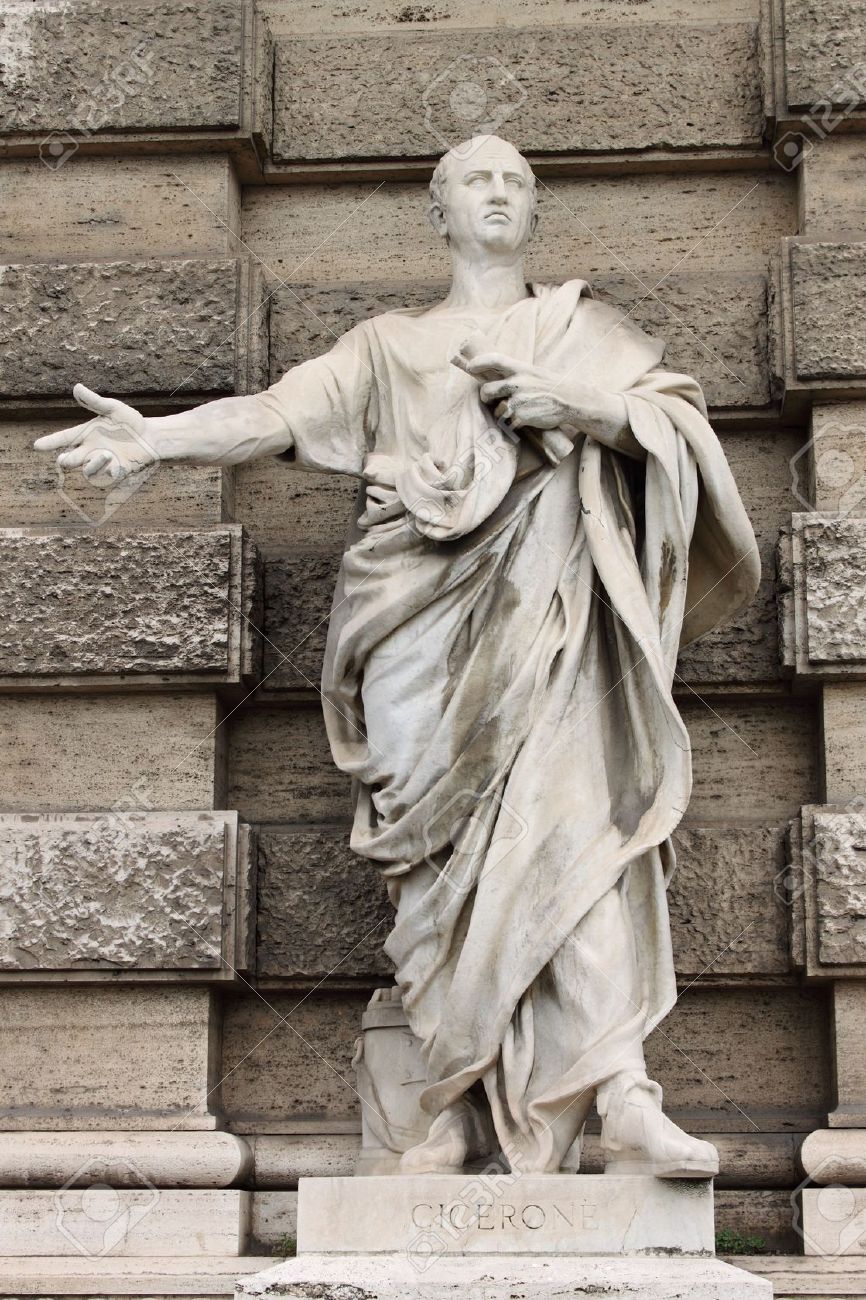
Statue-of-Cicero-Stock-Photo-rome

Friends of Padre Steve’s World,

I have been writing a lot about the Holocaust of late and as I was working on my latest book I came across a quote by British Historian Laurence Rees from his book “Auschwitz, a New History:

“Soon the last survivor and the last perpetrator from Auschwitz will have joined those murdered at the camp. There will be no one on this earth left alive who has a personal experience of the place. When that happens, there is a terrible danger that this history will merge into the distant past and just become one terrible event among many…. But that should not be allowed to happen.

We must judge behavior by the context of the times, and judged by the context of mid-twentieth century, sophisticated European culture, Auschwitz and the Nazis’ “Final Solution” represent the lowest act in all history. Through their crime, the Nazis brought into the world an awareness of what educated, technologically advanced human beings can do – as long as they possess a cold heart. Once allowed into the world, knowledge of what they did must not be unlearned. It lies there – ugly, inert, waiting to be discovered by each new generation. A warning for us, and for those who will come after. (Rees, Auschwitz p.299)

I have been reading about the declining number of students studying history, and the relative ignorance of Americans as a whole as to history, including the gross and willful ignorance of it by the President. As a historian that frightens me.

The great Roman philosopher and political theorist Marcus Tullius Cicero wrote, “History is the witness that testifies to the passing of time; it illumines reality, vitalizes memory, provides guidance in daily life and brings us tidings of antiquities.”

Those who follow my writings here on this site know that I am a historian and that much of what I write, even regarding current events, is framed by history and the stories of those who came before us. That is one of my driving passions, a passion for historical truth, and a passion to ensure that the past is not forgotten.

Cicero is an important figure in history. He resisted the moves toward the dictatorship of the Caesars and would die for his belief in the Republic. As such he inspired the founders of the United States, including Thomas Jefferson and John Adams. Adams wrote of the Roman:

“As all the ages of the world have not produced a greater statesman and philosopher united than Cicero, his authority should have great weight.”

Sadly, it seems that our society, and even our education system is disconnecting itself from history. We have pretty much stopped teaching history in schools, and often what is taught is myth. As such we have become a society that through its ignorance of the past is ever repeating the worst aspects of our history. As a whole we are ignorant of our past, and that ignorance is demonstrated by many of our political, business, journalism, educational, and military leaders on a daily basis.

Cicero wrote “To be ignorant of what occurred before you were born is to remain always a child. For what is the worth of human life, unless it is woven into the life of our ancestors by the records of history?”

Our lives must be woven together with those who came before us, without that sacred connection to the past, we endanger the future, and doom those who follow us. Cicero wrote, “The life of the dead is placed in the memory of the living.” Thus, it is for us the living to remember and never forget those who have gone before. That is why I write.

At some point I will write more on things that Cicero wrote and said, including political and social lessons that are as relevant today as when he wrote them, but as historian George Santayana noted: “Those who do not remember the past are condemned to repeat it.”

I fear that the President and his sycophants in the GOP and his Cult like followers in their ignorance of history and willful disregard for the Constitution and our institutions will end in the kind of political disaster that brought an end to the Roman Republic.

These are perilous times and I am afraid that the lessons of Cicero, Santayana, and Rees have not been learned.

Until tomorrow,

Peace

Padre Steve+

2 Comments

Filed under History, holocaust, News and current events, philosophy, Political Commentary

Presidents are Neither Above the Law or Criticism: Wisdom from Theodore Roosevelt and Stephen A. Douglas

Friends of Padre Steve’s World,

I find it both interesting and troubling to listen to many supporters of President Trump castigate anyone for any criticism offered about the President, sometimes going as far to say that critics are being “unfair,” “disrespectful,”or most disturbing, “disloyal” or “treasonous.” Even the President tweets out those kind of accusations on a whim.

Admittedly some forms of criticism cross boundaries and are personally insulting and disrespectful of the President. In my writings I try, even when being very critical of his policies, words, or actions, to refrain from personal insults that could be considered disrespectful to the President because I am still on active duty.  As my readers know I am a historian as well as an theologian/ethicist and when I do write about the actions of the President and his administration I do so based on careful study and comparison with historical, ethical, or legal precedents. My views are likewise informed by my education and and belief in the principles of the Enlightenment, my belief in human rights as set out in the Preamble of the Declaration of Independence, the U.S. Constitution, and the French Rights of Man and the Citizen, as well as my understanding of the Anglican Christian tradition of “Scripture, Tradition, and Reason” being the foundations of faith.

But it is not disloyal or treasonous to offer criticism of policies, legislative proposals, executive orders, or actions and words of the President or his advisers that could endanger the security of the United States, its citizens, and its alliances, or potentially be unlawful.

Even so I am occasionally criticized for offering historical examples that compare the President and his most ardent supporters in an unfair way, some even calling those disrespectful. I find their double standards and lack of appreciation of irony quite fascinating as most of these people have spent the last eight years or more disparaging and disrespecting President Obama with some of the most racist, vile, contemptible, and false accusations ever made against a sitting President, while at the same time condemning others for simply repeating what the President himself has said.

I found out that a couple of years when I had a couple of students criticize some of my teaching at Gettysburg when comparing the anti-immigrant Know Nothings of the 1830s-1850s to current anti-immigrant Trump supporters, and stated that some Trump Administration Civil Rights proposals to be a throwback to Jim Crow. My words then were not insulting nor disrespectful, but simply valid historical criticism; but some Trump supporters are so thin-skinned that they cannot abide any criticism of the President, despite dishing out incredibly racist and disgusting personal comments about President Obama, which were mostly devoid of any non-racially based political or ideological principles.

Last summer I experienced the threat to my career from one of my chapel parishioners who lied about the contents of a sermon and asked my Commander to have me investigated and tried by Court Martial for simply criticizing the actions of the administration on the southern border using Scripture, Tradition, Reason, and History. I did not mention the President but I was accused of comparing him to Hitler and my critic, who never spoke to me and who I still would not recognize wanted me charged with Conduct unbecoming of an officer and disrespect to the President of the United States. About a quarter of the congregation was questioned and I was exonerated, but I have learned the hard way that the President’s supporters will go to any length to silence anything the believe critical,of him.

Unlike President Obama the current President is ensnared in numerous legal, criminal, and Constitutionally backed investigations which range from simply enriching himself as a public official (the emoluments clause) and his family, or more seriously collusion with not only Russian, but Saudi, and other nations to influence his election. The Senate committee investigating the Russian connection said that this actually happened and backed up the evidence submitted by U.S. law enforcement, military, and intelligence agencies concerning this. The Saudi and other Sunni Arab connections were just brought to public light about a year ago. Lord knows how many other governments were involved with Donald Trump Jr., and others to seek to influence the 2016 elections and U.S. foreign policy since then.

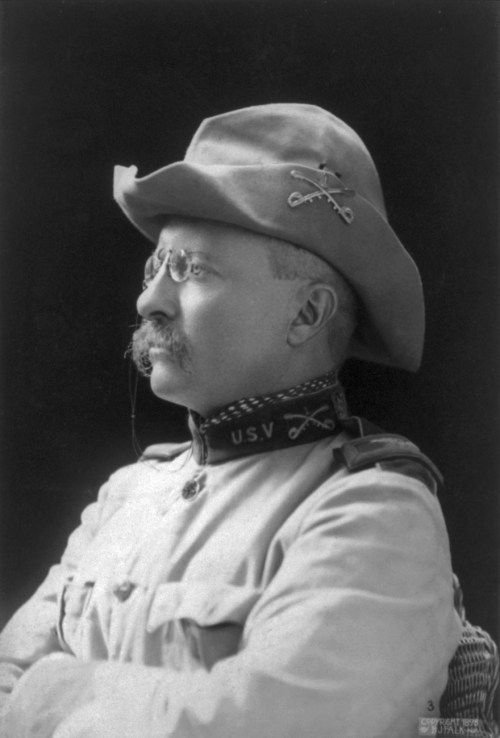
Theodore Roosevelt had to defend himself in 1918 from such criticism from the supporters of President Woodrow Wilson. Roosevelt was criticizing the Wilson administration because of how badly he thought they were pursuing the war effort against Germany. For this people were castigating him. People said that newspapers should not print what Roosevelt had to say as well as “He should stand by the President” and “He should be stood before a stone wall and shot.” Roosevelt ended up writing an op-ed in the Kansas City Star in which he noted:

“The President is merely the most important among a large number of public servants. He should be supported or opposed exactly to the degree which is warranted by his good conduct or bad conduct, his efficiency or inefficiency in rendering loyal, able, and disinterested service to the Nation as a whole. Therefore it is absolutely necessary that there should be full liberty to tell the truth about his acts, and this means that it is exactly necessary to blame him when he does wrong as to praise him when he does right. Any other attitude in an American citizen is both base and servile. To announce that there must be no criticism of the President, or that we are to stand by the President, right or wrong, is not only unpatriotic and servile, but is morally treasonable to the American public. Nothing but the truth should be spoken about him or any one else. But it is even more important to tell the truth, pleasant or unpleasant, about him than about any one else.”

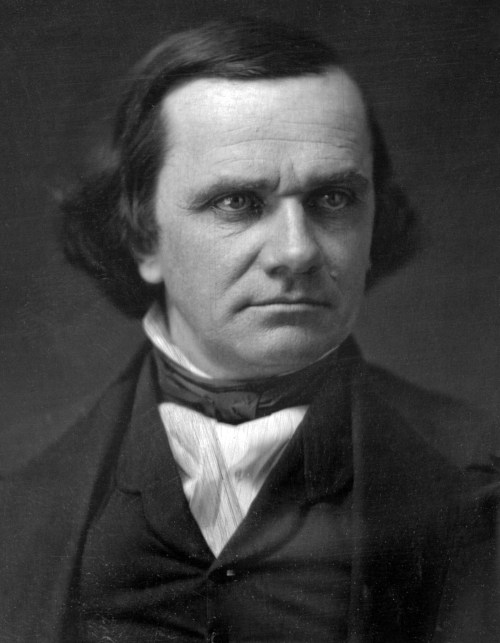
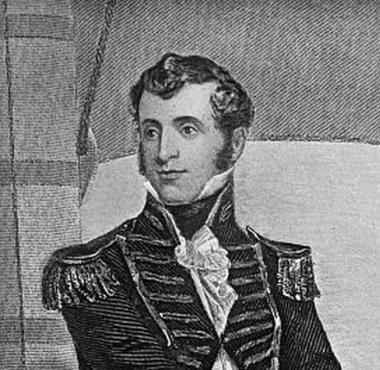
Senator Stephen A. Douglas

This is exactly how I base any criticism I offer of the President, his policies, words, and actions. I heartily agree with the words of Senator Stephen A. Douglas when he battled President James Buchanan over the pro-slavery attempt to have Kansas admitted to the Union as a Slave State in 1858. Douglas said of his encounter with Buchanan:

“God forbid,” I said “that I ever surrender my right to differ from a President of the United States for my own choice. I am not a tool of any President!” 

Sadly, there are very few GOP Senators who would have the moral courage to do what Stephen Douglas did in 1858. He did so even though it doomed his chances to be President.

I admire Stephan Douglas but there is a difference. Now there is a difference, I am not a Senator or elected Representative, I am an officer and must carry out the orders of the President. However, if I ever come to believe that I cannot in good conscience carry them out, or if I believe that they are un-Constitutional I will retire from the military in order to allow myself the freedom to speak out more openly. To ‘this point in time I have not to have been forced to Carr out any illegal or unconstitutional orders, and as a Chaplain I have been able to speak my thoughts openly, though I am careful in how I say them at least in order to maintain my respect for the office of the President.

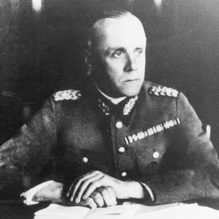
General Ludwig Beck

One of my examples is the German General Ludwig Beck, who resigned as head of the German Army in 1938 over Hitler’s aggression and his plan to attack Czechoslovakia. He wrote something that I hold particularly important in my service at this point in history:

“It is a lack of character and insight, when a soldier in high command sees his duty and mission only in the context of his military orders without realizing that the highest responsibility is to the people of his country.” 

Unlike the current President who sought numerous deferments from entering the military in a time of war: Stephen Douglas put his political career on the line to follow the Constitution, Theodore Roosevelt resigned from his office as Assistant Secretary of the Navy Since to go to war and place himself in harms way, Ludwig Beck would die in the failed attempt to kill Hitler in July 1944. All three men were far more honorable than President Trump, and their words should be heeded by Americans regardless of their political affiliation.

Over the past few weeks the President and his media cohorts have been suggesting unconstitutional and illegal actions against his critics Following the end of the Mueller investigation. His administration members are refusing Congressional subpoenas, and he is hiding behind executive privilege. In a different era his own party members in Congress would hold him to account, but these are different times. The actions of the President and his administration members, supported by the GOP majority in the Senate will likely bring about a Constitutional Crisis that will test the very foundations of the Republic, at the same time he is sending significant military assets to confront an undisclosed threat from Iran, while increasing sanctions on that country, while readying economic tariffs on China. I could go on, but I won’t.

Theodore Roosevelt was absolutely correct. Presidents are not beyond criticism, rebuke, or the law. Any real patriot understands that.

Until tomorrow,

Peace,

Padre Steve+

5 Comments

Filed under History, laws and legislation, leadership, Military, News and current events, Political Commentary

Americans should Always “Choose a President Wise, Well Read in History and Exceedingly Slow to Draw the Sword” Wise Words from the Late General Hal Moore in the Trump Era

29f03605f6b48a52887c2b51a20b5382

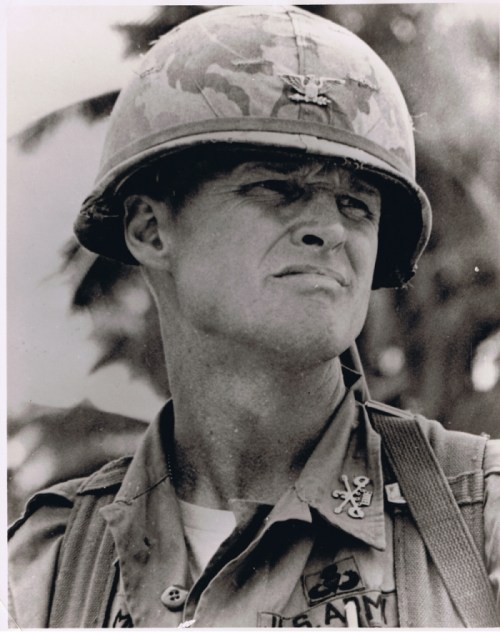
LTG Hal Moore as a Colonel in Vietnam

Friends of Padre Steve’s World,

Even since I was a child I was an avid reader of history, especially military history and biography. I idolized the military men that I read about and many of the things that they said and did, and almost always skewed them into an almost perverse form of patriotism. After the attacks of 9-11-2001 and during the run up to the invasion of Iraq I got into a internet argument with a man who later became the Presiding Bishop of my former denomination. He was and still is a very honorable man. He opposed the war on good historical, social, and moral grounds.

While he was very conservative theologically he had a strong sense of social justice and having come to adulthood during Vietnam war era he had a certain sense of distrust about military adventurism that I, an officer who at that time had some twenty years of military service did not fully appreciate. I responded to one of his comments with a quote from one of my favorite American Naval heroes, Captain Stephen Decatur who once remarked:

“Our Country! In her intercourse with foreign nations may she always be in the right; but right or wrong, our country!”

decatur 2 sqaure

There is some truth in what Decatur said, but his words should not be used to justify imperialistic nationalism, racism, or militarism. Sadly back then that was exactly how I used it to attempt to shut down the arguments of an honorable man. If he ever reads this I hope that Bishop Craig Bates accepts my heartfelt apology for how I treated him back then.

It took me two combat tours, one at sea where I was a member of a boarding team, and the other in Iraq’s Al Anbar Province, and a lot more military and historical education that I realized how wrong that I was in doing this. Using patriotic quotes to buttress immoral, illegal, unconstitutional, and un-Christian policies is damnable. G. K. Chesterton noted: “‘My country, right or wrong,’ is a thing that no patriot would think of saying. It is like saying, ‘My mother, drunk or sober.’”

But, I am afraid that my former understanding of patriotism is exactly what many Americans follow today, regardless of their political affiliation or ideology seem to automatically defer to the decisions of the President, no matter what his party in launching military strikes. This has been largely true since the end of Second World War until now with the exception of the latter stages of the Vietnam War when the bankruptcy of American policy became evident.

No one wants to be “against the troops” and I am still one of those troops, but opposing nationalism, imperialism, and militarism is not the same as “supporting the troops.” The late Army Lieutenant General Hal Moore, who led his battalion into the Battle of the Ia Drang in 1965 and was memorialized in the film We Were Soldiers told West Point Cadets in 2005:

“The war in Iraq, I said, is not worth the life of even one American soldier. As for Secretary Rumsfeld, I told them, I never thought I would live long enough to see someone chosen to preside over the Pentagon who made Vietnam-era Defense Secretary Robert McNamara look good by comparison. The cadets sat in stunned silence; their professors were astonished. Some of these cadets would be leading young soldiers in combat in a matter of a few months. They deserved a straight answer.

The expensive lessons learned in Vietnam have been forgotten and a new generation of young American soldiers and Marines are paying the price today, following the orders of civilian political leaders as they are sworn to do. The soldiers and those who lead them will never fail to do their duty. They never have in our history. This is their burden. But there is another duty, another burden, that rests squarely on the shoulders of the American people. They should, by their vote, always choose a commander in chief who is wise, well read in history, thoughtful, and slow-exceedingly slow-to draw the sword and send young men and women out to fight and die for their country. We should not choose for so powerful an office someone who merely looks good on a television screen, speaks and thinks in sixty-second sound bites, and is adept at raising money for a campaign.

If we can’t get that part right then there will never be an end to the insanity that is war and the unending suffering that follows in war’s wake-and we must get it right if we are to survive and prosper as free Americans in this land a million Americans gave their lives to protect and defend.”

I remember reading General Moore’s back words then and despite my respect for him I didn’t see their truth, I still believed the lies of Donald Rumsfeld, the Bush Administration, and the Right wing media. I was wrong, and within two and a half years I would discover just how right that he was.

Today, some eleven years after I returned from Iraq I find that we now have a President whose historical, ethical, and policy blindness is subjected to his narcissistic and paranoid personality. He is a man who dodged the draft, avoided military service, condemned men and women wounded. killed, or captured in combat as losers while bragging that avoiding sexually transmitted diseases in the 1980s was his Vietnam. Even now he is rushing a Carrier Strike Group and heavy bombers to challenge Iran for as of yet undisclosed threats to American interests in the Middle East, as well as suggesting military options to deal with the failing and flailing government of Venezuelan President Maduro.

War is a great way to distract from other real concerns, especially if it gives the President, any President, a chance to divert attention from his own malfeasance and criminality. Our Republic is in danger and I do not think that the danger will soon pass. I only wish that it would. Sadly, Hal Moore passed away in February of 2017. If he were alive today I am sure that he would be sounding the alarm.

So until tomorrow,

Peace

Padre Steve+

Leave a comment

Filed under Foreign Policy, History, leadership, middle east, Military, national security, News and current events

Dien Bien Phu: The Soldiers and the Lessons Forgotten and Unlearned 65 Years Later

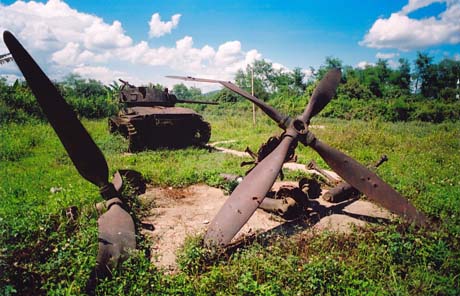
Dien Bien Phu War Remnants

Dien Bien Phu Today

It was an epic battle in a tragic war and most people neither know or care what happened in the valley where a small border post named Dien Bien Phu became synonymous with forgotten sacrifice. This year fewer remembrances are taking place. Some are in Vietnam and others in France. Last year, the French Prime Minister Edouard Philippe laid a wreath at the French Monument at Dien Bien Phu, accompanied by several elderly veterans of the battle. The French veterans were met with kindness by their former opponents.

French Prime Minister Edouard Philippe at Dien Bien Phu’s French Memorial

Diplomat_Sep10059-227x300

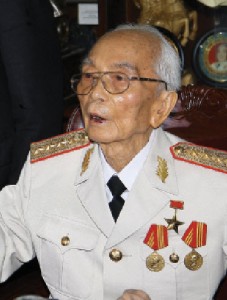
General Vo Nguyen Giap in 2011

Years before, on May 7th 2011 in Hanoi a small remembrance was held to mark the fall of Dien Bien Phu and honor the victor, 101 year old General Vo Nguyen Giap at his home. Giap was the last senior commander on either side at that time, and he died a year and a half later at the age of 102.  That 2011 ceremony was one of the few remembrances held anywhere marking that battle which was one of the watersheds of the 20th Century. A half a world away in Houston Texas a small group of French veterans, expatriates and historians laid a wreath at the Vietnam War Memorial.  In Paris an ever shrinking number of French survivors used to gather each year on May 7th at 1815 hours for a religious service at the Church of Saint Louis des Invalides to remember the dead and missing of the French Expeditionary Corps who were lost in Indochina. A small number of other small ceremonies were held as late as 2014. There appear to be no services to honor their memory this year.

155fdecaef82e8d699102f2c5390203c

Legionnaires of the Second Foreign Legion Parachute Battalion at Dien Bien Phu 

This battle is nearly forgotten by time even though it and the war that it symbolized is probably the one that we need to learn from before Afghanistan becomes our Indochina.

<img src="https://padresteve.com/wp-content/uploads/2013/05/french_surrender_at_dien_bien_phu1.jpg?w=500&quot; class="aligncenter size-full wp-image-11759" data-attachment-id="11759" data-permalink="https://padresteve.com/2013/05/06/remembering-hell-the-fall-of-dien-bien-phu-59-years-gone-by-and-still-forgotten/french-soldiers-surrender-3/&quot; data-orig-file="https://padresteve.com/wp-content/uploads/2013/05/french_surrender_at_dien_bien_phu1.jpg&quot; data-orig-size="375,253" data-comments-opened="1" data-image-meta="{"aperture":"0","credit":"AP","camera":"","caption":"Captured French soldiers are marched through the fields after their surrender at Dien Bien Phu in 1954. More than 10,000 French troops were captured after a 55 day siege . The French defeat ended nearly a century of French occupation of Indochina. (AP Photo\/Vietnam News Agency)","created_timestamp":"0","copyright":"","focal_length":"0","iso":"0","shutter_speed":"0","title":"FRENCH SOLDIERS SURRENDER"}" data-image-title="FRENCH SOLDIERS SURRENDER" data-image-description="

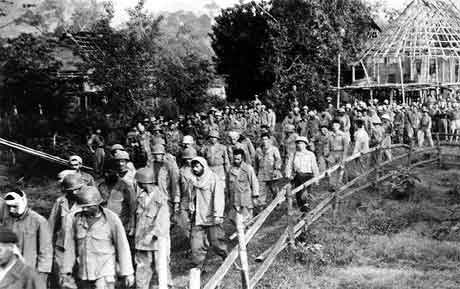
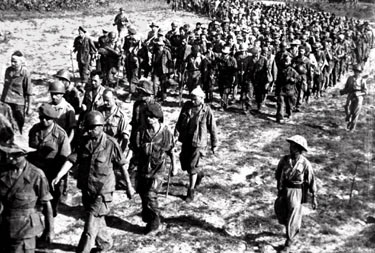
Captured French soldiers are marched through the fields after their surrender at Dien Bien Phu in 1954. More than 10,000 French troops were captured after a 55 day siege . The French defeat ended nearly a century of French occupation of Indochina. (AP Photo/Vietnam News Agency)

” data-medium-file=”https://padresteve.com/wp-content/uploads/2013/05/french_surrender_at_dien_bien_phu1.jpg?w=300&#8243; data-large-file=”https://padresteve.com/wp-content/uploads/2013/05/french_surrender_at_dien_bien_phu1.jpg?w=375&#8243; alt=”FRENCH SOLDIERS SURRENDER” srcset=”https://padresteve.com/wp-content/uploads/2013/05/french_surrender_at_dien_bien_phu1.jpg 375w, https://padresteve.com/wp-content/uploads/2013/05/french_surrender_at_dien_bien_phu1.jpg?w=150 150w, https://padresteve.com/wp-content/uploads/2013/05/french_surrender_at_dien_bien_phu1.jpg?w=300 300w” sizes=”(max-width: 375px) 100vw, 375px” style=”height: auto; max-width: 100%; margin-bottom: 2px; clear: both; display: block; margin-left: auto; margin-right: auto”>

French Prisoners

On May 8th 1954 the French garrison of Dien Bien Phu surrendered to the Viet Minh.  It was the end of the ill-fated Operation Castor in which the French had planned to lure the Viet Minh Regulars into open battle and use superior firepower to decimate them.  The strategy which had been used on a smaller scale the previous year at Na Son.

The French had thought they had come up with a template for victory based on their battle at Na Son in how to engage and destroy the Viet Minh. The plan was called the “Air-land base.”  It involved having strong forces in a defensible position deep behind enemy lines supplied by air.  At Na Son the plan worked as the French were on high ground, had superior artillery and were blessed by General Giap using human wave assaults which made the Viet Minh troops fodder for the French defenders.  Even still Na Son was a near run thing for the French and had almost no effect on Viet Minh operations elsewhere while tying down a light division equivalent and a large portion of French air power.

nlfmainforce

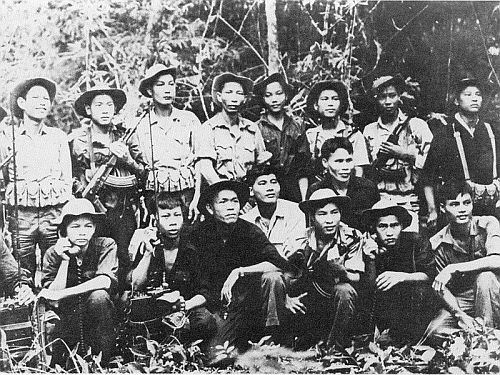
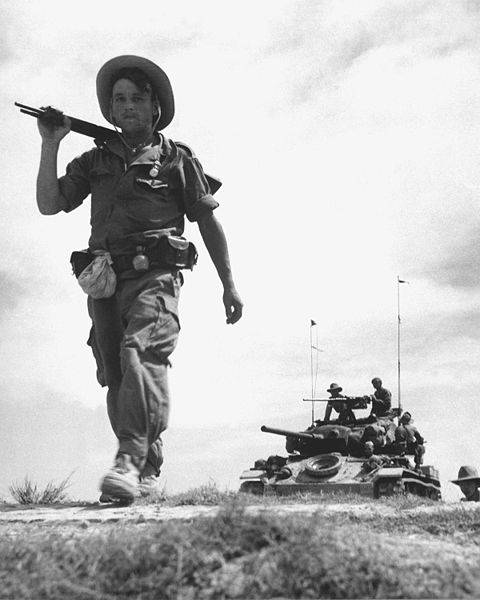
Viet Minh Regulars

The French took away the wrong lesson from Na-Son and repeated it at Dien Bien Phu.  The French desired to use Dien Bien Phu as a base of operations against the Viet Minh.  Unfortunately the French chose badly. Instead of high ground they elected to occupy a marshy valley surrounded by hills covered in dense jungle. They went light on artillery and the air head was at the far end of the range of French aircraft, especially tactical air forces which were in short supply.  To make matters worse, General Navarre, commander of French forces in Indochina was informed that the French government was going to begin peace talks and that he would receive no further reinforcements. Despite this, he elected to continue the operation.

dien-bien-phu

French Paras Drop into Dien Bien Phu

Once on the ground French logistics needs were greater than the French Air Force and American contractors could supply.  French positions at Dien Bien Phu were exposed to an an enemy who held the high ground, had more powerful artillery, and placed in defensive positions that were not mutually supporting. The terrain was so poor that French units were incapable of any meaningful offensive operations against the Viet Minh. As such they could only dig in and wait for battle. Despite this many positions were not adequately fortified and the artillery was in emplaced positions that were easily targeted by Viet Minh artillery and not hardened.

bigeard_instruction_saut

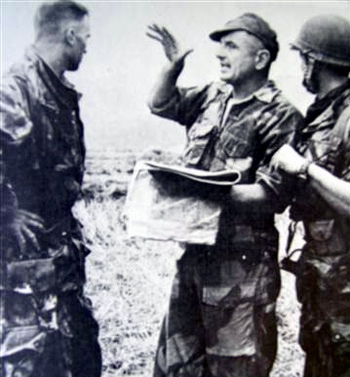
Major Marcel Bigeard 

The French garrison was a good quality military force composed of veteran units. It was comprised of Paras, Foreign Legion, Colonials (Marines), North Africans and Vietnamese troops. Ordinarily in a pitched battle it would have done well, but this was no ordinary battle and their Viet Minh opponents were equally combat hardened, well led and well supplied and fighting for their independence.

Many of the French officers including Lieutenant Colonel Langlais and Major Marcel Bigeard commander of the 6th Colonial Parachute Battalion were among the best leaders in the French Army. Others who served in Indochina including David Galula and Roger Trinquier would write books and develop counter-insurgency tactics which would help Americans in Iraq. Unfortunately the French High Command badly underestimated the capabilities and wherewithal of the Giap and his divisions.

65193421-small_269244

Viet Minh Supply Column

Giap rapidly concentrated his forces and built excellent logistics support.  He placed his artillery in well concealed and fortified positions which could use direct fire on French positions. Giap also had more and heavier artillery than the French believed him to have.  Additionally he brought in a large number of anti-aircraft batteries whose firepower from well concealed positions enabled the Viet Minh to take a heavy toll among the French aircraft that attempted to supply the base.  Unlike at Na-Son, Giap did not throw his men away in human assaults.  Instead he used his Sappers (combat engineers) to build protective trenches leading up to the very wire of French defensive positions. These trenches provided both concealment and protection from the French. In time these trenches came to resemble a spider web that enveloped the French base.

Without belaboring the point the French fought hard as did the Viet Minh. One after one French positions were overwhelmed by accurate artillery and well planned attacks.  The French hoped for U.S. air intervention, even the possibility of the United States using nuclear weapons against the Viet Minh. They were turned down by a US Government that had grown tired of a war in Korea.

dien bien phu6

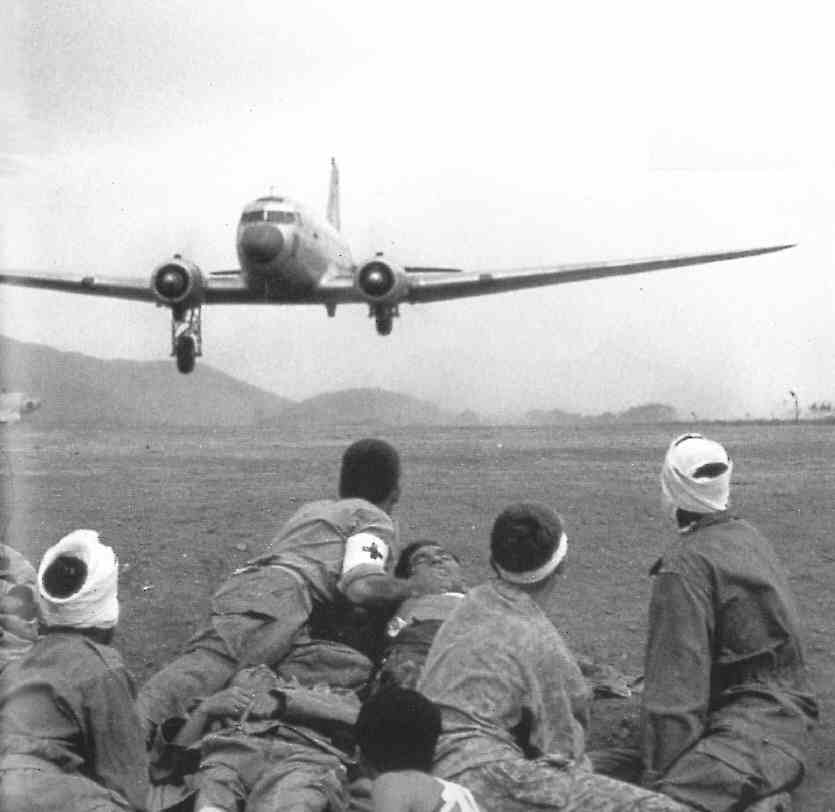
Wounded Awaiting Medivac 

Relief forces were unable to get through and the garrison died, despite the bravery of the Paratroops. Colonials and Legionaries. The French garrison was let down by their high command and their government and lost the battle due to inadequate logistics and air power. The survivors endured a brutal forced march of nearly 400 miles on foot to POW camps in which many died. Many soldiers who survived the hell of Dien Bien Phu were subjected to torture, including a practice that we call “water boarding.” General Georges Catroux who presided over the official inquiry into the debacle at Dien Bien Phu wrote in his memoirs: “It is obvious that there was, on the part of our commanding structure, an excess of confidence in the merit of our troops and in the superiority of our material means.”

Few French troops caved to the Viet Minh interrogations and torture but some would come away with the belief that one had to use such means to fight the revolutionaries.  Some French troops and their Algerian comrades would apply these lessons against each other within a year of their release. French soldiers and officers were shipped directly from Indochina to Algeria to wage another protracted counterinsurgency often against Algerians that they had served alongside in Indochina. The Algerian campaign proved to be even more brutal and it was lost politically before it even began.

dien_bien_phu

The March to Captivity

The wars in Indochina and Algeria tore the heart out of the French Army. The defeats inflicted a terrible toll. In Indochina many French career soldiers felt that the government’s “lack of interest in the fate of both thousands of missing French prisoners and loyal North Vietnamese…as dishonorable.” Divisions arose between those who served and those who remained in France or Germany and created bitter enmity between soldiers. France would endure a military coup which involved many who had fought in Vietnam and Algeria. Having militarily won that war these men called The Centurions by Jean Lartenguy had been turned into liars by their government.  They were forced to abandon those who they had fought for and following the mutiny, tried, imprisoned, exiled or disgraced. Colonial troops who remained loyal to France were left without homes in their now “independent” nations. They saw Dien Bien Phu as the defining moment. “They responded with that terrible cry of pain which pretends to free a man from his sworn duty, and promises such chaos to come: ‘Nous sommes trahis!’-‘We are betrayed.’

The effects of the wars in French Indochina, Algeria and Vietnam on the French military establishment were long lasting and often tragic. The acceptance of torture as a means to an end sullied even the hardest French officers. Men like Galula and Marcel Bigeard refused to countenance it, while others like Paul Aussaresses never recanted.

One of the most heart rending parts of the Dien Bien Phu story for me is that of Easter 1954 which fell just prior to the end for the French:

“In all Christendom, in Hanoi Cathedral as in the churches of Europe the first hallelujahs were being sung. At Dienbeinphu, where the men went to confession and communion in little groups, Chaplain Trinquant, who was celebrating Mass in a shelter near the hospital, uttered that cry of liturgical joy with a heart steeped in sadness; it was not victory that was approaching but death.” A battalion commander went to another priest and told him “we are heading toward disaster.” (The Battle of Dienbeinphu, Jules Roy, Carroll and Graf Publishers, New York, 1984 p.239)

Like many American veterans of Vietnam, many of the survivors of Dien Bien Phu made peace and reconciled with the Vietnamese soldiers who opposed them. While many still regretted losing they respected their Vietnamese opponents and questioned the leadership of their country and army. Colonel Jacques Allaire, who served as a lieutenant in a battalion under the command of MajorMarcel Bigeard reflected to a Vietnamese correspondent in 2014:

“I am now 92 years old and not a single day has gone by since the Dien Bien Phu loss that I haven’t wondered to myself about why the French army lost…Victory was impossible and too far away from us. The aircrafts were not able to give us relief. The French Government changed 19 times in nine years and that messed everything up. General Navarre did not know anything about the battlefield in Vietnam. After the Na San battle, the French commanders thought they could win and decided to attack at Dien Bien Phu, but they were wrong. It was Vietnamese soldiers who owned the hills, because it was their country… I respect my own enemies, who fought hard for national independence…Vietnam Minh soldiers were true soldiers with the will, courage and morality…” 

As a veteran of Iraq whose father served in Vietnam I feel an almost a spiritual link to our American and French brothers in arms who fought at Dien Bien Phu, the Street Without Joy, Algiers and places like Khe Sanh, Hue City, the Ia Drang and the Mekong. When it comes to this time of year I always have a sense of melancholy and dread as I think of the unlearned lessons and future sacrifices that we may be asked to make.

FrenchForeignLegionaireVtNamDOD

Legionairs on the Street Without Joy

The lessons of the French at Dien Bien Phu and in Indochina were not learned by the United States as it entered Vietnam, Iraq or Afghanistan. Nor were the lessons of Algeria. It was an arrogance for which we paid dearly and I do not think that many in our political, media and pundits or military have entirely learned or that we in the military have completely shaken ourselves. We lost 54,000 dead in Vietnam, nearly 4500 in Iraq and so far over 2400 in Afghanistan, and 20,000 wounded which does not count many of the PTSD or TBI cases. Add the casualties suffered by our NATO allies the number of allied dead is now over 3500. Some 36,000 Afghan National Army soldiers and Police officers have been killed. Afghan civilian deaths are estimated between 100,000 and 400,000, not counting the wounded or those killed in Pakistan. In January 2018 the Pentagon classified data on Afghan military, police, and civilian casualties.

The Afghan debacle has spanned three Presidential administrations so there accountability for it must be shared between Presidents Bush, Obama, and Trump, as well as their administrations, the military, and Congress. President Trump has shifted gears from the time he was a candidate when he pronounced the war “lost” to when addressed it as President on August 21st 2017. In his speech at fort Myer Virginia he said:

“When I became President, I was given a bad and very complex hand, but I fully knew what I was getting into:  big and intricate problems.  But, one way or another, these problems will be solved — I’m a problem solver — and, in the end, we will win.” 

But he also said:

“Someday, after an effective military effort, perhaps it will be possible to have a political settlement that includes elements of the Taliban in Afghanistan, but nobody knows if or when that will ever happen…” 

There are those even as we have been at war for almost 18 years in Afghanistan who advocate even more interventions in places that there is no good potential outcome, only variations on bad. I do not know how the President who calls himself a “problem solver” will define winning, but how many more American Soldiers, Sailors, Marines and Airmen will need die  for a “victory” that we cannot even define?

normal_03_56_F8F_decollage_a_DBP_Beriel_ph

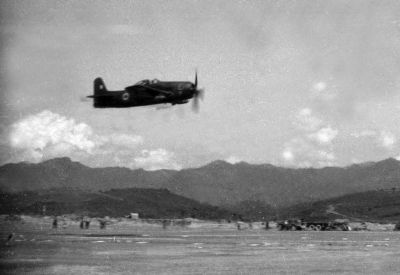
French Navy F-8 Bearcat at Dien Bien Phu

Like the French our troops who returned from Vietnam were forgotten.The U.S. Army left Vietnam and returned to a country deeply divided by the war. Vietnam veterans remained ostracized by the society until the 1980s. As Lieutenant General Harold Moore  who commanded the battalion at the Ia Drang immortalized in the film We Were Soldiers recounted “in our time battles were forgotten, our sacrifices were discounted, and both our sanity and suitability for life in polite American society were publicly questioned.”

I think that will be the case for those of us who served in Iraq, Afghanistan, or Syria. Americans love to say they support the troops and are overwhelmingly polite and even kind when they encounter veterans. But that being said even as they do that they don’t are ignorant about our campaigns, battles, and sacrifices; and even worse fail to hold the government regardless of administration accountable for sending American troops into wars that they cannot win. That being said the Trump administration is talking up and ramping up for a possible showdown with Iran.

I guess that is why I identify so much with the men of Dien Bien Phu. The survivors of that battle are now in their nineties and dissolved their Veterans of Dien Bien Phu association in 2014 due to the difficulties most had in traveling.

For those interested in the French campaign in Indochina it has much to teach us. Good books on the subject include The Last Valley by Martin Windrow, Hell in a Very Small Place by Bernard Fall; The Battle of Dien Bien Phu by Jules Roy; and The Battle of Dien Bien Phu – The Battle America Forgot by Howard Simpson. For a history of the whole campaign, read Street Without Joy by Bernard Fall. A novel that has some really good insights into the battle and the French Paras and Legionnaires who fought in Indochina and Algeria is Jean Larteguy’s  The Centurions. 

I always find Fall’s work poignant.  The French journalist served as a member of the French Resistance in the Second World War and soldier later and then became a journalist covering the Nuremberg Trials and both the French and American wars in Vietnam. He was killed on February 21st 1967 near Hue by what was then known as a “booby-trap” and what would now be called an IED while covering a platoon of U.S. Marines.

I do pray that we will learn the lessons before we enter yet another hell somewhere else.

Peace

Padre Steve+

2 Comments

Filed under counterinsurency in afghanistan, Foreign Policy, History, leadership, Military, national security, News and current events, Political Commentary, shipmates and veterans, vietnam

The Hitlerian Vision: Living Space, Race Hatred, and Genocide

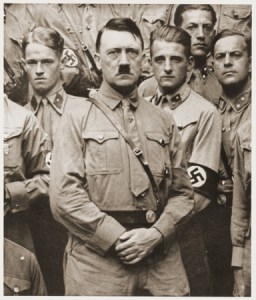
hitler

Introduction

Friends of Padre Steve’s World,

This is the second part of an article that deals with war crimes, genocide and how seemingly normal human beings can become complicit in such crimes. To understands this we must look at some of the intellectual and ideological foundations. When I hear President Trump say that the United States is “out of room” it reminds me a lot of the Pan-Germanic, and Nazi quest for “living space” and their attitudes towards non German immigrants, or for that matter fully integrated German Jews, who were at heart as much German as they were Jewish.

Peace

Padre Steve+

The German war against the Soviet Union was the first truly race-based ideological war in history with the campaign against Poland its precursor. Adolf Hitler’s racial theories and beliefs played a dominant role in Germany’s conduct of the war in the East in both the military campaign and occupation. This has become clearer in recent years as historians have had the opportunity to examine Hitler’s writings, those of senior Nazi officials and military officers and documents which had been unavailable until the end of the Cold War. Understanding the Nazi ideological basis and the underlying cultural prejudice against the Jews and eastern Europeans in general is foundational to understanding Hitler’s conduct of the war and why the destruction of the Jews figured so highly in his calculations. One must also understand the military and police cultures and doctrines that enabled them to cooperate so closely in the conduct of the war.

The German war in the east would differ from any previous war. Its underlying basis was ideological. Economic and geopolitical considerations were given importance in relationship to the understanding of the German “Master Race.” Race and Lebensraum was the goal of the State that “concentrates all of its strength on marking out a way of life for our people through the allocation of Lebensraum for the next one hundred years…the goal corresponds equally to the highest national and ethnic requirements.” 1

Hitler believed that Germany was “entitled to more land…because it was the “mother of life” not just some “little nigger nation or another.”” 2 The Germans planned to “clear” the vast majority of the Slavic population and the “settlement of millions of hectares of eastern Lebensraum with German colonists” complimented by a short term exploitation of the land to “secure the food balance of the German Grossraum.” 3 Joachim Fest notes that Hitler called it a “crime” to wage war only for the acquisition of raw materials. Only the issue of living space permitted resort to arms. 4

Following the Peace of Westphalia wars in Europe typically emphasized conquest of territory and natural resources either to expand empires or promote some kind of self-sufficiency. The Thirty Years War, which was ended by the Treaty of Westphalia had a heavy religious component which added to its brutality. However the root of much of this conflict was about increasing the power of emerging nation states led by men not necessarily loyal to their religious brethren. 5

The American and Russian Civil wars had some ideological basis and helped usher in the brutality of total war. Both had major effect in these nations’ development and both were bitterly contested with the winners imposing to various degrees political changes on their vanquished brothers they were civil wars. 6

Adam Tooze sees the Holocaust as the first step of the “last great land grab in the long and bloody history of European colonialism…” 7 This does have merit, Hitler’s desire for Lebensraum or living space was a type of colonialism. However, Tooze’s argument does not take away from the basic premise that Germany’s war in the east was at its heart motivated by ideological factors.

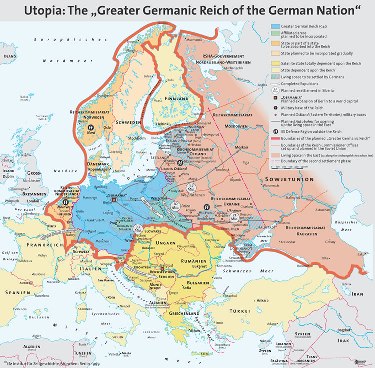
Lebensraum

Lebensraum

German Anti-Semitism and Adolf Hitler

The root of this war was in the mind of Adolf Hitler himself. Hitler was born in Linz Austria during a time when various Pan-German and Anti-Semitic groups, publications and propaganda were widespread. As a young man Hitler moved to Vienna hoping to become an artist, something that he found little commercial success. While struggling to make a living in Vienna he was exposed to a culture far different from the provincial city of his youth, a city that had much culture but was also a meeting ground for the various peoples that populated the Austro- Hungarian Empire, including Slavs and many Jews. While many of the Germanic or Austrian Jews were outwardly little different from their Christian neighbors the Jews from Eastern Europe repulsed Hitler.

This attitude was not unique to German but found its roots in the various anthropologies written by other Europeans as well as Germans regarding the lack of rights of “inferior cultures” as related to their colonial expansion as well as the westward expansion of Americans. Friedrich Ratzel a German anthropologist and a founder of the Pan-German League paired the Jews with “the stunted hunting people of the African interior” into “the class of scattered people with no

land.” 8 Ratzel’s work where he also studied the conquest of the Native American tribes by whites helped form the basis of Hitler’s Understanding of Lebensraum, a concept that he borrowed from Ratzel. Ratzel was originally a zoologist. In his concept of Lebensraum Ratzel “linked the biological theory of life with the geographical theory of space.” Ratzel believed that to “conquer and hold sufficient Lebensraum, others have to be displaced.” Ratzel noted how European settles had taken over land from the Native Americans to take it for themselves. He noted that “the result was an annihilating struggle, the prize for which was the land, the space.” 9

Another German academic and lecturer at the University of Glasgow Alexander Tille, wrote in 1893 that it is “the right of the stronger race to annihilate the lower…when that race does not maintain its ability to resist then it has no right to exist, for anyone who cannot maintain himself must be content to go under.” Tille’s “laws” were easily applied to both primitive peoples as well as to “the economically less successful peoples of Europe.” 10

Hitler’s lack of success, struggle with poverty and resentment of others led him to the writings of the Pan-Germanic and Anti-Semitic movements. His years in Vienna were foundational as he as he absorbed the ideas of these Pan-German, anti-Semitic groups through newspapers like the Deutsches Volksblatt11 In Vienna Hitler began to connect the Jews with Marxism.12 Joachim Fest notes that in Vienna Hitler became obsessed by the fear of the Slavs and Jews, hated the House of Hapsburg, the Social Democratic Party, and “envisioned the end of Germanism.” 13

Hitler’s racial views were amplified after the war in turbulent Weimar Germany where he became a member of the NDSAP, rising rapidly within it, eventually taking over party leadership, reorganizing it so that it “became the instrument of Hitler’s policies.” 14 Following the unsuccessful Beer Hall Putsch of 1923 Hitler wrote Mein Kampf while imprisoned in the Landsberg prison in which he enunciated his views about the Jews, Slavs and Lebensraum. Hitler believed that Imperial Germany had been “hopelessly negligent” in regard to the Jews 15 and that the Jews in conjunction with the Catholic Center Party and Socialists worked together for “maximum damage to Germany.” 16

Likewise he saw the Jews as heading the “main ideological scourges of the nineteenth and twentieth century’s.” 17 It was the ideology of Hitler’s “obsessive anti-Semitism” 18 that drove Nazi Germany’s policy in regard to the Jews and against Jewish-Bolshevism. By the 1920s Hitler had “combined his hatred of the Jews and of the supposedly Jewish dominated Soviet state with existing calls to conquer additional Lebensraum, or living space, in the east.” 19 Hitler wrote: “The fight against Jewish world Bolshevism requires a clear attitude toward Soviet Russia. You cannot drive out the Devil with Beelzebub.” 20 Richard Evans notes that Mein Kampf clearly enunciated that “Hitler considered racial conflict…the essence of history, and the Jews to be the sworn enemy of the German race ….” And that the “Jews were now linked indissolubly in Hitler’s mind with “Bolshevism” and “Marxism.” 21

When Hitler became the dictator of Germany “his ideology and strategy became the ends and means of German foreign policy.” 22 His aims were clear, Hitler remarked to Czech Foreign Minister Chvalkovsky on 21 January 1939: “We are going to destroy the Jews.” 23It was clear that Hitler understood his own role in this effort noting to General Gotthard Heinrici that “he was the first man since Charlemagne to hold unlimited power in his own hand. He did not hold this power in vain, he said, but would know how to use it in the struggle for Germany…” 24

To be continued…

Notes

1 Weinberg, Gerhard L. Ed. Hitler’s Second Book: The Unpublished Sequel to Mein Kampf by Adolph Hitler.  Translated by Krista Smith, Enigma Books, New York, NY 2006. Originally published as Hitlers zweites Buch, Gerhard Weinberg editor, 1961 p. 159

2 Davidowicz, Lucy S. The War Against the Jews 1933-1945 Bantam Books, New York, NY 1986. p.91

3 Tooze, Adam. The Wages of Destruction Penguin Books, New York, NY, 2008. First Published by Allen Lane Books, Penguin Group, London UK, 2006. p.463

4 Fest, Joachim, Hitler. Translated by Richard and Clara Winston. Harcourt Brace Jovanovich Publishers, San Diego,

New York, London, 1974. German Edition by Verlag Ullstein 1973 pp. 607-608

5 Note the actions of Cardinal Richelieu in France who worked to expand French power at the expense of other Catholic nations and the Vatican itself.

6 In the United States the Reconstruction policies produced great resentment in the south with decidedly negative

results for the newly freed slaves which lasted another 100 years, while in the Soviet Union great numbers of “opponents of Socialism” were killed, imprisoned or driven out of the county

7 Ibid. Tooze. The Wages of Destruction p.462

8 Lindqvist, Sven Exterminate All the Brutes: One Man’s Oddessy into the Heart of Darkness and the Origins of European Genocide Translated from the Swedish by Joan Tate, The New Press , New York and London 1992 p.145

9 Ibid. Lindqvist p.154 It is interesting to note that the current American “historian” of the American Religious right

David Barton made the same arguments recently about the American Indians. Barton said: “You have to deal, a lot of it, with how the enemy responds. It’s got to be based on what the enemy responds [to,] you cannot reason with certain types of terrorists; and see that’s why we could not get the Indians to the table to negotiate with us on treaties until after we had thoroughly whipped so many tribes …” “People complain about the fact that the American military and buffalo hunters went out and wiped out all the buffalo in the western plains. Doing that was what brought the Indians to their knees because the Indians lived on those wide western plains where there were very few towns; Indians didn’t go into town to buy supplies, they went to the buffalo herds, that’s where they got their meat, that’s where they got their coats, the hides provided coats, they provided covering for their teepees.

If you don’t have the buffalos, those Indians cannot live on the open western plains without those buffalo and so what happened was the military wiped out the supply line by wiping out the buffalo. That’s what brought those wars to an end, that’s what brought the Indians to their knees and ended all the western conflict.” Retrieved from Barton’s Wallbuilders Live broadcast http://www.wallbuilderslive.com/Historic.asp?cdate=77515 9 May 2014 and text   from   http://www.rightwingwatch.org/content/david-barton-explains-just-war-theory-we-had-destroy-indian-  tribes-until-they-became-civiliz

10 Ibid. Lindqvist p.148

11 Ibid. Davidowicz, The War Against the Jews pp.8-9 12 Ibid. Davidowicz. TheWar Against the Jews p.12 13 Ibid. Fest Hitler. p.47

14 Bracher, Karl Dietrich. The German Dictatorship: The Origins, Structure, and Effects of National Socialism.

Translated by Jean Steinberg, Holt Rinehart and Winston, New York, NY 1979. Originally Published under the title Die Deutsche Diktatur: Entstehung, Struktur,Folgen des Nationalsocialismus. Verlag Kiepenheuer & Witsch. Koln and Berlin, 1969 p.93

15 Weinberg, Gerhard L. Germany Hitler and World War II . Cambridge University Press, New York, NY 1995 p.61

16 Ibid. Weinberg, Hitler’s Second Book p.60

17 Friedlander, Saul Nazi Germany and the Jews 1939-1945: The Years of Extermination. Harper Perennial, New York, NY 2007 p.xviii

18 Ibid. Friedlander, The Years of Extermination p.xvii Friedlander called this anti-Semitism “Redemptive anti- Semitism” in which “Hitler perceived his mission as a kind of crusade to redeem the world by eliminating the Jews.

19 Megargee, Geoffrey P. War of Annihilation: Combat and Genocide on the Eastern Front 1941.Bowman and

Littlefield Publishers Inc. Lanham, Boulder, New York. 2007 p.4

20 Hitler, Adolf Mein Kampf translated by Ralph Manheim. Mariner Books, Houghton Mifflin Company, New York, NY 1999. Houghton Mifflin Company 1943, copyright renewed 1971. Originally published in Germany by Verlag Frz.

Eher Nachf. GmbH 1925. p.662.

21 Evans, Richard J. The Coming of the Third Reich Penguin Books, New York 2004. First published by Allen Lane 2003 p.197

22 Ibid. Davidowicz The War Against the Jews pp. 88-89

23 Rhodes, Richard. Masters of Death: The SS Einsatzgruppen and the Invention of the Holocaust. Vintage Books a division of Random House, New York, NY 2002 p.37

24 Speer, Albert. Inside the Third Reich. Collier Books, a Division of MacMillan Publishers, Inc. New York, NY 1970 p.166

Leave a comment

Filed under History, holocaust, national security, nazi germany, News and current events

The Psychology Of Dictatorship: Why Don’t We Learn From History?

Friends of Padre Steve’s World,

Another weekend, another attack on a synagogue, and another crazed rally in which the President again made wild swings directed at his opponents and admitted it was his “sick idea” to try to send detainees from the border to Sanctuary Cities. His words, his sick idea, even as his Attorney General hints that he will not submit to testifying to Congress on the Muller Report.

Normal American Presidents and their officials do not carry on this way. Dictators do, but not American Presidents, however it is part and parcel of everything that the President and his administration says or does. So tonight I am reposting something that I wrote a while back after reading British Military Historian Sir Basil Liddell-Hart’s little, but important book, “Why Don’t We Learn From History.”

NPG x25404; Sir Basil Henry Liddell Hart by Howard Coster

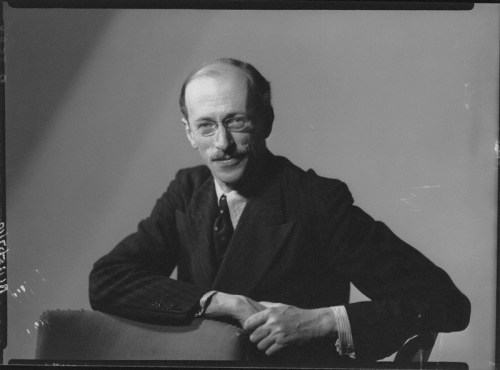
B.H. Liddell-Hart

Friends of Padre Steve’s World,

I have Read the short but poignant little but by the British military historian B.H. Liddell-Hart entitled Why Don’t We Learn from History, several times. The book was written in not long before his death in 1970 and it is good quite good. It deals with a number of issues, including the conflict between history and propaganda; or when faith, especially religious faith as treated as historic or scientific fact; and when propaganda or faith is preached as if it were history, if it were truth. In doing this he also contrasted democracy and lure of totalitarianism.

Liddell-Hart was a realist, especially about democracy and totalitarianism. He served on the Western Front in the First World War and was wounded in a German gas attack. Between the wars he was one of the theorists of armored warfare and the use of tanks in a combined arms force, and he was also quite observant of the trends toward totalitarianism in the late 1920s and 1930s.

Hart, like many others admitted the inefficiencies of democracy, however, he realized that it was far less dangerous than the “stupidity” of totalitarianism. In fact it was important for him to note just how this inefficient system was for freedom. He wrote:

“What is of value in “England” and “America” and worth defending is its tradition of freedom, the guarantee of its vitality. Our civilization, like the Greek, has, for all its blundering way, taught the value of freedom, of criticism of authority, and of harmonising this with order. Anyone who urges a different system, for efficiency’s sake, is betraying the vital tradition.”

There is much to ponder in his book and I will be posting some more of my thoughts on it, but when I looked at it again I was struck by just how much Liddell-Hart in his description of a despot described President Donald Trump through the his campaign and after his election and inauguration.

“We learn from history that self-made despotic rulers follow a standard pattern. In gaining power: They exploit, consciously or unconsciously, a state of popular dissatisfaction with the existing regime or of hostility between different sections of the people. They attack the existing regime violently and combine their appeal to discontent with unlimited promises (which, if successful, they fulfil only to a limited extent). They claim that they want absolute power for only a short time (but “find” subsequently that the time to relinquish it never comes). They excite popular sympathy by presenting the picture of a conspiracy against them and use this as a lever to gain a firmer hold at some crucial stage.” 

Once authoritarian, despotic, or dictatorial leaders gain power through the democratic process they seldom deviate from how they behave when seeking power. Liddell-Hart wrote:

“We learn from history that time does little to alter the psychology of dictatorship. The effect of power on the mind of the man who possesses it, especially when he has gained it by successful aggression, tends to be remarkably similar in every age and in every country.”

So please, take a breathe for a second and think about this in terms of President Trump and his actions during his first two weeks in office. Liddell-Hart noted that once a despot achieves power that their reign is marked by the following types of events:

“On gaining power:  They soon begin to rid themselves of their chief helpers, “discovering” that those who brought about the new order have suddenly become traitors to it. 

They suppress criticism on one pretext or another and punish anyone who mentions facts which, however true, are unfavourable to their policy. They enlist religion on their side, if possible, or, if its leaders are not compliant, foster a new kind of religion subservient to their ends. 

They spend public money lavishly on material works of a striking kind, in compensation for the freedom of spirit and thought of which they have robbed the public. 

They manipulate the currency to make the economic position of the state appear better than it is in reality. 

They ultimately make war on some other state as a means of diverting attention from internal conditions and allowing discontent to explode outward. 

They use the rallying cry of patriotism as a means of riveting the chains of their personal authority more firmly on the people. 

They expand the superstructure of the state while undermining its foundations by breeding sycophants at the expense of self-respecting collaborators, by appealing to the popular taste for the grandiose and sensational instead of true values, and by fostering a romantic instead of a realistic view, thus ensuring the ultimate collapse, under their successors if not themselves, of what they have created. 

This political confidence trick, itself a familiar string of tricks, has been repeated all down the ages. Yet it rarely fails to take in a fresh generation.”

Now pause for a moment. This is happening all over the world. It began again in Vladimir Putin’s Russia around 2010 and under a veneer of democratic “voting” Putin has become for all intents and purposes the dictator of Russia for as long as he desires. In Turkey Recip Erdogan has done the same thing, and it has also started in Hungary, Poland, and the Czech Republic. In China President Xi managed to abrogate the Chinese Communist Constitution to become ruler for life.

In the United States Donald Trump has been in office for about 27 months. Look at how he is behaving. Read his words, examine his actions, and not just during his presidency but throughout his business career and his campaign for the presidency. Then look at how his followers take it all in.

Then, take the time to let Liddell-Hart’s words sink in.

This is something to think about.

Peace

Padre Steve+

1 Comment

Filed under History, leadership, News and current events, Political Commentary

A Day at Temple Israel: Passover and the Holocaust

Friends of Padre Steve’s World,

I had the distinct honor today of being a guest speaker at the end of the final Passover service for Norfolk’s Temple Israel Synagogue. They are a Conservative synagogue that is quite active in the community here. I met their Rabbi, Michael Panitz last year at a Navy Exchange Command Diversity Celebration. In the months following we have become friends and as I remain in the area after I retire from the military hopefully become close colleagues in the fight for religious rights as intended by the Bill of Rights.

I spoke on the topic of Bearing Witness in an age where the witnesses to the Holocaust are passing away and Holocaust Denial and anti-Semitism are rising, with a commensurate increase in anti-Semitic and racial base. Even today as we were finishing the service in Norfolk a synagogue in The area of San Diego came under attack by a gunman armed with an AR type assault rifle. He killed one and wounded three worshippers before surrendering to the police. In the hours before his attack the terrorist had published an anti-Jewish and anti-immigrant manifesto.

Truthfully I was worried about something like that happening in Norfolk today, thankfully nothing like that happened, the Norfolk Police had officers stationed at both entrances. I don’t know if anyone in the local area was thinking about or planning anything, but you never know. I was just grateful that nothing happened here.

I have to say that today was most interesting. It was the first time I have attended a Jewish Passover service and despite the fact that I couldn’t understand half or more of the service because it was in Hebrew, I still found it fascinating. In it I could see where Some of or Catholic and other liturgical Christian traditions come from, and I could not help but to reverence the Scrolls of the Talmud as they were processed down the aisles of the sanctuary and taken back to the Tabernacle; the psalms and songs led by the Cantor, scripture readings and prayers, including for the prayers for our ancestors who have died was for me fascinating. Of course through my study of liturgy I knew this, but for the first time to see it was very humbling. As a Christian I could see the debt that we owe to our Jewish brothers and sisters.

What I talked about was received well, many of the congregation members came up,to me afterwards to thank me and tell me how much they learned and how it affected them. Likewise, they encouraged me to keep teaching, writing, and making pilgrimage to the sites that I have not yet visited.

We live in very dangerous times. We have to heed the words of Yehuda Bauer:

“The horror of the Holocaust is not that it deviated from human norms; the horror is that it didn’t. What happened may happen again, to others not necessarily Jews, perpetrated by others, not necessarily Germans. We are all possible victims, possible perpetrators, possible bystanders.”

As I mentioned last night this will be part of my post military mission, to teach, to write, and to take people to these places where millions were murdered by the Nazis and their allies.

As Ellie Wiesel noted: “For the dead and the living we must bear witness.”

I must bear witness.

Until tomorrow,

Peace,

Padre Steve+

4 Comments

Filed under History, holocaust, nazi germany, News and current events, Political Commentary

Turning People into Questions or Problems: the Root Of Genocide

Friends of Padre Steve’s World,

In the morning I will be speaking on the last day of Passover at Norfolk’s Temple Israel on bearing witness to the Holocaust even as its last survivors pass away from their earthly journey. Since it is late and I have to be up early, for a Saturday, I will leave you with this thought from the late Christopher Hitchens:

“Die Judenfrage,’ it used to be called, even by Jews. ‘The Jewish Question.’ I find I quite like this interrogative formulation, since the question—as Gertrude Stein once famously if terminally put it—may be more absorbing than the answer. Of course one is flirting with calamity in phrasing things this way, as I learned in school when the Irish question was discussed by some masters as the Irish ‘problem.’ Again, the word ‘solution’ can be as neutral as the words ‘question’ or ‘problem,’ but once one has defined a people or a nation as such, the search for a resolution can become a yearning for the conclusive. Endlösung: the final solution.”

President Trump repeatedly dehumanizes minority groups, immigrants, both legal and undocumented, LGBTQ people, religious minorities (including liberal Jewish) and women. Right wing pundits, politicians, and preachers often do the same, and the bulk of the Republican Party, mostly made up of White Evangelical Christians says nothing. While most do not readily admit their prejudice, though some, including members of Congress openly support White Nationalist policies and groups. Little or no condemnation is ever made by them against killings and mass murder, let us call it Domestic Terrorism. In return such groups are growing and being emboldened and the President and his compatriots spin lies as history.

How does one prevent yet another genocide from happening? I think that there is some wisdom in the answer a German University Colleague of Milton Mayer said when Mayer was questioning him about the subject.

In his book They Thought they Were Free Mayer wrote of his conversation with that professor:

“How is this to be avoided, among ordinary men, even highly educated ordinary men? Frankly, I do not know. I do not see, even now. Many, many times since it all happened I have pondered that pair of great maxims, Principiis obsta and Finem respice—‘Resist the beginnings’ and ‘Consider the end.’ But one must foresee the end in order to resist, or even see, the beginnings. One must foresee the end clearly and certainly and how is this to be done, by ordinary men or even by extraordinary men? Things might have. And everyone counts on that might.

“Your ‘little men,’ your Nazi friends, were not against National Socialism in principle. Men like me, who were, are the greater offenders, not because we knew better (that would be too much to say) but because we sensed better. Pastor Niemöller spoke for the thousands and thousands of men like me when he spoke (too modestly of himself) and said that, when the Nazis attacked the Communists, he was a little uneasy, but, after all, he was not a Communist, and so he did nothing; and then they attacked the Socialists, and he was a little uneasier, but, still, he was not a Socialist, and he did nothing; and then the schools, the press, the Jews, and so on, and he was always uneasier, but still he did nothing. And then they attacked the Church, and he was a Churchman, and he did something—but then it was too late.”

So I leave you with that for the night,

Until tomorrow,

Peace,

Padre Steve+

Leave a comment

Filed under ethics, History, holocaust, News and current events, Political Commentary

And Then there Were None: The Doolittle Raid 77 Years Later

Lieutenant Colonel Dick Cole

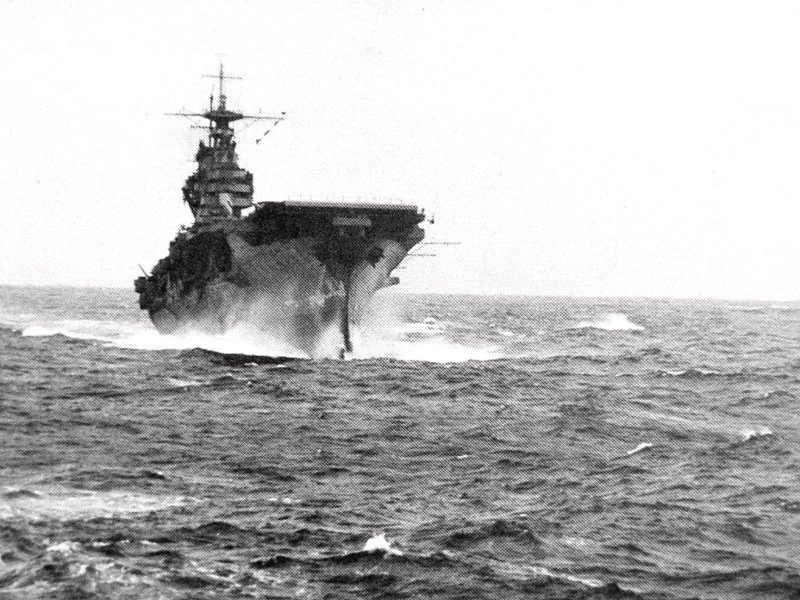
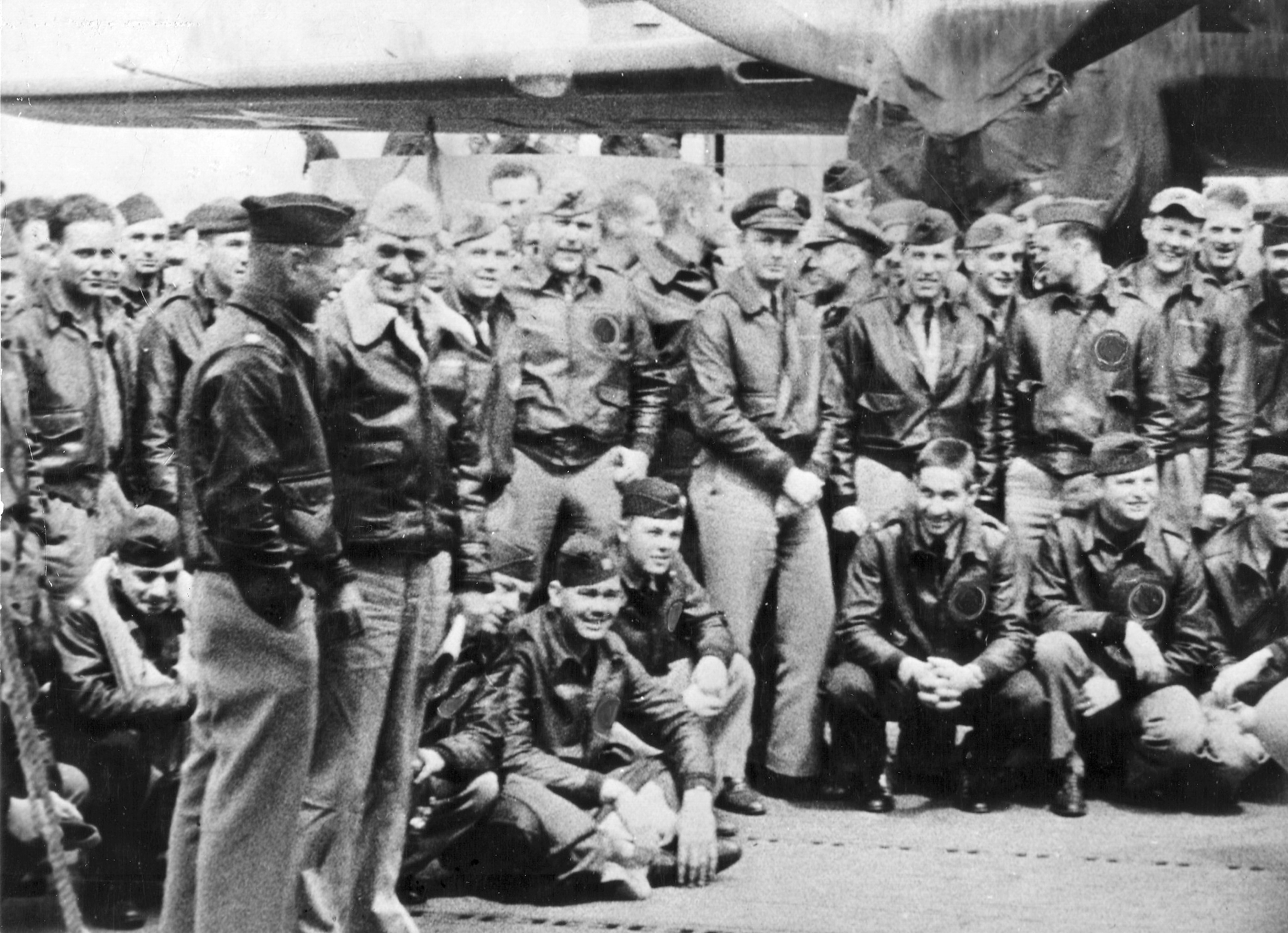
Today marks the 77th anniversary of the Doolittle Raid on Tokyo. 80 US Army Air Corps flyers manning 16 B-25 Mitchell bombers conducted a mission from the deck of the USS Hornet CV-8 which though it caused little damage changed the course of World War Two in the Pacific.

<img src=”https://padresteve.com/wp-content/uploads/2015/04/marc_a-_mitscher_and_james_doolittle.jpg?w=300&h=217″ class=”aligncenter size-medium wp-image-16779″ width=”300″ height=”217″ data-attachment-id=”16779″ data-permalink=”https://padresteve.com/2015/04/21/greetings-from-shangri-la-the-doolittle-raid/marc_a-_mitscher_and_james_doolittle/” data-orig-file=”https://padresteve.com/wp-content/uploads/2015/04/marc_a-_mitscher_and_james_doolittle.jpg” data-orig-size=”2785,2018″ data-comments-opened=”1″ data-image-meta=”{” data-image-title=”Marc_A._Mitscher_and_James_Doolittle” data-image-description=”

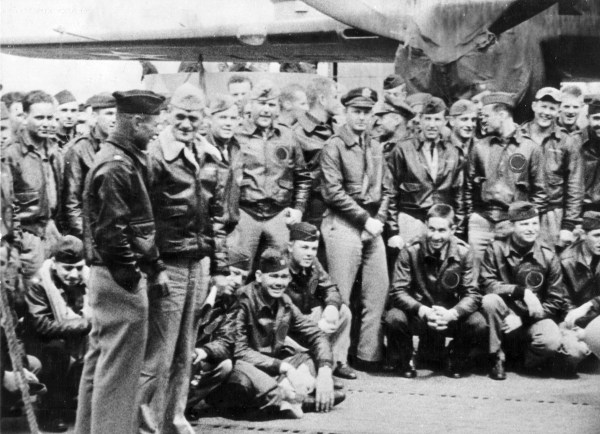
Orders in hand, Capt. Marc A. Mitscher, U.S.N., skipper of the U.S.S. Hornet (CU-8) chats with Maj. Gen. James Doolittle, U.S. Army. Some of the 80 Army fliers who took part in the historic Japanese raid are pictured with the two fliers.

” data-medium-file=”https://padresteve.com/wp-content/uploads/2015/04/marc_a-_mitscher_and_james_doolittle.jpg?w=300&h=217&#8243; data-large-file=”https://padresteve.com/wp-content/uploads/2015/04/marc_a-_mitscher_and_james_doolittle.jpg?w=500&#8243; srcset=”https://padresteve.com/wp-content/uploads/2015/04/marc_a-_mitscher_and_james_doolittle.jpg?w=300&h=217 300w, https://padresteve.com/wp-content/uploads/2015/04/marc_a-_mitscher_and_james_doolittle.jpg?w=600&h=434 600w, https://padresteve.com/wp-content/uploads/2015/04/marc_a-_mitscher_and_james_doolittle.jpg?w=150&h=109 150w” sizes=”(max-width: 300px) 100vw, 300px” style=”height: auto; max-width: 100%; border: 0px; margin-bottom: 2px”>

Doolittle and his Airmen with Hornet’s C.O. Captain Marc Mitscher 

The genus of the strike came from the desire of President Franklin Roosevelt to bomb Japan as soon as possible during a meeting just prior to Christmas 1941. Various aircraft types were considered and in the end the military chose the B-25 because it had the requisite range and had the best characteristics. Aircraft and their crews from the 17th Bomb Group which had the most experience with the aircraft were modified to meet the mission requirements. Lieutenant Colonel Jimmy Doolittle was selected to lead the mission.

Once the aircraft were ready they and their crews reported to Eglin Field for an intensive three week period of training. Supervised by a Navy pilot the crews practiced simulated carrier take offs, low level flying and bombing, night flying and over water navigation. When the training was complete the aircraft and crews and support personnel flew to McClellan Field for final modifications and then to NAS Alameda California where they were embarked on the Hornet Hornet’s air group had to be stowed on the ships hanger deck since the 16 B-25s had to remain of the flight deck. Each bomber was loaded with 4 specially modified 500 lb. bombs, three high explosive and one incendiary.

Departing Alameda on April 2nd the Hornet and her escorts, Hornet’s Task Force 18 rendezvoused with the Admiral William “Bull” Halsey’s Task Force 16 built around the USS Enterprise CV-6. task Force 16 provided escort and air cover during the mission. The carriers, escorted by 4 cruisers, 8 destroyers and accompanied by two oilers hoped to get close enough to the Japanese home islands so that the raiders could reach bases in allied China.

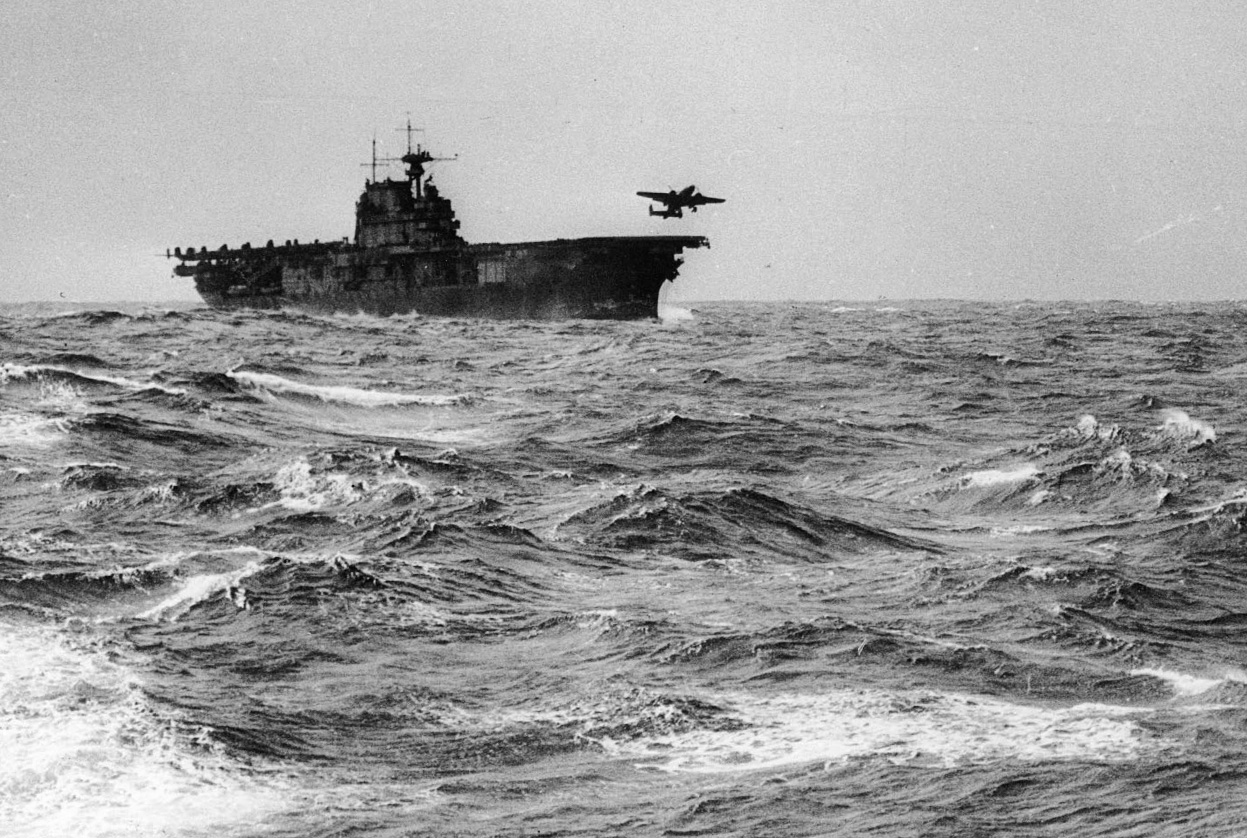
Hornet in Heavy Seas while launching the Raiders

The destroyers and slow oilers broke off on the evening of the 17th after refueling the carriers and cruisers. The two carriers and the cruisers then commenced a high speed run to get into range. However early in the morning of April 18th the ships were sighted by a Japanese patrol boat, the #23 Nitto Maru which was quickly sunk by the USS Nashville but not before it got off a radio message alerting the Japanese command. However the Japanese knowing that carrier aircraft had a relatively short range did not expect an attack. However, realizing the danger that the sighting brought, Mitscher elected to launch immediately, even though it meant that bombers would have to ditch their aircraft or attempt to land well short of the friendly Chinese airfields. The launch was 10 hours earlier and about 170 miles farther out from the Chinese bases than planned.

B-25 Launching from Hornet

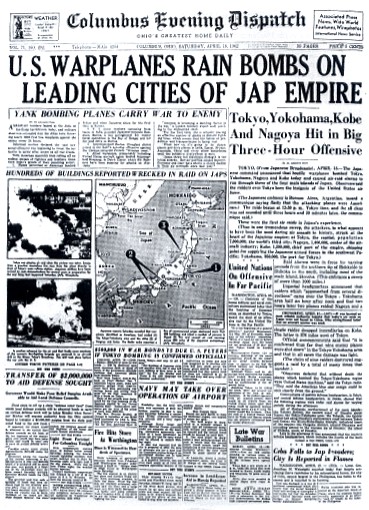
Flying in groups of two to four aircraft the raiders struck the Japanese cities of Tokyo, Yokohama, Yokosuka, Nagoya, Kobe and Osaka. Minimal damage was done and only one aircraft was damaged. However they needed to fly nearly 1500 more miles to get to areas of China unoccupied by Japanese forces. Miraculously most of the aircraft and crews managed to find refuge in China. 69 of the 80 pilots and crew members avoided death or capture. Two flyers drowned, one died when parachuting from his aircraft. Eight men were captured. Of those captured by the Japanese three, Lieutenants William Farrow, Dean Hallmark and Corporal Harold Spatz were tried and executed for “war crimes” on October 15th 1942.

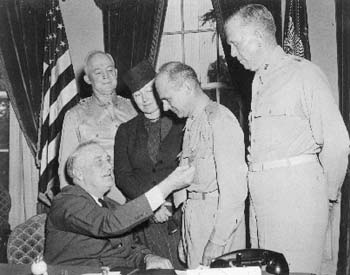
Many of the surviving flyers continued to serve in China while others continued to serve in North Africa and Europe, another 11 died in action following the raid. Doolittle felt that with the loss of all aircraft and no appreciable damage that he would be tried by courts-martial. Instead since the raid had so bolstered American morale he was awarded the Medal of Honor, promoted to Brigadier General and would go on to command the 12th Air Force, the 15th Air Force and finally the 8th Air Force.

The raid shook the Japanese, especially the leadership of the Imperial Navy who had allowed American aircraft to strike the Japanese homeland. The attack helped convince Admiral Isoroku Yamamoto that an attack on Midway was needed in order to destroy the American Carriers and the threat to the home islands.

When asked by a reporter about where the attack was launched from, President Roosevelt quipped “Shangri-La” the fictional location of perpetual youth in the Himalayas’ made famous in the popular book and movie Lost Horizon.

The raid in terms of actual damage and losses to the attacking forces was a failure, but in terms of its impact a major victory of the United States. The attack was psychologically devastating to Japanese leaders, including Prime Minister Hideki Tojo, whose personal aircraft was nearly hit by one of the raiders and Admiral Isoroku Yamamoto, who felt personally humiliated and dishonored by the fact that bombers launched from American carriers.

Likewise the raid gave the people of the United States a huge morale boost at a time when very little was going right. It forced the Japanese Navy to launch the attack on Midway that turned out to be a disaster, decimating the best of the Japanese Naval Air Forces and the loss of four aircraft carriers and enabled the US Navy to take the offensive two months later at Guadalcanal.

Franklin Roosevelt Awards Medal of Honor to Jimmy Doolittle 

In the years after the war the survivors would meet to toast each other and to reminisce about their experiences. Those meetings stopped several years ago and in 2017 LTC Dick Cole was the last of Doolittle’s raiders still alive. He passed away just over a week ago on April 9th in San Antonio. A memorial service will be held for him there on Thursday the 18th Of April. He will be buried in Arlington National Cemetery.

Now that he and the rest of the Doolittle Raiders have passed away it is up to us to never forget the heroism, sacrifice and service in a mission the likes of which had never before been attempted, and which would in its own way help change the course of the Second World War.

Since most of us have never had to make that choice, and our President dodged the draft under the unusual circumstances often given to the children of the wealthy, we should ask what we would do if we were in Dick Cole’s shoes, or for that matter any of the men involved in the Doolittle Raid.

Since I have been serving as a volunteer since 1981 with multiple combat deployments to my name, and I. All of which I put my life on the line unarmed, and I still serve, so I know what I would do. However, that being said I really do have to wonder about most Americans, including those of my own generation who claim to support the troops without ever serving a day in uniform or even volunteering in the Peace Corps, Americorps, or even with the Red Cross.

The devotion of these men is seldom seen today. Our President routinely mocks those killed, wounded, or taken prisoner in war as “losers” and on the Howard Stern Radio program described avoiding sexually transmitted diseases in the 1980s as his “personal Vietnam.”

But I digress… the Greatest Generation is passing away. They fought fascism, the Nazis, and the Japanese Empire, and then many continued to serve during the Cold War, and in Korea, and some up to Vietnam. It is up to us the living to not disgrace their memory by forgetting them, or even worse, pretending that avoiding STDs is the equivalent of serving in harms way.

I think of the words of the character played by Jose Ferrer in the novel and movie written by Herman Wouk, The Caine Mutiny:

So until tomorrow, either put up, or shut up, especially if you wear the Red MAGA hat. Being a true American Patriot is not based on political ideology, Party, race, or religion. It is all about upholding the foundational principle of the Declaration: “We believe that all men are created equal, and are endowed by their creator with certain unalienable rights, among them being life, liberty, and the pursuit of happiness.”

After all, that is the foundational principal of the United States. It is true for all of us, or none of us, for once those rights are denied to anyone, the precedent can be used against any of us. To fall back on a quote from Captain Jean Luc Picard in the Star Trek the Next Generation episode The Drumhead:

“You know, there are some words I’ve known since I was a schoolboy: “With the first link, the chain is forged. The first speech censured, the first thought forbidden, the first freedom denied, chains us all irrevocably.” Those words were uttered by Judge Aaron Satie, as wisdom and warning. The first time any man’s freedom is trodden on, we’re all damaged. I fear that today…”

Until tomorrow,

Peace

Padre Steve+

2 Comments

Filed under aircraft, History, Military, national security, News and current events, Political Commentary, US Army Air Corps, US Navy, World War II at Sea

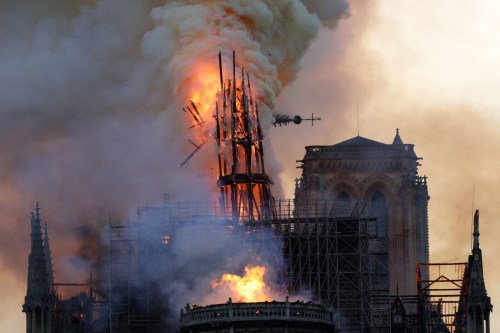
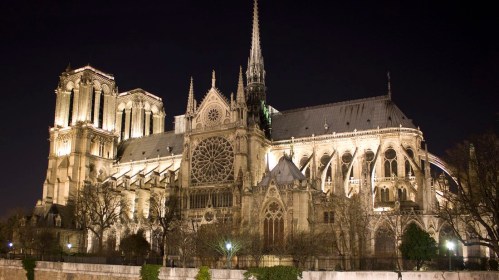
A Loss for France and Humanity: Notre Dame Burns

Friends of Padre Steve’s World,

A terrible loss for France and Humanity. I visited Notre Dame in May 2004 . I have been to many English, German, Dutch Cathedrals, but this one was special. Back then I was overwhelmed by the history, architecture, art, and the possibilities yet flaws of humanity and Catholicism.

While some artwork had been removed due to the renovation, so much architecture, and history of 800 plus years was destroyed. One does not have to be a Catholic or French to understand this. In my bad French I say “Mes amis français, mon cœur s’adresse à vous” (My French friends, my heart goes out to you.)

This cathedral is one of the most historic and iconic works of Gothic architecture. The spire, The towers, and the flying buttresses. I am so glad that my undergraduate Western Civilization professor, Delmar McComb at San Joaquin Delta College spent the time to help me appreciate such works of architecture and art. I wish more people in this country would come to a greater appreciation of such wonderful aged, and priceless works. Instead we fill our world with gaudy and banal buildings that will not stand the test of time, buildings like Trump Tower.

Victor Hugo wrote.

The church of Notre-Dame de Paris is still no doubt, a majestic and sublime edifice. But, beautiful as it has been preserved in growing old, it is difficult not to sigh, not to wax indignant, before the numberless degradations and mutilations which time and men have both caused the venerable monument to suffer, without respect for Charlemagne, who laid its first stone, or for Philip Augustus, who laid the last.

On the face of this aged queen of our cathedrals, by the side of a wrinkle, one always finds a scar. Tempus edax, homo edacior; which I should be glad to translate thus: time is blind, man is stupid.

I will close with that.

Peace

Padre Steve+

6 Comments

Filed under History, Loose thoughts and musings, News and current events