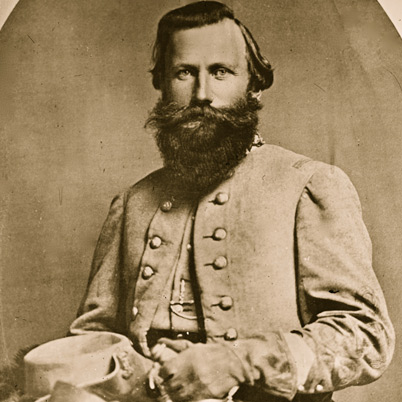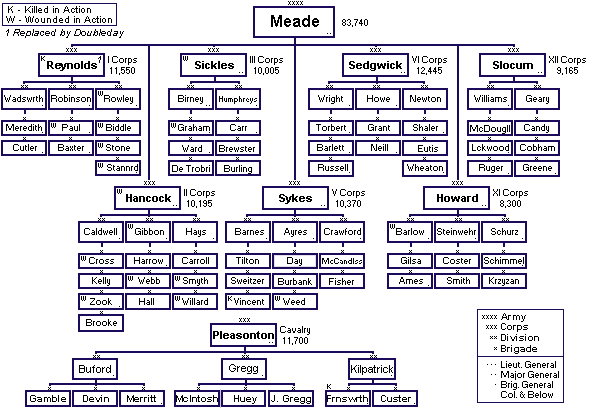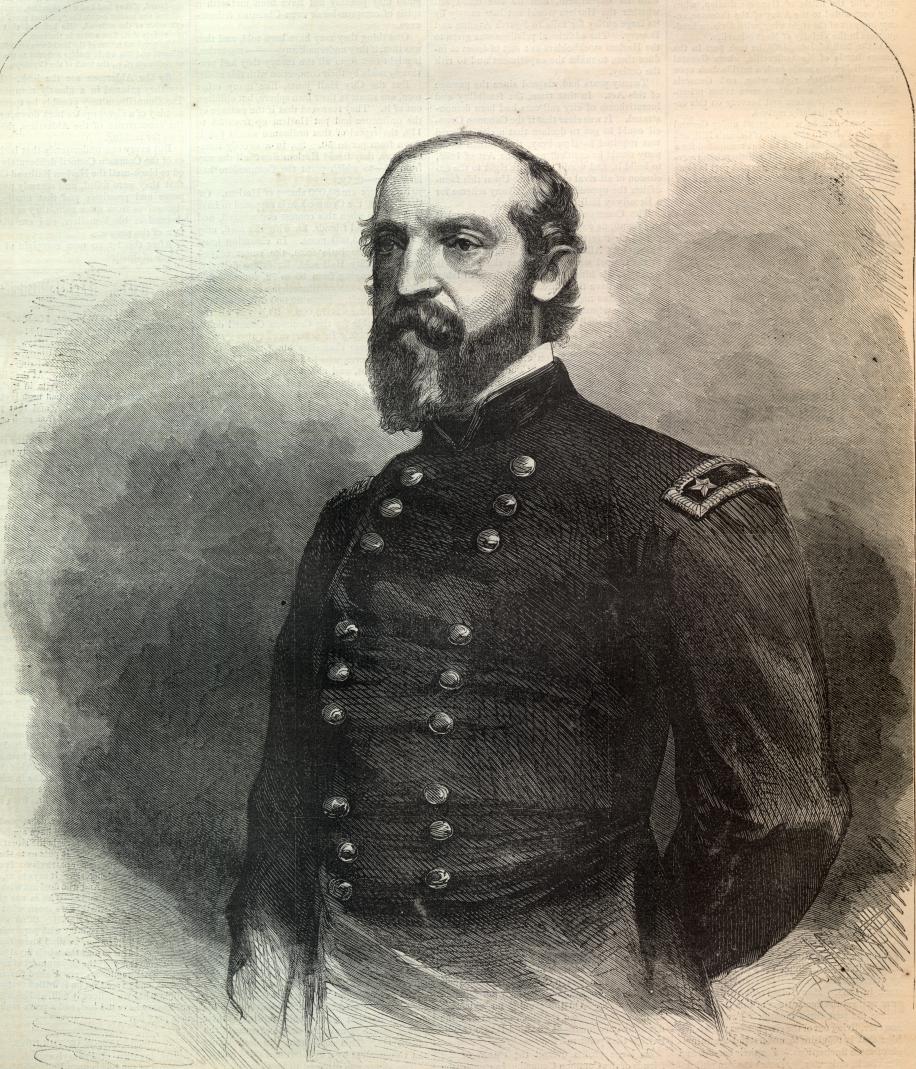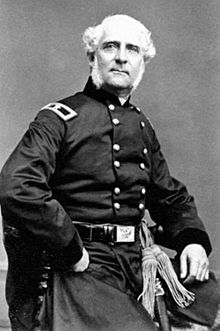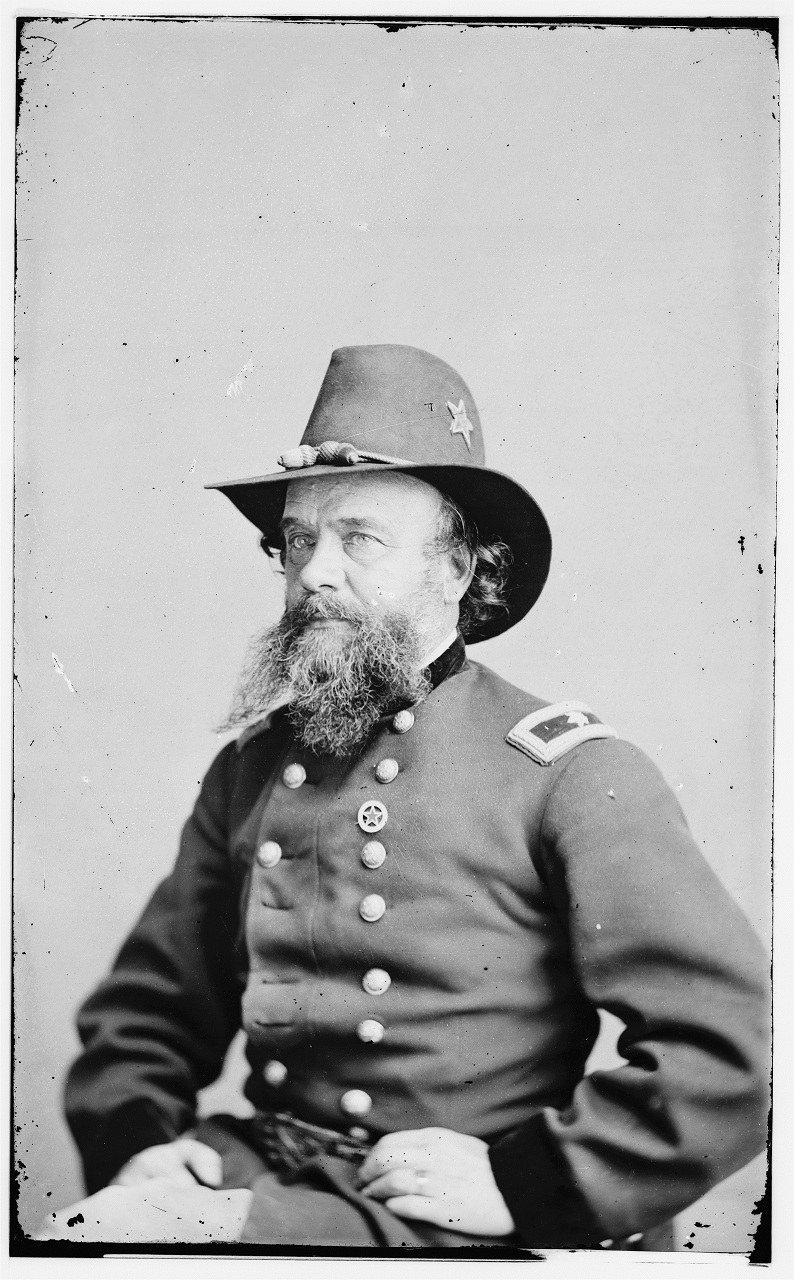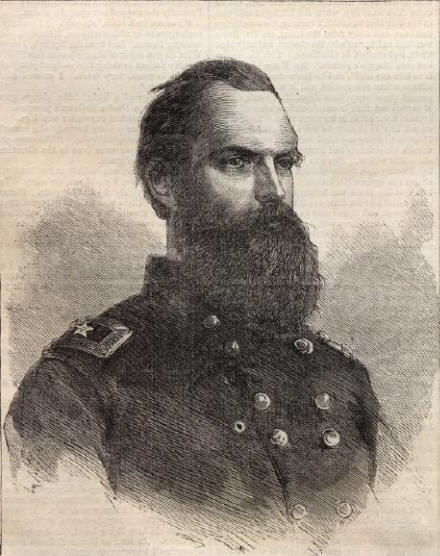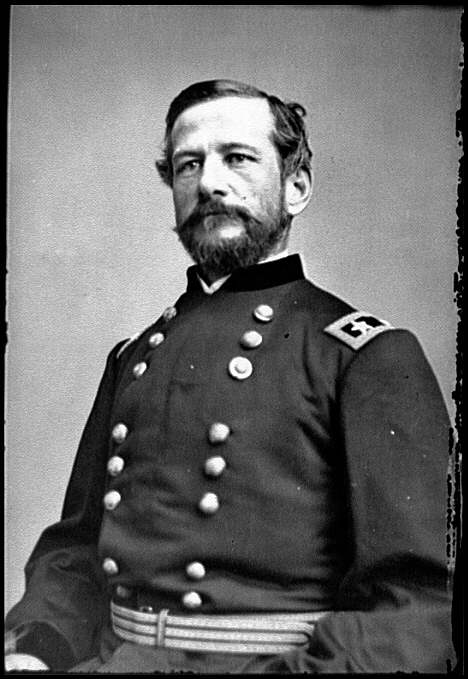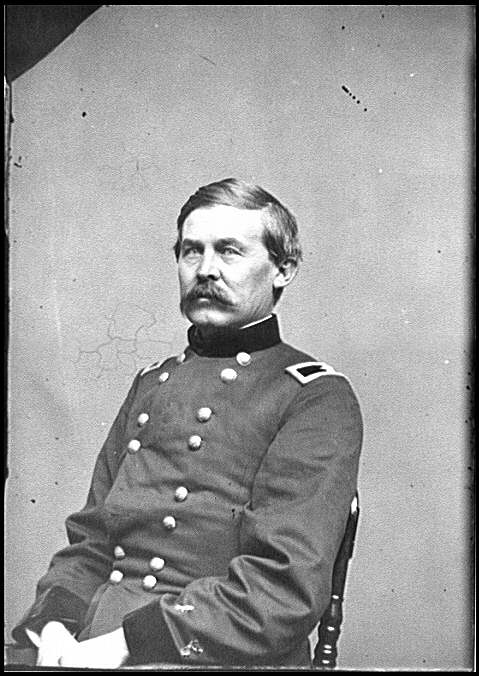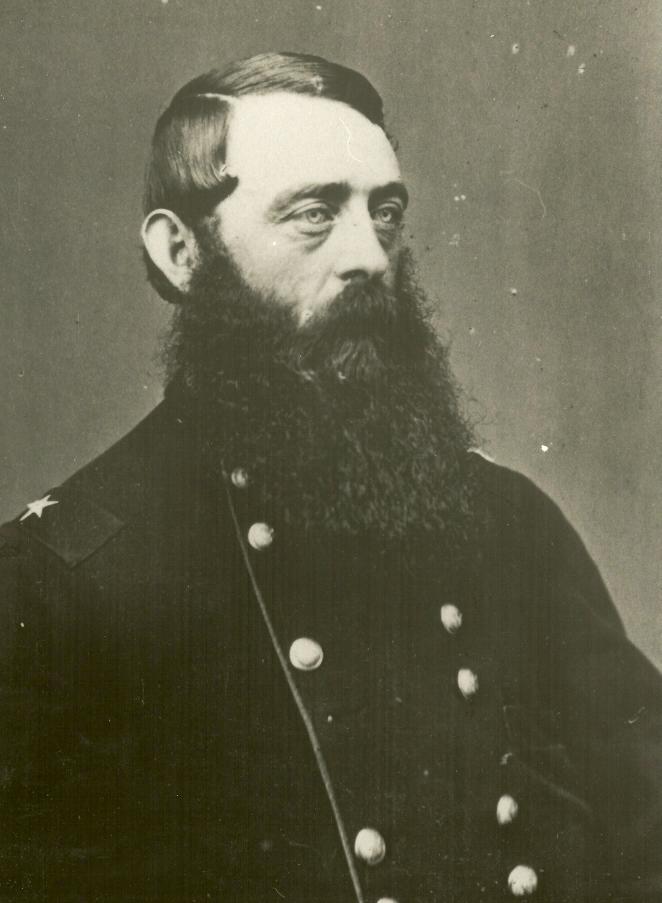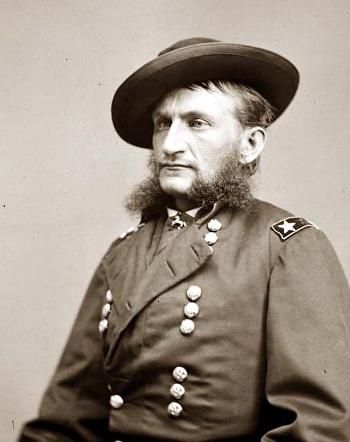
Tag Archives: john buford

“A Spirit of Unbelief”: A.P. Hill, Harry Heth and the Prelude to the Battle of Gettysburg

Hill.28135413_stdLieutenant General A.P. Hill

Note: One of the most important things to understand about the Battle of Gettysburg or for that matter any battle or campaign is leadership as well as organizational structure and climate of command. The study of A.P. Hill’s Third Corps is important to understanding how the battle unfolds and what happens at Gettysburg particularly on July 1st. In our understanding “Successful mission command demands that subordinate leaders at all echelons exercise disciplined initiative, acting aggressively and independently to accomplish the mission. Essential to mission command is the thorough knowledge and understanding of the commander’s intent at every level of command.”

While the leaders at Gettysburg on both sides would be unaware of our present definition they certainly would have been acquainted with the maxims of Napoleon, who many studied under Dennis Hart Mahan at the West Point. Napoleon noted: “What are the conditions that make for the superiority of an army? Its internal organization, military habits in officers and men, the confidence of each in themselves; that is to say, bravery, patience, and all that is contained in the idea of moral means.”

Likewise in a maxim that has direct application to the Confederate campaign in Pennsylvania Napoleon noted “To operate upon lines remote from each other and without communications between them, is a fault which ordinarily occasions a second. The detached column has orders only for the first day. Its operations for the second day depend on what has happened to the main body. Thus according to circumstances, the column wastes its time in waiting for orders or it acts at random….” [1]

I have spent more time in this chapter developing the issues of organization, leadership, climate of command and relationships between leaders because of their importance to the campaign. From these students should be able to draw lessons that would be applicable to leadership, organization and campaigning at the operational level of war.

As the Army of Northern Virginia began to concentrate near Cashtown after the reports that the Army of the Potomac was in Maryland it was Lieutenant General A.P. Hill’s Third Corps that was nearest to Gettysburg. Major General Harry Heth’s division led the corps and arrived on June 29th followed by Major General Dorsey Pender’s division on the 30th. Hill ordered his last division under the command of Major General Richard Anderson to remain behind and join the corps on July 1st. [2]

On the 30th Harry Heth sent Johnston Pettigrew’s Brigade to Gettysburg to “search the town for army supplies (shoes especially), and to return the same day.” [3] It was the first in a series of miscalculations that brought Lee’s army into a general engagement that he wished to avoid.

The Confederate Third Corps commanded by Lieutenant General Ambrose Powell (A.P.) Hill had been formed as part of the reorganization of the army following Stonewall Jackson’s death after the Battle of Chancellorsville. Hill had a stellar reputation as a division commander; his “Light Division” had distinguished itself on numerous occasions, especially at Antietam where its timely arrival after a hard forced march from Harper’s Ferry helped save Lee’s army late in the battle. At Chancellorsville Hill briefly succeeded Jackson until he too was wounded.

But that being said Hill was no stranger to controversy, beginning with a clash with James Longstreet during the Seven Days battles in which time Longstreet placed Hill under arrest and Hill challenged Longstreet to a duel. Lee quickly reassigned Hill to Jackson’s command as Jackson was operating in a semi-independent assignment. [4] Hill was in an intractable controversy with Stonewall Jackson for nearly a year until Jackson succumbed to his wounds. Jackson at one point during the invasion of Maryland prior to Antietam had Hill placed under arrest for the number of stragglers that he observed in Hill’s hard marching division as well as other errors that Jackson believed Hill had made. The dispute continued and the animosity deepened between the two men and in January 1863 Hill asked Lee for a trial by courts-martial on charges preferred against him by Jackson. Lee refused this and wrote to Hill: “Upon examining the charges in question, I am of the opinion that the interests of the service do not require that they be tried, and therefore, returned them to General Jackson with an indorsement to that effect….” [5] Just before Chancellorsville Jackson wrote to Lee “I respectfully request that Genl. Hill be relieved of duty in my Corps.” This time Lee simply ignored the request and though the two generals remained at loggerheads they also remained at their commands at Chancellorsville. [6]

Hill was recommended for promotion to Lieutenant General and command of the new Third Corps by Lee on May 24th and was promoted over the heads of Harvey Hill and Lafayette McLaws. The move displeased Longstreet who considered McLaws “better qualified for the job” and but who felt that the command should have gone to Harvey Hill whose “record was as good as that of Stonewall Jackson…but, not being a Virginian, he was not so well advertised.” [7]

Hill was slightly built and high strung. “Intense about everything” Hill was “one of the army’s intense disbelievers in slavery.” [8] Hill was an 1847 graduate of West Point and briefly served in Mexico but saw no combat. He spent some time in the Seminole wars and in garrison duty along the East Coast, spending 1855-1860 in the Coastal Survey and resigned his commission before Virginia’s secession. At the outbreak of the war he “received his commission as colonel, and soon trained one of Johnston’s best regiments in the Valley.” [9] He commanded a brigade under Longstreet on the Peninsula and was promoted to Major General and command of a division in May 1862. He was plagued by health problems which had even delayed his graduation from West Point, health issues that would arise on the first day at Gettysburg.

Hill’s Third Corps was emblematic of the “makeshift nature of the reorganization of the whole army.” [10] It was composed of three divisions; the most experienced being that of the recently promoted and hard fighting Major General Dorsey Pender. Pender’s division, was built around four excellent brigades from Hill’s old “Light Division” one of which Pender had commanded before his promotion. Hill strongly recommended Pender’s promotion which was accepted by Lee. Pender found the command to be a heavy burden. He was “an intelligent, reflective man, deeply religious and guided by a strong sense of duty….” [11]

Hill’s second experienced division was that of Major General Richard Anderson, transferred from Longstreet’s First Corps, something else which failed to endear Hill to Longstreet. [12] The unassuming Anderson had distinguished himself as a brigade and division commander in Longstreet’s corps, but in “an army of prima donnas, he was a self-effacing man, neither seeking praise for himself nor winning support by bestowing it on others.” [13] At Chancellorsville he fought admirably and Lee wrote that Anderson was “distinguished for the promptness, courage and skill with which he and his division executed every order.” [14] With four seasoned brigades under excellent commanders it was a good addition to the corps, although the transition from Longstreet’s stolid and cautious style of command to Hill’s impetuous style introduced “another incalculable of the reshuffled army.” [15]
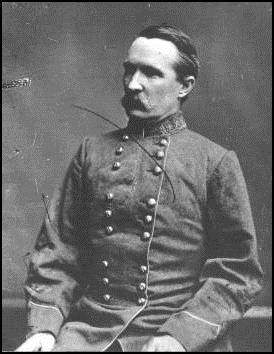
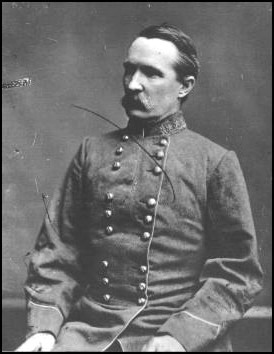
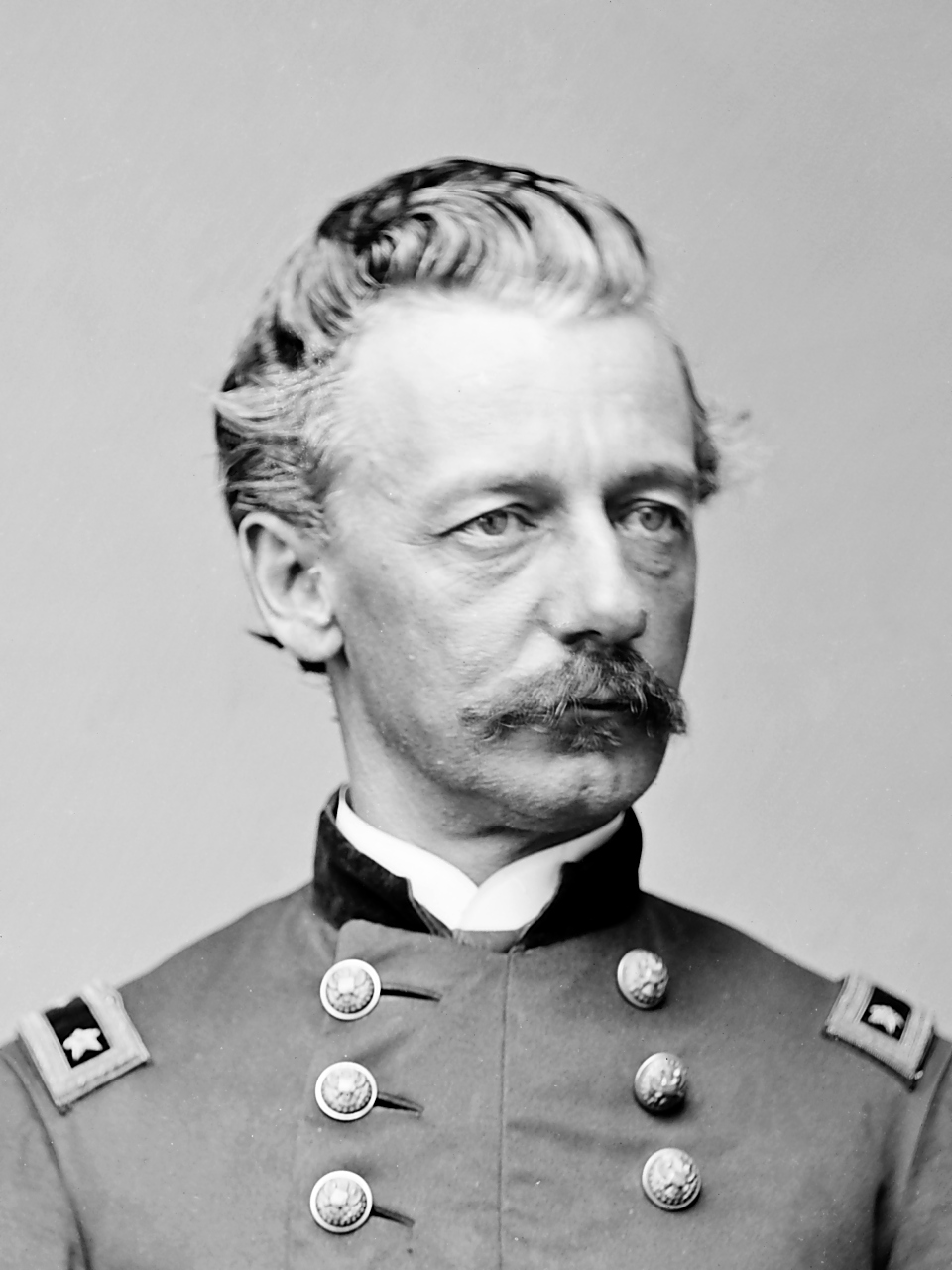
heth

Major General Harry Heth

Major General Harry Heth’s division was the final infantry division assigned to the corps. This division was recently formed from two brigades of Hill’s old Light Division and “the two new brigades that Jefferson Davis had forced on an already disrupted army organization.” [16] The organization of this division as well as its leadership would be problematic in the days to come, especially on June 30th and July 1st 1863.

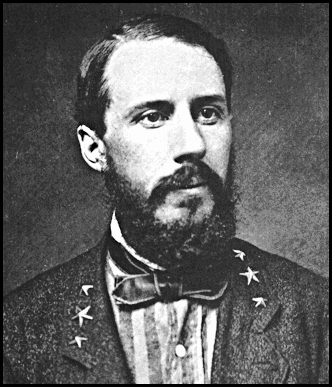
Heth like Pender was also newly promoted to his grade and the action at Gettysburg would be his first test in division command. Heth was a native Virginian, well connected politically who through his social charm had “many friends and bound new acquaintances to him” readily. [17] Heth was a West Point graduate who had an undistinguished academic career graduating last in the class of 1847. His career in the ante-bellum army was typical of many officers, he served “credibly in an 1855 fight with Sioux Indians” but his real claim to fame was in authoring the army’s marksmanship manual which was published in 1858. [18]

Heth’s career with the Confederate army serving in western Virginia was undistinguished but he was a protégé of Robert E. Lee who recommended him as a brigade commander to Jackson before Chancellorsville. Tradition states that of all his generals that Heth was the only one “whom Lee called by his first name.” [19] A.P. Hill when writing Lee about the choice of a successor for the Light Division noted that Heth was “a most excellent officer and gallant soldier” but in the coming campaign “my division under him, will not be half as effective as under Pender.” [20] Douglas Southall Freeman noted that Heth was “doomed to be one of those good soldiers…who consistently have bad luck.” [21]

Heth’s division was composed of two depleted brigades from the Light Division which had taken heavy casualties at Chancellorsville. The brigade commanded by James Archer from Alabama and Mississippi was “well led and had a fine combat reputation.” But the second brigade was more problematic. A Virginia brigade it had once been considered one of the best in the army had deteriorated in quality following the wounding of its first commander Brigadier General Charles Field. Heth took command of it at Chancellorsville and both he and the brigade performed well, but when Heth was promoted the lack of qualified officers left it under the command of its senior colonel, John Brockenbrough. [22] His third brigade came from Mississippi and North Carolina and was commanded by Brigadier General Joe Davis whose uncle was President Jefferson Davis. Davis had served on his uncle’s staff for months and had no combat experience. [23] One author noted that Davis’s promotion to Brigadier General “as unadulterated an instance of nepotism as the record of the Confederacy offers.” [24] His subordinate commanders were no better, one William Magruder was so bad that J.E.B. Stuart suggested that “he have his commission revoked” and only one of the nine field grade officers in his brigade had military training, and that from the Naval Academy. [25]
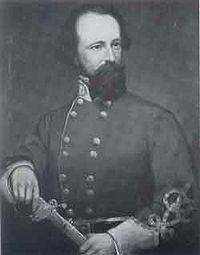
pettigrew

Brigadier General Johnston Pettigrew

Heth’s largest brigade was new to the army. Commanded by the North Carolina academic Johnston Pettigrew it had no combat experience though Pettigrew was considered a strong leader, badly wounded at Seven Pines and thinking his wound mortal “he refused to permit his men to leave the ranks to carry him to the rear” [26] and was captured but later paroled and returned to the army later in the year.

Hill was under the impression that Meade’s army was still miles away, having just come from meeting Lee who assured him that “the enemy are still at Middleburg,” (Maryland) “and have not yet struck their tents.” [27] With that assurance Heth decided to use June 30th to send Pettigrew’s brigade on the foraging expedition to Gettysburg. An officer present noted that Heth instructed Pettigrew “to go to Gettysburg with three of his regiments present…and a number of wagons for the purpose of collecting commissary and quartermaster stores for the use of the army.” [28]

However Heth did instruct Pettigrew in no uncertain terms not to “precipitate a fight” should he encounter “organized troops” of the Army of the Potomac. [29] Heth was specific in his report that “It was told to Pettigrew that he might find in the town in possession of a home guard,…but if, contrary to expectations, he should find any organized troops capable of making resistance., or any part of the Army of the Potomac, he should not attack it.” [30]

That in mind one has to ask the question as to why Heth would employ “so many men on a long, tiring march, especially as without a cavalry escort he took the risk of sending them into a trap” when his “objects hardly justified” using such a large force. [31] Likewise it has to be asked why the next day in light of Lee’s standing orders not to provoke an engagement that Hill would send two divisions, two thirds of his corps on a reconnaissance mission. Some have said that Hill would have had to move to Gettysburg on July 1st anyway due to forage needs of the army, [32] but this is not indicated in any of Hill or Heth’s reports.

As his troops neared Gettysburg Pettigrew observed the Federal cavalry of Buford’s 1st Cavalry Division as they neared the town. He received another report “indicating that drumming could be heard in the distance – which might mean infantry nearby, since generally cavalry generally used only bugles.” [33] He then prudently and in accordance with his orders not to precipitate a fight “elected to withdraw rather than risk battle with a foe of unknown size and composition.” [34] His troops began their retrograde at 11 a.m. leaving Buford’s cavalry to occupy the town at ridges. On Confederate wrote “in coming in contact with the enemy, had quite a little brush, but being under orders not to bring a general engagement fell back, followed by the enemy.” [35]

Upon returning Pettigrew told Hill and Heth that “he was sure that the force occupying Gettysburg was a part of the Army of the Potomac” but Hill and Heth discounted Pettigrew’s report. [36] “Heth did not think highly of such wariness” and “Hill agreed with Heth” [37] Hill believed that nothing was in Gettysburg “except possibly a cavalry vidette.” [38] Hill was not persuaded by Pettigrew or Pettigrew’s aide Lieutenant Louis Young who had previously served under Hill and Pender who reported that the “troops that he saw were veterans rather than Home Guards.” [39] Hill reiterated that he did not believe “that any portion of the Army of the Potomac was up” but then according to Young Hill “expressed the hope that it was, as this was the place he wanted it to be.” [40] The West Point Graduates Hill and Heth may have manifested an often typical “distain for citizen soldiers…a professional questioning a talented amateur’s observations” [41] If so it was a distain that would cost the Confederacy dearly in the days to come.

Pettigrew was “aghast at Hill’s nonchalant attitude” [42] and Young was dismayed and later recalled that “a spirit of unbelief” seemed to cloud their thinking. [43] In later years he wrote “blindness in part seems to have come over our commanders, who slow to believe in the presence of an organized army of the enemy, thought that there must be a mistake in the report taken back by General Pettigrew.” [44]

Heth then asked Hill since neither believed Pettigrew’s report “whether Hill would have any objection to taking his division to Gettysburg again to get those shoes. Hill replied “none in the world.” [45] Douglas Southall Freeman wrote “On those four words fate hung” [46] and then, in “that incautious spirit, Hill launched Harry Heth’s division down the Chambersburg Pike and into battle at Gettysburg.” [47]

Notes

[1] Napoleon Bonaparte, Military Maxims of Napoleon in Roots of Strategy: The Five Greatest Military Classics of All Time edited by Phillips, Thomas R Stackpole Books Mechanicsburg PA 1985 p.410

[2] Coddinton, Edwin B. The Gettysburg Campaign, A Study in Command A Touchstone Book, Simon and Shuster New York 1968 p.194

[3] Ibid. Coddinton, The Gettysburg Campaign, A Study in Command p. 263

[4] Dowdy, Clifford. Lee and His Men at Gettysburg: The Death of a Nation Skyhorse Publishing, New York 1986, originally published as Death of a NationKnopf, New York 1958 p.81

[5] Freeman, Douglas Southall, Lee’s Lieutenant’s a Study in Command, One volume abridgement by Stephen W Sears, Scribner, New York 1998 p.460

[6] Sears, Stephen W. Chancellorsville A Mariner Book, Houghton and Mifflin Company, Boston and New York 1996 p.51

[7] Foote, Shelby, The Civil War, A Narrative. Volume Two Fredericksburg to Meridian Random House, New York 1963 p.453

[8] Ibid. Dowdy, Lee and His Men at Gettysburg: The Death of a Nation p.79

[9] Ibid. Freeman Lee’s Lieutenant’s a Study in Command p.109

[10] Ibid. Dowdy, Lee and His Men at Gettysburg: The Death of a Nation p.88

[11] Ibid. Dowdy, Lee and His Men at Gettysburg: The Death of a Nation p.85

[12] Ibid. Dowdy, Lee and His Men at Gettysburg: The Death of a Nation p.86

[13] Ibid. Dowdy, Lee and His Men at Gettysburg: The Death of a Nation p.86

[14] Ibid. Freeman Lee’s Lieutenant’s a Study in Command p.512

[15] Ibid. Dowdy, Lee and His Men at Gettysburg: The Death of a Nation p.86

[16] Ibid. Dowdy, Lee and His Men at Gettysburg: The Death of a Nation p.87

[17] Ibid. Freeman Lee’s Lieutenant’s a Study in Command p.527

[18] Krick, Robert K. Three Confederate Disasters on Oak Ridge: Failures of Brigade Leadership on the First Day of Gettysburg in The First Day at Gettysburg edited by Gallagher, Gary W. Kent State University Press, Kent Ohio 1992 p.96

[19] Ibid. Krick. Three Confederate Disasters on Oak Ridge p.96

[20] Ibid. Freeman Lee’s Lieutenant’s a Study in Command p.527

[21] Ibid. Freeman Lee’s Lieutenant’s a Study in Command p.46

[22] Ibid. Dowdy, Lee and His Men at Gettysburg: The Death of a Nation p.87

[23] Ibid. Freeman Lee’s Lieutenant’s a Study in Command p.533

[24] Ibid. Krick. Three Confederate Disasters on Oak Ridge p.99

[25] Ibid. Krick. Three Confederate Disasters on Oak Ridge p.101

[26] Ibid. Freeman Lee’s Lieutenant’s a Study in Command p.136

[27] Guelzo, Allen C. Gettysburg: The Last Invasion Vintage Books a Division of Random House, New York 2013 p.131

[28] Tredeau, Noah Andre. Gettysburg: A Testing of Courage, Harper Collins Publishers, New York 2002 p.128

[29] Sears, Stephen W. Gettysburg. Houghton Mifflin Co. Boston and New York 2003 p.136

[30] Ibid. Tredeau Gettysburg: A Testing of Courage, p.129

[31] Ibid. Coddinton,. The Gettysburg Campaign, A Study in Command p. 263

[32] Ibid. Guelzo. Gettysburg: The Last Invasion p.131 This argument does have merit based on the considerations Guelzo lists but neither Hill, Heth or Lee make any mention of that need in their post battle reports.

[33] Ibid. Tredeau Gettysburg: A Testing of Courage, p.130

[34] Gallagher, Gary. Confederate Corps Leadership on the First Day at Gettysburg: A.P. Hill and Richard S. Ewell in a Difficult Debut in The First Day at Gettysburg edited by Gallagher, Gary W. Kent State University Press, Kent Ohio 1992 p.42

[35] Ibid. Tredeau Gettysburg: A Testing of Courage, p.135

[36] Ibid. Coddinton, The Gettysburg Campaign, A Study in Command pp. 263-264

[37] Foote, Shelby, The Civil War, A Narrative. Volume Two Fredericksburg to Meridian Random House, New York 1963 p.465

[38] Pfanz Harry W. Gettysburg: The First Day University of North Carolina Press, Chapel Hill and London 2001 p.27

[39] Ibid. Gallagher, Gary. Confederate Corps Leadership on the First Day at Gettysburg p.42

[40] Ibid. Pfanz. Gettysburg: The First Day p.27

[41] Ibid. Gallagher, Gary. Confederate Corps Leadership on the First Day at Gettysburg p.42

[42] Ibid. Guelzo. Gettysburg: The Last Invasion p.131

[43] Ibid. Coddinton, The Gettysburg Campaign, A Study in Command p. 264

[44] Ibid Pfanz Gettysburg: The First Day p.27

[45] Ibid. Coddinton, The Gettysburg Campaign, A Study in Command p. 264

[46] Ibid. Freeman Lee’s Lieutenant’s a Study in Command p. 563

[47] Ibid. Krick. Three Confederate Disasters on Oak Ridge p.94
1 Comment

Filed under civil war, History, leadership, Military

The King of Battle at Gettysburg: Union and Confederate Artillery Types and Organization

cemeteryridgearty

Note to my friends at Padre Steve’s World: This is another in my articles on Gettysburg that I am preparing for my next “Staff Ride” for the incoming class at the Staff College where I teach. Eventually I will have a page with a tab at the top of this site for my readers to access all of those articles.

The Artillery of the Army of the Potomac at Gettysburg proved that it was the “King of Battle” and a key part of Union commanders and their use of combined arms. The superiority of the Federal artillery at Gettysburg over their Confederate counterparts was not simply due to the numbers of guns employed, it was in the manner that they were employed and the manner that Federal commanders employed the artillery under their command.

porteralexanderColonel Porter Alexander

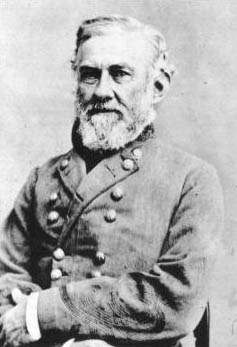
This is not to say that the Confederate artillerymen were inferior to their Federal counterparts, Porter Alexander, who commanded First Corps artillery under Longstreet was an excellent artillery commander, although Brigadier General Henry J. Hunt was by far superior to his Confederate Counterpart Brigadier General William Pendleton. The problems lay in equipment, ammunition and their employment by their carious Corps and division commanders.

henryhuntBrigadier General Harry Hunt

Hunt and Pendleton were both graduates of the West Point, however Pendleton had left active service in the 1830s to become an Episcopal Priest and had no combat experience. Hunt remained in the Army, served in Mexico and at the beginning of the war was the the chief artillery instructor at West Point. His treatise on the use of artillery Instructions for Field Artillery published by the War Department in 1861 was the primary instruction for all Union artillery units.

WNPendeltonBrigadier General William Pendleton

Union and Confederate organizations differed. Hunt was instrumental in reorganizing Union artillery organizations. Brigades retained their assigned batteries for direct support of those units. Divisions and Corps lost their artillery which was brought into an Artillery Reserve for greater flexibility on the battlefield. As such the Artillery Reserve became the instrument of of the Army commander and served as what we would now call “general support” artillery. The organization allowed Meade to better manage his artillery at Gettysburg and employ it where he needed at the time where it was most required. This ensured that Meade and his subordinate commanders had a good command of fires throughout the battle.

HD_WilkesonBattery_z.preview

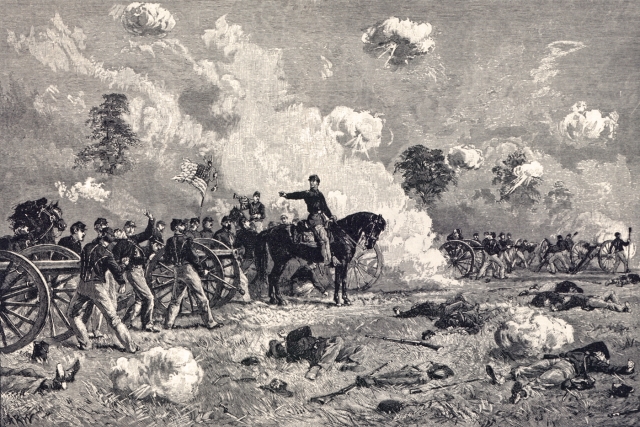
Hunt and his subordinates sought to concentrate their artillery but also to employ cross fires on advancing enemy infantry. During the battle Union artillery was particularly effective during Buford’s delaying action where its skillful employment caused Heth and Pender’s Divisions large number of casualties on July 1st. At Cemetery Hill on the evening of July 1st where Howard’s positioning of batteries on that hill with Steinwehr’s Division ensured that it held.  On July 2nd it was used with great effect during the savage fighting at the Peach Orchard, the Wheat Field, Devil’s Den and Little Round Top. However its greatest effect was in decimating Pickett’s Division and supporting units on July 3rd. 

The Confederate Artillery was assigned to each Army Corps and although Pendleton was Lee’s Artillery Chief he had little influence on the battle. Instead that authority was dispersed to the artillerymen serving under each Corps commander. While this worked well at the corps level it ensured that Lee had no way of effectively coordinating fires throughout the battle. As such on the third day Porter Alexander, a battalion commander and Longstreet’s senior artilleryman was limited to his First Corps batteries and whatever artillery was lent by A. P. Hill’s Third Corps as the artillery of Second Corps was unavailable and on the wrong side of the battlefield when needed.

At the battery level Union artillery was on the whole organized by type in six gun batteries. Confederate artillery units were organized in four or six gun batteries in which types of guns were often mixed, leading to supply problems and inconsistency in rates of fire and range. Union batteries also had better quality ammunition and gunpowder supplies.

smoothboreammorifledammo6pdrcarriagetravelcaisson-and-limber
Field Artillery batteries were of two types. Foot Artillery which accompanied the Infantry and Horse Artillery which accompanied the Cavalry. The crews of the Foot Artillery either marched alongside their guns or rode on the caissons. The crews of the Horse Artillery rode horses in order to better keep up with the Cavalry Units they supported.

Parrott-Answer-LRESM

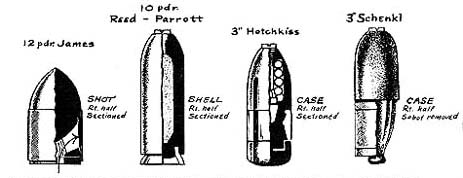
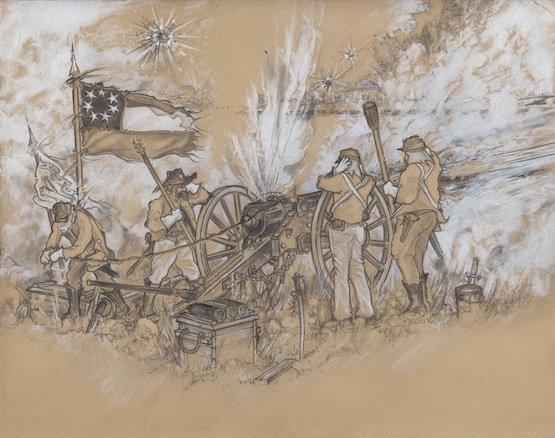
All the field artillery weapons were line of sight weapons. They had neither the range nor the fire direction capability for indirect fire. Ammunition included solid shot, exploding shells and canister which was used at short range against infantry.

The increase in range and effectiveness of rifled muskets made the job of the artilleryman more dangerous than it had been in previous wars. Thus when employed in the offense or during close assaults artillerymen were exposed to musket fire resulting in heavier casualties among the gun crews.

At Gettysburg the Army of the Potomac about 360 guns, the total number of guns available to Lee and the Army of Northern Virginia varies depending on the source between 262 and 241 guns.

The Union for the most part used weapons made in the United States, whereas the Confederates having few ordnance factories of their own were limited and attempted to obtain weapons from Europe. At Gettysburg it had two of the 2.75 inch Whitworth Breechloading Rifles were the most modern and long range weapons on the battlefield and prefigured the field artillery weapons that would dominate the battlefield in the Twentieth Century.

cannons

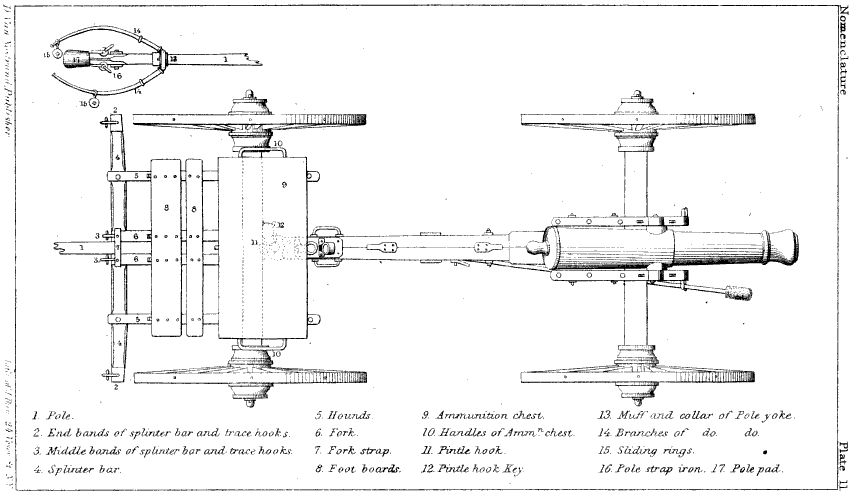
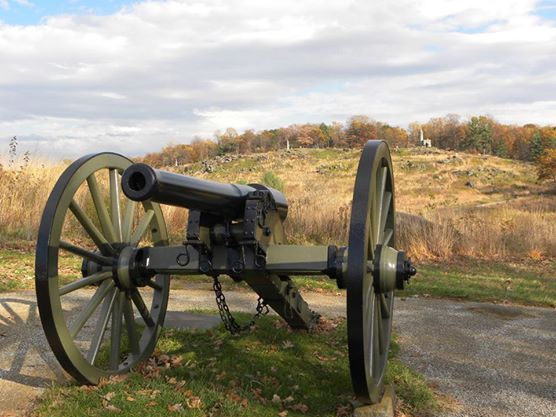
There were three basic types of cannon used at Gettysburg. Rifled cannon, Smoothbores and Howitzers. The bulk of Federal Artillery was made up of rifled cannon, especially the 3” Ordnance Rifle of which Meade had 146 at Gettysburg. There were also 142 of the M 1857 12 pound smoothbore “Napoleon’s” named after Emperor Napoleon III of France. Forty to forty-four percent of the guns available to Lee’s Army of Northern Virginia were Napoleons, of which they had 107 at Gettysburg. The technical details of each type are listed below.

Rifled Cannon
 999130_10152038135167059_1801660138_n

10-Pounder Parrott Rifle, M ’63

Bore Diameter             3.0 in (7.64 cm)
Tube Material              Cast and Wrought Iron
Tube Length                78 in (198 cm)
Tube Weight                890 lb (404 kg)
Powder Charge           1 lb (0.45 kg)
Range (5° Elevation)   2,000 yd (1,829 m)

10-Pounder Parrott Rifle, M ’61

Bore Diameter             2.9 in (7.37 cm)
Tube Material              Cast and Wrought Iron
Tube Length                78 in (198 cm)
Tube Weight                890 lb (404 kg)
Powder Charge           1 lb (0.45 kg)
Range (5° Elevation)   2,000 yd (1,829 m)

At Gettysburg (total M61 and M63)
60 Union; 42 Confederate

20-Pounder Parrott Rifle

Bore Diameter                 3.67 in (9.32 cm)
Tube Material                  Cast and Wrought Iron
Tube Length                    89 in (226 cm)
Tube Weight                    1,750 lb (794 kg)
Powder Charge                2 lb (0.91 kg)
Range (5° Elevation)        2,100 yd (1,920 m)
At Gettysburg 24 Union

3.67-Inch Navy Parrott Rifle

Bore Diameter                 3.67 in (9.32 cm)
Tube Material                  Cast and Wrought Iron
Tube Length                    89 in (226 cm)
Tube Weight                    1,750 lb (794 kg)
Powder Charge               2 lb (0.91 kg)
Range (5° Elevation)       2,100 yd (1,920 m)
At Gettysburg                  4 Confederate
cemeteryridge
3-Inch Ordnance Rifle

Bore Diameter                 3.0 in (7.62 cm)
Tube Material                  Wrought Iron
Tube Length                    73 in (185 cm)
Tube Weight                   816 lb (370 kg)
Powder Charge              1 lb (0.45 kg)
Range (5° Elevation)      1,835 yd (1,678 m)
At Gettysburg                 146 Union; 73 Confederate

14-Pounder James Rifle

Bore Diameter                3.80 in (9.65 cm)
Tube Material                 Bronze
Tube Length                   65 in (165 cm)
Tube Weight                   918 lb (416 kg)
Powder Charge              0.75 lb (0.34 kg)
Range (5° Elevation)     1,700 yd (1,554 m)
At Gettysburg                4 Union

12-Pounder (2.75 Inch) Whitworth Breechloading Rifle

Bore Diameter                2.75 in (7 cm)
Tube Material                 Iron and Steel
Tube Length                   104 in (264 cm)
Tube Weight                   1,092 lb (495 kg)
Powder Charge              1.75 lb (0.79 kg)
Range (5° Elevation)      2,800 yd (2,560 m)
At Gettysburg                  2 Confederate

Blakely Rifle

Bore Diameter                 3.4 in (8.64 cm)
Tube Material                  Steel
Tube Length                    59 in (150 cm)
Tube Weight                    800 lb (363 kg)
Powder Charge               1 lb (0.45 kg)
Range (5° Elevation)       1,850 yd (1,691 m)
At Gettysburg                   3 Confederate

Smoothbore

1497705_10152329726382059_1343167358_n

12-Pounder Napoleon-Federal Manufacture

Bore Diameter               4.62 in (11.73 cm)
Tube Material                Bronze
Tube Length                  66 in (168 cm)
Tube Weight                 1,227 lb (557 kg)
Powder Charge            2.5 lb (1.13 kg)
Range (5° Elevation)    1,619 yd (1480 m)
At Gettysburg               142 Union

12-Pounder Napoleon-Confederate Manufacture

Bore Diameter              4.62 in (11.73 cm)
Tube Material               Bronze
Tube Length                 66 in (168 cm)
Tube Weight                 1,227 lb (557 kg)
Powder Charge            2.5 lb (1.13 kg)
Range (5° Elevation)    1,619 yd (1480 m)
At Gettysburg               107 Confederate

6-Pounder Field Gun

Bore Diameter              3.67 in (9.32 cm)
Tube Material               Bronze
Tube Length                 60 in (152 cm)
Tube Weight                 884 lb (401 kg)
Powder Charge            1.25 lb (0.57 kg)
Range (5° Elevation)    1,523 yd (1,393 m)
At Gettysburg                1 Confederate

Howitzers

12-Pounder Field Howitzer

Bore Diameter              4.62 in (11.73 cm)
Tube Material               Bronze
Tube Length                 53 in (135 cm)
Tube Weight                788 lb (357 kg)
Powder Charge           1 lb (0.45 kg)
Range (5° Elevation)   1,072 yd (980 m)
At Gettysburg               2 Union; 26 Confederate

24-Pounder Field Howitzer

1454601_10152040914857059_709344690_n

Bore Diameter               5.82 in (14.78 cm)    
Tube Material                Bronze
Tube Length                  65 in (165 cm)
Tube Weight                  1,318 lb (598 kg)
Powder Charge             2 lb (0.91 kg)
Range (5° Elevation)     1,322 yd (1,209 m)
At Gettysburg                4 Confederate

20140308-231743.jpg

So until tomorrow,

Peace

Padre Steve+

1 Comment

Filed under civil war, History, Military

“For God’s Sake Forward!” John Reynolds at Gettysburg

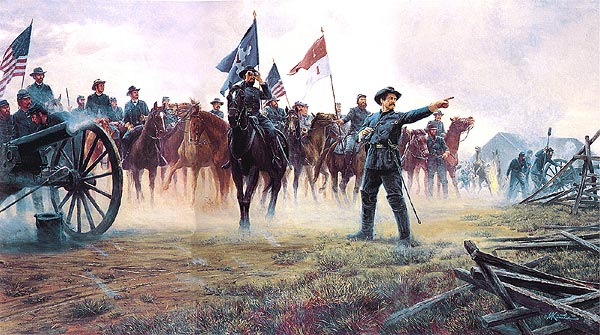
reynoldsz_maritato_ironbrigadeforward

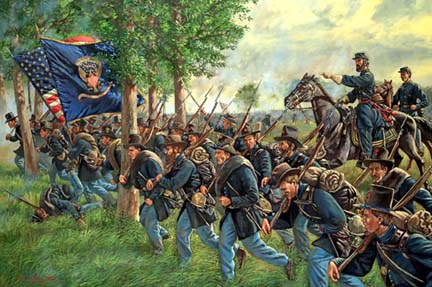
Iron Brigade Forward! Battle of Gettysburg, PA – July 1, 1863 by Mark Maritato

“…by his promptitude and gallantry he had determined the decisive field of the war, and he opened brilliantly a battle which required three days of hard fighting to close with a victory.” Major General Harry Hunt, Chief of Artillery, Army of the Potomac on the actions of Major General John F Reynolds at Gettysburg

Major General John Reynolds was one of the finest commanders on either side during the Civil War. He graduated in the middle of his class at West Point in 1841 and served in the artillery. He fought during the war with Mexico and was promoted for bravery twice, to Captain at Monterrey and Major at Buena Vista. Following the war he remained in the army serving in the west and as Commandant of the Corps of Cadets at West Point from 1860 to June of 1861 when he was appointed as Colonel of the 14th U.S. Infantry regiment. However before he could take command of that unit he was promoted to Brigadier General.

Reynolds commanded a brigade of Pennsylvania volunteers on the Peninsula and was captured on June 27th but was released in a prisoner exchange on August 15th. He fought as a Division commander at Second bull Run where his Division held firm as much of the army retreated. He missed Antietam as he was called to train Pennsylvania militia when Lee invaded Maryland. he commanded I Corps at Fredericksburg and again at Chancellorsville.

Reynolds now held command of his troops on his home soil. A native of Lancaster Pennsylvania  Reynolds was the senior Corps commander in the Army of the Potomac. Considered by his peers and superiors to be the best commander in the Army he had been given command of a wing of the Army, his own I Corps, Oliver Howard’s XI Corps and John Sedgewick’s III Corps. He also had John Buford’s 1st Cavalry Division under his command.

Early in June Abraham Lincoln had offered command of the Army of the Potomac to Reynolds. However according to some credible reports Reynolds set a condition which Lincoln in the political climate of the time could not grant. Reynolds insisted he would be free from the political interference which had beset previous Army commanders. Both Reynolds’ request and Lincoln’s response are understandable.

Reynolds was not a fan of Major General Joseph Hooker and opposed Hooker’s decision to retreat at Chancellorsville. When Hooker was relieved of command of the Army by Lincoln, Major General George Meade, commander of V Corps another Pennsylvanian took his place. Reynolds, a friend of Meade supported the decision and Meade, who trusted Reynolds’ judgement and abilities kept him in his key role as commander of the Left Wing.

Reynolds’ wing of three Infantry corps and Buford’s Cavalry division acted as the advance elements of the Army. Late in the afternoon of June 30th Buford’s troops observed Johnston Pettigrew’s brigade of Harry Heth’s division near Gettysburg. Pettigrew on detecting Buford’s cavalry refused to engage. Buford chose to take the good high ground west of Gettysburg and hold it. He sent word to Reynolds that he would hold the ground to give Reynolds time to arrive.

800px-John_Reynolds_death_2

The Death of Reynolds (Waud)

Buford sent messages late in the evening to both Reynolds and the Union Calvary Corps commander, Major General Alfred Pleasanton describing the situation. Reynolds’ units were south of Emmitsburg moving north. Early on the morning of the 1st of July Reynolds brought his troops up as Buford and his cavalry troopers engaged Heth’s division in a very successful delaying action.

Reynolds rode ahead and briefly met Buford at the Lutheran Seminary where Buford ensured Reynolds that his troopers could hold. With that Reynolds ordered his First Corps and the lead division under the command of Abner Doubleday to advance to the action at the double-quick. Reynolds sent a message to Meade through a staff officer stating “Tell the General that we will hold the heights to the south of the town, and that I will barricade the streets of the town if necessary.” Reynolds had an acute eye for the situation and rapidly brought his corps as well as Howard’s XI Corps to the field.

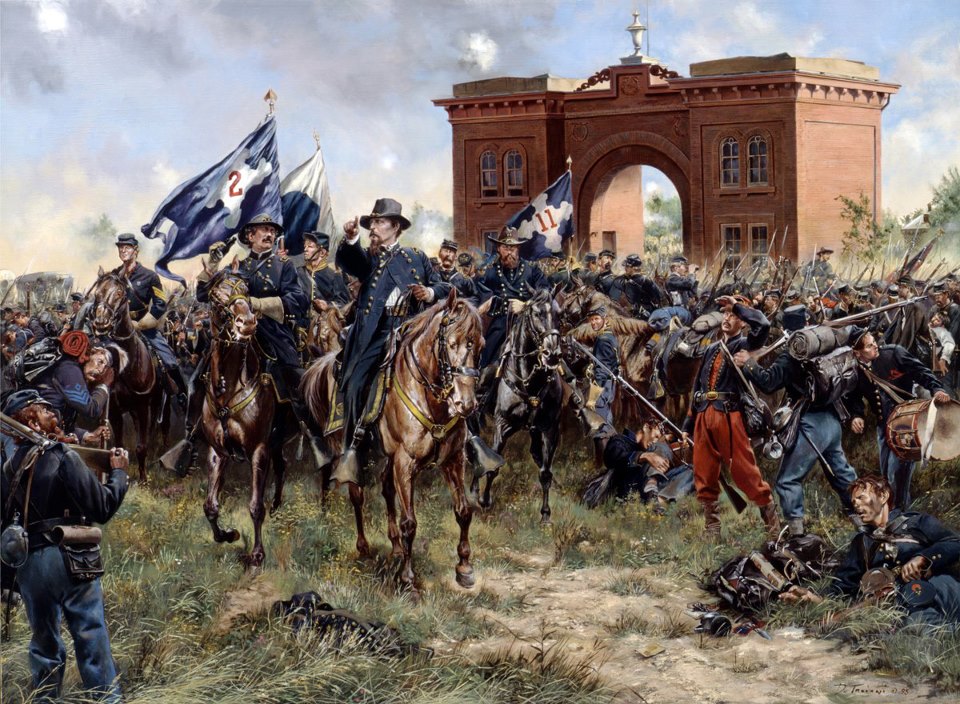
GenJFRenyoldsAs his units arrived into an already raging battle Reynolds directed them to key areas of the battlefield. With Confederate troops moving toward the high ground Reynolds directed the “Iron Brigade” into position in Herr’s (McPherson’s) Woods. Reynolds exhorted the men forward.“Forward! men, forward! for God’s sake, and drive those fellows out of the woods!” As he said these words he was struck by a bullet at the base of his skull and died instantly.

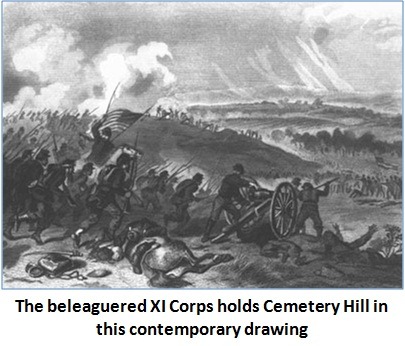
The Federal troops, I Corps under the command of Doubleday and XI under Major General Oliver Howard withdrew through Gettysburg to Cemetery Hill, where Howard had wisely placed two brigades as well as a significant amount of artillery earlier in the day. Reynolds’ old friend Major General Winfield Scott Hancock of II Corps arrived on the field to take command on the order of George Meade.

Hill’s troops entered the town but did not attempt to take the hill, he did not believe that his exhausted and disorganized troops were in a position to combat fresh troops in good defensive positions. Likewise Ewell passed on an opportunity to take nearby Culp’s Hill as his corps was not fully up and the divisions which had been in action were now in disarray and he recognized the strong position occupied by the Federal forces.

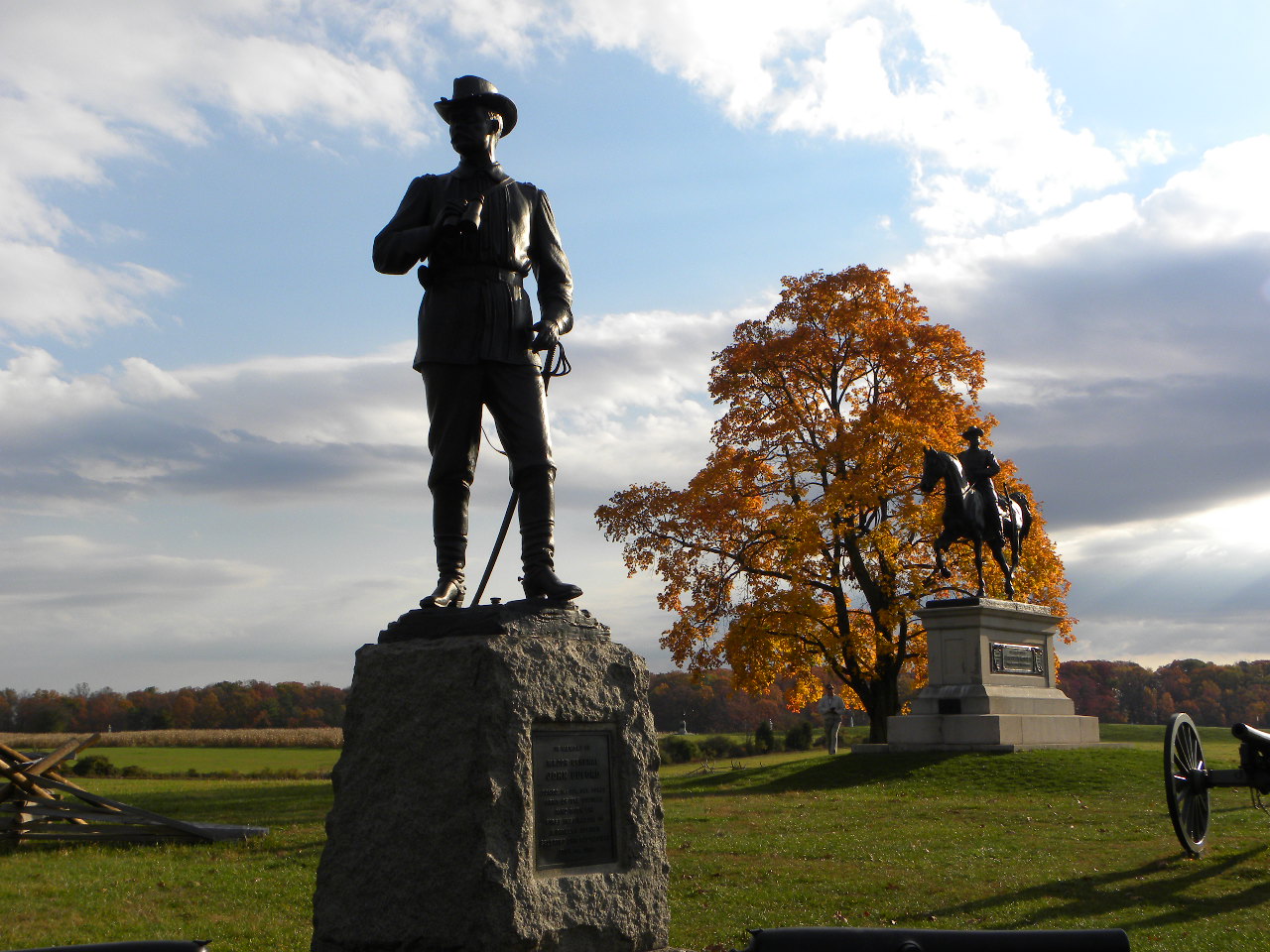
DSCN8774Monuments to Buford and Reynolds at McPherson’s Ridge

The first day ended with the Army of the Potomac holding the high ground in an easily defensible position on interior lines. Lee’s Army was spread out and the defense mounted by Buford and Reynolds had disrupted Hill’s Corps causing significant casualties to the Confederates and denying them the opportunity to take the high ground.

Buford is to be given much of the credit for choosing the ground of the battle and fighting a stellar delaying action against superior forces. But had Reynolds not brought his units up in the expeditious manner in which he did and then all of Buford’s efforts might have been in vain. The two men, bound by their professionalism and commitment to duty and their oath helped save the Union on that first day of July 1863.

Peace

Padre Steve+

Leave a comment

Filed under civil war, History, leadership, Military

Experience versus Inexperience, Accident and Intent: Harry Heth and John Buford on July 1st at Gettysburg

bufordholdatallcosts

On June 30th 1863 Robert E. Lee’s Army of Northern Virginia was still spread out over wide parts of south central Pennsylvania and Maryland. He had issued orders to concentrate his forces near Cashtown but his orders to his subordinate commanders still lacked clarity. As such his corps commanders still acted in a nearly independent manner.

Lee was operating blind. Due to his own operational decisions he was without any significant cavalry forces to screen his army and conduct reconnaissance as it operated deep in enemy territory. He had only found out about the location and proximity to his forces of the Army of the Potomac from the report of Longstreet’s spy Harrison.

On June 30th Major General Harry Heth sent a brigade of his division to conduct a reconnaissance in the direction of Gettysburg. The brigade commander Brigadier General Johnston Pettigrew was instructed to avoid being drawn into battle. Pettigrew observed Federal cavalry of John Buford taking up positions west of the town and chose not to engage. He retired from the field and reported the presence of well drilled Federal cavalry to General Heth. As he was doing so A.P. Hill arrived and rejected Pettigrew’s report insisting that the Army of the Potomac was still over 20 miles away in Maryland. Neither Hill or Heth trusted Pettigrew’s report as Pettigrew’s was not a professional soldier.

The following morning Heth with Hill’s permission decided to send a force to Gettysburg to see what was there and to obtain a large number of shoes that he heard were in the town.

henryhethMajor General Henry (Harry) Heth

Heth was an 1847 graduate of West Point. He graduated at the bottom of his class. Heth was commissioned as an Infantry Officer in the United States Army. Heth did not serve in Mexico but on the frontier. He had commanded a company in battle against the Lakota Sioux in 1855 and wrote the first marksmanship manual for use in the U.S. Army.

Heth was a Virginian and a close friend of A.P. Hill. He spent the early part of the war as Lee’s Quartermaster where he became one of Lee’s favorite officers. This was the beginning of a close relationship where Lee looked after Heth’s career. Heth served as regimental commander in the actions in the Kanawha Valley of Western Virginia being assigned to Kirby Smith’s Department of Tennessee. There he commanded a division but took part no any major actions.

Lee brought him back to the Army of Northern Virginia in 1863 to command a brigade in Hill’s Division. He took commanded that brigade at Chancellorsville in which he made an ill advised unsupported attack against Union forces in which his brigade sustained heavy casualties. Despite this, during the reorganization of the army Heth was promoted to command of the Division when Hill assumed command of Third Corps when it was created following the death of Stonewall Jackson.

Lee had given his commanders orders not to provoke a major engagement until the Army was fully concentrated. However neither Heth nor Hill believed that the troops that Pettigrew observed were a threat, believing them to be nothing more than local militia.

Hill was sick and decided to conduct a reconnaissance despite his lack of cavalry. Hill decided to conduct an infantry reconnaissance, However instead of sending a small force he dispatched two of his divisions, those of Heth and Dorsey Pender and remained in his quarters. Heth, the most inexperienced division commander took the lead and advanced his division in a column not deployed for battle or reconnaissance.

Lee’s intent seemed to be clear at this point clear. He desired to have a tired and weary Union force under a new commander under political pressure attack him on ground of his choosing. He hoped to defeat the Union forces piecemeal as they came into the battle. By initiating the action Hill and Heth set in motion events that would lead to the climactic battle of the Civil War. Hill’s decision to use such a large force and Heth’s inexperience in leading such a mission put Lee in a position where he began to make more mistakes.

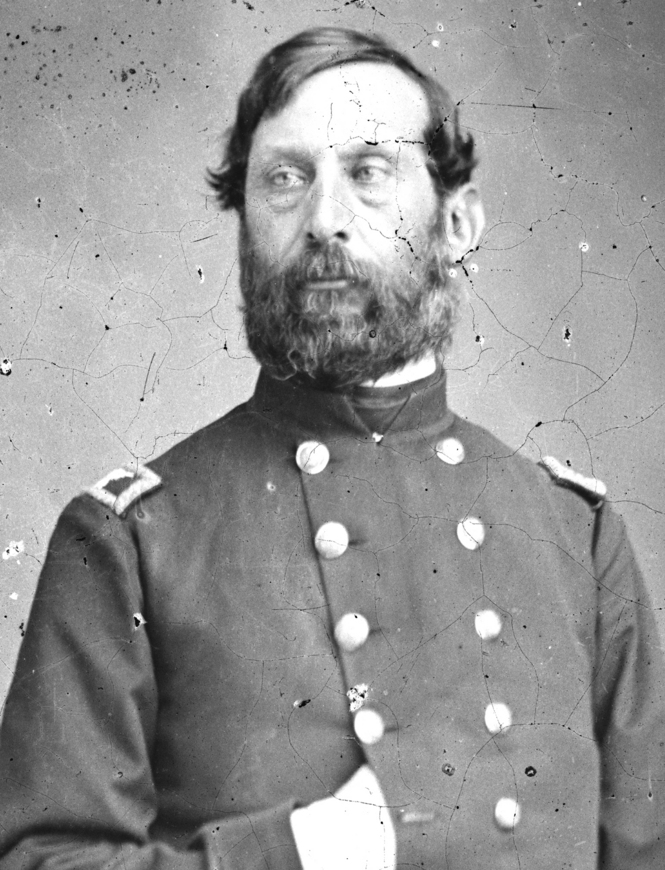
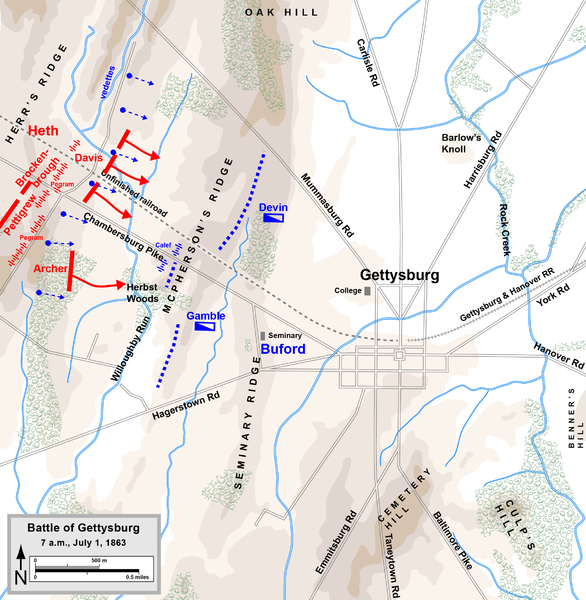
The Federal Cavalry that Heth’s troops encountered was the First Cavalry Division under the Command of Brigadier General John Buford. Buford’s division arrived in Gettysburg ahead of the Army of the Potomac on the 30th. Buford and his brigade commanders immediately recognized the importance of the ground when they saw Pettigrew’s troops. Buford order his troops to deploy on the ridges west of Gettysburg, Herr Ridge, McPherson Ridge and Seminary Ridge. It was the perfect place for a delaying action against superior forces.

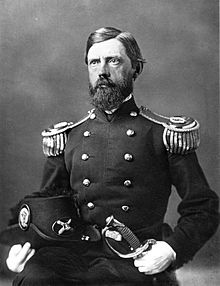
john_bufordBrigadier General John Buford

Buford was also a graduate of West Point and served as a Cavalry officer in the Army before the war. He was from Kentucky and his father was a Democrat who had opposed Abraham Lincoln. Much of his family chose to fight for the Confederacy but Buford remained loyal to his oath and remained in the Army.

Prior to the war Buford had served against the Sioux and on peacekeeping duty in the bitterly divided State if Kansas. Later he served in the Utah War in 1858. He was a modern soldier who recognized that the tactics of the Army had to change due to improvements in weapons and technology.  He was promoted to Brigadier General in 1862 and served in numerous engagements as a Cavalry Brigade commander before being given command of the 1st Cavalry Division after Chancellorsville.

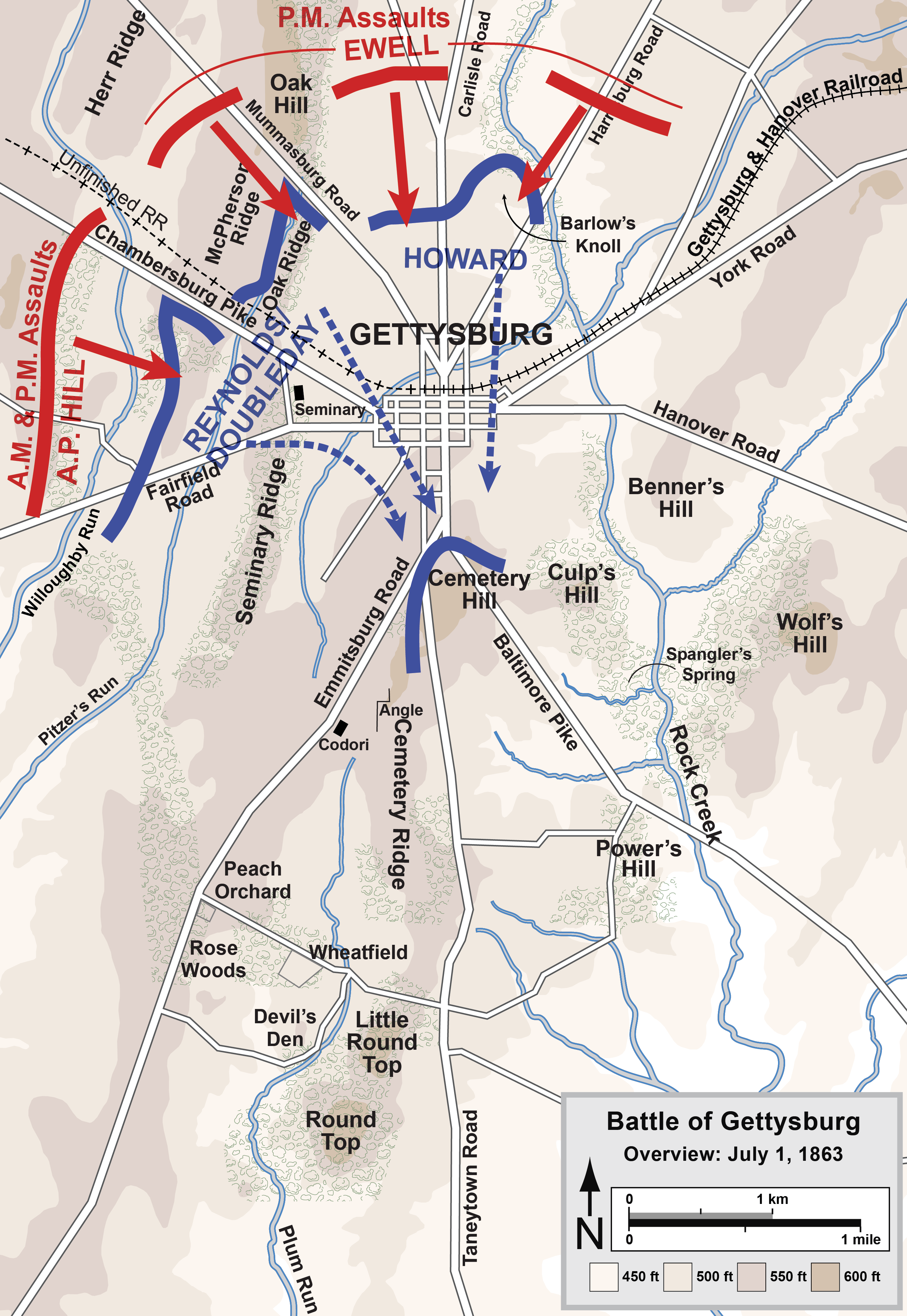
gettysburg_day1_0700

The Delaying Action, July 1st 1863 Map by Hal Jespersen, http://www.posix.com/CW

Buford was a keen student of war and a commander who was able to control his forces. When Heth’s division attacked he fought a masterful action. This allowed the Infantry Corps of the Army of the Potomac to arrive on the field of battle. Buford’s action to select the ground upon which the battle was fought was instrumental to the Union victory at Gettysburg. Even though Federal forces were pushed back on the first day they were able to maintain control of the high ground east of the city with interior lines of communication which they fortified.

After Heth engaged the Federal army Lee decided that he had to force the battle and continue the attack. Lee brushed aside the objections of General Longstreet and ignored the fact that he did not fully know the numbers and disposition of the troops arrayed against him.

Lee’s decision to engage the enemy was disastrous. Lee decided to attack after the ill conceived decision of Hill and Heth to get involved in a big fight and the correspondingly excellent command decisions of Buford to choose good ground and then to fight a skilled engagement.

While Lee and Hill’s decisions shaped the battle the tactical decisions of Heth and Buford in their conduct of the battle and their advice to their superiors had a dramatic effect on how the Battle of Gettysburg unfolded. Heth’s lack of experience in the east against the Army of the Potomac and limited battle experience as a senior commander certainly was a factor. Likewise, Buford’s experience played a major role. Buford had spent the war in action against Lee’s Army. He knew the capabilities of his enemies and knew what had to be done to give his side a chance to win.

Bufords-Cavalry

Like many battles success is often due to such factors. Had Heth been more experienced and been more prudent in conducting his mission Lee might not have made his fateful decision to commit his army at a Gettysburg. Had Buford not seen the importance of the ground that he selected and deployed himself accordingly the rest of the Army may not have gotten to Gettysburg before Lee had gained the critical ground east and south of the town.

On such decisions battles are decided and wars won. Heth was a good soldier, but his relative inexperience and inability to control his command was a decisive factor in the battle. On the other hand Buford’s experience and poise under pressure enabled the rest of the army to come up on that first day of battle. Had he not done so it is possible that despite the bad decisions made by Lee, Hill and Heth that the Army of northern Virginia might have seized the critical ground east of Gettysburg before the bulk of the Federal Army arrived.

Had that happened it would have been interesting to see how the rest of the campaign unfolded. But such is speculation and that is a subject for novelists, writers of historical fiction or alternate history. Instead we are left with the real decisions of people that to this day influence us. Experience versus inexperience, accident versus design and the decisions of men long dead are things that we must ponder as we look at this battle and seek to learn lessons that will benefit us today.

Peace

Padre Steve+

Leave a comment

Filed under civil war, History, leadership, Military

Lee Blunders into Battle: Day One at Gettysburg

Railroad_CutBetween Heth’s Divsion and I Corps at the Railroad Cut-Dale Gallon

The Army of Northern Virginia commanded by Robert E Lee was now deep in Union territory and nearly blind to the location of the Federal Army of the Potomac. On the 30th advanced units of Dick Ewell’s Second Corps had gone nearly as far as Harrisburg while most of the Army was on the road around Chambersburg. J.E.B. Stuart and his cavalry was far away encumbered by a large captured Federal wagon train around Hanover and not in position to report on Union troop movements.

As reports from the spy Harrison came to Longstreet he reported them to Lee. Lee was surprised but quickly began to concentrate the Army around Cashtown. As the rest of the army gathered General A.P. Hill sent Johnston Pettigrew’s Brigade of Harry Heth’s Division to Gettysburg on the 30th. Pettigrew observed the Federal cavalry of Buford’s 1st Cavalry Division as they took up positions on Seminary Ridge. Since it was late he declined to engage and reported the Federal concentration to Hill, believing it to be nothing more than militia and cavalry.

427_2Buford Defending McPherson’s Ridge Mort Kunstler

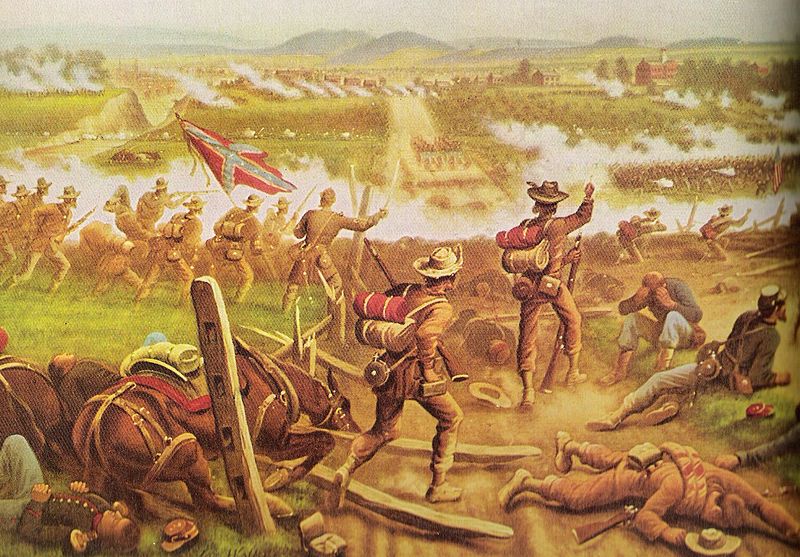
On the morning of July 1st Hill ordered Harry Heth’s to advance his division to Gettysburg without the benefit of cavalry support or reconnaissance. Hill believed that the troops reported by Pettigrew could be nothing more than local militia. As they advanced the leading brigades under Brigadier General James Archer and Joseph Davis met Federal forces. Heth first became embroiled in a fight with Buford’s cavalry, which forced him to deploy and held up his advance along McPherson’s and Herr’s Ridge. Lee’s “laxness with respect to reconnaissance and his lack of control of Hill’s movements caused him to stumble into battle.” For the master of so many battlefields it was an inauspicious beginning.

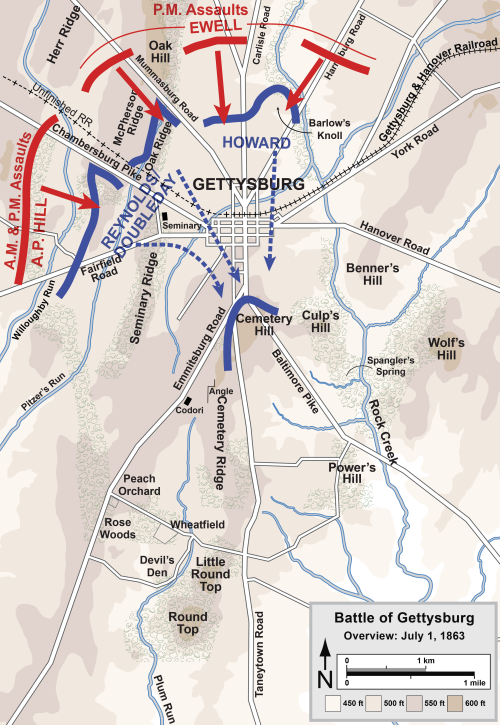
Heth had been surprised and then suffered heavy casualties when lead elements of the Federal 1st Corps under the command of Major General John Reynolds arrived. In the ensuing fight both Archer’s and Davis’ brigades were mauled with Archer being captured and Davis wounded. As the fight continued the Federal XI Corps under Oliver Howard arrived, extended the Right of the Federal line and emplaced troops on the hills to the east of the town. Unfortunately Howard’s dispositions were faulty and the choice of his First Division commander Barlow to advance to an exposed area of high ground proved to be nearly disastrous to the Federal position.

gettysburg_battle_map_of day1Gettysburg Day One (Map by Hal Jespersen, http://www.posix.com/Com)

Lee was surprised by the engagement and though he chastised Heth for getting involved but committed his army to the attack the Federals. Reynolds was killed early in the engagement but the fight was bitter, the Iron Brigade exacted a fearful toll on Archer and Davis’s brigades.

The attack by Heth was helped immensely when the lead elements of Ewell’s 2nd Corps in the form of Robert Rodes’ division arrived. Rodes’ division hit the right flank of the I Corps where it joined XI Corps and was joined by part of Jubal Early’s Division to his right. They overwhelmed the division of Francis Barlow who was wounded and captured, as well as other elements of XI Corps which was deployed on bad ground for defense.

The attack was well conceived but poorly executed, in part due to the failures of some of the subordinate brigade commanders. However, the attack threw the Federal line into confusion and the Federals shifted to meet the attack. Heth sought and got permission from Lee to renew his attack and the combination forced the Federal troops to withdraw through Gettysburg and up to Cemetery Ridge, where two brigade’s of Steinwehr’s division and the tough survivors of the Iron Brigade were already in place.

800px-First_day_at_gettysburgPender’s Division Goes into Action

In making the attack Lee acted against his own directions to his commanders. Though he only had a fraction of his army on the field and was unaware of the strength and location of the bulk of the Federal Army, Lee committed himself to a general engagement. In the process he placed his army at a disadvantage. Unless he could break the Federal line and take Cemetery Hill he would leave the Army of the Potomac with the high ground and with the ability to fight on interior lines, while his forces would be spread out over a long arcing line.

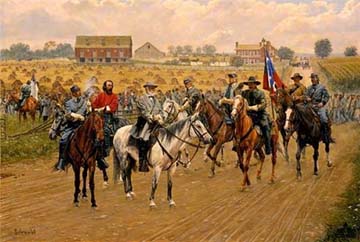
leeindexLee with A.P. Hill and Heth Bradley Schmehl

Ewell’s arrival was fortuitous because it temporarily tilted the balance to Lee, but the advantage was short lived, once again due to a vague order from Lee. This time it was an order to Ewell and like many things about Lee’s conduct of the battle this too is shrouded in controversy.

Lee’s report describes the order:

“General Ewell was, therefore, instructed to carry the hill occupied by the enemy, if he found it practicable, but to avoid a general engagement until the arrival of the other divisions of the army…”

But Lee had already committed himself to a general engagement in pursuing the attack during the afternoon. Although it appeared that Federal forces in turmoil as Reynold’s was dead and elements of XI Corps in retreat the situation was serious but the Confederates were not in a perfect or even completely advantageous position. Howard was able to rally his troops on Cemetery Hill taking advantage of his earlier deployment of Steinwehr’s division. Abner Doubleday who had succeeded Reynold’s brought his tropes back to reinforce the line as well as occupy Culp’s Hill to the right.

bogbayardwilkesonwebAbner Doubleday directs his troops on Day One

When Meade learned of Reynold’s death he dispatched Winfield Scott Hancock of II Corps to take command of all Federal Forces. Though he was junior to Howard, Hancock was able to work out a command arrangement with Howard and take command. Howard had to his credit Federal command position was strengthened.

Hancock doncemeteryhilljuly1_zps512a40faHancock Arrives on the Battlefield

Hancock was authorized by Meade to select where the Army would make its stand. Hancock told Howard “But I think this is the strongest position by nature upon which to fight a battle that I have ever saw…and if it meets your approbation I will select this as the battlefield.” Howard agreed and both men set off to rectify their lines.

Despite their success Ewell and his Corps were disorganized and not in a good position to take advantage of their earlier success. Likewise he was limited in the forces that he had available to continue the attack. Both his and A.P. Hill’s Corps only had two of their divisions in the field. Hill reported that his divisions “were exhausted by some six hours of hard fighting (and that) prudence led me to be content with what had been gained, and not push forward troops exhausted and necessarily disordered, probably to encounter fresh troops of the enemy.” Ewell reported that “all the troops with me were jaded by twelve hours’ marching and fighting.” Lee’s report of the battle indicated that the four divisions involved were “already weakened and exhausted by a long and bloody struggle.”

As such a night assault would have been exceptionally risky. Ewell would have only had the tired and disorganized survivors of four brigades at his disposal with no support from A.P. Hill on his right.

Early's_Charge_on_East_Cemetery_Hill

Ewell has often been criticized by the defenders of Lee and the legend of the Lost Cause for his failure to press the attack on Cemetery Ridge or Culp’s Hill. Critics cite that Federal forces were still disorganized and he could have easily attacked and driven the Federal Forces form the hills. Much is made of the protests of Major General Isaac Trimble as well as General John Gordon who were with Ewell. However as Edwin Coddington noted that these men concentrated their efforts on Ewell’s action to determine what went wrong at Gettysburg. In large part this was due to their inability to criticize Lee. Trimble’s account made its way into Michael Shaara’s classic novel of Gettysburg, the Killer Angels and were acted with conviction by Morgan Shepperd in the film adaptation of the book Gettysburg. Coddington correctly observed that “they forgot, however, the exact circumstances that kept the move from being “practicable” at the time.”

Rodes after battle report supported Ewell’s decision. He wrote before “the completion of his defeat before the town the enemy had begun to establish a line of battle on the heights back of the town, and by the time my line was in condition to renew the attack, he displayed quite a formidable line of infantry and artillery immediately in my front, extending smartly to my right, and as far as I could see to my left in front of Early.” Unfortunately for historians Rodes was killed in action at the Third Battle of Winchester in September 1864.

The Army of Northern Virginia came very close to sweeping Federal forces from the field on July 1st in spite of Lee’s lack of planning and clear commanders intent. But close was not enough. His forces which were committed in a piecemeal manner were unable to follow up their initial success. His orders to Ewell, to take the high ground “if practicable” were correctly interpreted by Ewell. Thus Federal corps under the command of Howard and Hancock were able to regroup, dig in and be reinforced by the rest of the Army on good ground of their choosing with interior lines.

Whether Lee intended to engage the Army of the Potomac at Gettysburg so early in the campaign is debated. His multiple and contradictory strategic aims left his commanders acting much on their own. His lack of clear commander’s intent to his subordinate commanders created confusion on the battlefield and paved the way to many controversies in the years following the war as Southerners sought to explain the failure of the Lost Cause, for which Lee could not be blamed.

Much of the controversy comes from Lee’s own correspondence which indicates that he might have not fully understood his own intentions. Some correspondence indicates that Lee desired to avoid a general engagement as long as possible while other accounts indicate that he wanted an early and decisive engagement. The controversy was stoked after the war by Lee’s supporters, particular his aides Taylor and Marshal and generals Gordon and Trimble, men like Longstreet and were castigated by Lee’s defenders for suggesting that Lee made mistakes on the battlefield.

Lee’s actual misunderstanding of his situation can be seen in the account of Isaac Trimble, traveling with Lee at the beginning of the invasion of Pennsylvania. He wrote:

“We have again outmaneuvered the enemy, who even now does not know where we are or what our designs are. Our whole army will be in Pennsylvania day after tomorrow, leaving the enemy far behind and obliged to follow by forced marches. I hope with these advantages to accomplish some single result and to end the war, if Providence favors us.”

The vagueness of Lee’s instructions to his commanders led to many mistakes and much confusion during the battle. Many of these men were occupying command positions under him for the first time and were unfamiliar with his command style. Where Stonewall Jackson might have understood Lee’s intent, even where Lee issued vague or contradictory orders, many others including Hill and Ewell did not. Lee did not change his command style to accommodate his new commanders.

That lack of flexibility and inability to clearly communicate Lee’s intent to his commanders and failure to exercise control over them proved fatal to his aims in the campaign. Stephen Sears scathing analysis of Lee’s command at Gettysburg perhaps says it the best. “In the final analysis, it was Robert E. Lee’s inability to manage his generals that went to the heart of the failed campaign.”

The vagueness of Lee’s intent was demonstrated throughout the campaign and was made worse by the fog of war. Day one ended with a significant tactical victory for Lee’s army but without a decisive result which would be compounded into a strategic defeat by Lee’s subsequent decisions on the 2nd and 3rd of July.

Peace,

Padre Steve+

2 Comments

Filed under civil war, History, leadership, Military

Gettysburg: The Order of Battle

battle-of-gettysburg-war-is-hell-store

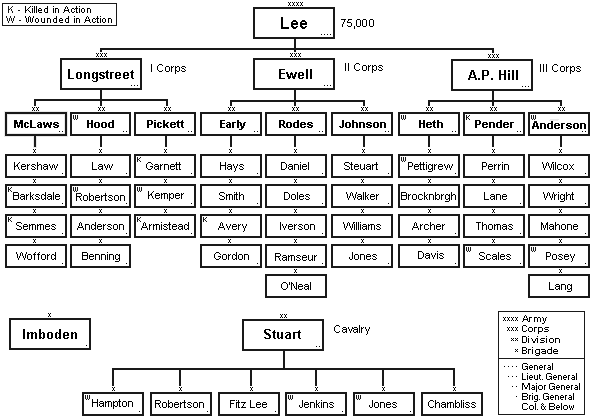
Note: This is a resource for those following my Gettysburg series and for my students that go with me on the Gettysburg Staff Ride. When the armies met at Gettysburg Lee’s Army of Norther Virginia had about 75,000-80,000 effectives, Meade’s Army of the Potomac had about 80,000-85,000 depending on the sources. This meant that they were relatively evenly matched in terms of manpower and that the battle came down to leadership, tactical decisions and strategic factors that were already in play by the time that the armies met at Gettysburg.

As a note of explanation the Confederate forces at the division and brigade level were named after their commander’s, or in some cases previous commanders. Confederate units were allocated to the Army from the various states, thus there is no Confederate “Regulars” as are shown in the Union order of battle. Union Corps were numbered as were the divisions and brigades in each corps. In some cases the brigades or divisions were referred to by the names of their commanders, but this was not consistent. Federal forces consisted of both Regular Army units as well as units allocated by the states. The reader can note the composition of each brigade in both the Union and Confederate armies to see from where the soldiers were recruited from.

So apart from that there is no story to tell tonight. Nothing in the way of commentary. This is simply a resource.
Have a great night.

Peace

Padre Steve+

confeorg

Army of Northern Virginia – General Robert Edward Lee, Commanding


ileerob001p1

General Staff: Chief of Staff and Inspector General: Col Robert H. Chilton; Chief of Artillery: BG William N. Pendleton; Medical Director: Dr. Lafayette Guild; Aide de Camp and Asst. Adjutant General: Maj Walter H. Taylor; Aide de Camp and Asst. Military Secretary: Maj Charles Marshall; Aide de Camp and Asst. Inspector General: Maj Charles S. Venable; Aide de Camp: Maj Thomas M. R. Talcott

General Headquarters
Escort: 39th Virginia Cavalry Battalion (companies A & C)

James_Longstreet

I Corps- Lt. Gen. James Longstreet, Commanding

Lafayette_McLaws

McLaws’ Division- MG Lafayette McLaws

Kershaw’s Brigade-BG Joseph B. Kershaw
2nd South Carolina, 3rd South Carolina, 7th South Carolina, 8th South Carolina,  15th South Carolina; 3rd South Carolina Battalion
Barksdale’s Brigade- BG William Barksdale (mw); Col Benjamin G. Humphreys
13th Mississippi, 17th Mississippi, 18th Mississippi, 21st Mississippi
Semmes’ Brigade- BG Paul J. Semmes (mw); Col Goode Bryan
10th Georgia, 50th Georgia, 51st Georgia, 53rd Georgia
Wofford’s Brigade- BG William T. Wofford
16th Georgia, 18th Georgia, 24th Georgia, Cobb’s (Georgia) Legion, Phillips’ (Georgia) Legion, 3rd Georgia Sharpshooter Battalion
Cabell’s Artillery Battalion- Col Henry C. Cabell; Maj Samuel P. Hamilton
1st North Carolina Artillery, Battery A, Pulaski (Georgia) Artillery, 1st Richmond Howitzers, Troup (Georgia) Artillery

GeorgePickett

Pickett’s Division- MG George E. Pickett

Garnett’s Brigade- BG Richard B. Garnett (k); Maj Charles S. Peyton
8th Virginia, 18th Virginia, 19th Virginia, 28th Virginia, 56th Virginia
Kemper’s Brigade- BG James L. Kemper (w&c); Col Joseph Mayo, Jr
1st Virginia, 3rd Virginia, 7th Virginia, 11th Virginia, 24th Virginia
Armistead’s Brigade- BG Lewis A. Armistead (mw&c); Ltc William White (w); Maj Joseph R. Cabell; Col William R. Aylett
9th Virginia, 14th Virginia, 38th Virginia, 53rd Virginia, 57th Virginia
Dearing’s Artillery Battalion- Maj James Dearing; Maj John P. W. Read (w)
Fauquier (Virginia) Artillery, Hampden (Virginia) Artillery, Richmond Fayette (Virginia) Artillery, Blount’s (Virginia) Battery

Lt._Gen._John_B._Hood

Hood’s Division- MG John Bell Hood (w); BG Evander M. Law

Law’s Brigade-BG Evander M. Law; Col James L. Sheffield
4th Alabama, 15th Alabama, 44th Alabama, 47th Alabama, 48th Alabama
Robertson’s Brigade- BG Jerome B. Robertson (w); Ltc Philip A. Work
3rd Arkansas, 1st Texas, 4th Texas, 5th Texas
Anderson’s Brigade- BG George T. Anderson (w); Ltc William Luffman (w)
7th Georgia, 8th Georgia, 9th Georgia,  11th Georgia,  59th Georgia
Benning’s Brigade- BG Henry L. Benning
2nd Georgia, 15th Georgia,  17th Georgia, 20th Georgia
Henry’s Artillery Battalion- Maj Mathias W. Henry; Maj John C. Haskell
Branch (North Carolina) Battery, Charleston German (South Carolina) Artillery, Palmetto (South Carolina) Light Artillery, Rowan North Carolina Artillery
Artillery Reserve- Col James B. Walton
Alexander’s Artillery Battalion- Col Edward P. Alexander (w)
Ashland (Virginia) Artillery, Bedford (Virginia) Artillery, Brooks (South Carolina) Artillery, Madison (Louisiana) Light Artillery, Richmond (Virginia) Battery, Bath (Virginia) Battery
Washington (Louisiana) Artillery Battalion- Maj Benjamin F. Eshleman
First Company, Second Company, Third Company, Fourth Company

Richard-Ewell

II Corps- Lt. Gen. Richard S. Ewell Commanding

??????????????????????????????????????????????????????????????????????????????????????????????

Early’s Division- MG Jubal A. Early
Hays’ Brigade- BG Harry T. Hays
5th Louisiana, 6th Louisiana, 7th Louisiana, 8th Louisiana, 9th Louisiana
Smith’s Brigade-BG William Smith
31st Virginia, 49th Virginia, 52nd Virginia
Hoke’s Brigade- Col Isaac E. Avery (mw); Col Archibald C. Godwin
6th North Carolina: Maj Samuel McD. Tate, 21st North Carolina: Col William W. Kirkland, Maj James Beall, 57th North Carolina: Col Archibald C. Godwin, Ltc Hamilton C. Jones
Gordon’s Brigade- BG John Brown Gordon
13th Georgia, 26th Georgia, 31st Georgia, 38th Georgia, 60th Georgia, 61st Georgia
Jones’ Artillery Battalion- Ltc Hilary P. Jones
Charlottesville (Virginia) Artillery, Courtney (Virginia) Artillery, Louisiana Guard Artillery, Staunton (Virginia) Artillery
Cavalry 35th Virginia Battalion: Ltc Elijah V. White

JohnsonE

Johnson’s Division- MG Edward Johnson

Steuart’s Brigade- BG George H. Steuart
1st Maryland Battalion, 1st North Carolina, 3rd North Carolina, 10th Virginia, 23rd Virginia, 37th Virginia
Stonewall Brigade- BG James A. Walker
2nd Virginia, 4th Virginia, 5th Virginia, 27th Virginia, 33rd Virginia
Nicholls’ Brigade-Col Jesse M. Williams
1st Louisiana, 2nd Louisiana, 10th Louisiana, 14th Louisiana, 15th Louisiana
Jones’ Brigade- BG John M. Jones (w); Ltc Robert H. Dungan
21st Virginia, 25th Virginia, 42nd Virginia, 44th Virginia, 48th Virginia, 50th Virginia
Andrews’ Artillery Battalion- Maj Joseph W. Latimer (mw); Cpt Charles I. Raine
1st Maryland Battery, Alleghany (Virginia) Artillery, Chesapeake (Maryland) Artillery, Lee (Virginia) Battery

robert-rodes

Rodes’ Division- MG Robert E. Rodes

Daniel’s Brigade-BG Junius Daniel
32nd North Carolina, 43rd North Carolina, 45th North Carolina, 53rd North Carolina, 2nd North Carolina Battalion
Doles’ Brigade-BG George P. Doles
4th Georgia, 12th Georgia, 21st Georgia, 44th Georgia
Iverson’s Brigade- BG Alfred Iverson, Jr.
5th North Carolina, 12th North Carolina, 20th North Carolina, 23rd North Carolina
Ramseur’s Brigade- BG Stephen D. Ramseur
2nd North Carolina, 4th North Carolina, 14th North Carolina, 30th North Carolina
Rodes’ (old) Brigade- Col Edward A. O’Neal
3rd Alabama, 5th Alabama, 6th Alabama, 12th Alabama, 26th Alabama
Carter’s Artillery Battalion-Ltc Thomas H. Carter
Jefferson Davis (Alabama) Artillery, King William (Virginia) Artillery, Morris (Virginia) Artillery, Orange (Virginia) Artillery

Artillery Reserve- Col J. Thompson Brown
First Virginia Artillery Battalion- Cpt Willis J. Dance
2nd Richmond (Virginia) Howitzers, 3rd Richmond (Virginia) Howitzers, Powhatan (Virginia) Artillery, Rockbridge (Virginia) Artillery, Salem (Virginia) Artillery
Nelson’s Artillery Battalion- Ltc William Nelson
Amherst (Virginia) Artillery, Fluvanna (Virginia) Artillery, Milledge’s Georgia Battery

general_a_p_hill

III Corps- Lt. Gen. Ambrose Powell Hill Commanding

Richard_H._Anderson

Anderson’s Division- MG Richard H. Anderson
Wilcox’s Brigade- BG Cadmus M. Wilcox
8th Alabama, 9th Alabama, 10th Alabama, 11th Alabama, 14th Alabama
Mahone’s Brigade- BG William Mahone
6th Virginia, 12th Virginia, 16th Virginia, 41st Virginia, 61st Virginia
Wright’s Brigade-BG Ambrose R. Wright; Col William Gibson; BG Ambrose R. Wright
3rd Georgia, 22nd Georgia, 48th Georgia, 2nd Georgia Battalion
Perry’s Brigade- Col David Lang
2nd Florida, 5th Florida, 8th Florida
Posey’s Brigade- BG Carnot Posey (w); Col. Nathaniel Harris
12th Mississippi, 16th Mississippi, 19th Mississippi, 48th Mississippi
Cutt’s Artillery Battalion- Maj John Lane
Company A, Company B, Company C

heth

Heth’s Division- MG Henry Heth (w); BG James J. Pettigrew (w)
Pettigrew’s Brigade-BG James J. Pettigrew; Col James K. Marshall (k); Maj John T. Jones (w)
11th North Carolina, 26th North Carolina, 47th North Carolina, 52nd North Carolina
Heth’s (old) Brigade- Col John M. Brockenbrough; Col Robert M. Mayo
40th Virginia, 47th Virginia, 55th Virginia, 22nd Virginia Battalion
Archer’s Brigade- BG James J. Archer (w&c); Col Birkett D. Fry (w&c); Ltc Samuel G. Shepard
13th Alabama, 5th Alabama Battalion, 1st Tennessee (Provisional Army), 7th Tennessee,  14th Tennessee
Davis’ Brigade- BG Joseph R. Davis (w)
2nd Mississippi, 11th Mississippi, 42nd Mississippi, 55th North Carolina
Garnett’s Artillery Battalion- Ltc John J. Garnett
Donaldsonville (Louisiana) Artillery, Huger (Virginia) Artillery, Lewis (Virginia) Artillery, Norfolk (Virginia) Blues Artillery

William_Dorsey_Pender

Pender’s Division-MG William D. Pender (mw); BG James H. Lane; MG Isaac R. Trimble (w&c); BG James H. Lane
McGowan’s Brigade-Col Abner M. Perrin
1st South Carolina (Provisional Army), 1st South Carolina Rifles, 12th South Carolina, 13th South Carolina, 14th South Carolina
Lane’s Brigade- BG James H. Lane; Col Clark M. Avery
7th North Carolina, 18th North Carolina, 28th North Carolina, 33rd North Carolina, 37th North Carolina
Thomas’ Brigade- BG Edward L. Thomas
14th Georgia, 35th Georgia, 45th Georgia, 49th Georgia
Scales’ Brigade- BG Alfred M. Scales (w); Ltc George T. Gordon; Col William L. J. Lowrance
13th North Carolina, 16th North Carolina, 22nd North Carolina, 34th North Carolina, 38th North Carolina
Poague’s Artillery Battalion- Maj William T. Poague
Albemarle (Virginia) Artillery, Charlotte (North Carolina) Artillery, Madison (Mississippi) Artillery, Brooke’s Virginia Battery
Artillery Reserve- Col Reuben L. Walker
McIntosh’s Artillery Battalion- Maj David G. McIntosh
Danville (Virginia) Artillery, Hardaway (Alabama) Artillery, 2nd Rockbridge (Virginia) Artillery, Johnson’s Virginia Battery
Pegram’s Artillery Battalion- Maj William R. J. Pegram; Cpt Ervin B. Brunson
Crenshaw (Virginia) Battery, Fredericksburg (Virginia) Artillery, Letcher (Virginia) Artillery, Pee Dee (South Carolina) Artillery, Purcell (Virginia) Artillery

CWP015

Cavalry Division- Maj. Gen. James Ewell Brown Stuart
Hampton’s Brigade- BG Wade Hampton (w)
1st North Carolina, 1st South Carolina, 2nd South Carolina, Cobb’s (Georgia) Legion, Jeff Davis (Mississippi) Legion, Phillips (Georgia) Legion
Robertson’s Brigade (not present at Gettysburg) BG Beverly H. Robertson
4th North Carolina, 5th North Carolina
Fitzhugh Lee’s Brigade- BG Fitzhugh Lee
1st Maryland Battalion, 1st Virginia, 2nd Virginia, 3rd Virginia, 4th Virginia, 5th Virginia
Jenkins’ Brigade- BG Albert G. Jenkins (w); Col Milton J. Ferguson
14th Virginia, 16th Virginia, 17th Virginia, 34th Virginia Battn., 36th Virginia Battn., Jackson’s (Virginia) Battery
William H. F. (Rooney) Lee’s Brigade- Col John R. Chambliss, Jr.
2nd North Carolina Cavalry, 9th Virginia, 10th Virginia, 13th Virginia
Jones’ Brigade- BG William E. Jones
6th Virginia, 7th Virginia, 11th Virginia
Stuart’s Horse Artillery- Maj Robert F. Beckham
Breathed’s (Virginia) Battery, Chew’s (Virginia) Battery, Griffin’s (Maryland) Battery Hart’s (South Carolina) Battery, McGregor’s (Virginia) Battery, Moorman’s (Virginia) Battery
Imboden’s Command- BG John D. Imboden
18th Virginia, 62nd Virginia, McNeill’s Company (Virginia), Staunton (Virginia) Battery

Union Order of Battle
unionorg

general-george-meade

Army of the Potomac – Major General George Gordon Meade, Commanding


General Staff: Chief of Staff: Maj. Gen. Daniel Butterfield, Chief of Artillery: Brig. Gen. Henry J. Hunt, Medical Director: Maj Jonathan Letterman, Chief of Engineers: Brig. Gen. Gouverneur K. Warren, Bureau of Military Information: Col. George H. Sharpe
Command of the Provost Marshal General: Brig. Gen. Marsena R. Patrick
93rd New York: Col. John S. Crocker, 8th United States (8 companies): Capt. Edwin W. H. Read, 2nd Pennsylvania Cavalry: Col. R. Butler Price, 6th Pennsylvania Cavalry (Companies E&I): Capt. James Starr, Regular cavalry
Engineer Brigade: Brig. Gen. Henry W. Benham
15th New York (3 companies): Maj Walter L. Cassin, 50th New York: Col. William H. Pettes, U.S. Battalion: Capt. George H. Mendell

GenJFRenyolds

I Corps- Maj. Gen. John F. Reynolds (k)

JSWadsworthBGenleft

First Division- Brig. Gen. James S. Wadsworth
1st  Brigade (The Iron Brigade)-Brig. Gen. Solomon Meredith (w); Col.. William W. Robinson
19th Indiana, 24th Michigan, 2nd Wisconsin, 6th Wisconsin, 7th Wisconsin
2nd Brigade- Brig. Gen. Lysander Cutler
7th Indiana, 76th New York, 84th New York (14th Militia), 95th New York, 147th New York, 56th Pennsylvania (9 companies)

john_Cleveland_Robinson

Second Division- Brig. Gen. John C. Robinson
1st Brigade- Brig. Gen. Gabriel R. Paul (w); Col. Samuel H. Leonard (w); Col. Adrian R. Root (w&c); Col. Richard Coulter (w); Col. Peter Lyle; Col. Richard Coulter
16th Maine, 13th Massachusetts, 94th New York, 104th New York, 107th Pennsylvania
2nd Brigade-Brig. Gen. Henry Baxter
12th Massachusetts, 83rd New York (9th Militia), 97th New York, 11th Pennsylvania, 88th Pennsylvania, 90th Pennsylvania

abner-doubleday

Third Division- Maj. Gen. Abner Doubleday; Brig. Gen. Thomas A. Rowley; Maj. Gen. Abner Doubleday
1st Brigade- Col. Chapman Biddle; Brig. Gen. Thomas A. Rowley; Col. Chapman Biddle
80th New York (20th Militia), 121st Pennsylvania, 142nd Pennsylvania, 151st Pennsylvania
2nd Brigade-Col. Roy Stone (w); Col. Langhorne Wister (w); Col. Edmund L. Dana
143rd Pennsylvania, 149th Pennsylvania, 150th Pennsylvania
3rd Brigade- Brig. Gen. George J. Stannard (w); Col. Francis V. Randall
13th Vermont, 14th Vermont, 16th Vermont
Artillery Brigade- Col. Charles S. Wainwright
Maine Light, 2nd Battery (B), Maine Light, 5th Battery (E), 1st New York Light, Batteries E&L, 1st Pennsylvania Light, Battery B, 4th United States, Battery B

HancockWinfield_teaser

II Corps- Maj. Gen. Winfield S. Hancock (w); Brig. Gen. John Gibbon; Brig. Gen. William Hays

John_C._Caldwell

First Division- Brig. Gen.  John C. Caldwell
1st Brigade- Col. Edward E. Cross (mw); Col. H. Boyd McKeen
5th New Hampshire, 61st New York, 81st Pennsylvania , 148th Pennsylvania
2nd Brigade (The Irish Brigade) – Col. Patrick Kelly
28th Massachusetts, 63rd New York (2 companies),69th New York (2 companies), 88th New York (2 companies), 116th Pennsylvania (4 companies)
3rd Brigade-Brig. Gen. Samuel K. Zook (mw); Lt. Col.. Charles G. Freudenberg (w); Col. Richard P. Roberts (k); Lt. Col.. John Fraser
52nd New York, 57th New York, 66th New York, 140th Pennsylvania
4th Brigade- Col. John R. Brooke (w)
27th Connecticut (2 companies), 2nd Delaware, 64th New York, 53rd Pennsylvania, 145th Pennsylvania (7 companies)

john_Gibbon

Second Division- Brig. Gen. John Gibbon (w); Brig. Gen. William Harrow
1st Brigade- Brig. Gen. William Harrow; Col. Francis E. Heath
19th Maine, 15th Massachusetts, 1st Minnesota, 82nd New York (2nd Militia)
2nd Brigade- Brig. Gen. Alexander S. Webb (w)
69th Pennsylvania, 71st Pennsylvania, 72nd Pennsylvania, 106th Pennsylvania
3rd Brigade- Col. Norman J. Hall
19th Massachusetts, 20th Massachusetts, 7th Michigan, 42nd New York, 59th New York (4 companies)
Unattached: Massachusetts Sharpshooters, 1st Company

Daniel_Edgar_Sickles

III Corps- Maj. Gen. Daniel E. Sickles (w); Maj. Gen. David B. Birney

David_B._Birney_-_Brady-Handy

First Division- Maj. Gen. David B. Birney; Brig. Gen. J. H. Hobart Ward (w)
1st Brigade- Brig. Gen. Charles K. Graham (w&c); Col. Andrew H. Tippin; Col. Henry J. Madill
57th Pennsylvania (8 companies), 63rd Pennsylvania, 68th Pennsylvania, 105th Pennsylvania, 114th Pennsylvania, 141st Pennsylvania
2nd Brigade- Brig. Gen. J. H. Hobart Ward; Col. Hiram Berdan
20th Indiana, 3rd Maine, 4th Maine, 86th New York, 124th New York, 99th Pennsylvania, 1st United States Sharpshooters, 2nd United States Sharpshooters (8 companies)
3rd Brigade- Col. P. Régis de Trobriand
17th Maine, 3rd Michigan, 5th Michigan, 40th New York, 110th Pennsylvania (6 companies)

HumphreysA

Second Division- Brig. Gen. Andrew A. Humphreys
1st Brigade- Brig. Gen. Joseph B. Carr (w)
1st Massachusetts, 11th Massachusetts, 16th Massachusetts, 12th New Hampshire, 11th New Jersey,26th Pennsylvania
2nd Brigade-Col. William R. Brewster
70th New York, 71st New York, 72nd New York, 73rd New York, 74th New York, 120th New York
3rd Brigade-Col. George C. Burling
2nd New Hampshire, 5th New Jersey, 6th New Jersey, 7th New Jersey, 8th New Jersey,115th Pennsylvania
Artillery Brigade-Capt. George E. Randolph (w); Capt. A. Judson Clark
1st New Jersey Light, Battery B, 1st New York Light, Battery D, New York Light, 4th Battery, 1st Rhode Island Light, Battery E, 4th United States, Battery K

George_Sykes_and_staff_-_Brady-Handy

V Corps-Maj. Gen. George Sykes

James_Barnes

First Division- Brig. Gen. James Barnes (w)
1st Brigade-Col. William S. Tilton
18th Massachusetts, 22nd Massachusetts, 1st Michigan, 118th Pennsylvania
2nd Brigade-Col. Jacob B. Sweitzer
9th Massachusetts, 32nd Massachusetts, 4th Michigan, 62nd Pennsylvania
3rd Brigade-Col. Strong Vincent (mw); Col. James C. Rice
20th Maine, 16th Michigan, 44th New York, 83rd Pennsylvania

2.-Brig.-Gen.-Romeyn-B.-Ayres

Second Division-Brig. Gen. Romeyn B. Ayres
1st Brigade- Col. Hannibal Day
3rd United States (Cos. B, C, E, G, I and K), 4th United States (Cos. C, F, H and K), 6th United States (Cos. D, F, G, H and I), 12th United States (Cos. A, B, C, D and G, 1st Bn. and Cos. A, C and D, 2nd Bn.), 14th United States (Cos. A, B, D, E, F and G, 1st Bn. and Cos. F and G, 2nd Bn.)
2nd Brigade-Col. Sidney Burbank
2nd United States (Cos. B, C, F, H, I and K), 7th United States (Cos. A, B, E and I), 10th United States (Cos. D, G and H), 11th United States (Cos. B, C, D, E, F and G),17th United States (Cos. A, C, D, G and H, 1st Bn. and Cos. A and B, 2nd Bn.)
3rd Brigade-Brig. Gen. Stephen H. Weed (k); Col. Kenner Garrard
140th New York, 146th New York, 91st Pennsylvania, 155th Pennsylvania
Third Division-Brig. Gen. Samuel W. Crawford
1st Brigade-Col. William McCandless
1st Pennsylvania Reserves (9 companies), 2nd Pennsylvania Reserves, 6th Pennsylvania Reserves,13th Pennsylvania Reserves
2nd Brigade (not present—assigned to Washington defenses)
3rd Brigade-Col. Joseph W. Fisher
5th Pennsylvania Reserves, 9th Pennsylvania Reserves, 10th Pennsylvania Reserves, 11th Pennsylvania Reserves, 12th Pennsylvania Reserves (9 companies)
Artillery Brigade-Capt. Augustus P. Martin
Massachusetts Light, 3rd Battery, 1st New York Light, Battery C, 1st Ohio Light, Battery L, 5th United States, Battery D, 5th United States, Battery I

John_Sedgwick

VI Corps-Maj. Gen. John Sedgwick

HGWright

First Division-Brig. Gen. Horatio G. Wright
1st Brigade-Brig. Gen. Alfred T. A. Torbert
1st New Jersey, 2nd New Jersey, 3rd New Jersey, 15th New Jersey
2nd Brigade-Brig. Gen. Joseph J. Bartlett; Col. Emory Upton
5th Maine, 121st New York, 95th Pennsylvania, 96th Pennsylvania
3rd Brigade-Brig. Gen. David A. Russell
6th Maine, 49th Pennsylvania (4 companies), 119th Pennsylvania, 5th Wisconsin

Provost Guard: 4th New Jersey (3 companies): Capt. William R. Maxwell

albion-howe-111-b-4713

Second Division- Brig. Gen. Albion P. Howe
2nd Brigade-Col. Lewis A. Grant
2nd Vermont, 3rd Vermont, 4th Vermont, 5th Vermont, 6th Vermont
3rd Brigade-Brig. Gen. Thomas H. Neill
7th Maine (6 companies), 33rd New York (detachment), 43rd New York, 49th New York, 77th New York, 61st Pennsylvania

NewtonJohn

Third Division-Maj. Gen. John Newton; Brig. Gen. Frank Wheaton
1st Brigade-Brig. Gen. Alexander Shaler
65th New York, 67th New York, 122nd New York, 23rd Pennsylvania, 82nd Pennsylvania
2nd Brigade-Col. Henry L. Eustis
7th Massachusetts, 10th Massachusetts, 37th Massachusetts, 2nd Rhode Island.
3rd Brigade-Brig. Gen. Frank Wheaton; Col. David J. Nevin
62nd New York, 93rd Pennsylvania, 98th Pennsylvania,139th Pennsylvania
Artillery Brigade-Col. Charles H. Tompkins
Massachusetts Light, 1st Battery, New York Light, 1st Battery, New York Light, 3rd Battery, 1st Rhode Island Light, Battery C, 1st Rhode Island Light, Battery G, 2nd United States, Battery D, 2nd United States, Battery G, 5th United States, Battery F

Oliver-Otis-Howard-9345101-1-402

XI Corps-Maj. Gen. Oliver O. Howard; Maj. Gen. Carl Schurz

Francis_C._Barlow

First Division-Brig. Gen. Francis C. Barlow (w); Brig. Gen. Adelbert Ames
1st Brigade-Col. Leopold von Gilsa
1st New York (9 companies), 54th New York, 68th New York, 153rd Pennsylvania
2nd Brigade-Brig. Gen. Adelbert Ames; Col. Andrew L. Harris
17th Connecticut, 25th Ohio, 75th Ohio, 107th Ohio

Adolph_von_Steinwehr

Second Division-Brig. Gen. Adolph von Steinwehr
1st Brigade-Col. Charles R. Coster
134th New York, 154th New York, 27th Pennsylvania, 73rd Pennsylvania
2nd Brigade  Col. Orland Smith
33rd Massachusetts, 136th New York, 55th Ohio, 73rd Ohio

schurz

Third Division-Maj. Gen. Carl Schurz; Brig. Gen. Alexander Schimmelfennig; Maj. Gen. Carl Schurz
1st Brigade-Brig. Gen. Alexander Schimmelfennig; Col. George von Amsberg
82nd Illinois, 45th New York, 157th New York, 61st Ohio, 74th Pennsylvania
2nd Brigade-Col. Wladimir Krzyzanowski
58th New York, 19th New York, 82nd Ohio, 75th Pennsylvania, 26th Wisconsin
Artillery Brigade-Maj Thomas W. Osborn
1st New York Light, Battery I, New York Light, 13th Battery, 1st Ohio Light, Battery I, 1st Ohio Light, Battery K, 4th United States, Battery G

Henry_Warner_Slocum

XII Corps-Maj. Gen. Henry W. Slocum; Brig. Gen. Alpheus S. Williams

alpheus-williams1

First Division-Brig. Gen. Alpheus S. Williams; Brig. Gen. Thomas H. Ruger
1st Brigade-Col. Archibald L. McDougall
5th Connecticut, 20th Connecticut, 3rd Maryland, 123rd New York, 145th New York, 46th Pennsylvania
3rd Brigade-Brig. Gen. Thomas H. Ruger; Col. Silas Colgrove
27th Indiana, 2nd Massachusetts, 13th New Jersey, 107th New York, 3rd Wisconsin

General-John-Geary

Second Division-Brig. Gen. John W. Geary
1st Brigade-Col. Charles Candy
5th Ohio, 7th Ohio, 29th Ohio, 66th Ohio, 28th Pennsylvania, 147th Pennsylvania (8 companies)
2nd Brigade-Col. George A. Cobham, Jr.; Brig. Gen. Thomas L. Kane
29th Pennsylvania, 109th Pennsylvania, 111th Pennsylvania
3rd Brigade-Brig. Gen. George S. Greene (w)
60th New York, 78th New York, 102nd New York, 137th New York, 149th New York
Lockwood’s Brigade-Brig. Gen. Henry H. Lockwood
1st Maryland, Potomac Home Brigade, 1st Maryland, Eastern Shore,150th New York
Artillery Brigade-Lt Edward D. Muhlenberg
1st New York Light, Battery M, Pennsylvania Light, Battery E,4th United States, Battery F  5th United States, Battery K

pleasonton

Cavalry Corps -Maj. Gen. Alfred Pleasonton

buford

First Division-Brig. Gen. John Buford
1st Brigade-Col. William Gamble
8th Illinois, 12th Illinois (4 cos.) & 3rd Indiana (6 cos.), 8th New York
2nd Brigade-Col. Thomas Devin
6th New York (6 companies), 9th New York, 17th Pennsylvania, 3rd West Virginia, Companies A and C
Reserve Brigade-Brig. Gen. Wesley Merritt
6th Pennsylvania, 1st United States, 2nd United States, 5th United States, 6th United States

dmgregg

Second Division-Brig. Gen. David Gregg
1st Brigade-Col. John B. McIntosh
1st Maryland (11 companies), Purnell (Maryland) Legion, Company A, 1st Massachusetts, 1st New Jersey, 1st Pennsylvania, 3rd Pennsylvania, 3rd Pennsylvania Heavy Artillery, Section, Battery H
3rd Brigade-Col. John I. Gregg
1st Maine (10 companies), 10th New York, 4th Pennsylvania, 16th Pennsylvania

Kilpatrick-Judson(1)

Third Division-Brig. Gen. Judson Kilpatrick
1st Brigade-Brig. Gen. Elon J. Farnsworth (k); Col. Nathaniel P. Richmond
5th New York, 18th Pennsylvania, 1st Vermont, 1st West Virginia (10 companies)
2nd Brigade-Brig. Gen. George A. Custer
1st Michigan, 5th Michigan, 6th Michigan, 7th Michigan: (10 companies)
Horse Artillery
1st Brigade-Capt. James M. Robertson
9th Michigan Battery, 6th New York Battery,2nd United States, Batteries B and L, 2nd United States, Battery M, 4th United States, Battery E
2nd Brigade-Capt. John C. Tidball
1st United States, Batteries E and G, 1st United States, Battery K, 2nd United States, Battery A

Robert_O_Tyler

Artillery Reserve-Brig. Gen. Robert O. Tyler, Capt. James M. Robertson

1st Regular Brigade-Capt. Dunbar R. Ransom
1st United States, Battery H, 3rd United States, Batteries F and K, 4th United States, Battery C, 5th United States, Battery C
1st Volunteer Brigade-Lt. Col.. Freeman McGilvery
Massachusetts Light, 5th Battery (E), Massachusetts Light, 9th Battery, New York Light, 15th Battery, Pennsylvania Light, Batteries C and F
2nd Volunteer Brigade-Capt. Elijah D. Taft
1st Connecticut Heavy, Battery B, 1st Connecticut Heavy, Battery M, Connecticut Light, 2nd Battery. New York Light, 5th Battery
3rd Volunteer Brigade-Capt. James F. Huntington
New Hampshire Light, 1st Battery, 1st Ohio Light, Battery H, 1st Pennsylvania Light, Batteries F and G, West Virginia Light, Battery C
4th Volunteer Brigade-Capt. Robert H. Fitzhugh
Maine Light, 6th Battery, Maryland Light, Battery A, New Jersey Light, 1st Battery, 1st New York Light, Battery G, 1st New York Light, Battery K
Train Guard: 4th New Jersey Infantry (7 companies)

Leave a comment

Filed under civil war, History, Military

Gettysburg: June 28th the Day of Surprises

army-potomac-1500Army of the Potomac on the March


If you were an ordinary soldier in either the Army of the Potomac or Army of Northern Virginia June 28th 1863 would not have been much different than any of the previous days. Both armies had been on the march, both were moving north and with the exception of a few minor cavalry engagements no troops had yet engaged in battle.

However it is almost never good when a commander gets surprised. On June 28th 1863, three men, General Robert E Lee, Lieutenant General J.E.B. Stuart and Major General George G Meade all were surprised by unexpected, and in the case of Lee and Stuart truly disturbing news. The manner in which each responded was critical to how the Battle of Gettysburg unfolded and indicative of each mans’ ability as a commander.

Harrison-1-

Harrison

On the morning of June 28th Lieutenant General James Longstreet was alerted to the presence of a man claiming to have information on the movement and location of the Army of the Potomac. The man’s name was Harrison and that he was an actor. Harrison is one of those mysterious figures that occasionally show up in the context of a historical event and make it even more interesting. He reported the location of Federal Cavalry as well as the location of five of the Army of the Potomac’s seven army corps, all too close for comfort. Questioned about the location and activities of Stuart, Harrison could give no information.

gettysburg-general-lee

Any commander that embarks on a high risk offensive operation in enemy territory must do so with great care, especially in regard to command and control of his forces. This is especially true regarding reconnaissance. Lee had been operating blind for well over a week and this was his fault. Because Lee had issued such vague orders Stuart was well to the east conducting his ride around the Federal army and completely useless to Lee.

longstreet

Longstreet

Though Lee still had three brigades of Stuart’s Cavalry Division available, none were in a position to assist his reconnaissance needs. Again blame for this has to be laid at the feet of Lee. Robertson’s and Jones’ brigades were still deep in Virginia guarding Snicker’s and Ashby’s Gap. Iboden’s Brigade was to the west at Hancock Maryland. Jenkins’ brigade, which was not a part of Stuart’s division, was far to the front with Ewell’s Corps.

In the case of the selection of Jones’ and Robertson’s brigades for the mission of screening Lee, Stuart made a critical mistake. Jones and Robertson both had serious deficiencies as leaders and proved that they had Lee’s “confidence or understood his expectations…and Stuart badly misread the amount of personal connection his superior required.”[i] Longstreet had recommended that Stuart assign the excellent Wade Hampton and his brigade to the mission of screening the Army, but Stuart ignored his counsel.

CWP015

Stuart

While Lee’s orders to Stuart allowed Stuart to go off on his mission Lee had plenty of cavalry available but employed it in a woeful manner and did not take the steps necessary to ensure that the commanders assigned understood his expectations. This was another critical mistake made by Lee and as Alan.T. Nolan wrote: “There seems to be no excuse for Lee’s finding himself at Chambersburg on the 28th without a single regiment of cavalry”[ii] The tragic thing for the Confederacy was that Lee would make this same mistake in failing to communicate his intent with other subordinates throughout the campaign.

Lee assumed quite wrongly that the reason he had not heard from Stuart was that Hooker’s army had not moved. This was a bad miscalculation on Lee’s part and Longstreet trusted Harrison and promptly reported the information to Lee. Lee refused to see Harrison as he had little appreciation for or confidence in the words of “spies.” That being said Lee reacted with alacrity and issued orders to concentrate his army near Cashtown.

The surprise of the Union Army being concentrated so near him took away Lee’s ability to retain the initiative of a campaign of maneuver. Likewise, because his army was so scattered he was now in danger of being hit and defeated in detail by the Federal army. It was a dangerous position for him to be in and he knew it. In a sense he was fortunate that on the 28th the Army of the Potomac was changing command and unable to strike while he was so vulnerable.

Seventy miles away J.E.B. Stuart was at Rockville Maryland where despite learning that the Army of the Potomac was moving did not hasten to re-join the main army. Instead, he and his troopers became distracted and captured a large Federal wagon train, 125 brand new wagons carrying supplies north. Instead of burning them and leaving his prisoners he decided to advance into Pennsylvania with his treasure. The effect was to radically slow down his march and keep him out of the battle when Lee most needed his presence.

While Lee and Stuart reacted to surprises that were largely of their own making another officer received a surprise of his own. On the night of June 27th George Meade was simply one of seven Corps Commanders in the Army of the Potomac. That changed suddenly when he was awoken at 3 Am on the 28th by Halleck’s messenger and Deputy Adjutant General Colonel James Hardie. In his hand Hardie had a letter of instruction from Halleck which began: “You will receive with this the order of the President placing you in command of the Army of the Potomac.” [iii]

meade2

Meade

Meade, though he desired the appointment as commander of the Army did not expect it.  He believed that if Hooker was relieved of command that John Reynolds of First Corps or another would receive it. He was outranked by two Corps commanders including Reynolds. Meade wrote to his wife the reasons he would not get command a few days before: “because I have no friends, political or others, who press or advance my claims or pretentions.”[iv] The latter was not because of he did not have friends, but because unlike Hooker, Sickles and so many others he stayed out of the various political cabals in the army and their constant intrigues.

The order gave Meade command of the troops at Harper’s Ferry which had been denied to Hooker just days before. It also gave him freedom of command. It read: “You will not be hampered by any minute instructions from these headquarters” and “you are free to act as you deem proper under the circumstances as they arise.”[v] Likewise he was authorized to command General Couch’s forces along the Susquehanna. A further power given to Meade which had not been given to previous commanders of the Army of the Potomac was the authority to relieve from command and dismiss officers from the army, or appoint to command officers regardless of seniority as he saw fit. It was a power that during the tumult of battle that he would use well.

The appointment of Meade was met with relief by most of his fellow Corps commanders. He was respected, despite having a temper which would occasionally erupt and send him into busts of rage. He was viewed as a truthful, honest and caring commander who after a blow up would do what he could to reconcile. He was passionate about the lives of his troops and whenever possible avoided battles that he believed their sacrifice would be in vain. He knew his trade, paid close attention to detail and knew and understood his troops and commanders. He had earned respect throughout his career and during the battles on the Peninsula, Antietam, Fredericksburg and Chancellorsville proved that he was an excellent leader and commander of troops.

Meade had an immense task to accomplish. When he went to bed on the night of the 27th he was unaware of the locations of the bulk of the Federal Army and knew that Lee was already deep in Pennsylvania. Meade was determined to bring Lee to battle was cautious as he did not want to take a chance of his forces being split up and defeated in detail. He knew that if he was to defeat Lee he had to concentrate his combat power. He wired Halleck that he would “move toward the Susquehanna keeping Baltimore and Washington well covered, and if the enemy is checked in his attempt to cross the Susquehanna or if he turns toward Baltimore, to give him battle.”[vi] He prepared a fallback position along Pipe Creek and gave his Corps commanders permission to withdraw back to the Pipe Creek line outside Taneytown Maryland if they felt threatened by a larger Confederate force.

He kept General Daniel Butterfield as his Chief of Staff despite Butterfield’s close association with Hooker and his political cabal and appointed Major General George Sykes to command his old V Corps. He also wired Halleck with an “unheard of request: to promote in one jump three brilliant young officers from the rank of captain to that of brigadier general. They were Elon J. Farnsworth of the 8th Illinois Cavalry, George A Custer of the 5th United States Cavalry and Wesley Merritt of the 2nd United States Cavalry.”[vii] Each was appointed to command brigades in Pleasanton’s Cavalry Corps which was being reorganized that day.

buford-on-mcphersons-ridge

Meade recognized the importance of Gettysburg and began to move his forces toward the town even as Lee gathered his army. By the evening of the 30th Meade’s 1st Cavalry Division under the command of Brigadier General John Buford detected Confederate infantry to the west of the town. Buford with a keen eye for terrain instantly recognized that it was favorable ground. He knew that the battle was to be there and sent word back to John Reynolds, commander of I Corps:

“Have Occupied Gettysburg. Contacted large force of Reb infantry. I think they are coming this way. Expect they will be here in force in the morning.”[viii]

Until tomorrow,

Peace

Padre Steve+


[i] Trudeau, Noah Andre. Gettysburg, A Testing of Courage Harper Collins, New York, 2003. p.69

[ii] Nolan, Alan T. R.E. Lee and July 1 at Gettysburgin The First Day at Gettysburg, Gallagher, Gary W. Editor, Kent State University Press, Kent Ohio 1992 p. 20

[iii] Foote, Shelby, The Civil War, A Narrative. Volume Two Fredericksburg to Meridian Random House, New York 1963 p.451

[iv] Ibid.

[v] Ibid.

[vi] Coddinton, Edwin B. The Gettysburg Campaign, A Study in Command A Touchstone Book, Simon and Shuster New York 1968 pp. 219-220

[vii] Ibid. p.220

[viii] Shaara, Michael. The Killer Angels. Ballantine Books, New York. 1974 p.40


Leave a comment

Filed under civil war, History, leadership, Military

Gettysburg at 150 Day One: “For God’s Sake Forward!” John Reynolds at Herr’s or McPherson’s Ridge July 1st 1863

z_maritato_ironbrigadeforward

Iron Brigade Forward! Battle of Gettysburg, PA – July 1, 1863 by Mark Maritato

“…by his promptitude and gallantry he had determined the decisive field of the war, and he opened brilliantly a battle which required three days of hard fighting to close with a victory.” Major General Harry Hunt, Chief of Artillery, Army of the Potomac on the actions of Major General John F Reynolds at Gettysburg

Major General John Reynolds was on his home soil. A native of Lancaster Pennsylvania  Reynolds was the senior Corps commander in the Army of the Potomac. Considered by his peers and superiors to be the best commander in the Army he had been given command of a wing of the Army, his own I Corps, Oliver Howard’s XI Corps and John Sedgewick’s III Corps. He also had John Buford’s 1st Cavalry Division under his command.

Early in June Abraham Lincoln had offered command of the Army of the Potomac to Reynolds, however Reynolds’ set a condition which Lincoln in the political climate of the time could not grant, that he would be free from the political interference which had beset previous Army commanders. Both Reynolds’ request and Lincoln’s response are understandable. Lincoln respected Reynolds and when Major General Joseph Hooker was relieved of command of the Army by Lincoln Major General George Meade, commander of V Corps another Pennsylvanian took his place with Reynolds keeping his position.

As the Army of the Potomac reacted to the advance of Robert E  Lee’s Confederate Army of Northern Virginia Hooker pursued and Meade continued the pursuit into Pennsylvania once he took command.

Reynolds’ wing of three Infantry corps and Buford’s Cavalry division acted as the advance elements of the Army. Late in the afternoon of June 30th Buford’s troops observed Johnston Pettigrew’s brigade of Harry Heth’s division near Gettysburg. Pettigrew on detecting Buford’s cavalry refused to engage and Buford made the choice to take the good high ground west of Gettysburg and hold it in order to give Reynolds followed by the rest of the Army time to arrive.

WaudSketch

The Death of Reynolds (Waud)

Reynolds sent messages late in the evening to both Reynolds and the Union Calvary Corps commander, Major General Alfred Pleasanton describing the situation. Reynolds’ units were south of Emmitsburg moving north and on the morning of the 1st of July he brought his troops up as Buford and his cavalry troopers engaged Heth’s division in a delaying action in order to give Reynolds’ units time to get to the good high ground around Gettysburg.

Reynolds rode ahead and briefly met Buford at the Lutheran Seminary where Buford ensured Reynolds that his troopers could hold. With that Reynolds ordered his leading corps, the lead division under the command of Abner Doubleday to advance to the action at the double-quick. He then sent a message to Meade through a staff officer stating “Tell the General that we will hold the heights to the south of the town, and that I will barricade the streets of the town if necessary.”

As his units arrived into an already raging battle Reynolds directed them to key areas of the battlefield. As he directed the “Iron Brigade” into position in Herr’s (McPherson’s) Woods Reynolds exhorted the men forward.“Forward! men, forward! for God’s sake, and drive those fellows out of the woods!” As he said these words he was struck by a bullet in the head and died instantly.

In the immediate confusion following Reynolds’ death the I and XI Corps confusion reigned. It seemed that the Union corps now fighting two Confederate Corps, Hill’s 3rd Corps which they had been fighting since the morning and Ewell’s 2nd Corps which arrived in a flanking position to their north during the afternoon might be routed. The Federal troops, I Corps now under the command of Doubleday and XI under Major General Oliver Howard withdrew through Gettysburg to Cemetery Hill where they were rallied by Reynolds’ old friend Major General Winfield Scott Hancock of II Corps.

Hill’s troops entered the town but did not attempt to take the hill while Ewell passed on an opportunity to take nearby Culp’s Hill which would have dislodged the Federal right flank.

The first day ended with the Army of the Potomac holding the high ground in an easily defensible position on interior lines. Lee’s Army was spread out and the defense mounted by Buford and Reynolds had disrupted Hill’s Corps, causing significant casualties.

Buford is to be given much of the credit for choosing the ground of the battle and fighting a stellar delaying action against superior forces. But had Reynolds not brought his units up in the expeditious manner in which he did and then all of Buford’s efforts might have been in vain. The two men, bound by their professionalism and commitment to duty and their oath helped save the Union on that first day of July 1863.

reynolds

Charles Veil who served as a staff officer under Reynolds wrote the following epitaph stating that Reynolds “was a man who knew not fear or danger was, in a word (he was) one of our very best Generals. Wherever the fight raged the fiercest, there the General was sure to be found, his undaunted courage always inspired men with energy & courage.” 

Peace

Padre Steve+

Leave a comment

Filed under civil war, History, leadership, Military

Gettysburg at 150 Day One: Lee Blunders into Battle

800px-First_day_at_gettysburg

Pender’s Brigade on Day One

The Army of Northern Virginia commanded by Robert E Lee was now deep in Union territory and nearly blind to the location of the Federal Army of the Potomac. On the 30th advanced units of Dick Ewell’s Second Corps had gone nearly as far as Harrisburg while most of the Army was on the road around Chambersburg and Cashtown. Lee’s Cavalry Division under the command of J.E.B. Stuart was far away engaging Union Cavalry around Hanover and not in position to report on Union troop movements. General A.P. Hill sent Johnston Pettigrew’s Brigade of Harry Heth’s Division to Gettysburg on the 30th but Pettigrew observing the Federal cavalry of Buford’s 1st Cavalry Division take up positions on Seminary Ridge declined to engage and reported the Federal concentration to Hill.

As reports from the spy Harrison came to Lee and Longstreet Lee began to concentrate the Army around Cashtown. However the morning of July Hill ordered Harry Heth’s division to move on Gettysburg without the benefit of cavalry support or reconnaissance believing that the troops reported by Pettigrew could be nothing more than local militia. His leading brigades under Brigadier General James Archer and Joseph Davis took heavy casualties and soon Heth became embroiled in a fight with Buford’s cavalry and lead elements of the Federal 1st Corps under the command of Major General John Reynolds.

Gettysburg_Battle_Map_Day1

Gettysburg Day One (Map by Hal Jespersen, http://www.posix.com/Com)

Lee was surprised by the engagement and though he chastised Heth for getting involved committed his army to the attack. Reynolds was killed early in the engagement but the fight was bitter, the Iron Brigade exacted a fearful toll on Archer and Davis’s brigades. The attack by Hill’s 3rd Corps was helped immensely when elements of Ewell’s 2nd Corps arrived on the right flank of the Federal XI Corps, forcing the Federal troops to withdraw through Gettysburg and up to Cemetery Ridge. Ewell’s arrival was fortuitous because it tilted the balance to Lee, but the advantage was short lived.

z_schmehl_leedeliberates

Lee Deliberates Heth’s Advance – Gettysburg by Bradley Schmehl

 Ewell failed to press the attack on Cemetery Ridge or Culp’s Hill while Federal forces were still disorganized, despite the repeated entreaties of Major General Isaac Trimble who was with him. The delay would be fatal to Lee’s intentions as Lee decided to give battle at Gettysburg, ignoring General Longstreet’s plea to disengage take up a favorable position between Gettysburg and Washington DC and force the Army of the Potomac to attack.

doncemeteryhilljuly1_zps512a40fa

Don Troiani’s Painting of Hancock taking Command on Cemetery Hill on Day One

The Army of Northern Virginia came very close to sweeping Federal forces from the field on July 1st in spite of Lee’s lack of planning and clear commanders intent. That much is clear. His orders to Ewell, to take the high ground “if practicable” we interpreted by Ewell in a manner that he determined not to be practicable, so the advanced Federal corps under the command of Major General Winfield Scott Hancock were able to regroup, dig in and be reinforced by the rest of the Army.

Whether Lee intended to engage the Army of the Potomac at Gettysburg so early in a campaign where his multiple and contradictory strategic aims and lack of clear commander’s intent to his subordinate commanders created confusion is debated. Much of the controversy comes from Lee’s own correspondence which indicates that he might have not fully understood his own intentions. Some correspondence indicates that Lee desired to avoid a general engagement as long as possible while other accounts indicate that he wanted an early and decisive engagement. The controversy was stoked after the war by Lee’s supporters, particular his aides Taylor and Marshal, and Longstreet’s supporters.

Isaac Trimble, traveling with Lee at the beginning of the invasion of Pennsylvania recored that Lee told him:

“We have again outmaneuvered the enemy, who even now does not know where we are or what our designs are. Our whole army will be in Pennsylvania day after tomorrow, leaving the enemy far behind and obliged to follow by forced marches. I hope with these advantages to accomplish some single result and to end the war, if Providence favors us.” (Glenn Tucker, High Tide at Gettysburg (Indianapolis: The Bobbs-Merrill Co.: 1958), p. 24.)

The vagueness of Lee’s instructions to his commanders, many of whom were occupying command positions under him for the first time and were unfamiliar with his command style led to confusion. Where Stonewall Jackson might have understood Lee’s intent, even where Lee issued vague or contradictory orders, many others including Hill and Ewell did not. Lee did not change his command style to accommodate his new commanders and that lack of flexibility on Lee’s part proved fatal to his aims in the campaign.

xi-corps-holds-cemetery-hill

The vagueness of Lee’s intent was demonstrated throughout the campaign and was made worse by the fog of war. Day one ended with a significant tactical victory for Lee’s army but without a decisive result which would be compounded into a strategic defeat by Lee’s subsequent decisions on the 2nd and 3rd of July.

Until tomorrow,

Peace

Padre Steve+

Leave a comment

Filed under civil war, History, Military

Remembering the Deal with the Devil that Has Brought us the Sequester

me-white-house1

“But we have no one to blame but ourselves. We voted them all into office and we have encouraged their repugnant behavior with our votes which more often than not were purchased by the fear mongering engaged by each side and our desire to have our special interests and or ideology come out on top.” Padre Steve August 2nd 2011

Back in late July 2011 it appeared that the Federal Government would o what it had never done, default on the payments for the National Debt. I was in Washington that week and could not believe what had become of the country.

For me it was a week that I remember well because on a nighttime picture taking expedition on the National Mall I fell off a darkened ledge at the Washington Monument while turning to line up another picture while walking in the dark.

That week I wrote a number of articles on my observations of what was happening. Since it appears there is a strong chance of the dreaded “Sequester” occurring in a bit over 48 hours I am posting those articles in their entirety here along with the links to the articles on this website.

As a historian and serving Naval Officer I really have a hard time believing what is happening in our government. I can only imagine it is the same kind of feeling that officers in service in 1860 and 1861 felt as their families, friends and the elected officials home states were pushing the country into the abyss. Unfortunately now, as it was then there is enough blame to spread copious amounts between politicians, preachers, and pundits the Unholy Trinity of both parties and across the political spectrum. Men, women and institutions that care more for their special interests than the country that gives them the opportunity to achieve great things.

These are my writings from that unfortunate week in our history. Unfortunately nothing leads me to believe that anything has changed since then and that the leaders of both of our political parties and their supporters in their respective media, corporate and lobbying interests and partisan pundits and preachers on both sides will not do all they can to ensure the ruin of this country.

While I have my own opinions about the root causes of this situation and my own political leanings. That being said I cannot fail to note that among our political classes and their supporters that to some degree they and we are all to blame.  No one wants to hear that but it is the truth. Most of us and certainly our political leaders, lobbyists, business leaders and pundits have by refusing to listen to those we disagree with have brought us to this point. Just like 1860. This is something that need not have ever had to happen. I agree with the hero of the first day of the Battle of Gettysburg, Union General John Buford: “I am disgusted and worn out with the system that seems to prevail.”

God help us because I do not believe that our leaders have the capacity in themselves to do anything.

Peace

Padre Steve+

dscn9994

A Tuesday in DC: Lunch with a Dear Friend and a Night walk through the Monuments

Today was another good day, in fact really good day at the conference I am attending with the George Washington Institute for Spirituality and Health.  At lunch I was able to spend some time with my former commanding officer at Marine Security Forces.  It was good to see Mike again.  He and I went through some very trying times together and I treasure his friendship as well of that of his family.  I think that of all the commanding officers that have served under which have included some incredible men that he was the best.  We are a lot alike in many ways both rather cerebral and out of the box thinkers. We basically are the same generation as far as military service goes, when he was a young Marine Corps Officer I was a young Army Officer.

We reminisced about the way the country was back then how our leaders still worked together and even if we disagreed with the policies of those in the opposing party that we still knew that we were Americans and that at the end of the day we were friends.  I guess that Mike and I are dinosaurs now; we tend to look at the big picture and both being career officers of the same generation have seen the country change. We both entered the military during the Cold War and after the loss of Vietnam.  Our teachers were the men that served in that war, those who came home to a then hostile country.  Neither Mike nor I are service academy types nor the products of conservative military schools, Mike went to Harvard and attended Navy ROTC and I went to a California State University School, CSU Northridge and took Army ROTC at UCLA.  We both come from strong yet tolerant religious traditions and were influenced by chaplains early in our careers.  Mike’s academic background is Economics mine Theology and Military History and both of us hold advanced degrees in those subjects.  We both graduated from the Marine Corps Command and Staff College.  We have both served overseas and in combat.  We love our country and treasure our military service and that of the men and women that we have served with over so many decades.

I am honored that Mike will administer the Oath of Office when I am promoted on September 1st at Harbor Park in Norfolk Virginia.  By the way Mike loves baseball too and being from Boston he is a Red Sox fan.  His dad, a die hard fan died a few months before the Sox broke the “Curse of the Bambino” in 2004. My dad died a few months before his San Francisco Giants won the World Series in 2010.

Talking with Mike today made me think back to a time when things were not like what they are now, where political opponents were simply opponents and not “the enemy.”  I shared with Mike the terms the German Military used in the Second World War to describe those that they fought against.  The Western Allies were “die Gegener” or simply opponents and for the most part the German military observed the Geneva Convention and Laws of War when fighting the Americans, British and French.  However with the Soviet Unionit was different.  The Soviets were “Der Feind” or the enemy.

As divided as we were in the 1970s and 1980s there was still a modicum of respect for the other side and ability to work together when we needed and Mike brought up the relationship of Ronald Reagan and Thomas “Tip” O’ Neill, vigorous political opponents who remained friends.  However there is today and has been for the past 20 years or so for members of the extreme wings of both major parties to identify their opponents as “enemies.”  The language difference is significant. An opponent is a adversary that you hope to defeat but there is not a hatred involved and when the competition ceases the opponents remain friends and even colleagues even as they prepare for the next “game” so to speak.

Enemies are another matter.  To be an enemy is to assume that the other side poses an existential threat to your side or your agenda.  Thus there can be no compromise and the opponent is not simply to be defeated but destroyed and annihilated much like the Old Testament when the Israelites were commanded by God to kill everything even the babies and pregnant women.  So much for being pro-life but I digress….

Today we are more divided than any time since the Civil War, blood is boiling and if there is compromise it will be a mere truce until the next round of political bloodletting which if we are not careful may become actual bloodletting and the enemies allow their unbridled hatred of each other spill out into open conflict.  Such affairs never end well and if we remember our history our Civil War’s military conflict was over in a few years and yet with the relatively primitive weapons of the ay killed more Americans than any other conflict.  The after effects well, frankly Scarlett took over a hundred years to recover from and I would dare posit that some believe that the war is not yet over.

Tonight I went to dinner alone cancelling my plans to head out to watch the Nationals play the Marlins. I needed the time and solitude and somehow a trip on the DC Metro seemed the last place that I would find it. I walked to the Gordon Biersch where I had dinner, drank a few beers and watched the Orioles beat the Blue Jays.  After dinner I detoured from my normal route back to my campus housing which takes me in front of the White House.

Amid the lights and the amazing splendor of the buildings adorned with American and District of Columbia Flags I walked and simply observed people.  Tourists from across the nation and the world were taking pictures, business people and government workers hurried about, vendors hawked their patriotic wares, mostly made in China I might add or snack foods.  Here and there a protester sought to draw attention to their pet cause, there is the anti-nuclear weapons protestor that has been camped across from the White House since 1981, people demanding to see the Birth Certificate, those protesting for the removal of various Arab dictators and others peppered about. Capitol Police and Secret Service officers were out in force and amid the fortress like surroundings of many government buildings and the offices such as the World Bank and major business and financial institutions armed police and private security stood watch with cameras watching every move.

When I passed the White House I was rather down.  So I decided to walk the monuments that adorn the Capitol Mall.  I passed the Executive Office Building and Washington Monument and crossed the street to the World War Two Memorial.  At each place I paused before I continued to walk into the night.  I then stopped by the Korean War Memorial and the Vietnam War Memorial, the stark reminder of the men and women killed and missing in that war as well as the rip in the fabric of the nation that I am not sure we have ever gotten past.  I then went and paused before the Lincoln Memorial and I thought of the immortal words spoken by President Lincoln in his Second Inaugural Address shortly before he was cut down by a bullet fired by John Wilkes Booth.  They are words of reconciliation spoken even while Americans fought Americans in the last months of the war.

dscn0061

Fellow-Countrymen:  At this second appearing to take the oath of the Presidential office there is less occasion for an extended address than there was at the first. Then a statement somewhat in detail of a course to be pursued seemed fitting and proper. Now, at the expiration of four years, during which public declarations have been constantly called forth on every point and phase of the great contest which still absorbs the attention and engrosses the energies of the nation, little that is new could be presented. The progress of our arms, upon which all else chiefly depends, is as well known to the public as to myself, and it is, I trust, reasonably satisfactory and encouraging to all. With high hope for the future, no prediction in regard to it is ventured.

On the occasion corresponding to this four years ago all thoughts were anxiously directed to an impending civil war. All dreaded it, all sought to avert it. While the inaugural address was being delivered from this place, devoted altogether to saving the Union without war, insurgent agents were in the city seeking to destroy it without war—seeking to dissolve the Union and divide effects by negotiation. Both parties deprecated war, but one of them would make war rather than let the nation survive, and the other would accept war rather than let it perish, and the war came.

One-eighth of the whole population were colored slaves, not distributed generally over the Union, but localized in the southern part of it. These slaves constituted a peculiar and powerful interest. All knew that this interest was somehow the cause of the war. To strengthen, perpetuate, and extend this interest was the object for which the insurgents would rend the Union even by war, while the Government claimed no right to do more than to restrict the territorial enlargement of it. Neither party expected for the war the magnitude or the duration which it has already attained. Neither anticipated that the cause of the conflict might cease with or even before the conflict itself should cease. Each looked for an easier triumph, and a result less fundamental and astounding. Both read the same Bible and pray to the same God, and each invokes His aid against the other. It may seem strange that any men should dare to ask a just God’s assistance in wringing their bread from the sweat of other men’s faces, but let us judge not, that we be not judged. The prayers of both could not be answered. That of neither has been answered fully. The Almighty has His own purposes. “Woe unto the world because of offenses; for it must needs be that offenses come, but woe to that man by whom the offense cometh.” If we shall suppose that American slavery is one of those offenses which, in the providence of God, must needs come, but which, having continued through His appointed time, He now wills to remove, and that He gives to both North and South this terrible war as the woe due to those by whom the offense came, shall we discern therein any departure from those divine attributes which the believers in a living God always ascribe to Him? Fondly do we hope, fervently do we pray, that this mighty scourge of war may speedily pass away. Yet, if God wills that it continue until all the wealth piled by the bondsman’s two hundred and fifty years of unrequited toil shall be sunk, and until every drop of blood drawn with the lash shall be paid by another drawn with the sword, as was said three thousand years ago, so still it must be said “the judgments of the Lord are true and righteous altogether.”

With malice toward none, with charity for all, with firmness in the right as God gives us to see the right, let us strive on to finish the work we are in, to bind up the nation’s wounds, to care for him who shall have borne the battle and for his widow and his orphan, to do all which may achieve and cherish a just and lasting peace among ourselves and with all nations.

As I walked through the warm and humid night air I imagined what it must have been like for officers of the United States Army, Navy and Marine Corps as the nation split in 1861 with many Southerners leaving the service to enter the service of their own states.  Many tearful goodbyes were spoken by men that had served together in war and peace and on the lonely frontier of the nation, men who in a few moths time would be commanding American armies and killing their fellow Americans.  My family fought for the South being from Virginia.  I cannot say that I would have done different like them and so many Southerners or if like General George Thomas of Virginia I would have remained with the Union incurring the wrath of his family for the rest of his life.  Since I have never taken my Oath lightly I can only imagine that I would have done what Thomas did even if it meant the loss of family.

Today I fear that even if our leaders can avert a default on or debts that they have now set the stage for worse I the coming months and years. The open hatred and contempt of our leaders for one another and the ideas that each stand for has wounded the nation more deeply than any default or government shutdown could ever do. This is not simply partisan discourse it is a deep enmity and hatred that has not been seen in this country for 150 years.  If cooler heads do not prevail soon the damage may be irreparable and the consequences more terrible than we can imagine and why anyone would willingly continue down this road is beyond me, but hatred does terrible things to people and nations.

Since it was nearing10 PMI hailed a taxi by the Lincoln Memorial.  I entered into a conversation with the driver, an immigrant from Morocco who has been in the United States 22 years.  I mentioned my concern and he was far more hopeful than me. He said he believed that a shutdown would be averted.  I love immigrants especially recent ones who have left home and family to become Americans.  My dad’s side family has been in this country since 1747 and my mother’s even longer.  It was inspiring for me to hear this man still be in awe of this nation despite all of our troubles. When I left the cab I thanked him, gave him a decent tip shook his hand and in my woeful Arabic said “Assalamu alaikum” or peace be unto you.

As a historian I tend to see the dangers in what is happening in our country and I do have legitimate concerns, but when I hear the words of hope and awe that this country engenders in those who come here to be free I hope again in spite of myself.

img00156-20110726-2050

Meditations on a Wednesday Night in Washington DC 

I was reflective tonight and thinking about all of those great men and women who sacrificed so much to the sake of this land and also the world as I walked the capitol late this evening.  As I saw the flags around the Washington Monument at half staff in honor of former Chairman of the Joint Chiefs of Staff General John Shalikashvili my thoughts turned to the words of America the Beautiful.

O beautiful for spacious skies,

For amber waves of grain,

For purple mountain majesties

Above the fruited plain!

America! America!

God shed His grace on thee,

And crown thy good with brotherhood

From sea to shining sea!

Today was another very good day in regard to the conference I have been attending at the George Washington University Medical School Institute for Spirituality and Healthcare.  Today was a day to practice what we have earned so far with men and women that are employed by the Medical School as “model patients.”  These are people that work with medical students before they even see a real patient and that simulate what the students might encounter when they actually start seeing patients as senior medical students and then as in their various internships and residencies following graduation.  I was very enlightening as we had the chance to be the physician in our encounters with the various actors.  Mine went very well and I thank God for the fact that I have worked with some very fine physicians that have modeled wonderful, compassionate and human care of patients on the various ICUs that I have worked in.

I have been very pensive this week due to the chaos that seems to reign in the halls of Congress in regard to the debt ceiling and intransigence of the members of that esteemed body to bother to work with each other or the President.

This evening I went out with my cousin Becky, actually she is my wife Judy’s cousin and works with one of the “Men in Black” law enforcement agencies headquartered in our nation’s capitol.  She was with a co-worker who has served at the end of the Cold War in Germany and in the Gulf War and we had a wonderful night talking, eating and drinking good beer at the Rock Bottom Brewery in Arlington.  After we were one I had Becky drop me off near the White House because I wanted to wander again about some of the monuments this time with my good camera as I wanted some good pictures from what I observed Tuesday night.

O beautiful for pilgrim feet

Whose stern impassion’d stress

A thoroughfare for freedom beat

Across the wilderness.

America! America!

God mend thine ev’ry flaw,

Confirm thy soul in self-control,

Thy liberty in law.

Since I have been at the conference or out most of the day I have only heard bits and pieces of the news, just enough to know that the Republicans and Democrats are still driving the train over the cliff even as some in each party attempt to throw the emergency brake to try to stop disaster from overtaking our fragile economy as well as that of the world.  The problem as I see it is that a vocal minority is hell bent on forcing their agenda at any cost and sabotaging the cooler heads in their own and the opposition party.

O beautiful for heroes prov’d

In liberating strife,

Who more than self their country lov’d,

And mercy more than life.

America! America!

May God thy gold refine

Till all success be nobleness,

And ev’ry gain divine.

Last night I was out and was a bit melancholy as I walked the monuments but came home encouraged by an immigrant cabbie from Morocco who still holds this nation in awe and wonder. It was something that I didn’t expect because it seems that so many of us that have lived here for all of our lives no longer have that sense of awe, wonder and appreciation for this now battered land.

I started at the White House and the proceeded past the Washington Monument to the World War Two Memorial, down the National Mall and pat the reflecting pool to the Korean War Memorial, the Lincoln Memorial and the Vietnam War Memorial before walking the 7 or 8 blocks back to the GWU campus where I am staying.

O beautiful for patriot dream

That sees beyond the years

Thine alabaster cities gleam

Undimmed by human tears.

America! America!

God shed His grace on thee,

And crown thy good with brotherhood

From sea to shining sea.

Tonight I took my time and did not get back to my room until 1230 AM.  I was more deliberate than last night and really pondered then things that made this country great and the sacrifices made by so many that we might enjoy freedom that most of the world cannot imagine.  I realized that it was not our economic or military might that made us great but the ideals that this country was founded upon and the sacrifices of men and women of many races and faiths who have each in their own way worked for the cause of liberty many at the cost of their lives in war or sadly in some cases at the hands of their own countrymen.

I do pray that the politicians, pundits and preachers, that “unholy Trinity” who have so terribly afflicted out nation and people with their loathing of all that are different than them will realize the damage that they have done to the peace and the very fabric of this country.  I pray that we are able to be one nation, or as it so well expressed on the Great Seal of the United States E Plurbus Unum, “out of many one.”

As I settled down and prepared for bed I came across a poem in a book of prayers that Judy put together for my birthday during one of those very lean seminary years.  It is by Alan Paton, a South African educator, writer and anti-apartheid activist who died in 1988 five years before the end of that evil system.  It is a poem but also a prayer and I think that it speaks as much to me now as the first time that I read it when Judy gave me this gift.

O Lord, open my eyes that I might see the needs of others;

Open my ears that I may hear their cries;

Open my heart that they need not be without succor;

Let me not be afraid to defend the weak because of the anger of the strong,

Nor defend the poor because of the anger of the rich.

Show me where love and faith are needed and bring me to those places;

And so open my eyes and my ears that I may this coming day

Be able to do some work of peace for thee. Amen.

dscn0064

A Physically Painful Thursday Night in DC: Dinner with a Classmate and watching Our Government Implode

I have spent most of the day in some bad physical pain. Last night while walking around the National Mall taking pictures I hurt myself.  I was walking from the Washington Monument toward the World War Two Memorial looking at the Lincoln Memorial and trying to figure out a good camera angle.  I wanted good pictures so instead of walking down either of the sidewalks that line the Mall I wanted to stay in the center which meant walking “cross country” so to speak in the dark.

I was sizing up the shot of the Lincoln Memorial while walking forward and I turned briefly to look back to see if I had a good shot of the Washington Monument and the Capitol Dome.  As I made this slight turn I found that there was nothing under my right foot and I went crashing down onto a sidewalk about three feet below.  I landed on the side of my right leg with the main impact seeming to be at the place where the fibula and tibia come together just below the knee.  I felt a sharp pain but got up and limped back to GWU while getting shots of the WWII Memorial, the Korean andVietnamand Lincoln Memorials.  I got back to my room in a substantial amount of pain and it took forever to get comfortable enough to get to sleep.  When I got up all I could do was hold onto walls as I made my way across the room and put my leg up on the coffee table in the living area.  Eventually I made my way over to the conference site where thankfully I was able to keep my leg up most of the day.

When the conference was over I changed clothes to meet my friend Pat, a Marine Lieutenant Colonel who I attended the Marine Corps Command and Staff College with and met up with inIraqin 2007.  We met at Fado’s an Irish Pub where I had a very tasty Shepherd’s Pie and several pints of Kilkenny Ale which I have not had since traveling in the Mediterranean and the Gulf.  On the way there I rode the DC Metro and was very careful to not put any extra pressure on my leg than was absolutely necessary until I got caught in a crosswalk and had to try to run across to beat the light.  I am in good physical shape and I figured since I could walk I could probably still run.  I was wrong. The first time my right foot hit the ground a shock wave went through my leg with the area that I had injured erupting in pain bad enough to bring tears to my eyes.

After dinner I left the Metro station near GWU and stepped off what I thought was a short one step which were actually two steps again landing on my already throbbing leg.  I managed to get to my room where after a couple of Aleve tablets the edge is starting to come off of the pain.  Tomorrow I will check out of my room and the conference and about 900-930 AM will hit the road out of town.  I am in enough pain that as soon as I get into Virginia Beach I will stop at the Navy Clinic at Joint Base Little Creek or the Naval Medical Center to get my leg checked out.

I was very glad to get together with Pat and to enjoy the fellowship.  There is something about the shared military experience including war that binds people together.  It was as if we had seen each other yesterday, but then we chat often on Facebook and comment a lot on “The New Adventures of Doctrine Man!”

While we were talking another stake was placed in the talks to raise the nation’s debt ceiling. I believe that the nation is now being held hostage by a minority of people on the political right and left who have decided it is better for them to destroy the economy of the nation and livelihood of the vast majority of Americans to gain a short term political advantage in the 2012 elections.

This is not the first time this national suicide pact has happened.  It is now so late and the sides so far apart with such great enmity between them that even if in the now unlikely event a debt ceiling deal is reached the damage is done. Our national credit rating will be downgraded and although the nation will survive life will become exponentially more difficult for most Americans and the chaos will spread around the globe.

Back in the late 1920s the radical left and radical right in the German Weimar Republic represented by the German Communist Party on the Left and Hitler’s National Socialist Party of Germany on the Right sabotaged the more moderate politicians of the Center Party and the Socialist Party of Germany.  When Wall Street Crashed and the World entered the “Great Depression” the parties of the Left and Right became even more polarized leading President Paul Von Hindenburg to appoint Hitler to form a government.

Of course the rest as we historians are prone to say is history. The short sighted policies and actions of the German political parties after the collapse of the Empire eventually brought about the Nazi dictatorship.  If our political leaders continue down this path we can expect that the already fragile economy will take a terrible hit.  We can expect that many people in the United Statesand around the World will suffer the economic effects of the actions of these so called leaders.  As things get worse the extremists in both major political parties aided and abetted by those that think that they can gain by this tragedy will fight it out until one or the other beats the other party into submission.

This will not be good and I expect that the pain of what our political leaders inflict on us will be far greater than the physical pain that I feel now. God help us all.

dscn0044

Be Careful…there is a point of no return and we may have crossed it

Be careful with your thoughts because they turn into words

Be careful with your words because they turn into actions

Be careful with your actions because they turn into habits

Be careful with your habits because they become your character

Be careful with your character because it defines you 

Ezra Taft Benson (former Secretary of Agriculture) quoted by Buck O’Neil

On Wednesday night I took a walk about our Nation’s Capitol.  It was a beautiful night and the buildings and monuments were illuminated in the most spectacular ways.  It was inspiring in a sense to see them, symbols of the greatness of the country and the people how sacrificed themselves to build it.  I can understand why so many millions of people have come to this country from all over the world to become Americans and be part of our dream.

In fact I became so engrossed I taking pictures that night that in the darkness I did not see an unilluminated ledge not far from theWashingtonMonument.  I fell from it onto the waiting sidewalk below and crunched my right leg pretty bad.  I had it checked out and x-rayed at the Naval Health Clinic at Joint Base Little Creek when I returned to Virginia. The doctor assumes that there is a good chance that I have a hairline fracture of either my tibia or fibula just below the knee and I am being referred for further tests when I return to Camp LeJeune Monday.  Until then I am on crutches and pain meds.

I fell over the ledge that I had no idea was where it was.  It was inadvertent and even when I got up and looked at it I had a hard time making it out.  However there are those in the country including many in the political leadership and media that seem to want us to go over a cliff because they perceive that it helps them and their agenda.  They see the ledge and they know the danger but they unfortunately enabled by “we” press on to the abyss.

For many years the political ideologues on the extremes of the Left and the Right in the United States have harbored the worst thoughts about those that do not match up with their ideologies. I have been writing for quite some time about how divided our body politic is and how dangerous the situation has become.

The contemptuous thoughts of the Left for the Right and Right for the Left first turned to words and those words became commonplace, so common that they became habitual.  In a sense they have become part of the political DNA of the most extreme among us.

The attitudes that we have formed and angry words which we now use so ubiquitously are reflective of a deep hatred that now is becoming what defines us as a people.  In fact the deep and abiding hatred which now permeates our society is now threatening the international standing and I would say the national security of the United States.  We have only ourselves to blame because through our actions and inactions of the past decade we have made our choice to be what we have become and there is no one group especially in our political, media and business elites that have served us well.  In fact we have as voters chosen this toxic mix of elected officials often more influenced by hate spewing pundits and our own self interests rather than that of the nation and future generations much as we would like to claim that we are looking out for the future.

We have chosen badly and we are paying for it.  We are being held hostage by those that we elected, men and women who supposedly know better than to destroy the country in order to save it as was about the village of Bien Tre in the Vietnam War… “we had to destroy the village in order to save it.” The Left and right have racked up massive debt over the past decade which has made previous debt pale in significance.  Each like to blame one another as “mostly to blame” but each has a major part of the responsibility for the mess that we are in.  However the amazing thing is that neither side nor we the electorate seems to be able to hold ourselves responsible.

Without going into the whole debt ceiling debacle which now has us on the edge of a default which we can only pray will not be as bad as real economists around the world say it will be; the fact is that we have made the mess and now our leaders are failing us. I have to say that all of them have used this made up crisis to some extent to further their goals and agendas at the expense of the country.  That is a shame and our elected leaders of all parties and factions are at fault and it comes back to character, theirs and ours.

You see it is about more than the budget or the debt ceiling. It is about hatred of fellow Americans which has been preached by hypocritical ideologues for decades on the radio, television and now the internet.  Much of it is as raw, hateful and disingenuous propaganda disguised as “news” as was Julius Streicher’s Nazi Der Sturmer and the Communist Party Die Rote Fahne were in Weimar Germany.  That poison has infected us and most of us line up on one side of the propaganda machine or the other.  We know what happened to the Weimar Republic, racked by bills it could not pay, massive unemployment brought on by the Great Depression and a desperate population led by politicians that intentionally used their misery to derail the efforts of government after government to try to manage the crisis.  They ended up with Hitler, the head of a large and vocal political movement which refused to compromise with anyone to bring down the Republic that they hated.

Whatever happens in regard to the debt ceiling and future budget negotiations the damage has been done.  The soul of our nation and our national character has been damaged perhaps irreparably.  Our leaders hate each other and the most influential media in the country, the talk radio and cable news pundits of all stripes throw gasoline on the fire every day. The social and political anarchy will reign until one side or the other has crushed their opposition.  Those in the middle lose either way as they will be crushed by whichever side wins unless they ally themselves with the winning side no matter who it is.

History teaches us that such times are at best tumultuous and at worst cataclysmic.  The consequences when great nations engage in such political fratricide it usually has grave consequences that effect it as well as nations and peoples far beyond its borders.

It is time for everyone to take a step back from the abyss before we plunge headlong into something that we will regret which will only benefit those that seek to benefit from it.  Or are we too stupid to see what is happening?

Thoughts, words, habits, character….be careful.

God help us all

img00169-20110726-2126

We won’t let this Happen again….Until the Next Time

“I am disgusted and worn out with the system that seems to prevail.” Brigadier General John Buford 

The news is abuzz tonight about the bi-partisan deal that has been agreed to by the President, the Speaker of the House and Majority Leader of the Senate.  The details will come out but certainly there will be those unhappy with the deal.  I don’t know what is in it and the devil is always in the details.

I am a realist and the details seldom bode well. Like John Buford a career Officer during the Civil War I have become disgusted and worn out watching the men and women that we have elected to public office work so hard to fracture this country that I hold so dear.

Tomorrow I expect that the deal will pass in the House and Senate unless the hard core right and left work together to embarrass their respective leaders. Since neither side had enough votes to do this on their own despite weeks of impassioned and often bitter argument with neither side listening to the other it has come down to this moment.  Personally in light of all that has transpired between the current Congress and the Obama administration even if this is passed Monday on Tuesday the death struggle will resume. Of course the deal may not pass and like Confederate General Robert E. Lee perhaps questioning his own rejection of  Union we might someday say  “the war… was an unnecessary condition of affairs, and might have been avoided if forbearance and wisdom had been practiced on both sides.”  

That struggle has already begun as some Tea Party leader declared Congressman Allen West and three other Tea Party Supported House Members as “Tea Party defectors” for supporting Speaker of the House John Boehner’s plan over the weekend.  On July 27th Tea Party Nation leader Judson Phillips urged Boehner “to go” and be replaced by a “Tea Party Speaker of the House” while The Party Patriot co-founder Jenny Beth Martin suggested a similar thing.  Many Liberals are equally critical of the President and Majority Leader Harry Reid with a growing number stating that they believe that President Obama has betrayed their ideals one Democrat Congressman calling the deal a “sugar coated Satan sandwich.”

The battle lines are still drawn and the language except for the utilitarian language that compromise was necessary to stave off a default has not changed an iota.  The language of compromise does not sit well with the most vocal members of the Tea Party faction nor those on the hard Left.  Many Tea Party leaders and members continue to argue that their leadership to push the government into default to achieve their goals.

The default may not happen now but the crisis is not past.  No it will be with us for a long time with more division, more bitterness and more fuel being poured onto the flames of hatred that have consumed us.  Much like the various crises and compromises on the road to the Civil War nothing substantial has changed.  In fact William Gross the head of PIMCO one of the major global investment groups said that a downgrade was “inevitable” and that “Congress has basically proven itself to be dysfunctional and this will carry on for months even if the crisis is basically resolved in the next few days.”

We have crossed the Rubicon and unless an external and existential threat to our nation forces our leaders to work together I seriously doubt that this will end well.  The President failed to lead when he had a super-majority and his allies in Congress squandered the chance that they were given in 2008.  The Republicans after taking the House in 2010 are doing the same.  Neither side will admit to their behavior. Both will with good reason to point the finger of blame at their opponents while ignoring their own contributions to this sordid state of affairs.

I can see it as if has already happened. The Unholy Trinity of politicians, pundits and preachers will step up their rhetoric inciting their followers to adopt even more uncompromising positions.  The already fearful enmity will deepen and the center will disappear. Emotion in the form of hatred will drive the arguments that neither side will listen to even as the United States and the world economy worsens and the wars continue.  Young Americans will give their lives in Iraq and Afghanistan even as their political leaders on both sides of the aisle seek ways to reduce the force and even the pay and benefits that they have earned after 10 years of unending war that the rest of the nation while seemingly grateful does not understand nor share. “We few, we happy few…” William Shakespeare quotes Henry V before the Battle of Agincourt.

Tonight I have been watching the movie Gettysburg which I think is a fitting reminder of what happens when the Unholy Trinity finally achieves their goal of destroying the very fabric of the nation and pits brother against brother.  Hopefully cooler heads will prevail and somehow, some way we will get through this before we long for the day that makes what we are experiencing now look good.

Like General James Longstreet I wonder “Why do men fight who were born to be brothers?”

dscn0066

The Deal is Done and are We? There are Always Results

“but this momentous question, like a fire bell in the night, awakened and filled me with terror. I considered it at once as the knell of the Union. it is hushed indeed for the moment. but this is a reprieve only, not a final sentence. a geographical line, coinciding with a marked principle, moral and political, once conceived and held up to the angry passions of men, will never be obliterated; and every new irritation will mark it deeper and deeper.” Thomas Jefferson on the Missouri Compromise

I believe that Thomas Jefferson in describing the results of the Missouri Compromise aptly describes the mood of our times and the consequences of politicians that lead us to the dark abyss of hatred and civil war.   There are times that I wish that I was not a historian or theologian for then I could simply be ignorant of the place that our elected leaders are leading us.

Yesterday and today I sat convalescing at home trying to stay off of my injured leg as the final actions were taken in the House and the Senate on the Debt Ceiling Compromise. I felt as if I was watching a national tragedy being marketed as by some as a triumph of cooperation.  I was amazed that talk which was paired with the opponents of the measure in both parties.  I felt that those praising their actions to pass the increase and related budgetary cuts were saying it all for show even as they sharpened their swords for the next battle even as the vast majority of Americans expressed anger and frustration with the behavior of their elected officials.  A Pew Research poll indicated “72 percent of American characterized the recent budget negotiations as “ridiculous, disgusting, stupid, and frustrating.”

But we have no one to blame but ourselves. We voted them all into office and we have encouraged their repugnant behavior with our votes which more often than not were purchased by the fear mongering engaged by each side and our desire to have our special interests and or ideology come out on top. We have been engaged in what conservative columnist Pat Buchanan declared a “culture war” for the past two decades and wars be they cultural, ideological, and economic or military have consequences.  The longer they go on the worse and more violent they become until one side finally loses and the landscape is destroyed. A conservative German newspaper noted “It is this war-like rhetoric that has so poisoned American politics.” The Germans should know something of this.  The “Kulturkrieg” and the violent hatred of their countrymen in the wake of the defeat of the First World War and humiliation of Versailles brought about civil war.  The pursuit of radical ideologies in the following years is what doomed the ill-fated Weimar Republic when the economic calamity of the Great Depression struck and led to the tragedy of the Nazi takeover and ultimately led to World War Two.

I believe that the actions of all parties in this forced crisis were a disservice to the citizens of this country, the memory of all who have gone before us and done more to damage our standing in the world than I could ever imagine.  It is as if the leaders of the country have forgotten why they are even in Washington.  There is no unity of purpose, only the language of war being used against fellow Americans.  A German newspaper wrote “No one can forget the Civil War atmosphere in which this debt fight has taken place. It weighs on America’s international reputation. From the point of view of financial markets, the dysfunctional nature of Washington is a risk factor that must be calculated for in the future.”

The sad thing is that there is so much work that has to be done and it is more than reducing Federal Government spending. Our industries have been shipped wholesale overseas using the treaties that business has foisted upon their willing accomplices in both parties in the name of “free trade.”  Our unemployment continues to rise and many economic experts believe that we are entering a “double dip” recession which some believe could easily become a depression. The infrastructure of the nation crumbling with the businesses that benefit from them refusing to contribute to their maintenance unless they receive government contracts and money in return.  We are committed to long term ground wars that have sapped the economy and worn out the military which now seem to serve little strategic purpose.   In fact the position of the Army in Afghanistan could be disastrous if Pakistan decides to stop cooperating and not allow us to supply the Army through it.

It is apparent to me that those that can afford it the least and the military will bear the brunt of the cuts that will come and that it will be a long time before this crisis passes.  No one seems to be addressing the major issue of unemployment or economic growth without which there is no recovery.  I heard the President and Senate Majority Leader McConnell repeat what they have said for years but no plans and no action.  As for the military we are worn to a nub, our equipment needs to be replaced and modernized and our troops still deserve the best that we can give them, but even this is on the chopping block, military retirement is called “an expensive entitlement program” by those advocating that the military adopt a private sector pay and benefit plan of little value especially to those that have spent 10 years at war paying with their minds, bodies and spirit fighting wars that the Wall Street bunch has benefited from, the same Wall Street leaders that now call for reductions in military pay and benefits.  It is obscene.

I would like to believe that this is a rough patch that we will get through, but right now with the terrible acrimony present in Washington and all the State Capitols I have a hard time believing that we will.  The President has failed to enunciate any kind of plan or vision and the Tea Party leadership is acting like the Jacobins in Revolutionary France.

I have no idea who will “win” this “culture war” and does it really matter? The result will be a Pyrrhic victory with the winners celebrating on the ruins of the country.  I only know that we all lose.

Leave a comment

Filed under civil war, economics and financial policy, History, laws and legislation, leadership, News and current events, Political Commentary