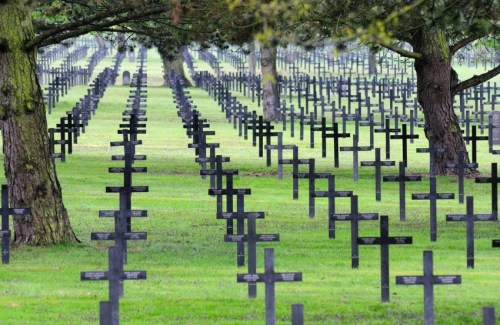
Tag Archives: john f kennedy

The Armistice Day Centenary: A Day of Conscience

Friends of Padre Steve’s World,

Forty years after the guns went silent in on November 11th 1918, General Omar Bradley, spoke these words on the eve of Armistice Day, 1948:

Tomorrow is our day of conscience. For although it is a monument to victory, it is also a symbol of failure. Just as it honors the dead, so must it humble the living. Armistice Day is a constant reminder that we won a war and lost a peace…”

It was supposed to be the “War to end all war,” or so thought President Woodrow Wilson and other American idealists. However, the war to end all war birthed a series of wars which far exceeded the losses of the First World War as ideological wars, exponentially more powerful weapons, and systematized mass murder and genocide birthed new horrors.

Winston Churchill wrote:

“The Great War differed from all ancient wars in the immense power of the combatants and their fearful agencies of destruction, and from all modern wars in the utter ruthlessness with which it was fought. … Europe and large parts of Asia and Africa became one vast battlefield on which after years of struggle not armies but nations broke and ran. When all was over, Torture and Cannibalism were the only two expedients that the civilized, scientific, Christian States had been able to deny themselves: and they were of doubtful utility.”

In the First World War there were over 22 million military casualties including over 8 million dead of which over 126,000 were Americans. Close to 20 million civilians also were casualties of the war.

President Woodrow Wilson established what we know now as Veteran’s Day as Armistice Day in November 1919, a year after the guns went silent.

Wilson wrote:

To us in America, the reflections of Armistice Day will be filled with solemn pride in the heroism of those who died in the country’s service and with gratitude for the victory, both because of the thing from which it has freed us and because of the opportunity it has given America to show her sympathy with peace and justice in the councils of the nations…

That initial proclamation was followed 45 years later by one of President Dwight D. Eisenhower. Eisenhower signed into law what we now know as Veteran’s Day in 1954.

In a sense I wish we had two holidays, one for Veterans from all wars in general and this one which we should never forget. It seems that in combining them we have lost some of the sacredness of the original. As Kurt Vonnegut wrote: “I don’t want to throw away any sacred things.” 

Because of that, I will remember all who served tomorrow as we observe Veterans Day, but I will not forget Armistice Day.

It is important not to forget the horrors and results of the First World War because both it and the Second World War, have faded from memory. Most people today cannot fathom killing on such a large scale, the overthrow of powerful nations and dynasties, the creation of new nations built from diverse, and often rival ethnic and religious groups such as Czechoslovakia and Yugoslavia, or the re-establishment of ancient nations such as Poland.

Yet to those of us who have gone to war and studied past wars the end result is not so distant. It is a part of our lives even today. Edmond Taylor accurately noted in his book, The Fall of the Dynasties: The Collapse of the Old Order, 1905-1922:

“The First World War killed fewer victims than the Second World War, destroyed fewer buildings, and uprooted millions instead of tens of millions – but in many ways it left even deeper scars both on the mind and on the map of Europe. The old world never recovered from the shock.”

The cost in human lives alone is incomprehensible. In the short time that United States forces went into action in late 1917 on the western front and the armistice, 126,000 Americans were killed, 234,000 wounded, and 4,500 missing; 8.2% of the force of 4,355,000 the nation mobilized for war. More Americans were killed in the First World War than Korea, Vietnam, the Gulf War, Iraq, and Afghanistan combined.

But American losses were small in comparison with the European nations who had for over four years bled themselves dry.  If one wonders why Europeans seem to have so little desire for involvement in war, one only needs to see how the concentrated killing of the First World War decimated the best and brightest of that generation. Out of the nearly 8.5 million Frenchmen mobilized lost 1,357,000 killed, 4,266,000 wounded and 537,000 missing, 6,160,000 casualties or 73.3% of its forces. The Russians also lost over 73% of 12 million, Romania 71% of 750,000, Germany 65% of 11 million, Serbia 47% of 707,000, tiny Montenegro 40% of 50,000, Italy 39.9% of 5.6 million, Great Britain 36% of almost 9 million, the Ottoman Empire 34% of 8.5 million. But the dual monarchy of Austria-Hungary which began the war in response to the assassination of Archduke Franz Ferdinand lost 90% of the 7.8 million men that it sent to war.
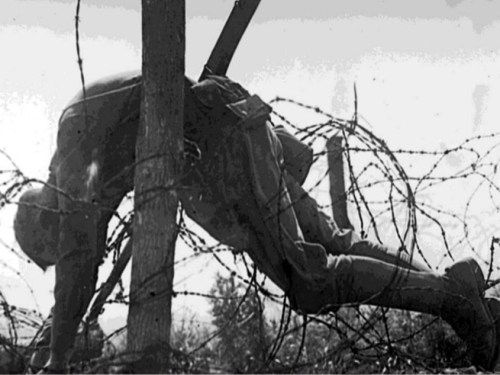
The human costs were horrifying. In all over over 65 million men served under arms in the war. Over 8.5 million were killed, over 21 million wounded, 7.75 million missing or prisoners or almost 37.5 million military casualties alone. That total would be roughly equivalent to every citizen of the 30 largest American cities being killed, wounded or missing.

Much of Europe was devastated and in the following months and years, mass numbers of refugees the dissolution of previously stable empires were displaced. A Civil War in Russia killed many more people and led to the establishment of the Soviet Union. Germany too was torn apart by civil war that left it bitterly divided and planted the seeds of Hitler’s Nazi regime. Border conflicts between new states with deep seated ethnic hatreds broke out. A flu pandemic spread around the world killing millions more. Economic disasters culminating in the Great Depression and social instability led to the rise of totalitarian regimes which spawned another, even more costly World War and a 40 year Cold War. The bitter results of the First World War are still felt today as conflicts in the Middle East in part fueled by the decisions of Britain and France at the end of the war rage on.

T. E. Lawrence, Lawrence of Arabia, who gained fame during the Arab revolt looked at the results of the war with a great deal of melancholy. He wrote:

“We were fond together because of the sweep of open places, the taste of wide winds, the sunlight, and the hopes in which we worked. The morning freshness of the world-to-be intoxicated us. We were wrought up with ideas inexpressible and vaporous, but to be fought for. We lived many lives in those whirling campaigns, never sparing ourselves: yet when we achieved and the new world dawned, the old men came out again and took our victory to remake in the likeness of the former world they knew. Youth could win, but had not learned to keep, and was pitiably weak against age. We stammered that we had worked for a new heaven and a new earth, and they thanked us kindly and made their peace.”
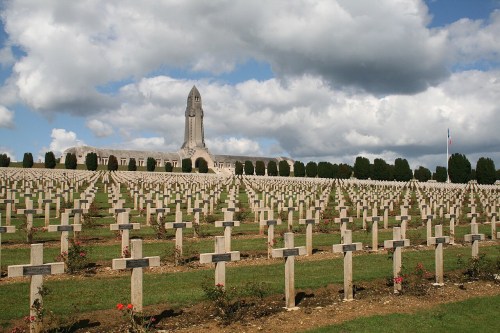
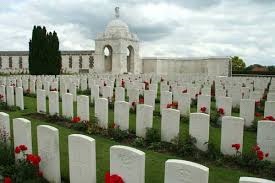
The his epic war poem, In Flanders Fields, Canadian Lieutenant Colonel John McCrea symbolized the cost of that war and the feelings of the warriors who endured its hell.

In Flanders fields the poppies blow
Between the crosses, row on row,
That mark our place; and in the sky
The larks, still bravely singing, fly
Scarce heard amid the guns below.

We are the Dead. Short days ago
We lived, felt dawn, saw sunset glow,
Loved and were loved, and now we lie
In Flanders fields.

Take up our quarrel with the foe:
To you from failing hands we throw
The torch; be yours to hold it high.
If ye break faith with us who die
We shall not sleep, though poppies grow
In Flanders fields.

Yes there are always consequences to actions. This weekend as we remember what we Americans now call Veteran’s Day, and the British refer to as Remembrance Day let us blood shed by so on the battlefields of Verdun, Gallipoli, Caporetto, Passchendaele, the Marne, the Argonne, Tannenberg, the Somme, Galicia, the Balkans, Flanders Fields, at sea and in the air.
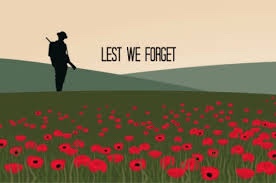
President John F. Kennedy said: “As we express our gratitude, we must never forget that the highest appreciation is not to utter words, but to live by them.”

Kennedy was right, that our appreciation is not just to utter words, but to live by them. Sadly, the current American President has no understanding of such nuances. He continued thump his chest and spit in the face of allies while, courting nations hostile to the very ideals of the United States. Likewise, the President, a man who never served in the military, and spent the Vietnam War avoiding service and dodging the draft while later comparing avoiding sexuality transmitted diseases to combat again dishonored the men who spilt their blood in the First World War. Donald Trump does not understand anything about history, war, courage, or honor. Sadly, he is all too representative of a generation that neither knows or cares about those things. He and others like him will be the ones that lead the world into another disaster.

“Strong prejudices in an ill-formed mind are hazardous to government, and when combined with a position of power even more so.”

I write in the hope of peace and an end to war.

Peace,

Padre Steve

4 Comments

Filed under History, Military, national security, Political Commentary, world war one

“The First Duty of Every Officer is to the Truth”

Friends of Padre Steve’s World,

Most of my readers know that in addition to being a Priest and Navy Chaplain that I am a historian and have taught both ethics and Gettysburg as a faculty member at a Staff College. Many of the men and women that I taught will lead our military as commanders, planners and staff officers. I stay in contact with a number of my former students, including two from South Korea. Now I still write even as I lead the staff at one of the Navy’s largest and most active Chapel programs.

Since I figure that this will be my last duty station before I retire my goal is to help guide those who work with me to success in the military and set them up for success when they leave the military. They are a great group, I could not ask for better and when I have a bad day or seem to be off in some way I have given them permission to ask how I am doing and to ask me hard questions. I give them permission to tell me the truth. A lot of leaders won’t do that, but I try to be transparent and honest with them because I know that they have my back and we do a pretty good job at caring for people and doing the right thing.

As such my first duty, whether it is in teaching, writing or in ministry is to the truth. In fact I quoted Captain Jean Luc Picard, played by Sir Patrick Stewart in Star Trek the Next Generation: “the first duty of every Starfleet officer is to the truth, whether it’s scientific truth, historical truth or personnel truth…” I am not a Starfleet Officer but as an officer nonetheless I have always believed that the truth matters, but sadly I, like so many of us have turned the other way and not spoken out. But the older I get the more I realize that I cannot be silent about subjects that at one time I turned a blind eye to because they were uncomfortable, unpopular or might hurt my career either in the church or in the military.

I have been writing a lot over the past few months about subjects that many people are controversial and as such many people are uncomfortable with those topics. Whether the issue is civil rights, racism, Gay rights and marriage equality, voting rights, religious freedom and religious intolerance, and even xenophobia, or the connection of symbols such as the Confederate Battle Flag to a heritage that goes to a hatred that extends far beyond the battlefields of the Civil War; I am speaking out. Now I am fully aware of that many of these subjects are controversial. I have been asked in comments on this site and on my various social media accounts, particularly Facebook, why I keep bringing up the uncomfortable past. But I have to, I have a duty to the truth and as Oscar Wilde noted “The truth is rarely pure and never simple.”

The late Howard Zinn, a brilliant historian whose work at one time I discounted, said: “But I suppose the most revolutionary act one can engage in is… to tell the truth.” Who would think that telling the truth could or would be a revolutionary act? However, when one lives in a society where the truth is bent, run over and shredded by politicians, preachers and pundits, what I call the Trinity of Evil; when state school boards whitewash history and force their religious views on children in public schools; where corporations and advertisers use the most crass means to deceive customers; and where established science is not met with denial under the guise of “skepticism;” telling the truth is a revolutionary affair.

The honest truth is that I never expected to be a revolutionary in terms of what so much of society, especially the conservative Christian movement that I spent much of my life in expects. Truthfully, upholding tradition, and for that matter defending myth, is much easier when backed by the certitude of an unbending theology and political is much easier than asking the hard questions. Barbara Tuchman once wrote: “The reality of a question is inevitably more complicated than we would like to suppose.” I guess that is why so many people would rather be content with myth than to ask the really hard questions; be they about history, religion, and science or for that matter anything. One of the must uncomfortable things to admit is that truth is always evolving as we learn more, it is dynamic, not static and to attempt to force people to live by the “truth” of our ancestors is disingenuous, dishonest and denies the reality of the universe that we live. Thomas Jefferson recognized this and wrote:

“I know also, that laws and institutions must go hand in hand with the progress of the human mind. As that becomes more developed, more enlightened, as new discoveries are made, new truths disclosed, and manners and opinions change with the change of circumstances, institutions must advance also, and keep pace with the times. We might as well require a man to wear still the coat which fitted him when a boy, as civilized society to remain ever under the regimen of their barbarous ancestors.” 

So why do I write? I write so that we never forget or push aside the great evils that human beings are capable of committing: The Holocaust, slavery and Jim Crow, the extermination of Native Americans by the millions in the name of God and Manifest Destiny, the enslavement, exploitation, and sometimes the extermination of whole peoples by colonialism; the witch trials, the religious wars of the Reformation, the Inquisition, the Chinese Cultural Revolution, Stalin’s purges, the Tuskegee experiments, the Japanese barbarity in the Rape of Nanking and other places in Asia, the Srebrenica genocide and the Rwandan genocide, just to name a few.

All too often the perpetrators of those events and their descendants as all too willing to last the past lie dormant. But at what cost do we do so? Do we sacrifice justice on the altar of prosperity and peace; do we sacrifice uncomfortable truth in order to remain undisturbed and comforted by myth? Do we condemn our descendants to live under the myths of our ancestors? Would we sacrifice the truth and justice in order to ensure obedience? Howard Zinn correctly observed, “Historically, the most terrible things – war, genocide, and slavery – have resulted not from disobedience, but from obedience.”

President John F Kennedy spoke these words at Yale in 1962: “The great enemy of truth is very often not the lie–deliberate, contrived and dishonest–but the myth–persistent, persuasive and unrealistic. Too often we hold fast to the cliches of our forebears. We subject all facts to a prefabricated set of interpretations. We enjoy the comfort of opinion without the discomfort of thought.”

Personally I would rather ask the questions and confront the past so we might have a better future, because though I am a realist, I also believe in my heart that humanity is capable of overcoming hatred, prejudice and ignorance. The problem is that times get difficult those attitudes can overcome our better nature. As Spencer Tracy’s character in the movie Judgment at Nuremberg said:

“But this trial has shown that under a national crisis, ordinary – even able and extraordinary – men can delude themselves into the commission of crimes so vast and heinous that they beggar the imagination. No one who has sat through the trial can ever forget them: men sterilized because of political belief; a mockery made of friendship and faith; the murder of children. How easily it can happen. There are those in our own country too who today speak of the “protection of country” – of ‘survival’. A decision must be made in the life of every nation at the very moment when the grasp of the enemy is at its throat. Then, it seems that the only way to survive is to use the means of the enemy, to rest survival upon what is expedient – to look the other way. Well, the answer to that is ‘survival as what’? A country isn’t a rock. It’s not an extension of one’s self. It’s what it stands for. It’s what it stands for when standing for something is the most difficult! Before the people of the world, let it now be noted that here, in our decision, this is what we stand for: justice, truth, and the value of a single human being.”

That my friends, is why I write: for justice, truth, and the value of a single human life.

Peace

Padre Steve+

1 Comment

Filed under ethics, faith, film, History, News and current events, Political Commentary

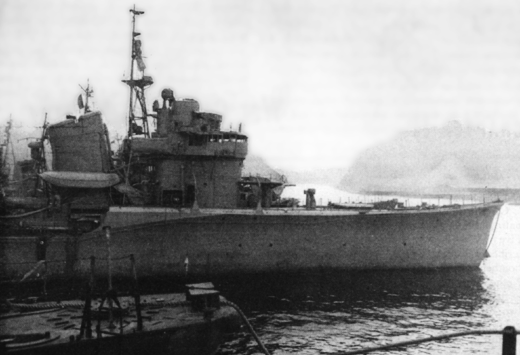
Modern and Deadly: The Japanese Fubuki Class Destroyers

battledestroy

Friends of Padre Steve’s World,

As I mentioned the past few days I am taking a little bit of a break from current events and I am going back to my archives to re-publish older articles about great classes of warships. I am a Navy officer as well as a Navy brat. I grew up with an appreciation for all things navy and various classes of warships that made history. Today, a post about a class of Japanese destroyers that set a standard for the world and can truly described as the first modern destroyers, the Fubuki Class

I hope that you enjoy.

Peace

Padre Steve+

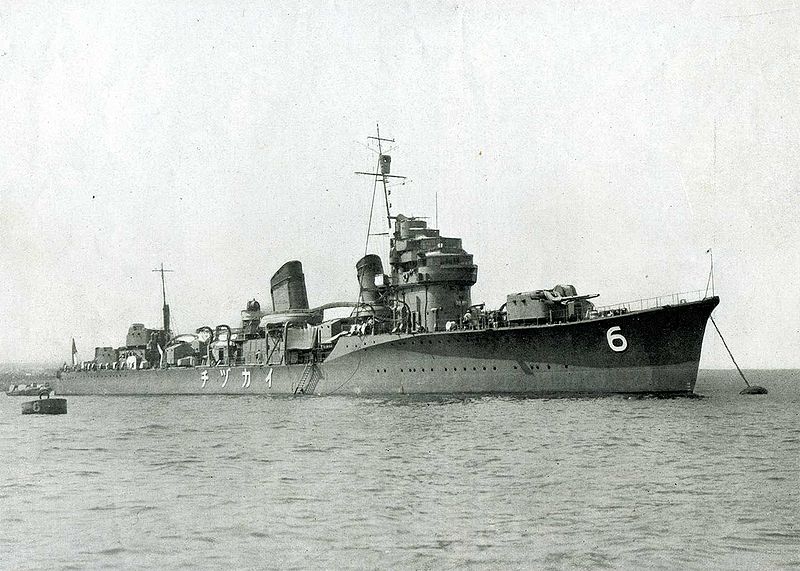
Fubuki

IJNS Fubuki

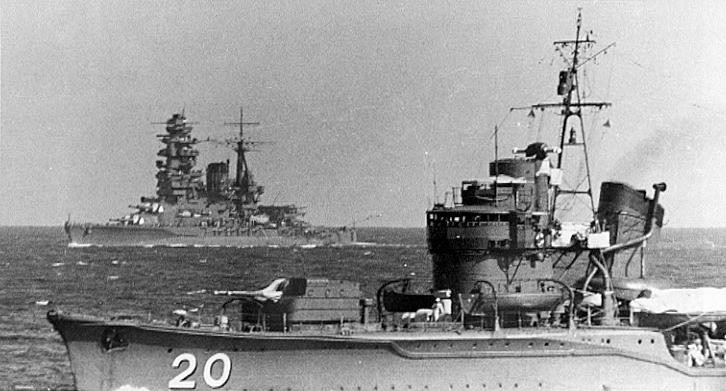
The Imperial Japanese Navy set the standard for destroyer construction in the 1920. While the United States Navy and British Royal Navy were fully stocked with their First World War design destroyers the Imperial Navy’s General Staff issued a requirement for a class of large destroyers which would complement the new classes of modern cruisers being built for the navy. The requirement called for a 2000 ton ship capable of 39 knots with a 4000 mile range at 14 knots that could carry a large number of torpedoes and a heavy gun armament. The program was designed to give the numerically inferior Imperial Navy a qualitative superiority against any opponent.

Fubuki-class ONI

WWII Office of Naval Intelligence images for Fubuki Class variants

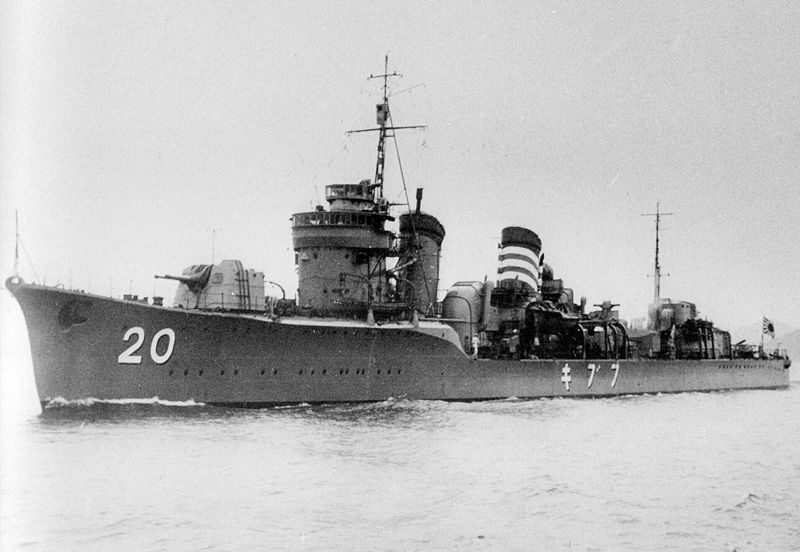
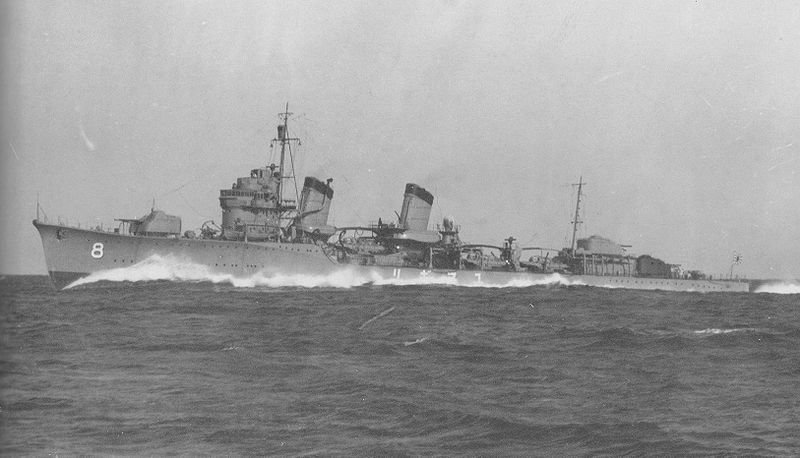
The 24 ship Fubuki Class was such a quantum leap over other contemporary destroyers that the Imperial Navy referred to them as the Special Type. Their large size, heavy armament and high speed made them equal to many of the light cruisers of the time. The design was modified to carry more guns and torpedoes on an increased displacement and the result was a 388 foot long 1750 ton ship armed with six 5” 50 caliber guns in weather proof and splinter proof mounts. On the initial 10 ships of the class the guns could only be elevated 40 degrees which made them less than effective as anti-aircraft guns but in the succeeding two groups of ships the mounts were an improved type which allowed them to elevate each gun separately to 75 degrees. The ammunition magazines were below the gun mounts and ammunition was passed to the guns by hoists. This gave them a decided edge in rate of fire over other destroyers which had open or partially shield mounts dependant on ammunition passers carrying ammunition to them.

Sagiri

Close up of IJNS Sagiri

The light anti-aircraft armament when built was two Type 93 13mm machine guns. In the years before the war and during the war this was increased in some cases up to twenty-two 25mm anti-aircraft guns and 10 of the Type 93 machine guns. In 1944 surviving ships of the class had their X- 5” gun mount removed to facilitate more of the 25mm guns, radar and additional depth charge capacity.

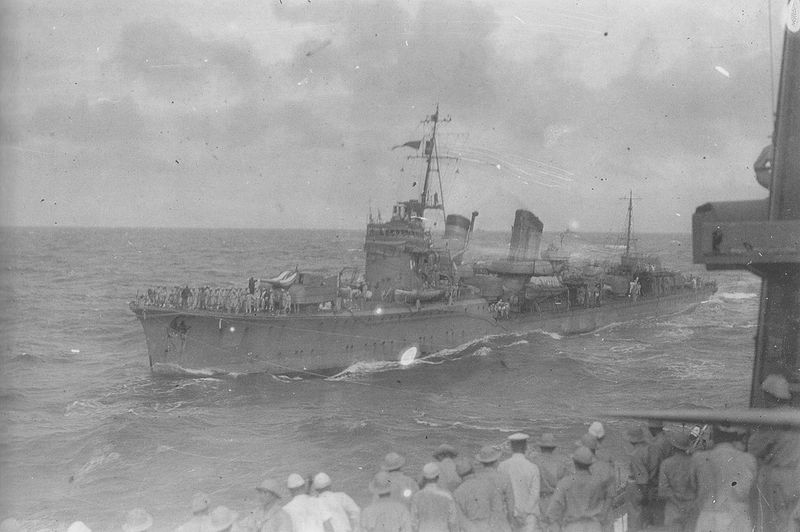
Ikazuchi

IJNS Ikazuchi

The nine 24” torpedo tubes in triple mounts were able to be reloaded while in battle a capability not shared by other destroyers. They carried a total of 18 torpedoes which initially were the Type 8 but these were replaced by the oxygen powered Type 93 “Long Lance” torpedoes before the war. These torpedoes had a higher speed, longer range and heavier warhead than torpedoes produced by other navies. These torpedoes would become the scourge of Allied navies during the war in the brutal surface engagements of 1942.

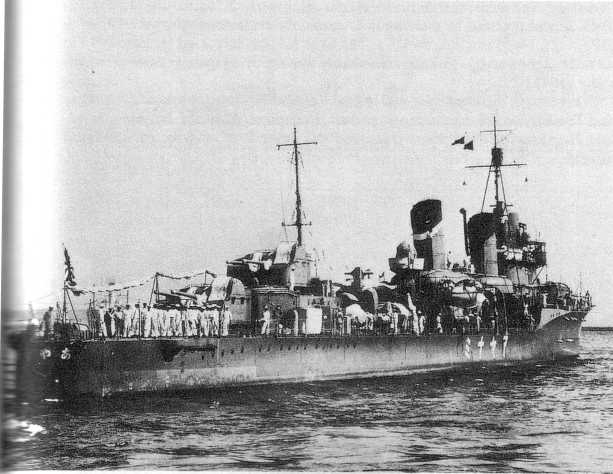
Yugiri_II

IJNS Yugiri

Due to the modifications made to the design which put more armament on a smaller displacement than the original design made them unstable in heavy seas and resulted in longitudinal hull weakness that resulted in the class being rebuilt between 1935 and 1937. The rebuild increased their displacement to 2050 tons standard and over 2400 tons full load and resulted in a slight reduction of their speed.

Hibiki_II

IJNS Hibiki

The class was built in three groups and each is sometimes referred to as a separate class as each incorporated improvements over the preceding group. The first 10 ships of the class which are sometimes referred to as the Fubuki Class were of less complex design than subsequent ships. They were feet long had a smaller bridge and exposed gunfire control room. The second group of 10 ships commonly referred to as the Ayanami Class had an enlarged bridge structure which enclosed previous exposed positions to include the gunfire control room, range finders and included a range finder tower. They also were the first ships to receive the improved Type B gun mounts. The final subtype of the class, the Akatsuki Class comprised just 4 ships and was distinguished by a smaller forward funnel, larger boilers and unique splinter proof torpedo tube mount housing.

ayanami

IJNS Ayanami

The ships of the class participated in every major campaign of Japan’s war in the Pacific as well as operations against China in the 1930s. One ship the Miyuki was lost in a collision with another destroyer in August 1934. All remaining ships of the class except the Hibiki and Ushio were lost in action during the war. Four the Fubuki, Ayanami, Yuguri and Ataksuki were sunk in surface actions. Eight ships the Usogumo, Shirakumo, Isonami, Shikinami, Sagiri, Sazanami, Inazuma, and Ikazuchi were lost to Allied submarines. Seven ships, the Shirayuki, Hatsuyuki, Murakumo, Uranami, Asagiri, Oboro and Akebono were sunk by aircraft, while the Shinonome and Amagiri fell victim to mines.

Ushio

The demilitarized IJNS Ushio after the war

Hibiki was given to the Soviet Union following the war and served in that Navy until either 1953 or 1963 depending on the source. She was scrapped. Ushio surrendered to the Allies was demilitarized and scrapped in 1948.

The Amagiri played a role in the life of future President John F Kennedy when she rammed and sank his PT-109 in the Blackett Strait on August 2nd 1943. Her commanding officer at the time Lieutenant Commander Kohei Hanami attended Kennedy’s inauguration in 1961.

The Fubuki Class destroyers set a standard in destroyer construction that other navies around the world sought to emulate. Fast and powerful they and their brave crews fought gallantly in the Second World War and though they fought in a losing cause, they deserve to be remembered as do all those who go down to the sea in ships.

Leave a comment

Filed under History, Military, Navy Ships, World War II at Sea, world war two in the pacific

The Truth is Rarely Pure & Never Simple

MenBrooklyn

Friends of Padre Steve’s World,

The past few days I have posted short articles about some very personal things dealing with life and relationships. In a sense that continues today as I prepare for another “Staff Ride” with my students to Gettysburg. This trip will be interesting because over half of the students attending the staff ride will be officers from South Korea. Over the past couple of weeks I have been working on major revisions and additions to another chapter of my Gettysburg text and I hope to share that before the coming week is out.

I have a passion for truth, especially in the realm of historical thought, in fact over the past few years this passion has deepened to a level of profoundness that I never dreamed. In fact for me this passion has become a duty, a duty to truth; an un-sanitized, warts and all examination of subjects attempting to strip away the veneer of myth in order to find truth. This is not easy, but it is what my life has become, knowing that in the long run I will not discover all truth, but hopefully point others to examine history, the sciences, philosophy and even theology to find truth. The process can be uncomfortable, especially when confronted by facts, documents, scientific and archeological data which shows what we used to think was truth, as either incomplete, romantic myth, or even complete lies, untruths and fabrication. Oscar Wilde once wrote,“The truth is rarely pure and never simple.”

Barbara Tuchman once wrote: “The reality of a question is inevitably more complicated than we would like to suppose.” That is the nature of truth. It does not matter if it is truth about history, biography, philosophy and religion, science, politics, economics or any part of life. To actively seek truth means that one must open up themselves to the possibility of doubting, as Rene Descartes wrote: “If you would be a real seeker after truth, it is necessary that at least once in your life you doubt, as far as possible, all things.” I admit that this is not comfortable, but it is necessary.

As a historian I have a tremendous passion for truth, and for unsanitized history and for me this means looking at what we know with a critical eye, to compare and examine sources to question what we or others knew before. Far too often what we believe about our own history is often more preserving myth more than by asking hard questions and applying reasoned critical study. To do this is dangerous, because to do so we have to admit that what we know today could be proven wrong at some time in the future when new facts, documents, archeological finds or other historical or scientific are discovered. To those content with half-truth, partial truth or even myth this is disconcerting, and those of us who attempt to unravel myth from fact and present things in a new way are called “revisionists” as if that is somehow a bad thing. The sad thing is we are having to revise in many cases, supposed history that was revised by people who needed to propagate myth, such as with those who promoted the myth of the Lost Cause, the romantic, noble Confederacy which for well over a half century was propagated as historical truth. This myth was sold to the American public in such in film, television and books, fiction and non-fiction alike, to the point that much of white America, even outside the South accepted the myth of the Lost Cause as truth. Films like Birth of a Nation, Gone with the Wind and even Disney’s Song of the South, helped ingrain the myth as truth, and even today when so much more is known, many people hold on to the myth and attack those who differ.

A lot of my readers may wonder why I write so much about the American Civil War as well as the ante-bellum and Reconstruction eras of American history. For me they are very important for a couple of reasons; first they are eras, that for good and bad define us as a nation and people. Second, they still have relevance to what happens today, especially in the understanding of liberty, civil rights and race relations.

I have a passion for this. The American Civil War and the Battle of Gettysburg are intrinsic parts of who we are as Americans today. The events of that war and this battle continue to reverberate in many aspects of our political, social and national life. Thus for me teaching about this event and what happened on the “hallowed ground” of Gettysburg, as Abraham Lincoln called it, and even 150 years later it matters far more than most of us realize.

Civil War hero Joshua Chamberlain is an icon of the Civil War and American history. A professor of Rhetoric and Natural and Revealed Religions at Bowdoin College he volunteered to serve with the 20th Maine Infantry, his military career in the Civil War has been depicted in movies such as Gettysburg and Gods and Generals and written about in biographies and even historical fiction. Chamberlain was one of the heroes of Gettysburg, and his story has a myth like quality, but he too was a complex, contradictory and sometimes flawed character. However, Chamberlain attached a great importance to passing down the stories of people who did noble deeds and who lived exemplary lives. He wrote, “The power of noble deeds is to be preserved and passed on to the future.”

I sincerely believe what Chamberlain said and I am getting ready to lead another Staff Ride for students from our Staff College to Gettysburg this week. I do beleive that the power of noble deeds needs to be preserved and passed on to the future. Even the deeds of less than perfect, often contradictory and sometimes even scandalous individuals. That is part of the task of the historian. I do this in what I teach and what I write, both in the academic setting as well as on this website.

We live in a time of great cynicism, some of which I can understand. We also live in a time where many people and our institutions operate in a “zero defect” culture, those who fail in any way are shunted aside, punished or even chastised or ostracized. However, when I look at the men who fought at Gettysburg, or for that matter almost any individual who has accomplished great things, none are perfect people and many have great flaws in character, or supported causes or ideologies that were evil. That being said, even less than perfect people can rise to do great deeds, deeds that need to be remembered, passed down and told to succeeding generations.

Many great leaders, or other men and women that we consider today to be great, influential or important were or are quite fallible. Even those who did great things often made gross mistakes, had great flaws in their character, and some lived scandalous lives. Such deeds may tarnish their legacy or take some of the luster away from their accomplishments. But I think that these flaws are often as important as their successes for they demonstrate the amazing capacity of imperfect people to accomplish great things, as well as the incredible complexity of who we are as people. No one is perfect. There are degrees of goodness and even evil in all of us. It is part of the human condition. That is the beauty of un-sanitized history, that is the beauty of stripping away myth to discover the humanity of people, and to recognize who they are, who we are, the good, the bad and even the ugly.

When I look at the perfection that imperfect people expect of others I am reminded of something that William Tecumseh Sherman said about his relationship with Ulysses Grant. These were flawed men, but they were in large part responsible for the Union victory in the Civil War. However, to be honest, neither man would never reach the level of command that they rose to in our current military culture, nor would they rise to the top in corporate America. They are too flawed. Sherman said it well, “Grant stood by me when I was crazy, and I stood by him when he was drunk, and now we stand by each other.”

That is a part of my passion about Gettysburg and my appreciation and admiration of the brave men who fought in that battle. As I continue to write about that battle and about those men I hope that my readers will gain a new appreciation of their complex and contradictory natures, as well as think about what that means to us today, as individuals and as a society, for it is only when we strip away the myth and seek the truth. Marcus Aurelius wrote:

“If someone is able to show me that what I think or do is not right, I will happily change, for I seek the truth, by which no one was ever truly harmed. It is the person who continues in his self-deception and ignorance who is harmed.”

Those truths can be scientific, they can be historical or literary, and quite often the truth can also be quite personal.

As John F Kennedy said at Yale in 1962: “The great enemy of truth is very often not the lie–deliberate, contrived and dishonest–but the myth–persistent, persuasive and unrealistic. Too often we hold fast to the cliches of our forebears. We subject all facts to a prefabricated set of interpretations. We enjoy the comfort of opinion without the discomfort of thought.”

So until tomorrow, have a thoughtful night.

Peace

Padre Steve+

Leave a comment

Filed under civil rights, civil war, History, leadership, Military

Reason is not the Subversion but the Salvation of Freedom

Friends of Padre Steve’s World

Adlai Stevenson once wrote:

“Unreason and anti-intellectualism abominate thought. Thinking implies disagreement; and disagreement implies nonconformity; and nonconformity implies heresy; and heresy implies disloyalty. So, obviously, thinking must be stopped. But shouting is not a substitute for thinking and reason is not the subversion but the salvation of freedom.”

I have traveled to a lot of places, in this country and around the world where reason has been a scarce commodity and to me that has always been a frightening specter; a world where reason is all too often sacrificed on the altar of political, ideological or religious expediency.

But reason does matter, and those who ignore it do so at their own peril as Christopher Hitchens once said “That which can be asserted without evidence, can be dismissed without evidence.” History shows us in times like this, where reason is tossed as primordial urges rise, that people all too often fall back on old hatreds and myth rather than seeking answers; instead of trying to figure out what is really important; instead of studying the details of the great questions; that frustrated people become intellectually lazy and gravitate towards angry demagogues who play to their often legitimate anger and frustration.

But demagogues do not need to appeal to reason, they appeal to something more primal, they appeal to fear, anger, and the need of desperate people to find someone to blame.

Appealing to fear and loathing is so much easier than using reason. To call an opponent a Communist or Nazi, Fascist or imperialist, unbeliever, heretic or even a racist; and then connect them to the evil we want to demonize them is far easier than it is to actually engage them in a truthful debate and to see things in their historical context.

Too often we allow people of little learning but whose great charm and salesmanship ability, to sell us myth in place of fact and this happens across the political, social, economic and theological spectrum. That is a tragedy for all of us no matter what our political, ideological, or religious views.

Such salesmanship may comfort the true believer in whatever cause may be, and it may even make them feel superior to those that disagree with them. But it blinds them to reality and ensures that they never become aware of their own envy, malice, pettiness and dishonesty. The untruths they believe serve as protection against any thought, fact, presumption or doctrine that contradicts them.  John F Kennedy said, “Too often we enjoy the comfort of opinion without the discomfort of thought.” 

In times like ours, it is most important to take the time to learn from history, not just generalities that mix fact and myth but the little details that make up history and for that matter the sciences, philosophy, sociology, political thought and theology.  As a society we have ceased to do this and until we take the time to return to such study, dialogue and put aside our blinders we will be doomed to remain as we are no matter what political party is in power or ideology dominates the airwaves and cyber space.

Reason, it is important, and the dangers that we face as a nation, society, and world demand that we return to it.

Have a great day.

Peace

Padre Steve+

3 Comments

Filed under ethics, History, philosophy, Political Commentary

The Oath of Office: What Kim Davis Doesn’t Get

DSCN0016

Friends of Padre Steve’s World

Kim Davis, the Recalcitrant County Clerk of Rowan County, Kentucky remains in jail. She has supporters around the country, one of whom I had to ban from commenting on my site. I didn’t want to do it but after fair warning he gave me little choice. The man was taking advantage of my graciousness to hijack the comments section to preach at me and treat me and other commentators with a contempt that the Pharisee’s would have admired. When I informed him of this he played the aggrieved persecuted Christian victim of vile liberal oppression routine; but I digress…

Lost to many of Mrs. Davis’ supporters, including a number of presidential candidates, some who are sitting United States Senators, is the sacred importance of oath of office. All who serve in public office swear an oath to uphold the law taking office, even laws that we may not like. These oaths, be they local, state or federal all prescribe the conduct and duty of the oath taker. People who take these oaths often swear before God that they will faithfully uphold the laws of the land.

Kim Davis swore an oath, actually two of them and she is in violation of both of them. This is the oath that she took less than nine months ago when she took office as the Clerk of Rowan County Kentucky, it is prescribed by law in the State of Kentucky and applies to all who hold that office:

“I do solemnly swear (or affirm, as the case may be) that I will support the Constitution of the United States and the Constitution of this Commonwealth, and be faithful and true to the Commonwealth of Kentucky so long as I continue a citizen thereof, and that I will faithfully execute, to the best of my ability, the office of ——————— according to law; and I do further solemnly swear (or affirm) that since the adoption of the present Constitution, I, being a citizen of this State, have not fought a duel with deadly weapons within this State nor out of it, nor have I sent or accepted a challenge to fight a duel with deadly weapons, nor have I acted as second in carrying a challenge, nor aided or assisted any person thus offending, so help me God.”

The Kentucky legislature also stipulated in 1978:

Every clerk and deputy, in addition to the oath prescribed by Section 228 of the Constitution, shall, before entering on the duties of his office, take the following oath in presence of the Circuit Court: “I, ….., do swear that I will well and truly discharge the duties of the office of ………….. County Circuit Court clerk, according to the best of my skill and judgment, making the due entries and records of all orders, judgments, decrees, opinions and proceedings of the court, and carefully filing and preserving in my office all books and papers which come to my possession by virtue of my office; and that I will not knowingly or willingly commit any malfeasance of office, and will faithfully execute the duties of my office without favor, affection or partiality, so help me God.” The fact that the oath has been administered shall be entered on the record of the Circuit Court.

Effective: January 2, 1978 History: Created 1976 (1st Extra. Sess.) Ky. Acts ch. 21, sec. 2, effective January 2, 1978. 

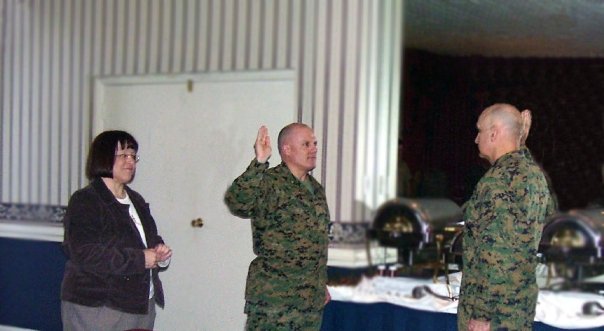
I am no stranger to taking an oath of office, and as a Navy Chaplain also signing a document binding me to support people of all religions and their religious liberty. The first oath I took was an oath of enlistment in the California Army National Guard. I took that oath 34 years ago on August 25th 1981. It stated:

I, ________ do solemnly that I will support and defend the Constitution of the United States and the State of California against all enemies, foreign and domestic; that I will bear true faith and allegiance to the same; and that I will obey the orders of the President of the United States (Ronald Reagan) and the Governor of California (Jerry Brown)  and the orders of the officers appointed over me, according to law and regulations. So help me God.

lcdr oath

Re-taking the oath of office in 2006 on being promoted to Lieutenant Commander

That was the beginning. On June 19th 1983 I took an oath as a Commissioned Officer in the United States Army. This is an oath that I renewed with every promotion, and every new appointment in the different components of the military in which I have served; the Army, the Texas and Virginia Army National Guard, and finally the United States Navy. That oath states:

I, _________, do solemnly swear that I will support and defend the Constitution of the United States against all enemies, foreign and domestic; that I will bear true faith and allegiance to the same; that I take this obligation freely, without any mental reservation or purpose of evasion; and that I will well and faithfully discharge the duties of the office on which I am about to enter. So help me God.

I and all other military chaplains also sign a letter when appointed in which each of us agree to serve in a pluralistic environment and to treat each person with dignity, respect, and compassion, irrespective of differences in religious beliefs. For Chaplains that is kind of like the Star Fleet’s Prime Directive.

I have been in the military officer for 34 years, an officer for 32 years and a chaplain for 23 of those years. In that time I have served different Christian denominations, two of which were very conservative, but even so recognized the need to care for all in our charge. I have done my best to care for my soldiers, sailors and marines for all of those years regardless of their beliefs, which span the spectrum of America.

If I cannot in good conscience do something, or if I cannot meet their particular religious need because they need a specific person of their faith group to conduct that rite, sacrament or other ritual, it is my duty, my obligation, to help them find the right person. Likewise, if they come to me seeking counsel or an administrative matter that the service dictates that they see me for, I cannot and will not turn them away. Sadly, I have had to take care of some service members’ non-religious administrative needs that the service required the chaplain to do, because their chaplains refused them based on their chaplain not approving of their faith, or lifestyle. In this case, these service members had me to go to and did not have to seek a court order, like the people in Rowan County Kentucky who were refused by Kim Davis.

This is what so many of Mrs. Davis’ supporters do not understand. Public office is not a private business nor is it a religious office or church. Likewise, all Federal and State appointed chaplains are officers of the state who happen to be religious ministry professionals whose training, and endorsement by their religious bodies is to serve in secular institutions and to protect the liberty of those they serve.

Likewise, judges, clerks, officers of the military, or police all take oaths to serve. Supreme Court Justice Antonin “Big Tony” Scalia said in regard to judges:

“[I]n my view the choice for the judge who believes the death penalty to be immoral is resignation, rather than simply ignoring duly enacted, constitutional laws and sabotaging death penalty cases. He has, after all, taken an oath to apply the laws and has been given no power to supplant them with rules of his own.”

President John F. Kennedy who faced severe criticism from Protestants because of his Catholic faith told the Houston Ministerial Association:

“I do not speak for my church on public matters; and the church does not speak for me. Whatever issue may come before me as President, if I should be elected, on birth control, divorce, censorship, gambling or any other subject, I will make my decision in accordance with these views — in accordance with what my conscience tells me to be in the national interest, and without regard to outside religious pressure or dictates. And no power or threat of punishment could cause me to decide otherwise. 

But if the time should ever come — and I do not concede any conflict to be remotely possible — when my office would require me to either violate my conscience or violate the national interest, then I would resign the office; and I hope any conscientious public servant would do likewise.”

That is the true test of a public official in a pluralistic country. Sadly, like Mrs. Davis, some of her biggest name supporters do not understand that, and truly that is dangerous. Like all public officials, elected, appointed, or commissioned, Mrs. Davis took an oath of office to the state, not her church. If, less than nine months ago, she took those oaths knowing that she would break them then she lied. In doing so lied by swearing with her hand on the Bible and in the name of God.

Please do not preach to me about her relgious rights, if she is willing to lie with her hand on the Bible in the name of God, then she is not worthy of the office.

Have a great day,

Peace

Padre Steve+

11 Comments

Filed under civil rights, ethics, faith, History, laws and legislation, News and current events, Political Commentary, Religion

Reason, the Salvation of Freedom

IMG_0230

Friends of Padre Steve’s World,

Adlai Stevenson once wrote

“Unreason and anti-intellectualism abominate thought. Thinking implies disagreement; and disagreement implies nonconformity; and nonconformity implies heresy; and heresy implies disloyalty. So, obviously, thinking must be stopped. But shouting is not a substitute for thinking and reason is not the subversion but the salvation of freedom.”

I have traveled to a lot of places, in this country and around the world where reason has been a scarce commodity and to me that has always been a frightening specter; a world where reason is is all too often sacrificed on the altar of political, ideological or religious expediency.

I had a Church History professor in seminary that was known for his attention to detail and his expectation that his students would master the subject.  His method was quite simple. A fellow student asked him during review for a mid-term exam “what do we need to study for the test?”  His answer was simple “everything.” The student restated his question “what do we really need to know?”  My professor paused and made a comment that did not make the student very happy.  He said something that I paraphrase here “it is the details that enable you to see the big picture, without the details you know nothing.”

A good number of my fellow students did not appreciate the fact that he was deadly serious.  I actually think that GOP Presidential hopeful Mike Huckabee, who flunked out of my seminary, may have been one of them. It was not simply the ability to remember names and dates and events but to be able to connect them and see what was really important.  Many did not take him seriously and when the test came many failed it.  In fact some continued to fail every exam because they could not reconcile that details were important. The attitude of a good number of my classmates was that history, philosophy or even systematic theology was not important especially if they involved study of people or ideas that they did not agree with.

Unfortunately we now live in an age of anti-intellectualism and anti-historicism. As much as some of us would like to try to affix blame, this is not a problem that can be blamed on any one side of the political spectrum. Sadly, it cuts across the spectrum as people return to more primal instincts in an uncertain time, where established political parties and systems of government seem unable to get the job done, where economic systems seem rigged in favor of a small minority of people and where the social and religious underpinnings of society are rocked by change and uncertainty.

But reason does matter, and those who ignore it do so at their own peril as Christopher Hitchens once said “That which can be asserted without evidence, can be dismissed without evidence.” History shows us in times like this, where reason is tossed aside in favor of primordial urges; that instead of seeking answers and instead of trying to figure out what is really important and studying the details of the great questions, that frustrated people become intellectually lazy and gravitate towards people who play to their often legitimate anger and frustration.

People simply fall back on the dogmas presented by the Unholy Trinity of Pundits, Politicians and Preachers that cater to their ideology for reassurance and quite often carry very dangerous demagogues into office with often-tragic results for their nations and the world.  The demagogues of the Unholy Trinity are quite good at taking advantage of frightened and angry people who need scapegoats.

If you listen to talk radio or are a devoted fan of any particular cable news pundit you can see this on display daily and even more so by our political leaders and those seeking political power. For the most part what is presented is at best half-truth sprinkled with deadly venom of hatred to make the half-truth an absolute truth.  In such a world facts are only important if the “true believer” can use them buttress his ideological bias even if he has to take the completely out of context to in order to do so.  The demagogues do not need to appeal to reason, they appeal to something more primal, they appeal to fear, anger, and the need of desperate people to find someone to blame.

Appealing to fear and loathing is so much easier than using reason. To call an opponent a Communist or Nazi, Fascist or Imperialist, Unbeliever or Heretic or even a Racist; and then connect them to the evil we want to demonize them is far easier than it is to actually engage them in a truthful debate and to see things in their historical context. The same is true when we try to shut them down without even listening to them or giving the chance to air their views, even views that are not supported by the facts or history. Likewise when we use such labels against those that disagree with us we dehumanize our opponents thereby justifying any evil that we use to silence them. That is one reason that on this site I do my best to listen to others, even those who do not agree with me and why I do my best to build bridges and maintain a respectful dialogue. I may disagree with someone’s argument but I will always do my best to treat them with respect, allow them to present their position and unless they are threatening me with death or bodily harm allow their comments to remain on the site. Sadly, I have had some of those threats, notably from known White Supremacists, one of which was so specific in violent intent that I had to report the man to the FBI.

That being said, I have a decent number of people who comment and express their disagreement, sometimes quite strongly, with me who are respectful and who I will never label with any of those often-pejorative terms. In fact there one commentator on this site with who I have often spirited disagreements, but despite that I have come to appreciate him and believe that if we were to spend any amount of time together drinking beer and watching baseball that we could become fast friends. But sadly, I do not think that many people on either side of the political divide could do now. I actually wouldn’t mind spending time with this man. Why? Because despite all of our disagreements; he remains respectful and continues to comment. I think that speaks volumes about his character, which has to be honorable. I think that is what we are supposed to be about in the United States.

Sometimes it seems to me that we presume that if we repeat what we believe enough, even if it what we believe is unsound or erroneous that it will become truth.  As individuals, governments, institutions and businesses we often settle for easy answers that agree with our presuppositions and dismiss opposing views as heresy.  Too often we allow people of little learning but whose great charm and salesmanship ability, to sell us myth in place of fact and this happens across the political, social, economic and theological spectrum. That is a tragedy for all of us no matter what our political, ideological, or religious views.

I have written on this site about the study of history as well as ways of learning.  The little things do matter, and the study of history, philosophy, theology, the sciences, economics in fact anything of any importance is based on understanding details, and things like precedent and context.  It is not enough to string together a series of quotations or citations if they are taken out of context, altered or intentionally misused to fit our ideology or doctrine, whatever it may be.

Such methods may comfort the true believer in whatever cause and even make them feel superior to those that disagree but such thinking. But it blinds them to reality and ensures that they never become aware of their own envy, malice, pettiness and dishonesty. The “wall of words” that flow so easily from the mouths and pens of the members of the Unholy Trinity that their faithful followers, ensures that they are unable to separate them from reality, truth from fiction, opinion from fact.  This “wall of words” serves as their protection against any thought, fact, presumption or doctrine that contradicts them.  John F Kennedy said, “Too often we enjoy the comfort of opinion without the discomfort of thought.” 

In times like this it is most important to take the time to learn from history, not just generalities that mix fact and myth but the little details that make up history and for that matter the sciences, philosophy, sociology, political thought and theology.  As a society we have ceased to do this and until we take the time to return to such study, dialogue and put aside our blinders we will be doomed to remain as we are no matter what political party is in power or ideology dominates the airwaves and cyber space.

Reason, it is important, and as unreasonable as it sounds there is a prayer that neatly sums up what I desire for me and for our society:

From the cowardice that dares not face new truth

From the laziness that is contented with half truth

From the arrogance that thinks it knows all truth,

Good Lord, deliver me.

Have a great night.

Peace

Padre Steve+

3 Comments

Filed under civil rights, faith, History, leadership, Political Commentary

Revolutionary Truth Telling & the Discomfort of Thought

IMG_1249

Friends of Padre Steve’s World,

Most of my readers know that in addition to being a Priest and Navy Chaplain that I am a historian and teach both ethics and about Gettysburg as a faculty member at a Staff College. Many of the men and women that I teach will lead our military as commanders, planners and staff officers. As such as I mentioned at beginning of the year my first duty, whether it is in teaching, writing or in ministry is to the truth. In fact I quoted Captain Jean Luc Picard, played by Sir Patrick Stewart in Star Trek the Next Generation: “the first duty of every Starfleet officer is to the truth, whether it’s scientific truth, historical truth or personnel truth…” I am not a Starfleet Officer but as an officer nonetheless I have always believed that the truth matters, but sadly I, like so many of us have turned the other way and not spoken out. But the older I get the more I realize that I cannot be silent about subjects that at one time I turned a blind eye to because they were uncomfortable, unpopular or might hurt my career either in the church or in the military.

I have been writing a lot over the past few months about subjects that many people are controversial and as such many people are uncomfortable with those topics. Whether the issue is civil rights, racism, Gay rights and marriage equality, voting rights, religious freedom and religious intolerance, and even xenophobia, or the connection of symbols such as the Confederate Battle Flag to a heritage that goes to a hatred that extends far beyond the battlefields of the Civil War; I am speaking out. Now I am fully aware of that many of these subjects are controversial. I have been asked in comments on this site and on my various social media accounts, particularly Facebook, why I keep bringing up the uncomfortable past. But I have to, I have a duty to the truth and as Oscar Wilde noted “The truth is rarely pure and never simple.”

The late Howard Zinn, a brilliant historian whose work at one time I discounted, said: “But I suppose the most revolutionary act one can engage in is… to tell the truth.” Who would think that telling the truth could or would be a revolutionary act? However, when one lives in a society where the truth is bent, run over and shredded by politicians, preachers and pundits, what I call the Trinity of Evil; when state school boards whitewash history and force their religious views on children in public schools; where corporations and advertisers use the most crass means to deceive customers; and where established science is not met with denial under the guise of “skepticism;” telling the truth is a revolutionary affair.

The honest truth is that I never expected to be a revolutionary in terms of what so much of society, especially the conservative Christian movement that I spent much of my life in expects. Truthfully, upholding tradition, and for that matter defending myth, is much easier when backed by the certitude of an unbending theology and political is much easier than asking the hard questions. Barbara Tuchman once wrote: “The reality of a question is inevitably more complicated than we would like to suppose.” I guess that is why so many people would rather be content with myth than to ask the really hard questions; be they about history, religion, and science or for that matter anything. One of the must uncomfortable things to admit is that truth is always evolving as we learn more, it is dynamic, not static and to attempt to force people to live by the “truth” of our ancestors is disingenuous, dishonest and denies the reality of the universe that we live. Thomas Jefferson recognized this and wrote:

“I know also, that laws and institutions must go hand in hand with the progress of the human mind. As that becomes more developed, more enlightened, as new discoveries are made, new truths disclosed, and manners and opinions change with the change of circumstances, institutions must advance also, and keep pace with the times. We might as well require a man to wear still the coat which fitted him when a boy, as civilized society to remain ever under the regimen of their barbarous ancestors.” 

So why do I write? I write so that we never forget or push aside the great evils that human beings are capable of committing: The Holocaust, slavery and Jim Crow, the extermination of Native Americans by the millions in the name of God and Manifest Destiny, the enslavement, exploitation, and sometimes the extermination of whole peoples by colonialism; the witch trials, the religious wars of the Reformation, the Inquisition, the Chinese Cultural Revolution, Stalin’s purges, the Tuskegee experiments, the Japanese barbarity in the Rape of Nanking and other places in Asia, the Srebrenica genocide and the Rwandan genocide, just to name a few.

All too often the perpetrators of those events and their descendants as all too willing to last the past lie dormant. But at what cost do we do so? Do we sacrifice justice on the altar of prosperity and peace; do we sacrifice uncomfortable truth in order to remain undisturbed and comforted by myth? Do we condemn our descendants to live under the myths of our ancestors? Would we sacrifice the truth and justice in order to ensure obedience? Howard Zinn correctly observed, “Historically, the most terrible things – war, genocide, and slavery – have resulted not from disobedience, but from obedience.”

President John F Kennedy spoke these words at Yale in 1962: “The great enemy of truth is very often not the lie–deliberate, contrived and dishonest–but the myth–persistent, persuasive and unrealistic. Too often we hold fast to the cliches of our forebears. We subject all facts to a prefabricated set of interpretations. We enjoy the comfort of opinion without the discomfort of thought.”

Personally I would rather ask the questions and confront the past so we might have a better future, because though I am a realist, I also believe in my heart that humanity is capable of overcoming hatred, prejudice and ignorance. The problem is that times get difficult those attitudes can overcome our better nature. As Spencer Tracy’s character in the movie Judgment at Nuremberg said:

“But this trial has shown that under a national crisis, ordinary – even able and extraordinary – men can delude themselves into the commission of crimes so vast and heinous that they beggar the imagination. No one who has sat through the trial can ever forget them: men sterilized because of political belief; a mockery made of friendship and faith; the murder of children. How easily it can happen. There are those in our own country too who today speak of the “protection of country” – of ‘survival’. A decision must be made in the life of every nation at the very moment when the grasp of the enemy is at its throat. Then, it seems that the only way to survive is to use the means of the enemy, to rest survival upon what is expedient – to look the other way. Well, the answer to that is ‘survival as what’? A country isn’t a rock. It’s not an extension of one’s self. It’s what it stands for. It’s what it stands for when standing for something is the most difficult! Before the people of the world, let it now be noted that here, in our decision, this is what we stand for: justice, truth, and the value of a single human being.”

That my friends, is why I write: for justice, truth, and the value of a single human life.

Peace


Padre Steve+

3 Comments

Filed under ethics, faith, film, History, News and current events, philosophy

Truth and Un-sanitized History

10570298_10152872503382059_5058681841617456899_n

Friends of Padre Steve’s World,

I have spent the last couple of days introducing to new readers to things that I have come to believe. Since I am a historian I will continue to do that today.

I have a passion for truth, especially in the realm of historical thought, in fact over the past few years this passion has deepened to a level of profoundness that I never dreamed. In fact for me this passion has become a duty, a duty to truth; an un-sanitized, warts and all examination of subjects attempting to strip away the veneer of myth in order to find truth. This is not easy, but it is what my life has become, knowing that in the long run I will not discover all truth, but hopefully point others to examine history, the sciences, philosophy and even theology to find truth. The process can be uncomfortable, especially when confronted by facts, documents, scientific and archeological data which shows what we used to think was truth, as either incomplete, romantic myth, or even complete lies, untruths and fabrication. Oscar Wilde once wrote,“The truth is rarely pure and never simple.”

Barbara Tuchman once wrote: “The reality of a question is inevitably more complicated than we would like to suppose.” That is the nature of truth. It does not matter if it is truth about history, biography, philosophy and religion, science, politics, economics or any part of life. To actively seek truth means that one must open up themselves to the possibility of doubting, as Rene Descartes wrote: “If you would be a real seeker after truth, it is necessary that at least once in your life you doubt, as far as possible, all things.” I admit that this is not comfortable, but it is necessary.

As a historian I have a tremendous passion for truth, and for unsanitized history and for me this means looking at what we know with a critical eye, to compare and examine sources to question what we or others knew before. Far too often what we believe about our own history is often more preserving myth more than by asking hard questions and applying reasoned critical study. To do this is dangerous, because to do so we have to admit that what we know today could be proven wrong at some time in the future when new facts, documents, archeological finds or other historical or scientific are discovered. To those content with half-truth, partial truth or even myth this is disconcerting, and those of us who attempt to unravel myth from fact and present things in a new way are called “revisionists” as if that is somehow a bad thing. The sad thing is we are having to revise in many cases, supposed history that was revised by people who needed to propagate myth, such as with those who promoted the myth of the Lost Cause, the romantic, noble Confederacy which for well over a half century was propagated as historical truth. This myth was sold to the American public in such in film, television and books, fiction and non-fiction alike, to the point that much of white America, even outside the South accepted the myth of the Lost Cause as truth. Films like Birth of a Nation, Gone with the Wind and even Disney’s Song of the South, helped ingrain the myth as truth, and even today when so much more is known, many people hold on to the myth and attack those who differ. 

A lot of my readers may wonder why I write so much about the American Civil War as well as the ante-bellum and Reconstruction eras of American history. For me they are very important for a couple of reasons; first they are eras, that for good and bad define us as a nation and people. Second, they still have relevance to what happens today, especially in the understanding of liberty, civil rights and race relations.

I have a passion for this. The American Civil War and the Battle of Gettysburg are intrinsic parts of who we are as Americans today. The events of that war and this battle continue to reverberate in many aspects of our political, social and national life. Thus for me teaching about this event and what happened on the “hallowed ground” of Gettysburg, as Abraham Lincoln called it, and even 150 years later it matters far more than most of us realize.

Civil War hero Joshua Chamberlain is an icon of the Civil War and American history. A professor of Rhetoric and Natural and Revealed Religions at Bowdoin College he volunteered to serve with the 20th Maine Infantry, his military career in the Civil War has been depicted in movies such as Gettysburg and Gods and Generals and written about in biographies and even historical fiction. Chamberlain was one of the heroes of Gettysburg, and his story has a myth like quality, but he too was a complex, contradictory and sometimes flawed character. However, Chamberlain attached a great importance to passing down the stories of people who did noble deeds and who lived exemplary lives. He wrote, “The power of noble deeds is to be preserved and passed on to the future.”

I sincerely believe what Chamberlain said and I am getting ready to lead another Staff Ride for students from our Staff College to Gettysburg next month.  I do beleive that the power of noble deeds needs to be preserved and passed on to the future.  Even the deeds of less than perfect, often contradictory and sometimes even scandalous  individuals. That is part of the task of the historian. I do this in what I teach and what I write, both in the academic setting as well as on this website.

We live in a time of great cynicism, some of which I can understand. We also live in a time where many people and our institutions operate in a “zero defect” culture, those who fail in any way are shunted aside, punished or even chastised or ostracized. However, when I look at the men who fought at Gettysburg, or for that matter almost any individual who has accomplished great things, none are perfect people and many have great flaws in character, or supported causes or ideologies that were evil. That being said, even less than perfect people can rise to do great deeds, deeds that need to be remembered, passed down and told to succeeding generations.

Many great leaders, or other men and women that we consider today to be great, influential or important were or are quite fallible. Even those who did great things often made gross mistakes, had great flaws in their character, and some lived scandalous lives. Such deeds may tarnish their legacy or take some of the luster away from their accomplishments. But I think that these flaws are often as important as their successes for they demonstrate the amazing capacity of imperfect people to accomplish great things, as well as the incredible complexity of who we are as people. No one is perfect. There are degrees of goodness and even evil in all of us. It is part of the human condition. That is the beauty of un-sanitized history, that is the beauty of stripping away myth to discover the humanity of people, and to recognize who they are, who we are, the good, the bad and even the ugly.

When I look at the perfection that imperfect people expect of others I am reminded of something that William Tecumseh Sherman said about his relationship with Ulysses Grant. These were flawed men, but they were in large part responsible for the Union victory in the Civil War. However, to be honest, neither man would never reach the level of command that they rose to in our current military culture, nor would they rise to the top in corporate America. They are too flawed. Sherman said it well, “Grant stood by me when I was crazy, and I stood by him when he was drunk, and now we stand by each other.” 

That is a part of my passion about Gettysburg and my appreciation and admiration of the brave men who fought in that battle. As I continue to write about that battle and about those men I hope that my readers will gain a new appreciation of their complex and contradictory natures, as well as think about what that means to us today, as individuals and as a society, for it is only when we strip away the myth and seek the truth. Marcus Aurelius wrote:

“If someone is able to show me that what I think or do is not right, I will happily change, for I seek the truth, by which no one was ever truly harmed. It is the person who continues in his self-deception and ignorance who is harmed.”

Those truths can be scientific, they can be historical or literary, and quite often the truth can also be quite personal.

As John F Kennedy said at Yale in 1962: “The great enemy of truth is very often not the lie–deliberate, contrived and dishonest–but the myth–persistent, persuasive and unrealistic. Too often we hold fast to the cliches of our forebears. We subject all facts to a prefabricated set of interpretations. We enjoy the comfort of opinion without the discomfort of thought.”

So until tomorrow, have a thoughtful night.

Peace

Padre Steve+


1 Comment

Filed under civil war, History, philosophy

War is Cruelty

481801_10151367001287059_1003164983_n-1.jpg

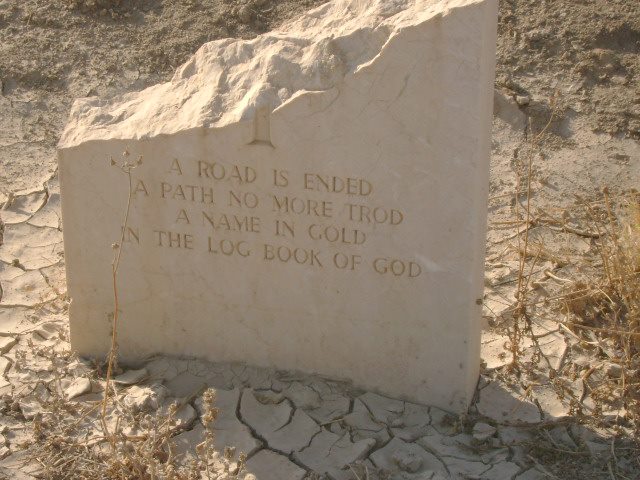
Destroyed Tombstone at the British Cemetery: Habbinyah Iraq  

I am a career military officer, an Iraq veteran and an anti-war liberal, but I am also a realist in terms of the world. I have no illusions about the world. I do not believe that the United States always acts with honor and I know in my heart of hearts that much of the chaos that we are seeing in the world, particularly the Middle East comes from years of American intrigue and intervention. But I also know that once you have let the genie of war and chaos out of the bottle that it seldom returns to it without creating more chaos, death and destruction. Since I am a realist, I understand that whether I want it or not, and regardless of who is President that this war will remain part of our lives, maybe for a generation or more. Thus we have to understand that this war is not a movie, it is not a video game, and it has the potential to change all of our lives, and not for the better.

I fully agree with two time Medal of Honor Winner and Marine Corps Major General, Smedley Butler who wrote in his book War is a Racket:

“What is the cost of war? what is the bill?…This bill renders a horrible accounting. Newly placed gravestones. Mangled bodies. Shattered minds. Broken hearts and homes. Economic instability. Depression and all of its attendant miseries. Back -breaking taxation for generations and generations. For a great many years as a soldier I had a suspicion that war was a racket; not only until I retired to civilian life did I fully realize it….”

Today I am taking some time to write about the nature of war. It is something that the vast majority of Americans have only vicariously experienced in news accounts, movies, television shows and video games which desensitize people to the horror of war as they kill virtual enemies in often the most violent ways. Abraham Lincoln noted “There’s no honorable way to kill, no gentle way to destroy. There is nothing good in war. Except its ending.”

This is amazing since we have been at war for over thirteen years now. This war has been extended indefinitely by the actions of the Islamic State and the announced intentions of President Obama to fight. Sadly, it will become much worse than people want to believe regardless of whether it is a long or a short war and believe me it will not be a short war. The Islamic State seems to up the ante every day with new atrocities against the peoples of the areas that they control, desecration of religious shrines and the destruction of irreparable historical sites and artifacts.

Americans have grown up for the past twenty years with hi-tech wars that with a few exceptions of terrorism inflicted on American civilians have been waged by a comparatively small professional military; a military that at any given time over the last 20 years has comprised less than one percent of the American population. As such war is a spectator sport for most Americans, we watch it on television, or on You Tube videos on the internet, but it is a distant thing, happening to others that doesn’t touch us too deeply because most of us think that we have no skin in the game. In fact people that bet on baseball have more skin in the game than most Americans do in the current war, but that will probably change.

Since I have written much about that military at its sacrifices in the war that began on September 11th 2001 I am not going to belabor that today. Instead I am going to go back to the nature of war, even wars that may be fought in self-defense and with just cause. It was General William Tecumseh Sherman who wrote:

“You cannot qualify war in harsher terms than I will. War is cruelty, and you cannot refine it; and those who brought war into our country deserve all the curses and maledictions a people can pour out…

Chris Hedges wrote: “Violence is a disease, a disease that corrupts all who use it regardless of the cause,” and as Clausewitz noted of war’s nature, that it is: “a paradoxical trinity-composed of primordial violence, hatred and enmity…”

We try to use language to soften war; to make it more palatable, but to do so is an Orwellian charade that is deceptive and destructive to the soul. Dave Grossman, the army infantry officer who has spent his post military life writing about the psychology of war and killing wrote:

“Even the language of men at war is the full denial of the enormity of what they have done. Most solders do not “kill,” instead the enemy was knocked over, wasted, greased, taken out, and mopped up. The enemy is hosed, zapped, probed, and fired on. The enemy’s humanity is denied, and he becomes a strange beast called a Jap, Reb, Yank, dink, slant, or slope. Even the weapons of war receive benign names- Puff the Magic Dragon, Walleye, TOW, Fat Boy, Thin Man- and the killing weapon of the individual soldier becomes a piece or a hog, and a bullet becomes a round.”

Likewise Thucydides wrote:

“Words had to change their ordinary meaning and to take that which was now given them. Reckless audacity came to be considered the courage of a loyal supporter; prudent hesitation, specious cowardice; moderation was held to be a cloak for unmanliness; ability to see all sides of a question incapacity to act on any….”

Such language gives those who have never been to war but cannot live without it to bring it on, but as Sherman noted: “It is only those who have neither fired a shot nor heard the shrieks and groans of the wounded who cry aloud for blood, more vengeance, more desolation. War is hell.”

President Obama in his address to the nation, and the world on the eve of September 11th talked of a war against the Islamic State, using far more diplomatic, restrained and less warlike language than did Vice President Biden who said:

“As a nation we are united and when people harm Americans we don’t retreat, we don’t forget. We take care of those who are grieving and when that’s finished, they should know we will follow them to the gates of hell until they are brought to justice because hell is where they will reside. Hell is where they will reside.”

I commend the President for his humanity and desire to fight the Islamic State with a matter of restraint. That restraint will last so long as the Islamic State is unable or unwilling to strike at American civilians in the American homeland, or in a country that is not in the war zone, or an American ship or military installation at home or abroad. But once that happens, and it will the pretense of restraint will drop and what the Vice President said will become our goal, even if we do not officially say it. But once those restraints are passed, the war will get really messy. Michael Walzer wrote in his book Just and Unjust Wars:

“We don’t call war hell because it is fought without restraint. It is more nearly right to say that, when certain restraints are passed, the hellishness of war drives us to break with every remaining restraint in order to win. Here is the ultimate tyranny: those who resist aggression are forced to imitate, and perhaps even to exceed, the brutality of the aggressor.”

The problem with this war is that it has lasted so long already, and such long wars are detrimental to the nations and peoples that fight them, as Sun Tzu wrote: “There is no instance of a nation benefitting from prolonged warfare,” as such the longer we drag this war against the Islamic State and other similar groups out, the longer the war continues, the crueler it will become and the more damage it will do to our civil liberties, our economy and even more importantly to the spirit of our nation. One can only look at the Patriot Act and related measures undertaken in the name of national security after 9-11-2001 and recall the words of President John F Kennedy who said in respect to the epidemic of loyalty oaths and restrictions on civil liberties enacted in the 1950s:

“We have also seen a sharpening and refinement of abusive power. The legislative investigation, designed and often exercised for the achievement of high ends, has too frequently been used by the Nation and the States as a means for effecting the disgrace and degradation of private persons. Unscrupulous demagogues have used the power to investigate as tyrants of an earlier day used the bill of attainder.

The architects of fear have converted a wholesome law against conspiracy into an instrument for making association a crime. Pretending to fear government they have asked government to outlaw private protest. They glorify “togetherness” when it is theirs, and call it conspiracy when it is that of others.”

Thus the place that we now find ourselves is not good. On one hand by using restraint the war goes on and on, war without end, and if we embrace Sherman’s realism and admit that “War is cruelty. There’s no use trying to reform it. The crueler it is, the sooner it will be over” is that we will imitate or exceed the brutality of the Islamic State. Either way, we lose something of ourselves.

My hope is that somehow, when this is war is done, maybe in our time or in another generation or two, that we will be able to establish peace by making our enemies our friends.

Peace

Padre Steve+

3 Comments

Filed under Foreign Policy, History, iraq,afghanistan, middle east, Military, national security, News and current events