Tag Archives: john gordon

Disaster at Blocher’s Knoll

Friends of Padre Steve’s World

Today another section from my Gettysburg text, this on the disaster the befell the Union Eleventh Corps north of the town on the afternoon of July 1st 1863.

Have a great day,

Peace

Padre Steve+

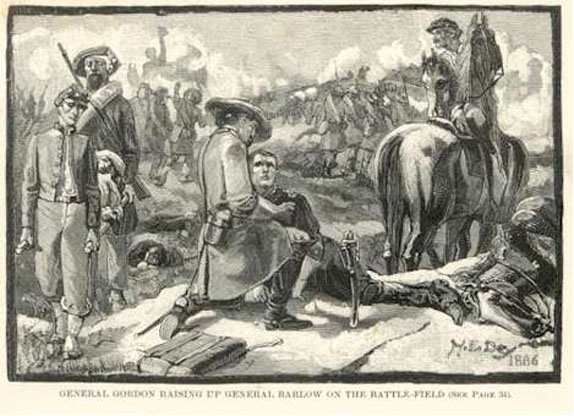
barlow_gordon

Schurz placed his own Second division under the acting command of Brigadier General Alexander Schimmelpfennig his senior brigade commander. Schimmelpfennig was a former Prussian Captain, an engineering officer, who had left the Prussian army to fight in the 1848 Revolution where he met Schurz and the two men became fast friends. When the revolution was crushed Schimmelpfennig, like Schurz fled Germany and was sentenced to death in absentia by the government of the Palatine region. He immigrated to the United States in 1853 “where he wrote military history and secured a position as an engineer in the War Department.” [1] He volunteered to serve at the outbreak of the war, and was appointed as colonel of the German 74th Pennsylvania Volunteers. Schimmelpfennig took command of the brigade when his brigade commander was killed at Second Bull Run, and he was promoted to Brigadier General by Lincoln in November 1862. According to an often told fable Lincoln supposedly promoted the German “because he found the immigrant’s name irresistible,” [2] but unlike so many other volunteer generals Schimmelpfennig was no novice to soldiering. It “took him aback to discover that American-born generals “have no maps, no knowledge of the country, no eyes to see where help is needed.” [3] He also criticized the method by which many American staff officers were selected, from their “relations, some of old friends, or men recommended by Congressmen,” [4] as compared to Molkte’s Prussian General Staff which prided itself on producing competent staff officers who could also direct troops in the heat of battle.

He too was a Chancellorsville and warned of the danger of the hanging flank and his troops were routed by Jackson’s, but as one writer noted “The brigade’s list of casualties indicates that it deserves more credit than it has been generally given.” [5] Schimmelpfennig too wanted to redeem himself and the Germans of his command as they marched to meet Lee again.

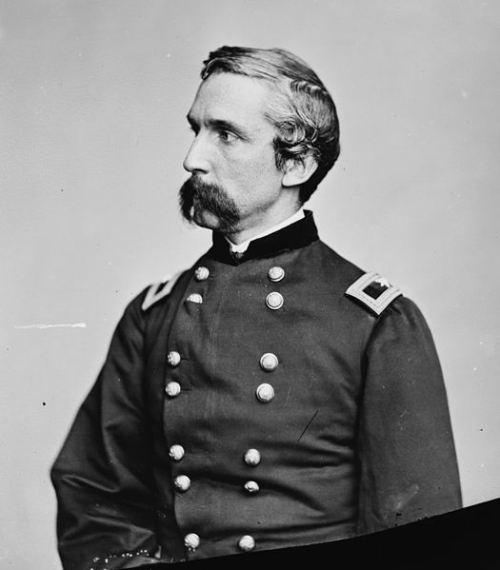
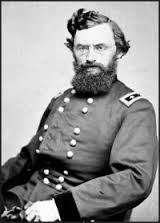
The First Division of Eleventh Corps was under the command of Brigadier General Francis Barlow. Barlow was a twenty-nine year old Harvard law graduate and Boston Brahmin was well connected politically with the more radical abolitionists of the Republican Party and had an intense dislike of Democrats. He volunteered for service and became the regimental commander and of the 61st New York Infantry. Though he did not have prior military training he “was a self-taught officer of resolute battlefield courage.” [6] His courage and competence were recognized and was promoted to Brigadier General after Antietam where he had been wounded in the groin by canister in the vicious battle for the sunken Road.

Due to his abilities the “Boy general” was convinced by his fellow abolitionist, Howard to command an Eleventh Corps division after Chancellorsville, but Barlow soon regretted his decision. Barlow, was to use modern terminology somewhat of an elitist and snob. He disliked army life and developed a reputation as a martinet with a boorish personality, who life in the army “very tedious living so many months with men who are so little companions for me as our officers are.” [7]

“Billy” Barlow was not happy with commanding the Germans, and he “disliked the beery and impenetrable Germans in his division as much as he disliked Democrats.” He admitted that he had “always been down on the ‘Dutch’ & I do not abate my contempt now.” [8] The feeling was reciprocal, his men considered him a “petty tyrant” and one wrote “As a taskmaster he had no equal. The prospect of a speedy deliverance from the yoke of Billy Barlow filled every heart with joy.” [9] As Barlow marched with his men into Gettysburg he had in his pocket a letter requesting to be given command of one of the new brigades of U.S. Colored Troops which were then being raised, something he felt was more attuned to his abolitionist beliefs and temperament.

Brigadier General Adolf von Steinwehr was another of the German’s and he enjoyed a solid reputation as a soldier. Steinwehr was a German nobleman, actually “Baron Adolf Wilhelm Augustus Friedrich von Steinwehr, a onetime officer in the army of the Duke of Brunswick-Wolfenbutel.” [10] Steinwehr was a graduate of the Brunswick Military Academy came to the United States seeking to serve in the United States Army and served in the Coastal Survey as an engineer, but was not able to get a commission. He settled in Connecticut and volunteered to serve at the beginning of the war. He raised the heavily German 29th New York Infantry. He was made a brigadier general in October 1861 and took command of the Eleventh Corp’s Second division in in the summer of 1862 when the Corps was still under the command of Franz Sigel. A Pennsylvania soldier noted that Steinwehr was “accomplished and competent, and deserv[ing] of more credit than he ever received.” [11] At Chancellorsville his troops performed well and did some hard fighting before being driven back, Howard considered Steinwehr’s conduct and bearing at Chancellorsville as “cool, collected and judicious.” [12]

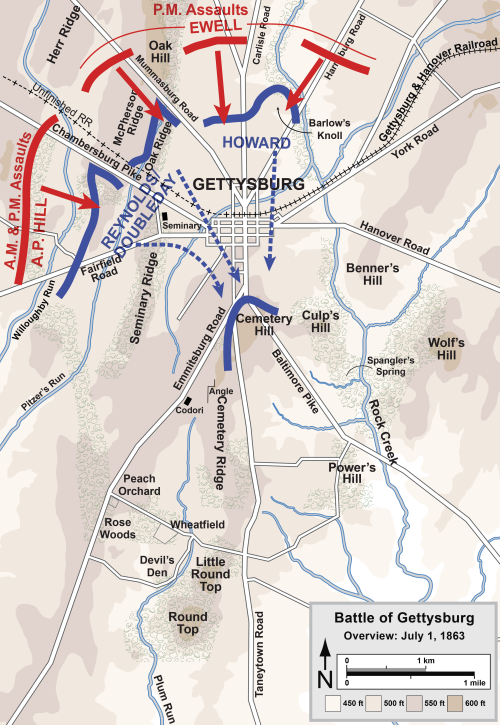
As Howard and Schurz consulted on Cemetery Hill, it was decided that Schurz would advance Schimmelpfennig and Barlow’s divisions to the north of the town in order to anchor the right flank of Doubleday’s embattled First Corps. “As Schurz remembered it, he was to take the “First and Third Divisions of the Eleventh Corps through the town and … place them on the right of First Corps, while he {Howard} would hold back the Second Division… and the reserve artillery on Cemetery Hill and the eminence east of it as a reserve.” [13] Schimmelpfennig’s division led the way through the town and deployed to the north, Barlow’s division followed moving to its right.

Schurz had two missions, to protect First Corps right flank and also to “guard against the anticipated arrival of Confederates from the northeast.” [14] Schurz intended to bring his two divisions into line each with one brigade forward and one in reserve. Schimmelpfennig’s brigade was placed at a right angle to the flank of Robinson’s division. It was Schurz’s intention that Barlow’s division “extend Schimmelpfennig’s front facing north” by keeping Ames’ brigade as a reserve in the right rear “in order to use it against a possible flanking movement by the enemy.” [15]

Both divisions were very small, especially compared to their Confederate opponents, consisting of just two brigades apiece. Schurz estimated that the two divisions numbered “hardly over 6,000 effective men when going into battle…” [16] and the ground that they had to occupy, being flat and open without and without any geographic advantage was hardly conducive for the defense, but it was necessary in order to attempt to secure the flank of First Corps and to prevent Doubleday’s command from being rolled up by Ewell’s Corps.

With the heavy pressure being put on First Corps by the Confederate divisions of Heth, Pender and Rodes; and the arrival of Jubal Early’s division of Ewell’s Second Corps Howard had few choices, and realistically Howard’s “only course was to delay the enemy.” [17] Howard has been faulted by historians Stephen Sears and Edwin Coddington for allowing Doubleday and First Corps to continue to fight on McPherson’s Ridge instead of withdrawing back to Seminary Ridge or even Cemetery Ridge during the lull in fighting early in the afternoon. [18] However, in defense of Howard, the only Confederate troops on the field when he met with Doubleday between Seminary and McPherson’s Ridge during the lull were those of Heth and Pender, as Rodes’ division had not yet arrived. As such, Howard promised to protect Doubleday’s flank without full knowledge of the situation, a promise that “would soon prove rash.” [19]

In making his decision to advance it was Howard’s intention was to get Schimmelpfennig and Barlow’s divisions up to Oak Hill to secure the right flank, but by the time his troops were moving into the open country north of the town, Rodes’s division was already there and the guns of Carter’s artillery battalion soon found the range on the Union troops. Because of this Schimmelpfennig “had to post his troops on the plain facing northwest off the right and rear of First Corps” [20] and his troops were never able to “make their link up with Robinson and the dangling flank of First Corps.” [21]

Schurz’s small divisions now found themselves facing elements of two veteran Confederate divisions; those of Robert Rodes and Jubal Early. Unlike the battle on McPherson’s and Seminary Ridge the Eleventh Corps troops did not have the advantage of good defensible ground. Likewise they had to cover a front that was much too wide for their numbers without fast reinforcements from Third or Twelfth Corps, which would not come.

Oliver Howard was counting on the timely arrival of either Slocum’s Twelfth or Sickles’ Third Corps which were in reasonable marching distance of Gettysburg, however Sickles was attempting to sort out conflicting orders from Meade and Howard, while Slocum who had just gotten the now hopelessly out of date Pipe Creek Circular waited for hours after receiving Howard’s message before putting his troops on the road to Gettysburg. Coddington argues that Howard’s hope for reinforcement at this point “was both unrealistic and unfair to the commanders of the other corps,” [22] but others have questioned that point of view, especially in regard to Slocum. Slocum’s most recent biographer Brian Melton notes that Slocum seemed to believe that “Reynolds and Howard were actively disobeying orders” [23] and wanted Slocum to do the same, and “because he deemed it contrary to Meade’s wishes, he did not want to come forward himself to take responsibility for the fight, or “of becoming a scapegoat for a lost, politically important fight someone else started against standing orders.” [24]

Melton attributes Slocum’s reluctance to take command and send his troops forward was that he had been McClellanized as a result of learned behavior in the politically charged Army of the Potomac. As such he was hesitant to jump into a situation that he had no control and then be blamed for the defeat.

“What historians see in Slocum at Gettysburg is not so much a failure of nerve (though it can be described as such) but, rather, the triumphant moment of his McClellanism. Slocum, with his tendency to absorb the philosophies of his powerful superiors, displayed conduct on day one and day two of Gettysburg that looks like McClellan in microcosm. He was absorbed with maneuver, over-cautious, focused on retreat, and scrupulously concerned with the chain of command (sometimes conveniently so). Like McClellan on the Peninsula he found excuses that kept him away from the fight, and therefore the responsibility.” [25]

What the Union command situation does show is that in a rapidly changing tactical environment that orders, no matter how well thought out, can become obsolete as soon as soon as contact is made. There it is imperative that commanders and staff officers adapt to changing situations. However, in the Army of the Potomac, which had been formed and taught by McClellan, and had endured command shake ups and the political machinations of many of its senior commanders, Slocum found that he could not take that risk. Melton wrote, “no matter what his reasons, Slocum missed an important opportunity to play an important role in the most famous battle fought on this continent, Acoustic shadows and conflicting orders kept him away from the fighting when other corps desperately needed him. Instead of covering himself with glory that day, the best he can hope for is to be quietly excused.” [26]

barlow

Major General Francis Barlow

“A Portrait of Hell”

Without reinforcements Schurz’s divisions moved north out of the town. Schurz had two missions as he moved north, “to protect Doubleday’s right and to guard against the anticipated arrival of Confederates from the northeast.” [27] to do this he had to keep his line compact enough on bad defensive ground with little natural advantage and maintain a reserve to parry any emerging Confederate threats from the northeast. The first issue was that to meet these missions Schurz only had about 6,000 troops, and these had to be spread along a line beginning at the Mummasburg Road to the York Pike. Even so there was a gap of about a quarter of a mile between Schurz’s left and Doubleday’s troops on Oak Ridge. It was the best he could do and for practical purposes the two Eleventh Corps divisions were only able to form “the equivalent of a strong skirmish line along their broad front.” [28] Had Barlow remained in place his troops would have been in a better position to receive the Confederate attack and protect Doubleday’s right flank.

However, this did not happen. Barlow did not comply with Schurz’s orders to simply extend Schimmelpfennig’s line and keep Ames’s brigade as a reserve to parry any attack on his right flank. Instead, as he moved his division through the town, Barlow secured the permission of Howard to take a small portion of high ground about a mile further north, called Blocher’s Knoll. There was a certain logic to the move, “to prevent the Rebel troops then visible to the north – George Doles’s brigade, of Rodes’s division – from occupying it and using it as an artillery platform.” [29] But the advance was to be a disastrous mistake as it left Barlow’s division exposed to Doles’s advancing troops, as well as Jubal Early’s division which then deploying for battle along the Harrisburg Road in perfect position to turn the flank of Schurz’s divisions. When Howard saw that deployment he countermanded his order that had allowed Barlow to seize Blocher’s Knoll. Howard wrote, “as soon as I heard of the approach of Ewell and saw that nothing the turning of my right flank if Barlow advanced… I countermanded the order.” [30] But the aggressive Billy Barlow continued to advance and left his own flank exposed to the attack of Early’s division which was “deployed in a three-brigade-wide battle front that was almost a mile across – and overlapped the Union line by almost half a mile.” [31]

Barlow was the only non-German division commander in XI Corps and he had little regard for Schurz. “Without consulting or even notifying his superiors, Barlow issued orders that got his division moving toward that point.” [32] Barlow advanced Colonel Ludwig Von Gilsa’s small brigade with two sections of artillery to Blocher’s Knoll placing it on the extreme right of the Union line. Instead of maintaining Ames’ brigade in reserve and slightly to the right of von Gilsa to guard against any potential flanking attack, Barlow deployed Ames’s brigade on the left of von Gilsa’s brigade facing slightly to the northwest. Barlow’s decision to do this left von Gilsa’s right flank hopelessly exposed and gave him no reserve to meet any danger on the right.

The orders that Barlow had previously had from Howard to move forward to Blocher’s Knoll were predicated on Oak Hill being unoccupied and Schimmelpfennig’s division being able to occupy it before the Confederates could do so. Barlow, on his own volition, knowing that the Confederates had taken Oak Hill and were assaulting Robinson’s division on Oak Ridge decided to advance movement placed Barlow’s division “where Barlow wished it to be” [33] and not where Schurz or Howard expected it, with disastrous results. Schurz noted:

“But I now noticed that Barlow, be it that he had misunderstood my order, or that he was carried away by the ardor of the conflict, had advanced his whole line and lost connection with my third division on the left, and…he had instead of refusing, had pushed forward his right brigade, so that it formed a projecting angle with the rest of the line.” [34]

There are still debates as to why Barlow advanced but one of the most likely explanations is that he saw the unprotected left of Brigadier General George Doles’s brigade of Georgians from Rodes division and wanted to strike them in the flank. [35]

To be sure, the position on Blocher’s Knoll “offered a cleared crown suitable for artillery and a good line of sight up the Heidlersburg Road,” [36] provided that it could be supported but it had a weakness in that “thick woods began about one hundred feet below the crest toward Rock Creek, severely limiting the field of fire in the direction of the anticipated Confederate advance.” [37] Barlow’s deployment provided Jubal Early with the perfect opportunity to execute one the hard hitting flanking attacks that had been the specialty of his old superior Stonewall Jackson.

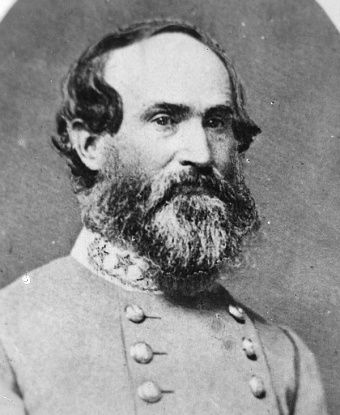
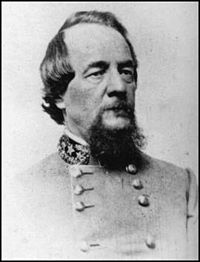
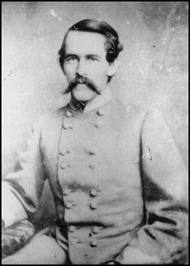
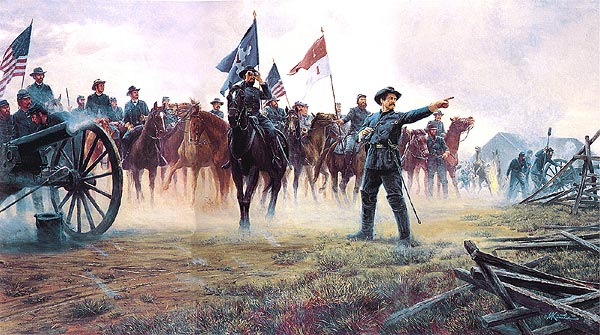
The instrument of Barlow’s division’s destruction was Brigadier General John Gordon’s brigade of Early’s division. Gordon was a self-taught soldier whose army service began when he was “elected Captain of a mountaineer company” [38] called “the Raccoon Roughs” in the opening weeks of the war.” [39] As Georgia had no room in its new military for the company Gordon offered it to Alabama where is was mustered into the 6th Alabama regiment. Even though Gordon had no prior military experience, he learned his trade well and possessed “an oratorical skill which inspires his troops to undertake anything. His men adore him….he makes them feel as if they can charge hell itself.” [40] After Manassas, Gordon was elected colonel of the 6th Alabama. He commanded the regiment until he was wounded five times in the defense of the Bloody Lane at Antietam. His final wound that day was to the face, which rendered him unconscious. He fell “with his face in his cap, and only the fact that another Yankee bullet had ripped through the cap saved him from smothering in his own blood.” [41] Before Chancellorsville the gallant colonel was promoted to brigadier general and given command of Lawton’s brigade.

Gordon’s troops hit the exposed right flank of Colonel Ludwig Von Gilsa’s tiny brigade and that force was overwhelmed by the fierceness of the Confederate assault. Von Gilsa was a professional soldier by trade who had served as a “major in the Prussian army during the Schleswig-Holstein War before immigrating to the United States” [42] from 1848 through 1850. After coming to the United States Von Gilsa supported as a singer, piano player and lecturer in New York, and on the outbreak of the war he raised and was commissioned as the Colonel of the 41st New York Infantry. He was badly wounded at the Battle of Cross Keys in the spring of 1862 and was made a brigade commander when Julius Stahel was elevated to division command. His first battle as a brigade commander was Chancellorsville where on the extreme Union right he warned of Stonewall Jackson’s flanking move, but his reports were discounted. Von Gilsa was a colorful man who won the respect of his men and “was notorious for his genius for profanity in his native German.” During the difficult retreat from Chancellorsville, Oliver Howard reminded the German Colonel “to depend upon God, and von Gilsa poured out a stream of oaths in German with such vehemence and profusion that Howard thought he had gone insane.” [43] Admired by his troops, one officer noted that von Gilsa was “one of the bravest of me4n and an uncommonly good soldier.” [44] This did not keep his new division commander Barlow from taking a dislike to him and arresting the German on the march to Gettysburg for allowing more than one soldier at a time to break ranks to refill canteens. Barlow reinstated Von Gilsa to his command at 1 p.m. just as his brigade was entering Gettysburg and beginning its march to engage the Confederates north of the town.

The position occupied by von Gilsa’s brigade “was at once a strong and dangerous position, powerful in front…but exposed on both flanks.” [45] Thus the exposed position of Barlow’s troops on Blocher’s Knoll provided the advancing Confederates the opportunity to roll up his division and defeat it in detail before moving down the Federal line to deal with Schimmelpfennig’s division. The Confederate attack engineered by Jubal Early was a masterpiece of shock tactics combining a fearsome artillery barrage with a well-coordinated infantry assault.

Colonel H.P Jones who commanded Jubal Early’s artillery battalion opened up a crossfire on von Gilsa’s brigade from its positions east of the Heidlersburg Road as Gordon’s brigade struck assisted by pressure being put forth by Junius Daniel’s brigade of Rodes division which was attacking Ames’s brigade from the northwest. The concentrated fire of the artillery added to the din and furthered the destruction among the Union men as Jones’s battalion’s fire “enfiladed its whole line and took it in reverse.” [46] The artillery fire from Jones’s battalion supported Gordon’s brigade as well as Early’s other two brigades, those of Hays and Avery as they advanced. “A prominent member of Ewell’s staff later said he had never seen guns “better served than Jones’ were on this occasion.” [47]

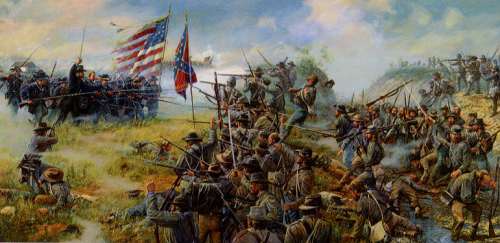
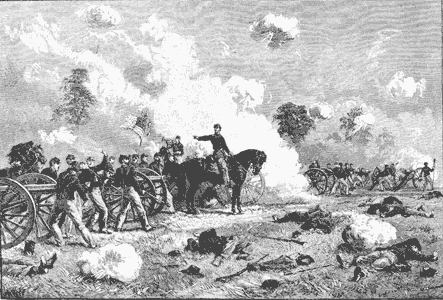
Von Gilsa’s outnumbered and badly exposed Union troops attempted to make a stand but were slaughtered by the Confederates; soon the brigade began to unravel, and then disintegrated. But it was not the complete rout posited by the brigade’s critics. It took “fifteen to twenty minutes of hard fighting for John Gordon’s men, assisted by some of George Doles regiments, to overrun Blocher’s Knoll” [48]One Confederate soldier later recalled, “it was a fearful slaughter, the golden wheat fields, a few minutes before in beauty, now gone, and the ground covered with the dead and wounded in blue.” [49] Another of Gordon’s soldiers noted “The Yankees…fought more stubborn than I ever saw them or ever want to see them again.” [50] Von Gilsa himself displayed tremendous courage in trying to stem the tide of the Confederate advance. He had “one horse shot from under him, but jumped onto another and desperately tried to stem the retreat. On soldier saw him ride “up and down that line through a regular storm of lead, meantime using German epithets so common to him.” [51] Despite his best efforts, just as a Chancellorsville von Gilsa was unable to hold his position and his troops fled through crowded and chaotic streets of Gettysburg to Cemetery Hill where their retreat was halted and they joined the troops of Steinwehr’s division and the other survivors of the First and Eleventh Corps troops who managed to escape the Confederate onslaught.
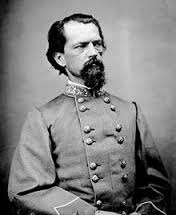
gordon

Brigadier General John Gordon

As Von Gilsa’s brigade collapsed Gordon “focused on the exposed right flank of Ames’s brigade” and Doles’s troops, now supported by Ramseur fell upon its left and “Ames’s outnumbered troops also collapsed” [52] even as that young and gallant commander attempted to advance his brigade to support Von Gilsa’s now fleeing troops. Barlow was in the thick of the fighting attempting to rally von Gilsa’s troops when he was wounded. Ames, the senior brigade commander took command of the shattered remnants of the two brigades when Barlow, went down. The wounded Barlow would be assisted by Gordon and “carried to the shade” of a nearby farmhouse by a member of Early’s staff. [53] Barlow recovered and after the war “he and Gordon established a friendship that lasted for the remainder of their lives.” [54]

Adelbert Ames was a native of Maine and had a stellar reputation when he entered Gettysburg. The young officer “graduated 5th out of 45 students in the Class of 1861, which completed its studies just after the fall of Fort Sumter.” [55] He was commissioned into the artillery and was wounded at First Bull Run where he was awarded the Medal of Honor. After he recovered he was commended for his service during the Peninsular Campaign. Ames then returned to Maine where he organized and commanded the illustrious 20th Maine Volunteer Infantry, and after Fredericksburg was promoted to brigadier general. “Like von Gilsa’s brigade, Ames’s came under fire from both infantry and artillery.” [56] After Chancellorsville he was promoted to brigadier general and took command of his brigade in Barlow’s division. Ames was a brave and capable leader who would continue to serve with distinction throughout the war ending up as a Major General of Volunteers and serving as one of Mississippi’s Reconstruction governors after the war. He lived a long and eventful life and was the last Civil War general to die in 1933.

Amidst the chaos of the retreat Ames worked with von Gilsa to “try to gather enough men together around a cluster of buildings along the Heidlersburg Road which served as the Adams County almshouse,” [57] and upon assuming command he succeeded in “slowing the retreat and establishing a second line when Avery’s and Hays’s brigades came crashing in on the right.” [58] However, this line too was driven back in great confusion as the brigades of Gordon and Hays, supported by Jones’s artillery hammered the thin blue line.

Schurz attempted to recover the situation by extending Schimmelpfennig’s division to the right, and advanced his reserve brigade under Polish born Colonel Wladimir Krzyzanowski to support Barlow counterattacking against Doles’s brigade. Krzyzanowski too was a refugee from Europe, coming from a region of Poland occupied by Prussia. “Kriz” as he was known to many Americans had fled to New York following the failed revolution of 1848 and made his living as a civil engineer. When war came Krzyzanowski volunteered for service, and was allowed to recruit “a multinational regiment that became known as the 58th New York Infantry, the “Polish Legion.” [59] Following service in a number of campaigns he was given command of a brigade in June of 1862.

Krzyzanowski’s brigade achieved some initial success against one of Doles’s regiments and for a time engaged in a furious short range shoot out with two more of Doles’s regiments. The opponents stood scarcely seventy-five yards apart aiming deadly volleys at one another without regard for themselves, an Ohio solider recalled “Bullets hummed about our ears like infuriated bees, and in a few minutes the meadow was strewn with…the wounded and the dead.” [60] Despite their gallantry Krzyzanowski’s troops were also rolled up in the Confederate assault when Doles and Gordon turned his flanks. Both of “Krzyzanowski’s flanks received enfilading fire and the brigade fell back across the Carlisle Road toward an orchard on the north side of Gettysburg.” [61]

As the situation deteriorated Schimmelpfennig ordered the 157th New York Infantry to support Krzyzanowski. The regiment advanced and engaged in a furious twenty minute fight, continuing the battle “in Indian fashion” until Schurz ordered them to retreat. The gallant 157th sacrificed itself buying time for others to withdraw and left over 75 percent of its men on the battlefield, when the order came, “less than fifty of the 157th were able to rise out of the wheat and follow.” [62] “So the horrible screaming, hurtling messengers of death flew over us from both sides,” recollected a New York soldier. “In such a storm it seemed a miracle that any were left alive.” [63] Krzyzanowski described the scene as “a portrait of hell.” [64]

Harry Hays brigade of Louisianans joined the assault on the collapsing Federal right while on the left Schimmelpfennig’s line collapsed under the weight of Doles’s attack, which had now been joined by the brigade of Stephen Ramseur. The proud Schimmelpfennig joined his troops in retreat. Inside the town he was unhorsed by enemy fire. In the town Schimmelpfennig was knocked unconscious “with the butt of a musket – “by the blow of a gun” – as he tried to scale a fence.” [65] By the time he regained himself Confederate troops were swarming all around, and to avoid capture he prudently “took refuge in a woodshed, where he remained in hiding the next three days.” [66] The attack of Early’s division supported by Doles and Ramseur “completely unhinged the end of the long Union line and destroyed any opportunities for resistance on that part of the field.” [67]

Howard was still looking for relief from Major General Slocum’s Twelfth Corps and seeing the disaster unfolding north of the town sent the First Brigade of Brigadier General Adolph Steinwehr’s division from Cemetery Hill to support the fleeing men of Barlow and Schimmelpfennig’s divisions. The small brigade of about 800 soldiers under the command of Colonel Charles Coster advanced through the town to a brickyard on the outskirts of the town. Before this small force could get into position they were hit hard by Hays and Avery’s brigades of Early’s division. The Confederates again had a massive numerical advantage at the point of attack with “eight big regiments to face Coster’s three small ones” [68] and they too were able to find an open flank and envelop both flanks of the tiny Union brigade. Avery’s brigade took them in the right flank and with both flanks turned by the advancing Confederates [69] Coster’s little brigade broke under the pressure and began to retreat leaving many prisoners to be collected by the Confederates. The commander of the 134th New York exclaimed “I never imagined such a rain of bullets.” [70] In its fight with Avery’s brigade which had the New Yorkers in a crossfire, the 134th lost some forty men killed and 150 wounded. Coster had entered the fight with about 800 soldiers but by the end of the afternoon over 550 were casualties, with “313 of them left it as prisoners.” [71] Coster survived the assault but resigned from the army a few months later never having filed and official report. [72] As the Union right collapsed and the Confederate pressure on Robinson’s division on Oak Ridge mounted, von Amsberg’s brigade, without the 157th New York found itself without support and was forced to withdraw. However, the sacrifice of Coster’s brigade “succeeded in checking the enemy long enough to permit Barlow’s division to “enter the town without being seriously molested on its retreat.” [73]

In his after action report as well as in other correspondence Barlow was acrimonious toward the German troops who he had so carelessly exposed to the Confederate onslaught on Blocher’s Knoll. He wrote “We ought to have held the place easily, for I had my entire force at the very point where the attack was made….But the enemies [sic] skirmishers had hardly attacked us before my men began to run. No fight at all was made.” [74] However, more circumspect Union officers do not back the gallant, but arrogant Boston Brahmin’s statement nor do his Confederate opponents. The Union artillery commander Henry Hunt wrote that it was “an obstinate and bloody contest” [75] while Gordon, whose brigade had inflicted so much of the damage on Barlow’s divisions wrote:

“The enemy made a most obstinate resistance until the colors of the two lines were separated by a space of less than 50 paces, when his line was broken and driven back, leaving the flank which this line had protected exposed to the fire from my brigade. An effort was made by the enemy to change his front and check our advance, but the effort failed and this line too, was driven back in the greatest confusion with immense loss in killed, wounded and prisoners.” [76]

A private of the 61st Georgia Infantry of Gordon’s brigade wrote that the Eleventh Corps troops “stood firm until we got near them. Then they began to retreat in good order. They were harder to drive than we had known them before….Their officers were cheering their men and behaving like heroes and commanders of ‘the first water’” [77]

During the retreat the redoubtable Hubert Dilger whose battery had wrought such death and destruction on O’Neal and Iverson’s brigades and Carter’s artillery while supporting Robinson’s division on Oak Ridge continued its stellar contribution to the battle. Instead of withdrawing his battery completely he halted four guns north of the town to support the infantry. “The four cannon immediately banged away at the approaching Confederate infantry and helped hundreds of Federal troops successfully escape the clutches of the enemy.” [78] When he could do no more Dilger withdrew to Cemetery Hill where his guns joined the mass of Union artillery gathering on that edifice.

Collapse and the Retreat of First & Eleventh Corps

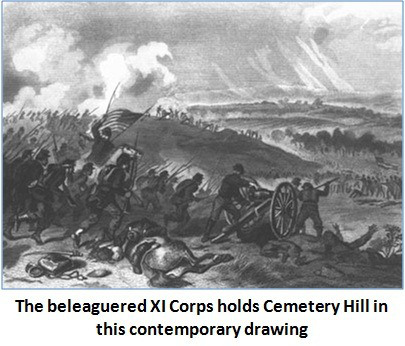
The retreat of Eleventh Corps “southward through the streets of Gettysburg exposed the rear of the First Corps at a time when Doubleday’s troops were already having to give ground before the superior numbers represented by” [79] the divisions of Harry Heth and Dorsey Pender of A.P. Hill’s Third Corps. The First Corps had been battling Hill’s troops for the better part of the morning and for the most part had gotten the better of their Confederate opponents, inflicting very heavy casualties on the divisions of Heth, Pender and Robert Rodes. The fierceness of the Union defense of the ridges west of the town wreaked havoc on the Confederate attackers. The remnants of the Iron Brigade supported by the brigades of Biddle and Stone, Gamble’s dismounted cavalry, and Wainwright’s expertly directed artillery inflicted massive casualties on their Confederate opponents.

Notes

[1] Ibid. Pfanz The First Day at Gettysburg p.218

[2] Ibid. Greene From Chancellorsville to Gettysburg: O. O. Howard and Eleventh Corps Leadership p.63

[3] Ibid. Guelzo Gettysburg: The Last Invasion p.166

[4] Ibid. Guelzo Gettysburg: The Last Invasion p.166

[5] Ibid. Tagg The Generals of Gettysburg p.139

[6] Ibid. Sears Gettysburg p.38

[7] Ibid. Guelzo Gettysburg: The Last Invasion p.181

[8] Ibid. Guelzo Gettysburg: The Last Invasion p.181

[9] Ibid. Tagg The Generals of Gettysburg p.126

[10] Ibid. Guelzo Gettysburg: The Last Invasion p.162

[11] Ibid. Greene From Chancellorsville to Gettysburg: O. O. Howard and Eleventh Corps Leadership p.63

[12] Ibid. Tagg The Generals of Gettysburg p.132

[13] Trudeau, Noah Andre. Gettysburg: A Testing of Courage, Harper Collins Publishers, New York 2002 p.198

[14] Ibid. Greene From Chancellorsville to Gettysburg: O. O. Howard and Eleventh Corps Leadership p.74

[15] Ibid. Guelzo . Gettysburg: The Last Invasion p.181

[16] Ibid. Coddington The Gettysburg Campaign: A Study in Command, p.288

[17] Ibid. Greene From Chancellorsville to Gettysburg: O. O. Howard and Eleventh Corps Leadership p.74

[18] Ibid. Sears, Gettysburg pp.193-194 and Coddington p.303

[19] Ibid. Trudeau Gettysburg: A Testing of Courage p.142

[20] Ibid. Pfanz The First Day at Gettysburg p.140

[21] Ibid. Guelzo Gettysburg: The Last Invasion p.166

[22] Ibid. Coddington The Gettysburg Campaign p.303

[23] Melton, Brian C. Sherman’s Forgotten General: Henry W. Slocum University of Missouri Press, Columbia and London 2007 p.125

[24] Ibid. Pfanz The First Day at Gettysburg p.143

[25] Ibid. Melton Sherman’s Forgotten General p.124

[26] Ibid. Melton Sherman’s Forgotten General p.128

[27] Ibid. Greene From Chancellorsville to Gettysburg: O. O. Howard and Eleventh Corps Leadership p.74

[28] Ibid. Greene From Chancellorsville to Gettysburg: O. O. Howard and Eleventh Corps Leadership p.76

[29] Ibid. Sears, Gettysburg pp.193-194 and Coddington p.212

[30] Ibid. Greene From Chancellorsville to Gettysburg: O. O. Howard and Eleventh Corps Leadership p.77

[31] Ibid. Sears, Gettysburg pp.193-194 and Coddington p.212

[32] Ibid. Trudeau Gettysburg: A Testing of Courage p.217

[33] Ibid. Trudeau Gettysburg: A Testing of Courage p.216

[34] Ibid. Greene From Chancellorsville to Gettysburg: O. O. Howard and Eleventh Corps Leadership p.77

[35] Ibid. From Chancellorsville to Gettysburg: O. O. Howard and Eleventh Corps Leadership Greene p.78

[36] Ibid. Trudeau Gettysburg: A Testing of Courage p.216

[37] Ibid. Greene From Chancellorsville to Gettysburg: O. O. Howard and Eleventh Corps Leadership p.78

[38] Warner, Ezra J. Generals in Gray: Lives of Confederate Commanders Louisiana State University Press, Baton Rouge 1959, 1987 p.111

[39] Ibid. Tagg The Generals of Gettysburg p.262

[40] Freeman, Douglas Southall, Lee’s Lieutenant’s a Study in Command, One volume abridgement by Stephen W Sears, Scribner, New York 1998 p.41

[41] Sears, Stephen W. Landscape Turned Red: The Battle of Antietam Houghton-Mifflin Company, Boston and New York 1983 p.242

[42] Ibid. Pfanz The First Day at Gettysburg p.224

[43] Ibid. Tagg The Generals of Gettysburg p.127

[44] Ibid. Greene From Chancellorsville to Gettysburg: O. O. Howard and Eleventh Corps Leadership p.61

[45] Ibid. Tagg The Generals of Gettysburg p.128

[46] Hunt, Henry The First Day at Gettysburg in Battles and Leaders of the Civil War edited by Bradford, Neil Meridian Press, New York 1989 p.363

[47] Ibid. Coddington The Gettysburg Campaign: A Study in Command, p.291

[48] Ibid. Trudeau Gettysburg: A Testing of Courage p.225

[49] Ibid. Greene From Chancellorsville to Gettysburg: O. O. Howard and Eleventh Corps Leadership p.79

[50] Ibid. Trudeau Gettysburg: A Testing of Courage p.225

[51] Ibid. Tagg The Generals of Gettysburg p.128

[52] Ibid. Greene From Chancellorsville to Gettysburg: O. O. Howard and Eleventh Corps Leadership p.79

[53] Ibid. Guelzo Gettysburg: The Last Invasion p.188

[54] Dowdy, Clifford. Lee and His Men at Gettysburg: The Death of a Nation Skyhorse Publishing, New York 1986, originally published as Death of a Nation Knopf, New York 1958 p.141

[55] Ibid. Tagg The Generals of Gettysburg p.129

[56] Ibid. Pfanz The First Day at Gettysburg p.234

[57] Ibid. Guelzo Gettysburg: The Last Invasion p.187

[58] Ibid. Coddington The Gettysburg Campaign: A Study in Command, p.292

[59] Ibid. Pfanz The First Day at Gettysburg p.236

[60] Ibid. Greene From Chancellorsville to Gettysburg: O. O. Howard and Eleventh Corps Leadership p.80

[61] Ibid. Greene From Chancellorsville to Gettysburg: O. O. Howard and Eleventh Corps Leadership p.80

[62] Ibid. Guelzo Gettysburg: The Last Invasion p.186

[63] Ibid. Trudeau Gettysburg: A Testing of Courage p.225

[64] Ibid. Guelzo Gettysburg: The Last Invasion p.186

[65] Ibid. Tagg The Generals of Gettysburg p.139

[66] Foote, Shelby, The Civil War, A Narrative. Volume Two Fredericksburg to Meridian Random House, New York 1963 p.477

[67] Ibid. Coddington The Gettysburg Campaign: A Study in Command, p.292

[68] Ibid. Guelzo Gettysburg: The Last Invasion p.190

[69] Ibid. Trudeau Gettysburg: A Testing of Courage, p.241

[70] Ibid. Trudeau Gettysburg: A Testing of Courage p.241

[71] Ibid. Sears, Gettysburg pp.193-194 and Coddington p.217

[72] Ibid. Guelzo Gettysburg: The Last Invasion p.190

[73] Ibid. Pfanz The First Day at Gettysburg pp. 267-268

[74] Ibid Greene From Chancellorsville to Gettysburg: O. O. Howard and Eleventh Corps Leadership p.79

[75] Ibid. Hunt The First Day at Gettysburg p.365

[76] Report of Brigadier General J. B. Gordon, CSA, commanding brigade, Early’s Division, in Luvaas, Jay and Nelson Harold W editors. The U.S. Army War College Guide to the Battle of Gettysburg South Mountain Press, Carlisle PA 1986 p.45

[77] Ibid. Greene From Chancellorsville to Gettysburg: O. O. Howard and Eleventh Corps Leadership p.79

[78] Gottfried, Bradley The Artillery of Gettysburg Cumberland House Publishing, Nashville TN 2008 p.71

[79] Weigley, Russell F. A Great Civil War: A Military and Political History 1861-1865 Indiana University Press, Bloomington and Indianapolis 2000 p.244

Leave a comment

Filed under Loose thoughts and musings

Regulars, Volunteers and Conscripts: Civil War Mobilization

Friends of Padre Steve’s World

A bit of a break from the past few days of confronting the civil rights issues and racism at work in the aftermath of the Emmanuel A.M.E. church massacre. I’m sure that I will be doing more to follow that up in the near future, but it looks like the most prominent symbol of the ideological and sometimes religious hatred that has been at the heart of American racism since the Civil War is beginning to come down, even in the South as people finally begin to face up to the evil for which that flag stood.

This is another part of my Civil War and Gettysburg text on the formation of the armies that fought the Civil War. 

When one thinks of our all-volunteer force today it is hard to imagine forming armies of this size and scope around such small regular forces. The story of how North and South raised their armies, and the stories of the volunteers of the first part of the war is amazing. I hope that you enjoy.

Peace

Padre Steve+

MenBrooklyn


The Secession Crisis, Mobilization, and Volunteer Armies

The American Civil War was the first American war fought by massed armies of mobilized citizens. All previous wars had been fought by small numbers of Regular Army troops supported by various numbers of mobilized State Militia formations or volunteer formations raised for the particular war; “The fighting force of the 1860s was a conglomerate of diverse units, each with its own degree of importance, pride, proficiency, and jealousy. Whether of North or South, an army began as little more than a loosely organized mob actuated by more enthusiasm than by experience. Its composition ran the full gauntlet of humankind.” [1]

In 1860 the Regular Army numbered 16,000 troops at the beginning of the war. These included some 1105 officers, and were organized into “ten regiments of infantry, four of artillery, and five of cavalry (including dragoons and mounted riflemen)” [2] These regiments were broken up into small units and they and their soldiers were scattered about in far flung isolated posts around the country and in the new western territories. The units primarily fought Indians and performed what best could be described as constabulary duties. Others, mostly from artillery units manned the coastal defense fortifications that protected American’s key ports and entrances to key waterways along the eastern seaboard. Even so, after the War with Mexico “three quarters army’s artillery had been scrapped” and most of the army’s artillerymen and their units were “made to serve as infantry or cavalry, thus destroying almost completely their efficacy as artillery.” [3]

The secession crisis and the outbreak of the war fractured the army, particularly the officer corps. The officer corps was heavily Southern and many Northern officers had some sympathy with their Southern brothers in arms. It has to be said that of the men holding positions of high command from 1849 to 1861 that many were Southerners:

“all of the secretaries of war were Southerners, as were the general in chief, two of the three brigadier generals, all but one of the army’s geographical departments on the eve of the Civil War, the authors of the two manuals on infantry tactics, and the artillery manual used at West Point, and the professor who taught tactics and strategy at the military academy.” [4]

Most of the Army remained loyal to the Union, “except for 313 officers who resigned their commissions.” [5] Those who remained loyal to the Union included the General in Chief, Winfield Scott, as well as the professor who had taught so many of those now leaving to serve the Confederacy, Dennis Hart Mahan. However, of the others brigadier generals William Harney, David Twiggs and Joseph E. Johnston, Brevet Brigadier General Albert Sidney Johnston, and the army’s Adjutant General, Colonel Samuel Cooper, and the newly promoted Colonel Robert E. Lee all went south. “Even so, 40 to 50 per cent of the Southern West Point graduates on active duty in 1860 held to their posts and remained loyal to the Union.” [6]

A Political Backlash against West Point and the Officer Corps

The exodus of these officers created a backlash against West Point and the professional officers who remained in service of the Union, especially those who were Democrats and to radical Republicans were soft on slavery. Some Republican members of Congress including Senator Ben Wade of Ohio, “figured that political apostasy had been taught at West Point as well, and he didn’t know which sin was worse – it or treason.” [7] The fact that the leaders of the Union forces defeated at Bull run were West Point graduates added incompetence to the list of the crimes, real and imagined committed by the officers of the Regular Army. When Congress reconvened in 1861 Wade said:

I cannot help thinking…that there is something wrong with this whole institution. I do not believe that in the history of the world you can find so many men who have proved themselves utterly faithless to their oaths, ungrateful to the Government that supported them, guilty of treason and a deliberate intention to overthrow that Government which educated them and given them support, as have emanated from this institution…I believe from the idleness of these military educated gentlemen this great treason was hatched.” [8]

Wade did not mention in his blanket his condemnation of the “traitors” that many “West Pointers from the Southern States – 162 of them – had withstood the pull of birth and kin to remain with the Union.” [9]

Wade’s fellow radical Senator Zachariah Chandler of Michigan urged Congress to dissolve the Military Academy. The academy, he said “has produced more traitors within the last fifty years than all the institutions of learning and education that have existed since Judas Iscariot’s time.” [10] Despite the words and accusations of the radical fire-eaters like Wade and Chandler and other like them, more level headed men prevailed and reminded the nation that there had been many other traitors. Senator James Nesmith of Oregon said: “Treason was hatched and incubated at these very decks around me.” [11]

Politicians and Professionals: Building Volunteer Armies

20110930-poster.png_

Many of the officers who left the army to serve the Confederacy were among the Army’s best and brightest, and many of them later rose to prominence and fame in their service to the Confederacy. In contrast to the officers who remained loyal to the Union, those that many in Congress despised and “pushed aside and passed over” in favor of “officers called back into service or directly appointed from civil life, the “South welcomed its professionals and capitalized on their talents. Sixty-four per cent of the Regular Army officers who went South became generals; less than 30 per cent of those who stayed with the Union achieved that rank.” [12]

The Union had a small Regular Army, which did undergo a significant expansion during the war, and the Confederacy did not even have that. During the war the “Confederacy established a regular army that attained an authorized strength of 15,000” [13] but few men ever enlisted in it. This was in large part due to the same distrust of the central government in Richmond that had been exhibited to Washington before the war.

Thus both sides fell back on the British tradition of calling up volunteers. The British had “invented volunteer system during the Napoleonic Wars, also to save themselves from the expense of permanent expansions of their army, and the United States had taken over the example in the Mexican War…” [14] The volunteer system was different from the militias which were completely under the control of their State and only given to the service of the national government for very limited amounts of time. The volunteers were makeshift organizations operating in a place somewhere between the Regular Army and the State militias and like the British system they saved “Congress the expense of permanently commissioning officers and mustering men into a dramatically expanded Federal service.” [15] As such the volunteer regiments that were raised by the States “were recruited by the states, marched under state-appointed officers carrying their state flag as well as the Stars and Stripes.” [16]

President Lincoln’s call for volunteers appealed “to all loyal citizens to favor, facilitate and aid this effort to maintain the honor, the integrity, and the existence of our Northern Union, and the perpetuity of the popular government; and to redress the wrongs already long enough endured.” [17] The Boston Herald proclaimed “In order to preserve this glorious heritage, vouchsafed to us by the fathers of the Republic, it is essential that every man perform his whole duty in a crisis like the present.” [18] The legislature of the State of Mississippi sated its arguments a bit differently and asserted, “Our position is thoroughly identified with the institution of slavery – the greatest material interest in the world.” Texas explained that it had joined the Union “as a commonwealth holding, maintaining and protecting the institution known as negro slavery – the servitude of the African to the white race within her limits.” [19] A newspaper correspondent wrote:

“All, all of every name and every age to arms! To arms! My father go, my son go, my brother go, your country calls you.” He called out to Southern women as well, “mothers, wives and daughters buckle on the armor of loved ones, the correspondent urged, “bid them with Roman fairness, advance and never return until victory perches on their banner.” [20]

Those who went off to war left their homes and families. Young Rhode Island volunteer Robert Hunt Rhodes wrote that is mother told him “in the spirit worth of a Spartan mother of old said: “My son, other mothers must make sacrifices and why should not I?” [21] The bulk of the soldiers that enlisted on both sides in 1861 were single their median age “was twenty-four. Only one in seven enlistees that first year was eighteen or younger, and fewer than a third were twenty-one or younger.” [22]

Illustrious regiments such as the 1st Minnesota Volunteers, the 20th Maine Volunteers, the 69th New York Volunteer Infantry, and the African American 54th Massachusetts Volunteer Infantry were just a few of the many regiments mustered into Union service under this system. As the war went on and the initial regiments were decimated by losses in combat and to disease, Northern governors “preferred to organize new regiments rather than to replenish old ones whittled down by battle and sickness. Fresh units swelled a state’s contributions, and the provided governors an opportunity to win more political favors by appointing more regimental officers.” [23] This practice produced “an army of shadow units” as “it was up to the regimental commanding officer to keep up a supply of new enlistments from back home for his own regiment, but most commanders could ill afford to detail their precious supply of junior officers for recruiting duty behind the lines.” [24]

Even before secession many Southern states began to prepare for war by building up their militias, both in numbers as well as by sending agents to arms suppliers in the North, as was done by Georgia Governor Joseph E. Brown who “sent an official north to purchase arms, ammunition and accouterments.” [25] After the bombardment of Fort Sumter both sides raced to build up their militaries. Jefferson Davis, the new President of the Confederacy who was a West Point graduate and former Secretary of War called for volunteers. On March 6th 1861 the new Provisional Confederate Congress in Montgomery authorized Davis to “call out the militia for six months and to accept 100,000 twelve-month volunteers.” [26] Within weeks they had passed additional legislation allowing for the calling up of volunteers for six months, twelve months and long-term volunteers up to any length of time. “Virginia’s troops were mustered en masse on July 1, 1861, by which time the state had 41,885 volunteers on its payroll.” [27]

poster

With the legislation in hand Davis rapidly called up over 60,000 troops to the Confederate Cause, and this was before Virginia and North Carolina seceded from the Union. A mixture of former Regular Army officers commanded these men, most of whom occupied the senior leadership positions in the army, volunteer officers, made up the bulk of the Confederate officer corps. “Well over 700 former students at Virginia Military Institute served as officers in the war, most in the Virginia Theater….” [28]Among these men was Robert Rodes who became one of Robert E. Lee’s finest division commanders.

In the North Abraham Lincoln was in a quandary. Congress was out of session, so relying on the Militia Act of 1795 called out 75,000 three-month militiamen to support the Union cause. The legislatures of the Northern States so well that the over-recruited and in this first call up the government “accepted 9,816 men, but governors clamored for the War Department to take still more troops.” [29] Dan Sickles, a rather infamous Democrat politician was one of these men. Sickles had been a Democratic Congressman representing the district of New York City that was in the control of Tammany Hall. In 1859 Sickles stood trial for the murder of Barton Key, the District Attorney for Washington D.C. and the nephew of Francis Scott Key. Key had been conducting an affair with Sickles’ young wife Maria and in a fit of anger Sickles confronted Key, who had been spotted attempting a liaison with Maria and shot him dead near Lafayette Square and the White House. Sickles was acquitted on the basis of temporary insanity becoming the first man in the United States to have that distinction.

The ambitious Sickles, “almost overnight, using flag-waving oratory, organizational skills, and promissory notes, had his regiment, the 70th New York Volunteers, well in hand.” [30] Not content with a regiment and knowing that a brigade would bring him his star as a brigadier general, he quickly the Excelsior Brigade in New York.

Daniel_Edgar_Sickles

Major General Dan Sickles

Within weeks Sickles had raised over 3000 men, a full forty companies and the New York Newspapers praised Sickles’ efforts. But partisan politics was at play. To Governor Edward Morgan, the fact that a Tammany Hall Democrat “was getting too far out ahead in the state’s race to supply manpower to the endangered Union” [31] was embarrassing and the Governor ordered Sickles to “disband all but eight of his forty companies.” [32] The incredulous, yet ambitious Sickles, knowing that Lincoln needed Democratic support to prosecute the war, traveled to Washington where after seeking an audience with the President. Lincoln was hesitant to infringe on any governor’s control of state units, but he was loath to lose the services of any soldiers. Lincoln discussed the matter with Secretary of War Simon Cameron and they ordered that Sickles “keep his men together until they could be inducted by United States officers.” [33] That process took two moths but in July Sickles was able to have the brigade sworn into service as a brigade of United States Volunteers.

For Sickles and most officers, volunteer and regular alike a regiment was a large military formation Likewise, a brigade massive and for most of these men divisions and corps on the scale of those found in Europe were almost unthinkable, but war was changing and this would be the scope of the coming war.

More troops were needed and with Congress out of session, President Lincoln acted “without legal authority…and increased the Regular Army by 22,714 men and the Navy by 18,000 and called for 42,034 three-year volunteers.” [34] On July 4th 1861 Lincoln “asked sanction for his extralegal action and for authority to raise at least another 400,000 three-year volunteers.” [35] Congress approved both of the President’s requests, retroactively, and in fact, “greatly expanded the numbers of volunteer recruitments, up to a million men – nothing more than the 1795 statute authorized either of these follow-up calls, and Lincoln would later have to justify his actions on the admittedly rather vague basis of the “war powers of the government.” [36]

In the North “the war department was staggered by the task of finding competent officers for an already numbering nearly half a million.” [37] There were so few professional officers available to either side that vast numbers of volunteer officers of often dubious character and ability were appointed to command the large number of volunteer regiments and brigades which were being rapidly mustered into service. Within months of the secession crisis the Regular Army of the United States, minus the officers who resigned to serve the Confederacy, “was swamped by a Union war army that reached about 500,000 within four months of the firing on Fort Sumter.” [38]

The Regular Army officers who remained loyal to the Union as well as those who left the army and joined the newly formed Confederacy were joined by a host of volunteer officers. Some of these officers, men like Ulysses Grant, William Tecumseh Sherman, George McClellan, Braxton Bragg, Thomas “Stonewall” Jackson, Jubal Early, and many others had left the army for any number of reasons only to return to the colors of the Union or the Confederacy during the secession crisis or at the outbreak of the war. Some of these men like George Sears Greene and Isaac Trimble Many were West Point graduates who had left the army decades before the war and almost to a man “nearly all of them displayed an old regular’s distrust of any general who had risen by political means.” [39] The hold of West Point and the teachings of Dennis Hart Mahan regarding professionalism had left a lasting imprint on these men.

2nd michigan

Another issue faced by all of the officers now commanding large formations in the Civil War was their inexperience in dealing with such large numbers of troops. When the war began, the officers educated at West Point, as well as others who had been directly appointed had previously only commanded small units. Even regimental commanders such as Joseph Johnston, Albert Sidney Johnston, and Robert E. Lee seldom had more than a few companies of their regiments with them at any given time for any given operation. Likewise, the men who had campaigned and fought in Mexico who had some experience in handling larger formations had for the most part left the service. The senior officers who had served in Mexico and that remained on active duty were handicapped because the Mexican war was still very much a limited Napoleonic War fought with Napoleonic era weapons against a more numerous but poorly equipped and trained enemy.

Other volunteer officers had little or no military experience or training and owed their appointments as officers to their political connections, business acumen or their ability to raise troops. It was not atypical for a volunteer officer to gain his rank and appointment based on the number of that he brought into the army, “if he recruited a regiment he became a colonel, while if he brought in a brigade he was rewarded with the shining star of a brigadier general.” [40] This led to a type of general “appointed for their political influence or – at least in the North with its more heterogeneous population – their leadership of ethnic groups.” [41] Despite the dangers of their inexperience, both Abraham Lincoln and Jefferson Davis had to appoint such men in order to maintain political support for the war.

Some of these men proved disastrous as commanders and their ineptness cost many lives. Henry Wager Halleck, wrote “It seems but little better than murder to give important commands to such men as Banks, Butler, McClernand, Sigel, and Lew Wallace…yet it seems impossible to prevent it.” [42] That being said some of the volunteer politically appointed generals proved to be exceptional learners of the art of war and impressive commanders in the own right.

Among the officers appointed for political considerations by Abraham Lincoln were the prominent Democratic politicians “Benjamin F. Butler, Daniel E. Sickles, John A. McClernand, John A. Logan.” [43] Among those commissioned to enlist immigrant support were Major General Carl Schurz and Brigadier General Alexander Schimmelpfennig who helped mobilize German immigrants to the Union cause. Both men were refugees from the failed revolution of 1848. Likewise, Brigadier General Thomas Francis Meagher, a survivor of the 1848 revolt in Ireland, who had escaped imprisonment in Australia helped to recruit and then commanded the famous Irish Brigade, whose regiments of Irish immigrants marched under the colors of the United States and the Green flag with the Harp of Erin.

corby

The Irish and the German soldiers volunteered in large part because they saw the Union as the hope of their people that had given them refuge from tyranny in Europe. The Irish, under the religious, political and economic thumb of Britain fled to the United States, many the victims of famine. The Irish were not sympathetic as a whole to the plight of slave and many sympathized with the South, their desire to save the Union was greater and they volunteered in overwhelming numbers. One Irish Sergeant wrote his family in Ireland who did not understand why he fought for the Union:

“Destroy this republic and her hopes are blasted If Irland is ever ever [sic] free the means to accomplish it must come from the shore of America…When we are fighting for America we are fighting for the intrest of Irland striking a double blow cutting with a two edged sword For while we strike in defense of the rights of Irishmen here we are striking a blow at Irlands enemy and oppressor England hates this country because of its growing power and greatness She hates it for its republican liberty and she hates it because Irishmen have a home and government here and a voice in the counsels of the nation that is growing stronger every day which bodes no good for her.” [44]

Thus for many Irishmen fighting for the Union had a twofold purpose, seeing the war as Americans as well as Irishmen, they were fighting for Ireland as much as they were fighting for the Union. Some too believed that the war would be a training ground for Irishmen who would someday return home to drive the English from their homeland. Thomas Meagher the commander of the Irish Brigade explained,

“It is a moral certainty that many of our countrymen who enlist in this struggle for the maintenance of the Union will fall in the contest. But, even so; I hold that if only one in ten of us come back when this war is over, the military experience gained by that one will be of more service in the fight for Ireland’s freedom than would that of the entire ten as they are now.” [45]

Many Germans and others were driven from their homeland in the wake of the failed revolutions of 1848. Having been long under autocratic and oligarchic rule in the old country many of the German, Polish and other volunteers who fled after the failed revolutions of 1848 “felt that not only was the safety of the great Republic, the home of their exiled race, at stake, but also the great principle of democracy were at issue with the aristocratic doctrines of monarchism. Should the latter prevail, there was no longer any hope for the struggling nationalities of the Old World.” [46] These immigrant soldiers saw the preservation of the Union in a profoundly universal way, as the last hope of the oppressed everywhere. Eventually the Germans became “the most numerous foreign nationality in the Union armies. Some 200,000 of them wore the blue. The 9th Wisconsin was an all-German regiment. The 46th New York was one of ten Empire State units almost totally German in makeup.” [47]

In the North a parallel system “composed of three kinds of military organizations” developed as calls for “militia, volunteers and an expanded regular army” went out. [48] A number of regular army officers were allowed to command State regiments or brigades formed of State units, but this was the exception rather than the rule. One of these men was John Gibbon who commanded the legendary Iron Brigade at the beginning of its existence through its first year of combat.

In the South too men without little or no military training and experience raised companies and regiments for the Confederate cause. Like Lincoln Jefferson Davis had to satisfy political faction as well as some prominent politicians aspirations for military glory. Thus Davis “named such men as Robert A. Toombs of Georgia and John B. Floyd and Henry A. Wise of Virginia as generals.” [49] These men were not alone; many more politicians would receive appointments from Davis and the Confederate Congress.

Some of these men were gifted in recruiting but were sadly deficient as commanders. Men like John Brockenbrough and Edward O’Neal were capable of raising troops but in combat proved to be so inept that they got their men slaughtered and were removed from the army of Northern Virginia by Robert E. Lee. But others including South Carolina’s Wade Hampton, Georgia’s John Gordon and Virginia’s William “Little Billy” Mahone, none of who had any appreciable military experience proved to be among the best division commanders in Lee’s army. By 1864 Gordon was serving as an acting Corps commander and Hampton had succeeded the legendary J.E.B. Stuart as commander of the Cavalry Corps of the Army of Northern Virginia.

Lower ranking officers in the regiments formed by the states on both sides of the Mason-Dixon Line, were most often elected by their units. During the war, some of these lower ranking officers rapidly progressed up the ranks and rose to command regiments and brigades, mostly due to their natural leadership abilities. That being said the volunteer system in which units elected their officers often to be fraught with problems. “Officers who might be popular as good fellows but who knew neither how to give orders and to get them obeyed nor even what kind of orders to give….At his worst, the volunteer officer could be as fully ignorant and irresponsible as the men he was supposed to command.” [50] Such officers proved to be a source of repeated concern for the professional officers who served alongside them.

John Reynolds, fresh from his assignment as Commandant of Cadets at West Point noted of the Pennsylvania volunteers that he commanded, “They do not any of them, officers or men, seem to have the least idea of the solemn duty they have imposed on themselves in becoming soldiers. Soldiers they are not in any sense of the word.” [51] In time both the Federal and Confederate armies instituted systems of qualifying exams for commissioned officers in order to weed out the worst of the incompetent officers.

Given the limitations of the volunteer officers who made up the bulk of the men commanding companies, battalions and regiments, “for the average soldier was that drill became his training for the realities of actual battlefield fighting.” This was helpful in getting “large and unwieldy bodies of men to the battlefield itself, but it generally turned out to be useless one the shooting started, especially as units lost cohesion and started to take casualties.” [52] This was much in evidence on the first day of the Battle of Gettysburg when Brigadier General Joseph Davis’s untested brigade got caught in the Railroad Cut and was decimated by Union troops.

These men, the regulars and the volunteers, were now faced with the task of organizing, training and employing large armies made up primarily of militia units and volunteers. Most had little experience commanding such units and their experience with militia and volunteer formations during the Mexican War did not increase the appreciation of Regulars for them or for their leaders. J.F.C Fuller noted that at the beginning of the war “the Federal soldier was semiregular and the Confederate semiguerilla. The one strove after discipline, the other unleashed initiative. In battle the Confederate fought like a berserker, but out of battle he ceased to be a soldier.” [53] Both required certain kinds of leadership and Regular officers serving in both the Union and Confederate armies “embedded with the volunteers to give them some professional stiffening privately regarded them as uncontrollable adolescents who kicked off every back-home restraint the moment they were on campaign.” [54] Over the course of time this did change as the units of both armies learned to be professional soldiers.

At the beginning of the war General George McClellan successful fought the break-up of the Regular United States Army, “which some argued should be split up to train volunteer brigades” [55] as had his predecessor General Winfield Scott. He and Scott helped keep it separate from the militia units organized by the States, “keeping it intact as the nucleus of an expandable army.” [56] This preserved a professional core in a time where the new volunteer units were learning their craft, but McClellan did approve of a measure to have regular officers command some of the new volunteer brigades.

Regular Army units were formed for the duration of the war and were exclusively under the control of the Federal government. While comparatively few in number, they often held the line and kept the Army of the Potomac intact during some early battles where volunteer units collapsed. Volunteer regiments, often officered by regulars or former regulars “remained state-based, and they signed up for two- or three- year periods, after which they returned to civilian life and their evaporated without any further fiscal obligations.” [57] Some of the volunteer regiments were formed from various state militia units, but since few states had effective militia systems, militia units “were usually employed only on emergency rear-echelon duties, to free up the volunteers and regulars.” [58]

railroad_cut

The Confederacy faced a similar situation to the Union, but it did not have a Regular Army and all of its units were raised by the various states. “In early 1861 the Confederate Congress authorized the creation of a provisional army of 100,000 men. To get these troops [the first Confederate Secretary of War Leroy Pope] Walker asked state governors to raise regiments and transfer them to the national army. The War Office provided generals and staff officers and, in theory at least, could employ the troops and their officers in any way it pleased once they mustered the provisional army.” [59] Some states were quite cooperative but others were not and the tension between the central government in Richmond in regard to military policy and some states would continue throughout the war. The quality of these units varied widely, mostly based on the leadership provided by their officers. That being said, many of the regiments mustered into service early in the war proved tough and resilient serving with distinction throughout the war.

Like the Federal forces, Southern units were officered by a collection of professionals from the ante-bellum Army, militia officers, political appointees or anyone with enough money to raise a unit. However command of divisional sized units and above was nearly always reserved to former professional soldiers from the old Army, most being graduates of West Point. At Gettysburg only one officer commanding a division or above in the Army of Northern Virginia was a non-academy graduate. This was the young and dashing Robert Rodes, who was a graduate of VMI. The quality of these officers varied greatly, as some of the old regulars failed miserably in combat and some of the volunteers such as John Gordon were remarkably successful as leaders of troops in combat.

As in the North, Southern militia and home guard units remained to free up the volunteer regiments and brigades fighting with the field armies. However, due to the South was always wrestling with the intense independence of every state government, each of which often held back units from service with the field armies in order to ensure their own states’ defense.

The withholding of troops and manpower by the states hindered Confederate war efforts, even though “the draft had been “eminently successful” in Virginia, North Carolina and South Carolina, but less so in Georgia, Mississippi, Alabama and Florida.[60] In the latter states, especially Georgia some Confederate Governors used militia appointments to protect men from the draft, classifying them as key civil servants in defiance of the needs of Richmond and the field armies for troops to fight the war.

The Changing Character of the Armies and Society: From All-Volunteer to Conscription: The Beginning of the Draft

Gettysburg was the last battle where the original volunteer armies predominated as the nature of both armies was changed by the war. Initially both sides sought to fight the war with volunteers but the increasingly costly battles which consumed vast numbers of men necessitated conscription and the creation of draft laws and bureaus.

The in April 1862 Confederate Congress passed the Conscription Act of 1862 which stated that “all persons residing in the Confederate States, between the ages of 18 and 35 years, and rightfully subject to military duty, shall be held to be in the military service of the Confederate States, and that a plain and simple method be adopted for their prompt enrollment and organization.” [61] The act was highly controversial, often resisted and the Confederate Congress issued a large number of class exemptions. Despite the exemptions “many Southerners resisted the draft or assisted evasion by others” [62] The main purpose of the conscription act was “to stimulate volunteering rather than by its actual use” [63] and while it did help increase the number of soldiers in Confederate service by the end of 1862 it was decidedly unpopular among soldiers, chafing at an exemption for “owners or overseers of twenty or more slaves” [64] who referred to the war as a “rich man’s war but a poor man’s fight.” [65]

Some governors who espoused state’s rights viewpoints “utilized their state forces to challenge Richmond’s centralized authority, hindering efficient manpower mobilization.” [66] Some, most notably Georgia’s governor Joseph Brown “denounced the draft as “a most dangerous usurpation by Congress of the rights of the States…at war with all principles for which Georgia entered the revolution.” [67] Governor Brown and a number of other governors, including Zebulon Vance of North Carolina fought the law in the courts but when overruled resisted it through the many exemption loopholes, especially that which they could grant to civil servants.

In Georgia, Governor Brown “insisted that militia officers were included in this category, and proceeded to appoint hundreds of new officers.” [68] Due to the problems with the Conscription Act of 1862 and the abuses by the governors, Jefferson Davis lobbied Congress to pass the Conscription Act of 1864. This act was designed to correct problems related to exemptions and “severely limited the number of draft exemption categories and expanded military age limits from eighteen to forty-five and seventeen to fifty. The most significant feature of the new act, however, was the vast prerogatives it gave to the President and War Department to control the South’s labor pool.” [69] Despite these problems the Confederacy eventually “mobilized 75 to 80 percent of its available draft age military population.” [70]

The Congress of the United States authorized conscription in 1863 as the Union Army had reached an impasse as in terms of the vast number of men motivated to serve “for patriotic reasons or peer group pressure were already in the army” while “War weariness and the grim realities of army life discouraged further volunteering” and “the booming war economy had shrunk the number of unemployed men to the vanishing point.” [71] Like the Confederate legislation it was also tremendously unpopular and ridden with exemptions and abuses. The Federal draft was conducted by lottery in each congressional district with each district being assigned a quota to meet by the War Department. Under one third of the men drafted actually were inducted into the army, “more than one-fifth (161,000 of 776,000) “failed to report” and about 300,000 “were exempted for physical or mental disability or because they convinced the inducting officer that they were the sole means of support for a widow, an orphan sibling, a motherless child, or an indigent parent.” [72]

There was also a provision in the Federal draft law that allowed well off men to purchase a substitute who they would pay other men to take their place. Some 26,000 men paid for this privilege, including future President Grover Cleveland. Another “50,000 Northerners escaped service by another provision in the Enrollment Act known as “commutation,” which allowed draftees to bay $300 as an exemption fee to escape the draft.” [73] Many people found the notion that the rich could buy their way out of war found the provision repulsive to the point that violence ensued in a number of large cities.

The Union draft law provoked great resentment, not because people were unwilling to serve, but from the way that it was administered, for it “brought the naked power of military government into play on the home front and went much against the national grain.[74] Open clashes and violence erupted in several cities and President Lincoln was forced to use Union Soldiers, recently victorious at Gettysburg to end the rioting and violence taking place in New York where protestors involved in a three day riot, many of whom were Irish immigrants urged on by Democratic Tammany Hall politicians, “soon degenerated into violence for its own sake” [75] wrecking the draft office, seizing the Second Avenue armory, attacking police and soldiers on the streets. Soon “the mob had undisputed control of the city.” [76] These rioters also took out their anger on blacks, and during their rampage the rioters “had lynched black people and burned the Colored Orphan Asylum.” [77] The newly arrived veteran Union troops quickly and violently put down the insurrection and “poured volleys into the ranks of protestors with the same deadly effect they had produced against the rebels at Gettysburg two weeks earlier.” [78] Republican newspapers which supported abolition and emancipation were quick to point out the moral of the riots; “that black men who fought for the Union deserved more respect than white men who fought against it.” [79]

Notes

[1] Ibid. Robertson Soldiers Blue and Gray p.19

[2] Ibid. Guelzo Fateful Lighteningp.141

[3] Ibid. Guelzo Fateful Lightening p.141

[4] McPherson, James M. Drawn With the Sword: Reflections on the American Civil War Oxford University Press, Oxford and New York 1996 pp.17-18

[5] Ibid. Weigley, American Strategy from Its Beginnings through the First World War in Makers of Modern Strategy, from Machiavelli to the Nuclear Age p.419

[6] Ibid. Huntington The Soldier and the State p.213

[7] Ibid Waugh The Class of 1846, p. 513

[8] Ibid Waugh The Class of 1846, pp. 512-513

[9] Ibid Waugh The Class of 1846, p. 513

[10] Ibid Waugh The Class of 1846, p. 513

[11] Ibid Waugh The Class of 1846, p. 513

[12] Ibid. Huntington The Soldier and the State p.213

[13] Millet, Allan R. and Maslowski, Peter For the Common Defense: A Military History of the United States of America, revised and expanded edition The Free Press, New York 1994 p.175

[14] Ibid. Guelzo Fateful Lightening p.143

[15] Ibid. Guelzo Fateful Lightening p.143

[16] Ibid. Guelzo Fateful Lightening p.142

[17] Moe, Richard The Last Full Measure: The Life and Death of the 1st Minnesota Volunteers Minnesota Historical Society Press, St Paul MN 1993 p.13

[18] Ibid. Robertson Soldiers Blue and Gray p.6

[19] Glatthaar, Joseph T. General Lee’s Army from Victory to Collapse The Free Press, Simon and Schuster, New York and London 2008 p.15

[20] McCurry, Stephanie Confederate Reckoning: Power and Politics in the Civil War South Harvard University Press, Cambridge and London 2010 pp. 82-83

[21] Rhodes, Robert Hunt ed. All for the Union: The Civil War Diaries and Letters of Elisha Hunt Rhodes, Vintage Civil War Library, Vintage Books a Division of Random House, New York 1985 p.4

[22] Ibid. Glatthaar General Lee’s Army from Victory to Collapse p.18

[23] Ibid. Robertson Soldiers Blue and Gray p.24

[24] Ibid. Guelzo Fateful Lightening p.263

[25] Ibid. Glatthaar General Lee’s Army from Victory to Collapse p.15

[26] Ibid. Millet and Maslowski For the Common Defensep.165

[27] Sheehan-Dean, Aaron Confederate Enlistment in Civil War Virginia in Major Problems in the Civil War and Reconstruction, Third Edition edited by Michael Perman and Amy Murrell Taylor Wadsworth Cengage Learning Boston MA 2011 p.189

[28] Ibid. Glatthaar General Lee’s Army from Victory to Collapse p.26

[29] Ibid. Millet and Maslowski For the Common Defensep.165

[30] Sears, Stephen W. Controversies and Commanders Mariner Books, Houghton-Mifflin Company, Boston and New York 1999 p.201

[31] Ibid. Sears Controversies and Commanders p.201

[32] Swanberg, W.A. Sickles the Incredible copyright by the author 1958 and 1984 Stan Clark Military Books, Gettysburg PA 1991 p.117

[33] Keneally, Thomas American Scoundrel: The Life of the Notorious Civil War General Dan Sickles Anchor Books a Division of Random House 2003 p.222

[34] Ibid. Millet and Maslowski For the Common Defensep.165

[35] Ibid. Millet and Maslowski For the Common Defensep.165

[36] Ibid. Guelzo Fateful Lightening p.142

[37] Nichols, Edward J. Toward Gettysburg: A Biography of John Fulton Reynolds Pennsylvania State University Press, Philadelphia 1958. Reprinted by Old Soldier Books, Gaithersburg MD 1987 p.78

[38] Ibid. Weigley, American Strategy from Its Beginnings through the First World War in Makers of Modern Strategy, from Machiavelli to the Nuclear Age p.419

[39] Ibid. Sears Controversies and Commanders p.202

[40] Ibid. Swanberg, Sickles the Incredible p.117

[41] Ibid. Millet and Maslowski For the Common Defensep.172

[42] Ibid. McPherson The Battle Cry of Freedom p.328

[43] Ibid. McPherson The Battle Cry of Freedom p.328

[44] Bruce, Susannah Ural The Harp and the Flag: Irish American Volunteers and the Union Army, 1861-1865 New York University Press, New York and London 2006 pp.54-55

[45] Ibid. Bruce The Harp and the Flag p55

[46] Gallagher, Gary W. The Union War Harvard University Press, Cambridge MA and London 2011

[47] Ibid. Robertson Soldiers Blue and Gray p.28

[48] Ibid. Guelzo Fateful Lighteningp.143

[49] Ibid. McPherson The Battle Cry of Freedom p.328

[50] Ibid. Guelzo Fateful Lightening p.245

[51] Ibid. Nichols Toward Gettysburg p.79

[52] Ibid. Guelzo Fateful Lightening p.246

[53] Fuller, J.F.C. Decisive Battles of the U.S.A. 1776-1918 University of Nebraska Press, Lincoln 2007 copyright 1942 The Royal Society for the Prevention of Cruelty to Animals p.182

[54] Guelzo, Allen C. Gettysburg: The Last Invasion Vintage Books a Division of Random House, New York 2013 p.12

[55] Ibid. Hagerman The American Civil War and the Origins of Modern Warfare p.37

[56] Ibid. Hagerman The American Civil War and the Origins of Modern Warfare p.38

[57] Ibid. Guelzo Fateful Lightening p.143

[58] Ibid. Guelzo Fateful Lightening p.143

[59] Thomas, Emory The Confederate Nation 1861-1865 Harper Perennial, New York and London 1979 p.74

[60] Gallagher, Gary W. The Confederate War: How Popular Will, Nationalism and Military Strategy Could not Stave Off Defeat Harvard University Press, Cambridge MA and London 1999 p.34

[61] Ibid. Thomas, The Confederate Nation p.152

[62] Ibid. Thomas, The Confederate Nation p.152

[63] Ibid. McPherson. The Battle Cry of Freedom p. 432

[64] Ibid. Thomas, The Confederate Nation p.154

[65] Ibid. McPherson. The Battle Cry of Freedom p.431

[66] Millet, Allan R. and Maslowski, Peter, For the Common Defense: A Military History of the United States The Free Press a Division of Macmillan Inc. New York, 1984 p.166

[67] Ibid. McPherson. The Battle Cry of Freedom p.433

[68] Ibid. McPherson. The Battle Cry of Freedom p.431

[69] Ibid. Thomas, The Confederate Nation p.261

[70] Ibid. Gallagher The Confederate War p.28

[71] Ibid. McPherson. The Battle Cry of Freedom p.600

[72] Ibid. McPherson. The Battle Cry of Freedom p.601

[73] Ibid. Guelzo Fateful Lightening p.460

[74] Ibid. Foote. The Civil War, A Narrative Volume Two p.635

[75] Ibid. Foote. The Civil War, A Narrative. Volume Two p.636

[76] Ibid. Foote. The Civil War, A Narrative. Volume Two p.637

[77] Ibid. McPherson. The Battle Cry of Freedom p.687

[78] Ibid. McPherson. The Battle Cry of Freedom p.610

[79] Ibid. McPherson. The Battle Cry of Freedom p.687


1 Comment

Filed under civil war, History, leadership, Military

As Brave & Dashing as Any Officer: John Bell Hood and the Limitation of Ability

Friends of Padre Steve’s World

I am continuing to periodically intersperse and publish short articles about various commanders at Gettysburg on the site. These all are drawn from my student text and may become a book in their own right.  The reason is I am going to do this is because I have found that readers are often more drawn to the lives of people than they are events. As I have noted before that people matter, even deeply flawed people, and we can learn from them.

Today’s article is about Major General John Bell Hood who commanded a division in Longstreet’s First Corps at the Battle of Gettysburg. As a brigade and division commander he was as good as any in either army. However, after Gettysburg he was promoted, eventually to army command in Georgia and Tennessee in which position he failed miserably. His story is interesting because it shows that all of us probably have some limitations, that while we may excel in one arena or level, that we may very well not be suited for other things, especially high command or senior management. As Harry Callahan so wisely noted “A man’s got to know his limitations.” I do hope that you enjoy this.

Peace

Padre Steve+

HD_hoodJB1

Lieutenant General John Bell Hood. C.S.A.

John Bell Hood was born in Owingsville Kentucky in 1831. He attended West Point where he was a classmate of the future Union Generals James McPherson and Phillip Sheridan, and graduated fortieth of the fifty-one in the class of 1853. Hood desired a commission in the newly formed cavalry but “his low class standing resulted him entering service as a second lieutenant in the 4th U.S. Infantry Regiment.” [1] However, Hood was persistent and continued to lobby for an appointment to the cavalry service, even directly corresponding with then Secretary of War Jefferson Davis. The young officer’s perseverance paid off and in 1855 he received orders to serve with the 2nd U.S. Cavalry.

Hood served as a cavalry officer under Lee’s command with the 2nd Cavalry in Texas. There he gained a stellar reputation as a leader and Indian fighter, though he only fought in one minor engagement. He was physically imposing and “stood six feet, two inches and had a powerful chest and a giant’s shoulders.” [2]

In 1860 “he received orders to report to West Point to serve as an instructor of cavalry.” [3] His secessionist sympathies were displayed when upon receipt of the orders and went5 directly to the War Department where he told the Adjutant General that “he did not want the position, since he “feared that was would soon be declared between the States, in which event I preferred to be in a position to act with complete freedom.” [4]

When his home state of Kentucky did not secede he attached himself to his adopted state of Texas. He resigned his commission and began the war as a lieutenant of cavalry in the Confederate army. In his resignation the officer was something of a realist concerning the coming war, noting, “seeing no hope of reconciliation or adjustment, but every indication of a fierce and bloody war.” [5] Lee assigned him to Magruder on the Peninsula where he quickly developed as a reputation as a fighter and was given the task of tasking independent cavalry companies into a regiment. He was soon was given the task of forming Texans then in Virginia into a fighting regiment, the 4th Texas, which was assigned to “join a Texas brigade under ex-Senator Louis T. Wigfall.” [6] After Manassas Hood was promoted to Brigadier General and given command of Wigfall’s brigade, the only Texas brigade in the east. He took temporary command of a division during the reorganization of the army that followed the Seven Days.

Over the course of the next year he had built a “combat record unequalled by any in the army at his level.” [7] And the “reputation gained as commander of the Texas Brigade and as a division commander made him both a valuable general officer and a celebrity who transcended his peers.” [8] After his performance at Antietam Lee worked the personnel system to get Hood promoted to Major General and assigned to command of an enlarged division which he would command at Gettysburg. Lee wrote of him “Hood is a good fighter, very industrious on the battle field, careless off, & I have had no opportunity of judging his action, when the whole responsibility rested on him. I have a high opinion of his gallantry, earnestness & zeal.” [9]

After Gettysburg Hood went on to succeed Joseph E. Johnston in Georgia as an army commander, but in this capacity he was out of his league. Johnston had fought a defensive campaign and was deemed by Jefferson Davis to be not aggressive enough in battling the combined armies of William Tecumseh Sherman.

However, Hood’s new responsibilities were beyond his capacity, at heart he “was an executive officer, not a strategist.” [10] Hood was overly aggressive and his offensive campaigns were all marked by failure. Hood saw his army shattered at the Battles of Franklin and Nashville. Afterward he asked to be relieved of command and “reverted to his permanent rank of Lieutenant General” in January 1865. [11]

He returned to Richmond to draft his reports on his campaigns and foreseeing the collapse and defeat of the army around Richmond “advocated that the three Confederate filed armies concentrate in central Tennessee and Kentucky.” [12] Though it was a reasonable suggestion from a strategic point of view, it was impossible for a number of reasons and rejected by Jefferson Davis. He requested another field command but instead was ordered to return to Texas. While on the way he learned of the surrenders of the various Confederate armies and “surrendered himself at Natchez, Mississippi.” [13]

After the war Hood married Anna Maria Henson and their marriage produced eleven children, who some jokingly referred to as “Hood’s brigade.” He remained in contact with James Longstreet and when Longstreet spoke to him about supporting Reconstruction and Negro suffrage Hood warned his former commander “that if he supported the congressional program that “the Southern press and people will vilify you and abuse you.” [14] While nothing is known about his own views on the subject Longstreet believed that the mirrored his own, though Hood would not publicly utter them.

He began working in the insurance business and writing his memoirs and campaign narratives, but in 1879 he business interests failed and in August of that year he, his wife and one of his children died in a Yellow Fever outbreak, he was just forty-eight years old.

As good of Brigade and division commander as he was under the direction of Longstreet, Hood was out of his league as an Army commander. John B. Gordon, as judicious of judge of command ability of any on the Confederate side noted:

“To say he was as brave and dashing as any officer of any age would be the merest commonplace tribute to such a man; but courage and dash are not the only or even the prime requisites of the commander of a great army.” [15]

Hood is highly regarded in Texas to this day. Units of the Texas Army National Guard including some that I served in during the 1980s and 1990s trace their lineage to the regiments of Hood’s Brigade. Likewise, Fort Hood, the largest post in the United States Army is named after him.

Notes

[1] Bohannon, Keith S. “A Bold Fighter” Promoted Beyond His Abilities: John Bell Hood in Leaders of the Lost Cause: New Perspectives on the Confederate High Command edited by Gallagher, Gary W. and Glatthaar, Joseph T. Stackpole Books, Mechanicsburg PA 2004 p.250

[2] Ibid. Freeman Lee’s Lieutenants p.121

[3] Ibid. Bohannon “A Bold Fighter” p.251

[4] Ibid. Bohannon “A Bold Fighter” p.251

[5] Ibid. Bohannon “A Bold Fighter” p.252

[6] Ibid. Freeman Lee’s Lieutenants p.121

[7] Ibid. Tagg The Generals of Gettysburg p.224

[8] Pfanz, Harry F. Gettysburg: The Second Day. University of North Carolina Press, Chapel Hill 1987 p.161

[9] Girardi, Robert I. The Civil War Generals: Comrades, Peers, Rivals in Their Own Words Zenith Press, MBI Publishing, Minneapolis MN 2013 p.219

[10] Ibid. Freeman Lee’s Lieutenants p.38

[11] Ibid. Warner Generals in Gray: Lives of Confederate Commanders p.143

[12] Ibid. Bohannon “A Bold Fighter” p.276

[13] Ibid. Warner Generals in Gray: Lives of Confederate Commanders p.143

[14] Ibid. Bohannon “A Bold Fighter” p.278

[15] Ibid. Girardi The Civil War Generals p.219

Leave a comment

Filed under civil war, Gettysburg, History, leadership, Military

“We Are All Americans” Surrender at Appomattox

appomattox surrender

One hundred and fifty years ago on the 9th and 10th of April 1865, four men, Ulysses S Grant, Robert E. Lee, Joshua Lawrence Chamberlain and Ely Parker, taught succeeding generations the value of mutual respect and reconciliation. They would do so after a bitter and bloody war that had cost the lives of over 600,000 Americans which had left hundreds of thousands others maimed, shattered or without a place to live, and seen vast swaths of the country ravaged by war and its attendant plagues.

The men were all very different, Lee was a Southern aristocrat and career army officer, Grant, the officer of humble means who had struggled with alcoholism and failed in his civilian life before returning to the army when war began. Chamberlain, was the professor of rhetoric and natural and revealed religion, the hero of Little Round Top, who helped exemplify the importance of citizen soldiers in peace and war. Finally there was Parker, a full-blooded Seneca Indian; a professional engineer, a man who was barred from being an attorney because as a Native American he was never considered a citizen. Although he had been rejected from serving in the army for the same reason, his friend Grant had obtained him a commission and kept him on his staff.

On the morning of the 9th Confederate General Robert E. Lee replied to an entreaty of Lieutenant General Ulysses S. Grant requesting that he and his Army of Northern Virginia be allowed to surrender. Lee wrote to Grant:

HEADQUARTERS ARMY OF NORTHERN VIRGINIA, APRIL 9, 1865

Lieut. Gen. U.S. GRANT:

I received your note of this morning on the picket-line, whither I had come to meet you and ascertain definitely what terms were embraced in your proposal of yesterday with reference to the surrender of this army. I now ask an interview in accordance with the offer contained in your letter of yesterday for that purpose.

R.E. LEE, General.

The once mighty Army of Northern Virginia which had won so many victories was now a haggard but proud force of about 15,000 soldiers. For Lee to continue the war now would mean that they face hopeless odds against a vastly superior enemy. Grant recognized this and wrote Lee:

I am equally anxious for peace with yourself, and the whole North entertains the same feeling. The terms upon which peace can be had are well understood. By the South laying down their arms they will hasten that most desirable event, save thousands of human lives, and hundreds of millions of property not yet destroyed. Seriously hoping that all our difficulties may be set-tied without the loss of another life, I subscribe myself, &c.,

Since the high water mark at Gettysburg, Lee’s army had been on the defensive. His ill-fated offensive into Pennsylvania being one of the two climactic events that sealed the doom of the Confederacy. The other was Grant’s victory at Vicksburg which fell to him a day after Pickett’s Charge.

The bloody defensive struggle lasted through 1864 as Grant bled the Confederates dry during the Overland Campaign, leading to the long siege of Petersburg. Likewise the armies of William Tecumseh Sherman had cut a swath through the Deep South and were moving toward Virginia from the Carolinas.

With each battle following Gettysburg the Army of Northern Virginia became weaker and finally after the nine month long siege of Petersburg ended with a Union victory there was little else to do. On the morning of April 9th a final attempt to break through the Union lines by John Gordon’s division was turned back by vastly superior Union forces.

grant 1

Lieutenant General Ulysses S. Grant, United States Army

On April 7th Grant wrote a letter to Lee which began the process of ending the war in Virginia. He wrote:

General R. E. LEE:

The result of the last week must convince you of the hopelessness of further resistance on the part of the Army of Northern Virginia in this struggle. I feel that it is so, and regard it as my duty to shift from myself the responsibility of any further effusion of blood, by asking of you the surrender of that portion of the C. S. Army known as the Army of Northern Virginia.

U.S. GRANT, Lieutenant-General

Lee was hesitant to surrender knowing Grant’s reputation for insisting on unconditional surrender, terms that Lee could not accept. He replied to Grant:

HEADQUARTERS ARMY OF NORTHERN VIRGINIA, APRIL 7, 1865 Lieut. Gen. U.S. GRANT:

I have received your note of this date. Though not entertaining the opinion you express on the hopelessness of further resistance on the part of the Army of Northern Virginia, I reciprocate your desire to avoid useless effusion of blood, and therefore, before considering your proposition, ask the terms you will offer on condition of its surrender.

R.E. LEE, General.

The correspondence continued over the next day even as the Confederates hoped to fight their way out of the trap that they were in. But now Robert E. Lee, who had through his efforts extended the war for at least six months knew that he could no longer continue. Even so some of his younger subordinates wanted to continue the fight. When his artillery chief Porter Alexander recommended that the Army be released, “take to the woods and report to their state governors” Lee replied:

“We have simply now to face the fact that the Confederacy has failed. And as Christian men, Gen. Alexander, you & I have no right to think for one moment of our personal feelings or affairs. We must consider only the effect which our action will have upon the country at large.”

Lee continued:

“Already [the country] is demoralized by the four years of war. If I took your advice, the men would be without rations and under no control of their officers. They would be compelled to rob and steal in order to live…. We would bring on a state of affairs it would take the country years to recover from… You young fellows might go bushwhacking, but the only dignified course for me would be to go to General Grant and surrender myself and take the consequences of my acts.”

Alexander was so humbled at Lee’s reply he later wrote “I was so ashamed of having proposed such a foolish and wild cat scheme that I felt like begging him to forget he had ever heard it.” When Alexander saw the gracious terms of the surrender he was particularly impressed with how non-vindictive the terms were, especially in terms of parole and amnesty for the surrendered soldiers.

Abraham Lincoln had already set the tone for the surrender in his Second Inaugural Address given just over a month before the surrender of Lee’s army. Lincoln closed that speech with these words of reconciliation:

“With malice toward none, with charity for all, with firmness in the right as God gives us to see the right, let us strive on to finish the work we are in, to bind up the nation’s wounds, to care for him who shall have borne the battle and for his widow and his orphan, to do all which may achieve and cherish a just and lasting peace among ourselves and with all nations.”

Lee1

General Robert E. Lee, CSA

Lee met Grant at the house of Wilmer McLean, who had moved to Appomattox in 1861 after his home near Manassas had been used as a Confederate headquarters and was damaged by artillery fire. Lee was dressed in his finest uniform complete with sash, while Grant was dressed in a mud splattered uniform and overcoat only distinguished from his soldiers by the three stars on his should boards. Grant’s dress uniforms were far to the rear in the baggage trains and Grant was afraid that his slovenly appearance would insult Lee, but it did not. It was a friendly meeting, before getting down to business the two reminisced about the Mexican War.

Grant provided his vanquished foe very generous surrender terms:

“In accordance with the substance of my letter to you of the 8th inst., I propose to receive the surrender of the Army of N. Va. on the following terms, to wit: Rolls of all the officers and men to be made in duplicate. One copy to be given to an officer designated by me, the other to be retained by such officer or officers as you may designate. The officers to give their individual paroles not to take up arms against the Government of the United States until properly exchanged, and each company or regimental commander sign a like parole for the men of their commands. The arms, artillery and public property to be parked and stacked, and turned over to the officer appointed by me to receive them. This will not embrace the side-arms of the officers, nor their private horses or baggage. This done, each officer and man will be allowed to return to their homes, not to be disturbed by United States authority so long as they observe their paroles and the laws in force where they may reside.”

When Lee left the building Federal troops began cheering but Grant ordered them to stop. Grant felt a sense of melancholy and wrote “I felt…sad and depressed, at the downfall of a foe who had fought so long and valiantly, and had suffered so much for a cause, though that cause was, I believe, one of the worst for which a people has fought.” He later noted: “The Confederates were now our countrymen, and we did not want to exult over their downfall.”

In the hours before and after the signing of the surrender documents old friends and classmates, separated by four long years of war gathered on the porch or around the house. Grant and others were gracious to their now defeated friends and the bitterness of war began to melt away. Some Union officers offered money to help their Confederate friends get through the coming months. It was an emotional reunion, especially for the former West Point classmates gathered there:

“It had never been in their hearts to hate the classmates they were fighting. Their lives and affections for one another had been indelibly framed and inextricably intertwined in their academy days. No adversity, war, killing, or political estrangement could undo that. Now, meeting together when the guns were quiet, they yearned to know that they would never hear their thunder or be ordered to take up arms against one another again.”

Grant also sent 25,000 rations to the starving Confederate army waiting to surrender. The gesture meant much to the defeated Confederate soldiers who had had little to eat ever since the retreat began.

The surrender itself was accomplished with a recognition that soldiers who have given the full measure of devotion can know when confronting a defeated enemy. Major General Joshua Lawrence Chamberlain, the heroic victor of Little Round Top was directed by Grant to receive the final surrender of the defeated Confederate infantry on the morning of April 12th.

It was a rainy and gloomy morning as the beaten Confederates marched to the surrender grounds. As the initial units under the command of John Gordon passed him, Chamberlain was moved with emotion he ordered his soldiers to salute the defeated enemy for whose cause he had no sympathy, Chamberlain honored the defeated Rebel army by bringing his division to present arms.

chamberlian gordon appomattox

John Gordon, who was “riding with heavy spirit and downcast face,” looked up, surveyed the scene, wheeled about on his horse, and “with profound salutation returned the gesture by lowering his saber to the toe of his boot. The Georgian then ordered each following brigade to carry arms as they passed third brigade, “honor answering honor.”

joshua_chamberlain_-_brady-handy

Major General Joshua Lawrence Chamberlain, U.S. Army

Chamberlain was not just a soldier, but before the war had been Professor of Natural and Revealed Religions at Bowdoin College, and a student of theology before the war. He could not help to see the significance of the occasion. He understood that he would be criticized by some for offering the salute. However, Chamberlain, unlike some, understood the value of reconciliation. Chamberlain was a staunch abolitionist and Unionist who had nearly died on more than one occasion fighting the defeated Confederate Army, and he understood that no true peace could transpire unless the enemies became reconciled to one another.

He noted that his chief reason for doing so:

“The momentous meaning of this occasion impressed me deeply. I resolved to mark it by some token of recognition, which could be no other than a salute of arms. Well aware of the responsibility assumed, and of the criticisms that would follow, as the sequel proved, nothing of that kind could move me in the least. The act could be defended, if needful, by the suggestion that such a salute was not to the cause for which the flag of the Confederacy stood, but to its going down before the flag of the Union. My main reason, however, was one for which I sought no authority nor asked forgiveness. Before us in proud humiliation stood the embodiment of manhood: men whom neither toils and sufferings, nor the fact of death, nor disaster, nor hopelessness could bend from their resolve; standing before us now, thin, worn, and famished, but erect, and with eyes looking level into ours, waking memories that bound us together as no other bond;—was not such manhood to be welcomed back into a Union so tested and assured? Instructions had been given; and when the head of each division column comes opposite our group, our bugle sounds the signal and instantly our whole line from right to left, regiment by regiment in succession, gives the soldier’s salutation, from the “order arms” to the old “carry”—the marching salute. Gordon at the head of the column, riding with heavy spirit and downcast face, catches the sound of shifting arms, looks up, and, taking the meaning, wheels superbly, making with himself and his horse one uplifted figure, with profound salutation as he drops the point of his sword to the boot toe; then facing to his own command, gives word for his successive brigades to pass us with the same position of the manual,—honor answering honor. On our part not a sound of trumpet more, nor roll of drum; not a cheer, nor word nor whisper of vain-glorying, nor motion of man standing again at the order, but an awed stillness rather, and breath-holding, as if it were the passing of the dead!”

The next day Robert E Lee addressed his soldiers for the last time. Lee’s final order to his loyal troops was published the day after the surrender. It was a gracious letter of thanks to men that had served their beloved commander well in the course of the three years since he assumed command of them outside Richmond in 1862.

General Order
No. 9

After four years of arduous service marked by unsurpassed courage and fortitude, the Army of Northern Virginia has been compelled to yield to overwhelming numbers and resources.

I need not tell the survivors of so many hard fought battles, who have remained steadfast to the last, that I have consented to the result from no distrust of them.

But feeling that valour and devotion could accomplish nothing that could compensate for the loss that must have attended the continuance of the contest, I have determined to avoid the useless sacrifice of those whose past services have endeared them to their countrymen.

By the terms of the agreement, officers and men can return to their homes and remain until exchanged. You will take with you the satisfaction that proceeds from the consciousness of duty faithfully performed, and I earnestly pray that a merciful God will extend to you his blessing and protection.

With an unceasing admiration of your constancy and devotion to your Country, and a grateful remembrance of your kind and generous consideration for myself, I bid you an affectionate farewell. — R. E. Lee, General

The surrender was the beginning of the end. Other Confederate forces continued to resist for several weeks, but with the surrender of the Army of Northern Virginia led by the man that nearly all Southerners saw as the embodiment of their nation the war was effectively over.

Lee had fought hard and after the war was still under the charge of treason, but he understood the significance of defeat and the necessity of moving forward as one nation. In August 1865 Lee wrote to the trustees of Washington College of which he was now President:

“I think it is the duty of every citizen, in the present condition of the Country, to do all in his power to aid the restoration of peace and harmony… It is particularly incumbent upon those charged with the instruction of the young to set them an example of submission to authority.

It is a lesson that all of us in our terribly divided land need to learn regardless of or political affiliation or ideology. After he had signed the surrender document, Lee learned that Grant’s Aide-de-Camp Colonel Ely Parker, was a full-blooded Seneca Indian. He stared at Parker’s dark features and said: “It is good to have one real American here.”

eparker05-966-g

Brigadier General Ely Parker, United States Army

Parker, a man whose people had known the brutality of the white man, a man who was not considered a citizen and would never gain the right to vote, replied, “Sir, we are all Americans.” That afternoon Parker would receive a commission as a Brevet Brigadier General of Volunteers, making him the first Native American to hold that rank in the United States Army. He would later be made a Brigadier General in the Regular Army.

I don’t know what Lee thought of that. His reaction is not recorded and he never wrote about it after the war, but it might have been in some way led to Lee’s letter to the trustees of Washington College. I think with our land so divided, ands that is time again that we learn the lessons so evidenced in the actions and words of Ely Parker, Ulysses Grant, Robert E. Lee and Joshua Chamberlain, for we are all Americans.

Sadly, I think that there is a portion of the population who will not heed these words and will continue to agitate for policies and laws similar to those that led to the Civil War, and which those the could not reconcile defeat instituted again during the Post-Reconstruction and Jim Crow eras.

But I still maintain hope that in spite of everything, that we can overcome.

Peace

Padre Steve+


1 Comment

Filed under civil war, History, leadership, Military, Political Commentary

Our Army Would Be Invincible If: Pt 3 Ewell’s Second Corps

Friends of Padre Steve’s World

This is the third part of my re-written chapter on the leadership of Army of Northern Virginia at Gettysburg. Today is a look at the leaders of Lieutenant General Richard S. “Dick” Ewell’s Second Corps. This like the following sections of this chapter of my Gettysburg text is interesting because it shows the complexities of the lives and personalities of the men leading these units. Professional soldiers, volunteers with little military experience, soldiers, lawyers, engineers and politicians they are an interesting collection of personalities; some surrounded in myth and others practically unknown. I think it is important for anyone studying a war, a campaign, or a battle to at least look at the lives of the men who planned and fought it. In doing so, even those that oppose what they did in rebelling against the United States can find in them some measure of humanity, and sometimes even gain a sense of empathy for some of them.   

That is why when we look at the lives of soldiers, we have to take the time to at least try to understand the nuance, the contradictions, their strengths and weaknesses as leaders, as well as a measure of their character.

In the coming week I will be doing A.P. Hill’s Third Corps, and Stuart’s Cavalry Division. I will then get to work on a similar chapter for the Army of the Potomac.

Have a great night

Peace

Padre Steve+

Richard-Ewell

Lieutenant General Richard S. Ewell C.S.A.

Since Lee believed that the size of his two corps was too ponderous, especially for those that he was considering as successors to Jackson, Lee divided Jackson’s old Second Corps into tow elements. To command the three division that now comprised the Second Corps, Lee promoted Major General Richard Ewell to Lieutenant General.

Dick Ewell was a modest man and “had maintained a reputation for solid competence.” [1] Freeman wrote:

“In part, the appointment of Dick Ewell was made because of sentimental association with the name Jackson, and in part because of admiration for his unique, picturesque, and wholly lovable personality. Of his ability to lead a corps nothing was known. Ewell had never handled more than a division and he had served with Lee directly for less than a month.” [2]

Ewell was native of Virginia, his father, Thomas Ewell, was a physician and scientific writer whose works created controversy with both the Catholic and Episcopal Churches. Though a gifted writer and editor his finances declined even as the size of his family increased, plunging the family into poverty. The elder Ewell struggled with depression and alcoholism and died at the age of forty in in 1826 when Richard was nine years old. Ewell’s maternal grandfather was Benjamin Stoddert who served in the Revolutionary war and as the first Secretary of the Navy by John Adams. Stoddert helped create the Navy that rose to greatness. “In just three years he purchased land for six navy yards, acquired fifty ships, and recruited 6,000 sailors, including a corps of talented young officers that included David Porter, Isaac Hull, Oliver Perry, and Stephen Decatur.[3]

When his father died the family remained in poverty on the family farm, albeit poverty with a distinguished heritage which his mother ensured that her children understood. She also instilled a strict religious faith in her son. With one brother at West Point and another having died of a liver infection, possibly caused by typhoid, Richard took over the management of the family farm. His mother, who sought more than a rudimentary education for him worked to get him an appointment to West Point for several years and he was finally admitted to the academy in 1836. Ewell was an eccentric, in many ways like his father, mother and grandfather:

“In him one could see the practical, precise mind of his grandfather Benjamin Stoddert and, negatively, the cynicism and sharp tongue of his mother, Elizabeth. The similarities to his deceased father were more pronounced. Richard possessed Thomas Ewell’s violent temper, high intellect, nervous energy, and love of alcohol.” [4]

In 1836 Ewell entered West Point, from which he graduated in 1840 along with his classmates, William Tecumseh Sherman and George Thomas. Some of his seniors in his cadet company included Joseph Hooker, John Sedgwick, P.T.G. Beauregard, Henry Halleck, Jubal Early and Henry Hunt, all of whom served as General officers in either the Union or Confederate armies during the Civil War. Some of the underclassmen who served under him included both James Longstreet and Ulysses S. Grant. By the end of his time at West Point Ewell had “developed into not only an impressive student but an impressive soldier.[5] He graduated thirteenth in a class of forty-two and chose to be commissioned in the Dragoons.

Upon graduation and his brevet promotion to Second Lieutenant the young officer reported to the First Dragoons and served on the western territories and plains of the rapidly expanding nation. Ewell was picky as far as relationships went and seeing the often sad examples of men who married on the frontier he elected to wait, which caused him not to marry until after the Civil War began.

On the frontier his Christian faith began to wane. He still believed in God, but he was a skeptic, did not own a Bible and found little solace in region, even as his mother converted to Catholicism and entered a novitiate with a Catholic religious order. His antipathy was deepened as he observed the behavior of Christian missionaries working among the various Indian tribes. Of the missionaries he observed “wife beating, fornication, theft and adultery.” He was taken by surprise when his younger brother William decided to become a missionary. Ewell wrote: “I have seen so much injury done the Indians here by them that I am rather skeptic[c]al of their utility. Some of the greatest scamps we have are missionaries.[6] Despite this he never completely lost faith. Stonewall Jackson had a marked influence on his return to faith. One night before a battle he heard Jackson praying inside his tent and later remarked that “he had never before heard a prayer so devout and beautiful; he then for the first time, felt the desire to be a Christian.[7]

When war came with Mexico Ewell, now a First Lieutenant went with his company. He fought at Vera Cruz, Cerro Gordo, Puebla and Churubusco. While he suffered no physical harm in combat, he developed malaria and he lost his older brother Tom, who was serving with the Mounted Rifles and was mortally wounded at Cerro Gordo, and his cousin Levi Gannt, was killed at Chapultepec. Following Mexico he served in various duties became a noted Indian fighter on the western frontier. Those duties showed that “he had proved his mettle and established his credibility.” [8]

As secession drew near Ewell was very sick again with fever and was being returned to Virginia, some thought to die. However, that did not stop him from offering to fight a group of secessionists in Texas who were threatening to attack a Federal installation. He returned to health and on April 24th 1861 he resigned his commission in the U.S. Army, an act that he wrote “was like death to me.” [9] He was commissioned in the new Confederate Army as a Lieutenant Colonel of Cavalry shortly after his resignation.

Completely bald, and speaking with a lisp, Ewell’s oddities “endeared him to his officers and men,” [10] and by January 1862 he was a division commander and Major General serving under Jackson in the Valley campaign. John Gordon noted that Ewell “had in many respects the most unique personality I have ever known. He was composed of anomalies, the oddest, most eccentric genius in the Confederate Army….” [11] During that campaign he distinguished himself. During the campaign “Next to Jackson himself, Ewell stood out. Every act of Ewell’s in the campaign had been the standard of a competent, alert, and courageous lieutenant.” [12]

William C. Oates wrote of Ewell:

“Ewell was a first-class lieutenant, but he did not have enough confidence in himself to make him successful with an independent command…He hesitated…Therein was Ewell’s deficiency as a general. He had a splendid tactical eye, capable of grand military conceptions, and once resolved quick as lightening to act, yet never quite confident of his own judgment and sought the approval of others before he would execute.” [13]

Ewell had been an effective and dependable division commander under Jackson but had been wounded at Groveton where he was severely wounded and lost a leg, which meant the “absence for long months of the most generous, best disciplined, and in many soldierly qualities, the ablest of Jackson’s subordinates.” [14] Longstreet “regarded him as a superior officer in every respect to Hill.” [15]However, Ewell, though serving long with Jackson in the Shenandoah Valley had served “only briefly under Lee” [16] before being wounded at Groveton. The result was that neither Lee nor Ewell fully knew or understood each other. Lee knew Ewell’s excellent reputation among the soldiers of Second Corps and “may have heard rumors that on his deathbed Jackson expressed a preference for Ewell as his successor” [17] but he had little familiarity with Ewell.

In sending the recommendation on to Richmond Lee termed Ewell “an honest, brave soldier, who has always done his duty well.” [18] It was not a resounding recommendation, but then Lee barely knew Ewell. Lee wrote after the war that he recommended Ewell “with full knowledge of “his faults as a military leader- his quick alternations from elation to despondency[,] his want of decision &c.” [19] Many questions hovered around the appointment of Ewell including how the loss of his leg, his recent marriage, newness to corps command, and unfamiliarity with Lee’s style of command would have on him.

The latter was even more problematic than any residual mental or physical effects of his wound and change in lifestyle. The fact was that Ewell was unfamiliar with Lee’s methods of command in large part because he “had served directly under Lee something less than a month, and then always subject to Jackson’s guidance. Lee never had an opportunity of the lack of self-confidence in Ewell.” [20] Had Lee known that the humble Ewell had reservations of his own about assuming command of a corps and going back to battle after the traumatic amputation of his leg, he had written “I don’t feel up to a separate command” and he had “no desire to see the carnage and shocking sights of another field of battle.” [21] Ewell admitted to his new bride Lizinka that he was “provoked excessively with myself at times at my depression of spirits & dismal way of looking at everything, present & future….” [22] Lee did speak privately about his concerns to Ewell, but no record exists of the conversation, regardless Lee was not concerned enough to remove Ewell from command or to assign his corps to important tasks.

Ewell’s reorganized Second Corps now consisted of his former division, commanded since Antietam by Major General Jubal Early, who in some measure acted as Ewell’s executive officer, on whom “Ewell came to rely on heavily – perhaps too heavily – on his judgment.” [23] The corps also contained the former division of Stonewall Jackson under the command of Edward “Old Allegheny” Johnson, an old regular with a solid record of service. The former division of D.H. Hill was now under the command of Robert Rodes, a VMI graduate and professor who had never served in the Regular Army and only had briefly commanded a division before his appointment to command. The brigade level commanders in the corps were another matter.

Early’s Division

??????????????????????????????????????????????????????????????????????????????????????????????

Major General Jubal Early C.S.A.

Early was an unusual character. Described similarly by many to Ewell in his gruffness and eccentrics, unlike Ewell, who was modest and charitable, Early was “ambitious, critical, and outspoken to the point of insubordination. Under certain circumstances he could be devious and malevolent.” [24] Longstreet’s aide Moxey Sorrel wrote of him: “Jubal Early….was one of the ablest soldiers in the army. Intellectually he was perhaps the peer of the best for strategic combinations, but he lacked the ability to handle troops effectively in the field….His irritable disposition and biting tongue made him anything but popular.” [25] Despite this, Early had proved himself as a brigade commander and acting division commander and Lee referred to him affectionately as “my bad old man.” [26]

Early was the son of a tobacco planter in Franklin County Virginia who had served in the Virginia legislature and was a Colonel of militia. Growing up he had an aptitude for science and mathematics accepted into West Point in 1833 at the age of seventeen. His fellow students included Joe Hooker, John Sedgwick, Braxton Bragg, and John Pemberton, later, the doomed defender of Vicksburg. Also in the class was Lewis Armistead, with whom the young Early, had an altercation that led to Armistead breaking a plate over his head in the mess hall. For the offense Armistead was dismissed from the academy. Early was a good student, but had poor marks for conduct and graduated eighteenth in a class of fifty.

He was commissioned into the artillery on graduation in 1837. However, after experiencing life in the active duty army, including service in the in the Seminole War, left the army and became a highly successful lawyer and active Whig politician. He served in the Mexican war as a Major with Virginia volunteers. Unlike some of his classmates, and later contemporaries in the Civil War, Early, and his men did not see combat, and instead served on occupation duty. In Mexico Zachary Taylor made Early the “military governor of Monterrey, a post that he relished and filled with distinction.” [27]

After his service in Mexico Early returned to Virginia where he returned to his legal practice, served as a prosecuting attorney and to politics where he served as a Whig in the Virginia legislature.

During his time in Mexico contracted rheumatic fever, which left him with painful rheumatoid arthritis for the rest of his life. Due to it he “stooped badly and seemed so much older than his years that his soldiers promptly dubbed him “Old Jube” or Old Jubilee.” [28]

Jubal Early was “notoriously a bachelor and at heart a lonely man.” Unlike many Confederate officers he had “no powerful family connections, and by a somewhat bitter tongue and rasping wit” isolated himself from his peers.[29]

Likewise, in an army dominated by those with deep religious convictions, Early was avowedly irreligious and profane, though he did understand the importance of “the value of religion in keeping his soldiers’ spirits up” and as commander of the Army of the Valley issued orders for a stricter keeping of the Sabbath. [30] Lee’s adjutant Walter Taylor wrote of him “I feared our friend Early wd not accomplish much because he is such a Godless man. He is a man who utterly sets at defiance all moral laws & such a one heaven cannot favor.” [31] That being said Porter Alexander praised Early and noted that his “greatest quality perhaps was the fearlessness with which he fought against all odds & discouragements.” [32]

Early was a Whig, and a stalwart Unionist who opposed Virginia’s secession voting against it because he found it “exceedingly difficult to surrender the attachment of a lifetime to that Union which…I have been accustomed to look upon (in the language of Washington) as the palladium of the political safety and prosperity of the country.” [33] Nonetheless, like so many others he volunteered for service after Lincoln called for 75,000 volunteers to crush the rebellion.

Lee “appreciated Early’s talents as a soldier and displayed personal fondness for his cantankerous and profane Lieutenant …who .Only Stonewall Jackson received more difficult assignments from Lee.” [34] He was the most influential of Ewell’s commanders, and his “record in battle prior to Gettysburg was unsurpassed.” [35]

Early’s brigade commanders included standouts such as Brigadier General John Gordon and Harry Hays, which was balanced out by the weakness of Brigadier General William “Extra Billy” Smith and the inexperience of Colonel Isaac Avery, who commanded the brigade of Robert Hoke who had been wounded at Chancellorsville.

Gordon

Brigadier General John Gordon was one of the most outstanding Confederate commanders in the Civil War, eventually rose to command Second Corps. He is possessed of a naturally chivalrous character, which would be show on the Gettysburg battlefield where he came to the aid of the wounded Union General Francis Barlow. Though lacking in some highest command abilities due to his inexperience, he brings a certain freshness, boldness, freedom and originality to command. At Appomattox he was detailed to lead the remnants of the Army of Northern Virginia as it formally surrendered, the officer receiving the surrender was Major General Joshua Chamberlain, who honored the defeated Rebel army by bringing his division to present arms.

Gordon was not a professional soldier, he raised a company from the northwest corner of Georgia called “the Raccoon Roughs” in the opening weeks of the war.” [36] Georgia had no room in its new military for the company and Gordon offered it to Alabama. After Manassas was elected colonel of the 6th Alabama which he commanded the regiment until he was wounded five times in the defense of the Bloody Lane at Antietam. Though he had no prior military experience he learned his trade well and possessed “an oratorical skill which inspires his troops to undertake anything. His men adore him….he makes them feel as if they can charge hell itself.” [37] He is promoted to Brigadier General Gordon took command of Lawton’s brigade of Georgians prior to Chancellorsville.

Hays

Brigadier General Harry Hays was a New Orleans lawyer who had served as “lieutenant and quartermaster of the 5th Louisiana in the Mexican War” and “When the South seceded Hays was made colonel of the 7th Louisiana.” [38] Harry Hays was a solid commander who was promoted to command a Louisiana brigade before the 1862 Maryland campaign. He would continue to serve with distinction until he was wounded at Spotsylvania.

“Extra Billy” Smith

Brigadier General William “Extra Billy” Smith was a sixty-five year old politician turned soldier who was a “valiant but unmilitary officer.” [39] He refused an appointment as a brigadier from Governor John Letcher of Virginia, because “he was wholly ignorant of drill and tactics,” [40] but he instead accepted an appointment as Colonel of the 49th Virginia, and attempted to learn the trade of being a soldier, though he never gave up his political office, serving in the Confederate Congress while at the same time serving as the Colonel of the 49th Virginia. Smith’s case was certainly an unusual, even in an unusual army.

Though never much of a tactician, he was brave in battle. He commanded that regiment and was acting commander of Early’s brigade at Antietam, where he was wounded three times, but directed his troops until the battle was over. Jeb Stuart observed him during the battle “dripping blood but fighting gallantly.” [41] Smith was “the only political general to survive Lee’s weeding out” [42] of officers after Chancellorsville, and in “commanding a brigade Extra Billy Smith was straining the limits of his martial abilities.” [43] He left the army in 1864, but only after he had been elected Governor of Virginia in 1863. At Gettysburg the caustic Jubal Early would “contend not only with an eccentric brigadier general but also the governor-elect of his state.” [44]

Avery

Colonel Isaac Avery commanded the 6th North Carolina and when Hoke was wounded at Chancellorsville took the brigade. Avery was described as having a “high moral worth,” “genial nature,” “stern inflexible fortitude,” and “chivalrous bearing.” [45] As a brigade commander he was an unknown quantity, and though “his peers had confidence in him, in Pennsylvania Avery would be going into battle for the first time at the head of a brigade of men who did not know him well.” [46]

Johnson’s Division

Edward_Johnson_(general)

Major General Edward Johnson C.S.A.

Edward “Old Allegheny” Johnson, an old regular, a graduate of the West Point class of 1838. He had a solid record of service in the old Army. Johnson served in the Seminole War and received brevet promotions to Captain and Major during the Mexican War. Like many officers that remained in the army after Mexico he served on the frontier on the Great Plains. He resigned his commission when Virginia seceded from the Union and was appointed Colonel of the 12th Virginia Infantry and soon was promoted to Brigadier General in December 1861. He commanded a brigade sized force with the grand name of “the Army of the Northwest” which fell under the command of Stonewall Jackson.[47] He was wounded in the ankle at the Battle of McDowell on May 8th 1862, but the wound took nearly a year to heal, imperfectly at that. He was a favorite of Jackson who insisted that he be promoted to Major General and be given a division.

He took command of Jackson’s old division when Ewell was promoted to command Second Corps after Jackson’s death after Chancellorsville. Despite his wealth of experience in the pre-war army and service with Jackson in the Valley, Johnson was an outsider to the division. Like so many others he had never commanded a division “with no real experience above the brigade level.” Likewise he was “unfamiliar with the qualities and limitations of his four new brigadiers.” [48] Despite this he becomes quite popular with some of his men, and because he walks with limp, and uses a long staff to help him walk “his boys sometimes call him “Old Club.” [49] Gettysburg is his first test as a division commander, but not one that he is given a real opportunity to excel.

As a division commander “Johnson developed a reputation that when he threw his troops into battle, the struck with the punch of a sledgehammer, exactly the way Lee wanted his commanders to fight.” [50] Johnson “does well in nearly all his fights, hits hard and wins the confidence of his men.” [51] He was considered for command of First Corps when Longstreet was seriously wounded during the Wilderness Campaign. [52] One of his subordinates agreed, writing “without hesitation that he was the best Division commander I have ever met with, a thorough soldier and capable officer. I have little doubt that as a corps commander he would have proved himself far superior to others that I knew….” [53]

In Johnson’s division the command situation was more unsettled. Like Johnson, all of his brigade commanders were new to their commands. Johnson’s division had four brigades commanded by Brigadier Generals George “Maryland Steuart, John Marshall Jones and James Walker, as well as Colonel Jesse Williams.

“Maryland” Steuart

Brigadier General George “Maryland” Steuart, was a tough regular army cavalry officer. Steuart was one of the few officers from Maryland who left the army for the Confederacy. He graduated from West Point in 1848 along with John Buford. He entered the army too late to serve in Mexico, but served with the 2nd Dragoons and the 2nd U.S. Cavalry Regiment on the Great Plains. He resigned his commission and entered Confederate service. Initially commissioned as a Captain of Cavalry, he became Colonel of the 1st (Confederate) Maryland Regiment at Bull Run. The Marylander was promoted to Brigadier general in March of 1862 and commanded “brigades of cavalry and infantry in the Shenandoah Valley” under Jackson. [54]

His performance as a cavalry commander was “lackluster” and “he was reassigned to an infantry brigade, which he commanded at Cross Keys,” [55] where he was wounded by a canister ball in his chest, a wound that took a year to heal.

Some wonder why Steuart was not more severely handled by Jackson, who was a harsh disciplinarian and who preferred courts-martial charges on others, including Dick Garnett for similar performance issues. Douglas Southall Freeman believed that “As a Maryland soldier of stranding, Steuart was expected to have a large influence, especially on recruiting. If he we arrested as a failure, Marylanders of Southern sympathy would be disillusioned and resentful. Considerations of policy outweighed personalities.” [56] This is likely the case, the Confederacy was counting on bringing sizable numbers of Marylanders into the fold as late as 1863.

Returning to active service Steuart took command of a troubled brigade, whose commander, Brigadier General Raleigh Colston, “had just been relieved of duty by Lee after a disappointing performance as head of a division at Chancellorsville.” [57] Steuart was a strict disciplinarian, who “Lee hoped would bring harmony to a bickering brigade of Marylanders, Virginians, and North Carolinians.” [58] Though Steuart was somewhat eccentric, he trained hi men well and over time his men came to respect him. Fifty years later, one of the surviving Maryland Confederate Veterans said “No one in the war gave more completely and conscientiously every faculty, every energy that was in him to the southern cause.” [59]

J.M. Jones

Brigadier General John Marshall Jones also was a former regular who was an underclassman in Ewell’s company and a classmate of John Reynolds and Richard Garnett. He graduated thirty-ninth of fifty-two cadets in the class of 1841, and served in the infantry. He had a “routine career” and served on the frontier and was an instructor at West Point during the Mexican War, a position that he heled for seven years. [60]

He resigned his commission in 1861 and served as a staff officer. He had a had a well-known problem with alcohol which had earned him the nickname “Rum” at West Point [61] likely kept him out of command for the first part of the war. Unlike most of the former Regulars Jones had never held a field command, and instead “served in staff assignments at the division level, lastly as a lieutenant colonel” [62] under Early.

Though Ewell thought much of his abilities as a staff officer, Jones was an alcoholic, but by early 1863 he appeared “to have gotten himself sufficiently under control to warrant the opportunity to lead men in battle.” [63] Lee was not confident of the appointment and wrote to Jefferson Davis “Should [Jones] fail his duty, he will instantly resign.” If this meant that Jones’s enemy was strong drink, the new brigadier met and overcame that adversary.” [64] Like Johnson he was new to command at this level, he would continue to serve well until his death in the Wilderness in 1864.

Walker

Brigadier General James Walker commanded the “Stonewall” Brigade. Walker replaced the former brigade commander, Elisha Paxton, who had been killed at Chancellorsville. As a cadet at V.M.I. Walker had a confrontation with his instructor, Stonewall Jackson, where he challenged his professor to a duel. [65] The duel did not take place and Walker “was expelled from the school.” [66] After his expulsion worked in railway construction, then studied law and set up a practice in Pulaski Virginia.

After John Brown’s raid Walker formed a militia company which became part of the 4th Virginia, which a part of Jackson’s command. The past did not haunt him and he and Jackson had an “amicable” relationship during the war and “Jackson did what he could to advance Walker.” [67] Walker became Lieutenant Colonel of the 13th Virginia and took command when A.P. Hill was promoted to Brigadier general. He continued to command the 13th Virginia in Ewell’s division, earning praise from Jubal Early who called him “a most gallant officer, who is always ready to perform a duty.” [68] The solid regimental commander then served as acting commander of different brigades during the Seven Days, Antietam, where he was wounded, and Fredericksburg. Walker had a solid record of success and was deserving of his promotion.

He had just been promoted to Brigadier General and was given the honor of command of the Stonewall Brigade, over the distinguished colonels of all five of its regiments. The appointment of an outsider like Walker was “a shock” [69] and brought an outcry from these officers who “in protest tendered their resignations.” Lee handled the incident with great care, and the “resignations were so declined so quietly and with so much tact that no trace of the incident appears in official records.” [70] Likewise Walker dealt with the situation well, in large part due to his personality:

“He was an extrovert who loved to fight, a two-fisted drinker and practical joker who enjoyed life too much to engage in petty bickering with his new subordinates. By the end of his first month, the Virginians affectionately called the tall and muscular fighter “Stonewall Jim.” [71]

He would lead the brigade until it was annihilated with the rest of the division at Spotsylvania, where he lost an arm. He briefly returned to service to lead a division at the end of the war. Following the war he returned to his law practice as well as politics, serving in the House of Delegates, as Lieutenant Governor, and as a Republican a two term member of Congress in the 1890s.

Williams

Colonel Jesse Williams had just taken acting command of the brigade of Brigadier General Francis Nichols who had been wounded at Chancellorsville. Williams had commanded the 2nd Louisiana Regiment prior to Gettysburg, and had little previous military experience. He remained in commanded due to the lack of a suitable brigadier, “it was an ominous admission that superior, developed material of high command had been exhausted temporarily.” [72] After less than stellar performances at Chancellorsville and Gettysburg Williams returned to his regiment when the brigade received a new commander. He was killed in battle at Spotsylvania Court House on May 12th 1864.

Rodes’ Division

rodes

Major General Robert Rodes C.S.A.

Robert Rodes was a Virginia Military Institute graduate and professor who had never served in the Regular Army, the only non-West Point Graduate at the Corps or Division levels in the Army of Northern Virginia at Gettysburg. Thirty-two years old “more than six feet in height, with a drooping sandy mustache and a fiery, imperious manner on the field of battle” [73] Rodes “as the visage of a Viking warrior” [74] and looks like he had “stepped off the pages of Beowulf.” [75] His physical appearance “seemed a dramatic contrast to his one-legged eccentric corps commander and to the stoop and irascible Early.” [76] One of his Alabama soldiers who served under him when he commanded a brigade wrote “We fear him; but at the same time we respect and love him.” [77]

His career had been remarkable. Rodes was “tough, disciplined and courageous; he was one of those unusual soldiers who quickly grew into each new assignment.” [78] In just two years he had “risen from captaining a company of “Warrior Guards” in Alabama in 1861 to earning the equivalent of a battlefield promotion to major general for the fight he made at Chancellorsville.” [79] As a brigadier he had shown remarkable leadership on the battlefield and off, taking care of the needs of his soldiers and worked to have “at least one company per regiment to drill on a field gun and to keep up that training from time to time, so that his men could service a cannon in a crisis.” [80]

While Rodes only had briefly commanded a division before his appointment, he was a solid officer who in time became an excellent division commander, but at Gettysburg he was still new and untried. In the summer of 1863 Rodes “was one of the Army of Northern Virginia’s brightest stars…because of his effective, up-front style of combat leadership.” [81]

Rodes’ division was the largest in the army with five brigades present at Gettysburg. His brigade commanders were a mixed bag ranging from the excellent to the incompetent. Among the former he had George Doles, Stephen Ramseur and Junius Daniel. However, Rodes was saddled with two commanders of dubious quality, Brigadier General Alfred Iverson, who was hated by his men and Colonel Edward O’Neal, a leading secessionist politician “who had absolutely no military experience before the war” [82] and who had been ineffective as an acting brigade commander when he took over for Rodes at Chancellorsville, however, Lee was forced to leave at the head of his brigade for lack of other senior leaders over Rodes objections.

Doles

While Brigadier General George Doles of Georgia had no formal military training he was no stranger to military life. He ran away from home as a teenager to join the army in the Mexican War but was caught before he could join. He later served in the Georgia militia where he commanded a company, “the Baldwin Blues,” one of the oldest and best-trained military units in the state.” [83] As a Colonel he “had shown fiber and distinction” [84] as commander of the 4th Georgia. He was promoted to Brigadier General after Antietam, and commanded the brigade at Chancellorsville. By Gettysburg he had a reputation for “being among the Southern army’s most daring, hard fighting brigadiers.” [85]

Ramseur

Raided in a devout Presbyterian home in North Carolina, Brigadier General Stephen Ramseur attended Davidson College, a Presbyterian before being accepted into West Point. He graduated fourteenth of forty-one cadets in the West Point class of 1861, the last to graduate before the Civil War commenced. [86]

Ramseur was commissioned as an artillery officer, but resigned shortly after to join the new Confederate army in Alabama even before his native state of North Carolina had seceded. Within seven months he would be a Brigadier General. He was elected captain of the Ellis Light Artillery of Raleigh North Carolina, and became colonel of the 49th Alabama in 1862. He led that regiment at Malvern Hill where he was badly wounded. Ramseur was noted for “being a fighter and for his skill in handling troops in battle.” [87] Ramseur was promoted to Brigadier General in late 1862, becoming the youngest general in the army and led a North Carolina brigade with great daring at Chancellorsville where he was wounded in the shin by a shell fragment. Along with his division commander Robert Rodes, the still injured Ramseur was “one of the brightest lights in Lee’s army as it approached the field at Gettysburg.” [88]Jubal Early, who he succeeded as a division commander when Early took command of Second Corps in 1864 said that Ramseur “was a most gallant and energetic officer whom no disaster appalled, but his courage and energy seemed to gain new strength in the midst of confusion and disorder.” [89] The young General was mortally wounded at Cedar Creek on October 19th 1864 shortly after hearing about the birth of a child.

Daniel

Brigadier General Junius Daniel, a former regular and graduate of the West Point Class of 1851. He had resigned his commission as a lieutenant in 1858 to manage a family planation, but when war came volunteered for service where he served as commander of the 14th North Carolina. [90] He commanded a brigade on the Peninsula and was promoted to Brigadier General in September 1862.

Daniel had much brigade command time but little combat experience, as his brigade had been posted in North Carolina and the Virginia Tidewater and thus had not shared in the Army of Northern Virginia’s year of glory and slaughter. “Daniel’s brigade joined Rodes division in Virginia as a result of the army’s reorganization after Chancellorsville and in time for it to take part in the invasion of Pennsylvania.” [91] Despite the lack of combat experience Junius Daniel was well respected and “had the essential qualities of a true soldier and successful officer, brave, vigilant, honest…gifted as an organizer and disciplinarian, skilled in handling troops.” [92] At Gettysburg he “proved himself a valiant soldier and capable leader….” [93] This officer too would be killed in the fighting in the Wilderness.

O’Neal

Colonel Edward O’Neal was an Alabama Lawyer who occasionally dabbled in politics and after the war was elected Governor of Alabama. He won his rank due to his political connections as nothing he “had studied or experienced before 1861 had prepared him for military command at any level.” [94] In acting command at Chancellorsville he handled Rodes old brigade badly and bungled his assignment when Jackson “gave the go-ahead to commence his famous flank attack.” [95] O’Neal was “quarrelsome and unhappy under Rodes, still mired at the rank of colonel and convinced that Rodes was planning to replace him.” [96]

In fact Rodes had recommended other officers for the position, but was turned down by Lee. However, Lee did not have anyone suitable to take command of the brigade and left O’Neal in command, though he “blocked O’Neal’s promotion to brigadier general…Obviously if Lee distrusted O’Neal’s ability as a brigade commander, Rodes would have to give special attention to his old brigade in the fight ahead.” [97]

Iverson

Brigadier General Alfred Iverson had served in Mexico as a teen and gained a direct appointment to the Regular army “with the help of his congressman father” [98] and served as a Lieutenant in the 1st U.S. Cavalry until Georgia seceded. He was “a Richmond political pet whose promotion was deeply resented by his North Carolina brigade as a vote of no confidence in their political loyalties.” [99] His brigade had never been in combat and “the four regiments …needed judicious and competent leadership. Instead they had Alfred Iverson.” [100] Iverson was at constant loggerheads with his officers and once attempted to arrest all twenty six officers of his former regiment. [101]

The situation faced by Ewell, a new corps commander working with three new division commanders, each of whom had a mixture of subordinates that ranged from stellar to incompetent was unfortunate. Though he kept most of Stonewall Jackson’s experienced headquarters staff, he was new to them as a commander. Unlike Longstreet who’s First Corps maintained good continuity among its senior leadership and units, Ewell’s command was just beginning to coalesce as the campaign began.

Notes

[1] Ibid. Taylor, John Duty Faithfully Performed p.130

[2] Ibid. Freeman Lee’s Lieutenants p.322

[3] Pfanz, Donald. Richard S. Ewell: A Soldier’s Life University of North Carolina Press, Chapel Hill and London 1998 p.9

[4] Ibid. Pfanz Richard S. Ewell p.11

[5] Ibid. Pfanz Richard S. Ewell p.24

[6] Ibid. Pfanz Richard S. Ewell p.33

[7] Ibid. Pfanz Richard S. Ewell p.266

[8] Ibid. Pfanz Richard S. Ewell p.99

[9] Ibid. Pfanz Richard S. Ewell p.121

[10] Ibid. Freeman Lee’s Lieutenants p.172

[11] Ibid. Girardi. The Civil War Generals p.209

[12] Ibid. Freeman Lee’s Lieutenants p.220

[13] Ibid. Girardi. The Civil War Generals p.209

[14] Ibid. Freeman Lee’s Lieutenants p.322

[15] Ibid. Wert A Glorious Army p.214

[16] Gallagher, Gary. Confederate Corps Leadership on the First Day at Gettysburg: A.P. Hill and Richard S. Ewell in a Difficult Debut in The First Day at Gettysburg edited by Gallagher, Gary W. Kent State University Press, Kent Ohio 1992 p.47

[17] Ibid. Gallagher Confederate Corps Leadership on the First Day at Gettysburg p.47

[18] Ibid. Gallagher Confederate Corps Leadership on the First Day at Gettysburg p.48

[19] Ibid. Gallagher Confederate Corps Leadership on the First Day at Gettysburg p..49

[20] Freeman, Douglas Southall, Lee an abridgment by Richard Harwell, Touchstone Books, New York 1997 p.305

[21] Ibid. Guelzo, Gettysburg: The Last Invasion p.23

[22] Ibid. Pfanz Richard S. Ewell p.279

[23] Ibid. Pfanz Richard S. Ewell p.268

[24] Ibid. Pfanz Richard S. Ewell p.268

[25] Ibid. Girardi. The Civil War Generals p.206

[26] Ibid. Wert A Glorious Army p.155

[27] Osborne, Charles C. Jubal: The Life and Times of General Jubal A. Early, CSA Algonquin Books of Chapel Hill, Chapel Hill NC 1992

[28] Ibid. Freeman Lee’s Lieutenants p.83

[29] Ibid. Freeman Lee’s Lieutenants p.33

[30] Ibid. Osborne Jubal p.385

[31] Ibid. Girardi. The Civil War Generals p.207

[32] Alexander, Edward Porter. Fighting for the Confederacy: The Personal Recollections of General Edward Porter Alexander edited by Gary Gallagher University of North Carolina Press, Chapel Hill 1989 p.397

[33] Ibid. Osborne Jubal p.50

[34] Gallagher, Gary W. Jubal A. Early, the Lost Cause, and Civil War History: A Persistent Legacy; Frank L Klement Lecture, Alternate Views of the Sectional Conflict Marquette University Press Marquette WI 2003 p.11

[35] Ibid. Tagg The Generals of Gettysburg p.256

[36] Ibid. Tagg The Generals of Gettysburg p.262

[37] Ibid. Freeman Lee’s Lieutenants p.41

[38] Pfanz, Harry W. Gettysburg: Cemetery Hill and Culp’s Hill University of North Carolina Press, Chapel Hill NC 1993 p.206

[39] Ibid. Freeman Lee’s Lieutenants p.534

[40] Pfanz, Harry W. Gettysburg: Cemetery Hill and Culp’s Hill University of North Carolina Press, Chapel Hill NC 1993 p.69

[41] Ibid. Freeman Lee’s Lieutenants p.380

[42] Ibid. Dowdy. Lee and His Men at Gettysburg p.123

[43] Sears, Stephen W. Gettysburg. Houghton Mifflin Co. Boston and New York 2003 p.53

[44] Ibid. Pfanz Gettysburg: Cemetery Hill and Culp’s Hill p.70

[45] Pfanz, Harry W. Gettysburg: Cemetery Hill and Culp’s Hill University of North Carolina Press, Chapel Hill NC 1993 p.240

[46] Ibid. Tagg The Generals of Gettysburg p.268

[47] Ibid. Pfanz. Gettysburg: Cemetery Hill and Culp’s Hill p.123

[48] Ibid. Tagg The Generals of Gettysburg pp.269-270

[49] Ibid. Freeman Lee’s Lieutenants p.47

[50] Ibid. Glatthaar General Lee’s Army from Victory to Collapse p.345

[51] Ibid. Freeman Lee’s Lieutenants p.47

[52] Ibid. Freeman Lee’s Lieutenants p.672

[53] Ibid. Girardi. The Civil War Generals p.227

[54] Ibid. Pfanz. Gettysburg: Cemetery Hill and Culp’s Hill p.312

[55] Ibid. Pfanz. Gettysburg: Cemetery Hill and Culp’s Hill p.312

[56] Ibid. Freeman Lee’s Lieutenants p.216

[57] Ibid. Tagg The Generals of Gettysburg p.273

[58] Sears, Stephen W. Gettysburg. Houghton Mifflin Co. Boston and New York 2003 p.54

[59] Ibid. Pfanz. Gettysburg: Cemetery Hill and Culp’s Hill p.313

[60] Ibid. Pfanz. Gettysburg: Cemetery Hill and Culp’s Hill p.206

[61] Ibid. Tagg The Generals of Gettysburg p.276

[62] Ibid. Pfanz. Gettysburg: Cemetery Hill and Culp’s Hill p.206

[63] Ibid. Tagg The Generals of Gettysburg p.276

[64] Ibid. Freeman Lee’s Lieutenants p.530

[65] Ibid. Pfanz. Gettysburg: Cemetery Hill and Culp’s Hill p.156

[66] Ibid. Pfanz. Gettysburg: Cemetery Hill and Culp’s Hill p.154

[67] Ibid. Freeman Lee’s Lieutenants p.530

[68] Ibid. Tagg The Generals of Gettysburg p. 279

[69] Ibid. Pfanz. Gettysburg: Cemetery Hill and Culp’s Hill p.156

[70] Ibid. Freeman Lee’s Lieutenants p.530

[71] Ibid. Tagg The Generals of Gettysburg p. 278

[72] Ibid. Freeman Lee’s Lieutenants p.530

[73] Ibid. Freeman Lee’s Lieutenants p.39

[74] Ibid. Sears, Gettysburg p.53

[75] Ibid. Freeman Lee’s Lieutenants p.39

[76] Pfanz Harry W. Gettysburg: The First Day University of North Carolina Press, Chapel Hill and London 2001 p.147

[77] Ibid. Wert A Glorious Army p.178

[78] Ibid. Glatthaar General Lee’s Army from Victory to Collapse p.243

[79] Ibid. Sears, Gettysburg p.53

[80] Ibid. Glatthaar General Lee’s Army from Victory to Collapse p.244

[81] Ibid. Tagg The Generals of Gettysburg p. 284

[82] Ibid. Tagg The Generals of Gettysburg p.299

[83] Ibid. Tagg The Generals of Gettysburg p.287

[84] Ibid. Freeman Lee’s Lieutenants p.386

[85] Ibid. Tagg The Generals of Gettysburg p.288

[86] Ibid. Tagg The Generals of Gettysburg p.289

[87] Pfanz Harry W. Gettysburg: The First Day University of North Carolina Press, Chapel Hill and London 2001

[88] Ibid. Tagg The Generals of Gettysburg p.290

[89] Ibid. Girardi. The Civil War Generals p.251

[90] Ibid. Pfanz Gettysburg: The First Day p.179

[91] Ibid. Pfanz Gettysburg: The First Day p.179

[92] Ibid. Tagg The Generals of Gettysburg p.292

[93] Ibid. Coddington The Gettysburg Campaign p.21

[94] Krick, Robert K. Three Confederate Disasters on Oak Ridge: Failures of Brigade Leadership on the First Day of Gettysburg in The First Day at Gettysburg edited by Gallagher, Gary W. Kent State University Press, Kent Ohio 1992 p.120

[95] Ibid. Tagg The Generals of Gettysburg p.298

[96] Ibid. Guelzo, Gettysburg: The Last Invasion p.170

[97] Ibid. Pfanz. Gettysburg: Cemetery Hill and Culp’s Hill p.162

[98] Ibid. Pfanz . Gettysburg: Cemetery Hill and Culp’s Hill p.152

[99] Ibid. Guelzo, Gettysburg: The Last Invasion p.170

[100] Ibid. Krick Three Confederate Disasters on Oak Ridge p.129

[101] Ibid. Krick Three Confederate Disasters on Oak Ridge p.129

Leave a comment

Filed under civil war, Gettysburg, History, leadership, Military

Gettysburg Day One: “A Portrait of Hell” The Collapse of Barlow and Schimmelpfennig’s Divisions at Blocher’s Knoll

XI_Coprs_July_1_Gettysburg_Barlows_advance_thumb

Note to readers: This is another of my articles on the battle of Gettysburg.  

Oliver Howard’s XI Corps had a bad reputation in the Army of the Potomac through no fault of its commander. Composed mainly of German immigrants the corps was on the extreme right of the Union line at Chancellorsville with its flank exposed. It was hit unexpectedly by Jackson’s Corps and routed, its soldiers fleeing as Howard and other commanders tried to rally them. The action earned the corps the derisive nickname “the flying Dutchmen.”

As the battle along McPherson’s and Seminary Ridge continued between Hill’s Third Corps and the Union I Corps and Buford’s Cavalry Howard’s Corps deployed to cover I Corps flank. Howard sent two divisions forward under the command of Major General Carl Schurz. The divisions Schurz’s Second division temporarily under the command of Brigadier General Alexander Schimmelpfennig, one of the brigade commanders and the First Division under the command of Brigadier General Francis Barlow were small divisions of just two brigades apiece. Schurz estimated that the two divisions numbered “hardly over 6,000 effective men when going into battle….[1]

schurz

Carl Schurz

Schurz intended to bring these two divisions into line each with one brigade forward and one in reserve. Schimmelpfennig’s brigade was placed at a right angle to the flank of Robinson’s division and it was his intention that Barlow’s division “extend Schimmelpfennig’s front facing north” keeping Ames’ brigade as a reserve in the right rear “in order to use it against a possible flanking movement by the enemy.” [2]

However Barlow did not comply. Barlow was a 29 year old Harvard law graduate and Boston Brahmin was well connected politically with the more radical abolitionists of the Republican Party and had an intense dislike of Democrats. He came from a family well entrenched in Boston society and though he became a competent soldier and was promoted to Brigadier General after Antietam and was convinced to command a division in XI Corps by Howard after Chancellorsville. He soon regretted his decision. Barlow was to use modern terminology somewhat of an elitist and snob. He “disliked the beery and impenetrable Germans in his division as much as he disliked Democrats.” He admitted that he had “always been down on the ‘Dutch’ & I do not abate my contempt now.” [3]

barlow

Francis Barlow

Barlow was the only non-German division commander in XI Corps and he had little regard for Schurz. Instead of following Schurz’s direction he advanced Colonel Leopold Von Gilsa’s small brigade with two sections of artillery to a small knob of high ground known as Blocher’s Knoll. Instead of maintaining Ames’ brigade in reserve and to the right to guard against a flanking attack he deployed it facing slightly northeast on the right of Von Gilsa’s brigade. It was to be a costly error. Schurz noted:

“But I now noticed that Barlow, be it that he had misunderstood my order, or that he was carried away by the ardor of the conflict, had advanced his whole line and lost connection with my third division on the left, and…he had instead of refusing, had pushed forward his right brigade, so that it formed a projecting angle with the rest of the line.” [4]

There are still debates as to why Barlow advanced but one of the most likely explanations is that he saw the unprotected left of Brigadier General George Doles’s brigade of Georgians from Rodes divsion and wanted to strike them in the flank. [5] However this left his own flank exposed to the attack of Brigadier General John Gordon’s brigade of Early’s division.

gordon

John Gordon

Gordon’s troops hit the exposed right flank of Von Gilsa’s brigade and that force rapidly cracked under the fierceness of the Confederate assault. Jones’ artillery battalion “enfiladed its whole line and took it in reverse” [6] supporting Gordon as well as Hays and Avery’s brigades as they advanced. One Confederate recalled “it was a fearful slaughter, the golden wheat fields, a few minutes before in beauty, now gone, and the ground covered with the dead and wounded in blue.” [7]

As Von Gilsa’s brigade collapsed Gordon “focused on the exposed right flank of Ames’s brigade” and Doles fell upon its left and “Ames’s outnumbered troops also collapsed” [8] even as he advanced his brigade to support Von Gilsa’s now fleeing troops. Ames took command of the shattered remnants of the two brigades when Barlow, attempting to rally his troops fell badly wounded. Barlow would be assisted by Gordon who had one of Early’s staff “carried to the shade” of a nearby farmhouse. [9] Barlow recovered and “he and Gordon established a friendship that lasted for the remainder of their lives.” [10]

barlow and gordon

Schurz attempted to recover the situation by extending Schimmelpfennig’s division to the right, and advanced his reserve brigade under Polish born Colonel Wladimir Krzyzanowski to support Barlow counterattacking against Doles’s brigade. However they too were rolled up in the Confederate assault, both of Krzyzanowski’s flanks received enfilading fire and the brigade fell back across the Carlisle Road toward an orchard on the north side of Gettysburg.” [11] During the retreat the 157th New York sacrificed itself leaving over 75 percent of its men on the battlefield. Krzyzanowski described the scene as “a portrait of hell.” [12]

Harry Hays brigade of Louisianans joined the assault on the collapsing Federal right while on the left Schimmelpfennig’s line collapsed and the Prussian joined his troops in retreat. Inside the town he was unhorsed and in order to avoid capture “took refuge in a woodshed, where he remained in hiding the next three days.” [13]

Howard, looking for relief from Major General Slocum’s XII Corps sent the First Brigade of Brigadier General Adolph Von Steinwehr’s division from Cemetery Hill to support the fleeing men of Barlow and Schimmelpfennig’s divsions. The small brigade of about 800 soldiers under the command of Colonel Charles Coster advanced through the town to a brickyard on the outskirts of the town. They were hit hard by Hays and Avery’s brigades of Early’s division; Avery’s which took them in the right flank. Both flanks turned by the advancing Confederates [14] Coster’s brigade too broke under the pressure leaving many prisoners to the Confederates. The commander of the 134th New York exclaimed “I never imagined such a rain of bullets.” [15] Coster survived but resigned from the army a few months later never having filed and official report. [16]

Barlow was acrimonious toward his troops who he had so carelessly exposed to the Confederate onslaught. He wrote “We ought to have held the place easily, for I had my entire force at the very point where the attack was made….But the enemies [sic] skirmishers had hardly attacked us before my men began to run. No fight at all was made.” [17] However this statement is not backed by others on the Union of Confederate side. Henry Hunt wrote that it was “an obstinate and bloody contest” [18] while Gordon wrote:

“The enemy made a most obstinate resistance until the colors of the two lines were separated by a space of less than 50 paces, when his line was broken and driven back, leaving the flank which this line had protected exposed to the fire from my brigade. An effort was made by the enemy to change his front and check our advance, but the effort failed and this line too, was driven back in the greatest confusion with immense loss in killed, wounded and prisoners.” [19]

A private of the 61st Georgia Infantry of Gordon’s brigade wrote the XI Corps troops “stood firm until we got near them. Then they began to retreat in good order. They were harder to drive than we had known them before….Their officers were cheering their men and behaving like heroes and commanders of ‘the first water’” [20]

xi corps

Their right now uncovered by the retreat of the XI Corps the battered I Corps survivors fell back through the town onto Cemetery Ridge.  There they and the remnants Barlow and Schimmelpfennig’s divisions were rallied by Howard and the recently arrived Major General Winfield Scott Hancock around Colonel Orland Smith’s fresh and dug in brigade and a substantial amount of artillery.

[1] Coddington, Edwin B. The Gettysburg Campaign: A Study in Command, A Touchstone Book, Simon and Schuster New York, 1968 p.288

[2] Guelzo, Allen C. Gettysburg: The Last Invasion Vintage Books a Division of Random House, New York 2013 p.181

[3] Ibid. Guelzo. P.181

[4] Green, A. Wilson. From Chancellorsville to Gettysburg: O. O. Howard and Eleventh Corps Leadership in The First Day at Gettysburg edited by Gallagher, Gary W. Kent State University Press, Kent Ohio 1992 p.77

[5] Ibid. Greene p.78

[6] Hunt, Henry The First Day at Gettysburg in Battles and Leaders of the Civil War edited by Bradford, Neil Meridian Press, New York 1989 p.363

[7] Ibid. Greene p.79

[8] Ibid. Greene p.79

[9] Ibid. Guelzo p.188

[10] Dowdy, Clifford. Lee and His Men at Gettysburg: The Death of a Nation Skyhorse Publishing, New York 1986, originally published as Death of a Nation Knopf, New York 1958 p.141

[11] Ibid. Greene p.80

[12] Ibid. Guelzo p.186

[13] Foote, Shelby, The Civil War, A Narrative. Volume Two Fredericksburg to Meridian Random House, New York 1963 p.477

[14] Tredeau, Noah Andre. Gettysburg: A Testing of Courage, Harper Collins Publishers, New York 2002 p.241

[15] Ibid. Trudeau p.241

[16] Ibid. Guelzo p.190

[17] Ibid Greene p.79

[18] Ibid. Hunt The First Day at Gettysburg p.365

[19] Report of Brigadier General J. B. Gordon, CSA, commanding brigade, Early’s Divsision, in Luvaas, Jay and Nelson Harold W editors. The U.S. Army War College Guide to the Battle of Gettysburg South Mountain Press, Carlisle PA 1986 p.45


[20] Ibid. Greene p.79

Leave a comment

Filed under civil war, History, Military

Lee Blunders into Battle: Day One at Gettysburg

Railroad_CutBetween Heth’s Divsion and I Corps at the Railroad Cut-Dale Gallon

The Army of Northern Virginia commanded by Robert E Lee was now deep in Union territory and nearly blind to the location of the Federal Army of the Potomac. On the 30th advanced units of Dick Ewell’s Second Corps had gone nearly as far as Harrisburg while most of the Army was on the road around Chambersburg. J.E.B. Stuart and his cavalry was far away encumbered by a large captured Federal wagon train around Hanover and not in position to report on Union troop movements.

As reports from the spy Harrison came to Longstreet he reported them to Lee. Lee was surprised but quickly began to concentrate the Army around Cashtown. As the rest of the army gathered General A.P. Hill sent Johnston Pettigrew’s Brigade of Harry Heth’s Division to Gettysburg on the 30th. Pettigrew observed the Federal cavalry of Buford’s 1st Cavalry Division as they took up positions on Seminary Ridge. Since it was late he declined to engage and reported the Federal concentration to Hill, believing it to be nothing more than militia and cavalry.

427_2Buford Defending McPherson’s Ridge Mort Kunstler

On the morning of July 1st Hill ordered Harry Heth’s to advance his division to Gettysburg without the benefit of cavalry support or reconnaissance. Hill believed that the troops reported by Pettigrew could be nothing more than local militia. As they advanced the leading brigades under Brigadier General James Archer and Joseph Davis met Federal forces. Heth first became embroiled in a fight with Buford’s cavalry, which forced him to deploy and held up his advance along McPherson’s and Herr’s Ridge. Lee’s “laxness with respect to reconnaissance and his lack of control of Hill’s movements caused him to stumble into battle.” For the master of so many battlefields it was an inauspicious beginning.

Heth had been surprised and then suffered heavy casualties when lead elements of the Federal 1st Corps under the command of Major General John Reynolds arrived. In the ensuing fight both Archer’s and Davis’ brigades were mauled with Archer being captured and Davis wounded. As the fight continued the Federal XI Corps under Oliver Howard arrived, extended the Right of the Federal line and emplaced troops on the hills to the east of the town. Unfortunately Howard’s dispositions were faulty and the choice of his First Division commander Barlow to advance to an exposed area of high ground proved to be nearly disastrous to the Federal position.

gettysburg_battle_map_of day1Gettysburg Day One (Map by Hal Jespersen, http://www.posix.com/Com)

Lee was surprised by the engagement and though he chastised Heth for getting involved but committed his army to the attack the Federals. Reynolds was killed early in the engagement but the fight was bitter, the Iron Brigade exacted a fearful toll on Archer and Davis’s brigades.

The attack by Heth was helped immensely when the lead elements of Ewell’s 2nd Corps in the form of Robert Rodes’ division arrived. Rodes’ division hit the right flank of the I Corps where it joined XI Corps and was joined by part of Jubal Early’s Division to his right. They overwhelmed the division of Francis Barlow who was wounded and captured, as well as other elements of XI Corps which was deployed on bad ground for defense.

The attack was well conceived but poorly executed, in part due to the failures of some of the subordinate brigade commanders. However, the attack threw the Federal line into confusion and the Federals shifted to meet the attack. Heth sought and got permission from Lee to renew his attack and the combination forced the Federal troops to withdraw through Gettysburg and up to Cemetery Ridge, where two brigade’s of Steinwehr’s division and the tough survivors of the Iron Brigade were already in place.

800px-First_day_at_gettysburgPender’s Division Goes into Action

In making the attack Lee acted against his own directions to his commanders. Though he only had a fraction of his army on the field and was unaware of the strength and location of the bulk of the Federal Army, Lee committed himself to a general engagement. In the process he placed his army at a disadvantage. Unless he could break the Federal line and take Cemetery Hill he would leave the Army of the Potomac with the high ground and with the ability to fight on interior lines, while his forces would be spread out over a long arcing line.

leeindexLee with A.P. Hill and Heth Bradley Schmehl

Ewell’s arrival was fortuitous because it temporarily tilted the balance to Lee, but the advantage was short lived, once again due to a vague order from Lee. This time it was an order to Ewell and like many things about Lee’s conduct of the battle this too is shrouded in controversy.

Lee’s report describes the order:

“General Ewell was, therefore, instructed to carry the hill occupied by the enemy, if he found it practicable, but to avoid a general engagement until the arrival of the other divisions of the army…”

But Lee had already committed himself to a general engagement in pursuing the attack during the afternoon. Although it appeared that Federal forces in turmoil as Reynold’s was dead and elements of XI Corps in retreat the situation was serious but the Confederates were not in a perfect or even completely advantageous position. Howard was able to rally his troops on Cemetery Hill taking advantage of his earlier deployment of Steinwehr’s division. Abner Doubleday who had succeeded Reynold’s brought his tropes back to reinforce the line as well as occupy Culp’s Hill to the right.

bogbayardwilkesonwebAbner Doubleday directs his troops on Day One

When Meade learned of Reynold’s death he dispatched Winfield Scott Hancock of II Corps to take command of all Federal Forces. Though he was junior to Howard, Hancock was able to work out a command arrangement with Howard and take command. Howard had to his credit Federal command position was strengthened.

Hancock doncemeteryhilljuly1_zps512a40faHancock Arrives on the Battlefield

Hancock was authorized by Meade to select where the Army would make its stand. Hancock told Howard “But I think this is the strongest position by nature upon which to fight a battle that I have ever saw…and if it meets your approbation I will select this as the battlefield.” Howard agreed and both men set off to rectify their lines.

Despite their success Ewell and his Corps were disorganized and not in a good position to take advantage of their earlier success. Likewise he was limited in the forces that he had available to continue the attack. Both his and A.P. Hill’s Corps only had two of their divisions in the field. Hill reported that his divisions “were exhausted by some six hours of hard fighting (and that) prudence led me to be content with what had been gained, and not push forward troops exhausted and necessarily disordered, probably to encounter fresh troops of the enemy.” Ewell reported that “all the troops with me were jaded by twelve hours’ marching and fighting.” Lee’s report of the battle indicated that the four divisions involved were “already weakened and exhausted by a long and bloody struggle.”

As such a night assault would have been exceptionally risky. Ewell would have only had the tired and disorganized survivors of four brigades at his disposal with no support from A.P. Hill on his right.

Early's_Charge_on_East_Cemetery_Hill

Ewell has often been criticized by the defenders of Lee and the legend of the Lost Cause for his failure to press the attack on Cemetery Ridge or Culp’s Hill. Critics cite that Federal forces were still disorganized and he could have easily attacked and driven the Federal Forces form the hills. Much is made of the protests of Major General Isaac Trimble as well as General John Gordon who were with Ewell. However as Edwin Coddington noted that these men concentrated their efforts on Ewell’s action to determine what went wrong at Gettysburg. In large part this was due to their inability to criticize Lee. Trimble’s account made its way into Michael Shaara’s classic novel of Gettysburg, the Killer Angels and were acted with conviction by Morgan Shepperd in the film adaptation of the book Gettysburg. Coddington correctly observed that “they forgot, however, the exact circumstances that kept the move from being “practicable” at the time.”

Rodes after battle report supported Ewell’s decision. He wrote before “the completion of his defeat before the town the enemy had begun to establish a line of battle on the heights back of the town, and by the time my line was in condition to renew the attack, he displayed quite a formidable line of infantry and artillery immediately in my front, extending smartly to my right, and as far as I could see to my left in front of Early.” Unfortunately for historians Rodes was killed in action at the Third Battle of Winchester in September 1864.

The Army of Northern Virginia came very close to sweeping Federal forces from the field on July 1st in spite of Lee’s lack of planning and clear commanders intent. But close was not enough. His forces which were committed in a piecemeal manner were unable to follow up their initial success. His orders to Ewell, to take the high ground “if practicable” were correctly interpreted by Ewell. Thus Federal corps under the command of Howard and Hancock were able to regroup, dig in and be reinforced by the rest of the Army on good ground of their choosing with interior lines.

Whether Lee intended to engage the Army of the Potomac at Gettysburg so early in the campaign is debated. His multiple and contradictory strategic aims left his commanders acting much on their own. His lack of clear commander’s intent to his subordinate commanders created confusion on the battlefield and paved the way to many controversies in the years following the war as Southerners sought to explain the failure of the Lost Cause, for which Lee could not be blamed.

Much of the controversy comes from Lee’s own correspondence which indicates that he might have not fully understood his own intentions. Some correspondence indicates that Lee desired to avoid a general engagement as long as possible while other accounts indicate that he wanted an early and decisive engagement. The controversy was stoked after the war by Lee’s supporters, particular his aides Taylor and Marshal and generals Gordon and Trimble, men like Longstreet and were castigated by Lee’s defenders for suggesting that Lee made mistakes on the battlefield.

Lee’s actual misunderstanding of his situation can be seen in the account of Isaac Trimble, traveling with Lee at the beginning of the invasion of Pennsylvania. He wrote:

“We have again outmaneuvered the enemy, who even now does not know where we are or what our designs are. Our whole army will be in Pennsylvania day after tomorrow, leaving the enemy far behind and obliged to follow by forced marches. I hope with these advantages to accomplish some single result and to end the war, if Providence favors us.”

The vagueness of Lee’s instructions to his commanders led to many mistakes and much confusion during the battle. Many of these men were occupying command positions under him for the first time and were unfamiliar with his command style. Where Stonewall Jackson might have understood Lee’s intent, even where Lee issued vague or contradictory orders, many others including Hill and Ewell did not. Lee did not change his command style to accommodate his new commanders.

That lack of flexibility and inability to clearly communicate Lee’s intent to his commanders and failure to exercise control over them proved fatal to his aims in the campaign. Stephen Sears scathing analysis of Lee’s command at Gettysburg perhaps says it the best. “In the final analysis, it was Robert E. Lee’s inability to manage his generals that went to the heart of the failed campaign.”

The vagueness of Lee’s intent was demonstrated throughout the campaign and was made worse by the fog of war. Day one ended with a significant tactical victory for Lee’s army but without a decisive result which would be compounded into a strategic defeat by Lee’s subsequent decisions on the 2nd and 3rd of July.

Peace,

Padre Steve+

2 Comments

Filed under civil war, History, leadership, Military