Tag Archives: world war ii

The Responsibility Of Command: Eisenhower’s Letter in Case the D-Day Invasion Failed

Friends of Padre Steve’s World,

The great Prussian military theorist Carl Von Clausewitz noted: “It is now quite clear how greatly the objective of war makes it a matter of assessing probabilities. Only one more element is needed to make war a gamble – chance: the very last thing that war lacks. No other human activity is so continuously or universally bound up with chance. And through through the element of guesswork and luck come to play a great part in war…. If we now consider briefly the subjective nature of war – the means by which war has to be fought – it will look more like a gamble. The highest of all moral qualities in time of danger is certainly courage.”

For a year General Dwight D. Eisenhower had worked to marshal the largest force possible to launch the long awaited invasion of Nazi Occupied France. Eisenhower surrounded himself with an exceptional staff, but had to fight for what he would need for the coming invasion. He had to struggle with Admiral Ernest King for the landing ships and crafts he needed, against the competing needs of Admiral Nimitz and General MacArthur’s Forces in the Pacific Theatre of operations. He had to battle Allied bomber commands, British Bomber Command, and 8th Air Force for bombers to support the invasion, taking them away from the strategic bombing command against the heart of German industry; and finally he had to battle Winston Churchill to be in overall command of the multi-national force being assembled to attack.

The invasion was in fact his baby. He had the ultimate responsibility for its success or failure. He knew the dangers. In 1942 the British launched a raid using Canadian troops on the English Channel port of Dieppe. It was a disaster. With all the work he had done to get his forces ready for the invasion, Eisenhower knew that he owned the result.

Eisenhower understood that everything in war is a gamble and that success is not guaranteed. The weather conditions of the English Channel are unpredictable and only offer a few month window of opportunity to successfully mount a cross channel invasion. The Germans found that out in 1940 when after their failure to clear the skies of the Royal Air Force that the a favorable opportunity for Operation Sea Lion had passed.

The Allied invasion required a full moon for a nighttime paratroop drop, and favorable weather for the landing craft to get ashore. Unfortunately, the weather was not cooperating. High winds, seas, and rain forced a cancellation of the planned June 5th invasion, the open question was whether conditions would be on the 6th would be favorable. If not the next opportunity would not be for at least two more weeks.

The German weather forecasters, having lost the ability to observe weather in the western and mid-Atlantic anticipated that the weather would continue to be unfavorable for an invasion. With this in mind, Field Marshal Erwin Rommel, Commander of Army Group B which had operational control over the potential landing beaches, decided to make a visit to his wife for her birthday and a trip to Berlin to plead for more resources. Other Senior German Commanders departed to inland areas to conduct war games and were not with their units.

Meanwhile, forecasters at Eisenhower’s headquarters who had access to weather data from the mid-Atlantic, predicted a brief lull, not perfect weather, but acceptable. Eisenhower met with his staff and made the decision to go ahead with the invasion in the night of June 5th and June 6th.

But the weather was but one factor, the Allies did not know the latest German deployments, including the movement of the crack 352nd Infantry Division to Omaha Beach. Likewise, a prompt German response with heavy Panzer units could throw the invaders back into the sea if they moved fast enough. However, neither Eisenhower or his staff knew of the conflict in the German High Command and Hitler regarding the deployment of the Panzer Divisions. Rommel argued that the Panzer Divisions should be deployed near the potential invasion beaches, but traditionalists in the German command and Hitler decided that most of the Panzer Divisions should be held back awaiting the point that they could make a decisive counterattack. Rommel, a veteran of Africa and the West knew the power of allied tactical air assets, and the havoc they could inflict on the Panzers. Rommel believed that the invasion had to be defeated on the beachheads and not given the chance to advance inland.
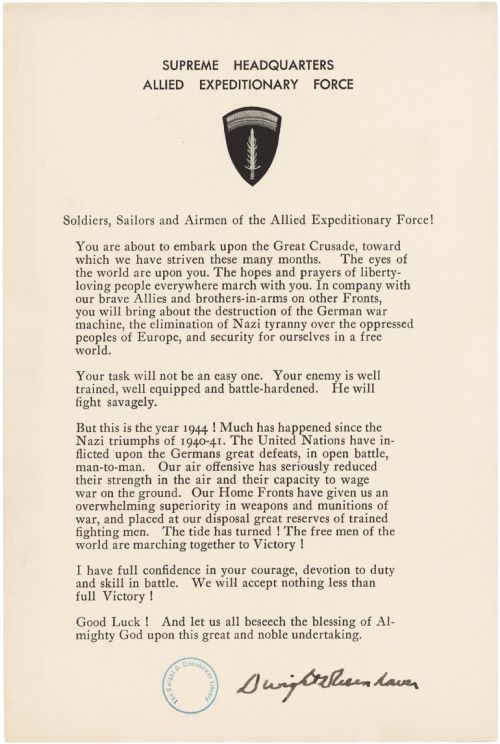
Eisenhower also knew that the success of the invasion depended on the success of the landings. A disaster at any of the landing beaches could doom the invasion. In light of this and so many other ways that could fail, Eisenhower, wrote a letter to his troops and the world when the invasion commenced. It read:

“Soldiers, Sailors, and Airmen of the Allied Expeditionary Force:

You are about to embark upon the Great Crusade, toward which we have striven these many months.

The eyes of the world are upon you. The hopes and prayers of liberty-loving people everywhere march with you.

In company with our brave Allies and brothers-in-arms on other Fronts you will bring about the destruction of the German war machine, the elimination of Nazi tyranny over oppressed peoples of Europe, and security for ourselves in a free world.

Your task will not be an easy one. Your enemy is well trained, well equipped, and battle-hardened. He will fight savagely.

But this is the year 1944. Much has happened since the Nazi triumphs of 1940-41. The United Nations1 have inflicted upon the Germans great defeats, in open battle, man-to-man. Our air offensive has seriously reduced their strength in the air and their capacity to wage war on the ground. Our Home Fronts have given us an overwhelming superiority in weapons and munitions of war, and placed at our disposal great reserves of trained fighting men. The tide has turned. The free men of the world are marching together to victory.

I have full confidence in your courage, devotion to duty, and skill in battle. We will accept nothing less than full victory.

Good Luck! And let us all beseech the blessing of Almighty God upon this great and noble undertaking.

However, prepared for any eventuality he also also wrote a letter in case the invasion failed, as it nearly did on Omaha Beach. That letter noted:

“Our landings in the Cherbourg-Havre area have failed to gain a satisfactory foothold and I have withdrawn the troops. My decision to attack at this time and place was based upon the best information available. The troops, the air and the Navy did all that Bravery and devotion to duty could do. If any blame or fault attaches to the attempt it is mine alone.”

It was dated July 5th, not June 5th, the mistake obviously due to the pressure of what he was feeling for his soldiers, the mission, and if the mission failed, his adversaries in the United States military and in Britain would have seen to his relief. It also could have aided those in the United States and Britain willing to make peace with Germany, which could have destroyed the allied alliance that ended up defeating Germany and rebuilding a democratic Europe, establishing NATO, the United Nations, and many other international organizations that have done much good for America and the world, but which are now under threat from leaders in the United States and Europe who would rather go back to the days of Hitler than advance into a better future.

Eisenhower did not make excuses if the invasion failed. He was ready to take full responsibility if Overlord failed, regardless of how it happened.

Likewise, he knew that the failure of the invasion would have made it possible for the Nazis to divert needed forces to the Eastern Front, where they might have been able to turn back the Soviet Operation Bagration which destroyed the German Army Group Center and opened the way for the Soviets to drive the Nazis from Soviet territory, advance to Warsaw, and knock key German allies out of the war. Before long, Hungary, Romania, and Finland were abandoning the Germans.

The fact that the invasion succeeded was as much as luck as it was the careful planning, and the exceptional courage, and dogged determination of the Allied troops.

Eisenhower’s willingness to take responsibility for defeat as well as give his troops credit for the eventual victory over the Nazis sets him apart from so many others then, and now who would deflect blame for a failed operation to their subordinates and lie about the results achieved.

In the age of Trump it is something to remember.

Peace,

Padre Steve+

6 Comments

Filed under History, leadership, Military, national security, News and current events, Political Commentary, us army, world war two in europe

Remembering the Joe Rochefort and Codebreakers Of Midway “We can accomplish anything provided no one cares who gets the credit.”

rochefort

Friends of Padre Steve’s World,

This week many people, especially those in the Navy, will be remembering the Battle of Midway on its 77th anniversary. The victory at Midway would not have happened without the exceptional intelligence gathering and code breaking by the cryptologists of Combat Intelligence Unit – Station Hypo – at Pearl Harbor under the command of Commander Joseph Rochefort. He and his small yet skillful team cracked the Japanese Naval code in time for Admiral Chester Nimitz to make the correct decision as to where to send his tiny carrier task forces to oppose the massive Japanese Combined Fleet under the Command of Isoroku Yamamoto.

Rochefort’s efforts were opposed by the key officers in the Office of Naval Intelligence who refused to believe that Midway was the target of the Japanese force. In spite of this opposition Nimitz was highly confident of Rochefort’s analysis and when all was said and done the U.S. Navy had defeated the Japanese, sinking four of the carriers that had attacked Pearl Harbor as well as a heavy cruiser, ripping the heart out of Japan’s premier naval striking force.

Historian Walter Lord wrote:

“Against overwhelming odds, with the most meager resources, and often at fearful self-sacrifice, a few determined men reversed the course of the war in the Pacific. Japan would never again take the offensive. Yet the margin was thin—so narrow that almost any man there could say with pride that he personally helped turn the tide at Midway. It was indeed, as General Marshall said in Washington, “the closest squeak and the greatest victory.”

One of those men was Joseph Rochefort. Admiral Nimitz credited Rochefort for breaking the codes and setting the stage for the victory, and recommended him for the Distinguished Service Medal, however, Rochefort’s rivals in Washington D.C. ensured that the award was turned down in order to claim the success for them. Shortly after Midway, Rochefort was reassigned to command a floating dry dock in San Francisco by the Department of the Navy as a way to punish him, and effectively ending his career. Rochefort retired as a Captain after the war, his contribution to the victory at Midway unrecognized by the Navy. Admiral Nimitz again recommended him for the award of the Distinguished Service Medal in 1958 and again it was turned down, but his supports continued to work to right the injustice.

In 1983 Rear Admiral Donald Showers who had worked for Rochefort in 1942 again recommended the award to Secretary of the Navy John Lehman who approved it. Unfortunately Rochefort was no longer alive to receive it, he had died in 1976. Today his service to the Navy and nation is remembered with the annual Captain Joseph Rochefort Information Warfare (IW) Officer Distinguished Leadership Award which is awarded to annually recognize the superior career achievement of one IW officer for leadership, teamwork, operational contributions and adherence to the principle by which he served, “We can accomplish anything provided no one cares who gets the credit.” 

Have a great day and please don’t forget men and women who embody the spirit of Joseph Rochefort, it is a rare commodity. I am afraid that in much of the current U.S. Navy there is not the same ideal as Joseph Rochefort. Without men and women who hold the ideal of Joe Rochefort you cannot win wars. This matters even today.

Peace

Padre Steve+

2 Comments

Filed under History, leadership, Military, Navy Ships, World War II at Sea, world war two in the pacific

A Week Of Momentous Historical Events


D-Day, June 6th 1944

Friends of Padre Steve’s World,

I am posting a small thought to begin the week. For those that do not know, the next several days are full of the anniversaries of many historical events which still reverberate to our time.

The Evacuation Of Dunkirk

On June 3rd 1940, the British finished the evacuation of the British Expeditionary Force and some French forces from Europe at Dunkirk, though defeated, the British action preserved the British Army and kept Britain in the war.


The Battle Of Midway 

From June 4th through June 6th 1942 a small American fleet defeated a much larger, more experienced and better equipped fleet at the Battle of Midway. The battle did not end the war, but it ensured that Japan never could win the war against the United States in the Pacific. It was a turning point. It has rightly been called an “Incredible Victory” as all the elements that make war what it is, the element of chance, the element of friction, and the  element of surprise all broke the American way. The Japanese leaders, and for that matter many if not the vast majority of their soldiers and sailors were full of hubris, believing themselves invincible they were decisively defeated.

Two Years later on June 6th 1944, Allied forces landed on the Normandy Peninsula of France to begin their long awaited attack on Nazi occupied Europe. The invasion, code named Operation Overlord did not end the war, but coupled with the Soviet offensive against the German Army Group Center which began just two weeks later, Operation Bagration, it was the beginning of the end for Hitler’s Germany.

Battle of Belleau Wood, 1918

Twenty-six years earlier U.S. Marines and Army soldiers turned back the Germans at the Battle of Belleau Wood near Chateau-Thierry France. The effort blocked a German drive on Paris, giving the Allies the time to begin a counter-offensive that would end the war.


Senator Robert F. Kennedy lays Mortally Wounded after being shot by Sirhan Sirhan 

But in addition to the battles other important events shook the world, in 1919 the Congress passed the 19th Amendment, which when ratified gave women the right to vote. In 1968, Senator Robert F. Kennedy was gunned down by the assassin Sirhan Sirhan in Los Angeles after winning the Democratic Party primary. He would have been the odds on favorite to defeat Republican Richard Nixon in the general election. On June 8th 1789 James Madison introduced twelve amendments to the U. S. Constitution, of which ten were ratified by the states to become known as the Bill of Rights. 

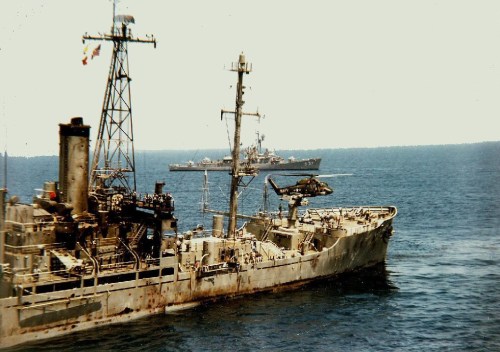
On June 8th 1967, the USS Liberty, a surveillance ship, was attacked by Israeli ships and aircraft during the Six Day Warthe attack resulted in the death of 34 American sailors and the wounding of 171 more.

Of course there are numerous other events that took place at different times on these days, some which were very important, and others which are interesting but less important in terms of their historical impact. I’ll be writing about some of these events in the coming days.

Have a great day,

Peace

Padre Steve+

Leave a comment

Filed under History, Military, Navy Ships, Political Commentary, World War II at Sea, world war two in europe, world war two in the pacific

The Tragedy Of the “Mighty Hood” at 78 Years

hms-hood-sinking11

Artist rendition of the Loss of the HMS Hood

Friends of Padre Steve’s World,

Seventy-eight years ago today the HMS Hood, the  “Mighty Hood” was sunk by the German Battleship Bismarck. It was an event that began a tragic and legendary week in Naval history. The news was broken to most of the world by American journalist Edward R. Murrow who in his radio broadcast reported:

“This is London, Ed Murrow reporting. This island, which is no stranger to bad tiding, received news today that HMS Hood largest warship in the British fleet and pride of the British navy, has been sunk by the German battleship Bismarck. From the Hood’s compliment of 1500 men, there were three survivors.”

The news of the sinking of the great ship stunned the world, and it is a tragic anniversary that I always mark. I first read about this battle in C.S Forrester’s little book Hunting the Bismarck when I was in 4th grade. That book was used as the screenplay for the 1960 film Sink the Bismarck.

This essay is in honor of the gallant HMS Hood and her crew.  It is fitting although the HMS Hood and her killer, the German battleship Bismarck were not American. Both were great ships manned by gallant crews and the loss of both ships was tragic, especially from the aspect of the great loss of human life. I do hope and pray that we never forget the sacrifice of these men and all others who have gone down to the sea in great ships.

hood-malta1

HMS Hood entering Valetta Harbor, Malta

There are some warships and naval engagements which assume legendary proportions.  The Battle of the Denmark Strait on 24 May 1941 between the two largest battleships in commission at the time, the pride of the British Royal Navy the HMS Hood and the German behemoth Bismarck is legendary as are those two mighty ships.  The battle came at a critical time as the Britain stood alone against the seemingly invincible German Blitzkrieg.

hood-at-san-francisco1

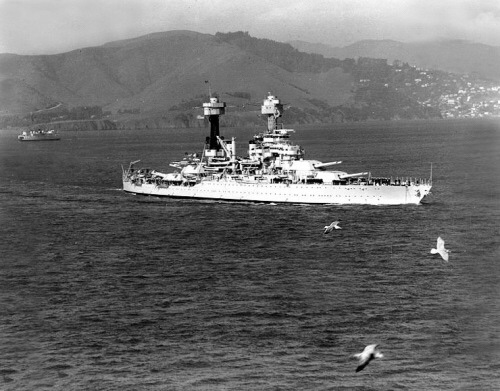
Hood in San Francisco on 1920s goodwill tour

Britain had been driven from Western Europe and was being bombed regularly by Herman Goering’s Luftwaffe while a British expeditionary force that had been sent to Greece had been defeated and the Germans were assaulting Crete with airborne forces.  In the Western Desert the Afrika Korps under Field Marshall Erwin Rommel had driven off a British counter-offensive on the Libyan-Egyptian frontier and were laying siege to Tobruk and in the Atlantic German U-Boats sank 66 Allied Merchant Ships of over 375,000 tons and the Royal Navy would lose 25 warships not including the Hood.

hms_hood_march_17_19241

The Hood was the pride of the Royal Navy and was world famous due to her inter-war international presence and goodwill visits.  Displacing 47,430 tons full load she was armed with eight 15” guns in four twin turrets.  Designed as a battle cruiser she was less heavily armored than contemporary battleships and had very weak vertical protection from plunging shellfire.  This was a fault which was known but never rectified between the wars, and when the war came the Royal Navy could ill-afford to take her out of service for the necessary improvements to her protection system.  She was fast with a designed speed of 31 knots which been reduced to 28 knots by 1939 as a result of modifications which increased her displacement.   This was further reduced by the wear and tear on her propulsion plant to 26.5 knots by 1940.

Hood was designed before the battle of Jutland (May 1916) where the weaknesses in the armor protection of British Battlecruisers was exposed as three, the HMS Invincible, HMS Queen Mary and HMS Indefatigable were destroyed by plunging fire which exploded their magazines.  Though her design was modified during construction she still was vulnerable to plunging fire. She was scheduled for a major refit which would have included significant improvement in armor protection in 1941, but the war prevented Hood from receiving anything more than improvements to her anti-aircraft batteries.

Combat1lg

Hood (nearly hidden by falling shells) in action at Mers-El-Kebir

During the war Hood was engaged in patrol and search operations against German raiders in the North Atlantic and in June 1940 joined Force “H” in the Mediterranean.  As Flagship of Force “H” she took part in the sinking of French Fleet Units including the Battleship Bregtange  at Mers-El-Kebir on 3 July 1940 following the French surrender to the Germans and remained in operation searching for the German Pocket Battleship Admiral Scheer and the Heavy Cruiser Admiral Hipper until she was withdrawn for a brief refit in January 1941.

Following another brief refit in mid-March, Hood was underway from mid-March searching for the German raiders Scharnhorst and Gneisenau and also false report of Bismarck breaking out into the Atlantic in April 1941. She returned to Scapa Flow on 6 May 1941.

bismarck1

The German Leviathan, Bismarck

When the British discovered that Bismarck had entered the Atlantic, Hood the flagship of Vice Admiral Lancelot Holland, was dispatched to find and sink her with the newly commissioned battleship HMS Prince of Wales.  The battleships were to join the Heavy Cruisers HMS Suffolk and HMS Norfolk at the entrance to the Denmark Strait.  When the cruisers discovered Bismarck along with her consort the Heavy Cruiser Prinz Eugen the two British battleships steamed into naval history.

flagshippg213

Bismarck was slightly larger than Hood and mounted the same main armament but that was about all the two ships had in common. If the battle was a battle between heavyweight prize fighters Hood was the valiant but crippled champion and Bismarck the young and overpowering challenger.  Bismarck was slightly faster than the limping Hood and was one of the most well protected ships ever built.  Her gunnery officers and the men that manned her deadly 15” guns, like previous generations of German sailors, were gunnery experts, working with some of the finest naval guns ever made.

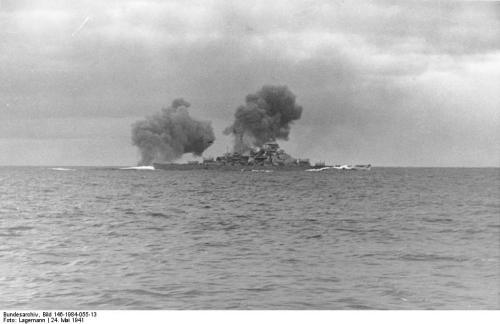
<img src="https://padresteve.com/wp-content/uploads/2014/05/bundesarchiv_bild_146-1984-055-13_schlachtschiff_bismarck_seegefecht1.jpg?w=500&h=324&quot; class="aligncenter size-full wp-image-14605" data-attachment-id="14605" data-permalink="https://padresteve.com/2014/05/24/remembering-the-mighty-hood-and-the-battle-of-the-denmark-strait/schlachtschiff-bismarck-seegefecht-3/&quot; data-orig-file="https://padresteve.com/wp-content/uploads/2014/05/bundesarchiv_bild_146-1984-055-13_schlachtschiff_bismarck_seegefecht1.jpg&quot; data-orig-size="500,324" data-comments-opened="1" data-image-meta="{"aperture":"0","credit":"Bundesarchiv","camera":"","caption":"Seegefecht des Schlachtschiffes \"Bismarck\" unter Island.\nNunmehr richtet Schlachtschiff Bismarck seine ganze Feuerkraft auf das sich zur\u00fcckziehende Schlachtschiff \"Prince of Wales\".\nProp.Kp.:MPA Nord Film-Nr. 100\/27\nBildberichter: Lagemann\nWilhelmshaven; Herausgabedatum: Juni 1941","created_timestamp":"0","copyright":"","focal_length":"0","iso":"0","shutter_speed":"0","title":"Schlachtschiff Bismarck, Seegefecht"}" data-image-title="Schlachtschiff Bismarck, Seegefecht" data-image-description="

Seegefecht des Schlachtschiffes “Bismarck” unter Island.
Nunmehr richtet Schlachtschiff Bismarck seine ganze Feuerkraft auf das sich zurückziehende Schlachtschiff “Prince of Wales”.
Prop.Kp.:MPA Nord Film-Nr. 100/27
Bildberichter: Lagemann
Wilhelmshaven; Herausgabedatum: Juni 1941

” data-medium-file=”https://padresteve.com/wp-content/uploads/2014/05/bundesarchiv_bild_146-1984-055-13_schlachtschiff_bismarck_seegefecht1.jpg?w=300&#8243; data-large-file=”https://padresteve.com/wp-content/uploads/2014/05/bundesarchiv_bild_146-1984-055-13_schlachtschiff_bismarck_seegefecht1.jpg?w=500&#8243; height=”324″ alt=”Schlachtschiff Bismarck, Seegefecht” width=”500″ srcset=”https://padresteve.com/wp-content/uploads/2014/05/bundesarchiv_bild_146-1984-055-13_schlachtschiff_bismarck_seegefecht1.jpg 500w, https://padresteve.com/wp-content/uploads/2014/05/bundesarchiv_bild_146-1984-055-13_schlachtschiff_bismarck_seegefecht1.jpg?w=150&h=97 150w, https://padresteve.com/wp-content/uploads/2014/05/bundesarchiv_bild_146-1984-055-13_schlachtschiff_bismarck_seegefecht1.jpg?w=300&h=194 300w” sizes=”(max-width: 500px) 100vw, 500px” style=”height: auto; max-width: 100%; margin-bottom: 2px”>

Bismarck firing on Hood, Picture taken from Prinz Eugen

gallbismdenmarkstrait11

The German ships were shadowed at a distance by the County Class heavy cruisers  Norfolk and Suffolk. The German task force under the command of Admiral Gunther Lütjens emerged from the strait and were sighted by the British at 0537.  Knowing his ships weakness in regard to plunging fire Admiral Holland desired to steer a direct course at the German ships in order to close the range quickly in order to narrow the range and prevent being hit by the same kind of plunging fire that doomed the British battle cruisers at Jutland.

However, events dictated otherwise and the British were forced to close the range much more slowly than Admiral Holland desired, this exposed both Hood and Prince of Wales to German plunging fire for a longer period of time.  Because of this Holland then turned and tried to close the German ships faster. The result was that his gunnery was degraded by wind and spray coming over the bows of his ships compounded by his inability to bring his after turrets to bear on the German ships.

hood0231

Hood, photographed from Prince of Wales just before being sunk by Bismarck

At 0553 Holland ordered his ships to open fire. Unfortunately, he dis so without the benefit of Suffolk and Norfolk being in position to engage the Prinz Eugen.  Due to the similar appearance of the German ships Hood initially concentrated her fire on Prinz Eugen assuming her to be the Bismarck while Prince of Wales engaged Bismarck.

During the initial exchange of fire Prince of Wales drew first blood by hitting Bismarck three times with her 14″ guns. One hit damaged Bismarck’s seaplane catapult. A second did minor damage to machinery spaces, and a third which passed throughBismarck’s bow near the waterline and severed the fuel lines from her forward fuel tanks to her engines. The third hit would prove the mighty German Leviathan’s undoing.

prinzeugen-21

Prinz Eugen

Both German ships opened fire at 0555 and concentred their fires on the Hood.  Prinz Eugen immediately hit Hood with at least one 8” shell which set a large fire among the ready to use 4”ammunition stored in lockers near the mainmast. The hit started a large fire which Hood’s damage control teams raced to contain.  At 0600, Admiral Holland ordered his ships to turn to port in order to bring the rear turrets of his battleships into the fight.

As the squadron executed the turn Hood was straddled by a salvo from Bismarck and observers on Prince of Wales observed an explosion between “X” turret and the mainmast of Hood. The hit set off the 4″ magazine and the resultant explosion consumed the Hood causing her bow to jut sharply out of the water before sinking beneath the waves in under 3 minutes time. Witnesses on both sides of the engagement were stunned by the sudden and violent end of the Hood. 

With Hood now destroyed the Germans rapidly shifted their fire to the Prince of Wales, crippling the battleship and knocking her out of the action.  Bismarck was now in a perfect position to finish off Prince of Wales but she did not do so. Against the advice of Bismarck’s Captain Ernst Lindemann, Admiral Lütjens refused to follow up his advantage to sink the crippled British battleship and instead broke off the action.

hood_explosion_sketch1

Hood blows up. Drawing by the Captain of HMS Prince of Wales J.C. Leach

Only three crewmen for Hood, Petty Officer Ted Briggs, Seaman Bob Tilburn and Midshipman Bill Dundas survived the cataclysm out of a total of 1415 souls embarked. They were rescued 4 hours later nearly dead of hypothermia. They stayed awake by singing  “Roll out the Barrel” until they were rescued by the destroyer HMS Electra.

hood_blowup1

Briggs who died in 2008 recounted the sinking:

“Then she started listing to starboard. She righted herself, and started going over to port. When she had gone over by about 40 degrees we realised she was not coming back…” Briggs was sucked under the water “I had heard it was nice to drown. I stopped trying to swim upwards. The water was a peaceful cradle – I was ready to meet my God. My blissful acceptance of death ended in a sudden surge beneath me, which shot me to the surface like a decanted cork in a champagne bottle. I turned, and 50 yards away I could see the bows of the Hood vertical in the sea. It was the most frightening aspect of my ordeal, and a vision which was to recur terrifyingly in nightmares for the next 40 years.” (The Daily Telegraph 5 October 2008)

briggs1

Ted Briggs

tilburn4111

Bob Tilburn

The Admiralty reported the loss of the Hood later in the day saying Hood received an unlucky hit in a magazine and blew up.”  The official report of the sinking released later in the year said:

That the sinking of Hood was due to a hit from Bismarck’s 15-inch shell in or adjacent to Hood’s 4-inch or 15-inch magazines, causing them all to explode and wreck the after part of the ship. The probability is that the 4-inch magazines exploded first.”

The commission’s findings have been challenged by a number of naval historians and there are several theories of how the magazines might have exploded. However, all theories point to a massive magazine explosion which may not have be caused by a plunging round but from a hit which detonated the unprotected 4” magazines or a hit from Bismarck that struck below Hood’s waterline and exploded in a magazine.

For forty years the Hood’s wreckage lay undiscovered. Her wreck was located in 2001 lying across two debris fields. The post mortem examination revealed that Hood’s after magazines had exploded.  Hood’s resting place is designated as a War Grave by Britain and protected site under the Protection of Military Remains Act of 1986.

bismarck-sinking1

Bismarck sinking

Bismarck and her crew did not long survive her victory.  When close to refuge in the French port of Brest on May 26th the great ship was crippled by a lucky aerial torpedo hit from a Fairley Swordfish bomber flying from the HMS Ark Royal. 

The hit damaged Bismarck’s rudders and forced her to steer a course towards the approaching British fleet. Throughout the night Bismarck fought off attacks by British and Polish destroyers on the morning of May 27th 1941, after absorbing massive damage from the HMS King George V, HMS Rodney and several cruisers including HMS Dorsetshire, he plucky and persistent Norfolk and several destroyers, Bismarck was scuttled by her crew. When she went down she took with her all but 115 souls of her crew of over 2200 which included the Fleet Staff of Admiral Lütjens.

hms-prince-of-wales1

HMS Prince of Wales

A few months later, Prince of Wales would take Winston Churchill to Argentia Bay Newfoundland to meet with Franklin Roosevelt. At the conference that took place in August 1941, the Atlantic Charter was drafted. With the increased threat of Japanese expansion Prince of Wales reported to the Far East where she was sunk along with the Battlecruiser HMS Repulse on 9 December 1941 by a force of land based Japanese aircraft.  The Prinz Eugen was the only heavy ship of the German Navy to survive the war and was taken as a prize by the US Navy when the war ended. She was used as a target during the Able and Baker nuclear tests at Bikini Atoll, but did not sink. She was too radioactive to be repaired and her hulk was towed to Kwajalein Atoll where she capsized and sank on 22 December 1946. Her wreck is still visible.

The loss of the Hood traumatized the people of Britain and the Royal Navy; she had been the symbol of British Naval power for over 20 years and people around the world were likewise stunned at her demise. The sinking of the Hood and the loss of her crew was a tragedy which all sailors assigned to large and prestigious ships and the nations that they sail for need to keep in mind.

No matter how mighty any ship may be, every ship has an Achilles heel and no ship is unsinkable, and human beings bear the brunt of such tragedies.  Of the over 3600 officers and crew of the Hood and the Bismarck only 118 survived.

dundasw1

I will continue to remember the gallant Hood, her brave crew, especially my very distant relative Midshipman Bill Dundas who I never met.  He left the Royal Navy with the rank of Lieutenant Commander in about 1960, and was killed in a car wreck in 1965. According to the Hood Association website he was troubled by the sinking for the rest of his life.  I think that I could understand as I am still troubled by my far less traumatic experience of war in Iraq.

Until tomorrow,

Peace

Padre Steve+

1 Comment

Filed under History, Military, Navy Ships, nazi germany, World War II at Sea, world war two in europe

Of Pardoning War Criminals: Trump and the Consequences Of Ignoring Justice

Friends of Padre Steve’s World,

There are reports that this Memorial Day weekend that President Trump will Pardon convicted or accused War Criminals, men whose conduct dishonored the military and the country, men whose fellow soldiers, Marines, or Sailors have voluntarily testified against. These men murdered prisoners and committed other crimes forbidden by the law of war. If he does so this weekend it will be the ultimate betrayal of the military by the Commander in Chief.

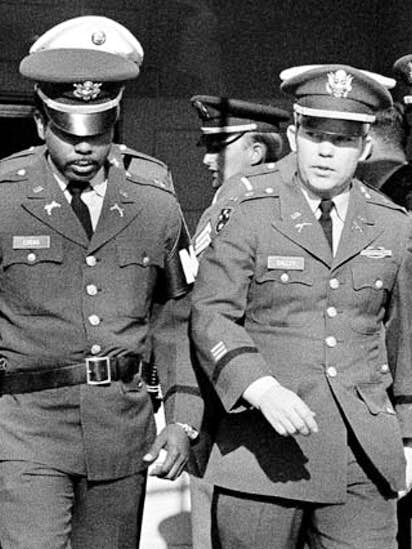
When Richard Nixon Pardoned Lieutenant William Calley, convicted of leading his platoon in the deadliest atrocity committed by American Troops in the Vietnam War at a village called My Lai. His men’s butchery had to be stopped by an American helicopter and its crew who interposed their bird between Carley’s men and other potential victims, and threatened to shoot at Calley’s men. The crime was initially covered up by Calley’s chain-of-command. Eventually it became public and the Army was forced to deal with it. Of all the officers charged and soldiers charged, only Calley was convicted. It took thirty years for the military to award the heroes who stopped the massacre.

In the six degrees of separation I am just twice removed from My Lai, two times. In my MSIII, junior year of Army ROTC in the Fall of 1981. My instructor was Major Barry Towne, during the investigation he was Commanding part of the security force. He told us what kind of criminal element that Calley and his platoon was. Calley’s defense at Court Martial was that “he was just following orders.”

Major Towne told us of its effect on the troops, the public, and the war. He told us that we would be war criminals if we ever allowed that to happen under my command. So I knew one of the Officers with first hand knowledge of the crime and the crime scene. Then, in June of 1998 while serving as the Garrison Chaplain at Fort Indiantown Gap, Pennsylvania I did the funeral of Calley’s Brigade Commander, Colonel Oran Henderson. He was acquitted of all charges including the cover-up which he began the day of the massacre. At the time I didn’t know his fully complicity in the massacre. Telford Taylor, one of the Senior American prosecutors at Nuremberg “wrote that legal principles established at the war crimes trials could have been used to prosecute senior American military commanders for failing to prevent atrocities such as the one at My Lai.” Those included Generals, and many other senior officers.

President Nixon commuted Calley’s prison time to House Arrest, and in September 1974 Calley was pardoned by the Secretary of the Army. That man said he did it because Calley really did believe that he was following orders.

So if the President begins pardoning War criminals it will be a watershed from which there will be no going back, unless the Generals and Admirals protest. If course if they do, Trump will replace them with men who will go all the way, and his base, especially his allegedly pro-life Christians, who believe that he has been ordained by God to Make America Great Again.

Just before the invasion of Poland Hitler told his military commanders:

“I shall give a propagandist cause for starting war -never mind whether it be plausible or not. The victor shall not be asked later on whether we told the truth or not. In starting and making a war, it is not the right that matters, but victory.”

In May 1941, Field Marshal Wilhelm Keitel disseminated the Barbarossa Decree in the name of Adolf Hitler which absolved German Soldiers from war crimes, even those against German law. Army Group and Army Commanders had the authority to be more severe than Keitel’s order. The Severity Order issued by Field Marshal Walter Reichenau of Army Group, Commander of 6th Army. That order stated:

The most important objective of this campaign against the Jewish-Bolshevik system is the complete destruction of its sources of power and the extermination of the Asiatic influence in European civilization.

In this eastern theatre, the soldier is not only a man fighting in accordance with the rules of the art of war, but also the ruthless standard bearer of a national conception and the avenger of bestialities which have been inflicted upon German and racially related nations. For this reason the soldier must learn fully to appreciate the necessity for the severe but just retribution that must be meted out to the subhuman species of Jewry. The Army has to aim at another purpose, i. e., the annihilation of revolts in hinterland which, as experience proves, have always been caused by Jews.

Other Wehrmacht Commanders wrote similar orders, unleashing the beast in their soldiers and classifying their enemies as less than human, a typical charge leveled at racial and religious minorities, as well as immigrants, and potential enemies by the President.

General Erich Hoepner issued this order to his soldiers of Panzer Group Four, Later known as the 4th Panzer Army:

The war against Russia is an important chapter in the German nation’s struggle for existence. It is the old battle of the Germanic against the Slavic people, of the defence of European culture against Muscovite-Asiatic inundation and of the repulse of Jewish Bolshevism. The objective of this battle must be the demolition of present-day Russia and must therefore be conducted with unprecedented severity. Every military action must be guided in planning and execution by an iron resolution to exterminate the enemy remorselessly and totally. In particular, no adherents of the contemporary Russian Bolshevik system are to be spared.

Unopposed Pardons will release unprecedented evil by otherwise honorable men who either believer that they are just following orders or approved by God through the words of their leader.

I take this very seriously. War Crimes are war crime whether committed by Nazis, Communists, the Iranian Revolutionary Guard, or American soldiers. Supreme Court Justice Robert Jackson who organized the Nuremberg Trials and prosecuted the leading Nazis noted before the trials began:

“If certain acts of violation of treaties are crimes, they are crimes whether the United States does them or whether Germany does them, and we are not prepared to lay down a rule of criminal conduct against others which we would not be willing to have invoked against us.” Justice Robert Jackson International Conference on Military Trials, London, 1945, Dept. of State Pub.No. 3080 (1949), p.330.

If Trump Pardons these men he will be spitting in the face of American and International Justice. He will be blessing war crimes and if there is no push back from the Joint Chiefs of Staff or the Regional Combatant Command Commanders we are doomed to repeat what criminal regimes have done. We will be a rogue and outcast nation whose word will not be believed, and whose military members will be considered criminals, even if they serve honorably and have never committed any crimes. Ask any Vietnam Veteran if you don’t believe me. I wasn’t a Vietnam veteran, but my dad was. When I enlisted and joined the ROTC program at UCLA I had a man come out from nowhere and start screaming at me “off campus ROTC Nazi!”

I haven’t forgotten that. I was a kid when Calley committed his crimes. I had never fired a shot in anger, and my primary focus of study over the previous year had been the guilt of the Nazis and their genocidal policies. What leaders do matters, and there is no escaping that, especially if you volunteer to serve in the military.

These are big issues and cannot be allowed to go unnoticed. The rot begins in the head of the fish. We are well on our way to to becoming a criminal and outlaw nation, something our Founders thought they had prevented by devising our system of government, a system intentionally designed to limit the powers of the Executive.

This does matter. If Trump Pardons these men and there is no push back from the Senior Commanders I would advise no one to enlist or take a commission in the United States military, and I have almost 38 years of service in the Army and Navy to prove my devotion to the Constitution and Country, including combat tours in which I was shot at and was in danger on a daily basis. As a historian, priest, and officer I cannot be silent if the President Pardons War criminals. The very thought is abhorrent to my nature.

Until tomorrow,

Peace

Padre Steve+

6 Comments

Filed under ethics, History, holocaust, iraq,afghanistan, laws and legislation, leadership, Military, national security, nazi germany, News and current events, Political Commentary

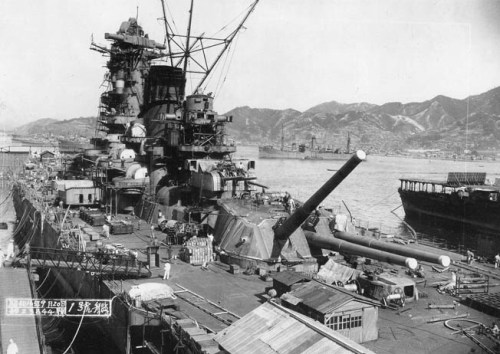
All the Drowned Sailors: The Sacrifice Of the Yamato, at Okinawa and the Myth Of Trump’s #MAGA

Friends of Padre Steve’s World,

Those who have read my site since the beginning know that I have written much in terms of Naval History. One of the things that I am drawn to are the great ships that were sacrificed with the crews in futile attempts of salvage victory from defeat, or which were sacrificed in order to save others. Regardless of the circumstance I have a soft spot in my heart for sailors of any nation who pay with their lives when their ships are sunk. This is the story of the IJN Yamato who along with her sister ship, the Musashi were the largest battleships ever constructed.

As dawn broke on April 7th 1945 the great Super-Battleship Yamato, the pride of the Japanese Imperial Navy and nine escorts steamed toward Okinawa on a suicide mission. It was literally the end of empire and the end of a navy. What had begun on December 7th 1941 was now winding down as the Imperial Navy launched its last offensive operation against the United States Navy.

The Imperial Navy was already at the end of its tether. Following the disasters at the Battle of the Philippine Sea which decimated the carrier air arm of the Imperial Navy; the subsequent losses in the defense of Formosa which used up the majority of any remaining carrier aircraft and crews; and the Battle of Leyte Gulf which decimated the surface forces of the navy what remained was a pitiful remnant of a once dominant fleet.

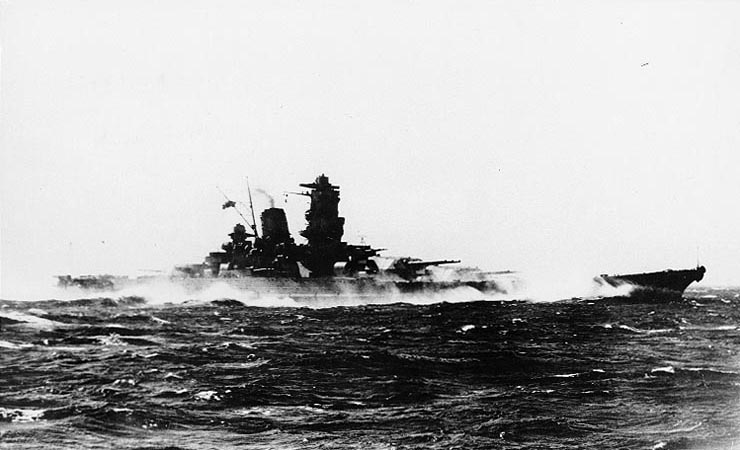
The great battleship Yamato and her sister ship Musashi were the largest warships ever built until the advent of the USS Enterprise CVN-65. Displacing over 72,000 tons 863 feet long and 127 feet in beam these ships mounted the heaviest artillery battery ever placed on a warship. Their nine 18.1” guns mounted in three triple turrets each weighing over 2500 tons weighed as much or more than the largest destroyers of the time. They could fire their massive shells 26 miles and even had the capability of firing a special anti-aircraft shell known as the Sanshiki or beehive round.the largest anti-aircraft shell ever developed.

Musashi was sunk during the Battle of the Sibuyan Sea at Leyte Gulf on October 24th 1944 after being hit by 19 aerial torpedoes and 17 bombs. Yamato engaged the American Escort Carriers and destroyers of Taffy-3 at the Battle off Samar the following day but was prevented by the audacity of the inferior American destroyers and timidity of the Japanese commander Vice Admiral Takeo Kurita from achieving any notable success.

The remains of the Imperial Navy were hampered by a lack of fuel, air power and training time. When the United States attacked Iwo Jima in February 1945, barely 700 miles from the home islands of Japan not a single Japanese surface ship sortied to challenge the American Navy.

However when the American attacked Okinawa on April 1st 1945 the Imperial Navy launched Operation Ten-Go. In spite of overwhelming American superiority in both naval air and surface forces the tiny task force was to fight its way to Okinawa, beach their ships and once the ships were destroyed the crews were to join Japanese Army forces on the island.

The doomed sortie was in part due to the insistence of the Imperial Army which derided the Imperial Navy for its failures at Philippine Sea and Leyte Gulf and pressure from Emperor Hirohito who asked “But what about the Navy? What are they doing to assist in defending Okinawa? Have we no more ships?” In response the Naval High command devised what amounted to a suicide mission for Yamato and her escorts. The plan was opposed by many in the Navy and leaders of the task force who saw it as a futile mission. Only the insistence of Admiral Kusaka who told the reticent commanders that the Emperor expected the Navy to make its best effort to defend Okinawa persuaded the Captains of the doomed force to accept the mission. Honor now matter more than lives.

At about 1600 on April 6th the ships of the task force weighed anchor and departed their anchorage at Tokuyama hoping to take advantage of approaching darkness to mask their departure. They were detected and shadowed by American submarines which provided real time information on the course and speed of the Japanese ships to the American leadership.

The next morning the task force was spotted by patrol planes and its position relayed to the American fleet commander, Admiral Raymond Spruance, the victor of Midway. Spruance ordered the six fast battleships, accompanied by two battlecruisers, seven cruisers and 21 destroyers engaged in shore bombardment to intercept the Japanese force. However, Admiral Marc Mitscher of Task Force 58, the fast carriers launched a massive air strike of over 400 aircraft against the Japanese.

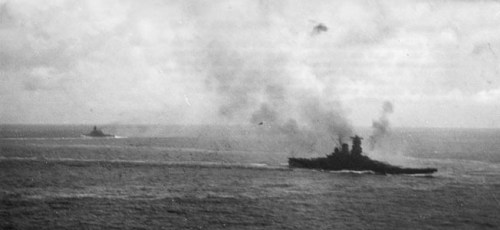
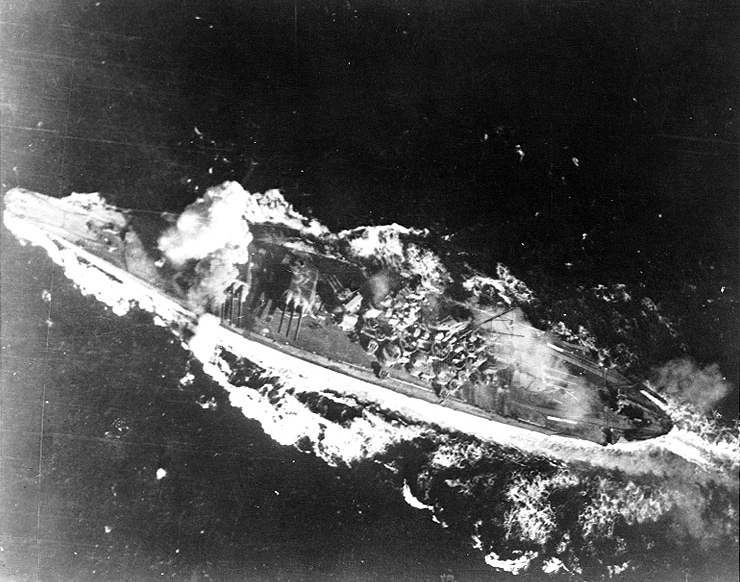
At 1232 the first wave of American aircraft began their attacks on the doomed Japanese force. As the succeeding waves of American aircraft attacked Yamato was hit by 15 bombs and at least 8 torpedoes, almost all of which struck her port side created an imminent risk of capsizing. The damage control teams’ counter flooded the starboard engine and boiler rooms which kept the ship from turning turtle, but which also further reduced her speed.

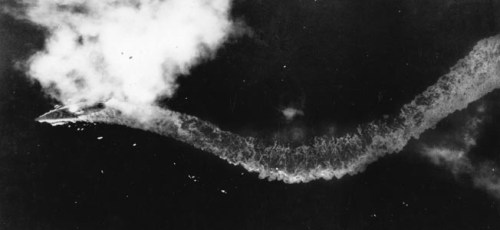
By 1405 the great ship was dead in the water with a heavy list, just minutes before her commander had ordered the crew to abandon ship. At 1420 Yamato capsized and began to sink and at 1423 she blew apart in a massive explosion that was reportedly heard and seen 120 miles away and created a mushroom cloud that reached 20,000 feet.

Captain Tameichi Hara of the light cruiser Yahagi which had already sank described the demise of the great ship in his book Japanese Destroyer Captain:

“We looked and saw Yamato, still moving. What a beautiful sight. Suddenly smoke belched from her waterline. We both groaned as white smoke billowed out until it covered the great battleship, giving her the appearance of a snow-capped Mount Fuji. Next came black smoke mingled with the white, forming to a huge cloud which climbed to 2000 meters. As it drifted away we looked to the surface of the sea again and there was nothing. Yamato had vanished. Tremendous detonations at 1423 of that seventh day of April signaled the end of this “unsinkable” symbol of the Imperial Navy.”

Only 280 men of the estimated 3000 crew members aboard Yamato were rescued by the surviving escorts. Of her escorts, the Yahagi and four destroyers were also sunk. The Americans lost a total of ten aircraft and 12 men. Never again would the surface forces of the Imperial Navy threaten U.S. forces or take any meaningful part in the war.

https://youtu.be/4ZcfU0cGAP0

The sacrifice of Yamato and her escorts was a futile was of lives and though many in Japan revere their sacrifice as noble it served no purpose. The loss of Yamato, named after the ancient Yamato province in a sense was symbolic of the demise of the Japanese Empire.

I cannot help but think of gallantry of the doomed crews of these ships, sacrificed for the “honor” of leaders that did not really value their sacrifice. Likewise, I regret the fact that Naval engineers, and maritime archeologists never got to examine this great ship while still afloat, or even to see how she would have faired as a target ship in the Bikini Atoll Nuclear tests.

I regret that so many sailors died in what was a senseless, and useless from an operation operation of any tactical, operational, or strategic point of view. Likewise I regret that a relatively intact Yamato was never fully examined by non-Japanese maritime engineers and ship designers to examine and learn lessons from. If Yamato had survived the war, been thoroughly examined and the. Been expended as a target ship at Bikini, which in light of the examples of the USS Nevada, USS New York, the DKM Prinz Eugen, and other ships might have assisted Naval engineers even today.

I am a career military man, and sailor. I am a humanist who abhors the indiscriminate and nonsensical sacrifice of lives for so called National Honor or pride. I am also a military and naval historical historian who believes that the preservation and study of such instruments of war save lives.

It is a commentary that is timeless. The useless sacrifice of over 2,800 human beings and the ultimate battleship ever built into, to do nothing more than commiserate over the lives that had not been so sacrificed, and the lessons that might prevent the loss of life in future conflicts.

I wonder if another Naval power, perhaps not the Japanese, but maybe the Americans, Russians, English, Indian, or Chinese aircraft carrier will be the latest to succumb to the myth of the great and allegedly indestructible capital ship.

It is a question worth asking as the United States Navy struggles to regain pure-eminence in the Pacific against the Chinese, in the Arctic against Chinese and the Russians, and against less than peer competitors in the Persian Gulf and the Mediterranean. When Yamato was sunk the Japanese were no longer under the illusion that they were the greatest sea power ever; if a United States Navy Aircraft were to be sunk in the North Atlantic, the Northeast Pacific, the Persian Gulf, or the Mediterranean it would be more than a military defeat, it would be a national catastrophe. Trust me, I have played the war games at the Joint Forces Staff College. I cannot go into detail about the war game scenarios, but the were favorable to the United States and its allies.

If any of our Nimitz class carriers were sunk along with the majority of their escorts it would be a crisis like we have not experienced since Pearl Harbor. Thus, Yamato, and her escorts serve as a lesson for all who believe in the myth of American Naval and Military superiority. In January of 1019, this year the Chinese boasted that they could not just sink one, but two Nimitz Class carriers in the South China Sea https://www.thesun.co.uk/news/8098177/chinese-admiral-south-china-sea-sink-us-aircraft-carriers/

That possibility has to be acknowledged, and even if one were sunk or seriously damaged it would be a disaster for United States Strategic interests; not Just in the South China Sea, but also Northeast Asia, the Persian Gulf, the Mediterranean, or the North Atlantic. The United States has not experienced such Naval disasters since 1941 and 1942 at the hands of the Japanese Imperial Navy, trust me; I have serve for almost 38 years in the Army and the Navy and I am a historian. If we to experience such losses it would be a strategic disaster that would collapse the confidence of an American public in the myth of American military superiority. There is no amount of #MAGA that can change that. The economy would collapse and the dream world that Americans have lived I would be destroyed. We would have to start again from scratch, like the Japanese in 1945 or the Chinese in 1274 and 1281, or more recently the defeat of the Russian Fleet, operation far from home at Tsushima in 1905 by Admiral Togo and his Japanese Fleet.

This my friends is history, and this is reality when a nation is led by a man with the stupidity of Czar Nicholas, the hubris of Kaiser Wilhelm II, and the racist, non-historical, and not strategically grounded ideology of Adolf Hitler, and their present day manifestations in President Donald Trump.

Until tomorrow

Peace

Padre Steve+

2 Comments

Filed under History, leadership, Military, nazi germany, News and current events, US Navy, White nationalism, World War II at Sea, world war two in the pacific

We Could Use a Man (or Woman) Like Franklin Roosevelt Again

Friends of Padre Steve’s World,

If I had to place myself on the political spectrum it would be in the area occupied by Franklin Delano Roosevelt. I am definitely a liberal, I can no longer claim to be a conservative by any means of the imagination, but as a historian I am very careful in embracing the extremes of left, or right wing populism, the very things which are driving much of the political division in our country. In 1932 Franklin Roosevelt was wise enough to state:

“Say that civilization is a tree which, as it grows, continually produces rot and dead wood. The radical says: “Cut it down.” The conservative says: “Don’t touch it.” The liberal compromises: “Let’s prune, so that we lose neither the old trunk nor the new branches.” This campaign is waged to teach the country to march upon its appointed course, the way of change, in an orderly march, avoiding alike the revolution of radicalism and the revolution of conservatism.”

Of course there were quite a few conservatives and progressives of his time who loathes and attempted to obstruct, hamper, or defeat Roosevelt’s New Deal. But what many didn’t understand was that Roosevelt was willing to risk failure so long as he learned from it and succeeded in the end.

As Historian John Meacham wrote:

“Disappointed liberals lobbied the president to move more quickly on social and economic issues. “You’ll never be a good politician,” FDR once told Eleanor, who frequently presented such pleas to her husband. “You are too impatient.” At a White House meeting, Roosevelt parried a questioner with a lesson in practical politics. Lincoln, Roosevelt said, “was a sad man because he couldn’t get it all at once. And nobody can. Maybe you would make a much better President than I have. Maybe you will, someday. If you ever sit here, you will learn that you cannot, just by shouting from the housetops, get what you want all the time.” He sometimes turned to sports to make his point. “I have no expectation of making a hit every time I come to bat,” Roosevelt remarked. “What I seek is the highest possible batting average.”

Likewise, Meacham noted:

“He argued that leadership, even his own, was imperfect. A wise public, Roosevelt believed, would give a well-meaning, forward-leaning president the benefit of the doubt. “The country needs and, unless I mistake its temper, the country demands bold, persistent experimentation,” Roosevelt said in 1932. “It is common sense to take a method and try it: If it fails, admit it frankly and try another. But above all, try something…. We need enthusiasm, imagination and the ability to face facts, even unpleasant ones, bravely.”

The situation confronting Roosevelt is little different than we face today. There are political forces on the extreme left and right that have little regard for what has been accomplished in the American experiment, and who as Roosevelt noted either want to cut it down completely, or change nothing, as if two and a half-centuries have not passed. As Thomas Jefferson wrote:

“I am not an advocate for frequent changes in laws and Constitutions. But laws and institutions must go hand in hand with the progress of the human mind. As that becomes more developed, more enlightened, as new discoveries are made, new truths discovered and manners and opinions change, with the change of circumstances, institutions must advance also to keep pace with the times. We might as well require a man to wear still the coat which fitted him when a boy as civilized society to remain ever under the regimen of their barbarous ancestors.”

Meacham noted of Roosevelt:

Sustained by this view of progress, Roosevelt urged the nation onward. “We shall strive for perfection,” Roosevelt said. “We shall not achieve it immediately—but we still shall strive. We may make mistakes—but they must never be mistakes which result from faintness of heart or abandonment of moral principle…. Our Constitution of 1787 was not a perfect instrument; it is not perfect yet. But it provided a firm base upon which all manner of men, of all races and colors and creeds, could build our solid structure of democracy.”

Abraham Lincoln understood this when in the Gettysburg Address he noted:

“Fourscore and seven years ago our fathers brought forth, on this continent, a new nation, conceived in liberty, and dedicated to the proposition that all men are created equal. Now we are engaged in a great civil war, testing whether that nation, or any nation so conceived, and so dedicated, can long endure. We are met on a great battle-field of that war. We have come to dedicate a portion of that field, as a final resting-place for those who here gave their lives, that that nation might live. It is altogether fitting and proper that we should do this. But, in a larger sense, we cannot dedicate, we cannot consecrate—we cannot hallow—this ground. The brave men, living and dead, who struggled here, have consecrated it far above our poor power to add or detract. The world will little note, nor long remember what we say here, but it can never forget what they did here. It is for us the living, rather, to be dedicated here to the unfinished work which they who fought here have thus far so nobly advanced. It is rather for us to be here dedicated to the great task remaining before us—that from these honored dead we take increased devotion to that cause for which they here gave the last full measure of devotion—that we here highly resolve that these dead shall not have died in vain—that this nation, under God, shall have a new birth of freedom, and that government of the people, by the people, for the people, shall not perish from the earth.”

Roosevelt understood, just as Lincoln did that our system, form, and institutions were under attack from many sides, thus we all must take increased devotion… that this nation, under, God, shall have a new birth of freedom, and that government of the people, by the people, and for the people, shall not perish from thee earth.”

I am going to stop for now. I am about two-thirds of the way through Meacham’s book and about 1/3 of the way through Doris Kearns Goodwin’s Leadership in Turbulent Times, which looks at the lives, failures, and ultimate successes of the leadership styles of Abraham Lincoln, Theodore Roosevelt, Franklin Roosevelt, and Lyndon Baines Johnson.

It seams that now regardless of what party or ideology we espouse, we want absolute doctrinal purity. Certainly that was not what our founders thought, nor men like Franklin Roosevelt. Our Republic can be destroyed by the radicalism of the Right and Left, but also the complacency of the Center, which by ignoring the the crisis engulfing the country only make the crisis worse. Hannah Arendt noted:

“The ideal subject of totalitarian rule is not the convinced Nazi or the convinced Communist, but people for whom the distinction between fact and fiction (i.e., the reality of experience) and the distinction between true and false (i.e., the standards of thought) no longer exist.”

I am a liberal, a progressive, and a Democrat, but I am as much as of a realist as Franklin Roosevelt. Our Union is imperfect, but just because it is so it should not be cut down and destroyed, nor ignored and uncultivated by progress. The grafting of new branches onto the old stock is not a travesty, or a threat. It is the ideal that motivated the Founders was not that they were achieving perfection in the moment, but that they were planting ideals that would ultimately be universal. “We hold these truths to be self-evident, that all men are created equal and are endowed by their creator with certain unalienable rights, among them being life, liberty, and the pursuit of happiness.”

Such thoughts are now part of the Constitutions of other countries and the United Nations. If we want to look into the imaginary future they are included as part of the Constitution of the United Federation of Planets.

We live in a nation whose past is far from perfect, a nation that has deviated from its foundational principles all too many times, that being said, Franklin Roosevelt, understood this as fact. He did not try to mythologize our past. He sought the best from that ancient trunk and grafted on, as Abraham Lincoln, and Theodore Roosevelt before him, as well as Harry Truman, Dwight Eisenhower, John Kennedy, and Lyndon Johnson did after him, ideas that expanded liberty for all, without which the radicals of the right or left fail to appreciate.

Roosevelt spoke during his nomination speech at the 1932 Democratic Party Convention:

“Wild radicalism has made few converts, and the greatest tribute that I can pay to my countrymen is that in these days of crushing want there persists an orderly and hopeful spirit on the part of the millions of our people who have suffered so much,” Roosevelt said. “To fail to offer them a new chance is not only to betray their hopes but to misunderstand their patience.

The forces of progress, Roosevelt believed, were not to cower or to lash out, but to engage. “To meet by reaction that danger of radicalism is to invite disaster,” he said. “Reaction is no barrier to the radical. It is a challenge, a provocation. The way to meet that danger is to offer a workable program of reconstruction, and the party to offer it is the party with clean hands.

He then introduced a crucial phrase: “I pledge you, I pledge myself,” FDR said, “to a New Deal for the American people.” The crisis was existential. “His impulse,” Winston Churchill wrote of FDR in the mid-1930s, “is one which makes toward the fuller life of the masses of the people in every land, and which, as it glows the brighter, may well eclipse both the lurid flames of German Nordic self-assertion and the baleful unnatural lights which are diffused from Soviet Russia.”

That is how I view the situation today. As far as it goes, those who consider themselves to be Democratic Socialists are little more than Franklin Roosevelt, Harry Truman, John F Kennedy, or Lyndon Baines Johnson Democrats. They believe in the New Deal, Civil Rights, and the Great Society. They also believe in the realities of science and Climate Change and seek answers that work with our economic and scientific realities, like their predecessors they believe in the instruments of the future. In the past it was fossile fuels and nuclear power; now it is wind power, and solar energy, combined with the cleanest and most efficient forms of past energy. None of those ideas are radical, they are progressive, economically sound, job producing, and environmentally friendly policies that could help reverse the scourge of global warming, sea rise, and climate change.

Likewise, Franklin Roosevelt realized the dangers of Stalinist Communism and Hitlerian Fascism, which he saw as a threat to the United States in the 1930s, but in the short term he realized that the Nazi threat was the greatest threat, and allied with Britain, the Soviet Union, Free France, and China to defeat Germany first, Japan next, and then deal with the Soviet Union using the full power of the nation; Diplomatic, Informational, Military, and Economic to achieve the overthrow of the Soviet Union. That did not happen until 1990, but when it did a plethora of Soviet dominated regimes fell in Eastern Europe. Since that time the Bush, Clinton, Bush, Obama, and Trump administrations have surrendered many of those gains and allowed a New expansionist, Soviet Union, albeit without the Soviet Name to be reestablished in Russia under Vladimir Putin.

I won’t go into the other overseas threats, but he would recognize the danger of President Trump’s “America First” policy which is little different from the America Firsters of his era. He looked forward, they looked back. He looked at a world that might overwhelm the United States, the threats of Naziism, Fascism, and Stalinist Communism, and in spite of resistance from his own party and the Republican isolationists who adopted the America First ideology of men like Charles Lindberg which would have surrendered all of Europe, including Great Britain to the Nazis because it was nothing more than an intra-racial struggle and not one against inferior races. Even after Hitler overran Poland and Western Europe Lindberg argued:

“for leaving the Old World to its own devices. “Now that war has broken out again, we in America have a decision to make on which the destiny of our nation depends,” Lindbergh said, adding: “In making our decision, this point should be clear: these wars in Europe are not wars in which our civilization is defending itself against some Asiatic intruder. There is no Genghis Khan or Xerxes marching against our Western nations. This is not a question of banding together to defend the White race against foreign invasion. This is simply one more of those age-old quarrels within our own family of nations.”

Roosevelt knew that was nonsense. He worked patiently with congress on both sides of the aisle, building his case in spite of resistance until Hitler attacked Poland, and overran most of Western Europe, Roosevelt’s policy ideas were ratified into policy. When Japan attacked at Pearl Harbor and Hitler declared war on the United States he was able to act.

Roosevelt brought the country together. He helped to maintain at disparate alliance between Britain, the United States, and the Soviet Union. It was courageous, as Meacham noted:

” A man of courage, Churchill appreciated it when he detected courage in others, and he had seen it, intimately, in Franklin Roosevelt. “It was a marvel that he bore up against it through all the many years of tumult and storm,” Churchill said of FDR’s paralysis. “Not one man in ten millions, stricken and crippled as he was, would have attempted to plunge into a life of physical and mental exertion and of hard, ceaseless political controversy. Not one in ten millions would have tried, not one in a generation would have succeeded, not only in entering this sphere, not only in acting vehemently in it, but in becoming indisputable master of the scene.”

We need a leader like Franklin Roosevelt now. Personally, I am not sure if any of the challengers to Donald Trump has the gravitas, courage, or determination to go where Roosevelt went. He was willing to risk failure, admit it and try again. I don’t know if our political culture, at least the political culture of the Democratic Party would allow it. The Republicans don’t seem to care as is obvious by their continued support of Donald Trump, and his policies which are nothing short of Lindberg’s America First campaign, Hitler’s racial politics, and American Jim Crow laws.

Roosevelt began the domestic and international policies that Donald Trump fights against on a daily basis. I don’t know what Democratic candidate that will be, but it has to someone has to fully embrace the Roosevelt legacy and push it to the future. As Roosevelt showed this has to me more than about sound bites; it has to be about truth, integrity, and the willingness to engage with and even at times compromise with domestic political rivals in order to preserve the Republic against all enemies, foreign and domestic. But none of the Democratic Party candidates have yet to show me that they have the moral, or physical courage of Roosevelt who battled polio which deprived him of much of his mobility and physical abilities when he was 39 years old. Maybe if Senator Tammy Duckworth would enter the race I might see a candidate with that kind of courage. If she would enter the race, win the nomination, and the presidency, she would be the first female, combat vet and wounded warrior to serve as president.

I would like that very much.

But, until tomorrow we have what we have.

Peace,

Padre Steve+

4 Comments

Filed under History, national security, nazi germany, News and current events, Political Commentary, world war two in europe

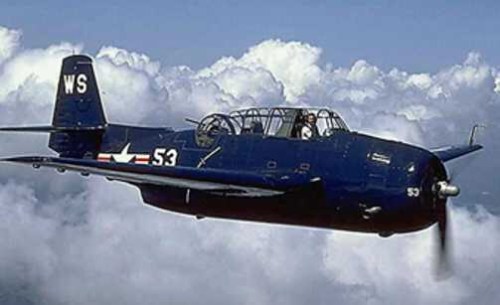
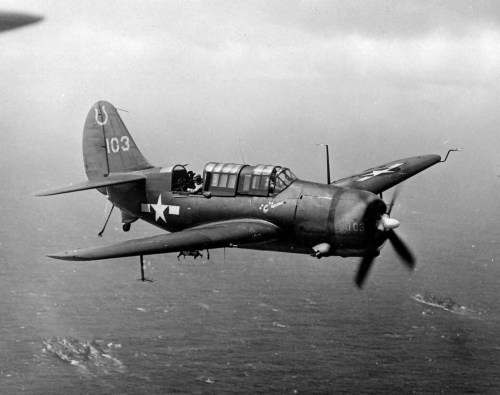
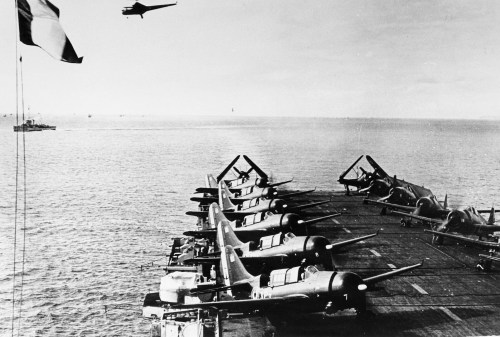
Wings of Gold: U.S. Navy Carrier Aircraft 1941-1945

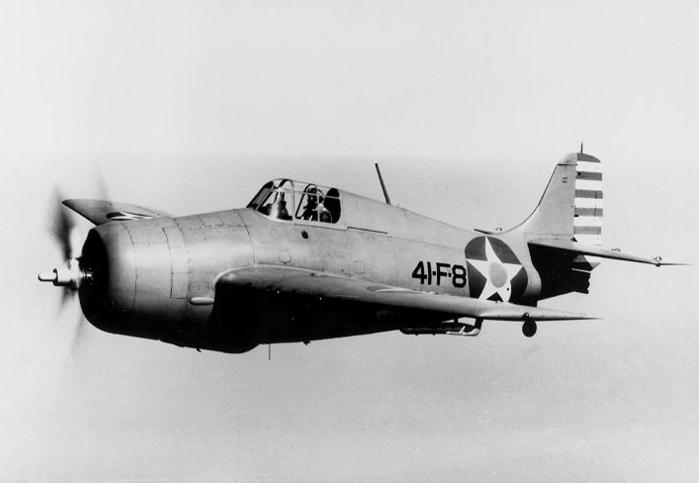
F4F-4 Wildcat of VF-41 in 1942

In 1941 with war raging in Europe and with the Japanese continuing their war in China and occupying French Indo-China the United States rushed to build up its Naval Air Arm and the Arm Air Corps.  New models of aircraft of all types were being rushed into production to replace aircraft already known to be obsolescent.  The Navy brought aircraft already accepted into full production even as it planned more advanced models.  The events in Europe and Asia demonstrated that new fighter designs were needed quickly.

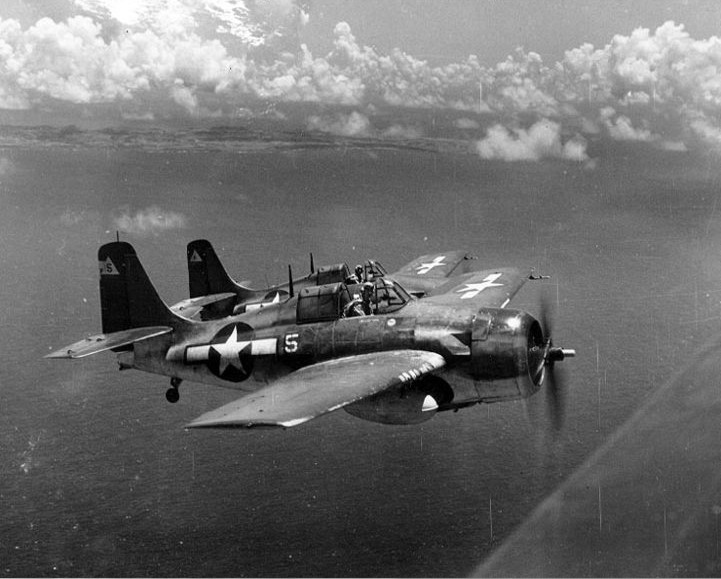
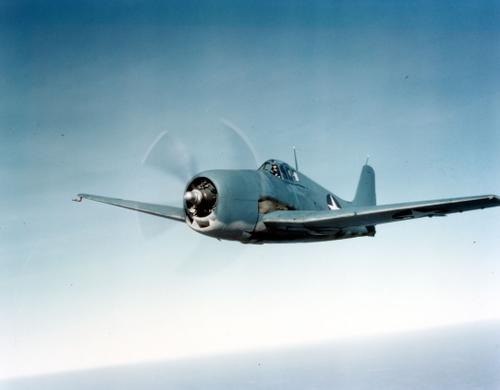
As 1940 dawned the standard fighter aircraft found on U.S. Navy carriers were the F2-A Brewster Buffalo, the Grumman F-3F biplane.  In February 1940 the Navy accepted its first F4F-3 Wildcat which in an earlier for had been rejected in favor of the Brewster Buffalo.  The new Grumman fighter was powered by a 1200 hp Pratt & Whitney R-1830-76 double row radial engine, mounted 4 .50 cal. Machine guns and was heavily armored.  It had a maximum speed of 331 mph range of 845 miles and ceiling of 39500 feet. This would serve it and its pilots well as they aircraft was incredibly tough, often amazing experienced Japanese pilots in their A6M2 Zeros in their ability to suffer heavy damage and remain in the air.  The plucky Wildcat would become the main line of defense in the Pacific against the advancing Japanese Imperial Navy in the months following Pearl Harbor.

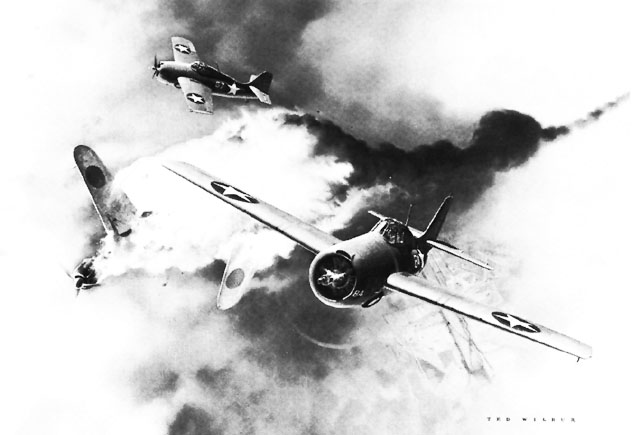
The early F4F-3s were superseded by the F4F-4 model which incorporated folding wings, additional armor and an extra two machine guns.  This decreased its maximum speed to 320 mph, rate of climb and ceiling but nonetheless the aircraft gave a good account of itself in Navy and Marine Corps service.  F4F-3’s and F4F-4s served in the British Royal Navy where it was called the Martlet until the end of the war.  When Grumman closed out F4F production in 1943 to concentrate on its replacement the F6F Hellcat production was continued by General Motors and Eastern Aircraft as the FM1 and FM2 Wildcat. The FM1 was identical to the F4F-4 but armament was reduced to 4 machine guns and bomb racks for two 250 lb bombs or depth charges were added.  The FM2 was based on an updated version of the F4F and had a more powerful engine as well as a higher tail assembly to account for the increased torque of the engine.  These aircraft served aboard the tiny Escort Carriers and performed valiantly, especially in the Battle off Samar during the Battle of Leyte Gulf.  A total of 7860 Wildcats of all varieties were built.  They accounted for 1327 enemy aircraft shot down with the loss of only 191 Wildcats.

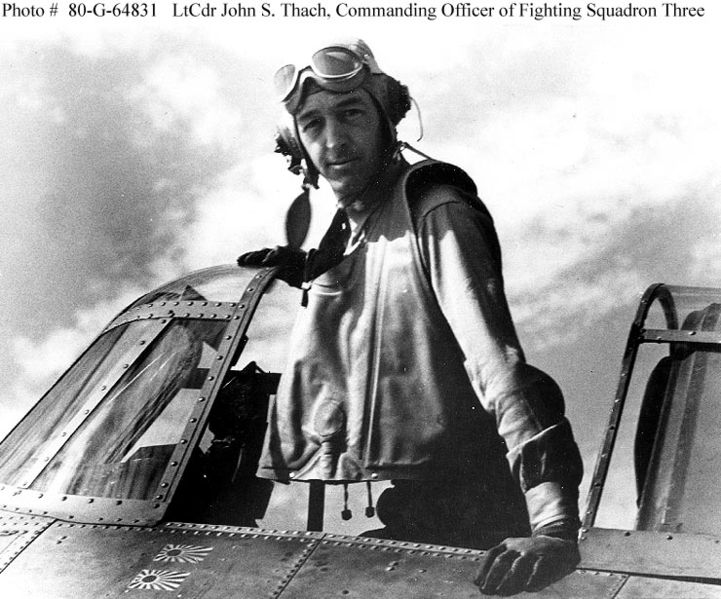
Aces Capt Joe Foss USMC and CAPT David McConnell USN both Medal of Honor Winners and CDR Jimmy Thatch (below)

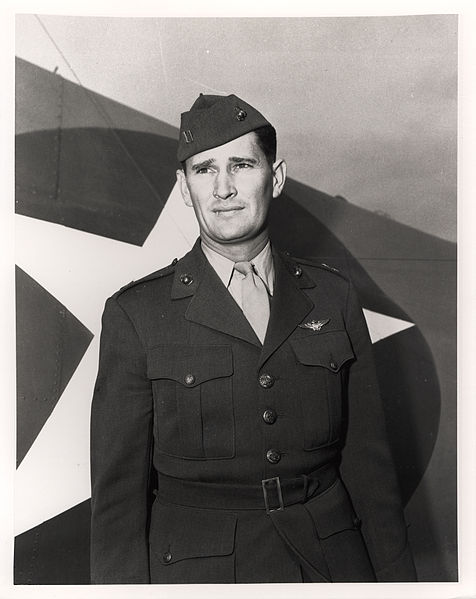
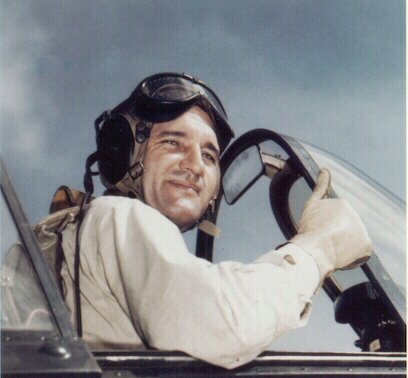
The top aces who flew the Wildcat were all Marines, CAPT Joe Foss (26 victories) MAJ John Lucian Smith (19 victories) and MAJ Marion Carl (16 victories in the F4F and 2 in the F4U Corsair). Foss and Smith both won the Medal of Honor.  Foss would go on to become Governor of South Dakota and the first Commissioner of the American Football League in 1959. Smith retired as a Colonel in 1960 and Carl as a Major General.  Other distinguished F4F aces included LT Butch O’Hare, the first U.S. Navy ace and Medal of Honor winner and LCDR Jimmy Thatch who developed the highly successful “Thatch Weave” which enabled the U.S.pilots whose machines were slower and less maneuverable than the speedy and nimble Zeros to achieve good success against their Japanese foe.  Thatch retired as an Admiral in 1967.  O’Hare rose to become commander of the Enterprise Air Group and was killed in action in November 1943. Chicago’s O’Hare International Airport is named for this brave aviator.

F6F Hellcat

The Grumman F6F Hellcat took over front line fighter duties on the Fleet Carriers from the Wildcat in early 1943 and established itself as the dominant fighter in the Pacific Theater of Operations.  Although it had a resemblance to the F4F the F6F was a totally new design built on combat experience against the Japanese.  The aircraft was built around the powerful Pratt & Whitney R-2800 engine which produced 2000 hp.  The Hellcat mounted six .50 caliber machine guns and had a rate of climb of 3500 feet per minute and a 37300 ft operational ceiling.

Faster than the Zero and other Japanese fighters and piloted by more experienced pilots the Hellcats took a brutal toll of Japanese aircraft.  They accounted for more Japanese aircraft kills than any other with 5163 confirmed kills with a loss of 270 aircraft an overall 19:1 kill ratio. They were piloted by 305 Navy and Marine Corps aces including Meal of Honor winner Captain David McConnell the Navy’s Ace of Aces, and highest surviving United States ace of the war that scored all 34 of his victories in the Hellcat.  The greatest achievement of the Hellcats were when they swept the rebuilt Japanese Naval Air Arm from the skies in the Great Marianas Turkey Shoot. By November 1945 12275 Hellcats had been built with 1263 going to the British Royal Navy. After the war the Hellcat was replaced by the F8F Bearcat as the primary fighter and served in a night fighter and trainer role until the 1950s.  The French Navy used the Hellcat in to provide heroic close air support to beleaguered French Soldiers in Indochina.

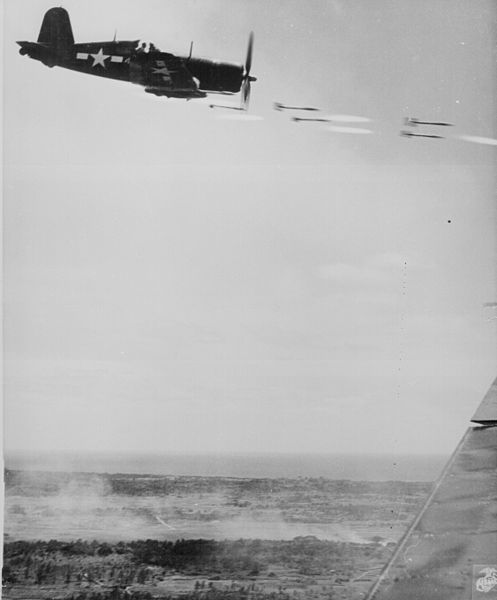
USMC F4U-4 Corsair providing close air support

Flying alongside the F6F was the Vaught F4U Corsair. The Corsair first flew in 1940 and the Navy was slow to adopt it due to difficulties in carrier operations and negative reviews of Navy pilots.  However Marine Corps aviators flying the Corsair had great success and legendary aviators like MAJ Gregory “Pappy” Boyington and VMF-214 the Black Sheep.  The Navy would adopt the aircraft later in the war as the Corsair’s carrier operation deficiencies were remedied, but its real success was a land based aircraft operated by the Marines.  Likewise the first squadrons to operate the aircraft successfully from carriers were the Marine Corps VMF-124 and VMF-213.

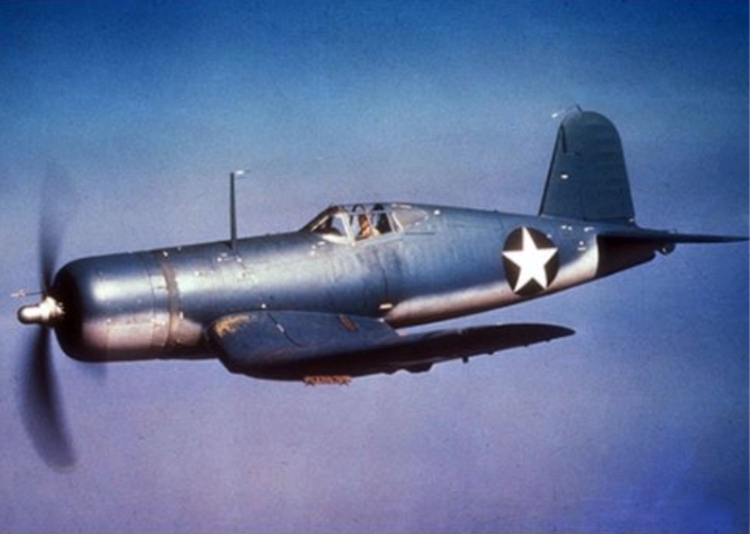
Early F4U-1

The Corsair mounted the same Pratt & Whitney R-2800 engine as the F6F but had a highly streamlined gull wing design as well as a turbo-charger which allowed it a top speed of 425 mph.  Later models such as the F4U-4 had a top speed of 445 mph. The F4F was armed with six .50 cal machine guns as well as rockets and a bomb load of 2000 pounds and the F4U-4 could carry 4000 pounds of ordnance.

Less than 10000 of the over 64000 combat sorties flown by F4Us were flown from carriers, the vast bulk of the sorties coming from land based Marine Corps squadrons.  The Corsair was often used as a fighter bomber where its capabilities to drop sizable amounts of ordinance including rockets, bombs and the nearly developed Napalm in a close air support role cemented the importance of Marine Air for future generations.  They were beloved by the Marine Corps and U.S. Army infantrymen in their brutal battles with the Japanese on many hellish island battlefields.  Corsairs accounted for 2140 confirmed kills during the war against a combat loss of 189 aircraft. The aircraft remained in production until 1952 with 12571 aircraft of all variants being built.  Many Japanese pilots considered the Corsair to be the best fighter of the war.

During the war many Corsairs served in the British Royal Navy and Royal New Zealand Air Force with good success, and after the war the French Navy had success with them in a close air support role in Indochina and Algeria.  Following the war the Corsair remained in service for many years in the U.S. Navy and Marine Corps as well as the French Navy and other smaller navies and air forces until the 1960s.

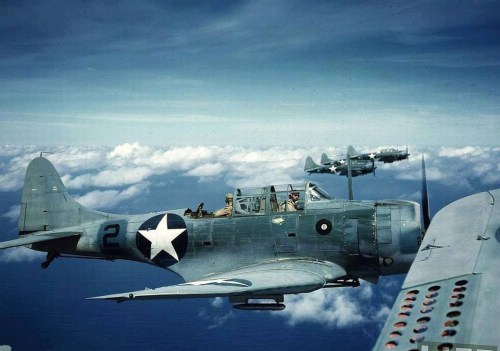
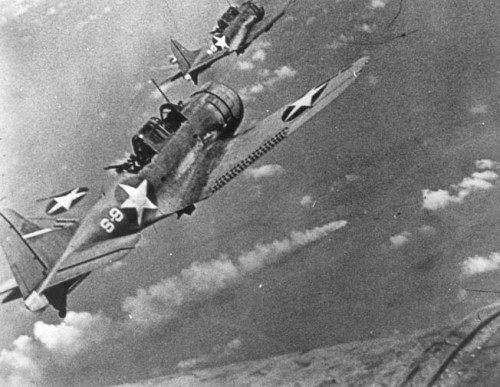
The Douglas SBD Dive Bomber was arguably the most effective Naval dive bomber of World War II, and possibly the best single engine dive bomber of all time. Other aircraft may have been faster or carried a larger bomb load, but the SBD, which served at a time when the U.S. Navy did not have air superiority and battled seasoned Japanese pilots and aircrews, achieved remarkable results,

The SBD was developed from the Northrop BT-2, after Douglas took over Northrop. The first model of the Dauntless, the SBD-1 began operations with the U.S. Marine Corps In 1940, the SBD-2 with the U.S. Navy in 1941. The SBD-3 which included more armor for the crew, and self sealing fuel tanks began entering service in late 1941.

The SBD combined a heavy bomb load, excellent bombing optics, great defensive armament, rugged construction, excellent handling characteristics and maneuverability, and superb dive bombing capabilities. It became the workhorse of the U.S. Navy between 1941 and 1944, flying about 25% of all missions flown from Navy carriers during that time. SBDs sank or damaged six Japanese Aircraft carriers, one Japanese and one French battleship, 14 cruisers, 6 destroyers, and many other ships including transports and submarines. It was the Dauntless which turn the tide of the Pacific war when at Midway they sank the Japanese aircraft carriers Akagi, Kaga, Soryu, and Hiryu and the heavy cruiser Mikuma. The SBD also accounted for more enemy aircraft in aerial combat than were lost to enemy aircraft, an amazing accomplishment by any bomber of any type.

In late 1944 after the Battle Of the Philippine Sea the Dauntless was phased out of U.S. Navy squadrons by the SB2C Helldiver. Though the Helldiver was bigger, faster, and carried a higher bomb load, many pilots preferred the Dauntless due to its superior handling characteristics, especially at low speeds, essential to landing on a carrier. It is hard to believe that the United States would have prevailed in 1942 without the Dauntless.

It was used in combat by other allies, a variant, the A-24 Banshee was built for the U.S. Army Air Force. The French operates it from the carrier Arromanches in Indochina until 1949.

SBD Dauntless Dive Bomber above and at Midway below

TBF Avenger above and below

The TBF Avenger torpedo bomber was developed as a replacement for the TBD Devastator by in 1940 by Leroy Grumman of Grumman aircraft. Production began in 1941 and the first combat by the aircraft was at the Battle of Midway. During that battle, 6 aircraft from VT-6, based at Midway while the rest of the squadron flying TBD Devastators from the USS Hornet attacked the Japanese carrier strike force. All of the TBD were shot down, as well as 5 of the 6 TBFs.

Despite the inauspicious start the TBFs became one of the deadliest aircraft of the Second World War. They helped sink the largest Battleships ever constructed, the Japanese Musashi and Yamato, as well as many other warships and auxiliaries. They conducted bombing missions of land targets, and operated from Escort Carriers in Anti-Submarine Warfare operations and supporting invasions and shore operations. The Avenger was particularly effective in the ASW role and was credited with sinking about 30 German U-Boats and Japanese submarines during the war.

The TBF was the largest single engine aircraft of the war, only the P-47 Thunderbolt was anywhere close to its size. Despite this the TBF was able to operate from the smallest aircraft carriers. Powered by a 1900 HP Wright R-2600-20 Twin Cyclone 14 Cylinder radial engine it could cruise at over 30,000 feet at a top speed of 275 MPH while carrying 2,000 pounds of bombs or a Mark 13 Aerial Torpedo. They also carried racks for 5″ High Velocity Aircraft Rockets and depth charges.

After the war it served in a variety of roles in the U.S. Navy, Royal Navy, Canadian Navy, French Navy, and other militaries until the 1960s. In peacetime it was used for many years as a fire fighting aircraft in the United States and Canada.

LTjg. George H. W. Bush in the cockpit of his Avenger

The most famous man to pilot a TBF/TBM was LTjg George H. W. Bush, later the President of the United States whose aircraft was shot down over Chuchi Jima In 1944.

SB2C Helldiver above and in French Service below

The replacement for the Dauntless was the SB2C Curtiss Helldiver. The Helldiver was bigger and faster than the Dauntless but for its size it was underpowered, and had a shorter range that the beloved Dauntless. The Helldiver had very poor performance in flight, had unreliable electrical and hydraulic systems and frequently was poorly manufactured. The defects made it less than popular among the aircrews which had previously flown the Dauntless who came to call it the Beast. The problems would lead to a Congressional investigation headed by Senator Harry Truman. During the hearings Assistant Secretary of the Navy for Air, Artemis Gates said: “When we needed the SB2C Helldiver neither we nor it was ready.”

The British Royal Navy and Australian Air Force evaluated the Helldiver and rejected it for service, cancelling their orders for it.

Despite the many flaws of the aircraft the superbly trained pilots and air crews made the most of it, sinking hundreds of Japanese ships and watercraft. From late 1944 until the end of the war it established a good combat record, though it never had to fight against the well trained Japanese pilots that the Dauntless aircrews had to face.

However, the Navy, and most air forces were moving away from the dive bomber as an attack aircraft. The U. S. Navy found that its F6F Hellcats, and F4U Corsairs could carry as heavy as payload in rockets and bombs as the Helldiver though the ordnance decreased their range. But even so the fighters were far better able to defend themselves against enemy fighter aircraft.

The aircraft served in the U. S. Navy and Naval Reserve until 1950. It also served in Greece where it was used in counter-insurgency (COIN) missions during the Greek Civil War, and by the French Navy during the Indochina campaign, including providing closer air support to French troops at Dien Bien Phu. The Italian Air Force was the last to operate the Helldiver, retiring it in 1959.

With the advent of rockets the dive bomber was replaced by single seat fighters and attack aircraft. The Helldiver was the last purpose built dive bomber. In the U.S. the Hellcat, Corsair, the postwar F8F Bearcat, the P-51 Mustang, and the P-47 Thunderbolt took over ground attack missions. The A4D Skyraider was designed as a ground attack aircraft, and eventually jet powered fighter-bombers would enter service.

These amazing aircraft and the men that flew them established a tradition of excellence that the Naval Aviators of the U.S. Navy and Marine Corps continue today.

Peace

Padre Steve

Leave a comment

Filed under aircraft, History, Loose thoughts and musings, Military, US Navy, World War II at Sea, world war two in the pacific

Hope In Hell: Dr. Kurt Reuber and the Madonna Of Stalingrad

Bundeswehr zeigt "Stalingrad"-Ausstellung

Friends of Padre Steve’s World,

It is almost Christmas and I am reflecting about the true meaning of Christmas in a world where hope seems to be dying before our eyes. In such an environment I reflect on men who lived in a human made hell, a hell made by hate filled ideologues who launched the world into its bloodiest war, and I wonder, could it happen again? A decade ago I would have said it never could again happen, but now I am not so sure. So, in the age of Donald Trump, I must try to find hope wherever I can find it.

I think most of my readers know that I am a career military officer and have served in peace and war as a chaplain. That service includes a tour in Iraq, a war, which by almost any standard would have been considered unjust and illegal, yet I served there, and came back a changed man. As such the stories of those who served in war, especially those who serve in hopeless battles, and even in evil causes during Christmas have a special place in my heart. One of those men was a German pastor and medical doctor named Kurt Reuber.

k_reuberl

As I said, Reuber was a theologian, pastor and medical doctor, likewise he was an accomplished artist and used that medium to convey his own faith, and doubts. He was a friend of Albert Schweitzer in 1939 he was conscripted to serve as a physician in the Germany Army. By November 1942 he was a seasoned military physician serving with the 16th Panzer Division, part of the German 6th Army, which had been fighting in the hell of Stalingrad. When his division along with most of 6th Army was surrounded by the Soviets, cut off from most supply and without real hope of relief, he like other physicians continued to serve the soldiers committed to his care.

pg-34-stalingrad-2-getty

However, unlike most physicians, the care Reuber offered care included spiritual matters, as he sought to help his soldiers deal with the hopelessness of their situation. As Reuber reflected on the desperation of the German soldiers in the Stalingrad pocket. He wrote to his family.

“I wondered for a long while what I should paint, and in the end I decided on a Madonna, or mother and child. I have turned my hole in the frozen mud into a studio. The space is too small for me to be able to see the picture properly, so I climb on to a stool and look down at it from above, to get the perspective right. Everything is repeatedly knocked over, and my pencils vanish into the mud. There is nothing to lean my big picture of the Madonna against, except a sloping, home-made table past which I can just manage to squeeze. There are no proper materials and I have used a Russian map for paper. But I wish I could tell you how absorbed I have been painting my Madonna, and how much it means to me.”

“The picture looks like this: the mother’s head and the child’s lean toward each other, and a large cloak enfolds them both. It is intended to symbolize ‘security’ and ‘mother love.’ I remembered the words of St. John: light, life, and love. What more can I add? I wanted to suggest these three things in the homely and common vision of a mother with her child and the security that they represent.”

The picture was drawn on the back of a captured Soviet map and when he finished it he displayed it in his bunker, which became something of a shrine. Reuber wrote:

“When according to ancient custom I opened the Christmas door, the slatted door of our bunker, and the comrades went in, they stood as if entranced, devout and too moved to speak in front of the picture on the clay wall…The entire celebration took place under the influence of the picture, and they thoughtfully read the words: light, life, love…Whether commander or simple soldier, the Madonna was always an object of outward and inward contemplation.”

drkrop

As the siege continued men came to the bunker for both medical care and spiritual solace.  On Christmas Eve Reuber found himself treating a number of men wounded by bombs outside the bunker. Another soldier lay dying, just minutes before the soldier had been in the bunker singing the Christmas hymn O Du Froehliche.  Reuber wrote:

“I spent Christmas evening with the other doctors and the sick. The Commanding Officer had presented the letter with his last bottle of Champagne. We raised our mugs and drank to those we love, but before we had had a chance to taste the wine we had to throw ourselves flat on the ground as a stick of bombs fell outside. I seized my doctor’s bag and ran to the scene of the explosions, where there were dead and wounded. My shelter with its lovely Christmas decorations became a dressing station. One of the dying men had been hit in the head and there was nothing more I could do for him. He had been with us at our celebration, and had only that moment left to go on duty, but before he went he had said: ‘I’ll finish the carol with first. O du Frohliche!” A few moments later he was dead. There was plenty of hard and sad work to do in our Christmas shelter. It is late now, but it is Christmas night still. And so much sadness everywhere.”

On January 9th 1943 with all hope of escape or reinforcement gone Reuber gave the picture to the battalion commander as the officer was too ill to carry on and was one of the last soldiers to be evacuated from the pocket. Reuber’s commander carried the Madonna out of the pocket and returned it delivered it to Reuber’s family, preserving it for all.

Reuber was taken prisoner and survived the harrowing winter march to the Yelabuga prison camp. In late 1943 Reuber wrote his Christmas Letter to a German Wife and Mother – Advent 1943. It was a spiritual reflection but also a reflection on the hope for life after the war, when the Nazi regime would be defeated, and Germany given a new birth.

Reuber wrote:

“The concatenation of guilt and fate has opened our eyes wide to the guilt. You know, perhaps we will be grateful at the end of our present difficult path yet once again that we will be granted true salvation and liberation of the individual and the nation by apparent disappointment of our “anticipation of Advent”, by all of the suffering of last year’s as well as this year’s Christmas. According to ancient tradition, the Advent season is simultaneously the season of self-reflection. So at the very end, facing ruin, in death’s grip – what a revaluation of values has taken place in us! We thus want to use this period of waiting as inner preparation for a meaningful new existence and enterprise in our family, in our vocation, in the nation. The Christmas light of joy is already shining in the midst of our Advent path of death as a celebration of the birth of a new age in which – as hard as it may also be – we want to prove ourselves worthy of the newly given life.”  (Erich Wiegand in Kurt Reuber, Pastor, Physician, Painter, Evangelischer Medienverb. Kassel 2004. )

prisoner's madonna

Reuber did not live to see that day. He died of Typhus on January 20th 1944, not long after writing this and just a few weeks after painting another portrait of the Madonna, this one entitled The Prisoner’s Madonna. He was not alone, of the approximately 95,000 German POWs taken at Stalingrad only about 6,000 returned home.

His paintings survived the war and his family gave The Madonna of Stalingrad to the Kaiser Wilhelm Memorial Church in Berlin after it was restored as a symbol of hope and reconciliation. Copies are also displayed in Coventry Cathedral and the Russian Orthodox Cathedral in Volgograd, the former Stalingrad. A copy of The Prisoner’s Madonna is now displayed at the Church of the Resurrection in Kassel.

I have a print of the Madonna of Stalingrad in my office. It has become one of the most meaningful pictures I have since I returned from Iraq in 2008. To me they are symbols of God’s presence when God seems entirely absent.

Praying for an end to war.

Peace

Padre Steve+

3 Comments

Filed under christian life, faith, History, Military, nazi germany, Political Commentary, world war two in europe

American Dreadnoughts: The Remarkable Battleships of Pearl Harbor

Friends of Padre Steve’s World,

We are coming up on the 77th anniversary of the Japanese attack on Pearl Harbor. It is hard to believe that the attack occurred so long ago. The survivors are aging, and even the youngest are close to ninety years old, the oldest survivor of the USS Arizona, Joe Langdell died in February of 2015. At the time of the attack he was a nearly commissioned Ensign. He and many like him served as the officers and men aboard the eight great battleships moored at Pearl Harbor on that terrible Sunday morning.

The next day President Franklin Roosevelt spoke these immortal words, “Yesterday, Dec. 7, 1941 – a date which will live in infamy – the United States of America was suddenly and deliberately attacked by naval and air forces of the Empire of Japan….

One of the young men who responded to the call to arms after the attack was a future President, 18 year old George H. W. Bush. He was advised to go to college instead of enlisting but he would hear nothing of it. He enlisted as soon as he graduated from high school on his 18th Birthday. He went to flight school and was commissioned just days before his 19th birthday, becoming the youngest Naval aviator. I guess that it is fitting that Bush, who passed away Saturday will be buried on December 6th, the day before the anniversary of the attack.

I remember reading Walter Lord’s classic and very readable book about Pearl Harbor “Day of Infamy” when I was a 7th grade student at Stockton Junior High School back in 1972.  At the time my dad was on his first deployment to Vietnam on the USS Hancock CVA-19.  As a Navy brat I was totally enthralled with all things Navy and there was little that could pull me out of the library.  In fact in my sophomore year of high school I cut over one half of the class meetings of the 4th quarter my geometry class to sit in the library and read history, especially naval and military history.

Over the years I have always found the pre-World War Two battleships to be among the most interesting ships in US Navy history.  No they are not the sleek behemoths like the USS Wisconsin which graces the Norfolk waterfront. They were not long and sleek, but rather squat yet exuded power. They were the backbone of the Navy from the First World War until Pearl Harbor. They were the US Navy answer to the great Dreadnaught race engaged in by the major navies of the world in the years prior to, during and after World War One.

Built over a period of 10 years each class incorporated the rapid advances in technology between the launching of the Dreadnaught and the end of the Great War.  While the United States Navy did not engage in battleship to battleship combat the ships built by the US Navy were equal to or superior to many of the British and German ships of the era.

Through the 1920s and 1930s they were the ambassadors of the nation, training and showing the flag. During those years the older ships underwent significant overhaul and modernization.

The Battle Force of the Pacific Fleet in 1941 included 9 battleships of which 8 were at Pearl Harbor on the morning of December 7th.  In the event of war the US War Plan, “Orange” called for the Pacific Fleet led by the Battle Force to cross the Pacific, fight a climactic Mahanian battle against the battleships of the Imperial Japanese Navy and after vanquishing the Japanese foe to relieve American Forces in the Philippines.  However this was not to be as by the end of December 7th all eight were out of action, with two, the Arizona and Oklahoma permanently lost to the Navy.

The ships at Pearl Harbor comprised four of the seven classes of battleships in the US inventory at the outbreak of hostilities.  Each class was an improvement on the preceding class in speed, protection and firepower.  The last class of ships, the Maryland class comprised of the Maryland, Colorado and West Virginia, was the pinnacle of US Battleship design until the North Carolina class was commissioned in 1941.  Since the Washington Naval Treaty limited navies to specific tonnage limits as well as the displacement of new classes of ships the United States like Britain and Japan was limited to the ships in the current inventory at the time of the treaty’s ratification.

USS Oklahoma (above) and USS Nevada

Those present at Pearl Harbor included the two ships of the Nevada class, the Nevada and Oklahoma they were the oldest battleships at Pearl Harbor and the first of what were referred to as the “standard design” battleships. The two ships of the Pennsylvania class, the Pennsylvania and her sister the Arizona served as the flagships of the Pacific Fleet and First Battleship Division respectively and were improved Nevada’s. The California class ships, California and Tennessee and two of the three Maryland’s the Maryland and West Virginia made up the rest of the Battle Force.

The Colorado was undergoing a yard period at Bremerton and the three ships of the New Mexico class, New Mexico, Mississippi and Idaho had been transferred to the Atlantic before Pearl Harbor due to the German threat.  The three oldest battleships in the fleet, those of the New York and Wyoming Classes, the New York, Arkansas and Texas also were in the Atlantic. Two former battleships, the Utah and Wyoming had been stripped of their main armaments and armor belts and served as gunnery training ships for the fleet. The Utah was at Pearl Harbor moored on the far side of Ford Island. The newest battleships in the Navy, the modern USS North Carolina and USS Washington were also serving in the Atlantic as a deterrent to the German battleships and battlecruisers which occasionally sortied into the Atlantic to attack convoys bound for Britain.

The great ships that lay at anchor at 0755 that peaceful Sunday morning on Battleship Row and in the dry dock represented the naval power of a bygone era, something that most did not realize until two hours later. The age of the battleship was passing away, but even the Japanese did not realize that the era had passed building the massive super-battleships Yamato and Musashi mounting nine 18” guns and displacing 72,000 tons, near twice that of the largest battleships in the U.S. inventory.

The Oklahoma and Nevada were the oldest ships in the Battle Force.  Launched in 1914 and commissioned in 1916 the Nevada and Oklahoma mounted ten 14” guns and displaced 27,500 tons and were capable of 20.5 knots. They served in World War One alongside the British Home Fleet and were modernized in the late 1920s. They were part of the US presence in both the Atlantic and Pacific in the inter-war years. Oklahoma took part in the evacuation of American citizens from Spain in 1936 during the Spanish Civil War.

During the Pearl Harbor attack Oklahoma was struck by 5 aerial torpedoes capsized and sank at her mooring with the loss of 415 officers and crew. Recent analysis indicates that she may have been hit by at least on torpedo from a Japanese midget submarine. Her hulk would be raised but she would never again see service and sank on the way to the breakers in 1946.

Nevada was the only battleship to get underway during the attack.  Moored alone at the north end of Battleship Row her Officer of the Deck had lit off a second boiler an hour before the attack.  She was hit by an aerial torpedo in the first minutes of the attack but was not seriously damaged. She got underway between the attack waves and as she attempted to escape the harbor she was heavily damaged. To prevent her from sinking in the main channel she was beached off Hospital Point.

Nevada was raised and received a significant modernization before returning to service for the May 1943 assault on Attu.  Nevada returned to the Atlantic where she took part in the Normandy landings off Utah Beach and the invasion of southern France.  She returned to the Pacific and took part in the operations against Iwo Jima and Okinawa where she again provided naval gunfire support.

Following the war the great ship was assigned as a target at the Bikini atoll atomic bomb tests. The tough ship survived these tests and was sunk as a target on 31July 1948.

Two views of USS Arizona

Pennsylvania

USS Pennsylvania sailing under the Golden Gate Bridge

The two ships of the Pennsylvania Class were improved Oklahoma’s.  The Arizona and Pennsylvania mounted twelve 14” guns and displacing 31,400 tons and capable of 21 knots they were both commissioned in 1916. They participated in operations in the Atlantic in the First World War with the British Home Fleet. Both ships were rebuilt and modernized between 1929 and 1931. Though damaged in the attack, Pennsylvania was back in action by early 1942. She underwent minor refits and took part in many amphibious landings in the Pacific and was present at the Battle of Surigao Strait.  She was heavily damaged by an aerial torpedo at Okinawa Pennsylvania and was repaired. Following the war the elderly warrior was used as a target for the atomic bomb tests. She was sunk as a gunnery target in 1948.

Arizona was destroyed during the attack. As the flagship of Battleship Division One, she was moored next to the repair ship USS Vestal.  She was hit by 8 armor piercing bombs one of which penetrated her forward black powder magazine. The ship was consumed by a cataclysmic explosion which killed 1103 of her 1400 member crew including her Captain and Rear Admiral Isaac Kidd, commander of Battleship Division One.  She was never officially decommissioned and the colors are raised and lowered every day over the Memorial which sits astride her broken hull.

USS Tennessee & USS California

California sailing under the Brooklyn Bridge

The Tennessee class ships the Tennessee and California were the class following the New Mexico class ships which were not present at Pearl Harbor. These ships were laid down in 1917 and commissioned in 1920. Their design incorporated lessons learned at the Battle Jutland. They mounted twelve 14” guns, displaced 32,300 tons and were capable of 21 knots. At Pearl Harbor Tennessee was moored inboard of West Virginia and protected from the aerial torpedoes which did so much damage to other battleships. She was damaged by two bombs.

California was the Flagship of Battleship Division Two. She was moored at the southern end of Battleship Row. She was hit by two torpedoes in the initial attack, but she had the bad luck to have all of her major watertight hatches unhinged in preparation for an inspection. Despite the valiant efforts of her damage control teams she sank at her moorings. She was raised and rebuilt along with Tennessee were completely modernized with the latest in radar, fire control equipment and anti-aircraft armaments. They were widened with the addition of massive anti-torpedo bulges and their superstructure was razed and rebuilt along the lines of the South Dakota class. When the repairs and modernization work was completed the ships looked nothing like they did on December 7th. Both ships were active in the Pacific campaign and be engaged at Surigao Strait where they inflicted heavy damage on the attacking Japanese squadron. Both survived the war and were placed in reserve until 1959 when they were stricken from the Navy list and sold for scrap.

USS Maryland & USS West Virgina

The Maryland and West Virginia were near sisters of the Tennessee class.  They were the last battleships built by the United States before the Washington Naval Treaty. and the first to mount 16” guns. With eight 16” guns they had the largest main battery of any US battleships until the North Carolina class. They displaced 32,600 tons and could steam at 21 knots. Laid down in 1917 and commissioned in 1921 they were modernized in the late 1920s. They were the most modern of the Super-Dreadnoughts built by the United States and included advances in protection and watertight integrity learned from both the British and German experience at Jutland.

At Pearl Harbor Maryland was moored inboard of Oklahoma and was hit by 2 bombs and her crew helped rescue survivors of that unfortunate ship.  She was quickly repaired and returned to action.  She received minimal modernization during the war. She participated in operations throughout the entirety of the Pacific Campaign mainly conducting Naval Gunfire Support to numerous amphibious operations. She was present at Surigao Strait where despite not having the most modern fire control radars she unleashed six salvos at the Japanese Southern Force.

Tennessee & West Virginia after the attack (above) Arizona (below)

Pennsylvania in Drydock Number One, Nevada beached at Hospital Point

Oklahoma Capsized and after being righted

West Virginia suffered some of the worst damage in the attack. She was hit by at least 5 torpedoes and two bombs. One of the torpedoes may have come from one of the Japanese midget submarines that penetrated the harbor. She took a serious list and was threatening to capsize. However she was saved from Oklahoma’s fate by the quick action of her damage control officer who quickly ordered counter-flooding so she would sink on an even keel.  She was raised from the mud of Pearl Harbor and after temporary repairs and sailed to the West Coast for an extensive modernization on the order of the Tennessee and California.

West Virginia was the last Pearl Harbor to re-enter service. However when she returned she made up for lost time.  She led the battle line at Surigao Strait and fired 16 full salvos at the Japanese squadron. Her highly accurate gunfire was instrumental in sinking the Japanese Battleship Yamashiro in the last battleship versus battleship action in history.  West Virginia, Maryland and their sister Colorado survived the war and were placed in reserve until they were stricken from the Naval List and sold for scrap in 1959.

The battleships of Pearl Harbor are gone, save for the wreck of the Arizona and various relics such as masts, and ships bells located at various state capitals and Naval Stations.  Unfortunately no one had the forethought to preserve one of the surviving ships to serve as a living memorial at Pearl Harbor with the Arizona. As I noted at the beginning of this article, the brave Sailors and Marines who manned these fine ships are also passing away.

Thus as we approach the anniversary of the Pearl Harbor attack it is fitting to remember these men and the great ships that they manned.

Peace,

Padre Steve

1 Comment

Filed under History, Loose thoughts and musings, Military, Navy Ships, US Navy, world war two in the pacific