Category Archives: History

“If Not Us, then Who? If Not Now, When?” Dr. Martin Luther King Day Weekend 2020

index

Friends of Padre Steve’s World,

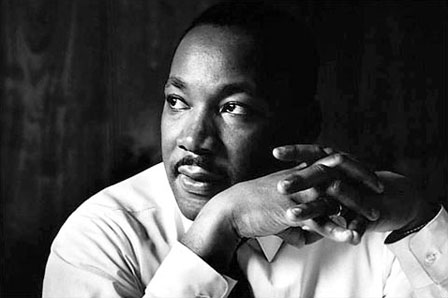
Dr. Martin Luther King Jr. has always been one of my heroes. This time of year I always ponder the importance of his life and work for civil rights, and I wonder what might have been had this man of peace not been cut down in cold blood at the young age of 39 by James Earl Ray on April 4th 1968. He was an amazing and courageous man whose memory should not be let to one day a year. We have to ensure, though our words and actions that it is not allowed to die.

This week was very busy for me at work. Lots of visits to workshops at the shipyard, counseling sessions, and the unexpected death of one of our shipyard worker, which brought a lot more personal interactions as well as group meetings to let his co-workers know of his death in person, followed by a small group session with the team that worked closest with him. In between was our service commemorating the life of Dr. King, in which I performed the invocation and benediction. It was one of the most memorable of these events I have been at in a long time. I was honored to be able to participate, especially, as our speaker Dr. Josephine Hardy Harris, noted, so many of the civil rights and liberties gained through the efforts of Dr. King and so many others are under attack today, and Monday should not be a “day off”, but a day “on” to care for others and to speak the truth.

Dr. King was a man of courage, a man of honor, a man of conviction. But he came of age in a time when many people were willing to maintain the status quo and play things safe, like many clergy of his time, including many African-American clergy.

Many pastors of the era, remained quiet about the conditions of segregation, and the racism of the day. Their lack of action did not mean they were bad people, they just understood that if they spoke up, their lives, and the lives of their families and congregations could be in danger. As such many pastors just hoped to see things slowly improve, without rocking the boat, and without endangering themselves or their families. They had seen what happened to blacks who spoke up or confronted the evil, lynching’s, cross burnings, threats and murder. They and their families had been dealing with it since the beginning of Reconstruction, and the establishment of Black Codes, and Jim Crow Laws. Finally, many had contented themselves with just trying to get along. At the beginning of the movement, many pastors did not support or gave only lukewarm support to Dr. King, and his companions, Andrew Young, Fred Shuttlesworth, and Ralph Abernathy going into that critical year of 1963.
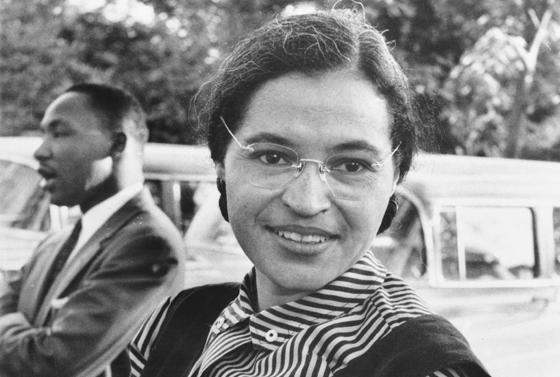
lossless-page1-560px-Rosa_Parks_(detail).tiff

Rosa Parks 

King did not start out to become a Civil Rights leader. However, he was inspired to actively join the movement through the example of Rosa Parks, who defiance of the law for blacks to sit “in the back of the bus” in 1955. He led the Montgomery Bus Boycott which lasted for 385 days. The reaction among segregationists to King and his protest was against violent. King’s house was bombed, and his life threatened. There were 39 attempts on his life before he was finally killed, but he refused to stand down.

King’s leadership of the boycott brought the young pastor to national prominence. However, by 1963 much of the Civil Rights movement and the African American community was despairing of the lack of progress. Many people had become disenchanted with King, not considering him bold enough despite his rhetorical abilities.

But in April 1963, working with other Civil Rights leaders in Birmingham Alabama King relit the fires of the movement. Montgomery Police Chief “Bull” Conner used his police force to violently attack the demonstrators. Conner ordered his men to unleash their police dogs on the protestors, and used high pressure water cannon against them, including women, children and the elderly. The violent reaction to the protests shocked much of America and the world.

King was arrested by Conner’s officers, and while he was in the Birmingham jail he composed one of his most famous works, the Letter from the Birmingham Jail.  The letter was a social, political and theological masterpiece. It was some of his harshest criticism was of white liberals, as well as black moderates:

“I have almost reached the regrettable conclusion that the Negro’s great stumbling block in his stride toward freedom is not the White Citizen’s Councilor or the Ku Klux Klanner, but the white moderate, who is more devoted to “order” than to justice; who prefers a negative peace which is the absence of tension to a positive peace which is the presence of justice; who constantly says: “I agree with you in the goal you seek, but I cannot agree with your methods of direct action”; who paternalistically believes he can set the timetable for another man’s freedom; who lives by a mythical concept of time and who constantly advises the Negro to wait for a “more convenient season”

Dr. King continued his activism until his assassination. In August 1963 he led the March on Washington for Jobs and Freedom, where before a crowd of an estimated 200,000-300,000 he gave his I Have a Dream Speech.

http://www.americanrhetoric.com/speeches/mlkihaveadream.htm

The crescendo of the speech was remarkable and is perhaps one of the most remembered speeches in American history.

Let us not wallow in the valley of despair, I say to you today, my friends.

And so even though we face the difficulties of today and tomorrow, I still have a dream. It is a dream deeply rooted in the American dream.

I have a dream that one day this nation will rise up and live out the true meaning of its creed: “We hold these truths to be self-evident, that all men are created equal.”

I have a dream that one day on the red hills of Georgia, the sons of former slaves and the sons of former slave owners will be able to sit down together at the table of brotherhood.

I have a dream that one day even the state of Mississippi, a state sweltering with the heat of injustice, sweltering with the heat of oppression, will be transformed into an oasis of freedom and justice.

I have a dream that my four little children will one day live in a nation where they will not be judged by the color of their skin but by the content of their character.

I have a dream today!

I have a dream that one day, down in Alabama, with its vicious racists, with its governor having his lips dripping with the words of “interposition” and “nullification” — one day right there in Alabama little black boys and black girls will be able to join hands with little white boys and white girls as sisters and brothers.

I have a dream today!

I have a dream that one day every valley shall be exalted, and every hill and mountain shall be made low, the rough places will be made plain, and the crooked places will be made straight; “and the glory of the Lord shall be revealed and all flesh shall see it together.”2

This is our hope, and this is the faith that I go back to the South with.

With this faith, we will be able to hew out of the mountain of despair a stone of hope. With this faith, we will be able to transform the jangling discords of our nation into a beautiful symphony of brotherhood. With this faith, we will be able to work together, to pray together, to struggle together, to go to jail together, to stand up for freedom together, knowing that we will be free one day.

And this will be the day — this will be the day when all of God’s children will be able to sing with new meaning:

My country ’tis of thee, sweet land of liberty, of thee I sing.

Land where my fathers died, land of the Pilgrim’s pride,

From every mountainside, let freedom ring!

And if America is to be a great nation, this must become true.

And so let freedom ring from the prodigious hilltops of New Hampshire.

Let freedom ring from the mighty mountains of New York.

Let freedom ring from the heightening Alleghenies of Pennsylvania.

Let freedom ring from the snow-capped Rockies of Colorado.

Let freedom ring from the curvaceous slopes of California.

But not only that:

Let freedom ring from Stone Mountain of Georgia.

Let freedom ring from Lookout Mountain of Tennessee.

Let freedom ring from every hill and molehill of Mississippi.

From every mountainside, let freedom ring.

And when this happens, and when we allow freedom ring, when we let it ring from every village and every hamlet, from every state and every city, we will be able to speed up that day when all of God’s children, black men and white men, Jews and Gentiles, Protestants and Catholics, will be able to join hands and sing in the words of the old Negro spiritual:

                Free at last! Free at last!

                Thank God Almighty, we are free at last!

King knew the dangers and the risks of appealing to a strategy of non-violence based on love of his enemies. King spoke to the world when he accepted the Nobel Peace Prize in 1964:

“Here and there an individual or group dares to love, and rises to the majestic heights of moral maturity. So in a real sense this is a great time to be alive. Therefore, I am not yet discouraged about the future. Granted that the easygoing optimism of yesterday is impossible. Granted that those who pioneer in the struggle for peace and freedom will still face uncomfortable jail terms, painful threats of death; they will still be battered by the storms of persecution, leading them to the nagging feeling that they can no longer bear such a heavy burden, and the temptation of wanting to retreat to a more quiet and serene life. Granted that we face a world crisis which leaves us standing so often amid the surging murmur of life’s restless sea. But every crisis has both its dangers and its opportunities. It can spell either salvation or doom. In a dark confused world the kingdom of God may yet reign in the hearts of men.”  http://www.nobelprize.org/nobel_prizes/peace/laureates/1964/king-lecture.html 

Dr. King understood how easily hatred could consume people and movements and urged people not to follow the course of hate. It is a message especially timely in our day. Dr King wrote:

“Returning hate for hate multiplies hate, adding deeper darkness to a night already devoid of stars. Darkness cannot drive out darkness; only light can do that. Hate cannot drive out hate; only love can do that. Hate multiplies hate, violence multiplies violence, and toughness multiplies toughness in a descending spiral of destruction.”

The day before his assassination in Memphis, Dr. King still recognized what he might face. His “I have been to the Mountaintop” speech http://www.americanrhetoric.com/speeches/mlkivebeentothemountaintop.htm recounted many of the things that he had encountered, including an assassination attempt in 1958 which had come close to killing him. It was an amazing speech and one wonders if having lived under threat so long that he almost had a premonition of his death the next day.

And then I got into Memphis. And some began to say the threats, or talk about the threats that were out. What would happen to me from some of our sick white brothers?

Well, I don’t know what will happen now. We’ve got some difficult days ahead. But it really doesn’t matter with me now, because I’ve been to the mountaintop.

And I don’t mind.

Like anybody, I would like to live a long life. Longevity has its place. But I’m not concerned about that now. I just want to do God’s will. And He’s allowed me to go up to the mountain. And I’ve looked over. And I’ve seen the Promised Land. I may not get there with you. But I want you to know tonight, that we, as a people, will get to the promised land!

Dr. King’s dream is not dead and we who live today cannot allow it to die. There is still much work to see justice done for all Americans as well as those suffering from violence, persecution, discrimination and poverty around the world.

It is 2020. It has been 57 years since Dr. King sat in the Birmingham jail. Sadly, there are some who long for a return to the day of Jim Crow. In some states there have been and there are ongoing attempts to return it by stealth, especially through restrictions on voting that predominantly impact African Americans and the poor. Racism is not dead, nor are so many other “isms.” As Dr. King told us, “Now is the time to make real the promises of democracy,” and “It would be fatal for the nation to overlook the urgency of the moment.”

Dr. King and many of the leaders of the Civil Rights Movement have passed on. Likewise, many people today are complacent about the injustices present in our society, injustices experienced by many people. We need a generation of new men and women with hearts like Dr. King’s, who will be the conscience of the nation and confront these injustices.
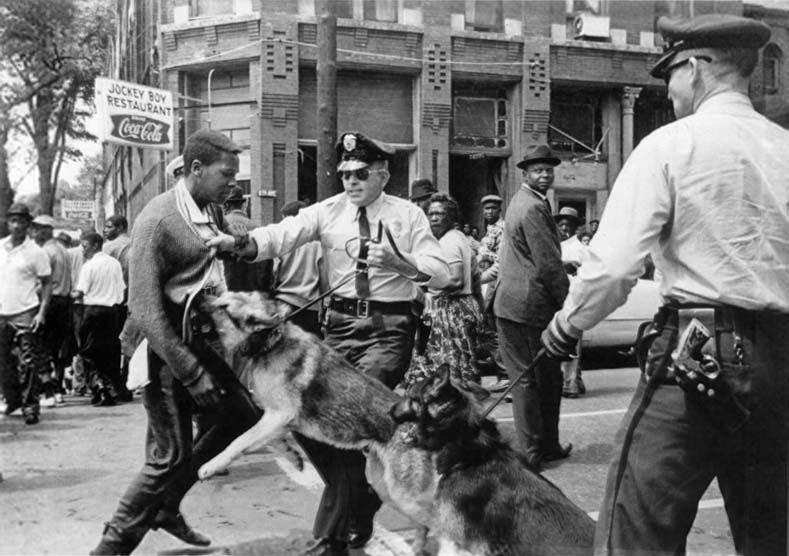
Birmingham_campaign_dogs

Representative John Lewis, one of the original Freedom Riders was beaten numerous times during those protests. When leading the march across the Pettus Bridge in Selma, Lewis had his skull fractured by a State Trooper when he stopped to pray.  Lewis’s words call us to action today:

“If not us, then who? If not now, then when?” 

We cannot let Dr. King’s dream die, especially when White Supremacists, encouraged by the words of the President attack those rights in city halls, state houses, the Congress, the Cabinet, and the Courts.

If the Dream is to survive, if we are to go to the mountaintop, if we are to see the day when people will be judged by the content of their character, and not their race, color, religion, or gender, we have to be the ones to not sit back and be bystanders, but to take action. To answer Congressman Lewis’s question, it has to be us, and it has to be now.

Until tomorrow,

Peace

Padre Steve+

1 Comment

Filed under civil rights, ethics, faith, History, laws and legislation, leadership, ministry, News and current events, philosophy, Political Commentary, racism, Religion

“A Mind Ready to Stand Alone” Intellectual Freedom in the Age of Trump and After

Richard Hofstadter

Friends of Padre Steve’s World,

Today was a very busy day and I am tired. Tomorrow will be busy with a full day of counseling, administration, and walking about the shipyard visiting our workers. So instead of commenting on impeachment, Iran, or illegal sign stealing, which I will start doing tomorrow. Obviously since sign-stealing in baseball, especially the World Series is culturally more important and reflective of our society than the impeachment of incredibly deserving President, and potential war, one criminal state against another, Mano an Mano. Anyway, I digress. So I am posting a commentary on the anti-intellectualism of much of America, and and especially of Trump’s ‘Merca. So until tomorrow,

Peace,

Padre Steve+ 

In July of 2017 the Pew Research Center published a detailed study of the current views of Americans regarding various institutions. One of those was higher education. The results showed that since 2015, Republicans, particularly Conservative Republicans place much less value on higher education and even that higher education has a negative effect on the country.

This should not be too surprising to anyone who studies American History. Our history is filled with anti-intellectual movements which are quite often tied in with conspiratorial world views, isolationism, and anti-immigrant or foreigner movements such as the Know Nothings, the Ku Klux Klan, and the original “America First” crowd. This has been a consistent drumbeat in American History, and yhe late historian Richard Hofstadter wrote:

“As a consequence, the heartland of America, filled with people who are often fundamentalist in religion, nativist in prejudice, isolationist in foreign policy, and conservative in economics, has constantly rumbled with an underground revolt against all these tormenting manifestations of our modern predicament.” 

But simple native prejudice and religious fundamentalism are only part of the problem. Throughout much of our history Americans have as Susan Jacoby has noted “only in terms of its practical results.” She notes that this phenomenon has “reasserted itself strongly in the “no frills” decisions of many local and state school boards. That the eliminated frills had once provided children with some exposure to a higher culture than pop was a matter of little concern to the public.”

The prevailing opinion, especially among conservatives is that education is only valuable if it produces jobs. In other words it’s training, not education and if you don’t know the difference between the two you are probably not really educated. The fact is that education, especially formal higher education should pursue truth more on their own long after their formal schooling ends. I can thank my teachers and professors at every level for inspiring me to do that. Sadly, more many, if not most Americans education at any level is simply a way to punch a ticket to get a job, but I digress…

In 2015 Pew noted that 54% of Republicans held a positive view of higher education, while 37% viewed universities, colleges and higher education negatively. That shifted in 2016 to a plurality of 45% positive and 45% negative. Their 2017 survey showed a much more pronounced shift, 58% negative and only 39% positive. Of the Republicans those who considered themselves “conservative” views were even more pronounced with 65% saying that higher education had a negative impact.

A change of such magnitude regarding what Americans have almost always universally valued as a societal good does not happen in a vacuum, the ground has to be prepared for it. Since a large portion of the GOP conservatives are Evangelical Christians one has to look at what has been going on in Evangelical Church and its politics for the past 50 years. whole denominations like the Southern Baptist Convention experienced splits as moderates were drive from the denomination and its educational institutions during the Fundamentalist takeover of it and its institutions.

The growth of Evangelical power centers that any type of education that comes from secular institutions have created their own educational centers to propagate their fundamentalist and radically right wing political views. Institutions like the American Family Association, the Eagle Institute, and others mimic traditional think tanks but are nothing more than propaganda outlets covered with an academic veneer in order to fool people into thinking that they are legitimate.  Likewise, the promotion and acceptance of fake history by faux “historians” like David Barton has led to a devastating decline in the willingness of Evangelicals, and hence Republicans to care about the truth and to rail at institutions which they despise out of the fundamentalist worldview.

Non-intellectual virtues such as patriotism, loyalty, faith, prosperity, and power have supplanted the intellectual quest for truth. Expertise of any kind is disregarded but particularly that of academics. Even on college and university campuses academics and the pursuit of academic and intellectual questions is being subsumed by bloated bureaucracies which treat instructors and professors as chattel while seeking profits which usually come at the cost of academics, but again I digress…

The fact is that American society as a whole is hostile towards intellectuals and academics. As Hofstadter wrote:

“All this is the more maddening, as Edward Shils has pointed out, in a populistic culture which has always set a premium on government by the common man and through the common judgement and which believes deeply in the sacred character of publicity. Here the politician expresses what a large part of the public feels. The citizen cannot cease to need or to be at the mercy of experts, but he can achieve a kind of revenge by ridiculing the wild-eyed professor, the irresponsible brain truster, or the mad scientist, and by applauding the politicians as the pursue the subversive teacher, the suspect scientist, or the allegedly treacherous foreign-policy adviser. There has always been in our national experience a type of mind which elevates hatred to a kind of creed; for this mind, group hatreds take a place in politics similar to the class struggle in some other modern societies. Filled with obscure and ill-directed grievances and frustrations, with elaborate hallucinations about secrets and conspiracies, groups of malcontents have found scapegoats at various times in Masons or abolitionists, Catholics, Mormons, or Jews, Negroes, or immigrants, the liquor interests or the international bankers. In the succession of scapegoats chosen by the followers of this tradition of Know-Nothingism, the intelligentsia have at last in our time found a place.” 

The American President has shown that he is exactly that kind of leader, and he is supported by followers who lap up everything that he says. Fed by the lies of pundits and radio talk show hosts who are college dropouts that despise anything that might be considered intellectual the President has added his voice to the cacophony of anti-intellectual thought that characterizes current American conservatism, in which men like William F. Buckley would be hard put to find a home.

There is a cost to such trends. We are not unique and such cultural trends do have consequences that many people do not think could happen here. But the non-intellectualism of our time, especially that of the militant and often fundamentalist Christian Right that predominates American conservatism is dangerous. Milton Mayer wrote of his experience with ordinary Germans in the years after the Second World War in his book They Thought They Were Free: 

“As the Nazi emphasis on nonintellectual virtues (patriotism, loyalty, duty, purity, labor, simplicity, “blood,” “folk-ishness”) seeped through Germany, elevating the self-esteem of the “little man,” the academic profession was pushed from the very center to the very periphery of society. Germany was preparing to cut its own head off. By 1933 at least five of my ten friends (and I think six or seven) looked upon “intellectuals” as unreliable and, among these unreliables, upon the academics as the most insidiously situated.”

The Nazis loved educated men who were able to subordinate themselves to the Party and the State to get the job done. There were quite a few academics, particularly lawyers and doctors who were willing to put their education to use in service of the regime. Real intellectuals, men who thought and fought for truth and freedom were removed from academia or their positions in government. They were replaced with men willing to sacrifice their integrity and honor to further their own interests or to serve Nazi ideology and the Party.

It is my view that regardless of what happens with the Trump Presidency, as bad as things seem now, that the assault on intellectuals, knowledge, education, and ultimately truth will continue unabated, with even more fury, regardless of whether he survives impeachment and is re-elected. Irving Howe wrote in his essay The Age of Conformity: 

“The most glorious vision of the intellectual life is still that which is loosely called humanist: the idea of a mind committed yet dispassionate, ready to stand alone, curious, eager, skeptical. The banner of critical independence, ragged and torn though it may be, is still the best we have.” 

1 Comment

Filed under civil rights, History, News and current events, philosophy, Political Commentary

The Continuum of History and Memory: The Example of the American Civil War Today

Friends Of Padre Steve’s World,

Barbara Tuchman wrote:

“No one is so sure of his premises as the man who knows too little.”

Our present situation in the United States proves that. No quote could better describe our current President, his entourage, and his cult of true believers. When one sees the President continually making up lies aided by cabinet members, Congressmen, media propagandists, and political preachers, one cannot take that for granted, regardless of the subject; especially when they claim to say that lies are the truth. George Orwell’s words on this come to mind:

“Doublethink means the power of holding two contradictory beliefs in one’s mind simultaneously, and accepting both of them.”

The President claims to love the military, but he claims a knowledge greater than his military leaders, commits war crimes and pardons war criminals, even talks about his military service though he didn’t serve and actually avoided serving while publicly disparaging those who did. But I digress, I got carried away simply because because the similarity of these individuals is so much like that of the leaders of the Confederacy, and it’s perpetual defenders who avoid facts and make up myths to prop up the legacy of the rebellion founded upon White Supremacy and African slavery, whose leaders destroyed the bulk of their states to defend that, even when they knew that they could not win. The only problem is that their ideology never died and has found new life. To the casual observer or one raised on the myths of The Noble South, and The Lost Cause, facts don’t matter.

That being said finite human beings find themselves bound by time and space, we live in the present, but not the present alone, but rather three worlds: one that is, one that was, and one that will be. The German historian Ernst Breisach wrote:

“In theory we know these three worlds as separate concepts but we experience as inextricably linked and influencing each other in many ways. Every new and important discovery about the past changes how we think about the present and what we expect of the future; on the other hand every change in the conditions of the present and in the expectations of the future revises our perception of the past. In this complex context history is born ostensibly as reflection of the past; a reflection which is never isolated from the present and the future. History deals with human life as it “flows” through time.”

Richard Evans wrote something in the preface to his book The Third Reich in History and Memory that those who study military history often forget. He noted:

“Military history, as this volume shows, can be illuminating in itself, but also needs to be situated in a larger economic and cultural context. Wherever we look, at decision-making at the top, or at the inventiveness and enterprise of second rank figures, wider contextual factors remained vital.”

Thus while this work is an examination of the American Civil War it is important to understand the various issues that were formative for the men who directed and fought the battle, as well as the vast continuum of often distant and seemingly unrelated events that come together at one time in the lives of the participants in any historic event.

This is important and it goes to a broader view of history and education rather that many people are comfortable with. We live in an age where much of education, even higher educations has been transformed into training for a particular skill to gain, or with which to enter the workforce, rather than teaching us to think critically. The social sciences, the liberal arts, philosophy, history are often considered by politicians and business leaders as skills which do not help people get jobs and have been the subjects of cuts in many public university systems.

Andy Chan, Vice President for Personal and Career Development at Wake Forest University wrote: “The prevailing argument is that students should study or major in something “employable,” something that is directly correlated to a job in a high paying career field. This view is espoused by many parents and national leaders, including politicians on both sides of the aisle. Many have called for additional STEM majors as well as eliminating funding for “softer” disciplines.” Like it or not such efforts impact the serious study of history and minimize the exsposure of students in the STEM disciplines to the broader aspects of intellectual study that happen provide them with a moral, ethical, and historic foundation for their disciplines. Giles Lauren in his introduction to B. H. Liddell-Hart’s classic Why Don’t We Learn from History?, wrote:

“Education, no longer liberal, has largely become a question of training in a skill for gain rather than teaching us how to think so as to find our own way. ‘It is strange how people assume that no training is needed in the pursuit of truth.’ We must learn to test and judge the information that comes before us. After all: ‘Whoever habitually suppresses the truth … will produce a deformity from the womb of his thought.’”

Liddell-Hart expressed the importance of a wide view of history as well as the importance of being able to dig deep into particular aspects of it, bit of which are important if we want to come as close to the truth as we can. He wrote:

“The benefit of history depends, however, on a broad view. And that depends on a wide study of it. To dig deep into one patch is a valuable and necessary training. It is the only way to learn the method of historical research. But when digging deep, it is equally important to get one’s bearings by a wide survey. That is essential to appreciate the significance of what one finds, otherwise one is likely “to miss the forest for the trees.””

This can be a particular problem for those who write about specific aspects of the American Civil War, especially about particular battles, technical developments, or individuals. Many writers dig deep into a particular subject, but despite their good work, miss important aspects because they have not done the groundwork of trying to put those subjects into the broader historical, as well as sociological context.

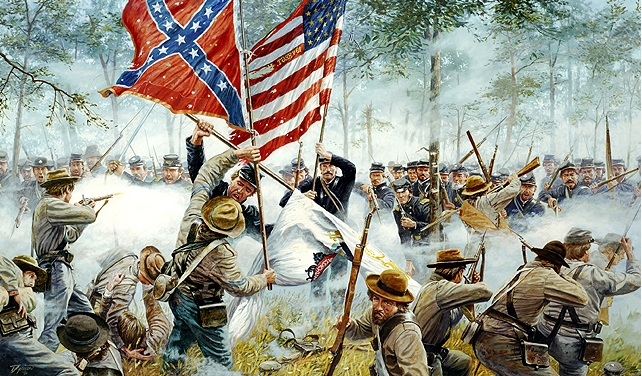
One cannot understand the determination the determination of Robert E. Lee to maintain the offensive without understanding his devotion to Napoleon, or his view of the war and the battles his men fought without understanding and taking into account his view of Divine Providence which was a part of his religious experience. One cannot understand the dogged persistence of Joshua Chamberlain or Strong Vincent to hold Little Round Top, without understanding their patriotic idealism and the nearly spiritual significance of the Union to them. One cannot understand William Tecumseh Sherman without understanding the often cold realism that shaped his world view. The same is true for any of the men, and women, soldier or civilian, slave, or free, who had some part, great or small in the war.

Thus it is important when digging deep, to also attempt to understand the broader perspective of history, and how factors outside their direct military training and experience, such as culture, politics, economics, religion, sociology, ideology, life experience, and all of those factors shaped these men and their actions. By such means we get closer to the truth and by doing so avoid the myths which even after a century and a half, still clutter the works of many people who write about the Civil War.

Likewise, in order to understand the context of the battles of the Civil War, or for that matter the battles in any war, one has to understand the events, ever distant events which play a role in the battle. All too often those that delve into military history, or a particular battle see that as separate event, often disconnected from other historical events. But as historian Edward Steers Jr. correctly notes, history “does not exist in a series of isolated events like so many sound bites in a newscast. It is a continuum of seemingly unrelated and distant events that so often come together in one momentous collision of time.”

To explain this in a different way, let us look at the Battle of Gettysburg as a case in point, but needless to say that no-matter what battle we study there are other factors, that influence it. In the case of the Battle of Gettysburg events like Lincoln’s publication of the Emancipation Proclamation, are important, as it resets the political and diplomatic narrative of the war in a way that influences both domestic politics, and diplomacy.

Diplomacy is another aspect that must be considered, and the incompetence of Confederate diplomats was a major factor. These men were unsuccessful in bringing France or Great Britain into the war, nor could they persuade any European power to recognize the Confederacy. Both of these failures were brought about by their provincialism and by their lack of understanding of the domestic politics of France and England. Both nations had abolished slavery, banned the slave trade, and had populations that were overwhelmingly against slavery.

On the military front, the failures of the Confederate armies in the West to maintain their hold on the Mississippi River, played a crucial role in Robert E. Lee’s ill-advised decision to launch an invasion of Pennsylvania, as did the failing Confederate economy. None of these events can be disconnected from it without doing violence to the historical narrative and thereby misunderstanding why the battle was important.

Another element that must be connected in order to understand the American Civil War is the part that policy, strategy, war aims, as well as operational doctrine, tactics, and technology played in every campaign of the war. When we examine those dimensions of the war and of specific campaigns we go back to the human factor: the people whose ideas, character, and personalities, influenced the conduct of the war and how it was waged.

Finally, events such as the battles of Antietam, Chancellorsville, Gettysburg, Vicksburg, and Atlanta, or the Overland Campaign or Sherman’s March to the Sea cannot be looked at as a stand-alone events for their military value only. The clash at Gettysburg as the armies of the Confederacy battled the Army of the Potomac, and surged and then ebbed back from their “high water mark,” is important. What happened there influences the rest of the war. However, it does not take place in isolation from other battles and events. While the war would go on for nearly two more years, the Union victory at Gettysburg coupled with the victory of Grant at Vicksburg ensured that the Confederacy, no matter how hard it tried would not be able to gain its independence through military means. It was no longer the master of its fate, it needed the Northern “Peace” Democrats to successfully win the election of 1864, and it needed intervention from Europe, neither which was forthcoming.

Maybe even more importantly the story of the Civil War is its continued influence today. The American Civil War was America’s greatest crisis. It was a crisis that “has cast such a shadow over the relations between the North and the South that the nation’s identity and its subsequent history have been considerably influenced by it.”

One cannot underestimate the importance of the American Civil War, it was the completion of the American Revolution and the birth of a modern nation. The successes and failures, the victories and defeats, and the scars that remain resonate in American cultural, political, and social divide, be it in the minds and hearts of the descendants of freed slaves, Southerners weaned on the myth of the Lost Cause, or the progeny of the Irish and German immigrants who fought for a country where they were despised and discriminated against by the adherents of the anti-immigrant Know Nothing movement. The remains of three-quarters of a million Union and Confederate soldiers interred in cemeteries across the North and South, the monuments devoted to them in town squares, the preserved battlefields with their now silent cannon are a constant reminder of this war that made a nation.

Many people pore over the accounts of the battles of the war, while the legions of devoted Civil War historians, re-enactors, military history buffs, and members of organizations such as the Sons of Confederate Veterans testify to the war’s continued hold on Americans and their fascination with it. The military struggle was important, but we always have to keep it in the context of why the war was fought and why so many of the issues that it was fought over remain issues today, as Ted Widmer noted; “What Lincoln called a “new birth of freedom” felt like a straitjacket to those who opposed it, and their legacy is still felt, in the many forms of opposition to the federal writ that we witness on a daily basis.”

It is important to understand how the war was fought, but it even more important to understand the relationship of how it was fought with why it was fought and in some ways is still being fought, as was evidenced by the vast numbers of Confederate battle flags proudly displayed outside of the historic Confederacy during much of the 2016 Presidential campaign.
Historian David Blight wrote:

“The boundaries of military history are fluid; they connect with a broader social, cultural, and political history in a myriad of ways. In the long run, the meanings embedded in those epic fights are what should command our greatest attention. The “war of ideas” as Douglass aptly called it, has never completely faded from our nation’s social condition or historical memory. Suppress it as we may, it still sits in our midst, an eternal postlude playing for all who deal seriously with America’s past and our enduring predicaments with race, pluralism and equality.”

The battles of the American Civil War are enshrined in American history and myth, and are woven deeply into the story of the nation. In this story the Battle of Gettysburg is often viewed different ways depending on one’s perspective. For many in the North the battle is viewed as a victory that helps brings an end to the institution of slavery, and with it freedom for enslaved African-Americans, and the preservation of the Union. In the South it is often part of the myth of the Noble Confederacy and the Lost Cause where the South was defeated by the Northern superiority in men and war making ability. At Gettysburg there is a certain irony that in the shadow of the cemetery where over 3,500 Union soldiers lay in hallowed repose and where Abraham Lincoln gave the Gettysburg Address that Confederate memorabilia vastly outsells that of the side that won the battle. People wearing t-shirts emblazoned with the image of the Confederate battle flag, and sayings like “I Will Not be Reconstructed” are bought at local gift shops, and their wearers parade past the graves of the Union soldiers who lie just a few hundred yards up the slope of West Cemetery Hill. For me, although members of both sides of my family owned slaves and fought for the Confederacy as members of the 8th Virginia Cavalry.

Yet in both cases, the truth is not so simple; in fact it is much more complex, and the truth is we are still in the process of learning from and interpreting the historical records of the events that led to the American Civil War, the war itself, and the aftermath. They are all connected and for that matter still influence Americans today more than any other era of our history. In fact James McPherson who is one of the nation’s preeminent scholars on the Civil War and Reconstruction wrote:

“I became convinced that I could not fully understand the issues of my own time unless I learned about their roots in the era of the Civil War: slavery and its abolition; the conflict between North and South; the struggle between state sovereignty and the federal government; the role of the government in social change and resistance to both government and social change. These issues are as salient and controversial today as they were in the 1960s, not to mention the 1860s.”

The prolific American military historian Russell Weigley wrote of how the war, and in particular how the Battle of Gettysburg changed the American Republic.

“The Great No one is so sure of his premises as the man who knows too little.”Civil War gave birth to a new and different American Republic, whose nature is to be discovered less in the Declaration of Independence than in the Address Delivered at the Dedication of the National Cemetery at Gettysburg. The powerful new Republic shaped by the bayonets of the Union Army of the Civil War wears a badge less benign aspect than the older, original American Republic. But it also carries a larger potential to do good for “the proposition that all men are created equal” both at home and around the world.”

Thus it is important for Americans to learn about the American Civil War, but not solely for its military significance, nor for clear-cut answers or solutions. The lessons go far deeper than that and span the spectrum of the world that we live in today. The fact is that “situations in history may resemble contemporary ones, but they are never exactly alike, and it is a foolish person who tries blindly to approach a purely historical solution to a contemporary problem. Wars resemble each other more than they resemble other human activities, but similarities can be exaggerated.”

British military historian Michael Howard warned. “the differences brought about between one war and another by social or technological changes are immense, and an unintelligent study of military history which does not take into account these changes may quite easily be more dangerous than no study at all. Like the statesman, the soldier has to steer between the dangers of repeating the errors of the past because his is ignorant that they have been made, and of remaining bound by theories deduced from past history although changes in conditions have rendered these theories obsolete.”

The ideal that we reach for is to understand the battles of the American Civil War in context, which includes understanding what led to the war as well as the period of Reconstruction, and the post-Reconstruction era and the continued reverberations today.

The American Civil War determined much of the history that followed, not only in the United State, but around the world both in its military advances which transformed war into a mechanized conflict that continues to grow more deadly, and in terms of politics, and social development.

The lessons of this period go far beyond military and leadership lessons gained in studying the battles themselves. They go to our understanding of who we are as a people. They are social, religious, political, economic, diplomatic, and informational. From a strategist’s perspective they certainly help inform the modern policy maker of the DIME, the diplomatic, informational, military, and economic elements of national power, but they are even more than that; the period provides lessons that inform citizens as to the importance of liberty, responsibility, and the importance of both fighting for and defending the rights of the weak and the oppressed.

They also deal with the lives of people, and throughout this volume you will find biographical portraits of some of the key people woven into the story for without them, there really is no story. The one constant in human history are real human beings, some driven by passion, ideology, religion, wealth, or power. There are others who in their quest for knowledge discover things that change the world, invent machinery that alters history, and create weapons which make killing easier. There are men and women who fight for truth, and seek justice for the oppressed. There are the honest and the hucksters, those with character and those that are charlatans. Then to are those who live in fantasy words, cloud-cuckoo lands of unreality that cause them to believe in and pursue causes that can only end in tragedy for them and in many cases others, and finally there are the realists who recognize situations for what they are and are willing to do the hard thing, to speak truth and to act upon it.

All of these types of people can be found in this great war in what was undoubtedly a revolutionary age of change, an age which has influenced the life of this nation, our people, and the world for over a century and a half. Its ghosts haunt our laws and institutions, the sacrifices of soldiers, and the actions of men like Abraham Lincoln have inspired people in this country and around the world.
In writing this volume I attempt to draw lessons from the Civil War era and the people who helped create the world in which we live. Even so I try to do so without making the mistake of assuming that what we learn and know about them is immutable and thus not subject to change; for the past influences the present, even as the present and future will influence how we view and interpret the past.

Until tomorrow,

Peace,

Padre Steve+

4 Comments

Filed under books, civil rights, civil war, culture, Gettysburg, History, leadership

The Horror of Evil is that it Does Not Deviate from Human Norms: the Eternal Precedent of the Holocaust

rolfe

Friends of Padre Steve’s World,

I read and write a lot about Weimar and Nazi Germany as well as the Holocaust. They were the focus of my undergraduate major working under Dr. Helmut Heussler who served as a translator and interrogator at Nuremberg while I was a student at California State University at Northridge and later in my Masters of Arts in Military History. I read the documents, the histories, the narratives, and the reports both in English and German. I study the perpetrators, the victims, and yes the bystanders as well and there is not enough time in one man’s life to read all of them, but I will try.

Likewise I visit the sites where things happened in Germany, and every time that I make a trip to those places I learn more and believe me it is not comfortable.  When I visited the Palace of Justice in Nuremberg a few years ago I saw a picture of Dr. Heussler doing his work. Back then he was very young and it would be a number of years before he finished college and went on to his doctorate. When I saw his picture I remembered just how important he was in opening my eyes to the dark side of humanity; even those people that are not truly evil; those like most of us who exist between the shades of gray between sainthood and the devil.

The histories, the documents, the narratives paint a dark picture of humanity and the fallibility of people. The portrait that they paint a disturbing picture of the true nature of what is in all of us. When I look at the pictures and see the films I can see that the lessons of that time have not been learned. Dr. Timothy Snyder wrote:

“The world is now changing, reviving fears that were familiar in Hitler’s time, and to which Hitler responded. The history of the Holocaust is not over. Its precedent is eternal, and its lessons have not yet been learned.”

In the age where men who admire tyrants and authoritarians like Trump, Putin, Farage, Erdrogan, Assad, and so many others it is important that we try to learn the lessons lest we fall into the same trap as our ancestors and become perpetrators, victims, or bystanders. I often find myself wondering what will be said we Americans of our time in say fifty years or so. I have a feeling that it will not be favorable or sympathetic.

Such a fascination with the thoughts of others years after I am likely to be dead may seem unusually circumspect. But my call as a priest and a historian doesn’t allow me not to care about the future, or ignore present realities. The fact is that totalitarian regimes and events like the Holocaust are all too common in human history, one of those is the connection of humanity with its past and future, and that humanity being the constant in our history. Yehuda Bauer wrote:

“The horror of the Holocaust is not that it deviated from human norms; the horror is that it didn’t. What happened may happen again, to others not necessarily Jews, perpetrated by others, not necessarily Germans. We are all possible victims, possible perpetrators, possible bystanders.”

The fact is that there are very few true saints and likewise very few truly evil people. Quite obviously Adolf Hitler and many of his associates fell in the latter category. The rest of us, and for that matter most of the people on all sides during from the Nazi seizure of power until the Gotterdammerung of the Third Reich in in the flames of Berlin in 1945 fell somewhere in the gray area between the truly evil and the saints and truthfully all of us given the right conditions are capable of becoming perpetrators, victims, or the worst, bystanders who turn their backs on evil because it doesn’t seem to affect us; but it does.

Admittedly this is a dark subject and as I always reminded my students “the one constant in history are fallible human beings.” 

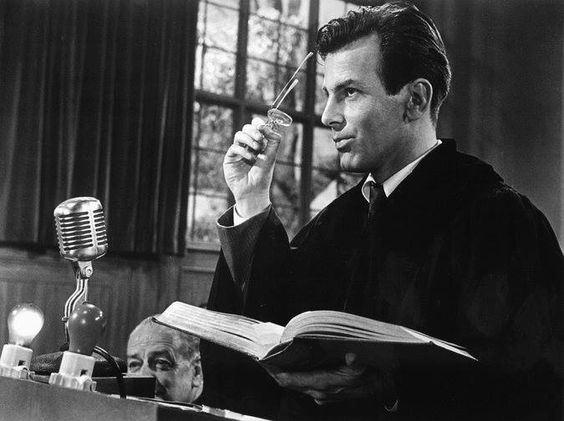
During our recent blizzard and snow event my wife Judy was away, so one of the nights that I was alone I re-watched the film Judgment at Nuremberg. The film is profoundly disturbing not only because of the subjects that it deals with but also when we look at the great uncertainty time that we live and how similar it is to the world of the late 1920s and early 1930s. In one of the more disturbing scenes of the film, Maximillian Schell, who played Hans Rolfe, the defense counsel for Ernst Janning, played by Burt Lancaster gives a summation in the final defense of his client who has already admitted his guilt which is remarkable because he tells the truth about the guilt of everyone.

Rolfe’s summation of his defense following his client’s admission of guilt is damning. It is something that almost all of us do. It is how we look at the atrocities of genocide, war crimes, ethnic cleansing, the willful starvation of millions by criminal regimes; and then stand by saying little or nothing and doing nothing, sometimes even supporting the leaders or the regimes that commit these actions.

So please, no matter what your political point of view, take the time to watch clip or the whole film, and read the transcript of Schell’s speech below. It’s far easier than trying to do all the reading, study, and research that I have done.

“Your Honor, it is my duty to defend Ernst Janning, and yet Ernst Janning has said he is guilty. There’s no doubt, he feels his guilt. He made a great error in going along with the Nazi movement, hoping it would be good for his country. But, if he is to be found guilty, there are others who also went along, who also must be found guilty. Ernst Janning said, “We succeeded beyond our wildest dreams.” Why did we succeed, Your Honor? What about the rest of the world? Did it not know the intentions of the Third Reich? Did it not hear the words of Hitler’s broadcast all over the world? Did it not read his intentions in Mein Kampf, published in every corner of the world? Where’s the responsibility of the Soviet Union, who signed in 1939 the pact with Hitler, enabled him to make war? Are we not to find Russia guilty? Where’s the responsibility of the Vatican, who signed in 1933 the Concordat with Hitler, giving him his first tremendous prestige? Are we not to find the Vatican guilty? Where’s the responsibility of the world leader, Winston Churchill, who said in an open letter to the London Times in 1938 – 1938! Your Honor – “were England to suffer national disaster should pray to God to send a man of the strength of mind and will of an Adolf Hitler!” Are we not to find Winston Churchill guilty? Where is the responsibility of those American industrialists, who helped Hitler to rebuild his armaments and profited by that rebuilding? Are we not to find the American industrialists guilty? No, Your Honor. No! Germany alone is not guilty: The whole world is as responsible for Hitler’s Germany. It is an easy thing to condemn one man in the dock. It is easy to condemn the German people to speak of the basic flaw in the German character that allowed Hitler to rise to power and at the same time positively ignore the basic flaw of character that made the Russians sign pacts with him, Winston Churchill praise him, American industrialists profit by him! Ernst Janning said he is guilty. If he is, Ernst Janning’s guilt is the world’s guilt – no more and no less.”

Sadly, little has changed in the character of humanity. If we do or say nothing, if we support those who do such things, if we close our eyes and pretend that it is not our problem, then we too are the guilty party.  As Hannah Arendt wrote: “The sad truth is that most evil is done by people who never make up their minds to be good or evil.”

Sophie Scholl, a young university student who died at the hands of the Nazis for daring to distribute leaflets telling the truth about Hitler’s regime wrote:

“The real damage is done by those millions who want to ‘survive.’ The honest men who just want to be left in peace. Those who don’t want their little lives disturbed by anything bigger than themselves. Those with no sides and no causes. Those who won’t take measure of their own strength, for fear of antagonizing their own weakness. Those who don’t like to make waves—or enemies. Those for whom freedom, honour, truth, and principles are only literature. Those who live small, mate small, die small. It’s the reductionist approach to life: if you keep it small, you’ll keep it under control. If you don’t make any noise, the bogeyman won’t find you. But it’s all an illusion, because they die too, those people who roll up their spirits into tiny little balls so as to be safe. Safe?! From what? Life is always on the edge of death; narrow streets lead to the same place as wide avenues, and a little candle burns itself out just like a flaming torch does. I choose my own way to burn.”

Whether I live one day, or another fifty years, I do not want to be a person who wants to be remembered as one who “just wants to survive,” or “left in peace,” or as Arendt said one “who never makes up their mind to be good or evil.” Nor can I be one who just goes along with things as Janning did, carrying in Judgment at Nuremberg, or be one for whom freedom, honour, truth, and principles are only literature.” 

That is the only way I know how to live. Life has taught me that.

Peace

Padre Steve+

4 Comments

Filed under books, civil rights, ethics, faith, film, History, holocaust, life, nazi germany, philosophy, Political Commentary

Silent Witnesses of Evil Deeds… Are We Still of Any Use? Trump’s Christian Advocates


Friends of Padre Steve’s World,

Over his three years in office President Trump has managed to tell over 15,000 lies or distortions of the truth as of December 16th 2019 according to the Washington Post. That being said we all expect politicians to lie, it’s part of American life and political discourse. Will Rogers once said “If you ever injected truth into politics you have no politics.” I think that the expectation that elected officials will lie is one reason that Mark Twain quipped: “An honest man in politics shines more there than he would elsewhere.”

However the shear numbers of lies and falsehood proclaimed by the President is having a toxic effect on our society, in particular on those in the church, men and women who call themselves by the name of Christ who not only believe them, but repeat them, and defend them.  The fact is that for decades these same Christian leaders and people have proclaimed their allegiance to what they call “moral absolutes”and  “Biblical values”while excoriating Democrats, particularly Bill and Hillary Clinton for their lies. The fact is that by doing this Christians simply become another political interest group hustling politicians for favors that benefit them, even at the expense of the credibility of their witness to Christ.

The constant repetition of the President’s well documented lies, and their defense by administration flacks, Congressional supporters, the Fox News media empire, and the big name Evangelical Preachers who have sold their souls in his defense have damaged the soul of the country and yes the Church.

Of course one would expect the President’s opponents to point out his lies but in normal times you wouldn’t expect his conservative religious supporters to go to the mat defending him and his lies, and even calling him a “role model” for young people.  In a recent survey some 70% of his predominantly Christian, Republican supporters say that he is and that my friends is, if you value the long term witness of the Christian Church absolutely devastating, especially since for over a decade young people have been fleeing the church in never before seen numbers while unbelievers, even those that admire Christ and what some would call Christian values want nothing to do with the Church.

The fact is that the repetition of lies and falsehoods, whether you are a Trump supporter or opponent there is a not a good thing either for the Church or for the country. It has a terrible effect, and one only has to look to the countries of Europe to see how Christian support for malevolent leaders has reduced it to irrelevance. Whether it be the support of ethnic and religious persecution, or the participation in and protection of sexual predators masquerading and Bishops, Priests, and Nuns has eviscerated the witness of the Church.

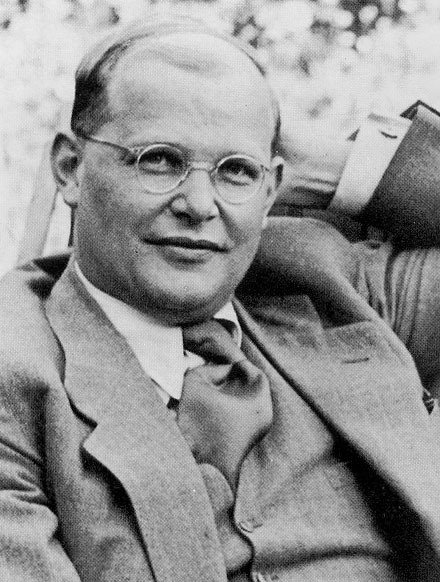
Dietrich Bonhoeffer understood this and asked a question that should be asked by people that call themselves by the name of Christ who at the same time defend the indefensible and not only defend, but take great pleasure in defending the lies of the President. Bonhoeffer observed the same dynamic in his day. He wrote:

“We have been silent witnesses of evil deeds; we have been drenched by many storms; we have learnt the arts of equivocation and pretense; experience has made us suspicious of others and kept us from being truthful and open; intolerable conflicts have worn us down and even made us cynical. Are we still of any use? What we shall need is not geniuses, or cynics, or misanthropes, or clever tacticians, but plain, honest, and straightforward men. Will our inward power of resistance be strong enough, and our honesty with ourselves remorseless enough, for us to find our way back to simplicity and straightforwardness?”

Please believe me when I say that I am not being an alarmist about this situation. I know too much about history, human nature, and yes the Church not to see the danger. Sophie Scholl, a leader of the Anti-Nazi White Rose Resistance who was martyred two years before Bonhoeffer wrote:

But that’s part of the problem. The lies and actions of the President and his administration have been cumulative; and toxic to our political, social, and even religious institutions. What was shocking to most on day one became normalized over the course of the past three years, four and a half if you go back to the time Candidate Trump came down the escalator at Trump Tower to announce his Presidential candidacy.

The effect is both numbing and corrosive: first on the President’s defenders who surrender all pretext of moral or religious authority, and on his opponents who gradually are worn down by the barrage of lies and the fact that they are also the minority party, or if the are Republicans, the minority in the President’s party. In addition to his lies and obfuscations the President appears to have directly collided with the Russians to influence the 2016 election, use his office for personal gain, pardoning war criminals, breaking treaties, and offering support for nations who kill American based reporters, and even assassinating a military leader of a nation we are not at war with on the soil of a badly needed, but fragile ally; and finally today made comments that he would commit US troops to nations who paid the most for them. In essence, he has agreed to turn the U.S. Military from a force dedicated to supporting and defending the Constitution, to a force for hire, mercenaries if you will.

Sophie Scholl, a leader of the Anti-Nazi White Rose Resistance who was martyred two years before Bonhoeffer wrote:

“The real damage is done by those millions who want to ‘survive.’ The honest men who just want to be left in peace. Those who don’t want their little lives disturbed by anything bigger than themselves. Those with no sides and no causes. Those who won’t take measure of their own strength, for fear of antagonizing their own weakness. Those who don’t like to make waves—or enemies. Those for whom freedom, honour, truth, and principles are only literature. Those who live small, mate small, die small. It’s the reductionist approach to life: if you keep it small, you’ll keep it under control. If you don’t make any noise, the bogeyman won’t find you. But it’s all an illusion, because they die too, those people who roll up their spirits into tiny little balls so as to be safe. Safe?! From what? Life is always on the edge of death; narrow streets lead to the same place as wide avenues, and a little candle burns itself out just like a flaming torch does. I choose my own way to burn.”

Since President Trump first announced his candidacy for President in 2015, I have been sounding out a warning about the President, mostly for my Christian friends. By doing so I have lost friends and been ostracized or attacked by others for doing so, despite the fact that until my return from Iraq in 2008, I had been both a politically active Conservative Christian and Republican for over thirty-two years. That being said regardless of the cost I would rather follow my conscience than surrender it to the cacophony of lies and acceptance of evil by people who were once friends.

I do not consider myself to be a victim of my former friends. In fact I understand how they got to this point. In fact what has happened with them did not begin with the lies of President Trump. For decades, they, like I did until 2008, bought the repeated lies of the politicians, pundits, and preachers of the American conservative movement. The leaders of this movement coopted them by constantly repeating that they were under attack and needed to take control of the government in order to both defend the faith and implement a Christian government.  Whole theologies were built around this and gradually many, if not most conservative and Evangelical Christians accepted the idea that Christians had to “take dominion”over the country regardless of the cost. The leaders of the so-called “Christian Right” including Franklin Graham, Tony Perkins, James Dobson, Pat Robertson, Albert Mohler, Robert Jeffress, Paula White, and far too many others have sacrificed every bit of their integrity in defending the President and excusing his lies to further their own power. His Secretary of State, Secretary of Health and Human Services, and others in his administration hold the same views as the Trump Court clergy.

Truthfully, I understand how they got there. If I hadn’t gone to Iraq, seen what I saw there, realized the lies that went into the propagation of the war and the lies of Christians who demonized all Muslims because of some after the attacks of September 11th 2001, I would probably still be one of them. For me it took war to understand the moral and theological bankruptcy the politics and theology of the Christian Right, of which over 80% voted for the President and over 75% still support him.

But there is a critical difference for those in the military versus religious sycophants. Above everything our oaths demand obedience to the Constitution above personal loyalty to any President, any Political Party, or any personal religious preference. Members of the military must remember the words of men who served under men with similar personality traits as our President. General Ludwig Beck, Chief of Staff of the German Army, resigned his post in 1938 over Hitler’s threatened invasion of Czechoslovakia. He wrote:

“It is a lack of character and insight, when a soldier in high command sees his duty and mission only in the context of his military orders without realizing that the highest responsibility is to the people of his country.”

Beck also wrote something that is all to important to any military officer, intelligence and law enforcement officials, as well as diplomats in such times as we live today:

“Final decisions about the nation’s existence are at stake here; history will incriminate these leaders with bloodguilt if they do not act in accordance with their specialist political knowledge and conscience. Their soldierly obedience reaches its limit when their knowledge, their conscience, and their responsibility forbid carrying out an order.”


Likewise, another German officer, Major General Henning Von Tresckow, who Like Beck lost his life in the attempt to kill Hitler on July 20th 1944, noted:

“I cannot understand how people can still call themselves Christians and not be furious adversaries of Hitler’s regime.”

Finally, the German pastor Martin Niemoller, himself a Conservative Christian, nati-Communist, and early supporter of Hitler wrote:

First they came for the Socialists, and I did not speak out—
Because I was not a Socialist.

Then they came for the Trade Unionists, and I did not speak out—
Because I was not a Trade Unionist.

Then they came for the Jews, and I did not speak out—
Because I was not a Jew.

Then they came for me—and there was no one left to speak for me.

As I said, Niemöller was an early supporter of Hitler, until he saw the truth about him. I think the same of Christians who support the basest and most immoral, unconstitutional, and deranged aspects of Trump’s policies. But I think that it was Bonhoeffer who asked the right question in terms of Christians and their support of morally bankrupt regimes, not just Trump’s, but those in many nations where Christians back such regimes. “Are we still of any use?”

It’s a pretty good question, I would ask anyone who calls themself a Christian to meditate upon it.

Until tomorrow,

Peace,

Padre Steve+

3 Comments

Filed under ethics, faith, germany, History, leadership, Military, ministry, nazi germany, News and current events, Political Commentary, Religion

“The laws of war are not a one-way street.” Benjamin Ferencz, Telford Taylor, and the Primacy of Law over Acts of War

Friends of Padre Steve’s World,

Last night I got a form of the crud going around, I did not sleep well, and woke up coughing, a bit of a sore throat, a terrible sinus headache and wondered if I was getting the Flu. So I called in to work, took some maximum strength Theraflu, went back to bed and didn’t wake up until almost 3:00 PM when a friend sent me a text. That stuff knocked me out for almost seven hours. My sinuses were clear, I was no longer coughing and the headache was gone. After I got up, had some coffee, soup, and Earl Grey Tea, and re-watched the biographical documentary of Benjamin Ferencz, who at the age of 27 served as the chief prosecutor at theNuremberg Einsatzgruppen Trials in 1947, on Netflix.

The title is Prosecuting Evil: the Extraordinary World Of Ben Ferencz. It is well worth the time to watch. Ferencz is now 98 years old and has been a driving force in the prosecution of war crimes. Probably more than any other American took to heart the message of Justice Robert Jackson:

If certain acts of violation of treaties are crimes, they are crimes whether the United States does them or whether Germany does them, and we are not prepared to lay down a rule of criminal conduct against others which we would not be willing to have invoked against us.”

Ferencz, took, and still takes that seriously. He fought long and hard for the establishment of the International Criminal Court and delivered the closing argument in its first prosecution of a war criminal, Thomas Lubanga Dyilo, for his use of child soldiers in the Democratic Republic Of the Congo, the Trial ended in 2006, with Dyilo’s conviction.

Ferencz was brought into the Nuremberg process because of his experience investigating Concentration Camps during and shortly after the war while still in the Army, by Colonel, Later General Telford Taylor, who was appointed to direct the 12 trials that followed the trial of the Major War Criminals. Ferencz discovered the evidence of the crimes of the Einsatzgruppen while doing investigations for Taylor, and he volunteered to take the lead in prosecuting the highest ranking of those killers. Taylor said:

“The laws of war do not apply only to the suspected criminals of vanquished nations. There is no moral or legal basis for immunizing victorious nations from scrutiny. The laws of war are not a one-way street.

Ferencz understood that, and ever since Nuremberg has been a consistent force in the conscience of the nation and international law. I had read about him many times, as well as the Einsatzgruppen Trials. As I watched the documentary about him, which included many interviews with him, I was amazed by how much he was like my history professor at California State University, Northridge, Dr. Helmut Haeussler in the pursuit of truth and justice, who served as an interpreter at Nuremberg and introduced me to victims of the Holocaust, people who survived Auschwitz.

Since that time, as a historian I have been devoted to telling the truth about the Holocaust and bearing witness, even as I confront Holocaust deniers, anti-semites, and Neo-Nazis.

Ferencz made history, and by his continued witness, and at the age of 98 still makes history and inspires men like me to want to make a difference after I retire from the Navy by bearing witness when all of the survivors are gone. Benjamin Ferencz never retired in his quest for justice. He noted:

“Nuremberg taught me that creating a world of tolerance and compassion would be a long and arduous task. And I also learned that if we did not devote ourselves to developing effective world law, the same cruel mentality that made the Holocaust possible might one day destroy the entire human race.”

I agree with him and no matter how long I live I will travel, research, write, and testify on behalf of the victims of the Holocaust and other genocides so that they won’t happen again.

Ferencz spoke out against the Invasion of Iraq in 2003, about American War Crimes in Vietnam, and in what we call The War on Terror. To be sure he labels those who attacked us in 2001 as War Criminals based on the Nuremberg statutes, but he has also been critical of the United States.

Ferencz said: “A true patriot will support his country when it is right but will have the courage to speak out when it’s wrong and try to set it right.”

I want to devote the remaining part of my life to making sure that the truth is told and such events of mass murder never happen again. I will do my best to live according to the ethos of Ben Ferencz as well as that of Robert Jackson.

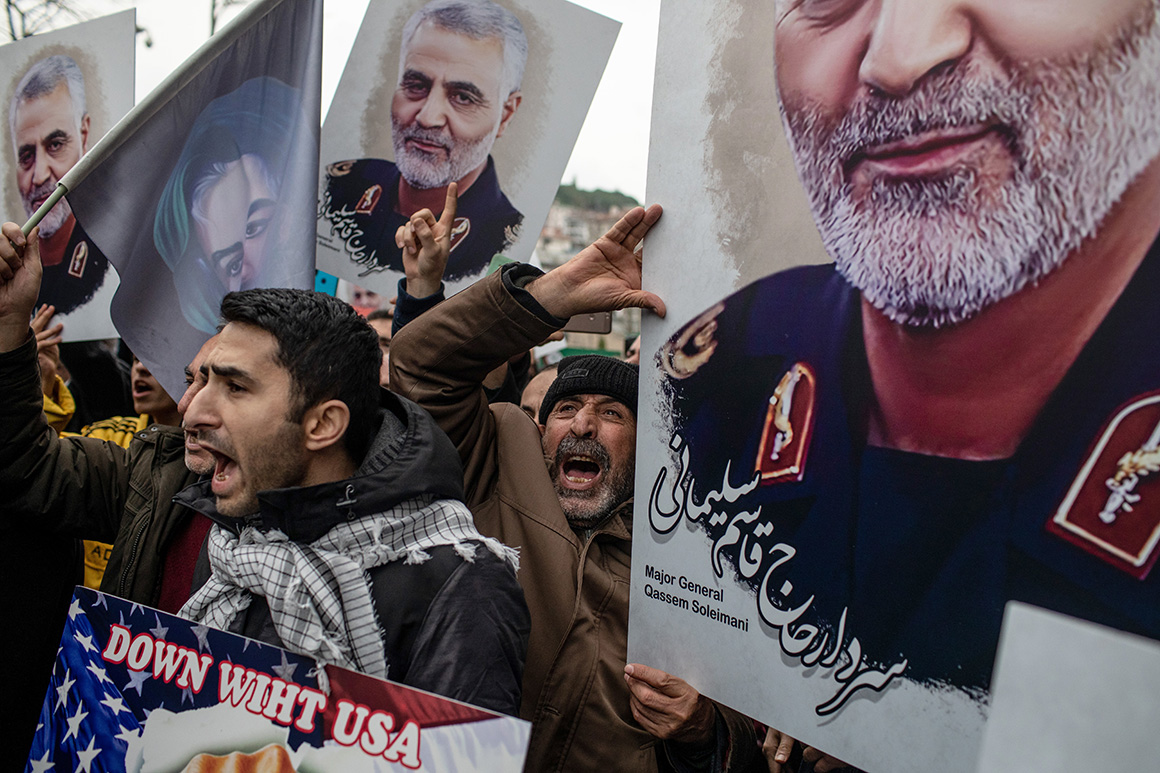
Part of that requires being honest about current conflicts in which the United States finds itself in today. Which brings me to the assassination of the Iranian Revolutionary Guards Al Quds Force, General Qassem Suleimani, a man who is as much of a war criminal as has been seen in decades, within his own country and throughout the region by sponsoring terrorist organizations, sowing civil wars that have cost hundreds of thousands of lives and  disrupted millions of others.

I shed no tears for Suleimani, but the case the administration used to kill him goes against the international law that the United States helped establish at Nuremberg and which cumulated in the Rome Accords and the Establishment of the International Criminal Court which the United States, though a signatory, has yet to ratify.

Specifically, it is the claim of preemptive action, preemptive killing, preemptive war. It was one of the defenses of the Nazi War Criminals, as well as the Japanese War Criminals. The United States claimed that rationale to kill Suleimani, on the scantiest evidence, none of which was produced. That is an unwise strategy, for it invites such actions against Americans, especially military, and diplomatic personnel, as well as political leaders.

My argument does not let Iran off the hook; however, to paraphrase Ferencz, is that we have to move away from war, and move towards using established international law against men like Suleimani, and nations like Iran. Of course opponents of the United States could easily make the same argument against us. But to quote Taylor, “the laws of war are not a one way street.”

My purpose tonight is not to excuse or defend Suleimani or Iran, it is to to say that unless the United States stands for law and justice, other nations, or non-state actors can and will use the same rational in order to assassinate Americans. The President’s actions have not made the United States any safer, instead it has made us even more of a target. I don’t want American leaders, even President Trump, assassinated by agents of foreign powers, or even Americans seeking extra judicial justice. Such organizations or people may think that such action is justified, but without a basis in law they are not, they just continue the cycle of violence, war, and injustice.

Until tomorrow,

Peace,

Padre Steve+

4 Comments

Filed under crime, ethics, film, History, holocaust, laws and legislation, leadership, nazi germany, News and current events, Political Commentary

A Man’s Got to Know His Strategic Limitations: President Trump and the Current Middle Eastern Crisis

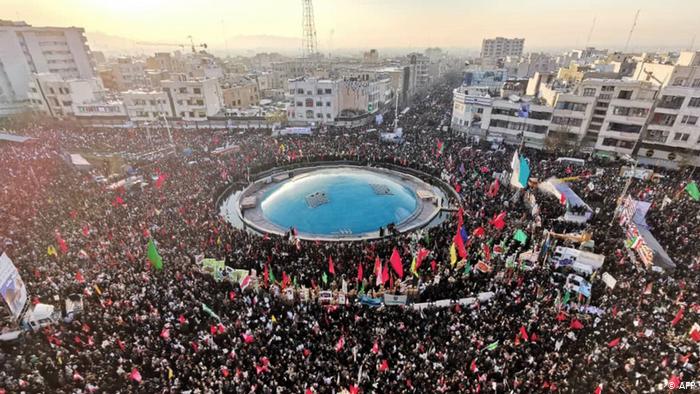
        Turkish Protestors in Istanbul 

Friends of Padre Steve’s World,

As I watch the crisis between the United States, or shall I better say President Trump and Iran unfold, and have talked with various friends about it in person and on social media I am reminded of a couple of different definitions of patriotism. Now since I have served the United States as a military enlisted man, and officer in both the Army and Navy in Peace and War, I think that I love my country and should be considered a patriot. I am not blind to our shortcomings, nor things that have been done in the name of the United States that go against the will of our Founders, the ideals of the Declaration of Independence, and the law embodied in our Constitution. Liberal or not, I am a realist. I don’t like to us to lose unnecessary wars.

Likewise, as my favorite theologian Harry Callahan said in Magnum Force: “A man’s got to know his limitations.”  Our President, nor his Cult  do not understand reality. Despite the comparative easy Assassination of the Iranian Revolutionary Guard General Qassim Suleimani, regardless of how bad of man he was, the President has opened a potentially apocalyptic Pandora’s Box which will bring about worse for the United United States, the region and the world.

None of our allies anywhere in the world, including the Israelis, who hate Iran, have officially offered us their support. The Iraqi Parliament has passed a resolution asking the government to order the United States military forces to leave the country. That may not happen, but it will place our very limited and scattered forces in Iraq at the mercy of Iraqi Militias supported by Iran, and quite possibly regular Iraqi and Iranian forces. It could be a death trap for the 5,500 or so American troops in Iraq, not to mention those in Kuwait, those based in Syria, Bahrain, and Qatar, or on ships in the Arabian/Persian Gulf.

American military power is not what it used to be and the President has not considered the second, third, fourth, fifth, or more effects of this strike. Our military readiness is not good, our ability to project power and sustain our forces is worse than it was in 2003, and now we have no allied support. Likewise there is no telling what the Russians, Chinese, North Koreans, or other competitors/enemies will do.

The Iranians have announced that they will not abide by the nuclear accords reached with the West during the Obama Administration, which they abided by even after President Trump renounced that accord. Likewise they have promised vengeance against American military targets and a eulogist at Suleimani’s funeral put an 80 million dollar contract for anyone who kills President Trump.

I neither want a wider war or for that matter for the Iranians to succeed in assassinating President Trump. As much as I oppose the President’s policies and think of him as a dangerous man, his death would only serve to make things worse. He would be succeeded by Vice President Pence, and his cult would demand its own vengeance, regardless of the military, diplomatic, and economic cost.

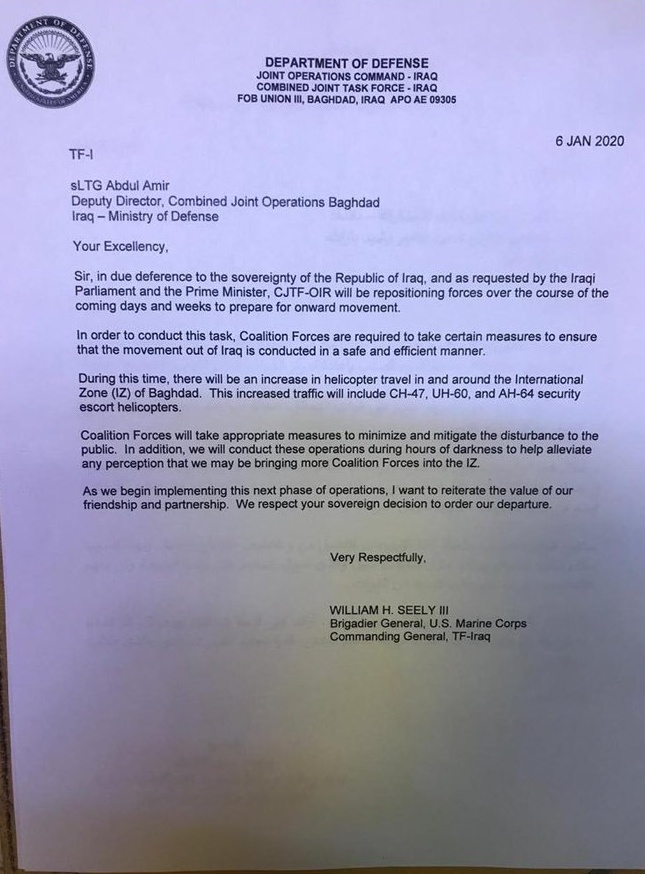
The “Mistake” Letter

Today the situation continued to escalate as the Iraqi Parliament continued to press for the removal of American and foreign forces from Iraq, backed now by the Iraqi President. President Trump threatened to attack religious and cultural sites in Iran, in violation of treaties we have signed and if carried out would be war crimes. He was countermanded by Mark Esper, the Secretary of Defense.Trump continued to reiterate his threat about 52 targets in Iran based on the number of hostages taken by Iranians during the takeover of the American Embassy in 1979, to which the Iranian President reminded the United States of the 290 passengers lost when the USS Vincennes misidentified and shot down IR-655, an Iranian passenger plane on a scheduled flight in 1988. In response the the Iraqi Parliament vote Trump ordered the administration to draft  sanctions against Iraq. During the day a draft of a withdraw letter was mistakenly released by the commander of American Forces, which was almost immediately denied as a mistake by the Chairman of the Joint Chiefs and Secretary of Defense.

If you ask me, things seem to be spiraling out of control, and nobody seems to be at the helm of the ship of state. This is not a good position to be in.

But now the dice have been thrown, the wager has been made, and the outcome is at best an uncertain gamble. I fear for our soldiers, sailors, marines, and airmen in Iraq and the Gulf. The Iranians can easily shut down the Straits of Hormuz, their Yemeni allies can threaten the Bab El Mendeb, the other major maritime choke point in the region. Likewise, in defiance of Trump the Iraqis could cut off supplies from the American troops scattered across the country if they do not withdraw or some kind of accord is reached for them to stay. Likewise, the Iranians, while not the military equal of the United States do have enough power to endanger every American facility in the Persian Gulf, kill tens of thousands of Americans, and seriously disrupt the world economy, yet leaving the Russians, and Chinese greatly strengthened.

I do not know what will happen over the next few days or weeks, but the President has backed us into a corner with little room for maneuver, diplomatically or militarily. Even long term allies like the Israelis, British, and Australians have not offered support. Neither have the Saudis, the mortal Sunni enemies of the Shia Iranians. Certain pundits have, but not their governments.

This is a watershed moment, things that Americans and the world trusted to remain as they were will no longer be the same, and we will not be the better for it. Things will not get better and they will very likely get worse and very possibly bring about the Armageddon that many of Trump’s followers, as well as certain groups of Sunni and Shia Muslims, and others fervently pray for.

Until tomorrow,

Peace,

Padre Steve+


3 Comments

Filed under ethics, Foreign Policy, History, iraq,afghanistan, middle east, Military, national security, News and current events, Political Commentary

“Anyone Could Do It; It Required No Brains at All. It Merely Required No Character” Trump’s Evangelical Allies

Catch-22 (1970) Alan Arkin Mike Nichols 24

Friends of Padre Steve’s World,

When I see the political-religious leaders of the Christian Right defend the indefensible actions of President Trump I am reminded of the words of Joseph Heller in his classic novel Catch 22  who wrote about the Chaplain:

“The chaplain had mastered, in a moment of divine intuition, the handy technique of protective rationalization, and he was exhilarated by his discovery. It was miraculous. It was almost no trick at all, he saw, to turn vice into virtue and slander into truth, impotence into abstinence, arrogance into humility, plunder into philanthropy, thievery into honor, blasphemy into wisdom, brutality into patriotism, and sadism into justice. Anybody could do it; it required no brains at all. It merely required no character.” 

As much as I doubt I am still a Christian, even if I wasn’t already a Christian I couldn’t think of a single reason to follow the false God of men like Pat Robertson, Jerry Falwell Jr., Franklin Graham, Tony Perkins, or any of the host of big name Evangelical Christian preachers who excuse the behaviors of President Trump and his decadently despicable defenders, including people that I once thought that I knew.

I used to think that most people like to believe that religion is a benign or positive influence in the world. As much as I want to believe the positive aspects I have to admit based on the historical and sociological evidence that this is not so, especially during unsettled times of great change. We live in such an era and when it comes to identity, God is the ultimate trump card.

If one wonders why the most fanatical individuals and groups on earth are tied to religions, whether it is the Islamic State and Al Qaeda, Boko Haram, Hezbollah, Orthodox Jews, radical Hindus and Buddhists as well as militant Christians. Of course all of these groups have different goals, but their thought and philosophy are quite similar.

Robert Heinlein wrote:

“Almost any sect, cult, or religion will legislate its creed into law if it acquires the political power to do so.”

Heinlein, the author of the classic Starship Troopers was absolutely correct. Just look at any place in any time where any religion, sect or cult has gained control of a government. They are not loving, they are not forgiving and they use the police power of the state to persecute any individual or group that is judged to be in error, or even worse has the gall to question their authority.

Since the Christian groups tend to thrive in the West, they only speak in terms of violence, most, with the exception of Russian Orthodox Christians, do not have a government to translation of those words into action. Many, especially conservative Catholics and some Evangelical and Charismatic Protestants seem for a long for the day when they can assume control of a theocratic government.

Samuel Huntington wrote in his book The Clash of Civilizations:

“People do not live by reason alone. They cannot calculate and act rationally in pursuit of their self-interest until they define their self. Interest politics presupposes identity. In times of rapid social change established identities dissolve, the self must be redefined, and new identities created. For people facing the need to determine Who am I? Where do I belong? Religion provides compelling answers….In this process people rediscover or create new historical identities. Whatever universalist goals they may have, religions give people identity by positing a basic distinction between believers and non-believers, between a superior in-group and a different and inferior out-group.”

Huntington was right, you see the true believers, those who follow their religion without question and believe that it is superior to all others also believe that their religion entitles them to be atop the food chain, others who don’t believe like them be damned, if not in this life, the next. That is the certitude of the true believer, especially the religious one. Secular or atheistic fanatics could care less about the next life, for this life is all that they have. But the religious “true believers” are not only interested in destroying someone in this life, but ensuring that in the next that they suffer for eternity, unless they believe in the annihilation of the soul after death, which really spoils the whole Dante’s Inferno perspective of the damned in the afterlife.

The great American philosopher, Eric Hoffer wrote:

“The impression somehow prevails that the true believer, particularly the religious individual, is a humble person. The truth is the surrendering and humbling of the self breed pride and arrogance. The true believer is apt to see himself as one of the chosen, the salt of the earth, the light of the world, a prince disguised in meekness, who is destined to inherit the earth and the kingdom of heaven too. He who is not of his faith is evil; he who will not listen will perish.”

That is why they, the religious true believers of any faith are capable of such great evil, and why such people can murder innocents in the most brutal manner simply because they do not believe correctly. In fact today when I see the words and actions of these supposed Conservative Christians.

Please do not get me wrong. I am a Christian, a priest, a historian and a theologian, but I also know just how insidious those who hold their religion over those of others can be. While I hold faith dear, I know that it can be abused for the claim of some to have God as their final authority is a sort of trump card with which they are able to justify the most obscene and evil acts against others.

Likewise I struggle with faith every day. If you have read this blog from the beginning you will see chronicle my struggles with faith and its practice, especially in life and politics.

I guess that is why I am even more frightened of religious true believers than non-religious true believers. While the non-religious true believer may sacrifice everything for the sake of power and control in this life, and may in fact commit the most heinous crimes against humanity, their hatred is bounded in space and time to this earth. The religious true believer is not content with that; their enemies must be damned and punished in this life, but for eternity, without hope of salvation.

When they look at people like me or Yossarian they believe as Heller wrote:

“Morale was deteriorating and it was all Yossarian’s fault. The country was in peril; he was jeopardizing his traditional rights of freedom and independence by daring to exercise them.” 

With that I wish you a good day.

Peace,

Padre Steve+

3 Comments

Filed under christian life, civil rights, ethics, faith, History, Loose thoughts and musings, ministry, Political Commentary

An Act of War: Trump Has Iranian General Assassinated

Friends of Padre Steve’s World,

The great Prussian military strategist Carl Von Clausewitz wrote:

“No one starts a war–or rather, no one in his sense ought to do so–without first being clear in his mind what he intends to achieve by the war and how he intends to conduct it.”

Late Thursday night I saw that the commander of the Iranian Revolutionary Guards Corps “Al Quds” division, General Qasem Soleimani was assassinated by an American Air Force Drone strike, which killed the leader of many of Iraq’s Iranian allied Shia militiamen. This was a day after the Shia militia withdrew after attacking the American Embassy in Baghdad’s Green Zone.

Rather than maintaining a policy of plausible deniability like the Israelis, Russians, Chinese or North Koreans, President Trump had the Defense Department almost immediately claim credit for the strike. Don’t get me wrong, I shed no tears for Qasem Soleimani.

He was responsible for the deaths of hundreds, if not more than a thousand American troops in Iraq, by supplying completed and equipment used to make Improvised Explosive Devices to Shia militants. Thousands of others were wounded, and throughout Iraq, Yemen, Syria, Lebanon, the Gulf States, Saudi Arabia, and even Israel. Militias that he supplied and that are allied with Iran have killed countless Sunni, Kurdish, Sufi, and Christian Arabs. Quite simply, there is no love between the Persians and the Arabs, it is a hatred that preceded the foundation of Islam, or Christianity for that matter. The Persians have always treated the Arabs as inferiors regardless of religion, one reason that some of the most powerful Iraqi Shia leaders remain Iraqi nationalists.

The smart thing to do would have been to use locally manufactured weapons, or those common in the region from Russia, China, North Korea, and European nations, to kill him, and then say nothing. That is how intelligent nations assassinate their opponents, by maintaining plausible deniability. Pardon my less than Christian interpretation of such actions, but beating your chest after such an action as President Trump did today only serves to embolden one’s opponents.

Iran was in the midst of disintegration, protests and deteriorating economic conditions were making it ripe for revolution, but every authoritarian government knows, the easiest way to unify a divided country is war, especially when a longstanding enemy launches a surprise attack that kills a man not only considered a military leader but an national icon. Likewise, the killing of Soleimani will do nothing to change the course of Iran or its policies anywhere. His successor is the man who has been his deputy since the late 1990s. Rather than dividing Iran, this will unify it, against the United States.

One should expect attacks by Iran’s allied militias in Syria, Iraq, Lebanon, the Persian Gulf, and Yemen against American, western, Israeli, and Saudi interests. Likewise one can not calculate the actions of the Russians, Chinese, North Koreans, or others, even friends will be. We could easily find ourselves fighting on multiple fronts without allies or support.

This is uncharted territory. The President did not seek the advice and consent of Congress for  an action that was a functional declaration of war, neither sanctioned by international law, nor in any way covered by the 2001 Authorization for Use of Force sought by the Bush Administration to take action against Al Qaida and Afghanistan; a document used by every succeeding administration for use of force around the world, whether connected with Al Qaida or not. At no point has Congress asserted its authority to declare war. In fact it hasn’t been since President Roosevelt asked for and got a declaration of war against Japan on December 8th 1941, and Germany and its allies when they declared war against the United States a few days later. Since then Congress has yielded to the executive branch and President in every subsequent occasion. Even the War Powers Act, enacted after Vietnam has done little to curtail the actions of each succeeding Presidency. As such this is not just a foreign policy and potential war action, but yet another assault on the Constitution; but then the Constitution hasn’t mattered to most Americans in decades, especially when it comes to military action.

Sun Tzu wrote: “If you know the enemy and know yourself, you need not fear the result of a hundred battles. If you know yourself but not the enemy, for every victory gained you will also suffer a defeat. If you know neither the enemy nor yourself, you will succumb in every battle.”

I feel that Americans by and large neither know ourselves, or our enemies, and that this is most exemplified by the example of President Trump. that my friends saddens me.

We believe that our military is the strongest and most capable in the world, which it would be if it had not been gutted by 18 years of war, which despite the vast sums spent on it is now less capable of projecting military power than it was in 2001. Likewise, massive debt of the country impedes the overall economy, the President’s attacks on the nation’s intelligence and free press have harmed our ability to gain information as well as use information to our advantage, and finally the gutting of the State Department has devastated our ability to use diplomacy rather than force to solve problems.

Every instrument of what American diplomats and strategists have called the DIME, the Diplomatic, Information, Military, and Economic pillars of national power are crumbling and neither the President or Congress has the honesty to say so, even though unclassified reports of all of the above are readily available for anyone to see. But many, if not most Americans prefer ignorance of the law, the Constitution, and facts to reality.

Expect cyber attacks, terrorist attacks on Americans overseas and quite possibly attacks in the United States itself. War could easily consume most of the Middle East and world. While the United States military would probably destroy most of Iran’s conventional military, and infrastructure, it will be a great cost. American losses will be more than OIF and OEF combined. The videos of American Warships burning and sinking from saturation attacks by Iran’s vast number of surface to surface anti-ship missiles, swarm attacks by Iran’s missile and torpedo boats, and speedboats laden with explosives piloted by suicide crews will be hard to fathom. Iranian attacks on U.S. bases in Bahrain, the UAE, Qatar, Kuwait, and Saudi Arabia with ballistic and cruise missiles will also overwhelm available missile defenses.

This may sound like a bleak estimate, but I study, I read, and I know.

I don’t know how to end this article but it just seams to me that the President has sown the wind, leaving his military and people to reap the whirlwind. I sincerely hope that I am wrong. But as Admiral Josh Painter, played by the late actor and Senator Fred Thompson said in the Hunt for Red October: “This business will get out of control. It will get out of control and we’ll be lucky to live through it.” 

In 1920 T. E. Lawrence wrote of the continuing British intervention and occupation of Iraq: “The people of England have been led in Mesopotamia into a trap from which it will be hard to escape with dignity and honour. They have been tricked into it by a steady withholding of information. The Bagdad communiqués are belated, insincere, incomplete. Things have been far worse than we have been told, our administration more bloody and inefficient than the public knows. It is a disgrace to our imperial record, and may soon be too inflamed for any ordinary cure. We are to-day not far from a disaster.” 
I feel much as Lawrence did at this moment in time, and I so want to be wrong.

It is very late and I am tired. Likewise I only think that things will get much worse before they get better.

Until tomorrow,

Peace,

Padre Steve+

3 Comments

Filed under ethics, Foreign Policy, History, iraq, iraq,afghanistan, middle east, Military, national security, News and current events, Political Commentary, Religion, terrorism, War on Terrorism

2020: Time For Reading, Reflecting, Writing, and Action to Help our Neighbors

Friends of Padre Steve’s World,

Welcome to 2019. I know, we’re all still a bit hung over from last night, but welcome to the New Year. Admittedly it doesn’t yet feel a lot different than 2018, but I really expect that 2019 will mark an epochal change in our history. Since I wrote about that yesterday I won’t go back for more.

That being said there is one resolution that I think that all people, the great and the small, should do, and that is not to cry boo who, but read like our lives depended on it, which in a sense they do. By reading, I don’t mean just the news, commentary, or opinion sections of print or online news services, but get real books, especially works of history, biography, philosophy, and the classics.

Barbara Tuchman wrote:

“Books are the carriers of civilization. Without books, history is silent, literature dumb, science crippled, thought and speculation at a standstill. Without books, the development of civilization would have been impossible. They are engines of change (as the poet said), windows on the world and lighthouses erected in the sea of time. They are companions, teachers, magicians, bankers of the treasures of the mind. Books are humanity in print.”

Likewise, the French philosopher Voltaire hit the nail on the head when he said:

“Despite the enormous quantity of books, how few people read! And if one reads profitably, one would realize how much stupid stuff the vulgar herd is content to swallow every day.”

That my friends is fact. If you want to be able to better distinguish fact from fake, read.

Last year I committed to read more, even as I stayed current on the news, analysis of it, and commentary, even as I continued to write. My office at work is crammed with books, as is much of our home. I think that we follow well the advice of Dr. Seuss who wrote:

“Fill your house with stacks of books, in all the crannies and all the nooks.”

So I read, and I read, until my eyes they turned red. I read with those eyes that had turned red, in bed and even in the head.

I read as I eat, and eat as I read, because somewhere in my soul I have this great need, which I ever did cede I would be a great deal poorer indeed.

The pages they turned and as my eyes burned I knew I could never be through so long as my fingers don’t turn blue. I read and read with voices sounding through my head I, but I will not stress even though I digress…

I continually read and I try to update my readers on the latest series of books that I have read and every few months try to let my readers know what I have been up to in my Reading Rainbow.

Since I have tried to keep my readers up with throughout the year I will concentrate on my most recent reads of the past few months. As usual many deal with human behavior in war, particularly in regard to to war crimes; perpetrators, victims, and bystanders. Most of my study of this field have focused on the Nazi Regime, its crimes, and the justice handed out to it, as well as American Slavery and racism. I have also read about crimes that Europeans enacted in their colonies, the Americans in the American West, Mexico, has Vietnam, Iraq, and Afghanistan, the Balkan wars of the 1990s, the Armenian genocide, and the Rwandan genocide.

But one of my readers challenged me to look at the war crimes of the Japanese War Crimes in Asia. I have written about the Rape of Nanking, writing about it specifically and also in more generic articles about human nature, conduct, and genocide. But, other than that at some cursory reads about how the Japanese treated POWs, conquered people’s, and units such as Unit 731; but those were all wave top looks, I never took the deep dive until after we got back from Germany in October.

Since then I have made the deep dive. It has opened my eyes to myths that I believed about Emperor Hirohito and the actions of of his government, and those of the supposedly honorable Imperial Japanese Navy, whose war crimes at sea and ashore rate their own article. In fact one of the books I read was Slaughter at Sea: The Story of Japan’s Naval War Crimes by Mark Felton.

Likewise, I learned of the American complicity at the highest levels in rigging the Tokyo trials to ensure that the Emperor, the bankers, business leaders, most politicians, civil servants, police officials and organizations, the members of Unit 731, which was involved in biological warfare and human experimentation similar to that of the Nazis. This is well documented in Robert P. Bix’s Pulitzer Prize winning biography Hirohito and the Making of Modern Japan and The Other Nuremberg: the Untold Story of the Tokyo War Crimes Trials by Arnold Brackman.

Both books, in excoriating detail not only deal with the Japanese War Crimes and criminals, but deal with the inclusion of the actions of President Truman and General MacArthur to protect certain war criminals, including the Emperor, and deflect responsibility to others such as General and Prime Minister Tojo. The Tokyo Trials took more than twice the time of the Nuremberg Trials, and allowed most of the highest order of war criminals to go free, while unlike Nuremberg exempting lower order war criminals and functionaries off the hook, because of the Cold War. That too, is another article.

I also read Lord Russell of Liverpool’s classic The Knights of Bushido: a Short (Over 300 pages) History of Japanese War Crimes and Showa: Chronicles of a Fallen God by Paul-Yanic Lequerre, another biography of Hirohito. I also re-read War Without Mercy: Race and Power in the Pacific War by John Dower, as well as John Toland’s Rising Sun: the Decline and Fall of the Japanese Empire 1936-1945; Infamy: Pearl Harbor and its Aftermath; and But Not In Shame: The Six Months After Pearl Harbor, as well as Max Hastings Retribution: The Battle for Japan 1944-1945. Then I re-read Iris Chang’s The Rape of Nanking and The Nanking Massacre: History Of China, Japan, and the Events Surrounding the Nanking Massacre by Mukuro Mori. Finally, For the first time I read Japan’s Infamous Unit 731: Firsthand Accounts of Japan’s Wartime Human Experimentation Program by Hal Gold.

All of these first or second time reads added a dimension to the Japanese atrocities that I had managed to cover with Cold War ideology and the myth that Emperor Hirohito was simply a figurehead leader with no responsibility for the war. He knew of the plans of his Army, he studied them, and criticized his military, but he always, even when military and civilian advisers urged him to seek peace, and that went on even after the atomic bombs were dropped. I’ll deal with that in another article.

I also re-read some of my Nazi War Crime books, but I won’t list them here and now. Likewise I have a good number of books to read in the coming weeks and months. As far as my writing I plan on blogging about the aspects of the Japanese War crimes and American complicity to cover them up after the war, as well as the book I started working on last year Lest We Forget: Walk, Remember, Bear Witness; Bearing Witness as the Last Witnesses to the Holocaust Pass Away.

So, I think that is enough for the day. However, our New Year’s Eve was nice. We went to our favorite German Restaurant for dinner, then went home, spent time with our dogs and binged watched episodes of Star Trek Deep Space Nine until about a half an hour before the new year, then we switched to CNN and Anderson Cooper counting down to 2020 in New York. We toasted with a German Rose Sekt (Champagne), stayed up a while longer then went to bed. We got up late, Judy and the dogs watched the Rose Parade, while between doing laundry and taking naps I spent the day until we went out to dinner at our favorite Mexican restaurant came home, and then help our next door neighbor who had collapsed on her porch from low blood sugar. Thanks to the prompt work of the EMS and our neighbor Larry she was able to treated in the ambulance. Judy and I helped with her dogs, and Judy helped her when the EMS released her and didn’t take her to the hospital once they got her blood sugar to a normal range. She stayed with her until she got her insulin and we will make sure she will be okay today. We care about our neighbors.

So, until tomorrow.

Peace

Padre Steve+


2 Comments

Filed under civil rights, crime, Foreign Policy, History, imperial japan, laws and legislation, leadership, Military, Political Commentary, star trek, war crimes, War on Terrorism, world war two in the pacific