Category Archives: iraq,afghanistan

Lessons in Coalition Warfare: Admiral Ernest King and the British Pacific Fleet

The genesis and strategy of British Royal Navy’s participation in the Pacific in 1945 is a little studied aspect of the Pacific campaign.  Prior to 1945 the participation of the Royal Navy in the Pacific ended at the Battle of the Java Sea.  After that the Royal Navy operated in the Indian Ocean in support of British operations in Burma and against German surface raiders. Michael Coles in “Ernest King and the British Pacific Fleet: The Conference at Quebec, 1944 (Octagon) published in The Journal of Military History January 2001, 65, 1 Research Library pp. 105-129 provides a good analysis of the Allied decision to allow the Royal Navy a role in the Pacific and the objections of Admiral Ernest King to the proposal.

The renewal of the Royal Navy’s Pacific role began at the 1944 Octagon Conference where the Allied Joint Staff made the decision to bring the Royal Navy back to the Pacific. Admiral Ernest King was the only dissenter in the question of Royal Navy operations in the Pacific.  The strategic aspects of this decision are seldom addressed by most who chronicle the Pacific war.[i] William Kimball in “Forged in War: Roosevelt Churchill and the Second World War” never mentions the naval strategy discussed at the Octagon conference. Samuel Elliott Morison in “The Two-Ocean War” described the decision for the Royal Navy to enter the Pacific as “important” and outlines King’s opposition to it without addressing strategic considerations.[ii] John Costello in “The Pacific War” described how Churchill insisted on the Royal Navy being committed to operations against Japan and how Roosevelt’s agreed to “to avoid a bitter clash.”[iii] Likewise Williamson Murray and Allen R. Millett in “War to Be Won” note that one of the goals of Octagon was “to determine the level and nature of British in the air-naval war in the Pacific.” However they do so as do the others without addressing the naval strategy.[iv] Max Hastings mentions Octagon in “Retribution: The Battle for Japan, 1944-1945” again without specific reference to naval strategy.  However later in the book later discusses the Royal Navy’s limitations in ships, manning, logistics and operational art as it entered the Pacific campaign.[v] Other writers chronicle British operations in the Pacific but usually focus in the gallantry and determination of the Royal Navy and not its weaknesses.[vi]

Coles’ article is invaluable to understand the decision in relation to the political, military and economic considerations which influenced both King’s opposition to the deployment and the performance of the British fleet in the Pacific.  Coles analyzes tensions between King and the other participants at Octagon. He judges King to be more realistic and informed regarding Royal Navy capabilities and more importantly its limitations than British leaders especially Churchill.[vii]

King was surprised at Roosevelt’s decision to accept Churchill’s offer of the Royal Navy without prior discussion by the Combined Chiefs of Staff.  Coles notes that King may have kept silent at subsequent meetings of the Combined Chiefs, because he either assumed that his positions were logical and apparent to all or that he believed that Churchill was lying about his navy’s capabilities. Of course it was politically impossible for King to suggest such.[viii]

King’s realism on the subject was a directly related to the political tensions between American and British visions for the outcome of the Pacific war, and the pressing strategic considerations necessitated by Japanese offensives in Burma and China. The British goal of re-establishing colonial rule in Southeast Asia was a major bone of contention.  Many Americans believed that the British goals were “aimed primarily at the resurgence of British political and economic ascendancy in South East Asia and restoration of British prestige.”[ix] Yet the US wanted to defeat Japan’s formidable Army in Asia without the sacrifice of large numbers of American troops or material which necessitated British participation.[x] The introduction of large numbers of American troops on the Asian continent was impossible due to the lineation of the US Army to 90 divisions, most of which were engaged in Europe.  Likewise US domestic issues regarding war production and the Navy’s share of it in relations to changing wartime conditions was a major concern for King.  King and the Navy argued for high naval production while others including George Marshall were beginning to question it, especially if the British could provide “make substantial Naval forces available in the Pacific.”[xi]

American Lend Lease aid to Britain was another issue.  Roosevelt calculated that the US needed Britain to be active in post-war Europe, this required significant post war aid. Roosevelt viewed “vigorous participation” by the Royal Navy as a means to gain congressional support in spite of the fact that Britain could no longer play a global military role without US support.[xii] One of the problems faced in the Pacific was how British mandated modifications to weapons systems supplied by the United States caused problems in production and caused shortages in key weapons systems, especially naval aircraft.  Coles’ notes how King had problems with this and wondered if supplying the Royal Navy’s Pacific operations “represented the most effective use of American industrial capacity.[xiii] However King did not chose to argue this point at the conference, once again demurring to President Roosevelt.

The most compelling factor discussed by Coles was the operational and logistic problems related to the deployment, supply and operation of the Royal Navy. There were a number of problems that the Royal Navy faced as it deployed to the Pacific.  First among them was the fact that the Royal Navy was in large part short-legged and cold water Navy.  Its ships were designed mainly for service in the Atlantic and Mediterranean and ill-suited for the Pacific. The Royal Navy did not have the operational experience of the Americans in regard to Fast Carrier Task Forces, especially coordination of refueling and resupply operations or coordination of air group operations.  Admiral Philip Vian insisted that “Before joining the Americans…we needed to be adept at using a great many more aircraft at a time, and for longer periods.”[xiv] Max Hastings’ noted that the Royal Navy was “overstretched and war weary”[xv] and Coles goes to great lengths to illustrate British weakness while analyzing tensions in the British-American relationship particularly the shift in the relationship as the Americans took the leading role.

King had the foresight to recognize that the British contribution would be more of a liability than help.[xvi] The principal Royal Navy purpose in the Pacific was political, not military and Coles asks if it helped or hindered “the achievement of the respective nations’ policy objectives.” Coles does not believe that it helped; that in fact the Royal Navy would not have been able to continue had the war continued.  He quoted a British liaison officer who wrote that the Royal Navy would have “been unable to continue operations because of lack of logistic support.”[xvii] Coles calls the Royal Navy’s effort in the Pacific an “expensive instrument of failed policy” and that Admiral King seemed to have recognized this better than others, arguing that King’s opinions were not based on simple personal prejudice.[xviii]

Coles uses an excellent mix of primary and secondary sources including diaries, operational reports, histories and journal articles from American and British sources to document his work providing ample references throughout his article. His work is important in recognizing the importance strategy plays in making political decisions in coalition warfare.  Likewise he places value on individuals such as King who are able to recognize the strategic aims and limitations in coalition warfare by various partners.

Though the Royal Navy’s participation in the Pacific War was a relatively insignificant in terms of its overall role in the war it provides lessons for our time. Coalition warfare requires that members of the coalition be able to function our time we can see a similar situation where many of the NATO forces in Afghanistan are dependent on the US for most of their operational and logistic support. It also requires that the members of the coalition have a firm grip on the overall strategy and understand the capabilities and limitations of each.  In Afghanistan the United States faces a situation where it needs capable alliance partners.  It does not have the force capacity to go it alone and political support for additional troops has weakened in congress and in the public.  It is a somewhat similar situation to the Second World War where the United States needed significant British participation in the Asian ground war to ensure that the United States would not have to make major commitments to on the Asian mainland.  Likewise it was needed to get congressional support for post war aid to Britain.  Likewise George Marshall and others wondered if the British could provide significant naval support which would alleviate the need for high naval production which they questioned.  Strategy and the desired end state must be central to how coalitions fight wars.


[i] See Spector, Ronald H. Eagle Against the Sun: The American War With Japan. The Free Press and Division of MacMillan, Inc. New York, NY 1985. Spector nowhere mentions the British Navy in his history of the campaign  and in his short reference to Octagon he does not mention the debate over the Royal Navy’s inclusion in the campaign. p.419

[ii] Morison, Samuel Eliot. The Two Ocean War: A Short History of the United States Navy in the Second World War. An Atlantic Monthly Press Book, Boston MA 1963. pp. Morrison does also mention some of the specific actions of Royal Navy in the Pacific. Pp.423-424.

[iii] Costello, John. The Pacific War: 1941-1945 Quill Publishers, New York, NY 1981. p.495.

[iv] Murray, Williamson and Millett, Allan R. A War to Be Won: Fighting the Second World War.  The Belknap Press of Harvard University, Cambridge, MA. 2000. pp.484-485.

[v] Hastings, Max. Retribution: The Battle for Japan, 1944-1945. Alfred A Knopf, New York, NY 2008. Originally published in Great Britain as Nemesis: The Battle for Japan, 1944-45, Harper Press, London, 2007.  p.112-113 and 400-402.

[vi] “Ernest King and the British Pacific Fleet: The Conference at Quebec, 1944 (Octagon). By Michael  Coles.  Published in The Journal of Military History January 2001, 65, 1 Research Library. p.127

[vii] Ibid. pp.111-112

[viii] Ibid. p.111

[ix] Ibid. p.113

[x] Ibid. p.114

[xi] Ibid. p.117

[xii] Ibid. p.118

[xiii] Ibid. p.120 Coles describes several instances where the “Anglicized” systems delayed deliveries and lengthened transportation to operational British units.  Modifications included flight helmets, radios and aircraft modifications. He also discusses how ineffectively the British used the large number of Escort Carriers provided by the US.

[xiv] Ibid. p.123

[xv] Hastings. p.400

[xvi] Coles. p.127. This is something that Morison does with utmost deference to the British.

[xvii] Ibid. p.128

[xviii] Ibid. p.129

8 Comments

Filed under Foreign Policy, History, iraq,afghanistan, world war two in the pacific

Padre Steve’s Thanksgiving Thoughts

The Abbess: “Steve would you pray for the food?”

Padre Steve: “Dear Lord we pray for this turkey and all of it’s relatives on this Thanksgiving. We ask you to comfort them in their sorrow and give them your peace. Amen.”   Padre Steve’s Thanksgiving prayer from 1992.  I think the last time that we hosted a Thanksgiving dinner.

I am on duty tonight, pretty tired and I have been pretty busy this evening.  Hopefully things will settle down and no one will take any turns for the worse that will cause them or their families to have to mourn on this Thanksgiving 2009.  We have several in pretty bad shape as well as some I know not in hospital who are in pretty dire straits.

But since things have settled down a little I do need on this Thanksgiving Eve pause to give thanks for all of the blessings that I have been given.  I also need to give thanks for  wife who has had to suffer all of my rough edges, refusal to completely grow up, my wanderlust, dreams as well as my obsession with work, academics and yea verily, even baseball.

I am grateful for so many things but most of all the Abbess of the Abby Normal.  This dear soul has put up with me yea these 26 years of marriage and the 31 years that we have known each other.  She has had to deal with a husband who has devoted himself to a military career and vocation as a Priest that has spanned 28 years of that time.  She has endured separations too many to count and a decent number of deployments, unaccompanied tours and temporary duty out of the areas that we have lived.  In the 20 or so months that I have been back from Iraq she has also had to deal with my struggle with PTSD and all the trimmings that go with it.  Likewise she has had to see me grieve my dad, who though still alive only exists in body and does not know me anymore. I am truly thankful for the wife that I am blessed to have.

I think I have tried this dear woman’s patience quite often in our marriage, of course I do not think that she has forgotten the 1992 “Prayer for the Food.”  It is dangerous sometimes to ask me to pray because I might just take you literally, as I did the Abbess back in 1992 who slipped up and instead of asking me to “ask a blessing on the meal” “say grace” or simply “give thanks” but rather asked me to “pray for the food.” Something that I did, and I think that the prayer was actually longer as I remember making eye contact with her during the prayer as she glared daggers at me as the guests either giggled or listened in stunned silence. This will surprise no one who really knows me well.  Tonight as I made my rounds in our cardiac care unit I noticed one of the newer high-tech CPR dummies looking bored in the training/ conference room.  I had to remedy the situation.  Taking the obviously bored and neglected dummy I set him in a high-backed office chair facing the television which happened to be on.  I so arranged him so that a person coming in the room would see the back of the head, which happens to be bald like mine as it was looking at the TV.

Bob the CPR Dummy Watching TV

A person entering from the hallway into the unit would see the profile for the dummy.  This one is kind of cool as it has a shirt and the facial features are more realistic than the old style.  I did let the charge nurse know so he could get a laugh out of anyone who does a double take as they enter the unit bleary eyed at two or three in the morning.  I mentioned my misdeeds to my buddies Cinda and Jennifer over in the PICU who both got a laugh out of it.

Bob Chilling Out

I think the greatest honor that I had on a Thanksgiving  was in 2007 serving in Iraq. I got  a chance to serve the troops and workers in the chow hall at TQ after coming back that afternoon from an aborted mission to Waleed on the Syrian border when our air support mission was cancelled when a host of Congressmen, Senators and dignitaries decided that they needed to visit Iraq leaving us and quite a few others marooned at Al Asad’s air terminal for 4 days as they flew about Iraq in our aircraft.  Thankfully when I knew that we could not get anywhere the west and that we had to return to TQ so we could prepare for our next mission later in the week I got us on a C-130 back to TQ which delivered us home in time for me to help serve at the dinner that night.  I was in charge of the Mac n’ Cheese and the Sweet potatoes.  So since Mac n’  Cheese was not in my typical Thanksgiving dinner growing up I figured that I had to sell it.  So with that in mind as each person came up to where I was I would say “Get your Mac n’ Cheese, an American Classic….8 of 10 customers agree that this is the best Mac n’ Cheese in Iraq.”  The servers from the Gulf Catering Company who were to my right and left, both from the Indian subcontinent somewhere had very limited English but were laughing as I served people and even called people over to my serving station from across the room. When the workers got a chance to come up and eat knowing that they were mainly vegetarians  I would say, “step right up, get your Mac n’ Cheese an American delicacy making American kids fat for years.” I don’t know if they bought the shtick but they did come back for more and most were smiling.

This year because of my duty schedule as well as my comprehensive exams the Abbess has done most of the work, even the turkey which is usually my job. When I go home I will help her with what I can since she has worked hard to get ready for this.  After all, we haven’t hosted one of these since 1992 so I’d better help.

Anyway, it is late and with any luck the Deity Herself will grant me a night’s sleep with no 2 AM pages.

Peace and Happy Thanksgiving to you and yours.  Please pray for my fellow Sailors, Marines, Soldiers and Airmen who serve in harm’s way, those who suffer the wounds of war in any form and those in need in the USA as well as around the world.  Despite all of our countries issues we still have so much to be thankful for to live in such a country.

Happy Thanksgiving!

I know that I am grateful and thankful for all the blessings that God has given me and all the people who have been there for me.  God bless you again.  Happy Thanksgiving!

Peace,

Padre Steve+

3 Comments

Filed under iraq,afghanistan, Loose thoughts and musings, marriage and relationships

Moslem Allies and Friends

I posted a piece that I’m sure that some will find controversial yesterday.  Entitled “A Christian Defense of the Rights of Moslems in a Democracy (or Constitutional Republic) it dealt with comments and demands made by some that Moslems be removed from the military, security services and government positions simply because of religion or ethnicity.  You an see the post here:

https://padresteve.wordpress.com/2009/11/14/a-christian-defense-of-the-rights-of-moslems-and-others-in-a-democracy-or-constitutional-republic/

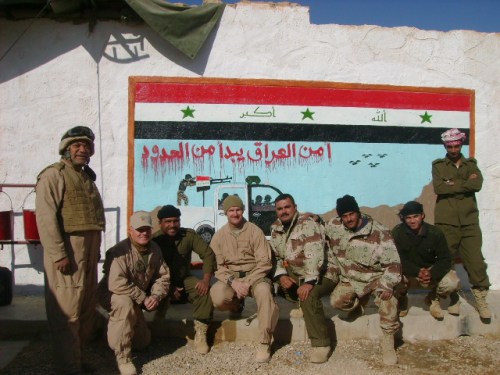
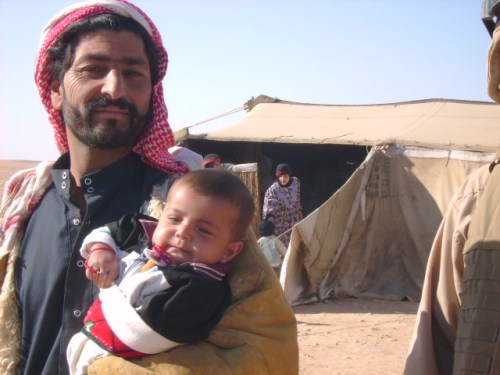
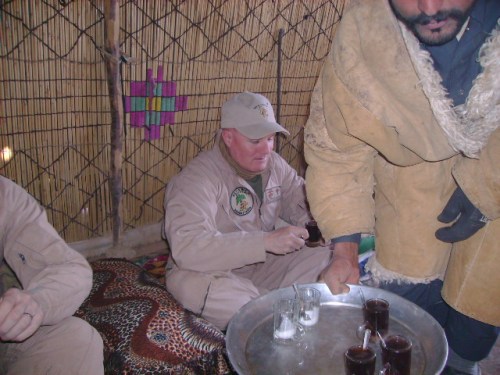
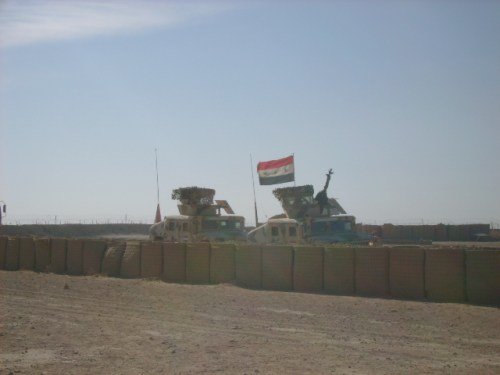
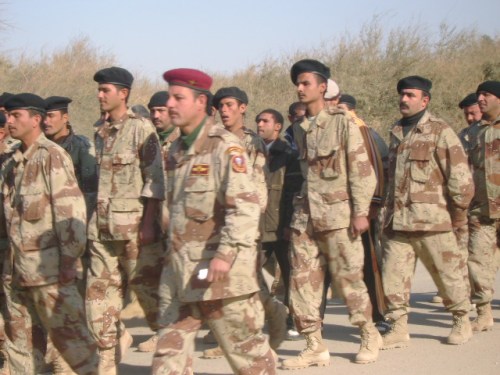
It generated some heated debate and I am sure that more will come. However I am just going to show a photo montage of the Iraqi military, US employed interpreters and former Iraqi officers helping the Iraqi government and US Forces.  The people of Iraq and much of the Middle East are not a monolithic bloc or extremists as many in this country are prone to believe.  Moslems fight every day against terrorists and are killed by the same kind of extremists who took down the Trade Center Towers and inspired Major Hasan in his shooting at Fort Hood.  They are friends and allies in the war against Moslem terrorists.  I post this article to put a human face on those that are often lumped together as the “enemy” simply because of their religion.

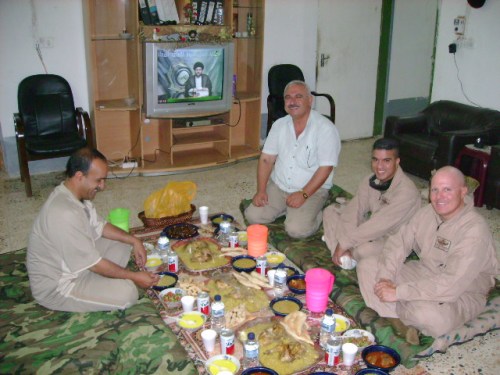
074Dinner with Brigadier General Sabah of 1st Brigade of 7th Iraqi Division in Ramadi. A professional soldier and Shia he sees himself as an Iraqi and ally of the US. The Last time we met in January 2008 in passing at the helo terminal in Ramadi he greeted me with a hug in front of his staff and many American soldiers and Marines calling me a friend.

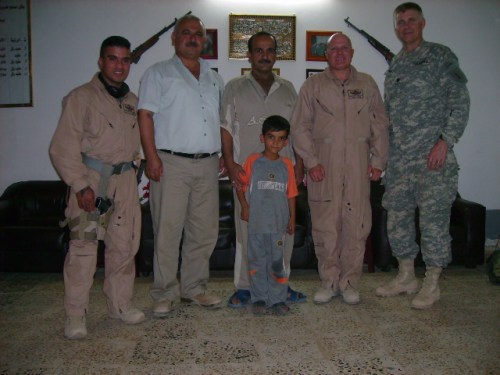
079Group Shot with General Sabah, his youngest son, our interpreter, the American Brigade Senior Adviser and my Assistant RP2 Lebron

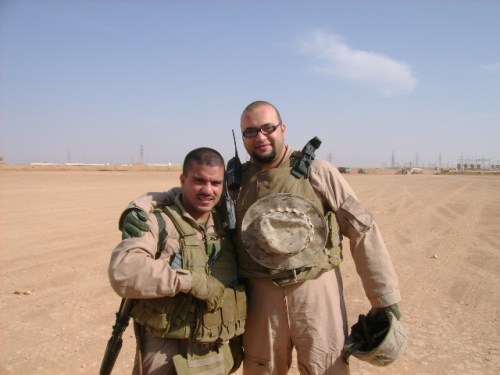
176RP2 Lebron with one of the “Terps” interpreters named “Shaun” originally from Palestine but a Green Bay Packer fan living in Minnesota

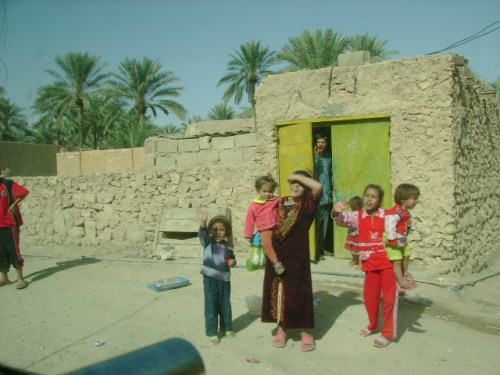
237Iraqi Children Greeting us in a town along the Euphrates

227Iraqi man in traditional garb happy to see us because Americans helped clean out the terrorists from his village

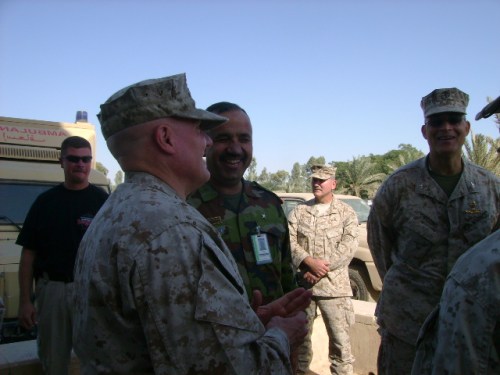
258With Iraqi Officers of 7th Division and Marine Advisers at the 2007 Marine Corps Birthday Cake Cutting at Camp Blue Diamond. Trained by the Marines the 7th and the 1st Iraqi Divisions helped turn the Tide in Al Anbar and the 1st went on to liberate Basra and then to Diyala Province

372Blessing Advisers of 7th Division as they prepared to go with Iraqis to guard a fuel convoy. Following this the Iraqis asked if I would bless them and their vehicles too, it seems they have some kind of Holy Water too and were willing to take the Christian kind as well.

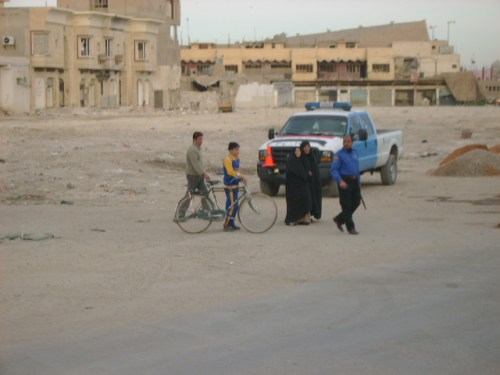
291A man with a Dangerous Job. Iraqi Policeman Escorting Civilians across Route Michigan in Ramadi. Shortly after we took small arms fire and Iraqi Police engaged the target

866With the Leaders of an Iraqi Border Force Company a kilometer from Syria, they like all the Iraqis we dealt with were hospitable offering us Ch’ai as well as food on our visit with the adviser team

880With a Bedouin Family near the Syrian border on Christmas Eve 2007

867Iraqi Border Troops at Border Fort Five near Syria

882Proud Bedouin Father and his son

883The Bedouin Father serves us Ch’ai and cakes

934Iraqi Troops of 7th Division coming back from Patrol on Christmas Day at COP North an isolated post near Syria. While we celebrated they worked and trained.

911One of the Iraqi vehicles in one of our convoy’s near Al Qaim pulling security for us to pass. Our convoys generally had about 3 American and 2-3 Iraqi trucks transiting dangerous areas with very few soldiers, nothing more than 240 series or .50 cal machine guns and far away from any big reinforcements should we have been hit

969New Iraqi Army Soldiers in Basic Training at Habbiniya. Imagine being far away from your family and know that they are in danger just because you serve in the Army

971Chaplains and our Assistants with General  Ali and his staff of the Training and Support Center at Habbinyah. He proudly showed us his well worn Arabic-English Bible. A Moslem he liked it because it had information not in the Koran

973Bakers at the Iraqi Army Bakery in Habbinyah the fresh bread is great

Dundas and FallahWith General Falah Hasan..driven from Iraq by Saddam under threat of death he returned from the United States to help rebuild the Iraqi Air Force and advise the Iraq Assistance Group.When asked what branch of Islam he said “My mother was Sunni, my father Shia I don’t know I am an Iraqi”

Of course I had many more interactions with the Iraqis than just these photos.  There was the G-3 Officer at 2nd Brigade of 7th Division who said that he wished that the Iraqis had Christian Priests to serve as Imams because he knew that they would care for the soldiers and families and were not compromised like many Sunni and Shia clergy.  The Iraqi military, Sunni and Shia distrusts most Moslem clergy because of their political militancy and divisiveness during the worst part of the civil war.  At one time they had Imams during the Saddam era but many commanders refused to appoint Imams.  Then there was the Iraqi Company commander at out in the west who tracked me down to meet the “American Imam and thank him” for serving our Marines and for praying for Iraq and its people. He also said to let people know that if something ever happened between the US and “Persia” that most Iraqis would support us. I could go on but needless to say there are millions of Moslems who fight along side of us as well as the American Moslems who serve in our ranks without being traitors like Major Hasan.   

Peace and blessings,

Padre Steve+


2 Comments

Filed under iraq,afghanistan, Tour in Iraq

A Christian Defense of the Rights of Moslems and Others in a Democracy (or Constitutional Republic)

Martin Niemöller was a war hero.  He had served on U-Boats during the First World War and commanded a U-Boat in 1918 sinking a number of ships.  After the war he resigned his commission in the Navy in opposition to the Weimar Republic and briefly was a commander in a local Freikorps unit. His book Vom U-Boot zur Kanzel (From U-boat to Pulpit) traced his journey from the Navy to the pastorate. He became a Pastor and as a Christian opposed what he believed to be the evils of Godless Communism and Socialism.  This placed him in the very conservative camp in the years of the Weimar Republic and he rose in the ranks of the United Evangelical Church of the Old Prussian Union.  Active in conservative politics, Niemöller initially support the appointment of Adolf Hitler as Chancellor.  However, he quickly soured on Hitler due to his insistence on the state taking precedence over the Church.  Niemöller was typical of many Germans of his era and harbored ant-Semitic sentiments that he only completely abandoned his anti-Semitic views until after he was imprisoned.  He would spend 8 years as a prisoner of the Nazis a period hat he said changed him including his views about Jews, Communists and Socialists.  Niemöller was one of the founding members of the Pfarrernotbund (Pastor’s Emergency Federation) and later the Confessing Church. He was tried and imprisoned in concentration camps due to his now outspoken criticism of the Hitler regime.

Herman Maas was another Evangelical Pastor.  Unlike Niemöller, Maas was a active participant in the ecumenical movement, built bridges to the Jewish community and defended the rights of Jews as German citizens.  He received a fair amount of criticism for his attendance of Reichspräsident Friedrich Ebert’s funeral.  Ebert was both a Socialist and avowed atheist.  Maas too was active in the Pfarrernotbund and the Confessing church, and unlike Niemöller maintained his opposition to anti-Semitism and the Nazi policies against the Jews. He would help draft the Barmen declaration.  He too would be imprisoned and survive the war.  Maas was the first non-Jewish German to be officially invited to the newly formed state of Israel in 1950. In July 1964 Yad Vashem recognized the Maas as one of the Righteous Among the Nations.

Dietrich Bonhoeffer a young Pastor and theologian would also step up to oppose the Nazis and offer support for the Jews.  He helped draft the Bethel Confession which among other things rejected “every attempt to establish a visible theocracy on earth by the church as a infraction in the order of secular authority. This makes the gospel into a law. The church cannot protect or sustain life on earth. This remains the office of secular authority.”  He also helped draft the Barmen declaration which opposed and condemned Nazi Christianity.  Bonhoeffer would eventually along with members of his family take an active role in the anti-Nazi resistance as a double agent for Admiral Canaris’ Abwehr.  For this he would be executed after his final sermon in the concentration camp at Flossenburg just a month prior to the end of the war.  Another opponent of the Nazis in the Confessing Church was Swiss-German theologian Karl Barth.  Barth went into exile as a Swiss citizen but remained active in the criticism of the Nazi regime.

Bishop Galen of Münster and Father and others including Father Rupert Meyer in Munich who opposed Hitler in the early 1920s would also oppose the Nazi policies toward the Church and the Jews.  They would also end up in concentrations camps with some dying at the hands of the Nazis.

All these men took risks to defend the Jews who were religious minority group that had been traditionally discriminated against in Germany.  They opposed the Nazi policies which were widely supported by much of the German populace making them unpopular in their own churches as among the traditionally conservative supporters of the Evangelical and Catholic Churches.  The Jews were not simply discriminated against as a racial or religious group but also identified with the political left, especially the Social Democrats, Independent Socialists, Communists and the Spartacists. Since the Independent Socialists, Communists and Spartacists were all involved in attempts to create a Soviet state during the early tumultuous years of Weimar and been involved in many acts of violence against traditional German institutions and the state, they were viewed by Hitler and others as part of the Bolshevik-Jewish threat to Germany.  Karl Liebnicht and Rosa Luxembourg were among the high profile leaders of this movement in Germany and both were Jewish.  The fact that many in the leadership of the Bolshevik movement in the Soviet Union were Jewish added fuel to the fire that the Nazis stoked in Germany.  Hitler and the Nazis played on the historic, but muted prejudice against German Jews who in many cases were more secular and German than religious and had assimilated well in Germany.  Hitler’s rhetoric as well as that of other Nazis and Nazi publications helped identify the Jews as part of the “Stab in the back” myth that was commonly used by the German right to explain the defeat in the First World War.  Thus they were painted as a political and social threat to Germany.

When Hitler took power persecution of the Jews began in earnest.  Jews were along with Communists, Trade Unions and Socialists enemies of the state.  They were banned from the military, civil service and other government employment, professional associations and forced to wear a gold Star of David on their clothing.  Their property was seized, many were abused by SA men acting as deputized auxiliary police and many times their businesses, Synagogues and homes were vandalized, burned or seized by the state.  Many would be forced to flee in order not to be sent to ghettos and concentration camps.  Even those leaving only escaped with the minimum of their possessions as the Nazi regime extorted anything of value from them as they left Germany.  This was all done because Hitler and those like him portrayed the Jews as not only an inferior race, but enemies of the state and the German people.

Today we face a similar movement in conservative circles in the United States.  This time it is not the Jews, but Moslems who are the targets of xenophobic rage by many influential members of the “conservative” media, including Rush Limbaugh, Sean Hannity and numerous others.  Their popularity in voicing support for “Christian morale values” such as being against abortion has ingratiated them with conservative Christians.  It is so bad that that many “conservative” Christians cannot differentiate between their vitriolic and un-Christian rage against Moslems, Democrats or anyone else portrayed by the big media talkers as the enemy that they have forgotten the Gospel and become simply an appendage to Republican or “conservative” politicians.  It is not uncommon to see Christians on the web or on the call in talk radio programs identify lock stock and barrel with Limbaugh and others identifying the crass materialism and social Darwinism of “pure” Capitalism and the anti-Christian policy of pre-emptive war.   That may seem harsh, but many of these people in the “Conservative Bible project” seek to re-translate the Bible into their own political, social and economic policies even seeking to change or minimize any Scripture that might be equated with the “Social Gospel.”  Unfortunately many Christians and others have jumped in on the anti-Moslem and anti-immigrant crusades launched by those on the far right.

These men and women have found new grist in the wake of the traitorous terrorism of the disaffected and possibly psychotic Major Nidal Malik Hasan at Fort Hood where he killed 13 and wound 30 Soldiers and military civilians.  Why Hasan was allowed to continue to serve after numerous reports of his Anti-American and pro-Jihadist is the question that needs to be investigated.  However the reaction of some is to treat all Muslims as suspect in a collective manner.  This is troubling.  I have posted just a few of the comments by various “conservatives” some who are Christians to demonstrate the point.

Bryan Fischer of the American Family Association is demanding that Moslems be removed from the military or other security related positions in government.  His position is that until we can prove which Moslems are not going to commit acts of terrorism that we should ban them from the military.  His comments are here:

“It it is time, I suggest, to stop the practice of allowing Muslims to serve in the U.S. military. The reason is simple: the more devout a Muslim is, the more of a threat he is to national security. Devout Muslims, who accept the teachings of the Prophet as divinely inspired, believe it is their duty to kill infidels. Yesterday’s massacre is living proof. And yesterday’s incident is not the first fragging incident involving a Muslim taking out his fellow U.S. soldiers. Of course, most U.S. Muslims don’t shoot up their fellow soldiers. Fine. As soon as Muslims give us a foolproof way to identify their jihadis from their moderates, we’ll go back to allowing them to serve. You tell us who the ones are that we have to worry about, prove you’re right, and Muslims can once again serve. Until that day comes, we simply cannot afford the risk. You invent a jihadi-detector that works every time it’s used, and we’ll welcome you back with open arms. This is not Islamophobia, it is Islamo-realism.”

Pat Robertson of the 700 Club and Regent University said:

“Islam is a violent–I was going to say religion–but it’s not a religion. It’s a political system. It’s a violent political system bent on the overthrow of governments of the world and world domination.”

“They talk about infidels and all this. But the truth is, that’s what the game is. You’re dealing with not a religion. You’re dealing with a political system. And I think you should treat it as such and treat it’s adherents as such. As we would members of the Communist party and members of some Fascist group.”

Dave Gaubatz, author of Muslim Mafia said:

Politicians, Muslims, and law enforcement are concerned about a ‘backlash’ against Muslims. Now is the time for a professional and legal backlash against the Muslim community and their leaders.” The post was redacted later by the website that it was on to change “backlash against the Muslim community” to “backlash against the Muslim Brotherhood.”  I guess the website realized that the use of the term community went a bit far.

Brigitte Gabriel of the American Congress for Truth told students at the Joint Forces Staff College  in response to the question “Should we resist Muslims who want to seek political office in this nation?”

“Absolutely. If a Muslim who has — who is — a practicing Muslim who believes the word of the Koran to be the word of Allah, who abides by Islam, who goes to mosque and prays every Friday, who prays five times a day — this practicing Muslim, who believes in the teachings of the Koran, cannot be a loyal citizen to the United States of America.”

Tell that to the Moslem Soldiers and Marines who have given their lives for this country and their fellow warriors in Iraq and Afghanistan.  Some of those include: U. S. Army Corporal Kareem Rashad Sultan Khan who was killed by a roadside bomb in Iraq, U.S. Army Specialist Rasheed Sahib who was accidently shot to death by a fellow soldier in Iraq, U.S. Army Major James Ahearn, killed by a bomb in Iraq, Army Captain Humayun Khan, who lured a suicide car bomb away from the men in his charge, saving their lives but giving up his own, Army Spc. Rasheed Sahib, an American Muslim from Guyana, Army Spc. Omead Razani, a son of Iranian immigrants or Marine Staff Sgt. Kendall Damon Waters-Bey, who was killed in a helicopter crash, and sadly many more.

Popular Talk Radio host and Fox News commentator Glenn Beck made this comment back in December 2006:

“I’m telling you, with God as my witness… human beings are not strong enough, unfortunately, to restrain themselves from putting up razor wire and putting you on one side of it. When things—when people become hungry, when people see that their way of life is on the edge of being over, they will put razor wire up and just based on the way you look or just based on your religion, they will round you up. Is that wrong? Oh my gosh, it is Nazi, World War II wrong, but society has proved it time and time again: It will happen.”

Timothy Rollins of the American Partisan suggests in the wake of the Fort Hood shootings:

“While the dust is still settling and everything starts getting sorted out with the usual deflections away from the truth that this administration is notorious for doing, there is no better time than now to improve the safety of our military, and this can best be done by enacting the Great Muslim Purge from our military and other national security apparatuses. These people need to be removed from every security post, even to be completely removed from all levels of government employment, be it federal, state, county, city or other municipality. This applies especially to universities. To keep them employed in these positions places our food, water, and other essential services at unacceptable risk.”

Of course there is Doug Giles an unabashed “Christian” columnist for Townhall.com using scripture to justify torture making this delightfully Christian comment in one of his columns about the practice of water boarding:  “Please note: If Christ wasn’t cool with irrigating irate Islamicists for facts, I must admit, I would still have to green light our boys getting data from enemy combatants 007 style. Stick a fire hose up their tailpipe and turn it on full blast. I don’t care. I’m not as holy as most of you super saints or as evolved as some of you progressive atheists purport to be. Security beats spirituality in this scenario, as far as I’m concerned.”

This is so similar to the Nurnberg Laws and the Aryan Paragraph issued by the Nazis that it is scary.  Likewise the threats to American Moslems of placing them “behind razor wire” as we did to American Japanese citizens in World War II are chilling.  I wonder how Christians would react if an atheist or someone on the political left suggested all conservative Christians or members of pro-Life groups be imprisoned for the actions of Christians or pro-Life movement members like Scott Roeder or Eric Rudolph who killed to stop abortion or Fred Phelps and his Westboro Baptist Church?

This new found militancy has swept up the “Christian right” and others since 9-11 and has reached proportions that I could never have imagined. After my tour in Iraq I realized that much of what these people were saying was not Christian at all and when taken to their logical conclusion would be a police state in which anyone who opposed them would be persecuted. In Iraq I met many good Moslems fighting on our side against jihadists and terrorists many of whom have great respect and appreciation of the Christian faith and are more tolerant to Christians than many Christians are to Moslems.  These men put their families at risk to side with us to try to free Iraq from Al Qaida terror.  Almost all had lost family and friends to extremists.

As for the suggestions or demands that all Moslems be investigated and removed from the military these people insist that such action is necessary in the name of “security” and “protecting the Constitution.” All Moslems, even those who are loyal American citizens as well as those from Iraq and other nations who fight and die alongside Americans are placed on the same level as the fanatics and terrorists.  I question the motivations of the leaders of the movement but believe that most of the Christian conservatives have been caught up in the anger and the emotion of the times versus being true believers in what these men say.  That being said, you don’t have to be a true believer to be a willing accomplice in actions that first are not Christian and second trample on the Constitutional rights of American citizens.

I could keep citing examples but if someone can show me where this is condoned in the Gospels I would like to know.  The fact is that Christians are to place God first and defend the rights of others, even non-believers.  This is found not only in Scripture but runs through the Christian tradition across the denominational spectrum unfortunately there are Americans such as Marine Reservist Jasen Bruce have gone “terrorist hunting” and misidentifying a Greek Orthodox Priest as a Jihadist attacking him because of he didn’t speak English. http://www.tampabay.com/news/publicsafety/crime/article1050707.ece Admittedly people like Bruce are idiots, but it doesn’t take much to push some people over the edge.

The fact that so many people are suggesting such actions against American Moslems is troubling on a number of levels especially when those doing so claim to be Christians.  First is that it is the Church, or member’s thereof adopting a non-Christian worldview and attempting to use the state to enact legislation and laws against minority groups that they oppose, in this case the Moslems.  The fact that we live in a secular state, something that many of our Nation’s founding Fathers intended it to be, especially in regard to religion being mandated by the state is a point lost on many of these people.  Many Christians have completely embraced the mythology of the United States being a “Christian Nation.” With some even regarding the Constitution as a God inspired document.  For a more detailed critique of the Christian Nation mythology see Jared Holloway’s article on his Saepe Nihil Cogitamus website: http://jzholloway.wordpress.com/2009/08/04/did-the-founding-fathers-usa-found-the-nation-as-a-christian-nation/

Thankfully there are some, including the daughters of one of the men killed by Major Hasan who said on CBS The Early Show Kerry Cahill said:

“You can’t blanket a whole group of people. There’s extremists in every religion, and there’s extremists all over the world…when this man was obviously ill, I think.” Her sister Keely Vanacker said, “The death of our father or any of these victims shouldn’t be an excuse or a reason to begin to hate an entire group of people.”

There are also leaders of the Religious Right who have taken a stand against such action, Reverend Rob Schenck, President of the National Clergy Council, comments in regard to the Moslem prayer vigil in Washington D.C. earlier this year:  “With over 1.5 billion Muslims in the world, it is important that Christians have an open dialogue with the Islamic community. The church must never be timid in reaching out to peoples and groups with differing beliefs and traditions. Too much is at stake for future generations not to begin this historic conversation. This is an opportunity that we cannot afford to miss.”

And the Reverend Patrick J. Mahoney, Director of the Christian Defense Coalition states:

“The heart of Christ is to reach out and build bridges to all peoples regardless of what their faith traditions or beliefs might be. Several years ago the Christian Defense Coalition began reaching out to the Muslim world which resulted in a prayer delegation going to Baghdad to pray for the nation of Iraq and Prime Minister Maliki. Since then we have had many conversations and discussions with Islamic leaders in Washington, D.C. and around the world. This news conference gives us another chance to dialogue and share with our Islamic neighbors. It also gives us the platform to celebrate the greatness of America where everyone is allowed to practice their faith tradition in the public square free from government interference of harassment. The prayer vigil on the lawn of the Capitol this Friday highlights that timeless truth. Since 9/11, the church should not run from Muslims in America but begin reaching out with God’s love.”

What the good people who suggesting these punitive actions against American Moslems do is dangerous, not just for Moslems and other minorities but for them.  American and English law is based on legal precedence.  Once something has been determined to be legal, or constitutional it is considered by the law to be settled law.  This is a point made by Chief Justice Roberts regarding Roe v. Wade at his confirmation hearings.  If Christians want to use the law against Moslems or for that matter any other minority be it religious or political they tread on very dangerous ground.  Not only do they make a mockery of the Gospel command to love our neighbors, care for the foreigners among us and to be a witness to non-Christians support policies or laws that if enacted could and very well would be used against them by their opponents.  Law is all about precedent and if such laws were enacted and upheld by the courts they would be settled law that could be used against anyone.   What these dear brothers and sisters fail to realize is that such laws can be turned against them if the state should ever decided based on the statements of actions of some that the Christian community is a threat to state security of the public welfare.  With the actions of some radical Christians who have committed murder and violence against political, social and religious opponents it would not be hard for the government to label whole churches as enemies of the state.  The law is a two edged sword and those who want to use it to have the state enforce their religious, social, ideological or political beliefs on others need to remember what comes around goes around.

The Confessing church understood this and many were imprisoned, exiled or killed for this belief.  The founding fathers of this country understood this too, that is why there is the Constitution protection of Religion in the First Amendment.  This was put in because Virginia Baptists who had been persecuted by Anglicans lobbied James Madison for the amendment in the Bill of Rights threatening to withdraw their support for his candidacy if he did not.  Niemöller would discover the depths of his earlier folly in prison telling one interviewer after the war:

“I find myself wondering about that too. I wonder about it as much as I regret it. Still, it is true that Hitler betrayed me. I had an audience with him, as a representative of the Protestant Church, shortly before he became Chancellor, in 1932. Hitler promised me on his word of honor, to protect the Church, and not to issue any anti-Church laws. He also agreed not to allow pogroms against the Jews, assuring me as follows: ‘There will be restrictions against the Jews, but there will be no ghettos, no pogroms, in Germany. I really believed given the widespread anti-Semitism in Germany, at that time—that Jews should avoid aspiring to Government positions or seats in the Reichstag. There were many Jews, especially among the Zionists, who took a similar stand. Hitler’s assurance satisfied me at the time. On the other hand, I hated the growing atheistic movement, which was fostered and promoted by the Social Democrats and the Communists. Their hostility toward the Church made me pin my hopes on Hitler for a while. I am paying for that mistake now; and not me alone, but thousands of other persons like me.”

It is easy for well meaning people Niemöller to be bought with promises of support by politicians and media types who speak the words they want to hear in difficult times.  So today I suggest the formation of an ecumenical Pastor’s Emergency League which will not be bought by the empty and godless promises of hate mongers on the right or the left.  Such a group of men and women spanning the breadth of the Christian tradition and others that see the danger of extremism of all types is becoming necessary.  Such a step is becoming necessary due to the militancy of the Christian right as well as the militancy of atheist groups who lobby against all public religious expression by any religion.  Such a League would respect the various creeds and statements of faith of each member’s denomination.  The movement o the right has set a dangerous course fraught with perils that they do not comprehend. Just allow those that they believe are oppressing or persecuting them now to be empowered with the precedent of laws discriminating against specific religious groups against the Christians that supported them in the first place.  It will be a bitter poison indeed when that happens to them later if American Moslems were to be targets by such laws.

We have entered a dangerous phase of American history.  These movements have the potential not only to oppress law-abiding and patriotic American Moslems and to crush the religious freedoms of all in this county. Suggesting that American citizens, including those who serve the county in the military or government of entire religious or ethnic groups be  targeted for punitive action on the basis of extremists and fanatics like Major Hasan sets a precedent that is chilling.

Niemöller would say it well in this poem:

First they came for the communists, and I did not speak out—because I was not a communist;
Then they came for the socialists, and I did not speak out—because I was not a socialist;
Then they came for the trade unionists, and I did not speak out—because I was not a trade unionist;
Then they came for the Jews, and I did not speak out—because I was not a Jew;
Then they came for me—and there was no one left to speak out for me.

Peace,

Padres Steve+

40 Comments

Filed under History, iraq,afghanistan, Military, philosophy, Religion

Veteran’s Day: Goodbye to 666 Lake of Fire Circle, a Golf Outing and Remembering the Veterans in my Life

veteransday2009

Today was Veteran’s Day. Amid the solemnity of the day I am still in California where I came this week to try to help my mom with my dad’s affairs and to also see my dad who is definitely in the end stages of Alzheimer’s disease.  This has been the hardest trip home in my life.  I knew I had to come, although the Abbess was against it fearing for my emotional health and perhaps she was right.  Tonight I sit in a hotel room self medicating and trying to regain some sense of sanity.

Me and last last picDad and Me back in May…He Still knew Me then

The past few days have been hell.  My dad does not know me anymore; he has almost no response to anything and stares straight ahead.  The hardest part is when I realized that he didn’t know me.  So I asked if he had seen my mother who I had taken to visit him the day before and my brother.  He said that he had seen them, and even seen my mom the morning I asked him the question.  However she had not been there that day.  So I asked if “Steve had visited yesterday.”  He got agitated and said “I don’t know any Steve yesterday.”  Today was much the same, I asked if he knew who Steve was, and he said “yes” and I asked if he had seen him and he said “no he hasn’t been here.”  This whole trip he has probably spoken under 50 words in 4 visits.  There is nothing left. For all practical purposes he is dead in a body that won’t die.  If that was not bad enough my mother has not skipped any opportunity to attack and pick at me until I broke.  I begged her to lay off, told her that I was not up to fighting with her and tried to keep my cool but she wouldn’t let up.   I cannot deal with constant conflict and a mother who calls me “a weak, politically correct pansy.”  I’m a combat veteran and went to war unarmed into hostile territory with little groups of Americans far away from the big battalions with all the heavy weapons and the women called me a “weak, politically correct pansy.  She has put me down, belittled my education, vocation and career and insulted my wife for the last time. When I told her that “everything in her life that was wrong was somebody else’s fault and not hers” she agreed.  I knew it was over at that point. This may sound un-Christian but I will not go see her again.   Tomorrow I will see my dad for what it is worth, see my brother and his family and then early Friday I will get the hell out of Dodge.  She had offered to pay for my trip out but I can’t prostitute myself for that kind of abuse.    The next time I come back it will be for my father’s funeral.  I love my brother and his family.  He and his wife are saints.  I couldn’t live that near my mother without ending up in a psychotic state, something that I came perilously close to this week.  God bless Jeff, Mel and their kids.

Me and Jeff at mickey groveWith my Brother back in May

I went golfing with my brother and nephews today.  For much of the day I couldn’t hit water if I fell out of the damned boat.  My mind was so gooned up and upset by the events of the week I couldn’t concentrate worth a shit.  Even my well hit shots were mainly slicing to the right and I embarked on a tree killing expedition.  I hit 7 trees solidly, took down a couple of decent sized branches, grazed three other trees and nailed an outhouse.  However it was really good to be out with Jeff, Darren and Nate.  Nate can really hit the ball for an 8 year old; he has the potential to be a really good golfer.  Darren doesn’t really care and is out to have fun.  He enjoyed my sarcasm as I commented on my shots and helped keep track of the number of trees that I hit and I told him that I would see how many I could try to kill before the day was out.  By the end of the round I was hitting the ball a lot better and it was going more often than not where I wanted it to go, but the first 7 holes were hell.  It makes me think of Robin Williams’ golf routine. http://www.youtube.com/watch?v=xDQd49rEF_0

As I mentioned today was Veteran’s day.  After I got my hotel I went to a local Applebee’s where I had a sirloin steak and potatoes and a couple beers on their Veterans’ day salute.  I sat at the bar with a couple about 10 years older than me; he had served on a Navy Minesweeper in Vietnam.  They were nice; I think that is why I like sitting at the bar when I go out to eat, there is a sense of community that you don’t find a lot of other places.

As it is Veteran’s day I think I will take some time to remember some of the Veterans in my life who have helped my through my life and career.  This is taken from a post that I did around Memorial Day.

I’ve been in the military for almost 28 years now.  I enlisted in the National Guard while in college and entered Army ROTC back in 1981.  Since then it has been to quote Jerry Garcia “a long strange trip.”  My dad served twenty years in the Navy.  He retired in 1974 as a Chief Petty Officer and did time surrounded in the South Vietnamese city of An Loc when it was surrounded by the North Vietnamese for 80 days in 1972.  He didn’t talk about it much when he came back; in fact he came back different from the war.  He probably suffered from PTSD.  All the markers were there but we had no idea about it back then, after all he was in the Navy not the Army.

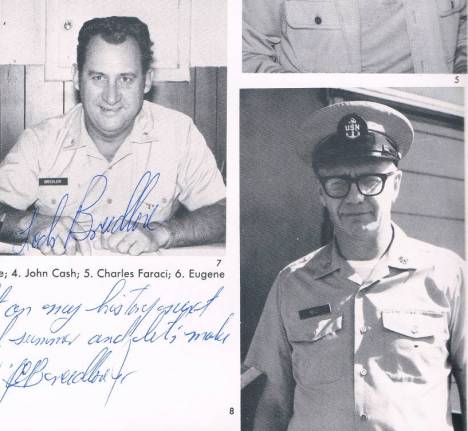
breedlove-ness2LCDR Breedlove and Chief Ness

My second view of war came from the Veterans of Vietnam that I served with in the National Guard and the Army.  Some of these men served as teachers and mentors.  LCDR Jim Breedlove and Senior Chief John Ness at the Edison High School Naval Junior ROTC program were the first who helped me along. They have both passed away in the past year and a half.  I will never forget them.  A post dedicated to them is on this blog. Colonel Edgar Morrison was my first battalion commander.  He was the most highly decorated member of the California National Guard at that time and had served multiple tours in Vietnam.  He encouraged me as a young specialist and officer cadet and showed a tremendous amount of care for his soldiers.  Staff Sergeant’s Buff Rambo and Mickey Yarro taught me the ropes as a forward observer and shared many of their Vietnam experiences. Buff had been a Marine dog handler on the DMZ and Mickey a Forward Observer.  Sergeant First Class Harry Zilkan was my training NCO at the UCLA Army ROTC program.  He was a Special Forces Medic with 7th Group in Vietnam.  He still had part of a VC bayonet embedded in his foot.  He received my first salute as a newly commissioned Second Lieutenant as well as a Silver Dollar.  I understand that after the Army he became a fire fighter.  He had a massive heart attack on the scene of a fire and died a few years later from it.  Sergeant Major John Butler was our senior enlisted at UCLA.  He served with the 173rd Airborne in Vietnam.  Sergeant First Class Harry Ball was my drill sergeant at the ROTC pre-commissioning camp at Fort Lewis Washington in 1982.  He was also Special Forces and a Ranger and served multiple tours in Vietnam.  He was quite influential in my life, tearing me apart and then building me back up.  He was my version of Drill Sergeant Foley in An Officer and a Gentleman. Like Zack Mayo played by Richard Gere in the movie I can only say: Drill Sergeant “I will never forget you.”

As I progressed through my Army career I encountered others of this generation who also impacted my life. First among them was First Sergeant Jim Koenig who had been a Ranger in the Mekong Delta.  I was the First Sergeant that I would measure all others by.  Once during a ARTEP we were aggressed and all of a sudden he was back in the Delta. This man cared so much for his young soldiers in the 557th Medical Company.   He did so much for them and I’m sure that those who served with him can attest to this as well as me. Jim had a brick on his desk so that when he got pissed he could chew on it.   He was great.  He played guitar for the troops and had a song called Jane Fonda, Jane Fonda You Communist Slut. It was a classic.  He retired after he was selected to be a Command Sergeant Major because he valued his wife and family more than the promotion.  It hurt him to do this, but he put them first. Colonel Donald Johnson was the commander of the 68th Medical Group when I got to Germany in January 1984.  Colonel “J” as well all called him was one of the best leaders I have seen in 28 years in the military.  He knew everything about everything and his knowledge forced us all to learn and be better officers and NCOs.  On an inspection visit you could always find him dressed in coveralls and underneath a truck verifying the maintenance done on it.  He served a number of Vietnam tours.  He died a few years back of Multiple Myeloma and is buried at Arlington.  Chaplain (LTC) Rich Whaley who had served as a company commander in Vietnam on more than one occasion saved my young ass at the Army Chaplain School.  He remains a friend and is the Endorsing Agent for the Church of Jesus Christ of Latter Day Saints. As a Mormon he was one of the most “Christian” men that I have ever met.  I know some Christians who might have a hard time with that, but Rich demonstrated every trait of a Christian who loved God and his neighbor.

MVC-023SMe with Major General Frank Smoker USAF (Ret) and Colonel Tom Allmon 2005

When I was the Installation Chaplain at Fort Indiantown Gap PA I was blessed to have some great veterans in my Chapel Parish.  Major General Frank Smoker flew 25 missions as a B-17 pilot over Germany during the height of the air war in Europe. He brought his wonderful wife Kate back from England with him.  Henry Boyd who I buried was one of the 101st Airborne soldiers epitomized in Band of Brothers. He had a piece of shrapnel lodged next to his heart from the Battle of the Bulge until the day he died. Scotty Jenkes was an Air Force pilot in Vietnam flying close air support. Colonel Ray Hawthorne served several tours both in artillery units and as an adviser in 1972.  CWO4 Charlie Kosko flew helicopters in Vietnam.  All these men made a deep impact on me and several contributed to my career in very tangible ways.

051Ray and his Crew from The Vietnam Veterans of America at Harbor Park

My life more recently has been impacted by others.  My friends of the veterans of the Battle of Hue City including General Peter Pace, Barney Barnes,  Tony “Limey Cartilage ” Sergeant Major Thomas and so many others have become close over the years, especially after I did my time in Iraq. They and all the Vietnam vets, including the guys from the Vietnam Veterans of America like Ray and John who man the beer stand behind the plate at Harbor Park all mean a lot to me.  My friends at Marine Security Forces Colonel Mike Paulovich and Sergeant Major Kim Davis mean more than almost any people in the world.  We traveled the globe together visiting our Marines.  Both of these men are heroes to me as well as friends.

boarding teamUSS HUE CITY Boarding Team 2002

Finally there are my friends and brothers that I have served with at sea on USS HUE CITY during Operation Enduring Freedom and the advisers on the ground in Al Anbar mean more than anything to me. Perhaps the most important is my RP, RP2 Nelson Lebron who helped keep me safe and accompanied me all over the battlefield.  Nelson who has done Iraq 3 times, Afghanistan, Lebanon and the Balkans is a hero.  The men and women of Navy EOD who I served with from 2006-2008 have paid dearly in combating IEDs and other explosive devices used against us in Iraq and Afghanistan are heroes too.  There is no routine mission for EOD technicians.

307With 1st Brigade 1st Iraqi Division Advisers in East Ramadi January 2008

I give thanks for all them men that I mention in this post, especially my dad. God bless all of you guys. Please honor the Veterans that you know not only on Memorial Day or Veterans’ Day but every day.   Honor also those who gave their lives in the defense of liberty in all of the wars of our nation. They have earned it.

Today as I write many of my friends serve in harm’s way.  I hope that my recovery, spiritually, emotionally and physically goes well enough that I can go back with them.  For now I need to recover. My boss is right about that, if this week is any indication I’m in no shape to go back to a combat zone, bit Lord willing I will be so I can be with those I care for and serve alongside.

Peace,

Padre Steve+

Post Script: I do pray that no one takes offense at my words regarding my dealings with my mother. If someone thinks that I am wrong, or out of line they can contact me privately.  However, I have to protect me now.  I can’t help her or save her so I’m done.

12 Comments

Filed under alzheimer's disease, golf, iraq,afghanistan, Military, PTSD

Going to War: Life at TQ, Chuck Norris Visits and Mass Casualties

While we prepared for our first mission we adjusted to what life was like on a large airbase and logistics hub. Ta Qaddum is one of the larger Iraq Air Force bases from Saddam’s time but has a history going back to the old Royal Air Force base at Habbinyah which is just down the hill.  In 1941 the Iraqi Army laid siege to the British forces in Habbinyah from the escarpment that overlooks the town from what is now the northern edge of TQ.  One only has to imagine the feelings of the Iraqi soldiers short on supply and exposed to air attack on the escarpment while waiting for German intervention only to be driven off by the British when their relief force arrived from Jordan.

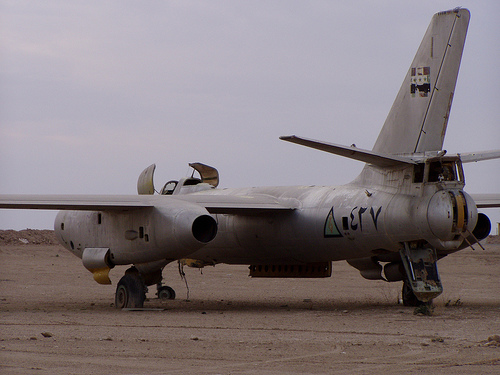
iraqi bomber at tqWrecked Iraqi Bomber at TQ

The Iraqi legacy on the base looms in some of the infrastructure as well as the hulks of Soviet made Iraqi Air Force bomber and fighter aircraft near the edge of the airfield.  When I was there in 2007-2008 the base was under the command of the 2nd Marine Logistics Group or 2nd MLG.  The MLG is a command and control headquarters for logistics support units of the 2nd Marine Expeditionary Force.  It is tailored to support the Ground Combat Element, the 2nd Marine Division and the Air Combat Element, the 2nd Marine Air Wing and attached units.  Its function is similar to an Army Corps Support Command or whatever the Army calls them now.  TQ was also the home of several helicopter squadrons Marine and Army as well as a local defense force at the time made up of the 1st Battalion 11th Marines from Camp Pendleton. 1/11 was an artillery battalion but was being primarily used as a security and convoy protection force.  Other units including Navy Seabees and Army logistics units operated from TQ.  A Marine Infantry Battalion was stationed in Habbinyah while elements of a Marine Expeditionary Unit (MEU) were operating in the area as part of the surge.

The base is about mid-range on the amenity scale for troop comfort. At the time we were there the only non-DFAC/ Chow Hall was the Green Beans Coffee trailer as opposed to places like Al Asad and Camp Victory which had a multiplicity of fast food places for the troops.  The Marines are tougher on communication security than the Army and many websites which troops could use on other bases were unavailable unless one went to the Iraqi internet café or the MWR computer and phone center.  The Iraqi run shop had the fastest internet on the base but you had to contend with huge amounts of second hand smoke and pay a nominal charge to use it.  The MWR facility often had broken machines, had a waiting list to use them and the connections were very poor with pages slower to load that the old dial up days.  On the plus side TQ did have a relatively decent Marine Corps exchange, not as big as Al Asad or Camp Victory, but one of the larger exchanges in Iraq and second only to Al Asad in the West.  Most places including Ramadi had pretty small and not well stocked exchanges.  TQ had nice fitness center facilities which I used a lot being coached by Nelson.

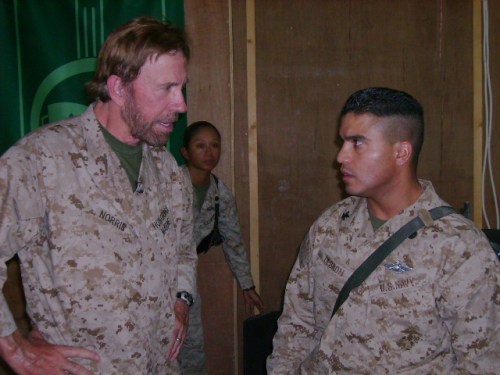
060Chaplains and RPs with Chuck Norris

The base MWR worked with the USO and other agencies to bring sports stars or celebrities to the base.  Just before we left on our first mission Chuck Norris came through.  Chuck was made an “Honorary Marine” a few years back and has made it his task to try to meet every Marine deployed in Iraq and Afghanistan, shaking the hand of each one he met.  The chapel was the host facility for the visit which last about 2 hours in which Chuck pressed the flesh and had his picture taken with probably close to 5000 Marines and other personnel, maybe more.  The Chaplains were drafted to be the photographers and I lost count of how many different types of digital cameras that I took pictures with.  Chuck enjoyed the heck out of Nelson and was impressed with his fighting resume.  I think that Nelson got more face time with Chuck than anyone on the base and he deserved it.  Chuck was accompanied by Chaplain Langston and RP1 Roland our friend from Fallujah.  After they were done he had to get on the waiting helo and fly out to his next stop.

058Chuck and Nelson

The chow halls, of which there were two, were large and usually had a pretty good menu.  I especially came to like the Indian nights where Indian specialties were served.  Since many of the cooks employed by Gulf Catering who had the contract were Indian, Pakistani, Bangladeshi or from Ceylon so it generally was pretty good unless they had to scrounge for suitable ingredients.  I like the curry chicken, but occasionally it was made with chicken nuggets when the real chicken was in short supply.  It almost reminded me of the Spam Lamb in the TV series M*A*S*H or the great quote out of the movie Meatballs: “Attention. Here’s an update on tonight’s dinner. It was veal. I repeat, veal. The winner of tonight’s mystery meat contest is Jeffrey Corbin who guessed “some kind of beef.”   I think that there were a number of times when I really wondered what the meat was.  They usually had a pretty good salad bar unless resupply convoys were interrupted and fresh vegetables had run out.  There were a number of times where the pickins were slim and Nelson and I had to get creative.  Breakfast was usually good with a good choice of food choices, some even healthy.  The workers were great, always friendly despite working 12 hour days 6 days a week for $300 a month.  Many had signed up through agencies which cost them $4000 so the first year that many worked was for nothing.  It was in my opinion a case of a KBR/ Halliburton subcontractor using them in effect as indentured servants and pretty well damned close to slaves, all legal by the US Government.  I thought that it was pretty immoral and certainly a case of a company contracted by the government reducing labor costs on the back of some of the poorest people in the world. Back at the end of the Cold War the military downsized and eliminated most of the Army and Marine mess specialists which paved the way for the contracting industry, led by the former Secretary of Defense and his Halliburton team to begin their massive contracting operations with the Bosnia deployments back in 1995.  They were limited to their own compound far away from anything and were always the last to eat.  They were polite and really tried to accommodate sometimes rude and condescending Americans, the local management did the best they could to give them good accommodations but were limited by their parent company.  Many of the workers were Roman Catholic or Anglican Christians  and Fr Jose had a great ministry that he took on to support them by going to their camp a couple of times a week to celebrate Mass.  His masses were packed and what a source of life and the love of God he was to so many people at TQ, Americans and non-Americans alike.

988Fr Jose on the bank of the Euphrates at Habbinyah

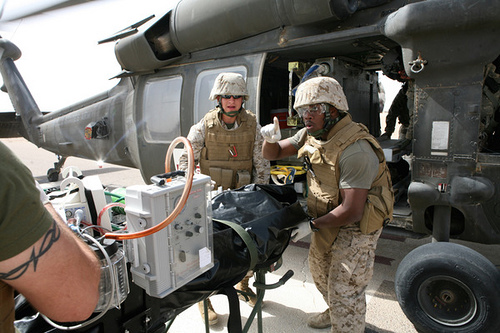
About a week after we got to TQ Marines from the battalion in Habbinyah were hit in an IED complex ambush while on patrol.  A couple of vehicles were hit, Jose was across the base celebrating Mass and Pat was in Fallujah.  A chaplain was needed in the Shock Surgical Trauma Unit or SSTP.  Wounded were being brought in, the platoon had been hit hard, 14 wounded and a couple killed.  I figured that since I was a pretty experienced trauma and critical care chaplain who had dealt with over 500 deaths, many traumatic with bullet wounds, burns and the host of other types of trauma, and tended to probably twice that many who did not die that I could handle this.  When I got to the SSTP I was greeted by a couple of nurses and docs and briefed as to what was going on.  Within a few minutes the casualties were beginning to roll in as the UH-60 Dust-off MEDIVAC helicopters landed and teams went out to meet them.  Some were ambulatory, or walking wounded bandaged with lacerations and burns on their faces and upper bodies, other were brought in on stretchers and ushered into the treatment beds in the area outside the OR.  It was like a scene out of M*A*S*H as the well honed surgical teams, surgeons, anesthetists, nurses and corpsmen went to work.  I now work with a number of these fine people. I was able to make my way about to the wounded Marines, praying with some, holding hands as and with a couple performing the sacrament of healing, or the anointing of the sick.  As I listen to Marines, prayed with them or anointed them there was a tremendous sense that this was different than what I did at Parkland or Cabell-Huntington.  These young men wore the same uniform that I wore, served the same country that I served and travelled the same roads that I would soon be on.  As each was assessed and moved off to surgery, prepared for further evacuation or treated and sent to a ward I noticed the little things about each of them.  The wounds, the torn uniforms, the burns and even the tattoos, these were our guys, they weren’t gang bangers or criminals but young Americans fighting a brutal war against a enemy that had terrorized Iraqis and found devastating ways to kill Americans.  Some of the Marines asked if they would be okay, others asked about friends and in those moments I learned what it was to care and be with men traumatized by the violence and brutality of war against an enemy that would not fight by our rules, much as the North Vietnamese and Viet Cong refused to fight our war.  The enemy was clever and determined and his weapons were deadly.

Stars and Stripes sstpTQ Surgical During Mass Casualty Event (Stars and Stripes Photo)

The teams did their work quickly and soon the event in the ER was done as the Marines were moved off to OR, the ward or further evacuation. I spent some time talking with unit Corpsmen and less wounded Marines and learned about the attack. They were in a convoy heading back to Habbinyah when the there was an enemy contact ahead of them.  As they moved forward to engage a primary and secondary IED hit the convoy heavily damaging two trucks with an ensuing firefight.  The Marines fought off their attackers, the wounded were treated and security set up as Dust-off came in to evacuate the wounded.  I thought back to my days as a Medical Service Corps Officer in the Army and remembered my friends who had elected to apply for flight school to become Dust-off pilots.  I remembered learning to call in MEDIVAC missions and some of the Army MSC aviators that I knew; some had flown in Vietnam, being a Dustoff pilot can be a sporty occupation.  They fly an unarmed bird into hot landing zones and get badly wounded troops to medical facilities in 100 degree plus weather without killing them enroute, those guys are good. As the crowd dissipated I spend so time with some of the staff.  Eventually with night having fallen I began the walk back to my office in the Chapel.  I looked up at the night sky, in the darkness a another UH-60 sat down to pick up others being evacuated on to Baghdad or Balad.  I looked up at the sky and saw more stars than I had seen at any time since I was at sea on the USS HUE CITY.  It was amazing; it looked like you could almost walk across them from horizon to horizon. When I got to my office I checked on my our mission status, I had submitted our first Air Support Request earlier in the day, of course it had not moved yet, but at least it gave me something to do.  I checked my unclassified e-mail and knew that there was nothing that I could share with anyone so I looked at baseball scores, checked a couple of news sites and headed off to my “can.”

medivacPackaging a Casualty for Further Evacuation on the TQ Surgical Pad

That night I did not sleep well, the images of the wounded Marines were burned into my mind; I could see their faces, their wounds and their tattoos.  I prayed the office of Compline from the Book of Common Prayer using Psalm 91 and the prayer “Be our light in the darkness, O Lord, and in your great mercy defend us from all perils and dangers of this night; for the love of your only Son, our Savior Jesus Christ.  Amen.” I took some comfort in this, walked out again into the night to see illumination rounds in the vicinity of Habbinyah and the distant sound of automatic weapons fire.   For once my insomnia was not related to jet lag or exhausting night flights, it was instead a realization that what happened to these Marines could well happen to me as I we launched later in the week.

The next morning another eight or ten Marines from the same company came in, this time I went to the SSTP with Jose and we did a tag team match, we tried to determine religious affiliation of the wounded Marines with him taking the Roman Catholics to provide sacramental needs and me taking the rest.  Once again the images were vivid; these Marines were on a mission to recover the damaged vehicles and were hit by IEDs on their way back to base.  This time one Marine was killed.  I walked to the graves registration and mortuary affairs team with the battalion surgeon and a corpsman who were to identify the body.  I listened to their frustration and heartache as they described what they had been through the past two days.  The company had taken over 20 casualties including 3 dead.  A high percentage of casualties for a unit that probably numbered about 120 men.  Once again I walked back, this time in the hot mid-morning sun with Jose to the Chapel.  We talked for a while about the past two days, he knew the battalion that had been hit well as he supported them as well.  The surgeon was one of his parishioners.  After we went our separate ways I did my morning prayer and settled in to study more about where we were going.  Nelson and I got PT later in the evening and I spent a restless night in my “can” playing computer Maj-Jong and Chess on my laptop deep into the morning.  Once again I spent time walking in the dark looking at the vast sea of stars above me.

3 Comments

Filed under iraq,afghanistan, Military, Tour in Iraq

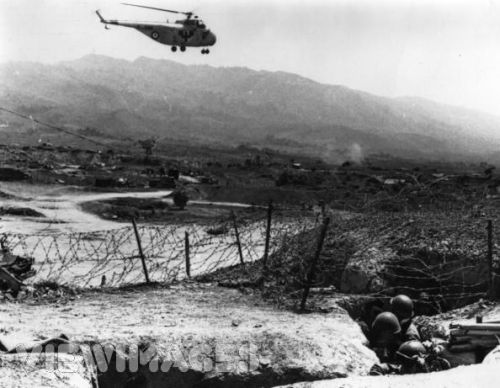
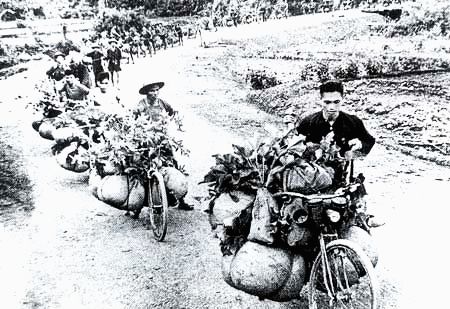
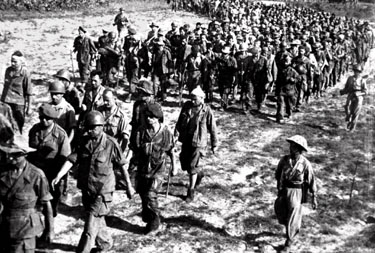
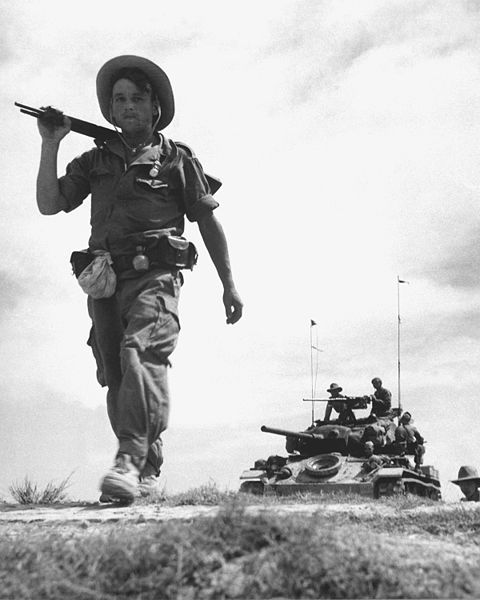
Lessons for the Afghan War: The Effects of Counterinsurgency Warfare on the French Army in Indo-China and Algeria and the United States Military in Vietnam

Note: This is an article that I wrote for a class a year ago which has been updated in order to show the lessons of history that can be useful in the current wars in Iraq and Afghanistan.

legion indo-china

French Foreign Legionnaires in Indo-China

The effects of the wars Indo-China, Algeria and Vietnam on the French and American military organizations internally and in relationship to their nations piqued my interest in 2005. The wars in Iraq and Afghanistan forced me to start asking the question of what short and long term effect that these wars might have on the U.S. military.  As such I wondered what historical precedent that there was for the question. My interest was furthered by my deployment with Marine and Army advisors to Iraqi Army and Security forces in 2007-2008.  My search led to the French experiences in Indo-China and Algeria and the American experience in Vietnam.  Recently with the Iraq war winding down and ongoing war in Afghanistan which has gone from apparent victory to mounting concern that the effort could fail as the Taliban and Al Qaida have regained momentum amid widespread corruption by the Afghan government and weakness of NATO forces.

Thesis

The counterinsurgency campaigns conducted by the French and American militaries in Vietnam and Algeria had deep and long lasting effects on them.  The effects included developments in organization and tactics, relationship of the military to the government and people, and sociological changes.  The effects were tumultuous and often corrosive.  The French Army in Algeria revolted against the government. The US Army, scarred by Vietnam went through a crisis of leadership and confidence which eventually resulted in end of the draft and formation the all volunteer military.  The effects of the Iraq and Afghanistan wars are yet unknown but could result in similar situations to the militaries and governments involved,

Historiography

legion algeriaForeign Legion in Algeria

There is a wealth of data regarding these wars. There are several types of materials. The accounts of soldiers, diplomats and reporters who experienced these events contained in memoirs and diaries. The best include David Hackworth’s About Face and Steel My Soldiers Hearts; and General Harold Moore’s We Were Soldiers Once… and Young. French works include Jules Roy’s The Battle of Dien Bien Phu and General Paul Aussaresses’ The Battle of the Casbah. There are innumerable popular accounts written by NCOs and junior officers.  These accounts may contain a wealth of information, but are limited by a number of factors. First, the authors, veterans of the wars, only saw part of the overall picture and first-hand experience in war can skew a writer’s objectivity. Those who have been through the trauma of war interpret war through their own experience.  Physical and psychological wounds can have a major impact on the interpretation of these writers as can their experience and political ideology. Finally few of these writers are trained historians. Despite this they can be a valuable resource for the historian.

Another source is found in the official histories written by the military forces involved in the wars. Often these incorporate unit histories and individual narratives and analyze specific battles and the wider campaigns, but do little in regard to broader conditions that affected operations.  While a good source, many are not as critical of their institutions as they should be.

Histories by trained historians and journalists provide another view. The most insightful of the journalist accounts include Bernard Fall’ Street Without Joy and The Siege of Dien Bien Phu: Hell in a Very Small Place. A limitation of all of these is that they are often heavily influenced by the political and societal events. This means that earlier accounts are more likely to be reactive and judgmental versus critical and balanced. Later accounts have the benefit of access to the opposing side and documents not available to earlier writers.  Alistair Horn in A Savage War of Peace provides one of the most informative and balanced accounts of the war in Algeria. Martin Winslow does the same regarding Dien Bien Phu in The Last Valley.

Another source is the writings of participants who critically examine their participation in the wars.  Many of these, French and American provide insights into the minds of leaders who are reflective and critically examine what happened to their military institutions in these wars. The best of these is French Colonel David Galula whose books Pacification in Algeria 1956-1958 and Counterinsurgency Warfare: Theory and Practice provide first-hand accounts of the subject combined with critical reflection. Galula’s works have been important to John Nagl, General David Petreus and others who helped write the U.S. Army and Marine Corps Counterinsurgency manual. Andrew Krepinevich in The Army and Vietnam provides a critical analysis of the U.S. Army in Vietnam.  Other sources, both online and print, such as RAND, provide excellent analysis of selected topics within the scope of this essay, especially COIN.

Dien Bien Phu 1French at Dien Bien Phu

The ability to dispassionately and critically examine and evaluate these sources over a period of several years was and integrate them with my own experience has been a critical to me.  It has changed the way that I look at sources, and caused me to be much more aware of bias, the limitations of sources and the need to have a multiplicity of sources and points of view and to be suspicious of contemporary reports and accounts of the war in Afghanistan regardless of the source.

Analysis of the Issue

viet minh supplyViet Minh Supply Columns were Never Stopped by French Air power or Artillery

The conflicts in French Indo-China, Algeria and Vietnam had major effects on the French and American military institutions. These effects can be classified in a number of ways. First, the manner in which each military waged war, including tactics employed and use and development of weapons systems was changed.  The use of airpower, especially helicopters and use of riverine forces provided an added dimension of battlefield mobility but did not bring victory. As John Shy and Thomas Collier noted regarding the French in Indo-China: “French mobility and firepower could take them almost anywhere in Vietnam, but they could not stay, and could show only wasted resources and time for their efforts.”[1]

Joint_operation_with_ARVN_112-1Joint US and ARVN Operation

The use of intelligence and psychological warfare, including the use of torture became common practice in both the French and American armies.  The wars had an effect on the institutional culture of these armed services; neither completely embraced the idea of counterinsurgency and for the most part fought conventionally. Galula notes how the “legacy of conventional thinking” slowed the implementation of proper counterinsurgency tactics even after most commanders learned that “the population was the objective.”[2] Krepinevich notes that “any changes that might have come about through the service’s experience in Vietnam were effectively short-circuited by Army goals and policies.”[3] Finally the wars had a chilling effect on the relationship between the both militaries and the state, veterans from each nation often felt betrayed or disconnected from their country and people.  Unfortunately instances of all of these have occurred or can be seen in the current wars in Iraq and Afghanistan.

VIETNAM DIEN BIEN PHUFrench Prisoners after Dien Bien Phu: Many Survivors Would be Fighting in Algeria within Two Years

The French Army had the misfortune of fighting two major insurgencies back to back.  The French military was handicapped even before it went into these wars. The Army came out of World War II defeated by the Germans, divided by loyalties to Vichy or one of the Free French factions. They were humiliated by the Japanese in Indo-China, while in Algeria France’s crushing defeat was devastating.  “Muslim minds, particularly sensitive to prestige and baraka, the humiliation made a deep impression.”[4] French society was as divided as the Army; the economy in shambles, the government weak and divided.  The Viet-Minh had prepared well making use of time and training to get ready for war.  “Once full-scale hostilities broke out, the French, for budgetary and political reasons could not immediately make the large scale effort to contain the rebellion in the confines of small-scale warfare.”[5]

In both Indo-China and Algeria the French attempted to fight the budding insurgencies in a conventional manner.  This was particularly disastrous in Indo-China when on a number of occasions battalion and regimental combat team sized elements were annihilated by Viet-Minh regulars.  Between October 1st and 17th 1950 every French garrison along the Chinese border was over-run.  The French lost over 6000 troops and enough equipment to outfit “a whole additional Viet-Minh division.” It was their worst colonial defeat since Montcalm at Quebec.[6] In Algeria when the fight began in earnest France’s “ponderous ponderous N.A.T.O forces found themselves at an impossible disadvantage,”[7] unable to have any influence off the main roads.

french troops indochinaFrench Troops and Tanks in Indo-China: Road Bound Forces were often Defeated by Viet- Minh Forces

In Vietnam the French did not absorb the lessons of fighting a well established insurgent force. French forces hoped to draw the Viet-Minh main forces into battles of attrition where their superior firepower could be brought to bear. Such was the case at Na San in December 1952 where the French established an “Air ground base” deep in Viet-Minh territory to draw Giap’s forces into open battle.  This worked, but just barely. General Giap, short of artillery and not planning on a long battle frittered away his troops in mass charges.  However, the French, because of Na Son assumed they had found the key to victory. In their embrace of the “air ground base concept, French staff officers were following an intellectual tradition that had long been prone to seduction by elegant theories.”[8] The result was the disaster at Dien Bien Phu the following year.  The destruction of the elite Group-mobile 100 near Pleiku in 1954 was the coup de grace. In Indo-China the French made limited use of helicopters, used paratroops widely, and developed riverine forces. One thing they were critically short of was significant tactical air support.[9]

The most inventive French creation in Indochina was the GCMA/GMI forces composed of mountain tribesmen led by French NCOs and Junior Officers.  They were designed to provide “permanent guerilla groups rooted in remote areas” to harass and interdict Viet-Minh forces.[10] Trinquier noted that at the time of the Dien Bien Phu defeat that these forces had reached over 20,000 trained and equipped maquis in the Upper Region of Tonkin and Laos. These forces achieved their greatest success retaking Lao Cai and Lai Chau May 1954 as Dien Bien Phu fell.[11] Trinquier stated that “the sudden cessation of hostilities prevented us from exploiting our opportunities in depth.”[12] The GMI units and their French leaders were abandoned fighting on for years after the defeat. One account noted a French NCO two years after the defeat cursing an aircraft patrolling the border “for not dropping them ammunition so they could die like men.”[13] In the end the French left Indo-China and Giap remarked to Jules Roy in 1963 “If you were defeated, you were defeated by yourselves.”[14]

Algeria was different being part of Metropolitan France; there the French had support of European settlers, the pieds-noir. Many French soldiers had come directly from Indo-China. There French made better adaptations to local conditions, and realized that they had to win the population and isolate the insurgents from it and outside support. As Galula said, victory is the destruction of the insurgent’s political and military structures, plus “the permanent isolation from the population, not forced upon the population, but by and with the population.”[15] The lessons learned by the French in both Algerian and Indo-China were lost upon the Americans.

4CavVnM48US Heavy Forces including Armor had Little Utility in Many Parts of Vietnam

The United States military, especially the Army approached the Vietnam War with a conventional mindset, referred to as the “Army concept.” [16] It not only approached the war in this manner, but it trained and organized the South Vietnamese forces, ARVN into the American model. Americans re-organized ARVN into divisions “based upon the U.S. divisional force structure.”[17] Due to the imposition of an American template and organizational structure upon it, ARVN was not structured appropriately for the threat that it faced.”[18] The results were as to be expected. Large numbers of American troops poured in taking the lead against the North Vietnamese and Viet Cong . The American method of counterinsurgency was costly.  It was “almost a purely military approach”[19] which ignored political and social realities on the ground. Instead of focusing on protecting the Vietnamese people and denying the Communists a safe haven the Army in particular believed that massive firepower was the best means to be“utilized by the Army to achieve the desired end of the attrition strategy-the body count.”[20] In the end the American defeat was a “failure of understanding and imagination.”[21] The one shining success was the Marine Corps experimentation with “Combined Action Program” platoons which lived in the villages with militia for long periods of time. This program produced great results “in eliminating local guerillas”[22] but was killed by the Army.

NlfmainforceNVA Main Forces

These wars tore the heart out French and American armies. For the French the defeats inflicted a terrible toll.  In Indo-China many French career soldiers felt that the government’s “lack of interest in the fate of both thousands of missing French prisoners and loyal North Vietnamese…as dishonorable.”[23] Divisions arose between those who served and those who remained in France or Germany and created bitter enmity between soldiers.  France would endure a military coup which involved many who had fought in Vietnam and Algeria. Having militarily won that war, were turned into what Jean Lartenguy called The Centurions had been turned into liars.”[24] They were forced to abandon those who they had fought for and following the mutiny, tried, imprisoned, exiled or disgraced. Colonial troops who remained loyal to France were left without homes in their “independent” nations.  They saw Dien Bien Phu as the defining moment. “They responded with that terrible cry of pain which pretends to free a man from his sworn duty, and promises such chaos to come: ‘Nous sommes trahis!’-‘We are betrayed.’”[25]

war protestUS Veterans of Vietnam Would Return to a Deeply Divided Country that turned its Back on Them for Years

The U.S. Army left Vietnam and returned to a country deeply divided by the war.  Vietnam veterans remained ostracized by the society until the 1980s.  As Harold Moore recounts “in our time battles were forgotten, our sacrifices were discounted, and both our sanity and suitability for life in polite American society were publically questioned.”[26] The Army endured a massive reorganization that resulted in the formation of the All-Volunteer force, which would redeem itself and emerge from the ashes in the Gulf War. The Americans would not learn the lessons of revolutionary warfare and counterinsurgency until forced to do so in Iraq in 2004-2007. These lessons however were not applied to Afghanistan and the Taliban which seemed to have been defeated have regained the initiative, policy is being debated amid discord in the west and there are reports of American and NATO forces becoming discouraged by the course of the war and concern that their efforts will be in vain. This is a dangerous situation to be in and if we learn from anything from our own history as well as that of foreign military forces in Afghanistan we need to be very careful in implementing strategy to get whatever we do right.

training team baseTraining Team Base in Afghanistan: Some of these Bases Have proven Vulnerable to Well Planned and Coordinated Taliban Attacks

Conclusion

The effects of these wars on the French and American military establishments were long lasting and often tragic. The acceptance of torture as a means to an end sullied even the hardest French officers. Men like Galula and Marcel Bigeard refused to countenance it, while others like Paul Aussaresses never recanted.  Americans would repeat the tactic at Abu Ghraib rallying the Iraqis against them and nearly losing the war because of it.

For the Americans, the effects of Vietnam continued at home. Race riots tore at the force while drug addictions and criminal activities were rampant.  Many incompetent leaders who had “ticket punched” their careers kept their jobs and highly successful leaders who became whistle blowers like Hackworth were scorned by the Army institution.  The years following Vietnam were a severe test of the US Military and took years for the military to recover.  Likewise It took years before either the French or American veterans again felt a part of their countries.  They ended up going to war, and when it was over; feeling abandoned, their deepest bonds were to their comrades who had fought by their side.

What are the lessons to be learned from these campaigns as well as from the various accounts?  Andrew Krepinevich prophetically noted that the failure to learn the lessons of Vietnam “represents a very dangerous mixture that in the end may see the Army again attempting to fight a conventional war against a very unconventional opponent.”[27] Obviously, there are lessons to be learned, especially in understanding the nature of revolutionary war as well as the culture and history of our opponents. The U.S. has made some improvement in this regard but there is still much to be learned, especially since after the war the Army was “erecting barriers to avoid fighting another Vietnam War.”[28] From these wars we learn that nations and incompetent governments who mismanage wars can alienate themselves from the soldiers that they send to fight, with serious consequences.  As far as historiography we learn that certain historical fallacies are evident when one reads the accounts critically and recognize the bias and limitations of the various sources.


[1] Shy, John and Collier, Thomas W. “Revolutionary War” in Makers of Modern Strategy from Machiavelli to the Nuclear Age,” Peter Paret editor. Princeton University Press, Princeton N.J. 1986  p.849

[2] Galula, David. Counterinsurgency in Algeria: 1956-1958. RAND Corporation, Santa Monica, CA. 2006. First published by RAND in 1963. p.244

[3] Krepinevich, Andrew F. “The Army and Vietnam,” The Johns Hopkins University Press, Baltimore and London, 1986 p.213

[4] Horn, Alistair. “A Savage War of Peace: Algeria 1954-1962,” a New York Review Book published by the New York Review of Books, New York, 1977, 1987, 1996, and 2006 p 41

[5] Fall, Bernard B. “Street Without Joy: The French Debacle in Indochina.” Stackpole Books, Mechanicsburg PA, 2005, originally published by Stackpole Publications 1961 p.27

[6] Ibid. p.33

[7] Horn. p.100.

[8] Windrow, Martin. “The Last Valley: Dien Bien Phu and the French Defeat in Vietnam,” Da Capo Press, Novato, CA 2006, originally published by Weidenfeld and Nicholson, London 2004 p.63

[9] Fall, Bernard B. “The Siege of Dien Bien Phu: Hell in a Very Small Place.” Da Capo Press, New York an unabridged reprint of the 1st Edition reprinted in arrangement with Harper and Row Publishers, New York. 1967 pp. 456-457  Fall discusses in depth the lack of French Air support and the antecedents that led to the shortage following World War II.

[10] Pottier, Philippe(2005)’Articles: GCMA/GMI: A French Experience in Counterinsurgency during the French Indochina War’, Small Wars & Insurgencies,16:2,125 — 146 http://dx.doi.org/10.1080/09592310500079874

[11] Simpson, Howard K. “Dien Bien Phu: The Epic Battle America Forgot,” Potomac Books Inc. Washington DC 2005, originally published by Brassey’s Inc. 1994 pp. 170-171

[12] Trinquier, Roger. “Modern Warfare: A French View of Counterinsurgency,” translated from the French by Daniel Lee with an Introduction by Bernard B. Fall. Praeger Security International, Westport CT and London. 1964 and 2006. Originally published under the title “La Guerre Moderne” by Editions Table Ronde. p.87

[13] Windrow. p.652.

[14] Roy, Jules. “The Battle of Dien Bien Phu” Carrol and Graf Publishers, New York 1984. Translated from the French by Robert Baldrick. English translation copyright 1965 by Harper and Row Publishers, New York. p.xxx

[15] Galula, David. “Counterinsurgency Warfare: Theory and Practice.” Praeger Security International, Westport CT 1964 and 2006 p. 54

[16] Krepinevich. p.213

[17] Ibid. p.24

[18] Nagl, John A. “Learning to East Soup with a Knife: Counterinsurgency Lessons from Malaya and Vietnam,” University of Chicago Press, Chicago and London, 2005 p.138

[19] Shy. p.856

[20] Krepinevich. p.202

[21] Spector, Ronald H. “After Tet: The Bloodiest Year in Vietnam,” Vintage Press, a division of Random House, New York, 1993 p.314

[22] Millett, Allan R. and Maslowski, Peter. “For the Common Defense: A Military History of the United States of America.” The Free Press, a division of Macmillian, Inc. New York, 1984 p.555

[23] Windrow. p.655

[24] Ibid. p.657

[25] Ibid.

[26] Moore, Harold G and Galloway, Joseph L. “We were Soldiers Once…and Young: Ia Drang: The Battle that Changed Vietnam,” Harper Collins Publishers, New York NY 1992  p. xx


[27] Krepinevich. p.275

[28] Ibid. p.274

1 Comment

Filed under History, iraq,afghanistan, Military, vietnam

Unequal Allies: Lessons from The German’s and Their Allies on the Eastern Front for Today

patton with french tankPatton with French Renault F1 Tank in WWI

One of the problems that any coalition of unequal partners as is the case in Afghanistan is the role of the lesser partners, their capabilities and limitations imposed on them by their own governments.  When NATO joined the US led effort in Afghanistan a number of NATO allies contributed troops to the effort.  The same was true of the “coalition of the willing” in Iraq.  While obviously the US appreciated and continues to appreciate the efforts of its allies in both theaters the unique problems associated with coalition warfare are often not appreciated until the strengths and weaknesses of each junior partner in the coalition are shown to include the effect of each nation’s choice of units sent, logistics capability and rules of engagement.  Thus when some Americans are critical of the contribution of some allies, or the limitations imposed by their governments they should remember that in the First World War the United States was dependant on France and Britain for the majority of the Artillery, all of the tanks and aircraft as well as instructors and training facilities for the rapidly recruited American Expeditionary Force.

RickenbackerUS Ace Eddie Rickenbacker with French Supplied Nieuport 28

Every nation works within its own national interests and domestic political situation as well as its military capabilities. Unfortunately many people do not look at history to see how a coalition of a major power allied with a number of minor powers each with their own limitations as well as motivations for entering the war execute that war after the initial plan is foiled.  This is something that has happened in Afghanistan after the initial success disappeared with the corrupt and ineffective Afghan government, the resurgent Taliban and the resiliency of Al Qaida in their bases in the remote border areas of Afghanistan and Pakistan.

nato_france_a_0403French Troops in Afghanistan: The French, British and Canadians have the most Robust Rules of Engagement of Non US NATO Forces (Time Magazine Photo)

One of the best places to find such an example is the German relationship with their allies on the Eastern Front.  The question of the German dominated European Axis alliance in the Second World War is one of the more neglected subjects of World War Two II. In most accounts of the war, the relationship of the Germans to their coalition is minimal.  This includes the works of B.H. Liddell-Hart, Williamson Murray, Chester Wilmot and David M Glantz.   Italy usually receives some attention in the context of the campaign in North Africa and Mediterranean.  Hungary, Romania and Finland receive scant attention from anyone except as to how their armies were overrun during the Stalingrad campaign. Popular German memoirs provide little substantive help. Field Marshal Albert Kesselring’s memoirs and Erwin Rommel’s papers give some views of the Italian efforts in North Africa and the Mediterranean and Erich Manstein gives a limited amount of attention to the Italians, Finns, Hungarians and Rumanians in Russia.

Finland-HitlerConflicting War Aims: Hitler with Finland’s Field Marshal Von Mannerheim

In his essay The Dysfunctional Coalition Robert Di Nardo examines the relationship of Germany to her allies on the Eastern Front where the Germans due to their own limitations were forced into a coalition war with weak allies of uncertain reliability. This is a subject that Di Nardo expanded on in his book Germany and the Axis Powers: from Coalition to Collapse (University of Kansas Press, 2005).  Di Nardo believes that there are important lessons to be learned from the failure of Germany and its coalition. Unfortunately we in the west are more often than not content to judge coalitions by the success of the Allies in the Second World War.  Di Nardo’s work on the subject is something that the United States must learn from as it works with coalitions whose members have significant military weaknesses often magnified by the domestic political climates in their own country. The situation, especially in Afghanistan places he United States in a similar position to Germany in relation to the current wars on terror and campaigns in Iraq and Afghanistan.

m 13-40 tankItalian M 13-40 tanks were the mainstays of Italian Armored Units, Slow, Undergunned and Poorly Armored they were No Match for Soviet T-34s

Di Nardo asserts “the way in which Germany conducted coalition warfare was reflective of the manner in which Hitler and the German military looked at the world, as well as the war in general.”  Germany often displayed a haughtiness toward its allies and even knowing their weaknesses was both unable and often unwilling to do much to strengthen them for the fight against the Soviet Union.  Di Nardo believes that the German attitudes were “a significant factor that contributed to the ultimate defeat of Nazi Germany.” (p.712)  In the essay Di Nardo notes the few successes of the coalition. In particular he looks at the German work with Rumanian air defense around the Ploesti oil refineries and the German-Finnish Winter Warfare School.  Apart from these instances he characterizes Axis coalition warfare on the eastern front as “poor” with “failures at every level.” (p.713)

italian troops stalino

Di Nardo analyzes the problems with language barriers, the wide differences of modernity of the armies and levels of technology and training of the coalition partners many of which are common to the war in Afghanistan. Germany’s failure to become the “arsenal of Fascism” which the United States became “the Arsenal of Democracy” for its allies hindered the Germans in their relationship to their poorly equipped allies.  Likewise, the lack of understanding of all the partners regarding the “relationship between national objectives, strategy and the morale of soldiers of officers and soldiers alike”(p.713) was a major obstacle.

finnish at gun

Di Nardo provides a good description of the German liaison detachments allotted to the coalition armies.  These teams functioned as advisors to their allies as well as liaisons between the German army and the allies. These teams dealt with language, tactical communications weaknesses and often displayed the generally haughty attitude that the Germans displayed to their partners. There is an excellent illustration of this in dealing with the failure of XLVIII Panzer Corps at Stalingrad when the German Liaison to the Romanian 1st Panzer Division was wounded.  At the operational and strategic levels Di Nardo describes the German policies and attitudes toward their allies as “imperialist.” (p.718)

He examines the wide gap in transportation capabilities of the various armies and the failure of the Germans to better provide for the needs of their partners in contrast to the United States assistance to her allies.   Germany provided obsolete captured Czech and French weapons and vehicles to her allies.  They refused to supply the Romanians and Hungary with the plans to build German tank and aircraft in Romanian and Hungarian industrial concerns capable of their manufacture. (pp.718-719) Di Nardo notes how this lack of modern equipment impacted the allies operations against the Red Army and their defeat at the hands of the Soviets.  Although Di Nardo alludes to how even elite German formations had substandard equipment he does not explain principle reason for this.   This was due to the fact that the Germans did not go to a “total war” footing in regard to industrial production until Albert Speer took over as Armaments Minister in 1943.

spanish blue divsion

The number of troops contributed by the German Allies was substantial. Hungary began Barbarossa with two corps, including its Mobile Corps and in 1942 supplied their 2nd Army which was composed of 1 Armored and 9 Infantry Divisions. 2nd Army was crushed by the Soviet offensive against Stalingrad. The Italians began with an expeditionary corps of 2 Semi-Motorized and 1 Light Infantry Divisions. In early 1943 they added 4 Infantry and 3 Alpine Divisions and a number of other smaller formations. This force became the 8th Army. It fought well during the advance toward Stalingrad but spread out over a wide front with little armored or air support was decimated by the Soviet offense against the city.  The remnants were no longer battle worthy and were evacuated to Italy.  Most of the Finnish Army was engaged in the war but after September 1939 made no major offensive contribution to the war. In 1944 following a major Soviet offensive which forced them to withdraw from the territory that they had captured in 1941 the Finnish government sued for peace. The Russians occupied a number of border provinces and islands and Finland was obliged to expel German Forces.  This resulted in the “Lapland War” between the Finns and the Germans with the Germans adopting a scorched earth policy as they withdrew from the country. The quality of the Finnish forces was generally higher than that of Germany’s other Allies.

romanian r35Obsolete French Built Romanian R-35 Light Tank

The Romanians contributed 19 divisions organized into 3 Armies to Barbarossa. They were limited by their equipment and logistics. The 3rd and 4th Romanian Armies were shattered at Stalingrad forcing a major reorganization as they continued the war.  In August 1944 with the Soviets pressing their border King Michael led a coup to overthrow the Fascist dictatorship of Antonescu. The Germans elected to fight and the Romanians changed sides and joined the Russian advance to the end of the war with their 1st Army taking part in the Prague offensive. Another contributor of troops was Franco’s Spain although it was a neutral country. Spain provided a division of volunteers which became the famous “Spanish Blue Division” or the 250th Infantry Division. It was outfitted as a German unit and received additional training from the Germans before it went into action. The division fought near Leningrad and was engaged in many tough fights.  A Spanish “Blue” Fighter squadron allotted to and equipped by the Luftwaffe also distinguished itself. In October 1943 Spain under allied pressure withdrew the division from the front although many soldiers volunteered to remain and fight on as smaller units attached to German formations. One volunteer company became part of the 11th SS Panzergrenadier Division Nordland at Berlin.  One thing that probably was a factor in the Spanish effectiveness as well as commitment to to German cause was their genuine loathing of the Soviets following the Spanish Civil War.

The final part of Di Nardo’s essay deals with the strategic goals and conflicts among the Axis coalition which were never worked out.  Examples of this include how the Finns never signed a formal alliance with Germany and how their national strategy did not allow them to deeper into the Soviet Union instead settling on recovering territory lost to the Soviets in 1939 with a few minor gains.  There was also the problem that the Romanians and Hungarians distrusted each other so much that they could not work together over their own territorial disputes.  The Italians joined the campaign late and their 8th Army participated in the German advance toward Stalingrad protecting the German flank.  While the Italians provided their own equipment including armor and aircraft they and their weapons were woefully suited for the war that they faced on the Eastern Front.  Di Nardo finishes his essay noting morale problems in the Hungarian, Italian and Romanian armies, the lack of understanding and general lack of motivation for the campaign.

Romanian_Me109-px800Romanian ME-109 E4, The Romanian Air Force Was One of the Axis Success Stories

This article is well sourced. Di Nardo uses histories, archival sources, operational orders and analysis by the various armies as well as interviews with participants. Of particular note is that he goes to sources of the coalition partners and not just German sources.  This allows him to be far more nuanced and detailed in his discussion as opposed to others who simply ignore the contributions of the Axis partners.  His footnotes provide added detail and provide and lend support to his arguments.

The importance of this essay is twofold.  First it provides a look at the relationship of German to her coalition partners on the Eastern Front.  This is important from a historic standpoint simply because it is such a neglected topic in most histories of the period and gives added depth to the reasons for Germany’s defeat.  One has to ask the “what if questions” in regard to had the Germans better treated, equipped and recognized their allies’ contributions to the war effort.

The second and probably more important for Afghanistan is that it provides lessons to any nation which has to engage in coalition warfare.  In particular it has lessons for the United States which has found itself as the senior and vastly superior partner in a war which has multiple coalition partners in several theaters of operations.  Each coalition partner has certain military strengths and weaknesses in relationship to the United States, national interests, geo-political and economic relationships with competitors to the United States and internal political realities which impact their cooperation in the war.  As such the United States cannot allow itself to be cast in the role of a haughty imperialistic senior partner as did Germany.  The US instead must cultivate an attitude of assistance, respect and trust among its partners to assure their full cooperation and assistance in relation to U.S. goals in the war. This is particularly important now was it appears that the Afghan war is reaching a point where the deteriorating situation on the ground could invite the early withdraw of allies and necessitate either the addition of more US troops or a strategic withdraw which would be for all intents and purposes a defeat for the US and NATO. The consequences would not be good and while the Taliban may be able to be contained they undoubtedly would invite Al Qaida back and provide them with a sanctuary just as Pakistan has stepped up its efforts on the border.

Leave a comment

Filed under History, iraq,afghanistan, world war two in europe

Going to War: Building Blocks for Success at TQ

Note: This is the latest chapter of my “Going to War” series which documents my deployment with RP2 Nelson Lebron to serve as the Religious Support Team for all advisors in Al Anbar Province.  Previous posts of this series are located in the “Tour in Iraq” link in the topics section on the left hand column of the website.  If you have friends or family who are serving in Iraq or Afghanistan and a little bit of an idea of what they might be experiencing or might have experienced feel free to read and share.  Peace and Blessings, Steve+

tq vew from airTQ: The Chow Hall is on the Right

It was about 0400 when I got to sleep after our flight to TQ.  About 0900 I woke up with the sun shining through the small holes in the metal shade over the window of my can.  I was still pretty groggy when I got up, went and got another shower just to try to wake up.  Even at 0900 it was close to 100 degrees and the sun beat down on me as I walked the 100-150 yards to the shower trailers in my PT gear.  After waking up and getting myself together I knocked on Nelson’s door and woke him up.  Nelson looked pretty beat as well and after this I walked over to the only non-military food outlet the “Green Beans Coffee” trailer and got me some coffee before I walked over to the Chapel.  The Green Bean is interesting; a couple of guys from California started with one store in Saudi Arabia and now is located around the world with U.S. Forces.  They have a program to buy a cup of Joe for a Joe.”  The company website is here: http://www.greenbeanscoffee.com/ now I have to admit I never got a free cup but it was good coffee.

I kind of surveyed the area.  My “can” was located not far from the chapel, the gym and MWR facilities.  A bit down the way a hundred and fifty yards or so was the Marine Corps exchange which though not bad was often like shopping in East Germany, long lines and limited quantities of merchandise.  If you needed something and waited to buy it there was a strong likelihood that the exchange would not have it on your next trip.  About 400 years past the exchange was the main chow hall which was pretty large and covered with a canopy designed to cause high explosive shells from rockets or mortars to burst before they could penetrate the roof of the actual facility.  The chow hall was staffed by contractors, mostly workers from the Indian subcontinent of Sri Lanka and like other areas inside the perimeter guarded by a contracted Ugandan security force.

I walked over to the Chapel and was met by RP1 who introduced me to Fr Jose Bautista Rojas, the Group Catholic Chaplain and the Apostle of TQ.  Jose and I instantly hit it off.  He is out of Los Angeles and really has a good way with people.  On his first tour and first deployment he was having a huge impact around the base.  His support and prayers would be greatly appreciated by me and by Judy in the coming months.  Not long afterward, Chaplain Pat McLaughlin came in after a meeting.  Pat was a fairly newly promoted Commander who was the 2nd Marine Logistics Group Chaplain and was on his second one year tour in Iraq.  He had previously served as the Chaplain at Camp David.  He immediately gave us his full support and put his staff to work helping us get settled and to link us up with all the support staff that we would need to conduct operations. Without this our tour would have never have had the success that we had.

05_Flatbed_1 - NOVEMBERSouthwest Asia Huts or SWA Huts at TQ I stayed in one of these at the end of my tour

TQ was a major air and logistics hub perfectly suited to operate from to support advisers around the entirety of the province.  We had access to rotor and fixed wing aviation assets, excellent telephone and internet, secure and non-secure access, a place to call home and excellent support.  This is critical when you are operating independently and supporting multiple organizations.   Other Army Chaplain teams had gone into areas where they were given little or no support by the Army teams that they supported.  Unfortunately from a chaplain perspective the talk that I heard had more to do with the Army Chaplains than the units that they supported.  Part of the problem was that most of the Army teams were reservists with minimal training or preparation for a mission type that they were never taught about in chaplain School.   I know of a Navy Chaplain with Marine experience who had no significant problems when he was placed with an Army division level team in Mosel. There were probably a number of reasons for this, and to be charitable I will chalk it up to lack of experience, but lack of support was something that we never had to face.

Lebron, Bautista, McLaughlin, Dundas 2A Great Team: Nelson, Jose, Pat and Me…Pat and Jose helped us tremendously

Within days we had our “operations center” set up in an office in the back of the Plywood Parish chapel. The office had a somewhat auspicious history having taken a hit by a rocket or mortar earlier in the year, a shot that had also made a mess of the drums and other musical instruments of the chapel praise team.  The chapel was kind of a ramshackle affair but had some interesting touches mostly donated by the military personnel to include doors which had been made with care and donated.  Part of getting it together was having phone and internet cables run to the office.  The communications people made this happen quickly and they also got our elderly computers set up and loaded with all that we would need to operate on the secure and non-secure side the house.  I think that we were one of the few ministry teams lower than Regiment or BCT level to have the communications suite that we had been provided.  Likewise the G-3 Air section at the MLG headquarters gave us tremendous support and quickly got us the ability to plan and submit our own air mission requests.

The information that Luke Fabiunke had provided me back at Fallujah now became a gold mine to begin operations.  It was an amazing amount of information, not all current but the situation with adviser teams was always fluid and subject to change based on operational considerations.  There were phone numbers, secure and no secure e-mail contacts for key leaders.  Once we had our communications up the communication began with teams across the province and our calendar was rapidly filled.  The only “glunk” that we had in this was with the senior adviser for one of the Military Training Teams in our local area.  Though his staff and subordinate unit team chiefs were happy for our arrival he for all intents and purposes froze us out of his area.  That did not keep me from continuing to build relationships with some of his people which paid dividends later.  I think that sometimes some chaplains are intimidated by people who rebuff their honest and well meaning efforts to provide support.  I don’t work that way and will constantly work whatever angle I need to in order to get the mission done.  In order not to burn bridges I usually use a slow and patient approach to continually work to build relationships with those in charge of the units that I serve.  It really is an indirect approach.  If I can’t get in one place I put it on the back burner without burning the bridge.  I then work with all the other teams that I can and get out among people.  As we did this “back doors” to ministry opened with teams where we had been locked out of before as they contacted us to get support.  So I did not give up on these local teams but reached out to the furthest reaches of the province with the teams of the 7th Iraqi Division and the 2nd Border Brigade with its Border units and Port of Entry teams.  The senior advisers of these units, Colonel Cottrell and Lieutenant Colonel Bien gave me absolute freedom to coordinate with their teams and opened doors that were never shut.

As we prepared for our mission the first few days were days of acclimatization to the base and to finally recover from the long road in.  One of the first things that we noticed was the pall cast over the mood of the camp by the crash of the Army CH-47 the day of our arrival.  The chapel was being rigged by the staff for the memorial service for the five Army aviators, all of who were significantly younger than me.  The Army was in charge of the service so except for the set up of the chapel and other miscellaneous administrative support.  It is a sobering thing to come into your base of operations and see the set up for five men who died in service of their country.  To look at their pictures and to read their biographies was humbling; one was on his last enlistment before retirement others at different points of their careers, all left behind families, friends and their fellow soldiers who did not know if the bird went  down to mechanical failure or hostile action.   This was in no small way lost on me as we would fly many missions with the men and women of this Army squadron.

Nelson and I worked hard that first day and thereafter to get set up for our first missions.  While I worked the big picture parts of the mission he took care of the little thinks that ensured our success.  Working with Pat, Jose and RP1 he became a key part of the team whenever we were not traveling.

That evening we went to dinner at the chow hall and took in some PT.  Following that I went back to my can where I continued to unpack and make the place somewhere that I could relax.  Though still exceptionally tired from the trip I had a difficult time getting to sleep between my own anxiety the din of UH-60 Army Medivac choppers coming in and out of the LZ for the Shock, Surgery and Trauma Platoon.  Not able to sleep I walked out of my can where I saw the sky light up to our north near Habbinyah with illumination rounds while outgoing artillery sent rounds somewhere into the night and small arms fire could be heard nearby.  A number of Marine and Navy officers gathered near me as we watched the display and talked among ourselves as we wondered what was going on.  Eventually I would get to sleep, but it was very late, that night I found the Office of Compline to be of great comfort, especially this collect.

“Be our light in the darkness, O Lord, and in your great mercy defend us from all perils and dangers of this night; for the love of your only Son, our Savior Jesus Christ.  Amen.”

2 Comments

Filed under iraq,afghanistan, Military, Tour in Iraq

The Effects of Counter-Insurgency Operations on U.S. and French Forces in Vietnam and Algeria and Implications for Afghanistan

legion indo-china1st Foreign Legion Parachute Regiment in Indo-China

Introduction

The effects of the wars Indo-China, Algeria and Vietnam on the French and American military organizations internally and in relationship to their nations piqued my interest in 2005. The wars in Iraq and Afghanistan forced me to start asking the question of what short and long term effect that these wars might have on the U.S. military.  As such I wondered what historical precedent that there was for the question. My interest was furthered by my deployment with Marine and Army advisors to Iraqi Army and Security forces in 2007-2008.  My search led to the French experiences in Indo-China and Algeria and the American experience in Vietnam.

The counterinsurgency campaigns conducted by the French and American militaries in Vietnam and Algeria had deep and long lasting effects on them.  The effects included developments in organization and tactics, relationship of the military to the government and people, and sociological changes.  The effects were tumultuous and often corrosive.  The French Army in Algeria revolted against the government. The US Army, scarred by Vietnam went through a crisis of leadership and confidence which eventually resulted in end of the draft and formation the all volunteer military.
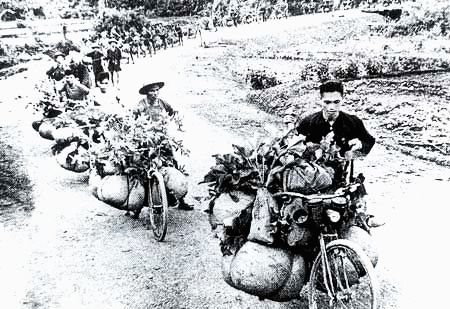
viet minh supplyPrimitive but Effective- Viet Minh Supply Column The French Could Never Stop them

There is a wealth of data regarding these wars. There are several types of materials. The accounts of soldiers, diplomats and reporters who experienced these events contained in memoirs and diaries. The best include David Hackworth’s About Face and Steel My Soldiers Hearts; and General Harold Moore’s We Were Soldiers Once… and Young. French works include Jules Roy’s The Battle of Dien Bein Phu and General Paul Aussaresses’ The Battle of the Casbah. There are innumerable popular accounts written by NCOs and junior officers.  These accounts may contain a wealth of information, but are limited by a number of factors. First, many only saw part of the overall picture and first-hand experience can skew objectivity. Those who have been through the trauma of war interpret war through their own experience.  Physical and psychological wounds can have a major impact on the interpretation of these writers as can their experience and political ideology. Finally few of these writers are trained historians. Despite this they can be a valuable resource for the historian.

Another source is official histories. Often these incorporate unit histories and individual narratives and analyze specific battles and the wider campaigns, but do little in regard to broader conditions that affected operations.  While a good source, many are not as critical of their institutions as they should be. Histories by trained historians and journalists provide another view. The most insightful of the journalist accounts include Bernard Fall’ Street Without Joy and The Siege of Dien Bien Phu: Hell in a Very Small Place. A limitation of all of these is that they are often heavily influenced by the political and societal events. This means that earlier accounts are more likely to be reactive and judgmental versus critical and balanced. Later accounts have the benefit of access to the opposing side and documents not available to earlier writers.  Alistair Horn in A Savage War of Peace provides one of the most informative and balanced accounts of the war in Algeria. Martin Winslow does the same regarding Dien Bien Phu in The Last Valley.
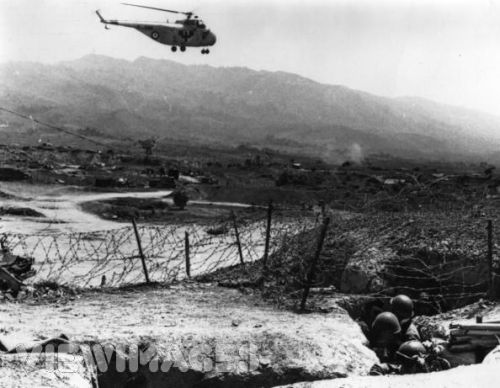
Dien Bien Phu 1Isolated and Besieged Dien Bien Phu

Another source is the writings of participants who critically examine their participation in the wars.  Many of these, French and American provide insights into the minds of leaders who are reflective and critically examine what happened to their military institutions in these wars. The best of these is French Colonel David Galula whose books Pacification in Algeria 1956-1958 and Counterinsurgency Warfare: Theory and Practice provide first-hand accounts of the subject combined with critical reflection. Galula’s works have been important to John Nagl, General David Petreus and others who helped write the U.S. Army and Marine Corps Counterinsurgency manual. Andrew Krepinevich in The Army and Vietnam provides a critical analysis of the U.S. Army in Vietnam.  Other sources, both online and print, such as RAND, provide excellent analysis of selected topics within the scope of this essay, especially COIN.

The ability to dispassionately and critically examine and evaluate these sources over a period of several years was and integrate them with my own experience has been a critical to me.  It has changed the way that I look at sources, and caused me to be much more aware of bias, the limitations of sources and the need to have a multiplicity of sources and points of view.

Effects of Insurgencies on the Armies that Fought Them

The conflicts in French Indo-China, Algeria and Vietnam had major effects on the French and American military institutions. These effects can be classified in a number of ways. First, the manner in which each military waged war, including tactics and weapons systems was changed.  The use of airpower, especially helicopters and use of Riverine forces provided an added dimension of battlefield mobility but did not bring victory. As John Shy and Thomas Collier noted regarding the French in Indo-China: “French mobility and firepower could take them almost anywhere in Vietnam, but they could not stay, and could show only wasted resources and time for their efforts.”[1] The use of intelligence and psychological warfare, including the use of torture became common practice in both the French and American armies.  The wars had an effect on the institutional culture of these armed services; neither completely embraced the idea of counterinsurgency and for the most part fought conventionally. Galula notes how the “legacy of conventional thinking” slowed the implementation of proper counterinsurgency tactics even after most commanders learned that “the population was the objective.”[2] Krepinevich notes that “any changes that might have come about through the service’s experience in Vietnam were effectively short-circuited by Army goals and policies.”[3] Finally the wars had a chilling effect on the relationship between the both militaries and the state, veterans from each nation often felt betrayed or disconnected from their country and people.

legion algeriaForeign Legion in Algeria

The French Army had the misfortune of fighting two major insurgencies back to back.  The French military was handicapped even before it went into these wars. The Army came out of World War II defeated by the Germans, divided by loyalties to Vichy or one of the Free French factions. They were humiliated by the Japanese in Indo-China, while in Algeria France’s crushing defeat was devastating.  “Muslim minds, particularly sensitive to prestige and baraka, the humiliation made a deep impression.”[4] French society was as divided as the Army; the economy in shambles, the government weak and divided.  The Viet-Minh had prepared well making use of time and training to get ready for war.  “Once full-scale hostilities broke out, the French, for budgetary and political reasons could not immediately make the large scale effort to contain the rebellion in the confines of small-scale warfare.”[5]

In both Indo-China and Algeria the French attempted to fight the budding insurgencies in a conventional manner.  This was particularly disastrous in Indo-China when on a number of occasions battalion and regimental combat team sized elements were annihilated by Viet-Minh regulars.  Between October 1st and 17th 1950 every French garrison along the Chinese border was over-run.  The French lost over 6000 troops and enough equipment to outfit “a whole additional Viet-Minh division.” It was their worst colonial defeat since Montcalm at Quebec.[6] In Algeria when the fight began in earnest France’s “ponderous ponderous N.A.T.O forces found themselves at an impossible disadvantage,”[7] unable to have any influence off the main roads.

VIETNAM DIEN BIEN PHUSurrender at Dien Bien Phu

In Vietnam the French did not absorb the lessons of fighting a well established insurgent force. French forces hoped to draw the Viet-Minh main forces into battles of attrition where their superior firepower could be brought to bear. Such was the case at Na San in December 1952 where the French established an “Air ground base” deep in Viet-Minh territory to draw Giap’s forces into open battle.  This worked, but just barely. Giap, short of artillery and not planning on a long battle frittered away his troops in mass charges.  However, the French, because of Na Son assumed they had found the key to victory. In their embrace of the “air ground base concept, French staff officers were following an intellectual tradition that had long been prone to seduction by elegant theories.”[8] The result was the disaster at Dien Bien Phu the following year.  The destruction of the elite Group-mobile 100 near Pleiku in 1954 was the coup de grace. In Indo-China the French made limited use of helicopters, used paratroops widely, and developed Riverine forces. One thing they were critically short of was significant tactical air support.[9]

The most inventive French creation was the GCMA/GMI forces composed of mountain tribesmen led by French NCOs and Junior Officers.  They were designed to provide “permanent guerilla groups rooted in remote areas” to harass and interdict Viet-Minh forces.[10] Trinquier noted that at the time of the Dien Bien Phu defeat that these forces had reached over 20,000 trained and equipped maquis in the Upper Region of Tonkin and Laos. These forces achieved their greatest success retaking Lao Cai and Lai Chau May 1954 as Dien Bien Phu fell.[11] Trinquier stated that “the sudden cessation of hostilities prevented us from exploiting our opportunities in depth.”[12] The GMI units and their French leaders were abandoned fighting on for years after the defeat. One account noted a French NCO two years after the defeat cursing an aircraft patrolling the border “for not dropping them ammunition so they could die like men.”[13] In the end the French left Indo-China and Giap remarked to Jules Roy in 1963 “If you were defeated, you were defeated by yourselves.”[14]

Algeria was different being part of Metropolitan France; there the French had support of European settlers, the pieds-noir. Many French soldiers had come directly from Indo-China. There French made better adaptations to local conditions, and realized that they had to win the population and isolate the insurgents from it and outside support. As Galula said, victory is the destruction of the insurgent’s political and military structures, plus “the permanent isolation from the population, not forced upon the population, but by and with the population.”[15] The lessons learned by the French in both Algerian and Indo-China were lost upon the Americans.

The United States military, especially the Army approached the Vietnam War with a conventional mindset, the “Army concept.” [16] It not only approached the war in this manner, but it trained and organized the South Vietnamese forces, ARVN into the American model. Americans re-organized ARVN into divisions “based upon the U.S. divisional force structure.”[17] ARVN was not structured appropriately for the threat that it faced.”[18] The results were as to be expected. Large numbers of troops poured in, American counterinsurgency was costly.  It was “almost a purely military approach”[19] which ignored political and social realities on the ground. Massive firepower was the means “utilized by the Army to achieve the desired end of the attrition strategy-the body count.”[20] In the end the American defeat was a “failure of understanding and imagination.”[21] The one shining moment was the Marine Corps experimentation with “Combined Action Program” platoons which lived in the villages with militia for long periods of time. This program produced great results “in eliminating local guerillas”[22] but was killed by the Army.

For both the French and Americans these wars tore the heart out of their armies. For the French the defeats inflicted a terrible toll.  In Indo-China many French career soldiers felt that the government’s “lack of interest in the fate of both thousands of missing French prisoners and loyal North Vietnamese…as dishonorable.”[23] Divisions arose between those who served and those who remained in France or Germany and created bitter enmity between soldiers.  France would endure a military coup which involved many who had fought in Vietnam and Algeria. Having militarily won that war, were turned into what Jean Lartenguy called ‘the Centurions” had been turned into liars.”[24] They were forced to abandon those who they had fought for and following the mutiny, tried, imprisoned, exiled or disgraced. Colonial troops who remained loyal to France were left without homes in their “independent” nations.  They saw Dien Bien Phu as the defining moment. “They responded with that terrible cry of pain which pretends to free a man from his sworn duty, and promises such chaos to come: ‘Nous sommes trahis!’-‘We are betrayed.’”[25]
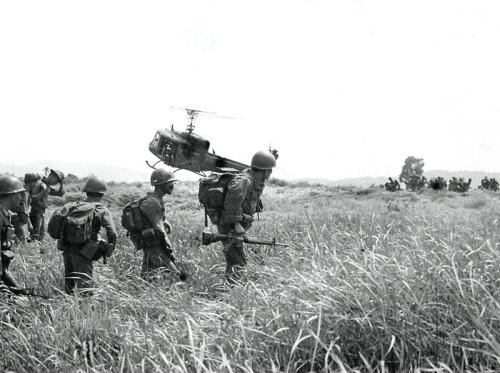
Joint_operation_with_ARVN_112-1Joint US-ARVN Operation

The U.S. Army returned to a country deeply divided and Vietnam veterans remained ostracized until the 1980s.  As Harold Moore recounts “in our time battles were forgotten, our sacrifices were discounted, and both our sanity and suitability for life in polite American society were publically questioned.”[26] The Army endured a massive reorganization that resulted in the formation of the All-Volunteer force, which would redeem itself and emerge from the ashes in the Gulf War. The Americans would not learn the lessons of revolutionary warfare and counterinsurgency until forced to do so in Iraq in 2004-2007.

Conclusions and Possibilities

The effects of these wars on the French and American military establishments were long lasting and often tragic. The acceptance of torture as a means to an end sullied even the hardest French officers. Men like Galula and Marcel Bigeard refused to countenance it, while others like Paul Aussaresses never recanted.  Americans would repeat the tactic at Abu Ghraib rallying the Iraqis against them.

For the Americans, the debacle continued at home. Race riots tore at the force while drug addictions and criminal activities were rampant.  Incompetent leaders kept their jobs and highly successful leaders who became whistle blowers like Hackworth were scorned by the Army institution. It took years before either the French or American veterans again felt a part of their countries.  They ended up going to war, and when it was over; feeling abandoned, their deepest bonds were to their comrades who had fought by their side.

What are the lessons to be learned from these campaigns as well as from the various accounts?  Andrew Krepinevich prophetically noted that the failure to learn the lessons of Vietnam “represents a very dangerous mixture that in the end may see the Army again attempting to fight a conventional war against a very unconventional opponent.”[27] Obviously, there are lessons to be learned, especially in understanding the nature of revolutionary war as well as the culture and history of our opponents. The U.S. has made some improvement in this regard but there is still much to be learned, especially since after the war the Army was “erecting barriers to avoid fighting another Vietnam War.”[28] From these wars we learn that nations and incompetent governments who mismanage wars can alienate themselves from the soldiers that they send to fight, with serious consequences.  As far as historiography we learn that certain historical fallacies are evident when one reads the accounts critically and recognize the bias and limitations of the various sources.

In Iraq the U.S. adapted, albeit belatedly to the nature of the insurgency and took advantage of Al Qaeda Iraq (AQI) over-reach in the manner that they abused the Iraqi people.  The situation turned dramatically in September of 2007 when Al Qaeda killed the most prominent Sunni Sheik outside of Ramadi.  The Sheik had begun to work with Americans on security issues and his death turned much of the Sunni populace in Al Anbar and other provinces against AQI for the first time allying them with the Sh’ia dominated government.  Changing focus the U.S. Forces focused on safeguarding the population and building up the capabilities of Iraqi forces.  Within months because of the increased security and stability in Al Anbar the U.S. Marine trained and Iraqi led forces of the 1st Iraqi Division were able to be moved to Basra where they retook the city from insurgent forces and to Diyala where they helped the government gain the upper hand.  Success in Iraq did not come easy, American forces suffered their greatest losses since the Vietnam War in the cities, villages and countryside of Iraq.  The U.S. is now in the process of drawing down as the Iraqis take over their own security.  The process is not perfect as there still tension between Sunni and Sh’ia factions as well as Kurds and other minority ethnic groups.  However it is still going better than most experts predicted.
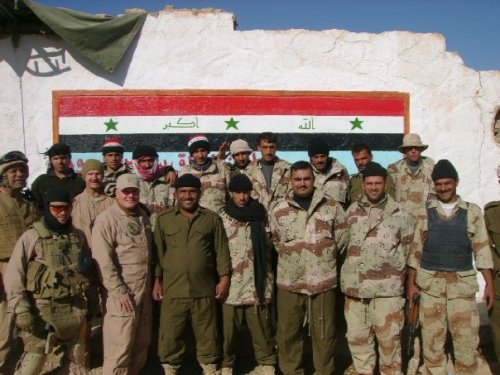
iraqi border troopThe Author and Advisors with Iraqi Border Troops near Syria

Afghanistan is another matter.  After early success in overthrowing the Taliban and isolating Al Qaeda the Americans and NATO pretty ran a status quo operation attempting to legitimize the Karzai government, eliminate the Opium poppy crops and establish government presence and security in outlying areas.  There was a problem in this; both the Taliban and Al Qaeda used border sanctuaries in Pakistan and financial support from worldwide Moslem groups to continue the fight.  As Al Qaeda and the Taliban built themselves up the Afghan government lost support. This loss of support was in large part due to rampant government corruption as well as to the perception of U.S. and NATO forces being occupiers and not liberators.  This perception of the U.S. and NATO forces was in large part because they had ignored the lessons of French Indo-China, Algeria, Vietnam and Iraq.  Isolated from the population the bulk of NATO forces performed in a reactionary manner and often used aircraft and artillery to respond to Taliban forces often killing non-combatants by mistake. Each time this happened, the Al Qaeda and Taliban leaders used the results to further bolster their image and portray the allies as the oppressors.  As the Taliban took back much of the country they also returned to oppressive means to subdue the population by fear and intimidation.
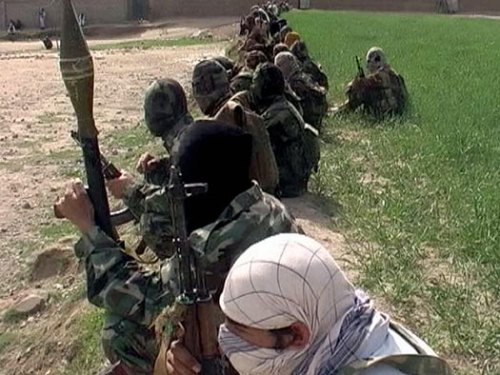
taliban insurgentsTaliban Insurgents

The new American commander, General Stanley McChrystal has asked for more forces in order to run a proper counter-insurgency campaign which focuses on the security of the population to isolate the Taliban and Al Qaeda.  Whether General McChrystal gets his forces and whether they are enough to turn the tide before all political and public support in the U.S. and NATO countries is lost is another matter.  Right now the situation is tenuous at best.  There are means to win this war despite the history of Afghanistan which suggests that this is not possible.  The key is he Afghan population, if they believe that the U.S. and NATO are n their side, that we respect them, their culture, religion and that Al Qaeda and the Taliban are the real oppressors the war can be won.  This requires patience, forethought and deliberate measures to secure the population, build up a government that they can trust and de-legitimatize Al Qaeda and the Taliban.  If that does not happen, the U.S. and NATO run the risk of repeating the story of the French in Indo-China.   Unlike AQI and Iraqi insurgents the Taliban are very capable of running military operations capable of defeating small to medium sized units in isolated locations.  They know the terrain, often have the support of the people, are highly mobile and not dependant on roads and can mass quickly at critical points.  Last year the Taliban launched a large scale assault on an American COP which came close to overrunning it.  They were repelled with heavy casualties but the incident demonstrated a capability that is growing.  What I would be concerned about is the total destruction of an isolated post or a convoy which could be used to demoralize western nations.  While I do not think that the Taliban could pull off the defeat of a major US or NATO base or force as the Viet-Minh did at Dien Bien Phu but the threat should not be minimized.

traiining team with afghan armyUSMC Training Team in Afghanistan

How we learn the lessons of past insurgencies and revolutionary wars is important in Afghanistan.  The stakes are higher than most would want to admit. A withdraw would be seen by militants outside of Afghanistan would be emboldened just as the Algerians were by the loss of the French in Indo-China. It would again provide Al Qaeda with a safe haven and secure base of operations.  The stakes are high.  Who knows what will happen?

Bibliography

Aussaresses, Paul, “The Battle of the Casbah: Counter-Terrorism and Torture,” translated by Robert L Miller.  Enigma Books, New York, 2005. Originally published in French under the title of “SERVICES SPECIAUX Algerie 1955-1957” Perrin 2001

Fall, Bernard B. “The Siege of Dien Bien Phu: Hell in a Very Small Place.” Da Capo Press, New York an unabridged reprint of the 1st Edition reprinted in arrangement with Harper and Row Publishers, New York. 1967

Fall, Bernard B. “Street Without Joy: The French Debacle in Indochina.” Stackpole Books, Mechanicsburg PA, 2005, originally published by Stackpole Publications 1961

Galula, David. “Counterinsurgency Warfare: Theory and Practice.” Praeger Security International, Westport CT 1964 and 2006

Galula, David. “Pacification in Algeria 1956-1958.” RAND Corporation, Santa Monica CA 2006. Originally published by RAND 1963

Hackworth, David H. and Sherman, Julie. “About Face: The Odyssey of an American Warrior,” a Touchstone Book published by Simon and Schuster, New York. 1989

Horn, Alistair. “A Savage War of Peace: Algeria 1954-1962,” a New York Review Book published by the New York Review of Books, New York, 1977, 1987, 1996, and 2006

Karnow, Stanley. “Vietnam, a History: The First Complete Account of Vietnam at War,” The Viking Press, New York, 1983

Krepinevich, Andrew F. “The Army and Vietnam,” The Johns Hopkins University Press, Baltimore and London, 1986

Millett, Allan R. and Maslowski, Peter. “For the Common Defense: A Military History of the United States of America.” The Free Press, a division of Macmillian, Inc. New York, 1984

Moore, Harold G and Galloway, Joseph L. “We were Soldiers Once…and Young: Ia Drang: The Battle that Changed Vietnam,” Harper Collins Publishers, New York NY 1992

Nagl, John A. “Learning to East Soup with a Knife: Counterinsurgency Lessons from Malaya and Vietnam,” University of Chicago Press, Chicago and London, 2005

Nolan, Keith William. “The Battle for Hue: Tet 1968,” Presidio Press, Novato CA, 1983

Pottier, Philippe (2005) Articles: GCMA/GMI: A French Experience in Counterinsurgency during the French Indochina War, Small Wars & Insurgencies,16:2,125 — 146 http://dx.doi.org/10.1080/09592310500079874

Roy, Jules. “The Battle of Dien Bien Phu” Carrol and Graf Publishers, New York 1984. Translated from the French by Robert Baldrick. English translation copyright 1965 by Harper and Row Publishers, New York.

Sheehan, Neil. “A Bright and Shining Lie: John Paul Vann and America in Vietnam,” Vintage Books, a division of Random House, New York, 1989

Shy, John and Collier, Thomas W. “Revolutionary War”in Makers of Modern Strategy from Machiavelli to the Nuclear Age,” Peter Paret editor. Princeton University Press, Princeton N.J. 1986

Simpson, Howard K. “Dien Bien Phu: The Epic Battle America Forgot,” Potomac Books Inc. Washington DC 2005, originally published by Brassey’s Inc. 1994

Spector, Ronald H. “After Tet: The Bloodiest Year in Vietnam,” Vintage Press, a division of Random House, New York, 1993

Trinquier, Roger. “Modern Warfare: A French View of Counterinsurgency,” translated from the French by Daniel Lee with an Introduction by Bernard B. Fall. Praeger Security International, Westport CT and London. 1964 and 2006. Originally published under the title “La Guerre Moderne” by Editions Table Ronde.

West, F.J. “The Village,” Pocket Books, a division of Simon and Schuster, New York. 1972.

Windrow, Martin. “The Last Valley: Dien Bien Phu and the French Defeat in Vietnam,” Da Capo Press, Novato, CA 2006, originally published by Weidenfeld and Nicholson, London 2004


[1] Shy, John and Collier, Thomas W. “Revolutionary War” in Makers of Modern Strategy from Machiavelli to the Nuclear Age,” Peter Paret editor. Princeton University Press, Princeton N.J. 1986  p.849

[2] Galula, David. Counterinsurgency in Algeria: 1956-1958. RAND Corporation, Santa Monica, CA. 2006. First published by RAND in 1963. p.244

[3] Krepinevich, Andrew F. “The Army and Vietnam,” The Johns Hopkins University Press, Baltimore and London, 1986 p.213

[4] Horn, Alistair. “A Savage War of Peace: Algeria 1954-1962,” a New York Review Book published by the New York Review of Books, New York, 1977, 1987, 1996, and 2006 p 41

[5] Fall, Bernard B. “Street Without Joy: The French Debacle in Indochina.” Stackpole Books, Mechanicsburg PA, 2005, originally published by Stackpole Publications 1961 p.27

[6] Ibid. p.33

[7] Horn. p.100.

[8] Windrow, Martin. “The Last Valley: Dien Bien Phu and the French Defeat in Vietnam,” Da Capo Press, Novato, CA 2006, originally published by Weidenfeld and Nicholson, London 2004 p.63

[9] Fall, Bernard B. “The Siege of Dien Bien Phu: Hell in a Very Small Place.” Da Capo Press, New York an unabridged reprint of the 1st Edition reprinted in arrangement with Harper and Row Publishers, New York. 1967 pp. 456-457  Fall discusses in depth the lack of French Air support and the antecedents that led to the shortage following World War II.

[10] Pottier, Philippe(2005)’Articles: GCMA/GMI: A French Experience in Counterinsurgency during the French Indochina War’, Small Wars & Insurgencies,16:2,125 — 146 http://dx.doi.org/10.1080/09592310500079874

[11] Simpson, Howard K. “Dien Bien Phu: The Epic Battle America Forgot,” Potomac Books Inc. Washington DC 2005, originally published by Brassey’s Inc. 1994 pp. 170-171

[12] Trinquier, Roger. “Modern Warfare: A French View of Counterinsurgency,” translated from the French by Daniel Lee with an Introduction by Bernard B. Fall. Praeger Security International, Westport CT and London. 1964 and 2006. Originally published under the title “La Guerre Moderne” by Editions Table Ronde. p.87

[13] Windrow. p.652.

[14] Roy, Jules. “The Battle of Dien Bien Phu” Carrol and Graf Publishers, New York 1984. Translated from the French by Robert Baldrick. English translation copyright 1965 by Harper and Row Publishers, New York. p.xxx

[15] Galula, David. “Counterinsurgency Warfare: Theory and Practice.” Praeger Security International, Westport CT 1964 and 2006 p. 54

[16] Krepinevich. p.213

[17] Ibid. p.24

[18] Nagl, John A. “Learning to East Soup with a Knife: Counterinsurgency Lessons from Malaya and Vietnam,” University of Chicago Press, Chicago and London, 2005 p.138

[19] Shy. p.856

[20] Krepinevich. p.202

[21] Spector, Ronald H. “After Tet: The Bloodiest Year in Vietnam,” Vintage Press, a division of Random House, New York, 1993 p.314

[22] Millett, Allan R. and Maslowski, Peter. “For the Common Defense: A Military History of the United States of America.” The Free Press, a division of Macmillian, Inc. New York, 1984 p.555

[23] Windrow. p.655

[24] Ibid. p.657

[25] Ibid.

[26] Moore, Harold G and Galloway, Joseph L. “We were Soldiers Once…and Young: Ia Drang: The Battle that Changed Vietnam,” Harper Collins Publishers, New York NY 1992  p. xx

[27] Krepinevich. p.275

[28] Ibid. p.274

1 Comment

Filed under History, iraq,afghanistan, Military, vietnam