Category Archives: Military

Military Civil Rights Pioneers, Buffalo Soldier & the Red Tail: Benjamin O. Davis Senior and Junior

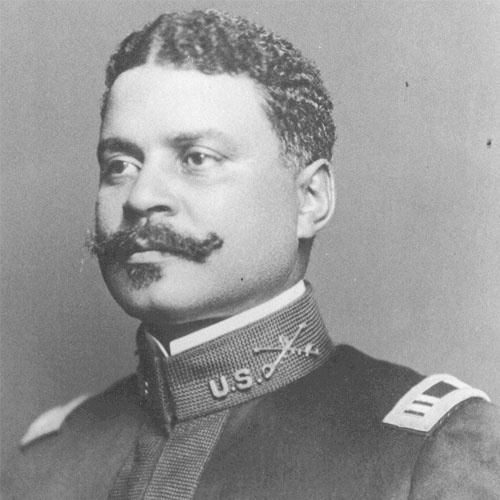
Benjamin_o_davis

Brigadier General Benjamin O Davis in France 1944

Friends of Padre Steve’s World,

In his I Have a Dream speech Dr. Martin Luther King Jr. gave all of us a vision of what can and in spite of what I see going on today will be the future of the people of this country:

“I have a dream that my four little children will one day live in a nation where they will not be judged by the color of their skin, but by the content of their character.”

American History would not be the same without the life, work and prophetic ministry of Dr. Martin Luther King Jr. Dr. King was born in a time when most of the country was segregated when “separate by equal” was simply façade to cover the lie that in no way did African Americans have equal rights or privileges in the United States.

Dr King was born less than 60 years after the secession of the Southern states from the Union and the beginning of the American Civil War. Though that blood conflict had freed the slaves it had not freed African Americans from prejudice, violence and discrimination.  When Dr. King began his ministry and was thrust upon the national stage as the strongest voice for equal rights and protections for blacks the discrimination and violence directed towards blacks was a very real and present reality in much of the United States.

However there were cracks beginning to appear in the great wall of segregation in the years preceding Dr. King’s ascent to leadership as the moral voice of the country in the matter of racial equality. In baseball Jackie Robinson became the first African American player in Major League Baseball opening a door for others who would become legends of the game as well as help white America begin its slow acceptance of blacks in sports and the workplace.

Likewise the contributions of a father and son Brigadier General Benjamin O. Davis Sr. and General Benjamin O. Davis Jr. were advancing the cause of blacks in the military which eventually led to the desegregation of the military in 1948.  The impact of these two men cannot be underestimated for they were trailblazers who by their lives, professionalism and character blazed a trail for African Americans in the military as well as society.

Benjamin O. Davis Sr. was a student at Howard University when the USS Maine exploded and sank in Havana Harbor.  He volunteered for service and was commissioned as a temporary 1st Lieutenant in the 8th United States Volunteer Infantry. He was mustered out of service in 1899 but enlisted as a private in the 9th United States Cavalry one of the original Buffalo Soldiers regiments.  He enlisted as the unit clerk of I troop of 3rd Squadron and was promoted to be the squadron Sergeant Major.

Davis was commissioned while the unit was deployed to the Philippines and assigned to the 10th Cavalry.  He was assigned in various positions throughout his career including command, staff and instruction duties including as Professor of Military Science and Tactics in various ROTC programs.  He reached the rank of rank of temporary Lieutenant Colonel and Squadron Commander of 3rd and later 1st Squadron 9th Cavalry from 1917-1920 in the Philippines before reverting to the rank of Captain on his return as part of the post World War I reduction in force.

Davis continued to serve during the inter-war years and assumed command of the 369th Infantry Regiment New York National Guard in 1938. He was promoted to Brigadier General on 25 October 1940 becoming the first African American elevated to that rank in the United States Army and was assigned as Commander 4th Brigade 2nd Cavalry Division. He later served in various staff positions at the War Department and in France and was instrumental in the integration of the U.S. Military. He retired after 50 years service in 1948 in a public ceremony with President Harry S. Truman presiding. He was a member of the American Battle Monuments Commission from 1953-1961 and died in 1970.

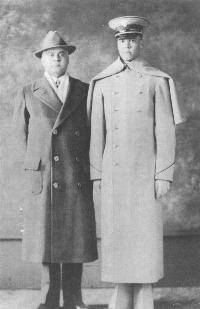
davis-3

Colonel Davis with his son Cadet Benjamin O Davis Jr.

His son Benjamin O. Davis Jr. was appointed to West Point in 1932.  He graduated and was commissioned in 1936 graduating 35 out of 278, the fourth African American graduate of West Point. During his time at the Academy most of his classmates shunned him and he never had a roommate.  Despite this he maintained a dogged determination to succeed.  The Academy yearbook made this comment about him:

“The courage, tenacity, and intelligence with which he conquered a problem incomparably more difficult than plebe year won for him the sincere admiration of his classmates, and his single-minded determination to continue in his chosen career cannot fail to inspire respect wherever fortune may lead him.”

He was denied entrance to the Army Air Corps because of his race and assigned to the Infantry first to the all lack 24th Infantry Regiment at Ft Benning where he was not allowed in the Officers Club due to his race. Upon his commissioning the Regular Army had just 2 African American Line Officers, 2nd Lieutenant Davis and his father Colonel Davis.

After completion of Infantry School he was assigned as an instructor of Military Science and Tactics and the Tuskegee Institute.  In 1941 the Roosevelt Administration moved to create a black flying unit and Captain Davis was assigned to the first black class at the Tuskegee Army Air Field and in March 1942 one his wings as one of the first 5 African Americans to complete flight training.

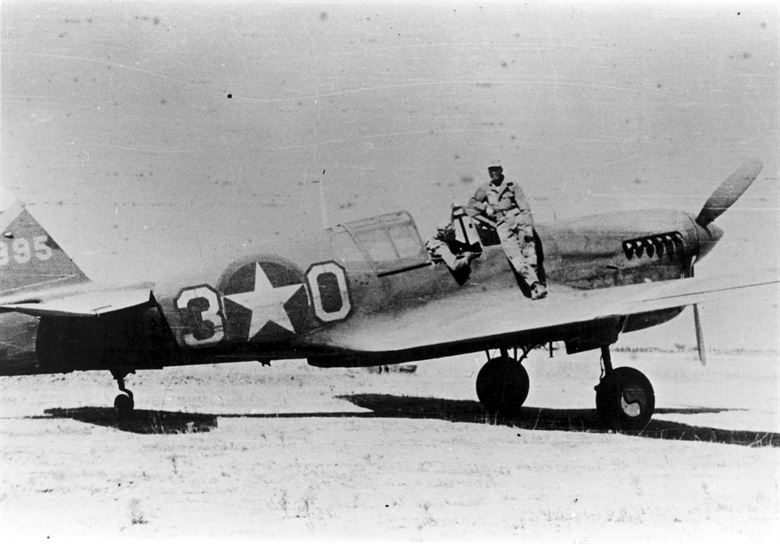
In July 1942 the younger Davis was assigned as Commanding Officer of the 99th Pursuit Squadron which served in North Africa and Sicily flying Curtiss P-40 Warhawks. He was recalled to the United States in September 1943 to command the 332ndFighter Group. However some senior officers attempted to prevent other black squadrons from serving in combat alleging that the 99th had performed poorly in combat. Davis defended his squadron and General George Marshall ordered an inquiry which showed that the 99th was comparable to white squadrons in combat and during a 2 day period over the Anzio beachhead the pilots of the 99thshot down 12 German aircraft.

davis Library of congress photo public domain

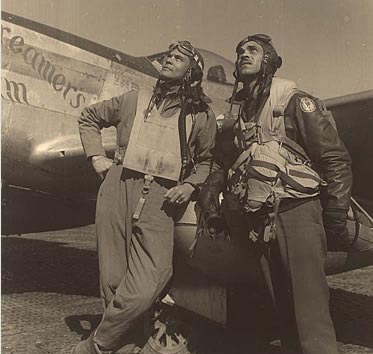
Colonel Benjamin O Davis Jr (left) with one of his Tuskegee Airmen

Davis took the 332nd to Italy where they transitioned to P-47 Thunderbolts and in July 1944 to the P-51 Mustang which were marked with a signature red tail. During the war, the units commanded by Davis flew more than 15,000 sorties, shot down 111 enemy planes, and destroyed or damaged 273 on the ground at a cost of 66 of their own planes.

Tuskegee_01

Their record against the Luftwaffe was outstanding and their protection of the bombers that they escorted was superb with very few bombers lost while escorted by them men that the Luftwaffe nicknamed the Schwarze Vogelmenschen and the Allies the Red-Tailed Angels or simply the Redtails. Davis led his Tuskegee Airmen to glory in the war and their performance in combat helped break the color barrier in the U.S. Military which was ended in 1948 when President Truman signed an executive order to end the segregation of the military. Colonel Davis helped draft the Air Force plan and the Air Force was the first of the services to fully desegregate.

ltgen Benjamindavis

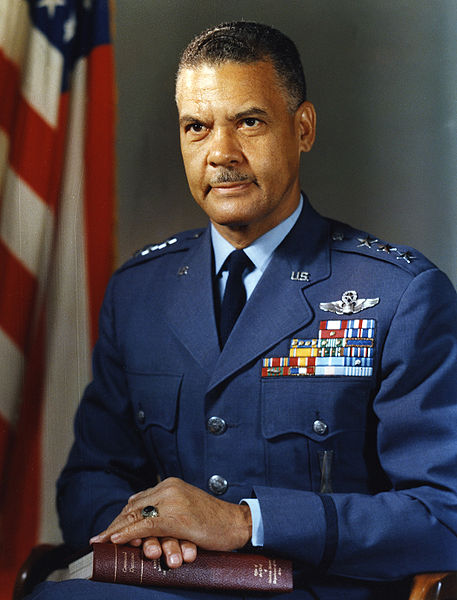
Lieutenant General Benjamin O Davis Jr

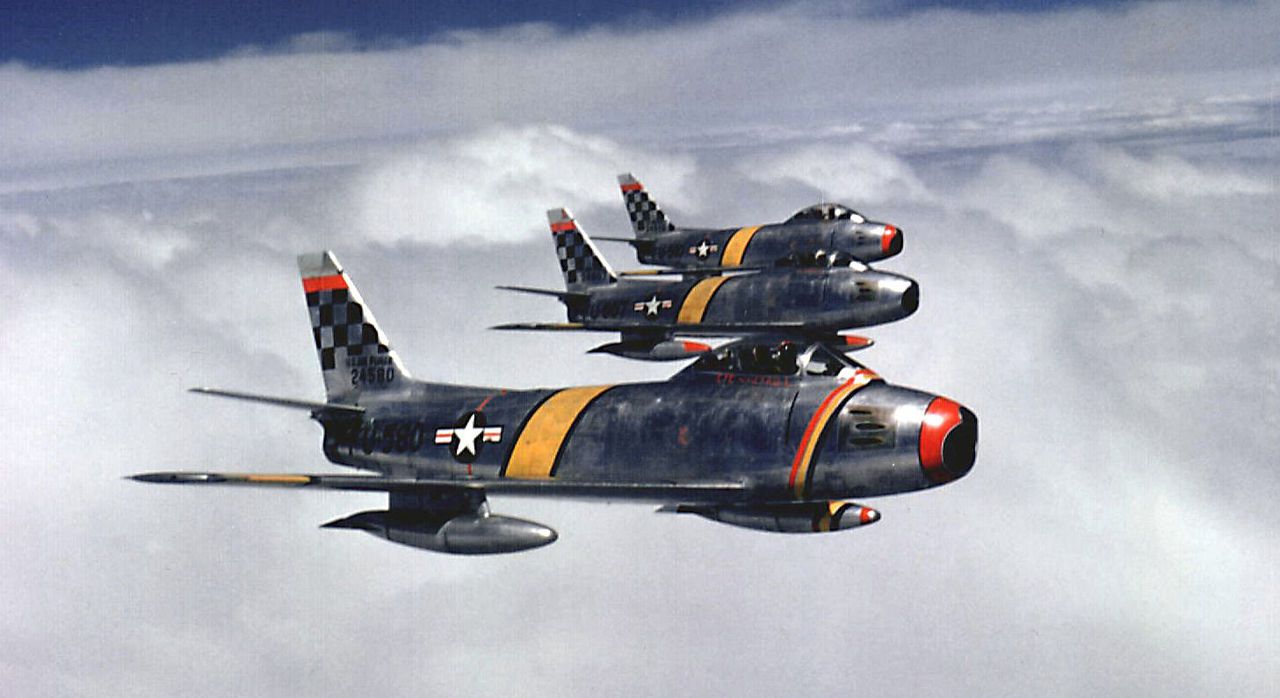
Colonel Davis transitioned to jets and led the 51st Fighter Interceptor Wing against Chinese Communist MIGs in the Korean War.

Davis Leading a Flight of F-86 Super Sabers in Korea 

He was promoted to Brigadier General in 1954 and served in numerous command and staff positions. He retired in 1970 with the rank of Lieutenant General and was advanced to General while retired by President Clinton in 1998.  He died in 2002 at the age of 89.

The legacy of Benjamin O. Davis Senior and Benjamin O. Davis Junior is a testament to their character, courage and devotion to the United States of America. They helped pioneer the way for officers such as General Colin Powell and helped change this country for the better.  During times when discrimination was legal they overcame obstacles that would have challenged lesser men.  Benjamin O. Davis Junior remarked:

“My own opinion was that blacks could best overcome racist attitudes through achievements, even though those achievements had to take place within the hateful environment of segregation.”

Such men epitomize the selfless service of so many other African Americans who served the country faithfully and “by the content of their character” triumphed over the evil of racism and helped make the United States a more perfect union. That may seem threatened today with the open display of White Supremacy movements which are now openly being supported by many Republican politicians, at all levels of government. However, it was worse before and in the words of the old spiritual, “we shall overcome.” In days like ours it may seem not to be the case, but we must persevere.

Peace

Padre Steve+

Leave a comment

Filed under civil rights, History, Korean Conflicts, laws and legislation, Military, News and current events, Political Commentary, racism, us army, US Army Air Corps, world war two in europe

Fighting For Emancipation and Equality: The Black Soldiers of the Civil War

Friends of Padre Steve’s World,

February is Black History Month, it’s something that no American of any race, color, or creed should forget. African Americans, the decendants of slaves and slaves themselves fought for freedom that was only at best was in the promissory note of the Emancipation Proclamation.

Those men, and women in the case of Harriett Tubman and Sojourner Truth, paved the way for freedom for African Americans and all others who benefited from what they fought for: women, Native Americans, Mexican Americans, and other Hispanics, Asian Americans, and LGBTQ Americans. That promise being made then, must be kept today, to the descendents of  this men, as well as all who benefited through their sacrifice: even the Southern Whites who at the time did not know then, or all too often today, that they too needed emancipation.

This article is a section of one of my yet unpublished Civil War books in which I spend much time dealing with the importance of emancipation and the role of Black soldiers during the American Civil War. I think it is important to remember as we get ready to close out Black History Month just how important these men are to American history and for the civil rights of all Americans.

Emancipation and the U.S. Military

HD_4USCinfantryDetail.preview

Men of the 4th Regiment of U.S. Colored Troops

The war brought about another change to warfare in America. This was a societal and political change that has shaped American military history, culture and life ever since. The Emancipation Proclamation gave African Americans, both Freedmen and recently freed slaves the opportunity to serve in the Union Army. The change of policy instituted by Lincoln was revolutionary as well as controversial and it had strategic implications for the war effort. There were many doubters in the north whose attitudes towards African Americans were not much different than Southerners, especially among the Copperheads.

Prior to the Emancipation some Union commanders in occupied Confederate territory “had unofficially recruited black soldiers in Kansas and in occupied portions of South Carolina and Louisiana in 1862. But the administration had not sanctioned these activities.” [1] The issue for Lincoln in 1861 and 1862 was the necessity of keeping the Border-Slave Sates of Kentucky, Missouri and Maryland, which had not seceded from the Union. Lincoln repudiated the orders of General John Fremont, in Missouri, and his friend General David Hunter, who commanded the Department of the South regarding emancipation, not because he was in complete disagreement, but because he felt that the officers had overstepped their authority.

Lincoln understood that this might hurt him with the abolitionist wing of the Republican Party. While Lincoln was certainly sympathetic to their cause, he insisted that such decisions were not within the prevue of local commanders, but that any such proclamations had to come from him, as Commander-in-Chief. He told Treasure Secretary Salmon Chase, who supported the measures of Hunter and Fremont, “No commanding general shall do such a thing, upon my responsibility, without consulting me.” [2] Lincoln’s decision to reverse and repudiate the decisions of local commanders infuriated some in his cabinet and in the Congress. But Lincoln remained firm in that conviction due to the need to ensure the cooperation of the Border States the continued loyalty of which were absolutely vital to winning the war, without which no meaningful emancipation would be possible.

However, Lincoln did support the efforts of General Benjamin Butler. Butler commanded the Federal forces at Fort Monroe in Hampton Roads. Butler had been a former pro-slavery Democrat who learned that the Confederates were using slaves to construct fortifications and to support their army on the Peninsula. In May 1862 twenty-three slaves escaped to his lines and their owner, a Confederate Colonel, “demanded the return of his property under the Fugitive Slave Law! With as deadpan expression as possible (given his cocked eye), Butler informed him that since Virginia claimed to have left the Union, the Fugitive Slave Law no longer applied.” [3]Butler then declared that since the escaped slaves had worked for the Confederate Army that they were “contraband of war – enemy property subject to seizure.” [4] It was a solid argument, since Southerners themselves referred to African American slaves as property was subject to seizure. Lincoln and Secretary of War Cameron approved of Butler’s action and “eventually, the Congress passed a confiscation law ending the rights of masters over fugitive slaves used to support Confederate troops.” [5]

Salmon Chase and other strong abolitionists opposed Lincoln vehemently for this, but it would not be long until Lincoln made the decision for full emancipation. This was first accomplished by the Emancipation Proclamation, a military order that only applied to the states that had seceded. However, Lincoln would follow this by pushing for a constitutional amendment to end slavery.   The latter occurred when Congress passed the Thirteenth Amendment was passed in January 1865. This amendment abolished slavery in the United States.

Lincoln had already decided upon emancipation in the spring of 1862, however, following the defeat of McClellan on the Peninsula he decided to postpone announcing it, Secretary of State Seward recommended against it until “until you can give it to the country supported by military success.” Otherwise the world might view it as an incitement for slave insurrections, “as the last measure of an exhausted government, a cry for help…our last shriek, on the retreat.” [6] The wisdom of Seward’s advice was profound, and Lincoln put off the announcement until after the Battle of Antietam.

McClellan, true to form opposed any such policy. When Lincoln visited him after his withdraw from the Peninsula, the defeated but still arrogant General handed Lincoln a memorandum on what McClellan viewed as the “proper conduct of the war.” McClellan advised Lincoln that the war “should not be a war looking to the subjugation of any State in any event…but against armed forces and political organizations. Neither confiscation of property, political executions of persons, the territorial organization of States, or the forcible abolition of slavery should be contemplated for a moment.” [7]

Lincoln was not seeking advice from his recalcitrant commander and put the letter in his pocket and simply told McClellan, “All right.” Interestingly enough just a few months earlier Lincoln would have agreed with McClellan’s views on the conduct of the war. However, with the passage of time and the realization that the Confederacy was fully committed to its independence as well as the continuance and even the expansion of slavery had come to the view that fighting a limited war with limited aims was foolish. He told another Unionist Democrat a few days after McClellan offered his advice that the war could not be fought:

“with elder-stalk squirts, charged with rose water….This government cannot much longer play a game in which it stakes all, and its enemies stake nothing. Those enemies must understand that they cannot experiment for ten years trying to destroy this government, and if they fail still come back into the Union unhurt.”[8]

From Slavery to Soldiering

2nd-colored-light-artillery

Gun Crew of 2nd Colored Light Artillery 

But as the war continued on, consuming vast numbers of lives the attitude of Lincoln and his administration began to change. After a year and a half of war, Lincoln and the closest members of his cabinet were beginning to understand that the “North could not win the war without mobilizing all of its resources and striking against Southern resources used to sustain the Confederate war effort.” [9] Slave labor was essential to the Confederate war effort, not only did slaves still work the plantations, they were impressed into service in war industries as well as in the Confederate Army.

Lieutenant Colonel Arthur Freemantle, a British observer who was with Lee’s army at Gettysburg noted, “in the rear of each regiment were from twenty to thirty negro slaves.” [10] The fact is that the slaves who accompanied the army remained slaves, they were not the mythical thousands of black soldiers who rallied to the Confederate cause, nor were they employees. “Tens of thousands of slaves accompanied their owners to army camps as servants or were impressed into service to construct fortifications and do other work for the Confederate army.” [11] This fact attested to by Colonel William Allan, one of Stonewall Jackson’s staff members who wrote “there were no employees in the Confederate army.” [12] slaves served in a number of capacities to free up white soldiers for combat duties, “from driving wagons to unloading trains and other conveyances. In hospitals they could perform work as nurses and laborers to ease the burdens of patients.” [13] An English-born artilleryman in Lee’s army wrote in 1863 that “in our whole army there must be at least thirty thousand colored servants….” [14] When Lee marched to Gettysburg he did so with somewhere between ten and thirty-thousand slaves in support roles and during the advance into Virginia Confederate troops rounded up and re-enslaved as many blacks as they could, including Freedmen.
istanto001p1

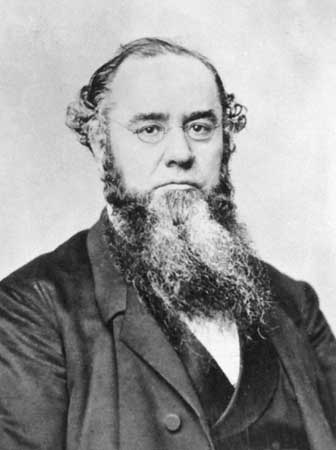
                                                      Secretary of War Edwin Stanton

Lincoln’s Secretary of War, Edwin Stanton; who was a passionate believer in the justice of emancipation, was one of the first to grasp the importance of slave labor to the Confederate armies and how emancipation was of decided military necessity. Stanton, “Instantly grasped the military value of the proclamation. Having spent more time than any of his colleagues contemplating the logistical problems facing the army, he understood the tremendous advantage to be gained if the massive workforce of slaves could be transferred from the Confederacy to the Union.” [15]

Lincoln emphasized the “military necessity” of emancipation and “justified the step as a “fit and necessary war measure for suppressing the rebellion.” [16] The process of emancipation now became not only a moral crusade, but now became a key part of national strategy, not just in a military means, but politically, economically and diplomatically as Lincoln “also calculated that making slavery a target of the war would counteract the rising clamor in Britain for recognition of the Confederacy.”  [17]

Lincoln wrote to his future Vice President, Andrew Johnson, then the military governor of occupied Tennessee that “The colored population is the great available and yet unavailed of, force for restoration of the Union.”[18] The idea of simply mollifying the border states was dropped and policy changed that of “depriving the Confederacy of slave labor. Mobilizing that manpower for the Union – as soldiers as well as laborers – was a natural corollary.” [19] Reflecting President Lincoln’s and Stanton’s argument for the military necessity of emancipation, General Henry Halleck wrote to Ulysses Grant:

“the character of the war has very much changed within the past year. There is now no possibility of reconciliation with the rebels… We must conquer the rebels or be conquered by them….Every slave withdrawn from the enemy is the equivalent of a white man put hors de combat.” [20]

54thmassposter

Ulysses Grant concurred with Lincoln’s decision. Grant wrote to in a letter to Lincoln after the assault on Battery Wagner by the 54th Massachusetts, “by arming the negro we have added a powerful ally. They will make good soldiers and taking them from the enemy weakens him in the same proportion as it strengthens us.” [21] William Tecumseh Sherman was supportive but also noted some facts that some radical abolitionists did not understand. He noted in his correspondence that, “The first step in the liberation of the Negro from bondage will be to get him and his family to a place of safety… then to afford him the means of providing for his family,… then gradually use a proportion – greater and greater each year – as sailors and soldiers.” [22] Lincoln wrote after the Emancipation Proclamation that “the emancipation policy, and the use of colored troops, constitute the heaviest blow yet dealt to the rebellion.” [23] The change was a watershed in both American history as well as for the future of the U.S. Military services.

In conjunction with the Emancipation Proclamation Secretary of War Stanton “authorized General Rufus Saxton to “arm, uniform, equip, and receive into the service of the United States such number of volunteers of African descent as you may deem expedient, not exceeding 5,000, and [you] may detail officers to instruct them in military drill, discipline, and duty, and to command them.”  [24] The initial regiments of African Americans were formed by Union commanders in liberated areas of Louisiana and South Carolina, and most were composed of newly freed slaves. Others like the 54th and 55th Massachusetts Volunteer Infantry regiments were raised from free black men in the north. Stanton’s authorization was followed by the Enrollment Act passed by Congress in March of 1863 which established the draft also allowed blacks to serve. By March Stanton was working with state governors to establish more black regiments. The units became known as United States Colored Troops, or U.S.C.T. and were commanded by white officers and organized into the infantry, cavalry and, artillery regiments organized on the model of white regiments. The U.S.C.T. “grew to include seven regiments of cavalry, more than a dozen of artillery, and well over one hundred of infantry.” [25]

Some Union soldiers and officers initially opposed enlisting blacks at all, and some “charged that making soldiers of blacks would be a threat to white supremacy, and hundreds of Billy Yanks wrote home that they would no serve alongside blacks.” [26]  But most common soldiers accepted emancipation, especially those who had served in the South and seen the misery that many slaves endured, one Illinois soldier, stationed who served in the Western Theater of war wrote, “the necessity of emancipation is forced upon us by the inevitable events of the war… and the only road out of this war is by blows aimed at the heart of the Rebellion…. If slavery should be left undisturbed the war would be protracted until the loss of life and national bankruptcy would make peace desirable on any terms.” [27]

Another soldier’s letters home show his conversion from being against emancipation to being fully for it. Corporal Chauncey B. Welton from Ohio wrote to his father after the Emancipation proclamation:

“Father I want you to write and tell me what you think of Lincoln’s proclamation of setting all the negroes free. I can tell you we don’t think much of it hear in the army for we did not enlist to fight for the negro and I can tell you that we never shall or many of us any how[.] no never.”

Following over two years of combat in which he served with Sherman’s army he became a vocal critic of the anti-abolitionist Copperheads in the North, especially former Ohio Governor Clement Vallandigham, as well as a strong proponent of abolition and opponent of slavery. By February 1865 his tone had changed “dear parents let us trust in Him that never forsakes the faithful, and never cease to pray… that soon we may look upon an undivided Country and that Country free free free yes free from that blighting curs[e] Slavery the cause of four years of Bloody warfare.” [28]

Even so racial prejudice in the Union ranks never went away and sometimes was accompanied by violence. It remained a part and parcel of life in and outside of the army, even though many Union soldiers would come to praise the soldierly accomplishments and bravery of African American Soldiers. An officer who had refused a commission to serve with a U.S.C.T. regiment watched as black troops attacked the defenses of Richmond in September 1864:

“The darkies rushed across the open space fronting the work, under a fire which caused them loss, into the abattis… down into the ditch with ladders, up and over the parapet with flying flags, and down among, and on top of, the astonished enemy, who left in utmost haste…. Then and there I decided that ‘the black man could fight’ for his freedom, and that I had made a mistake in not commanding them.” [29] Likewise, “Once the Lincoln administration broke the color barrier of the army, blacks stepped forward in large numbers. Service in the army offered to blacks the opportunity to strike a decisive blow for freedom….” [30]

HD_NgroWarFL640116p264cz.preview

                                                    The Defense of Milliken’s Bend 

Emancipation allowed for the formation of regiments of United States Colored Troops (USCT), which were mustered directly into Federal service. In sheer numbers the U.S.C.T. formations soon dwarfed the few state raised Black Regiments.  However, it was the inspiration provided by those first state raised regiments, the heroic accounts of those units reported in Northern newspapers, as well as the unprovoked violence directed against Blacks in the 1863 New York draft riots that helped to provoke “many northerners into a backlash against the consequences of violent racism.” [31]

Despite the hurdles and prejudices that blacks faced even in the North, many African Americans urged others to enlist, self-help mattered more than self-preservation. Henry Gooding, an black sergeant from Massachusetts wrote the editor of the New Bedford Mercury urging fellow blacks to enlist despite the dangers, “As one of the race, I beseech you not to trust a fancied security, laying in your minds, that our condition will be bettered because slavery must die…[If we] allow that slavery will die without the aid of our race to kill it – language cannot depict the indignity, the scorn, and perhaps the violence that will be heaped upon us.” [32]

The valor of the state regiments, as well as the USCT units that managed to get into action was remarkable, especially in regard to the amount of discrimination levied at them by some northerners, including white Northern soldiers, and the very real threat of death that they faced if captured by Confederates. In response to the Emancipation Proclamation and to the formation of African American regiments the Confederate Congress passed measures that would make Union officers who commanded African American troops as war criminals and return any black soldier captured by Confederate forces return to slavery, if those blacks captured in battle were not summarily tortured by their captors or executed as happened at Fort Wagner, Petersburg, and at Fort Pillow.

In late 1862 Major General Nathaniel Banks was in desperate need of soldiers and received permission to form a number of regiments of free blacks. Known as the First, Second and Third Regiments of the Louisiana Native Guards they were primarily composed of former slaves who had escaped to Union lines, as well as some mulattos who were the children of prominent white citizens of the city. During an inspection, the white Colonel of the Guards told another officer:

“Sir, the best blood of Louisiana is in that regiment! Do you see that tall, slim fellow, third file from the right of the second company? One of the ex-governors of the state is his father. That orderly sergeant in the next company is the son of a man who has been six years in the United States Senate. Just beyond him is the grandson of Judge ______ …; and through all the ranks you will find the same state of facts…. Their fathers are disloyal; [but] these black Ishmaels will more than compensate for their treason by fighting in the field.” [33]

In May of 1863 Banks dared to send the First and Third Regiments of “Louisiana Native Home Guard regiments on a series of attacks on Confederate positions at Port Hudson, Louisiana” [34] where they received their baptism of fire. They suffered heavy losses and “of the 1080 men in the ranks, 271 were hit, or one out of every four.” [35] A white Wisconsin soldier commented that the black soldiers “fought like devils,”while a soldier of the 156th New York wrote, “They charged and re-charged and they didn’t know what retreat meant. They lost in their two regiments some four hundred men as near as I can learn. This settles the question about niggers not fighting well. They on the contrary make splendid soldiers and are as good fighting men as we have.” [36] Banks too was caught up in the moment and said of these troops in his after action report: “They answered every expectation…In many respects their conduct was heroic…The severe test to which they were subjected, and the determined manner in which they encountered the enemy, leave upon my mind no doubt of their ultimate success.” [37]

The_Storming_of_Ft_Wagner-lithograph_by_Kurz_and_Allison_1890a

                                                54th Massachusetts at Fort Wagner 

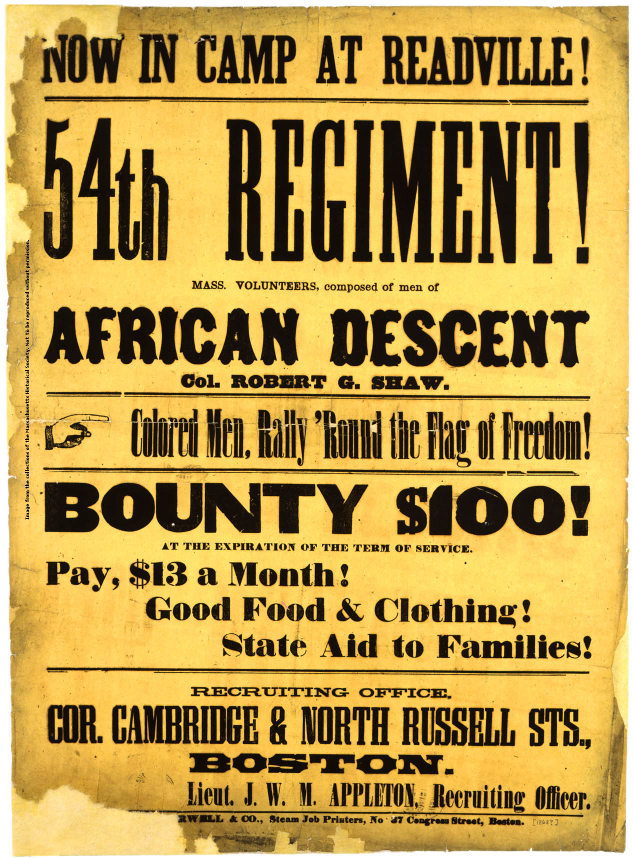
But the most famous African American volunteer regiment was the 54thMassachusetts, commanded by Colonel Robert Gould Shaw, the “North’s showcase black regiment.” [38] Raised in Boston and officered by many men who were the sons of Boston’s blue blood abolitionist elite, the regiment was authorized in March 1863. Since there was still opposition to the formation of units made up of African Americans, Massachusetts Governor John Andrew authorized the formation of the 54th under the command of white officers, a practice that with few exceptions, became standard in the U.S. military until President Truman desegregated the armed forces in 1948. Governor Andrew was determined to ensure that the officers of the 54th were men of “firm antislavery principles…superior to a vulgar contempt for color.”[39]

The 54th Massachusetts first saw action in early June 1863 and at Shaw’s urging were sent into battle against the Confederate positions at Fort Wagner on July 18th 1863. Leading the attack the 54th lost nearly half its men, “including Colonel Shaw with a bullet through his heart. Black soldiers gained Wagner’s parapet and held it for an hour before falling back.” [40]Though they tried to hold on they were pushed back after a stubborn fight to secure a breach in the fort’s defenses. “Sergeant William H Carney staggered back from the fort with wounds in his chest and right arm, but with the regiment’s Stars and Stripes securely in his grasp. “The old flag never touched the ground, boys,” Carney gasped as he collapsed at the first field hospital he could find.” [41] Shaw was buried with his men by the Confederates and when Union commanders asked for the return of his body were told “We have buried him with his niggers,” Shaw’s father quelled a northern effort to recover his son’s body with these words: We hold that a soldier’s most appropriate burial-place is on the field where he has fallen.” [42] As with so many frontal attacks on prepared positions throughout the war, valor alone could not overcome a well dug in enemy. “Negro troops proved that they could stop bullets and shell fragments as good as white men, but that was about all.” [43]

Despite the setback, the regiment went on to further actions where it continued to distinguish itself. The Northern press, particularly abolitionist newspapers brought about a change in the way that many Americans in the North, civilians as well as soldiers, saw blacks. The Atlantic Monthly noted, “Through the cannon smoke of that dark night, the manhood of the colored race shines before many eyes that would not see.”  [44]

55th-mass-at-charleston

                                  55th Massachusetts being welcomed in Charleston SC 

In the African American 55th Massachusetts, which was recruited after the 54th, twenty-one year old Sergeant Isaiah Welch wrote a letter which was published in the Philadelphia Christian Recorder from Folly Island South Carolina:

“I will mention a little about the 55th Massachusetts Regiment. They seem to be in good health at the present and are desirous of making a bold dash upon the enemy. I pray God the time will soon come when we, as soldiers of God, and of our race and country, may face the enemy with boldness. For my part I feel willing to suffer all privations incidental to a Christian and a soldier…. In conclusion, let me say, if I fall in the battle anticipated, remember, I fall in defense of my race and country. Some of my friends thought it very wrong of me in setting aside the work of the Lord to take up arms against the enemy…. I am fully able to answer all questions pertaining to rebels. If taking lives will restore the country to what it once was, then God help me to slay them on every hand.” [45]

Like the 54th Massachusetts, the 55th would see much action. After one particularly sharp engagement in July 1864, in which numerous soldiers had demonstrated exceptional valor under fire the regiment’s commander, Colonel Alfred S. Hartwell “recommended that three of the black sergeants of the 55th be promoted to the rank of 2nd Lieutenant.” But Hartwell’s request was turned down, and a member of the regiment complained, “But the U.S. government has refused so far to must them because God did not make them White…. No other objection is, or can be offered.”[46]


Frederick Douglass
Frederick Douglass, who had two sons serving in the 54th Massachusetts, understood the importance of African Americans taking up arms against those that had enslaved them in order to win their freedom:

“Once let a black man get upon his person the brass letters U.S… let him get an eagle on his button, and a musket on his shoulder and bullets in his pockets, and there is no power on earth which can deny he has won the right to citizenship in the United States.” [47]

Douglass urged African American men to enlist to secure their freedom, even while noting the inequities still prevalent in society and in the military, in which they did not receive the same pay as whites, nor could they become officers. Appealing to duty and reality Douglass noted in a speech in Philadelphia urging black men to volunteer. In it he carefully defined the real differences between the purposes of the Confederacy which was to “nothing more than to make the slavery of the African race universal and perpetual on this continent,” which was “based upon the idea that colored men are an inferior race, who may be enslaved and plundered forever.” [48]
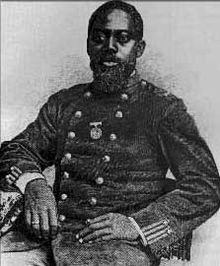
220px-WilliamCarney

                        Sergeant William Carney 54th Massachusetts, Medal of Honor

But the premier leader of the African Americans of his day, who had himself suffered as a slave, did not stop with that. Douglass understood that winning the war was more important that to what had been the attitude of the Federal government before the war and before emancipation, “Now, what is the attitude of the Washington government towards the colored race? What reasons have we to desire its triumph in the present contest? Mind, I do not ask what was its attitude towards us before the war…. I do not ask you about the dead past. I bring you to the living present.” He noted the advances that had been made in just a few months and appealed to his listeners. “Do not flatter yourselves, my friends, that you are more important to the Government than the Government to you. You stand but as the plank to the ship. This rebellion can be put down without your help. Slavery can be abolished by white men: but liberty so won for the black man, while it may leave him an object of pity, can never make him an object of respect…. Young men of Philadelphia, you are without excuse. The hour has arrived, and your place is in the Union army. Remember that the musket – the United States musket with its bayonet of steel – is better than all the mere parchment guarantees of liberty. In your hands that musket means liberty…” [49]

Other African American units less famous than the illustrious 54thMassachusetts distinguished themselves in action against Confederate forces. Two regiments of newly recruited blacks were encamped at Milliken’s Bend Louisiana when a Confederate brigade attempting to relieve the Vicksburg garrison attacked them. The troops were untrained and ill-armed but held on against a determined enemy:

“Untrained and armed with old muskets, most of the black troops nevertheless fought desperately. With the aid of two gunboats they finally drove off the enemy. For raw troops, wrote Grant, the freedmen “behaved well.” Assistant Secretary of War Dana, still with Grant’s army, spoke with more enthusiasm. “The bravery of the blacks,” he declared, “completely revolutionized the sentiment in the army with regard to the employment of negro troops. I heard prominent officers who had formerly in private had sneered at the idea of negroes fighting express after that as heartily in favor of it.”[50]

The actions of the black units at Milliken’s bend attracted the attention and commendation of Ulysses Grant, who wrote in his cover letter to the after action report, “In this battle most of the troops engaged were Africans, who had little experience in the use of fire-arms. Their conduct is said, however, to have been most gallant, and I doubt not but with good officers that they will make good troops.” [51] They also garnered the attention of the press. Harper’s published an illustrated account of the battle with a “double-page woodcut of the action place a black color bearer in the foreground, flanked by comrades fighting hand-to-hand with Confederates. A brief article called it a “the sharp fight at Milliken’s bend where a small body of black troops with a few whites were attacked by a large force of rebels.” [52] In the South the result was chilling and shocked whites, one woman wrote “It is hard to believe that Southern soldiers – and Texans at that – have been whipped by a mongrel crew of white and black Yankees…. There must be some mistake.” While another woman in Louisiana confided in her diary, “It is terrible to think of such a battle as this, white men and freemen fighting with their slaves, and to be killed by such a hand, the very soul revolts from it, O, may this be the last.” [53]

flporthudsonedml

                                          Louisiana Native Guards at Port Hudson 

By the end of the war over 179,000 African American Soldiers, commanded by 7,000 white officers served in the Union armies. For a number of reasons most of these units were confined to rear area duties or working with logistics and transportation operations. The policies to regulate USCT regiments to supporting tasks in non-combat roles “frustrated many African American soldiers who wanted a chance to prove themselves in battle.” [54] Many of the soldiers and their white officers argued to be let into the fight as they felt that “only by proving themselves in combat could blacks overcome stereotypes of inferiority and prove their “manhood.” [55]Even so in many places in the army the USCT and state regiments made up of blacks were scorned:

“A young officer who left his place in a white regiment to become colonel of a colored regiment was frankly told by a staff officer that “we don’t want any nigger soldiers in the Army of the Potomac,” and his general took him aside to say: “I’m sorry to have you leave my command, and am still more sorry that you are going to serve with Negroes. I think that it is a disgrace to the army to make soldiers of them.” The general added that he felt this way because he was sure that colored soldiers just would not fight.”  [56]

The general of course, was wrong, for “Nothing eradicated the prejudices of white soldiers as effectively as black soldiers performing well under fire. And nothing inspired black soldiers to fight as desperately as the fear that capture meant certain death.” [57]  In the engagements where USCT units were allowed to fight, they did so with varying success most of which was often attributable to the direction of their senior officers and the training that they had received. As with any other unit, well led and well trained regiments performed better than those whose leaders had failed their soldiers. When given the chance they almost always fought well, even when badly commanded. This was true as well when they were thrown into hopeless situations.

One such instance was when Ferrero’s Division, comprised of colored troops were thrown into the Battle of the Crater at Petersburg when “that battle lost beyond all recall.” [58] The troops advanced in good order singing as they went, while their commander, General Ferrero took cover in a dugout and started drinking; but the Confederate defenders had been reinforced and “Unsupported, subjected to a galling fire from batteries on the flanks, and from infantry fire in front and partly on the flank,” a witness write, “they broke up in disorder and fell back into the crater.” [59] Pressed into the carnage of the crater where white troops from the three divisions already savaged by the fighting had taken cover, the “black troops fought with desperation, uncertain of their fate if captured.”[60] In the battle Ferrero’s division lost 1,327 of the approximately 4,000 men who made the attack. [61]

Major General Benjamin Butler railed to his wife in a letter against those who questioned the courage of African American soldiers seeing the gallantry of black troops assaulting the defenses of Petersburg in September 1864: The man who says that the negro will not fight is a coward….His soul is blacker than then dead faces of these dead negroes, upturned to heaven in solemn protest against him and his prejudices.” [62]

In another engagement, the 1864 Battle of Saltville in western Virginia the troops of the 5th USCT Cavalry who had been insulted, taunted, and derided by their fellow white Union soldiers went into action against Confederate troops defending the salt works in that town. The regiment’s commander, Colonel Wade, order his troops to attack. Colonel James Brisbin detailed the attack:

“the Negroes rushed upon the works with a yell and after a desperate struggle carried the line killing and wounding a large number of the enemy and capturing some prisoners…. Out of the four hundred men engaged, one hundred and fourteen men and four officers fell killed or wounded. Of this fight I can only say that men could not have behaved more bravely. I have seen white troops in twenty-seven battles and I never saw any fight better…. On the return of the forces those who had scoffed at the Colored Troops on the march out were silent.” [63]

The response of the Confederate government to Emancipation and African Americans serving as soldiers was immediate and uncompromisingly harsh. “When in the autumn of 1862 General Beauregard referred the question of a captured black soldier to Davis’s latest Secretary of War, James A. Seddon, the later replied “…my decision is that the negro is to be executed as an example.” [64] Davis approved of the summary executions of black prisoners carried out in South Carolina in November 1862, and a month later “on Christmas Eve, Davis issued a general order requiring all former slaves and their officers captured in arms to be delivered up to state officials for trial.” [65] Davis warned that “the army would consider black soldiers as “slaves captured in arms,” and therefore subject to execution.” [66] While the Confederacy never formally carried out the edict, there were numerous occasions where Confederate commanders and soldiers massacred captured African American soldiers.

The Lincoln administration responded to the Confederate threats by sending a note to Davis that threatened reprisals against Confederate troops if black soldiers suffered harm. It “was largely the threat of Union reprisals that thereafter gave African-American soldiers a modicum of humane treatment.” [67] Even so, they and their white officers were often in much more danger than the officers and soldiers of all-white regiments if captured by Confederate forces.

When captured by Confederates, black soldiers and their white officers received no quarter from many Confederate opponents. General Edmund Kirby Smith who held overall command of Confederate forces west of the Mississippi instructed General Richard Taylor to simply execute black soldiers and their white officers: “I hope…that your subordinates who may have been in command of capturing parties may have recognized the propriety of giving no quarter to armed negroes and their officers. In this way we may be relieved from a disagreeable dilemma.” [68] This was not only a local policy, but echoed at the highest levels of the Confederate government. In 1862 the Confederate government issued an order that threatened white officers commanding blacks: “any commissioned officer employed in the drilling, organizing or instructing slaves with their view to armed service in this war…as outlaws” would be “held in close confinement for execution as a felon.” [69] After the assault of the 54th Massachusetts at Fort Wagner a Georgia soldier “reported with satisfaction that the prisoners were “literally shot down while on their knees begging for quarter and mercy.” [70]

                                                                       Fort Pillow Massacre 

On April 12th 1864 at Fort Pillow, troops under the command of General Nathan Bedford Forrest massacred the bulk of over 231 Union most of them black as they tried to surrender. While it is fairly clear that Forrest did not order the massacre and even may have attempted to stop it, it was clear that he had lost control of his troops, and “the best evidence indicates that the “massacre”…was a genuine massacre.” [71] Forrest’s soldiers fought with the fury of men possessed by hatred of an enemy that they considered ‘a lesser race’ and slaughtered the Union troops as they either tried to surrender or flee; but while Forrest did not order the massacre, he certainly was not displeased with the result. His subordinate, General James Chalmers told an officer from the gunboat Silver Cloud that he and Forrest had neither ordered the massacre and had tried to stop their soldiers but that “the men of General Forrest’s command had such a hatred toward the armed negro that they could not be restrained from killing the negroes,” and he added, “it was nothing better than we could expect so long as we persisted in arming the negro.” [72] It was a portent of what some of the same men would do to defenseless blacks and whites sympathetic to them as members of the Ku Klux Klan, the White Liners, White League, and Red Shirts, during and after Reconstruction in places like Colfax Louisiana.

Ulysses Grant was infuriated and threatened reprisals against any Confederates conducting such activities, he a later wrote:

“These troops fought bravely, but were overpowered I will leave Forrest in his dispatches to tell what he did with them.

“The river was dyed,” he says, “with the blood of the slaughtered for up to 200 years. The approximate loss was upward of five hundred killed; but few of the officers escaped. My loss was about twenty killed. It is hoped that these facts will demonstrate to the Northern people that negro soldiers cannot cope with Southerners.” Subsequently Forrest made a report in which he left out the part that shocks humanity to read.”  [73]

The bulk of the fanatical hatred of Forrest’s troops was directed at the black soldiers of the 6th U.S. Colored Heavy Artillery, which composed over a third of the garrison. “Of the 262 Negro members of the garrison, only 58 – just over 20 percent – were marched away as prisoners; while of the 295 whites, 168 – just under sixty percent were taken.”  [74] A white survivor of the 13th West Tennessee Cavalry, a Union unit at the fort wrote:

We all threw down our arms and gave tokens of surrender, asking for quarter…but no quarter was given….I saw 4 white men and at least 25 negroes shot while begging for mercy….These were all soldiers. There were also 2 negro women and 3 little children standing within 25 steps of me, when a rebel stepped up to them and said, “Yes, God damn you, you thought you were free, did you?” and shot them all. They all fell but one child, when he knocked it in the head with the breech of his gun.” [75]

A Confederate Sergeant who was at Fort Pillow wrote home a week after the massacre: “the poor deluded negroes would run up to our men, fall upon their knees and with uplifted hands scream for mercy, but were ordered to their feet and shot down.” [76] The captain of the Union gunboat Silver Cloud was allowed by the Confederate to bring his ship to the Fort to evacuate wounded, and to bury the dead was appalled at the sight, he wrote:

“All the buildings around the fort and the tents and huts in the fort had been burned by the rebels, and among the embers of the charred remains of numbers of our soldiers who had suffered terrible death in the flames could be seen. All the wounded who had strength enough to speak agreed that after the fort was taken an indiscriminate slaughter of our troops was carried on by the enemy…. Around on every side horrible testimony to the truth of this statement could be seen, Bodies with gaping wounds,… some with skulls beaten through, others with hideous wounds as if their bowels had been ripped open with bowie-knives, plainly told that little quarter was shown…. Strewn from the fort to the river bank, in the ravines and the hollows, behind logs and under the brush where they had crept for protection from the assassins who pursued them, we found bodies bayoneted, beaten, and shot to death, showing how cold-blooded and persistent was the slaughter…. Of course, when a work is carried by assault there will always be more or less bloodshed, even when all resistance has ceased; but here there were unmistakable evidences of a massacre carried on long after any resistance could have been offered, with a cold-blooded barbarity and perseverance which nothing can palliate.” [77]

The rabidly pro-slavery members of the Confederate press lent their propaganda to cheer the massacre of the captured blacks. John R. Eakin of the Washington (Arkansas) Washington Telegraph, who later became a justice on the Arkansas Supreme Court after Reconstruction, wrote,

“The Slave Soldiers. – Amongst there are stupendous wrongs against humanity, shocking to the moral sense of the world, like Herod’s massacre of the Innocents, or the eve of St. Bartholomew, the crime of Lincoln in seducing our slaves into the ranks of his army will occupy a prominent position….

How should we treat our slaves arrayed under the banners of the invader, and marching to desolate our homes and firesides….

Meanwhile, the problem has been met our soldiers in the heat of battle, where there has been no time for discussion. They have cut the Gordian knot with the sword. They did right….

It follows that we cannot treat negroes in arms as prisoners of war without a destruction of the social system for which we contend. We must be firm, uncompromising and unfaltering. We must claim the full control of all negroes who may fall into our hands, to punish with death, or any other penalty, or remand them to their owners. If the enemy retaliate, we must do likewise; and if the black flag follows, the blood be upon their heads.” [78]

However, when African American Troops were victorious, and even after they had seen their brothers murdered by Confederate troops, that they often treated their Confederate with great kindness. Colonel Brisbin wrote that following Battle of Saltville that “Such of the Colored Soldiers who fell into the hands of the Enemy during the battle were murdered. The Negroes did not retaliate but treated the Rebel wounded with great kindness, carrying them water in their canteens and doing all they could to alleviate the sufferings of those whom the fortunes of war had placed in their hands.” [79]

African American soldiers proved themselves during the war and their efforts paved the way for Lincoln and others to begin considering the full equality of blacks as citizens. If they could fight and die for the country, how could they be denied the right to votes, be elected to office, serve on juries or go to public schools? Under political pressure to end the war during the stalemate before Petersburg and Atlanta in the summer of 1864, Lincoln reacted angrily to Copperheads as well as wavering Republicans on the issue of emancipation:

“But no human power can subdue this rebellion without using the Emancipation lever as I have done.” More than 100,000 black soldiers were fighting for the Union and their efforts were crucial to northern victory. They would not continue fighting if they thought the North intended to betray them….If they stake their lives for us they must be prompted by the strongest motive…the promise of freedom. And the promise being made, must be kept…There have been men who proposed to me to return to slavery the black warriors. “I should be damned in time & in eternity for so doing. The world shall know that I will keep my faith to friends & enemies, come what will.”  [80]

The importance of African Americans cannot be minimized, without them the war could have dragged on much longer or even ended in stalemate, which would have been a Confederate victory. Lincoln wrote about the importance of the African American contribution to the war effort in 1864:

“Any different policy in regard to the colored man, deprives us of his help, and this is more than we can bear. We can not spare the hundred and forty or hundred and fifty thousand now serving us as soldiers, seamen, and laborers. This is not a question of sentiment or taste, but one of physical force which may be measured and estimated as horse-power and Steam-power are measured and estimated. Keep it and you save the Union. Throw it away, and the Union goes with it.” [81]

Despite this, even in the North during and after the war, blacks, including former soldiers faced discrimination, sometimes that of the white men that they served alongside, but more often from those who did not support the war effort. Lincoln wisely took note of this fact, and wrote that after the war:

“there will there will be some black men who can remember that, with silent tongue, the clenched teeth, the steady eye, the well poised bayonet, they have helped  mankind on to this great consummation; while, I fear, there will be some white ones, unable to forget that, with malignant heart, and deceitful speech, they have strove to hinder it.” [82]

swails

Lt Stephen Swails, First African American Officer of 54th Massachusetts 

Those rights would be fought for another century and what began in 1863 with the brave service and sacrifice of these African American soldiers began a process of increased civil rights that is still going on today. It would not be until after the war that some blacks were commissioned as officers in the Army. When Governor John Andrew, the man who had raised the 54th Massachusetts attempted to “issue a state commission to Sergeant Stephen Swails of the 54th…the Bureau of Colored Troops obstinately refused to issue Swails a discharge from his sergeant’s rank, and Swails promotion was held up until after the end of the war. “How can we hope for success to our arms or God’s blessing,” raged the white colonel of the 54th, Edward Hallowell, “while we as a people are so blind to justice?” [83]

The families of the free blacks who volunteered also suffered, especially those who still had families enslaved in Confederate occupied areas or Union States which still allowed slavery. One women in Missouri wrote her husband begging him to come home “I have had nothing but trouble since you left….They abuse me because you went & say they will not take care of our children & do nothing but quarrel with me all the time and beat me scandalously the day before yesterday.”  [84]

However, the Emancipation Proclamation transformed the war, and even jaded White Union soldiers who had been against emancipation and who were deeply prejudiced against blacks began to change their outlook as the armies marched into the South and saw the horrors of slavery, Russell Weigley wrote that Union soldiers: “confronting the scarred bodies and crippled souls of African Americans as they marched into the South experienced a strong motivation to become anti-slavery men…Men do not need to play a role long, furthermore, until the role grows to seem natural and customary to them. That of liberators was sufficiently fulfilling to their pride that soldiers found themselves growing more accustomed to it all the more readily.” [85]

A sergeant of the 19th Michigan who had already lost a stepson in the war wrote to his wife from Georgia before being killed in action during the Atlanta campaign; “the more I learn of the cursed institution of Slavery, the more I feel willing to endure, for its final destruction…. After this war is over, this whole country will undergo a change for the better…. Abolishing slavery will dignify labor; that fact will revolutionize everything…. Let Christians use all their influence to have justice done to the black man.” [86]

But even more importantly for the cause of liberty, the sight of regiments of free African Americans, marching “through the slave states wearing the uniform of the U.S. Army and carrying rifles on their shoulders was perhaps the most revolutionary event of a war turned into revolution.” [87]
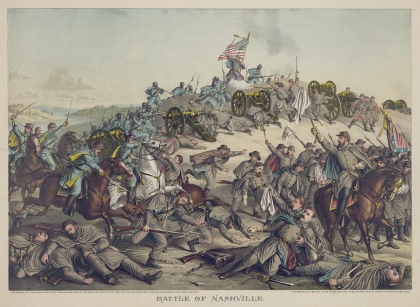
battle_of_nashville_kurz__allison

At peak one in eight Union troops were African American, and Black troops made an immense contribution to the Union victory. “Black troops fought on 41 major battlefields and in 449 minor engagements. Sixteen soldiers and seven sailors received Medals of Honor for valor. 37,000 blacks in army uniform gave their lives and untold sailors did, too.” [88] To fully appreciate the measure as to the importance and significance of the numbers of African American troops serving in the Union ranks has to compare that number with the number of active Confederate troops serving toward the end of the war. The approximately 180,000 African Americans serving in Union ranks at the end of the war outnumbered the “aggregate present” in Confederate ranks on January 1st 1865 by over 20,000 men. Of these troops “134,111 were recruited in states that had stars in the Confederate battle flag, and the latter figure in turn was several thousand greater than the total of 135,994 gray-clad soldiers “present for duty” that same day.” [89]

Of the African American soldiers who faced the Confederates in combat, “deep pride was their compensation. Two black patients in an army hospital began a conversation. One of them looked at the stump of an arm he had once had and remarked: “Oh I should like to have it, but I don’t begrudge it.” His ward mate, minus a leg, replied: “Well, ‘twas [lost] in a glorious cause, and if I’d lost my life I should have been satisfied. I knew what I was fighting for.” [90]

22nd-usct-flags                                                Flags of the 22nd U.S. Colored Troops 

After the war many of the African American soldiers became leaders in the African American community and no less than 130 of these former soldiers held elected office including in the U.S. Congress and various state legislatures. The liberating aspect of “the black military experience radiated from black soldiers and their families into the larger black community, so it spread into white society as well.” [91]  Many abolitionists who had served as officers, and officers who were assigned to the USCT or volunteered to serve with state raised African American regiments became leaders continued to be voices for expanding civil rights in the years following the war.

Following war’s end, the demobilized African American troops became the target of racial discrimination and violence, but even so, “black veterans continued to play a central role in black communities, North and South. The skills and experience black men gained during the war not only propelled many of them into positions of leaders and sustained the prominence of others, but it also shaped the expectations and aspirations of all black people. The achievements and pride engendered by military service helped to make a new world of freedom.” [92]

Sadly, much of the nation has forgotten the efforts of the Free Black Soldiers and Sailors who fought for freedom, but even so their legacy remains in the “contribution of black soldiers to Union victory remained a point of pride in black communities. “They say,” an Alabama planter reported in 1867, “the Yankees never could have whipped the South without the aid of the Negroes.” Well into the twentieth century, black families throughout the United States would recall with pride that their fathers and grandfathers had fought for freedom.” [93]

Notes 

[1] Ibid. McPherson Tried by War: Abraham Lincoln as Commander in Chief

[2] Ibid. Goodwin Team of Rivals p.435

[3] Ibid. McPherson Tried by War p.58

[4] Ibid. McPherson Tried by War p.58

[5] Ibid. Goodwin Team of Rivals p.369

[6] Ibid. McPherson Tried by War p.109

[7] Ibid. Foote, The Civil War, A Narrative Volume Two p.531

[8] Ibid. McPherson. The Battle Cry of Freedom p.503

[9] Ibid. McPherson Drawn With the Sword: Reflections on the American Civil War p.101

[10] Ibid. Guelzo Gettysburg: The Last Invasion p.160

[11] Foner, Eric Forever Free: The Story of Emancipation and Reconstruction Vintage Books a Division of Random House, New York 2005 p.45

[12] Ibid. Guelzo Gettysburg: The Last Invasion p.160

[13] Ibid. Glatthaar General Lee’s Army from Victory to Collapse p.313

[14] Ibid. Guelzo Gettysburg: The Last Invasion p.160

[15] Ibid. Goodwin Team of Rivals p.465

[16] Egnal, Marc Clash of Extremes: The Economic Origins of the Civil War Hill and Wang a division of Farrar, Straus and Giroux New York 2009 p.318

[17] Ibid. Foner Forever Free p.48

[18] Ibid. McPherson Tried by War p.159

[19] Ibid. McPherson Drawn With the Sword p.159

[20] Ibid. McPherson Abraham Lincoln and the Second American Revolution p.35

[21] Ibid. Guelzo Fateful Lightning p.381

[22] Ibid. Dobak Freedom by the Sword: The U.S. Colored Troops, 1862-1867 p.10

[23] Ibid. McPherson Abraham Lincoln and the Second American Revolution p.35

[24] Ibid. Robertson Soldiers Blue and Gray p.31

[25] Ibid. Dobak Freedom by the Sword: The U.S. Colored Troops, 1862-1867 p.11

[26] Ibid. Robertson Soldiers Blue and Gray p.31

[27] Ibid. Gallagher, Gary W. The Union War Harvard University Press, Cambridge MA and London 2011 p.103

[28] Welton, Chauncey B. A Union Soldier’s Changing Views on Emancipationin The Civil War and Reconstruction: A Documentary Collection edited by William Gienapp, W.W. Norton Company, New York and London 2001 pp.242 and 245

[29] Ibid. Robertson Soldiers Blue and Gray p.34

[30] Glatthaar, Joseph T. Black Glory: The African American Role in Union Victory in Why the Confederacy Lost edited by Gabor S. Boritt Oxford University Press, Oxford and New York 1992

[31] Ibid. McPherson. The Battle Cry of Freedom p.686

[32] Ibid. Goldfield America Aflame p.282

[33] Jones, Terry L. The Free Men of Color Go to War in The new York Times Disunion: 106 Articles from the New York Times Opinionator edited by Ted Widmer with Clay Risen and George Kalogerakis, Black Dog and Leventhal Publishers, New York 2013 p.403

[34] Ibid. Guelzo Fateful Lightening p.379

[35] Ibid. Foote The Civil War, A Narrative Volume Two p.398

[36] Ibid. Trudeau Like Men of War p.44

[37] Ibid. Guelzo Fateful Lightening p.379

[38] Ibid. McPherson. The Battle Cry of Freedom p.686

[39] Ibid. McPherson Drawn With the Sword p.101

[40] Ibid. McPherson. The Battle Cry of Freedom p.686

[41] Ibid. Guelzo Fateful Lightening pp. 380-381

[42] Ibid. McPherson. The Battle Cry of Freedom pp.686-687

[43] Ibid. Foote, The Civil War, A Narrative Volume Two p.697

[44] Ibid. McPherson. The Battle Cry of Freedom p.686

[45] Welch, Isaiah H. Letter in the Christian Recorder 24 October 1863 in The Civil War and Reconstruction: A Documentary Collection edited by William E. Gienapp, W.W. Norton and Company, New York and London 2001 pp.225-226

[46] Trudeau, Noah Andre, Like Men of War: Black Troops in the Civil War 1862-1865 Little, Brown and Company, Boston, New York and London, 1998 p.262

[47] Ibid. Guelzo Fateful Lightening p. 381

[48] Douglass, Frederick Philadelphia Speech of July 6th 1863 recorded in the Liberator in The Civil War and Reconstruction: A Documentary Collection edited by William E. Gienapp, W.W. Norton and Company, New York and London 2001 pp.220-221

[49] Ibid. Douglass Philadelphia Speech of July 6th 1863 p.221

[50] Ibid. McPherson. The Battle Cry of Freedom p.634

[51] Ibid. Trudeau Like Men of War: Black Troops in the Civil War 1862-1865p.58

[52] Ibid. Gallagher The Union War p.97

[53] Ibid. Trudeau Like Men of War: Black Troops in the Civil War 1862-1865 p.59

[54] Ibid. Gallagher The Union War p.92

[55] Ibid. McPherson Drawn With the Sword p.89 p.

[56] Catton, Bruce. A Stillness at Appomattox Doubleday and Company Garden City, New York 1953 p.227

[57] Berlin, Ira, Riedy, Joseph P. and Rowland, Leslie S. editors, Freedom’s Soldiers: The Black Military Experience in the Civil War  Cambridge University Press, Cambridge and New York 1998 pp.133-134

[58] Ibid. Catton A Stillness at Appomattox p.249

[59] Foote, Shelby, The Civil War, A Narrative. Volume Three Red River to Appomattox Random House, New York 1974 p.537

[60] Ibid.Wert The Sword of Lincoln: The Army of the Potomac pp.384-385

[61] Ibid. Foote The Civil War, A Narrative Volume Three p.537

[62] Ibid. Robertson Soldiers Blue and Gray p.34

[63] Ibid. Berlin et al, Freedom’s Soldiers: The Black Military Experience in the Civil War  p.135

[64] Ibid. Weigley A Great Civil War p.189

[65] Ibid. McPherson Battle Cry of Freedom p.566

[66] Ibid. Goldfield America Aflame p. 280

[67] Ibid. Weigley A Great Civil War p.188

[68] Ibid. Guelzo Fateful Lightening p. 377

[69] Ibid. Guelzo Fateful Lightening p. 377

[70] Ibid. Goldfield America Aflame p.281

[71] Ibid. Weigley A Great Civil War p.189

[72] Ibid. Dobak Freedom by the Sword: The U.S. Colored Troops, 1862-1867 p.208

[73] Grant, Ulysses S. Preparing for the Campaigns of ’64 in Battles and Leaders of the Civil War Volume IV, Retreat With Honor Edited by Robert Underwood Johnson and Clarence Clough Buel Castle, Secaucus NJ pp.107-108

[74] Ibid. Foote The Civil War, A Narrative Volume Three p.111

[75] Ibid. Guelzo Fateful Lightning p. 378

[76] Ibid. Foote The Civil War, A Narrative Volume Three p.112

[77] Ibid. Dobak Freedom by the Sword: The U.S. Colored Troops, 1862-1867 p.208

[78] Eakin, John R. The Slave Soldiers, June 8, 1864  in Loewen, James W. and Sebesta, Edward H. editors, The Confederate and Neo-Confederate Reader: The “Great Truth” about “The Lost Cause” University of Mississippi Press, Jackson 2010 pp.210 and 212

[79] Ibid. Berlin et al, Freedom’s Soldiers: The Black Military Experience in the Civil War  p.47

[80] Ibid. McPherson Abraham Lincoln and the Second American Revolution p.89

[81] Ibid. Glatthaar Black Glory: The African American Role in Union Victoryp.138

[82] Ibid. McPherson The War that Forged a Nation p. 113

[83] Ibid. Guelzo Fateful Lightning p. 376

[84] Ibid. Goldfield America Aflame p.282

[85] Ibid. Weigley A Great Civil War p.192

[86] Ibid. McPherson For Cause and Comrades p.130

[87] Ibid. Weigley A Great Civil War p.191

[88] Gallagher, Gary, Engle, Stephen, Krick, Robert K. and Glatthaar editors The American Civil War: The Mighty Scourge of War Osprey Publishing, Oxford UK 2003 p.296

[89] Ibid. Foote The Civil War, A Narrative. Volume Three Red River to Appomattox p.756

[90] Ibid. Robertson Soldiers Blue and Gray p.36

[91] Ibid. Berlin et al, Freedom’s Soldiers: The Black Military Experience in the Civil War  p.47

[92] Ibid. Berlin et al. Freedom’s Soldiers: The Black Military Experience in the Civil War pp.49-50

[93] Ibid. Foner Forever Free p.55

2 Comments

Filed under civil rights, civil war, History, Military, Political Commentary, racism, us army

The Legacy and Warning of Field Marschal Von Paulus at Stalingrad: Even Honorable People Can Believe a Lie and Lead Men to Death

Friends of Padre Steve’s World,

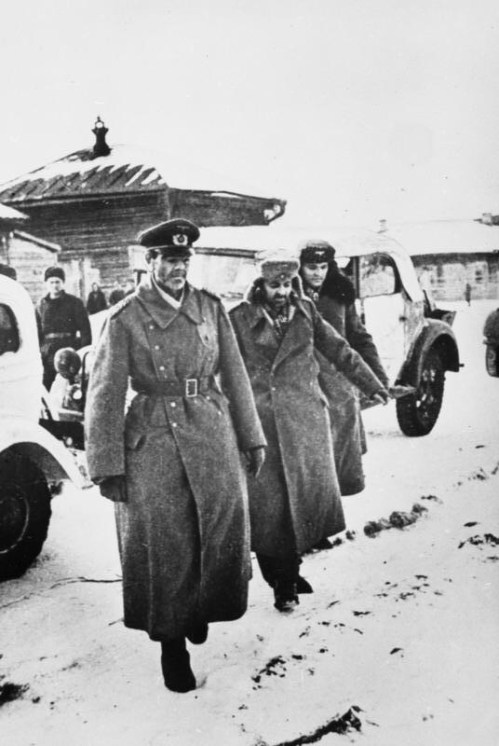
Seventy-seven years ago today the commander of the encircled German Sixth Army at Stalingrad, Field Marshal Friedrich Paulus left his command bunker and surrendered the the Red Army. In the ruins of Stalingrad lay most of the freezing, malnourished, soldiers of his once elite Army. Around 90,000 survivors of his army surrendered in the coming days to the Red Army. Of the Germans taken prisoners, only about 5,000 returned home. The Most were to die of their wounds, or of diseases, maltreatment, and starvation in Soviet Camps between 1943 and 1955 when the bulk of the survivors were released.

Friedrich Paulus was one of them, and his story is interesting, not simply because he was the Commander of the Sixth Army, but because he wasn’t the kind of man one would have expected to command an army of 13 divisions with a strength of nearly 285,000 men spearheading the great German Offensive of 1942.

Paulus was born in 1890, and joined the Imperial Army in 1910. During the First World War he served on the Western Front, finishing the war as a Captain. After the was the collapse of the Army and order during the German civil war he served as Adjutant of a government sponsored Freikorps Brigade. Following the Treaty of Versailles, Paulus was retained as one of the 4,000 officers in the new Reichsheer. He served as a staff officer and company commander, and briefly commanded a battalion. He would also serve on the staff which developed the new Panzer Forces for the Wehrmacht. Paulus was an apolitical professional soldier, he was not a Nazi but he, like many other military men considered Hitler:

“an excellent leader for the German people, a man who had contributed greatly to the development of the state. After watching him evolve the strategies that conquered Poland, France, and most of Europe, Paulus was awed by Hitler’s grasp of the technical aspects of warfare. He considered him a genius.”

Paulus was promoted to Colonel in 1938 and served as Chief of Staff to Heinz Guderian’s XVI Motorized Corps. But Guderian had reservations about Paulus’s lack of command experience, decisiveness, and toughness. Following his assignment with the motorized Corps, Paulus was promoted to the rank of Generalmajor (the equivalent of a U.S. Brigadier General) to serve as Chief of Staff to the 10th Army under the command of General Walter Reichenau during the invasion of Poland. He continued in that position when 10th Army was redesigned 6th Army for the Invasion Of France and the Low Countries.

After the Battle of France he was promoted to Generalleutnant and assigned as deputy Chief Staff, Operations, of the Oberkommando Des Heeres, the German General Staff. In this capacity he served as one of the principle planners of Operation Barbarossa.

His wife, Elena, a descendant of one of Romania’s Royal Houses was opposed to Hitler and the war. She told her husband that “he was far too good for the likes of men such as Keitel and the other “lackeys” who surrounded Hitler.” She protested the injustice of the war against Poland, but he, in the thrall of Hitler’s genius and simply followed orders. When he brought home maps and documents related to Barbarossa she again protested to him. When he ignored her she said:

“What will become of us all? Who will survive to the end?”

Since he believed in Hitler’s invincibility, Paulus ignored her concerns, and told her that the war would be over in six weeks. Elena’s words would prove prophetic.

But Elena’s concerns were well justified. In December 1941 the German Offensive ground to a halt at the gates of Moscow and a devastating Red Army counterattack created a crisis in the Wehrmacht which was completely unprepared for the Russian Winter. Only heroic resistance and improvisation by German units, and the still imperfect application of operational warfare by the Red Army, saved the German front. While battles from Leningrad to Crimea continued throughout the winter, the lines stabilized, and both sides began their plans for the coming year.

During the winter debacle Hitler sacked many commanders, which left many command vacancies. Reichenau, a committed National Socialist and fanatical fighter took over command of Army Group South from Field Marshal Gerd Von Rundstedt, who had been fired by Hitler. Reichenau, who had been Paulus’s patron had Paulus promoted to General der Panzertruppen and named as commander of 6th Army.

The two men were nothing alike and Paulus had never commanded more than a battalion, and that not in peacetime. However, six days later the athletic Reichenau suffered a heart attack, which was was followed by a head injury during a medical evacuation flight back to Germany. Reichenau, the fanatical Nazi died, and Paulus, revoked the infamous Commissar Order, as well as Reichenau’s most notorious orders, the Severity Order in the Sixth Army area of operations. That order stated:

“The most important objective of this campaign against the Jewish-Bolshevik system is the complete destruction of its sources of power and the extermination of the Asiatic influence in European civilization.… In this eastern theatre, the soldier is not only a man fighting in accordance with the rules of the art of war, but also the ruthless standard bearer of a national conception.… For this reason the soldier must learn fully to appreciate the necessity for the severe but just retribution that must be meted out to the subhuman species of Jewry.…”

Paulus demonstrated moral courage unusual for senior German officers, but he also forbade cooperation with the Einsatzgruppen death squads, which Reichenau had gone out of his way to support. This was unusual for any commander on the Eastern Front, especially a man like Paulus who believed in Hitler’s invincibility. Paulus did well in his first combat with the Red Army, when it attempted to disrupt the coming German offensive at Kharkov as Sixth Army encircled and captured over 200,000 Soviet troops.

The Sixth Army had a key role in the German summer offensive, Operation Blau. Paulus commanded it well but became involved in the battle for Stalingrad. The battle dragged on in the face of fanatical and skilled Soviet resistance. However, Hitler would not let Paulus break off the Battle, and promoted him to Colonel Genera in order to bolster his confidence. Likewise, in an interesting, but vital footnote to the campaign, which was unknown to Hitler and his commanders, Stalin knew of Operation Blau.

Stalin had learned to preserve his forces after the catastrophes of 1941 withdrew his forces and observing the German movements decided to turn Stalingrad into a fortress. He conducted a strategic withdraw to preserve his forces, allowing the majority of the German Army Group South to advance deep into the Caucasus in order to capture the oilfields of the region.

However, this movement divided the German armies, leaving the flanks of the Sixth Army protected by pathetically equipped Italian, Romanian, and Hungarian armies. None of these units could not match the manpower, mobility, or firepower of the Red Army, and none were prepared for the onslaught that was to be directed against them.

Stalin allowed the German Army Group South to continue to advance, and forced the Sixth Army to battle street by street, building by building, factory by factory to capture Stalingrad. Had the Germans followed their operational doctrine Stalingrad would have been bypassed and surrounded, but they didn’t, Hitler would not allow it. Because of this, Paulus allowed the Soviets to maintain their defense by not cutting the Red Army defenders in the city off from the Volga, even by not taking action to link up with the Fourth Panzer Army which under its commander Hermann Hoth had broken through the Soviet front south of the Stalingrad when the opportunity presented itself.

Even so, the Sixth Army had conquered most of the city when in lateNovember the Red Army launched Operation Uranus, which was designed to destroy the weakly held flanks and surround the Sixth Army by a deep envelopment operation, which had previously been the forte of the German Blitzkrieg. The operation totally surprised the Germans and in four days time the Sixth Army went from the spearhead of the German assault to an army cut off and surrounded by a Soviet Army Group. The Italian, Hungarian, and Romanian armies on its flanks were shattered.

Plans were made to relieve the Sixth Army but they depended on the Sixth Army attacking out to meet the relief forces of the Fourth Panzer Army. Hitler refused permission and Paulus obeyed, believing Hitler’s promise that Goering’s Luftwaffe would be able to keep his troops supplied. On New Year’s Day Hitler promoted Paulus to Colonel General. Paulus was now convinced that his Army was doomed but he grasped the broader strategic situation; as long as he could keep the Red Army invested in Stalingrad, it would keep them from encircling the much bigger portion of Army Group South, now under direction of Erich von Manstein from being cut off. According to one officer Paulus remarked:

“What would become of the war if our army in the Caucasus were also surrounded? That danger is real. But as long as we keep on fighting, the Red Army has to remain here. They need these forces for a big offensive against Army Group ‘A’ in the Caucasus and along the still-unstable front from Voronesh to the Black Sea. We must hold them here to the last so that the eastern front can be stabilized. Only if that happens is there a chance of the war going well for Germany.”

But the handwriting was on the wall. German Forces to the south were having to extricate themselves from an even bigger encirclement. The superb generalship of Field Marshal Erich Von Manstein prevented a complete disaster and inflicted a compelling defeat on the Red Army, but the Sixth Army was doomed. On January January 7th Paulus was offered generous surrender terms by General Konstantin Rokossovsky. Paulus asked permission to surrender which was denied by Hitler.

Again on January 22nd Paulus requested his Fuhrer:

… For submittal to the Führer and to commander in chief, Army Group Don.… The Russians are advancing on a six-kilometer frontage both sides of Voporonovo toward the east, [toward Stalingrad] in part with flying colors. There is no possibility to close the gap … All provisions are used up. Over twelve thousand unattended [wounded] men in the pocket. What orders am I to issue to the troops, who have no ammunition left? … Immediate decision is required, since symptoms of disintegration are noted in some places. However, the troops still have faith in their commanders.” Paulus

On January 25th the Red Army overran the last airfield in the Stalingrad pocket, now there was no escape.

To a Luftwaffe Officer who was sent by Berlin to encourage Paulus about new airlifts, Paulus said:

“Why on earth did the Luftwaffe ever promise to keep us supplied? Who is the man responsible for declaring that it was possible? Had someone told me it was not possible, I should not have held it against the Luftwaffe. I could have broken out. When I was strong enough to do so. Now it is too late.…”

Paulus radioed Hitler for permission to surrender, empathetically stating the conditions in the pocket. No food, no medicine, no ammunition, no fuel; only to be denied again.

On January 30th, the 10th anniversary of Hitler’s seizure of power the Troops in Stalingrad were treated to a radio broadcast from Berlin, not Hitler, but Goering. The words of the Reichsmarschal fell hollow on the ears of the doomed men:

“… What herculean labors our Führer has performed … out of this pulp, this human pulp … to forge a nation as hard as steel. The enemy is tough, but the German soldier has grown tougher.… We have taken away the Russians’ coal and iron, and without that they can no longer make armaments on a large scale.… Rising above all these gigantic battles like a mighty monument is Stalingrad.… One day this will be recognized as the greatest battle in our history, a battle of heroes.… We have a mighty epic of an incomparable struggle, the struggle of the Nibelungs. They, too, stood to the last.… My soldiers, thousands of years have passed, and thousands of years ago in a tiny pass in Greece stood a tremendously brave and bold man with three hundred soldiers, Leonidas with his three hundred Spartans.… Then the last man fell … and now only the inscription stands: ‘Wanderer, if you should come to Sparta, go tell the Spartans you found us lying here as the law bade us.’… Someday men will read: ‘If you come to Germany, go tell the Germans you saw us lying in Stalingrad, as the law bade us.…’”

The soldiers knew that they had been abandoned by Berlin. Yet, Paulus, ever loyal radioed:

January 30th:

On the tenth anniversary of your assumption of power, the Sixth Army hails its “Führer.” The swastika flag is still flying above Stalingrad. May our battle be an example to the present and coming generations, that they must never capitulate even in a hopeless situation, for then Germany will come out victorious.

Hail my Führer Paulus, Generaloberst

But it was a lie. Less than 24 hours later on January 31st with Red Army tanks and troops outside his command bunker, Paulus surrendered, just hours after Hitler promoted him to Field Marshal. The promotion was supposed to encourage Paulus to commit suicide as no German Field Marshal had ever surrendered his army.

Colonel Adam, an aide to Paulus recorded how Paulus received his promotion:

January 31, 1943 – 7.00 a.m. It was still dark but day was dawning almost imperceptibly. Paulus was asleep. It was some time before I could break out of the maze of thoughts and strange dreams that depressed me so greatly. But I don’t think I remained in this state for very long. I was going to get up quietly when someone knocked at the door. Paulus awoke and sat up. It was the HQ commander. He handed the colonel general a piece of paper and said: ‘Congratulations. The rank of field marshal has been conferred upon you. The dispatch came early this morning – it was the last one.’

‘One can’t help feeling it’s an invitation to suicide. However I’m not going to do them such a favour.’ said Paulus after reading the dispatch. Schmidt continued: ‘At the same time I have to inform you that the Russians are at the door.’ with these words he opened the door and a Soviet general and his interpreter entered the room. The general announced that we were his prisoners. I placed my revolver on the table.”

Paulus surrendered, and contrary to Hitler’s wishes did not commit suicide. In the next few days the other isolated pockets of German resistance surrendered as well. Roughly 95,000 Germans, Italians, and Romanians surrendered at Stalingrad. Fewer than 6,000 would return home after nearly a decade of imprisonment and forced labor.

In Hitler’s headquarters the scene was terrifying. Hitler ranted about the treason and cowardice of Paulus, and his lackeys in the military agreed. Paulus should have shot himself and the garrison formed a hedgehog and resisted to the last bullet.

Though he surrendered Paulus did not give support to the Soviets or the German resistance until he learned of the execution of his Friend Field Marshal Erich von Witzleben and others for their participation in the attempt to kill Hitler. When he learned of their deaths he joined the he joined the Communist-inspired Bund Deutsche Offiziere, an “anti-Fascist” group that broadcast appeals to the citizens of the Third Reich against the Hitler regime.

After the war he testified at the Nuremberg Trials admitting German conduct of the war in the east was criminal but refusing to label men like Wilhelm Keitel, and Afred Jodl as war criminals. He took up a position as the civilian chief for military history for the new East German Government. He died on February 1st 1957, of ALS, having never seen his wife since he left to take command of Sixth Army in January 1942, she died in 1949. His son Alexander was killed at Anzio in 1944. His other son, Ernst, survived the war and committed suicide in 1970.

Paulus’s fate is an object lesson for military personnel, civil servants, or police officials who themselves are apolitical, and that honorable can people become seduced and believe in cults of personality. In the end, many sacrifice their lives, reputations, and even their families.

Without mentioning any names, the Americans who worship at the cult of Trump should pay heed. like Paulus, their loyalty will be betrayed, and even as their leader abandons them.

Until tomorrow,

Peace,

Padre Steve+

10 Comments

Filed under ethics, faith, germany, History, holocaust, Military, nazi germany, News and current events, Political Commentary, world war two in europe

Silent Witnesses of Evil Deeds… Are We Still of Any Use? Trump’s Christian Advocates


Friends of Padre Steve’s World,

Over his three years in office President Trump has managed to tell over 15,000 lies or distortions of the truth as of December 16th 2019 according to the Washington Post. That being said we all expect politicians to lie, it’s part of American life and political discourse. Will Rogers once said “If you ever injected truth into politics you have no politics.” I think that the expectation that elected officials will lie is one reason that Mark Twain quipped: “An honest man in politics shines more there than he would elsewhere.”

However the shear numbers of lies and falsehood proclaimed by the President is having a toxic effect on our society, in particular on those in the church, men and women who call themselves by the name of Christ who not only believe them, but repeat them, and defend them.  The fact is that for decades these same Christian leaders and people have proclaimed their allegiance to what they call “moral absolutes”and  “Biblical values”while excoriating Democrats, particularly Bill and Hillary Clinton for their lies. The fact is that by doing this Christians simply become another political interest group hustling politicians for favors that benefit them, even at the expense of the credibility of their witness to Christ.

The constant repetition of the President’s well documented lies, and their defense by administration flacks, Congressional supporters, the Fox News media empire, and the big name Evangelical Preachers who have sold their souls in his defense have damaged the soul of the country and yes the Church.

Of course one would expect the President’s opponents to point out his lies but in normal times you wouldn’t expect his conservative religious supporters to go to the mat defending him and his lies, and even calling him a “role model” for young people.  In a recent survey some 70% of his predominantly Christian, Republican supporters say that he is and that my friends is, if you value the long term witness of the Christian Church absolutely devastating, especially since for over a decade young people have been fleeing the church in never before seen numbers while unbelievers, even those that admire Christ and what some would call Christian values want nothing to do with the Church.

The fact is that the repetition of lies and falsehoods, whether you are a Trump supporter or opponent there is a not a good thing either for the Church or for the country. It has a terrible effect, and one only has to look to the countries of Europe to see how Christian support for malevolent leaders has reduced it to irrelevance. Whether it be the support of ethnic and religious persecution, or the participation in and protection of sexual predators masquerading and Bishops, Priests, and Nuns has eviscerated the witness of the Church.

Dietrich Bonhoeffer understood this and asked a question that should be asked by people that call themselves by the name of Christ who at the same time defend the indefensible and not only defend, but take great pleasure in defending the lies of the President. Bonhoeffer observed the same dynamic in his day. He wrote:

“We have been silent witnesses of evil deeds; we have been drenched by many storms; we have learnt the arts of equivocation and pretense; experience has made us suspicious of others and kept us from being truthful and open; intolerable conflicts have worn us down and even made us cynical. Are we still of any use? What we shall need is not geniuses, or cynics, or misanthropes, or clever tacticians, but plain, honest, and straightforward men. Will our inward power of resistance be strong enough, and our honesty with ourselves remorseless enough, for us to find our way back to simplicity and straightforwardness?”

Please believe me when I say that I am not being an alarmist about this situation. I know too much about history, human nature, and yes the Church not to see the danger. Sophie Scholl, a leader of the Anti-Nazi White Rose Resistance who was martyred two years before Bonhoeffer wrote:

But that’s part of the problem. The lies and actions of the President and his administration have been cumulative; and toxic to our political, social, and even religious institutions. What was shocking to most on day one became normalized over the course of the past three years, four and a half if you go back to the time Candidate Trump came down the escalator at Trump Tower to announce his Presidential candidacy.

The effect is both numbing and corrosive: first on the President’s defenders who surrender all pretext of moral or religious authority, and on his opponents who gradually are worn down by the barrage of lies and the fact that they are also the minority party, or if the are Republicans, the minority in the President’s party. In addition to his lies and obfuscations the President appears to have directly collided with the Russians to influence the 2016 election, use his office for personal gain, pardoning war criminals, breaking treaties, and offering support for nations who kill American based reporters, and even assassinating a military leader of a nation we are not at war with on the soil of a badly needed, but fragile ally; and finally today made comments that he would commit US troops to nations who paid the most for them. In essence, he has agreed to turn the U.S. Military from a force dedicated to supporting and defending the Constitution, to a force for hire, mercenaries if you will.

Sophie Scholl, a leader of the Anti-Nazi White Rose Resistance who was martyred two years before Bonhoeffer wrote:

“The real damage is done by those millions who want to ‘survive.’ The honest men who just want to be left in peace. Those who don’t want their little lives disturbed by anything bigger than themselves. Those with no sides and no causes. Those who won’t take measure of their own strength, for fear of antagonizing their own weakness. Those who don’t like to make waves—or enemies. Those for whom freedom, honour, truth, and principles are only literature. Those who live small, mate small, die small. It’s the reductionist approach to life: if you keep it small, you’ll keep it under control. If you don’t make any noise, the bogeyman won’t find you. But it’s all an illusion, because they die too, those people who roll up their spirits into tiny little balls so as to be safe. Safe?! From what? Life is always on the edge of death; narrow streets lead to the same place as wide avenues, and a little candle burns itself out just like a flaming torch does. I choose my own way to burn.”

Since President Trump first announced his candidacy for President in 2015, I have been sounding out a warning about the President, mostly for my Christian friends. By doing so I have lost friends and been ostracized or attacked by others for doing so, despite the fact that until my return from Iraq in 2008, I had been both a politically active Conservative Christian and Republican for over thirty-two years. That being said regardless of the cost I would rather follow my conscience than surrender it to the cacophony of lies and acceptance of evil by people who were once friends.

I do not consider myself to be a victim of my former friends. In fact I understand how they got to this point. In fact what has happened with them did not begin with the lies of President Trump. For decades, they, like I did until 2008, bought the repeated lies of the politicians, pundits, and preachers of the American conservative movement. The leaders of this movement coopted them by constantly repeating that they were under attack and needed to take control of the government in order to both defend the faith and implement a Christian government.  Whole theologies were built around this and gradually many, if not most conservative and Evangelical Christians accepted the idea that Christians had to “take dominion”over the country regardless of the cost. The leaders of the so-called “Christian Right” including Franklin Graham, Tony Perkins, James Dobson, Pat Robertson, Albert Mohler, Robert Jeffress, Paula White, and far too many others have sacrificed every bit of their integrity in defending the President and excusing his lies to further their own power. His Secretary of State, Secretary of Health and Human Services, and others in his administration hold the same views as the Trump Court clergy.

Truthfully, I understand how they got there. If I hadn’t gone to Iraq, seen what I saw there, realized the lies that went into the propagation of the war and the lies of Christians who demonized all Muslims because of some after the attacks of September 11th 2001, I would probably still be one of them. For me it took war to understand the moral and theological bankruptcy the politics and theology of the Christian Right, of which over 80% voted for the President and over 75% still support him.

But there is a critical difference for those in the military versus religious sycophants. Above everything our oaths demand obedience to the Constitution above personal loyalty to any President, any Political Party, or any personal religious preference. Members of the military must remember the words of men who served under men with similar personality traits as our President. General Ludwig Beck, Chief of Staff of the German Army, resigned his post in 1938 over Hitler’s threatened invasion of Czechoslovakia. He wrote:

“It is a lack of character and insight, when a soldier in high command sees his duty and mission only in the context of his military orders without realizing that the highest responsibility is to the people of his country.”

Beck also wrote something that is all to important to any military officer, intelligence and law enforcement officials, as well as diplomats in such times as we live today:

“Final decisions about the nation’s existence are at stake here; history will incriminate these leaders with bloodguilt if they do not act in accordance with their specialist political knowledge and conscience. Their soldierly obedience reaches its limit when their knowledge, their conscience, and their responsibility forbid carrying out an order.”


Likewise, another German officer, Major General Henning Von Tresckow, who Like Beck lost his life in the attempt to kill Hitler on July 20th 1944, noted:

“I cannot understand how people can still call themselves Christians and not be furious adversaries of Hitler’s regime.”

Finally, the German pastor Martin Niemoller, himself a Conservative Christian, nati-Communist, and early supporter of Hitler wrote:

First they came for the Socialists, and I did not speak out—
Because I was not a Socialist.

Then they came for the Trade Unionists, and I did not speak out—
Because I was not a Trade Unionist.

Then they came for the Jews, and I did not speak out—
Because I was not a Jew.

Then they came for me—and there was no one left to speak for me.

As I said, Niemöller was an early supporter of Hitler, until he saw the truth about him. I think the same of Christians who support the basest and most immoral, unconstitutional, and deranged aspects of Trump’s policies. But I think that it was Bonhoeffer who asked the right question in terms of Christians and their support of morally bankrupt regimes, not just Trump’s, but those in many nations where Christians back such regimes. “Are we still of any use?”

It’s a pretty good question, I would ask anyone who calls themself a Christian to meditate upon it.

Until tomorrow,

Peace,

Padre Steve+

3 Comments

Filed under ethics, faith, germany, History, leadership, Military, ministry, nazi germany, News and current events, Political Commentary, Religion

A Man’s Got to Know His Strategic Limitations: President Trump and the Current Middle Eastern Crisis

        Turkish Protestors in Istanbul 

Friends of Padre Steve’s World,

As I watch the crisis between the United States, or shall I better say President Trump and Iran unfold, and have talked with various friends about it in person and on social media I am reminded of a couple of different definitions of patriotism. Now since I have served the United States as a military enlisted man, and officer in both the Army and Navy in Peace and War, I think that I love my country and should be considered a patriot. I am not blind to our shortcomings, nor things that have been done in the name of the United States that go against the will of our Founders, the ideals of the Declaration of Independence, and the law embodied in our Constitution. Liberal or not, I am a realist. I don’t like to us to lose unnecessary wars.

Likewise, as my favorite theologian Harry Callahan said in Magnum Force: “A man’s got to know his limitations.”  Our President, nor his Cult  do not understand reality. Despite the comparative easy Assassination of the Iranian Revolutionary Guard General Qassim Suleimani, regardless of how bad of man he was, the President has opened a potentially apocalyptic Pandora’s Box which will bring about worse for the United United States, the region and the world.

None of our allies anywhere in the world, including the Israelis, who hate Iran, have officially offered us their support. The Iraqi Parliament has passed a resolution asking the government to order the United States military forces to leave the country. That may not happen, but it will place our very limited and scattered forces in Iraq at the mercy of Iraqi Militias supported by Iran, and quite possibly regular Iraqi and Iranian forces. It could be a death trap for the 5,500 or so American troops in Iraq, not to mention those in Kuwait, those based in Syria, Bahrain, and Qatar, or on ships in the Arabian/Persian Gulf.

American military power is not what it used to be and the President has not considered the second, third, fourth, fifth, or more effects of this strike. Our military readiness is not good, our ability to project power and sustain our forces is worse than it was in 2003, and now we have no allied support. Likewise there is no telling what the Russians, Chinese, North Koreans, or other competitors/enemies will do.

The Iranians have announced that they will not abide by the nuclear accords reached with the West during the Obama Administration, which they abided by even after President Trump renounced that accord. Likewise they have promised vengeance against American military targets and a eulogist at Suleimani’s funeral put an 80 million dollar contract for anyone who kills President Trump.

I neither want a wider war or for that matter for the Iranians to succeed in assassinating President Trump. As much as I oppose the President’s policies and think of him as a dangerous man, his death would only serve to make things worse. He would be succeeded by Vice President Pence, and his cult would demand its own vengeance, regardless of the military, diplomatic, and economic cost.

The “Mistake” Letter

Today the situation continued to escalate as the Iraqi Parliament continued to press for the removal of American and foreign forces from Iraq, backed now by the Iraqi President. President Trump threatened to attack religious and cultural sites in Iran, in violation of treaties we have signed and if carried out would be war crimes. He was countermanded by Mark Esper, the Secretary of Defense.Trump continued to reiterate his threat about 52 targets in Iran based on the number of hostages taken by Iranians during the takeover of the American Embassy in 1979, to which the Iranian President reminded the United States of the 290 passengers lost when the USS Vincennes misidentified and shot down IR-655, an Iranian passenger plane on a scheduled flight in 1988. In response the the Iraqi Parliament vote Trump ordered the administration to draft  sanctions against Iraq. During the day a draft of a withdraw letter was mistakenly released by the commander of American Forces, which was almost immediately denied as a mistake by the Chairman of the Joint Chiefs and Secretary of Defense.

If you ask me, things seem to be spiraling out of control, and nobody seems to be at the helm of the ship of state. This is not a good position to be in.

But now the dice have been thrown, the wager has been made, and the outcome is at best an uncertain gamble. I fear for our soldiers, sailors, marines, and airmen in Iraq and the Gulf. The Iranians can easily shut down the Straits of Hormuz, their Yemeni allies can threaten the Bab El Mendeb, the other major maritime choke point in the region. Likewise, in defiance of Trump the Iraqis could cut off supplies from the American troops scattered across the country if they do not withdraw or some kind of accord is reached for them to stay. Likewise, the Iranians, while not the military equal of the United States do have enough power to endanger every American facility in the Persian Gulf, kill tens of thousands of Americans, and seriously disrupt the world economy, yet leaving the Russians, and Chinese greatly strengthened.

I do not know what will happen over the next few days or weeks, but the President has backed us into a corner with little room for maneuver, diplomatically or militarily. Even long term allies like the Israelis, British, and Australians have not offered support. Neither have the Saudis, the mortal Sunni enemies of the Shia Iranians. Certain pundits have, but not their governments.

This is a watershed moment, things that Americans and the world trusted to remain as they were will no longer be the same, and we will not be the better for it. Things will not get better and they will very likely get worse and very possibly bring about the Armageddon that many of Trump’s followers, as well as certain groups of Sunni and Shia Muslims, and others fervently pray for.

Until tomorrow,

Peace,

Padre Steve+


3 Comments

Filed under ethics, Foreign Policy, History, iraq,afghanistan, middle east, Military, national security, News and current events, Political Commentary

An Act of War: Trump Has Iranian General Assassinated

Friends of Padre Steve’s World,

The great Prussian military strategist Carl Von Clausewitz wrote:

“No one starts a war–or rather, no one in his sense ought to do so–without first being clear in his mind what he intends to achieve by the war and how he intends to conduct it.”

Late Thursday night I saw that the commander of the Iranian Revolutionary Guards Corps “Al Quds” division, General Qasem Soleimani was assassinated by an American Air Force Drone strike, which killed the leader of many of Iraq’s Iranian allied Shia militiamen. This was a day after the Shia militia withdrew after attacking the American Embassy in Baghdad’s Green Zone.

Rather than maintaining a policy of plausible deniability like the Israelis, Russians, Chinese or North Koreans, President Trump had the Defense Department almost immediately claim credit for the strike. Don’t get me wrong, I shed no tears for Qasem Soleimani.

He was responsible for the deaths of hundreds, if not more than a thousand American troops in Iraq, by supplying completed and equipment used to make Improvised Explosive Devices to Shia militants. Thousands of others were wounded, and throughout Iraq, Yemen, Syria, Lebanon, the Gulf States, Saudi Arabia, and even Israel. Militias that he supplied and that are allied with Iran have killed countless Sunni, Kurdish, Sufi, and Christian Arabs. Quite simply, there is no love between the Persians and the Arabs, it is a hatred that preceded the foundation of Islam, or Christianity for that matter. The Persians have always treated the Arabs as inferiors regardless of religion, one reason that some of the most powerful Iraqi Shia leaders remain Iraqi nationalists.

The smart thing to do would have been to use locally manufactured weapons, or those common in the region from Russia, China, North Korea, and European nations, to kill him, and then say nothing. That is how intelligent nations assassinate their opponents, by maintaining plausible deniability. Pardon my less than Christian interpretation of such actions, but beating your chest after such an action as President Trump did today only serves to embolden one’s opponents.

Iran was in the midst of disintegration, protests and deteriorating economic conditions were making it ripe for revolution, but every authoritarian government knows, the easiest way to unify a divided country is war, especially when a longstanding enemy launches a surprise attack that kills a man not only considered a military leader but an national icon. Likewise, the killing of Soleimani will do nothing to change the course of Iran or its policies anywhere. His successor is the man who has been his deputy since the late 1990s. Rather than dividing Iran, this will unify it, against the United States.

One should expect attacks by Iran’s allied militias in Syria, Iraq, Lebanon, the Persian Gulf, and Yemen against American, western, Israeli, and Saudi interests. Likewise one can not calculate the actions of the Russians, Chinese, North Koreans, or others, even friends will be. We could easily find ourselves fighting on multiple fronts without allies or support.

This is uncharted territory. The President did not seek the advice and consent of Congress for  an action that was a functional declaration of war, neither sanctioned by international law, nor in any way covered by the 2001 Authorization for Use of Force sought by the Bush Administration to take action against Al Qaida and Afghanistan; a document used by every succeeding administration for use of force around the world, whether connected with Al Qaida or not. At no point has Congress asserted its authority to declare war. In fact it hasn’t been since President Roosevelt asked for and got a declaration of war against Japan on December 8th 1941, and Germany and its allies when they declared war against the United States a few days later. Since then Congress has yielded to the executive branch and President in every subsequent occasion. Even the War Powers Act, enacted after Vietnam has done little to curtail the actions of each succeeding Presidency. As such this is not just a foreign policy and potential war action, but yet another assault on the Constitution; but then the Constitution hasn’t mattered to most Americans in decades, especially when it comes to military action.

Sun Tzu wrote: “If you know the enemy and know yourself, you need not fear the result of a hundred battles. If you know yourself but not the enemy, for every victory gained you will also suffer a defeat. If you know neither the enemy nor yourself, you will succumb in every battle.”

I feel that Americans by and large neither know ourselves, or our enemies, and that this is most exemplified by the example of President Trump. that my friends saddens me.

We believe that our military is the strongest and most capable in the world, which it would be if it had not been gutted by 18 years of war, which despite the vast sums spent on it is now less capable of projecting military power than it was in 2001. Likewise, massive debt of the country impedes the overall economy, the President’s attacks on the nation’s intelligence and free press have harmed our ability to gain information as well as use information to our advantage, and finally the gutting of the State Department has devastated our ability to use diplomacy rather than force to solve problems.

Every instrument of what American diplomats and strategists have called the DIME, the Diplomatic, Information, Military, and Economic pillars of national power are crumbling and neither the President or Congress has the honesty to say so, even though unclassified reports of all of the above are readily available for anyone to see. But many, if not most Americans prefer ignorance of the law, the Constitution, and facts to reality.

Expect cyber attacks, terrorist attacks on Americans overseas and quite possibly attacks in the United States itself. War could easily consume most of the Middle East and world. While the United States military would probably destroy most of Iran’s conventional military, and infrastructure, it will be a great cost. American losses will be more than OIF and OEF combined. The videos of American Warships burning and sinking from saturation attacks by Iran’s vast number of surface to surface anti-ship missiles, swarm attacks by Iran’s missile and torpedo boats, and speedboats laden with explosives piloted by suicide crews will be hard to fathom. Iranian attacks on U.S. bases in Bahrain, the UAE, Qatar, Kuwait, and Saudi Arabia with ballistic and cruise missiles will also overwhelm available missile defenses.

This may sound like a bleak estimate, but I study, I read, and I know.

I don’t know how to end this article but it just seams to me that the President has sown the wind, leaving his military and people to reap the whirlwind. I sincerely hope that I am wrong. But as Admiral Josh Painter, played by the late actor and Senator Fred Thompson said in the Hunt for Red October: “This business will get out of control. It will get out of control and we’ll be lucky to live through it.” 

In 1920 T. E. Lawrence wrote of the continuing British intervention and occupation of Iraq: “The people of England have been led in Mesopotamia into a trap from which it will be hard to escape with dignity and honour. They have been tricked into it by a steady withholding of information. The Bagdad communiqués are belated, insincere, incomplete. Things have been far worse than we have been told, our administration more bloody and inefficient than the public knows. It is a disgrace to our imperial record, and may soon be too inflamed for any ordinary cure. We are to-day not far from a disaster.” 
I feel much as Lawrence did at this moment in time, and I so want to be wrong.

It is very late and I am tired. Likewise I only think that things will get much worse before they get better.

Until tomorrow,

Peace,

Padre Steve+

3 Comments

Filed under ethics, Foreign Policy, History, iraq, iraq,afghanistan, middle east, Military, national security, News and current events, Political Commentary, Religion, terrorism, War on Terrorism

2020: Time For Reading, Reflecting, Writing, and Action to Help our Neighbors

Friends of Padre Steve’s World,

Welcome to 2019. I know, we’re all still a bit hung over from last night, but welcome to the New Year. Admittedly it doesn’t yet feel a lot different than 2018, but I really expect that 2019 will mark an epochal change in our history. Since I wrote about that yesterday I won’t go back for more.

That being said there is one resolution that I think that all people, the great and the small, should do, and that is not to cry boo who, but read like our lives depended on it, which in a sense they do. By reading, I don’t mean just the news, commentary, or opinion sections of print or online news services, but get real books, especially works of history, biography, philosophy, and the classics.

Barbara Tuchman wrote:

“Books are the carriers of civilization. Without books, history is silent, literature dumb, science crippled, thought and speculation at a standstill. Without books, the development of civilization would have been impossible. They are engines of change (as the poet said), windows on the world and lighthouses erected in the sea of time. They are companions, teachers, magicians, bankers of the treasures of the mind. Books are humanity in print.”

Likewise, the French philosopher Voltaire hit the nail on the head when he said:

“Despite the enormous quantity of books, how few people read! And if one reads profitably, one would realize how much stupid stuff the vulgar herd is content to swallow every day.”

That my friends is fact. If you want to be able to better distinguish fact from fake, read.

Last year I committed to read more, even as I stayed current on the news, analysis of it, and commentary, even as I continued to write. My office at work is crammed with books, as is much of our home. I think that we follow well the advice of Dr. Seuss who wrote:

“Fill your house with stacks of books, in all the crannies and all the nooks.”

So I read, and I read, until my eyes they turned red. I read with those eyes that had turned red, in bed and even in the head.

I read as I eat, and eat as I read, because somewhere in my soul I have this great need, which I ever did cede I would be a great deal poorer indeed.

The pages they turned and as my eyes burned I knew I could never be through so long as my fingers don’t turn blue. I read and read with voices sounding through my head I, but I will not stress even though I digress…

I continually read and I try to update my readers on the latest series of books that I have read and every few months try to let my readers know what I have been up to in my Reading Rainbow.

Since I have tried to keep my readers up with throughout the year I will concentrate on my most recent reads of the past few months. As usual many deal with human behavior in war, particularly in regard to to war crimes; perpetrators, victims, and bystanders. Most of my study of this field have focused on the Nazi Regime, its crimes, and the justice handed out to it, as well as American Slavery and racism. I have also read about crimes that Europeans enacted in their colonies, the Americans in the American West, Mexico, has Vietnam, Iraq, and Afghanistan, the Balkan wars of the 1990s, the Armenian genocide, and the Rwandan genocide.

But one of my readers challenged me to look at the war crimes of the Japanese War Crimes in Asia. I have written about the Rape of Nanking, writing about it specifically and also in more generic articles about human nature, conduct, and genocide. But, other than that at some cursory reads about how the Japanese treated POWs, conquered people’s, and units such as Unit 731; but those were all wave top looks, I never took the deep dive until after we got back from Germany in October.

Since then I have made the deep dive. It has opened my eyes to myths that I believed about Emperor Hirohito and the actions of of his government, and those of the supposedly honorable Imperial Japanese Navy, whose war crimes at sea and ashore rate their own article. In fact one of the books I read was Slaughter at Sea: The Story of Japan’s Naval War Crimes by Mark Felton.

Likewise, I learned of the American complicity at the highest levels in rigging the Tokyo trials to ensure that the Emperor, the bankers, business leaders, most politicians, civil servants, police officials and organizations, the members of Unit 731, which was involved in biological warfare and human experimentation similar to that of the Nazis. This is well documented in Robert P. Bix’s Pulitzer Prize winning biography Hirohito and the Making of Modern Japan and The Other Nuremberg: the Untold Story of the Tokyo War Crimes Trials by Arnold Brackman.

Both books, in excoriating detail not only deal with the Japanese War Crimes and criminals, but deal with the inclusion of the actions of President Truman and General MacArthur to protect certain war criminals, including the Emperor, and deflect responsibility to others such as General and Prime Minister Tojo. The Tokyo Trials took more than twice the time of the Nuremberg Trials, and allowed most of the highest order of war criminals to go free, while unlike Nuremberg exempting lower order war criminals and functionaries off the hook, because of the Cold War. That too, is another article.

I also read Lord Russell of Liverpool’s classic The Knights of Bushido: a Short (Over 300 pages) History of Japanese War Crimes and Showa: Chronicles of a Fallen God by Paul-Yanic Lequerre, another biography of Hirohito. I also re-read War Without Mercy: Race and Power in the Pacific War by John Dower, as well as John Toland’s Rising Sun: the Decline and Fall of the Japanese Empire 1936-1945; Infamy: Pearl Harbor and its Aftermath; and But Not In Shame: The Six Months After Pearl Harbor, as well as Max Hastings Retribution: The Battle for Japan 1944-1945. Then I re-read Iris Chang’s The Rape of Nanking and The Nanking Massacre: History Of China, Japan, and the Events Surrounding the Nanking Massacre by Mukuro Mori. Finally, For the first time I read Japan’s Infamous Unit 731: Firsthand Accounts of Japan’s Wartime Human Experimentation Program by Hal Gold.

All of these first or second time reads added a dimension to the Japanese atrocities that I had managed to cover with Cold War ideology and the myth that Emperor Hirohito was simply a figurehead leader with no responsibility for the war. He knew of the plans of his Army, he studied them, and criticized his military, but he always, even when military and civilian advisers urged him to seek peace, and that went on even after the atomic bombs were dropped. I’ll deal with that in another article.

I also re-read some of my Nazi War Crime books, but I won’t list them here and now. Likewise I have a good number of books to read in the coming weeks and months. As far as my writing I plan on blogging about the aspects of the Japanese War crimes and American complicity to cover them up after the war, as well as the book I started working on last year Lest We Forget: Walk, Remember, Bear Witness; Bearing Witness as the Last Witnesses to the Holocaust Pass Away.

So, I think that is enough for the day. However, our New Year’s Eve was nice. We went to our favorite German Restaurant for dinner, then went home, spent time with our dogs and binged watched episodes of Star Trek Deep Space Nine until about a half an hour before the new year, then we switched to CNN and Anderson Cooper counting down to 2020 in New York. We toasted with a German Rose Sekt (Champagne), stayed up a while longer then went to bed. We got up late, Judy and the dogs watched the Rose Parade, while between doing laundry and taking naps I spent the day until we went out to dinner at our favorite Mexican restaurant came home, and then help our next door neighbor who had collapsed on her porch from low blood sugar. Thanks to the prompt work of the EMS and our neighbor Larry she was able to treated in the ambulance. Judy and I helped with her dogs, and Judy helped her when the EMS released her and didn’t take her to the hospital once they got her blood sugar to a normal range. She stayed with her until she got her insulin and we will make sure she will be okay today. We care about our neighbors.

So, until tomorrow.

Peace

Padre Steve+


2 Comments

Filed under civil rights, crime, Foreign Policy, History, imperial japan, laws and legislation, leadership, Military, Political Commentary, star trek, war crimes, War on Terrorism, world war two in the pacific

 “Sound the loud timbrel o’er Egypt’s dark sea, Jehovah hath triumphed, his people are free.” The Emancipation Proclamation

Friends of Padre Steve’s World

Today is the 156th  anniversary of the Emancipation Proclamation. The proclamation made by Abraham Lincoln when the outcome of the rebellion of the Southern slave states against the Union was still up in the air was a watershed for civil rights in the United States. Though it was a military order that only affected slaves in the rebellious states, it also set the stage for the 13th, 14th, and 15th Amendments and other legal rulings that affected not only African Americans and former slaves, but also Native Americans, Women, other racial minorities and LGBTQ people. It is something that in our era when so many civil rights are under threat that we must remember and continue to fight for in the coming years. Freedom is never free.

As you read this compare the words of Lincoln with those of his Copperheads, or Peace Democrat opponents it would seem that the modern Republicans led by President Trump, have become the new day Copperheads, a party of White Supremacy, willing to destroy the country in order to do so. Thus the fight goes on.

This article is a part of my hopefully soon to be published book “Mine Eyes Have Seen the Glory!” Race, Religion, Ideology, and Politics in the civil War Era. 

Peace

Padre Steve+

From the beginning of the war many Northerners, especially abolitionists and radical Republicans believed that “as the “cornerstone” of the confederacy (the oft-cited description by the South’s vice-president, Alexander H. Stephens) slavery must become a military target.” [1]When some Union generals made their own attempts at issuing emancipation orders, Lincoln countermanded them for exceeding their authority. Lincoln resisted the early calls of the abolitionists to make that a primary war goal for very practical reasons, he had to first ensure that the Border Slave States did not secede, something that would have certainly ensured that the Union would not survived. As a result in the first year of the war, Lincoln “maneuvered to hold Border South neutrals in the Union and to lure Union supporters from the Confederacy’s Middle South white belts. He succeeded on both scores. His double success with southern whites gave the Union greater manpower, a stronger economy, and a larger domain. These slave state resources boosted free labor states’ capacity to should the Union’s heavier Civil War burden.” [2] His success in doing this was instrumental in enabling him to turn to emancipation in 1862.

Finally, some twenty months after Fort Sumter fell and after nearly two years of unrelenting slaughter culminating in the bloody battle of Antietam, Abraham Lincoln published the Emancipation Proclamation. Emancipation was a tricky legal issue for Lincoln as “an executive order of emancipation would be beyond the powers of the president, but not, Lincoln concluded, if such an order were issued as furtherance of the executive’s war powers.” [3] Lincoln had desired to issue the order during the summer and sounded out elected officials and soldiers as to his plan.

Lincoln discussed his views with General George McClellan during a visit to the latter’s headquarters. McClellan stated his strident opposition to them in writing. McClellan did not admire slavery but he despised abolitionists and he wrote one of his political backers “Help me to dodge the nigger – we want nothing to do with him. I am fighting for the Union…. To gain that end we cannot afford to mix up the negro question.”  [4]

Lincoln then called border state Congressmen to sound them out on the subject on July 12th 1862 only to be met with opposition. Such opposition caused Lincoln “to give up trying to conciliate conservatives. From then on the president tilted toward the radical position, though this would not become publicly apparent for more than two months.” [5]

Lincoln’s cabinet met to discuss the proclamation on July 22nd 1862 and after some debate decided that it should be issued, although it was opposed by Postmaster General Montgomery Blair who believed that “the Democrats would capitalize on the unpopularity of such a measure in the border states and parts of the North to gain control of the House in the fall elections.” [6] Wisely, Lincoln heeded the advice of Secretary of State Seward to delay the announcement until military victories ensured that people did not see it as a measure of desperation. Seward noted: “I approve of the proclamation, but I question the expediency of its issue at this juncture. The depression of the public mind, consequent on our repeated reverses, is so great I fear…it may be viewed as the last measure of an exhausted government, a cry for help…our last shriek on the retreat.” Seward suggested that Lincoln wait “until the eagle of victory takes his flight,” and buoyed by military success, “hang your proclamation about his neck.” [7]

After the Battle of Antietam, President Lincoln issued the Preliminary Emancipation Proclamation. This document served as a warning to the leaders of the South, and insisted that there was much more at stake in their rebellion unless they surrendered; their slaves, the very “property” for which the seceded. The document “warned that unless the South laid down its arms by the end of 1862, he would emancipate the slaves.” [8] This was something that they could not and would not do, even as their cities burned and Confederacy collapsed around them in 1864.

The proclamation was a military order in which Lincoln ordered the emancipation of slaves located in the Rebel states and areas of those states occupied by Union troops. It was not designed to change law, which would have to wait until Lincoln felt he could have Congress amend the Constitution.  Instead of law it was “the doctrine of military necessity justified Lincoln’s action.” [9] The concept emanated from Boston lawyer William Whiting who argued “the laws of war “give the President full belligerent rights” as commander and chief to seize enemy property (in this case slaves) being used to wage war against the United States.” [10] There was a legitimate military necessity in the action as Confederate armies used slaves as teamsters, laborers, cooks, and other non-combatant roles to free up white soldiers for combat duty, and because slaves were an important part of the Southern war economy which could not function without them. The proclamation gave inspiration to many slaves throughout the South to desert to the Union cause or to labor less efficiently for their Confederate masters. A South Carolina planter wrote in 1865:

“the conduct of the Negro in the late crisis of our affairs has convinced me that we were all laboring under a delusion….I believed that these people were content, happy, and attached to their masters, But events and reflection have caused me to change these positions….If they were content, happy and attached to their masters, why did they desert him in the moment of need and flocked to the enemy, whom they did not know….” [11]

The proclamation authorized that freed blacks be recruited into the Federal army and it ensured that freed slaves would not again be surrendered back into slavery. As Montgomery Blair had warned Lincoln and the Republicans suffered sharp electoral reverses as “Democrats made opposition to emancipation the centerpiece of their campaign, warning that the North would be “Africanized” – inundated by freed slaves competing for jobs and seeking to marry white women.”  [12]

Lincoln’s response was to continue on despite the opposition and issue the Proclamation in spite of electoral reverses and political resistance. The vehemence of some Northern Democrats came close to matching that of white Southerners. The “white Southerner’s view of Lincoln as a despot, hell-bent on achieving some unnatural vision of “equality,” was shared by Northern Democrats, some of whom thought the president was now possessed by a “religious fanaticism.” [13] But Lincoln was not deterred and he understood “that he was sending the war and the country down a very different road than people thought they would go.” [14] He noted in December 1862:

“Fellow citizens, we cannot escape history….This fiery trial through which we pass, will light us down, in honor or dishonor, to the latest generation….In giving freedom to the slave, we assure freedom to the free – honorable alike in what we give, and what we preserve.”[15]

For Lincoln the Emancipation Proclamation was something that he believed was something that he had to do, and he believed that it would be the one thing that he did in life that would be remembered. He had long been convicted of the need for it, but timing mattered, even six months before it might have created a political backlash in the North which would have fractured support for the war effort, and in this case timing and how he made the proclamation mattered.

The Emancipation Proclamation had military, domestic political, and diplomatic implications, as well as moral implications for the conduct of the war.

 Soldiers of the 1st South Carolina (colored) Infantry announcing emancipation near Port Royal S.C on January 1st 1863 

The military implication would take some time to achieve but were twofold. First, Lincoln hoped that the Emancipation Proclamation would encourage former slaves, as well as already free blacks in the North to join the Union cause and enlist to serve in the Federal Army. The act would vest African Americans in the Union’s cause as little else could, and at the same time begin to choke-off the agricultural labor force that provided the backbone of the Confederate economy. Frederick Douglass eloquently made the case for African Americans to serve in July 1863, telling a crowd in Philadelphia:

 “Do not flatter yourself, my friends, that you are more important to the Government than the Government is to you. You stand but as a plank to the ship. This rebellion can be put down without your help. Slavery can be abolished by white men: but Liberty so won for the black man, while it may leave him an object of pity, can never make him an object of respect…. Young men of Philadelphia, you are without excuse. The hour has arrived, and your place is in the Union army. Remember that the musket – the United States musket with its bayonet of steel – is better than all the parchment guarantees of Liberty. In you hands the musket means Liberty…” [16] By the end of the war over 180,000 African American men would serve as volunteers in the United States Army.

                                                    Frederick Douglass
Politically the proclamation would the diplomatic purpose by isolating the Confederacy from European assistance. This it did, after the proclamation public sentiment, especially among Europe’s working classes turned solidly against the Confederacy. Domestically it would break-ground for the Thirteenth Amendment, which Lincoln, the pragmatic lawyer was needed to actually abolish slavery. Morally, it  would serve as the guarantee of The United States Government’s public, irrevocable pledge of freedom to African Americans if the North won the war.

Lincoln signed the order on January 1st 1863. As he got ready to sign the document he paused and put down the pen, speaking to Seward he said “I never, in my life, felt more certain that I was doing right, than I do now in signing this paper….If my name ever goes down in history it will be for signing this act, and my whole soul is in it.” [17] The opening paragraph read:

“That on the first day of January, in the year of our Lord one thousand eight hundred and sixty-three, all persons held as slaves within any State or designated part of a State, the people whereof shall then be in rebellion against the United States, shall be then, thenceforward, and forever free; and the Executive Government of the United States, including the military and naval authority thereof, will recognize and maintain the freedom of such persons, and will do no act or acts to repress such persons, or any of them, in any efforts they may make for their actual freedom.” [18]

At the ends of the proclamation he added the words suggested by his devoutly Christian Secretary of the Treasury Salmon Chase: “And upon this act, sincerely believed to be an act of justice, warranted by the Constitution, upon military necessity, I invoke the considerate judgment of mankind, and the gracious favor of Almighty God.” [19]

The response throughout the North was euphoric as celebrations took place throughout the North. In some cities one hundred gun salutes were fired. At Boston’s Tremont Temple people broke out singing a hymn “Sound the loud timbrel o’er Egypt’s dark sea, Jehovah hath triumphed, his people are free.” [20] The Boston Daily Evening Telegraph predicted, “Slavery from this hour ceases to be a political power in this country…such a righteous revolution as it inaugurates never goes backward.” [21]

Frederick Douglass wrote about his reactions to the Emancipation proclamation as he had nearly despaired wondering if the Lincoln administration would actually take up the fight for emancipation:

“The fourth of July was great, but the first of January, when we consider it in all of its relations and bearings in incomparably greater. The one we respect to the mere political birth to a nation, the last concerns national life and character, and is to determine whether that life and character shall be radiantly and glorious with all high and noble virtues, or infamously blackened, forevermore, with all the hell-darkened crimes and horrors which we attach to Slavery.” [22]

The proclamation was not all some had hoped for and it was certainly provoked a negative response in the South and among many Northern Democrats. Southerners accused Lincoln of inciting racial warfare and Jefferson Davis responded “The day is not so distant when the old Union will be restored with slavery nationally declared to be the proper condition of all of African descent.” [23]

But the proclamation did something that politicians, lawyers did not comprehend, that “the details of the emancipation decree were less significant than the fact that there was an emancipation decree, and while the proclamation read like a dull legal brief, filled with qualifying clauses and exceptions, it was not language made for this, finally, a moral document. It was its existence, its title, its arrival into this world, its challenge to the accepted order, and from that there was no turning back. In this sense it was a revolutionary statement, like the Declaration itself, and nearly as significant.” [24]

 That the proclamation most certainly was and it was a watershed from which there was no stepping back. “It irrevocably committed the government of the United States to the termination of slavery. It was an act of political courage, take at the right time, in the right way.” [25]

However, it would take another two years, with the Confederacy crumbling under the combined Federal military onslaught before Lincoln was able to secure passage of the Thirteenth Amendment to the Constitution in January 1865.  The amendment abolished slavery and involuntary servitude throughout the country, as well as nullified the fugitive slave clause and the Three-Fifths Compromise. It would be followed after Lincoln’s death by the Fourteenth Amendment which reversed the result of the Dred Scott decision and declared that all people born in the United States were citizens and entitled to the rights of citizenship. During the Grant administration the Fifteenth Amendment was passed, and this finally extended to African American men, the right to vote in every state.

Though limited in scope, the Emancipation Proclamation had more than a domestic military, social and political effect. It also had an effect on foreign policy which ensured that Britain, and thereby France would not intervene in the war on behalf of the Southern Confederacy. It stopped all British support for the Rebels to include seizing warships that had been contracted for by Confederate agents that were building or being fitted out in British Yards. Likewise the British rejected various proposals of Emperor Napoleon III to intervene in the war in late 1862 and during the summer of 1863.

Effects of the Emancipation Proclamation on Military Law

The Emancipation Proclamation and the elimination of slavery also impacted the Union war effort in terms of law, law that eventually had an impact around the world as nations began to adapt to the changing character of war. It was important because for the first time slavery was accounted for in the laws of war. The “Instructions for the Government of Armies of the United States in the Field, General Orders No. 100 by President Lincoln, April 24, 1863; Prepared by Francis Lieber, LLD noted in Article 42 of that Code:

“Slavery, complicating and confounding the ideas of property, (that is of a thing,) and of personality, (that is of humanity,) exists according to municipal or local law only. The law of nature and nations has never acknowledged it. The digest of the Roman law enacts the early dictum of the pagan jurist, that “so far as the law of nature is concerned, all men are equal.” Fugitives escaping from a country in which they were slaves, villains, or serfs, into another country, have, for centuries past, been held free and acknowledged free by judicial decisions of European countries, even though the municipal law of the country in which the slave had taken refuge acknowledged slavery within its own dominions.” [26]

It continued in Article 43:

“Therefore, in a war between the United States and a belligerent which admits of slavery, if a person held in bondage by that belligerent be captured by or come as a fugitive under the protection of the military forces of the United States, such person is immediately entitled to the rights and privileges of a freeman To return such person into slavery would amount to enslaving a free person, and neither the United States nor any officer under their authority can enslave any human being. Moreover, a person so made free by the law of war is under the shield of the law of nations, and the former owner or State can have, by the law of postliminy, no belligerent lien or claim of service.” [27]

The Continued Fight for Emancipation: Dealing with the Copperheads and the Passage of the Thirteenth Amendment

But there were still legitimate concerns that slavery might survive as the war continued. Lincoln knew that in issuing the Emancipation Proclamation raised the stakes of the war far higher than they had been. He noted, “We shall nobly save, or meanly lose, the last best hope on earth.” [28] The threat of the destruction of the Union and the continuance of slavery in either the states of the Confederacy, the new western states, territories, or the maintenance of the Union without emancipation was too great for some; notably, the American Freedmen’s Commission to contemplate. With Grant’s army stalled outside Richmond the Copperheads and the peace party gained influence and threatened to bring about a peace that allowed Confederate independence and the continuance of slavery; members of that caucus they Edwin Stanton in the spring of 1864:

“In such a state of feeling, under such a state of things, can we doubt the inevitable results? Shall we escape border raids after fleeing fugitives? No man will expect it. Are we to suffer these? We are disgraced! Are we to repel them? It is a renewal of hostilities!…In the case of a foreign war…can we suppose that they will refrain from seeking their own advantage by an alliance with the enemy?”[29]

The effort of the Copperheads and the peace party to was soon crushed under the military successes of William Tecumseh Sherman’s armies in Georgia. This was especially true of the capture of Atlanta, which was followed by Sherman’s march to the sea and the Carolinas. Additionally the naval victory of David Farragut’s fleet at the Battle of Mobile Bay served to break the stranglehold that the Copperheads were beginning to wield in Northern politics.  These efforts helped secure Lincoln’s reelection by a large margin in the 1864 presidential election over a divided Democratic opposition, whose presidential nominee McClellan could not even endorse his party’s platform.

In his Second Inaugural Address, Abraham Lincoln discussed the issue of slavery as the chief cause of the war. In it, Lincoln noted that slavery was the chief cause of the war in no uncertain terms and talked in a language of faith that was difficult for many, especially Christians, who “believed weighty political issues could be parsed into good or evil. Lincoln’s words offered a complexity that many found difficult to accept,” for the war had devastated the playground of evangelical politics, and it had “thrashed the certitude of evangelical Protestantism” [30] as much as the First World War shattered Classic European Protestant Liberalism.  Lincoln’s confrontation of the role that people of faith brought to the war in both the North and the South is both illuminating and a devastating critique of the religious attitudes that so stoked the fires of hatred.  His realism in confronting facts was masterful, and badly needed.  He spoke of “American slavery” as a single offense ascribed to the whole nation.” [31]

“One-eighth of the whole population were colored slaves, not distributed generally over the Union, but localized in the southern part of it. These slaves constituted a peculiar and powerful interest. All knew that this interest was somehow the cause of the war. To strengthen, perpetuate, and extend this interest was the object for which the insurgents would rend the Union even by war, while the Government claimed no right to do more than to restrict the territorial enlargement of it. Neither party expected for the war the magnitude or the duration which it has already attained. Neither anticipated that the cause of the conflict might cease with or even before the conflict itself should cease. Each looked for an easier triumph, and a result less fundamental and astounding. Both read the same Bible and pray to the same God, and each invokes His aid against the other. It may seem strange that any men should dare to ask a just God’s assistance in wringing their bread from the sweat of other men’s faces, but let us judge not, that we be not judged. The prayers of both could not be answered. That of neither has been answered fully. The Almighty has His own purposes. “Woe unto the world because of offenses; for it must needs be that offenses come, but woe to that man by whom the offense cometh.” If we shall suppose that American slavery is one of those offenses which, in the providence of God, must needs come, but which, having continued through His appointed time, He now wills to remove, and that He gives to both North and South this terrible war as the woe due to those by whom the offense came, shall we discern therein any departure from those divine attributes which the believers in a living God always ascribe to Him? Fondly do we hope, fervently do we pray, that this mighty scourge of war may speedily pass away. Yet, if God wills that it continue until all the wealth piled by the bondsman’s two hundred and fifty years of unrequited toil shall be sunk, and until every drop of blood drawn with the lash shall be paid by another drawn with the sword, as was said three thousand years ago, so still it must be said “the judgments of the Lord are true and righteous altogether.” [32]

Notes 

[1] Ibid. Foner Forever Free: The Story of Emancipation and Reconstruction p.42

[2] Ibid. Freehling The South vs. The South p.47

[3] Brewster, Todd. Lincoln’s Gamble: The Tumultuous Six Months that Gave America the Emancipation Proclamation and Changed the Course of the Civil War Scribner a Division of Simon and Schuster, New York and London p.59

[4] Ibid. McPherson The Battle Cry of Freedom p.364

[5] Ibid. McPherson The Battle Cry of Freedom p.504

[6] McPherson, James M. Tried by War: Abraham Lincoln as Commander in Chief Penguin Books, New York and London 2008 p.109

[7] Ibid. Goodwin Team of Rivals p. 468

[8] Ibid. Foner Forever Free p.49

[9] McGovern, George Abraham Lincoln Times Books, Henry Holt and Company, New York 2009 p.70

[10] Ibid. McPherson Tried by War: p.108

[11] Ibid. Zinn The Other Civil War p.39

[12] Ibid. Foner Forever Free p.49

[13] Ibid. Brewster Lincoln’s Gamble p.169

[14] Ibid. Guelzo Fateful Lightning p.184

[15] Ibid. Foner Forever Free p.49

[16] Douglass, Frederick. Philadelphia Speech of July 6th 1863 recorded in the Liberator in The Civil War and Reconstruction: A Documentary Collection edited by William E. Gienapp, W.W. Norton and Company, New York and London 2001 p.221

[17] Ibid. Goodwin Team of Rivals p. 499

[18] Lincoln, Abraham The Emancipation Proclamation The National Archives & Records Administration retrieved from http://www.archives.gov/exhibits/featured_documents/emancipation_proclamation/transcript.html 14 June 2014

[19] Ibid. Lincoln The Emancipation Proclamation

[20] Ibid. Brewster Lincoln’s Gamble p.244

[21] Ibid. McPherson The Battle Cry of Freedom p.501

[22] Ibid. Guelzo Fateful Lightning pp. 180-181

[23] Ibid. Goldfield America Aflame p.263

[24] Ibid. Brewster Lincoln’s Gamble p.245
[25] Ibid. McGovern Abraham Lincoln p.78

[26] Reichberg, Gregory M, Syse Henrik, and Begby, Endre The Ethics of War: Classic and Contemporary Readings Blackwell Publishing Ltd, Malden, MA and Oxford UK 2006 p.570

[27] Ibid. Reichberg et al. The Ethics of War p.570

[28] Ibid. Goldfield America Aflame p.263

[29] Ibid. Guelzo Fateful Lightning p.534

[30] Ibid. Goldfield  America Aflame p.358

[31] Ibid. Wills Lincoln at Gettysburg p.186

[32] Lincoln, Abraham Second Inaugural Address March 4th 1865 retrieved from www.bartleby.com/124/pres32.html 24 March 2014

Leave a comment

Filed under civil rights, civil war, History, laws and legislation, leadership, Military, News and current events, Political Commentary, White nationalism

The Pinnacle of Naval Superiority or Obsolescence: The Battle Cruisers of 1920 and the Aircraft Carriers of 2020

artist

Artists Depiction of G3 Battlecruiser 

Friends of Padre Steve’s World,

The next few days I will be reflecting on the old year and the coming new year, but tonight I decided to tweak and republish an article from about four years ago dealing with the battle cruisers being built by Great Britain, Japan, and the United States after the First World War. They represented the pinnacle of naval design for their era and would have been far superior to their adversaries had technology and war remained static. As Admiral Ernest King noted:

“Nothing remains static in war or military weapons, and it is consequently often dangerous to rely on courses suggested by apparent similarities in the past.”

As the First World War ended a new Naval Race was heating up. The United States had announced its intention during the war to build a navy second to none while Imperial Japan was making plans for a fleet that would give it superiority in the Western Pacific. The British, though still be far the largest naval power in the world were burdened by the massive costs of war and empire, but also seeking to maintain their naval dominance and to that end they were in the process of building a class of massive super-Dreadnought battleships, and Battle Cruisers.

Much of each powers actions in the coming years would be based on internal politics, foreign policy, and the simple economics of how much each power could afford to spend on their militaries after such a costly war. The result was the Washington Naval Treaty of 1922 which limited the signatories to specific numbers, tonnage, and armaments each Navy would be allowed. Do to those reasons the massive Battle Cruisers planned by Britain, the United States and Japan were canceled. The Japanese and Americans would choose to convert two of their incomplete ships to aircraft carriers, while the British would convert the already completed ships of the Courageous Class battlecruisers (Courageous, Glorious, and Furious) into aircraft carriers as though none of the G3 ships had been laid down.

The ships known as the G3 battle cruisers were first designed by the British Royal Navy as a compliment to the all big gun Dreadnought battleships. The Battle Cruiser concept was for a ship of roughly the same size and firepower as a Battleship, but sacrificed armor protection for greater speed, endurance and range.  The United States and Japan joined in the Battle Cruiser race before and during the war. However, Britain the United States had concentrated on building battleships during the war but following the war began to design and build its own classes of massive battle cruisers.

800px-InvincibleBlowingUpJutland1916

HMS Invincible Blowing Up at Jutland 

During the war the weaknesses of the battlecruisers as a type were exposed during the Battle of Jutland where three British Battle Cruisers, the HMS InvincibleHMS Indefatigable and HMS Queen Mary blew up with the loss of most of their crews; of the 3311 officers and sailors on the ships only 26 survived. The HMS Lion was almost lost in a similar manner but the heroic actions of her crew saved her from her sisters fate. The British ships had glaring deficiencies in armor protection and the arrangement of their ammunition magazines and hoists which certainly contributed to their loss. Their German counterparts on the other hand proved much tougher and though all sustained heavy damage while engaging British Battleships and Battle Cruisers, only one the Lützow was lost. She absorbed over 30 hits from large caliber shells and only lost 128 crew members. However, though a battle cruiser Lützow, and other German battle cruisers wer designed for relatively short range operations which meant they neither sacrificed armor protection, speed, or firepower as did the British ships which were designed for missions far and wide, needing more displacement for fuel and crew supplies, often sacrificing armor protection in order to maintain their high speed capabilities.

h60404

HMS Hood

As the war progressed other Battle Cruisers were built, the British launched the HMS Repulse and HMS Renown and completed the HMS Hood shortly after the war was over. The Japanese built the four ship Kongo class from a British design, the first of which, the Kongo was completed in a British yard, the others Haruna, Hiei, and Kirishima were built in Japanese yards. The Kongo Class would prove to be the workhorses of the Battle Force of the Imperial Japanese Navy, all seeing significant combat action.

As the powers embarked on the next Naval Race planners and naval architects designed ships of massive firepower, better protection and higher range and speed. All would have been better classed as Fast Battleships, a better description of the Kongo Class or the Hood than previous ships.

The British designed and funded the G3 class in 1921, while the Japanese began work on the Amagi Class, and the United States the Lexington Class. However the construction and completion of these ships as Battle Cruisers was prevented by the Washington Naval Treaty.

invincible 490

The treaty, which was ratified in 1922 limited the United States and Great Britain to a maximum of 525,000 tons in their battle ship fleets and 125,000 tons in aircraft carriers.  The Japanese agreed to a limit of 315,000 tons and the French and Italians 175,000 tons each. Tonnage for battleships was limited to a maximum of 35,000 tons with a limitation on guns size to 16 inches.  Since the bulk of the ships planned or being built by the US and Japan exceeded those limits they would be effected more than the British whose post war shipbuilding program had not begun in earnest, in fact the G3 Class had just been approved for construction and there is no proof that construction had begun on any of the ships.

The G3 class would have comprised four ships and been similar to the N3 Class Battleships. They were very well balanced ships and would have mounted nine 16” guns in three turrets on a displacement of 49,200 tons and deep load of 54,774 tons. They had an all or nothing protection plan meaning that the armored belt was concentrated in vital areas around the armored citadel, conning tower, turrets and magazines and engineering spaces. Their armor belt would have ranged from 12-14 inches, deck armor from 3-8 inches, conning tower 8 inches, barbettes 11-14 inches, turrets 13-17 inches and bulkheads 10-12 inches. Their propulsion system of 20 small tube boilers powering 4 geared steam turbines connected to 4 propeller shafts would have produced 160,000 shp with a designed speed of 32 knots.

The four ships, none of which were named were ordered between October and November of 1921. Their construction was suspended on November 18th 1921 and they and the N3 Battleships were cancelled in February 1922 due to the limitations of the Washington Naval Treaty. Many concepts of their design were incorporated in the Nelson Class battleships which were a compromise design built to stay within the limits of the treaty.

rys-amagi

Amagi Class as Designed, Akagi as Completed (below) 

JapaneseAircraftCarrierAkagi3Deck_cropped

The four planned Japanese Amagi Class ships would have mounted ten 16” guns on a displacement of 47,000 tons at full load. Their propulsion system 19 Kampon boilers powering four Gihon turbines would have given them a maximum speed of 30 knots, They would have had less protection than the G3 ships being more of a traditional Battle Cruiser design. As a result of the Washington Naval Treaty the Japanese elected to convert two of the ships, the Amagi and Akagi to aircraft carriers. Amagi was destroyed on the ways during the great Tokyo earthquake and Akagi was completed as a carrier. The other two vessels were scrapped on the ways. To replace Amagi the Imperial Navy selected the incomplete Tosa Class battleship Kaga. 

Lexington_battlecruiser_conversion_models

lexington-class-battle-cruisern11978

Lex4259BrassDraw

The United States Navy planned the six ship Lexington Class. These ships would have mounted eight 16” guns on a ship measuring 874 feet long and 105 feet in beam, displacing 43,254 tons at full load, or nearly the size of the Iowa Class battleships. They would have had a maximum speed of 33 knots being powered by 16 boilers which drove 4 GE electric turbines producing 180,000 shaft horse power. Theirs was a massive engineering plant and while the class did not have as heavy armor protection as either the G3 or Amagi classes, they were superior to them in speed as well as endurance. Upon ratification of the Washington Naval Treaty four of the six ships were cancelled and the remaining two, the Lexington and Saratoga competed as aircraft carriers.  Had any of the ships been completed as Battle Cruisers it is likely due to their speed that they would have operated primarily with the the carriers that the US Navy built during the 1930s.

g416531

One can only speculate what the navies of World War II would have looked like had the Washington and the subsequent London Naval Treaties not been ratified. One can also only imagine how the war at sea would have been different had the ships completed as carriers been completed as Battle Cruisers. It is certain had the Royal Navy, the Imperial Japanese Navy, and the United States Navy Not Converter These ships, that Naval Aviation would have take years, or maybe more than decades to reach its potential.

However that was not to be, of the planned 14 ships of these three classes only three were completed, all as aircraft carriers, ships that helped to forge the future of naval operations and warfare for nearly a century. Thus the uncompleted ships are an interesting footnote in naval history yet have their own mystique.

                 HMS Queen Elizabeth 

Yet nothing remains static. The carriers have ruled the waves since December 7th 1941. But the massive aircraft carriers which have ruled the seas since the Second World War are not necessarily invincible and depending on how technology progresses could be heading into obsolescence, and may end up serving in support roles or being paid off. Yet that being said the United States is continuing to construct carriers of the Ford Class, the British the Queen Elizabeth Class, while the Chinese and Indian Navies pursue the development of new super carriers, while the French Navy operates the CVN Charles De Gaulle.  

But with the development of more and more relatively cheap, long range, and maneuverable land based anti-ship missile systems, and the capabilities of modern submarines we have to ask the legitimate question, is the aircraft carrier’s reign of the seas in jeopardy? This is a good question, but not the only one because since World War II there have been no carrier versus carrier engagements on the high seas. There are some places that are outside the range of land based anti-ship weapons, although submarines may prove a problem for surface forces to deal with, and for carriers their survival.

But since there have been no carrier versus carrier actions since the Second World War it would be interesting to see how the current carriers now operational or being developed would fare against each other if such an encounter occurred. It would be a test of air wings, ship design, and the protective capabilities of their escorts, as well as the cyber realm, on, above, and below the surface. Until such an engagement occurred all opinions, even those done in computer simulations are at best guesses as most of the weapons systems have never been tried in actual combat against peer competitors. Thus, like the carriers and their escorts designed before the Second World War, they will have to be tested in combat to see if they are still relevant in their designed role, or if they will be relegated to support roles which could be done by less costly alternatives such as the LHA/LHD type ships of the United States, France, Japan, and South Korea, or the the Sea Control Ship derivations in other smaller Navies in Europe and Asia.

Perhaps to meet some missions smaller and cheaper carriers will be developed, or existing platforms modified to carry more capable aircraft as the Japanese are doing with their Izumo and Hyuga Class “Helicopter Destroyers,” and the South Koreans are doing with their two Dokto Class LPH (Landing Platform Helicoptor) both of which may soon begin to operate the F35B fighter aircraft purchased from the United States, the same aircraft with will operate from United States Navy LHAs and LHDs as well as the British Queen Elizabeth Class. 

JMSDF “Helicopter Destroyer” Kaga 

Thus, one might wonder if the large new aircraft carriers currently being built by the United States, Britain, China, India, and other nations will also be displaced by advancing technology as were the battlecrusiers of the 1920s. It is a question that must be asked. There are certainly arguments for them, but what would the effect be on the United States Navy if one of the Nimitz or Ford Class carriers was sunk by the Chinese, or evening the Iranians? My guess is that it would be the same kind of shock that hit the Royal Navy after Jutland, and the U.S. Navy after Pearl Harbor.

I still believe in the aircraft carrier, as a weapon of deterrence, support of operations ashore, and against enemy ships on the high seas. But eight decades is a long run for any weapons system, and it is possible that despite the major power’s investment in carriers, that their reign may be coming to an end, at the same time it may be too early to count out the Super Carriers. Perhaps their mission will be modified to support smaller ships in sea control missions and reserved for potential combat with countries which have no answer to them, or against similar platforms in open ocean battles.

USS Gerald R. Ford 

I believe that the future has not been decided in relation to the aircraft carrier and much of that will have to do with how the operators of such vessels adapt to a changing world with many more threats, in order to maximize their capabilities while minimizing the dangers to such expensive national security assets. This is the aspect of war and national security that is within the control of human beings. I think of Admiral Arleigh Burke’s words at times like this:

“For in this modern world, the instruments of warfare are not solely for waging war. Far more importantly, they are the means for controlling peace. Naval officers must therefore understand not only how to fight a war, but how to use the tremendous power which they operate to sustain a world of liberty and justice, without unleashing the powerful instruments of destruction and chaos that they have at their command.”

he other possibility is that the navies that operate them decide that they are too expensive, and that their vulnerabilities outweigh their capabilities. This was the case in the 1920s with the battlecruisers then under construction.

Until tomorrow,

Peace

Padre Steve+

2 Comments

Filed under History, Military, national security, Navy Ships, News and current events, US Navy, World War II at Sea

Christmas Tragedy: The Senseless Loss of the Scharnhorst at North Cape

Friends of Padre Steve’s World,

Today is the Second Day of Christmas or as it is also known, the Feast of St. Stephen; and Boxing Day, oh for the days of Ali and Frazier… but I digress…

Christmastide is a joyous time for many, but in the course of history there have been times that military men have fought and died in hopeless battles far from their families. Thus it is often a time of sorrow, especially for those that die alone. Among those who died alone in the Arctic darkness of December 26th 1943 were the officers and crew of the German battlecruiser Scharnhorst.

Schlachtschiff

The Scharnhorst along with her sister ship Gneisenau were the product of the naval architects of Germany who in the early 1930s designed some of the most beautiful as well as deadly warships of the Second World War.  Following Germany’s rejection of the provisions of the Treaty of Versailles the Kreigsmarine enacted a building program to enlarge and modernize the German Navy which then was composed of obsolete pre-Dreadnaught battleships and a few modern light cruisers and destroyers.   The first major units constructed were actually begun by the predecessor to the Kreigsmarine, the Reichsmarine Of the Weimar Republic.  These were the Deutschland class Armored Ships, sometimes called “Pocket Battleships” and later reclassified as Heavy Cruisers. These ships were designed to replace the old pre-Dreadnaught battleships and incorporated electric welds to reduce displacement, diesel engines for extended cruise range to enable them to serve as commerce raiders and a battery of six 11” guns.  While an advance over anything in the German inventory they were outclassed by the British battle cruisers Hood, Renown and Repulse.

However, the first true capital ships built by the Kriegsmarine were the Scharnhorst and Gneisenau They were classed as battleships by the Germans, but in reality they were battle cruisers because of their light main battery of 11” guns as opposed to the 14”, 15” or 16” batteries of other nations battleships.  In fact, their main battery was Despite this in displacement and armor protection of the ships was comparable to other battleships of the era and their designed speed of 31.5 knots was superior to almost all other battleships of the era including the British King George V Class and the US Navy’s  North Carolina class.  Only the massive battlecruiser HMS Hood was their superior in speed and firepower.

As built Scharnhorst and Gneisenau displaced 31,000 toms, however at full combat load they both weighed in at nearly 38,000 tons and were 772 feet long.  They had an armor belt that was nearly 14 inches thick.  Armed with a main battery of nine 11” guns and a secondary armament of twelve 5.9 inch guns they also mounted a powerful for the time anti- aircraft battery of fourteen 4.1 inch guns, 16 37mm and 16 20mm anti-aircraft cannons.  Additionally they mounted six 21” torpedo tubes and carried three Arado 196 A3 scout planes.  The main battery was eventually to be replaced by six 15” guns but this never occurred; Gneisenau was taken in hand to mount the new weapons but the conversion was never completed due to Hitler’s anger after the failure of a German task force during the Battle of the Barents Sea in December 1942.

scharnhorst2

Scharnhorst firing at HMS Glorious 

Laid down on 15 June 1935 and launched 3 October 1936 Scharnhorst was commissioned 7 January 1939.  Her sister Gneisenau was laid down 6 May 1935, launched 8 December 1936 and commissioned 21 May 1938.  Upon the commencement of the Second World War the two sisters began a reign of destruction on British shipping. In November they sank the Armed Merchant Cruiser HMS Rawalpindi During Operation Weserübung the pair surprised sank the aircraft carrier HMS Glorious and her two escorting destroyers, the only time a Fleet carrier was caught and sunk by battleships during the war.   From January to March 1941 they conducted Operation Berlin against British merchant shipping in the North Atlantic sinking 22 ships before returning to base.

eeb893a0b92de4ae595de56fe0fd90ca

Scharnhorst and Gneisenau during Operation Cerebus

While in the port of Brest Gneisenau was bombed and torpedoed requiring extensive repairs.  Due to the exposed location of the port the German high command decided to return the ships to Germany along with the Heavy Cruiser Prinz Eugen.  The operation was called Operation Cerberus and it took place from 11-13 February 1942. The ships made a dash up the English Channel which was unsuccessfully contested by the British Royal Air Force and Royal Navy. However, both Scharnhorst and Gneisenau were damaged by mines and needed subsequent repairs.  While undergoing repairs in Kiel Gneisenau was further damaged by the Royal Air Force requiring repairs in or to steam to the port of Gotenhafen for repair and conversion.  Although some work was completed she was decommissioned and sunk as a blockship on 23 March 1945.  Following the war she was raised by the Poles and scrapped.

Scharnhorst was repaired following Operation Cerberes and in March 1943 was transferred to Norway where along with Tirpitz, Admiral Scheer, Lutzow (the former Deutschland), Admiral Hipper and Prinz Eugen she became part of a “fleet in being” poised to strike the Allied convoys bound for Russia.

Admiral_Bruce_Fraser_1943_IWM_A_16489

Admiral Bruce Fraser

The German surface ships were a potent force that if the circumstances allowed could devastate the Russia bound convoys and the Commander of the British Home Fleet, Admiral Bruce Fraser was determined to entrap and destroy any of these ships that threatened any convoy. As such in December 1943 Fraser formed a task group built around the HMS Duke of York to be ready to pounce on any German raider that threatened the convoys. His intent was to catch any of these ships, especially Scharnhorst and trap them between the convoys and their base, in conduction with a second task group centered around the cruisers HMS Belfast, HMS Norfolk, and HMS Sheffield, Known as Force One, and destroy the German battleship.

The key to British the British operation was Enigma the German code machine and cipher system which they had acquired from captured U-Boats, and which British code-breakers had mastered. The Germans decided to send Scharnhorst and five destroyers to locate and destroy convoy JW-55B which had been spotted by Luftwaffe reconnaissance aircraft. Because of Enigma, Fraser knew that Scharnhorst would attempt to intercept the convoy and put his plan to set the trap in motion.

Battle_of_North_Cape_26_December_1943_map

Scharnhorst and her escorts set sail on Christmas Day 1943 under the command of Rear Admiral Erich Bey to conduct Operation Ostfront. But Bey was new to command, he had been promoted to Konteradmiral on the day the force sailed, having taken the place of Admiral Oskar Kummetz who had left for Germany to take a long convalescent leave. Bey was an experienced commander, but all of his experience was on destroyers. He was a torpedo expert, but had never served aboard a battleship, or even a cruiser, and he was a a novice when it came to the large caliber guns aboard the Scharnhorst. His position was made worse by the fact that the task force staff had been thinned out by the Navy, for few expected it to be sent in combat.

However, Grand Admiral Karl Dönitz, had decided that given the right conditions, specifically that an exposed convey without heavy support which could be engaged with a high degree of success could be attacked. This convoy was JW-55B, which had been spotted by a German weather observation aircraft on the 22nd Of December. However, the weather was so foul that no further spotting of it or any other British ships was made. There was no question that further air reconnaissance was possible, Berlin was satisfied that the convoy had no support, as German Historian Wolfgang Zank wrote that Berlin followed its motto: “Was nicht gemeldet wird, ist auch nicht da” or “What isn’t reported, isn’t there.” 

Bey wasn’t convinced while still transiting Alta Fjord, he radioed Berlin to inform the high command of how the weather would interfere with the operations of his five destroyers, after all he was a destroyerman and had commanded destroyers in such weather. He was attempting to get the mission called off, but Berlin insisted on the attack. Dönitz replied “I believe in your attacking spirit. Sieg Heil!” With no recourse, Bey put to sea.

However, his destroyers could not keep pace with Scharnhorst so Bey detached them and sailed alone to fight the enemy.

Since Fraser knew that the Germans were coming he had the convoy to temporarily reverse course. This action caused Bey to find nothing where he expected the convoy to be, but he did encounter and engage at long range Fraser’s cruisers including HMS Norfolk, HMS Sheffield both veterans of the the hunt for and sinking of the Bismarck and the HMS Belfast. Scharnhorst’s guns damaged the heavy cruiser Norfolk, but the radar directed fire of the British cruisers landed a hit which knocked out her search radar leaving the German ship virtually blind as the weather worsened and darkness set in.

Bey, thinking he had shaken his pursuers, set course for Alta Fjord at full speed, however, Belfast had maintained contact and Fraser with Duke of York closed the distance and at 1617 her radar picked up the German at a range of 45,500 yards. By 1632 she was 29,700 yards away. Scharnhorst was oblivious to the danger, and at 1648 Belfast illuminated the German ship and Duke of York opened fire at just under 12,000 yards scoring hits which disabled Scharnhorst’s forward turrets and destroyed her airplane hanger. Bey changed course and increased speed, briefly opening the range and momentarily giving the Germans hope, but that was not to be.

At 1820 Duke of York struck a devastating blow on the German ship. A 14” shell pierced the armored belt and exploded in Scharnhorst’s number one boiler room reducing her speed to just 10 knots. Quick repairs were made enabling the ship to steam at 22 knots, but now she was vulnerable to torpedo attacks by the British destroyers.

When he did not find the convoy in the expected location Bey detached his destroyers to expand the search area, leaving Scharnhorst alone to face the enemy.

Rear Admiral Erich Bey

At about 0900 on December 26th 1943 the cruisers of Force One discovered Scharnhorst and the  Battle of North Cape was on. Though little damage was suffered in the first engagement, the radar of Scharnhorst was knocked out, leaving her not only without air support or escort, but blind.

HMS Duke of York underway, and firing her main battery

Scharnhorst attempted to flee, but Fraser’s Duke of York  and her four escorting destroyers destroyers intercepted her. Without radar in the blinding snow squalls Scharnhorst was surprise by their appearance. Duke of York’s first radar direct salvos knocked out her forward main battery but the German ship appeared to be making a getaway when a shell from Duke of York hit her number one boiler room and reduced her speed to barely ten knots. Although the German engineers and damage control teams made some repairs and were able to bring her speed back up to 22 knots, the British ships rapidly made up the distance enabling the British destroyers to launch torpedo attacks.

Knowing the ship was doomed Admiral Bey dispatched a message to the high command of the Kriegsmarine: “We will fight on until the last shell is fired.” 

While Scharnhorst attempted to fight off her attackers and escape she was struck by torpedoes from several destroyers as being punished at distance of under 10,000 yards by Duke of York’s 14″ shells, as well as the 6″ shells of HMS Belfast and HMS Jamaica. Savaged by at least 13 hits by Duke of York’s 14” shells and numerous torpedo hits, incapable of further resistance, the German ship capsized and sank, her massive screws still turning at 1945 hours with the loss of all but 36 of her 1968 man crew. Admiral Bey was not among the survivors, though he was spotted in the water

As she sank bow first survivors attempted to abaneon ship. Günter Sträter, who survived amd was rescued noted:

“In the water now the sailors were looking to get the rafts”,… those  who found a place on the rafts sang both verses of the song: ‘On a sailor’s grave, there are no roses blooming.’ I did not hear cries for help. It all happened exactly and without panic. “

Survivors were rescued by the British destroyers HMS wreck was discovered on October 3rd 2000 some 70 miles north of North Cape Norway. Of the ships engaged, only HMS Belfast survives, as a museum ship in the Thames River in London.

Scharnhorst_survivors_A_021202

Survivors of Scharnhorst 

Admiral Fraser praised the gallantry of the German ship to his officers later that night saying: “Gentlemen, the battle against Scharnhorst has ended in victory for us. I hope that if any of you are ever called upon to lead a ship into action against an opponent many times superior, you will command your ship as gallantly as Scharnhorst was commanded today”

After the battle Grand Admiral Erich Raeder who had authorized the sortie was relieved as commander in chief of the navy and was replaced by Grand Admiral Karl Donitz who commanded the U-Boat forces. Hitler was furious and ended most surface naval operations.

800px-Scharnhorst-WHV-April-2011

Memorial to Scharnhorst and her crew at Kiel and the HMS Belfast moored as a Museum ship in the Thames River, London 

I have written many times about the tragedy of war, on land and at sea. Having served in combat zones on land and having been shot at by the enemy, as well as having served at sea on a cruiser I have a sense of what these men must have gone through on that final day of their lives. Though I am a realist and know that such tragedies will likely occur again, in fact I expect them and predict that the United States Navy will see its share of nautical disasters when it faces well equipped and trained opponents.

All that being said, I really do pray for the day that war will be no more and that those who serve in harm’s way will never have to do so again.

Peace

Padre Steve+

1 Comment

Filed under History, Military, Navy Ships, nazi germany, World War II at Sea, world war two in europe